Where the Wall on Skid Row in San Francisco California Remembered the Names

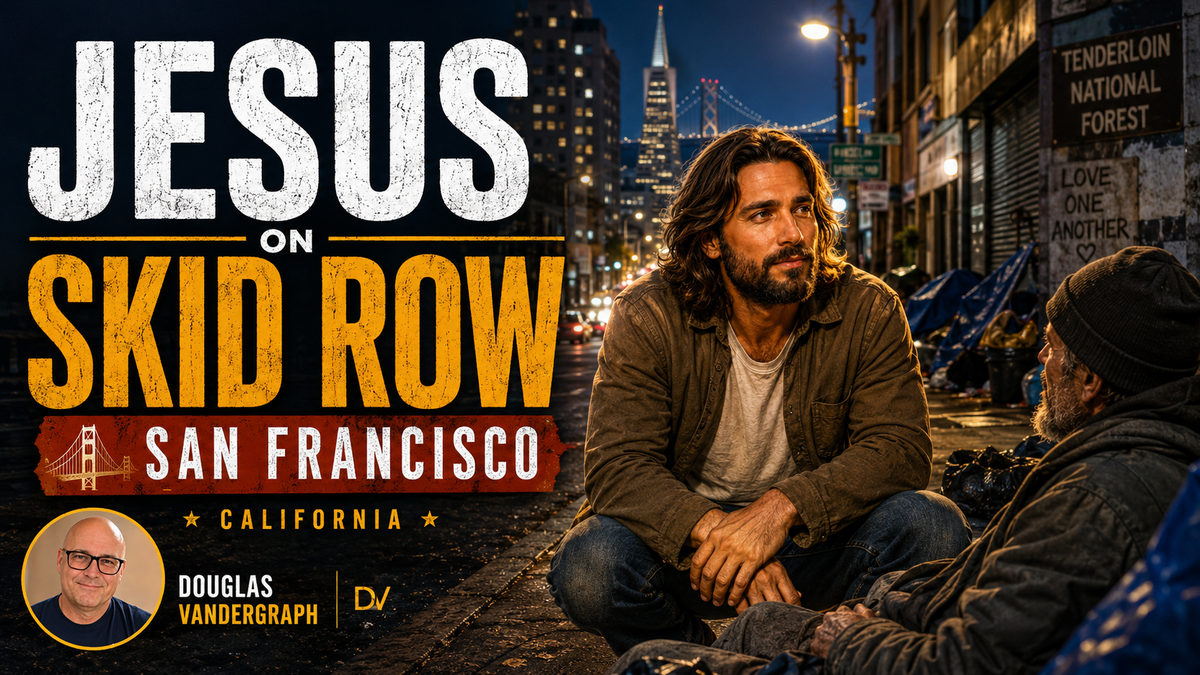
Chapter One: The Order Before Sunrise
Jesus knelt beneath the narrow shelter of a closed storefront on Sixth Street while the city still held its breath before morning. A thin mist clung to the pavement, and the streetlights made the wet concrete shine like old glass. A bus hissed at the curb near Market, then pulled away with only three passengers inside. Jesus prayed quietly with His hands folded, His head bowed, and His face calm in the cold air while the city around Him stirred with the restless sleep of people who had not found beds.
Across the street, Mateo Alvarez sat in a white city truck with the heater blowing against his knees and a work tablet glowing on the passenger seat. The order had come in at 4:12 a.m., marked urgent, tied to a mayor’s office walk-through scheduled later that morning. The location was a narrow wall behind a boarded storefront off Sixth, close enough to Market Street that cameras could find it and far enough from the bright office towers that most people pretended not to see it. His crew was supposed to remove a hand-painted wall of names before dawn, and someone in communications had already called it a public safety hazard. Mateo looked at the attached photo and saw rows of names written in black, blue, red, and silver paint, stacked like a prayer that had learned how to survive rain.
He had seen plenty of walls like that in San Francisco, but this one had become a problem because somebody had posted a video of it the night before. The caption said Jesus in Skid Row San Francisco California, and for some reason it had started spreading through phones faster than any clean-up notice or city statement ever could. Mateo did not care about viral posts, and he did not trust the way strangers used suffering to look tender online. Still, the video had caught one thing right. The wall was not trash. It was not simple graffiti. It was a memory made by people who had almost no other place to leave one.
The second note on the order made his stomach tighten. It said the wall had been tied by online viewers to the quiet streets where mercy still waited, which was exactly the kind of phrase people used when they did not have to decide what happened next. Mateo rubbed his thumb along the cracked edge of his travel mug. His job was not to weigh souls. His job was to make walls clean, sidewalks passable, and complaints disappear before they turned into reports. That was what he told himself as he reached for the radio and told his crew to stage at the alley entrance.
By 4:35, two other trucks had arrived. Lena Park, who had worked graffiti abatement for eleven years and had a laugh that could cut through fog, climbed out first and pulled her hood tight around her face. Devon Price followed in silence, carrying rollers, solvent, and a five-gallon bucket of gray paint that matched half the patched walls south of Market. Behind them came Tomas, the newest man on the crew, who still looked at every work order like it might contain a moral question. Mateo hated that about him, mostly because he used to be the same way before the city trained it out of him one early morning at a time.
Nobody spoke at first. The wall stood under a broken security light, half hidden by a metal roll-up gate and a fire escape that dripped old rain. There were names everywhere. Some had dates beside them. Some had no dates at all. Some were written carefully, as if the writer had taken a long time with each letter. Others looked rushed, scratched into the paint by a hand that had been cold or shaking. Beneath the names, someone had painted a pair of open hands. The hands were not perfect, but they were not careless. They looked worn, patient, and empty enough to receive whatever the city had dropped.
Lena let out a low breath. “They want this gone before eight?”
“Before seven,” Mateo said.
Devon put the bucket down too hard. “Of course they do.”
Tomas stepped closer to the wall, but Mateo stopped him with one hand. “Don’t touch anything yet.”
“I wasn’t going to,” Tomas said.
Mateo did not answer. He was staring at a name halfway down the wall, written in faded gold paint that had run slightly where rain had caught it. Rafael Alvarez. No date. No last words. Just the name. His brother had never used gold paint. Rafael had been a blue Sharpie man, a cardboard sign man, a back-of-the-receipt poet when he was sober enough to make the letters sit still. Mateo stared until the name blurred, then sharpened again. It could have been another Rafael Alvarez. San Francisco had enough people for two men to carry the same name into trouble, but Mateo knew the slant of the z. He knew the way Rafael had always made the lower loop too long, like the letter wanted to keep walking.
Lena noticed his face. “You all right?”
“Fine,” Mateo said too quickly.
She followed his eyes to the name. Her mouth softened, then she looked away with the kindness of someone who knew when not to witness too much. Devon busied himself with the ladder. Tomas kept reading the names, moving his lips without sound. A siren wailed somewhere up Market, then faded toward the Tenderloin. A man wrapped in two coats pushed a shopping cart past the alley and slowed when he saw the crew. He did not come in. He only watched, shoulders raised against the cold, as if waiting to see whether the city would erase someone he still loved.
Mateo turned from the wall and checked the tablet again, not because he needed to but because it gave his hands something to do. The order had language in it that sounded clean. Remove unauthorized markings. Restore surface to approved neutral finish. Document completion. It did not say erase Rafael. It did not say cover the only place where someone had cared enough to write down the names of people who died outside, vanished into hospitals, left town, lost their minds, or simply stopped being seen. The tablet did not ask whether a wall could become a kind of graveyard when nobody could afford stone.
“Mateo,” Lena said quietly.
He looked up. Jesus stood at the mouth of the alley.
No one had heard Him cross the street. He wore a dark coat, plain pants, and worn shoes with damp edges from the morning pavement. Nothing about His clothing demanded attention, but the air seemed to change around Him. The alley did not become bright. No music rose. The broken security light still flickered over the wall. Yet the crew went still as if something truthful had entered and every false reason for hurrying had lost its strength.
Jesus looked first at the wall, then at the names, then at Mateo.
“Good morning,” He said.
Mateo swallowed. “This is a restricted work area.”
Jesus did not move closer. He did not challenge him, and He did not step back. “Who is being protected?”
The question was simple enough that Mateo almost answered with the language from the order. Public safety. Pedestrian access. Blight removal. But those words fell apart before they reached his mouth. He looked toward Sixth Street, where the man with the shopping cart still watched from the curb. He looked at the bucket of gray paint. He looked at Rafael’s name. The heater from the truck had left warmth in his jacket, but the cold had found his hands.
“We have a job to do,” Mateo said.
Jesus nodded, as if the words mattered but did not settle the matter. “Yes.”
Tomas shifted his weight. Devon stared at Jesus with suspicion. Lena lowered her eyes, not in fear, but in the way people do when they sense they are near something bigger than their opinion. Mateo hated that he felt exposed. He had spent years building a hard line between what he saw and what he could carry. That line had kept him employed. It had kept him from breaking down at the sight of tents under freeway shadows, men sleeping in doorways near luxury coffee shops, women yelling at no one near Civic Center because no one had listened when they were still speaking plainly. That line had kept him moving.
“Do you live around here?” Mateo asked.
Jesus looked down Sixth Street, where trash skittered against a curb and the first soft blue of morning pressed behind the buildings. “I am here.”
“That doesn’t answer my question.”
“It answers enough for now.”
Devon gave a short laugh without humor. “Man, we don’t have time for this.”
Jesus turned toward him, and Devon’s expression changed. It was not fear exactly. It was more like recognition without memory. “You are tired,” Jesus said.
Devon’s jaw tightened. “Everybody’s tired.”
“Not everybody is angry at the people they are tired for.”
The alley went quiet. Devon looked ready to snap back, but he did not. He picked up the roller frame and turned away, though his hands were not as steady as before. Mateo felt anger rise in his own chest because Jesus had said what he had hidden in himself. He was tired too. Tired of calls, tired of complaints, tired of stepping over human misery with a clipboard in his hand, tired of people with clean shoes telling him to make hard streets look softer for an hour. He was tired of caring in small secret bursts that helped no one.
Lena cleared her throat. “Mateo, supervisor wants photos before removal.”
“Then take them,” Mateo said.
She lifted her phone, but not the city-issued camera. Mateo saw the difference and almost told her not to. Instead, he watched her photograph the whole wall, then Rafael’s name, then the painted hands. The man with the shopping cart rolled closer by a few feet. Two women appeared near the alley entrance, one wrapped in a red blanket, the other holding a paper cup with both hands. Nobody spoke. They seemed drawn by the threat of disappearance.
Mateo stepped toward Jesus. “Do you know who painted this?”
Jesus looked at the wall again. “Many hands.”
“That’s not an answer.”
“It is the truth.”
“Truth doesn’t help me close the work order.”
Jesus’ eyes returned to him. “No. It helps you see what the order cannot hold.”
Mateo felt his throat tighten, and that made him angry again. He did not want this stranger speaking in sentences that found the cracks in him. He did not want Rafael’s name on a wall before sunrise. He did not want the crew watching him try to act normal while his brother’s ghost stood between a bucket of gray paint and a government deadline. Rafael had been missing for thirteen months. Not officially missing, because grown men who used drugs and slept outside did not become missing in ways that made people search hard. They became absent. They became stories that ended with maybe.
The last time Mateo saw him had been outside the Powell Street station, near the cable car turnaround where tourists smiled for photos and Rafael sat against a pole with one shoe unlaced. Mateo had been in uniform. Rafael had called his name too loudly. People had turned. Mateo had walked over fast, not from love, but from embarrassment. He had given Rafael forty dollars and told him not to come near his job again. Rafael had laughed, then coughed, then said, “You clean walls now, little brother. Don’t let them make you clean your heart out too.” Mateo had told him to get help. Rafael had told him to stop using that word like a trash bag big enough to throw a person into.
That was the last clear memory. After that there were rumors. A hospital visit at Zuckerberg San Francisco General that might have been him. A man seen near the library. Someone who thought he had gone east. Someone else who said he was dead. Mateo had searched for three weekends and then stopped because stopping hurt less than failing. He told himself Rafael had chosen his life, but that was only half true. Rafael had made choices, yes, but the city had made some too. Their father had made some. Mateo had made some. Addiction had made its own cruel choices in Rafael’s blood before anybody had a chance to vote.
“Do you know Rafael Alvarez?” Mateo asked.
Jesus did not look at the name. He looked at Mateo. “Yes.”
The answer struck him harder than denial would have. Mateo stepped back once, then caught himself. Lena whispered his name, but he barely heard her.
“Where is he?” Mateo asked.
Jesus was silent.
“Where is he?” Mateo repeated, louder.
The man with the shopping cart lowered his head. One of the women crossed herself. Devon set the roller down. Tomas stood with both hands clenched at his sides, young enough to still believe every answer should arrive when pain demanded it. Jesus did not rush. His silence was not empty, but it was not easy. Mateo felt trapped inside it.
“Tell me,” Mateo said.
Jesus’ face held grief without helplessness. “You are asking where he is because you have not wanted to ask where you left him.”
Mateo moved before he knew he had moved. He stepped close enough that Devon started toward him, but Lena stopped Devon with a look. Mateo pointed toward the wall. “I didn’t leave him there. I didn’t put him on the street. I didn’t make him use. I didn’t make him lie to my mother. I didn’t make him steal from us.”
“No,” Jesus said.
“I tried.”
“Yes.”
“I gave him money. I found beds. I drove him places. I answered calls at two in the morning. I did everything until there was nothing left.”
Jesus’ voice stayed low. “You did many things.”
Mateo’s eyes burned. “Then don’t stand here and tell me I left him.”
Jesus looked toward the wall of names. “I am not here to condemn you for being wounded. I am here because you have learned to call numbness peace.”
The words landed so gently that Mateo could not defend himself against them. He turned away and faced the wall, breathing through his nose, trying to keep control. The city was waking now. Tires hissed over wet pavement. Someone shouted near Mission Street. A delivery truck backed into an alley with three sharp beeps. The smell of coffee drifted from somewhere beyond the block, mixing with urine, damp cardboard, and the chemical bite of solvent from Devon’s open container.
Lena walked toward Mateo and stood beside him without touching him. “We can ask for delay,” she said.
“They won’t give it.”
“We can ask.”
“You know what this is,” Mateo said. “They want it gone before the walk-through. They want photos after. They want clean edges and no questions.”
“Then make them answer questions.”
He gave a bitter laugh. “That’s not how this works.”
The man with the shopping cart spoke from the entrance. His voice was rough and thin. “Rafael wrote some of those.”
Mateo turned.
The man raised both hands, palms outward, as if he expected someone to accuse him of stealing air. He was older than he had first appeared, with gray in his beard and a knit cap pulled low. His cart was packed with blankets, bottles, a broken lamp, and a plastic crate full of books warped by rain. “Not his own name,” the man said. “He wouldn’t have done that. He wrote others. He had good letters when his hand wasn’t shaking.”
Mateo stared at him. “You knew my brother?”
The man nodded. “He shared cigarettes he didn’t have. Talked too much. Sang old songs wrong. Said he had a little brother with a city job and clean boots.”
Devon muttered, “Lord.”
Mateo ignored him. “When did you see him last?”
The man looked at Jesus, then back at Mateo. “Months ago. Maybe winter. Time goes funny out here.”
“Was he alive?”
The man’s face folded in pain. “He was alive when I saw him.”
Mateo wanted more. He wanted a date, a hospital, a direction, a final sentence, a clean answer that could be put in a file. Instead, the man looked past him to the wall.
“His name got put up last night,” he said. “Woman named Sela did it. She keeps names in a notebook. People tell her. Sometimes she knows. Sometimes she hopes she’s wrong.”
“Where is she?” Mateo asked.
“Gone before sunup most days.”
“Where?”
The man shrugged. “Near Jessie sometimes. Sometimes by the old theater side. Sometimes by the church line if she feels safe. She don’t like officials.”
“I’m not here as an official.”
The man looked at the city logo on Mateo’s jacket. He did not need to say anything.
Mateo pulled the jacket zipper down, then stopped because taking it off would not change what he was. He was the person with the authority to erase the wall. He was also the brother of a man whose name had appeared on it. Both truths stood there with him, and neither gave way.
His radio crackled. “Alvarez, status on Sixth Street removal?”
Mateo grabbed it from his belt. He watched Jesus while he answered. “On site. Documenting.”
“Removal started?”
“Not yet.”
A pause. “We need that completed before the scheduled walk.”
“Copy.”
“Send progress photo in fifteen.”
Mateo lowered the radio. Fifteen minutes. That was how much time the city had given a wall of names, his brother’s possible death, and a stranger who stood like mercy without asking permission. He looked at the crew. Devon would follow his call, angry or not. Lena would help him delay if he asked. Tomas would probably remember this morning for years, no matter what happened. The people at the alley entrance would remember too, because people remember the moment just before something they love is taken.
Jesus stepped closer to the painted hands. He did not touch the wall. He read the names in silence, moving His eyes slowly across them one by one. Mateo had seen officials glance at memorials before. They always read enough to appear human, then moved on. Jesus read as if no name was small, as if no misspelled word weakened the life behind it, as if heaven itself had leaned near to listen.
“Why are You here?” Mateo asked.
Jesus turned. “Because the city has learned to remove signs of pain faster than it learns to love the wounded.”
Mateo looked toward the street, toward the edge of morning where San Francisco appeared in pieces. There were towers not far away where people paid more for one month of rent than Rafael had held in his hand for most of a year. There were old hotels with narrow rooms and tired elevators. There were restaurants that washed their sidewalks before opening and alleys where people folded themselves into blankets. There were churches, clinics, bars, tech offices, bus stops, shelters, locked gates, and windows where nobody looked down. Mateo had driven through all of it before dawn so many times that the contradictions had become ordinary.
He turned to Lena. “Take full photos. Every name. Close enough to read.”
She nodded and began.
“Devon,” Mateo said. “Put the solvent away.”
Devon looked relieved and annoyed at once. “So we’re not doing it?”
“I didn’t say that.”
“What are we doing?”
Mateo did not know. The old Mateo, the trained Mateo, the one who survived by turning every crisis into steps, would have said they were pausing for documentation. But something had shifted. He felt as if he had been walking through the city with one eye closed for years, and now the closed eye had opened with pain in it.
“Tomas,” he said. “Get cones at both ends. Make sure nobody comes through and says they tripped.”
Tomas moved fast, grateful for a task that did not involve paint.
The woman in the red blanket stepped into the alley. “They’ll still paint it,” she said.
Mateo looked at her. She was young, maybe twenty-five, maybe forty. The street did that to faces. Her hair was tucked inside a hood, and one cheek had a small scar that caught the gray light. She held herself like someone used to being moved along.
“I don’t know yet,” Mateo said.
She laughed once. “That means yes.”
“No,” he said, surprising himself. “It means I don’t know yet.”
Jesus watched him with no pride, no pressure, no satisfied look that said Mateo had passed some hidden test. That unsettled him almost more than the question had. Jesus did not seem interested in winning an argument. He seemed interested in the truth that would remain after everybody stopped talking.
The woman pointed to a name near the bottom. “That one was my cousin.”
Mateo read it. Anika Bell.
“She had a laugh you could hear from a block away,” the woman said. “Got on everybody’s nerves. Then when she was gone, the block got too quiet.”
“I’m sorry,” Mateo said.
She looked at him, testing whether the words were real. “People say that when they want you to move.”
“I don’t want you to move.”
“You sure? That vest says different.”
Mateo almost defended himself. Instead, he looked down at the reflective strips on his jacket. “I’m not sure about much right now.”
That answer changed her face. Not much. Just enough.
Lena continued taking photos. Devon stood guard near the truck, arms folded. Tomas placed cones in the street, and a delivery driver cursed at him for blocking the alley. More people gathered, not many, but enough to make the space feel less like a work site and more like a waiting room where everyone feared the doctor would come out with bad news. Jesus remained near the wall. Sometimes He looked at the names. Sometimes He looked at the people. Sometimes He looked at Mateo as if He could see the boy he had been before Rafael became a wound.
Mateo’s phone buzzed. His supervisor, Camille Rhodes. He let it ring once, twice, three times, then answered.
“Tell me you’re almost done,” Camille said.
“We have a complication.”
“No, we do not have a complication. We have an unauthorized wall and a high-visibility visit in less than three hours.”
“There are names on it.”
“There are names on half the walls in this city.”
“One of them might be my brother’s.”
The line went quiet. Camille was not cruel. That made it harder. She had risen through departments by knowing when to care privately and when to obey publicly. Mateo had learned from her.
“I’m sorry,” she said, and for a moment she sounded like a person instead of a title. “But that does not change the order.”
“It changes mine.”
“Mateo.”
“I need time.”
“You have fifteen minutes.”
“I need until we identify who made the wall and whether these names are documented somewhere.”
“That is not our department.”
“Maybe it should be somebody’s department before we paint over it.”
Camille sighed. He could picture her in her car, parked somewhere near City Hall, coffee balanced in the cup holder, one hand pressed to her forehead. “Do not turn this into a protest.”
“I’m not.”
“It will become one if you let people gather.”
“They’re already people whether they gather or not.”
He did not know where that sentence came from. He looked at Jesus when he said it. Jesus was still.
Camille’s voice lowered. “Listen to me. Communications is nervous because that video made the wall look like some holy indictment of the city. They want it gone before anyone else turns it into a story.”
“It is already a story.”
“Everything is a story if you stare at it long enough. Our job is to keep the city moving.”
Mateo looked at the painted hands. “Maybe the city is moving over people.”
Another silence. “You’re too close to this.”
“Yes,” he said. “I am.”
That honesty seemed to leave Camille with no prepared answer. When she spoke again, her voice had changed. “What are you asking for?”
“Until noon.”
“You won’t get noon.”
“Then nine.”
“Mateo.”
“Give me nine.”
“For what?”
He looked at the man with the cart, the woman in the red blanket, Lena’s phone, Devon’s closed face, Tomas standing near the cones, and Jesus, who had begun to pray again without kneeling, His eyes lowered, His presence steady.
“To find Sela,” Mateo said.
“Sela who?”
“I don’t know yet.”
“That is not a plan.”
“It’s the only honest one I have.”
Camille exhaled. “I can give you until 7:30 if you send me documentation and keep the site clear.”
“That’s not enough.”
“It’s what I can do without putting both our jobs under a bus.”
Mateo almost said he did not care about his job. That would have been a lie. He cared. He had rent. He had a mother in Daly City whose prescriptions were not cheap. He had a daughter who needed braces and a school trip payment due Friday. He had a life built on showing up, wearing the jacket, getting the job done, and not letting Rafael’s chaos swallow everyone. He cared about his job very much. That was why this moment hurt.
“7:30,” he said.
“And Mateo?”
“Yeah.”
“If this becomes a scene, I never gave you that.”
The call ended.
Mateo lowered the phone and looked at the clock. Less than two hours. The sun had not risen fully, but the city had started its daily argument with itself. Street sweepers growled along curbs. A cyclist cut between cars with a delivery bag bouncing on his back. A man in a suit stepped around a sleeping body without slowing. A woman with a small dog crossed the street and stared at the wall with open discomfort, as if grief itself had violated zoning rules.
The man with the cart rolled closer. “Sela won’t talk if you bring a crowd.”
“I don’t need a crowd.”
“You got a truck, a vest, and two hours. That’s worse.”
“What’s your name?”
“Bernard.”
“Will she talk to you?”
Bernard rubbed his beard. “Maybe. If she’s not already gone.”
“Can you take me to her?”
Bernard looked at Jesus. It was a strange glance, quick but full of meaning, as if the decision had to pass through Him first. Jesus gave no command. He only looked at Bernard with patience.
Bernard nodded. “I can try.”
Lena stepped forward. “You want me to come?”
Mateo shook his head. “Stay with the wall. Keep documenting. Nobody paints unless I say it.”
Devon frowned. “And if they send another crew?”
“Call me.”
“And if they order us to start?”
Mateo zipped his jacket again, then unzipped it halfway because he could not stand the city seal against his throat. “Then don’t hear them clearly.”
Devon looked at him for a long moment, then gave the smallest nod. “Radio’s been bad all morning.”
Tomas smiled despite himself. Lena did not. She was looking at Mateo like she understood that something had begun that would not end with a simple delay.
Mateo turned toward Jesus. “Are You coming?”
Jesus stepped away from the wall. “Yes.”
Bernard pushed his cart out of the alley, wheels rattling over broken pavement. Mateo followed, and Jesus walked beside him without hurry. They moved toward Market Street as the morning opened around them. The city smelled of rain, diesel, coffee, old smoke, and the salt air that somehow found its way inland even through concrete. A bus sighed at the stop. A woman shouted at someone only she could see. Two men argued over a blanket near a doorway. Above them, office windows caught the first pale light and reflected a sky that looked cleaner than the street below it.
Mateo had walked these blocks many times, but never like this. Usually he moved as an employee, eyes scanning for hazards, tags, illegal dumping, blocked access, anything that could become a complaint. Now Bernard moved slowly enough that Mateo had to notice what his speed usually erased. A pair of socks drying over a railing. A paper plate with half a pastry left beside a sleeping man’s hand. A child’s pink hair clip lying in the gutter. A row of pigeons pecking near the curb where someone had spilled rice. Little things, human things, city things, all carrying the weight of lives that did not fit into reports.
“Rafael liked mornings,” Bernard said suddenly.
Mateo looked at him. “No, he didn’t.”
Bernard gave him a tired grin. “Out here he did. Said mornings were before everybody got disappointed again.”
Mateo almost smiled, but it hurt too much. “That sounds like him.”
“He talked about you.”
“I doubt that.”
“He did.”
“What did he say?”
Bernard pushed the cart around a pothole filled with dirty water. “Said you were the responsible one. Said you held your mother’s house together with both hands. Said he used up more mercy than one brother should ask for.”
Mateo looked away.
Bernard continued. “He also said you had a temper like a locked door.”
Jesus walked quietly between them and the curb. Mateo glanced at Him, expecting some comment, but Jesus said nothing. His silence gave the words room to do their work.
They crossed near Sixth as the signal changed, moving with a small wave of early workers, tired faces, backpacks, security badges, paper cups. Mateo felt exposed walking beside Bernard’s cart. He hated that feeling and hated himself for hating it. He wondered how many times Rafael had seen him from across a street and chosen not to call out. He wondered whether shame had worked both ways, passing between them like traffic neither could stop.
“Where are we going?” Mateo asked.
“Jessie first,” Bernard said. “She sometimes sleeps near the cut if nobody pushed her off.”
They turned into a narrower street where the city seemed to lower its voice. Old brick, metal doors, damp walls, a loading dock with graffiti layered over graffiti. Bernard stopped near a recessed doorway and looked around. “She was here yesterday.”
Mateo scanned the ground. There were flattened cardboard pieces, a green ribbon tied to a pipe, and a small pile of bottle caps arranged in a circle. No Sela. Bernard cursed softly.
Jesus crouched near the bottle caps. He did not touch them. “She marks where she has remembered someone.”
Bernard stared at Him. “You know her?”
Jesus stood. “Yes.”
Mateo felt that same unsettling pressure in his chest. “Do You know everyone?”
Jesus looked at him with deep sadness and deeper love. “Everyone who has been forgotten is not forgotten by My Father.”
Mateo could not answer. He looked away fast, pretending to study the alley. The words were too much, not because they were grand, but because they were simple enough to believe and painful enough to resist. If God had not forgotten Rafael, then Mateo could not keep hiding behind the idea that the whole thing was too lost to touch.
A voice came from behind a parked delivery van. “Bernard, why you bring them?”
A woman stepped into view holding a canvas bag against her chest. She was small, with sharp eyes and gray-streaked hair braided down one shoulder. Her coat was patched at both elbows, and one hand was wrapped in cloth. She looked at Mateo’s jacket first, then at Jesus, then back at Bernard with a hurt that looked older than the morning.
Bernard lifted his hands. “Sela, wait.”
“No.”
Mateo stepped forward. “I just need to ask about the wall.”
Sela’s eyes flashed. “You found it. That’s all there is.”
“They’re going to paint over it.”
“I know.”
“I’m trying to stop that.”
“No,” she said. “You’re trying to feel better before you do it.”
The sentence hit him clean. He had no defense ready because part of him feared she was right. Sela backed away, clutching the bag tighter. Jesus did not move toward her. He let her have the space she needed, and somehow that made her look at Him longer.
“Sela,” Jesus said.
Her face changed. Not softened. Not yet. It changed the way a locked room changes when someone outside speaks the name of a person inside who thought no one knew they were there.
“Don’t,” she whispered.
Jesus’ voice remained gentle. “You have carried many names.”
Sela’s mouth trembled once before she tightened it. “Somebody has to.”
Mateo looked at the bag. “Are they in there?”
She stepped back again.
“I’m not taking it,” he said. “I swear.”
“People swear when they want the thing in your hands.”
“I don’t want to take it.”
“You want proof. Then you want a copy. Then you want to decide which names count. Then you want to put it somewhere nobody has to see it.”
Mateo heard every institution she had ever met in those words. He heard desks, clipboards, intake windows, police reports, hospital bracelets, outreach logs, family promises, missing person forms that went nowhere, and the soft violence of being processed instead of known.
“My brother’s name is on that wall,” he said.
Sela froze.
“Rafael Alvarez,” Mateo said. “Someone wrote him in gold.”
Her grip on the bag loosened. “You’re Mateo.”
He could barely breathe. “You knew him?”
She looked toward Jesus, then down at the wet pavement. “He told me if a city truck ever came for the wall, I should look for the man who pretended not to care.”
Mateo flinched.
Bernard whispered, “Raf always did talk too sharp.”
Sela did not smile. “He gave me names. Not all, but many. He said names were heavier when they stayed inside one person. He wanted them somewhere the rain could touch.”
“Is he dead?” Mateo asked.
Sela closed her eyes.
The city seemed to keep moving without them. A truck door slammed. A gull cried somewhere above the buildings. Far off, a train rumbled beneath the street. Mateo waited for the answer with his whole body locked around it.
“I don’t know,” Sela said.
Mateo’s shoulders fell.
“I wrote his name because he asked me to if he disappeared,” she said. “He said disappearing was different from dying, but both needed a witness.”
Mateo pressed a hand over his mouth and turned away. Anger and grief rose together, tangled so tightly he could not separate them. Rafael would do that. Rafael would turn his own vanishing into a sentence that sounded half like a joke and half like a wound. Mateo wanted to curse him for it. He wanted to hug him. He wanted one more chance to stand outside Powell Station and not act ashamed.
Jesus stepped closer, not to Sela, but to Mateo. “Your brother wanted to be seen.”
Mateo wiped his face quickly. “He made that hard.”
“Yes.”
“He hurt people.”
“Yes.”
“He broke my mother.”
Jesus’ eyes held him. “And still he was more than the harm.”
Mateo breathed unevenly. He thought of his mother at the kitchen table in Daly City, sorting pills into a plastic organizer, pretending she did not look at the door every time footsteps passed outside. He thought of Rafael stealing her wedding ring, then returning it two weeks later in an envelope with no note. He thought of the night Mateo found him shaking behind a laundromat and held him until the ambulance came, both of them grown men and both of them boys again. More than the harm. The words did not erase anything. They made everything heavier and somehow more true.
Sela opened the canvas bag and pulled out a blue notebook wrapped in plastic. The cover was bent, and the corners were soft from weather. She held it like a living thing.
“This is not for the city,” she said.
Mateo nodded. “Okay.”
“I mean it.”
“I heard you.”
She studied him. “Rafael wrote in the back.”
Mateo’s chest tightened. “Can I see it?”
Sela looked at Jesus. “Should I trust him?”
Jesus answered, “Trust the truth working in him. Not because he is ready for all of it, but because he has stopped running from the first part.”
Mateo almost laughed through the pressure in his throat. It was such an honest mercy that it felt impossible. Sela opened the notebook near the back and held it out, not letting go. Mateo stepped close enough to read.
Rafael’s handwriting leaned across the page in blue ink.
If Mateo comes, tell him I knew he was tired. Tell him I was tired too. Tell him I was sorry before I knew how to stay sorry. Tell him not to paint over everybody just because he could not save me.
Mateo stared until the words became shapes and the shapes became water in his eyes.
Sela pulled the notebook back gently. “That was months ago.”
“Did he say where he was going?”
“North for a while. Maybe the park. Maybe nowhere. He talked like that.”
“Golden Gate Park?”
“Maybe. He said trees don’t ask questions.”
Bernard nodded faintly. “That sounds like Raf.”
Mateo looked at Jesus. “Is he alive?”
Jesus did not answer the way Mateo wanted. “Today, you have been given what is in front of you.”
“That’s not enough.”
“No,” Jesus said. “But it is true.”
Sela put the notebook away. “The wall has to stay.”
Mateo looked back toward Sixth, though the wall was out of sight. “They’ll send someone else.”
“Then stop them too.”
“I’m one crew lead.”
“You’re the one who came.”
He wanted to say he had come because of a work order, not courage. He wanted to say she did not understand how the city worked. Yet that was not true. Sela understood the city from the underside, which meant she knew parts of it Mateo had been paid not to feel. She knew how fast a place could remove evidence of suffering while calling it care. She knew what happened when names had no property owner, no approved plaque, no permit, no family with money, no clean story that made grief acceptable.
His phone buzzed again. Camille.
Mateo did not answer.
It buzzed a second time, then a third. Lena sent a text. Another crew just arrived. Supervisor not mine. Says they have orders.
Mateo read it and felt the morning tilt.
“We have to go,” he said.
Sela shoved the notebook into her bag and stepped back. “I’m coming.”
“No,” Mateo said. “If this turns into confrontation, they’ll use that.”
She gave him a hard look. “They already use everything.”
Jesus looked toward Sixth Street. “Come.”
There was no force in the word, but all of them moved. Bernard turned his cart with effort. Sela walked fast, her bag tight against her side. Mateo called Lena as they moved.
“Stall them,” he said.
“I am,” Lena answered. “But they’ve got a paint rig.”
“Who sent them?”
“Don’t know. Contractor maybe. They’re saying we’re relieved.”
“Do not let them touch the wall.”
“Mateo, there are four of them.”
He started to run.
Jesus did not run, yet somehow He did not fall behind.
They reached Market breathless, cutting through the edge of foot traffic as the morning thickened. Mateo heard shouting before he saw the alley. A box truck was parked at an angle near the cones, hazard lights blinking. Two men in paint-splattered coveralls were unloading equipment while another argued with Lena. Devon stood in front of the wall with his arms crossed. Tomas had placed himself beside him, pale but planted. The woman in the red blanket stood near the painted hands, and three more people had joined her. The wall of names waited behind them all.
Mateo pushed through. “Stop.”
The contractor turned, annoyed. “You Alvarez?”
“Yes.”
“We were told you were unable to complete.”
“You were told wrong.”
“We have authorization.”
“Show me.”
The man held up his phone, but Mateo did not look at it. He looked past him to the paint sprayer being rolled toward the wall.
“Pack it up,” Mateo said.
The contractor laughed. “Not happening.”
Devon stepped forward. “You heard him.”
The air sharpened. People on the sidewalk slowed. Phones appeared. Mateo understood at once how fast this could become the scene Camille had warned him about. One shove, one raised voice, one frightened person stepping wrong, and the story would no longer be about names. It would become about disorder, obstruction, public safety, crews unable to do their jobs. The wall would be painted by noon in the name of calming everyone down.
Jesus walked between Mateo and the contractor.
The contractor frowned. “Sir, move aside.”
Jesus looked at him. “Do you know what is written here?”
“I don’t need to.”
“You do.”
The man opened his mouth, but no words came. He looked at the wall for the first time as if it had become visible only when Jesus asked. Mateo watched his eyes move across the names. The irritation on his face did not vanish, but it weakened. He saw Anika. He saw Rafael. He saw the painted hands. He saw the woman in the red blanket standing beside a name with her whole body tense.
“We just got called,” the contractor said, quieter now.
Jesus nodded. “Then you can wait.”
The man looked uncomfortable. “I’ll get fined.”
Mateo said, “Put it on me.”
“Gladly.”
Camille’s city car pulled up hard at the curb, and the door opened before it fully stopped. She stepped out wearing a navy coat over work clothes, her hair pulled back, her face tight with the strain of someone who had hoped a problem would stay small and had arrived to find it breathing in public. She looked at the contractor, the gathered people, the phones, the wall, then Mateo.
“What did you do?” she asked.
“I found Sela.”
Sela lifted her chin but did not speak.
Camille lowered her voice. “This is not controlled.”
“No,” Mateo said. “It’s honest.”
“That is not the same thing.”
Jesus turned toward Camille. She met His eyes and seemed to forget the next sentence she had prepared. Mateo saw something pass across her face, something private and sudden. Camille was not a woman easily moved in public. She had survived too many meetings, too many angry calls, too many tragedies reduced to agenda items. Yet under Jesus’ gaze, her authority looked less like power and more like armor she was tired of wearing.
“Camille Rhodes,” Jesus said.
Her lips parted slightly. “Do I know You?”
“Yes.”
She looked shaken by the answer, though He had not explained it.
Jesus gestured toward the wall. “These are not obstacles to the city’s future.”
Camille looked at the names. “I know that.”
“Then do not act as if you do not know.”
Her eyes filled, but she blinked the tears back with practiced speed. “You don’t understand the pressure.”
Jesus’ voice was soft. “I carried the weight of a city that did not know the hour of its visitation.”
No one spoke. Mateo had heard Scripture before, but not like that. Not quoted. Not performed. Spoken as memory. The sentence seemed to make the alley larger than its walls, as if the grief of every city that had failed to recognize mercy had gathered there in the damp San Francisco morning.
Camille looked away first.
The contractor shifted his feet. “So what are we doing?”
Mateo answered before Camille could. “Nothing gets painted today.”
Camille turned sharply. “You do not have that authority.”
“Then give it to me.”
“I can’t.”
“Yes, you can. Temporary hold. Documentation review. Public art assessment. Memorial evaluation. Call it whatever keeps your phone quiet.”
“That is not how this process works.”
“Then make a better process for one morning.”
Her face hardened. “You think one wall fixes this?”
“No.”
“You think keeping names on a wall houses one person? Treats one addiction? Stops one overdose? Finds your brother?”
The words were harsh, but Mateo heard the fear beneath them. He stepped closer, lowering his voice. “No. But painting it before breakfast because a camera might see it does something too.”
Camille looked at him for a long time.
Sela spoke then, her voice carrying through the alley. “You all keep asking whether the wall fixes anything. Maybe it doesn’t. But it tells the truth that people were here. You keep fixing the city by making it forget faster.”
A bus rolled past behind them. Someone on the sidewalk whispered, “That’s right.” Another person raised a phone higher. Camille heard it and closed her eyes for half a second. When she opened them, she looked older.
Jesus stepped toward the wall and placed His hand gently on the painted hands. The gesture was so simple that everyone stopped moving. He did not bless the paint like an object. He did not perform grief for the cameras. He touched the wall the way a man might touch the shoulder of someone who had been standing too long alone.
Then He turned to Mateo. “What will you do with the authority you still have?”
Mateo looked at the city seal on his jacket. He thought authority meant permission from someone above him. He had lived that way for years. But he had authority over his hands. He had authority over whether the roller touched the wall. He had authority over whether he hid behind orders when mercy asked him to stand in the cost of seeing. He had authority over one small stretch of morning, and maybe that was not nothing.
He took the work tablet from the truck and opened the report field. His fingers hovered. The normal language waited in his head, polished and empty. Then he began to type.
Removal paused due to discovery of memorial wall containing names of deceased and missing residents, including possible immediate family connection to city employee. Site requires documentation, review, and preservation pending further determination. Painting over wall at this time may destroy community-held records not maintained elsewhere.
He read it once, then sent it before fear could edit him.
Camille’s phone buzzed seconds later. She looked down, read, and slowly looked back at him. “You just made this official.”
“Yes.”
“You understand what happens now?”
“No.”
“At least you’re honest.”
Mateo almost smiled.
Jesus looked down the wall again, and His eyes stopped on Rafael’s name. Mateo followed His gaze. The gold paint seemed less faded in the morning light. Not bright. Not clean. Just present.
Sela walked to the wall and stood beside Mateo. “He wasn’t always kind,” she said.
“I know.”
“He was funny when he wanted to be.”
“I know.”
“He was scared near the end. I think he knew he was slipping beyond where people could follow.”
Mateo swallowed hard. “Why didn’t he call me?”
Sela’s face softened with a sadness that had no easy answer. “Maybe he thought you had already followed as far as you could.”
Mateo’s eyes stayed on the name. The sentence did not heal him. It opened something. He had always imagined Rafael’s silence as accusation or selfishness. He had never considered that it might have been a broken kind of mercy from a man who did not trust himself not to pull his brother under again.
His radio crackled, but he did not answer. Camille’s phone began ringing, and she silenced it. The contractor stepped away to make his own call. Lena stood near the wall, arms folded, watching Mateo with wet eyes she pretended were from the cold. Devon looked at the ground. Tomas stared at Jesus like he had questions he was afraid to ask.
The woman in the red blanket touched Anika’s name with two fingers. Nobody stopped her.
Jesus turned from the wall and looked toward the rising city. Sunlight had reached the upper windows now, catching glass and metal while the street below remained shadowed. Mateo felt the unfairness of that light, but also the mercy of it. Light did not ask whether the pavement deserved it. It came anyway, touching what was high first, then working its way down.
“We still need Sela’s notebook documented,” Camille said, her voice careful. “Not taken. Not copied without consent. But if there are names here connected to missing persons, families should have a chance to know.”
Sela’s eyes narrowed. “Families like his?”
Camille nodded toward Mateo. “Yes. And others.”
“Who decides what happens to the wall?”
Camille looked at Mateo, then at Jesus, then back at Sela. “Not me alone.”
Sela gave a dry laugh. “That’s the first smart thing anybody official said today.”
A few people laughed softly, not because anything was funny enough, but because the morning had been too tight and something needed to release. Even Camille’s mouth moved slightly, though she fought it.
Mateo looked at Jesus. “What do I do if Rafael is dead?”
Jesus answered with no delay. “You grieve him truthfully.”
“And if he’s alive?”
“You love him without pretending love gives you control.”
Mateo nodded, though both answers frightened him.
“And the wall?” he asked.
Jesus looked at the names. “Let what is hidden be brought into the light without using the light to shame the wounded.”
Mateo did not fully understand, but he knew enough to know the morning had not ended. The wall was only the first door. Behind it were names, families, records, missing people, city departments, shame, anger, and maybe Rafael somewhere under trees or under concrete or under God’s eye in a place Mateo could not reach. The story had not been solved. It had been uncovered.
A gust of wind moved down the alley and lifted the corner of Sela’s coat. She pressed the canvas bag against her side and looked at Mateo as if deciding whether he was still dangerous. Maybe he was. Maybe people in power were always dangerous until they learned to kneel before something higher than their own authority.
Jesus stepped away from the wall and returned to the edge of the alley where the morning had first found Him. He bowed His head again, not as an escape from the conflict but as its deepest answer. Around Him, the city kept moving. Buses came and went. Phones rang. Orders traveled through invisible channels. People hurried past, some looking, some not. Mateo stood in the alley with his crew, his supervisor, the contractors, Sela, Bernard, and a small gathering of witnesses, and for the first time in years, he did not know how to make the moment smaller.
He only knew he could not paint over it.
When Jesus lifted His head, His eyes met Mateo’s once more.
“Come,” He said.
Mateo looked from Him to Rafael’s name, then to Sela’s guarded face and Camille’s troubled one. The wall would need protection. The report would bring consequences. The notebook would bring names. Rafael would bring a question that might not leave Mateo alone again. He felt the whole day opening in front of him like a street he had avoided for years.
This time, he followed.
Chapter Two: The Notebook Beneath the Blue Tarp
Jesus led them away from the alley without explaining where they were going. Mateo followed with the uneasy feeling that he had stepped out of the life he understood and into a morning that did not care about his schedule. Sela stayed close to Bernard, her canvas bag held tight against her ribs, while Camille walked a few steps behind them with her phone in her hand and fear in her face. Lena remained at the wall with Devon and Tomas, and Mateo kept looking back until the corner swallowed them from sight.
They crossed Sixth Street while the city thickened into workday noise. A Muni bus roared past with fogged windows and faces half-lit by phone screens. A man slept under a torn tarp near a doorway, one hand tucked inside his coat as if protecting the last warmth he had left. Two people argued near a trash can, then fell silent when Jesus passed them, not because He looked official, but because His presence made their anger feel too small for the sorrow underneath it.
Sela finally spoke when they reached Market Street. “If we go to where I think we’re going, he has to keep that jacket open.”
Mateo looked at her. “What?”
“The seal,” she said. “People see it before they see you. You want names, or you want everyone to scatter?”
Mateo glanced down at the city emblem on his chest. He wanted to tell her the jacket did not make him the enemy, but the sentence would have sounded thin in this part of the city. He unzipped it all the way and pulled the sides apart so the seal did not sit centered and proud. It was a small thing, almost nothing, but Sela noticed.
Camille noticed too. “You’re still on duty.”
“I know.”
“Then remember you represent the department.”
Mateo stopped at the corner, letting a line of commuters move around him. “That’s part of the problem, isn’t it?”
Camille’s mouth tightened, but she did not answer. She looked down Market toward Civic Center, where the morning light touched stone buildings that had seen protests, weddings, arguments, ceremonies, and broken people sleeping under their shadow. Mateo knew Camille had not come to this job empty. Nobody stayed long in city work unless they had made some private peace with disappointment. He wondered what she had buried beneath phrases like process, policy, and interdepartmental review.
Bernard pushed his cart along the curb with care. One wheel kept turning sideways, and every few feet he had to kick it straight. Jesus slowed to match his pace. Mateo expected Bernard to wave Him off, but the older man let Him walk near the bad wheel as if the simple act of not being hurried had become a kind of help.
Sela watched Jesus from the corner of her eye. “You always walk like this?”
Jesus looked at her. “Like what?”
“Like nobody can make You late.”
“I am never late to mercy.”
She gave a small, bitter breath. “Mercy missed a lot of appointments out here.”
Jesus did not correct her quickly. He let the words stand between them, rough and honest. “Many who used My name did not come when they should have come.”
Sela’s face changed, not into trust, but into something less guarded. “That’s true.”
“Yes,” Jesus said.
Mateo heard the exchange and felt a strange relief. Jesus did not defend every person who claimed Him. He did not make suffering smaller to protect a religious idea. Mateo had heard people talk about faith in ways that turned real pain into a lesson too fast, like grief was only useful if someone could pull a clean sentence out of it. Jesus did not do that. He walked inside the pain without rushing it into a shape that would make others comfortable.
They turned toward Jessie Street, then slipped into a pocket of the city where the buildings seemed to lean closer. The street was not empty, but people moved differently there. Some watched from doorways. Some lowered their heads. A woman in a heavy coat sat on an overturned crate and sorted through a plastic bag of medicine bottles. A young man with a swollen eye held a phone to his ear and said, “I told you I’m trying,” with the kind of desperation that made the word trying sound like his whole defense before the world.
Mateo knew the city by routes and work zones, but Sela knew it by invisible weather. She knew where people would talk and where they would not. She knew which corners made women uneasy after dark, which loading docks stayed dry, which security guards moved people gently and which ones enjoyed the moving. She pointed with her chin, never her finger. Mateo followed and realized that every block had a second map drawn beneath the official one.
They stopped near a blue tarp tied between a fence and the side of a building. The tarp sagged in the middle with old rainwater and fluttered at the edges. Beneath it sat three plastic bins, a milk crate, and a stack of cardboard weighted down with bricks. Sela looked around before she crouched. Bernard parked his cart in front of her, shielding her from the street with the pile of broken possessions that had somehow become his wall.
“This is not all of it,” Sela said. “The notebook you saw is the traveling one. The older names stay here unless I think the spot got found.”
Camille took one step closer. Sela looked up sharply.
“I’m not touching anything,” Camille said.
“No photos.”
Camille lowered her phone and put it in her coat pocket. “No photos.”
Sela studied her for another second, then lifted the corner of the tarp. Underneath was a metal cash box with no lock. It was wrapped in two grocery bags and tucked inside a cracked storage bin beneath a folded blanket. She removed it with both hands. Mateo saw the care in the movement and understood that this was not clutter to her. It was an archive built by a woman who owned almost nothing and still carried what the city had failed to keep.
Sela opened the box. Inside were notebooks, loose papers, folded envelopes, hospital bracelets, funeral cards, bus passes, photographs with bent corners, and scraps of cardboard with names written in different hands. Some names had dates. Some had only a location, like Turk near Hyde or bench by UN Plaza or last seen near the library. One paper had a child’s handwriting on it, large and uneven, and Mateo looked away before he could read it. The sight made his chest feel too tight.
Camille whispered, “How long have you kept this?”
Sela did not look at her. “Long enough.”
“Sela.”
“Don’t soften your voice like that. I know the voice. I heard it from nurses, cops, outreach teams, reporters, family members who came once and never came back, people with lanyards, people with clipboards, people who said they were sorry while their eyes looked past me.”
Camille accepted the words without defending herself. That surprised Mateo. Camille was good at defending herself. She could explain a policy until a room gave up from exhaustion. Now she stood in a damp side street with her phone in her pocket and let a woman with a guarded heart tell the truth about what official kindness often felt like from the ground.
Jesus crouched beside the tarp but did not reach for the box. “Why did you begin?”
Sela’s hands stilled over the papers. “A woman named Maureen died behind a dumpster near a restaurant that charged twenty-six dollars for toast.”
Bernard looked down.
Sela kept her eyes on the box. “She wasn’t old. People thought she was old because the street had taken her teeth and made her walk bent. She used to hum when she was scared. That morning nobody knew her last name, so the ambulance took her like an unnamed thing. I knew her last name. I had heard her say it once when she was angry. I wrote it down because I got scared that if I didn’t, the world would get away with calling her nobody.”
Jesus nodded slowly. “You became a witness.”
“I became tired,” she said. “Witness sounds clean. This is not clean.”
“No,” He said. “Love often touches what others refuse to touch.”
Sela’s eyes flicked up, and for a moment Mateo saw how worn she was. Her sharpness had protected her, but it had not rested her. She had carried names, but she had also carried the fear of losing the names, the fear of being called unstable, the fear of officials taking the box, the fear of families demanding answers she did not have. She had become a living record because the city had left empty space where remembrance should have been.
Mateo crouched a few feet away. “Can you show me Rafael’s page?”
Sela hesitated. Then she pulled the blue notebook from her bag and opened it near the back. “There’s more than what I showed you.”
Mateo braced himself, but no one can fully brace for the handwriting of someone they love after silence has turned that person into a question. Sela held the notebook so he could see without taking it. Rafael’s page had several entries, some written by him, others written by Sela around his words. There were names Mateo did not know. Jonah Reese. Marnie. Calvin from the yellow tent. A woman called Bird because she sang at the bus stop. Rafael had written beside one name, He owed me five dollars and I forgive him because I owed him seven.
Mateo let out a broken laugh that almost became a sob. “That’s him.”
Sela turned the page. “He wrote this later.”
The ink was darker, pressed harder into the paper.
If I go missing, do not let Mateo think this is his fault. He likes fault because it gives him something to carry. Tell him I was always running from more than him. Tell him I remembered the day he gave me his jacket when we were kids and lied to Mom that he lost it. Tell him I knew he loved me before he learned how to be mad all the time.
Mateo read the words once, then again. The street noise faded until all he heard was his own breathing. He remembered the jacket. He had been nine. Rafael had been twelve. It was raining hard after school in the Mission, and Rafael had forgotten his coat because he always forgot things their mother told him not to forget. Mateo had given him the jacket because Rafael was shivering, then told their mother he left it on the bus. Rafael had teased him for years about being a terrible liar, but Mateo had not known Rafael remembered it as love.
Camille looked away, giving him privacy that the street could not give. Bernard wiped his nose with his sleeve. Sela watched Mateo carefully, maybe expecting him to grab the notebook, maybe expecting him to fall apart. Jesus remained near, silent and steady.
Mateo touched the pavement with one hand to keep himself grounded. “Why didn’t you find me?”
Sela’s voice was quiet. “I tried once.”
He looked up.
“I called a number he gave me. A woman answered. She sounded tired. I hung up.”
“My mother.”
“I’m sorry.”
Mateo wanted to be angry, but the anger could not find a place to stand. “She would have wanted to know.”
“I know that now.”
“She wanted anything.”
Sela closed the notebook with care. “People out here learn not to bring pain to families unless we know what we’re bringing. Half the time we don’t know. We hear somebody died, then see them alive three weeks later. We hear somebody got clean, then find their shoes under a bridge. We hear a body had no ID, but nobody tells us enough to know who. I did not want to call your mother with smoke.”
Mateo sat back on his heels. He understood, and he hated understanding. It was easier when someone was clearly wrong. It was harder when everyone had been trying to survive with only pieces of the truth.
Camille crouched carefully, leaving space between herself and the box. “Sela, some of these names might connect to open missing person reports.”
Sela’s face closed. “There it is.”
“I’m not asking to take them.”
“You want the data.”
“I want families to have a chance.”
“You want a spreadsheet.”
Camille flinched. Mateo saw that one land. He had sat in rooms where names became columns. He had watched tragedy become case numbers because numbers could travel through systems better than grief. Still, Camille was not wrong. Some families might be waiting. Some names might open doors. The question was whether opening those doors would honor the people or swallow them into another machine.
Jesus looked at Camille. “What would you do if she trusted you?”
Camille did not answer quickly. Her face showed the strain of someone being pulled out from behind her practiced language. “I would try to create a protected record. Community-held, not seized. Voluntary. Names would not be published without consent. Families could submit inquiries. The wall would not be erased while review is pending.”
Sela gave a sharp laugh. “You just built a whole office with your mouth.”
Camille’s cheeks colored. “Maybe. But I know people who could help.”
“People with badges?”
“Some.”
“No.”
“People from the medical examiner’s office?”
“No.”
“Public defender outreach?”
“No.”
Camille stopped herself. Jesus watched her, and Mateo saw the moment she understood that she was naming institutions before trust. She lowered her eyes.
“What kind of person would you allow near the names?” Jesus asked Sela.
Sela looked at Him as if the question had found the place where her anger and longing met. “Someone who does not hurry. Someone who does not treat people like a problem to solve. Someone who can hear a story without needing it to sound respectable. Someone who knows that some people loved badly and were loved badly, but that does not mean they should disappear.”
Camille nodded slowly. “Then that is where we start.”
Sela did not soften, but she did not close the box either. That was its own kind of opening.
Mateo’s radio came alive again. Lena’s voice cracked through. “Mateo, you need to get back here.”
He stood too fast. “What happened?”
“News van just pulled up. Not one of the big ones. Local online thing. Contractor called somebody. Camille’s office is calling her nonstop. The wall’s becoming a crowd.”
Camille pulled out her phone and saw the missed calls. Her face tightened. “We should go.”
Sela grabbed the box and shoved the notebooks back inside. “No, you should not. If cameras are there, the names turn into content.”
Mateo looked toward Market. He felt the truth of that. The video from the night before had brought attention that delayed the paint, but attention was a dangerous mercy. It could protect people in one breath and use them in the next. The wall could become a backdrop for strangers to perform sadness. Rafael’s name could become a clip, a caption, a symbol for people who had never heard him sing wrong lyrics in a doorway.
Jesus stood. “The wall must be guarded from erasure and from vanity.”
Bernard nodded. “That’s a narrow road.”
“Yes,” Jesus said. “Most roads of mercy are.”
They packed quickly. Sela wrapped the box again and slid it into Bernard’s cart beneath a blanket and two warped books. Mateo noticed one book was a water-damaged Bible with the cover nearly gone. Another was a city maintenance manual from the 1990s. Bernard caught him looking and smiled faintly.
“Found both in trash,” Bernard said. “One tells you how things ought to be fixed. One tells you why they broke.”
Mateo would have laughed on another day. Instead, he walked beside them back toward Sixth with his mind crowded by Rafael’s handwriting. He could feel the story shifting inside him. Rafael was no longer only missing. He was connected to the names, to Sela, to the wall, to an act of remembrance Mateo had been sent to destroy. That did not make his brother noble in some simple way. Rafael had hurt people, lied, stolen, vanished, and left wounds behind. But he had also written names so others would not vanish. The truth was not clean, and maybe that was why it finally felt real.
When they neared the alley, Mateo saw the crowd had doubled. Not large enough to block the whole street, but large enough to make officials nervous. Two phones were mounted on small tripods. A young reporter in a tan coat stood near the curb practicing a serious face while her camera operator framed the wall behind her. The contractor crew waited by the box truck, irritated and uncertain. Lena stood like a guard at the mouth of the alley, while Devon kept his body between the paint rig and the wall. Tomas was speaking quietly to the woman in the red blanket, who now had a name. Her name was Clarice, and Mateo heard it as he approached.
The reporter turned when she saw Camille. “Deputy Rhodes, can you comment on why the city attempted to remove a memorial wall in the Sixth Street corridor before public review?”
Camille stopped walking.
Mateo could almost see her old instincts forming. She would say they were reviewing the matter. She would say the city cared deeply. She would say unauthorized markings created complex challenges. She would say nothing false and nothing alive. Then Jesus stepped beside her, not in front of her, and she looked at Him once.
Camille faced the camera. “The removal is paused.”
The reporter leaned forward. “Paused for how long?”
“Long enough to listen to the people connected to these names.”
The words surprised everyone, including Camille. Mateo saw it on her face. She had not planned them. They were too plain to sound like a statement.
The reporter tried again. “Was the city aware that this wall may contain names of unhoused residents who died or went missing?”
Camille looked at the wall. “Not enough.”
“That means yes?”
“It means not enough,” Camille said. “And that is part of what needs to change.”
The camera operator lowered the camera slightly, then raised it again when the reporter gave him a sharp look. The crowd murmured. Sela stood behind Bernard’s cart, half-hidden, watching Camille with suspicion that had gained a thin edge of interest.
The reporter noticed Jesus next. Her eyes moved over Him, trying to place Him into a category. “Sir, are you affiliated with the memorial?”
Jesus looked at her. “Yes.”
Mateo felt the whole alley hold still.
“With what organization?” she asked.
“With the mourning.”
The reporter blinked. “Can you clarify that?”
Jesus’ face was calm. “No one belongs to an organization before they belong to God.”
The sentence passed through the crowd in a way Mateo could almost feel. Some people looked down. Others looked at the wall. Clarice pressed the red blanket closer around her shoulders. Bernard closed his eyes, and his lips moved as if he were repeating the words so they would not be taken from him.
The reporter hesitated, then turned back to Camille because Camille fit the shape of news better. “What happens now?”
Camille looked at Mateo. He did not know why she looked at him, and yet he did. He had made the report official. He had found Sela. His brother’s name was on the wall. He was no longer just a crew lead. He was a witness with a city badge and a wound that would not let him pretend neutrality.
Mateo stepped beside her. “The wall stays today.”
The reporter asked, “And after today?”
“We build a way for the names to be reviewed without taking them from the people who kept them.”
“Who is we?”
Mateo looked at Sela, then Camille, then Lena, Devon, Tomas, Bernard, Clarice, and finally Jesus. “That’s what we have to find out.”
It was not a polished answer. It would probably make Camille’s day harder. But it was honest, and honesty felt like the only ground solid enough to stand on.
The reporter shifted toward him. “Is it true one of the names is your brother?”
Mateo’s body tightened. He had not said that publicly. Maybe the contractor had heard. Maybe someone from the crowd had repeated it. Maybe the wall had already become the kind of story that fed on private pain. His first instinct was to shut down.
Jesus looked at him, not commanding, not rescuing.
Mateo breathed once. “Yes.”
“Do you believe he is dead?”
The question was too sharp. Lena made a sound of protest. Camille started to interrupt, but Mateo raised one hand.
“I don’t know,” he said. “And I need people to understand what that means. There are families in this city living with I don’t know. There are people outside who carry answers nobody asks for. There are names written on walls because no office had room for them. My brother is one name. He is not the only one.”
The reporter lowered the microphone a little. Something human broke through her practiced expression. “What was his name?”
Mateo turned toward the wall. “Rafael Alvarez.”
Clarice stepped aside so the camera could see the gold letters, then seemed to regret making space for it. She looked at Mateo as if asking whether it was all right. Mateo nodded once, though he was not sure. The camera moved slowly over the name, and Mateo felt both exposed and grateful. His brother’s name was being seen. His brother’s name was being used. Both were true.
Sela moved close to him and spoke low. “Do not let them make Rafael the whole wall.”
“I won’t.”
“I mean it.”
“I heard you.”
She looked toward the reporter. “They love one clean face for a dirty thing.”
Mateo nodded. “Then we won’t give them one.”
Camille’s phone rang again. This time she answered and stepped toward the curb. Mateo could hear only pieces. Yes. I am on site. No removal today. Because I made the call. Then silence. Her shoulders stiffened. I understand. Yes, I understand the consequences. She ended the call and stood for a moment facing the street.
Mateo walked over. “Bad?”
“Very.”
“I’m sorry.”
“No, you’re not.”
He almost smiled. “Not completely.”
Camille looked back at the wall. “They want me downtown in an hour.”
“What will you tell them?”
She gave a tired breath. “That a wall embarrassed us because it told the truth.”
“That will go well.”
“No,” she said. “It will not.”
Jesus approached them. “Do not fear losing what keeps you from becoming truthful.”
Camille looked at Him with a pain Mateo had not expected. “Some of us have people depending on us.”
“Yes,” Jesus said. “And some of them need more than your position. They need your soul not to be purchased by it.”
Camille’s eyes shone. She looked away quickly, but the words had entered her. Mateo knew because they had entered him too. He had told himself for years that responsibility meant doing what the system required so his family could stay safe. That was partly true. But responsibility had also become his hiding place. He had protected his paycheck while letting parts of himself go silent.
Sela came toward them with Bernard close behind. “If you go downtown, they’ll separate you from us and talk until the wall is gone.”
Camille shook her head. “I won’t authorize removal.”
“They don’t need you if they find somebody else.”
Mateo knew she was right. The machinery of a city did not stop because one person felt convicted. It rerouted. It renamed. It found another signature.
“Then we need something stronger than a pause,” Mateo said.
Camille looked at the crowd. “An emergency cultural review might buy time, but this is not registered public art. It is on private property, and the owner has complained before.”
“Who owns it?”
Camille checked her memory, then her phone. “A holding company. Building has been vacant for years. Code complaints, unpaid fees, rotating management contacts. It’s one of those properties everyone knows about and nobody seems to own when responsibility comes due.”
Sela laughed without humor. “Of course. Empty building gets more legal protection than dead people.”
Mateo looked at the boarded storefront. The wall was part of a building that had given nothing to the block for years except shadow, peeling paint, and a place for people to lean when they could no longer stand. Yet the property owner had power. The names did not. That imbalance suddenly seemed like the whole city in one wall.
Jesus walked to the center of the alley. The crowd quieted, not all at once, but gradually, like rain easing. He looked at the boarded windows, the painted names, the contractors, the city workers, the reporter, the people wrapped in blankets, the supervisor with calls waiting, and Mateo with Rafael’s handwriting still burning in his mind.
“What belongs to a man when he owns a wall but refuses to see those who die beside it?” Jesus asked.
No one answered. The question was not aimed at one person. It moved through all of them. Mateo thought of ownership, permits, liability, complaints, city codes, and the legal language that could make a vacant building sound more real than a dead woman named Anika. He thought of Rafael writing names while knowing his own might soon need to be written.
The contractor who had challenged them earlier rubbed the back of his neck. “Look, I don’t want to paint it now.”
His coworker stared at him. “Man.”
“I don’t,” he said. “You paint it then.”
The coworker looked at the wall and did not move.
Camille took that opening. “I’m issuing a temporary field suspension pending review.”
“Can you do that?” Mateo asked.
“Not cleanly.”
“Will it hold?”
“For today. Maybe tomorrow if I write fast and nobody above me wants the headline.”
Sela’s eyes narrowed. “And after tomorrow?”
Camille looked at her. “Then we need public pressure, property pressure, and a record that does not depend on one person’s good mood.”
“Now you sound honest,” Sela said.
“I’m learning.”
Bernard chuckled softly. “Everybody learning before breakfast.”
The small laugh that moved through the alley did not erase the seriousness, but it made room for breath. Mateo saw Devon relax for the first time. Tomas leaned against a cone as if his legs had remembered they were young. Lena wiped her eyes openly now and did not pretend it was the cold.
Then a woman pushed through the edge of the crowd, frantic and angry. “Who wrote Lionel Brooks?”
The alley went still again.
She was in her fifties, dressed in a black work uniform from one of the hotels near Union Square. Her hair was pulled back tight, and her eyes were red in a way that made Mateo think she had either been crying or had not slept. She pointed toward the wall with a shaking hand. “Who wrote Lionel Brooks up there?”
Sela’s face changed. “Who are you?”
“I’m his sister.”
The reporter turned fast, but Camille stepped in front of the camera. “Give her space.”
The woman pushed past Camille anyway. “Who wrote his name? Who said he was dead?”
Sela looked trapped. Bernard placed one hand on the cart. Mateo felt the fragile shape of the morning begin to tremble. The wall was no longer only about preservation. It was about the danger of writing a name before the whole truth was known. It was about families finding grief in public before anyone had held them through it. It was about memory and rumor standing too close together.
Jesus walked toward the woman, stopping a respectful distance away. “What is your name?”
She looked at Him fiercely. “Denise.”
“Denise,” He said, and her anger faltered under the sound of her own name spoken with care. “You love your brother.”
Her face twisted. “Don’t talk to me like you know me.”
“I know love when it arrives wounded.”
She covered her mouth, but only for a moment. “He called me last week. Lionel called me last week. So why is his name on that wall?”
Everyone looked at Sela. Sela’s lips parted, but no answer came. Her hand went to the canvas bag, then fell away.
Mateo understood then that the wall, for all its beauty and truth, also carried risk. A name could honor. A name could wound. A name could accuse the living of being gone before they were ready to be found. Rafael had asked for his name to be written if he disappeared. Maybe Lionel had not. The city had failed these people, but love could still make mistakes while trying to repair what failure left behind.
Denise stepped toward Sela. “Was it you?”
Sela’s voice was thin. “Someone told me he passed near the station.”
“Someone told you?” Denise nearly shouted. “Someone told you, and you put my brother on a death wall?”
“He had been gone from where he slept. People said—”
“People say anything out here.”
“I know.”
“Then why?”
Sela’s face crumpled for the first time. “Because if I wait for proof, some people never get remembered at all.”
Denise stared at her, breathing hard. The anger in her face did not vanish, but Mateo saw the pain behind it widen. She looked at the names again, then back at Sela. “You had no right.”
Sela lowered her head. “Maybe not.”
The admission did what defensiveness could not. Denise’s shoulders shook once. She turned toward the wall and found Lionel’s name. It was written in black near the lower right side. She touched it with two fingers, then pulled her hand back as if the paint had burned her.
“He is alive,” she said, though her voice broke on the last word. “He is alive until God says otherwise.”
Jesus came beside her. “Yes.”
Denise looked at Him through tears. “I can’t find him.”
“I know.”
“He was good before he got sick. People need to know he was good.”
Jesus’ eyes held sorrow and strength together. “He is not only what happened to him.”
Mateo heard the echo of what Jesus had said about Rafael. More than the harm. Not only what happened to him. The same mercy, shaped for another wound.
Denise looked at Sela. “Take his name down.”
Sela nodded quickly. “I will.”
“No,” Jesus said.
Every face turned toward Him.
Denise stiffened. “What?”
Jesus looked at the wall, then at Denise. “Do not erase him. Correct the witness.”
Sela wiped her face with the back of her hand. “How?”
Jesus stepped to the wall and pointed to the space beneath Lionel’s name. “Write that he is loved, missing, and being sought. Let the truth be more careful than fear.”
Denise stared at the wall. Her breathing slowed. Mateo saw the shift in her, not acceptance exactly, but the first opening of a different kind of grief. Lionel’s name did not have to mean dead. It could mean sought. It could mean his sister had found one more place to say he mattered.
Sela reached into her bag and pulled out a black marker. Her hand shook as she offered it to Denise. “You write it.”
Denise took the marker. For a long moment she stood frozen before the wall. Then she bent and wrote beneath Lionel’s name in careful letters.
Alive when last heard. Loved by Denise. Please tell him to call home.
The whole alley seemed to breathe differently after that. The correction did not weaken the wall. It made it more truthful. Mateo felt the story turn again, and this time he understood the movement. The wall could not be protected as a perfect thing. It had to become a living witness, humble enough to be corrected, strong enough not to be erased, and honest enough to carry uncertainty without pretending uncertainty was the same as nothing.
Camille watched Denise cap the marker. “This changes the review.”
Sela looked at her warily. “How?”
“It means the wall is not just memorial. It is also a missing persons witness, but informal and vulnerable to error. That makes preservation more urgent and more complicated.”
“Complicated is what officials say before they take something.”
“Sometimes,” Camille said. “Today it is what I say because the truth deserves more care than a paint roller.”
Sela held her gaze. Something passed between them that was not trust yet, but might one day become the road toward it.
Mateo’s phone buzzed again. This time it was his mother. He stared at the screen, and all the noise around him seemed to draw back. She rarely called this early unless something was wrong or unless she had felt something in that way mothers sometimes did. The name on the screen made Rafael’s handwriting rise in him again.
He answered and stepped toward the curb. “Mom?”
Her voice was thin. “Mateo, are you working?”
“Yes.”
“Are you near Market?”
He closed his eyes. “Yes.”
“I saw a video. Someone from church sent it. They said there is a wall.”
Mateo turned and looked at Rafael’s name. “Mom.”
“Is your brother’s name on it?”
He could not lie. Not now. “Yes.”
She made a sound he had never heard from her before, not quite a cry, not quite a breath. He gripped the phone harder.
“It doesn’t mean he’s dead,” he said quickly. “Listen to me. It does not mean that. I found someone who knew him. He wrote something. He wanted us to know he was sorry.”
His mother was silent so long he thought the call had dropped.
Then she whispered, “He is alive?”
“I don’t know.”
The truth hurt, but he gave it cleanly. He would not cover pain with false comfort. Not after this morning.
“I want to come,” she said.
“No. Not yet.”
“He is my son.”
“I know.”
“Do not tell me not yet.”
Mateo looked toward Jesus. Jesus was watching Denise, who still stood near Lionel’s corrected name. He was not close enough to hear the phone, yet Mateo felt known.
Mateo spoke softly. “Then come to Sixth, but call me when you get close. Do not come into the crowd alone.”
His mother began to cry. “I prayed last night. I told God I was angry because I did not know where my child was.”
Mateo’s eyes filled again. “I know.”
“No, you don’t. You are angry like your father. I am angry like a mother.”
The words almost broke him because they were true. “I’ll be here.”
“Don’t let them paint him away.”
“I won’t.”
The call ended, and Mateo stood with the phone in his hand while traffic moved past him like the city did not know his life had changed. When he turned back, Jesus was there.
“My mother is coming,” Mateo said.
Jesus nodded.
“I don’t know what to give her.”
“Give her the truth you have. Do not invent the truth you want.”
Mateo looked down. “She’s going to break.”
Jesus’ voice was gentle. “She has been breaking for a long time. Today she will not break alone.”
Mateo breathed in, but it shook. He wanted to be strong before his mother arrived. He wanted to be the son who handled everything, the employee who controlled the scene, the brother who found answers, the man who did not tremble in public. Jesus seemed to see every layer of that wanting and every fear beneath it.
“You do not have to hold everyone together by becoming stone,” Jesus said.
Mateo looked at Him. “Then what do I become?”
Jesus glanced toward the wall, where Rafael’s name waited among all the others. “A son who tells the truth. A brother who grieves without hiding. A man who uses his hands differently than he planned.”
Mateo looked at his hands. They were rough, paint-stained at the edges from years of work, marked by solvent, cold mornings, steering wheels, tools, and the small scars of ordinary labor. That morning they had been ready to cover names. Now he did not know what they were for, but he knew they could not return unchanged.
Behind them, Denise sat on the curb with Clarice beside her. Sela stood near the wall, holding the marker like it weighed more than metal. Camille was on another call, this time speaking with less fear and more force. Lena had begun organizing people who wanted to add corrections or dates, making them wait instead of crowding the wall. Devon had moved the paint rig back toward the contractor’s truck. Tomas was taking notes on scrap cardboard because nobody had given him official paper and he did not want to stop.
The wall had not become peaceful. It had become truthful, which was harder. It now held grief, argument, correction, uncertainty, memory, and the first fragile shape of responsibility. Mateo saw that the wall was not asking to be admired. It was asking the city to stop lying about what it had learned to ignore.
A silver sedan pulled up too fast near the curb, and Mateo’s mother stepped out before the driver could fully stop. She was small, with a black coat buttoned wrong and gray hair pinned in a hurry. Her name was Elena, and she carried a rosary wrapped around one hand like she had been holding it the whole ride. Mateo moved toward her, but she walked past him at first, eyes fixed on the wall.
She stopped in front of Rafael’s name.
No one spoke.
Mateo came beside her, but not too close. He knew his mother’s grief had its own space, and he had no right to crowd it. She lifted one hand toward the gold letters, but her fingers stopped before touching them. Her lips moved silently. Maybe she was praying. Maybe she was saying Rafael’s name in the private language only a mother can speak.
Jesus stood a few steps away, head lowered, giving her the dignity of being seen without being watched too closely.
Elena finally touched the wall.
“My son,” she said.
Mateo looked down because he could not bear the sound of it.
His mother turned to him then. “Who wrote this?”
“Sela kept the names,” he said. “Rafael asked her to write his if he disappeared.”
Elena looked toward Sela. The two women studied each other across the small space between worlds that should have met long before a wall forced them to. Sela lowered her eyes first.
“I’m sorry,” Sela said.
Elena walked to her. Mateo tensed, unsure whether his mother would slap her or embrace her or demand every answer Sela did not have. Instead, Elena took Sela’s wrapped hand gently between both of hers.
“You knew my boy when I could not find him,” Elena said.
Sela’s face broke. “I knew pieces.”
“Then give me the pieces.”
Sela nodded, crying now without hiding it. “I will.”
Mateo turned away, overwhelmed by the sight of the two women holding the same wound from opposite sides. Jesus looked at him, and Mateo understood without words that mercy had not solved the pain. It had brought the hidden pieces into the same morning.
Camille stepped closer, her phone lowered. “Mateo, I bought us seventy-two hours.”
He looked at her. “How?”
“Emergency preservation review. Temporary suspension. Public documentation hold. I used every boring phrase I know.”
“Will it stick?”
“For seventy-two hours, probably. After that, the owner’s attorneys may push back hard.”
Sela wiped her face. “Seventy-two hours is not much.”
“No,” Camille said. “But it is not gray paint before breakfast.”
Bernard nodded. “That is something.”
Jesus looked toward the sky between the buildings. The sun had risen higher now, but the alley still held shadow. Mateo watched the light touch the upper edge of the wall, then slowly move down toward the names. He thought of what he had felt earlier, that light reached the high places first and then worked its way down. Now he wondered whether mercy sometimes did the same, touching what was visible before entering what had been hidden.
His mother stood before Rafael’s name again, this time with Sela beside her. Denise remained near Lionel’s corrected line. Clarice had started telling Lena about Anika’s laugh. Devon was pretending not to listen while listening to every word. Tomas wrote carefully, his young face serious with the burden of realizing a name could be mishandled even by kindness.
Mateo felt the shape of the next seventy-two hours forming, and it was larger than he wanted. They would need to protect the wall, verify names, correct errors, involve families, keep cameras from feeding on grief, and find a way to search for Rafael without turning Sela’s whole world over to the city. He would have to speak to people above Camille. He would have to face his mother’s questions. He would have to decide whether finding his brother meant reopening every place inside him he had sealed shut.
Jesus stepped beside him.
“You asked what you were to do with the authority you still had,” Jesus said.
Mateo looked at the wall. “I don’t think I have enough.”
“You have enough for obedience today.”
“And tomorrow?”
Jesus’ eyes rested on Rafael’s name, then on the corrected line beneath Lionel’s. “Tomorrow will ask for its own courage.”
Mateo nodded slowly. The answer did not give him a plan, but it gave him ground. For years he had tried to survive by seeing only what he could manage. This morning had shown him something different. He could see more than he could control and still not run away.
A gust moved through the alley and lifted a loose corner of the tarp near Bernard’s cart. Sela noticed and went to secure it, but Elena stopped her gently.
“I will help,” Mateo’s mother said.
Sela hesitated, then handed her the twine.
Mateo watched them kneel together beside the cart where the notebooks were hidden. His mother, who had spent thirteen months praying into silence, tied a knot to protect the names of people she had never met. Sela held the tarp steady. Bernard stood guard. Camille faced another call. Lena kept the crowd calm. Jesus looked over all of them with a sorrow that did not weaken His peace.
For the first time since Rafael vanished, Mateo felt that searching for his brother might mean more than finding out whether he was alive or dead. It might mean finding the part of himself that had disappeared too, the part that had once given away a jacket in the rain without needing anybody to call it love. He did not know how far the road would go. He only knew it had begun on a wet San Francisco morning, beside a wall he had been ordered to erase and could no longer pretend not to see.
Chapter Three: The Man Who Owned the Empty Windows
By late morning, the wall had become too visible to belong only to the alley. People came in slow waves, some because they had seen the video, some because a friend had called, and some because they had heard a name was written there and could not stay away. Mateo stood near the entrance with a city radio on his belt and his jacket hanging open, caught between the people who wanted answers and the department that wanted the situation contained. Every few minutes, someone tried to turn the wall into something simpler than it was, and every few minutes the wall refused.
Jesus remained near the painted hands, quiet enough that a person could miss Him at first and steady enough that no one who truly looked at Him could look away quickly. He did not manage the crowd. He did not direct Camille, correct Sela, or tell Mateo how to speak to his mother. He simply stayed where the truth had been uncovered, and His presence seemed to keep the morning from collapsing into noise. People lowered their voices near Him without knowing why.
Elena sat on a low concrete ledge beside Sela’s cart, holding the blue notebook in both hands while Sela watched closely. Sela had allowed her to read Rafael’s words, but not alone, and Elena had accepted that condition without offense. She read slowly, her lips moving over each line, and sometimes she stopped to press the page lightly with her fingertips. Mateo had seen his mother cry many times since Rafael disappeared, but this was different. These tears did not come from the empty place of not knowing. They came from contact, from words that had survived long enough to reach her.
“He remembered the jacket,” Elena said.
Mateo stood a few feet away. “Yes.”
“You told me you lost it on the bus.”
“I know.”
“You were a bad liar.”
“That’s what he wrote.”
Elena almost smiled, and the sight of it broke something tender in Mateo. His mother had smiled over Rafael’s name. Not because the pain had lifted, but because one living memory had pushed through it. Sela looked down at the notebook, and Mateo saw that she understood. A name on a wall could hold a place, but a story could breathe inside that place.
Camille had turned the sidewalk into a careful mess of urgency. She had made three calls, sent two emails, and ordered the contractor truck to leave the block without touching the wall. She spoke in short, controlled sentences, the kind of sentences that came from someone doing something risky while trying to make it sound boring enough to survive. When a higher-level director called and asked whether she had lost control of the site, she looked at Jesus once and answered, “No, I found the site before we destroyed it.”
Mateo heard that and stared at her.
Camille ended the call and slipped the phone into her pocket. “Don’t look at me like that.”
“I’m not.”
“You are.”
“That was a good line.”
“It was a dangerous line.”
“Still good.”
She almost laughed, then stopped when a black SUV pulled to the curb near the box truck’s old spot. Two people stepped out. The first was a tall man in a charcoal overcoat, neat beard, polished shoes, and the careful expression of someone who had spent years entering difficult places without intending to remain in them. The second was a woman with a leather folio and a phone already in her hand. She looked at the wall only long enough to confirm it existed, then looked at Camille.
“Here we go,” Camille said under her breath.
Mateo asked, “Owner?”
“Representative,” she said. “Owners rarely come to walls.”
The man approached with his hand extended toward Camille. “Deputy Rhodes. I’m Nathaniel Cross. I represent Belford Urban Holdings.”
Camille did not shake his hand right away. “You got here quickly.”
“We were told the property had become an unauthorized public gathering.”
“It became a protected review site this morning.”
His smile did not change. “Temporarily.”
“For now.”
He glanced at the wall again. “This building has been repeatedly vandalized. My client has tolerated far more than most owners would tolerate.”
Sela stepped forward before anyone could stop her. “Your client owns broken windows and a locked door. Don’t make him sound generous.”
Nathaniel turned toward her with the practiced patience of a man used to being interrupted by people he would not have to answer for long. “And you are?”
“She is one of the people who knows what this wall is,” Mateo said.
Nathaniel looked at Mateo’s open jacket and the city emblem beneath it. “Are you authorized to speak for the city?”
Mateo felt the old reflex to step back. Camille spoke before he could. “He is authorized to speak to what happened here this morning.”
Nathaniel’s eyes moved from her to Mateo, then to Jesus, then back to Camille. When his gaze touched Jesus, his confidence seemed to catch on something. It recovered quickly, but not completely.
“My client wants the markings removed,” Nathaniel said. “The building is already under evaluation for sale and redevelopment. This situation creates risk.”
Clarice, still wrapped in her red blanket, said, “People died here, and you’re worried about risk?”
Nathaniel looked toward her, then away. “I am speaking about legal exposure.”
Jesus stepped closer, but not between them. “What exposure does a man fear when he has covered his eyes?”
Nathaniel’s expression tightened. “Excuse me?”
Jesus’ voice remained calm. “You speak of risk as if it began when names appeared. Were there no risks when people slept beside an empty building with locked doors and unused rooms?”
The woman with the folio frowned. “This is private property.”
Jesus looked at the boarded windows. “Then the private has stood in public silence.”
The alley seemed to pause around the words. Mateo saw Nathaniel’s jaw set. He had expected anger from unhoused people, pressure from Camille, questions from reporters, maybe some emotional family members. He had not expected a man in plain modern clothes to speak as if ownership itself had been called into court before God.
Nathaniel turned back to Camille. “I’m not here for a theological debate. I’m here to state that any alteration, preservation, or public use of this wall requires owner consent.”
Camille nodded. “Understood.”
“And consent is not granted.”
“Also understood.”
Sela let out a sharp breath. “So that’s it?”
Camille did not look away from Nathaniel. “No.”
Nathaniel’s smile thinned. “Deputy Rhodes, I would be careful.”
“I am being careful.”
“You are inviting a dispute the city may not want.”
“The dispute was already here. The paint just made it harder to pretend.”
Mateo looked at her with new respect. Camille had found a different voice, and it sounded like the voice had been there for years waiting for permission. It was not reckless. It was not loud. It was the voice of a woman who knew the rules well enough to stop hiding behind them.
Nathaniel’s assistant whispered something to him. He listened, then said, “My client is prepared to file an emergency complaint if the city prevents removal.”
Camille answered, “Then we will respond.”
“And if the property is damaged while this crowd remains?”
Mateo stepped forward. “We’ll keep the site clear.”
“You?”
“Yes.”
“You were sent to remove the markings.”
“I was.”
“And now?”
Mateo looked at Rafael’s name, then back at Nathaniel. “Now I am keeping anyone from making it worse.”
Nathaniel studied him. “Your brother is on that wall. I heard the interview.”
Mateo did not answer.
“That makes your judgment compromised.”
“My judgment was compromised before that,” Mateo said. “I just didn’t know in which direction.”
The words surprised even him. Lena, standing near the wall, looked down to hide her face. Devon coughed into his hand. Camille’s eyes softened for a second, then returned to Nathaniel.
Nathaniel looked irritated now. “This is emotional, but emotion does not create legal standing.”
Jesus said, “No. But it may reveal where justice has been standing without being recognized.”
Nathaniel turned toward Him fully. “Who are you?”
Jesus did not answer right away. He looked at the man’s polished shoes, then at his face, not with insult, but with such deep knowledge that Nathaniel’s confidence flickered. “You know what it is to lose a name.”
The assistant’s eyes moved sharply toward Nathaniel. Camille noticed. Mateo noticed too.
Nathaniel’s voice went cold. “You don’t know anything about me.”
Jesus stepped no closer. “Your father’s name is kept on a brass plate in a building no one enters without a card. Your mother’s name is spoken every year at a table where grief has become manners. But there is another name you do not say.”
Nathaniel’s face drained of color. “Stop.”
The alley went quiet enough for Mateo to hear the light buzzing in the broken security fixture above the wall.
Jesus’ voice was not harsh. “A brother.”
Nathaniel looked away fast, but not before the truth showed. The assistant lowered her eyes. Camille’s mouth parted slightly. Sela stared at him with sudden attention, not sympathy yet, but recognition of a hidden wound.
“I said stop,” Nathaniel whispered.
Jesus obeyed. He said nothing more.
That silence seemed to trouble Nathaniel more than continued speech would have. He stepped back and looked at the wall, but now he did not look at it as a legal problem. He looked at it as a man who had been seen against his will. Mateo knew that look. He had worn it that morning when Jesus asked who was being protected. The same light that comforted could also uncover, and being uncovered did not feel gentle at first.
Camille spoke carefully. “Mr. Cross.”
He lifted one hand. “Give me a moment.”
No one moved. The city did, but the alley did not. Cars passed behind them. A horn sounded. Someone shouted near the corner. The reporter kept the camera lowered, sensing either decency or danger, maybe both. Clarice pulled her blanket tighter. Bernard rested both hands on his cart and watched Nathaniel with narrowed eyes.
Nathaniel walked closer to the wall. The names seemed to receive him without caring about his coat, his client, his education, or the phone calls he could make. He stopped near Rafael’s name, then looked down and saw the line Denise had written beneath Lionel’s. Alive when last heard. Loved by Denise. Please tell him to call home. His face changed again.
“My younger brother’s name was Caleb,” he said, so quietly that only those closest heard him.
His assistant whispered, “Nathaniel.”
He ignored her. “He was not unhoused. Not at first. He was brilliant, difficult, cruel sometimes, funny when he wanted something, and impossible when he was ashamed. My family had enough money to hide what was happening longer than most families can. We called it treatment. Then recovery. Then relapse. Then boundaries. Then we stopped calling it anything at all.”
Mateo felt his mother look up from the notebook.
Nathaniel’s eyes stayed on the wall. “He died in Oakland. Not here. Not on a sidewalk. In a motel room we paid for because it was easier than letting people know he had nowhere else to go. My father put his name on a scholarship. My mother put his picture in a drawer. I put him in a file inside myself and went to work.”
Sela’s face softened in spite of herself. “Why did you say the wall had to go?”
Nathaniel’s mouth tightened. “Because I came here representing the owner.”
“That’s not what I asked.”
He looked at her, and this time he did not carry the same polished shield. “Because it is easier to manage property than grief.”
Jesus’ eyes rested on him with mercy that did not flatter him. “Now you are speaking truth.”
Nathaniel swallowed. “Truth does not give me authority to grant what my client has refused.”
Camille said, “But you can advise them.”
“I can.”
“Will you?”
He looked at the boarded building. “This property has been empty for six years. The owner group is waiting for market conditions to improve. They pay fines, appeal notices, and do the minimum needed to avoid larger action. They wanted this wall gone because attention complicates a sale.”
Clarice said, “Good.”
Nathaniel gave her a tired look. “Attention also brings cleanup sweeps, police, speculation, and people who come to take pictures of sorrow. Be careful what you think is good.”
Clarice did not answer, because he was not entirely wrong.
Jesus turned slightly toward Mateo. “What is exposed must be guarded.”
Mateo nodded. He understood that better now. Exposure alone was not justice. A camera could expose and still consume. A crowd could protect and still trample. A city could review and still bury. If the wall was going to remain alive, it would need more than outrage. It would need care.
Denise had been quiet since writing under Lionel’s name, but now she stood. “I don’t care who owns the building. My brother’s name needs to stay until he is found, and it needs to say he is alive when I last heard him.”
Nathaniel looked at her. “I understand.”
“No, you don’t.”
He accepted that. “Maybe I don’t.”
“My brother is not a symbol for your client’s building. He is not your risk. He is not a stain. He is a man who called me last week and said he was cold and embarrassed and trying to come home. If someone paints over that, they paint over my chance to have someone say, ‘I saw him.’”
Nathaniel looked down. “I will ask for a temporary consent agreement.”
Camille stared at him. “In writing?”
“Yes.”
“For how long?”
“I can request ninety days.”
Sela crossed her arms. “Request?”
“I cannot promise what is not mine.”
“You people always have clean ways to say no.”
Nathaniel took the blow without defending. “That may be true.”
Jesus looked at Sela. “Let him do the good he can do without making him the savior of what he cannot control.”
Sela breathed through her nose. “Fine. But I don’t trust him.”
Jesus said, “Trust is not required for the first step. Truth is.”
Nathaniel pulled out his phone and walked to the curb. His assistant followed, speaking quickly in his ear, but he shook his head and made the call anyway. Mateo could not hear every word. He heard memorial, public concern, liability if removed now, ninety-day consent, community process, documented corrections. Nathaniel’s voice stayed professional, but there was strain beneath it. For the first time, Mateo wondered how many people were trapped in polished lives by salaries that paid them to speak against their own souls.
Elena came to Mateo’s side. “He had a brother too.”
“Yes.”
“Everybody has somebody.”
Mateo looked at the crowd, the wall, the city workers, Sela, Camille, Denise, Nathaniel on the phone, and Jesus standing beneath the broken light. “I think that’s the problem.”
Elena touched his arm. “No, mijo. That is the mercy.”
He looked at her, and she gave him a sad smile. His mother had not become less broken since arriving. If anything, the wound in her was more visible now. Yet she had also become steadier near the wall, as if being allowed to grieve in the open had given her back some strength that silence had stolen.
Camille joined them. “I need to go downtown soon.”
Mateo nodded. “I figured.”
“I want you to stay here as site lead until relieved.”
“Relieved by who?”
“I don’t know yet. Someone who won’t bring paint.”
“That narrows it down.”
She gave him a tired look. “Don’t make me regret trusting you.”
“You already do a little.”
“A little,” she admitted.
Before she could say more, Tomas came over holding the scrap cardboard he had been using for notes. His face had the tight seriousness of someone carrying information he did not want to mishandle. “There are five corrections so far. Lionel is the biggest one. Another name is spelled wrong. One person said a date is off by two years. A woman says her nephew’s street name is here but his legal name is not, and she wants both. I didn’t write anything on the wall. I just wrote what they said.”
Camille took the cardboard and read it. “Good.”
Tomas looked relieved. “Is there a form for this?”
Camille looked at the cardboard, then at the wall. “There will be by tonight.”
Sela gave her a look. “A form.”
“A careful one,” Camille said.
“Forms are where stories go to die.”
“Then you help me make one where they don’t.”
Sela did not answer right away. Mateo saw her weighing pride, fear, and need. She had spent so long guarding the names from systems that the idea of helping shape one must have felt like placing her hand near a flame. Still, Lionel’s correction had changed things. The wall needed care beyond one person’s memory.
“I don’t work for the city,” Sela said.
“I’m not asking you to.”
“You’ll use me for trust.”
“I might be tempted to,” Camille said. “So tell me when I do.”
Sela stared at her. Then, unexpectedly, she laughed. It was a short laugh, rough from disuse, but real enough to loosen the air around them. “You’re either getting honest or losing your mind.”
“Those may be closer than I thought.”
Bernard chuckled. “Now we getting somewhere.”
Jesus looked at them with quiet warmth, but He did not smile in a way that made the pain smaller. Mateo noticed that about Him again. He allowed small human light to appear without using it to cover the dark. That made the light feel stronger, not weaker.
Nathaniel returned from the curb. His face had tightened again, but not into the same polished mask. “My client will agree to seventy-two hours in writing. Not ninety. During that period, no additions to the wall without review, no media staging on the property, no city alteration, and no removal.”
Sela immediately said, “No additions?”
Denise stepped forward. “I already wrote under Lionel.”
Nathaniel nodded. “Existing corrections remain. New changes need to be documented before they are made.”
Sela’s eyes flashed. “You don’t get to decide how grief writes.”
“No,” Nathaniel said. “But if the wall is going to survive the next three days, it cannot become uncontrolled. That is the argument I can make. I cannot defend chaos to people who already want a reason to erase it.”
Sela hated that. Mateo could see it. He hated it too, but he also knew Nathaniel was not only threatening them. He was describing the ground beneath them. The wall had entered a world of signatures, liability, headlines, and ownership. If they pretended that world did not exist, the wall might be gone by nightfall.
Jesus said, “Order without love becomes a weapon. Love without wisdom can wound what it tries to protect.”
Sela closed her eyes briefly. “So what do You want?”
Jesus looked at the names. “Let every name be treated as a person, not a mark. Let every correction be received as care, not control. Let no one add a name to satisfy fear. Let no one remove a name to satisfy comfort.”
The words settled on them with the weight of a foundation.
Camille nodded slowly. “A temporary name review table. Not here in the alley. Close by, visible, but not crowding the wall. People can bring information. Sela decides what community records exist. Families decide what they want attached to their loved ones. We document corrections and mark only what is verified or personally claimed.”
Sela looked suspicious. “Where?”
Mateo thought of nearby spaces and immediately hated most of them. City offices would scare people off. Churches might help some and frighten others. Police-adjacent spaces were impossible. Coffee shops would turn grief into a purchase. The alley itself was too exposed.
Bernard pointed down the block. “Old loading bay by the shuttered print shop. Dry enough. Nobody uses it till night.”
Camille frowned. “That’s not authorized.”
Bernard looked at the wall, then at the city logo on her coat. “Lady, neither is truth most days.”
Camille glanced at Mateo. “Can we keep it safe?”
“Safer than here,” Mateo said. “If Lena stays at the wall and I stay at the table.”
Sela immediately objected. “You don’t stay with the notebooks alone.”
“I didn’t say alone.”
Elena spoke. “I will sit with Sela.”
Mateo turned to his mother. “Mom, you don’t have to do that.”
“I know what I do not have to do,” she said. “I am doing what I must.”
Sela looked startled, then wary. “Why?”
Elena held the blue notebook against her chest. “Because my son’s words were kept by you. Now I help you keep others.”
Sela’s face shifted in a way she tried to hide. “It is not easy.”
“No,” Elena said. “Children are not easy even when they are grown.”
Denise stepped forward. “I’ll sit too, after I call my sister. Lionel’s name stays right.”
Clarice raised her hand slightly. “I can tell Anika’s story. Not for cameras.”
“Not for cameras,” Mateo said.
The reporter, who had been standing nearby, lowered her eyes. “I’ll stay back.”
Sela gave her a hard look. “You’ll leave.”
The reporter opened her mouth, then closed it. “Okay.”
That small surrender mattered. Mateo saw it ripple through the group. The camera could wait. The names could come first. For once, the story did not have to perform itself for the world before it had held itself together.
They moved slowly toward the shuttered print shop. Lena stayed with Devon and Tomas at the wall, and the contractor crew finally drove away. Nathaniel remained near the curb, drafting language on his phone with his assistant. Camille went back and forth between the alley and the loading bay, building a fragile bridge out of calls, texts, and promises no one fully trusted yet. Bernard rolled his cart to the edge of the bay and parked it like a gate.
The loading bay smelled of dust, damp cardboard, and old ink. A faded sign above the locked door still showed the ghost of a printing company that had moved or died years ago. The concrete platform sat high enough to keep people from stepping into the space by accident. Mateo found two milk crates and turned them into seats. Clarice brought a flattened box. Devon appeared with a folding table from the city truck and set it down without being asked.
“Don’t say I’m helpful,” Devon told Mateo.
“I won’t.”
“I mean it.”
“You’re terrible.”
“Thank you.”
For a moment they were just coworkers again, and Mateo felt grateful for the ordinary shape of it. Then Sela placed the metal box on the table, and the air changed. People gathered in a loose half-circle but did not crowd. Elena sat beside Sela. Denise stood behind them, arms folded. Jesus stood near the edge of the bay where light met shadow.
Camille opened a blank document on her tablet. “We need a way to record without taking control.”
Sela said, “Start with what the person was called.”
Camille typed. “Name used.”
“No,” Sela said. “Not used. Known by.”
Camille deleted and typed again. “Known by.”
Denise nodded. “Then legal name if family knows it.”
Camille added it.
Clarice said, “Don’t make people prove they loved someone with paperwork.”
Camille paused, then typed slowly. “Relationship or how known. Optional.”
Sela looked at her. “Good.”
Tomas came from the wall with another correction, and the table received it. Not smoothly. Nothing about the process was smooth. People argued over dates. One man insisted a woman named Tasha had died in February, while another said he saw her in March. Sela checked two notebooks and found an entry that said Tasha left for Fresno with her cousin, maybe. The name on the wall was changed only after a woman arrived with a cracked phone and showed a message from Tasha sent three days earlier. Beneath the name, Denise wrote in careful letters, Believed alive. Last message received May 10. Family seeking contact.
Mateo watched the correction happen and felt the wall become more alive, not less sacred. It was not a stone monument pretending death was tidy. It was a trembling witness in a city where many lives moved between sight and disappearance. That made it harder to protect. It also made it harder to dismiss.
Near noon, the sun reached the alley floor for the first time. It fell across the lower names and lit the painted hands. People who had been talking grew quiet. Jesus walked from the loading bay to the wall, and Mateo followed without knowing why. The noise around the table faded behind them.
Jesus stopped before Rafael’s name.
Mateo stood beside Him. “I keep wanting that name to tell me more than it can.”
Jesus looked at the gold letters. “A name is a door, not the whole house.”
Mateo swallowed. “I’m afraid to find out he’s dead.”
“Yes.”
“I’m afraid to find out he’s alive too.”
Jesus turned to him. “Because then love will ask something of you again.”
Mateo closed his eyes. He wished Jesus would say easier things. He wished mercy did not understand him so well. “I don’t know if I can do it again. The calls. The lies. The hope. The crash after hope. I don’t know if I can watch my mother go through that.”
“You cannot choose for love only the parts that do not cost you.”
Mateo opened his eyes. “That sounds impossible.”
Jesus’ face held him with deep compassion. “With man, yes.”
The rest did not need to be said. Mateo had heard it before, somewhere in childhood, somewhere in church, somewhere back when Rafael still sat beside him and made jokes under his breath until their mother pinched his arm. With God all things are possible. But Jesus did not say it like a slogan. He let the unfinished truth stand there until Mateo felt both his weakness and God’s nearness inside the same breath.
Camille walked over, holding her phone. “We have the seventy-two-hour written consent.”
Mateo turned. “Really?”
“Really.”
Sela shouted from the loading bay, “Let me see it before I believe anybody.”
Camille actually smiled. “I expected that.”
Nathaniel came toward them with his assistant. He held out his phone, showing Camille the email. Mateo read enough to see formal language and limits. The wall would remain untouched for seventy-two hours. The city would maintain a safety perimeter. No removal, covering, or alteration by owner agents during that period. Community representatives and city staff would confer regarding documentation and next steps.
Sela read it twice and still looked unhappy. “Seventy-two hours.”
Nathaniel nodded. “That is what I could get.”
“What happens after?”
“I try for more.”
“You try?”
“Yes.”
She studied him for a long moment. “Was Caleb older or younger?”
“Younger.”
“Did anybody write his name somewhere?”
Nathaniel looked at the wall. “Only on things my family controlled.”
“That’s not the same.”
“No,” he said. “It is not.”
Sela reached into her bag and pulled out a small piece of cardboard. She handed it to him with the black marker. “Then write it somewhere you don’t control.”
His assistant looked alarmed. “Nathaniel, I don’t think—”
He took the cardboard. For several seconds, he did not move. Then he wrote Caleb Cross in small, careful letters. Beneath it, after a long pause, he wrote brother. He stared at the word as if it accused him and comforted him at once.
Sela took the cardboard back, but gently. “This does not go on the wall unless you ask.”
He nodded, his face tight. “Not yet.”
“Not yet is allowed,” she said.
Jesus watched them, and Mateo understood that the wall had begun to do something no department had planned. It was not only gathering the names of people outside. It was drawing hidden grief out of people who thought they lived far from the street. The wall did not flatten those differences. Nathaniel would leave in a car. Sela would still guard notebooks under a tarp. That mattered. Yet grief had opened a narrow crossing, and for a moment people met there without pretending they were the same.
A shout rose from the loading bay. Bernard was waving one hand. “Mateo.”
Mateo hurried over. His mother stood beside Sela, holding a loose page that had fallen from one of the older notebooks. Her face had gone pale.
“What is it?” Mateo asked.
Elena handed him the page.
The writing was not Rafael’s. It was Sela’s, dated six months earlier. Mateo read the entry twice before he understood it.
Rafael A. seen near Stanyan side of Golden Gate Park with man called Preacher Joe. Coughing bad. Said he was heading where the trees remember better than people. Asked about Mateo but said not to call unless he stayed clean seven days. Did not stay long enough to know.
Mateo looked up. “Why didn’t you show me this?”
Sela reached for the page, then stopped. “Because I forgot it was there.”
“You forgot?”
“There are hundreds of pages.”
“My brother asked about me.”
“I know.”
“And you forgot?”
Sela’s face hardened, but tears stood in her eyes. “Yes, Mateo. I forgot a note in a box full of dead, missing, sick, lost, loved, cursed, prayed-for people. I forgot because I am one person sleeping under tarps with more names than sleep. Be angry if you need to be, but do not act like I had a clean office and a secretary.”
The words struck him with force. His anger had risen fast because anger was easier than the helplessness beneath it. He looked at the box, the papers, the torn envelopes, the names written in shaking hands. Sela was right. She had carried too much. Everyone had.
He lowered his voice. “I’m sorry.”
She wiped her face angrily. “I am sorry too.”
Elena touched Sela’s shoulder. “Both can be true.”
Mateo looked at the page again. Golden Gate Park. Stanyan side. Preacher Joe. Trees remember better than people. The note was six months old, but it was more direction than they had had in over a year. Hope rose in him before he could stop it, sharp and dangerous. He wanted to crush it before it had power over him. He wanted to chase it. He wanted to throw the page away and hold it like a relic at the same time.
Jesus stood at the edge of the loading bay. “Hope is not safe because it promises no pain. Hope is holy because it refuses to let death speak before God has spoken.”
Mateo held the page with both hands. “Do I go?”
Jesus looked toward the west, beyond the buildings, beyond the traffic, toward the long green stretch of the park where fog could sit among eucalyptus and cypress while the rest of the city hurried. “Not as a man running from this wall. Go as a brother willing to return.”
Elena’s voice trembled. “I am going with you.”
Mateo shook his head. “Mom.”
“I am going.”
Sela said, “Preacher Joe moves around. If he is still near the park, Bernard might know who to ask.”
Bernard lifted both hands. “Don’t put me in charge of miracles.”
Jesus looked at him.
Bernard sighed. “Fine. I know two people near Haight who might know him.”
Camille stepped closer. “Mateo, I need someone here.”
He looked at the wall, then at the paper. The old split opened again. Duty and blood. City and family. Names and one name. He could not be everywhere. He could not hold everything. His hands began to shake.
Lena came from the alley, having heard enough. “I’ll stay.”
Camille shook her head. “You are not lead.”
“Make me temporary lead.”
“That is not how—” Camille stopped herself and let out a breath. “Fine. Temporary site lead under my authorization until I assign formal relief.”
Devon appeared beside her. “I’ll stay too.”
Tomas said, “Me too.”
Mateo looked at them, unable to speak for a moment. His crew had arrived to paint. Now they were guarding names.
Sela picked up the metal box and placed it back into Bernard’s cart. “The notebooks go with me.”
Camille looked uneasy but nodded. “Okay.”
Denise stepped toward Mateo. “If you find Lionel out there too, you tell him Denise said call home.”
“I will.”
Clarice added, “If you see a woman named Anika, then I guess heaven opened a side door.”
No one laughed at first. Then Clarice smiled sadly, and a few others did too. Humor had survived in the alley because people had. Mateo nodded to her, grateful for the strange mercy of it.
Jesus began walking toward Market Street.
Mateo looked once more at Rafael’s name, then at the corrected lines beneath Lionel and Tasha. The wall was no longer only a place he had refused to erase. It had become a beginning that was sending him west through the city with his mother, Sela, Bernard, and Jesus. The thought frightened him. It also felt like the first honest step he had taken in a long time.
Camille touched his arm before he left. “Keep your phone on.”
“You too.”
“And Mateo.”
“Yeah?”
“If you find him, do not try to handle it alone.”
He nodded. “I’m starting to learn that.”
They left the wall under the care of people who had not expected to become its guardians. The city opened before them in the bright, restless middle of the day. Market Street carried buses, bikes, office workers, tourists, street vendors, men shouting into the air, women walking fast with keys between their fingers, and the endless movement of a place that never fully stopped to ask what it was stepping over. Jesus walked among it all with the same unhurried mercy He had carried before dawn.
Mateo folded the page and placed it inside his shirt pocket, close enough to feel it when he breathed. His mother walked on one side of him, Sela and Bernard on the other. None of them knew whether Rafael was alive. None of them knew what waited near the park. But the search had become more than a desperate chase after one man. It had become a test of whether Mateo could follow hope without demanding that hope obey him.
Behind them, on the wall in the alley, Rafael’s name remained in gold. For the first time, Mateo did not read it only as an ending. He read it as a door.
Chapter Four: The Trees That Kept the Rumor
They did not drive at first. Mateo had the city truck nearby, and Camille would not have stopped him from using it, but Sela said Rafael would not have stayed anywhere a city vehicle could find him easily. Bernard agreed without saying much. He only adjusted the tarp over his cart, tied the bad wheel with a strip of cloth, and told Mateo that if they wanted to follow a man who had learned how to vanish, they had to travel at the speed of people who were used to being overlooked. Mateo hated the delay because every minute felt like a door closing, but Jesus was already walking toward Market Street, and somehow that settled the matter better than any argument could have.
Elena stayed close to Mateo, one hand on the strap of her purse and the other wrapped around her rosary. She had insisted on coming, and Mateo had stopped trying to talk her out of it after seeing the look in her eyes. It was not stubbornness in the ordinary sense. It was the fierce, wounded steadiness of a mother who had been told to wait too many times. She had waited through unanswered calls, waited through rumors, waited through nights when Rafael’s birthday passed without him, and now that one scrap of paper had pointed toward the park, she would not be left standing by a wall while others searched for her son.
Sela walked with the canvas bag under her arm and the metal box hidden under Bernard’s tarp. Every so often she glanced behind them, as if expecting someone to follow and take the names back into the city’s machinery. Bernard pushed the cart with a low grunt whenever the wheel caught a crack in the sidewalk. He seemed weaker away from the wall, or maybe Mateo was only seeing what had always been there. The man had guarded pain for so long that he had become part of the street’s furniture to people who passed him, but each step toward the west showed the effort under his jokes.
Jesus moved beside them without hurry. On Market Street, the whole city seemed to divide around Him without noticing it had done so. A cyclist swerved around a delivery truck. A man in a gray hoodie cursed at a parking meter. A woman holding a bakery bag stepped over a sleeping body with her mouth pressed tight. Jesus saw each one, not with the quick scanning look Mateo had learned on the job, but with a kind of attention that made no person feel like background. Mateo wondered how anyone could carry that much seeing and still walk peacefully.
They boarded a bus near the edge of Civic Center after Bernard said his wheel would not make the whole distance. Mateo expected trouble when Bernard tried to bring the cart aboard, but Jesus placed one hand on the side of it and helped him lift it with such quiet ease that the driver only sighed and waved them in. The bus smelled of damp coats, warm brakes, and old coffee. Mateo guided his mother into a seat near the front, while Sela stood beside the cart and kept one hand on the tarp. Jesus remained standing, holding the pole with one hand while the bus lurched west.
No one spoke much at first. The city rolled by in pieces through streaked windows. Storefront gates gave way to wider streets, then to corners where murals and old apartment fronts held the weather in their paint. Mateo watched people climb on and off, each carrying some sealed-up world. A young woman in scrubs rubbed her eyes and leaned against the window. Two teenagers shared earbuds and laughed too loudly because laughter still had to prove it was alive. An older man in a Giants cap held a bouquet of cheap flowers upside down without realizing it. Mateo had spent years moving through San Francisco as if the city were made of work zones, complaints, and routes. Now it looked like a thousand private burdens crossing one another without introduction.
Elena reached for his hand. Mateo let her take it. He had not held his mother’s hand in public since he was a child, and the first instinct in him was to pull away. Then he remembered Rafael sitting on the floor in their old apartment, pulling Mateo’s jacket over his head like a tent and laughing while their mother told them both to stop acting wild before dinner. He tightened his fingers around hers. She looked straight ahead, but he felt her answer in the way she held on.
Sela stood across from them, watching the bus through suspicious eyes. “He used to ride this way when he wanted trees,” she said.
Mateo looked up. “Rafael?”
She nodded. “He said the west side made him feel like the city had a back room where people could breathe.”
“He always liked parks,” Elena said quietly. “When he was little, he would collect leaves and bring them home like they were money.”
Mateo almost smiled. “He tried to sell me one once.”
“He did sell you one,” Elena said. “You paid him with two cookies.”
“I was six.”
“You were still cheated.”
Sela listened without intruding. Something in her face softened at the family memory, but it also seemed to hurt her. Mateo realized she had known a version of Rafael that came after many losses, while his mother carried the boy before those losses had done their full work. Neither version cancelled the other. The full truth of a person was always larger than the piece somebody survived with.
Bernard leaned on his cart as the bus climbed toward the Haight. “Preacher Joe used to stand near the Panhandle and shout at pigeons.”
Sela frowned. “I thought he preached.”
“He did, but mostly to pigeons.”
Elena looked concerned. “Is he dangerous?”
Bernard shook his head. “Not the kind you mean. He gets loud when he thinks people are lying to themselves. Sometimes he is right. Sometimes he is just loud.”
Mateo glanced at Jesus. “Do You know him too?”
Jesus looked toward the window as the bus passed a row of older buildings with bay windows. “Yes.”
Mateo let out a tired breath. “Of course.”
Jesus turned to him. “You are troubled because I know the people you did not know to ask for.”
“I’m troubled because everybody seems to have held a piece of my brother except me.”
Jesus did not answer quickly. The bus groaned to a stop, and a few passengers got off. A man stepped on with a paper cup and a guitar case, and for one strange second Mateo thought of Rafael again, though Rafael had never played guitar well. He had only known three chords and had made them sound like accusations.
Jesus finally said, “You are not finding proof that you were unloved. You are finding proof that your brother was not alone in every place you could not reach.”
Mateo looked down at his mother’s hand in his. “It feels like I failed him.”
“You loved him with limits.”
Mateo’s jaw tightened. “That sounds like failure.”
“It is human,” Jesus said.
Elena’s eyes filled, but she kept looking forward. Sela turned her face toward the window. Bernard looked down at the floor. Mateo felt the words settle over all of them, because every person on that bus had loved someone with limits. They had stopped answering calls, stopped believing promises, stopped giving money, stopped trusting apologies, stopped waiting by windows, stopped searching certain blocks because the body could only carry so much. Jesus did not call those limits holiness, but He did not call them hatred either. That mercy was harder to receive than blame.
They got off near Haight and Stanyan where the edge of Golden Gate Park opened like another kind of city. The air changed almost at once. It was cooler, touched with wet earth, eucalyptus, and the faint green smell of grass that had held fog. Traffic still moved, people still hurried, and the corners still carried their own strain, but the trees gathered the sound differently. Mateo looked toward the park and felt hope rise again, unwanted and sharp. Six months was a long time. The note was old. Rafael could have moved twenty times since then. Rafael could be dead. Rafael could be alive and unwilling to be found.
Bernard led them toward a cluster of people near the park entrance. A man with a blanket around his shoulders recognized Bernard and called him a thief with a smile that made clear the insult was old affection. Bernard responded with a rude gesture softened by laughter. Sela stayed close to Elena now, which surprised Mateo. His mother had one hand on the rosary and the other resting near the canvas bag, as if guarding the names had become instinct in less than an hour.
The first person they asked about Preacher Joe was a woman selling small drawings on the sidewalk. She had silver rings on every finger and a little dog sleeping inside her coat. She said Joe had been around two weeks earlier, talking about going “where the wind had less opinion.” The second person, a man in a paint-stained parka, said Joe had been near the Conservatory side, arguing with a man over a blue sleeping bag. The third person would not speak until Jesus looked at him and said his name, Leonard. Then Leonard’s whole face changed, and he pointed them toward a footpath near the trees.
They entered the park slowly. Bernard could not push the cart far over uneven ground, so they left it near the sidewalk with Sela’s box hidden under the tarp and paid Leonard five dollars to watch it. Sela did not like that, but Bernard said Leonard would guard a nickel if someone trusted him with it. Jesus looked at Leonard and told him, “Do not betray the small trust because you fear no one will ever give you a greater one.” Leonard swallowed hard and sat on the curb beside the cart like a soldier assigned to a gate.
Inside the park, the city felt both near and far. Car horns thinned behind the trees. A jogger passed with a dog that glanced at Jesus and slowed until the leash tugged it onward. Damp leaves clung to the path, and the grass held the prints of many shoes. Mateo saw hidden signs of life that he would have missed before that morning. A folded tarp behind a bush. A paper cup tucked beside a root. A path worn through plants by people who moved at night. A blanket hung over a branch to dry. This was not wilderness. It was refuge, hiding place, public garden, sleeping room, memory field, and city pressure valve all at once.
Elena walked slower under the trees. Her eyes moved from one shape to another, looking for Rafael in every man with a hood, every figure bent over a bag, every cough behind a trunk. Mateo wanted to shield her from the searching, but he knew he could not. She had been searching in her mind for thirteen months. At least now her eyes had somewhere to go.
Sela called out softly to a woman sitting on a bench with a green scarf wrapped around her head. “Mina.”
The woman looked up, guarded. Then she saw Jesus and seemed to forget the guard for a moment. “Sela. Who are they?”
“Family of Rafael Alvarez.”
Mina’s expression shifted. “Gold Rafael?”
Mateo’s chest tightened. “Why gold?”
“He liked finding shiny trash,” Mina said. “Bottle caps, ribbon, foil from cigarette packs. Said the city threw away little suns.”
Elena covered her mouth.
Mateo asked, “Have you seen him?”
“Not since the rains,” Mina said. “He was with Joe for a while. Not like together, but nearby. Joe kept telling him he could not repent for other people by freezing himself to death under trees.”
Jesus’ eyes lowered for a moment, as if He was listening not only to Mina but to the memory behind her words.
“Where is Joe?” Bernard asked.
Mina pointed deeper into the park. “He was near the old path this morning. Singing angry.”
Sela gave Mateo a look. “That means him.”
They moved on. Mateo’s hope now had shape enough to hurt. Gold Rafael. City threw away little suns. A man did not become a rumor like that unless he had been truly present. The pieces gathered, but none of them became an answer. Mateo began to understand why Sela’s notebooks were so hard to carry. Every entry was a door that might open onto life, death, confusion, or nothing at all.
They found Preacher Joe near a stand of trees, sitting on an overturned crate with a red knit cap on his head and a Bible open on his knees. He was not preaching when they arrived. He was arguing with a squirrel. The squirrel had stolen something from a paper bag near his foot, and Joe was telling it that theft was still theft even if the thief had a tail. His beard was white in patches, his coat was too large, and his shoes did not match. Yet his eyes were clear when he looked up, sharper than Mateo expected.
“Bernard,” Joe said. “You owe me socks.”
Bernard shook his head. “You owe me an apology for those socks.”
“They had holes.”
“So did my feet.”
Joe snorted, then looked at Sela. “You got the name keeper with you. That means either somebody died, somebody didn’t, or somebody official got nervous.”
“All three,” Sela said.
Then Joe saw Jesus.
The change in him was immediate. He stood so fast the crate tipped behind him. The open Bible slid to the ground, pages bending against wet leaves. Joe did not seem to notice. His mouth opened, but no sound came. The anger, humor, and wildness in his face fell away, and beneath it Mateo saw a man who had been waiting longer than he wanted anyone to know.
Jesus looked at him. “Joseph.”
Joe’s knees weakened. He reached for the tree beside him, steadied himself, and laughed once through tears. “I knew You would come where the benches were cold.”
Jesus stepped closer and picked up the Bible from the ground. He smoothed the bent pages with one hand and held it out. “You have been speaking many words.”
Joe took the Bible with trembling hands. “Most of them wrong?”
“Many of them wounded.”
Joe nodded as if that was fair. He pressed the Bible against his chest. “I tried to tell them You still saw them.”
“Yes.”
“I also yelled too much.”
“Yes.”
Bernard muttered, “Finally, a word from heaven I can confirm.”
Joe laughed, then cried before the laugh finished. Elena stepped closer to Mateo. Sela looked away, uncomfortable with the rawness of a man meeting the One he had been shouting about for years.
Mateo forced himself to speak. “I’m looking for Rafael Alvarez.”
Joe turned toward him slowly. His eyes searched Mateo’s face. “Little brother.”
The words hit Mateo harder than his own name would have. “You knew him.”
“I knew him as much as he allowed anybody to know him after he decided being known was dangerous.”
“Is he alive?”
Joe looked at Jesus first. That frightened Mateo. He did not want Joe to ask permission from silence. He wanted a direct answer.
“I don’t know,” Joe said.
Mateo felt his hope falter.
Joe held up one hand. “But he was alive when I last saw him.”
“When?”
Joe looked around as if dates might be hanging from the branches. “After the hard rain, before the cherry trees started showing off. Maybe late February. Maybe March. Time slips out here when the fog keeps changing its clothes.”
Sela said, “Joe.”
He sighed. “Early March. I remember because a woman gave me a sandwich with green icing on it from some Saint Patrick thing, and Rafael said the Irish had suffered enough without that sandwich.”
Elena gave a broken laugh and cried at the same time. “That is my son.”
Mateo stepped closer. “Where did he go?”
Joe’s face grew serious. “He was sick. Not only using sick. Body sick. Cough deep. Fever sometimes. He said the shelters made him feel trapped, and hospitals made him feel judged. I told him pride kills men faster when they dress it up as not wanting to be a bother. He told me I should preach to trees because people were tired.”
“Where?” Mateo pressed.
“He stayed near the Stanyan side for a while, then moved toward the windmill end with a woman named Rue and a man people called Bishop.”
Sela frowned. “Bishop from the wall?”
Joe nodded. “Not dead, if that’s what your wall says. Mean as a stepped-on nail, but breathing last I saw.”
Sela closed her eyes. “I don’t have him marked dead. Only missing.”
“Good. He’d haunt you just to complain.”
Mateo fought impatience. “Rafael went with them?”
“For a few days. Then he came back alone.”
Elena whispered, “Why?”
Joe looked at her with surprising gentleness. “Because he wanted to confess something and did not know where to put it.”
Mateo’s stomach tightened. “Confess what?”
Joe glanced at Jesus. Jesus did not stop him. He only stood with a grief so steady it seemed to hold the space open.
Joe looked at Mateo. “He said he had stolen from your mother.”
“We know that.”
“No,” Joe said. “Not the ring.”
Elena went still.
Mateo felt his voice harden. “What did he steal?”
Joe rubbed his forehead. “A letter.”
Elena’s face changed. “What letter?”
“He said it came years ago. Before things got bad all the way. From your father.”
Mateo stared at him. The park seemed to tilt. “Our father is dead.”
“Yes,” Elena said quickly. “He died before Rafael was on the street.”
Joe nodded. “Rafael said the letter came after your father left the house but before he died. He took it before you saw it. Said he thought it would hurt everybody. Then he said maybe he only wanted to be the one who knew something you didn’t.”
Elena’s face had gone gray. Mateo reached for her, but she waved him off.
“My husband wrote?” she asked.
Joe looked pained. “That is what Rafael said.”
Mateo felt anger rise so fast it almost blinded him. Rafael again. Even absent, even maybe dead, even maybe alive under trees, he had found a way to reach back into the family and disturb what little settled ground they had. Their father had been a hard man, not cruel every day, which sometimes made the cruel days harder to name. He had left after years of shouting, silence, returning, apologizing, and leaving again. Mateo had told himself he did not care what his father might have written. Yet the thought of Rafael stealing the letter opened an old locked room inside him.
Elena sat down on a nearby bench. Jesus moved near her but did not crowd her. “I never knew,” she said.
Joe lowered his head. “Rafael carried it in his backpack for years. He said he read it when he wanted to hate your father less and when he wanted to hate him more.”
“Did he still have it?” Mateo asked.
Joe nodded slowly. “He gave it to me.”
Mateo’s anger turned toward him. “You have it?”
“I had it.”
“Where is it?”
Joe looked toward a cluster of trees beyond the path. “Hidden.”
“Then get it.”
Joe did not move. “He told me not to give it unless you came looking without a city truck and without pretending you were only doing your job.”
Mateo opened his mouth, then closed it. The condition was so Rafael that it hurt. It was manipulative, funny, sharp, and strangely hopeful all at once. Rafael had imagined this. Not fully. Maybe not clearly. But some part of him had believed Mateo might one day come looking as a brother and not as a man trying to control the damage.
Elena looked at Jesus. “Should we read it?”
Jesus sat beside her on the bench. “Do you want truth, even if it grieves you?”
She looked down at the rosary twisted in her hand. “I do not know.”
Jesus answered with patient tenderness. “Then say that to God before you say anything else.”
Elena bowed her head. She did not make a formal prayer. She whispered in Spanish so softly Mateo could barely hear her, but he caught Dios mío and mi hijo and no puedo. My God, my son, I cannot. It was not a polished prayer, but Jesus listened as if no cathedral had ever held anything more holy.
Joe led Mateo and Sela toward the trees while Bernard stayed near Elena. Jesus remained with Mateo’s mother at first, then rose and followed. They left the path and stepped over wet roots into a small hidden pocket where the ground dipped behind a thick trunk. Joe crouched, moved aside leaves, and pulled up a flat stone. Beneath it was a plastic container wrapped in a torn black bag.
Sela whispered, “Joe.”
He looked embarrassed. “Not all my hiding spots are bad.”
He opened the container. Inside were a few papers, a cracked pair of reading glasses, a photograph of a young woman, three coins, and a sealed plastic sleeve. Joe took out the sleeve and held it to Mateo. “He said if the letter made you hate him more, I should remind you that he already hated himself enough for both of you.”
Mateo took it. His hands shook. The letter inside was folded twice, yellowed, and worn soft along the creases. The handwriting on the outside was his father’s. Mateo recognized it immediately from old bills, birthday cards written in stiff sentences, and the one note his father had left on the refrigerator the first time he disappeared for nine days. Elena. Mateo. Rafael. The three names sat together on the fold like a family that had not known how to remain one.
He carried it back to the bench without opening it.
Elena looked at the sleeve and put one hand to her chest. “That is his writing.”
Mateo sat beside her. For a moment he was not a city worker, not a site lead, not a man chasing a missing brother. He was a son holding a letter from a father he had spent years trying not to need. The park moved around them. A child laughed somewhere on the path. A dog barked. Wind shifted through the trees with a sound like distant water. Jesus stood before them, and Mateo felt no pressure from Him, only truth waiting without force.
“Read it,” Elena said.
Mateo looked at her. “Are you sure?”
“No.”
He nodded. “Okay.”
He opened the sleeve and unfolded the letter carefully. His father’s handwriting filled one page, uneven and crowded, as if the man had tried to say too much after years of saying too little. Mateo began to read aloud, but his voice failed after the first line. Elena took the letter from him and tried, then pressed it back into his hand. Jesus did not offer to read it for them. Mateo understood why. Some words had to pass through the voices they had wounded.
He tried again.
Elena, if this reaches you, I do not ask you to forgive me because I do not know if I would forgive me. Tell the boys I was weaker than my anger made me look. Tell Rafael I saw too much of myself in him and punished him for it. Tell Mateo I leaned on his goodness like a crutch and called him strong when I should have let him be a child. I am sick now, and fear has made me honest too late. I do not know how to come home without hurting all of you again, so I am writing what I should have said at the table. None of this was your fault. Not her patience. Not his storms. Not your silence. Not the way the house learned to listen for my keys and tighten before I opened the door. I loved you badly. I am sorry. If God has any mercy for men like me, I will ask Him to give it first to you.
Mateo stopped. He could not read more because there was no more. One page. Years of damage, one page of truth, and Rafael had taken it.
Elena’s hands were folded in her lap so tightly her knuckles had gone pale. “He wrote that before he died?”
Joe nodded. “Rafael said it came through someone your father knew. He found it before you did. He kept it.”
Mateo folded the letter along its old creases. Rage and sorrow pressed against each other inside him. He wanted to curse Rafael for stealing the letter. He also understood why a broken son might hide the one proof that his father had finally seen him. Rafael had lived so long feeling like the family wound that he had kept the confession that named him wounded too.
“My brother stole our father’s apology,” Mateo said.
Jesus looked at him. “And preserved it.”
Mateo stared at Him. “That doesn’t make it right.”
“No.”
“It hurt us.”
“Yes.”
“It hurt him too.”
“Yes.”
The simple answers held him in place. Jesus did not rescue Rafael from responsibility. He did not turn theft into tenderness. He did not turn tenderness into innocence. Mateo felt the weight of that. Mercy was not pretending wrong had become right because pain stood behind it. Mercy was seeing the wrong, seeing the pain, and refusing to let either be the whole person.
Elena reached for the letter. Mateo gave it to her. She held it against her chest and finally wept in a way that seemed to come from many years at once. Sela looked away, tears in her own eyes. Bernard removed his cap. Joe stood with his Bible pressed against his coat, his face full of regret and relief. Jesus sat beside Elena again and let her cry without filling the silence.
When her crying softened, she looked at Mateo. “Your father knew.”
Mateo nodded.
“He knew what he did.”
“Yes.”
“And Rafael knew he knew.”
The words carried a different pain. For years Elena had prayed for signs that her husband had died with some truth in him. Rafael had carried that sign alone, and his loneliness had curdled around it. Mateo wondered how many times his brother had read the line about their father seeing himself in him. Had it comforted Rafael or condemned him? Had it helped him understand his anger or made him believe he was doomed to become the man who hurt them?
Joe sat on the crate he had carried back from the trees. “Rafael wanted to give it to you. Many times. Then he’d say he waited too long, and waiting too long becomes its own prison.”
Mateo looked at him sharply. “Did he say where he went after he came back alone?”
Joe nodded toward the west. “He said he wanted to see the ocean before deciding whether to go to a hospital.”
“A hospital?” Mateo leaned forward. “Which one?”
“He didn’t say.”
“Did he go?”
Joe’s face tightened. “I don’t know.”
Mateo stood. The letter had opened another door, but Rafael was still beyond it. “Ocean Beach?”
“Maybe. He talked about the windmill, the dunes, the place where the city runs out of street and has to admit it is not in charge.”
Bernard said, “That sounds like him and like you, Joe. Hard to tell which one made it dramatic.”
Joe shrugged. “Both of us were artists of unnecessary sentences.”
Sela said, “If he was coughing badly, somebody near the beach might remember. People remember a cough.”
Elena looked exhausted, but she stood anyway. “Then we go.”
Mateo shook his head. “Mom, sit for a minute.”
“I sat for thirteen months.”
The sentence ended the argument. Mateo looked at Jesus for help, but Jesus only looked at Elena with respect. Mateo understood. His mother was not fragile because she was grieving. She was a grieving woman with the right to walk toward truth.
They returned to the sidewalk for Bernard’s cart. Leonard was still guarding it, sitting upright with both hands on his knees. When he saw them, he pointed at the cart as if presenting evidence. “Didn’t touch nothing. Didn’t let nobody touch nothing.”
Bernard gave him the five dollars. Jesus placed a hand on Leonard’s shoulder and said, “You were faithful in a small thing.”
Leonard looked down fast, but not before Mateo saw tears gather in his eyes. “It was just a cart.”
Jesus answered, “Nothing is just what the careless call it.”
They moved deeper toward the west, slower now because Bernard’s wheel was failing again and Elena’s strength was not endless. Mateo offered to call a rideshare or bring the city truck, but Sela said they would lose the thread if they moved like people who could afford to skip the in-between places. Joe agreed to come as far as he could. He walked beside Jesus, sometimes silent, sometimes muttering apologies for sermons that had been more about his own anger than God’s mercy. Jesus listened, and every now and then He answered with a few words that quieted Joe more than a rebuke would have.
The park stretched around them. They passed open lawns, shadowed paths, benches with names on plaques, and people who had made temporary rooms out of blankets and bushes. Mateo noticed how close memorial and disappearance lived beside each other there. A bench could carry the name of a loved one in polished metal, while a man slept ten feet away with no one sure of his last name. San Francisco had official ways to remember people who had belonged to the visible world. The wall, Sela’s notebooks, and the hidden cardboard in Nathaniel’s hand were for those who had slipped outside it.
Near a path lined with cypress, Joe stopped. His breathing had grown rough. “I can’t go to the beach today.”
Bernard looked at him with concern hidden under irritation. “You look like old bread.”
Joe nodded. “I feel like old bread.”
Elena touched his arm. “Thank you for the letter.”
Joe lowered his eyes. “I should have found you sooner.”
“Maybe,” she said. “But today you gave it.”
Joe looked at Jesus. “Is that enough?”
Jesus said, “Enough for the step given to you.”
Joe nodded, though his face showed he wanted more. Mateo understood that wanting. Everyone wanted one act of repair to cover years of delay. It never did. It only opened the next faithful thing.
Before Joe left, Mateo asked one more question. “Did Rafael ever say why he wrote names on Sela’s wall?”
Joe looked toward Sela. “He said a man who wasted his name should spend what was left remembering others.”
Sela closed her eyes.
Mateo felt the words enter him slowly. Wasted his name. That was how Rafael had seen himself. Not only sick, not only guilty, not only lost, but wasted. Mateo wanted to go back through the years and argue with him. He wanted to tell him a name could be damaged without being wasted. He wanted to tell him what Jesus had said before he ever saw the wall. He was more than the harm. But Rafael was not there to hear it.
Jesus looked at Mateo as if He heard the unspoken wish. “Speak the truth when you are given the person. Until then, let the truth change how you search.”
They left Joe by the path, and he watched them go with the Bible held against his chest. The group was smaller now in one way and heavier in another. They carried the letter, the note, the notebooks, the corrected names, and the possibility of Ocean Beach. Mateo felt the day stretching longer than one day should be able to stretch. Dawn at the wall felt like a week ago.
As they moved west, clouds thickened above the park. The bright noon softened into a gray afternoon, and the wind came colder through the trees. Elena grew quiet. Sela offered her a granola bar from her bag, pretending it was no great kindness. Elena took it and split it in half, giving part back to Sela. Neither woman said anything about it. Mateo saw and kept walking.
Bernard’s cart finally gave out near a paved path when the bad wheel twisted fully sideways and refused to turn. He cursed at it, then apologized to Jesus, then cursed again more quietly. Mateo crouched to examine it. The strip of cloth had snapped, and the bracket was bent almost flat. He could fix many things with the right tools, but he did not have them there.
“We can’t drag this to the beach,” he said.
Sela immediately gripped the tarp. “The box stays with me.”
“I know.”
“No, you don’t know. You think you know because you are being kind right now, but kind people get tired and practical. Then they say leave it somewhere safe. Then safe becomes gone.”
Mateo sat back on his heels. “You’re right.”
She blinked, thrown off.
“I was going to suggest hiding it,” he said. “You’re right not to trust that.”
Bernard looked at the broken wheel, then at Jesus. “Any chance You fix carts?”
Jesus crouched beside Mateo and touched the bent bracket. “A cart can be mended. A man must also know when he has carried more than his strength.”
Bernard’s humor faded. “Don’t start with me.”
Jesus looked at him tenderly. “I have already begun.”
Bernard looked away, jaw working. For the first time that day, Mateo saw fear in him. Not fear of the street, not fear of officials, but fear of being asked to admit he was weaker than his role. Bernard had been the guide, the guard, the man who knew corners and people and hiding places. If the cart stopped, he had to stop too, and stopping meant trusting others with what he had carried.
Elena stepped closer. “We can move the box into my bag.”
Sela shook her head. “No.”
Mateo said, “What if we take only the blue notebook and the Rafael pages for now, and Bernard stays with the rest until I get the truck?”
Sela hated that too. Mateo could see every objection pass across her face. Then she looked at Bernard, who was breathing harder than he wanted to admit, and something in her gave way.
“Only if Jesus stays with the box,” she said.
Mateo looked at Jesus, expecting Him to say He was coming with them to the beach. Instead, Jesus looked at the cart, then at Bernard, then at Sela. “I will remain here for a while.”
Mateo felt immediate panic. “You’re not coming?”
Jesus turned to him. “You have been shown the way for this step.”
“I don’t know what I’m doing.”
“You know more than you did before sunrise.”
“That’s not much.”
“It is enough to obey the next mercy.”
Mateo looked toward the west, where the park stretched toward the ocean. The idea of continuing without Jesus beside him felt wrong, almost impossible. Yet Jesus had not said He was leaving. He was staying with Bernard, with the box of names, with the broken wheel and the man who could not carry everything anymore. Mateo realized then that he had begun wanting Jesus only for his own search, as if the Lord had come into the city to help Mateo solve Rafael. But Jesus had come for all of them. For Bernard too. For Sela. For the people in the notebooks. For the wall. For Nathaniel. For Camille. For Denise and Lionel. For the city that kept revealing more wounds than one pair of hands could hold.
Sela removed the blue notebook and the loose page about Rafael. Elena placed their father’s letter inside her purse. Mateo took a photo of the broken cart’s location and texted Lena and Camille, explaining that he would need the truck brought west when possible. Then he looked at Jesus again.
“How will we find You?”
Jesus smiled gently, not with amusement but with something older than comfort. “You are not the one who keeps Me from being lost.”
Mateo had no answer for that.
They left Bernard seated on a bench near the broken cart, Jesus beside him, both men watching the tarp-covered box as if guarding a sleeping child. Sela looked back three times before the trees hid them. Mateo walked with Elena and Sela toward the western edge of the park, carrying the loose page in his pocket and the dangerous hope it had awakened. The sky lowered. The wind grew sharper. Somewhere ahead, beyond the trees and streets and dunes, the Pacific waited with its cold, endless voice.
For the first time all day, Jesus was not walking in front of Mateo. The path ahead still asked him to keep going.
Chapter Five: The Wind That Did Not Answer
Mateo had always thought of Golden Gate Park as a place people went when the city became too loud, but walking west through it with his mother and Sela made him see how much sorrow could hide beneath trees. The paths curved gently, almost kindly, but every turn seemed to hold some sign of someone trying to live outside the lines of ordinary life. A blanket folded behind a shrub. A grocery bag tied to a branch. A pair of shoes placed carefully under a bench as if their owner intended to return but had not trusted the world enough to leave them in plain sight. The park did not feel peaceful in the simple way people liked to imagine. It felt patient, as if it had learned to hold secrets without promising to fix them.
Sela walked a few steps ahead with the blue notebook tucked beneath her coat. She moved like someone reading weather from the ground. Mateo had seen her sharp and guarded all morning, but away from the wall she seemed more exposed. The wall had given her authority because it was her place, her burden, her record. Out here, under the long reach of trees and cloud, she was only a woman carrying names and hoping she had not lost too many of them along the way. Every time a figure moved in the distance, her head lifted slightly, and Mateo knew she was measuring whether the person was safe to approach or better left alone.
Elena kept walking because will moved her when strength began to fail. Mateo could see it in the set of her shoulders. She had eaten only half the granola bar, and the cold air had made her face pale, but she would not ask to stop. In her purse were the letter from her dead husband and Rafael’s surviving words. In front of her was the rumor of her living son, somewhere between trees, dunes, and the ocean. Mateo wanted to put her in a car and take her home. He also knew she would never forgive him for turning back before the trail ended.
They came out of the deeper park near the western edge, where the wind grew stronger and the smell of salt entered everything. The trees thinned, and the sky opened wide and gray above them. Traffic moved along the roads near the beach with a restless hiss. Farther ahead, beyond the low dunes and the broad stretch of sand, the Pacific rolled under a heavy ceiling of clouds. Mateo heard it before he fully saw it, that endless sound of water throwing itself against land and withdrawing as if it had not given up, only gathered strength to return.
Sela stopped near a path that cut toward the beach. “If Rue was with him, she would not be on the open sand in this wind.”
Mateo scanned the area. “Where would she be?”
“Somewhere with a wall at her back.”
Elena looked toward the ocean. “Rafael came here sick?”
“That is what Joe said,” Mateo answered.
His mother tightened her grip on the purse strap. “He should have gone to the hospital.”
Mateo almost said, We told him that a hundred times, but the words would only deepen a wound that already had enough salt in it. He looked toward the road instead. Cars moved with headlights on though it was still afternoon. The wind pushed sand across the pavement in thin streams. A man in a hoodie leaned over a bike near a restroom building, fighting with a chain. Two surfers in black wetsuits crossed toward the water as if the cold meant nothing to them. Near the edge of the dunes, a woman sat under a piece of cardboard angled against the wind, her hair whipping across her face.
Sela touched Mateo’s arm and nodded toward the woman. “Maybe.”
They approached slowly. Sela kept her hands visible, and Mateo copied her without being told. Elena stayed close behind him. The woman under the cardboard watched them come with eyes that missed nothing. She was thin, with a narrow face and a green scarf wrapped around her neck. A blanket covered her legs. Beside her sat a plastic bag full of cans, a thermos, and a small stuffed rabbit so worn that one ear had been sewn back on with blue thread.
Sela spoke first. “Rue?”
The woman’s face tightened. “Who wants to know?”
“Sela.”
Rue stared at her. “Name wall Sela?”
“Yes.”
Rue’s eyes shifted to Mateo and Elena. “You brought family.”
Mateo felt the world narrow. “You knew Rafael Alvarez?”
Rue looked past him toward the water. “Gold Rafael.”
Elena made a soft sound and touched Mateo’s back as if she needed to know he was solid.
Mateo crouched to keep from standing over Rue. The sand pushed against his shoes, and the wind cut through the open front of his jacket. “I’m his brother. This is his mother.”
Rue’s eyes moved to Elena, and her guarded expression changed. Not into softness exactly, but into respect. “He had your mouth,” she said.
Elena pressed her hand to her lips.
“When did you see him?” Mateo asked.
Rue pulled the blanket higher over her knees. “Depends who’s asking.”
“I am.”
“Brother asking, or city asking?”
Mateo looked down at the seal on his jacket. He had forgotten it again, or maybe he had only hoped it had become invisible. He took the jacket off, folded it, and laid it on the sand beside him with the emblem turned down. The wind struck through his shirt immediately, but he did not pick it back up.
“Brother,” he said.
Rue watched him for a long moment. “He was here after the big rains. Stayed near the windmill end, then moved because Bishop got stupid.”
Sela muttered, “Bishop is always stupid.”
“Not stupid like funny,” Rue said. “Stupid like scared.”
Mateo’s patience was thin, but he forced his voice to stay steady. “What happened?”
Rue looked toward the dunes. “Rafael was coughing blood some mornings. Not a lot at first. Enough to scare him. He kept saying he was going to go in, then he’d talk himself out of it. Bishop said hospitals take your name and give you a number. Rafael said he already had enough trouble with his name, so maybe a number would be rest.”
Elena closed her eyes.
“He was sick enough for an ambulance?” Mateo asked.
“Yes.”
“Did anyone call?”
“I did once. He left before they came.”
Mateo looked at the sand, anger rising again with nowhere to go. “Of course he did.”
Rue’s eyes sharpened. “Do not do that.”
He looked up.
“Do not make him smaller because he was afraid. People out here make bad choices, but not always because they don’t care if they live. Sometimes living means walking into a place that has hurt you before, and people act like fear is the same as foolishness because they are not the ones going in.”
Mateo swallowed the answer he wanted to give. Rue was not defending everything Rafael had done. She was defending the part of him that had still been human inside the mess. Mateo had needed that defense when strangers judged his brother. He hated needing it from a stranger now.
Elena stepped forward. “Did he speak of me?”
Rue’s face changed. She looked suddenly younger and older at the same time. “Every day he was feverish.”
Elena began to cry without sound.
“What did he say?” Mateo asked.
Rue looked at Elena, not him. “He said, ‘My mother would put three blankets on me and still ask if I was cold.’ He said you made rice when everybody else made noise. He said your hands were small but could make a whole room behave.”
Elena laughed through tears, then covered her face. Mateo turned away for a second because the sound opened too much in him. His mother had been reduced by worry for so long that hearing Rafael remember her with tenderness gave her back a piece of herself. It also made the distance more painful. Love spoken too late still mattered, but it could cut on the way in.
Sela sat on a low concrete edge near Rue, keeping the notebook hidden. “Where is Bishop?”
Rue pointed toward the north end of the beach without looking. “Last I heard, under the wall near the old steps when the wind turns mean. He owes everybody something, so he stays where people have to work to find him.”
“Did Rafael go with him?”
“For a while. Then no.”
“What does that mean?” Mateo asked.
Rue pulled the scarf tighter. “It means Bishop took Rafael’s pack when Rafael was too sick to stop him.”
Elena’s face hardened in a way Mateo had rarely seen. “He stole from my son?”
Rue nodded. “Rafael got it back.”
“How?”
“He walked into Bishop’s camp with a piece of driftwood and said he was too tired to fight but not too tired to make it embarrassing. Bishop gave back the pack because nobody wants to be beaten by a man who can barely stand. It ruins the story.”
Sela almost smiled despite the seriousness. “That sounds like Bishop.”
Mateo did not smile. “What was in the pack?”
Rue looked at him carefully. “Not much. Papers. A pair of socks. Some bottle caps. A little gold ribbon. A photograph of two boys in jackets.”
Mateo went still. Elena opened her purse with shaking hands and took out a small photo she had carried for years, but this was not the one Rue meant. The one in Elena’s hand showed Rafael and Mateo at ten and seven, standing outside their old apartment building, both squinting in sunlight. Mateo had a jacket with sleeves too long. Rafael had his arm hooked around Mateo’s neck like he owned him.
“Was it this?” Elena asked.
Rue leaned closer and nodded. “That one. Or like it.”
Elena pressed the photo to her chest. “He had a copy.”
“I think he had the original for a while,” Mateo said quietly. “Mom made copies later.”
Rue’s eyes stayed on the photo. “He looked at it when he was trying not to use.”
Mateo stared at the ocean because he did not trust himself to look at anyone. Rafael looking at their childhood photo in the dunes, sick and cold, trying to keep one hand on the boy he had been before addiction and shame learned his name, was almost too much to bear. Mateo wanted to hate him cleanly. He wanted to love him cleanly. The truth kept refusing both.
Sela opened the blue notebook and turned to a blank page. “I need to write this.”
Rue’s face closed. “No.”
“Rue.”
“No. You write things and then people become wall words.”
Sela flinched. “That is not fair.”
“Lionel was not dead.”
“I know.”
“You wrote him like he was.”
“I corrected it.”
“After his sister found out from strangers.”
Sela closed the notebook slowly. The wind snapped the edge of her coat against her leg. Mateo watched the two women, understanding that the wall had traveled with them in ways they could not leave behind. Preservation had consequences. So did silence. Sela had carried names because nobody else did, but carrying did not make her free from mistakes. Rue’s anger was not cruelty. It was fear of what a written name could do when it outran the truth.
Elena stepped between them gently. “Then we do not write yet.”
Sela looked wounded, but she nodded.
Mateo asked Rue, “Where did Rafael go after he got his pack back?”
Rue looked toward the water again. “He said he was going to the edge.”
“The edge of what?”
“The city. Himself. He liked saying things like that when he was scared.”
“Ocean Beach?”
She nodded. “Down near the dunes first. Then he talked about going south. Maybe to the hospital. Maybe not. There was a woman who found him by the fire rings one night.”
Sela frowned. “What woman?”
“Older. Walked with a cane. People called her Mrs. June. She feeds birds even though signs tell her not to, which is why I like her.”
“Where do we find her?”
Rue pointed toward a line of benches facing the ocean. “She comes when the tide is low or when she is lonely. Hard to know which.”
Mateo looked at the beach. The tide was out far enough that wet sand reflected the clouds in dull silver. The wind carried grit against his face. He could see a few people walking near the waterline, their bodies bent forward. No older woman with a cane stood out from that distance.
“Did Rafael leave anything with you?” Mateo asked.
Rue’s expression closed again, but not from distrust this time. From sorrow. “Yes.”
Elena gripped Mateo’s arm.
Rue reached into the plastic bag beside her and pulled out the small stuffed rabbit with the blue-sewn ear. She held it in both hands for a moment before offering it to Elena. “He found it in a trash can after a family picnic. Washed it in a restroom sink for a long time. Said it looked like something that had been loved badly but not finished being loved. He kept it for a week, then gave it to me when I couldn’t sleep.”
Elena took the rabbit with a care that made it seem more precious than anything in the city. “This was his?”
“Only for a week.”
“That counts,” Elena said.
Rue looked down fast.
Mateo felt the wind harden against his face. Rafael had carried a child’s discarded toy, washed it, kept it, given it away to comfort a woman under cardboard. This did not erase the stolen ring, the missing letter, the lies, the nights Mateo had driven across the city to find him. It did not erase anything. That was what made it powerful. The good had survived beside the damage. The mercy had not waited for Rafael to become clean enough to matter.
Sela stood. “We should find Mrs. June before the weather turns.”
Rue looked toward Mateo’s folded jacket. “Put that back on before you make your mother worry about you too.”
Mateo picked it up and hesitated. Then he turned it inside out and put it on that way, the city seal hidden against his shirt. It looked ridiculous, and the seams pulled wrong, but Elena smiled faintly through her tears. Rue noticed and gave a small nod, as if he had answered some question she had not asked aloud.
Before they left, Elena bent toward Rue. “Thank you for helping my son when I could not.”
Rue’s mouth tightened. “He helped me too.”
“I believe you.”
Rue looked at the stuffed rabbit in Elena’s hands. “If you find him, don’t tell him I gave that away.”
Elena held it close. “I will tell him you kept it safe until his mother came.”
Rue blinked hard and turned her face toward the sea.
They walked north along the edge of the beach, staying near the paved path because Elena’s shoes were not made for sand. Sela moved more quietly now. Mateo could tell Rue’s words had stayed with her. She kept one hand over the notebook beneath her coat, not possessively, but protectively in a new way. Protecting the names now meant protecting them from being written too quickly as much as from being erased.
Mateo glanced at her. “You did what you could.”
Sela did not look at him. “That is what people say when what you did hurt someone.”
“Sometimes it is still true.”
“Truth does not undo hurt.”
“No.”
She looked at him then. “You learned that from Him.”
“I’m trying to.”
The wind pushed between them. Ahead, the old windmill rose near the edge of the park, its dark arms still against the gray sky. Mateo had seen it before, but never with any feeling for it. Now it looked like a marker at the end of one world and the beginning of another. San Francisco behind them was all streets, schedules, orders, wires, windows, and official language. The ocean before them did not care about any of that. It kept speaking in waves that sounded like judgment and mercy together.
They found Mrs. June on a bench with a cane across her lap and a paper bag of seed tucked beside her. She was not feeding birds when they approached. She was scolding them for impatience. A line of pigeons stood at her feet as if they were students who had failed a lesson. She wore a purple knit hat, a long tan coat, and red gloves with the fingertips cut off. Her face was lined deeply, but her eyes were bright.
“You’re not supposed to feed them,” Sela said.
Mrs. June looked up. “And you’re not supposed to sleep in doorways, but here we are in a city full of instructions that don’t solve hunger.”
Sela gave Mateo a look. “This is her.”
Mateo stepped forward. “Mrs. June?”
“Depends why you need me.”
“I’m looking for Rafael Alvarez.”
The pigeons fluttered when Elena made a small sound. Mrs. June looked from Mateo to Elena, then to Sela. The sharpness in her face softened. “Gold Rafael’s people.”
Mateo nodded.
Mrs. June patted the bench beside her. “Sit before the wind steals your manners.”
Elena sat. Mateo remained standing. Sela leaned against the back of the bench, arms folded. Mrs. June reached into the paper bag, tossed a small handful of seed, and the pigeons rushed forward. Mateo waited, struggling not to push. Every person they met had a rhythm, and pushing too hard seemed to close doors. He was learning that the search for someone outside moved by trust, not urgency, no matter how urgent it felt.
Mrs. June looked at Elena. “He had your eyes when he was not trying to look tough.”
Elena held the stuffed rabbit in her lap. “You saw him?”
“I did.”
“When?”
“Three months ago, maybe less. The plum trees had started showing color, and the wind was mean enough to make people honest.”
Mateo leaned forward. “Was he sick?”
“Yes.”
“Did he go to a hospital?”
“After he scared me half to death.”
Elena grabbed Mateo’s hand. “He went?”
Mrs. June nodded slowly. “I found him near the fire pits after dark. He was sitting with his pack in his lap and shaking so hard I thought he was drunk or dying. Maybe both. I told him if he died in front of me, I would be very angry because I had already buried one son and was not in the mood to borrow another. He laughed. Then he coughed, and I stopped joking.”
“Where did he go?” Mateo asked.
“I called a friend who volunteers with night outreach. Before you make a face, not all helpers are fools. Some are fools. This one is not. She got him into a van, and they took him to the emergency room.”
“Which hospital?”
Mrs. June frowned. “General, I think. The big one. He did not want to go. I told him I would hit him with my cane if he ran.”
Sela almost smiled. “Would you have?”
“I am Christian, not decorative.”
Elena crossed herself with the rabbit still in her hand.
Mateo felt hope surge so sharply he had to sit on the low wall near the bench. Zuckerberg San Francisco General. There had been a rumor months ago. Someone thought Rafael had been there. Mateo had called once and been told they could not confirm much without the right information. He had gone in person and shown a photo, but the person at the desk had been kind in the tired way of overworked staff and unable to help. If Rafael had been treated under a wrong name, or left before discharge, or refused to list family, the trail could have vanished again.
“Did he give his name?” Mateo asked.
Mrs. June’s lips pressed together. “He said Rafael. I do not know what they wrote.”
“Was anyone with him after that?”
“My friend, Mara. She stayed until they took him back. She said he kept asking for paper.”
“Paper?”
Mrs. June nodded. “He wanted to write something. Mara gave him a receipt and a pen.”
“What did he write?”
“I don’t know.”
Mateo looked out toward the water. “How do we find Mara?”
Mrs. June studied him. “Carefully.”
Sela said, “June.”
The older woman lifted one red-gloved hand. “I know. But I don’t hand people over just because grief arrives with a familiar face. People use grief too.”
Mateo nodded. “You’re right.”
Mrs. June seemed surprised by the answer. “That was faster than most men.”
“I’ve had a long morning.”
“I can see that. Your jacket is inside out.”
“It’s been mentioned.”
Elena leaned toward Mrs. June. “Please. I am his mother.”
Mrs. June’s face softened again. “I know, honey.”
“I do not want to hurt anyone. I only want to know if my son lived after that night.”
Mrs. June reached across and placed one red-gloved hand over Elena’s. “Then I will call Mara, but I will not give you her number unless she says yes.”
“Thank you.”
Mrs. June pulled an old flip phone from her coat pocket. Mateo almost smiled at the sight of it, then realized the phone was probably tougher than half the smartphones he had seen cracked across city sidewalks. She dialed from memory and waited. The wind carried the sound of the ocean over the silence between rings.
“Mara,” Mrs. June said when the call connected. “It’s June. I’m looking at Gold Rafael’s mother.”
Elena closed her eyes.
Mrs. June listened. “Yes. Brother too. City jacket, but inside out. Seems ashamed in a useful way.”
Sela snorted despite herself.
Mrs. June listened longer. Her face grew serious. “You’re sure?” Another pause. “No, don’t say it fast. These are people, not weather.” She looked at Mateo and Elena, then away. “Yes. I can bring them. Where?” She nodded slowly. “We’ll come.”
She ended the call and held the phone in both hands.
Mateo stood. “What did she say?”
Mrs. June looked at Elena first. “He did not die that night.”
Elena bowed forward with a sob, and Mateo caught her before she slipped from the bench. Relief struck him so hard it felt like pain. Not dead that night. Not dead that night did not mean alive now, but it was a door opening. Sela covered her mouth and turned toward the ocean.
Mateo’s voice shook. “Where is he?”
Mrs. June’s face held something that kept the relief from flying too high. “Mara says he left the hospital before they wanted him to. He stayed two nights. Infection in his lungs. They tried to place him somewhere to recover, but he got scared. He left with the paper he had written on. Mara found him later near a bus stop in the Mission.”
“The Mission?” Mateo repeated. “Why would he go there?”
Elena whispered, “Home.”
Their old apartment had been in the Mission before rent and family rupture pushed them south. Rafael had not lived there in years, but memory does not always respect leases. Mateo felt the city folding back on itself. Sixth Street, Golden Gate Park, Ocean Beach, the Mission. Rafael had been moving through old wounds and soft places, not randomly, but like a man circling the rooms of his life before deciding whether to keep living in it.
Mrs. June stood with effort and took up her cane. “Mara is at a church basement near the Mission this afternoon. Before anyone panics, it is not a program. They use the kitchen because the building lets them. She said she will meet Rafael’s mother, but only if no cameras and no officials.”
Mateo looked down at his inside-out jacket. “I can leave this.”
Elena said, “You are his brother. You come.”
Sela looked uneasy. “A church basement is where people get organized.”
Mrs. June gave her a sharp look. “People also get soup there, Sela.”
“I know.”
“No, you know bad rooms with good signs. There are other rooms.”
Sela’s jaw tightened, but she did not argue. Mateo wondered what church rooms had done to her. Not the rooms themselves, maybe, but people inside them who had used God’s name without God’s heart. He thought of Jesus back with Bernard by the broken cart and wished He were physically beside them now. Then he remembered what Jesus had said. He was not the one who kept Jesus from being lost.
The phone in Mateo’s pocket buzzed. A text from Camille. Wall holding. Written consent filed. Media backed off for now. Bernard and Jesus still with cart. Found someone bringing tools. Be careful.
He stared at the words. Bernard and Jesus still with cart. Something about that steadied him. Jesus was not absent. He was still in the story, still guarding what had been entrusted to Him, still present in another part of the same wounded city. Mateo did not have to see Him every moment to follow what He had already shown.
He texted back. Going to Mission. Possible hospital lead. Mom with me. Sela with me.
Camille responded almost immediately. Do not go alone into anything unstable.
Mateo looked at Sela, Elena, Mrs. June, and the ocean beyond them. He typed, I’m not alone.
They began the walk back from the beach, slower now because Elena’s relief had weakened her knees. Mrs. June came with them as far as the road, leaning on her cane and scolding birds that followed too closely. Sela carried the blue notebook but did not open it. Mateo kept seeing Rafael in pieces: a sick man under dunes, a brother with a stolen letter, a son remembering blankets, a stranger washing a stuffed rabbit, a man leaving the hospital with something written on a receipt. The pieces did not form a whole yet, but they no longer felt like only wreckage. They felt like a trail.
At the road, Mrs. June stopped. “Mara will not give you easy comfort.”
Mateo nodded. “Good.”
“It may not be what you want.”
“I know.”
“No, you don’t,” she said. “But you are learning not to demand that truth arrive dressed the way you prefer. That may help.”
Elena hugged the stuffed rabbit against her coat. “Will you pray for us?”
Mrs. June’s face softened. “Already have been.”
She looked toward the ocean once more, then back at Mateo. “If you find him, do not try to drag him home like a netted fish. Men who have lived long in shame need room to stand up, or they will run even from love.”
Mateo swallowed. “I’ll remember.”
“See that you do.”
They left her by the bench with the pigeons gathering at her feet and the ocean wind pulling at her purple hat. As they moved east again, the sky broke slightly near the horizon, and a pale line of light touched the water. It did not last long. Clouds moved over it within minutes. But Mateo had seen it. Elena had too. Sela walked beside them without comment, yet her face had changed. The woman who had carried names beneath tarps was now carrying the possibility that one name she had painted in gold might still be breathing somewhere in the city.
Mateo did not let hope run ahead unchecked. He held it like something fragile and hot, something that could warm or burn depending on how tightly he gripped it. Rafael had left the hospital. Rafael had gone toward the Mission. Rafael had written something on a receipt. None of that meant he would be found today. None of it meant he wanted to be found. Still, as they approached the road that would take them back through the city, Mateo felt the first clear answer forming inside him.
He would not paint over names anymore.
He would not paint over fear with anger, or grief with work, or love with control. He would not paint over Rafael with the worst thing Rafael had done, and he would not paint over the people at the wall with the word homeless as if one word could hold a thousand souls. The wind off Ocean Beach had not answered every question. It had only stripped away some of the lies that made the questions easier to avoid.
When a bus came, they climbed aboard with the smell of salt still in their clothes. Mateo sat beside his mother, and Sela stood near the door, one hand over the notebook. The vehicle pulled away from the edge of the city and turned back toward the streets where Rafael’s trail had gone. Mateo looked through the window at the ocean until it disappeared behind buildings and trees.
The next door waited in the Mission, and this time he was not following an order. He was following a name.
Chapter Six: The Receipt in the Church Basement
The bus carried them east through the city with the damp smell of the ocean still clinging to their clothes. Mateo sat by the window, though he did not really see the passing streets at first. His mind kept returning to the same few pieces until they almost became a prayer against his will. Rafael had been alive after the night by the fire pits. Rafael had gone to the hospital. Rafael had left before he was ready. Rafael had carried a written note on a receipt and then moved toward the Mission, toward the old part of their life that still lived beneath Mateo’s skin no matter how many years had passed.
Elena held the stuffed rabbit in her lap with both hands, the blue thread on its ear bright against the worn gray fabric. Every few stops she turned her face toward the window and studied the sidewalk, as if Rafael might be standing at a corner with his old grin and his ruined apology. Mateo did not tell her to rest her eyes. He understood now that searching was not only something people did with feet and phones. Sometimes the eyes kept searching because the heart had been given one more reason not to shut down.
Sela stood near the front door with one hand over the blue notebook tucked inside her coat. She had said little since leaving Ocean Beach. Rue’s anger had stayed with her, and Mateo could see it working through her in small changes. She no longer looked at the notebook as if it were only proof of devotion. She looked at it as if it were a living thing that could be mishandled. That was a hard mercy for a woman who had carried more names than anyone had helped her carry.
The bus rolled past blocks that grew more familiar to Mateo. The Mission did not arrive all at once. It gathered through color, noise, old storefronts, fruit stands, bus stops crowded with tired workers, murals that held both beauty and protest, and the smell of food drifting into the street from places that had fed people long before the city learned to sell neighborhoods as experiences. Mateo remembered being young there, walking fast behind Rafael, who always seemed to know which corner might produce a friend, a fight, or something interesting enough to delay getting home. Their mother had worked late then, and the boys had often moved through the neighborhood like they owned nothing but still belonged to the sidewalks.
Elena noticed the change in him. “You remember.”
He nodded. “Too much.”
“No,” she said, still looking out the window. “Maybe not enough.”
The sentence stayed with him as they got off near Mission Street. The air here did not carry the ocean as strongly. It held exhaust, warm tortillas, wet pavement, and the human press of a neighborhood that had been loved, strained, priced, painted, prayed over, and argued about for generations. Sela stood on the sidewalk and looked uneasy. She knew the Mission, but not as her place. Every part of the city had its own rules, and people who survived by reading danger did not assume one block understood another.
Mrs. June had given them only enough direction to find the church basement, not enough to make it feel simple. They walked past storefronts with metal gates half-open and people moving through the afternoon with grocery bags, backpacks, tool belts, strollers, and the worn-down focus of those trying to finish the day. Mateo kept his jacket inside out. A few people glanced at him strangely, but he left it that way. The hidden seal rubbed against his shirt like a reminder that he could not stop being connected to the city just by turning cloth around.
The church sat on a side street, older than the buildings pressing around it, with steps worn in the middle from years of feet. It did not look polished. A narrow sign near the basement entrance announced a community meal in plain letters, and someone had taped a note beside it asking people not to block the neighboring driveway. The door at the bottom of the steps was open. Warm air came out, carrying the smell of soup, coffee, bleach, and old wood.
Sela stopped at the top of the basement stairs. “I don’t like this.”
Mateo looked at her. “We can wait outside.”
Elena turned. “No. If the woman who helped my son is inside, I will go in.”
Sela’s eyes moved to the cross above the church door, then down to the basement entrance. “Rooms like this come with rules people do not say at first.”
A woman coming up the steps overheard and paused. She was middle-aged, with gray hair tucked under a knit cap and a paper bowl in her hand. “This one mostly says don’t fight near the coffee and don’t steal the spoons.”
Sela did not smile.
The woman softened. “I’m serious, honey. Nobody’s going to make you pray for soup.”
That seemed to surprise Sela more than an argument would have. She glanced at Mateo, then at Elena, and finally started down the steps. Mateo followed behind his mother, keeping one hand near her back without touching unless she needed him. The basement opened into a wide room with low ceilings, folding tables, mismatched chairs, and yellowed posters on the walls. People sat in clusters, some eating, some charging phones along a power strip, some talking quietly with volunteers who moved carefully, like they had learned that kindness had to be steady to be trusted.
Mara was easy to recognize before anyone gave her name. She stood near a table with a clipboard tucked under one arm, speaking to a man whose hands shook around a cup of coffee. She had dark hair pulled into a loose bun, a weatherproof jacket over scrubs, and the kind of tired eyes that came from seeing too much and still returning. When Mrs. June’s name was mentioned at the door, Mara looked up and found Elena first. Her expression changed at once.
“You’re Rafael’s mother,” she said.
Elena nodded because her voice did not come.
Mara set down the clipboard and came slowly, leaving enough space for Elena to decide whether to receive her. “I’m Mara. I was with him the night June called.”
Elena reached for her hand. Mara took it with both of hers.
“Thank you,” Elena said.
Mara lowered her head. “I wish I had done more.”
“Did you keep him alive that night?”
Mara’s eyes filled. “I helped get him to people who could.”
“Then that is more.”
Mateo watched Mara absorb the words like someone who did not know what to do with kindness when it came from the family of a person she had not been able to keep safe. He knew that look too. It was the look of workers, volunteers, nurses, outreach teams, and ordinary people who kept touching crisis and then went home carrying unfinished stories. Not everyone who tried helped well. Some helped badly. Some hurt while meaning to help. But some stayed in rooms most people avoided, and Mateo was learning not to flatten them all into one shape.
Mara led them to a quieter corner near a stack of folded chairs. Sela remained standing at first, then slowly sat beside Elena when Mara pulled out a chair for her without comment. Mateo sat across from them. The room moved around their small circle with the low murmur of people eating, coughing, laughing, asking for seconds, arguing softly, and surviving one afternoon at a time.
Mara looked at Mateo’s jacket turned inside out. “City?”
“Public works,” he said. “Graffiti abatement.”
Sela gave a dry sound. “This morning he was the paint.”
Mara looked between them. “And now?”
Mateo rested his hands on the table. “Now I’m his brother.”
Mara nodded once, accepting that as the only answer that mattered for the moment. She opened a worn folder and removed a plastic sleeve. Inside was a receipt, folded and creased, the ink faded in places. Mateo felt his whole body tighten. Elena reached for him under the table, and he took her hand.
“He wrote this in the emergency department,” Mara said. “Not all at once. He was feverish, angry, ashamed, and scared. He asked me for paper, and this was all I had in my pocket. I kept it because he left before I could give it back.”
“Why didn’t you call us?” Mateo asked, then hated the sharpness in his voice.
Mara did not flinch. “He would not give me a number.”
“He knew our number.”
“I believe you.”
“He could have called.”
“Yes.”
The simple yes took away his argument. Mara was not defending Rafael’s silence. She was only telling him it had happened. Mateo looked down at the table and forced himself to breathe.
Mara continued. “He said if I tried to find family before he was ready, he would leave. I did not know whether that was manipulation, fear, or both. I made the choice I thought would keep him in care for one more hour.”
Sela leaned forward. “That was the right choice.”
Mara looked at her. “He left anyway.”
Sela’s face tightened. “That does not mean it was wrong.”
Elena whispered, “May I see it?”
Mara placed the sleeve on the table and slid it toward her. Elena did not open it right away. She looked at the receipt as if it might speak before she read it. Mateo could see Rafael’s handwriting through the plastic, cramped and slanted, crossing over the printed lines of some small purchase. Mara had written a date on the outside in blue pen. March 6.
Elena opened the sleeve with shaking fingers and unfolded the receipt. Her eyes moved slowly, then stopped. She pressed one hand to her chest.
“Read,” she said to Mateo, pushing it toward him.
He did not want to read. He wanted to know and not know. He wanted the receipt to say exactly where Rafael was, that he had lived, that he was sorry, that he wanted to come home. He also feared it would say goodbye in the sideways language Rafael used when direct pain became too much. He picked it up carefully.
The receipt was from a corner store near the Mission. The purchase printed on it was tea, cough drops, and a banana. Over that, Rafael had written in blue ink.
Mara says I have pneumonia or something trying to be pneumonia. Hospital says stay. I say I know. That should count for one point. If I leave, it is not because nobody tried. Tell whoever asks that some people get scared right when help starts looking possible. I am writing this because I do not trust my courage to last. If Mateo ever sees this, tell him I went back to the place with the red door, but the red door is gone. Tell Mom I remembered the rice. Tell her I am sorry I made her listen for calls. Tell Mateo I am not asking him to save me. I am asking him not to hate the part of himself that still wants to.
Mateo stopped because the words had taken his breath.
Elena closed her eyes, tears sliding down her cheeks. Sela stared at the tabletop. Mara looked at the floor, giving them what little privacy a church basement could offer. Around them, someone laughed near the soup line, and a chair scraped against the floor. Life kept happening with unbearable normalcy while Mateo held his brother’s fear in his hands.
He forced himself to read the last lines.
If I make it to morning, I will try the clinic again. If I do not, God knows where I am even when I do not. I used to think that was a threat. Maybe it is mercy.
The receipt ended there.
Mateo laid it flat on the table. He could not speak at first. The room blurred, then sharpened. Rafael had written his name without writing it. The place with the red door. Their old apartment building. The door had been painted red when they were children, a deep red that their mother loved because she said it made the building look less tired. It had been replaced years later after the building sold, then sold again, then changed into something brighter, colder, and far less forgiving of people who could not afford to remain.
Elena touched the receipt with one finger. “He went home.”
Mateo shook his head. “Not home. The old building.”
“For him, maybe that was what was left.”
Sela looked up. “Where is it?”
Mateo hesitated. “Near Capp. Not far from here.”
Mara’s eyes narrowed with recognition. “That tracks. I found him later near a bus stop not far from there.”
Mateo leaned forward. “After the hospital?”
“Yes. Two days after he left. He looked worse, but not dying that minute. He had the receipt. He asked me if a person could go home when the home was gone.”
“What did you say?”
Mara’s face tightened. “I said sometimes people have to make a new safe place.”
Sela gave her a look. “That’s outreach language.”
“I know,” Mara said, not offended. “It was the wrong answer. I was tired, and I answered like a pamphlet.”
Elena looked at her gently. “What did he say?”
Mara swallowed. “He said, ‘I’m not looking for safe. I’m looking for the door before I ruined everything after it.’ Then he walked away before I could get him back into the van.”
Mateo closed his eyes. The red door. Before he ruined everything. Rafael had not gone to the old building because he thought it would shelter him. He had gone to stand before the last place in his memory where the family had still been wounded but not yet shattered beyond recognition. He had gone to look for a doorway that no longer existed.
“Did he say where he would go after?” Mateo asked.
Mara nodded slowly. “He mentioned a laundromat.”
Elena opened her eyes. “La Perla.”
Mateo looked at her. “That closed years ago.”
“It changed names,” she said. “But the building is there.”
Mara pointed toward her. “That may be it. He said his mother used to fold clothes there and his brother would fall asleep on the plastic chairs.”
Mateo remembered the chairs. Orange, cracked, lined along the wall beneath a television that played shows nobody watched closely. He remembered Rafael feeding quarters into a machine just to hear them fall into the slot, then getting yelled at by the owner. He remembered his mother folding white school shirts with the careful dignity of someone making order from too little money. He remembered sleeping with his head against Rafael’s shoulder while dryers turned and the room filled with heat.
Sela closed the notebook without having written anything. “We need to go there.”
Mara put one hand on the receipt. “Before you do, you need to understand something.”
Mateo looked at her.
“I saw him one more time after the bus stop.”
Elena gripped the stuffed rabbit so tightly that its worn fabric wrinkled under her fingers.
“When?” Mateo asked.
Mara looked toward the basement door, as if measuring whether truth might run if spoken too loudly. “About three weeks ago.”
Mateo went still. Three weeks. Not six months. Not three months. Three weeks was almost now.
“He was alive three weeks ago?” Elena whispered.
“Yes.”
“Where?”
Mara folded her hands. “Near a meal line in the Mission, not here. He would not come inside. He was thinner. His cough was better than before, but he looked tired in a way that frightened me. Not only body tired. Spirit tired.”
Mateo leaned closer. “Did he ask about us?”
“He asked whether I had kept the receipt.”
The answer struck him strangely. “Why?”
“He said receipts prove something was paid for, even when the thing is gone.”
Sela murmured, “Rafael.”
Mara nodded. “He talked like that. Half joke, half wound.”
Mateo’s voice lowered. “Did he say where he was staying?”
“He said he was sleeping where bells could hear him.”
Elena crossed herself. “Bells?”
Mara looked at the ceiling, thinking. “I asked if he meant the church. He said not inside. He said outside was honest.”
Sela sat back. “Could be anywhere. Churches, schools, trolley bells, streetcars.”
Mateo thought of the Mission. Church bells. School bells. The old sounds of his childhood. “Did he mention the red door again?”
“No. He said the door was gone, but the steps still knew him.”
Elena stood suddenly. “We go now.”
Mateo rose with her. “Mom.”
“No. Three weeks. He was alive three weeks ago. We go.”
Mara stood too. “I’ll come partway.”
Sela tucked the notebook securely under her coat. “No cameras, no officials, no van.”
Mara looked at Mateo. “No city approach.”
He nodded. “Brother only.”
The words were easier to say now, but harder to live. If they found Rafael, brother only meant no grabbing, no ordering, no making his fear worse with authority disguised as love. It meant Mateo would have to stand near the man who had stolen from them, written apologies, vanished, remembered rice, washed a stuffed rabbit, hid a letter, and left a hospital still sick. It meant Mateo would have to love without controlling the outcome. He did not know if he could do that. He only knew the next street was asking him to try.
Before they left, Mara took the receipt from the table and held it toward Elena. “This belongs with you now.”
Elena looked at her. “He gave it to you.”
“He left it with me,” Mara said. “Maybe so I could give it when the right people came.”
Elena took the receipt and placed it carefully inside her purse with the letter from her husband. The two documents lay together now, one from a father too late with truth and one from a son afraid his courage would not last. Mateo thought of how much of his family had survived on paper because the people themselves could not face the rooms where the words belonged.
As they moved toward the basement stairs, a man at a table near the wall spoke without looking up from his bowl. “Gold Rafael?”
Mateo stopped.
The man was older, with a knit cap pulled low and a coat patched with duct tape at one sleeve. He held his spoon halfway between the bowl and his mouth. His eyes were cloudy but focused enough.
“You saw him?” Mateo asked.
The man shrugged. “Maybe. Man with shiny trash, talked to parking meters like they were judges.”
Sela stepped closer. “When?”
“Few days maybe. Time’s a liar.”
Mara crouched beside him. “Eddie, think. Was it before or after the rain on Monday?”
“After. He gave me a cough drop.”
Mateo’s pulse jumped. “Where?”
The man pointed with his spoon toward the stairs. “By the laundromat that ain’t the laundromat no more. He was sitting on steps where a door used to be red, telling a young guy not to sell his mother’s necklace. Said some things are not worth the money even when you need the money. Young guy told him to shut up. Rafael laughed.”
Elena held the back of a chair to steady herself.
Mateo’s voice nearly failed. “How many days ago?”
Eddie frowned, counting something invisible. “Monday rain. Then two sleeps. Then today soup. Three maybe.”
Three days.
The room seemed to drop away beneath Mateo. Three days was no longer rumor. Three days was heat still left in the ashes. He looked at Sela, and she looked as stunned as he felt. Mara closed her eyes briefly. Elena whispered Rafael’s name.
“Was he sick?” Mateo asked.
Eddie returned to his soup. “Everybody’s sick.”
“Eddie,” Mara said.
He sighed. “Walking. Coughing some. Not dying right there, if that’s what you mean. Had a little gold ribbon tied to his pack.”
Mateo gripped the chair so hard his knuckles hurt. The trail had come close enough to frighten him. It was one thing to search a memory. It was another to follow footsteps that might still be drying in the same week’s rain.
Elena moved toward Eddie and placed the stuffed rabbit on the table for him to see. “Was this with him?”
Eddie squinted, then shook his head. “No. He had a bottle cap necklace though. Dumb-looking thing. Said it was a crown for people with no kingdom.”
Sela let out a breath that was almost a laugh and almost a sob. “That’s him.”
Elena took the rabbit back and held it close. “Thank you.”
Eddie looked uncomfortable with her gratitude. “Tell him Eddie says he owes me a story.”
“If I find him, I will,” she said.
They climbed the basement stairs into the Mission afternoon. The sky had darkened again, and the sidewalks shone in patches where a light rain had started and stopped while they were inside. Mateo checked his phone. Camille had sent another update. Bernard’s cart repaired enough to move. Jesus walking with him back toward wall. More families arriving. Need you after Mission if possible.
Mateo stared at the message longer than necessary. Jesus walking with him back toward wall. The Lord had stayed with the names, with Bernard, with the part of the story Mateo had left behind. Now Mateo stood in another part of the city, following Rafael’s trail through old family ground. The two paths were not separate. They were one mercy moving through many streets.
Mara led them down the block, then turned toward the deeper Mission streets Mateo knew too well and not well enough anymore. He felt the neighborhood press against him with old memories and new money, familiar smells and unfamiliar windows, murals that still spoke while buildings changed around them. His mother walked faster than before, as if three days had placed fire under her feet. Sela kept pace, guarding the notebook. Mara moved with the alert calm of someone used to finding people who did not want to be found too quickly.
They reached the old building near Capp just as the rain began again, light but steady. The red door was gone. In its place stood a sleek black entry with a keypad, a camera above it, and a small sign asking delivery drivers not to leave packages outside. Mateo stopped across the street. The building had been painted a pale gray that made it look cleaner and colder. The old fire escape remained, though even that seemed decorative now. The stoop was the same, worn at the edges, but the door behind it no longer remembered them.
Elena stood beside Mateo and stared. “They took the color.”
He nodded. He had not expected that sentence to hurt, but it did.
“This was our home,” she said.
Sela looked at the building, then at the wet sidewalk. “He came here.”
Mara pointed to the steps. “Eddie said he sat there.”
Mateo crossed the street before anyone could stop him. He stood at the bottom of the steps, looking at the place where Rafael might have sat three days earlier with a gold ribbon tied to his pack and a cough drop in his pocket. The security camera above the door stared down at him. He wondered if it had recorded Rafael. He wondered if some property manager had footage of his brother sitting on his own childhood steps and had marked it as loitering before deleting it.
Elena crossed more slowly and placed one hand on the railing. Her fingers found the same curve of metal she had touched years before carrying laundry, groceries, school forms, bills, and the impossible weight of keeping a family together while the men in it broke in different directions. She looked at the keypad and shook her head.
“He would not know how to get in,” she said.
Mateo looked at the black door. “None of us would.”
The sentence carried more than the lock. Their old home was gone in the way homes vanish while buildings remain. Rafael had come here looking for the red door, and he had found a camera. He had come looking for the doorway before everything broke, and he had found proof that time had locked him out too.
Sela crouched near the steps. “There’s something under here.”
Mateo turned fast. She reached beneath the lowest step, into a narrow gap where old concrete had chipped away near the wall. Her fingers closed around a small object wrapped in plastic. She pulled it out carefully. Inside was a flattened bottle cap tied with a strip of gold ribbon, and a piece of paper folded tight.
Elena made a sound that seemed to come from the center of her.
Mateo knelt beside Sela. “Open it.”
Sela handed it to him instead. “You.”
His hands shook as he unwrapped the plastic and unfolded the damp-edged paper. The writing was Rafael’s, but weaker, the letters less steady than on the receipt.
Red door is gone. Fair. I guess doors do not owe men anything. If Mateo finds this, I came here because I wanted to remember the house before I made him old. I wanted to tell the steps I was sorry, which is stupid, but the steps listened better than I did. I am going to hear the bells. If they do not make me brave, maybe they will at least make noise where I can’t.
Mateo read it aloud, his voice breaking on the last sentence.
Elena gripped the railing. “Bells.”
Mara looked down the street, then toward the church towers visible beyond the rooftops. “There are bells everywhere here.”
Sela stood slowly. “But he said outside was honest.”
Mateo looked at the note again. Hear the bells. Not inside. Outside. The church basement. The old building. The laundromat. He tried to place Rafael in the neighborhood, walking sick and half-ashamed, drawn by sound and memory. There was one place from their childhood where bells had always seemed too loud because the sound bounced between buildings and reached the laundromat windows.
Elena looked at him at the same time he looked at her.
“Twenty-Fourth,” she said.
He nodded. “Near the old church.”
Mara looked from one to the other. “You know where?”
“I think so,” Mateo said.
The rain grew harder. People hurried past with hoods up and bags over their heads. The black door stayed shut. The camera kept watching. Mateo folded the note and placed it inside his shirt pocket with the older page from Sela’s records. Rafael’s words now rested against his chest in layers, each one moving him closer and cutting him deeper.
Before they left the stoop, Elena touched the step where Rafael had hidden the bottle cap. “You were here, my son,” she whispered. “We came.”
Mateo stood behind her, rain running down his face, though not all of it was rain. Sela tucked the bottle cap and gold ribbon into a small pocket of the blue notebook, but she did not write anything. Not yet. Rue’s warning had changed her. This moment would be recorded, but carefully, after breath, after permission, after the living had been given room to remain living.
They turned toward Twenty-Fourth Street with Mara beside them. The Mission moved around them, bright murals wet with rain, taillights smeared red on the pavement, voices rising from shop doors, music leaking from a passing car. Somewhere ahead, a bell began to ring. It was not loud at first. The sound came through traffic, rain, and human noise, steady and old.
Elena stopped walking and lifted her face.
Mateo felt the bell in his chest.
Sela looked at him. “Is that it?”
He could not answer with certainty. He only knew Rafael had written that he was going to hear the bells, and now the bells were calling through the rain as if the city itself had remembered the next line of the search.
Mateo began walking faster, not running, because Mrs. June’s warning remained with him. Do not drag him home like a netted fish. But his steps lengthened, and Elena kept pace with a strength that did not seem to come from her body alone. The bell rang again, and the sound moved over the wet streets, over the locked doors, over the places where families had broken and still somehow left traces behind.
Three days. A red door gone. A gold ribbon under a step. A brother somewhere near the bells.
Mateo followed the sound.
Chapter Seven: Where the Bells Held His Name
The bell rang again before they reached Twenty-Fourth Street, and the sound moved through the rain with a weight Mateo remembered from childhood. It did not sound sweet to him. It sounded heavy, old, and patient, like something that had kept speaking over the neighborhood while families moved in, moved out, held together, broke apart, and tried to make peace with what time had taken. The rain deepened the color of the murals, darkened the sidewalks, and made the streetlights flicker against the wet pavement even though afternoon had not fully given way to evening.
Elena walked faster than Mateo wanted her to, one hand wrapped around the stuffed rabbit and the other holding her purse close to her side. Her face had gone pale again, but her eyes were fixed ahead. She knew the sound as surely as he did. The bell belonged to the old Catholic church near Twenty-Fourth and Alabama, close enough to the laundromat of their childhood that its ringing used to shake through the windows while dryers turned and their mother folded clothes. Rafael had hated the bells when he was young because he said they made every mistake feel official. Mateo had forgotten that until the sound came through the rain.
Sela stayed close behind them with the blue notebook beneath her coat. Mara moved at Mateo’s other side, scanning doorways, bus stops, and corners with the calm focus of someone who knew that a person in distress might be near without being obvious. The Mission pressed around them in wet color and motion. People hurried under awnings. A man pushed a cart of fruit crates toward a storefront. Two women laughed beneath one umbrella, their voices bright against the gray. A delivery rider coasted past with water spraying from his tires, and somewhere behind them a car horn gave one sharp complaint before traffic swallowed it.
Mateo could not stop hearing Rafael’s note. I am going to hear the bells. If they do not make me brave, maybe they will at least make noise where I can’t. The words frightened him because they sounded like a man standing near the edge of a decision, not fully ready to live and not fully willing to die. He had heard people talk about rock bottom before, but the phrase felt too clean now. Nothing about Rafael’s path had been a single bottom. It had been many small falls, many almost-returns, many doors he approached and fled from before anyone knew he had been there.
They passed the old laundromat first. It had another name now, brighter windows, newer machines visible through the glass, and a sign that promised same-day wash and fold. Mateo stopped without meaning to. Through the window, he saw plastic chairs lined against the wall. They were not orange anymore. They were gray, metal-framed, and uncomfortable-looking. A young father sat in one of them with a toddler asleep against his chest while clothes spun behind him in circles of blue light.
Elena stopped beside Mateo. “This is where you used to sleep.”
“I remember.”
“Rafael would put his jacket under your head.”
Mateo looked at her. “I thought that was you.”
“No,” she said, with a sad softness. “He did that. Then he complained that you drooled on it.”
Mateo’s throat tightened. He stared through the glass at the turning machines, and for one moment he could see the old room laid over the new one. His mother younger, tired, counting quarters. Rafael restless, making faces in the dryer door reflection. Mateo small, warm, and half-asleep against his brother’s side. There had been pain in those years too, but memory had preserved a few ordinary mercies that no later damage could erase.
Sela looked through the window. “Do you want to go in?”
Mateo shook his head. “Not yet.”
The bell rang again, and Elena turned toward it. “He would have gone there.”
They continued. The church rose ahead through the rain, familiar and strange at once. Its pale walls and twin towers stood above the street with the quiet endurance of a building that had watched generations carry candles, coffins, babies, groceries, guilt, hope, and unanswered prayers through its doors. Mateo had not been inside in years. After his father left and Rafael spiraled, church had become complicated for him. He still believed in God in some stubborn, buried way, but he had not known what to do with a place where people spoke of peace while his house had sounded like slammed cabinets and late-night accusations.
Elena slowed at the sight of the church. She crossed herself with the stuffed rabbit still in her hand. “Your brother was baptized here.”
“I know.”
“You cried louder than he did.”
“I was a baby.”
“You were jealous of attention before you knew what attention was.”
Sela glanced at Mateo, and he almost smiled despite the fear in his chest. Elena’s memory had begun returning in small details, and each one made Rafael more real. Not the lost man. Not the name on the wall. Not the note under the step. Her son. Mateo’s brother. A boy baptized under bells, wrapped in a white blanket, held by a mother who had not yet learned how much waiting one family could do.
They reached the church steps as the rain eased into a fine mist. The main doors were closed, but a side gate near the courtyard stood partly open. A few people lingered under the overhang, not entering, not leaving. One man smoked with the cigarette hidden under his palm against the rain. An older woman sorted plastic bags on the bottom step. A young man in a black hoodie sat near the iron fence with his head bowed, turning something small in his fingers.
Mara stopped. “That’s Nico.”
Mateo looked at her. “The necklace?”
“I think so.”
Nico glanced up when Mara said his name. He was maybe nineteen, with a thin mustache, wet hair stuck to his forehead, and eyes that looked older than the rest of him. Around his neck hung a small gold chain with a pendant tucked beneath his shirt. When he saw Mara, his hand went to it.
“I didn’t do anything,” he said.
Mara’s voice stayed gentle. “Nobody said you did.”
“Then why you looking at me like that?”
Mateo took one step closer, then stopped when Nico leaned back. “We’re looking for Rafael.”
Nico’s face changed quickly, but not quickly enough to hide recognition. “Don’t know him.”
Sela folded her arms. “You’re a bad liar.”
Nico looked at her. “And you’re rude.”
“Yes,” Sela said. “Still true.”
Elena stepped forward before the exchange could sharpen. “Please. I am his mother.”
Nico’s defensive posture shifted. He looked at the stuffed rabbit, then at Elena’s face. His hand closed around the necklace beneath his shirt. “He talked about you.”
Elena’s eyes filled immediately. “You saw him?”
Nico looked toward the church towers. “A few nights ago.”
Mateo felt the world narrow to the wet steps beneath them. “How many?”
Nico shrugged, but the motion looked forced. “Three. Maybe four. The night after the hard rain.”
“Where?”
“Here.”
“On these steps?”
“Near the side gate. He was sitting where the bells come down loudest. I thought he was crazy at first.”
Mateo almost laughed because Rafael would have appreciated the fairness of that. “What was he doing?”
“Listening.”
“To the bells?”
Nico nodded. “He said he needed something louder than his head. I told him good luck because heads don’t shut up. Then he asked what I was holding, and I told him to mind his business.”
“The necklace,” Mara said.
Nico looked down. “My mom’s. I was going to sell it.”
Elena’s face tightened, but she did not scold him.
Nico spoke faster now, as if defending himself against judgment that had not yet arrived. “Rent was short. My little sister needed stuff for school. My mom’s gone, so don’t look at me like I stole from her drawer. It was mine to sell.”
“No one is accusing you,” Mateo said.
Nico’s eyes flashed. “Everybody accuses. Some people just do it quiet.”
The words stopped Mateo. He had spent years accusing Rafael quietly, even when he said nothing. Sometimes the silence had carried more judgment than shouting. He looked at Nico and saw a young man trying to turn grief into cash before hunger or fear did it for him.
“What did Rafael say?” Elena asked.
Nico swallowed. “He asked if I loved her.”
“Your mother?”
“Yeah. I said that was a stupid question. He said stupid questions are sometimes the only ones brave enough to show up. I told him he talked like a bus ad that got rained on.”
Sela looked down, and Mateo saw her mouth twitch.
Nico continued. “He laughed for real. Then he coughed so hard I thought he was going to fall over. I asked if he needed help, and he said help was a door he kept mistaking for a trap.”
Mara closed her eyes briefly.
“He told me not to sell the necklace if I was only doing it because I thought being desperate meant I had to give up the last proof that my mother loved me. Then he gave me this.” Nico reached into his hoodie pocket and pulled out a flattened bottle cap with a bit of gold ribbon tied through it. “Said it was worthless enough to keep me from thinking he was buying my decision.”
Elena covered her mouth with the stuffed rabbit.
Mateo looked at the bottle cap. It matched the one under the old stoop. Rafael had been leaving little gold signs behind like a man making a trail out of trash because trash was what he could afford. Mateo felt both anger and wonder at it. Even near the edge of his own fear, Rafael had stopped a young man from selling one of the last pieces of his mother. That did not make him fixed. It did not make him safe. It made him alive in the one way Mateo had almost forgotten to look for.
“Where did he go after that?” Mateo asked.
Nico’s guarded look returned. “Why?”
“Because I need to find him.”
“Need can be dangerous.”
“I know.”
Nico studied him. “You city?”
Mateo looked down at the inside-out jacket. “I work for the city. Today I’m here as his brother.”
“That sounds like something a city person says when they want both.”
“It might be,” Mateo admitted.
Nico seemed caught off guard by the honesty. He looked at Mara. “You trust him?”
Mara hesitated. “I trust that he is trying not to use power the way people expect him to.”
“That is a complicated yes.”
“It’s the only honest one I have.”
Nico looked at Elena. “And you?”
Elena stepped closer to him, rain silvering her hair. “I trust God more than I trust any of us right now.”
Nico looked away, uncomfortable with the plainness of her answer. “Rafael went inside the gate after the bells stopped. Not inside the church. Just the courtyard. There’s a place by the side wall where people sit when they don’t want to be seen from the street.”
Mateo turned toward the partly open gate.
Nico held up one hand. “He’s not there now.”
“How do you know?”
“Because I checked.”
“Why?”
Nico’s jaw tightened. “Because he looked bad when he left.”
“Left where?”
“The courtyard. He said he was going to take one more walk past the laundromat and then maybe let Mara’s people find him. I told him that sounded like a dumb plan because if he wanted help, he should just go get help. He said I was young enough to think fear listens to good advice.”
Mateo closed his eyes for half a second. “That sounds like him.”
“He gave me a message,” Nico said.
Elena stepped forward so quickly Mateo reached for her arm.
Nico looked frightened by the force of her hope. “Not like a big message. Just if anyone came.”
“What did he say?” Mateo asked.
Nico held the bottle cap tighter. “He said, if a man named Mateo comes here looking angry enough to hide that he’s scared, tell him I heard the bells and I did not jump.”
The words entered the rainy air and stayed there.
Elena made a broken sound and sat on the wet step without caring that it soaked her coat. Sela turned away, one hand pressed over her eyes. Mara put her hand to her chest. Mateo stood very still because moving felt dangerous. I heard the bells and I did not jump. The sentence told him more than he wanted to know. Rafael had been close to a darkness deeper than disappearance, and something, maybe the bells, maybe God, maybe one last thread of love, had kept him from stepping into it.
Mateo sat beside his mother. He did not know whether his legs had weakened or whether sitting was the only way to stay with the sentence. Elena leaned into him, and he put his arm around her. For once, he did not try to hold her grief away from his own. They sat under the church wall while rain gathered in small beads on the iron fence.
After a while, Mateo looked up at Nico. “Thank you for telling us.”
Nico’s face twisted. “I should have stayed with him.”
Mateo heard himself in the young man’s guilt. He answered slowly, because the words had to be true. “Maybe. Maybe not. But you did not make him leave.”
Nico looked at him like he wanted to believe it and hated that he needed to.
Elena lifted her head. “You kept your mother’s necklace?”
Nico nodded.
“Good,” she said. “When you miss her, hold it. Do not sell the only thing that still lets your hand remember her.”
Nico’s eyes filled, but he blinked fast and looked away. “Yes, ma’am.”
Sela wiped her face and crouched in front of him. “Can I write what you told us?”
Nico’s suspicion returned. “Where?”
“In my notebook. Not on the wall. Not yet. Not unless his family says.”
He looked at Mateo.
Mateo looked at Elena. She nodded, but her face showed the cost. “Write that he was alive here,” she said. “Write that he did not jump. Write that he wanted Mateo to know.”
Sela opened the blue notebook with great care. For the first time since Rue had challenged her, she asked each sentence aloud before writing it. Nico corrected the timing. Elena corrected the church name as she knew it from the old days. Mateo added nothing at first. Then he said, “Write that he helped Nico keep his mother’s necklace.”
Nico looked embarrassed. “You don’t need to put that.”
“I do,” Mateo said. “People should know he did more than scare us.”
Sela wrote it down.
Mara watched the process with quiet respect. “This is different from an intake form.”
Sela did not look up. “Do not ruin the moment by being obvious.”
Mara smiled faintly. The smile faded when her phone buzzed. She checked it, read the message, and looked toward the street. “Camille says Jesus and Bernard are back near the wall.”
Mateo looked at her quickly. “She texted you?”
“No. She texted you. Your phone is buzzing.”
He pulled it out. There were three messages. The first said Bernard’s cart made it back. The second said more family members had arrived at the wall and a formal city liaison was on the way. The third was new. Jesus is asking for you when you can come, but He said not to leave the trail before the trail gives what it was given to give.
Mateo stared at the message until the words blurred.
Elena touched his wrist. “What is it?”
“He is asking for me at the wall,” Mateo said. “But not yet.”
Sela looked toward the church gate. “Then we keep following.”
Nico shifted uneasily. “There’s one more thing.”
Mateo stood slowly. “What?”
“He came back the next morning.”
“To the church?”
Nico nodded. “I was here because I slept under the overhang. He looked like he hadn’t slept. He had a paper bag from the corner store, but he didn’t eat. He kept looking at the bells like they owed him money.”
“Did he say where he’d been?”
“Walking. He said he went past the laundromat and the old steps. Then he said the city keeps changing the locks but not the ghosts.”
Sela quietly repeated, “Changing the locks but not the ghosts,” as if she hated how much she understood it.
Nico pointed down the street. “A woman came up to him. Older, but not old. Had a blue umbrella. She knew him from somewhere. Called him Raf, not Rafael. He looked scared when he saw her.”
Mara frowned. “What woman?”
“I don’t know. She had a scar on her chin and a voice like she was used to telling men the truth. She told him he had to stop punishing everybody with his disappearance. He told her he was trying. She said trying is not a place to sleep.”
Sela’s eyes narrowed. “That sounds like Carmen.”
Mateo turned to her. “Who is Carmen?”
“Not a helper. Not official. She used to live near Sixth. Got sober years ago, but still comes around when she feels like God is bothering her. People listen to her because she has been terrible and honest about it.”
Mara nodded slowly. “Carmen Reyes?”
“You know her?” Sela asked.
“Everyone in outreach knows Carmen. She yells at us when we sound stupid.”
“Then yes,” Sela said. “That’s her.”
Mateo looked from one to the other. “Where do we find her?”
Mara checked the time. “Maybe near the bakery on Twenty-Fourth. Maybe at her sister’s place. Maybe nowhere. Carmen moves like a weather report nobody can predict.”
Nico said, “She took Rafael with her.”
Elena stood. “She did?”
“He didn’t want to go. She didn’t force him. She just started walking and said, ‘Fine, die dramatic if you want, but walk with me first so I can tell you how selfish you’re being.’ He got mad and followed her.”
Mateo almost laughed through the pressure in his chest. Whoever Carmen was, she had managed to do what so many others had not. She had made Rafael follow by offending him in the exact direction of life.
“Which way?” Mateo asked.
Nico pointed south, then east. “Toward Harrison maybe. I lost them when the delivery truck blocked the corner. But I heard her say something about the bakery first.”
Mara said, “La Esperanza?”
“Maybe.”
Sela closed the notebook. “Carmen likes their coffee because she says it tastes like somebody stayed mad long enough to make it strong.”
“That’s her,” Mara said.
Elena started down the steps, then stopped and turned back to Nico. She removed the stuffed rabbit from under her arm and held it toward him. Mateo almost protested, but something in her face stopped him.
Nico looked alarmed. “I don’t want that.”
“It is not for keeping,” she said. “Hold it for one moment.”
He hesitated, then took it awkwardly.
“My son found this when it had been thrown away,” Elena said. “He washed it and gave it to a woman who could not sleep. That means he still knew how to care for something small. You keep your necklace because your mother loved you. But remember this too. A thing does not stop mattering because somebody else stopped seeing it.”
Nico looked down at the rabbit in his hands. His face crumpled, and he quickly handed it back. “I’m sorry.”
“For what?”
“For thinking about selling it.”
Elena touched his cheek with a mother’s boldness. “You were scared. Now you know.”
Nico nodded, unable to speak.
They left him on the church steps with the gold chain still around his neck and Rafael’s bottle cap in his hand. As they turned down the street, the bells rang again. Mateo stopped walking and looked up at the tower. The sound rolled over him, and this time he did not hear only dread in it. He heard witness. Rafael had come here in the rain, stood near a darkness no one in his family had known about, and lived through that hour. The bells had not saved him in the simple way stories like to make things neat. They had made enough noise for one more breath, one more message, one more morning.
Mara led them toward the bakery. The rain slackened again, leaving the street shining beneath the gray sky. People moved around them with grocery bags, umbrellas, backpacks, and wet hair. Mateo looked at every man with a pack, every figure under an awning, every person crossing too slowly. Hope had become almost unbearable now because the trail was no longer cold. Rafael had been here three or four days ago. He had spoken to Nico. He had gone with Carmen. The distance between Mateo and his brother had narrowed from thirteen months to a few blocks and a handful of days.
Sela walked beside him. “Do not run when you see him.”
Mateo looked at her. “If I see him.”
“When,” she said, then seemed surprised by her own word. She corrected herself. “If. I mean if.”
Mara glanced back. “No, say when if you need to. Just do not make when a demand God has to obey.”
Elena spoke without looking at them. “I have lived with if for too long. Today I will let myself carry when for one street.”
No one argued with her.
They reached the bakery, but Carmen was not inside. The woman behind the counter knew her and gave them a look that measured whether they were worth trusting. When Mara explained without saying too much, the woman’s expression changed. She leaned across the counter and lowered her voice.
“Carmen was here,” she said. “With a man. Thin, coughing, ribbon on his pack.”
Elena gripped the counter.
“When?” Mateo asked.
“Yesterday morning.”
The word struck like lightning.
Yesterday.
The woman continued, “She bought him coffee and made him eat half a concha. He said it was too sweet. She told him bitterness was not a personality. He laughed.”
Sela whispered, “Rafael.”
“Where did they go?” Mateo asked.
The woman looked toward the window. “Carmen said she was taking him to see the mural he used to talk about. The one with the birds. I don’t know which one. This neighborhood has many birds on walls.”
Mateo turned toward Mara. “Do you know?”
Mara shook her head. “Maybe Balmy Alley. Maybe one of the newer murals. Carmen would know the old ones.”
Sela frowned. “Rafael liked birds?”
Elena answered. “When he was little. He wanted to fly away before he knew what running meant.”
Mateo looked out at the wet street. Yesterday morning. Coffee. Concha. A mural with birds. The trail had become close enough that every delay felt like a test of restraint. He wanted to sprint through every alley in the Mission shouting Rafael’s name. He wanted to grab every stranger with tired eyes and ask whether they had seen a thin man with a gold ribbon. But Mrs. June’s warning stood firm inside him. Do not drag him home like a netted fish.
The woman behind the counter said, “Carmen sometimes sits in Balmy when she wants to argue with God.”
“Balmy Alley?” Mateo asked.
She nodded. “If she is there, do not tell her I sent you. She owes me six dollars.”
Sela said, “Everybody owes everybody six dollars.”
The woman smiled sadly. “That is how the city keeps us connected.”
They stepped back into the mist and turned toward Balmy Alley. Mateo had not walked there in years, but he knew the direction. The murals would be wet now, colors deepened by rain, faces and histories painted on garage doors and fences, stories layered over stories in a narrow passage where art had long carried what official language could not. It made sense that Rafael would go there. If the red door was gone and the bells had only carried him through the night, maybe he would look for a wall that still remembered people in color.
As they approached, Mateo’s phone buzzed again. This time it was Camille calling. He answered while walking.
“Tell me you are safe,” she said.
“We’re safe.”
“Good. Because the wall is not getting quieter.”
“What happened?”
“More corrections. More families. One city attorney who looks like he swallowed a lemon. Nathaniel is still helping, which I do not fully understand. Jesus is here.”
Mateo felt a strange longing at the sound of His name. “What is He doing?”
“Mostly listening. Sometimes saying one sentence that makes everyone stop pretending.”
“That sounds right.”
“Mateo, He told me to tell you something.”
Mateo slowed. “What?”
Camille’s voice softened, and he could hear noise behind her at the wall. “He said, when you find the man, do not forget the boy.”
Mateo stopped walking completely.
Elena turned back. “Mijo?”
Mateo closed his eyes. The boy. Rafael before the stealing, before the coughing, before the wall, before the fear. Rafael with Mateo’s jacket over his head. Rafael selling him a leaf for two cookies. Rafael making dryer-door faces in the laundromat. Rafael baptized under bells. Rafael had not stopped being that boy just because the man had become hard to love.
He opened his eyes. “Tell Him I heard you.”
Camille paused. “I think He knows.”
The call ended.
They entered Balmy Alley under a soft gray light. The narrow lane held murals on both sides, bright even in the wet afternoon. Faces, birds, flowers, protest, memory, pain, beauty, and history stood on walls that had been allowed to speak. Mateo moved slowly now, not because the urgency had left him, but because the place demanded attention. Sela walked with the reverence of someone who understood walls. Elena looked from image to image with the stuffed rabbit held close. Mara scanned the alley ahead.
Near the middle of the lane, a woman with a blue umbrella stood facing a mural where birds lifted over painted rooftops. She had a scar on her chin and silver threaded through her dark hair. Beside her, on the low curb beneath the mural, sat a man with a pack at his feet and a strip of gold ribbon tied to one strap.
Mateo stopped breathing.
Elena whispered, “Rafael.”
The man did not turn at first. He was thinner than Mateo had ever seen him, shoulders sharp beneath a worn coat, hair longer, beard uneven, one hand resting on his knee as if holding himself in place. The rain had darkened his sleeves. He looked at the painted birds with his head slightly tilted, like he was listening for something inside the color.
Carmen turned first. Her eyes moved over Mateo, Elena, Sela, and Mara. She lifted one finger to her lips, not as a command to silence forever, but as a warning not to break the moment by rushing it.
Mateo’s body wanted to run. His heart wanted to shout. His anger, fear, love, and thirteen months of not knowing all rose at once. Then Jesus’ message came back through Camille’s voice. When you find the man, do not forget the boy.
Mateo took one slow step forward.
Rafael turned.
For a moment, no one spoke. The brothers looked at each other across the wet alley, with painted birds above them and the Mission holding its breath around them. Rafael’s eyes were sunken, wary, and full of a shame so deep it seemed to have aged him more than the street had. Then he saw Elena. His face broke before he could hide it.
“Mom,” he said.
Elena did not run. Somehow she found the strength not to. She stood with the stuffed rabbit in her hands, rain on her hair, and love trembling through her whole body.
“My son,” she said. “We found the bells.”
Chapter Eight: The Birds Above Balmy Alley
Rafael’s voice seemed too small for the man Mateo remembered and too large for the silence it broke. He had said Mom like the word hurt his mouth, then he looked away as if even that much love had become too much light. Elena took one step forward and stopped, not because her body refused, but because some deeper wisdom held her back from crossing the distance too quickly. She clutched the worn rabbit to her chest, and Mateo could see her fighting every instinct in her to gather her son into her arms before he could disappear again.
Rafael stood from the curb too fast and swayed. Carmen put one hand near his elbow without touching him. The gesture told Mateo more than a warning would have. Rafael was weaker than he wanted to look. His cheeks were hollow, and his coat hung loose on him. The gold ribbon tied to his pack was real, bright against the worn fabric, a small scrap of stubborn beauty that made Mateo feel like the whole city had been dropping clues from his brother’s hand.
“Don’t,” Rafael said, though no one had moved.
Elena’s face broke, but her feet stayed planted. “I am here.”
“I know.”
“I have been looking for you.”
“I know.”
“No,” she said, her voice trembling but clear. “You know the idea of it. You do not know the nights.”
Rafael flinched as if the words had struck him. His eyes moved to Mateo, then away. He looked older than his age. Shame had carved into him where sickness had not, and fear moved behind his eyes like an animal that had learned every exit in a room. Mateo had imagined this moment too many times. In some versions he grabbed Rafael and held him until all the anger burned out. In others he shouted, demanded answers, dragged him to a hospital, or walked away to punish him with the silence Rafael had given them. Standing there in Balmy Alley, with painted birds rising above them, every imagined version fell apart.
Carmen closed her blue umbrella and leaned it against the wall. “I told you the bill was coming due, Raf.”
Rafael shot her a look. “This is not helping.”
“I am not here to help your pride.”
“You never are.”
“That is why God keeps putting me in your path.”
Sela stood beside Mara, watching Carmen with guarded recognition. “You found him yesterday.”
Carmen turned her sharp eyes toward Sela. “I found him because he was sitting outside a bakery making a concha look guilty for being sweet.”
Sela’s mouth tightened. “People were looking.”
“People were always looking. They just were not looking with family yet.”
Rafael looked at Sela then, and his face changed. “You wrote it.”
Sela did not pretend not to understand. “Yes.”
“My name.”
“Yes.”
“I told you if I disappeared.”
“You did.”
“I am not dead.”
“I know that now.”
He gave a bitter laugh. “That is a strange sentence.”
Sela lowered her eyes. For once she had no sharp answer ready. “I am sorry.”
Rafael stared at her, and Mateo saw anger rise in him, then drain almost as quickly. He seemed too tired to hold even the anger that might have protected him from the tenderness of being found. He looked at the mural again, at the painted birds lifting over rooftops that did not match any one block and somehow belonged to all of them. Rain gathered on the colors and made the wings shine.
Mateo stepped forward once. “Raf.”
His brother’s eyes came back to him.
The nickname hung between them with years attached. Mateo had not said it in a long time. He had spoken Rafael’s name to hospitals, shelters, police desks, old contacts, and their mother, but Raf belonged to childhood, to laundromats, to shared jackets, to fights over cookies, to a brother who had not yet become a question mark in everyone’s life.
Rafael’s mouth twisted. “You look cold.”
Mateo looked down and remembered his jacket was still inside out, the seams showing, the city seal hidden. “You look terrible.”
For one second, Rafael almost smiled. It appeared and vanished so quickly that Mateo might have missed it if he had not been searching his face like a map.
“Fair,” Rafael said.
Elena took another slow step. “Can I touch you?”
Rafael’s face collapsed inward. He pressed his lips together and shook his head once, not in rejection, but in panic. “I smell bad.”
Elena made a sound that was almost a laugh and almost a cry. “I changed your diapers.”
“That was before I ruined the comparison.”
“Rafael.”
“Mom, please.”
The word please stopped her. She nodded, though it cost her. Mateo watched his mother obey the boundary of a son she wanted to hold more than she wanted her next breath, and he understood love with limits in a new way. Limits were not always rejection. Sometimes they were the fragile fence that kept a frightened person from running.
Mara spoke gently. “Rafael, do you remember me?”
He looked at her. “Receipt woman.”
“I have been called worse.”
“You kept it?”
“Elena has it now.”
His eyes moved to his mother’s purse. Shame crossed his face again. “I wrote too much.”
“You wrote enough,” Elena said.
Rafael looked at the stuffed rabbit in her arms. “Rue gave you that?”
“Yes.”
“She promised she would not.”
“She did not give it away carelessly. She placed it in my hands.”
He looked down, and Mateo saw tears gather before Rafael blinked them back. “It was stupid.”
Elena held the rabbit out slightly. “No. It was kind.”
“Kind does not weigh much against everything else.”
Mateo felt his own chest tighten. The old response rose in him, the one that would have said, You’re right, or You have no idea what you did, or Do you know what Mom went through? All of those sentences held some truth. None of them belonged first. He heard Jesus through Camille’s message. When you find the man, do not forget the boy. The boy had washed a rabbit. The man had stolen a letter. Both stood in front of him, shaking in the rain.
“You wrote names,” Mateo said.
Rafael’s eyes lifted. “Sela told you?”
“The wall told me first.”
Rafael looked alarmed. “You saw the wall?”
“I was sent to paint over it.”
For the first time, Rafael looked fully at him. The rain slid down his beard, and his eyes sharpened with something like fear. “Did you?”
“No.”
Rafael stared as if the answer could not find a place in him. “You always follow orders.”
“I did this morning too. Then Jesus asked who was being protected.”
The name entered the alley differently than other words. Carmen crossed herself. Mara bowed her head slightly. Sela looked down at the notebook under her coat. Elena’s eyes filled again, but she did not speak. Rafael went still.
“What did you say?” he asked.
“Nothing smart.”
“That sounds like you.”
Mateo almost smiled. “That sounds like you.”
Rafael looked past him, toward the mouth of the alley. “Jesus is at the wall?”
“He was. He stayed with Bernard and the box when we followed your trail.”
Rafael closed his eyes and seemed to sway again. Carmen moved closer, but he held up one hand. “I knew.”
Mateo’s voice softened. “You knew what?”
Rafael opened his eyes. “I knew He was near before I saw anybody. Out here, sometimes you feel watched by things that want to use you, move you, count you, scare you, sell you something, arrest you, pity you, or step around you. This was different. For two days I kept feeling like someone was waiting without hunting.”
Elena whispered, “That was Him.”
Rafael looked at her, and the hardness in his face broke again. “I was afraid if I came back, you would forgive me too fast.”
Elena’s eyes widened with pain. “Too fast?”
“You do that. You cover wounds with food and blankets and prayer. Then I get to feel loved without facing what I did.”
Elena absorbed the words. Mateo saw them hurt her, but she did not reject them. She looked down at the rabbit, then back at her son. “Then I will not forgive you cheaply.”
Rafael’s face trembled.
“I will love you,” she said. “I will hear the truth. I will not pretend there is no wound. But I will not let shame decide whether you are my son.”
Carmen nodded once, satisfied. “That is a mother who has been through fire.”
Rafael looked at Mateo. “And you?”
Mateo felt every year between them crowd the narrow lane. The stolen money. The ring. The letter. The calls. The embarrassment at Powell Street. The searching. The stopping. The morning at the wall. The note under the old step. The sentence about not hating the part of himself that still wanted to save him. Mateo took in a breath and let it out slowly.
“I am angry,” he said.
Rafael nodded as if receiving a deserved sentence.
“I am scared,” Mateo continued. “I am tired. I don’t know how to trust you. I don’t know how to hope without feeling like an idiot. I don’t know what happens next, and I am not going to pretend I do.”
Rafael looked down.
“But I am here,” Mateo said. “Not as the city. Not as someone who can fix you. Not as someone who knows how to do this right. I am here as your brother.”
Rafael’s face twisted, and he turned away quickly toward the mural. His shoulders shook once. Mateo did not move closer. He wanted to, but he waited. Waiting felt like standing with open hands while everything in him wanted to close around an answer.
Mara stepped in carefully. “Rafael, you need medical care.”
His shoulders tightened at once. “No.”
“You had pneumonia. You left early. You’re still weak.”
“I am standing.”
“Barely.”
“That counts.”
“No,” Mara said, gentle but firm. “It means you have not fallen yet.”
Rafael gave a dry laugh. “I forgot how comforting you are.”
“I can be less comforting if needed.”
Carmen leaned against the wall. “She can. I have seen it.”
Elena looked at Rafael. “Please.”
That one word nearly undid him. He pressed both hands over his face and breathed through them. “Hospitals make me feel like I am already dead and they are just trying to find the right drawer.”
Mara nodded. “Then not the emergency room first unless we have to. There is a clinic where people know me. We can go slow. You can sit outside first. No one takes your pack. No one calls anyone without your say unless you are in immediate danger.”
Rafael looked suspicious. “That sounds rehearsed.”
“It is. I say it to frightened men who think refusal is the only dignity they have left.”
He looked at her sharply, then away.
Sela spoke from behind Mateo. “You told Nico fear does not listen to good advice.”
Rafael glanced at her. “I should stop saying true things around people who write them down.”
“Probably,” Sela said. “But I wrote it carefully.”
He studied her. “You changed the wall?”
“Some names needed correction.”
“Because I was on it.”
“Because Lionel was alive when last heard, and his sister came. Because Tasha sent a message from Fresno. Because the wall has to tell truth even when truth changes.”
Rafael looked shaken. “Lionel is alive?”
“Maybe. His sister heard from him last week.”
He lowered his head. “Good.”
“You understand what that means?” Sela asked.
“That you made a mistake.”
“Yes.”
“That the wall still matters.”
She blinked. It was not the answer she expected.
Rafael coughed then, a deep cough that bent him forward and changed the whole air. Elena moved on instinct, but Carmen stopped her with a gentle hand. Mara stepped closer and waited until the coughing eased. Rafael wiped his mouth with his sleeve before anyone could see whether there was blood. Mateo saw anyway. Not much. Enough.
“Clinic,” Mara said.
Rafael shook his head, but less firmly now.
Mateo looked at him. “Raf.”
“No.”
“I am not dragging you.”
“Good.”
“I am asking you to let us walk with you there.”
Rafael looked at him with suspicion and longing tangled together. “And if I leave?”
Mateo forced himself to answer truthfully. “It will hurt.”
Rafael’s mouth tightened.
“But I will not pretend you are a prisoner because I am afraid,” Mateo said.
Elena looked at Mateo with pain in her eyes, but she did not contradict him. She knew the cost of the words. Letting Rafael choose meant he could choose wrong. It meant love would not be able to lock the door from the outside and call it safety. It meant they might lose him again in the name of honoring him. Mateo hated it. He also knew Jesus had been leading him toward this exact place since dawn.
Carmen pushed herself off the wall. “There is a bench at the end of the alley. Sit there first. Then decide if your lungs are too proud for help.”
Rafael sighed. “You make everything ugly.”
“I make ugly useful.”
He picked up his pack, but the movement cost him. Mateo moved before thinking, reaching to help, then stopped halfway. Rafael saw the stopped hand. For a long moment they looked at each other. Then Rafael lifted the pack on his own and winced. Mateo let him. It felt cruel and respectful at the same time.
They walked to the bench near the mouth of Balmy Alley. Rafael sat with his pack between his feet, as if someone might take it even surrounded by people who had come looking for him. Elena sat on one side, not touching. Mateo stood in front of him at a slight distance. Sela and Mara remained near the wall. Carmen opened her umbrella again though the rain had nearly stopped.
The painted birds were still visible from the bench. Rafael looked back at them. “I came here because I wanted to see something that knew how to leave the ground.”
Elena looked at the mural. “You always liked birds.”
He gave her a tired smile. “I liked the idea that they could go without explaining.”
“You were wrong,” she said softly.
He looked at her.
“Even birds return somewhere. Even if it is not the same branch.”
Rafael looked away, and tears slid into his beard.
Mateo sat on the curb facing him. He no longer cared that the pavement was wet. “Why did you hide Dad’s letter?”
Rafael closed his eyes. “I knew that was coming.”
“It has been waiting a long time.”
“I was angry.”
“At who?”
“Everyone. Him. You. Mom. Me. God, if He was listening. The mailman for bringing it. The envelope for being sealed. I don’t know.”
Mateo held still.
Rafael rubbed both hands over his knees. “I opened it because I thought he had sent money. That is the ugliest honest start. I thought maybe he felt guilty in a useful way for once. Then I read it, and I saw my name. I saw him say he punished me because he saw himself in me. I hated him for that. Then I believed him. Then I hated myself for believing him. Then I thought if Mom read it, she would cry and forgive him in some way that made me want to break something. If you read it, you would take all the blame off him and put it on yourself because that is your hobby. So I kept it.”
Mateo looked at him for a long moment. “You stole our chance to hear the truth.”
“I know.”
“You made yourself the keeper of something that belonged to all of us.”
“I know.”
“You let Mom wonder.”
Rafael’s face crumpled. “I know.”
Elena whispered, “Why did you not give it back later?”
“Because later became a monster,” Rafael said. “Every day I kept it made giving it back bigger. Then I was using more. Then I was ashamed more. Then I told myself the letter was safer with me because I was already ruined. That is how I thought. Ruined people should hold ruined things.”
Elena reached toward him slowly, stopping before she touched his sleeve. “You were not ruined.”
Rafael shook his head. “Mom.”
“You were not.”
“I did things.”
“Yes.”
“I hurt you.”
“Yes.”
“I stole from you.”
“Yes.”
“I made you sick with worry.”
“Yes.” Her voice broke, but she kept going. “And you were not ruined.”
The words seemed to pass through Rafael without finding a place to rest. Mateo knew that kind of resistance. Shame did not leave because someone contradicted it once. It had to be faced again and again, with truth stronger than the lie it had built its home inside.
Rafael looked at Mateo. “I saw you at Powell.”
Mateo’s stomach tightened. “I know.”
“No. Before I called you. I saw you from across the turnaround. You looked tired in your uniform. Important and tired. I almost walked away.”
“I wish you had not called me like that.”
“I know.”
“I was embarrassed.”
“I know that too.”
Mateo looked down. “I hate that I was.”
Rafael’s eyes softened in the smallest way. “I hated you for it. Then I understood it. Then I hated that I understood it.”
Mateo let out a breath that almost became a laugh, but it carried too much sadness. “We are a mess.”
“Yes,” Rafael said. “A family tradition.”
Elena gave him a mother’s look, and he lowered his eyes.
Mara crouched in front of Rafael, bringing the conversation back to the living body in front of them. “Will you let me check your breathing before we move?”
He looked cornered.
“No touching without permission,” she said. “I can count from here first.”
Rafael gave a small shrug. She watched him breathe, asked a few questions, and noted how long the cough had been dry, when he had last eaten, whether he had fever, whether he had used that day. He answered some, dodged others, and joked badly when the truth got too close. Mara did not let the jokes carry him away.
“You need care today,” she said. “Not tomorrow. Today.”
Rafael looked at Elena. “If I go, you will all stand around and look at me.”
Elena answered, “Yes.”
He winced.
Mateo said, “Maybe not all of us in the room.”
Rafael looked at him with suspicion.
“You can decide who comes in,” Mateo said. “But somebody has to know where you are.”
Rafael stared at the wet sidewalk. “I don’t want the wall to have my name like I am gone.”
Sela held the notebook tighter. “Then come correct it.”
His eyes snapped to hers.
“The wall is not only for the dead now,” she said. “It is for the missing, the found, the misnamed, the feared dead, the still loved, the people who need somebody to stop making the story cleaner than it is. You asked me to write your name if you disappeared. Now you can stand in front of it and tell the truth yourself.”
Rafael looked terrified. “No.”
Carmen said, “Yes, eventually.”
“No.”
“Not first,” Mara said. “Clinic first. Wall later if you choose.”
Rafael laughed bitterly. “You all have a whole itinerary for the prodigal disaster.”
Elena’s face hardened with love. “Do not call my son that.”
“I am your son.”
“Then do not insult what God gave me.”
Rafael looked stunned. Mateo did too. Elena had carried grief all day, but there was authority in her now that came from something deeper than desperation. She was not begging Rafael to come home so she could stop hurting. She was calling him back to the truth that he did not belong to his ruin.
The bell from the church rang again in the distance, softer here but still clear. Rafael closed his eyes. The sound moved through the wet streets and reached them where they sat beneath painted birds. He did not jump. Mateo felt the sentence again. His brother had heard these bells and had not jumped.
Rafael opened his eyes and looked at Mateo. “Did Jesus really ask for you?”
“Yes.”
“Why?”
“I think He wants us back at the wall.”
“Us?”
Mateo did not answer too quickly. “I hope so.”
Rafael shook his head. “I can’t stand in front of all those people.”
“Then don’t yet.”
“I can’t look at my name.”
“Then look at the ground first.”
“I can’t see Him.”
The words came out so quietly that everyone went still.
Elena leaned forward. “Why?”
Rafael looked like a man admitting the deepest fear beneath all the others. “Because if He looks at me and I am still me, I don’t know what I will do.”
No one spoke for a moment. Mateo thought of Jesus’ gaze in the alley, how it had revealed him without humiliating him. He thought of Camille losing her official voice, Nathaniel remembering Caleb, Bernard being asked to stop carrying more than his strength, Sela having to face the harm love could do when it wrote too fast. Jesus did not look at people to destroy them. But He did destroy hiding places, and Mateo understood why Rafael was afraid.
Carmen’s voice softened for the first time. “Raf, He has already been looking at you.”
Rafael’s mouth trembled.
“You think you survived the bells because metal made noise?” she said. “You think you made it to the bakery because your legs had a good idea? You think this many stubborn people found you because the city suddenly got organized? He has been looking at you the whole time.”
Rafael covered his face. His shoulders shook, and this time he did not stop it quickly. Elena moved her hand to his back and paused, waiting. He did not pull away. She touched him lightly between the shoulders, and when he did not run, she let her hand rest there. The contact was small, but Mateo saw what it cost both of them. It was not the embrace she wanted. It was the beginning she had been given.
Rafael cried without sound at first, then with the broken breath of a man who had trained himself not to weep where others could see. Mateo looked away to give him dignity, but not so far that Rafael would think he was alone. Sela wiped her face openly now. Mara stayed still. Carmen looked up at the painted birds, her own jaw tight.
When Rafael’s crying eased, he took a breath that turned into another cough. Mara gave him water from her bag. He drank slowly and handed the bottle back with a muttered thanks.
“All right,” he said.
Mara’s eyes sharpened with careful hope. “All right what?”
“Clinic first. Not hospital unless I’m dying.”
“If you are in danger, we go where you need to go.”
He made a face. “You always leave the bad part in.”
“It keeps people alive.”
He looked at Mateo. “You don’t sit too close.”
“Okay.”
“Mom can come if she promises not to cry at every chair.”
Elena wiped her face and lifted her chin. “I promise nothing that foolish.”
For the first time, Rafael laughed in a way that sounded almost like the brother Mateo remembered. It was weak and brief, but it was real. Elena laughed too, and the sound moved through the little group like a match struck in damp air.
Rafael looked at Sela. “And you do not write anything until I say.”
Sela nodded. “I will not.”
He looked surprised. “That easy?”
“No,” she said. “But yes.”
Mateo stood and offered no hand at first. Rafael looked at him, then at the hand Mateo had kept at his side. After a long moment, he reached down for his pack, but his strength failed halfway. Mateo saw the stumble and moved only one step.
“Can I carry it?” he asked.
Rafael froze.
“Not take it. Carry it.”
Rafael looked at the pack as if it contained both his life and his last defense. The gold ribbon stirred in the light wind. Finally, he unhooked one strap and handed it to Mateo, but kept the other looped around his wrist.
“Half,” Rafael said.
Mateo took the offered strap. “Half.”
They walked out of Balmy Alley that way, two brothers connected by one worn pack neither fully held alone. Elena walked beside Rafael with the rabbit under her arm and her hand near his back. Mara led them toward the clinic she trusted. Sela followed with the notebook closed. Carmen brought up the rear with her blue umbrella open again, muttering that men made everything take six miracles longer than necessary.
The Mission moved around them, unaware and entirely aware. Rainwater ran along the curb. Murals watched from wet walls. A bell rang once more behind them, and Rafael did not look back. Mateo felt the weight of the pack in his hand and the fragile pull of his brother’s wrist on the other strap. It was not homecoming. Not yet. It was not healing. Not yet. It was not forgiveness finished, trust restored, or the wound closed.
It was one shared step toward care.
For that moment, it was enough to keep walking.
Chapter Nine: The Clinic With the Open Back Door
The clinic sat behind a narrow storefront on a side street not far from the noise of Mission, easy to miss unless someone already knew where to look. The front window had a faded sign about walk-in care, a small paper notice in Spanish and English, and a row of plants that looked like they had survived more by stubbornness than sunlight. Mara knocked twice before opening the door, then stepped in first and spoke quietly to someone inside. Mateo stayed on the sidewalk with Rafael, Elena, Sela, and Carmen while traffic moved behind them and the wet city breathed around their small, uncertain circle.
Rafael kept one strap of his pack looped around his wrist, while Mateo held the other. The arrangement made them look almost foolish, two grown brothers standing in the rain connected by a worn bag with a gold ribbon tied to it. Still, Mateo did not let go. Rafael had allowed him to carry half, and Mateo understood that half was not about weight. It was about trust arriving in the smallest amount Rafael could survive.
Elena stood near Rafael but did not crowd him. Her hand kept moving toward his sleeve, then stopping, as if love had to learn a new discipline every few seconds. She wanted to fix his collar, wipe rain from his face, put food in his hands, and ask a hundred questions before he vanished into silence again. Instead, she held the stuffed rabbit and waited. Mateo had never seen waiting look so active.
Sela leaned against the wall near the clinic door, the blue notebook still closed beneath her coat. She had obeyed Rafael’s request and written nothing since Balmy Alley, but the effort showed in her face. Names were how she held the world together when people disappeared. Now she had to let a living man stand outside her pages and decide what could be recorded. That restraint seemed to cost her as much as speaking had cost others.
Carmen watched all of them with her blue umbrella tilted against the light rain. “If he bolts, nobody chases.”
Rafael gave her a tired glare. “I am standing right here.”
“That is usually when men plan foolish exits.”
“I am too tired to bolt.”
“Good. That is the first useful thing exhaustion has done all day.”
Mateo glanced at Rafael, expecting annoyance, but his brother almost smiled. Carmen seemed to know how to speak to him without making pity the center of the room. She was not gentle in the way Elena was gentle. She was not trained like Mara. She was a woman who had apparently survived enough ruin to recognize the tricks of another person’s shame before the tricks had fully dressed themselves.
Mara returned and held the door open. “They can see you now, Rafael. Small room. Back hallway. No waiting room crowd.”
Rafael looked through the doorway, and Mateo felt the strap tighten between them. The clinic’s front room was plain, with plastic chairs, a water dispenser, and a bulletin board full of notices. Nothing about it looked threatening to Mateo, but Rafael stared at it as if the doorway had teeth.
“No one takes the pack,” Mara said.
Rafael swallowed. “You said that already.”
“I am saying it again because fear repeats itself too.”
He looked at her, then at Mateo. “You wait outside the exam room.”
Mateo nodded. “Okay.”
“Mom too.”
Elena stiffened, but she nodded before Mateo could speak for her. “I will wait where you ask.”
Rafael looked surprised and wounded by her obedience. Mateo understood why. When people expect love to become control, respect can feel almost unbearable. Rafael looked down at the wet sidewalk, then stepped forward. Mateo moved with him until they reached the door, and Rafael took the pack fully into his own hands.
“I need it now,” Rafael said.
Mateo released the strap. “Okay.”
The word felt too small for what it carried. Rafael stood there another second, as if testing whether Mateo would change his mind, then went inside with Mara. Carmen followed only as far as the front room and sat with one leg crossed, umbrella dripping into a corner. Sela stayed near the door. Elena sat in a plastic chair and placed the rabbit in her lap like a child she had been asked to watch.
Mateo remained standing. The clinic smelled of disinfectant, damp coats, and coffee that had been on a warmer too long. A man with a bandaged hand sat near the water dispenser, looking at the floor. A woman with a toddler whispered into her phone in Spanish while the child slept against her shoulder. Behind the reception counter, someone typed with steady patience. The room did not feel holy in any obvious way, but Mateo thought of Jesus saying that love often touches what others refuse to touch, and the clinic suddenly seemed like one of those places where mercy wore tired shoes.
Through the wall, Mateo could hear low voices but not words. He was grateful and frustrated at the same time. He wanted to know everything. He wanted Rafael’s oxygen level, fever, lungs, risk, plan, and every detail that could help him feel less helpless. He also knew Rafael had asked him to wait outside. The brother in him wanted access. The man being changed by the day understood that access was not the same as love.
Elena looked up at him. “Sit down, mijo.”
“I’m fine.”
“You are not.”
He sat beside her because arguing would have been childish and because his legs were more tired than he wanted to admit. For the first time since before dawn, he had nothing immediate to do. No wall to guard. No note to follow. No person to question. No work order to resist. He sat in a clinic chair beside his mother while his brother received care behind a closed door, and the stillness made every feeling he had outrun catch up with him.
Elena reached into her purse and removed the receipt, the letter from his father, and the damp note from the stoop that Mateo had given her when they arrived. She laid them across her lap with the stuffed rabbit above them, not as display, but as if trying to understand the shape of what had survived. Mateo looked at the handwriting from his father and brother, two men who had hurt the family in different ways and left truth behind in pieces. He wondered whether God had been gathering those pieces all along, not to make the pain pretty, but to refuse its final word.
“I hated your father for many years,” Elena said quietly.
Mateo turned to her. She did not look at him. Her eyes stayed on the letter.
“I told myself I did not hate him because hate felt ugly and I had children to raise,” she continued. “But it was there. Then he died, and I hated him for leaving no room to speak. Now this letter comes, and I am angry again because it gives me what I asked God for too late.”
Mateo looked at the floor. “I didn’t know you wanted that.”
“I did not say it out loud.”
“Why not?”
“Because mothers think silence protects children. Sometimes it only teaches them to be silent too.”
The words sat between them with the weight of confession. Mateo thought of all the years he had made himself useful instead of honest. He had become the son who fixed things, paid things, moved things, answered calls, and absorbed tension. People had praised him for being strong, but strength had become a room where he hid fear, resentment, and exhaustion. That morning Jesus had named it numbness, and Mateo had felt offended because the truth knew his address.
Sela moved closer, though she did not sit. “My mother kept everything loud.”
Elena looked up.
Sela’s face tightened, but she kept speaking. “No silence in our house. Every fear had a voice. Every wound had a sermon. Every mistake got named until the name was bigger than the person. I used to think quiet families were lucky.”
Elena folded her hands over the papers. “Maybe every house finds its own way to hurt.”
Sela nodded once. “And its own way to hide.”
Carmen spoke from across the room. “Some houses do both before breakfast.”
The woman with the toddler looked over, then gave a tired smile as if she understood too well. The clinic returned to its low murmur. Mateo felt the room holding more than one family’s history, more than one kind of damage. The day had begun with a wall of names, but the wall had opened doors into living rooms, hospitals, alleys, benches, churches, bakeries, murals, and now a clinic where the living were still deciding whether to let themselves be helped.
Mara emerged after nearly forty minutes. Mateo stood before he could stop himself. Elena rose too, clutching the rabbit. Mara closed the exam room door behind her and spoke softly enough that the room did not become part of the conversation.
“He is dehydrated. His lungs are not clear, and he needs treatment. He is not in immediate crisis this minute, but he is not okay. The clinician wants him evaluated further today and started on care he will actually continue.”
Elena’s face tightened. “Hospital?”
“Maybe. They are talking with him. He is frightened, but he is listening.”
Mateo looked at the closed door. “Can I see him?”
“He asked for Carmen first.”
Carmen stood. “Of course he did. Men call the person who will annoy them into wisdom.”
She went down the hallway with Mara. Mateo watched her disappear, surprised by the sting of not being asked first. Then he almost laughed at himself. Rafael had allowed him to carry half the pack. That did not mean he had been promoted to safe person in every room. Trust was not a ladder climbed in one dramatic moment. It was a path that could move forward, pause, turn, and test the ground again.
Elena touched his arm. “Do not make his fear about you.”
He looked at her. “I wasn’t.”
She gave him the kind of look only a mother can give a son she knows too well.
He sighed. “I was starting to.”
“At least now you know.”
Sela sat at last, lowering herself into the chair near Elena. “When someone disappears, everyone starts making a case in their own head. Evidence they loved us. Evidence they did not. Evidence we failed. Evidence they never cared. Then the person comes back and ruins all our arguments by being more complicated than the case.”
Mateo looked at her. “How long have you known that?”
She rubbed her hands together. “Long enough to still forget it.”
The hallway door opened again, and Carmen returned first. Her expression had changed. Not softened exactly, but sobered. Rafael followed with Mara beside him, pack in one hand, shoulders bent from fatigue. His face looked washed out under the clinic lights. He had a paper cup of water in one hand and a packet of crackers in the other, as if the clinic had given him the first ordinary things he could manage.
Elena stood. Rafael glanced at her, then at Mateo. “They want me to go to General.”
Mateo kept his voice steady. “What do you want?”
Rafael looked irritated by the question. “That is not fair.”
“Why?”
“Because part of me wants to go, part of me wants to run, and part of me wants everyone to stop looking at me like my answer is the hinge of the universe.”
Carmen sat down and crossed her arms. “Your answer is the hinge of your afternoon. Start there.”
Rafael glared at her, then looked back at Mateo. “Mara says if I go, she will stay until intake is done. Mom can come if she does not cry at the chairs.”
Elena wiped her face quickly, though she had not yet cried. “I am not promising that.”
Rafael’s mouth moved with a faint smile. “I know.”
“And Mateo?” Mateo asked.
Rafael looked down at his crackers. “You can come to the hospital, but you cannot answer questions for me unless I ask you.”
“Okay.”
“And you cannot tell people what I need like I am not sitting there.”
“Okay.”
“And if I want to leave, you cannot block the door.”
The last condition struck hard. Elena drew in a breath. Sela looked at the floor. Mara watched Mateo carefully. This was the place where love wanted to turn into force because force promised relief from fear. Mateo looked at his brother’s face and saw the boy under the man, not innocent of everything, but scared enough to mistake a closed door for a trap.
“I will not block the door,” Mateo said.
Rafael searched his face. “You mean it?”
“I mean it. I might stand there looking miserable.”
“That is allowed.”
“I might try to talk.”
“That depends how annoying you get.”
Mateo nodded. “Fair.”
Elena stepped closer. “And I may ask God to block it.”
Rafael looked at her, startled. Then he laughed once, weak but real. “That is also allowed.”
Mara’s shoulders lowered with relief. “Then we need to move soon.”
Sela stiffened. “What about the wall?”
Rafael looked at her. “What about it?”
“You said you did not want your name there like you were gone. If you go to the hospital, we can tell them you are found.”
Rafael’s face tightened. “No.”
“Rafael.”
“No. Not yet.”
Sela’s mouth closed. She nodded, though the effort cost her. “Not yet.”
Mateo watched her choose restraint again and saw the change deepening in her. The old Sela might have argued that the record had to be corrected immediately. This Sela heard the living man in front of her and let the page wait.
Mara said, “We can send only enough to stop harm. Something like, Rafael has been located by family and is receiving care. No details. No wall change without consent.”
Rafael looked uncertain.
Mateo pulled out his phone. “You choose the words.”
“I hate choosing words.”
“You are good at it.”
“No, I hide inside them.”
“Then come out enough for one sentence.”
Rafael stared at him, and something like respect moved behind the exhaustion. He took the phone slowly and typed with one thumb, pausing often. Then he handed it back.
Mateo read the message.
Camille, this is Rafael. I am alive today. Please do not make my name into a lesson before I can stand in front of it. Tell Jesus I am afraid to come, but I heard the bells.
Mateo’s throat tightened. He looked at Rafael. “Send it?”
Rafael nodded once.
Mateo sent it before fear could revise it. The reply came less than a minute later.
Jesus says He has heard every bell you heard. The wall will wait.
Rafael read the message over Mateo’s shoulder. He turned away quickly, but not before Mateo saw his face break.
Elena whispered, “He answered.”
Rafael wiped his eyes with the heel of his hand. “Stop.”
No one stopped the mercy in the room, but they stopped talking for a moment so he could breathe.
Mara arranged transportation with the clinic, not an ambulance at first, because Rafael did not need sirens and would not survive the feeling of being taken. A staff member called ahead to the hospital. Carmen volunteered herself into the trip without asking permission, then told Rafael he could blame her presence on bad luck. Sela said she needed to return to the wall with the update and the notebook. Elena looked torn, but Rafael told her he wanted her at the hospital. The words were clumsy, almost resentful, but they were still an invitation.
Sela pulled Mateo aside near the clinic door while Mara handled details. “I should go back.”
He nodded. “The wall needs you.”
“She needs me less than she did this morning.”
“The wall?”
Sela looked through the rain-specked window. “No. The woman I was when I thought keeping names was enough.”
Mateo understood. “It was not nothing.”
“I know.” She pressed the blue notebook against her coat. “But names need people around them. Not just ink.”
“Will you tell Jesus?”
She looked at him. “Tell Him what?”
Mateo thought for a moment. “That Rafael is going to care.”
Sela nodded. “I will.”
Then, after a pause, she added, “You should know something. When he comes to the wall, if he comes, people may expect some big moment. Do not let them turn him into proof that everything is fixed.”
“I won’t.”
“They will try. Family finds missing man. City pauses removal. Jesus at memorial wall. People love a clean ending.”
Mateo looked down the hall where Rafael stood with Elena and Mara, fragile, sick, alive, and still capable of leaving. “This is not clean.”
“No,” Sela said. “That is why it might be true.”
She left with Carmen’s umbrella because Carmen forced it into her hand and said she was tired of watching stubborn people get wet for symbolism. Sela looked offended but took it. Mateo watched her walk back toward the street with the notebook held close, moving now not like the sole keeper of the dead, but like a witness learning how to share the weight with the living.
The ride to the hospital was quiet. Rafael sat by the window with Elena beside him, while Mateo sat across from them and Mara near the door. Carmen came after all, not because Rafael asked, but because he did not tell her not to. The city passed in wet streaks, Mission storefronts giving way to the routes that led toward the hospital. Mateo remembered making similar drives in crisis before, but this one felt different. He was not chasing Rafael in panic or dragging him under protest. Rafael was going by choice, even if the choice shook in him.
At a red light, Rafael looked at Mateo. “Did the wall really have my name in gold?”
“Yes.”
“Was it ugly?”
“No.”
“That’s disappointing. I was hoping to complain.”
“It ran a little in the rain.”
Rafael nodded. “Good. Humility.”
Elena made a quiet sound, half laugh and half sob. Rafael looked at her, and the teasing faded from his face. “Mom.”
“Yes.”
“I do not know how to come home.”
She took that in without rushing. “Then do not come home all at once.”
He looked confused.
“Come to care. Come to truth. Come to one meal when you can. Come to one call. Come to one day alive. We will not pretend the house is ready just because my heart wants it.”
Rafael stared at her, and Mateo could see how the answer reached him. It did not promise a warm fantasy that fear could reject. It gave him steps small enough to imagine. It honored both love and damage. It sounded like something Jesus might have been teaching all of them without turning any of them into a sermon.
Mara nodded softly. “That is a good plan.”
Elena looked at her. “I am surprised too.”
Rafael actually smiled.
At the hospital, everything became slower and more difficult. There were doors, forms, questions, waiting, fluorescent light, and the smell of disinfectant stronger than at the clinic. Rafael nearly turned back twice. The first time was at the entrance, when the automatic doors opened and he froze. Mateo stood near him but not in front of him. Elena whispered a prayer in Spanish, not loud enough to pressure him, but loud enough for Rafael to know he was not entering alone.
The second time was at registration, when a question about emergency contacts made Rafael’s hand shake so badly that the pen slipped. Mateo wanted to take it and fill the line himself. He did not. Rafael picked it up, stared at the paper, and wrote Elena’s name. Then he paused and wrote Mateo’s beneath it. Mateo looked away because the sight was too much to meet directly.
Mara stayed, just as she promised. Carmen complained about the chairs, the lighting, and the vending machine prices until Rafael told her she was making him want treatment just to escape her. Elena sat beside him, not touching unless he leaned near. Mateo stood when standing helped and sat when his mother told him to stop wearing holes in the floor.
A nurse finally called Rafael back. He looked at Elena first, then Mateo.
“Mom comes,” he said.
Elena stood.
Mateo nodded, accepting the exclusion before it became a wound. Rafael hesitated, then added, “You wait.”
“I will.”
“Don’t leave.”
“I won’t.”
Rafael followed the nurse with Elena beside him. Before turning the corner, he looked back once. Mateo lifted a hand. Rafael did not lift his, but he saw.
Then the hallway swallowed them.
Mateo sat in the waiting area with Mara and Carmen. For the first time all day, he let his head fall back against the wall. He was beyond tired now, but not numb. That was the difference. He felt everything. Fear, relief, anger, grief, gratitude, uncertainty, and the raw tenderness of seeing his brother write his name under emergency contact. It all moved in him without becoming something he had to paint over.
His phone buzzed again. It was a message from Camille.
Sela delivered the update. The wall is calm. Families are reading names aloud in small groups. Nathaniel is still here. Bernard fixed the cart badly but proudly. Jesus is praying near the painted hands. He said to tell you the city has not finished being seen.
Mateo read the message twice. Then he stood and walked to a window at the end of the waiting area. Outside, the city was turning toward evening. Rain clung to the glass, and lights had begun to come on across the hospital campus. Somewhere across San Francisco, Jesus was praying by the wall where Rafael’s name waited in gold. Somewhere down the hall, Rafael was alive and being seen by people who might help him breathe through another night.
Mateo placed one hand against the cold window.
He did not know what tomorrow would ask. He did not know whether Rafael would stay through treatment, return to the wall, call home, or run from fear again. He did not know whether the city would protect the names after seventy-two hours or hide behind clean language and old habits. He did not know how to repair a family, a wall, or a heart that had learned to call numbness peace.
But he knew this much.
For one day, nobody had painted over the truth.Chapter Nine: The Clinic With the Open Back Door
The clinic sat behind a narrow storefront on a side street not far from the noise of Mission, easy to miss unless someone already knew where to look. The front window had a faded sign about walk-in care, a small paper notice in Spanish and English, and a row of plants that looked like they had survived more by stubbornness than sunlight. Mara knocked twice before opening the door, then stepped in first and spoke quietly to someone inside. Mateo stayed on the sidewalk with Rafael, Elena, Sela, and Carmen while traffic moved behind them and the wet city breathed around their small, uncertain circle.
Rafael kept one strap of his pack looped around his wrist, while Mateo held the other. The arrangement made them look almost foolish, two grown brothers standing in the rain connected by a worn bag with a gold ribbon tied to it. Still, Mateo did not let go. Rafael had allowed him to carry half, and Mateo understood that half was not about weight. It was about trust arriving in the smallest amount Rafael could survive.
Elena stood near Rafael but did not crowd him. Her hand kept moving toward his sleeve, then stopping, as if love had to learn a new discipline every few seconds. She wanted to fix his collar, wipe rain from his face, put food in his hands, and ask a hundred questions before he vanished into silence again. Instead, she held the stuffed rabbit and waited. Mateo had never seen waiting look so active.
Sela leaned against the wall near the clinic door, the blue notebook still closed beneath her coat. She had obeyed Rafael’s request and written nothing since Balmy Alley, but the effort showed in her face. Names were how she held the world together when people disappeared. Now she had to let a living man stand outside her pages and decide what could be recorded. That restraint seemed to cost her as much as speaking had cost others.
Carmen watched all of them with her blue umbrella tilted against the light rain. “If he bolts, nobody chases.”
Rafael gave her a tired glare. “I am standing right here.”
“That is usually when men plan foolish exits.”
“I am too tired to bolt.”
“Good. That is the first useful thing exhaustion has done all day.”
Mateo glanced at Rafael, expecting annoyance, but his brother almost smiled. Carmen seemed to know how to speak to him without making pity the center of the room. She was not gentle in the way Elena was gentle. She was not trained like Mara. She was a woman who had apparently survived enough ruin to recognize the tricks of another person’s shame before the tricks had fully dressed themselves.
Mara returned and held the door open. “They can see you now, Rafael. Small room. Back hallway. No waiting room crowd.”
Rafael looked through the doorway, and Mateo felt the strap tighten between them. The clinic’s front room was plain, with plastic chairs, a water dispenser, and a bulletin board full of notices. Nothing about it looked threatening to Mateo, but Rafael stared at it as if the doorway had teeth.
“No one takes the pack,” Mara said.
Rafael swallowed. “You said that already.”
“I am saying it again because fear repeats itself too.”
He looked at her, then at Mateo. “You wait outside the exam room.”
Mateo nodded. “Okay.”
“Mom too.”
Elena stiffened, but she nodded before Mateo could speak for her. “I will wait where you ask.”
Rafael looked surprised and wounded by her obedience. Mateo understood why. When people expect love to become control, respect can feel almost unbearable. Rafael looked down at the wet sidewalk, then stepped forward. Mateo moved with him until they reached the door, and Rafael took the pack fully into his own hands.
“I need it now,” Rafael said.
Mateo released the strap. “Okay.”
The word felt too small for what it carried. Rafael stood there another second, as if testing whether Mateo would change his mind, then went inside with Mara. Carmen followed only as far as the front room and sat with one leg crossed, umbrella dripping into a corner. Sela stayed near the door. Elena sat in a plastic chair and placed the rabbit in her lap like a child she had been asked to watch.
Mateo remained standing. The clinic smelled of disinfectant, damp coats, and coffee that had been on a warmer too long. A man with a bandaged hand sat near the water dispenser, looking at the floor. A woman with a toddler whispered into her phone in Spanish while the child slept against her shoulder. Behind the reception counter, someone typed with steady patience. The room did not feel holy in any obvious way, but Mateo thought of Jesus saying that love often touches what others refuse to touch, and the clinic suddenly seemed like one of those places where mercy wore tired shoes.
Through the wall, Mateo could hear low voices but not words. He was grateful and frustrated at the same time. He wanted to know everything. He wanted Rafael’s oxygen level, fever, lungs, risk, plan, and every detail that could help him feel less helpless. He also knew Rafael had asked him to wait outside. The brother in him wanted access. The man being changed by the day understood that access was not the same as love.
Elena looked up at him. “Sit down, mijo.”
“I’m fine.”
“You are not.”
He sat beside her because arguing would have been childish and because his legs were more tired than he wanted to admit. For the first time since before dawn, he had nothing immediate to do. No wall to guard. No note to follow. No person to question. No work order to resist. He sat in a clinic chair beside his mother while his brother received care behind a closed door, and the stillness made every feeling he had outrun catch up with him.
Elena reached into her purse and removed the receipt, the letter from his father, and the damp note from the stoop that Mateo had given her when they arrived. She laid them across her lap with the stuffed rabbit above them, not as display, but as if trying to understand the shape of what had survived. Mateo looked at the handwriting from his father and brother, two men who had hurt the family in different ways and left truth behind in pieces. He wondered whether God had been gathering those pieces all along, not to make the pain pretty, but to refuse its final word.
“I hated your father for many years,” Elena said quietly.
Mateo turned to her. She did not look at him. Her eyes stayed on the letter.
“I told myself I did not hate him because hate felt ugly and I had children to raise,” she continued. “But it was there. Then he died, and I hated him for leaving no room to speak. Now this letter comes, and I am angry again because it gives me what I asked God for too late.”
Mateo looked at the floor. “I didn’t know you wanted that.”
“I did not say it out loud.”
“Why not?”
“Because mothers think silence protects children. Sometimes it only teaches them to be silent too.”
The words sat between them with the weight of confession. Mateo thought of all the years he had made himself useful instead of honest. He had become the son who fixed things, paid things, moved things, answered calls, and absorbed tension. People had praised him for being strong, but strength had become a room where he hid fear, resentment, and exhaustion. That morning Jesus had named it numbness, and Mateo had felt offended because the truth knew his address.
Sela moved closer, though she did not sit. “My mother kept everything loud.”
Elena looked up.
Sela’s face tightened, but she kept speaking. “No silence in our house. Every fear had a voice. Every wound had a sermon. Every mistake got named until the name was bigger than the person. I used to think quiet families were lucky.”
Elena folded her hands over the papers. “Maybe every house finds its own way to hurt.”
Sela nodded once. “And its own way to hide.”
Carmen spoke from across the room. “Some houses do both before breakfast.”
The woman with the toddler looked over, then gave a tired smile as if she understood too well. The clinic returned to its low murmur. Mateo felt the room holding more than one family’s history, more than one kind of damage. The day had begun with a wall of names, but the wall had opened doors into living rooms, hospitals, alleys, benches, churches, bakeries, murals, and now a clinic where the living were still deciding whether to let themselves be helped.
Mara emerged after nearly forty minutes. Mateo stood before he could stop himself. Elena rose too, clutching the rabbit. Mara closed the exam room door behind her and spoke softly enough that the room did not become part of the conversation.
“He is dehydrated. His lungs are not clear, and he needs treatment. He is not in immediate crisis this minute, but he is not okay. The clinician wants him evaluated further today and started on care he will actually continue.”
Elena’s face tightened. “Hospital?”
“Maybe. They are talking with him. He is frightened, but he is listening.”
Mateo looked at the closed door. “Can I see him?”
“He asked for Carmen first.”
Carmen stood. “Of course he did. Men call the person who will annoy them into wisdom.”
She went down the hallway with Mara. Mateo watched her disappear, surprised by the sting of not being asked first. Then he almost laughed at himself. Rafael had allowed him to carry half the pack. That did not mean he had been promoted to safe person in every room. Trust was not a ladder climbed in one dramatic moment. It was a path that could move forward, pause, turn, and test the ground again.
Elena touched his arm. “Do not make his fear about you.”
He looked at her. “I wasn’t.”
She gave him the kind of look only a mother can give a son she knows too well.
He sighed. “I was starting to.”
“At least now you know.”
Sela sat at last, lowering herself into the chair near Elena. “When someone disappears, everyone starts making a case in their own head. Evidence they loved us. Evidence they did not. Evidence we failed. Evidence they never cared. Then the person comes back and ruins all our arguments by being more complicated than the case.”
Mateo looked at her. “How long have you known that?”
She rubbed her hands together. “Long enough to still forget it.”
The hallway door opened again, and Carmen returned first. Her expression had changed. Not softened exactly, but sobered. Rafael followed with Mara beside him, pack in one hand, shoulders bent from fatigue. His face looked washed out under the clinic lights. He had a paper cup of water in one hand and a packet of crackers in the other, as if the clinic had given him the first ordinary things he could manage.
Elena stood. Rafael glanced at her, then at Mateo. “They want me to go to General.”
Mateo kept his voice steady. “What do you want?”
Rafael looked irritated by the question. “That is not fair.”
“Why?”
“Because part of me wants to go, part of me wants to run, and part of me wants everyone to stop looking at me like my answer is the hinge of the universe.”
Carmen sat down and crossed her arms. “Your answer is the hinge of your afternoon. Start there.”
Rafael glared at her, then looked back at Mateo. “Mara says if I go, she will stay until intake is done. Mom can come if she does not cry at the chairs.”
Elena wiped her face quickly, though she had not yet cried. “I am not promising that.”
Rafael’s mouth moved with a faint smile. “I know.”
“And Mateo?” Mateo asked.
Rafael looked down at his crackers. “You can come to the hospital, but you cannot answer questions for me unless I ask you.”
“Okay.”
“And you cannot tell people what I need like I am not sitting there.”
“Okay.”
“And if I want to leave, you cannot block the door.”
The last condition struck hard. Elena drew in a breath. Sela looked at the floor. Mara watched Mateo carefully. This was the place where love wanted to turn into force because force promised relief from fear. Mateo looked at his brother’s face and saw the boy under the man, not innocent of everything, but scared enough to mistake a closed door for a trap.
“I will not block the door,” Mateo said.
Rafael searched his face. “You mean it?”
“I mean it. I might stand there looking miserable.”
“That is allowed.”
“I might try to talk.”
“That depends how annoying you get.”
Mateo nodded. “Fair.”
Elena stepped closer. “And I may ask God to block it.”
Rafael looked at her, startled. Then he laughed once, weak but real. “That is also allowed.”
Mara’s shoulders lowered with relief. “Then we need to move soon.”
Sela stiffened. “What about the wall?”
Rafael looked at her. “What about it?”
“You said you did not want your name there like you were gone. If you go to the hospital, we can tell them you are found.”
Rafael’s face tightened. “No.”
“Rafael.”
“No. Not yet.”
Sela’s mouth closed. She nodded, though the effort cost her. “Not yet.”
Mateo watched her choose restraint again and saw the change deepening in her. The old Sela might have argued that the record had to be corrected immediately. This Sela heard the living man in front of her and let the page wait.
Mara said, “We can send only enough to stop harm. Something like, Rafael has been located by family and is receiving care. No details. No wall change without consent.”
Rafael looked uncertain.
Mateo pulled out his phone. “You choose the words.”
“I hate choosing words.”
“You are good at it.”
“No, I hide inside them.”
“Then come out enough for one sentence.”
Rafael stared at him, and something like respect moved behind the exhaustion. He took the phone slowly and typed with one thumb, pausing often. Then he handed it back.
Mateo read the message.
Camille, this is Rafael. I am alive today. Please do not make my name into a lesson before I can stand in front of it. Tell Jesus I am afraid to come, but I heard the bells.
Mateo’s throat tightened. He looked at Rafael. “Send it?”
Rafael nodded once.
Mateo sent it before fear could revise it. The reply came less than a minute later.
Jesus says He has heard every bell you heard. The wall will wait.
Rafael read the message over Mateo’s shoulder. He turned away quickly, but not before Mateo saw his face break.
Elena whispered, “He answered.”
Rafael wiped his eyes with the heel of his hand. “Stop.”
No one stopped the mercy in the room, but they stopped talking for a moment so he could breathe.
Mara arranged transportation with the clinic, not an ambulance at first, because Rafael did not need sirens and would not survive the feeling of being taken. A staff member called ahead to the hospital. Carmen volunteered herself into the trip without asking permission, then told Rafael he could blame her presence on bad luck. Sela said she needed to return to the wall with the update and the notebook. Elena looked torn, but Rafael told her he wanted her at the hospital. The words were clumsy, almost resentful, but they were still an invitation.
Sela pulled Mateo aside near the clinic door while Mara handled details. “I should go back.”
He nodded. “The wall needs you.”
“She needs me less than she did this morning.”
“The wall?”
Sela looked through the rain-specked window. “No. The woman I was when I thought keeping names was enough.”
Mateo understood. “It was not nothing.”
“I know.” She pressed the blue notebook against her coat. “But names need people around them. Not just ink.”
“Will you tell Jesus?”
She looked at him. “Tell Him what?”
Mateo thought for a moment. “That Rafael is going to care.”
Sela nodded. “I will.”
Then, after a pause, she added, “You should know something. When he comes to the wall, if he comes, people may expect some big moment. Do not let them turn him into proof that everything is fixed.”
“I won’t.”
“They will try. Family finds missing man. City pauses removal. Jesus at memorial wall. People love a clean ending.”
Mateo looked down the hall where Rafael stood with Elena and Mara, fragile, sick, alive, and still capable of leaving. “This is not clean.”
“No,” Sela said. “That is why it might be true.”
She left with Carmen’s umbrella because Carmen forced it into her hand and said she was tired of watching stubborn people get wet for symbolism. Sela looked offended but took it. Mateo watched her walk back toward the street with the notebook held close, moving now not like the sole keeper of the dead, but like a witness learning how to share the weight with the living.
The ride to the hospital was quiet. Rafael sat by the window with Elena beside him, while Mateo sat across from them and Mara near the door. Carmen came after all, not because Rafael asked, but because he did not tell her not to. The city passed in wet streaks, Mission storefronts giving way to the routes that led toward the hospital. Mateo remembered making similar drives in crisis before, but this one felt different. He was not chasing Rafael in panic or dragging him under protest. Rafael was going by choice, even if the choice shook in him.
At a red light, Rafael looked at Mateo. “Did the wall really have my name in gold?”
“Yes.”
“Was it ugly?”
“No.”
“That’s disappointing. I was hoping to complain.”
“It ran a little in the rain.”
Rafael nodded. “Good. Humility.”
Elena made a quiet sound, half laugh and half sob. Rafael looked at her, and the teasing faded from his face. “Mom.”
“Yes.”
“I do not know how to come home.”
She took that in without rushing. “Then do not come home all at once.”
He looked confused.
“Come to care. Come to truth. Come to one meal when you can. Come to one call. Come to one day alive. We will not pretend the house is ready just because my heart wants it.”
Rafael stared at her, and Mateo could see how the answer reached him. It did not promise a warm fantasy that fear could reject. It gave him steps small enough to imagine. It honored both love and damage. It sounded like something Jesus might have been teaching all of them without turning any of them into a sermon.
Mara nodded softly. “That is a good plan.”
Elena looked at her. “I am surprised too.”
Rafael actually smiled.
At the hospital, everything became slower and more difficult. There were doors, forms, questions, waiting, fluorescent light, and the smell of disinfectant stronger than at the clinic. Rafael nearly turned back twice. The first time was at the entrance, when the automatic doors opened and he froze. Mateo stood near him but not in front of him. Elena whispered a prayer in Spanish, not loud enough to pressure him, but loud enough for Rafael to know he was not entering alone.
The second time was at registration, when a question about emergency contacts made Rafael’s hand shake so badly that the pen slipped. Mateo wanted to take it and fill the line himself. He did not. Rafael picked it up, stared at the paper, and wrote Elena’s name. Then he paused and wrote Mateo’s beneath it. Mateo looked away because the sight was too much to meet directly.
Mara stayed, just as she promised. Carmen complained about the chairs, the lighting, and the vending machine prices until Rafael told her she was making him want treatment just to escape her. Elena sat beside him, not touching unless he leaned near. Mateo stood when standing helped and sat when his mother told him to stop wearing holes in the floor.
A nurse finally called Rafael back. He looked at Elena first, then Mateo.
“Mom comes,” he said.
Elena stood.
Mateo nodded, accepting the exclusion before it became a wound. Rafael hesitated, then added, “You wait.”
“I will.”
“Don’t leave.”
“I won’t.”
Rafael followed the nurse with Elena beside him. Before turning the corner, he looked back once. Mateo lifted a hand. Rafael did not lift his, but he saw.
Then the hallway swallowed them.
Mateo sat in the waiting area with Mara and Carmen. For the first time all day, he let his head fall back against the wall. He was beyond tired now, but not numb. That was the difference. He felt everything. Fear, relief, anger, grief, gratitude, uncertainty, and the raw tenderness of seeing his brother write his name under emergency contact. It all moved in him without becoming something he had to paint over.
His phone buzzed again. It was a message from Camille.
Sela delivered the update. The wall is calm. Families are reading names aloud in small groups. Nathaniel is still here. Bernard fixed the cart badly but proudly. Jesus is praying near the painted hands. He said to tell you the city has not finished being seen.
Mateo read the message twice. Then he stood and walked to a window at the end of the waiting area. Outside, the city was turning toward evening. Rain clung to the glass, and lights had begun to come on across the hospital campus. Somewhere across San Francisco, Jesus was praying by the wall where Rafael’s name waited in gold. Somewhere down the hall, Rafael was alive and being seen by people who might help him breathe through another night.
Mateo placed one hand against the cold window.
He did not know what tomorrow would ask. He did not know whether Rafael would stay through treatment, return to the wall, call home, or run from fear again. He did not know whether the city would protect the names after seventy-two hours or hide behind clean language and old habits. He did not know how to repair a family, a wall, or a heart that had learned to call numbness peace.
But he knew this much.
For one day, nobody had painted over the truth.
Chapter Ten: The Wall After Nightfall
By the time Mateo returned to Sixth Street, evening had settled into the low places of the city. The rain had stopped, but the pavement still held it, turning headlights into broken ribbons across the street. He had left Elena at the hospital beside Rafael, though leaving had taken more strength than he expected. Rafael had been admitted for the night, not because anyone had solved him, but because his lungs needed care and his body needed more than coffee, stubbornness, and fear could give. He had argued twice, gone silent three times, and finally let a nurse place a hospital band on his wrist while looking at Mateo as if the strip of plastic might erase him.
Mateo had wanted to stay. Elena had wanted him to stay too, though she did not say it. Rafael had surprised them both by asking him to go back to the wall. He had said it quietly, with his eyes on the blanket over his knees, as if the words embarrassed him. “Tell them I’m not dead,” he had said. Then, after a pause that cost him, he added, “But don’t make it sound like I’m fixed.” Mateo had promised, and Rafael had closed his eyes as if even being represented truthfully was a kind of exposure he could only bear from a distance.
Now Mateo stood at the edge of the alley where the day had begun with a paint order and a wall of names under a broken security light. The place looked different after nightfall. Battery lanterns had been placed along the ground, not bright enough to turn the alley into a stage, but enough to let people see without using harsh phone lights. Someone had tied a strip of plastic across one side to guide foot traffic. Lena and Devon stood near the entrance with tired faces and coffee cups. Tomas sat on an overturned bucket, writing carefully on a clipboard that looked too official for the cardboard notes he had started with that morning.
The wall itself seemed larger in the lantern light. The names did not glow, but they held presence. Rafael’s gold letters were still there, rain-streaked and imperfect. Beneath the name, Sela had not written anything new. She had taped a small blank card beside it, waiting. That blankness moved Mateo more than an immediate correction would have. It gave Rafael room to be alive without being forced into public meaning before he could breathe in a hospital bed.
Jesus stood near the painted hands, head bowed in quiet prayer.
Mateo stopped when he saw Him. The whole day had carried Jesus’ presence, even when He was not physically beside him, but seeing Him again made the strain in Mateo’s chest loosen in a way he had not expected. Jesus was still wearing the same dark coat, damp at the edges, plain enough that any passerby might have mistaken Him for another man standing near another wall. Yet everyone in the alley seemed to move differently because He was there. Not controlled. Not quiet from fear. More like people had remembered that noise was not the only proof of importance.
Sela saw Mateo first. She stood from the folding table near the loading bay and crossed toward him with the blue notebook against her chest. Her face searched his before she asked anything.
“He’s alive,” Mateo said.
She closed her eyes, and her shoulders lowered.
“He’s at General,” he continued. “Pneumonia is still an issue. Dehydration too. They admitted him for the night. My mother is with him.”
Sela nodded, but her mouth trembled. “Did he go by choice?”
“Yes.”
“That matters.”
“I know.”
“Did he give words for the wall?”
Mateo looked at Rafael’s name. “He said, ‘Tell them I’m not dead, but don’t make it sound like I’m fixed.’”
Sela breathed out slowly. “That is exactly the kind of sentence that refuses to fit anywhere.”
“He has always been gifted at making simple things impossible.”
“He made impossible things more honest sometimes,” she said.
Mateo looked at her, and she seemed surprised by her own defense of him. The day had changed her too. Her devotion to names had become less fierce in one way and deeper in another. She no longer treated the wall as something she alone had to protect by sheer will. It had become a shared burden now, which meant she had to trust people who might fail. Mateo wondered whether that was harder for her than sleeping under rain.
Camille came out of the loading bay with a city attorney beside her. The attorney was a compact man with tired eyes, a dark coat, and the expression of someone who had spent the last hour being forced to care about something he had hoped would remain procedural. Nathaniel Cross followed behind them, speaking quietly on his phone, his polished shoes now marked with damp grit from the alley. Bernard sat near his repaired cart, which leaned badly but still stood. When he saw Mateo, he lifted two fingers in greeting like a man too tired to make a full gesture.
Camille came close enough to speak softly. “How is he?”
“Alive tonight,” Mateo said. “Not safe, not settled, not fixed. Alive tonight.”
She accepted the words as they were. “That is enough to say carefully.”
“That’s what he asked.”
Camille looked toward Rafael’s name. “We need to decide what goes on the card.”
Sela stiffened. “He decides.”
“He gave Mateo words,” Camille said gently. “We can use those exact words or leave it blank.”
Mateo looked at the card. A blank space beside a living man’s name could be mercy or confusion, depending on who saw it. A sentence could protect or expose, depending on how it was written. He had spent years thinking clean surfaces were the goal. Now he was learning that even truth had to be handled with care.
“Write this,” he said. “Rafael Alvarez has been located by family and is receiving care. He asks that his name not be used as proof that everything is fixed.”
Sela watched him. “That is not exactly what he said.”
“No. It is the truth of what he asked, without turning him into a performance.”
She considered it. “I think he would complain.”
“He complains when water is wet.”
“Then it may be right.”
Camille nodded to Tomas, who came over with a small stack of cards and a black marker. He wrote slowly, asking Mateo to repeat each phrase. His handwriting was cleaner than Mateo expected, careful without looking fake. When he finished, he held it up for Mateo to read. Sela read it too. Then, with a solemnity that might have looked excessive anywhere else, she took a strip of tape and placed the card beside Rafael’s gold name.
The wall changed again.
Not dramatically. No one cheered. No camera captured a perfect moment. Yet Mateo felt the shift. Rafael was no longer only feared dead, not simply missing, not safely recovered, not restored to a clean family ending. He was alive and receiving care, and his life was still fragile enough that no one had the right to turn it into a slogan. The card told the truth without closing the wound.
Jesus lifted His head from prayer and looked at the card. He said nothing for a while. Then He turned to Mateo.
“You gave him room to be a living man,” Jesus said.
Mateo swallowed. “I wanted to write more.”
“Yes.”
“I wanted people to understand.”
Jesus’ eyes held him. “Understanding that devours the person is not love.”
Mateo looked down. That sentence touched more than the card. He had wanted to understand Rafael for years in a way that would make Rafael manageable. If he could explain him, diagnose him, blame him, pity him, or fit him into a story with a clean moral, maybe he would not hurt so much. But a person was not made to be swallowed by another person’s need for explanation. Rafael was still Rafael, still responsible, still wounded, still alive, and still not fully knowable to the brother who loved him.
The attorney cleared his throat. “I’m sorry to interrupt.”
Camille gave him a look that said he should be.
He adjusted his coat. “We need to address the status of the wall before morning. The temporary consent holds, but the owner’s legal team has already indicated that any further public gathering may be treated as trespass if it grows.”
Nathaniel ended his call and stepped closer. “They are nervous because the story is spreading.”
Sela’s face hardened. “The story is people’s names.”
Nathaniel nodded. “I know.”
“Do you?”
“I know more than I did this morning,” he said. “Not enough, but more.”
Bernard shifted on his crate. “That might be the most honest rich-man sentence I heard all year.”
Nathaniel almost smiled. “I am not rich.”
Bernard looked at his coat. “You are rich-adjacent.”
“That may be worse.”
“It usually is.”
The small exchange drew a few tired laughs. Mateo noticed Nathaniel did not bristle the way he might have earlier. He looked worn down by the day, but not in the irritated way of a man inconvenienced by other people’s pain. He seemed troubled in the deeper sense, as if Caleb’s name on the cardboard in Sela’s notebook had followed him into every phone call.
The attorney continued. “The city cannot simply take control of a private wall because the markings are meaningful. There are public art pathways, emergency cultural documentation options, possible memorial review, and maybe a temporary protective designation if certain departments agree. But none of that happens overnight.”
Camille said, “We know.”
“Do we?” he asked. “Because people here seem to think moral urgency creates legal authority.”
Jesus looked at him. “Does legal authority free a man from moral sight?”
The attorney turned toward Him, clearly wishing he could pretend he had not heard. “No.”
“Then speak as one who sees, not only as one who limits.”
The attorney opened his mouth, closed it, and looked at the wall. Mateo had watched Jesus do this all day. He did not crush people with speeches. He asked a question or spoke a sentence, and the careful structures people hid inside began to show their seams. The attorney’s face changed as he looked at the names, not into sudden conversion, but into discomfort that had become honest enough to matter.
“My mother’s brother died outside,” the attorney said abruptly.
Camille looked at him with surprise. “Daniel.”
He rubbed one hand over his face. “Not in San Francisco. Sacramento. Years ago. Family barely spoke of it because everyone had opinions about what he should have done differently. I was in law school. I wrote a paper on municipal responsibility that year because anger needed somewhere respectable to go.”
Sela watched him carefully. “Did it help?”
“No,” he said. “It got an A.”
Bernard made a low sound. “That’s a whole tragedy in one sentence.”
The attorney looked at the wall again. “I am saying the law may give us narrow tools, not no tools. We can use the narrow tools honestly. We can also avoid promising people something the city cannot deliver by sunrise.”
Camille nodded. “Then tell us what can be done tonight.”
He took a breath and seemed to become both lawyer and grieving nephew at once. “Document current condition with consent from those present. Establish a no-removal agreement through the seventy-two-hour period. Create a community verification process with privacy protections. Request an emergency meeting with Arts, Public Works, Public Health, and the property owner’s representatives. Keep the wall physically accessible but not staged for media. If the owner refuses extension after seventy-two hours, we may need an injunction or emergency public interest argument, but that is uncertain.”
Sela frowned. “That sounded like a list.”
“It was,” he said. “I’m a lawyer. That is how panic leaves my body.”
Bernard chuckled, and even Sela’s mouth softened for a second.
Mateo looked at Jesus. “Is that enough?”
Jesus looked at the wall and then at the people gathered near it. “Enough for faithfulness tonight.”
The phrase echoed what He had told Mateo before. Enough for obedience today. Enough for the step given. Enough for faithfulness tonight. Jesus kept bringing them back from the impossible whole to the faithful next thing. Mateo had spent years refusing to act unless he could control the outcome, then calling the refusal wisdom. This day had shown him that mercy often began before outcomes were safe.
A woman near the wall began to read a name aloud. Not loudly. Just enough for those closest to hear. “Anika Bell.” Clarice stood beside her and answered, “She laughed loud enough to scare birds.” Someone else read another name. “Maureen Ellis.” Sela answered, “She hummed when she was scared.” Then Bernard said, “Calvin from the yellow tent owed everyone money and always paid in stories.” A few people smiled through tears.
Mateo looked at Sela. “When did this start?”
“After you left. People kept coming with corrections and stories. Someone said the names were too quiet, and Bernard said quiet names get stolen by officials.”
Bernard lifted a hand. “I stand by my wisdom.”
Sela continued. “So we started reading some aloud. Not all. Only the ones someone could speak for.”
The reading continued in small waves. It did not become a ceremony, at least not in any formal sense. Nobody introduced it. Nobody led from the front. It moved as people were ready. Some names had full stories. Some had only a remembered coat, a favorite phrase, a laugh, a warning, a bad habit, a kindness, a place where they used to sit. Some names had no one present to speak for them, and those were read with silence afterward, which somehow did not feel empty.
Mateo found himself standing before Rafael’s name. He had not planned to speak. His brother was alive, and that made speaking complicated. Still, silence did not feel right either. He looked at the card beside the gold letters and thought of Rafael in a hospital bed, irritated at the blanket, frightened by the questions, alive under fluorescent lights because he had chosen care for one night.
“Rafael Alvarez,” Mateo said.
The alley quieted.
He felt everyone listening, and for a moment he almost regretted speaking. Then he looked at Jesus, who stood near the painted hands with no demand in His face.
“He is alive tonight,” Mateo said. “He is receiving care. He is not fixed, and his family is not fixed. He wrote some of the names here because he thought he had wasted his own. He was wrong about that. He did harm, and he also remembered people others forgot. He is my brother.”
Elena was not there to hear it, but Mateo felt as if he had spoken partly for her. He did not say more. More would have made the moment too neat. The alley received the words, and then Sela read the next name with a careful voice.
After a while, Camille pulled Mateo aside. “I need to tell you something before someone else does.”
He looked at her. “That sounds bad.”
“It is not good. A deputy director wants you placed on administrative leave pending review of your actions this morning.”
Mateo looked toward the wall. He had expected consequences, but expectation did not remove the sting. “For refusing the work order?”
“For delaying removal, filing a report outside standard language, speaking to media without authorization, and possibly creating liability by involving community members in documentation.”
He almost laughed. “Possibly creating liability by not painting over my brother.”
“That will not be how they phrase it.”
“No. I bet they’ll use better words.”
Camille’s face tightened. “I am pushing back.”
“You don’t have to.”
“Yes, I do.”
“Camille.”
She stopped him with a look. “Do not make my conscience your burden. I carried it badly long enough.”
Mateo had no answer to that. He thought of how she had looked that morning when Jesus told her not to act as if she did not know. Since then, she had been fighting with tools she understood and truth she was still learning how to speak. He had thought of her as part of the machine. Maybe she was. But maybe machines were made of people who had forgotten they could stop a gear for one faithful night.
“What happens if they leave me out?” Mateo asked.
“Then you keep being Rafael’s brother, and we figure out the wall without your badge.”
He nodded slowly. “That might be better.”
“It might not. Your badge did something today.”
“So did taking it less seriously.”
Camille gave a tired smile. “That may be the most accurate sentence about public service I have heard in years.”
Nathaniel approached with the attorney. “My client has agreed not to object to the emergency meeting tomorrow morning.”
Sela came over when she heard that. “That sounds like very little.”
Nathaniel nodded. “It is very little.”
“Why tell us like it is something?”
“Because this morning they wanted the wall gone before breakfast. Tonight they are agreeing to sit in a room while people say the names on it. Very little can still be movement.”
Sela studied him. “Did Caleb make you less polished or did Jesus?”
Nathaniel looked toward the cardboard tucked inside her notebook. “Both, I think.”
She nodded. “Good.”
The attorney said, “We will need community representatives at the meeting. Not a crowd. Three or four people who can speak clearly and not turn it into a spectacle.”
Clarice immediately said, “Sela.”
Bernard said, “Sela and Denise.”
Denise had returned after checking messages from relatives about Lionel. She stood near the corrected line under his name, exhausted but fierce. “I’ll go if Lionel stays written as alive when last heard.”
Camille nodded. “Yes.”
Sela looked trapped. “I am not good in rooms like that.”
Bernard snorted. “You are terrifying in rooms like that. That is different.”
“I sleep under tarps. They will look at me like a problem.”
Jesus stepped closer. “Then let them see what they have called a problem carrying what they failed to carry.”
Sela’s eyes filled, though she blinked hard. “You say things like they are easy.”
“No,” Jesus said. “I say them because they are true.”
She turned away, but not before Mateo saw her face. She was afraid. Not of officials in the simple way. She was afraid of being brought into a room where grief would be translated into agenda language and she would have to keep the names alive under fluorescent lights. Mateo understood that fear now. Rooms could erase differently than paint.
“I’ll go too,” Mateo said.
Camille looked at him. “You may not be allowed as staff.”
“Then I’ll go as family.”
The attorney frowned. “That complicates things.”
Mateo looked at him. “Everything honest has done that today.”
The attorney sighed. “Fair.”
Sela glanced at Mateo. “Rafael?”
“He is in the hospital tonight. If he wants to speak, it will be through his own words. Not mine.”
She nodded, approving the restraint.
Bernard raised one hand from his crate. “I nominate myself not to go.”
“No one nominated you,” Sela said.
“Good. Democracy works.”
Clarice sat beside him and handed him a paper cup of coffee. “You should go.”
Bernard looked betrayed. “Why would you say that to a sick old man?”
“Because you know the wall.”
“I know the wall from down here. Those rooms are up there.”
Clarice looked at Jesus, then back at Bernard. “Maybe that is why you should go.”
Bernard’s humor faded. He looked at the wall, then at the cart, then at Jesus. Earlier that day, Jesus had told him a man must know when he has carried more than his strength. Now the next mercy seemed to be asking Bernard not to carry the box alone, but to speak from what he had carried. The difference was small and enormous.
Bernard muttered, “I hate growth.”
Jesus’ eyes warmed. “Most seeds do.”
Devon, who had been listening near the alley entrance, shook his head. “That was good.”
Bernard pointed at him. “Do not encourage holy gardening metaphors near me.”
The alley laughed again, weary and human. Mateo found himself grateful for the laughter because it did not deny the pain. It kept people from drowning in it.
Night deepened. The reading of names slowed. Some people left because cold and exhaustion had limits. Others arrived from late shifts, from buses, from shelters, from sidewalks, from apartments where someone had seen a post and recognized a name. Camille arranged for a small overnight watch that did not rely only on people sleeping outside. Lena took the first rotation with Devon. Tomas insisted on staying until midnight, though Mateo suspected he would fall asleep before then. Nathaniel arranged portable barriers through a private contact, then looked embarrassed when Bernard called it rich-adjacent usefulness.
At some point, Mateo found himself standing beside Jesus again. They were near the wall but not directly in front of Rafael’s name. The painted hands were between them, open beneath the rows of names as if receiving every story that had been spoken and every story still hidden.
“He went to the hospital,” Mateo said, though Jesus already knew.
“Yes.”
“He might leave.”
“Yes.”
“I might lose him again.”
Jesus looked at him with compassion that did not turn away from the possibility. “Yes.”
Mateo swallowed. “I hate that.”
“I know.”
“I want You to promise he will stay.”
Jesus did not answer with a promise Mateo wanted. Instead, He looked at the names. “I did not come to make love painless. I came to make love stronger than death.”
The words entered Mateo slowly. He knew enough Scripture to hear more inside them than the alley could hold. Stronger than death did not mean nothing died. It did not mean hospitals always worked, families always healed, cities always listened, or brothers never ran. It meant death did not have the final authority over what God loved. It meant Rafael’s life was not worthless even if tomorrow became hard. It meant the people on the wall had not disappeared from God because they disappeared from systems.
Mateo looked at Jesus. “How do I love him without trying to control him?”
“Stay near truth. Offer mercy. Do not make fear your lord.”
“That sounds simple.”
“It is not.”
Mateo let out a tired breath. “Thank You for saying that.”
Jesus looked at him, and for the first time that night, Mateo saw deep weariness in His face. Not weakness. Not uncertainty. Something like the sorrow of One who had stood with human grief from the beginning and never become numb to it. Mateo thought of Jesus praying before dawn under the storefront shelter, before anyone knew the wall would change the day. He thought of Him praying now after nightfall, when the city had not become whole but had been seen more truthfully.
“Do You ever get tired of us?” Mateo asked before he could stop himself.
Jesus looked at the wall of names, then at the people gathered in small clusters, then back at Mateo. “I grew tired beside a well. I slept in a boat during a storm. I wept outside a tomb. Do not confuse My patience with distance from your pain.”
Mateo felt the answer move through him like warmth he had not earned. Jesus was not distant from the weight. He was not floating above the alley’s grief. He had entered it, carried it, and remained holy without becoming untouched.
Mateo’s phone buzzed. He looked down and saw a message from Elena.
He is asleep. They are giving fluids and medicine. He asked if you went back to the wall. I told him yes. He said good, then complained the blanket smells like boiled paper. He is still himself.
Mateo laughed softly, and tears came with it. He showed the message to Jesus.
Jesus read it and looked at Mateo. “Your mother is right.”
“He is still himself,” Mateo said.
“Yes.”
The sentence did not erase the fear. It gave the fear company.
Near the loading bay, Sela was showing Camille how the notebook entries worked. Denise stood beside them, insisting that the correction process include living contact when possible, not just names and dates. Bernard was arguing that any official form needed space for “things only the street remembers,” and the attorney was trying to find a way to write that without sounding like he had lost professional standing. Nathaniel stood apart for a moment, holding the cardboard with Caleb’s name. Then he approached Sela and asked if it could be kept in the box for now. She accepted it without comment, which from her seemed like grace.
Mateo looked around the alley. It was still dirty. Still cold. Still full of unresolved questions. People would sleep outside tonight. Rafael was alive, but sick. Lionel was still missing. Tasha was alive but far away. The wall had seventy-two hours, not a future. Mateo might lose his position. Camille might be punished for courage dressed in procedural language. Sela might be asked to trust rooms that had never earned her trust. Nothing was fixed.
Yet the alley was not the same.
Jesus knelt again near the painted hands and began to pray. This time, Mateo knelt beside Him. He did not know what to say, so he said nothing at first. The wet pavement soaked through one knee of his pants. A bus passed at the end of the street. Someone coughed near the loading bay. A phone rang and went unanswered. The city kept moving around them, restless and wounded, but for a moment Mateo felt the movement held inside a mercy greater than the city’s failure.
After a while, he whispered, “Lord, help us not erase what You are showing us.”
Jesus remained in prayer, but Mateo felt His nearness like an answer.
The wall stood before them with its names, corrections, blank spaces, and newly written truths. Rafael’s card held in the lantern light. Alive. Receiving care. Not proof that everything was fixed. That was enough for tonight.
Tomorrow would bring rooms, arguments, signatures, and fear. Tonight, the names were still visible. Tonight, Rafael was breathing under hospital care. Tonight, Mateo had stopped trying to make grief small enough to manage and had begun to let God meet him inside it.
He stayed on his knees until the cold reached through his clothes, and even then he did not rise quickly. The city had not finished being seen, and neither had he.
Chapter Eleven: The Room Where the Names Entered
Morning came without making anything easier. The wall had survived the night, but survival was not the same as safety. Mateo learned that before sunrise when he woke in the city truck with his neck stiff, his phone half-charged, and a message from Camille telling him to meet at a municipal conference room near Civic Center by eight. He had slept for less than an hour in short broken pieces while Lena and Devon kept watch near the alley, Bernard snored beside his repaired cart, and Sela sat against the loading bay wall with the blue notebook inside her coat as if her own body had become its lock.
Jesus had prayed through much of the night. Sometimes He knelt near the painted hands. Sometimes He stood at the mouth of the alley and looked down Sixth Street toward Market, where buses passed and people moved under the last dark hour before morning. Mateo had tried to stay awake enough to understand what Jesus was praying, but he could not. The words were low, sometimes silent, and carried in a sorrow deeper than exhaustion. More than once Mateo woke and saw Jesus still there, and the sight unsettled him in a way that brought peace. The Lord had not left the wall to people’s good intentions.
Just after six, Elena called from the hospital. Rafael had stayed the night. He had complained about the food, refused a second blanket, accepted it ten minutes later, and asked whether the card beside his name was still there. Elena said his fever had come down some, though he still sounded weak and frightened beneath every joke. Mateo stepped away from the alley to take the call near the curb, where the morning smelled of wet concrete, diesel, and the coffee someone had brought in a cardboard carrier.
“Can I talk to him?” Mateo asked.
Elena was quiet for a moment. “He is asleep now.”
“Did he ask for me?”
“He asked if you left.”
Mateo looked back toward the wall. “What did you say?”
“I told him you went where you promised to go.”
He closed his eyes. That answer held more grace than he deserved. “How are you?”
“I am sitting in a chair that hates mothers.”
He laughed softly. “That sounds right.”
“He woke once and said he did not want to be a miracle story.”
Mateo looked toward Rafael’s gold name and the card beside it. “He told me that too.”
“I told him miracles do not always look clean. Sometimes they look like a sick man staying in a bed until morning.”
Mateo smiled through the pressure in his chest. “That is good.”
“I was surprised also,” she said.
Before they ended the call, Rafael woke enough to take the phone. His voice was rough and thin, but it was there. “You still at the wall?”
“Yes.”
“They paint it?”
“No.”
“Good.” He coughed, turned away from the phone, and came back with less force in his voice. “Meeting today?”
“Yes.”
“Do not let them make me talk.”
“I won’t.”
“Do not talk like I am brave.”
Mateo stared at the street while a city bus pulled up at the stop and hissed open. “What should I say?”
Rafael was quiet long enough that Mateo thought he had drifted off again. Then he said, “Say the wall told the truth before I could. Say that scared me. Say I am alive, but alive is not the same as ready. Say if they erase it, they erase more than death. They erase the people still trying to come back.”
Mateo pressed his fingers against his eyes. “I’ll say it.”
“Not prettier.”
“Not prettier.”
Rafael breathed unevenly. “Tell Sela I’m mad at her.”
“I think she knows.”
“Tell her I’m grateful too. But make the mad part louder.”
“I will.”
“And tell Jesus…” His voice failed for a moment. Mateo waited. “Tell Him I heard the bells again in the hospital. They were not real bells. Some cart in the hallway kept squeaking. But I heard them.”
Mateo looked toward Jesus, who stood near the wall with His head bowed. “I’ll tell Him.”
Rafael gave a weak sound that might have been agreement, then Elena took the phone back and said he needed rest. Mateo ended the call and stood with the phone in his hand, letting the morning settle around him. Alive was not the same as ready. The sentence would go with him into the meeting. It felt like Rafael’s whole life in six words.
By seven, the alley had begun to stir. Clarice had gone to find coffee. Denise arrived with no sleep in her face and a small notebook of her own, full of numbers she had called in search of Lionel. Nathaniel came in the same charcoal coat, though it looked less polished now, and his assistant carried a stack of papers with the tight grip of someone who knew the morning could ruin many plans. The attorney, Daniel, arrived with circles under his eyes and a legal pad already marked with notes. Camille looked as if she had argued with three departments before breakfast and won only enough to keep arguing.
Sela did not want to leave the wall. She made that clear before anyone asked. She stood in front of the names with the blue notebook pressed against her ribs and said, “The moment we walk into that room, they can send another crew.”
Camille shook her head. “They cannot do that without violating the written hold.”
Sela looked at Daniel. “Can they?”
Daniel hesitated. “They can do many things they later have to explain.”
“That is not comforting.”
“It was not meant to be. It was meant to be accurate.”
Bernard leaned on his cart. “I like him better when he admits the law has back doors.”
Daniel looked tired. “The law is mostly back doors with nicer signs.”
Sela did not smile. Her eyes moved to Jesus. “Do I go?”
Jesus stood before the wall, and the early light caught the side of His face. “You have guarded names in hidden places. Now you must carry them where people prefer not to hear them.”
“I will say something wrong.”
“Yes.”
She looked startled, almost offended.
Jesus continued, “And truth will not die because your words are imperfect.”
Sela looked down at the notebook. The answer did not flatter her, and perhaps that was why it steadied her. She had spent years believing that if she failed, the names would fall through the cracks forever. Jesus did not tell her she would not fail. He told her failure was not stronger than truth when truth was carried before God.
Bernard tried again to avoid going. He said his cart needed him, his back hurt, and rooms with conference tables made his spirit itch. Clarice told him his spirit could scratch after the meeting. Denise said Lionel needed someone who knew the wall before cameras knew it. Sela said nothing, but her look was enough to make him mutter that he had survived terrible weather, bad soup, and city sweeps only to be defeated by women with purpose.
Jesus looked at Bernard and said, “You are not being asked to perform dignity for them. You are being asked to bring the dignity they have not learned to recognize.”
Bernard rubbed his beard and looked away. “That is worse than a pep talk.”
“Yes,” Jesus said.
Mateo almost smiled.
They left Lena, Devon, Tomas, Clarice, and several others at the wall under the written hold, with Daniel making one final call to make sure no contractor could claim ignorance. Mateo took the city truck because Camille told him to stop acting like punishment had already been issued and use the tools still in his hand. Sela sat in the back with Denise, Bernard beside them with his hat in his lap and his shoulders stiff. Jesus sat in the front passenger seat. Mateo drove.
The route from Sixth to Civic Center was not long, but it felt like moving between worlds that had always been closer than people wanted to admit. The streets were damp, the sidewalks active with morning urgency. Office workers stepped around people still wrapped in blankets. A man washed a storefront window while another man slept under the ledge beside it. A woman in running shoes passed a man asking for change without changing pace. Mateo had driven these blocks countless times. Now every ordinary sight seemed to ask whether he had seen it before or only passed near it.
Jesus looked out the window as they passed the edge of Market. “A city teaches its people what to notice.”
Mateo kept both hands on the wheel. “And what not to.”
“Yes.”
“I was good at the second part.”
Jesus turned toward him. “Now learn the first without despising the man who learned survival.”
Mateo swallowed. He had been judging his old self since dawn, calling every past action cowardice. Jesus did not let him escape into self-hatred any more than He let Rafael escape into shame. Mateo had survived too. Badly sometimes. Blindly. But not without wounds that had taught him to close parts of himself. Seeing that did not excuse everything. It made repentance possible without making hatred the engine.
The municipal building felt colder than the alley. Not in temperature, though the air conditioning did have the strange chill of public rooms that never fully belonged to anyone. It was colder in its surfaces. Polished floors, directional signs, elevators that opened with a clean tone, walls bearing framed photographs of city projects where people smiled in hard hats. Mateo watched Sela’s shoulders tighten as they moved through security. She held the notebook as if someone might demand she put it in a tray and send it through a machine. Jesus walked beside her, and no one asked Him who He was.
The conference room was on the third floor. A long table filled the center, surrounded by chairs that looked comfortable until a person sat in them. At one end of the room, a screen showed the wall in a photograph taken before sunrise the day before, the image too flat to carry what the wall had become. Several people were already seated. Department representatives. A man from the property owner’s side who was not Nathaniel’s client but spoke as if he had inherited the client’s irritation. Two city staff members Mateo recognized only by badge lanyards and guarded expressions. A woman from public health whom Mara had sent notes to. Someone from arts and culture who looked troubled before the meeting began.
Mateo felt Sela stop beside him.
“Too many chairs,” she whispered.
Bernard said, “All chairs are too many when people plan to sit on the truth.”
Denise looked at him. “Save that for later.”
“I cannot promise responsible use of wisdom.”
Camille took a seat near the middle, not at the head. Daniel placed his legal pad beside her. Nathaniel sat across from the property representative, not beside him, and that small choice did not go unnoticed. Mateo sat between Sela and Denise. Bernard lowered himself beside Sela with a grunt. Jesus remained standing near the wall of the room, behind no one and above no one, simply present. The room did not know what to do with Him, so it pretended not to notice while slowly becoming aware of nothing else.
The meeting began with language. Mateo had expected that, but the force of it still angered him. Temporary field suspension. Unauthorized markings. Potential liability. Public right-of-way. Property rights. Unsheltered population impacts. Community sensitivity. Risk mitigation. The words circled the wall without touching it. Sela’s fingers tightened around the notebook until Mateo thought the cover might bend.
After ten minutes, she spoke without waiting to be invited.
“Have any of you said a name yet?”
The property representative paused mid-sentence. “Excuse me?”
Sela looked around the table. “A name. From the wall. Have you said one name in here?”
Camille lowered her eyes. Daniel stopped writing. The arts and culture woman looked toward the photo on the screen.
The property representative adjusted his papers. “We are discussing the wall as a site condition.”
“No,” Sela said. “You are discussing paint, ownership, risk, and feelings you can control with longer words. The wall is names. If you cannot say one, you are not ready to decide anything.”
Silence filled the room. It was not polite silence. It was exposed silence.
The public health woman leaned forward first. “Anika Bell.”
Denise said, “Lionel Brooks, alive when last heard.”
Bernard said, “Maureen Ellis.”
Camille said, “Rafael Alvarez, located by family and receiving care.”
Nathaniel looked at the table, then said quietly, “Caleb Cross, not on the wall, but not absent from this room.”
Sela looked at him for a long moment, then nodded.
The property representative cleared his throat. “I am sympathetic, but we cannot conduct legal review by reciting names.”
Jesus spoke from the side of the room. “Can you conduct it without them?”
The man turned toward Him. “Who are you representing?”
Jesus looked at him with a calm that made the question feel smaller than intended. “Those you have not represented.”
The room changed. Mateo saw it in the way shoulders shifted, eyes lowered, pens stopped moving. The property representative tried to recover, but his voice had less force when he said, “With respect, this cannot become a public shrine on a privately owned building.”
Sela answered, “It already became a witness because the private building stood empty while public suffering leaned against it.”
The arts and culture woman spoke carefully. “There may be a way to document it as a community memorial or living record, but living records are difficult. They change. They can contain uncertain information.”
Denise leaned forward. “People are difficult. That does not mean we erase them.”
“No,” the woman said. “I agree.”
“Then make room for difficulty.”
The woman nodded slowly. “That may be the right framework.”
The property representative gave a tight laugh. “Frameworks do not resolve ownership.”
Nathaniel spoke for the first time in several minutes. “Neither does pretending ownership is the only issue.”
The man looked irritated. “Nathaniel, your role is to communicate our client’s position.”
“I have communicated it,” Nathaniel said. “I am now advising that their position is exposed to moral, reputational, and possibly legal challenge if they insist on immediate removal after the wall has been identified as a community-held record connected to deceased, missing, and located individuals.”
Sela leaned toward Mateo. “That sounded expensive.”
Mateo whispered, “I think it was.”
Bernard whispered, “Rich-adjacent thunder.”
Denise elbowed him lightly, and he quieted.
Daniel laid out the narrow tools available, but this time the tools sounded different because names had entered the room. He did not pretend the law could easily preserve the wall. He explained what might hold for a week, what might hold for ninety days, what would need consent, and what would require pressure beyond the department. The arts and culture representative suggested an emergency documentation project paired with a preservation review. Public health offered to connect with missing persons and outreach teams, but Sela immediately pushed back against turning the notebook into a government intake pipeline. The room tensed, then adjusted.
“Consent first,” Sela said. “Families where families are known. Living people where living people are found. Street witnesses where the city has no record. No publishing names online without care. No using the wall for a campaign. No cameras in people’s faces while they find out someone they love might be dead or alive.”
The property representative looked weary. “You are asking for a process that does not exist.”
Jesus answered, “Then make what should have existed.”
The sentence stood in the room like a door.
Camille looked at the people around the table. “We can begin with a temporary covenant.”
Daniel frowned. “Not a legal covenant in the formal sense.”
Camille glanced at him. “Then call it an agreement.”
Sela said, “Agreements get broken.”
Camille looked at her. “So do people. We still make promises because the alternative is letting brokenness run everything.”
Sela was quiet after that.
The agreement came slowly. It did not come as a miracle document lowered from heaven. It came through argument, suspicion, legal caution, grief, irritation, and a surprising amount of coffee. The owner would allow the wall to remain for thirty days while emergency review proceeded. Not ninety, not permanent, but more than seventy-two hours. During that time, no removal or covering would occur. A small community group would work with city staff to document the wall carefully. Corrections could be added through a witnessed process. Living persons could choose their own language. Families could add or withhold details. Media would be kept away from active documentation unless people gave clear permission. The wall would not become an official public attraction. It would be treated as a fragile witness.
Sela fought the word fragile at first. “Fragile sounds like weak.”
The arts and culture woman shook her head. “Fragile means it must be handled with care.”
Jesus looked at Sela. “What is precious among men often requires guarding.”
She accepted it, though not happily.
The hardest part came when the property representative asked what would happen after thirty days. The room lost its fragile progress for a while. Permanent preservation was uncertain. Moving the wall was nearly impossible without destroying it. Photographing it would preserve an image but not the place. Repainting the names elsewhere might honor them, but Sela said a copied wall could become a clean imitation of a dirty truth. Bernard said the empty building had become part of the witness whether the owner liked it or not. Denise said families needed time. Camille said the city could not promise forever without authority it did not yet have. Nathaniel said the owner might consider a longer agreement if public pressure made removal more costly than preservation, then admitted that was not justice, only leverage.
Mateo listened, feeling the old desire for a clean ending rise again. He wanted someone to say the wall would stay forever. He wanted the city to repent in one meeting. He wanted the owner to surrender, the departments to align, the law to become tender, and every name to be safe. Instead, he watched people fight their way from one day to thirty. It was not enough. It was more than they had.
Jesus looked at him across the room, and Mateo remembered the words from the night before. Enough for faithfulness tonight. Now it was morning, and the mercy had become enough for thirty days of faithfulness, if they did not waste it.
The meeting paused near noon. People stood, stretched, checked phones, and stepped into the hallway. Mateo stayed seated, suddenly drained. Sela sat beside him with the notebook closed on the table. She had allowed it to be seen but not taken, quoted but not copied freely, respected but not absorbed. That had been its own battle.
“You did well,” Mateo said.
“I hated it.”
“I know.”
“I wanted to bite that man.”
“I think Bernard did too.”
“Bernard always wants to bite someone. He calls it discernment.”
Mateo laughed quietly, and Sela almost did.
Then her face grew serious. “Rafael is alive.”
“Yes.”
“I painted him like he might not be.”
“He asked you to.”
“He asked me if he disappeared. I decided disappearance had become enough.”
Mateo did not answer immediately. Through the glass wall of the room, he could see Jesus speaking with Daniel in the hallway. Daniel was listening with his head slightly bowed, legal pad still in hand, as if even his professional habits had come under mercy.
Mateo turned back to Sela. “You were wrong and loving.”
She looked at him sharply.
“I have been both too,” he said.
Her eyes filled. “That is a terrible kind of mercy.”
“Yes.”
She opened the notebook to the page where Rafael’s entries were held. The newest page had the update from the night before, written in Tomas’s careful hand and her smaller notes beneath it. She ran her finger near the line but did not touch the ink. “He said he is mad.”
“He told me to make that part louder.”
A tear slipped down her face, and she wiped it away with irritation. “Good. Let him be mad. Living people get to be mad.”
Mateo nodded. “He said he is grateful too.”
“Do not make that part too loud.”
“I promised.”
Denise returned to the room, holding her phone. Her face was different. Mateo stood immediately. “Lionel?”
She nodded, but she looked as if she did not yet know whether to smile or cry. “My cousin got a message from someone who saw him near Bayview two days ago. Not confirmed. But maybe.”
Sela stood. “Do you want it added?”
Denise shook her head. “Not yet. I want to check first.”
Sela nodded slowly. “Good.”
That good carried the whole lesson of Lionel’s name. Wait when waiting protects truth. Move when delay becomes erasure. No rule could replace discernment, and discernment could not grow where people were treated like data.
Camille came back in with Nathaniel and Daniel. The final language was still being drafted, but the core agreement held. Thirty days. Documentation. Corrections. Community oversight. Emergency review. Not enough. Not nothing.
The property representative signed first, with the expression of a man who wanted it known he was not enjoying himself. Camille signed for the city process within her authority. Daniel initialed the legal limitations. Nathaniel signed as witness for the owner’s communication. Sela refused to sign until the words “community-held witness” replaced “informal display.” That took twenty more minutes and another argument. She won because Jesus said nothing and simply looked at the phrase on the page until everyone else seemed to understand how small the old wording was.
When the revised agreement came back, Sela stared at the signature line. “I don’t have an address.”
Daniel said gently, “You can still sign.”
She looked at him. “Systems hate people without addresses.”
“Yes,” he said. “This one will have to endure you.”
Bernard laughed so loudly from the corner that the property representative flinched. Sela signed her name with a careful hand. Denise signed after her. Bernard signed with handwriting so dramatic that Daniel stared at it.
“What?” Bernard said. “A man can have flair.”
Mateo signed as Rafael’s family representative only for the statement Rafael had given, not for decisions beyond him. That distinction mattered, and he made them write it. He thought Rafael would appreciate the stubbornness. He hoped so.
When it was done, nobody clapped. The room was too tired for that and too aware that paper could not carry the whole weight. Still, something had shifted. A wall that was supposed to be gray before breakfast now had thirty days to breathe. Names that had lived under tarps and rumor had entered a room that preferred clean language and forced it to make space. The city had not been healed. It had been interrupted by truth.
As they prepared to leave, the arts and culture woman approached Sela. “I would like to visit the wall without cameras.”
Sela looked at her suspiciously. “Why?”
“To listen before designing anything.”
Sela considered that. “Bring shoes you do not mind ruining.”
The woman nodded. “I will.”
Bernard leaned toward Mateo. “That is how you know city people are serious. Footwear sacrifice.”
Mateo smiled for real this time.
In the hallway, Jesus stopped near a window overlooking the city. Mateo came beside Him. From there, San Francisco looked both beautiful and impossible. Towers rose in the distance. Traffic moved in orderly streams that hid the disorder inside each life. Somewhere beyond the buildings lay the wall, the loading bay, the names. Farther west, the park and ocean held the trail Rafael had left. South and east, the Mission held the bells, the old steps, the murals, and the clinic where one frightened yes had carried him into care.
“Thirty days,” Mateo said.
Jesus looked out over the city. “What will you do with them?”
“I don’t know.”
“That is an honest beginning. Do not let it become an excuse.”
Mateo nodded. “Rafael might leave the hospital.”
“Yes.”
“The owner might still fight.”
“Yes.”
“The city might turn this into a program that forgets the people.”
“Yes.”
“Sela might stop trusting us.”
“Yes.”
“Then what did we win?”
Jesus turned toward him. “You are still measuring faithfulness as if it must become control before it counts.”
Mateo let the words settle. He had wanted victory because victory felt safer than obedience. Thirty days was not victory in the way he wanted. It did not secure Rafael’s future, the wall’s permanence, Lionel’s return, Sela’s safety, Bernard’s health, Camille’s job, or the city’s conscience. But it was a door. Like a name. Like a receipt. Like a bell. Like a brother’s hand on the other strap of a worn pack.
“Rafael said alive is not the same as ready,” Mateo said.
Jesus’ eyes were gentle. “That is true of cities too.”
Mateo looked back out the window. San Francisco shimmered under a pale break in the clouds, wet streets catching light between gray buildings. Alive, but not ready. Seen, but not whole. Called, but not finished.
When they returned to the wall that afternoon, the alley received them with cautious expectation. Lena read the agreement aloud in plain language because Sela said official language should not be trusted until it had been forced to wear work clothes. People listened. Some cried. Some shook their heads and said thirty days was nothing. Others said thirty days was more than the wall had ever had. Denise updated Lionel’s card only with the words possible recent sighting being checked, at her request. Sela approved the phrasing. Tomas taped it carefully.
Mateo stood before Rafael’s name and sent a photo of the card to Elena. She showed Rafael, then texted back his response.
Tell Sela I am still mad. Tell her the card is okay. Tell Mateo not to look proud because I am still deciding whether he is annoying.
Mateo laughed, and when Sela read it, she laughed too, though tears came with it.
Jesus stood near the painted hands as the afternoon light leaned into evening. People began the work slowly. Not the work of fixing everything. The work of caring for what had been seen. A table was set up with paper, pens, consent notes, coffee, and space for silence. Camille stayed longer than she should have. Daniel argued with a printer over forms that did not sound dead. Nathaniel returned Caleb’s cardboard to Sela’s box and asked whether, one day, there might be a place for names not from the street but connected by grief. Sela told him maybe, but not to rush his sorrow into public just because he had finally found it.
Bernard declared himself too important for paperwork and then spent an hour telling Tomas how to spell nicknames correctly. Clarice told Anika’s laugh story to the arts and culture woman, who listened without taking notes at first. Denise kept calling numbers for Lionel. Lena went home to sleep and came back with sandwiches. Devon pretended he had not bought extra socks to hand out quietly. Nobody was pure. Nobody was enough. But the alley had become a place where people were doing the next truthful thing.
Near dusk, Mateo’s phone buzzed with a video call from Elena. He stepped aside and answered. Rafael’s face appeared against a hospital pillow, pale, irritated, alive. Elena hovered partly in frame until Rafael told her she was breathing like a worried security guard. She moved away but not far.
Mateo held the phone so Rafael could see the wall.
For a long moment, Rafael said nothing.
Then he whispered, “That’s a lot of names.”
“Yes.”
“I wrote some badly.”
“Sela says everyone does something badly.”
“Sounds like her.”
“Your card is still there.”
“I see it.”
Mateo waited.
Rafael swallowed. “Do not erase it yet.”
“I won’t.”
“And do not let them make the wall only sad.”
Mateo looked at the names, the corrections, the people gathered, Bernard arguing, Sela watching, Denise calling, Jesus standing near the painted hands. “It is not only sad.”
Rafael’s eyes shifted on the screen. “Is He there?”
Mateo turned the phone slowly.
Jesus looked toward the screen.
Rafael went still. His face changed in a way Mateo could not name. Fear, longing, shame, recognition, hope, all moving at once. He did not speak. Jesus stepped closer to the phone, and the alley quieted without anyone asking.
“Rafael,” Jesus said.
Rafael closed his eyes. Tears slipped down his face. “Lord, I am not ready.”
Jesus’ voice was soft enough that Mateo barely heard it, yet every word seemed to reach the hospital room. “I did not wait for you because you were ready. I waited because you are Mine.”
Rafael covered his face with one hand. Elena began crying off-screen. Mateo held the phone steady though his own hand shook.
“I heard the bells,” Rafael said through tears.
“I know,” Jesus said.
“I did not jump.”
“I was with you.”
Rafael broke then, not loudly, not dramatically, but with the helplessness of a man whose last hiding place had been found by mercy and not destroyed. Mateo looked away enough to give him dignity, but he did not lower the phone. The wall, the alley, the hospital, the bells, the red door, the ocean, the notebooks, the names, the city, all seemed held inside that one exchange.
When Rafael could speak again, he said, “Can my name stay?”
Sela stepped into view beside Mateo. Her face was wet, but her voice was steady. “Alive?”
Rafael nodded. “Alive. Not ready. Trying not to run.”
Sela looked at Mateo, then at Jesus, then back at the phone. “I can write that if you want.”
Rafael wiped his face. “Write it ugly.”
Sela almost smiled. “I only write true.”
“That is uglier.”
“Usually.”
She took a card and wrote in careful letters.
Alive. Not ready. Trying not to run.
Mateo held the phone so Rafael could watch her tape it beneath his name. The gold letters remained. The old card remained beside them. The new card did not replace the truth. It deepened it. Rafael stared from the hospital screen, breathing with effort, face open in a way Mateo had not seen since they were boys.
Jesus looked at the wall, then at Rafael through the phone. “This is not the end of your returning.”
Rafael nodded, crying again. “I know.”
Mateo lowered the phone after they said goodbye. The alley remained quiet for several seconds. Then Bernard cleared his throat and said, “Well, now I need coffee strong enough to recover from holiness.”
People laughed, and the laughter carried tears inside it.
As evening settled, Mateo stood near the wall with the phone still warm in his hand. The story had not ended. Not Rafael’s, not Sela’s, not Lionel’s, not the wall’s, not the city’s. But something had moved from hidden to seen, from erased to guarded, from rumor to witness, from despair to one frightened sentence of return.
Jesus bowed His head again in quiet prayer.
This time, the names were not alone in the room or on the wall. They had entered the city’s hearing, and the city, however reluctantly, had begun to listen.
Chapter Twelve: The Door He Did Not Walk Through
Rafael tried to leave the hospital before sunrise.
Mateo got the call from Elena at 4:38 in the morning, while he was sitting in his parked city truck two blocks from the wall with cold coffee in the cup holder and a blanket Lena had thrown through the window at him around midnight. His mother did not begin with hello. She said his name in the voice she used when something had already started moving faster than she could hold. Mateo sat up too quickly, hit his knee against the steering wheel, and reached for the keys before he understood the whole sentence.
“He is dressed,” Elena said. “He took off the hospital socks because he said they make him feel like a trapped old man. The nurse is being kind, but he is saying he needs air.”
Mateo closed his eyes for one second, and the old panic rose in him with the force of a habit that had not died just because one day had changed him. “Is he leaving against medical advice?”
“He has not signed anything yet. He is standing by the door.”
“Where is Mara?”
“Coming. I called her too.”
Mateo looked through the windshield toward the wet street. The city was still dark, but not asleep. A man crossed the intersection with a plastic bag over his head against the mist. A street sweeper crawled along the curb, brushing yesterday’s dirt into a line. Somewhere behind him, the wall waited under lanterns and tired watch. Somewhere ahead, Rafael stood near a hospital door, caught between care and flight.
“I’m coming,” Mateo said.
Then he stopped with his hand on the ignition. He remembered Rafael’s condition from the clinic. Do not block the door. He remembered his own promise. He remembered Jesus standing near the painted hands, telling him to offer mercy and not make fear his lord. The keys hung from his fingers, and for the first time in his life, Mateo understood that rushing could be another way to hide from trust.
“Mom,” he said, forcing his voice to steady. “Put him on the phone if he’ll take it.”
There was a rustle, then muffled voices. Elena spoke in Spanish, low and urgent. Rafael said something Mateo could not make out. A nurse’s voice entered gently, then faded. Finally Rafael came on the line breathing hard, not from running but from the strain of standing against himself.
“You better not start,” Rafael said.
Mateo leaned back against the seat and looked at the dark windshield. “I haven’t even had coffee that knows what it’s doing yet.”
“That’s not my problem.”
“It became your problem when you called before dawn.”
“I didn’t call. Mom called.”
“Then complain to management.”
There was silence on the other end, and Mateo feared he had pushed too lightly or too familiarly. Then Rafael gave a weak sound that might have been a laugh if it had more strength. “You’re still annoying.”
“Yes.”
“I need to leave.”
Mateo gripped the phone. Every part of him wanted to say no. He wanted to tell him he was sick, foolish, selfish, and about to tear their mother apart again. He wanted to call the nurse, call security, call Mara, call anyone who could keep Rafael from stepping through the door. Instead, he looked toward the passenger seat where Jesus had sat the day before and tried to answer as a brother instead of fear with a voice.
“Why?” Mateo asked.
Rafael’s breathing came unevenly through the phone. “Because the room is too white. Because everyone writes things down. Because Mom cried when she thought I was asleep. Because the hallway cart keeps squeaking like the bells, and last night that helped, but this morning it makes me want to tear my skin off. Because I woke up and remembered that staying means tomorrow has questions too.”
Mateo let the words land. None of them were simple excuses. None of them made leaving wise. They were the truth of a frightened man whose body was sick and whose spirit had been surviving by escape for so long that care felt like a trap.
“That sounds like a lot,” Mateo said.
Rafael was quiet. “That’s your big answer?”
“For now.”
“You’re supposed to tell me I’m being stupid.”
“I can later if you miss it.”
Another breath. Less sharp this time.
Mateo continued. “You told me not to block the door.”
“I know what I said.”
“I’m not going to block it. But I am asking you to wait ten minutes.”
“For what?”
“For Mara. For Mom to breathe. For you to drink water. For the nurse to check what happens when you stand that long. If you still decide to leave after ten minutes, you decide. But don’t let panic make the decision before you even get a vote.”
Rafael said nothing. Mateo heard movement. He heard Elena whispering in the background. He heard the nurse say, “We can sit right here. No pressure.” Then Rafael came back.
“Ten minutes,” he said.
“I’ll come anyway.”
“Don’t come storming in.”
“I will arrive with moderate weather.”
“That means storming.”
“I’ll work on it.”
Rafael hung up without saying goodbye.
Mateo started the truck and drove toward the hospital through streets that looked almost empty but carried more life than people liked to imagine at that hour. He did not speed. That felt like obedience with teeth in it. The instinct to rush kept surging, and each time he had to choose again not to let fear take the wheel. He prayed while he drove, not with elegant words, only with the same sentence over and over until it became steadier than his pulse. Lord, help me love him without making fear my lord.
At the hospital, Mara met him near the entrance with her hair still damp from the mist and her jacket half-zipped over clothes that looked thrown on in haste. She had the face of someone who had slept even less than he had. Carmen was with her, holding a paper cup of coffee and wearing an expression of deep offense toward the entire medical system.
“He sat back down,” Mara said before Mateo could ask. “For now.”
Mateo felt his knees weaken slightly. “Thank God.”
“Yes,” Mara said. “And thank your mother. She told him if he wanted to leave, he had to at least let her fix his collar first because no son of hers was going to flee looking crooked.”
Carmen took a sip of coffee. “That woman is a genius.”
Mateo almost laughed, but the relief was too close to breaking. “Where is he?”
“Room,” Mara said. “But listen before you go in. He is embarrassed. Embarrassment makes him sharp. Do not grab at the sharpness.”
“I know.”
Carmen looked at him. “No, you are learning. Say that instead.”
Mateo nodded. “I am learning.”
“Good. Learning men are less dangerous than certain men.”
They walked through the hospital’s early morning quiet. It was not peaceful. Hospitals at that hour held a strange tension, as if night’s emergencies had not finished and day’s order had not yet begun. Nurses moved with practiced calm. Machines beeped behind doors. A custodian pushed a mop bucket down the hall, leaving the clean smell of chemicals over whatever fear had been there before. Mateo passed a family asleep in waiting room chairs, a woman with a blanket pulled to her chin, a man staring into nothing with both hands around a paper cup.
Rafael’s door was open. Elena sat near the bed with the stuffed rabbit in her lap and her rosary around her wrist. Rafael was not in the bed. He sat in a chair by the window, dressed in the clothes from the day before, coat over his hospital gown, shoes unlaced, pack on the floor between his feet. The hospital band was still on his wrist. That small fact gave Mateo more relief than he wanted to show.
Rafael looked at him. “Moderate weather looks tense.”
Mateo stopped near the doorway instead of entering fully. “Moderate weather has concerns.”
“Of course it does.”
Elena looked at Mateo, and he could see that she had been crying but had managed not to collapse into pleading. That restraint had probably cost her more than Rafael knew.
Mara stepped in but stayed near the wall. Carmen leaned against the doorframe. The nurse, a woman named Alina, stood near the sink and gave Mateo a brief nod. She looked tired, alert, and mercifully unoffended by the fact that her patient had nearly walked out before morning rounds.
Alina spoke to Rafael, not to the room. “Your oxygen dropped when you stood by the door. Not dangerously in that moment, but enough that your body was telling the truth. You need more treatment.”
Rafael stared out the window. “My body has been telling on me for years.”
“That may be,” she said. “This morning I am listening to your lungs.”
He looked at her with reluctant respect. “You always talk like that?”
“Only when men try to escape in unlaced shoes.”
Carmen lifted her coffee cup. “I like her.”
Rafael sighed. “Everybody is forming alliances.”
Mateo stepped just inside the room. “Can I sit?”
Rafael looked at the chair by the door, then nodded. Mateo sat there, leaving space between them. It felt unnatural to keep distance from a brother he had feared dead, but distance was part of the trust Rafael had asked for. Elena watched Mateo choose the chair by the door and gave him a tiny nod, the kind that said she saw the effort.
Rafael rubbed his wrist where the hospital band sat. “I can’t do this place.”
Mara said, “You did it through the night.”
“That was night. Night is different. Night lets everybody pretend morning won’t ask for paperwork.”
Alina checked the IV line beside the bed. “Morning does ask for paperwork. It also asks whether you want breakfast.”
“I do not.”
Elena’s head snapped toward him.
Rafael corrected himself. “I might want coffee.”
Alina smiled without overdoing it. “Food first. Bad coffee after.”
Mateo looked at Rafael’s pack. “What scared you most when you woke up?”
Rafael’s jaw tightened. “Do we have to make everything a doorway into my tragic inner life?”
“No. We can discuss the socks.”
“They are terrible.”
“They are.”
Rafael looked at him, then down at his unlaced shoes. “I woke up and didn’t know where I was for a second. Then I remembered. Then I remembered that Mom was in the chair. Then I remembered the wall. Then I remembered Jesus saw me on the phone. Then I thought if I stayed, I would have to become somebody who deserved all that.”
The room went still.
Elena whispered, “Rafael.”
He shook his head, not looking at her. “Don’t. I know you are going to say I already deserve love because I am your son. I know the good answer. I know the God answer too. My head knows too much. That is part of the problem.”
Mateo leaned forward with his elbows on his knees. “Maybe staying is not about deserving it.”
Rafael looked at him. “Then what is it?”
“I don’t know exactly,” Mateo said. “Maybe letting love be there before you know what to do with it.”
Rafael’s eyes moved away.
Carmen’s voice softened in a way Mateo was still not used to hearing. “You keep trying to become clean enough to enter what is already being offered. That is another way to run, Raf.”
Rafael swallowed. “I am tired of people saying true things in rooms where I cannot leave dramatically.”
Alina looked at his shoes. “You can’t leave dramatically until those are tied.”
He stared at her for a moment, then laughed. The laugh turned into a cough, and the cough took over hard enough that Elena stood in alarm. Alina moved quickly, calm but firm, guiding Rafael back toward the bed. This time he did not resist. He sat, then let his body fold forward until the coughing passed. When he lifted his head, the fight had drained from him.
“I hate this,” he said.
“I know,” Alina answered.
“No, you people keep saying you know.”
“You are right,” she said. “I do not know your whole life. I know what your breathing is doing in front of me.”
He looked at her, too tired to argue.
“That is enough for the next decision,” she said.
The next decision became sitting on the bed. Then taking the medicine offered. Then letting Alina check his vitals again. Then eating three bites of oatmeal under Elena’s watchful eyes and Carmen’s insulting commentary about hospital food. No one called it surrender. No one called it healing. It was too small and too bodily for big language. Yet Mateo felt the weight of it. A man who had nearly left had remained through one more small act of care.
After Alina left, Rafael looked at Mateo. “Tell the wall people I did not leave.”
Mateo pulled out his phone. “You want me to text Sela?”
“Not like an announcement.”
“Then what?”
Rafael thought for a long moment. “Say the door was open, but I stayed in the room.”
Mateo typed it exactly and sent it to Sela. Her reply came back after a minute.
I will not write it on the wall. I will remember it for when you want it remembered.
Rafael read it and looked down. “She is better at this than she thinks.”
“Yes.”
“I am still mad.”
“I told her that.”
“Good.”
Elena reached for his hand. He let her take two fingers, not the whole hand. She accepted the two fingers like a gift that had to be carried carefully.
Mateo stepped into the hallway after a while to give them room. Mara followed. Carmen stayed inside because Rafael had told her she could stay if she stopped comparing the oatmeal to wet ceiling tile. She had agreed to stop for five minutes and had lasted two.
In the hallway, Mara leaned against the wall and closed her eyes. Mateo saw the exhaustion in her face now that she was not managing Rafael’s fear. “Thank you for coming without taking over,” she said.
“I wanted to.”
“I know.”
“I still want to.”
“I know that too.”
He looked down the hallway. “How do people do this?”
“Which part?”
“Love someone who might leave care the moment fear gets loud again.”
Mara opened her eyes. “Badly some days. Better when we remember they are people and not projects. Worse when we need their recovery to prove something about us.”
Mateo looked at her. “That sentence has been waiting for me all morning.”
“I have said it to myself more than once.”
“About Rafael?”
“About many people.” She looked toward his room. “I wanted him to stay at the hospital in March because he needed it. I also wanted him to stay because I was tired of another story ending with someone vanishing after I tried. Both were true. One was care. One was my own wound asking him to make me feel less helpless.”
Mateo leaned against the opposite wall. The hallway smelled faintly of antiseptic and burnt coffee from a staff room nearby. “Jesus keeps showing me that two things can be true, and I keep finding it inconvenient.”
Mara smiled faintly. “Yes. Truth is inconvenient when we prefer clean categories.”
A cart squeaked down the hallway, and Mateo looked toward it sharply. The sound was thin and high, nothing like church bells, yet he understood why Rafael had heard them in it. A frightened mind could turn any sound into a summons or a threat. The cart passed, pushed by a young orderly who looked apologetic without knowing why. Mateo thought of Rafael waking to that sound and fighting the old pull toward escape.
His phone buzzed. It was Camille.
Meeting follow-up has begun. Owner already asking for limits on visitors. Sela is furious. Bernard is calling the owner “the empty-window king,” which is not helping. Jesus is quiet. That may be helping more than anything.
Mateo typed back, At hospital. Rafael tried to leave. Stayed. Door was open, but he stayed in the room.
Camille responded quickly. That is no small thing.
Mateo looked at the message, then slid the phone into his pocket. The day before, he might have called that kind of sentence too soft. Now he knew better. No small thing was often where life began changing.
By midmorning, Rafael had agreed to remain until at least the next doctor’s assessment. He made the agreement sound temporary enough to protect himself. Elena made it sound significant enough to give thanks. Mateo accepted both versions. He drove back toward the wall only after Rafael told him to go and promised to call before making any door-related decisions. Mateo made him repeat the promise once, then stopped when Rafael’s face closed.
“Sorry,” Mateo said.
Rafael looked surprised. “You stopped.”
“I did.”
“That was weird.”
“I’m practicing.”
“Keep practicing somewhere else for a while. You make the room feel crowded even when you stand in corners.”
Mateo nodded. “I’ll come back later.”
Rafael looked at him, and for a second the sharpness faded. “You better.”
“I will.”
The drive back to Sixth Street felt different from every other drive Mateo had made through the city. He was not racing a paint order, chasing a rumor, or rushing toward crisis. He was returning to work that had begun before Rafael was found and would continue whether Rafael stayed or ran. The wall was not a side story anymore. It had become a place where the city’s hidden lives demanded a form of attention Mateo had never been trained to give.
When he reached the alley, the daylight showed the wear of the long morning. The lanterns were off, stacked near the loading bay. The wall looked more ordinary and more powerful in the gray sun. Some of the cards had curled slightly at the edges from damp air. Tomas was replacing tape with a better kind someone had brought. Sela stood at the documentation table arguing with a man in a blazer who held a tablet like a shield. Bernard sat nearby, eating a sandwich and looking delighted by the argument.
“Absolutely not,” Sela said as Mateo approached.
The man in the blazer spoke with the strained patience of someone who thought patience should be rewarded with obedience. “We are simply asking that visitor access be limited to designated hours.”
“You are asking grief to keep office hours.”
“That is not a fair characterization.”
Bernard pointed his sandwich at him. “It is fair and catchy.”
The man looked pained.
Camille stood between them, trying to keep the discussion from becoming a public execution. Nathaniel was on the phone near the curb. Denise sat at the table with two women Mateo did not know, carefully comparing information about Lionel’s last possible sighting. Clarice was helping Lena direct people away from the narrowest part of the alley so no one could claim the gathering blocked passage. Jesus stood near the wall, looking at the names in silence.
Mateo joined Sela. “What happened?”
She answered without taking her eyes off the man. “Empty-window people want the wall tucked into a schedule so nobody important sees sorrow after dinner.”
The man gave Mateo a pleading look. “That is not the request.”
“What is the request?” Mateo asked.
“Access controls. Safety. Predictability. The owner agreed to thirty days, not an unrestricted gathering site.”
Mateo looked at the alley. He could see the concern, even if he disliked the source. Crowds could grow. People could be hurt. Media could return. The property owner could use any incident as reason to shut everything down. But Sela was not wrong either. Pain did not arrive between posted hours, and families did not discover names on schedule.
Jesus turned from the wall. “What is needed is not control, but watchfulness.”
The man in the blazer frowned. “How does that translate operationally?”
Bernard leaned back. “You hear heaven and ask for a spreadsheet. This is why the world is tired.”
Daniel, the attorney, arrived carrying a folder and answered before the exchange could worsen. “It translates into a voluntary stewardship rotation instead of restricted visitor hours. The wall remains visible. The documentation table operates during posted times. Outside those times, designated stewards help keep the space calm without preventing people from quietly viewing the names.”
The man in the blazer looked relieved to have language he understood. “That may be workable.”
Sela looked suspicious. “Stewards?”
Daniel nodded. “Not guards. Not enforcement. People trusted by the wall community and recognized by the city for the thirty-day period.”
Bernard raised one finger. “If you give me a badge, I will abuse it for comedy.”
“No badges,” Daniel said.
“Then I decline power.”
Sela’s expression eased slightly. “Who chooses the stewards?”
“Not the owner alone,” Daniel said. “Not the city alone. The community group proposes names. City confirms for contact purposes. No one uses it to control who grieves.”
Sela looked at Jesus. He did not speak this time. He only looked back at her. Mateo saw her understand that not every question would be answered for her. Some would require her to carry what she had learned into judgment.
“Fine,” she said. “But no uniforms. No lanyards. No one with a clipboard standing like a prison gate.”
Daniel wrote it down. “No uniforms. No lanyards.”
The man in the blazer looked as if this was becoming less orderly by the minute, but he did not object. Mateo wondered how many important changes in a city began as something that made a man with a tablet uncomfortable.
Sela turned to Mateo. “Rafael?”
“He stayed.”
Her face changed. “After trying to leave?”
“Yes.”
“Door was open?”
“Yes.”
She nodded slowly. “Good.”
“He said to tell you the door was open, but he stayed in the room.”
She looked down at the notebook but did not open it. “I will keep that until he wants it written.”
Mateo smiled faintly. “That is what you told him.”
“I meant it.”
“I know.”
Jesus walked toward them then. The conversation around the table softened without stopping entirely. He looked at Mateo with the same searching compassion that had met him before dawn two days earlier.
“You did not block the door,” Jesus said.
“No.”
“You feared he would leave.”
“Yes.”
“You loved him in the fear without bowing to it.”
Mateo swallowed. “Barely.”
Jesus’ eyes warmed. “Barely is not nothing.”
The words nearly undid him. Mateo had been measuring himself against the strength he thought love required, and he kept finding himself short. Jesus did not deny the weakness. He named the obedience inside it. Barely was not victory in the grand sense, but it was real. A trembling yes was still a yes.
A woman approached the table while they stood there. She was maybe in her thirties, wearing a clean work jacket and holding a folded piece of paper. Her eyes moved over the wall, then the people, then the table. She looked embarrassed to be there, as if grief had brought her to a place her daily life had taught her not to enter.
“I think my father’s name is here,” she said.
Sela stepped toward her with unusual gentleness. “What name?”
“David Kim. He used to go by Davy.” The woman’s voice caught. “I haven’t seen him in two years. My aunt sent me a photo from the news, and I thought I saw it.”
Sela looked at Mateo, then at the wall. “There is a Davy near the middle.”
The woman’s face tightened with hope and dread. “Is he marked dead?”
Sela did not answer quickly. The old Sela might have led with what the wall said. This Sela looked at the woman first. “It says missing since winter. No death date. We do not know more yet.”
The woman covered her mouth, and her shoulders shook. “Thank God. I mean, not thank God he’s missing. I don’t know what I mean.”
Denise stood and brought a chair. “Sit down. You don’t have to know what you mean yet.”
The woman sat, and Sela opened a blank page. This time, she asked before writing anything. The woman gave her name, Hannah, then stopped and asked whether writing it would make her responsible for things she was not ready for. Sela told her no one at the table was allowed to take more from her than she chose to give. Mateo heard that and looked at Jesus. He was watching Sela with quiet approval, though He did not interrupt.
Hannah told them Davy had worked as a cook for years before drinking cost him job after job. She said he loved old jazz records, hated mushrooms, sent birthday cards late but always sent them, and once walked from the Mission to Daly City because he said buses made him feel trapped. None of it fit neatly into any form. Daniel added a field called “story notes with consent” after Bernard loudly insisted that mushroom hatred might one day identify a man faster than a case number.
Mateo watched the table receive Hannah’s sorrow without devouring it. The wall had begun to teach them. Lionel’s correction taught them to be careful. Rafael’s return taught them to leave room for the living. Hannah taught them that families might arrive with fear so tangled they could not name it. Each person changed the process, which meant the process had to remain humble or become another machine.
Near noon, Mateo’s supervisor above Camille arrived.
Her name was Audrey Vale, and Mateo had spoken to her only a handful of times before, usually in meetings where she read numbers from a slide and asked why response times had increased in specific districts. She arrived with two staff members and no visible patience. Her coat was expensive in the quiet way, and her face carried the controlled strain of a person who had already decided the situation had grown beyond what she considered reasonable.
“Mateo,” she said. “A word.”
Camille stepped toward them. “Audrey, if this is about leave or discipline, I should be present.”
Audrey looked at her. “It is about operational clarity.”
Bernard whispered loudly, “That means discipline wearing church shoes.”
Audrey glanced at him, then chose not to engage. Mateo followed her a few steps away, but not out of sight of the wall. Jesus did not move, but Mateo felt His attention.
Audrey folded her hands. “You understand this has become a serious matter.”
“Yes.”
“You were given a lawful work order.”
“Yes.”
“You did not complete it.”
“No.”
“You filed language that created exposure for the department.”
“I filed what was true.”
“You spoke to media.”
“I answered a question.”
“You involved unsanctioned individuals in a city process.”
Mateo looked back at Sela, Denise, Bernard, Hannah, Daniel, and the table where names were being handled with more care than any city form had shown them before. “Yes.”
Audrey’s mouth tightened. “Do you understand that agreeing with every point does not resolve it?”
“I do.”
“I am placing you on administrative leave pending formal review.”
The words landed with a dull weight. Mateo had known they might come, but the moment still stripped something from him. His job had been many things. A paycheck, an identity, armor, burden, excuse, stability. He thought of his mother’s prescriptions, his daughter’s braces, the bills that did not care whether a wall of names had changed him. Fear rose again, practical and immediate.
Camille stepped forward. “Audrey—”
Mateo lifted a hand. “It’s okay.”
“It is not,” Camille said.
Audrey looked at Mateo. “You will surrender your radio and work tablet. You are not to act in any city capacity during the review.”
Mateo looked at the radio on his belt. He remembered using it before dawn, answering status on removal. He remembered telling Devon to put the solvent away. He remembered the work tablet where he had typed the report that made the wall official. The tools had helped and harmed, depending on the hands using them. He removed the radio and tablet and handed them to Audrey.
She took them with a flicker of discomfort, maybe because surrender looked less like defeat than she had expected.
“You may remain here as a private citizen if you do not interfere with operations,” she said.
Mateo almost laughed at the phrase. “Whose operations?”
Audrey did not answer.
Jesus approached then. Audrey turned toward Him, and for the first time her controlled expression shifted. Not much. Enough.
“Audrey,” He said.
She blinked once. “I don’t believe we’ve met.”
Jesus looked at the tablet in her hand, then at her face. “You have been afraid that mercy will make the city unmanageable.”
Her face hardened immediately. “I am responsible for public order.”
“Yes,” Jesus said. “But order that cannot bear the sight of the wounded becomes another form of hiding.”
Audrey looked away. “You people speak as if systems can run on feeling.”
Jesus’ voice remained calm. “No city is healed by feeling alone. But a city that trains itself not to feel becomes cruel and calls it efficiency.”
Mateo saw the words strike her, though she did not let them show fully. Her staff members looked deeply uncomfortable. Camille stood very still. Sela had stopped writing. Bernard’s sandwich remained halfway to his mouth.
Audrey took a breath. “The review stands.”
Jesus nodded. “Truth does not always remove consequence.”
Mateo felt that sentence settle over him with unexpected peace. He did not want leave. He did not want uncertainty. He did not want to explain this to his daughter or his mother. But he also did not feel the old collapse of shame. He had made choices. Some would cost him. Cost did not prove they were wrong.
Audrey left with the radio and tablet. Camille followed her to argue in the language of departments. Daniel went after them with legal caution. Nathaniel watched from the curb, troubled. Sela walked to Mateo and stood beside him without speaking for a moment.
“You all right?” she asked.
“No.”
“Good. I hate when people lie.”
“I’m scared.”
“Also good. Means you are not pretending consequences are poetry.”
Mateo looked at her and laughed once, tired and real. “You should write greeting cards.”
“They would not sell.”
Bernard called from the table. “I would buy one that says consequences are not poetry.”
Jesus stood before Mateo. “You have lost the tools of one role for now. Do not lose the obedience that began before the tools were taken.”
Mateo nodded slowly. Without the radio, his belt felt strangely light. Without the tablet, his hands felt empty. He looked at the wall, the table, the people, the names, and realized the work had not ended because his official part had been suspended. It had only become more honest. He had to decide whether he cared about the wall when he could no longer act with city authority.
His phone buzzed. It was Rafael.
Mom says they benched you. Is that true?
Mateo smiled despite everything and typed back.
Administrative leave. Benched sounds athletic.
The reply came slowly.
You okay?
Mateo stared at the question. Rafael asking if he was okay felt like sunlight through a cracked door. He typed honestly.
Scared. Still here.
Rafael answered.
Door was open. You stayed in the room.
Mateo read the sentence and sat down on the curb before his legs decided for him. His brother had given his own words back to him. The door had opened for Mateo too, not out of a hospital room, but out of the work, the wall, the cost, and the truth that had begun remaking him. Fear had offered him an exit into bitterness, self-pity, or retreat.
He looked at Jesus, then at the names, then at Sela helping Hannah speak carefully about Davy. He thought of Rafael in the hospital bed, staying through one more assessment. He thought of the wall standing under a thirty-day agreement, still fragile, still threatened, still alive with witness.
Mateo typed back.
Yes. I stayed.
Chapter Thirteen: The Work Without a Badge
Mateo remained on the curb longer than he meant to. The message from Rafael stayed open on his phone, the words small and bright against the screen. Yes. I stayed. It looked simple, almost childish, but it held more truth than most reports he had filed in years. He had no radio now. No tablet. No city vehicle he could properly claim as his after the end of the day. No official authority to stand between the wall and whoever came next with polished shoes, careful language, and another reason the names should be made less visible. Yet he was still there.
Jesus stood near him without speaking. That silence did not feel empty. It felt like room. Mateo had spent so many years filling every hard moment with action that stillness felt like being asked to stand without armor. He looked at his hands. They were the same hands that had driven work trucks, held rollers, filled reports, gripped steering wheels, carried half of Rafael’s pack, held his mother’s grief through a phone, and now rested uselessly on his knees while the city decided whether his obedience had made him too inconvenient to employ.
Sela sat beside him without asking permission. She lowered herself to the curb with a tired sound, the blue notebook held against her stomach. For a while she said nothing. That surprised him. Sela usually filled silence with suspicion before anyone else could fill it with control. Now she watched the wall, the table, the people moving around it, and the place where Audrey had walked away with Mateo’s radio and tablet.
“Badges make people strange,” she said finally.
Mateo looked at her. “People without badges too.”
“Yes. But badges give the strangeness paperwork.”
He smiled faintly. “I miss the paperwork already.”
“No, you don’t.”
“No. I miss what it protected.”
Sela nodded as if that answer had weight. “I used to hate everyone who came with a badge or vest or clipboard. It was easier. Then you show up to paint the wall and do not paint it. Camille shows up sounding like a locked filing cabinet and starts bleeding truth by breakfast. Daniel comes in with legal words and dead uncles. Now I have to hate more carefully.”
“That sounds inconvenient.”
“It is.”
Bernard called from the table, “Growth continues to be terrible.”
Sela raised one hand without turning. “Nobody asked you.”
“I felt included by the Holy Spirit.”
Mateo laughed, and this time it did not crack open into tears. It was just a laugh, tired and human. The alley had learned to hold grief and humor in the same breath because the people there had lived that way for years. A woman could speak of a missing father and then remember that he hated mushrooms. A man could be placed on leave and still receive a text from his sick brother teasing him back toward courage. The truth was not clean, but it was alive.
Jesus stepped closer and sat on an overturned crate near them. The movement was so ordinary that Mateo almost forgot to be startled by it. Jesus did not hover above their exhaustion. He sat inside it. His coat gathered slightly at His knees, still damp at the hem from the morning mist. The wall rose behind Him with names, cards, corrections, and blank spaces where truth had not yet become safe enough to write.
Mateo looked at Him. “What do I do now?”
Jesus looked toward the documentation table, where Hannah was speaking softly with Denise while Daniel tried to make his new forms sound less like forms. “What is in front of you?”
“I’m not staff anymore.”
“For now.”
“I can’t direct crews.”
“No.”
“I can’t use city systems.”
“No.”
“I can’t protect the wall the same way.”
Jesus’ eyes came back to him. “Then do not confuse the way you protected something with the reason you protected it.”
Mateo let the words settle. His official authority had been one way. It had never been the reason. The reason had begun with a wall of names and a question Jesus asked before sunrise. Who is being protected? The reason had deepened through Rafael’s name, Sela’s notebook, Denise’s correction, Nathaniel’s brother, the bells, the hospital door, and every person who stepped close enough to the wall to become less abstract.
Sela opened the blue notebook and turned to a blank page. “We need a stewardship list.”
Mateo looked at her. “No lanyards.”
“No lanyards. No official faces. Just people who know how to keep the wall from becoming a circus.”
“You should lead it.”
Sela snorted. “That is exactly what a person says when they do not want to be blamed later.”
“I mean it.”
“I sleep under tarps.”
“You also got a room full of officials to say names before they talked about property.”
“That was anger.”
“It worked.”
“Anger works until it becomes the only tool you know how to hold.”
Mateo looked at her. That sentence had come from somewhere deep in her. He wondered how many years anger had kept her warm, alert, defended, and trapped. He thought of his own anger toward Rafael, how useful it had seemed because it gave him shape when grief made him feel powerless. It had been easier to be angry than to admit he still loved someone he could not save.
Jesus looked at Sela. “Anger can wake a sleeping conscience. It cannot shepherd what has awakened.”
Sela’s face tightened. “I know.”
“Then learn the next thing.”
She stared at the page, and for the first time Mateo saw fear under her sharpness without her trying to hide it. “What if I am bad at it?”
Jesus said, “You will be.”
Bernard nearly choked on his coffee. “Lord, I was not ready for that.”
Jesus continued, His eyes still on Sela. “You will be impatient. You will speak too sharply. You will mistrust some who are trying and trust some who are not. You will need correction, and you will not always receive it kindly. But if you remain near the truth and do not make the names serve your pride, you can learn.”
Sela looked down, and tears dropped onto the blank page before she could turn away. “That is not comforting.”
“It is better than comfort that lies.”
Mateo watched her wipe the page with the side of her hand. The ink had not started yet, so nothing smeared. He thought of how many beginnings looked like that, wet before they were written.
Denise came over with Hannah beside her. Hannah’s face was swollen from crying, but she seemed steadier now. She carried one of Daniel’s revised forms and a paper cup of water. “We need a place for people to come when they cannot stay at the wall,” Denise said. “Not everyone can stand in an alley and tell a story while strangers listen.”
Sela nodded, shifting quickly back toward the work. “The loading bay is too exposed.”
Hannah said, “My aunt works at a community room near a senior building. It is small, but sometimes unused in the afternoons. I can ask.”
Sela looked suspicious by reflex, then caught herself. “Would people have to sign in with ID?”
“I don’t know. I can ask that too.”
“Ask before offering.”
“I will.”
Denise looked at Mateo. “Can you help us map who is doing what? Not as city. Just as someone who knows how work falls apart when nobody knows who is holding which piece.”
Mateo almost said yes immediately, grateful for a task. Then he hesitated. He knew the danger in himself. Work could become another hiding place. If he threw himself into organizing the wall, he might avoid sitting with the cost of his suspension, his brother’s fragile care, his mother’s exhaustion, and the part of his heart still trembling from the hospital call. He looked at Jesus.
Jesus did not answer for him.
Mateo turned back to Denise. “Yes, but I need someone to tell me when I start acting like I’m in charge of people instead of helping.”
Sela lifted the notebook. “I volunteer with joy.”
“I assumed.”
Bernard raised his hand. “I volunteer for dramatic backup.”
“You are not dramatic backup,” Sela said. “You are noise with shoes.”
“Still useful.”
Hannah smiled through her tiredness, and the small smile made Mateo glad. She had arrived looking embarrassed by her own grief. Now she was offering a room, asking questions, and standing among people who knew that not knowing what you meant was not a failure. It was often the first honest place grief could speak from.
They moved to the table and began writing the stewardship plan on ordinary paper because Daniel said ordinary paper was less intimidating than official forms. That sentence made Bernard accuse him of becoming spiritually suspicious of printers. Daniel accepted the accusation with dignity and went to find more pens. The plan was rough, full of gaps and arrows. Sela would hold the primary notebook process, but she would not hold it alone. Denise would help with family contact language. Hannah would explore a quieter room. Bernard would serve as a wall witness during evening hours, though he objected to the word serve until Clarice told him to hush. Tomas would create a clean list of corrections without posting private information. Camille, if she survived the next wave of department anger, would coordinate the city side. Nathaniel would keep pressure on the property owner, though no one fully trusted that yet, including Nathaniel.
Mateo wrote only what people agreed to. That became important. Every time he tried to smooth a sentence into something that sounded efficient, Sela stopped him. Every time Sela tried to make a rule out of one justified fear, Denise stopped her. Every time Bernard made a joke to avoid admitting responsibility, Clarice stopped him. The work moved slowly, but it moved with more truth than most meetings Mateo had attended.
By early afternoon, the wall had received three new corrections and one new story. Davy Kim’s card remained unchanged because Hannah wanted to speak to her aunt first. Lionel’s possible sighting was still being checked. Tasha’s card had been corrected with her family’s permission. A man named Jerome, previously written only as “J,” was identified by a cousin who arrived with a photograph and a sandwich she could not eat because her hands shook too badly. Sela asked before writing. The cousin said yes, but only his first name for now. That was what went on the card.
Mateo watched the wall grow more careful. It was not only adding information. It was learning restraint. Blank spaces had become sacred in their own way because they refused to let fear pretend to know what love had not yet confirmed. He thought of Rafael’s first card and the newer one. Alive. Not ready. Trying not to run. It was the most honest public sentence he had ever seen about his family.
Around two, Elena called again. Rafael had slept for almost three hours. His fever was lower. He had agreed to stay through the day. The doctor wanted more tests, and Rafael had complained that doctors collected tests the way pigeons collected crumbs. Elena said this with such tired affection that Mateo had to sit down on the loading bay step.
“Are you eating?” she asked.
“I had coffee.”
“That is not food.”
“It had milk.”
“Mateo.”
“I’ll eat.”
“You sound like your brother when you answer that way.”
He looked toward the wall and smiled faintly. “That is offensive.”
“It is also true.”
“How are you?”
She sighed. “I am happy he is in the bed. I am afraid he will leave the bed. I am angry that I have to be grateful for a bed. I am tired of chairs. I am thankful for nurses. I want to bring him home. I know home is not ready. I want to forgive everything. I know that would be another way to rush him. I am having many feelings, and all of them are loud.”
Mateo closed his eyes. “That sounds honest.”
“I dislike honesty today.”
“Me too.”
“Jesus is still at the wall?”
Mateo looked over. Jesus stood beside Hannah now, listening while she showed Him the photo of her father. “Yes.”
“Tell Him thank You.”
“I will.”
“No,” she said. “Tell Him I am still angry too.”
Mateo opened his eyes. “At Him?”
“At everyone. At Rafael. At your father. At myself. At God because He knew where my son was when I did not. I know that is not a polite prayer.”
Mateo looked at Jesus again. “I don’t think He’s afraid of it.”
“No,” Elena said quietly. “I think that is what frightens me.”
After they hung up, Mateo sat with the phone in his hand and thought of his mother’s anger. He had seen her faith as something soft, something that made her forgive too fast and endure too much. Now he wondered if her faith had been stronger than he knew because she kept bringing even anger to God instead of pretending He could only receive her gentleness. Jesus had not asked any of them to become polite before they became truthful.
A shadow fell across him. It was Nathaniel.
“May I sit?” Nathaniel asked.
Mateo nodded, and Nathaniel sat on the step beside him, careful at first, then with less concern for his coat when he realized the concrete was already damp. For a while they watched the alley. Nathaniel looked tired in a way money could not hide.
“My client wants a public statement drafted,” he said.
Mateo laughed once. “That sounds dangerous.”
“It is. They want to say they are deeply committed to community healing.”
“Are they?”
“No.”
Mateo appreciated the bluntness. “What did you tell them?”
“That if they say that, people here will know it is false before the sentence ends.”
“Good advice.”
“They did not enjoy it.”
“I’m guessing they hired you for advice they don’t enjoy.”
“They hired me to make problems manageable.”
Mateo looked at the wall. “This one?”
Nathaniel followed his gaze. “No. This one has made me less manageable.”
Mateo did not answer. He thought of Caleb’s name on the cardboard and the way Nathaniel had stood before the wall when Jesus named the brother he had hidden inside a polished life.
Nathaniel continued, “I went home last night and opened a drawer I had not opened in years. My brother’s things were in a box. Watch, old hospital bracelet, a ticket stub, a letter he never mailed. I thought I kept them because I was honoring him. Then I realized I kept them where no one could ask me about him.”
“That’s a hard thing to see.”
“Yes.” Nathaniel rubbed his hands together. “I called my mother this morning. I said his name. She cried so hard I almost apologized for calling.”
“Did you?”
“No. I remembered what Jesus said about speaking as one who sees.”
Mateo nodded. “How did she take it?”
“She asked if I still had his watch. I said yes. She asked if she could hold it sometime.”
“That’s good.”
“Yes,” Nathaniel said. “It is also terrible that she had to ask after all these years.”
Mateo let that sit. The wall was reaching beyond its alley now, not through public statements or media clips, but through private drawers opening in houses where sorrow had learned manners. Caleb was not on the wall, and yet the wall had found him. Mateo wondered how many hidden names a city carried behind clean doors.
Nathaniel looked at him. “I heard about your leave.”
“News travels.”
“Bad news wears running shoes.”
“That sounds like Bernard.”
“I may have spent too much time near him.”
“Impossible,” Bernard shouted from the table without looking up. “I improve legal men.”
Nathaniel smiled faintly. “I can make calls if you need employment counsel.”
Mateo’s first instinct was to refuse. Pride rose in him, practical and defensive. Then he thought of what the day had taught him about receiving help without turning it into humiliation. “Maybe,” he said. “Not yet. But maybe.”
Nathaniel nodded. “Not yet is allowed.”
Mateo looked at him, recognizing Sela’s words from the day before. “You’re learning from her.”
“Everyone is learning from everyone. It is highly inefficient.”
Mateo laughed.
As afternoon moved toward evening, the alley settled into a working rhythm. Not peaceful. Not smooth. But real. The stewardship list gained names. The documentation table gained clearer boundaries. A sign was written by hand and taped near the entrance: This wall contains names of people loved, missing, deceased, located, and still being sought. Please do not photograph close-up names without permission from those present. Please do not add or change a name without speaking to the table. Please remember these are people, not content.
Sela hated the word please at first because she said it sounded like asking politely not to be exploited. Denise said please might reach people who would resist accusation. Bernard suggested adding “or Bernard will glare,” and nobody approved it. The sign went up. Within ten minutes, someone tried to take a close-up photo anyway, and Bernard glared so effectively that the person lowered the phone and walked over to ask what was allowed. Bernard looked deeply proud.
Mateo ate half a sandwich Lena brought him and admitted to Elena by text that he had eaten. Rafael sent back from her phone, Heroism. Mateo replied, Medical compliance. Rafael responded with a skull emoji and then, after a minute, I’m still here. Mateo stared at that second message longer than the first. Then he sent, Me too.
Near sunset, Jesus walked from the wall to the mouth of the alley. Mateo followed Him, sensing the movement was not casual. The evening light had turned the wet pavement copper in places, and the city carried the tired noise of people trying to get through another day. Buses sighed. Brakes squealed. Someone laughed too loudly near the corner. Someone else cried into a phone.
Jesus looked down Sixth Street. “You have seen the wall.”
Mateo stood beside Him. “Yes.”
“You have seen your brother.”
“Yes.”
“You have seen the city room where names were difficult.”
“Yes.”
“You have seen what happens when authority is taken.”
Mateo looked down at his empty belt. “Yes.”
Jesus turned toward him. “Now you must see whether you will continue when the story no longer centers your wound.”
The words did not sound like accusation, but they still cut cleanly. Mateo looked back at the alley. He had come because Rafael’s name was on the wall. His pain had opened the door. But the wall was not his brother’s wall. It was not Mateo’s redemption stage. It was not a place for him to prove he had changed. It belonged, if belonged was even the right word, to the names, the families, the missing, the found, the dead, the street witnesses, and the God who had seen them before any card or notebook did.
Mateo swallowed. “I don’t know how to do that.”
Jesus’ gaze stayed steady. “Begin by not needing the work to praise you.”
Mateo almost defended himself, then stopped. He wanted people to see that he had done the right thing. He wanted his suspension to mean something noble. He wanted Rafael to stay partly because it would make the story of Mateo’s courage feel less foolish. He wanted the wall to survive partly because he had risked something for it. Those desires did not erase the real love in him, but they were there, tangled with it.
“I hate how much You see,” he said.
Jesus’ eyes held deep warmth. “No, Mateo. You hate how much you hid from yourself.”
That was worse because it was true.
For several minutes, they stood watching the street. Then a familiar car pulled up at the curb. Audrey Vale stepped out, alone this time. She wore a simpler coat than before, or maybe Mateo only noticed more because she looked less surrounded by role. She stood near the curb for a moment before approaching the wall. Nobody greeted her warmly. Sela saw her and stiffened. Camille, who had returned after another round of departmental calls, walked over with visible caution.
Audrey did not go to Camille first. She went to Jesus.
“I came back,” she said.
Jesus looked at her. “Yes.”
“I still believe there must be order.”
“Yes.”
“I still believe Mr. Alvarez violated procedure.”
Mateo felt the words land but did not interrupt.
Jesus nodded. “Truth does not become false because it is incomplete.”
Audrey’s eyes moved to the wall. “I also believe I did not see what I should have seen.”
That cost her. Mateo could hear it. Sela came closer, listening hard.
Audrey continued, “My department has removed many markings. Some needed removal. Some were threats, hate, filth, territorial claims. Some were probably more than we allowed ourselves to notice. I cannot undo that tonight.”
“No,” Jesus said.
“I do not know what to do with that.”
“Begin with repentance that does not try to finish itself quickly.”
Audrey closed her eyes briefly. When she opened them, she looked at Mateo. “Your leave remains pending review.”
“I understand.”
“I am not reversing that tonight.”
“I understand that too.”
“But I am adding a statement to the file that the removal order did not account for memorial or community record implications, and that the situation exposed a process failure beyond your individual action.”
Camille looked startled. Daniel, who had come close enough to hear, looked almost relieved.
Mateo nodded slowly. “Thank you.”
Audrey looked uncomfortable with gratitude. “That does not clear you.”
“I know.”
“It may not save your position.”
“I know.”
“It is what I can say truthfully.”
Mateo remembered Jesus’ words to Nathaniel. Let him do the good he can do without making him the savior of what he cannot control. He looked at Audrey and saw a woman doing a narrow good after a hard day of being made to see. It was not everything. It was not nothing.
Sela stepped forward. “Will you say a name?”
Audrey looked at her.
Sela held her gaze. “Not because it fixes anything. Because if you are going to put statements in files, say a name first.”
Audrey turned toward the wall. Her eyes moved over the rows until they stopped on one card. “Maureen Ellis,” she said quietly.
Sela nodded. “She hummed when she was scared.”
Audrey stood very still. Then she said, “Maureen Ellis,” again, even softer.
Jesus bowed His head.
The alley did not celebrate. It received the moment and kept working. That seemed right. Repentance did not need applause. It needed a next faithful step.
By the time night settled, Mateo was no longer waiting for someone to tell him what his role was. He helped where help was needed and stepped back where his presence crowded. He carried coffee. He wrote what others asked him to write. He walked Hannah to her car because she did not want to cross the block alone. He stood with Denise while she listened to a voicemail that might have mentioned Lionel but turned out to be nothing. He watched Sela correct a spelling with the care of someone handling a wound. He saw Audrey leave quietly after speaking with Camille. He saw Nathaniel sit on the curb and call his mother again.
Near the wall, Bernard held court with three people who had known Calvin from the yellow tent. Tomas wrote down a story about Calvin trading a broken radio for a pair of gloves because he said silence was warmer than frostbite. Devon returned with more socks and pretended he had found them by accident. Lena told him nobody accidentally buys three packs of socks, and he told her to stop investigating kindness.
Mateo checked his phone. No new message. That scared him for a moment, then he remembered that no news did not have to become disaster just because his fear knew how to write that story quickly. He texted Elena.
How is he?
A few minutes later, she replied.
Sleeping. Still there. I am going to close my eyes in the chair that hates mothers.
Mateo smiled. Then another message came from Rafael’s phone, probably typed while half-awake.
Tell Jesus the hallway cart stopped squeaking. Suspicious.
Mateo showed the message to Jesus.
Jesus read it and looked toward the wall with a quiet smile. “Tell him I am not limited to one bell.”
Mateo sent the message. Rafael did not answer, but Mateo imagined him reading it, rolling his eyes, and maybe holding the words somewhere he would not admit.
The night air cooled. People began to leave in small groups. The stewardship rotation took shape for the late hours. Sela refused to go rest until Denise threatened to sit on the notebook, which no one believed she would do but everyone appreciated. Bernard said he would take first watch because old men and guilt both sleep poorly. Clarice stayed with him. Daniel left to draft something for the next morning. Camille lingered near the entrance, looking at the wall as if measuring not only the work ahead but the life that had led her to this point.
Mateo found himself beside Jesus once more near Rafael’s name. The card was still there. Alive. Not ready. Trying not to run. Beneath it, someone had placed no flower, no candle, no symbol. Just space.
“He stayed today,” Mateo said.
“Yes.”
“I stayed too.”
“Yes.”
“I don’t know what I will lose.”
“No.”
“I don’t know what this wall becomes.”
“No.”
“I don’t know if Lionel will be found. Or Davy. Or whether Rafael will make it through this week.”
“No.”
Mateo took in a slow breath. “But I know I can come back tomorrow without a badge.”
Jesus looked at him. “Then you have learned something the badge could not teach you.”
Mateo stood in silence, and for once he did not rush to understand more than he had been given. The wall held its names under the alley light. The city moved beyond it, still wounded, still proud, still beautiful, still blind in places, still being seen by God. The story had not become clean. It had become more truthful.
Before leaving for the night, Mateo stepped close to Rafael’s name and touched the wall beside it, not on the letters, but near them. “Still here,” he whispered.
He did not know whether he was speaking to Rafael, to himself, or to God.
Maybe, for that night, it was enough that all three were true.
Chapter Fourteen: The Name That Walked Back
Rafael came back to the wall on the fourth evening, not because he was healed, not because the hospital had fixed what fear, sickness, shame, and years of running had done to him, and not because anyone had found a clean way to say what returning meant. He came because Elena told him the wall was still standing, Mateo told him nobody had rewritten his words without permission, and Jesus had sent no command except the quiet mercy that had already followed him through bells, rain, clinic doors, and hospital hallways. The doctor had not loved the idea of him leaving even for a short visit, but Mara had helped arrange it carefully, with medication taken, a mask in his pocket, a follow-up plan in place, and Carmen threatening to personally insult him back into the hospital if he tried to turn one visit into another disappearance.
Mateo waited near the mouth of the alley with no radio on his belt and no city tablet in his hand. That absence had stopped feeling like a wound every minute, though it still found him at strange times. He would reach toward his side for something that was not there, then remember the cost of the morning when he had chosen the wall over the order. He did not feel heroic about it. Heroic was too clean a word. He felt unemployed in a way that might become official, frightened in a way that still had bills attached to it, and strangely freer because the work in front of him no longer depended on whether the department gave him permission to see.
The alley had settled into a careful rhythm over the past two days. The handwritten sign remained near the entrance, and most people respected it after Bernard added a second smaller note beneath it that said, “These are people, not scenery.” Sela argued that the second note was too blunt, but everyone knew she liked it because she protected it from rain with a plastic sleeve. Denise had confirmed that Lionel had indeed been seen near Bayview, though no one had spoken to him directly yet, so his card now read, possible recent sighting confirmed by two witnesses, family still seeking contact. Hannah’s aunt had opened the senior building community room for two afternoon hours, and Davy Kim’s daughter had sat there with Sela and cried over a story about old jazz records and burnt rice.
Nothing was fixed, but several things were less hidden. That had become the phrase Mateo used in his own mind when the work felt too small. Less hidden was not the same as healed. Less hidden did not house people, cure addiction, reunite every family, or stop the owner from wanting the wall gone after thirty days. Still, less hidden mattered. The city had spent years hiding sorrow under neutral paint, and the wall had forced even temporary honesty into the open air.
Jesus was already in the alley when Rafael arrived. He stood near the painted hands, head bowed, not speaking, while Sela and Tomas finished taping a corrected card beside a name that had been misspelled for months. His presence had become familiar without becoming ordinary. People still grew quieter near Him, but not in the stiff way of fear. They seemed to remember themselves around Him. Bernard said Jesus made lies feel underdressed, which Daniel wrote down on a scrap of paper because he said it might one day help him understand law.
Elena stepped out of Mara’s car first, moving carefully, as if the whole evening might break if she rushed it. Rafael followed more slowly. He wore a clean hoodie from the hospital donation closet, his old coat, and the same pack with the gold ribbon tied to one strap. His face still looked too thin, and he held his body like someone conserving strength, but he was upright. Carmen got out behind him with her blue umbrella though it was not raining, because she said the sky could not be trusted and neither could men fresh from hospitals.
Rafael stopped at the alley entrance.
Mateo did not step toward him at once. He wanted to. Every part of him wanted to close the distance, put a hand on Rafael’s shoulder, and prove by touch that his brother had not vanished again. Instead, he stayed where he was and let Rafael decide the next step. That had become a new kind of labor for him, the work of not turning love into a grip.
Rafael looked at the wall from a distance. “It looks smaller than it did on the phone.”
Bernard, seated near his cart, called out, “Everything looks smaller when you are not hiding from it.”
Rafael glanced at him. “Are you always like this?”
“Worse when rested.”
“I hope never to see that.”
Bernard smiled, but his eyes were wet. “Good to see you breathing, Gold Rafael.”
Rafael looked down at the pavement. “Good to disappoint the wall.”
Sela stood from the table. She did not rush either. She held the blue notebook at her side and faced him with the kind of guarded tenderness that had no practice being gentle without armor. For a long moment, neither of them spoke. Sela had written his name in gold because he had asked her to if he disappeared, and he had lived long enough to stand in front of what that meant.
“I am still mad,” Rafael said.
“I know,” Sela answered.
“I told Mateo to make that part loud.”
“He did.”
“I am grateful too.”
“He made that part quieter.”
“Good.”
Sela’s mouth trembled. “I should have waited longer.”
Rafael looked at the wall. “I should not have made you carry that kind of instruction.”
“You were scared.”
“I was selfish.”
“Both can be true,” Sela said, and Mateo heard Elena’s voice inside the sentence.
Rafael looked at her then. “You have been talking to my mother.”
“She is hard to avoid when she is guarding a son.”
Elena came beside Rafael but left space between them. “I am not guarding. I am accompanying.”
Carmen snorted. “That is mother language for guarding with better shoes.”
Elena gave her a look, and Carmen lifted both hands in surrender.
The small laughter that followed gave Rafael enough room to move. He took one step into the alley, then another. Mateo moved beside him, not touching, walking at the same slow pace. The wall grew closer. The names became readable. Rafael’s breathing changed as they approached, not only because his lungs were still recovering, but because the sight of the names pressed into him with visible force. He had written some of them. He had known others. He had allowed his own name to be placed among them when disappearance felt like the closest truth he could offer.
When he reached his name, he stopped.
The gold paint had streaked slightly more from damp air, and the letters looked both bright and wounded. Beside them were the cards. Rafael Alvarez has been located by family and is receiving care. He asks that his name not be used as proof that everything is fixed. Beneath that, in Sela’s careful hand, the newer card read, Alive. Not ready. Trying not to run. Rafael stared at the words as if someone had placed his heart outside his body and taped it to a wall in public.
“Nobody made it prettier,” he said.
Mateo shook his head. “No.”
“It’s ugly.”
Sela’s voice was quiet. “It’s true.”
Rafael nodded once, very slowly. “Then it can stay.”
Elena began crying, but she did it softly, and Rafael did not pull away when she placed one hand lightly on his back. He looked smaller under her touch, not diminished, but returned for one moment to the son beneath all the ruin. Mateo saw the boy too, the one Jesus had told him not to forget. Rafael with the jacket. Rafael with the leaves. Rafael with bells overhead before either brother knew how far a man could run from love and still be found by it.
Jesus lifted His head and looked at Rafael.
The alley grew quiet, not because anyone asked it to, but because the meeting they had all been waiting for without naming it had come. Rafael did not look at Him right away. His eyes stayed on the gold letters, then on the painted hands beneath the names. His own hands shook. Mateo saw him curl his fingers into his palms as if he were trying to keep himself from reaching for something or from fleeing.
Jesus stepped closer, stopping several feet away.
“Rafael,” He said.
Rafael closed his eyes. The sound of his name in Jesus’ voice seemed to undo the last strength he had used to stand apart from mercy. His shoulders bent, and his breath caught. Elena’s hand stayed on his back, but she did not press him forward. Mateo stood beside him, close enough to steady him if he fell, far enough to let the moment belong to him.
“I am here,” Rafael said, though the words came out rough.
“Yes,” Jesus answered.
“I almost wasn’t.”
“I know.”
“I almost left the hospital.”
“I know.”
“I almost left the bells.”
Jesus’ eyes held him with sorrow and love. “I was with you at the edge.”
Rafael covered his face with one hand. “I do not know why You would be.”
“Because the edge is not beyond My reach.”
A sound moved through the people nearby, not quite a sob, not quite a breath. Sela looked down. Denise pressed her hand to her mouth. Bernard removed his cap. Even Carmen, who usually met every holy moment with a practical defense, lowered her head and stopped fighting the tears on her face.
Rafael dropped his hand and looked at Jesus directly for the first time. “I stole. I lied. I scared my mother. I took my father’s letter. I let my brother get old trying to survive me. I wrote names so I did not have to look at my own. I wanted to die and wanted someone to stop me without making me admit I wanted to be stopped.”
Jesus did not look away. “Yes.”
Rafael’s face twisted. “That is all You say?”
Jesus stepped closer by one pace. “No lie will be needed between us.”
The words landed with more mercy than comfort would have. Rafael seemed to understand that Jesus was not offering him a soft room where the truth could be hidden. He was offering him a place where the truth could finally be spoken without becoming the final judge of his life. That was harder and holier than being excused.
Rafael looked back at his name. “I thought if the wall had my name, then someone would not have to keep looking.”
Elena’s breath broke.
Jesus said, “You thought ending the search would end the burden.”
Rafael nodded, crying now. “Yes.”
“But love is not a burden because it searches. Love becomes burdened when it is forbidden to reach.”
Rafael turned toward his mother then. He looked at her as if the sentence had given him permission to see what his disappearance had done without letting shame shove him back into hiding. Elena reached for his hand slowly. He let her take it. Not two fingers this time. The whole hand. She held it against the stuffed rabbit tucked under her arm, and her face crumpled with gratitude that did not pretend the wound was gone.
“I am sorry,” Rafael said.
She nodded through tears. “I hear you.”
“I do not know how to come back.”
“We already said you do not have to come all at once.”
“I might run.”
“I know.”
“I might lie.”
“I know.”
“I might hurt you again.”
Her face tightened, but she did not release his hand. “Then we will tell the truth faster.”
Rafael gave a broken laugh and cried harder. Mateo looked away for a moment, not from discomfort, but to give his mother and brother a little privacy inside the public mercy that had found them. When he looked back, Jesus was watching him.
“You also must speak,” Jesus said.
Mateo felt the words before he understood them. “To him?”
“Yes.”
Rafael looked at him, fear returning in the edges of his expression. Mateo felt his own fear rise too. Speaking privately was one thing. Speaking in front of the wall, in front of the names, in front of Jesus, carried a weight he had not prepared for. He almost said later. Then he remembered how many truths in his family had become monsters because later kept feeding them.
Mateo faced Rafael. “I hated you sometimes.”
Rafael nodded, eyes lowered.
“I hated how much space your pain took. I hated the calls, the lies, the way Mom could be having one normal hour and your name would come in and change the air. I hated seeing you outside Powell because I was embarrassed, and I hated myself for being embarrassed. I hated that I still loved you because loving you made me feel weak.”
Rafael’s face tightened, but he did not look away.
Mateo continued, his voice shaking now. “I also missed you. I missed you before you disappeared. I missed who you were before the street, before the drugs, before Dad’s anger got into both of us in different ways. I missed the brother who put his jacket under my head in the laundromat. I missed the boy who sold me leaves like treasure. I missed you while I was mad at you, and I did not know where to put that.”
The alley was silent.
Rafael wiped his face with his sleeve. “I did not know you remembered the leaves.”
“I did not know either until yesterday.”
“That was a good business.”
“You cheated me.”
“You were easy to cheat.”
Elena made a soft sound that might have been a laugh if it had not carried so much grief. Mateo stepped closer, but stopped before touching him. Rafael looked at the space between them, then at Mateo’s hand hanging at his side.
“Do I have to hug you?” Rafael asked.
“No.”
“Good.”
A moment passed.
Then Rafael said, “Maybe half.”
Mateo laughed through the tears in his throat. “Half?”
“One arm. No crushing. No dramatic brother nonsense.”
“Understood.”
They embraced awkwardly, one arm each, Rafael’s pack caught between them, Elena’s hand still holding his other one. It lasted only a few seconds, but Mateo felt years move through it. It did not repair everything. It did not make Rafael trustworthy. It did not make Mateo free of anger or fear. It was not a movie ending, and thank God for that, because it was too fragile to survive being made into one. It was half a hug from a brother who had stayed alive long enough to stand beside his own name.
When they stepped apart, Bernard cleared his throat. “For the record, that was emotionally uncomfortable and properly restrained.”
Rafael looked at him. “Who are you again?”
“Bernard. Cart owner. Wall witness. Occasional prophet.”
“Sounds unofficial.”
“Most real things are.”
Rafael nodded as if that made sense.
Denise stepped forward then, surprising everyone. She had been standing near Lionel’s card, watching the reunion with a face that held both gladness and pain. She looked at Rafael not as a symbol of hope but as a living man who had returned while her own brother remained unfound.
“I’m glad you are alive,” she said.
Rafael turned toward her. “Thank you.”
“My brother Lionel is still missing.”
“I saw the card.”
“If you ever saw him, if you remember anything, tell me. Not now if you’re tired. But tell me.”
Rafael’s face grew serious. “I knew Lionel some. Not well. He talked with his hands when he was mad.”
Denise’s eyes filled. “Yes.”
“He liked lemon candy.”
She covered her mouth. “Yes.”
Rafael looked toward the wall. “I saw him weeks ago near Bayview, maybe. I was sick and not thinking clearly. He was with a man in a green jacket, heading toward a bus stop. I remember because he told the man lemon candy was proof God did not give up on sour things.”
Denise began to cry, and this time no one moved quickly to shape the moment. Sela opened the notebook but did not write yet. She waited, eyes on Denise.
Denise nodded. “Write that. Please.”
Sela wrote carefully. The new information did not find Lionel, but it gave Denise one more living detail, something no rumor of death could flatten. Lemon candy. A bus stop. A green jacket. A sentence only Lionel would say. Rafael watched Sela write, and the weight of what his memory had offered seemed to frighten him.
“I should have said sooner,” he whispered.
Denise wiped her face. “You said now.”
“That may not be enough.”
“No,” she said. “But it is something.”
Rafael nodded, receiving the same hard mercy others had been given all along. Something was not enough. Something was not nothing.
Hannah arrived while Sela was still writing. She had come from the community room with her aunt, carrying a small envelope of photographs. Mateo watched her stop when she saw Rafael standing in front of his name. People had heard he was alive, but seeing a name become a person changed the air. Rafael seemed to feel it and shifted uneasily.
“This is weird,” he muttered.
Carmen, who had been standing behind him, said, “Being alive is often awkward. Continue.”
Hannah approached the wall and touched Davy’s card. “My aunt confirmed he was seen two months ago near a church meal in the Sunset. She also said he once traded a good coat for a record player that did not work because he said music should be believed in before it behaves.”
Bernard nodded with deep approval. “I like Davy.”
Hannah smiled sadly. “You would.”
Rafael looked at the photograph in her hand. “I saw him.”
Hannah turned quickly. “You did?”
“Not recently. Maybe a year ago. Near the park. He had a little radio, kept telling people it played silence in three languages.”
Her aunt laughed and cried at the same time. “That is David.”
Sela asked permission, then added the note. The wall did not solve Davy’s disappearance either, but it returned one more piece of him to the people who loved him. Mateo saw the pattern becoming clearer. Rafael’s return was not the end of the wall’s story. It was one living correction that made room for other corrections. He had come back to his own name and, in doing so, carried pieces of other names with him.
Jesus stood near the painted hands, watching every exchange. He did not make Rafael the center for long. That was another mercy. The attention moved from Rafael to Lionel to Davy to the wall as a whole, and Rafael seemed to breathe easier when he was no longer being looked at by everyone. Mateo remembered what Jesus had told him the day before. Continue when the story no longer centers your wound. Now he saw the same truth for Rafael. His living mattered deeply, but it did not make every other name orbit him. It let him rejoin a human field where every life mattered.
After a while, Rafael sat on the curb because his strength began to fade. Mara noticed before he admitted it and gave him water and a stern look. He accepted both. Elena sat beside him, close enough that their shoulders touched lightly. Mateo sat on Rafael’s other side, leaving a small space between them at first. Rafael looked at the space, then shifted enough to close half of it.
“Do not make that symbolic,” he said.
“I would never.”
“You absolutely would.”
“I am growing.”
“Suspicious.”
They sat that way as the evening deepened. People came and went. The documentation table continued, quieter now. Camille arrived after another long department meeting and stood near the alley entrance, visibly relieved to see Rafael upright. Audrey came by briefly too, not in an official cluster this time, and she said Rafael’s name directly when she greeted him. Rafael looked confused by her seriousness and asked Mateo later whether everyone in the city had become strange. Mateo told him yes, but only some for the better.
Nathaniel brought copies of the thirty-day agreement in plain language and left them at the table. He did not linger near cameras because there were none, and maybe because he had learned not to treat being present as proof of goodness. He spoke with Sela about Caleb’s cardboard and asked if it could remain in the box a while longer. Sela told him yes, but only because grief should not be rushed into display or locked away forever. Nathaniel accepted the answer like a man receiving homework he could not outsource.
Bernard took it upon himself to tell Rafael about the night watch, the stewardship list, the no-lanyard rule, the sign, and the ongoing war against people trying to take close-up photos. Rafael listened with tired amusement until Bernard mentioned the owner’s request for designated access hours, at which point Rafael said, “Grief does not keep office hours.” Bernard stood, pointed at him, and declared him fit for advisory service. Rafael coughed from laughing, and Mara threatened to end the visit if comedy interfered with breathing.
Mateo watched the wall through all of it. The story was narrowing now, not shrinking, but gathering toward what had to be done next. Rafael had returned to his name. The city had granted thirty days. The stewardship group had formed. Families were arriving into a process that was imperfect but alive. The main threads had not all resolved, but they had begun moving in truth instead of secrecy. He felt the story pulling not toward a grand public victory, but toward a quieter completion, something that would leave the city seen by God even if the wall’s future remained uncertain.
Jesus came and sat on the curb across from Rafael, Mateo, and Elena. No one spoke for a moment. Cars moved at the end of the alley. A bus sighed. Somewhere nearby, a man shouted at someone who was not there. The wall stood behind them with Rafael’s name no longer a rumor of death, Lionel’s card carrying a new detail, Davy’s story widened by memory, and many other names still waiting for someone to speak.
Rafael looked at Jesus. “What happens if I leave again?”
Elena’s hand tightened slightly, but she did not interrupt.
Jesus answered, “Then the truth spoken today will still have been true.”
Rafael swallowed. “That is not enough to stop me.”
“No. Love is not a chain.”
“I might need a chain.”
“You need a Shepherd.”
Rafael looked down.
Jesus continued, “A chain can keep a man near a place while his heart remains far. A Shepherd calls him by name and walks the road again when he wanders.”
Rafael’s face trembled. “I am tired of roads.”
“I know.”
“I am tired of being looked for.”
“Then learn to be found.”
The words entered him slowly. Mateo could see them working, not as sudden transformation, but as truth finding a place to begin. Learn to be found. Rafael had spent years being seen only when he was in crisis, found only when someone dragged him from danger, noticed only when the damage became loud. Being found by mercy was different. It required staying visible after the first rescue, remaining reachable when shame wanted darkness, allowing love to approach without turning it into either control or proof of worthiness.
Rafael looked at Mateo. “Did you learn that too?”
Mateo nodded. “I am learning.”
“Annoying.”
“Yes.”
Elena leaned her head briefly against Rafael’s shoulder. He stiffened, then slowly let himself remain. That small staying seemed to answer more than words could.
Sela came over with the notebook. She stood in front of Rafael, holding it closed. “I need to ask you something.”
He looked wary. “That has not gone well for me lately.”
“I will not write unless you say.”
“Okay.”
“Do you want your original name on the wall to remain in gold, with the cards, or do you want it changed?”
Rafael turned and looked back at the wall. The gold letters had become part of the whole now, but they still carried the first fear that placed them there. Mateo wondered what he would choose. To remove them might be an act of life. To keep them might be an act of witness. Either could be true, depending on the heart behind it.
Rafael was quiet for a long time. “Leave the gold.”
Sela nodded.
“But add one more card.”
She opened the notebook to a blank space but did not write yet. “What should it say?”
Rafael looked at Jesus before he answered. “Name written when I was missing. Name left because I am still being found.”
Sela’s face changed. “Say it again.”
He did.
She wrote the sentence first in the notebook, then on a card after he approved the words. Mateo watched her tape it beneath the others. The three cards now stood beside the gold name like a record of movement. Located by family and receiving care. Alive, not ready, trying not to run. Name written when missing, name left because still being found. It was too much, too honest, and exactly right.
Rafael stared at it. “I sound exhausting.”
Carmen folded her arms. “You are exhausting.”
“Thank you.”
“But less vague now.”
“I will take that as growth.”
“As you should.”
The evening grew colder. Mara finally insisted Rafael needed to return to the hospital before the visit became another act of foolishness dressed as meaning. This time he did not argue long. He stood slowly, leaning on his own knees first, then allowing Mateo to hold half the pack again for the walk to the car. Before leaving, he stopped in front of the painted hands.
He looked at Jesus. “Can I come back?”
Jesus answered, “Yes.”
“If I run first?”
“Yes.”
Rafael’s eyes filled. “You make it hard to stay ashamed.”
Jesus looked at him with deep tenderness. “Good.”
Rafael lowered his head. Then, with great care, he touched the wall beside his own name the way Mateo had done the night before. Not on the letters. Near them. “Still here,” he whispered.
Mateo heard it, and his throat tightened.
They walked Rafael back to Mara’s car. Elena rode with him. Carmen went too because she said hospital chairs needed opposition. Before getting in, Rafael looked at Mateo. “You coming later?”
“Yes.”
“Not too late. Mom needs sleep even if she lies.”
Elena protested from inside the car. “I heard that.”
“You were meant to.”
Mateo smiled. “I’ll come.”
Rafael nodded, then looked back toward the alley. “Tell the wall…” He stopped, embarrassed by his own sentence.
Mateo waited.
Rafael shook his head. “Never mind.”
“No. Say it.”
Rafael looked down. “Tell the wall thank you for not knowing everything.”
Mateo nodded. “I will.”
The car pulled away, its taillights sliding into the evening traffic. Mateo stood at the curb until it turned the corner. When he returned to the wall, Jesus was again near the painted hands, and Sela was sitting at the table with the notebook open, not writing, only looking at the page where Rafael’s new sentence had been recorded.
Mateo walked to the wall and read the cards once more. His brother’s name had not been erased. It had been corrected by life, complicated by truth, and left in place as a witness that being found was not always a single event. Sometimes being found was a road a person had to keep walking, one open door at a time.
Night settled slowly over Skid Row in San Francisco California. The alley held its names. The city moved around it. The wall was still fragile, but it was no longer silent. Rafael had come and gone, not vanished. Mateo had watched him leave in a car headed back to care, and for once leaving did not mean disappearance.
Jesus bowed His head in prayer as the first stars hid behind the city’s clouded sky. The painted hands remained open beneath the names, and Mateo understood that the story was nearing its ending, not because everything had been fixed, but because the truth had been given a place to stand.
Chapter Fifteen: When the City Was Seen
The thirty days did not turn the wall into a victory. That was the first thing Mateo had to learn after Rafael came back to his own name. A lesser story would have wanted the wall to become famous, the city to apologize in one clean statement, the owner to surrender forever, Rafael to stay in treatment without wavering, Lionel to walk into Denise’s arms by sunset, and every lost name to find a family before the agreement expired. Real mercy did not move that neatly. It came into the alley with wet shoes, tired hands, corrected forms, hard conversations, missed calls, partial sightings, hospital updates, and people who still had to decide every morning whether they would stay near the truth.
Rafael stayed in the hospital longer than he wanted and shorter than Elena wished. That was the first compromise of his return. He left with medication, a follow-up appointment, a discharge plan, and three people watching him closely enough to annoy him but not closely enough to trap him. He did not move home. He said home was too large a word to carry all at once, and for once Elena did not argue. He entered a short-term recovery placement Mara trusted, then left it for half a day, then came back before nightfall and told Mateo not to act proud because the vending machine had eaten his money and spite had driven him back. Mateo did not act proud. He only drove across the city and sat outside with him under a weak yellow light while Rafael drank bad coffee and admitted he had almost kept walking.
The wall learned to hold that kind of truth. Rafael’s cards remained in place, and he added no new sentence for several days. Then, after a difficult morning when he had missed an appointment and called Mateo from a bus stop near the old laundromat, he asked Sela to write one more line in the notebook but not on the wall. Still learning how to stay found. Sela wrote it with his permission and did not ask to display it. That mattered to him. Being known did not mean being exposed at every moment, and the people at the wall began to understand that privacy could be part of mercy too.
Denise found Lionel on the twelfth day. Not at the wall, not through an official search, and not through the kind of dramatic moment people would have wanted to share online. She found him because Rafael’s memory of the green jacket led to a bus route, the bus route led to a shelter worker who remembered lemon candy, and that worker led to a corner where Lionel sometimes sat when his mind was clear enough to avoid louder places. Denise did not bring cameras. She did not bring a crowd. She brought a coat, lemon candy, and a phone with her sister waiting on the line. Lionel did not come home that day. He did not agree to everything Denise wanted. But he spoke to her for twenty-three minutes, and later she came to the wall and changed his card herself. Located. Alive. Still loved. Still deciding what help he can receive.
Davy Kim remained missing. Hannah had to learn that a wall could give back memories without giving back a person. That was its own hard mercy. The story about the silent radio led to two more sightings, both old, both uncertain. Her aunt brought a photograph of Davy holding a record sleeve and smiling like a man who knew a joke he had not shared yet. With Hannah’s permission, Sela added one line beneath his name. Loved old jazz records and believed broken things could still carry music. Hannah stood there after the card was taped and cried because it was not enough, then thanked them because it was not nothing. Mateo had heard that phrase so often by then that it had become one of the wall’s quiet laws.
The city did not become kind all at once. Some officials came only to be seen near compassion. Some departments sent people who used careful words and tired eyes. Some visitors treated the wall like a spectacle until Bernard’s glare, Clarice’s sign, or Sela’s direct correction made them remember their manners. A few people complained that the wall made the block look worse. Sela told one man that the block had looked worse when everyone was comfortable pretending no one had died there. Camille pulled her aside afterward and said the sentence was true but perhaps not strategically helpful. Sela said strategy could wait until after lunch. Jesus, who had heard the whole exchange, said only that truth should not become cruelty just because cruelty sometimes pretended to be honesty. Sela did not like that, but she received it.
Mateo’s review did not end cleanly either. Audrey’s statement helped, Camille’s defense helped, and Daniel’s careful record of the process helped, but the department still needed to prove that procedure mattered. Mateo received a formal reprimand, a suspension without pay for several days, and a mandatory review of field protocols. He also received, quietly and without much announcement, an invitation to serve on a new working group about memorial markings, community records, and removal procedures. Bernard called that “getting slapped with one hand and handed homework with the other.” Mateo called it better than being fired. Jesus called him to continue telling the truth without needing the consequence to feel fair.
That was harder than Mateo expected. He wanted a clean vindication. He wanted someone to say he had been right and the system had been wrong. Instead, he had to sit in rooms where people discussed policy changes slowly, cautiously, sometimes foolishly, and sometimes with real humility. He had to hear colleagues admit they had painted over things they now wondered about. He had to hear others complain that every wall could not become a case study in grief. He had to learn the difference between righteous anger and the kind of anger that only wanted someone else to feel small. More than once, he left those meetings and drove straight to the wall, not because the wall solved his frustration, but because it reminded him why the work mattered.
The owner did not grant permanent preservation by the end of the thirty days. That hurt. Nathaniel fought harder than anyone expected, and his polished language became less polished as the weeks passed. He brought proposals, counterproposals, liability arguments, reputation arguments, and, finally, a personal appeal that mentioned Caleb by name. The owner still refused permanent status but agreed to extend the wall for six more months while a longer-term memorial process was explored. Sela hated the limit. So did Mateo. So did Denise, Hannah, Clarice, Bernard, Camille, and most of the people who had carried the wall through those thirty days. Jesus did not tell them to be satisfied. He taught them not to confuse a partial reprieve with a final resting place.
On the last evening of the first agreement, they gathered without calling it a ceremony. People had learned to distrust anything that made grief perform. Still, they came. Denise came with Lionel’s lemon candy in her pocket. Hannah came with her aunt and the photograph of Davy. Nathaniel came carrying Caleb’s watch, not to place it on the wall, but to hold it in public for the first time. Camille came in plain clothes. Audrey came and stood near the back. Daniel came with no folder in his hands, which Bernard said was the surest sign of spiritual progress. Lena, Devon, and Tomas came too, no longer as the crew sent to remove the wall, but as people who had become part of its witness.
Rafael came late, because staying found still made him nervous. Mateo saw him at the alley entrance before anyone else did. He looked stronger than he had the night he returned to his name, though not fully well. His coat was cleaner. His beard was trimmed unevenly because Elena had insisted and Rafael had resisted halfway through the process. The gold ribbon still hung from his pack, though the pack was lighter now. He stood at the entrance for a long moment, scanning the wall, the people, the exits, and finally Jesus.
Jesus was kneeling beneath the painted hands in quiet prayer.
The sight stopped Rafael where he stood. Mateo did not interrupt him. The whole story had begun with Jesus in quiet prayer before dawn, and now, after thirty days of names, corrections, meetings, hospital rooms, phone calls, arguments, and fragile steps, Jesus was praying again at the wall. Not as a closing performance. Not as an ornament to the story. He prayed like the wall had never been out of His Father’s sight, like every name had been known before paint, before paper, before memory, before anyone else had learned to care enough to write them down.
Rafael walked toward Him slowly. Elena followed a few steps behind, letting her son approach first. Mateo stood near the wall with Sela, who had the blue notebook in her hands. She had guarded it differently over the month. It was no longer hidden under a tarp as the lone archive of one woman’s burden. It now had copies stored with consent, pages marked private when needed, and a small circle of trusted people who knew how to handle it. Sela still carried it like something sacred, but not like something only she could save.
Rafael stopped beside Jesus and lowered himself carefully to the pavement. He did not kneel with grace. His knees cracked, and he winced. Bernard whispered that holiness should come with better joint support, and Clarice elbowed him. Rafael bowed his head, and for a while he said nothing. Jesus remained in prayer beside him, and the alley quieted.
Mateo watched his brother kneeling near the wall where his name had once meant maybe dead. The gold letters remained, but the cards told the fuller truth. Located by family and receiving care. Alive, not ready, trying not to run. Name written when missing, name left because still being found. The sentences had not become old to Mateo. Every time he read them, they reminded him that return was not a single doorway. It was a daily mercy with shaking hands.
After a while, Rafael lifted his head and looked at Jesus. “I stayed thirty days.”
Jesus opened His eyes. “Yes.”
“Not perfectly.”
“No.”
“I ran once.”
“You came back.”
“I lied twice.”
“You told the truth afterward.”
“I still wanted to disappear.”
Jesus’ gaze held him with no surprise and no disgust. “And you are here.”
Rafael breathed in slowly, then looked at the wall. “I used to think if I could become missing enough, nobody would expect me to become anything.”
Jesus said, “You do not need to become anything before you receive mercy.”
Rafael looked down. “What if mercy makes people expect more?”
“It will.”
Rafael gave a weak laugh. “That is a terrible advertisement.”
“Mercy raises the dead. It does not flatter the tomb.”
The words settled over the alley with a depth no one tried to explain. Mateo felt them in his own life too. Mercy had not flattered his numbness. It had called him out of it. Mercy had not flattered Sela’s anger, Camille’s caution, Nathaniel’s polished grief, Audrey’s order, Denise’s fear, Hannah’s uncertainty, or Rafael’s shame. It had not crushed them either. It had called each of them by name and asked them to stand in the light long enough to be changed.
Sela stepped forward when Rafael stood. “Do you want to change your card?”
He looked at the wall for a long time. “Add one. Not remove.”
She nodded and opened the notebook. “Say it first.”
He swallowed. “Still being found. Still afraid. Still here by mercy.”
Sela wrote it slowly. Then she looked at him. “Wall?”
He nodded. “Wall.”
She wrote the card in her careful hand and taped it beneath the others. Mateo looked at the four cards now gathered beside Rafael’s name, and he knew that one day the wall might move, change, be photographed, be preserved, be fought over, or even be lost. But this truth had stood in the city. It had entered people. It could not be completely painted over now.
Denise came forward next and read Lionel’s card aloud. Hannah read Davy’s. Clarice read Anika’s. Bernard read Maureen’s and added that she hummed when she was scared, then hummed one low note badly enough that several people laughed through tears. Nathaniel held Caleb’s watch and said his brother’s name aloud without explaining him. Audrey read a name she did not know and stood silently afterward because silence, by then, had become one of the ways the wall taught people not to rush.
Then Sela read from the notebook, not every name, not every story, but the line they had written together on the first page of the new record: This wall began because people were being forgotten faster than they were being loved. It remains, for as long as God allows and people are faithful, as a witness that names must not be erased for the comfort of the living or the convenience of the city.
No one clapped. The words did not ask for applause.
Jesus rose from prayer and stood before the wall. The evening light had begun to fade, and the first lanterns glowed softly near the ground. He looked at the names, the cards, the witnesses, the officials, the families, the people still sleeping outside, the people newly found, the people still missing, and the people learning that being alive was not the same as being whole. His face held grief and glory together.
“This city has been seen,” He said.
The words were not loud, yet they seemed to reach beyond the alley, beyond Sixth Street, beyond Market, beyond the Mission bells, beyond the park, beyond Ocean Beach, beyond hospital rooms and municipal rooms and locked doors and hidden boxes. Mateo felt them move through him with a force that did not need volume. San Francisco had been seen. Not polished. Not excused. Not condemned without mercy. Seen. Its wounds, its pride, its beauty, its locked rooms, its empty buildings, its hidden names, its people who stepped over pain, and its people who stopped long enough to kneel beside it.
Elena stood beside Rafael and placed her hand in his. He did not pull away. Mateo stood on his other side, close but not crowding. For a moment, the three of them faced the wall together. A mother, one son still learning how to stay found, and one son still learning how to love without becoming stone. Their family was not restored in the way easy stories promise. There would be hard calls, missed appointments, apologies that came too late, boundaries that hurt, and mornings when fear tried to take back authority. But the lie that they had to be alone inside it had been broken.
Mateo looked at Rafael. “Still here?”
Rafael looked at the wall, then at Jesus, then at their mother. “Still here.”
Sela closed the notebook. Bernard leaned on his cart. Denise held Lionel’s lemon candy in her palm. Hannah held Davy’s photograph. Camille wiped her eyes without hiding it. Nathaniel pressed Caleb’s watch into his hand. Audrey stood with her head bowed, not as a director, but as a woman learning to see. The alley was cold, imperfect, and full of unresolved lives, but it was no longer only a place of removal. It had become a place where truth had stood long enough for mercy to gather witnesses.
Later, after people began leaving in small groups, Jesus returned to the painted hands and knelt once more in quiet prayer. Mateo remained a few steps away. He did not interrupt. The city moved around them with its buses, sirens, arguments, footsteps, engines, and restless lights. Somewhere in the Mission, bells would ring again. Somewhere near Bayview, Lionel might be deciding whether to call Denise. Somewhere in a room not too far away, a man named Davy might still be carrying silence like a broken radio waiting for a signal. Somewhere inside Rafael, fear would rise again and mercy would call again.
Jesus prayed.
The wall stood.
Mateo finally understood that the ending was not the wall being saved forever, or his brother being fixed forever, or the city finally becoming gentle enough to stop needing witnesses. The ending was this: God had seen what people tried not to see, and once He opened their eyes, they were responsible for the light they had received. That responsibility did not crush him the way it might have before. It called him forward, one faithful step at a time.
When Jesus rose from prayer, He looked at Mateo.
“Come,” He said.
Mateo looked once more at Rafael’s name, at the open painted hands, and at the wall that had taught a city to listen for the people beneath its own noise. Then he followed, not away from the work, but deeper into the mercy that had begun before dawn and would continue long after the lanterns went out.
Your friend,
Douglas Vandergraph
Watch Douglas Vandergraph inspiring faith-based videos on YouTube
https://www.youtube.com/@douglasvandergraph
Support the Christian encouragement library through GoFundMe:
https://www.gofundme.com/f/help-douglas-vandergraph-build-a-christian-encouragement-lib
Support the ministry by buying Douglas a coffee