Where the River in Pueblo Colorado Kept the Secret

Chapter One: The Name Under the Paint
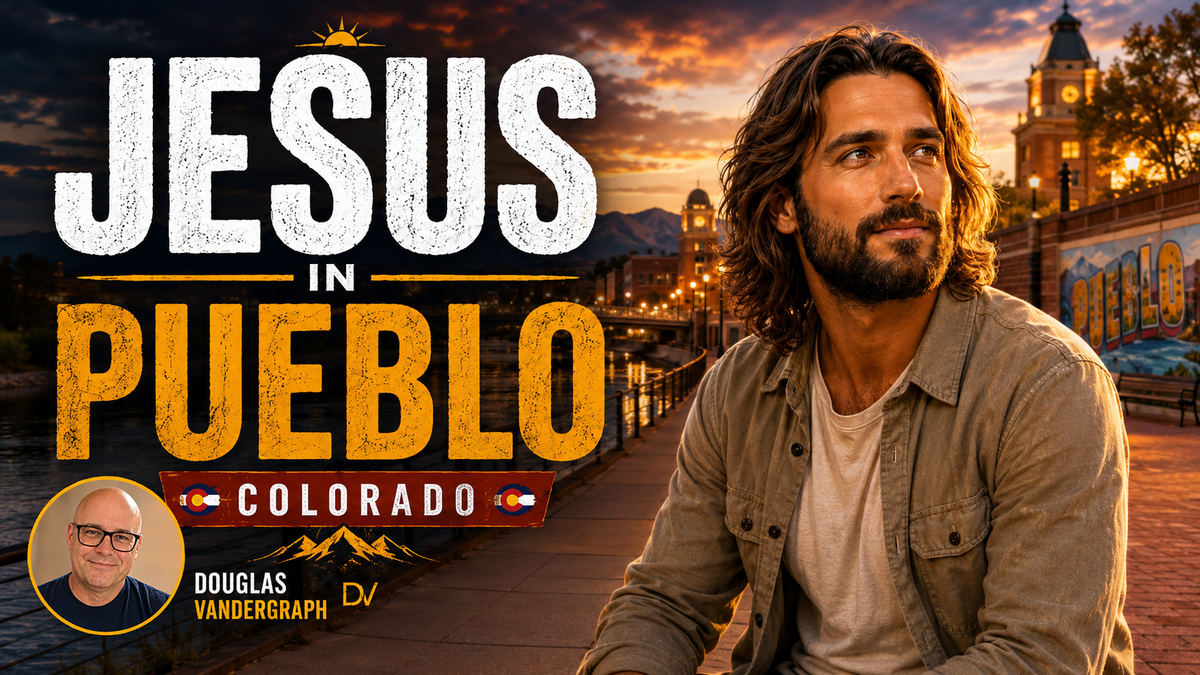
Jesus prayed beside the Arkansas River before the first noise of Pueblo had gathered its strength. The water moved dark and steady under the morning air, and the lights near the Historic Arkansas Riverwalk threw pale lines across the surface. He stood beneath a cottonwood with His head slightly bowed, wearing a plain gray coat and dark work pants, quiet enough that a man unloading supplies from a nearby truck did not notice Him at first. The city had not fully awakened yet, but its burdens had already begun to rise from houses near Bessemer, apartments near Mesa Junction, and old brick storefronts along Union Avenue.
Across town, Marisol Vega sat in her parked city maintenance truck behind a warehouse near the Pueblo Levee murals with both hands wrapped around the steering wheel. She had been there for almost twenty minutes, though her shift had not started yet. On the seat beside her was a folded work order, a stained thermos of coffee, and a photograph she had taken the night before with her phone. The photograph showed a patch of peeling paint on a section of the levee wall where the city had scheduled touch-up work before a weekend volunteer cleanup. Beneath the lifted paint was an older name, scratched deep into the concrete, half-hidden under layers of color and weather.
Elias Vega.
Her father’s name.
Marisol had not slept after finding it. She had driven home past Lake Avenue with the heater too high and the radio off, telling herself there were probably a thousand men named Elias in Southern Colorado. Then she remembered the way her father used to talk about the Arkansas River like it was a person who knew things. She remembered him taking her to the levee when she was nine and saying, “Some walls carry more than paint, mija.” She had thought he meant the murals, the bright sweep of faces and history that made Pueblo look like it was telling its story in public. Now she wondered whether he had meant something buried under them.
A message from her brother kept glowing on her phone. Mateo had sent it at 5:12 that morning from his apartment near Belmont: Don’t touch it. I mean it. That wall is part of a city project, and if you start digging around because of Dad, you’ll lose your job. She had typed three different replies and deleted all of them. The only thing she had managed to write in her notebook was a phrase she had seen while looking for a local faith video late in the night, Jesus in Pueblo Colorado, because something about the words had held her attention longer than she wanted to admit.
By 6:40, the city yard was coming alive with the rough sounds of trucks, backup alarms, metal gates, and men pretending they were not already tired. Marisol walked into the break room carrying the work order like it might burn her hand. A flyer was taped near the coffee machine for cleanup volunteers around the Riverwalk and levee, and someone had pinned a printed article beside it about the quiet mercy found along Colorado’s river cities. Marisol barely looked at it, but the phrase stayed with her as she poured coffee that tasted like it had been made in a machine that gave up years ago.
Her supervisor, Trent Hollis, came in wearing a neon vest over a flannel shirt and stopped when he saw her face. Trent had worked for the city long enough to know the difference between someone who was tired and someone who had found trouble before breakfast. He was a heavy-shouldered man with a close gray beard, kind when he could afford to be, careful when he could not. His eyes moved from her to the folded paper in her hand. “Please tell me you’re not bringing me another drainage complaint off Northern Avenue,” he said.
Marisol unfolded the work order and set the photograph on top of it. Trent leaned closer, frowned, then took the phone in his hand without asking. His thumb and finger widened the image. For a few seconds he said nothing, and that silence worried her more than any warning would have. The break room around them kept moving. A microwave door slammed. Somebody laughed near the lockers. A radio mentioned wind along the I-25 corridor, and a woman from streets muttered that wind was not news in Pueblo.
“That section was sealed years ago,” Trent said.
“I know.”
“Then why were you scraping at it?”
“I wasn’t scraping at it. The paint lifted where the storm runoff got under the edge. I saw the letters.”
Trent looked at the photo again. “You sure that’s your father?”
“No,” Marisol said, though the lie sat badly in her mouth. “I’m sure it’s his name.”
He handed the phone back. “That wall is part of the volunteer project. We’re not opening a historical investigation because a name showed under old paint.”
“I didn’t say investigation.”
“You didn’t have to.”
Marisol folded the work order again, slower this time. She had known Trent for six years. He had come to her father’s funeral at Imperial Memorial Gardens. He had stood in the back with his hat in his hands, respectful and quiet, then left before the family meal because he said he had a water main issue near the Mesa. She had never asked how well he knew Elias. In Pueblo, everybody seemed to know everybody just enough to have something they were not saying.
“My dad worked on that levee in the eighties,” she said.
“A lot of men did.”
“He never told us he put his name there.”
“Maybe he was young and stupid.”
Marisol looked at him. “My father was many things. Stupid was not one of them.”
Trent rubbed his eyes, then lowered his voice. “Listen to me. There are old layers all over that wall. Names, gang marks, memorials, things from cleanup crews, things from kids with keys in their pockets and too much time. Some of it is history, and some of it is damage. The city made choices about what stayed visible. We keep the public side clean because that is what the public sees.”
“That sounds rehearsed.”
“It sounds like experience.”
She slipped the phone into her coat pocket. “The work order says prep and touch-up today.”
“Then prep and touch up.”
Marisol waited for him to meet her eyes again. “You want me to cover it?”
“I want you to do your job.”
Outside, a gust pushed dust along the yard and rattled the chain-link fence. Marisol watched a plastic grocery bag skate across the gravel like it knew where it was going. Pueblo mornings could turn sharp without warning. The sky above the Wet Mountains had a thin pale edge to it, and the air smelled faintly like cold metal, river mud, and the old industrial memory that still seemed to live in certain parts of town. She had grown up with that smell. Her father said it was Pueblo refusing to pretend it had never worked hard.
She took Truck 14 because the heater worked and the passenger window did not whistle. Her crew that day was supposed to be Luis Ortega and Dani Sato, but Luis had called in because his kid was sick, and Dani had been reassigned to a pothole complaint near Thatcher Avenue. That left Marisol alone with a pressure washer, safety cones, two cans of approved coating, and a feeling she could not shake. She drove south along Santa Fe Avenue, then cut toward the levee where the murals ran long and bright against the concrete. Traffic was light, and the sun had begun to throw color onto the old brick buildings in a way that made even cracked windows look alive for a moment.
When she reached the worksite, she parked near the access point and sat with the engine running. The levee wall stretched ahead of her with its painted scenes and bold shapes, public memory on a surface built to hold back water. She had always loved the murals as a child because they made the city feel bigger than its struggles. Pueblo had its scars, but here the scars had color. Here people had taken concrete and turned it into a witness. Yet now, under one lifted edge, her father’s name waited like a door she had not known was there.
A white pickup was already parked nearby. Its tailgate was down, and a man in a brown canvas jacket stood beside it, sorting brushes into a bucket. He had white hair, a red scarf tucked into his collar, and the bent posture of someone who had spent years painting walls, ceilings, signs, and whatever else needed color. Marisol recognized him after a moment. Victor Lujan. He had been part of the early mural crews, though she had only met him twice. He was old now, but he still had eyes that looked like they were measuring the world for where the next line should go.
“You’re Elias’s daughter,” Victor said before she could speak.
Marisol shut the truck door. “Marisol.”
“I know your name.”
That answer bothered her. “Trent send you?”
“No.” Victor lifted one brush and studied the bristles. “He would rather I stayed home.”
“Then why are you here?”
Victor looked toward the wall. “Because that paint lifted.”
Marisol felt a chill that had nothing to do with the wind. “You knew it was there.”
Victor did not answer at once. He walked to the wall with slow steps, set the bucket down, and placed his palm just below the lifted paint. His fingers touched the concrete with a tenderness that made Marisol’s throat tighten. She had seen older people touch gravestones that way. She had seen mothers touch hospital doors that way. She had never seen a man touch a public wall like it remembered him.
“What is this?” she asked.
Victor pulled his hand back. “A mistake we covered.”
The words moved through her hard and fast. For a second, she heard nothing but traffic, wind, and the dull rush of the river beyond the concrete. “What mistake?”
Victor turned to face her. “Your father was trying to stop something. I was trying not to lose my place in the project. That is the simple version.”
“I don’t want the simple version.”
“No one ever does until they hear the full one.”
Marisol stepped closer to the lifted paint. The name was clearer in daylight. Elias Vega. Beneath it, there were other marks. Not letters exactly, or not all letters. Lines. Dates maybe. She crouched, careful not to touch the surface. The older layer looked gray and rough, and the scratches had been made with force. Her father had not written his name like a bored kid. He had carved it into the wall like he wanted the concrete to testify if he could not.
“What was he trying to stop?” she asked.
Victor’s mouth moved, but no answer came out. He looked past her instead, toward the path.
A man was walking beside the river, coming from the direction of the Riverwalk, though Marisol did not remember seeing him there a moment before. He wore a plain coat, and His steps were unhurried. Nothing about Him looked out of place, yet the space around Him seemed to grow still as He came nearer. The wind moved against His clothes, but He did not brace Himself against it. His face was calm, and His eyes carried a sorrow so deep and clean that Marisol looked away before she understood why.
Victor whispered something she could not hear.
The man stopped a few feet from them, not too close to the wall and not too far from the truth that had begun to open under the paint. He looked first at Victor, then at Marisol. He did not introduce Himself. He did not ask what they were doing. He simply stood there with them, and the morning seemed to gather around His silence.
Marisol felt anger rise because silence from strangers was easier to resent than silence from old men. “This is a closed work area,” she said.
His eyes rested on her with no offense in them. “Is it closed because of the work,” He asked, “or because of what was found?”
The question unsettled her. It was too direct, yet not rude. She glanced at Victor, but the old painter was staring at the ground. “Who are you?”
The man looked at the wall. “One who heard what was covered.”
Marisol almost laughed, but the sound would not come. She had never liked people who spoke in riddles. Pueblo had enough people who knew things and buried them under half-sentences. “If you know something, say it plainly.”
He turned back to her. “Your father tried to tell the truth, and it cost him more than others saw.”
The words struck so sharply that Marisol took one step back. Her father had died five years earlier of a heart attack in his driveway after shoveling snow that had turned wet and heavy before noon. That was the story. That was the ordinary ending the family carried. He had been tired, stubborn, proud, and bad at resting. No one had ever said the truth cost him anything, except her mother once after the funeral when she whispered, “Your dad carried what he should have set down,” then refused to explain.
Victor’s face had gone pale. “You shouldn’t say that here.”
Jesus looked at him. “Where should truth be spoken, Victor?”
The old man closed his eyes.
Marisol stared at them both. She did not know why the name came to her before anyone said it. Jesus. The thought entered her quietly, not as a guess but as something recognized by a deeper place than reason. She resisted it at once. Her mind reached for simpler explanations. A street preacher. A man from a church. Someone Victor knew. Someone staging a moment. Yet He did not carry the restless energy of people trying to impress themselves onto a scene. He carried stillness like authority.
“You know my father?” Marisol asked.
“I know him,” Jesus said.
Her anger changed shape. It did not disappear. It became fear with edges. “Then tell me why his name is under that paint.”
Jesus did not answer quickly. His restraint felt heavier than speech. He looked toward the river, where the water moved under a sky now brightening over the city. “Because a man can be asked to help make something beautiful while being told to hide what made it necessary.”
Victor sat down on the lowered tailgate of the pickup as if his legs had lost their strength. His hands trembled once before he locked them together. Marisol turned on him. “What does that mean?”
Victor swallowed. “There was a collapse.”
“What collapse?”
“Not the levee. Not like that.” He looked toward the wall. “An old section failed after spring water pushed hard through the drainage. It happened before the public mural expansion on this stretch. A boy got hurt.”
Marisol’s breath caught. “A boy?”
“He lived,” Victor said quickly. “But he was hurt bad. His family moved away. The city didn’t want panic. The project had donors. There was pressure to keep things moving and handle it quietly.”
“My father worked for the city then.”
“He was on the maintenance crew that filed the safety report.”
“And?”
Victor looked at Jesus before answering, as though he needed permission and feared it at the same time. Jesus gave none except His presence, which seemed to leave no room for hiding. Victor lowered his head. “The report was changed.”
Marisol felt the world narrow until only the wall existed. “By who?”
“I don’t know everyone involved.”
“That’s not an answer.”
“It’s the answer cowards give when they know more than they want to say.”
His honesty did not soften her. If anything, it made the heat in her chest stronger. “Did my father change it?”
Victor looked up fast. “No. Elias refused.”
The relief came so suddenly that Marisol hated herself for needing it. She had not known until that moment that part of her feared her father’s name was carved there because he had done something shameful. She thought of his hands, thick from work, always rough near the knuckles. She thought of him wiping grease on a rag in the garage and telling her that clean work was not always work that kept your clothes clean. She pressed her thumb hard into her palm.
“Then why cover his name?” she asked.
Victor’s eyes filled, though no tears fell. “Because he carved it there with the original date and the boy’s initials after they changed the report. He said if the paperwork lied, the wall would not. He wanted someone to ask someday.”
“And you painted over it.”
Victor did not defend himself. “Yes.”
The single word was worse than an excuse. It stood bare in the cold morning, and Marisol wanted to throw it back at him. She wanted to ask how many years he had let her family pass this wall without saying one word. She wanted to ask whether her father knew, whether he forgave him, whether he died still carrying the knowledge that men who called themselves his friends had decided paint mattered more than truth. Instead, she looked at Jesus.
“Why now?” she asked. “Why would this come up now?”
Jesus stepped closer to the wall, though He still did not touch it. “Because what is hidden does not sleep forever.”
Victor covered his face with one hand. Marisol looked at the exposed name again and felt the first weight of what this could do. It was not just family history. It was a city record, a public project, old liability, reputations, maybe men still alive who had built their lives on being respected in Pueblo. It was her job too. Trent had told her to cover it. Maybe he knew enough to be afraid. Maybe he was protecting the department. Maybe he was protecting himself.
Her phone rang.
The sound tore through the stillness so sharply that she flinched. Mateo’s name flashed on the screen. She let it ring twice, then answered without taking her eyes off the wall.
“Where are you?” he asked.
“At work.”
“Don’t lie to me.”
“I’m at the levee.”
Mateo swore under his breath. “Marisol, listen. Mom just called me. Trent called her.”
Marisol’s jaw tightened. “He called Mom?”
“He told her you found something that might upset the family and that you needed to let it go.”
Jesus looked toward the river. Victor looked sick.
Marisol walked several steps away from both of them. “Why would Mom call you?”
“Because she knows more than she ever told us.”
The morning seemed to tilt. “What did she say?”
Mateo’s voice lowered. “She said Dad came home one night with blood on his shirt. Not his blood. He told her a kid had been hurt near the wall and that people were already deciding whose fault it wasn’t. She begged him to stay out of it because she was pregnant with me and you were little. He told her if men stayed quiet every time they had something to lose, children would be the ones who paid for it.”
Marisol closed her eyes. The words sounded like her father. That made them hurt more.
Mateo kept talking. “She said after that, Dad got moved off certain crews. No promotion. Bad shifts. People stopped inviting him around. He never blamed anyone, but she knew.”
“Why didn’t she tell us?”
“Because she thought silence was how she protected us.”
Marisol looked back at Jesus. He was watching her with a grief that did not crush, but it did not look away either. She understood then that mercy did not always feel gentle at first. Sometimes mercy lifted paint. Sometimes it let a daughter see that the peace in her family had been built over a sealed place. Sometimes it brought the past into daylight because the future could not be clean while the old lie remained covered.
Mateo said, “You need to leave that wall alone.”
“I can’t.”
“You can. You have a job. You have a pension. You have a mortgage. You think Dad would want you to lose everything over something from thirty years ago?”
Marisol watched Victor stand slowly from the tailgate. He looked smaller than before. Older. Not harmless, but exposed.
“I don’t know what Dad would want,” she said. “I know what he did.”
“That’s not the same thing.”
“No,” she said, and her voice shook once. “Maybe it’s worse.”
Mateo went quiet. In that quiet, she heard traffic, the water, and the faint scrape of Victor’s boot against gravel. She also heard the old fear that lived in her family, the one that taught them to survive by not asking questions that could cost them. Her father had fought it once. Her mother had lived under it. Mateo had inherited it. Maybe she had too.
When she ended the call, Trent’s city truck was pulling up behind hers.
He got out with his vest already zipped and his face set hard. Dani Sato was with him, but she stayed near the truck, uneasy and silent. Trent looked at Victor, then at the wall, then finally at Marisol. He did not seem surprised to see Jesus standing there, but he seemed troubled by Him in a way Marisol could not understand. It was the look of a man who had found someone waiting in a room he thought he had locked.
“Marisol,” Trent said, “step away from the wall.”
She did not move. “You called my mother.”
“I called someone who might talk sense into you.”
“You knew what this was.”
Trent’s face tightened. “I knew it was old trouble.”
“That’s what you call a covered-up injury report?”
Dani looked up quickly. Victor turned away. Trent’s eyes moved between them, calculating how much had already been spoken. “You don’t know what you’re saying.”
“I know my father refused to lie.”
“No,” Trent said, and his voice grew sharper. “You know one side of a story that can hurt people who can’t defend themselves anymore.”
Jesus spoke then, quiet and clear. “The dead do not need lies to defend them.”
Trent looked at Him. “And you are?”
Jesus held his gaze. “You know who I am asking you to be.”
The sentence seemed to pass through Trent instead of stopping at his ears. His expression changed, not into belief exactly, but into discomfort so deep it almost looked like pain. He looked down at the gravel, then back at the wall. Marisol had seen Trent handle angry residents, broken water lines, city meetings, and crew fights without losing his footing. Now one simple sentence had moved something under him.
Dani took one cautious step forward. “Trent, what is going on?”
He shook his head. “Nothing that concerns you.”
“It concerns me if you’re asking us to cover evidence.”
“It’s not evidence.”
Marisol pointed to the exposed name. “Then why are you scared?”
Trent’s face flushed. “Because I have spent half my life trying to keep this department from being torn apart by every old mistake people drag up like bones.”
Jesus’ eyes remained on him. “Were they mistakes, or were they sins men agreed to rename?”
No one spoke after that. The word hung there without volume, yet it carried more force than shouting. Marisol felt it settle over the wall, over Victor, over Trent, over herself. Sin. Not the kind people used to win arguments or shame strangers. This was the old kind, the plain kind, the kind that made men wash their hands while a child’s blood was still fresh somewhere nearby. It was a word with a weight no city policy could lift.
Trent rubbed the back of his neck. “I was twenty-six,” he said.
Marisol went still.
Victor turned back toward him. “Trent.”
“No,” Trent said, but he was not stopping Victor. He was stopping himself from running. “No, I’m tired.”
Marisol felt her pulse in her throat. “You were there?”
Trent looked at her then, and for the first time since she had known him, he seemed less like a supervisor and more like a boy who had grown old around one protected fear. “I was the one who found him.”
“The boy?”
Trent nodded once. “His name was Caleb.”
The name changed the whole morning. Until then, the injured boy had been a shape in an old story, terrible but distant. Caleb made him real. Caleb had a mother, maybe a bike, maybe a school he missed while adults argued over paperwork. Caleb had a body that hit concrete or water or metal because something failed and people decided the cleanest path was not the truest one.
“What happened to him?” Marisol asked.
“He fell through a weakened service opening near the old access point after runoff undermined part of the edge. It should have been blocked. Your father had written it up twice.” Trent swallowed hard. “The barricade got moved for equipment access and wasn’t put back. Caleb and another kid came through after school. He dropped hard and cut his leg open on exposed metal. There was a head injury too.”
Dani’s hand went to her mouth.
“Dad reported the blocked access problem?” Marisol asked.
“Yes.”
“And they changed it?”
“They made it look like vandalism and trespassing caused it. Said the warning signs were there. Said maintenance had not been notified of any hazard.”
Marisol’s anger went cold. “They erased his report.”
Trent nodded. “Your father had copies. He told them he would go public. Then suddenly he was accused of mishandling materials, insubordination, all kinds of things. Nothing formal that would leave a clean record he could fight. Just enough to make work miserable.”
“And you?” she asked.
Trent’s eyes reddened. “I signed the revised statement.”
Victor made a small sound, almost a sigh, almost a confession repeated through someone else.
Marisol stepped back as if Trent had moved toward her, though he had not. She had expected a villain, maybe because villains were easier to hate. Instead, the man in front of her had taught her how to operate a plow, covered her shift when Mateo’s daughter was born, and once brought her green chile stew after her father died because he said nobody should live on funeral sandwiches. That did not make the confession smaller. It made it worse. Wrong did not always stand across the street with a sneer. Sometimes wrong trained you, praised you, helped you, and still hoped you never found the place where it had lied.
“Why?” she asked.
Trent did not hide behind policy this time. “Because I was scared. I had just gotten hired full-time. My wife was pregnant. A supervisor told me the boy was alive, the family would be compensated, and nobody needed careers ruined over a maintenance gap that would get fixed anyway. I told myself I wasn’t lying about the whole thing, just signing what men above me said was enough.”
Jesus looked at him with sorrow and firmness. “Enough for whom?”
Trent’s mouth trembled once. He did not answer.
Marisol looked at the wall again. Elias Vega. Her father’s name had sat under color for years while Pueblo walked past it, took pictures by it, praised the murals, held cleanups, and told stories about community pride. She loved that wall. She still loved it. That was part of the hurt. The beauty was real, but so was the covered thing beneath it. Maybe that was Pueblo too. Steel and river, pride and poverty, old harm and stubborn tenderness, bright paint over concrete that remembered pressure.
A gust of wind came off the water and lifted the edge of the old paint a little more.
Marisol stepped forward.
Trent said, “Don’t.”
She stopped, not because he commanded her, but because Jesus had turned His eyes toward her. He did not forbid her. He did not urge her on. That somehow made the choice heavier. She wanted to tear the paint back with both hands. She wanted to expose every hidden mark and make Trent look at it until he felt what her father had felt. She wanted her mother vindicated, her brother silenced, her father honored, and the city embarrassed enough to admit what it had buried.
Jesus spoke softly. “What do you seek, Marisol?”
“The truth.”
His gaze did not move. “Only the truth?”
Her answer rose fast, but it did not leave her mouth. The truth was there, yes, but not alone. She wanted punishment. She wanted apology. She wanted her father restored in a way death did not allow. She wanted thirty years repaired before lunch. She wanted to feel clean after years of not knowing she had been walking beside something unclean. She looked down at her hands, rough from work like her father’s hands had been, and hated that she could not give the simple answer she had wanted to give.
“I don’t know,” she said.
Jesus nodded, as though honest uncertainty was not failure. “Then do not let anger decide the first act of justice.”
Trent let out a breath that sounded like relief, and Marisol turned on him. “That does not mean I cover it.”
“No,” Jesus said.
The word was quiet, but it settled everything.
Trent looked at Him. So did Victor. So did Dani. Marisol felt the strange force of it, not loud enough to overpower anyone, yet strong enough to remove all pretending. No. The wall would not be covered. The name would not be painted over. The old report would not remain safe in whatever drawer or box or memory still held its shadow. But neither would Marisol become cruel in the name of truth if Jesus could keep her from it.
Dani stepped closer to the wall, careful and pale. “There are procedures for this,” she said. Her voice shook, but she kept going. “If this is tied to an altered safety report, we document the site, stop the work order, notify preservation, legal, and records. We don’t touch anything else.”
Trent looked at her with exhaustion. “You know what that starts?”
“Yes,” Dani said. “I think that’s the point.”
Victor reached into his jacket and pulled out an envelope so worn at the corners that it looked like it had been carried for years. He held it in both hands but did not yet offer it to anyone. Marisol stared at it. Trent stared too, and his face changed in a way that told her he knew or feared what it held.
Victor’s voice came out thin. “Elias gave me copies.”
Marisol could barely breathe. “You had them all this time?”
“I was supposed to give them to your mother if he lost his job. Then he told me not to. Then years passed. Then he died, and I told myself opening it would only hurt people.” Victor looked at Jesus, and shame moved across his face. “That was not the whole reason.”
Jesus waited.
Victor’s fingers tightened on the envelope. “The whole reason is that if I gave these up, everyone would know I helped cover his name. I painted over it myself. I told Elias the mural mattered more than old anger. He looked at me and said, ‘No, hermano. It matters because the truth matters.’ I called him bitter. That was the last real conversation we had.”
Marisol felt the pain of that more deeply than she wanted to. Her father had lost not only standing at work, but a friend. Maybe more than one. She thought of all the quiet evenings when he sat in the garage with the door halfway up, listening to Rockies games on the radio while pretending he was sorting tools. She had thought he liked being alone. Now she wondered how much of that solitude had been forced on him by men who preferred a beautiful wall to an honest one.
Victor held out the envelope.
Marisol did not take it right away. The paper looked small compared to what it carried. Once she touched it, the story would no longer be hidden under paint alone. It would be in her hands, and hands had to decide what to do next.
Jesus said, “Your father’s courage is not asking you to become hard. It is asking you to become faithful.”
Marisol looked at Him. “Faithful to what?”
“To what is true, and to the mercy that keeps truth from becoming revenge.”
Her eyes filled before she could stop them. She turned away from everyone and looked toward the river. The Arkansas moved past Pueblo as it always had, carrying light now, brown and gold under the morning sun. Cars moved over nearby streets. Somewhere downtown, a shop door opened. Somewhere in Bessemer, a mother probably hurried a child toward school. The city kept living, unaware that a piece of its buried conscience had surfaced beside a maintenance truck and two cans of paint.
Marisol wiped her face with the back of her wrist and reached for the envelope.
Victor placed it in her hand. His fingers brushed hers, and he whispered, “I’m sorry.”
She wanted to say she forgave him. She wanted to say she did not. Neither would have been true enough yet. So she held the envelope and said, “You’re going to say that again where people can hear you.”
Victor nodded. “Yes.”
Trent looked at the ground. “So will I.”
Marisol turned toward him. She had imagined this moment ending with someone begging her not to tell. Trent did not beg. That almost made her angrier, because repentance came too late to be clean. But his face had lost its careful supervisor mask, and beneath it she saw a man who had been living under his own coat of paint for most of his adult life. She did not pity him. Not yet. But she saw him, and that was more than she wanted.
Dani pulled out her phone. “I’ll document the site,” she said.
“No,” Marisol said quickly.
Dani froze.
Marisol looked at Jesus, then at the wall. “I mean, yes. But carefully. We do it right. We don’t turn this into gossip before we know what’s in the envelope.”
Trent nodded. “That’s wise.”
“I wasn’t asking for your approval.”
He accepted that without argument.
Jesus stepped nearer to the exposed name. He did not touch the wall with His hand, but He stood close enough that His shadow crossed part of the lifted paint. For a moment, Marisol thought of her father standing there in the dark thirty years earlier, angry and afraid, carving his name because no one with authority would let his report stand. She wondered whether he had prayed. Her father had not been a churchy man. He believed in God, but he did not talk about faith the way some people did. He fixed things. He showed up. He told the truth badly sometimes, bluntly, with more heat than grace. Maybe that was prayer in a man who did not know how to kneel.
Jesus looked at the carved name with a tenderness that made Marisol’s breath catch again.
“He was not unseen,” He said.
Those four words entered her more deeply than the confession, more deeply than the envelope, more deeply even than the anger. Her father had not been unseen. Not when the report was changed. Not when friends backed away. Not when promotions passed him by. Not when he sat in the garage with his radio and his silence. Not when he died with parts of the story still locked inside other people’s fear.
Marisol pressed the envelope against her chest.
The wind rose again, and this time the lifted paint did not tear. It only trembled. The wall held. The name remained visible. The story had opened, but it had not yet finished. Somewhere inside the envelope were copies her father had saved, and somewhere inside Pueblo were people who still remembered more than they had admitted. Marisol knew the day would not stay quiet. By noon, phones would ring. By evening, someone would tell her she had gone too far. By tomorrow, the city might feel smaller and sharper than it had before.
Jesus began walking toward the river path.
Marisol took one step after Him. “Where are You going?”
He turned, and the morning light rested on His face. “To the place where the next hidden thing is waiting.”
She looked at the wall, then at the envelope, then back at Him. “There’s more?”
His eyes held hers with mercy that did not soften the truth. “There is always more when fear has been allowed to keep records.”
Then He turned and walked beside the Arkansas River, steady and unhurried, while Marisol stood with the old envelope in her hands and the name of her father uncovered behind her.
Chapter Two: The Man Who Kept the Keys
Marisol did not open the envelope at the levee. She wanted to, and that wanting told her she should wait. Her hands were still shaking, and she knew the difference between courage and hunger when both were burning in the same place. Courage could stand before the truth. Hunger wanted to tear it open and feed on the first person it could blame. She slipped the envelope inside her coat, zipped it halfway, and told Dani to photograph the wall from every angle before anyone else touched it.
Trent stayed near his truck with his arms folded, but the old authority had gone out of his posture. He looked like a man waiting for a sentence that had already begun. Victor stood several yards away by the bucket of brushes, staring at the ground as if he could see the younger version of himself there, holding paint over a name he should have protected. None of them spoke much. The morning around them kept growing brighter, and that brightness felt almost rude against the seriousness of what had come up from under the paint.
Dani worked with careful hands. She photographed the lifted surface, the wider mural area, the access point, the runoff stain, the ground below, and the work order number clipped inside Marisol’s truck. Marisol watched her with gratitude she did not know how to express. Dani had only been with the department nine months, and she still carried herself like someone who had to prove she belonged. That morning she proved it by refusing to look away. She did not turn the moment into gossip, and she did not treat it like a routine task. She handled the wall like it mattered.
“We need to file a stop-work notice,” Dani said when she was done. “If we don’t, someone can claim the site wasn’t officially protected.”
Trent nodded, but he seemed far away. “I’ll call it in.”
“No,” Marisol said. “You’ll be on the call, but I’m making it.”
He looked at her, then looked away. “That’s fair.”
The word fair landed badly. None of this was fair. It was not fair that her father had carried documents other men should have honored. It was not fair that her mother had spent decades protecting her children from a truth that had already shaped their lives. It was not fair that Trent could stand in daylight and confess after spending so long being treated as a decent man. Marisol knew fairness was too small for what had begun, so she did not answer him.
She called the department office from the cab of Truck 14, where the smell of old vinyl and dust made the moment feel more ordinary than it was. The administrative assistant, Sheila, answered with her usual flat cheer, and Marisol asked for the stop-work form in a voice she barely recognized. Sheila asked whether there had been damage, vandalism, or a safety issue. Marisol looked through the windshield at her father’s name and said there was a historical concern tied to a possible altered record. The line went silent for long enough that Marisol knew the words had reached farther than the office phone.
“Marisol,” Sheila said carefully, “who told you to phrase it like that?”
“No one.”
“You sure you want to put that in writing?”
Marisol closed her eyes. The question was not cruel. That made it more dangerous. Pueblo had a way of warning people with the voice of concern. It was how families kept quiet, how workplaces stayed smooth, how old wrongs learned to live inside polite caution. She opened her eyes and saw Jesus standing near the river path, not close enough to hear the call by ordinary means, yet somehow present in the space between her fear and her answer.
“Yes,” she said. “Put it in writing.”
Sheila breathed out through her nose. “I’ll send the form.”
When Marisol stepped out, Jesus had moved down the path toward the Riverwalk. He was not far, but He was not waiting in a way that forced anyone to follow. That unsettled her. She had spent most of her life around men who pushed, hinted, pressured, or withdrew until others learned what they wanted. Jesus did none of that. His presence invited without pulling. It made her decision feel like it was truly hers, which was harder than being commanded.
She walked after Him with the envelope pressed under her arm. “You said there was another hidden thing.”
Jesus slowed but did not stop. “Yes.”
“Where?”
He looked across the river, toward the older parts of town where brick, rail lines, small houses, and long memories seemed to gather close together. “With a man who kept keys longer than he should have.”
Marisol glanced back at Trent and Victor. Dani was still near the wall, looking between them and her phone as if she had just realized her whole workday had changed into something no training manual could hold. “That doesn’t tell me much.”
“It tells you enough for the next step.”
She wanted to be irritated by that answer, but it held no game in it. He was not withholding to control her. He was giving her only what she could carry while she still had to choose. That patience touched a place in her she did not want touched yet. She had spent the morning wanting truth like a weapon, but Jesus seemed determined that truth would become something heavier and cleaner in her hands.
Trent called after her. “Marisol.”
She stopped but did not turn fully around.
He walked toward her slowly, his boots grinding the gravel. Victor watched him with the troubled attention of a man seeing an old companion step toward a fire they both should have entered years earlier. Trent took a folded business card from his wallet and held it out. The card was yellowed, softened by years of being carried. On one side was an old city maintenance number no longer in service. On the back, written in blue ink, was a name and an address.
“Gideon Vale,” Trent said. “He was the records clerk then. Not the official one people dealt with at the counter. He handled internal storage, field reports, old maps, inspection duplicates, that kind of thing.”
Marisol took the card. “You’ve carried this around?”
“For years.”
“Why?”
Trent’s mouth tightened. “Because your father told me once that Gideon had the original intake logs. I didn’t believe him then. Later I did. By then, I had already signed what I signed.”
The address was on the East Side, not far from where the streets began to feel older and more worn, where yards held both pride and exhaustion. “Did you ever go see him?”
“I drove past his house twice.” Trent looked toward Jesus, then back at Marisol. “I never stopped.”
The admission did not surprise her, and that made it sadder. She turned the card over in her hand. “Is he still alive?”
“As far as I know.”
“As far as you know,” she repeated.
Trent accepted the rebuke. “He used to come into the yard once in a while after he retired. Then he stopped. Somebody said his daughter moved in with him. Somebody else said he got mean after his wife died. You know how people talk.”
Marisol did know. Pueblo could spread news faster than wind through a chain-link fence, but truth moved slower because it had to fight through all the stories people preferred. She looked at the address again. “Why give me this now?”
Trent’s eyes moved toward the lifted paint. “Because I heard myself tell you to cover your father’s name.”
The simplicity of that answer cut through some of her anger, though not enough to release him. She placed the card in her pocket with the envelope. “You’re coming.”
Trent’s face tightened. “I don’t think Gideon will talk if I’m there.”
“I didn’t ask what you think he’ll do.”
“Marisol, I’m trying to help.”
“Then start by standing where you ran from.”
Dani walked over before Trent could answer. “I’ll stay with the wall until preservation gets here,” she said. “I already sent the first photos to the shared file and flagged the work order. If anyone comes with paint, I’ll tell them the site is frozen.”
Marisol looked at her. “You sure?”
Dani gave a small humorless smile. “No. But I’m still doing it.”
Jesus looked at Dani with quiet approval, and she seemed to feel it even if she did not know what to name. Her shoulders lowered a little. She went back toward the wall, not bold, not fearless, but steady enough for the work in front of her. Marisol watched her go and thought of how truth often survived because someone ordinary decided to do one right thing at the right time.
They drove separately because Marisol wanted the few minutes alone. Jesus did not get into her truck. When she started the engine and looked up, He was already walking toward Union Avenue, though the address was miles away. She told herself He must have another way there. She also knew that explanation did not explain anything. She had stopped asking her mind to make sense of Him, because something deeper than sense had already begun to recognize His authority.
The envelope sat on the passenger seat as she drove. She kept glancing at it at red lights. It looked too thin to carry thirty years of silence. The streets of Pueblo passed around her with their familiar mix of hard edges and stubborn life. A man in a hoodie pushed a shopping cart near a corner store. A school bus hissed to a stop by a row of small houses. Farther south, the old steel mill presence seemed to sit in the city’s bones, even where the day looked ordinary. Pueblo was always carrying more history than it said out loud.
She turned toward the East Side and slowed near the address on Trent’s card. The house was a low tan stucco place with a sagging porch, a chain-link fence, and a yard where dry grass had given up in patches. A faded blue cooler sat upside down beside the steps. The curtains were drawn, but the porch light was on though it was midmorning. That small light made Marisol feel like someone inside had been awake for a long time.
Trent pulled up behind her and stayed in his truck for several seconds. Marisol saw him grip the steering wheel with both hands before he finally got out. He looked older here than he had by the levee. Maybe places held people differently. At the wall he had been a supervisor confronted by a hidden record. In front of Gideon Vale’s house, he looked like a man walking toward the person who had kept proof of what he had helped bury.
Jesus was already at the gate.
Marisol did not see Him arrive. He stood with one hand resting lightly on the metal latch, waiting. The wind moved through the dry grass and made the fence tremble. A dog barked somewhere down the block, then stopped. The whole street seemed to pause, not dramatically, but the way a room pauses when someone is about to tell the truth.
Marisol joined Him at the gate. “Do we just knock?”
Jesus looked at the house. “Yes.”
“That seems too simple.”
“Many right things are simple before fear explains why they are impossible.”
She opened the gate. The hinge gave a sharp squeal, and the porch boards creaked under her boots. Trent came up behind her but stayed one step lower. His face had gone guarded again, and she almost told him not to hide now. Before she could speak, the front door opened.
A woman in her early fifties stood there holding a dish towel. She had short dark hair streaked with gray and the tired eyes of someone who had already handled three problems before breakfast. She looked at Marisol first, then Trent, then Jesus. Her expression changed when she saw Him, not into recognition exactly, but into something cautious and startled.
“Yes?” she said.
Marisol held up her city badge. “My name is Marisol Vega. I work with Pueblo Public Works. I’m looking for Gideon Vale.”
The woman’s hand tightened around the towel. “My father doesn’t talk to the city.”
“I understand.”
“No, you don’t.” Her eyes moved to Trent. “And if he’s here, you definitely don’t.”
Trent lowered his gaze. “Hello, Ruth.”
The woman’s mouth hardened. “Don’t hello me from my porch after thirty years.”
Marisol looked between them. “You know him?”
Ruth let out a bitter little breath. “Everybody in this story knows everybody. That’s been the problem from the start.”
Jesus stood quietly beside Marisol, and Ruth’s eyes kept returning to Him despite herself. She seemed both unsettled and steadied by His presence. Marisol understood that feeling. It was like standing near a fire that warmed and revealed dirt on your clothes at the same time.
“My father’s name was found under paint on the levee wall this morning,” Marisol said. “Elias Vega.”
Ruth’s expression shifted. The anger did not leave, but grief entered beside it. “Your dad was Elias?”
“Yes.”
Ruth looked past Marisol toward the street, toward no one visible. “My father said that name in his sleep for years.”
Trent flinched. Marisol felt the envelope under her coat like a second heartbeat. “We need to speak with him.”
“My father is not well.”
“I’m sorry.”
“That doesn’t mean no. It means you don’t get to walk in here and take whatever is left of him because the city finally got curious about its own lies.”
Marisol took the words because they were not all wrong. She had come with urgency, but Ruth had lived with the cost in this house. “I’m not here for the city.”
Ruth looked at her badge.
Marisol unclipped it and put it in her coat pocket. “I’m here for my father.”
For the first time, Ruth seemed to soften. She opened the door wider but did not step aside yet. “He has bad days. If he starts fading, you leave him alone.”
“I will.”
“If he says no, you leave.”
Marisol hesitated. The morning had already taught her that no could sometimes protect fear, not truth. Jesus looked at her, and His eyes corrected the thought before it became action. Mercy did not force an old man to bleed for her timetable. She nodded. “If he says no, I leave.”
Ruth stepped aside.
The house smelled like coffee, dust, old paper, and the faint medicinal scent of menthol rub. Family photographs lined the hallway. Some were faded snapshots of children in school uniforms, a woman holding a baby near what looked like City Park, Gideon as a younger man in a short-sleeved dress shirt with a ring of keys on his belt. In several pictures, he stood beside shelves of record boxes, smiling like a man proud of order. Marisol wondered how much of that order had been truth and how much had been silence placed in labeled folders.
Gideon Vale sat in a recliner near the front window with a blanket over his legs. He was very thin, with skin like folded paper and white hair combed straight back from his face. His eyes were open, but they did not seem fixed on anything in the room. A small table beside him held pill bottles, a rosary, two sharpened pencils, and a stack of index cards wrapped with a rubber band. The television was on mute, showing weather over Southern Colorado.
“Dad,” Ruth said gently. “Someone’s here.”
Gideon blinked. His eyes moved slowly from Ruth to Marisol, then to Trent. When he saw Trent, his face tightened with sudden clarity. “No,” he said.
Trent stopped just inside the room. “Mr. Vale.”
“No.” Gideon’s voice was weak, but the word had old strength in it. “Not him.”
Ruth turned sharply. “He can wait outside.”
Trent did not argue. He looked at Marisol once, then stepped back through the hallway and out onto the porch. The screen door clicked behind him. Marisol heard the porch boards complain under his weight as he moved away from the window.
Gideon’s eyes shifted to Jesus. Something passed through his face that Marisol could not read. Fear, relief, shame, recognition, all of it perhaps. His hands moved on top of the blanket, searching for each other.
“You came,” Gideon whispered.
Ruth looked confused. “Dad?”
Jesus stepped forward and lowered Himself into the chair across from him. He did not loom over the old man. He sat at eye level, His hands resting quietly on His knees. “You asked Me to remember.”
Gideon’s chin trembled. “I thought maybe I had only been talking to myself.”
“No.”
The room changed around that answer. Marisol felt it. Ruth did too, because she stopped twisting the towel and stood very still. There are moments when ordinary walls seem to hold more than plaster and paint, and this was one of them. The little house on the East Side, with its old carpet and muted television, seemed to become a place where heaven had leaned close without making a show of itself.
Marisol moved nearer but stayed standing. “Mr. Vale, my name is Marisol Vega.”
Gideon looked at her with effort. “Elias.”
“He was my father.”
The old man closed his eyes. A tear moved down the side of his face into the lines near his mouth. “I kept them,” he said.
Ruth leaned over him. “Kept what?”
“The intake logs.” He opened his eyes and looked toward the hallway. “And the first report. And the photographs. Not all. Enough.”
Marisol’s breath shortened. “Where are they?”
Gideon looked at Ruth. “Furnace.”
Ruth frowned. “The furnace room?”
“Behind,” he said.
Ruth’s face went pale. “Dad, there’s nothing back there. I cleaned that room last winter.”
“False panel,” Gideon said, with a flash of the records clerk he had been. “Behind the old vent. Your mother wanted me to burn it.”
Ruth straightened slowly. “Mom knew?”
Gideon’s eyes filled with pain. “She wanted peace.”
Ruth laughed once, but there was no humor in it. “This house never had peace.”
The words seemed to wound him, and Marisol looked away. She had come looking for her father’s truth, but another family’s truth was opening too. She thought of her own mother, of all the women in Pueblo kitchens who had kept men’s secrets because they were told family peace depended on silence. She wondered how many houses had lights on in daylight because somebody inside was still trying to live with what had been hidden.
Jesus looked at Ruth. “Peace built over fear does not rest. It only waits.”
Ruth’s eyes filled, but she did not cry. She looked angry at herself for being moved. “I don’t know what You are doing in my father’s living room,” she said. “But I know he has waited long enough.”
She walked down the hall, and Marisol followed. The furnace room was more of a narrow utility space near the back of the house, just wide enough for a water heater, the old furnace, shelves of paint cans, and boxes of Christmas decorations. Ruth pulled a chain, and a bare bulb threw hard light over everything. Dust drifted in the air. The wall behind the furnace had a vent cover that looked as if it had not been touched in years.
Ruth found a screwdriver on a shelf and handed it to Marisol. “You’re taller.”
Marisol stepped carefully around a cardboard box labeled Easter in black marker. The screws resisted at first, then gave with a dry squeal. She removed the vent cover and found not ductwork, but a plywood panel fitted into a shallow space between studs. Her hands steadied as soon as she saw it. Work did that for her. Grief and anger made her shake, but tools gave her something clear to do.
The panel came loose after she pried one edge with the screwdriver. Behind it sat a metal cash box, green with rust at the corners. Ruth drew in a breath. Marisol lifted it out and felt the weight immediately. Paper, photographs, maybe tapes. Something more than memory. Something that had waited in the dark behind a furnace while families aged and men died and a painted wall became a landmark.
They brought the box back to the living room. Gideon watched it like he was seeing a ghost he had fed for thirty years. Ruth set it on the coffee table and looked at her father. “Where’s the key?”
Gideon reached toward the side table with a trembling hand. Ruth opened the drawer and found nothing but pens, old receipts, and a pair of reading glasses. Gideon shook his head. “Not there.”
“Where, Dad?”
He looked ashamed. “Rosary.”
Ruth picked up the rosary from the table. A small key had been tied into the beads with thin wire, so carefully hidden among the worn dark beads that Marisol had not noticed it. Ruth held it for a long moment. “You prayed with this.”
Gideon nodded.
“With the key on it.”
“I did not want to forget what I was asking forgiveness for.”
Ruth’s face twisted. “And did that help?”
Gideon looked at Jesus. “Not until today.”
Ruth untied the key with fingers that shook harder than Marisol’s had at the levee. She unlocked the box and opened it. The smell of old paper rose from inside, dry and stale, like a closet that had not been opened since another decade. On top was a photograph of the levee before the murals brightened that stretch, when the concrete looked raw and the access areas were rough. Beneath it were carbon copies, handwritten notes, city forms, Polaroids, a folded map with red circles, and a small cassette tape in a cracked plastic case.
Marisol saw her father’s name on the first form and had to sit down.
It was his handwriting in the margins. She knew it from birthday cards, grocery lists, repair notes taped to appliances, and the careful block letters he used when writing labels on boxes in the garage. Hazard reported. Temporary barrier missing after equipment access. Children seen cutting through after school. Needs immediate closure. His words were plain, practical, and urgent. No poetry. No drama. Just a man trying to stop harm before harm arrived.
Ruth sat beside her and covered her mouth. Gideon closed his eyes. Jesus remained seated across from them, His presence steady as Marisol lifted each page and found the shape of the buried story. The first report had been filed three weeks before Caleb fell. A second note followed after a rainstorm. Then a supervisor response saying repair would be delayed until after a scheduled funding inspection. Then a handwritten copy of a phone message from Elias to records, asking why the hazard status had been downgraded. Then the altered version, clean and official, making the injury sound like a sad accident caused by trespassing.
The difference between the reports was not subtle. It was a sin with letterhead.
Marisol pressed one page flat on the table. “Who changed it?”
Gideon’s lips moved. Ruth leaned closer. “Dad?”
“Names,” he whispered. “Back page.”
Marisol turned the altered report over. On the back, someone had written initials beside routing marks. Some she did not know. One made Trent’s confession real in ink. T.H. Another set looked like R.M., then D.C., then a signature she could not read. She photographed nothing yet. She only looked, because seeing had to come before recording, and she did not want the phone to turn her father’s pain into evidence too quickly.
Ruth picked up one Polaroid. “That’s Caleb?”
The photograph showed a narrow service opening near the levee, orange cones knocked sideways, a dark stain on concrete, and a child’s backpack lying near a metal edge. Caleb was not in the photo. Somehow that made it worse. His absence filled the image. Marisol could see the story without seeing his body, and she was grateful and horrified at the same time.
Gideon spoke again, stronger now that the box was open. “Elias came to records after hours. He knew I stayed late on Thursdays. He had dirt on his boots and blood on his sleeve. He said, ‘Gideon, if the first paper disappears, a second child will pay for it.’ I copied what I could. I told him I would help. Then men came down hard.”
“What men?” Marisol asked.
Gideon stared at the ceiling. “Men with clean shoes.”
Ruth shut her eyes.
Jesus leaned forward slightly. “Say what you know, Gideon. Do not carry what belongs in the light.”
The old man breathed in with difficulty. “One from public works. One from the city manager’s office. One from the project committee. They said panic would kill the mural funding. Said Pueblo needed something beautiful. Said the boy’s family had already accepted settlement language. Said Elias was making it personal because he was angry about being passed over.”
Marisol’s hands curled into fists. “They said that about him?”
“Yes.”
“He was trying to protect kids.”
“I know.”
“But you kept the box instead of giving it to him.”
Gideon nodded, and the confession seemed to scrape him from the inside. “I told myself keeping copies was brave. It was only halfway brave. Halfway brave is still fear with better manners.”
The phrase stayed in the room. Marisol looked at him and saw not a monster, not a hero, but a man who had lived in the narrow space between what he knew and what he feared. She did not want that to move her. She wanted all guilty people to look guilty in ways that made judgment easy. Yet the morning had already ruined easy judgment. Trent had confessed. Victor had handed over copies. Gideon had prayed with a key tied to a rosary for years. None of that erased what they had done or failed to do, but it made the truth more human than rage wanted it to be.
Ruth stood and walked to the window. Through the glass, Marisol could see Trent on the porch with his back to the house. He had one hand on the railing and his head lowered. “He was one of them,” Ruth said.
“Yes,” Gideon whispered.
Ruth’s voice sharpened. “And you let him come here?”
Marisol answered before Gideon could. “I made him.”
Ruth turned. “Why?”
“Because running was part of the lie.”
For a moment, Ruth studied her as if deciding whether to be angry. Then she looked back out the window. “My father became a different man after that year. He checked locks three times. He kept boxes no one could touch. He yelled when my mother moved papers. He forgot birthdays but remembered file numbers. I thought the city had taken his mind.” Her voice lowered. “Maybe it took his soul first.”
Jesus stood then and went to the window beside her. He did not look out at Trent. He looked at Ruth. “A soul can be wounded by silence, but silence does not own it.”
Ruth’s face tightened as tears finally came. “You make that sound possible.”
“It is why I came.”
Marisol looked down at the pages before her. She could feel the story widening. There was the public truth, the paperwork, the signatures, the people who would need to be told. There was her family’s truth, the weight her father carried and her mother feared. There was Gideon’s house, Ruth’s bitterness, Victor’s shame, Trent’s confession. And somewhere, if he was still alive, there was Caleb, no longer a boy, perhaps living with scars Pueblo had paid to keep quiet.
She picked up the cassette tape. A handwritten label on it said Meeting, May 14. No year, just those words. “What’s this?”
Gideon looked at it with visible dread. “Your father.”
Marisol’s heart hit hard once. “His voice?”
Gideon nodded. “And others. He brought a recorder. Small one. Said if they would not let him write the truth, he would keep the sound of it.”
Ruth stared at the tape. “We don’t have anything to play that.”
“I do,” Trent said from the doorway.
No one had heard him open the door. He stood just inside, pale, eyes fixed on the cassette in Marisol’s hand. Ruth moved toward him with sudden fury, but Jesus lifted one hand slightly, not commanding her like a guard, only stopping the room from breaking open in the wrong direction. Ruth stopped, breathing hard.
“You were told to wait outside,” she said.
“I know,” Trent answered. “I heard enough to know what tape that is.”
Marisol stood, still holding it. “You heard it before?”
“Once.”
“What’s on it?”
Trent looked at Gideon. “The meeting after Caleb’s family hired a lawyer.”
Gideon’s eyes closed. “I could not listen again.”
Trent swallowed. “I kept an old cassette player in my garage. Don’t ask me why. Maybe because I knew one day this would happen, and I wanted to pretend I had prepared.”
Marisol stepped toward him. “Then get it.”
He nodded. “It’ll take me twenty minutes.”
Ruth pointed at him. “If you leave, you come back.”
Trent looked at Jesus before answering. “I’ll come back.”
Jesus said nothing, but the silence felt like a witness.
Trent left, and the screen door closed behind him. For several minutes, no one moved much. Ruth went to the kitchen and returned with coffee nobody drank. Gideon leaned back with his eyes closed, worn out by the box, the names, and the years that had finally found him. Marisol sat with the pages spread across the coffee table and read her father’s handwriting again and again. His words were so practical that they became holy in their own way. Immediate closure recommended. Public access unsafe. Do not reopen until secured.
She thought about that last line as the house settled around them. Do not reopen until secured. Her father had meant a service opening near the levee, but the words seemed to reach farther. Do not reopen a wound carelessly. Do not reopen a public lie without enough truth to hold it. Do not reopen a family story simply to make everyone bleed. The old reports were not only proof. They were a warning about how easily harm spread when people rushed to protect appearances instead of people.
Jesus sat beside Gideon again. The old man opened his eyes and looked at Him with a childlike fear that made Marisol’s anger loosen despite herself.
“I failed him,” Gideon said.
Jesus answered softly. “Yes.”
Ruth looked startled by the plainness of it. Marisol was too. She had expected comfort first, maybe because that was what people usually wanted from Jesus. But His mercy did not erase the shape of the wrong. It named it without cruelty.
Gideon’s lips trembled. “I failed Caleb too.”
“Yes.”
“And my family.”
Jesus looked at Ruth, then back at him. “Yes.”
Gideon wept then, not loudly, but with a brokenness that seemed to come from a place words had never reached. Ruth stood frozen for a moment before she crossed the room and knelt beside his chair. She took his hand, still angry, still hurt, but unable to leave him alone under the weight of truth. Marisol watched them and felt something inside her shift. She had wanted confession to look like punishment. Here it looked like an old man finally being strong enough to be crushed.
Jesus placed His hand over Gideon’s thin fingers. “But failure is not the only word written over you.”
Gideon could not speak.
“You hid what should have been given,” Jesus said. “Yet you did not destroy it. Today you have opened what fear locked away. Tell the truth now with the breath you still have.”
Ruth bent her head over her father’s hand. Marisol looked toward the window because the tenderness felt too private to watch straight on. Outside, Pueblo moved past the little house without knowing the old box had been opened. A pickup rattled by. Two kids walked along the sidewalk with backpacks bumping against their shoulders. A train horn sounded faintly in the distance, long and low, crossing the city like a memory.
When Trent returned, he carried a dusty black cassette player under one arm and an extension cord in his hand. He had changed somehow in the short time away. His face was still strained, but there was less calculation in it. He placed the player on the coffee table as if setting down something dangerous. Ruth plugged it in without speaking. Marisol handed him the tape.
His hands shook when he opened the case. “I need to say something before this plays.”
Ruth’s eyes flashed. “You’ve had thirty years.”
“I know.” Trent looked at Marisol. “Whatever is on here, I won’t deny it. I won’t explain it away. I won’t ask you to think about my family or my career or what people will say. I have used up every excuse a man can use.”
Marisol held his gaze. “Good.”
He accepted the word like a deserved blow. Then he put the tape in, pressed the button, and the machine clicked. Static filled the room. There was a scrape, a muffled thump, then voices, distant at first. Marisol leaned forward without meaning to.
A man she did not know said something about timing and donor confidence. Another voice said the public would never understand the difference between a maintenance delay and negligence. Papers shuffled. Someone coughed. Then her father’s voice came through, younger, angry, unmistakably alive.
“A child got hurt because we left that access open after I wrote it up twice.”
Marisol covered her mouth.
The room blurred. She had not heard her father’s voice in five years except on one saved voicemail where he told her he had extra green chile and to stop by if she was hungry. This voice was different. Stronger. Fighting. It came through the cheap speaker with a thin metallic edge, but it was him. Elias Vega, standing in a room full of men who wanted the story to become paperwork.
Another voice answered, smooth and impatient. “Elias, nobody is saying the situation was ideal.”
Her father cut in. “Don’t make it soft. It was wrong.”
Trent closed his eyes.
The tape hissed, then another man said, “The family has counsel. The city will respond through proper channels. Your unauthorized report language is not helpful.”
“My report language is true.”
“Truth has to be handled responsibly.”
Her father laughed once, hard and bitter. “Responsibly? You mean quietly.”
The room on the tape erupted with overlapping voices. Someone told him to calm down. Someone else said he was putting the whole project at risk. Then came Trent’s younger voice, nervous and strained. “Elias, maybe we should let the supervisors handle it.”
Her father answered with a sharpness Marisol remembered from childhood. “That is what men say when they have already decided they don’t want to handle it.”
No one in Gideon’s living room moved.
The tape continued. There were threats, though carefully phrased. There were references to chain of command, public perception, unauthorized duplication of records, and the need to keep Pueblo from becoming a headline for the wrong reason. Marisol heard no single villain confess everything in a clean sentence. It was worse than that. She heard a group of men building a room where truth had no air. They did it with reasonable words. They did it while calling themselves responsible.
Then her father’s voice came again, lower this time. “You can cover the report. You can cover the wall. You can make me the problem. But God saw that boy on the ground before any of you found language for why it wasn’t your fault.”
The tape clicked, then kept running through silence.
Marisol wept openly then. She did not care who saw. Her father had said God saw. He had stood there, outnumbered and threatened, and said it. Not as a preacher. Not as a man trying to sound holy. As a worker with blood on his shirt who knew a child had been hurt and the truth was being buried.
Jesus looked at her, and in His eyes was the same truth her father had spoken into that meeting room long ago.
God saw.
The tape ended with a hard click. No one reached to turn it off. The little machine hummed until Ruth finally pressed stop. Gideon stared at the coffee table. Trent was crying silently now, one hand over his eyes. Victor was not there, but Marisol could feel his absence like another unfinished confession waiting at the levee. The story had not ended at the wall. It had opened into rooms, records, voices, and people who had learned to live by not saying Caleb’s name.
Marisol picked up the tape and held it carefully. “We need to find Caleb.”
Gideon opened his eyes. “Morales.”
She turned toward him. “What?”
“Caleb Morales,” he said. “His mother was Ana. They moved to Avondale first. Then maybe Colorado Springs. I don’t know after that.”
Marisol looked at Trent. “Did you know his last name?”
He nodded, ashamed. “Yes.”
“And you didn’t say it.”
“I was afraid to make him real.”
The answer sickened her because she understood it. Names made people harder to bury. Her father had carved his own name into the wall, but maybe he had done it because he could not carve Caleb’s where the city would allow it to remain. Maybe Elias had known that one uncovered name could lead to another.
Jesus rose from His chair. “The truth has found its voice. Now it must find the one who was wounded.”
Marisol looked at the box, the tape, the reports, the old man, the daughter, the guilty supervisor, and the quiet Christ standing in a room that smelled of coffee and dust and opened years. She understood that going to Caleb would change the story again. It would no longer be about clearing her father’s name, though that still mattered. It would no longer be only about exposing men who lied, though that mattered too. It would become about a boy who had grown into a man somewhere with a scar Pueblo had chosen not to remember.
Ruth touched the edge of the metal box. “You’ll need copies before anything leaves this house.”
Marisol nodded. “Yes.”
“My father should give a statement today while he can.”
Gideon looked tired, but he did not object. “I will.”
Trent stood slowly. “I’ll give one too.”
Marisol turned to him. “Not to protect yourself.”
“No,” he said. “Not anymore.”
Jesus walked toward the door, and the others followed Him with their eyes. Marisol expected Him to say where to go next, but He did not. He opened the door and let the daylight in. Outside, the East Side street looked ordinary again, but not untouched. The same cracked sidewalk, the same dry yards, the same pale winter sun over Pueblo. Yet Marisol felt that something buried under the city had begun to breathe.
She gathered the envelope, the copies from the box, and the cassette tape with Ruth’s permission. Before leaving, she turned back to Gideon. He looked smaller in the recliner, but freer in a way that made him seem less swallowed by the blanket and the years.
“My father trusted you once,” Marisol said.
Gideon’s eyes filled again. “I know.”
“I don’t know what he would say to you now.”
“No.”
“But I know what he left behind found daylight today.”
Gideon nodded, and that was all he could manage.
On the porch, Trent waited at the bottom step. Jesus stood by the gate, looking toward the west where the mountains sat faint in the distance beyond the city’s roofs and wires. Marisol stepped into the wind with the old papers held tight against her side. She knew the next part would hurt. She knew people would deny, minimize, warn, and advise. She knew her mother would cry, Mateo would rage, and the department would close ranks before it opened its files.
But the tape had her father’s voice on it.
The wall had her father’s name on it.
And somewhere beyond that street, Caleb Morales was no longer a hidden boy in an altered report. He was a man with a name, and for the first time in decades, Pueblo was going to have to speak it.
Chapter Three: The Room Where His Voice Returned
Marisol did not go back to the department after leaving Gideon Vale’s house. She should have. There were forms to file, supervisors to notify, and official steps that would make everything cleaner on paper. But the papers in her passenger seat had already shown her what clean paper could do when men used it to hide dirt. She drove instead toward Bessemer, past streets where old houses sat close to the road and the shadow of Pueblo’s steel history still seemed to rest over porches, fences, and narrow driveways.
Jesus was not in the truck with her, but she saw Him twice on the way. The first time, He was standing near a bus stop on East Abriendo Avenue, beside a man with a lunch cooler and tired shoulders. The second time, He was walking along a sidewalk near an old brick building where sunlight hit the upper windows. Marisol did not understand how He moved through the city that way, both near and ahead, both present and unhurried. By then, she had stopped trying to force Him into the rules she understood.
Her mother lived in the same small house where Marisol and Mateo had grown up. The front porch had been repainted three summers earlier, though the boards still groaned in familiar places. A blue metal gate opened into a yard with two rose bushes that had survived hail, drought, neglect, and her mother’s occasional threats to dig them up. On the porch railing, a clay pot held dead stems from last season’s geraniums. Elena Vega always said she would clean it out when the weather turned, but in Pueblo the weather kept changing its mind, and so did she.
Marisol parked at the curb and sat with the engine off. The cassette tape lay on top of the folder Ruth had given her. The metal box had stayed with Ruth and Gideon for copying, but the first batch of documents rested in Marisol’s truck like something alive. She had listened to her father’s voice once. She did not know if she could bear to play it again. She also knew her mother deserved to hear it before strangers in offices did.
Mateo’s truck was already in the driveway.
That made her close her eyes. She had hoped for a few minutes alone with her mother first, though hope was beginning to feel like another word for wanting the truth to arrive in a shape that did not hurt as much. Mateo would be angry. Her mother would be afraid. Marisol would want to defend herself before she fully knew what needed defending. The house looked quiet from the outside, but she could feel the argument waiting behind the door.
Jesus stood at the gate.
She turned sharply, though she had not heard Him come. He rested one hand on the blue metal and looked toward the house with the same still sorrow He had carried beside the levee. The morning had moved toward noon now, and the sun was bright enough to show the flaking paint on the gate and the dust on His shoes. He looked like any man who had walked far through a working city, except no ordinary man could make silence feel so full.
“My mother is scared,” Marisol said.
“Yes.”
“My brother is going to think I’m destroying the family.”
Jesus looked at her. “A family is not destroyed when what wounded it is finally named.”
“It can feel that way.”
“Yes,” He said. “At first.”
She held the folder against her chest. “I don’t know how to do this without hurting her.”
“You cannot bring truth into a wounded room and promise no one will hurt.”
That answer made her angry for a second because it was not comforting in the way she wanted. Then she realized comfort without honesty had been part of the problem for years. Her mother had tried to keep peace by hiding the sharp edges. Mateo wanted to protect everyone by leaving the wall covered. Trent had once believed a softer version of the story could spare the city. All of them had been trying to reduce pain by giving the lie somewhere to live.
Marisol opened the gate. “Will You come in?”
Jesus looked at the door. “I am already expected.”
Before she could ask what He meant, the front door opened. Elena stood there in a dark sweater, one hand gripping the doorframe. She was seventy now, though she looked younger when she was irritated and older when she was afraid. That morning fear had aged her. Her silver hair was pulled back too tightly, and her eyes were red as if she had been crying before Marisol arrived.
Mateo stood behind her in the hallway, arms folded, jaw hard. He looked so much like their father in that posture that Marisol had to look away for a moment. Same thick eyebrows. Same square shoulders. Same way of turning fear into anger before anyone could see it tremble.
Elena’s eyes moved from Marisol to Jesus, and the hand on the doorframe loosened. Her mouth opened slightly. She whispered in Spanish, too low for Mateo to hear clearly, but Marisol heard enough.
“Señor.”
Mateo looked confused. “Mom?”
Jesus stepped onto the porch. “Elena.”
Her name in His mouth changed her face. She did not smile. She did not fall apart. She simply seemed known, and being known looked almost painful. She stepped back from the door without asking another question. Mateo stared at Jesus with suspicion, then at Marisol with open frustration.
“You brought somebody?” he said.
Marisol walked past him. “Not the way you think.”
“That doesn’t answer anything.”
“No,” she said. “It doesn’t.”
The living room was exactly as it had been for years, except it felt smaller. Family photos crowded the walls. Elias held a fish in one frame near Lake Pueblo. Marisol and Mateo stood in school clothes in another, both squinting at the sun. A wooden cross hung near the hallway, and beneath it was the old recliner Elias had used until Elena finally gave it away because she said an empty chair could become a wound if you let it. In its place sat a small bookshelf filled with photo albums, prayer cards, and bills tucked into envelopes.
Elena went to the kitchen without speaking and came back with four glasses of water, though no one had asked. It was the kind of thing she did when words were too dangerous. She set them on the coffee table, then sat on the edge of the sofa with her hands folded so tightly that her knuckles whitened.
Mateo remained standing. “Tell us what happened.”
Marisol placed the folder on the coffee table. “Dad’s name was under the paint. Victor Lujan knew. Trent knew. Gideon Vale had copies of the original reports.”
Elena closed her eyes, but she did not look surprised.
Mateo did. “Copies of what?”
“The safety reports Dad filed before Caleb Morales was hurt.”
The name seemed to move through the room like cold air. Elena’s shoulders bent. Mateo looked at their mother. “You know that name?”
Elena’s lips pressed together. For a moment, Marisol thought she would choose silence again. Then Jesus sat in the chair across from her, and the room became still in the way Gideon’s living room had become still. He did not tell Elena to speak. He simply sat near enough that she could not pretend she was alone with her fear.
Elena looked at her children. “I know the name.”
Mateo’s anger sharpened. “All morning I’ve been telling Mari to leave this alone, and you knew?”
“I knew enough to be afraid.”
“That’s not an answer.”
“It is the truest answer I have,” Elena said, and her voice cracked. “I was afraid when your father came home with that boy’s blood on his sleeve. I was afraid when men stopped calling. I was afraid when his hours changed and he came home so tired he could barely eat. I was afraid when he sat in the garage at night and stared at his hands like they had failed him. Then I was afraid after he died because I thought if the story came back, it would take whatever peace we had left.”
Marisol sat beside her. The folder remained between them like a table had become a courtroom. “Mom, Dad’s voice is on a tape.”
Elena’s eyes opened.
Marisol took the cassette from her coat pocket. “He recorded a meeting.”
Elena reached for it, then stopped before touching it. Her hand hovered in the air and slowly withdrew. “I told him not to go to that meeting.”
“You knew?”
“I knew he had the little recorder. He used it sometimes when he had to remember supply notes. He said men were changing words after he said them, so he wanted his own words to stay where he put them.” She swallowed hard. “I begged him to think about you both. I said truth would not put food on the table if he lost his job.”
Mateo looked wounded. “Mom.”
She turned to him. “I was pregnant with you. Your sister needed shoes. The furnace was making that sound again. I was tired of being proud and scared at the same time.”
The plainness of it softened something in the room. Marisol had always imagined courage and fear as opposites, but her mother had carried both in the same body. Elias had gone toward the truth, and Elena had counted bills under a kitchen light wondering what that truth would cost their children. It did not make silence right. It made it human.
Jesus spoke gently. “You believed fear could protect love.”
Elena looked at Him, tears rising. “Yes.”
“And what did fear do to love?”
She covered her mouth with one hand. “It made it quiet.”
Mateo turned away and put both hands on his hips. He stood by the window, staring out at the street as if the houses across from them had insulted him. “So what now?” he asked. “We open all of this? We drag Dad’s name into the city again? We turn Mom’s life upside down? We chase down a man who probably spent thirty years trying to forget us?”
Marisol looked at him. “Caleb didn’t need to forget us. The city forgot him.”
“We are not the city.”
“No. But we benefited from the silence in our own way.”
He turned around fast. “Don’t put that on us.”
“I’m putting it where it belongs. We grew up thinking Dad was just difficult at work. We thought he carried grudges. We thought some doors closed because that’s how life goes. What if those doors closed because he refused to lie?”
Mateo’s face changed, and she knew she had reached the place he did not want touched. He had spent years making peace with a smaller version of their father because the bigger version hurt too much. A stubborn dad who struggled at work was easier to carry than a truthful dad punished by cowards while his own family learned to call his loneliness a mood.
Elena stood suddenly. “There is something else.”
Marisol felt the day tilt again. Mateo looked at their mother with dread. “What else?”
Elena walked toward the hallway. “I did not keep the reports. I promise you that. Your father did not bring those home after he gave copies away. But I kept one thing because I could not throw it out.” She disappeared into her bedroom, and they heard a closet door slide open, then the scrape of something being moved. When she returned, she carried a round cookie tin with faded Christmas bells on the lid.
Marisol knew the tin. It had once held sewing supplies, spare buttons, old keys, and stamps that were probably no longer worth anything. Elena set it on the table and opened it. Inside were envelopes, a dried corsage from some long-ago wedding, Elias’s old pocketknife, and a folded sheet of blue stationery. She lifted the paper carefully, as if it might tear from memory alone.
“This came six months after the settlement,” Elena said.
“From who?” Marisol asked.
“Ana Morales.”
Mateo sat down at last.
Elena unfolded the letter, but she did not hand it over. Her eyes moved across the page, and Marisol could tell she had read it many times in her life, perhaps not often, but enough that the words had made a path through her. “She wrote to thank your father.”
Marisol’s throat tightened. “For what?”
“For telling her the truth before they left Pueblo.”
The room seemed to draw in one breath. Elena held the letter with both hands.
“She said Elias came to their apartment after everything was settled and told her he was sorry. Not the kind of sorry people say when they want to close a door. He told her what he had reported and what had been changed. He gave her what copies he had then. She said she could not fight anymore because Caleb was still healing and her husband had already taken work in Avondale. She said the money helped with bills, but it felt like being paid to stop asking why her son had fallen through a place adults knew was unsafe.”
Marisol closed her eyes. Her father had gone to them. Of course he had. She should have known the carved name was not his only witness.
Elena kept reading silently, then lowered the letter. “She said Caleb had nightmares about the river even though he did not fall into the water. He kept saying he could hear it through the concrete. She said he would not walk near walls for months. She said your father stood outside their door and cried, and Caleb asked him if he was the man who pulled him out.”
Trent had said he found him. Marisol looked down at the tape. “Was he?”
Elena nodded. “Your father and Trent both. Elias went down first. Trent called for help.”
Mateo’s voice came out low. “Dad never told us.”
“No,” Elena said. “He said if he told the story too much, he would start making himself the center of it, and the boy was the one who got hurt.”
Jesus looked toward the photograph of Elias holding the fish, and something in His face held both grief and joy. Marisol followed His gaze. In the picture, her father was younger than she was now, standing in harsh sunlight with a proud grin and a trout in his hand. She had walked past that photo for years without knowing how much of him had been hidden from his own children.
“What else does the letter say?” she asked.
Elena hesitated.
Marisol knew that hesitation. It was the sound of a door not yet open.
“Mom.”
Elena folded the paper once, then opened it again. “Ana said Caleb kept a piece of red cloth your father tied around his leg to slow the bleeding. She said he called it the river ribbon. He would not let the hospital throw it away. She said he asked whether the man from the wall was in trouble.”
Mateo lowered his head.
“She wrote that Caleb wanted to see him someday when he was not scared anymore. Then at the bottom she put an address in Avondale.” Elena touched the bottom of the page. “Years later, your father tried to find them. They had moved. He made calls. He drove out once. Nothing came of it.”
Marisol leaned forward. “There’s no later address?”
Elena did not answer right away. She reached back into the tin and pulled out a small card. It was not old like the letter. It was from a repair shop, smudged at the corner, with a phone number printed under the name Morales Custom Iron & Gate. The address was in Pueblo West.
Marisol stared at it. “Where did you get this?”
“Two years after your father died, a man came by. I was in the yard. He asked if this was the Vega house. I said yes. He stood there a long time, looking at the porch. Then he asked if Elias lived here. I told him Elias had passed. The man gave me that card and said he was sorry to hear it.”
“Was it Caleb?”
Elena’s eyes filled. “I think so.”
“You think so?”
“He had a scar near his hairline and walked with a slight drag in one leg. He was maybe forty, maybe younger. He looked like someone who had come to say something and lost the courage when he found out death had closed the first door.”
Mateo picked up the business card. “You never told us this?”
Elena’s shame was quieter than Gideon’s but no less real. “No.”
“Why?”
“Because your father was gone. Because the man left before I could ask more. Because I did not know what good would come from reopening a thing nobody could fix.” She looked at Jesus, and her voice broke. “Because I was still afraid.”
Jesus did not rebuke her harshly. He looked at her the way He had looked at Gideon, with truth that refused to humiliate. “Fear kept asking for more years.”
Elena nodded as tears moved down her face. “And I kept giving them.”
Marisol took the business card from Mateo. Pueblo West was not far. The thought that Caleb might have come back near Pueblo, might have built gates and fences and ironwork while her family lived with an unopened story across town, made the whole thing feel painfully close. Not buried in another state. Not lost beyond finding. Close enough that he could have stood at her mother’s gate with his own scar and left with words still trapped inside him.
Mateo stood and paced once across the room. “We don’t know it’s him.”
“No,” Marisol said. “But we can find out.”
“And if it is? What do you expect him to do? Thank us? Forgive everybody? Let us pull him into some city investigation because we suddenly need closure?”
Marisol looked at the card. “Maybe he gets to decide what happens with his own story.”
Mateo stopped pacing. That answer seemed to reach him more than anything else she had said. He looked at the folder, then the tape, then the card. His anger had not vanished, but it had begun losing its grip on the shape of the room.
Jesus spoke to him for the first time since they entered the house. “You are afraid your father’s courage will ask something of you.”
Mateo stiffened. “You don’t know me.”
Jesus looked at him with steady compassion. “I know the boy who learned to be strong by not asking why his father was sad.”
Mateo’s face went pale. Elena covered her mouth again. Marisol felt the sentence move through her brother the way sunlight moves through a window and shows dust no one wanted to see. Mateo turned away, but not before Marisol saw his eyes fill.
“He never said anything,” Mateo said.
“No,” Jesus answered.
“I thought he was disappointed in me.”
Elena made a small sound. “Mijo, no.”
Mateo pressed his fingers against his eyes. “He’d sit in that garage and hardly talk. I would ask him to throw a ball or help with something, and he’d say later. Then later he’d be too tired. I thought he just didn’t want to be around us.”
Marisol’s own grief changed shape again. She had known her father’s silence as distance, but Mateo had known it as rejection. All these years, the covered report had kept hurting people who did not even know its name.
Jesus stood and walked toward the empty place where the recliner used to be. He did not touch the wall or the photographs. He simply stood in the center of a room Elias had once filled with his quiet presence. “When a man is punished for telling the truth, the punishment does not stop at his own heart. It enters the house unless someone brings it into the light.”
Elena bowed her head. “I should have told them.”
Jesus turned to her. “You can tell them now.”
“I don’t know how to give back what silence took.”
“You begin with what you have.”
Elena looked at her children, and something in her face changed. Fear did not leave all at once, but it no longer sat in the highest seat. She reached into the tin again and pulled out a smaller envelope. Inside were three photographs Marisol had never seen. The first showed Elias standing by the levee with a younger Victor, both wearing work shirts, both unsmiling. The second showed a strip of concrete marked with spray paint and cones. The third made Marisol’s chest tighten. It showed her father kneeling beside a boy in a hospital room, his large hand resting carefully on the blanket near the boy’s knee. Caleb looked thin and frightened, his head bandaged, one leg under a brace. Elias looked like a man trying not to cry in front of a child.
Mateo sat down hard.
Elena handed the photograph to Marisol. “Ana sent that with the letter. Your father looked at it once. Then he told me to put it away because if he kept seeing the boy’s face, he would hate men he was supposed to forgive someday.”
Marisol stared at the image. This was no longer a report, a tape, or a name. Caleb’s young face looked out from a hospital bed with guarded eyes. Her father looked back at him with a sorrow that seemed too large for the room. The photograph made both of them real in a way nothing else had. Marisol touched the edge of it, careful not to press the surface.
Mateo whispered, “He carried all this.”
Elena nodded. “Yes.”
“And we were mad at him.”
“We did not know.”
Mateo looked at Jesus. “Does not knowing change what it did to him?”
Jesus answered with painful gentleness. “No. But knowing can change what it does next.”
The phone rang then, sharp and sudden. Elena flinched. Marisol looked at her screen and saw Dani’s name. She answered quickly.
“Marisol,” Dani said, her voice tight. “You need to know something. Someone from administration showed up at the wall.”
Marisol stood. “Who?”
“I don’t know him. Suit, city badge, not public works. He said he was there to assess site risk. He wanted me to step back while he took his own photos.”
“Did you?”
“No. I told him the stop-work notice was active and preservation had been notified.”
“What did he do?”
“He got mad without raising his voice. You know that kind of mad?”
“Yes.”
“He said old markings under municipal paint are not automatically protected, and unauthorized release of internal records could put employees at risk. He asked where you were.”
Marisol looked at Trent’s initials on the copied report. “What did you say?”
“I said you were unavailable.”
“Good.”
“He left, but before he did, he made a call. I heard him say the phrase ‘Vega material.’ Not levee material. Vega material.”
Marisol felt the air in the room tighten. “Did he give a name?”
“No. But Trent knows him. I could see it on his face when I described him.”
“Where is Trent?”
“Still here. Victor came back too. They’re both quiet, and I don’t like it.”
Marisol closed her eyes for one second. The city had begun to react. Not all of it, maybe not officially, but the old machinery of caution and control had heard the first sound of truth and started turning. “Stay with the wall, but don’t be alone. Call preservation again. Put everything in writing. If anyone pressures you, write down the exact words.”
“I already started.”
“Dani?”
“Yeah?”
“Thank you.”
Dani was quiet for a moment. “Your dad was right, wasn’t he?”
Marisol looked at the hospital photograph in her hand. “Yes.”
After the call ended, the living room felt different. The story had moved from memory into present danger. Mateo noticed it at once. “What happened?”
“Someone is trying to control the site.”
“Already?”
Marisol put the photograph down gently. “Already.”
Elena stood. “This is what I feared.”
Jesus looked at her. “Yes.”
The word did not shame her. It honored the fact that fear had not been imaginary. People had buried this once. Some might try again. The danger was real, but Jesus did not let danger become lord of the room.
Mateo picked up the Morales business card. “Then we go now.”
Marisol turned to him. “We?”
He looked at the photograph of their father and Caleb. His face was still wet, but his voice had steadied. “You’re not walking into this by yourself.”
For the first time all day, Marisol felt something like relief. It was not happiness. It was not peace yet. It was the feeling of a broken family finding one board solid enough to step on. Elena watched them both, and the fear in her eyes mixed with something that looked almost like pride.
She reached for the cassette tape. “Take his voice with you.”
Marisol hesitated. “Mom, are you sure?”
Elena held it out. “Your father kept speaking after they tried to make him quiet. I kept him quiet again by hiding what I knew. I will not do that today.”
Marisol took the tape. Elena then lifted the hospital photograph and placed it inside the folder. “And take Caleb’s face. Do not let him become only a name in your anger.”
Jesus looked at Elena, and His expression carried a tenderness so deep that Marisol had to look down. “You have begun with what you have,” He said.
Elena nodded, crying silently now.
They left the house together, Marisol with the folder, Mateo with the business card, and Jesus walking beside them down the porch steps. The blue gate squealed again as it opened. Across the street, a neighbor lifted one hand in greeting, then lowered it when she saw their faces. Pueblo was like that. People knew when to ask and when to wait, though they did not always choose wisely.
At the truck, Mateo paused. “Where did He come from?”
Marisol looked at Jesus, who stood near the curb with His eyes turned toward the southwest, where the road would eventually lead toward Pueblo West. “I don’t know how to answer that.”
Mateo studied Him for a long moment. “Mom knew Him.”
“Yes.”
“Do you?”
Marisol opened the driver’s door. The folder pressed against her side, heavy with paper, voice, and the face of a wounded boy. She thought of the levee, Gideon’s rosary key, her mother’s tin, her father’s carved name, and Jesus’ question by the wall.
“I’m beginning to,” she said.
Mateo nodded slowly, as if that answer troubled him and steadied him at the same time. He walked to his truck, then stopped and turned back. “Mari.”
“What?”
“If Caleb tells us to leave, we leave.”
She thought of Ruth saying almost the same thing about Gideon. She thought of mercy refusing to force the wounded to perform for those who came late. “Yes,” she said. “If he tells us to leave, we leave.”
Jesus began walking before either truck started, heading along the sidewalk as if the road itself had been waiting for Him. Marisol watched Him for a moment through the windshield. He was not rushing, though the city had already begun pushing back against the truth. He was not anxious, though old powers had started moving. His pace held a strange authority, as if He knew every hidden room, every sealed wall, every frightened heart, and every locked box in Pueblo, and none of them could keep Him from arriving exactly where mercy intended.
Marisol started the truck. Mateo followed behind her. In the rearview mirror, her mother stood at the blue gate with one hand pressed against her chest. The little house grew smaller as Marisol drove away, but something in it had changed. Her father’s voice had returned there, not as a ghost, but as witness. Her mother’s silence had opened. Her brother’s anger had cracked enough for grief to breathe.
Ahead of them, the road bent west, and the mountains sat faint beyond the pale hard light. Somewhere in Pueblo West, if the card still meant anything, a man named Caleb Morales might be working iron with scarred hands, building gates for other people while keeping his own story closed. Marisol did not know whether he would open it. She only knew they were going to stand before him with proof, apology, and the name her father had carved into concrete because paper had lied.
And for the first time since the paint lifted, she understood that the truth was not only trying to expose what had happened.
It was trying to return every stolen voice to the person it belonged to.
Chapter Four: The Gate with the River Mark
The drive toward Pueblo West felt longer than it was because every mile carried a question Marisol could not answer. Highway 50 stretched ahead with its familiar mix of traffic, open views, shopping centers, dry lots, and the pale shoulder of land that seemed to widen as the city thinned. Mateo followed in his truck, close enough that she could see his headlights in the rearview mirror even under the noon brightness. Jesus walked ahead of them in a way that made no ordinary sense, appearing sometimes near the sidewalk and sometimes near the shoulder of the road, always moving with the same unhurried certainty.
Morales Custom Iron & Gate sat off a side road in a low building with a corrugated metal roof and a gravel lot full of steel pieces, welding screens, and unfinished frames. A sign over the front door had been cut from dark metal into clean lettering, and beneath the name was a small river shape worked into the design. Marisol noticed it before she noticed anything else. The river mark curved under the letters like a scar someone had turned into craftsmanship. She parked beside a white work van and sat with her hand still on the key.
Mateo pulled in behind her and got out first, but he did not move toward the door. He stood beside his truck and looked at the shop like a man who had agreed to do a hard thing before feeling how hard it would be. Marisol stepped out with the folder under her arm, and the wind brought the smell of dust, hot metal, and welding smoke from the open bay. Somewhere inside, a grinder screamed against steel, then stopped. The sudden silence afterward made the whole place feel like it had been listening.
Jesus stood near the shop entrance, His hand resting lightly against the doorframe. He looked toward the work bay, not with surprise, but with the deep patience of someone who had arrived at a sorrow before the sorrow knew it was ready to be seen. Marisol walked up beside Him and saw a metal gate leaning inside near the wall. It was unfinished, but the shape was already clear. Thick vertical bars curved into a wave pattern at the center, and along the lower rail someone had forged a narrow line that looked almost exactly like the river mark on the sign.
Mateo came up behind her and whispered, “That’s beautiful.”
Marisol nodded, though the word beautiful had become complicated since morning. The levee mural was beautiful too. Her father’s name had been covered under beauty. Caleb Morales, if this was his shop, had built a life shaping metal into things people trusted to protect openings. Gates. Railings. Fences. Boundaries. The boy who had fallen through an unsafe access point had grown into a man who made passageways safe or kept them closed.
A woman in a welding jacket came from the back, pulling off gloves as she walked. She was maybe twenty-five, with dark hair tied under a bandana and safety glasses pushed up on her forehead. Her face changed when she saw strangers near the door, then sharpened when she noticed Marisol’s city jacket. “We’re not open for walk-ins during fabrication hours,” she said.
Marisol removed the city badge from her pocket but did not clip it on. “I’m looking for Caleb Morales.”
The woman’s eyes moved from Marisol to Mateo, then to Jesus. When she saw Him, her guarded expression faltered for a moment. She seemed to recognize no name and yet feel a presence that made her lower her voice. “Who’s asking?”
“My name is Marisol Vega. This is my brother, Mateo. Our father was Elias Vega.”
The woman went still at the name. It was not the blank pause of someone hearing words with no meaning. It was the pause of someone hearing a family story step through the door without warning. She looked toward the back of the shop, where sparks flashed blue-white behind a screen. When she turned back, her voice had changed. “I’m Lucia Morales. Caleb is my dad.”
Mateo’s eyes met Marisol’s. The card had led them to the right place.
Lucia wiped her hands on her jacket, though they were already clean enough. “Why are you here?”
Marisol held the folder closer. “We found records this morning tied to what happened to your father at the Pueblo Levee when he was a boy.”
Lucia’s face closed immediately. “No.”
“We’re not here to use him.”
“That’s what people say before they use him.” Her voice stayed controlled, but the heat under it was real. “My dad does not talk about that wall. He does not go near that river. If this is about some city cleanup or public apology event, you can turn around.”
Jesus looked at Lucia with compassion, and she seemed angry that His gentleness reached her. She crossed her arms and looked away. Marisol understood her more than she expected to. The wounded had their own guards, and family members often stood at those gates long after everyone else had gone home. Lucia had probably watched her father refuse invitations, change routes, wake from dreams, or go quiet when Pueblo praised a place that had marked him before he had words for it.
Mateo spoke carefully. “Our father pulled him out.”
Lucia looked back at him, startled.
Marisol saw the opening and did not rush through it. “We only learned that today. We found a tape. His voice is on it. He tried to tell the truth about what happened, and men changed the report.”
“My grandmother said there was a worker,” Lucia said, but her tone remained cautious. “She said he cried in the hospital room and apologized to my dad. She said he was the only one from the city who acted like my dad was a child instead of a problem.”
“That was our father,” Marisol said.
Lucia’s eyes filled quickly, and she blinked hard as if tears at work were unacceptable. She turned her head toward the back. “Dad.”
The grinder stopped again. A heavy curtain moved, and a man stepped out from behind the welding screen. He wore a dark canvas apron over a long-sleeved shirt, and one side of his face had a pale scar near the hairline that disappeared into his short dark hair. He was in his early forties, broad through the shoulders, with hands that looked strong from years of shaping hard material. His right leg dragged slightly when he walked, not enough to make him weak, but enough to tell the truth of old injury with every step.
Marisol knew before he spoke.
Caleb Morales stopped when he saw them. His eyes moved first to Marisol’s face, then Mateo’s, searching for a resemblance he seemed both ready and unwilling to find. When his gaze landed on Jesus, the whole shop seemed to quiet around him. His jaw tightened, and the anger in his face did not disappear, but something older moved behind it. He looked like a man seeing the one Person he could not accuse of arriving too late.
“Vega,” he said.
Marisol nodded. “Yes.”
Caleb looked at the folder. “Your father died.”
“Yes.”
“I went to the house once.” His voice was low and rough. “Your mother told me.”
“She told us today.”
His eyes flickered with surprise, then bitterness. “Today seems popular for old truths.”
Lucia stepped closer to him. “Dad, they found records.”
Caleb looked at her sharply. “What records?”
“The original reports,” Marisol said. “Copies kept by Gideon Vale. A cassette of the meeting after you were hurt. A letter from your mother to my father. A photograph from the hospital.”
At the mention of the photograph, Caleb looked away. His hand moved to the edge of the workbench and gripped it so hard his knuckles paled. Lucia touched his arm, but he did not seem to feel it. Mateo shifted beside Marisol, clearly wanting to speak and afraid to make the wrong sound. Jesus remained near the doorway, giving Caleb room to stand without being crowded.
Caleb’s voice came out flat. “I told my mother to throw that picture away.”
“She sent it to my father,” Marisol said. “He kept it, then my mother hid it because she did not know what else to do.”
Caleb gave a short laugh, dry and hard. “Everyone hid something.”
The words hit their target because they were true. Marisol did not defend her mother. Mateo did not defend their father. The shop around them smelled of hot metal and grinding dust, and outside the open bay the Pueblo wind moved loose dirt across the gravel. Marisol thought of the levee, the lifted paint, Gideon’s furnace room, Elena’s cookie tin, and now this place where steel was heated until it could be shaped. Maybe the truth had brought them here because some things could not be mended cold.
Jesus spoke from near the door. “You have hidden pain where others could admire your strength.”
Caleb turned toward Him. His face hardened. “People admire gates because they don’t ask why you build them.”
Lucia looked at her father as if she had heard him say something he usually kept locked inside. Marisol felt the sentence land in the shop. It did not sound like a line made for effect. It sounded like a man who had spent decades making strong barriers because the first barrier meant to protect him had failed.
Jesus stepped farther inside, but He did not come too close. “And what have your gates protected?”
Caleb’s mouth tightened. “My family. My work. My peace.”
Jesus waited.
Caleb looked toward the unfinished gate leaning by the wall. “What do You want me to say?”
“The truth.”
Caleb laughed again, but this time it broke near the end. “The truth is I hate that wall. I hate the murals. I hate every bright color people praise down there because under all of it I remember concrete, water noise, blood, and grown men telling my mother not to make trouble. I hate that my daughter learned how to read my face before she learned how to ride a bike near a river path. I hate that I came back to Pueblo because my mother got sick and then stayed because leaving again felt like letting the city keep the last word.”
Lucia’s eyes were wet now, but she did not interrupt him. Marisol looked at the unfinished gate again and saw the river mark differently. Caleb had not escaped the river. He had forged it into metal over and over, not as decoration, but as a way of touching what he could not speak. Every curve under his business name, every wave in a gate, every railing shaped like water, had been a quiet argument with the place that hurt him.
Mateo stepped forward. “My dad said God saw you.”
Caleb looked at him sharply.
“It’s on the tape,” Mateo said. “He said God saw you before anyone found language for why it wasn’t their fault.”
Caleb swallowed. For the first time since he entered, his face lost its hard edges. “He said that?”
“Yes.”
Caleb looked at Marisol. “You heard it?”
She nodded. “This morning.”
He looked away, and his breath came unevenly. “I don’t remember everything. People think trauma is a clean story, but it isn’t. I remember the sound more than the fall. The river through the concrete. My shoe slipping. The metal edge. Then your father’s voice telling me to look at him and not at my leg. I remember his hand pressing cloth down and shaking like he was the one bleeding.”
Marisol could barely speak. “He kept your photograph.”
Caleb nodded slowly. “I kept something too.”
Lucia looked surprised. “Dad?”
He released the workbench and walked toward a cabinet near the back wall. His limp was more visible now, perhaps because the past had entered his body again. He opened a drawer, moved aside small boxes of hardware, and took out a sealed plastic sleeve. Inside was a strip of red cloth, faded almost brown in places. The river ribbon. Marisol recognized it before he said anything because her mother’s words had already made it sacred.
Caleb held it in both hands. “He tied this around my leg. I was ten. I thought he saved me from the river, even though I hadn’t fallen into it. That’s how kids think. If you hear water and wake up hurt, then water becomes part of the monster.”
Jesus looked at the cloth with a tenderness that filled the room more deeply than speech.
Caleb continued, “My mother said he came to the apartment later and told her the truth. My father wanted to sue again, but we were already drowning in bills and fear. He had work lined up outside town. My mother wanted out. I did too until we left, and then I wanted to come back because the place that scares you can start owning you from a distance.”
Marisol had never heard fear described that way, but it made sense. Her family had stayed in Pueblo and still been owned by the hidden story. Caleb’s family had left and carried it with them. Distance had not freed them. Silence had not freed them. Even good intentions had not freed them.
Lucia wiped her face with the heel of her hand. “Why didn’t you tell me you had that?”
Caleb looked at his daughter, and the pain in his eyes changed from old memory to present regret. “Because I thought if I could build a good life around it, I wouldn’t have to hand it to you.”
“You handed it to me anyway,” she said softly. “Just without words.”
The shop went quiet again. Marisol looked down because the honesty between them felt private, but she could not fully look away. This was what the old lie had done. It had not stayed inside one report or one wall. It had moved into daughters who guarded fathers, sons who misunderstood silence, mothers who hid letters, workers who carried guilt, and old men who tied keys to rosaries.
A truck pulled into the gravel lot outside. Everyone turned toward the sound. A dark SUV stopped near the entrance, and a man in a navy suit stepped out, careful not to get dust on his polished shoes. Dani had described him well enough that Marisol knew before he reached the door. City badge. Controlled anger. The kind of man who did not need to raise his voice because he trusted systems to do most of his pushing.
Caleb’s face hardened. “You brought the city to my shop?”
“No,” Marisol said. “I didn’t.”
The man came to the entrance and stopped when he saw the room full of people. His eyes moved quickly over Marisol, Mateo, Caleb, Lucia, the folder, the red cloth, and finally Jesus. He paused there a fraction too long before turning his attention back to Marisol. “Ms. Vega,” he said. “I’m Donovan Rusk from the city attorney’s office.”
Marisol felt Mateo stiffen beside her. “How did you know I was here?”
Donovan gave a practiced smile that did not reach his eyes. “You drove a city vehicle from a protected worksite while in possession of municipal materials tied to a pending legal review. We need to make sure documentation is handled properly.”
Caleb stepped forward. “This is private property.”
“I understand. I’m not here to disrupt your business.”
“You already did.”
Donovan turned his smile toward Caleb. “Mr. Morales, I assume. I am sorry for any distress old records may be causing.”
Caleb’s eyes went cold. “Old records didn’t cause it.”
Donovan’s mouth tightened slightly. “Of course.”
Jesus stood near the unfinished gate, His presence quiet but impossible to ignore. Donovan tried not to look at Him again and failed. Something about Jesus troubled him, though he masked it quickly. Marisol had seen that look now in Trent, Victor, Gideon, and even in herself. It was the look of a person suddenly aware that the room held a truth no title could manage.
Donovan turned back to Marisol. “I need the documents you removed from Mr. Vale’s residence.”
“You need them?”
“They may include municipal records that should be preserved through official channels.”
“They were hidden for thirty years because official channels failed.”
“I understand your emotion,” Donovan said.
Marisol felt Mateo shift, and she raised one hand slightly to stop him from speaking. She had heard enough workplace talk to know how men like Donovan used calm words to make anger look like weakness. The folder under her arm felt heavier, but her hands stayed steady. “No, you don’t.”
His smile thinned. “Ms. Vega, you are still a city employee.”
“And you are standing in the shop of the man your office should have cared about before today.”
Donovan looked at Caleb. “Mr. Morales, I would be happy to speak with you separately and explain what options may be available.”
Caleb laughed, and this time there was nothing dry in it. It was a hard sound from a grown man who had heard polished language before. “Options. I had options when I was ten, right? Be quiet and heal. Move away and heal. Let grown men with badges and signatures decide what my leg, my fear, and my mother’s tears were worth.”
Donovan held up both hands. “I’m not your enemy.”
Jesus spoke before Caleb could answer. “Then do not speak as one who came to take what does not belong to him.”
The room changed.
Donovan turned toward Him slowly. “Excuse me?”
Jesus’ face remained calm. “The truth you seek to collect is not yours to control.”
Donovan’s professional mask flickered. “And who are you?”
Jesus looked at him with a gravity that made the question seem very small. “The One who was present when the child fell, when the report was changed, when the mother wept, when the father feared, when the worker carved his name, and when men taught themselves to call silence wisdom.”
No one breathed for a moment.
Donovan’s face lost color. He tried to recover with a small shake of his head, but the recovery did not hold. “I don’t know what this is,” he said, “but I know legal exposure when I see it.”
Jesus stepped closer, not threatening, not hurried. “You see exposure because you have learned to protect institutions before people.”
“That is not fair.”
“It is true.”
Donovan’s eyes flashed. “You have no idea what it takes to keep a city from tearing itself apart every time old claims come up.”
Jesus looked at him with compassion that did not yield. “A city is not held together by buried wrongs. It is weakened by them.”
The words seemed to strike deeper than Donovan wanted. For a second, Marisol saw the man behind the suit: tired, trained, afraid of consequences, perhaps convinced that public order required private pressure. He was not the original liar. He may not have been alive when Caleb fell. Yet he had arrived with the same old instinct dressed in newer language. Preserve. Contain. Review. Control.
Caleb walked to the unfinished gate and placed one hand on the metal wave at its center. “You know what this is for?”
Donovan glanced at it. “A commissioned security installation, I believe.”
“For the levee access point,” Caleb said. “Subcontract came through a private project group. They did not tell me exactly where until yesterday. I almost canceled when I saw the delivery site. Then I thought maybe I was being childish, maybe a grown man should be able to install a gate near a wall without feeling ten years old again.”
Marisol stared at the gate. The story locked into place with a force that made her chest tighten. Caleb had been hired to build the new barrier for the very area tied to the old harm. The boy hurt by an unsecured opening had become the man unknowingly asked to seal it with his own hands. Pueblo had circled the wound back to him, and no one in authority had even known enough to tremble.
Jesus looked at the gate. “You have shaped what should have protected you.”
Caleb’s hand tightened on the metal. “I thought that meant I won.”
“What did it cost you?”
Caleb looked at Lucia, and the answer moved across his face before he said anything. “Too much.”
Lucia stepped beside him and put her hand on the same metal rail. “Dad, don’t deliver it if you can’t.”
He looked at her with pain. “The contract matters.”
“I know.”
“The shop needs the money.”
“I know.”
He swallowed. “You shouldn’t have to carry my fear and my payroll.”
Lucia’s voice softened. “Then don’t make me carry your silence too.”
Marisol watched them and thought of herself and Elena, Mateo and Elias. The same sentence could have been spoken in their house. Don’t make me carry your silence too. It was not accusation alone. It was a plea for a different inheritance.
Donovan cleared his throat. “The installation is separate from any historical concern. If anything, it shows the city is addressing access safety.”
Caleb turned on him. “The city is addressing it thirty years after calling my fall trespassing.”
“That characterization is not helpful.”
“Neither was the lie.”
Marisol stepped forward. “Mr. Rusk, preservation has been notified. The stop-work notice is active. The original records are being copied with witnesses. Caleb Morales has the right to see everything before your office touches it.”
Donovan’s eyes narrowed. “That is not your decision.”
“No,” she said. “It’s his.”
The sentence surprised even her, not because she did not believe it, but because she felt how much had changed since morning. At first, she had wanted the truth to restore her father, punish the guilty, and break the city’s sealed place open. Now she saw Caleb standing with his daughter beside a gate shaped like a river, and she understood that justice could not be centered on her pain alone. Her father’s courage had pointed toward a child. If she made the story about the Vega name only, she would be using Caleb in another way.
Jesus turned His eyes to her, and the quiet approval there steadied her more than praise would have.
Donovan seemed to recognize that the room had moved beyond his control. His voice became colder. “I am advising all of you to avoid distributing, copying, publishing, or discussing any material that may relate to city liability until counsel has reviewed it.”
Mateo finally spoke. “Is that advice or a threat?”
“It is a legal caution.”
“Sounds like a threat wearing clean shoes.”
The phrase hit the room because Gideon had used almost the same words. Men with clean shoes. Donovan looked irritated, but Jesus’ eyes remained on him, and the irritation did not grow into authority. It faltered.
Caleb took the red cloth from the workbench and held it up. “You want to preserve something? Preserve this. Preserve the fact that a city worker used his own shirt to keep a kid from bleeding out while other men protected a project. Preserve the fact that my mother left Pueblo because every street started looking like a place where adults could explain away a child. Preserve the fact that I built gates for years because no gate was there when I needed one.”
Donovan said nothing.
Caleb placed the cloth back in its sleeve. “Then preserve the truth that I am not handing my story to your office so you can turn it into language.”
Donovan’s mouth tightened again. “You may want to reconsider after speaking with counsel.”
“Maybe I will,” Caleb said. “But not yours.”
For the first time, Donovan looked truly defeated, though not humbled. There was a difference. Defeat had found his strategy. Humility had not yet reached his heart. He turned to Marisol. “You need to report to the department by end of day.”
“I’ll report,” she said. “And I’ll bring witnesses.”
He looked as if he wanted to answer, then thought better of it. His eyes moved once more to Jesus, and something like fear crossed his face before he turned and left the shop. The SUV backed out of the gravel lot and pulled onto the road, dust rising behind it like a thin brown curtain.
No one spoke until the dust settled.
Caleb let out a breath and sat on a low stool beside the gate. His strength seemed to leave him all at once. Lucia knelt near him, and he put one hand on her shoulder. For the first time, he looked less like the owner of the shop and more like the wounded boy still living somewhere under the scar, still hearing water through concrete.
Marisol placed the folder on the workbench. “You should see all of it.”
Caleb looked at the folder but did not reach for it. “Not standing up.”
Lucia pulled chairs from a small break area, and Mateo helped clear space on the bench. Jesus remained near the gate while they spread out the first copies. Marisol showed Caleb the original safety report, her father’s notes, the altered version, the hospital photograph, and Ana’s letter. Caleb read slowly, stopping often. Sometimes his face tightened with anger. Sometimes it went empty in a way that frightened Lucia more than anger would have. When he reached the photograph, he touched the corner with one finger and closed his eyes.
“That room smelled like bleach and orange juice,” he said.
Lucia sat beside him. “You remember?”
“Some of it. My mother kept peeling oranges because she didn’t know what else to do with her hands. Your grandfather sat by the window and would not look at the city outside. Elias stood by the bed and cried without making noise.” He opened his eyes. “I thought grown men only cried when somebody died.”
Marisol’s voice softened. “My father cried in the garage too. We didn’t know why.”
Caleb looked at her with a grief that finally recognized hers without competing with it. “He was a good man.”
“He was hard to live with sometimes.”
“Good men can be.”
Mateo gave a small broken laugh. “That sounds like him.”
For the first time since arriving, the room loosened enough to let human warmth enter. It did not erase anything. It simply made space around the pain so they could breathe. Caleb looked at Mateo, and the two men seemed to see each other through their fathers, through silence, through the different ways a boy can grow up feeling something unnamed in the house.
Marisol took out the cassette tape. “Do you want to hear him?”
Caleb looked at it for a long time. Lucia’s hand rested on his arm. Mateo stood still beside the bench. Outside, the wind pressed against the metal siding, and the unfinished gate gave a faint ring as if the building itself had shifted.
“I don’t know,” Caleb said.
Jesus came closer and stood across from him. “You do not owe the past your readiness before you are ready.”
Caleb looked up. “Then why did You bring them here?”
“Because readiness is not the same as being left alone.”
The answer moved through Caleb slowly. He looked at the tape again. “If I hear his voice, I might remember more.”
“Yes,” Jesus said.
“And if I don’t hear it?”
“You will still know it exists.”
Caleb rubbed both hands over his face. “I spent years thinking I needed proof that I was not crazy. Then when proof shows up, I want it out of my shop.”
Marisol nodded. “That makes sense.”
He looked at her, surprised by the simple agreement.
She continued, “When I saw my father’s name under the paint, I wanted to rip the whole wall open. Then I wanted to run. Sometimes the same truth does both.”
Caleb looked at the red cloth, the folder, and his daughter’s hand on his sleeve. At last he took a deep breath. “Not here,” he said. “Not with machines and contracts and that gate watching me.”
“Where?” Lucia asked.
Caleb turned toward the open bay, and beyond it, toward the road leading back into Pueblo. “The hospital first.”
Marisol felt her stomach tighten. “The hospital?”
“Not the same room. I know that. Maybe not even the same wing anymore. But my mother said Elias came there after the meeting. If I’m going to hear his voice, I want to hear it where he came back to tell the truth.”
Mateo looked at Marisol, uncertain. This was not what either of them had expected, but it carried a rightness that was hard to deny. Jesus looked toward the road with the steady gaze of One who had known this turn before they did.
Caleb stood, slower than before. “Lucia, close the shop.”
She nodded without argument.
He turned to the unfinished gate and rested his hand on the river curve one more time. “And this does not go to the levee today.”
Marisol saw what that decision cost him. Money, contract trouble, pressure, maybe a fight with the project group and the city. Yet his face held a steadiness that had not been there when they arrived. The gate would not be used to make the city look safe while the truth was still bleeding under the paint. For now, it would remain unfinished, a piece of shaped iron waiting for the story to become honest enough to receive it.
Jesus looked at Caleb. “A gate can close a danger, or it can guard a truth.”
Caleb’s eyes filled, but he did not look away. “I don’t know which one this is yet.”
“You will.”
They gathered the folder, the tape, the red cloth, and the hospital photograph. Lucia locked the shop door after turning off the main lights, leaving the unfinished gate inside the dim bay where the metal river caught one thin line of sun. Marisol walked to her truck with a strange sense that the story had crossed another threshold. They had found Caleb, but finding him had not resolved the wound. It had given the wound back its rightful owner, and now that owner was choosing where the next truth would be heard.
As they pulled out of the gravel lot, Marisol looked in the mirror and saw Jesus walking behind them for a moment, then beside them, then somehow ahead on the road toward Pueblo. The city waited under the afternoon light with its river, its wall, its hospital, its offices, its old houses, and its hidden rooms. She no longer felt like she was chasing a buried secret. She felt like Jesus was leading them through the places where the secret had left pieces of people behind.
Caleb drove in his work van with Lucia beside him. Mateo followed behind. Marisol led because she knew the way, though she was beginning to understand that knowing streets was not the same as knowing where you were being taken. The folder rested on the passenger seat. The cassette tape sat on top of it. Her father’s voice was quiet for now, waiting inside a little black case while the road carried them back toward the city that had tried to bury it.
Ahead, the roofs and signs of Pueblo gathered again. Somewhere beyond them, the Arkansas River kept moving past the wall, past the lifted paint, past the name Elias Vega had cut into concrete. The river had carried its sound through Caleb’s nightmares for thirty years. Now, for the first time, they were driving toward that sound together, not to be swallowed by it, but to hear what else had been waiting beneath it.
Chapter Five: The Hallway That Remembered
The hospital did not look like the place Caleb had carried in his mind. He knew it would not. Thirty years could change walls, entrances, wings, waiting rooms, signs, floor patterns, and the smell of a hallway, but some part of him had expected the building to recognize him the way a scar recognizes cold weather. When they pulled into the parking lot near the medical center, he sat in his van with both hands on the wheel and stared through the windshield as if the glass were holding him back from a room that no longer existed.
Marisol parked two spaces away and did not get out right away. She watched Caleb through the side mirror and waited for him to move first. Mateo had pulled in behind her, and Lucia sat beside her father in the van, turned toward him with her hand resting on the folder in her lap. Jesus stood near the entrance under the overhang, not speaking to anyone, not hurrying anyone, simply present where people came in with pain, fear, babies, lab orders, bad news, and prayers they were too tired to form.
Marisol had been to that hospital many times. Her father’s heart had been treated there once before the final attack that took him at home. Mateo’s daughter had been born there during a spring snow that melted by afternoon. Elena had spent a night there after a dizzy spell two years earlier, insisting she was fine while scolding every nurse who told her to rest. The building held ordinary memories for the Vega family, but for Caleb it held the moment when childhood split into before and after.
He finally opened the van door. His right leg came down first, careful and stiff. Lucia got out on the other side with the folder, and for a moment they stood by the van without speaking. Caleb looked toward the entrance, then toward Jesus. The anger he had carried at the shop had quieted into something more vulnerable and more difficult to watch. It was the face of a man who had spent years proving he could stand, now wondering whether standing was the same as healing.
Marisol walked over slowly. “We do not have to do this here.”
Caleb looked at the hospital doors. “I know.”
“You can change your mind.”
“I know that too.” He rubbed the side of his leg once, just above the knee. “That’s what makes it harder.”
Mateo came up beside them but stayed quiet. He had been quiet most of the drive. Every now and then, Marisol had seen him in the rearview mirror gripping his steering wheel, and she knew his mind was replaying their father’s voice on the tape, the hospital photograph, and his own childhood memories with new pain inside them. He was carrying too much at once, but he had not turned back.
Lucia adjusted the folder under her arm. “Dad, I can go ask where there’s a private room.”
Caleb shook his head. “No. I need to walk in.”
The automatic doors opened as a nurse came out pushing an empty wheelchair toward the curb. Warm air flowed from inside, carrying the clean hospital scent of sanitizer, coffee, old carpet, and something metallic beneath it all. Caleb’s face changed when the smell reached him. His jaw tightened, and his eyes unfocused for a second. Lucia took a step closer, but he lifted one hand gently, not pushing her away, just telling her he needed to remain upright by his own choice.
Jesus walked toward them from the entrance. He stopped in front of Caleb, close enough to be heard without making His words public. “You were carried through these doors as a child. Today you walk.”
Caleb swallowed hard. “That does not mean I am not afraid.”
“No.”
“I thought You might say fear is gone when faith comes.”
Jesus looked at him with a sorrowful kindness. “Faith can enter while fear is still in the room.”
Caleb breathed out, and the breath shook. Then he walked forward.
The lobby had been remodeled, but hospitals have a way of making time feel layered. A child cried somewhere near registration. A woman in scrubs hurried past with a paper cup in one hand and a phone against her ear. An older man sat under a television mounted on the wall, staring at a morning show without really watching it. Caleb stopped just inside the doors, and Marisol saw his eyes move to the floor, the walls, the hallway signs, and the waiting chairs, searching for the shape of a memory that no longer matched the building.
A receptionist looked up from behind the desk. Her practiced smile faded slightly when she took in their group. “Can I help you?”
Marisol stepped forward, then stopped herself. This was not hers to begin. Caleb noticed and gave her a small nod of thanks before facing the desk.
“My name is Caleb Morales,” he said. “I was treated here when I was a child after an injury at the Pueblo Levee. It would have been more than thirty years ago. I know you probably cannot access records that old, and I am not asking you to do that at the front desk. I need a private room for a little while if one is available. I need to listen to something connected to that day.”
The receptionist blinked, then looked uncertainly at the others. “Are you here for a current appointment?”
“No.”
“Are you experiencing a medical emergency?”
Caleb almost smiled, but it did not reach his eyes. “Not the kind you mean.”
The receptionist’s face softened, though training still held her in place. “Let me call patient relations.”
They waited near a wall of pamphlets. Caleb stood instead of sitting, though Marisol could tell the standing cost him. Mateo offered him a chair without words by touching the back of one, but Caleb shook his head. Lucia stayed close with the folder. Jesus stood by the hallway, His eyes resting on people as they passed. Some did not notice Him. Some glanced once and then looked again, not because He demanded attention, but because something in His presence made their guarded hearts pause.
A woman came down the hallway a few minutes later wearing a hospital badge and a cardigan over blue scrubs. Her name tag said Patricia M. She had the calm face of someone used to meeting families at difficult moments. She introduced herself and listened as Caleb gave the simplest version of why they had come. He did not mention every report or every name. He said there had been an old injury, new evidence, a family connection, and a tape from a man who had helped him.
Patricia looked at him carefully. “I cannot promise access to anything historical today, but I can find you a consultation room. Would that help?”
Caleb nodded. “Yes.”
She led them down a hallway that turned twice and opened into a quieter area near administrative offices. The hallway walls were painted a soft color meant to calm people, but Caleb walked like the floor might change under him. He slowed near one intersection and touched the wall. Lucia looked at him.
“What is it?” she asked.
Caleb frowned. “I don’t know.”
Patricia stopped. “This area used to connect to older treatment rooms before the renovation. Years ago, pediatric overflow sometimes came through this side during busy days. I have been here twenty-six years, so I remember some of the old layout, but not all of it.”
Caleb’s hand remained on the wall. “There was a window at the end.”
Patricia looked down the hallway. “There used to be.”
“And a vending machine that made a grinding sound.”
Her face changed. “Yes. It was right there before they moved this corridor.”
Lucia stared at her father. He stared at the wall, breathing slowly, as if the building had finally spoken a word he understood. Marisol looked at the place where the vending machine had been and imagined a boy in a bed hearing adults whisper, machines hum, carts roll past, his own fear turning every sound into something that would follow him.
Patricia unlocked a small consultation room and turned on the light. It held a round table, six chairs, a box of tissues, a wall clock, and one framed print of aspens that looked too peaceful for the room. She glanced at the size of the group. “I can give you privacy here. I need to stay nearby, but I will not interrupt unless you need me.”
Caleb thanked her. His voice was quiet but sincere. Patricia looked once at Jesus before leaving, and her face changed in the same unsettled way others had changed. She seemed about to ask something, then decided not to. The door closed softly behind her.
No one sat at first.
The room was too small for all they had brought into it. Marisol set the portable cassette player on the table. Trent had insisted she keep it after they left the shop, saying he had no right to hold it now. The black plastic casing looked cheap and worn, but it had become the doorway through which Elias’s voice could return. Lucia placed the folder beside it and took out the hospital photograph, the red cloth, and the copies of the first report.
Caleb looked at the objects laid out on the table and laughed under his breath. “That is my childhood, I guess. A report, a rag, a picture, and a tape.”
Jesus sat down across from him. “No. Your childhood was more than what wounded it.”
Caleb’s face tightened. He looked at the photograph of himself as a boy in the hospital bed. “I know that in my head.”
“What does your heart know?”
Caleb did not answer quickly. He sat down slowly and looked at the red cloth in its plastic sleeve. “My heart knows the floor gave way.”
No one interrupted him.
“It knows adults lied after that,” Caleb continued. “It knows my mother packed boxes while crying in the kitchen. It knows my father got quiet because he wanted to fight and could not afford to. It knows I stopped running because every hard step reminded me something had happened that nobody wanted to say out loud. It knows I came back to Pueblo and built gates because I thought if I made enough strong things, I would stop feeling like the world had an opening under my feet.”
Lucia sat beside him and reached for his hand. He let her take it.
Marisol sat across the table with Mateo beside her. The folder remained near her elbow, but she did not touch it. For once, she did not want evidence to lead the room. She wanted Caleb to have the space that had been stolen from him before evidence became useful to anyone else.
Caleb looked at her. “Did your father suffer because of me?”
The question struck her hard. “Because of you? No.”
“You know what I mean.”
“I do.” She leaned forward. “He suffered because men lied. He suffered because he refused to help them lie. He suffered because the truth mattered to him and cost him. You did not cause that.”
Caleb looked down. “I have spent years feeling guilty for surviving something that hurt everybody around me.”
Mateo’s voice came quietly. “My dad would have hated that.”
Caleb looked at him.
Mateo swallowed. “He was rough around the edges. He could be hard to talk to. But he would have hated the thought that you carried guilt for what adults did.”
Caleb looked back at the tape. “Then maybe I need to hear him say something that is not just in my head.”
Marisol slid the cassette player toward him. “You control it.”
His hand hovered over the button. He looked at Lucia. She nodded, though tears were already in her eyes. He looked at Jesus.
“What if hearing him makes me angry?” Caleb asked.
“Then bring the anger into the truth,” Jesus said.
“What if it makes me fall apart?”
“Then you will not fall alone.”
Caleb pressed play.
The static came first, rough and thin. Then the meeting room from decades earlier entered the hospital room like a sealed jar opened after too many years. The same voices came through, but here they sounded different. At Gideon’s house, Marisol had heard them as proof. Here, Caleb heard them as the weather around his own wound. Men discussed timing, funding, language, responsibility, and public understanding while the boy at the center of it sat grown now under fluorescent light with one hand gripping his daughter’s.
Then Elias’s voice filled the room.
“A child got hurt because we left that access open after I wrote it up twice.”
Caleb closed his eyes. His fingers tightened around Lucia’s hand.
Marisol watched him, and the sound of her father’s voice changed again. At Gideon’s house, it had restored Elias to his family. In this hospital room, it returned him to Caleb. Not as a memory of a man leaning over him with blood on his sleeve, but as a witness who had refused to let Caleb become a paperwork problem. Elias’s anger on the tape did not sound reckless now. It sounded like someone standing between a wounded child and a room full of men trying to make the wound smaller.
The tape continued. The official voices tried to soften the matter, then contain it. Elias cut through them. “Don’t make it soft. It was wrong.”
Caleb bent forward and covered his face with his free hand. Lucia moved closer but did not stop the tape. Mateo looked down at the table, his jaw tight, his eyes wet. Marisol felt tears gather but held herself still. This was Caleb’s moment to receive what had been withheld, and she did not want her grief to fill the space before his could speak.
The voice on the tape said the public would not understand. It said the project mattered. It said proper channels were being followed. Then Elias said, “You can cover the report. You can cover the wall. You can make me the problem. But God saw that boy on the ground before any of you found language for why it wasn’t your fault.”
Caleb made a sound that seemed pulled from somewhere deeper than memory. Lucia put both arms around him, and he leaned into her, shaking. The tape kept playing through the heavy silence that followed Elias’s words, but Marisol reached over and stopped it. Caleb did not object. No one did.
For a long time, the only sounds in the room were Caleb crying and the faint hospital noises beyond the door. A cart rolled past. Someone laughed softly down the hall, unaware of the sacred grief inside the consultation room. The wall clock ticked with rude steadiness. Jesus remained seated, His eyes on Caleb, not as an observer, but as One who had entered the suffering without taking away the dignity of the man who carried it.
Caleb lifted his head at last. His face was wet, and he looked younger somehow. “He said God saw me.”
Marisol nodded.
“I was so mad at God,” Caleb said. “People talked about Him like He was watching over children. I thought if He was watching, then He watched me fall. That made Him feel worse than absent.”
Jesus did not look away.
Caleb turned toward Him. “Did You?”
The question had more force than accusation. It was the question of a boy who had waited thirty years to ask it without someone giving him a clean religious answer.
Jesus answered with a grief that seemed to fill the room without crowding it. “Yes.”
Lucia inhaled sharply. Mateo looked up. Marisol felt the word pierce her, not because it was surprising, but because Jesus did not escape the question.
Caleb stared at Him. “You watched?”
“Yes.”
“And You let it happen?”
Jesus’ eyes held sorrow deeper than defense. “I did not delight in it. I did not turn from you. I was with you when the floor failed, when fear entered your body, when your mother held your hand, when Elias pressed cloth against your wound, when men lied, when you woke at night, and when you shaped iron so your hands would not feel empty.”
Caleb’s voice trembled. “That does not answer why.”
“No,” Jesus said. “Not fully.”
The room became very still.
Jesus continued, “There are answers too small for wounds this deep. I will not insult you with them.”
Caleb’s anger flickered, but it did not find the same footing. “Then what do You give me?”
“Myself,” Jesus said. “And the truth that evil did not get the final word over you.”
Caleb looked at the red cloth on the table. “It got a lot of words.”
“Yes.”
“It got my sleep. My leg. My mother’s peace. My father’s joy. My daughter’s childhood in ways I did not see.”
Jesus leaned forward slightly. “Then let Me speak where it spoke.”
Caleb’s face broke again, but this time the tears came quieter. He looked at Lucia. “I’m sorry.”
She shook her head quickly. “Dad, no.”
“I taught you to watch doors. I taught you to read my silence. I made the river a ghost in our house.”
Lucia wiped her face. “You also taught me to work hard. You taught me to make things that last. You taught me to check every hinge twice because people trust what we build.”
Caleb gave a small pained smile. “That too.”
“Yes,” she said. “That too.”
Jesus looked at both of them. “Truth does not only uncover what was stolen. It also reveals what grace kept alive.”
Marisol felt those words settle into her own chest. Her father’s punishment had wounded their family, but it had not stolen everything. Elias had still taught her work. He had still taught Mateo loyalty, even if silence confused it. Elena had kept a home alive under fear. Not everything that grew in wounded ground was ruined. Some things survived with roots bent toward light they could not yet see.
Caleb reached for the hospital photograph and held it in both hands. “I hated this picture.”
Lucia looked at it. “Because you looked hurt?”
“Because I looked helpless.” He touched the corner gently. “But he does not look disgusted with me. Elias. He looks like he wants to trade places.”
Marisol’s tears slipped then. “That sounds like him.”
Caleb looked at her over the photograph. “Did he ever know I came to the house?”
“No. He had already passed.”
“I stood at your mother’s gate like an idiot. I had a whole speech in my truck. I was going to tell him I had been angry at him too, for a while. Child anger. Messy anger. I thought if he had told the truth louder, maybe we would not have had to leave. Then I got older and understood what it costs to stand in a room where everybody wants you quiet. I came to tell him I knew he had tried.”
Mateo rubbed both hands over his face. “He needed to hear that.”
“I know.” Caleb lowered the photograph. “That is the part that stayed with me after your mother told me he was gone. I waited too long.”
Jesus spoke softly. “You came when you could.”
Caleb looked at Him. “Was that enough?”
“It was not the meeting you wanted. It was still not wasted.”
Marisol thought of her mother standing at the blue gate two years earlier, holding a business card from a man she thought might be Caleb. Elena had hidden the card, but she had not thrown it away. Fear had kept it silent, but grace had kept it available. All day, the story had been like that. Men and women failed, withheld, delayed, denied, and avoided. Yet scraps remained. A name under paint. An envelope. A key on a rosary. A cookie tin. A business card. A red cloth. A tape. Grace had not made the past clean, but it had kept enough pieces for truth to find a path.
Patricia knocked gently and opened the door a few inches. “Is everyone okay?”
Caleb wiped his face. “No.”
She looked startled.
He gave her a tired, honest look. “But we’re safe.”
Patricia nodded with the respect of someone who understood the difference. “Take the time you need.”
Before she closed the door, Jesus looked at her. “Thank you for making room.”
Patricia’s eyes filled suddenly. She nodded again, unable to speak, and left them.
Mateo stood and walked to the far wall. He put one hand against it, then turned back toward the table. “I keep thinking about Dad in that meeting.”
Marisol looked at him. “Me too.”
“I keep thinking I would have done better than Trent.” His voice tightened. “But I don’t know. I have a family. A job. Bills. I like to think I would stand up, but I’ve kept quiet for smaller things.”
Marisol was surprised by the confession, but not by its truth. Mateo had always been quick to judge fear in others because he hated seeing it in himself. She knew that because she did the same thing in different clothes.
Jesus looked at Mateo. “A man becomes strong when he stops pretending weakness only lives in other people.”
Mateo nodded slowly. “Then what do I do with that?”
“Tell the truth sooner than the men before you did.”
Mateo looked at Caleb. “I’m sorry. Not in a big official way. I don’t have the right to represent everybody. I’m sorry as Elias’s son. I’m sorry we did not know your name in our house when we should have.”
Caleb held his gaze for a long moment. “You were a kid too.”
“I know. I’m still sorry.”
Caleb nodded once. “I receive that.”
The words did not make everything whole, but they placed one stone where a bridge might begin. Marisol watched her brother sit down again, and she felt proud of him in a way that surprised her. He had not fixed anything. He had not made a speech. He had simply stepped into the room without hiding behind what he did not know.
Caleb turned to Marisol. “What are you going to do with all this?”
The question had been waiting. She glanced at the folder, the tape, the letter, and the photograph. “I thought I knew this morning.”
“And now?”
“Now I think you decide what part of your story becomes public and when. I still need to protect my father’s name. I still need to document what was found at the wall. The city cannot cover it again. But I do not want to use your pain to win my fight.”
Caleb studied her. “Your father’s name should be cleared.”
“Yes.”
“And the report should be corrected.”
“Yes.”
“And the people who signed lies should have to say so.”
“Yes.”
“And if I don’t want cameras, speeches, committees, or some apology plaque with words nobody bled for?”
“Then we fight for the truth without turning you into a display.”
Lucia breathed out as if she had been holding that fear in her own chest. Caleb looked at Jesus, then back at Marisol. “I can agree to that.”
Marisol felt the weight of the next step settle. “We need counsel who is not the city. Maybe records preservation too. And we need copies secured somewhere safe.”
“My shop has a safe,” Caleb said. “But the city knows where I am now.”
Mateo pulled out his phone. “I know a guy from church who does document scanning for medical offices. He is careful. Not flashy. He can make encrypted copies and time-stamped backups.”
Marisol looked at him. “You sure?”
“No,” Mateo said. “But I can ask without giving details.”
Caleb touched the folder. “I want my own copy of everything.”
“You’ll have it,” Marisol said.
“And my mother’s letter stays with me.”
Marisol nodded. “Of course.”
The door opened again, but this time Patricia did not knock first. Her face was tense. “I am sorry. There is a man from the city asking whether municipal documents were brought into the building. I did not confirm anything, but security called me because he mentioned an active legal matter.”
Marisol’s pulse quickened. “Donovan.”
Caleb’s face hardened again, though the fresh grief was still visible. “He followed us?”
Lucia stood. “That man does not get this folder.”
Jesus rose with them. The room seemed smaller around His stillness, but not in a way that trapped anyone. It was more like the truth had stood up.
Patricia looked nervous. “I can ask him to leave if he has no patient business, but if this is legal, I don’t know what authority he has.”
Jesus turned to Caleb. “Do you want him in this room?”
“No.”
“Then he does not enter.”
There was no raised voice. No dramatic gesture. Yet something in the sentence gave Patricia courage. She straightened, nodded, and said, “Then he does not enter.” She stepped back into the hallway and closed the door.
Caleb looked at Jesus with a mixture of gratitude and wonder. “You make people brave.”
Jesus’ eyes softened. “I call them to what fear has covered.”
Marisol gathered the documents quickly. Lucia placed the red cloth and letter back in protective sleeves. Mateo took the cassette player in one hand and his phone in the other. No one panicked, but everyone moved with purpose. They could not stay in the room forever. The truth had been heard there, but now it had to be carried through a hallway where pressure waited.
When they stepped out, Donovan Rusk stood near the nurses’ station with a security officer and Patricia between him and the consultation room. His polished shoes looked out of place on the hospital floor, though Marisol knew that was Gideon’s phrase working on her mind. He saw them and set his face into professional concern.
“Ms. Vega,” he said, “this has gone far enough.”
Caleb stepped beside Marisol. “No. It went far enough thirty years ago.”
Donovan looked at him with controlled patience. “Mr. Morales, I am trying to protect the integrity of any future process.”
Jesus walked forward, and the hallway seemed to grow quiet around Him. Nurses still moved, phones still rang, carts still rolled, but something deeper hushed. Donovan’s eyes flickered.
Jesus said, “Integrity does not begin by taking truth from the wounded.”
The security officer, a broad man with tired eyes, looked from Jesus to Donovan and seemed suddenly unsure whom he was supposed to protect people from. Patricia stood with her badge clipped straight and her hands clasped tightly in front of her, but she did not move aside.
Donovan lowered his voice. “You are interfering with city business.”
Jesus looked at him. “You are standing in a place of healing while asking for the tools of concealment.”
The words struck the hallway with quiet force. Donovan’s face tightened, and for one second Marisol thought he might push harder. Then a patient in a wheelchair nearby began to cry softly. She was an older woman, thin and pale, with a knit cap pulled over her head. Her husband stood behind her holding discharge papers. They had nothing to do with the levee, the city, Elias, Caleb, or the reports, but they were close enough to hear the tone if not the details.
Jesus turned His head toward the woman. His face changed with immediate tenderness. The pressure in the hallway shifted from confrontation to compassion, and even Donovan looked toward her. The woman’s husband whispered something to her, but she kept crying, embarrassed and tired.
Jesus stepped away from the group and knelt beside the wheelchair. “Daughter,” He said softly, “you have endured much today.”
The woman looked at Him, startled. Her husband watched with wary exhaustion that softened almost at once.
“I’m sorry,” she said. “I’m just tired.”
Jesus nodded. “I know.”
Those two words carried such gentleness that Marisol felt her own eyes fill again. The woman stopped apologizing. Her husband rested one hand on her shoulder. No miracle flashed in the hallway. No spectacle unfolded. But the woman’s breathing steadied, and the tight shame in her face loosened. Jesus placed His hand lightly over hers for a moment, then stood.
The interruption changed everything. Donovan could not easily resume his pressure in the same hallway where a sick woman had just been treated with more dignity than his legal caution had shown to Caleb. The security officer cleared his throat. “Sir,” he said to Donovan, “unless you have a warrant or hospital authorization, I think we need to let these folks leave.”
Donovan looked at him. “This is a municipal matter.”
“This is a hospital,” Patricia said. Her voice shook, but she held her ground. “And they were given private space as guests.”
Marisol looked at Patricia with gratitude. Patricia did not look back because she was too busy being brave.
Donovan stepped aside, but his eyes stayed on Marisol. “Report by five.”
She met his gaze. “We will.”
“We?”
“Yes,” Caleb said. “We.”
Mateo lifted the cassette player slightly. “And we will bring copies of what matters, not originals.”
Donovan’s face hardened. “That may complicate your employment status, Ms. Vega.”
Before Marisol could answer, Jesus spoke. “A position kept by surrendering truth has already become a loss.”
The sentence entered Marisol cleanly. She did not know whether she would lose her job. She did not know whether the city would suspend her, whether Trent’s confession would hold, whether Victor would stay brave, whether Caleb would be dragged into public attention he did not want, or whether old names with old influence would begin calling in favors by sunset. But she knew this: if she painted over her father’s name after hearing his voice, she would lose something no pension could replace.
She walked past Donovan without another word.
Outside, the afternoon had turned sharper. Clouds had gathered west of the city, throwing shadows over the parking lot. Caleb stopped under the entrance overhang and leaned against a pillar. Lucia stood beside him. Mateo carried the cassette player like it weighed more than plastic and batteries. Marisol held the folder under her coat, protecting it from the wind.
Caleb looked back at the hospital doors. “I thought this place took something from me.”
Marisol waited.
He touched the red cloth through the folder Lucia held. “Maybe today it gave something back.”
Jesus stood near the curb, looking toward the city. “Not the building,” He said. “The truth spoken within it.”
Caleb nodded, his face worn but clearer. “I need to go to the wall.”
Lucia looked at him quickly. “Now?”
“Yes.”
Marisol felt the seriousness of it. “Are you sure?”
Caleb looked toward Pueblo, where the levee waited with Elias’s name uncovered and the gate still unfinished back at the shop. “No. But I think I have been circling it for thirty years.”
Mateo looked at the sky. “Weather’s turning.”
Caleb almost smiled. “It always does when people decide to do something hard.”
Jesus began walking toward the parking lot exit, His coat moving in the wind. They followed in their vehicles, but the sense of following Him was no longer strange to Marisol. It felt like the truest thing happening. The hospital receded behind them, but the room where Elias’s voice had returned remained vivid in her mind. It had become another marked place in the story, not because of a plaque or a record, but because a wounded man had heard that God saw him, and the words had not been taken back.
As they drove toward the levee, the sky over Pueblo darkened at the edges. The Arkansas River would be moving under that changing light. Dani would still be guarding the wall if no one had forced her away. Trent and Victor would be waiting with their own unfinished confessions. Donovan would not be done. The city would not yield its old silence easily.
But Caleb Morales was going to the wall by his own choice, carrying the red cloth, his mother’s letter, and the voice of the man who had refused to let his pain be covered.
Marisol drove with both hands steady on the wheel. For the first time all day, she was not only thinking about what had been hidden under the paint. She was thinking about what might be built when the truth finally stood in the open air.
Chapter Six: The Wall That Would Not Stay Covered
By the time Marisol reached the levee, the sky had lowered over Pueblo in a hard gray sheet. The wind had picked up enough to bend weeds along the gravel and press dust against the sides of parked trucks. The Arkansas River moved below the wall with a darker sound than it had made that morning, as if the weather had given it a deeper voice. The murals still stretched bright against the concrete, but the color looked different under the clouds. It did not look cheerful now. It looked like beauty bracing for judgment.
Dani stood near the exposed section with her hood up and her hands jammed into her jacket pockets. She had placed cones farther out around the wall and taped off the work area with a roll she must have taken from the truck. The tape snapped in the wind, bright and restless. Trent stood several yards away, not speaking, while Victor sat on an overturned bucket with his elbows on his knees. Two other city employees Marisol recognized from facilities had arrived, but they stayed by their vehicle and looked like men who wished they had been assigned anywhere else.
Donovan Rusk was there too.
He stood beside a black city SUV with his phone in one hand and his coat buttoned against the wind. Another man stood with him, older, clean-shaven, wearing a dark overcoat that looked too formal for the levee path. Marisol did not know him, but she recognized the kind of authority he carried. He was the sort of man people introduced by title before name. He kept his hands folded in front of him, expression grave, as if the wall had inconvenienced him by remembering.
Caleb’s van pulled in behind Marisol. Mateo parked beside it. Lucia got out first, holding the folder close under her coat. Caleb remained seated for a moment, staring through the windshield at the murals. Marisol could see his face in the glass. He was not frozen this time. He was gathering himself. The boy in the hospital room had heard Elias’s voice. The man in the van was deciding how close he could stand to the place that had shaped half his life without permission.
Jesus walked along the path from the direction of the Riverwalk, His coat moving in the wind, His face turned toward the wall. No one seemed to see Him arrive until He was already near the exposed name. Dani noticed first. Her shoulders lowered the smallest amount, the way a person relaxes when someone trustworthy comes back into the room. Victor lifted his head, and when he saw Jesus, shame and relief crossed his face together.
Marisol got out with the cassette player in one hand and the folder under her arm. She did not look at Donovan yet. She walked first to Dani. “You okay?”
Dani gave a short laugh that had no humor in it. “I’ve been better.”
“Anyone touch the wall?”
“No. Preservation is on the way, but they got delayed. Mr. Rusk here has been very interested in how long they’ll take.”
Donovan heard his name and started toward them. The older man followed more slowly. Caleb stepped out of the van before Donovan reached Marisol, and the movement stopped him. For all his polished control, Donovan seemed to understand that the ground had changed when Caleb Morales stood there in work boots, limping slightly, with his daughter beside him and the red cloth held safe in her folder.
The older man spoke first. “Mr. Morales?”
Caleb did not answer immediately. His eyes were on the wall. More specifically, they were on the exposed place where Elias Vega’s name sat under lifted paint. Marisol watched him see it. The scar near his hairline tightened as his face changed. He did not look angry at first. He looked struck by the simple fact of it. A name had waited there. A man had carved himself into concrete so a child would not be erased completely.
The older man tried again. “Mr. Morales, my name is Raymond Carver. I serve as deputy city manager. I want to say personally that we are taking this matter seriously.”
Caleb turned his head slowly. “Today?”
Raymond’s face tightened just enough to show that the question had landed. “I understand the timing is painful.”
“No,” Caleb said. “You understand the timing is public.”
Marisol felt Mateo move beside her, but he did not speak. The wind snapped the tape line again. Somewhere behind them, a car passed too fast and sent road noise rolling over the area. The city felt close and distant at once, as if Pueblo itself were waiting to see whether this would become another managed problem or something truer.
Raymond glanced at Donovan before answering. “We need to proceed carefully. There are legal, historical, and procedural concerns.”
Caleb nodded once. “There it is.”
“Excuse me?”
“The room sounds different, but the language has the same bones.”
Donovan stepped in. “Mr. Morales, no one is trying to minimize what happened. We are trying to ensure that all claims are reviewed in an appropriate manner.”
Caleb looked at him. “I was ten years old when grown men started using words like that around my mother.”
Donovan stopped.
Jesus stood near the wall, quiet, His eyes resting on the exposed name. He had not entered the argument, but His presence seemed to keep the truth from being swallowed by official tone. Marisol felt it the way she had felt it in the hospital hallway. The men in clean coats could still speak, but their words could not fill the space the same way.
Victor stood from the bucket. His knees seemed stiff, and his face had gone gray in the weather. “Mr. Carver,” he said.
Raymond looked at him. “Victor.”
So they knew each other. Of course they did. Pueblo’s old civic circles were not large. Artists, project committees, city officials, donors, maintenance crews, and neighborhood leaders had crossed paths for decades. The wall was not only concrete and paint. It was relationships, favors, pride, fear, and history layered under public color.
Victor swallowed. “I need to make a statement.”
Raymond’s expression turned careful. “This may not be the appropriate place.”
“It wasn’t the appropriate place thirty years ago either,” Victor said. “That didn’t stop us from doing wrong here.”
Dani looked down, then back up, visibly shaken by the bluntness. Trent closed his eyes. Donovan shifted his weight, but Raymond lifted one hand slightly, stopping him from interrupting.
Victor walked toward the exposed section, but he stopped several feet away as if the wall had drawn a boundary he did not deserve to cross. “I painted over Elias Vega’s name,” he said. His voice was thin at first, but it strengthened as he kept going. “I knew why he carved it. I knew he was telling the truth about the boy. I told myself the murals were for the city and the city needed something beautiful. I told myself one hidden name did not matter compared to the whole wall.” He looked at Caleb then. “I was wrong.”
Caleb did not soften. “You knew my name?”
Victor’s face crumpled. “Yes.”
“And you covered his instead.”
“Yes.”
That word had followed them all day. Yes. Jesus had said it to Gideon when Gideon confessed failure. Trent had said it when asked whether he had signed the revised statement. Victor said it now, not as explanation, but as exposure. There was something terrible and necessary about a plain yes after years of complicated hiding.
Caleb stepped closer to the wall. Lucia stayed beside him, though Marisol could tell she was fighting the urge to hold him back. He looked at the carved name, then at Victor. “Did my mother know this was here?”
Victor shook his head. “I don’t think so.”
“Did Elias want her to?”
“I don’t know.” Victor’s voice broke. “He wanted someone to ask.”
Caleb turned back to the wall. The lifted paint moved slightly in the wind, showing more of the older layer beneath. Marisol came up beside him but left space between them. The name looked rough, made by a tool pressed hard into concrete. She could almost see her father’s hand carving it, not for pride, not for attention, but because the official record had become unsafe ground.
Caleb whispered, “He put his own name there because mine was too dangerous.”
Jesus spoke from behind them. “He put his name where courage could be found.”
Marisol turned toward Him. So did Caleb. Jesus was looking at the wall, but His words seemed to reach all of them. The river moved below, and thunder sounded faintly west of the city. The weather was coming closer.
Trent stepped forward next. His face was pale, but he did not look away from Caleb. “I signed the altered statement.”
Raymond’s mouth tightened. “Trent, I would advise you not to continue without counsel.”
Trent looked at him. “I have taken advice like that before.”
Donovan said, “This is not helpful.”
Trent’s laugh was short and miserable. “That’s what we called Elias. Not helpful. Difficult. Emotional. Bitter. Anything but right.” He looked at Caleb. “I was there when you fell. Elias reached you first, but I was there. I helped pull you up. Then I helped make it easier for men to say the hazard had not been reported. I have lived as if being sorry in private was enough. It wasn’t.”
Caleb’s jaw tightened. “Why didn’t you come find me?”
Trent’s answer came quietly. “Because you were the proof I wanted to avoid.”
Lucia wiped her face and turned away toward the river. Marisol felt her own anger stir again, not hot now, but heavy. Trent was telling the truth, and truth mattered. Still, part of her wanted confession to hurt more than it seemed to hurt him. Then she saw his face and realized it did. It had hurt for years, but privately. The difference now was that the pain had finally become honest.
Caleb looked at Jesus. “What am I supposed to do with all these apologies?”
Jesus answered gently. “Do not carry them for the men who offer them.”
Caleb breathed in, then out. “That sounds right, but I don’t know what it means yet.”
“It means their confession is their burden to live out. Your healing is not payment for it.”
The words brought a visible release to Caleb’s shoulders. Marisol felt it too. The guilty did not get to use the wounded person’s forgiveness as proof that all had been repaired. A public apology could be real and still incomplete. A confession could matter and still not erase consequence. Mercy did not mean Caleb had to make everyone feel better because they finally felt bad.
Raymond looked unsettled. “Mr. Morales, I want to assure you that any formal review will include your concerns.”
Caleb turned toward him. “My concerns?”
Raymond seemed to realize the phrase had failed as soon as it left his mouth.
Caleb stepped closer, not aggressively, but firmly. “My concern is that I was a child and people trusted with public safety lied about why I was hurt. My concern is that my mother died believing Pueblo would rather paint over the truth than say her son mattered. My concern is that a good man lost pieces of his life because he refused to help you call negligence an accident. My concern is that today, before anyone asked me what I wanted, your office tried to collect the records and control the story again.”
Raymond took the rebuke without interrupting. Donovan looked like he wanted to intervene, but the presence of Caleb, Jesus, the exposed name, and the people gathered around the wall seemed to hold him still.
Marisol set the cassette player on the hood of her truck. The wind tugged at the cord of the old machine. “There is a tape,” she said. “Caleb has heard the part he needed to hear at the hospital. But before this becomes another set of private meetings, everyone standing here needs to hear what my father said in the room where the lie was made.”
Raymond looked alarmed. “Ms. Vega, I strongly recommend against playing potential evidence in an uncontrolled environment.”
Jesus looked at Marisol. “Why do you want them to hear it?”
The question stopped her more effectively than Raymond’s warning. She looked at the tape player, then at the wall. The answer in her anger was simple. Because I want them exposed. Because I want the city to feel shame. Because I want my father’s voice to cut through every clean sentence these men can make. But those answers were not the whole truth, and Jesus would not let her pretend they were.
She took a breath. “Because the lie was spoken in a room where Caleb was not present. I don’t want another room like that to form here. His story should not be discussed around him again as if he is somewhere else.”
Caleb looked at her. Something like trust moved across his face, cautious but real.
Jesus nodded once.
Marisol pressed play.
Static entered the windy air first, thin against the open space. The tape sounded weaker outside than it had in the hospital room, but then Elias’s voice came through, and the levee seemed to receive it. A child got hurt because we left that access open after I wrote it up twice. The words struck the wall, the cones, the officials, the workers, the old painter, the guilty supervisor, the daughter, the son, and the man who had once been that child.
No one moved.
The official voices followed, smaller in the open air than they had seemed in the hidden rooms. Language about timing and donor confidence sounded almost foolish with the river moving nearby and the exposed name visible under paint. Marisol watched Raymond’s face as he listened. He was old enough that he might have known some of the voices personally. Donovan’s eyes shifted, perhaps counting risk, perhaps feeling something he had not planned to feel.
Then Elias’s voice came again. Don’t make it soft. It was wrong.
Caleb lowered his head.
Marisol looked at Mateo. His eyes were fixed on the machine, his lips pressed tight. He was hearing their father not as a difficult man in a garage, not as a tired worker at a kitchen table, but as a witness. It did not remove the years they had misunderstood him, but it gave those years a new frame. Their father had not been swallowed by bitterness. He had been wounded by refusing to bend.
The tape reached the final words again. You can cover the report. You can cover the wall. You can make me the problem. But God saw that boy on the ground before any of you found language for why it wasn’t your fault.
The wind rose as if answering.
Marisol stopped the tape before the silence could run too long. She looked at the wall through tears she did not wipe away. For the first time all day, she did not feel the need to defend her father. His own voice had done what no daughter’s argument could do. It had returned to the place where his name was hidden and stood there without apology.
Raymond removed his glasses and rubbed his eyes. When he put them back on, his official composure had weakened. “I knew Elias Vega,” he said.
Marisol turned toward him sharply. “You did?”
“I was younger then. Not in my current role. I worked in planning support, mostly meeting minutes and project files. I knew of him more than I knew him. People said he was making things difficult.”
“People lied,” Mateo said.
Raymond nodded slowly. “Yes.”
The word surprised everyone. Even Donovan looked at him.
Raymond continued, “I cannot repair what happened with a sentence. I also cannot undo the city’s legal obligations or pretend process does not matter. But I can say this here, before all of you. This site will not be painted over. Not today. Not while I hold authority to stop it.”
Donovan stepped closer. “Raymond.”
Raymond lifted a hand. “No. We are done beginning with containment.”
Jesus looked at Raymond with steady attention. It was not praise, not yet. It was the gaze of One watching a man take one step out of a long-trained fear.
Raymond turned to Caleb. “Mr. Morales, any review will include you before public statements are made about your injury. I will put that in writing today.”
Caleb studied him. “And the original report?”
“We will seek to correct the historical record.”
“Seek?”
Raymond nodded once, accepting the challenge. “We will correct it. The process may have steps, but the intent should not be vague.”
Donovan’s face tightened again, but he did not interrupt.
Marisol looked at Raymond with caution. “My father’s personnel history needs review too. If he was retaliated against, that belongs in the record.”
“Yes,” Raymond said.
Victor spoke from near the wall. “And my part.”
Raymond looked at him. “Yes.”
Trent added, “Mine too.”
“Yes.”
For a moment, the levee became less like a worksite and more like a court without walls. No judge sat above them. No audience had gathered except a few distant walkers slowing because of the cones and vehicles. Yet something was being entered into the open air. Names. Failures. Promises that would need more than emotion to become real. The city had not been healed, and nobody standing there was foolish enough to pretend it had. But the first public turn away from the old lie had happened beside the same wall where the lie had once been covered with paint.
Then Caleb stepped past the cones.
Lucia moved after him, but he lifted a hand. “I’m all right.”
He walked slowly to the exposed section and stopped in front of Elias’s name. He did not touch it at first. He stood there, breathing hard, while the river moved behind the levee and clouds gathered darker over the city. Marisol watched him from several feet away. She knew this moment belonged to him more than to any of them.
Caleb reached into Lucia’s folder and took out the red cloth. Still inside its plastic sleeve, it looked small against his large hand. He held it near the carved name without pressing it to the wall. “I thought this thing meant I was trapped there,” he said. His voice was not loud, but everyone close enough heard. “A boy on the ground. Blood on concrete. Water in the dark. Men talking over my mother. I thought if I kept it hidden, it could not make a fool of me.”
He looked at Jesus. “But hiding it kept me there too.”
Jesus nodded. “Yes.”
Caleb turned back to the wall. “I don’t know if I can forgive everybody today.”
“No one here should ask that of you,” Jesus said.
Caleb’s mouth trembled. “Can I forgive the city slowly?”
Jesus’ eyes were full of compassion. “You can begin by telling the truth without letting hatred become your home.”
Caleb closed his eyes.
Marisol felt the sentence move through her too. Hatred had offered itself to her all day like shelter. It promised strength. It promised clarity. It promised a way to keep her father close by staying angry on his behalf. But hatred was not the same as honor. It would not restore Elias. It would only build another hidden room inside her, and she had seen what hidden rooms did to families.
Caleb opened his eyes and placed his free hand lightly on the wall below Elias’s name. Not over it. Below it. His fingers rested against the concrete with care, as if touching something wounded and sacred at once. “Thank you,” he whispered.
The words were for Elias, but they reached Marisol. She covered her mouth, and Mateo stepped beside her, his shoulder touching hers. They stood that way as brother and sister, closer than they had stood in a long time. Both of them watched a man thank their father thirty years late, and somehow the lateness did not make it meaningless. It made it heavier. It made it holy in the way human things can become holy when truth finally passes through them.
Victor began to cry. Trent turned away, not to hide this time, but because grief had taken his face. Dani wiped her eyes with her sleeve and pretended she was adjusting her hood. Even Raymond Carver looked down at the ground with the expression of a man realizing that policy could not stand in for repentance.
Then rain began.
It came lightly at first, small cold drops darkening the dust and tapping against the hoods of trucks. The paint edge trembled under the moisture, and Dani moved quickly. “We need to protect the exposed area.”
Marisol stepped into motion at once. Work gave everyone something clean to do. Dani ran to the truck for a tarp. Mateo grabbed clamps. Trent opened a storage compartment and found plastic sheeting. Victor, despite his age, moved with surprising speed toward his pickup and pulled out a roll of soft cloth used to protect mural surfaces. Even Raymond took off his overcoat and held part of the tarp against the wind while they secured it above the exposed name without touching the old markings.
Caleb helped too. He moved carefully, using his strength where it mattered, holding one edge steady while Marisol fastened the clamp. Their hands worked near each other. Neither spoke. They did not need to. For that brief moment, the wall was not being covered to hide the truth. It was being covered to protect it.
The difference nearly broke her.
Jesus stood in the rain and watched them, His face calm, His hair dampened by the weather. The sight of Him there made Marisol think of the morning by the river, when He had prayed before the city woke. He had known where the day would go. He had known the wall, the envelope, the key, the tape, the hospital, the shop, the gate, and this rain. He had known every hidden thing and every trembling person who would be asked to step into the light.
When the tarp was secured, the exposed name was shielded but not erased. Dani marked the barrier and documented the protective covering with photographs. Raymond made a call to preservation in a voice that no longer sounded interested in delay. Donovan stood apart, his phone at his side, watching with a troubled face. Marisol did not know what was happening inside him, and she did not trust him yet. But he had stopped trying to take the documents, and for now, that mattered.
Caleb stood in the rain looking at the covered section. “The gate,” he said.
Lucia glanced at him. “What about it?”
“It should still come here.”
Marisol turned toward him, surprised. “Are you sure?”
“No.” He almost smiled. “But I know more than I did this morning.”
He looked at Jesus. “You said a gate can close a danger or guard a truth.”
“Yes.”
Caleb looked back at the wall. “Then mine should guard this. Not hide it. Not make the city look better. Guard it. Leave the name visible somehow. Leave space for what happened. Let people know why the access stays protected now.”
Raymond stepped closer. “That would require approvals.”
Caleb looked at him.
Raymond caught himself. “And we will pursue them.”
Lucia smiled faintly through tears. “Dad, we could redesign the center panel.”
Caleb nodded slowly, already seeing the metal in his mind. “No river mark at the bottom this time. The river goes through the center. Not as a monster. As witness.”
Marisol looked at him and felt hope rise in a form she did not expect. Not bright. Not easy. But real. The same man who had built gates from pain was beginning to imagine one built from truth. The same wall that had hidden her father’s name might one day hold that name openly, protected by the hands of the boy he helped save. Pueblo had not been healed by a rainstorm and a few confessions, but something new had entered the story.
Jesus looked at the river, then at the people gathered by the wall. “What is built after truth must not fear what truth reveals.”
The rain thickened for a moment, then softened. Thunder rolled farther south. The city smelled of wet concrete and river mud, and the murals shone under the water as if their colors had been washed awake. Marisol stood beside Caleb, Mateo, Lucia, Dani, Trent, Victor, Raymond, and even Donovan, all of them damp, exposed, unfinished. No one looked heroic. No one looked clean. Maybe that was why the moment felt honest.
Raymond ended his call and turned toward them. “Preservation will be here within the hour. I have ordered the site secured through the weekend. No paint. No removal. No public statement until we meet with Mr. Morales and the Vega family.”
“And the records?” Marisol asked.
“We will arrange a formal evidence intake with copies retained by all relevant parties.”
“Not originals disappearing into an office.”
Raymond nodded. “Not disappearing.”
Donovan looked as if he wanted to object to the wording, but he remained silent.
Caleb placed the red cloth back in the folder Lucia held. “I want my mother’s name in the record too.”
Raymond nodded. “Ana Morales.”
“And my father.”
“Yes.”
“And Elias Vega.”
Raymond looked at Marisol. “Yes.”
Marisol felt Mateo’s shoulder press closer to hers. She did not know whether this would hold. Men made promises under pressure and weakened later under consequence. Systems shifted slowly, then sometimes snapped back. But this time the truth had copies. It had witnesses. It had names spoken aloud. It had Caleb standing by the wall. It had Jesus standing in the rain.
That did not make the next steps easy.
It made them possible.
Victor approached Caleb slowly. Rain ran down the old painter’s face, mixing with tears. “Mr. Morales.”
Caleb looked at him, guarded again but not closed.
Victor took a breath. “If the mural is changed to make room for the truth, I would like to help. Not lead. Not be honored. Just help repair what I damaged.”
Caleb was quiet for a long time. “I don’t know if I want your hand on it.”
Victor nodded, wounded but accepting. “That is fair.”
Caleb looked at Jesus, then at the wall. “But maybe you can teach Lucia what paint was used in the old layers. Not for credit. For accuracy.”
Victor’s mouth trembled. “Yes. I can do that.”
Lucia looked surprised, then thoughtful. “I would like that.”
A small act. Not forgiveness completed. Not reconciliation wrapped with a bow. Just a narrow board laid over a wide break. Marisol thought maybe this was how God often began repairs in human places. Not with grand endings, but with one truthful task no one used to hide anymore.
Trent stood apart, and Mateo noticed. He looked at Marisol, then walked toward him. She could not hear the first words over the rain, but she watched Trent lift his head. Mateo spoke for less than a minute. Trent listened, then nodded with tears in his eyes. Mateo did not touch him. He did not smile. When he came back, Marisol raised her eyebrows slightly.
“What did you say?”
Mateo looked at the wall. “That if he wants to honor Dad, he can stop being brave only after someone else starts.”
Marisol breathed out. “That sounds like Dad.”
“Yeah,” Mateo said. “I think it did.”
Jesus turned toward the path. The movement was subtle, but Marisol noticed. He was preparing to leave the wall, not because the story was finished, but because the next place was calling. She felt a sudden desire to ask Him to stay exactly where He was until every document was signed, every confession recorded, every public lie corrected, and every heart settled. But He had not worked that way all day. He had led them to the next act of obedience, then left them enough room to choose it.
She stepped toward Him. “Where now?”
He looked toward the heart of Pueblo, where streets led back to homes, offices, shops, churches, kitchens, and all the places where truth would need to be lived after the rain stopped. “To your mother.”
Marisol’s chest tightened. Elena. She had sent them out with Elias’s voice and Caleb’s face, but she had not seen Caleb. She had not stood by the wall. She had not heard him thank Elias. Her fear had opened, but it still needed somewhere to go.
“Does Caleb come?” Marisol asked.
Jesus looked at Caleb, then back at her. “He must choose.”
Caleb had heard. He looked toward Lucia, then toward the covered name. The decision moved across his face slowly. “Your mother was kind to me when I came to the house,” he said. “She looked scared, but kind.”
“She was scared,” Marisol said.
“I know.” He held the folder closer. “I would like to tell her what I could not tell your father.”
Mateo nodded. “Then come.”
Raymond stepped forward. “We still need statements.”
Marisol looked at him. “You will get them.”
“When?”
“After Caleb speaks to my mother.”
For once, Raymond did not argue. He looked at the protected wall, the people around it, and the rain still falling lightly over the levee. “After,” he said.
They secured the site once more before leaving. Dani agreed to remain until preservation arrived. Trent stayed with her. Victor stayed too, seated under the raised tailgate of his pickup, looking like a man who would not leave the wall again while any part of the old truth stood exposed. Donovan and Raymond remained near the SUV, speaking in low tones, but the urgency had shifted. They were no longer the only ones deciding what the city would do with what had surfaced.
Marisol walked to her truck. Mateo headed to his. Caleb and Lucia climbed into the van. Jesus walked ahead of them along the rain-dark path, past the bright wet murals and the covered place where Elias Vega’s name waited for official eyes. The Arkansas River moved below, no longer only the sound from Caleb’s nightmares, no longer only the witness to a hidden wrong. It moved as water moves, carrying what falls into it, reflecting what light reaches it, refusing to stop because men once lied beside it.
As Marisol pulled away from the levee, she looked once in the mirror. The tarp fluttered but held. Dani stood guard with her hood up. Trent spoke into his phone, perhaps beginning the first formal statement of his life that would cost him something. Victor sat near the wall with his hands folded. Raymond watched the site like a man who had inherited a burden he could no longer rename.
The rain dotted Marisol’s windshield, and the wipers moved in a steady rhythm as she drove back toward her mother’s house. In the passenger seat, the cassette tape rested beside the copied reports. The hospital photograph lay in the folder with Ana’s letter. Caleb followed behind with the red cloth and a decision that had taken thirty years to reach the right porch.
The city had not become clean in one day. Pueblo still held its old pressures, old fears, old pride, and old ways of telling people to calm down when truth made the room uncomfortable. But the wall had refused to stay covered. Elias’s voice had returned. Caleb had stood where the boy in him had fallen. And now they were going to Elena, where another kind of hidden sorrow waited for the knock at the door.
Chapter Seven: The Kitchen Where Fear Let Go
Elena Vega saw the van before she saw her daughter’s truck. She was standing at the front window with one hand holding the curtain back, though she would later deny she had been waiting there the whole time. The rain had softened to a cold mist, and the street outside her house looked darker than usual, with water gathering along the curb and turning dust into thin brown lines. When Marisol pulled in, Elena’s first thought was that her daughter looked older than she had that morning. Her second thought was that the man stepping down from the work van behind her had the same careful leg she remembered from the stranger at her gate two years earlier.
She let the curtain fall and pressed one hand against her chest. The house seemed too quiet around her. Mateo’s childhood baseball cap still sat on a shelf in the entry closet because she had never been able to throw it away. Marisol’s old school art project was tucked behind a stack of photo albums in the living room. Elias had been gone five years, and still the house carried him in a thousand small ways that could be touched but not answered. Now Caleb Morales was walking toward her porch with the weight of everything Elias had tried to protect.
Jesus stood at the gate before anyone knocked. Elena saw Him through the front window and felt her knees weaken. She had spent years praying with guarded words, asking God to keep the past still because she thought stillness meant peace. That morning, Jesus had entered her house and shown her that stillness could also be fear wearing a quiet face. Now He had come back with the man whose name she had avoided saying for decades, and she understood that prayer had not kept the truth away. Prayer had only waited until she could bear its arrival.
She opened the door before Marisol reached it. Rain clung to her daughter’s hair and jacket. Mateo stood behind her, carrying the old cassette player. Caleb waited one step lower on the porch with Lucia beside him. He held a folder under his arm, and Elena knew without being told that the red cloth was inside it. His face was not accusing, but it was not easy either. That made it harder. A cruel face would have given her somewhere to put her fear. This face asked her to remain human.
“Mrs. Vega,” Caleb said.
Elena gripped the doorframe. “Caleb.”
His eyes filled at the sound of his name. Maybe he had expected her to say Mr. Morales. Maybe he had expected her not to know him. Elena herself had not expected the name to come so quickly, but it had lived in her longer than she admitted. It had been in the letter from Ana, in the photograph she hid, in Elias’s tired silence, in the business card she tucked away after Caleb came too late to speak to the man who had pulled him from the broken place.
She stepped back. “Please come in.”
The hallway was too narrow for all of them, and for a few moments they moved awkwardly, taking off wet jackets, wiping shoes, holding folders and old machines like fragile things. Lucia thanked Elena for a towel. Mateo set the cassette player on the coffee table and then seemed unsure whether to sit or stand. Marisol carried the copied reports into the living room but did not open them. Jesus entered last and closed the door with quiet care, as if even the sound of the latch mattered.
Caleb stood in the living room and looked around. His eyes moved to the photographs, the cross near the hallway, the bookshelf where the cookie tin had been returned after Marisol left, and the space where Elias’s recliner used to sit. Elena saw him notice the missing chair. She wondered if he could feel the absence the way she did, not as empty space but as the shape of a man still influencing where everyone stood.
“You came here once,” Elena said.
Caleb nodded. “I did.”
“I should have asked you in.”
“I didn’t give you much chance.”
“I knew who you might be after you left. Not for certain, but enough.” She looked down at her hands. “I kept your card.”
Marisol set the folder gently on the table. “That card brought us to him.”
Elena looked at the business card lying beside the reports. It seemed impossible that such a small thing had helped move the day forward. Fear had told her she was hiding the card to keep pain from spreading. Yet because she had not thrown it away, grace had used even her fearful keeping. That humbled her in a way she did not know how to explain.
Caleb looked at the old photographs on the wall. “Your husband came to the hospital after the meeting.”
“Yes.”
“My mother told me, but I remembered only pieces.”
“He came home afterward and sat in the car for almost an hour.” Elena’s voice trembled, but she kept going. “I watched from the window. I was angry because I thought he was bringing trouble back into the house. When he finally came in, he said he had seen your mother’s face and could not decide whether truth had helped her or hurt her more.”
Caleb lowered his head. “It helped later.”
Elena nodded through tears. “I wish I had known that.”
Jesus stood near the hallway, silent and attentive. His presence kept the room from rushing to comfort too quickly. Elena felt that restraint. It would have been easier to cry, apologize, be forgiven in some vague way, and move on before the truth had time to settle. Jesus did not allow that kind of escape. His mercy was tender, but it did not hurry past what needed to be named.
They moved into the kitchen because Elena insisted on making coffee. No one wanted any, but no one stopped her. The kitchen had always been the place where her family handled hard news because the table gave their hands somewhere to rest. She filled the pot, measured grounds, and wiped the counter twice though it was already clean. Marisol watched her with worried eyes, but Elena did not want to be stopped. She needed one ordinary task to keep her from collapsing under extraordinary weight.
Caleb sat at the table with Lucia beside him. Mateo sat across from them, and Marisol stayed near her mother until the coffee began to drip. Jesus took the chair at the end of the table, the one Elias used to take when he came in late from work and ate warmed leftovers while pretending he was not as tired as he was. Elena looked at that chair and nearly turned away. Jesus did not fill Elias’s place as if replacing him. He sat there as One who had known what Elias carried when his own family did not.
Elena placed mugs on the table. “I owe you words I should have spoken years ago.”
Caleb looked at her with steady eyes. “You don’t owe me for what the city did.”
“No,” she said. “But I owe you for what I hid after I knew enough to help memory stay alive. Your mother wrote to us. I kept her letter. You came to my gate, and I kept your card. I told myself I was protecting my children, but some of what I protected was my own fear.”
Marisol’s eyes filled. Mateo looked down at his hands. Lucia watched Elena with the guarded compassion of a daughter who knew what it meant to protect a hurting parent.
Caleb took a slow breath. “My mother hid things too.”
Elena looked at him. “Ana?”
“She kept settlement papers in a flour tin. I found them after she died. She had underlined your husband’s name in one of the notes because she did not want to forget the one person who told her the truth. But she barely spoke of him when I was young. She said anger could become a second injury if we fed it every day.”
Elena sat slowly. “She was wiser than I was.”
Caleb shook his head. “She was scared too. She just used different words.”
The kindness in that answer nearly broke her. Elena had expected anger, perhaps deserved it. She had not expected Caleb to make room for her fear without excusing it. She folded her hands around the coffee mug and looked into the dark surface. “I was angry at your mother once,” she admitted. “Not because she did anything wrong. Because her son’s injury changed my husband. That is a shameful thing to say.”
Caleb did not flinch. “Maybe it’s true.”
“It is true, but it was not right.”
Jesus spoke quietly. “Truth about the heart is not the same as approval of it.”
Elena looked at Him, and the words gave her courage to continue. “I would see Elias sitting alone, and part of me would think, if that boy had not been there, my husband would still be himself. Then I would hate myself for thinking it because you were a child. You had suffered more than our house did. Still, I was tired and pregnant and afraid, and my mind looked for somewhere to put the blame.”
Caleb’s face showed pain, but not surprise. “My father blamed Elias at first.”
Marisol looked up quickly. “What?”
Caleb nodded. “Not out loud to everyone. At home. He said if Elias had reported it twice, why wasn’t it fixed? My mother told him Elias had tried. My father said trying did not keep me out of the hospital. He was wrong, and later he knew he was wrong. But fear makes people blame whoever stands closest to the wound.”
Mateo rubbed his forehead. “That’s what we did to Dad, in our own way.”
Elena looked at her son. He had said we, but she knew he meant himself too. The family had judged Elias through the small evidence they could see because the larger truth had been hidden. He was moody. He was difficult. He did not play enough. He carried grudges. All those explanations had been easier than admitting something had been done to him that never stopped echoing through the house.
Lucia set the red cloth in its protective sleeve on the table. She did it gently, almost like placing a candle. “My dad kept this all these years.”
Elena put one hand over her mouth. Up close, the cloth looked smaller than she remembered from the story in Ana’s letter. Age had dulled it. Time had made it look fragile. Yet it carried more truth than the official report ever had. Elena imagined Elias tearing his shirt, pressing it to Caleb’s leg, telling him to look at his face and not the blood. She had washed that shirt later without knowing a strip of it had remained with the boy.
“He came home missing that piece,” Elena whispered. “I asked what happened to his shirt. He said it got caught on something.”
Caleb looked at the cloth. “It got caught on me.”
No one spoke after that for a while. The coffee pot clicked off. Rain tapped lightly against the kitchen window. A car drove past outside, its tires hissing on the wet street. The world continued in the ordinary way, and that made the moment feel even more tender. There was no ceremony, no official apology, no microphone. Just two families at a kitchen table with an old strip of cloth between them.
Jesus looked at Caleb. “Why did you bring it here?”
Caleb rubbed his thumb along the table edge. “I thought I brought it to show her.” He glanced at Elena. “Maybe to prove something. Maybe to make sure she understood it was real.”
“And now?”
Caleb looked at the cloth for a long time. “Now I think I brought it because it belongs in both stories.”
Elena’s tears slipped again. “It belongs to you.”
“Yes,” Caleb said. “But it came from him.”
Mateo leaned back and stared at the ceiling, trying not to cry. Marisol did not try to hide hers. Lucia looked between her father and Elena with a soft grief that had begun to make room for something new.
Caleb continued, “I’m not giving it away. I don’t think I can. But I want you to hold it once, if you want to.”
Elena looked at him, startled. “Me?”
“My mother held it many times. I held it for years. Elias never held it again after that day. Maybe you can hold it for him.”
Elena pressed both hands flat against the table. “I don’t deserve that kindness.”
Caleb’s eyes were wet. “Maybe neither of us knows what people deserve anymore.”
Jesus looked at them with a quiet depth that seemed to hold the whole room. “Mercy is not given because pain has been measured correctly. It is given because God is near.”
Lucia opened the plastic sleeve with careful hands and slid the cloth out. She placed it in Caleb’s palm. He held it a moment, then passed it to Elena across the table. Elena received it with both hands, and the moment the cloth touched her skin, a sound left her that was part sob and part prayer. She bowed over it, not theatrically, not with any polished religious display, but like a woman finally holding the piece of her husband’s wound that had been missing from her own understanding.
“I am sorry,” she said. “Caleb, I am so sorry.”
He nodded. Tears moved down his face, but he did not look away. “I know.”
“I should have said your name in this house.”
“Yes.”
“I should have told my children.”
“Yes.”
“I should have written back to your mother.”
Caleb swallowed hard. “She would have liked that.”
Elena held the cloth close. “I was wrong.”
The confession did not fix the years. It did not return Ana’s letter to the mailbox with an answer. It did not give Caleb a childhood without nightmares or Elias a life without punishment. But the words stood in the room without being softened, and that mattered. Marisol watched her mother become smaller and stronger at the same time. Fear had made Elena hide. Truth made her tremble, but it also made her clear.
Mateo leaned forward. “I need to say something too.”
Everyone looked at him, and he seemed to regret speaking for a second. Then he looked at Jesus, who gave him no escape except patience.
Mateo turned to Caleb. “I told Marisol this morning to leave it alone. I said Dad would not want her risking her job over something from thirty years ago. I thought I was protecting my family, but I was really protecting the version of my life that did not ask too much of me. I am sorry for that.”
Caleb nodded slowly. “You didn’t know me.”
“No. But I knew enough to know there was a wall and a name and my sister was shaken. I still told her to walk away.”
Marisol reached under the table and touched her brother’s arm. He looked at her, and for a moment they were children again in the same kitchen, listening for their father’s truck after a long shift. Only now they were hearing the truth behind that tired engine, the part of him that came home carrying more than tools and dust.
Caleb looked at Mateo. “I spent years telling myself I would go to the wall someday. Then I would drive near it and turn away. We all have places where we almost become brave.”
Mateo breathed out. “Almost brave. That sounds about right.”
Jesus’ eyes moved around the table. “Almost brave becomes brave when truth is chosen before comfort.”
The room received the words quietly. They did not sound like a lesson. They sounded like a description of what had been happening all day. Dani at the wall. Ruth opening the furnace room. Gideon giving up the box. Trent confessing. Victor standing in the rain. Raymond choosing not to begin with containment. Elena opening the tin. Caleb walking into the hospital and then to the wall. Each act had been imperfect, late, shaking, and still real.
Marisol took Ana’s letter from the folder and placed it on the table. “Caleb, your mother’s letter should go with you.”
He touched the edge of it but did not pick it up. “I want to read it here first.”
Elena nodded and slid the letter toward him. “Take your time.”
Caleb unfolded it slowly. His mother’s handwriting moved across the blue paper in careful lines. He read silently at first, but his lips began to move near the second paragraph, and then he stopped. Lucia leaned closer. “Do you want me to read it?”
He shook his head. “No. I need to hear her in my own voice.”
He began again, reading quietly but audibly. Ana thanked Elias for coming to their apartment. She wrote that the truth had hurt but had also kept her from thinking she was crazy for seeing fear in the men who settled the claim. She wrote that Caleb asked about the man who tied the red cloth around his leg. She wrote that leaving Pueblo felt like running and surviving at the same time. She wrote that she did not know whether God would give justice in this life, but she believed He had sent at least one man who refused to let her son be spoken of as a problem.
Caleb stopped reading and closed his eyes.
Elena covered her face. Mateo looked toward the window. Marisol watched Jesus, and His face held a tenderness that made the kitchen feel larger than its walls. Ana Morales was gone, Elias Vega was gone, and yet their words were sitting at the table because someone had kept what fear told them to throw away. Not all keeping had been holy. Some of it had been hiding. Still, God had drawn a path through even that.
Caleb folded the letter carefully. “My mother believed your father.”
Elena nodded. “She did.”
“I needed to know that.”
“I think Elias did too,” Elena said. “He doubted whether he helped her by telling her. He carried that question for years.”
Caleb looked at Marisol. “Then your father should be remembered for that. Not just as a whistleblower or whatever word people use. He came to our door when it cost him and told my mother the truth.”
Marisol nodded, unable to speak for a moment. She had wanted her father’s name cleared in the record, and she still did. But Caleb had just given her something the record could not. Elias had not only resisted a lie. He had served a wounded family with truth when truth could not give them back what they lost. That was a deeper honor than she had known how to ask for.
A knock came at the front door.
Everyone froze.
Mateo stood first. Marisol’s hand moved instinctively toward the folder. Lucia took the red cloth and slid it back into its protective sleeve. Elena looked at Jesus, and He rose calmly from the end of the table.
“I will answer,” He said.
No one argued.
Jesus walked through the living room to the front door. Marisol followed a few steps behind but stopped near the hallway. When He opened it, Raymond Carver stood on the porch without his overcoat. Rain had dampened his hair and shoulders. He looked less formal than he had at the levee, and more uncertain. Donovan was not with him.
“Forgive the interruption,” Raymond said. “I know you said after.”
Marisol stepped into view. “Then why are you here?”
Raymond looked past Jesus, not trying to enter. “Because after may become too late for one part.” He held up a folder of his own. “I made calls. There is an archival storage room under the old municipal annex. Some project files from that period were transferred there before digital conversion. Most are boxed and uncatalogued. If the original report routing packet still exists, it may be there.”
Caleb came slowly into the living room. “May be?”
“Yes. I do not want to promise what I have not seen.”
Marisol studied him. “Why come here instead of calling?”
Raymond looked toward Jesus, then back at her. “Because I spent years learning how to manage public problems from a distance. I think that may be part of how this happened in the first place.”
The answer was not perfect, but it was honest enough to matter.
Elena came to the doorway behind Caleb. “Do you remember my husband?”
Raymond lowered his head. “Not well enough. That is part of my shame today.”
She held the edge of the doorframe. “He was not difficult. He was tired of being lied to.”
Raymond accepted it with a nod. “Yes, Mrs. Vega.”
She looked at him for a long moment. “Then do not make my children carry this alone.”
“I will not.”
Jesus’ gaze rested on Raymond. “What will you do when the records threaten the city’s comfort?”
Raymond did not answer quickly. The rain tapped against the porch roof. He looked like a man weighing not only a response but the shape of his own future. “I do not know every cost yet,” he said. “But I know enough to say that comfort has already cost this city too much.”
Jesus said nothing, but the silence allowed the answer to stand.
Raymond continued, “Preservation secured the wall. Dani Sato’s documentation is in the system. Trent Hollis has requested to give a formal statement. Victor Lujan too. I have placed a hold on any work order connected to that section or the gate installation until Mr. Morales is part of the discussion.”
Caleb stepped nearer. “The gate will not be used as decoration for an apology.”
“I understand.”
“No, you don’t yet,” Caleb said, not harshly but firmly. “But maybe you can.”
Raymond nodded. “Then I would like to learn before I speak for anything.”
Lucia looked at her father. Something passed between them, a quiet agreement that did not need full words yet.
Marisol looked at the kitchen table behind them, where the coffee sat cooling and Ana’s letter remained unfolded beside Elias’s copied report. Then she looked back at Raymond’s folder. The story was moving again, but not in a new direction that sprawled. It was moving deeper into the original wound. If the annex held the original routing packet, the city record could no longer pretend confusion. It would show who touched the truth, who changed it, and who let the altered version stand.
Mateo spoke from behind her. “When?”
Raymond answered, “Tonight, if you are willing. I can authorize access before more people get involved. Not to hide it. To prevent disappearance.”
Marisol glanced at Jesus. She expected Him to answer, but He looked at Caleb.
Caleb understood. “My story does not go into another room without me.”
Raymond nodded. “Then you come.”
Elena looked frightened again. “All of them?”
“Yes,” Caleb said. Then he turned to Elena. “And you, if you want.”
She stepped back slightly. “Me?”
“You kept the letter. You held the cloth. Elias was your husband. This belongs to you too.”
Elena looked at Marisol and Mateo. Marisol saw the old fear rise, but this time it was not alone. Something steadier rose with it. Her mother had hidden for years inside the house. Now the truth was inviting her out, not to be punished, but to stand beside what her husband had carried.
Jesus spoke gently. “Fear let go in this kitchen. Do not pick it back up at the door.”
Elena closed her eyes. When she opened them, she looked older, tired, and freer. “I will come.”
Marisol walked to her and took her hand. Mateo came beside them and placed one hand on Elena’s shoulder. Caleb stood near the doorway with Lucia beside him. Raymond remained outside on the porch, waiting like a man who had finally understood that authority did not mean entering before being welcomed.
Elena looked at Caleb. “Before we go, I need to give you something.”
She went back to the bookshelf and lifted the cookie tin. From inside, she removed the hospital photograph, the one of Elias kneeling by Caleb’s bed. She carried it to him with both hands. “Your mother sent this to my husband. I hid it because I was afraid of what it would do to us if we kept looking at it. I think I was wrong. Maybe it was given so we would remember the truth with faces, not just papers.”
Caleb took the photograph. His hand trembled as he held it beside the red cloth and his mother’s letter. “I want a copy made for you.”
Elena nodded. “And one for the wall someday, if you choose.”
Caleb looked at the image, then at Jesus. “Not yet.”
Jesus nodded. “Not yet is not the same as never.”
Caleb folded the photograph carefully into the folder. “Then not yet.”
They gathered their coats. Elena turned off the coffee pot, then stood in the kitchen for one last moment. Marisol could see her mother looking at the table, the chairs, the place where the red cloth had rested. The room had changed. It was still the same kitchen with the same worn cabinet handles and the same small crack near the window frame, but fear had lost its old claim there. It had not vanished from Elena’s life. It had simply been named, answered, and refused the right to rule the next step.
Jesus waited near the door.
Outside, the rain had nearly stopped. The street shone under a dim break in the clouds, and the air smelled like wet pavement, chile smoke from someone’s kitchen down the block, and the river’s damp breath carried faintly across town. Pueblo stood around them, not healed, not condemned beyond hope, but summoned. Houses, offices, walls, records, and hearts were being asked to tell the truth.
Marisol helped Elena down the porch steps. Mateo walked beside them. Caleb and Lucia followed with the folder. Raymond stepped aside and then joined them at the gate. Jesus opened the blue metal latch, the same one Caleb had approached two years earlier and left before speaking. This time he passed through it with the Vega family beside him.
For a brief moment, Caleb stopped on the sidewalk and looked back at the house. “I wish your father had been there when I came.”
Elena’s eyes filled again. “So do I.”
Jesus looked at them both. “He is not absent from the good his courage began.”
Caleb held the folder close. Elena placed one hand over her heart. Marisol looked at Mateo, and he gave a small nod. No one needed to add more. They had another hidden place to enter before night, and this time the truth would not go alone.
Chapter Eight: The Box No One Wanted Catalogued
The municipal annex looked tired in the wet evening light. It was not the kind of building people noticed unless they had business there, and even then they were usually thinking about permits, payments, forms, complaints, or some other piece of city life that required a counter and a signature. The rain had left dark streaks along the concrete near the entrance, and water dripped from a rusted edge above a side door that Raymond Carver opened with a key card and a hesitation he tried to hide.
Marisol helped Elena step over a shallow puddle near the threshold. Mateo carried the cassette player in a canvas bag now, along with the first set of copied documents. Caleb held the folder with his mother’s letter, the hospital photograph, and the red cloth. Lucia walked beside him, close enough to steady him if his leg stiffened but far enough to honor the fact that he wanted to enter under his own strength. Jesus came last, and when He passed through the doorway, the annex hallway seemed to hold its old fluorescent light differently.
Raymond led them past dark offices, bulletin boards, a break room with stale coffee smell, and a row of locked doors with names printed on plastic plates. The building was mostly empty after hours, except for the low hum of ventilation and the far-off sound of a custodian moving something heavy across a floor. Marisol had been in city buildings like this all her adult life. They always seemed harmless in their boredom, but now every beige wall and closed file room felt like a place where human pain could be reduced to a folder title.
Elena stayed quiet, though Marisol could feel her mother’s hand trembling against her arm. She had agreed to come, but agreement did not make courage easy. Mateo walked on Elena’s other side with the stiff alertness of a son trying to protect his mother without treating her like she was weak. Caleb looked straight ahead. His face had settled into a calm that did not look peaceful. It looked chosen.
Raymond stopped at an elevator near the end of the hall and pressed the down button. “The archival storage room is below the annex. It was used for overflow from several departments before the newer records system came in. Some boxes were scanned, some were moved, some were supposed to be destroyed after retention dates, and some were simply left because nobody wanted to make a decision.”
Marisol looked at him. “That sounds convenient.”
Raymond accepted the edge in her voice. “It was convenient for many things.”
“Including this?”
He looked at the closed elevator doors. “Maybe.”
Jesus stood beside them, silent. His silence did not rescue Raymond from the discomfort. It made the discomfort honest. Raymond had been trying since the porch to help, but help did not erase the years he spent inside the kind of system that made hidden rooms possible. Marisol could see that he knew it now. She did not know yet whether knowing would be enough.
The elevator came with a slow mechanical groan. They stepped inside, crowded together beneath a flickering light. Elena’s shoulder pressed against Marisol’s. Caleb held the folder flat against his chest. The doors closed, and for a moment their reflections stared back from dull metal, distorted and tired. Marisol saw her mother, her brother, Caleb, Lucia, Raymond, and Jesus all contained in that little descending box. It felt strange to be going below the city to find the truth about a wall built to hold back water.
The elevator opened into a basement corridor that smelled like dust, old glue, damp concrete, and paper that had spent too many seasons in boxes. A custodian stood near a rolling cart with a ring of keys clipped to his belt. He was a short man with a gray ponytail and a name patch that said Abel. He looked at Raymond first, then at the others, then at Jesus. His face changed at the sight of Him, but he did not ask.
“You sure about this room tonight?” Abel asked.
Raymond nodded. “Yes. Thank you for staying.”
Abel took a key from the ring. “I don’t like that room after rain. Smells like the river got lost down here.”
Caleb’s eyes moved toward him.
Abel noticed and looked apologetic, though he did not know what he had touched. “Sorry. Old building.”
Jesus looked down the corridor. “Some rooms remember what men hoped they could forget.”
Abel’s hand paused at the lock. He looked at Jesus again, quieter now. “That sounds about right.”
The storage room door opened with a heavy scrape. Abel pulled a cord inside, and rows of fluorescent tubes flickered awake one by one. The room was larger than Marisol expected. Metal shelving filled most of it, stacked with banker’s boxes, rolled maps, old binders, plastic tubs, cracked file trays, and a few framed items leaning against the far wall. Some shelves were labeled neatly. Others had masking tape curling at the edges with handwriting that had faded into near uselessness. A dehumidifier rattled in the corner like it was fighting a war it had been losing for years.
Raymond stepped inside and looked around with visible shame. “This should have been cleaned out long ago.”
“Why wasn’t it?” Mateo asked.
“Because neglected records rarely embarrass anyone until someone needs them.”
Marisol almost responded, but the answer had enough truth in it to stand alone.
Abel pointed toward the back left section. “Public works overflow is down there. Older planning files along that wall. Arts commission and project committee boxes are mixed in the center because somebody decided all mural-related material belonged together, but nobody agreed on which department owned it.”
Lucia looked at Caleb. “Mural-related.”
Caleb nodded once. His face had tightened.
Abel handed Raymond a clipboard. “Anything removed gets logged. I don’t care who authorized it. I’ve been here twenty-two years, and I’m not losing my job over a box that should have been dealt with before my beard went gray.”
Raymond took the clipboard. “Fair.”
Abel glanced at Marisol. “You Vega’s daughter?”
Marisol stilled. “Yes.”
The custodian nodded slowly. “I knew him a little. Good man. Didn’t talk unless there was a reason.”
Marisol felt the words touch her in a softer place than she expected. All day, people had spoken of Elias through guilt, fear, and evidence. Abel’s simple memory felt different. It carried no agenda. “Thank you.”
Abel looked toward the rows of boxes. “He came down here once after hours. Years ago. Before I was lead, but I was working nights. He asked where old field intake went when nobody wanted it upstairs. I told him I just mopped floors and fixed jams, not secrets. He laughed at that.” Abel’s eyes narrowed with memory. “Didn’t sound like a happy laugh.”
Raymond looked at him sharply. “When was this?”
Abel shrugged. “Long time. Maybe late eighties. Maybe early nineties. I remember because he had concrete dust on his boots and looked like he hadn’t slept.”
Marisol glanced at Jesus. His face remained calm, but His eyes held the weight of the memory like He had been there too, because He had.
Caleb stepped farther into the room. “Where would files from a levee incident be?”
Abel pointed again. “If they survived, public works or risk management. If somebody wanted them lost without destroying them, mural project overflow.”
The sentence chilled the room. It was practical, not dramatic, and that made it worse. Abel had spent years around municipal storage. He knew the habits of people who did not want to commit the crime of destroying a record but did not mind burying it in a place no one would search.
Raymond exhaled slowly. “We start with mural project overflow.”
They moved into the rows. The basement made time feel physical. Marisol read labels as she passed: Drainage 1984, Street Closure Notices, Riverwalk Planning, Signage Permits, Public Art Phase II, Safety Correspondence, Volunteer Cleanup, Levee Beautification, Grant Materials. Some boxes were too new. Others were so old the cardboard had softened. Dust rose every time a lid shifted. Lucia took photos of shelf labels before anything moved. Mateo logged box numbers on a notepad Abel gave him. Caleb stood back at first, watching them search through the city’s memory like a man not sure he wanted it to answer.
Jesus walked slowly along the shelves, not touching the boxes. Every few steps, He stopped as if listening. Marisol noticed and followed His gaze to a stack of boxes that looked no different from the rest except for one thing. The label on the top box had been crossed out twice. Under the first label, someone had written Arts Committee Misc. Under that, in a different hand, was a faded line: River Access Visual Prep.
“Here,” Jesus said.
Raymond came over with the clipboard. “That is not a standard category.”
Abel snorted softly. “That means somebody made it up.”
Mateo pulled the box down carefully. The tape had dried and split at one corner. He set it on a metal table near the aisle, and everyone gathered around except Elena, who stayed a few steps back with one hand at her throat. Marisol opened the lid.
The first layer held old flyers for mural events, lists of volunteer painters, photographs of community days, and handwritten notes about color samples. It looked ordinary at first, almost innocent. The second layer held rolled site diagrams and correspondence with donors. The third layer made Raymond stop breathing.
A red folder sat beneath a stack of project newsletters. On its tab, typed in fading letters, were the words Access Incident Follow-up.
Caleb turned away for a moment.
Lucia reached for his hand. He took it.
Marisol looked at Raymond. “You open it.”
He looked surprised. “Me?”
“This was your building. Your system. Your city.”
Raymond accepted the folder with both hands. He opened it slowly and laid the contents on the table. There were routing slips, internal memos, photocopies of inspection notes, meeting schedules, and a stapled packet with the original incident report on top. Marisol recognized her father’s handwriting in the margins before she read a single typed line. Her knees weakened, and Mateo reached toward her, but she steadied herself against the table.
“It’s the original,” she whispered.
Raymond turned the page. The intake date matched her father’s report from Gideon’s copies. The hazard description was clear. The missing barrier was documented. The delayed repair was noted. The follow-up inspection was marked incomplete. A handwritten note at the bottom, not Elias’s, read: Discuss presentation risk before donor walk-through.
Mateo read it aloud, his voice tight. “Presentation risk.”
Caleb’s face hardened. “Not child risk.”
No one answered.
Raymond flipped to the next page. A memo from a project coordination meeting listed concerns about visible damage, public confidence, grant timing, and possible delay of mural expansion. Another memo said access control should be corrected quietly after the weekend to avoid drawing attention to the incident site. The words were careful, bureaucratic, and devastating. Marisol felt her father’s anger in the margins, in places where he had underlined phrases and written, Not accurate. Hazard known prior. Child injury preventable.
Elena came closer and saw Elias’s handwriting. Her hand shook as she touched the edge of the page. “He wrote when he was angry,” she said softly. “His letters got darker.”
Marisol looked at the pressure of the pen strokes. Her mother was right. The words looked nearly carved into paper.
Jesus stood beside Elena. “He was trying to keep truth from being softened into convenience.”
Raymond reached another page and froze. “There’s a removal request.”
Marisol looked at him. “For what?”
“Original hazard reports, field notes, and photographs. It says they were to be consolidated into revised incident summary and archived under project correspondence.”
Abel muttered, “That’s how you bury a fish and call it dinner.”
No one laughed.
Raymond’s face had gone pale. “This signature belongs to Daniel Crewe.”
“Who is that?” Mateo asked.
“Former assistant city manager. Later interim city manager. Died eight years ago.”
Caleb looked at him. “Convenient.”
Raymond nodded without defensiveness. “Yes. But not everyone on these pages is dead.”
He turned another page. Trent’s signature appeared on a witness statement. Victor’s name appeared in notes from a mural subcommittee conversation. Gideon’s initials appeared on a photocopy transfer slip. Then came a name Marisol had not expected.
Raymond Carver.
She looked up slowly.
Raymond did not move. His name was typed on a meeting minutes distribution list. Not a signature approving the change. Not the author of the removal request. But his name was there, one of several junior staff copied on a memo after the decision had begun. He stared at it like the page had reached up and touched his face.
“You knew,” Mateo said.
Raymond shook his head once, then stopped himself. “I saw something.”
Marisol’s voice was low. “That is not the same as no.”
“No,” Raymond said. “It is not.”
Elena stepped back from the table. Caleb watched Raymond with a tired kind of anger, as if he had expected the room to do this eventually. Lucia looked ready to speak, but Jesus’ silence held them all in place long enough for Raymond to continue.
“I was twenty-four,” Raymond said. “Temporary planning support. I typed meeting notes from handwritten summaries other people gave me. I remember this file because someone told me not to use the word hazard in the minutes. They said incident was sufficient. I thought it was strange. I asked one question. My supervisor said legal language was not my job.” He looked at Caleb. “I let that be enough.”
Caleb’s jaw tightened. “You didn’t know about me?”
“I knew a boy had been hurt. I did not know your name then. Or I told myself not knowing your name made it less mine.” Raymond’s eyes moved to Jesus, then back to Caleb. “Today I know that was part of the sin.”
Jesus spoke quietly. “You were copied on fear and chose not to ask what it was hiding.”
Raymond lowered his head. “Yes.”
The word stood with all the others from the day. Plain. Late. Necessary.
Marisol wanted to hate him cleanly, but the story kept denying her clean hatred. Raymond had not ordered the report changed. He had not pulled paint over Elias’s name. He had not signed Trent’s lie or hidden Gideon’s box. But he had seen enough to feel discomfort and had accepted the comfort of not asking. That smaller failure had helped larger failures survive. Maybe most buried wrongs stayed buried because dozens of people accepted small silences and later told themselves they had done nothing.
Mateo looked shaken. “How many people saw pieces?”
Raymond’s answer came with difficulty. “Enough.”
Caleb stepped away from the table and walked to the far end of the aisle. His limp sounded louder against the concrete floor. Lucia followed, but he lifted a hand, asking for a moment. She stayed back, though it hurt her to do so. He stood near a shelf of rolled maps, one hand against the metal upright, head bowed. The basement light made his scar look pale and sharp.
Jesus walked to him.
Marisol could not hear the first words. She saw Caleb speak with his jaw tight, and Jesus answer softly. The others remained around the table, held by the red folder and all it had opened. Abel looked at the documents with a custodian’s practical disgust. Elena wept silently over Elias’s handwriting. Mateo photographed each page with careful hands. Raymond stood like a man trying not to look away from the paper that had found him.
After a while, Caleb returned. His face was worn, but the first heat of his anger had settled into something more useful. “I want it all scanned tonight.”
Abel raised his eyebrows. “That machine upstairs is old enough to vote, but it works.”
Raymond nodded. “We can use the administrative scanner. Abel, can you open the office?”
“I can,” Abel said. “And I will stand there while it runs.”
Marisol looked at Caleb. “You should have the first digital copy.”
“So should the Vega family,” Caleb said.
“And the archive,” Raymond added.
Caleb looked at him. “And an independent attorney.”
Raymond nodded. “Yes.”
“And someone outside the city who can verify the chain.”
“Yes.”
Abel scratched his beard. “I’ve got a nephew who works records compliance for the county. Different office, different chain. He owes me for fixing his garage door.”
Raymond looked at him. “Call him.”
Abel smiled faintly. “Now you like custodians.”
Raymond did not smile back, but his face softened. “I should have liked them sooner.”
They worked for nearly an hour. The old scanner upstairs whined through each page while the building settled around them. Lucia scanned. Mateo logged. Abel stamped each scanned batch with time and date. Raymond signed the access sheet and then wrote a separate note explaining who was present and why the box was opened. Marisol watched him write the note by hand first, then type it. She saw him pause over certain phrases and choose clearer ones. Known hazard. Altered summary. Delayed response. Child injury. Retaliation concern. No soft words. No convenient fog.
Caleb read each scan before saving. Not because he distrusted Lucia, but because he needed to see the record become real outside the box that had buried it. Elena sat in a chair near the office door with Ana’s letter in her lap, reading it again while tears dried on her cheeks. Jesus stood near a window that looked out at nothing but a dark reflection and rainwater streaks. His presence filled the administrative office without making it feel crowded.
When the final scan finished, Mateo saved the files to three drives Abel found in a locked supply cabinet and two secure online folders using his contact’s instructions over the phone. Marisol did not understand all of the steps, but she understood enough to know the documents no longer depended on one folder, one office, one frightened person, or one hidden shelf. The truth had begun to multiply, not as gossip, but as protection.
Then they returned to the basement to re-box the original file.
Raymond placed the red folder back on the table for final review. As he lifted the last stack of newsletters, a small envelope slipped from between two folded site maps and fell to the floor. It landed near Elena’s shoe.
She bent slowly and picked it up. “This has Elias’s name.”
Marisol came to her side. The envelope was sealed but old, addressed in pencil: Elias Vega, hand deliver. No stamp. No return address. Her mother’s fingers trembled as she held it.
Raymond looked confused. “That was in the box?”
“Yes,” Elena said.
Marisol felt her heart beat harder. “Mom, do you recognize it?”
Elena shook her head. “No.”
Mateo looked at Jesus. “Should we open it?”
Jesus’ eyes rested on the envelope with deep tenderness. “It was meant to be given. It was withheld.”
Caleb’s face changed. “Open it.”
Elena handed it to Marisol. “You.”
Marisol slid one finger under the brittle flap and opened it carefully. Inside was a single sheet of notebook paper, folded twice. The handwriting was not her father’s. It was uneven, larger in some places than others. At the top was a date from months after the incident. Beneath it were the words: To the man who helped me.
Marisol looked at Caleb.
His face had gone still.
She read aloud because the room seemed to require voice.
“Dear Mr. Vega, my mom said you told the truth. I don’t remember all of you, but I remember your hand and your shirt. I am walking with a brace now. I hate it, but my mom says hate makes heavy shoes. I wanted to say thank you for not leaving me there. I wanted to say I was scared when the men talked to my mom, and I did not like how they made her cry. She said you were brave. I hope you do not get in trouble. If you do, I am sorry. My mom says it is not my fault, but I still feel bad. I drew you the river, but not scary. Maybe someday I will see it not scary.”
Marisol’s voice broke. She lowered the paper for a moment and saw, at the bottom, a child’s drawing in blue pencil. A river curved under a wall, but above it was a gate. The gate was simple, uneven, childlike, and open.
Caleb reached for the table.
Lucia covered her mouth with both hands.
Marisol forced herself to finish. “Thank you for helping me. From Caleb Morales.”
The basement seemed to disappear around the letter. The shelves, boxes, scanner logs, legal concerns, signatures, and memos all became smaller before the plain words of a child who had written to the man who helped him. A letter meant for Elias had been buried in the same box as the altered record. Whether by malice, neglect, or someone’s cowardly decision, it had never reached him. Elias had died never knowing that Caleb had thanked him in his own hand.
Elena made a wounded sound and sat down on the nearest chair. Mateo turned away, one hand pressed over his mouth. Raymond whispered, “God forgive us,” and for once the words did not sound like performance. Abel removed his cap, though he was indoors and had been the whole time.
Caleb took the letter with trembling hands. He stared at the child’s drawing as if looking at a message from a boy he had abandoned and protected all at once. “I wrote this,” he said. “I remember now. My mother helped me spell his name. We gave it to someone at an office because we didn’t know where he worked exactly. I thought he got it.”
Marisol could barely speak. “He never did.”
Caleb’s eyes filled. “He should have known.”
Jesus stepped close to them. “He knows now.”
The words did not erase the loss, but they entered it with authority. Marisol thought of her father in whatever mystery lies beyond death, no longer sitting in a garage with unanswered questions, no longer wondering whether telling Ana the truth had helped or harmed. He knew now. Jesus said it as One who had the right to say it.
Elena took the letter from Caleb only when he offered it. She held it against her heart the way she had held the red cloth. “I wish I could put this in his hands.”
Jesus looked at her. “Let what he could not receive become what you now live.”
Elena nodded, crying too hard to answer.
Caleb looked again at the drawing. “The gate,” he whispered.
Lucia leaned over the letter. “Dad.”
He touched the uneven blue pencil lines. “I drew the gate before I ever built one.”
Marisol felt a quiet awe move through the room. The design had been there in the boy, not as a business plan, not as a coping mechanism fully formed, but as a hope he could not yet understand. A river not scary. A gate open. The thing he had later shaped in iron had first appeared in a child’s letter meant to comfort the man who saved him. Pain had twisted it over the years, but the first drawing had not been born from fear alone. It had been born from gratitude and a hope that the river could be seen differently someday.
Jesus looked at Caleb. “The wound spoke loudly, but it did not speak first.”
Caleb wept then with a freedom he had not allowed at the hospital or the wall. Lucia held him, and this time he did not try to stand apart from her care. Marisol stood near Elena and Mateo, feeling the story turn again, not into another complication, but into a deeper mercy. The letter did not open a new mystery. It closed a hidden one. It answered a question Elias had carried, even if late by earthly time. It showed that Caleb had wanted to thank him long before fear and distance covered the words.
Raymond placed the empty envelope in a protective sleeve. “This must be preserved separately.”
Caleb looked at him through tears. “No. It belongs with the Vega family first. Scan it, document it, preserve a copy. The original goes to Elena.”
Elena shook her head. “Caleb, it is yours.”
“I wrote it to Elias,” he said. “And he did not receive it. You receive it for him.”
She could not answer. She only nodded.
They scanned the letter with extraordinary care. Abel found acid-free sleeves in a supply cabinet after grumbling that the archive had better materials for old parking studies than for human decency. Lucia scanned the drawing at high resolution. Mateo saved it in every protected folder. Raymond logged its discovery and wrote, in plain language, that the letter had been found sealed among project materials and apparently never delivered to Elias Vega.
When they were finished, Caleb held the original one last time before passing it to Elena. “Tell him,” he said.
Elena’s voice trembled. “I will.”
Jesus stood beside her. “He has heard.”
Elena closed her eyes, and peace touched her face for the first time that day. It was not the peace she once tried to build by hiding. It was heavier and cleaner than that. It had tears in it. It had truth in it. It had cost in it. But it did not tremble the same way fear trembled.
The hour had grown late by the time they sealed the box again. This time, it was not sealed to hide. It was sealed with logs, copies, witnesses, and names. Raymond signed the custody form. Caleb signed as injured party and witness. Marisol signed as discoverer. Elena signed as Elias’s widow. Mateo signed below her. Lucia signed for the Morales family archive copy. Abel signed last and wrote the time so firmly the pen nearly tore the page.
As they left the basement, Marisol looked back once at the rows of shelves. The room still held many boxes. Some were probably boring. Some might hold other truths no one had searched for yet. She did not feel called to open every hidden thing in Pueblo that night. This story had its own path, and it was nearing the place where truth would need to become public record, family memory, and a changed wall. But she understood now that cities were not only built from roads, offices, rivers, and neighborhoods. They were built from what people chose to remember correctly.
Outside the annex, the rain had stopped. The wet pavement reflected streetlights, and the air smelled cold and washed. Pueblo was quiet in that hour between workday noise and night rest, but Marisol no longer trusted quiet as proof of peace. She stood near the side door with her mother, brother, Caleb, Lucia, Raymond, Abel, and Jesus. The folder in Elena’s hands now held Caleb’s childhood letter to Elias. The copied drives were divided carefully among them. The box remained logged and secured inside.
Raymond looked at Caleb and Marisol. “Tomorrow morning, I will convene the review.”
Caleb’s face showed exhaustion, but also resolve. “Not without us.”
“Not without you,” Raymond said.
Marisol added, “And not without the wall protected.”
“Yes.”
Mateo looked at him. “And no statement before families see it.”
Raymond nodded. “No statement before you see it.”
Elena held the folder closer. “And when you speak of Elias, you speak of him as a man who told the truth.”
Raymond looked at her. “I will.”
Jesus’ eyes rested on Raymond one last time. “Do not borrow courage from this night and return it in the morning.”
Raymond took the words like a charge. “I understand.”
“Then keep watch over what has been entrusted to you.”
Raymond nodded, and for once there was no official answer. Only a man standing outside a tired annex with wet shoes and a burden he could no longer reduce to process.
Caleb looked toward the dark streets leading back toward the levee, then toward his daughter. “Tomorrow, we redesign the gate.”
Lucia smiled through her weariness. “With the drawing?”
“With the drawing,” he said. “The river not scary. The gate open.”
Marisol felt the words settle over the night with quiet power. The child’s drawing would not erase the fall, the lie, or the years. But it might shape what stood there next. Not a decorative apology. Not a city trying to look noble after being caught. Something humbler. Something that guarded the truth and let a child’s first hope speak beside an old worker’s carved name.
Jesus turned toward the river though it could not be seen from where they stood. “What was meant to be buried has become seed.”
No one answered, but everyone heard.
Marisol helped Elena into the truck. Mateo carried the cassette player. Caleb and Lucia walked to their van with slower steps than before, but not defeated ones. Abel locked the side door and tugged twice to make sure it held. Raymond remained by the entrance, watching them leave like a man who knew sleep would not come easily.
As Marisol drove away, Elena held Caleb’s childhood letter in her lap with both hands. Mateo followed behind. Caleb’s van turned in the opposite direction, back toward Pueblo West, where an unfinished gate waited in a dark shop. Jesus walked along the sidewalk for a while, then turned toward a street that would eventually lead, by ways Marisol did not understand, back to the river.
The city lights blurred on the wet windshield. The day had begun with paint lifting from a wall and her father’s name appearing in the cold morning. It had led them through a living room, a furnace room, a hospital, a shop, a rain-dark levee, a kitchen, and now a basement where a child’s undelivered thanks had been found. Marisol did not feel finished. Not yet. But she felt the story drawing toward a shape she could trust.
Tomorrow would bring records, statements, pressure, and public language that would have to be watched carefully. But tonight, for the first time, the truth had more than witnesses.
It had roots.
Chapter Nine: The Morning the Record Changed
Morning came to Pueblo with a pale sky and streets still damp from the night rain. The city looked rinsed but not clean, and Marisol understood the difference now. Water could wash dust from a windshield, brighten old brick, and darken the concrete along the levee, but it could not correct a record. It could not deliver a letter thirty years late. It could not make frightened men brave after the fact unless they chose to become truthful with the time they had left.
She slept less than two hours. When she woke before dawn, her mother was already in the kitchen with Caleb’s childhood letter spread on the table beside a cup of coffee she had not touched. Elena had not turned on the bright overhead light. A small lamp near the stove filled the room with a soft gold glow, and the paper looked almost fragile enough to breathe. Marisol stood in the doorway for a moment, watching her mother trace the edge of the protective sleeve with one finger.
“I keep thinking about his little drawing,” Elena said without looking up.
Marisol came in and sat across from her. “The gate?”
“The open gate.” Elena’s voice was quiet. “All these years, I thought the past was a locked door. I thought if we opened it, everything behind it would come out and destroy us. But that boy drew a gate open. He was hurt, and still some part of him imagined the river without fear.”
Marisol looked at the drawing. The lines were uneven and childlike, but the meaning had grown during the night. A river not scary. A gate open. The child Caleb had drawn what the grown Caleb could now build, though the years between had been filled with silence, pain, and metal shaped under pressure.
Mateo arrived twenty minutes later with his hair still wet from the shower and a travel mug in his hand. He knocked once and came in before anyone answered, the way he always had. He looked at the letter on the table, then at his mother’s face, then at Marisol. The anger that had carried him the day before had turned into something quieter. He looked like a man who had wrestled through the night and found no easy opponent.
“I talked to my document guy again,” he said. “He confirmed the backups went through. He also said if this gets ugly, the scan logs will matter. Time, file creation, custody chain, all of it.”
Elena looked at him with tired pride. “Your father would like that you are thinking about proof.”
Mateo almost smiled. “He would probably tell me I should have thought about it sooner.”
“He would,” Marisol said.
For a moment, the three of them shared a grief that did not pull them apart. Elias was still gone. The truth did not bring him into the chair at the end of the table. Yet something of him had returned through his handwriting, his voice, and the choices they were now making because of him. Marisol had missed him for years, but this was the first morning she missed him with understanding instead of confusion.
Jesus was waiting outside when they left.
He stood near the blue gate where Caleb had once come and gone without saying what he meant to say. The early light rested on His face, and His stillness made the morning feel held. He had begun the story in quiet prayer by the river, and though the final prayer had not yet come, Marisol sensed that everything was moving toward it. Not quickly. Not neatly. But steadily.
They drove first to Caleb’s shop because he had asked them to meet there before the city review. When they arrived, Lucia had already opened the bay doors. The unfinished gate stood in the center of the shop, pulled out from the wall and braced on padded stands. Caleb had not slept either. It showed in his face, but his eyes were clear. He had laid the child’s scanned drawing beside the original gate plan, and the two images seemed to speak to each other across thirty years.
Victor was there too.
He stood near a workbench with his hands clasped in front of him, not touching anything. Marisol had not expected to see him, but she understood when she saw the old mural paint charts beside him. He had brought color samples, photographs, and notes from the older layers. He did not greet Caleb like a partner. He greeted him like a man still waiting to be allowed into the work.
Caleb looked at Marisol when she entered. “I asked him to come.”
Victor lowered his eyes. “Only to answer questions.”
Lucia had taped a large sheet of drafting paper to the workbench. On it, she had sketched a new center panel based on Caleb’s childhood drawing. The river moved through the middle now, not tucked below like a hidden mark. The gate itself did not look closed in the drawing, even though it would physically guard the access point. Its lines suggested passage, witness, and protection rather than fear. Near the side, Lucia had drawn a small open space where a plaque or etched panel might carry the corrected names.
Marisol stepped closer. “It feels different.”
Caleb nodded. “The old design was strong, but it was angry. I didn’t know that until yesterday.”
Lucia leaned over the drawing. “This one is still strong.”
“Yes,” Caleb said. “But it does not have to snarl.”
Victor looked at the sketch with wet eyes. “The wall can hold it.”
Caleb turned to him. “Will the mural?”
Victor accepted the deeper question. “Only if the truth is allowed to change the art. If they make us hide the name behind a plaque off to the side, then no. That would be another covering.”
Marisol looked at Jesus. He stood just inside the open bay, watching the gate and the people gathered around it. The shop smelled of iron, oil, coffee, and rain-damp dust. It felt like a forge not only for metal but for the next form of memory. The city had once used art to cover what it feared. Now the question was whether art could serve truth without using beauty as a disguise.
Caleb picked up a pencil and marked the center of the drawing. “Elias’s name stays visible.”
Marisol swallowed. “Thank you.”
“It was already there,” he said. “I’m not giving him anything. I’m refusing to take it away.”
Victor closed his eyes at that sentence.
Caleb continued, “My name does not need to be carved beside his unless I choose it later. For now, the record can carry my name. The wall can carry the truth that an unsafe access point hurt a child and that Elias Vega tried to stop it.”
Lucia looked at him. “What about Grandma?”
Caleb’s hand stilled. “Your grandmother’s name belongs there too. Not as a victim for display. As the mother who carried the first truth after everyone else tried to manage it.”
Elena, who had been standing beside Marisol, covered her mouth with one hand. “Ana should be remembered.”
“Yes,” Caleb said. “And maybe not with too many words. She hated public fuss.”
“How do you know?” Mateo asked.
Caleb looked at him. “Because she would tell me she hated public fuss every time she made one.”
A small laugh moved through the shop, gentle and brief. It did not feel wrong. It felt like the first human warmth of the day.
Jesus looked at Caleb. “Memory does not honor the wounded by making them smaller than they were.”
Caleb nodded. “Then we keep her strong.”
They spent another half hour shaping the language they would take into the city review. It was not a public statement yet. It was a set of non-negotiable truths. The original report identified a known hazard. Elias Vega filed warnings before Caleb’s injury. The altered summary removed that knowledge. Caleb Morales and his family were excluded from the truth. Elias Vega faced retaliation after refusing to accept the altered account. The wall must preserve the exposed name and acknowledge the harm without hiding behind vague language. The gate design must serve safety and memory, not image repair.
Marisol noticed how careful they all became with words. Not careful like Donovan had been, using language as a fog. Careful like people handling something sharp enough to wound again if held wrongly. Caleb rejected the phrase unfortunate incident. Elena rejected past misunderstanding. Mateo struck out legacy concern with a pencil so hard the paper nearly tore. Lucia wrote known hazard in clear letters, and no one softened it.
When they finished, Caleb placed the child’s drawing into a separate sleeve and set it on top of the folder. “This goes with us.”
Victor looked at it. “Will you show them?”
“If they need to remember there was a child before there was a liability issue,” Caleb said.
The city review took place in a conference room on the second floor of a municipal building that overlooked a wet parking lot and a row of leafless trees. The room had a long table, a screen mounted on the wall, a coffee station no one used, and framed photographs of Pueblo from more flattering angles. Raymond Carver was already there with three other city officials, a records manager, a preservation representative, and Donovan Rusk. Trent sat near the far end of the table with his hands folded. Dani sat beside him, looking nervous but determined. Abel stood near the door in his custodian uniform because Raymond had asked him to testify about the storage room, and Abel had answered that he would come if nobody made him wear a tie.
Jesus entered with Marisol, Elena, Mateo, Caleb, Lucia, and Victor. Conversations stopped. No one announced Him. No one asked Him to sign in. Yet the whole room recognized that some authority had entered beyond the kind printed on nameplates. Donovan looked down at his papers. Raymond stood.
“Thank you all for coming,” Raymond said. “Before we begin, I want to state that this meeting is being recorded and transcribed. Copies of the recording and transcript will be provided to the Vega family, the Morales family, preservation, records, and independent counsel once identified.”
Caleb sat slowly. “Good.”
Marisol sat beside her mother. Mateo took the chair on Elena’s other side. Lucia sat beside Caleb, with the folder between them. Jesus remained standing near the window at first, looking out toward the city. Marisol wondered if He saw only buildings and streets or every hidden thing inside them.
Raymond began with the timeline. He did not soften the first sentence. “The documents recovered last night show that a known hazard existed at the levee access point before the injury of Caleb Morales.”
Donovan’s face tightened, but he did not interrupt.
Raymond continued, “The recovered original report contains warnings filed by Elias Vega. Later documents show that the official incident summary did not accurately reflect those warnings. The record also suggests efforts to consolidate, relocate, and obscure the original file materials.”
The records manager, a woman named Helen Park, looked visibly uncomfortable. “I want to clarify that our current records system has safeguards that were not in place then.”
Abel cleared his throat. “Safeguards don’t help if people call a box miscellaneous and bury it under newsletters.”
Helen looked at him. For a second, Marisol expected irritation. Instead, Helen nodded. “That is fair.”
Caleb leaned forward. “I do not want this turned into a story about outdated filing.”
Raymond looked at him. “It will not be.”
Donovan spoke for the first time. “The city must be careful not to assign motive beyond what the documents prove.”
Jesus turned from the window. “Motive is not always hidden when men write down what they feared losing.”
Donovan looked at Him, then at the document packet in front of him. No one had to ask what Jesus meant. Presentation risk. Donor confidence. Public understanding. Delay language. The documents may not have contained a sentence saying we intend to lie about a child, but they showed adults choosing the city’s appearance over the plain truth of a preventable injury.
The preservation representative, a thin man with silver glasses, adjusted his notes. “From the wall standpoint, we have confirmed that the exposed marking appears to be older than the later mural layer. We need more analysis, but it should not be painted over.”
“It should not be removed either,” Lucia said.
“No,” the man replied. “Not without review.”
Caleb looked at him. “Review is not permission to delay until everyone stops paying attention.”
The man nodded. “Understood.”
Raymond turned to Caleb. “Mr. Morales, before any further administrative discussion, I want to give you the floor.”
Caleb did not speak right away. He opened the folder and removed three things: the red cloth in its sleeve, the hospital photograph, and the child’s drawing of the open gate. He did not pass them around. He placed them on the table in front of him, where everyone could see them from where they sat if they chose to look.
“I was ten,” he said. “That is the first thing I want in this room. Not injured party. Not claimant. Not legacy exposure. I was ten. I had a backpack, a mother who worried too much, a father who worked too hard, and a fear of getting in trouble for being where someone would later say I should not have been.”
The room was completely still.
Caleb continued, “I fell because an access point was unsafe after warnings had been filed. Elias Vega helped pull me out. He tied this cloth around my leg. He came to the hospital. He came to my mother and told her the truth after men in rooms like this tried to make her feel like the truth was too complicated for her to hold. I grew up with scars, nightmares, anger, and silence. Your record helped create that silence.”
Elena lowered her head. Marisol kept her eyes on Caleb.
“I am not here to ask the city to feel sad in public,” Caleb said. “I do not want pity language. I do not want a ceremony that makes people feel clean before they have done the hard work. I want the record corrected. I want Elias Vega’s name cleared. I want Ana Morales named as a mother who was denied the full truth. I want the wall preserved in a way that tells what happened without turning my childhood into decoration. I want the gate redesigned so safety and memory stand together. And I want every person in this room to understand that I decide how much of my personal story becomes public.”
Raymond wrote nothing while Caleb spoke. He looked directly at him, and that mattered.
Caleb placed his hand over the child’s drawing. “This is something I drew when I was a boy. It was in a letter I wrote to Elias Vega. It was never delivered. It was buried in your files. I drew the river and an open gate because some part of me wanted to believe the place that hurt me would not always own me. If the wall changes, this drawing guides the change.”
Lucia’s eyes were wet. Elena wept silently. Mateo sat with his jaw tight, but pride in Caleb moved across his face. Marisol looked at the officials around the table. Some looked ashamed. Some looked careful. Donovan looked like a man trying to decide whether silence was safer than objection. Jesus watched all of them, and His presence made every expression feel seen.
Raymond finally spoke. “Thank you, Mr. Morales. The city will correct the record.”
Donovan leaned toward him. “Raymond, the wording needs review.”
Raymond looked at him. “The wording will be truthful.”
“That is not a legal category.”
Jesus stepped closer to the table. “It is the first category before God.”
Donovan’s face hardened, but there was fear beneath it. “With respect, this room still has legal obligations.”
Jesus looked at him. “And you have a soul before you have a role.”
No one moved.
Donovan looked down at his papers. Something in him seemed to struggle, not publicly enough to be called repentance, but deeply enough to interrupt his resistance. When he spoke again, his voice was lower. “Truthful wording can create exposure.”
Marisol answered, “The exposure already exists. The only question is whether the city exposes the truth or gets exposed for hiding it again.”
Dani whispered, “Yes,” before she could stop herself.
Abel looked proud of her.
Raymond turned to the records manager. “Helen, what needs to happen to amend the historical file?”
Helen took a breath. “We can create a corrective record addendum. The original materials need to be digitally attached to the incident file and cross-referenced with public works, planning, risk, and arts commission records. We need to preserve the chain and mark the later summary as inaccurate based on recovered documentation.”
“Inaccurate how?” Mateo asked.
Helen looked at him. “By omission of known hazard warnings and prior maintenance reports.”
“Say that,” Mateo replied. “Every time.”
She nodded. “Yes.”
The meeting moved slowly after that, but it moved. Trent gave his statement on record. His voice shook when he admitted signing the altered witness summary and failing to come forward later. Victor gave his statement too, naming his decision to paint over Elias’s carved name and explaining the pressure around public image and funding. Dani described finding the exposed section, documenting the site, and resisting pressure to leave it unprotected. Abel described the storage room, the mislabeled box, and the sealed letter.
Then Raymond did what Marisol had not expected. He gave his own statement.
He did not make himself the center. He did not exaggerate his role to look noble or minimize it to look innocent. He said he had been copied on language that troubled him as a young staffer, that he accepted a superior’s correction when he was told not to use the word hazard, and that he had spent years learning professional caution in ways that now looked morally dangerous. He said the city’s failure was not only in the original decision but in the culture that allowed many people to see fragments and never ask what whole truth those fragments served.
When he finished, the room was quiet.
Jesus looked at him. “This is a beginning.”
Raymond nodded. “I know.”
Caleb watched him with caution, but not contempt. “Then keep going after we leave the room.”
“I will.”
The preservation discussion came next. Lucia presented the revised gate concept, with Caleb’s permission. She placed the sketch beside the child’s drawing and explained how the gate could protect the access point while framing the exposed section instead of covering it. Victor explained which mural layers could be stabilized and how the visible name could be preserved without letting weather destroy it. The preservation representative grew more engaged as they spoke. He asked real questions, not the kind meant to slow everything down.
“What about public interpretation?” he asked.
Caleb answered, “Plain and limited. No dramatic language. No hero language that makes people forget the child. No apology language that makes people forget the lie. It should say the access point was known unsafe, a child was injured, Elias Vega warned the city, the report was altered, and the record was corrected after the truth was recovered.”
Donovan rubbed his forehead. “That is going to be difficult to approve.”
Elena looked at him. Her voice was quiet, but everyone heard her. “My husband lived with difficult because people wanted easy. Do not ask us to admire easy now.”
Donovan did not answer.
Marisol had never loved her mother more than in that moment. Elena was still afraid. Marisol could see it in the way she held her hands. But fear no longer decided what came out of her mouth.
By late morning, the first set of decisions had been entered into the meeting record. The work order remained frozen. The wall would be protected and evaluated for preservation. The original incident file would receive a corrective addendum. Elias Vega’s personnel file would be reviewed for retaliation. Trent and Victor’s statements would be attached to the record. Caleb Morales would be consulted before any public language, ceremony, or interpretive panel. The gate redesign would be formally considered with Caleb and Lucia as primary voices, not as symbolic participants.
It was not everything. It was not justice completed. It was not a city transformed in one morning. But it was no longer silence.
When the meeting ended, no one rushed to leave. Papers were gathered slowly. Chairs slid back. Helen asked Lucia for a digital copy of the gate sketch. Abel took a wrapped muffin from the untouched coffee station and said he considered it hazard pay. Dani laughed, and the sound felt like a small window opened in a room that had been sealed too long.
Donovan approached Marisol near the door. Mateo saw him and started to move closer, but Marisol gave him a slight shake of her head. Donovan held a folder against his side, and his face looked strained.
“I owe you an apology,” he said.
Marisol waited.
“I came to contain the records.”
“Yes,” she said.
“I believed I was protecting the city.”
“I know.”
He swallowed. “I am not ready to say everything I should probably say.”
The honesty surprised her. “Then don’t say it yet.”
He looked at Jesus, who stood several feet away speaking quietly with Caleb. “Does He always do that?”
“Do what?”
“Make the thing you were going to say feel too small to bother with.”
Marisol almost smiled. “Yes.”
Donovan nodded, then looked back at her. “I will not interfere with the copies or the family review.”
“That is not the same as helping.”
“No,” he said. “It is not. But it is where I can start without lying about who I am this morning.”
Marisol studied him. She did not trust him, but she believed that sentence. “Then start there.”
He stepped away.
Caleb stood by the window with Jesus. Marisol joined them, and for a while all three looked down at the parking lot. The wet pavement was drying in patches. Beyond the buildings, Pueblo stretched outward with its old neighborhoods, rail lines, storefronts, schools, churches, shops, and the river moving through it all. Somewhere along the levee, Elias’s name waited under protection. Somewhere in Caleb’s shop, the unfinished gate waited to be remade.
Caleb spoke without turning. “I thought the meeting would make me feel better.”
Marisol nodded. “Did it?”
“No.” He paused. “But it made the truth less lonely.”
Jesus looked out over the city. “Truth carried together becomes a road.”
Caleb looked at Him. “And where does this road end?”
Jesus did not answer at once. When He did, His voice was gentle. “At the place where what was broken is no longer hidden from God or from love.”
Caleb breathed in slowly. “That sounds farther than the wall.”
“It is.”
Marisol felt the truth of that. The wall mattered. The record mattered. The gate mattered. But the deeper ending would have to include the people who still carried the hidden thing inside them. Elena. Mateo. Caleb. Lucia. Trent. Victor. Even Raymond and Donovan in their own ways. And Marisol herself, who had begun the day before wanting justice partly because anger made her feel close to her father.
Raymond came over with a signed copy of the morning decisions. He handed one to Caleb and one to Marisol. “This is the preliminary action record. More will follow.”
Marisol scanned the page. Known hazard. Corrective addendum. Preservation hold. Family consultation. Elias Vega. Caleb Morales. Ana Morales. The words were imperfect because official language always had weight limits. But they were true enough to mark a turn.
Elena joined them, holding Caleb’s childhood letter in its sleeve. “When can we go back to the wall?”
Raymond looked surprised. “Today, if you want. Preservation is there now.”
Caleb glanced at Lucia. She nodded.
Jesus turned from the window. “Then we go to the river.”
No one asked why. They all seemed to know.
The drive back to the levee was quieter than the drive the day before. Marisol rode with Elena this time. Mateo followed. Caleb and Lucia drove behind him. Victor rode with Dani because his truck was still near the site. Raymond came separately, and to Marisol’s surprise, Donovan followed too, though no one had asked him. The sky had cleared enough for sunlight to break through the clouds in thin places, laying silver patches on wet pavement.
When they reached the levee, preservation workers had set up a more secure barrier around the exposed section. The temporary tarp remained, but it had been lifted enough under controlled cover to allow documentation. A clear protective sheet had been placed near the surface without touching the carved name. The wall looked vulnerable and cared for at the same time.
Marisol stood beside her mother while Caleb approached with the child’s drawing. Jesus walked ahead and stopped near the river side of the path. He looked down toward the water, then back at the wall. The morning had begun with records and signatures, but here the story became human again. Concrete. Paint. A name. A drawing. A river.
Caleb unfolded a copy of the childhood drawing and held it below Elias’s carved name, not attaching it, only letting the image meet the place. The open gate in blue pencil seemed almost too small for the size of the wall. Yet every person there understood that the small drawing had more authority than the old altered report ever did.
Elena stepped forward and stood beside Caleb. “May I read the letter here?”
Caleb looked at the wall, then at her. “Yes.”
Her voice shook at first, but it grew steadier as she read. Dear Mr. Vega, my mom said you told the truth. The words rose into the open air, over the path, near the murals, beside the river. She read every line, including the part about hate making heavy shoes, the part about the men making Ana cry, the part about hoping Elias did not get in trouble, and the part about the river not being scary someday. When she finished, she looked at the carved name and whispered, “He heard you, Elias.”
A wind moved softly along the wall.
Jesus closed His eyes.
Marisol felt the day hold its breath. The story had not reached its final prayer yet, but something in that moment felt like a door opening toward it. Elias’s name stood under the lifted paint. Caleb’s childhood thanks had finally been spoken at the place where it should have mattered long ago. The river moved below them, no longer only a witness to fear, but now a witness to truth returning.
Caleb looked at Marisol. “The final gate should be open in the design.”
“It still has to protect the access,” Lucia said gently.
“I know.” He looked at the drawing. “But it should look like it is opening toward the river, not locking people away from it.”
Victor, standing nearby, nodded. “That can be done.”
Marisol looked at Jesus. “Is that what healing is? A gate that protects without imprisoning?”
Jesus opened His eyes and looked at her with tenderness. “It is one image of it.”
Caleb folded the drawing carefully. “Then that is what we build.”
Raymond stepped beside them, not too close. “I will support it.”
Donovan stood farther back. After a moment, he said, “So will I.”
Everyone looked at him. He seemed uncomfortable under the attention, but he did not withdraw the words.
Marisol turned back to the wall. The sunlight strengthened, touching the bright mural colors and the protected place where older truth had surfaced. Pueblo was not suddenly righteous because a record had changed. The city had not earned an easy ending. But it had been given a chance to remember differently, and that was no small mercy.
Jesus began walking toward the river path.
This time, the others followed without needing to ask. The water moved steady beside them, carrying the light in broken pieces. Marisol walked with her mother on one side and Mateo on the other. Caleb walked a little ahead with Lucia. Behind them came Victor, Dani, Raymond, Donovan, and Abel, who had somehow appeared with a thermos and claimed he wanted to see whether the wall looked better when it was telling the truth.
They stopped near the place where Jesus had prayed the morning before. Marisol recognized the cottonwood, the angle of the water, the quiet space just beyond the stronger noise of the path. Jesus looked over the river, and His face held the sorrow and hope of the whole city. Marisol sensed that the next chapter of the story would not be about another document, another hidden room, or another official decision.
It would be about what all of them did now that the truth had reached the open air.
Chapter Ten: The River That Learned His Name
The river did not look mighty from where they stood. It moved low and brown under the clearing sky, carrying bits of light in broken pieces between stone, concrete, and the winter-bare branches leaning near the bank. It was not the kind of water that asked to be admired. It was working water, city water, a river that had passed under bridges, beside rail lines, past murals, through years of flood fear and drought worry and human decisions made too close to pride. Caleb stood near the cottonwood with his hands in his coat pockets, watching it as if he had come to meet someone who had frightened him in childhood and aged without asking permission.
Marisol stood a few steps behind him with Elena and Mateo. Lucia stayed near her father but gave him room. Victor, Dani, Raymond, Donovan, and Abel lingered farther back along the path, their presence quiet now, no longer arranged like officials and witnesses but like people who had been drawn into a story larger than their roles. Jesus stood closest to the water. He did not speak at first. He looked over the river with the same stillness He had carried in the morning before everything opened, and Marisol understood that His silence was not emptiness. It was room.
Caleb took one step closer to the bank. “I used to think the river wanted me.”
Lucia looked at him, but he kept his eyes on the water.
“I know that sounds childish,” he said. “I did not fall into it. I fell near it. I heard it under the concrete, or thought I did. After that, every time someone said river, I felt like there was a hole under the word.”
Jesus turned toward him. “A child names fear with the sounds closest to the wound.”
Caleb nodded slowly. “Then I grew up and told myself I was smarter than that. I built gates, worked steel, paid taxes, raised my daughter, fixed other people’s broken hinges, and still crossed town the long way if a road took me too close to this place.” He glanced toward the levee wall, where preservation workers still moved carefully near the protected section. “That is a strange thing, to be grown and still obeying a scared boy inside you.”
Marisol felt the words enter her own life. She had obeyed a scared daughter too, though she had called it anger, loyalty, and the need to know. Mateo had obeyed a scared son by warning her to leave the wall alone. Elena had obeyed a scared wife for decades. The city had obeyed fear in official language and called it process. None of them had been as free as they wanted to believe.
Jesus stepped beside Caleb, close enough for companionship but not so close that Caleb lost the dignity of standing on his own. “What do you want to say to the boy?”
Caleb looked uncomfortable. “I don’t know.”
“Speak what is true.”
Caleb breathed in, and the breath shook a little. He looked at the river, then down at his leg. “You did not do anything wrong,” he said, so quietly that Marisol barely heard him. “You were a kid. You were scared. Grown men made you carry words that belonged to them. You were not weak because the sound of water followed you. You were not foolish because you kept the red cloth. You were not broken beyond love because your daughter learned your fear before you knew how to name it.”
Lucia covered her mouth, but she did not interrupt. Elena took Marisol’s hand. Mateo looked down at the path, blinking hard.
Caleb’s voice grew rough. “And you were seen. Elias said God saw you. I did not believe it then. Maybe I could not. But I believe it more now than I did yesterday.”
Jesus looked at him with deep tenderness. “He saw you then, and He sees you now.”
Caleb closed his eyes. The wind moved over the river and lifted the edge of Lucia’s sleeve. Nothing dramatic happened. No bright sign broke the clouds. No voice came out of the sky. Yet the place felt changed because Caleb had said aloud what silence had kept from the child he had been. He had not erased the fall. He had not made the river harmless in memory. He had simply stopped letting the fear speak alone.
Marisol felt her mother’s grip tighten. Elena was crying again, but her tears were quiet. She had cried so many times in the last two days that Marisol wondered how a body could hold so much water. Maybe that was true of cities too. Maybe places held grief in walls, records, kitchens, basements, and rivers until truth finally gave the grief a way to move without drowning everyone.
Jesus turned from the water and looked at all of them. “The truth has reached the open air. Now each of you must decide whether you will live as if it has.”
No one answered quickly. The words did not accuse only the officials. They reached the families too. It was one thing to uncover a lie, correct a file, protect a wall, and design a gate. It was another to live afterward without returning to the old habits that made the lie possible. Marisol knew she could still use her father’s courage as a weapon if she was careless. Mateo could still hide behind practical warnings. Elena could still retreat into quiet worry. Caleb could still let the river decide where he could walk. Even Raymond could leave the meeting moved and later surrender to safer language when pressure returned.
Raymond stepped forward first. “The written actions from this morning are not enough.”
Donovan looked at him, but did not stop him.
Raymond continued, “I will recommend an independent review of the incident and the records handling. Not only an internal correction. I should have said that in the room.”
Caleb looked at him. “Why didn’t you?”
Raymond took the question without flinching. “Because some part of me still wanted the smallest truthful step possible.”
Jesus’ eyes rested on him. “And now?”
“Now I think small truth can become another shelter for fear if it is used to avoid the whole one.”
Donovan exhaled, long and tired. “That will be difficult.”
Raymond looked at him. “Yes.”
Donovan stared toward the river, then spoke as if each word had to pass through something resistant inside him. “I will not oppose it.”
Marisol studied him. The statement was not heroic. It was not enough to make him trustworthy. But it was more than he had offered the day before, and she had learned not to despise beginnings just because they were late. Jesus did not praise him aloud. He simply looked at him with a kind of sober mercy that seemed to call Donovan farther than the sentence he had managed.
Abel shifted his thermos from one hand to the other. “If you’re doing independent review, somebody better look through that whole storage section. Not tonight. Not with all of us half dead. But that room has more stories than one box.”
Raymond nodded. “Agreed.”
Marisol looked at the levee. “This story stays centered. My father. Caleb. Ana. The altered report. The wall.”
“Yes,” Raymond said. “No burying it under a larger review.”
Abel pointed at her with the thermos. “That’s the trick. Make it too big, and nobody can find the one thing again.”
Marisol almost smiled. “You should be in charge of records.”
“Don’t curse me,” Abel said, and for the first time in two days, several people laughed without guilt. The laughter was brief, but it mattered because it did not cover the pain. It rose beside it. It reminded them that truth did not require everyone to become solemn forever. It required honesty, and honest rooms sometimes had room for a weary custodian with a thermos and better sense than half the city.
Caleb turned from the river. “I want the gate finished before any public ceremony.”
Raymond nodded. “That may take time.”
“It should take time,” Caleb said. “Rushing is how people make image decisions. I want the work done right.”
Lucia looked at the wall, then at her father. “We can make a temporary protective frame first. Something simple. Nothing decorative. Just enough to guard the exposed section while the full gate is redesigned and approved.”
Victor stepped closer, careful not to seem too eager. “I can help stabilize the surrounding paint under preservation’s guidance. The old and new layers need to stop fighting each other.”
Caleb looked at him. “That sounds like more than paint.”
Victor nodded. “It is.”
The preservation representative, who had been speaking with workers near the wall, came over when Lucia motioned to him. They talked through practical details for several minutes. Marisol listened as much as she could, but the conversation moved into materials, spacing, moisture, visibility, and protective barriers. It was strangely comforting to hear people speak carefully about how to protect what had been uncovered. For once, the technical language served the truth instead of hiding it.
Elena stepped toward Caleb while the others spoke. She held the folder with his childhood letter against her side. “I want to ask you something, but you can say no.”
Caleb turned to her. “Ask.”
“When the time comes, may I be there when the letter is copied for the wall record? Not the original on display unless you choose. I mean the part that shows he thanked Elias. I think people should know that the child tried to speak too.”
Caleb’s face softened. “You may be there.”
“And if there is a private dedication before anything public, I would like to bring flowers for your mother.”
Caleb looked away toward the river. For a moment, Marisol thought the request had been too much, but then he nodded. “She liked yellow ones. Nothing fancy. She said fancy flowers made her think somebody was apologizing badly.”
Elena gave a small tearful laugh. “I would have liked her.”
“She probably would have liked you after pretending not to.”
Elena smiled through her tears, and the smile held grief and warmth together. Marisol watched them and felt a quiet piece of the story settle into place. Elena and Ana had never become friends. They had lived on opposite sides of a wound, connected by Elias’s courage and Caleb’s injury, separated by fear, distance, and silence. But even now, some kindness could move between them through their children and the truth that had outlived both fear and death.
Mateo came to stand beside Marisol. “You know what Dad would say right now?”
“He would say we’re all standing around talking while there’s work to do.”
Mateo nodded. “Then he’d tell me I was holding the wrong end of something.”
Marisol smiled, and the smile hurt in a good way. “He told you that a lot.”
“I usually was.”
They stood together watching Caleb and Lucia speak with Victor about the gate. Mateo’s shoulder brushed hers. “I’m sorry I fought you so hard at the start.”
“I know.”
“I was scared Mom would break.”
“She almost did.”
“Yeah.” He looked at Elena, who was speaking softly with Caleb. “But maybe she was breaking already. Just quietly.”
Marisol nodded. “We all were.”
Mateo looked toward Jesus. “I keep wondering what happens when He leaves.”
The question had been resting in Marisol too. Jesus had moved through the city with them, opening hidden rooms, calling out fear, protecting truth, refusing easy comfort. But He never seemed to stay in one place to manage what people were responsible to live. The thought made her uneasy. She wanted Him in every meeting, every phone call, every drafted statement, every future argument over wording. She wanted His presence to keep everyone honest because she did not fully trust any of them, including herself.
Jesus turned before she answered, as if Mateo’s question had reached Him across the path. “I do not leave the truth I have called you to carry.”
Mateo swallowed. “But we won’t see You like this.”
Jesus walked toward them. “You will know Me when you choose mercy without hiding, truth without hatred, courage without pride, and repair without display.”
Marisol felt those words go into her slowly. They were not a slogan. They were a way to test every next step. Mercy without hiding. Truth without hatred. Courage without pride. Repair without display. Each phrase stood against a temptation already waiting for them. Hide to keep peace. Hate to feel strong. Perform courage to be praised. Turn repair into a public image. Jesus was giving them a path narrow enough to be holy and human enough to walk.
Caleb came over with Lucia. “We talked about the temporary frame. It can be done in two days if materials are approved.”
Raymond answered, “I can authorize emergency preservation support today.”
Donovan added, “I will draft it narrowly so it protects the site without implying final design approval yet.”
Everyone looked at him again.
He sighed. “I said I would not oppose. I can also be useful.”
Abel grunted. “Look at that. Clean shoes found a broom.”
Donovan stared at him, then unexpectedly laughed once under his breath. “Fair.”
The laughter eased something, but not too much. Marisol was grateful for that balance. She did not want the story softened into sentimental reconciliation, where everyone smiled by the river and pretended the past had been redeemed by a few moving speeches. The past remained the past. Caleb still limped. Elias was still dead. Ana had left Pueblo with a wounded child. Elena had lost years to fear. But redemption was beginning to work with what remained, and what remained was not nothing.
They returned to the wall. Preservation had lifted the protective cover under controlled conditions, and Elias’s carved name was visible again through the temporary barrier. The letters looked rougher in the daylight after rain. Marisol stood close, reading the name as if she had not already read it a hundred times. Elias Vega. Her father had carved it in defiance, but now it seemed less like defiance alone and more like a seed of witness that had waited for the right season to split the ground.
Elena stepped beside her. “He would not like all this attention.”
“No,” Marisol said. “He would complain.”
“He would say someone better check the hardware twice.”
Caleb, overhearing, said, “He would be right.”
Victor looked at the exposed letters. “There may be more below the name. The marks beneath it could include the date and initials. We should uncover nothing more without proper process.”
Marisol nodded. “We do it right.”
That sentence felt like a small victory. The day before, doing it right might have meant following a work order and covering the name. Now doing it right meant patience, witnesses, preservation, and truth. The phrase had been converted.
Dani came up with a tablet in her hands. “I have the site photos organized from first discovery through preservation arrival. I also wrote down everything I remember from when Mr. Rusk first came yesterday.”
Donovan grimaced slightly. “I deserve that.”
Dani looked at him. “Yes.”
He nodded. “Send it to records and independent review.”
Dani looked surprised, then suspicious. “You sure?”
“Yes,” he said. “And keep your own copy.”
Abel pointed at her. “Marry a backup drive, kid.”
Dani laughed. “I’ll think about it.”
Jesus stood near the wall, watching these small exchanges with quiet joy. Marisol could feel it. Not joy because pain had disappeared, but joy because truth was beginning to reshape ordinary behavior. People were keeping copies, naming fears, correcting language, giving room to the wounded, and making jokes without denying sorrow. Maybe this was how a city started to heal. Not all at once, not through a headline, but through specific acts of honesty that changed what people did next.
Raymond’s phone rang. He looked at the screen, then stepped away to answer. His face tightened as he listened. Marisol watched him closely. Donovan did too. The call lasted several minutes. Raymond said little beyond yes, no, and I understand. When he returned, his expression was heavy but not defeated.
“That was the city manager,” he said.
Caleb waited.
“Word has spread that the site is secured and that a corrective record process has begun. There is concern about public response.”
Marisol crossed her arms. “Concern from who?”
“Several offices.”
“Meaning people are scared.”
“Yes.”
Jesus looked at Raymond. “And what did you tell them?”
Raymond met His eyes. “That fear had already had thirty years.”
The words settled over the group. Marisol saw the cost on Raymond’s face. He was not a naturally brave man. Maybe few people were. But he had said the right thing while someone with power pushed from the other end of the line. That mattered.
Donovan looked at him with something like respect. “That will not make your afternoon easier.”
“No,” Raymond said. “But it made the morning clearer.”
Caleb nodded once. “Good.”
The sky opened more by midday. Sunlight touched the levee in broken patches, brightening parts of the mural while leaving other sections under cloud shadow. The wall looked layered, which was honest. Some beauty belonged there. Some beauty had covered harm. Now the work was not to destroy the beauty but to make it truthful enough to remain. Marisol thought that might be true of families too. You did not have to throw away every good memory once a hidden sorrow came into view. You had to let the sorrow correct the story so the goodness could stand without lying.
Caleb asked for a few minutes alone near the wall, and everyone gave him space. Even Jesus stepped back. Caleb stood with the childhood drawing in his hand, looking from the open gate on the paper to Elias’s name on the concrete. Lucia waited near the path, wiping her eyes now and then. Marisol watched her watching him and understood the daughter’s burden in a new way. Lucia had inherited a guarded love, but now she was helping her father shape that love into something freer.
After several minutes, Caleb turned and motioned Marisol over. She went to him alone.
He handed her a copy of the drawing. “I want you to have this.”
She took it carefully. “Are you sure?”
“Yes. The original stays with me for now. This copy belongs with Elias’s family.” He looked at the wall. “The boy who wrote that letter wanted your father to know he was thankful. The man standing here wants you to know too.”
Marisol’s throat tightened. “Caleb.”
“He did not fail me,” Caleb said. “I need you to carry that home.”
She pressed the copy to her chest. Those five words opened something in her she had not known was still locked. He did not fail me. She had spent years feeling her father’s distance without knowing its source. Then she had spent the last two days learning the size of his courage and the cost of it. Now Caleb gave her one final correction. Elias had not failed the wounded child. The men who lied had failed him. The system that softened truth had failed him. The friend who painted over the name had failed him. But Elias had not.
“I will carry it,” she said.
Caleb nodded. “And when the gate is done, I want your mother there when we install it.”
“She will be.”
“And Mateo.”
“He will be.”
“And Jesus,” Caleb said, then looked toward Him with uncertainty. “If He comes that way.”
Jesus, standing several yards away, turned toward them. “I will be there.”
Caleb seemed both comforted and undone by that answer.
The day passed into afternoon with work that looked ordinary from a distance. Measurements were taken. Statements were scheduled. Copies were checked. The temporary frame plan was approved. Victor and Lucia argued gently over how close the frame could sit to the old paint without trapping moisture. Dani went for sandwiches because Abel announced that truth on an empty stomach made people dramatic. Elena sat on a folding chair near the path, holding the copied drawing in her lap, and for the first time since the story began, she looked tired without looking afraid.
Marisol eventually sat beside her. “You okay?”
Elena looked at the wall. “No. But I am not hiding.”
“That may be okay enough for today.”
Her mother nodded. “I dreamed last night that your father was in the garage. He was sorting tools, like always. I kept trying to tell him about the letter, but he already knew. He just looked at me and said, ‘You found the right box.’ Then he went back to pretending the wrenches needed organizing.”
Marisol smiled through tears. “That sounds like him.”
“I know dreams are not proof.”
“No,” Marisol said. “But sometimes they are gifts.”
Elena folded her hands around the drawing. “I think so.”
Near the river, Jesus had begun walking away from the group. Marisol noticed and stood. The movement in her chest told her this was not another step toward an office, a house, or a hidden room. This was something else. She followed Him quietly down the path toward the cottonwood where He had prayed at the beginning. Caleb saw her go and followed at a distance. Lucia came with him. Mateo helped Elena stand, and they joined too. One by one, the others noticed and came along, not in a formal procession, but like people drawn by the gravity of a closing moment.
Jesus stopped beside the river.
The water moved steadily, carrying sunlight now in clearer pieces than it had that morning. The city sounded behind them in low layers: traffic, voices near the worksite, a distant horn, wind against the levee. Jesus stepped close to the bank and bowed His head. No one spoke. Marisol realized that the story had begun here with prayer before she knew anything had been uncovered. Now they had returned, not because every task was done, but because the hidden truth had reached the light and needed to be entrusted back to God before people tried to manage it again.
Jesus prayed quietly.
His words were not many, and not all of them reached Marisol’s ears. She heard Father. She heard these children. She heard what was hidden. She heard mercy. She heard Pueblo. The rest was carried by the river, or perhaps given where human ears did not need to follow. His prayer did not sound like a performance over a completed story. It sounded like love standing before the Father with the names, wounds, confessions, failures, and beginnings of a city.
Caleb lowered his head. Lucia leaned against him. Elena held Marisol’s hand on one side and Mateo’s on the other. Victor wept without covering his face. Trent, who had come quietly from the wall after finishing a call, stood with his head bowed and his hands open. Dani closed her eyes. Raymond stood still, official papers tucked under one arm, looking less like a deputy city manager than a man being taught how to be accountable. Donovan bowed his head after a long hesitation. Abel removed his cap again.
Jesus lifted His face when the prayer ended. He looked at each of them, and Marisol felt seen not only in the brave parts but in the parts still angry, tired, and unsure. His gaze rested last on the city beyond them.
“Let the wall tell the truth,” He said. “Let the record tell the truth. Let the gate guard the truth. And let your lives no longer make peace with what fear asks you to cover.”
No one answered, but no answer was needed.
The next hour unfolded quietly. People returned to their tasks with a different steadiness. The preservation crew continued its careful work. Raymond left to face the calls waiting for him. Donovan went with him, not speaking much, but carrying copies he had agreed would be shared rather than contained. Dani and Trent stayed to complete additional site notes. Victor sat with Lucia and began sketching paint-layer options, his hands moving with humility now instead of pride. Abel finished his sandwich and declared the mustard inadequate, which somehow made Elena laugh.
Caleb stood near the wall one last time before leaving. He looked at Elias’s name, then at the river, then at the drawing in his folder. “I’m coming back tomorrow,” he said.
Marisol stood beside him. “So am I.”
“I might still hate this place some days.”
“That makes sense.”
“But not every day,” he said. “Maybe that is enough for now.”
Jesus stood behind them. “Enough for today can become a road for tomorrow.”
Caleb nodded, and this time the words seemed to settle without needing more explanation.
By evening, the first temporary frame was ordered, the records were backed up again, and a written notice had been drafted for internal staff that did not hide behind vague language. It was not public yet. Caleb would see it first. The Vega family would see it first. Ana Morales’s name would not be used without care. Elias Vega’s role would not be softened. The report would be corrected. The gate would be redesigned from a child’s drawing and a grown man’s courage to face the river again.
Marisol drove Elena home as the sun lowered behind clouds that had begun to break apart. Mateo followed, and this time he did not look tense in the rearview mirror. At the house, they carried Caleb’s copied drawing and letter inside. Elena placed them on the kitchen table, not hidden in the cookie tin, not tucked into a drawer, but in the open where the family could see them. She touched the protective sleeve once and whispered, “Welcome home, Elias,” though the words were also for Caleb’s letter, and maybe for the truth itself.
Jesus stood at the doorway for a moment. The house was warm with lamplight, and the kitchen no longer felt like a place where fear had the final say. Marisol wanted to ask Him not to go. She wanted to ask a dozen questions about tomorrow, about her job, about public response, about whether people really change, about whether her father knew, about whether Caleb would be all right. But when she looked at Him, those questions did not vanish. They became less frantic.
“Will we know what to do next?” she asked.
Jesus looked at her with gentle strength. “You know more than you did when the paint lifted.”
“That does not feel like enough.”
“It is enough to obey the next truth.”
Elena came to the doorway and stood beside Marisol. Mateo stood behind them. For a moment, none of them spoke. Jesus looked into the house, at the table, the photographs, the place where Elias’s chair used to be, and the family no longer held together by silence alone.
Then He turned and walked down the porch steps.
Marisol followed Him with her eyes until He reached the blue gate. He opened it, stepped through, and looked back once. His face held sorrow, joy, and authority in a way no human face could hold without breaking. Then He continued down the wet sidewalk, moving toward the city, toward the river, toward whatever hidden sorrow would need Him next.
The story did not end because every consequence had arrived. It ended because the lie no longer owned the room, the wall, the record, the river, or the families it had wounded. Pueblo remained Pueblo, with its steel memory, working streets, old pride, hard weather, and people who knew how to survive more easily than they knew how to speak. But something had changed beside the Arkansas River. A name under paint had been seen. A child’s letter had been delivered late but not lost. A gate that once came from fear would be remade from truth.
That night, before bed, Marisol stood alone in the kitchen and listened to the quiet house. She thought of her father in the garage, of Caleb by the river, of her mother holding the red cloth, of Mateo saying he was sorry, of Jesus praying beside the water. She did not feel light. The story was too heavy for that. But she felt grounded, as if her feet had finally found a floor that would not give way.
On the table, under the warm kitchen lamp, the copied drawing of the open gate rested beside Caleb’s letter.
The river was not scary in the drawing.
The gate was open.
And somewhere across Pueblo, under careful protection, Elias Vega’s name remained in the wall where truth had finally found it.
Your friend,
Douglas Vandergraph
Watch Douglas Vandergraph inspiring faith-based videos on YouTube
https://www.youtube.com/@douglasvandergraph
Support the Christian encouragement library through GoFundMe:
https://www.gofundme.com/f/help-douglas-vandergraph-build-a-christian-encouragement-lib
Support the ministry by buying Douglas a coffee