When the Water Did Not Become a Road

Chapter 1: The Night Faith Lost Its Balance
There are nights when fear does not arrive all at once. It starts small. The house gets quiet, the phone sits faceup on the table, and your mind begins doing what it does when there is no noise left to hold it back. You think about the bill you have not paid yet, the person you have not heard from, the child you cannot control, the doctor’s appointment you wish you could skip, the work pressure waiting for you in the morning, and the prayer you keep praying that still has not been answered the way you hoped. That is where many people actually meet the story of Jesus walking on water, not in a painting, not in a children’s lesson, not as a miracle so familiar it loses its force, but in the dark place where you realize you are already tired and the storm is not finished. This is why the Jesus walking on water message matters beyond the miracle itself, because the question is not only whether Jesus can stand above the waves, but whether we can recognize Him when life is moving under our feet.
Most of us want faith to feel steady before we step forward. We want proof before obedience, calm before courage, clarity before trust, and some kind of guarantee that the thing beneath us will hold. But the story does not begin with calm water. It begins with disciples in a boat, far from land, battered by waves, with wind against them. It begins with people who had already followed Jesus, already seen His power, already heard His teaching, and still found themselves straining in the dark. That alone should comfort anyone who has ever felt ashamed for being afraid while trying to trust God. Faith does not mean you never find yourself in rough water. Faith may be the very thing that keeps you in the boat when the night gets long. And if you have been walking through fear, pressure, uncertainty, or the strange loneliness that comes when you are trying to obey God and still feel surrounded by resistance, the faith-under-pressure reflection connected to this miracle belongs right beside this one, because the same Jesus who sees the disciples in the storm also sees the hidden storms people carry quietly today.
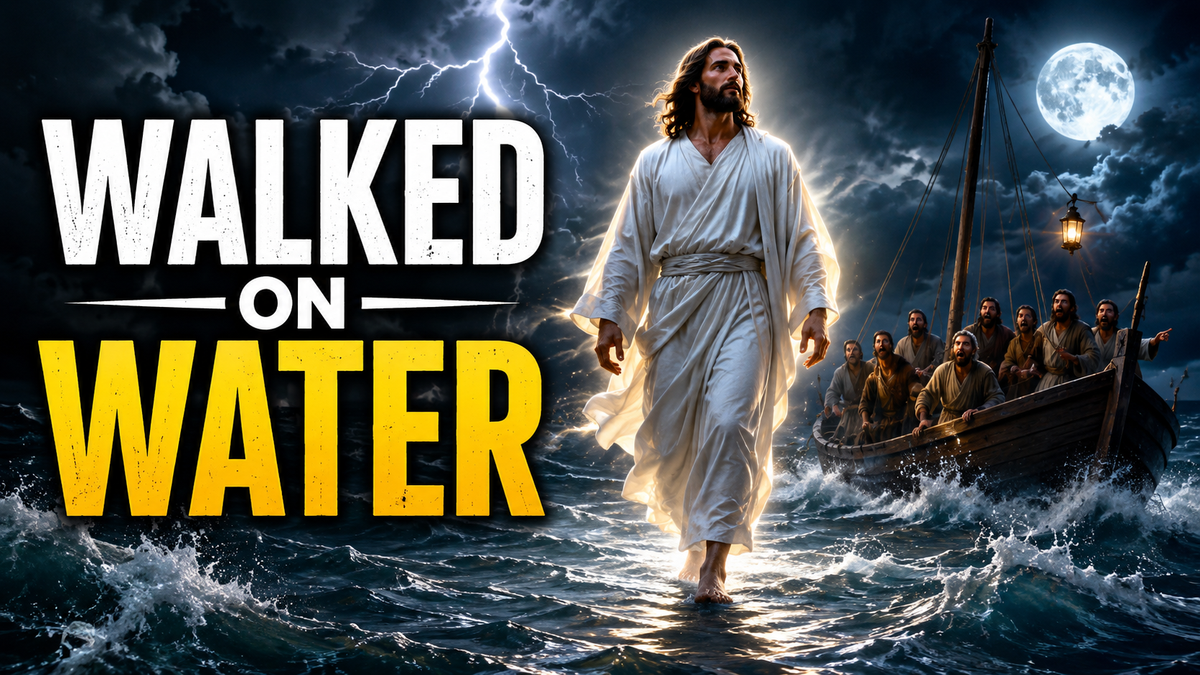
What makes this story so powerful is that Jesus does not remove the water before He calls Peter to come. That is the part we rush past. We often talk about Peter stepping out of the boat as if the miracle is that the water suddenly became safe. But the Bible does not say the lake turned into stone. It does not say the waves froze in place. It does not say the wind apologized and backed away. Peter stepped out while the water was still water, while the wind was still wind, while the night was still dark, and while every natural reason for fear was still present. That changes the whole lesson. Jesus was not teaching Peter that faith means the conditions become easy. He was showing him that the presence of Christ is greater than the instability beneath him.
That is where this story reaches into real life. Someone is trying to keep a marriage alive while conversations keep turning sharp. Someone is driving to work with a knot in their stomach because they know the meeting ahead of them could change everything. Someone is sitting beside a hospital bed, trying to sound strong while silently begging God for more time. Someone is raising a teenager and wondering when love became so complicated. Someone is trying to build something meaningful, but the results are slow, the criticism is loud, and the private fear is that maybe they misunderstood the call. These are not dramatic movie moments. They are ordinary human storms. They are the places where people discover that trusting Jesus is not always peaceful at first. Sometimes trust begins with shaking hands.
The disciples had just seen Jesus feed a crowd. They had watched abundance come from almost nothing. They had watched bread multiply in His hands. That is important because fear has a strange way of making yesterday’s miracle feel far away. You can see God provide in one season and still panic in the next. You can remember what He did and still wonder what He will do now. That is not because you are fake. It is because you are human. The disciples did not stop being disciples when they were afraid in the boat. They were still His. They were still called. They were still loved. They were simply caught in a place where what they knew about Jesus was being tested by what they felt in the storm.
That is a perspective shift many people need. The storm does not always mean you are outside the will of God. Sometimes the storm is where you learn something about Jesus you could not have learned from the shoreline. On land, you can believe He is powerful. In the boat, with waves hitting the side and wind fighting your progress, you learn whether you believe He is near. On land, you can talk about courage. In the dark, when you cannot control the outcome, you find out where your courage actually comes from. The disciples were not abandoned because the night was hard. Jesus came to them in the very place they could not control.
That matters because people often judge their spiritual condition by their emotional weather. If they feel calm, they assume they are faithful. If they feel afraid, they assume something is wrong with them. But the Bible is much more honest than that. Peter had enough faith to step out of the boat and enough fear to start sinking. Both were true in the same man, in the same moment, under the same sky. That is why this story feels so human. Peter is not a cartoon example of perfect courage. He is a man pulled in two directions. His eyes see Jesus, then his senses feel the wind. His spirit wants to come forward, but his body knows water is not a floor. His faith begins moving, then fear interrupts the movement.
If we are honest, that is us. We start strong, then we notice the wind. We pray with confidence, then the situation gets worse. We decide to trust God, then a new problem appears. We take one step toward obedience, then our mind starts calculating everything that could go wrong. The wind is not always a storm on a lake. Sometimes the wind is an email, a diagnosis, a bank balance, a memory, a rejection, a silence, a responsibility, or the look on someone’s face when you realize they still do not understand you. The wind is whatever pulls your attention away from the One who called you.
But here is the grace in the story: when Peter begins to sink, Jesus does not let him drown to teach him a lesson. He reaches out His hand. That may be the most important part for someone who is tired of pretending. Jesus did not say, “You should have done better.” He did not say, “Real faith would not have struggled.” He did not leave Peter under the water until Peter could explain himself. Peter cried out, “Lord, save me,” and Jesus immediately reached for him. The hand of Jesus moved faster than Peter’s failure.
That is the heart of this miracle. It is not simply about walking on water. It is about the Savior who comes to frightened people in the dark, calls them beyond the limits of what they can manage, and catches them when their faith loses balance. The water did not have to become a road for Jesus to be trustworthy. The storm did not have to become silent before Peter could begin. The miracle was not that Peter became fearless. The miracle was that Jesus was close enough to catch him.
Many people are waiting for life to feel stable before they trust God with the next step. They want the marriage healed before they choose humility. They want the money secured before they practice generosity. They want the fear gone before they obey. They want the grief fully lifted before they worship again. But this story gently challenges that way of living. Peter did not step onto certainty. He stepped toward Jesus. The difference matters. Faith is not confidence in the water. Faith is confidence in the One who stands above it.
There is a quiet kitchen somewhere right now where someone is reading this with a tired soul. Maybe it is early morning, before anyone else is awake. Maybe the coffee has gone cold because the thoughts are too heavy. Maybe the day has not even started and already it feels like too much. That person may not need a dramatic speech about being brave. They may need to know that Jesus sees them in the boat. He sees the strain. He sees the long night. He sees the part of them that wants to trust and the part that is afraid of sinking. And He is not far away, waiting for them to become impressive. He comes across the water.
The disciples thought they were alone with the storm, but they were not. That is the reframing this chapter has to begin with. The presence of fear is not proof of the absence of Jesus. The instability beneath you is not proof that God has forgotten you. The wind against you is not proof that obedience was a mistake. Sometimes the very place that feels impossible becomes the place where you discover that Jesus is not limited by what limits you.
Chapter 2: When Jesus Looks Like One More Threat
A man sits in his parked car outside the building where he works, both hands on the steering wheel even though the engine is already off. He knows he needs to go inside. The meeting is on the calendar. The conversation has been coming for weeks. Maybe his job is changing. Maybe his name has been mentioned in rooms he was not invited into. Maybe he has been carrying more responsibility than anyone sees, and now the same people who kept asking more from him are about to question whether he is doing enough. He looks through the windshield at the doors and feels that familiar pressure rise in his chest. He has prayed about this. He has asked God for strength. But the morning still feels like wind against his face.
That is one of the harder parts of faith. We often expect Jesus to come in a form we immediately recognize as comfort. We want His help to feel calm, gentle, obvious, and easy to understand. But in the story of Jesus walking on water, the disciples do not recognize Him at first. They see a figure coming toward them on the sea, and they are terrified. They cry out because they think He is a ghost. That detail matters. Jesus is coming to rescue them, but in their fear, He looks like one more thing to be afraid of.
That happens to people more than we admit. God starts answering a prayer, but the answer arrives through a change we did not want. He begins moving us toward healing, but the first step is a conversation we have avoided. He opens a door, but the open door demands courage we do not feel ready to carry. He exposes something in our heart, not to shame us, but to free us, and at first the conviction feels like danger. We asked for peace, but Jesus begins by asking us to face the truth. We asked for direction, but He begins by interrupting the plan we trusted. We asked for rescue, but He comes walking across the very thing that scares us.
The disciples were not wrong to be startled. A human figure on the water in the middle of the night would have shaken anyone. The Bible is honest about the strangeness of the moment. They were already tired, already fighting wind, already far from land, and then something impossible appeared where no person should have been able to stand. Their fear had a kind of logic to it. But fear, even when understandable, does not always interpret reality correctly. They thought the presence coming toward them was a threat. It was Jesus.
That is a perspective shift many of us need. Not everything that scares you is against you. Sometimes the thing that makes your heart race is the very place where Jesus is coming near. The hard conversation may be the beginning of honesty. The closed door may be mercy. The uncomfortable conviction may be the first clean breath after a long season of hiding. The responsibility you did not ask for may become the place where God teaches you strength. The change you would not have chosen may be carrying the help you could not have created on your own.
This does not mean every frightening thing is from God, and it does not mean we should call harmful situations holy. Jesus never asks us to pretend danger is safe or abuse is love. Wisdom still matters. Discernment still matters. Counsel, boundaries, and protection still matter. But this story does challenge the assumption that fear always tells the truth. Sometimes fear screams “ghost” when Jesus is standing right there.
That is why the words of Jesus are so important. He does not wait for the disciples to calm themselves down. He speaks into their panic. He says, “Take courage. It is I. Do not be afraid.” He gives them His presence before He gives them an explanation. He does not start with a long speech about why they should have known better. He identifies Himself. He lets His voice cut through the storm.
There is a reason the voice matters. In a storm, vision can become unreliable. The water is moving. The light is low. The wind is loud. The body is tired. What the disciples see confuses them, but what Jesus says anchors them. That is true for us too. When life is unstable, what we see may not be enough to steady us. We look at the numbers, the symptoms, the silence, the conflict, the delay, the uncertainty, and all of it seems to say one thing. But then the voice of Christ says another. He says He is near. He says He is Lord. He says we are not abandoned. He says the Father sees. He says we are worth more than many sparrows. He says peace is not found in controlling the storm but in trusting the One who stands within it.
A mother may know this feeling when she checks her phone late at night and sees no message from the child she is worried about. Her mind fills the silence with every possibility. She wants to trust God, but the empty screen feels louder than her prayers. In that moment, faith may not feel like a song. It may feel like whispering, “Jesus, help me not obey every fear my mind creates.” That is not weak faith. That is real faith trying to breathe in a real storm.
Peter’s response is also strange in the best way. He says, “Lord, if it is You, tell me to come to You on the water.” Peter does not ask Jesus to prove Himself by making the storm disappear. He asks to come closer. That is easy to miss. The goal was not walking on water for the sake of doing something spectacular. The goal was Jesus. Peter wanted to move toward the One speaking in the storm.
That gives the miracle a different meaning. If walking on water becomes only a symbol for doing something impressive, we miss the heart of it. Peter was not chasing attention. There was no crowd on the shore applauding. There was no platform, no spotlight, no public victory. There was only night, water, wind, a frightened boat, and Jesus. The step mattered because it was a step toward Him.
That is how obedience should be understood. The point is not to become impressive. The point is to come closer to Christ. If God calls you into a hard act of forgiveness, the goal is not to prove you are spiritually strong. It is to become more like Jesus. If He calls you to tell the truth, the goal is not to look brave. It is to leave the darkness behind and walk toward Him. If He calls you to keep showing up when quitting would be easier, the goal is not to build a heroic image. It is to trust the One who called you.
There is another reason this matters. Peter did not step out because the water was safe. He stepped out because Jesus said, “Come.” That one word was stronger than the surface beneath him. The call of Jesus became the place his foot could land. That is not how the world teaches us to live. The world says, “Do not move until everything is secure.” Jesus sometimes says, “Come,” while the water is still moving.
A person may feel this when they finally decide to apologize without knowing how the other person will respond. The floor does not feel solid. The outcome is not guaranteed. Pride argues against it. Fear warns them to stay protected. But somewhere deeper, the voice of Jesus is calling them toward humility, and they know the next faithful step is not waiting for perfect safety. It is moving toward Him.
The story does not teach us to be reckless. Peter did not climb out of the boat because he was bored or because he wanted to test his own courage. He asked for the word of Jesus. That is the difference between faith and presumption. Faith moves when Jesus calls. Presumption moves to prove something. Faith is centered on Christ. Presumption is centered on self. Faith listens. Presumption performs.
For people carrying heavy decisions, this distinction is mercy. You do not have to jump into every dangerous situation and call it faith. You do not have to force dramatic steps to make your trust look real. The question is not, “What would look bold?” The question is, “Where is Jesus calling me closer to Him?” Sometimes that call will look like staying faithful in a quiet assignment. Sometimes it will look like leaving what is harming your soul. Sometimes it will look like speaking gently when anger wants to win. Sometimes it will look like opening your Bible after months of distance, not because you feel impressive, but because you are hungry for His voice again.
When Jesus said, “Come,” Peter had to decide whether the voice of Christ was more real to him than the instability of the water. That is still the decision. Not once in a lifetime, but again and again. In the kitchen. In the car. At work. Beside the bed. In the message you need to send. In the prayer you need to pray honestly. In the habit you need to surrender. In the burden you need to stop pretending you can carry alone.
The disciples first thought Jesus was a ghost because fear distorted what they saw. Then His voice revealed who He was. Peter stepped toward Him, not because the situation became easy, but because the call became clear. That is where faith begins to regain its balance. It does not always begin with a changed storm. Sometimes it begins with a clearer recognition of the One coming toward you through it.
Chapter 3: The Hand That Reached Before the Lesson
There is a different kind of fear that comes after you have already tried to trust God. It is the fear that shows up after the first step, after the prayer, after the decision, after the moment when you told yourself you were going to be brave this time. A woman sits beside her father’s recliner with a pill organizer in her hand, trying to remember which medication comes after dinner and which one has to wait until morning. She loves him, but she is tired in a way sleep does not fix. She has been trying to do the right thing for months. She has prayed for patience. She has asked God to help her honor him, care for him, and not lose herself in the process. Then one evening she snaps over something small, and the guilt hits her harder than the exhaustion. She thought she was walking forward. Now she feels like she is sinking.
That is the part of Peter’s story many people understand more deeply than they say. Stepping out of the boat is not the only hard part. Sometimes the harder part is what happens when you step out and still struggle. Peter did what many of us say we want to do. He moved toward Jesus. He obeyed the call. He climbed over the side of the boat, left the place that at least seemed familiar, and put his weight on something that could not hold him unless Christ was truly with him. For a moment, he walked. We should not erase that. Peter really did walk on the water. His faith was not imaginary. His courage was not fake.
But then he saw the wind.
That phrase has always felt strangely honest. You do not really see wind itself. You see what wind is doing. You see water lifting. You see waves breaking. You see the boat moving. You feel the force against your body. Peter noticed the evidence of the storm, and suddenly the evidence of danger became louder than the voice that had called him. His attention shifted, and he began to sink.
That is not hard to understand. Many of us have started with faith and then felt panic rise when the situation stayed difficult. We decided to forgive, and then the old hurt came back. We chose to trust God with money, and then another bill arrived. We committed to being patient with our children, and then the same argument happened again. We opened our heart to hope, and then the door stayed closed. We obeyed Jesus, but obedience did not remove the wind.
This is where a lot of people become ashamed. They think struggling after they stepped out means the step was not real. They think fear after obedience cancels the obedience. They think sinking means they failed so badly that Jesus must be disappointed in them from a distance. But the story does not move that way. Peter begins to sink, and his prayer becomes very short. He cries, “Lord, save me.”
That may be one of the most honest prayers in the Bible.
No polished language. No long explanation. No attempt to sound composed. Just need. Just truth. Just a man who knows that if Jesus does not reach for him, he cannot save himself. There are seasons when prayer becomes that simple. You may not have the energy to say everything the way you think a faithful person should say it. You may not be able to organize your fear into beautiful words. You may only be able to whisper, “Lord, save me,” while standing in a hallway, sitting in a car, lying awake in bed, or trying not to fall apart in front of people who depend on you.
And Jesus responds immediately.
That word matters. He does not let Peter sink for a while to make the lesson more dramatic. He does not make Peter prove that he has learned something. He does not stand beyond reach and wait for Peter to correct his theology. He reaches out His hand and catches him. The correction comes, but the hand comes first.
That is a side of Jesus people need to see clearly. Jesus does teach Peter. He does ask, “Why did you doubt?” But He does it after He has hold of him. The order is mercy before correction. Rescue before explanation. Presence before instruction. Jesus does not ignore Peter’s fear, but He does not let Peter drown in it either.
Some people grew up believing God only comes close after they perform well. They imagine God watching with folded arms, waiting to see whether they can keep their faith steady enough to deserve help. But the Jesus in this story reaches for the sinking disciple. He reaches for the one whose courage broke. He reaches for the one who started well and then panicked. He reaches for the one who had faith and fear tangled together in the same chest.
That is good news for anyone who has ever tried and stumbled. It is good news for the person who started reading Scripture again and then missed days. It is good news for the person who made progress with anger and then lost their temper. It is good news for the person who meant to trust God through the medical test but still cried in the parking lot. It is good news for the person who believed, doubted, prayed, panicked, obeyed, sank, and still cried out to Jesus.
The miracle is not only that Peter walked. The miracle is that when Peter sank, Jesus was still close enough to catch him.
That changes how we view failure. Failure is not something to celebrate, but it is also not always the end of the story. Sometimes it becomes the place where we find out whether we believe Jesus is only pleased with strong people or whether He truly saves weak ones. Peter learned something about Jesus while walking, but he also learned something while sinking. He learned that the hand of Christ is not withdrawn the moment our faith trembles.
A man trying to rebuild his life after years of bad choices may need that truth. He may have made promises before. He may have disappointed people. He may have disappointed himself. He may be trying to live differently now, but every setback feels like proof that he will never change. The enemy loves to turn a stumble into an identity. He whispers, “See, this is who you are. You will always sink.” But Jesus does not call Peter “sinking one.” He catches him. He lifts him. He brings him back.
There is a deep mercy in that. Jesus does not define Peter by the worst few seconds of the story. We often do that to ourselves. We take the moment we lost focus, the sentence we wish we had not said, the fear we could not hide, the weakness that embarrassed us, and we build a name out of it. We start living as if one sinking moment tells the whole truth. But Peter’s story keeps moving. The hand reaches. The water does not win. The storm does not get the final word.
This does not make doubt harmless. Jesus asks Peter why he doubted because doubt did something real to him. It pulled his attention away from Christ. It made the storm seem more trustworthy than the call. It caused him to sink. Jesus loves Peter too much to pretend that did not matter. But His question is not cruelty. It is not humiliation. It is the voice of a Savior teaching Peter to understand what happened inside him so he can learn to stand differently next time.
That is how Jesus often works with us. He rescues us, then He teaches us. He brings us out of what was swallowing us, then He helps us see why we began to go under. Maybe we were trying to obey while still measuring everything by visible results. Maybe we trusted Him until people criticized us. Maybe we had courage until the situation felt expensive. Maybe we stepped forward but kept listening to the old voice that said we were foolish for believing. Jesus does not expose those places to crush us. He brings them into the light because He wants our faith to grow stronger than our reactions.
The boat was still there. The disciples were still watching. Peter had to come back with wet clothes and a rescued life. That must have been humbling. But maybe humility was part of the gift. Peter could never again talk about faith as if it were only a bold speech. He knew what it felt like to step. He knew what it felt like to sink. He knew what it felt like to be caught. That kind of experience can make a person gentler with others. When you know you have been rescued, you become less interested in shaming people who are still struggling in the water.
This is one of the places where the story becomes deeply practical. When someone around us starts sinking, we should not pretend the wind is harmless, and we should not mock them for being afraid. We should become the kind of people who reach faster. We should learn from Jesus. The hand comes first. The lesson can come, the truth can come, the growth can come, but the first movement of love toward a sinking person should not be a lecture. It should be help.
Peter’s cry was short, but it was enough. That should comfort every tired believer who thinks prayer has to be impressive before God will respond. Sometimes the most faithful prayer is the one that has no strength left to decorate itself. “Lord, save me” is not a weak prayer. It is a clear one. It knows where help comes from. It knows who is near. It knows the water cannot be argued with and the self cannot be trusted as its own savior.
The hand of Jesus reached before the lesson, and that is still how mercy feels when it finds us. It does not deny the storm. It does not flatter our fear. It does not pretend doubt is wisdom. But it reaches. It catches. It lifts. And once His hand has hold of us, we begin to learn that the point of faith was never to become someone who never needs saving. The point is to keep turning toward the Savior who is already reaching for us.
Chapter 4: When the Wind Finally Lost Its Voice
A man stands at the kitchen counter with an envelope opened beside his coffee cup, reading the same sentence for the third time because the number on the page is not the number he hoped to see. It is not a dramatic moment anyone would film. There is no thunder outside, no visible crisis, no one else in the room to witness it. There is only paper, coffee, morning light, and the private pressure of wondering how he is supposed to keep everything together. He has been trying to trust God, but trust feels different when the problem has a due date. He wants peace, but the wind in his mind keeps talking.
That is one of the hardest things about fear. It has a voice. It tells you what could happen. It tells you what you cannot handle. It tells you what might fall apart. It takes one number on a page, one message on a phone, one conversation from yesterday, one uncertainty about tomorrow, and it begins preaching a future without mercy. Fear does not always scream. Sometimes it just keeps repeating itself until you start believing it is wisdom.
In the story of Jesus walking on water, there comes a moment when the wind finally stops. Jesus catches Peter. They go back into the boat. Then the wind dies down. That order matters. The wind did not die before Peter stepped out. It did not die before Peter started sinking. It did not die before Jesus reached for him. The wind died after Jesus and Peter entered the boat together.
That detail is easy to miss, but it holds a strong truth. Sometimes peace does not come before you obey. Sometimes peace does not even come before you cry out for help. Sometimes peace comes after you have been caught, after you have been humbled, after you have learned that Jesus is not only Lord over the storm but Savior in the middle of your weakness. The quiet that follows is not just relief. It is recognition.
The disciples in the boat worshiped Him and said, “Truly You are the Son of God.” They had seen miracles before, but this moment brought them to a clearer confession. The storm became a classroom, but not the kind of classroom any of them would have chosen. No one asks for lessons in fear. No one volunteers for the kind of night that strips away the illusion of control. Yet when Jesus stepped into the boat and the wind lost its voice, the disciples saw Him more clearly.
That is one of the perspective shifts this miracle gives us. The goal of the story is not Peter becoming famous for walking on water. The goal is Jesus being known as the Son of God. Peter’s step matters. Peter’s sinking matters. The rescue matters. But the final movement of the scene is worship. The disciples are not left saying, “Peter is brave.” They are left saying, “Jesus is Lord.”
That matters because we often make our storms too much about ourselves. We ask what our fear says about us, what our struggle says about us, what our failure says about us, what our sinking says about us. We turn every hard moment into a courtroom where our identity is on trial. But the deeper question is not only, “What does this reveal about me?” The deeper question is, “What is Jesus revealing about Himself here?”
Maybe the storm reveals that we are not as in control as we thought. That can be painful. But it may also reveal that Jesus is closer than we imagined. Maybe the sinking reveals that our focus can break. That can humble us. But it may also reveal that His hand is faster than our collapse. Maybe the wind reveals how easily fear can dominate our attention. That can sober us. But it may also reveal that His presence has authority over the very thing that has been shouting at us.
A person living through financial pressure may understand this slowly. At first, the whole story feels like the bill, the bank account, the deadline, the shame of not being further along, and the exhausting question of what comes next. But somewhere in the middle of that pressure, God may begin forming something deeper than a quick escape. He may teach honesty instead of panic. He may teach contentment without passivity. He may teach humility enough to ask for help. He may teach generosity that does not depend on feeling rich. He may teach a person to stop measuring their worth by what they can afford. None of that makes the pressure easy, but it can make the storm holy ground instead of wasted pain.
When Jesus entered the boat, the disciples were not the same men they had been when the night began. They had seen fear misread Him. They had heard His voice in the dark. They had watched Peter step out. They had watched Peter sink. They had watched Jesus reach. They had watched the wind lose its power. By the time they worshiped, their praise had history behind it. It was not shallow. It had waves in it. It had trembling in it. It had wet clothes and pounding hearts in it. It had the memory of thinking they were alone and then discovering they were not.
That kind of worship is different from singing when everything feels easy. Easy worship is beautiful too, but storm-tested worship carries a certain weight. It comes from the person who knows what it felt like to be afraid and still be held. It comes from the person who has prayed from the bottom of the heart, not the top of the head. It comes from the person who can say, “I do not only believe Jesus is Lord because someone told me. I believe because He met me where I could not stand.”
This does not mean we should chase storms or romanticize suffering. Pain is still pain. Fear is still heavy. The disciples were not better because they suffered that night. They were changed because Jesus came to them in the suffering. There is an important difference. Christians do not have to pretend hard things are good in themselves. The goodness is not always in the storm. The goodness is in the Christ who refuses to leave His people alone in it.
Someone may need that distinction because they have been told to call every wound a blessing before they have even had time to grieve. That is not always helpful. Some things are simply hard. Some losses are real. Some disappointments leave a mark. Some seasons take more from us than we know how to explain. Faith does not require fake language. The disciples did not have to pretend the wind was gentle. They simply discovered that Jesus was greater.
When the wind finally died, it did not erase what had happened. Peter still knew he had sunk. The disciples still knew they had been afraid. The night was still part of their story. But now the fear had a new ending. It did not end with abandonment. It ended with worship. It did not end with Peter disappearing under the water. It ended with Jesus in the boat. It did not end with the disciples trapped in terror. It ended with a confession: “Truly You are the Son of God.”
That is what Jesus can do with the storms we survive. He does not always remove the memory, but He can change the meaning. The thing that once seemed like proof that you were alone can become the place where you learned His nearness. The season that made you feel weak can become the place where you learned His mercy. The night that exposed your fear can become the place where your worship became more honest.
There is a quiet kind of strength that forms after the wind loses its voice. It is not loud. It does not need to impress anyone. It may look like a person paying one bill at a time instead of surrendering to panic. It may look like someone making a hard phone call instead of hiding. It may look like telling the truth about fear without letting fear become the leader. It may look like opening your hands and saying, “Jesus, I do not know how this all works out, but I know You are not absent.”
That is not small. That is faith learning to breathe after a storm.
The disciples worshiped after Jesus entered the boat because they finally understood that the miracle was not only out there on the water. The miracle was with them. The One who had authority over the waves had stepped into their fear, caught their friend, silenced the wind, and received their worship. Their boat became a sanctuary, not because it was impressive, but because Jesus was there.
Maybe that is what some of us are really longing for. We think we need a different boat, a different bank account, a different family situation, a different workplace, a different body, a different past, or a different road before we can have peace. Sometimes change is needed, and God may lead us into it. But the deepest peace is not born from perfect conditions. It is born from the presence of Christ becoming more real than the wind.
When Jesus comes into the boat, fear does not get to be the loudest voice forever. It may speak for a while. It may shake the night. It may make strong people tremble. But it does not have final authority. The final word belongs to the One who walks where we cannot walk, reaches when we cannot stand, and stays until worship rises from the place where panic used to be.
Chapter 5: The Boat Jesus Sent Into the Wind
A woman leaves church on a Sunday feeling steadier than she has felt in weeks. The song touched something in her. The message gave her a little oxygen. For a few hours, she remembered that God had not forgotten her. Then Monday morning comes, and the same child is still distant, the same inbox is still full, the same tension is still waiting in the house, and the same fear is sitting beside her coffee like it never left. She wonders why the peace did not last longer. She wonders why a real moment with God can be followed so quickly by pressure.
That is one of the parts of the walking-on-water story we do not always hold together. The storm does not come after the disciples disobey Jesus. It comes after they obey Him. Matthew says Jesus made the disciples get into the boat and go ahead of Him to the other side while He dismissed the crowds. Mark says the same kind of thing. Jesus sends them across, then He goes up the mountain to pray. The disciples are not running from God. They are not wandering outside the call. They are exactly where Jesus told them to be, and still the wind is against them.
That changes the way we read our own hard seasons. We often assume resistance means we must have missed God. We think if the decision was right, the road should be smooth. We think if Jesus sent us, the crossing should feel protected in a way we can immediately recognize. But the disciples were in the boat because Jesus put them there. The wind was against them, but the command of Christ was still beneath them.
This is not permission to baptize every bad decision as obedience. Sometimes we create our own storms through pride, impatience, foolishness, or refusal to listen. But this story keeps us from making the opposite mistake. It reminds us that difficulty is not automatic proof of disobedience. A hard road can still be a called road. Wind in your face does not always mean Jesus told you to turn around.
That matters for the person who is trying to do right and still feels resisted. A father decides to become more present with his children, and at first it gets harder, not easier, because now he has to face years of distance, awkward conversations, and the pain of realizing love cannot be repaired with one good weekend. A woman decides to stop lying to herself about a relationship, and the truth brings grief before it brings freedom. A man starts rebuilding his faith, and instead of instant peace, he notices all the places he has been numb for too long. Obedience can disturb what avoidance kept quiet.
The disciples were rowing against the wind for hours. That image feels honest. Sometimes faith is not a dramatic leap out of the boat. Sometimes faith is staying at the oars when progress feels painfully slow. It is showing up again when nobody claps. It is praying again when your emotions are flat. It is doing the next right thing when the outcome is still unclear. It is moving inch by inch through a season that does not feel inspiring at all.
There is a kind of Christian encouragement that only talks about the breakthrough. It loves the moment when Jesus appears, the moment Peter steps out, the moment the wind stops. Those moments are real, and they matter. But many people live most of their lives between the command to cross and the moment the wind dies. They are not yet in the dramatic rescue scene. They are rowing. They are tired. They are doing what Jesus said, and the distance still feels long.
The kindness of this story is that Jesus sees that too. Mark’s Gospel says Jesus saw the disciples straining at the oars because the wind was against them. That single detail carries so much comfort. Jesus was on the mountain, but He was not unaware. He was praying, but He was not disconnected. The disciples may have felt alone on the water, but they were seen from the place of prayer.
There are seasons when Jesus feels distant because He is not handling the situation the way we expected. We wanted Him in the boat from the start. We wanted Him to prevent the wind. We wanted Him to arrange the crossing so obedience felt immediately peaceful. Instead, He is on the mountain, and we are on the water. But distance in the scene is not abandonment. The One praying on the mountain is still the One who sees the boat.
That is a hard but holy reframing. Jesus can be interceding while you are straining. He can be present in ways you cannot feel yet. He can see what is happening even when the night makes you think you have disappeared. He can let you row longer than you would have chosen and still arrive at exactly the moment His presence will teach you what easier conditions never could.
A young person trying to follow Jesus in a family that does not understand may know this kind of wind. They want faith to feel clean and simple, but instead every step creates questions, tension, and loneliness. They may wonder whether something is wrong because obedience has not made life easier. But sometimes following Jesus creates a new kind of honesty that the old life did not require. The wind against them does not mean Christ is absent. It may mean they are learning to belong to Him more deeply than they belong to the approval around them.
The crowd had just been fed before the disciples got into the boat. That is important too. They left a miracle and entered resistance. One moment there was abundance in their hands. The next, there was wind in their face. That is how life can feel. A person can come out of a strong spiritual moment and still have to face the ordinary difficulty of being faithful. The miracle of yesterday does not remove the need for trust today. Bread in your memory does not automatically calm the lake under your boat.
Maybe Jesus sent them away from the crowd because they needed to know Him beyond the excitement of public miracles. Crowds can be powerful. Momentum can feel like faith. When everyone is fed, everyone is amazed, and everything feels successful, belief can ride the energy of the moment. But the boat strips that away. There is no crowd on the water. No applause. No baskets of leftovers in everyone’s hands. Just tired disciples, dark waves, and the question of whether Jesus is still Lord when the excitement is gone.
That is where deeper faith is formed. Not always in the big public moment, but in the private crossing afterward. Not only when the message moves you, but when Monday tests you. Not only when you feel lifted, but when you have to live what you said you believed. The storm after the miracle is not proof that the miracle was false. It may be the place where the miracle becomes something more than a memory.
This is especially important for people who feel guilty because their faith does not stay emotionally high. You may have had a real encounter with God and still wake up anxious the next morning. You may have meant every word of the prayer and still struggle later that week. You may have felt courage rise and then watched it get tested almost immediately. That does not make your faith fake. It means your faith is moving from a moment into a life.
Jesus sent them into the boat, and He came to them on the water. Both are part of His care. The sending was not cruelty. The waiting was not neglect. The coming was not late. The whole story belonged to a Lord who knew what His disciples would face and knew what they still needed to learn about Him.
So if you are rowing right now, do not assume the wind has canceled the command. Do not assume the strain means you are unseen. Do not assume the absence of easy progress means the absence of God. Keep your heart open. Keep your ears ready for His voice. Keep doing the next faithful thing, not because the water is easy, but because Jesus is still Lord over the crossing.
The boat Jesus sends you into may face wind. The work He gives you may require endurance. The obedience He calls you toward may uncover fear you did not know was there. But the story does not end with disciples straining in the dark. It moves toward Jesus coming near in a way they never expected, walking over what had been fighting them, turning the place of resistance into the place where they would see His glory with new eyes.
Chapter 6: The Faith That Comes Back to the Boat Different
A man sits at the edge of his bed before sunrise, shoes on, hands folded, not because everything is fixed, but because he has decided to face the day anyway. The house is still quiet. There is a problem waiting for him at work, a conversation he cannot keep avoiding, and a heaviness he has not been able to explain to anyone in a way that feels complete. He is not standing on top of the world. He is not glowing with confidence. He is simply choosing not to let fear make the final decision before the day begins.
That is closer to real faith than many people realize.
When we hear the story of Jesus walking on water, we often picture the most dramatic moment. Peter steps out. The waves move beneath him. Jesus stands ahead of him. The impossible happens. And because that image is so powerful, we can start thinking faith is only real when it looks bold, visible, and impressive.
But the story does not end with Peter standing on the water.
It ends with Peter back in the boat.
That matters.
Peter did not stay out there forever. He did not build a life on the surface of the lake. He did not become a man who never needed shelter, community, correction, rescue, or ordinary obedience again. Jesus caught him, brought him back, entered the boat with him, and the wind died down. The miracle did not remove Peter from human life. It sent him back into it with a deeper understanding of who Jesus was.
That may be one of the most important lessons in the whole story.
Faith is not always about staying in the most dramatic moment. Sometimes faith is what changes in you after Jesus brings you back.
Peter came back to the boat wet, humbled, and rescued. He came back knowing courage was real, but so was weakness. He came back knowing fear could pull his eyes away, but Jesus could still reach him. He came back knowing that the call of Christ could hold him, but not because Peter himself was strong enough to master the sea.
That kind of faith is less flashy, but it is stronger.
It is the faith of someone who no longer has to pretend.
A parent knows this when they apologize to a child after handling something poorly. That apology may not feel like walking on water. It may feel small, awkward, and humbling. But maybe it is what faith looks like after Jesus has been working on the heart. Instead of hiding behind authority, the parent tells the truth. Instead of pretending they never sink, they show the child what it looks like to reach for grace and begin again.
A worker knows this when they stop trying to control every outcome and start doing honest work with a steadier spirit. The pressure may still be there. The deadlines may still be real. But something inside them is different. They are not worshiping the storm anymore. They are not letting fear become their manager, their prophet, and their god. They are doing the next faithful thing because Jesus is in the boat.
A person carrying regret knows this when they stop replaying the worst moment as if it is the only true thing about them. They bring the memory to Jesus again, not to excuse it, but to be healed from the lie that failure gets the final name. They may still have consequences to face. They may still have repairs to make. But they begin to believe that the hand that caught Peter can also reach into their story.
The walking-on-water miracle is not an invitation to chase spiritual drama. It is an invitation to trust Jesus in the unstable places and then live differently when you return to ordinary ground.
That is where the story becomes deeply practical. The next morning still comes. The disciples still have to keep following. Peter still has to keep learning. The boat still has to reach shore. Life continues after the miracle, and maybe that is where the miracle proves its depth.
It is one thing to cry out to Jesus in panic. It is another thing to let His rescue change how you live afterward.
If Jesus caught you in a season when you were sinking, maybe the next step is not to act as if you were never afraid. Maybe the next step is to become more honest, more humble, more patient with others who are afraid. Maybe the rescue should make you gentler instead of louder. Maybe the hand that saved you should teach your hands how to reach for someone else.
This is where the story challenges the way we sometimes talk about faith. We love victory, but we do not always love dependence. We love the idea of doing impossible things, but we do not always love admitting how quickly we can lose focus. We love Peter stepping out, but we are less comfortable with Peter crying for help. Yet both belong to the story. If we remove the sinking, we remove the mercy. If we remove the rescue, we turn faith into performance.
Jesus did not call Peter out of the boat so Peter could become impressed with himself. He called him toward Himself. That is the difference. The point was never the water. The point was Jesus.
That means your faith does not have to look impressive to be real. It has to keep moving toward Christ.
Some days that movement will look bold. You will make the call, take the step, tell the truth, forgive the person, start again, or obey when fear argues with you. Other days, moving toward Jesus will look like one tired prayer from the floor of your life: “Lord, save me.” Both can be faith. One is the step. One is the cry. Jesus honors the step, and He answers the cry.
What He does not want is for us to stay trapped in the boat of fear pretending it is wisdom. He also does not want us jumping into storms to prove we are brave. The center of the story is not recklessness. It is relationship. Peter asked for the word of Jesus. Jesus said, “Come.” Peter moved toward the voice. That is the pattern.
Listen for His voice.
Move toward Him.
Cry out when you sink.
Receive His hand.
Return changed.
That is not a list for religious performance. It is a way of seeing the miracle as a living word for daily life. The faith that begins on the water has to come back to the kitchen, the workplace, the hospital room, the bank account, the family table, the quiet bedroom, and the long road of becoming more like Christ.
Maybe the real miracle is not only that Peter walked where people cannot walk. Maybe the real miracle is that Jesus kept forming Peter after the moment was over.
That is what He does with us too.
He does not simply save us from moments of fear. He teaches us how to live after fear has been exposed. He teaches us how to stop letting the wind define reality. He teaches us how to stop confusing emotional calm with spiritual faithfulness. He teaches us how to come back to the boat without shame, knowing we have been rescued by grace and strengthened by truth.
There is hope in that for the person who feels like they have failed too many times to keep walking with God. Peter’s story says otherwise. He sank, but he was not finished. He doubted, but he was not discarded. He needed rescue, but he was not rejected. Jesus did not erase him from the story because his faith trembled. Jesus kept working with him.
That means the storm you are in right now does not have to become your identity. The fear you feel does not have to become your master. The moment you sank does not have to become the title of your life. Jesus is still near enough to reach you, strong enough to hold you, and faithful enough to bring you back changed.
So when you think about Jesus walking on water, do not only imagine the impossible surface beneath His feet. Imagine the eyes that saw the disciples in the dark. Imagine the voice that spoke through their panic. Imagine the hand that caught Peter before the water could take him. Imagine the Savior stepping into the boat, not ashamed to be near frightened people, not embarrassed by their weakness, not limited by their storm.
And then imagine your own life differently.
Maybe the water beneath you does not have to become a road before you can trust Him.
Maybe the wind does not have to go silent before you can take the next faithful step.
Maybe the fear you keep fighting is not proof that Jesus is absent.
Maybe the place that feels unstable is the very place where you are about to discover that Christ is steadier than everything beneath you.
The disciples began that night straining against the wind. They ended it worshiping. Not because they had become fearless, but because Jesus had revealed Himself in the place where fear had been loudest.
That can happen in you too.
Not always all at once. Not always in a way other people notice. But quietly, deeply, honestly, as you learn to trust the One who comes across the water.
The storm may still be real.
The waves may still move.
The wind may still push against you.
But Jesus is not waiting on the shore.
He is coming near.
And when He says, “Come,” you do not have to trust the water.
You can trust Him.
Your friend,
Douglas Vandergraph
Watch Douglas Vandergraph inspiring faith-based videos on YouTube:
https://www.youtube.com/@douglasvandergraph
Support the Christian encouragement library through GoFundMe:
https://www.gofundme.com/f/help-douglas-vandergraph-build-a-christian-encouragement-lib
Support the daily work by buying Douglas a coffee:
https://www.buymeacoffee.com/douglasvandergraph