The Standard We Change When Jesus Walks Into the Room

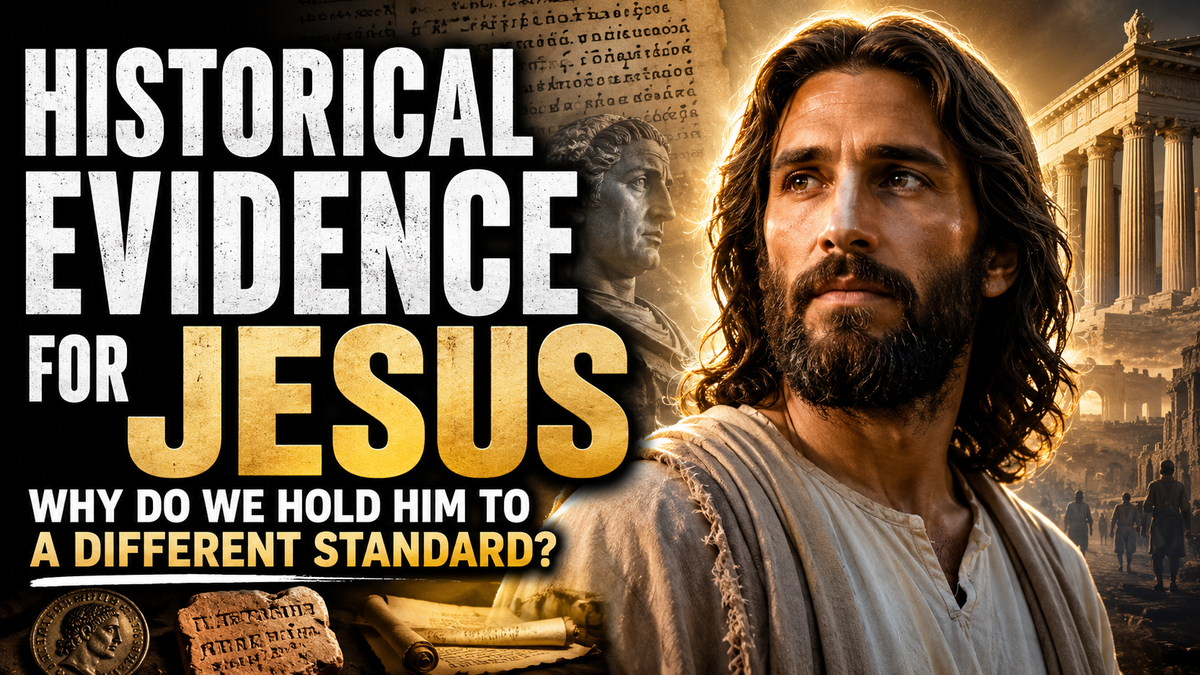
Chapter 1: The Question That Gets Quiet at the Dinner Table
You can feel the room change when the name of Jesus comes up. People can talk about Julius Caesar, Alexander the Great, Socrates, Plato, or ancient kings with a calm kind of confidence, even when they have never personally studied the documents behind those lives. Nobody at the dinner table asks for a laboratory test proving that Socrates drank hemlock. Nobody folds their arms and demands video footage before accepting that Alexander marched across empires. But when Jesus is mentioned, especially if someone says He really lived, taught, was crucified, and changed history, the standard suddenly moves. That is why this article belongs beside the historical evidence for Jesus and the different standard we use and also connects naturally with the deeper question of why people resist Jesus more than other figures from history, because the issue is not only about ancient evidence. It is about what happens inside us when historical evidence starts walking toward our conscience.
Maybe you have felt this yourself. You were talking with a friend, a coworker, a son or daughter, someone in your family, or even someone online who seemed perfectly reasonable until Jesus became the subject. They accepted entire stretches of ancient history without demanding impossible proof. They trusted classroom summaries, museum labels, documentaries, professors, biographies, and quick statements from people they considered credible. Then Jesus came up, and suddenly every ancient source became suspicious, every manuscript became too late, every witness became biased, every Christian became unreliable, and every piece of evidence had to carry a burden that almost no other ancient figure is asked to carry. You may not have had the words for it in the moment, but you felt the shift. You felt that the conversation was no longer operating by the same rules.
This matters because some believers are made to feel foolish for trusting that Jesus existed. They sit in a break room or scroll through comments at night and begin to wonder if maybe their faith is standing on smoke. They hear someone say, “There is no evidence Jesus even existed,” and because the claim sounds confident, it feels powerful. A tired believer can carry that sentence home like a stone in the pocket. It sits there while dinner is being made, while the kids are asking questions, while the bills are on the counter, while the phone lights up with one more stressful message. The mind starts whispering, “What if I have believed something weak?” But often the person making that claim is not applying a careful historical method. They are applying one standard to Jesus and another standard to almost everyone else.
A man can sit on the edge of his bed at 1:00 in the morning with his phone in his hand, reading arguments from strangers who sound certain. That is a strange place to have a crisis of faith. The room is dark. The house is quiet. The day has already taken more strength than he had. He may not know the difference between a first-century source and a medieval copy. He may not know how ancient history is studied. He may not know how historians weigh testimony, hostile witnesses, cultural memory, community formation, and the survival of texts. All he knows is that somebody online said Jesus is no different than a myth, and now the peace he had before bedtime feels shaken.
That is one of the reasons this subject has to be handled carefully. We do not need to pretend the evidence for Jesus is the same kind of evidence we would have for a modern public figure. It is not. We do not have camera footage from Galilee. We do not have a birth certificate from Bethlehem filed in a county office. We do not have a Roman execution video saved in an archive. Ancient history does not work that way. If those are the demands, then almost the entire ancient world disappears. The question is not whether we have modern evidence for an ancient person. The question is whether we have the kind of evidence historians normally use when dealing with the ancient world.
And when the question is asked that way, Jesus does not vanish. He stands.
He stands in the writings of early Christians who were not writing as detached journalists, but who were also not inventing a harmless private idea. They were making public claims in a world where those claims could cost them dearly. He stands in the letters of Paul, written close enough to the events that the movement was still alive with people who had known the earliest witnesses. He stands in the Gospels, which are theological writings, yes, but theological does not mean imaginary. A person can write with devotion and still write about real events. A grieving daughter can write about her father with love, and the love does not prove the father never existed. A veteran can describe a battlefield with emotion, and the emotion does not erase the battlefield. We know this in ordinary life, but somehow people forget it when Christian writings are on the table.
Jesus also stands outside the New Testament in the memory of people who had no reason to build Christian faith. Ancient Jewish and Roman references do not give us a full biography, but they do show that Jesus was not merely a later church idea floating free from history. The historian Josephus refers to Jesus and to James, the brother of Jesus. Tacitus, writing as a Roman historian, refers to Christus being executed under Pontius Pilate during the reign of Tiberius. These references are not sermons. They are not altar calls. They are not Christian praise songs. They are fragments from a world that was trying to describe movements, leaders, disturbances, and consequences. And in those fragments, Jesus appears as a real figure, not as a fairy tale character nobody had ever heard of.
Still, the deeper issue is not only whether there is evidence. The deeper issue is why the evidence is treated so differently.
Imagine a teenager studying for a history test at the kitchen table. There are flashcards spread everywhere. A parent is helping, half-listening while trying to answer work messages and keep dinner from burning. The student says, “Who was Hannibal?” The parent says, “A Carthaginian general who crossed the Alps.” Nobody stops the evening and says, “But prove Hannibal existed.” Nobody demands multiple independent contemporary eyewitness reports before allowing him into the study guide. The family accepts that historians have done enough work to treat him as real. But if that same teenager asks, “Was Jesus real?” the air gets heavier. The question carries more than historical curiosity. It carries identity, morality, eternity, family history, church wounds, pride, disappointment, and fear.
That is the pressure underneath the standard.
Jesus is not merely an ancient name. He is not only an entry in a textbook. He makes a claim on us. If Caesar existed, it may interest us. If Socrates existed, it may challenge how we think. If Alexander existed, it may reshape how we understand conquest and empire. But if Jesus existed, and if the earliest claims about Him are taken seriously, then the question does not remain safely outside the heart. It moves from “What happened back then?” to “Who is He now?” That movement is what many people resist. Not because they are stupid. Not because they are evil. Often because they are wounded, disappointed, afraid of being controlled, tired of religious hypocrisy, or unwilling to face the possibility that Jesus is not just a topic but a Person.
This is where a believer needs both humility and courage. Humility, because we should not mock honest questions. Some people have been handed shallow answers for serious doubts. Some have been pressured to “just believe” when their minds were truly struggling. Some have seen Christians behave in ways that made the name of Jesus harder to trust, not easier. A person who questions the evidence for Jesus may not be attacking God. He may be trying to find a place where his mind can breathe. She may be trying to separate Jesus from the pain caused by people who used His name carelessly. We do not help those people by yelling at them. We help by telling the truth with steadiness.
But we also need courage, because humility does not require us to accept unfair rules. It is not arrogant to ask why Jesus must clear a higher bar than nearly every other person from the ancient world. It is not hateful to notice that some skeptics dismiss Christian sources because they are Christian, then dismiss non-Christian sources because they are brief, then dismiss early testimony because it is theological, then demand a kind of proof that ancient history almost never provides. That is not careful thinking. That is a moving finish line.
A woman may be sitting in her car outside a grocery store after a hard day, listening to someone explain why faith is childish. She may not be a scholar. She may have no desire to win a debate. She may just be trying to hold onto Jesus while life feels heavy. Her marriage may be strained. Her child may be struggling. Her bank account may be thin. She may be praying in small sentences because long prayers feel impossible. When she hears that “there is no evidence,” the enemy can turn that into shame. He can whisper, “You are weak. You are gullible. You are clinging to something educated people have outgrown.” But the whisper is not telling the whole truth. Faith in Jesus is not blind because someone on the internet says it is. Trusting Jesus does not mean turning off the mind. It means bringing the mind, the heart, the wounds, the questions, and the whole tired life into the presence of the One who entered history.
The Christian claim has always been historical at its center. Christianity does not begin with a vague idea that kindness is nice or that spiritual feelings are comforting. It begins with a man in a place, among a people, under a government, during a time. Jesus of Nazareth taught in Galilee and Judea. He gathered followers. He was crucified under Roman authority. His followers proclaimed that God raised Him from the dead. That proclamation did not stay private. It moved through cities, homes, synagogues, prisons, roads, letters, arguments, persecutions, conversions, and communities. Something happened that forced history to deal with His name.
That does not mean every person who studies history automatically becomes a Christian. Evidence does not remove the need for faith. It does not eliminate mystery, surrender, repentance, or trust. A person can look at evidence and still harden his heart. Another person can look at the same evidence and begin to pray. The point is not that historical evidence alone can save the soul. Only Jesus saves. The point is that the common claim “there is no evidence Jesus existed” is not the careful, devastating argument it is often made out to be. It is usually a slogan. And slogans can feel strong until you slow down and ask what standard is being used.
The question we need to carry into the rest of this article is simple, but it cuts deep: why do we become so strict with Jesus after being so generous with everyone else? Why are we comfortable trusting ancient history in general, then suddenly suspicious when Jesus enters the room? Why do we accept that biased sources can still contain real information in every other area of life, then act as if devotion automatically disqualifies Christian testimony? Why do we understand that hostile references can confirm basic facts in other historical discussions, then shrug when hostile or non-Christian references mention Jesus and the early movement around Him?
There is a reason the room gets quiet.
Jesus is not only being examined by us. We are being revealed by how we examine Him.
Chapter 2: The Kind of Evidence We Already Trust
There is a shelf in almost every home that can teach us something about history. It may be a shoebox in a closet, a plastic bin in the garage, a folder on an old computer, or a stack of photographs that somebody keeps meaning to organize. Inside are pictures of people younger than you ever knew them, birthdays before you were born, handwriting from relatives whose voices you may not remember, and maybe one old document with a name written in ink that has started to fade. You look at those things and you do not say, “This is useless because I was not there.” You know you are handling traces. You know traces are not the same as being in the room, but you also know they are not nothing.
That is closer to how ancient history works than most people realize. We live in a time where we are spoiled by evidence without even noticing it. We can pull up a bank statement, a medical record, a video from a doorbell camera, a text message thread, a GPS map, a timestamp, a photo archive, a social media post, and a recorded phone call. Modern life leaves a trail so thick that we begin to assume real things must always leave modern trails. Then we turn around and judge the ancient world by the habits of a world with smartphones. That is not careful. It is unfair before the conversation even begins.
A man may lose his grandfather and later find an old military record in a drawer. The paper does not tell him everything. It may not describe how afraid his grandfather was, what his voice sounded like when he laughed, what he prayed about, how he carried grief, or why he never talked much about that part of his life. But the document still matters. A faded record can anchor a real life. A short reference can tell you that a person stood in a real place at a real time under real pressure. We understand this with family history. We understand it with local history. We understand it with war records, cemetery stones, court files, old letters, and names carved into buildings. We know that limited evidence does not automatically mean imaginary.
But when Jesus is discussed, many people forget the way they already reason.
They say, “The Gospels were written by believers,” as if belief cancels memory. But the people who preserve history are often the people who care the most about what happened. A mother remembers the details of her child’s surgery because love made the day unforgettable. A firefighter remembers the address of a house that burned because danger burned the memory into him. A widow remembers the last conversation with her husband because grief would not let the words vanish. Caring about an event does not prove the event did not happen. Sometimes caring is the reason the event was preserved.
Of course, caring can shape how a person tells something. Love can emphasize certain details. Pain can affect memory. Devotion can frame meaning. That is why historians do not simply say, “This person cared, so everything must be accepted without thought.” But neither do honest historians say, “This person cared, so everything must be thrown away.” Real life does not work that way. If your daughter tells you what happened at school and she is crying, you may know her emotions are strong, but you do not immediately decide the school does not exist, the teacher does not exist, and nothing happened. You listen. You ask. You weigh. You consider what fits with other things you know. You recognize that emotional testimony can still be testimony.
This is where the conversation about Jesus needs a better doorway. Many people are not actually asking, “Is there any historical reason to believe Jesus existed?” They are asking, “Can I trust sources written by people who loved Him?” That is a more honest question. It does not have to be feared. The answer begins by admitting that the New Testament writings are not cold reports from uninterested outsiders. They are written by people who believed Jesus mattered more than life itself. But that does not make them worthless. It makes them serious. It means the writers were not treating Jesus like a rumor they heard at a market stall. They were testifying to the center of their lives.
A tired father may understand this better than a scholar in an office. He comes home after work, sees a drawing taped to the refrigerator, and realizes his little boy has drawn the family standing together under a bright yellow sun. The drawing is not a photograph. The proportions are wrong. The dog may be bigger than the house. The father may have no hair in the picture even though he still has some left. But the drawing tells the truth in another way. It says, “This family exists. This child sees us this way. These people matter.” The fact that the drawing is shaped by love does not make the family fake.
Now, the Gospels are not children’s drawings. They are ancient biographical and theological writings, formed in a world very different from ours. But the principle still helps. A source can have a point of view and still preserve truth. In fact, almost every ancient source has a point of view. Kings sponsored inscriptions to make themselves look powerful. Roman historians carried political judgments. Philosophers wrote from schools of thought. Military accounts often served public honor, warning, or memory. If we threw away every ancient source with a perspective, we would not become wiser. We would become blind.
The same person who says Christian sources are biased may accept Roman sources while forgetting Rome had its own interests. He may trust a Greek historian while forgetting that Greek writers also had loyalties, assumptions, rivalries, and cultural pride. He may quote ancient philosophers while forgetting that disciples preserved their teachers’ ideas. That does not mean all ancient writing is equally reliable. It means we must stop pretending that the Christian sources are the only ones carrying conviction. Everyone writes from somewhere.
This is not only an academic problem. It becomes a spiritual problem when people use selective suspicion to avoid being honest with Jesus.
Think about a woman cleaning out her mother’s house after the funeral. She finds recipes written on index cards, bills from years ago, a birthday card tucked into a drawer, and a few letters tied with a ribbon. The letters are emotional. They are not neutral. They are full of longing, frustration, apology, gratitude, and family tension. But those letters may tell her more about her mother than any official document ever could. If she said, “These letters are emotional, so I cannot trust that my mother existed,” everyone would know something had gone wrong in her reasoning. Emotion may complicate evidence, but it does not erase it.
When people say, “I only trust unbiased sources,” they often do not realize they are asking for something that barely exists. Human beings are not machines. Every witness has a location, a memory, a motive, a limitation, and a lens. The better question is not, “Was this source written by someone with no viewpoint?” The better question is, “What can this source reasonably tell us, and how does it fit with the wider picture?” That is how we already approach much of history. That is how we approach family stories. That is how we approach courtrooms, interviews, memoirs, records, and memory itself.
The evidence for Jesus should be handled with the same kind of mature honesty. We do not need to exaggerate it. We do not need to pretend every question is easy. We do not need to act as if a skeptical person is dishonest just because he is skeptical. But we also do not need to let skepticism dress itself up as wisdom when it is really applying a special rule to Jesus. If someone rejects Jesus because he has examined the evidence and reached a different conclusion, that is one kind of conversation. If someone rejects Jesus by demanding a kind of evidence he does not demand for anyone else in the ancient world, that is something different.
That difference matters because unfair standards can sound intelligent while quietly protecting the heart from surrender.
There is a young adult somewhere who grew up in church but left angry. Maybe he was hurt by hypocrisy. Maybe she was embarrassed by shallow answers. Maybe someone used God’s name to control instead of love. Years later, when the subject of Jesus comes up, the argument is presented as historical: “There is no evidence.” But beneath the argument there may be an old wound saying, “I cannot trust the place where I first heard His name.” That person may not be lying. The pain may be real. The problem is that pain can make us change the rules without noticing. We can become stricter with the evidence not because the evidence demands it, but because trust feels dangerous.
This is where Jesus is different from other figures in history. Not because the evidence for His existence is weaker than the rest. He is different because accepting that He existed opens a door many people do not want opened. Once Jesus is allowed to stand as a real person in real history, the conversation naturally moves toward what He said, why He died, why His followers were transformed, and why His name still has power over human hearts. Some people sense that movement before they can explain it. So they try to stop the conversation at the first gate. “He never existed” becomes easier than “I do not want Him to be Lord.”
That may sound harsh, but it can be said with compassion. We all know what it is like to avoid a truth that asks something of us. A man can avoid opening a bill because opening it makes the problem real. A wife can avoid an honest conversation because speaking the truth may change the marriage. A parent can avoid looking at a child’s pain because seeing it clearly may require repentance. A believer can avoid prayer because prayer may bring him face to face with the bitterness he has been carrying. Human beings avoid doors when we fear what is behind them. Jesus is the greatest door in history.
So the question is not only, “What evidence do we have?” It is also, “What are we afraid will happen if we admit the evidence is stronger than the slogan?”
For the Christian, this should bring peace. You do not have to panic when someone questions Jesus. Truth does not become weak because it is questioned. You do not have to know every manuscript date, every scholarly debate, every argument about Josephus, every detail about Roman execution practices, or every answer to every objection before you are allowed to trust Christ. It is good to learn. It is good to strengthen the mind. But your faith is not hanging by a thread just because someone speaks confidently against it.
You can take a breath. You can remember that ancient history is built from traces, testimonies, records, references, communities, consequences, and preserved memory. You can remember that Jesus has not been erased by serious historical study. You can remember that the early Christian witness did not appear in a vacuum. You can remember that non-Christian references, though brief, fit the larger picture. You can remember that movements do not explode out of nothing without cause, especially movements centered on a crucified man in a world where crucifixion was shame. You can remember that the existence of Jesus is not the fragile part of Christianity. The harder question has always been what we will do with Him.
And maybe that is why the standard changes.
It is easier to debate whether Jesus existed than to ask whether He is calling your name.
Chapter 3: When the Evidence Touches the Heart
A man sits in a courthouse waiting room with a paper cup of coffee cooling beside him. He was called for jury duty, and he does not want to be there. His phone keeps buzzing with work messages. He is thinking about the meeting he is missing, the parking meter outside, and the long afternoon ahead. Then a clerk opens the door and calls a group of names. Suddenly the idea of evidence stops being a word people use in arguments online. It becomes a human responsibility. Someone’s story will be weighed. Someone’s pain will be heard. Someone’s future may be affected by how carefully ordinary people listen.
That courthouse moment matters because most of us already understand that evidence is not always simple. We know eyewitnesses can be sincere and still limited. We know documents can be incomplete and still important. We know motives matter, but they do not automatically erase truth. We know a hostile witness can accidentally confirm something valuable. We know a friend may speak with love and still tell the truth. We know a record can be brief and still establish a fact. We know that weighing evidence requires patience, not slogans.
Then Jesus enters the conversation, and patience often disappears.
The word “evidence” starts carrying emotional freight. It no longer feels like a fair search for what can be known. It becomes a shield. For some people, the shield is intellectual pride. For others, it is old hurt. For others, it is fear of losing control. For others, it is anger at Christians who made Jesus look smaller than He is. A person can say, “I just need evidence,” while deep down meaning, “I do not want to be vulnerable again.” Another person can say, “I follow the facts,” while quietly making sure no fact is allowed to get close enough to threaten the life he has built.
That is not something we should say cruelly. It is something we should recognize in ourselves first. Every one of us knows how to raise the standard when the truth is uncomfortable. A husband may accept every good thing his wife says until she tells him he has become distant, and suddenly he needs exact dates, exact words, exact examples, and a full legal case before he will listen. A teenager may believe every compliment from a parent but demand impossible proof when that same parent says, “I am worried about who you are becoming.” A worker may trust the company handbook until it asks something hard of him. We are not neutral creatures. We are people with pressure points.
Jesus touches the deepest pressure points.
If someone says an ancient emperor existed, you can accept it and keep your life exactly as it is. You do not have to forgive your brother because Augustus ruled Rome. You do not have to confess pride because a Greek philosopher taught in Athens. You do not have to rethink lust, bitterness, greed, mercy, anger, prayer, marriage, parenting, money, power, or death because a Carthaginian general crossed the Alps. But Jesus does not stay politely in the museum case. He steps out of the past and asks what you are doing with the life God gave you.
That is why the historical question about Jesus feels different even before anyone admits it. His existence is not emotionally neutral. It is tied to the possibility that God has spoken, that love has a face, that sin is real, that mercy is offered, that death does not get the last word, and that the human heart is accountable. That does not mean a person must accept every Christian claim the moment he admits Jesus existed. But it does mean Jesus is not like a broken piece of pottery labeled with a date. He is a door. Once He is allowed to be real, the door begins to open.
A nurse working the night shift may understand this kind of uncomfortable opening. She has seen people avoid test results because a sealed envelope feels safer than a diagnosis. The truth inside the envelope does not become false because she is afraid to open it. Avoidance can feel like control, but it does not heal anything. The body still knows. The numbers still mean something. The next step still waits. In a similar way, rejecting Jesus before honestly weighing the evidence can feel like freedom, but sometimes it is only fear wearing a confident voice.
This is where Christians need to be careful. We can make the mistake of thinking every skeptical person is simply rebelling. That is too easy and too shallow. Some people have asked honest questions and received mockery. Some were told that doubt itself was sin, when doubt was actually the place where they were trying to tell the truth. Some watched religious people defend cruelty, hide abuse, worship politics, shame the wounded, or turn church into performance. When those people push back against Jesus, they may be pushing back against the only version of Him they were shown. Their resistance may be tangled with grief.
But compassion does not require us to surrender clarity. It is possible to say, “I understand why this is hard for you,” and also say, “The evidence for Jesus cannot be dismissed just because Christians have failed.” It is possible to care about someone’s pain without letting pain rewrite history. It is possible to admit that the church has wounded people and still say Jesus of Nazareth did not become imaginary because His followers have sometimes been unfaithful. The failures of Christians may explain why someone struggles to trust. They do not erase the historical footprint of Christ.
The more honest question is not only whether Jesus existed, but why His existence bothers us.
There are people who can spend hours arguing about whether the Gospels were written too late, but they have never spent ten honest minutes asking why the teachings of Jesus make them angry. There are people who can repeat claims about myths and legends, but they have never asked why they feel relieved when they think Jesus might not be real. There are people who say they want truth, but only if truth never asks them to change. That sounds harsh until we remember that believers do the same thing in quieter ways. We may defend the historical Jesus while avoiding the living Jesus. We may argue that He existed while refusing to forgive, refusing to repent, refusing to trust, refusing to obey.
That may be the most uncomfortable part of the whole subject. The double standard is not only out there among skeptics. It can also live inside church people who believe in Jesus on paper but keep Him at a safe distance in real life. We accept the evidence that He walked the earth, but we resist the evidence that He is asking for our heart today. We say He is Lord, but panic like we are alone. We say He is merciful, but hide our sins like He is cruel. We say He rose from the dead, but treat our worst season as if it has the final word.
So before this article becomes something we use to win an argument, it should become something we use to examine the way we listen. Are we being fair with Jesus? Are we asking honest questions, or are we building walls out of selective doubt? Are we rejecting weak evidence, or are we rejecting a strong Person because we sense He may lead us somewhere we do not want to go?
A man sitting alone at his kitchen table with an unpaid bill in front of him may not think this has anything to do with ancient history. He is not debating Tacitus. He is not reading manuscript studies. He is trying to survive Thursday. But this is exactly where the reality of Jesus matters. If Jesus is only a religious idea, then faith becomes a coping method. If Jesus is only a symbol, then prayer is only self-comfort. But if Jesus truly entered history, if He truly stood among the poor, touched the sick, welcomed sinners, confronted pride, died under Roman power, and rose in victory, then that man at the kitchen table is not speaking into empty air when he whispers, “Lord, help me.”
Historical reality gives weight to spiritual trust. Not because evidence replaces faith, but because faith is not floating without ground. The Christian does not pray to a mood. The Christian does not follow an inspirational concept. The Christian trusts a Savior who came near enough to be seen, heard, touched, rejected, crucified, and proclaimed. The same Jesus who stepped into history can step into a hospital room, a divorce conversation, a prison cell, a child’s bedroom, a lonely apartment, a job loss, a season of doubt, and a heart that has almost forgotten how to hope.
This is why the different standard matters so much. It is not only unfair to history. It can become a way of keeping hope at arm’s length.
When someone says there is no evidence for Jesus, a believer does not need to become arrogant. But neither does he need to become ashamed. He can calmly ask, “What kind of evidence are you requiring, and do you require that same kind for other ancient people?” That one question can clear away a lot of fog. It does not force faith. It does not settle every issue. It does not prove the resurrection by itself. But it exposes whether the conversation is truly about history or whether Jesus is being held at a distance because His reality feels too dangerous.
And maybe dangerous is the right word.
Not dangerous because Jesus is unsafe in the way fear imagines. Dangerous because grace can ruin our excuses. Dangerous because mercy can break our pride. Dangerous because truth can pull us out of hiding. Dangerous because a real Jesus means we cannot keep Him locked in the category of “interesting religious figure.” He is either ignored unfairly, reduced dishonestly, or faced honestly. There is no clean middle place forever.
The evidence does not merely ask whether Jesus existed.
It asks whether we are willing to let Him be as real as He is.
Chapter 4: The Thin Paper We Call Proof
A college student sits in the back row of a classroom with a notebook open and a pen resting between his fingers. The professor is moving quickly through ancient history, and names slide across the screen like everyone already agrees they belong there. Some are famous. Some are not. A poet from one century. A ruler from another. A philosopher known mostly through people who wrote about him. The student writes the names down because there will be a test on Friday. He does not feel the need to interrupt and ask whether every person on the slide has the kind of evidence people demand from Jesus. The classroom has trained him to trust the category.
That is not necessarily a bad thing. We cannot personally verify everything we learn. A person cannot live that way. We trust pilots, pharmacists, mechanics, engineers, historians, translators, doctors, and weather reports because life requires reasonable trust. The problem is not that we trust. The problem is that we often do not notice when our trust becomes selective. We accept one historical claim because it feels academically safe, and then reject another because it carries spiritual weight. We call one posture educated and the other gullible, even when the actual difference is not the evidence but the pressure the evidence puts on us.
Ancient history is full of thin paper. Some lives are known through copies made long after the original writing. Some events are reconstructed from fragments, inscriptions, coins, hostile comments, later summaries, and the survival of tradition. Historians do not throw all of that away because it is not modern. They work carefully with what remains. They ask what can be reasonably known. They compare sources. They examine context. They pay attention to what enemies admit, what followers preserve, what communities remember, and what consequences followed. That is normal historical work.
The strange thing is that many people already accept this process until Jesus is involved.
A man may watch a documentary about an ancient ruler while folding laundry on the couch. The narrator speaks with a serious voice. Old stone ruins appear on the screen. A map glows in the background. The man nods along. He does not pause the television every three minutes to say, “But where is the original document written by the ruler’s own hand?” He understands, without thinking about it, that history is often recovered through a mix of sources. He can accept reconstruction when the subject is an empire, a battle, or a royal family. But when the subject is Jesus, he may demand something stronger than the ancient world is able to give for almost anyone.
This does not mean we lower the standard for Jesus. It means we stop raising it unfairly.
A fair standard does not say, “I will believe anything Christians wrote because I want Christianity to be true.” That is not wisdom. A fair standard also does not say, “I will reject anything Christians wrote because they believed Jesus was Lord.” That is not wisdom either. A fair standard asks what kind of writing this is, how early it is, what claims it makes, what the surrounding world confirms, what hostile voices admit, what best explains the rise of the movement, and whether the same methods would be considered reasonable in any other historical question.
When we do that, the existence of Jesus is not the weak point skeptics sometimes pretend it is. Serious historians of many different beliefs accept that Jesus existed. They may disagree strongly about who He was. They may reject the resurrection. They may view the Gospels through different lenses. They may debate details about chronology, authorship, miracles, and theological interpretation. But the basic reality of Jesus of Nazareth as a first-century Jewish teacher who was crucified under Roman authority is not hanging by a thread. The more extreme claim is not “Jesus existed.” The more extreme claim is “Jesus never existed at all.”
That should matter to the believer who has been intimidated by confident voices.
Sometimes confidence is mistaken for knowledge. A person can speak with sharp edges and still be repeating something he has not examined. A comment section can make a shallow claim look powerful because hundreds of people applaud it. A short video can create the feeling that a complex issue has been settled in thirty seconds. A friend can say, “Scholars know Jesus is made up,” and the sentence lands hard because it sounds like there is a whole library behind it. But volume is not the same as depth. Smirking is not the same as scholarship. Dismissal is not the same as evidence.
A grandmother sitting in a waiting room at a clinic knows this in another part of life. She hears one person say with confidence that a certain treatment is worthless, another say it saved his life, and a doctor explain the actual situation with more patience and less drama. The loudest voice may not be the most careful voice. The dramatic voice may not be the truest voice. Wisdom learns to listen differently. It does not chase every confident statement. It asks whether the statement has roots.
The claim that Jesus never existed often has shallow roots. It may sound bold, but once you ask what standard is being applied, the roots begin to show. If the New Testament writings are rejected simply because Christians preserved them, then the rule would damage much more than Christianity. Much of what we know about ancient teachers, movements, and leaders comes from people who cared enough to preserve their memory. If non-Christian references are dismissed because they are too brief, then we should admit that brief references are still often useful in ancient history. If early Christian testimony is rejected because it is theological, then we should ask why theological meaning automatically cancels historical memory when political meaning does not cancel Roman sources and philosophical meaning does not cancel Greek sources.
This is where the conversation begins to turn. The problem is not that Jesus has no historical footprint. The problem is that His footprint leads somewhere.
It leads to a cross.
That is one of the most striking parts of the early Christian message. If someone were inventing a hero to impress the ancient world, crucifixion was a strange choice. It was public shame. It was Roman power saying, “This man is defeated.” Yet the earliest Christians did not hide the cross. They preached it. They built their proclamation around it. They said the One Rome crucified was the One God raised. Whether someone believes that proclamation or not, the existence of the proclamation is historically serious. Something made people center their lives around a crucified Jesus and then carry that message into a world that often punished them for it.
That does not prove every Christian claim by itself, but it demands more respect than dismissal.
Think of a small business owner unlocking the front door before sunrise. He is exhausted. Sales are down. Payroll is coming. A vendor has not been paid. He turns on the lights and stands for a moment in the quiet shop, feeling the burden of whether everything will survive. He does not have time for abstract debates. But he knows what consequences look like. He knows that real causes produce real effects. A broken pipe leaves water on the floor. A late shipment leaves empty shelves. A faithful employee changes the whole atmosphere of a place. Effects point backward toward something that happened.
The early Christian movement is an effect. It did not come from nowhere. It formed around specific claims about Jesus. It carried memories of His teaching, His death, and His resurrection. It spread among people who had very little worldly advantage to gain from proclaiming a crucified Messiah. It survived opposition, argument, ridicule, imprisonment, and death. That historical effect does not answer every question all at once, but it refuses to be explained away with a shrug.
Many people treat faith as if it begins where evidence ends. That is not the Christian view. Faith is trust, but it is not trust in emptiness. It is not closing your eyes and jumping into darkness because thinking became too hard. Christian faith looks at Jesus, listens to His word, sees the witness around Him, recognizes the work of God, and says, “I trust You.” Faith goes beyond what the historian can prove with ordinary tools, but it does not begin by denying history. It begins with God entering history so deeply that people could misunderstand Him, argue with Him, follow Him, betray Him, touch Him, kill Him, and then be transformed by the claim that He rose.
That is why this subject should strengthen ordinary believers, not make them combative. You do not have to become the kind of person who turns every conversation into a fight. You do not have to carry a stack of arguments like weapons. But you can become steadier. When someone says, “There is no evidence,” you can refuse to be shaken by a sentence that is too broad to be true. You can ask calmly what they mean. You can listen for whether they are dealing with evidence or repeating a feeling. You can care about the person more than the debate while still refusing to let Jesus be treated by rules no one applies anywhere else.
There is peace in realizing that your faith is not as fragile as your fear told you it was.
Maybe you were taught to think faith meant never asking questions. Maybe you were told doubt was proof that you were failing God. Maybe you have carried secret embarrassment because you did not know how to answer someone who sounded smarter than you. But Jesus is not threatened by careful questions. He is not held together by your ability to win arguments. He is not standing in history because you defended Him perfectly. He is standing because He truly came.
And when that settles in, the whole conversation changes.
You are no longer begging the modern world for permission to believe. You are learning to see that the modern world often believes plenty of ancient things with far less emotional resistance. The issue is not that Jesus has been given too much trust. It is that He has often been given too little fairness.
Once you see that, the question becomes quieter and stronger at the same time.
Why was I so willing to trust thin paper everywhere else, but so afraid to let Jesus stand on the evidence that remains?
Chapter 5: When Certainty Becomes a Locked Door
A man stands in the garage on a Saturday morning with a box cutter in one hand and a half-open package on the workbench. He ordered a replacement part for the washing machine because the old one quit on Thursday, and the laundry has already started piling up in baskets outside the hallway. The instructions are printed in tiny letters. The video he watched made the repair look simple, but now he is staring at screws, wires, brackets, and one plastic piece that does not seem to fit the way the diagram says it should. His wife asks from the doorway, “Do you know what you’re doing?” He pauses, looks at the mess, and says, “Enough to keep going.”
That sentence carries more wisdom than it first appears. Most of life is lived without perfect certainty. We do not know every detail before we make a decision. We do not know every future consequence before we forgive, marry, apply for a job, start over, raise a child, move to a new place, or sit beside a hospital bed and pray. We live by enough light to take the next faithful step. Not careless guesses. Not empty wishes. Not pretending questions are not real. But enough. Enough reason. Enough trust. Enough evidence. Enough history. Enough experience. Enough grace for the step in front of us.
When people talk about Jesus, the word “proof” often gets used as if it means certainty without remainder. The demand sounds simple: prove He existed. But when you slow down, you have to ask what kind of proof is being requested. Does the person mean reasonable historical evidence? Does he mean the same kind of evidence used for other ancient people? Or does he mean a level of certainty so complete that faith, humility, and personal response are no longer necessary? Those are not the same request. One is fair. The other can become a locked door.
There is a difference between wanting evidence and wanting escape from responsibility. Evidence invites us to look carefully. Escape demands that nothing ever be enough. Evidence can be weighed, questioned, compared, and understood. Escape keeps moving the requirement. If Christian sources speak, they are too biased. If non-Christian sources speak, they are too brief. If the movement spread, that only proves people believed something. If the earliest followers suffered, that only proves sincerity. If historians generally accept that Jesus existed, then historians are accused of trusting tradition. At some point, the conversation may stop being about evidence and start being about making sure Jesus never gets a fair hearing.
That kind of moving standard shows up in ordinary relationships too. A wife can say to her husband, “I need you to be present with me,” and he may answer, “I am here every night.” She explains that being in the room is not the same as being emotionally present. He asks for examples. She gives examples. He argues with the examples. She names the hurt. He says she is too sensitive. She remembers a conversation. He says he does not remember it that way. He keeps asking for more proof, not because there is no truth in what she is saying, but because accepting the truth would require him to change. The problem is no longer lack of information. The problem is resistance.
That is a hard thing to admit, because we all do it somewhere. We ask for clarity when what we really fear is obedience. We ask for more time when what we really fear is surrender. We ask for another sign when what we really fear is losing the life we built around our own control. Doubt can be honest, and honest doubt deserves patience. But doubt can also become a shelter where we hide from the voice of God. The same question can be either a doorway or a wall depending on what is happening in the heart.
Jesus met both kinds of people. Some came with questions because they were hungry for truth. Others came with questions designed to trap Him, protect power, or avoid repentance. The question itself was not always the problem. The posture behind the question mattered. A person can ask, “Who are You?” with open hands. Another can ask the same words with clenched fists. A person can say, “Help my unbelief,” and be closer to faith than someone who says all the right words while protecting a proud heart.
This is where the historical question becomes deeply personal. Are we asking about Jesus because we want to know what is true, or are we asking in a way that guarantees we will never have to respond? That question is not only for skeptics. It is for believers too. A Christian can demand proof from God in daily life while ignoring the proof already given at the cross. We can say, “Lord, show me You love me,” while stepping over the wounds of Christ as if they are not enough. We can say, “Lord, show me You are with me,” while forgetting that Jesus took on flesh and entered the human story. We can say, “Lord, show me You can redeem this,” while standing in the shadow of an empty tomb and treating our current trouble as stronger than resurrection.
A mother sitting at the kitchen counter after the children go to bed may know this tension well. She has prayed for one child for years. The child is older now, harder to reach, quicker to shut down, and carrying things the mother cannot fix with a bedtime prayer or a cheerful talk in the car. She still believes in Jesus, but her heart is tired. One night she whispers, “God, I need proof You are still working.” That prayer is not rebellion. It is the cry of a weary soul. But in that moment, the proof she needs may not be a lightning bolt answer. It may be the steady remembrance that Jesus entered history to seek and save the lost, and her child is not beyond the reach of the same Savior who found her.
Historical faith does not remove pain, but it changes the ground under pain. If Jesus is real, then suffering is not happening in a universe abandoned by God. If Jesus is real, then prayer is not just self-talk in a quiet room. If Jesus is real, then mercy is not a religious mood. If Jesus is real, then forgiveness is not weakness. If Jesus is real, then death is not the final authority. The facts of His existence do not solve every emotional struggle in one breath, but they keep the soul from floating into nothingness. They remind us that Christianity is not built on a private feeling that happens to comfort us. It is built on God coming near in time, place, flesh, blood, tears, hunger, friendship, betrayal, suffering, and victory.
That is why unfair standards do so much damage. They do not only confuse the mind. They can steal courage from people who are already carrying more than anyone sees. A believer may be trying to walk through grief, addiction recovery, marriage strain, financial fear, or spiritual dryness. Then a confident voice says Jesus probably never existed, and suddenly the person feels foolish for the only hope that has kept him from giving up. That is not a small thing. Bad arguments can wound tired hearts when they are delivered with enough confidence.
But truth is steadier than confidence. Jesus does not become less real because someone requires impossible certainty. The ancient world does not become modern because a skeptic demands modern records. The witness of history does not disappear because the surviving evidence comes through communities, writings, memories, enemies, movements, and consequences. We may not have the kind of proof demanded by a person who has decided beforehand that no evidence will be enough. But we have more than enough reason to say that treating Jesus as fictional is not historical caution. It is often a refusal to let the evidence carry its natural weight.
There is a kind of peace that comes when you stop trying to satisfy impossible demands. You can answer honest questions. You can study. You can grow. You can admit what you do not know. You can say, “That is a good question, and I need to learn more.” None of that weakens faith. What weakens faith is thinking that every hostile standard must be accepted as fair. Some standards are not designed to discover truth. They are designed to keep truth outside the door.
A young man in a break room may not know how to say all of this when a coworker laughs at Christianity. He may not have names and dates ready. He may feel his face get warm and his confidence shrink. But he can still stand in quiet strength. He can say, “I do not think we treat Jesus the same way we treat other ancient figures.” He can say, “I am willing to talk about evidence, but I want the standard to be fair.” He can say, “My faith is not based on nothing.” Those sentences may not win applause. They may not end the conversation. But they can keep shame from taking over.
And sometimes that is the first victory.
The point is not to force someone into faith by argument. Nobody is saved by being cornered. Jesus does not need us to bully people into belief. The point is to clear away the fog so the real question can be faced. Not, “Can Jesus survive a standard no other ancient person is required to meet?” but, “What will I do with the Jesus who stands in history and still calls the human heart today?”
The man in the garage may never understand every detail of the machine in front of him. He may have to pause, rewatch the video, call someone who knows more, and admit that his first attempt was wrong. But he does not need infinite certainty to keep going. He needs enough light, enough honesty, and enough humility to take the next step. Faith often grows in that same place. Not in pretending every question has vanished, but in realizing that the evidence has not failed just because mystery remains.
And maybe the locked door begins to open when a person finally admits that certainty was never the real issue. Maybe the fear was that Jesus would be real enough to be trusted, real enough to be followed, and real enough to change everything.
Chapter 6: The Witnesses We Tried to Disqualify
A caregiver sits in a hospital hallway with a paper bracelet around her wrist and a vending machine coffee growing cold in her hand. She has been awake since before sunrise. Her father is behind a curtain, sleeping after a long morning of tests, and the doctor has just explained what the family should expect next. Later, when her brother calls from another state and asks what happened, she tells him everything she remembers. Her voice shakes. She forgets one small detail and gets another out of order. She is tired, emotional, and deeply invested. Yet nobody in the family says, “You love Dad too much, so your testimony is useless.” They understand something simple: love may affect the way a witness speaks, but love does not make the witness worthless.
That everyday truth exposes one of the strangest moves people make with Jesus. They look at the early Christians and say, “They believed in Him, so we cannot trust them.” The statement sounds careful until you use it anywhere else. The people closest to an event are often the people most marked by it. The survivors remember the disaster. The disciples remember the teacher. The family remembers the funeral. The soldiers remember the battle. The first responders remember the room. The fact that they were changed by what happened does not automatically mean nothing happened. Sometimes the change is one of the reasons we should pay attention.
This does not mean devotion turns every sentence into perfect reporting. Christians should not be afraid to admit that witnesses are human. Memory is human. Writing is human. Ancient authors arranged material with purpose. The Gospel writers were not pretending to be modern court stenographers. They were bearing witness to Jesus in a way that showed both what happened and what it meant. But purpose is not the same as invention. Meaning is not the enemy of truth. A person can tell you what happened and why it mattered without lying about the happening.
We already know this. A man who has been sober for seven years may tell the story of the night he finally asked God for help. He may not remember the exact minute. He may not quote every word perfectly. His story will be shaped by gratitude because gratitude is part of the truth. If someone said, “You are too thankful, so I reject your testimony,” we would recognize the unfairness. His gratitude does not prove every detail beyond question, but it also does not erase the bottle, the floor, the prayer, the morning after, or the change that followed. In real life, transformed people are often the strongest witnesses that something happened.
So why do we treat transformed Christians as suspicious by default?
Part of the answer is that many people have learned to confuse neutrality with reliability. They assume the most trustworthy person is the least affected person. But the least affected person may not have been paying attention. A stranger walking past a house fire might remember smoke. The firefighter who went inside may remember the child’s bedroom, the hallway, the heat, the sound of breaking glass, and the way his own breath felt inside the mask. He is not neutral. He is involved. His involvement does not make him less useful. It may make him more useful, as long as his account is weighed honestly.
The early Christian witnesses were involved. That is not a scandal. That is the whole point. They were not writing about a distant rumor that made no claim on them. They were writing about the One who called them, corrected them, frightened them with holiness, welcomed them with mercy, and changed what they thought God was doing in the world. They believed because they had been confronted by something they could not reduce to ordinary memory. A fair reader does not have to accept every Christian conclusion immediately, but a fair reader should not throw away the witness simply because the witnesses cared.
This matters for the believer sitting across from a skeptical friend who says, “The Bible was written by Christians.” That sentence is not the end of the conversation. In one sense, of course it was preserved by people who believed. Who else would spend their lives carrying the memory of Jesus across languages, dangers, arguments, prisons, and generations? People preserve what they believe matters. That does not settle every question, but it should stop us from acting surprised that the community formed by Jesus became the community that remembered Jesus.
A teacher grading essays late at night understands this in a smaller way. The students who cared about the subject wrote with energy. Their papers had conviction. Sometimes they overreached. Sometimes they needed correction. But their interest did not make their work automatically false. Meanwhile, a student who barely cared might sound detached, but detachment did not make him more accurate. He may have skimmed, guessed, and forgotten half the assignment. Distance can sometimes look like objectivity while producing shallow understanding.
The same is true when people say they want sources that are not Christian. Non-Christian sources can be helpful, and the fact that Jesus appears in the writings of people outside the church is important. But outsiders usually do not preserve the deepest meaning of an inside event. A Roman writer may tell you that Christians existed and that their movement was tied to a crucified figure. That matters. A Jewish historian may mention Jesus and His brother. That matters. But you would not expect outsiders to give the fullest account of why people loved Him, feared Him, followed Him, worshiped Him, and died proclaiming Him. For that, you have to listen to the people who were changed.
Listening is not the same as swallowing everything without thought. It means allowing witnesses to speak before disqualifying them. It means noticing when rejection has become automatic. It means asking whether our suspicion is reasonable or selective. It means refusing to treat Christian conviction as a stain while treating every other ancient viewpoint as normal. It means remembering that no document arrives from nowhere. Every source has a place, a purpose, a community, and a reason it survived.
There is also a spiritual lesson here for people who already believe. Many Christians secretly disqualify their own witness because they know their motives are not perfect. They think, “Who am I to talk about Jesus? I still struggle. I still get impatient. I still have doubts. I still have days when my prayers feel dry.” But the earliest witnesses were not presented as flawless heroes. Peter failed. Thomas doubted. Paul had once opposed the church. The Gospel story is filled with people who misunderstood Jesus, ran from pressure, argued about greatness, and needed mercy. Their weakness did not erase their witness. In many ways, their weakness made the mercy of Jesus more visible.
A woman sitting in the school pickup line may feel this tension. She wants her children to know the Lord, but she also remembers the way she snapped that morning over a lost shoe, the way she hurried prayer because she was late, the way she smiled at another parent while carrying fear about money. She may think her imperfect life makes her unqualified to speak about faith. But her children do not need a mother who pretends to be a museum statue of religious success. They need a mother who can say, “I need Jesus too.” That is not a disqualified witness. That is an honest one.
The world often demands that Christians be perfect before they are allowed to speak, while also accusing them of pretending to be perfect when they try. That is another moving standard. If Christians admit weakness, critics say faith does not work. If Christians speak with conviction, critics say they are arrogant. If Christians point to historical evidence, critics say they are trying too hard. If Christians speak from personal experience, critics say feelings are not evidence. A believer can spend a lifetime trying to satisfy people who have already decided no form of witness will be acceptable.
Freedom comes when we stop playing that game.
The Christian witness is not, “I am impressive, so Jesus is true.” The Christian witness is, “Jesus is true, and He had mercy on me.” That is very different. It allows room for humility. It allows room for learning. It allows room for apology when Christians fail. It also allows room for courage, because imperfect witnesses can still testify to a perfect Savior. The evidence for Jesus does not depend on Christians pretending they have never stumbled. The whole message of Christianity assumes we needed saving in the first place.
That is one reason the early testimony has such a human ring to it. The disciples are not polished into untouchable legends. They are often confused, afraid, slow to understand, and stunned by what Jesus does. That is not how people usually invent propaganda for themselves. It feels too honest. It feels like memory that still carries embarrassment. And while that observation does not prove everything by itself, it should make us slower to dismiss the accounts as convenient religious fiction. The writings have texture. They have dirt on the sandals. They have arguments on the road. They have failures in the courtyard. They have women at the tomb when that detail was not the easiest invention for that world. They have a crucified Messiah at the center, which was not an obvious way to win respect.
When evidence has texture, we should handle it with care.
A man reading the Gospels for the first time after years away from church may be surprised by this. He expected religious polish. Instead, he finds people interrupting Jesus, misunderstanding Him, needing Him, betraying Him, touching Him, questioning Him, and being loved by Him anyway. The pages do not feel like a clean myth built to flatter human pride. They feel like God walking through rooms full of people who are not ready for Him. That recognition can be unsettling, because it means the witness is not merely asking to be analyzed. It is asking to be heard.
The different standard for Jesus often begins by disqualifying His witnesses before they can speak. But fairness asks us to slow down. It asks us to admit that people who loved Jesus may have preserved true memory, that people changed by Jesus may have had a reason for their change, and that devotion does not automatically destroy credibility. It asks us to treat Christian testimony with the same human seriousness we give to other testimony.
Once we do, the conversation becomes less about whether believers cared too much.
It becomes about whether we have cared enough to listen.
Chapter 7: The Fair Question That Opens the Soul
A father is driving home from church with his daughter in the passenger seat, and the road is quiet except for the soft sound of tires over pavement. She has been looking out the window for several minutes, not angry, not mocking, just thinking. Then she asks, “Dad, how do we know Jesus was real?” The father feels the question land harder than she probably intended. He wants to answer well. He wants to protect her faith without making her afraid of questions. He wants to sound steady, but inside he feels the old pressure many believers know: what if I say the wrong thing and make the doubt worse?
That moment is more important than a debate. A child asking from the passenger seat is not the same as a stranger trying to win an argument online. A friend asking through tears is not the same as someone throwing insults in a comment section. A spouse asking after years of disappointment may not be trying to destroy faith, but trying to find out whether faith can still be trusted. When the question is honest, the answer should not come with panic. It should come with care. It should make room for the mind and the heart at the same time.
The first gift we can offer is permission to ask without shame. A faith that falls apart the moment a child asks a historical question has probably been wrapped too tightly in fear. Jesus did not build His kingdom on fragile pretending. The Christian story is not helped by telling people to stop thinking. God gave us minds, memories, questions, and the ability to weigh what we hear. So when someone asks, “How do we know Jesus existed?” the believer does not need to flinch. That question can become a doorway into deeper trust if it is handled with patience.
A fair answer might begin simply: “We know Jesus existed the way we know many ancient people existed, through writings, testimony, historical references, communities that formed around Him, and the consequences His life left behind.” That kind of answer does not overpromise. It does not pretend we have modern records. It does not act as if ancient history comes with the same kind of evidence as a traffic camera or a newspaper interview from yesterday. It places Jesus back into the normal world of historical study, where He belongs, instead of letting Him be judged by rules invented only for Him.
The father in the car may not say all of that perfectly. He may stumble. He may admit, “I do not know every detail, but I know enough to say Jesus was not made up.” That kind of honesty can be stronger than pretending to know everything. Children can often tell the difference between confidence and performance. They do not need parents who have every footnote memorized. They need adults who are not afraid of truth.
This is also important for adults who have carried private doubts for years. Some people think they are not allowed to ask the question because they have been Christians too long. They sit in church, sing the songs, nod during the sermon, and feel a quiet embarrassment because a basic doubt still shows up sometimes. They may think, “I should be past this by now.” But faith does not grow by hiding questions in the dark. Hidden questions do not become holy just because we refuse to look at them. They often become heavier. Bringing a question into the light with Jesus is not betrayal. It can be an act of trust.
A warehouse worker on his lunch break may know that private heaviness. He has a sandwich in one hand and his phone in the other, and he sees a video claiming Christianity borrowed everything from old myths. He does not know how to answer it. He watches half of it, feels his stomach tighten, and puts the phone face down on the table. Nobody around him knows that his faith just took a hit. To everyone else, he is just eating lunch. Inside, he is wondering whether he has been fooled. That is the kind of person this article is really for. Not the professional debater. Not the person who enjoys arguing. The tired believer who needs to know that doubt is not the same as defeat.
The answer is not to chase every claim in fear. The internet can produce more accusations in an hour than a person can examine in a week. If your faith depends on answering every short video before bedtime, you will always feel behind. A steadier path is to learn how fair thinking works. Ask what evidence is being dismissed. Ask what standard is being applied. Ask whether that same standard would erase other ancient figures. Ask whether the person making the claim is dealing with the best evidence or only the easiest version to mock. These are not tricks. They are acts of honesty.
Still, the Christian must guard the heart while asking them. It is possible to become so focused on defending Jesus that we stop resembling Him. We can win a point and lose patience. We can correct an error and forget mercy. We can treat a wounded person like an opponent because we are more interested in proving the argument than loving the soul in front of us. That is not the way of Christ. If Jesus is real, then His reality should shape not only what we say but how we say it.
A fair conversation about Jesus should carry His spirit. That means we can be clear without being cruel. We can be confident without being smug. We can be honest about evidence without pretending evidence removes every mystery. We can say, “I believe there are strong historical reasons to accept that Jesus existed,” while also saying, “I understand why this matters to you.” The tone matters because many people are not only listening for information. They are listening for safety. They are asking, sometimes without words, “Can I bring my real questions here, or will I be shamed for having them?”
This is where many of us need repentance. Christians have sometimes answered honest questions with fear, anger, or shallow slogans. We have sometimes acted as if faith means never struggling, and then wondered why people hide their struggles until they walk away. We have sometimes defended the truth in a way that made the truth look harsh. Jesus did not need that from us. The One who welcomed Thomas after resurrection doubt is not honored when we treat every doubter like an enemy.
But Thomas also teaches us something else. Jesus did not leave him in doubt as if doubt itself were the destination. He met him. He invited him closer. He gave him reason to trust. Then Thomas confessed Him with awe. That movement matters. The goal is not to celebrate doubt forever. The goal is to bring doubt near enough to Jesus that trust can be rebuilt. Honest questions should not be buried, but neither should they become a permanent home. They are meant to lead us somewhere.
A college athlete sitting alone in a locker room after practice may understand this movement. He has been praised all his life for strength, speed, and discipline, but secretly he is tired of pretending. His roommate has been talking about faith, and part of him wants to listen. Another part of him is afraid that if Jesus is real, he will have to stop hiding behind the image everyone admires. So he says, “I need proof.” Some of that is honest. Some of it may be fear. He may need someone who can sit with him long enough to help him see the difference.
That is why the double standard question should not be used like a hammer. It should be used like a window. It helps a person look out and see what has been happening. Maybe the issue has not been lack of evidence. Maybe the issue has been a special suspicion toward Jesus. Maybe that suspicion came from pain, pride, confusion, or fear. Maybe it came from bad teaching or bad experiences. Maybe it came from the feeling that following Jesus would cost too much. Once the window opens, the person can breathe. The conversation can become more honest.
For the believer, this becomes practical in everyday life. When your child asks, do not panic. When your friend challenges you, do not shrink. When your own mind starts asking questions at night, do not assume you are falling away. Slow down. Pray. Learn. Ask better questions. Remember that Jesus has endured centuries of examination, attack, devotion, misunderstanding, worship, scholarship, mockery, and love. He is still here. His name still turns hearts. His mercy still reaches people who thought they were too far gone. His presence is not held together by your ability to answer perfectly before breakfast.
The father and daughter eventually pull into the driveway. The porch light is on. The house looks ordinary, the way houses do when large questions are being carried inside them. He turns off the engine but does not rush out of the car. He says, “I am glad you asked me that.” Maybe that is the most faithful first answer. Not a lecture. Not a panic. Not a warning. An open door.
Because Jesus is not afraid of the question.
And the people we love should not be afraid to ask it.
Chapter 8: Letting Jesus Stand by the Same Light
A man walks through a museum on a quiet afternoon, moving slowly past glass cases filled with coins, pottery, broken tools, scraps of writing, and stones with names cut into them. He does not know the full story behind most of what he sees. A small card beside each object gives a place, a century, a ruler, a culture, a likely use. He reads the cards and accepts that these fragments are connected to real people who ate real meals, buried real family members, fought real wars, prayed real prayers, and died long before he was born. He does not demand that the whole ancient world rise from the dust and introduce itself before he allows those people to be real.
Then he walks past a display from the first-century world, and somewhere in his mind the name of Jesus comes near. The same kind of ancient distance is now attached to a different kind of pressure. The coins and inscriptions felt safe because they asked almost nothing of him. Jesus feels different because He does. The museum has not changed. The distance of history has not changed. The nature of ancient evidence has not changed. Something inside the man has changed because the Person being considered is no longer safely buried in the past.
That is the realization this whole conversation has been moving toward. We do not usually reject Jesus because we are suddenly more careful with history. We often reject Him because His reality is harder to keep at arm’s length. The standard changes because the stakes change. If Jesus is only a myth, we can admire religious language when it comforts us and ignore it when it corrects us. If He is only a symbol, we can use Him for inspiration and dismiss Him when He becomes inconvenient. But if Jesus truly lived, truly taught, truly was crucified, and truly stands at the center of the earliest Christian witness, then we are not dealing with a symbol we can rearrange. We are dealing with a Savior who has entered the world we actually live in.
That does not mean a person has to pretend every question is easy. Faith that has never faced a hard question can become brittle. It can sound strong in church and tremble in a hospital hallway. It can sing loudly on Sunday and panic on Tuesday when a coworker brings up an objection. Strong faith is not faith that has never been tested. Strong faith is faith that has learned Jesus can survive examination, doubt, grief, disappointment, and the long silence between prayers.
A woman may discover this while sitting at a laundromat on a rainy evening. The machines are humming. A child is asleep with his head against her coat. She is scrolling through her phone while waiting for the dryer to finish, and she sees someone say Christianity is built on nothing. For a moment, the sentence lands in the tired place. She thinks about all the prayers she has prayed, all the times Jesus has been the only name she could say, all the moments when faith kept her from falling apart. Then another thought rises, quieter but firmer: my trust in Jesus is not nothing. It is not a superstition floating above history. It is not an emotional blanket I invented because life is hard. It is rooted in a real Person who stepped into a real world.
That kind of steadiness is not arrogance. It is freedom from unnecessary shame.
Some believers have been living as if they need permission from every skeptic before they are allowed to trust Christ. They think they must answer every objection immediately. They think one unanswered question means the whole faith is collapsing. They hear a sharp claim and feel as if Jesus has been pushed out of history. But Jesus has been questioned for centuries. He has been mocked by empires, studied by scholars, loved by children, doubted by wounded hearts, preached in prisons, whispered over graves, and called upon by people with nothing left. The existence of Jesus is not fragile because a modern voice sounds confident. His name has carried more weight through history than the slogans used to dismiss Him.
The better path is not panic. It is honest confidence. We can say that ancient evidence must be handled as ancient evidence. We can say that Christian sources should be examined, not automatically disqualified. We can say that non-Christian references matter even when they are brief. We can say that the rise of the early Christian movement deserves a serious explanation. We can say that devotion does not erase memory, that bias does not equal fiction, and that a fair standard should not become unfair the moment Jesus is named. These are not desperate claims. They are reasonable ones.
Yet the goal is not only to defend a historical point. A person can agree Jesus existed and still keep Him outside the heart. Many people do. They call Him a teacher, a reformer, a prophet, a moral example, a misunderstood figure, or a religious founder. Some of those descriptions may contain pieces of truth, but none of them are enough if Jesus is who the earliest Christians proclaimed Him to be. The historical question opens the door, but the spiritual question waits inside the room. Once Jesus is allowed to stand in history, we must ask why His life has such power, why His cross became the center of hope, why His followers proclaimed resurrection, and why His mercy still finds people who thought they were finished.
A man in recovery may understand that better than anyone. He may not be able to explain every manuscript argument, but he knows what it means to be found. He remembers the night he could not keep lying to himself. He remembers the drive home from the meeting, the streetlights shining on wet pavement, the shame in his chest, and the strange little prayer that came out before he knew he was praying. He did not need Jesus to be an idea that night. He needed Jesus to be real. And the good news is that Christianity does not offer him a vague force, a mood, or a metaphor. It offers him Christ, the One who came near enough to sinners that religious people complained about it.
This is why the different standard is not just an intellectual issue. It can block mercy from people who need mercy. When Jesus is dismissed before He is fairly considered, the weary soul may never find out that He is gentle with the broken. The guilty person may never find out that forgiveness is not a fantasy. The lonely person may never find out that God has come near. The grieving person may never find out that death has met its conqueror. The proud person may never find out that surrender is not humiliation but rescue.
The Christian response should therefore be both clear and tender. We should not sneer at people who question. We should not speak as if every doubter is dishonest. We should not confuse volume with courage or argument with love. But we also should not surrender Jesus to unfair suspicion. We can hold open the door and say, “Come and look honestly.” Not because we are afraid He will disappear, but because we believe that when a person truly begins to see Him, the question changes.
It changes from “Can I dismiss Him?” to “Why have I been running from Him?”
It changes from “Is there enough evidence to silence every possible doubt?” to “Is there enough light to take the next faithful step?”
It changes from “Can I keep Jesus in the category of ancient religious claims?” to “What if He is standing closer than I wanted to admit?”
A hospice volunteer sitting beside an old man near the end of life may see this in its simplest form. The room is dim. The television is off. The man’s hands are thin under the blanket. He does not want a clever argument. He does not want a lecture about every ancient source. He wants to know whether the name he heard as a boy still means anything now that death is no longer theoretical. In that room, the historical reality of Jesus and the spiritual mercy of Jesus belong together. The One who entered history is the One who can meet us at the edge of eternity. The One who was crucified under Roman authority is the One who can receive a trembling prayer from a dying man. The One whose existence some dismiss too quickly is the One whose presence countless people have needed when all other confidence ran out.
That is where this article must land. Not in triumph over skeptics, but in worshipful steadiness before Christ. The point is not that Christians have nothing left to learn. We have much to learn. The point is not that evidence removes the need for trust. Trust will always be part of following Jesus. The point is that the believer does not need to be ashamed for believing Jesus stood in history. The evidence does not require the double standard people often apply to Him. The unfairness can be named. The fear can be faced. The question can be asked with a clear mind and an open heart.
And once the standard becomes fair, the room changes again.
Jesus no longer looks like the weak figure who cannot survive scrutiny. He looks like the One people keep trying to avoid because He keeps surviving it. He stands where history, conscience, mercy, and hope meet. He stands before the skeptic, not with hatred but with invitation. He stands before the wounded, not with accusation but with healing. He stands before the proud, not with flattery but with truth. He stands before the tired believer, not demanding a perfect defense, but offering peace.
So when someone says, “There is no evidence Jesus existed,” do not let fear answer first. Let patience answer. Let honesty answer. Let humility answer. Let courage answer. Ask what standard is being used. Ask whether that standard is used for anyone else. Ask whether the issue is really evidence or whether Jesus has come too close for comfort. Then keep your own heart soft enough to be corrected by the same Jesus you are defending.
Because the final goal is not to win an argument about Jesus.
The final goal is to meet Him truthfully.
And when we let Jesus stand by the same light we use for the rest of history, we may discover that He was never the one standing in the shadows. We were.
Your friend,
Douglas Vandergraph
Watch Douglas Vandergraph inspiring faith-based videos on YouTube:
https://www.youtube.com/@douglasvandergraph
Support the Christian encouragement library through GoFundMe:
https://www.gofundme.com/f/help-douglas-vandergraph-build-a-christian-encouragement-lib
Support the daily work by buying Douglas a coffee:
https://www.buymeacoffee.com/douglasvandergraph