Jesus joins the Star Trek crew

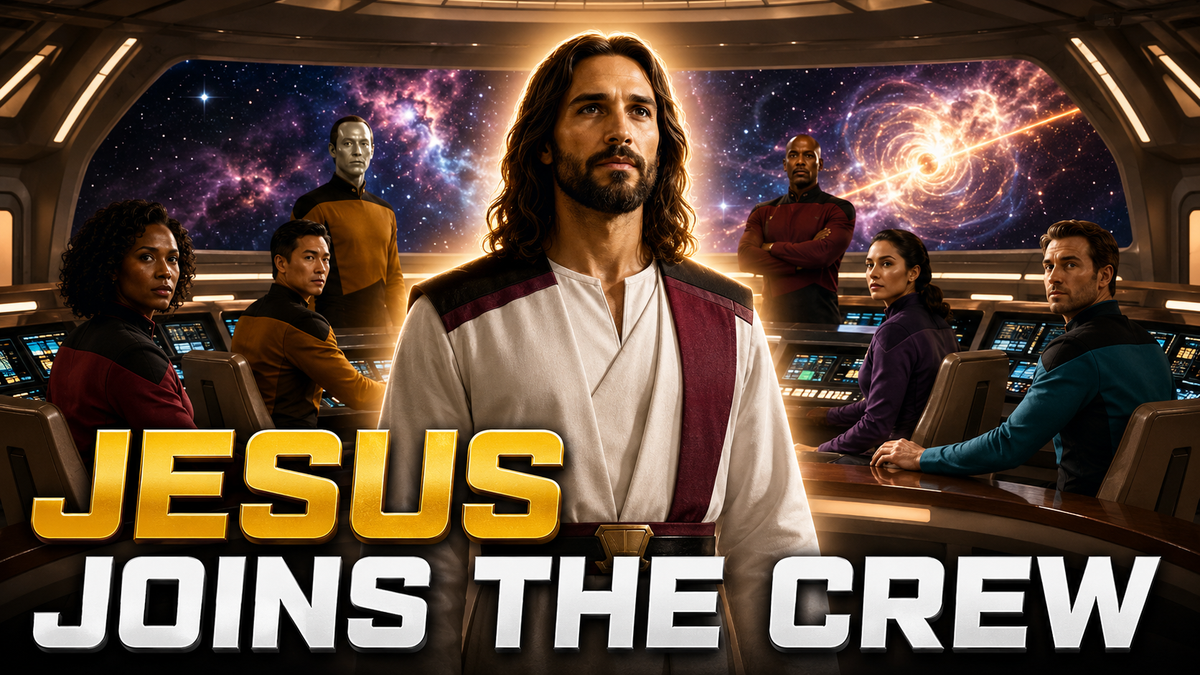
The Traveler Beneath the Uncharted Light
Chapter One: The Man Without a Signal
The USS Enterprise-D moved through the outer rim of the Daledon Expanse with the graceful certainty of a city that had learned to sail among stars. For three days, her mission had been routine: chart ion streams, update old Federation survey markers, and observe a region of space whose only reputation was that nothing interesting had happened there for almost a century. It was exactly the kind of quiet assignment that allowed officers to pretend the universe was orderly. Somewhere beyond the observation lounge windows, the stars held their places, patient and cold, while Captain Jean-Luc Picard read the latest sensor summary and found himself thinking, for reasons he did not welcome, that even peace could feel heavy when one was responsible for carrying it. For those drawn to the Jesus in Star Trek: The Next Generation faith-based science fiction story, this was not the beginning of a battle. It was the beginning of a question.
Picard stood alone in his ready room, the stars moving in silence beyond the curved glass. The Enterprise was operating flawlessly. The crew was rested. No diplomatic emergency waited in the queue. No distress call pleaded from the dark. Yet command had a way of filling even quiet hours with invisible weight. Every name on the crew manifest belonged to someone who trusted his judgment without seeing the private cost of it. He had grown skilled at not letting that cost appear on his face. A captain could receive reports, issue orders, evaluate risk, and sit with the knowledge that one wrong decision might turn a routine mission into a memorial service. That was why the related article about faith, command, and mercy among the stars seemed, in another life, like something he might have read with intellectual curiosity rather than personal discomfort.
The chime sounded.
“Come,” Picard said.
Data entered with his usual measured precision, carrying a padd though he did not need one.
“Captain, long-range sensors have detected an anomalous reading approximately point-seven light-years ahead of our current position.”
Picard turned from the window. “Anomalous in what respect?”
“That is difficult to classify, sir. The phenomenon emits no detectable radiation, gravitational distortion, subspace fluctuation, neutrino activity, or electromagnetic signature. However, the sensors agree that something is present.”
Picard studied him. “The sensors agree?”
“Yes, Captain. The systems register a location, boundary, and approximate diameter. But they are unable to identify any measurable property that would ordinarily permit such registration.”
Picard set down the report he had been reading. “Can it be a sensor malfunction?”
“That was my initial hypothesis. I conducted a level-three diagnostic and requested independent verification from Engineering. Lieutenant Commander La Forge reports no malfunction in the relevant systems.”
“Yet we are detecting something that cannot be detected.”
Data tilted his head slightly. “That is a concise description of the difficulty.”
Picard might have smiled if the unease behind the report had not been so immediate. “Bring us to yellow alert, Mister Data. Have Commander Riker join us on the bridge.”
“Aye, sir.”
The bridge shifted from routine quiet into disciplined readiness without drama. The lights dimmed subtly as yellow alert engaged. Officers moved with practiced efficiency. No one panicked. No one needed to be reminded that the unknown was not automatically hostile. It was, after all, the reason they wore the uniform.
Picard stepped from the ready room and crossed to the command area.
Commander Riker was already rising from the first officer’s chair. “Report?”
Data moved to his station. “The phenomenon lies directly ahead, bearing zero-one-five mark three. Diameter approximately four thousand kilometers. It is stationary relative to the surrounding starfield, though its boundary appears mathematically inconsistent.”
Riker glanced toward Picard. “That sounds like a polite way of saying it shouldn’t exist.”
“The phrase is imprecise,” Data said, “but emotionally understandable.”
At tactical, Worf’s expression remained severe. “No vessels detected in the vicinity. No weapons signatures. No cloaking distortion.”
“Life signs?” Picard asked.
Data’s hands moved across the console. “None, sir. However, the absence of life signs may be meaningless, given the phenomenon’s resistance to conventional scanning.”
Geordi’s voice came through from Engineering. “La Forge to bridge.”
“Go ahead,” Picard said.
“Captain, we’re getting the same thing down here. The sensors are locking onto a shape, but every time we ask what the shape is made of, the system gives us nothing. It’s like asking the computer to describe a shadow without an object casting it.”
“Could it be subspace?”
“I’d like to say yes because that would make my morning easier. But no, sir. Not any subspace behavior I’ve ever seen.”
Picard stepped closer to the forward view screen. “Put it on screen.”
At first, there was nothing. Only stars.
Then the image adjusted, and space ahead of them appeared to bend—not visually, not in the way gravity might distort light, but in the way the mind bends when it recognizes that something is wrong before it knows why. The stars beyond a certain region seemed perfectly ordinary, and yet Picard felt the exact boundary of the anomaly before Data outlined it with a faint overlay.
A sphere of absence hung in the dark.
It did not glow. It did not pulse. It did not swirl with energy or flash with menace. It simply occupied space with a silence so complete that the bridge seemed to grow quieter around it.
Counselor Troi, seated to Picard’s left, drew in a slow breath.
Picard noticed. “Counselor?”
She looked at the screen with careful concentration. “I’m not sensing life. Not exactly.”
“That is not reassuring,” Riker said.
Troi turned slightly. “There is… attention.”
Worf’s eyes sharpened. “From the phenomenon?”
“I don’t know.” Her voice stayed calm, but something in it caused Picard to listen more closely. “It feels less like being watched and more like standing before someone who is waiting to see what you will do.”
Picard folded his hands behind his back. “Data?”
“I cannot confirm Counselor Troi’s impression through instrumentation.”
“No,” Picard said softly. “I didn’t expect you could.”
Riker leaned in slightly. “Options?”
“We observe,” Picard said. “Maintain distance. Passive scans only. Mister Worf, shields at standby, not raised. I do not want our first gesture to be defensive unless defense becomes necessary.”
Worf did not look pleased, but he nodded. “Aye, sir.”
“Helm, bring us to one hundred thousand kilometers from the anomaly and hold position.”
“Aye, Captain.”
The Enterprise moved forward.
Picard watched the dark sphere grow larger on the screen. He had faced beings of tremendous power before. Entities that toyed with starships, civilizations that masked violence in diplomacy, machines that measured life as inefficiency, enemies who believed fear was the foundation of order. He knew how to stand before power. He knew how to negotiate with arrogance, resist intimidation, and challenge cruelty.
This felt different.
There was no demand. No threat. No greeting. No claim of superiority.
Only presence.
In Ten Forward, Guinan had stopped polishing a glass.
The room around her carried the soft murmur of off-duty crew. Someone laughed near the viewport. A young ensign attempted to explain a card trick to a friend who had already seen the trick twice. A science officer stared into a cup of something blue and steamless, pretending not to be tired.
Guinan looked toward the windows.
She could not see the anomaly from that angle. The ship’s structure hid it. Still, she felt the moment the Enterprise drew near.
It was not fear.
She had known fear in many forms. This was older than fear and quieter than warning. It moved through her memory like a note played on an instrument she had not heard since childhood, if childhood could survive across centuries and disasters and the long migration of a scattered people.
She set the glass down.
A server behind the bar noticed. “Guinan?”
She did not answer immediately.
There were kinds of danger that announced themselves by force. Others entered softly and rearranged the air.
She looked toward the doors as if expecting someone to walk through them.
No one did.
On the bridge, the first scan cycle completed.
Data reviewed the results. “Captain, the anomaly has responded.”
Picard turned. “Responded how?”
“It altered its boundary at the exact moment our passive scan reached it. The alteration produced a geometric pattern.”
“On screen.”
The dark sphere changed.
Across its surface—not on the surface, Picard thought, because the thing had no surface in any conventional sense—points of distortion appeared in a sequence. They formed lines, then angles, then something resembling a lattice. For a moment the shape looked mathematical. Then the lines shifted again, and Picard realized with a tightening in his chest that the pattern was not meant for the computer.
It was meant for them.
“Data?”
“The pattern contains repeating ratios found in multiple Federation symbolic systems, though none precisely. It may represent a form of communication.”
“Can the universal translator interpret it?”
“Negative. There is insufficient linguistic structure.”
The lights flickered.
Not a power failure. Not a surge. A flicker, gentle and brief, as if the ship had blinked.
“Engineering?” Picard said.
Geordi answered immediately. “We saw it, Captain. Power grid is stable. No overload, no drain.”
“Shields?”
“Still on standby. No external impact.”
“Worf?”
“No hostile action detected.”
Troi’s hand tightened against the armrest of her chair. “Captain…”
Picard looked at her.
Her face had paled. “The attention changed.”
“Explain.”
“It’s closer.”
Before Picard could respond, every console on the bridge went silent.
Not dead. Silent.
The hum of the ship remained. The stars remained. The anomaly remained. But the ordinary language of the Enterprise—the soft confirmations, the alert tones, the faint conversation between machine and crew—ceased all at once.
Data worked rapidly. “Main computer interface has paused. I am attempting manual access.”
Worf’s fingers moved across tactical. “Weapons offline. Shields inaccessible.”
Riker straightened. “Red alert.”
Nothing happened.
For three seconds, Picard felt the full weight of command settle over him with physical force. Hundreds of lives. Families. Children. Civilians. Officers who had trusted him enough to sleep while the ship moved through the unknown.
He did not let the feeling show.
“Bridge to Engineering.”
No response.
“Bridge to Sickbay.”
Nothing.
“Internal communications are unavailable,” Data said.
The viewscreen flickered once.
The anomaly vanished.
In its place appeared a single line of text.
NOT POWER.
The bridge went still.
The words remained for five seconds, white against black.
Then the screen returned to the starfield.
All systems resumed at once.
“Red alert!” Riker called.
This time the ship responded. The alert sounded. Lights shifted. Worf brought shields up.
“Report,” Picard said.
Data’s hands moved quickly. “Systems restored. No damage. No indication of external intrusion. Computer records show no interruption.”
Riker stepped toward tactical. “No interruption? We all saw it.”
“Yes, Commander. The ship’s records do not include the event.”
Worf’s jaw tightened. “Then the records have been altered.”
“Possibly,” Data said. “However, there is no evidence of alteration.”
“That does not make me feel better, Mister Data.”
“No, sir. It was not intended to.”
Picard’s eyes stayed on the screen. “Data, was the message stored anywhere?”
“Negative. It exists only in our recollection.”
“Counselor?”
Troi was still watching the empty place where the words had appeared. “Whatever touched us, Captain, it was not trying to frighten us.”
“Then what was it trying to do?”
She looked at him, and for a moment he saw her hesitation.
“To correct us.”
The word settled over the bridge.
Picard did not like it.
He had no objection to correction when it came through reason, experience, or evidence. But an unknown force reaching into his ship, silencing systems, and displaying cryptic messages did not earn his trust simply by avoiding violence.
“Maintain red alert,” he said. “Mister Data, full analysis. Mister Worf, prepare security teams for sensitive areas. Number One, coordinate shipwide reports. I want to know if anyone outside this bridge observed anything unusual.”
Riker nodded. “Aye, Captain.”
Picard looked again at the screen. The anomaly had returned to sensor display, still hanging where it had been, dark and patient.
“Captain,” Data said.
Picard heard the change in his voice. “What is it?”
“There is now a life sign aboard the Enterprise.”
Riker turned sharply. “Location?”
“Deck Ten. Corridor outside Ten Forward.”
Worf was already moving. “Security team to Deck Ten.”
“Transporter activity?” Picard asked.
“None.”
“Shuttle bay?”
“No arrivals.”
“Any breach in the hull?”
“Negative.”
Picard’s expression hardened. “On screen.”
The main viewer shifted to an internal corridor.
A man stood alone outside Ten Forward.
He wore no Starfleet uniform, no alien armor, no environmental suit. His clothing was simple: a light tunic under a weathered outer garment, sandals, a woven belt. His hair fell to his shoulders. His beard was full but not unkempt. His skin was sun-browned, his posture relaxed, his hands empty.
He did not look confused.
He did not look afraid.
He looked, Picard thought, as if he had arrived exactly where he intended to be, yet had no desire to announce authority over anyone.
The corridor around him remained ordinary. Crew members had stopped at a cautious distance. A lieutenant near the turbolift held a padd at her side, forgotten. Two civilians stood behind her, uncertain whether to retreat.
The man looked toward the nearest security camera.
Not up at it. Not searching for it.
Directly toward it.
For one impossible instant, Picard felt that the man was not looking at the bridge.
He was looking at him.
“Magnify,” Picard said quietly.
The image tightened.
The man’s expression was calm, but not blank. There was sorrow in it, and warmth, and a kind of patience that made Picard uncomfortable because it seemed to have nothing to prove.
“Identify him,” Riker said.
Data checked. “No match in Federation records, Starfleet personnel files, known diplomatic databases, historical reconstructions, or current crew manifest.”
Worf’s security team appeared at the far end of the corridor, phasers drawn but held with restraint.
The man turned toward them.
Worf’s voice came from the security channel. “This is Lieutenant Commander Worf. Identify yourself.”
The man did not answer immediately.
Instead, he looked at the officers before him. His eyes moved from face to face, not as a threat assessment, but as if each person deserved to be fully seen before he spoke.
“I mean you no harm,” he said.
His voice was not loud. The corridor’s audio barely needed to adjust.
Worf’s expression did not soften. “You are aboard a Federation starship without authorization. State your name and point of origin.”
The man looked at him with a gentle seriousness. “You ask where I came from because you must protect those entrusted to you.”
Worf’s eyes narrowed. “Answer the question.”
“I came because I was sent.”
Riker muttered, “That does not narrow it down.”
Picard heard him, but his attention remained fixed on the screen.
Worf stepped closer. “Sent by whom?”
The man’s eyes held Worf’s.
“By the One who sees the warrior and the child he is still defending.”
The corridor went silent.
Worf’s face changed so slightly that only those who knew him would have noticed. It was not fear. It was not weakness. It was the impact of a blade touching armor and finding the hidden seam.
“Captain,” Worf said, voice controlled, “permission to escort the intruder to a secure location.”
Picard took one step closer to the viewer. “Granted. Use restraint. Sickbay first. I want a full medical scan. Mister Worf, no unnecessary force.”
“Aye, Captain.”
On screen, Worf gestured with his phaser. “You will come with us.”
The man looked toward Ten Forward’s doors for a moment.
They opened.
Guinan stood inside.
She did not step out. She simply stood there, eyes fixed on the man in the corridor.
The man turned to her.
For several seconds, neither spoke.
Picard watched Guinan’s face. He had seen her amused, guarded, wise, wounded, and unreadable. He had never seen her look quite like that.
Not certain.
Not afraid.
Almost remembering.
The man inclined his head to her, not in submission, not in ceremony, but in recognition.
Guinan whispered something the corridor audio barely caught.
“Oh.”
The man’s eyes softened.
Worf stepped between them, protective by instinct. “Move.”
The man obeyed.
That, more than any resistance might have, disturbed Picard.
Sickbay was prepared by the time Worf arrived with the stranger.
Dr. Beverly Crusher stood near the main diagnostic bed, her medical staff positioned but not intrusive. She looked from Worf to the man and then to the security officers behind them.
“Everyone take a breath,” she said. “This is Sickbay, not a brig.”
Worf did not lower his guard. “He appeared aboard without explanation.”
“I heard.” Beverly looked at the stranger. “I’m Dr. Crusher.”
“I know,” he said.
Her professional warmth cooled by a degree. “Do you?”
“You heal the sick. You keep watch over the dying. You carry more names than you speak aloud.”
For a moment, Beverly’s expression stilled.
Then she recovered. “That’s a poetic answer, not a medical one. Please sit on the biobed.”
He did.
The security officers remained near the doors. Worf stood close enough to intervene.
Beverly began the scan. The medical arch passed over him once, then again. Her brows drew together.
“Computer, confirm diagnostic function.”
“Medical diagnostic systems are functioning within normal parameters,” the computer replied.
She adjusted the scan manually. “That can’t be right.”
Worf glanced at the readout. “What is it?”
“He registers as human.”
“That is not unusual.”
“It is when the computer refuses to give me more than that.”
Beverly tried another scan. “No cellular anomalies. No synthetic implants. No known pathogen. No temporal displacement markers. No transporter residue. No evidence of cloning or replication. He’s human, adult male, physically healthy, and somehow the scan stops every time it attempts deeper genetic mapping.”
The man looked at her with compassion. “You search because you do not want to miss what might hurt others.”
Beverly met his eyes. “I search because that’s my job.”
“Yes.”
The simplicity of the answer seemed to disarm her more than argument would have.
She turned back to the console. “Name?”
The man was quiet.
Beverly waited.
At last he said, “Many have called me teacher.”
Worf’s suspicion deepened. “That is not a name.”
“No,” the man said gently. “It is what they needed first.”
Beverly folded her arms. “And what do you think we need?”
He looked around Sickbay, at the instruments, the beds, the sterile brightness, the officers watching him with distrust and curiosity. Then he looked back at Beverly.
“To know that life is not made less sacred because you can measure it.”
No one spoke for a moment.
Worf broke the silence. “Doctor?”
Beverly looked back at her readings. “Medically, he’s not an immediate threat. Scientifically, he’s impossible. I’d like to keep him under observation.”
“Security will remain.”
“I assumed they would.”
On the bridge, Picard listened to the Sickbay report with his jaw set and his hands clasped behind his back.
Data stood beside him. “Captain, there is no record of the individual’s arrival. Internal sensors did not detect him until after the message appeared on the viewscreen. The anomaly’s boundary fluctuated precisely point-eight seconds before the life sign was registered.”
“Suggesting a connection.”
“Strongly suggesting one, sir. Though not proving it.”
“Speculate.”
Data considered. “Possibilities include advanced transport technology, matter-energy conversion beyond Federation capability, temporal insertion, extradimensional manifestation, projection with biological substance, or a deliberate manipulation of our sensor records.”
“And Q?”
“The Q Continuum remains a possibility. However, this event does not match previous behavioral patterns associated with Q.”
Riker leaned against the rail, arms crossed. “Meaning no theatrical entrance, no insults, no trial, no costume.”
“Among other distinctions,” Data said.
Picard gave him a look, but there was no reprimand in it. “What about the message? NOT POWER.”
Data clasped his hands behind his back, mirroring the captain without realizing it. “Its grammar is minimal. It may be a denial, a warning, or a correction. The most direct interpretation is that the phenomenon wished to distinguish itself from the concept of power.”
“Or accuse us of misunderstanding power,” Troi said softly.
Picard turned to her.
She looked unsettled but composed. “When the man appeared, the feeling changed again. The attention did not leave. It became… focused.”
“On him?”
“No.” She looked toward Picard. “On us.”
The ready room felt smaller than usual with Data and Troi seated across from him and the anomaly glowing darkly on a wall display.
Picard had requested privacy. Not because the situation was personal, he told himself, but because command decisions sometimes required silence before they required action. It was a distinction he found increasingly thin.
“Counselor,” he said, “your impressions are valuable, but I need clarity. Is this individual exerting influence over the crew?”
“I don’t sense coercion.”
“Emotionally?”
“He is calm. Deeply calm. But not empty. There is grief in him.”
“Grief?”
“Yes. Not grief for himself, exactly.” Troi searched for words. “It feels… expansive. Like sorrow held without bitterness.”
Data turned toward her with interest. “Is such a state psychologically sustainable?”
“In most people, no.”
Picard looked at the display. “Mister Data, what do you make of his statement that he was sent?”
“There are several possible interpretations. He may believe himself to be an emissary. He may be concealing his origin. He may be communicating in metaphor. Or he may possess knowledge not currently available to us.”
“Do you detect deception?”
“I do not possess Counselor Troi’s empathic abilities. However, his verbal responses do not appear evasive in the typical sense. He does not answer our questions, but he also does not seem to be attempting to mislead us.”
Picard sat back. “A distinction without much comfort.”
“Agreed.”
The door chime sounded.
Picard looked toward it. “Come.”
Guinan entered.
She rarely came to the ready room without reason. Picard had learned long ago not to treat her visits casually.
“Captain,” she said.
“Guinan. I suspect you’re here about our guest.”
“I am.”
Picard gestured to a chair. She remained standing.
“You saw him,” Picard said.
“Yes.”
“Do you know him?”
Guinan took her time. “No.”
“But?”
She looked toward the display, where the anomaly rested in sensor outline. “There are people you meet and you know where to place them. Species, planet, century, danger, comfort, debt, memory. Then there are people you meet and all the places inside you stop rearranging themselves.”
Troi watched her carefully. Data appeared fascinated.
Picard folded his hands on the desk. “That is not an answer Starfleet can act upon.”
“No,” Guinan said. “It’s not.”
“What did you sense?”
She looked back at him. “Not what. Who.”
Picard’s eyes narrowed slightly. “You believe the phenomenon is a person?”
“I think something is behind it. I think something old is looking through it. But the man in Sickbay…” She paused. “He isn’t the same as the thing watching us.”
“Then what is he?”
Guinan’s face carried the burden of someone refusing to say more than she knew.
“I don’t know. But when he looked at me, I felt like every locked door in my life had been seen and left unforced.”
The words stayed in the room.
Picard did not look away from her. “Does he pose a threat?”
Guinan answered immediately. “Not the way you mean.”
“Guinan.”
She stepped closer to the desk. “Captain, I have stood in rooms where powerful beings wanted worship. I have seen conquerors dress hunger as destiny. I have watched people use peace as a mask until the knives came out. That man is not hungry for control.”
“Then why is he here?”
Her gaze softened, and for the first time since she entered, Picard felt that she was not speaking as someone ancient or mysterious, but as a friend.
“Maybe because control is not what this ship needs most.”
Picard’s expression remained composed.
Inside, something tightened.
He was accustomed to counsel. He valued it. He sought it. He was not a tyrant allergic to correction. Yet there were regions of the soul where even a thoughtful man posted guards. Command had taught him to do so. Loss had reinforced it. The galaxy had little mercy on captains who confessed exhaustion at the wrong moment.
“Thank you, Guinan,” he said.
She heard the dismissal. She also heard what lay beneath it.
“You’ll want to question him yourself.”
“Yes.”
“Don’t only listen for what he refuses to answer.”
Picard rose. “What should I listen for?”
Guinan turned toward the door.
“What he refuses to take.”
Sickbay had become too quiet.
Beverly disliked quiet when it gathered around a patient. It made everyone too aware of breathing, of blinking monitors, of the fragile line between knowledge and ignorance.
The stranger sat on the biobed with his hands resting loosely in his lap. He had not asked to leave. He had not demanded explanation. He had not seemed offended by the security presence, the scans, or the suspicion.
That bothered her.
Most beings with power resented examination. Most ordinary people feared it. He seemed neither above it nor beneath it.
Wesley Crusher stood near one of the secondary consoles, trying and failing not to stare. Beverly had allowed him into Sickbay only because he had been assisting with an unrelated systems calibration before the event. She was beginning to regret it.
“Wes,” she said quietly.
He straightened. “I’m working.”
“You’re staring.”
“I’m also working.”
The stranger looked at Wesley with a small smile. Not amused at him. Kindly aware of him.
“You are young to carry so many questions,” he said.
Wesley blinked. “I guess that depends on how many answers are available.”
“Sometimes a question grows before the answer is ready.”
Wesley frowned, not insulted, but drawn in. “That sounds like something Counselor Troi would say.”
“Does that make it untrue?”
Wesley opened his mouth, then closed it.
Beverly pointed toward the door with a mother’s authority that needed no rank. “Wesley, bridge support.”
“But—”
“Now.”
He nodded, though curiosity pulled at him all the way out.
The stranger watched him leave.
Beverly studied the man. “You speak as if you know people.”
“I know what is in people.”
Her voice sharpened slightly. “That is a dangerous claim.”
“Yes.”
The answer came without defensiveness. It left Beverly nowhere obvious to go.
The doors opened, and Picard entered with Data beside him. Worf remained near the wall. Beverly caught the captain’s eye and gave the smallest shake of her head, the medical equivalent of no answers yet.
Picard approached the biobed.
The stranger stood.
Worf’s hand moved nearer his phaser.
Picard lifted one hand slightly. “That won’t be necessary.”
The stranger looked at Picard, and the room seemed to narrow around the two of them.
“Captain,” the man said.
Picard did not ask how he knew. Too many impossible things had already gathered around this man. “You have us at a disadvantage.”
“I have not come to take advantage of you.”
“You appeared aboard my ship without permission.”
“Yes.”
“You understand why that is unacceptable.”
“I do.”
“And yet you offer no explanation.”
The man’s gaze remained steady. “Would an explanation give you peace?”
“It would give me information.”
“Is that the same thing?”
Data’s eyes shifted between them.
Picard felt irritation rise, not hot, but precise. “I am responsible for this vessel and every life aboard it. I do not have the luxury of treating unknown intrusions as philosophical exercises.”
“No,” the man said softly. “You do not.”
Something in the way he agreed robbed the words of confrontation.
Picard stepped closer. “Who are you?”
The man was silent.
“Are you human?”
“Yes.”
“From Earth?”
“Yes.”
Data’s head tilted.
Picard continued. “From what time period?”
The man looked at him with sorrowful patience. “The hour you are in is enough for now.”
Riker would have hated that answer. Worf clearly did. Beverly’s expression suggested she was trying to decide whether it was evasive or merely impossible.
Picard kept his voice even. “Were you brought here by the anomaly?”
“I came through it.”
“By choice?”
“Yes.”
“For what purpose?”
The man looked past Picard for a moment, not at the walls of Sickbay, but at something far beyond them.
“To walk with you.”
Picard stared at him.
“That is not a mission objective,” he said.
“No,” the man replied. “It is a mercy.”
The word landed too personally.
Picard turned slightly, giving himself space to think. He did not like being drawn into language that carried emotional weight before factual foundation. He did not like the way the room seemed to listen when the man spoke. He did not like that Guinan’s warning still pressed against his thoughts.
What he refuses to take.
“Captain,” Data said, “may I ask a question?”
Picard nodded.
Data stepped forward. “You stated that you came through the phenomenon. Are you composed of matter native to this universe?”
“Yes.”
“Were you transported by technological means?”
“No.”
“Were you transported by non-technological means?”
The man looked at Data with interest. “You divide the possible from the impossible by what has been built.”
“That is generally useful.”
“It has brought you far.”
Data considered this. “But you imply it is incomplete.”
“Yes.”
“Are you implying the existence of a category of causation outside matter, energy, space, time, and technology?”
Beverly murmured, “Data.”
The man looked at the android with unmistakable tenderness. “I am saying that a house is more than its walls, though the walls are real.”
Data’s expression did not change, but something in his stillness deepened.
“I do not understand,” he said.
“You will.”
Data seemed almost startled by the certainty.
Picard watched that exchange with concern. He had seen many beings attempt to manipulate Data by appealing to his desire to be human. This was different, subtler and therefore perhaps more dangerous. Yet the stranger had not flattered him. He had not promised transformation. He had simply spoken to Data as if his longing was neither defective nor foolish.
“Doctor,” Picard said, “can he be safely moved?”
Beverly looked at her readings again, though they had told her almost nothing. “Physically, yes. But I want continued observation.”
“Very well. Our guest will be escorted to guest quarters under security supervision.”
Worf nodded approval.
The man turned to Picard. “Am I a prisoner?”
Picard held his gaze. “You are an unknown individual who appeared aboard a Federation starship during an encounter with an unexplained phenomenon.”
“That is not what I asked.”
“No,” Picard admitted. “It isn’t.”
The room waited.
Picard had faced hostile ambassadors with less discomfort than he felt in that pause. The easy answer was yes. The practical answer was yes. The Starfleet answer, under certain regulations, might even be yes.
But the man had submitted to every order. He had threatened no one. He had touched nothing. The only disturbance he had caused was not in the systems, but in the people watching him.
“You are not free to move about the ship unescorted,” Picard said. “Not yet.”
The man nodded once. “Then I will wait.”
No protest.
No accusation.
Somehow that felt worse.
As Worf prepared the escort, Picard turned toward the door.
“Captain,” the man said.
Picard stopped.
The stranger’s voice remained quiet. “You carry the ship as though love requires you to carry it alone.”
Beverly looked down. Data looked at Picard. Worf froze with rigid discomfort.
For a fraction of a second, Picard’s composure became something he had to choose rather than something he simply wore.
He turned back.
“You know nothing about what I carry.”
The words were not loud. That made them sharper.
The man did not retreat from them. Neither did he press forward.
“No,” he said. “But I know the One who sees.”
Picard’s face hardened into command. “Escort him.”
Worf stepped forward. “This way.”
The man went with him.
Only after the doors closed did Beverly exhale.
Data looked at Picard. “Captain, his final statement appeared to affect you.”
Picard’s reply came quickly. “Analyze the anomaly, Mister Data.”
“Yes, sir.”
Picard left Sickbay before the room could ask anything else of him.
The guest quarters assigned to the stranger were comfortable, neutral, and watched by two security officers outside the door. Worf had inspected the room personally. No unsecured access panels. No replicator functions beyond basic nutrition. No computer access except emergency medical call.
The man entered as though it were a place prepared for him by friends.
Worf stood in the doorway. “You will remain here.”
“Yes.”
“If you attempt to leave, security will stop you.”
“I understand.”
Worf studied him. “Why did you speak to me as you did in the corridor?”
The man turned from the window. Stars reflected faintly in the glass behind him.
“Because strength that never grieves becomes a prison.”
Worf’s eyes darkened. “You presume much.”
“I see much.”
“If you are telepathic, say so.”
“I do not enter where I am not welcomed.”
Worf gave a low, skeptical breath. “Yet you entered this ship.”
The man looked at him with a sadness that did not accuse.
“Yes.”
Worf seemed ready to challenge him again, but the words did not come. At last he stepped back.
“The door will remain secured.”
The man nodded.
The doors closed.
Worf stood outside them for a moment longer than necessary.
Inside the room, the man approached the window and looked out at the anomaly.
For the first time since his arrival, sorrow crossed his face without concealment.
Not fear.
Sorrow.
On the bridge, the anomaly began to change.
“Captain,” Data said from Ops. “The phenomenon is expanding.”
Picard returned from the turbolift and moved immediately to the command area. “Rate?”
“Variable. It expanded by two hundred kilometers, then stopped. Now it is contracting.”
“Pattern?”
“Not yet.”
“On screen.”
The dark sphere appeared again. Its boundary shifted with delicate precision, pulsing in silence.
Geordi’s voice came through. “Captain, the warp core just registered a harmonic vibration.”
“Cause?”
“No mechanical cause. The core is stable, but it’s resonating with something external. Almost like the anomaly hummed and the ship answered.”
“Danger?”
“Not immediate, but I don’t love it.”
“Keep me informed.”
“Aye, sir.”
Troi leaned forward. “Captain, the attention is stronger now.”
Picard looked at the anomaly. “Directed at us?”
“At him.”
Data spoke without turning. “The expansion and contraction may be forming another message.”
“Decode it.”
“I am attempting to.”
Minutes passed.
On a starship, minutes could feel like years when everyone was waiting for the unknown to decide whether it was language, weapon, or judgment. Picard remained standing. The command chair sat behind him, available and unused. Riker noticed but did not comment.
Data’s fingers paused.
“I have isolated a repeating structure.”
“Put it on screen.”
The anomaly’s outline faded. In its place, symbols appeared. Not letters. Not numbers. A geometric arrangement that shifted every few seconds, as though meaning itself were refusing to stay still.
Data spoke carefully. “The computer cannot translate the entire sequence. However, one segment corresponds to the earlier message.”
“NOT POWER,” Riker said.
“Yes. A second segment appears to be forming through comparative symbolic logic.”
Picard waited.
Data looked up.
“The closest approximation is: TEST.”
Worf’s voice was low. “A challenge.”
“Possibly,” Data said. “There is a third segment.”
The bridge seemed to hold its breath.
“Translate it,” Picard said.
Data’s expression, though restrained, carried something almost like hesitation.
“The computer gives several possible meanings. Weaker. Irrational. Obsolete. Burden.”
Picard looked at him. “Which is most accurate?”
Data turned toward the screen.
“Mercy.”
The word appeared on the viewer.
NOT POWER.
TEST.
MERCY.
No one spoke.
The red alert lights glowed softly over the bridge. The stars beyond the anomaly burned with indifferent beauty. Picard felt, with sudden and unwelcome clarity, the solitude of the center chair behind him. Not because he lacked friends. Not because his crew was unworthy of trust. But because command had trained him to stand at the point where every unknown became his responsibility before it became anyone else’s fear.
Mercy, he thought, and did not know whether the word was invitation, accusation, or bait.
Then the anomaly vanished from the screen.
For one second, space ahead was empty.
Then every reflective surface on the bridge—console glass, polished trim, the darkened edge of the viewscreen—showed the same impossible image.
Not the anomaly.
Not the stranger.
An eye made of stars, opening slowly in the black.
The computer spoke in a voice that was not its own.
“WE WILL MEASURE WHAT YOU PROTECT.”
The lights steadied.
The reflections cleared.
The anomaly returned, silent and dark.
Picard stood motionless, surrounded by officers waiting for him to speak.
At last he said, “Maintain position.”
Riker looked at him. “Captain?”
Picard’s gaze did not leave the screen.
“We came here to investigate an unknown phenomenon. We will continue to do so as Starfleet officers, not as frightened children and not as aggressors looking for a target.”
Worf’s posture remained rigid. “And the intruder?”
Picard thought of the man in guest quarters. His calm. His refusal to seize authority. His words in Sickbay, too near the hidden thing Picard had never given anyone permission to touch.
“He remains under observation,” Picard said.
Troi looked at him gently, as though she heard the sentence beneath the sentence.
Data turned back to his console. “Captain, there is one additional development.”
Picard almost closed his eyes. “Report.”
“The message was not recorded in the computer.”
“Again?”
“Yes, sir. However…” Data paused. “This time, the ship did record an audio signal from guest quarters.”
“From our guest?”
“No, Captain. From the room itself.”
Picard turned slowly. “Play it.”
The bridge speakers activated.
For a moment, there was only static.
Then came the stranger’s voice, quiet and sorrowful.
“Not this ship.”
A second voice answered.
It was vast, cold, and patient.
“ALL SHIPS.”
The transmission ended.
Picard looked at the dark shape ahead and felt the boundaries of the mission widen beyond anything Starfleet had assigned him to carry.
Chapter Two: The Shape of Mercy
The Enterprise held position at the edge of the impossible.
On the main viewscreen, the anomaly remained where it had first appeared, a dark sphere against the deeper dark of space, a presence without radiation, mass, or explanation. Its boundary no longer expanded. It no longer formed symbols. It did nothing any instrument could call action. That stillness, to Picard, was almost more troubling than movement.
Red alert had been reduced to yellow after twenty-three minutes of no further intrusion, though the distinction felt ceremonial. Shields remained raised. Security remained posted outside the guest quarters on Deck Eight. Engineering continued to report subtle harmonic reactions in the warp core, none dangerous, all unexplained. Sickbay still could not produce a complete genetic profile of the man who had appeared aboard without transporter trace, shuttle record, temporal signature, or permission.
And the computer still insisted that none of the impossible messages had ever appeared.
Picard stood in the observation lounge with his senior officers gathered around the table. Beyond the windows, the anomaly hovered like a wound in the stars.
Riker sat to Picard’s right, outwardly relaxed but clearly alert. Data had arranged several padds before him, though all of the available evidence could have fit into one short and unsatisfying report. Worf stood instead of sitting. Dr. Crusher sat with her medical files open, frustrated by their emptiness. Troi watched the room more than the data. Geordi had come up from Engineering with the tired focus of a man whose machines had started behaving like poets. Guinan stood near the far end of the lounge, invited by Picard despite holding no Starfleet rank, because sometimes the most important voice aboard the Enterprise wore no uniform at all.
Picard began without ceremony.
“We have encountered an unknown spatial phenomenon, an unidentified intelligence possibly associated with that phenomenon, and an unauthorized visitor who claims to have come through it. The intelligence has communicated three concepts: power, test, and mercy. It has also indicated an intention to measure what we protect.”
Worf’s mouth tightened. “A threat.”
“A statement,” Picard corrected. “Possibly a threat.”
“With respect, Captain, unknown forces do not board this vessel and announce tests unless they intend domination.”
Guinan’s eyes shifted toward Worf. “Some tests reveal the one giving them.”
Worf looked at her. “And some are traps.”
“Both can be true,” she said.
Picard let the exchange breathe for half a second, then continued. “We will proceed as Starfleet officers. We will not assume hostility where it has not been proven, but neither will we surrender caution to curiosity. Data?”
Data touched the control panel, and the wall display filled with layered sensor diagrams that did very little to clarify anything.
“The anomaly occupies a spherical region of space approximately four thousand kilometers in diameter. It possesses a stable boundary, yet no measurable interior. Our sensors identify spatial coordinates but detect no matter, energy, plasma, gravity, subspace distortion, temporal variance, or known exotic particle interaction. It is, in effect, an object defined only by our inability to define it.”
Riker leaned back slightly. “That line is going to haunt the science journals.”
“Assuming we survive long enough to publish,” Worf said.
Geordi lifted a hand. “I’m less worried about the science journals and more worried about the warp core. It’s still humming back at the anomaly.”
Picard turned. “Humming?”
“That’s the best word I’ve got. There’s no force acting on it. No field penetration. No energy transfer. But the matter-antimatter reaction chamber is producing a harmonic pattern that matches the fluctuations on the anomaly’s boundary.”
“Could the anomaly be controlling the core?”
“No. At least not the way we’d define control. It’s more like the core is hearing something and answering before we know there’s a sound.”
Data looked interested. “That metaphor may be technically useful.”
Geordi gave him a tired glance. “I was afraid you’d say that.”
Beverly moved her report forward. “Our guest is medically human as far as the equipment can determine. But every deeper scan fails at the same threshold. No damage to the equipment, no error messages, no refusal from the computer. The data simply stops.”
“Could he be shielding himself?” Riker asked.
“I don’t know. If he is, he’s doing it without any detectable field or biological stress. He doesn’t register as telepathic. He doesn’t register as enhanced. He doesn’t register as anything except a healthy human male until the scan reaches the point where it should tell me more.”
Picard looked toward Troi. “Counselor?”
Troi folded her hands on the table. “He is not emotionally hostile. He is not afraid of us. He feels sorrow, compassion, and patience. There is strength there, but it isn’t aggressive.”
Worf’s voice remained hard. “Many enemies conceal aggression.”
“Yes,” Troi said. “But concealment has texture. I feel none.”
Picard knew better than to dismiss her intuition. He also knew better than to let it decide policy alone. “And the anomaly?”
Troi looked through the window.
Her answer came slowly. “The intelligence behind it is not like him. It feels vast, but not warm. Observant. Evaluating. There is no empathy I can detect. Not cruelty in the ordinary sense. More like a mind that has studied compassion from the outside and concluded that it is an inefficiency.”
The room grew quiet.
Picard looked toward Guinan. “Does that fit your impression?”
Guinan did not answer quickly.
“That thing out there,” she said at last, “is old enough to be patient and proud enough to think patience makes it wise.”
Data turned toward her. “That is a psychological characterization without empirical support.”
“Yes.”
“Yet you believe it is accurate.”
“I do.”
Data considered this without offense.
Picard looked at the faces around him. They were trained, capable, disciplined. They had stood before enemies, gods, machines, tyrants, and mysteries. Yet this encounter pressed on each of them differently, finding seams where command reports could not go.
He felt, not for the first time, that the Enterprise was not only a vessel moving through space. It was a community of souls he had been entrusted to carry across the dark. Starfleet would never phrase it that way. Neither would he, not aloud. Still, there were nights when the hum of the ship felt less like machinery and more like hundreds of lives breathing under his care.
“Recommendations,” he said.
“Keep our distance,” Riker said. “Continue passive scans. No probes until we understand whether sending one would be interpreted as provocation.”
“Agreed,” Geordi said. “But I’d like to run a low-energy harmonic analysis from Engineering. If the warp core is responding, maybe we can map the relationship.”
“Security should move the intruder to the brig,” Worf said.
Beverly looked at him sharply. “He hasn’t done anything violent.”
“He appeared aboard during a hostile intrusion.”
“Possible hostile intrusion,” Picard said.
“He should not be in guest quarters.”
Guinan’s voice was quiet. “Putting him behind a force field will tell us more about our fear than about him.”
Worf turned to her. “Fear is not the issue.”
“No,” Guinan said. “It usually calls itself something else first.”
Worf’s expression hardened.
Picard intervened. “For the moment, he remains in guest quarters under security supervision. Doctor Crusher will continue medical observation. Mister Data, I want you to conduct an interview under recorded conditions.”
Data nodded. “Aye, sir.”
“Counselor Troi, you will observe.”
“Yes, Captain.”
Picard looked toward Guinan. “And I would like you present as well.”
Guinan’s eyes held his. “He’ll know why.”
“I suspect he already knows more than he has chosen to say.”
“Yes,” she said. “That’s different from hiding.”
Picard did not answer.
The observation lounge doors opened, and Wesley Crusher stepped halfway inside, trying to balance urgency with the awareness that he had interrupted a senior staff briefing.
“Captain?”
Beverly turned. “Wesley?”
“I’m sorry, but Engineering asked me to bring this up. We found something in the harmonic pattern.”
Picard gestured him forward. “Go on.”
Wesley moved to the display, visibly aware of every senior officer watching him. He entered a command, and the sensor diagrams shifted into waveform analysis.
“The anomaly’s boundary fluctuations look random until they’re compared with the warp core resonance. When we overlay them, they form a repeating sequence. It’s not language exactly. More like an equation missing one side.”
Data studied the pattern. “Interesting. The sequence appears incomplete because the Enterprise is supplying the second variable.”
Geordi moved closer. “The ship is part of the calculation.”
“That is one interpretation,” Data said.
Picard’s eyes narrowed. “Calculation of what?”
Wesley swallowed. “I don’t know, sir. But the pattern changed after the guest appeared. Before that, the anomaly was measuring the ship’s systems. Now it seems to be measuring responses.”
“Responses to what?” Riker asked.
Wesley hesitated.
Picard heard the hesitation before he saw it. “Say it.”
“To him.”
No one spoke for a moment.
Then the ship trembled.
It was not a weapons impact. Not a shockwave. It was a deep, brief shudder through the deck plates, as if the Enterprise had passed over a memory.
“Bridge to Captain Picard,” came the voice of the officer at Ops.
“Picard here.”
“Sir, a vessel has appeared between us and the anomaly.”
Picard was already moving. “On my way.”
The bridge was calm but tense when Picard arrived.
The vessel on the viewscreen was small, badly damaged, and unfamiliar. It looked less like a starship than a shard broken off a larger machine. Its hull was dark bronze, ribbed along the sides, with three engine fins twisted by heat damage. Atmosphere vented in thin white streams. Power signatures flickered.
“Report,” Picard said, taking his place.
Data’s hands moved across his console. “The vessel appeared without warp signature or impulse trail. It is approximately seventy meters in length. Severe structural damage. Life signs present.”
“How many?”
“Two. One is faint. The other is unstable.”
Worf’s voice was grim. “I am detecting weapons ports.”
“Active?” Riker asked.
“No. But the configuration suggests a combat craft.”
“Hail them,” Picard said.
Worf tried. “No response.”
“Language database?”
“No match.”
Data added, “Their life support is failing. Estimated time before total collapse: six minutes, thirty seconds.”
“Transporter lock?”
The transporter chief answered from the bridge station. “Interference from the anomaly is making it difficult, Captain. I can try, but I can’t guarantee pattern integrity.”
Beverly’s voice came over the comm. “Sickbay standing by.”
Worf turned from tactical. “Captain, this may be the test.”
Picard did not look away from the damaged vessel.
Of course it was the test. Or part of it. Or bait shaped like mercy. A strange craft appears wounded at the very moment an intelligence announces that it will measure what they protect.
A captain could not afford innocence.
A captain could not afford cruelty either.
“Can we extend shields around them?” Picard asked.
Geordi answered from Engineering. “Not at this distance without dropping strength on our side. I can do it, but if the anomaly hits us with anything, we’ll be exposed.”
Riker looked at Picard. “We could move closer.”
Worf’s objection came immediately. “That places the Enterprise within weapons range.”
“Their weapons appear offline,” Data said.
“Appear,” Worf repeated.
The life signs flickered on Picard’s side display.
Six minutes.
Hundreds of lives aboard the Enterprise. Two lives on the dying craft. Unknown origin. Possible hostile design. A cosmic intelligence watching for mercy as if mercy were an equation it expected to fail.
Picard felt every eye on the bridge waiting for the answer only he could give.
He thought, against his will, of the man in guest quarters.
You carry the ship as though love requires you to carry it alone.
Picard’s voice was steady. “Mister Crusher, bring us within transporter range. Mister Worf, keep shields raised until the last possible moment. Transporter room, prepare emergency beam-out the instant we have a viable lock. Doctor Crusher, full quarantine protocol.”
Worf turned. “Captain—”
“I am aware of the risk.”
“Sir, if this is a trap—”
“Then we will meet it with our eyes open. Proceed.”
The Enterprise moved toward the damaged vessel.
In guest quarters, the man stood at the window as the stars shifted.
The two security officers outside did not see him bow his head.
He did not speak loudly. He did not raise his hands. He did not command the anomaly, the ship, the dying craft, or the people racing to save strangers who might become enemies.
He simply whispered, “Let them choose life.”
Outside, the anomaly’s boundary rippled once.
On the bridge, the transporter chief called out, “I have a partial lock.”
Beverly’s voice followed. “I need better than partial if you expect me to reassemble living patients.”
“Bridge to Engineering,” Picard said.
Geordi answered quickly. “I can boost confinement beam stability by routing through the secondary deflector, but we’ll have to drop aft shield coverage for four seconds.”
Worf’s hands tightened over tactical. “Unacceptable.”
Riker looked to Picard. “Four seconds.”
The damaged vessel vented harder. One of its engine fins broke away and spun into space.
Data spoke without emotion, which made the numbers worse. “Life support collapse in one minute, twelve seconds.”
Picard stood. “Drop aft shields for four seconds. Energize when ready.”
Worf entered the command with visible reluctance.
The bridge lights flickered as power rerouted.
“Transporter room?” Picard said.
“Lock acquired. Energizing.”
Four seconds had never been so long.
The viewscreen showed the damaged craft’s hull split along one side.
“Transport complete,” came the transporter chief. “Two life forms aboard.”
“Restore shields,” Picard said.
Worf did so before the order had finished leaving the captain’s mouth.
The damaged vessel exploded.
The blast washed against the Enterprise shields in a brief wave of light. The ship absorbed it without serious strain. No hostile strike followed. No hidden fleet decloaked. No weapon activated from the anomaly.
Only silence.
Picard released a breath so controlled no one would have noticed unless they had been looking for it.
“Damage report.”
“Shields holding,” Worf said. “No damage.”
“Doctor Crusher?”
There was a pause before Beverly answered. “We have them. One adult, one juvenile. Species unknown. Severe trauma, atmospheric poisoning, radiation exposure. I’m working.”
Picard turned toward the screen.
The anomaly remained unchanged.
Riker stepped closer, lowering his voice. “If that was the test, did we pass?”
Picard looked at him.
“I’m not sure I accept the premise, Number One.”
In Sickbay, Beverly was too busy to be unsettled.
That was a relief. Work steadied the mind. Blood pressure, respiration, cellular damage, toxin filtration, neural shock. These were problems with procedures attached. They did not become less serious, but they became reachable.
The two rescued beings lay on adjacent biobeds. The adult was tall, with gray-blue skin, a narrow crest along the skull, and arms marked by dark bands that might have been natural pigmentation or cultural tattooing. The juvenile was smaller, curled slightly even while unconscious, one hand clenched as if still holding something.
“They’re not in the database,” Beverly said to her nurse. “Start broad-spectrum detoxification. Their blood chemistry is oxygen-reactive but copper-based. Keep the atmospheric mix stable at nineteen percent oxygen equivalent, low nitrogen, increase trace argon.”
The nurse moved quickly.
The adult convulsed.
Beverly reached for the neural stabilizer. “Easy. Easy.”
The adult’s eyes opened.
They were pale, almost silver.
He saw Beverly. Then the room. Then the Starfleet uniforms.
Fear became rage in an instant.
He lunged upward with more strength than his injuries should have allowed.
Security moved in.
“No!” Beverly snapped. “Don’t fire!”
The adult tore free of one restraint, striking a tray of instruments to the floor. His voice came out in harsh, broken sounds the universal translator could not yet parse.
The juvenile stirred.
That changed him.
He twisted toward the smaller biobed, reaching, desperate.
Beverly understood that much.
“He’s protecting the child,” she said. “Back off. Give him space.”
Worf entered with two security officers, phaser drawn but lowered. “Doctor?”
“Not unless I say.”
The adult saw Worf and froze, reading the posture if not the uniform.
The doors opened again.
Picard entered, followed by Data and Troi.
Beverly did not look pleased. “Captain, this is a critical medical situation.”
“I understand.”
The adult began speaking again, urgent and fierce. The translator caught fragments this time.
“Do not… separate… mine… enemy ship… mercy false…”
Troi stepped forward slowly. “He believes we are enemies.”
“Why?” Picard asked.
Data checked the readings from the destroyed vessel. “The weapons configuration shares certain structural similarities with the outer hull of a debris field catalogued by Starfleet twelve years ago near the Vantika Corridor. The species may have encountered Federation technology during a conflict involving another power.”
“In other words,” Riker said over the comm from the bridge, listening in, “they may think we’re someone else.”
The adult’s breathing grew more ragged. He looked at the juvenile again.
The child’s vital signs dropped.
Beverly moved at once. “I’m losing the smaller one.”
The adult tried to rise again.
Worf blocked him.
The adult snarled a word the translator rendered only as “thief.”
Then, from the Sickbay entrance, a quiet voice spoke.
“No one will take your child from you.”
Everyone turned.
The man from guest quarters stood just inside the doors, flanked by two security officers who looked both embarrassed and baffled.
Worf’s anger flashed. “How did he get here?”
One security officer stiffened. “Sir, he was in his quarters. Then the door opened.”
“I did not authorize that door to open.”
“No, sir.”
Picard’s eyes fixed on the man. “You were ordered to remain in guest quarters.”
“Yes.”
“Then why are you here?”
The man looked toward the juvenile on the biobed. “Because a child is afraid.”
Beverly had no time for the security issue. “If you’re going to stand there, stay out of my way.”
“I will.”
The adult stared at him, breathing hard. Something in his posture shifted—not trust, not peace, but confusion deep enough to interrupt panic.
The man took one slow step forward.
Worf raised his phaser. “Stop.”
The man stopped.
He looked at Worf. “You are right to guard them.”
That simple sentence disarmed the room in a way argument would not have.
Worf did not lower the phaser, but his eyes flickered.
Picard studied the stranger. “Can you communicate with him?”
“I can speak. He may choose whether to hear.”
The adult gripped the edge of the biobed, eyes darting from Picard to Worf to the man.
The man spoke to him in the same quiet voice.
“You crossed the dark carrying one weaker than yourself.”
The translator did not activate. The words were still Federation Standard.
Yet the adult heard.
His face changed.
Beverly noticed. “Captain…”
The adult answered in his own language. This time the translator caught more.
“She is my daughter.”
The man nodded. “Yes.”
The adult’s eyes filled with terror. “Do not take her.”
“We will not,” Picard said.
The adult looked at him with hatred. “Commanders lie.”
Picard absorbed the accusation without visible offense. “Some do. I will not.”
The adult laughed once, bitter and broken, then coughed violently.
Beverly pressed a hypospray to his neck. “You are tearing yourself apart. Lie back or you won’t be alive to protect anyone.”
He resisted.
The man looked at him.
“Let her be helped,” he said. “Love does not fail when it receives mercy.”
The adult’s face twisted.
For a moment, he seemed to fight not Beverly, not Starfleet, not Worf, but some older law carved into him by suffering: if you cannot save them alone, you have already failed.
His hand loosened.
He lay back.
Beverly moved immediately. “Thank you. Now stay still.”
The man did not approach further.
Picard watched him carefully. “How did he understand you?”
The man looked at the adult and the child. “Pain has fewer languages than pride.”
Data’s expression sharpened with curiosity. “That statement is metaphorical, but it appears to correspond to an observable effect.”
Beverly worked over the juvenile. “Less analysis, more quiet.”
Data fell silent.
The child’s vital signs dipped again.
Beverly adjusted the cortical stabilizer, then stopped. “Her neural system is rejecting the field. I need to know their baseline neurochemistry.”
Data moved to the console. “The adult’s readings suggest a secondary synaptic compound functioning as a trauma regulator.”
“Can we synthesize it?”
“Possibly, but not before the juvenile suffers irreversible damage.”
The adult heard enough. His head turned toward the child.
He whispered a word. The translator supplied, “Little dawn.”
The man closed his eyes.
Picard saw it. So did Troi.
There was no light. No dramatic surge. No shaking room. No sound of power announcing itself. The monitors did not flare with miracle. The laws of physics did not visibly bow.
But the child’s clenched hand opened.
Her breathing eased.
Beverly stared at the monitor.
“What just happened?”
Data checked the readings. “The juvenile’s neural activity has stabilized.”
“I can see that.”
“The stabilizing compound is now present in her bloodstream.”
Beverly looked at the man.
He opened his eyes.
She stepped toward him, not angry exactly, but fierce with the need to know. “Did you do that?”
He looked at the child.
“She was heard.”
“That is not an answer.”
“No,” he said gently.
Beverly’s voice lowered. “I need answers when a patient’s body changes in front of me.”
“Yes.”
“Then give me one.”
The man met her eyes. “You would not believe less in healing because you learned its mechanism.”
“Of course not.”
“Then do not believe less in mercy because you have not yet found it.”
Beverly stared at him, caught between frustration and something she did not want to name.
Picard stepped in before the moment could deepen beyond usefulness. “Our guest will return to quarters.”
The adult spoke from the biobed, voice weak but clear.
“No.”
Everyone turned.
He looked at the man. “He stays.”
Worf’s face hardened. “You are in no position to make demands.”
The adult’s eyes moved to Worf. “Warrior. You know. When death stands near child, father hears truth.”
Worf did not respond.
The man looked at Picard. “Captain?”
The single word contained no challenge. He asked permission.
Picard noticed that. Everyone did.
He could have bypassed command. He had already moved through a secured door. He had appeared on the Enterprise without explanation. If he possessed power, he had not yet treated permission as beneath him.
That was what Guinan had meant.
What he refuses to take.
Picard looked to Beverly. “Doctor?”
She folded her arms, deeply unhappy with every part of the situation. “Medically, the adult is calmer with him here. The child is stable. I don’t have to like it to observe it.”
“Security remains,” Worf said.
“Yes,” Picard replied. “Our guest may remain in Sickbay under supervision.”
The man inclined his head.
Picard moved closer, lowering his voice enough that only the man could hear.
“You will not move through my ship without authorization again.”
The man looked at him, not wounded, not defensive.
“I will not abandon the frightened to preserve the appearance of obedience.”
Picard’s eyes hardened.
The man continued softly. “But I will honor your burden where I can.”
For a moment, Picard felt anger rise. Not because the words were insolent. Because they were not.
He turned and left Sickbay with Data and Troi behind him.
In the corridor, Data spoke first.
“Captain, may I make an observation?”
Picard kept walking. “You may.”
“The guest asked your permission to remain in Sickbay after demonstrating an ability to bypass security restrictions. This suggests either a strategic performance of submission or a genuine respect for your authority.”
“I am aware of that.”
“Do you have a preferred hypothesis?”
Picard stopped near the turbolift and turned.
“No, Mister Data. And that is precisely the problem.”
Troi looked at him gently. “He unsettles you.”
Picard’s answer was immediate. “This entire situation unsettles me.”
“That isn’t what I meant.”
He looked at her.
Troi did not push further. She did not need to.
The turbolift doors opened.
Picard stepped inside alone.
“Bridge,” he said.
The doors closed before either of them could follow.
Ten Forward was quieter than usual.
News traveled on a starship even when official reports did not. It moved through glances, shortened conversations, officers leaving meals unfinished when called back to duty, civilians pretending not to listen to uniformed whispers. By the time Guinan returned behind the bar, everyone aboard knew some version of the truth: a strange man had appeared from nowhere, the anomaly had spoken, and the Enterprise had rescued two unknown aliens under circumstances no one could explain.
Most of the versions were wrong.
That did not mean they were useless.
Rumor, Guinan had learned, was often fear trying to dress itself as information.
Data entered Ten Forward shortly after his conversation with the captain. He approached the bar with the careful purpose of someone who had decided that ordinary surroundings might help extraordinary questions become less abstract.
Guinan placed an empty glass in front of him.
“I do not drink,” Data said.
“I know.”
He looked at the glass. “Is this symbolic?”
“Maybe.”
“Of what?”
“That depends on what you fill it with.”
Data considered this. “I do not experience thirst.”
“No,” Guinan said. “But you do experience longing.”
Data looked up.
The background conversations continued around them.
“I have been analyzing our guest’s statements,” he said. “Many are imprecise, yet they produce significant emotional responses in those who hear them.”
“That bothers you?”
“It interests me. Precision is generally useful. However, he speaks in ways that are not precise by technical standards and yet appear to reach truths that more precise statements do not.”
Guinan smiled faintly. “Welcome to people.”
“I have been among people for some time.”
“Yes. But every now and then, you meet someone who makes you realize you’ve been studying the doorway instead of walking through it.”
Data’s gaze shifted toward the windows. “He told me that a house is more than its walls, though the walls are real.”
“What do you think he meant?”
“I believe he was responding to my question regarding causation beyond matter, energy, space, time, and technology. The house may represent a living being. The walls may represent measurable physical properties. He may be suggesting that personhood is not reducible to measurable structure.”
Guinan leaned on the bar. “And what do you think?”
Data was silent for six full seconds.
“I think I would like that to be true.”
Guinan’s expression softened.
Data seemed to recognize that he had said more than analysis required.
“However,” he continued, “desire does not establish truth.”
“No. But it can tell you where the ache is.”
Data looked at the empty glass.
“Do you believe he knows what I am?”
Guinan tilted her head. “I think he knows who you are.”
“That distinction is frequently made by humanoids. I have not always found it meaningful.”
“You might now.”
Before Data could answer, the lights in Ten Forward dimmed.
Every conversation stopped.
Across the room, a viewport darkened until the stars vanished behind a black reflective surface.
Then words appeared on the glass.
The weak preserve weakness.
A young ensign dropped her cup.
The words vanished.
The stars returned.
A commotion began at once—quiet by civilian standards, controlled by Starfleet standards, but fear moved through the room all the same.
Guinan did not move.
Data tapped his combadge. “Data to bridge. A message has appeared in Ten Forward.”
Picard’s voice answered at once. “We saw it here as well. Report to the bridge.”
“Aye, sir.”
Data turned to leave, then paused.
Guinan was looking at the window with an expression so old it seemed to belong to someone else.
“Guinan?”
She blinked once.
“It’s trying to learn the wrong lesson,” she said.
“Please clarify.”
She turned toward him.
“It thinks mercy means protecting weakness because weakness has value.”
“Does it not?”
“Yes,” Guinan said. “But that’s not the whole of it.”
“What is the whole?”
Guinan looked toward the door, toward the decks where Sickbay held a frightened father, a wounded child, and a mysterious traveler who had asked permission after passing through a locked door.
“Mercy does not only protect the weak,” she said. “It exposes the strong.”
On the bridge, Picard read the message again from the manual transcription Riker had entered the moment it appeared.
The weak preserve weakness.
It had shown on the viewscreen, every bridge console, the windows in Ten Forward, the diagnostic arch in Sickbay, and according to the reports now arriving, in reflective surfaces across the ship. No system record. No trace. Only witnesses.
Worf looked ready to fire at something simply to restore the universe to a more honest shape.
“Captain,” he said, “we cannot allow this intelligence to continue penetrating ship systems at will.”
“I am open to suggestions, Lieutenant.”
“A controlled phaser spread at the anomaly’s boundary.”
Riker shook his head. “We don’t know that weapons would do anything except answer its question for it.”
Worf’s eyes flashed. “Inaction is also an answer.”
Picard turned. “No one has proposed inaction.”
Data arrived from the turbolift and moved to Ops. “Captain, preliminary reports suggest the message appeared only in locations occupied by crew or civilians who were aware of the rescue operation.”
Picard absorbed that. “It is targeting moral awareness.”
“That is one possibility.”
Troi looked shaken. “It wants us to defend mercy as if mercy were on trial.”
Riker glanced at the screen. “Maybe it is.”
“No,” Picard said.
They looked at him.
His voice grew quieter, and therefore stronger.
“Mercy is not on trial. We are.”
The words surprised him after he said them.
For a moment, the bridge seemed to settle around that truth.
Picard turned toward Data. “Any change in the anomaly?”
“Yes, sir. A narrow spatial corridor has opened within its boundary.”
“Destination?”
“Unknown. Sensors cannot penetrate beyond the entry point.”
“Is it an invitation?” Riker asked.
“Or a mouth,” Worf said.
Geordi’s voice came through from Engineering. “Captain, the warp core resonance just stabilized. Whatever that corridor is, the ship seems to be aligned with it.”
Picard’s eyes moved to the dark sphere on screen.
The unknown intelligence had not attacked. It had presented a wounded vessel and watched. It had judged their rescue not as compassion, but as weakness preserved. Now it had opened a way forward.
A test did not require consent to exist.
But a mission did.
Picard sat in the command chair at last. He felt the familiar weight of it beneath him and the unfamiliar weight above it, something not in his duty roster and not in any regulation.
“Hold position,” he said. “No entry until we understand more.”
The bridge returned to motion around him.
Reports came in. Analysis continued. The anomaly waited.
In Sickbay, the child slept.
Her father sat upright now, still weak, still guarded, one hand resting near hers. The man remained nearby, seated in a chair Beverly had not offered but no longer objected to him using. Security watched from the door.
The adult had given his name as Thalen of the Orathi, though the translator still struggled with cultural inflection. His daughter’s name translated imperfectly as Asha, or First Light, or Little Dawn. Beverly had chosen Asha because it made him stop looking as if every translated word stole something from him.
Thalen looked at the man.
“They will ask us questions,” he said.
“Yes.”
“They will want to know if we are enemies.”
“Yes.”
“Are we?”
The man’s eyes rested on him. “What do you want to be?”
Thalen looked toward his daughter.
“I want her alive.”
“That is a beginning.”
Thalen’s face twisted with grief and exhaustion. “My people say mercy is what the defeated beg for when strength has left them.”
The man leaned forward slightly.
“And what do you say?”
Thalen’s hand closed gently around his daughter’s fingers.
“I do not know anymore.”
The man nodded, as though not knowing were not failure but an honest doorway.
“Then let that be enough for tonight.”
Beverly, standing at a nearby console, pretended not to hear.
But she did hear.
And somewhere beneath her training, beneath her frustration, beneath the part of her that wanted every healing to arrive with a chartable pathway and peer-reviewed explanation, she felt the child’s steady heartbeat on the monitor and wondered why the sound seemed almost like a prayer.
On the bridge, the anomaly changed again.
This time no words appeared.
No voice spoke through the computer.
The corridor within the dark sphere widened, and at its center, a small point of light appeared. It was faint at first, then clearer. Not bright enough to blind. Not strong enough to threaten.
A single light in the dark.
Data studied his readings. “Captain, the corridor is now emitting a navigational signal.”
Picard rose. “Coordinates?”
“Yes, sir. They lead into the anomaly.”
Worf’s voice was flat. “Naturally.”
Riker looked to Picard. “We don’t have to take the invitation.”
“No,” Picard said.
He stared at the light.
Then the computer spoke again in the stranger’s voice, though the man was still in Sickbay.
“Captain.”
Picard’s jaw tightened. “Locate source.”
Data answered immediately. “The audio originated from the bridge speakers. No transmission path.”
Picard looked at the ceiling as if the ship herself had become a witness.
The voice continued, quiet and steady.
“Do not enter because you are challenged. Enter only if you are called to protect.”
The channel closed.
Worf stepped forward. “He is influencing ship systems.”
“Or something is using his voice,” Riker said.
Troi shook her head slowly. “No. That was him.”
Picard looked at her.
“I don’t know how,” she said. “But it was him.”
Picard turned back to the screen.
Beyond the windows, the dark corridor waited with its single point of light.
A captain did not have the luxury of acting from wounded pride. He did not have the luxury of refusing danger because the test offended him. He did not have the luxury of pretending the lives aboard his ship were his alone to risk, or that the lives beyond it were less real because he had not yet seen their faces.
For the first time since the anomaly had appeared, Picard allowed himself to feel the question beneath the mission.
Not what is it?
Not what does it want?
But who will we become if we answer it?
He stood very still.
“Maintain position,” he said again, but his voice had changed.
Riker heard it. Data heard it. Troi heard it. Worf, perhaps most of all, heard it and did not like what it might mean.
Picard looked toward the ready room door, then back to the screen.
“Number One, you have the bridge.”
Riker stood. “Aye, Captain.”
“Where are you going?”
Picard paused at the edge of the command circle.
“To speak with our guest.”
The turbolift doors opened.
Picard stepped inside alone.
On the viewscreen, the point of light inside the anomaly held steady, small and patient, as if waiting to see whether mercy would move because it was forced, or because it had learned to listen.
Chapter Three: The Door That Would Not Open for Pride
Picard found the man in Sickbay, seated near the sleeping child.
The room had quieted into that fragile hour after crisis when medicine had done enough for the body to stop fighting but not enough for fear to leave. Dr. Crusher stood at a side console, reviewing scans that continued to frustrate her. The Orathi father, Thalen, slept in brief, unwilling fragments, his hand still resting near his daughter’s. The child’s breathing remained steady. Every few seconds, the monitor beside her released a soft pulse of sound, a small proof that mercy had not been wasted.
The man sat with his hands folded loosely, his eyes open, his attention fixed neither on the child nor on the instruments, but on the whole room at once. Picard had the peculiar impression that nothing in Sickbay was escaping him—not the guarded weariness in Beverly’s shoulders, not the fear still buried under Thalen’s exhaustion, not the nervous discipline of the security officers near the door, not even the captain standing in silence just inside the entrance.
The man looked up.
“Captain.”
Picard stepped forward. “You spoke to me on the bridge.”
“Yes.”
“Through my ship’s communications system.”
“No.”
Picard stopped at the foot of Asha’s biobed. “Then how did I hear you?”
The man looked at him calmly. “You were listening.”
Beverly glanced over from the console, unable to hide her irritation. “That is exactly the kind of answer that makes medical professionals reach for stronger coffee.”
Picard did not look away from the man. “Doctor Crusher is not the only one dissatisfied.”
“I know.”
“Then perhaps you could try a different approach.”
The man nodded once. “You heard me because the ship carried what I said. I did not force it.”
“The Enterprise is not a messenger to be used without authorization.”
“No.”
“Yet it happened.”
“Yes.”
Picard felt the same quiet resistance he had felt before: not rebellion, not evasion, but an unwillingness to reduce the truth into something less than itself merely to make it easier for Picard to file. He had negotiated with beings who refused direct answers because they enjoyed superiority. This man did not appear to enjoy anything about the confusion he caused.
That did not make the confusion acceptable.
“I need to know whether you represent a threat to this vessel,” Picard said.
The man’s eyes moved briefly to the sleeping child. “If I wished to threaten this vessel, Captain, I would not begin by asking you to protect a child.”
“Some threats begin exactly that way.”
“Yes,” the man said. “Because some know that goodness can be used against those who still have it.”
Picard’s expression sharpened. “You acknowledge the possibility.”
“I acknowledge the cost.”
Picard drew in a slow breath. He was aware of Beverly nearby, listening while pretending to work. He was aware of Worf’s security rotation outside Sickbay. He was aware that every minute he spent here was a minute the anomaly waited with its opened corridor and its single point of light.
“Why did you come aboard this ship?”
“To walk with you.”
“You have said that already.”
“Yes.”
“It is not enough.”
The man looked at him with a patience that was almost unbearable.
“It is what I was given to say.”
“By whom?”
The man was silent.
Picard’s voice cooled. “You understand that silence will not increase my trust.”
“No,” the man said gently. “But a false answer would wound it more.”
Picard studied him.
There were moments in command when the problem before him was not that someone lied, but that someone told the truth from a height he could not yet reach. He disliked the thought as soon as it came. It gave too much ground to mystery. It made humility sound like strategy, and Picard had always preferred reason sharpened by discipline to awe left wandering in the dark.
Yet the man had done nothing that resembled conquest.
He had not demanded worship. He had not asked for command. He had not urged the crew to follow him into the anomaly. He had not even asked to be believed.
He had only appeared, seen too much, spoken too little, and moved toward the vulnerable with a certainty that unsettled every officer trained to calculate risk before compassion.
Picard lowered his voice. “The anomaly has opened a corridor. It appears to be inviting us inside.”
The man said nothing.
“You told me not to enter because I was challenged. Only if called to protect.”
“Yes.”
“Protect whom?”
“That is what you must learn.”
Picard turned away, his control tightening around irritation. “You ask for trust while withholding the information trust requires.”
“No,” the man said. “I ask you not to mistake certainty for trust.”
Picard looked back.
The man stood slowly. The security officers straightened, but he made no move toward the door.
“You command a ship of great power,” he said. “You carry people who would follow your voice into danger. You have learned to measure, to anticipate, to resist manipulation, to stand between harm and those entrusted to you. These are not small things.”
Picard’s eyes remained guarded.
“But the one watching through the dark does not believe mercy is real,” the man continued. “It believes mercy is only weakness wearing a noble name. It believes love makes civilizations easier to break. It believes sacrifice is proof that the strong have forgotten their purpose.”
“And you know this how?”
The man’s face grew sorrowful. “Because there is nothing new in pride, even when it learns to speak from the stars.”
For a moment, Sickbay felt very far from the Federation, from Starfleet, from the clean language of exploration and diplomacy. The words seemed older than the ship. Older than the anomaly. Old enough to have stood beside deserts, kingdoms, temples, battlefields, graves.
Picard felt the pull of them and resisted it.
“You speak of pride as though it were an enemy.”
“It is.”
“Pride can also preserve dignity.”
“Dignity does not need to make itself greater by making another smaller.”
Picard had no immediate answer.
Beverly’s console chimed softly. Asha’s vitals remained stable. The small sound restored the room to medical reality.
Picard looked toward the child. “The Orathi vessel. Was it placed there by the intelligence?”
“Yes.”
Beverly turned fully now. “You knew?”
“I knew it was not an accident.”
“And you didn’t tell us?”
The man looked at her with compassion. “Would you have healed them differently?”
Beverly’s face tightened. “That is not the point.”
“It is one point.”
“It could have been a trap.”
“Yes.”
“Then people could have died.”
“Yes.”
Her anger rose because he did not deny any of it. “You are very calm about that.”
His eyes moved to the child.
“No,” he said quietly. “I am not.”
The words changed the air.
Beverly looked at him more carefully then, and Picard did too. The man’s calm was not detachment. It was not indifference. It was grief under command—not Starfleet command, not rank, but something inward and disciplined. He seemed to feel the danger more deeply than anyone in the room, yet he did not let fear rule him.
Picard recognized that.
Perhaps that was why it troubled him.
The man turned back to him. “Captain, you must not enter the corridor to prove courage. Courage used to defend pride becomes another form of fear.”
“And if there are lives beyond it?”
“Then you will know what to do.”
“You keep placing the decision back in my hands.”
“It is in your hands.”
“You could tell me what is beyond the anomaly.”
“Yes.”
Picard waited.
The man did not continue.
“But you will not.”
“No.”
“Why?”
“Because obedience without choice is not love. Mercy without freedom is only control with a softer voice.”
The sentence struck harder than Picard wanted to admit.
He had built his life around freedom—of worlds, of peoples, of thought. He had argued for it in tribunals, defended it under fire, risked his ship to preserve it. Yet this man had just placed freedom somewhere more intimate than policy. Not a Federation principle. A condition of the soul.
Picard straightened. “I will not be manipulated by riddles, no matter how compassionate their delivery.”
The man’s face remained gentle. “Then do not be manipulated.”
A lesser man might have sounded clever. This one sounded sincere.
Picard turned to Beverly. “Doctor, continue your work with the Orathi. I want to know who they are, what damaged their vessel, and whether they can tell us anything about what lies beyond that corridor.”
Beverly nodded. “I’ll do what I can.”
Picard looked back to the man. “You will remain here until further notice.”
The man inclined his head.
As Picard turned to leave, the man spoke once more.
“Captain.”
Picard stopped.
“When you stand at the door, ask not whether you can survive what waits beyond it.”
Picard did not turn around.
“Ask whom fear would teach you to leave behind.”
The doors opened.
Picard walked out.
The corridor outside Sickbay seemed brighter than it should have.
Picard paused there alone for a moment, though two security officers stood several meters away. He could feel the ship moving around him: officers at stations, families in quarters, engineers tracing impossible harmonics, scientists trying to force the unknown into models sturdy enough to bear its weight.
He had made thousands of decisions in command. Most were not dramatic. Most would never appear in histories. Alter course by two degrees. Delay a survey. Accept a diplomatic invitation. Decline another. Send an away team. Hold them back. Speak sharply. Speak gently. Wait one more minute. Act before the minute was gone.
Command was not one burden. It was a thousand small burdens braided together until no one else could see the rope.
The turbolift opened.
Data stood inside.
“Bridge, Captain?”
Picard stepped in. “Not yet. Deck Ten.”
Data’s head turned slightly. “Ten Forward?”
“Yes.”
The lift began moving.
Data looked forward. “May I inquire whether your conversation with our guest was informative?”
“It was frustrating.”
“That does not preclude it from being informative.”
Picard almost smiled. Almost. “No, Mister Data. I suppose it does not.”
“Did he identify himself?”
“No.”
“Did he explain the anomaly?”
“No.”
“Did he clarify his method of arrival?”
“No.”
Data paused. “Your frustration is increasingly understandable.”
Picard looked at him. “You find him compelling.”
“Yes.”
“Why?”
Data considered with his usual seriousness. “He addresses individuals according to aspects of themselves that are not externally obvious, yet he does not appear to use that knowledge for advantage. In my experience, beings with superior knowledge often leverage it to establish hierarchy. He has not done so.”
Picard looked forward again.
Data continued. “He also appears to treat my questions as meaningful even when they are incomplete.”
“Do others not?”
“Many do. However, they often treat them as steps toward a human conclusion. He seems to treat them as belonging to me.”
The turbolift hummed softly.
Picard heard more in that sentence than Data may have intended.
“You are wondering if he sees you as human.”
“I am wondering if he sees me as a person.”
Picard turned to him.
Data’s face remained composed, but his golden eyes held the quiet intensity of a question that had lived in him for years.
“And does that distinction matter to you?” Picard asked.
“Yes, sir.”
The lift slowed.
Picard’s voice softened. “Mister Data, whatever our guest may or may not see, there is no one aboard this ship whose personhood I consider more worthy of respect than yours.”
Data looked at him.
“Thank you, Captain.”
The doors opened before either of them could say more.
Ten Forward was nearly empty when they arrived. Guinan stood at the windows, looking out toward the anomaly though it could not be seen from that angle. A few crew members sat in pairs at distant tables, speaking quietly. The earlier message had left its mark. The room still offered warmth, but now the warmth had to work harder.
Guinan did not turn as Picard approached.
“You spoke with him,” she said.
Picard stood beside her. Data remained nearby but gave them space.
“Yes.”
“And?”
“He continues to answer questions by opening larger ones.”
“That sounds right.”
Picard looked at her. “You are not easily unsettled.”
“No.”
“He unsettles you.”
“Yes.”
“Why?”
Guinan’s reflection in the glass seemed to hold more sadness than her face.
“Because I have known people who wanted to be mistaken for gods,” she said. “And I have known powers that wanted to be mistaken for truth. He wants neither.”
Picard watched her carefully. “You believe that makes him trustworthy?”
“I believe it makes him different.”
“That is not the same thing.”
“No. But difference matters when everything else powerful has the same hunger.”
Picard’s gaze moved to the stars.
Guinan continued, quieter. “There is a kind of power that enters a room and takes up space until everyone else becomes smaller. And there is another kind that enters and somehow gives people back to themselves.”
Picard looked down.
“He told me I carry the ship as though love requires me to carry it alone.”
Guinan did not react with surprise.
“That sounds like something he would see.”
“It was presumptuous.”
“Yes.”
Picard glanced at her.
She looked back. “It can be presumptuous and true.”
He gave a short breath, not quite laughter. “You have a gift for comfort.”
“I’m not sure comfort is what you came here for.”
Picard folded his hands behind his back. “The anomaly has opened a corridor. If we enter, we may be placing the ship in unacceptable danger. If we do not, there may be lives beyond it we abandon to whatever intelligence is conducting this test.”
Guinan waited.
“The obvious answer is caution,” Picard said. “Gather more information. Send probes. Continue scans. Avoid allowing the anomaly to dictate our actions.”
“Is that what you’re going to do?”
“It is what I should do.”
“But?”
Picard’s jaw tightened. “The Orathi vessel was dying. It was placed there deliberately. If our response was being measured, then the test was designed around whether we would risk ourselves for strangers who might be enemies.”
“And now?”
“Now the corridor may be another such test.”
“Or it may be where the ones who need help are.”
Picard looked at her. “You seem prepared to accept an extraordinary amount of risk on intuition.”
Guinan turned from the window. “No. I’m prepared to admit that not all danger is a reason to close the door.”
For a moment, neither spoke.
At a nearby table, a young officer reached across and took another officer’s hand. Picard noticed it without intending to. Small acts of courage looked different when the ship itself had been accused of preserving weakness.
Guinan followed his glance.
“The message frightened people,” she said. “But it also revealed something.”
“What?”
“They don’t want to become the kind of people who agree with it.”
Picard watched the officers for another moment.
Data approached then, holding a padd. “Captain, I have completed a preliminary reconstruction of the Orathi vessel’s final sensor record.”
Picard turned. “You found something?”
“Yes. The vessel was fleeing a region of space located beyond the anomaly’s corridor. Its systems recorded a repeating transmission before the craft was displaced near us.”
“Content?”
Data handed him the padd.
The translation was incomplete, but several lines were clear.
Mercy contagion detected.
Compassion event unstable.
Subjects bonded beyond survival logic.
Isolate and measure.
Picard read the words twice.
Guinan closed her eyes briefly.
Picard looked to Data. “Mercy contagion?”
“That is the closest translation. The originating signal appears to classify acts of compassion as a transmissible instability.”
“From whom?”
“Unknown. But the signal structure matches the intelligence behind the anomaly.”
Picard’s expression hardened. “And the Orathi?”
“I have spoken briefly with Thalen through Dr. Crusher’s translator matrix. His vessel escaped from a settlement called Merak-Tol. The Orathi were apparently refugees or prisoners. Details are unclear. He became highly distressed when describing the region.”
“Did he mention the Federation?”
“No. His fear of us appears to derive from a different species whose ships use saucer-like command modules. It is an unfortunate superficial resemblance.”
Picard handed the padd back. “How many were at this settlement?”
“Unknown. Thalen was able to provide one number before requiring sedation.”
Data paused.
“Approximately nine thousand.”
Picard looked toward the window.
Nine thousand.
The number entered the room and changed everything.
Not a theory. Not a symbol. Not a philosophical exercise.
Nine thousand lives beyond a corridor opened by an intelligence that considered mercy a contagion.
Picard’s face settled into command.
“Senior staff to the bridge,” he said.
The Enterprise moved from waiting into decision.
The briefing was shorter this time.
No one pretended the choice had become simple. It had not. The corridor could collapse around them. It could lead to a trap. It could interfere with warp capability, transporters, communications, or every system at once. The intelligence had already demonstrated the ability to bypass records and speak through surfaces. It had placed dying refugees in their path to provoke a response. It had categorized mercy as contamination.
But Starfleet did not exist to map only the safe edges of the unknown.
Picard stood at the head of the observation lounge table.
“We have reason to believe there are thousands of lives beyond the anomaly’s corridor,” he said. “We do not know their condition, allegiance, species, or political context. We do know that the intelligence we have encountered regards compassion as a defect to be studied and isolated.”
Worf’s posture remained rigid. “Which suggests any rescue attempt may be anticipated.”
“Agreed.”
“Then we should prepare for combat.”
“We will prepare for defense,” Picard said. “Not aggression.”
Riker nodded. “We can enter at minimal impulse, shields modulated to the anomaly’s harmonic frequency. Keep warp power in reserve.”
Geordi leaned forward. “I can adjust shield modulation, but inside that corridor all bets are off. If the ship starts resonating again, I may need authority to reroute power fast.”
“You have it.”
“Transporters?” Beverly asked.
“Limited,” Data said. “The anomaly’s interference may make transport unreliable. Shuttle deployment may also be hazardous.”
Beverly did not like that. “So if there are wounded people on the other side, getting them aboard could be difficult.”
“Yes.”
“And if we bring them aboard, Sickbay may be overwhelmed.”
Picard nodded. “Begin preparing cargo bays for emergency triage.”
“I’ll coordinate medical teams.”
“Counselor Troi, I want civilian areas briefed calmly. No speculation. No spiritual panic, no rumors of invasion, no promises we cannot make.”
Troi inclined her head. “Understood.”
Worf looked toward Picard. “And the guest?”
The room shifted slightly.
Picard had expected the question.
“He remains under supervision.”
“With respect, Captain, he is connected to this phenomenon.”
“Yes.”
“He bypassed security.”
“Yes.”
“He may be capable of influencing this vessel in ways we cannot prevent.”
Picard held his gaze. “All true.”
“Then he should be confined.”
Picard paused.
He thought of Sickbay. The child’s hand opening. The father surrendering enough fear to let help arrive. The man asking permission though he apparently did not require it. The voice on the bridge: Enter only if you are called to protect.
“No,” Picard said.
Worf’s eyes narrowed. “Captain?”
“He has not acted against this ship. Until he does, he will not be treated as an enemy simply because he is beyond our understanding.”
Worf looked dissatisfied but did not challenge further.
Data spoke. “Captain, may I suggest that our guest be invited to the bridge?”
Worf turned sharply. “Absolutely not.”
Data continued, untroubled. “If his presence is relevant to the anomaly’s behavior, observing that interaction from the bridge may yield valuable information. Furthermore, if the intelligence is indeed testing our responses to him, excluding him may itself constitute a response.”
Riker looked at Picard. “Data has a point.”
Beverly shook her head slightly. “I don’t know whether I hate that logic or agree with it.”
Troi’s voice was soft. “He won’t take the bridge from you.”
All eyes moved to her.
Picard did not ask how she knew.
He already knew the answer: because the man had refused to take anything else.
“Very well,” Picard said. “He may be brought to the bridge, escorted by security. He will have no access to command functions.”
Worf gave a curt nod. “I will escort him personally.”
“Make it so.”
The words were no sooner spoken than the lights dimmed.
Not red alert. Not power failure.
The observation lounge windows darkened until the stars vanished.
The same vast, cold voice filled the room without speakers.
“COMMAND SELECTS CONTAMINATION.”
Worf reached for his phaser. Beverly flinched. Riker stood. Data scanned. Troi closed her eyes as if the voice had pressed against her mind.
Picard did not move.
The voice continued.
“MERCY WILL BE GIVEN WEIGHT. WEIGHT WILL BREAK THE VESSEL.”
Then the windows cleared.
The stars returned.
Silence followed.
Geordi exhaled. “I miss routine survey missions.”
Picard looked around the table. “Stations.”
They moved.
Worf found the man in Sickbay speaking quietly with Thalen.
The Orathi father’s strength had improved, though his fear remained close to the surface. Asha slept. Beverly monitored both from nearby while issuing instructions to nurses preparing emergency triage supplies.
Worf entered with purpose.
The man looked up. “It is time?”
Worf stopped.
“I have been instructed to escort you to the bridge.”
The man rose. “Then I will come.”
Thalen gripped the side of his bed. “Do not go into the dark.”
The man turned to him.
“There are others still there.”
Thalen’s face twisted. “That place eats kindness.”
The man stepped closer to him. “No. It fears it.”
Thalen shook his head. “You do not know what watches there.”
The man’s expression grew quiet and deep. “I know what watches.”
For the first time, real fear passed through Thalen’s eyes—not fear of Starfleet, not fear for his daughter, but fear that this gentle stranger understood the horror too well.
“What are you?” Thalen whispered.
The man did not answer.
Asha stirred in her sleep, then settled again.
The man looked at her once more before turning back to Worf. “I am ready.”
As they walked through the corridor, crew members turned to look.
Worf noticed all of it. The whispers that stopped. The officers who straightened. The civilians who stared not with fear alone but with hope they did not yet understand. He disliked it. Not because he envied it. Because hope could make people careless. Hope could lower shields. Hope could get warriors killed if it taught them to mistake tenderness for safety.
The man walked beside him without hurry.
“You are angry,” the man said.
Worf kept his eyes forward. “I am vigilant.”
“Yes.”
“That is not anger.”
“Sometimes it is what anger becomes when it is given a uniform.”
Worf stopped.
The corridor around them quieted.
The man stopped too.
Worf turned toward him slowly. “You speak often of things you do not understand.”
“I speak of what I see.”
“You see a warrior and assume violence.”
“No,” the man said. “I see a son who learned that grief must be guarded with steel.”
Worf’s face became stone.
The security officers behind them looked anywhere else.
The man’s voice remained gentle. “Your honor is not lessened by mercy.”
“You know nothing of Klingon honor.”
“I know that any honor which cannot kneel beside the wounded is too small for the warrior carrying it.”
For a moment, Worf looked as if he might say something sharp enough to end the conversation permanently.
Instead, he turned forward.
“We are going to the bridge.”
“Yes,” the man said.
They continued.
The bridge quieted when the man entered.
Picard stood near the command chair. Riker was at his side. Data at Ops. Worf escorted the man to a position beside the aft rail, far from any control surface. Two security officers remained near the turbolift.
The man did not look at the technology first. He looked at the people.
He saw Wesley at the helm support station beside the primary flight controller, assisting with navigational modeling. Wesley looked away too late and blushed slightly. The man’s eyes moved to Data, then Troi, then Riker, then Picard.
Finally, he looked at the viewscreen.
The anomaly’s corridor waited.
A small point of light burned at its center.
Picard stepped toward him. “You will remain where Lieutenant Worf places you. You will not interfere with ship operations.”
“I understand.”
“If you perceive anything relevant to the safety of this crew, you will say so plainly.”
“I will say what is given to me to say.”
Picard’s jaw tightened, but he accepted the answer because there was no time to extract a better one.
He turned. “All stations, report.”
Data spoke first. “Sensors are aligned with the corridor. Interference remains significant. No hostile energy buildup detected.”
Worf followed. “Shields are raised and modulated. Weapons are on standby.”
Geordi’s voice came from Engineering. “Warp core resonance stable. I’ve got teams watching every relay that even thinks about humming.”
Beverly over comm: “Sickbay and cargo bay triage are ready.”
Troi: “Civilian areas are calm. Uneasy, but calm.”
Riker looked at Picard. “We’re ready.”
Picard sat in the command chair.
The man stood behind him, still and silent.
Picard could feel him there. Not as pressure. Not as intrusion. As witness.
That almost made it harder.
“Mister Crusher,” Picard said, “set course for the corridor. One-quarter impulse.”
Wesley’s hands moved carefully. “Course set.”
“Engage.”
The Enterprise moved forward.
On screen, the dark sphere widened. The point of light grew larger, though it still gave no true illumination. The ship passed through the outer boundary of the anomaly with no impact.
For a moment, nothing happened.
Then the stars disappeared.
The Enterprise entered a space that was not space.
The viewscreen showed a corridor of darkness lined with faint threads of light, each one stretching forward like a path remembered by the universe but not used in ages. The ship’s hull groaned softly, not from stress, but resonance. Every console flickered once and returned.
Data’s voice remained steady. “We are inside the anomaly. External reference points unavailable. Inertial guidance functioning. Shields holding.”
Geordi came over the comm. “Captain, the warp core is stable, but the resonance just harmonized with the shield grid. It’s like the ship is being tuned.”
“Can you compensate?”
“I can keep her steady for now.”
Troi gripped the armrest of her chair. “There are minds ahead.”
Picard turned. “How many?”
“I can’t tell. Many. Afraid. Suppressed.” Her face tightened. “And something else. Cold. Enormous.”
Worf’s console sounded.
“I am detecting vessels ahead. Multiple contacts.”
“On screen,” Picard ordered.
The corridor opened.
Space returned in a rush.
The Enterprise emerged above a planet wrapped in dim violet cloud. Around it hung dozens of structures—stations, satellites, and ringlike devices that glowed with the same cold geometry as the anomaly. Below, on the surface, artificial grids scarred the continents. Cities, perhaps. Camps, perhaps. Energy barriers formed vast circles across the land.
Data worked rapidly. “We have arrived in an uncharted system. One M-class planet. Artificial satellites in high orbit. Population readings uncertain due to interference, but I detect thousands of humanoid life signs concentrated in containment zones.”
Beverly’s voice cut in. “Containment zones?”
Data continued. “The zones appear to be separated by energy fields. There are also automated defense platforms in orbit.”
Worf’s hands moved. “Weapons signatures detected. The platforms are powering up.”
“Shields to full,” Riker said.
“Open a channel,” Picard ordered.
Worf frowned. “No response to standard hailing frequencies.”
The viewscreen changed without command.
The cold voice returned, now accompanied by a shifting geometric form suspended above the image of the planet. It was not a face. It was not a body. It was an arrangement of light and absence that suggested intellect without warmth.
“VESSEL ENTERPRISE. YOU HAVE ENTERED THE MEASUREMENT FIELD.”
Picard stood. “I am Captain Jean-Luc Picard of the Federation starship Enterprise. We are on a mission of peaceful exploration and humanitarian assistance. Identify yourself.”
“I AM THE EVALUATION.”
“That is a function, not an identity.”
“IDENTITY IS INEFFICIENT.”
Picard felt Riker shift beside him.
The geometric form pulsed.
“YOU CARRY CONTAMINATION. YOU PRESERVED WEAKNESS. YOU HAVE ENTERED TO PRESERVE MORE.”
Picard’s voice remained firm. “If you are referring to mercy, you misunderstand it.”
“ASSERTION RECORDED. TEST CONTINUES.”
Worf spoke low. “Captain, defense platforms are locking weapons.”
Picard did not look away from the screen. “We have no hostile intent.”
“HOSTILITY IRRELEVANT. OUTCOME RELEVANT. MERCY INCREASES RISK. RISK THREATENS SURVIVAL. SURVIVAL REQUIRES CORRECTION.”
On the bridge, the man stepped forward one pace.
Worf turned immediately. “Stay where you are.”
The man stopped.
The geometric form on the screen shifted.
For the first time, its attention seemed to move.
“UNCLASSIFIED VARIABLE.”
The bridge went utterly still.
Picard looked from the screen to the man, then back again.
The voice continued.
“YOU ARE NOT POWER.”
The man’s face was calm, but grief moved through his eyes.
“No,” he said.
The Evaluation pulsed.
“YOU ARE SOURCE OF CONTAMINATION.”
The man answered quietly.
“Mercy was here before I entered your field.”
“FALSE. MERCY IS FAILURE PATTERN. FAILURE PATTERN WILL BE ISOLATED.”
Picard stepped forward. “There are thousands of lives on that planet. Are they prisoners?”
“SUBJECTS.”
“Against their will?”
“WILL IS VARIABLE. SUFFERING REVEALS STRUCTURE. MERCY DISTORTS RESULTS.”
Beverly’s voice came over the comm, sharp with horror. “Captain…”
Picard’s expression hardened. “You are experimenting on them.”
“MEASURING.”
“You are imprisoning and tormenting sentient beings.”
“PRESSURE REVEALS TRUTH.”
The man’s voice came from behind Picard, soft but carrying.
“No. Pressure reveals what has not yet been healed.”
The Evaluation’s shape flickered.
“UNCLASSIFIED VARIABLE WILL BE REMOVED.”
The defense platforms fired.
“Evasive maneuvers!” Riker barked.
Wesley and the helm officer moved together. The Enterprise banked hard as beams of pale energy crossed the space where she had been. Shields flared.
Worf responded instantly. “Shields holding at eighty-seven percent. Weapons locked.”
“Target defense platforms only,” Picard ordered. “Disable, do not destroy.”
“Aye, Captain.”
The Enterprise returned fire with precision. Phaser beams struck the nearest platforms, overloading weapon nodes without breaching their cores.
“More platforms powering up,” Worf said.
Geordi’s voice rose from Engineering. “Captain, if we keep taking hits, shield harmonics will destabilize.”
Data called out, “I am detecting a central control structure on the far side of the planet. It coordinates the platforms and containment fields.”
“Can we disable it?”
“Not from orbit without risking catastrophic failure of the planetary field network.”
Picard turned toward the screen. The planet below glowed with its prisons.
There it was again.
Power offered the simple answer: destroy the thing that threatens you.
Mercy made the answer heavier because mercy had to protect even those standing near the machinery of cruelty. Mercy had to ask what else would break when force felt clean.
The Enterprise shook under another impact.
“Shields at seventy-two percent,” Worf said.
Riker looked to Picard. “We need to move.”
Picard nodded. “Take us behind the planet’s northern moon. Break weapons lock. Data, scan that control structure. Geordi, I need options that do not kill the prisoners when we shut down the fields.”
“You’ll have them,” Geordi said.
The ship moved hard, elegant even under fire.
The man remained standing behind the command circle, untouched by panic, sorrowful as the planet filled the viewscreen.
Troi turned toward Picard, her eyes wet with empathic strain. “Captain, the people below know we’re here.”
“How?”
“I don’t know. But they felt something change.”
Data’s hands moved quickly. “Incoming transmission from the surface. Audio only. Weak signal.”
“Put it through.”
Static filled the bridge.
Then a voice. Young. Frightened. Determined.
“Unknown vessel… if you hear… do not come down. It learns from rescue. It punishes the helped. Leave before it measures you too.”
The signal broke.
No one spoke.
Picard stood in the quiet after the warning.
The Evaluation’s voice returned through the same static.
“OBSERVE. MERCY REPRODUCES FEAR.”
The man looked at Picard.
Picard did not look back at him.
He looked at the planet.
A world of prisoners had just begged not to be rescued because their oppressor had taught them that compassion always made suffering worse.
That, Picard thought, was a crime deeper than confinement.
He sat slowly in the command chair.
“Captain?” Riker said.
Picard’s voice was low, steady, and unmistakable.
“We will not leave them with that lesson.”
The Enterprise passed behind the moon, weapons fire flashing harmlessly beyond its gray horizon.
For the moment, they were hidden.
For the moment, they had time.
On the bridge, every officer waited for the next order.
Behind them, the mysterious traveler stood in silence, his face marked by the grief of one who had heard the cry beneath the warning.
And far below, on a world where mercy had been studied like disease, thousands of frightened people looked up without knowing whether hope had arrived as rescue, or as one more thing they would be punished for receiving.
Chapter Four: What the Strong Could Not Measure
From behind the northern moon, the Enterprise became quiet in the way a ship becomes quiet before mercy costs something.
Picard stood at the center of the bridge while the prison-world turned slowly on the viewscreen. Beyond the moon’s gray curve, the Evaluation’s defense platforms searched for them with cold patience. Below, thousands waited behind energy fields designed not merely to contain bodies, but to teach souls that rescue was dangerous.
Geordi’s voice came from Engineering. “Captain, I’ve got an option, but it’s ugly.”
“Proceed.”
“The containment fields are connected through the central control structure, but not evenly. If we send a standard shutdown signal, the fields collapse too fast and overload the surface grid. Bad for everyone standing near them.”
“And the alternative?”
“We use the Enterprise as a regulator. I can route the field backlash through our shields, slow the collapse, and keep the surface grid from killing anyone.”
Riker’s face tightened. “At what cost?”
A brief pause.
“Shields may fail,” Geordi said. “And if the Evaluation fires while we’re absorbing the backlash, we won’t have much left to stop it.”
Worf turned from tactical. “That would leave the ship vulnerable.”
“Yes,” Geordi said. “That’s what ugly means.”
Picard looked toward Data. “Assessment?”
Data’s hands moved with precision. “Lieutenant Commander La Forge’s proposal has a sixty-three percent chance of collapsing the containment network without mass casualties. Probability of severe damage to the Enterprise increases significantly if the defense platforms reacquire target lock before the process completes.”
“And if we do nothing?”
Data was silent for one beat.
“The prisoners remain prisoners.”
The answer needed no elaboration.
Picard turned toward the man standing near the aft rail. Security still watched him, but less sharply than before. The traveler had not moved toward a console. He had not offered strategy. He had not tried to become captain in a crisis that would have tempted many powerful beings to seize control for the supposed good of all.
He only watched the planet with sorrow.
Picard walked to him. “You said to enter only if called to protect.”
“Yes.”
“We may lose shields protecting people who have been taught that rescue brings punishment.”
The man looked at him. “Then let them see rescue without possession.”
Picard held his gaze. “And if the ship is destroyed?”
The man’s eyes were steady and deeply sad. “Love is not made true because it survives. It is made true because it gives itself freely.”
Picard looked away first.
He returned to the command circle.
“Number One, prepare evacuation teams but do not beam anyone until the fields are stabilized. Doctor Crusher, triage teams ready. Mister Worf, target the defense platforms’ weapon emitters only. Mister Data, coordinate with Engineering. Mister Crusher, bring us out from behind the moon at one-half impulse, then hold position between the platforms and the planet.”
Wesley swallowed, then nodded. “Aye, Captain.”
Riker stood beside Picard, his voice low. “You know what this looks like.”
“Yes.”
“A starship placing itself between the weapon and the wounded.”
Picard’s eyes remained on the planet.
“Precisely.”
The Enterprise emerged from behind the moon.
The defense platforms turned at once.
The Evaluation filled the screen, geometric and merciless.
“VESSEL ENTERPRISE. SELF-PRESERVATION FAILURE CONFIRMED.”
Picard stepped forward. “No. Self-preservation is not failure. But neither is it our highest law.”
“IRRATIONAL.”
“Perhaps,” Picard said. “But we have found that civilizations built only on survival eventually forget why survival matters.”
The Evaluation pulsed.
“COMMENCE CORRECTION.”
The platforms fired.
“Evasive pattern Delta-Seven,” Riker ordered.
The Enterprise moved with grace under pressure. Phaser fire lanced from her arrays, striking emitters, disabling rather than destroying. The ship shook. Shields flashed. Geordi called from Engineering that the regulator was ready.
Picard gripped the rail.
“Begin field collapse.”
The planet below lit with circles of failing light.
Energy surged upward like a storm trying to climb into orbit. The Enterprise caught it in her shields. Every console flickered. The deck trembled. In Sickbay, Beverly braced herself as cargo bays filled with medics and frightened refugees began to appear in staggered emergency transports. In Ten Forward, Guinan stood at the windows and whispered to crew members who had no words left. In Engineering, Geordi shouted instructions over alarms while the warp core sang with impossible harmony.
On the bridge, Data’s voice cut through the noise. “Containment fields collapsing at controlled rate. Twenty percent. Thirty-five. Forty-eight.”
“Shields?” Picard asked.
Worf answered. “Fifty-one percent and falling.”
The Evaluation spoke through every speaker.
“MERCY INCREASES SUFFERING.”
Troi shook her head, tears in her eyes from the flood of fear and sudden hope below. “No. They’re afraid, but they’re moving. They’re helping each other.”
Data looked up. “Sixty-two percent. Surface casualties minimal.”
Another weapons impact rocked the ship.
Worf fired, disabling two more platforms.
“Shields at twenty-nine percent.”
The man stepped closer, still far from the controls. He looked at Picard, not to instruct him, but to stand with him.
The Evaluation’s form sharpened.
“UNCLASSIFIED VARIABLE. YOU WILL BE REMOVED.”
A beam from the central control structure struck the Enterprise directly.
The bridge lights went dark.
For one second, every system failed.
In that second, Picard heard nothing but breathing.
Then the man’s voice, quiet in the darkness.
“Do not be afraid.”
The emergency lights returned.
Data’s console came alive. “Containment fields collapsing. Eighty-four percent. Ninety-one.”
Geordi shouted through the comm, “Captain, shields won’t hold the last surge!”
Picard turned. “Options?”
“Vent the excess through the main deflector, but we have to point toward open space. That means turning away from the planet.”
Riker understood immediately. “The platforms will have a clean shot at the surface.”
Worf’s voice was grim. “Unless we remain in position.”
Picard looked at the viewscreen. The last containment circles glowed on the planet like chains heated white before breaking.
He thought of hundreds aboard his ship.
He thought of thousands below.
He thought of command as a lonely place, and then, for the first time, felt the loneliness answered not by being removed, but by being shared. Riker beside him. Data steady at Ops. Worf ready to defend without hatred. Troi bearing the pain of strangers. Geordi holding the ship together by faith in his hands and his machines. Beverly receiving the wounded. Guinan somewhere below, knowing more than she would say. And the man behind him, taking nothing, forcing nothing, yet somehow making courage feel less like pride and more like love.
“Hold position,” Picard said.
The final surge hit.
The Enterprise shuddered like a living thing.
“Shields collapsing!” Worf called.
Then, from the planet, hundreds of small power signatures rose—not weapons, not ships, but generators. The freed prisoners were linking their own failing systems into the field, sharing the burden back upward.
Data’s voice changed almost imperceptibly.
“Captain, the surface population is stabilizing the energy cascade.”
Troi smiled through tears. “They’re helping us.”
The last containment field vanished.
The Evaluation flickered.
“ERROR. WEAKNESS SHOULD NOT STRENGTHEN.”
Picard stood tall.
“That is what you failed to measure.”
The central structure went dark. The remaining platforms powered down one by one. Across the surface, prison grids faded into open land.
No cheer erupted on the bridge. The moment was too large for that. It came instead as breath, as lowered shoulders, as the stunned silence of people who had watched mercy become strategy without ceasing to be mercy.
The traveler looked toward the planet and closed his eyes.
When he opened them, Picard knew.
Not fully. Not in doctrine. Not in a way Starfleet could record.
But enough.
Later, after triage, after negotiations with the freed Orathi and the other imprisoned peoples had begun, after Data collected more questions than answers and Beverly admitted that Asha’s recovery still defied her scans, Picard went to the guest quarters.
The room was empty.
No transporter trace.
No shuttle record.
No door log.
Only a small cup of water sat on the table, untouched, catching the starlight.
Picard stood there for a long time.
Guinan found him at the doorway.
“He’s gone,” Picard said.
“Yes.”
“Did you know he would be?”
“I knew no room could keep him.”
Picard looked at the cup, then back to the stars.
“He never told us his name.”
Guinan’s expression was soft. “Maybe he told you enough.”
The Enterprise resumed course two days later, escorting relief ships toward the liberated world. The anomaly had vanished. The Evaluation was gone, or silent, or waiting somewhere beyond instruments. Picard did not pretend the mystery had been solved.
Some mysteries were not solved.
Some were answered by the people who walked away changed.
Captain’s Log, supplemental. The Enterprise has departed the uncharted system after assisting in the liberation and relief of several thousand imprisoned beings. The intelligence responsible for their captivity remains unidentified. So does the traveler who came aboard during our first encounter with the phenomenon. Starfleet will ask for classifications, origins, capabilities, and conclusions. I will provide what evidence I can. Yet I suspect the most important part of this mission will resist every official category. We have encountered powerful beings before. Some demanded obedience. Some offered judgment. Some tested humanity for their own amusement. This traveler did none of those things. He commanded no station, wore no uniform, seized no authority, and still revealed something in us that power alone could never reach. Among all the extraordinary beings we have met, none has shown me more clearly that to be human is not merely to reason, explore, survive, or command. It is to receive mercy, and then become brave enough to give it.
Your friend,
Douglas Vandergraph
Watch Douglas Vandergraph inspiring faith-based videos on YouTube:
https://www.youtube.com/@douglasvandergraph
Support the Christian encouragement library through GoFundMe:
https://www.gofundme.com/f/help-douglas-vandergraph-build-a-christian-encouragement-lib
Support the daily work by buying Douglas a coffee:
https://www.buymeacoffee.com/douglasvandergraph