The Sea Could Not Carry Him Home

Chapter One
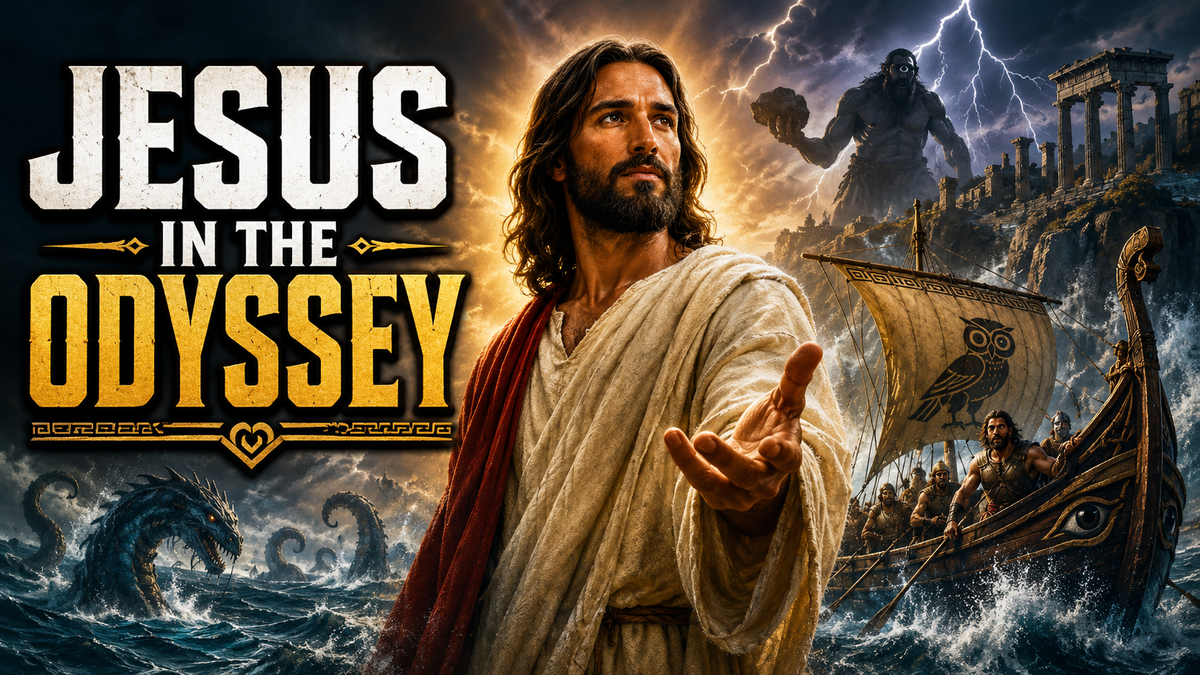
Jesus knelt in quiet prayer near the ruined edge of Troy, where the shore still held the smell of smoke and broken timber, and the sea rolled in as if it were trying to wash blood out of the sand. Behind Him, the fallen city stood in jagged silence, its towers blackened, its gates torn open, its alleys filled with the cold aftermath of victory. Long before any singer would know how to Read the FULL Jesus in The Odyssey faith-based story, and long before any hand would place beside it the related reflection on the warrior’s long road back to mercy, the journey began without ceremony, without applause, with the Son of God praying where men had learned how to destroy one another and then call it glory.
The morning wind moved through the abandoned shields and loosened scraps of sailcloth from the Greek ships drawn up along the beach. Soldiers laughed too loudly near the fires because quiet made them remember. Some loaded bronze and cloth and carved cups into the holds as if plunder could explain the years they had lost. Others stared at the sea with the stunned faces of men who had wanted home for so long that they no longer knew whether home would want them back.
Odysseus stood apart from them, one hand on the dark hull of his ship, his eyes fixed not on Troy, and not on the sea, but somewhere between the two. He had the look of a man who had survived by keeping three thoughts ahead of death, yet now could not bear the one thought waiting in front of him. Ithaca was across the water. Penelope was across the water. Telemachus, who had been a child when he left, was across the water. But so were the memories of every command he had given, every trick that had worked, every life spent in the long argument between pride and survival.
A captain called for him, asking whether the last stores should be divided or kept under seal. Odysseus answered without turning, and the answer was sharp enough to send the man away with lowered eyes. Then he saw Jesus.
Jesus was still kneeling, His hands open on His knees, His face lifted slightly toward the gray light that hovered over the sea. He was not dressed like a Greek, nor like a Trojan, nor like a wandering priest from any temple Odysseus knew. His robe was simple, stained near the hem with sand and ash, and yet nothing around Him seemed able to claim Him. The smoke did not make Him less clean. The ruin did not make Him less whole. The morning did not make Him small.
Odysseus frowned, not because the stranger seemed dangerous in the usual way, but because He did not seem afraid. Men without fear were often fools. Men without fear after Troy were often mad. This man seemed neither.
“You pray beside the wrong city,” Odysseus said.
Jesus opened His eyes and looked at him with such direct gentleness that Odysseus felt, for one breath, as though he had been addressed before he had spoken. “I pray beside men who have forgotten what victory costs,” Jesus said.
Odysseus gave a short laugh that carried no joy. “Then You will be praying a long time.”
“I have time for the lost.”
The words should have angered him. Instead, they landed somewhere below anger, where a weariness lived that Odysseus had not allowed his men to see. He looked back toward Troy, where smoke slipped out of the broken streets. “The lost are in that city.”
Jesus rose slowly. “Some are. Some are loading ships.”
Odysseus’s jaw tightened. He had been praised for his mind since boyhood, for the way he saw angles where other men saw walls. He had lived by answer and counteranswer, by patience, disguise, timing, and nerve. Troy had not fallen to strength alone. It had fallen because he knew how pride could be baited, how fear could be hidden, how men could be made to open gates they had sworn to guard. He had given the Greeks a way in. The world would remember that.
Yet when this stranger looked at him, Odysseus felt as if the cleverness that had saved him had also accused him.
“You speak as though You know me,” he said.
“I know what war does to a man who thinks he must never confess that it has wounded him.”
Odysseus looked away first. He hated that. “I am going home.”
“Yes,” Jesus said. “But the question is what kind of man will arrive there.”
A gull cried over the beach. Somewhere behind them a sailor cursed at a mule that refused to step onto a plank. Odysseus heard it all too sharply, because the sentence had opened a door inside him and he did not want to look through it. He imagined Penelope’s face, but the image would not stay still. He imagined his son, but the boy kept changing into a stranger. He imagined his own hall, his own bed, his own fields, but every doorway seemed to ask whether the man returning was husband, father, king, or only a sharpened weapon with a name.
He recovered with the speed of habit. “The kind who survived.”
Jesus did not rebuke him quickly. That was worse. “Survival is a mercy,” He said. “It is not the same as being whole.”
Odysseus studied Him then, more carefully. “Who are You?”
“My Father sent Me to seek those who are far from home.”
“Your father is a king?”
“My Father is greater than kings.”
Odysseus almost smiled. In the world he knew, every shore had a god, every storm had a temper, every spring had a rumor, every shrine had a bargain. Men lived beneath powers that demanded smoke, blood, fear, and flattery. He had learned to honor them when useful, avoid them when possible, and never trust them with a man’s heart. Yet this stranger spoke of His Father without calculation, without dread, and without the crawling politeness men used before gods who could be offended by a badly chosen word.
“If You travel under some god’s protection,” Odysseus said, “You should choose Your companions carefully. The sea between here and Ithaca is not kind.”
Jesus looked toward the ships. “I will travel with you.”
Odysseus stared at Him. “That was not an invitation.”
“No,” Jesus said. “It was a wound speaking before the man could.”
A flush rose under Odysseus’s beard. He stepped closer, lowering his voice so his men would not hear. “Stranger, I have led kings through ten years of war. I have watched better men than You drown in armor, burn under towers, and vanish under horses’ hooves. I do not need a holy man on my deck telling me my soul is heavy. I need wind, discipline, oars, and men who obey.”
“You need truth.”
“I need home.”
Jesus held his gaze. “A man can reach his shore and still refuse to come home.”
For a moment Odysseus wanted to order Him seized, if only to prove that the old rules still held. A captain commanded, men obeyed, strangers learned their place, and the world remained understandable. But something in Jesus’s face made command feel small. Not impossible. Small. Like a child lifting a reed against the tide.
From the ships came a cheer. A chest had been pried open, and cups of Trojan gold passed from hand to hand. One young sailor, scarcely bearded, put a woman’s bracelet around his own wrist and danced while others roared. The sound cut through Odysseus. He thought of the houses behind Troy’s walls. He thought of men who had begged, men who had lied, men who had fought until their breath emptied onto the stones. He thought of the wooden horse standing in memory like a second city, hollow and full of waiting death.
Jesus turned toward the laughter. His face carried grief, but not surprise. “Do you know their names?” He asked.
Odysseus followed His gaze. “My men?”
“The dead.”
Odysseus almost answered with numbers. He knew numbers. Ships lost. Captains killed. Stores burned. Years spent. But names came differently. Names had faces. Names had mothers, wives, brothers, children, debts, songs, old injuries, foolish boasts, favorite cups, fears hidden under jokes. Names demanded something numbers did not.
“Enough of them,” Odysseus said.
Jesus did not move. “Enough to repent?”
The word was foreign to the beach and yet not foreign to Odysseus’s soul. It was not like regret, which could be carried privately while a man continued forward unchanged. It was not like shame, which bent a man inward until he saw only himself. This word seemed to turn the whole body toward a different road.
Odysseus hardened himself against it. “We did what war required.”
“And now you must learn what mercy requires.”
Before Odysseus could answer, a shout rose from the far end of the shore. Two sailors were fighting over a carved idol taken from a Trojan house. The thing had a small painted face, cracked from heat, and both men held it as if it could make them rich. One had a knife out. The other had blood on his cheek already. Men gathered around them, hungry for one more spectacle after ten years of spectacles.
Odysseus strode toward them with relief because anger was easier than truth. “Drop it,” he shouted.
The men froze. One lowered the knife. The other kept both hands around the idol.
Odysseus reached them and struck the idol from their grip. It hit the sand, rolled once, and stared up with its painted eyes. “You would spill Greek blood over a dead city’s toy?”
The sailor with the knife muttered, “He stole my share.”
“Your share?” Odysseus said. “Your share is breath in your lungs and a ship to carry you away.”
The men around him quieted. It was the kind of answer they expected from him, hard and quick, and for a moment the old confidence returned. He could still master a beach. He could still bend disorder into shape.
Then Jesus came near. He looked not at the idol first, but at the man whose cheek was bleeding. “Who taught you to believe that what you take can heal what you lost?”
The sailor blinked as though he had been struck. He was older than he had first appeared, with gray in his beard and salt in the lines around his eyes. “My brother died at the wall,” he said. “He had no share.”
“So you took one for him?” Jesus asked.
The man looked down. “I do not know.”
Odysseus felt irritation stir because the moment was turning soft, and softness on a beach full of armed men could spread like rot. “He drew a knife.”
“Yes,” Jesus said. “And he bled before he drew it.”
The words disturbed the gathered men more than a command would have. Some looked away. Some shifted their feet. The young sailor with the bracelet slipped it off and hid it in his fist.
Odysseus wanted to say that wounds did not excuse disorder, and he would have been right. But Jesus was not excusing it. That was the trouble. He was looking straight at the wrong and straight at the pain beneath it, as if truth and mercy were not enemies.
Jesus knelt and picked up the cracked idol. He brushed sand from its painted face. “This cannot answer grief,” He said. “It cannot forgive. It cannot restore a brother. It cannot guide a ship. It cannot carry a man’s sorrow. It can only sit in the hand until the hand mistakes possession for peace.”
The sailor who had drawn the knife began to weep, not loudly, but with a kind of humiliation that made the others give him room. Odysseus watched, unsettled, as Jesus placed the idol on the ground instead of keeping it or breaking it. Then He turned to the two men.
“Return what is not yours,” Jesus said. “Bind the wound. Ask forgiveness. Then board the ship as brothers, or the sea will teach you with harsher hands.”
No one moved at first. Then the sailor with the bleeding cheek tore a strip from his tunic, and the other, after a long hesitation, helped press it to the cut. It was awkward, imperfect, and full of pride not yet dead. But it was something.
Odysseus said nothing. He told himself it was because the matter was settled. He did not want to admit that another kind of authority had just stood on his shore, one that did not need to dominate in order to command.
By midday the ships were ready. The men pushed them into the surf with groans and shouted rhythm, their shoulders shining, their sandals sinking into wet sand. Odysseus boarded last, as captains often do, and found Jesus already seated near the mast, not in the place of honor, not hidden among the cargo, but where the labor of the ship could be seen and shared.
“You assume much,” Odysseus said.
Jesus looked at the oarsmen taking their benches. “I have come for much.”
The sail climbed. The ropes tightened. Troy began to shrink behind them, becoming smoke, then stain, then memory. The men cheered when the wind caught, and some sang as if singing loudly enough could keep ghosts from following. Odysseus stood at the stern with his cloak whipping behind him, his eyes fixed westward. The sea opened before him, bright and restless, promising distance.
For the first hours, the voyage seemed almost merciful. The shore slipped away. The ships held formation. The men settled into labor and hope. Odysseus gave orders with calm precision, and each correct movement restored his faith in command. Sail, rudder, oar, ration, watch, course. These things could be known. These things could be mastered. He did not look often at Jesus, though he felt the stranger’s presence the way a man feels a lamp behind him in a dark room.
Near evening, clouds gathered where the sea met the sky. They rose too quickly, piling black upon purple, and the wind turned with a low animal sound. Old sailors stopped singing. A boy at the forward ropes whispered a prayer to a sea power whose name died in his throat when thunder answered.
Odysseus shouted for the sail to be reefed. Men sprang to the lines. Rain struck before the sail was half-secured, hard drops that became sheets. The ship lurched, and a wave slapped across the deck, knocking one man against the cargo. Another lost his grip on an oar and nearly went over before two hands caught him.
Through the storm, Odysseus became himself again in the way men admired. He moved fast. He saw danger before it finished forming. He cursed when curses were useful, praised when praise would strengthen a trembling hand, and drove fear into motion. The other ships vanished and reappeared between walls of water. Lightning showed them like broken thoughts.
Jesus stood beside a fallen sailor and helped him rise. He did not shout over Odysseus. He did not seize the rudder. He moved where pain was, where panic broke rhythm, where a man’s hands forgot what they had been trained to do. When one oarsman cried that the gods were punishing them, Jesus leaned close and said, “Do not give your fear a throne. Pull.”
The man pulled.
A wave struck the stern so hard that Odysseus went to one knee. He gripped the rail, teeth clenched, and for one fierce instant he believed the sea itself hated him. The thought came with the name Poseidon, with all the old stories of insult and vengeance, of powers waiting beneath foam. But when he looked across the deck, he saw Jesus in the lightning, steady, soaked, His hand on the shoulder of a terrified man.
Odysseus rose and fought the rudder straight. The storm did not cease. Jesus did not lift His hand and make the sea gentle. The men still strained, slipped, bled, and prayed. One jar of grain broke open and vanished into water. A mast rope snapped and lashed a man’s arm raw. The night became labor without horizon.
At last, sometime beyond counting, the storm loosened. The thunder moved away. Rain thinned into cold mist. The ship groaned in the swell, damaged but alive. Around them, a few shadowed sails emerged through the dark, though not as many as had left the beach in order.
Odysseus stood breathing hard, his hair plastered to his face, his hands cramped around the wet rail. He began counting ships before he counted men. He hated himself for noticing that, and hated more that he knew Jesus had noticed too.
Dawn came pale. The sea lay scattered with wreckage: a broken oar, a storage lid, a strip of painted wood from some vessel that had not kept whole. Men searched the water in silence. Once, someone called a name, but no answer came. Odysseus looked at the horizon and calculated what could be repaired, how far they had been driven, how many days of food remained, whether the winds might still favor them if discipline held.
Jesus came to stand beside him.
“Do not say it,” Odysseus muttered.
“What do you think I came to say?”
“That I should grieve before I plan.”
Jesus looked over the gray water. “I came to say that a captain who refuses grief will make plans that do not know the value of men.”
Odysseus closed his eyes briefly. His whole body wanted to reject the sentence, but the storm had left him too tired for the clean armor of contempt. Below them, men wrapped the injured arm of the sailor struck by the rope. Another man knelt near the bow, whispering the names of those missing from his bench.
“I know the value of men,” Odysseus said, though his voice had less force than he intended.
Jesus answered quietly. “Then let their names slow you down.”
The words were not command in the way Odysseus understood command, yet they required more obedience than any order he had ever given. He looked again at the wreckage. A captain survived by moving quickly from loss to necessity. But Jesus was asking him to stand in the space between the two, where a man could neither undo death nor hide from it by becoming useful too soon.
Odysseus turned to the crew. They looked back at him with hollow eyes, waiting for orders, waiting for certainty, waiting for the man who always knew the next move.
He gave them one. But it was not the one they expected.
“Names,” he said.
No one spoke at first.
Odysseus swallowed. “We will speak the names of the missing before we mend the sail.”
The old helmsman stared as if he had misheard. The wounded sailor lowered his bandaged arm. Somewhere among the benches, a man began to cry without covering his face.
One by one, the names came. Some were spoken clearly. Some broke in the throat. Some were corrected by men who knew a fuller name, a father’s name, a village, a wife waiting on an island that might never receive news. Odysseus repeated each one. At first he did it like a duty. Then the duty became heavier, and the heaviness became strangely honest. He did not become gentle all at once. He did not become new by sunrise. But by the time the last name was said, he understood that the sea had not only scattered his ships. It had exposed the way he had been trying to return home without letting the dead have weight.
Jesus stood nearby, saying nothing, and His silence did not feel empty. It felt like room.
When the names were finished, Odysseus ordered repairs. This time his voice still carried authority, but it no longer struck the deck like a blade. Men moved with a different kind of quiet, not weaker, not slower in the way fear slows, but steadier because the truth had been allowed to stand among them.
By afternoon, the sail was patched, the wounded tended, and the ships that remained gathered close. Odysseus looked west again. Ithaca was still far beyond storms, islands, monsters, hunger, enchantment, judgment, and the hard mercy of returning as more than a survivor. He did not know any of that yet. He only knew that a stranger who feared no god of the sea had stepped onto his ship and already made home feel less like a place he could conquer.
Jesus sat near the mast as the wind returned, His eyes on the horizon, His hands marked with the work of helping men rise. Odysseus watched Him for a moment, then looked away before gratitude could show.
The ships turned into the open water, carrying bronze, grief, pride, hunger, wounded men, and one quiet light that did not belong to the old powers of the world. Behind them, Troy disappeared. Before them, the sea waited, and beyond the sea, the Father waited too.
Chapter Two
For two days after the storm, the surviving ships moved through a sea that looked almost innocent. The wind came low and steady, the sky cleared, and sunlight flashed across the oars as if the night had been only a bad dream sent to test old sailors. Men worked with the tired obedience of those who had no strength left for boasting. They mended torn lines, dried soaked cloaks, counted jars, and spoke more quietly than before. A few still whispered the names of the missing under their breath while they rowed, not because any captain commanded it, but because once grief had been allowed aboard, it could no longer be treated as cargo to be thrown over the side.
Odysseus noticed the change and did not know whether to call it weakness or wisdom. His men looked less like a weapon now, and that disturbed him. A weapon did not weep while it sharpened. A weapon did not pause over names. A weapon did not remember the hands of the dead when tying a knot or lifting a cup. Yet the ship had not slowed because of it. If anything, the men obeyed with greater care. The orders passed along the benches with less fear and more trust, which made Odysseus uneasy in a way he could not explain. He had known how to rule fear. He was less certain how to lead men who had begun to tell the truth.
Jesus spent the daylight among the crew, sharing the work without drawing attention to it. He helped grind grain, carried water to the injured, listened when men spoke of brothers, wives, and fields, and sat beside those who had no words. He did not make Himself useful in the restless way of a man trying to prove worth. He served as if service were the natural shape of authority. Odysseus watched this with suspicion, then irritation, then a guarded curiosity that felt too close to need.
On the third morning, the sea changed color near the horizon. A long green shore rose out of mist, low and warm, with trees bending over pale sand and a sweetness in the air that reached the ships before the anchors dropped. Men lifted their faces. After salt, smoke, wet rope, and grief, the smell was almost enough to make them laugh.
One scout called from the bow that there were streams inland. Another pointed to fields bright with flowers. The island looked unwalled, unguarded, and harmless, which in Odysseus’s experience made it dangerous in a different way. But the men needed water. They needed fruit. They needed rest, and he needed them strong enough to row when the wind failed.
“We land in order,” he said. “No wandering beyond sight. Fill skins, gather food, return before sunset.”
The first party went ashore under a soft morning sun. Jesus stepped onto the sand with them, His robe moving in the warm wind. Odysseus came after, scanning the tree line, counting distances, measuring escape routes, refusing to let beauty make him stupid. The islanders appeared slowly, not from hiding, but from indifference. They were gentle people with slow hands and dream-filled eyes. They carried baskets of pale blossoms and fruit shaped like little cups, and they welcomed the Greeks without fear, as if no army had ever burned a city and no stranger had ever come with a sword.
The sailors lowered their weapons. Some laughed with relief. One accepted a flower. Another tasted the fruit offered by a young islander and smiled as though a burden had slipped from his back. Soon several men were eating, and the islanders touched their shoulders kindly, pointing toward shaded places beneath the trees.
Odysseus did not eat. He watched the faces of his men change.
It happened quietly. The hard lines softened first. Then the urgency faded from their eyes. Men who had spoken of Ithaca, Zacynthos, Same, and other homes across the sea began to sit in the grass as if they had arrived at the only shore that mattered. One sailor who had wept for his son the night before now smiled at a flower turning in his hand and said he could not remember why he had been in such haste. Another lay back under a tree and murmured that the sea could keep its roads.
Odysseus seized him by the tunic. “Up.”
The sailor smiled without shame. “Captain, listen to the bees.”
“I said up.”
“There is no war here.”
The sentence struck more men than the drugged fruit had. There was no war here. No towers. No shouting. No captains dragging them from sleep. No dead names floating between waves. The sweetness of the place did not feel like rebellion. It felt like mercy offered without demand.
Jesus knelt beside the sailor and looked into his unfocused eyes. “Rest is a gift,” He said. “Forgetting your calling is not rest.”
The man blinked, and for a moment pain returned to his face. Then the sweetness pulled him back. “My calling was pain.”
“No,” Jesus said gently. “Pain has been on your road. It is not your name.”
Odysseus turned on the islanders. “What have you given them?”
An old woman with flowers braided into her white hair smiled at him. “Only peace.”
“This is not peace.”
“It is the end of wanting.”
Jesus rose, and the warmth around them seemed thinner than before. “A peace that steals love is only another prison.”
The old woman looked at Him for the first time with something like displeasure. Her eyes were not cruel, but they were empty in a way that made Odysseus think of a temple after the fire had gone out. “They are tired,” she said.
“Yes,” Jesus answered. “And the tired are easily lied to.”
Odysseus ordered the men dragged back to the ships. Some resisted with the dreamy weakness of children pulled from sleep. Others pleaded. One cursed him. The captain in Odysseus found grim satisfaction in being right, but the man beneath the captain heard their pleading and understood it too well. He wanted to stay for reasons he would not admit. Not forever, perhaps. Just long enough to stop remembering. Long enough for home to become unnecessary, for names to blur, for Troy to become a story that had happened to someone else.
Jesus helped carry the most weakened sailor toward the shore. Odysseus walked beside Him, angry at the island, at the men, at the old woman, at the strange truth that temptation did not always snarl. Sometimes it smiled, fed you, and called your numbness healing.
When the last of the men were aboard, Odysseus ordered the anchors lifted. The drugged sailors wept as the island pulled away. One reached toward the trees until the shoreline became a green line, then covered his face with both hands as memory returned.
That night, Odysseus found Jesus near the stern, watching the dark. “You could have stopped them before they ate.”
“I could have.”
“Why did You not?”
Jesus looked at him. “Because you needed to see that not every danger looks like an enemy.”
Odysseus leaned against the rail. “I know temptation.”
“You know desire that announces itself loudly. You know ambition, anger, hunger, honor, and victory. You are less watchful against the comfort that asks you to lay down love because love is heavy.”
The captain said nothing. Across the deck, a sailor whispered his son’s name over and over, as if stitching it back into his mind.
By morning the wind carried them toward a harsher coast. Cliffs rose in broken teeth from the sea, and caves opened above the surf like dark mouths. Goats moved along the slopes. The men, ashamed from the lotus island and eager to feel strong again, begged for fresh meat. Odysseus agreed to land with a chosen party. He told himself it was prudence. He needed provisions. He needed knowledge. He needed to show the crew that comfort had not softened command.
Jesus came with them.
They found the cave before sunset. It was enormous, with a stone threshold worn by heavy feet and pens full of sheep larger than any Odysseus had seen. The men marveled at the cheeses stacked in baskets, the bowls of milk, the skins and tools scattered everywhere without order or fear of theft. One sailor laughed and said the master of the cave must be rich and careless. Another suggested they take what they could and leave before he returned.
Odysseus raised a hand. “No. We wait.”
The men stared at him.
“We wait,” he repeated, “and learn who owns this place. A guest-gift may be earned where theft would make us hunted.”
Jesus looked at him, and Odysseus bristled. “Do You object?”
“I am listening to the reason you give,” Jesus said, “and the reason beneath it.”
Odysseus turned away. He wanted more than food. He wanted the story. He wanted to stand before whatever rough lord owned the cave and be known as Odysseus, breaker of Troy, master of ships, a man whose presence demanded honor even on a savage shore. He had been humbled by storm and lotus. He wanted the world to become recognizable again, arranged by rank, wit, and reputation.
The owner came at dusk, driving his flock before him. He was a giant with one vast eye in his forehead, a creature of muscle and appetite, more mountain than man. When he rolled a stone across the cave mouth, the entrance vanished behind a weight no mortal crew could move. The sailors pressed back into the shadows. Odysseus felt fear run through them, and through himself, though he locked it down before it reached his face.
The Cyclops smelled them before he saw them. His great head turned. “Strangers.”
Odysseus stepped forward because stepping forward was what leaders did when others shook. “We are Greeks returning from Troy. We ask the courtesy owed to guests.”
The Cyclops laughed, and the sound shook dust from the roof. “Courtesy is for small men who need rules.”
Jesus stood a little behind Odysseus, His eyes full of sorrow rather than fear.
The giant leaned closer. “Do you bring gifts?”
Odysseus said, “We bring our need.”
The Cyclops smiled. “Then I will answer need with hunger.”
What followed changed the cave forever in the memory of every man who lived to leave it. The giant seized two sailors before anyone could move, and the cave filled with shouting, horror, and the blunt truth of power without mercy. Odysseus reached for his sword, but Jesus caught his wrist.
“Not yet,” Jesus said.
“He is killing them.”
“And rage will not move the stone.”
Odysseus trembled with the effort of not striking. His mind raced while grief and fury fought inside him. The Cyclops ate, drank, and slept across the cave mouth, as secure as a tyrant on a throne built from other men’s fear.
When the dark deepened, Odysseus whispered plans. He would make the giant drunk. He would use a sharpened stake. He would give a false name. The men gathered close, desperate for his cleverness now, and he felt the old terrible comfort of being needed for the sharpness of his mind.
Jesus listened. At last He said, “Use wisdom to save life, not to feed pride.”
Odysseus glared at Him in the dimness. “Do You have a gentler plan for moving a mountain?”
“No. But I know the danger that will remain after the stone is moved.”
The plan worked because Odysseus knew how to turn arrogance against itself. He offered the giant wine from their stores. He spoke humbly when humility served strategy. He named himself Nobody, and the giant, swollen with drink and contempt, believed him. When sleep dragged the Cyclops down, the men drove the fire-hardened stake into his single eye. The scream that followed seemed to split the cliff from root to crown.
Odysseus did not enjoy the pain. At least he told himself he did not. But something fierce in him rose when the giant clawed blindly through the cave, helpless now against men he had treated as meat. The stone was moved at dawn. The surviving sailors escaped beneath the sheep, clinging to wool and terror. Jesus moved among them last, guiding one shaking man whose hands nearly failed.
They reached the ships with torn skin and wild eyes. The men pushed off, and the blinded giant staggered to the cliff, hurling stones that crashed into the sea near the hulls. Water exploded around them. Oars bit hard. The crew shouted for silence, for speed, for distance.
Odysseus stood at the stern, and the old hunger for recognition surged in him like a second storm. They had escaped. His plan had saved them. His name should not vanish behind Nobody like a coward hiding in smoke. He cupped his hands and shouted toward the shore, “Tell any who ask that Odysseus of Ithaca took your eye!”
The men groaned in fear. Jesus turned toward him, and in His face Odysseus saw not surprise, but grief already arriving before the consequence.
The Cyclops lifted his head to the sky and called upon the sea’s dark power, begging ruin upon the man who had named himself. Whether the old power heard, or whether pride itself opened the door to more suffering, the sea changed. Wind slammed the sails. A stone struck near enough to flood the deck with spray and splinter a rail. Men screamed at Odysseus to be silent.
He stood with his hands shaking, the glory of his name turning bitter in his mouth.
Jesus came near. “You saved them from the cave,” He said. “Then you placed them beneath your pride.”
Odysseus rounded on Him. “Without me they would be bones under that monster’s roof.”
“Yes.”
The agreement took the force from his anger.
Jesus continued, “Your gift is real. So is the wound that twists it.”
Odysseus looked toward the cliffs as they fell away. He wanted to defend himself, but the sea had taken up the accusation. Each wave seemed to strike the hull with his name.
Days later, battered by contrary winds, they reached the floating halls of Aeolus, keeper of winds in that old world’s telling, a lord of rushing air and bronze thresholds. His island moved with a strange grace over the sea, surrounded by walls that rang softly when the wind touched them. Aeolus received Odysseus as a curiosity and a guest, amused by the famous Greek whose name had outrun his ships. He feasted the crew, asked for stories of Troy, and smiled when Odysseus gave them with the polish of a man who knew which details made listeners lean closer.
Jesus sat at the feast but did not eat from the plates placed before idols. He accepted bread from a servant’s ordinary basket and gave thanks to His Father quietly. Aeolus watched Him with narrowing interest.
“You do not honor the winds?” Aeolus asked.
Jesus lifted His eyes. “The wind does not need my worship.”
The hall cooled. Odysseus felt every soldier tense. One did not speak so in the houses of powers, limited or not. But Aeolus only laughed, though the laugh had an edge. “And yet you travel by it.”
“I travel by my Father’s will.”
Aeolus leaned back, entertained and offended in equal measure. “Then perhaps your Father will not mind if I help this king find his shore.”
He gave Odysseus a leather bag bound tight with silver cord, saying it held the wild winds that would drive him from his course if released. Only the gentle west wind would remain to carry them home. Odysseus accepted the gift, and for nine days Ithaca drew nearer. The men began to speak of roofs, vineyards, wives, children, olive trees, smoke rising from their own hearths. Odysseus did not sleep. He held the bag near him, guarding it with the tight, sleepless suspicion of a man who believed everything depended on his control.
Jesus said to him on the eighth night, “Let another man watch while you rest.”
“No.”
“You are not the only faithful one aboard.”
“I know men,” Odysseus said.
“You know wounded men. You do not yet know how to trust them when you are wounded too.”
Odysseus looked toward the dark outline of distant land. His eyes burned from sleeplessness. “If I let go, everything scatters.”
Jesus answered, “That is what fear says when it dresses itself as responsibility.”
But Odysseus kept the bag beside him until exhaustion overcame him within sight of Ithaca’s shore. While he slept, men who had mistaken secrecy for betrayal whispered over the silver cord. They thought the bag held treasure he meant to keep for himself. They opened it, and all the imprisoned winds leapt out with the violence of long restraint.
The ships were driven backward across the sea. Ithaca vanished into storm and distance.
When Odysseus woke, the world he had nearly reached was gone.
His rage broke over the crew with such force that men shrank from him as they had shrunk from the Cyclops. He cursed their greed, their stupidity, their faithlessness, and every accusation was partly true. That made it more dangerous. Truth without mercy became a club in his hands.
Jesus stepped between him and the nearest sailor, the one whose trembling fingers had loosened the cord. “Enough.”
Odysseus’s face was white with fury. “He stole home from us.”
“He sinned,” Jesus said. “Do not become another storm.”
The sailor fell to his knees. “I thought it was gold.”
Odysseus stared at him. “You thought I would hide gold while you starved beside me?”
The man could not answer.
Jesus looked at Odysseus. “Would they have believed that if you had trusted them with the truth?”
The question went deeper than the opened bag. Odysseus saw nine days of silence, nine days of clutching control against his chest, nine days in which he had treated his crew as a threat while demanding their loyalty. Their sin was real. So was his.
He turned away because if he stayed, he might strike a man who had once followed him into Troy.
The next landfall gave no time for healing. The harbor of the Laestrygonians seemed safe at first, narrow and still, with high cliffs forming a bowl around calm water. Most of the ships entered. Odysseus, made cautious by suspicion he called wisdom, kept his own vessel outside.
The people of that place were giants of another kind, not solitary like the Cyclops, but many, organized by appetite, their city built around the devouring of strangers. When the trap closed, stones rained from the cliffs. Ships cracked. Men who had survived Troy, lotus, cave, and storm vanished beneath hands too large to fight. The harbor became a place of splintered masts and screaming.
Odysseus cut his cable and fled because staying would kill the last ship too. His men rowed with the horror of those who heard friends dying behind them and could do nothing. Jesus stood at the stern, tears on His face, praying not to the powers of that harbor, not to the sea, but to His Father, naming the dying as the ship escaped.
Odysseus could not bear the prayer. “Do not name them,” he said hoarsely.
Jesus continued.
“Do not name them!”
Jesus turned, and His grief was stronger than Odysseus’s command. “They are not less precious because you could not save them.”
The words broke something Odysseus had been holding together by force since Troy. He gripped the rail so hard his knuckles whitened. Behind him, the harbor swallowed the last visible mast. Before him, the open sea waited again, wider and emptier than before.
By nightfall, only one ship remained.
No one sang. No one boasted. No one spoke of Ithaca. The men sat in the dark with the stunned stillness of survivors who knew survival had become almost unbearable. Odysseus stood alone until Jesus came beside him.
“I have led them to death,” Odysseus said.
Jesus did not soften the truth by denying it. “Some died by evil. Some by storm. Some by their own sin. Some by yours. You cannot heal what you refuse to name.”
Odysseus looked at Him with eyes hollowed by the day. “And if naming it destroys me?”
“Then the man built on pride must fall, so the man who can return in humility may live.”
The sea moved under them, dark and patient. For the first time since Troy, Odysseus did not answer. He had always believed the road home required a sharper mind, a stronger will, a tighter hand on every rope and every man. Now he stood on a ship full of grief with almost everything lost, and the quiet presence beside him made him wonder whether the thing he called strength had been carrying him home or keeping him from it.
Far ahead, unseen in the night, another island waited with smoke rising through trees and a woman of enchantment in a house of beasts and cups. But Odysseus did not know that yet. He only knew that his name, his control, his hunger to be honored, and his refusal to trust had followed him onto every shore.
Jesus looked over the water and prayed softly for the living and the dead.
Odysseus listened, unable to join Him, unable to walk away.
Chapter Three
The island they reached at dawn did not look like a place of judgment. It rose green from the sea, with cypress and oak gathered thick around a stone house set back from the shore. Smoke lifted from the roof in a narrow, peaceful line. After the harbor of slaughter, after the crushed ships and the men left screaming beneath cliffs, the sight of a house with a hearth nearly broke the crew in a different way. Men who had not spoken all night stared at it as though it were a memory from another life.
Odysseus did not trust it. He trusted almost nothing now. The loss of the fleet had changed the shape of his caution. Before, suspicion had felt like cleverness. Now it felt like a wound that watched everything. He ordered the men to remain by the ship while he chose a smaller party to search inland. They moved through the trees with hands near their swords, though the air was warm and the birds did not seem afraid.
Jesus walked with them, quiet as ever, His attention not only on the path but on the men themselves. One sailor kept whispering the names of those lost in the Laestrygonian harbor. Another stared at his own hands as if they belonged to someone else. Odysseus wanted to tell them to steady themselves, but the words would have sounded cruel even to him. He had demanded steadiness from men he had led through ruin, and he was beginning to understand that command could keep a body moving long after the heart had begun to collapse.
They heard singing before they saw the house clearly. It was not loud. It drifted through the trees with the softness of water over stone, beautiful enough to make even frightened men slow their steps. At the doorway stood a woman with bright eyes and a calm smile, surrounded by animals that should not have rested together. Wolves lay at her feet like dogs. Lions lifted their heads and blinked without hunger. The woman welcomed them as if she had expected them, and her voice carried a warmth that seemed shaped to whatever a man most wanted to hear.
“I know the look of travelers who have been badly handled by the sea,” she said. “Come in. Eat. Wash. Sleep without fear.”
The men looked to Odysseus. He looked to Jesus.
Jesus did not nod. He did not forbid. He only said, “Hunger is honest until it becomes a master.”
Odysseus did not like the sentence because he could not tell whether it was warning him against the woman, the men, or himself. He accepted the invitation but kept his hand near his sword. Inside, the house smelled of roasted meat, herbs, and wine. Servants moved silently. Bowls appeared. Cups were filled. The men sat as if their knees had finally remembered how tired they were.
The woman said her name was Circe.
She watched Jesus more carefully than the others. The men noticed her beauty. Odysseus noticed her confidence. Jesus noticed her captives.
At first Odysseus saw only animals near the walls, swine nosing through straw, a wolf asleep beside a pillar, birds in bronze cages. Then one of the pigs looked up with eyes too human to belong to a beast, and a chill moved through him. A sailor lifted his cup. Jesus placed a hand over it before he drank.
Circe’s smile thinned. “Your companion is discourteous.”
Jesus looked at the cup. “This drink does not reveal the man. It buries him.”
Odysseus stood. The men froze, cups in hand. Circe lifted her chin, and the room changed. The fire burned greener. The animals stirred. The air grew heavy with the pressure of an old enchantment, one that had long practiced making men less than men and calling it release.
“You come from war,” Circe said to Odysseus. “You come from blood, hunger, shouting, fear, and the endless labor of being obeyed. Why pretend you are noble? Men are ruled by appetite. I only remove the costume.”
Jesus stepped forward. “No. You mock what sin has wounded, then call the wound the truth.”
Circe’s eyes flashed. “And what are men, then? Look at them. Feed them enough. Frighten them enough. Tempt them enough. They crawl.”
Odysseus heard the insult and the accusation beneath it. He had seen men crawl. He had made men crawl. He had crawled inside himself beneath pride, though his body stood upright. The swine along the wall shifted, and one gave a strangled cry that sounded almost like a name.
Jesus turned toward the animals. “They are not yours.”
The words did not shake the house with thunder. They did not need to. The room seemed to recognize a law deeper than Circe’s spells. The animals trembled. Circe raised her staff, and the men drew swords, but Jesus did not reach for any weapon. He looked at the woman with grief that did not excuse her.
“You have power,” He said. “But power that teaches people to despise their own souls is not freedom.”
Circe’s hand faltered. For a heartbeat, Odysseus saw not a goddess of enchantment, not a mistress of beasts, but a lonely creature who had learned to control what she could not heal. Then her face hardened.
“These men would devour each other without people like me.”
“Some would,” Jesus said. “Some have. That is why they must be called back, not reduced.”
The first pig changed before anyone touched it. Its back arched, its hooves twisted into hands, and a man collapsed naked and sobbing into the straw. Then another. Then another. The room filled with the sounds of human beings returning to bodies they had thought lost forever. Some covered their faces. Some kissed the floor. Some looked around with such shame that Odysseus had to turn away.
Jesus knelt beside the first restored man and wrapped him in a cloak. “You are not what was done to you,” He said. “And you are not only what you desired.”
Odysseus felt those words reach beyond the man in the straw. He did not want them. He wanted clearer categories, guilty and innocent, strong and weak, master and victim. But the journey kept destroying categories that had once made him feel safe.
Circe lowered her staff. Her house no longer seemed large. “Take your men,” she said.
Odysseus stared at her. “All of them.”
She looked toward Jesus, and for the first time her confidence seemed close to fear. “He speaks as though every hidden thing already stands in daylight.”
“It does,” Jesus said.
By evening the restored captives, those who wished to leave, were led to the shore. Some were too broken to travel farther and remained near the island’s edge, beginning the slow work of remembering how to live as men. Circe gave food, water, and directions, not with kindness exactly, but with a strange, subdued obedience to truth. She told Odysseus that if he wanted the road home, he must pass through the place of the dead and hear what waited beneath his own story.
Odysseus almost refused. Then he saw Jesus watching him, not forcing, not sparing.
“The dead have followed us long enough,” Jesus said. “You must stop running from them.”
The crew hated the command when they heard it. They had escaped monsters and enchantments only to be told that the next road led downward, into the land where breath ended and memory remained. But the sea itself seemed to leave no other passage. The wind carried them north through gray water until the sky lost warmth and the shore they reached was dark with mist.
No birds sang there. No hearth smoke lifted. The ground was cold underfoot, and the water near the bank moved sluggishly, as if even rivers grew tired near death. Odysseus brought offerings because that was what old fear and old custom told men to bring. Jesus did not touch them. He stood apart and prayed to His Father, His voice low, steady, and full of life in a place that seemed built to deny it.
The dead came as shadows at first, thin as smoke and sorrow. Men Odysseus had known in battle. Men he had commanded. Men he had outlived. They gathered without footsteps. His crew backed away, but Odysseus could not move. Faces rose from the mist, and each one carried something he had left unfinished.
Then he saw his mother.
The sight took every defense from him. She was not as she had been when he sailed from Ithaca. Time had gone on without him, and grief had done what swords had not. She looked at him with love that deepened the wound instead of closing it.
“Mother,” he said, and the word sounded like a boy’s word in his mouth.
She told him of waiting, of Penelope’s sorrow, of Telemachus growing under the shadow of an absent father, of a house strained by men who ate what was not theirs and laughed in rooms that should have been guarded by love. She did not accuse him as enemies accused. She spoke truth as the dead can speak it, without needing to win.
Odysseus reached for her, but his arms closed on mist. The failure of that embrace undid him more than battle ever had. He sank to his knees on the cold ground.
“I was trying to come home,” he said.
Jesus stood near him. “Were you?”
Odysseus looked up, stricken.
The question did not deny his longing. It pierced it. He had wanted Ithaca. He had wanted Penelope. He had wanted his son, his bed, his hall, his name restored among his people. But had he wanted to return as a repentant man? Had he wanted to be known by those he had harmed by absence, pride, silence, and war? Had he wanted home, or had he wanted proof that after everything he had done, his place still belonged to him without confession?
His mother’s shadow watched him with sorrowful tenderness.
“I do not know how to go back,” Odysseus whispered.
Jesus knelt beside him in the land of the dead, and the darkness around them seemed unable to come nearer. “Then stop pretending you already know.”
Other shades came. A soldier who had died because Odysseus delayed retreat for advantage. A young man who had followed him into the wooden horse and never came out of Troy alive. A sailor lost in the storm whose name Odysseus had nearly forgotten until Jesus made him speak it. Not all accused him. That was harder. Some simply looked at him, and their looking told the truth. A leader’s choices lived in other people’s bodies.
At last a blind prophet spoke from the mist of hunger, forbidden cattle, wrathful seas, and a home filled with violence. His words came like stones dropped into deep water. Odysseus listened, but the prophecy was not the true turning. The turning had already begun when he stopped arguing with the dead.
He bowed his head. “I have used men to carry my name.”
Jesus said nothing.
“I have called control wisdom. I have called pride honor. I have called anger justice. I have wanted home, but I have wanted it on my terms.”
The mist moved around them. His crew stood silent, hearing their captain speak without armor.
Odysseus looked at Jesus. “What obedience remains for a man like me?”
Jesus answered, “Tell the truth. Receive mercy. Give mercy where vengeance would be easier. Lead as one who knows every man belongs first to God, not to your need, your fear, or your fame.”
Odysseus closed his eyes. He thought mercy would feel light. Instead, it felt costly. It asked him to release the story in which he had always been the necessary man, the clever man, the wronged man, the man who suffered too much to repent. It asked him to become smaller without becoming less responsible.
When they left the place of the dead, the crew did not speak for a long time. The sea seemed brighter simply because it belonged to the living. Odysseus stood at the stern and watched the dark shore fade. He was not healed. He was not remade in a single confession. But something had shifted. He no longer mistook being haunted for being honest. He had begun, painfully, to let truth have a voice.
Their next danger announced itself in beauty. The Sirens sang from a shore of bones and flowers, their voices carrying over the water with impossible tenderness. They did not sound like monsters. To one man they sounded like his wife calling from the doorway. To another, like his dead brother forgiving him. To Odysseus, they sounded first like Penelope, then like his mother, then like a crowd crying his name in praise, then like his own heart promising that he could be comforted without being changed.
He ordered wax pressed into the ears of the crew, but he, still hungry to know what no other man knew, commanded them to bind him to the mast. It was a compromise between wisdom and pride, and he knew it. Jesus watched the ropes tighten around him.
“You still want to hear what may destroy you,” Jesus said.
“I want to understand it.”
“You want to survive it and call that mastery.”
Odysseus did not answer before the song reached him.
It was unbearable because it was almost true. It knew his grief, his longing, his hunger for honor, his exhaustion, his fear that Penelope would see a stranger, his terror that Telemachus would not need him, his secret belief that if his name were sung loudly enough, his guilt might grow quiet. He strained against the ropes until they cut his skin. He shouted for the men to release him, but they could not hear. He cursed them, begged them, promised rewards, threatened punishments. Jesus stood before him, not blocking the sound, but looking at him with eyes that held him to the truth.
When the song faded and the island passed behind, Odysseus sagged against the mast, shaking. The crew removed the wax from their ears. One by one, they saw the marks on his wrists and the shame on his face.
Jesus loosened the ropes. “Temptation often sings with pieces of your own story,” He said. “That is why you must learn to love truth more than the voice that flatters your pain.”
The waters narrowed after that. On one side, cliffs rose sheer and cruel. From a hidden cave came a sound like hunger scraping stone. On the other, the sea sank and twisted around a swallowing mouth that pulled water down into itself and threw it back broken. Scylla and Charybdis waited, not as lessons in a singer’s tale, but as a choice no leader wanted: lose some, or risk all.
Odysseus knew the counsel from the dead. He knew the passage required sacrifice. The old Odysseus might have hidden the truth and driven the men forward, keeping the burden alone and calling secrecy mercy. He nearly did. The habit rose in him like a familiar shield.
Then he looked at Jesus.
“Tell them what you know,” Jesus said.
“They will fear.”
“They already fear. Do not add betrayal to fear.”
So Odysseus gathered them. His voice did not tremble, but it no longer carried the polished hardness of command untouched by confession. He told them the passage was deadly. He told them the ship could not avoid all danger. He told them he did not have power to make the road painless. The men stared at him, some angry, some pale, some strangely steadier because they were being treated as men rather than tools.
One sailor asked, “Will you stand with us?”
Odysseus answered before pride could improve the sentence. “Yes.”
They rowed into the strait.
No telling of that passage could make it clean. The whirlpool roared. The cliff shadow swallowed daylight. Scylla struck with sudden horror, and men were taken from the benches with cries that followed the ship long after their bodies vanished. Odysseus reached for one and failed. He called the man’s name, and that was all he could do.
Jesus stood amid the terror with tears on His face, bracing the living, naming the taken, refusing to let death turn them into numbers. He did not pretend the loss was small. He did not rebuke their fear. He carried the moment with them, and somehow the ship passed through.
On the far side, the surviving men collapsed. Odysseus remained standing only because falling felt like theft from those who could not stand again. He looked at Jesus and said, “Mercy did not spare them.”
Jesus answered, “Mercy told the truth, stayed near, and refused to let evil have the final word over their names.”
The ship limped onward beneath a hard sun until hunger became the strongest voice aboard. They came at last to an island where sacred cattle grazed in shining fields, guarded by old warning and fear. The men looked at the animals with hollow eyes. Their food was nearly gone. Their bodies had been emptied by rowing, grief, terror, and salt.
Odysseus forbade them to touch the cattle. He did it with full authority, and this time the command was right. But right commands still had to pass through starving bodies. Wind trapped them on the island for days. Then weeks. The sea would not open. The stores failed. Men chewed leaves and leather. Their prayers turned thin.
Jesus moved among them, sharing what little there was, refusing despair, refusing the lie that hunger made disobedience holy. “Need is real,” He told them. “So is trust.”
But trust felt far away when ribs showed and the cattle grazed within sight.
One day, while Odysseus slept from exhaustion, the men broke. They killed what had been forbidden and cooked the flesh over a desperate fire. The smell woke him before any voice did. He ran toward the smoke, and when he saw the meat, his face filled with a grief so fierce it looked like rage.
“You have doomed us,” he said.
The men could not meet his eyes. One answered, “We were dying.”
Jesus stood beside the fire. He looked at the slaughtered animal, then at the starving men, then at Odysseus. “Sin often comes dressed in an argument that has suffered enough to sound reasonable.”
The sailor who had spoken began to sob. “What should we have done?”
Jesus did not answer with an easy sentence. He sat down among them in the smoke, among the guilty and hungry, and His presence made the question heavier because He did not deny either their need or their disobedience. Odysseus stood over them, and for the first time he understood how judgment could be true and still break the heart of the one who had to speak it.
When the wind finally returned, it came with judgment in its teeth. The ship had barely reached open water when the sky darkened. Thunder rolled. The mast split. Waves rose like walls, and the sea that had carried them so far became a field of wreckage. Men cried out, confessed, prayed, cursed, reached for one another, and were torn away.
Odysseus clung to broken timber as the last ship came apart beneath him. Through rain and spray he saw Jesus standing where the deck had been, steady amid ruin, His eyes lifted not to the furious sky, but beyond it.
“Father,” Jesus prayed, His voice somehow clear within the storm, “hold what the sea thinks it has taken.”
Then the wave came between them.
Odysseus was driven into darkness with the taste of salt and failure in his mouth. He did not know whether any man remained alive. He did not know where Jesus was. He did not know whether Ithaca still waited or whether home had become another word for judgment. He only knew, as he clung to wreckage under a torn and merciless sky, that cleverness had not carried him home, control had not carried him home, reputation had not carried him home, and strength had not carried him home.
If he lived, it would have to be by mercy.
Chapter Four
Odysseus woke beneath a ceiling of leaves, with the sound of gentle water moving somewhere beyond the trees. For a long moment he did not know whether he was dead. The air was too soft for wreckage. The ground beneath him was too still for the sea. His hands opened and closed around white sand, and the movement brought pain back into his body. Pain meant life, though life had become a question he no longer knew how to answer.
He rolled onto his side and coughed salt from his throat. The shore curved around a hidden island bright with flowers, warm springs, and trees heavy with fruit. Nothing in it looked cruel. That made him afraid.
A woman stood near the edge of the shade, watching him with eyes that held the patience of someone who had never been hurried by mortal grief. She was beautiful in a way that seemed less like a face and more like a spell the island kept repeating. Her name, she told him, was Calypso. She had found him half-dead among the rocks. She had drawn him from the surf. She had given him water. She had watched over him while fever came and went.
Odysseus tried to rise, but his body failed. “My crew,” he said.
Calypso did not answer quickly.
He understood before she spoke.
He turned his face away, but the grief found him anyway. Not as it had before, not as a thing to command or avoid, but as a sea inside the sea. Every man was gone. Every bench was empty. Every voice that had trusted him, cursed him, obeyed him, doubted him, followed him, and died near him came back with terrible clarity. He had no orders to give them now. He had no plan to hide behind. He had only memory.
For many days, perhaps many weeks, he lived because the island would not let him die. Calypso fed him, spoke gently, and offered him the one temptation that did not need wine, song, lotus, or fear. She offered him escape from return. No suitors. No son grown strange. No wife wounded by years. No kingdom damaged by absence. No hall full of accusation. No old mother waiting beyond death. No men to bury in his heart. She offered him a life without consequence, a bed without confession, a shore where the past could soften until it no longer required anything from him.
“You have suffered enough,” she told him one evening as the sun lowered over a calm sea. “Stay. Be honored here. Let the world that broke you go on without you.”
Odysseus sat at the edge of the water. He had become thinner, quieter, slower. His beard had grown wild, and his eyes had lost the bright edge men once mistook for confidence. “I do not know whether home remains.”
“Then why chase it?”
He looked at the horizon. For days he had asked himself the same thing. At first the answer had been Penelope. Then Telemachus. Then Ithaca. Then his name. But Jesus had taught him too much for the older answers to stand alone. Home was not merely the place where his bed had been built and his olive trees had grown. Home was the place where truth waited for him, where love had been hurt by his absence, where mercy would have to be asked for and given, where the man who had survived the sea would have to decide whether he could live without hiding behind survival.
“Because I belong to what I have wounded,” he said at last.
Calypso studied him. “That is a strange reason to return.”
“It may be the only honest one.”
That night, he found Jesus in a small grove above the shore, kneeling in quiet prayer. Odysseus stopped among the trees. He had thought Jesus lost in the storm, swallowed with the ship and the men. Yet there He was, simple, whole, and sorrowful, praying as though no wave, goddess, island, or death-shadow could interrupt His communion with the Father.
Odysseus did not speak until Jesus rose.
“You were with them?” he asked.
Jesus understood. “Yes.”
“All of them?”
“Yes.”
The answer did not explain the mystery. It did something more necessary. It gave the dead back their dignity. Odysseus lowered his head.
“I cannot carry them.”
“No,” Jesus said. “But you can stop using the weight of them as an excuse not to obey.”
Calypso did not bar the way when Odysseus built his raft. Perhaps she could have, in that old world of lesser powers and beautiful prisons, but she did not command Jesus, and Odysseus no longer mistook captivity for kindness. He cut timber, shaped beams, bound rope, and worked with the slow discipline of a humbled man. Jesus worked beside him. They did not speak much. The work itself became confession: every knot a refusal to remain hidden, every beam an answer to the lie that peace could be purchased by forgetting love.
When the raft finally left the island, Calypso watched from the shore, her face unreadable. Odysseus did not look back for long. The sea received him again, and for a time it seemed almost willing to carry him. Then the old rage of the waters rose. Clouds tore open. Waves climbed. The raft broke under him, and Odysseus was driven once more into the violence of foam and night.
This time, he did not shout his name into the storm.
He prayed.
It was not a polished prayer. It was not the prayer of a temple or a king. It came out broken between mouthfuls of salt and fear. “Father of the One who walked with me, have mercy.”
He did not know whether he had said enough. He only knew that Jesus had taught him to turn toward the Father instead of bargaining with fear.
By morning, he crawled onto another shore, naked, battered, and alive. The people who found him were not warriors hungry for plunder, nor giants, nor enchanters, but the Phaeacians, a seafaring people with clean garments, careful speech, and a king’s house where strangers were first fed before they were questioned. Jesus was there when Odysseus lifted his head, standing near the servants who brought water.
“You arrive with nothing,” Jesus said softly.
Odysseus almost laughed. It hurt too much. “Not nothing.”
“No,” Jesus said. “Not nothing.”
At the feast that followed, the Phaeacians asked for his story. Once, Odysseus would have shaped the telling like a blade: polished, heroic, arranged to make his cleverness shine. Now he spoke differently. He told of Troy without making slaughter noble. He told of the storm and named the missing. He told of lotus and comfort that steals calling, of the Cyclops and the pride that nearly killed those already saved, of the opened bag and the distrust that helped create betrayal, of the harbor where appetite became a city, of Circe’s house where men were called beasts until truth called them back, of the dead who would not flatter him, of the Sirens, the strait, the forbidden cattle, the wreck, and the island that offered peace without repentance.
He did not make himself innocent.
The hall grew quiet as he spoke. Men who had expected adventure heard confession. Women who had heard many travelers boast heard something rarer: a leader telling the truth without dressing failure as fate.
The Phaeacian king sent him home with gifts, a ship, and silence enough to sleep. Jesus traveled beside him, not as cargo, not as priest to a pagan court, not as servant of any sea-lord, but as the quiet light that had followed him from ruin toward return.
Ithaca appeared at dawn under a gray sky.
Odysseus did not cheer. He stood at the rail with both hands open, as if he were afraid to grasp the island too tightly. The hills were familiar and strange. The olive trees looked smaller than memory. The shore smelled of goats, wet stone, smoke, and home. The word nearly bent him double.
They came ashore away from the harbor. Jesus walked beside him through paths Odysseus knew from boyhood, and each turn returned something he had lost. A wall he had climbed as a child. A spring where his mother had once called him in from play. A field that should have been better tended. A road that should have heard his footstep years earlier.
A loyal swineherd received them without recognizing his master. He saw only a battered stranger and the quiet man beside him, and he offered bread because decency had survived in Ithaca even while the great house suffered. Odysseus ate with tears he concealed poorly. Jesus blessed the poor man’s kindness and said, “The house has not been empty of faithfulness.”
Telemachus came later, tall, guarded, and carrying the wound of a son who had learned manhood beside an empty chair. When Odysseus revealed himself, the young man did not run to him at once. That hesitation pierced deeper than embrace would have. Odysseus saw the cost of absence standing in his son’s eyes.
“I am your father,” he said, and then, because the old claim was not enough, he added, “and I have returned late.”
Telemachus’s face trembled. “Late?”
The word held years inside it.
Odysseus did not defend himself. He did not speak first of storms or gods or monsters or war. “Yes,” he said. “Late. And not only because the sea opposed me.”
Jesus stood near the doorway, letting the truth have room.
Telemachus looked from his father to Jesus. “Who is He?”
“The One who would not let me call survival the same thing as love,” Odysseus said.
In the great house, the suitors still feasted. They had made appetite sound like entitlement and entitlement sound like law. They ate another man’s food, mocked the servants, pressed Penelope with smiles that had sharpened into threats, and treated Telemachus as an obstacle to be removed once politeness no longer served them. The hall that should have been the heart of Ithaca had become a place where disorder wore fine clothing.
Odysseus entered in the appearance of a beggar, not because cunning had left him, but because Jesus had taught him to test his own heart before testing others. He saw who kicked the weak when no reputation was at stake. He saw which servants had been bent by fear, which had joined corruption, and which had remained faithful under pressure. He saw Penelope from across the hall and nearly forgot how to breathe.
She was older than his memory and stronger than his hope. Grief had not made her small. Waiting had not made her empty. She carried sorrow with dignity, intelligence, and restraint. When she spoke to the disguised stranger, she did not know his face, but something in her listened beyond it.
“Do you know anything of my husband?” she asked.
Odysseus looked down, because the question was harder than any spear. “I know he has suffered.”
“Many men suffer,” Penelope said. “Not all return faithful.”
The sentence went through the disguise and found him.
Jesus, standing among servants near the wall, looked at Odysseus with the same steady sorrow He had carried since Troy.
That night, when the house slept uneasily, Odysseus and Jesus stood in the courtyard beneath the stars. Telemachus had hidden the weapons as instructed. The faithful few waited in fear. The suitors would not leave by persuasion alone; their violence had already ripened. Yet Odysseus felt the old desire rising, the desire not merely to restore the house, but to make every insult bleed until his pain felt answered.
Jesus spoke before he did. “What do you want tomorrow to prove?”
Odysseus closed his eyes. “That this is my house.”
“And if you win your house but lose the man mercy has been making?”
Odysseus opened his eyes. “They will not yield.”
“Some may not. Do what justice requires. But do not worship vengeance and call it restoration.”
The next day, the hall filled with noise. The suitors mocked the beggar. They demanded sport. They laughed when Penelope brought out the great bow of Odysseus and declared the trial. Whoever could string it and send an arrow through the aligned axe heads would have answered the challenge. One after another, the suitors failed. Their laughter turned sour.
When the bow came to Odysseus, the room shifted. Telemachus watched, pale and still. Penelope watched with pain she did not yet dare name. Jesus watched from the side of the hall, quiet, holy, untouched by the idols of power gathered there.
Odysseus strung the bow.
The sound it made was not loud, but it ended one world and began another.
The arrow flew clean through the iron mouths.
Silence fell.
Odysseus stood, and the disguise seemed to fall from him though the rags remained. “I am Odysseus of Ithaca,” he said. His voice did not boast. That made it more terrible. “This house was given to honor, and you have made it a trough. You have devoured what was not yours, threatened what you could not win, and laughed at mercy because mercy gave you time.”
Some reached for weapons that were no longer there. Some cursed. One, younger than the rest and less hardened, fell to his knees and begged to live, admitting he had followed stronger men because cowardice had seemed safer than truth.
The old Odysseus would not have heard him. The wounded Odysseus would have killed him for the relief of it. The man Jesus had been forming looked at him and saw not innocence, but surrender.
“Stand aside,” Odysseus said. “If you take up violence now, you choose your judgment.”
A few stumbled away from the center of the hall, shaking. Others, proud to the end, attacked. The battle that followed was fierce, but it was no longer slaughter wearing the mask of justice. Odysseus fought to defend his son, his wife, his servants, and the order of a house that had been ravaged by arrogant men. Telemachus stood beside him, not as a boy trying to earn a father’s notice, but as a son learning that courage must be governed or it becomes another hunger.
Jesus did not lift a blade. Yet His presence held the room in truth. When a servant tried to strike a surrendered man from behind, Jesus stopped him with a look and said, “No more lies in the name of righteousness.” When a dying suitor spat hatred toward Penelope, Jesus moved between them, not to protect Himself, but to keep cruelty from having the final word in her ears.
By evening, the hall was quiet except for breathing, weeping, and the low work of cleansing what had been defiled. The dead were removed. The guilty who had surrendered were bound for judgment, not secret revenge. The servants who had been faithful were honored. Those who had betrayed the house were made to answer truthfully. Nothing was simple. Nothing was clean. But the house had begun to turn away from the madness that had fed inside it.
Penelope did not fall into Odysseus’s arms like a song eager to close. She tested him, because love that has suffered long must know whether the one returning is truly the one who belongs. She spoke of their bed, rooted in the living olive tree around which their room had been built, a secret no stranger could carry.
Odysseus answered, and the answer broke him.
He spoke not only of the bed, but of the man who had left it. He told her he had wanted to come home as if time would kneel before him. He told her he had learned on the sea that cleverness could save a body while pride ruined a soul. He told her of Jesus, of the names of the dead, of the island of forgetting, of the cave, of the underworld, of the songs that flattered pain, of the wreck, of the temptation to stay away because return required truth.
Then he did what the old Odysseus would have found harder than battle.
He asked forgiveness without demanding that forgiveness hurry.
Penelope stood before him with tears in her eyes and years between them. She touched his face, not as proof that all was healed, but as the first mercy of a long healing. “You are changed,” she said.
“I am changing,” he answered.
It was the truest thing he had said in his own house.
Later, when the first quiet night settled over Ithaca, Odysseus walked through the courtyard with Telemachus. They did not know how to be father and son yet. That, too, would take time. But Odysseus did not fill the silence with instruction. He asked his son about the years. He listened. When Telemachus spoke with anger, Odysseus did not punish the truth for arriving rough. When the young man’s voice broke, Odysseus stayed.
Inside the house, Penelope ordered lamps lit in rooms that had known too much shadow. Servants washed tables, repaired torn hangings, and opened doors to the night air. The household was not made whole by one victory. No true house is. But truth had entered. Mercy had entered. Repentance had entered. The violence that had once shaped Odysseus no longer had the right to name him without challenge.
Near dawn, Odysseus found Jesus on a rise above the house, looking out toward the sea. The horizon had begun to pale. Ithaca rested below them, wounded and living.
“You are leaving,” Odysseus said.
Jesus looked at him with tenderness. “I go where my Father sends Me.”
“I do not know how to live this.”
“You will learn by telling the truth when pride offers you a throne, by receiving mercy when shame tells you to hide, by giving mercy when anger asks to rule, and by remembering that home is not conquered. It is tended.”
Odysseus looked toward the hall, where his wife and son slept under a roof he had nearly returned too broken to restore. “Will I fail?”
“Yes,” Jesus said.
The answer startled him, then steadied him because it was free of flattery.
Jesus continued, “And when you do, return again to the Father. Do not make failure another island where you stay.”
Odysseus bowed his head. “You came all this way for a man like me?”
Jesus placed a hand on his shoulder. “I came for the lost.”
The words were the same as they had been on the shore of Troy, but Odysseus was no longer the same man hearing them. He thought of the ruined city, the storm, the lotus, the cave, the opened winds, the lost fleet, Circe’s captives, the dead, the Sirens, the strait, the forbidden cattle, Calypso’s island, the Phaeacian hall, the beggar’s rags, the bow, Penelope’s tears, Telemachus’s anger, and the long road that had not merely brought him across the sea, but had brought him low enough to be led.
He looked at Jesus and finally understood that the true light had not traveled with him because Odysseus was strong. The light had traveled with him because he was loved.
When the sun lifted over Ithaca, Jesus knelt in quiet prayer among the stones above the house. He prayed for Odysseus, for Penelope, for Telemachus, for the servants, for the dead whose names had been carried across the water, for the guilty who still needed truth, for the wounded who still needed mercy, and for every wandering heart that mistakes distance for destiny and survival for salvation.
Below Him, the household began to wake. A door opened. A woman’s voice called softly. A son answered. A man who had crossed the world stood still for a moment before going inside, not as a conqueror returning to claim what was owed, but as a husband, father, and servant learning at last that the road home ends only where humility begins.
Jesus remained in prayer as the light widened over the sea.
Your friend,
Douglas Vandergraph
Watch Douglas Vandergraph inspiring faith-based videos on YouTube
https://www.youtube.com/@douglasvandergraph
Support the Christian encouragement library through GoFundMe:
https://www.gofundme.com/f/help-douglas-vandergraph-build-a-christian-encouragement-lib
Support the ministry by buying Douglas a coffee
https://www.buymeacoffee.com/douglasvandergraph