The Quiet Power of Not Needing to Win

Chapter 1: When Being Right Still Costs Too Much
There are moments when you know you could win the argument, and that knowledge becomes its own temptation. You are sitting at the kitchen table, or standing in a hallway after a tense meeting, or reading a message that completely misrepresents what happened, and every part of you wants to correct the record. You have the facts. You have the memory. You have the proof. You have the sentence ready. That is why the Jesus paid a tax He did not owe video message matters for people who are tired of turning every misunderstanding into a courtroom, and why the faith to choose peace without losing yourself belongs near this conversation for anyone learning how to follow Christ under pressure.
Most of us do not only want to be right. We want to be seen as right. That is where the soul gets tangled. It is one thing to love truth. It is another thing to need every person in the room to recognize that you were correct, reasonable, misunderstood, mistreated, or unfairly questioned. A person can begin by defending truth and slowly drift into defending ego. That is where the strength to let Jesus define your identity becomes more than a nice phrase. It becomes the difference between peace and exhaustion.
This is the strange pressure sitting behind Matthew 17, when the collectors of the temple tax come to Peter and ask whether Jesus pays the tax. At first, it looks like a small administrative question. Does your teacher pay or not? But questions are not always as simple as they sound. Some questions carry suspicion. Some questions are really traps wearing polite clothes. Some questions are designed to put someone on the defensive before the conversation even begins. Peter is approached, Jesus is being measured, and the issue is not only money. The issue is reputation, expectation, religious pressure, and the public appearance of whether Jesus is doing what people think He should do.
Peter answers quickly. He says yes. Then he goes into the house, and before Peter explains what happened, Jesus speaks first. That detail matters. Jesus is not confused. He is not caught off guard. He knows the question. He knows the pressure behind it. He knows Peter’s answer. He knows the full situation before anyone has to brief Him. That should settle something in us before the story even moves forward. Jesus sees the moments when other people put pressure on us before we know how to handle it. He sees the conversations that leave us feeling cornered. He sees the small public tests that touch something deeper than the issue itself.
Then Jesus asks Peter a question about kings and taxes. Do kings collect from their own sons or from others? Peter answers that they collect from others. Jesus says, in effect, that the sons are free. He is making a quiet but powerful claim. He is not merely another man standing outside the Father’s house, owing what every outsider owes. He is the Son. His relationship to the Father is unlike anyone else’s. His identity changes the whole situation.
That is where the story turns. Jesus has the truth on His side. He has the right to refuse. He has the authority to explain Himself. He could walk out and make the whole moment a public lesson. He could correct the collectors, expose the misunderstanding, and make sure everyone understands who He is. If anyone in history ever had the right to say, “You do not know who you are talking to,” it was Jesus.
But He does not do that.
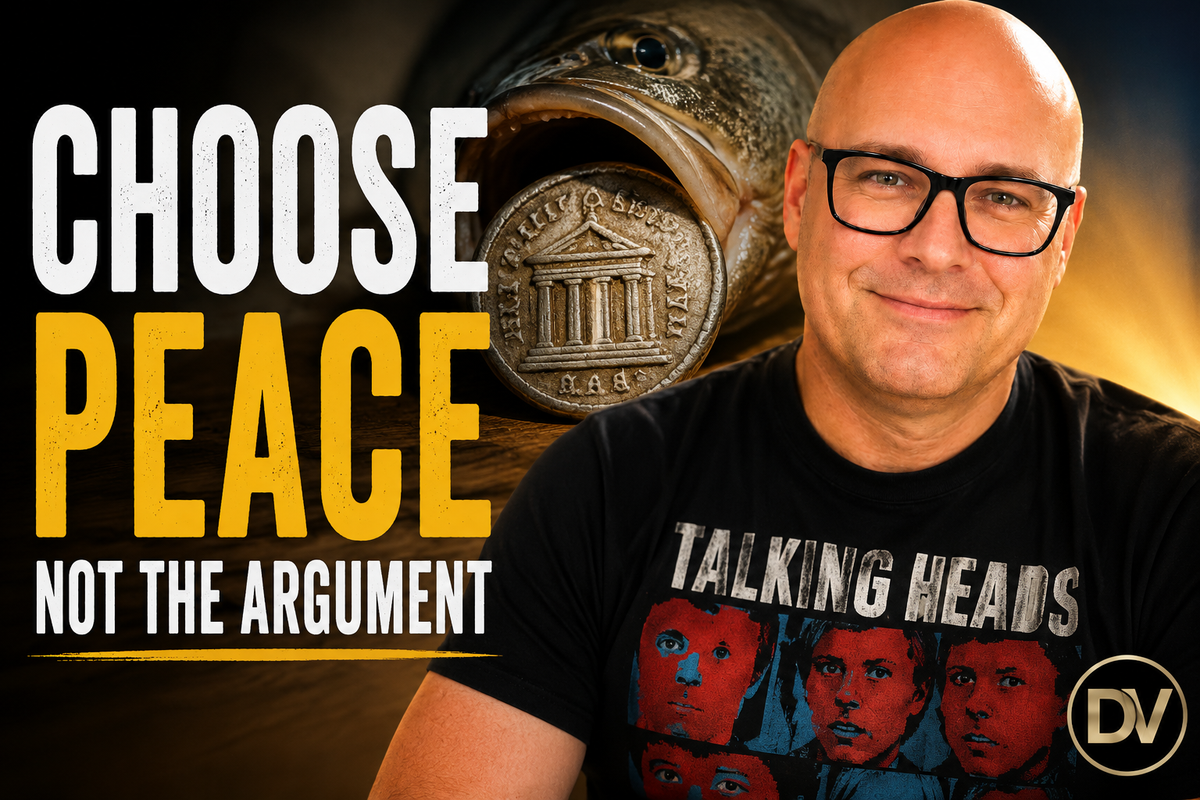
Instead, He says they will pay it so they do not offend them. Then He sends Peter to the sea, tells him to cast in a hook, take the first fish that comes up, open its mouth, and find a coin. That coin will pay the tax for both Jesus and Peter. It is one of the quieter miracles in the Gospels, but it carries a thunderous lesson for anyone who has ever confused strength with the need to prove a point.
Jesus pays what He does not owe.
Not because He is wrong. Not because He is weak. Not because He is afraid of religious pressure. Not because He has forgotten who He is. He pays because He knows who He is so deeply that He is not controlled by the need to demonstrate it in every room.
That is a different kind of power.
We often think power means always asserting the right, always correcting the misunderstanding, always answering the accusation, always making sure nobody walks away with the wrong idea. Sometimes that is necessary. There are moments when truth must be spoken clearly. There are times when silence becomes cooperation with harm. Jesus Himself confronted hypocrisy, corruption, cruelty, and false religion. He was never cowardly. But Matthew 17 shows us a different side of holy strength. It shows us that not every challenge deserves our full force. Not every moment of being misunderstood requires a public trial. Not every right must be exercised simply because we have it.
A person who does not know who they are cannot afford to let anything go. Every slight feels like a threat. Every question feels like disrespect. Every disagreement feels like a personal attack. Every failure to recognize them feels like a wound. So they spend their life defending, explaining, correcting, proving, and trying to make sure the room sees them properly. That kind of life is tiring because the soul is always standing on trial.
Jesus is free from that. He is not less true because He chooses peace. He is not less the Son because He pays the tax. He is not less holy because He refuses to make the moment louder than it needs to be. His identity is not reduced by His humility. That may be the sharpest reframing in the whole story. Real humility is not forgetting who you are. Real humility is knowing who you are and not needing to weaponize it.
Think about how much damage happens because people cannot separate truth from ego. A husband and wife are having a hard conversation after a long day. One person remembers the exact words from last week and knows they could win the point. The sentence is ready. The evidence is clear. But if they say it with the wrong spirit, the argument may be won while the relationship loses more ground. The question becomes deeper than, “Am I right?” The better question becomes, “What does love require from someone who knows they are right?”
That is not weakness. It takes more strength to speak with restraint than to unleash every correct sentence at the wrong time. It takes more maturity to protect peace without denying truth than to use truth as a hammer. It takes more security to say, “I do not need to win this moment in order to know who I am,” than to make every disagreement a test of worth.
This matters in leadership too. A leader may be questioned by someone who does not understand the full weight of the decision. The leader could embarrass them. They could expose the incomplete information. They could make sure everyone in the room understands who has the better grasp of the facts. Sometimes clear correction is needed, but sometimes wisdom takes the long road. Sometimes the stronger move is to preserve dignity, answer calmly, and handle the deeper conversation privately. A leader who needs to win every exchange may keep authority, but lose trust.
Jesus does not model fragile strength. He models settled strength. He can pay the tax without surrendering His identity because His identity does not depend on the tax collectors recognizing it. He can avoid unnecessary offense without becoming controlled by people’s expectations. He can make peace without becoming false. That is the difference many of us need to learn. Peacekeeping becomes unhealthy when it requires us to lie, enable evil, avoid necessary truth, or abandon obedience. But there is a holy kind of peace that flows from security in God. It says, “I know who I am, so I do not need to turn this moment into proof.”
That kind of peace is rare because our culture rewards reaction. The quick comeback gets attention. The public correction gets applause. The sharp answer feels satisfying. The person who refuses to let anything slide may look strong for a moment. But the way of Jesus asks a harder question: Are you strong enough to be misunderstood without becoming bitter? Are you secure enough to choose restraint without feeling erased? Are you free enough to pay what you do not owe when peace is worth more than the argument?
This is not about becoming passive. It is about becoming governed by Christ instead of ego. Jesus was not avoiding truth. He had already told Peter the truth. The sons are free. He knew the deeper reality. But once the truth was clear, He chose the path that served the moment wisely. He did not need to turn His freedom into a spectacle.
There are people carrying private exhaustion because they are still fighting battles that God never asked them to keep fighting. They are still answering imaginary arguments in the shower. They are still rewriting conversations in their head while driving to work. They are still trying to prove themselves to people who may never understand. They are still paying with peace because they cannot bear the thought that someone might think they were wrong. Matthew 17 comes gently but firmly into that place and shows us Jesus doing something almost shocking. He lets the point go without losing the truth.
That is the beginning of a different kind of life. Not a life without courage. Not a life without boundaries. Not a life where anyone can take advantage of you and call it Christianity. A life where identity is so rooted in the Father that ego no longer has to run every conversation. A life where wisdom decides when to speak and when to release. A life where peace is not fear wearing religious language, but strength resting in God.
Chapter 2: The Coin That Came Without a Stage
There is a strange kind of pressure that comes when you are trying to do the right thing, but you do not want to make the situation bigger than it has to be. Maybe it happens in a workplace conversation where someone misunderstands your decision, and you know you could defend yourself with every detail. Maybe it happens in a family disagreement where you could pull out the full history and prove exactly why you reacted the way you did. Maybe it happens in a public setting where someone questions your integrity, your judgment, your faith, or your motives, and you feel that old fire rise in your chest. You want the record corrected. You want the facts known. You want the people in the room to understand.
That is the human place where this story becomes more than a small miracle about a fish and a coin. Jesus does not simply tell Peter to pay the tax. He provides the payment in a way no one could have planned. He sends Peter to the sea, tells him to cast a hook, and says the first fish will have the coin they need. This is not only provision. It is a picture of authority held quietly.
Jesus could have made the miracle public. He could have called the tax collectors over and said, “Watch this.” He could have turned the moment into a dramatic display. He could have made the coin appear in His hand in front of everyone. He could have used the miracle to prove His identity and silence every question. Instead, the miracle happens away from the public argument. Peter goes fishing. A fish comes up. A coin is found. The tax is paid. Peace is kept. The point is made without becoming a spectacle.
That is a deep reframing for people who think God’s power must always be loud to be real. Sometimes the strongest work of God is quiet. Sometimes He provides without announcing it to everyone. Sometimes He gives you what you need without giving you the public vindication you wanted. Sometimes He solves the issue, not by turning your critics into an audience, but by giving you enough grace to move forward without being ruled by them.
This can be hard to accept because many of us do not only want provision. We want proof. We want the kind of answer that makes everyone else see that God was with us. We want the door to open in a way that embarrasses the people who doubted us. We want the blessing to arrive with a spotlight attached. We want the coin, but we also want the crowd to know where the coin came from.
Jesus is not controlled by that need. The coin in the fish’s mouth is almost hidden power. It is authority without performance. It is provision without self-promotion. It is heaven’s answer wrapped in ordinary obedience. Peter has to go to the water, cast the hook, pull up the fish, open its mouth, take the coin, and pay the tax. That is not the kind of miracle that feeds the ego. It is the kind of miracle that teaches trust.
A person may experience something like this when they are carrying financial pressure quietly. The bill is due. The account is thin. They are trying not to let fear take over the whole house. Maybe they pray in the car before work, then later an unexpected opportunity comes, a small refund arrives, a side job opens, or someone pays what they owed at the right time. It may not be dramatic enough for the world to notice, but it is enough to remind the soul that God knows how to provide. Not every miracle comes with thunder. Some come like a coin in a fish’s mouth.
There is also something important about the way Jesus involves Peter. Jesus could have handed him the money directly, but He sends him to fish. Peter has a role to play. He has to obey a simple instruction that probably felt strange. That matters because God’s provision does not always remove our participation. Sometimes He gives us a step that looks ordinary, even odd, and asks us to obey without understanding the whole method.
That is difficult for people who want full clarity before they move. We want the whole plan written out. We want to know why the fish, why the hook, why the first one, why this method, why not a simpler way. But Peter does not need a full explanation to obey the next step. He needs trust. He needs enough confidence in Jesus to go do what Jesus said.
There is a practical lesson there. When you are under pressure, do not despise the simple obedient step in front of you. Make the call. Send the honest message. Pay what you can pay. Apologize where you need to apologize. Take the meeting. Ask for wisdom. Go to the sea and cast the hook. Many people miss quiet provision because they are waiting for God to move in the dramatic way they imagined, while ignoring the ordinary step He actually placed in front of them.
For a leader, this may look like choosing a calm response when a defensive one would feel more satisfying. For a parent, it may look like lowering your voice when your pride wants to win the room. For a business owner, it may look like making one wise adjustment instead of panicking over the whole future. For a believer, it may look like praying before reacting, waiting before posting, listening before correcting, or choosing the faithful next action before the full solution is visible.
The miracle in Matthew 17 shows us that Jesus is not limited by the systems that create pressure. The tax is demanded from one direction, but the provision comes from another. The collectors ask at the door, but the answer is waiting in the water. That should encourage anyone who feels trapped by one visible channel. God is not limited to the places you are staring at. He can bring help from the side, from the deep, from the overlooked, from the unlikely, from the first fish on an ordinary day.
Still, the point is not only that Jesus can provide. The point is that Jesus provides while refusing to be pulled into the wrong fight. He does not let the collectors determine His identity. He does not let Peter’s quick answer create panic. He does not let the pressure of expectation steal His peace. He simply makes a wise choice, provides what is needed, and keeps moving.
That kind of steadiness is rare. Many people lose themselves in the moment of pressure. They become reactive, loud, sharp, anxious, or desperate to prove that they are not what someone implied. But Jesus shows us another way. He knows the Father. He knows Himself. He knows the truth. From that settled place, He can decide what the moment requires without being controlled by the emotional charge around it.
This is where the story presses into the hidden life. A person who constantly needs the stage may struggle to receive quiet provision. A person who needs every critic corrected may struggle to accept a private answer from God. A person who needs to be seen as right may not recognize the peace of simply doing the wise thing and moving on. The coin in the fish’s mouth confronts that in us. It asks whether we want God’s faithfulness or whether we want God’s faithfulness to come packaged as public applause.
Jesus was not less powerful because the miracle was quiet. He was not less Lord because He paid the tax. He was not less the Son because He avoided offense. He was showing a form of power that does not have to shout. He was showing Peter, and us, that heaven can meet a real need without feeding human pride.
That is good news for anyone who is tired of living on display. You do not need every act of obedience to be understood by everyone. You do not need every wise decision to be applauded. You do not need every moment of restraint to be recognized by the people who benefited from it. God sees. God knows. God can provide the coin, protect your peace, and teach you a strength that does not depend on a crowd.
Sometimes the holiest victory is not winning the argument. Sometimes it is walking to the water, doing what Jesus said, receiving what He provides, paying what needs to be paid, and refusing to let ego turn a small tax into a spiritual war.
Chapter 3: When Peace Is Not the Same as Surrender
There is a moment in a family argument when the whole room seems to pause before the next sentence. Someone has said something unfair. Someone has remembered the past differently than you remember it. Someone has made you sound colder, harsher, or more selfish than you believe you were. You can feel the answer rising in you. You know the correction. You know the facts. You know exactly how to make your case. And in that pause, the real question is not only whether you are right. The real question is what kind of person you are going to become while being right.
That is where the story of Jesus and the temple tax moves from an unusual Gospel detail into the middle of everyday life. Jesus was not confused about the truth. He knew He was free. He knew the sons did not owe what outsiders owed. He knew the tax collectors did not understand the fullness of who He was. He knew Peter had answered quickly, and He knew the situation could become larger if He chose to make it larger. Still, He chose a path of peace.
That does not mean Jesus surrendered the truth. That distinction matters. He did not say, “You are right, I owe this.” He did not pretend His identity was smaller than it was. He did not allow religious expectation to define Him. He explained the truth to Peter plainly. The sons are free. That truth stands. But after the truth was named, Jesus chose not to turn the truth into a public fight.
Many people confuse peace with surrender because they have only seen two extremes. They have seen people avoid conflict out of fear, swallow truth, enable harm, and call it peace. They have also seen people fight every battle, answer every accusation, escalate every disagreement, and call it courage. Jesus shows another way. He is not afraid, and He is not reactive. He is not controlled by people’s expectations, and He is not controlled by the need to rebel against them. He is free enough to choose what love and wisdom require.
That is a perspective shift many of us need. Peace is not always passivity. Sometimes peace is disciplined strength. It is the ability to know the truth, speak the truth where it needs to be spoken, and still refuse to let pride turn the moment into a fire. It is the ability to ask, “What is God asking from me here?” before asking, “How do I prove I am right?”
A mother or father may know this tension with a child. A teenager says something careless. The parent has every right to correct the tone, challenge the disrespect, and set a boundary. That may be necessary. But there is also a difference between correction and domination. The parent can use authority to crush the child in the moment, or they can use authority to guide the child toward maturity. Both may involve truth. Only one carries the spirit of Christ.
The same is true in marriage. There are conversations where one person could win the argument by bringing up every detail, every date, every exact sentence. But winning with precision is not the same as loving with wisdom. A person can be factually correct and spiritually reckless. They can use truth in a way that leaves the room colder, the heart harder, and the relationship weaker. Jesus teaches us to ask whether our use of truth serves love or only serves ego.
That is not an excuse for hiding from hard conversations. Jesus did not hide from truth. He corrected Peter’s understanding before He paid the tax. The order matters. He clarified identity first. Then He chose peace. Healthy peace does not require self-erasure. It begins with knowing what is true before deciding how much of that truth needs to be pressed in that moment.
A person at work may have to live this out quietly. Maybe a coworker questions their decision in front of others. Maybe the question is not fair. Maybe the tone carries accusation. The old instinct says, “Defend yourself right now. Make sure the room knows.” Sometimes that may be appropriate. But sometimes wisdom says, “Answer enough to keep clarity, do not humiliate anyone, and handle the rest privately.” That kind of restraint is not weakness. It is maturity with a longer view.
The question is not whether truth matters. Truth absolutely matters. The question is whether our heart is clean in the way we handle it. Are we correcting because love requires clarity, or are we correcting because our pride cannot tolerate being misunderstood? Are we setting a boundary because wisdom requires it, or are we punishing someone for making us feel small? Are we speaking with courage, or are we using courage as a nicer name for ego?
Jesus paid the tax because He was not controlled by the need to make every point publicly. That should stop us because many of us are controlled by that need more than we admit. We may call it integrity, but sometimes it is insecurity. We may call it truth, but sometimes it is fear. We may call it strength, but sometimes it is a wounded need to be recognized.
The freedom of Jesus is different. He knows that paying the tax does not make Him less the Son. He knows that choosing peace does not make the tax collectors greater than Him. He knows that avoiding unnecessary offense does not mean He has lost authority. He does not need the moment to validate Him because the Father already has.
That is the spiritual center of this story. Identity settled in God creates freedom in conflict. When you do not know who you are, every misunderstanding threatens you. When you are rooted in God, you can decide which battles are holy and which battles are just ego looking for a stage.
This is a serious lesson because some people are exhausted not from the size of their calling, but from fighting every unnecessary battle around it. They are trying to explain themselves to people who are not listening. They are trying to correct stories that will keep changing. They are trying to make every critic understand their heart. They are trying to prevent every possible offense. That kind of life becomes a prison because peace depends on everyone else seeing clearly.
Jesus offers a better way. He shows us that peace can come from the Father’s voice being stronger than the crowd’s opinion. It can come from knowing the truth without needing to weaponize it. It can come from being willing to do the humble thing when the humble thing serves love, even if someone else misunderstands the strength it took.
There are times when following Jesus will require you to speak plainly. There are times when you must refuse pressure, confront wrong, protect the vulnerable, and hold the line. But there are also times when following Jesus will require you to let go of the need to be publicly vindicated. It may require you to pay what you do not owe, not because the demand is ultimate, but because peace is more valuable than proving the point in that moment.
That is hard. It cuts against the ego. It feels unfair. It may even feel like losing if your heart has been trained to measure strength by visible victory. But the way of Jesus often looks like loss to people who do not understand freedom. He can choose humility without becoming less. He can choose restraint without becoming afraid. He can choose peace without surrendering truth.
Maybe the next step for some of us is not to win the next argument better. Maybe it is to become the kind of person who does not need every argument to become a test of identity. Maybe it is to pause before the sentence, breathe before the reply, pray before the correction, and ask whether love is asking for clarity, restraint, or both.
Jesus paid a tax He did not owe, and He lost nothing by doing it. That is the quiet power of the story. He did not lose His identity, His authority, His dignity, or His relationship with the Father. He only refused to let an unnecessary battle become the center of the day.
Chapter 4: The Battles Ego Keeps Reopening
It is late, and the house is finally quiet, but the phone in your hand has made your mind loud again. Someone sent a message that was not fully true. Maybe it was a comment under something you posted, a reply in a group thread, a short email with a sharp edge, or a sentence passed along by someone else. You read it once, then again, and suddenly you are no longer tired. You are awake with a defense forming. Your thumb hovers over the screen, and you can feel how easily the night could become a trial where you serve as the lawyer, the witness, the judge, and the wounded party all at once.
That is the kind of moment where ego often sounds like justice. It tells us the issue must be answered immediately. It tells us silence will look like weakness. It tells us someone may think the wrong thing if we do not correct the record right now. It may even borrow the language of truth and responsibility. But underneath all of that noise, a quieter question waits: Is this really about obedience, or is this about the part of me that cannot stand being misunderstood?
The temple tax story presses on that question because Jesus does not treat every pressure point like a battlefield. He has the right answer. He has the higher authority. He has the truest identity. He also has the freedom to let a small issue remain small. That may be one of the most difficult freedoms for human beings to practice. Many of us do not know how to let a small issue stay small once our pride has touched it.
Ego is not satisfied with the size of the actual problem. It enlarges everything. A tax becomes a test of honor. A question becomes an attack. A misunderstanding becomes a crisis. A delay becomes disrespect. A disagreement becomes rejection. A criticism becomes a verdict on our worth. The issue may begin as one coin, one sentence, one look, one decision, one comment, but pride knows how to build a courtroom around it.
Jesus refuses that enlargement. He names the truth to Peter, then provides what is needed and moves on. He does not build a bigger stage around the matter. He does not let the collectors decide the emotional size of the moment. He does not turn a coin into a crown issue. That restraint is not accidental. It shows a kind of inner order that many of us need.
Inner order means the loudest voice inside you is not your wounded pride. It means your next step is not automatically decided by the person who irritated you. It means your peace is not held hostage by every comment, challenge, or misunderstanding. It means you can ask, “What does Jesus want here?” before your ego finishes writing the reply.
Think about a person serving in a community group, church, nonprofit, or volunteer effort. They give hours nobody sees. They answer messages, set up chairs, clean up after events, listen to people’s needs, and carry details others forget. Then someone complains about the one thing that was not perfect. The person who served feels the sting because they know what it cost to show up. The complaint may be unfair, or at least incomplete. They could respond sharply and explain every sacrifice. But there is a moment before they speak when Christ invites them to separate the real issue from the wounded need to be appreciated.
That separation is holy work. The real issue may need attention. Maybe a mistake needs to be corrected. Maybe a boundary needs to be set. Maybe someone needs to understand the full context. But the wounded need to be appreciated can turn a simple conversation into a fight for identity. Jesus shows us that we do not have to hand our identity to the person who failed to notice our sacrifice.
This does not come naturally. Most of us want to be seen rightly, especially when we have tried hard. We want our motives understood. We want our effort counted. We want our sacrifices named. There is nothing evil about that desire. The problem begins when that desire becomes a master. If we cannot rest until every person understands us, we will never rest for long.
Jesus could rest because the Father already knew Him. That is the foundation under His restraint. He was not performing sonship for the collectors. He was not waiting for them to recognize His relationship with the Father before He could live from it. He did not need their understanding to make His identity true. The Father’s knowledge of Him was enough.
That is the place where ego starts losing its grip on us too. When the Father’s knowledge of you becomes more important than the crowd’s opinion of you, not every misunderstanding feels like an emergency. You can still speak when wisdom calls for it. You can still correct what should be corrected. You can still protect what must be protected. But you no longer have to make every situation carry the full weight of your worth.
There is a difference between guarding truth and guarding image. Guarding truth is clean. It seeks what is right, loving, and necessary. Guarding image is restless. It needs control. It cannot tolerate ambiguity. It needs the room to see you in a certain light before you can breathe. Jesus was committed to truth, but He was not enslaved to image.
That distinction can change how a person lives. It can change the way you answer criticism. It can change the way you respond when someone underestimates you. It can change the way you carry public faith in a world that often misunderstands it. You do not have to become loud to be faithful. You do not have to become combative to be courageous. You do not have to correct every person who has the wrong idea before you keep obeying God.
Sometimes the more Christlike question is not, “How do I win this?” It is, “What would peace look like if I were not afraid of being overlooked?” That question exposes the hidden fear beneath many unnecessary battles. We fight because we fear being erased. We defend because we fear being reduced. We push back because we fear being made small. But Jesus shows us a Savior who can take the low road in a small matter because He is already secure in the highest truth.
That security does not make Him indifferent. It makes Him free. He can pay the tax without worshiping the demand. He can avoid offense without obeying fear. He can choose restraint without becoming passive. He can provide quietly without needing applause. The coin is paid, but His soul remains unowned by the moment.
There may be a battle in your life that keeps reopening because ego keeps feeding it. Maybe it is a conversation you keep replaying. Maybe it is a person you keep trying to convince. Maybe it is a misunderstanding you keep dragging into your prayers, not because God is asking you to act, but because your pride will not let it rest. Ask Jesus for the courage to tell the difference. Some battles are assignments. Some battles are distractions wearing the clothing of importance.
The peace of Christ does not require you to pretend something did not hurt. It does not require you to let lies grow where truth should be spoken. But it does invite you to stop making every wound a throne. It invites you to let the Father name you more deeply than any critic, collector, coworker, family member, stranger, or friend ever could.
Jesus paid the tax He did not owe, and the world kept moving. No speech. No spectacle. No demand for everyone to understand the full meaning of what had happened. Just a settled Son, a provided coin, and a quiet lesson for every person tired of letting pride turn small fires into lifelong wars.
Chapter 5: The Freedom to Pay Without Being Owned
A person can agree to something on the outside while resenting it on the inside for days. They send the payment, accept the task, cover the shift, stay late, help with the move, answer the call, or let the issue go, but their heart keeps a private ledger. They may look peaceful to everyone else, yet inside they are still rehearsing how unfair it was. That is not freedom. That is compliance with bitterness hidden underneath it.
This is why the temple tax story has to be handled carefully. Jesus paying a tax He did not owe is not a lesson in becoming a doormat. It is not a call to let every demand shape your life. It is not permission for people to use guilt, pressure, religion, or fear to take from you. Jesus was not manipulated. He was not trapped. He was not surrendering control of His soul to the collectors. He chose freely.
That difference matters. There is a world of difference between peace chosen from strength and peace chosen from fear. Fear says, “I will give in because I cannot handle being disliked.” Strength says, “I will choose this because I have prayed, I know who I am, and this is the wise path.” Fear says, “I cannot say no because someone might be upset.” Strength says, “I can say no when I need to, and because I am free to say no, my yes can be clean.” Fear obeys pressure. Christlike peace obeys the Father.
Jesus makes His freedom clear before He pays. That is easy to miss. He does not simply hand over the money with no explanation. He teaches Peter first. The sons are free. He names the truth. Only after that does He choose to pay. That order protects the lesson from becoming shallow. Jesus does not pay because He forgets His freedom. He pays because He stands inside it.
That has practical weight for everyday life. Some people keep paying emotional taxes they do not owe, not because God has asked them to, but because they are afraid to disappoint anyone. They apologize for things that were not wrong. They take responsibility for feelings they did not create. They let unhealthy people keep defining the terms of peace. They call it kindness, but over time their spirit becomes tired, resentful, and small.
That is not the freedom Jesus shows us. His humility is not self-erasure. His restraint is not fear of man. His willingness to pay does not mean He has become owned by the demand. He remains centered, free, and directed by the Father. That is the difference between holy humility and unhealthy surrender.
Imagine a woman at work who is always the one people ask to fix what others leave unfinished. She cares. She wants to help. She is capable, reliable, and good at stepping into messy situations. But over time, people begin to assume she will always absorb the cost. She stays late again. She covers again. She smiles again. Then one night she sits in her car and realizes she is not serving from love anymore. She is serving from fear, guilt, and the need to be seen as dependable. In that moment, Jesus may not be asking her to pay another tax. He may be asking her to remember that the sons and daughters are free.
That can be just as faithful as paying. Sometimes obedience is restraint. Sometimes obedience is generosity. Sometimes obedience is a boundary. Sometimes obedience is silence. Sometimes obedience is a clear sentence spoken with a steady voice. The point is not that Christians must always yield in every situation. The point is that Christians must not let ego, fear, or pressure decide for them.
This is where discernment becomes necessary. Jesus did not choose peace because conflict is always wrong. He confronted plenty of things. He turned over tables when His Father’s house was being corrupted. He called out hypocrisy when religious leaders crushed people with burdens they would not carry themselves. He protected the vulnerable. He spoke truth when truth needed to be spoken. So we cannot take Matthew 17 and turn it into a rule that says, “Never resist, never confront, never correct, never refuse.” That would not be faithful to Jesus.
The better question is, “What is love asking for here?” Sometimes love pays the tax. Sometimes love refuses the demand. Sometimes love answers gently. Sometimes love speaks firmly. Sometimes love covers an offense. Sometimes love exposes harm. The form may change, but the heart must stay surrendered to God instead of ruled by pride.
A father may face this when an adult child speaks with frustration and blame. The father may be tempted to defend every decision he ever made. He may have real reasons, real context, and real pain of his own. But if he answers only to protect his image, the conversation may close before healing begins. There may be a moment when love asks him to listen longer than feels fair. There may also be a moment when love asks him to say, “I will listen, but I will not be spoken to with contempt.” Both can be faithful. The issue is not whether he pays or refuses. The issue is whether Christ is leading him.
This perspective can free a person from two traps. The first trap is pride that never yields. The second trap is fear that never stands. Pride says, “I must win every time.” Fear says, “I must give in every time.” Jesus shows a third way. He is secure enough to yield when yielding serves peace, and strong enough to confront when confrontation serves truth. His identity is not controlled by either response.
That is the kind of maturity many of us need. We do not become more Christlike by becoming easier to pressure. We become more Christlike by becoming harder for ego and fear to control. When ego loses control, we can stop fighting unnecessary battles. When fear loses control, we can stop surrendering necessary boundaries. That is real freedom.
The coin in the fish’s mouth becomes more meaningful here. Jesus does not pay from anxiety. He pays from abundance. He does not scrape together the coin as if heaven has been cornered. He sends Peter to the water, and provision arrives in a way that reminds Peter that Jesus is still Lord. The demand may be real, but the demand is not ultimate. The system may ask, but the Father provides. The pressure may come from people, but the answer comes through the authority of Christ.
Someone reading this may need to ask a serious question before the next yes or no. Am I doing this because Jesus is leading me, or because I am afraid of what people will think? Am I refusing because wisdom requires it, or because my pride cannot stand the cost? Am I calling this peace when it is really fear? Am I calling this courage when it is really ego? Those are not easy questions, but they are freeing questions.
Jesus paid a tax He did not owe, but He did not become owned by the tax. That is the lesson. You can choose peace without becoming controlled. You can show humility without losing truth. You can be generous without becoming available for every unhealthy demand. You can let something go without letting people define you. You can also draw a boundary without letting anger take over your soul.
The goal is not to always pay or always refuse. The goal is to become free enough in God to do the faithful thing without needing ego to call the shots or fear to write the script. Jesus was free before the coin was paid, free while it was paid, and free after it was paid. That is the kind of freedom He is teaching us.
Chapter 6: The Peace That No Longer Needs Permission
There is a quiet kind of freedom that shows up when a person stops asking every room to confirm who they are. You can see it in someone who receives criticism without collapsing, answers pressure without panic, and walks away from an unfair conversation without needing to make the whole world understand. They are not careless. They are not weak. They are not indifferent to truth. They have simply stopped giving every misunderstanding the power to name them.
That is where the temple tax story finally lands. Jesus knew who He was before the collectors asked their question. He knew who He was while Peter answered. He knew who He was when He explained that the sons are free. He knew who He was when He sent Peter to find the coin. He knew who He was when the tax was paid. Nothing about the moment changed His identity because His identity was not waiting on the moment.
That is the peace many of us are missing. We keep trying to get from people what only the Father can give. We want people to confirm our worth, respect our motives, understand our calling, recognize our effort, and approve our choices. When they do, we feel steady for a little while. When they do not, we feel shaken. That is a hard way to live because it leaves the soul dependent on unstable witnesses.
Jesus shows us something better. His peace is not borrowed from public approval. It comes from perfect union with the Father. That is why He can refuse unnecessary battles without losing dignity. That is why He can pay what He does not owe without becoming less. That is why He can choose a quiet solution when a loud defense would have been easier to justify.
A person may need this truth on a normal Wednesday afternoon. The email comes in with the wrong tone. The meeting did not go the way they hoped. Someone questions a decision without understanding the cost behind it. A family member assumes the worst. A friend does not respond. A person at church, work, or online says something that lands unfairly. In that moment, the old habit rises. Explain yourself. Prove yourself. Correct it now. Make sure they know.
Sometimes that voice is wisdom. Sometimes correction is needed. Sometimes truth must be spoken clearly. But sometimes that voice is not wisdom at all. Sometimes it is the fear of being unseen. Sometimes it is the anger of being reduced. Sometimes it is the pride of needing the last word. The hard work of following Jesus is learning the difference before we respond.
That difference cannot be learned by willpower alone. It has to be formed in the hidden place with God. If the Father’s voice is faint in us, the crowd’s voice becomes loud. If we do not let God tell us who we are, every critic gets a chance. If we do not receive identity from Christ, we will keep begging tense moments to give it to us. That is why spiritual maturity is not only about knowing what to do. It is about knowing who we are before we decide what to do.
Jesus did not need the tax collectors to understand Him before He could act with wisdom. That is a powerful sentence. Many of us wait for understanding before we obey. We want the other person to see our heart before we become gentle. We want the room to acknowledge our value before we become humble. We want the facts fully appreciated before we let go. But Jesus lets the Father’s knowledge of Him be enough.
Imagine how much lighter life would become if we lived more like that. Not careless with truth. Not silent in the face of harm. Not passive under pressure. But free. Free to speak without needing to crush. Free to be misunderstood without becoming bitter. Free to correct without performing. Free to let a small issue remain small. Free to choose peace when peace is not fear, but wisdom.
That kind of freedom changes leadership. A leader who does not need to prove themselves in every exchange becomes safer to follow. They can listen without feeling threatened. They can admit what they do not know without feeling small. They can correct with clarity instead of irritation. They can make hard decisions without turning every challenge into a personal offense. The room becomes steadier because the leader is not being governed by insecurity.
It changes family life too. A spouse who is secure in God can apologize without feeling erased. A parent who is secure in God can correct a child without needing to dominate. An adult child who is secure in God can honor a parent without surrendering every boundary. A friend who is secure in God can let a misunderstanding breathe long enough for wisdom to speak instead of anger.
The way of Jesus does not remove hard conversations. It cleans the spirit we bring into them. That may be the hidden miracle in this story. The coin is amazing, but the deeper miracle is the freedom of Christ. He is standing inside pressure, expectation, reputation, religious assumption, and possible offense, yet His soul remains steady. He is not owned by the demand. He is not ruled by the misunderstanding. He is not pulled into a battle just because one is available.
That is a word for the tired person who has been living like every battle is urgent. You do not have to fight everything. You do not have to correct everyone. You do not have to make every person understand. You do not have to treat every question like an attack or every misunderstanding like a verdict. Some things must be faced. Some things must be spoken. Some lines must be held. But some things can be released because God is not asking you to spend your life defending what He has already named.
Jesus paid a tax He did not owe, and He lost nothing by doing it. That is the final lesson. He lost no authority. He lost no identity. He lost no favor with the Father. He lost no truth. He only refused to let the moment become larger than obedience required.
There is peace in that. There is maturity in that. There is courage in that. There is a strength so settled it does not need to announce itself every time it enters a room.
So before the next argument becomes a war, pause. Before the next reply is sent, breathe. Before the next correction is made, pray. Ask whether the moment is asking for truth, restraint, a boundary, humility, silence, or a clean and steady word. Ask whether you are being led by Jesus or pushed by ego. Ask whether peace is possible without lying. Ask whether the point you want to prove is worth the spirit you may lose while proving it.
The Son was free, and because He was free, He could pay. He could provide. He could move on. He could leave the moment smaller than pride wanted it to be. That is the quiet power of not needing to win.
And through Him, that freedom can become ours too.
Your friend,
Douglas Vandergraph
Watch Douglas Vandergraph inspiring faith-based videos on YouTube:
https://www.youtube.com/@douglasvandergraph
Support the Christian encouragement library through GoFundMe:
https://www.gofundme.com/f/help-douglas-vandergraph-build-a-christian-encouragement-lib
Support the daily work by buying Douglas a coffee:
https://www.buymeacoffee.com/douglasvandergraph