Where the Tarp Held the Rain

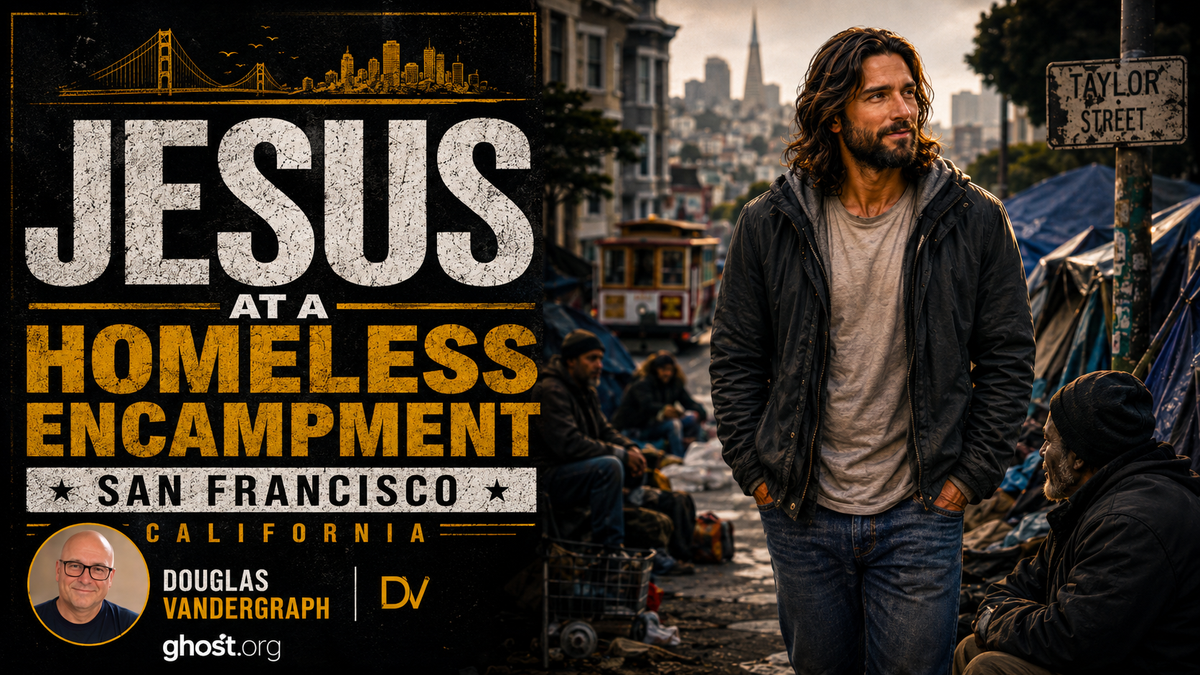
Chapter One: The Blue Tag on the Tent
Jesus prayed before sunrise where the freeway shadow touched the wet pavement beneath the edge of the Central Freeway. The rain had softened to a mist, but water still gathered in the seams of the sidewalk and ran in thin streams toward the storm drains near Division Street. He knelt near a chain-link fence with His hands resting open on His knees, wearing a dark jacket damp at the shoulders and work pants stained at the cuffs from the street. The city moved around Him in pieces, with trucks groaning above, a bus sighing near the curb, and the quiet breathing of people hidden inside tents, tarps, cardboard walls, and blankets that tried to hold back the morning.
Across the street, Marisol Vega sat in a white city maintenance truck with the engine running and her hand wrapped around a paper cup she had forgotten to drink from. The windshield showed the encampment in broken shapes because the wipers dragged more than they cleared. Blue tags hung from several tents now, each one printed with a tracking number, a date, and a warning about obstruction clearance for a drainage repair. She had placed nine of them before dawn because the work order said the area had to be cleared before the next heavy rain, and she had told herself she was not deciding anyone’s fate. She was only doing her job, though the phrase sounded weaker every time she used it.
Her phone lay faceup on the passenger seat with a video still paused on the screen, the title reading Jesus at a homeless encampment in San Francisco California. Her mother had sent it at 4:18 that morning with no message, which was worse than a message because silence from her mother always carried disappointment. Marisol had opened it while parked near 13th Street, listened for twelve seconds, then shut it off when the speaker said Jesus notices the places people step around. She had stared through the windshield after that and watched a man in a soaked Giants cap tuck a grocery bag beneath his sleeping bag to keep it dry. Then she reached for another blue tag because the rain was coming again by Thursday.
The first tent she tagged belonged to a woman everyone called Pearl, though Marisol did not know that yet. Pearl’s tent was patched with silver tape, a green tarp, and a faded blanket patterned with small yellow suns. A plastic crate sat outside it with two chipped mugs, a Bible in a freezer bag, and a broken transistor radio that still sometimes caught baseball games when the weather was kind. Marisol had hesitated there longer than she should have because someone had tied a child’s shoelace around one of the tent poles, not because a child lived there now, but because something small and remembered had been kept. On the phone, beneath the paused video, her mother had also sent a link to the mercy that found people under another hard city sky, and Marisol knew without opening it that her mother was trying to reach her without starting a fight.
The work order came from a complaint chain that had moved through three offices, two supervisors, one district aide, and a private engineer whose report said clogged stormwater access could flood the block if the encampment remained. Marisol had read the report twice before leaving the yard because the language made everything sound simple. Access needed to be restored. Debris needed to be removed. Personal property needed to be noticed and relocated according to city policy. Now, with her boots on the wet pavement and Pearl’s freezer-bag Bible catching the gray light, the words felt like they belonged to another world.
She had not always been the kind of woman who could attach a warning tag to someone’s shelter and keep moving. Her father used to repair radios in a narrow shop near Mission Street, and when customers could not pay, he let them bring tamales, oranges, a pack of batteries, or nothing at all. He said a city was held together by the mercy people practiced when nobody wrote it down. After he died, the shop became a phone case store, the rent doubled, and Marisol learned that mercy did not sign checks or keep health insurance active. She became practical because grief had made softness feel unsafe.
Jesus rose from prayer as the first gray light spread under the freeway. He did not hurry. He looked toward the tents, then toward the truck where Marisol sat with her jaw set and both hands now gripping the steering wheel. A man named Tuck emerged from a blue tarp lean-to carrying a dented pot, his shoulders hunched against the cold. He had once been a Muni mechanic, and he still wore an old work jacket with his name stitched above the pocket, though the letters had faded from oil, rain, and years of being treated like a problem instead of a man. He saw the blue tag tied to the tent beside his and stopped so suddenly that water sloshed over the rim of the pot.
“Pearl,” he called, not too loud, because people were still sleeping. “They tagged you.”
The flap of Pearl’s tent moved. She pushed it open with two fingers, slow and careful, and looked at the tag like it was a letter from someone she had known would eventually find her. Her gray hair had been braided down one shoulder, and her face was thin in a way that made her eyes look larger. She did not curse. She did not cry. She reached out and touched the tag with the back of her fingers, then looked toward the maintenance truck.
Marisol opened her door before she could talk herself out of it. “Morning,” she said, and the word came out too official, too bright for the weather. “I need everyone to leave those notices in place. They explain the scheduled work and the contact number.”
Tuck turned toward her with the pot still in his hand. “Scheduled work,” he said. “That what they call it when they make people pack wet blankets into shopping carts at six in the morning?”
“It’s not happening today,” Marisol said. “This is advance notice.”
Pearl looked at her calmly. “Advance notice is still notice.”
The sentence landed between them with no anger in it, and that made it harder for Marisol to answer. She had prepared for shouting. She had prepared for insults, accusations, maybe someone filming her with a phone. She had not prepared for an old woman standing barefoot inside a tent, speaking as if Marisol had come to her door like a neighbor.
“I’m required to post them,” Marisol said. “There’s a drainage access issue. If the storm system backs up, this whole underpass could flood.”
Tuck laughed once, but it was not a happy sound. “Lady, everything down here already floods. The sidewalk floods. The tents flood. People’s shoes flood. The only thing that don’t flood is the offices where they decide what happens to us.”
Marisol felt heat rise in her face. “I don’t decide policy.”
“No,” Pearl said, still looking at the blue tag. “You only carry it.”
That was when Jesus stepped closer.
No one noticed Him at first as something strange. People came through the encampment all the time. Some brought food. Some brought cameras. Some brought pity so thin it barely covered their fear. Some came with clipboards and questions that sounded kind until they became forms nobody ever saw again. But Jesus came with empty hands, and the quiet around Him seemed to arrive before He did.
He stopped beside the crate outside Pearl’s tent. Rainwater dripped from the edge of the tarp near His shoulder. He looked at the Bible in the freezer bag, then at the blue tag tied to the tent pole, then at Marisol, who suddenly became aware of the badge clipped to her jacket as if it were heavier than before.
“May I stand here?” He asked Pearl.
Pearl blinked, surprised by the courtesy. “Street’s not mine.”
Jesus looked at her with a tenderness that did not flatter her. “You are here.”
Something in the simple answer made Tuck lower the pot. Pearl studied Jesus for a long moment, and Marisol did too, though she did not know why. His face was not soft in the way paintings made it soft. There was strength in Him, but it did not threaten anyone. There was sorrow in His eyes, yet it did not sink into despair. He seemed fully present in the cold, the rain, the smell of wet nylon, diesel, urine, coffee, and asphalt, as if none of it made Him turn away.
Pearl nodded once. “You can stand.”
Jesus did.
Marisol checked the time because she needed something normal to do. Her supervisor expected photo confirmation by seven. She still had fourteen tags to post before moving toward the cluster under the ramp near Bryant. If she stayed, she would fall behind, and if she fell behind, there would be a text, then a call, then a question in the afternoon meeting asked in a tone that made failure sound like a character flaw. Still, she did not move.
Tuck pointed at Jesus with his chin. “You with outreach?”
“No,” Jesus said.
“Church?”
Jesus looked at him. “I am with My Father.”
Tuck gave a dry smile. “Well, your Father got a spare room?”
Pearl closed her eyes like she wished Tuck had not said it, but Jesus did not look offended. He looked at Tuck the way a man might look at a locked door while holding the key, not in triumph, but with patience. “My Father’s house has room,” He said. “But you have been taught to expect doors to close.”
Tuck’s smile faded. The pot shifted in his grip.
Marisol felt something tighten in her chest. She had heard religious talk before, mostly from people who wanted the encampment cleared and called it compassion because it sounded better. But this was not that. Jesus had not spoken over Tuck. He had spoken into something Tuck had hidden beneath jokes, anger, and the old mechanic’s jacket he wore like proof that he had once belonged somewhere.
Pearl sat down slowly on the crate, her knees stiff from the cold. “You hungry?” she asked Jesus.
“I have eaten,” He said.
“Then you’re doing better than most of us.”
He looked toward the row of tents. “Who has not eaten?”
Pearl gave a small shrug. “Manny, probably. He won’t say. Lost his cart last night.”
Marisol knew about the cart before Pearl finished. She had seen it near the curb when she arrived, overturned beside a drain with two black bags split open and clothes spread into the gutter. She had assumed it was abandoned debris because that was the category in her app. Debris required a photo. A person’s life required more than she had time to give.
A young man crawled out from behind a plywood sheet near the fence. He looked no older than twenty-three, with a narrow face and a hoodie pulled tight around his head. He had one sock on and one bare foot pressed into a shoe with no laces. His eyes moved quickly over Marisol, the truck, the tags, then Jesus. He looked like someone who had learned to wake ready for loss.
“Who touched my stuff?” Manny asked.
No one answered.
He saw the blue tag on Pearl’s tent, then one on Tuck’s tarp, then one on his own plywood wall. His expression changed before he spoke. Fear came first, then rage came to cover it. He kicked the overturned cart, and one wheel spun with a thin squeak that somehow cut through the traffic noise overhead.
“I’m not moving,” Manny said. “I’m not doing it again.”
Marisol lifted both hands slightly. “No one is clearing anything today.”
Manny turned on her. “You always say that. Not today. Not right now. Not our department. Then one morning everything is gone.”
“It’s a drainage repair,” Marisol said, hearing how empty it sounded.
“My mother’s ashes were in that cart.”
The underpass went still.
Marisol looked at the split bags in the gutter. A dark sweatshirt lay half in the water. A cracked plastic storage bin had spilled papers, socks, a bent spoon, and a small framed photo turned facedown on the pavement. There was no urn visible. No box. Nothing that looked like ashes. But Manny’s face had gone gray, and his hands began shaking as he searched through the wet mess.
Pearl stood too quickly and grabbed the tent pole to steady herself. Tuck set the pot down and moved toward Manny. Marisol took one step forward, then stopped because she did not know whether her help would be received as help or as proof of what had been done. She had tagged tents. She had photographed carts. She had used the word debris. Now a son was digging through rainwater for what remained of his mother.
Jesus went to Manny without rushing. He crouched beside him and began lifting soaked clothing from the gutter with both hands. He did not ask Manny to calm down. He did not explain that grief needed perspective. He did not tell him the ashes were only ashes. He simply searched.
Manny looked at Him with suspicion and panic. “Don’t touch it unless you know what you’re looking for.”
Jesus looked back at him. “Tell Me.”
“It’s a small tin,” Manny said. His voice cracked, and he hated that it did. “Blue. Butter cookie tin. She used to keep sewing stuff in it before. I wrapped it in a towel. It was in the black bag. The one with the tape.”
Tuck moved to the far side of the cart. Pearl bent as much as she could and picked up papers before the water took them. Marisol stood frozen until Jesus reached into the gutter and pulled out a towel dark with rain. Manny lunged toward it, but the towel was empty. He made a sound that did not become a word.
The traffic light at South Van Ness changed somewhere behind them. A cyclist passed slowly, watching but not stopping. A delivery truck backed toward a warehouse with a warning beep that seemed cruel in its cheerfulness. The city did what cities do around suffering. It continued.
Marisol stepped into the gutter. Cold water rose over the sole of her boot and soaked the seam near her ankle. She moved the broken bin, lifted a wet sleeping bag, and reached behind the drain grate. Her fingers touched metal.
“I found something,” she said.
Manny turned so fast he nearly slipped. Marisol pulled out a small blue tin, dented at one corner, sealed with silver duct tape around the lid. She held it with both hands because suddenly it felt heavier than any clipboard, any policy, any work order she had ever carried. Manny took it from her and pressed it against his chest, his whole body folding around it as if the tin were alive.
No one spoke for a while.
Then Manny whispered, “They threw her away.”
Marisol wanted to say she did not. She wanted to say the cart must have tipped in the wind, or someone else had moved it, or the rain had done what rain does when things are left near gutters. She wanted to defend herself before the accusation could reach her. But the words died because whether she had touched the cart or not, the world she served had taught Manny to expect that his mother could be mistaken for trash.
Jesus remained crouched beside the gutter. “No,” He said quietly.
Manny looked at Him through wet eyes. “You don’t know.”
“I know what it is to be wrapped and carried by those who love Me,” Jesus said. “I know what it is for the world to think a body can be discarded. Your mother was not thrown away by God.”
Manny stared at Him, breathing hard. Something passed across his face that Marisol could not name. It was not comfort yet. It was not belief. It was the first crack in the rage where another truth might enter.
Pearl crossed herself with trembling fingers. Tuck looked down at his old work boots. Marisol felt the phone in her pocket buzz once, then again. Supervisor. She did not answer.
Jesus stood and turned toward her. His eyes met hers, and she had the strange sense that He was not looking at her badge, her job, her mistake, or even her guilt. He was looking at the place inside her where she had buried her father’s voice because remembering it made practical life too hard.
“What did you come to measure?” He asked.
Marisol’s throat tightened. “Obstruction clearance.”
He waited.
“The drain access,” she added, though she knew that was not what He meant.
Jesus glanced toward the tents, the blue tags, Manny holding the tin, Pearl’s freezer-bag Bible, Tuck’s pot, the tarps sagging beneath rain. “And what have you seen?”
Marisol looked at the work app still open on her phone. Each site needed a condition photo, a category, and a note. Tent. Cart. Loose items. Biohazard risk. Blocked path of travel. She thought of her father behind the counter of his repair shop, bending over a radio with a tiny screwdriver while telling her that the city became blind one small choice at a time.
“I saw things,” she said.
Jesus did not move. He did not soften the truth for her, but He did not crush her with it either.
Marisol swallowed. “I should have seen people.”
The words came out quietly, almost lost beneath the freeway noise, but the people near her heard them. Tuck looked at her with less anger and more exhaustion. Pearl sat back down on the crate and rubbed her hands together. Manny held the tin tighter but stopped shaking.
Jesus nodded once, not as if she had completed something, but as if she had finally opened a door that had been stuck.
Her phone buzzed again. This time she pulled it out. Supervisor: Need all posted before 0700. Photos required. Keep moving. She stared at the message and felt the old fear rise, the fear of losing the practical life she had built from her father’s death, the fear of becoming soft and then being crushed by what softness could not pay for. She had a mortgage in Daly City she shared with her sister. She had a teenage nephew applying for colleges. She had medical bills from her mother’s surgery still stacked in a drawer. Mercy, she had learned, always sent an invoice to someone.
Tuck nodded toward the phone. “Boss?”
“Yes.”
“You gonna tell him the drain got feelings?”
Marisol almost smiled, but the moment was too raw for it. “No.”
“What then?”
She looked at the blue tags. They moved slightly in the damp wind. The work order said notice posting only. The repair crew would come later in the week. Policy required documenting personal property, offering bagging where possible, and listing nearby shelter options, though everyone here knew nearby did not mean available. The real problem was not only the drain. It was that the rain had nowhere to go, and neither did they.
Marisol turned toward Pearl. “Who here can help me make a map?”
Pearl narrowed her eyes. “A map of what?”
“Of what cannot be moved without someone present. Medicine, documents, ashes, pets, anything that would be lost or damaged if a crew comes fast.” Marisol looked at Tuck. “And the drain covers. I need to know which ones flood first when the rain gets hard.”
Tuck studied her with open suspicion. “Why?”
“Because if I only upload obstruction photos, that’s all they’ll see.” She looked down at her phone, then back at the tents. “If I upload a field condition report showing active risk to people and property, maybe I can slow the crew until we have a better plan.”
Manny laughed bitterly. “A better plan from City Hall?”
“I didn’t say City Hall has one,” Marisol said. “I said I can write down what is true.”
Pearl watched her for a long time. “Truth in a report still got to climb many stairs.”
Jesus looked at Pearl. “Truth often begins in a low place.”
Pearl’s eyes filled, but she blinked the tears back hard. “You talk like somebody I used to know.”
“Who was that?” Jesus asked.
“My husband,” she said. “Before the stroke took half his words and the hospital took the rest of him from me.”
The rain picked up again. It tapped against tarps, truck roofs, plastic bags, and the cardboard sign someone had tied to the fence asking people not to steal blankets. Marisol looked down the line of tents and realized there were more people awake now, listening from behind half-open flaps. Some watched with distrust. Some with interest. Some with the blankness of those who had seen help arrive in many forms and leave before anything changed.
A woman with a small white dog under her jacket stepped from behind a tarp. “You putting names on that map?”
“No,” Marisol said quickly. “Not legal names unless someone wants it. First names or descriptions. Whatever protects your stuff.”
The woman held the dog closer. “They took his carrier last month. Said it was contaminated.”
“What’s his name?” Jesus asked.
The woman looked startled, as if no one official had ever asked that first. “Biscuit.”
Jesus smiled faintly. “Biscuit should not be carried like refuse.”
The woman’s mouth tightened. She looked away before anyone could see her cry.
Marisol opened a new note in her phone, then stopped. A phone note felt too small, too easy to delete. She went back to the truck, grabbed a roll of waterproof marking tape, a clipboard, and the emergency field sketch sheets used for sinkholes and blocked culverts. When she returned, Jesus was helping Tuck pour yesterday’s rainwater out of a plastic crate. Manny had sat on the curb with the blue tin in his lap, staring at the duct tape seal. Pearl had taken the Bible from the freezer bag and was holding it under the tarp where the pages would not get wet.
Marisol clipped the map sheet down and drew the underpass in rough lines. Division Street. The ramp edge. The blocked grate near Pearl’s tent. The low spot where the water pooled first. The fence. The carts. The tents. She worked quickly, but not carelessly, and as people began speaking, she wrote what they told her in plain words.
Insulin in red cooler, belongs to Jay.
Ashes in blue tin, Manny’s mother.
Dog carrier missing, Biscuit needs dry bedding.
Pearl cannot lift more than one bag.
Tuck knows drain pattern and has tools.
The last line made Tuck lean in. “You wrote I have tools?”
“You do?”
He looked embarrassed. “Some. Not much.”
“What kind?”
“Socket wrench. Pliers. Old drain snake, if nobody stole it.” He paused. “Used to fix buses. I know water flow too.”
Marisol wrote: Tuck can identify blocked flow path.
He stared at the sentence as if she had returned something that had been taken from him. Not a home. Not a paycheck. Not the years. But a piece of his name that belonged to skill instead of survival.
Jesus watched him gently. “A man is not only what happened to him.”
Tuck rubbed his thumb over the stitched name on his jacket. “Some days he is.”
“Some days he believes he is,” Jesus said.
The words did not float above the street like a sermon. They entered the wet underpass and sat with the smell of coffee grounds, damp wool, oil, and rain. Marisol kept writing because stopping would make her feel too much at once.
By seven, the encampment had become a strange kind of meeting, not official enough to satisfy policy and not safe enough to trust, but real enough that people kept coming out of tents to add one more detail. A man named Devon had court papers in a plastic grocery bag tied to the fence. A woman named Alina had a daughter’s phone number written on a receipt because her own phone had died weeks ago. Someone had a photo album in a backpack under a tarp weighed down with bricks. Someone else had a wheelchair with one bad brake that would not make it uphill if the block had to clear fast.
Marisol’s supervisor called three times. She let the first two go. On the third, she answered.
“Vega, where are the completed photos?”
She turned away slightly, but not far enough to pretend the people could not hear. “I’m still on site.”
“You were supposed to be done twenty minutes ago.”
“The site conditions are more complicated than the work order shows.”
A pause. “It’s an encampment. They’re always complicated. Post and move.”
Marisol looked at Jesus. He was standing near Manny, not speaking, simply staying close while Manny held the blue tin. The sight steadied her in a way she did not understand.
“There are critical personal property risks,” she said. “Medication, mobility equipment, remains of a family member, documents, and a drainage pattern that may put people in danger if the weather hits before the repair.”
Her supervisor exhaled hard. “We are not writing a novel out there. We need access.”
“I’m preparing a field risk report.”
“That is not what I asked for.”
“No,” Marisol said. “But it is what is here.”
The sentence surprised her. It surprised her supervisor too, because the line went quiet except for the faint office noise behind him. Marisol had never spoken that way at work. She had been reliable, precise, careful, and invisible when necessary. She had built a life on not becoming the kind of employee who made supervisors remember her for the wrong reasons.
“You understand this can create delays,” he said.
“I understand.”
“And if the drain floods?”
“That’s why I’m documenting the actual drainage flow and the people in the flood path.”
Another pause. Then he said, “Send what you have in thirty minutes.”
The call ended.
Marisol lowered the phone and realized her hands were trembling. Tuck looked almost impressed, though he tried to hide it. Pearl whispered something that sounded like a prayer but might have only been a breath.
Manny looked up from the curb. “They still coming, though.”
Marisol did not lie. “Probably.”
His face closed again.
“But not blind,” she said. “Not if I can help it.”
Jesus turned toward her. “Is that enough for you?”
The question unsettled her more than accusation would have. She wanted to say yes because she had done more than required. She wanted the relief of being able to place one decent act on the scale and feel it balance the morning. But Jesus’ eyes did not allow easy math.
“I don’t know,” she said.
“Then keep seeing.”
A horn blared from the street. Morning traffic thickened. The gray light lifted, revealing the city more clearly now: the wet concrete columns, the graffiti layered over older graffiti, the distant glass of downtown catching a pale break in the clouds, the slope of streets beyond the freeway, the restless movement of people who belonged everywhere and nowhere. San Francisco looked beautiful from certain hills and brutal from certain sidewalks, and under the freeway both truths seemed to lean toward each other without touching.
Marisol finished the rough map and began taking photos differently. Not close-ups that reduced life to violations. Wider shots that showed water lines, blocked drains, tents inches from runoff channels, carts tied high against the fence to keep them from floating, the slope of the pavement, the places where a sudden hard rain would trap people before they could gather what mattered. She photographed Pearl’s crate only after asking. She photographed Manny’s cart only after he moved the blue tin out of frame. She photographed Biscuit’s corner with the little dog wrapped in a towel and labeled it as occupied shelter with animal care need.
Each word she chose became a small act of resistance against careless seeing.
Jesus walked with her for several minutes without speaking. His silence did not feel empty. It felt like room. Marisol had spent years thinking silence meant disapproval because her mother used it that way and grief had sharpened it into a blade. But this silence did not punish her. It allowed the truth to rise without being forced.
At Pearl’s tent, He stopped. The blue tag was still tied to the pole. Rain had softened one corner, but the printed warning remained legible. Pearl looked at it, then at Him.
“Should I take it down?” she asked.
Marisol answered before Jesus did. “Please don’t. If it’s removed, they’ll say notice wasn’t completed and post again. I’ll add your condition note to the report.”
Pearl looked at Jesus. “She talks like a person who knows the maze.”
Jesus looked at Marisol. “She has walked in it long enough to know where people disappear.”
Marisol felt the words strike somewhere deep. She thought of her father’s shop disappearing behind a new sign. She thought of her mother’s hands shaking while opening medical bills. She thought of all the things a city could erase while calling it change, repair, progress, safety, policy, cleanup. She thought of people under tarps being spoken of as obstacles while the rain came down on everyone.
Pearl reached into her tent and brought out a small envelope. It was sealed in plastic and folded so many times the corners had softened. “If they come when I’m not here,” she said to Marisol, “this needs to go with me. My husband’s death certificate. My daughter’s old address. A picture from before.”
Marisol did not take it. “Keep it with you.”
Pearl gave a tired smile. “Baby, if I could keep everything with me, I wouldn’t be here.”
That sentence almost broke something in Marisol. She looked at the envelope and understood that Pearl was not asking the city to save her whole life. She was asking one woman to not let the last proof of it vanish into a black trash bag.
Jesus looked at Marisol. “Can you bear witness?”
The phrase sounded old, but it did not sound distant. It sounded like work. Real work. Harder than posting tags, harder than filling forms, harder than defending herself.
Marisol took the envelope carefully. “I’ll scan it in the truck and give it back,” she said. “I won’t upload it. I’ll just make you a copy.”
Pearl’s eyes narrowed with hope she did not trust. “You can do that?”
“Yes.”
“Why?”
Marisol looked at Jesus, then at the underpass, then at Pearl. She could not say because it was policy. It was not. She could not say because it solved the larger problem. It did not. She could only tell the truth that had begun under the weight of His question.
“Because you asked me to see it,” she said.
Pearl nodded slowly. “That’ll do for now.”
It would not do forever. Everyone knew that. The rain would come. The crew would come. The city would keep moving through its systems. A report would climb the stairs Pearl spoke of, and someone above them might still reduce it to a delay. But something had shifted beneath the freeway, small and stubborn as a flame cupped in the hand.
Marisol walked back to the truck with Pearl’s envelope held inside her jacket to keep it dry. Jesus remained near the tent, watching the people gather their morning around them. Manny sat with his mother’s ashes in his lap and stared at the gutter where they had almost been lost. Tuck pulled a bent tool from beneath his tarp and began clearing leaves from the edge of the drain without being asked. Pearl opened her Bible under the tarp, not to preach from it, but to let the pages breathe after the long damp night.
Inside the truck, Marisol placed the envelope on the passenger seat beside her untouched coffee and the paused video her mother had sent. She looked at the screen again and saw her own face reflected faintly over the title. For the first time that morning, she pressed play.
The speaker’s voice came through low beneath the rain, but she only listened for a moment before pausing it again. The story outside the windshield had already begun speaking louder than the phone. Jesus stood in the mist near the blue-tagged tent, and when He turned His face slightly toward the city, Marisol saw no disgust in Him, no helpless pity, no anger looking for a target. She saw grief with authority inside it. She saw mercy that did not blink.
Then her scanner warmed, her supervisor texted again, and Pearl’s envelope waited to be copied.
Marisol closed the truck door, wiped rain from her eyes with the heel of her hand, and began.
Chapter Two: The Report That Could Cut Both Ways
Marisol’s scanner sat on a narrow shelf bolted behind the passenger seat, meant for utility maps, signed work forms, and damage sheets after storms. It made a soft dragging sound as Pearl’s old papers moved beneath the lid, one page at a time, while rain tapped against the truck roof with the steady patience of something that did not need permission. Marisol kept glancing through the windshield at Pearl’s tent because the envelope felt too personal to be away from its owner for even a few minutes. She had handled accident reports, drainage diagrams, photographs of collapsed asphalt, and complaint packets thick enough to bruise a hand, but these papers made the cab feel like a chapel and a crime scene at once.
The death certificate was folded so deeply that the crease split the first name. Theodore James Bell. Pearl had not used his last name when she spoke of him. There was also a faded photograph of Pearl and Theodore standing in front of a painted wall somewhere in the Fillmore, both of them younger, laughing with the kind of unguarded ease people have before loss teaches the face to prepare itself. Behind them, a mural showed a trumpet player rising from a blue background, and the corner of the photo had been softened by years of being handled. Marisol scanned it last because she did not want to look away from it.
Her supervisor called again before the final page finished. This time the name on her screen made her stomach tighten before she even answered. “Vega,” he said, skipping any greeting. “I saw your note come through, and I need you to be careful with how you’re framing this.”
Marisol watched the scanner light move under the lid. “I’m framing it as field conditions.”
“You’re framing it like a human services intake.”
“That’s not what I wrote.”
“You wrote remains of family member on site. You wrote medication risk. You wrote mobility equipment risk. You wrote occupied shelters in flood path. You understand that language triggers review.”
Marisol looked through the windshield. Jesus stood with Tuck near the drain grate, listening as Tuck pointed with the handle of a bent screwdriver. Manny sat under Pearl’s tarp now, the blue tin wrapped in the dryest towel they could find. Pearl had both hands around a cup someone had filled with instant coffee. Nothing in the scene looked like an intake. Nothing looked like a category that could survive its own paperwork.
“That’s why I wrote it,” Marisol said.
Her supervisor was quiet for a moment. When he spoke again, his voice lowered. “Listen to me. There’s pressure on this one. The complaint didn’t come through normal channels.”
Marisol felt the scanner stop. “What does that mean?”
“It means people above my pay grade are watching it.”
“Because of a clogged drain?”
“Because of liability, optics, and a property owner who has been documenting the block every week for months. Don’t make this bigger than it has to be.”
Marisol reached for the scanned pages and slid them back into the plastic sleeve. “People are already there. I can’t make it bigger than that.”
“That sounds noble until someone asks why you delayed access and then a storm floods the underpass.”
“It may flood because the whole low point is wrong,” she said. “Tuck knows the flow pattern. He says the water backs from the side channel first, not the main grate.”
“Tuck?”
“A man on site who used to work on buses. He has been watching the water there for years.”
Her supervisor gave a humorless breath. “We are not basing a work delay on a man living under a freeway.”
Marisol closed her eyes, not in defeat but because the sentence showed her exactly how far the report would have to climb. “Then send someone from engineering to verify it.”
“That is not how this works.”
“Maybe that is why it keeps failing.”
The words left her before she could pull them back. She heard the danger in them as soon as they entered the line. There was a soft office sound on his end, a chair shifting, a keyboard being pushed away. Marisol waited for the reprimand because she had earned it in the language of systems. Instead, her supervisor spoke with a tiredness she had never heard from him before.
“Marisol, I have fourteen sites today. Two crews short. A deputy director who wants this block cleaned before a walk-through. A storm advisory starting Thursday. I am asking you to do the job in front of you.”
She opened her eyes and looked at the scanned photograph of Pearl and Theodore on the small screen. “That’s what I’m trying to do.”
“No,” he said. “You’re trying to do the job you wish existed.”
The line went quiet, but he did not hang up. Marisol felt that sentence move through her with strange force because part of her knew he was not entirely wrong. There was the job printed on the work order, and there was the job her father would have recognized as human. For years she had told herself those two jobs could not live in the same day. Under the freeway, with Jesus standing in the rain, they had collided.
“I’ll send the report,” she said. “I’ll include photos, drainage notes, and property risks. I’m also requesting field verification from engineering before any removal action.”
“You can request anything,” he said. “That doesn’t mean it happens.”
“I know.”
“Don’t become the reason this goes badly.”
The call ended, and Marisol sat very still with Pearl’s papers in her lap. The warning sounded practical, but it hid a threat inside its softness. It also hid a fear she understood. People inside offices were afraid too, though their fear wore cleaner shoes and used better words. Everyone seemed to be trying not to be the one caught holding responsibility when the rain came down.
She made two copies of the photograph because one copy felt too close to nothing. She placed the original papers back in the plastic sleeve, then folded the printed copies with care. When she stepped from the truck, the rain had thickened again. A gust moved under the freeway and snapped the edge of Pearl’s tarp so sharply that Biscuit barked from inside the woman’s jacket nearby.
Pearl watched Marisol approach with a face that had learned to expect bad news even from people carrying good things. “You finished?”
Marisol handed the envelope back first. “These are yours.”
Pearl took it and pressed the plastic sleeve against her chest. “You didn’t keep them?”
“No. I made copies for you.” Marisol held out the folded papers. “One for your bag and one for somebody you trust, if you have somebody.”
Pearl gave a small laugh that carried more weariness than humor. “Trust is a rich person’s storage unit.”
Jesus was close enough to hear, but He did not rush to correct her. He looked at Pearl as if even bitterness deserved to be understood before it was answered. “Trust can be buried,” He said. “It can also be found again.”
Pearl looked down at the copies, and her face changed when she saw the photograph. She touched Theodore’s printed face with one finger, then looked away toward the traffic because tears had risen too quickly. “He loved that wall,” she said. “Said the trumpet looked like it was playing through concrete.”
“Where was it?” Marisol asked.
“Fillmore, before half the block changed hands and everybody started talking about history like they hadn’t just priced it out of the room.” Pearl folded the copy slowly. “Theo used to say San Francisco kept painting over its ghosts, then charging admission to remember them.”
Tuck had come closer while she spoke. He glanced at Jesus, then at the photo, then at the freeway columns around them. “City’s full of ghosts.”
Jesus looked at him. “Not all who are unseen are gone.”
Tuck frowned as if the words had struck a place he had not meant to expose. He turned away and crouched near the drain grate again, scraping leaves and wet paper away with the bent screwdriver. Marisol watched him work and saw how his hands changed when they had a task. They were still rough and cold, still marked by the street, but they moved with memory. The body remembered dignity before the world remembered to give it back.
Marisol opened her clipboard and added another line to the map. Side channel may backflow before main grate; verify with engineering. She hesitated, then wrote, resident observation from former transit mechanic. The word resident gave her pause because she knew someone might object to it. Then she left it there because person on site sounded too thin, and transient sounded like the city had already made up its mind.
Manny saw her writing and stood. “What are you putting down about me?”
“Nothing personal,” she said. “Only that there are family remains on site and they need protected handling.”
He looked at the blue tin under his arm. “Don’t write where.”
“I won’t.”
“Don’t write my last name.”
“I don’t know it.”
“Good.”
He pulled the hood tighter around his face and walked toward the curb where his cart lay bent. Jesus went with him, not close enough to crowd him, but close enough that Manny was not alone with the wreckage. Marisol expected Him to speak, but He only helped turn the cart upright. One wheel twisted sideways, and when Manny kicked it straight, it bent back again.
“Forget it,” Manny said. “It’s done.”
Tuck looked up. “Wheel bracket’s bent. Might hold if we brace it.”
Manny snapped, “I didn’t ask you.”
Tuck stood slowly, the screwdriver in one hand. “No, you didn’t. That don’t make the wheel less bent.”
Manny’s face hardened. “Everybody wants to touch my stuff today.”
Jesus placed one hand on the cart, and the gesture was so calm that Manny stopped talking. “What do you want no one to touch?” He asked.
“My mother,” Manny said.
Jesus nodded. “Then let that be honored.”
Manny’s jaw shook. “You don’t get it.”
“I know the fear of losing what love left in your hands.”
Manny stared at Him. For a moment his anger seemed to search for a place to land and found none. He looked down at the tin, then at the broken cart, then toward the long slope of the street beyond the underpass. “She hated this,” he said. “When she was alive. She used to tell me not to come around here. Said if I slept under concrete, I’d start thinking I was made of it.”
Pearl wiped her eyes with the cuff of her sleeve. Tuck looked away. Marisol kept her pen still because writing during that sentence felt wrong.
Jesus said, “And do you?”
Manny’s mouth twisted. “Do I what?”
“Think you are made of concrete.”
Manny gave a laugh that almost became a sob. “No. Concrete lasts.”
No one answered too fast. The rain filled the space where cheap comfort might have gone. Marisol had heard plenty of people tell others they were strong because they were still alive, but Manny looked like he was tired of being praised for surviving what he never should have had to carry. Jesus did not offer him that thin praise. He stood beside him and let the truth be hard without leaving him alone inside it.
Then Jesus looked at the cart. “May Tuck help with the wheel?”
Manny rubbed his nose with the back of his hand. “He’ll just make it worse.”
Tuck lifted both eyebrows. “I kept buses running on Market Street when half the fleet wanted to die every morning. I can handle a busted cart.”
Manny looked at him then, really looked, as if seeing the stitched name and the old mechanic’s jacket for the first time. “You worked on buses?”
“Long time ago.”
“Why’d you stop?”
Tuck’s face closed so quickly that Marisol knew the question had hit history, not employment. He crouched by the cart and turned the damaged wheel with his fingers. “Because life got creative.”
Pearl made a soft sound. “That’s one way to say it.”
Tuck ignored her. “Need wire. Strong wire, not that twist-tie garbage.”
A woman from a tent near the fence raised one hand without stepping out. “I got a coat hanger.”
“Bring it.”
Manny did not thank her. He did not refuse either. In the world of the encampment, that was enough for a beginning.
Marisol’s phone buzzed with another message. Her supervisor wanted the report by 7:45. She attached the map photos, the flood notes, the property risk summary, and the request for engineering verification. She read the wording three times because every sentence could either protect people or expose them. Too much detail could become a target. Too little could become erasure. She felt suddenly sick with the knowledge that truth itself could be mishandled.
Jesus stepped near her as she stood beside the truck. “You are troubled,” He said.
She looked down at the report. “If I write what matters, somebody can use it against them. If I don’t write it, nobody above us has to care.”
He looked toward the underpass where Tuck had started working the coat hanger around the wheel bracket. “A knife can cut bread or flesh.”
“So what am I supposed to do?”
“Hold it with clean hands.”
Marisol almost argued because the answer did not give her a procedure. She wanted the comfort of steps, the safety of language, the perfect way to make a report climb through a system without becoming a weapon on the way. Instead, Jesus gave her a mirror. Clean hands were not hands that had never touched anything dirty. Clean hands were hands that did not pretend not to know what they were carrying.
“My hands aren’t clean,” she said.
“No,” Jesus said gently. “But they are open now.”
She looked at Him then, and the rain blurred the edges of His face for a moment. There was no disgust in His eyes. That was somehow harder than disgust. If He had condemned her, she could have defended herself. If He had excused her, she could have gone back to comfort. But He did neither, and the space between truth and mercy felt like the first honest place she had stood in years.
A white SUV rolled slowly along the curb, then stopped near the truck. The driver lowered the window just enough for his voice to come through. He wore a black jacket with a private security patch and had a phone mounted on the dash. His eyes moved over the tents, the tagged poles, and the people gathering around the cart.
“You the city contact?” he asked Marisol.
“I’m with Public Works,” she said.
“Property manager wants to know when this is getting cleared. We’ve got footage of blocked access, open waste, aggressive behavior, all of it. This has gone on long enough.”
Manny stiffened. Pearl lowered her papers into her lap. Biscuit began barking again from under the woman’s jacket.
Marisol stepped closer to the SUV, keeping her voice even. “The site is posted for scheduled work. Field review is ongoing.”
The man glanced behind her. “Looks like you’re holding a town hall.”
“I’m documenting conditions.”
He gave a thin smile. “Conditions are pretty obvious.”
Jesus had turned toward the SUV. He did not move closer, but the driver’s attention shifted to Him anyway. For a moment the man seemed ready to dismiss Him as another person from the encampment. Then something in Jesus’ stillness made him look twice.
“What?” the driver said.
Jesus looked at him through the half-open window. “What have you recorded?”
The man tapped his phone. “Enough.”
“For what purpose?”
“To show what’s happening.”
Jesus stepped one pace closer. “Have you recorded their names?”
The man frowned. “I don’t need their names.”
“Have you recorded what was lost in the rain?”
“That’s not my job.”
“Have you recorded who is afraid?”
The man’s mouth tightened. “I record what affects the property.”
Jesus looked at him with sorrow that did not soften the question. “Then you have recorded damage and missed the wounded.”
The driver’s face flushed. “I’m not the villain here.”
“No,” Jesus said. “You are a man looking through a narrow window.”
Marisol felt the sentence move through everyone who heard it. The driver looked away first, but his defensiveness remained. He rolled the window higher, leaving only a small gap. “We’ll follow up with the department,” he said to Marisol. “Make sure your report includes the obstruction. We have our own documentation.”
The SUV pulled away, tires hissing through the gutter water.
Manny muttered something under his breath and turned back toward the cart. Tuck kept his head down, twisting the hanger into place with the steady anger of someone who needed his hands busy. Pearl watched the SUV disappear toward the light. “Narrow window,” she said softly. “That sounds like half the city.”
Marisol looked at the phone in her hand. Her report suddenly felt like another window, and she was the one choosing how wide it opened. She deleted two sentences that gave exact positions of certain personal items. She rewrote the property section to describe protected categories without creating a map for removal. She kept the flood risk clear. She kept the need for verification clear. She added a sentence that made her heart beat harder because it would be noticed: Removal before verification may increase risk to occupied shelters during forecast rain event.
She sent the report before fear could edit it again.
For a few minutes nothing happened. The city did not split open. Her supervisor did not call. The underpass remained what it had been, wet and cold and crowded with lives too large for the space allowed them. Yet something inside Marisol shifted with the strange quiet after doing the thing she could not undo. She had not saved anyone. She had not solved the encampment, the rain, the office pressure, the property complaint, or the years that had led people here. But she had refused to help the system remain blind without at least making blindness work harder.
Tuck grunted from beside the cart. “There.”
The wheel still leaned, but it turned. Manny pushed the cart two feet, and it wobbled like a drunk animal but did not collapse. He looked at Tuck with reluctant surprise. “It’ll hold?”
“Long as you don’t race it down a hill.”
“I wasn’t planning to.”
“In this city, everybody ends up on a hill sooner or later.”
Manny almost smiled. It was brief and uneven, but it changed his face enough that Marisol could see the young man he might have been in a room where grief had not cornered him. He set the blue tin carefully in the cart’s center and wedged folded cardboard around it so it would not shift.
Jesus watched him. “You have carried her in fear,” He said. “Can you carry her now in love?”
Manny’s hands froze on the cardboard. “I don’t know the difference anymore.”
“Fear says, if I lose this, she is gone,” Jesus said. “Love says, because she lived, I will not become stone.”
Manny looked down. His voice was barely above the rain. “She used to sing when the fog came in.”
“What did she sing?”
“Old stuff. Church stuff sometimes. Songs from when she was little. I told her it was corny.”
Jesus waited.
Manny swallowed. “I wish I hadn’t.”
Pearl answered from her crate. “Every child wishes they hadn’t said something.”
Manny glanced at her. “You got kids?”
“A daughter somewhere in Oakland, unless she moved again. Haven’t heard her voice in two years.”
“Why not?”
Pearl held the copied photo in her lap and looked at Theodore’s face. “Because pride can keep a person warmer than a blanket for a while. Then it turns cold, and by then you don’t know how to ask for fire.”
Marisol heard herself ask, “Do you have her number?”
Pearl looked up sharply. “Why?”
“I could help you call. If you want.”
Pearl’s eyes hardened with old defense. “I didn’t say I wanted that.”
“No,” Marisol said. “You didn’t.”
Jesus looked at Pearl, and His voice was quiet. “What have you been waiting for her to say?”
Pearl’s expression changed as if He had reached into a pocket she had sewn shut. “That she was wrong,” she said.
“And what have you wanted to say?”
Pearl stared at the wet pavement. The rain ran from the edge of the tarp in a steady line beside her shoe. “That I was wrong too.”
The words were not loud, but they seemed to move farther than the underpass. Manny looked at her with sudden attention. Tuck stopped pretending to work on the cart. Marisol felt the weight of the phone in her hand, full of numbers, contacts, supervisors, reports, messages from a mother she had ignored more than once because love wrapped in correction made her tired.
Pearl gave a bitter little shake of her head. “Don’t look at me like that. She won’t answer.”
“Maybe not,” Marisol said.
“Then why put myself through it?”
Jesus answered with care. “Because a locked door is not opened by staring at the wall beside it.”
Pearl drew a breath that trembled. “You make everything sound simple.”
“No,” Jesus said. “I make nothing smaller than it is.”
That silenced her. She held the copied photograph in one hand and the plastic sleeve in the other. Marisol did not push. She had learned that pressure could hide inside kindness, and she did not want to turn Pearl’s confession into another task on a clipboard. After a moment, Pearl reached into the freezer bag that had held her Bible and pulled out a receipt folded behind the back cover. The ink had faded, but a phone number was still visible.
Marisol took out her phone and entered the number exactly as written. “What’s her name?”
Pearl’s mouth moved once before sound came. “Nadine.”
Marisol typed the name but did not call. She held the phone out so Pearl could see the screen. “You can decide.”
Pearl looked at the green call button as if it were a high ledge. “Not now.”
“Okay.”
Pearl seemed surprised that Marisol did not press her. She took the phone gently, stared at the number a moment longer, then handed it back. “Maybe after the rain.”
Jesus looked at her. “The rain has already begun.”
Pearl closed her eyes. Her thumb rubbed the edge of Theodore’s photograph. “Then maybe before it gets worse.”
Marisol saved the number under Pearl’s request, though she did not know whether that was the right thing to call it. Around them the encampment slowly returned to motion. Someone lit a small camp stove under a sheet of metal. Someone laughed too loudly at nothing. A bus hissed at the stop, and a man with a backpack paused at the edge of the sidewalk to watch before deciding he had seen enough and continuing toward work.
Then Marisol’s phone rang again.
Her supervisor’s name filled the screen. This time she did not hesitate. “Vega.”
His voice was tight. “What did you send?”
“A field risk report.”
“You copied engineering, human services, and the watch desk?”
“They are all relevant.”
“You also copied the district aide.”
“They were listed on the complaint chain.”
“You don’t copy elected staff on unresolved field language unless directed.”
Marisol looked at Jesus. He was helping Tuck lift the front of the cart while Manny checked the wheel. He did not look toward her, but she felt steadier because He was there.
“I copied the chain attached to the work order,” she said.
“You made this visible.”
“It was already visible down here.”
“Don’t get clever.”
“I’m not trying to be clever.”
“No, you’re trying to be righteous.”
The word struck her harder than she expected because she feared it might be partly true. Not righteousness as holiness, but righteousness as armor. The kind people wore when guilt wanted to become performance. She looked at the people under the freeway and knew she could still make even mercy about herself if she was not careful.
Jesus turned then, as if He had heard what was spoken through the phone and what was unspoken inside her. His gaze held her without accusation.
Marisol answered slowly. “Maybe I’m trying to stop being careless.”
Her supervisor did not respond right away. “Engineering is sending someone at ten,” he finally said. “Human services wants a property sensitivity note before any crew action. The district office wants a briefing by noon. Congratulations, you slowed it down.”
Marisol closed her eyes for one second. Relief rose, but so did fear. “Thank you for telling me.”
“Do not thank me. This is now a problem.”
“It was a problem before.”
“It was a manageable problem.”
“For who?”
The question hung between them. He did not answer it. When he spoke again, his voice had changed. It was still firm, but it had lost some of its sharpness. “You stay on site until engineering arrives. Do not make promises to anyone. Do not interfere with posted notice. Do not give legal advice. Do not touch personal property unless requested and documented. Do you understand?”
“Yes.”
“And Marisol?”
“Yes.”
“Be careful what you start.”
He hung up.
Marisol lowered the phone and let out a breath she had been holding since the first blue tag. Tuck looked over. “We bought time?”
“Engineering is coming at ten,” she said. “That’s all I know.”
Pearl’s eyes lifted. “Time is not nothing.”
Manny pushed the cart once more. The wheel held. “Time can still turn on you.”
Jesus looked at him. “So can a heart.”
Manny did not answer, but he did not walk away.
By midmorning, the rain thinned into a cold mist that made everything shine without making anything clean. The underpass smelled of wet concrete and burnt instant coffee. Marisol stayed, not because she had permission to care, but because she had been ordered to remain and because she now understood the difference. Permission could be taken back. What she had seen could not be unseen.
She helped Pearl tape one copy of Theodore’s photograph inside a plastic folder. She watched Tuck explain the flood pattern with a seriousness that made him stand taller. She listened as Manny told Jesus how his mother used to work nights cleaning offices downtown and sleep through the morning light with one hand over her eyes. No one became fixed. No one became easy. The cart still wobbled, Pearl still had nowhere safe to put her papers, Tuck still flinched when a city truck passed too slowly, and Manny still held the blue tin like fear had fingers around his wrists. Yet the whole place felt less like scattered survival and more like people standing inside the same hard truth.
Just before ten, an engineering vehicle pulled behind Marisol’s truck. A woman stepped out in a rain jacket with rolled plans under one arm and an expression that suggested she had expected annoyance, not witnesses. Marisol recognized her from a culvert repair in the Sunset two winters ago. Her name was Elaine Park, and she was known for being blunt in a way that usually saved time.
Elaine looked at the tents, then at Marisol. “You made a lot of people nervous before breakfast.”
Marisol nodded. “The drainage pattern is not what the work order says.”
“Show me.”
Marisol turned toward Tuck. He froze when he realized she meant him.
Elaine followed her gaze. “He’s the resident observation?”
Tuck’s shoulders tightened. “I’m right here.”
Elaine studied him for a second, then nodded once. “Then show me.”
That one sentence changed the air. Tuck wiped his hands on his jacket, grabbed the bent screwdriver, and walked toward the side channel. He did not ask anyone to follow, but they did. Marisol, Elaine, Jesus, Manny, Pearl with her cup, Biscuit’s owner, and three others moved in a loose line along the wet pavement under the freeway. Tuck pointed out the slope, the old patch in the concrete, the place where leaves collected after wind came down from the ramp, and the mark on a column where water had reached during the last hard storm.
Elaine crouched near the side channel and ran her gloved hand along the edge. “This was patched.”
“Badly,” Tuck said.
“When?”
He shrugged. “Before my tent. After the big rain two winters back, maybe. Crew came, poured something fast, left before dark.”
Elaine looked closer. “This lip is wrong.”
Tuck’s eyes sharpened. “That’s what I said.”
She stood and followed the grade with her eyes. “If this backs up, water diverts toward the tents before the main grate even hits capacity.”
Marisol felt the sentence land with the force of confirmation.
Elaine looked at her. “You got photos from before the debris was moved?”
“I didn’t move debris. I photographed as found.”
“Good.” Elaine turned back to Tuck. “You see this flood more than once?”
“Every serious rain.”
“How fast?”
“Fast enough that people wake up with shoes floating.”
Elaine nodded, then took out her own phone and began photographing the concrete. The private security SUV appeared again near the curb but did not stop this time. It slowed just enough for the driver to look, then continued when he saw Elaine’s city markings and the small crowd gathered around the side channel.
Pearl leaned toward Marisol. “Truth climbed a stair.”
“Maybe one,” Marisol said.
Jesus looked at the channel, then at the people around it. “The low place revealed what the high place missed.”
Elaine glanced at Him as if she had not expected theology beside a drainage flaw. “That’s one way to put it.”
“It is often the way,” Jesus said.
Elaine did not know what to do with that, so she returned to her photos. Marisol almost smiled because she understood. Many people did not reject Jesus outright. They simply had no category for a Man whose words made the ordinary world feel suddenly transparent. A drainage channel remained a drainage channel, but beneath His gaze it also became a confession about the city, about power, about who got flooded first when something had been built wrong and left unfixed.
After Elaine finished the inspection, she walked back toward the truck with Marisol. “I’m recommending temporary delay on clearance until we address the side channel,” she said. “Not because of the encampment. Because the repair scope is incomplete.”
Marisol understood the gift inside the wording. “Thank you.”
Elaine gave her a sharp look. “Don’t thank me like I’m brave. I’m writing what I saw.”
“Sometimes that is brave.”
Elaine looked back at Tuck, who was pretending not to watch them. “Sometimes it’s just late.”
Marisol sent the updated engineering note to her supervisor. This time he did not call. A short message came back five minutes later: Hold site. No removal action pending revised scope. Coordinate with outreach/property sensitivity. Maintain notices.
Pearl listened as Marisol read it aloud, then closed her eyes. Manny looked suspicious, as if relief itself might be a trap. Tuck crossed his arms and stared at the side channel he had been right about all along.
“So they’re not coming?” Biscuit’s owner asked.
“Not today,” Marisol said. “Not for removal. The notices stay because the repair is still active, but the work scope has to be revised.”
“That means we still got to move later,” Manny said.
“Yes,” Marisol said.
His face darkened.
Jesus stepped near him. “Later is not salvation,” He said. “But today has been given back.”
Manny looked at the blue tin in his cart. “I don’t know what to do with today.”
Pearl spoke before Jesus did. “You help me call Nadine, and I help you find a dry bag for your mama.”
Manny stared at her. “Why would I help you call your daughter?”
“Because if she curses me out, I’ll need somebody young to hang up fast.”
For the first time all morning, Manny laughed. It startled him so much he looked embarrassed afterward. Tuck shook his head, but his mouth lifted at one corner.
Jesus looked at them, and the quiet joy in His face did not erase the wet tents, the bad wheel, the warning tags, or the uncertain future. It did something stronger. It refused to let those things have the final word over the moment in front of them.
Pearl held out her hand toward Marisol. “Let me see that number again.”
Marisol opened the contact and handed the phone to Pearl. The old woman took it with both hands, as if the device weighed more than it did. Her thumb hovered above the call button. Everyone suddenly found somewhere else to look because mercy sometimes needed privacy even in public.
Pearl pressed call.
The phone rang once, twice, three times. Pearl’s face tightened with every sound. On the fourth ring, her courage seemed to falter. Manny stepped beside her, not touching her, just close enough to be there. Jesus stood on her other side in silence.
A woman’s voice answered. “Hello?”
Pearl’s mouth opened, but no sound came.
The voice sharpened. “Hello? Who is this?”
Pearl gripped the phone. Her eyes filled. Marisol saw the whole history rise in her face, the pride, the hurt, the years of rehearsed speeches that now scattered when a real voice entered the line.
Jesus leaned slightly toward her and spoke only two words. “Begin true.”
Pearl drew a shaking breath. “Nadine,” she said. “It’s Mama. I don’t know if you want to hear me, but the rain’s coming, and I have been wrong for a long time.”
The underpass seemed to hold its breath.
Pearl listened. Her face changed, then changed again. She did not smile. She did not collapse. She stood under the freeway with one hand pressed to Theodore’s photograph and the other holding the phone, hearing whatever came from a daughter two years away and still alive on the line.
Marisol stepped back until she stood beside Jesus. “I thought this morning was about a drain,” she said quietly.
Jesus looked at the people gathered beneath the wet concrete, at Tuck with his bent screwdriver, Manny with his repaired cart, Pearl listening to her daughter breathe through a phone line, and the blue tags moving in the wind like small flags of warning that had not yet become the end.
“It is,” He said. “A city must learn where the water goes.”
Marisol watched Pearl close her eyes as Nadine spoke. The rain began again, light but steady, finding the low places first.
Chapter Three: The Daughter Who Would Not Cross the Curb
Pearl did not speak for almost a full minute after Nadine answered. She stood beneath the freeway with Marisol’s phone pressed against her ear, one hand clamped over Theodore’s photograph, and her eyes fixed on a dark seam in the pavement where rainwater kept gathering before slipping toward the drain. The city did not quiet itself for her, but the small circle around her did. Even Manny, who distrusted silence because silence usually meant something was about to be taken, stood without moving while Pearl listened to the voice of her daughter come through a speaker held against trembling skin.
Nadine’s first words could not be heard by the others, but Pearl’s face carried their weight. Her mouth tightened with hurt, then softened with shame, then lifted for one brief second at the sound of something Marisol guessed was her own name being spoken back to her. Pearl tried to answer twice and failed both times. On the third try, she closed her eyes and said, “No, baby, I am not calling for money.” The sentence broke apart at the end, and she pressed Theodore’s photograph hard against her chest as if his paper face could help her stand through the rest.
Marisol looked away because the moment felt too private to watch straight on. She pretended to review the updated work order, but every word blurred. She could still hear Pearl’s side of the conversation in pieces. Yes, she was still in the city. No, she was not in a shelter. Yes, the rain had made things worse. No, she did not want Nadine to come if it would cause trouble. That last sentence made Jesus lift His eyes toward her, and Pearl seemed to feel it without looking at Him.
Tuck had gone back to the side channel because standing near a family wound made him restless. He crouched by the concrete lip, scraping at the wet leaves with his bent screwdriver even though Elaine had already photographed the problem. Manny watched Pearl for a while, then looked down at the blue tin in his cart as if he were listening to two mothers at once. Biscuit’s owner, whose name Marisol had learned was Cora, sat on an overturned bucket beneath the tarp edge, stroking the dog’s wet head through the opening of her coat. All of them acted like they were not listening, which was a kindness people learned in places without walls.
Pearl’s voice dropped lower. “I know what I said. I remember.” She swallowed and wiped under one eye with the heel of her hand. “I should not have made you choose between him and me. I was scared, and I called it wisdom. I was proud, and I called it protection.” Her breathing changed when Nadine answered. Pearl nodded even though her daughter could not see her. “Yes,” she whispered. “I hear you.”
Jesus stood near the edge of the tarp with His hands relaxed at His sides. He did not intrude on the call. He did not smile like the pain was already healed. He simply remained present with a steadiness that made the underpass feel less like a place people passed through and more like a room where truth had finally been allowed to sit down. Marisol wondered how many things in the city would change if people only stayed long enough for the truth to finish speaking.
Pearl opened her eyes and looked toward the street. “You do not have to come,” she said. “I did not call to pull you into my mess.” She listened, then shook her head quickly. “No. No, I do not want your daughter seeing this.” Her face tightened again, but this time fear lived inside it. “Nadine, please. I cannot have that baby remember me under a freeway.”
The words landed harder than Pearl seemed to expect. Manny looked up. Tuck stopped scraping. Marisol felt something inside her bend toward the old woman because shame had a way of making people protect others from the truth that might also save them. Pearl was not refusing help because she did not need it. She was trying to control the last picture her family would have of her.
Jesus spoke softly, not to take over the call, but to reach the part of Pearl that was closing. “Is love made unclean by seeing the low place?”
Pearl turned toward Him with wet eyes. The question did not shame her, but it removed the cover from her shame. She looked back toward the street where cars passed without slowing and where the city rose beyond the freeway in expensive glass, old brick, painted signs, and hills that made even hope feel like it had to climb. Then she said into the phone, “If you come, come alone first. Let me see you before she sees me.”
Nadine must have answered quickly because Pearl drew in a breath that had surprise inside it. “You are already where?” she asked. “No. I am under the freeway near Division. By the ramp.” She listened again, and her whole body seemed to tense. “Baby, do not park there. The curb floods.” Then she almost laughed, but the sound became a sob. “Listen to me. I still think I can tell you where to park.”
Marisol looked down at the phone in Pearl’s hand and realized Nadine had been closer than any of them knew. Two years of silence had lived across the bay, across a bridge, across a few miles of road and pride. That was one of the cruel things about a city built so tightly. People could be physically close and still lost to each other for years.
Pearl ended the call without saying goodbye because Nadine said she was coming and because neither of them knew how to close a door they had just cracked open. She handed the phone back to Marisol with both hands. “She is in the city,” Pearl said, as if confessing something. “She brought my granddaughter to a dentist appointment near Civic Center. She said she can be here in fifteen minutes.”
Manny looked toward the street. “You want us to clean up around your tent?”
Pearl’s face flushed with embarrassment. “No.”
Tuck stood and wiped the screwdriver on his pants. “That means yes.”
“I said no.”
He looked at the sagging tarp, the crate, the wet blanket, the cups, the plastic bags tied to keep rats out, and the Bible resting on top of everything like a small stubborn flag. “Then we’ll just make sure nobody trips.”
Cora stood with Biscuit still under her jacket. “I got an extra trash bag. Clean one.”
Pearl’s voice sharpened. “Do not start making me into a project.”
Jesus looked at her gently. “Let them honor what is already yours.”
Pearl looked at Him as if ready to argue, but the argument did not have enough strength behind it. She sat down on the crate and pressed the photograph of Theodore against her knees. Her hands moved over the paper again and again, smoothing it although it was not wrinkled. “I do not know how to see her,” she said quietly.
Jesus sat on the curb near her, not above her. “Begin with her face.”
Pearl gave Him a wounded look. “That sounds too small.”
“It is not small to see the one you have missed.”
Marisol held the clipboard against her chest and looked away. She thought of her mother’s message from that morning, the link sent without explanation, the way she had ignored the call last night because she was tired and did not want another conversation about whether her work was making her hard. Her mother had not said it that way, but Marisol heard it underneath everything. She checked her phone and saw no new message from her. For once, she wished there had been one.
The small work of preparing Pearl’s space began without anyone calling it that. Manny moved his repaired cart beside Pearl’s tent so it blocked wind instead of foot traffic. Tuck tightened a loose tarp cord with a mechanic’s knot he said he had not used since the old maintenance yard near Potrero. Cora gave Pearl the clean trash bag, then pretended not to notice when Pearl used it to cover the crate rather than throw anything away. Marisol offered the second printed copy of the photograph and Pearl tucked it behind the Bible, where the freezer bag could shield it.
Jesus helped without making His help the center. He lifted the edge of a wet blanket so Pearl could fold it. He held the tarp while Tuck retied the cord. He picked up a plastic cup that had rolled toward the gutter and set it inside the crate. Each act was small, but nothing He touched seemed insignificant afterward. Marisol saw that with Him, service did not announce itself. It restored the weight of what others had stopped noticing.
A city sedan passed slowly, then continued. A delivery cyclist shouted at a car that had cut too close. Somewhere above them on the freeway, tires hissed through standing water. The world was still the world. Yet the encampment had begun to move like a household preparing for a guest, and that made the brokenness more visible rather than less. Nobody mistook the tarp for a living room. Nobody mistook a clear path through wet pavement for safety. But dignity had entered the place in the form of people asking what could be straightened before a daughter arrived.
Marisol’s supervisor texted again, asking whether engineering had completed the revised scope note. She answered with a brief confirmation and did not mention Pearl, Nadine, Manny, or the way the underpass had changed. Not every truth belonged in the report. Some truths needed to be guarded because systems had no hands gentle enough to hold them. She was beginning to understand that seeing people did not mean exposing them.
A silver Honda pulled near the curb fifteen minutes later and stopped too far from the flooded edge because Pearl’s warning had been obeyed. The driver stayed inside for a moment with both hands on the wheel. Through the rain-streaked window, Marisol saw a woman in her late thirties or early forties with her hair pulled back tightly and her face set in the strained calm of someone who had promised herself she would not cry. In the back seat, a little girl leaned forward against the seat belt, trying to see past her mother.
Pearl stood before the car door opened. She held Theodore’s photograph in one hand and gripped the tent pole with the other. Her body seemed caught between going forward and fleeing backward into the only shelter she had. Jesus stood a few feet behind her. He did not touch her shoulder. His nearness was enough.
Nadine stepped out of the car and closed the door with care, as if a loud sound might break the moment. She wore dark work slacks, a tan coat, and shoes that were already wrong for the wet pavement. She looked at the tents first, then at the blue tags, then at the faces watching too carefully, and finally at her mother. Her expression did not become gentle right away. Pain had been standing guard too long for that. But when she saw the photograph in Pearl’s hand, her mouth trembled.
“Mama,” she said.
Pearl lifted one hand a little, then let it fall. “You look tired.”
Nadine gave a broken laugh. “That is what you say first?”
Pearl’s face tightened with shame. “I suppose I still do not know how to start.”
The little girl opened the back door before Nadine could stop her. She looked about nine, maybe ten, with pink glasses, a purple jacket, and the solemn stare of a child old enough to notice what adults wished she would not. Her shoes landed in a shallow puddle, and Nadine turned quickly.
“Amara, stay by the car.”
The girl ignored the instruction just enough to step beside her mother but not enough to seem openly disobedient. Her eyes went to Pearl. “Is that Grandma Pearl?”
Pearl flinched at the title. Marisol saw it and understood that the word hurt because it gave her something she had been denied and had also denied herself. Nadine saw it too. For a second, anger returned to her face, sharp and protective.
“Yes,” Nadine said. “That is your grandmother.”
Amara looked at the tents again, not with disgust, but with the frightened honesty of a child who had expected a person and found a world. “Does she live here?”
Nadine closed her eyes. Pearl looked down at the pavement. Manny turned away because the question was too clean to be answered easily. Tuck muttered something under his breath and went back to pretending the cart wheel needed attention.
Jesus stepped closer, and Amara looked at Him with the directness children often have before adults teach them to hide it. He did not answer for Pearl. He simply stood where the truth could be spoken without being stripped of mercy.
Pearl knelt slowly, though the motion clearly hurt her knees. “For now,” she said to Amara. “I live here for now.”
Amara nodded with serious concentration. “Is it cold?”
Pearl’s eyes filled. She tried to smile. “Yes, baby. Sometimes.”
The girl looked at her mother. “We have blankets in the trunk from the dentist drive.”
Nadine’s face changed. “Those are for the school collection.”
Amara looked back at Pearl, then at the tents, then at her mother again. “Isn’t this a collection?”
The question was not polished, and that made it harder to resist. Nadine stared at her daughter, then let out a breath that carried surrender and grief together. She opened the trunk. Inside were three folded fleece blankets, a bag of small toothpaste kits, and a box of children’s books meant for a donation table somewhere more organized and less immediate. The sight of it seemed to embarrass her, as if generosity packed in a trunk felt different when need stood ten feet away.
Pearl rose with effort. “Nadine, I did not call you for things.”
“I know.” Nadine pulled out one blanket and held it against her chest. “You already said that.”
“I mean it.”
“I know you mean it.” Nadine looked at the tent, the tarp, the blue warning tag, and the crate with Theodore’s photograph. Her voice lowered. “That does not make this easy to see.”
Pearl’s chin lifted a little. “You think it has been easy to live?”
The old fight rose fast, as if it had been waiting behind both of them for a chance to return. Nadine’s eyes flashed. “Do not do that. Do not turn every sentence into proof that nobody understands you.”
Pearl drew back. “I was not.”
“Yes, you were.” Nadine’s voice shook, but she did not look away. “You did it when I married Marcus. You did it when I moved to Oakland. You did it when I tried to help after Dad died. Every time I came near you, you made your pain into a locked door and then blamed me for standing outside.”
Pearl’s face went pale. Manny stopped moving. Marisol felt the chapter of someone else’s family history opening right there on the curb, in front of too many people and under too much rain. She almost stepped in, then stopped because it was not hers to manage.
Pearl looked at Jesus. “Say something.”
He looked back at her with deep compassion. “She has.”
Pearl stared at Him, wounded by the refusal to rescue her from the truth. Nadine also looked startled, as if she had expected Him to comfort the older woman and make the daughter feel cruel. Jesus did neither. He stood between them without taking the side that would let either of them stay hidden.
Nadine wiped her cheek quickly. “Who are you?”
Jesus looked at her. “One who hears both wounds.”
Nadine’s eyes narrowed. “That sounds like something people say before they tell the daughter to forgive and move on.”
“No,” Jesus said. “Forgiveness is not pretending the wound was small.”
Pearl lowered herself back onto the crate. The words seemed to take strength out of her anger. Nadine held the blanket and looked at her mother as if she had arrived ready to accuse but now could not escape the sight of the woman herself. Thin. Wet. Proud. Ashamed. Still her mother.
Amara stepped closer to Pearl with the fearless softness of a child who had not earned the family rules. “Did you know my dad died too?”
Nadine turned sharply. “Amara.”
Pearl’s face changed with shock. “What?”
Nadine closed her eyes. Rain gathered along her hairline. “Marcus died last year. Heart infection. It happened fast.”
Pearl seemed to shrink where she sat. Her mouth opened, but no words came. The anger, the defensiveness, the old speeches, all of it fell away because grief had entered from a direction she had not expected. Marisol saw her grip Theodore’s photograph as if one dead husband could somehow help her understand another.
“I did not know,” Pearl whispered.
Nadine’s voice broke. “Because we were not speaking.”
Pearl bowed her head. That was all. No defense came. No explanation. No attempt to remind Nadine of who had stopped calling first. She bowed her head like a woman who had finally reached the part of the truth where language could no longer protect her.
Jesus looked at Pearl and spoke quietly. “This is the place where pride has no shelter.”
The words did not humiliate her. They named the bare ground beneath her. Pearl began to cry without covering her face, which somehow made her seem older and younger at the same time. Amara looked frightened by the crying until Nadine put a hand on her shoulder. Then the child stepped closer and held the blanket out to Pearl.
Pearl took it, but instead of wrapping herself, she pulled Amara gently into it with her. Nadine made a small sound, half protest and half grief, but did not stop them. Pearl pressed her face against the child’s hair and whispered something Marisol could not hear. Amara stood stiffly at first, then softened with both arms around her grandmother’s neck.
Tuck looked away hard. Cora wiped Biscuit’s face with her sleeve. Manny stood beside his cart with the blue tin and watched Pearl hold the granddaughter she had never held before. His jaw tightened with a kind of grief that had no place to go. Jesus saw him watching but did not call attention to it.
Nadine stepped closer but did not join the embrace. She looked at the tent, and Marisol could see the question forming before she asked it. “How long has it been like this?”
Pearl released Amara slowly. “Long enough.”
“That is not an answer.”
“It is the only one I can give without lying.”
Nadine looked at Marisol then, maybe because Marisol had the truck, the badge, the clipboard, the appearance of someone connected to answers. “What is happening here?”
Marisol chose her words carefully. “There is a drainage repair scheduled. The site was posted this morning. Engineering found the repair scope needs revision, so there is no removal action today.”
“Today,” Nadine repeated.
“Yes.”
“What happens after today?”
Marisol looked toward the blue tags. “The city still needs access. The rain is still coming. Human services and property sensitivity review are supposed to coordinate before any next step.”
Nadine gave a tired, bitter smile. “That sounds like a lot of words for I don’t know.”
“It is,” Marisol said.
The honesty surprised Nadine. She looked at her for a long moment, then turned back to Pearl. “Come home with me.”
Pearl stiffened. “No.”
The answer came too fast. Nadine’s hurt flared again. “You have not even thought about it.”
“I have thought about it for years.”
“Then think again.”
Pearl clutched the blanket around Amara’s shoulders and shook her head. “You have a child. You had a husband die. You have your own rent, your own life. I will not walk into your home like another disaster.”
Nadine’s voice rose. “You would rather stay under a freeway than let me help?”
Pearl’s eyes flashed. “I would rather not become the reason you drown.”
The words stunned both of them because they belonged to more than housing. They belonged to a mother who had once tried to protect her daughter by controlling her, then lost her, and now wanted to protect her by staying away. The shape had changed, but the fear had not.
Jesus stepped closer. “Pearl.”
She looked at Him, and the anger in her face trembled.
“You are calling refusal love,” He said. “You have done this before.”
Pearl recoiled as if struck, though His voice had not risen. Nadine looked at Him with sharp attention. Marisol held her breath. The underpass seemed suddenly too narrow for so much truth.
Pearl whispered, “I am trying not to hurt her.”
Jesus looked at Nadine, then back at Pearl. “Then do not decide her mercy for her.”
Pearl covered her mouth with one hand. Nadine’s eyes filled again, but this time she did not look angry. She looked seen in a way she had not expected. For years, maybe, she had carried the wound of being kept outside by a mother who called it care. Now someone had named the old pattern without making her mother a monster.
Nadine spoke quietly. “I am not asking you to move in forever today. I am asking you to get out of the rain and come have a shower, soup, and one night where I know you are safe.”
Pearl shook her head, but weaker now. “And tomorrow?”
“Tomorrow we argue again if we have to.” Nadine wiped her face and gave a small broken laugh. “We are good at that.”
Amara looked up at Pearl. “We have a couch that turns into a bed, but it squeaks.”
Pearl looked at the child, and a helpless smile touched her mouth. “That sounds fancy.”
“It is not,” Nadine said. “It came from Facebook Marketplace and smells like somebody else’s dog when it rains.”
Pearl laughed once, then cried harder because laughter had opened the door. Nadine stepped forward at last and put one hand on her mother’s shoulder. Pearl did not lean into it right away, but she did not pull away either. That was the first bridge. Small, shaking, and not strong enough yet for everything, but real.
Manny turned his cart slightly and began securing the blue tin deeper inside it. Jesus watched him. “You are thinking of leaving.”
Manny froze. “No, I’m not.”
“You looked toward the street three times.”
Manny’s jaw tightened. “This is family stuff. Not mine.”
“Grief recognizes grief,” Jesus said.
Manny looked at Pearl and Nadine, then down at the cart. “She gets a daughter. I get a tin.”
Jesus came beside him. “You have more than a tin.”
Manny’s voice hardened. “Don’t.”
Jesus did not push. He stood with him while Pearl’s family tried to speak through years of silence. After a moment, Manny whispered, “My aunt lives in Richmond. My mom’s sister. I haven’t called her since the funeral because she said I was wasting my life, and I told her she was happy my mom was gone. I said it right next to the grave.”
The confession came out with shame wrapped around every word. Marisol heard it and understood that one family reunion could awaken every broken line around it. Mercy in one place disturbed the locked rooms nearby.
Jesus asked, “Was it true?”
Manny kept his eyes on the cart. “No.”
“Then truth remains waiting.”
“I don’t have her number.”
Tuck spoke from behind him. “I might.”
Manny turned. “What?”
Tuck looked uncomfortable. “Your mom was Lorrie, right? Used to bring soup sometimes in the red cooler?”
Manny stared at him. “You knew my mom?”
“Everybody knew your mom. She yelled at us for leaving trash near the curb and then fed us like we were all underweight dogs.”
Despite himself, Manny’s mouth moved toward a smile. Then suspicion returned. “How do you know my aunt?”
“I don’t know her. But your mom wrote a number inside that old prayer book she gave Pearl once. Said if something happened, somebody should call her sister.” Tuck looked at Pearl. “You still got that book?”
Pearl blinked through tears. “The little brown one?”
“Yeah.”
Pearl looked toward her tent. “Maybe. Unless it went moldy.”
Manny stood very still as Pearl ducked inside the tent and searched through a plastic bin. Nadine instinctively moved to help, then stopped when Pearl held up one finger without looking back. The gesture was pure mother, and Nadine obeyed with a wounded little smile.
Pearl emerged with a small brown devotional book swollen from damp and held together by a rubber band. She handed it to Manny. “Your mother gave it to me when Theodore died. I never read it much. I kept it because she wrote my name in it.”
Manny took the book like it might fall apart from memory alone. Inside the front cover, in blue ink faded but clear enough, was a name and a phone number. Celia. A Richmond area code. Under it, Manny’s mother had written, If my boy ever needs family and is too proud to ask, call her anyway.
Manny sat down on the curb as if his legs had failed. The blue tin rested in the cart beside him. Pearl covered her mouth. Nadine turned her face away. Marisol stared at the handwriting and felt the morning tilt again. The lost object had been found, but now it had become a key.
Jesus crouched in front of Manny. “Your mother saw this day from love.”
Manny’s eyes filled, and he looked angry about it. “She always did stuff like this.”
“What stuff?”
“Trying to save me behind my back.”
Jesus’ face softened. “Love often leaves bread for a hunger that has not come yet.”
Manny pressed the book shut. “I can’t call.”
“Why?”
“Because she’ll ask where I am.”
“Yes.”
“She’ll ask what happened.”
“Yes.”
“She’ll tell me my mom would be ashamed.”
Jesus looked at him with sudden firmness. “Do not place cruel words in another mouth before she speaks.”
Manny looked up, startled.
“You have enough burdens without inventing tomorrow’s rejection,” Jesus said.
The correction was clean and strong. It did not leave Manny room to hide inside imagined injury. He looked down at the book again, breathing hard through his nose. The rain kept tapping against the tarp above Pearl’s tent. Somewhere beyond the underpass, a siren rose and fell, then faded into the wet streets.
Marisol thought Manny would refuse. She thought Pearl would delay. She thought Nadine would leave after giving the blanket because the moment had already demanded too much from one morning. Instead, the underpass held them all in a strange waiting. Each person seemed to be standing before a door. Each door had a name on the other side.
Nadine helped Pearl gather the smallest things first. Not everything, because that would have started a different fight. The Bible went into one plastic bag. Theodore’s papers went into Nadine’s purse after Pearl made her promise out loud that she would not lose them. One blanket, one sweater, one chipped mug, and the photograph copy went into a tote bag. Pearl refused to leave the radio because she said it did not work well enough to steal, which meant she loved it too much to risk. Tuck promised to keep it under his tarp until she came back.
“You are coming back?” Nadine asked before she could stop herself.
Pearl looked at her. “I do not know how to leave all at once.”
Nadine’s face tightened with worry, but she nodded. “Then do not leave all at once. Just come today.”
The words seemed to pass through Pearl slowly. Just come today. Not forever. Not surrender every defense. Not become a burden without limit. Just come today. The smallness of it made it possible.
Marisol watched them and realized that her own idea of help had often been shaped by forms that demanded complete answers. Housing status. Emergency contact. Disability. Income. Risk category. But human beings often moved by one day, one phone call, one dry blanket, one copied paper, one repaired wheel. A system needed categories because it handled too many lives from too far away. Jesus stood close enough to call one life by its hidden wound.
Manny held the little brown book and looked toward Marisol’s phone, still in her hand. She understood the question before he asked it. “You can use it,” she said.
He took the phone but did not dial. His thumb hovered over the numbers as Pearl’s had done. “What do I say?”
Jesus stood beside him. “Begin true.”
Manny let out a shaky laugh. “You like that line.”
“It opens many locked places.”
Manny typed the number, then erased the last digit. He typed it again. His breathing changed as the call connected. Pearl and Nadine stopped moving. Tuck stood with one hand on the repaired cart. Cora held Biscuit still under her coat. Even Amara seemed to understand that something sacred and frightening was happening.
The phone rang twice.
Manny nearly ended the call.
Jesus said his name softly. “Stay.”
On the third ring, a woman answered. Her voice was older, wary, and clear. “Hello?”
Manny closed his eyes. “Aunt Celia?”
The woman inhaled sharply. “Who is this?”
“It’s Manny.”
Silence came through the line, heavy and alive.
“Manny?” she said at last. “Emmanuel?”
His face broke at the full name. He turned away from everyone, but he did not walk off. “Yeah.”
The woman began to cry before she formed another word. Manny covered his eyes with his free hand. “I’m sorry,” he said. “I shouldn’t have said what I said at the cemetery.”
Celia’s answer came loud enough for Marisol to hear only part of it. “Boy, I have been waiting for you to call me.”
Manny bent forward as if the sentence had struck him in the chest. Jesus placed one hand lightly on the cart, not on Manny, giving him the dignity of standing under the weight himself. The blue tin rested inches away, wrapped in cardboard and towel, no longer almost lost in the gutter.
Marisol turned away, unable to hold all of it at once. She looked up at the freeway, at the gray underbelly of the city’s movement, and saw water dripping from concrete seams in steady lines. The side channel still needed repair. The tents still bore blue warning tags. No miracle had lifted the encampment out of poverty, policy, weather, or grief. Yet under the same freeway where people had been classified as obstruction, mothers, daughters, sons, aunts, mechanics, workers, children, and strangers were becoming visible to one another.
Elaine returned from her truck with rolled plans under one arm. She had been on a call and still looked annoyed, but something in the scene made her slow down. She saw Pearl’s tote bag, Nadine’s open trunk, Manny on the phone, Tuck beside the cart, and Jesus standing in the middle of it all without trying to command it. Her expression shifted from professional urgency to uncertain respect.
“Revised scope is approved for emergency patch before clearance,” she told Marisol quietly. “Small crew this afternoon, no removal needed if they can access the side channel from the curb. They will need a three-foot work path.”
Marisol looked toward the tents. “Can we mark it by hand and have people shift only what is needed?”
“That is what I am recommending.” Elaine glanced at the encampment. “It will be messy.”
“It already is.”
“No, I mean administratively.”
Marisol almost laughed. “That too.”
Elaine’s eyes moved to Jesus. “Who is he?”
Marisol looked at Him. She could not answer with a role, a department, a title, or a category that would make sense in an email. She thought of saying He was a volunteer, but that would have been false. She thought of saying He was with Pearl, with Manny, with all of them, but even that seemed too small. Jesus turned then and met her gaze, and she felt the question He had asked earlier return in another form.
What have you seen?
Marisol answered Elaine softly. “He is the reason I looked longer.”
Elaine did not know what to say to that. She nodded as if it were enough for the moment and walked toward Tuck to discuss the work path.
Pearl stood beside Nadine’s car with Amara holding her hand. She looked back at the tent as if leaving it for a few hours might cause it to vanish. Tuck noticed and lifted the broken radio from the crate. “I got it,” he said. “Nobody touches it.”
Pearl narrowed her eyes. “You better not listen to my station.”
“Your station barely exists.”
“It exists enough.”
Tuck tucked the radio under his jacket with exaggerated care. “Then I’ll guard the almost-existing station.”
Pearl smiled, and for one brief second Marisol saw the young woman from the Fillmore photograph, not restored exactly, but not erased either. Nadine saw it too. Her face softened with grief for all the years that smile had been outside her life.
Manny ended his call and handed Marisol’s phone back with both hands. His face looked emptied out and full at the same time. “She wants me to come to Richmond,” he said.
Pearl touched his arm. “You going?”
“I don’t know.” He looked at the cart. “She said I can bring Mom.”
Jesus looked at him. “Then love has made a road.”
Manny shook his head, overwhelmed. “I don’t know how to take it.”
“One step while it is open,” Jesus said.
Nadine opened the passenger door for Pearl, but Pearl did not get in yet. She turned toward Jesus. “Will You be here when I come back?”
Jesus looked at her with tenderness and truth together. “I am not absent from the place you fear returning to.”
Pearl searched His face as if trying to understand whether He meant the underpass, her daughter’s home, her memories, or the years she had lost. Maybe He meant all of it. She nodded once, then allowed Nadine to help her into the car. Amara climbed into the back and leaned forward to keep holding Pearl’s hand between the seats.
Before Nadine closed the door, Pearl looked at Marisol. “Thank you for copying Theodore.”
Marisol shook her head. “Thank you for trusting me with him.”
Pearl’s eyes held hers. “Do not waste what you saw today.”
The words entered Marisol more deeply than praise would have. She watched Nadine drive away slowly, avoiding the flooded curb exactly as Pearl had instructed. The silver Honda moved into traffic and disappeared beneath the wet light, carrying an old woman, a daughter, a granddaughter, a folded photograph, and one day of mercy that did not yet know what tomorrow would demand.
Manny stood beside his cart, staring in the direction the car had gone. “Everybody’s leaving,” he said.
Tuck looked at him. “Some people are coming back different.”
Manny glanced at Jesus. “Is that true?”
Jesus looked down the wet street where Pearl had disappeared, then back at Manny. “It can be.”
The rain eased again, leaving the underpass shining with water and the smell of disturbed earth rising from places where concrete had cracked. Marisol looked at the blue tags fluttering on the tents. They no longer looked like the whole truth, but they were still there. That seemed important. Mercy had come, but the warning had not vanished. The city had looked longer, but it had not yet learned to love.
A city crew would arrive that afternoon. A three-foot path would have to be cleared. People would argue over what counted as three feet. Someone would move too slowly. Someone would lose patience. Someone would accuse Marisol of taking sides, and someone else would accuse her of not doing enough. The day had not become easy because Jesus was there.
But Marisol was beginning to see that His presence did not make hard things disappear. It made false things harder to keep. It made a man with a cart become a son again. It made an old woman under a tarp become a mother again. It made a drainage flaw become a confession. It made a report become a window.
Jesus walked with her toward the side channel where Elaine and Tuck were arguing about the safest work path. Tuck insisted the crew would bring the wrong tool. Elaine insisted he could not supervise city repair without clearance. Manny pushed the repaired cart closer, listening while pretending not to care. Cora asked whether the crew would scare Biscuit. The encampment had become complicated in the way life was complicated when people were no longer invisible.
Marisol stopped beneath the freeway and looked at Jesus. “This is going to get harder now.”
“Yes,” He said.
“I thought seeing people would make me know what to do.”
His face held a faint sorrowful warmth. “Seeing people will make it harder to do the wrong thing.”
She looked toward the city beyond the underpass. The hills rose in wet layers. Office windows brightened. Buses dragged water along the curb. Somewhere, her supervisor was preparing for a noon briefing, and somewhere else, her mother was probably wondering whether the video she sent had mattered.
Marisol took out her phone and opened a new message. Her thumb hovered for a moment before she typed: I watched part of what you sent. I am still working. I will call you tonight. You were not wrong about me needing to look longer.
She did not send it right away. The words made her feel exposed. Then she looked at Jesus, who was watching Manny explain the cart wheel to Elaine with more confidence than he had shown all morning. Marisol pressed send before she could become practical again.
The message left her phone and disappeared into the city.
Jesus looked back at her, and in His eyes she saw no applause, no pressure, no easy promise that one honest message could heal years of distance. She saw only the mercy of a beginning. Under the freeway, that was enough for the next step.
Chapter Four: Three Feet of Mercy
The repair crew arrived after lunch in two orange trucks with cones stacked in the back and a portable pump strapped beside a toolbox. By then the rain had thinned into a cold drift that hung under the freeway and made every surface feel touched by breath. Marisol had spent the last hour marking the proposed work path with yellow tape and chalk, though chalk on wet pavement behaved like a promise made too early. Every few minutes she bent down, redrew a line, and looked toward the tents to make sure the three feet did not become four, then five, then whatever was easiest for the crew.
Tuck stood near the side channel with his arms folded and his old screwdriver tucked behind one ear like a pencil. He had been told twice that he could not touch city equipment, and twice he had answered that he was only touching his own patience. Elaine stayed between him and the crew lead, a heavyset man named Ruiz who clearly wanted the job finished before the next wall of rain came in from the ocean. Ruiz was not cruel, but he was tired in the practical way of someone who had spent too many years fixing emergencies that had been ignored while they were still warnings.
Manny kept his repaired cart close to Pearl’s tent even though Pearl was gone with Nadine. He had moved the blue tin into a backpack and wrapped it in a sweatshirt, then kept checking the zipper as if it might open by itself. His aunt Celia had called him back twice since their first conversation, and both times he had let it ring before calling back after the fear passed. He told Jesus he was thinking about Richmond, but thinking was not the same as going, and everyone under the freeway knew it.
Jesus stood just outside the yellow tape and watched the crew study the channel. He did not look like an observer who had come to judge the work. He looked like someone who understood that even a drainage repair could reveal the condition of a city’s heart. His jacket had dried in places and darkened again in others as mist gathered on the fabric. When people moved around Him, they did not step aside because He demanded space. They did it because there was something in His stillness that made rushing feel dishonest.
Ruiz pointed at the taped line with his boot. “This is too tight.”
Elaine looked at her plans. “It is the access path approved in the revised scope.”
“It gives me no room to stage the pump.”
“You can stage from the curb.”
“Not with traffic there.”
Marisol looked toward the curb where cars passed too close and fast, spraying water from the gutter. The original clearance order would have moved half the encampment for convenience and called it safety. The revised plan forced the city to work around the people already there. That was harder, slower, and more likely to irritate everyone with a schedule, which told Marisol something important about why mercy often got labeled inefficient.
Ruiz looked past her toward Manny’s cart. “That needs to move another two feet.”
Manny stiffened. “It’s behind the tape.”
“Barely.”
Marisol stepped closer before Manny could answer. “The tape marks the approved path. If you need an adjustment, show me why.”
Ruiz rubbed a hand over his face. “Because if my guy trips over that wheel while carrying the pump hose, I’m writing an injury report instead of fixing a channel.”
Tuck gave a short laugh. “Maybe tell your guy not to walk like the sidewalk owes him rent.”
Ruiz turned on him. “I’m not doing this with you.”
“You’re not doing anything with me. You’re doing it next to me.”
Elaine lifted one hand. “Enough. Tuck, step back. Ruiz, show me the hose line.”
Jesus watched the exchange without stepping in. Marisol noticed that He often waited through the first layer of conflict. He allowed people to show what they were protecting before He spoke to what they were hiding. Tuck was protecting his usefulness because the morning had given it back to him. Ruiz was protecting his crew because in his world the person who signed the safety form carried the blame when bodies got hurt. Manny was protecting the backpack against every version of loss he had already survived.
Ruiz walked the hose line with Elaine. Marisol followed them, taking notes. Tuck followed too, though he stayed far enough back to pretend he had not. Manny watched from the cart, his shoulders tight. The proposed hose path crossed close to Cora’s tarp, where Biscuit had finally fallen asleep inside a laundry basket lined with the school-drive blanket Amara had left behind. Cora saw them looking and pulled the tarp flap tighter.
“I can move the basket,” she said.
Ruiz nodded. “That would help.”
Cora’s face hardened. “I said the basket. Not my stuff.”
“Nobody said your stuff,” Marisol answered.
Cora looked at her with the distrust of someone who knew how fast nobody could become everybody once a crew started moving. “People say a lot of things before the truck gets full.”
The crew lead’s jaw tightened. “Lady, I’m here to fix drainage, not steal your dog bed.”
Jesus turned toward Cora. “What was taken before?”
Cora looked at Him, then away. “A carrier. I already told her.”
“What else?”
She held Biscuit closer through the tarp opening. “My son’s jacket.”
Marisol glanced up from the clipboard. Cora had not mentioned a son before. Her voice had changed when she said it, and Manny noticed too.
Ruiz exhaled as if another story had just stepped in front of the work. “We need to get this done.”
Jesus did not look at him with anger. “And she needs to know what may be touched.”
Ruiz opened his mouth, then shut it. He looked at Cora and seemed to see for the first time that the basket was not only a basket. A carrier had been taken. A son’s jacket had been taken. So now every hand near the tarp was already guilty until proven otherwise. He rubbed his forehead and spoke with less force.
“What needs to stay untouched?”
Cora hesitated. She had been ready to fight, not answer. “The green duffel,” she said. “Biscuit’s medicine is in the coffee can. The blanket under the basket was my son’s.”
“Where is your son?” Jesus asked.
Cora’s eyes narrowed. “Gone.”
The word warned everyone away, but Jesus stayed gentle. “Gone from you, or gone from the world?”
Her mouth trembled with anger at the tenderness of the question. “From me.”
Jesus nodded once. “That is a different grief, but it is still grief.”
Cora looked down at Biscuit and said nothing. Marisol added the green duffel, coffee can, and blanket to the temporary property sensitivity sheet, but she did not ask for the son’s name. Some details did not need to be collected to be honored. She was learning to let people keep what little privacy the sidewalk had not taken.
The crew began staging the pump from the curb. Traffic slowed, then grew impatient. A delivery driver leaned on his horn even though cones were out and the orange warning lights flashed. The sound cut through the underpass, and several people flinched. Manny grabbed the cart handle. Tuck stepped toward the driver with the quick fury of a man tired of being treated as scenery.
Jesus spoke his name before Tuck crossed the tape. “Tuck.”
Tuck stopped but did not turn. “He can see the cones.”
“Yes.”
“Then he can wait.”
“Yes.”
Tuck looked back, frustrated by agreement that did not excuse him. “So what?”
Jesus stepped beside him. “Do not give your anger the wheel.”
Tuck’s face tightened. “You say that like I’ve got a whole garage full of choices.”
“You have this one.”
The horn blared again. Tuck’s hands curled, then slowly opened. He took one step back from the street and looked at the ground as if he hated how hard the small choice had been. Jesus did not praise him. Praise would have made the struggle feel like a lesson for someone else to admire. He simply stood with him until the driver stopped honking and traffic moved around the cones.
Ruiz saw the exchange but said nothing. He directed two workers to guide the pump hose along the taped path. Elaine crouched by the channel and marked the patched lip with spray paint. The smell of wet concrete mixed with gasoline and the sharp chemical scent of marking paint. The encampment watched with the tense attention of people who had seen repairs become removals and removals become stories nobody believed afterward.
Manny’s phone, borrowed from Marisol again, buzzed in his hand. He looked at the screen and swallowed. “Celia,” he said.
Marisol stood near enough to hear. “You want privacy?”
Manny almost laughed. “Where?”
She looked around and realized the question had no clean answer. Privacy under a freeway came in inches, not rooms. Jesus looked toward the far side of the ramp, where a concrete column and parked truck created a narrow pocket out of the wind.
“Walk there,” He said. “I will stand nearby.”
Manny stared at Him. “Why?”
“So you do not have to be alone, and so no one has to hear.”
The answer unsettled Manny because it respected both needs at once. He walked toward the column with the phone in one hand and the backpack strap wrapped around the other. Jesus followed at a distance and stopped near the edge of the pump noise. Marisol watched only long enough to see Manny answer, then turned back to the work because she did not want to steal the dignity Jesus had just protected.
Celia’s voice carried only once, when the wind shifted. “Emmanuel, I am not asking you to explain yourself before you eat.” Manny bent forward, one hand over his eyes, and the rest disappeared under traffic, pump noise, and rain. Jesus remained still, a few steps away, as if guarding a doorway no one else could see.
The emergency patch took longer than Ruiz expected. The side channel was worse than the work order had shown, with loose concrete beneath the bad lip and a clog of leaves, rags, and gravel packed behind it. Tuck knew where the hidden clog would be before Elaine found it, and after the second time he was right, Ruiz stopped pretending not to listen. By the third time, Ruiz asked him directly where the water usually jumped the curb.
Tuck’s face changed when the question came. He tried to shrug it off, but he could not hide the lift in his chest. “There,” he said, pointing toward a shallow dip where the pavement darkened. “It comes up like it’s thinking, then it runs fast toward Pearl’s tent. If you don’t cut a small relief there, you’ll patch this and still flood them.”
Elaine looked at the dip, then at Ruiz. “He’s right.”
Ruiz grunted. “I didn’t say he wasn’t.”
Tuck looked down at his boots to keep from showing what that meant to him. Marisol wrote the observation into her notes. Former transit mechanic. Resident observation verified on site. The phrasing felt dry, but the truth beneath it was alive. A man who had been treated as a blockage had helped identify the blockage.
Cora shifted Biscuit’s basket back six inches when the hose brushed too close. One of the crew members apologized before she could snap at him. She looked so surprised by the apology that she had no answer ready. A small courtesy can expose how much disrespect a person has been trained to expect. She nodded once, then tucked the green duffel under her knee.
A black SUV pulled up behind the repair trucks just after the pump started. The private security patch appeared first, then the property manager from the building across the street stepped out behind him. Marisol recognized the manager from the complaint file. His name was Grant Ellison, and his emails were polished in a way that made urgency sound clean. In person he looked younger than she expected, with an expensive raincoat, dark shoes, and a face drawn tight by irritation he believed was reason.
Grant walked toward Ruiz without acknowledging the people whose tents lined the sidewalk. “Who authorized this limited access plan?” he asked.
Elaine stood before Ruiz could answer. “Engineering.”
Grant glanced at the side channel. “The issue is encampment obstruction. That is what we reported.”
“The drainage issue is more complicated than obstruction.”
“With respect, the obstruction is why the drainage hasn’t been repaired.”
Tuck muttered, “Drain was stupid before my tent ever got here.”
Grant looked at him briefly, then back at Elaine. “I’m not debating infrastructure history. My tenants have to walk past this every day. Staff have been threatened. We have human waste near our loading area. We submit documentation weekly, and now the city is patching around the problem instead of resolving it.”
Several people under the freeway went still. Marisol felt the old pattern forming. One man with clean language speaking over many people who would be reduced to the worst thing he had seen near them. She also knew he was not inventing every concern. People had shouted at staff. The sidewalk did smell bad. The loading area had been blocked more than once. A truth could be partial and still be true, which made it more dangerous when used without mercy.
Jesus looked at Grant. “You are burdened by what you see.”
Grant blinked, surprised to be addressed by Him. “I’m burdened by the city ignoring basic safety.”
“And whom do you fear for?”
Grant frowned. “My staff. My tenants. Anyone trying to use the sidewalk.”
Jesus nodded. “That is a real fear.”
The acknowledgment disarmed him for a moment. Marisol saw it happen. Grant had expected to be called heartless by the encampment or defended by the crew. He had not expected Jesus to meet the true part of his concern before touching the false part.
Then Jesus asked, “Whom do you not fear for?”
Grant’s face closed. “I don’t know what that means.”
Jesus looked toward the tents. “Your fear has a border.”
Grant followed His gaze, and his irritation returned. “People here have been offered services.”
Cora laughed bitterly from under the tarp. Manny returned from the column and stopped near his cart, phone still in hand. Tuck turned the screwdriver between his fingers. The phrase had entered the underpass like a coin dropped into a deep well. Offered services. Everyone there had heard it. Some had accepted and found nothing available. Some had refused because the offer would split them from a partner, a pet, or the little they owned. Some were too afraid, sick, proud, addicted, confused, ashamed, or exhausted to navigate what was offered. The phrase was not always false, but it was rarely the whole truth.
Jesus did not argue with the phrase. He looked at Grant and said, “You have spoken of offers. Have you learned any names?”
Grant’s jaw tightened. “That isn’t my role.”
“No,” Jesus said softly. “It is your lack.”
The words struck harder because they were quiet. Grant’s face reddened. “I am not required to personally know every person blocking access to a building I manage.”
“No,” Jesus said. “Love is seldom found in what is required.”
Marisol felt her own chest tighten because the sentence did not leave her outside its reach. She had taken shelter in requirement for years. Grant was doing it now, but he was not the only one. The underpass held many people who had hidden behind what they were owed, what they were not obligated to do, what they had already suffered, and what nobody could ask of them anymore.
Grant looked at the gathered faces as if seeing them too late made him angry at the sight. “You want me to feel guilty for doing my job.”
Jesus looked at him with steady mercy. “Guilt may open the door, but it cannot keep you in the room.”
Grant stared at Him. “Then what can?”
“Truth,” Jesus said. “And a neighbor you stop stepping over.”
The pump rattled loudly, pulling water and grit from the side channel. Ruiz shouted instructions to one of the crew members, and for a moment the work swallowed the conversation. Grant stepped back from the spray path and nearly bumped into Manny’s cart. Manny grabbed the handle quickly, more from fear than anger.
“Watch it,” Manny said.
Grant turned. His eyes dropped to the cart, then to the backpack Manny held close. “This is exactly what I’m talking about. There is no clear path.”
Manny’s expression hardened. “You want a clear path? Buy the whole street. That’s what everybody else does.”
Grant’s face went cold. “You don’t know anything about me.”
Manny laughed. “You know anything about me?”
The question echoed the one Jesus had already asked. Grant did not answer because the answer was obvious. He knew the cart, the complaint photos, the blocked path, maybe Manny’s face from security footage. He did not know Manny. He did not know Lorrie, the mother in the blue tin. He did not know Celia waiting in Richmond with a pot of something warm because she had told Manny on the phone that she was cooking whether he came or not.
Jesus turned toward Manny. “Do not strike with the wound.”
Manny looked at Him, breathing hard. “He started it.”
“Yes,” Jesus said. “And you can end your part.”
Manny looked furious for one moment, then tired. He pulled the cart back six inches and said nothing. That small movement changed the space enough for Grant to step away, but it also made something plain. Manny had yielded without disappearing. It was not weakness. It was restraint, and it cost him.
Grant noticed the backpack clutched in Manny’s hand. “What’s in there?”
Manny’s face sharpened. “None of your business.”
Marisol stepped between them. “Protected personal property.”
Grant looked at her. “That term is doing a lot of work today.”
“Yes,” she said. “It is.”
His phone buzzed, and he checked it with visible impatience. “I have a noon call with the district office. I will be asking why this is being allowed to continue.”
Elaine looked up from the channel. “Ask them why the infrastructure patch failed two winters ago.”
Grant gave her a clipped look. “I’m not your adversary.”
“No,” Elaine said. “You’re a stakeholder, which is sometimes worse because everyone uses the word when nobody wants to say power.”
Marisol almost smiled, but she stopped herself. Grant clearly did not appreciate the remark. He looked back toward Jesus, perhaps because Jesus had been the only one to speak to him without sarcasm.
“What do you want from me?” Grant asked.
Jesus answered, “A wider window.”
The same phrase from the security driver returned in a new form. Grant understood enough to resent it. “And what does that mean in practical terms?”
Jesus turned and looked toward the encampment. “There is a woman named Cora whose dog needs space away from the pump. There is a man named Tuck who knows the water better than your reports. There is a young man named Manny carrying his mother’s remains. There is a woman named Pearl who left today to see her daughter because mercy reached her before the storm did. There are workers here trying to repair what was missed. You can begin by allowing them to be more than the obstruction you reported.”
Grant’s face changed with each name. Not softened exactly, but interrupted. Names disturbed categories. He looked at Manny, then at Tuck, then toward Cora’s tarp where Biscuit’s nose poked out from the blanket. For a second, Marisol thought he might say something human. Then his phone buzzed again, and his eyes lowered to the screen.
“I have to take this,” he said.
He walked toward the curb, speaking into the phone before he had fully turned away. The spell of names broke but did not vanish completely. Manny looked at Jesus with an expression that mixed gratitude and discomfort.
“You didn’t have to tell him about my mom.”
Jesus met his eyes. “Would you rather he only knew your cart?”
Manny looked away. “No.”
“Then let truth stand without shame.”
Manny gripped the backpack strap. “I don’t know how.”
“You are learning.”
The crew worked through the early afternoon. The pump cleared the standing water, and Ruiz used a chisel to break the bad lip from the side channel. Every crack of the tool made someone flinch. The sound was too much like things being broken by order. Marisol kept walking the line, making sure no property was dragged, no tarp collapsed, no worker stepped into someone’s shelter without asking. It was exhausting work because it required constant attention to small things most people would not notice until they became harm.
At one point, a crew member moved Pearl’s crate with his boot to keep it from the spray. Tuck snapped before Marisol could. “Hands, man. Not your foot.”
The worker froze. Ruiz turned, ready to bark back, then saw what had been moved. Pearl’s Bible, wrapped again in the freezer bag, sat inside the crate beside the chipped mug. The crew member looked embarrassed. He bent down, picked up the crate with both hands, and set it carefully beneath Tuck’s tarp.
“Sorry,” he said.
Tuck nodded once. “All right.”
That small apology moved through the day like a repair of its own. Not enough to fix what had been broken across years. Enough to keep the next break from happening in that exact place. Marisol wrote nothing about it. Some of the most important moments left no official mark.
Manny’s aunt called again while the crew packed broken concrete into buckets. This time he answered on the second ring. He walked less far away, and his voice sounded steadier. “I can come tomorrow,” he said, then listened. “No, I don’t need you to come here.” He looked at Jesus, then closed his eyes. “I’m not saying that because I’m ashamed. I just need to do one thing first.”
When he came back, he handed Marisol her phone and stood beside his cart. “Celia says she’ll meet me at Richmond Station tomorrow.”
“That’s good,” Marisol said.
He looked at the backpack. “I told her I want to scatter some of Mom’s ashes first. Not all. Just some. At the bay maybe. My mom liked looking at water when she wasn’t mad at life.”
Tuck nodded toward the east. “Could go by the Embarcadero.”
Manny shook his head. “Too many people.”
Cora spoke from the tarp. “Heron’s Head is quieter sometimes.”
Marisol looked at her, surprised. “You know Heron’s Head Park?”
Cora’s face closed, then softened. “Used to take my son there when he was little. He liked the birds. Said they walked like old men with secrets.”
The line made Manny smile faintly. “My mom would have liked that.”
Jesus looked toward the southeast, beyond the freeway columns and streets, toward the part of the city where land reached into the bay with industrial edges and unexpected birds. “Then go where the city opens to water without pretending it is clean of sorrow.”
Manny listened as if the sentence had given permission to choose a place that was not beautiful in an easy way. Heron’s Head was not postcard San Francisco. It carried shipyard shadows, wind, marsh grass, and the hard memory of what the city built and buried. That made it feel right for Lorrie, or at least for the woman Manny had described in pieces.
Marisol checked the time. The noon briefing had already happened without her being called directly. That was either good or bad. She sent the latest repair update to her supervisor, then saw a text from her mother. I am glad you watched. I was not trying to hurt you. I only miss the girl who used to notice people.
The sentence hit so hard that Marisol had to sit on the truck step. She read it again, then locked the phone, then unlocked it because not looking did not make the words less true. She wanted to defend herself. She wanted to explain bills, pressure, staffing shortages, late-night calls, the way grief had taught her to survive by narrowing her attention. But her mother had not said she was a bad daughter. She said she missed the girl who used to notice people.
Jesus came and stood nearby. He did not ask what the message said. He looked toward the underpass where the repair crew now cleaned tools and Tuck argued with Ruiz about whether the patch edge was smooth enough. Marisol held the phone in both hands.
“My mother thinks I changed,” she said.
Jesus looked at her. “Have you?”
“Yes.”
The answer came faster than she expected. She looked down at her boots, still damp from stepping into the gutter that morning to retrieve Manny’s blue tin. “I thought I had to. After my father died, everything got expensive and sharp. My mother got sad in a way that made her angry. My sister needed help. Work rewarded the part of me that could keep moving without feeling too much.” She swallowed and rubbed her thumb across the edge of the phone. “I did not become cruel all at once. I just got efficient.”
Jesus sat beside her on the truck step, leaving a little space between them. “Efficiency can serve love. It can also hide from it.”
Marisol nodded because the truth was too clear to resist. “I used to think my father was foolish. He fixed radios for people who would never pay him. He remembered everybody’s name. He cried when the old bakery closed on 24th, like a building was a family member.” She gave a tired smile that did not last. “I thought he did not understand how the world worked.”
“And now?”
She looked at Pearl’s empty tent, Manny’s cart, Tuck standing taller beside a repair he had helped shape, Cora protecting a blanket because it carried the memory of a son. “Now I think he understood more than I did.”
Jesus looked at her with deep kindness. “Then honor what he showed you without despising what grief cost you.”
That sentence entered her quietly. She had expected Him to tell her to repent of hardness, and part of her needed that. But He also saw the road that had led there. He did not call her survival wisdom. He did not call it evil without sorrow. He told her to honor what was good without hating the wounded woman who had forgotten it.
Marisol typed slowly. I miss her too. I am trying to find her again. I will call tonight.
She sent it before fear could turn it into something safer.
By midafternoon, the emergency patch was in place. It was not pretty. The concrete looked raw and uneven, and the relief cut along the low dip seemed too small to matter unless someone knew how badly the water had run before. Elaine said the temporary fix should reduce backflow for the next storm, though the whole drainage section needed proper reconstruction later. Tuck asked when later was, and Elaine gave him the look government workers give when time belongs to budgets nobody in the street controls.
“Later,” she said.
Tuck laughed without humor. “That’s the city’s favorite date.”
Ruiz surprised everyone by answering him seriously. “You’re not wrong.”
Tuck looked at him, and some of the fight left his face. “Patch might hold.”
“Yeah,” Ruiz said. “Because you pointed at the right place.”
The compliment came roughly, but it came. Tuck looked down at the screwdriver in his hand and nodded once. Marisol saw his eyes shine before he turned away.
Grant returned from his call as the crew began coiling the hose. He looked less certain than before, though he still carried himself like a man who trusted certainty more than mercy. He walked to Marisol and kept his voice low.
“The district office says temporary repair today, no clearance until revised plan and coordination.”
“That’s what I was told.”
“My owner is not happy.”
“I understand.”
Grant looked toward the tents. “No, you don’t. We have employees quitting because they don’t feel safe. We have tenants threatening to break leases. We have cleanup costs, insurance concerns, human waste, drug use, fires in the alley, all of it. People talk like compassion only flows one direction.”
Marisol heard the strain beneath his polished words. For the first time, she wondered how long he had been carrying complaints from every side and turning them into emails because email was the only place his fear sounded professional. He was not the villain Manny wanted him to be. He was also not innocent of what he had refused to see.
Jesus stepped closer. “Compassion does not flow in one direction,” He said. “It flows downward first, because that is where thirst is greatest. Then it rises in those who have received it.”
Grant looked at Him with tired confusion. “I don’t know what to do with that.”
“Begin with one name.”
Grant’s eyes moved to Manny, then away. “That does not solve the safety issue.”
“No,” Jesus said. “It keeps you from solving it as if people are waste.”
The words made Grant flinch. Marisol saw it. Tuck saw it too. Manny looked down at his cart, perhaps because even he understood that Jesus had not come to crush Grant. He had come to call him out of a narrow way of seeing before that narrowness damaged everyone it touched.
Grant exhaled slowly. “I can ask the owner to let the crew stage materials in the loading area for the full repair later. That might reduce how much sidewalk access they need.”
Elaine turned from the truck. “That would help.”
Grant glanced at her. “I said I can ask.”
“Ask in writing,” Elaine said.
His mouth tightened, but he nodded. “Fine.”
Jesus looked at him. “A wider window.”
Grant did not smile. “Maybe a cracked one.”
“Cracks let light enter,” Jesus said.
Grant stared at Him for a moment, then looked away before the sentence could reach too deeply. He walked back toward the SUV, already typing. It was not a conversion. It was not a grand act. It was an email that might make a later repair less harmful. Under the freeway, that was no small thing.
The crew left near four o’clock. The underpass felt strangely quiet after the pump and tools were gone. The yellow tape sagged in the damp air. The blue tags remained on the tents, but now they hung beside new chalk marks, revised access lines, and the raw concrete patch that proved someone had finally looked at the ground itself. Water trickled through the side channel with a cleaner sound than before.
Manny stood beside Jesus near the cart. “I’m going to Heron’s Head in the morning,” he said. “Then Richmond.”
Jesus looked at him. “You have decided?”
“No.” Manny gave a nervous breath. “I’m going anyway.”
Jesus’ face warmed. “Often the feet obey before fear agrees.”
Manny looked down at his shoes, one still missing laces. “My feet are not exactly prepared.”
Tuck overheard and disappeared into his tarp. He came back with a pair of worn but solid black shoes. “Try these.”
Manny frowned. “Where’d you get those?”
“Not off a dead man, if that’s what your face is asking.”
“I didn’t say anything.”
“You thought loud.” Tuck held the shoes out. “They were too small for me. Some outreach kid gave them last month.”
Manny looked at the shoes but did not take them. “I don’t need charity.”
Tuck snorted. “Good, because I’m not charitable. I’m tired of looking at that sad sock situation.”
Manny tried to stay hard, but a laugh escaped him. He took the shoes and sat on the curb to try them on. They fit well enough. Not perfectly, but better than what he had. He stood and shifted his weight, embarrassed by how much the gift mattered.
“Thanks,” he muttered.
Tuck nodded. “Don’t make it emotional.”
“It’s already emotional,” Cora called from inside her tarp.
Biscuit barked once, as if agreeing.
Jesus smiled faintly, and the small humor did not weaken the holiness around Him. It made the place feel human again after a day of hard truth. Marisol realized she had once imagined sacred moments as quiet, clean, and set apart from the mess of ordinary life. Here, the sacred stood beside wet socks, repaired carts, tense phone calls, city forms, bad concrete, and a dog named Biscuit.
Her supervisor finally called as the light began to dim behind the freeway. Marisol stepped beside the truck to answer. His voice was less sharp than before, which made her wary.
“Vega, the deputy director wants a full incident timeline by morning.”
“Incident?”
“That’s the word being used.”
She closed her eyes. “There was no incident.”
“There was a deviation from the original work order, interdepartmental escalation, property owner complaint, engineering revision, and delayed clearance.”
“In other words, the site was assessed correctly before harm was done.”
He sighed. “Do not put that sentence in the timeline.”
“I was not planning to.”
A pause followed. “You did good field work today.”
Marisol opened her eyes. She had not expected that. “Thank you.”
“Do not make me regret saying that.”
There he was again, practical as a locked gate. Yet this time she heard something else beneath it, maybe his own narrow window cracking. He had sent engineering. He had allowed the hold. He had survived the noon briefing and called her work good, even if he wrapped the praise in warning.
“I won’t,” she said.
“Go home after you file the last update. Storm watch begins tomorrow evening. We’ll know more by morning.”
The call ended, and Marisol leaned against the truck. Go home sounded simple until she looked at the tents. Home had walls, heat, a lock, old mail on the counter, and a mother waiting for a call later. Under the freeway, people were preparing for night with tarps and hope measured in plastic bags.
Jesus approached. “You are thinking of staying.”
“I can’t stay all night.”
“No.”
“I also don’t know how to leave.”
He looked toward the underpass. “Leaving is not the same as forgetting.”
Marisol looked at Him. “How do I know the difference?”
“What will you carry with you?”
She thought of Pearl’s photograph, Manny’s blue tin, Tuck’s verified knowledge, Cora’s son’s blanket, Grant’s guarded email, Ruiz’s apology, Elaine’s blunt truth, her mother’s message, her father’s radio shop, and the words that had opened one locked place after another. Begin true. She had thought all morning that the story belonged to the encampment. Now she understood it also belonged to every person who had passed by with a narrowed gaze and called that narrowness wisdom.
“I’ll carry names,” she said.
Jesus nodded. “Then you will not leave the same way you came.”
The last light faded into a gray evening. Under the freeway, Tuck covered Pearl’s radio with a dry rag. Manny tied the new shoes tight and placed the blue tin carefully back into the cart for the night. Cora settled Biscuit into the basket, leaving the green duffel where everyone had agreed no one would touch it. Elaine drove off with revised notes. Ruiz’s crew left behind a patch that might hold through the storm if the rain did not come too hard.
Marisol packed her clipboard into the truck but did not start the engine. She looked once more at Jesus, who had turned back toward the encampment as if the day were not over simply because her shift was. His presence made no promise that the night would be easy. It promised something harder and better: no one under that freeway was unseen by God.
She got into the truck and closed the door. Through the windshield, she saw Manny raise one hand in a small, awkward wave. Tuck pretended not to notice her leaving, then nodded at the last second. Cora lifted Biscuit’s paw from inside the tarp. Marisol smiled with more sadness than relief, then pulled away from the curb.
As she drove toward Mission Street, the city rose around her in wet lights and passing windows. San Francisco looked different now, not because it had changed, but because she had. Every doorway, tent, office lobby, bus stop, and curb seemed to ask what kind of window she would look through next. The rain had not stopped. It was only waiting above the city, gathering itself for the night.
Chapter Five: What the Morning Carried to the Water
Marisol did not call her mother as soon as she got home. She told herself it was because her boots were wet, her jacket smelled like rain and concrete dust, and the incident timeline had to be started before the details blurred. She put her keys in the chipped bowl by the door, washed her hands twice, and stood in the kitchen while the small apartment hummed around her with the ordinary safety she had stopped noticing. The refrigerator clicked on. The heater pushed warm air from the vent near the floor. Somewhere in the wall, a neighbor’s television murmured through a crime show, and the whole place felt almost offensive in its shelter.
She opened her laptop at the table and began the timeline. At 05:42, notice posting began near Division Street. At 06:18, family remains were identified as protected personal property after near loss in storm runoff. At 07:36, field risk report submitted. At 10:04, engineering arrived on site. At 12:52, emergency repair plan authorized. The sentences were clean, but the day had not been clean. The words held the shape of what happened without carrying the smell of wet cardboard, the sound of Manny’s voice when he said his mother had almost been thrown away, or Pearl’s face when her daughter answered the phone.
Marisol tried to write the report so it would protect people without turning them into a spectacle. She did not include Pearl’s last name. She did not identify Manny’s aunt. She did not mention Amara’s blankets or the way Jesus had told Pearl not to decide her daughter’s mercy for her. She wrote enough for the city to understand why the original clearance plan would have caused harm, but not enough for the city to own what did not belong to it. Every sentence felt like walking across a narrow board over deep water.
When she finished the first draft, she sat back and looked at her phone. Her mother had not sent another message. That was mercy too, maybe. Space could be love when it did not become punishment. Marisol picked up the phone and called before she could make another practical excuse.
Her mother answered on the second ring. “Mija?”
The word undid her more than she expected. Marisol closed her eyes. “Hi, Mom.”
There was a pause, small and careful. “Are you home?”
“Yes.”
“Did you eat?”
Marisol almost laughed because no matter how deep the wound, her mother always approached it through food first. “Not yet.”
“You should eat.”
“I will.”
Another pause came, longer this time. Marisol could hear a faint rustle, maybe her mother turning down the television, maybe folding the towel she always kept over the back of her chair. Her mother lived in a small apartment in Daly City now, but in Marisol’s mind she still moved through the old house with the blue kitchen, the one they lost after her father died and the bills grew teeth.
“I did not send that video to accuse you,” her mother said.
“I know.”
“I was afraid you would think that.”
“I did at first.”
Her mother let out a sad breath. “Yes. You are honest at least.”
Marisol looked toward the window. The city lights beyond her apartment blurred in the damp glass. “I was at an encampment this morning, under the freeway. I was posting notices for drainage work.”
“I know that kind of place,” her mother said softly. “Your father used to bring radios to a man near the old ramps because the man liked baseball but could never keep batteries dry.”
Marisol had forgotten that. The memory returned slowly, her father wrapping a small radio in a plastic grocery bag, telling her to wait in the car, then changing his mind and bringing her with him because he said she should learn not to be afraid of people just because life had pushed them outside. She had been twelve. The man had no front teeth and called her Miss Marisol like she was important. Her father had repaired the volume knob for free.
“I forgot about him,” Marisol said.
“I did not,” her mother answered.
The words were not cruel, but they hurt anyway. Marisol deserved the hurt. Not because she had become evil, but because forgetting had been easier than remembering. Remembering made demands. Remembering gave faces to people whose suffering could otherwise be filed under location, condition, or complaint.
“I think I became hard,” Marisol said.
Her mother did not rush to deny it. That was the first mercy. “You became tired,” she said. “Then you protected the tired part with hardness.”
Marisol opened her eyes. The kitchen light reflected in the window, turning her own face faint and tired. “Is there a difference?”
“Yes,” her mother said. “Hardness says people are problems. Tiredness says I cannot hold all this alone. One can repent. The other also needs rest.”
The sentence sounded like something her father would have said, except her mother carried grief in it differently. Marisol pressed her fingers against her eyes. She thought of Jesus sitting beside her on the truck step, telling her to honor what her father showed her without despising what grief cost her. She had heard the same truth twice in one day, from heaven under a freeway and from her mother in a small apartment miles away.
“There was a woman there,” Marisol said. “Pearl. She had a photograph of her husband in her tent. I copied it for her.”
Her mother was quiet.
“What?” Marisol asked.
“Nothing. I am listening.”
“No, what?”
Her mother sighed. “Your father would have liked that.”
Marisol could not answer right away. She looked at the unfinished report and thought of the phrase field risk. She wondered what a field risk report would have said about her own life after her father died. Daughter at risk of mistaking survival for wisdom. Mother at risk of sounding angry because sorrow has nowhere soft to land. Family property includes memory, tenderness, and one repair shop that can no longer be accessed.
Her mother spoke again. “Did the people have to move?”
“Not today.”
“Only today?”
“Only today,” Marisol said. “But today mattered.”
“Yes,” her mother said. “Sometimes today is the mercy God gives because tomorrow is too much to carry.”
They stayed on the phone for nearly an hour. They did not fix everything. Her mother still cried when she mentioned the old shop. Marisol still felt defensive when her mother asked whether the city ever really helped people or only moved them where fewer important people could see them. There were moments when both of them nearly returned to old patterns, but each time Marisol tried to begin true before the door closed again. When they finally hung up, she ate soup straight from the pot, printed the draft timeline, and slept badly under a roof she could no longer take for granted.
By morning, the storm had not fully arrived, but the sky had lowered over San Francisco like a hand pressing down. Marisol woke before her alarm and checked the weather first, then her work phone. There were emails from her supervisor, engineering, human services, and the district office. The revised repair was holding for now, but the heavier rain was expected by evening. Human services wanted a coordinated visit before noon. The property owner had agreed to let materials stage in the loading area for a future permanent repair, which Grant called a temporary accommodation and Elaine replied to with only, Received.
Marisol drove back into the city with a thermos of coffee and a bag of breakfast sandwiches she bought near her apartment because she did not know what else to bring that would not become strange. She told herself it was not outreach. It was not charity. It was breakfast, and breakfast did not need a department. Still, when she reached the underpass, she kept the bag in the truck for a moment because even kindness could feel insulting if handed down from the wrong height.
Jesus was already there.
He stood near the edge of the encampment in the dim morning, facing the east as the first pale light reached beneath the freeway. His head was slightly bowed, and His hands were open before Him. The city woke around Him in rough sounds, with brakes crying, engines starting, a bottle rolling somewhere in the gutter, and someone coughing hard behind a tarp. He was praying, though Marisol could not hear the words. His stillness was not escape from the place. It was attention offered upward from within it.
Manny was awake too. He stood beside his cart wearing Tuck’s shoes and the same hoodie, but the backpack holding the blue tin rested more securely against his chest. Tuck sat on an overturned bucket, drinking coffee from Pearl’s chipped mug and guarding her radio under his jacket as if it were official property. Cora was arguing softly with Biscuit about whether a dog could dislike rain on moral grounds. Pearl’s tent remained empty, though her tarp still moved in the wind like it expected her to return.
Marisol stepped out of the truck. “Morning.”
Tuck lifted the mug in greeting. “City lady.”
“Public Works,” she corrected automatically, then shook her head at herself. “Marisol.”
Tuck smiled without showing teeth. “There she is.”
Manny looked at the bag in her hand. “What’s that?”
“Breakfast. No forms attached.”
Cora leaned out of her tarp. “That sounds suspicious.”
“It probably is,” Tuck said. “Egg sandwiches are how they get you into databases.”
Marisol held up the bag. “You can say no.”
Manny looked at Jesus, who had turned from prayer and now stood watching the exchange with quiet warmth. “Can we say yes without owing anything?”
Marisol nodded. “Yes.”
“That’s new,” Manny said, but he took one.
They ate standing near the truck because the curb was wet. Marisol gave one to Tuck, one to Cora, one to Manny, and left two in the bag for anyone still sleeping. She offered one to Jesus, but He shook His head gently. She did not push. She had begun to understand that His hunger and fullness moved from a place she could not measure.
Manny checked the time on Marisol’s phone. “I want to go before the rain gets bad.”
“To Heron’s Head?” she asked.
He nodded. “Then Richmond. Celia says she’ll be at the station at two. She said if I don’t show, she’ll come looking, and she sounds like the type who means that.”
Tuck swallowed a bite of sandwich. “Lorrie’s sister? She means it.”
Manny looked at him. “You coming?”
Tuck nearly choked. “What?”
“To the water. You knew my mom. Pearl’s gone. Cora’s got Biscuit. I don’t want a crowd.”
Tuck set the mug down carefully. His face did the thing it did when something mattered too much, closing first before letting any feeling show. “I don’t know.”
Manny shrugged as if it had not cost him anything to ask. “Fine.”
“I didn’t say no.”
“You looked like no.”
“I look like a lot of things before coffee settles.”
Jesus stepped near them. “Go with him.”
Tuck looked at Him. “You always this direct in the morning?”
“When the road is short,” Jesus said.
Tuck stared toward the wet street. “I haven’t left this block in weeks.”
Manny’s face changed. “You serious?”
“Where would I go?”
The question carried more weight than Manny expected. For a young man, leaving the block meant fear of what waited beyond it. For Tuck, it meant disturbing the small perimeter where his losses had become familiar enough to manage. The encampment was unsafe, but it was known. A man could become trapped not only by walls, but by the few places where he still knew how to survive.
Marisol looked at Jesus. “I can drive them.”
Manny stiffened immediately. “In the city truck?”
“No. I have to stay near the site until human services arrives anyway.” She heard herself trying to solve the problem too quickly and stopped. “Sorry. That might not work.”
Manny looked relieved by the correction. “I don’t want to ride in a city truck with my mom’s ashes.”
Tuck nodded. “Bad symbolism.”
Cora said, “Take the T. It’s warmer than walking.”
Manny looked doubtful. “With the cart?”
“Leave the cart here,” Tuck said. “Take the backpack. We can catch the T toward Third and walk from there.”
Marisol knew the route. They could take Muni toward the southeast, get close enough, then walk through the industrial edges and wet streets near India Basin and Hunters Point. Her work brain began calculating timing, weather, risk, and whether it was wise to let them go before outreach arrived. Then she realized she was not their keeper. That thought both freed and frightened her.
Jesus looked at Manny. “Do you want Me with you?”
Manny stared at Him as if the question itself was too much. “Yes,” he said, then looked embarrassed by how fast he had answered. “I mean, if You want.”
“I will go.”
Tuck stood, wiping crumbs from his jacket. “Then I guess we’re taking your holy field trip.”
Jesus looked at him, and the faintest smile touched His face. “A son carrying his mother is not a field trip.”
Tuck lowered his eyes. “Yeah. I know.”
Marisol felt torn between site duty and the road forming without her. Part of her wanted to go because she had found the blue tin and because Manny’s grief had become tied to her own awakening. Another part knew she was needed under the freeway. Human services would come with forms, shelter options, property bags, and good intentions shaped by scarcity. The revised repair had bought time, but time needed tending. Cora still had Biscuit. Pearl might return. The city might call. The encampment would not pause because Manny went to the water.
Jesus seemed to know the conflict before she spoke. “Stay and keep the place from becoming unseen again.”
Marisol nodded. It was not the answer she wanted, but it was the answer that fit. “Call if you need anything,” she said to Manny, then realized he did not have a phone.
Tuck lifted an old flip phone from his pocket. “Mine works when it feels spiritually motivated.”
Cora laughed. “That phone has been dead since Tuesday.”
“It has moods.”
Marisol pulled a portable charger from her glove compartment. “Take this.”
Tuck accepted it with dignity that looked like suspicion wearing a better coat. “I’ll bring it back.”
“I know.”
He gave her a sideways look. “You don’t know. You’re choosing.”
Marisol smiled a little. “Then I’m choosing.”
Manny secured the backpack and checked the tin inside it without taking it out. He looked toward Pearl’s empty tent. “Tell Pearl I went, if she comes back.”
“I will,” Marisol said.
Cora stepped out with Biscuit tucked under her coat. She held out a small folded cloth. “For the tin. It’s dry.”
Manny hesitated. “Is that your son’s?”
“No,” she said sharply, then softened. “It was wrapped around his jacket in the duffel. He would not care.”
Manny took it. “Thanks.”
Cora looked away. “Don’t drop your mother in the bay by accident.”
Tuck shook his head. “Beautiful send-off, Cora.”
“What? It’s practical.”
Manny almost smiled. He tucked the cloth into the backpack. Jesus began walking toward the street, and Manny and Tuck followed Him. They moved slowly at first, three figures leaving the underpass together: one holy and quiet, one young and frightened, one older and pretending not to be. Marisol watched them until they reached the corner and turned out of sight.
The encampment felt different after they left. Smaller, maybe. More exposed. Cora noticed it too and drew her tarp closer around Biscuit. People emerged in ones and twos as the morning went on, asking whether the crew was coming back, whether the tags still counted, whether the rain would flood them anyway. Marisol answered what she knew and admitted what she did not. It was harder than sounding certain, but people seemed to trust it more.
Human services arrived at 10:30 in a gray van with two workers Marisol had seen before. One of them, Jonah, had kind eyes and a tired backpack full of forms. The other, Priya, carried blankets sealed in plastic and spoke softly enough that people leaned in instead of bracing. They knew the limits before they opened the van doors. Few beds. Fewer that allowed dogs. Storage options that vanished fast. Intake windows that closed early. Transportation that might or might not come. They were there to help, but the help had to pass through systems that pinched it down until it looked like disappointment.
Cora asked the first question. “Can Biscuit come?”
Priya’s face told the answer before her words did. “Some places allow service animals. Some allow pets if there is room. I can check.”
“He’s not a service animal,” Cora said. “He’s Biscuit.”
Jonah crouched so he was not standing over her. “Then let’s start there.”
That answer, small as it was, kept Cora from walking away. Marisol stood beside the truck and watched Priya write Biscuit’s name on the top of a page. Not dog. Not animal. Biscuit. She thought of Jesus asking the same thing first the day before, and she understood that a name could make even a weak system bend a little closer to mercy.
At noon, Pearl returned with Nadine.
They pulled up in the same silver Honda, but Pearl did not look the same when she got out. She wore the fleece blanket around her shoulders, and her hair had been combed back. Her face still carried every year, and her body still moved with stiffness, but she had slept somewhere dry. That fact alone seemed to both comfort and shame her. Nadine walked beside her with a paper bag from a grocery store and the careful expression of a daughter trying not to become a mother to her mother too quickly.
Pearl looked first at her tent. Then she looked at Marisol. “Where’s my radio?”
“Tuck has it,” Marisol said. “He went with Manny to Heron’s Head.”
Pearl’s face changed. “Manny went?”
“With Jesus and Tuck. He’s going to scatter some of his mother’s ashes before meeting his aunt.”
Pearl closed her eyes. “Lord have mercy.”
Nadine looked around the underpass, then toward Priya and Jonah near Cora’s tarp. “Is someone helping people move?”
“Trying to coordinate before the storm,” Marisol said.
Pearl gave a knowing sound. “Trying is a thin blanket.”
Priya approached with a gentle nod. “Are you Pearl?”
Pearl stiffened. “Depends who is asking.”
“My name is Priya. Marisol mentioned you may have mobility concerns if the weather gets bad. I wanted to ask what would help today.”
Pearl looked at Marisol sharply. Marisol held her breath, hoping she had not overstepped. “I did not give her your papers,” she said. “I only said you may need help with lifting if you choose to move anything.”
Pearl studied her long enough to make Nadine uncomfortable. Then she nodded. “That is true.”
Nadine stepped forward. “She can come back with me tonight.”
Pearl looked annoyed. “I can speak.”
Nadine stepped back. “Sorry.”
Pearl turned to Priya. “I can go with my daughter tonight if I choose. I need my things not thrown out if I am not standing here to guard them.”
Priya nodded. “Then we can document what stays and what goes with you. We can mark certain items for hold, but I want to be honest. I cannot promise nothing will happen if there is an emergency clearance later.”
Pearl’s mouth tightened. “At least you did not lie.”
“I try not to,” Priya said.
Nadine looked at the blue tag on the tent. “This is insane. She is right here. Why can’t somebody just guarantee her things are safe?”
Jonah answered gently. “Because too many hands touch the process.”
“That is not an answer.”
“No,” he said. “It is the problem.”
Pearl looked at him with reluctant approval. “You talk like you have failed enough people to stop pretending.”
Jonah’s face saddened. “Yes.”
That one word changed the way Nadine looked at him. Marisol saw her anger falter because he had not defended the system from the truth. There was something deeply powerful about a person inside a broken system refusing to pretend it was whole. It did not fix the break, but it gave everyone permission to speak honestly beside it.
Pearl began choosing what would go with her for one more night. Theodore’s papers were already safe in Nadine’s purse. The Bible went into the tote. The chipped mug would wait for Tuck to return because Pearl refused to leave without drinking from it once more. The radio had to be returned. The blanket with yellow suns would be folded if it dried enough. Everything else became a negotiation between memory and space.
Nadine picked up a cracked plastic frame with no picture inside. “What is this?”
Pearl took it from her. “Nothing.”
“Then why keep it?”
Pearl looked at the empty frame. “Because I kept telling myself I would put your wedding picture in it when I stopped being mad.”
Nadine went still. “You had my wedding picture?”
“You mailed one. I threw away the envelope and kept the picture.” Pearl’s face tightened. “Then I got mad again and hid it so well I lost it.”
Nadine looked like she might cry or yell, and perhaps both would have been fair. Instead she sat on the crate and covered her face with one hand. “Mama.”
“I know,” Pearl said. “I know.”
Jesus was not there to speak into that moment, but the truth He had already planted seemed to rise between them. Pearl did not defend herself. Nadine did not leave. The empty frame remained in Pearl’s hands, proof that love had tried to survive even when pride kept burying it in strange places.
Across the city, Manny, Tuck, and Jesus stepped off the train into a wind that smelled like wet metal, bay water, and diesel. The southeast side of San Francisco did not greet them with postcard beauty. Warehouses, chain-link fences, industrial yards, and low clouds stretched around the streets. The storm had not broken open yet, but the air felt loaded, and the water beyond the land moved under a dull silver sky.
Manny kept the backpack pressed against his body. Tuck walked with the slight stiffness of someone who had not walked far in a while and did not want anyone to notice. Jesus moved at their pace. He did not lead like a guide trying to reach a destination. He walked like every step was part of the thing they had come to do.
Heron’s Head Park opened ahead of them with its narrow reach into the bay. The marsh grass bent under the wind. Birds moved low over the water, and the city’s hard edges softened where land gave itself to tide. It was not clean in the way Manny had imagined a sacred place should be. Old industry lingered nearby. The bay carried history in its smell. But there was space there, and the water did not ask him to explain why he had come.
They walked to a quiet place away from the few others braving the weather. Tuck stopped several yards back, giving Manny room. Jesus stayed beside him until Manny looked at Him.
“Do I say something?” Manny asked.
“If words are given.”
Manny swallowed. “What if they aren’t?”
“Then love can be silent.”
He nodded, but his hands shook as he opened the backpack. He took out the blue tin, now wrapped in Cora’s cloth, and held it against the wind. The duct tape around the lid had softened from age but still held. He stared at it for a long time.
“My mom would hate that I used a cookie tin,” he said.
“Why?” Tuck asked from behind him.
“She said those tins always lied. You’d think there were cookies, and it was sewing needles.” Manny smiled faintly, then the smile broke. “She was funny. Mean funny sometimes. But funny.”
Jesus looked at the tin. “Tell her what you remember.”
Manny shook his head. “She’s not in there hearing me.”
“No,” Jesus said. “But your heart has carried words in chains. Speak, and let them loosen.”
Manny breathed hard. The wind pushed against his hoodie and made his eyes water before the tears came. “I remember you singing when fog came in,” he said, looking out over the bay because looking at the tin was too much. “I remember you making rice when we had nothing else and acting like it was a feast because you put green onions on top. I remember you yelling at me for leaving my socks everywhere, even when we were in one room and there was nowhere else to put them.” He laughed once, then wiped his face with his sleeve. “I remember you telling me concrete wasn’t my name.”
Tuck turned away. Jesus remained still.
Manny opened the tin. Inside was a sealed plastic bag holding ashes, folded carefully, protected as well as a young man with too few resources had known how to protect them. He did not scatter all of them. He only took a small amount, as he had told Celia he would. His hands trembled so badly that Jesus placed His hand under Manny’s wrist, not taking over, only steadying him.
Manny looked at Him. “I’m scared I’m letting her go.”
“You are not losing her by releasing what fear has held too tightly,” Jesus said.
The wind rose. Manny opened his hand, and a small portion of ash moved out over the water. It did not look dramatic. It did not rise in a perfect cloud or carry itself beautifully into the distance. Some of it fell quickly. Some moved back toward the shore before the wind took it. Manny made a wounded sound, half laugh and half cry.
“That’s her,” he said. “Still not going where I thought.”
Tuck let out a rough breath that might have been a laugh. Jesus looked out over the bay with eyes full of sorrow and life.
Manny closed the bag and sealed the tin. He held it against his chest. “I’m sorry, Mom,” he whispered. “I’m sorry I became so hard to find.”
Jesus spoke softly. “You have been found.”
Manny bent forward and wept. Tuck stepped closer, then stopped, unsure. Jesus looked at him, and Tuck came the rest of the way. He placed one hand on Manny’s shoulder, awkward and firm. Manny did not pull away.
For several minutes, the three of them stood there while the wind moved across the bay and the city waited behind them. No one passing nearby would have known the size of what had happened. A young man had opened a cookie tin near the water. An older man had placed a hand on his shoulder. A Man in a dark jacket had stood beside them with the quiet authority of heaven. That was all the eye could see. It was enough.
Back under the freeway, the first hard rain began just after two.
It came suddenly, the way San Francisco storms sometimes arrive after hours of warning that still leave people surprised. Water struck the tarps in sharp bursts. The side channel began to run almost immediately, cleaner than before but still fast. Marisol moved with Priya and Jonah, helping people lift bags onto crates, checking the three-foot path, watching the patched lip where the water had overflowed before. The emergency repair held. Water moved through the relief cut and into the channel instead of rushing straight toward Pearl’s empty tent.
Cora shouted, “It’s going the right way!”
Marisol looked, and for one brief moment she felt something like joy. Not because the encampment was safe. It was not. Not because the city had solved anything. It had not. But because Tuck had been right, Elaine had listened, Ruiz had patched, Grant had made room, and the water was moving where it should have moved long ago.
Pearl stood under the tarp with Nadine beside her, watching the channel carry the rain. “Theo would have said even water needs somebody to tell the truth about the ground,” she said.
Nadine looked at her. “Dad said things like that?”
“All the time. Drove me crazy.”
“I wish I had known him better.”
Pearl’s face softened with regret. “I wish I had let you.”
The rain hammered harder. Nadine took her mother’s hand, and this time Pearl did not stiffen. They stood together as water rushed along the concrete, not reconciled in any simple way, but no longer pretending distance was protection.
Marisol’s phone buzzed. A message from Tuck came through in broken spelling with a photo attached. It showed Manny from behind, standing near the water with the blue tin in his hands and Jesus a few steps away. The photo was slightly crooked, blurred by wind and Tuck’s old phone, but Marisol could still feel the weight of it.
The message said: He did it. Going Richmond now. Phone dying but charger works.
Marisol showed Pearl. Pearl touched the screen with two fingers. “That boy is going to need more courage after the courage.”
Nadine looked at her. “What does that mean?”
Pearl watched rain run down the tarp edge. “The first brave thing gets you through the door. The next brave thing makes you stay when love is awkward.”
Marisol thought of her mother, her own call, and the report waiting to become part of a record. She thought Pearl was right. The dramatic moment was not always the hardest one. Sometimes the hardest part came afterward, when no one was watching and the old self invited you back because it knew your habits.
By late afternoon, Manny and Tuck reached Richmond Station, soaked at the shoulders and carrying more silence than when they left. Celia was waiting under the station covering with an umbrella too small for her and a face that looked so much like Manny’s mother that he stopped walking. She saw him and pressed one hand to her mouth.
“Emmanuel,” she said.
He stood frozen.
Jesus stepped close but did not speak. Tuck remained a little behind him, holding the cart of his own fear inside his chest. Manny took one step forward, then another. Celia met him before he reached her and wrapped both arms around him with such force that he nearly dropped the backpack. He made a sound like a child and held on.
Celia cried into his hoodie. “You are too thin.”
Manny laughed through tears. “That’s what you say first?”
“I cooked.”
“Of course you did.”
She pulled back and touched his face with both hands. “Your mama would be so mad at me for letting you stay lost this long.”
“I was hiding.”
“I should have looked harder.”
“I was mean.”
“I am mean too. We are family.”
Manny laughed again, and the laugh broke into crying. Celia held him until he stopped trying to stand like nothing hurt. Jesus watched with joy that did not erase the years, but filled the moment with a mercy larger than them. Tuck looked away, wiping rain from his face though they were under cover.
Celia noticed him. “You Tuck?”
He blinked. “Depends.”
“My sister talked about you. Said you could fix anything except your own life.”
Tuck stared at her, then barked a laugh before he could stop it. “Sounds like Lorrie.”
Celia looked at the backpack. “You brought her?”
Manny nodded. “Some of her. I scattered some at the bay.”
Celia closed her eyes. “Good. She liked water when it wasn’t coming through the ceiling.”
Manny looked at Jesus. “You coming?”
Jesus looked at Celia, then at Manny. “Go eat.”
The answer frightened Manny more than he expected. “You’re not coming?”
“I am with you.”
“That’s not what I asked.”
Jesus stepped closer. “You are not being left.”
Manny searched His face. Something in him wanted to cling to the visible form of the mercy that had walked him to the water. But Celia stood waiting, holding a place inside a family he had thought was closed. Jesus had brought him to the door. Now Manny had to cross it with his own feet.
He nodded slowly. “Will I see You again?”
Jesus’ eyes held him with a tenderness that seemed to steady the whole station. “When you are hungry for truth, when mercy finds you, when love asks you not to turn back into stone, you will know I am near.”
Manny swallowed hard. “That sounds like yes and not yes.”
Tuck muttered, “Get used to that.”
Jesus smiled faintly. Manny hugged Him then, sudden and fierce, the blue tin pressed between them in the backpack. Jesus held him like a son, not like a case, not like a lesson, not like a story someone else would tell to feel better. When Manny stepped back, his face was wet and open.
Celia took him by the arm. “Come on. Food gets offended if you make it wait.”
Manny looked at Tuck. “You coming?”
Tuck shook his head. “This part’s yours.”
“I can come back tomorrow,” Manny said. “To the block.”
Tuck’s face changed. “Maybe don’t rush back.”
“My cart’s there.”
“I’ll guard your tragic cart.”
“And Pearl’s radio.”
“And Pearl’s radio.”
“And Cora’s charger.”
Tuck rolled his eyes. “Apparently I run a warehouse now.”
Manny smiled, but it faded with feeling. “Thanks.”
Tuck nodded. “Go.”
Manny walked with Celia toward the parking area. He looked back once. Jesus stood beside Tuck beneath the station covering, rain falling behind Him like a curtain. Then Manny turned and kept walking.
Tuck stood in silence until the car pulled away. “I didn’t think he’d go.”
Jesus looked down the tracks. “He did not know he could.”
Tuck shoved his hands into his jacket pockets. “What now?”
“Now we return.”
“To the rain.”
“To the people waiting in it.”
Tuck gave a tired laugh. “You make terrible invitations sound holy.”
Jesus looked at him. “Some are.”
When they returned to the underpass near evening, the rain was heavy but the patch still held. The water moved through the channel with force, and people watched it the way villagers might watch a river that had spared them for one more night. Marisol saw Jesus first, then Tuck, soaked and weary, carrying Pearl’s radio under his jacket as though the whole trip had been a delivery route for impossible things.
Pearl stepped out from beneath her tarp. “Where is my radio?”
Tuck pulled it out. “Nice to see you too.”
“Where is Manny?”
“Richmond. With Celia. He scattered some ashes at Heron’s Head first.”
Pearl closed her eyes. “Thank God.”
Tuck handed her the radio. “Still barely works.”
Pearl held it to her chest. “So do I.”
Jesus stood beneath the freeway as the rain hammered the city. His face was wet, His jacket dark, His eyes filled with the kind of sorrow that did not despair because it was rooted deeper than the storm. Around Him stood Marisol, Pearl, Nadine, Cora, Tuck, Priya, Jonah, and others whose names were still being learned. No one had been saved from every trouble. No one knew what the next clearance notice, next storm, next family call, or next office decision would bring.
But water was moving differently now.
So were they.
Chapter Six: The Loading Bay Light
The storm became more serious after dark, and the underpass lost the gray softness of rain and entered the hard sound of weather that wanted to get inside everything. Water struck the freeway above, ran down the concrete columns, and fell in cold ropes from seams no one noticed on dry days. The patch held through the first hour, and that gave everyone a strange confidence until the wind shifted and drove rain sideways beneath the tarps. Then the whole encampment began moving at once, not in panic yet, but in the tight rhythm of people who knew panic was close enough to smell.
Marisol stayed longer than her shift allowed. She had told her supervisor she was monitoring the temporary repair through peak runoff, which was true, though it was not the whole truth. The whole truth was that leaving felt like closing her eyes again, and after the day she had lived, she could not do it. She stood near the side channel with her rain jacket zipped to her chin, flashlight in one hand and phone in the other, watching water move through the relief cut with a force that made the small concrete patch look brave and foolish at the same time.
Pearl sat inside Nadine’s car with the door open, wrapped in the yellow-sun blanket she had decided to take after all. She had meant to leave before evening, but every time Nadine tried to help her gather the last things, Pearl found one more reason to wait for Tuck, then Manny, then the radio, then the first real test of the repair. Nadine was trying to be patient, but patience looked different when her daughter was asleep in the back seat and the rain kept coming harder. She stood near the car, arms folded against the cold, watching her mother watch the tents as if she were being asked to abandon people by accepting one dry night.
“You can come back tomorrow,” Nadine said.
Pearl did not look at her. “Tomorrow keeps making promises it cannot keep.”
“Mama, Amara is sleeping in the car.”
That moved Pearl more than any argument could have. She turned and looked through the rain-streaked window at the little girl curled sideways beneath a fleece blanket, mouth slightly open, glasses folded on the seat beside her. Shame crossed Pearl’s face, then love came behind it. She knew she was not the only one being asked to endure the night. She was beginning to understand that receiving help also required mercy toward the helper.
Jesus stood under the freeway near Tuck, who had returned from Richmond with a dampness that seemed to have entered his bones. Tuck held Pearl’s radio in both hands, trying to coax a station from it, though the static rose and fell like rain inside a metal can. He had talked very little since returning. People thought it was because the trip had tired him, but Jesus saw more. Leaving the block had loosened something in him, and now the old boundaries of his life no longer felt as secure as they had that morning.
Cora had moved Biscuit’s basket onto a plastic crate and tied her green duffel to the fence with two knots. She kept checking the water line near the tarp, then checking the coffee can with Biscuit’s medicine, then checking the blanket that had belonged to her son. The blanket stayed folded in a bag on her lap because she refused to put it down while the rain was this heavy. Every gust made her hold it tighter, as if wind itself might learn where she was weakest.
A pair of headlights slowed near the curb. Marisol turned, expecting Grant’s SUV again, but the vehicle was older, a dark sedan with one headlight dimmer than the other. It stopped behind Nadine’s Honda, and for a moment no one got out. Cora saw the car and went still. Biscuit lifted his head beneath the tarp and gave a low sound that was not quite a bark.
The driver’s door opened. A young man stepped out wearing a soaked black hoodie, jeans, and the cautious face of someone who had come close to a place many times in his mind before arriving there in his body. He looked about twenty-two. His hair was cropped short, and he had Cora’s eyes, though his carried a guarded softness that made him look younger when he blinked against the rain. He shut the car door but did not move away from it.
Cora stood so suddenly that Biscuit scrambled in the basket. “Mateo.”
The name came out like a warning and a prayer together.
The young man looked at the tents, the blue tags, the taped path, the patch in the concrete, the people watching from tarp openings, and then at his mother. His face tightened when he saw the blanket in her arms. “Aunt Denise said you were still here,” he said.
Cora’s mouth hardened because fear often reached her as anger first. “Denise talks too much.”
“She said the storm was bad.”
“It rains in San Francisco. That is not breaking news.”
Mateo took one step forward, then stopped at the curb because water ran fast along the gutter. “She said there might be a clearing.”
“There is always maybe a clearing.”
“I came to get you.”
Cora laughed, but the sound shook. “No, you came to see whether I was as bad as they said.”
Mateo flinched. “That is not why I came.”
“Then why did it take you three years?”
The sentence cut through the rain so sharply that Nadine looked away. Pearl closed her eyes. Marisol felt the old pattern trying to form again, the same pattern that had almost swallowed Pearl and Nadine, except this wound had different edges. Cora was younger than Pearl, quicker to strike, and more afraid of being seen as needing anyone. Mateo stood in the rain like a son who had rehearsed brave words in the car and lost them the moment his mother spoke.
Jesus stepped closer, though not between them. His presence quieted some of the people watching, but Cora did not look at Him. She kept her eyes on Mateo because looking away might let grief rise faster than anger could cover it.
Mateo swallowed. “I was seventeen when I left.”
“You ran.”
“You told me to get out.”
“I told you to stop stealing from me.”
“I was not stealing. I was taking my own jacket.”
Cora’s grip tightened on the bag in her lap. “This jacket?”
Mateo looked at the folded bundle, and his face changed. The old argument stumbled into the present and found the evidence still alive between them. “You kept it?”
Cora looked down as if surprised by her own hands. “You left it.”
“I came back for it the next week. You were gone.”
The rain filled the silence that followed. Biscuit whined from the basket. Cora’s mouth opened, but the next accusation did not come. For three years, she had carried a story in which her son had abandoned even his jacket because he wanted to leave no part of himself with her. Mateo had carried a story in which his mother had vanished before he could return. Both stories had kept them apart, and both had left out what fear had done in the middle.
Jesus spoke softly. “A wound can become a witness that lies.”
Cora turned toward Him, eyes wet with rain and anger. “Do not make this pretty.”
“I will not,” He said. “It is not pretty when love is buried under the story pain wrote in its own defense.”
Mateo looked at Him then. “Who are you?”
Jesus looked at him with the same quiet authority that had unsettled Grant and steadied Manny. “One who knows what sons carry when they leave home wounded.”
Mateo’s face shifted with suspicion and longing. “You do not know me.”
“No,” Jesus said. “But I know the path of a son who believes distance will make him free and finds that grief traveled with him.”
Mateo looked down at the water moving along the curb. His shoulders lowered slightly. Cora saw the movement and looked away, because if she watched her son soften too long, she might have to soften too.
Marisol’s phone buzzed before anyone could speak again. A message from Elaine came through with an urgent flood advisory attached. Another drainage backup had been reported a few blocks away, and emergency crews were being reassigned. The underpass repair would not get another city crew tonight unless something failed completely. Marisol looked toward the patched channel, then toward the tents, then toward Grant’s building across the street. The loading bay light was on, a square of hard white brightness behind a roll-up door that had been left half-open for maintenance staging.
Grant stood inside the loading area with two employees and the private security driver. He had been watching the storm from dry concrete, phone in hand, as if the scene outside were a problem he could still manage by distance. Marisol saw him look toward the encampment, then toward the rising water near the curb, then back at his phone. The loading bay could hold people out of the wind for the night if the owner allowed it. It was not shelter. It was not a solution. It was dry concrete, bright light, and a door that could close.
Marisol looked at Jesus. He was still watching Cora and Mateo, but He turned before she spoke. He knew. She could see that He knew what she was about to ask, and He also knew what it would cost to ask it.
“I need to talk to Grant,” she said.
Jesus nodded. “Then begin true.”
She crossed the wet pavement toward the loading bay, stepping around the curb water and ducking beneath the roll-up door. The shift from the storm into dry light was almost jarring. Inside, stacked pallets, a forklift, coiled hoses, and labeled bins sat in clean order. The concrete floor smelled of dust and metal instead of wet blankets and runoff. The building’s employees looked at her with alarm, as if rain itself had followed her in.
Grant met her near the door. “What’s happening?”
“Flood advisory upgraded,” Marisol said. “The repair is holding, but the wind is pushing water under the freeway. Human services does not have enough immediate placement tonight, especially for people with pets and property.”
Grant’s face tightened because he understood where she was going. “No.”
“I have not asked yet.”
“You are asking to bring them in here.”
“Temporarily. Just inside the loading bay line, away from equipment. Not the building interior. Not overnight unless the worst band stalls. We can document who enters and keep a clear path to the elevator and fire door.”
One of the employees behind Grant spoke quickly. “Absolutely not.”
Grant did not turn around. “Quiet.”
Marisol held her ground. “You said your staff did not feel safe. I heard you. I am not dismissing that. But the weather is making the sidewalk unsafe in a different way right now, and this is the only dry staging area immediately beside the site.”
Grant rubbed his forehead. “You know what the owner will say.”
“Yes.”
“You know what my staff will say.”
“Yes.”
“You know what happens if there is an incident inside the loading bay?”
“Yes.”
“Then why are you putting this on me?”
Marisol looked back through the open door. She saw Cora standing in the rain with her son still at the curb. She saw Pearl watching from Nadine’s car. She saw Tuck trying to cover the radio beneath his jacket. She saw Jesus under the freeway, not forcing the door, not turning mercy into a spectacle, simply standing with those who would be flooded first if everyone in dry places protected themselves with policy.
“Because you have the door,” Marisol said.
Grant stared at her. The sentence left no easy place to hide. He looked toward the roll-up door, then at the bright dry square of concrete inside it. “This is private property.”
“I know.”
“My employees have rights too.”
“I know.”
“This could go very badly.”
“I know.”
His voice rose. “Do you know anything besides I know?”
Marisol’s answer came quietly. “I know their names.”
Grant looked away first. His jaw worked as if he were chewing back every reason he had prepared before she arrived. The security driver stepped forward and kept his voice low.
“We cannot let unknown people into the building.”
Jesus appeared at the edge of the loading bay then, rain running from His jacket. He did not cross the threshold. He stood outside the dry concrete, where the light met the storm. Grant saw Him and looked almost frustrated, as if the Man’s presence made ordinary refusal harder to keep clean.
Jesus looked at the security driver. “You fear what you cannot control.”
The driver’s face hardened. “That’s my job.”
“Then do your job without making fear your master.”
The man looked offended, but he did not answer. Grant looked at Jesus for a long moment. “If I open this door, I own whatever happens.”
Jesus looked around the loading bay, then back at him. “You do not own mercy because you allow it to pass through your door.”
Grant’s eyes narrowed. “That sounds like a way to make me feel guilty.”
“No,” Jesus said. “It is a way to make you less afraid of doing one good thing imperfectly.”
The words worked on him. Marisol saw it in the small change around his mouth, the way his eyes moved again to the people outside. Grant was not becoming simple. He still saw liability, staff concern, owner anger, cleanup, and risk. But another sight had entered the room, and it would not leave.
Grant turned to his employees. “Move the pallets against the far wall. Nothing past the yellow line. Keep the interior door locked. No one goes upstairs. No one enters the elevator area. We document entry and exit. If anyone becomes aggressive, they leave.”
The employee who had spoken earlier stared at him. “Are you serious?”
Grant looked tired. “No. I am terrified. Move the pallets.”
Marisol let out a breath she did not know she was holding. She wanted to thank him, but she sensed thanks might make him retreat behind irritation. Instead she nodded. “I will help coordinate.”
Grant looked at Jesus. “This better not become a sermon.”
Jesus’ gaze remained steady. “Then let it become shelter.”
The word entered the loading bay and seemed to make the light less harsh. Grant turned away quickly, perhaps because he felt it too and did not want anyone to see.
Marisol stepped back into the rain and called Priya and Jonah over. Together they began moving people in the order of greatest immediate risk. Cora first, because Biscuit was small, shivering, and the medicine had to stay dry. Then two people whose tents had begun taking water along the ground seam. Then a man with a wheelchair and a bad brake. Pearl refused to come because Nadine’s car was right there, but Nadine insisted on helping carry blankets into the bay before taking her mother and Amara back across the bridge.
Cora did not move at first. She stood with the bag holding Mateo’s jacket and looked at the loading bay as if it might swallow her. Mateo had crossed the curb by then and stood a few feet away, soaked through, hands open at his sides.
“Mom,” he said. “Come inside.”
The word Mom hit her harder than any argument. She looked at him with a face full of resistance and hunger. “You do not get to show up and tell me where to go.”
“I know.”
“You do not get to act like this is easy.”
“I know.”
“You do not get to look at me like I am the only one who broke something.”
Mateo’s eyes filled. “I know.”
Cora seemed almost angry that he would not fight. She needed the old argument to stay balanced. He had returned without carrying his end of it, and that left her holding more pain than she wanted to feel.
Jesus stepped nearer. “Cora.”
She turned on Him. “What?”
“Give him the jacket.”
She clutched the bag to her chest. “No.”
“You have guarded it as proof that he left,” Jesus said. “Let it become proof that he came.”
Cora looked at Mateo, then down at the bag. Her hands would not open at first. Marisol could see the struggle in her fingers. That jacket had been anger, memory, accusation, comfort, and grief all folded together. Letting him hold it meant losing the version of the story that had kept her alive, even if that story had also kept her alone.
Mateo stepped closer but did not reach for it. “You can keep it,” he said. “I just wanted to know you had it.”
Cora shook her head, crying now with no dignity left to defend. “I thought you threw me away.”
Mateo’s face broke. “I thought you disappeared so I could not come back.”
Rain struck the tarp beside them so hard it bounced. Biscuit whined from the basket. Cora opened the bag, pulled out the jacket, and held it toward her son with both hands. It was faded, too small for him now, and worn at the cuffs. Mateo took it like it was something holy and ruined.
“I grew,” he said softly.
Cora gave a wet laugh through tears. “Children do that to spite their mothers.”
He stepped forward, and she let him put his arms around her. Biscuit barked from the basket, offended by being left out, and the sound made Cora laugh harder until laughter and crying became the same thing. Mateo held her under the edge of the tarp while rain soaked both of them. Jesus stood close, and His face held joy so deep it looked almost like sorrow turned toward morning.
Pearl watched from the car, her hand pressed against the window. Nadine stood beside the open driver’s door, seeing her own mercy reflected back in another mother and child. She looked at Pearl and said, “We really need to go.”
Pearl nodded. “Yes.”
This time she did not delay. Nadine helped her into the passenger seat, and Pearl rolled down the window before the door closed. “Marisol.”
Marisol came over, rain dripping from her hood. “Yes?”
“If Manny comes back for his cart, tell him I said his mama would be proud he went to the water.”
“I will.”
“And tell Tuck if that radio sounds worse tomorrow, I will blame him.”
Tuck called from under the freeway, “It already sounds worse.”
Pearl smiled. Nadine closed the door, then leaned toward Marisol. “Thank you.”
Marisol looked at Pearl, then at Nadine, then at Amara sleeping in the back seat. “Take care getting home.”
Nadine nodded. “You too.”
The Honda pulled away carefully, its tires cutting through shallow water. Pearl looked back until the car turned at the light and vanished into the rain. The space where her tent stood looked emptier than before, yet not abandoned. Tuck had placed her crate under his tarp, and the radio remained in his hand. Some absences held promise. Others did not. This one, Marisol prayed, would become the kind that returned with a different weight.
Inside the loading bay, Grant’s temporary shelter unfolded awkwardly. People did not know where to stand. Staff did not know where to look. Priya set blankets along the wall. Jonah wrote first names or chosen names on a sheet without asking for more than needed. The security driver remained near the interior door, still watchful, but less sharp after Jesus spoke to him. Grant walked the line between caution and mercy with visible discomfort, reminding everyone about the yellow boundary every few minutes until Cora told him the line was not shy and everyone could see it.
To Marisol’s surprise, Grant almost smiled.
Tuck entered last, though he insisted he was only checking on Pearl’s crate and not accepting shelter. Water ran from his jacket onto the loading bay floor. One employee muttered something about cleanup under his breath. Tuck heard it and started to turn, but Jesus looked at him once. Tuck closed his mouth, took a breath, and shook water from his sleeve more carefully.
Grant noticed. “There are towels in the utility closet,” he said to the employee. “Bring them.”
The employee looked irritated but obeyed. When he returned, he handed towels to Grant, who handed them to Priya, who handed them to the people along the wall. The path of the towels looked like bureaucracy turned briefly toward kindness. It was still clumsy. It still passed through too many hands. But it reached the people wet from the storm.
Marisol stood just inside the loading bay door and looked out. Jesus had not come all the way inside. He remained at the threshold, half in the rain and half in the light. She walked to Him, her shoulders heavy with the day.
“You can come in,” she said.
He looked at her gently. “I am in.”
She glanced at His feet, still on the wet pavement outside the line. “Not really.”
He looked toward Cora drying Biscuit, Mateo holding the old jacket, Tuck guarding Pearl’s radio, Grant pretending not to watch everyone too closely, and the others sitting against the wall with towels around their shoulders. “Where mercy is received, I am not outside.”
Marisol stood beside Him and said nothing for a while. The rain came down harder beyond the loading bay light, and the patched channel carried what it could. Across the street, the underpass remained full of tarps, blue tags, and lives not yet settled. Inside, dry concrete held people who had never expected to be invited in by the building that complained about them. Nothing was simple. Nothing was solved. But a door had opened.
Grant came to the threshold after several minutes. He stood on the dry side, looking at Jesus on the wet side. “I emailed the owner.”
Marisol braced. “And?”
“He said I was out of my mind.”
Tuck called from inside, “Takes one to know one.”
Grant looked toward him, then back at Jesus. “I told him I would take responsibility for tonight.”
Jesus looked at him with solemn kindness. “That is a heavy thing.”
“Yes,” Grant said. “It is.”
“And what have you found beneath it?”
Grant stared out at the rain. His face looked older than it had that morning. “That responsibility is less clean when people have names.”
Jesus nodded. “Now you are closer to truth.”
Grant looked uncomfortable, but not offended. “Do not make me sound noble. I waited until the storm forced me.”
“Many men do.”
Grant looked at Him sharply, then let out a breath that almost became a laugh. “You do not flatter anyone, do you?”
“No.”
“Good,” Grant said. “I do not think I could take it tonight.”
The three of them stood at the loading bay door while the storm moved through the city. Marisol thought of the morning before, when she had arrived with blue tags and a narrow job. She thought of her father fixing radios, Pearl calling Nadine, Manny releasing his mother to the water, Cora handing Mateo the jacket, Grant opening the loading bay, and Jesus kneeling in prayer before sunrise beneath the freeway. She could not see the whole story yet. She only knew that every true thing had begun small and cost more than expected.
Inside, Biscuit barked once, and someone laughed. Tuck finally found a station on Pearl’s radio, faint beneath static. It was an old song, barely recognizable, with a horn line that rose and vanished, then rose again through the poor speaker. Pearl would have said it was not her station, but she would have listened anyway. The sound filled the loading bay with something fragile and stubborn.
Mateo sat on the floor beside Cora, the old jacket folded across his lap. They were not speaking much, but Cora had let him sit close enough for their shoulders to touch. That seemed like more than words could handle. Grant watched them, then looked away when emotion came too near.
The rain continued for another hour, but the water did not enter the loading bay. It ran along the curb, through the patched channel, and down into the storm system that had finally been made to tell the truth for one night. Marisol knew morning would bring new problems, new calls, new complaints, and new decisions. She also knew she would not be able to return to the woman who had first stepped from the truck.
Jesus turned His face toward the dark underpass and then toward the people gathered in the light. His eyes held every part of it without confusion. The blocked drain and the opened door. The mother and son. The manager and the tarp. The city that had wounded and the God who still entered its low places. He did not speak for a long time, and when He finally did, His voice was quiet enough that only Marisol and Grant heard Him.
“Remember this night when the rain is gone,” He said.
Marisol looked into the loading bay, where wet people sat on dry concrete beneath fluorescent lights, and she understood that remembering would be harder than being moved. Emotion would fade. Reports would file. The owner would complain. Staff would want the bay cleaned. The city would resume its old habits as soon as the weather gave it permission. The real test would not be whether mercy could enter during a storm. The real test would be whether anyone would still make room when the sky cleared.
Chapter Seven: The Morning the Loading Bay Remembered
By morning, the storm had passed into a thin gray rain that seemed almost embarrassed by what it had done in the dark. The city outside the loading bay looked washed but not clean, with water still trembling along the curb and small rivers slipping into gutters that had worked harder than anyone expected. Under the freeway, tarps sagged, cardboard softened, and the blue tags hung limp against tent poles as if the night had worn them down too. The emergency patch had held, though the concrete around it was dark and scarred, and the side channel carried a steady stream that made Tuck stand over it like a man watching a patient breathe.
Inside the loading bay, people woke slowly beneath fluorescent lights. Some had slept sitting against the wall. Some had not slept at all. Cora had dozed with Biscuit inside her coat and Mateo beside her, his old jacket folded between them like a peace treaty neither one knew how to explain. Grant stood near the interior door with a paper cup of coffee in his hand, his shirt wrinkled and his face marked by the kind of sleeplessness that comes when a man has done the right thing and still expects punishment for it.
Marisol had slept for twenty minutes in the driver’s seat of her truck and woke with a stiff neck, wet socks, and three missed calls from her supervisor. She stepped into the loading bay with her hair pulled back badly and her work jacket still damp at the cuffs. No one looked rested. No one looked safe in any lasting way. But no one had been carried out of a flooded tent, no one had lost medicine to the water, and the loading bay floor had held more humanity overnight than its owner ever intended.
Jesus was near the roll-up door when she came in. He had been awake before everyone else, standing just where the dry concrete met the wet street, praying toward the pale morning light under the freeway. His clothes were damp again, and the wind moved softly around Him. He seemed neither tired nor untouched. That was what unsettled Marisol most. He did not stand above the night as if suffering could not reach Him. He stood within it as One who had carried it somewhere deeper than exhaustion could go.
Grant looked at Him, then at Marisol. “The owner is coming.”
Marisol nodded. “When?”
“Soon.” Grant took a swallow of coffee and made a face because it had gone cold. “He called at six. Then again at six-ten. Then he stopped calling and texted that he was on his way, which means he wants to be angry in person.”
Cora opened one eye from where she sat against the wall. “Tell him he can have his floor back after Biscuit gives it a five-star review.”
Mateo looked at her, surprised by the humor. Cora did not look back, but the corner of her mouth moved. Something between them had shifted overnight, not healed, not even close, but shifted enough that a joke could cross the space without being shot down. Mateo had offered three times to drive her to his aunt Denise’s apartment in the morning, and three times Cora had said they would talk after Biscuit ate. It was not yes. It was not no. It was the narrow middle where wounded families often have to begin.
Tuck came in from the sidewalk, shaking rain from his sleeves. “Patch held.”
Elaine, who had returned before dawn after monitoring two other sites, looked up from her phone. “I know.”
“You didn’t see it from the low side.”
“I saw the flow report.”
Tuck gave her a look. “Flow report didn’t get its shoes wet.”
Elaine almost smiled. “No. You did.”
Ruiz had come back too, though he insisted he was only checking his crew’s temporary work before his shift officially started. He stood near the loading bay door with his hands in his pockets, watching Tuck pretend not to care that the repair had held. The two men had not become friends. They were too similar in the places they hid for that to happen quickly. But Ruiz had brought a thermos of coffee and handed Tuck the first cup without making a speech, which was better than a speech.
Marisol opened her work phone and scanned the messages. Her supervisor wanted a status update, an occupancy count for the temporary loading bay use, confirmation that no injuries had occurred, and a written note that the property manager had voluntarily opened the loading area due to weather risk. Human services wanted to know who still needed placement. Engineering wanted photos of the patch after peak runoff. The district aide wanted language for a public-facing response in case a tenant posted pictures online. Everyone wanted a piece of the night now that the night had become reportable.
She began typing, then stopped. The loading bay was full of people who had just spent the night under lights because a storm made mercy harder to refuse. If she wrote the update too coldly, the night would shrink into temporary accommodation granted during weather event. If she wrote it too personally, it might become a story people used to praise themselves while nothing changed. She looked toward Jesus.
He was watching Grant.
Grant had stepped to the doorway and was staring at the encampment across the wet pavement. In daylight, the distance between the loading bay and the tents looked smaller than it had in the storm. That seemed to trouble him. The night before, opening the door had felt like crossing a dangerous line. In the morning, with people folding towels and Cora whispering to Biscuit, the line looked less like law and more like habit.
Jesus walked beside him. “You are wondering why the distance looked greater yesterday.”
Grant did not seem surprised that Jesus knew. He had grown less startled by Him, though not more comfortable. “It is easier to say no from behind glass.”
“Yes.”
Grant rubbed his eyes. “The owner will not see it that way.”
“What will he see?”
“Liability. Cleanup. Precedent. Employees upset. Tenants upset. A building manager who made a decision beyond his authority.” Grant looked toward Cora and Mateo. “Maybe he will be right.”
Jesus did not answer quickly. He let the word right stand there until Grant felt how little it could hold by itself.
Finally Jesus said, “A man can be right about risk and wrong about his neighbor.”
Grant turned toward Him. “And what if my neighbor does hurt someone? What if one good night becomes ten harder ones? What if I open a door and cannot close it again?”
Jesus looked into the loading bay, where Priya was helping a man fold a blanket and Jonah was speaking quietly with Cora about options that allowed pets. “You are not called to pretend fear is foolish. You are called not to let fear become lord.”
Grant looked down at the coffee cup in his hand. “You keep saying things like they are simple.”
“No,” Jesus said. “I keep saying them before you make them impossible.”
Grant breathed out a tired laugh despite himself. “That is irritatingly accurate.”
A black Mercedes pulled up behind the private security SUV at 7:42. The man who stepped out did not rush through the rain. He opened an umbrella first, checked his shoes as if the sidewalk might offend them, and walked toward the loading bay with the controlled expression of someone who already knew his conclusion and had come only to arrange facts around it. Grant straightened when he saw him. The security driver stepped aside.
“Mr. Halden,” Grant said.
The owner glanced inside the loading bay and stopped. His eyes moved over the towels, the blankets, Cora with Biscuit, Mateo holding the old jacket, Tuck near the doorway, Priya’s forms, Jonah’s backpack, Marisol’s city jacket, Elaine’s plans, Ruiz’s boots, and Jesus standing just inside the threshold. His face did not show disgust. It showed calculation first, which was colder.
“How many?” he asked.
Grant’s mouth tightened. “Eleven came in during peak storm conditions. Seven remain. Human services is coordinating exits now.”
“Exits,” Halden repeated. “Good. Immediately.”
Marisol stepped forward. “The loading bay was used as a temporary safety measure due to flood risk from the storm. We are working on transition now.”
Halden looked at her badge. “You are the Public Works employee who changed the clearance action.”
“I submitted a field risk report.”
“You created a record that forced a delay.”
“I created a record of what was there.”
His gaze sharpened. “Do you understand how many times we have documented this block? Do you understand what my staff deals with? Do you understand what happens when a city keeps pushing responsibility onto private property owners?”
Marisol felt the old defensive answer rise, but she held it back. Halden’s concern was not empty simply because his compassion was narrow. She had learned that from Jesus, though learning it did not make the conversation easier.
“I understand your building has real concerns,” she said. “I also understand people outside were in the flood path last night.”
“People who should not be living there.”
“No one here argued that a loading bay is a home.”
“Then we agree this must end.”
Jesus stepped toward Halden. He did not move dramatically, but the room felt the shift. Halden turned to Him with the impatient look of a man who did not yet know who had entered the conversation.
“And you are?” Halden asked.
Jesus looked at him with deep calm. “One who stands with those you are eager to remove from your sight.”
Halden’s eyes narrowed. “That is not an answer.”
“It is the answer you need first.”
Grant lowered his eyes slightly, as if bracing. Marisol held still. The people in the loading bay grew quiet because power had entered the room in an expensive coat, and Jesus had not bowed to it.
Halden looked toward the wall where Cora sat. “I do not enjoy this. Despite what you may think, I am not without feeling. But a city cannot function if every private entrance becomes an emergency shelter whenever public systems fail.”
Jesus nodded. “You have spoken a truth.”
The acknowledgment seemed to surprise Halden. “Then you understand.”
Jesus looked toward the wet sidewalk. “Public failure should not be hidden inside private mercy.”
Halden’s face settled into satisfaction too soon.
Then Jesus continued, “But neither should private comfort become blind to public suffering.”
The satisfaction vanished.
Halden shifted the umbrella from one hand to the other. “I donate to housing organizations. I support policy reform. I have attended meetings for years.”
“And do you know Cora?” Jesus asked.
Cora looked up sharply at the sound of her name.
Halden blinked. “No.”
“Do you know Tuck?”
Tuck lifted one hand without smiling.
“No,” Halden said, more tightly.
“Do you know Manny, who left yesterday to carry his mother’s ashes to the water?”
Halden looked uncomfortable now. “No.”
“Do you know Pearl, who slept dry in her daughter’s home because someone under this freeway helped her find courage to call?”
“No.”
Jesus looked at him with sorrow. “Then you have attended meetings about pain you would not cross the curb to meet.”
The words filled the loading bay, not loudly, but with a force that made several people look away. Halden’s face reddened. He glanced toward Grant as if expecting him to interrupt, but Grant did not. Marisol could see the struggle in the owner’s posture. He wanted to dismiss Jesus as sentimental, but Jesus had already acknowledged the true part of his concern. That made dismissal harder. He had to face the part of himself that was not only responsible, not only practical, but unwilling to be troubled by names.
“I cannot solve homelessness in San Francisco,” Halden said.
“No,” Jesus answered.
“I cannot make this building carry what the city has failed to carry.”
“No.”
“I cannot let compassion become chaos.”
Jesus looked at him steadily. “No.”
The repeated agreement unsettled Halden more than argument would have. “Then what are you asking me to do?”
“Do not use what you cannot do as an excuse to refuse what is in your hand.”
Halden stared at Him.
Jesus turned slightly toward the loading bay. “Today you have a dry floor, a loading area, influence with the owner of record because you are that owner, a manager who opened a door when the rain came, staff who are afraid, people outside who are wet, a repair plan that needs cooperation, and a morning in which you can decide whether last night was an exception you regret or a truth you will remember.”
The words did not flatter him. They gave him back his agency, and that seemed to trouble him most. It is easier for powerful men to speak of systems when the specific good in front of them has a cost. Halden looked at Grant, then at Marisol, then at Cora, who held Biscuit with one hand and her son’s jacket with the other.
Cora met his gaze. “I don’t want to live in your loading bay,” she said. “I didn’t even want to sleep in it.”
Halden looked at her, perhaps expecting anger. He found exhaustion instead.
“My dog needed dry,” she continued. “My medicine needed dry. My son came back in the middle of a storm, and I did not want him seeing me float down your gutter because everybody was worried about precedent.”
Mateo put his hand over hers, and Cora did not pull away.
Halden looked at the dog. “What is the dog’s name?”
“Biscuit.”
A flicker moved across Halden’s face. It was small, almost nothing. But in the loading bay, small things had begun to matter.
“Biscuit,” he repeated, awkwardly.
Cora nodded. “He bites emotionally, not legally.”
Tuck made a choking sound that was almost a laugh. Grant looked down at his coffee cup to hide his expression. Even Halden seemed caught off guard by the absurdity and humanity of the sentence. The room breathed a little.
Halden closed the umbrella even though he was already inside. He took a step farther into the loading bay and looked at the yellow boundary Grant had marked overnight. “No one goes beyond this line?”
Grant answered quickly. “Correct.”
“No access to elevator or interior areas?”
“Correct.”
“Security remained present?”
“Yes.”
“Any damage?”
Grant glanced around. “Wet floor. Some towels. No damage.”
Halden looked at Marisol. “How long before people can safely return outside?”
Marisol refused the easy answer. “Some can now if their tents held. Some need time to dry bedding. Some need placement options. Human services can give a better count.”
Priya stepped forward. “We have two people willing to accept transport if pet accommodation is confirmed. One wheelchair user waiting on accessible placement. Cora may have family transport if she chooses.” She looked toward Cora, who did not commit with her face. “Others plan to return to their shelters once the rain fully lightens.”
Halden looked at Jonah. “How long?”
Jonah answered with the tired honesty Pearl had recognized. “A few hours to transition respectfully. Less if we force it. More damage if we force it.”
Halden let out a slow breath. “Grant, keep the bay available until noon. No one new enters unless there is immediate weather risk. Document what is reasonable, not every breath people take. I do not want photographs of anyone’s face.”
Grant looked surprised. “All right.”
Halden turned to Marisol. “I will allow staging for the permanent repair, provided the city gives written liability language and a specific time window. I will not agree to an open-ended use of the loading bay.”
“That is still helpful,” Marisol said.
“It is not charity.”
Jesus looked at him. “Do you need it not to be?”
Halden’s mouth tightened. The question reached him because it exposed the small pride beneath his caution. If he called it logistics, he could remain unchanged. If he called it mercy, he might have to remember the faces after the floor dried.
Halden looked toward Cora again. “It is not only charity,” he said at last.
Jesus nodded once. “Truth has room for more than one reason.”
For the first time, Halden seemed relieved rather than cornered. He did not become warm. He did not suddenly speak like a changed man. But he had moved, and in that movement the loading bay became more than an accident of weather. It became a place where responsibility had widened by a few feet, which was often how mercy began in cities that measured everything.
Marisol updated her supervisor with careful language. Temporary weather refuge at adjacent loading bay extended until noon with owner consent; no reported injuries; no property damage; transition support ongoing. She hesitated, then added, owner agrees to discuss staging cooperation for permanent drainage repair. That sentence would matter later. Not as a miracle. As leverage for less harm.
Outside, the rain became mist again. People began stepping back toward the underpass in small groups to check their things. The tents looked worse in daylight, especially the ones that had taken water along the bottom. Priya and Jonah moved carefully, asking before touching anything. Tuck crossed ahead of them and lifted Pearl’s tarp edge, inspecting her crate like a man charged with guarding a museum.
Pearl arrived with Nadine just before ten.
She stepped out of the car wearing the same yellow-sun blanket over a clean sweater Nadine had given her. Her hair had been brushed, but her expression had returned to the underpass before the rest of her did. She looked at the loading bay first, then at the tents, then at Tuck.
“My radio?” she called.
Tuck held it up. “Good morning to you too, sunshine.”
Pearl pointed at him. “Do not sunshine me unless my station works.”
“It worked last night.”
“Last night is not this morning.”
Nadine came around the car with a paper bag of breakfast rolls. Amara was not with her because she had gone to school, and Pearl looked both relieved and disappointed by that. She had spent one dry night in her daughter’s apartment and had already learned how strange it felt to belong partly to a place where people wanted her and partly to a sidewalk where she had left too much of herself behind.
Jesus watched her approach. Pearl saw Him and stopped.
“You were here through the storm,” she said.
“Yes.”
“And with Manny?”
“Yes.”
She held His gaze. “You get around.”
His face softened. “Love is not hindered by distance.”
Pearl looked away because that answer carried Nadine, Manny, Theodore, and maybe God Himself into one sentence. She walked to her crate and checked the Bible first, then the mug, then the folded copy of Theodore’s photograph. Tuck had kept everything dry. She touched the radio last.
“You did right,” she said.
Tuck shrugged. “Don’t spread that around.”
Nadine handed him a breakfast roll. “Too late.”
He accepted it, embarrassed by the small celebration of his faithfulness. “Where’s the kid?”
“School,” Nadine said. “She told me to tell Grandma Pearl that the couch only squeaked twice.”
Pearl’s face softened in a way that made Marisol look down to give her privacy. “That child talks too much.”
Nadine smiled. “She gets it from you.”
For a second, Pearl looked ready to argue. Then she laughed, and the laugh came easier than the day before. It was still surrounded by grief, but it no longer sounded like grief had locked every door.
Cora watched them from the loading bay with Mateo beside her. She had not left with him yet. The offer was there, and the fear was there too. Jonah had found a pet-friendly respite option across the city, but it required intake by two o’clock and would only hold for forty-eight hours. Mateo had offered his apartment, then admitted his roommate was allergic to dogs. Denise had space for Cora but not Biscuit. Every possible answer came with a small cruelty attached.
Jesus sat on an overturned crate near Cora. “You are being asked to choose under pressure.”
Cora nodded, eyes fixed on Biscuit. “That’s how they get you. They make every choice a loss, then call you difficult when you grieve what you didn’t choose.”
Mateo sat across from her on the floor. “I can take Biscuit for two days if Aunt Denise takes you.”
Cora looked horrified. “No.”
“Mom.”
“No.”
“You trust me with an old jacket but not a dog?”
“The jacket doesn’t need medicine.”
“You can show me.”
Cora shook her head hard. “Biscuit gets nervous without me.”
Mateo looked at the small dog, who was currently asleep with his tongue slightly out. “He looks devastated.”
Cora glared. “Do not mock my dog.”
“I am not mocking him. I am trying to help you.”
“I did not ask you to fix me.”
Mateo’s face hurt, but he held his ground. “I know. I am asking you to let me care about you without getting punished for being late.”
The sentence stopped her. It was not polished, and it might not have come out without the night behind them, the jacket between them, and Jesus sitting close enough to make lies feel heavier. Cora looked at her son as if seeing the man he had become and the boy she had lost at the same time.
Jesus spoke quietly. “He cannot return to seventeen. You cannot return to the day before he left. Meet him where mercy has brought him now.”
Cora closed her eyes. “You make now sound so demanding.”
“It is,” Jesus said.
Mateo leaned forward. “Let me take Biscuit today. You go to Denise. Tomorrow I take off work, and we figure out the next step together.”
“You have work?”
“Yes.”
“What kind?”
He looked almost shy. “Warehouse in South San Francisco. Night shift mostly.”
Cora studied him with sudden motherly concern that forgot to hide itself. “Night shift will ruin your stomach.”
Mateo laughed softly. “That’s what you say?”
“I have opinions.”
“I remember.”
She looked down at Biscuit. The small dog stirred, then settled again. “He gets half a pill with food if he coughs. Not before food. He hates the blue bowl but eats from it anyway because he likes to suffer dramatically. If he shakes, wrap him tight but do not cover his nose. He bites when scared, but he feels bad after.”
Mateo listened as if receiving sacred instructions. “Half pill with food. Blue bowl. Wrap but not nose. Forgiving bites.”
Cora’s eyes filled. “Do not lose him.”
“I won’t.”
“You cannot know that.”
“No,” he said. “But I can be careful.”
She looked at Jesus. He did not nod for her or against her. He let the choice remain hers. That respect seemed to give her strength. She kissed Biscuit on the head, then held him toward Mateo with both hands. The dog woke and looked offended by the transfer. Mateo accepted him with great seriousness, and Biscuit immediately sneezed on his hoodie.
Cora laughed through tears. “He approves.”
Mateo smiled, but his eyes were wet. “Of course he does.”
Jonah quietly confirmed the respite intake with Denise’s address and transportation. Cora signed only what was needed. She refused to call it a new start because new starts sounded too heavy. She called it forty-eight hours of not sleeping wet, and everyone let that be enough.
Halden left before noon, but not before speaking once more with Grant near the doorway. Marisol could not hear all of it, but she saw Grant’s face change when Halden handed him a set of keys.
“For the exterior restroom?” Grant asked.
Halden nodded. “Daytime access only. Code changed weekly. Coordinate with security and the city. If it becomes unsafe, we reassess.”
Grant looked stunned. “You sure?”
“No.” Halden glanced toward Jesus, who stood outside with Pearl and Tuck near the tents. “But I am becoming less sure that my certainty has served me well.”
Grant nodded slowly. “I’ll set it up.”
Halden walked to his car without making an announcement. He did not speak to Cora. He did not shake hands. He did not ask for thanks. Marisol watched him leave and wondered whether that was humility or discomfort. Maybe it was both. Jesus had said truth had room for more than one reason.
By noon, the loading bay was nearly empty. Towels were stacked wet in a bin. Priya swept the floor because she said leaving it clean mattered for the next time mercy needed a door. Grant started to object that there might not be a next time, then stopped himself. Cora left with Jonah for intake, while Mateo drove separately with Biscuit wrapped in the old jacket on the passenger seat. Pearl agreed to spend another night with Nadine, though she insisted on returning in the afternoon to help Tuck label the crate correctly because she did not trust his handwriting. Tuck said his handwriting had survived decades of maintenance logs and one woman with opinions would not kill it.
Manny did not return that morning. A text came through Tuck’s charged phone just after the loading bay closed. It was short and misspelled in two places, but it carried more hope than any polished message could have held. Celia made me eat. Staying tonight. Tell everybody the tin is safe.
Tuck read it twice, then handed the phone to Pearl when she asked. Pearl smiled at the words and touched the screen. “His mama can rest some.”
Jesus stood beside them, looking at the message. “And so can he.”
Marisol stepped under the freeway with her clipboard hanging at her side. The blue tags were still there. The tents were still there. The city was still the city. But the block had become different because the people in it had become harder to reduce. A manager had opened a loading bay. An owner had allowed a restroom code. A mechanic without a garage had helped repair a drainage channel. A mother had called a daughter. A son had carried ashes to the bay. Another son had returned for a jacket and left with a dog. None of it solved homelessness in San Francisco, but it told the truth against despair.
Jesus walked to the edge of the patched channel and looked down at the water moving through it. Marisol stood beside Him.
“I keep wanting one big answer,” she said.
He looked at the flow of water. “Many want a flood of righteousness without first clearing the small channels of mercy.”
She took that in slowly. “That sounds like it should be easier than it is.”
“It is often harder,” He said. “A flood impresses the eye. A channel must be kept open when no one applauds.”
Marisol looked across the street at Grant speaking with the security driver, then toward Pearl and Nadine arguing gently over whether a crate should go in the trunk. She looked at Tuck holding the radio, at Priya loading the van, at Ruiz checking the patch one more time before driving away. The story did not feel near its end. But it no longer felt like a morning of isolated rescues. Something had begun moving through the block, narrow but real, like water finding the way it should have gone all along.
Jesus turned from the channel and looked at her. “You will be asked to write what happened.”
“I know.”
“Write what can be used for mercy.”
“And what about the rest?”
“Carry what belongs in prayer.”
Marisol looked at Him. “I am not very good at prayer.”
His face softened. “Begin true.”
She almost laughed because the words had followed everyone now. Pearl. Manny. Her mother. Grant. Cora. Her. Maybe that was how prayer began too, not with the right language, but with the end of hiding.
The rain stopped for the first time in two days. A pale line of light opened between the clouds and the city’s rooftops, touching the wet pavement beneath the freeway. It did not transform the place into beauty. It simply revealed it more clearly. That felt right. Mercy did not need to pretend the underpass was clean to prove God had been there. It needed only to show that God had not refused to enter it.
Chapter Eight: The Words That Would Outlive the Rain
Marisol wrote the first version of the full report in the cab of her truck with the windows fogging from her breath and the wet smell of the underpass still clinging to her jacket. She had parked where she could see the repaired side channel, Pearl’s tent, Tuck’s tarp, Grant’s loading bay, and the curb where Manny’s cart remained covered under a black plastic sheet. The storm had moved on, but the ground had not forgotten it. Water still slipped along the pavement in thin restless lines, carrying cigarette filters, leaves, bits of paper, and the small grit of a city that always seemed to shed itself after rain.
The report opened with the required language. Location. Date. Assigned crew. Original work order. Field assessment. Weather conditions. Revised scope. Temporary emergency patch. Coordination with engineering, human services, property management, and adjacent private property. Each sentence behaved itself, but the truth beneath it did not. Marisol kept stopping because the official words would not hold the human weight unless she chose them with care. If she wrote too little, the people under the freeway would become obstruction again. If she wrote too much, their pain could be copied, forwarded, misunderstood, and turned into another reason to manage them instead of see them.
Her supervisor had asked for the timeline by noon. It was 11:14. She could feel the old pressure pushing against her shoulders, the pressure to finish, submit, satisfy, and move on to the next site where another complaint waited in a different district with different faces and the same narrow language. Before yesterday, she would have written quickly and well. She would have protected herself with precision. Now precision felt like a blade that needed mercy wrapped around the handle.
Jesus was standing outside the truck near the patched channel, speaking with Tuck. Marisol could not hear them through the closed window, but she watched Tuck’s face move through resistance, humor, discomfort, and a quiet seriousness that seemed to have taken hold of him after Richmond. He still looked like the same man in the old work jacket, still hunched from weather and years, still quick to hide feeling under a rough comment. But something had shifted in the way he stood near the repair. He was not guarding only a tent now. He was guarding a truth he had helped bring into the open.
Pearl and Nadine were arguing near the trunk of the Honda. It was not the kind of argument that breaks a family apart. It was the kind that proves people have come close enough to irritate each other again. Pearl wanted the radio in the front seat because she did not trust the trunk. Nadine said the radio barely worked and would not be offended by the trunk. Pearl said Nadine had not known the radio long enough to judge its feelings. Nadine looked toward Jesus as if He might help her, and Jesus only smiled faintly, which made Pearl laugh and made Nadine shake her head.
Marisol looked back at the report and typed a line she knew would matter: Field conditions demonstrated that clearance prior to repair verification would likely have increased risk to occupied shelters, protected personal property, and public safety. She read it twice. It was true. It was defensible. It did not name Manny’s mother, Pearl’s papers, Biscuit’s medicine, or Cora’s son’s jacket. It carried enough truth to serve mercy without dragging private grief into the machinery.
Her phone rang before she finished the next paragraph. Her supervisor’s name lit the screen. She answered with one eye still on the report.
“Vega,” he said. “Tell me your timeline is almost in.”
“It is.”
“Good. Before you send it, leave out any language that sounds like the original clearance plan was unsafe.”
Marisol sat back. “It was unsafe.”
A pause came through the line, not long enough to be silence and not short enough to be missed. “The original work order was based on available information.”
“It was based on incomplete information.”
“That is different from unsafe.”
“Not to the people who would have been flooded or had property removed before verification.”
He exhaled. She could picture him rubbing his forehead, surrounded by screens and unresolved work. “Marisol, I am trying to keep this from turning into blame.”
“So am I.”
“No, you are creating a record that someone may use to ask why we did not know this sooner.”
Marisol looked through the windshield at the raw concrete patch. “Maybe someone should ask that.”
“You want to be careful.”
“I am being careful.”
“I mean career careful.”
The words landed with familiar power. Career careful had paid bills. Career careful had helped keep insurance active. Career careful had made her useful, trusted, promoted enough to survive but not enough to change much. Career careful had also trained her to step over the difference between what was documented and what was true. She looked at Jesus through the windshield. He was listening to Tuck, but somehow His stillness reached her.
“I cannot write a report that hides the reason we changed course,” she said.
“I am not asking you to hide it. I am asking you to frame it responsibly.”
Marisol almost smiled because she had used that phrase herself before. Frame it responsibly. It could mean tell the truth with care. It could also mean place the truth where it would not disturb anyone powerful. The difference was not always visible in the sentence. It lived in the heart of the person writing it.
“I will frame it responsibly,” she said. “I will not frame it falsely.”
Her supervisor did not answer right away. When he did, his voice was lower. “You understand this may go above us.”
“Yes.”
“And if it does, people will ask why you copied the district aide, why you involved engineering before clearance, why you let the property manager open the loading bay, why you stayed beyond shift, and why this field response became a multi-agency incident.”
Marisol looked toward Grant, who had stepped outside the loading bay and was speaking with the security driver near the restroom door. He looked tired, wary, and more human than he had the day before. “Because it was always multi-agency,” she said. “We were just the first ones willing to put it in writing.”
The line went quiet again.
Her supervisor sighed. “Send me the draft before you submit it to the full chain.”
“I can send it to you first, but I will not remove the core finding.”
“I did not ask you to.”
This time, his tiredness sounded honest rather than tactical. “I have been doing this job long enough to know that sometimes the system punishes the first accurate report more than the bad condition it describes. I am not your enemy, Marisol.”
She closed her eyes for a moment. He was right. That made the morning harder, not easier. It would have been simpler if he were only protecting himself or the department. But he had been shaped by the same machinery she had, and he knew how truth could be treated when it embarrassed the wrong person.
“I know,” she said. “But I still have to write it.”
“Yes,” he said quietly. “You do.”
After the call ended, Marisol sat for a while with the phone in her lap. She had expected Jesus to speak when she stepped out, but He did not come to the truck. He remained with Tuck near the channel. That silence taught her something. He had given her enough truth to act. He would not turn every decision into a moment where she could borrow His visible courage instead of standing in what had already been planted.
She finished the draft and sent it to her supervisor with the core finding intact. Then she stepped out of the truck and walked toward Pearl, who was now holding the radio against her chest while Nadine leaned on the open trunk with the exhausted patience of a daughter learning that reconciliation includes logistics.
Pearl noticed Marisol coming. “You look like you just mailed a stone uphill.”
“That is almost exactly what I did.”
“Reports?” Pearl asked.
“Yes.”
Pearl nodded with grave understanding. “Paper can hurt worse than weather.”
Nadine looked at her mother. “That sounds like something Dad would say.”
Pearl’s face softened. “No. Your father would say paper cuts deep because people pretend it is not a knife.”
Nadine went quiet. The little pieces of Theodore that Pearl kept handing back were changing something between them. Nadine had lost him twice, once to death and once to her mother’s refusal to speak without pride in the years after. Now he was returning in sentences, habits, old jokes, and a photograph that had survived under a tarp. It was not enough to recover the lost years, but it was enough to prove they had not vanished completely.
Marisol looked at Pearl’s tent. “Are you taking more today?”
Pearl followed her gaze. “A little. Not all.”
Nadine took a breath as if preparing not to argue.
Pearl saw it and lifted one finger. “Do not make that face. I said a little because I mean a little. I am not sleeping here tonight.”
Nadine’s shoulders lowered. “Okay.”
“I am also not giving up my place here like it never mattered.”
“I did not ask you to.”
“You thought it.”
Nadine opened her mouth, then closed it because she had thought it. Pearl smiled with tired victory, then her expression turned serious.
“This place is not good,” Pearl said. “I know that. I am old, not foolish. But grief made a home here when I had nowhere else to put it. If I just leave like I am escaping a bad hotel, I lie about what God carried me through.”
Nadine looked at the tent. “I do not know how to honor a place that hurt you.”
Jesus had come near enough to hear. He looked at Nadine with compassion. “Do not honor the wound. Honor the mercy that kept her alive within it.”
Pearl turned toward Him. Her eyes filled, but she did not cry. “Yes,” she whispered. “That is it.”
Nadine nodded slowly. “Then we will take a little today.”
Pearl handed her the radio. “Front seat.”
Nadine took it without protest. “Front seat.”
Tuck watched from a few yards away and looked pleased with himself, as if he had personally negotiated peace through radio custody. Marisol walked over to him once Pearl and Nadine began folding the yellow-sun blanket.
“You okay?” she asked.
Tuck gave her a suspicious look. “That question usually means somebody wants to hand me a pamphlet.”
“No pamphlet.”
“Then I’m alive.”
“That is not what I asked.”
He looked toward the channel. “You been talking to Him too much.”
“Probably.”
Tuck rubbed the back of his neck. “Richmond messed me up.”
Marisol waited.
He glanced at Jesus, who had moved to help Pearl tie a bag without taking over. “Manny got out. I mean, maybe. Maybe he comes back in three days, mad and hungry and saying his aunt prays too loud. But yesterday he got on the train, went to the water, called family, and slept under a roof.” Tuck looked down at his boots. “I was happy for him, then I hated him for about ten seconds.”
Marisol did not soften the confession by pretending it sounded nicer than it did. “Because he left?”
“Because he could.” Tuck swallowed. “Then I hated myself because what kind of man hates a kid for going somewhere good?”
“A scared one,” Marisol said.
Tuck looked at her sharply.
She shrugged. “That is what my mother told me last night. Hardness and tiredness are not the same thing. Maybe envy and cruelty are not the same thing either.”
Tuck’s face shifted. “Your mother sounds dangerous.”
“She is.”
Jesus approached then, and Tuck seemed to know before turning. The older man’s shoulders tightened with that familiar mixture of resistance and need.
Jesus looked at him. “You watched Manny leave and felt your own door.”
Tuck rubbed his jaw. “I don’t have a Celia in Richmond.”
“No.”
“I don’t have a daughter calling, or a son driving up in the rain, or a building owner opening doors because You looked at him sideways.”
Jesus’ gaze remained kind. “No.”
“So what do I have?”
Jesus looked toward the repaired channel, the old screwdriver in Tuck’s pocket, Pearl’s crate, the tent line, Ruiz’s patch, and the place where water had finally moved differently. “You have truth about the ground, hands that remember repair, a woman who trusts you with her radio, a young man who asked you to walk with him to the water, and a block that listens when you speak of what floods first.”
Tuck’s eyes shone, but his mouth hardened. “That is not a home.”
“No,” Jesus said. “But it is not nothing.”
The answer did not let Tuck romanticize his situation. It did not turn the encampment into a noble community and pretend a wet tarp was enough. It also did not let him call his remaining life empty because the thing he wanted most had not arrived. Tuck looked at the channel for a long time.
“I used to have a room in the Mission,” he said. “Small place over a bakery. You could smell bread in the morning even if you were broke, which was rude but nice. Lost it after the back injury. Then pills. Then days got weird.” He looked at Jesus with raw honesty. “I am afraid if I try to leave here, I will fail in front of people who think I am worth something now.”
Jesus stepped closer. “You believe failure under the tarp is safer because fewer people can see it.”
Tuck gave a rough laugh. “You are really something.”
“Yes,” Jesus said, without pride or humor, and the simplicity of it made Marisol look down.
Tuck wiped his face with his sleeve. “What am I supposed to do?”
“Begin with the next repair.”
“I thought You were going to say begin true.”
“That too,” Jesus said, and His eyes warmed.
Tuck laughed despite himself. Then he looked at Marisol. “That permanent drainage work. They’ll need people to keep stuff clear without making everyone panic.”
Marisol nodded carefully. “Probably.”
“They should have someone from here help mark what matters. Not touch. Not move people. Just explain. Someone they trust.”
“They will not officially appoint a resident liaison from an encampment,” Marisol said, then heard the old system talking through her and stopped. “But I can recommend community coordination with a named contact if the person agrees.”
Tuck stared at her. “Named?”
“First name or chosen name. Whatever is safe.”
He looked toward Pearl. “She’ll boss everybody.”
“She is leaving with Nadine tonight.”
“She’ll still boss everybody by spiritual remote control.”
Marisol smiled. “Probably.”
Tuck’s face turned serious. “I can do it. If it keeps them from messing with Cora’s stuff or Pearl’s crate or whatever else. I can do that.”
Jesus looked at him. “A man who has known loss can guard without owning.”
Tuck nodded slowly. “I’ll try.”
Marisol opened her phone and added a note to the report appendix: Recommend designated on-site communication contact during permanent drainage repair to reduce property conflict and improve safety compliance. She did not put Tuck’s name yet. She would ask him when the time came. Mercy was not only doing good things. It was letting people consent to the way their lives entered the record.
Grant walked over from the loading bay with a key ring in his hand. He stopped near Marisol, but his eyes went to Jesus first. That had become common now. People who did not know what to do with Jesus still found themselves checking whether He was near before they spoke the difficult thing.
“The restroom code is active,” Grant said. “Daytime only for now. Security has instructions. Halden wants documentation on use.”
Marisol nodded. “That is more than yesterday.”
Grant looked toward the encampment. “It still feels like not enough.”
“It is not enough,” Jesus said.
Grant flinched slightly at the bluntness, then nodded. “Right.”
Jesus looked at him with mercy. “Let not enough become the ground where more begins.”
Grant held that sentence with visible discomfort. “I can work with that.”
Tuck lifted his hand. “Does this bathroom situation involve one of those codes nobody can remember unless they got a law degree?”
Grant looked at him. “It is four digits.”
“Four digits have ruined better men than me.”
Grant hesitated, then held out a laminated card. “The code is printed here. It will stay with the on-site contact.”
Tuck stared at the card. Marisol stared too. Grant had not known about her note. He had arrived at the same place from another direction.
Pearl, watching from near the car, called out, “Do not give that man a bathroom empire.”
Tuck shouted back, “Respect my office.”
Grant looked confused. Marisol almost laughed. Jesus did not laugh, but the warmth in His face deepened.
Tuck took the card with unexpected care. “I’ll keep it dry.”
Grant looked at him. “If there are problems, they will shut it down.”
“Then we’ll try not to be problems.”
Jesus looked at Tuck. “Try to be truthful people. Problems are often named by those inconvenienced by need.”
Grant looked down, and Tuck nodded as if he understood both the correction and the dignity inside it.
By early afternoon, the report had moved beyond Marisol’s supervisor. She knew because emails began arriving from people who had not been copied before. A deputy director asked for clarification on the owner’s staging offer. The district aide requested a summary of the temporary weather refuge without identifying individuals. Human services asked whether the on-site communication contact could support follow-up. Engineering wanted Tuck’s observations included in a separate technical note, though they used the phrase community-provided drainage history, which made Tuck sound like an old map.
Marisol’s supervisor finally sent a message after two o’clock. Draft accepted with minor edits. Core finding remains. Submit final by 1600.
She sat down on the curb when she read it.
Jesus was nearby, helping Nadine lift Pearl’s folded tarp into the trunk. He looked toward Marisol, and she felt the quiet recognition in His eyes. Not applause. Not victory. Acknowledgment that one door inside the machinery had not closed.
She texted her mother: I wrote it honestly.
Her mother replied almost immediately: Your father would say truth repairs what lies keep flooding.
Marisol laughed softly through sudden tears. Her mother had just out-Theodored Theodore, and somehow her father was in it too. She tucked the phone away and stood.
A bus hissed at the stop nearby. People walked past with umbrellas, some looking toward the encampment, some looking away, some looking into it longer because the loading bay door was still open and something about the scene refused the usual categories. A woman in office clothes stopped near Pearl and Nadine and asked if they needed help carrying anything. Pearl told her no, then softened and said thank you. The woman nodded and continued, looking shaken by the simple exchange.
Marisol understood then that the story was beginning to spread beyond the people who knew it. Not as publicity. Not yet as policy. As a disturbance in the way people saw the block. One open door had made other closed eyes less comfortable.
Later in the afternoon, Manny returned.
He came alone on the train, wearing Tuck’s shoes and carrying the backpack against his chest. He looked tired but clean in small ways, as if Celia had made him wash his face even if she could not make him accept a haircut. He stopped at the edge of the underpass and looked at his cart beneath the plastic sheet. For a moment, no one spoke. The cart looked like an old life waiting to see whether he would climb back inside it.
Tuck saw him first. “Richmond rejected you already?”
Manny smiled. “Celia said I had to come get my stuff, not my attitude.”
Pearl stepped forward, leaning on the cane Nadine had made her bring. “Your mama would be proud you went to the water.”
Manny looked down. “Celia said that too.”
“Then two wise women have spoken.”
“Celia also said if I sleep outside tonight, she is coming here and dragging me by my ear.”
Tuck nodded. “That sounds hereditary.”
Manny looked at Jesus. “I came for the cart. Some clothes. The book. Then I’m going back.”
Jesus’ face held deep joy, but He did not make the moment too bright. “Then gather what belongs to the next step.”
Manny nodded. He went to the cart and began sorting through it. At first he moved quickly, choosing socks, a jacket, the little brown book, a plastic folder of papers Pearl had helped him find, and a few things that seemed worthless until he touched them. Then he slowed. The cart had carried his fear for so long that every item felt like a question. If he left too much, was he abandoning himself? If he took too much, was he dragging the sidewalk back into Celia’s apartment?
Celia arrived thirty minutes later, because apparently she did not trust him to return by himself. Her car pulled up behind Nadine’s, and she stepped out with a scarf over her hair and an expression that made it clear she had already judged everyone’s weight, clothing, and need for soup. Manny sighed when he saw her, but he also looked relieved.
“You said two hours,” Celia called.
“It has not been two hours.”
“It has been auntie hours.”
Tuck whispered to Marisol, “Those are shorter.”
Celia walked straight to Pearl and embraced her as if they had known each other longer than they had. Pearl allowed it, surprised but not displeased. Then Celia turned to Tuck.
“You are the man who walked with him.”
Tuck shifted uncomfortably. “Jesus walked with him. I complained nearby.”
Celia looked toward Jesus and went still.
The air changed around her, not because Jesus moved, but because recognition reached her faster than explanation. She had the look of a woman who had prayed enough in kitchens, hospital rooms, buses, and grief to know when holiness stood in ordinary clothes. Her eyes filled immediately.
“My Lord,” she whispered.
Jesus stepped toward her. “Celia.”
She covered her mouth. Manny looked between them, startled. “You know Him?”
Celia laughed through tears. “Baby, not like I should. But enough to know when I have been helped.”
Jesus took her hands. “You kept a place for a son who was not ready.”
“I kept a plate too,” she said, crying harder. “Many plates. Many nights. I was mad while I did it.”
Jesus looked at her with tenderness. “Love cooked through anger.”
Celia laughed again, and even Tuck looked moved. Manny stood behind her with the backpack, overwhelmed by the sight of his aunt holding Jesus’ hands. He had known Jesus under the freeway, at the bay, and in the station, but now he saw Him reflected in Celia’s years of stubborn hope. It seemed to steady him.
Celia helped Manny pack the car. She did not let him take everything. She did not let him leave everything either. She had a fierce wisdom about objects, saying some things belonged to memory, some to fear, and some to trash, though she gave Manny the final say whenever his face showed the item had history. Jesus watched without interfering. The sorting itself became part of the healing. Manny was learning that leaving the street did not mean throwing himself away.
When the car was ready, Manny stood beside the cart, now half-empty. Tuck looked at it. “You want me to keep it?”
Manny shook his head. “No. Give it to somebody who needs it.”
Tuck’s face softened. “You sure?”
“No.” Manny smiled nervously. “I’m going anyway.”
Jesus nodded. “Again, your feet obey before fear agrees.”
Manny looked at Him. “You remember everything You say?”
“I remember you,” Jesus said.
Manny’s eyes filled. He hugged Tuck first, awkwardly and quickly. Tuck pretended the hug damaged him, then held on for one second longer than necessary. Pearl kissed Manny’s cheek and told him not to let Celia boss him into becoming respectable too fast. Nadine handed him a bag of rolls for the ride. Cora was not there, but Mateo had sent a photo of Biscuit asleep on the old jacket, and Manny laughed when Marisol showed it to him.
Finally Manny came to Jesus. He did not ask whether he would see Him again this time. He seemed to know that the question had already been answered in a way he would spend years learning to understand. Jesus placed His hand on Manny’s shoulder.
“Carry your mother in love,” He said. “Carry your life in hope. And when shame calls you back to stone, do not answer it as your name.”
Manny closed his eyes. “I’ll try.”
Jesus looked at him. “Try in the light.”
Celia honked once. Manny wiped his face, laughed, and got into the car. When they drove away, the cart remained at the curb, lighter than it had been, waiting for someone else whose belongings needed wheels. Tuck stood beside it for a long time.
The sun broke through late, not fully, only in a pale stripe across the wet pavement. It touched the blue tags, the patched channel, the loading bay threshold, Pearl’s emptying tent, and the place where Manny’s cart stood. San Francisco did not become gentle. It became visible. That was enough for the hour.
Marisol sent the final report at 3:58.
At 4:07, her supervisor replied: Received.
At 4:12, he sent one more line: Good work.
She stared at it longer than two words deserved. Then she looked up. Jesus was walking toward the edge of the underpass, where the evening light reached beneath the freeway. For a moment, the sound of traffic above seemed softer, though she knew it had not changed. Pearl and Nadine were packing the last of the day’s chosen things. Tuck was explaining the restroom code to two people as if entrusted with national security. Grant stood near the loading bay door, watching without retreating behind glass.
Marisol walked to Jesus. “What happens now?”
He looked at the block, then at her. “Now the rain has stopped, and the remembering begins.”
She understood then why He had said the real test would come after the storm. It was one thing to open a door when water pushed against it. It was another to keep mercy alive when urgency faded and everyone had a reason to return to normal. Normal had nearly washed Manny’s mother into a gutter. Normal had let Pearl’s papers live in a freezer bag. Normal had taught Grant to see obstruction before names and Marisol to trust a work order before her own eyes.
She looked at the report in her sent folder, then at the people in front of her. The words would outlive the rain, but only if people kept living as if the words were true. That thought frightened her. It also gave her strength.
Jesus turned toward the city as evening gathered again. His face held the underpass, the hills, the bay, the offices, the loading doors, the family cars, the wet tents, and every unseen person beyond their small block. Marisol stood beside Him and felt, for the first time in a long time, that seeing was not a burden meant to crush her. It was a calling meant to open her hands.
Chapter Nine: When the Sky Cleared Too Soon
The next morning came bright enough to feel almost dishonest. Sunlight struck the wet pavement under the freeway and turned leftover rain into glitter along the curb, as if the city were trying to make the storm look gentler in memory than it had been in the body. The patched side channel carried only a thin stream now, and the raw concrete looked smaller without water testing it. People moved more slowly in the dry light because crisis had a strange way of giving shape to the hours, and when the crisis passed, every decision returned without the mercy of urgency.
Marisol arrived before seven with coffee she had not meant to buy for everyone and another report request waiting on her phone. The district office wanted a brief summary of lessons learned, though the phrase made her uneasy because lessons learned often meant lessons filed away before they changed anything. Engineering wanted a date for the permanent repair walk-through. Human services wanted to know whether Cora had completed intake, whether Pearl had remained with her daughter, and whether Manny had returned to Richmond. Her supervisor wanted her in a virtual meeting at nine to explain how a drainage notice had become a story half the department was now discussing in careful tones.
Jesus was already under the freeway when she parked. He stood near Pearl’s empty tent, not praying now, but watching Tuck untie the yellow tape from the work path and roll it with the seriousness of a man returning borrowed tools. Tuck had the laminated restroom code card clipped inside his jacket, and he checked it every few minutes as if it might escape. The responsibility had made him stand taller and sleep less. He had already told three people the code, then corrected himself and said he would escort them instead because, in his words, power corrupts and four digits were a lot of power.
Pearl’s tent was still standing, but it no longer looked occupied in the same way. Nadine had come the evening before with bins from her apartment and helped Pearl take the things that mattered most. The old woman had argued over every object, not because she wanted to keep living under the freeway, but because she needed the leaving to tell the truth. She would not let her life be swept into a trunk as if the sidewalk had been only a mistake. Theodore’s photograph, the Bible, the mug, the yellow-sun blanket, and the radio had gone with her. The tent remained for one more day because Pearl said goodbye happened in layers, and Nadine had finally stopped fighting every layer.
Manny had not come back. Celia had sent a photo to Tuck’s phone late the night before. In it, Manny sat at a small kitchen table with a bowl of soup in front of him and the blue tin beside a vase of plastic flowers. He looked uncomfortable, tired, and alive in a new way. Tuck had shown the photo to anyone who would look and then pretended to be annoyed when people said he seemed proud.
Cora had completed the first night of intake, though she had called Mateo three times about Biscuit and once to accuse him of letting the dog sound lonely. Mateo sent back a video of Biscuit sleeping on the old jacket with one paw over his nose, which did not calm her so much as make her cry in the restroom where she thought no one could hear. Priya had reported that Cora stayed. That was the word she used. Stayed. Not placed, not compliant, not successful. Stayed carried more truth.
Marisol stepped out with the coffee carrier and looked at Jesus. “You were here before me again.”
Jesus looked at the freeway columns, the drying tents, the loading bay, and the people emerging into the morning. “Many wake before the city remembers them.”
She held out a cup to Tuck. “Coffee?”
Tuck took it. “Is this part of a pilot program?”
“No.”
“Good. Pilot programs always die after the muffins run out.”
Jesus looked at him with quiet warmth. “Receive the coffee, Tuck.”
Tuck lifted the cup toward Him. “Yes, Sir.”
The words came out joking, but the respect inside them was not a joke. Tuck noticed that too and looked away quickly. Marisol handed cups to two others, then set the remaining ones on the hood of her truck where people could take them without feeling watched. She had learned that even kindness needed a way to leave dignity untouched.
Grant came out of the loading bay a few minutes later wearing the same raincoat, though the rain was gone. He looked like a man who had slept in a chair and woken inside an email chain. The building owner had allowed the restroom access to begin, but morning had already brought complications. Someone had left paper towels on the floor. An employee complained that the hallway smelled damp. A tenant had photographed Tuck near the door and posted something angry online before eight. Grant carried his phone like it had become a small weapon pointed at his ribs.
“We have a problem,” he said to Marisol.
Tuck lifted his coffee. “Good morning to you too.”
Grant ignored the remark, then seemed to think better of it. “Good morning. We have a problem.”
“What happened?” Marisol asked.
He showed her the phone. A social media post displayed a blurry photo of the loading bay door and a caption accusing the building of becoming an unofficial homeless shelter. The comments had already begun doing what comments do. Some demanded compassion. Some demanded removal. Some blamed the city. Some blamed addicts, landlords, politicians, nonprofits, tech money, taxes, police, judges, and everyone except themselves. Nobody in the comments knew Pearl’s name, Manny’s mother, Cora’s dog, Tuck’s repair, or the way Jesus had stood in the rain at the threshold.
Grant rubbed his forehead. “The owner is getting calls. Tenants are asking whether people now have access to the building. Staff want the restroom code canceled until there is a written policy.”
Tuck’s face hardened. “That lasted what, twelve hours?”
Grant looked at him, and for once he did not answer defensively. “I have not canceled it.”
“Yet.”
“No,” Grant said. “Not yet.”
Jesus stepped near them. “The storm outside has ended. Now fear seeks another form.”
Grant looked at Him, tired and almost pleading. “I cannot run a building on spiritual sentences.”
“No,” Jesus said. “But if you run it only on fear, you will call every act of mercy a security failure.”
Grant looked down. Marisol could see how badly he wanted someone to give him a policy that would satisfy every side. There was no such policy. There might be a careful plan, a limited window, a sign-in sheet that did not humiliate, a cleaning schedule, a way for Tuck to coordinate use without being turned into unpaid staff, and a building protocol that protected employees without pretending people outside were only threats. But none of it would remove discomfort. Mercy had opened a practical problem, and practical problems were where many good intentions went to die.
Marisol spoke gently. “Do not cancel it because of one post. Tighten the process if needed. Put the access window in writing. Have one security person manage the door from the loading bay side. Keep the interior door locked. Let human services know the access exists during daytime hours. Review after three days.”
Grant looked at her. “You sound like you have been thinking about this.”
“I have been thinking about how fast people close doors after the weather clears.”
Tuck looked at Jesus. “That line came from You, didn’t it?”
Jesus did not answer, and Tuck nodded as if confirmed.
Grant looked toward the restroom door, then at Tuck. “Can you help keep people from crowding the entrance?”
Tuck’s eyes narrowed. “Help how?”
“Not as security. Not as staff. Just tell people the access window and keep them from making it harder than it already is.”
Tuck looked at Marisol. “That sounds like a job.”
“It is responsibility,” she said. “Not employment unless they pay you, and I would be careful about that.”
Grant seemed caught off guard. “I cannot just put him on payroll.”
“I did not say you could. I said do not blur the line. If you rely on him, name the reliance honestly and compensate through the proper channel if it becomes ongoing.”
Tuck blinked. “You trying to make me official?”
“I am trying not to let your help become invisible.”
Jesus looked at Marisol with approval that did not need words. Grant put his phone away and nodded slowly. “I can ask Halden about a formal community liaison stipend through the outreach contract, if the city has one.”
Marisol almost laughed at the strange path of mercy. Yesterday Tuck had been obstruction. This morning he had become a possible community liaison with a stipend someone had not invented yet. It was imperfect and bureaucratic, but something in the ground had shifted.
Tuck looked suspiciously moved. “I do not want a vest.”
Grant frowned. “Who said anything about a vest?”
“All official people eventually get vests.”
“No vest,” Grant said.
“Put that in writing.”
For a moment, everyone smiled, including Grant. It did not solve the post, the owner, the tenants, the code, or the distrust. But humor had become a small bridge in a place where the bridge had been washed out for a long time.
At nine, Marisol joined the virtual meeting from her truck. She kept the camera off because the cab light was bad and because she wanted to keep one eye on the underpass. Her supervisor was there, along with a deputy director, someone from legal, a district office staffer, Elaine, Priya, and a communications person who used phrases like narrative risk and interagency alignment. The story had now entered the level of government where lived pain became language people could safely repeat in meetings.
The deputy director began with a careful thank-you, which sounded less like gratitude and more like a way to establish that nobody should be blamed until blame had been properly assigned. Then he asked Marisol to summarize the field conditions that led to the delay. She did. She described the drainage flaw, the flood path, the protected property concerns, the engineering verification, the emergency patch, the temporary weather refuge, and the need for a coordinated plan before permanent repair. She did not mention Jesus because she did not know how to put Him in the meeting without turning Him into something smaller than Himself.
The communications person asked whether there had been any conflict with the encampment. Marisol looked through the windshield at Tuck pointing someone toward the restroom door while Grant watched from the loading bay.
“There was fear,” Marisol said. “There was distrust. There were hard conversations. But the most conflict came from people expecting harm before it happened.”
Legal asked whether the loading bay was used under city direction.
“No,” Grant said, joining by phone from across the street. “I opened it voluntarily after consultation with city staff and due to immediate weather risk.”
The owner’s lawyer, who had apparently joined without Marisol noticing, interrupted. “We need to be precise that this was an emergency, temporary, non-precedential action.”
Jesus was near the truck now, and though He could not hear the meeting through the phone, Marisol felt as if His presence pressed against the word non-precedential.
Grant cleared his throat. “Temporary, yes. Emergency, yes. But I do not want the word non-precedential in a way that suggests we learned nothing.”
The line went quiet.
The lawyer said, “Grant, I understand the sentiment, but precedent has legal meaning.”
“So does negligence,” Elaine said dryly. “We should be more worried about the failed patch no one inspected for two winters.”
The deputy director stepped in quickly. “Let’s keep this focused.”
Marisol almost smiled. Focused often meant do not let the truth walk too far. But this time the truth had already moved through too many people to be put back easily.
Priya spoke next. “The temporary refuge prevented avoidable harm. It also allowed us to complete intake conversations that would not have happened in active rain. Cora accepted short-term placement because the dog issue was handled with family support. Pearl reconnected with her daughter because trust was built before the storm. Manny connected with family before the weather event escalated. None of that came from clearance alone.”
The meeting quieted again because Priya had said names. First names only, but enough to make the case harder to flatten.
The district staffer asked, “Are we comfortable including those names in the internal summary?”
Marisol answered before anyone else. “No. Not beyond first-name field references where consent exists. The public summary should not use them. Their stories are not proof points for our success.”
Her supervisor spoke for the first time in several minutes. “Agreed.”
Marisol felt a small gratitude toward him. He had not always understood her choices in the moment, but he had not abandoned the truth after it entered the record. That mattered.
The meeting ended with action items, though nobody called them that in front of her because she had made her dislike of flattened language clear without meaning to. Engineering would schedule a permanent repair review. Human services would continue follow-up. The property owner would consider limited daytime restroom access for a trial period. Public Works would revise the clearance protocol to require drainage verification when occupied shelters were within a known runoff path. The words were small compared to what the underpass needed, but they were not nothing. Not nothing had become sacred ground in this story.
When Marisol stepped out of the truck, Jesus was waiting nearby.
“I did not know how to speak of You in there,” she said.
Jesus looked toward the underpass. “Did truth enter?”
“Yes.”
“Did mercy have room?”
“A little.”
“Then do not grieve that My name was not used where My way was followed.”
The sentence lifted a strange burden from her. She had feared leaving Him out was cowardice. Perhaps some of it was. But He did not seem offended by being unnamed in a meeting where the work of truth and mercy had still gone forward. He was less concerned with being used as language than being obeyed in love.
Pearl and Nadine returned near noon with Amara, who had insisted on coming after school let out early for a teacher planning day. Pearl wore a clean coat and carried herself with the uneasy dignity of someone who had bathed but did not yet feel fully separate from the sidewalk. Amara ran ahead, then slowed when Nadine reminded her not to run near traffic. She came straight to Jesus.
“Grandma Pearl said You helped her call my mom,” Amara said.
Jesus looked down at her. “Your grandmother chose courage.”
Amara thought about that seriously. “She said You made her.”
Pearl, arriving behind her, said, “I did not say made. I said He cornered me with truth.”
Jesus looked at Pearl with tenderness. “You were free to refuse.”
Pearl lifted one eyebrow. “That is what made it worse.”
Nadine laughed softly, and the sound seemed to surprise her. The three generations stood together beneath the freeway, and Marisol saw how fragile it was. Pearl was not suddenly housed in any permanent way. Nadine’s couch was still temporary. Amara still had questions no child should have to ask. But the family line that had been broken by pride, grief, and silence now had a knot tied in it. Knots were not seamless. They were proof that something torn had been brought together.
Pearl walked to her tent and stood before it for a long moment. Then she turned to Tuck. “You got a knife?”
Tuck looked delighted and alarmed. “Depends why.”
“I am cutting this tarp down.”
Nadine stiffened. “Mama, are you sure?”
Pearl looked at the tent. “No. But I am doing it anyway.”
Amara looked confused. “Why are you cutting it?”
Pearl crouched beside her granddaughter. “Because I am not sleeping here tonight, and if I leave it standing too long, fear will tell me I still belong to it.”
Amara nodded slowly. “Can I help?”
Pearl’s face trembled. “Yes, baby. You can help me fold what kept me alive.”
The sentence stopped Nadine from objecting. It stopped Marisol too. Pearl did not say the tent was home. She did not say it was only trash. She named it as something that had kept her alive, which allowed her to leave it without hatred and without worshiping the pain attached to it.
Jesus watched as Tuck carefully cut the cords and Pearl guided Amara in folding the tarp. Nadine packed the poles. Marisol helped only when asked. The tent came down slowly, not like a clearance, not like erasure, but like a burial for a season that had held too much suffering and still deserved a truthful goodbye. People nearby watched without making jokes. Even Grant stepped out of the loading bay and stood quietly.
As they folded the last section, an older man from a tent near the fence began shouting at no one visible. His name was Devon, and Marisol remembered him from the papers tied in the grocery bag. He had been quiet during the storm, but now he paced near the patched channel with a stack of wet documents clutched against his chest. His voice rose fast, accusing someone named Isaac of taking his court date, then accusing the city of changing the numbers, then accusing Tuck of working with them because of the restroom card.
Tuck turned quickly. “Devon, nobody took your court date.”
“You did,” Devon snapped. “You got keys now. You got codes. You think I don’t see?”
Grant stepped backward toward the loading bay. The security driver moved closer. Marisol felt the whole delicate morning tighten. One frightened man could become proof for everyone who wanted the door closed. She knew it. Grant knew it. Tuck knew it too, and that knowledge flashed across his face as hurt.
Jesus walked toward Devon before anyone else moved. He did not hurry. He did not raise His hands like a negotiator. He simply approached with the calm of One who saw the man beneath the fear.
Devon backed away. “Don’t touch my papers.”
“I will not,” Jesus said.
“They changed the date.”
“Who?”
Devon looked around wildly. “Them. The people who do that. They make you miss it, then they say you didn’t come. They write failure like it was your idea.”
Jesus stopped a few feet away. “Show Me without giving them to Me.”
Devon clutched the papers tighter. The offer was precise enough to reach him. Jesus did not demand trust. He made room for it. Devon slowly turned the top page outward while still holding it. His hand shook so badly the paper rattled.
Marisol stepped close enough to see. “That date is tomorrow,” she said softly. “The address is on McAllister. It is not today.”
Devon stared at her. “You lying?”
“No.”
“Everybody says tomorrow until it becomes yesterday.”
Jesus looked at him with deep compassion. “You are afraid time will betray you again.”
Devon’s breathing hitched. “I missed one because I slept through it. I missed one because they moved me. I missed one because the bus driver said I smelled too bad. Then the judge said I did not care.”
The words cracked something open in the people listening. Grant’s face changed. The security driver looked down. Marisol felt the terrible power of Devon’s sentence because it showed how easily systems turned barriers into character judgments. You did not arrive, so you did not care. You did not comply, so you did not want help. You lost the paper, so you must not value your life.
Jesus said, “You cared enough to keep the paper dry.”
Devon looked at the stack in his arms. Most of it was not dry. But he had tried. That truth entered him slowly.
Tuck stepped forward, careful now. “I can write the time on cardboard big enough to see. We can put it by your bedroll tonight.”
Devon stared at him. “Why?”
“Because I got a code card and apparently that means I run a kingdom now.”
A few people laughed softly, and the tension eased without mocking Devon. He looked uncertain, but not as frightened. Marisol added, “I can ask Jonah to help confirm transportation. Not take your papers. Just confirm.”
Devon looked at Jesus. “Can they change it?”
Jesus answered, “Men may change many things. But fear does not have to change truth before it arrives.”
Devon closed his eyes, clutching the papers. “I need to go tomorrow.”
“Yes,” Jesus said.
That moment became the morning’s test. Not the meeting. Not the social media post. Not the owner’s fear. A man with wet papers and a shaking mind had stood in the clear sky and nearly turned mercy into evidence against itself. The old world would have used him to close the restroom, end the loading bay conversation, and prove that risk was stronger than care. Instead, Tuck made a cardboard sign. Jonah confirmed the court address. Grant told security to stand down. Pearl paused her tent folding and gave Devon a dry grocery bag.
The sky had cleared, and mercy had still chosen to stay.
By late afternoon, Pearl’s tent was gone. Not removed by a crew. Not thrown into a truck. Folded, sorted, carried, and released by hands that knew what it had meant. Nadine placed the folded tarp in her trunk because Pearl said she might use it one day for a garden cover, though everyone knew she was not talking only about gardening. Amara carried the empty frame, declaring that they would find a picture for it. Pearl said she had opinions about which picture, and Nadine said the frame was not a government committee.
Manny called before they left. Celia put him on speaker because she said family news should not have to travel one ear at a time. He told them he had slept eight hours, eaten twice, and been threatened with church by morning if he kept looking pitiful. Pearl told him to go and complain respectfully. Tuck told him not to become too housed to remember his friends. Manny went quiet, then said he remembered. No one made that heavier than it needed to be.
Cora called too. Biscuit had eaten from the blue bowl at Mateo’s place and forgiven everyone for the transfer. She had slept badly but dry. Mateo was coming to take her to Denise’s for dinner, and she said this like she was reporting a suspicious development. Jesus listened as Marisol relayed it and looked toward the city with a joy so steady it seemed to see past the next setback without denying it would come.
Grant kept the restroom access open until the posted closing time. Devon used it once and returned the card to Tuck without incident. Two others used it. No one crowded the door. No one entered the building. At closing, Tuck handed the card back to Grant with ceremony.
“Your empire survived day one,” Grant said.
Tuck nodded. “Barely. There were rumors of rebellion.”
Grant looked toward Jesus, then back at Tuck. “Same time tomorrow?”
Tuck accepted the card again. “Same time tomorrow.”
The words were small, but they carried more hope than a public promise would have. Same time tomorrow meant remembering had survived one clear day.
As evening came, Marisol stood beneath the freeway with Jesus while Pearl and Nadine prepared to leave. The underpass looked more open where Pearl’s tent had been. It also looked more wounded, like a missing tooth. Marisol could not decide whether the emptiness felt hopeful or sad. Maybe it was both, and maybe truth often made room for both.
“I thought today would be easier because the storm was gone,” she said.
Jesus looked at Devon’s cardboard reminder, Tuck’s code card, Grant locking the loading bay, and Pearl’s folded tarp in Nadine’s trunk. “Clear skies reveal what storms interrupt.”
Marisol nodded. “People go back to normal too fast.”
“Yes.”
“How do we stop that?”
Jesus turned toward her. “You do not stop a whole city by strength of will. You keep one channel open where you stand, and you refuse to let it clog with fear, pride, or forgetfulness.”
She looked at the repaired side channel, then at the report on her phone, then at the people around her. “That does not feel big enough.”
“No,” He said. “It feels faithful.”
Pearl called out before getting into the car. “Marisol.”
She walked over. Pearl held out the empty blue notice tag that had once been tied to her tent. “I took it down when we folded everything. I thought I wanted to throw it away.”
Marisol took it carefully. “You want me to keep it?”
Pearl nodded. “Not as proof against anybody. As proof that a warning did not get the last word.”
Marisol looked at the softened paper tag, the tracking number smeared slightly by rain. Two days earlier, it had been a cold instrument of notice. Now it was a witness to everything that had happened because someone had stopped long enough to see.
“I’ll keep it,” she said.
Pearl touched her arm. “Do not keep it in a drawer where truth goes to sleep.”
“I won’t.”
Nadine helped Pearl into the car. Amara waved from the back seat with the empty frame in her lap. They drove away slowly, and Pearl did not look back the whole time. She looked forward too hard, like a woman practicing.
Marisol returned to Jesus with the blue tag in her hand. “What do I do with it?”
He looked at the tag, then at her. “Let it remind you what can happen when notice becomes witness.”
The phrase stayed with her as the evening deepened. Under the freeway, Tuck checked Devon’s cardboard reminder one more time. Grant turned off the loading bay light but left the exterior restroom light on until the final minute. The patched channel carried the last thin thread of stormwater away. The city above them roared on, unaware or unwilling to know that beneath it, a few people had spent one clear day refusing to forget what the rain had revealed.
Chapter Ten: The Card in Tuck’s Pocket
Tuck slept with the restroom code card inside his jacket because he did not trust the world to leave small power alone. He told himself it was not fear. It was responsible custody of a laminated object that had already survived more drama than some people’s families. Still, before dawn, he woke three times and checked the pocket, touching the card through the fabric as if it might dissolve into the damp night. By the third time, he sat up beneath his tarp and stared at the place where Pearl’s tent used to stand, angry at himself for missing a woman who had insulted his handwriting less than twenty-four hours earlier.
The underpass before sunrise had its own kind of silence. It was never truly quiet because the freeway carried trucks, the city breathed through vents and pipes, and someone always coughed or turned inside a tent. But there was a space before the first bus hissed at the curb when people seemed to belong more to sleep than survival. Tuck sat in that thin hour with the radio on his lap and Pearl’s absence making the pavement look wider than it was.
Jesus was already praying near the patched channel.
Tuck saw Him through the opening of the tarp, kneeling where the concrete still held dark lines from the storm. His hands were open, His head bowed, and the early light gathered around Him slowly, not like a spotlight, but like morning knew where to begin. Tuck watched Him longer than he meant to. He had been around religious people before, and many of them prayed as if trying to pull heaven down with the force of their words. Jesus prayed like heaven was already listening and the city was the one that needed help hearing.
Tuck slipped the code card from his pocket and looked at it. Four digits, printed in black on a white strip, sealed beneath plastic. Grant had said the code would change every week. Halden wanted records. Security wanted clear limits. The city wanted coordination. Everybody wanted something tidy enough to trust. Tuck wanted not to mess it up before breakfast.
He stepped out from beneath the tarp, joints stiff, back complaining, shoes still damp at the edges. He walked to the patched channel and stood a few feet from Jesus, not wanting to interrupt prayer and not wanting to stand too far away either. When Jesus rose, Tuck looked quickly toward the street like he had been inspecting traffic.
Jesus looked at him. “You woke before the card did.”
Tuck made a face. “That supposed to mean something?”
“It means you carried responsibility through the night.”
“It is a bathroom code.”
Jesus looked toward the tents, the sleeping bodies, the curb, the loading bay across the way, and the restroom door that had become a small test of whether the clear sky would erase the storm’s mercy. “A small door can reveal a large fear.”
Tuck rubbed the card with his thumb. “I keep thinking somebody is going to do something stupid, and then they shut it down, and then everybody looks at me like I lost it.”
“You are afraid their failure will become your name.”
Tuck gave a short laugh without humor. “That is how it works down here. One person messes up, everybody pays. One guy shouts at a tenant, everybody is dangerous. One person leaves trash by the door, nobody gets the bathroom. One tent catches fire, all tents are fire hazards. Whole world grades us as a group project nobody signed up for.”
Jesus did not answer right away. He looked at the concrete patch where water had run during the storm. “When one man fell, many suffered. When One Man obeyed, mercy opened for many.”
Tuck stared at Him. He knew enough Scripture from childhood, jail chaplains, shelter walls, and Pearl’s occasional muttering to feel the depth beneath the words, but Jesus had not said them like a lesson. He had said them like a reality too large to fit under the freeway and yet somehow present there.
“That is a lot to put on a four-digit code,” Tuck said.
Jesus’ eyes held warmth. “Do not confuse your task with Mine.”
Tuck looked down. The relief of that sentence almost embarrassed him. He had not known how heavy the card felt until Jesus removed the false weight from it. Tuck was not saving the encampment. He was not redeeming the block. He was not responsible for every wounded choice another person might make. He had been given one small trust, and small trust was still trust.
Marisol arrived a little after seven, carrying a folder, coffee, and the blue tag Pearl had given her the night before. She had placed it in a clear sleeve and clipped it inside the front of the folder, not hidden and not displayed like a trophy. When she stepped out of the truck, Tuck noticed the tag right away.
“You framed the warning?”
“I protected it.”
“Same difference if you charge admission.”
She smiled, tired but steadier than before. “No admission.”
Jesus looked at the tag. “You brought witness with you.”
Marisol nodded. “I have a meeting with the permanent repair team at eight. I want to remember what the first work order missed.”
Tuck tapped the pocket with the card. “We all got sacred office supplies now.”
Marisol handed him a coffee. “How did night one of the code go?”
“Card survived. Empire fragile. Citizens suspicious.”
“Any actual problems?”
“One guy wanted to know if he could use it after hours if he promised God was watching. I told him God sees in the daytime too and the hours are the hours.”
Jesus looked at him. “You answered well.”
Tuck’s ears reddened. “Don’t start.”
Marisol laughed softly, and the sound moved into the morning with more ease than it would have two days earlier. Her laughter still had fatigue in it, but not the closed kind. It sounded like air getting into a room that had been shut too long.
Grant arrived soon after, walking out from the loading bay with two paper cups and a clipboard. He looked as if he had slept better than the night before but not by much. His raincoat was gone, replaced by a dark sweater and a jacket that made him look less like a complaint file and more like a man trying to begin the day before he fully understood it. He handed one of the cups to Tuck.
Tuck looked at it suspiciously. “What is this?”
“Coffee.”
“Why?”
Grant hesitated. “Because I bought two.”
Tuck sniffed it. “This from the lobby machine?”
“Cafe down the street.”
Tuck looked impressed despite himself. “Moving up in the world.”
Grant glanced at Jesus, then back at Tuck. “I wanted to talk about the access window before it opens. Security wants a sign posted. Human services suggested simple language. Halden wants it clear that this is limited.”
“Everybody wants,” Tuck said.
“Yes,” Grant admitted. “But I am trying to keep the door open.”
The sentence landed differently because it did not sound like management language. Tuck nodded slowly. “What does the sign say?”
Grant showed them the paper on his clipboard. It was simple enough. Daytime restroom access available during posted hours. Please check in at loading bay door. Keep the path clear. Respect the space so access can continue. No photos or filming of individuals. For support services, speak with outreach staff during scheduled visits.
Marisol read it and looked up. “This is good.”
Grant looked relieved but tried not to show it. “Legal hated the no photos line because it sounds like an admission that people might film.”
“People are already filming,” Marisol said. “This gives you a standard.”
Tuck pointed at the sentence about respecting the space. “That sounds like something a principal says before suspending everybody.”
Grant looked at the line. “What would you write?”
Tuck blinked. “Me?”
“You know how people hear things down here.”
Tuck took the clipboard like it might shock him. He read the sign twice, lips moving slightly. Then he pointed. “Do not say respect the space. People hear that as you already think we won’t. Say help keep this open. That tells the truth without starting with an accusation.”
Grant looked at the line for a long moment, then wrote the change. Help keep this open so access can continue. “Better?”
Tuck handed the clipboard back. “Less annoying.”
Grant almost smiled. “That is high praise.”
“It is the highest praise I give before eight.”
Jesus watched them with quiet satisfaction. Marisol saw it and thought about how strange the scene would have looked to anyone who had only read the original complaint. A property manager and an unhoused former mechanic standing under a freeway, editing a restroom sign together before an engineering meeting. The city was still broken, but one small seam had been stitched differently.
The permanent repair team arrived just before eight with more people than the underpass wanted. Two engineers, a traffic control supervisor, Ruiz, Elaine, Marisol’s supervisor, a human services coordinator, Grant, and a man from the district office who wore clean boots and tried not to stare at the tents. The sudden crowd made people retreat into shelters or come out ready to defend them. Tuck stood near the patched channel with the restroom card in one pocket and Pearl’s radio in the other, though he had no reason to carry the radio anymore. It seemed to give him courage.
Marisol’s supervisor, Luis Herrera, stepped from his car and looked at her with the tired expression of a man who had read too many emails before coffee. He nodded toward the blue tag in her folder. “You keeping artifacts now?”
“Witnesses,” she said.
He looked at her for a second, then nodded once. “All right. Let’s make this useful.”
That surprised her. Luis had sounded cautious on the phone, but in person he seemed less like an obstacle and more like a man deciding whether he had enough courage to stand beside what he had already allowed. He greeted Elaine, Ruiz, and Grant, then looked toward Tuck.
“You are Tuck?”
Tuck lifted his chin. “Depends who is asking.”
“Luis Herrera. Public Works field supervisor.”
“Congratulations.”
Luis did not smile, but his eyes moved like he might have wanted to. “I hear you know how this block floods.”
“I know how it used to flood. Patch changed some things.”
“That is exactly what we need to understand.”
Tuck looked at Marisol as if checking whether this was a trap. She gave him nothing but her attention. Jesus stood near the edge of the group, not pushing him forward, not rescuing him from the discomfort of being asked to matter.
Tuck cleared his throat. “Then stop standing on the high side.”
The engineers looked at each other. Elaine smiled openly this time. Luis gestured for the group to move. “Lead the way.”
Tuck walked them through the underpass with awkward authority. At first, his words were clipped and defensive. He pointed out the old overflow mark, the failed lip, the low dip, and the places where water would run if the permanent repair raised the wrong edge. One engineer asked a question in jargon, and Tuck stared at him until Elaine translated it into plain language. After that, Tuck spoke more freely. He described water like an old enemy whose habits he respected. He showed where leaves collected after wind came off the ramp. He explained which tents were most vulnerable because of pavement slope, not because of carelessness. He pointed out where a crew could stage tools with the least disruption if Grant opened the loading bay again for materials.
Ruiz listened carefully. “If we cut here and taper there, we can keep flow away from the shelter line.”
One engineer nodded. “But we need access for the saw.”
Tuck pointed to the curb. “Use the loading bay for staging. Run the saw line from this angle. People move these two carts for the morning, not the whole row. Mark the path two days before, not at dawn like you are sneaking up on everybody.”
Luis glanced at Marisol. She wrote it down, though she already knew she would. Grant watched the exchange with a look that suggested he was seeing his building’s loading area become part of a living street system rather than a private edge. The district office man tapped notes into his phone, but slower now, maybe because the reality on the ground had become harder to compress.
A voice shouted from behind them. “You all planning us like furniture?”
Everyone turned. Devon stood near his tent with the dry grocery bag Pearl had given him clutched under one arm. His cardboard court reminder was tucked inside the bag, and his eyes moved anxiously over the group. The clear morning had not removed his fear. It had made the number of officials harder for him to bear.
Tuck started to answer, but Jesus stepped forward first. “No, Devon.”
Devon looked at Him, breathing fast. “They got maps.”
“Yes.”
“Maps mean moving.”
“Sometimes,” Jesus said. “Today, the map must learn the people before the people are moved by the map.”
The district office man looked confused, but Luis seemed to hear the practical command inside the spiritual language. He turned to Devon. “We are planning repair access. Not clearance today. We need to know what cannot be disturbed and how to keep people safe when crews return.”
Devon stared at him. “You saying that because He said that?”
Luis looked at Jesus, then back at Devon. “I am saying it because it is true.”
Devon held the grocery bag tighter. “My court is today.”
Marisol stepped forward. “Yes. Jonah confirmed transport. He should be here in about thirty minutes.”
“If he doesn’t come?”
“Then I will call him.”
Devon looked suspicious. “You promise?”
Marisol knew promises could become traps if life interrupted them. She also knew some moments required plain commitment. “Yes. I promise I will call if he is late.”
Devon nodded once and retreated, still wary, still wounded, but not exploding into the fear everyone had been ready to punish. Marisol felt the whole group absorb the moment. Devon had almost become evidence against trust. Instead, trust had adjusted around him.
The walk-through continued. This time, the engineers asked before stepping near tents. Ruiz explained where the saw noise would be loudest. Grant agreed to open the loading bay for tool staging during the repair window but insisted on a written schedule. Luis said the schedule would be written and shared forty-eight hours in advance, not posted at dawn. Marisol added that notices needed plain language, not only code references. Tuck said if the notice used the word obstruction more than once, people would assume the worst and start hiding things in panic. The district office man wrote that down too.
Jesus stayed near enough to the conversation that people kept glancing toward Him, but He did not dominate it. His presence seemed to draw truth out of people and then let them carry it in their own hands. Marisol noticed that more and more. He did not need to be the loudest voice because every honest word spoken in mercy already belonged to Him.
After the walk-through, the group gathered near the loading bay door. Grant posted the revised restroom sign, now carrying Tuck’s sentence. Help keep this open so access can continue. Tuck pretended not to care, but he stood close enough to read it three times.
Luis turned to Marisol. “I want you on the repair coordination next week.”
She blinked. “Me?”
“You wrote the report. You know the site. You know the people.”
The old part of her wanted to ask whether this was a reward or punishment. The newer part, the part still tender from being opened, knew it could be both and still be right.
“I can do that,” she said.
Luis lowered his voice. “Do it carefully. The attention on this block is not going away.”
“Good,” she said.
He studied her. “You sure?”
“No. But good.”
For the first time, Luis smiled. It was small, tired, and gone quickly, but it was real. “Your father would have liked that answer.”
Marisol went still. “You knew my father?”
Luis looked surprised by her surprise. “Rafael Vega? Radio repair on Mission? Of course. My mother took him a busted kitchen radio three times because she kept dropping it. He fixed it twice for free and told her the third time the radio was not broken, it was suffering from poor leadership.”
Marisol stared at him. The memory entered the morning like a door opening in a wall she had not known was there. “He said that?”
“My mother quoted it for years.” Luis looked toward the underpass. “I did not connect you at first. Vega is not exactly rare. But when you mentioned the old shop in your report notes, I wondered.”
“My report notes did not mention the shop.”
Luis looked embarrassed. “No. Your email to me did. Last night, when you explained why you would not remove the core finding. You said your father taught you a city goes blind one small choice at a time.”
Marisol had forgotten writing that. It must have been near midnight, when fatigue had made her less guarded. She looked down, overcome by the strange way her father kept appearing in the story, through Pearl’s Theodore, through her mother, through a supervisor’s memory of a kitchen radio. Her father was gone, but the mercy he had practiced had been moving through the city longer than she knew.
Jesus stood beside her. “Love sown in hidden places rises after many rains.”
Marisol closed her eyes. She wanted to hold that sentence and also argue with it, because hidden love often seemed buried forever. Yet under the freeway, after stormwater and reports and family calls, she could no longer deny that some seeds had waited.
Luis looked at Jesus with the startled expression of someone hearing both poetry and diagnosis. “You have a way of saying things.”
“Yes,” Tuck called. “He does that. You either get used to it or start crying near infrastructure.”
Ruiz laughed first, then Elaine, then Marisol. Even Luis shook his head. The laughter did not make the moment smaller. It helped it breathe.
Jonah arrived for Devon at 9:43, thirteen minutes later than promised but not late enough to break the fragile trust completely. Marisol called him at minute ten because she had promised. Devon saw her make the call and seemed more steadied by that than by Jonah’s arrival. He climbed into the van with his papers in the dry grocery bag, his cardboard reminder folded inside as if it had become an official document. Before leaving, he pointed at Tuck.
“Do not lose the code while I am gone.”
Tuck placed one hand over his heart. “The kingdom will endure.”
Devon looked toward Jesus. “Will I be okay?”
Jesus approached the van. “Tell the truth. Listen carefully. Do not let fear answer questions asked of you.”
Devon nodded, though he looked terrified. “That is a lot.”
“I will be near.”
Devon held His gaze for a second, then climbed in. The van pulled away toward McAllister, carrying one man, one stack of papers, one promise kept by a phone call, and one more fragile thread in the widening story.
By late morning, the underpass entered a quieter rhythm. The official crowd thinned. The restroom access opened without incident. Grant stayed near the loading bay for the first hour, then went inside when Tuck told him hovering made people nervous and also made him look like a museum guard for toilets. Grant did not know whether to be offended, but he left.
Pearl returned with Nadine around noon, this time without Amara. She came not to gather more things but to bring food. Nadine had made soup in a large pot and insisted it was not charity because she had made too much. Pearl told everyone Nadine always made too much when anxious, which made Nadine protest and then admit it might be true. They set the pot on a folding table Grant allowed near the loading bay, outside the interior door but under cover. It became the first meal on the block that did not feel like distribution. People came because Pearl called them by name and insulted them into eating.
Tuck took one bowl and declared it almost seasoned. Nadine told him he could starve next time. Pearl looked delighted. Cora arrived with Mateo and Biscuit just as the second round of bowls was being filled. She had not meant to come, she said. She had merely been passing through in a car with her son and her dog and a bag of clean clothes. No one challenged the obvious lie. Mateo carried Biscuit, who looked smug in a small towel like a prince rescued from scandal.
Cora looked thinner in daylight outside the respite van, or maybe just more exposed. She had slept indoors again, and that made her grateful and irritable. When she saw Pearl, she lifted her chin. “You leave for one night and start catering?”
Pearl stirred the pot. “You leave for one night and come back criticizing the kitchen?”
Mateo whispered to Marisol, “Are they friends?”
Marisol watched the two women glare with affection hidden under combat. “Apparently.”
Jesus sat on the curb nearby, a bowl in His hands because Pearl had insisted that refusing her soup twice would become a spiritual problem. He ate quietly while people gathered in a loose circle. The meal did not erase the encampment. It did not make the sidewalk safe, dry, or clean. It did not turn the loading bay into a community center or the city into a family. But it created a table where no table existed, and that mattered.
Grant came out near the end, drawn by the smell and perhaps by curiosity. Pearl saw him and held up a bowl. “Building man. You eating?”
He looked startled. “I am fine.”
“That is not what I asked.”
Tuck called, “Do not fight her. She has ladle authority.”
Grant hesitated, then stepped forward and accepted the bowl. He stood at first, unsure where to place himself. Jesus looked at the curb beside Him, and Grant, after a moment of visible discomfort, sat. His expensive shoes rested inches from a water stain left by the storm. He took a spoonful and looked surprised.
“This is good,” he said.
Nadine, from behind the pot, said, “Sound more shocked.”
“I did not mean it that way.”
Pearl smirked. “Yes, you did.”
Grant almost laughed, then did not quite allow himself. Still, he kept eating. The security driver watched from the doorway until Pearl shouted that if he could guard a door, he could hold a bowl. He came too, awkwardly, and stood near Tuck. Tuck looked at him and said nothing, which in Tuck’s language was hospitality.
Marisol stood beside Jesus after returning her empty bowl. “This feels like something.”
“It is,” He said.
“What is it?”
He looked at Pearl, Nadine, Tuck, Cora, Mateo, Grant, the security driver, Ruiz finishing a second bowl near his truck, Elaine pretending she had only stopped by for engineering reasons, and the tents that still lined the underpass. “It is not the kingdom in fullness,” He said. “It is a sign placed at the edge of a road.”
Marisol looked at the people eating. “A sign to where?”
“To what the Father intended before fear taught people to build walls without tables.”
She let the words settle. They did not sound like a slogan. They felt like a window opening on a world too whole to fit into the broken one, and yet near enough to be tasted in soup under a freeway.
After the meal, Cora asked to speak with Jesus. She said it roughly, as if asking for a cigarette, but everyone nearby heard the tremor in it. Jesus walked with her to the patched channel, and Biscuit followed on a leash Mateo had bought that morning. The dog sniffed the concrete with professional suspicion.
Cora looked at the channel rather than at Jesus. “I am supposed to go back to Denise tonight. Mateo keeps Biscuit another day. Then there is maybe a room somewhere if paperwork works. Maybe not. Everyone keeps saying maybe.”
Jesus waited.
“I hate maybe,” she said.
“Yes.”
“It makes me want to run before maybe turns into no.”
Jesus looked down at Biscuit, who had decided the patched concrete was acceptable. “Where would you run?”
Cora’s mouth tightened. “Back here. Somewhere else. Anywhere I do not have to sit in a room waiting for people to decide if I am worth a bed.”
Jesus’ face held her with deep compassion. “You are not worth a bed because they decide it.”
She looked at Him then, eyes sharp with old pain. “Do not say I am worth more than that unless You can make the room happen.”
“I will say you are worth more than that because it remains true if the room does not happen.”
Her anger faltered. She looked back at the water line. “Truth that does not change the door feels cruel.”
“Truth that depends on the door is too weak to carry you.”
Cora swallowed hard. “I am tired of being carried by words.”
Jesus stepped closer. “Then let Mateo carry Biscuit. Let Denise carry one night. Let Priya carry one form. Let Tuck carry the code. Let Marisol carry witness. Let each mercy carry the part given to it. Do not demand that one door become the whole rescue before you walk through it.”
Cora looked at Him for a long time. Tears filled her eyes, but she blinked them back with the stubbornness everyone had come to expect from her. “You make surrender sound like logistics.”
Jesus’ eyes warmed. “Sometimes it is.”
She laughed once, then covered her mouth and cried quietly. Biscuit pressed against her ankle, suddenly solemn. Mateo watched from a distance but did not come closer, which proved he was learning. Cora wiped her face and looked at Jesus again.
“If it falls apart, I am going to be angry.”
“Yes,” He said.
“At You too.”
Jesus nodded. “Bring even that truth.”
She seemed surprised by the permission. “You are not worried I will offend You?”
“No.”
“Must be nice.”
“It is holy,” He said.
Cora did not know how to answer. She bent down, picked up Biscuit, and held him against her chest. The dog licked her chin. “He needs the half pill tonight if he coughs,” she called to Mateo.
Mateo called back, “With food. Blue bowl. No nose covering.”
Cora nodded, satisfied and heartbroken at once. “Fine,” she said to Jesus. “I will go back to Denise tonight.”
Jesus looked at her with tenderness. “One faithful night.”
“One annoying night,” she said.
“Faithfulness is often annoying before it becomes peace.”
Cora stared at Him, then shook her head. “You are impossible.”
“Yes,” Jesus said.
The afternoon moved with a steadiness that felt almost dangerous because it could make a person believe the hard part had passed. Marisol knew better now. Every open channel needed clearing again. Every restored relationship would be tested by old habits. Every policy shift could shrink under pressure. Every person who left the encampment could return, and every person who stayed could lose hope in a new way. Still, the story had gained structure around mercy, and structure mattered.
At three, Devon returned from court.
He stepped from Jonah’s van with the dry grocery bag still under one arm and a paper in his hand. His face looked stunned. Tuck walked over first because he had been pretending not to watch the street for half an hour.
“Well?” Tuck asked.
Devon looked at the paper. “They gave me another date.”
Tuck’s shoulders lowered with disappointment he tried to hide. “That’s it?”
Devon shook his head. “No. The legal lady there said if I come back with this form signed, they can help clear the old warrant. Jonah talked to her. I did not miss it.” He looked at Jesus, who had come near. “I did not miss it.”
Jesus’ face softened. “You arrived.”
Devon began to cry, not loudly, but with a kind of disbelief that made everyone look away to protect him. “I arrived,” he said.
Tuck placed one hand on his shoulder. “Then we need a new cardboard.”
Devon laughed through tears. “Yeah.”
Pearl, who had not left yet because leaving remained a layered process even after soup, declared that the new date would be written in marker large enough for angels to read. Grant offered paper from the loading bay office. The security driver brought a black marker without being asked. Devon watched these people gather around a date he was afraid to miss, and the fear in his face loosened by a fraction.
Marisol stood near her truck, watching the new cardboard sign take shape. Her phone buzzed with a message from her mother. Are you coming for dinner Sunday? I will make caldo. You can tell me about the people if it is okay to tell.
Marisol looked at the underpass, at the people whose stories she now carried with care. She typed back: I will come. I will tell only what is mine to tell.
Her mother replied: That is wisdom.
Marisol smiled. Her mother had not added a correction, a warning, or a hidden sadness. Just that. That is wisdom. It felt like a blessing handed through a phone.
As evening approached, Jesus walked once more to the patched channel. The water had nearly stopped. The concrete held. The restroom light came on for the last access window of the day. Pearl finally allowed Nadine to drive her away, though not before telling Tuck that the radio better not develop character in her absence. Cora left with Mateo to return Biscuit’s supplies, then planned to meet Denise. Devon placed his new cardboard reminder where he could see it. Grant locked the loading bay but did not turn away quickly. Ruiz and Elaine drove off after arguing over whether temporary patches had personalities. Luis left last among the officials, telling Marisol he would see her next week for repair coordination.
Tuck stood beside Jesus and looked at the underpass as if seeing it from a step outside himself. “This place feels different.”
“Yes,” Jesus said.
“Still smells the same.”
“Yes.”
“Still hard.”
“Yes.”
Tuck glanced at Him. “You ever say no?”
“When no is true.”
Tuck nodded, satisfied by that for some reason. He touched the card in his pocket. “I don’t know what happens if I mess this up.”
Jesus looked at him. “Then begin again with truth.”
“You got one tool, don’t You?”
Jesus looked toward the city, where evening lights began appearing in windows up the hill and across the wet streets. “Truth opens what lies have locked. Mercy enters what truth has opened. Love remains to keep the house.”
Tuck breathed that in slowly. “That is three tools.”
“And faith carries them,” Jesus said.
Tuck looked down at his hands. “I used to fix buses.”
“I know.”
“I liked when something broken started moving again.”
Jesus looked at him with deep understanding. “You still do.”
Tuck’s eyes filled, but he did not turn away this time. “Maybe.”
The light faded beneath the freeway, but the darkness no longer felt exactly the same. It still held danger, cold, memory, and the restless uncertainty of people living too close to loss. Yet it also held a code card in a guarded pocket, a cardboard court date written large, a repaired channel, a folded tent gone with a mother to her daughter’s home, a young man eating soup in Richmond, a dog sleeping on an old jacket, and a report that told the truth more plainly than the first work order had dared.
Jesus stood among it all without hurry. The city continued above Him, unaware of how much had shifted below. But heaven had seen it. Under the freeway, that was no small thing.
Chapter Eleven: The Day the Saw Cut the Street
The permanent repair began four days later under a sky that could not decide whether to forgive the city or test it again. Low clouds moved over the freeway, but no rain fell, and the air smelled like damp concrete, diesel, and the sour edge of things that had stayed wet too long. The block had changed in small visible ways since the storm. Pearl’s tent was gone, Manny’s cart had been given to a man named Reggie whose shopping cart had lost a wheel, and the loading bay restroom sign still hung by the door with Tuck’s sentence printed in clean black letters. Help keep this open so access can continue.
Tuck had read that sentence so many times that he had started hearing it in his sleep. He told Marisol that if the sign became famous, he wanted royalties in coffee and batteries. She told him he would have to negotiate with Grant, and Tuck said Grant looked like the kind of man who thought royalties required a committee. The jokes covered something deeper. Tuck was nervous, and everyone could see it except the people kind enough to pretend they could not.
The repair crew arrived at seven with a concrete saw, barriers, hoses, orange cones, and the heavy mood that comes when work has already been discussed too long before it begins. Ruiz led the crew again, and Elaine stood near the patched channel with revised plans clipped to a board. Marisol was there in a clean reflective vest, though the cuffs of her jacket still carried faint stains from the first morning she had stepped into the gutter for Manny’s tin. Her supervisor, Luis, came too, not because he needed to stand there all day, but because the block had become the kind of place where leaving one employee alone with the consequences of truth would have been another form of blindness.
Jesus stood near the edge of the underpass, wearing the same dark jacket and work pants, His face calm beneath the gray light. He had come before the crew, before Marisol, before Grant unlocked the loading bay, before Tuck emerged with the restroom card and Pearl’s radio tucked into his coat like paired symbols of duty and complaint. Marisol had seen Him praying when she arrived. He had knelt beside the channel where the saw would cut, and for a moment she thought of all the men who had worked concrete, pipes, steel, wood, roads, roofs, and repair without anyone calling their labor holy. Then she looked at Jesus and remembered that He had once been known in a workshop before He was known on a cross.
The first conflict came before the saw was even unloaded. Reggie did not want to move the cart Manny had left him because he had spent two nights arranging everything in it by a logic no one else understood. The cart was two feet inside the marked work path, and Tuck had been the one to tell him it had to shift before the crew began. Reggie took it as betrayal. He called Tuck a city pet, then worse, and the words hit harder because they came from someone under the same concrete.
Tuck’s face changed at once. The old anger rose in him fast, visible in the way his shoulders lifted and his hand went toward the screwdriver he still carried though no one had asked him to fix anything. Marisol started toward him, but Jesus was closer.
“Tuck,” Jesus said.
Tuck did not turn. “I am trying to help him not lose his stuff.”
“Yes.”
“He is calling me bought.”
“Yes.”
Tuck spun toward Him, hurt and furious. “You got another yes in there, or You want to tell me what to do?”
Jesus looked at him without flinching. “Let the wound speak truthfully, not violently.”
Tuck’s breathing was hard. Reggie stood by the cart, eyes bright with the kind of fear that prefers to look like rage. The crew watched. Grant watched from the loading bay. Luis watched with the careful stillness of a supervisor who knew one wrong move could turn a repair plan into another story of force.
Tuck swallowed. He looked back at Reggie and spoke through clenched teeth. “I am not bought. I am scared too. If you leave the cart there, the crew moves it in a hurry. If you move it with me, you decide what goes where.”
Reggie’s face flickered. He was not ready to trust, but he had been given a door that did not require surrendering his pride all at once. “You touch nothing without asking.”
“Fine.”
“You rush me, I stop.”
“Fine.”
“You make jokes, I leave it there.”
Tuck paused. “That one hurts.”
Reggie almost smiled, but he killed it quickly. Together they moved the cart six feet back, one bag at a time. Tuck did not touch a thing without asking, even when Reggie’s slowness made Ruiz check his watch twice. Marisol saw Jesus watching closely. Not because the cart mattered less than the concrete repair, but because the way the cart moved would decide whether the work began in dignity or domination.
When the cart was clear, Ruiz signaled the crew. The saw came down from the truck with a hard metallic scrape. Several people under the freeway tensed at the sound. Devon had returned from court follow-up the day before with a new appointment and a signed form that Jonah had helped him keep dry. He stood near his tent now with his papers in a plastic folder and the cardboard reminder updated in marker. When the saw engine started, he pressed both hands over his ears and backed toward the fence.
Marisol moved toward him, but Jesus was already there. He did not touch Devon. He stood close enough to be seen and spoke low enough that Devon had to focus on Him instead of the machine.
“The sound is here,” Jesus said. “It is not chasing you.”
Devon shook his head hard. “It means they are cutting. Cutting means removing.”
“They are cutting the street.”
“They cut the street, then they cut the people.”
Jesus looked toward the saw as Ruiz guided the blade into the marked concrete. Dust rose, then turned to wet slurry as water fed the cut. “Today, we will tell the truth about each cut as it happens.”
Devon’s eyes darted toward the workers. “You promise?”
Jesus answered with quiet firmness. “I will not lie to calm you.”
That steadied Devon more than a soft promise would have. He kept his hands over his ears, but he stopped backing away. Marisol brought him a pair of foam earplugs from the truck. He looked at them suspiciously until Jesus nodded. Then Devon took them and pushed them into his ears with exaggerated care.
The saw cut a line along the bad edge where the old patch had failed. The sound filled the underpass and climbed into the freeway noise above, metal against stone, engine against morning, repair sounding too much like destruction. Tuck stood near Ruiz, not in the work zone, but close enough to answer when the crew needed to know where water had crossed before. Elaine watched the grade. Grant kept the loading bay open for tool staging and made his security driver stand farther back because Tuck said hovering near people’s belongings made everyone feel arrested.
Pearl arrived with Nadine just after the first section of broken concrete came loose. Pearl wore a clean blue sweater beneath her coat and carried the radio in a tote bag because, according to Nadine, she had refused to leave it alone in the apartment. Amara was at school, and Pearl had already complained twice that children had too many obligations now. Yet when she saw the crew cutting near the place her tent had once stood, she stopped walking.
Nadine touched her elbow. “You okay?”
Pearl did not answer right away. The space where her tent had been was now marked by cones and a chalk line. Workers were breaking apart the ground, and the sound seemed to reach into her body. “I know it was not home,” she said.
Nadine waited.
Pearl’s eyes stayed on the broken concrete. “But God met me there before I was ready to leave it.”
Jesus heard her and turned. He looked at the empty space, then at Pearl. “A place can be holy because mercy found you there, even when sorrow should not have had to keep you there.”
Pearl nodded slowly. “Then I can grieve it without going back.”
“Yes.”
Nadine’s eyes filled, though she looked away before Pearl saw. She had spent years wanting her mother away from the street. Now she was learning that rescue without honor could feel like erasure. It was hard to watch Pearl grieve a tent, but it was better than watching her pretend the tent had meant nothing.
Pearl walked to Tuck and handed him the tote. “Hold this while I watch.”
Tuck looked inside. “You brought the radio back?”
“It was lonely.”
“The radio told you this?”
“I know my belongings.”
Tuck took the tote. “Your radio has separation issues.”
Pearl lifted her chin. “So do you.”
Tuck’s mouth opened, then closed. Nadine coughed into her hand to hide a laugh. Even Ruiz smiled while pretending to adjust the hose.
The repair continued through the morning. The crew removed the failed concrete lip, cut the relief channel wider, and began shaping the grade so stormwater would run away from the shelter line instead of toward it. It was slow, practical work, and it revealed more than anyone expected. Beneath the old patch was a half-buried piece of broken grate that had likely caught debris for years. Ruiz held it up with pliers, muddy and jagged.
Tuck stared at it. “That thing has been causing trouble since before half these tents.”
Elaine photographed it. “That will go in the technical note.”
Luis looked at Marisol. “And the field summary.”
Grant looked at the broken grate, then toward the building. “So the flooding was not caused only by the encampment.”
Elaine gave him a look over the top of her glasses. “No.”
Grant absorbed that quietly. He had already admitted some of this in pieces, but the broken metal made it harder to retreat later. A physical object had appeared from beneath the ground and testified against the simpler story. Marisol saw him look toward the tents with shame, not dramatic shame, but enough to make him lower his eyes before he spoke.
“I blamed them for all of it,” he said.
Tuck wiped his hands on his jacket. “Most people do.”
Grant nodded. “I was wrong.”
No one rushed to forgive him for everyone. Tuck did not say it was fine. Pearl did not soften it. Cora was not there to hear it. The words stood in the work zone like a tool laid down carefully. Jesus looked at Grant, and Marisol saw again that strange mercy that did not dilute truth.
“Let wrong become repair, not performance,” Jesus said.
Grant nodded, though his face showed he would be thinking about that sentence longer than he wanted to.
Cora arrived near midday with Mateo and Biscuit. She had come from Denise’s apartment, wearing clean jeans, a borrowed sweater, and the expression of someone suspicious of her own improvement. Biscuit wore a small harness Mateo had bought, which Cora said made him look like he had joined a tiny security team. Mateo carried the dog’s medicine, the blue bowl, and the old jacket folded over one arm because Biscuit refused to nap without it. Their closeness was still uneven, but they moved like people connected by a rope neither one was pulling too hard.
Cora stood beside Marisol and watched the crew shape the channel. “So this is what all the fuss was about.”
Marisol looked at the broken grate on the tarp near Elaine’s feet. “Part of it.”
Cora stared at the jagged metal. “That ugly thing flooded us?”
“Helped.”
“Looks about right. Ugly stuff causing years of trouble because nobody dug deep enough.” She glanced at Jesus. “Do not turn that into a lesson.”
Jesus looked at her with warmth. “You already did.”
Cora groaned. “I walked into that.”
Mateo laughed, and Biscuit barked as if defending her. The sound made several people smile. Marisol realized that laughter had become part of the block’s repair too. Not the cruel laughter people used to survive by hardening, but the kind that let them stand near truth without being crushed by it.
At lunch, Nadine returned with food again, though this time she brought sandwiches instead of soup because Pearl said soup near concrete dust was an insult to broth. Grant brought bottled water from the building without being asked. Ruiz’s crew ate beside the truck. Tuck sat on the curb with Pearl’s radio tote between his feet and the restroom card in his pocket. For a while, the line between worker, resident, manager, city staff, family, and stranger did not disappear, but it became less useful than the fact that everyone was eating in the same weather.
Marisol sat beside Luis on the bumper of her truck. He drank water and watched Jesus across the work zone. “Who is He?” he asked quietly.
Marisol looked at Jesus, who was speaking with Devon near the fence. Devon had his court folder open, and Jesus was listening as if every paper mattered. “You already know the answer you are afraid to say.”
Luis did not laugh. “That is what worries me.”
She turned to him. “Why?”
“Because if I say it, then this is not just a strange field response anymore.” Luis watched Jesus in silence for a moment. “It means I have spent years making peace with less mercy than God Himself would stand beside.”
Marisol felt the words enter her own story too. “Maybe we all have.”
Luis looked down at the bottle in his hands. “I have signed clearance orders I do not remember. People probably remember them.”
The sentence was heavy with no easy answer. Marisol did not tell him he had only done his job. That phrase had lost its power to comfort her. She also did not crush him with what only God could judge. She remembered what Jesus had told her.
“Then write different ones now,” she said.
Luis nodded slowly. “Your father really did raise you dangerous.”
She smiled sadly. “I forgot for a while.”
“Maybe not completely.”
Across the work zone, Devon was showing Jesus a page from the court packet. He had become attached to the idea that Jesus would know which boxes mattered, though Jesus kept directing him back to Jonah for legal help. Still, Jesus did not dismiss the papers. He asked Devon what each one meant to him, and that seemed to calm him. A document that had been a threat became less frightening when someone holy was willing to look at it without taking it away.
The afternoon’s main trouble came from outside the block.
A man in a clean jacket arrived with a camera and a small microphone attached to his phone. He had seen the social media post about the loading bay and heard there was a city repair, an encampment, a property owner, and some kind of unusual cooperation. That combination had drawn him like a bird to crumbs. He began filming from across the street, speaking in a low dramatic voice about San Francisco’s homeless crisis and asking whether private businesses were now being forced to host encampments.
Grant saw him first and swore under his breath. Marisol crossed the street before the man could walk into the work zone. Luis followed, and the security driver moved near the loading bay door. People under the freeway noticed the camera and shifted immediately. Some ducked into tents. Cora turned her back and pulled Biscuit close. Devon panicked and shoved his papers under his jacket. Tuck stepped forward with the kind of fury that could undo a week’s worth of trust in ten seconds.
Jesus placed a hand on Tuck’s shoulder. “Stay.”
Tuck shook with anger. “He is making us into content.”
“Yes.”
“I should break his phone.”
“No.”
Tuck looked at Him, wounded by the command. “Why not?”
“Because you cannot defend your dignity by surrendering your character.”
Tuck breathed hard. The words held him, but barely.
Marisol reached the man with the camera. “You cannot film inside the active work zone.”
“I’m on a public sidewalk.”
“You are approaching an active construction area and filming vulnerable individuals during a coordinated city response. Step back.”
The man smiled the way people smile when they want confrontation to improve their footage. “Are you ordering me not to record public officials?”
Luis spoke before Marisol could. “No. You can record us from outside the marked zone. Do not film residents’ faces without consent. Do not block the crew. Do not cross the cones.”
The man turned the camera toward him. “And who are you?”
Luis gave his title calmly. The man asked whether the city was hiding conditions from the public. Marisol saw the trap. If they refused, he would call it secrecy. If they answered, he would cut their words into whatever shape served him. She looked toward Jesus, who had begun walking toward them.
The man noticed Him and shifted the camera. “Sir, are you part of this encampment?”
Jesus stopped several feet away. The camera pointed at His face, but He did not shrink from it. He looked at the man with such directness that the man’s performance faltered for the first time.
“What do you seek?” Jesus asked.
The man recovered. “The truth.”
Jesus looked at the phone in his hand. “Then why did you arrive speaking before listening?”
The man’s smile stiffened. “I’m documenting what’s happening.”
“Documentation can serve truth,” Jesus said. “It can also feed appetite.”
The microphone caught the words. The man glanced at the screen, perhaps pleased by the dramatic line, but Jesus was not finished.
“You came for a crisis you could carry away,” Jesus said. “Will you stay long enough to learn a name you cannot use?”
That confused him. “What does that mean?”
“It means truth is not yours simply because your camera can capture pain.”
The man lowered the phone slightly. Around them, the crew had quieted. Grant stood in the loading bay doorway. Tuck watched with clenched fists. Cora kept her back turned. Devon peered from behind Luis’s truck, papers still under his jacket.
The man’s face shifted between embarrassment and defensiveness. “People need to know what’s going on.”
“Yes,” Jesus said. “Tell them the drain was broken beneath what they blamed. Tell them a mother called her daughter before the rain. Tell them a son carried his mother to the water. Tell them a manager opened a door and found responsibility heavier with names. Tell them a man who had been ignored knew how the street flooded. Tell them without stealing their faces.”
The man stared at Him. The story had been given to him and withheld from him at the same time. Marisol felt the wisdom of it. Jesus had not said nothing. He had offered truth without allowing the man to own the people.
Luis stepped in. “You can film the repair from this side. No close shots of residents. No faces without consent. I will give you a statement about the drainage correction.”
The man looked at Jesus once more, then at the camera. Something in him had lost its appetite for the version of the story he came to take. He nodded, uncomfortable now. “Fine.”
Tuck muttered behind them, “Miracle number whatever.”
The man filmed the broken grate, the saw cut, the crew working, and Luis giving a plain statement about infrastructure, weather risk, and coordinated response. He did not film Cora’s face. He did not film Devon’s papers. When he tried to capture a wide shot of the tents, Grant stepped into the frame and asked him to angle toward the repair instead. The man did, perhaps because Jesus was still watching him.
After he left, Tuck walked to Jesus. “I still think the phone deserved a short flight.”
Jesus looked at him. “Your restraint repaired more than his phone would have revealed.”
Tuck sighed. “I hate spiritual math.”
Jesus smiled faintly. “Yet you are learning it.”
By late afternoon, the permanent repair was complete enough to pour the new concrete. Ruiz guided the crew as they shaped the final slope, and Elaine checked the grade twice. Tuck stood beside her for the second check, arms folded, trying not to look invested. When water from a test bucket ran cleanly into the channel and away from the shelter line, the whole underpass watched. It was only water. It was also not only water.
Ruiz nodded. “That’s it.”
Elaine looked at Tuck. “You agree?”
Tuck walked the line slowly, crouched, touched the wet edge with one finger, and watched the water settle. “It’ll run better,” he said. “Still needs keeping clear.”
Luis looked at him. “Then we put that in the maintenance note.”
Tuck stood. “You really putting my words in city notes?”
Marisol answered, “Some of them.”
“Leave out the brilliant ones. I may need them later.”
Pearl, who had returned from resting in Nadine’s car, called out, “You have used none of those yet.”
Tuck pointed at her. “Your radio heard that.”
The final concrete was smoothed as the light began to change. The crew placed barriers around the fresh section and marked the cure time. The work did not make the block beautiful. It left cones, wet cement, tire marks, and a sharper smell in the air. But the ground had been corrected. Not fully, not forever, but truly.
Grant stood beside Halden, who had come near the end and watched without interrupting. Halden looked at the new channel, the loading bay, the tents, and the people gathered near the curb. His face was still guarded, but not closed in the same way. He asked Luis about the maintenance schedule, then asked Priya whether the daytime restroom access had helped reduce conflicts. He said it like a property owner asking about impact. Priya answered like a woman who knew that impact could not be measured only in incidents avoided.
“It helped people stay human in a place where that is difficult,” she said.
Halden looked at her, then toward Jesus. “That is not a metric.”
Jesus said, “It is a measure.”
Halden had no answer. He looked at the restroom sign again. “We will continue the trial through next week.”
Grant turned, surprised. “We will?”
“Yes,” Halden said. “With the same conditions. And no photographs.”
Tuck lifted his chin. “And no vest.”
Halden blinked. “What?”
Grant shook his head. “Long story.”
Jesus looked at Halden. “A door kept open after fear has argued is not a small thing.”
Halden lowered his eyes briefly. “I am still afraid.”
“Yes.”
“I still have concerns.”
“Yes.”
“I still may have to close it.”
Jesus’ gaze remained steady. “Then do not close it today for tomorrow’s fear.”
Halden nodded once. “All right.”
Marisol watched the exchange and felt the movement of the whole story inside it. No one had become easy. No one had been turned into a symbol so clean that real life could no longer touch them. Halden still feared liability. Grant still feared losing control. Tuck still feared failing in public. Pearl still feared becoming a burden. Cora still feared trusting a maybe. Manny still feared that Richmond would not hold. Marisol still feared what truth would cost her career. But none of them were standing exactly where they had stood before Jesus entered the rain.
As evening settled, the crew packed up. Ruiz shook Tuck’s hand. Tuck tried to make it casual, but he looked at his hand afterward as if something official had passed through it. Elaine gave Marisol a copy of the revised drainage drawing with the community observation note included. Luis told her the department would likely use the block as an example, then quickly added that examples could be dangerous if they became self-congratulation. Marisol told him she agreed, and he said he was beginning to fear she usually did.
Pearl prepared to leave with Nadine again. This time there was no tent to return to, only a few items Tuck had agreed to hold until Pearl decided what belonged where. She stood near the empty space and looked at Jesus.
“I keep thinking I should feel free,” she said.
Jesus stood beside her. “What do you feel?”
“Sad. Angry. Relieved. Suspicious. Hungry because Nadine feeds me like I am a recovering horse.” She looked down. “And afraid if I sleep there too many nights, I will start needing it.”
Jesus looked at her with great gentleness. “Needing love is not the same as becoming a burden.”
Pearl’s mouth trembled. “I am trying to believe that.”
“Then let tonight help you.”
Nadine stood by the car, hearing enough to cry quietly without interrupting. Pearl saw her and waved a hand. “Do not start leaking. I am coming.”
Nadine laughed through tears. “Yes, ma’am.”
Cora left with Mateo after showing him Biscuit’s pill schedule again, even though he recited it perfectly. Devon placed his new court form in the dry bag and asked Tuck to remind him in the morning that the next date was not tomorrow. Tuck said he would remind him that tomorrow was not everything, which made Devon suspicious until Jesus said it was true. Grant closed the loading bay but left the restroom light on until the posted time. Halden drove away slowly, looking once toward the underpass before turning onto the street.
Marisol stayed until the barriers were secure. She stood with Jesus near the new channel as the evening quieted. The fresh concrete was roped off, pale and smooth compared with the old scarred pavement around it. A city repair had become a place of witness, and she knew that would sound foolish to anyone who had not stood there. It no longer sounded foolish to her.
“You said many want a flood of righteousness without clearing small channels of mercy,” she said.
Jesus looked at the channel. “Yes.”
“Today felt like clearing one.”
“It was.”
“Will it last?”
He looked at the tents, the loading bay, the people preparing for another night, and the sky darkening above the freeway. “Only if it is kept.”
She nodded, though the answer was heavier than hope alone. “So tomorrow matters too.”
“Yes,” He said. “And the day after.”
Marisol looked at Him. “Will You still be here?”
Jesus turned toward her. His eyes held the kind of love that made the question feel both answered and deepened. “Where the least are seen, I am there. Where they are forgotten, I am calling. Where mercy opens a door, I stand at the threshold. Where truth repairs what fear has broken, I am not far.”
She wanted a simpler answer. She also knew He had given her the truer one.
The freeway roared above them. The new concrete rested below. Between the two, a few people gathered their lives for the night with a little more room than they had before. Jesus stood among them, and the city, though still wounded, had been made to look longer at one of its low places.
Chapter Twelve: The Work That Asked for His Name
The morning after the saw cut the street, the new concrete was still pale, roped off, and slightly strange against the old pavement. It looked too clean for the underpass, like a bandage placed on skin that still carried many untreated wounds. Tuck stood beside it with a paper cup of coffee, watching a thin test stream run exactly where it was supposed to go. He had poured the water himself from a plastic jug because he said trust was good, but verification kept your socks dry.
Marisol arrived while he was crouched near the edge, studying the slope. She parked the city truck behind the cones and stepped out with a folder under one arm. The sky was clear again, but the air still carried the cold dampness left behind by storm days. Traffic moved above them in steady waves. Across the street, Grant unlocked the loading bay door and paused long enough to look toward the restroom sign before turning on the exterior light.
Jesus stood near the fence, speaking quietly with Devon, who had taped his next court date inside the dry grocery bag so many times the bag had become more tape than plastic. Devon had slept poorly because the new appointment was not for several weeks, and long waits gave fear too much time to invent disasters. Jesus listened as Devon explained every way the date might be lost, changed, stolen, rained on, or forgotten. He did not mock the fear. He helped Devon place the papers inside a folder Jonah had given him, then asked where Devon would keep the folder when he slept. The question was practical enough to calm him.
Tuck watched from the concrete. “He ever get tired?”
Marisol followed his gaze. “Jesus?”
“No, Devon. Yes, Jesus.”
“I do not think tired means the same thing for Him.”
Tuck nodded as if that made no sense and complete sense at the same time. “He sees everything. That would wear me out.”
Marisol looked at the folder in her hand. “It does wear me out.”
“That why you got that face?”
“What face?”
“The face of someone bringing paperwork that bites.”
She gave him a sideways look. “You have become too observant.”
“Power of the code card.”
The joke landed, but softly. Tuck knew something was coming. Marisol had asked him the evening before if he would be on site in the morning for a conversation with Luis, Grant, and Priya. He had said yes too fast, then spent the night regretting it. The word conversation had sounded innocent, but Tuck had lived long enough to know that official conversations usually wanted to put a person into a box and then call the box support.
Grant crossed the street with two coffees, handed one to Marisol, then held the other toward Tuck. “Morning.”
Tuck took it with suspicion. “You keep doing this, people will talk.”
“About coffee?”
“About your transformation from building man to beverage outreach.”
Grant glanced at Marisol as if checking whether he was supposed to respond. She hid a smile behind her cup. Grant looked back at Tuck. “I will risk the rumors.”
Tuck sniffed the coffee. “Still cafe coffee.”
“Still no lobby machine.”
“Noted.”
Priya arrived in the gray van a few minutes later, followed by Luis in his city sedan. Ruiz came too, though he insisted he was only checking that the concrete barriers had not been moved. Elaine joined by phone because she had another site in the Richmond District with water intrusion and a contractor who kept saying gravity wrong. The gathering was smaller than the repair meeting, but it made Tuck stand straighter in the defensive way of a man preparing to be disappointed in public.
Jesus did not join the circle at first. He remained with Devon until the folder was secured. Then He walked toward them slowly, not entering as an official participant, but as the presence everyone noticed and no one knew how to list.
Luis opened the folder Marisol had handed him. “Tuck, yesterday you helped the repair team identify the flow problem and coordinate movement around the work path. The repair went better because of that.”
Tuck looked at the concrete. “Water helped too. It followed orders.”
Ruiz gave a short laugh. Luis continued.
“We have another repair window next week for cleanup, barrier removal, and final inspection. Human services also has follow-up visits scheduled. Grant’s building has agreed to continue limited restroom access through that same period. We need someone on site who can help communicate timing, prevent confusion, and tell us when something is not working before it becomes a conflict.”
Tuck’s face closed. “Someone.”
Luis nodded. “You.”
“There it is.”
Marisol watched him carefully. The word you had landed like a burden, not an honor. Tuck shifted the coffee from one hand to the other and looked toward the tents, then toward Pearl’s empty space, then toward the restroom door. Several people under the freeway were pretending not to listen. That made it worse. If he refused, they would know. If he accepted and failed, they would know that too.
Grant stepped in. “This would not make you responsible for everyone. The sign, access hours, and security remain my responsibility. Public Works handles the repair. Human services handles service follow-up. You would only be a communication contact.”
Tuck looked at him. “Only. That word is where trouble hides.”
Priya nodded. “You are right. So let us make it clear. You would tell people what is happening, tell us what people are worried about, and help us avoid surprises. You would not enforce rules. You would not move property. You would not be security. You would not be blamed for other people’s choices.”
Tuck looked at Luis. “And if other people make choices anyway?”
Luis answered carefully. “Then we handle that as the city, property management, or outreach, depending on what happened. We do not put it on you.”
Tuck laughed once, without humor. “That sounds nice in the sunshine.”
Jesus stepped closer. “Say what you fear.”
Tuck’s eyes flashed. “I fear all of it. I fear saying yes and becoming their little helper. I fear saying no and going back to being the guy everyone ignores until water hits their shoes. I fear people here thinking I switched sides. I fear people there thinking I am only useful until I smell wrong in the wrong meeting.” His voice roughened. “I fear liking the idea that somebody needs me.”
No one spoke too quickly after that. The honesty was too large to cover with reassurance. Marisol felt it in her own body because she knew that fear. Being needed could become dangerous when a person had been invisible too long. It could feel like warmth, then become a leash. It could restore dignity, or it could make someone perform usefulness until they collapsed.
Jesus looked at Tuck with deep compassion. “Need is not the same as being used. But when a man has been used, even honest need can sound like a trap.”
Tuck stared at Him. The words seemed to reach the part of him that had been braced before the conversation began.
Luis lowered the folder. “Then let us not make it a trap. We can put the role in writing with limits. Three days next week, four hours each day during repair and access coordination. Paid through the emergency community coordination fund Priya identified. If payroll cannot process it because of documentation issues, we use a vendor stipend through outreach with a receipt. No vest. No enforcement. No personal liability.”
Tuck looked startled by the last two words. “You wrote no vest?”
Marisol smiled. “Grant insisted.”
Grant raised one hand slightly. “I was told it mattered.”
“It matters,” Tuck said, trying not to smile.
Priya held out a plain-language sheet. “You can read this. You can say no. You can say yes later. You can ask to change wording. Nothing starts today.”
Tuck did not take the paper immediately. He looked at Jesus. “What do You think?”
Jesus did not answer as quickly as Tuck wanted. He let him stand there with the paper between fear and possibility. Finally He said, “Work can restore dignity when it is offered truthfully. Work can also become another chain when a wounded man thinks he must earn the right to be seen. Ask which one this is, and ask again each day.”
Tuck swallowed. “That is not a yes.”
“No.”
“Not a no.”
“No.”
“Useful.”
Jesus’ eyes warmed. “You are learning to ask better questions.”
Tuck took the paper from Priya. His hands trembled slightly, and he hated that they did. He read the first few lines, then handed it to Marisol. “Read it out loud. My eyes are doing that thing.”
Marisol did. She read slowly, keeping her voice plain. The role was limited. The duties were clear. The pay was small but real. The protections were written in ordinary language. When she reached the line saying the contact was not responsible for enforcement or individual behavior of others on site, Tuck stopped her and asked her to read it again. She did.
He looked at Luis. “That stays?”
“That stays.”
“And the pay happens even if some guy loses his mind and yells at a cone?”
“Yes.”
“What if the cone deserves it?”
Ruiz muttered, “Some cones do.”
Luis looked at Ruiz, then at Tuck. “Even then.”
Tuck folded the paper carefully. “I will think about it.”
Priya nodded. “That is a good answer.”
Tuck looked suspicious. “Do not praise me for not deciding.”
“I am praising you for not running.”
He opened his mouth, then closed it. Jesus looked at Priya with quiet approval, and she seemed to feel it. She lowered her eyes for a moment, not from embarrassment, but from recognition that the sentence had come from a place she had not planned.
Pearl arrived before the meeting fully broke apart. Nadine drove, and Amara was in the back seat with a school notebook on her lap. Pearl stepped out wearing the blue sweater again and carrying a small canvas bag. She looked more rested, which made her look more like herself and less like someone rescued. That difference mattered. She did not approach like a woman returning to a place of defeat. She came like a person checking on a complicated neighbor.
“What are all these officials doing around Tuck?” she asked.
Tuck lifted the paper. “Trying to make me respectable.”
Pearl’s eyes narrowed. “Against medical advice?”
Nadine smiled despite herself. Amara ran to Marisol and showed her a drawing she had made of the underpass, though in the drawing the freeway columns had flowers growing up them and Biscuit wore a crown. Marisol crouched to look.
“This is beautiful,” she said.
Amara pointed to a small figure in the center. “That is Jesus. Grandma Pearl said I should not make Him glow like a superhero, so I made everybody else look like they could see Him.”
Marisol looked closer. The figure of Jesus did not have beams or gold around Him. Instead, every drawn person was turned slightly toward Him, even the ones beside tents, trucks, and the loading bay. The holiness was shown by attention, not decoration. It was better theology than many adults could manage.
Pearl looked over Marisol’s shoulder. “Child listens sometimes.”
Amara beamed. “You said I listen when snacks are involved.”
“That is still sometimes.”
Jesus came near and looked at the drawing. Amara held it up without fear. “Do You like it?”
Jesus studied it as seriously as He had studied Devon’s court papers. “You have drawn people seeing.”
Amara smiled. “That is what happened.”
Pearl’s face softened. Nadine wiped quickly beneath one eye and pretended she had something in it. Tuck leaned in and pointed at the drawing. “Is that me?”
“Yes,” Amara said. “You are holding the bathroom card.”
“Why is my head that shape?”
“You were hard to draw.”
Pearl laughed so loudly that two people under the freeway looked over. The laughter moved through the morning like sun through a crack. Tuck shook his head and muttered that artists were dangerous.
Nadine asked Marisol if she could speak privately for a minute. They stepped near the city truck while Pearl inspected the new concrete with the attitude of someone who might write a complaint if water misbehaved.
Nadine lowered her voice. “My mother stayed again last night. On the couch. She complained about the blanket, the neighbor’s dog, my tea, the sound of the refrigerator, and the fact that Amara’s school starts too early. Then she slept seven hours.”
Marisol smiled. “That sounds good.”
“It is.” Nadine looked toward Pearl. “It is also terrifying. I do not know what comes next. I cannot have her on my couch forever. I want her safe, but I am scared of how fast need grows once you let it in.”
Marisol appreciated the honesty. “Have you told her that?”
Nadine laughed softly. “Are you trying to get me killed?”
“No. Just asking.”
Nadine’s face grew serious. “I do not want to become hard because I am afraid. But I also have Amara. Rent. Work. My own grief. Marcus died and everything has been one careful step since. Then my mother calls from under a freeway, and suddenly I am twelve again, trying to make her less angry at the world.”
Marisol looked at Pearl, who was now telling Ruiz that concrete should not look smug. “You need help making the next step real, not just emotional.”
“Yes.”
“Priya can talk through options. Not promises. Options. Maybe a senior placement waitlist, maybe temporary family support, maybe storage for her things, maybe mediation. I do not know. But you should not have to carry it alone.”
Nadine nodded, but her eyes filled. “I hate that the best sentence anyone can say is you do not have to carry it alone, because somebody still has to carry it.”
Jesus had come close enough to hear. “A burden shared is not a burden erased,” He said. “But love was never meant to prove itself by carrying alone.”
Nadine turned toward Him. “What if sharing it hurts everyone?”
“Then speak the truth before resentment learns to speak for you.”
She closed her eyes. “That sounds like something I do not want to do.”
“Yes,” Jesus said.
Marisol almost smiled because she had heard that yes so many times now it felt like a bell. Jesus never used it to dismiss pain. He used it to keep pain from becoming an excuse to hide.
Nadine opened her eyes. “Will You sit with us when I say it?”
Pearl, somehow hearing from too far away, turned sharply. “Say what?”
Nadine froze.
Jesus looked at Pearl, then at Nadine. “Now is not your enemy.”
Pearl walked toward them with her canvas bag clutched in one hand. “What are we saying?”
Nadine looked at Marisol, then at Jesus, then at her mother. “I am glad you are staying with us. I want you there tonight. I want you safe. But I am scared because I do not know how long I can do this without help, and I do not want to start resenting you after we just found each other again.”
Pearl’s face went still.
Nadine spoke faster, tears rising. “I am not asking you to leave. I am asking us to tell the truth before I become quiet and angry and you become proud and hurt and we repeat everything with better furniture.”
Pearl looked wounded. Then she looked angry. Then, to Marisol’s surprise, she looked tired in a clean way, as if the truth had cut through the first two reactions and reached the woman beneath.
“You think I do not know I am heavy?” Pearl asked.
Nadine flinched. “That is not what I said.”
“It is what I hear.”
Jesus stepped closer. “Pearl, answer what she said, not what fear translated.”
Pearl’s eyes flashed toward Him, but she did not argue. She looked back at Nadine. The silence stretched so long that Amara stopped drawing and watched. Tuck stood completely still with the role paper in his hand. Even Ruiz looked away to give them room.
Pearl’s voice was quieter when it came. “I am scared too. I slept on your couch, and I liked hearing you in the kitchen. Then I hated myself for liking it because I thought, here I am again, needing my child to make a place for me. I did not know how to say that, so I complained about the refrigerator.”
Nadine laughed once through tears. “The refrigerator is loud.”
“It is very loud.”
They both smiled, and the smile broke the worst of it. Pearl looked down at the canvas bag. “I brought this because I was going to ask Tuck to keep more things. Then I thought maybe I should ask you first.”
Nadine wiped her face. “Ask me.”
Pearl opened the bag and took out the empty picture frame. “Amara said we need a picture for it. I have one in my Bible. From your wedding. I found it last night tucked behind a page I had no business ignoring.” She held the frame with both hands. “Can we put it in your home? Not hidden. Not to pretend I was right to miss it. To remember that I was wrong and love was still there waiting.”
Nadine covered her mouth. Amara came forward slowly. “Can I help put it in?”
Pearl nodded. “Yes, baby.”
Nadine took the frame. “We can put it in the living room.”
Pearl looked overwhelmed by the generosity of a wall. “Not too central. I am not trying to take over.”
Nadine smiled through tears. “We will start with a shelf.”
Jesus looked at them with a tenderness that felt like dawn arriving again.
Later that morning, Cora came by with Mateo and Biscuit before returning to Denise’s. She had agreed to visit a pet-friendly room option with Priya in the afternoon. She announced this as if the room had personally offended her by existing. Mateo carried Biscuit again, though Cora kept correcting the angle of his arms.
Tuck showed Cora the paper about the communication role. She read it slowly, lips pressed together. “They paying you?”
“Maybe.”
“No vest?”
“No vest.”
“Not security?”
“No.”
“Not snitching?”
Tuck’s face tightened. “No.”
Cora looked at him for a long moment. “Then do it.”
He blinked. “That’s your whole review?”
“You know the ground. People listen to you when you stop being dramatic. And if they try to use you, Pearl will destroy them with her mouth.”
Pearl called from near Nadine’s car, “Accurate.”
Cora handed the paper back. “Do it for three days. If it stinks, quit.”
Tuck looked at Jesus. “Everybody got opinions.”
Jesus said, “Wisdom sometimes comes wrapped in many voices.”
“Cora is wisdom now?”
Cora pointed at him. “Do not get theological about me.”
Biscuit barked once. Mateo said, “He agrees with Mom.”
Cora stared at her son, then smiled despite herself. The word Mom had begun returning to his mouth more often, still tentative, still checking whether it would be received. Each time it landed, Cora pretended it did not move her. Each time, it did.
Priya came over to confirm the afternoon visit. “No pressure,” she said to Cora. “We can look and decide after.”
Cora nodded. “If it smells weird, I am leaving.”
“Fair.”
“If they say no dogs on the bed, Biscuit and I are leaving emotionally before physically.”
“We will ask.”
Mateo looked at Jesus. “Is there a prayer for a dog-friendly room?”
Jesus looked at Biscuit, who was licking Mateo’s sleeve. “The Father knows every creature He has made.”
Cora’s eyes softened before she could stop them. “Even this ridiculous one?”
“Yes,” Jesus said.
Biscuit sneezed again, and Tuck declared that the dog was spiritually dramatic.
By afternoon, Tuck still had not signed the paper. He carried it folded in his pocket, taking it out, reading the first line, folding it again, and muttering about official traps. Marisol did not push. Luis did not return. Grant asked only once, then backed off when Tuck told him he was thinking at the speed of government, which should satisfy everyone.
Jesus finally walked with Tuck toward the old bus stop near the corner. The stop had a scratched plastic panel, a bent sign, and a small puddle that seemed to survive all weather. Tuck sat on the bench, and Jesus sat beside him. For a while they watched buses move through the city, stopping and pulling away with the sighing sound Tuck knew better than most people knew their own front door.
“I used to hear problems before the drivers did,” Tuck said. “Brake hiss wrong, belt slipping, door motor tired. Machines tell you things if you are not too proud to listen.”
Jesus looked at the traffic. “So do people.”
Tuck nodded. “People are harder. Machines don’t lie because they’re ashamed.”
“No,” Jesus said. “They break honestly.”
Tuck laughed softly. “That might be the saddest mechanic theology I ever heard.”
He unfolded the paper again. “My full name is Thomas Tucker Bellamy. Nobody calls me Thomas except people mad at me or people trying to sell me something. If I sign this, they’ll want that name. Maybe ID. Maybe the old things start showing up. Warrants? I don’t think so, but who knows. Debt. Hospital bills. Back child support for a child I never met because her mother took her to Arizona before I got clean and then I did not stay clean anyway.” He swallowed. “That is the part I did not say before.”
Jesus turned toward him fully. “You have a child.”
“A grown woman now, I guess. Not a child. I do not know her. I sent money for a while, then not. Sent letters twice. They came back. Maybe wrong address. Maybe mercy. I told myself she was better without me, which is a sentence cowards use when they are tired of being guilty.”
The confession sat between them with the roar of traffic behind it.
Jesus did not rush to comfort him. “Do you know her name?”
“Rachel.” Tuck’s voice nearly disappeared. “Rachel Bellamy, unless she changed it. Last I knew, Tucson. Or Mesa. Or nowhere near there because last I knew was twenty years ago.”
Jesus looked at him with sorrow and hope together. “You fear this small work will call your buried life by name.”
Tuck closed his eyes. “Yes.”
“And you fear that if your name is spoken, judgment will arrive before mercy.”
Tuck’s hands trembled around the paper. “Yes.”
Jesus leaned slightly closer. “Thomas.”
The name broke something. Tuck bowed his head. He had expected the name to sound like accusation. In Jesus’ mouth it sounded like being found before being ready and loved before being cleaned up enough to deserve it.
Jesus continued, “Your name has been carried by My Father through every place you hid from it.”
Tuck covered his face with one hand. “I do not know how to fix that.”
“You cannot repair twenty years in one morning.”
“I know.”
“But you can stop calling hiddenness peace.”
Tuck breathed unsteadily. “If I sign this paper, I have to use my name.”
“Yes.”
“If I use my name, other things might find me.”
“Yes.”
“You are not making this easier.”
“I am making it true.”
Tuck laughed through tears. “You and truth. Relentless.”
Jesus waited.
Tuck looked at the bus stop sign, the street, the underpass, the people he had begun to care about against his will. “If I use my name for this, can I maybe use it later for something else?”
“Yes.”
“Maybe look for Rachel?”
Jesus’ eyes softened deeply. “When the time is true, not when shame demands a spectacle.”
Tuck nodded, grateful for the restraint. “Not today.”
“Not today.”
“But not never.”
“Not never,” Jesus said.
Tuck folded the paper one more time, but differently now. Not like hiding it. Like carrying it. They walked back to the underpass together.
When they returned, Marisol was near the truck speaking with Grant about the restroom schedule. Tuck approached before he could lose courage.
“I’ll do it,” he said.
Marisol turned. “The role?”
“Three days. Four hours. No vest. No enforcement. Paid if paperwork does not choke on itself.”
Grant nodded. “Yes.”
Tuck looked at Priya, who had come over from the van. “I will need help with the name part.”
Priya’s face remained calm, though Marisol saw her understand the depth of what he had said. “We can do that privately.”
“My name is Thomas Tucker Bellamy,” he said, before fear could pull it back.
The people closest to him heard. Pearl softened first. Cora looked surprised, then respectful. Grant lowered his eyes as if understanding he had been given something more serious than a signature. Marisol felt tears rise and blinked them away.
Pearl spoke gently. “Thomas suits you when you are not acting foolish.”
Tuck looked at her. “Do not abuse it.”
“I make no promises.”
Jesus looked at him with joy that did not embarrass him. Tuck signed the paper on the hood of Marisol’s truck. His hand shook, but the signature was legible. Thomas Tucker Bellamy. Under the freeway, a man who had spent years as a nickname wrote his name where the city could not ignore it.
Nothing dramatic happened afterward. No trumpet sounded. No door to a room above a bakery opened. No daughter appeared at the curb. The concrete still needed curing. The tents still stood. The restroom schedule still had limits. But Tuck held the copy of the signed paper as if it were both dangerous and alive.
Marisol clipped her own copy into the folder beside Pearl’s blue tag. The warning had become witness. Now a name had become work.
As evening moved in, Jesus stood near the new channel with Tuck beside Him. Water from the test jug had dried. The concrete held its shape in the fading light.
Tuck touched the paper in his pocket. “Thomas feels weird.”
Jesus looked at him. “It has been waiting.”
Tuck nodded, eyes fixed on the repaired ground. “I guess tomorrow I begin.”
Jesus looked toward the underpass, where people settled into another night with a little more order, a little more trust, and the same need for mercy when morning came. “You began when you stopped hiding from the sound of your name.”
Tuck stood very still. Above them, the freeway carried the city home. Beneath it, a man named Thomas listened to his own name and did not run.
Chapter Thirteen: The First Morning Thomas Did Not Disappear
Thomas Tucker Bellamy woke before the city truck arrived, before Grant opened the loading bay, before the first person asked for the restroom code, and before fear could talk him out of what he had signed. He lay beneath his tarp with the paper folded inside a plastic sleeve beside his chest, listening to the freeway and trying to remember whether his own name had sounded that heavy when he was young. The letters seemed larger now that he had written them where others could see. Thomas felt like a man who had responsibilities, debts, failures, and a daughter somewhere in the wide world. Tuck felt like someone who could still laugh before anyone got too close.
He sat up slowly and pulled the paper from the sleeve. The agreement was still there, dry and real, with his signature at the bottom and no vest requirement in writing because Grant had actually added it in plain language. That line should have made him laugh, but instead it made him strangely quiet. The paper did not save him. It did not house him. It did not repair twenty years. But it told the truth that he was not just a man sleeping near a patched drain. For three days, four hours a day, he had a named task, and the task had limits that other people had agreed to honor.
Jesus stood near the new concrete when Thomas stepped out. Morning light had not reached beneath the freeway yet, but the city was already beginning to stir. A bus sighed at the stop. Someone shook rainwater from a tarp though the sky was dry. Grant’s building hummed behind closed walls across the street, and the restroom light remained off until the access window began. Jesus looked at Thomas before Thomas said anything, and that was enough to make him feel both exposed and steadied.
“I am here,” Thomas said, as if reporting to a supervisor he could not fool.
Jesus looked at him with quiet warmth. “Yes.”
“I almost packed up before dawn.”
“I know.”
“Did You stop me?”
Jesus looked toward the repaired channel. “You stayed.”
Thomas gave a rough breath. “That is a very You answer.”
“It is true.”
Thomas folded the paper and tucked it into his inner pocket. “I kept thinking of Rachel. After I said her name yesterday, I could not get it back inside. It kept moving around in me like a loose bolt in an engine.”
Jesus did not answer quickly. He looked at the street, the tents, the loading bay, and the first gold line of morning touching the upper edge of a building. “A name spoken in truth does not return to silence unchanged.”
Thomas rubbed his face. “I am not ready to look for her.”
“No.”
“I am not ready to be told I am too late.”
“No.”
“I am not ready for her to have no interest in knowing me, which would be fair and would still cut me in half.”
Jesus turned toward him fully. “Then do not make her carry the weight of your readiness today. Carry the work in front of you truthfully, and let courage grow without demanding tomorrow’s fruit this morning.”
Thomas stared at Him for a long moment. “You ever just say, ‘Take it one day at a time’?”
Jesus’ eyes warmed. “Would you have heard it?”
“Probably not.”
“Then I said it another way.”
Thomas laughed, and the laugh loosened something in his chest. He looked at the underpass, where Reggie was already awake beside Manny’s old cart, checking the wheels like the cart might change its mind overnight. Devon was still asleep, one hand visible outside his blanket, the dry folder tucked beneath his arm. Pearl’s old tent space remained empty, and Thomas still felt himself glance at it as if she might step out and criticize the way he was standing. That absence had become part of the block now, not as a loss only, but as evidence that someone had left without being erased.
Marisol arrived at seven-thirty with coffee, a clipboard, and her hair pulled back in a tired knot. She looked at Thomas first, not because she doubted him, but because she knew enough to check the person before the task. He respected that. Before, official eyes had scanned the site for violations. Marisol now looked for people. That did not make the clipboard less dangerous, but it made her hand steadier around it.
“Morning, Thomas,” she said.
The name startled him. It still did that. He almost corrected her to Tuck, then stopped himself because she had said it gently, not formally. “Morning, Marisol.”
She heard the effort and did not make a moment out of it. “Access opens in thirty minutes. Grant has the sign ready. Priya is coming at ten. Luis asked me to check whether you still want to use Thomas on the coordination sheet or just Tuck for public-facing notes.”
Thomas looked toward Jesus. Jesus did not answer for him. That bothered Thomas for half a second before he understood the mercy in it. “Thomas Tucker Bellamy on the payment paper,” he said. “Tuck on the daily sheet. People here know Tuck. Thomas can work behind the curtain until he gets stronger.”
Marisol wrote it down. “That makes sense.”
He pointed at her clipboard. “You are not going to write ‘behind the curtain,’ right?”
“No.”
“Good. Sounds dramatic.”
“You said it.”
“I am allowed.”
Grant crossed the street with the laminated sign and two rolls of painter’s tape. He looked more alert than the day before but carried the controlled nervousness of a man about to test a compromise in daylight. The security driver followed him, though farther back than usual. Thomas noticed that and appreciated it without saying so. Grant held out the sign to Thomas.
“You want to check the wording one more time?”
Thomas took it and read slowly. Daytime restroom access available during posted hours. Please check in at the loading bay door. Help keep this open so access can continue. No photos or filming of individuals. Outreach support available during scheduled visits. He nodded once. “Still annoying, but less annoying than it could be.”
Grant accepted that as the approval it was. “We will post one by the loading bay and one near the underpass, if that is all right.”
Thomas looked at the tents. “Ask before putting it on anybody’s pole.”
“I planned to use the city cone.”
“Look at you learning.”
Grant almost smiled. “Painfully.”
Jesus watched them tape the first sign near the loading bay. A week earlier, Thomas would have seen the sign as another way to control people. Now he still saw the control in it, because he was not foolish, but he also saw the narrow mercy it held. A bathroom was not housing. A sign was not justice. A code card was not dignity by itself. Yet the lack of a bathroom had stolen dignity every day, and this small opening gave back something too ordinary for people with homes to notice.
The first test came at eight-oh-seven. Reggie wanted to use the restroom but refused to check in at the loading bay because he said check-in sounded like jail, and the security driver standing near the door made him feel like he was already guilty. Thomas felt irritation rise because Reggie had been difficult about the cart, difficult about the repair, and now difficult about the bathroom that everyone had worked to keep open. Then he saw Jesus looking at him, not correcting yet, just seeing whether the man named Thomas would reach for the old tool or the new one.
Thomas walked to Reggie. “You do not have to give your government name.”
“I did not ask you.”
“I am telling you before you start a speech I cannot survive before coffee.”
Reggie frowned. “Why they need anything?”
“So they know how many people use it, whether the access works, and whether Halden can be convinced not to panic by lunch.”
“Who is Halden?”
“The building owner.”
“Why do I care if he panics?”
“Because panic closes doors faster than locks.”
Reggie looked toward the restroom, then at the security driver. “I don’t want him staring at me.”
Thomas turned to Grant. “Can he stand by the interior door instead of the outer one?”
Grant looked at the driver, then at the door. “Yes. That still protects the building.”
The driver looked uncertain but moved back. Reggie watched him, then looked at Thomas with reluctant approval. “I write Reggie only.”
“Write Reggie.”
“No last name.”
“No last name.”
“No questions.”
“One question. You need the code repeated, or you got it?”
Reggie held out his hand. Thomas gave him the card long enough to read, then took it back. Reggie entered, used the restroom, and returned without drama. The whole thing took seven minutes and felt, to Thomas, like dismantling a bomb with a plastic spoon. When it was over, Grant exhaled so visibly that Thomas shook his head.
“If that exhausted you, wait until lunch.”
Grant rubbed his forehead. “I am learning new forms of stress.”
“Welcome to being outside,” Thomas said.
Marisol wrote nothing during the exchange. Thomas noticed. She could have turned it into proof of success. Instead, she let it remain a human moment unless it needed to become data later. That restraint mattered to him more than he expected.
At ten, Priya arrived with news about Cora. The pet-friendly room had not been approved yet, but the visit had not failed. That was how Priya phrased it. Cora had inspected the room, objected to the smell, complained about the blanket, asked whether Biscuit would be judged for coughing, then agreed to think about it until afternoon. Mateo had taken Biscuit to work with him in a carrier borrowed from Denise because his supervisor apparently liked dogs more than people. Cora had called twice to check on the dog and once to say she was not emotionally attached to the idea of the room, which Priya translated as progress.
Pearl arrived soon after with Nadine and Amara. Pearl carried a framed wedding picture wrapped in a towel, and she announced that it was being transported back to Nadine’s apartment after public inspection because the frame had a right to know where it had come from. Nadine looked embarrassed but happy. Amara carried her drawing of the underpass with flowers on the columns, now folded into a plastic sleeve because Pearl said art needed weather protection.
Thomas looked at the frame. “You brought a wedding picture to a drainage site?”
Pearl lifted her chin. “You brought your whole name to a bathroom job.”
“Fair.”
Nadine laughed, and Pearl gave Thomas the kind of look that meant she liked him enough to insult him. Then she turned toward Jesus, who stood near the patched channel. Her face softened. “I slept in a bed last night.”
Jesus looked at her. “How did the bed receive you?”
Pearl blinked, then smiled because the question was strange and exactly right. “The bed did fine. I was the suspicious one.”
“And this morning?”
“I woke before Nadine and listened to the apartment. Refrigerator too loud. Pipes knocking. A bus outside. Amara talking in her sleep. For a minute I thought I had no right to be there.” Her voice became quieter. “Then I saw the wedding picture on the shelf, and I thought maybe if my mistake could stand in the living room, so could I.”
Nadine’s eyes filled. She stepped closer to her mother but did not interrupt.
Jesus looked at Pearl with deep tenderness. “A house that receives truth has room for the one who brings it.”
Pearl swallowed. “I am still scared.”
“Yes.”
“I may leave some night.”
Jesus did not pretend otherwise. “Then let the door remain a door, not a threat.”
Pearl looked at Nadine. “Did you hear that?”
Nadine nodded, crying now. “I heard.”
Pearl reached for her hand. It was a small movement, almost hidden by the frame between them. Nadine took it as if it were fragile glass.
Amara watched them for a moment, then turned to Jesus. “Can Grandma Pearl still be Grandma Pearl if she does not live here?”
Jesus crouched so His eyes were level with hers. “Your grandmother is not named by the sidewalk or the couch. She is named by the love that calls her back to herself.”
Amara considered that seriously. “So yes.”
Jesus smiled. “Yes.”
Thomas turned away because the conversation had become too soft for where he kept his face. He checked the restroom card even though it was still in his pocket. Marisol saw him and did not tease him, which he appreciated and resented.
The morning seemed to settle into a rhythm after that. Two people used the restroom without conflict. Grant handled a tenant complaint by explaining the access window calmly instead of apologizing for mercy as if it were a spill. Priya helped Devon place his next date into a folder with a bright orange cover. Nadine spoke with Priya about Pearl’s next steps, including storage, senior services, and a family meeting that did not have to solve everything in one afternoon. Thomas stood in the middle of it all, uncomfortable but present, carrying messages between people who had spent too long expecting messages to harm them.
Near noon, Luis arrived with a paper bag of sandwiches and a look that told Marisol he had not come only to eat. He spoke with her near the truck first, then came to Thomas.
“How is day one?”
Thomas looked at the underpass, the sign, Grant, and the restroom door. “Nobody has overthrown me yet.”
“That is usually day two.”
Thomas studied him. “You make jokes?”
“Rarely in writing.”
Luis handed him a sandwich. “I also wanted to tell you that payroll may take a few extra forms, but Priya’s stipend route will work faster. You will get paid for today even if the forms finish later.”
Thomas took the sandwich but did not open it. “People say that kind of thing and then disappear.”
Luis nodded. “They do. I will put it in an email before I leave.”
“And if the email disappears?”
“I will copy Marisol, Priya, Grant, and you if you want an email address set up.”
Thomas looked overwhelmed by the words email address. “Let us not get futuristic.”
Luis smiled. “Paper copy then.”
Jesus stood nearby, listening. Thomas could feel Him there like a steady weight against panic. “Why are you doing this?” Thomas asked Luis.
Luis did not answer too quickly. “Because you helped us do the work better, and because unpaid invisible labor is one way cities steal from people while calling them unproductive.”
Thomas stared at him. “You say stuff like that in meetings?”
“Not enough.”
“You should.”
Luis looked at Jesus, then back at Thomas. “I am starting to.”
That answer settled something. Thomas opened the sandwich and took a bite because accepting food was easier than accepting respect, and sometimes the body had to go first.
The trouble came just after one, when the man with the camera returned.
He stood across the street again, but this time he did not speak into his microphone right away. He watched the restroom sign, the loading bay, Thomas with the code card, Pearl and Nadine near the car, and Jesus standing by the channel. Marisol saw him first and felt frustration rise, but Jesus lifted one hand slightly, not to stop her from acting, but to slow the spirit in which she acted.
The man crossed at the light with his phone lowered. “I am not filming,” he said before anyone spoke.
Thomas muttered, “Miracles getting out of hand.”
The man heard him and looked embarrassed. “I came to ask a question.”
Luis stepped forward. “You can ask me.”
The man looked at Jesus. “Actually, I wanted to ask Him.”
Jesus looked at him. “Ask.”
The man held the phone in both hands, screen dark. He looked less polished than before, or maybe less armed. “Yesterday You said truth is not mine just because my camera can capture pain. I posted the repair footage without faces. It got attention. People are asking for more. They want the human side.”
Cora would have cursed if she had been there. Thomas nearly did for her.
Jesus’ face remained calm. “And what do you want?”
The man looked toward the tents. “I do not know anymore. At first, I wanted views. Then I thought maybe I could show something good happening. Now I am worried that showing it will ruin it.”
Marisol had not expected that much honesty. Neither had Grant, who came to the loading bay door and listened. The man looked ashamed, but he did not run from the shame. That mattered.
Jesus said, “You are beginning to see the person on the other side of the image.”
“Yes.”
“Then let that sight govern your hand.”
The man nodded slowly. “Can I tell the story without using their faces or names?”
Jesus looked at Pearl, Thomas, Marisol, Grant, Luis, Priya, and the underpass. “You may tell what is yours to tell. You may tell what has been freely given. You may tell that a broken drain revealed a broken way of seeing. You may tell that mercy moved through a city employee, a building manager, workers, neighbors, and people the city had stopped hearing. But do not harvest wounds to decorate your own awakening.”
The man looked down. The sentence cut him, but it did not drive him away. “How do I know the difference?”
Jesus stepped closer. “If the story makes you larger and the wounded smaller, you have stolen. If the story makes truth clearer and your own pride quieter, you may be serving.”
The man took that in. “Can I quote that?”
Thomas rolled his eyes. Marisol almost smiled despite herself.
Jesus looked at him. “Will you live under it?”
The man’s face went still. “I can try.”
“Then try before you quote.”
That ended the conversation for a while. The man put his phone away and asked Luis for permission to film only the new channel, the sign without people near it, and a statement about infrastructure repair. Luis agreed. The man filmed quietly, with less appetite than before. When he left, he did not point the camera at Pearl, Tuck, Devon, or Jesus.
Thomas watched him go. “You think he means it?”
Jesus looked down the street. “A man can mean a thing truly before he has become the kind of man who can carry it well.”
Thomas frowned. “That is uncomfortable.”
“Yes.”
“You say yes a lot.”
“Yes.”
Pearl laughed from the curb. “He does, Thomas.”
Thomas looked at her. “Do not start using my name like seasoning.”
“I will season as needed.”
In the afternoon, a message came from Manny through Celia’s phone. He had gone with her to a small church office, not for a service, but because someone there knew a man with a spare room behind a house in Richmond. It was not ready. It might not work. Manny was suspicious of it. Celia was already cleaning it in her mind. The blue tin was on a high shelf in her kitchen, and Manny had eaten breakfast without being threatened. He asked whether the cart was gone, then said he was glad and sad at the same time.
Thomas read the message twice, then sat on the curb beside Jesus. “Glad and sad. That kid is getting wise.”
Jesus looked toward the direction of the bay. “Grief and hope often travel together when a life is leaving fear.”
Thomas held the phone. “Should I text back?”
“What would you say?”
Thomas thought about it. He wanted to joke. He wanted to tell Manny not to mess it up. He wanted to say something fatherly and then hated himself for wanting that because he had failed at fatherhood before. Jesus waited while he wrestled.
Finally Thomas typed slowly. Cart is helping Reggie now. Your mom is safe. So are your things. Stay with Celia tonight if you can. Fear knows the way back here, but you do not have to ride with it.
He stared at the message. “Too much?”
Jesus read it. “It is true.”
Thomas sent it before he could make it smaller.
The reply came ten minutes later. Manny wrote: I’ll stay tonight. Tell Pearl her radio is still ugly.
Thomas showed Pearl. She snatched the phone, read it, and declared Manny disrespectful in exactly the tone of a woman pleased to be remembered. Nadine took a picture of Pearl reading the message and sent it back through Celia. A few minutes later, Celia responded with a photo of Manny smiling into a bowl of rice, the blue tin visible on the shelf behind him. The underpass gathered around the phone for a moment, and no one called it a miracle because the word felt too large and too small at once.
Cora called near four with news of the room. She had not accepted it. Not fully. She had agreed to one trial night with Biscuit allowed on the bed if Mateo brought an extra sheet and if the window opened because she said air that did not move made her feel trapped. Priya considered this a yes. Cora considered it a legally temporary maybe. Mateo considered it progress and was smart enough not to say so near his mother. Biscuit had no comment because he was asleep.
By the time the restroom access closed, Thomas felt as if he had lived three days inside one. He returned the card to Grant, who logged the count without making faces at anyone. Seven uses. No incidents. One complaint. One adjustment to security position. One sign revision. One door still open.
Grant looked at the sheet. “This is workable.”
Thomas leaned against the loading bay wall. “Dangerous phrase.”
“It is better than impossible.”
“Barely.”
Grant looked at him. “You did well today.”
Thomas looked away. Praise still felt like a trapdoor. “We survived day one.”
“Yes,” Grant said. “We did.”
Thomas noticed the we. Grant seemed to notice it too, and neither man corrected it.
As evening settled, Pearl and Nadine finally left with the framed wedding picture wrapped safely in the towel. Amara waved her drawing from the back seat. Devon checked his orange folder before sleeping. Reggie settled Manny’s old cart beside his tarp, the wheels turned slightly toward the street. Marisol packed her clipboard but stayed a while, leaning against the truck in the cooling light. Luis had gone. Priya had gone. Grant closed the loading bay. The restroom light clicked off at the posted time.
Jesus stood with Thomas near the repaired channel. The day had gone well enough to frighten him. That was the truth Thomas did not want to say, but after a whole day of carrying his name, silence seemed heavier than honesty.
“What if tomorrow goes bad?” Thomas asked.
Jesus looked at the fresh concrete, the sign, the people settling into night, and the city moving around them. “Then tomorrow will need truth too.”
“What if I go bad?”
Jesus turned to him. “Then return to truth quickly.”
Thomas swallowed. “You make repentance sound like maintenance.”
“It is more than maintenance,” Jesus said. “But neglected repentance clogs the heart like neglected channels clog the street.”
Thomas sighed. “There You go again with infrastructure holiness.”
Jesus’ eyes warmed. “You understand it.”
That was true. Thomas looked at the channel and thought of the broken grate buried beneath the old patch, years of water misdirected because something hidden had been left in place. He thought of his own hidden things, Rachel’s name, the shame that had shaped his boundaries, the fear that had called itself peace. He was not repaired. But a cut had been made. Something buried had been exposed. Water had begun to move another way.
“I used my name today,” he said.
“Yes.”
“I did not disappear.”
“No.”
“Tomorrow, I might.”
Jesus looked at him with deep patience. “Then let tonight remember for you until morning.”
Thomas nodded. The words were strange, but so was everything that had become true under the freeway. He touched the folded copy of his agreement inside his jacket, not as a chain, but as a witness. Then he looked toward the city beyond the underpass, where lights rose in windows and traffic moved toward homes he could not see. Somewhere out there, maybe in Arizona, maybe somewhere else, Rachel Bellamy lived under a sky he had not shared with her for most of her life. He was not ready to find her. But for the first time in many years, he did not call never by the name of wisdom.
Jesus stood beside him until the last daylight faded from the new concrete. The repaired channel rested in the dimness, waiting for rain that would come another day. Thomas stood there too, not whole, not housed, not free from fear, but present. Under the freeway, that was the first work his name had done.
Chapter Fourteen: The Room Cora Would Not Call Home
Cora stood outside the room for six full minutes before she let Mateo unlock the door. She said she was checking the hallway for mold, but Mateo knew better than to correct her when fear had dressed itself as inspection. The room was on the second floor of an old building south of Market, not far from a bus line that rattled the windows when it passed. The hallway smelled like floor cleaner, old paint, and someone’s dinner warming behind a closed door. Biscuit sat in the carrier by Mateo’s foot, staring through the mesh with the offended dignity of a small dog who had survived the street only to be contained by zippers.
Priya stood a few steps back, giving Cora space. She had learned not to crowd a threshold. A person who had slept outside did not always experience a door as safety. Sometimes a door felt like a trap because once you stepped inside, someone could decide when you had to leave. Cora had already asked three times whether the room locked from the inside, twice whether staff could enter without knocking, and once whether the bed had bugs or just looked like it had a complicated past.
Mateo held the key out. “You can open it.”
Cora looked at him. “I know how doors work.”
“I know.”
“Do not talk to me like I’m dramatic.”
He glanced down at Biscuit, who sneezed inside the carrier. “I would never.”
She narrowed her eyes, but the corner of her mouth softened. Then she took the key, turned it hard enough to scrape the lock, and opened the door.
The room was small. A twin bed stood against one wall with a blue blanket folded at the foot. There was a narrow dresser, a chair, a lamp, a wastebasket, and a window that opened three inches before the safety stop caught it. The floor was worn but clean. A radiator clicked softly beneath the window. Someone had placed a towel, a bar of soap, and a small bottle of shampoo on the dresser, all wrapped in clear plastic. To many people, it would have looked plain, maybe even bleak. To Cora, it looked like a question she did not know how to answer.
Biscuit whined.
Cora set the carrier on the floor but did not unzip it. She walked to the window first and pushed it up until it stopped. “Three inches,” she said.
Priya nodded. “That is the safety limit.”
“Air does not care about safety limits.”
“No,” Priya said. “But the building does.”
Cora turned on the lamp, then off, then on again. She checked behind the dresser. She pulled back the blanket and inspected the sheet. Mateo stood by the door with Biscuit’s medicine bag in one hand and the old jacket over his arm. He had learned to wait without asking whether she was done. Waiting was becoming one of his first new acts of love.
Cora touched the bed with the tips of her fingers. “It is too quiet.”
Mateo looked toward the hallway, where a television mumbled behind another door. “There is noise.”
“Not the same kind.”
Priya stayed near the doorway. “You can leave the radio on if that helps. Or the window cracked. Or the hallway light under the door.”
Cora gave a short laugh. “You got a menu for nervous people?”
“I have watched people be brave in strange rooms.”
Cora looked at her. “Do not call this brave.”
“What should I call it?”
Cora opened her mouth, then closed it. She did not have a word that did not sound too large or too small. Moving into a temporary room for one trial night was not victory. It was not home. It was not stability. It was not healing. But it was also not nothing, and she was beginning to understand why not nothing had started to annoy her. Not nothing asked her to participate without giving her a guarantee.
Mateo crouched and unzipped the carrier. Biscuit stepped out, shook himself once, and immediately walked to the bed as if he owned the building. He sniffed the blanket, sneezed, turned in a circle, and jumped up with a clumsy scramble that made Mateo reach out too late to help. Cora gasped.
“He is not supposed to jump like that.”
“He made it.”
“That is not the point.”
Biscuit settled in the middle of the bed and stared at her.
Mateo smiled. “He seems open to the room.”
“He is easily bought by fabric.”
Priya looked at Cora. “Would you like a few minutes alone with Mateo before I go?”
Cora’s face changed. “You are leaving?”
“I can stay if you want.”
“No, I did not say that.”
Priya waited.
Cora looked around the room again. “You are going to come back tomorrow?”
“Yes.”
“What time?”
“Ten, unless you need earlier.”
“If I call?”
“I will answer if I can. If not, I will call back.”
Cora studied her, trying to decide whether to believe that. “People say that.”
“They do.”
“And then they do not.”
“Sometimes,” Priya said.
Cora looked irritated by the honesty. “You people are all getting honest now. It is inconvenient.”
Mateo laughed softly. Priya smiled. “I will come at ten.”
Cora nodded once. “Fine.”
After Priya left, the room felt even smaller. Mateo set Biscuit’s medicine on the dresser and placed the blue bowl beside it. He folded the old jacket and put it on the bed near the dog. Biscuit immediately stepped onto it, turned twice, and lay down with a sigh so dramatic that Cora looked personally betrayed.
“Really?” she said to the dog. “You accept this place faster than me?”
Mateo leaned against the wall. “He trusts the jacket.”
Cora looked at the jacket. “You should take it.”
“No.”
“It is yours.”
“It was mine. Then it was yours. Now it belongs to Biscuit, apparently.”
Cora sat in the chair, not the bed. She kept her coat on. “You grew out of it.”
“Yes.”
“I did not know what to do with that.”
Mateo looked down. “With the jacket?”
“With you growing. With you leaving angry. With me being angry first. With all of it.” She rubbed her hands together, though the room was warm. “I kept the jacket because if I kept it, then part of you had not fully left. Then I hated that I kept it because it made me feel pathetic. So I put it in the green duffel and got mad whenever anyone touched the duffel.”
Mateo moved to sit on the edge of the bed, far enough from her that she would not feel trapped. Biscuit placed one paw on his thigh. “I came back for it.”
“I know that now.”
“I waited outside the old spot for almost two hours. Then somebody told me you had moved under the freeway. I went there once, but I did not see you. Or maybe I did and got scared.” His voice lowered. “I told myself you did not want me back.”
Cora’s eyes shone, but she did not cry yet. “I told myself you were safer away from me.”
“That sounds like Grandma Pearl.”
Cora gave him a sharp look. “Do not compare me to that woman. She is a professional.”
He smiled sadly. “You both make love sound like a restraining order when you are scared.”
She looked away because the sentence was too accurate. “Who taught you to talk like this?”
Mateo shrugged. “Therapy. Denise. Missing you. Making mistakes. That Man under the freeway who looks at people like He already knows the sentence before they say it.”
Cora looked toward the window. The strip of sky visible through the three-inch opening was pale and restless. “Jesus.”
Mateo said the name carefully. “Yes.”
She rubbed her thumb over the arm of the chair. “I do not know what to do with Him.”
“Me neither.”
“He makes me feel like I cannot keep lying, but He does not make me feel thrown away when the lie comes out.”
Mateo looked at her. “That is exactly it.”
Cora finally took off her coat. She placed it across the chair back, then looked at the bed as if it were a river she might have to cross. “I am not calling this home.”
“I did not ask you to.”
“Do not let anyone else call it that.”
“I won’t.”
“If Denise asks, this is a trial night.”
“Trial night.”
“If Priya asks, I am considering options.”
“Considering options.”
“If Biscuit asks, he is spoiled and has no vote.”
Biscuit lifted his head.
Mateo nodded solemnly. “No vote.”
Cora stood, walked to the bed, and sat on the very edge. The mattress dipped slightly. She seemed offended by the softness, then suddenly exhausted by it. The body sometimes recognizes rest before the mind gives permission. She placed one hand on Biscuit’s back. The dog pressed into her palm.
“I am scared if I sleep here, I will feel how tired I am,” she said.
Mateo sat beside her but did not touch her. “That happened to me when I first stayed with Denise after I left.”
“You never told me that.”
“I was not talking to you.”
She winced. “Fair.”
“I slept sixteen hours and woke up mad because nobody woke me up to survive something.”
Cora looked at him then, really looked. The boy who had left was gone, but not erased. The man beside her had his own history now, his own survival, his own grief that did not belong only to her. That was painful too. Children did not freeze in time just because their mothers lost track of them. They kept becoming people elsewhere.
“I am sorry,” she said.
Mateo’s eyes filled. “For what?”
“For making you leave before you were ready. For making you think the door was only mine to close. For keeping your jacket and hating you through it when I should have been looking for you.” Her voice trembled, but she held the words. “For letting Biscuit become easier to love than my own son because he could not talk back and leave.”
Mateo covered his face with one hand. Cora reached for him, then hesitated. He lowered his hand and nodded once. She put her arm around him awkwardly at first, then tightly. Biscuit climbed into the middle as if called to supervise. Mateo laughed and cried into his mother’s shoulder. Cora cried too, quietly, with her face turned toward the small window.
In the room she would not call home, something homeless in both of them rested for a moment.
Back under the freeway, Thomas had opened the restroom access for the second day of his three-day role. He had arrived early, checked the sign, checked the cones around the new concrete, checked Devon’s folder, and then checked his own paper again as if his name might have changed overnight. Marisol noticed but said nothing. Grant noticed and said nothing. Pearl would have said something, but she was not there yet, which made the morning more peaceful and less alive.
Jesus stood near Thomas as the first hour passed without incident. Two people used the restroom. One tenant walked by with tight shoulders but said nothing. The security driver kept his position back from the door. Grant handled a call from Halden without pacing, which Thomas considered a sign of either growth or low battery. The city seemed almost manageable, and that made Thomas uneasy.
“Quiet mornings worry me,” he said.
Jesus looked at the street. “Because trouble has often waited until you trusted quiet.”
Thomas nodded. “Quiet is when paperwork sneaks up.”
Marisol approached with her phone in hand. “Luis wants to confirm whether you are comfortable with the stipend paperwork going through Priya’s organization. You would receive a prepaid card or check, depending on what documentation is easiest.”
Thomas grimaced. “Prepaid card sounds like they do not trust me with real money.”
“It is often faster.”
“That is not a no.”
“No.”
He looked at Jesus. “This is where I ask better questions?”
“Yes.”
Thomas looked at Marisol. “Will the prepaid card have my full name on it?”
“I need to check.”
“Will accepting it affect anything else?”
“I need to check that too.”
“Will they use my name in some report where people who do not know me talk like I am a partnership outcome?”
Marisol sighed. “I can ask that they do not.”
“Can you make them not?”
“No.”
“Honest answer.” He looked down the street. “I hate honest answers.”
Jesus spoke gently. “Honesty gives you ground firm enough for a next step.”
Thomas touched the paper in his pocket. “Then check. I am not saying no. I am saying I do not want a small yes to open a big door I did not choose.”
Marisol nodded. “That is fair.”
She texted Priya, then Luis. Thomas watched her type and felt strange relief. Before, decisions had happened elsewhere, and he learned about them when a tag appeared on a tent or a crew arrived before dawn. Now a question about his name, money, and risk was being asked while he stood there. It did not make the answer safe, but it made him part of it.
Pearl arrived with Nadine just before ten, carrying a bag of oranges and the expression of a woman who had already decided everyone looked nutritionally neglected. Amara was in school, so Pearl had no child buffer between her opinions and the world. She handed Thomas an orange without greeting him.
“For scurvy,” she said.
Thomas took it. “Good morning to you too.”
“You look pale.”
“I live under a freeway.”
“That is not an excuse for poor fruit intake.”
Nadine smiled apologetically. “She bought a whole bag.”
Pearl turned to Jesus. “You want one?”
Jesus accepted the orange with both hands. “Thank you.”
Pearl looked satisfied, as if she had successfully improved the diet of heaven. Then she walked to the patched channel and inspected it like she had owned the concrete in another life. “It looks better.”
Thomas joined her. “Runs better too.”
“You tested it?”
“Jug water. Twice.”
“Good. Trust but drown nobody.”
Nadine said, “That is not the phrase.”
Pearl shrugged. “Mine is clearer.”
Grant came out of the loading bay while peeling his own orange because Pearl had forced one on him too. He looked embarrassed to be eating fruit in front of everyone, which made Thomas enjoy it more than he should have. The morning held that strange new rhythm again, the awkwardness of people becoming familiar before they understood what the familiarity meant.
Then a city van pulled up that Marisol did not recognize.
A man and woman stepped out wearing jackets from a separate municipal team. They carried tablets and bright orange notices. Marisol’s stomach tightened before she knew why. The man looked at the tents, then at his tablet, then toward Grant’s building.
“Who is site lead?” he asked.
Marisol stepped forward. “For Public Works repair coordination, I am.”
“We are here for a separate right-of-way assessment.”
Thomas stiffened. “Separate what?”
The woman held up one of the orange notices. “Public access compliance review. We have complaints about sidewalk blockage extending beyond the drainage repair zone.”
Grant came down from the loading bay quickly. “I did not request a new review.”
The man looked at him. “Complaints came through the city portal and district referral.”
Marisol glanced at Luis’s thread on her phone. Nothing. This team had not been looped into the repair coordination. It was the old system arriving through a different door, carrying fresh notices into a place that had just begun to trust the last ones would not get the final word. People emerged from tents as if they could smell paper before seeing it. Devon came out clutching his orange folder. Reggie moved toward Manny’s old cart. Thomas stepped between the van and the shelter line without thinking.
“Not today,” Thomas said.
The man looked at him. “Sir, please step aside.”
Thomas’ face hardened. “Do not sir me toward a mistake.”
Marisol raised a hand gently. “Thomas.”
He did not move. “They are going to tag everything again.”
The woman with the notices spoke in a tired voice. “We are required to assess and post where access is obstructed.”
Pearl walked over, eyes sharp. “Required by who?”
The woman looked at her tablet. “Ma’am, this is a standard review.”
Pearl gave a short laugh. “Baby, nothing about this block is standard anymore.”
Jesus stepped forward.
The whole tone of the street changed, though the two new staff members did not yet understand why. Jesus looked first at Thomas, whose hands had curled into fists, then at the workers holding orange notices. His face carried no anger toward them, but His eyes held the full weight of the people behind Him.
“What have you been sent to see?” He asked.
The man frowned. “We are conducting a sidewalk access assessment.”
Jesus looked at the orange papers. “And what did they tell you before you came?”
“That there were obstructions within the public right-of-way.”
Jesus turned slightly, showing the repaired channel, the new concrete, the loading bay sign, Pearl standing with oranges, Devon clutching a folder, Reggie guarding his cart, Grant holding a half-peeled orange, Marisol with her phone already raised to call Luis. “Did they tell you a repair was completed here after a drainage failure was verified?”
The man hesitated. “No.”
“Did they tell you people were moved by consent for work access rather than swept away?”
“No.”
“Did they tell you names had been learned so harm would not be hidden inside procedure?”
The man looked uncomfortable. “We are not briefed on individual names.”
Jesus stepped closer, still calm. “Then you have been sent with paper into a story already in motion, and if you do not stop to see, your paper may cut what mercy has begun to heal.”
The woman lowered her notices slightly. Something in her face changed. She looked young enough that the job had not fully hardened her yet, but tired enough that she had already learned to hide behind the tablet. “We have to complete the assessment.”
Marisol spoke quickly but not sharply. “Complete it in coordination. This site is under active repair follow-up and multi-agency transition. Posting today without review will create confusion and may undo compliance gains. I am calling my supervisor now.”
The man looked annoyed. “We cannot just leave because people are upset.”
Thomas snapped, “People are upset because paper shows up before people do.”
Jesus looked at him. “Thomas.”
The name steadied him. Not completely, but enough. He stepped back one pace, breathing hard.
Grant spoke next. “I can confirm the property owner complaint about the loading area has been addressed through coordinated access and repair staging. We did not request new posting today.”
The woman looked at Grant. “You are the building manager?”
“Yes.”
She looked at the man with her. “That should be noted.”
Marisol reached Luis, who answered on the second ring. She explained fast, then listened while his voice sharpened in a way she had not heard before. “Put me on speaker,” he said.
She did.
Luis’s voice came through clear and controlled. “This is Luis Herrera, Public Works field supervisor for the drainage repair coordination at this location. No posting should occur until the current site status is reviewed with our team, engineering, human services, and the district office. The access concerns are already part of an active coordination plan. Please document observation only and hold enforcement notices pending review.”
The man with the tablet looked irritated. “We have a work ticket.”
“I understand,” Luis said. “Document observation. Do not post today. I will send written confirmation within five minutes.”
The woman nodded. “That works.”
The man looked at her, then back at the tents. “Fine. Observation only.”
The orange notices stayed in her hand.
The whole underpass seemed to exhale. Devon sat down hard on the curb. Reggie muttered something about papers breeding in vans. Pearl looked at the two workers and held out oranges. The man stared, confused. The woman accepted one after a moment. That small act softened what could have become a rupture.
Jesus looked at the workers. “When you return, return having heard more than complaint.”
The woman met His eyes. “I will try.”
“Try in truth,” He said.
She nodded.
They completed a visual assessment with Marisol walking beside them, Thomas nearby but not crowding, and Grant providing building context. No notices were posted. The van left after twenty minutes, and the orange papers left with it. It was not victory in any grand sense. It was a cut prevented before it opened. Sometimes repair looked like stopping harm before anyone else saw the wound.
Thomas sat on the curb after they left, shaken and angry. Jesus sat beside him.
“I almost lost it,” Thomas said.
“Yes.”
“I wanted to grab those papers and throw them into traffic.”
“Yes.”
“That would have been bad.”
“Yes.”
Thomas looked at Him. “You could add some variety.”
Jesus’ face softened. “You stepped back when your name was spoken.”
Thomas swallowed. “I heard it.”
“Then the name is becoming a place you can return to.”
That sentence quieted him. He had not thought of a name as a place, but maybe it was. Tuck had been a hiding place. Thomas might become a place to stand.
Marisol came over after speaking with Luis. “He is looping the other team into the coordination plan. There should not be surprise posting while this is active.”
Thomas looked at her. “Should not.”
“Yes,” she said. “Should not.”
“Honest answer.”
“It is the only kind that seems to work around here now.”
Pearl walked over and handed Thomas another orange. “For after trauma.”
“I already have one.”
“This is advanced scurvy prevention.”
He took it. “You are impossible.”
Pearl looked at Jesus. “Apparently that is holy.”
Jesus smiled.
The rest of the afternoon moved carefully, as if everyone knew trust had been bumped and needed time to settle. Thomas handled the restroom window with more seriousness than before. Grant checked in without hovering. Marisol added the surprise assessment to the coordination log and sent it to the full chain so the story could not be fractured by departments that did not speak to each other. Devon checked his folder twice but did not spiral. Reggie kept Manny’s old cart in place. Pearl sat in Nadine’s car for a while, tired from the morning’s shock.
Cora called around three to report that the room had a suspicious radiator but acceptable bed conditions. Biscuit had taken ownership of the blanket. Mateo had gone to work after delivering the blue bowl. She had not left yet. She said this as if daring anyone to call it good news. Marisol relayed it to the group, and Pearl said, “Stayed is stayed.” Nobody argued.
Manny’s message came at four. He had looked at the spare room behind the house in Richmond. It was small, needed cleaning, and smelled like paint. Celia said it had potential. Manny said potential was what adults called work before asking young people to carry boxes. He had agreed to help clean it the next day. He also asked whether Thomas had kept the block from falling apart. Thomas read the message and smiled despite himself.
He typed back: Block tried. I argued with paper and won round one. Stay in Richmond.
Manny replied: Yes, Thomas.
Thomas stared at the phone.
Pearl leaned over. “He used your name.”
Thomas nodded, unable to speak for a moment.
Jesus stood nearby, watching with quiet joy. The name had traveled to Richmond and returned without accusation. It felt like a small thing. It was not.
As evening came, the restroom access closed without incident. Thomas returned the card to Grant, then took it back after Grant reminded him he was supposed to hold it overnight during the three-day role. Thomas complained about inconsistent leadership, but he tucked it into his jacket carefully. Marisol finished her log. Pearl and Nadine drove away before dark because Pearl said she was practicing leaving before the street had to beg. Cora stayed in the room. Manny stayed with Celia. Devon’s papers stayed dry. The orange notices stayed unposted.
Jesus stood at the edge of the underpass as the sky turned the color of old silver. Thomas came beside Him with one orange in each pocket and the code card against his chest.
“I did not disappear today,” Thomas said.
“No.”
“I almost became Tuck the angry disaster.”
Jesus looked at him. “Tuck survived many days for you. Do not despise him. But do not let him lead where Thomas must stand.”
Thomas took that in slowly. He had spent years thinking the goal was to kill the old version of himself, or else surrender to him completely. Jesus gave him a harder mercy. Honor what helped him survive, but do not let survival govern the road ahead.
“Tomorrow is day two,” Thomas said.
“Yes.”
“You will be here?”
Jesus looked toward the city, where evening lights gathered in windows, traffic moved toward warm rooms, and under the freeway a few people settled beneath tarps with slightly less fear than before. “I am here.”
Thomas did not ask whether that meant physically, spiritually, tomorrow, always, or all at once. He was learning that with Jesus, the answer often became clear by walking into it. So he stood beside Him beneath the freeway, carrying his name, two oranges, and a four-digit code that had somehow become part of his return to the world.
Chapter Fifteen: Day Two Held Its Ground
Thomas woke with the code card still in his jacket, two oranges beside his bedroll, and a strange sense that the underpass had become less like a hiding place and more like a room where people expected him to be present. That thought irritated him before it encouraged him. Expectation had never felt safe. Expectation meant someone had drawn a line around your name and might point to it when you failed. Still, he did not pack before dawn, did not slip away toward another block, and did not pretend the paper he had signed had been a mistake made under spiritual weather.
Jesus was already near the repaired channel, not kneeling this time, but standing quietly with His eyes lifted toward the waking city. The morning was clear and cold. The kind of cold that made the concrete feel unforgiving under every step. Traffic moved above them with its usual indifference, and a street sweeper groaned along the curb, pushing water and grit into the drain that had finally learned a better path. Thomas watched the water disappear and felt a reluctant respect for the ground.
“I stayed,” Thomas said when he reached Him.
Jesus looked at him. “Yes.”
Thomas shook his head. “One of these days, I am going to say something big, and You are going to answer with a paragraph.”
Jesus’ eyes warmed. “You have not needed one yet.”
“That is debatable.”
They stood together for a while without speaking. Thomas looked toward Pearl’s empty space, Devon’s tent, Reggie’s cart, the loading bay, and the restroom sign that would soon become his responsibility again. He had survived day one. He had survived the surprise orange notices. He had survived Manny calling him Thomas. Now day two waited with the quiet arrogance of a thing that knew he still had plenty of ways to ruin it.
“What if yesterday was luck?” Thomas asked.
Jesus looked at the channel. “Luck does not teach a man to step back when his wound wants to speak with his fists.”
Thomas stared at Him. “So You are saying I learned something.”
“Yes.”
“See? Paragraph.”
Jesus smiled faintly, and Thomas felt the smile settle him more than he wanted to admit.
Marisol arrived while the first light slipped beneath the freeway in long pale strips. She looked less frantic than she had the week before, but more burdened in a different way. The emergency had moved into follow-up, and follow-up was where many good beginnings either became practice or disappeared into files. She carried the clear sleeve with Pearl’s blue tag clipped inside her folder. Thomas had stopped teasing her about it because he understood now. Some objects helped people remember who they had almost become and what mercy had interrupted.
“Morning, Thomas,” she said.
“Morning, Marisol.”
The name exchange no longer startled him as much. It still moved something in him, but it did not knock him off balance. He took that as progress and refused to say so aloud.
She handed him coffee. “Luis sent the written confirmation about the stipend. Priya’s organization can process it without putting your full name on any public-facing document. Payment paperwork will still need your legal name, but it stays internal. You can choose check or prepaid card. Accepting it should not affect benefits because there are no active benefits on file, but Priya wants to talk through that before you decide.”
Thomas held the coffee and listened as if the words were traffic directions through a dangerous intersection. “That is more answers than I expected.”
“Me too.”
“No public-facing full name?”
“No.”
“No vest?”
“No vest.”
“Payment real?”
“Yes.”
“Questions still allowed?”
“Always.”
Thomas looked at Jesus. “She is getting good at this.”
Jesus looked at Marisol. “She is learning to keep the channel clear.”
Marisol smiled softly, but her eyes showed she knew the sentence cost something. Keeping a channel clear meant noticing when fear, paperwork, pride, and convenience started gathering again. It meant staying near the low places after the rain moved on. It meant not letting one good report become the end of the matter.
Grant came out of the loading bay at eight with the sign already in place and the security driver standing back where people could see him without feeling blocked. The driver’s name, they had learned, was Omar. Tuck had refused to keep calling him security like a vending machine label, and Omar had finally introduced himself after Pearl asked whether his mother had named him Private Security Patch. Thomas still did not trust him fully, but Omar had brought a small trash bag for restroom paper waste and asked where to put it without sounding like the world was ending. That counted.
“Access opens in five,” Grant said.
Thomas touched the card in his pocket. “Door ready?”
“Yes.”
“Omar ready?”
Omar lifted one hand. “Ready.”
“You say that now.”
Grant held out a clipboard. “Yesterday’s count and today’s log. First names only if people offer them. No pressure.”
Thomas took the clipboard and looked over the page. Seven uses yesterday. No incidents. One security position adjustment. One complaint received and resolved. One coordination concern involving unplanned review team. It looked too neat for how much fear had moved through the day. Still, it was not false. It was only thin, and thin truth needed living people around it to keep it from becoming pretend.
Reggie arrived first again. He approached the loading bay with Manny’s old cart behind him, though he did not need the cart for the restroom and seemed to know that everyone knew it. The cart had become his proof that he was not leaving anything unguarded. Thomas understood. Fear liked wheels.
“You got the code?” Reggie asked.
“I got the code.”
“Same as yesterday?”
“Yes.”
“That seems unsafe.”
“You want it changed?”
“No. I just wanted to complain.”
Thomas handed him the card long enough to read. Reggie entered, used the restroom, returned the card, and moved the cart back without drama. Thomas marked one use. Grant watched from a distance, not hovering. Omar looked at the street. Marisol wrote something on her clipboard, then stopped and crossed it out, perhaps deciding that one ordinary use did not need to become evidence unless someone tried to deny ordinariness later.
By nine, the underpass settled into a working rhythm. Devon checked his orange folder and asked Marisol to read the next court date aloud even though he knew it. She did, and he repeated it after her. Reggie asked whether the new concrete could handle a hard rain now, and Thomas told him no concrete could handle stupidity if people threw trash into the channel. Grant walked over with a broom and asked whether clearing loose debris near the drain would make people nervous. Thomas said yes if he did it alone and less if he asked first. So Grant asked, and three people helped, mostly so he would not look ridiculous sweeping in office shoes.
Pearl arrived before ten with Nadine and Amara. Pearl carried the framed wedding picture in a brown paper bag even though it had already been placed on Nadine’s living room shelf. She claimed the picture had requested one more visit before settling permanently. Nadine told Marisol that her mother had taken it off the shelf that morning, wrapped it like fragile evidence, and said closure had errands. Marisol did not laugh because she understood more than she wanted to.
Amara ran to Jesus with a folded paper. “I made another drawing.”
Jesus received it with the full attention He gave every offering, whether it was a child’s paper, a widow’s memory, or a man’s trembling name. This drawing showed the new concrete channel, the loading bay door, and a small table with oranges. Jesus stood near the middle again, but this time Thomas was beside Him holding the code card like a tiny shield.
Thomas leaned in. “Why do I look worried?”
Amara looked at him with complete seriousness. “Because you are.”
Pearl laughed. “The child sees clearly.”
Thomas pointed at the drawing. “My hair does not do that.”
“It does when you argue,” Amara said.
Grant, who had walked over to see the picture, turned his face away too late to hide a smile. Thomas looked at him. “Enjoying yourself, building man?”
“Professionally, no.”
“Liar.”
Jesus looked at the drawing, then at Amara. “You have shown responsibility as something carried, not worn.”
Amara nodded as if she had meant exactly that. “Grandma Pearl said vests were forbidden.”
Pearl lifted one finger. “They were.”
Nadine stood beside her mother with a softness that still seemed new. She looked tired, but not trapped. Marisol had arranged for Priya to meet them at eleven to discuss senior services, storage, and a family support plan that did not depend entirely on Nadine’s couch becoming a permanent answer. Pearl had complained about the phrase family support plan until Nadine said she preferred it to family explosion plan. Pearl admitted that was fair.
When Priya arrived, she brought forms but did not lead with them. She sat with Pearl and Nadine on two folding chairs Grant had offered from the loading bay. Amara sat on the curb with her notebook, drawing Biscuit from memory with a crown that had now grown larger. Jesus stood nearby at first, then moved away when Pearl began speaking more freely. He had a way of knowing when His presence needed to comfort and when it needed to give people room to tell the truth without performing for Him.
Pearl did not want a shelter bed. She said that plainly. She did not want to be across town away from Nadine, Amara, the underpass, the people she had begun leaving, or the bus routes she understood. She did not want to sleep on Nadine’s couch forever either, though admitting that seemed to cost her pride. She wanted storage for the few things that mattered, help applying for senior housing, a mailing address that did not vanish, and enough space in the family to be present without swallowing the family whole. Nadine listened without interrupting, even when the sentences were imperfect.
Priya wrote slowly. “So tonight at Nadine’s. This week we help with storage and mailing address. We start the senior housing application. We schedule a family meeting with a housing navigator, but not today. Today you both rest after this conversation.”
Pearl narrowed her eyes. “You telling me to rest?”
“I am recommending it.”
Pearl looked at Nadine. “She talks sneaky.”
Nadine smiled. “She talks wisely.”
Pearl sighed. “Fine. I will be wisely annoyed.”
Marisol heard that and felt something in her loosen. Pearl was not solved, but she was no longer only reacting to fear. Nadine was not rescued from burden, but she was no longer carrying the next step alone. The empty tent space under the freeway remained a witness to what had been left and what had begun.
At eleven-thirty, Cora arrived with Mateo and Biscuit. Cora carried herself differently, and everyone noticed. It was not confidence exactly. It was the wary dignity of a woman who had survived a room overnight and had not been swallowed by it. Biscuit trotted beside Mateo on the leash, wearing the small harness and looking pleased with his public importance. Cora insisted she was only there to check whether Thomas had ruined everything, but she brought a small bag of dog treats for Reggie, who had once given Biscuit a piece of turkey and was therefore part of Biscuit’s social obligations.
“You stayed?” Pearl asked.
Cora gave her a look. “Do not say it like a choir director.”
“I asked like a person.”
“You asked like a person who wants to clap.”
Pearl raised both hands. “No clapping.”
Cora nodded. “I stayed. One night. The radiator is loud, the bed is suspiciously soft, and the hallway smells like cabbage after six. I am considering another night because Biscuit likes the window.”
Mateo smiled. “And because you slept.”
Cora glared at him. “Do not provide commentary.”
Jesus looked at Cora. “You rested?”
She looked away. “Some.”
“And what did rest reveal?”
“That I am more tired than I wanted to know.” Her voice roughened, but she did not hide from it. “And that I did not die from being inside.”
Mateo’s face changed with tenderness he did not speak. Pearl looked down at her hands. Thomas turned toward the channel because he knew the feeling. Sometimes safety did not feel like safety at first. It felt like the body finally telling the truth about how long it had been afraid.
Jesus said, “Then let the second night teach you what the first night could not.”
Cora pointed at Him. “You are not subtle.”
“No.”
Biscuit barked, and Mateo said, “He agrees.”
Cora looked at the dog. “He agrees with whoever feeds him.”
The afternoon brought the kind of trouble that did not look like trouble at first. A tenant from Grant’s building came out during lunch and walked toward the loading bay door with a woman from the tenant association. They had printed screenshots of the online post and a list of questions. Grant saw them coming and looked briefly like a man considering hiding behind his own sign. Then he glanced at Jesus, breathed in, and stepped forward.
The woman spoke first. “We need to discuss the restroom access.”
Grant nodded. “All right.”
“We were not consulted.”
“No.”
“That is a problem.”
“Yes.”
She seemed surprised by the answer. “So you admit it?”
“I admit the decision was made during a storm and then extended on a trial basis because it reduced harm and has not created the incidents people feared.”
The tenant beside her looked toward the underpass. “People in the building are nervous.”
Thomas stood nearby with the clipboard. His first instinct was to say people under the freeway were nervous too, but he held his tongue because he had learned that true did not always mean timely. Marisol came closer, not to take over, but to stand within hearing distance.
Jesus remained near the channel, watching.
Grant continued. “Nervousness matters. So does the reason for it. The access is limited, monitored, and outside the building interior. It reduces public urination near the loading area, reduces conflict, and gives us a way to coordinate instead of just complain.”
The woman looked at Thomas. “And he is in charge of it?”
Thomas bristled. Grant answered before he could. “No. I am responsible for building access. He is helping us communicate with people on site because we learned that doing things without communication caused harm.”
The tenant looked uncertain. “But what if someone abuses it?”
Thomas spoke then, choosing each word. “Then you deal with what happened. You do not punish everybody in advance for what fear imagines.”
The woman’s eyes moved to him. “That is easy for you to say.”
Thomas almost laughed because nothing about his life had made those words easy. Jesus stepped closer, but He did not interrupt. Thomas felt Him near and let the anger settle before it spoke.
“No,” Thomas said. “It is not easy for me to say. I know what happens when one person’s mistake gets stamped on everybody. I have been on the receiving end of that stamp for years. I am asking you not to use fear like a stamp before something has even happened.”
The tenant association woman looked at him differently then. Not warmly, but more carefully. “What is your name?”
Thomas felt the underpass shift inside him. The question was simple. It was also not simple. He could have said Tuck and been safe enough. He could have said nothing and made the silence a wall. Instead he stood with the clipboard in his hand and the card in his pocket.
“Thomas,” he said. “People here call me Tuck.”
She nodded. “I am Eleanor.”
The name exchange did not solve the issue, but it changed the conversation. Eleanor asked how many people had used the restroom. Grant gave the count. She asked what would happen if incidents increased. Grant explained review conditions. She asked whether tenants could receive weekly updates. Marisol suggested a brief building-facing note that included numbers, boundaries, and repair coordination without identifying residents. Eleanor agreed to bring that to the tenant group. The man with her still looked unhappy, but he did not argue as hard after Thomas gave his name.
When they left, Grant leaned against the loading bay wall. “That went better than I expected.”
Thomas handed him the clipboard. “Names again. Dangerous things.”
Jesus came beside them. “A name can slow the hand reaching for a label.”
Grant nodded. “Eleanor has been one of the loudest complainants.”
“Now she is also Eleanor,” Jesus said.
Grant took that in. “And I am also Grant.”
“Yes.”
“And he is Thomas.”
Thomas looked at Jesus. “You are making this sound like a meeting where everyone wears name tags.”
Jesus smiled faintly. “The Father knew your names before you wore them.”
Thomas had no joke ready for that. Neither did Grant.
Late in the afternoon, Manny called on Celia’s phone. This time he asked to speak to Thomas first. Thomas walked to the bus stop for privacy, and Jesus went with him but stayed several feet away. The old reflex to perform toughness rose in Thomas’ throat, but Manny spoke before he could make a joke.
“I helped clean the room,” Manny said.
“How bad?”
“Paint smell. Dust. One dead spider. Celia acted like the spider was judging us.”
“Was it?”
“Probably.” Manny paused. “I think I can sleep there tomorrow. Maybe.”
Thomas sat on the bench. “That is good.”
“Yeah.” Another pause came, longer this time. “I got scared today. Like if I sleep in a room, then I am not allowed to mess up anymore.”
Thomas closed his eyes. The sentence went straight into him because it sounded too much like his own fear in another voice. “That is not how rooms work.”
“You sure?”
“No. But I am pretty sure. A room is not a courtroom. It is a room.”
Manny let out a shaky laugh. “Celia says if I mess up, she will yell and feed me.”
“Sounds stable.”
“She asked about you.”
Thomas opened his eyes. “Why?”
“Because I told her your name.”
Thomas looked toward Jesus. Jesus was watching the street, giving him space, but not absence. “What did you tell her?”
“That Thomas helped me take Mom to the water.”
The bus stop blurred for a moment. Thomas rubbed his eyes roughly. “Do not make me sound better than I am.”
“I didn’t,” Manny said. “I told her you complained the whole time.”
Thomas laughed. “Good.”
Manny’s voice softened. “She prayed for you.”
Thomas could not answer.
“Not in a weird way,” Manny added quickly. “Just said God knows the fathers who lost children and the children who lost fathers, and He is not confused by either.”
Thomas bent forward, elbows on knees, phone pressed hard to his ear. The words entered a place he had kept locked behind jokes, anger, and years of saying Rachel was better off. He did not know what to do with Celia praying for him. He did not know what to do with Manny saying it gently.
“Tell her thank you,” Thomas said at last.
“I will.”
“And stay in the room tomorrow if you can.”
“I will try.”
“Try in the light,” Thomas said.
Manny laughed softly. “You stole that.”
“Borrowed.”
Jesus looked toward him then, and Thomas felt seen in the borrowing. It did not feel like theft. It felt like a word given to one man had become bread for another.
When Thomas returned, Pearl was preparing to leave with Nadine, Cora was negotiating another night in the room with Priya, and Grant was posting the tenant update draft near the loading bay office. Marisol stood beside her truck, finishing the day’s coordination log. The block had held. Not perfectly. Not peacefully all the way through. But it had held.
At closing time, Thomas did the final restroom count. Nine uses. No incidents. One tenant concern meeting. One security adjustment maintained. One resident communication with new city review prevented from becoming surprise posting. He wrote the words slowly because his handwriting still looked like it had been trained by engine grease, but it was readable.
Grant accepted the clipboard. “Day two complete.”
Thomas held out his hand for the code card, then remembered he already had it. “See? Power corrupts memory.”
Grant smiled. “Tomorrow is the last official day.”
Thomas looked toward the underpass. “Yes.”
“What happens after?”
The question hung between them. Marisol looked over. Pearl paused by the car. Even Cora, who pretended not to care about most things, turned slightly.
Thomas touched the card in his pocket. “Tomorrow, we ask better questions.”
Jesus stood near the repaired channel, His face calm in the evening light. “Yes,” He said.
Thomas laughed. “There it is.”
The sun lowered behind the buildings, leaving the underpass in a gentle gray. Pearl and Nadine drove away with the framed picture in the back seat. Cora left with Mateo, Biscuit, and a plan she refused to call a plan. Marisol sent the coordination log. Grant locked the loading bay but left the restroom access note posted for morning. Devon checked his folder and slept with it dry. Reggie tied Manny’s old cart to the fence with a knot Thomas had taught him.
Thomas stood beside Jesus after everyone else had settled. “Day two held.”
“Yes.”
“Tomorrow is day three.”
“Yes.”
“After that, nobody has to keep paying attention.”
Jesus looked toward the sign, the channel, the tents, and the city beyond them. “After that, love will reveal who has learned to pay attention without being forced.”
Thomas swallowed. That was the part he feared. Emergency had forced attention. Paper had structured attention. Payment had named attention. But love asked for something deeper than a three-day role. It asked whether a man would remain present when the role ended and the old option of disappearing returned.
“I do not know if I can do that,” Thomas said.
Jesus turned to him. “Then do not promise beyond truth. Stand tomorrow. Let tomorrow teach you what can be carried next.”
Thomas nodded slowly. The answer was not too small anymore. One day had become a real measure, not an excuse. He touched the card in his pocket, then looked at the repaired ground and the people sleeping near it. Day two had held its ground. For tonight, so would he.
Chapter Sixteen: The Day After a Role Becomes a Choice
The third morning of Thomas’s paid role came with a fog that rolled low through the city and made the underpass feel half-hidden again. It softened the hard edges of the freeway columns and turned the loading bay light into a pale square across the street. The new concrete channel looked damp though no rain had fallen, and the air carried the salt smell that sometimes reached farther inland than people expected. Thomas woke before the first bus, touched the code card through his jacket, and felt the strange sadness of knowing the day had an ending already built into it.
He had not slept much. He kept dreaming that the restroom sign had changed while he was asleep and now said something cruel in official language he could not understand. In the dream, everyone asked him why he had allowed it, and when he reached for the code card, it had turned into one of the orange notices from the surprise assessment. He woke angry, embarrassed, and relieved to find the real card still plain and ordinary in his pocket. The fact that a four-digit code could work its way into a man’s dreams seemed ridiculous, but Thomas had learned that small doors could carry large meanings when a person had gone years without being trusted with keys.
Jesus was praying near the repaired channel when Thomas stepped out from under his tarp. He had grown used to seeing Him there now, though he knew he should not grow casual about it. Jesus knelt with His hands open toward the ground, and the fog moved around Him without hiding Him. The city above roared awake, but beneath the freeway there was a stillness around Him that seemed stronger than the traffic. Thomas stopped a few feet away and waited, not because he knew what to say when prayer ended, but because leaving felt wrong.
When Jesus rose, Thomas lifted the code card. “Last official day.”
Jesus looked at him. “Yes.”
“You ever get tired of that answer?”
“No.”
Thomas shook his head. “Of course not.”
Jesus looked toward the loading bay, where Grant had not yet opened the door. “You are grieving something before it is gone.”
Thomas frowned. “I am not grieving a bathroom schedule.”
“No,” Jesus said. “You are grieving the fear that when the role ends, your place among them may end with it.”
Thomas wanted to dismiss the sentence, but it found the truth too quickly. He looked toward the tents, the empty space where Pearl had once lived, Reggie’s cart, Devon’s folder tucked beneath his blanket, and the sign by the loading bay that carried his words. Three days had given him structure. Structure had given him a reason to stand in the open. He hated that the role might have mattered that much, because needing it made him feel poor in a way money had nothing to do with.
“I do not want to be useful only when there is a form for it,” he said.
Jesus’ face softened. “Then do not let the form name the whole gift.”
Thomas looked at Him. “What is the gift?”
“The Father has given you eyes for what floods first.”
Thomas glanced down at the channel. “That sounds like drainage.”
“It is also people,” Jesus said.
The words entered him slowly. Thomas thought of Reggie’s cart before the crew touched it, Devon’s papers before panic took over, Cora’s fear before the room became a trap in her mind, Grant’s anxiety before it hardened into policy, Marisol’s report before it became safe language, and his own name before shame turned it into danger. Maybe he did know what flooded first. Maybe survival had taught him to see the first signs of overflow in ways official eyes often missed.
Grant arrived early, carrying coffee and the clipboard. He looked more nervous than usual, which Thomas noticed at once. The building manager had learned to carry worry in cleaner ways, but it still showed around his eyes. Omar followed him, unlocked the loading bay, and turned on the exterior restroom light. The fog made the light look softer than it was.
Grant handed Thomas the coffee. “Morning.”
Thomas took it. “You look like an email happened.”
“Several.”
“Emails are locusts.”
Grant almost smiled. “Halden wants to know what the plan is after today.”
Thomas looked at the sign. “I knew it.”
“He has not said no.”
“That is what people say before no puts on a nicer shirt.”
Grant sighed. “He wants data from the three days, tenant feedback, security notes, and a recommendation.”
“And you?”
Grant looked across the street toward the tents. “I do not want to close it.”
The answer surprised Thomas enough that he did not respond right away. Grant seemed surprised by his own plainness too. A week earlier, he would have buried that sentence under concerns, conditions, optics, risk, and owner approval. Now it came out tired and honest.
Thomas nodded toward the restroom door. “Then say that.”
“I will.”
“To Halden?”
“Yes.”
“To the tenants?”
Grant hesitated.
Thomas lifted one eyebrow. “There it is.”
Grant rubbed the back of his neck. “I can tell them the data supports continuing the trial.”
“That is not the same as saying you do not want to close it.”
“No,” Grant admitted. “It is safer.”
Jesus stepped closer. “Safer for whom?”
Grant looked at Him and let out a breath. “For me.”
Jesus said nothing else. He did not need to. Grant lowered his eyes, and Thomas felt a strange sympathy for him. Fear did not belong only to people under tarps. It lived in offices too, wearing better shoes and using words like liability when it meant, I do not want to stand alone.
Marisol arrived a few minutes later, and Luis came with her. That alone told Thomas the day mattered more than the clipboard suggested. Marisol carried Pearl’s blue tag in the clear sleeve, and Luis carried a folder with the city seal on it. They walked toward Thomas, Grant, and Jesus without the hurried feel of crisis. That made Thomas more nervous.
Luis greeted him by name. “Thomas.”
“Luis.”
“Day three.”
“So everyone keeps reminding me.”
Luis nodded toward the underpass. “I spoke with Priya this morning. The stipend for the three days is confirmed. After today, the formal emergency role closes because the repair window closes.”
Thomas felt the sentence land, though he had expected it. “There is the no with government shoes.”
Luis held up one hand. “The emergency role closes. That does not mean the coordination has to end.”
Thomas looked at him carefully. “Explain before my imagination commits a crime.”
Luis almost smiled. “Public Works cannot create an ongoing position from a three-day emergency stipend without a process. But Priya’s organization has a community support fund. Grant’s building is considering contributing if the restroom access continues. The district office is also interested in a pilot for repair communication near occupied sites.”
Thomas stared at him. “You just used pilot.”
“I did.”
“I told you pilot programs die after muffins.”
“No muffins are involved.”
“Worse.”
Marisol stepped in gently. “Nothing is decided. Nobody is asking you to say yes today. Luis is saying there may be a way to keep some form of limited paid communication work going if you want it and if it is structured safely.”
Thomas looked at Jesus. “I have a strong reaction to all of this.”
Jesus nodded. “Say it truthfully.”
Thomas looked back at Luis. “I do not want to become the city’s example. I do not want my name in a slide deck. I do not want people pointing at me while saying lived experience like I am a tool they found under a tarp. I do not want a pilot, a program, a vest, a committee, or a picture of me shaking hands with a man who used to call me obstruction.”
Grant looked down, accepting the hit.
Thomas continued, his voice lower now. “But I also do not want to go back to pretending I do not know how to help. So if there is a way to do this small, with limits, with pay that is real, with privacy, and with the right to say no before it eats my life, I will talk.”
Luis listened without interrupting. “That is more than fair.”
“It better be.”
“It is.”
Jesus looked at Thomas with quiet joy. “You have spoken from the place where fear and calling meet.”
Thomas rubbed his face. “That place is crowded.”
“It often is.”
The first restroom use came before anyone could say more. Devon emerged from his tent holding the orange folder and asked whether he could use the restroom before checking the date again. Thomas gave him the code, then waited near the sign while Devon went inside. The morning moved into its rhythm, and the big questions had to stand beside ordinary needs. That seemed right. Life did not pause for a man’s future just because his present had a bathroom schedule to keep.
Pearl arrived around nine with Nadine and Amara, carrying a paper bag of breakfast rolls and the framed wedding picture again. Thomas looked at the bag, then at the frame. “Does the picture have visitation rights?”
Pearl gave him a stern look. “This is its last trip. It wanted to bless the transition.”
“The picture told you that?”
“Do not mock what you cannot hear.”
Nadine shook her head. “She brought it because she is nervous about leaving more things in storage today.”
Pearl turned to her daughter. “Betrayal before breakfast?”
“Truth before breakfast.”
Jesus looked at them both. “Truth can be served early.”
Amara giggled. Pearl tried to look offended but failed. She handed Jesus a roll first, then Marisol, then Luis, then Thomas, then Grant, then Omar, who accepted it like he had been given a formal duty. Pearl’s breakfast distributions had become less about food and more about reminding the block that people still had names after a storm.
Priya arrived soon after with storage paperwork for Pearl and a small update on Cora. Cora had stayed a second night in the room. She had called it tolerable, which Priya said was the highest available category before trust. Biscuit had coughed once, received his half pill with food, and slept on the old jacket. Mateo had visited before work and fixed the window latch so it opened more smoothly within the safety limit. Cora had not thanked him directly, but she sent him back to work with a sandwich, which everyone understood as a form of surrender.
Pearl listened carefully, then nodded. “Stayed is stayed.”
Thomas looked at her. “You going to trademark that?”
“I should. People need reminding.”
Nadine unfolded a storage form and sighed. “Speaking of reminding, we have to decide what goes into storage today and what comes to the apartment.”
Pearl’s face tightened. “I know.”
Amara held the framed picture in both hands. “This goes to the apartment.”
Pearl looked at her granddaughter. “Yes. That one knows where it belongs.”
Nadine softened. “So do you.”
Pearl looked away quickly, but not before tears rose. She covered it by opening the breakfast bag and telling Thomas he looked like he needed another roll because responsibility had made his face too thin. Thomas accepted the roll because arguing with Pearl cost more energy than eating.
The morning’s trouble came from Eleanor.
She arrived with two other tenants from Grant’s building, all three dressed for work and carrying the cautious posture of people who had decided to be civil without promising to be comfortable. Eleanor had introduced herself the day before, and Thomas remembered her name. That mattered, though he tried not to show it. She stopped near Grant first, then looked at Thomas.
“Good morning,” she said.
Thomas nodded. “Eleanor.”
She seemed surprised he remembered. “Thomas.”
Grant stepped forward. “We have the usage data from the first two days and today’s partial log. I was going to send the tenant note this afternoon.”
Eleanor nodded. “That would be helpful. But we wanted to see the access process ourselves before the tenant meeting tonight.”
Thomas braced. “See it how?”
“Not to interfere,” she said. “Just to understand.”
Omar shifted near the doorway, uncertain whether observers observing access would make the whole process more awkward. Marisol came closer but did not interrupt. Jesus stood near the channel, watching with the same calm that always made people more honest than they planned to be.
A man behind Eleanor spoke. “Some tenants are worried this will expand. Today it is a restroom. Tomorrow it is the loading bay again. Then it is people sleeping in the doorway.”
Pearl, who had been pretending not to listen, muttered, “Tomorrow it is civilization collapsing because someone peed indoors.”
Nadine whispered, “Mama.”
“What? I said it softly.”
Thomas felt anger rise but held it. He looked at the man. “What is your name?”
The man looked startled. “David.”
“David, I do not know what tomorrow does. Today, the restroom is open during posted hours. People check in, use it, and leave. That has reduced mess near your loading area and reduced people getting treated like animals because they need what everybody needs.”
David flushed. “I did not say people are animals.”
“No,” Thomas said. “But some systems imply it and then ask everyone to speak politely around the implication.”
The sentence hung in the air. Thomas had not known he had it in him. He glanced at Jesus, and Jesus’ expression told him the words had been hard but not cruel. That steadied him.
Eleanor looked at David, then back at Thomas. “I think that is part of what we need to understand.”
David did not answer, but he did not argue.
Grant opened the clipboard and showed the counts, the boundaries, and the incident log. Eleanor asked practical questions. What happened if someone stayed too long? Who cleaned? How were staff protected? What about after hours? Grant answered with more honesty than polish. Omar explained his position and said standing back from the outer door had reduced tension. Thomas explained that first names only and no filming mattered. Marisol added that access should be reviewed alongside outreach and repair coordination, not treated as a favor floating without structure.
Then Reggie came to use the restroom.
Everyone grew too aware of themselves at once. Reggie saw the tenants and stopped. “I’m not performing.”
Thomas walked toward him. “Nobody asked you to.”
“Looks like they did.”
Eleanor stepped back. “We can move away.”
Reggie looked at her suspiciously. “Why are you here?”
She answered plainly. “To understand the process.”
“Fancy way to say watching.”
“Yes,” she said. “It could become that. I am trying not to let it.”
Reggie stared at her, thrown by the honesty. “Well. Good luck with your personal growth.”
Pearl laughed out loud. Reggie took the code, used the restroom, and returned the card. He did not hurry, but he did not make a scene. Eleanor watched without staring. David looked uncomfortable, which Thomas considered an improvement over superior.
When Reggie left, Eleanor turned to Grant. “Continue it.”
David looked at her. “We have not discussed it with the group.”
“I know,” she said. “But I will say that at the meeting. Continue it with review. It is better than pretending the need does not exist.”
David looked toward the underpass. “People are still going to be worried.”
Eleanor nodded. “Then we tell them what is true. Worry did not disappear because the restroom was closed before. It just had fewer names attached to it.”
Jesus looked at her with quiet approval. “You have seen something.”
Eleanor turned toward Him. She did not seem to know what to call Him, but she had stopped looking for a category before listening. “I think I have seen a small part.”
“That is where sight begins,” Jesus said.
Eleanor lowered her eyes. “Then I will begin there.”
After they left, Grant looked almost weak with relief. Thomas handed him the clipboard. “You got your tenant witness.”
Grant nodded. “I did.”
“Do not turn her into a shield.”
Grant looked at him, then nodded again, more slowly. “I will not.”
Jesus stood beside Thomas. “You are guarding more than the code now.”
Thomas sighed. “I noticed.”
“You also did not disappear.”
“I am considering disappearing after lunch.”
Pearl held up another roll. “Eat first.”
By midday, the fog had lifted, and the block seemed unusually bright. The new concrete had dried another shade lighter. The channel remained clear. The restroom access continued without incident. Priya sat with Pearl and Nadine, sorting storage forms into two piles: now and later. Amara drew a shelf in Nadine’s apartment with the wedding picture on it and Pearl sitting nearby in a chair that did not exist yet. Pearl said the chair looked too comfortable and therefore suspicious.
Marisol took a call from her mother near the truck. She spoke softly, but Thomas heard enough to know she was explaining that she would come for Sunday dinner and maybe bring something, though her mother clearly objected to guests bringing food when soup was involved. Marisol laughed in a way Thomas had not heard before. It did not sound like relief from a single day. It sounded like a daughter finding her way back into a family without pretending she had not been gone.
Luis returned after lunch with a written summary of possible next steps for Thomas. It was not a contract. It was not a promise. It was a page of options written in plain language because Marisol had apparently threatened to reject anything that sounded like a grant proposal disguised as human speech. Thomas took it to the bus stop and read it with Jesus beside him.
“There is a weekly coordination thing,” Thomas said. “Limited hours. No enforcement. Paid through Priya’s group if funding clears. Optional training.”
He paused. “Training sounds like a trap.”
Jesus looked at the page. “Some training gives language to what wisdom already knows. Some training teaches men to stop hearing. Ask which kind it is.”
Thomas made a face. “Better questions. Always better questions.”
He read another line. “Privacy protections. No public story use without consent. No photos. No case study unless agreed in writing.” He looked toward Marisol. “She did that.”
“Yes,” Jesus said.
Thomas touched the line with his thumb. “People being careful with my name feels strange.”
“Your name was not made for careless hands.”
Thomas looked down quickly. Rachel’s name rose in him again, not as sharply as before but with steady pressure. “If my name is not made for careless hands, then hers was not made for mine when I was careless.”
Jesus did not soften the truth. “No.”
Thomas closed his eyes. “That is the part that makes me want to stop.”
Jesus waited.
“I can maybe be useful here. I can help with signs, codes, drains, people panicking at papers. But Rachel is not a channel. She is not a repair job. She is a woman I hurt by being gone.”
“Yes.”
“I do not want to turn finding her into another project that lets me feel better.”
“Then do not seek her to relieve your shame,” Jesus said. “Seek her, when the time is right, to offer truth without demanding return.”
Thomas breathed slowly. “Not today.”
“Not today.”
“But someday?”
Jesus looked at him. “Let faithfulness make you ready for what guilt cannot carry.”
Thomas folded the paper. “You ever think maybe You should make these things easier?”
“No.”
“Figured.”
When they returned from the bus stop, Manny was waiting near the repaired channel.
He had come with Celia, who stood beside a small car holding a covered dish because she believed no reunion was complete unless someone needed to eat. Manny looked different again. Not transformed in some obvious way, but cleaner, steadier, and nervous about being seen that way. He wore the black shoes Thomas had given him, and a jacket Celia had clearly made him accept. The blue tin was not with him.
Thomas stopped. “You came back.”
Manny smiled. “For a visit. Not a collapse.”
“That your official statement?”
“For now.”
Pearl came over and hugged him before he could defend himself. “You look fed.”
“Celia is dangerous.”
Celia called from the car, “Correct.”
Manny looked at Jesus. His face changed in a way that made the street seem to quiet around him. He walked to Him and stood there with his hands in his jacket pockets. “I slept in the room.”
Jesus looked at him. “How did the room receive you?”
Manny laughed softly. “You asked Pearl that.”
“And now I ask you.”
Manny looked down. “It was quiet. I hated it. Then I slept so hard Celia checked if I was breathing.”
Celia said, “I did.”
Manny smiled, then grew serious. “I woke up scared because I did not know where I was. Then I saw Mom’s tin on the shelf and remembered.” He swallowed. “I did not want to run. I wanted breakfast.”
Jesus’ face filled with deep tenderness. “Hunger returned before fear commanded you.”
Manny nodded, eyes wet. “Yeah.”
Thomas looked away, pretending to inspect the sign. Manny saw him and walked over.
“I got your text,” Manny said.
Thomas shrugged. “It was free.”
“It helped.”
“Dangerous precedent.”
Manny smiled. “I wanted to say thanks in person.”
Thomas looked at him. “Stay in Richmond.”
“I am.”
“I mean when it gets boring, stay. When Celia nags, stay. When the room feels too quiet, stay until you know whether quiet is danger or just quiet.”
Manny looked at Jesus. “He stealing from You again.”
Jesus’ eyes warmed. “Truth is meant to be shared.”
Thomas muttered, “Convenient.”
Celia brought the covered dish into the middle of the gathering and announced that she had made enough food because she did not trust anyone under the freeway to define lunch correctly. Pearl inspected the dish, approved it after one taste, and then began giving instructions as if Celia had asked for supervision. Within minutes, the two women were debating seasoning with the intensity of policy experts. Nadine looked delighted. Grant looked afraid to taste anything incorrectly.
The meal that formed was not planned. That made it better. People came out from tents, workers paused, Grant brought paper plates, Omar found napkins, and Marisol set a folding table near the loading bay. Manny ate beside Reggie, who told him the cart was working fine but had developed an attitude. Cora arrived halfway through with Mateo and Biscuit, declared that Celia’s food smelled like emotional manipulation, and accepted a plate anyway.
For an hour, the block became something almost like a neighborhood.
Not clean. Not solved. Not safe in every way. But connected by more than crisis. That mattered. Jesus moved among them quietly, accepting what was offered, listening more than speaking, letting laughter do what lectures could not.
Near the end of the meal, Halden arrived.
He stepped from his car more slowly than before, watching the gathering under the loading bay edge. His face carried the familiar calculation, but something else too. He looked at the table, the paper plates, the restroom sign, the repaired channel, the tenants’ notice Grant had drafted, and Thomas standing with the clipboard. Grant walked to meet him, but Halden lifted a hand slightly.
“I came because Eleanor called,” he said.
Grant stiffened. “What did she say?”
“She said the tenants should support continuing the restroom trial with review.” Halden looked toward Thomas. “She said Thomas explained the difference between responding to an incident and punishing fear in advance.”
Thomas looked down. “I said it messier.”
“Probably,” Halden said.
Pearl whispered loudly, “He did.”
Halden heard her and almost smiled. Then he turned toward Jesus. “I also came because I did not want to make the decision from my office.”
Jesus looked at him. “Then you have already refused one blindness.”
Halden nodded slowly. “We will continue the access for two more weeks. Same conditions. Grant will send weekly updates. If there are incidents, we review. If there are no incidents, we discuss whether it continues longer.”
Thomas felt the words enter the group before anyone reacted. Two weeks. Not forever. Not justice complete. But more than three days. More than storm mercy. More than emergency exception.
Grant let out a quiet breath. Marisol looked toward Luis, who nodded. Priya smiled faintly. Cora whispered, “Stayed is stayed,” and Pearl pointed at her with approval.
Halden continued, more uncomfortable now. “I am also willing to contribute to the coordination stipend during the access period if it is handled through the proper organization and does not create employment confusion.”
Thomas looked at him. “You buying me?”
Halden met his eyes. “No. I am paying for work I benefit from.”
That answer held. Thomas tested it in his mind and found it did not collapse immediately. “No vest.”
Grant closed his eyes.
Halden looked puzzled. “No vest.”
Pearl nodded. “He learns.”
Jesus looked at Halden with solemn kindness. “Let payment honor what fear once dismissed.”
Halden held His gaze. “I will try.”
“Try in truth,” Jesus said.
The decision changed the day without turning it into celebration. People had learned not to trust too quickly. Still, a quiet relief moved through the block. The door would stay open. Thomas’s role would not vanish at sundown. Grant would not have to defend mercy as an accident. Marisol would have a structure to report. The tenants would receive updates. The channel would be watched. The work had moved from emergency into practice, and practice was where love either deepened or died.
As the afternoon lowered toward evening, Thomas completed the day’s final log. Eleven uses. No incidents. Tenant observation completed. Continuation recommended. Extended access approved for two weeks. Coordination stipend pending. He wrote slowly, then signed only the daily name line as Tuck because that was what the sheet required. Beneath it, in a small corner where no one had asked him to write anything, he added Thomas B.
Marisol saw it but said nothing.
At closing time, Grant did not take the card back. He looked at Thomas and said, “Keep it. Access opens Monday on the extended schedule. Same hours.”
Thomas held the card. “Weekend?”
“Closed unless weather emergency or arranged outreach visit. We said limits.”
“Limits are good,” Thomas said, surprising himself.
Jesus stood beside him. “Limits can protect what love has opened.”
Thomas nodded. “I am starting to see that.”
Pearl and Nadine prepared to leave with Amara, the framed picture, and two containers of Celia’s food because Pearl said reconciliation required leftovers. Cora left with Mateo, Biscuit, and enough instructions to fill a small manual. Manny left with Celia after promising three different people he was returning to Richmond and not just saying so. Devon checked his folder and then checked the new restroom sign because he said signs sometimes changed without telling anyone. Reggie tied the cart near his tarp and told Manny it was in good hands, by which he meant his own.
Marisol packed her folder and looked at the blue tag in its sleeve. The tag seemed older now, like a relic from a narrower world. She did not need to keep it forever, but she was not ready to let it go. It reminded her that the first notice had warned people to move. The deeper witness had warned the city to see.
Thomas stood with Jesus near the repaired channel after the others settled. The third official day was ending, but the work was not. That scared him less than he expected. It still scared him. But the fear no longer felt like a command.
“I thought today would decide whether I mattered,” Thomas said.
Jesus looked at the channel. “And what did it decide?”
Thomas thought of Eleanor using his name, Halden agreeing to pay for work, Manny coming back fed and leaving again, Cora staying in the room, Pearl carrying the picture to a shelf, Marisol writing truth, Grant saying he did not want to close the door, and his own small signature at the bottom of the log. “Maybe that mattering is not decided all at once.”
Jesus turned to him. “It is received, guarded, and given.”
Thomas breathed in the cold air. “That sounds like work.”
“It is.”
He nodded. “I can do some work.”
Jesus looked at him with joy that seemed to reach beyond the underpass, beyond San Francisco, beyond every hidden place where a person thought their name had been lost. “Yes, Thomas. You can.”
For once, Thomas did not make a joke out of the yes. He stood in the evening light with the code card in his pocket, his name no longer hiding as deeply as before, and the repaired channel at his feet. The sky was clear, but mercy had not left with the storm. It had become a choice for Monday, and that was a harder miracle to keep.Chapter Sixteen: The Day After a Role Becomes a Choice
The third morning of Thomas’s paid role came with a fog that rolled low through the city and made the underpass feel half-hidden again. It softened the hard edges of the freeway columns and turned the loading bay light into a pale square across the street. The new concrete channel looked damp though no rain had fallen, and the air carried the salt smell that sometimes reached farther inland than people expected. Thomas woke before the first bus, touched the code card through his jacket, and felt the strange sadness of knowing the day had an ending already built into it.
He had not slept much. He kept dreaming that the restroom sign had changed while he was asleep and now said something cruel in official language he could not understand. In the dream, everyone asked him why he had allowed it, and when he reached for the code card, it had turned into one of the orange notices from the surprise assessment. He woke angry, embarrassed, and relieved to find the real card still plain and ordinary in his pocket. The fact that a four-digit code could work its way into a man’s dreams seemed ridiculous, but Thomas had learned that small doors could carry large meanings when a person had gone years without being trusted with keys.
Jesus was praying near the repaired channel when Thomas stepped out from under his tarp. He had grown used to seeing Him there now, though he knew he should not grow casual about it. Jesus knelt with His hands open toward the ground, and the fog moved around Him without hiding Him. The city above roared awake, but beneath the freeway there was a stillness around Him that seemed stronger than the traffic. Thomas stopped a few feet away and waited, not because he knew what to say when prayer ended, but because leaving felt wrong.
When Jesus rose, Thomas lifted the code card. “Last official day.”
Jesus looked at him. “Yes.”
“You ever get tired of that answer?”
“No.”
Thomas shook his head. “Of course not.”
Jesus looked toward the loading bay, where Grant had not yet opened the door. “You are grieving something before it is gone.”
Thomas frowned. “I am not grieving a bathroom schedule.”
“No,” Jesus said. “You are grieving the fear that when the role ends, your place among them may end with it.”
Thomas wanted to dismiss the sentence, but it found the truth too quickly. He looked toward the tents, the empty space where Pearl had once lived, Reggie’s cart, Devon’s folder tucked beneath his blanket, and the sign by the loading bay that carried his words. Three days had given him structure. Structure had given him a reason to stand in the open. He hated that the role might have mattered that much, because needing it made him feel poor in a way money had nothing to do with.
“I do not want to be useful only when there is a form for it,” he said.
Jesus’ face softened. “Then do not let the form name the whole gift.”
Thomas looked at Him. “What is the gift?”
“The Father has given you eyes for what floods first.”
Thomas glanced down at the channel. “That sounds like drainage.”
“It is also people,” Jesus said.
The words entered him slowly. Thomas thought of Reggie’s cart before the crew touched it, Devon’s papers before panic took over, Cora’s fear before the room became a trap in her mind, Grant’s anxiety before it hardened into policy, Marisol’s report before it became safe language, and his own name before shame turned it into danger. Maybe he did know what flooded first. Maybe survival had taught him to see the first signs of overflow in ways official eyes often missed.
Grant arrived early, carrying coffee and the clipboard. He looked more nervous than usual, which Thomas noticed at once. The building manager had learned to carry worry in cleaner ways, but it still showed around his eyes. Omar followed him, unlocked the loading bay, and turned on the exterior restroom light. The fog made the light look softer than it was.
Grant handed Thomas the coffee. “Morning.”
Thomas took it. “You look like an email happened.”
“Several.”
“Emails are locusts.”
Grant almost smiled. “Halden wants to know what the plan is after today.”
Thomas looked at the sign. “I knew it.”
“He has not said no.”
“That is what people say before no puts on a nicer shirt.”
Grant sighed. “He wants data from the three days, tenant feedback, security notes, and a recommendation.”
“And you?”
Grant looked across the street toward the tents. “I do not want to close it.”
The answer surprised Thomas enough that he did not respond right away. Grant seemed surprised by his own plainness too. A week earlier, he would have buried that sentence under concerns, conditions, optics, risk, and owner approval. Now it came out tired and honest.
Thomas nodded toward the restroom door. “Then say that.”
“I will.”
“To Halden?”
“Yes.”
“To the tenants?”
Grant hesitated.
Thomas lifted one eyebrow. “There it is.”
Grant rubbed the back of his neck. “I can tell them the data supports continuing the trial.”
“That is not the same as saying you do not want to close it.”
“No,” Grant admitted. “It is safer.”
Jesus stepped closer. “Safer for whom?”
Grant looked at Him and let out a breath. “For me.”
Jesus said nothing else. He did not need to. Grant lowered his eyes, and Thomas felt a strange sympathy for him. Fear did not belong only to people under tarps. It lived in offices too, wearing better shoes and using words like liability when it meant, I do not want to stand alone.
Marisol arrived a few minutes later, and Luis came with her. That alone told Thomas the day mattered more than the clipboard suggested. Marisol carried Pearl’s blue tag in the clear sleeve, and Luis carried a folder with the city seal on it. They walked toward Thomas, Grant, and Jesus without the hurried feel of crisis. That made Thomas more nervous.
Luis greeted him by name. “Thomas.”
“Luis.”
“Day three.”
“So everyone keeps reminding me.”
Luis nodded toward the underpass. “I spoke with Priya this morning. The stipend for the three days is confirmed. After today, the formal emergency role closes because the repair window closes.”
Thomas felt the sentence land, though he had expected it. “There is the no with government shoes.”
Luis held up one hand. “The emergency role closes. That does not mean the coordination has to end.”
Thomas looked at him carefully. “Explain before my imagination commits a crime.”
Luis almost smiled. “Public Works cannot create an ongoing position from a three-day emergency stipend without a process. But Priya’s organization has a community support fund. Grant’s building is considering contributing if the restroom access continues. The district office is also interested in a pilot for repair communication near occupied sites.”
Thomas stared at him. “You just used pilot.”
“I did.”
“I told you pilot programs die after muffins.”
“No muffins are involved.”
“Worse.”
Marisol stepped in gently. “Nothing is decided. Nobody is asking you to say yes today. Luis is saying there may be a way to keep some form of limited paid communication work going if you want it and if it is structured safely.”
Thomas looked at Jesus. “I have a strong reaction to all of this.”
Jesus nodded. “Say it truthfully.”
Thomas looked back at Luis. “I do not want to become the city’s example. I do not want my name in a slide deck. I do not want people pointing at me while saying lived experience like I am a tool they found under a tarp. I do not want a pilot, a program, a vest, a committee, or a picture of me shaking hands with a man who used to call me obstruction.”
Grant looked down, accepting the hit.
Thomas continued, his voice lower now. “But I also do not want to go back to pretending I do not know how to help. So if there is a way to do this small, with limits, with pay that is real, with privacy, and with the right to say no before it eats my life, I will talk.”
Luis listened without interrupting. “That is more than fair.”
“It better be.”
“It is.”
Jesus looked at Thomas with quiet joy. “You have spoken from the place where fear and calling meet.”
Thomas rubbed his face. “That place is crowded.”
“It often is.”
The first restroom use came before anyone could say more. Devon emerged from his tent holding the orange folder and asked whether he could use the restroom before checking the date again. Thomas gave him the code, then waited near the sign while Devon went inside. The morning moved into its rhythm, and the big questions had to stand beside ordinary needs. That seemed right. Life did not pause for a man’s future just because his present had a bathroom schedule to keep.
Pearl arrived around nine with Nadine and Amara, carrying a paper bag of breakfast rolls and the framed wedding picture again. Thomas looked at the bag, then at the frame. “Does the picture have visitation rights?”
Pearl gave him a stern look. “This is its last trip. It wanted to bless the transition.”
“The picture told you that?”
“Do not mock what you cannot hear.”
Nadine shook her head. “She brought it because she is nervous about leaving more things in storage today.”
Pearl turned to her daughter. “Betrayal before breakfast?”
“Truth before breakfast.”
Jesus looked at them both. “Truth can be served early.”
Amara giggled. Pearl tried to look offended but failed. She handed Jesus a roll first, then Marisol, then Luis, then Thomas, then Grant, then Omar, who accepted it like he had been given a formal duty. Pearl’s breakfast distributions had become less about food and more about reminding the block that people still had names after a storm.
Priya arrived soon after with storage paperwork for Pearl and a small update on Cora. Cora had stayed a second night in the room. She had called it tolerable, which Priya said was the highest available category before trust. Biscuit had coughed once, received his half pill with food, and slept on the old jacket. Mateo had visited before work and fixed the window latch so it opened more smoothly within the safety limit. Cora had not thanked him directly, but she sent him back to work with a sandwich, which everyone understood as a form of surrender.
Pearl listened carefully, then nodded. “Stayed is stayed.”
Thomas looked at her. “You going to trademark that?”
“I should. People need reminding.”
Nadine unfolded a storage form and sighed. “Speaking of reminding, we have to decide what goes into storage today and what comes to the apartment.”
Pearl’s face tightened. “I know.”
Amara held the framed picture in both hands. “This goes to the apartment.”
Pearl looked at her granddaughter. “Yes. That one knows where it belongs.”
Nadine softened. “So do you.”
Pearl looked away quickly, but not before tears rose. She covered it by opening the breakfast bag and telling Thomas he looked like he needed another roll because responsibility had made his face too thin. Thomas accepted the roll because arguing with Pearl cost more energy than eating.
The morning’s trouble came from Eleanor.
She arrived with two other tenants from Grant’s building, all three dressed for work and carrying the cautious posture of people who had decided to be civil without promising to be comfortable. Eleanor had introduced herself the day before, and Thomas remembered her name. That mattered, though he tried not to show it. She stopped near Grant first, then looked at Thomas.
“Good morning,” she said.
Thomas nodded. “Eleanor.”
She seemed surprised he remembered. “Thomas.”
Grant stepped forward. “We have the usage data from the first two days and today’s partial log. I was going to send the tenant note this afternoon.”
Eleanor nodded. “That would be helpful. But we wanted to see the access process ourselves before the tenant meeting tonight.”
Thomas braced. “See it how?”
“Not to interfere,” she said. “Just to understand.”
Omar shifted near the doorway, uncertain whether observers observing access would make the whole process more awkward. Marisol came closer but did not interrupt. Jesus stood near the channel, watching with the same calm that always made people more honest than they planned to be.
A man behind Eleanor spoke. “Some tenants are worried this will expand. Today it is a restroom. Tomorrow it is the loading bay again. Then it is people sleeping in the doorway.”
Pearl, who had been pretending not to listen, muttered, “Tomorrow it is civilization collapsing because someone peed indoors.”
Nadine whispered, “Mama.”
“What? I said it softly.”
Thomas felt anger rise but held it. He looked at the man. “What is your name?”
The man looked startled. “David.”
“David, I do not know what tomorrow does. Today, the restroom is open during posted hours. People check in, use it, and leave. That has reduced mess near your loading area and reduced people getting treated like animals because they need what everybody needs.”
David flushed. “I did not say people are animals.”
“No,” Thomas said. “But some systems imply it and then ask everyone to speak politely around the implication.”
The sentence hung in the air. Thomas had not known he had it in him. He glanced at Jesus, and Jesus’ expression told him the words had been hard but not cruel. That steadied him.
Eleanor looked at David, then back at Thomas. “I think that is part of what we need to understand.”
David did not answer, but he did not argue.
Grant opened the clipboard and showed the counts, the boundaries, and the incident log. Eleanor asked practical questions. What happened if someone stayed too long? Who cleaned? How were staff protected? What about after hours? Grant answered with more honesty than polish. Omar explained his position and said standing back from the outer door had reduced tension. Thomas explained that first names only and no filming mattered. Marisol added that access should be reviewed alongside outreach and repair coordination, not treated as a favor floating without structure.
Then Reggie came to use the restroom.
Everyone grew too aware of themselves at once. Reggie saw the tenants and stopped. “I’m not performing.”
Thomas walked toward him. “Nobody asked you to.”
“Looks like they did.”
Eleanor stepped back. “We can move away.”
Reggie looked at her suspiciously. “Why are you here?”
She answered plainly. “To understand the process.”
“Fancy way to say watching.”
“Yes,” she said. “It could become that. I am trying not to let it.”
Reggie stared at her, thrown by the honesty. “Well. Good luck with your personal growth.”
Pearl laughed out loud. Reggie took the code, used the restroom, and returned the card. He did not hurry, but he did not make a scene. Eleanor watched without staring. David looked uncomfortable, which Thomas considered an improvement over superior.
When Reggie left, Eleanor turned to Grant. “Continue it.”
David looked at her. “We have not discussed it with the group.”
“I know,” she said. “But I will say that at the meeting. Continue it with review. It is better than pretending the need does not exist.”
David looked toward the underpass. “People are still going to be worried.”
Eleanor nodded. “Then we tell them what is true. Worry did not disappear because the restroom was closed before. It just had fewer names attached to it.”
Jesus looked at her with quiet approval. “You have seen something.”
Eleanor turned toward Him. She did not seem to know what to call Him, but she had stopped looking for a category before listening. “I think I have seen a small part.”
“That is where sight begins,” Jesus said.
Eleanor lowered her eyes. “Then I will begin there.”
After they left, Grant looked almost weak with relief. Thomas handed him the clipboard. “You got your tenant witness.”
Grant nodded. “I did.”
“Do not turn her into a shield.”
Grant looked at him, then nodded again, more slowly. “I will not.”
Jesus stood beside Thomas. “You are guarding more than the code now.”
Thomas sighed. “I noticed.”
“You also did not disappear.”
“I am considering disappearing after lunch.”
Pearl held up another roll. “Eat first.”
By midday, the fog had lifted, and the block seemed unusually bright. The new concrete had dried another shade lighter. The channel remained clear. The restroom access continued without incident. Priya sat with Pearl and Nadine, sorting storage forms into two piles: now and later. Amara drew a shelf in Nadine’s apartment with the wedding picture on it and Pearl sitting nearby in a chair that did not exist yet. Pearl said the chair looked too comfortable and therefore suspicious.
Marisol took a call from her mother near the truck. She spoke softly, but Thomas heard enough to know she was explaining that she would come for Sunday dinner and maybe bring something, though her mother clearly objected to guests bringing food when soup was involved. Marisol laughed in a way Thomas had not heard before. It did not sound like relief from a single day. It sounded like a daughter finding her way back into a family without pretending she had not been gone.
Luis returned after lunch with a written summary of possible next steps for Thomas. It was not a contract. It was not a promise. It was a page of options written in plain language because Marisol had apparently threatened to reject anything that sounded like a grant proposal disguised as human speech. Thomas took it to the bus stop and read it with Jesus beside him.
“There is a weekly coordination thing,” Thomas said. “Limited hours. No enforcement. Paid through Priya’s group if funding clears. Optional training.”
He paused. “Training sounds like a trap.”
Jesus looked at the page. “Some training gives language to what wisdom already knows. Some training teaches men to stop hearing. Ask which kind it is.”
Thomas made a face. “Better questions. Always better questions.”
He read another line. “Privacy protections. No public story use without consent. No photos. No case study unless agreed in writing.” He looked toward Marisol. “She did that.”
“Yes,” Jesus said.
Thomas touched the line with his thumb. “People being careful with my name feels strange.”
“Your name was not made for careless hands.”
Thomas looked down quickly. Rachel’s name rose in him again, not as sharply as before but with steady pressure. “If my name is not made for careless hands, then hers was not made for mine when I was careless.”
Jesus did not soften the truth. “No.”
Thomas closed his eyes. “That is the part that makes me want to stop.”
Jesus waited.
“I can maybe be useful here. I can help with signs, codes, drains, people panicking at papers. But Rachel is not a channel. She is not a repair job. She is a woman I hurt by being gone.”
“Yes.”
“I do not want to turn finding her into another project that lets me feel better.”
“Then do not seek her to relieve your shame,” Jesus said. “Seek her, when the time is right, to offer truth without demanding return.”
Thomas breathed slowly. “Not today.”
“Not today.”
“But someday?”
Jesus looked at him. “Let faithfulness make you ready for what guilt cannot carry.”
Thomas folded the paper. “You ever think maybe You should make these things easier?”
“No.”
“Figured.”
When they returned from the bus stop, Manny was waiting near the repaired channel.
He had come with Celia, who stood beside a small car holding a covered dish because she believed no reunion was complete unless someone needed to eat. Manny looked different again. Not transformed in some obvious way, but cleaner, steadier, and nervous about being seen that way. He wore the black shoes Thomas had given him, and a jacket Celia had clearly made him accept. The blue tin was not with him.
Thomas stopped. “You came back.”
Manny smiled. “For a visit. Not a collapse.”
“That your official statement?”
“For now.”
Pearl came over and hugged him before he could defend himself. “You look fed.”
“Celia is dangerous.”
Celia called from the car, “Correct.”
Manny looked at Jesus. His face changed in a way that made the street seem to quiet around him. He walked to Him and stood there with his hands in his jacket pockets. “I slept in the room.”
Jesus looked at him. “How did the room receive you?”
Manny laughed softly. “You asked Pearl that.”
“And now I ask you.”
Manny looked down. “It was quiet. I hated it. Then I slept so hard Celia checked if I was breathing.”
Celia said, “I did.”
Manny smiled, then grew serious. “I woke up scared because I did not know where I was. Then I saw Mom’s tin on the shelf and remembered.” He swallowed. “I did not want to run. I wanted breakfast.”
Jesus’ face filled with deep tenderness. “Hunger returned before fear commanded you.”
Manny nodded, eyes wet. “Yeah.”
Thomas looked away, pretending to inspect the sign. Manny saw him and walked over.
“I got your text,” Manny said.
Thomas shrugged. “It was free.”
“It helped.”
“Dangerous precedent.”
Manny smiled. “I wanted to say thanks in person.”
Thomas looked at him. “Stay in Richmond.”
“I am.”
“I mean when it gets boring, stay. When Celia nags, stay. When the room feels too quiet, stay until you know whether quiet is danger or just quiet.”
Manny looked at Jesus. “He stealing from You again.”
Jesus’ eyes warmed. “Truth is meant to be shared.”
Thomas muttered, “Convenient.”
Celia brought the covered dish into the middle of the gathering and announced that she had made enough food because she did not trust anyone under the freeway to define lunch correctly. Pearl inspected the dish, approved it after one taste, and then began giving instructions as if Celia had asked for supervision. Within minutes, the two women were debating seasoning with the intensity of policy experts. Nadine looked delighted. Grant looked afraid to taste anything incorrectly.
The meal that formed was not planned. That made it better. People came out from tents, workers paused, Grant brought paper plates, Omar found napkins, and Marisol set a folding table near the loading bay. Manny ate beside Reggie, who told him the cart was working fine but had developed an attitude. Cora arrived halfway through with Mateo and Biscuit, declared that Celia’s food smelled like emotional manipulation, and accepted a plate anyway.
For an hour, the block became something almost like a neighborhood.
Not clean. Not solved. Not safe in every way. But connected by more than crisis. That mattered. Jesus moved among them quietly, accepting what was offered, listening more than speaking, letting laughter do what lectures could not.
Near the end of the meal, Halden arrived.
He stepped from his car more slowly than before, watching the gathering under the loading bay edge. His face carried the familiar calculation, but something else too. He looked at the table, the paper plates, the restroom sign, the repaired channel, the tenants’ notice Grant had drafted, and Thomas standing with the clipboard. Grant walked to meet him, but Halden lifted a hand slightly.
“I came because Eleanor called,” he said.
Grant stiffened. “What did she say?”
“She said the tenants should support continuing the restroom trial with review.” Halden looked toward Thomas. “She said Thomas explained the difference between responding to an incident and punishing fear in advance.”
Thomas looked down. “I said it messier.”
“Probably,” Halden said.
Pearl whispered loudly, “He did.”
Halden heard her and almost smiled. Then he turned toward Jesus. “I also came because I did not want to make the decision from my office.”
Jesus looked at him. “Then you have already refused one blindness.”
Halden nodded slowly. “We will continue the access for two more weeks. Same conditions. Grant will send weekly updates. If there are incidents, we review. If there are no incidents, we discuss whether it continues longer.”
Thomas felt the words enter the group before anyone reacted. Two weeks. Not forever. Not justice complete. But more than three days. More than storm mercy. More than emergency exception.
Grant let out a quiet breath. Marisol looked toward Luis, who nodded. Priya smiled faintly. Cora whispered, “Stayed is stayed,” and Pearl pointed at her with approval.
Halden continued, more uncomfortable now. “I am also willing to contribute to the coordination stipend during the access period if it is handled through the proper organization and does not create employment confusion.”
Thomas looked at him. “You buying me?”
Halden met his eyes. “No. I am paying for work I benefit from.”
That answer held. Thomas tested it in his mind and found it did not collapse immediately. “No vest.”
Grant closed his eyes.
Halden looked puzzled. “No vest.”
Pearl nodded. “He learns.”
Jesus looked at Halden with solemn kindness. “Let payment honor what fear once dismissed.”
Halden held His gaze. “I will try.”
“Try in truth,” Jesus said.
The decision changed the day without turning it into celebration. People had learned not to trust too quickly. Still, a quiet relief moved through the block. The door would stay open. Thomas’s role would not vanish at sundown. Grant would not have to defend mercy as an accident. Marisol would have a structure to report. The tenants would receive updates. The channel would be watched. The work had moved from emergency into practice, and practice was where love either deepened or died.
As the afternoon lowered toward evening, Thomas completed the day’s final log. Eleven uses. No incidents. Tenant observation completed. Continuation recommended. Extended access approved for two weeks. Coordination stipend pending. He wrote slowly, then signed only the daily name line as Tuck because that was what the sheet required. Beneath it, in a small corner where no one had asked him to write anything, he added Thomas B.
Marisol saw it but said nothing.
At closing time, Grant did not take the card back. He looked at Thomas and said, “Keep it. Access opens Monday on the extended schedule. Same hours.”
Thomas held the card. “Weekend?”
“Closed unless weather emergency or arranged outreach visit. We said limits.”
“Limits are good,” Thomas said, surprising himself.
Jesus stood beside him. “Limits can protect what love has opened.”
Thomas nodded. “I am starting to see that.”
Pearl and Nadine prepared to leave with Amara, the framed picture, and two containers of Celia’s food because Pearl said reconciliation required leftovers. Cora left with Mateo, Biscuit, and enough instructions to fill a small manual. Manny left with Celia after promising three different people he was returning to Richmond and not just saying so. Devon checked his folder and then checked the new restroom sign because he said signs sometimes changed without telling anyone. Reggie tied the cart near his tarp and told Manny it was in good hands, by which he meant his own.
Marisol packed her folder and looked at the blue tag in its sleeve. The tag seemed older now, like a relic from a narrower world. She did not need to keep it forever, but she was not ready to let it go. It reminded her that the first notice had warned people to move. The deeper witness had warned the city to see.
Thomas stood with Jesus near the repaired channel after the others settled. The third official day was ending, but the work was not. That scared him less than he expected. It still scared him. But the fear no longer felt like a command.
“I thought today would decide whether I mattered,” Thomas said.
Jesus looked at the channel. “And what did it decide?”
Thomas thought of Eleanor using his name, Halden agreeing to pay for work, Manny coming back fed and leaving again, Cora staying in the room, Pearl carrying the picture to a shelf, Marisol writing truth, Grant saying he did not want to close the door, and his own small signature at the bottom of the log. “Maybe that mattering is not decided all at once.”
Jesus turned to him. “It is received, guarded, and given.”
Thomas breathed in the cold air. “That sounds like work.”
“It is.”
He nodded. “I can do some work.”
Jesus looked at him with joy that seemed to reach beyond the underpass, beyond San Francisco, beyond every hidden place where a person thought their name had been lost. “Yes, Thomas. You can.”
For once, Thomas did not make a joke out of the yes. He stood in the evening light with the code card in his pocket, his name no longer hiding as deeply as before, and the repaired channel at his feet. The sky was clear, but mercy had not left with the storm. It had become a choice for Monday, and that was a harder miracle to keep.Chapter Sixteen: The Day After a Role Becomes a Choice
The third morning of Thomas’s paid role came with a fog that rolled low through the city and made the underpass feel half-hidden again. It softened the hard edges of the freeway columns and turned the loading bay light into a pale square across the street. The new concrete channel looked damp though no rain had fallen, and the air carried the salt smell that sometimes reached farther inland than people expected. Thomas woke before the first bus, touched the code card through his jacket, and felt the strange sadness of knowing the day had an ending already built into it.
He had not slept much. He kept dreaming that the restroom sign had changed while he was asleep and now said something cruel in official language he could not understand. In the dream, everyone asked him why he had allowed it, and when he reached for the code card, it had turned into one of the orange notices from the surprise assessment. He woke angry, embarrassed, and relieved to find the real card still plain and ordinary in his pocket. The fact that a four-digit code could work its way into a man’s dreams seemed ridiculous, but Thomas had learned that small doors could carry large meanings when a person had gone years without being trusted with keys.
Jesus was praying near the repaired channel when Thomas stepped out from under his tarp. He had grown used to seeing Him there now, though he knew he should not grow casual about it. Jesus knelt with His hands open toward the ground, and the fog moved around Him without hiding Him. The city above roared awake, but beneath the freeway there was a stillness around Him that seemed stronger than the traffic. Thomas stopped a few feet away and waited, not because he knew what to say when prayer ended, but because leaving felt wrong.
When Jesus rose, Thomas lifted the code card. “Last official day.”
Jesus looked at him. “Yes.”
“You ever get tired of that answer?”
“No.”
Thomas shook his head. “Of course not.”
Jesus looked toward the loading bay, where Grant had not yet opened the door. “You are grieving something before it is gone.”
Thomas frowned. “I am not grieving a bathroom schedule.”
“No,” Jesus said. “You are grieving the fear that when the role ends, your place among them may end with it.”
Thomas wanted to dismiss the sentence, but it found the truth too quickly. He looked toward the tents, the empty space where Pearl had once lived, Reggie’s cart, Devon’s folder tucked beneath his blanket, and the sign by the loading bay that carried his words. Three days had given him structure. Structure had given him a reason to stand in the open. He hated that the role might have mattered that much, because needing it made him feel poor in a way money had nothing to do with.
“I do not want to be useful only when there is a form for it,” he said.
Jesus’ face softened. “Then do not let the form name the whole gift.”
Thomas looked at Him. “What is the gift?”
“The Father has given you eyes for what floods first.”
Thomas glanced down at the channel. “That sounds like drainage.”
“It is also people,” Jesus said.
The words entered him slowly. Thomas thought of Reggie’s cart before the crew touched it, Devon’s papers before panic took over, Cora’s fear before the room became a trap in her mind, Grant’s anxiety before it hardened into policy, Marisol’s report before it became safe language, and his own name before shame turned it into danger. Maybe he did know what flooded first. Maybe survival had taught him to see the first signs of overflow in ways official eyes often missed.
Grant arrived early, carrying coffee and the clipboard. He looked more nervous than usual, which Thomas noticed at once. The building manager had learned to carry worry in cleaner ways, but it still showed around his eyes. Omar followed him, unlocked the loading bay, and turned on the exterior restroom light. The fog made the light look softer than it was.
Grant handed Thomas the coffee. “Morning.”
Thomas took it. “You look like an email happened.”
“Several.”
“Emails are locusts.”
Grant almost smiled. “Halden wants to know what the plan is after today.”
Thomas looked at the sign. “I knew it.”
“He has not said no.”
“That is what people say before no puts on a nicer shirt.”
Grant sighed. “He wants data from the three days, tenant feedback, security notes, and a recommendation.”
“And you?”
Grant looked across the street toward the tents. “I do not want to close it.”
The answer surprised Thomas enough that he did not respond right away. Grant seemed surprised by his own plainness too. A week earlier, he would have buried that sentence under concerns, conditions, optics, risk, and owner approval. Now it came out tired and honest.
Thomas nodded toward the restroom door. “Then say that.”
“I will.”
“To Halden?”
“Yes.”
“To the tenants?”
Grant hesitated.
Thomas lifted one eyebrow. “There it is.”
Grant rubbed the back of his neck. “I can tell them the data supports continuing the trial.”
“That is not the same as saying you do not want to close it.”
“No,” Grant admitted. “It is safer.”
Jesus stepped closer. “Safer for whom?”
Grant looked at Him and let out a breath. “For me.”
Jesus said nothing else. He did not need to. Grant lowered his eyes, and Thomas felt a strange sympathy for him. Fear did not belong only to people under tarps. It lived in offices too, wearing better shoes and using words like liability when it meant, I do not want to stand alone.
Marisol arrived a few minutes later, and Luis came with her. That alone told Thomas the day mattered more than the clipboard suggested. Marisol carried Pearl’s blue tag in the clear sleeve, and Luis carried a folder with the city seal on it. They walked toward Thomas, Grant, and Jesus without the hurried feel of crisis. That made Thomas more nervous.
Luis greeted him by name. “Thomas.”
“Luis.”
“Day three.”
“So everyone keeps reminding me.”
Luis nodded toward the underpass. “I spoke with Priya this morning. The stipend for the three days is confirmed. After today, the formal emergency role closes because the repair window closes.”
Thomas felt the sentence land, though he had expected it. “There is the no with government shoes.”
Luis held up one hand. “The emergency role closes. That does not mean the coordination has to end.”
Thomas looked at him carefully. “Explain before my imagination commits a crime.”
Luis almost smiled. “Public Works cannot create an ongoing position from a three-day emergency stipend without a process. But Priya’s organization has a community support fund. Grant’s building is considering contributing if the restroom access continues. The district office is also interested in a pilot for repair communication near occupied sites.”
Thomas stared at him. “You just used pilot.”
“I did.”
“I told you pilot programs die after muffins.”
“No muffins are involved.”
“Worse.”
Marisol stepped in gently. “Nothing is decided. Nobody is asking you to say yes today. Luis is saying there may be a way to keep some form of limited paid communication work going if you want it and if it is structured safely.”
Thomas looked at Jesus. “I have a strong reaction to all of this.”
Jesus nodded. “Say it truthfully.”
Thomas looked back at Luis. “I do not want to become the city’s example. I do not want my name in a slide deck. I do not want people pointing at me while saying lived experience like I am a tool they found under a tarp. I do not want a pilot, a program, a vest, a committee, or a picture of me shaking hands with a man who used to call me obstruction.”
Grant looked down, accepting the hit.
Thomas continued, his voice lower now. “But I also do not want to go back to pretending I do not know how to help. So if there is a way to do this small, with limits, with pay that is real, with privacy, and with the right to say no before it eats my life, I will talk.”
Luis listened without interrupting. “That is more than fair.”
“It better be.”
“It is.”
Jesus looked at Thomas with quiet joy. “You have spoken from the place where fear and calling meet.”
Thomas rubbed his face. “That place is crowded.”
“It often is.”
The first restroom use came before anyone could say more. Devon emerged from his tent holding the orange folder and asked whether he could use the restroom before checking the date again. Thomas gave him the code, then waited near the sign while Devon went inside. The morning moved into its rhythm, and the big questions had to stand beside ordinary needs. That seemed right. Life did not pause for a man’s future just because his present had a bathroom schedule to keep.
Pearl arrived around nine with Nadine and Amara, carrying a paper bag of breakfast rolls and the framed wedding picture again. Thomas looked at the bag, then at the frame. “Does the picture have visitation rights?”
Pearl gave him a stern look. “This is its last trip. It wanted to bless the transition.”
“The picture told you that?”
“Do not mock what you cannot hear.”
Nadine shook her head. “She brought it because she is nervous about leaving more things in storage today.”
Pearl turned to her daughter. “Betrayal before breakfast?”
“Truth before breakfast.”
Jesus looked at them both. “Truth can be served early.”
Amara giggled. Pearl tried to look offended but failed. She handed Jesus a roll first, then Marisol, then Luis, then Thomas, then Grant, then Omar, who accepted it like he had been given a formal duty. Pearl’s breakfast distributions had become less about food and more about reminding the block that people still had names after a storm.
Priya arrived soon after with storage paperwork for Pearl and a small update on Cora. Cora had stayed a second night in the room. She had called it tolerable, which Priya said was the highest available category before trust. Biscuit had coughed once, received his half pill with food, and slept on the old jacket. Mateo had visited before work and fixed the window latch so it opened more smoothly within the safety limit. Cora had not thanked him directly, but she sent him back to work with a sandwich, which everyone understood as a form of surrender.
Pearl listened carefully, then nodded. “Stayed is stayed.”
Thomas looked at her. “You going to trademark that?”
“I should. People need reminding.”
Nadine unfolded a storage form and sighed. “Speaking of reminding, we have to decide what goes into storage today and what comes to the apartment.”
Pearl’s face tightened. “I know.”
Amara held the framed picture in both hands. “This goes to the apartment.”
Pearl looked at her granddaughter. “Yes. That one knows where it belongs.”
Nadine softened. “So do you.”
Pearl looked away quickly, but not before tears rose. She covered it by opening the breakfast bag and telling Thomas he looked like he needed another roll because responsibility had made his face too thin. Thomas accepted the roll because arguing with Pearl cost more energy than eating.
The morning’s trouble came from Eleanor.
She arrived with two other tenants from Grant’s building, all three dressed for work and carrying the cautious posture of people who had decided to be civil without promising to be comfortable. Eleanor had introduced herself the day before, and Thomas remembered her name. That mattered, though he tried not to show it. She stopped near Grant first, then looked at Thomas.
“Good morning,” she said.
Thomas nodded. “Eleanor.”
She seemed surprised he remembered. “Thomas.”
Grant stepped forward. “We have the usage data from the first two days and today’s partial log. I was going to send the tenant note this afternoon.”
Eleanor nodded. “That would be helpful. But we wanted to see the access process ourselves before the tenant meeting tonight.”
Thomas braced. “See it how?”
“Not to interfere,” she said. “Just to understand.”
Omar shifted near the doorway, uncertain whether observers observing access would make the whole process more awkward. Marisol came closer but did not interrupt. Jesus stood near the channel, watching with the same calm that always made people more honest than they planned to be.
A man behind Eleanor spoke. “Some tenants are worried this will expand. Today it is a restroom. Tomorrow it is the loading bay again. Then it is people sleeping in the doorway.”
Pearl, who had been pretending not to listen, muttered, “Tomorrow it is civilization collapsing because someone peed indoors.”
Nadine whispered, “Mama.”
“What? I said it softly.”
Thomas felt anger rise but held it. He looked at the man. “What is your name?”
The man looked startled. “David.”
“David, I do not know what tomorrow does. Today, the restroom is open during posted hours. People check in, use it, and leave. That has reduced mess near your loading area and reduced people getting treated like animals because they need what everybody needs.”
David flushed. “I did not say people are animals.”
“No,” Thomas said. “But some systems imply it and then ask everyone to speak politely around the implication.”
The sentence hung in the air. Thomas had not known he had it in him. He glanced at Jesus, and Jesus’ expression told him the words had been hard but not cruel. That steadied him.
Eleanor looked at David, then back at Thomas. “I think that is part of what we need to understand.”
David did not answer, but he did not argue.
Grant opened the clipboard and showed the counts, the boundaries, and the incident log. Eleanor asked practical questions. What happened if someone stayed too long? Who cleaned? How were staff protected? What about after hours? Grant answered with more honesty than polish. Omar explained his position and said standing back from the outer door had reduced tension. Thomas explained that first names only and no filming mattered. Marisol added that access should be reviewed alongside outreach and repair coordination, not treated as a favor floating without structure.
Then Reggie came to use the restroom.
Everyone grew too aware of themselves at once. Reggie saw the tenants and stopped. “I’m not performing.”
Thomas walked toward him. “Nobody asked you to.”
“Looks like they did.”
Eleanor stepped back. “We can move away.”
Reggie looked at her suspiciously. “Why are you here?”
She answered plainly. “To understand the process.”
“Fancy way to say watching.”
“Yes,” she said. “It could become that. I am trying not to let it.”
Reggie stared at her, thrown by the honesty. “Well. Good luck with your personal growth.”
Pearl laughed out loud. Reggie took the code, used the restroom, and returned the card. He did not hurry, but he did not make a scene. Eleanor watched without staring. David looked uncomfortable, which Thomas considered an improvement over superior.
When Reggie left, Eleanor turned to Grant. “Continue it.”
David looked at her. “We have not discussed it with the group.”
“I know,” she said. “But I will say that at the meeting. Continue it with review. It is better than pretending the need does not exist.”
David looked toward the underpass. “People are still going to be worried.”
Eleanor nodded. “Then we tell them what is true. Worry did not disappear because the restroom was closed before. It just had fewer names attached to it.”
Jesus looked at her with quiet approval. “You have seen something.”
Eleanor turned toward Him. She did not seem to know what to call Him, but she had stopped looking for a category before listening. “I think I have seen a small part.”
“That is where sight begins,” Jesus said.
Eleanor lowered her eyes. “Then I will begin there.”
After they left, Grant looked almost weak with relief. Thomas handed him the clipboard. “You got your tenant witness.”
Grant nodded. “I did.”
“Do not turn her into a shield.”
Grant looked at him, then nodded again, more slowly. “I will not.”
Jesus stood beside Thomas. “You are guarding more than the code now.”
Thomas sighed. “I noticed.”
“You also did not disappear.”
“I am considering disappearing after lunch.”
Pearl held up another roll. “Eat first.”
By midday, the fog had lifted, and the block seemed unusually bright. The new concrete had dried another shade lighter. The channel remained clear. The restroom access continued without incident. Priya sat with Pearl and Nadine, sorting storage forms into two piles: now and later. Amara drew a shelf in Nadine’s apartment with the wedding picture on it and Pearl sitting nearby in a chair that did not exist yet. Pearl said the chair looked too comfortable and therefore suspicious.
Marisol took a call from her mother near the truck. She spoke softly, but Thomas heard enough to know she was explaining that she would come for Sunday dinner and maybe bring something, though her mother clearly objected to guests bringing food when soup was involved. Marisol laughed in a way Thomas had not heard before. It did not sound like relief from a single day. It sounded like a daughter finding her way back into a family without pretending she had not been gone.
Luis returned after lunch with a written summary of possible next steps for Thomas. It was not a contract. It was not a promise. It was a page of options written in plain language because Marisol had apparently threatened to reject anything that sounded like a grant proposal disguised as human speech. Thomas took it to the bus stop and read it with Jesus beside him.
“There is a weekly coordination thing,” Thomas said. “Limited hours. No enforcement. Paid through Priya’s group if funding clears. Optional training.”
He paused. “Training sounds like a trap.”
Jesus looked at the page. “Some training gives language to what wisdom already knows. Some training teaches men to stop hearing. Ask which kind it is.”
Thomas made a face. “Better questions. Always better questions.”
He read another line. “Privacy protections. No public story use without consent. No photos. No case study unless agreed in writing.” He looked toward Marisol. “She did that.”
“Yes,” Jesus said.
Thomas touched the line with his thumb. “People being careful with my name feels strange.”
“Your name was not made for careless hands.”
Thomas looked down quickly. Rachel’s name rose in him again, not as sharply as before but with steady pressure. “If my name is not made for careless hands, then hers was not made for mine when I was careless.”
Jesus did not soften the truth. “No.”
Thomas closed his eyes. “That is the part that makes me want to stop.”
Jesus waited.
“I can maybe be useful here. I can help with signs, codes, drains, people panicking at papers. But Rachel is not a channel. She is not a repair job. She is a woman I hurt by being gone.”
“Yes.”
“I do not want to turn finding her into another project that lets me feel better.”
“Then do not seek her to relieve your shame,” Jesus said. “Seek her, when the time is right, to offer truth without demanding return.”
Thomas breathed slowly. “Not today.”
“Not today.”
“But someday?”
Jesus looked at him. “Let faithfulness make you ready for what guilt cannot carry.”
Thomas folded the paper. “You ever think maybe You should make these things easier?”
“No.”
“Figured.”
When they returned from the bus stop, Manny was waiting near the repaired channel.
He had come with Celia, who stood beside a small car holding a covered dish because she believed no reunion was complete unless someone needed to eat. Manny looked different again. Not transformed in some obvious way, but cleaner, steadier, and nervous about being seen that way. He wore the black shoes Thomas had given him, and a jacket Celia had clearly made him accept. The blue tin was not with him.
Thomas stopped. “You came back.”
Manny smiled. “For a visit. Not a collapse.”
“That your official statement?”
“For now.”
Pearl came over and hugged him before he could defend himself. “You look fed.”
“Celia is dangerous.”
Celia called from the car, “Correct.”
Manny looked at Jesus. His face changed in a way that made the street seem to quiet around him. He walked to Him and stood there with his hands in his jacket pockets. “I slept in the room.”
Jesus looked at him. “How did the room receive you?”
Manny laughed softly. “You asked Pearl that.”
“And now I ask you.”
Manny looked down. “It was quiet. I hated it. Then I slept so hard Celia checked if I was breathing.”
Celia said, “I did.”
Manny smiled, then grew serious. “I woke up scared because I did not know where I was. Then I saw Mom’s tin on the shelf and remembered.” He swallowed. “I did not want to run. I wanted breakfast.”
Jesus’ face filled with deep tenderness. “Hunger returned before fear commanded you.”
Manny nodded, eyes wet. “Yeah.”
Thomas looked away, pretending to inspect the sign. Manny saw him and walked over.
“I got your text,” Manny said.
Thomas shrugged. “It was free.”
“It helped.”
“Dangerous precedent.”
Manny smiled. “I wanted to say thanks in person.”
Thomas looked at him. “Stay in Richmond.”
“I am.”
“I mean when it gets boring, stay. When Celia nags, stay. When the room feels too quiet, stay until you know whether quiet is danger or just quiet.”
Manny looked at Jesus. “He stealing from You again.”
Jesus’ eyes warmed. “Truth is meant to be shared.”
Thomas muttered, “Convenient.”
Celia brought the covered dish into the middle of the gathering and announced that she had made enough food because she did not trust anyone under the freeway to define lunch correctly. Pearl inspected the dish, approved it after one taste, and then began giving instructions as if Celia had asked for supervision. Within minutes, the two women were debating seasoning with the intensity of policy experts. Nadine looked delighted. Grant looked afraid to taste anything incorrectly.
The meal that formed was not planned. That made it better. People came out from tents, workers paused, Grant brought paper plates, Omar found napkins, and Marisol set a folding table near the loading bay. Manny ate beside Reggie, who told him the cart was working fine but had developed an attitude. Cora arrived halfway through with Mateo and Biscuit, declared that Celia’s food smelled like emotional manipulation, and accepted a plate anyway.
For an hour, the block became something almost like a neighborhood.
Not clean. Not solved. Not safe in every way. But connected by more than crisis. That mattered. Jesus moved among them quietly, accepting what was offered, listening more than speaking, letting laughter do what lectures could not.
Near the end of the meal, Halden arrived.
He stepped from his car more slowly than before, watching the gathering under the loading bay edge. His face carried the familiar calculation, but something else too. He looked at the table, the paper plates, the restroom sign, the repaired channel, the tenants’ notice Grant had drafted, and Thomas standing with the clipboard. Grant walked to meet him, but Halden lifted a hand slightly.
“I came because Eleanor called,” he said.
Grant stiffened. “What did she say?”
“She said the tenants should support continuing the restroom trial with review.” Halden looked toward Thomas. “She said Thomas explained the difference between responding to an incident and punishing fear in advance.”
Thomas looked down. “I said it messier.”
“Probably,” Halden said.
Pearl whispered loudly, “He did.”
Halden heard her and almost smiled. Then he turned toward Jesus. “I also came because I did not want to make the decision from my office.”
Jesus looked at him. “Then you have already refused one blindness.”
Halden nodded slowly. “We will continue the access for two more weeks. Same conditions. Grant will send weekly updates. If there are incidents, we review. If there are no incidents, we discuss whether it continues longer.”
Thomas felt the words enter the group before anyone reacted. Two weeks. Not forever. Not justice complete. But more than three days. More than storm mercy. More than emergency exception.
Grant let out a quiet breath. Marisol looked toward Luis, who nodded. Priya smiled faintly. Cora whispered, “Stayed is stayed,” and Pearl pointed at her with approval.
Halden continued, more uncomfortable now. “I am also willing to contribute to the coordination stipend during the access period if it is handled through the proper organization and does not create employment confusion.”
Thomas looked at him. “You buying me?”
Halden met his eyes. “No. I am paying for work I benefit from.”
That answer held. Thomas tested it in his mind and found it did not collapse immediately. “No vest.”
Grant closed his eyes.
Halden looked puzzled. “No vest.”
Pearl nodded. “He learns.”
Jesus looked at Halden with solemn kindness. “Let payment honor what fear once dismissed.”
Halden held His gaze. “I will try.”
“Try in truth,” Jesus said.
The decision changed the day without turning it into celebration. People had learned not to trust too quickly. Still, a quiet relief moved through the block. The door would stay open. Thomas’s role would not vanish at sundown. Grant would not have to defend mercy as an accident. Marisol would have a structure to report. The tenants would receive updates. The channel would be watched. The work had moved from emergency into practice, and practice was where love either deepened or died.
As the afternoon lowered toward evening, Thomas completed the day’s final log. Eleven uses. No incidents. Tenant observation completed. Continuation recommended. Extended access approved for two weeks. Coordination stipend pending. He wrote slowly, then signed only the daily name line as Tuck because that was what the sheet required. Beneath it, in a small corner where no one had asked him to write anything, he added Thomas B.
Marisol saw it but said nothing.
At closing time, Grant did not take the card back. He looked at Thomas and said, “Keep it. Access opens Monday on the extended schedule. Same hours.”
Thomas held the card. “Weekend?”
“Closed unless weather emergency or arranged outreach visit. We said limits.”
“Limits are good,” Thomas said, surprising himself.
Jesus stood beside him. “Limits can protect what love has opened.”
Thomas nodded. “I am starting to see that.”
Pearl and Nadine prepared to leave with Amara, the framed picture, and two containers of Celia’s food because Pearl said reconciliation required leftovers. Cora left with Mateo, Biscuit, and enough instructions to fill a small manual. Manny left with Celia after promising three different people he was returning to Richmond and not just saying so. Devon checked his folder and then checked the new restroom sign because he said signs sometimes changed without telling anyone. Reggie tied the cart near his tarp and told Manny it was in good hands, by which he meant his own.
Marisol packed her folder and looked at the blue tag in its sleeve. The tag seemed older now, like a relic from a narrower world. She did not need to keep it forever, but she was not ready to let it go. It reminded her that the first notice had warned people to move. The deeper witness had warned the city to see.
Thomas stood with Jesus near the repaired channel after the others settled. The third official day was ending, but the work was not. That scared him less than he expected. It still scared him. But the fear no longer felt like a command.
“I thought today would decide whether I mattered,” Thomas said.
Jesus looked at the channel. “And what did it decide?”
Thomas thought of Eleanor using his name, Halden agreeing to pay for work, Manny coming back fed and leaving again, Cora staying in the room, Pearl carrying the picture to a shelf, Marisol writing truth, Grant saying he did not want to close the door, and his own small signature at the bottom of the log. “Maybe that mattering is not decided all at once.”
Jesus turned to him. “It is received, guarded, and given.”
Thomas breathed in the cold air. “That sounds like work.”
“It is.”
He nodded. “I can do some work.”
Jesus looked at him with joy that seemed to reach beyond the underpass, beyond San Francisco, beyond every hidden place where a person thought their name had been lost. “Yes, Thomas. You can.”
For once, Thomas did not make a joke out of the yes. He stood in the evening light with the code card in his pocket, his name no longer hiding as deeply as before, and the repaired channel at his feet. The sky was clear, but mercy had not left with the storm. It had become a choice for Monday, and that was a harder miracle to keep.
Chapter Seventeen: The Monday Mercy Had to Become Ordinary
Monday morning did not arrive with rain, emergency trucks, camera phones, or the heavy sound of a saw cutting through concrete. It arrived with ordinary cold, ordinary traffic, and the ordinary temptation to let everything holy become memory once the pressure lifted. Thomas woke before the access window with the code card still in his pocket and the two-week extension folded inside the plastic sleeve near his chest. The paper had survived the weekend, but the deeper question had followed him through every hour of it. It was one thing to stand when everyone was watching the storm. It was another thing to stand when the weather had cleared and the city wanted to return to habit.
The underpass had changed over the weekend in ways that were hard to explain to someone who had not been there. Pearl’s space stayed empty, but people no longer stepped through it carelessly. Reggie kept Manny’s old cart near his tarp, and he had started calling it Emmanuel’s former luxury vehicle, which Manny claimed by text was disrespectful and accurate. Devon’s orange folder remained dry, and the new court date was still written on cardboard large enough for Pearl to approve from across the street. The repaired channel stayed clear because Thomas had swept leaves from it twice and then complained to nobody in particular that apparently he was now emotionally attached to drainage.
Jesus stood near that channel when Thomas stepped out from beneath his tarp. He was not kneeling that morning. He was looking toward the waking street, where fog had thinned into a pale band above the curb. His presence had become familiar, but never common. Thomas had begun to fear the day Jesus would not be standing there in a way his eyes could find, and he hated that fear because it made him feel like a child waiting at a window.
“You are thinking about absence,” Jesus said.
Thomas stopped beside Him. “You do that too early in the morning.”
Jesus looked at him. “Truth does not wait for comfort.”
“That sounds like something Pearl would put on a mug and then throw at somebody.”
Jesus’ eyes warmed, but His face remained serious. “You have begun to trust seeing Me here.”
Thomas looked down at the new concrete. “That is bad?”
“No.”
“But You are going to tell me not to make Your visible nearness the only reason I stay.”
Jesus did not answer at once. Traffic moved above them, and the sound filled the space between the question and the answer. “A child learns to walk while a father is near,” He said. “The father’s nearness is not meant to weaken the child’s legs.”
Thomas swallowed. “So You are preparing me.”
“I am loving you.”
That answer struck deeper than preparation would have. Thomas looked away toward the loading bay, where Grant had not yet opened the door. “I do not know how to keep doing this if You are not standing right here.”
“You will not keep it by pretending you are strong,” Jesus said. “You will keep it by returning to truth, receiving mercy, and giving what has been given to you.”
Thomas rubbed his thumb over the code card through his jacket. “That sounds like one of those answers that becomes useful after it annoys me.”
“Yes.”
Thomas laughed despite himself. The laugh carried fear in it, but not defeat.
Grant arrived at eight with coffee, the clipboard, and a face that showed the weekend had produced more emails than rest. He had met with tenants Friday evening and again Sunday afternoon. Eleanor had spoken in favor of continuing the access window, and David had not opposed her as strongly as expected. Halden had confirmed the two-week extension in writing, though every sentence in his email seemed to wear a belt and suspenders. Omar had agreed to the adjusted security position, and the first weekly update had gone out without naming anyone under the freeway.
“Morning,” Grant said, handing Thomas a cup.
Thomas took it. “Did the building survive democracy?”
“Barely.”
“Any torches?”
“Only metaphorical.”
“Those burn longer.”
Grant sighed. “The tenant group wants weekly numbers, clear boundaries, and assurance that the loading bay will not become overnight shelter without emergency conditions.”
“That seems reasonable.”
Grant looked surprised. “You think so?”
Thomas took a sip of coffee. “Do not get used to it. I am trying maturity on a trial basis.”
Jesus stood nearby, listening without inserting Himself. Grant seemed to notice the restraint and looked at Him. “I told them I do not want to close the restroom access unless there is a real reason. Not just fear. I used those words.”
Jesus looked at him with quiet approval. “How did truth feel in your mouth?”
Grant considered the question. “Expensive.”
Thomas nodded. “That means it was probably real.”
Grant smiled faintly. “It also felt clean afterward.”
Jesus said, “Truth often costs before it frees.”
Grant lowered his eyes, and Thomas saw that the words reached him. The building manager had not become a different man in some dramatic sweep. He still worried about liability, owners, tenants, and the fragile arrangement that could break with one bad afternoon. But now he worried while looking at people instead of looking past them, and that made his fear less likely to rule him.
Marisol arrived at eight-thirty with Luis and Priya. That was new. Monday had become the first morning of the extended schedule, and everyone wanted it to begin with enough structure to survive without feeling like a show. Marisol carried the blue tag in her folder, as always, but she also carried a printed copy of the revised coordination plan. It used plain language because she had refused three versions that sounded like they were written to impress a committee and confuse a human being.
“Today is the first day under the extension,” she said to Thomas.
He lifted his cup. “I noticed the ominous sunrise.”
Priya smiled. “Nothing changes unless it needs to. Same access hours. Same limits. Same privacy protections. Your stipend continues through the two-week period, handled weekly. We will check in every few days, not every hour.”
Thomas looked at the paper. “And if I say it is too much?”
“Then we adjust,” Priya said. “Or stop.”
He studied her face for the part that was hidden. There was none he could see. “You make stopping sound allowed.”
“It is.”
Luis added, “A role that cannot be stopped safely becomes a trap. We are trying not to build traps.”
Thomas looked at Jesus. “That sounds like something You would say if You worked in government.”
Jesus’ expression softened. “Let them speak truth in their own work.”
Thomas nodded slowly. He had to admit the sentence belonged to Luis and Priya too. Jesus was not the only one allowed to say what was right. Maybe that was part of the point. If truth only sounded holy when it came from Jesus’ mouth, then everyone else could admire it without obeying it.
The first half of the morning went quietly. Reggie used the restroom, returned the card, and informed Thomas that Manny’s old cart needed a new name because it had begun to develop dignity. Devon used the restroom after asking whether the access would exist on the same day as his next court appointment, then asked whether court buildings had bathrooms, which led to a ten-minute conversation with Priya about arriving early and finding one before anxiety made everything worse. Two people Thomas barely knew used the access without giving names, which Grant accepted because the plan allowed first names only if offered. Omar stood back, and nobody complained that he was watching too closely.
Pearl arrived late because Nadine had taken Amara to school first, and Pearl had insisted on bringing the framed wedding picture back to the apartment before coming to the underpass. She got out of the car wearing a brown coat that Nadine said had belonged to Marcus’s mother. Pearl said borrowing clothes from her late son-in-law’s mother felt theologically complicated, but warm. She carried a small bag of oranges anyway, because she had decided the underpass was fighting a long war against scurvy and she alone understood the assignment.
Thomas took one before she could speak. “Preventative medicine.”
Pearl looked pleased. “You are becoming teachable.”
“Do not tell anyone.”
Nadine came around the car with a folder of her own. “We have the storage appointment at one.”
Pearl’s mouth tightened. “We have the storage inspection at one. Appointment makes it sound like the boxes are in charge.”
“They might be,” Thomas said. “Objects have strong personalities around you.”
Pearl pointed at him. “Careful, Thomas.”
He liked the way she used his name now. It still came with edge, but the edge was not meant to cut him. It meant he had become known enough to be teased with care. That was a form of belonging he had not expected, and he did not fully trust it yet.
Jesus stepped close to Pearl. “You are carrying sadness today.”
Pearl’s face shifted before she could hide it. “It is only storage.”
“No,” Jesus said.
Nadine looked at her mother. Pearl sighed like a woman caught smuggling grief.
“The things going into storage are not just things,” Pearl said. “They are the last witnesses that Theodore and I had a life before everything scattered. I know they cannot all sit on Nadine’s floor. I know a storage unit is better than a tarp. But a locked room with a monthly bill feels like a quiet threat.”
Nadine reached for her mother’s hand. “We will pay it for now.”
Pearl looked at her. “That is part of the threat.”
Nadine did not pull back. “Then we will talk about the cost honestly. But we will not let fear make us leave everything in the street just because a bill might come later.”
Pearl looked at Jesus. “She is becoming bossy.”
Jesus looked at Nadine with kindness. “She is learning to speak before resentment grows.”
Pearl nodded reluctantly. “I suppose that is better than the family tradition.”
The truth did not remove the sadness, but it made the next step possible. Pearl agreed to go to the appointment after lunch, and Nadine agreed not to rush her through every box as if grief could be folded on schedule. Amara had drawn labels for three bins: Theodore, Grandma Pearl, and Not Trash. Pearl said Not Trash was the most accurate family archive label she had ever seen.
Cora arrived close to noon with Mateo and Biscuit, and she looked angry enough that Thomas immediately knew something had happened. Biscuit wore his harness and seemed cheerful, which suggested the disaster was human. Mateo looked tired but patient. Cora held a folded paper in one hand and waved it slightly as she approached.
“Temporary room wants a meeting,” she announced.
Priya turned from the loading bay. “They scheduled the review?”
“They scheduled something with chairs.”
Mateo said, “It is tomorrow morning. They want to discuss whether she can stay longer than the trial period.”
Cora glared at him. “I can speak.”
“You were speaking with smoke coming out of your ears.”
Pearl leaned toward Nadine. “I like him.”
Cora pointed at Pearl. “No alliances.”
Jesus walked toward Cora. Biscuit pulled gently on the leash to reach Him, and Cora let him. The dog sniffed Jesus’ shoe, then sat down as if satisfied with the state of heaven.
Jesus looked at Cora. “You fear the meeting because it can give or take.”
Cora’s face tightened. “I hate rooms where people decide whether I am worth a key.”
“Yes.”
“I hate chairs where people sit across from you with papers and soft voices.”
“Yes.”
“I hate that I want the room.”
The last sentence came out smaller than the first two. Mateo’s expression softened. Cora looked furious at herself for saying it where others could hear.
Jesus did not soften the truth into something easier. “Wanting shelter does not make you weak.”
“It makes me available for disappointment.”
“Yes,” He said. “And also available for rest.”
Cora looked away. “Rest is pushy.”
Thomas almost laughed, but he stopped because he understood her too well. Rest asked the body to tell the truth. Rest made fear visible. Rest left a person without the constant tasks of survival, and in that space grief could rise with nothing to distract it.
Priya stepped closer. “I can go with you tomorrow.”
Cora looked at Mateo.
“I can go too,” he said. “If you want.”
“I do not want a parade.”
“One worker and one son is not a parade.”
“It is in my nervous system.”
Jesus looked at her. “Choose one steady witness, then allow the other to wait near enough to come if called.”
Cora breathed in slowly. “Priya goes in. Mateo waits outside with Biscuit.”
Mateo nodded. “I can do that.”
Biscuit barked, and Cora said, “Do not agree too fast. You are the emotional support witness outside the room.”
Mateo took this with appropriate seriousness. “Understood.”
The paper in Cora’s hand stopped shaking. Not fully. Enough.
At one, Pearl and Nadine left for storage. At one-thirty, Cora left for the room after making Mateo repeat the next day’s plan and making Thomas promise not to let the block become stupid while she was gone. At two, Manny arrived with Celia, not for long, but long enough to bring news that the room behind the house in Richmond had a mattress now. He had cleaned the dead spider corner, which he said made him feel like a landlord and a fool. Celia brought food again because she did not believe men could visit any place without forgetting hunger.
Manny looked healthier, and that created its own kind of pain under the freeway. Reggie joked with him about the cart, but his face carried a sadness he tried to hide. Devon asked if Richmond had quiet streets, then looked frightened by his own interest in somewhere else. Thomas saw it all. He saw what flooded first. Hope could flood too if it came too fast and made people feel left behind.
Jesus seemed to see Thomas seeing. “Do not let another man’s step become accusation against those still gathering strength,” He said quietly.
Thomas nodded. “I was thinking Reggie looks hurt.”
“Yes.”
“What do I do?”
“See him without turning him into your task.”
Thomas hated how often the right answer had a limit inside it. He walked over to Reggie anyway, not to fix him, but to stand beside the cart that had once belonged to Manny.
“Cart treating you okay?” Thomas asked.
Reggie shrugged. “It squeaks like it misses him.”
“Everything around here has opinions.”
Reggie watched Manny talking with Celia near the loading bay. “He looks different.”
“He does.”
“Good for him.”
Thomas heard both words and the weight beneath them. “Yes. Good for him.”
Reggie looked at him sharply, maybe expecting a lecture. Thomas gave him none. After a moment, Reggie said, “I am not jealous.”
“I did not say you were.”
“I am not.”
“Okay.”
Reggie leaned against the cart. “Maybe a little.”
Thomas nodded. “That is allowed.”
Reggie stared at him. “Since when?”
“Since I said so just now with my temporary authority.”
Reggie laughed despite himself. “You are terrible at being official.”
“Good.”
They stood in silence. Manny eventually came over, and the two men spoke awkwardly about the cart, the room, Richmond, the underpass, and whether Celia was as dangerous as everyone believed. Celia, hearing her name from twenty feet away, said yes without turning around. The small conversation did not heal Reggie’s life, but it let Manny’s progress be shared without becoming a wall.
Marisol watched from her truck and wrote nothing.
Later in the afternoon, Luis asked her to walk with him to the edge of the repaired channel. He held a copy of the revised clearance protocol draft. It was not final. Legal still had comments. Another department wanted softer language around occupied shelter risk. Someone had suggested changing must verify drainage conditions to should consider drainage conditions, and Marisol had written no in the margin so hard the pen nearly tore the page.
Luis handed her the draft. “I agree with you.”
She looked up. “On must?”
“Yes. If we write should, people under pressure will skip it.”
“Then why is it still there?”
“Because someone above me wants flexibility.”
Marisol looked toward the tents. “Flexibility for whom?”
“That is the question I am taking back.”
She studied him. Luis looked tired, but there was a steadiness in him that had not been as visible the first morning. He had known her father. He had signed orders he regretted. He had allowed the core finding to stay. Now he was fighting over one word because one word could decide whether future crews looked before moving people.
“Thank you,” she said.
He nodded. “Do not thank me yet. Policy fights make drainage repairs look emotionally healthy.”
Jesus came near enough to hear. “A word placed rightly can guard a life later.”
Luis looked at Him. “That is why this feels heavier than grammar.”
“It is,” Jesus said.
Marisol looked at the draft again. Must verify. She thought of Pearl’s blue tag, Manny’s tin, Cora’s medicine, Devon’s papers, Reggie’s cart, Tuck’s name, the broken grate, the loading bay light, and all the ways harm entered through words that sounded harmless. She circled must and wrote: This protects the field worker as well as the people on site. It gives the worker authority to stop and verify before harm occurs.
Luis read the note and nodded. “That is the argument.”
“It is the truth.”
“Yes,” he said. “That too.”
By four, the day had held. The restroom access count was ordinary. The tenant update had gone out. Grant had received only two complaints, both calmer than before. Eleanor had replied to the update with one sentence: Thank you for including the boundaries and the reason. Grant stared at it like praise from a difficult tenant was a weather event.
Pearl and Nadine returned from storage just before closing. Pearl looked drained, and Nadine looked like she had cried in the car. The storage appointment had been hard but not disastrous. Theodore’s papers stayed with Nadine. The radio stayed in the apartment. The yellow-sun blanket stayed on Pearl’s side of the couch. The extra tarp, the cracked frame without glass, a box of old clothes, and three bags of things Pearl could not yet sort went into storage. Amara’s Not Trash label had been taped to the largest bin.
Pearl sat on the curb near Jesus without speaking for a long time. When she finally did, her voice was low. “I hated the sound of the storage door closing.”
Jesus sat beside her. “What did it sound like?”
“Like losing twice.”
Nadine, standing nearby, covered her mouth.
Pearl continued, “But then Nadine put the key in my hand. Not hers. Mine. She said we will keep the bill on the refrigerator, not hidden. We will talk before it becomes trouble.” Pearl looked at the small key in her palm. “So maybe it sounded like losing once and keeping once.”
Jesus looked at the key. “You are learning the difference between surrender and erasure.”
Pearl nodded slowly. “I do not like how much learning I am doing at my age.”
“Wisdom is not late when truth is received.”
She looked at Him. “You make age sound less bossy.”
“It is not your master.”
Pearl smiled faintly. “Do not tell my knees.”
As the access window closed, Thomas completed the log. Ten uses. No incidents. One tenant update. One storage transition. One room review scheduled. One policy draft note. He almost crossed out the last three because they did not belong on the restroom log, but then he realized the day had never been only about the restroom. Still, he moved them to the coordination notes because Marisol had taught him that the right truth in the wrong place could become confusion later.
Grant accepted the log and nodded. “Good day.”
Thomas looked around. “Ordinary day.”
Grant considered it. “That may be better.”
Jesus stood nearby. “Mercy that becomes ordinary has entered the bones of a place.”
Thomas held the code card, then looked toward the underpass. “Then we are still in the bones stage.”
Pearl called from the curb, “Some of our bones are tired.”
“Noted,” Thomas said.
Evening came softly. Manny left for Richmond with Celia. Cora stayed in her room another night. Pearl left with Nadine, carrying the storage key in her coat pocket. Devon checked his folder and slept. Reggie tied the cart and looked less alone than he had that morning. Grant locked the loading bay but left the sign posted. Omar said good night to Thomas by name. Marisol sent the day’s log and kept the policy draft in her folder. Luis drove away with must circled in pen.
Thomas stood with Jesus near the repaired channel after most of the movement faded. The city above them was loud, but the underpass had settled into a weary peace.
“I thought Monday would feel like proving something,” Thomas said.
“And did it?”
He thought about the morning, the ordinary uses, the storage key, the room review, the policy word, Reggie’s jealousy, Grant’s tenant update, and the fact that nobody had applauded because ordinary mercy rarely gathered applause. “It felt like maintenance.”
Jesus looked at the channel. “Many holy things do.”
Thomas nodded. “I can do maintenance.”
“Yes,” Jesus said. “You can.”
This time, Thomas believed Him a little faster.
Chapter Eighteen: The Meeting Where Nobody Was Reduced to a Case
Tuesday morning carried a sharper wind through San Francisco, not strong enough to threaten the tents, but strong enough to remind everyone that clear weather did not mean comfort. The underpass woke in layers. A tarp snapped against a rope. Reggie argued with Manny’s old cart because one wheel had locked during the night. Devon checked his orange folder before his eyes were fully open. Thomas stepped from beneath his tarp with the code card in his jacket and the two-week access plan folded in a sleeve, already feeling the day’s weight before anyone handed it to him.
Jesus stood near the repaired channel, looking down at a small gathering of leaves that had collected at the edge overnight. He bent, picked them out by hand, and set them in a pile away from the flow path. The act was so ordinary that Thomas almost missed it. Then it struck him that Jesus, who had spoken words that opened mothers, sons, city workers, and building owners, was clearing leaves from a drainage channel without making the work look beneath Him.
Thomas walked over slowly. “You know, we could get a broom.”
Jesus looked at the channel. “A broom would help.”
“That was not a criticism. It was a municipal suggestion.”
Jesus’ eyes warmed. “Then bring one.”
Thomas stared at Him for a second, then laughed. “You just delegated.”
“I invited.”
“That is what bosses call it.”
He crossed to the loading bay, where Grant had just opened the door. Grant saw him coming and raised one eyebrow. “Already?”
“Need a broom.”
“For what?”
Thomas pointed toward the channel. “Leaves.”
Grant looked past him and saw Jesus standing near the small pile. Something in his face softened before he covered it with practicality. “There is one inside.”
Thomas took the broom and returned to the channel. He swept slowly, not because the job required drama, but because people were watching. He had learned that small maintenance done visibly could teach the block without a lecture. Reggie saw him and rolled his eyes, then brought over a broken dustpan. Devon watched, then pointed out another cluster near the curb. Grant stood at the loading bay door with coffee in one hand and said nothing, which was sometimes his best contribution.
Marisol arrived while Thomas was sweeping. She parked behind the cones, stepped out with her folder, and paused when she saw Jesus and Thomas working near the channel. A week earlier, the block had been a work order. Now it had morning habits. She stood there for a moment longer than necessary because ordinary mercy had begun to look like something she did not want to miss.
“You are early,” Thomas said.
“So are the leaves.”
“Jesus started it.”
Marisol smiled. “That sounds believable.”
She had come for Cora’s review meeting, Pearl and Nadine’s family support follow-up, and the next round of notes on the policy draft. Three separate matters, according to email. One connected story, according to everything that had happened under the freeway. She had stopped trying to separate those two truths completely. The system needed categories. People needed continuity. The work was learning how to move between them without letting one destroy the other.
Cora arrived at nine with Mateo, Biscuit, and the face of a woman going to court though the meeting was only across town in a small office. She had slept in the room for another night. She admitted this only because Biscuit had been seen in the window by Mateo, who had brought dinner and found his mother wearing socks, which Cora claimed was not evidence of settling. The room review was scheduled for ten-thirty, and Priya had promised to go inside with her while Mateo waited nearby with Biscuit.
Cora approached Jesus first, which surprised Marisol. The woman did not speak right away. She stood beside Him near the channel, arms folded, eyes on the cleared water path.
“I did not run last night,” she said.
Jesus looked at her. “No.”
“I wanted to.”
“Yes.”
“I sat on the bed with my coat on for an hour like an idiot.”
Thomas leaned on the broom. “That is not idiotic. That is transitional outerwear.”
Cora glared at him. “Nobody asked your fashion theology.”
Jesus waited, and Cora’s face shifted from irritation into honesty.
“I took the coat off after Biscuit fell asleep,” she said. “Then I cried because the room was warm, and I did not know what to do with warm.”
Mateo looked down. He had heard parts of this, but not that part. Priya, who had just stepped from the van, remained quiet.
Jesus’ voice was gentle. “Warmth can grieve a body that has survived the cold.”
Cora swallowed. “That is not fair.”
“No,” Jesus said. “Much of what you endured was not fair.”
She blinked hard. “The meeting today can still say no.”
“Yes.”
“If they say no, I am not doing some inspirational lesson about how I tried.”
“Then do not.”
She looked at Him, caught off guard.
Jesus continued, “If they say no, tell the truth. Receive help for the next step. Do not call the closed door your name.”
Cora looked away toward Mateo, who held Biscuit’s leash with both hands as if the dog might carry the whole morning away. “And if they say yes?”
“Then tell the truth there too.”
“That I want it?”
“Yes.”
“That I am scared I will ruin it?”
“Yes.”
“That I do not know how to sleep inside without feeling trapped?”
“Yes.”
Cora rubbed both hands over her face. “You are impossible before breakfast.”
Pearl’s voice came from behind them. “He is impossible at all hours.”
Nadine had pulled up with Pearl and Amara in the back seat. Pearl stepped out slowly, holding the storage key in one hand and the framed wedding picture no longer wrapped in a towel. The picture, at last, seemed to be allowed to exist as itself. Amara climbed out carrying a folder of drawings because she had decided the underpass needed records from someone who understood flowers, dogs, and people looking toward Jesus.
Pearl looked at Cora. “You have the room meeting today.”
Cora narrowed her eyes. “Why does everybody know my business?”
“Because you keep announcing it angrily.”
Mateo coughed into his hand. Cora looked at him. “Do not enjoy that.”
Pearl came closer, her expression softer now. “If they offer you more time, do not insult the gift just because it is not the whole answer.”
Cora’s mouth tightened. “Look at you, housed one week and already dispensing wisdom.”
Pearl did not flinch. “Not housed. Staying with my daughter. Storage key in my pocket. Pride under daily review.”
Cora stared at her, then let out a breath that almost became a laugh. “Fine. I will not insult the gift first.”
“Good,” Pearl said. “Insult it second if needed.”
Jesus looked at both women with quiet joy. They had become mirrors for each other, neither gentle enough to be sentimental, neither cruel enough to leave the other alone with fear. It was not softness that bound them. It was truth with enough humor to keep the wound from owning the whole room.
At ten, Priya, Cora, Mateo, and Biscuit left for the review. Cora insisted on carrying Biscuit to the car herself, then handed him to Mateo at the last second with a list of instructions he already knew. Mateo repeated them anyway. Half pill only if coughing. Food first. Blue bowl. No covering the nose. Forgiving bites. Cora nodded as if he had passed an exam administered by a suspicious mother and a tiny judge in a harness.
Before she got into the van, she looked back at Jesus. “You coming?”
Jesus looked at Priya, then at Mateo, then at Cora. “I am with you.”
Cora frowned. “You know I meant in the van.”
“I know.”
She held His gaze for a moment, then nodded as if she had received the answer and disliked the lack of control it gave her. “Fine. But if the room smells weird again, I am blaming everyone.”
The van pulled away, leaving the underpass slightly emptier and more expectant.
Pearl and Nadine’s meeting began under the loading bay edge because Pearl said offices made her itchy and Priya had already used up the day’s official room energy with Cora. Marisol, Nadine, Pearl, and a housing navigator named Alicia sat in folding chairs while Amara drew nearby. Jesus stood at a respectful distance, close enough to be present but not so close that Pearl could use Him to avoid answering.
Alicia was careful, which Pearl appreciated and distrusted. She explained mailing address options, storage support, senior housing applications, waiting lists, medical documentation, and family shelter alternatives that did not quite fit. Pearl listened with a tight face. Nadine took notes. Marisol watched the small ways truth entered and resisted. Every option had a time frame, and every time frame had uncertainty inside it. Housing was not a door opening in one motion. It was a hallway full of forms, waiting, proof, and the constant risk of discouragement.
Pearl interrupted when Alicia began explaining the senior housing waitlist. “How long?”
Alicia paused. “It can be a long wait.”
“That is not a number.”
“No,” Alicia said. “Because the number would not be honest. It depends on openings, eligibility, documentation, and priority factors.”
Pearl leaned back. “So I need a plan that does not pretend a waiting list is a room.”
Alicia nodded. “Yes.”
Nadine looked relieved by that answer. “That is what I need too.”
Pearl turned to her daughter. “Say the whole thing.”
Nadine looked startled. “What?”
“You have been carrying words in your mouth since we got here. Say them before they spoil.”
Nadine looked down at her notes. “I can have you stay with us for now. I want that. I also need a schedule and help. I work. Amara has school. The apartment is small. I do not want to start treating you like a guest I resent or a mother I am afraid to upset.”
Pearl’s face tightened, but she did not interrupt.
Nadine continued, voice shaking. “I need us to agree on what you can do for yourself, what you need help with, and when we ask for outside help. I need you not to disappear back here without telling me. And I need you not to test whether I love you by making me chase you.”
The words hit. Pearl looked away toward the empty space where her tent had been. Marisol saw the old pride rise, looking for a weapon. Jesus did not move, but Pearl glanced toward Him as if hearing again, answer what she said, not what fear translated.
Pearl breathed in slowly. “I have done that.”
Nadine’s eyes filled.
Pearl looked back at her. “I have made people prove love by surviving my fear. I did it to you. I did it to Theodore. I did it to myself. I will probably try again without meaning to.”
Amara looked up from her drawing. Pearl saw her and softened.
“So write this down,” Pearl said to Alicia. “If I leave angry, Nadine gets to call Marisol, Priya, or whoever the right person is before she comes looking alone. If I need to come back here to see people, I say that plainly. I do not pretend I am only checking my radio.”
Thomas called from across the way, “Radio heard that.”
Pearl lifted a hand without looking. “Radio knows its sins.”
Nadine laughed through tears. Alicia wrote the plan down. Not because it solved Pearl’s housing. Not because it made family pain clean. But because it turned old patterns into spoken agreements. Under the loading bay light, the family began building a bridge with plain sentences and enough witnesses to keep the bridge from being invisible.
Jesus stepped closer when the first part of the meeting ended. Pearl looked at Him with tired eyes. “That was awful.”
“Yes,” He said.
“Necessary?”
“Yes.”
“I hate necessary.”
Jesus looked at her with deep tenderness. “Necessary truth often feels harsh until it begins to protect love.”
Pearl nodded slowly. “Then let it protect.”
Alicia helped Nadine organize the next steps. Storage support paperwork. Mailing address appointment. Senior housing application checklist. A family check-in schedule. A plan for Pearl’s visits to the block that did not depend on secrecy or panic. Amara drew a calendar with hearts on Tuesdays and question marks on Thursdays because she said adults always needed extra room for confusion.
At noon, Luis called Marisol about the policy draft. She stepped beside the truck, and Thomas drifted close enough to overhear without pretending otherwise. Luis sounded tired but steady.
“The must stayed,” he said.
Marisol closed her eyes. “It did?”
“For this version. Legal wanted qualifying language, but we kept mandatory drainage verification when occupied shelters are within the runoff path. We also added authority for field staff to pause posting when conditions require multi-agency review.”
Marisol leaned against the truck. The relief did not feel like victory. It felt like a future harm had been made harder. “Thank you.”
“Do not thank me alone. Elaine backed it with engineering. Priya backed it with human services. Grant’s written statement helped. Your report made it hard to deny.”
Thomas pointed at himself silently. Marisol smiled. “And community observation mattered.”
Luis’s voice softened. “Yes. Thomas mattered.”
Thomas looked away quickly.
After the call, Marisol told him the words. “The policy draft kept must. It also recognizes community observation in the verification process.”
Thomas stared at the repaired channel. “So another crew somewhere might have to look longer because this block made noise?”
“Yes.”
Jesus stood beside them. “Witness has traveled.”
Thomas swallowed. “That sounds good and dangerous.”
“It is both,” Jesus said.
Marisol touched the folder where Pearl’s blue tag rested. She thought of the first notice, the first report, the first call she had almost ignored, the first sentence she refused to soften. Now a word in policy had changed, at least in draft. Must. Not should. Not when convenient. Must. A small word, but small words could redirect large systems when they were placed where fear used to hide.
Cora returned from the room review just after two.
Everyone knew the van before it parked. Mateo arrived behind it in his own car with Biscuit in the front seat. Cora stepped out first, and her face gave nothing away. Priya came after her, calm but smiling faintly. Mateo lifted Biscuit from the car, and the dog immediately pulled toward Cora as if delivering the verdict himself.
Pearl stood. “Well?”
Cora glared. “Do not well me.”
Thomas leaned on the broom. “Room fail the smell test?”
Cora looked at him, then at Jesus, then at Mateo. Her mouth trembled once before she controlled it. “They offered thirty days.”
No one spoke for a second.
Nadine covered her mouth. Pearl closed her eyes. Marisol felt tears rise. Thomas looked down at the ground, suddenly busy with nothing.
Cora continued quickly, as if good news had to be contained before it became too powerful. “Thirty days does not mean forever. It does not mean I like the radiator. It does not mean the hallway is normal. It does not mean Biscuit has accepted their administrative authority.”
“Of course not,” Pearl said softly.
“But it means I can stay there while Priya works on the next thing.” Cora looked at Mateo. “And Mateo can visit without acting like I am made of glass.”
Mateo nodded, eyes wet. “I can try.”
“And Biscuit can stay with me,” Cora said. Her voice broke there. “They said Biscuit can stay.”
That was the sentence that undid her. Not thirty days. Not services. Not paperwork. Biscuit can stay. She bent down and took the dog into her arms, crying openly into his fur while he licked her chin with great seriousness. Mateo stepped closer, and Cora reached for him without looking. He knelt beside her, one arm around her shoulders and one hand on Biscuit’s back.
Pearl wiped her eyes. “Stayed is stayed.”
Cora laughed through tears. “You and that phrase.”
“It is mine now,” Pearl said.
Jesus came near and looked at Cora with deep joy. “You entered the meeting without calling the door your judge.”
Cora shook her head, still crying. “Barely.”
“Barely is not nothing.”
She looked up at Him. “Do not make me say thank You in front of everybody.”
Jesus smiled gently. “Then live it today.”
Cora nodded and held Biscuit tighter.
The good news changed the rest of the afternoon. Not into celebration exactly, but into a kind of careful gladness. People had learned that joy could frighten those who were used to disappointment, so they did not crowd Cora. Pearl gave her an orange and said it was for room health. Thomas told Mateo that Biscuit now had more stable housing than most politicians had morals. Grant asked Priya whether the restroom access had helped support the placement conversation, and Priya said yes because Cora had stayed connected to the block without having to live in the weather. Grant wrote that down for the tenant update.
Manny called at three and heard the news about Cora. He said Richmond was still holding, though Celia had made him attend church on Sunday and then fed him so much he called it a hostage situation. He had slept in the spare room behind the house for one night. The paint smell was fading. He still woke up scared. He still stayed. Thomas told him that counted. Manny asked how Thomas knew. Thomas looked at Jesus and said he had reliable sources.
By late afternoon, the underpass had become quieter. Pearl left with Nadine after the family plan was copied. Cora left with Mateo to bring Biscuit’s things to the thirty-day room. Devon sat with Alicia to organize his next paperwork steps. Reggie cleaned out a section of Manny’s old cart and admitted that having working wheels made him feel responsible in ways he had not requested. Grant sent the tenant update, including the extended access, the usage counts, and a note that the arrangement had supported reduced conflict and better coordination. Eleanor replied with a thumbs-up, which Grant said was the most emotionally confusing punctuation he had ever received.
As the access window closed, Thomas completed the log. Nine uses. No incidents. Cora approved for thirty-day room with pet accommodation. Pearl and Nadine family support plan drafted. Policy draft retained mandatory drainage verification language. He paused over the last sentence, then looked at Marisol.
“Too much for the restroom log?”
“For the restroom log, yes.”
“Coordination notes?”
“Yes.”
He moved it carefully. The right truth in the right place. He was learning.
Grant locked the restroom door at the posted time and let Thomas keep the card. “Good day,” he said.
Thomas looked at him. “Ordinary mercy day.”
Grant nodded. “Those are harder to explain in updates.”
“Then explain badly and truthfully.”
Grant smiled. “I may use that.”
Jesus stood near the repaired channel as evening lowered. The leaves were gone. The water path was clear. The new concrete no longer looked strange in quite the same way. It was becoming part of the block, which meant it would need maintenance, attention, and people willing to notice when small things began to gather again.
Marisol stood on one side of Jesus, Thomas on the other. For a while none of them spoke.
Then Marisol said, “Today closed a lot of loops.”
Thomas nodded. “Cora has a room. Pearl has a plan. Manny has Richmond. Devon has paperwork. Grant has tenants not revolting. Policy has must. I have a broom.”
Jesus looked at him. “And your name.”
Thomas breathed in slowly. “And my name.”
Marisol looked toward the city beyond the underpass. “It feels like the story is getting ready to let go.”
Jesus’ face held both sorrow and peace. “A story of mercy does not end because the moment changes. It becomes seed, witness, habit, and calling.”
Thomas looked at Him carefully. “That sounds like goodbye language.”
Jesus did not deny it. “It is preparation language.”
The evening seemed to still around them. Marisol felt the words enter her with a heaviness she did not want. Thomas looked down at the code card in his hand, then toward the channel, then toward the place where Pearl’s tent had been. Neither of them spoke because both understood, in different ways, that Jesus had never come to become another system they could depend on instead of God. He had come to reveal the Father, open their eyes, call them into truth, and leave mercy behind in their hands.
Above them, traffic moved through the city as it always had. Beneath it, the low place had been seen. The work of remembering was about to belong more fully to them.
Chapter Nineteen: The Hands That Had to Remember
The next morning began with absence before anyone named it. Thomas woke before the first bus and reached for the code card, then listened for the quiet weight of Jesus praying near the channel. The freeway carried its usual thunder above him. Reggie coughed near Manny’s old cart. Devon turned inside his blanket with the orange folder pressed under one arm. Grant’s loading bay was still dark across the street. The repaired concrete held the cold of the night, pale and smooth in the gray light. But Jesus was not kneeling beside it.
Thomas stepped out from beneath his tarp and stood still. At first he told himself Jesus might be near the fence, or by the loading bay, or around the corner speaking to someone Thomas had not seen yet. He walked the short length of the underpass once, then again, pretending to check the channel. There were a few leaves near the edge, and he bent to clear them by hand because the broom was still inside the loading bay. The leaves were wet, small, and stubborn. He removed them slowly, as if the task might summon the Man who had started it the morning before.
Marisol arrived while Thomas was crouched near the channel. She parked the truck, stepped out, and looked toward the usual place before she looked at anything else. Thomas saw the moment her face changed. She did not ask at first. She walked to the channel, stood beside him, and watched the waterless concrete in silence.
“He is not here,” Thomas said.
Marisol looked toward the fence. “Maybe He is nearby.”
“That is what I told myself fifteen minutes ago.”
She nodded, but her eyes stayed on the place where Jesus had prayed so many mornings. The underpass felt too ordinary without Him visible in it. That was what hurt. Nothing had collapsed. The channel still held. The sign still hung. The code card was still in Thomas’s pocket. Pearl was still with Nadine. Cora was still in the room with Biscuit. Manny was still in Richmond. The policy draft still carried must. Mercy had not vanished, yet the air felt thinner.
Grant crossed the street at eight with coffee and the clipboard. He looked toward the channel before greeting them. “Where is He?”
Thomas took the coffee. “You too, huh?”
Grant’s face tightened. “He is usually here.”
Marisol looked down at her folder, where the blue tag rested in its clear sleeve. “He said preparation language.”
Grant lowered his eyes. “I did not want to understand that.”
Thomas gave a short laugh without humor. “No one did.”
They stood in a small triangle near the repaired concrete, three people from three sides of the first morning, now joined by the same absence. Omar unlocked the loading bay and turned on the restroom light. The sign by the door looked the same. Help keep this open so access can continue. Thomas had helped write that line. Yesterday it had felt like a practical sentence. This morning it felt like a commandment too plain to escape.
Reggie approached with the cart and stopped when he saw their faces. “Somebody die?”
“No,” Thomas said.
Reggie looked around. “Where’s Jesus?”
Nobody answered fast enough.
Reggie’s expression shifted. “Oh.”
It was strange how quickly the news traveled without being spoken loudly. Devon came out and asked if Jesus was with Pearl. Pearl called at 8:20 because she said she had woken with a feeling that the underpass had gone quiet in the wrong way. Marisol put the phone on speaker. When Pearl heard that Jesus was not there, she did not speak for several seconds.
“He told us,” Pearl said at last.
Nadine’s voice came from farther away in the apartment. “Told us what?”
Pearl answered, “Not with the words we wanted.”
Thomas looked at the phone. “You coming?”
Pearl was quiet again. “Yes. But not because panic is driving. Because witness needs feet.”
Thomas looked at Marisol. “She is getting worse.”
Marisol almost smiled. “Or better.”
Pearl heard that. “Both, baby.”
The first restroom use came before Pearl arrived. Reggie needed the code, and Thomas gave it to him with more attention than usual. He realized, with a sharp discomfort, that part of him had expected Jesus to stand nearby during the exchange. Not because Reggie was difficult, but because Thomas had grown used to being watched by mercy while he tried. Now the work was in his hands without the comfort of visible holy eyes.
Reggie took the card, then paused. “You okay?”
Thomas frowned. “Do not start caring this early.”
“Just asking.”
“I am doing the job.”
Reggie looked toward the channel. “He would say something about doing and being.”
Thomas stared at him.
“What?” Reggie said. “I listened sometimes.”
Thomas handed him the card. “Use the bathroom before you become wise.”
Reggie went in laughing softly, and the laugh helped the morning breathe.
Pearl arrived with Nadine and Amara just after nine. She stepped from the car more slowly than usual, carrying the radio against her chest. Nadine held the framed wedding picture, and Amara carried her drawing folder. Pearl looked immediately toward the channel. When she did not see Jesus there, her face folded in on itself for one second before she set it straight.
“He is not absent,” she said before anyone spoke.
Thomas crossed his arms. “You sure?”
“No.” Pearl looked at the channel. “But I know what He told me. He said He was not absent from the place I feared returning to. He did not say I would always see Him standing there waiting to make fear behave.”
Amara looked from one adult to another. “Is Jesus gone?”
Nadine knelt beside her daughter. “We do not know how to say it exactly.”
Amara held her folder tighter. “But He was here.”
Pearl crouched with effort until she was level with her granddaughter. “Yes. He was here. And when someone has truly been with you, they leave something behind that is not just memory.”
Amara’s eyes filled. “What?”
Pearl touched the child’s chest gently. “The way you see after.”
That answer seemed to help and hurt at the same time. Amara looked toward the channel and then at Thomas. “So we still have to see?”
Thomas swallowed. “Yes.”
The word sounded different in his mouth now. Jesus had used it so often that Thomas had almost made it a joke. This morning, yes felt like a tool too heavy for careless hands.
Priya arrived at nine-thirty with news from Cora. Cora had stayed another night in the thirty-day room, and Biscuit had officially claimed the bed against all administrative boundaries. Mateo had come early before work to bring coffee, and Cora had opened the door without making him knock twice. That detail had made Priya smile when she said it. Then she looked around the underpass and understood the mood.
“He is not here,” Marisol said.
Priya nodded slowly. “I wondered.”
“How?”
Priya glanced toward the room of absence near the channel. “Cora called me this morning before I left. She said the room felt quiet, but not empty. Then she asked if that sounded like something He would say. I told her yes.”
Pearl closed her eyes. “Quiet, but not empty.”
Grant repeated it softly. “That may be the tenant update I cannot send.”
Thomas looked at him. “Please do not.”
Grant nodded. “I know.”
The morning unfolded with a tenderness that made ordinary tasks feel exposed. Thomas opened the restroom access and logged each use. Grant answered two tenant emails without apologizing for the access. Omar reminded someone politely to wait outside the loading bay line, and when the man snapped at him, Omar did not step forward with threat in his body. Marisol called Luis about the policy draft and confirmed that the mandatory verification language remained intact for the next review. Priya helped Devon check his folder and then asked him to say the date back without looking. He did, then looked startled by his own memory.
Each small act seemed to ask the same question. Had they learned only to behave differently when Jesus stood where they could see Him, or had they become different enough to carry His way into the hours when He did not?
At eleven, Manny arrived with Celia. He came carrying a paper bag from a Richmond bakery and wearing the black shoes Thomas had given him. His face looked brighter until he stepped from the car and noticed everyone’s expression. He looked toward the channel. Then he looked at Thomas.
“He is gone?”
Thomas did not correct the word. “Not here like before.”
Manny held the bakery bag lower. “I wanted to tell Him about the room.”
Pearl came to him and took the bag before it fell. “Tell us.”
Manny looked lost for a second, as if the news belonged only in Jesus’ hands. Celia came beside him and placed one hand on his back. “Tell them, baby.”
He nodded slowly. “I slept there. In the room behind the house. It still smells like paint, and Celia keeps calling it fresh when she means strong. But I put Mom’s tin on the shelf. I put the little brown book beside it. I woke up once and wanted to leave. Then I remembered what He said about shame calling me back to stone.” Manny’s voice thickened. “I did not answer.”
Thomas closed his eyes. Pearl whispered, “Thank God.”
Manny looked at the repaired channel. “I wanted to say that to Him.”
Celia spoke gently. “Then say it where He taught you to stand.”
Manny looked embarrassed, but he turned toward the channel. He did not lift his voice. “I did not answer it,” he said. “I stayed.”
The underpass held the words.
Thomas felt something move in him, not the same as if Jesus had visibly nodded, but not nothing. The witness of one man’s stayed night entered the place Jesus had made attentive. It became part of the block’s memory.
Cora came after lunch with Mateo and Biscuit. She claimed she had only come because Biscuit wanted to inspect the channel and because Mateo’s driving near construction made her anxious. Her eyes went to the usual places quickly, then slowed. “He is not here,” she said.
Pearl looked at her. “Not visible.”
Cora rubbed Biscuit’s head. “Do not make me cry outside. I have a room now. I am trying to become mysterious.”
Mateo touched her shoulder. “You okay?”
“No.” She looked at the repaired concrete, then at Thomas, Marisol, Grant, and Pearl. “But I woke up in the room. Biscuit was on the bed. The radiator was doing its haunted knocking. For one second I forgot to be ready for rain. Then I felt guilty, like rest was cheating on everybody still here.” She looked at Thomas. “I was going to ask Him what to do with that.”
Thomas did not know what to say. He had no right to fill Jesus’ place with cheaper words. But he remembered enough to speak carefully.
“Maybe you tell the truth and do not let guilt make the room smaller than mercy made it.”
Cora stared at him.
Thomas shifted. “That sounded like Him in my head. Blame Him.”
Cora’s eyes filled. “I hate that it helped.”
Jesus was not standing there in the way they wanted, but His words had begun to pass through them. Not perfectly. Not with His authority in themselves. But as remembered truth, shared carefully, tested by love. Marisol saw it happen and understood that this was part of what He had meant. A story of mercy becomes seed, witness, habit, and calling. Seeds did not remain in the hand forever. They went into ground.
In the early afternoon, Luis arrived with the newest version of the policy draft. He had printed copies for Marisol, Priya, Elaine, and one for Thomas because, as he put it, community observation had earned a seat even when the chair was imaginary. Thomas took the paper and read the highlighted section. Field staff must verify drainage and other site-specific safety conditions before posting or initiating clearance activity when occupied shelters, protected personal property, or vulnerable persons are present within the affected work area. Field staff may pause action and request multi-agency review when conditions indicate foreseeable harm.
Thomas read it twice. “This is because of here.”
Luis nodded. “In part.”
“In part because of Manny’s mother almost going into the drain.”
“Yes.”
“Because Pearl’s papers were in a freezer bag.”
“Yes.”
“Because Cora’s dog needed dry.”
“Yes.”
“Because Grant opened the door.”
Grant looked down.
“Because Marisol wrote the report,” Thomas said.
Luis looked at her. “Yes.”
Thomas looked toward the empty place near the channel. “Because Jesus asked what we saw.”
No one answered right away. Luis did not argue. He folded his copy and held it against his side.
Finally he said, “Yes.”
The word came from a government supervisor under a freeway, and it sounded like confession.
Marisol looked at the draft and felt the weight of it. No policy could carry the fullness of what had happened. It would not make every field worker merciful. It would not make every supervisor brave. It would not stop every harmful clearance or repair mistake. But somewhere, someday, a worker under pressure might point to that must and say, I have authority to stop and verify. A person under a tarp might keep medicine dry because someone had to look before moving. A drain might be checked before a tent was treated like the problem. It was not the kingdom in fullness. It was a sign placed at the edge of a road.
Amara, who had been drawing near the truck, came over and looked at the policy page. “Is that a grown-up drawing?”
Thomas smiled faintly. “Kind of.”
“It has no people in it.”
Marisol looked at the page. “That is why we have to remember who it is for.”
Amara took a sticker from her folder, a small yellow flower, and held it up. “Can I put this on it?”
Luis opened his mouth, then closed it. The policy draft in his hand was an official copy. The sticker was not appropriate. Everyone knew that. Everyone also knew something more important.
Luis held out the corner of the page. “On my copy.”
Amara pressed the flower sticker near the bottom margin. “Now it has one person in it.”
Pearl whispered, “Child is dangerous.”
Luis looked at the flower and nodded slowly. “Good.”
The afternoon continued with visitors and departures that felt like threads being tied rather than scenes being opened. Eleanor came by and told Grant the tenant group had agreed to support the two-week access trial with written boundaries. David had not supported it, but he had stopped arguing long enough to ask whether better lighting near the restroom would help. Grant considered that progress with side effects. Omar suggested a softer bulb for the exterior light because the current one made everyone look guilty. Halden approved the bulb change by text with the heroic enthusiasm of a man learning mercy through facilities management.
Devon received a call from Jonah confirming his next legal appointment and transportation plan. He did not panic when the call ended. He asked Thomas to help him make a smaller reminder card that could fit in his pocket, because the cardboard was good for sleeping but bad for walking. Thomas cut a piece from a box, wrote the date in large numbers, and handed it to him. Devon placed it in his pocket like a passport.
Reggie asked Manny how Richmond smelled, and Manny said paint, rice, and Celia’s opinions. Reggie said that sounded better than the underpass, then looked guilty for saying it. Manny told him it was better and worse because better made him responsible for staying. Reggie nodded like he understood more than he wanted to say. Thomas heard them and did not interrupt. Some truths needed peers more than helpers.
Cora told Pearl that thirty days felt like being given a bridge made of paper. Pearl told her that paper could still carry instructions, records, photographs, and proof that a person existed. Cora said she hated when Pearl made sense. Pearl said everyone did eventually. Nadine brought more oranges, though she claimed it was not becoming a tradition. Everyone knew it was.
As the access window neared closing, Marisol stepped away from the group and walked to the repaired channel alone. She held Pearl’s blue tag in one hand and the policy draft in the other. The two papers did not belong together, but they did. One had warned a woman under a tarp that the city was coming. The other warned the city that people had to be seen before action could be taken. Between those two papers stood rain, grief, work, repair, family, truth, and Jesus.
She wished He were there to tell her what to do with the feeling in her chest. Then she remembered what He had told her. Write what can be used for mercy. Carry what belongs in prayer. She was not very good at prayer, but she began true.
“Father,” she whispered, awkwardly and quietly, “do not let me forget them when this becomes work again.”
That was all she had. It was enough to make her eyes fill.
Thomas came beside her, not too close. “You praying?”
“Trying.”
“Dangerous.”
“Yes.”
He held up the restroom log. “Ten uses. No incidents. One tenant support update. One policy draft with flower sticker. One room held. One Richmond visit. One storage plan still annoying Pearl. One Jesus not visible and everybody still breathing.”
Marisol laughed through tears. “That is not how logs work.”
“Maybe logs need reform too.”
She looked at him. “How are you?”
Thomas looked toward the place where Jesus had prayed. “Sad. Proud. Scared. Irritated that invisible Jesus is still effective.”
Marisol nodded. “Me too.”
At closing time, Grant locked the restroom door. Thomas kept the card. Omar turned off the light and said good night to the group. People began to leave in their new directions. Pearl left with Nadine and Amara, carrying less from the underpass and more toward the apartment each time. Manny left with Celia after promising to text when he got to Richmond. Cora left with Mateo and Biscuit for the thirty-day room. Priya drove away with forms that now had faces attached in her mind. Luis left with the policy draft and the flower sticker on his copy. Grant crossed back to the building after standing for a moment at the loading bay threshold, looking not at risk, but at people.
Thomas and Marisol remained under the freeway with the evening settling around them. The low place was not empty. Reggie, Devon, and others still stayed there. Need remained. Weather would return. Systems would forget unless someone kept speaking. The story was not over because life was not over.
But this chapter of visible visitation had changed.
Thomas looked toward the channel. “I keep expecting Him to step out from behind a column and say something impossible.”
Marisol smiled sadly. “What would He say?”
Thomas thought about it. “Keep the channel clear.”
They both stood quietly.
Then, from the far end of the underpass, a man Thomas barely knew called out, “Hey, Tuck. The drain’s got leaves again.”
Thomas closed his eyes. “Of course it does.”
Marisol laughed softly.
Thomas took the broom from beside the loading bay and walked toward the channel. He moved slowly, not because he was reluctant, but because the act no longer needed an audience to be true. Marisol watched him clear the leaves, then turned toward her truck to send the day’s notes. Above them, San Francisco roared on, but beneath it, mercy had learned hands.
Chapter Twenty: The Place Where the Water Remembered
Two weeks later, the morning came with rain again, but it was a gentler rain, the kind that made the city shine instead of brace. It tapped against the freeway, gathered on tent seams, darkened the new concrete channel, and slid where the repaired ground now told it to go. Thomas stood near the curb with the broom in one hand and the code card in his jacket, watching the water move cleanly through the path that had once betrayed everybody beneath the underpass. He did not smile right away. He waited, because trust had become a careful thing in him, and careful things deserved time.
The channel held.
Water ran through the widened cut, around the shaped concrete, and into the drain without turning toward the shelter line. It did not make the underpass safe. It did not make tents into homes or turn wet pavement into mercy. But it proved that one buried failure had been found, named, and repaired. Thomas looked at the water and thought of the first morning, though it already felt farther away than the calendar allowed. Blue tags had fluttered on tents then. Manny had nearly lost his mother to a gutter. Pearl’s papers had been folded in plastic. Cora had guarded a jacket like a wound. Marisol had sat in a city truck trying not to see too much. Grant had watched through a narrow window. Jesus had knelt in prayer where everyone else had learned to hurry past.
Marisol arrived before the access window opened, but she was not in the same truck. Her old one had been sent to another yard, and she had complained about the replacement because the scanner shelf rattled. Thomas told her all important city equipment had to rattle so workers remembered suffering was real. She told him he was becoming unbearable with authority. He accepted this as professional recognition.
She stepped out with her folder tucked inside her rain jacket. Pearl’s blue tag was still in it, but it was no longer alone. Beside it were a copy of the revised protocol, the first two-week access summary, and a small printout of Amara’s underpass drawing with the flowered freeway columns. Marisol did not show the folder to everyone. She carried it the way some people carry a family Bible, not because the paper itself was holy, but because it held witness to what people were capable of forgetting.
“Channel held,” Thomas said.
“I saw.”
“You sound relieved.”
“I am.”
“You trust concrete now?”
“No. I trust that it was checked.”
He nodded. “That is the better answer.”
Grant came from the loading bay with coffee and the day’s log. He no longer looked embarrassed when he crossed the street, though he still looked like a man who expected a problem to step out from behind every reasonable decision. The restroom access had continued through the two-week trial with fewer issues than the building feared and more use than the building had imagined. There had been complaints. There had been one difficult afternoon when a tenant shouted, a man shouted back, and Thomas had stepped between them with shaking hands and a voice that did not break. There had been two messes, one broken soap dispenser, and a rumor that the restroom would become a shelter, which Eleanor helped correct in the tenant meeting before Grant had to. There had also been fewer reports of waste near the loading dock, fewer arguments at the door, and more mornings when people began with something closer to dignity.
Halden had extended the trial another month.
He did not call it mercy in the email. He called it a controlled access continuation based on observed reduction in exterior sanitation concerns and improved site coordination. Thomas said the sentence sounded like a man trying to hide a heart inside a filing cabinet. Grant said the filing cabinet was at least unlocked. Marisol wrote the extension into her notes and did not complain about the language because, for once, the language had left the door open.
Pearl and Nadine arrived just after eight with Amara in the back seat, and they did not come because Pearl needed to check the old tent space. They came because Pearl had baked, badly. Nadine carried a container of rolls that leaned too hard in the middle, and Pearl insisted the problem was not the baker but the apartment oven, which had a rebellious spirit. Amara carried the framed wedding picture, not because it needed another farewell, but because her school project asked for a family object with a story, and she had chosen the photograph of her grandparents standing in the Fillmore before pride, grief, and silence scattered the years.
Pearl’s storage unit was paid through the month. Her mailing address had been set up. The senior housing application had been submitted, and nobody pretended the waiting list was a room. She still slept on Nadine’s couch, but the couch had gained a small shelf beside it with her Bible, Theodore’s photograph, the radio, and Amara’s drawing of Jesus without superhero light. Every Tuesday and Friday, Pearl came back to the block during the day, not secretly, not in panic, and not as a woman slipping back into defeat. She came as Pearl, who knew people, scolded people, brought oranges, and left before evening because Nadine had made a family rule and Pearl had agreed that truth needed a schedule.
Cora came next, riding with Mateo, Biscuit, and one bag of laundry she said did not belong to hope but to basic hygiene. Her thirty-day room had been extended into a longer placement review, and she hated every phrase attached to it. Still, she had stayed. She had learned which radiator knock was normal, which floorboard creaked near the door, and which neighbor cooked cabbage without apology. She still came to the underpass often, but she no longer arrived like a woman escaping a room. She arrived like a woman visiting a place that had kept her alive and no longer had the right to keep her trapped.
Mateo carried Biscuit in his jacket because the dog had decided rain was beneath him. The old jacket had been washed, which Cora called emotional vandalism until she admitted it smelled better. Mateo had begun coming to dinner at Denise’s twice a week with Cora, though both of them still argued over small things because love returning after absence did not become smooth just because it became real. The difference was that now, when the argument rose, one of them usually said the truth before the old story could take over. Not always. Often enough to matter.
Manny came with Celia near nine, carrying a plastic container of rice and chicken and looking embarrassed by how many people greeted him. The room behind the house in Richmond had become his for now. He still called it the room, never my room, but Celia said she would take the victory in whatever grammar arrived. The blue tin was still on the high shelf with the little brown book beside it. Manny had started helping a man at Celia’s church repair old bicycles on Saturdays. He said it was not a job. Thomas told him not every good thing had to be denied before it could breathe.
When Manny reached Thomas, he looked down at the new concrete and then at the water moving through it. “It works.”
Thomas nodded. “So far.”
“You say that about everything.”
“Wisdom.”
“Fear with a broom.”
Thomas looked at him. “Richmond made you bold.”
“Celia made me sleep.”
“Same thing sometimes.”
Manny smiled, then looked toward the place where Jesus had so often stood. His face softened with longing. “Still not visible?”
Thomas shook his head. “Not since that morning.”
Manny nodded. “I keep thinking I see Him in Richmond. Not like here. More like when Celia says something I do not want to hear, or when I almost leave and then remember I do not have to answer shame.” He swallowed. “It makes me mad sometimes.”
“Yeah,” Thomas said. “Invisible Jesus still gets involved.”
Manny laughed quietly. “He does.”
Devon came out with his folder and a new smaller reminder card in his shirt pocket. The legal process had not been fixed, but he had attended another appointment. That alone had changed the way he carried the folder. It was still precious, still frightening, but no longer proof that time would always betray him. Jonah had helped him connect with a legal clinic, and Devon had said thank you so abruptly that Jonah almost missed it. Thomas had written three dates on three cards, and Devon kept them in different places because, as he said, one reminder could be ambushed but three formed a strategy.
Reggie used the restroom after telling Grant that the soap smelled like an airport. Grant said he would take that under advisement. Reggie had kept Manny’s old cart in working shape and had started helping Thomas clear the channel after windy nights. He claimed he was only protecting his own socks, which Thomas accepted as the official version. Reggie still slept under the freeway. So did Devon and others. Their lives were not wrapped in a neat ending, and nobody with sense pretended otherwise. Yet even there, something had shifted. The people who remained were not proof that mercy had failed. They were proof that mercy still had work to do after the visible story moved on.
Luis arrived with Elaine and Ruiz near ten. They brought the final signed protocol update. The word must had survived. Mandatory drainage verification remained in the policy. Field staff authority to pause for multi-agency review remained. Community observation had been added as a recognized source of site-specific condition history, though the phrase still made Thomas sound like a weather station with opinions. Luis handed Marisol one copy and Thomas another.
“This is final?” Marisol asked.
“For now,” Luis said. “Final in government means stable until the next argument.”
Elaine looked at the channel. “The next argument better keep must.”
Ruiz pointed at Thomas. “And him. If he says water runs wrong, listen.”
Thomas looked at the signed page, then at the repaired ground. “So somewhere else, somebody has to look before they tag?”
Luis nodded. “That is the point.”
Thomas’s face tightened with the effort not to show what that meant. “Good.”
Pearl took the protocol from him before he could object, read three words, and handed it back. “Too many sentences, but I approve the outcome.”
Luis looked at Marisol. “Is that legally binding?”
“More than most meetings,” she said.
The rain thickened for a few minutes, and everyone moved closer to the loading bay edge. Grant opened the bay wider, not as emergency shelter this time, but as cover for the food people had brought. Halden had approved daytime use of the loading bay edge for outreach coordination twice a week, with rules, limits, and enough disclaimers to wallpaper a hallway. Pearl said the disclaimers could sit in the corner and learn humility. Grant pretended not to hear her, which meant he had grown.
A table came out. Not a fancy one. A folding table with one leg that needed cardboard under it. Celia placed rice and chicken on it. Nadine set down the crooked rolls. Pearl added oranges. Cora brought coffee she said was terrible but hot. Grant brought paper cups. Omar brought napkins. Reggie contributed a packet of hot sauce with suspicious origins. Thomas said this was how civilizations formed and collapsed.
They ate under the loading bay edge while rain moved through the repaired channel and the city passed by, still loud, still wounded, still unequal, still beautiful in ways that could make a person angry if they looked too long from the wrong sidewalk. No one gave a speech. That was important. Speeches would have made the moment too clean. Instead, people talked over each other, corrected each other, laughed, worried, asked questions, and carried plates to those who did not want to come close.
Marisol stood a little apart for a moment, watching them. Her mother had come to dinner the Sunday before, or rather Marisol had gone to her mother and brought nothing because she had learned not to insult caldo. She had told what was hers to tell. She spoke of the report, the channel, her father’s memory, and the way she had almost used work to stop seeing. Her mother had listened, cried, corrected her twice, and sent her home with containers. The old house was gone. The repair shop was gone. Her father was gone. But his mercy had not vanished. It had risen after many rains, just as Jesus said.
Grant came to stand beside her. “Halden wants a monthly update after the first month.”
“That sounds reasonable.”
“He also asked whether we should explore a permanent partnership with Priya’s organization for restroom access and coordinated outreach support.”
Marisol looked at him. “That is more than reasonable.”
Grant nodded. “He wrote it like a tax concern, but I think he meant it.”
“Truth has room for more than one reason,” she said.
Grant smiled faintly. “I remember.”
He looked toward Thomas, who was explaining to Manny why the channel needed clearing before a storm, not during it. “I used to think opening a door would create endless need.”
“It did,” Marisol said.
Grant looked at her, startled.
She smiled. “It revealed the need that was already there.”
Grant breathed out slowly. “Yes. That is more accurate.”
“And it revealed help you did not know was there.”
He nodded toward Thomas. “Yes.”
Nearby, Thomas had gone quiet. He was looking at the final protocol copy in his hand and then at the code card in his pocket. The coordination stipend had been extended with the restroom trial, and Priya had helped him open a basic account for payments through a community financial program. He complained about every step, but he completed them. He had also asked Priya, privately, what it would take to search for Rachel without turning the search into an emotional ambush. Priya had not pushed. She had written down three careful options and told him no one had to be contacted until he was ready. Thomas had folded that paper and placed it in a separate sleeve, one he did not carry in the same pocket as the code card. Some doors needed their own time.
Pearl, of course, knew nothing about the Rachel paper and somehow knew everything. She walked to Thomas and handed him an orange.
“For courage you are pretending not to need,” she said.
He stared at her. “You are a menace.”
“Yes.”
He took it. “Thank you.”
She softened. “Thomas, do not make your usefulness here the only place you let God call your name.”
He looked at her sharply. “Who told you?”
“Nobody. I am old and nosy with spiritual instincts.”
He looked away, jaw tight. “Not today.”
Pearl nodded. “Not today. But not never.”
Thomas closed his eyes because those were Jesus’ words through Pearl’s mouth, and they found him. He looked toward the channel, then the freeway, then the city beyond it. “Not never,” he said.
The rain eased near noon. A thin break of light opened above the street, and the water in the channel turned silver for a few seconds. Amara saw it first. She ran to the edge of the work line and pointed.
“Look,” she said. “The water remembered.”
Everyone turned. The phrase spread through them quietly. The water remembered. It was a child’s way of saying the repair had held, the channel had stayed open, the low place had been changed enough to carry what once would have flooded it. Thomas stepped beside her, broom in hand.
“Water does not remember,” he said, but gently.
Amara looked up at him. “Then why is it going the right way?”
He had no answer that did not feel smaller than hers.
Marisol looked down at Pearl’s blue tag in her folder and understood that this was the moment to let it go. Not throw it away. Not hide it. Let it become part of the witness in a different way. She took it from the clear sleeve and walked to Luis.
“I do not want this sitting in my folder forever,” she said.
Luis looked at the tag. The edges were worn now, the warning number smeared by rain. “What do you want to do with it?”
Marisol looked at Pearl. “It is yours.”
Pearl shook her head. “No. It was mine when it warned me. It is ours now because it witnessed us.”
Thomas leaned on the broom. “Do not make a shrine. We have enough weird.”
Pearl ignored him. “Put it with the final repair file.”
Luis looked surprised. “The file?”
“Yes,” Pearl said. “Not as decoration. As evidence that the first paper was not the last truth.”
Marisol looked at Luis. He understood. He opened the protocol folder and placed the blue tag behind the signed update, not stapled, not hidden, not made official in a way that would flatten it. Just kept. A warning beside a repair. A notice beside witness. A record that the city had almost moved too fast and then, by mercy, looked longer.
The hour grew quiet after that. People finished eating. Grant folded the table. Omar changed the restroom light bulb to the softer one David had suggested. Cora gave Biscuit his medicine with food from the blue bowl because he had coughed twice and then acted like the bowl had betrayed him. Manny helped Reggie tighten the cart wheel, then stood back when Reggie said he could handle it. Pearl and Nadine checked the storage payment reminder taped inside Nadine’s folder, and neither of them got sharp with the other. Devon placed the pocket reminder card back in his shirt. Elaine took one last photo of the channel for the file. Ruiz said the concrete looked good, then added that concrete always looked good before people started expecting miracles from it.
By midafternoon, people began leaving in their different directions. Manny returned to Richmond with Celia. Cora returned to the room with Mateo and Biscuit. Pearl returned to Nadine’s apartment with Amara carrying the school project and the wedding picture story. Luis left with the final protocol, the blue tag, and Amara’s flower sticker still on his older copy. Elaine and Ruiz left for another site where water was probably misbehaving. Grant went back into the building, then came out again to make sure Thomas had the next week’s log sheets. Omar said good night even though it was not yet evening. Reggie settled the cart near his tarp. Devon asked Thomas to check the date one more time, and Thomas did.
The underpass slowly returned to itself.
That was when Jesus came back.
Not with light breaking open the sky. Not with music, not with shock, not with everyone falling silent at once. He was simply there near the repaired channel, kneeling in quiet prayer with His hands open on His knees, just as He had been on the first morning before the city knew it was being visited. For a moment, nobody saw Him because the holiest things often enter without demanding the room. Then Amara, halfway into Nadine’s car, turned and whispered, “There.”
Everyone looked.
Jesus prayed beneath the freeway while the last of the rainwater ran through the channel. His dark jacket was damp at the shoulders. His head was bowed. His face held the city before the Father, not as a problem to be managed, not as a headline to be consumed, not as a failure to be mocked, but as a wounded place still beloved by God. Around Him stood the people who had been changed by being seen. Some were housed for now. Some were still under tarps. Some had opened doors. Some had written reports. Some had carried names back into the world. None were finished. All had been witnessed.
Thomas did not move. Marisol pressed one hand to her mouth. Pearl began to cry without hiding it. Manny stood beside Celia’s car with his eyes wide and wet. Cora held Biscuit against her chest. Grant lowered his head. Luis, who had not yet driven away, stepped out of his car and stood in the rain. Reggie stopped pretending he did not care. Devon held his orange folder like a prayer book. Amara smiled because she seemed less surprised than the adults.
Jesus remained in prayer.
No one interrupted Him. No one asked Him to explain His absence or His return. No one tried to turn the moment into proof they could possess. They simply stood while He prayed in the low place, and the city roared above Him, still blind in many places and yet not beyond the mercy of God.
When Jesus rose, He looked at them one by one. He did not speak long. He did not need to. His words were quiet, but every person heard them as if spoken directly into the place where the story had reached them.
“What the Father has shown you, keep,” He said. “What mercy has opened, guard. What truth has repaired, do not cover again. And when you see the low place, do not pass by as if I am not there.”
He looked toward the channel, then toward the tents, the loading bay, the street, the cars, the people with places to go and the people with nowhere certain yet. His eyes held sorrow and hope together.
Then He walked toward the far end of the underpass.
Nobody followed. They wanted to. Thomas took half a step, then stopped. Marisol’s hands tightened around her folder. Pearl whispered His name, but not to call Him back. Cora held Biscuit closer. Manny bowed his head. Grant stood very still. Amara waved, and Jesus turned once more, His face filled with love.
Then He was gone from their sight.
The underpass did not become empty. That was the miracle that remained. It held Thomas with the broom and the code card. It held Marisol with the report and the calling to keep seeing. It held Grant with a door that would stay open longer than fear wanted. It held Pearl’s absence and her return by choice. It held Cora’s room, Manny’s shelf in Richmond, Devon’s paper, Reggie’s cart, Luis’s policy, Elaine’s repair, Ruiz’s concrete, Omar’s quieter light, Eleanor’s changed mind, Amara’s drawings, and the water that went the right way because people had finally listened to the ground.
As evening came, Thomas cleared one more cluster of leaves from the channel. Marisol sent the final note for the day. Grant locked the loading bay and left the sign posted. Pearl left with Nadine before dark, as agreed. Cora and Manny returned to the places mercy had opened for them. Devon slept with his folder dry. Reggie tied the cart carefully. The city kept moving overhead.
And beneath it, the low place had learned to remember.
Your friend,
Douglas Vandergraph
Watch Douglas Vandergraph inspiring faith-based videos on YouTube
https://www.youtube.com/@douglasvandergraph
Support the Christian encouragement library through GoFundMe:
https://www.gofundme.com/f/help-douglas-vandergraph-build-a-christian-encouragement-lib
Support the ministry by buying Douglas a coffee