When Feeling Lost Is Actually the End of a False Definition of Purpose

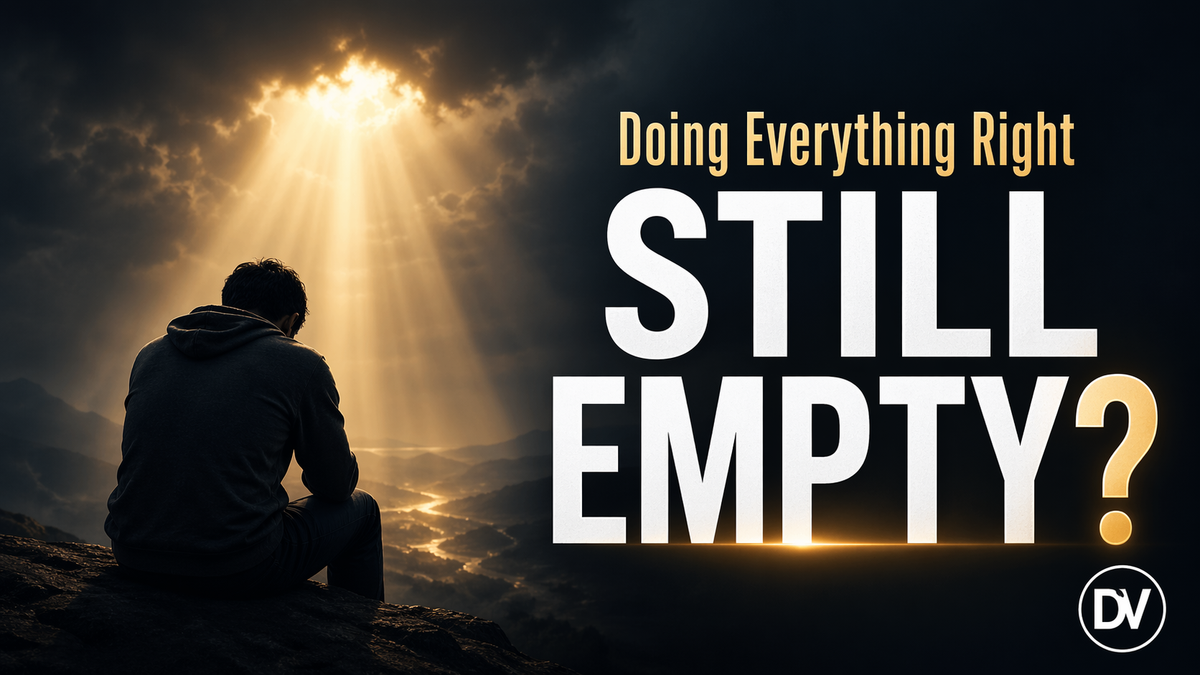
There is a kind of emptiness that does not come from laziness, rebellion, or neglect. It comes after effort. It comes after responsibility. It comes after you have tried to live well, tried to stay decent, tried to carry what was yours to carry, and still found yourself sitting in a quiet moment thinking, I am doing everything I know to do, so why does my life still feel like it is missing something real?
That question does not usually show up when everything is falling apart in obvious ways. It shows up when your life looks functional enough to confuse you. You are not sleeping on a sidewalk. You are not throwing everything away. You are not openly wrecking your future. You may even be the dependable one. The one who shows up. The one who answers the call. The one who keeps moving. The one who keeps trying to improve. The one other people would probably describe as solid. Yet somewhere under the movement, something feels hollow, and because you cannot point to a dramatic disaster, you start turning the blade inward. Maybe the problem is your gratitude. Maybe the problem is your faith. Maybe the problem is that you are broken in some deeper way. Maybe the problem is that if you were really walking with God, you would not feel so disconnected from your own life.
A lot of people live in that tension longer than they admit. They keep functioning because functioning is what adults do. They keep pushing because the next thing still has to be handled. They keep praying when they can, working when they must, and managing the visible parts of their lives well enough that very few people suspect how flat it all feels on the inside. The strangest part is not always the pain. Sometimes the strangest part is the shame. It feels embarrassing to be empty when you have been responsible. It feels embarrassing to feel purposeless when you are not doing nothing. You start to believe that emptiness is only supposed to belong to people who gave up, not to people who have been trying.
But that belief is one of the first things that needs to be broken.
Because one of the biggest lies people carry is the idea that effort and purpose are the same thing. They are not. They can overlap, but they are not the same thing. A person can be exhausted and still misaligned. A person can be disciplined and still disconnected. A person can be productive and still feel like their soul is somewhere behind them, trying to catch up to the pace of a life it no longer understands. This is why some of the emptiest people are not inactive people. They are capable people. Responsible people. Dependable people. People who know how to keep going long after joy has packed up and left the room.
That matters because many people have been taught to search for purpose with the wrong instruments. They measure meaning by movement. They measure calling by visible results. They measure worth by output. They measure spiritual health by consistency alone. Then when they do all the right-looking things and still feel no sense of life inside them, they assume the answer must be to do more, optimize more, organize more, push more, and become more efficient at carrying a life that already feels increasingly disconnected from their heart. The modern world rewards that kind of response. It praises the person who knows how to keep producing while empty. It praises the person who can keep the machine running. But God has never been confused by a well-maintained machine. He sees the human being under the motion.
And sometimes that is exactly where the ache begins. Not when your life is collapsing, but when you start to realize that a well-run life can still be deeply unsatisfying if the whole thing is being interpreted through a false definition of purpose.
That is the sharper truth underneath this subject. The emptiness many people feel is not always a sign that they are failing to find purpose. Sometimes it is the beginning of God exposing the fact that they have been using the wrong definition of purpose the whole time.
That is a different conversation.
It is also a more honest one.
Because when people say they feel purposeless, they are often not saying they have nothing to do. They are saying that what they are doing no longer feels connected to life, meaning, or the deepest part of who they are before God. They are saying they can complete tasks without feeling anchored. They are saying they can meet expectations without feeling known. They are saying they can accomplish what is necessary without sensing the quiet witness in the soul that says, yes, this is aligned, this is clean, this matters, this is not wasted. Without that inner connection, even a full life can start to feel strangely vacant.
That emptiness is often treated as an enemy to silence quickly. In reality, it can be a mercy. It can be painful mercy, but mercy all the same. Because some feelings exist to expose what pleasant functioning can hide. A person can run for years on borrowed definitions. They can inherit other people’s measurements of success. They can build their life around survival, duty, image, fear, pressure, habit, or the simple fact that they never had time to stop and ask deeper questions. Then one day they realize they are carrying a life that fits on paper but does not fit in the soul. That moment feels like loss, but it may actually be the first honest moment they have had in a long time.
Not every uncomfortable feeling means something is wrong with you. Sometimes it means something false is no longer working.
That distinction matters more than people realize.
When false things stop working, most people first experience that not as revelation but as frustration. They wonder why what used to keep them going is no longer enough. They wonder why achievement feels thinner. They wonder why approval does not land the way it used to. They wonder why checking the boxes brings less and less peace. They wonder why the same life structure that once felt tolerable now feels heavy in a deeper way. Often they assume they need a new goal, a new plan, a new environment, a new rhythm, or a new version of themselves. Sometimes those changes matter. But often the more important shift is not external first. It is interpretive. It is the sudden painful realization that you have been calling something purpose that God never called purpose.
That does not mean the responsibilities in your life are meaningless. It does not mean ordinary work is beneath spiritual meaning. It does not mean everything you have been doing is empty in itself. It means you may have been asking those things to tell you who you are, why you matter, and whether your life is worth something. They cannot carry that weight. No structure of human effort was designed to answer the deepest spiritual hunger of a person made by God. Work can matter. Family can matter. service can matter. Discipline can matter. Obedience can matter. But none of those things are meant to become your private proof that you deserve to exist. Once they are forced into that role, even good things begin to drain you.
A person can become incredibly sincere inside a false equation.
That is part of what makes this subject so painful. It would almost be easier if the answer were simple moral failure. It would almost be easier if the problem were obvious self-sabotage. But many people arrive at this emptiness by trying hard. They became who people needed them to be. They carried burdens without complaint. They tried to become reliable, useful, mature, steady, and helpful. They learned how to keep the room calm. They learned how to be needed. They learned how to show value through function. They learned how to survive by being effective. Then later, often much later, they discovered that being effective is not the same as being alive.
That discovery can feel disorienting because it threatens the whole inner bargain a person has been living by. If I do what I am supposed to do, why do I still feel empty. If I stay responsible, why do I still feel lost. If I keep going, why does my soul still feel untouched. There is real pain in that. But there is also revelation. Because once those questions rise to the surface, you are no longer dealing with surface-level frustration. You are getting close to the deeper place where God begins to separate purpose from performance.
That separation is uncomfortable.
It can feel like weakness because many people have built their identity on being able to keep going. The moment they cannot solve the emptiness through more effort, they feel stripped. The old skills do not work. Pushing harder does not produce life. Becoming more efficient does not produce peace. Even trying to be more spiritual in a performative way can start to feel strangely hollow. A person can pray in that state and still feel tired. They can read in that state and still feel flat. Not because God is absent, but because the soul is no longer willing to be tricked by motions that bypass the deeper issue.
The deeper issue is often this: you have been trying to derive a sense of purpose from proving your usefulness rather than receiving your life from God.
That is a painful sentence for many people because usefulness often became their emotional survival strategy long before it became their adult identity. Some learned early that value came through helping, achieving, fixing, calming, providing, excelling, or not becoming a burden. Usefulness gave them a place in the world. Usefulness kept them safe. Usefulness reduced conflict. Usefulness won approval. Usefulness covered insecurity. Usefulness became not just a behavior but a deep private theology. If I am useful, I matter. If I am useful, I can stay. If I am useful, I am safe. If I am useful, I have purpose.
Then one day, after years of living that way, they discover that usefulness can fill a schedule while starving a soul.
That is why feeling lost in the middle of responsibility can become such a holy interruption. It is not always a sign you need to abandon your life. It may be a sign you need to stop interpreting your life through the lens of usefulness alone. God is not a manager scanning your output to decide if your existence is justified. He is not standing back with a clipboard waiting to see whether your productivity reaches spiritual worth. He is the One who formed you before you performed anything. He is the One who knew you before you proved anything. He is the One who loved you before you built the structure you now hide inside.
That does not weaken purpose. It rescues it.
Because purpose in God is not first about your ability to produce visible importance. It is first about relationship, formation, alignment, and faithfulness. It is about becoming the kind of person who lives from truth rather than panic, from identity rather than performance, from obedience rather than image. That kind of life can include ordinary work, hidden seasons, quiet responsibilities, and long periods that do not feel dramatic at all. Yet it can still be full of meaning because meaning is no longer being extracted from applause, speed, or obvious momentum. Meaning is being received from the fact that your life belongs to God and is being shaped by Him in ways you do not always know how to measure.
This is where many people miss what God is doing.
They assume purpose must feel large. They assume calling must feel clear in an emotionally satisfying way. They assume that if God is leading them, they will always feel a clean sense of direction with enough internal energy to match it. But much of the Christian life does not unfold that way. There are seasons of clarity, yes. There are moments of strong conviction, yes. But there are also long stretches where faithfulness feels small and formation feels hidden. The world tends to call those seasons unremarkable. Heaven does not.
Heaven sees things differently because God values what people often overlook. He values the hidden interior life. He values the slow death of vanity. He values the long obedience no one claps for. He values the choice not to become hard. He values honesty. He values surrender. He values the person who remains tender under pressure. He values trust when outcomes are unclear. He values the kind of character that can hold real weight without collapsing under the need to be seen. Those things are not side notes to purpose. They are often the deeper substance of it.
This is the perspective shift many people need. You may not be in a purposeless season. You may be in a season where God is breaking your addiction to counterfeit versions of purpose.
That will not always feel good.
It may feel like losing your map before receiving a better one.
It may feel like watching old motivations stop working while new clarity has not yet fully arrived.
It may feel like the collapse of a private system that once kept you emotionally functional.
But collapse is not always destruction. Sometimes it is mercy making room for truth.
A person who has lived by false definitions usually feels that mercy first as confusion. They wonder why they cannot simply go back to being driven the way they used to be. They wonder why external success no longer quiets the deeper ache. They wonder why they are suddenly less able to pretend. But the inability to keep pretending can be one of the kindest things God allows. It pulls a person toward honesty, and honesty is often where real purpose begins to re-emerge.
Not glamorous honesty. Not branded honesty. Real honesty.
The kind where you admit that you have been living from pressure more than peace.
The kind where you admit that what looked like discipline sometimes came from fear.
The kind where you admit that being needed felt safer than being known.
The kind where you admit that some of your effort was not flowing from calling at all. It was flowing from panic, from old wounds, from the need to justify yourself, from the terror of slowing down long enough to feel what was really going on inside you.
That kind of honesty is not the end of purpose. It is the beginning of a more truthful one.
Because God can do much more with an honest person than with a polished one.
An honest person can be led.
An honest person can be healed.
An honest person can stop confusing exhaustion with importance.
An honest person can stop worshiping visible results.
An honest person can learn to let God define meaning instead of trying to manufacture it.
That is where the path starts to open.
Not with a dramatic reinvention.
Not with immediate certainty.
Not with some loud spiritual moment that explains every unanswered question.
It often opens quietly. It opens when a person stops demanding that life prove its value through constant visible return. It opens when they begin to ask different questions. Not just, what should I do with my life, but what have I been using to measure whether my life matters. Not just, where is my purpose, but what false purposes have I been clinging to because they kept me functional. Not just, why do I feel empty, but what in me is finally telling the truth.
That shift changes everything because it moves the conversation from external mapping to internal revelation. And without internal revelation, external changes can become just another form of running. A person can change jobs, locations, schedules, even ministries, and still carry the same false equation into the next season. The scenery changes, but the soul keeps interpreting life through the same exhausting lens.
So the deeper work must happen.
It is the work of relearning what purpose is.
It is the work of seeing that your life does not gain value by becoming impressive enough.
It is the work of receiving that hidden faithfulness counts.
It is the work of understanding that seasons of obscurity are not proof of abandonment.
It is the work of letting God separate your identity from your utility.
It is the work of learning that being led by Him will not always look efficient to the world.
That kind of relearning takes time because false definitions do not fall apart in one afternoon. Many of them are tied into history, pain, coping, family patterns, and old forms of fear that became so normal you no longer noticed them. That is why some people feel deeply unsettled when God begins to do this work. They are not just losing a mindset. They are losing an inner survival structure. The old way of understanding purpose gave them control. It gave them a formula. It allowed them to believe that if they stayed productive enough, helpful enough, strong enough, and needed enough, they could keep themselves safe.
God does not shame people for building those structures. He understands why they were built.
But He loves people too much to let them live and die inside them.
What makes this hard is that when those structures begin to crack, you do not always feel freer right away. Sometimes you feel weaker. You feel less certain. You feel more exposed. The things that once helped you keep moving do not work the same way anymore, yet the deeper rest and clarity you long for do not appear overnight either. That in-between place can feel almost unbearable because it strips away the illusion that control, performance, and usefulness were ever going to save you, but it does not immediately replace them with a neat and tidy emotional experience. You are left in a quieter place. A truer place. A place where your life can no longer be carried by the old lie that if you just keep doing enough, then eventually you will finally feel whole.
That is where many people panic and rush to build a new false version. They do not want to feel the loss of the old one, so they grab something else. They make purpose about a new project, a new image, a new kind of spiritual intensity, a new identity, a new plan for reinvention. Sometimes the new thing looks healthy on the surface. Sometimes it even has religious language attached to it. But if the deeper issue has not been touched, the new form will still carry the same old burden. It will still ask visible movement to do what only God can do. It will still ask outcomes to tell you who you are. It will still quietly whisper that your worth hangs on whether your life feels significant enough by human standards.
That whisper is exhausting because it never really lets a person rest. It only changes costumes.
This is why the perspective shift matters so much. The goal is not to find a shinier version of purpose. The goal is to let God teach you what purpose actually is when it is no longer tangled up with self-justification. That changes how you see ordinary days. It changes how you see hidden seasons. It changes how you see frustration, delay, and even the numbness that scared you. Numbness is not always the final state of a heart. Sometimes it is what happens when a person has been overusing themselves for so long that they no longer know how to feel the difference between activity and life. God often begins there, not by condemning the numbness, but by revealing the false economy that produced it.
A false economy always promises more than it can pay.
It promises that if you keep giving enough of yourself, life will eventually hand you back a settled sense of meaning. It promises that if you become disciplined enough, useful enough, or admirable enough, the inner ache will finally stop. It promises that if you can just get the right role, the right recognition, the right structure, the right rhythm, or the right momentum, then your soul will feel at home. But that transaction never fully closes. The payment never comes the way you hoped. You keep spending yourself, and yet the debt of emptiness remains. That is why so many responsible people quietly live with chronic disappointment. Not because they have done nothing, but because what they were depending on to satisfy the deeper hunger was never designed to do it.
God breaks false economies by inviting a person out of transaction and back into relationship.
That sounds simple until you realize how much of human life is built on transaction. Perform and be approved. Produce and be valued. Achieve and be seen. Help and be safe. Do and become worthy. Those equations get deep inside a person. Some people carry them into work. Some carry them into marriage. Some carry them into ministry. Some carry them into prayer. They do not always mean to. They just do not know another way. Then when God starts untying those knots, it can feel disorienting because He is not merely adjusting behavior. He is removing a whole way of interpreting existence.
That kind of work does not always look dramatic from the outside. In fact, it often looks like a person going through a season where they cannot fake inner agreement with old definitions anymore. They still fulfill duties. They still move through daily life. But somewhere inside, something has stopped nodding yes to the old system. Something has gone quiet. Something has started grieving. Something has started asking for truth.
That is not a wasteful place to be.
It may be one of the most important places you will ever stand.
Because once the soul begins asking for truth, it is no longer satisfied with substitutes.
Then the question becomes not, how do I get my old drive back, but what is God trying to show me that my old drive kept me from seeing. That question opens the door to a much deeper kind of healing. It allows you to look beneath the obvious frustration and ask what you have been confusing with purpose all along. For some people, it was approval. For some, it was control. For some, it was the relief that comes from staying busy enough not to feel grief. For some, it was the comfort of being needed. For some, it was ambition wearing spiritual clothes. For some, it was simply the identity of being the one who can carry more than everybody else.
None of those things can hold the weight of your soul.
Only God can.
And He rarely gives that truth to a person as a slogan. He usually teaches it through a process. He lets the old definitions wear thin. He lets the familiar strategies lose their power. He lets the inner ache become clear enough that you can no longer call it by the wrong name. Then, slowly, He begins teaching you how to live from a place deeper than performance.
Living from a deeper place does not mean becoming passive. It does not mean abandoning responsibility. It does not mean despising discipline or pretending ordinary obligations do not matter. It means those things are no longer your secret source of identity. They are no longer carrying the impossible burden of proving that your life matters. They become part of your stewardship rather than the foundation of your worth. That may sound like a subtle shift, but it changes the whole emotional texture of a life.
When purpose is tangled up with performance, every ordinary struggle feels like a threat to your value. A hard week feels like failure. A hidden season feels like insignificance. A slow process feels like personal defect. You begin to live under constant evaluation. But when purpose is received from God rather than extracted from performance, the ground under your feet changes. Hard seasons can still hurt, but they no longer get the final word over your identity. Delays can still confuse you, but they do not automatically mean your life is off course. Hidden years can still stretch you, but they are not empty by definition. You stop needing constant visible proof that your life matters because you are learning to trust the God who sees what others do not.
That trust is not flimsy optimism. It is not positive thinking covered in Christian language. It is a re-anchoring of the soul. It is the slow discovery that your life can have deep purpose even when it does not feel dramatic. It is the realization that some of the holiest work God does happens in the stripping away of false needs. He removes the need to always appear strong. He removes the need to always feel ahead. He removes the need to build an identity around visible usefulness. He removes the need to use achievement as an emotional sedative. In the removal, a person may feel bare. But in the bareness, a new kind of freedom begins to appear.
That freedom often looks quieter than people expect.
It may look like telling the truth about your exhaustion instead of dressing it up as dedication. It may look like noticing how much of your drive came from fear and not calling that wisdom anymore. It may look like taking your foot off the inner gas pedal long enough to hear what your soul has been trying to say. It may look like obeying God in smaller, cleaner ways instead of constantly searching for some grand sign that you matter. It may look like allowing yourself to be loved by God in places where you cannot point to results.
That last part is harder than it sounds.
Many people are comfortable with being used by God before they are comfortable being loved by God apart from usefulness. They know how to serve. They know how to contribute. They know how to carry weight. They know how to help. What they do not know, at least not deeply, is how to let the love of God reach the places in them that are not performing. That is why some people can stay active in outwardly good things and still remain inwardly starving. They have never learned to receive from God without first presenting a case for why they deserve it.
But grace has never worked that way.
Grace is not a reward for the well-functioning. It is the atmosphere in which a human being can finally stop bargaining and begin to live.
Once that begins to sink in, purpose starts to look different. It stops being a ladder and becomes a direction. It stops being a trophy and becomes a way of walking. It stops being something you prove and becomes something you increasingly align with. That alignment is less flashy than the world’s idea of significance, but it is sturdier. It can hold in hidden years. It can hold in grief. It can hold in waiting. It can hold in ordinary work. It can hold when external life looks unimpressive. Why? Because it is no longer built on whether your circumstances flatter your identity. It is built on who God is and who you are becoming in Him.
This is why seasons that feel empty can become so important. They expose which version of purpose you have been living under. If your sense of meaning collapses every time life feels hidden, then perhaps your private definition of purpose was still too dependent on visibility. If your sense of worth disappears whenever you cannot produce at your usual level, then perhaps you have been leaning more on usefulness than on identity. If you only feel close to God when you are doing well, then perhaps some part of you is still trying to relate to Him through performance instead of trust. These realizations can sting, but they are gifts. They bring hidden things into the light. And what comes into the light can finally be healed.
Healing here is not just emotional relief. It is structural change in the soul. It is the slow rebuilding of a person from the inside out. God does not merely comfort your frustration and send you back into the same false equation. He invites you into a different way of living. One where obedience matters, yes, but not as self-salvation. One where faithfulness matters, yes, but not as personal proof of worth. One where service matters, yes, but not as the only place you know how to exist. One where ambition, if it remains at all, gets purified until it can serve love instead of panic.
A purified life often feels simpler. Not always easier, but simpler. There is less inner scrambling. Less frantic reaching. Less need to wring identity out of every season. A person begins to notice that they can do ordinary work without demanding that it make them feel important. They can go through a slower year without calling themselves forgotten. They can be faithful in hidden places without assuming hidden means meaningless. They can rest without feeling like rest itself is a threat. They can experience limits without reading those limits as proof that they are failing God.
That is not a small shift. It is a profound one.
It is the kind of shift that makes a person steadier over time because they are no longer being jerked around by every rise and fall in visible momentum. Their soul begins to settle. They begin to understand that purpose in God is not fragile. It does not vanish because this season feels quiet. It does not disappear because you are tired. It does not evaporate because your life is not currently producing obvious signs of significance. Real purpose is not that flimsy. It is deeper than the emotional weather of a single chapter.
Sometimes the most purposeful thing happening in your life is not what you are building. It is what God is undoing.
He may be undoing your dependence on being needed.
He may be undoing your agreement with fear-driven striving.
He may be undoing the lie that usefulness equals lovability.
He may be undoing the inner belief that ordinary faithfulness is not enough.
He may be undoing the addiction to visible proof.
That undoing can feel like loss until you understand what is being made possible through it. God is not reducing your life. He is freeing it from false masters.
And false masters are cruel. They always ask for more. They never say enough. They cannot bless you because they do not love you. But God is not a false master. He is a Father. He does not define your life by how much you can produce for Him. He forms you, leads you, corrects you, comforts you, and teaches you to walk in truth. That truth includes work, faithfulness, service, and obedience, but it places all of them in the right order. They flow from identity. They do not create it.
That right order changes how a person suffers. It changes how they wait. It changes how they serve. It changes how they see hidden seasons. Suddenly a quiet year is not automatically a pointless year. A year of inward repair is not automatically a wasted year. A season where you are less visible but more honest is not a lesser season. The world may not know what to do with that kind of life, but heaven does.
The kingdom of God has always valued what the world overlooks.
It values mustard seeds.
It values widows with small coins.
It values cups of cold water.
It values hidden prayer.
It values clean motives.
It values mercy.
It values surrender.
It values the person who stays soft in a hard world.
It values the person who keeps trusting without public applause.
It values the person who learns to belong to God before trying to become impressive to people.
Once you begin to see through that lens, the old pressure starts to loosen. Not all at once. Usually not dramatically. But steadily. You start to notice that your life is not empty simply because it is not loud. You start to realize that a deep life with God may not always feel emotionally thrilling, but it carries a different kind of strength. You begin to recognize that what felt like purposelessness was sometimes grief over the death of a false definition. The ache was real, but it was not telling you that your life had no meaning. It was telling you that the old way of measuring meaning was collapsing.
And that collapse, painful as it is, can become holy ground.
Because from there, a truer life can begin.
A life where you stop asking every day to justify your existence.
A life where responsibility is stewardship instead of self-salvation.
A life where work has dignity but not lordship.
A life where hidden faithfulness is not despised.
A life where your relationship with God is not built on a performance review.
A life where you can move through ordinary days without the constant terror that if nothing dramatic happens, then nothing important is happening.
Much of what God does is dramatic only in retrospect.
At the time, it often looks like quiet staying. Quiet surrender. Quiet honesty. Quiet endurance. Quiet cleansing. Quiet growth in the roots. Quiet separation from old lies. Quiet relearning of what it means to be loved. Quiet restoration of an inner life that had been forced to live under harsh terms for too long.
Do not underestimate quiet things.
A seed is quiet before it breaks open.
Roots are quiet while they go deeper.
Healing is often quiet while it reorganizes a person from within.
God is not absent because the work is quiet.
He may be closest there.
So if you are in a season where you are doing everything you know to do and still feel strangely empty, do not rush to condemn yourself. Do not immediately assume that the emptiness proves you have no purpose. Consider the possibility that something more precise is happening. Consider that your soul may be rejecting a false definition it can no longer live under. Consider that God may be rescuing you from the burden of trying to earn meaning through movement. Consider that this ache may be exposing the difference between a life that functions and a life that is aligned.
That is not a small difference.
A functioning life can impress people.
An aligned life can carry peace.
A functioning life can look successful.
An aligned life can remain whole.
A functioning life can stay busy for years.
An aligned life can actually bear the weight of eternity.
What you need may not be a louder life.
It may be a truer one.
What you need may not be more proof that you matter.
It may be freedom from the need to prove it at all.
What you need may not be immediate clarity about every next step.
It may be a deeper release of the false things that kept you from recognizing God in the life you are already living.
There is real hope in that.
Hope, because your life does not have to become more visible to become more meaningful.
Hope, because hidden seasons are not dead seasons.
Hope, because God does not waste the years in which He dismantles lies.
Hope, because the emptiness that frightened you may not be the end of purpose. It may be the end of a counterfeit one.
And the end of a counterfeit is a mercy.
It hurts, but it is mercy.
Because once the counterfeit falls, the real has room to rise.
Your friend,
Douglas Vandergraph
Watch Douglas Vandergraph inspiring faith-based videos on YouTube: https://www.youtube.com/@douglasvandergraph
Support the ministry by buying Douglas a coffee: https://www.buymeacoffee.com/douglasvandergraph