Jesus in Vatican City and the Silence Beneath the Marble

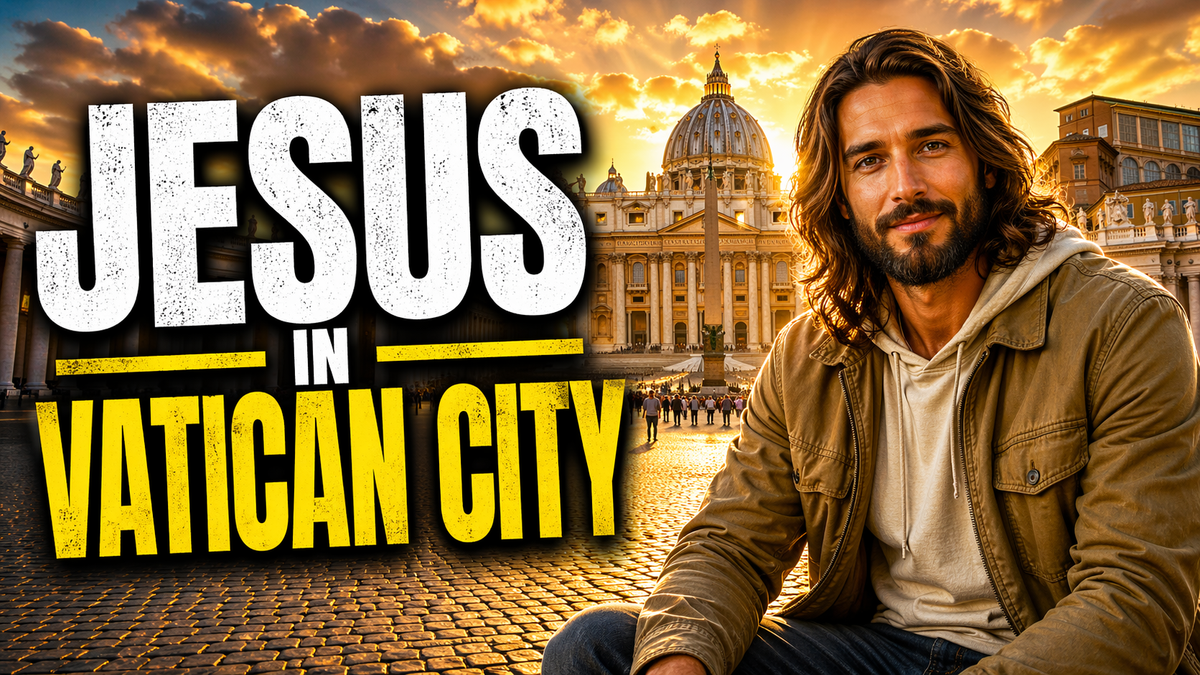
Before sunrise, Jesus stood alone in the Vatican Gardens with His head bowed and His hands open at His sides. The city was still quiet then. The paths were empty. The trimmed hedges held the last coolness of the night. The dome of Saint Peter’s rose beyond the trees like something the world had already decided was too holy to question, but Jesus did not stand there to admire stone. He prayed in the stillness the way a man breathes when he knows exactly where strength comes from. Nothing in Him was rushed. Nothing in Him strained. The day had not started for anyone else yet, but He was already there, present before the noise, present before the lines, present before uniforms and badges and metal gates and whispered schedules and the thousand small efforts required to make a place like Vatican City look calm from the outside.
When He opened His eyes, the first thing He heard was not a bell. It was the sharp scrape of a bucket being dragged over stone.
Under the Bernini colonnade in Saint Peter’s Square, Marta Leone was on her knees with a rag in one hand and her phone pressed between her shoulder and her ear, trying to scrub away a dark stain near one of the columns before the morning foot traffic picked up. She was fifty-eight, broad-shouldered, tired in the face, and moving with the heavy determination of someone who had been awake much longer than her shift required. Her grandson had been sick half the night. Her daughter had not answered a single call. The school had left two messages the evening before. The landlord wanted the rest of the rent by Friday. Now the line supervisor had texted her at 5:11 in the morning asking why the west side of the colonnade had not been finished yesterday. She had written back that she would take care of it. She always wrote that. I’ll take care of it. I’ll handle it. I’ll find a way. The words had become her whole life.
The voice on the phone was from the school office. It was too early for kindness, and the woman on the other end had stopped pretending to sound gentle. “Mrs. Leone, we need you to come in today. It cannot wait.”
Marta kept scrubbing. “I start work before dawn. I told you that yesterday.”
“It concerns Davide.”
Everything in her arm tightened. “What did he do?”
There was a pause, and the woman lowered her voice the way people do when they want to sound less harsh without actually becoming less harsh. “Another student says Davide took money from his backpack.”
Marta sat back on her heels so hard the bucket rocked. “No. He didn’t.”
“That is what we need to discuss.”
“He didn’t,” Marta said again, but the force had already gone out of her voice. Her grandson was twelve. He had started lying in small frightened ways after his mother disappeared for three days last month and came back acting cheerful and thin and promising she was fine. The boy had begun hiding school forms. He had begun saying he had eaten when he had not. He had begun looking at the floor when anyone asked him a direct question. Marta knew what pressure could do to a child. She knew what humiliation could do to a child. She also knew that hunger and embarrassment made people do things they swore they would never do.
The woman said, “Can you come by at ten?”
Marta looked around the square as if the city itself might answer for her. The two fountains stood quiet. The chairs were still stacked near a barricade. The first early workers were moving at a distance. “If I leave, I lose the hours.”
“That is not my concern.”
Marta closed her eyes. “No. Of course not.”
When she ended the call, she did not cry. She pressed the heel of her hand hard into one eye and went back to scrubbing the stain. She scrubbed like the stone had insulted her. She scrubbed like one clean patch of pavement might somehow keep the rest of her life from slipping.
Jesus came out from the side walkway and stopped a few steps from her. He wore simple dark clothes, nothing that would turn a head in Rome or anywhere else. His face held the quiet alertness of someone who had already been listening long before anyone spoke. He did not say her name. He did not start with a lesson. He looked down at the stone, then at the rag in her hand, then at the way she was breathing through her mouth to keep herself steady.
“You’ve been cleaning the same place for a while,” He said.
Marta did not look up. “That’s because it’s still dirty.”
“It isn’t.”
She stopped. The rag hung limp from her hand. She turned and looked at Him with the irritated suspicion of a woman too tired for strangers. “Do you work here?”
“Today I’m walking here.”
“That sounds like the kind of answer a person gives when he doesn’t want to answer.”
Jesus smiled a little. “Sometimes.”
She gave Him a flat look and went back to wringing the rag into the bucket. “Then keep walking.”
He did not move. “You’re not angry at the stone.”
That landed harder than she expected. She pulled the rag too tightly and water ran over her fingers. “People should mind their own business.”
“When pain gets heavy enough, it spills into public places.”
That should have annoyed her. Instead it made something in her chest feel suddenly visible. She set the rag down. “You don’t know anything about me.”
“I know you have been carrying too much for too long and calling it strength.”
She stared at Him then, truly stared, and the square seemed to widen around them. The city was still quiet enough that a person could hear the scrape of shoes far off near the barricades. She should have stood up and walked away. She should have said she had work. She should have ended the conversation before it touched anything real. But there are certain moments when the soul knows it has just been spoken to plainly, and the body becomes still before the mind catches up.
“My grandson’s school called,” she said at last. “They say he stole money.”
Jesus said nothing.
“I can’t leave my shift. If I leave, I don’t get paid for the morning. If I don’t get paid for the morning, then I have to move some other bill, and everything is already moved as far as it can go.” She gave a humorless laugh. “You ever try to choose which problem gets to be the worst one that day?”
“Yes,” He said.
That answer was so soft it nearly undid her.
She shook her head and picked the rag up again because it was easier to hold something than to let her hands hang empty. “He’s a good boy. That’s the part I keep trying to say to people. He’s a good boy. He’s just… everything has been off. My daughter isn’t stable. I’ve got him most nights. Some weeks I’ve got him all week. He sees more than I want him to see. I keep telling myself if I can just keep the walls standing a little longer, he’ll make it through this.”
Jesus looked out over the square where the first small clusters of visitors were beginning to gather far from them. “Walls can keep out weather,” He said. “They can’t raise a child.”
Marta let out a breath through her nose. “That’s encouraging.”
“It’s honest.”
She almost smiled then. Almost. “Honest doesn’t pay rent either.”
“No,” He said. “But lies keep taking more than rent.”
She did not answer because she knew what He meant. She had been telling everyone the same thing for months. We’re managing. He’s okay. I’m okay. My daughter is getting herself together. It had become a language of survival, but survival can rot into denial so quietly that a person does not notice until the whole heart feels airless.
Jesus crouched and took hold of the bucket handle before she could protest. “Show me where the rest of your work is.”
She blinked. “You’re not carrying that.”
“I already am.”
He lifted it with such ordinary ease that arguing felt foolish. Marta rose slowly, knees stiff, and led Him along the curve of the colonnade. She kept glancing at Him as if waiting for the trick behind the kindness to show itself, but none came. He walked beside her as if there were nothing unusual about a man carrying a cleaner’s bucket in Saint Peter’s Square before the crowds arrived. That, more than anything, unsettled her. Most people knew how to help in ways that made the other person feel smaller. He did not.
At Porta Sant’Anna, where authorized workers entered through one of the guarded gates, Lukas Baumann stood in full uniform with his shoulders squared and his jaw locked so tightly that the muscles near his ears kept jumping. He was twenty-three, from near Lucerne, and had been in Vatican City long enough to learn how to hold his face still when tourists photographed him from a distance. That morning he had already transferred four hundred euros to his mother back in Switzerland because his father had disappeared again after three days of drinking and left the utility bill unpaid. Lukas had told her it was no problem. He had almost laughed when he said it. After the transfer, his account balance looked like a joke nobody would explain. He had not told his fiancée that he would need to postpone their train trip next week. He had not told anyone that the uniform had begun to feel less like honor and more like armor over a life he could not keep from fraying.
He saw Marta coming with the stranger and stepped forward automatically. “Badge, please.”
Marta reached into her pocket and produced it. Lukas scanned it, then looked at Jesus. “And yours?”
“He’s with me,” Marta said.
Lukas looked at her, then at the bucket in Jesus’ hand, then back at Jesus. The whole thing annoyed him in a way he could not explain. Maybe because Jesus looked too calm. Maybe because men who were calm in the morning usually had money in the bank and someone waiting for them at home. Maybe because it felt offensive for a stranger to stand so untroubled in a city full of people holding themselves together by force.
“I asked for your badge,” Lukas said again.
Jesus met his eyes. “You haven’t slept enough.”
Lukas felt heat move up his neck. “That is not what I asked.”
“No,” Jesus said. “It’s what you’re showing.”
Something flashed across the young guard’s face before he could stop it. Not fear. More like anger at being seen. “Move along.”
Jesus did not challenge him. He handed the bucket back to Marta and stepped aside. “A man can stand straight and still be crushed underneath,” He said.
Lukas kept his expression fixed. Marta moved on, unsettled all over again, and Jesus walked with her through the gate. Lukas watched Him go with a pressure in his chest that had nothing to do with duty. For the next ten minutes he replayed the sentence in his mind and hated it for being true.
Marta’s cleaning route took her toward the area around the Vatican Post Office and then back toward the side passages that led toward Saint Peter’s Basilica. By then the city had shifted into morning. Priests moved quickly with folders under their arms. Lay workers passed through with badges swinging at their chests. Visitors clustered in hopeful lines. A nun guided two elderly women toward the security area. The sound of rolling carts, low conversation, shoes on stone, and distant bells mixed into the kind of steady human motion that made Vatican City feel less like a monument and more like a small nation built on routines nobody outside could see.
At the post office window, Enzo Rinaldi was sorting stamped envelopes with the slow, disciplined efficiency of a man who had trained his hands to keep moving because his thoughts were no longer safe company. He was sixty-one and had worked there for almost twenty years. Tourists loved the Vatican stamps. Pilgrims mailed postcards home so their families could hold proof that they had been there. Enzo weighed packages, licked the edge of labels, stamped forms, answered the same questions in three languages, and went home every evening to a clean apartment that had become too quiet since his wife died. His sister in Naples wrote him every few weeks. He left the letters unopened on the kitchen counter until the pile looked accusing, then tied them with string and put them in a drawer. He told himself he would read them when he felt stronger. He had been telling himself that for nineteen months.
Marta stepped up to the counter and slid a small envelope forward. “I need this sent today.”
Enzo took it and looked at the address. “Registered?”
“No. Just sent.”
He weighed it. “Seven euros.”
Marta searched in her wallet, then in the side pocket of her bag. Her fingers began moving faster. She counted coins twice. She came up short by two euros and ten cents. For a few seconds she just stared at the small collection of metal in her palm like it had personally betrayed her.
“I can come back,” she said, though they both knew from her face that she would not be back until the next day at best.
Enzo had seen this expression before. Not often in Vatican City, but enough. It was the expression of someone caught in the indignity of a small amount they could not cover. He could have quietly waved it through. Some clerks did that. He usually did not, not because he was cruel but because years of rule-following had become their own refuge. The line behind Marta was growing. His mouth opened to repeat the price.
Jesus stepped to the side of the window but did not interfere. He looked at Enzo first, not Marta. “You know the difference between procedure and hardness,” He said.
Enzo’s hand froze over the scale. “Excuse me?”
“You learned it years ago. You’ve just been leaning on one to avoid the other.”
Enzo stared at Him. The line behind Marta shifted. Someone cleared a throat. A woman in a blue jacket checked her watch. But in the space between Jesus and the clerk, all the small public impatience lost its weight.
Marta turned. “Please don’t make a scene.”
“I’m not making one,” Jesus said.
Enzo felt strangely exposed. “There are rules.”
“Yes,” Jesus said. “And there is the person in front of you.”
The words unsettled him because they were so simple. He looked past Marta at the line, then back at the coins in her hand. He heard himself say, “It’s fine. I’ll cover the difference.”
Marta’s face flushed. “No. Don’t do that.”
“It’s two euros and ten cents,” Enzo said, but his voice had changed. It sounded less like policy and more like a man remembering what softness used to feel like in his own mouth.
She hesitated, then pushed the coins toward him. “I’ll pay you back tomorrow.”
He shook his head once. “No you won’t.”
It should have embarrassed her. Instead it almost made her cry again. She nodded hard, looked down, and stepped aside after he processed the envelope. Jesus remained where He was.
Enzo kept his attention on the forms in front of him. “If you’re here to lecture me, save it.”
“I’m here because you haven’t opened your sister’s letters.”
The stamp slipped in Enzo’s hand and hit the counter crooked. He lifted his eyes slowly. There was no anger in Jesus’ face. No triumph. Just a kind of steady grief that made defensiveness feel childish.
“That,” Enzo said, “is none of your business.”
“Pain likes sealed rooms,” Jesus said. “It gets offended when someone opens a window.”
Enzo felt his throat tighten. He looked away first. The line moved. Forms passed. Coins changed hands. But for the rest of the morning, nothing sat right inside him.
Jesus left the post office and walked toward the edge of Saint Peter’s Square where morning light was beginning to slide across the stone in a brighter wash. Marta had not gone far. She stood near one of the fountains pretending to check her phone. When He came beside her, she did not pretend not to notice.
“I don’t like owing people,” she said.
“That’s not the same as receiving help.”
“It feels the same.”
“Only to people who have been left alone too long.”
She looked out at the square, at the widening lines, at the priests and tourists and workers moving through the open space as if everyone had someplace important to be. “I used to think if I worked hard enough, God would at least make the math calm down. Not rich. Just calm. Just manageable. Something.” She swallowed. “I’m not asking for luxury. I’m asking for one week where I don’t wake up already behind.”
Jesus leaned one hand on the stone edge of the fountain. “A tired heart starts mistaking relief for salvation.”
She turned to Him. “What does that mean?”
“It means you are so worn down you think the answer is a lighter load. But you also need a different way of carrying it.”
“That sounds nice,” she said, “but the load still exists.”
“Yes. And you were not made to carry it through silence and pride.”
Marta gave a sharp little laugh. “Pride. That’s funny. I don’t feel proud.”
“Pride does not always look tall,” He said. “Sometimes it looks like refusing to let anyone get close enough to help because you cannot bear to be seen needing it.”
That one sank deeper. She looked away again. “You talk like a man who expects people to change in a morning.”
“No,” Jesus said. “I talk like a man who knows a heart can start telling the truth in one.”
By late morning, the Vatican Museums were taking in their first dense waves of visitors. The echo inside the long corridors had risen into that particular blend of whispers, guided explanations, shoe leather, and restrained awe that made people speak softly even when they did not feel reverent. In an office near the entrance to one of the inner work areas, Giulia Ferri stood with both hands flat on a desk while a younger assistant explained, for the second time, that the courier for a private transfer had been delayed and the schedule would need to be adjusted. Giulia was forty-two, sharply intelligent, exacting, and so disciplined in public that most people assumed she had never once cried in a bathroom stall during work hours. They were wrong. Her husband had left the year before with the kind of cowardly vagueness that makes the abandoned person blame herself longer than she should. Since then she had become tighter, faster, less patient. She carried authority well, but she no longer carried warmth with any ease. She had learned how to get through a day without letting anyone know she went home to an apartment where the only sound after dark was the washing machine and the hum of the refrigerator.
“Then adjust it,” she said.
“We need approval first.”
“Then get approval.”
“The office said they need your sign-off.”
She closed her eyes for one second. “Then why are you in here telling me this instead of bringing me the paper?”
The assistant flinched almost imperceptibly. Giulia saw it and hated herself immediately, but not enough to apologize. That was how hard her life had become inside. Regret without softness. Conviction without change.
When the assistant left, Giulia sat down, picked up her phone, and saw three missed calls from a number she knew too well. Her ex-husband. She did not listen to the voicemail. She already knew the tone. He only called when paperwork, money, or convenience required it. She put the phone face down and pressed her fingers into her temples until she felt the edge of a headache settle in.
A knock came at the half-open door.
“We’re not ready,” she said.
Jesus stood there.
She straightened immediately, annoyed at herself for showing strain. “This area isn’t open to visitors.”
“I’m not visiting.”
There was something about the way He said it that irritated her before she even knew why. She rose from the desk. “Then who let you in?”
“A woman who thought I was carrying a bucket well.”
Giulia frowned. “What?”
He glanced down the corridor toward the distant movement of staff and visitors. “You speak to people like you’re holding a wall together with your voice.”
She let out a short dry laugh. “I’m sorry, have we met?”
“No.”
“Then that was a bold first sentence.”
“It was a true one.”
Giulia folded her arms. “Truth from strangers is usually just arrogance with better phrasing.”
He nodded once, as if conceding the point without giving up the ground. “And tired people often mistake kindness for intrusion.”
That stopped her. Only for a second, but long enough. “I am working.”
“Yes. Very hard.”
“I supervise real things here. Timelines. People. Transfers. Security coordination. This isn’t one of those places where a person can just drift through feeling profound.”
“I know,” Jesus said. “You’ve built your whole face around that.”
She stared at Him. Something hot and immediate rose in her chest. “You don’t know me.”
“I know you are lonely enough to call control by its better names.”
Giulia felt the room narrow. There were sentences that a person could dismiss. This was not one of them. She moved around the desk because standing behind furniture suddenly felt weak. “You are out of line.”
“Yes,” He said. “So are you. Not in your work. In your soul.”
It was such an impossible sentence that she nearly laughed again, but the laugh would not come. She thought of the missed calls on her phone. She thought of how many mornings lately she had entered the museums already angry. She thought of the young assistant’s face when she had snapped. She thought of the way she went home each night and moved through the apartment with the radio on just to keep silence from sounding like abandonment.
“Who are you?” she asked quietly.
Jesus looked at her for a long moment, and when He answered, the words did not come like a performance. They came like a door being opened. “I am the One who is not impressed by how well you hold together what is already cracking you.”
Giulia said nothing. Somewhere down the corridor, a group passed with soft footsteps and the murmur of a guide speaking French. The ordinary world remained intact. That almost made the moment harder to absorb.
“You should leave,” she said, but her voice had lost all command.
“Not yet.”
He stepped back into the corridor and she followed almost without deciding to. They walked slowly toward the Cortile della Pigna, where the open space gave a little air after the enclosed rhythm of the galleries. Workers crossed between duties. A pair of museum staff spoke quietly near a service door. Sunlight touched the upper walls. The giant bronze pine cone sat with its old unbothered stillness while the day moved around it.
Jesus stopped near the edge of the courtyard. “You think if you let yourself feel the full weight of what was done to you, it will ruin your usefulness.”
Giulia’s throat tightened so abruptly it hurt. “I do not talk to strangers about my marriage.”
“You hardly talk about it to God.”
That one struck lower. She had prayed, technically. Small clipped things. Help me get through today. Keep me steady. Don’t let this derail my work. But there is a difference between prayer and guarded reporting. She had not spoken to God plainly in months.
“He left,” she said, and the words sounded blunt and oddly young. “He just left. No explosion. No confession worth telling. He became distant, then practical, then absent. And somehow I’m the one who now has to stay reasonable about everything.” She laughed once, with no humor in it. “Do you know how humiliating it is to be the one who is left and still has to keep answering emails politely?”
“Yes.”
“Everybody here assumes I’m fine because I show up. Because I still do my job. Because I don’t fall apart in the corridors.” She looked at Him then with the fury of someone who has been composed too long. “What exactly would you have me do? Weep into the inventory forms?”
“No,” Jesus said. “I would have you stop making competence your hiding place.”
She turned her face away. In the courtyard, a bell sounded somewhere beyond the walls. Workers passed. The day kept moving. Yet inside her, something had stopped. Not broken. Stopped. Like a machine being switched off after running too hot.
On the far side of the city, at Porta Sant’Anna, Lukas was still replaying the morning in his head. Tourists came and went. Staff passed through. A senior officer corrected the angle of his glove at one point and he stood even straighter out of reflex. But the sentence would not leave him. A man can stand straight and still be crushed underneath. That was exactly what the uniform required him not to admit. He had chosen duty, chosen discipline, chosen a life that carried honor in public. None of that had made his father stop drinking. None of it had made his mother stop sounding tired on the phone. None of it had made him less ashamed of sending money he did not have while telling everyone around him that he was blessed to serve.
Just before noon, Marta came back through the gate with a folded note in her hand and fresh worry all over her face. She had finally listened to the voicemail the school left the night before. Davide had not just been accused of stealing. He had also shoved another boy when confronted. There would be a meeting. There might be a suspension. The note in her hand was from the line supervisor confirming she could leave for two hours if she found someone to cover the basilica-side corridor in the afternoon.
She stopped in front of Lukas. “Do you know who handles temporary maintenance reassignment requests?”
He pointed toward the internal office. “Second door down.”
She started to go, then stopped. “You look worse than I do.”
It came out so plainly that he almost laughed. Instead he looked at her, really looked at her, and saw in her face something he had not expected to find inside these walls. Not reverence. Not composure. Recognition.
“Did he talk to you too?” she asked.
Lukas knew immediately who she meant. “This morning.”
Marta nodded once, like that confirmed something she had been carrying around since dawn. “I don’t usually listen to strangers.”
“Neither do I.”
“He says things like He has a right.”
Lukas felt the truth of that and hated how much he wanted to deny it. “I’m on duty.”
“That has nothing to do with what I said.”
He looked away toward the gate. “My family is a mess.”
The confession slipped out before he could stop it.
Marta’s expression changed. Not pity. Just quiet. “Mine too.”
For a moment they stood there in the strange relief of two people who had not planned to tell the truth and had done it anyway.
Then Jesus appeared again, walking toward the gate from the inner road as if He had known exactly where to find them and exactly when. There was no rush in Him. No effort to manage the moment. Yet both of them went silent when He came near, as if each had instinctively understood that whatever was happening this day was larger than coincidence and gentler than pressure.
He looked at Marta first. “You need to go to the school.”
She nodded. “I know.”
“Not to defend your grandson before you know the truth. To stand beside him while the truth comes out.”
Her eyes filled again, but this time she did not look away from Him. “What if he did it?”
“Then he is still not alone.”
The answer broke something open in her that fear had kept clenched. Because that was what terrified her most. Not only that the boy might have done it, but that shame would get to him before love did. That he would start believing he was the kind of child who became the worst thing he had done under pressure.
Jesus turned to Lukas. “And you need to stop calling burden devotion.”
Lukas swallowed. “I’m helping my mother.”
“Yes. But you are also hiding your fear behind sacrifice. Those are not the same thing.”
He felt suddenly young, much younger than twenty-three. “If I don’t help her, who will?”
“That is not the only question,” Jesus said. “The other is why you think carrying everything alone is faithfulness.”
Lukas had no answer for that because no one had ever asked it in those words.
The air near the gate seemed to hold still around them. People were moving. Footsteps crossed. Radios murmured softly from a guard nearby. The city had not stopped. Yet for Marta and Lukas, the day had turned inward and become something else.
Then from farther up the path came the sound of a woman’s voice, tight with controlled frustration, speaking faster than she meant to. Giulia was walking toward the gate with her phone in one hand and a folder tucked against her side, her face pale with the aftermath of a call she should never have answered while standing in a public courtyard. Her ex-husband had said he needed more time before sending the support payment. More time. Always more time, asked from the person already carrying the consequences. She had listened until her dignity began to slip, then ended the call and kept walking because movement was the only thing stopping her from shaking.
She saw Jesus with Marta and Lukas and stopped.
For one strange second, all three of them looked at one another with the same stunned question. You too?
Jesus stood among them with that unforced stillness He carried everywhere, and the silence between the four of them no longer felt empty. It felt like something gathering.
No one spoke first. They did not know how.
Then Jesus said, “Good. Now you can stop pretending your pain is unrelated.”
That was where the day changed.
For a moment none of them knew what to do with that sentence. Good. Now you can stop pretending your pain is unrelated. It sounded too large for a workday and too personal for a public place. Around them, Vatican City kept moving with its practiced calm. A delivery cart rattled somewhere behind the wall. A priest crossed the road with quick measured steps and a folder under his arm. A tourist lifted a phone toward the dome. A guard answered a radio. Everything visible kept its order. But inside the four people standing there, something had begun to shift in a way none of them could control with routine.
Marta was the first to break the silence, though her voice came out rough. “My grandson is waiting in a school office while I’m standing here with strangers talking about my soul.” She shook her head as if trying to wake herself up. “I have to go.”
“Yes,” Jesus said. “And this time you will go without anger deciding the room before truth gets there.”
She looked at Him with the weary panic of a woman who had survived for so long by bracing first and thinking later. “If he took it, I’ll be humiliated. If he didn’t take it, I’ll still be humiliated because they already decided he did.”
Jesus held her gaze. “Humiliation is not the worst thing that can happen to love.”
That answer landed with more force than comfort. She looked away, jaw tight, because a part of her already knew He was right. Fear had been making all her decisions for months. Fear of bills. Fear of collapse. Fear of what people would think if they saw how thin the walls had become. Fear had started dressing itself up as responsibility. She had called it realism. But the truth was simpler. She was terrified of one more thing going wrong.
Giulia spoke before she could stop herself. “What school?”
Marta turned to her. “The one near Via di Porta Angelica. Davide’s school.”
“I know where it is,” Giulia said.
Marta gave her a suspicious glance. “Why?”
“Because I pass it some mornings.” Giulia hesitated. She was not used to offering herself without first calculating the inconvenience. “I can drive you part of the way. Or walk with you. Whatever gets you there faster.”
Marta blinked. The offer itself seemed to offend the rules of the day. “Why would you do that?”
Giulia looked at Jesus, then back at Marta. “Because I’m tired of acting like other people’s pain is an interruption.”
The words sounded new even to her. She had not planned to say them. They had come out ahead of her defenses. For one brief second she felt exposed again, but Jesus did not rescue her from it. He only stood there with the quiet face of a man who knew truth always sounded strange at first when it had been absent too long.
Lukas shifted his weight in his uniform. “I can call the reassignment office for you,” he said to Marta. “Tell them you need the afternoon coverage confirmed now, not later. It’ll move faster if it comes through internal security.” He almost apologized after saying it. Help was easier for him when it sounded procedural.
Marta looked from one face to the other like a person whose whole body had forgotten how to receive. “I didn’t ask for all this.”
“No,” Jesus said. “You asked for enough strength to survive. This is different.”
Enzo came up the path with a packet of forms under one arm and stopped when he saw them together. There was a strange look on his face, as if the day had become difficult to dismiss. He had spent the last hour at the post office trying to work while every sentence Jesus had spoken to him kept returning with greater weight. The unopened letters in his kitchen drawer had begun to feel less like paper and more like accusation.
He glanced at Marta, then at Giulia, then at Lukas, and finally at Jesus. “Am I late for something?”
“For honesty,” Jesus said. “Only by a little.”
Enzo gave a tired exhale and rubbed a hand across his chin. “That seems to be what today is doing.”
Jesus looked at Marta again. “Go.”
This time she did.
Giulia went with her. They crossed out toward the edge of the city with fast steps and almost no conversation at first. The walls, the gate, the dressed stone, the steady current of workers and visitors all seemed to recede behind the pounding urgency in Marta’s chest. She kept checking the time on her phone as if minutes themselves were a kind of judgment.
“You don’t have to come,” she said when they reached the outer street.
“I know.”
“You have work.”
“So do you.”
“That’s not the same.”
“No,” Giulia said. “It isn’t.”
They kept walking. The streets just beyond Vatican City held the ordinary Roman blend of mopeds, delivery vans, pedestrians cutting around one another, the smell of coffee from a nearby bar, and the faint impatience of midday traffic. Marta moved like a woman who did not know whether she was heading toward defense, shame, or both. Giulia, beside her, felt the unfamiliar strain of helping someone while her own life still ached open inside her. She had always assumed a person needed to be steadier before becoming useful. Now she was not so sure.
After half a block Marta said, “You don’t even know me.”
Giulia let out a small breath. “That may be why I can walk with you.”
Marta glanced at her. “What does that mean?”
“It means people who know us often know the version of us that functions. The version that covers, explains, adjusts, keeps going.” Giulia looked ahead. “Sometimes a stranger catches the part underneath before the performance comes back.”
Marta almost smiled despite herself. “You sound like someone who thinks too much.”
“I work in museums,” Giulia said. “It’s an occupational hazard.”
They turned toward the school and the pace of their steps slowed only when they reached the entrance. Marta stopped before going inside. Her face changed then. It lost its fight and showed something harder to stand in front of. Fear for a child. Fear of what he might have done. Fear of seeing himself collapse under the knowledge of it.
Giulia touched her arm. It was a simple touch, but it held no superiority in it. “Stand beside him,” she said. “Not in front of him.”
Marta swallowed. “That’s what He said.”
“I know.”
Inside the school office, the fluorescent lights made everyone look slightly more tired than they were. The principal sat behind a desk with the careful expression of someone who had seen many family situations and learned not to assume too much too soon. A teacher stood near the filing cabinet. Davide sat in a plastic chair with his shoulders collapsed inward and both hands pushed between his knees. He looked up when his grandmother entered, and the first thing that crossed his face was not guilt. It was dread.
Marta felt everything in her rush toward him at once. Anger. Protection. Disappointment. Love. A fierce desire to take him out of the room and a fierce desire to make him answer in it. Jesus’ words held her back from both extremes. Not to defend your grandson before you know the truth. To stand beside him while the truth comes out.
So she did the harder thing. She sat next to him instead of towering over him. She did not demand. She did not rescue. She put one hand on the back of his neck and felt him trembling under the skin.
The principal explained. Twenty euros had gone missing from another boy’s backpack. A classmate said he saw Davide take it. When confronted, Davide denied it. Then when the boy pushed again, Davide shoved him and the situation escalated. The money had later been found folded inside Davide’s pencil case.
Marta shut her eyes once. Just once. Then she opened them and looked at the boy beside her.
“Did you take it?”
Davide stared at the floor.
She waited.
The principal began to speak again, but Marta lifted one hand slightly and the woman stopped.
“Davide,” Marta said, and there was no hardness in her voice now, only a weight the boy could feel. “Look at me.”
He did. Tears were already in his eyes. His face had that stunned, ashamed look children get when the thing they did under pressure suddenly becomes larger than the pressure that caused it.
“Yes,” he whispered.
The room held still.
“Why?” Marta asked.
At first he only cried harder. Then, in pieces, the truth came. There was a class trip next week. Everyone had to bring money. He had not told Marta because the electricity notice had been on the table and he had heard enough whispered conversations at night to know there was no space left for one more need. Another boy had laughed at his shoes two days earlier and asked if he would stay back again because poor people always had some excuse. Davide had gone hot all through his chest. That morning when he saw the money in the backpack, he took it. Not because he thought it was right. Because in the stupid pressed little logic of a twelve-year-old carrying too much humiliation, it felt like one fast way to stop being the kid who never had enough.
Marta listened with one hand over her mouth.
The principal said something about consequences, about trust, about the other family. The teacher mentioned the shove and the need for accountability. The words were not wrong. They were just not the deepest thing in the room.
The deepest thing in the room was a boy who had been growing ashamed in silence and a grandmother who suddenly understood that she had been letting him witness every burden without ever letting him hear hope spoken out loud.
Marta turned toward him fully. “You should have told me.”
He broke. “You already have too much.”
That did it. Tears came hard then, without permission. Not because of the theft alone. Because she heard in his answer her own whole life. I’ll handle it. I’ll take care of it. Don’t worry. He had learned her silence as if it were love. He had watched her carry strain without asking for help and concluded that love means hiding your need until it turns crooked inside you.
She pulled him against her. He resisted for one second out of shame, then gave up and collapsed into her shoulder like a child much younger than twelve.
“You never fix this kind of thing by becoming someone else,” she said into his hair. “Do you hear me? You tell me. You tell me even when it’s ugly. You tell me before it gets ugly. You do not carry it alone and then do something that teaches your heart the wrong lesson.”
He nodded into her neck.
The principal let the moment stand longer than policy usually would have allowed. Giulia, sitting quietly in the corner where Marta had asked her to stay, watched the scene with her own chest aching open in places she had kept shut. She saw in Davide’s bowed body something familiar. The human instinct to hide need until it mutates. The desperate little transactions people make with shame. The cost of being too proud or too scared to speak before pressure hardens into damage.
The school decided on a suspension for the next day and restitution to the other family. The consequences remained. Marta did not fight them. She was too tired for appearances and too honest now for false victories. When they left the building, Davide walked between the two women with swollen eyes and a face emptied by crying.
On the sidewalk outside, he finally noticed Giulia clearly. “Who are you?”
She surprised herself by smiling. “Someone who had business nearby.”
He looked at his grandmother. “Is she mad at me?”
Marta wiped her face. “No. She’s just unfortunate enough to be having a strange day with us.”
Davide gave the tiniest broken laugh. It was the first thing that sounded like a child again.
They stopped at a small cafe near the corner, the kind of place where the coffee came fast and the sandwiches were wrapped in paper if you asked to take them away. Marta insisted she was not hungry. Davide said the same thing. Giulia ignored both of them and bought sandwiches anyway. The simple act of food placed in front of people who were too strained to remember they needed it changed the mood more than any careful speech could have. Davide began eating with the quiet concentration of a boy who had not had enough breakfast. Marta took two bites before the tears threatened again and she had to look away.
Giulia stirred her coffee and said, not looking at either of them, “I spent a year being angry with someone who left me and another year being angry with myself for not being enough to make him stay. It did not improve my judgment.”
Marta stared at her. Davide looked back and forth between them with the blunt curiosity of a child who can feel honesty in a room even when he does not understand all of it.
Giulia kept her eyes on the table. “I have learned that pain kept hidden becomes a lens. You begin seeing everything through it. You stop knowing when you’re reacting to today and when you’re reacting to everything before today.”
Marta swallowed. “That sounds right.”
“It is also exhausting.”
Davide finished half his sandwich and asked in a small voice, “Nonna, are we in trouble forever?”
The question was so childlike and so enormous that neither woman answered at once.
Then Marta reached over and took his wrist. “No. You’re in trouble now. That’s not the same as forever.”
He stared at her, waiting.
“We fix what can be fixed,” she said. “We tell the truth sooner next time. We stop hiding things because we’re scared of being poor or embarrassed or small. And we do not become the worst thing we did on the worst morning we had.”
He nodded slowly. Something in his face eased. Not erased. Eased.
Back inside Vatican City, Lukas made the call he had promised. Then, after standing with the phone still in his hand for another full minute, he made a second call he had not planned to make. His fiancée answered on the third ring, warm and unsuspecting, already talking about next week’s trip before he said a word. He had been rehearsing the polite version for two days. Something light. Something temporary. Something that would make him sound responsible instead of strained. Instead, with the sentence Jesus had given him pressing against all his usual instincts, he told the truth.
“I sent money to my mother again,” he said. “A lot. More than I should have without telling you.”
There was silence on the line.
“I know,” he added quickly. “I should have said something before. I keep thinking I can solve it alone and then come back to you with everything handled, but I’m not handling it. I’m just getting more ashamed each time.”
When she spoke, her voice was not angry. It was hurt in the deeper way. “Lukas, I don’t need you to arrive polished. I need you to arrive honest.”
He closed his eyes where he stood under the gate arch. He had thought sacrifice would make him admirable. He had not noticed how secrecy was making him unavailable.
“I’m sorry,” he said.
“For the money?”
“For turning burden into performance.”
That sentence surprised both of them. She exhaled softly into the phone. “Then stop.”
Something loosened in him. Not the external problems. Those remained. But the pressure to seem unbreakable began to crack. When the call ended, he stood for a few seconds with his hand still on the phone and felt how much energy it had taken to maintain an image no one had asked him to maintain.
An hour later, on a short break, he called his mother too. The conversation did not become easy. His father was still missing. The bill was still due. But for the first time Lukas said, “I cannot keep sending money like I have no limits.” His mother cried, not because she was offended, but because she had known it already and had hated accepting from him what he could not afford to give. Truth made the call painful. It also made it clean.
At the Vatican Post Office, Enzo lasted until early afternoon before he went into the back room, sat on a stool near the sorting bins, and finally opened the most recent letter from his sister. The envelope tore badly in his hands because he was nervous and angry at himself for being nervous. Inside was not a demand. Not pressure. Not guilt. Just a letter written in the full ordinary tenderness of a woman who had not stopped loving her brother through his silence.
She wrote about the sea in Naples looking rough that week. She wrote about the lemon tree at the edge of her courtyard finally producing better fruit than last year. She wrote that she knew grief had made him retreat and that she had decided not to interpret his distance as rejection even though it hurt. She wrote that his wife’s name still came up in their house without awkwardness. She wrote that he did not need to become cheerful to be loved, only reachable. At the end she said, If you cannot call, write one sentence. If you cannot write one sentence, pray one honest prayer and let it count as movement.
Enzo sat with the paper in both hands until the room blurred. The thing that broke him was not her kindness. It was the line about not needing to become cheerful to be loved. He had been postponing all contact until he could sound less widowed, less emptied, less like a man whose life had narrowed into work and reheated soup and the careful avoidance of memory. He had assumed love required a better version of him than the one currently alive.
Jesus found him there.
Enzo did not startle this time. He only wiped one eye with the back of his hand and said, “You could knock less softly if you want to make people uncomfortable.”
Jesus leaned against the doorway. “I am not trying to make you uncomfortable.”
“You’re doing very well accidentally.”
Enzo looked down at the letter again. “My wife used to write notes in the margins of grocery lists. Not beautiful notes. Just stupid little things. Don’t forget the oranges. Or buy the coffee this time, not the cheap one you pretend tastes the same. Things like that.” He let out a helpless sound somewhere between a laugh and grief. “After she died, every ordinary thing became expensive. Not money. Spirit. Just costly.”
Jesus listened.
“I stopped answering my sister because every answer would have to admit that I’m still here and she isn’t. That the world kept going and I hated it for that. That I still stamp postcards for happy pilgrims and go home to rooms that sound wrong.” He looked up then, not defensive now, only tired. “I didn’t know grief could make a person selfish.”
“It can make a person guarded,” Jesus said. “Guarded people often look selfish from the outside.”
Enzo nodded slowly.
“You have been protecting a wound by locking love out with it,” Jesus said.
“That sounds dramatic.”
“It is simple,” Jesus said. “You think contact will deepen loss. But love withheld deepens it more.”
Enzo stared at Him for a long second, then down at the letter. “So what am I supposed to do. Call her and say what. Hello, I ignored your last six letters because sorrow made me proud.”
Jesus answered without flinching. “Yes.”
Enzo laughed then, an actual laugh through wet eyes. “You really do have no instinct for helping a man save face.”
“No,” Jesus said. “I have better instincts.”
By late afternoon, the four adults and one tired boy found themselves drawn back toward Saint Peter’s Square as if the day had been moving in circles toward a center all along. Marta had returned after the school meeting because a part of her felt unfinished if she left Vatican City without seeing Jesus again. Giulia came with her because she no longer trusted her own impulse to slip back into work and call the day handled. Davide, subdued and watchful, stayed close to his grandmother without complaint. Lukas finished his shift at the gate and crossed the square with the rare uncertain posture of a man whose certainty has been exposed as strain. Enzo closed his window at the post office, tucked his sister’s letter into his coat pocket, and walked out with his face looking older but somehow less sealed.
They found Jesus not in the center where people looked, but under the curve of the colonnade where shadow had begun to gather and the late light reached only in slanted pieces. He was sitting on the low stone edge near one of the columns, watching the square with the kind of stillness that made everyone else’s haste feel optional.
Davide saw Him first. He stopped walking and looked up at his grandmother. “That’s him.”
Marta nodded.
The boy hesitated. “Is he a priest?”
“No,” Giulia said before she knew why.
Jesus looked at Davide and patted the stone beside Him. “Come here.”
The boy went, not with the fearless eagerness of a child in a sentimental story, but with the careful seriousness of a child who already knew this man did not waste words. He sat down, shoulders slightly raised, waiting.
“You told the truth,” Jesus said.
Davide nodded.
“That is harder after a wrong thing than before it.”
The boy looked at his hands. “I felt sick.”
“Yes.”
“I didn’t want my nonna to know.”
“Why?”
Davide was quiet a moment. “Because she already has enough.”
Jesus glanced toward Marta, who stood a few feet away with tears already close again. Then He looked back at the boy. “Love is not helped by hiding the very thing that needs it.”
Davide absorbed that slowly, the way children do when a sentence meets them at the exact point of confusion they have been living inside.
“You thought the shame was the emergency,” Jesus said. “It wasn’t. The emergency was the silence growing around it.”
The boy looked up. “Am I bad now?”
“No.”
The answer came without hesitation, and because it did, it carried full weight.
“You did wrong,” Jesus said. “That is not the same as becoming wrong all the way through. But if you learn to lie to protect your image, that will build something crooked in you. So we stop that now.”
Davide nodded hard, blinking.
Jesus touched the side of the boy’s head lightly, a small ordinary gesture that somehow made the whole square feel gentler. “Good,” He said.
Then He stood and looked at the others. “Walk with Me.”
They moved slowly through the square as evening approached. The crowds had thinned from their midday density and stretched into looser currents. Some people sat near the fountains. Others lingered under the colonnades. A family posed for a photo. A woman in a navy coat lit a candle inside the basilica after passing security. Bells sounded somewhere beyond immediate sight, not dramatic, just part of the lived rhythm of the place.
Jesus did not lecture them as they walked. He asked questions that stripped away disguise.
To Marta He said, “When did help begin to feel like failure?”
She answered after a while, “When my daughter first came home asking for money she couldn’t repay and promises she couldn’t keep. After enough disappointment, you start believing the only safe plan is to depend on no one.” She kept walking. “Then one day you realize you have made a religion out of endurance.”
Jesus nodded. “And endurance without openness becomes hardness in holy clothing.”
She did not resist the sentence. She had seen enough in herself that day to know it was true.
To Giulia He said, “What do you fear would happen if you were not composed?”
She gave a tired smile. “People would see how angry I still am.”
“And then?”
“They might see I am not only angry at him.”
Jesus waited.
She exhaled. “I am angry at God for letting me build a life with someone who could leave that cleanly.”
The words came out low and direct. Marta glanced at her. Lukas looked down. Davide, sensing adult territory, stayed quiet. But Jesus did not rebuke her. That almost undid her more than correction would have.
“That is closer to prayer than your last several months have been,” He said.
Giulia stopped walking for half a step. Nobody had ever described truth that way to her. She had been avoiding honesty with God because she thought it dishonored Him. Now she saw that guarded language had been the greater distance.
To Lukas Jesus said, “Who taught you that love means showing no need?”
Lukas looked out across the square where the stones glowed warm in the lowering light. “My father, probably. Not by words. By absence. By making every weakness in the house feel expensive.” He swallowed. “I thought if I became disciplined enough, I could stop being from him.”
“And have you?”
Lukas looked at his white glove, then flexed his hand inside it. “No.”
“What have you done instead?”
“I turned fear into control.”
“Yes,” Jesus said. “And called it honor.”
Lukas winced because no sentence had ever named him more exactly.
To Enzo Jesus said, “What part of grief were you trying to preserve by staying unreachable?”
Enzo frowned a little. “Preserve?”
“You were afraid that opening the door to love again would make her absence lighter than it should be.”
Enzo’s steps slowed. “Yes,” he said after a moment. “Maybe yes.”
Jesus looked at him kindly. “The dead are not honored by the starvation of the living.”
The sentence entered him so deeply that for the next several seconds he could not speak.
They passed near the fountain where Marta had stood that morning pretending to check her phone instead of cry. They moved by the broad open stone of the square that had held thousands of footsteps all day without noticing any one of them. And that was the strange mercy of it. Vatican City was full of symbols, rituals, guarded spaces, beauty polished by centuries, and a dignity many came searching for. Yet Jesus had spent the day not mainly in the grandeur of it but in the unguarded suffering moving underneath it. He had not been distracted by the marble. He had not been intimidated by the institution. He walked straight into the hidden costs people were carrying and treated those as the true holy ground needing attention.
As the light lowered, they came to rest near the side entrance of Saint Peter’s Basilica. The line was shorter now. The air had cooled a little. The stone held the memory of the day’s warmth under their feet.
“Look around,” Jesus said.
They did. The columns. The facade. The windows lit by changing evening light. The slow movement of remaining visitors. The workers continuing with their small unseen tasks. The guards. The cleaners. The clerks. The staff. The pilgrims. The locals. The people who had saved for years to come here and the people who came every day because their badge opened a gate.
“This place teaches people to look up,” Jesus said. “That is not wrong. But many have learned to look up without ever opening what is buried inside. They stand before symbols of mercy while hiding the very wounds mercy would enter.”
No one answered.
“Stone can hold memory,” He said. “It cannot carry confession for you. Ceremony can point. It cannot surrender. Beauty can awaken. It cannot repent. A man can spend years in holy surroundings and still protect the exact thing that is making him unwell.”
Giulia felt tears rise again, not sharp this time, but clean. She thought of her apartment. Her office. Her clipped prayers. Her controlled face. She had been living in proximity to sacred things without allowing God near the rawest part of her actual life. She had mistaken familiarity with holy places for openness to holy work.
Marta looked down at Davide, who had moved closer to her side again. She understood something too. She had believed love was proven by how much she could absorb in silence. But silence had not protected the boy. It had trained him in secrecy. The thought hurt, but not in a hopeless way. More like a window being opened in a room long shut.
Lukas stood with both hands behind his back out of habit, then dropped them because the posture suddenly felt ridiculous. Enzo touched the folded letter in his pocket and thought of all the months he had given grief the authority to decide who could reach him.
Jesus turned toward them fully then. “You do not need to become impressive to begin healing. You need to become honest. The Father is not fooled by polished strength, and He is not repelled by tired truth.”
Davide tugged lightly on Marta’s sleeve. “What does polished strength mean?”
Jesus looked at him. “It means pretending you are doing fine because you are scared of what people will think if they see you need help.”
The boy thought about that and nodded in the solemn way children do when a sentence names something they have already seen at home.
“Then grown-ups do that a lot,” he said.
For the first time all day, all four adults laughed at once.
The laughter did not erase anything. Marta still had rent due. Davide still had consequences. Giulia still had an empty apartment and a man who had left. Lukas still had family strain and limits he had avoided naming. Enzo still had a wife he missed every evening. But when truth enters a room cleanly, pain stops having to spend so much energy disguising itself. That alone can feel like the first sip of water after a long dry stretch.
A young assistant from the museums crossed the square then, saw Giulia, and instantly stiffened as if preparing for some work correction or sharp instruction. Giulia noticed and felt shame move through her. The old instinct told her not to do this here, not publicly, not in front of everyone, not while still feeling emotional. But the whole day had been stripping away the excuses she used to protect her pride.
“Lucia,” she called.
The young woman came over carefully. “Yes, dottoressa?”
Giulia looked at her and did not hide behind rank. “I spoke harshly to you today. More than once. It was wrong. You did not deserve the weight I put on you.”
Lucia blinked. “It’s all right.”
“No,” Giulia said gently. “It isn’t all right just because you can survive it. I’m apologizing because it was wrong.”
The young woman’s face changed in that quiet startled way people do when someone with power stops using it to defend themselves. “Thank you,” she said.
After Lucia moved on, Giulia stood very still. Jesus did not praise her. He did not need to. The clean relief in her own chest was enough.
A little later Lukas stepped aside and called his senior officer to ask for one day of leave the following week. Not because the system was collapsing, but because he needed to go home and face what he had been managing from a distance with transfers and polished phone calls. The request itself felt like surrendering an image. When the officer agreed with less resistance than Lukas expected, he nearly laughed at how much of his prison had been self-constructed.
Enzo, still fingering the letter in his pocket, asked Marta quietly if Davide might like to see how the stamps were sorted some afternoon when things settled. “Not as a reward,” he said. “Just… sometimes boys like machines and order.” Davide looked up with cautious interest. Marta thanked him with the kind of look people exchange when they have both had their pride interrupted and are gentler because of it.
The sky shifted toward evening blue. The last full warmth of day withdrew from the open stone. Somewhere within the basilica a deeper bell sounded. People thinned further. Workers began moving with end-of-day purpose. The square, which had held so much motion, now seemed to widen into rest.
Jesus started walking again, and this time they did not all follow. Not because they did not want to, but because each had received something to carry now that was lighter and heavier at once. Lighter because it was truth. Heavier because truth asks something of you after you hear it.
Marta stood with Davide beside her and watched Him go. “Will we see Him again?” the boy asked.
She looked down at him, then back toward Jesus. “I think that depends on whether we keep telling the truth.”
Giulia heard that and knew it was more than a line. It was the shape of the road now. Lukas stood near the colonnade, no longer rigid in his frame, and felt that honor might finally have a chance to become something cleaner than performance. Enzo drew the letter out again and read the last line once more before folding it carefully. If you cannot call, write one sentence. If you cannot write one sentence, pray one honest prayer and let it count as movement. He smiled through the ache. Tonight he would call.
Jesus crossed away from the square as the city settled. He passed through the quieter internal roads where the rush had gone out of the day. The Vatican Gardens received Him again with their evening hush, their ordered paths, their old trees standing in the fading light. The sounds of the city were softer here. Distant bells. Far traffic beyond the walls. A bird shifting in the branches. The faint movement of air through leaves. The places where people had spoken to Him all day were behind Him now, but not lost. He had carried each one fully. The cleaner who had mistaken silence for strength. The museum administrator who had mistaken control for dignity. The young guard who had mistaken burden for honor. The postal clerk who had mistaken isolation for loyalty to grief. The boy who had mistaken shame for identity. He had walked through a city that drew the world to its stones and had answered the hidden cries moving beneath those stones one by one.
He came to a quiet place among the paths and stopped.
The evening light had gone thin and gold at the edges. Above the trees, the last brightness touched the dome in the distance and then slowly withdrew. Jesus bowed His head and stood in stillness before the Father. No audience. No performance. No visible wonder. Only the same unbroken communion with which the day had begun. He gave thanks for truth spoken, for pride interrupted, for mercy entering where silence had lived too long. He held before the Father the names and faces of those He had met, not as problems to be managed but as lives deeply seen. The city beyond the garden continued settling into night, and Jesus remained there in quiet prayer until the last of the light was gone.
Your friend,
Douglas Vandergraph
Watch Douglas Vandergraph inspiring faith-based videos on YouTube:
https://www.youtube.com/@douglasvandergraph
Support the ministry by buying Douglas a coffee:
https://www.buymeacoffee.com/douglasvandergraph