The Part of Peter’s Walk We Keep Getting Backward

Chapter 1: When Fear Makes You Rewrite the Whole Story
You are sitting at the kitchen table after everyone else has gone to bed. The house is quiet, but your mind is not. Earlier in the day, you did something you believed was right. Maybe you made the call you had been avoiding, accepted a responsibility you had prayed about, tried to repair a relationship, or finally took a step you had been afraid to take. Now the confidence you felt a few hours ago is gone, and you are replaying everything. That is why this deeper look at Peter walking on water with Jesus matters so much. It speaks to the strange moment when obedience has already happened, but fear arrives afterward and tries to convince you that the whole thing was a mistake.
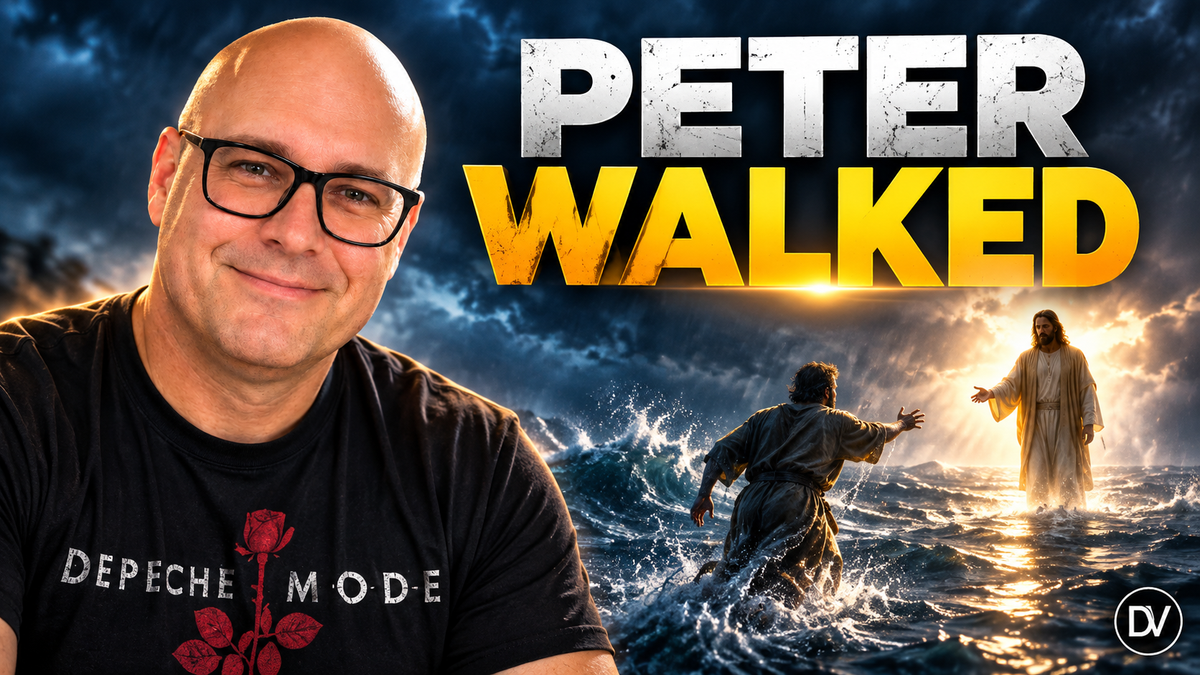
A lot of people know the scene in Matthew 14 well enough to picture it without opening a Bible. The disciples are in a boat fighting the wind. Jesus comes toward them on the water. Peter gets out, walks toward Him, becomes afraid, and begins to sink. The story is often reduced to a warning about taking your eyes off Jesus. That warning has truth in it, but it can become so dominant that we miss what the passage says to someone who is already trying to follow Christ under pressure. Peter was not standing safely on shore criticizing somebody else’s faith. He was already out on the water. That is why this reflection on trusting Jesus when fear takes over belongs naturally beside Christian encouragement about faith under pressure. The story is not only about avoiding fear. It is also about what Jesus does with us when fear appears after obedience has begun.
That difference matters in real life because fear does not always stop us before the first step. Sometimes it waits until after we move. You can enter a difficult conversation with good intentions and wonder afterward whether you said the right thing. You can begin a new job with gratitude and spend the first week questioning whether you belong there. You can return to prayer after a dry season and discover that your doubts did not vanish simply because you opened your Bible again. Peter’s experience feels honest because he had enough trust to climb over the side of the boat, yet he was still human enough to react to wind and waves.
The storm did not begin when Peter stepped out. The wind was already there, the waves were already moving, and the boat was already struggling. Peter did not discover a brand-new danger halfway through his walk. What changed was his attention. He became newly aware of something that had been present from the beginning, and what had been part of the background suddenly filled his vision.
You may know that feeling from a morning when an unpaid bill is still sitting on the counter. Nothing about the amount changed overnight. You may even have gone to bed believing you could handle it. Then an email arrives about another expense, and suddenly the room feels smaller. Your mind races ahead to next week, next month, and every possible problem that has not happened yet. The numbers did not become frightening because God disappeared. Fear grew because your attention narrowed until the problem seemed larger than everything else.
That is one of the most useful ways to understand what happened to Peter. We sometimes imagine that strong faith would have prevented him from feeling fear at all. We may apply the same standard to ourselves and quietly decide that if we were really trusting God, we would not feel nervous, uncertain, tired, or overwhelmed. Peter gives us a more honest picture. He obeyed Jesus and became afraid. Both things were true in the same person within the same stretch of water.
That does not make fear harmless. Fear can distort our judgment, pull our attention away from what matters, and make us forget what we knew five minutes earlier. Jesus does not celebrate Peter’s doubt. Yet the response of Christ shows us that fear is not the same thing as abandonment. Peter begins to sink and cries out, “Lord, save me.” Matthew tells us that Jesus immediately reaches out His hand and catches him.
The word immediately changes the emotional center of the scene. Jesus does not make Peter prove that his faith has recovered before helping him. He does not leave Peter in the water long enough to embarrass him into becoming stronger. Peter calls, and Jesus reaches. The rescue happens before Peter has time to offer a better explanation of himself.
Imagine his hand in that moment. Peter is not forming a polished prayer or trying to sound spiritual. He is trying not to go under. His prayer is short because his need is immediate. That can be deeply comforting if you have ever sat somewhere with nothing impressive to say to God. A real prayer does not become less real because it is only a few words.
Picture a mother awake at two in the morning because her teenager is late coming home. The living room is dark except for the light from her phone. She has checked the time again, sent one more message, and tried not to imagine the worst. All she manages to whisper is, “Jesus, help me.” The front door may still be closed after she says it. Her phone may still be silent. Yet there is nothing spiritually inferior about that prayer. Peter’s prayer was simple too. He knew who to call when fear became larger than his ability to manage it.
This is where the familiar telling of the story can become harsher than the passage itself. We remember that Jesus asks Peter why he doubted, and we can hear those words as though Christ is scolding him from several feet away. But the sequence matters. Jesus has already caught him. Peter receives correction from the One whose hand is holding him above the water.
That changes how we understand correction from Christ. Jesus can tell the truth about our fear without rejecting us. He can expose what needs to grow while remaining close. A hard question from Him does not mean He has walked away. Sometimes the lesson reaches us while grace is already carrying our weight.
You may experience that in a quieter setting after you have said something you regret. The argument is over, the room is still, and you can finally hear your own words clearly. You know you were defensive. You know fear or pride spoke too quickly. There are two easy ways to respond. One is to excuse everything and learn nothing. The other is to condemn yourself until one bad conversation becomes proof that you are a bad person. Jesus offers a better kind of honesty. He can show you what was wrong without making that moment the final definition of who you are.
Peter was not renamed “the man who sank.” His fear did not become the title of his life. Even calling the moment a failure can be misleading if we are careless with the word. Peter faltered, doubted, and needed rescue, but he also stepped out when Jesus called him. Courage and fear existed in the same story, and Christ stayed engaged with him through both.
That is the perspective shift worth carrying into your own difficult season. The presence of fear does not automatically prove the absence of faith. Sometimes fear becomes visible precisely because you have stepped into something that matters. A person who never leaves the boat may never discover the particular fears that appear once obedience becomes costly.
This does not mean every risky decision should be labeled faith. Peter did not jump out because he wanted to prove how brave he was. He asked Jesus to call him, and Jesus did. The center of the moment is not thrill-seeking or self-confidence. Peter moved in response to Christ.
That distinction matters when you are trying to make sense of a difficult choice. Faith is not chasing danger so you can feel spiritual. It is not ignoring wisdom or pretending consequences do not exist. There are times when following Christ requires restraint, patience, counsel, and a willingness to wait. The important question is not whether a path feels frightening. What matters is whether you are moving toward Jesus in a way that is faithful to what He teaches.
Sometimes that kind of faith looks almost ordinary. You may be sitting in your car outside an office before a difficult meeting. You know you need to speak honestly without becoming combative. Your stomach is tight, and part of you would rather drive away. There is no crowd watching and no dramatic music playing. You turn off the engine, ask Jesus for wisdom, and walk through the door. That may not look like walking on water, but the inner movement can feel very similar. You are choosing obedience while fear is still present.
Much of Christian life happens in places like that. Faith enters kitchens, hospital waiting rooms, conference rooms, parking lots, bedrooms, and quiet conversations where no one applauds the right choice. It is tested when the future is unclear and when following Christ does not immediately make the situation easier.
Peter’s experience also reminds us that the first step is not the whole story. A sincere beginning does not guarantee that you will feel equally strong every hour afterward. You can trust Jesus in the morning and feel overwhelmed by afternoon. You can make a courageous decision and still need reassurance later. The need for help does not make the beginning fake.
There is freedom in seeing the story that way because it keeps you from rewriting your entire walk with God every time you have a hard day. One frightened afternoon does not cancel years of faithfulness. A season of questions does not erase every prayer you have prayed. A weak moment does not prove that everything before it was an illusion.
The disciples saw the whole sequence. They saw Peter leave the boat, walk, sink, cry out, and get caught. All of those details belong to the same story. We become unfair to ourselves when we keep only the part that embarrasses us and throw away everything else God was doing.
You may have been doing that without realizing it. Perhaps you remember the moment you panicked more clearly than the months you kept showing up. You may remember the conversation you handled badly while forgetting the patience you practiced before it. You may remember that you doubted but overlook the fact that you prayed while doubting. Even the decision to ask for help can reveal humility that fear would rather hide from you.
Peter’s story invites a more truthful reading of our lives, one that is neither flattering nor cruel. You can admit that you were afraid without turning fear into your identity. You can admit that you needed help without deciding your faith was worthless. You can say that the wind got your attention while still recognizing that Jesus never moved.
That is where this familiar passage becomes personal. Most people know what it feels like to start sinking in some area of life. The deeper question is what we believe about Jesus when it happens. If we imagine Him far away, disgusted by weakness and waiting for us to become impressive again, we will hide. If we remember the Christ who was close enough to reach Peter immediately, we can call to Him honestly.
The passage does not promise that every storm ends the second we pray. In Matthew 14, the wind calms when Jesus and Peter return to the boat. That means there is still some distance between rescue and calm. Peter is caught before the circumstances fully change, and that detail may be one of the most realistic parts of the whole story.
There are seasons when the help of Christ becomes clear before the answer does. You may know that you are being carried even though the medical result has not changed, the relationship is not repaired, the money is still tight, or the decision is still difficult. His presence does not always remove the remaining distance, but it changes how you travel through it.
If that is where you are today, you do not need to reduce your story to the moment you became afraid. Peter’s story is bigger than the sinking, and yours is bigger than the worst five minutes you can remember. The wind may have gotten your attention, but Jesus was still there when Peter called. That is not a small detail. It is the reason the story ends with Peter returning to the boat instead of disappearing beneath the water.
When fear tries to rewrite everything, remember the whole story. Remember the step you took, the Christ you were moving toward, the moment you called for help, and the hand that did not hesitate to reach for you. Your fear may tell part of the truth about what you felt, but it does not get to tell the whole truth about what Jesus was doing.
Chapter 2: The Wind Was Already There
There is a certain kind of fear that does not arrive with a loud crash. It appears after the decision has already been made. You have signed the paper, accepted the responsibility, started the treatment, told the truth, or finally taken the first step, and then the questions begin. You are standing in the grocery store, pushing a cart past the same shelves you have walked past a hundred times, when your mind suddenly starts working against you. What if I made the wrong choice? What if I cannot handle this? What if everything gets worse from here? Nothing around you has changed in that moment. The lights are still buzzing overhead. Someone is comparing cereal prices three feet away. Your phone is still in your pocket. But inside, the wind has picked up.
That is what makes Peter’s experience so useful. The wind was already blowing before he stepped onto the water. The storm was not created by his obedience. Jesus did not invite him into calm water and then surprise him with trouble. Peter stepped toward Christ in the middle of conditions that were already difficult. The danger was visible from the boat, and yet something about hearing Jesus say, “Come,” made the next step possible.
Then Peter noticed the wind in a different way.
That difference is easy to miss because we often assume fear is caused only by new information. Sometimes it is. A doctor gives you a diagnosis you did not expect. A manager tells you your position is being eliminated. A relationship changes in one conversation. Those moments bring real new pressure. But there are other times when fear grows even though the facts have not changed. The same issue that was manageable yesterday feels impossible today because your attention has shifted, your body is tired, or your imagination has started running ahead of reality.
You can see this in the person who checks a bank account late at night. The balance is the same balance that was there at noon, but it feels more threatening at 11:47 p.m. when the house is quiet and every future expense seems to line up at once. The mortgage is due next week. The car has been making a strange sound. One child needs new shoes. Another expense is coming that was not in the plan. The numbers are real, but fear starts adding things that are not yet real. It fills in the blank spaces with the worst possible ending.
Peter does not appear to sink because the water suddenly became less able to hold him. He begins to sink when fear takes control of his attention. That does not mean the wind was imaginary. The wind was strong. The waves were real. Faith never requires us to pretend that difficult things are not difficult. The lesson is not that Peter should have denied the storm. It is that the storm became larger in his vision than the One who had called him.
That happens to us more often than we admit.
You can know that God has carried you through hard seasons and still wake up one morning convinced that this next problem is finally the one that will undo you. You can remember answered prayers and still wonder whether heaven has gone quiet. You can have years of evidence that you are not alone and still feel deeply alone on a Tuesday afternoon when nobody returns your call.
Fear has a way of making the present problem feel unlike every problem that came before it. It whispers that this time is different. This time the wind is too strong. This time the money is too tight. This time the relationship is too damaged. This time you are too tired. This time there is no way through.
That voice is persuasive because it usually mixes truth with exaggeration. The money may really be tight. The relationship may really be strained. Your body may really be tired. Christian faith does not require dishonest optimism. Jesus never told Peter that the wind was not blowing. He called Peter to keep moving toward Him while it was.
There is a difference between seeing the storm and surrendering your entire attention to it.
Think about someone sitting in a hospital waiting room while a family member is in surgery. The plastic chair is uncomfortable. A television mounted high on the wall is playing a program nobody is really watching. Every time the door opens, the person looks up. The surgery was necessary. The doctors explained the plan. The family prayed before the patient was taken back. Then the waiting begins, and the mind tries to fill the silence. What if there is a complication? Why is this taking so long? Should someone have come out by now?
The facts have not necessarily changed. The waiting itself has become the wind.
In moments like that, faith is not a demand that you feel peaceful every second. Sometimes faith is simply refusing to let your fear become your only source of information. It is remembering that your feelings are real without treating them as final authority. It is allowing yourself to say, “I am scared,” and then adding, “but fear does not know everything.”
Peter’s fear knew the wind was strong. It did not know what Jesus was about to do.
That is one reason we should be careful about making permanent conclusions during temporary panic. A frightened mind wants certainty immediately, and if it cannot find hopeful certainty, it may settle for negative certainty instead. We tell ourselves the relationship is over, the opportunity is lost, the prayer will never be answered, the future is ruined, or God must be disappointed in us. Fear would rather have a terrible answer than live with an unanswered question.
Jesus often meets us in that unanswered space.
The disciples could not control the weather. Peter could not control the sea. Their security came from something outside their control: Christ was present, and His authority was not threatened by the storm. That truth does not give us control over every outcome, but it gives us a place to stand when control is gone.
A father may understand this when his adult child is making choices he cannot fix. He has offered advice, listened, prayed, and tried to keep the relationship open. Still, he lies awake wondering whether he should do more. There is a terrible helplessness in loving someone you cannot manage. He may be tempted to believe that if he worries hard enough, he is somehow being more responsible. But worry is not the same thing as love, and control is not the same thing as faithfulness.
Sometimes the faithful thing is to remain present without pretending you can determine another person’s path.
That is difficult because fear often makes action feel safer than trust. We want to send one more message, make one more call, reread one more symptom page, check the account one more time, search for one more answer. There are situations where action is wise and necessary. But there are also moments when all that extra motion is really an attempt to escape the discomfort of not knowing.
Peter could not calm the wind by studying it harder.
Neither can we.
There comes a point when attention itself becomes a spiritual decision. What are you going to keep staring at? What will you allow to define the size of your world? What gets the largest share of your imagination?
This does not mean you should ignore responsibilities. If the bill is due, make a plan. If the doctor told you to follow up, make the appointment. If the relationship needs an honest conversation, have it. Faith should make us more honest about reality, not less. But after you have done what is yours to do, you still have to decide whether fear gets the rest of the night.
There is a woman who finishes work, gets home, feeds the dog, reheats leftovers, and sits down at the end of the day. Her company has been restructuring for weeks. Nobody has told her that her job is in danger, but rumors are everywhere. She opens her laptop because she tells herself she is going to update her résumé. Twenty minutes later, she is reading message boards about layoffs at other companies, comparing numbers, and imagining the worst. By midnight, she feels as though she has already lost a job she still has.
The wind was already there, but her attention turned it into the whole horizon.
There is wisdom in preparing. There is wisdom in updating the résumé. There may even be wisdom in quietly exploring other opportunities. But there is no wisdom in suffering tomorrow’s loss tonight when tomorrow has not arrived.
Jesus taught people not to be consumed by tomorrow’s trouble. That instruction is not shallow. It recognizes how much pain we can create by mentally living inside futures that do not exist yet. Today may already contain enough responsibility. Fear tries to make you carry today, tomorrow, next month, and every imagined disaster at the same time.
Peter only had one step in front of him.
So do you.
That is not a small idea. It can change the way you move through pressure. You do not need enough strength today for every possible future. You need enough grace for the next faithful step. Sometimes that step is a conversation. Sometimes it is rest. Sometimes it is opening the bill instead of avoiding it. Sometimes it is closing the laptop because you have already done enough for one evening.
There is also a physical side to fear that Christians sometimes overlook. Peter was in a storm. His body would have been responding to real danger: wind, spray, movement, darkness, unstable footing. We are embodied people too. Lack of sleep, constant stress, hunger, illness, pain, and exhaustion can all make fear louder. That does not mean every anxious thought is merely physical, but it does mean we should stop treating ourselves like disembodied minds.
A caregiver may discover this after weeks of interrupted sleep. During the day, she is managing medications, appointments, meals, phone calls, and paperwork. She loves the person she is caring for, but by evening every small problem feels enormous. She may interpret that exhaustion as spiritual failure when part of what she needs is simply help, rest, and permission to admit that she is tired.
Jesus did not shame human limitation. He knew His disciples needed sleep, food, and rest. He also knew when they were afraid. Mature faith does not require us to ignore the way strain affects us. Sometimes turning our attention back toward Christ includes making an honest decision about what our bodies and minds can reasonably carry.
That can mean asking for help before the crisis gets worse. It can mean telling someone you trust that you are not doing as well as you look. It can mean going to bed instead of solving one more problem at midnight. Those choices can be acts of humility because they reject the idea that everything depends on you.
Peter’s rescue began when he admitted that he could not save himself.
“Lord, save me.”
There is no image management in that prayer. No pretending. No attempt to look competent in front of the other disciples. He is sinking, and he says what is true.
That kind of honesty is part of faith too.
We often celebrate the faith that steps out of the boat, and we should. But there is also faith in the cry for help. It takes humility to stop pretending you have control. It takes trust to call on Christ when you have reached the end of yourself. Peter’s words reveal that even in panic, he still knew where rescue was.
You may not feel spiritually strong right now. You may be tired of your own thoughts. You may have spent more time this week looking at the wind than looking toward Jesus. None of that prevents you from telling Him the truth.
You can pray from exactly where you are.
You do not have to clean up your emotions first. You do not have to wait until you feel calm. You do not have to produce a better version of yourself before you speak. Peter did not.
The practical shift is smaller than we sometimes imagine. You notice that fear has taken over your attention, and instead of arguing with yourself for an hour, you return to what is true. You name the actual problem without adding ten imaginary ones. You do the next responsible thing you can do. Then you give the part you cannot control back to God.
You may have to repeat that process many times.
That is not failure. Attention wanders. Fear returns. The mind reaches for control. You notice it, and you come back.
There is something steadying about realizing that spiritual maturity may look less like never feeling fear and more like learning how to return. You return to prayer. You return to truth. You return to the character of Christ. You return to the next faithful step.
Peter had already seen Jesus do extraordinary things before that night, yet the wind still frightened him. Past faithfulness does not make us immune to present fear. It gives us something to remember when fear arrives.
Maybe that is what you need today: not a dramatic new sign, but a better memory.
Remember a season you thought would break you but did not. Remember the call that came at the right time, the strength you found when you thought you had none, the person who showed up, the prayer that was answered differently than you expected but still carried you forward. Memory can become a way of widening your vision again.
The wind wants to shrink your world to one problem.
Faith widens it enough to include Jesus.
That does not erase the pressure. It puts the pressure in a larger story.
Peter was not walking toward an idea. He was walking toward a Person. That remains one of the most important truths in the passage. Christianity is not merely a method for managing anxiety. It is a relationship with Christ. The goal is not to become so mentally disciplined that nothing bothers you. The goal is to keep learning who Jesus is when something does.
And what Peter discovered was that the same Jesus who called him onto the water was still there when he started sinking.
The storm did not expose the absence of Christ.
It exposed how quickly Peter could lose sight of Him.
There is a difference.
If the wind feels loud in your life right now, you do not have to pretend otherwise. Call it what it is. Be honest about the pressure. Deal with what actually needs your attention, and allow yourself to seek help when the weight is too much to carry alone. Then remember that none of those honest responses require you to hand fear the final word.
The wind was already there when Peter stepped out.
Jesus was too.
Chapter 3: The Hand That Reaches Before the Storm Ends
The morning after a hard night can feel strangely ordinary. The coffee maker still clicks on, the same light comes through the blinds, and the same shoes are by the door. Yet you may wake up feeling as though something inside you has shifted. Maybe you spent half the night worrying about a decision, a person you love, or a problem you cannot solve. By morning, nothing has been fully resolved. You still have work to do, messages to answer, and responsibilities waiting for you. What you need most may not be a dramatic sign. You may simply need to know that you are not facing the day alone.
That is where Peter’s story becomes more than a lesson about fear. He does not receive help only after the storm disappears. Jesus reaches for him while the wind is still blowing, which means the rescue comes before the calm. We often assume peace should arrive only when circumstances improve. We tell ourselves we will breathe easier after the test result, after the payment comes through, after the relationship is repaired, or after the uncertainty ends. Until then, we imagine ourselves stuck in a waiting room between fear and relief.
Peter’s experience gives us another possibility. The presence of Christ can become real before the situation changes. A man may be sitting in his truck before sunrise, getting ready to walk into another long shift while tension at home follows him into the parking lot. The conversation from the night before is still playing in his head. He turns off the radio and sits for a moment with both hands on the steering wheel. Nothing is solved, and he still has to go inside, but he asks Jesus to help him be patient and steady for the next few hours. The circumstances are not calm, yet he no longer feels as though he has to carry them entirely by himself.
That kind of stability is not denial. It is learning that steadiness can come from a Person before it comes from an outcome. Peter’s hand in the hand of Jesus is a picture worth holding onto because Peter had already discovered the limits of his own strength. Whatever confidence got him out of the boat was no longer enough to keep him above the water. His weakness became the place where he experienced the strength of Christ in a way he could not have experienced while remaining safely in the boat.
We do not need to chase failure in order to experience God, but we can stop assuming weakness makes us useless to Him. Some of the deepest lessons of faith arrive when we can no longer impress ourselves. There is a quiet pride in wanting to be the person who always handles things well. We like being dependable and knowing what to do, and those qualities can be good. The trouble begins when being capable becomes an identity we are terrified to lose.
Life eventually gives almost everyone a situation that cannot be managed through competence alone. A parent who has spent years holding a family together may become the one who needs help. A business owner who usually has an answer may have to admit to the team that the next step is unclear. The person everyone calls for encouragement may wake up one morning and realize he is the one who needs someone to sit beside him. Those moments can feel uncomfortable because they expose how much confidence was tied to being the strong one.
Peter could not save himself from the water by becoming more impressive. He had to receive help, and there is something freeing about that. Christianity does not ask you to become so strong that you no longer need Christ. Spiritual maturity actually makes dependence on Him more honest. In ordinary life, growing up often means becoming more self-sufficient, but faith moves differently. The more clearly we see Jesus, the more clearly we understand that needing Him is not humiliation. It is relationship.
A person recovering from a major setback may understand this in a very practical way. There can be a day when pride says, “I should be further along by now,” while reality says, “You still need assistance.” Accepting help can feel harder than offering it. Yet sometimes courage looks like allowing another person to carry the box, drive the car, prepare the meal, or sit nearby while you figure out what comes next. Faith can ask for the same humility because we cannot receive what we are determined to pretend we do not need.
You may be tempted to present God with a finished version of yourself. Perhaps you think you should pray after you have calmed down, return to church after you have sorted yourself out, or open Scripture again after you feel more worthy. Peter did not have time for any of that. He called to Jesus from the middle of the problem, and that is exactly where Christ met him.
It is easy to imagine that Jesus is closest to us when we are doing well, but the Gospel accounts repeatedly challenge that assumption. Jesus moves toward people who are frightened, grieving, sick, confused, or ashamed. He does not approve of every choice they make, but their need does not frighten Him away. The same Christ who told Peter to come did not become a different Christ when Peter became afraid. That can change the way you pray after a difficult day because you no longer have to begin by pretending you are doing better than you are.
Consider the person who receives a message from someone they have not heard from in months. The relationship ended badly, and the sight of the name on the phone brings back anger, confusion, and hurt. The first impulse may be to answer immediately or ignore it forever. Instead, the phone goes down on the table, and the person takes a short walk before deciding what to do. A quiet prayer during that walk does not erase the history. It simply keeps the first wave of emotion from becoming the only voice in the decision.
That is what looking back toward Jesus can look like in ordinary life. It may be a pause before you hit send or the decision to sleep before making a choice while angry. It may be the moment you admit that you are too upset to have a useful conversation tonight and choose to return to it tomorrow. These small decisions are not dramatic, but they are often where faith becomes lived instead of merely discussed.
Peter’s return to the boat deserves attention too. Matthew tells us that when Peter and Jesus got into the boat, the wind ceased. Whatever those steps back looked like, Peter returned with Jesus. Rescue was not merely a hand pulling him above the surface and then leaving him to finish alone. Christ remained with him for the distance that was still ahead.
Sometimes we ask God for a single moment of help when what we really need is companionship for the road that remains. We want the fear gone immediately, the grief finished, or the uncertainty removed. Yet there are seasons when Jesus seems to help us differently. He steadies us enough to keep going while the larger situation takes time, and we begin to discover that His presence is not merely a bridge to the answer. His presence is part of the answer.
A widow may discover this during the first year after losing her husband. There is paperwork to handle, accounts to change, clothing still hanging in the closet, and an empty chair that catches her eye when she least expects it. No single prayer makes all of that disappear. Yet there may be strength on a morning when she thought she had none, a friend who calls at the right time, or a passage of Scripture that suddenly feels personal in a new way. One day she realizes that another difficult week has passed and she was carried through it.
The storm is not gone simply because she has faith, but she is not walking through it without Christ. That distinction matters because shallow encouragement can make suffering people feel unseen. Telling someone to “just have faith” can sound like an accusation when that person is already holding on as tightly as possible. Peter’s story is more compassionate than that. It shows us a disciple whose faith and fear collide and a Savior who remains close enough to rescue him.
The goal, then, is not to build a life in which you never need rescue. It is to know who to call when your own strength is not enough. Over time, that knowledge changes you. You may still notice the wind, but you recognize sooner that it does not deserve all of your attention. Fear may still speak, but you become less willing to treat it as prophecy. A stumble may still hurt, but you stop assuming every stumble means the story is over.
You can see that growth when an anxious thought arrives and you no longer follow it all the way to catastrophe. You deal with the actual problem in front of you and let tomorrow remain tomorrow. You become willing to ask for help before exhaustion turns into collapse. Prayer starts becoming part of the way you walk rather than an emergency button you press only after every other option has failed. You stop judging the strength of your faith by how calm you feel and begin noticing where you return when calm is gone.
Peter returned to Jesus even while sinking, and there is hope in that for anybody who feels spiritually unsteady. Maybe the strongest thing you can do today is simply return after the anxious night or the argument that left you ashamed. Maybe disappointing news has occupied your mind for three straight days, and you realize you have thought far more about the wind than about Christ. Returning does not require a perfect speech. You can come back honestly and tell Jesus exactly where your mind has been.
The detail that changes the whole scene is still the same: Jesus reached immediately. That does not mean every answer comes immediately or every circumstance changes on demand. It means Peter did not have to earn Christ’s attention at the moment he needed Him most. If you are somewhere between the boat and the place you thought you would be by now, do not reduce your life to the fact that you became afraid. Look at the whole story. Stepping out taught you something about your limits, and calling for help revealed that Christ was still there.
There will be days when following Jesus feels strong and clear. There will also be days when your prayer is little more than asking Him to help you get through the day. Both can belong to a real life of faith because the deepest hope in Peter’s story is not Peter’s ability to maintain perfect focus. It is the steadiness of Christ when Peter cannot.
That is why the familiar story looks different when we stop making the sinking the center of it. Peter’s walk began with the call of Jesus, and his fear did not erase that beginning. When he could no longer keep himself above the water, he still knew where to turn. His weakness changed the moment, but it did not change Christ. Jesus reached for him, stayed with him on the way back, and only afterward did the wind become calm.
The order is worth remembering when your own life feels unfinished. You may still be waiting for the phone call, the answer, the reconciliation, the open door, or the morning when the weight finally feels lighter. You do not have to pretend the waiting is easy. You only have to remember that Christ does not wait on the other side of the storm for a stronger version of you to arrive. He meets you in the middle of it.
So when an ordinary morning follows a difficult night, make the coffee, open the blinds, and take the day you have actually been given. Do what is yours to do without trying to carry every possible tomorrow at once. Speak to Jesus before fear writes an ending that has not happened. If your confidence wobbles, do not turn that moment into a verdict on your entire faith. Peter’s story gives you better evidence than that.
The man who sank was also the man who stepped out of the boat, and the moment he could no longer hold himself up, Jesus did not hesitate. That is the part worth carrying with you into whatever comes next. You are not trusting in your ability to be fearless. You are learning to trust the One whose hand remains steady when yours is not.
Your friend,
Douglas Vandergraph
Explore the complete Douglas Vandergraph Master Index:
https://douglasvandergraph.com/douglas-vandergraph-master-index/
Watch Douglas Vandergraph’s faith-based videos on YouTube:
https://www.youtube.com/@douglasvandergraph