The Mirror Jesus Put in Our Hands

Chapter 1: The Correction That Changes When You Look Inward
The conversation starts in the kitchen after the plates have been cleared. A mother tells her adult daughter that she has become too sharp with people lately. She says the daughter interrupts, assumes the worst, and turns every disagreement into a fight. The daughter listens for a minute, then quietly says, “Do you hear how you are talking to me right now?” The room goes still because the mother suddenly realizes that the very thing she came to correct is present in her own voice.
That uncomfortable moment gets close to what Jesus meant when He said judge not. Most people hear those words as a command to stop recognizing what is wrong. They assume Jesus was telling us never to question harmful behavior, never to challenge dishonesty, and never to tell someone that a pattern is causing damage. But Jesus was not asking us to become blind. He was asking us to stop acting as though we can see everyone else clearly while refusing to look honestly at ourselves.
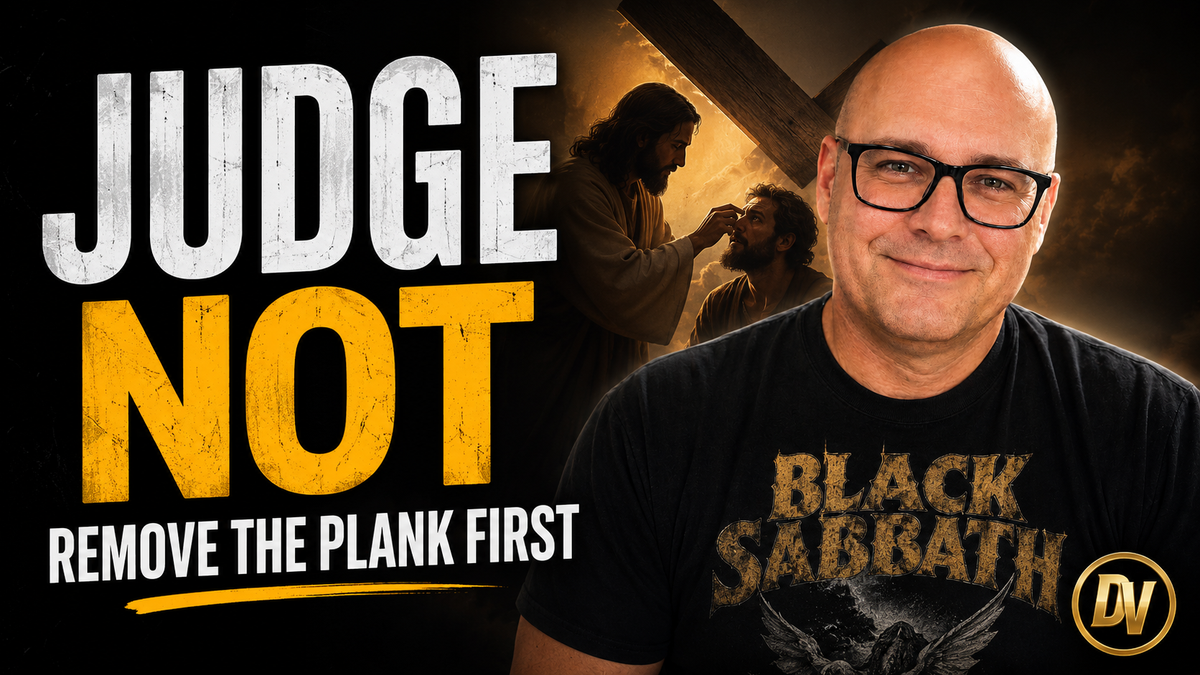
That is why learning to correct others without becoming hypocritical begins with a mirror, not a finger. Before Jesus talked about helping someone remove a speck from their eye, He talked about the plank in our own. The order matters. He did not say the speck was imaginary. He did not say the other person never needed help. He said our own blindness must be faced before our correction can become clear, useful, and loving.
This is the part of “judge not” that changes the whole teaching. Jesus was not forbidding all judgment. He was changing the position from which judgment is made. He was confronting the habit of standing above another person while pretending that our own failures do not belong in the conversation.
Most of us understand this problem better than we want to admit. We notice someone else’s impatience while ignoring the cold tone in our own voice. We criticize another person for being self-centered while arranging every conversation around our own needs. We become angry when someone stretches the truth, yet we defend our own omissions as necessary or harmless.
The issue is not that the other person has done nothing wrong. The issue is that we often become very accurate about their failure and very creative about explaining ours.
Jesus used a picture that no one could easily forget. A person with a plank in his own eye is trying to remove a speck from someone else’s eye. The image is almost absurd. The person doing the correcting cannot see clearly, yet he is convinced that the urgent problem is somewhere else.
That is what hypocrisy does. It does not always make us completely wrong about another person. It makes us blind to the way our own pride, anger, fear, or insecurity is shaping the correction.
A husband may be right that his wife is not listening, but he may raise the issue by refusing to listen to her. A supervisor may be right that an employee needs to become more dependable, but he may deliver the message after repeatedly changing expectations without warning. A friend may be right that someone is becoming too critical, but she may explain it by tearing that person apart to everyone else.
The speck can be real while the plank is still making the situation worse.
That is why self-examination is not a delay tactic. It is part of responsible correction. Looking inward does not mean we talk ourselves out of every concern. It means we become honest about what we are bringing into the room.
Before speaking, we may need to ask whether we are trying to help or trying to win. We may need to admit that the other person’s behavior touched an old wound and made our reaction larger than the present moment. We may need to recognize that we have been asking for a standard we do not consistently practice ourselves.
These questions are not designed to silence us. They are designed to clear our vision.
There is a major difference between discernment and condemnation. Discernment says, “Something is wrong here, and it needs to be addressed.” Condemnation says, “Something is wrong with you, and that makes me better than you.”
Discernment stays connected to the actual behavior. Condemnation turns one behavior into a final statement about the person’s identity.
That difference often appears in ordinary language. A parent can say, “You lied to me about where you were, and that damaged trust.” Or the parent can say, “You are a liar, and I cannot believe anything you say.” The first statement addresses the action and the consequence. The second turns the action into a permanent label.
Words like that can stay with someone for years.
Jesus never taught us to pretend harmful behavior is harmless. He taught us to see people as more than the thing that needs correction. That becomes much easier when we remember that we also have areas where God is still working on us.
The person correcting a lie has probably hidden something before. The person confronting pride has had proud moments. The person addressing anger has said things in anger that needed to be repaired. None of this cancels the present concern. It removes the illusion that correction comes from someone who has never needed correction.
Humility changes the tone because humility remembers grace.
Imagine the mother in the kitchen taking a breath after her daughter points out the harshness in her voice. She could defend herself. She could say, “Do not change the subject. We are talking about you.” That would allow her to protect her authority while missing the truth.
Or she could say, “You are right about my tone. I need to correct that. I still believe we need to talk about how you have been treating people, but I do not want to do the same thing while I am saying it.”
That response does not weaken her concern. It makes her concern more trustworthy.
The daughter may still need to hear hard truth. The conversation may still be uncomfortable. There may still be patterns that need to change. But now the mother is not pretending she is standing on higher ground. She is entering the conversation as someone who is willing to live by the same standard.
That is the shift Jesus was calling for.
Some people hear this and assume it means we must become perfect before we can ever correct anyone. That cannot be the meaning. If perfection were required, no parent could guide a child, no leader could address misconduct, no friend could warn another friend, and no community could protect itself from harm.
Jesus did not say, “Wait until you never fail.” He said, in effect, “Deal honestly with what is blocking your vision.”
Removing the plank means facing the part of us that wants to correct without being corrected. It means admitting where we have contributed to the problem. It means being willing to apologize for our tone even when the main issue still belongs to the other person.
That kind of honesty requires strength.
It is easier to act certain than to admit mixed motives. It is easier to point outward than to notice how our own fear is affecting the conversation. It is easier to call someone disrespectful than to acknowledge that we entered the room already prepared for a fight.
The plank often looks like certainty.
We become so sure of our reading of another person that we stop asking questions. We assume we know why they acted the way they did. We assign motives without evidence. We decide that one moment reveals the whole heart.
Then we call our assumption discernment.
Jesus slows us down. He reminds us that we can judge actions more accurately than we can judge souls. We may know that someone lied. We do not automatically know every fear, pressure, or belief beneath the lie. We may know that a decision caused harm. We do not know everything God knows about the person who made it.
This does not excuse the action. It limits our pride.
There are moments when clear judgment is necessary. A parent must decide whether a situation is safe. A business owner must decide whether an employee can still be trusted with money. A church leader must decide whether a volunteer should remain around vulnerable people. A friend may need to say that addiction, manipulation, or cruelty is destroying a life.
Jesus was not telling us to avoid those decisions.
He was teaching us to make them without pretending we are God.
That is an important distinction because some people use “judge not” to silence the very people who are trying to tell the truth. A person who has been harmed may be told not to judge the one who harmed them. A leader may be pressured to ignore a pattern because accountability feels uncomfortable. A family may protect a destructive person by accusing everyone else of being unforgiving.
That is not humility. It is confusion.
Humility does not erase boundaries. It makes boundaries more honest. Humility can say, “I know I am not perfect, but this behavior is still dangerous.” It can say, “I have needed grace, and this still cannot continue.” It can hold a person accountable without enjoying their humiliation.
The absence of superiority does not require the absence of courage.
That may be one of the clearest lessons for people who struggle with this teaching. We do not have to choose between condemning others and saying nothing. There is a faithful middle ground where truth and mercy meet.
In that middle ground, we examine ourselves first. We correct our own tone. We admit where we have failed. We make sure our concern is connected to what actually happened. Then we speak because silence would allow harm, dishonesty, or confusion to grow.
The goal is not to prove that we are better. The goal is to help bring what is hidden into the light.
That goal changes the way correction feels.
A person who wants restoration asks questions before making accusations. A person who wants truth stays close to the facts. A person who wants to help does not gather an audience for private shame. A person who understands grace can be firm without making cruelty feel righteous.
This is where many of us need the teaching of Jesus most. We live in a world that rewards instant judgment. A few seconds of video can become enough for thousands of people to decide who someone is. A sentence can be separated from its setting. A mistake can become a permanent identity.
People rush to condemn because condemnation gives the quick satisfaction of certainty.
But certainty is not always clarity.
Sometimes we do not know enough. Sometimes the wisest and most faithful response is to wait. Sometimes the plank in our eye is our desire to have an opinion before the truth is fully known.
That does not mean we refuse to speak forever. It means we respect truth enough not to rush past it.
Jesus was not trying to create people who never notice what is wrong. He was trying to create people who can notice what is wrong without becoming proud, careless, or cruel.
The mother in the kitchen still needs to finish the conversation with her daughter. The issue has not disappeared. But the conversation is different now because the mother has allowed the truth to reach her first.
That is what the mirror does.
It does not tell us that the other person has no speck. It shows us why we were not ready to reach for it yet.
Chapter 2: The Need to Be Right Can Hide Inside Concern
The meeting has been over for twenty minutes, but one employee is still standing beside the conference-room table while everyone else has returned to work. He is upset because a coworker challenged his decision in front of the team. He keeps saying that the real issue is accountability, yet every sentence circles back to the same point: she embarrassed him, and now he wants her to understand what it feels like to be exposed.
That is how judgment often hides inside concern. We tell ourselves that we are protecting standards, defending truth, or helping someone grow, and sometimes we are. Yet a good purpose can become mixed with a wounded ego so quietly that we do not notice the change. What begins as a legitimate concern can become a need to prove that we are right and the other person is wrong.
Jesus understood that mixture. His warning about judging was not only about people who openly condemn others. It was also about the hidden motives that shape the way we correct, confront, and evaluate. A person can identify a real problem and still address it from the wrong place. The facts may be accurate while the spirit is distorted.
That is why looking inward has to go deeper than asking whether the other person did something wrong. We also have to ask what their wrongdoing awakened in us. Did it touch our pride? Did it make us feel ignored, disrespected, threatened, or unimportant? Are we correcting the behavior because it must be corrected, or because correction gives us a chance to regain control?
These questions matter because motive changes the meaning of our words. A true statement can be spoken with care or contempt, and a reasonable boundary can protect people or become a way to punish someone. Truth remains truth, but the heart delivering it affects whether it becomes light or a weapon.
The employee in the conference room may have every right to address what happened. Public disagreement can be handled poorly, and a coworker may have crossed a line. The answer is not to dismiss his concern. The answer is to help him see whether his concern is still about the issue or whether it has become a way to recover wounded pride.
That distinction can be difficult because pride rarely introduces itself honestly. It does not admit that it wants to make another person feel small. Instead, it borrows the language of responsibility and says that people need to learn that actions have consequences. It does not confess a hunger to be proven right. It says the team deserves clarity because that sounds honorable.
This is why Jesus used the plank in the eye. A plank does not only block vision; it changes how we interpret what we see. We may be looking at a real speck, but our own injury, insecurity, or anger makes it appear larger, more personal, and more dangerous than it is.
A leader who fears losing authority may treat every question as rebellion. A parent who feels unappreciated may hear ordinary frustration as disrespect. A friend who carries an old betrayal may read hesitation as dishonesty. The present behavior may still need attention, but the response becomes heavier because the past has joined the conversation.
Self-examination helps us separate the current issue from the old wound. It does not require us to pretend that we have no emotions. It asks us to name those emotions honestly so they do not quietly control the response.
We can admit that we felt embarrassed, afraid, or angry without making the other person pay for everything those feelings awakened. We can recognize that the situation touched something deep in us and still decide that the response must stay connected to what actually happened.
This is one place where prayer becomes practical. Prayer before correction is not a religious formality. It is a way of slowing down long enough to let God show us what we are bringing into the room. A simple prayer such as, “Help me speak to the real issue and not use this moment to defend my pride,” can change the entire direction of a conversation.
That prayer may reveal that we need to wait before speaking. It may show us that our first version of the conversation was designed to win rather than help. It may also remind us that the person in front of us is not the enemy, even when the behavior is wrong.
Waiting does not always mean avoiding. A concern should sometimes be addressed quickly, especially when safety, trust, or ongoing harm is involved. Even then, a short pause can keep necessary correction from becoming a personal attack.
The employee could return to his desk and write down what actually happened. He could separate the facts from the feelings. The facts might be that his coworker challenged his decision in front of the team and did not give him a chance to explain. The feelings might be embarrassment, anger, and fear that the team now doubts his judgment.
Both deserve attention, but they should not be confused. When feelings are treated as facts, we begin making claims we cannot prove about what another person intended.
We may say the person was trying to undermine us, wanted to make us look foolish, or never respects anyone. Those statements move beyond the event and assign a motive. Once that happens, the other person is no longer being asked to discuss what occurred. They are being asked to defend the kind of person we have decided they are.
Jesus teaches us to stay humble about what we cannot fully know. We can often judge behavior with reasonable clarity and say that someone interrupted, lied, broke an agreement, or caused harm. What we cannot always know is why they did it. Even when we suspect the motive, humility leaves room for the possibility that our interpretation is incomplete.
That room matters because it keeps correction connected to truth. It allows us to ask, “What was happening for you in that moment?” instead of declaring, “You did that because you wanted to embarrass me.” One approach creates room for honesty, while the other closes it before the conversation begins.
There are times when the other person will reveal a motive that is still unhealthy. They may admit they were angry, jealous, or intentionally disrespectful. Humility does not require us to excuse that. It simply means we do not claim more knowledge than we have.
This kind of clarity is especially important when relationships already carry tension. A strained marriage, a difficult workplace, or a divided family can turn every new issue into proof of an old story. One person thinks the latest conflict shows that the other never cared. Another takes the same moment as proof that blame will always be placed on them. The present gets pulled into a larger case that has been building for years.
Correction can then become prosecution. The person raising the concern is no longer trying to understand one event. They are presenting evidence for a verdict reached long ago, and every new mistake becomes another exhibit.
Jesus interrupts that habit by calling us back to our own eye. Before we build the case against another person, we have to ask whether resentment is collecting evidence more eagerly than truth requires. We may discover that we have stopped listening because we are only waiting for another chance to prove our story.
That discovery can be painful, but it is also freeing. It means the relationship does not have to remain trapped in the role we assigned it. We can address the present without dragging every past failure into the room.
This does not mean old patterns should never be discussed. Repeated behavior matters, and history can reveal whether a problem is isolated or ongoing. Yet even when a pattern must be named, the goal should be clarity rather than character destruction.
A person can say, “This has happened several times, and it is damaging trust.” That sentence is very different from declaring that someone has always been selfish and will never change. One addresses a pattern that needs correction. The other closes the future and turns frustration into a permanent sentence.
Jesus never asks us to deny patterns, but He warns us against speaking as though growth is impossible. Grace tells the truth while leaving room for repentance, even when trust has to be rebuilt slowly or a relationship requires distance.
This is where the employee in the conference room has a choice. He can confront his coworker in a way that seeks understanding and a better working relationship. He can explain that the public challenge made collaboration harder and ask that future concerns be raised differently. He can also listen to whether his own decision process left people without a safe way to question him.
That last possibility may be the plank he did not expect to find. Perhaps the coworker handled the moment badly, but perhaps the team had learned that private concerns were dismissed. The public challenge may have been wrong and still have exposed a leadership habit that needed correction. Looking inward does not erase what the coworker did. It makes enough room for both truths to be seen.
That is one of the hardest parts of humility. We prefer clean stories where one person is wrong and the other is right. Real life often gives us mixed responsibility. Someone may owe us an apology, and we may still need to change. Their failure does not cancel ours, and ours does not cancel theirs.
Jesus teaches us to let truth reach everyone in the room, including us. When that happens, correction becomes less about winning and more about seeing clearly. We stop using another person’s mistake to protect ourselves from examination.
Being right about the issue is not enough if we become proud, cruel, or dishonest while addressing it. The goal is not merely to prove who failed. The goal is to bring the relationship, the team, or the situation closer to truth.
That may require courage from both people. The one who caused harm must face it. The one who was hurt must be willing to examine the way pain has shaped the response. Neither task is easy, but both are part of clear vision.
By the time the employee leaves the conference room, the issue may still need a conversation. The public disagreement did not become acceptable simply because he examined himself. What changed is the reason he will speak. He is no longer preparing to restore his pride by lowering someone else. He is preparing to tell the truth without hiding from the truth that may also come back to him.
That is what the mirror of Jesus does. It does not silence necessary correction. It purifies the reason we give it, allowing truth to reach the other person without being blocked by the part of us that also needs to change.
Chapter 3: When the Mirror Answers Back
The text message arrives late in the evening, after the house has gone quiet. It comes from someone you trust enough to know they are not trying to hurt you. The message is careful but direct: “I need to tell you something. Lately, when people disagree with you, you stop listening and start defending yourself.” You read it once, feel your chest tighten, and immediately begin building a case for why they are wrong.
This is the other side of “judge not” that many of us would rather avoid. We are willing to talk about how we should correct others with humility, but the teaching of Jesus also asks whether we are willing to receive correction with humility. It is difficult to remove the plank from our own eye if we become angry every time someone points toward it.
Most of us say we want honesty. What we often mean is that we want honesty delivered in a way that does not disturb the version of ourselves we prefer. We want feedback that confirms our good intentions, recognizes our effort, and leaves our identity untouched. When someone names a pattern we did not see, our first instinct may be to defend our motives rather than examine our behavior. That instinct is human, but it can keep us blind.
The person sending the message may not understand everything. They may be missing context. Their timing may be poor, or their wording may be imperfect. Still, the question is not only whether they expressed the concern flawlessly. The question is whether there is enough truth in it to deserve our attention.
This is where the teaching of Jesus becomes a mirror that answers back. We are not only called to notice hypocrisy before we correct someone else. We are called to remain teachable when someone helps us notice hypocrisy in ourselves.
That can be especially hard for people who carry responsibility. A parent is used to giving guidance. A leader is used to making decisions. A pastor, teacher, manager, or caregiver may spend much of life helping others see what needs to change. Over time, the role can create the illusion that correction mostly travels in one direction.
Authority does not remove blind spots. Sometimes it protects them. People may hesitate to tell a leader the truth because they fear the response. Family members may stay silent because every concern turns into an argument. Employees may stop raising problems because the person in charge explains away every mistake. The absence of correction can then be mistaken for proof that no correction is needed, but silence around us does not always mean clarity within us.
Imagine a small business owner who often tells his staff that he values honesty. He says he wants people to speak up when a process is not working. One afternoon, an employee carefully explains that last-minute changes are creating confusion and causing the team to redo work. The owner responds by listing all the pressures he carries, reminding the employee how much is at stake, and explaining why the changes were necessary.
Everything he says may be true. The business may be under real pressure. The decisions may have had reasons. Yet none of those explanations answer the concern. The employee was not asking whether the owner had reasons. She was explaining the effect of his choices. The owner can defend his intentions and still miss his impact.
That distinction matters because we often judge ourselves by what we meant and judge others by what they did. We say, “I was trying to help,” as if good intention automatically cancels harmful effect. But the person on the receiving end lives with the effect, not merely the intention.
Humility allows both truths to exist. We may have meant well, and we may still have caused harm. We may have been under pressure, and our response may still have been unfair. We may have been right about the main issue, and our tone may still need correction. Receiving that truth does not make us weak. It makes us honest.
The business owner could pause and say, “I can explain why I made those changes, but I hear that the way I made them created extra work and uncertainty. I need to look at that.” He has not surrendered his authority. He has shown that authority is strong enough to learn.
That kind of response changes a culture. People become more willing to tell the truth because they know the truth will not automatically be treated as disrespect. Problems surface earlier. Trust becomes more real. The leader does not become smaller by listening; the leadership becomes safer.
Jesus did not call His followers to defend an image of righteousness. He called them into truth. An image must be protected, but truth can survive examination. This is why defensiveness is such an important signal. Defensiveness does not always mean the criticism is correct, but it tells us that something feels threatened. Maybe our reputation is at risk. Maybe the concern touches an insecurity. Maybe we are afraid that admitting one failure will cause people to question everything about us.
When that fear rises, we may respond to a small correction as if someone is trying to erase our entire worth. The gospel gives us a better foundation. Our worth does not depend on being the person who is always right. We are loved by God while still being corrected by God. Grace does not require us to deny failure; grace makes it safe to face failure because failure is not the final word about who we are.
That changes the way we receive the message on the phone. Instead of asking only, “How do I prove this person wrong?” we can ask, “What might God be showing me through this?” We do not have to accept every accusation as truth, but we do have to remain open enough to test it honestly.
That testing may involve prayer, reflection, or a conversation with someone mature who knows us well. It may require looking for patterns rather than reacting to one statement. Have other people hinted at the same issue? Do similar conflicts keep happening? Do we often feel misunderstood in the same way? Repeated friction can be evidence that the problem is not always everyone else.
This is not an invitation to unhealthy self-doubt. Some people have been blamed unfairly for years and are quick to assume every conflict is their fault. Self-examination does not mean automatically accepting blame. It means examining the concern without pride or fear deciding the answer before the evidence is considered.
A clear response can still say, “I understand why you felt that way, but I do not agree with all of your conclusion.” Humility is not the absence of judgment. It is the refusal to protect ourselves from truth.
Sometimes, after careful reflection, we will discover that the concern was exaggerated or based on incomplete information. Even then, we can often learn something from how the situation was experienced. We may not agree with the accusation, but we may recognize that our communication left room for it.
At other times, the truth will be painful and plain. We have become impatient. We have stopped listening. We have used spiritual language to avoid apology. We have held others to standards we quietly bend for ourselves. That is the plank, and the moment we see it, we have a choice. We can explain it, hide it, or begin removing it.
Removal usually starts with ownership, not a polished statement designed to protect reputation, but a simple sentence: “You are right. I have been doing that.” Those words can feel costly because they remove the shelter of excuses. Yet they also open the door to change. What remains hidden cannot be repaired, and what is defended at all costs will continue.
An apology may need to follow. A real apology names the behavior without forcing the other person to comfort us. It does not say, “I am sorry you felt that way.” It says, “I did not listen. I became defensive, and that made it hard for you to speak honestly. I am sorry.” That kind of apology is not weakness. It is the sound of the plank beginning to move.
Change then has to become visible. The leader who says he wants feedback must respond differently the next time it comes. The parent who admits being too harsh must learn to pause before speaking. The friend who sees a habit of interrupting must practice listening long enough to hear what the other person is actually saying. Without changed behavior, self-awareness becomes another form of performance.
Jesus did not call us to admire the mirror. He called us to act on what it reveals. This is where judgment becomes something deeper than criticism. The standard we use is not only for measuring others. It is for shaping us. When Jesus warns that the measure we use will be measured to us, He exposes our desire for one set of rules outward and another inward.
If we demand honesty, we must welcome honest examination. If we expect others to admit harm, we must become willing to admit harm. If we believe people should receive correction without attacking the messenger, we must practice the same humility when the message reaches us. The standard cannot only travel outward.
The late-night text still sits on the screen. You may not be ready to answer immediately, and that is all right. A rushed response may only repeat the pattern being named. You can wait until the first wave of defensiveness settles. You can pray. You can read the message again with less attention to how it feels and more attention to what it may be showing you.
Then you can answer as someone who does not have to be perfect in order to be loved. You may say, “That was hard to read, but I think there is truth in it. I want to understand better.” That sentence does not solve everything, but it creates a new direction. The conversation is no longer about protecting an image. It is about becoming more honest.
Jesus did not give us the mirror so we could become ashamed of every flaw. He gave it so we would stop pretending the flaws belong only to everyone else. The person who can receive correction without collapsing or attacking has begun to see clearly. That person can later correct others with more mercy because they remember what it felt like to be on the other side.
The mirror has done more than expose a plank. It has taught the heart how to remain open when truth comes from a voice other than its own.
Chapter 4: Clear Eyes, Open Hands
The message thread has grown while you were asleep. By morning, someone’s mistake has been reduced to a screenshot, a sentence, and a conclusion. People who were not present know exactly what happened. They claim to know what the person intended, what kind of character they have, and what should happen next. By the time you finish reading, the person at the center of the story no longer sounds like a human being. They sound like a problem everyone has permission to punish.
This is where the words of Jesus become painfully current. “Judge not” does not mean that harmful behavior should be ignored. It means we must not confuse our limited view with God’s complete knowledge. We can recognize what is wrong without claiming to know everything about the person who did it. We can protect people, set boundaries, and require consequences without turning one failure into a final definition of someone’s life.
The line between discernment and condemnation is found in what each one seeks. Discernment looks at what happened and asks what truth, protection, and responsibility require. Condemnation looks at what happened and decides the person is now beneath mercy. One remains connected to facts, while the other fills every gap with the worst possible motive. A hard response may be necessary, but condemnation goes beyond necessity because it wants the person reduced, exposed, and remembered only for the failure.
The difference is not softness. It is accuracy. A woman discovers that a close friend has repeated something private. Trust is damaged, and the friendship cannot continue as though nothing happened. She may need to confront the betrayal, create distance, and decide that personal information will not be shared in the same way again. None of that violates the teaching of Jesus.
The danger comes when the betrayal becomes permission to rewrite the friend’s entire life. One act becomes proof that every kind thing was false, every shared memory was manipulation, and every future action should be viewed with suspicion. The wound is real, but the judgment grows larger than the evidence.
Pain often wants a complete explanation. It is difficult to accept that someone can love us in some ways and still fail us badly in another. We prefer a simpler story because simple stories are easier to carry. If the person is entirely cruel, then our anger feels clean. If we are entirely innocent, then self-examination feels unnecessary.
Jesus does not give us that escape. He calls us to tell the truth about the betrayal without using the betrayal to avoid truth about ourselves. Maybe we ignored warning signs because we wanted the friendship to remain easy. Maybe we have also spoken carelessly about another person. Perhaps our response has begun to injure people who were not involved. These discoveries do not excuse what happened. They remove the plank that would keep us from responding clearly.
Clear sight makes room for more than one truth. The friend broke trust, and the wounded person may still need to guard against revenge. A leader made a harmful decision, and the people affected may still need to avoid exaggeration. A parent acted unfairly, and the adult child may still need to stop using that event to justify cruelty in every future conversation. Jesus does not ask us to choose between truth about them and truth about us. He asks us to let truth reach everyone.
That is why His teaching is so demanding. It refuses the comfort of superiority. It will not let us stand at a safe distance and turn correction into a performance of our goodness. The moment we begin to speak about another person’s speck, the mirror appears again and asks what is happening in our own eye.
We need to know whether we are seeing clearly enough to help or using the moment to feel above someone. We need to examine whether we are protecting people or feeding a crowd, and whether silence would allow harm or attention simply makes judgment feel powerful. The same standard we apply to someone else must be allowed to reach us too. These questions should not paralyze us. They should purify us.
There are moments when silence becomes participation. If someone is abusing authority, endangering others, stealing, deceiving, or repeatedly manipulating people, love may require direct action. A report may need to be made. A child may need protection. A leader may need removal. A pattern may need to be named in public because the harm is public.
The words “judge not” do not mean that the person causing harm must be protected from every consequence. They mean that consequences do not give us ownership of another person’s worth. That distinction matters because Christian language can be misused in opposite directions. Some people use this teaching to silence truth, while others use the idea of righteous judgment to excuse cruelty. Jesus gives neither side permission. Silence is not mercy when it protects harm, and humiliation is not courage when it feeds pride.
His way is harder and better because it tells the truth without enlarging it. It protects vulnerable people without creating an appetite for destruction. It keeps consequences connected to behavior and leaves room for repentance without demanding that trust return before change has been proven.
This kind of judgment has open hands. It does not hold a person forever at the worst moment of life, yet it does not confuse hope for change with denial of a pattern. It can say that something cannot continue while still believing God is able to reach a heart we cannot repair.
Sometimes the boundary remains because the person never changes in front of us. The role stays closed. The relationship does not return. A legal, professional, or family consequence may be permanent. Open hands do not mean reopening every door. They mean we stop gripping the person’s failure as proof that grace must never find them, and we release the final sentence to God.
Only God sees the entire heart. Only God knows every hidden motive, every opportunity rejected, every fear that shaped a choice, and every moment when repentance became possible. We can make necessary judgments about behavior, but we cannot honestly claim His complete view of the soul.
That humility protects us from believing that one correct judgment makes every other judgment trustworthy. Clear vision has to be maintained because the plank can return through pride, bitterness, or the approval of people who admire our certainty.
This is especially dangerous when others praise us for being bold. Public approval can make harshness feel like courage. A person may begin with a necessary warning and slowly become known for finding fault. Correction becomes an identity. Every issue needs an opponent, and every opponent becomes evidence of the speaker’s faithfulness.
Jesus did not say His followers would be known by how quickly they condemned. He said love would mark them. Love is not silent about harm, but it refuses to become harm while confronting it.
That is the final shift in this misunderstood teaching. “Judge not” is not a command to stop seeing. It is a command to stop pretending that our sight is clear when pride, anger, or hypocrisy is blocking it. Jesus wants us to see more accurately, not less. He wants us to see the behavior, the damage, our own motives, the other person’s humanity, and our dependence on grace at the same time.
That kind of vision changes the message thread. We may still refuse to defend what was wrong. The evidence may matter, and the people affected may deserve protection. Even so, we can refuse to spread claims we cannot verify, attack the person’s family, assign motives we do not know, or join language that treats them as beyond redemption. We can step away from the crowd without stepping away from truth.
In personal relationships, this means addressing what happened without turning one conflict into a lifelong label. In leadership, it means making a hard decision without enjoying someone’s fall. Family correction can include an honest admission of our own contribution, and private self-examination can keep us teachable when the mirror answers back.
Spiritual maturity does not deny that some choices are wrong. It recognizes that a person is more than the choice being addressed. It accepts that consequences can be loving when they serve truth and protection, yet it refuses to use them as a way to feel superior. The person with the speck still matters, the speck itself matters, and the plank matters too. Jesus brings all three into view.
When we remove what blinds us, we become capable of correction that does not crush. We can speak with courage because our courage is no longer fueled by pride. We can hold boundaries because those boundaries are no longer built from hatred. We can name what is wrong without declaring ourselves righteous by comparison.
That is why the mirror comes before the finger. The lesson of “judge not” is not that we should stop caring about right and wrong. It is that truth must be allowed to correct us before we use it to correct anyone else. Once it has humbled us, truth becomes safer in our hands.
We will still make mistakes. We may speak too quickly, assume too much, or defend ourselves before listening. When that happens, the teaching does not disappear. The mirror remains available. We can return, admit what we missed, repair what we harmed, and begin again with clearer eyes.
The goal was never to become people who make no judgments. The goal is to become people whose judgment has been humbled by mercy, disciplined by truth, and cleared by honest self-examination. Then we can look at another person without looking down on them. We can address the speck without forgetting the plank, and we can leave room for God to do what only God can do.
Your friend,
Explore the complete Douglas Vandergraph Master Index:
https://douglasvandergraph.com/douglas-vandergraph-master-index/
Watch Douglas Vandergraph’s faith-based videos on YouTube:
https://www.youtube.com/@douglasvandergraph