Does Google Hate Jesus? This May Not Be About Jesus—and That Is Exactly Why Google Should Explain It

Why the most responsible version of this investigation may reveal a broader problem with opaque indexing systems, Blogger, and independent publishing
The easiest answer to “Does Google hate Jesus?” is also the least useful one.
One group will say yes almost immediately because the question fits a larger fear that Christian voices are being pushed out of public life. Another group will say no just as quickly because the question sounds exaggerated, emotional, or technically uninformed. Both reactions allow people to stop thinking before they examine the evidence. That is why this article begins by linking back to the canonical WordPress investigation into the Google-versus-Bing visibility gap and the Medium account of what it feels like to build a Gospel library the world cannot find.
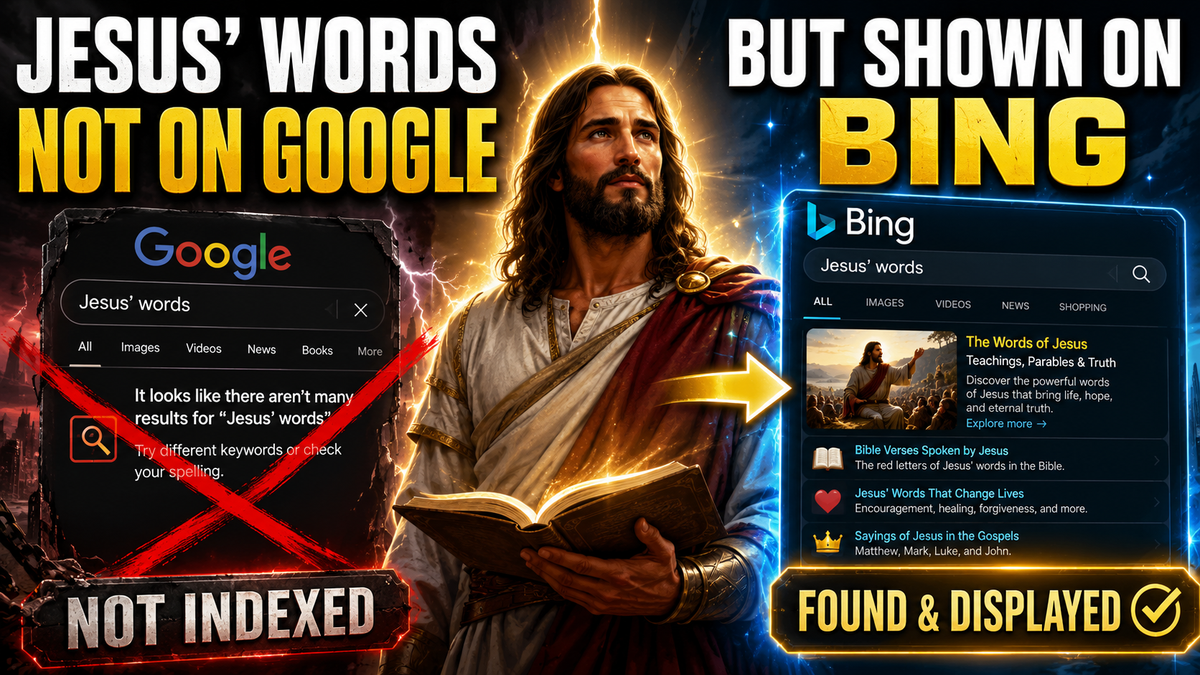
The question is provocative because the situation is provocative. A large body of Gospel and New Testament writing exists publicly on Blogger. The pages open. The archive is visible. The publisher reports that Google Search Console once showed hundreds of discovered URLs and zero indexed. Bing appears to find at least some of the same Blogger content that Google leaves much harder to locate. Those facts justify scrutiny. They do not yet establish motive.
Here is the perspective shift I want to introduce:
This may not be about Jesus.
And if it is not about Jesus, Google, Blogger, search specialists, and independent publishers should still care.
The most important outcome of this campaign may not be proving religious discrimination. It may be exposing how difficult it has become for an independent publisher to understand why a large public library is excluded, clustered, delayed, or ignored by one of the most influential discovery systems in the world.
The question “Does Google Hate Jesus?” may eventually receive a technically ordinary answer. Blogger may be generating signals that Google interprets poorly. The site may have grown faster than Google’s crawl demand. The content network may create canonical confusion. Repeated structures may cause hundreds of articles to look less distinct than they are. Google may simply operate with a more restrictive inclusion threshold than Bing.
Any of those answers would reduce the likelihood that Christian subject matter is the central cause.
None of them would make the investigation meaningless.
The Question Is Larger Than the Headline
The headline asks whether Google hates Jesus because a softer phrase would disappear into the same silence being investigated.
“An Analysis of Index Selection Across a Large Blogger Property” might sound respectable, but few people outside technical SEO would stop to read it. “Does Google Hate Jesus?” forces the reader to confront the collision between a spiritual subject and a technological system.
The danger is that a memorable question can become a substitute for thought.
Some Christians may hear the title and assume the case has already been proven. Some critics may hear it and decide the creator must be manufacturing persecution. Some search professionals may treat the religious framing as evidence that the technical claims can be ignored. The campaign fails if any of those reactions controls the investigation.
The headline should open the door to evidence, not close the door behind an accusation.
The most honest statement remains this:
I have not proven that Google discriminates against Jesus, Christianity, Christian publishers, or Gospel content. I have not identified a person inside Google who made a deliberate choice against my library. I have not produced a controlled comparison showing that technically equivalent nonreligious Blogger sites are treated differently. The cause remains unresolved.
What I have documented is a real publishing discrepancy.
The Blogger firsthand account explains what happened after hundreds of articles were published. The Google Sites explainer separates publication, discovery, crawling, rendering, indexing, canonicalization, ranking, and visibility. The WordPress pillar preserves the central evidence and correction policy.
This Ghost article asks a different question:
What if the reason is not religious hostility, but a combination of platform structure, automated quality decisions, and a lack of meaningful explanation for small publishers?
That possibility may be less dramatic.
It may also be more important.
The Two Comfortable Stories
People are drawn toward stories that protect what they already believe.
The first comfortable story is that Big Tech is hostile to Christianity, so the indexing problem must be intentional suppression.
That story offers emotional clarity. It identifies a villain. It transforms a confusing technical problem into a moral conflict. It may fit genuine experiences Christians have had elsewhere. It also risks claiming more than this evidence can prove.
The second comfortable story is that Google is a neutral system, so the publisher must have created low-quality content, broken the site, or misunderstood search.
That story protects trust in the system. It allows technical people to dismiss the case without reviewing the pages. It treats Google’s outcome as evidence of Google’s correctness. If the pages were excluded, the reasoning becomes circular: they must not have deserved inclusion because Google did not include them.
Neither story is rigorous.
Google does not need to hate Jesus for Christian content to become harder to discover. Automated systems can produce unequal or confusing outcomes without a conscious discriminatory decision. A platform can create structural problems. A classifier can overvalue repeated patterns. An index can decide that many public pages are unnecessary. A crawl system can deprioritize a property so aggressively that the practical result resembles invisibility.
At the same time, a creator’s sincere mission does not guarantee that every page is technically strong, clearly differentiated, or useful enough to justify inclusion. Good intentions do not repair canonicals. Faith does not simplify a theme’s document structure. Original writing can still be surrounded by repeated template elements. A large project can grow beyond the architecture supporting it.
The responsible investigation lives between those two comfortable stories.
It allows the system to be wrong without assuming malice.
It allows the publisher to have made mistakes without treating the entire mission as worthless.
It allows the Christian subject to remain relevant without announcing discrimination.
It demands evidence from everyone.
If the Answer Is Technical, Why Should Google Care?
A common response to indexing problems is that Google does not owe anyone inclusion.
That is true in a narrow sense. A publisher cannot require Google to store and rank every page. Search engines must make choices. The web contains more material than any engine can treat equally. Index selection is unavoidable.
But “Google does not owe you indexing” does not answer every public-interest question.
Google Search is not a private filing cabinet used only by Google. It is a dominant gateway through which people encounter public information. Its decisions affect which voices are easily discoverable, which archives become visible, and which independent publishers can reach readers without purchasing attention.
That influence creates a responsibility for understandable systems, even when it does not create an obligation to index every URL.
A publisher should be able to learn whether the dominant issue is crawling, canonicalization, duplication, rendering, quality evaluation, or site structure. Google Search Console provides categories, but categories such as “discovered—currently not indexed” often describe a state more clearly than they explain a cause.
That difference matters.
Imagine a hospital system telling a patient that treatment was not approved, while refusing to identify whether the decision resulted from missing records, clinical criteria, an administrative error, or a duplicate claim. The hospital may have discretion. The patient still needs to know what happened if there is anything to correct.
Search indexing is not healthcare, and a missing article is not a denied medical treatment. The comparison concerns operational clarity. When a system controls an important pathway, a broad outcome label may not be enough for someone trying to fix a recurring problem.
If the Blogger library was excluded because the pages were too similar, identify the pattern.
If Google selected other canonicals, show which ones.
If the site’s publication pace exceeded crawl demand, make that visible.
If mobile rendering weakened the pages, identify the rendered difference.
If the system made a quality decision, offer enough guidance that the publisher can understand which observable characteristics likely mattered.
If Google cannot disclose more without exposing ranking systems to abuse, then specialists and platform teams should still be able to explain the likely causes through reproducible tests.
The answer does not need to be flattering.
It needs to be actionable.
Blogger Is Not an Innocent Background
The campaign’s sharpest irony is not simply that Google Search appears to overlook a Christian library. It is that the library is hosted on Blogger.
Blogger is part of Google’s product ecosystem. That does not mean Google Search promises to index Blogger pages. Search and Blogger are different systems with different teams, rules, and priorities. Hosting on a Google platform is not a guarantee of inclusion in Google Search.
Still, the relationship matters.
An independent publisher using Blogger reasonably expects the platform to generate pages that Google Search can crawl and interpret without extraordinary intervention. The publisher should not need to understand every server header, mobile variant, feed endpoint, archive route, or template-generated element to create a technically coherent public page.
Blogger simplifies publishing by hiding much of that complexity.
The same hidden complexity can make troubleshooting harder.
The writer controls the article body. Blogger and the theme control much of the surrounding document. The platform can generate mobile parameters, feeds, labels, archives, structured data, heading structures, and canonical signals. A publisher may alter the theme without fully understanding how those changes interact with rendering or search systems.
That creates a serious possibility: the problem may not be Google’s attitude toward the subject. It may be the way Google Search interprets pages produced by Google’s own publishing platform under conditions of high volume and repeated structure.
If that is the answer, Blogger should care.
A platform’s value is not limited to whether it can display a page to someone who already has the exact link. Public publishing platforms are part of the discovery ecosystem. If large Blogger libraries routinely become known to Google without entering the index, publishers deserve better guidance about how to prevent that condition.
The public Blogger library remains intact during this investigation because constant changes would destroy the baseline. That preservation is not meant to trap Blogger in an accusation. It is meant to allow specialists to inspect the real environment.
The Four Gospel Pages Are a Test of Method, Not Theology
The evidence set includes one representative article from each canonical Gospel.
The Matthew 5 commentary addresses the Sermon on the Mount.
The Mark 14 commentary addresses betrayal, Gethsemane, failure, and costly love.
The Luke 24 commentary addresses the resurrection and the road to Emmaus.
The John 3 commentary addresses Nicodemus, new birth, belief, light, and John 3:16.
The pages are theological in content, but their role in the investigation is methodological.
They provide stable public URLs.
They were published on different dates.
They use different titles.
They focus on different Gospel chapters.
They contain substantial visible text.
They share the Blogger environment.
A reviewer can inspect them without accepting my interpretation.
The central technical questions remain the same whether the pages discuss Jesus, gardening, local history, or software development:
Can the crawler retrieve the page?
What response does it receive?
What content is present in mobile rendering?
What canonical is declared?
What canonical is selected?
How much of the page is unique?
How strong are the internal links?
Are alternate versions consuming signals?
Was the page crawled?
Was it indexed?
If not, what reason was recorded?
Does Bing treat it differently?
Those questions do not become less technical because the pages are Christian.
The Christian content makes the public concern more emotionally charged. It does not alter the standard of proof.
The Possibility That Google Is Correct
A credible investigation must consider the possibility that Google’s systems made a defensible decision.
Perhaps the Blogger pages are not sufficiently distinct from content published elsewhere in the network.
Perhaps the repeated signatures, calls to action, link patterns, and article structures create a high level of boilerplate.
Perhaps the site grew too quickly without enough durable hierarchy.
Perhaps hundreds of pages cover overlapping search needs that Google believes are already satisfied by stronger sources.
Perhaps some articles are long without adding enough unique information.
Perhaps the system sees the project as a scaled publishing pattern and applies a stricter quality threshold.
Those possibilities should not be dismissed merely because I believe in the mission.
A creator knows the intent behind the work. A search system evaluates the output.
The gap between intent and output is where honest review must occur.
I can say that the library was created to help people, explain Scripture, and preserve Christian encouragement. That statement does not prove every article succeeds equally. It does not prove every platform version is different enough. It does not prove the architecture communicates the library’s purpose effectively.
If technical reviewers show that some content clusters are too similar, I should correct them.
If the archive buries older articles, I should build stronger hubs.
If titles are excessively long, I should improve them.
If the theme adds structural noise, I should repair it carefully.
If publication velocity exceeded the property’s ability to establish clear value, I should adjust the system.
Admitting that does not make Google automatically right. It makes the investigation capable of learning.
The Possibility That Google Is Wrong
It is equally important not to assume that exclusion proves the system worked correctly.
Search engines make errors.
Automated systems misclassify content.
Canonical selection can be wrong.
Crawlers can fail to prioritize valuable pages.
Platforms can generate confusing signals.
Quality systems can overvalue familiar domains and undervalue independent sources.
Repeated structures can cause classifiers to miss meaningful differences.
A site can meet the spirit of helpful publishing while triggering patterns associated with lower-value scale.
Google’s systems operate at enormous scale. That scale requires automation. Automation creates false positives, blind spots, and opaque interactions.
A publisher does not need to prove hatred before asking whether the system made a poor decision.
The question is not whether Google has the right to choose. The question is whether the choices can be understood, tested, and corrected when they appear inconsistent with the public material.
If Bing can index pages that Google declines, that does not prove Bing is right. It does prove that another major system reached a different conclusion.
That difference should encourage comparison rather than dismissal.
Bing Is Not the Hero of This Story
The campaign’s subtitle emphasizes that Bing appears to find parts of the Gospel library that Google leaves behind.
It would be easy to turn that contrast into a hero-and-villain story.
Bing found Jesus. Google did not.
That phrase is memorable. It is also too simple.
Bing may index a broader range of pages because its thresholds differ. It may crawl the property differently. It may retain pages that Google considers unnecessary. It may show results that later disappear. Its public visibility may still be limited.
The purpose of Bing in this investigation is not to prove moral superiority.
Bing is a comparison point.
When two systems evaluate the same public URL differently, the difference creates diagnostic value. Specialists can compare crawl dates, index status, canonicals, rendered content, warnings, and public results. Bing may help reveal that the pages are technically accessible. It may show that heading warnings are not absolute barriers. It may demonstrate that one system recognizes value where another does not.
Or it may reveal that Bing is simply more permissive.
Either way, the comparison is useful.
The campaign should resist replacing one oversimplification with another. Google is not automatically the enemy. Bing is not automatically the defender of the Gospel. Both are technological systems making choices about public information.
The Scale Problem Is Real
The Blogger archive contains hundreds of posts. The broader project covers every New Testament chapter across several platforms and includes videos, stories, commentary, encouragement, and social distribution.
That scale is part of the accomplishment.
It is also part of the risk.
A high-volume site creates more URLs than a small site. It places more pressure on crawl prioritization. It creates more opportunities for repeated elements. It can make chronological archives deeper. It can amplify theme defects. It can create dense internal link patterns that look intentional to readers and overengineered to automated systems.
Cross-platform publishing adds another layer.
The same biblical chapter may be addressed on Blogger, WordPress, Google Sites, Medium, Ghost, Write.as, Substack, Tumblr, and LinkedIn. The intention is not to publish identical copies. Each platform has its own lane and audience. But intention must appear in the actual text.
Search systems do not read assignment plans.
They compare pages.
If the titles, introductions, headings, examples, and conclusions overlap too closely, Google may cluster them. It may choose one platform as the representative version. It may decide that storing every page would not add enough value.
That possibility is especially relevant because the Blogger property may be the weakest domain in the network from Google’s perspective. If stronger platforms host related articles, Blogger URLs may lose the canonical contest even when the Blogger version is substantial.
A specialist should test that theory page by page.
The answer may not be “Google hates Jesus.”
It may be “Google thinks it already has this answer somewhere else.”
Canonicalization Can Look Like Disappearance
Canonicalization is one of the least emotional explanations and one of the most important.
When several URLs contain duplicate or very similar content, a search engine tries to select a representative version. The other URLs may remain accessible but receive little or no independent visibility.
To a publisher, that can look like erasure.
To the search engine, it may look like consolidation.
The distinction matters.
If Google selected a WordPress, Medium, or another platform page as the canonical version of a topic, then the Blogger article may be absent without the Gospel subject being excluded. The content might still be represented elsewhere.
That outcome would weaken the religious-hostility theory.
It would strengthen the need for clearer platform differentiation.
The only way to know is to examine the declared and selected canonicals for representative URLs. Public search alone cannot reliably answer that. Search Console URL Inspection can provide stronger publisher evidence.
A useful specialist response would not merely say, “You have duplicate content.” It would identify which URLs are clustered, how similar they are, what canonical was selected, and what changes would make the platform versions more distinct.
Without that specificity, “duplicate content” becomes another vague label that explains everything and nothing.
The Headline Is a Stress Test
“Does Google Hate Jesus?” is not only a campaign title. It is a stress test for everyone who encounters it.
It tests whether Christians can ask a forceful question without converting suspicion into certainty.
It tests whether critics can look beyond provocative language and examine evidence fairly.
It tests whether search professionals can explain systems without hiding behind generic policies.
It tests whether I can accept an answer that places responsibility on my own publishing choices.
It tests whether a large technology company’s supporters can admit that opaque systems may create legitimate public concerns even without malicious intent.
The question mark matters because it keeps the inquiry open.
A campaign built on certainty would seek confirmation.
A campaign built on investigation seeks explanation.
What Google Should Explain, Even If It Is Not About Jesus
If the final answer is that Christian content had nothing to do with the outcome, Google or qualified specialists should still be able to explain the pattern in useful terms.
They should be able to say whether the main bottleneck is discovery, crawling, rendering, canonicalization, quality selection, or serving.
They should be able to identify whether Blogger-generated mobile variants or template structures are relevant.
They should be able to determine whether the publication rate is far beyond the crawl rate.
They should be able to examine whether the site’s hierarchy is too weak for its size.
They should be able to compare repeated boilerplate with unique article content.
They should be able to show whether cross-platform versions are being clustered.
They should be able to explain why Bing reaches different outcomes on at least some pages.
They should be able to recommend a controlled test.
The explanation may come from independent specialists rather than Google itself. That would still be valuable. But the broader principle remains: independent publishers need pathways to understand how public work disappears from dominant discovery systems.
The absence of proven religious discrimination does not remove that need.
It sharpens it.
What I Must Be Willing to Change
This campaign cannot demand transparency from Google while refusing accountability for my own system.
If the evidence points toward publishing velocity, I must reconsider pace.
If it points toward repetitive structures, I must improve differentiation.
If it points toward weak internal hierarchy, I must strengthen book and chapter hubs.
If it points toward title length, I must simplify titles.
If it points toward cross-platform clustering, I must make platform roles more distinct.
If it points toward a Blogger theme condition, I must test repairs carefully.
If it points toward articles that do not add enough unique value, I must revise or consolidate them.
The Blogger site is being preserved during the baseline investigation, but preservation is not a commitment to permanent inaction. It is a commitment to change one variable at a time after the strongest hypotheses are identified.
That is how correction becomes knowledge rather than panic.
What Google Must Not Be Allowed to Hide Behind
At the same time, Google’s discretion should not become an all-purpose shield against scrutiny.
“Indexing is not guaranteed” does not explain a severe property-wide pattern.
“Create helpful content” does not identify which pages failed or why.
“Wait” is not a meaningful response after months of little progress.
“Build authority” may be broadly true but does not address a specific canonical or rendering problem.
“Search systems are complex” is a fact, not an answer.
Complex systems still produce observable behavior.
The campaign is asking specialists to connect that behavior to evidence.
That is not an unreasonable demand from a publisher. It is the minimum needed to make improvement possible.
The Broader Risk for Independent Publishers
The most important reframe may be this:
The campaign is not only about whether Google hates Jesus.
It is about whether independent publishers can remain meaningfully visible without understanding systems that are nearly impossible to audit from the outside.
Large institutions can absorb search volatility. They have technical teams, established domains, public recognition, backlinks, and budgets. Independent creators often have none of those protections.
They depend on platforms that simplify publishing but obscure infrastructure.
They depend on webmaster tools that describe outcomes without always identifying causes.
They depend on search systems that can remove discoverability without removing the page.
They depend on social platforms that can change distribution overnight.
A public archive can therefore become privately maintained and publicly inaccessible at the same time.
That problem affects Christian writers, local historians, disability advocates, teachers, neighborhood journalists, artists, researchers, and small organizations. The Gospel library is one vivid case inside a larger structural issue.
What happens to public knowledge when publication is easy but discovery is controlled by systems few publishers can understand?
What happens when existence and visibility separate?
What happens when the creator can prove the page is alive but cannot explain why the catalog leaves it out?
Those are not religious questions.
They are questions about the modern public square.
The Answer I Am Hoping For
I am not hoping to prove that Google hates Jesus.
I am hoping to understand the system well enough to repair what can be repaired.
The best possible outcome would be a technically specific explanation that accounts for the difference between Google and Bing, identifies the strongest page or property signals, and provides a controlled path forward.
Perhaps specialists will find that the Blogger theme creates confusing canonical or heading structures.
Perhaps they will find that the site’s scale overwhelms its internal hierarchy.
Perhaps they will identify excessive similarity across platform versions.
Perhaps they will show that Google’s crawl demand never caught up with publication.
Perhaps they will find that current indexing is improving and the historical report captured an earlier backlog.
Perhaps they will identify a Blogger-specific defect.
Perhaps they will conclude that Google’s quality systems simply reject much of the library and explain which observable characteristics are responsible.
Any of those answers would be more useful than speculation.
The Answer I Will Not Accept
I will not accept an answer that is merely dismissive.
“Google does not owe you anything” is not analysis.
“Your content must be bad” is not evidence.
“Christians always think they are persecuted” is not technical review.
“Big Tech hates Christianity” is not proof.
“Bing found it, so Google censored it” is not a valid inference.
“You published too much” is incomplete without showing how volume affected crawling, similarity, or quality evaluation.
“Multiple H1 tags did it” is incomplete without demonstrating causation.
A credible answer must survive contact with the pages.
The Campaign’s Real Challenge
The real challenge is to remain forceful without becoming reckless.
A weak campaign would hide behind technical language until no one cared.
A reckless campaign would declare religious discrimination because the title attracted attention.
A credible campaign must do both difficult things at once:
Make the problem impossible to ignore.
Keep the conclusion open until the evidence supports it.
That is why the WordPress article remains the canonical investigation. It preserves the central case and correction policy.
That is why the Blogger article tells the firsthand publishing story.
That is why Google Sites explains the indexing stages.
That is why Medium addresses the emotional cost.
And that is why Ghost must challenge the campaign itself.
A campaign that never questions its own framing becomes propaganda.
An investigation that survives self-criticism becomes stronger.
This May Not Be About Jesus
The final answer may be that Google’s treatment of the Blogger library had nothing to do with Christianity.
It may be about scale.
It may be about structure.
It may be about duplication.
It may be about canonicals.
It may be about crawl priorities.
It may be about quality thresholds.
It may be about Blogger.
It may be about choices I made.
That possibility does not embarrass the campaign.
It validates the investigation.
A question is not defeated when the answer turns out to be different from the most dramatic theory. A question succeeds when it leads to truth.
And if the answer is not about Jesus, the larger issue remains:
Why can an independent publisher build a large, public, navigable library on a major platform, watch one search engine find parts of it, and still struggle to understand why another leaves so much outside meaningful visibility?
That question deserves an answer from technical specialists, platform experts, search journalists, and anyone concerned about the discoverability of public work.
The Gospel does not need Google’s approval to remain true.
Publishers still need to understand the systems that determine whether readers can find what has been published.
So I will keep the question mark.
I will preserve the evidence.
I will accept correction.
I will not accuse without proof.
I will not stop asking because the ordinary explanation may be less dramatic.
Does Google hate Jesus?
Maybe that is not the real question.
Maybe the real question is whether a system with enormous influence over public discovery can leave a large library behind without giving the person who built it enough information to understand why.
That is a question bigger than my Blogger site.
It is a question worth answering.
Your friend,
Explore the complete Douglas Vandergraph Master Index:
https://douglasvandergraph.com/douglas-vandergraph-master-index/
Watch Douglas Vandergraph’s faith-based videos on YouTube:
https://www.youtube.com/@douglasvandergraph