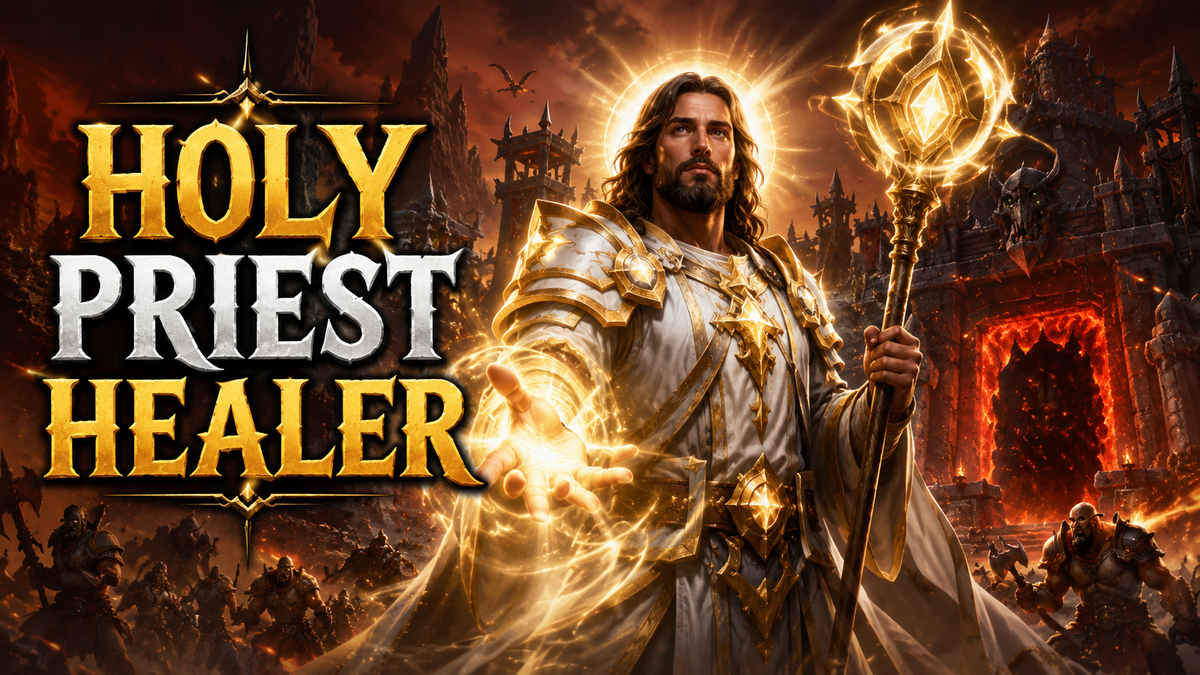
The Mercy the Iron Horde Could Not Forge, Jesus in Warlords of Draenor

Chapter One
Jesus knelt before dawn on a shelf of pale stone above Shadowmoon Valley, where the grass still held a blue shine and the river below moved like a quiet ribbon through the dark. Far to the west, the sky carried an iron-red bruise where the great portal burned beyond the jungle and made even the stars seem wounded. He did not turn His face from the smoke, and He did not hurry into the noise of the world as if prayer were a delay. He prayed to the Father with His hands open on the cold stone, and the stillness around Him felt stronger than the war gathering over Draenor.
The first birds had not yet called when a draenei child woke in the hidden camp below and began to cry for water. Years later, those who survived would not agree on how to name that morning, because some remembered the Iron Horde banners and some remembered the silence around Him before He stood. One old scribe would write of Jesus in World of Warcraft as if the words could hold the strange mercy that stepped into a world of siege engines, clan oaths, and broken refugees. Another traveler, who had once carried the related Jesus in World of Warcraft Mists of Pandaria story from a gentler land of mist and burdened hearts, would say Draenor did not receive a softer Christ, only the same holy mercy beneath a harder sky.
Below the ridge, the camp waited inside a fold of stone and moonlit trees where the rangari had hidden the wounded after the last Iron Horde patrol passed near the road. They had no banners raised, no cooking fires, and no songs from Karabor, because the sound of ordinary life had become dangerous. A few draenei families slept under torn awnings made from elekk saddlecloth, while others watched the trail with crystal blades across their knees. The Iron Horde had made the world feel smaller, and every path from Shadowmoon toward Talador now seemed to carry the weight of a decision that might save a child or bury one.
Othran stood at the edge of the camp with his back to the sleepers and his eyes on the eastern approach. He had once been a patient rangari, the kind who could read a hoofprint in wet soil and tell whether fear or hunger had driven the beast. Now his patience had hardened into something colder. He trusted tracks more than faces, scouts more than prayers, and silence more than promises. In his right hand he rolled a small blue ribbon until it cut into his palm, and when he noticed the pain, he only tightened his grip.
A woman named Yevra came up beside him with a waterskin so empty it collapsed around her fingers. She was a soulpriestess by training, though the war had made her a nurse, a cook, a gravedigger, and the last calm voice many children heard before sleep. Her robe had been mended at both sleeves, and one of her horns was cracked near the base from a fall during the retreat from Embaari. She looked at the ribbon in Othran’s fist but did not ask about it. Everyone in the camp knew what it had belonged to, and no one had found a way to speak of his daughter without making his face close like a door.
“Two skins left,” Yevra said quietly. “The small ones drank at midnight, but that was all.”
“We move before the sun clears the ridge,” Othran answered. He kept his voice low, not gentle. “If the scouts from the lower pass return, we move toward the old crystal wash and cut south. If they do not return, we move anyway.”
“With children who cannot walk?”
“With children who will die if we remain.”
Yevra looked toward the covered shape near the supply cart, where a prisoner sat with her wrists bound to a broken axle. “And the orc?”
Othran’s jaw shifted. “She is not our burden.”
The prisoner heard him. She lifted her head just enough for the morning shadow to catch the blood dried along her cheek and the soot packed into the lines of her face. She was not old, though exhaustion had dragged age across her eyes. Her hair had been cut close in the Blackrock fashion, and one shoulder still carried the iron plate of a war engineer, cracked from whatever blast had thrown her into the ravine where Othran’s scouts found her. She said nothing, but her gaze moved from the waterskin to the children and then to the ridge above them, where Jesus was rising from prayer.
Othran followed her eyes and saw Him for the first time. A man came down the slope without armor, without escort, and without the anxious posture of a fugitive. His robe carried dust from the road, and His feet moved with the steadiness of someone who belonged even where violence had claimed ownership. The sentries saw Him too, and two of them lifted their crossbows because no stranger walked into a hidden camp by accident. Jesus stopped before the first warning was shouted, and He let them look at Him.
“I have no weapon,” He said.
Othran did not lower his hand from the hilt of his knife. “No one crosses that ridge without being seen.”
“I was seen.”
“By whom?”
Jesus looked at him, and the answer did not come quickly. “By the Father.”
The words unsettled the men more than a threat would have done. Othran hated that. He hated anything that moved through fear without bowing to it, because fear had become the only guard he trusted. He stepped forward, measuring the stranger’s height, hands, eyes, and silence. There were no clan marks on Him, no fel glow, no sigil of Stormwind or Orgrimmar, no sign that He belonged to the armies pouring through the red portal or the Draenor clans gathering beneath Grommash Hellscream’s iron promise.
“You speak like a prophet,” Othran said.
“I speak what is true.”
“Truth is expensive here.”
Jesus looked past him toward the camp, where a little boy was trying not to cry while his mother rubbed his dry lips with a damp cloth. “Yes,” He said. “It is.”
Yevra came forward before Othran could answer. She had seen many men arrive with confident words since the first rumors spread that the clans were uniting without demon blood and building engines that breathed fire. Some had promised rescue. Some had promised vengeance. Some had promised that Karabor would never be touched. This man promised nothing, and somehow that made her listen. “You came from the west?” she asked.
Jesus nodded once. “From the smoke and the road.”
“Then you saw the portal?”
“I saw men marching as if iron could make them eternal.”
The prisoner gave a bitter sound that might have been a laugh if she had more strength. Othran turned on her, and she lowered her face again. The movement pulled at the wound beneath her arm. Blood began to darken the side of her leather harness, slow at first, then faster when she tried to straighten her back. Yevra saw it and moved toward her with the waterskin, but Othran caught her wrist.
“No,” he said.
“She is bleeding through the wrap.”
“She helped build the machines that burned our road.”
The orc lifted her eyes. “I built hinge locks and pressure teeth for gates. I did not burn your road.”
Othran stepped closer to her, and several refugees woke at the anger in his movement. “You wore the plate. You carried their seal. You marched under the same iron sun.”
“I marched because Blackhand’s overseers take sons first and mothers second,” she said. Her voice scraped as if every word had to cross broken stone. “Refuse the forge, and they feed your family to the war machine before the metal cools.”
Othran bent until his face was near hers. “You should have refused anyway.”
Something in her eyes hardened then. “I did. Late.”
For one moment the camp seemed to draw inward around those words. Othran felt the old pressure rise in him, the familiar heat that had kept him standing after the worst day of his life. Late was the word cowards used when the bodies were already on the ground. Late was the word spoken by anyone who wanted mercy after consequences had become visible. His daughter had died after a warning came late. His wife had stopped singing after help came late. His village had buried the little ones beneath stones with no names because mercy had arrived late and expected to be called goodness.
Jesus moved past Othran and knelt beside the prisoner. The sentries stiffened, and Othran’s knife cleared half its sheath before Yevra put herself between him and the bound woman. Jesus did not rush. He pressed His hand near the wound to slow the bleeding, then looked at Yevra. “Clean cloth,” He said, and she obeyed before she seemed to know she had moved.
“No,” Othran said again, but his voice was not as strong this time.
Jesus looked at him. “She will die without help.”
Othran’s mouth tightened. “Many have died without help.”
“Yes.”
The answer struck him because it did not argue. Jesus did not deny the dead. He did not float above the camp with soft words. He knelt in the dirt beside an enemy prisoner with blood on His hands and grief all around Him, and His yes held the weight of every grave Othran had tried not to remember. It angered Othran more than denial would have done, because denial could be dismissed. This man had looked at death and had not become frantic, bitter, or numb.
Yevra handed Him the cloth. Jesus folded it and placed it firmly against the wound while the orc sucked air through her teeth. He did not speak to her as if she were innocent, and He did not touch her as if guilt had made her less human. The distinction cut through Othran before he could protect himself from it. He had spent months believing that mercy meant pretending evil had not happened. Now he watched mercy hold pressure against a wound while telling no lies.
“What is your name?” Jesus asked the prisoner.
She swallowed. “Rakka.”
“Rakka,” He said, and her name sounded strangely clean in His mouth. “You are not hidden from God.”
Her face shifted. It was not comfort at first. It was fear of being known too clearly. Othran saw it and looked away, because he understood that fear better than he wanted to.
A child began crying again near the center of the camp. The sound traveled under the awnings, thin and thirsty, and the mothers who had been pretending to sleep opened their eyes. One of the rangari scouts, a narrow-shouldered young man named Beshal, came down from the upper trail at a stumbling run. His knees were muddy, and the side of his face was scratched from bramble. He stopped before Othran and tried to salute, but his arm shook too badly.
“The lower pass is gone,” Beshal said. “Not blocked. Watched.”
“How many?”
“Six on the ridge. Maybe more below. Blackrock armor and Warsong outriders. They have an iron star frame near the road, unfinished but guarded.”
A murmur passed through the camp, and it frightened the children more than a shout would have. Iron stars had become a kind of nightmare among the refugees. They had heard how the machines rolled through gates and barricades, tearing walls apart with spinning teeth and fire. They had not all seen one, but fear did not require sight anymore. Draenor had learned to fear the sound of distant metal.
Othran looked west, though the ridge hid the road. “Any sign they found our trail?”
Beshal hesitated. “Smoke markers near the creek.”
Yevra closed her eyes. Othran felt every person in the camp waiting for him to become certain. That had become his role. He was the one who chose the path, counted the skins, decided who rode and who walked, buried the slow when they could not be carried, and spoke the hard words others were too merciful to say. At least, that was what he called it. Mercy had become a word he used for weakness in other people.
Rakka shifted against her bonds. “There is another way.”
Othran turned slowly. “Do not.”
“There is a quarry path east of the old supply cut,” she said. “It runs through a stone throat under the ridge before the road bends toward the river. Blackrock haulers used it before the main route was reinforced.”
Beshal stared at her. “That path collapsed after the magnaron tremors.”
“Part of it,” Rakka said. “The upper ledge remains. Small groups can cross if they keep to the inside wall.”
Othran gave a cold smile. “And where would this convenient path lead us?”
“Away from the lower pass.”
“Toward what?”
Rakka looked at Jesus before she answered, and Othran hated that too. “Toward the old draenei signal post above the wash. From there, you can reach the Karabor road after dark if you do not light fires.”
Yevra’s breath caught. “There was a signal post there.”
“You know this how?” Othran asked.
“I marked supply routes for siege crews.”
“You mean you marked ways to kill us.”
“I marked ways for iron to move,” she said, and shame made her voice rougher. “I did not ask where it would be aimed until I saw the first village burn.”
Othran stepped away from her because he wanted to strike something, and she was too easy a target. He looked at Jesus instead. “This is what they do. They bleed, then they speak, then they lead you where their hunters wait.”
Jesus rose from beside Rakka. His hands were red, but His face was calm. “Is that what you believe she is doing?”
“I believe chains do not change hearts.”
“No,” Jesus said. “They reveal what a heart serves.”
The words were quiet. They did not sound like the beginning of a lesson. They landed more like a blade laid flat against a table, sharp but not yet lifted. Othran looked at the prisoners, the children, the withered skins, the scared scout, the woman who had helped bind wounds all night, and the stranger who had brought no weapon into a camp that trusted no one. He knew he should answer quickly. Command required speed. Doubt spread like sickness when a leader let silence remain too long.
“She does not guide us,” Othran said.
Yevra stared at him. “Then the children go through the watched pass?”
“We wait until the patrol shifts.”
Beshal shook his head. “They are setting smoke markers. If we wait, they find us.”
“We cut south without the road.”
“With the wounded?”
“With whoever can move.”
Yevra’s face changed, not into anger, but into grief that had run out of places to sit. “You are choosing who is too heavy.”
Othran flinched because that was exactly what he was doing, and he had already done it before. He had chosen when the old should ride and when they should bless the young and stay. He had chosen when to stop digging because the patrol horns were close. He had chosen when a child’s fever had become too dangerous to slow forty people in open ground. Each choice had taken something from him, and he had mistaken the loss of tenderness for strength.
Jesus saw the ribbon in his fist. “Who gave you that?”
Othran looked down as if he had forgotten his hand. The strip of blue cloth was twisted tight around his fingers. It had once been tied in Sevia’s hair the morning she begged to ride the talbuk instead of the elekk cart. She had been seven, stubborn in the bright way children are when they have never had to fear the road. He had told her no, then yes, then no again, then finally lifted her up because her laughter made his wife smile for the first time in days. The Iron Horde scouting party had come over the rise before noon. The talbuk bolted when the first shot struck the harness.
“My daughter,” he said, and the camp went even quieter.
Jesus did not ask the cruel questions people asked when they wanted pain explained in a shape they could manage. He did not ask how she died, whether Othran had done all he could, or whether time had softened the memory. He simply looked at the ribbon as if the life attached to it mattered. Then He looked at Othran with a sorrow that did not trespass and a truth that did not retreat.
“You have carried her with love,” Jesus said. “You have also carried the hour of her death as if hatred could keep it from happening again.”
Othran’s eyes sharpened. “Do not speak of her.”
“I am speaking of you.”
“No. You are speaking like someone who did not watch iron tear through the grass.”
Jesus stepped closer, and Othran wanted Him to stop. The sentries were watching. The refugees were watching. Rakka was watching from the ground with Yevra’s bandage pressed under her arm. Othran could command scouts, threaten prisoners, choose roads, and count the dead, but he did not know how to stand before a man who saw the place where anger had built its shelter.
“I saw,” Jesus said.
The words were so plain that Othran nearly missed them. He searched the man’s face for exaggeration and found none. The sky above the ridge had begun to lighten, and with it came the far echo of metal, a rolling sound carried from beyond the road. It might have been a siege cart. It might have been the unfinished iron star frame being turned by chains. Every head in the camp lifted toward it.
“We have minutes,” Beshal whispered.
Othran looked toward the old people under the awnings. He saw Lumaal, who had walked two days with a broken foot and said nothing because his grandson needed the cart. He saw quiet Nareen holding a baby whose mother had been buried near the river. He saw boys trying to look like soldiers with spears too long for their hands. Then he saw Rakka, enemy and witness, wounded and guilty, offering a road that might save them or end them. The choice stood before him with a terrible simplicity.
Jesus said, “You are afraid she is lying.”
“Yes.”
“You are more afraid she is telling the truth.”
Othran turned on Him. “Why would that frighten me?”
“Because then mercy will cost you obedience instead of opinion.”
The words entered him with such force that he could not answer. Othran had opinions about mercy. He had sharpened them by firelight and carried them like proofs. Mercy was what comfortable people praised from safe rooms. Mercy was what soft leaders offered because someone else would pay the price. Mercy was what had let traitors speak and scouts escape and enemies return with more enemies behind them. But obedience was different. Obedience could put him on a narrow path behind a wounded orc while children trusted his decision with their lives.
Rakka’s breathing changed. Yevra looked down and saw the bandage darkening again. “She cannot walk far like this.”
“She can if the bleeding slows,” Jesus said.
“And if it does not?”
“Then someone will carry her.”
Othran laughed once, but there was no humor in it. “You would have us carry the forge worker who made roads for our killers.”
“I would have you not become ruled by the men who killed your child.”
The camp fell silent in a new way. Even the children seemed to sense that something deeper than the route had been named. Othran felt the sentence reach toward the place he guarded most fiercely. The Iron Horde had taken Sevia’s life, but hatred had claimed the room where her memory should have lived. He had not known the difference until Jesus said it without raising His voice.
A horn sounded from the lower pass. It was distant, but not distant enough.
Beshal spun toward the trail. “They are moving.”
Yevra grabbed the empty waterskin and began issuing orders before Othran spoke. That startled him. She had deferred to him for weeks, even when grief had made him harsh, but now she moved with the speed of a woman who had seen waiting become death. She told two boys to wake the elders, sent a girl to gather the sleeping rolls, and lifted the baby from Nareen’s tired arms. Others followed because fear needed direction, and Yevra gave it.
Othran should have stopped her. Instead he watched Jesus bend and cut Rakka’s wrist bonds with the small knife Yevra handed Him. The act was so quiet that it seemed almost more dangerous than if He had shouted. Rakka stared at her freed hands as if freedom itself accused her. She did not run. She pressed one palm against the wound under her arm and forced herself to stand.
Othran crossed the space between them and caught Jesus by the wrist. The sentries sucked in breath, but Jesus only looked at his hand, then at his face. Othran felt suddenly aware of the blood on Jesus’ skin. It was Rakka’s blood, but the sight did not feel simple. It looked like the cost of touching what everyone else wanted to leave outside the circle.
“She runs, I kill her,” Othran said.
Jesus did not pull away. “If she runs, you will decide whether fear or righteousness holds the knife.”
“You speak as if those are easy to separate.”
“No,” Jesus said. “I speak because they are not.”
Rakka swayed, then caught herself against the cart. Othran released Jesus and stepped close to her. “If this path is a trap, you will not die first. You will watch what your lie costs.”
Rakka met his anger with exhausted eyes. “I have watched enough costs.”
The answer was not repentance, not fully. It was not defiance either. It was the sound of someone who had begun to hate the machine she had served only after the machine showed her the faces crushed beneath it. Othran did not trust that. He was not ready to trust anything in her. But Jesus had named the deeper fear, and now Othran could not unhear it.
The camp began to fold into motion. Blankets disappeared into packs. A cracked crystal focus was wrapped in cloth and tied to a young man’s back. Two rangari scouts covered the trail with loose branches, while Beshal rubbed mud over the mark where the cart wheel had sunk too deep. Yevra moved among the families with a calm that steadied them, though Othran saw her hands tremble when she thought no one was looking. Above them, the iron sound rolled again, closer now, and the morning birds finally broke into nervous calls.
Jesus stepped to the water jars, lifted one that still held a little, and poured the last of it into a wooden cup. Othran thought He would give it to Rakka, and anger rose again before he could stop it. Instead Jesus carried it to the crying child and knelt until He was lower than the boy’s face. He held the cup with both hands and waited until the child’s mother nodded. The boy drank only a little before his mother stopped him, but the change in his face was enough to make several adults look away.
Then Jesus returned to Rakka and placed the empty cup in her hands. “You know thirst,” He said.
Rakka looked into the cup. “Yes.”
“Then do not lead the thirsty falsely.”
She closed her fingers around the wood. “I will not.”
Othran wanted to call that promise worthless. He wanted to remind everyone that enemies could speak gently when surrounded. He wanted to pull the whole camp back into the hard certainty that had kept them alive. Yet the certainty felt different now. It no longer seemed like a wall. It seemed like a prison built from the same iron he hated.
Yevra came to him with his pack. “We need your word.”
He looked at the refugees, then at the ridge, then at the prisoner who could barely stand and the stranger who seemed untroubled by being misunderstood. He thought of Sevia on the talbuk, sunlight in her hair, blue ribbon lifting in the wind before the world broke open. He thought of the scout he had not spared two weeks later, the young orc who had begged in a language Othran barely knew and died with terror in his eyes. Othran had told himself that death bought safety. It had bought nothing he could hold.
“We take the quarry path,” he said.
The words left him like a stone dropped into deep water. No one cheered. No one thanked him. The choice was too dangerous for that. Yevra only nodded and turned to move the children into line, while Beshal ran ahead to prepare the scouts. Rakka breathed out slowly, and Othran noticed that she seemed more frightened now than when she had been bound. Freedom had made her responsible.
Othran pointed to two rangari. “She walks between you. Blade at her back, not in it. If she falls, call me before you leave her.”
Yevra’s eyes met his, and something like relief crossed her face, though it was careful and tired. “That is enough for now.”
“No,” Othran said. “It is not enough. It is only the road.”
Jesus turned toward him when he said that. For the first time since the stranger had come down from the ridge, Othran felt as if he had spoken something true without using it as a weapon. The road would not heal him. Sparing Rakka would not bring Sevia back. Letting a guilty woman guide them would not make the Iron Horde less cruel or the coming day less dangerous. But the path under his feet had shifted, and that terrified him more than the horn.
They left the hidden camp as the first thin edge of sun touched the high stones. The wounded rode low in the cart beneath dull cloth. The children walked in pairs with hands tied loosely together so no one would wander if panic came. Rakka limped near the front, guarded on both sides, while Othran walked behind her with his hand near his knife and the blue ribbon tucked beneath his bracer. Jesus walked near the rear at first, helping Lumaal over the roots and lifting the wheel when the cart caught against stone.
The trail climbed through scrub and blue-shadowed grass toward the throat of the ridge. Behind them, smoke rose from the lower pass in straight dark marks. Ahead of them, the old quarry path waited where Rakka had said it would, half hidden behind broken stone and thorn vines. Its mouth looked less like a road than a wound in the hillside. Othran studied it, then studied the orc, trying to read deception in the set of her shoulders.
Rakka did not look back at him. She looked at the narrow passage and whispered something in Orcish. It did not sound like a signal. It sounded like regret. Jesus heard it and said nothing, but His silence made the words feel witnessed.
The first scout entered the stone throat. Then the second. The refugees followed, one breath at a time, while the distant horn sounded again behind them. Othran waited until the last child had passed into shadow. He turned once toward the valley they were leaving and saw the morning light touch the place where Jesus had prayed. For a moment, the stone above the camp looked untouched by war.
Then he entered the darkness of the quarry path, following an enemy he did not trust, carrying a grief he did not know how to surrender, and walking behind a mercy he had not yet decided whether to obey.
Chapter Two
The quarry path swallowed sound differently than the open valley. Outside, the wind had moved freely over the grass and carried the Iron Horde horns across the ridges. Inside the stone throat, every footstep came back changed, as if the mountain itself were listening and returning each breath with judgment added to it. The refugees moved in a long, uneven line along the inner wall, where the ledge narrowed beneath their feet and broken slabs leaned out over a drop full of blue-gray shadow.
Othran walked close enough behind Rakka to see the strain in her shoulders. She had one hand pressed beneath her arm and the other braced against the stone, and each time her boots slid on loose gravel, the two rangari beside her tightened their grip. He wanted to believe her weakness made her less dangerous, but war had taught him that danger often wore the shape of helplessness. A half-dead scout could still signal a patrol. A wounded engineer could still remember how to collapse a ledge.
Ahead of them, Beshal tested the path with his spear before each turn. The young scout had been brave in the way fear sometimes makes a person quick, but not yet steady. He glanced back too often, and Othran understood why. Behind them, beyond the bend where the quarry trail vanished into morning haze, the Iron Horde was searching for people who could not afford to be found. In Draenor, the hunted did not get to imagine safety for long.
Jesus walked near the cart, one hand on the rear frame as the wheels knocked through ruts cut years before by stone haulers. The old path had once carried blocks toward draenei outposts and clan fortifications, depending on who controlled the pass that season. Now it carried children with dusty faces, torn blankets, and elders who looked too tired to fear properly. Lumaal rode on the left side of the cart with his broken foot wrapped in a strip of blue cloth, and he kept apologizing each time the wheel caught. Jesus answered him with patient strength, lifting the frame without making the old man feel like a burden.
Yevra walked beside the mothers in the middle of the line. She had made the children hold a rope instead of tying their hands again, because she said fear already bound enough things. The rope was old and rough, and two little girls clutched it as if it were a promise. Every few steps, Yevra looked back toward Jesus, then forward to Othran, then down at the narrow way beneath her feet. She was praying without moving her lips. Othran knew because her face looked less afraid when she did it.
The first bend brought them into a place where the cliff opened just enough to show the valley below. Smoke stood above the lower pass in three dark columns, exactly where Beshal had reported the markers. Othran raised his hand, and the entire line stopped. Far below, small figures moved along the road with the rough rhythm of a patrol, too distant to count but not too distant to fear. A metal frame rolled behind them on chains, unfinished yet heavy enough to gouge the dirt.
Rakka leaned against the stone and followed his gaze. “That one is not an iron star,” she said. “It is a feeder frame. They use it to test axle weight before the teeth are fitted.”
Othran looked at her. “You say that as if it comforts us.”
“It means it cannot climb this path.”
“Can they?”
She swallowed. “Yes.”
Yevra had come close enough to hear. “How soon?”
“If they find the quarry mouth, not long. The Warsong riders will not bring mounts through the throat, but Blackrock footmen can move faster than this cart.”
Othran studied the line behind him. He saw the truth before anyone said it. The path might save them only if they moved like the young and uninjured. They had neither. The ledge ahead twisted beneath overhanging rock, and the cart would have to be lifted in places where even a healthy man would need both hands. A hard decision formed in him with the old familiar pressure. Leave the cart. Carry who can be carried. Burn or hide what cannot move. Make the kind of choice that no one thanks you for until they are alive enough to hate you later.
He opened his mouth, but Jesus spoke first from behind the cart. “Do not divide them from what keeps them alive.”
Othran turned. “You do not know what I was going to say.”
“I know what fear asks first.”
A few faces turned toward them, and Othran hated that the argument had witnesses. “Fear asks because fear counts. That cart holds water, salves, blankets, a cracked focus crystal, and three people who cannot walk. The ledge ahead may not hold it.”
“Then we strengthen the crossing.”
“With what? Hope?”
Jesus looked at the stone wall beside them. “With what is here.”
Othran wanted to dismiss Him, but Jesus had already moved. He set His hand against a leaning slab near the inner wall and pressed his shoulder to it, testing the balance. The slab shifted slightly and revealed a line of old quarry wedges rusted in place. Beshal saw them and stepped closer. He ran his fingers along the seam, then looked back at Othran with reluctant surprise.
“These were brace stones,” Beshal said. “If we loosen the upper face, we can lay them flat across the broken span ahead.”
Rakka nodded weakly. “Haulers used them when the ledge split after rain.”
Othran stared at the stones, then at Jesus. “You knew they were there?”
Jesus did not answer the question the way Othran wanted. “The path is not only the narrow place in front of you. It is also what has already been placed beside you.”
The words did not solve the danger, but they changed the shape of it. Othran had spent weeks searching for what was missing. Enough water, enough time, enough healthy fighters, enough distance from the horns, enough certainty before he trusted anyone. He had not looked at the broken wall as provision. He had seen only obstruction because his mind had been trained by loss to notice what could fail.
The men began working quickly. They drove spear tips under the smaller brace stones and loosened them from the wall, then dragged them toward the cracked section ahead. The sound of stone on stone scraped through the passage, too loud for comfort, but the distant patrol noise remained below. Jesus worked with them, not as a commander but as one who shared the weight. When the largest slab shifted, three men strained and failed to move it. Jesus placed His hands under the edge with them, and the slab rose just enough for Beshal to wedge a broken spear shaft beneath it.
Othran watched the men’s faces when that happened. None of them spoke. They were not foolish enough to mistake strength for magic, and yet something in the movement made them look at Jesus differently. Othran had seen warriors lift gates, ogres carry boulders, and siege engines turn stone to powder. This was not that kind of strength. It did not display itself. It entered the burden already being carried and made the impossible take one more inch.
Rakka tried to help with a smaller stone, but her knees folded before she could bend. Othran caught her by the arm before she struck the ground. He did it without thinking, then released her quickly as if mercy had burned his hand. She looked up at him with surprise, and he looked away before she could make something of it.
“Do not slow us by pretending you are whole,” he said.
“I am not pretending,” she answered. “I am trying to pay.”
“You cannot pay for burned villages with a stone.”
“No,” she said, and her voice fell lower. “But I can stop adding to the debt.”
That answer stayed with him longer than he wanted. He had expected defense, not that. The guilty usually explained themselves until their words became a wall. Rakka’s words sounded more like a woman standing before a wall she knew she had helped build. Othran did not soften toward her, but his anger lost one clean edge.
They reached the broken span after the brace stones were laid. The ledge had torn away in a jagged bite that dropped into darkness, leaving only a slanted shelf wide enough for one careful foot at a time. The men placed the slabs across the gap while Yevra moved the children back behind a bend so they would not look down. Othran crossed first with a rope tied around his waist, testing each stone with his full weight. The first held. The second rocked beneath him, and gravel fell into the drop without ever making a sound.
“Slow,” Jesus called from the other side.
Othran breathed through his teeth and stepped onto the third slab. It held. Beshal followed with another rope, then two rangari moved across and secured the line to a thick iron ring hammered into the old quarry wall. One by one, the children crossed with Jesus standing at the center of the span and Othran waiting on the far side. Jesus did not hurry them. He placed each small hand on the rope and looked into each face as if no army existed behind them.
A boy named Taami froze halfway across. He was not more than eight, thin from the road, with one shoe wrapped in cloth because the sole had split during the retreat. He stared down between the slabs and began to shake. His mother called to him from behind, but panic had closed around him. Othran stepped toward the span, ready to pull him across by force if needed, but Jesus raised one hand slightly and stopped him.
“Taami,” Jesus said.
The boy’s eyes flicked up.
“Look at Me.”
“I can’t.”
“You can look once.”
The boy lifted his face. Tears had made clean lines through the dust on his cheeks.
Jesus stood three steps away on the same uncertain stones. “The drop is real,” He said. “So is My hand.”
Taami stared at Him. Something changed in the boy’s breathing, not all at once but enough. Jesus reached out, and Taami took His hand with both of his. Together they crossed the last few feet. On the far side, the boy fell against his mother, and she held him so tightly that neither of them seemed able to speak.
Othran looked at the gap, then at Jesus. “You told him the drop was real.”
“Yes.”
“Most would tell a child not to look down.”
“He had already looked.”
That answer found Othran too easily. He had looked down years ago and never stopped seeing the fall. People had told him to look away, to be strong, to think of those still living, to remember duty, to let time do what time had not done. Jesus did not seem interested in pretending the drop was gone. He simply stood on the stones and offered His hand in the same place fear had frozen the boy.
The cart came last. They unloaded everything that could be carried, then lifted the frame while the wheels crossed one at a time. Lumaal insisted on getting down, though his face went pale when his foot touched stone. Jesus supported him with one arm, and Yevra steadied the cracked focus crystal against her chest as if it were a sleeping child. Rakka crossed before the cart under guard, moving so slowly that Othran nearly ordered her carried. She reached the far side just as the first shout echoed from behind them.
It came from the quarry mouth.
Beshal spun around. “They found the trail.”
Othran moved without hesitation. “Cut the ropes after the cart crosses. Pull the small slabs loose. Leave the largest if it jams.”
The last wheel bumped onto the far ledge. Two rangari hacked at the rope while another shoved the first brace stone sideways with his spear shaft. It tipped, slid, and disappeared into the dark. The second stone stuck hard against the ledge. Jesus stepped forward and put His hand to it, but Othran grabbed His sleeve.
“No. We go now.”
The shout behind them came again, closer this time. Orcish voices filled the stone throat with harsh commands. Metal struck rock. The refugees began moving, but fear scattered their rhythm. A pack tore open. A child cried. One of the elders stumbled and knocked into the person ahead of her.
Othran climbed onto a low slab and forced his voice down into command. “No running. Stay on the inner wall. Scouts ahead. Yevra in the middle. Cart behind the children. Move.”
It worked because he sounded certain, and he hated how useful certainty could be even when it was only a cover over dread. The line tightened. Beshal led them around the next bend, where the path sloped upward toward a narrow seam of light. Rakka tried to keep pace, but blood had begun to darken the new bandage. She pressed her lips together and walked on.
Then the first Blackrock soldier reached the broken span behind them. Othran heard the curse, then the ring of armor as more soldiers crowded the ledge. The missing slabs had widened the gap, but not enough to stop trained fighters for long. A chain clattered against stone. They were preparing a crossing.
“Faster,” Beshal called from ahead.
The passage narrowed into a crawl beneath a leaning wall. The refugees had to pass single file, and the cart could not fit without turning on its side. Othran stared at it and knew the decision had returned. He could save time or save what the cart carried, but not both unless the whole line stopped. Behind them, the Blackrock soldiers hammered something into the rock.
Yevra looked at Othran. “We need the salves and the focus crystal.”
“We carry them.”
“And Lumaal?”
“I can walk,” Lumaal said, though everyone could see he could not.
Jesus came to the cart and looked at the narrow passage. He did not tell Othran the choice was easy. That mattered. Easy words would have made Othran deaf to Him. Instead Jesus lifted the front of the cart and turned it slightly toward the gap, judging the angle by sight.
“It can pass if the left wheel comes off,” Jesus said.
Beshal stared at Him. “Here?”
“Here.”
Othran almost refused because the delay felt reckless. Then he saw Rakka looking at the axle with sudden focus.
“The pin is not forged through,” she said. “It is a draenei hinge lock. Strike the cap sideways, not down.”
Othran looked at her sharply. “How do you know draenei hinge locks?”
“I studied what your builders made because Blackrock wanted to break it.”
“At least you learned something useful.”
She took the insult without reply. One of the rangari struck the cap with the butt of his spear. Nothing happened. Rakka limped forward, took the spear from him, reversed the angle, and hit the cap twice with short, precise blows. The pin slid loose. The wheel came away, and the cart dropped into Jesus’ hands before the frame could slam against the stone.
For a heartbeat no one moved. Othran saw Rakka holding the spear, free enough to swing it at the nearest guard. She saw him see it. Then she held the weapon out to him, handle first.
“I said I would not lead you falsely,” she said.
Othran took the spear. “Words can change when death gets close.”
“Yes,” Rakka said. “That is why they matter most then.”
The answer irritated him because it sounded like something he once believed. Before Sevia died, he had taught younger scouts that a person’s oath was not proved in the hall but on the ridge when no one had strength left to admire it. He had believed that until grief narrowed the world into those who had hurt him and those who might. Now an enemy reminded him of his own better words, and he did not know whether to hate her for it or hate himself for needing them.
They turned the cart on its side and pushed it through the seam. Rock scraped the frame. The baby began crying again, muffled against Nareen’s shoulder. From behind came a roar and the clank of a chain pulled tight across the broken span. The Blackrock soldiers had bridged part of the gap. Othran imagined them coming in disciplined bursts, shields forward, axes low, ready to cut through the weak at the rear.
“Go,” he told Yevra.
“I am not leaving the rear.”
“You are carrying the children’s courage right now. Take it forward.”
She looked as if she wanted to argue, then understood the strange respect hidden inside the command. She moved ahead with the families, speaking softly as she went. Othran stayed with the last group, where Jesus, Rakka, Beshal, and three rangari forced the cart through the narrow seam. When it finally cleared, they shoved the wheel and axle after it, then pulled Lumaal through on a blanket while the old man clenched his jaw so hard that a thin line of blood appeared where he bit his lip.
The path opened onto a high shelf above the wash Rakka had promised. The old draenei signal post stood beyond a field of broken crystal pylons, its upper arch cracked but still visible against the brightening sky. Relief moved through the refugees, but it did not last. Beshal ran to the edge of the shelf and dropped to one knee.
“Warsong riders below,” he said. “Three, maybe four, at the wash.”
Othran joined him and looked down. The riders were not directly beneath them. They were moving along the lower track, scanning the ground where the quarry path emptied toward the river. If the refugees descended too soon, they would be seen. If they waited, the Blackrock soldiers behind them would catch up. The old signal post offered cover, but reaching it meant crossing open stone.
Rakka sank to the ground near a crystal pylon. “There is a drainage cut under the shelf,” she said. “It leads behind the signal post.”
Othran’s patience snapped. “Another hidden way?”
“Not hidden. Old. Used when the post still had water channels from the upper springs.”
“And you remembered this after we reached the open shelf?”
“I did not know the lower track was watched.”
He stepped toward her, anger rising because uncertainty needed somewhere to go. “How many useful paths are in your head, Blackrock?”
Her face tightened. “Enough to know where I helped send iron.”
Beshal glanced from one to the other. “We do not have time.”
Jesus knelt beside one of the broken crystal pylons and brushed dirt away from its base. The crystal was dead, its glow long faded, but the carved channel beside it still sloped toward a dark slot under the shelf. He looked to Rakka. “This one?”
She crawled closer, examined the channel, and nodded. “Yes. The cover stone will be heavy.”
Othran looked at the slot. It was narrow, damp, and half-choked with roots. A child could pass easily. Adults would have to crawl. The cart would have to be abandoned or dismantled completely. The wounded would need to be dragged through darkness toward a place none of them could see.
A shout echoed from the passage behind them. The Blackrock soldiers had entered the narrow seam.
Othran made the choice before fear could dress itself as debate. “Children first through the drainage cut. Packs next. Break the cart down. We carry the frame only if it fits. If it does not, strip it.”
Yevra began moving the children again. Beshal and the rangari lifted the cover stone with Jesus, and a breath of cold, mineral air came from the dark opening. The children stared into it with wide eyes. Taami, the boy from the broken span, was near the front. His face went pale, but he gripped the rope and looked back at Jesus.
“The dark is real too,” Taami said, as if repeating a lesson he did not like.
Jesus smiled faintly, not with amusement but with tenderness. “Yes.”
“So is Your hand?”
Jesus offered it to him. “Yes.”
The boy took it once, then let go and crawled into the drainage cut ahead of the others. His courage passed through the children more quickly than any command could have. One by one, they disappeared into the dark. Mothers followed, then elders, then bundles of supplies pushed along on blankets. Yevra went halfway in and called back directions, her voice echoing through the stone channel.
Othran stayed above until the last possible moment. Behind them, the first Blackrock soldier emerged from the seam with an axe in his fist and a hooked chain over one shoulder. He saw the refugees at once and shouted to the men behind him. Beshal raised his crossbow, but his hands shook.
“Hold until they commit,” Othran said.
The soldier charged. Beshal fired too early. The bolt struck the man’s shoulder plate and glanced away. Othran moved past the young scout and met the charge with Rakka’s borrowed spear. He drove the point low, not to kill but to throw the soldier’s weight off balance near the loose edge of the shelf. The orc stumbled, swung hard, and the axe tore a line through Othran’s sleeve. Othran twisted inside the second swing and struck the soldier’s helm with the spear shaft. Beshal fired again, this time close enough that the bolt punched through the soldier’s thigh.
The orc fell to one knee. Othran lifted the spear to finish him.
“Enough,” Jesus said.
It was not loud, but it stopped him as completely as a hand on the blade. Othran stood over the soldier, breathing hard, with the spear point near the gap beneath the helm. Behind the first attacker, more armor scraped through the narrow seam. There was no time for mercy. No time for restraint. No time for the kind of holiness that got children killed while enemies recovered.
“He will rise,” Othran said.
“Then disarm him.”
“He will call the others.”
“They already know.”
Othran’s grip tightened until his wounded sleeve pulled against his arm. The soldier stared up at him with hatred and fear mingled together. It would be easy. It would be sensible. No one behind him would accuse him. The refugees would only hear that Othran had kept them alive one more time.
Rakka spoke from near the drainage cut. “He is one of Blackhand’s chainmen.”
Othran did not look back. “That is not an argument for mercy.”
“No,” she said. “It is a warning. If he dies here, the others will know we are cornered and press harder. If he lives and screams, they slow to pull him from the ledge.”
It was cruelly practical, and because it was practical, Othran heard it. He kicked the axe away, slammed the butt of the spear into the soldier’s hand hard enough to break his grip on the chain, and shoved him sideways toward the broken pylon. The soldier cried out, loud and furious. The men behind him stumbled as they tried to push through and reach him.
Jesus looked at Othran, and the look was not approval in the simple way he expected. It was invitation, as if the unfinished thing inside him had been seen again.
“Go,” Jesus said.
Othran backed toward the drainage cut. Beshal went in first, then Rakka, though her strength failed as she lowered herself into the opening. Jesus took her under the arms and helped her down, and she vanished into the dark with a muffled groan. Othran waited until Jesus turned to follow.
“You first,” Othran said.
Jesus looked toward the soldiers forcing their way onto the shelf. “I am with you.”
The sentence did not make tactical sense, and still Othran found himself unable to argue. He dropped into the drainage cut, shoulders scraping stone, spear angled awkwardly ahead of him. Jesus entered behind him and pulled the cover stone partly across the opening with one hand, leaving the slot dim but not sealed. The shouts outside became muffled. The world narrowed to wet stone, frightened breathing, and the scrape of bodies moving through a forgotten channel beneath Draenor’s war-scarred surface.
The passage was colder than Othran expected. Water still moved somewhere below the stone, a thin underground thread from springs that had not cared who ruled the ridge. The refugees crawled slowly, pushing bundles ahead of them, passing the baby from arm to arm when the tunnel dipped. Several times someone panicked, and each time Yevra’s voice moved through the dark with calm instructions. Othran heard Taami whispering to another child that the dark was real but not stronger than the hand leading them. The words should have sounded childish. Instead they made the tunnel feel less like a grave.
Halfway through, Rakka collapsed.
The line jammed behind her. Othran crawled forward over stone that scraped his knees raw and found her wedged against a bend, face gray, breath shallow. Blood had soaked through the bandage and smeared the tunnel floor beneath her. Beshal whispered that they had to move. Behind them, the cover stone scraped. The Blackrock soldiers had found the drainage cut.
Othran stared at Rakka in the dimness. The old decision returned again, but now it had a face inches from his own. Leave her, and the line would move. Drag her, and the soldiers might catch them all. He could say she had chosen her path long before this tunnel. He could say mercy had already been offered. He could say the living children ahead mattered more than a guilty engineer behind.
Rakka opened her eyes and seemed to understand. “Go,” she whispered. “I can block the bend.”
Othran hated the relief that rose in him. He hated it so much that he could not move.
Jesus crawled close behind him. There was not enough room for Him to pass, but His presence filled the narrow dark. “Othran,” He said.
“She is dying,” Othran answered.
“She is not dead.”
“She told us to go.”
“She is not the one you obey.”
The words shook him. Not because they were harsh, but because they reached the hidden center of his false strength. He had obeyed death so many times while calling it wisdom. He had let the worst hour of his life become the voice that made his choices. He had believed that every hard decision proved he was protecting the living, but some of those decisions had only protected him from feeling compassion again.
The cover stone moved behind them. A blade scraped through the opening, sending a thin line of light along the tunnel wall.
Othran slid his arms beneath Rakka’s shoulders. Pain tore through his wounded sleeve, but he pulled her toward him. “Beshal,” he said. “Take her feet.”
The young scout froze. “If they catch us here—”
“Take her feet.”
Beshal obeyed. They dragged Rakka through the bend inch by inch while she bit down on a strip of leather to keep from crying out. Jesus stayed behind them, slowing the first soldier who tried to crawl into the cut by pressing the cover stone back with steady force. The soldier cursed and shoved from the other side. The stone moved a finger’s width, then stopped.
Othran did not see how Jesus held it. He only heard the strain of men outside and the calm breathing behind him in the dark.
At last the drainage cut widened. Pale light spilled ahead. Yevra reached in and helped pull Rakka onto the hidden ground behind the signal post. The refugees emerged into a narrow hollow surrounded by broken crystal and silver-leaf brush, shielded from the lower track by the ruins of the old post. One by one, they climbed out and collapsed in the dust, silent from fear and effort.
Jesus came out last, His robe streaked with mud and His hands scraped from stone. The cover behind Him shifted as the soldiers forced the tunnel mouth open, but the passage they entered narrowed sharply at the bend. It would slow them, though not forever. Othran looked down at Rakka, who lay unconscious with Yevra pressing both hands to the wound, then looked toward the ruined signal arch above them.
“Can the post still signal?” he asked.
Yevra shook her head. “Not without power.”
Rakka’s eyes fluttered. “The focus crystal,” she whispered. “If it still holds a charge.”
“It is cracked,” Yevra said.
“Cracked is not empty.”
Othran looked at the crystal, then at Jesus. For once, Jesus did not tell him what to do. He simply waited, and that waiting felt like a question the whole morning had been asking. Othran could keep reacting to what chased them, or he could choose something that served more than survival. The old signal post had once warned settlements across the wash. If it lit even once, others hiding in the valley might see danger moving below. The Iron Horde would see it too.
He looked at the children, at the wounded, at Rakka’s blood on the stone, and at the distant riders searching the lower track. Then he understood the next cost of mercy. It did not only spare the enemy in front of him. It warned strangers he might never meet, even if the warning made his own hiding place less safe.
“Raise it,” Othran said.
Yevra stared at him. “If we light the post, they will know where we are.”
“They already hunt us. Others may still have time.”
Beshal’s mouth opened, then closed. He looked toward Jesus, as if expecting correction. None came. The rangari moved to the old arch and began clearing the socket where the focus crystal belonged. Yevra bound Rakka’s wound tighter, then carried the cracked crystal to Othran with both hands.
Othran took it. The crystal was dim and fractured, its inner blue light flickering like breath beneath ice. He thought of Sevia again, not as the last moment, not as the fall, but as the child who used to press her palms against the crystal lamps in their village and say the light was singing. The memory hurt, but it did not poison him this time. It entered him cleanly, grief without the iron shell around it.
He set the crystal into the socket.
For a moment nothing happened. Then Jesus placed His hand over Othran’s on the cracked surface. He did not speak a command. He prayed in a voice so low that only those nearest heard the Father named. The crystal trembled beneath their hands, and light moved through the fractures instead of around them. It ran up the broken arch in thin blue lines, gathered at the shattered crown, and burst outward across the wash in a single bright pulse.
The signal did not last long. It did not need to. Across the valley, hidden among stones and ravines and dead groves, faint answering glimmers appeared one by one. Othran saw them and felt something inside him give way, not collapsing but opening. They had not been the only ones running. They had not been the only ones afraid. The world was still full of people trying to survive under the same broken sky.
Below, the Warsong riders shouted and turned their mounts toward the signal post.
Othran lifted the borrowed spear and looked to the path behind the ruins. The refugees were exhausted, Rakka was barely alive, and the Iron Horde was coming from two directions. Yet for the first time since Sevia died, he did not feel ruled by the hour behind him. The danger ahead was real. So was the mercy that had brought them this far.
Jesus stepped beside him and looked across the wash where the answering lights faded into morning. “Now,” He said gently, “walk in the light you have given others.”
Othran tightened his grip on the spear, not with hatred this time, but with a steadier purpose. The signal post burned once more behind him, its cracked crystal dimming after its final work. He turned from the ruins and began leading the refugees toward the hidden path above the wash, carrying grief, responsibility, and the first painful hint that mercy might be stronger than the iron he had feared.
Chapter Three
The hidden path above the wash did not feel hidden once the signal faded. Every loose stone seemed too loud, and every branch that touched a shoulder sounded like a warning sent ahead of them. The refugees climbed through a long shelf of silver grass and broken crystal roots while the Warsong riders below drove their wolves hard toward the ruined post. Behind the ridge, Blackrock voices still moved somewhere in the drainage cut, delayed but not defeated. Othran kept the line low against the slope and understood that mercy had not made the world safer. It had only made his next choices harder to lie about.
The old signal light had done what it was made to do. Far across the wash, glimmers had answered from places Othran had never seen clearly from the road. A cracked tower near the southern stones had flashed once, then gone dark. A pale thread of light had risen from a ravine where he had assumed only thornbrush grew. Another signal, faint as the last breath of a candle, had answered from the direction of a ruined rangari watch nest. The valley was full of survivors, and the knowledge pressed on him with a weight he had not asked to carry.
Yevra moved near the middle of the line, one arm around Rakka’s waist. The orc could barely keep her feet under her, but she refused to be dragged. Each time the ground steepened, Yevra murmured a calm word in Draenei, and Rakka answered with a stubborn breath rather than speech. Othran watched them more than he wanted to. A draenei priestess holding up a Blackrock engineer should have looked impossible, but on Draenor impossible things had become common. Hatred was easier to explain than mercy, and that was part of why he distrusted it.
Jesus walked near the rear again, where the slowest suffered most. He carried no pack because every time someone faltered, another burden found His hands. For a while He held the cracked focus crystal wrapped in cloth against His chest, its last blue light gone from the center. Later He gave it back to Yevra without ceremony and helped Lumaal across a slope where the old man’s broken foot slipped in loose shale. He did not move like a hero seeking a scene. He moved like the servant of every person whose strength was failing.
Beshal ran ahead and returned with his face pale. “The lower track bends toward us,” he said to Othran. “The riders will reach the dry ford before we clear the ridge.”
“How many?”
“Four riders, maybe five. Two scouts on foot behind them. I saw Warsong blades and one Blackrock helm.”
Othran looked toward the ridge line. The hidden path narrowed between two slabs shaped by ancient water, then dropped into a stand of black-rooted trees beyond the ridge. If they reached the trees first, they might disappear before the riders saw them. If not, the children would be caught in the open, and the signal he had raised to help others would become the marker that ended his own people.
He turned to Rakka. “Is there another cut through the stone?”
Her face was gray from blood loss. “Not for the cart frame. Not for the elders.”
“The frame is gone if needed.”
Yevra tightened her hold on Rakka. “The frame is carrying Lumaal and two children.”
“Then it is not gone yet,” Othran said, and he hated the relief in Yevra’s eyes because it showed him how low her expectations of him had become. He did not blame her. He had spent weeks teaching people that compassion should never expect to be chosen twice.
Rakka blinked hard, fighting to stay present. “There is a root tunnel through the black trees. Talbuk use it when wolves run the open slope. It comes out near the old moonwell stones.”
Beshal frowned. “Moonwell stones?”
“Draenei water basin,” she said. “That is what our trackers called it. I do not know your word.”
Yevra looked toward the dark trees ahead. “There was once a roadside cistern there. Pilgrims stopped before the climb toward Karabor.”
“Can it still hold water?” Othran asked.
Yevra’s eyes moved to the empty skins. “If the spring above it still lives.”
The word water traveled through the line before anyone meant to pass it along. Children lifted their heads. Mothers tightened their grip on cups and cracked bowls. The thought of water did something dangerous to tired people, because hope could make them careless. Othran raised his hand sharply, and the whispering died. He saw the old fear in their faces, but now it was mixed with expectation, and expectation frightened him more.
“Beshal,” he said, “take two ahead. Find the root tunnel. Do not engage riders. Do not chase tracks. Come back if the path forks.”
The young scout nodded and moved quickly up the slope with two others. Othran watched him go, then looked at Jesus. “You are going to tell me hope is worth the risk.”
Jesus stood beside a thorn-bent tree, His robe torn at the hem from the drainage cut. “No,” He said. “I am going to tell you hope is not the same as carelessness.”
Othran almost smiled, but the feeling did not reach his face. “Then at least we agree on one thing.”
“You have not failed because you count the danger,” Jesus said. “You have only lost your way when danger becomes the only thing you believe.”
The words were not spoken for the crowd, but several people heard them anyway. Othran felt their attention and looked away toward the wash. Below, the riders had split around a bank of stone and were climbing toward the ruined signal post. One of them stood in his stirrups and pointed toward the shelf. They had found the line of movement. The time for argument was gone.
They pressed toward the ridge with the cart frame dragging across rough ground. The children no longer complained, which worried Othran more than crying would have. Silence from children often meant they had crossed from fear into exhaustion, and exhaustion made their feet clumsy. Twice Jesus lifted a child over roots without breaking stride. Once He stopped a boy from reaching for a bright red flower growing near a black stone, and Rakka saw the flower and whispered that Bleeding Hollow scouts used its crushed leaves to poison water skins. Othran stored the warning but did not thank her.
The first arrow came as they reached the ridge. It struck a tree trunk above Yevra’s head with a flat wooden thud. The line flinched, but Othran shouted for them to stay low and keep moving. A second arrow skidded across stone and snapped near the cart frame. The riders were still below and shooting uphill, but the range would close quickly. Beshal burst from between the slabs ahead, breathing hard.
“Found it,” he said. “The root tunnel is tight but passable. It drops into a hollow with old stones. No riders there yet.”
Othran pointed the families forward. “Children first. Elders next. No one stands at the entrance. Move through and clear the hollow.”
The passage through the black trees was less a tunnel than a place where roots had arched over a narrow animal trail. Damp earth swallowed the sound of their steps, and the air smelled of bark, moss, and something sweet beginning to rot. The trees leaned together so tightly that the sky vanished above them. It was the first place all morning where the Iron Horde could not be seen, but that did not make it peaceful. It felt like hiding inside the ribs of something old.
Rakka faltered near the entrance. Her shoulder struck a root, and she gasped as fresh blood broke through Yevra’s bandage. Othran saw Yevra try to hold her upright, but the priestess was too tired. He stepped forward before the guard beside Rakka could move and took the orc’s weight across his own shoulder. She stiffened as if she expected him to shove her down.
“Walk,” he said.
Rakka did, barely. “You should not be the one carrying me.”
“I am not carrying you. I am keeping the line from stopping.”
“That is a safer answer.”
“It is the one you get.”
They moved together under the roots, and Othran felt the heat of her fever through the torn leather at her side. She was lighter than he expected. That angered him for reasons he could not explain. He had made her larger in his mind, not as a person but as a piece of the Iron Horde itself. Carrying her forced him to feel the truth of bone, breath, weakness, and blood. It did not erase what she had served. It made hatred work harder to remain simple.
A howl rose behind them, then another. The wolves had found the ridge.
Fear pushed the refugees too fast through the root tunnel. A woman stumbled and dropped a bundle of salves. Two children tried to turn back for it, but Jesus caught the bundle first and placed it into the woman’s hands while guiding the children forward with His other arm. “You are not alone in the narrow place,” He said. His voice carried only to those nearest, yet the sentence traveled through the tunnel by the way people steadied one another after hearing it.
The path dropped suddenly, and the refugees spilled into a hollow ringed by black-rooted trees and half-buried draenei stones. At the center stood the old roadside cistern, cracked along one side, its carved rim dulled by moss. A small statue of a kneeling guardian had fallen nearby, face down in the dirt, one hand still raised as if in blessing. The spring channel above the cistern was choked with leaves and shale, but beneath the blockage came the faint sound of water tapping stone.
The sound almost broke them. People who had kept quiet through arrows and horns now stared at the cistern with open hunger. A little girl began to laugh, then covered her mouth as if joy might be punished. Othran raised his hand again, but this time the gesture was slower. He knew he could not command thirst out of them. He could only keep hope from trampling wisdom.
“No one drinks until Yevra tests it,” he said. “Scouts on the ring. Clear the channel quietly. Watch the south gap.”
Yevra eased Rakka down beside the fallen statue and went to the cistern. She took a strip of clean cloth, dipped it into the small amount of water pooled at the bottom, and smelled it. Then she touched the wet cloth to a crystal shard from her pouch. The shard remained pale blue, not green or black. Her shoulders fell with relief.
“It is not poisoned,” she said. “But the channel must be opened.”
The refugees went to work with the desperate care of people touching something holy. They cleared leaves by hand, pulled roots from the narrow cut, and used broken spear tips to pry shale from the spring mouth. Jesus knelt with them in the mud, His hands moving beside theirs. When the first clear thread of water slid down the channel and fell into the cistern, no one cheered. They listened as if the sound itself were mercy speaking in a language older than war.
Othran stood guard near the south gap, but the water sound pulled at him. He remembered Sevia cupping spring water in both hands and spilling more than she drank because she always laughed before she swallowed. For months, he had avoided that memory because it hurt cleanly instead of making him angry. Anger had been easier. Anger gave him something to do with his hands.
Jesus came beside him with a small cup made from a cut gourd. Othran did not know who had given it to Him. The cup held only a mouthful of water. Jesus offered it without speaking.
Othran looked at the cup. “Give it to the children.”
“They have begun.”
“Then to Yevra.”
“She is drinking after she binds Rakka.”
“I do not need it.”
Jesus held the cup steady. “Need is not always measured by the throat.”
Othran stared at Him. The sentence felt too near the place where his strength had become a performance. He wanted to refuse again, because refusing small comfort had become one more way of proving he deserved the grief he carried. Instead he took the cup and drank. The water was cold, with stone and roots in its taste. It ran through him like a memory of being alive before survival became his only prayer.
Across the hollow, Yevra cut away Rakka’s ruined bandage. The wound was worse in daylight. A jagged tear ran beneath the orc’s arm where metal or stone had opened her flesh, and dark bruising spread across her ribs. Yevra’s face remained calm, but Othran knew the look in her eyes. She had seen too many wounds that looked survivable until fever proved otherwise.
Rakka tried to sit up. “Do not waste clean cloth.”
Yevra pressed her down with surprising firmness. “Do not insult mercy by calling it waste.”
Rakka closed her eyes. “I have not earned your hands.”
“No,” Yevra said. “You have received them.”
Othran looked toward Jesus, expecting Him to add something, but He remained silent. That silence sharpened the moment. If Jesus had spoken, Othran might have placed the mercy entirely on Him, as if everyone else were only being carried by His holiness. But Yevra had chosen those words. The priestess who had lost cousins in the burning roads was not pretending Rakka was clean. She was refusing to let guilt decide whether a wound should be bound.
A scout whistled softly from the south gap. Othran moved at once. Beyond the trees, a slope of pale grass ran down toward the lower track, and three Warsong riders were circling toward the hollow. Their wolves had their noses low, pulling against the reins. The fourth rider had stayed higher, likely searching for the root tunnel’s entrance. They had not seen the hollow yet, but the wolves had caught enough scent to keep coming.
Beshal crouched beside Othran. “We can shoot the first wolf when it enters.”
“And the rider behind it shouts before he falls.”
“We cannot outrun them with the wounded.”
“No.”
The simple answer sat between them. Othran looked back at the cistern, where children were drinking in measured turns while adults watched the trees with fear. He saw Rakka pale under Yevra’s hands. He saw Jesus washing mud from Taami’s scraped palms, listening to the boy speak in a whisper. The hollow had become more than a pause. It had become a test. Would he use the water and flee, or defend the place long enough for those weaker than him to receive what they needed?
Rakka called his name. Her voice was faint but clear. He turned, annoyed that she had the strength to interrupt.
“The wolves will not enter if they smell goren musk,” she said.
Othran frowned. “There are no goren here.”
“In the shale bank above the spring. I saw pellets near the channel. Old den, maybe empty. Crush them with mud and smear the south gap. Wolves hate the scent when it is strong.”
Beshal looked skeptical. “Or she wants us smearing dirt while they ride in.”
Rakka gave him a tired glare. “If I wanted you dead, I had better chances in the tunnel.”
Othran looked at Jesus, though he did not know why. Jesus was watching him with that same patient attention, as if every decision revealed not only what Othran believed about Rakka but what he believed about God, enemies, and himself. Othran drew a slow breath.
“Beshal, find the pellets. Two scouts with him. Quietly.”
Beshal obeyed, and within moments the scouts returned with a foul handful of dry, chalky pellets from the shale bank. They crushed them into mud, and the smell rose so sharply that several children groaned. Othran sent two rangari to smear the mixture across the south gap and the lowest roots. The riders came closer. The wolves pulled forward, then stopped hard, snarling and shaking their heads. One backed into its rider’s leg and nearly threw him.
The Warsong rider cursed and struck the wolf with the flat of his blade. The beast snapped at the air but would not cross the scent line. The other wolves reacted the same way, circling wide and refusing the direct entrance. The riders argued in harsh voices, then split toward the higher ground, searching for another way around the hollow.
Beshal looked at Rakka as if she had become more confusing than dangerous. “That worked.”
Rakka’s mouth twitched, though pain stole the expression quickly. “Blackrock engineers learn which beasts ruin supply lines.”
Othran turned back to the hollow. The trick had bought time, not safety. He ordered the water skins filled first, then the smallest cups, then the cooking bladder tied beneath the cart frame. No one drank freely. That was the cruel discipline of survival. Even mercy had to be measured when the next spring might be guarded by enemies.
As they worked, a low tremor passed through the ground. It was not an earthquake. Othran had felt enough of those in the hills to know the difference. This was heavier, staggered, almost rhythmic. Rakka felt it too and pushed herself onto one elbow despite Yevra’s protest.
“Siege walkers,” she said.
Othran looked toward the lower track. “Here?”
“Not the great ones. Smaller transport walkers, maybe moving parts toward the coast road. Blackrock used them where mud swallowed wheels.”
Beshal’s face tightened. “Can they climb to the hollow?”
“No. But they can cut off the road beyond it.”
Othran almost laughed at the neat cruelty of it. Every path saved them from one danger and introduced another. He looked at the cistern, the hidden hollow, the water channel running clean again, and felt the temptation to remain. The place had cover, water, and a defensible entrance. With the scent barrier, the wolves hesitated. With the stones above, a handful of rangari could slow footmen. It was not safe, but after the morning they had survived, it looked close enough to safety to deceive tired minds.
Yevra seemed to read his thought. “If we stay, they surround the hollow.”
“I know.”
“Some will want to stay anyway.”
“I know that too.”
She looked toward the families drinking from cupped hands. “Then tell them before hope roots too deeply.”
Othran walked to the center of the hollow and stood beside the cracked cistern. The refugees turned toward him, water still shining on their faces. He saw resentment before he spoke. They knew. Everyone knew. But knowing a hard thing did not make it less bitter to hear.
“We cannot remain here,” he said. “Fill what we can carry. Drink what Yevra allows. In a few minutes, we move through the upper break toward the moonlit road stones.”
A man named Halan, whose wife had not survived the first retreat, stood from beside the cistern. He had carried his two sons through the root tunnel and had not spoken since dawn. “No,” Halan said. “There is water here.”
“There are riders here too.”
“The wolves will not enter.”
“They will find another way.”
“Then we block it.”
“With children in a hollow and siege walkers cutting the road beyond?”
Halan stepped forward, and for one moment Othran saw himself in the man’s face. Not the same grief, not the same wound, but the same exhausted refusal to be moved again. “You keep moving us,” Halan said. “From road to ridge, from ridge to tunnel, from tunnel to ruin, from ruin to another place where we are told not to breathe too loudly. My boys have not slept. My wife is in the ground because we kept moving. Maybe the mercy today is to stop.”
A murmur passed through the refugees. It was not rebellion yet. It was weariness discovering a voice. Othran felt command rising in him, hard and ready, but Jesus stepped closer to the cistern. He did not stand between the men. He stood where both could see Him.
“Halan,” Jesus said.
The man’s jaw shook, but he answered. “I do not know You.”
“I know.”
“I did not ask You to come.”
“No.”
“My wife prayed for help.”
Jesus looked at him with such sorrow that the hollow seemed to quiet around it. “Yes.”
Halan’s face twisted. “Then where were You?”
The question struck the hollow harder than the arrows had. Several people looked down. Yevra closed her eyes. Othran felt the words enter his own chest because he had asked the same thing without letting sound carry it. Where were You when the talbuk bolted? Where were You when the iron shot struck the road? Where were You when I called Sevia’s name and the grass did not answer?
Jesus did not defend Himself. He did not explain the movements of armies, the choices of cruel men, the freedom of created beings, or the mystery of suffering beneath a broken sky. He looked at Halan, and His answer came with no distance in it. “Nearer than your pain allowed you to feel, and not finished with what death tried to take.”
Halan shook his head. “That does not give her back.”
“No,” Jesus said.
The honesty made the man’s anger falter. He seemed to have expected a correction, and he received grief instead. His sons had come to either side of him, one holding a cup, the other clutching the torn hem of his coat. Halan looked down at them as if he had almost forgotten they could hear him break.
Jesus continued, “Stopping here will not honor her if fear is what makes the place holy.”
Halan looked at the cistern. “I am tired.”
“I know.”
“My boys are tired.”
“Yes.”
“And You still ask us to walk.”
Jesus stepped nearer. “I ask you to live.”
The words did not lift the burden like a song. They did something quieter and more painful. Halan looked at his boys, and the older one began to cry without making noise. The man bent and pulled both children against him, his shoulders shaking once before he forced himself still. When he straightened, the anger had not vanished, but it had lost its command over him.
“I will need help carrying the smaller one,” Halan said.
Othran answered before anyone else could. “I will put him on the frame beside Lumaal until the upper break.”
Halan looked at him with surprise. “The frame is full.”
“Then I will walk beside it and hold him when the slope turns.”
It was a small promise, and it cost Othran more than it should have. He had been willing to make deadly choices for the group. Offering to carry a grieving man’s child felt harder because it required tenderness without hiding behind necessity. Halan nodded once and looked away, embarrassed by his own tears. No one mocked him. Everyone was too close to the same edge.
They left the cistern cleaner than they found it. Yevra insisted on clearing the last leaves from the channel so water would continue to run for whoever saw the old signal and came later. Othran almost told her there was no time, then stopped. It took only moments. A place of water left open behind them was not wasted effort. It was a kind of witness against the Iron Horde’s claim that everything useful must be seized, burned, or forged into war.
The upper break climbed through a steep split in the stone behind the hollow. The refugees moved slowly, heavier now with filled skins and the frame bearing Lumaal, two children, and the wrapped focus crystal. Rakka had to be supported by Yevra and one rangari, though she fought to keep her feet under her. The Warsong riders circled below, still unable to bring their wolves through the scent-marked gap, but Othran saw one dismount and begin climbing the outer stones on foot.
Beshal came to his side. “We should drop rocks when they enter the lower cut.”
“We will if they commit.”
“And if they go around?”
“Then we keep moving.”
The tremor came again, stronger now. Beyond the trees, through breaks in the ridge, Othran saw dark shapes moving along the lower road. Siege walkers, as Rakka had said, not as tall as the great engines rumored near the portal but large enough to crush a cart and scatter refugees by sound alone. Blackrock engineers walked beside them with signal flags, while grunts drove teams of clefthoof pulling iron crates. The road toward Karabor would not remain open.
Rakka saw the movement through the gap and stopped so abruptly that Yevra nearly stumbled. “Those crates,” she said.
Othran followed her gaze. “What about them?”
“They are not axle parts.”
“You said transport walkers.”
“I was wrong.” Her face changed in a way that made the back of his neck tighten. “Those are pressure charges for gate teeth. If they are taking them toward the coast road, they are not only hunting refugees. They are moving siege stock toward the draenei holdouts.”
Yevra’s voice lowered. “Karabor?”
“Maybe not the temple itself,” Rakka said. “But the roads feeding it. They mean to close the safe approaches.”
Othran looked at Jesus. The larger danger had been planted from the beginning of the morning, but now it had a shape. The Iron Horde was not merely chasing his camp because they had lit a signal. Their movement across Shadowmoon had purpose. They were tightening roads, choking water, testing fear, and turning every refuge into a trap before the refugees understood the map had changed.
Beshal whispered, “We have to warn someone.”
“We already signaled,” Othran said.
“That signal said danger. It did not say charges, siege walkers, road closure.”
Othran looked at the exhausted line. Warning someone properly would mean sending scouts away from the group or changing route toward a communication shrine that might no longer stand. It would mean risk for people who had barely survived one mercy-driven decision. He felt the old calculation begin, then felt something else beside it, quieter but not weaker.
Jesus was watching the road below, and His face carried grief without surprise. “The truth you have seen is not yours to bury,” He said.
Othran closed his eyes briefly. “You ask much.”
“I ask what love requires.”
“Love?” Othran opened his eyes and looked at the war machines. “This is strategy.”
Jesus turned toward him. “Without love, strategy only decides who is allowed to matter.”
The sentence cut deep because it named the shape of Othran’s leadership. He had not stopped loving his people, but fear had been shrinking the circle of who counted. First the enemy did not count. Then strangers beyond the ridge did not count. Then the slow became dangerous to count too much. He had never said it that plainly, yet his choices had been moving that way.
Rakka lowered her head. “There may be a way to warn them.”
Othran looked back at her. “Speak.”
“The old moonlit road stones connect to a rangari message hollow near the upper ridge. Blackrock avoided it because the stonework confused compass needles. I marked around it, not through it.”
Beshal frowned. “I know that hollow. It is half collapsed.”
“But not silent,” Yevra said slowly. “Some of the old message hollows carried sound through crystal ribs. Not far, but far enough to reach another post if the receiving stone still stands.”
Othran looked toward the route ahead. “How far?”
Beshal answered this time. “An hour if we move clean. More with the frame.”
“And if we stop to send warning?”
“Then the riders close.”
The decision did not wait for him to feel ready. Othran looked at Halan’s younger son sitting limp on the frame, half asleep from exhaustion. He looked at Rakka, whose warning might save people who would spit at the sight of her armor. He looked at Yevra, who had opened the cistern for strangers not yet arrived. Then he looked at Jesus, who had not made the path less costly but had made cowardice harder to rename.
“We go to the message hollow,” Othran said. “Not because we can afford it. Because we cannot afford to become the kind of people who know and say nothing.”
Beshal nodded, and something steadier entered his face. Yevra adjusted Rakka’s arm across her shoulders. Halan lifted his older son’s pack without being asked, and two others took the rear poles of the frame. The group moved again, not faster, but with a different kind of weight. The morning had begun with escape. Now it carried witness.
The upper break opened onto a narrow ridge where pale stones marked the remnants of the old moonlit road. Their surfaces still held faint carvings, worn by weather and war, but here and there a thin silver line caught the light. Othran had walked old draenei paths all his life and had stopped seeing the care built into them. Now, with Iron Horde machines groaning below, the road felt like a quiet refusal. Not everything strong had been forged for conquest. Some strength had been laid down so pilgrims, children, traders, and the wounded could find their way.
They followed the stones toward the message hollow while riders searched below and the siege walkers crawled along the lower road. Othran carried Halan’s younger boy for the last stretch when the child could no longer sit upright. The boy slept against his shoulder, breath warm against Othran’s neck. It was the first child he had carried since Sevia. Every step hurt in a way no wound had hurt, but he did not hand the boy away.
Jesus walked beside him for a while. He did not speak of Sevia. He did not need to. The silence between them held her name without using it.
When the message hollow finally appeared, it looked almost useless. Half the entry had fallen inward, and roots had split the carved rim. Inside, crystal ribs curved along the walls like the bones of a great sleeping creature. Dust lay thick over the floor. A dead moth rested in the receiving bowl at the center, its wings turned to powder when Yevra brushed it aside.
Beshal stared into the hollow. “Will it carry?”
Yevra placed both hands on the rim and closed her eyes, feeling for something Othran could not see. “There is still a line in the stone. Weak, but present.”
Rakka leaned against the entry, barely able to stand. “If the cracked focus crystal still has a breath left, seat it in the bowl and strike the eastern rib. Not hard. It will break if struck like a weapon.”
Othran gave her a sharp look. “You know much about breaking what belongs to us.”
“Yes,” she said. “And some things about not breaking it.”
No one answered. The quiet that followed was not forgiveness, but it was not contempt either. It was something unfinished, and for now unfinished was more mercy than Rakka had expected.
Yevra placed the cracked focus crystal in the receiving bowl. It lay there dull and fractured, emptied by the signal post. Jesus stepped into the hollow and knelt beside it. The light from the ridge fell across His face and the mud still drying on His sleeves. Othran noticed the refugees gathering outside the entry, watching not with the excitement of spectacle but with the worn hope of people who needed one more impossible thing to be true.
Jesus placed His hand near the crystal, not on it. “Father,” He prayed softly, “let truth travel farther than fear.”
Yevra struck the eastern rib with the end of her small crystal tool. The sound that came was barely more than a hum at first. Then it deepened, moving through the hollow, through the cracked bowl, through the silver lines in the old road stones beneath their feet. The focus crystal flickered once, then glowed with a faint blue-white pulse.
Othran stepped to the bowl. Yevra looked at him. “Speak clearly. The line may not carry much.”
He leaned close, and for the first time that day his voice shook. Not from fear of enemies, but from the cost of saying what must be said while knowing he could not control who heard it. “Iron Horde siege charges moving along the lower road east of the Shadowmoon wash,” he said. “Transport walkers and pressure crates marked for gate teeth. Roads toward draenei holdouts may be cut. Refugees in the valley, move before dark. Water at the old cistern above the black-root hollow. Signal post answered. You are not alone.”
The hollow carried the last sentence back to him first. You are not alone. It circled the crystal ribs like a truth looking for somewhere to land. Then the sound thinned and passed into the stone line beyond the ridge.
For a moment, no one moved. Then from somewhere far ahead, so faint that Othran almost thought grief had invented it, another tone answered. Not words. Just a tone. A receiving stone had heard.
Beshal let out a breath that was almost a sob. Yevra covered her mouth with one hand. Halan’s older son whispered that his mother would have liked the sound, and Halan pulled him close.
Then the ridge below erupted with shouts.
A Warsong scout had reached the lower approach and seen them at the hollow. He lifted a horn to his mouth. Beshal raised his crossbow, but the scout blew before the bolt struck him. The sound carried across the slope, sharp and savage. Below, the riders turned. Behind them, the Blackrock footmen changed direction. Farther down, one of the siege walkers slowed as signal flags snapped in the wind.
Othran lifted Halan’s sleeping child back onto the frame and took Rakka’s borrowed spear in both hands. The warning had gone out. The cost had arrived.
Jesus rose from beside the crystal. The last light faded from it, leaving the fracture lines dark. He looked at Othran, and there was no panic in Him, only the same holy steadiness from the morning ridge.
“The truth has traveled,” Jesus said.
Othran looked toward the enemies climbing toward them and felt fear rise, real and strong. But it no longer stood alone inside him. The line of mercy had widened beyond what he could protect, and somehow that made him less owned by the need to survive untouched. He turned to the refugees and pointed toward the upper road beyond the hollow.
“Move,” he said. “We hold the ridge until the frame clears the stones.”
This time no one mistook hold for abandon. Beshal took position beside him. Two rangari joined them with crystal blades drawn. Rakka tried to rise with a broken spear shaft in her hand, but Yevra pushed her back with one look. Jesus stepped to the narrow approach, not in front of Othran as if replacing him, but beside him as if the next obedience had to be walked by the man who feared it.
The first rider climbed toward the ridge on foot, wolf snarling below, blade bright in the hard morning light. Othran felt the sleeping child’s weight leave his shoulder in memory but not in meaning. He felt Sevia’s ribbon beneath his bracer. He felt the road under his feet, built by hands that believed someone would need a way through danger one day.
He lowered the spear, not with hatred as his guide, and waited for the cost of the warning to reach him.
Chapter Four
The ridge did not give Othran room for fear to spread. It forced everything into a narrow line of stone, root, breath, and choice. The message hollow stood behind him with its cracked crystal gone dark, while the upper road bent away toward broken moonlit stones and a slope of pale grass beyond them. The refugees moved along that road as quickly as wounded bodies and tired children could go, but the sound of their retreat was too slow against the climb of Iron Horde feet below.
The first Warsong fighter reached the ledge with a curved blade in one hand and a round hide shield strapped across his forearm. He was broad through the chest, braided at the beard, and painted with red streaks that marked him as someone who wanted fear to see him before steel did. His wolf snapped and clawed beneath the steep cut, unable to climb the last broken shelf. He came alone because pride had carried him faster than caution. Othran saw that pride and knew how to use it.
The orc lunged toward Beshal first, perhaps because the young rangari looked easier to break. Othran caught the blade on Rakka’s spear shaft and drove his shoulder into the shield before the fighter could recover. The impact jarred his wounded arm, and pain ran hot from his sleeve to his collarbone. He ignored it, turned the spear, and hooked the orc’s ankle. The fighter crashed to one knee, swore in Orcish, and swung hard enough to split the spear if Othran had not pulled back.
Beshal fired from three paces away. The bolt struck the shield and stuck there, quivering. The orc grinned as if the failed shot had already decided the fight. Then Jesus stepped beside Othran, not with a weapon, not with raised hands, but with a presence that made the orc hesitate for the length of one breath. Othran used that breath. He drove the butt of the spear into the fighter’s wrist, knocked the blade loose, and kicked it over the edge.
The orc roared and reached for Othran with his bare hand. Othran pivoted and brought the spear point to the hollow of the fighter’s throat. Everything in him wanted to push. The enemy was close, dangerous, and real. This was not a moral question in a safe room. This was a ledge above a hunted camp, with children still within sight and more soldiers climbing below. Mercy felt like a luxury until it stood there breathing in front of him.
Jesus looked at the orc, then at Othran. “Bind him.”
Othran did not move the spear. “He came to kill us.”
“And failed.”
“He will try again.”
“Then bind him well.”
The fighter spat near Jesus’ feet. “Your soft man speaks as if rope is stronger than blood.”
Othran pressed the spear point until it nicked the skin. “Speak again and find out what kind of man I am.”
Jesus’ voice came quietly beside him. “You already know what kind of man hatred makes you. Do not let him name you back into it.”
For one sharp moment Othran resented Jesus more than the orc. He had not asked to be seen this deeply in the middle of battle. He had not asked for every choice to become a mirror. But the refugees were still moving behind him, and the orc beneath the spear was no longer swinging. Othran jerked his chin toward Beshal. “Rope.”
Beshal stared at him. “Alive?”
“Rope.”
The young scout handed over a coil. Together they forced the Warsong fighter onto his stomach and bound his wrists behind him. The orc fought until Jesus placed one hand on his shoulder. He stopped then, not peacefully, not willingly, but as if some greater authority had pressed through muscle and fury to the place where even rage had to answer. Othran saw the fighter’s eyes widen. He had seen fear in enemies before. This was different. It was the shock of being held without being crushed.
Two more soldiers came over the shelf before the knot was finished. One wore Blackrock shoulder plates and carried a hammer with an iron hook welded to its head. The other was younger, with Warsong paint poorly smeared across his cheek and a blade that looked too large for his arm. He froze when he saw the bound fighter. The Blackrock soldier did not freeze. He advanced with the heavy confidence of a man trained to break shields, doors, and bones with the same motion.
“Beshal, right side,” Othran said.
The young scout moved, and the rangari beside him came forward with a crystal blade. The ledge turned the fight into a grinding press. There was no room for a wide swing unless a man wanted his own momentum to drag him into the drop. The Blackrock soldier knew that and used short blows, hammering at Othran’s guard until the borrowed spear cracked along the grain. Beshal darted in from the side and cut at the soldier’s thigh, but iron plates caught most of the strike.
The younger Warsong fighter tried to slip past them toward the message hollow. Jesus stepped into his path. The young orc lifted his blade with both hands, then stopped. Othran could not watch closely because the Blackrock hammer came down again, but he heard the boy’s breath break. He heard Jesus say, “You do not have to become what they praise.”
The young orc snarled, though it sounded more frightened than fierce. “Move.”
“No.”
The blade shook in the boy’s hands. “I said move.”
Jesus did not move. He did not threaten. He did not plead. He stood in the narrow way with the calm of one who could not be driven from truth by a trembling weapon. The young orc stepped forward, then stopped again, trapped between command behind him and holiness before him.
Othran’s spear split under the next hammer blow. The upper half spun out of his hand and clattered over the ledge. He drew his knife before the Blackrock soldier could advance, but the hammer came low and struck his knee. He staggered, nearly falling, and Beshal lunged to cover him. The Blackrock soldier caught Beshal across the shoulder with the hammer’s haft and knocked him hard against the stone wall.
Othran saw the soldier raise the hook for a killing blow. His body moved before thought. He drove his knife into the leather gap beneath the soldier’s arm, not deep enough to kill but deep enough to ruin the strike. The soldier bellowed and turned on him. The hammer hit the stone where Othran’s head had been a heartbeat earlier. Chips flew against his face.
The young Warsong fighter heard the cry and looked away from Jesus. That moment was enough for one of the rangari to tackle him from the side. His blade skidded into the dust. Jesus caught the rangari by the back of his vest before both of them rolled too near the ledge. The young orc struck wildly, all elbows and panic. He did not fight like a killer hungry for glory. He fought like a boy terrified of surviving shame.
The Blackrock soldier ripped the knife from his side and threw it over the edge. Othran had no weapon then except the broken spear haft in his left hand. He backed one step, felt the drop behind his heel, and saw the soldier smile. It was not the smile of a warrior who had beaten another warrior. It was the smile of a machine finding soft material. Othran had seen that look on the road the day Sevia died. It had lived inside his nightmares with iron wheels and red banners.
The old rage surged up so fast that it nearly took him whole. He drove forward with the broken haft and smashed it across the soldier’s face. Bone cracked. The soldier reeled, and Othran hit him again, harder. Beshal shouted his name, but the sound came from far away. The third blow dropped the soldier to his knees. Othran seized the hammer from the ground and lifted it with both hands.
Then Jesus was there.
He did not grab the hammer. He did not shout. He put Himself within reach of the raised weapon and looked at Othran as if no battle noise could hide him. The Blackrock soldier groaned at Othran’s feet. The bound Warsong fighter cursed from the ground. The young orc stopped struggling and stared. Beyond them, the refugees continued along the moonlit road, the frame creaking beneath Lumaal and the children.
“Othran,” Jesus said.
Othran’s hands shook around the hammer. “Move.”
“No.”
“He would have killed Beshal.”
“Yes.”
“He would kill every child here.”
“Yes.”
“Then why do You stand in front of him?”
Jesus’ eyes did not leave his. “Because I am also standing in front of you.”
The hammer seemed to grow heavier. Othran felt the truth of it in his shoulders first, then in his chest. Jesus was not only defending the fallen enemy. He was guarding the place in Othran that had not yet been surrendered to death. That made the mercy unbearable. It would have been easier if Jesus had accused him. It would have been easier if He had commanded him as a soldier. Instead He stood between Othran and the man he would become if every wound were allowed to choose the next action.
The Blackrock soldier coughed blood onto the stone. “Weak,” he rasped.
Othran’s arms tightened again. Jesus did not look down at the soldier. “Do not take counsel from the man who wants your soul to look like his.”
For a moment the only sound was Othran’s breathing. Then the hammer lowered inch by inch until its iron head touched the ground. The release did not feel peaceful. It felt like tearing a hook from flesh. Othran dropped the weapon and stepped back, suddenly aware of how close he had come to crossing a line he would have called necessary forever.
Beshal bound the young Warsong fighter with shaking hands. The Blackrock soldier was too dazed to fight, but one rangari tied him anyway and kicked the hammer out of reach. Othran bent to retrieve his knife, remembered it had gone over the ledge, and laughed once under his breath. It was not humor. It was the thin sound of a man who had nearly lost himself and found no language ready for that kind of rescue.
Jesus knelt beside Beshal and touched the bruise rising near the young scout’s shoulder. “Can you move your arm?”
Beshal winced and lifted it halfway. “Enough.”
“Enough is not always small,” Jesus said.
Othran looked toward the upper road. The refugees had cleared the first bend but were still visible through the grass. The frame had slowed near a fallen arch stone. Halan was helping lift it while his older son held the smaller boy awake with soft words. Yevra was not with them. Othran found her near the message hollow, pressing both hands to Rakka’s side as the orc sat against the carved rim.
Rakka was awake, but barely. Her eyes moved from the bound prisoners to Othran’s empty hands. “You spared them?”
Othran wiped blood from his mouth with the back of his wrist. “Do not sound surprised.”
“I am surprised.”
“So am I.”
Her tired face shifted in a way that might have become a smile in another world. It did not last. Pain pulled her back against the stone. Yevra looked up with worry she did not hide.
“She needs rest,” Yevra said.
“She will get it when we are not being hunted.”
“She may not live that long if we keep dragging her.”
Othran looked at Rakka. “Can you walk?”
Rakka opened her mouth, then closed it. The old answer would have been yes. Pride would have said yes. Fear of being left would have shouted yes. Instead she looked at Jesus, then at Othran. “Not without slowing you.”
The honesty unsettled him more than another lie would have. He looked toward the prisoners. The bound Blackrock soldier had passed out. The older Warsong fighter watched them with hatred. The younger one kept his head down, breathing too fast. Behind them, more Iron Horde voices climbed from below. They had minutes, perhaps less.
Othran made a decision that felt foolish and right at the same time. “We use their gear.”
Beshal frowned. “For what?”
“Armor straps, shield hide, spear shafts. We make a drag litter for Rakka and strap the Blackrock soldier to the broken frame if we take him.”
Yevra stared at him. “Take him?”
Othran looked at the unconscious soldier. Every practical instinct told him to leave the man bound and let his own patrol find him. But the same instinct had been wrong before when fear wore wisdom’s cloak. “If we leave him, they learn our condition from him when he wakes. If we kill him, we become less than we were when the signal went out. If we drag him, he slows us but cannot report.”
Beshal looked at Jesus. “Is that mercy or strategy?”
Jesus answered gently. “Sometimes mercy gives strategy back its soul.”
Othran felt the sentence land, but he did not stop to examine it. He stripped the Blackrock soldier’s shoulder strap, took the hide shield from the older Warsong fighter, and used broken spear shafts to brace a litter. The work was rough and fast. The older orc cursed them until Othran gagged him with a strip of his own sash. The younger one watched every movement, eyes darting to Jesus each time Jesus came near.
“What is your name?” Jesus asked him.
The young orc looked away.
Jesus waited.
After a long moment, he muttered, “Dravik.”
The older fighter thrashed against his bonds and made an angry sound through the gag. Dravik flinched as if the sound struck him.
Jesus remained close enough that Dravik could not pretend the question had ended. “Who taught you that mercy is shame?”
Dravik’s jaw worked. “Mercy is what weak clans beg for before they are absorbed.”
“Who told you that?”
“My father.”
“Did he believe it?”
The boy looked confused, then angry. “He lived it.”
“That is not the same thing.”
Othran tied the final strap around the litter and tried not to listen. He failed. The words found him even while he worked. He had lived many things since Sevia died. He had lived grief as anger, protection as suspicion, leadership as control, and strength as the refusal to need comfort. Living something did not make it true. That thought irritated him because it had come too late and still not late enough to ignore.
Rakka was lifted onto the drag litter with more care than she expected. She gripped the edge of the shield hide and looked toward the bound younger orc. “Dravik of the Warsong?”
The boy looked at her with sudden recognition. “You are Blackrock.”
“I was.”
“There is no was.”
“There is if the road burns behind you.”
The older Warsong fighter growled through the gag again. Dravik’s eyes flicked toward him, then away. Rakka saw the movement and understood something. “You are not his son.”
Dravik said nothing.
“Apprentice?”
The boy’s face closed.
Othran tightened the rope around the unconscious Blackrock soldier’s wrists. “This is not the time for clan stories.”
Rakka kept looking at Dravik. “No. He is oath-bound. Probably sent forward to prove he would not hesitate. That is why he shook before striking.”
Dravik’s face flushed dark. “I do not shake.”
“You did.”
“I would have cut you open if the pale man had moved.”
Jesus looked at him. “I did not move.”
The boy had no answer. His shame filled the silence more loudly than his threats had. Othran recognized that too. Shame often reached for violence because violence gave it a louder voice.
They moved from the message hollow with the prisoners bound, Rakka on the drag litter, and the unconscious Blackrock soldier tied to the rear of the stripped frame. The arrangement slowed them badly, but it also stripped the Iron Horde pursuers of three fighters and bought confusion among those climbing from below. Othran sent Beshal ahead to tell the refugees what had happened before panic turned the sight of prisoners into disorder. Then he took the front strap of Rakka’s litter himself.
Yevra took the other front strap. “Your knee?”
“Works.”
“That was not my question.”
“It is the answer I have.”
She looked at him with the weary patience of someone who had been mending men too proud to admit pain since before the war. “You are not the only one allowed to be carried.”
Othran almost told her to save that for someone with time. Instead he kept walking because he did not trust his voice. Jesus walked behind them beside Dravik, whose wrists were tied but whose feet were left free enough to climb. The older Warsong fighter and the Blackrock prisoner were pulled along under guard, one angry and one barely conscious. It was a strange procession, and Othran imagined how it would look from a distance: refugees, enemies, and one unarmed Christ moving along a draenei road while war machines crawled below.
The moonlit stones led them out of the ridge and into a high stretch of Shadowmoon where the land opened under a sky gone bright with late morning. The valley was beautiful in a way that felt almost cruel. Silver-blue leaves trembled in the wind. Pale flowers grew between stones that had survived more seasons than any army. Far off, the shape of Karabor rose beyond folds of land and light, holy and threatened, still standing while smoke gathered on roads that fed it. Othran had not looked at it directly in days. Hope hurt when it had walls and towers.
The refugees had stopped near a broken way shrine, not by choice but because the frame had jammed against a tilted slab. Halan and two rangari were trying to free it without waking the child resting on it. Lumaal had his head bowed, lips moving in prayer. The children watched the prisoners with wide eyes. Some hid behind their mothers. Others stared as if hatred were something they were trying to learn from the adults.
Othran saw that and felt a quiet fear. Children learned quickly which faces they were supposed to despise. He had learned that truth from the other side of it, when orcish war cries became the sound that turned every green-skinned stranger into a single enemy in his mind. Now Taami watched Dravik with the same fixed attention. The boy who had crossed the broken span by taking Jesus’ hand was deciding what the bound orc meant.
Jesus saw it too. He stepped beside Taami and lowered Himself until they were near eye level. “What do you see?”
Taami whispered, “Enemy.”
“Yes,” Jesus said. “What else?”
The boy looked uncertain. “Orc.”
“Yes. What else?”
Taami frowned at Dravik. The young orc glared back, but there was fear beneath it. “He is scared,” the boy said at last.
Dravik snapped, “I am not scared.”
Taami stepped back, but Jesus’ hand steadied him. “You do not have to answer his fear with your own,” Jesus said.
Othran turned away because the exchange felt too close to the work being done inside him. He helped free the frame from the tilted slab and ordered a short halt behind the broken way shrine. The scouts needed to check the road ahead, and the wounded needed water. He allowed each person two small drinks. It was not enough, but it was more than they had before the cistern. That mattered.
Yevra examined his knee while pretending to adjust the strap near his boot. “It is swelling.”
“Then stop looking at it.”
“Your leadership grows more inspiring by the hour.”
Against his will, Othran almost smiled. It surprised him, and the surprise hurt. He had not known there was still a place in him where humor could knock softly and be recognized. Yevra saw the flicker and did not press it. She only tied a strip of cloth tight above his knee and moved on.
Rakka lay on the litter beneath the shade of the shrine. Her eyes were open, fixed on the carved stones above her. Othran came near with a cup. “Drink.”
She turned her face away. “Give it to the children.”
“They have had their measure.”
“Then to the old man.”
“He had his.”
“Then to someone who did not make siege roads.”
Othran crouched beside her. “Do not make me argue you into staying alive.”
“I am not worth the water.”
The words were not dramatic. They were flat, almost tired. Othran had heard people plead, bargain, curse, and confess, but this was different. Rakka spoke as if her worth had been settled somewhere long before this cup. He looked at the water, then at her face, and something Jesus had said at the first camp returned to him. Guilt had not made her less human. Othran still did not know how to forgive her. But he was beginning to see that refusing her water would not punish the Iron Horde. It would only agree with the lie that death got to decide value.
He held the cup near her mouth. “Drink because Yevra spent clean cloth on you, because the children followed the road you gave, and because if you die, I carried you for nothing.”
Rakka looked at him with faint disbelief. “That is your mercy?”
“It is the only version I have ready.”
A weak breath escaped her. This time it almost was a smile. She drank. Not much, but enough. Othran lowered the cup and stood too quickly, which sent pain through his knee. He hid it poorly. Rakka noticed but did not comment. That, too, was a kind of mercy.
Beshal returned from the road ahead with one of the scouts. “There is a fork near the old prayer stones. The lower way descends toward a trade road, but smoke is moving there. The upper way cuts along a ravine and may reach the ridge above Elodor by dusk.”
“Elodor,” Yevra said softly. “If any defenders still hold the outer gardens, they may help the children.”
Rakka’s eyes sharpened. “Do not take the lower way. Blackrock walkers can reach it by afternoon. The upper ravine is harder, but machines cannot pass there.”
The older Warsong prisoner gave a muffled laugh through his gag. Dravik looked down.
Othran noticed. “What?”
Dravik said nothing.
Jesus turned toward him. “Speak truth while it can still save.”
The young orc’s face twisted. “The upper ravine has a watch notch.”
Beshal stepped closer. “A what?”
“A cut in the stone above the bend. Two archers can hold it. Warsong use it when talbuk herds are driven through.”
The older prisoner thrashed again, fury in every movement. Dravik would not look at him.
Othran studied the boy. “How many are there?”
“I do not know.”
“How many were assigned?”
Dravik swallowed. “Three this morning. Maybe more if they saw the signal.”
“Why tell us?”
The boy’s jaw hardened, and for a moment Othran thought he would retreat into clan pride. Then his eyes moved to Jesus. “Because He looked at me as if I was not already finished.”
The answer silenced the adults near enough to hear. Othran felt its weight. He had treated enemies as finished things, already judged, already reduced to what they had done or might do. He had treated parts of himself that way too. Finished father. Finished husband. Finished gentle man. Finished believer in mercy. Jesus kept looking at unfinished people, and the road kept changing.
Beshal exhaled slowly. “If the watch notch is held, we cannot take the ravine blind.”
“We do not have another clean route,” Othran said.
Yevra looked at the children. “Then we need to draw the archers away or make them think the road is already watched by something worse.”
Rakka closed her eyes, thinking through pain. “The Warsong riders below fear losing face more than losing time. If they think Blackrock command has marked the upper ravine for siege movement, they may avoid interfering until orders are clear.”
Othran looked at the stolen Blackrock gear strapped to the frame. “You want us to pretend to be a Blackrock advance marker.”
“Not us,” Rakka said. “The road. Blackrock uses iron ash symbols on stones before moving charges through narrow cuts. Warsong hate them but obey if the mark comes with a pressure count.”
Beshal frowned. “Can you make the mark?”
Rakka opened her eyes. “Yes.”
Othran did not like the plan. That did not make it wrong. He looked toward Jesus, and for once he almost wished Jesus would simply tell him which way to go. Jesus did not. He stood near the broken shrine, watching the road and the people, letting Othran carry the responsibility without letting him carry it alone.
“We mark the lower fork,” Othran said. “Make it look like Blackrock claimed it for charges. If the riders see it, they may slow or redirect. Then we take the upper ravine and deal with the watch notch before the frame reaches the bend.”
Beshal nodded. “I can take two scouts and move ahead.”
“Take Dravik.”
Everyone looked at him.
The young orc’s eyes widened. “Me?”
Othran held his gaze. “You know the watch notch. You walk with Beshal. Bound hands, free feet. If you lie, you answer to the people your lie kills.”
The older Warsong fighter made a violent sound through the gag. Dravik stared at Othran, then at Jesus, then at the children near the frame. “I will show the notch,” he said.
Beshal did not look pleased, but he did not argue. Othran cut the rope between Dravik’s ankles and left his wrists tied. Jesus came near and looked at the young orc with a mercy that seemed to frighten him more than threats.
“Do not confuse a chance with freedom from truth,” Jesus said.
Dravik nodded once.
Rakka used soot, iron filings from the Blackrock soldier’s gear, and water from the cup to make a dark paste. Her hand shook badly, so Yevra steadied her wrist while she showed Beshal how to smear the symbol on a flat road stone near the lower fork. It was a hard, angular mark with three short cuts beside it. Beshal copied it twice, then scuffed the dirt around the lower path to suggest heavy scouts had already passed. The lie was meant to prevent bloodshed, but Othran still felt its danger. War made liars of people and then asked them to call it clever.
Jesus watched the mark being made. “Let it be used to turn violence aside, not to hide greed or fear.”
Othran nodded, though he was not sure whether the words were a prayer, a warning, or both.
They moved before noon began leaning toward afternoon. The lower fork dropped into smoke and noise. The upper ravine rose between pale walls streaked with silver mineral lines and patches of blue moss. Beshal went ahead with Dravik and two scouts, disappearing around the first bend. Othran led the main group slowly, using the wall for balance when his knee threatened to buckle. Yevra saw but said nothing. That kindness was more irritating than correction.
The ravine narrowed after the first turn. Sound changed again, but not like the quarry path. Here the stone carried whispers forward. Othran could hear the scrape of Beshal’s boots ahead, the small clink of Dravik’s bonds, and the distant groan of siege walkers below fading into the lower road. For several minutes, it seemed the Blackrock mark had done its work. No riders called from behind. No wolf howls pressed close.
Then a cry came from above.
Beshal’s voice followed, sharp and low. “Down!”
An arrow struck the ravine wall and snapped, raining splinters onto the path. Another hit the frame, punching into the wood inches from Lumaal’s shoulder. The children ducked. Halan threw himself over his sons. Othran looked up and saw the watch notch carved into the stone above the bend, exactly where Dravik had warned. Two figures moved there, but not three. One archer drew again. The other held a horn.
Dravik shouted in Orcish before the horn could sound. His words cracked through the ravine with a force that startled everyone. The archer with the horn hesitated. Beshal used that heartbeat to fire. His bolt struck the horn and knocked it from the orc’s hand. The horn tumbled down the wall and shattered on the path below.
Othran looked at Dravik. “What did you say?”
Dravik’s face had gone pale under the paint. “That Blackrock claimed the lower road and would skin them for spoiling a pressure route.”
“Did they believe you?”
“For one breath.”
“Then spend the next one well.”
The archers shifted positions. They could still kill several people before the ravine cleared. Othran ordered the frame back against the wall and sent the children under the overhang. Beshal and the scouts returned fire, but the angle favored the notch. A direct climb would be exposed. Waiting would bring riders if the horn was not the only signal.
Rakka lifted her head from the litter. “There is a shelf behind the notch.”
Othran turned. “You know this too?”
“I studied routes.”
“Of course you did.”
“The shelf can be reached from a crack before the bend. Small climber only.”
Beshal looked toward the crack. “I can climb.”
“With that shoulder?” Othran said.
Beshal’s face tightened. “Enough.”
Jesus stepped beside them. “Not alone.”
Othran knew before Jesus looked at him. His knee was swollen. His arm was bleeding again. He was too large for the crack. But Halan’s older son had climbed the spring shale quickly earlier, and Dravik knew the notch. Othran hated the thought before it fully formed.
“No children,” he said.
Halan, who had heard, looked up sharply. “No.”
Dravik swallowed. “I can fit.”
Beshal laughed once in disbelief. “You are bound.”
“Then unbind me.”
“No.”
Dravik looked at Jesus. “If I do not go, they keep shooting. If I run, you will know what I chose.”
Othran stared at him. The request felt absurd. It also felt like the exact shape of the road Jesus kept forcing open. Trust did not mean pretending danger was gone. It meant deciding whether a person could be allowed to answer truth before being reduced to fear. He looked at the arrows striking the wall. He looked at the children crouched under the overhang. Then he drew his belt knife from Yevra’s kit, the small one she used for cloth, and cut Dravik’s wrist bonds.
Beshal swore under his breath. The older Warsong prisoner, still gagged near the frame, stared with furious disbelief.
Othran put the knife under Dravik’s chin, not cutting, only making the cost clear. “You betray us, and it will not prove you were strong. It will prove you were still owned.”
Dravik’s throat moved against the dull side of the blade. “I know.”
Jesus placed a hand briefly on Othran’s shoulder, then on Dravik’s. “Go with truth.”
Dravik climbed.
He moved faster than Othran expected, slipping into the crack with the lean desperation of someone trying to outrun the person he had been commanded to become. Beshal covered him as best he could. The archers above did not see the movement at first because Jesus stepped into the open part of the ravine and drew their eyes without raising a weapon. Othran’s breath caught.
“Get back,” he said.
Jesus remained in the open.
The archer drew on Him. Othran lifted a broken shield and moved, but he was too far. The arrow flew. It should have struck Jesus in the chest. A gust moved through the ravine at the same instant, not violent, not theatrical, but sudden enough to turn the shaft. It glanced off the stone beside Him and split in two. The ravine went silent for half a breath.
The second archer cursed. Then Dravik reached the shelf behind them.
He did not kill them. That was the first thing Othran noticed. Dravik struck the hornless archer from behind and knocked him sideways into the notch wall. The second turned, blade out, and Dravik drove into him low, using his shoulder rather than steel. Beshal climbed after him despite his injury, and together they forced both archers down, shouting, struggling, disappearing from sight for several terrible breaths. Then Beshal appeared at the edge and lifted one hand.
“Clear,” he called.
The refugees began moving again, shaken but alive. Othran stood in the ravine with his heart pounding in places he had thought grief had numbed. Dravik had not run. The boy had been given one unwalled choice, and he had used it to protect people his clan taught him to despise. It did not make him innocent. It made him unfinished. Othran was beginning to understand why Jesus kept guarding that word with His silence and His presence.
When Dravik climbed down, his lip was split and one eye was swelling. Beshal came after him with the captured archers’ bows. The two Warsong archers were bound and left in the notch with enough slack to sit but not climb quickly. Othran looked at Dravik for a long moment.
“You could have run along the shelf,” he said.
Dravik wiped blood from his mouth. “Yes.”
“Why didn’t you?”
The boy looked past him toward Jesus. “I heard what He said to Taami.”
Othran frowned. “The child?”
“He said the drop was real and so was His hand.” Dravik looked down at his own hands, newly rebound but not as tightly as before. “I think my whole clan taught me to stare at the drop and call it strength.”
Othran did not answer. The words were too close to his own wound, and he was too tired to pretend otherwise.
They cleared the ravine as the sun tilted westward. Behind them, the lower road carried confusion and delay where the false Blackrock mark had done its work for a little while. Ahead, the upper path opened toward distant gardens and the faint outer lines of Elodor’s lands, though smoke still stood between them and any promise of safety. The refugees were bruised, thirsty again, and slowed by prisoners they had not planned to carry. Yet something had changed among them. Not peace. Not trust. Something more fragile. The circle of who counted had widened, and everyone felt the strain of making room.
Othran walked beside Jesus near the rear for a while. His knee throbbed with each step, and his wounded arm had stiffened. He expected Jesus to speak about mercy, enemies, forgiveness, or the next road. Jesus said nothing. That silence allowed the lesson to remain embodied in the day instead of being turned into an explanation.
At last Othran spoke because the silence had become too honest. “I wanted to kill him.”
“The Blackrock soldier.”
“Yes.”
“I know.”
“I still think there may come a time when I have to kill.”
Jesus looked toward the road ahead, where Yevra walked beside Rakka’s litter and Halan carried his younger son. “There is a difference between defending life and feeding death.”
“I do not always know the difference in time.”
“No,” Jesus said. “That is why you must not let hatred be the first voice you obey.”
Othran felt the blue ribbon beneath his bracer, damp now with sweat and road dust. “When she died, something in me decided that if I stayed angry enough, I would never be surprised by pain again.”
Jesus walked with him several steps before answering. “Did it work?”
Othran looked at the road. “No.”
“Did it keep her close?”
The question struck so gently that it hurt more than accusation. Othran’s throat tightened. “I thought it did.”
“Hatred keeps the hour of death close,” Jesus said. “Love remembers the life.”
Othran stopped walking for a moment. The line moved ahead without him. He saw Sevia not on the road where she fell, but at the spring with water slipping through her fingers. He saw her asleep against his shoulder after a night of festival lamps. He saw her tying the blue ribbon crooked because she insisted she was old enough to do it herself. The memories came with pain, but not only pain. They carried her back from the single moment hatred had used to own her name.
When he looked up, Jesus was still beside him.
“I do not know how to let go,” Othran said.
Jesus’ voice was quiet. “Begin by letting her be more than what was done to her.”
Othran closed his eyes once, then opened them. The road ahead remained dangerous. The Iron Horde had not vanished. The wounded were still wounded. The prisoners were still enemies. But the place inside him where Sevia lived shifted, and for the first time in many months, he felt grief without needing to sharpen it.
A scout called softly from the front. The outer gardens of Elodor were not empty. Smoke rose beyond them, and a draenei banner hung torn from a watch arch. Figures moved near the gate stones, too far to identify. Some might be defenders. Some might be Iron Horde scouts wearing captured cloth. The next decision waited ahead with no guarantee attached.
Othran adjusted the strap across his shoulder and started walking again. He did not feel healed. He did not feel ready. But he was beginning to understand that obedience rarely waited for either. Beshal looked back from the front, Dravik walked under guard beside him, Rakka breathed shallowly on the litter, and Jesus moved with them all beneath the hard bright sky of Draenor.
Behind them, the ravine held the echo of arrows that did not find their mark, a boy who did not run when given the chance, and a man who lowered the hammer before hatred could finish naming him.
Chapter Five
The outer gardens of Elodor looked alive from a distance and wounded up close. Pale branches bent over the road, heavy with silver leaves that should have shone cleanly in the afternoon light, but ash had settled along their edges and turned them dull. The carved walkways were cracked by hurried wheels, and the flower beds near the first watch arch had been trampled into mud by too many frightened feet. It had once been a place where travelers slowed, washed dust from their hands, and lifted their eyes toward Karabor with grateful silence. Now the gardens held barricades made from prayer benches, broken carts, fallen arch stones, and whatever could be dragged into the road before the next patrol came.
Othran stopped the refugees before the final turn. From there, he could see the torn draenei banner hanging from the watch arch and the shadows of defenders moving behind the barricade. They were draenei, or at least they wore draenei armor and carried draenei blades, but that did not settle the matter. Captured cloth had been used before. Deception had become common enough that even familiar colors could not be trusted without cost. He raised his hand, and the whole line lowered behind the stone wall bordering the path.
Beshal crouched beside him with his injured shoulder held stiffly. “I count nine at the barricade. More inside the garden wall. Two archers in the left tower, one crystal rifle on the right platform.”
“Any Iron Horde marks?”
“None I see.”
Rakka’s voice came weakly from the litter behind them. “If they were Iron Horde wearing draenei armor, they would not place the rifle that low. Blackrock would set it higher to cut the road angle.”
Othran looked back. “You are certain?”
“No,” she said. “I am useful. There is a difference.”
The answer was dry enough that Yevra glanced at her with something almost like approval. Rakka’s fever had deepened during the ravine climb, and her face had taken on a gray cast that troubled everyone who understood wounds. Still, her mind kept working through routes, angles, siege marks, weapon placement, and the ugly habits of the Iron Horde. Othran had begun to depend on that mind while still distrusting the life behind it. The contradiction sat inside him like a stone he had not yet learned how to set down.
Jesus stood a few paces behind the wall, looking toward the gardens. He had walked the last stretch in silence, but the silence had not been empty. Othran had felt it beside him after the words about Sevia. Hatred keeps the hour of death close. Love remembers the life. The sentence had not released him from grief, but it had made grief harder to use as a weapon. That bothered him because weapons were easier to carry than tenderness.
Halan shifted near the frame, trying to keep his younger son asleep while holding the older boy close with his free arm. Lumaal sat upright despite his broken foot, as if entering Elodor slumped would dishonor the old stones. Taami stood near Jesus with both hands on the rope that had guided the children since the quarry path. The boy had stopped crying hours ago, but his eyes had become watchful in a way no child’s eyes should be. Othran looked at him and wondered how many children the war was teaching to survive before they had learned how to be young.
“We need to approach openly,” Yevra said. “If we hide, they may shoot before they recognize us.”
“If we approach with orc prisoners, they may shoot anyway,” Beshal muttered.
Dravik stood under guard a few steps away, hands rebound in front of him after the ravine. His split lip had swollen, and one side of his face was darkening from the fight in the watch notch. The older Warsong prisoner had been gagged again after trying to warn the archers with a whistle between his teeth. The Blackrock soldier had regained consciousness twice and fainted twice, which made him less dangerous but harder to drag. Othran had considered leaving all three hidden near the road before entering the gardens. That would have been simpler. It also would have been a lie told with rope.
Jesus turned to him. “Bring them in the light.”
Othran looked toward the barricade. “That may close the gate.”
“Then the truth will close it.”
“And if the children pay for that truth?”
Jesus did not answer quickly, and Othran was grateful for that. A quick answer would have felt careless. At last He said, “Truth does not remove wisdom. It cleanses it.”
Othran exhaled through his nose. “You speak in ways that make simple things harder.”
“No,” Jesus said. “I speak because sin makes hard things seem simple.”
The words held no accusation on the surface, but Othran felt them settle over more than the prisoners. It had seemed simple to hate every orc. It had seemed simple to leave Rakka in the drainage cut. It had seemed simple to bring the hammer down. Each simple thing had carried a hidden cost, and Jesus kept uncovering the price before Othran could pay it with someone else’s life.
He rose from behind the wall. “Yevra, take the center with the children. Beshal, right flank but bow lowered. No drawn weapons unless I give word. Prisoners visible. Rakka on the litter. Jesus…”
He stopped because he did not know how to command Him. Jesus looked at him with quiet patience.
“Walk where You will,” Othran said.
Jesus inclined His head slightly, not as a subordinate but as one who accepted the humility inside the correction. They moved from the wall into the open road. The defenders saw them at once. A horn sounded from the barricade, not Iron Horde harshness, but the clear crystal note of a draenei warning call. Archers lifted bows. The rifle on the right platform turned, its crystal lens catching the light. The children froze, and Yevra spoke softly until they walked again.
“Stop there,” a voice called from behind the barricade.
Othran stopped at the old boundary stone where pilgrims had once placed flowers before entering the garden. The stone was cracked through the center, and the offering bowl at its base had been filled with arrowheads. A draenei defender stepped into view above the barricade. He was tall, older than Othran by many years, with one horn broken short and a scar across his mouth that pulled his face slightly to the left when he spoke. His armor was not polished. It had been repaired with mismatched plates and tied at one shoulder with leather meant for saddles.
“Name yourself,” the defender said.
“Othran of Embaari road watch. Rangari attached to the Shadowmoon evacuation line.”
The man’s eyes moved over him, then over the refugees. Recognition flickered at some faces but did not soften him. “I am Taraan, acting shield-captain of this garden hold. Why do you bring bound orcs to our gate?”
“They were taken on the ridge after we sent warning through the old message hollow.”
Taraan’s gaze sharpened. “That was you?”
“Yes.”
“The message reached Elodor’s outer stone. Half of it broke in the crossing. We heard siege charges, lower road, pressure crates, refugees not alone.” His eyes moved to Rakka on the litter. “We did not hear that you travel with Blackrock.”
“She gave the route details,” Othran said.
A murmur rose behind the barricade. It was not grateful. It was the sound of fear finding an object it could stand over. Rakka lay still, eyes half open, hearing every word. Dravik lowered his head. The older Warsong prisoner stared toward the barricade with hatred that seemed almost relieved to be hated back.
Taraan pointed toward the prisoners. “Leave them there and come in.”
“No,” Jesus said.
The single word crossed the space between road and barricade with no force except truth. Every defender looked at Him. Taraan’s hand tightened on the rail. Othran felt the whole line shift behind him. He had expected the command. He had even expected Jesus to oppose it. He had not expected the refusal to come before he could answer.
Taraan looked down at Jesus. “Who are you?”
Jesus stepped beside Othran. “One who does not leave the wounded at the gate because their faces trouble the shelter.”
Taraan’s scar pulled as his mouth tightened. “Those faces burned shelters.”
“Some did.”
“You correct me while our dead are still warm?”
“No,” Jesus said. “I stand with your dead against the lie that cruelty becomes holy when grief wears it.”
The barricade went silent. Othran felt the sentence strike him too, though it was aimed at the gate. Taraan’s expression changed from anger to something more dangerous. Wounded leaders did not like being seen before their people. Othran knew because he had been one all morning.
A woman behind Taraan lifted her bow slightly. “Captain, the children need water. Let the refugees in. Keep the orcs outside.”
Yevra stepped forward. “The Blackrock woman is dying. If she stays outside, you are not keeping danger out. You are sending a wound away because judgment feels cleaner at a distance.”
Taraan looked at Yevra, and recognition finally entered his face. “Soulpriestess Yevra?”
She bowed her head. “Once.”
“My sister trained under your aunt at Elodor.”
“Then honor what she was taught.”
His face hardened again. “My sister died on the lower road.”
Yevra’s shoulders dropped, not in defeat but in sorrow. “I am sorry.”
“She died carrying children who were not hers while Blackrock fire tore the stones open.” Taraan pointed to Rakka. “Do not ask me to lay our cloth under one who may have marked that road.”
Rakka lifted her head with effort. “I did not mark the lower Elodor road.”
Othran wanted her to stop speaking. Taraan turned his full attention toward her.
Rakka continued, each word thin but steady. “I marked the quarry routes west of the wash, the feeder road near the broken ridge, and the pressure count path toward the coast approach. I did not mark Elodor’s lower road. Someone else did. That does not clear me.”
The admission moved through the refugees and defenders alike. Rakka had not defended herself in the way people expected. She had drawn a boundary around one act and confessed the rest remained. Taraan stared at her, perhaps more unsettled by honesty than he would have been by denial.
“You confess enough to hang,” he said.
Rakka closed her eyes. “Yes.”
Dravik looked at her quickly. The older Warsong prisoner made a muffled sound that might have been contempt. The Blackrock soldier groaned on the frame and tried to lift his head.
Jesus looked up at the barricade. “Open the gate.”
Taraan’s voice lowered. “You do not command here.”
“No,” Jesus said. “The Father does.”
A breath went through the defenders. Some looked angry. Some looked afraid. Some looked as if a memory of holiness had brushed against a place war had covered. Taraan’s face changed again. He studied Jesus more closely, and the longer he looked, the less certain his anger appeared. It did not vanish. It stood there losing its crown.
Othran realized the moment required him. Not Jesus alone. Not Yevra. He stepped forward until he stood between the boundary stone and the barricade, close enough that the archers could strike him easily if they chose.
“Taraan,” he said, “I wanted to leave her in the tunnel when she fell. I wanted to kill the Blackrock soldier on the ridge. I wanted to believe every hard thing I did was wisdom because my daughter was killed by Iron Horde fire.”
The road behind him went still. He had not planned to speak of Sevia there. Her name had lived under his bracer and behind his teeth, guarded from strangers. But the gate was guarded by the same wound in another man, and Othran knew command would not open it. Only truth might.
He continued before fear could stop him. “My hatred did not bring her back. It did not keep the children safer. It only made the circle of who mattered smaller with every decision. Rakka gave us the quarry path. Dravik warned us about the watch notch. These prisoners are not innocent, and I do not call them friends. But if we make the wounded die outside the shelter because we are afraid mercy will look like weakness, then the Iron Horde has taught us how to build gates from the same iron they worship.”
No one spoke. Othran’s knee throbbed. His arm hurt. His throat felt raw, not from shouting but from saying something that had been buried too long beneath command. Jesus stood beside him with no visible change in His face, yet Othran felt steadied by His nearness.
Taraan looked from Othran to the children, then to Rakka, then to Dravik. “If they enter and harm one child, their blood is yours before mine.”
Othran nodded. “Mine before yours.”
“No weapons. No unbound hands. They go under guard to the lower healing court, not the inner shelter.”
“Agreed.”
“And the Blackrock woman speaks to our mapkeepers before she sleeps, if she can still speak.”
Yevra’s face tightened. “She may die if you question her first.”
Rakka opened her eyes. “I will speak.”
Jesus looked down at her. “You are not saved by spending yourself past truth.”
Rakka swallowed. “People may die if I do not.”
“Then speak what love requires. Not what shame demands.”
The difference seemed to pass over her face like light through cloud. Shame had been driving her as surely as hatred had driven Othran. She wanted to pay with pain because she could not repay with life. Jesus did not let even repentance become self-destruction without naming it. That was another mercy Othran did not know what to do with.
Taraan turned and gave the order. The barricade shifted. A cart was pulled aside, then a broken prayer bench. The opening was narrow, guarded by two spear-bearers and the crystal rifle above. The refugees moved first. Mothers crossed with children, some weeping now that they had permission to stop being brave for a moment. Halan carried his younger son through and paused at the boundary stone, touching it with two fingers as if asking forgiveness for entering with fear still in him. Lumaal was lifted through on the frame, jaw clenched against the pain of movement.
When Rakka’s litter reached the gate, several defenders recoiled. One spat on the ground. Yevra’s face flashed with anger, but Rakka did not look at the man. Othran watched her hands grip the litter edge. She had been ready to be struck. She might even have expected it to feel deserved. Jesus walked beside the litter, and His presence seemed to keep the worst of the defenders’ rage from becoming action.
Dravik entered next under Beshal’s guard. Taami stood inside the gate now, holding a small cup of water given by an Elodor woman. He watched Dravik pass, then did something no one expected. He held the cup out toward him.
Dravik stopped. The guard behind him tightened his grip. The older Warsong prisoner growled through his gag. Taami’s mother whispered his name in warning, but the boy did not lower the cup.
“You helped at the notch,” Taami said.
Dravik stared at the water. “I am not thirsty.”
Othran knew the lie because everyone on that road was thirsty. Taami lifted the cup a little higher.
“The water is real too,” the boy said.
For a moment, Dravik looked as if the words had struck him harder than Beshal’s bow could have. His face twisted with shame, anger, confusion, and something too young to name. Since his wrists were bound, Taami stepped closer and held the cup to his mouth. Dravik drank one careful swallow. Then he looked away sharply, as if the whole garden had seen too much of him.
Jesus’ eyes rested on Taami with a tenderness that made Othran look down. The boy had carried the lesson forward without being told to do it. The drop is real. The hand is real. The dark is real. The water is real too. It was not a child’s game anymore. It was becoming a way of seeing.
Inside the garden hold, the damage was worse than the road had shown. The lower healing court had once been a place of quiet fountains and shaded benches where travelers rested before continuing toward the temple roads. Now it held rows of blankets, cracked basins, stacked water jars, and wounded people lying beneath awnings tied to lamp posts. The fountain at the center still ran, though weakly. Its water fell in a broken rhythm because one side of the stone lip had been shattered by impact.
The smell of salve, smoke, damp cloth, and fear sat heavy in the air. Children who had reached Elodor before Othran’s group watched from the steps of a storage house. Some had bandaged heads. One had no shoes. An old draenei man sat beside the fountain with both hands pressed against his ears, rocking slightly as if the Iron Horde horns still sounded inside him. No one here had been spared. They had only arrived earlier.
Taraan walked beside Othran toward the map table beneath the arch. “Your message changed our road watch. We pulled twenty people off the lower route before the walkers reached it.”
Othran absorbed that quietly. “Twenty?”
“Maybe more by now. One of our runners carried the warning farther before the receiving stone failed.” Taraan glanced at him. “Whatever else you brought to my gate, you brought that too.”
Othran did not know how to answer. Part of him wanted to hand the credit to Rakka, to Yevra, to Jesus, to anyone else. Another part wanted to hold it because he had needed to know the risk mattered. Jesus had told him to walk in the light he had given others. He had not known that light would have names and faces.
At the map table, three draenei mapkeepers had spread worn cloth charts across a flat stone. Crystal markers showed patrol sightings, blocked roads, water points, and places where signals had gone dark. Rakka was carried beside the table and propped up with blankets despite Yevra’s objections. Her breathing had become shallow, but when she saw the map, her eyes focused.
Taraan pointed to the lower road. “Tell us what moves here.”
Rakka studied the marks. “Your lower marker is wrong. The walkers are not going straight east. They will bend here, where the road hardens near the basalt shelf. Pressure crates cannot be shaken too long or the inner teeth misalign.”
A mapkeeper moved a crystal marker. “Toward the north approach?”
“No. Toward the old quarry feed, then south. They mean to make you think Karabor’s outer road is the target, but the crates are for a gate lower than a temple gate. Supply hold, garden wall, or water court.”
Taraan’s face tightened. “The western water court.”
Yevra looked up sharply. “If they break that, everyone sheltering here loses clean water.”
“The garden hold falls without a long siege,” Taraan said.
Othran looked at the map. The Iron Horde did not need to storm every refuge. It could close roads, poison fear, break water, and let the weak collapse under the weight of being cut off. The cruelty of it was colder than battle frenzy. It was strategy without love, exactly as Jesus had said.
Rakka raised a trembling hand. “There is a service culvert beneath the water court wall. Blackrock would use charges outside the main gate because the wall draws attention, but a pressure tooth set under the culvert could crack the channel from below.”
The mapkeeper frowned. “That culvert is hidden.”
“Not from engineers ordered to study what draenei builders thought no enemy would respect.”
Taraan’s eyes burned. “Can it be defended?”
“Yes,” Rakka said. “But not from the wall top. You need people below the outer spill stones before the crates arrive.”
“How long?”
She closed her eyes, measuring through exhaustion. “If the walkers kept pace after the signal, late afternoon.”
“That is not enough time.”
“It is what you have.”
Yevra touched Rakka’s shoulder. “Enough. She needs treatment.”
Taraan looked as if he wanted to press further, but Jesus stepped between the map table and the litter. He did not block the map. He blocked the assumption that a person could be used until nothing remained.
“She has spoken what she can,” Jesus said.
“We need more,” Taraan answered.
“Yes,” Jesus said. “And she needs mercy. Do not make the same mistake as the men you resist by calling a body useful until it breaks.”
Taraan looked away first. The mapkeepers stood silent. Yevra signaled two healers, and they lifted Rakka’s litter toward the shaded side of the court. As she passed Othran, Rakka caught his wrist with surprising strength.
“The Blackrock soldier,” she whispered. “The one you spared.”
“What about him?”
“If he is chain crew, he knows the pressure count call. He may not tell you willingly. But he knows.”
Othran looked toward the frame where the unconscious soldier had been placed under guard. The man was awake now, one eye swollen nearly shut, watching the court with bitter calculation. Othran felt the old urge return. Information could be forced. Pain could open mouths. War had many tools for men who wanted results quickly.
Jesus, still beside him, said quietly, “Do not ask darkness to defend the water.”
Othran did not turn. “If he refuses and people die?”
“Then his refusal will be evil. Yours does not have to join it.”
The answer angered him because it did not solve the problem. Mercy kept refusing to become a tactic with guaranteed outcomes. It demanded obedience without promising control. That was the hardest part. Othran had obeyed fear because fear always promised a result, even when it lied. Mercy asked him to act without ownership of what came next.
Taraan followed his gaze to the Blackrock soldier. “He will speak if pressed.”
Othran looked at him. “Pressed how?”
The shield-captain’s scar pulled tight. “You know how.”
“Yes,” Othran said. “I do. That is why I asked.”
A hard silence formed between them. Taraan’s grief had not disappeared at the gate. It had only agreed to wait. Now it found another place to stand. “If the water court falls because we protected the comfort of a Blackrock chainman, what do I tell the mothers?”
Othran did not answer quickly. He felt the weight of the question. It was not theoretical. Water was life in the garden hold. The fountain behind them proved that with every broken fall. He looked at Jesus, but Jesus did not speak for him this time. The next words had to belong to Othran.
“Tell them we did everything we could without becoming what we fear,” he said.
Taraan’s eyes narrowed. “That sounds holy until bodies need washing.”
“It sounds impossible to me too.”
“Then why say it?”
Othran touched the blue ribbon beneath his bracer. “Because I am starting to learn what happens when I call hatred practical.”
Taraan stared at him for a long time. Then he looked at Jesus, and the anger in his face trembled under a pressure deeper than pride. “You are asking me to risk my people’s water on restraint.”
Jesus answered, “I am asking you not to poison the well before the enemy reaches it.”
The fountain kept running behind them. Weak, uneven, alive. Taraan turned toward it, and Othran saw the sentence land. Poison did not always enter water through leaves, toxins, or broken pipes. Sometimes it entered through what frightened people permitted themselves to become while protecting what they loved.
Taraan called two guards. “Bring the Blackrock soldier to the shade. Bind him upright. No blades.”
The guards looked surprised, but they obeyed. The soldier was dragged to a stone bench beneath a silver-leaf tree and tied there with his wrists around the back support. He glared at Rakka as she was carried toward the healing awning, then at Othran, then at Jesus. Blood had dried across his lip from the ridge fight. His eyes held no gratitude for being alive.
Taraan stood before him. “Name.”
The soldier spat red onto the ground.
Othran stepped closer. The soldier looked at him and smiled. “You are the one who wanted to finish it.”
Othran said nothing.
“You should have. Now you beg.”
Jesus stood at Othran’s side. “No one here begs evil to become good.”
The soldier’s eyes moved to Jesus. For the first time, uncertainty crossed his face. “I know what you are.”
Othran’s attention sharpened.
The soldier swallowed, then covered the fear with a sneer. “A soft curse for weak-minded refugees.”
Jesus looked at him, and the garden around them seemed to quiet. “You know less than you fear and more than you admit.”
The soldier’s jaw tightened.
Taraan leaned in. “The pressure crates moving toward the water court. What is the count call?”
The soldier laughed. “Listen for the sound of your fountain dying.”
One guard struck him across the face before Taraan could stop it. The sound cracked through the lower court. Children flinched. Jesus turned His eyes to the guard, and the man stepped back as if suddenly aware of his own hand.
“No,” Jesus said.
The guard lowered his gaze. Taraan’s face burned with frustration, but he did not order another blow. Othran felt the whole court watching. Restraint was harder in public because everyone could mistake it for weakness. He stepped closer to the soldier, not with a knife, not with the hammer, but with the memory of how close he had come to losing himself on the ridge.
“You want pain because pain proves the world you serve,” Othran said. “You understand commands, force, fear, and the moment a body breaks. If we beat the call from you, you will still belong to that world even while helping us.”
The soldier snorted. “Then lose your water.”
“Maybe.”
That answer unsettled him. He expected bargaining, not acceptance of cost. Othran continued, “But you will not make us into your proof.”
The soldier looked from Othran to Jesus. His face shifted. Not repentance. Not softness. Something more like confusion before a door he had never been trained to see.
Dravik, who had been standing under guard near the fountain, spoke suddenly. “Chain crews use a four-beat count if pressure teeth are old.”
The Blackrock soldier turned on him. “Shut your mouth, dog.”
Dravik flinched, but he did not stop. “If crates are fresh, three beats and a hold. If they are moving them fast with transport walkers, they will use old charges because fresh ones need better packing.”
Taraan stepped toward him. “You know the call?”
“I heard it during cross-training near the forge yards. Not all of it.”
The Blackrock soldier strained against his bonds. “Warsong whelp. You know nothing of Blackrock charges.”
Dravik’s face reddened. The insult found shame quickly, but Jesus looked at him, and the young orc steadied. “I know enough to hear when old iron sings wrong,” Dravik said.
Othran looked at Taraan. “Can that help?”
The shield-captain turned to the mapkeepers. One of them nodded slowly. “If we know old charges are likely, we reinforce below the culvert, not only above it. We listen for a three-beat hold. It may give warning before the tooth strikes.”
“May,” Taraan said.
“May is more than we had,” Yevra called from the healing awning.
She was bent over Rakka with both hands bloodied again, but her voice carried. The court turned toward her. The priestess looked exhausted, fierce, and completely unwilling to let despair take command.
Taraan drew a breath and released it. “Send word to the water court. Quietly. No panic. Reinforce the spill stones. Place listeners below the culvert. Watch for old charges and a three-beat hold. Move half our water jars to the inner storage now.”
The garden hold moved. Not chaotically. Not perfectly. People who had been waiting for fear to become final found work and entered it. Guards ran toward the western passage. Mapkeepers copied marks onto smaller slates. Two women began moving water jars from the fountain court, and Halan joined them without being asked, his sons carrying cups and lids behind him. Beshal sat for the first time in hours and let a healer wrap his shoulder. Dravik stood beside the fountain, looking shaken by the fact that speaking had mattered.
Othran stepped away from the Blackrock soldier before the man’s hatred invited his own back into the room. Jesus followed him to the edge of the court, where the broken fountain’s water gathered in a shallow basin before running through a carved channel toward the gardens below. For a moment, they watched the water move.
“You did not make him speak,” Jesus said.
“No.”
“You wanted to.”
“Yes.”
“Tell the truth about that when it rises again.”
Othran nodded slowly. “It rises faster than prayer.”
“Then pray before it rises, not only after.”
The sentence did not sound like a correction from a teacher. It sounded like an invitation from someone who knew the weakness He named. Othran looked at the water and thought of Jesus on the ridge before dawn, praying while the Iron Horde gathered beyond the roads. He had thought prayer was what holy men did before entering danger. Now he wondered if prayer was also where mercy learned not to become panic.
A small hand touched his sleeve. He looked down and found Taami standing there with the empty cup. The boy looked toward Dravik, then toward the healing awning where Rakka lay, then back at Othran.
“Are they still enemies?” Taami asked.
Othran crouched carefully because his knee had stiffened. He could feel Jesus listening beside him. The question deserved more than the easy answer.
“Yes,” Othran said. “Some choices have made them our enemies. Some may still choose harm.”
Taami’s brow tightened. “Then why did we give water?”
Othran looked at the cup. “Because thirst does not stop being thirst in an enemy.”
The boy considered that. “And because the water is real.”
Othran’s throat tightened unexpectedly. “Yes. Because the water is real.”
Taami nodded and ran back toward the fountain, satisfied for now in the way children can be satisfied by one true piece of a larger grief. Othran watched him go and felt the strange pain of a future still being formed. Not all children would become what war taught them first. That did not undo the dead. It did not restore Sevia. But it meant death was not the only teacher left in the world.
Near the healing awning, Rakka cried out as Yevra cleaned the wound more deeply. The sound was brief, then swallowed. Othran stood, but Jesus did not move. He looked toward the awning with compassion and restraint. Othran understood then that not every pain could be interrupted by rushing toward it. Some mercy had to remain near without taking the healer’s place.
Taraan returned after sending the orders. His face looked older than it had at the gate. “The water court will prepare. If the charges come, we may hold. If not, we will at least know we did not sleep through the warning.”
Othran nodded. “Good.”
Taraan looked toward Jesus. “I almost left her outside.”
“Yes,” Jesus said.
“I still do not know if letting her in was right.”
Jesus turned to him. “You are asking if mercy was safe.”
Taraan’s scar pulled as he looked away. “Was it?”
“No.”
The shield-captain gave a tired, bitter breath. “Then what comfort is that?”
Jesus looked toward the fountain, the wounded, the children, the bound prisoners, and the maps marked with danger. “Safety is not the same as righteousness. When you confuse them, fear will always sound wise.”
Taraan stood very still. Othran felt those words settle over the entire garden hold. That was the perspective shift the day had been carving into them, one costly decision at a time. Safety mattered. Only a fool would deny it. But safety was not God. It could not become the altar where mercy, truth, and human worth were sacrificed until nothing holy remained to protect.
A bell sounded from the western side of the garden. Not the clear warning horn from the gate. A lower bell. Three beats and a pause. Then three again.
The mapkeeper nearest the arch went pale. “The water court.”
Taraan turned at once. “Positions.”
The court erupted into motion. Guards ran. Healers pulled wounded away from the outer wall. Children were gathered toward the inner steps. Yevra shouted for more cloth and told two assistants not to move Rakka unless fire reached the awning. Beshal grabbed his bow despite the healer’s protest. Dravik looked toward the western passage as if the sound had pulled some old training awake inside him.
The bell sounded again. Three beats and a hold.
The Blackrock soldier began to laugh.
Othran looked at Jesus. The final act had not arrived yet, but the road had narrowed sharply toward a point he could no longer avoid. The water was real. The enemy was real. Mercy was real too, and it had brought them all into a place where its cost could no longer be discussed from a distance.
Jesus looked back at him, holy and calm beneath the damaged silver leaves.
“Come,” He said.
Othran took up the Blackrock hammer from where it had been placed with the captured gear. He felt its weight, remembered the ridge, then turned it in his hand and carried it not as an executioner’s tool but as a burden that might break stone instead of a man. Together they moved toward the western water court while the bell marked the old charge count through the wounded garden of Elodor.
Chapter Six
The western water court lay lower than the healing gardens, carved into the side of Elodor where the old builders had guided spring water through stone channels before sending it beneath the terraces. Othran had passed that court in quieter years when pilgrims washed dust from their hands and spoke softly because the sound of running water made every voice feel too large. Now the same court was being stripped for defense. Jars were dragged from alcoves, children were moved up the steps, and guards ran along the rim with the careful panic of people trying not to show panic in front of the wounded.
The bell sounded again from the far arch. Three heavy beats, then a hold that seemed to hang in the air after the metal stopped moving. Dravik had been right. The old charges were coming. Othran could see the meaning of that on the faces around him, even on those who did not understand siege craft. People knew when a sound was counting down toward something they loved.
Taraan reached the court ahead of Othran and Jesus, shouting orders as he crossed the stone bridge over the main channel. The western wall curved beneath a row of silver-leaf trees, and beyond it the land dropped into a spillway of flat stones where excess water once flowed into the lower gardens. That spillway had become the weak place. If Rakka was right, the Iron Horde would not waste force on the visible gate. They would break the hidden channel beneath it and let the water court destroy itself from under the floor.
“Listeners below the culvert,” Taraan called. “Shield line at the spill stones. No one fires until we see the charge crew.”
Two young defenders hurried down a narrow stair toward the lower spillway with crystal listening rods in their hands. Othran followed their movement and saw how exposed they would be once they reached the flat stones beyond the wall. A few broken statues and root clusters offered cover, but not enough. If Iron Horde sappers were already near the culvert, the listeners would be the first to die.
Beshal came up beside him, jaw tight against the pain in his shoulder. “I can take the left tree line.”
“You can barely lift your bow.”
“I can lift it enough.”
Othran wanted to refuse, but he had no clean reason. Beshal had earned more than protection. He had warned, climbed, fought, and carried fear without letting it rule every choice. Othran nodded toward the shadowed walk above the spillway. “Take two with you. Stay high. If the sappers show, pin them away from the listeners. Do not chase.”
Beshal left without arguing. That alone told Othran how tired he was.
Jesus stood near the center channel, looking down at the water as it ran beneath the bridge. The surface was clear, carrying small leaves and flecks of ash toward the lower flow. His hands were still marked from mud, stone, and blood. He did not look like a commander, yet every frightened person who passed seemed to slow near Him. Othran had seen commanders gather fear into obedience. Jesus gathered fear into truth, and the difference changed the air around Him.
Dravik was brought into the court under guard. His wrists were still bound, but his feet were free. The young orc stared toward the spillway with the fixed attention of someone hearing old training call his name. Taraan saw him and frowned.
“Why is he here?”
Othran answered before the guard could. “He knows the charge rhythm.”
“He is a prisoner.”
“He is also the reason we heard the first warning correctly.”
Dravik looked startled by the defense but quickly hid it. Taraan studied him, then looked toward Jesus, as if the presence of Christ made every practical decision feel watched in a way that went beyond rank.
“Keep him guarded,” Taraan said. “If he lies, bind him to the outer grate and let his own people decide what to do with him when they come.”
Dravik’s face tightened, but he did not answer. Jesus looked at Taraan without speaking, and the shield-captain looked away first. Othran noticed that too. Mercy had entered the garden like water under a door. It had not swept everything clean, but it kept finding cracks.
The Blackrock soldier was dragged in next at Othran’s request. His name had not been given, and he held that silence with the stubborn pride of a man who believed a name was a gate others did not deserve to enter. He had been bound more tightly after laughing at the bell, but no one had struck him again. That seemed to anger him more than pain would have. He looked at the water court and smiled with one swollen eye half closed.
“You should be running,” he said.
Taraan stepped toward him. “Where is the charge crew?”
The soldier’s smile widened. “Below your prayers.”
Othran felt the hammer in his hand grow heavy. It would be so easy to swing it into the stone beside the soldier’s head, not to kill, only to frighten. Fear might shake something loose. Fear had worked for the Iron Horde. That was the temptation, and the thought itself made shame rise in him. He looked at Jesus, but Jesus’ eyes were on the soldier.
“You have made yourself hard because someone taught you hardness could keep you from being owned,” Jesus said.
The soldier sneered, but it was less steady than before. “Do not speak to me like a soulmender.”
“I speak to you as a man.”
“A man?” He tugged once against his bonds. “Men take. Men strike. Men build what others fear. That is how the world remembers them.”
Jesus stepped closer. “The world you serve remembers men by the damage they leave because it cannot imagine a name written in mercy.”
The soldier spat at the ground again, but his breathing had changed. Othran saw it. Taraan saw it too and misread it as weakness to be pressed.
“Count call,” Taraan demanded. “Now.”
The soldier looked at the shield-captain. “When the charge teeth bite, the floor will jump before it cracks. Your first instinct will be to run upward. Wrong choice. The break will chase the channel. Those who run up the court steps live longer than those who stay, but not long enough.”
Dravik stared at him. “You are telling them the break pattern.”
The Blackrock soldier turned his head slowly. “I am telling them how they will die.”
“No,” Jesus said. “You are telling them what you know because truth is still alive under the ruin you worship.”
The soldier’s face darkened. “I worship nothing.”
“You bow every time cruelty tells you who to be.”
A horn sounded beyond the western wall before the soldier could answer. Not the draenei bell this time. A short, harsh Iron Horde note from below the spillway. The court tightened at once. Taraan signaled to the upper archers. Othran moved toward the low parapet and looked over.
At first he saw only trees, stone, and the long flat spillway descending into the lower garden. Then the branches near the far culvert shook. Three Blackrock sappers emerged in dark iron gear, crouched low beneath round shields. Behind them, two grunts dragged a crate reinforced with bands of black metal. A fourth sapper carried a long pressure tooth wrapped in chain. It looked like a monstrous hinge, too small to be a siege engine by itself but heavy enough to split stone when driven into the right place.
The listeners below the wall flattened behind a broken statue. One raised his listening rod, and the crystal at its tip shivered pale blue. Beshal fired from the left tree line. His arrow struck the ground near the lead sapper’s boot and forced him sideways. The upper archers followed, sending bolts into the spillway. One sapper dropped, not dead but pinned behind his shield. The others rushed toward the culvert.
“Do not let them reach the grate,” Taraan shouted.
Defenders surged toward the lower stair, but Othran saw the trap a heartbeat before it sprang. The sappers were too exposed. They wanted the defenders rushing down. He saw movement in the brush beyond the right side of the spillway, where Warsong fighters waited beneath camouflaged hides. They rose with blades ready, positioned to hit any draenei who came down the stair.
“Hold the stair,” Othran shouted. “Right brush.”
Some stopped. Not all. Two defenders had already descended too far. The Warsong fighters charged them from the brush. Othran did not think. He leapt down three steps with the hammer in hand and slammed it into the stone rail beside the first defender, cracking loose a chunk that tumbled into the path of the charging orcs. One tripped. The other vaulted the stone and swung at Othran’s head. Othran caught the blow on the hammer haft, felt the impact burn through his wounded arm, and drove his knee into the orc’s thigh.
Pain exploded in his swollen leg. He nearly fell. The orc recovered faster and came at him again. Before the blade landed, Jesus was on the stair beside him. He did not strike. He took hold of the attacker’s wrist as it descended. The movement looked simple, almost gentle, but the orc stopped as if the whole stair had risen against him.
Jesus looked into his face. “No farther.”
The orc strained, teeth bared, but his arm did not move. Othran used the opening to shove the attacker backward into the broken rail. The man struck stone and dropped his blade. A defender bound him at once. The other Warsong fighter scrambled up from the fallen chunk, saw Jesus, and hesitated long enough for Beshal’s arrow to cut the strap of his shield. The shield fell, and two draenei guards forced him back toward the brush.
Below, the Blackrock sappers reached the culvert grate.
Taraan cursed and signaled the crystal rifle. The rifle fired from the right platform with a bright crack, striking the crate’s rear band. Sparks scattered across the spill stones, but the crate did not ignite. The sappers dropped behind it and began turning the pressure tooth toward the channel mouth. The listeners were now trapped between the culvert and the fight on the stair.
Dravik leaned forward against his guard. “That is not the right angle.”
Othran looked up from the stair. “What?”
“The tooth is turned too high. It will not break the lower channel. It will blow back into the spill stones.”
Taraan shouted down from the parapet, “Are you certain?”
Dravik watched the sappers adjust the chain. “No. Wait.” His brow tightened. “They know. They want the first blast to send stone upward. Then a second charge goes in after the defenders rush to clear the break.”
The Blackrock soldier laughed behind them. “Warsong whelp knows one trick and thinks he sees the forge.”
Dravik turned toward him. “There is a second crate.”
The soldier stopped laughing.
Othran followed Dravik’s gaze to the brush beyond the spillway. At first he saw nothing. Then he noticed two grunts moving too carefully behind the right tree line, dragging a smaller crate under a tarp. The first charge was bait. The second was the killer.
“Beshal,” Othran shouted. “Right tree line. Second crate.”
Beshal heard. He shifted position on the upper walk, but his injured shoulder slowed him. The angle was poor, and the grunts were nearly behind cover. He fired anyway. The arrow struck one grunt in the forearm. The tarp fell aside, revealing the smaller pressure crate beneath.
The court understood at once. Fear moved through it like wind through dry leaves. If the second crate reached the culvert after the first blast damaged the stones, the water channel would crack deep. The fountain, the healing court, the storage jars, the refugees, all of it depended on stopping a box of iron from entering a hole in the earth.
Taraan ordered the shield line down the stair. Othran knew it had to be done and hated the cost. This time the charge was not a trap to avoid. It was a fire to enter. He started down, but his knee buckled on the third step. He caught the rail with his free hand and nearly dropped the hammer.
Jesus reached him. “You cannot carry every front.”
“I can still stand.”
“Yes,” Jesus said. “But standing is not the same as obeying.”
Othran looked at Him, breathing hard. “Then what do You want me to do?”
“Let the one you fear become responsible for the truth he has seen.”
Othran turned and saw Dravik. The young orc stood bound beside the guard, eyes fixed on the second crate. He knew the charge rhythm. He knew the markings. He knew the small ugly details that could save the water. He also had feet strong enough to reach the spillway faster than Othran could. The thought came with immediate resistance. Trust him again. Trust him farther. Trust him where the cost is higher.
Othran felt the old voice rise. A child could die if you are wrong. The water court could fall if he runs. Mercy will make you a fool in front of everyone. Then he heard the voice beneath that one, quieter and harder to obey. Has fear earned the right to be called wisdom every time?
He looked at the guard. “Cut his hands.”
The guard stared. “What?”
Othran limped up the step and seized the small blade from the guard’s belt. He cut Dravik’s bonds himself. The young orc’s hands came free. He flexed them once, as if they hurt, then looked at Othran with open disbelief.
“You know the charges,” Othran said. “You know the call. You go with two defenders. You stop the second crate or tell them how.”
Dravik swallowed. “Why would you trust me with that?”
“I do not trust you with everything,” Othran said. “I trust you with this choice.”
Jesus stood beside them, and His gaze rested on Dravik with the same unhurried certainty that had stopped him in the ravine. “Choose the truth before shame chooses for you.”
Dravik nodded once. There was no speech in him. He took a fallen shield from the stair, waited for two draenei defenders to join him, then ran.
The sight struck the whole court. A Warsong prisoner, unbound, running beside draenei defenders toward a Blackrock charge crew while Jesus stood at the stair and watched without fear. Some defenders shouted in anger. Others shouted instructions. The Blackrock soldier strained against his ropes, face twisted with fury.
“Coward,” he roared. “Clanless dog.”
Dravik stumbled at the words. Othran saw the stumble and felt his heart seize. The old shame had reached him mid-stride. Then Taami’s voice rose from somewhere behind the inner steps, small but clear.
“Keep going.”
The boy should not have been so close to the court, and later someone would surely scold him for it. In that moment, his voice crossed the water like a thrown rope. Dravik kept going.
The first charge blew.
It was not a fiery explosion like the stories children imagined. It was a brutal upward concussion that struck the spill stones from beneath and turned the lower court into dust, sound, and broken rock. The culvert grate buckled. The defenders nearest the blast were thrown backward. Water surged from the channel in a violent sheet, then dropped as the pressure shifted below. The main court shook. Cracks raced across the outer stones like dark roots.
Othran was knocked to one knee. Jesus remained standing, though dust covered His robe and hair. He turned at once toward the children’s steps, making sure they were shielded. Taraan shouted for the upper jars to be moved farther back. Yevra appeared at the court arch with blood on both sleeves from Rakka’s treatment, calling for the wounded to be carried away from the lower wall.
Dravik had been thrown against a fallen statue below the spillway. For a few breaths he did not move. One of the defenders with him was down. The other crawled toward the second crate, which the grunts were trying to drag through dust toward the cracked culvert. The Blackrock sappers had used the first blast to open their path. Now the true strike came.
Beshal fired again from the left walk, but the dust ruined his sight. The arrow vanished into gray. Taraan ordered the crystal rifle to fire, but the lens had cracked from the shock and the shot scattered weakly into the outer stones. The second crate kept moving.
Othran forced himself upright with the hammer. His knee screamed against the motion. He took one step down, then another, and knew he would not reach the crate in time. Jesus was beside him again.
“Call him,” Jesus said.
“He is down.”
“Call him by name.”
Othran gripped the rail and looked into the dust. He saw the shape of Dravik’s body near the fallen statue, one hand moving weakly. The grunts were ten paces from the culvert. Othran drew breath into a chest full of dust and shouted.
“Dravik.”
The name carried across the broken water court.
The young orc stirred.
Othran shouted again, louder. “Dravik, the hand is real. Get up.”
Dravik lifted his head. He looked dazed, blood running from his temple. For a moment he seemed not to know where he was. Then he saw the second crate. He pushed himself to one knee. The grunts were almost at the culvert. Dravik staggered upright and grabbed the fallen defender’s spear.
The Blackrock soldier screamed curses from the court, but they dissolved into the bell sounding again behind him. Three beats and a hold. The charge crew had begun the final count.
Dravik ran with the spear low. He did not run like a hero from a song. He ran like a frightened young man with dust in his lungs and shame at his heels. One grunt turned and swung an axe at him. Dravik ducked badly, taking the flat of the blade across his shoulder, but he kept his feet. He drove the spear not into the grunt, but through the iron loop on the front of the crate, pinning the drag chain to the broken stone.
The second grunt kicked him hard in the ribs. Dravik fell against the crate. The charge count continued. The sapper nearest the culvert reached for the pressure latch. The standing draenei defender tackled him from the side, and both went down in the water spilling across the stones.
Dravik grabbed the chain with both hands and pulled. The crate did not move. It was too heavy, and the spear pin would not hold long. Othran started down again, dragging his bad leg, but Jesus took the hammer from his hand.
“Lord,” Othran said, and the word came out before he thought about it.
Jesus moved down the broken stair with the hammer in both hands. He did not rush wildly, but every step carried terrible purpose. Arrows struck stone near Him. A sapper lunged from the dust, and Jesus turned the blow aside with the hammer haft, not crushing the man but removing his force as if violence had overreached and found no agreement in Him. He reached the lower spill stones as the charge count neared its final hold.
The pressure latch clicked.
Jesus brought the hammer down on the stone beside the crate, not on the charge, not on a body, but on the cracked spill surface where the first blast had opened a seam. The blow rang through the water court. The stone split along the line already weakened, and the front edge of the spillway dropped a hand’s breadth. The pinned crate lurched away from the culvert mouth, pulled sideways by the shift. Dravik threw his whole weight onto the chain. The remaining defender pulled with him. The crate slid another foot, scraping sparks from the stone.
“Again,” Dravik shouted.
Jesus struck the seam a second time. The outer slab broke loose. The crate tipped, rolled sideways, and dropped into the lower runoff trench just as the charge fired.
The blast went downward and away.
A column of water, dust, and shattered stone burst from the trench beyond the wall. The force threw Dravik, the defender, and two sappers into the mud. The water court shook hard enough to crack the outer basin, but the main channel held. The fountain above stuttered, went thin, then began running again in broken pulses.
For several seconds, no one understood that they were still alive.
Then Taraan shouted for rescue lines. Defenders surged down the stair. Othran followed as far as his knee allowed, then half slid the rest of the way, cursing under his breath because pain had no respect for holy moments. He reached Dravik first. The young orc lay in the mud near the broken trench, coughing water and dust, both hands scraped raw from the chain.
Othran rolled him onto his side. “Breathe.”
Dravik coughed again. “Did it break?”
“The channel held.”
Dravik closed his eyes, and for one brief moment his face looked younger than ever. “Good.”
The word was small. It carried no pride. Othran looked at him and felt the strange pressure of being corrected by a life he would once have discarded. Not corrected in argument. Corrected by existence. The boy had been allowed one true choice and then another, and those choices had helped save water for people he had been trained to conquer.
Jesus knelt beside the draenei defender who had tackled the sapper. The man’s leg was trapped under broken stone. Jesus set the hammer aside and placed both hands on the slab. Two guards rushed to help, and together they lifted it enough for Taraan to pull the defender free. The sapper beside him tried to crawl away. Othran saw a guard raise a blade over the man.
“No,” Othran shouted.
The guard froze. Othran had no idea whether he was heard because of rank, desperation, or the echo of Jesus’ earlier command living in the court. He limped toward the sapper and kicked the pressure latch away from his reach. “Bind him. He may know what else was sent.”
The guard hesitated, then bound him. Othran looked at Jesus, expecting perhaps approval. Jesus was helping the injured defender breathe through pain and did not look up. That was better. Othran did not need reward every time he chose not to feed death. He needed to become the kind of man who made that choice when no one praised it.
The remaining Iron Horde fighters withdrew into the lower brush when the second blast failed. Some dragged wounded with them. Some fled. Beshal and the upper archers kept them from regrouping, but Taraan did not order a pursuit. The water court could not afford revenge disguised as momentum. The main channel had survived, but the outer spillway was broken, and water now escaped through cracks that had to be sealed quickly.
“Stone plugs,” Taraan shouted. “Cloth, pitch, packed clay. Move.”
The defenders obeyed. Refugees came too. Halan arrived carrying a bundle of torn awning cloth. His sons followed with clay scraped from the garden beds. Yevra left Rakka under another healer’s care and came down to wrap the wounded. Even Taami appeared with a small jar of clay until his mother caught him by the shoulder and redirected him to the safer upper line. The entire court became a labor of hands against loss.
Othran found himself beside Taraan at the largest crack, packing clay beneath a cloth plug while water fought through their fingers. The shield-captain’s armor was wet to the waist, and his scar had reopened slightly near the mouth. He worked without speaking for several minutes. Then he glanced toward Dravik, who was sitting under guard while a healer examined his shoulder.
“I would have left him bound,” Taraan said.
Othran pressed the cloth deeper into the crack. “So would I.”
“You cut him loose.”
“Yes.”
“Were you certain?”
Othran gave a tired breath that was almost a laugh. “No.”
Taraan looked at the water. “That is not comforting.”
“No,” Othran said. “It is only true.”
They worked another stretch in silence. The water slowed as more cloth and clay filled the seam. Above them, the fountain continued its uneven rhythm. Each pulse sounded like a fragile victory.
Taraan said, “My sister’s name was Irielle.”
Othran did not answer too quickly. “Tell me about her.”
The shield-captain’s hands stilled for half a breath. It was the kind of invitation grieving people often did not receive because others feared reopening pain that was never closed. “She sang when she was nervous,” he said. “Badly. She had a voice that could frighten birds from trees, but children followed her anywhere because she made fear feel less ashamed.”
Othran felt the words enter him gently. “Sevia laughed before drinking from springs,” he said. “Always too soon. Half the water would fall down her chin.”
Taraan’s face shifted, not into a smile exactly, but into recognition. For a moment they were not shield-captain and rangari, not two men arguing about prisoners at a gate, not leaders trying to save water beneath war. They were two fathers of memory, two keepers of names that hatred had tried to reduce to reasons for hardness.
Jesus looked over from the wounded defender and met Othran’s eyes. He said nothing. He did not need to. Love remembers the life. Othran had begun, and the beginning hurt, but it was clean.
When the major cracks were plugged, Taraan ordered a count of the wounded and the water loss. The channel had held, though the lower spillway was ruined. Two draenei defenders were badly injured. One Blackrock sapper had died in the downward blast despite Jesus and the healers reaching him quickly. Three sappers were bound. The first captured Blackrock soldier still refused his name, but he no longer laughed. He watched the court with a face like iron cooling too quickly, brittle and uncertain.
Rakka was carried down after the worst of the danger passed because she demanded to see whether the channel held. Yevra protested the entire way, but Rakka insisted with the stubbornness of someone who had spent too long serving destruction and needed proof that something she said had prevented it. They set her litter near the upper edge where she could see the fountain.
“The water still runs,” Yevra told her. “Now you have seen it. Rest.”
Rakka looked at Dravik sitting under guard. “He stopped the second crate?”
“With Jesus and the defenders,” Yevra said.
Rakka’s eyes moved to Othran. “You unbound him.”
Othran leaned against the broken stair, exhausted enough that he did not bother pretending his knee was fine. “It seemed like the least foolish foolish choice.”
Rakka let out a weak breath. “That is almost praise.”
“Do not get used to it.”
Her face softened for a moment, and then tears gathered before she could hide them. She turned her head away. Yevra saw and knelt beside her.
Rakka whispered, “I helped teach them where stone breaks.”
Yevra’s answer was quiet. “Today you helped us keep it standing.”
“That does not balance.”
“No.”
Rakka swallowed hard. “Then what do I do with the rest?”
Jesus came near her litter. The court around Him seemed to make room without being told. He knelt beside Rakka, the hem of His robe wet from the spillway, the hammer lying behind Him on the stone where He had set it down after breaking the seam.
“You bring the rest into the light,” He said. “Not so shame can devour you, but so truth can free what lies have chained.”
Rakka looked at Him with a fear deeper than the wound in her side. “I do not think there is freedom for me.”
“There is no freedom in pretending you did not serve evil,” Jesus said. “There is also no freedom in believing evil owns the final word over you.”
Her tears slipped into her hairline. “I do not know how to live after what I helped build.”
“Begin by refusing to build it again.”
She closed her eyes. The answer was too simple to be shallow and too costly to be easy. Othran understood that kind of beginning. He was standing inside one.
A runner arrived from the upper gate before anyone could settle. He was young, breathless, and covered in road dust. He bowed quickly to Taraan, then looked toward the mapkeepers gathering near the court entrance.
“Receiving stone from the northern ridge answered,” he said. “The warning spread past Elodor. Refugees from the lower ravine are moving toward the east garden road. But there is more.”
Taraan’s expression tightened. “Speak.”
The runner looked at the prisoners, then at Othran, then at Jesus. “The Iron Horde column is not withdrawing after the failed charge. Scouts say they are regrouping near the broken quarry feed. They have a commander with them. Blackrock armor, red furnace crest, and a chain standard.”
Rakka’s eyes opened sharply. The first captured Blackrock soldier lifted his head.
Othran saw both reactions. “You know the crest?”
Rakka’s face went pale in a new way. “Kargun Thrice-Forged.”
The Blackrock soldier smiled again, but this time it looked strained. “Now you should run.”
Taraan looked from Rakka to the soldier. “Who is Kargun?”
Rakka answered with effort. “A siege master under Blackhand’s forge lines. Not a clan chief. Worse in some ways. He does not waste troops on rage when pressure will do. If he is here, the water court was only the first break he wanted.”
Othran felt the story widen at the edge, but this threat had been moving beneath the day from the first sight of pressure crates and siege walkers. This was not a new war. It was the name of the hand already pressing against the roads. He looked at Jesus, and Jesus’ face carried the sorrow of a man who had seen the enemy’s shape before anyone named it.
Taraan said, “What does he do next?”
Rakka’s voice weakened, but the words came clear. “He will not strike where you just defended. He will measure what you protected and find what protection cost you. If the garden hold moved defenders to the water court, he will test the inner shelter, the east road, or the healing court.”
Yevra looked toward the upper gardens where the wounded had been gathered. “He would attack the healing court?”
The Blackrock soldier laughed softly. “Wounded bodies are walls if you know how to lean them against the right fear.”
Othran turned toward him, and the old rage rose with fresh strength. This time it came not only for Sevia, not only for refugees, but for the sick lying under awnings who had no part in any battle except surviving it. His hand closed around nothing because the hammer lay behind Jesus. That absence helped him think.
Jesus stood. “Then the next battle is not only for stone or water.”
Othran looked toward the upper steps where children, wounded, prisoners, and defenders all waited in the fragile shelter of Elodor. “It is for who we become when he presses the wound.”
“Yes,” Jesus said.
The word did not comfort him. It clarified the road. Kargun Thrice-Forged would attack more than a wall. He would attack the widening circle of mercy itself. He would press fear until someone decided the prisoners were too dangerous, the wounded too heavy, the enemy too unworthy, or the truth too costly. Othran could feel the shape of it before it came.
The water still ran behind him, broken but living. Dravik sat unbound long enough to have saved it and rebound afterward without protest. Rakka lay between confession and fever. Taraan stood beside a court he had nearly defended by sending a wounded enemy away, and Othran stood with Sevia’s ribbon against his wrist, no longer able to pretend hatred had kept her near.
Jesus looked across the damaged court toward the healing gardens above. “Gather the people,” He said. “Not to panic. To see one another.”
Othran drew a long breath. His body wanted rest. His fear wanted a simpler enemy. His grief wanted to return to the old iron shape because that shape knew how to survive without asking what survival cost. Instead he turned toward Taraan.
“We need every entrance counted, every wounded person moved inward without crushing the court, and every prisoner guarded in sight, not hidden where fear can invent stories,” Othran said. “We need the children away from the walls but not lied to. We need Rakka to mark what Kargun may test, and Dravik to tell us what Warsong riders will do if Blackrock takes command.”
Taraan studied him for one breath. “You sound like a man preparing to hold a city with enemies inside it.”
Othran looked at Jesus, then at the water, then at the people moving under the bruised silver leaves. “No,” he said. “I am preparing to hold mercy while the enemy tries to make us drop it.”
Taraan nodded slowly. “Then we had better learn quickly.”
Above them, the bell changed. Not three beats this time. One long call rolled from the gate tower and spread across Elodor’s damaged gardens. People turned toward the sound. It was not the water court alarm. It was the call for every sheltering group to gather at the inner court.
Jesus began walking up the steps, and Othran followed with a limp he could no longer hide. Behind them, the fountain kept running in uneven pulses, carrying the sound of water through stone that had cracked but not failed. The next pressure was coming, but the first great test had left something alive in the court that no siege master had meant to strengthen.
Chapter Seven
The inner court of Elodor had been built around a circle of living stone that caught the evening light before evening ever arrived. In peaceful seasons, pilgrims stood there before moving on toward Karabor, and the light from the crystals set in the upper arches fell over their faces like a blessing they could feel but not explain. Now the circle held bedrolls, water jars, stacked shields, wounded bodies, crying children, and every fear the western bell had gathered from the outer gardens. The place still had beauty, but war had pushed too many people into it at once, and beauty under pressure can make grief feel sharper.
Othran entered behind Jesus with Taraan at his side and felt the weight of every eye turn toward them. News had traveled ahead faster than they had. The water court had been attacked. The channel had held. A Warsong prisoner had helped stop the second charge. A Blackrock engineer had warned them about the culvert. A siege master named Kargun Thrice-Forged was moving somewhere beyond the gardens. People had enough truth to be frightened and enough rumor to become dangerous.
The wounded had been moved inward beneath awnings tied from one arch to another. Rakka lay near the eastern side under Yevra’s care, her litter set apart enough to keep guards close but not so far that she seemed thrown away. Dravik sat on the lower steps near the fountain channel with his hands bound again in front of him, watched by two tired defenders and several children who could not stop looking at the young orc who had run toward the charge. The first Blackrock soldier was tied to a pillar near the map alcove, his face bruised, his eye swollen, and his silence harder than any insult he had spoken. The older Warsong prisoner sat beside him, gagged and furious, his hatred almost comforting to those who wanted enemies to remain simple.
That simplicity was already fraying. Othran could see it in the way people avoided looking at Rakka while still waiting for her to answer questions. He saw it in the way some defenders glared at Dravik with disgust but drank water from the channel he had helped save. He saw it in Taraan, whose mouth stayed tight each time his gaze crossed the wounded Blackrock woman. Mercy had become visible in the court, and visibility made it easier to resent.
Jesus walked to the center of the living stone circle and stopped near the shallow channel that carried water from the western court toward the inner basins. He did not call for silence. He did not lift His hands to perform authority. People quieted because something in them recognized that He was not another voice competing to be heard. He was the only one in the court who seemed unafraid of what truth would cost.
Taraan stepped onto the first stair beside the map alcove. His armor was still wet from the spillway, and a thin line of blood had dried near the scar at his mouth. “Listen carefully,” he said. “The western channel holds, but the outer spillway is damaged. Water must be measured. No one drinks outside the assigned turns unless Yevra or the healers order it. The east road is being watched. The lower road is cut. We have sent warnings north and south, but we do not know which messages reached friendly hands.”
A low murmur moved through the court. Othran looked toward the families from his own group. Halan stood with his sons near a cracked column, one child leaning against his leg and the other sleeping sitting up. Taami held the old rope with both hands even though the children were no longer moving. Some survivors from Elodor stared at the newcomers as if they had brought the danger in with them rather than warning of what was already coming.
Taraan continued, “Kargun Thrice-Forged has taken command of the Iron Horde column near the broken quarry feed. The attack on the water court was not random. He is testing where we are weak and what we are willing to sacrifice.”
At the word sacrifice, many eyes moved to the prisoners.
The Blackrock soldier smiled. Othran noticed and felt a cold anger rise in him. The man understood the court better than he should have. He knew fear was more useful than flame once people were crowded together. Kargun might be outside the walls, but his pressure had already entered.
A woman from Elodor’s lower shelter stood near the second fountain basin. She had soot in her hair and a bandage around one forearm. Othran did not know her name, but he knew the look on her face. It was the look of a person who had waited for leaders to say the obvious and had decided they were too holy or too afraid to say it.
“Then remove what he came for,” she said.
Taraan turned toward her. “Miraal.”
She did not sit down. “If he wants the traitor, send her away. If he wants the Warsong boy, send him out too. The Blackrock chainman can go with them. Let Kargun chase his own people instead of breaking our water and walls.”
A few people murmured agreement. Not all. Enough.
Yevra rose from beside Rakka. “Rakka is fevered and wounded. Sending her out is not defense. It is execution with extra steps.”
Miraal looked at her with a face twisted by exhaustion. “My husband was executed when the lower shelter collapsed. No one softened the word for me.”
Yevra’s expression changed. Grief met grief, and neither yielded easily. “I am sorry for him.”
“Do not be sorry while asking my children to sleep beside Blackrock.”
Rakka’s eyes opened at the sound of the clan name. She tried to lift herself on one elbow, but Yevra put a hand on her shoulder and pressed her down. Rakka looked toward the woman anyway. “Your children should not have to sleep beside what I served.”
Miraal’s voice shook. “Then you know what to do.”
The court went still. The sentence had not been shouted. It did not need to be. It placed death on the ground and waited for the guilty to pick it up. Rakka’s face tightened, not with surprise but recognition. Shame had been offering her that same answer since the ravine.
Othran stepped forward before he had planned to. His knee protested, and he stopped near the water channel to steady himself. “No one here gets to put death in another person’s hand and call it their choice.”
Miraal turned on him. “You brought them.”
“Yes.”
“Then you can carry the cost.”
Othran could not deny it. He had said as much at the gate. If the prisoners harmed a child, their blood was his before Taraan’s. Responsibility had sounded noble when spoken at the boundary stone. Inside the court, surrounded by mothers who had buried husbands and children who had learned the shape of arrows, it felt less noble and more like a stone tied to his chest.
Jesus looked at him but did not rescue him from answering.
“I will carry what is mine,” Othran said. “But I will not let fear decide that mercy has become too expensive before we have even counted what fear costs.”
A man near the back called out, “Easy to say when your dead are already dead.”
The words struck the court with a cruel precision. Othran turned slowly. He did not know the man either, only that his left hand was wrapped in a blood-dark cloth and that rage had given him a strength his body did not seem to have. Several people looked away, embarrassed by the bluntness, but Othran held the man’s gaze.
“My daughter’s name was Sevia,” Othran said. “She was seven. Iron Horde fire took her on the road below Embaari after a talbuk bolted. I have carried her ribbon since that day. I have also carried the hour of her death so tightly that I almost let it choose who deserved water, who deserved bandages, and who deserved to live long enough to tell the truth.”
The man’s anger faltered, not because Othran had won but because he had made the dead specific. The court changed when Sevia’s name entered it. Some looked at him with pity, which he hated less than he expected. Others looked toward the children. Taami stared at the ribbon tucked beneath Othran’s bracer, and for the first time Othran did not hide it.
He continued, “I do not stand here because grief has left me. I stand here because hatred used my grief to make every enemy look finished. It told me killing was the same as guarding. It told me leaving the wounded was the same as wisdom. It told me my child would be safer in my memory if I never let mercy near the people who wore the colors of those who killed her. It lied.”
The living stone beneath his feet seemed to hold the silence. Even the Blackrock soldier did not speak. Othran had not meant to confess so much in front of strangers, but once truth opened, he could not close it quickly without turning it into performance.
Miraal’s eyes filled, though her face remained hard. “My husband’s name was Arven.”
Othran bowed his head. “Tell me one thing about him.”
She looked offended at first, as if the request had intruded into anger’s rightful place. Then her mouth trembled. “He carved small animals from broken spear wood for the children when patrols kept them underground. They were terrible. No child could tell if they were talbuk, riverbeasts, or birds. He insisted they were all three because he did not want to admit he was bad at carving.”
A faint sound moved through the court, not laughter exactly, but the memory of laughter. Miraal pressed her hand over her mouth and sat down before her legs failed. A woman beside her put an arm around her shoulders. The demand to send the prisoners out did not vanish, but something human had entered the place where it had stood.
Jesus looked across the court. “Death wants every name reduced to a wound. The Father does not forget the life He gave.”
The sentence was simple, and it did not become a sermon because the names had already opened the room. Sevia. Arven. Irielle. Others began whispering names too quietly for the whole court to hear. A child said her grandmother’s name into her sleeve. An old man touched the floor and spoke the name of a son. The Iron Horde had counted bodies, roads, gates, and pressure points. Jesus made them remember people.
The moment might have deepened if the arrow had not struck the upper arch.
It came from outside the inner court, fired high over the outer wall with enough force to clatter against the crystalwork and fall near the central basin. Several defenders raised bows at once. Children cried out. The arrow shaft was black, heavier than a hunter’s arrow, and wrapped with a strip of scorched metal. A small iron tube had been tied beneath the head.
“Do not touch it,” Rakka called weakly.
Everyone turned. Her face was pale with effort. “Blackrock message bolts sometimes carry flash powder.”
Beshal moved from the side wall despite his injured shoulder. “Then how do we open it?”
Rakka looked toward the basin. “Water first. Submerge the tube. Then cut the binding.”
Taraan signaled two defenders. They lowered the arrow into the basin with spear tips until water covered the tube. After a moment, the binding smoked faintly and died. One defender cut the strip loose and opened the tube with a knife. Inside was a thin metal plate etched with harsh angular marks. Taraan carried it to the mapkeepers, but Dravik stood suddenly.
“I can read some of it,” he said.
The guard pushed him back down. “No one asked you.”
Jesus looked at the guard, and the man loosened his grip. Taraan hesitated, then nodded. “Bring him.”
Dravik came forward with his hands bound. The court’s attention followed him like arrows. He looked at the plate and swallowed. “It is not a full message. It is a pressure demand.”
Othran felt the air tighten. “Read it.”
Dravik glanced at the Blackrock soldier, who watched with narrowed eyes. Then he looked down and translated carefully. “Return forge traitor, Warsong oathbreaker, and captured chain crew before moonrise. Open east gate for inspection. Refuse, and the healing court will learn how stone remembers fire. Kargun Thrice-Forged claims the unbroken under iron.”
The court erupted.
Some shouted that the prisoners had to go. Others shouted that opening the east gate would doom them. Taraan called for silence, but his voice vanished under the rising fear. Children were pulled back. The older Warsong prisoner strained against his bonds as if the demand had restored his strength. The Blackrock soldier laughed softly, almost tenderly, like a man hearing a favorite song.
Othran looked at Jesus. Jesus was not watching the shouting. He was watching the wounded under the awnings, where the threat had landed deepest. The healing court will learn how stone remembers fire. Kargun had not simply demanded prisoners. He had named the place fear would picture burning until fear did his work for him.
Yevra stood beside Rakka’s litter. “Listen to yourselves,” she said, but no one heard.
Taraan climbed onto the map alcove stair and struck the stone rail with the flat of his blade. The sound cracked over the court. Once. Twice. On the third strike, the shouting broke into fragments and then faded.
“No east gate opens,” Taraan said. “That much is decided.”
Miraal stood again, tears still wet on her face. “Then give him the prisoners outside the gate without opening it.”
The suggestion gained immediate support. It sounded like compromise because fear often dresses surrender in practical clothing. Othran felt the pull of it. Send three enemies out. Keep the gate closed. Save the wounded. Preserve water. Let Kargun spend time punishing his own instead of attacking the court. It was an ugly thought, but not an irrational one, and that made it more dangerous.
Dravik looked at the ground. Rakka closed her eyes. The Blackrock soldier looked pleased in a way Othran did not like.
Jesus turned toward him. “You hear the trap.”
Othran did. Not fully, but enough. He looked at the metal plate again, then at Rakka. “He called you forge traitor.”
She nodded faintly. “Yes.”
“Not Blackrock traitor.”
Her eyes opened. “That is what Kargun would call one of his own crews, not someone he merely wanted dead.”
Taraan frowned. “Meaning?”
Rakka struggled to sit up, and this time Yevra helped her because the question mattered. “He does not only want me punished. He wants what I know removed from your maps. He wants Dravik removed because the boy knows enough Warsong movement to confuse clan coordination. He wants the chain crew returned because the man knows enough of Kargun’s methods to be useful, even if he hates you. But the east gate demand is too obvious. He expects refusal.”
The Blackrock soldier’s face hardened.
Othran watched him. “And the healing court threat?”
Rakka’s breathing grew rougher. “Pressure. He wants you moving wounded away from the inner court in panic, probably toward the old east storage hall or the lower chapel. Both have stone roofs. If he has already placed a crew near the outside vents, smoke or fire will do more than arrows.”
Taraan turned sharply toward a mapkeeper. “The healing court vents.”
The mapkeeper went pale. “They run beneath the east storage wall.”
Othran felt cold move through him. Kargun was not just demanding. He was shaping their movement from outside the gate. He was pressing the wound and waiting for them to move the vulnerable exactly where he wanted them.
Jesus said, “Fear is being used as a shepherd.”
The court went quiet around that sentence. It was not poetic. It was precise. Kargun wanted to herd them with dread. Othran looked at the healing awnings, the children, the wounded, the prisoners, the water channel, and the gate. Everything connected. Every mercy they had chosen was now being turned into a pressure point.
Taraan’s face hardened into command. “Check the east vents. Quietly. No mass movement. Move no wounded until the vents are cleared. Double watch on the east storage hall. Mapkeepers, find every old service line under this court.”
Miraal looked shaken. “If she is lying, we lose time.”
“If she is right, we save lives,” Taraan said.
Othran glanced at him. The shield-captain had changed since the gate. Not softened in a simple way. Sharpened differently. He had begun to understand that mercy did not make him less responsible. It made responsibility wider.
Beshal pushed away from the wall. “I will take the vent team.”
“No,” Othran said.
The young scout bristled. “I can still move.”
“You can also collapse in a service tunnel and block the team behind you. Take the upper watch where your bow matters.”
Beshal looked angry enough to argue, then saw Jesus watching him with kindness and closed his mouth. “Fine. Upper watch.”
Othran turned to Dravik. “East vent markings. Would Warsong be involved?”
Dravik shook his head. “No. Blackrock work. But Warsong riders may circle to catch anyone fleeing smoke.”
“Taraan, we need riders watched, not only vents.”
Taraan signaled two guards. “South and east wall. Watch for wolf movement.”
The court began to move with contained urgency. This time, panic did not own every step. People carried orders rather than rumors. Two defenders lifted floor slats near the east storage passage and found a narrow service stair dropping into darkness. The air that rose from it smelled faintly of old ash. Rakka turned her head away as if the smell reached memory before reason.
Yevra bent over her. “You should not speak more.”
Rakka’s eyes stayed on the service stair. “If there is ash, he has already tested the vent.”
Othran heard and moved toward the stair. Jesus went with him. Taraan joined them with three defenders carrying crystal lamps and curved short blades. The stair was too narrow for heavy armor, and the air below was close. Othran’s knee throbbed at the thought of descent, but he did not step back.
Jesus looked at him. “You cannot lead every descent.”
“This one I can.”
“Can, or must?”
Othran almost answered quickly. Then he stopped. The difference mattered. He looked back at the court. Halan was helping move water jars away from the east wall without alarming the children. Miraal was holding cloth over her mouth, staring toward the vents with fear and shame mixed together. Beshal had taken the upper watch. Dravik stood near the basin, waiting to be told whether his knowledge was needed or feared. Rakka lay under Yevra’s hands, barely conscious after warning the very people who wanted her expelled.
“I must,” Othran said, and this time it was not pride speaking. “Not because I can carry every front. Because I helped bring us here, and because I know what fear will whisper if no one returns quickly.”
Jesus held his gaze, then nodded. “Then go without hatred.”
Othran looked down the stair. “That is harder than going without a blade.”
“Yes.”
Taraan handed him a short crystal knife. Othran accepted it, then looked toward the Blackrock hammer lying near the map alcove, the same hammer Jesus had used to break the spillway seam. He left it there. The choice surprised him. A hammer could break stone, but in the vent tunnels it would be more burden than help. He did not need the symbol of the ridge in his hand every time danger came.
They descended into the service passage with two defenders ahead, Taraan behind them, and Jesus last. The air cooled quickly. The crystal lamps threw pale light across walls carved with old maintenance marks and devotional symbols half covered in soot. The passage had been built for caretakers, not soldiers. It ran beneath the east storage wall and turned toward the healing court vents through a crawl space lined with narrow channels where warm air could once be released in winter.
Othran touched the soot on the wall. It smeared fresh across his fingers. “Recent.”
Taraan’s voice lowered. “How many?”
Othran listened. At first he heard only water moving somewhere deeper in the stone. Then a soft scrape came from ahead. Not rats. Too measured. He motioned for the lamps to be covered. Darkness pressed in, broken only by thin blue light between fingers and cloth.
They moved forward slowly. The passage opened into a low chamber beneath the east storage wall. There, three small iron cylinders had been wedged into a vent channel and packed around with cloth soaked in oil. No flame yet. A delayed fire trap, waiting for a spark or fuse from outside. Beside the cylinders, a Blackrock sapper crouched with a striker in hand, frozen by the sudden appearance of the defenders. He had expected panic above to cover his work. Instead he found men in the dark before he could finish.
The sapper lunged for the striker.
Othran reached him first. He knocked the striker away with the crystal knife and drove his shoulder into the man’s chest. Pain tore through his knee as they hit the wall. The sapper clawed for a hidden blade. Taraan kicked the man’s wrist hard enough to send the blade skittering into the channel. One defender pinned his legs. The other seized the oil cloth and pulled it away from the cylinders.
“Careful,” Jesus said.
The defender froze. Jesus stepped closer and looked at the cylinders without touching them. “They are meant to punish haste.”
Taraan swallowed. “Pressure caps?”
Othran leaned close but did not touch. The caps were small and recessed, with wires no thicker than hair running beneath the packing. If the cloth were yanked too fast, one could pull the wires and spark the powder.
“Rakka would know,” one defender whispered.
“She cannot come down here,” Othran said.
The sapper laughed under Taraan’s boot. “Then you should have sent her out when you had the chance.”
Othran looked at him. The man wanted fear to hurry them. He wanted anger to make hands clumsy. He wanted one of them to strike him, drag him, pull the wrong wire, and turn the service chamber into a furnace under the healing court. Kargun’s pressure was everywhere, even in the mouth of a captured man.
Jesus knelt beside the cylinders. “Light.”
The defenders uncovered one lamp carefully. Jesus studied the wires, then the carved vent groove beneath them. “The fire is made to climb upward. The caps are made to punish removal. But the channel below is open.”
Othran saw it then. A maintenance channel no wider than a wrist ran beneath the vent stones, dry except for a thin trickle of mineral water along one edge. “Flood it from below.”
Taraan looked behind him. “The water channel is two turns back.”
“Break the maintenance plug,” Othran said. “Slow flow. Not a surge.”
One defender ran back. The sapper began struggling harder, and Taraan pressed him down. “Hold still unless you want to burn with us.”
The sapper bared his teeth. “Kargun says the unbroken belong under iron.”
Jesus looked at him. “And yet you tremble.”
The man’s face shifted in the lamplight. He did tremble. Not much. Enough. His belief in iron did not keep him from fearing fire in a low chamber. Othran saw again how the Iron Horde built courage from performance and called trembling shame. Dravik had nearly broken under that same lesson. This sapper still lived inside it.
A low crack sounded behind them as the defender broke the maintenance plug. Water began to thread along the lower channel, first thin, then stronger. It crawled beneath the cylinders and darkened the packed cloth from below. Steam rose where old heat powder met dampness. Everyone held still. The wires tightened slightly, then loosened as the packing softened.
Jesus reached for the first cylinder.
Othran’s breath stopped.
With slow care, Jesus lifted it not upward but sideways into the wet channel, keeping the wire slack. He did the same with the second. Taraan took the third only after Jesus showed him the angle. The cylinder slipped once, and the sapper sucked in a breath, waiting for death to prove him right. Taraan steadied it and laid it in the water.
Nothing ignited.
The chamber remained dark, wet, and alive.
Othran released a breath he had not known he was holding. The defenders bound the sapper and gathered the soaked cylinders. Taraan leaned against the wall for one brief moment, eyes closed. He was not praying with words, but his face looked like a man standing near the edge of prayer.
Jesus stood and looked at the wet channel. “What was meant to carry fire has carried water.”
Othran looked at the dark vent above them, then at the captured sapper, then at his own hands. “Kargun wanted us to move the wounded into the smoke.”
“Yes,” Jesus said.
“He knew fear would do half his work.”
“Yes.”
“And if Rakka had been sent out, we might have missed it.”
Jesus’ eyes met his. “Mercy preserved the witness that fear wanted removed.”
The words settled into Othran with the force of the chapter’s turning. He had seen mercy spare lives one at a time. Rakka in the tunnel. Dravik in the ravine. The Blackrock soldier in the court. Now he saw something wider. Mercy had not only saved the undeserving from death. It had preserved truth needed by the whole community. Fear had wanted to narrow the circle for safety. Mercy had widened it and uncovered the trap.
They returned to the inner court carrying the soaked cylinders and the bound sapper. When the people saw the devices, a sound passed through them that was almost worse than shouting. It was the sound of imagining what would have happened if fear had moved them where Kargun wanted. Miraal stared at the cylinders, then at Rakka. The anger in her face broke into shame so quickly that Othran felt pain for her.
Taraan lifted one cylinder for the court to see. “A fire trap was set beneath the east vents. It has been disarmed. No one moves to the east storage hall. The healing court remains where it is until we clear every service line.”
Miraal took a step toward Rakka’s litter. Yevra tensed, but the woman did not attack. She stopped a few feet away, twisting the edge of her sleeve.
“You saw it,” Miraal said.
Rakka’s eyes opened slightly. “I smelled it.”
“You warned us after I said you should be sent out.”
Rakka’s voice was faint. “You were afraid for your children.”
“That does not make what I said right.”
“No,” Rakka whispered. “But I understand it.”
Miraal looked as if forgiveness would have been easier to reject than understanding. She glanced back at her children, then lowered her head. “Arven would have checked the vents. He was always crawling into places no one wanted to clean.”
Rakka looked at her for a long moment. “Then he helped us today too.”
Miraal covered her mouth and turned away, crying without sound. Yevra watched the exchange with tears standing in her own eyes, though her hands remained steady on Rakka’s bandage.
Othran looked toward Jesus. He stood near the water channel, wet to the knees from the service passage, His face calm but not distant. The court had not become safe. Kargun still waited beyond the walls. The east gate was still threatened. The wounded still lay beneath fragile awnings. Yet the people had seen the shape of the enemy’s pressure and the shape of mercy’s answer.
Dravik spoke from near the basin. “Kargun will know the vent failed when smoke does not rise.”
Taraan turned to him. “What then?”
The young orc looked toward the Blackrock soldier, then away. “Then he stops asking the shelter to break itself and starts breaking from outside.”
The Blackrock soldier finally gave his name, though no one had asked again. “Mordak,” he said, voice rough. “And the whelp is right.”
Othran looked at him. “Why speak now?”
Mordak smiled without joy. “Because Kargun punishes failed pressure with direct force. If I am inside when he comes, I would rather not be tied to a pillar like meat.”
Taraan’s hand moved toward his blade, then stopped. Othran noticed. Jesus did too.
“You want protection,” Taraan said.
Mordak looked at the soaked cylinders. “I want a chance to stand when the wall shakes.”
Jesus’ voice was quiet. “That is not the same as repentance.”
Mordak’s face hardened. “I did not offer repentance.”
“No,” Jesus said. “You offered fear.”
The court waited. Othran felt the old simplicity trying to return. Mordak did not deserve trust. He did not even ask for mercy with humility. But the day had shown them that refusing to become cruel did not require pretending every enemy had changed.
Othran stepped toward Mordak. “If the attack comes, you stay bound until we need what you know. If you lie, you answer for it. If you tell truth, that truth will be used to defend everyone in this court, including you.”
Mordak snorted. “How generous.”
“No,” Othran said. “How costly.”
Jesus looked at him, and this time Othran did not need to look away.
The bell at the outer wall sounded once more, not the charge count and not the gather call. It was the deep alarm of sighted movement. One beat. A pause. Two beats. A pause. Three beats. Othran looked to Taraan, and the shield-captain’s face tightened.
“Column in view,” Taraan said.
People rose. The fragile calm shifted into readiness. Mothers pulled children close. Defenders checked bowstrings. Healers covered the wounded with thicker cloth against dust and splinters. The prisoners were moved where guards could see them and the court could not forget them. Rakka whispered something to Yevra, who shook her head and told her to save strength. Dravik stood without being ordered, eyes fixed toward the western wall. Mordak tested his bonds once, then stopped when Jesus looked at him.
Othran walked to the upper arch where the outer road could be seen between silver branches and broken stone. Kargun’s column had formed beyond the garden wall. Blackrock shields stood in a dark line. Warsong riders circled behind them. A chain standard rose at the center, red furnace crest hanging beneath it. The siege master himself was too far to see clearly, but the formation bore his mind. Ordered pressure. No wasted movement. No hurry. He had failed to burn the healing court from beneath, so now he would bring force to the surface.
Jesus came beside Othran and looked out over the damaged gardens of Elodor. The afternoon light had begun to lower, touching the smoke with gold it did not deserve.
Othran said, “This is the midpoint, isn’t it?”
Jesus did not ask what he meant. “A turning has been shown.”
“Mercy saved the court.”
“Yes.”
“And now it has to be defended when it would be easier to abandon.”
Jesus looked at him. “Now you know what you are defending.”
Othran felt Sevia’s ribbon beneath his bracer, no longer a shard of the hour she died but a small witness to the life she lived. He looked back at the inner court, at the people who had nearly sent mercy outside the gate and then watched mercy uncover fire beneath their feet. He looked at Rakka, Dravik, Miraal, Taraan, Yevra, Halan, Taami, Mordak, and the wounded whose names he did not yet know. The circle of who mattered had become painfully wide.
He drew a breath and stepped away from the arch. “Then we hold it.”
Chapter Eight
Kargun Thrice-Forged did not begin with a charge. He let the column stand in view long enough for the garden hold to imagine every way it could fall. Blackrock shields formed a dark jaw beyond the western wall, and Warsong riders moved behind them in wide loops that threw dust across the lower road. The chain standard swayed at the center with a red furnace crest hanging beneath it, bright against the smoke like an eye that had learned to look without pity. Nothing rushed. That was the cruelty of it. A panicked enemy spent strength. Kargun spent fear.
Othran stood beneath the upper arch and watched the formation settle. His knee had swollen enough that each shift of weight sent pain through his leg, and his wounded arm had stiffened after the water court. He no longer had the strength to pretend he was untouched. That should have embarrassed him, but something in him had changed since the service passage. Weakness admitted in truth felt cleaner than strength performed for fear. He still wanted command in his voice, but he no longer wanted it to be a mask.
Taraan joined him with a field slate tucked under one arm. “He has shield crews left, six sappers, maybe eight, and at least three riders carrying signal horns. No large siege walker in direct view.”
“Hidden?”
“Maybe below the bend. Maybe he knows the road is too damaged for heavy movement after the water court blast.”
Othran looked past the shield line to the dust behind it. “Or he wants us looking for a machine while he attacks what we fear.”
Taraan’s mouth tightened. “The healing court.”
“The prisoners. The children. The water. Anything that makes people choose quickly.”
Taraan glanced back toward the inner court, where defenders were moving the wounded away from outer walls without crowding the east storage passage. The work looked calmer than the first rush, but calm under threat could break in an instant. “We have checked the main vents. Two are clear. One is blocked with old stone. The service passage under the east side is watched.”
“Good.”
“It will not be enough if he brings fire over the wall.”
“No,” Othran said. “But it means fear did not lead us blind.”
That answer surprised Taraan. Othran heard it after he said it and realized he had begun speaking from the day’s lesson before fully understanding it. The goal was no longer to create perfect safety. There was no perfect safety in Elodor, no perfect safety on Draenor, and no perfect safety in any heart that loved someone in a violent world. The question was whether fear would be allowed to become shepherd, judge, and god.
Below the arch, Jesus stood near the central basin in the inner court. People had gathered around Him without being summoned. Not close enough to crowd Him, not far enough to pretend they were not listening for whatever He might say. He did not give a battle speech. He asked an old man to sit before his legs failed. He told a mother where to place her child so falling stone from the western side would not reach them. He watched a young healer tie a bandage too tightly and gently showed her how to leave room for swelling. His holiness did not float above the crisis. It entered the small tasks fear made people forget.
Rakka had been moved into the shadow of the map alcove, where she could see the marked slates without being exposed to arrows from the western wall. Yevra had argued against it until Rakka said she could rest better if she knew whether the court would survive the next hour. The priestess had called that foolishness. Then she had arranged blankets beneath the orc’s shoulders and stayed beside her anyway. Dravik sat nearby with his hands tied loosely now, close enough for mapkeepers to ask questions, guarded by Beshal, who leaned against a column with his bow in one hand and a sling around the injured shoulder. Mordak remained bound to the pillar under two guards, but his eyes stayed fixed on the Blackrock formation outside as if part of him still marched there.
Othran descended from the arch and crossed the inner court. The people parted for him more quietly than before. Earlier, they had watched him because he commanded movement. Now they watched him because he had spoken Sevia’s name and had not fallen apart. That made him feel both exposed and steadied. Grief, once named without being weaponized, had become a different kind of authority.
Rakka lifted her eyes when he approached. “Kargun will send a word before he sends steel.”
“He already sent one.”
“That was pressure at distance. Now he is watching who carries it.”
Taraan came up behind Othran. “What does that mean?”
Mordak answered from the pillar before Rakka could. “It means he will make you repeat his demand in front of everyone. He will want the weak ones to hear what you could trade for quiet.”
Rakka looked toward him. “You served under him.”
Mordak’s face went still.
Othran turned. “You know him.”
“I know the kind of commander he is.”
“That was not the question.”
Mordak tested the rope around his wrist with a slow twist. “I ran chain crews on his outer works near the foundry road. I was not his chosen man.”
“But you know how he presses a hold.”
The Blackrock soldier looked toward the western wall. “He breaks agreement first. Then bodies. If he can make people inside blame the shelter before he breaches it, he has already taken half of it.”
Jesus stepped closer. Mordak looked away, but not fast enough to hide the discomfort. Jesus had been able to unsettle him without threat since the first interrogation. Othran did not understand it fully. Mordak had endured blows, bindings, and battle without yielding. Yet the calm gaze of Christ kept reaching some buried place he did not want touched.
A horn sounded outside the western gate. It was not the short warning from before. It was long, formal, almost ceremonial. The court grew quiet. A Blackrock voice called from beyond the wall, amplified by the stone curve of the outer road.
“People of Elodor. Kargun Thrice-Forged speaks under the iron standard. Return the forge traitor, the Warsong oathbreaker, and the captured chain crew. Open no gate if you fear it. Send them out through the western spillway with hands bound, and no blade will touch the children before moonrise.”
The last words did their work. Mothers pulled children closer. A man near the water jars cursed softly. Someone sobbed under a healing awning. Kargun had not promised safety. He had promised a delay in harming children, and fear treated the difference like mercy for one terrible breath.
The voice continued. “Refuse, and the first stones fall where the wounded lie. Refuse, and the water you saved will carry ash. Refuse, and every name you spoke in your court will be remembered under iron, not light.”
Othran felt the hair rise along his arms. Kargun knew about the names. Not the names themselves, perhaps, but the gathering, the public grief, the way Jesus had turned death back into remembered life. A spy could have heard from the wall. A captured runner might have spoken. Or Kargun simply understood wounded people well enough to know where his words should strike. Either way, the message pressed exactly where mercy had opened them.
The horn fell silent. The court waited for Taraan, but Taraan looked at Othran, and Othran looked at Jesus.
Jesus did not hurry to answer. He let the fear be felt, because denying it would only teach people to hide it. Then He turned slowly, His gaze passing over mothers, defenders, wounded elders, bound enemies, tired children, and leaders whose strength was nearly spent.
“The children are not safer because evil promises to delay its cruelty,” He said. “The wounded are not safer because fear is given someone to throw outside. A lie that offers quiet for a moment will ask for more before the sun goes down.”
His voice was not loud, but the court held it. Othran saw Miraal close her eyes. He saw Halan lower his head over his sons. He saw Dravik’s shoulders tighten at the word oathbreaker. He saw Rakka stare at the floor as if resisting the old urge to solve the room’s fear by disappearing from it.
Mordak laughed under his breath. “Holy words do not stop furnace shot.”
Jesus turned toward him. “No. Truth teaches hands why they must stand.”
The answer moved through Othran with a strange force. It did not make weapons unnecessary. It gave their use a boundary. They would defend life without making surrender to fear their strategy. They would not hand over prisoners to purchase a lie. They would not move wounded into traps. They would not let Kargun decide who counted.
Taraan stepped onto the central stone rim. “No one is sent out. No gate opens. The wounded stay within the cleared court. Children remain behind the inner basin wall. Water crews continue under guard. Archers take west and south. Shield line at the spillway breach. We hold.”
A few voices protested, but fewer than before. The vent trap had taught what fear could hide. The water court had taught what truth from an enemy could save. The names had taught that grief was not owned by rage. People were still afraid, but their fear no longer sounded like the only wisdom in the room.
Othran moved toward Dravik and crouched despite his knee. “If Kargun sends Warsong riders around the south wall, what are they told to do?”
Dravik swallowed. “Drive noise first. Not full assault. Wolves near children make shelters break formation. If people move inward, Blackrock sappers reach the lower spillway again.”
“So the rider noise is another shepherd.”
“Yes.”
Beshal shifted beside him. “How do we counter it?”
“Do not chase the wolves,” Dravik said. “Make a sound they cannot read. Warsong riders expect fear cries, horns, or silence. If the court sings, the wolves will still howl, but the riders may think there are more defenders inside or that the people are not breaking.”
Beshal gave him a skeptical look. “Sing?”
Dravik’s cheeks darkened. “I did not say I liked it.”
Othran looked toward Jesus, remembering Irielle, Taraan’s sister, who sang badly when nervous and made children follow her anywhere. He turned to Taraan. “Your sister sang under fear.”
Taraan’s face changed. “Badly.”
“Do you know her songs?”
The shield-captain looked toward the children, then toward the southern wall. For a moment grief and embarrassment crossed his face together. “One.”
“Teach it to the court.”
Taraan stared at him as if he had suggested fighting Blackrock with flowers. Then he understood. The song would not stop blades. It would keep panic from becoming the first response when riders began their noise. It would give children something human to hold. It would deny Kargun the sound he wanted.
Taraan stepped toward the inner basin and spoke to Miraal first. “Irielle used to sing the pilgrim lamp song. Do you remember it?”
Miraal wiped her face and nodded. “Everyone remembers it because she sang it wrong.”
A faint, broken laugh moved through a small corner of the court. It should have been too fragile to matter. It mattered anyway.
The first furnace shot struck the western wall before the song began. It came not as flame but as a black iron ball wrapped in burning pitch, launched from below the bend by a smaller engine hidden behind stone. It hit the outer parapet and burst into a spray of fire that clung to the carved surface. Defenders ran with sand and wet cloth. Children screamed, and the sound nearly broke the court before it formed.
Taraan began to sing.
His voice was rough, strained, and not made for gentleness. The first line shook. Miraal joined him on the second, stronger than he was. Then an old woman near the fountain lifted the third line, and Yevra caught the melody from the healing awning. The song was simple, a pilgrim song about lamps being carried through a long road toward a house where the light did not fail. It had no place in a siege, and that was why it belonged there. The children heard adults singing while fire struck stone, and some of them stopped screaming long enough to listen.
Another shot struck the wall. This one broke a carved crest and sent fragments into the outer court. Beshal shouted a warning from the west arch and fired at the engine crew below. The crystal rifle, repaired enough for one narrow shot, answered from the right platform and flashed through the smoke. The hidden launcher jolted backward. Blackrock soldiers dragged it behind cover.
From the south came the wolf howls Dravik had predicted. The sound slid under the song like a blade under a door. Several children whimpered. Taami clutched the rope in both hands and sang too loudly, not because he knew the song but because he knew fear was trying to make him listen to the wolves. Dravik stared at him, then looked down.
Othran moved to the spillway breach with the shield line. The broken lower stones had been reinforced with benches, wet hides, and clay-packed rubble. It would not withstand a true siege engine, but it might slow sappers. Mordak had told them where Blackrock would test the repaired seam, and though he had spoken from self-preservation rather than repentance, the information had helped. Othran had placed defenders low and archers high, with no one standing where the first blast had taught them not to stand.
Mordak was brought near the spillway under guard, still bound but able to see the outer movement. Taraan had resisted the idea until Jesus asked whether fear of using truth would make them less wise than fear of hearing it. Mordak watched the Blackrock crews through a gap in the broken wall.
“They will send shielders first,” he said. “Not to breach. To draw your archers. The sappers crawl beneath the smoke on the left. If your men fire at shields, you lose the seam.”
Othran signaled Beshal, who passed the word along the upper walk. “Hold for sappers. Ignore shields unless they climb.”
Mordak glanced at him. “You take orders from prisoners easily now.”
“I take truth from where it can be found.”
“Pretty answer.”
“Costly answer,” Othran said.
The first Blackrock shielders emerged through smoke with wide plates locked shoulder to shoulder. The defenders tensed, but Othran held up his hand. Arrows waited. The shielders advanced three steps, four, five. Behind them, shadows moved low near the left side of the spillway where smoke crawled along the stones. Beshal saw them. So did Taraan. Othran dropped his hand.
Arrows struck the smoke line. One sapper rolled into view, clutching his leg. Another tried to retreat and was pinned behind a fallen statue. The shielders shouted and lifted their plates higher, but the ambush had been weakened. Mordak’s mouth tightened as if he resented being right for people he still refused to join.
Jesus stood behind the shield line, close to the wounded defender whose leg had been freed from stone in the last attack. The man had insisted on returning to the lower court with a crutch and a short spear. Jesus had not told him he was foolish. He had asked whether he came from courage or shame. The man had thought a long time before answering that he came because the water served the wounded, and he could guard water while sitting. Jesus had nodded and placed him where his spear could reach the seam without requiring him to stand.
A third furnace shot came over the wall, higher than the others. It struck near the inner court arch and burst above the awnings. Fire scattered across the upper cloth. Yevra shouted for water, but the jars were too far. For one terrible moment, flame ran along the awning edge above Rakka and two wounded children.
Rakka tried to roll from her litter, dragging herself toward the children as if her broken body could become a shield. Yevra pushed her back and threw a blanket over the nearest flame, but more fire caught above her. Dravik bolted from the map alcove before his guard could catch him. His hands were bound loosely, but he grabbed a water jar between both forearms and slammed it against the awning pole. The jar shattered, water spilling over the cloth and down across the fire. Steam rose. The children coughed but did not burn.
One guard seized Dravik and nearly threw him down by instinct. Taami shouted, “He helped.”
The guard froze, breathing hard, hand locked in Dravik’s collar. He looked toward Jesus. Jesus said nothing. The guard released Dravik slowly and shoved him back only enough to keep him clear of falling sparks. The song faltered, then resumed. This time Dravik mouthed one line without sound.
The western wall shook under another impact. Blackrock shielders pressed closer. Warsong riders circled the south, their wolves howling at the song that would not become screams. Kargun’s column had not broken the hold, but it was learning. Othran felt it. The attacks were not meant to win in one blow. They were measuring response, exhausting defenders, forcing water use, testing whether mercy under fire would hold when fire touched the vulnerable.
A messenger ran from the upper watch, face streaked with soot. “Shield-captain. A white-marked envoy at the western approach. Under black flag.”
Taraan frowned. “Kargun?”
“No. A speaker.”
Mordak exhaled. “He wants to see if the fire softened you.”
Othran looked at Jesus. “Do we answer?”
Jesus looked toward the burning awning now smoldering under wet cloth, then toward the children, then toward the west arch. “Answer without opening the gate.”
Taraan signaled the archers to hold. The shield line shifted, keeping the spillway covered while Othran, Taraan, and Jesus moved to the western wall walk. Othran climbed slowly, refusing help until his knee nearly failed at the last step. Jesus put one hand beneath his elbow without comment. Othran accepted it because refusing would have served only pride.
From the wall, the envoy was visible below. He was a Blackrock orc in dark plate marked with a white ash handprint across the chest. He stood beyond bow range with no shield raised. Behind him, Kargun’s line waited. The chain standard did not move now. Beneath it stood a larger figure in blackened armor with a red furnace crest fixed at the shoulder. Kargun Thrice-Forged had come into sight at last, not close enough for words, close enough for presence.
The envoy lifted his head. “Kargun asks whether the garden hold has learned the cost of keeping refuse.”
Taraan’s hand tightened on the wall stone. Othran answered first. “The garden hold has learned the cost of listening to fear.”
The envoy looked toward him. “Then you have learned nothing useful.”
Jesus stood at the center of the wall between them. The envoy’s eyes moved to Him, and for a moment his prepared expression faltered. Even from that distance, men could feel when they were seen beyond the armor they performed.
Jesus said, “Tell Kargun the wounded are not his leverage. The children are not his bargain. The guilty are not his excuse to teach the innocent cruelty. The water is not his throne. The people here will not hand him their souls so he can delay his violence.”
The envoy stared, then forced a laugh. “You speak as though souls matter when stone falls.”
“They matter most when stone falls,” Jesus said.
The answer reached the wall, the road, and perhaps even the chain standard. Othran saw Kargun shift below, a small movement but visible. The siege master raised one hand. The envoy lowered his head slightly, receiving a signal.
“Then Kargun offers a final mercy before moonrise,” the envoy said. “One prisoner. Send the Blackrock traitor only. Keep the others if sentiment requires. Send her, and the healing court will be spared the next volley.”
Rakka. The court could not hear from the wall, but Othran felt the offer like a hook under the ribs. Kargun had narrowed the demand. That made it more tempting. One dying enemy for the wounded. One guilty engineer for children under cloth awnings. One life that already seemed half lost for many who might yet survive. Fear always became more persuasive when it reduced the price.
Taraan’s face showed the strain. “He knows she is the one reading him.”
“Yes,” Othran said.
“He will aim everything at the court if we refuse.”
“Yes.”
The envoy waited.
Othran looked at Jesus. “If we keep her, others may die.”
Jesus did not soften the truth. “Yes.”
“If we send her, he may attack anyway.”
“Yes.”
“Then where is the path?”
Jesus looked back toward the inner court where the song continued beneath smoke and dusk. “You do not choose righteousness because it guarantees the outcome. You choose it because the Father is righteous.”
Othran closed his eyes briefly. The answer was no strategy and every strategy. He opened them and looked toward the chain standard. Kargun had built his pressure around the belief that everyone could be made to trade the vulnerable when fear became sharp enough. Othran had believed something close to that himself, though he had clothed it in grief and duty. The final act of this siege would not only decide whether Elodor’s stones held. It would reveal whether mercy was still mercy when it could not promise safety.
Taraan turned to the envoy. “No.”
The word fell from the wall cleanly.
The envoy smiled. “Then remember that the next cries were chosen by you.”
Jesus answered before Taraan could. “The next violence is chosen by the one who commits it. Do not hide murder behind the refusal of mercy.”
The envoy’s smile weakened. He stepped back, then turned and walked toward the shield line. Kargun lifted his hand again. Horns sounded across the lower road. The shielders withdrew from the spillway. Warsong riders pulled back from the south wall. For one strange moment, the attack stopped.
Mordak shouted from below, “Down.”
Othran did not question him. He seized Taraan’s shoulder and pulled him below the parapet. Jesus moved at the same instant, drawing a young archer down with Him. A line of furnace shot struck the upper wall where they had been standing, not one ball but several smaller charges fired together. Stone burst outward. Dust filled Othran’s mouth. The wall walk shook, and part of the parapet collapsed into the outer court.
The final volley had begun.
Othran coughed and pushed himself upright. Jesus was already helping the archer stand. Taraan had blood on his forehead but remained conscious. Below, the inner court kept singing, shakier now, but still singing. The sound rose through dust and impact, imperfect and stubborn.
Othran looked toward the map alcove. Rakka was still there. Not sent out. Dravik was helping lift the fallen awning pole under guard. Mordak had warned them from the spillway because even fear, when brought into the light, had told truth that saved lives. None of it was clean. None of it was easy. Mercy had not made enemies harmless. It had made the hold human enough to receive truth from the places fear wanted discarded.
Kargun’s horns sounded again. The next assault would come closer. Othran knew it in the rhythm of the line below. This was no longer testing only. The siege master had failed to make them surrender the circle of who mattered, so now he would try to crush it.
Jesus stood beside Othran in the dust, His face turned toward the smoking road and the iron standard beyond it.
Othran wiped blood from his cheek. “We refused.”
“Yes.”
“Now he comes.”
Jesus looked at him with a calm that did not deny the danger. “Then we stand without becoming his.”
Othran nodded, though his whole body hurt. The song from the court rose behind him. The water still moved beneath the stone. The names of the dead had not been reduced to weapons. The guilty had not been thrown away to purchase a lie. The wounded had not been hidden where fear wanted them. The children had heard adults sing while fire fell.
He took his place at the broken wall as Kargun’s line began to move.
Chapter Nine
The line below the western wall moved like a single piece of iron. Blackrock shielders came first, broad plates locked together beneath the smoke, their boots striking the road in a rhythm meant to enter the bones before their blades reached flesh. Behind them, sappers carried hooks, short charges, and coils of chain. Warsong riders circled wider now, no longer wasting breath on howls alone. They waited for the breach to open, ready to drive panic into whatever space the Blackrock line created.
Othran stood at the broken wall with dust in his mouth and blood drying along his cheek. The parapet had been torn open by the last volley, leaving a jagged gap where the defenders could see too much of the enemy and the enemy could see too much of them. Taraan placed shield-bearers across the opening, but the stones under their feet were cracked, and everyone knew one hard push might widen the break. The wall had held through warning, fire, pressure, and fear. Now it would be asked to hold bodies.
The song still rose from the inner court, though it had changed. It was no longer clean enough to be called beautiful. It broke when the wounded cried out. It faltered when stone fell. It thinned when mothers covered their children under cloaks and tried to sing at the same time. Still, it remained. That mattered more than beauty. Kargun had asked for screams, bargains, and accusation. Elodor answered with a cracked pilgrim song about lamps on a long road.
Jesus stood a few steps behind the shield line, not far from the broken arch where the last furnace shot had struck. He had soot on His face and dust in His hair, yet nothing in Him looked diminished. He was not untouched by the suffering. Othran had seen Him kneel beside the wounded, lift stones, steady children, and look at the guilty without flinching. He was touched by everything and ruled by none of it. That was the difference Othran kept seeing and could not stop needing.
Taraan raised his blade. “Hold for impact. Do not break formation to chase. Archers, wait for sappers.”
The shielders below advanced another ten paces. Arrows from the upper walk struck their plates and snapped. Beshal cursed from his position near the side tower, then lowered his bow until he could see under the shield edge. His injured shoulder had darkened through the bandage, but he kept his stance. Dravik crouched near him under guard, hands tied again, watching the Blackrock movement with a face full of knowledge he had never wanted to use for these people and could no longer keep from them.
“They will hook the broken wall,” Mordak called from below the arch.
Othran turned. The Blackrock chainman had been brought close enough to watch but remained bound at the wrists and waist. His guards stood on both sides with spears ready. He looked angry that he had spoken, as if truth had escaped him without permission.
“Where?” Othran shouted.
“Not at the center,” Mordak said. “Left seam. The stone there is proud. They pull, it shears, and your shield line falls sideways.”
Taraan signaled two defenders toward the left seam. “Brace there.”
Mordak shook his head. “Wrong. Do not stand where they pull. Let the hook bite, then cut the chain when they strain. Their own weight drops them.”
Taraan looked at Othran. Othran looked at the left seam and saw the truth of it. The Blackrock line had not come only to batter the wall. It came to make the defenders resist in the wrong direction.
“Beshal,” Othran called. “Left chain. Wait until strain.”
Beshal shifted, then winced hard enough that Dravik noticed. The young orc looked at Othran. “I can reach the side cut faster.”
“No,” Othran said.
Dravik swallowed whatever he was going to say. The refusal hurt him, though Othran did not know whether it was pride, shame, or the first fragile desire to be trusted again. There would be a time for him, perhaps soon, but not every chance had to become a test. Mercy was not recklessness. Jesus had already said hope was not carelessness, and Othran was trying to learn the difference before someone paid for his confusion.
The first hooks flew.
Iron teeth struck the wall with a brutal clang. One skipped off and struck a defender’s shield. Another caught the left seam exactly where Mordak had said. The chain snapped tight, and Blackrock soldiers below leaned into the pull. Stone groaned. The shield line lurched toward the crack.
“Now,” Othran shouted.
Beshal fired. His arrow struck the chain near the hook but glanced off. Pain had weakened his aim. Dravik moved before anyone ordered him. He did not run for the wall. He grabbed Beshal’s bow hand with both bound wrists and forced the angle down a finger’s width.
“Again,” he said.
Beshal did not argue. He fired a second arrow. This one struck the chain wedge where the hook met the seam. The link snapped under strain. The Blackrock pullers fell backward in a tumble of armor, shields, and curses. The hooked plate tore loose from the wall but carried only a small chunk of stone with it. The breach remained narrow.
Beshal looked at Dravik with irritation and reluctant respect. “Touch my bow hand again and I break your nose.”
Dravik’s mouth twitched. “Aim better and I will not need to.”
Othran heard the exchange and nearly felt the edge of a smile before the next volley came. Furnace shot struck the outer wall again, lower this time. Fire burst against the shield line, and defenders smothered it with wet hides. The heat rolled over Othran’s face. Beneath the smoke, two sappers crawled toward the breach with a low charge between them.
“Left low,” Mordak shouted.
Beshal fired. The arrow struck one sapper in the shoulder. The second kept crawling, dragging the charge by a short loop. Othran took one step toward the gap, but his knee nearly folded. He caught the wall and cursed under his breath. Jesus was beside him at once.
“You cannot reach it.”
“I see that.”
“Then command the hands that can.”
The correction steadied him. Othran raised his voice. “Crutch-spear. Lower seam.”
The wounded defender with the injured leg, the one Jesus had placed near the seam, drove his short spear through the low gap while still seated behind the shield. The spear struck the loop on the charge and pinned it to the dirt outside. The sapper pulled once, twice, and could not free it. Beshal’s next arrow struck the ground beside him, close enough to make him abandon the charge and roll behind a shield. A draenei guard hooked the pinned loop from inside and dragged the charge into a shallow water channel where it hissed and died.
The wounded defender looked stunned that his seated post had mattered. Jesus met his eyes and nodded once. The man gripped his spear more tightly, not with pride, but with the sudden dignity of someone who had been placed where his weakness could still serve.
Kargun’s shield line paused. Othran looked beyond the smoke toward the chain standard. The siege master had not moved closer. He stood where he could see everything, red furnace crest catching the dull light. He was learning the hold’s new shape. He had expected fear to break formation, but instead truth was passing through unlikely mouths. Mordak warned about chains. Dravik corrected the bow shot. A wounded defender stopped a charge from the ground. Rakka’s warnings had preserved the court. Kargun had pressed the unwanted, and the unwanted kept becoming necessary.
That realization stirred something dark in Mordak. Othran saw it from the corner of his eye. The chainman watched the failed hook and the drowned charge with a face that looked almost offended. Not because Elodor survived, but because Elodor survived by using truth from those Kargun would have discarded or punished. Mordak had wanted to stand if the wall shook. Now he saw men standing because of words he had spoken.
Another horn sounded outside. The Blackrock shielders split, and the Warsong riders surged toward the south wall. Dravik stiffened.
“This is the turn,” he said. “They will make the south sound like the break, but the real push comes through smoke at the western spillway.”
Taraan heard him. “You are certain?”
Dravik shook his head, then forced himself to look at the shield-captain. “No. But it is how Warsong covers shame after a failed draw. Make more noise than the failure. Blackrock uses the noise.”
Othran looked at Jesus. Jesus did not answer the tactical question. He looked toward the inner court, where the song wavered as the wolf howls grew louder. The people were being pulled by sound again.
“Taraan,” Othran said, “keep the song in the court. Do not move the children from the basin wall. Send no one south except watchers. Hold the west.”
Taraan gave the order. Some defenders disliked it. The south sounded terrifying. Wolves snarled close to the wall. Riders struck shields with blades and shouted threats through the gaps. But no breach appeared there. The west filled with smoke again, thick and oily, crawling low across the damaged spillway.
Mordak leaned forward against his bonds. “There.”
Othran pointed. “Archers low. Watch the smoke’s edge.”
Nothing moved for several heartbeats. Then the smoke bulged where men crawled beneath it with shield hides over their backs. Beshal saw the first shape and fired. Other archers followed. One hidden sapper rolled into view. Another dropped his bundle and fled backward. A third reached the broken spill stones and slammed a wedge into the clay-packed seam before anyone could stop him.
The wedge began to burn white.
“Water,” Taraan shouted.
A defender threw a jar from above. It shattered near the wedge but did not smother it. The white flame ate through the clay plug. Water burst from the seam, first in a narrow stream, then in a stronger spray. The repaired spillway began to fail.
Othran moved down the steps despite the pain. This time Jesus did not stop him. Perhaps there were moments when a man limped toward the thing he could reach because obedience and ability had finally met in one place. He slid the last few feet to the lower court, grabbed a wet hide, and pressed it against the burning wedge. Heat bit through the hide into his palms. Taraan came beside him with another cloth. Together they shoved against the flame, but the wedge had teeth buried in the crack. It would not pull free.
Mordak shouted from above. “Do not smother it. Turn it.”
Othran looked up through steam. “How?”
“It has a locking tooth. Hit the side pin.”
“With what?”
Mordak looked toward the broken wall where the Blackrock hammer lay after being carried down from the arch. “Hammer.”
Othran grabbed it. The old memory rose with the weight of the handle. The ridge. The Blackrock soldier on his knees. Jesus standing between Othran and what hatred wanted him to become. The hammer had nearly been an instrument of death. Jesus had used it to break stone and save the water. Now Othran held it again, and the choice returned in another form. What a thing had almost been did not have to decide what it became.
Steam blinded him. Taraan held the wet hide as Othran found the side pin by touch. The heat burned through the cloth wrapped around his hand. He set his feet as best he could, ignored the scream in his knee, and struck the pin. The first blow glanced off. The second cracked the pin casing. The third turned the wedge sideways. White flame spat into the water and died in a violent hiss.
The seam still leaked, but the main crack held.
Othran leaned on the hammer, breathing hard. Taraan looked at him through steam, and both men understood that the next wedge might finish what this one had failed to do. Above them, the south wall noise swelled again. Kargun was not done. He had found the seam. He would keep pressing it until stone or courage gave way.
A cry rose from the inner court. Not a battle cry. A child’s cry. Othran turned sharply. Through the drifting smoke, he saw movement near the map alcove. One of the smaller furnace shots had struck the upper arch again, and a piece of crystalwork had fallen near the healing awning. People scattered. In the confusion, the older Warsong prisoner broke free of one wrist rope by tearing skin against the knot. He shoved his guard into a basin and lunged toward Taami, who had been helping carry cups near the inner wall.
Dravik moved first.
His hands were still tied, but he threw himself between the older Warsong fighter and the child. The fighter struck him hard across the face, knocking him to the floor. Taami fell backward, cup shattering. The older orc seized Dravik by the collar and shouted in Orcish, voice raw with contempt. Othran could not hear every word over the battle, but he recognized the shape. Shame. Clan. Weakness. Betrayal.
The guards were too far. Beshal had turned but could not reach them in time. Rakka tried to rise from her litter and failed. Jesus was already moving from the wall toward the inner court.
The older Warsong fighter dragged Dravik up and put a stolen shard of crystal against his throat. “Open the side door,” he shouted in broken Draenei. “Or the oathbreaker bleeds.”
The court froze. It was the first true hostage moment inside the hold, and it struck the fear Kargun had been trying to grow all along. An enemy inside. A child nearly taken. A prisoner turned dangerous. The demand to open a door. Every voice that had argued to send the prisoners out found fresh strength in silence.
Miraal grabbed Taami and pulled him behind her, though he was not her child. Halan moved his sons back. Taraan started toward the fighter, blade low.
“Stop,” the orc shouted, pressing the shard harder into Dravik’s throat.
Dravik’s face was bloodied, but his eyes found Jesus. Othran saw him begin to shake. Not from cowardice. From the terrible return of the voice that had named him weak since boyhood. He had stood against charges and smoke, but now the old authority had a hand on his collar and a blade at his throat. Some chains were harder after the rope was gone.
Jesus stopped a few paces away. “Release him.”
The older fighter spat. “This one belongs to the Warsong. His shame is ours to cut out.”
“He belongs to the One who made him.”
The orc laughed, but his hand trembled. Dravik heard it. So did Othran. The fighter was not only trying to escape. He was trying to restore the old order inside himself by making Dravik pay for breaking it. Kargun’s pressure had found a living tool in the room.
Mordak shouted from the pillar, “He is buying time for the west seam. Do not gather there.”
The warning cut through the court. Othran looked back toward the wall and saw a new smoke movement near the spillway. Mordak was right. The hostage crisis was not separate from the attack. It was part of the pressure. Draw guards inward, break the seam outward, make mercy look like the reason everyone died.
Taraan understood too. He split the defenders with a hand signal, half holding west, half watching the inner court. That restraint may have saved them. It also meant Dravik remained under the shard longer.
Jesus stepped one pace closer. The older orc’s arm tightened.
“No closer.”
Jesus stopped. “Dravik,” He said.
The young orc swallowed against the crystal edge. Blood formed in a thin line. “I failed.”
“No.”
“I let him take me.”
“No,” Jesus said. “You stood between him and the child.”
The older fighter snarled. “He stood against his blood.”
Jesus’ gaze moved to him. “Blood does not make cruelty holy.”
The fighter’s face twisted. “You know nothing of oath.”
“I know the oath men make to pride when they fear mercy will expose their emptiness.”
The words landed like a blow, though Jesus had not raised His voice. The fighter’s eyes flickered. Dravik felt the grip loosen for a fraction of a breath. He did not try to become a hero. He did something smaller and braver. He dropped his weight suddenly, letting the shard cut shallowly instead of deeply, and rolled toward Jesus. The older orc slashed downward, but Jesus caught Dravik by the shoulder and pulled him clear. Beshal’s arrow struck the fighter’s upper arm before he could recover. Taraan drove him to the ground with the flat of his shield, and three guards bound him so tightly he could barely move.
The court erupted, but Jesus knelt beside Dravik and placed His hand over the cut at his throat. “Breathe.”
Dravik shook violently. “I thought I was back there.”
“I know.”
“I heard him, and I was a boy again.”
Jesus’ voice was gentle. “You are here.”
Dravik looked at Taami, who was crying behind Miraal but alive. “The child?”
“Safe.”
The young orc closed his eyes, and tears cut through the dust on his face. He looked ashamed of them, but no one mocked him. Taami pulled away from Miraal and stepped toward him. His mother tried to stop him, then let him go when Jesus looked back and nodded.
Taami stood near Dravik, trembling. “You got in front.”
Dravik could not answer.
The boy touched his own throat, then said, “The shard was real.”
Dravik opened his eyes.
Taami continued, “So was His hand.”
The words moved through the court like the song had moved through fire. Dravik broke then, not loudly, not dramatically, but with a single sob he could not swallow. He turned his face away, and Jesus kept His hand steady on his shoulder.
Othran watched from the lower steps, and the sight reached the place where Sevia’s memory had been returning from the hour of death. A child had nearly been taken. Another child’s lesson had helped bring a young enemy back from shame. Mercy had not prevented the danger. It had met it without surrendering the child or the enemy to fear’s simplest answer.
Then the west seam exploded.
The sound drove everyone down. Stone and water burst across the lower court. The second wedge had reached the crack while the hostage scene held attention, though not as fully as Kargun intended. Because half the shield line had remained, the charge had not been placed deep enough. It broke the outer seam but not the main channel. Water surged through the breach, flooding the lower spillway and knocking two Blackrock sappers from their feet. The shield line staggered but held the inner lip.
“Plug will not hold again,” Taraan shouted from the lower court.
Othran limped toward him. “Can we divert?”
“Where?”
Rakka’s voice came from the map alcove, weak but urgent. “Old overflow gate.”
Yevra tried to stop her from sitting up. Rakka pushed past the hand with what little strength remained. “There is an old overflow gate under the north basin. It sends water into the lower garden channels. If opened, pressure drops from the west seam.”
Taraan turned to a mapkeeper. “We sealed that gate years ago. The crank broke.”
Mordak shouted, “Blackrock used external teeth because the crank broke. If the gate exists, break the pin and water chooses the lower channel.”
Othran looked at Jesus. Jesus looked toward the north basin, where a stone cover lay beneath fallen debris from the furnace shot. This was the next path. Not a new mystery, not a hidden escape, but an old piece of the water system they had been defending all along.
“Move the debris,” Othran said. “Now.”
Defenders, refugees, and even two lightly wounded healers rushed to the north basin. Halan joined them. Miraal came too, wiping tears from her face with the back of her hand. The cover was heavy and cracked, wedged beneath fallen crystalwork. Othran tried to lift and nearly fell when his knee gave out. Taraan caught him.
“You cannot.”
Othran hated that the words were true. He looked at the cover, then at the people gathering around it. “Together.”
That word did what command alone could not. Halan took one edge. Miraal took another. Beshal braced with his good arm. Two defenders slid spear shafts under the crack. Yevra tied cloth around Dravik’s throat, then sent him to push with his shoulder despite his protests that he was fine. Even Mordak, still bound, shouted where the leverage was wrong until Taraan ordered one wrist freed and put him under spear point to show the pin housing from a distance.
Jesus placed His hands under the broken edge with them.
They lifted.
The cover shifted an inch, then two. Mud and old roots tore loose beneath it. Water from the west seam began to crawl toward their feet. Outside the wall, Kargun’s horns sounded again, angrier now. The next shield push was coming. The court strained together, not cleanly, not perfectly. People slipped. Someone cried out. The cover rocked and nearly fell back.
“Again,” Othran said, though he could not lift much. “Together.”
They lifted again. This time the cover tipped aside and crashed onto the floor. Beneath it lay the old overflow gate, sealed with mineral crust and a rusted pin as thick as Othran’s wrist. The crank socket was broken clean away, just as the mapkeeper said. Water pressed against the closed gate from the rising channel, trembling around the edges.
Mordak leaned forward under guard. “Side pin. Hit downward, not across. Across wedges it forever.”
Othran held out the hammer, but his burned palms shook. He looked at Taraan. The shield-captain’s blade was needed at the wall. He looked at Halan, but the man’s younger son clung to his leg in terror. He looked at Dravik, wounded and shaking. Then Jesus reached for the hammer.
No one questioned Him.
Jesus stepped into the shallow water at the north basin and set one hand against the stone above the pin. He lifted the hammer with the other. The court seemed to hold its breath. Outside, the Blackrock shielders struck the broken wall. Inside, the song had thinned to a hum as people watched. Jesus brought the hammer down.
The pin cracked but did not fall.
He struck again.
The rust split. Water hissed through the edge.
He struck a third time, and the pin dropped into the channel with a heavy splash. For one breath, nothing moved. Then the old overflow gate lurched open, and water roared downward into the lower garden channels. The pressure at the west seam dropped at once. The broken crack still leaked, but the surge that would have torn the court apart was pulled north and down, away from the wounded, away from the children, away from the inner basin.
A cry rose from the defenders at the wall. Not fear this time. The Blackrock push had expected the seam to widen under pressure. Instead the water beneath them shifted, turning the spillway ground into mud. Shielders slipped. Sappers fell. The charge line broke formation for the first time.
Taraan saw it. “Archers. Now.”
Beshal and the upper defenders fired into the exposed gaps, not to slaughter the fallen but to drive them back from the breach. The Blackrock line recoiled. Warsong riders tried to rally the south side, but the song in the court rose louder, rough and stubborn, while the wolves found no panic to chase. The chain standard outside dipped, then lifted again. Kargun had not been defeated, but his pressure had failed to break the hold from within.
Othran stood in ankle-deep water near the open overflow gate, leaning on the basin wall. His body was close to spent. His hands burned. His knee shook. Yet the court around him was alive in a way it had not been when Kargun’s line first appeared. Not safe. Alive. People had lifted together. Enemies had spoken truth. A child had named mercy. A prisoner had warned them. A wounded woman had remembered the gate. Jesus had broken the pin.
Mordak stared at the open overflow channel. Something in his face had altered. He had told them how to strike the pin because he did not want to die tied to a pillar, but the result stood before him larger than self-preservation. His knowledge had helped save children who feared his armor and defenders who would not have mourned him in the morning. He did not look repentant. He looked cornered by meaning.
Jesus turned from the gate and looked at him. “You have seen what truth can serve when it is no longer chained to cruelty.”
Mordak’s mouth opened, but no answer came.
Another horn sounded outside. Longer. Lower. The Blackrock line began to withdraw from the immediate breach, pulling back beyond the mudded spillway. Taraan did not order pursuit. No one had strength for it, and Jesus had already taught them what revenge could cost when it wore the face of momentum.
From the western road, the envoy’s voice came again, harsher now. “Kargun says the garden has chosen ruin.”
Othran looked toward the broken wall and answered before Taraan could. “No. The garden has chosen not to become his.”
The envoy did not reply. The chain standard turned slowly in the smoke. Kargun’s line withdrew far enough to regroup but not far enough to abandon the siege. Dusk had begun touching the edges of Shadowmoon, laying blue over the smoke and silver over the cracked stones. Moonrise was coming. The demand had failed. The assault had failed to break the court. But the siege master remained, and the final reckoning had not yet arrived.
Jesus set the hammer down beside the open gate. He looked at Othran, not with celebration, but with the solemn mercy of one who knew victory was not complete until the wound itself had been brought fully into the light.
Othran touched Sevia’s ribbon through the wet cloth of his bracer. For the first time, he whispered her name without tasting anger first.
“Sevia,” he said.
The water roared beneath the north basin, carrying pressure away from the court through channels older than the war. The people kept singing, and this time Othran joined them quietly, not because he knew the melody well, but because fear had asked for his voice all day and, at last, he chose to give it somewhere else.
Chapter Ten
Dusk settled over Elodor with the strange tenderness of a world that had not stopped being beautiful just because men had chosen violence inside it. The smoke above the western road thinned into long dark bands, and the silver leaves caught the first cool light of evening along their edges. Broken water ran beneath the north basin in a steady roar now, carrying the pressure away from the damaged spillway and down into old channels the builders had placed with care long before the Iron Horde learned to measure stone for breaking. The court was bruised, wet, scorched, and frightened, but it still stood.
Othran remained near the open overflow gate until his shaking hands forced him to sit on the low basin wall. He did not want to sit. Sitting felt like admitting what his body had been telling him since the ravine. His knee had swollen beneath the binding, his palms were burned from the white wedge, and his wounded arm had stiffened until every movement sent pain across his shoulder. Yet the court had seen enough false strength for one day. He sat because standing when he could not stand would serve pride more than courage.
Jesus came near him with a strip of clean cloth and a small basin of water. He knelt without asking permission, took Othran’s burned hands, and began washing dust, ash, and blood from the skin. Othran almost pulled away because being tended by Him felt more difficult than being corrected by Him. Correction could be met with argument. Tenderness left him with no shield except honesty.
“I should be at the wall,” Othran said.
“You have been.”
“Kargun is still there.”
“Yes.”
“Then this is not over.”
Jesus wrapped the first palm carefully. “That is why you must not confuse exhaustion with failure.”
Othran looked toward the western wall, where Taraan was moving defenders into a thinner but better set of positions. The shield-captain had stopped trying to cover every break with bodies. He had begun using the water, the mud, the broken stones, and even the places already damaged as part of the defense. That, too, felt like something Jesus had been teaching all day. Broken places did not have to be denied before they could serve.
Othran lowered his voice. “When I said her name, I felt less angry for a moment.”
“Sevia.”
The name in Jesus’ mouth carried no weight of pity, no attempt to use grief for a lesson. It was simply known. Othran looked down at his bandaged hand and swallowed.
“Yes.”
“And that frightened you.”
Othran’s answer came after a long breath. “If the anger leaves, I do not know what holds the memory in place.”
Jesus finished wrapping the second palm and rested Othran’s hand gently on his knee. “Love held her before anger did.”
Othran closed his eyes. The court noise moved around him, but for a moment he was not in Elodor. He was back at the spring with Sevia, watching her laugh water down her chin. He saw the blue ribbon crooked in her hair. He saw her small fingers pulling his sleeve because she wanted him to look at a beetle crossing a stone as if the creature were carrying a royal message. Those memories hurt, but they did not demand blood from anyone. They only asked to be received.
When he opened his eyes, Jesus was still kneeling before him. “I do not know how to forgive what took her.”
“You are not asked to call evil good.”
“I know.”
“You are asked not to let evil become the keeper of her name.”
The words settled deeper than the bandage. Othran looked at the ribbon beneath his bracer. All day, it had pressed against his skin like a vow. He had thought the vow was to never soften toward the kind of world that killed children. Now he wondered if the truer vow was to never let the hour of death define the whole life of the child. That thought felt holy and unbearable at the same time.
A shout rose from the western wall. Not alarm, not yet, but warning. Othran stood too quickly and nearly lost his balance. Jesus steadied him by the elbow, then released him once he had his weight under him. They moved toward the wall together, Othran limping and Jesus matching his pace without making the limp feel like shame.
Taraan stood at the broken parapet with Beshal, Dravik, and two mapkeepers. Mordak had been brought close again under guard because he could read Blackrock movement in ways none of the defenders could. Rakka remained near the map alcove, awake but barely, with Yevra beside her and one healer insisting she drink between each answer she gave. The court had stopped pretending that the prisoners were separate from the survival of the hold. They were still guarded. They were still dangerous. But they were no longer being treated as objects outside the circle of truth.
Kargun’s line had pulled back beyond the mudded spillway and re-formed in a crescent across the lower road. Their shields no longer pressed the wall. Their sappers no longer crawled through smoke. The chain standard stood at the center, and under it Kargun waited, motionless enough that his stillness became a threat. Behind him, smaller crews moved with covered lanterns and low sledges, dragging something Othran could not yet identify through the dusk.
Mordak leaned forward. His face changed.
“What is it?” Taraan asked.
“Not a ram,” Mordak said.
Othran followed the movement below. “Then what?”
Mordak’s mouth tightened. “A listening frame.”
Beshal frowned. “That does not sound like a weapon.”
“It is not used like a blade. It is used before the blade. Blackrock sets it against stone to hear hollow chambers, water lines, weak ribs, hidden passages. Kargun will find where your old channels run now that the overflow gate is open.”
Rakka heard from behind them and pushed herself higher on her elbows. “If he maps the overflow, he may not need to breach the wall. He can collapse the lower channels and pull the north basin under itself.”
Taraan turned sharply. “Can he do that from outside?”
Rakka looked at Mordak. For once, neither seemed eager to contradict the other.
Mordak answered. “If the old channels are shallow near the lower garden wall, yes. Not cleanly. It could bring down more than he intends.”
Rakka’s face hardened. “He will not care.”
A quiet passed among them. The overflow gate had saved the court, but now it had revealed a new vulnerability connected to the same defense. Kargun had not widened the conflict into a new direction. He had followed the very mercy that saved them and looked for the cost attached to it. Othran understood the pattern now. Every act of protection created a new place to trust God, not a place to trust safety.
Taraan looked at the mapkeepers. “Find the lower channel route.”
The older mapkeeper spread a slate across the wall stone, but his hands trembled. “These garden plans are old. Some lower channels were sealed before my father’s time. The north overflow may split into three branch lines below the basin.”
“Which branch is weakest?”
“I do not know.”
Rakka spoke through clenched pain. “Bring the slate.”
Yevra shook her head. “You are not going to hold a map over your own wound and pretend that is healing.”
“If the basin collapses, your bandages will be very tidy under stone.”
Yevra’s eyes flashed. “And if you tear open again, you will not be here to tell them the next thing.”
Jesus turned from the wall and looked at Rakka. “You are still trying to pay with the body when truth is what is required.”
Rakka closed her eyes, and shame passed over her face. “Then let me speak, not strain.”
Othran motioned to the mapkeepers. “Carry the slate to her. She speaks. You mark.”
The adjustment seemed small, but it changed something. Rakka did not need to make herself a sacrifice to be useful. Others could come close enough to receive what she knew. The mapkeepers brought the slate to her litter, and Yevra held a lamp over it while she traced the possible channels with one finger hovering above the surface, not touching because her hand shook too much.
“The overflow drops here,” Rakka said. “Old draenei channels favor curve over force. Blackrock will expect a straight fall, but if the builders meant to preserve the lower gardens, the line turns north, then splits where the stone softens.”
The mapkeeper nodded. “There is an old root terrace there.”
“Moss and roots mean water stayed close.” Rakka breathed carefully. “Kargun’s listening frame will find the hollow if he reaches the lower terrace. He will strike there.”
Mordak stared at the slate from the wall. “Unless he already knows the builders curved the line.”
Rakka looked at him. “Does he?”
Mordak did not answer at once. That delay told Othran enough. Mordak knew something and was deciding whether fear, pride, or truth would receive it.
Jesus looked at him. “Your silence is also a choice.”
Mordak’s jaw tightened. “Kargun studied draenei waterwork after the fall of a smaller outpost near the foundry road. He mocked the curves until one of them saved his own engine from sinking. After that, he ordered every engineer to mark old water turns when found.”
Taraan’s face darkened. “So he knows.”
“He knows enough to suspect the curve.”
Rakka looked down at the slate. “Then he will set the frame at the root terrace.”
Othran studied the wall, the court, the basin, and the lower road. “Can we reach the terrace before him?”
Beshal answered. “From inside, maybe through the north garden steps. But they are cracked, and the lower route is exposed to the road.”
Dravik added, “Warsong riders will watch that descent now. Kargun knows you have used water twice. He will expect someone to defend the channel.”
Taraan looked at Othran. “If we send a team, they may not return.”
Othran felt every eye near the wall shift toward him. This was no longer a defensive moment inside the court. Someone had to go below, into the exposed lower gardens, and stop the listening frame before Kargun found the old channel. If they waited, the north basin could collapse beneath the wounded, the children, and the water line they had fought to preserve.
He should not be the one. His knee could barely bear him. His hands were wrapped. His arm was stiff. He knew all of that before Jesus said anything.
“You are not the one to climb down,” Jesus said.
Othran looked at Him. “I know.”
Saying it aloud cost him more than expected. A leader wounded by pride hears every necessary delegation as accusation. Yet the words were true. He could not lead the descent. He could command it, but he could not take every road himself.
Beshal stepped forward. “I can.”
“No,” Othran and Taraan said together.
Beshal glared. “I am still a scout.”
“You are a scout with one good arm and a shoulder that will fail halfway down,” Othran said. “Your bow is needed here.”
Dravik lifted his head. “I can go.”
Beshal turned toward him. “You were nearly cut open ten minutes ago.”
“I can still run.”
“You are a prisoner.”
Dravik looked at Othran. “Then send a guard with me.”
Mordak gave a low laugh. “Send the oathbreaker to save the holy water again. Kargun will enjoy that.”
Dravik’s face flushed, but he did not look away this time. “Kargun enjoying it does not decide what I do.”
The answer silenced Mordak for a moment. Othran saw it land. Dravik was no longer only reacting to shame. Something steadier had begun forming beneath the fear. Not innocence. Not confidence. A first obedience.
Taraan looked doubtful. “He knows the lower movement, but he does not know the water channels.”
Rakka looked at the mapkeeper, then at Dravik. “He does not need the channels if he reaches the frame. The frame has thin listening ribs. Break those, and Kargun hears nothing until he brings another. Strike the side rods, not the center. If you hit the center, the sound carries once before dying, and they may still get the hollow.”
Dravik nodded. “Side rods.”
Othran looked down into the court. Halan stood near the inner basin, watching the exchange with his sons close to him. He had carried jars, lifted stone, and held his family through each blast. He was not a trained scout, but he knew the lower garden paths from the evacuation into Elodor. Othran hated the thought of asking him. Halan had already lost enough. Yet the lower garden route needed someone who knew where the old pilgrim steps cut behind the terrace.
Halan saw Othran looking and stepped forward before he was called. “I know the north garden steps.”
Othran shook his head. “Your sons need you.”
“They need the basin not to fall under them.”
Miraal, standing nearby with soot still in her hair, looked at him. “I know the root terrace. Arven used to clean those channels when roots clogged the lower run.”
Othran turned to her. “No.”
She met his eyes. “You asked me to tell you one thing about him. I told you he crawled into places no one wanted to clean. I went with him sometimes because he forgot tools. I know the stone turn.”
Taraan looked like he wanted to forbid all of it. Othran understood. Halan was a grieving father. Miraal was a grieving widow. Dravik was a wounded prisoner. None of them fit the old shape of a proper strike team. Yet Kargun’s whole strategy depended on everyone being reduced to the safest category fear could assign them. Wounded. Prisoner. Widow. Father. Burden. Threat. Jesus had spent the day breaking those reductions open.
Othran looked at Jesus. “Is this wisdom or desperation?”
Jesus’ face remained calm. “Ask whether love is leading them or whether shame is driving them.”
Othran turned first to Halan. “If you go because you think dying below would be easier than raising your sons without their mother, you stay.”
Halan’s face tightened, and for a painful moment the truth struck him visibly. He looked back at his boys. The younger one clung to the older, both watching him with wide eyes. “Part of me wants to go because I am tired,” he admitted. “But I will come back if God lets me. I am not trying to leave them.”
Othran nodded slowly. That answer was honest enough to trust more than bravery would have been.
He turned to Miraal. “If you go because you regret what you said to Rakka and want to pay for it, you stay.”
Miraal looked toward Rakka’s litter. Her mouth trembled. “I do regret it. But Arven knew those channels, and so do I. My regret is not the only thing in me.”
Othran looked at Dravik. “If you go because you need to prove you are not weak, you stay.”
Dravik swallowed hard. His eyes moved to Jesus, then to Taami, then down to his own bound wrists. “I want to prove it,” he said. “I do. But I also know the listening frame. If it is not broken, the court may fall. I can be afraid and still go for that reason.”
Jesus nodded once. “Truth has entered each answer.”
Othran released a breath. “Then that is the team. Dravik, Halan, Miraal. Two defenders with shields. No more. A larger group draws riders.”
Taraan looked unhappy but convinced. “They need a signal if the frame is destroyed.”
Beshal lifted his bow slightly. “One blue flare from below?”
Rakka shook her head from the litter. “Too visible. Use sound through the channel. Strike the overflow branch three times with stone. The basin will carry it. If we hear three dull knocks beneath us, the frame is broken or abandoned.”
Mordak added, almost unwillingly, “If Kargun hears it, he will know too.”
“Then they run after the third strike,” Othran said.
Dravik held out his hands. “I cannot climb bound.”
The court quieted around the request. It had happened before, but each time had been under immediate pressure. This was different. This was before a mission, with time enough for fear to argue.
Taraan looked at Othran. “We cannot send him armed and unbound.”
Dravik said, “I do not need a blade.”
Miraal looked at the defenders. “He needs his hands.”
Taami stepped forward before his mother could stop him. “He gave me his body when the bad one grabbed me.”
His mother pulled him back gently but did not silence him.
Othran walked to Dravik. The young orc lifted his wrists, and Othran cut the rope. The sound of the fibers giving way seemed louder than the distant enemy. Then Othran handed the rope to Dravik instead of throwing it aside.
“You carry it,” Othran said. “Not as a chain. As a reminder that freedom is something you answer with, not something you perform with.”
Dravik took the rope carefully. “I understand.”
Mordak muttered, “No, you do not.”
Dravik turned toward him. “Maybe not. But I am done letting men like you explain me to myself.”
Mordak’s face went cold. The words had cut him more deeply than insult would have. Othran wondered how long Mordak had allowed Kargun, Blackhand, the forge, and the worship of iron to explain him to himself. Perhaps long enough that freedom sounded like mockery.
The team prepared quickly. Halan kissed both sons on the head and spoke to them in a low voice Othran could not hear. The older boy tried to be brave and failed, which made his father hold him longer. Miraal tied back her hair with a strip of cloth and took a small tool roll from the lower court supplies. She paused beside Rakka’s litter before leaving.
“I was wrong to ask you to die outside,” Miraal said.
Rakka looked at her with fever-bright eyes. “I was wrong before you ever feared me.”
“That is true,” Miraal said, and her honesty made Yevra glance up sharply. Then Miraal continued, “But it did not give me the right to hand your life to my fear.”
Rakka’s eyes filled. “Come back.”
Miraal nodded. “You too.”
It was not forgiveness completed. It was something more believable. A bridge made of one honest plank.
Jesus came to the north passage where the team would descend. He looked at each of them in turn. “Do not go to become worthy. Go because love has made the need clear.”
Halan bowed his head. Miraal closed her eyes. Dravik held the rope in one hand and nodded once, face pale but steady. Then they went down the narrow north garden steps with two shielded defenders before them, disappearing into the blue-gray dusk below the court.
Othran hated remaining behind. Every instinct pulled him toward the descent after them, but his body and the needs of the wall kept him where he stood. Jesus stayed beside him at the top of the steps.
“This is harder,” Othran said.
“Yes.”
“I would rather risk myself.”
“I know.”
“Because then I do not have to trust what I cannot control.”
Jesus looked toward the lower gardens. “Yes.”
Othran let the answer sit. The story of his grief had always included control. Control routes. Control risk. Control mercy. Control memory through anger. Now he stood above a mission carried by a father, a widow, and a former enemy, and he could not make their steps for them. He could only hold the wall, listen for three knocks, and refuse to let fear make him undo what love had set in motion.
Below the western road, Kargun’s listening frame reached the root terrace. Its thin ribs unfolded like insect legs against the stone. Blackrock engineers knelt around it with lanterns shielded in iron cups. Othran could see only fragments through the trees, but the map Mordak and Rakka had described now lived in his mind. The frame would press its rods to the terrace. The rods would listen for the hollow. The hollow would reveal the channel. The channel would become the next wound.
Beshal stood near the arch with his bow ready. “I hate this.”
Othran kept his eyes on the lower terrace. “Good.”
The young scout glanced at him.
“If it felt easy to send them, something would be wrong,” Othran said.
Beshal absorbed that and looked back toward the terrace. “I did not trust Dravik.”
“I did not either.”
“Do you now?”
Othran thought carefully. “I trust that Jesus has not finished with him. I trust the truth he has spoken. I trust the choice he is making now. That is not the same as trusting every place in him.”
Beshal nodded slowly. “That makes more sense than pretending.”
Othran almost smiled. “Most holy things do.”
The lower gardens shifted with shadow. The team had reached the first broken stair behind a line of root-choked planters. Halan moved carefully, not like a soldier but like a man who had carried sleeping children through dangerous rooms and learned where floors complain. Miraal guided them toward a low retaining wall half hidden beneath vines. Dravik stayed behind the first shielded defender, hands free, rope looped around his wrist. He looked small from above, not weak, but terribly young against the machinery of Kargun’s siege.
A wolf barked from the far side of the terrace. One of the defenders froze. Warsong riders had watchers below after all. Dravik dropped to one knee and pressed his hand to the dirt, then pointed toward the left drainage cut. Halan followed. Miraal slid behind him. The shielded defenders moved last, using the old planters to hide their profiles.
Kargun’s engineers placed the listening frame against the terrace stone.
Mordak watched from the wall with a face like carved basalt. “They have little time.”
Othran did not turn. “Then pray.”
Mordak gave a rough laugh. “To whom?”
Jesus answered from beside Othran. “To the One who has heard you even while you called iron your strength.”
Mordak’s laugh died. He looked at Jesus with anger first, then something more dangerous to his pride than anger. Need. It passed quickly, but Othran saw it. Mordak looked away toward the lower terrace and said nothing. Yet his silence had changed. It no longer felt like refusal only. It felt like a man standing before a door he hated because part of him wanted it open.
Below, Dravik reached the rear of the listening frame. One Blackrock engineer turned suddenly, perhaps sensing movement. Miraal threw a handful of loose gravel into the channel on the opposite side. The engineer looked that way. Dravik slipped behind the frame and grabbed the first side rod.
Rakka had said strike the side rods, not the center. Dravik had no hammer. He used a stone from the terrace and brought it down hard on the rod’s joint. The first strike bent it. The second snapped it. The listening frame shivered, and the engineers shouted.
Halan and the defenders surged from cover. Miraal struck the second rod with a tool from Arven’s old roll, not hard enough at first, then harder when the joint resisted. A Blackrock engineer lunged toward her. Halan hit him with the flat side of a broken planter stone and knocked him into the roots. One defender raised a shield as arrows from the road began striking the terrace.
The frame’s center plate started to hum.
“Too late,” Mordak whispered.
Othran’s hands gripped the wall. Dravik heard the hum. He looked up toward the court for one fraction of a breath, too far away for Othran to know whether he was afraid. Then he wrapped the rope around the damaged side rod, braced both feet against the frame, and pulled with everything he had. Miraal struck the second rod at the same instant. The joint cracked. Halan shoved the frame sideways. The center plate screamed against stone, one clear note rising from the terrace.
Then the whole frame twisted and fell.
The note broke before it could settle.
A shout rose from the Blackrock line. Warsong riders turned toward the terrace, wolves lunging. The team had no time. Dravik grabbed a stone and struck the exposed overflow branch beneath the terrace.
Once.
The basin under Othran’s feet gave a dull answering knock.
Twice.
Another knock carried up through the water channel.
Three times.
The third sound rolled under the north basin and reached the court like a heartbeat through stone.
“Frame is broken,” Rakka whispered from the map alcove, though everyone had heard.
“Run,” Othran said, uselessly from above.
The team ran.
Halan took Miraal’s arm when she stumbled. One defender fell under an arrow and did not rise. The other turned back, lifted his shield over the fallen man, and shouted for the others to keep moving. Dravik hesitated, torn between the fallen defender and the approaching riders.
Jesus stepped to the edge of the wall. “Dravik,” He called.
The young orc looked up.
“You cannot save by returning to shame.”
Dravik’s face twisted. He understood. The fallen defender was already beyond his reach, and the rider line would take them all if he turned back. It hurt him to obey. He ran after Halan and Miraal, carrying the rope like a wound and a vow.
The remaining defender held the shield until the first wolf reached him. Beshal fired from the wall and struck the wolf’s shoulder, turning it aside. Taraan ordered covering fire, and arrows rained down along the terrace edge. The defender used the brief opening to drag himself toward the stairs, wounded but alive. Halan saw him and turned back just far enough to seize the back of his armor. Miraal and Dravik helped pull him behind the retaining wall.
The court erupted in shouts, but Othran could not breathe until all four living shapes reached the north garden steps. The second defender was badly wounded. The first had been hit near the frame and lay still on the terrace beyond reach. Othran looked at Jesus, and Jesus’ face held grief with no denial. Not everyone returned. Mercy had not made obedience painless. It had made it true.
The team climbed into the court under covering fire as the last blue of dusk darkened toward moonrise. Halan reached the top first and collapsed into his sons’ arms. Miraal came after him, shaking so hard she could barely stand. Dravik emerged last with the wounded defender’s arm over his shoulders, blood from his throat reopened and running down his collar. He did not look triumphant. He looked devastated and alive.
Othran met him at the top of the steps. “You broke it.”
Dravik looked back toward the terrace. “One defender did not come.”
“I know.”
“I almost went back wrong.”
“But you listened.”
Dravik’s eyes filled with anger at himself. “Listening feels like leaving.”
Othran put a bandaged hand on the young orc’s shoulder. “Sometimes obedience feels like betrayal until truth has time to breathe.”
The words surprised him as much as Dravik. They sounded like something Jesus might have said, but they had come through Othran’s own wound. Jesus stood nearby, and the faintest sorrowful warmth touched His face.
Miraal went straight to Rakka’s litter and dropped to her knees beside it. She was covered in dirt, and her tool roll was torn. “Arven’s lower turn was still there,” she said through shaking breaths.
Rakka looked at her. “You found it.”
“You were right.”
“No,” Rakka whispered. “Your husband remembered through you.”
Miraal began to cry then, not loudly, but fully. Yevra pulled her close with one arm while keeping her other hand near Rakka’s bandage. The court did not look away as quickly this time. They let grief exist in the open without rushing to make it useful.
Below, Kargun’s line shifted violently. The listening frame lay broken at the terrace. The overflow channel could no longer be mapped in time for the next strike. The siege master had lost another pressure point, and moonrise was nearly upon them. He would have one move left before darkness changed the field.
Mordak stared at the broken frame. His face had gone pale beneath the bruises. “He will come himself now.”
Taraan turned. “Kargun?”
Mordak nodded. “Not for the wall. For the lesson. He cannot let the hold believe he was answered by prisoners, widows, wounded men, and water.”
Othran looked toward the chain standard. Kargun stood beneath it, and even from the wall, Othran could see the stillness had changed. The siege master was no longer only measuring. He had been exposed. His pressure had not merely failed. It had been resisted by the very people his world despised. That kind of man could not leave the meaning alone.
Jesus looked toward the western road, where the first moonlight touched the iron standard.
“Then the wound comes to the gate,” He said.
Othran understood. The final confrontation would not be fought only at the spillway, the basin, or the wall. Kargun would come to force Elodor to see itself through his eyes one last time. He would name mercy weakness, grief leverage, enemies refuse, and children bargaining chips. He would try to make Othran pick up the old hammer inside his soul.
Othran touched Sevia’s ribbon and felt love before rage answered.
“Let him come,” he said.
Chapter Eleven
Moonrise did not arrive all at once. It gathered slowly over the broken gardens, touching the upper crystals first, then the wet stones around the north basin, then the faces of people who had spent the whole day wondering which light would be the last one they saw. The western wall stood open in places where furnace shot had torn through the parapet, and the lower spillway was half mud, half shattered stone, with the old overflow roaring beneath it like a hidden river finally remembered. Beyond the wall, Kargun’s line shifted under the pale light, and the chain standard moved forward.
No drums sounded. No horn announced him now. Kargun Thrice-Forged came toward the western approach as if the road itself had been built to receive his boots. He wore blackened armor heavy at the shoulders, with plates hammered into layered ridges that caught red furnace glow from a lantern carried behind him. His crest rose over one side like a piece of cooling metal shaped into authority. He had no need to shout. Men who command by pressure often learn to let silence carry the threat for them.
Othran stood behind the broken wall with Taraan, Jesus, Beshal, and two shield-bearers. His body had passed from pain into a deeper exhaustion that made every sound feel too clear. He could hear water under the basin, the scratch of a bowstring being checked, the low murmur of Yevra praying over Rakka, the ragged breathing of Dravik near the north steps, and the faint uneven song still moving through the inner court. He could also hear his own heart, not racing now, but striking steadily as if it had decided fear would not be allowed to spend it all at once.
Mordak was brought to the wall under guard because he had asked to see. No one trusted the request. Othran did not trust it either, but Jesus had looked at the chainman and said that truth sometimes begins by making a man face the master he copied. So Mordak stood with one wrist still bound to a guard’s rope, staring through the wall gap toward the siege master he had once served. His face held anger, dread, and something like humiliation, though whether he was ashamed to be captured or ashamed to be seen by Kargun, Othran could not tell.
Rakka had insisted on being raised enough to see the approach from the map alcove. Yevra had refused until Rakka whispered that if Kargun spoke, there might be meanings hidden in what he left unsaid. That was how she survived her guilt now. She looked for ways truth could serve people before shame convinced her to disappear. The healers propped her against a folded cloak, and Miraal sat beside her, holding the lamp steady with both hands. They did not speak like friends. That would have been too neat. They sat like two wounded witnesses who had decided not to turn away.
Kargun stopped beyond the broken spillway, just outside the range where a quick spear cast might reach him. His guards stayed farther back. That was not trust. That was calculation. He wanted the wall to see him alone and feel the insult of his confidence. A man beside him carried a long iron speaking tube, but Kargun waved it away. His own voice carried well enough in the moonlit road.
“You have spent many lives to save traitors,” he said.
Taraan answered from the wall. “You have spent many lives trying to make us afraid of mercy.”
Kargun’s head tilted slightly, as if the reply amused him. “Mercy did not break my listening frame. Fear of collapse did. Mercy did not open your overflow gate. Fear of drowning did. You wrap fear in soft cloth and call it holy because you cannot bear to admit iron taught you urgency.”
Othran felt the words search for a place to settle. Kargun was skilled. He did not merely insult. He took true pieces of the day and bent them. They had been afraid. They had acted under threat. They had broken pins, moved wounded, drowned charges, and sent people below because danger was real. Kargun wanted to claim every urgent act as proof that fear, not love, had led them. Othran understood the tactic because he had lived inside it for months.
Jesus stood beside the broken wall, visible in the moonlight. “Fear named the danger,” He said. “Love decided who mattered.”
Kargun looked at Him for the first time. The road seemed to quiet around that gaze. “You are the one they speak of.”
Jesus did not answer as if the title mattered.
Kargun continued, “The unarmed healer. The soft judge. The wandering holy man who teaches refugees to spare knives and trust enemies while stronger men decide the shape of the world.”
Jesus looked at him with the same calm that had unsettled Mordak, Dravik, and Othran in different ways. “Stronger men have always built monuments to the graves they caused.”
Kargun smiled without warmth. “Graves are honest. They mark what failed.”
“No,” Jesus said. “They mark where love still refuses to forget.”
Othran felt Sevia’s ribbon beneath his bracer. The sentence moved through him differently now. Earlier in the day, it might have sounded like comfort too fragile for war. Now he had seen names steady a court, songs hold children through fire, and memories guide hands toward old channels that preserved the living. Kargun counted graves as proof of failed strength. Jesus named them as places where love still testified against death.
Kargun shifted his gaze to Othran. “You are the father.”
The words struck more sharply because they were true. Othran did not answer at once. He knew Kargun wanted the court to hear what came next. He wanted Sevia’s name dragged back toward the road where she died, turned again into fuel for what hatred called wisdom.
Kargun lifted one gauntleted hand. A Blackrock soldier stepped forward carrying a small bundle tied in dirty blue cloth. Othran’s breath stopped before reason could tell him it was a trick. The cloth was not Sevia’s ribbon. It was too dark, too broad, and likely taken from some other ruined cart or body. Still, the color found the wound before truth could guard it.
“We found many scraps on the roads you failed to hold,” Kargun said. “Children wear bright things. It makes them easy to find after fire.”
Taraan moved as if to speak, but Jesus lifted one hand slightly and he stopped. Othran stared at the bundle and felt the old hour trying to return in full force. The talbuk. The shot. The grass. The scream that had torn his life into before and after. Kargun had not known Sevia, yet he had found the doorway grief left open and shoved iron through it.
“Your daughter died because your people were weak,” Kargun said. “You know it. That is why you became hard after. You learned from us and hated the lesson because it saved those who remained.”
The court behind Othran grew silent. Even the song faltered. Kargun had reached over the wall and put his hand around the central wound, not only Othran’s but the whole hold’s. Every grieving person had wondered whether a harder choice, a faster command, a colder heart, or a smaller circle might have saved someone. Kargun spoke the language of that torment fluently.
Othran’s hand moved toward the knife at his belt. There was no way to reach Kargun from the wall, no honest use for the blade in that moment. The movement was only the body looking for something sharp because the soul had been struck. Jesus saw it. He did not grab Othran’s wrist. He only spoke his name.
“Othran.”
The name came with the same authority that had stopped the hammer on the ridge. Othran closed his hand around empty air instead of the knife. He looked at Jesus, and the face beside him held grief for Sevia without agreeing with the lie Kargun had wrapped around her death.
“Let her be more than what was done to her,” Jesus said.
The words returned the spring. The beetle on the stone. The crooked ribbon. The laughter before drinking. Othran breathed once, then again. Kargun still stood below with his cruel bundle, but Sevia was no longer alone on that road in Othran’s memory. Her life rose around the hour of death and refused to be reduced.
Othran stepped to the wall gap. His voice was rough, but it held. “My daughter’s name was Sevia. You did not know her. You know only the kind of death your world creates, so you think death explains everyone it touches. It does not.”
Kargun’s expression did not change, but his stillness sharpened.
Othran continued, “She laughed too soon when she drank from springs. She tied her ribbon badly and insisted it was perfect. She believed every small creature was on its way to something important. You can speak of fire because fire is what you understand. You cannot speak of her.”
Behind him, someone began singing again. Not loudly. Miraal, perhaps. Then another voice joined. The court took the song back from the silence Kargun had almost won. Othran did not turn. He kept his eyes on the siege master and felt the old anger rise, but this time love stood in front of it.
Kargun lowered his hand, and the soldier with the bundle stepped back. “Pretty memory. Useless defense.”
“No,” Jesus said. “A truthful memory has already defended more here than your iron has taken.”
Kargun’s attention returned to Him. For the first time, anger showed beneath the siege master’s control. “You speak of truth while hiding traitors behind walls.”
Jesus looked toward Rakka’s alcove, Dravik near the steps, and Mordak under guard. “Truth is why they are still alive.”
Mordak flinched at that, and Kargun saw it. The siege master’s gaze snapped to him with cold precision. “Mordak Chainhand.”
The name struck the wall like a shackle closing. Mordak’s back straightened despite the rope. His face hardened quickly, but not before Othran saw fear under it.
Kargun said, “You taught them our seams.”
Mordak swallowed. “I told them what kept me alive.”
“You told them enough to save a basin.”
“I told them enough to keep from being buried under your failure.”
A faint shift passed through the Blackrock line. It was not rebellion. Not yet. But soldiers who hear a commander’s pressure named as failure do not unhear it. Kargun’s eyes narrowed.
“You were always useful,” Kargun said. “Never strong.”
Mordak’s jaw tightened. The insult found old grooves in him. Othran saw the same pattern that had nearly broken Dravik under the older Warsong fighter’s shard. Kargun knew which words men had built themselves around. Useful. Strong. Owned. Weak. Refuse. He pressed them like charge teeth into stone.
Jesus spoke before Mordak could answer from the wound. “A man is not made strong by the master who teaches him to fear being called weak.”
Mordak looked toward Him, furious at being defended in front of Kargun. Yet the defense reached him. Othran saw it in the way his shoulders lowered a fraction.
Kargun gave a slow smile. “Then release him. If your mercy is not fear, let him choose where he stands.”
The wall went still. Taraan’s face tightened. Mordak looked sharply at Othran, then at Jesus, then down at the rope around his wrist. Kargun had found a clean pressure point again. If they kept Mordak bound, he would call mercy cowardice. If they released him, Mordak might betray them, run to Blackrock, seize a weapon, or create panic inside the hold. Either way, Kargun wanted the choice to be made under his eyes, in his language, on his terms.
Jesus looked at Othran. “Do not answer his challenge. Answer the truth.”
Othran turned toward Mordak. “Do you want to stand with him?”
Mordak’s mouth twisted. “Do not make this noble.”
“It is not noble. It is a question.”
Mordak looked over the wall at Kargun. The chain standard lifted in the moonlight behind the siege master, and for a moment Othran saw the life Mordak had served. Forge yards. Chain crews. Men measured by the force they could deliver and the fear they could endure without begging. A world where mercy was ridicule and usefulness was the closest thing to value. Then Mordak looked back into the court. He saw the open basin, the wounded defender with the crutch-spear, Dravik with a bandaged throat, Rakka pale under lamplight, Miraal beside her, Taami clutching the old rope, and Jesus standing in dust and moonlight without fear of his answer.
Mordak’s voice came low. “If I stand with him, I know exactly what I am.”
Othran waited.
Mordak’s face pulled tight with anger at the words before he forced them out. “If I stand here, I do not.”
Jesus said, “That is the beginning of truth, not the end.”
Kargun’s voice cut in. “He will betray you.”
Othran kept his eyes on Mordak. “Maybe.”
Taraan shot him a look, but Othran did not turn away.
Othran said, “Mordak, if I cut the rope, you do not get a blade. You do not get trust you have not earned. You get one place to stand and one truth to serve. If you use it to harm anyone in this court, we stop you. If you use it to defend life, that choice will be yours.”
Mordak stared at him. “That is a thin freedom.”
“It is the only one I can offer honestly.”
Jesus nodded. “Honest mercy is better than careless release.”
Othran took Yevra’s small cloth knife from his belt, the same one he had used on Dravik’s bonds earlier, and cut the rope from Mordak’s wrist. A sound moved through the wall crew, half protest and half disbelief. Mordak rubbed the raw skin but did not move toward the gap. Kargun watched him with eyes like banked coals.
“Come down,” Kargun said. “You will not be restored, but you may be used well before the end.”
Mordak laughed once. It was short and ugly, but not empty. “That is the best blessing Blackrock ever offered.”
Kargun’s face went still.
Mordak stepped back from the wall, not toward the court’s inner safety, but beside Othran, where the broken stone opened toward the road. He lifted his unbound hands so both sides could see he carried no weapon. “The west seam will not break by pressure now,” he called. “The overflow took the force. Your listening frame is broken. Your sappers are short. Your shielders are standing in mud and pretending it is ground. If you press before moon height, you spend men for pride.”
The Blackrock line shifted again, more visibly this time. Kargun’s stillness turned dangerous.
“You advise me from a refugee wall?” he asked.
“I name what your engineers are too frightened to say.”
The sentence was more than defiance. It was betrayal of the system that had owned Mordak’s mouth. He did not sound gentle. He did not sound healed. He sounded like a hard man using truth for something other than cruelty for the first time, and the roughness of it made the moment believable.
Kargun lifted one hand. For a breath, Othran thought he would order his archers to shoot Mordak. Instead the siege master turned his palm toward the line behind him. A heavy shape rolled forward from the darkness below the bend. Not a full siege walker. A compact furnace cart with a low barrel mouth and iron braces, designed for close-range fire against damaged gates. The road had been too broken for a large engine, but not for this. Kargun had saved it for the moment when pressure needed teeth.
Rakka saw it from the alcove and cried out despite Yevra’s hand on her shoulder. “Low furnace cart.”
Mordak swore. “He will not aim at the wall.”
Othran turned. “Then where?”
Mordak looked toward the court. “The basin arch. The shot will skip over the broken wall and burst inside.”
The mapkeeper stared at him. “Can it angle that high?”
“With a ground wedge,” Mordak said. “Once. Maybe twice before the braces crack.”
Taraan shouted orders. “Inner court down. Move children behind the north basin wall. Shields over the wounded. Archers target the wedge crew.”
The court moved, but the furnace cart was already being set. Blackrock engineers drove iron stakes into the road and shoved a wedge beneath the cart’s front brace. The barrel lifted slowly toward the broken wall. Beshal drew his bow and winced. Dravik stepped beside him.
“Not the crew,” Dravik said. “The wedge rope.”
Beshal’s face was tight with pain. “I see it.”
“No, lower.”
“Do not touch my bow hand.”
“I will not.”
Beshal breathed once, then drew. His injured shoulder trembled. Jesus stepped behind him and placed one hand lightly between his shoulders. Not to aim for him. To steady the shaking beneath the wound. Beshal released. The arrow flew through moonlit smoke and struck the wedge rope. It frayed but did not break.
The furnace cart fired.
The shot came as a roaring ball of black fire that struck the upper edge of the broken wall, skipped, and spun inward toward the court. Othran saw its path in a terrible fraction of time. It would burst near the central basin, where children had been gathered behind the low wall. Taraan shouted. People ducked. No one could reach it.
Jesus moved.
He did not run like panic. He stepped into the shot’s path with the Blackrock hammer in His hands, the same hammer that had been carried from ridge to water court to overflow gate. Othran had not seen Him pick it up. Perhaps someone had placed it near the wall after the last repair. Perhaps He had carried it for this moment. The fire shot struck the stone floor in front of Him and bounced upward, spinning toward the basin.
Jesus brought the hammer down on the floor, not on the burning shot, but on a cracked channel stone just before it. The stone split open. Water from the inner channel burst upward as the shot struck the broken edge. Flame met water, steam exploded across the court, and the shot dropped into the sudden wash instead of reaching the children. Heat rolled over everyone. The basin wall cracked, but it held.
For several breaths, the court was blind with steam.
Then children coughed. Healers shouted. The song returned, thin and shaken. Othran stumbled through the white cloud toward Jesus and found Him kneeling beside the broken channel, one hand pressed against the wet stone, the hammer lying beside Him. His sleeve was singed. His face was calm.
“Lord,” Othran said, voice breaking.
Jesus looked up. “The water was already here.”
That was all He said. Not a claim of spectacle. Not a call for awe. The water was already here. The provision had been under the floor before the fire came. The builders had laid the channel long before Kargun aimed his furnace cart. The Father had placed means of mercy where fear saw only stone. Othran felt that truth open inside him with force. All day, he had thought mercy arrived as interruption. Now he saw it had also been waiting in what had already been given.
Beshal fired again through the thinning steam. This time the wedge rope snapped. The furnace cart’s front brace dropped hard, and the barrel slammed downward. The second shot misfired into the mud before the cart, bursting at the feet of Kargun’s own shield line. Blackrock soldiers scattered. Warsong riders pulled back from the sudden fire. The chain standard lurched as men around it shifted.
Kargun did not move.
Mordak stepped to the wall gap and shouted with a voice that carried farther than Othran expected. “You taught us to listen for hollow places, Kargun. You forgot that not every hollow is weakness. Some carry water.”
A murmur ran through the Blackrock line. Kargun turned his head slowly toward Mordak, and the hatred in that movement was colder than fury. He lifted a short black blade from his belt and pointed it toward the wall.
“Then I will come without machines,” he said.
The words reached them clearly.
Taraan raised his blade. “He means a direct assault.”
“No,” Rakka called from the alcove, gasping through pain. “He means challenge.”
Mordak nodded grimly. “Kargun does not risk himself unless meaning is slipping. He will call for single passage under iron right. If refused, he attacks and tells his line the hold fears one man. If accepted, he tries to kill the one who has become the symbol.”
Othran knew before anyone looked at him. The one who had spoken Sevia’s name. The one who brought the prisoners in. The one who stood at the wall and refused Kargun’s bargain. The pressure had narrowed again, down from court to wall, from wall to man, from man to wound.
Jesus looked at Othran, and His gaze held no surprise.
Taraan said immediately, “No. We do not answer clan theater.”
Kargun’s voice rose from below. “Othran of the dead child. Come down. Stand before the iron you learned from. If you win, I pull my line from this garden until dawn. If you refuse, I burn the court and let every child know whose fear killed them.”
The words did exactly what they were designed to do. They made Othran’s private obedience feel responsible for everyone’s public danger. He could refuse and be called coward. He could accept and die. He could fight from hatred and lose himself even if he survived. Kargun had finally stopped trying to make Elodor throw mercy away. Now he wanted Othran to carry the wound back into violence and call it protection.
The court watched him. Jesus watched him. Sevia’s ribbon pressed beneath his bracer.
Othran’s hand went to it. This time, he did not feel the road first. He felt the spring. The laughter. The crooked knot. He heard Jesus again. Love held her before anger did.
He stepped away from the wall and faced Jesus. “If I go down there, hatred will come with me.”
Jesus answered, “Then do not go with hatred as your lord.”
“I may die.”
“Yes.”
“He may not honor his word.”
“No.”
“Then why would I go?”
Jesus looked toward the people behind them, then toward Kargun below. “Do not go to satisfy his challenge. Go only if love requires a witness he cannot twist from a distance.”
Othran stood still. The answer did not command him. It purified the question. Was this pride, shame, fear, or love? He looked at Taraan. The shield-captain shook his head, but his eyes were wet with more than fear. He looked at Yevra, who held Rakka upright. He looked at Dravik, who had been called oathbreaker and had still gone below. He looked at Mordak, unbound and standing in a place he did not understand. He looked at Taami, who was alive because people had stood between him and harm.
Finally, he looked down at the broken wall and the road beyond it. Kargun had come to make mercy look weak in front of both lines. If no one answered, the hold would still defend itself, and perhaps that would be wise. But Othran saw the Blackrock soldiers shifting after Mordak’s words. He saw the Warsong riders uncertain after Dravik’s betrayal of shame. He saw that Kargun’s authority had cracked, not in the wall but in meaning. A witness might widen that crack.
Othran took a slow breath. “I will go.”
Taraan stepped forward. “You can barely walk.”
“I know.”
“Then I should go.”
“No,” Othran said. “He did not call your wound.”
Jesus’ face held sorrow, but He did not stop him.
Othran removed the blue ribbon from beneath his bracer. For a moment he held it in his bandaged hands. Then he tied it around his wrist where everyone could see it, not as a charm, not as a demand for revenge, but as a witness that Sevia’s life was not hidden beneath anger anymore. He took no hammer. No Blackrock blade. Taraan offered him a crystal sword, and he refused it. Beshal offered a short rangari knife, and he accepted only that, because going unarmed would turn the moment into theater of a different kind.
Jesus came close. “Remember who names you.”
Othran’s throat tightened. “The Father.”
“Yes.”
“And not the man below.”
“Not the wound either,” Jesus said.
Othran nodded. Then he limped toward the gate passage that led down to the broken western approach. The defenders opened only the narrow postern, shielded from the main road by a fallen slab. Taraan sent two archers to cover the angle, but Othran raised a hand. No one followed.
The moon had climbed over Elodor when Othran stepped outside the wall. The road smelled of mud, iron, smoke, and wet stone. Kargun waited below with his black blade drawn, and behind him the Iron Horde line watched in uneasy silence. Behind Othran, the garden hold watched too, wounded and alive.
Jesus stood above the broken wall, holy in the moonlight, and Othran walked toward the siege master carrying the memory of his daughter as love, not iron.
Chapter Twelve
The road outside Elodor felt different beneath Othran’s feet than it had from the wall. From above, he had seen lines, gaps, shield positions, mud, broken stone, and the shape of Kargun’s pressure. From below, he saw faces. Blackrock soldiers watched him through furnace smoke with eyes narrowed behind iron cheek plates. Warsong riders held their wolves in restless half-circles, and the beasts snapped at the wet ground where the overflow had turned the spillway into treacherous mud. The siege line was not a single piece of iron anymore. It was men pretending to be one.
Kargun waited near the chain standard, black blade held low in his right hand. He was larger up close, but not in the crude way of a brute who trusted size alone. Everything about him had been chosen and arranged. His armor carried scars from heat and battle but no unnecessary ornament except the red furnace crest at his shoulder. His gauntlets were thick enough to catch a blade. The plates over his chest overlapped like closed gates. He looked like a man who had spent years making his body into a message.
Othran limped toward him with Yevra’s small knife in his hand and Sevia’s blue ribbon tied around his wrist. The ribbon moved faintly in the night wind. He could feel the eyes of Elodor behind him, the eyes of the Iron Horde before him, and the steady presence of Jesus above the broken wall. The temptation to look back came more than once. He did not give in to it because he knew the face he needed was already with him whether he turned or not.
Kargun’s mouth curved when he saw the knife. “That is what you bring?”
“It is what I need.”
“You need more.”
“I used to think so.”
A low sound moved through the Blackrock line, amusement sharpened by contempt. Kargun let it breathe for a moment. He knew how to use a crowd. He knew how to make ridicule into a weapon before steel crossed air. Othran had used fear in smaller ways and recognized the craft behind it. Men under pressure often accept the voice that sounds most certain, even when certainty has become only another form of violence.
Kargun lifted his blade slightly. “You come wounded, limping, half burned, carrying a child’s rag. Your wall is cracked. Your water runs through broken channels. Your shelter hides traitors and calls that mercy. Tell me, rangari, what part of this looks like strength to you?”
Othran stopped several paces away. The mud sucked lightly at one boot. “The part you cannot understand.”
Kargun’s smile faded only a little. “Then teach me before I cut it out of you.”
The words were meant to pull rage quickly. Othran felt it rise, not as an idea but as heat in his arms. He imagined the knife crossing the distance. He imagined striking under the armor where a gap might open. He imagined the face below him, the blade in his own hand, the chance to put one source of cruelty in the dirt and call it justice. The desire was real. He did not hide from it. He looked at it and refused to obey it first.
Kargun saw the hesitation and stepped sideways, circling. “You are slower than anger wants you to be.”
“Yes,” Othran said.
That answer irritated him. Kargun had expected denial. Othran gave him truth, and truth did not offer the same handles for manipulation. The siege master’s eyes narrowed.
“You think this holy man has made you better,” Kargun said. “He has made you uncertain. Certainty keeps children alive.”
Othran turned carefully, keeping his weight off the worst of his knee. “Certainty killed some too.”
“Softness killed more.”
“No,” Othran said. “Cruel men did.”
Kargun moved first.
He came forward with sudden speed, black blade cutting low toward Othran’s damaged leg. It was the strike of a man who had read the wound before the fight began. Othran barely got the small knife down in time. Metal shrieked against metal, and the force drove pain through his knee so sharply that his vision whitened at the edges. He stumbled back, and Kargun followed with a gauntleted blow to the shoulder.
Othran hit the mud and rolled before the black blade came down where his chest had been. Wet stone tore his sleeve. The Iron Horde line growled approval, and from the wall came a sharp cry that might have been Taami or one of Halan’s boys. Othran pushed himself up with his burned hand and felt the bandage soak through. He had no chance in a clean duel. That had been true before he stepped outside.
Kargun knew it. “This is the witness your mercy sends?”
Othran stood with difficulty. “No.”
Kargun came again. This time Othran did not try to match strength. He stepped into the mud where the overflow had softened the road, letting the ground pull at Kargun’s heavier boots. The siege master’s first strike passed too wide. Othran cut at the exposed strap near his wrist, not deep enough to wound, but enough to loosen the smaller plate over Kargun’s hand. Kargun snarled and turned the next blow into a hard elbow that caught Othran across the ribs.
Air left him. He dropped to one knee. The black blade lifted.
Above the wall, Beshal drew his bow. Othran saw the movement from the edge of his vision and raised one hand sharply, refusing the shot. If Kargun used the duel to draw fire from the wall, the whole meaning would twist. Beshal held, trembling with anger. Jesus stood beside him, His hand near the young scout’s bow but not touching it.
Kargun lowered his blade just enough to show he had noticed. “They want to save you.”
“Yes.”
“And you forbid them because you still believe this moment is yours.”
“No,” Othran said, forcing breath back into his lungs. “Because I will not let you turn their love into your proof.”
Kargun kicked him in the chest.
Othran fell hard onto his back. Mud splashed against his face. The sky above Draenor opened over him, deep blue now, carrying the moon above the broken garden. For one terrible moment, he was on the road again under another sky, hearing Sevia cry out where he could not reach her. Kargun had tried to drag him back there with words. Pain almost did the rest.
He heard Jesus’ voice from the wall, calm enough to pass through battle noise.
“Othran, she is more than that hour.”
Othran turned his head. The blue ribbon lay across his wrist, wet with mud, but still bright enough to catch moonlight. He saw Sevia’s hands cupping spring water. He saw the beetle on the stone. He saw her crooked knot. He let the memory come, and it did not make him weaker. It gave him back the reason he had walked down without surrendering to rage.
Kargun stood over him. “Get up, father.”
Othran rolled to the side as the blade came down. It struck the mud and bit into hidden stone. Othran drove his knife into the loosened wrist plate and twisted. The strap snapped. The plate fell away. Kargun pulled back with a curse, and Othran dragged himself upright again, breathing hard. He had not hurt the siege master much. He had damaged the image. For a man like Kargun, that mattered.
The Blackrock line shifted uneasily. Kargun heard it. His eyes flashed with anger, not because he was in danger, but because the watching men had seen something fall from him. Armor was more than protection in his world. It was meaning. Othran had not tried to kill him. He had exposed a seam.
Kargun attacked with more force. The blade came high, then low, then across. Othran gave ground because he had no strength to stand and trade blows. Twice the black edge cut cloth. Once it opened a line along his upper arm. He used mud, broken stone, and the drag of Kargun’s armor to survive each stroke. The duel looked nothing like songs made battle sound. It was ugly, breathless, and full of pain. Each time Othran could have struck at flesh, he found himself cutting straps, buckles, or armor ties instead.
Kargun realized it after the fourth such cut. “You mock me.”
“No.”
“You refuse to strike true.”
“I refuse to become the shape you understand.”
Kargun slammed him backward with the flat of his blade. Othran struck a broken stone post and felt something tear in his side. His knife nearly fell. He kept it only because his fingers locked around it before thought could leave him empty-handed.
“You think restraint is victory,” Kargun said. “It is only delay.”
“Sometimes delay gives truth room to stand.”
Kargun stepped close and struck Othran across the face with the exposed edge of his loosened gauntlet. Blood filled Othran’s mouth. He fell again, this time on his hands and knees. The road spun beneath him, and he knew he could not keep rising many more times. His body had been spent before he came down. The duel had not changed that. It had only made the truth public.
From the wall, Taraan shouted, “Othran.”
The sound carried command and grief together. The shield-captain wanted him to yield. Others did too. Othran could feel it without looking. But Kargun had not yet been fully brought into the light. His blade had shown force. His words had shown cruelty. His next move would show the wound beneath both.
Kargun bent close enough that only those nearest could hear, though the night seemed to carry the words farther than he intended. “Your daughter would have lived if you had learned this sooner.”
The sentence entered like poison.
Othran’s grip on the knife changed. He saw Kargun’s throat. He saw the gap beneath the armor. He saw how easy it would be, if not to win, then to answer death with death before falling. Rage flooded him, sudden and hot enough to make every wound disappear for one dangerous breath. The ribbon on his wrist trembled as his hand tightened.
Jesus did not call his name this time.
He prayed.
From the wall, in the silence between Kargun’s sentence and Othran’s answer, Jesus prayed to the Father. The words were not loud, and not everyone would remember them clearly, but Othran heard enough. He heard mercy named. He heard the Father trusted with the dead. He heard the living offered back to God before hatred could claim them. The prayer did not remove Othran’s rage. It gave him somewhere else to put it.
His knife rose.
Kargun smiled, thinking he had finally drawn the strike he wanted.
Othran drove the blade into the leather strap that held the red furnace crest to Kargun’s shoulder.
The crest tore free and fell into the mud.
The road went silent.
Kargun stared at the fallen crest as if a piece of his own name had been cut from him. The Iron Horde line saw it too. The symbol of command, pressure, and forge authority lay wet and trampled between the wounded father and the siege master. Othran did not stand over Kargun. He did not boast. He did not lunge for the exposed place beneath the armor. He remained on one knee, bleeding, shaking, and free enough to speak.
“You do not get to use my daughter to make me like you,” Othran said.
Kargun’s face changed then. Control cracked. Not completely, but enough. The man who had measured everyone else’s fear suddenly showed his own. It was not fear of death. It was fear of being seen without the iron meaning he had built around himself.
He roared and struck.
This time the blow was not measured. The black blade came down with fury, and Othran could not move fast enough. It would have split him from shoulder to chest if another blade had not met it from the side.
Taraan had come down.
The shield-captain had not waited for permission, but neither had he come to steal Othran’s witness. He stepped between the full killing blow and the wounded man with his crystal blade raised in both hands. The impact drove him to one knee, but he held. Beshal’s arrow struck the mud near Kargun’s boot, not at his body, a warning line. Above the wall, defenders drew together. The duel had ended because Kargun had broken its meaning first.
Kargun shoved Taraan back. “Cowards.”
Jesus’ voice came from the broken wall. “No. Witness has been given. Murder will not be allowed to pretend it is challenge.”
The authority in His voice changed the road. Even some of the wolves stopped pulling. Kargun turned toward Him, breathing hard. Without the red crest on his shoulder, his armor looked heavier and less certain, as if the image had lost its center. He pointed the black blade toward the wall.
“I will grind your mercy under the gate stones.”
Jesus looked at him with sorrow sharper than anger. “You cannot grind what you do not hold.”
Kargun gave a short command in Orcish. The Blackrock shield line lurched forward, but not as one piece. Some men moved quickly. Others hesitated. The fallen crest lay in the mud between them and their commander, and Mordak’s earlier words had done their hidden work. The wall had not folded. The prisoners had not been sent out. The listening frame had fallen. The fire shot had failed. A wounded father had refused to become the rage Kargun tried to summon. Meaning had shifted, and even iron-trained men could feel it under their boots.
Mordak stepped onto the broken wall above, unarmed and visible. A guard reached for him, but Jesus lifted one hand, and the guard stopped. Mordak looked down at the Blackrock line, then at Kargun.
“He will spend you because he has been seen,” Mordak shouted. “He will call it strength because he cannot bear the sound of truth without armor over it.”
Kargun snarled, “Chainhand, I will hang you from the furnace road.”
Mordak’s voice shook, but he did not step back. “Maybe. But I know the count, and I know the mud under your shielders. They cannot cross clean. They know it too.”
The shield line slowed further. A Blackrock sergeant barked at them, but the rhythm was broken. Warsong riders circled, uncertain whether to charge through their own allies’ hesitation. Dravik appeared beside Mordak on the wall, throat bandaged and face bruised.
“The south ground is bad,” Dravik called in Orcish, his young voice cracking but carrying. “Wolves will founder if driven straight. He wants noise, not victory.”
One of the Warsong riders shouted back, cursing him as oathbreaker. Dravik flinched but remained visible. “Then hear an oath broken for truth,” he shouted. “The children live because I stopped obeying shame.”
The words stunned even Othran. Dravik was no longer only refusing an old identity. He was naming the new reason in front of the men who had held power over him. That was a different kind of courage than battle frenzy. It looked less like iron and more like trembling obedience.
Kargun turned from wall to line and saw the crack widening. He had challenged Othran to crush the symbol. Instead Othran’s refusal, Taraan’s intervention, Mordak’s accusation, and Dravik’s witness had made Kargun’s own command feel exposed. The siege master’s answer was pure force. He lifted his blade and charged toward Othran and Taraan himself, roaring for the line to follow.
Some did.
Not all.
The final clash began in broken rhythm. Blackrock shielders pushed through mud toward the spillway breach while Taraan dragged Othran backward. Beshal and the archers fired to slow the nearest. The water from the overflow made the ground treacherous, and men in heavy plates slipped where lighter defenders held the higher stones. Warsong riders tried to drive around the south flank, but the court song rose louder again, joined now by shouts from defenders striking shields in a pattern Dravik called down from the wall. The wolves balked at the noise and mud together, and the riders lost their clean timing.
Kargun still came.
He reached Taraan first, hammering the shield-captain’s blade aside with brutal strokes. Taraan was fresher than Othran but not unhurt, and Kargun’s fury gave him frightening strength. Othran tried to rise, failed, and then used the broken stone post to pull himself into a half-standing position. He had no strength for another duel. He had only the small knife, the ribbon, and the truth that the man before him could be resisted without being mirrored.
Kargun drove Taraan back toward the mud seam. If Taraan fell there, the siege master would be through the breach and into the court path. Othran saw the black blade lift. He could not reach Kargun’s body. He could reach the fallen red crest in the mud.
He grabbed it.
The metal was heavier than he expected, sharp where the strap had torn. He hurled it low, not at Kargun’s head, but at his exposed boot where the mud had already pulled deep around the heel. The crest struck the side of the boot and lodged under the plate. Kargun shifted his weight for the next killing blow and slipped. It was only a small break in balance, but Taraan used it. He slammed his shoulder into Kargun’s chest and drove him backward into the wet stones.
Jesus had come down from the wall now. Not with a weapon. He moved through the edge of battle toward the place where Kargun fell, and the fighting seemed to slow around Him without fully stopping. A Blackrock soldier swung at Him from the side. Jesus turned, caught the man’s wrist, and looked at him. The soldier dropped the blade as if suddenly ashamed of its weight. A Warsong rider tried to force his wolf through the gap, but the beast reared at the water roar beneath the stones and threw him into the mud.
Kargun rose with murder in his face. Taraan stood between him and Jesus, but Jesus stepped past the shield-captain. Othran tried to shout for Him to stop, but his throat caught.
Kargun lifted his blade. “You first, then the father.”
Jesus looked at him. “You have spent the day pressing wounds because you are ruled by one you will not name.”
Kargun froze for half a breath. It was not fear of accusation. It was recognition against his will.
Jesus continued, “Who taught you that mercy was weakness?”
Kargun’s blade remained raised, but it did not fall.
“Who named you only when you broke something?” Jesus asked.
The Blackrock line faltered again. No one had spoken to Kargun that way. Othran saw it in their faces. Kargun had been siege master, pressure, command, iron. Jesus spoke to the hidden man beneath the armor, and the armor seemed suddenly loud around him.
Kargun’s voice dropped. “Do not dig for softness in me.”
“I name the grave you buried it in.”
The siege master struck then, not because the opening was wise, but because the words had gotten too close. Jesus stepped aside just enough that the black blade hit the broken stone where He had stood. Taraan moved to disarm, but Jesus lifted a hand and stopped him. Kargun pulled the blade free and swung again. Jesus did not flee. He moved with calm precision, never striking, never yielding the space, letting each furious blow reveal the man behind it.
Othran watched from the mud and understood. Jesus was not dueling Kargun’s blade. He was uncovering Kargun’s bondage in front of both lines. Every wild strike made the siege master look less like iron and more like a man terrified of being touched by truth. Every refusal to answer mercy with violence exposed the poverty of Kargun’s strength.
At last Kargun overreached. His wounded boot caught in the mud where the red crest had lodged. He stumbled forward, and Taraan knocked the black blade from his hand with the flat of his crystal sword. The blade spun away and landed in the water channel. Kargun reached for a hidden dagger, but Mordak had come down from the breach with a guard beside him and shouted the warning. Beshal’s arrow struck the dagger’s handle at Kargun’s belt and pinned it against the armor strap before he could draw.
Kargun stood unarmed, breathing like a furnace, surrounded by men who had stopped moving.
For one terrible moment, everyone waited to see what mercy would do now that it had the enemy within reach. Othran knew the danger of the moment because he had lived it on the ridge. This was where hatred claimed its prize and called the day complete.
Jesus looked at Othran. Not Taraan. Not Mordak. Not Dravik. Othran.
The central wound had come all the way into the light. The man who had tried to use Sevia’s death now stood disarmed in the mud. Every human part of Othran wanted the right to finish what grief had begun. He limped forward, knife still in hand, blue ribbon bright against the bandage.
Kargun saw him coming and lifted his chin. “Do it.”
Othran stopped before him.
Kargun’s voice hardened. “Show them what truth costs.”
Othran looked at the mud on Kargun’s armor, the missing crest, the exposed wrist, the eyes that still fought to command even without a blade. He thought of Sevia’s laugh. He thought of Jesus’ prayer. He thought of the hammer lowered, the water running, the names spoken in the court, the rope in Dravik’s hand, the truth in Mordak’s mouth, the warning in Rakka’s fevered voice, and the children singing while fire fell.
Then he lowered the knife.
“No,” Othran said. “You do not get to make her memory your altar.”
Kargun’s face twisted. “Weak.”
Othran looked at Jesus. “Maybe that is what it looks like from iron.”
Jesus stepped beside him. “Mercy is not weakness. It is strength no longer ruled by fear.”
The words reached both lines. Some heard them as judgment. Some as rescue. Some only as sound in a long night of smoke. But they stood there, spoken over mud, blood, broken stone, and a disarmed enemy who had tried to make fear the shepherd of every soul in Elodor.
Taraan moved forward and bound Kargun’s hands.
The siege master fought then, but the fight had left its meaning. Defenders forced him to his knees and tied him with the same practical restraint used on other prisoners. No spectacle. No vengeance. No cheering over his humiliation. That silence unsettled him more than mocking would have. Kargun had known how to stand inside hatred. He did not know how to be held inside mercy that told the truth about him.
The Blackrock line began to break apart.
Not in surrender all at once. Not in repentance. Some pulled back because their commander was bound. Some retreated because the mud and water had ruined the assault. Some carried wounded. Some cursed Mordak. Some stared at Jesus. Warsong riders withdrew toward the road, dragging the thrown rider with them. A few Blackrock soldiers remained uncertain until Taraan’s archers raised bows again, and then they stepped back beyond the spillway.
Othran sank to one knee because his body could not stay upright any longer. Jesus caught him before he fell fully. This time Othran did not resist being held. He leaned against the strength offered to him and looked up at the wall where Taami stood between Halan’s sons and Miraal, all of them alive beneath the moon.
“Is it over?” Othran asked.
Jesus looked toward the withdrawing line, the bound siege master, the broken wall, and the court beyond. “The assault is broken.”
“That was not my question.”
“I know.”
Othran breathed through pain. “Is the wound over?”
Jesus’ face softened. “No. But it no longer has to rule.”
Othran closed his eyes. That answer was honest enough to receive. The wound was not gone. Sevia was still dead. Elodor was still damaged. Rakka was still fevered. Dravik still trembled under the old words. Mordak still stood at the beginning of a truth he had not yet learned how to live. Kargun still breathed hatred through bound teeth. But the wound no longer sat on the throne.
The gate opened only wide enough for the wounded to be brought back inside under guard and for Kargun to be taken to the lower holding court. No one celebrated loudly. There were too many injured, too many dead, and too much night still ahead. Yet the song returned when Othran crossed the threshold leaning on Jesus and Taraan together. It was quieter now, less a defense against panic and more a witness that the court had not become what pressed against it.
Yevra met them near the basin with tears in her eyes and a healer’s command in her mouth. “Sit before you collapse completely.”
Othran obeyed because he had no strength left for pride. As he sat, Taami came close and looked at the ribbon on his wrist.
“It got muddy,” the boy said.
Othran looked down at the blue cloth. “Yes.”
“Is that bad?”
Othran touched it gently. “No. It means it came through the road with me.”
Taami nodded as if that made perfect sense. “The road was real too.”
Othran looked at Jesus, who stood nearby with mud on His robe and moonlight on His face.
“Yes,” Othran said. “The road was real too.”
Chapter Thirteen
The first quiet after the assault did not feel like peace. It felt like a room full of people afraid to breathe too loudly because noise might call the violence back. Elodor stood beneath the moon with broken walls, wet stones, scorched awnings, and water running where no one had expected water to run when the day began. The Iron Horde line had pulled beyond the lower road, not gone far enough to be forgotten, but far enough that the garden hold could hear its own wounded again.
Othran sat near the inner basin while Yevra cut away the ruined cloth around his knee. He had argued once, weakly, and she had ignored him with the complete authority of someone who had kept too many people alive to entertain pride. Jesus stood nearby, speaking quietly with Taraan beside the damaged channel stone He had broken to save the children from the furnace shot. Around them, the court moved in careful fragments of recovery. Defenders gathered arrows from cracks in the wall. Mothers counted children again even after already knowing they were present. Healers moved from blanket to blanket, and every now and then someone found a living person beneath dust and thanked God with a voice too tired to rise above a whisper.
Yevra pressed two fingers along the swelling near Othran’s knee, and he clenched his jaw so hard his teeth hurt.
“That is not a small injury,” she said.
“I noticed.”
“You noticed and walked on it.”
“There was a siege.”
“There was also a body attached to your stubbornness.”
Othran looked at her, and despite the pain, the corner of his mouth moved. “You have become less gentle since dawn.”
She glanced toward the healing awning where Rakka lay under a fresh covering. “Dawn had more room for politeness.”
The answer carried no humor after it landed. Dawn felt like another lifetime. At dawn, Othran had stood outside a hidden camp with Sevia’s ribbon twisted tight in his fist, ready to let a wounded enemy bleed because mercy seemed like danger dressed in softer words. Now the ribbon was tied openly around his wrist, muddy from the road where he had refused to let Kargun use his daughter’s death as fuel. He did not feel victorious. He felt emptied, bruised, and strangely awake.
Taraan came over after giving orders to reinforce the western breach with stone, carts, and wet hides before midnight. His scar had reopened again, and dried blood darkened one side of his jaw. He looked toward Othran’s knee, then toward Yevra’s face.
“How bad?”
“Bad enough that he should not stand unless the wall is falling directly on him,” Yevra said.
Taraan gave Othran a tired look. “Then sit.”
“I am sitting.”
“Stay that way.”
Othran would have argued if he had strength left. Instead he looked toward the lower holding court where Kargun had been taken under guard. “He will still press.”
“Yes,” Taraan said. “But his line has pulled back to the road bend. Our scouts say they are gathering wounded and arguing over command.”
“Arguing?”
“Mordak’s words reached them. So did Dravik’s. So did Kargun falling in the mud without his crest. Men who worship certainty do not know what to do when certainty bleeds in front of them.”
Othran let that settle. He had thought the decisive moment was lowering the knife. Perhaps it was. Yet the meaning of that act had traveled farther than he understood while he was still kneeling in mud. Kargun had built his rule on the belief that every person could be bent by fear if the pressure found the right wound. Elodor had shown something else, not with a speech, but with one costly refusal after another.
Jesus came near them, and the conversation changed before anyone spoke. Not because He demanded attention, but because the air around truth always feels different after a lie has been resisted.
“Taraan,” Jesus said, “the prisoners must not be hidden where anger can visit them unseen.”
The shield-captain looked toward the lower court. “Kargun is under four guards.”
“Four guards can still become a crowd if hatred gathers quietly.”
Taraan looked ashamed before he looked defensive. “Some will want him dead before morning.”
“Yes,” Jesus said.
“So will I, if I am honest.”
Jesus held his gaze. “Then tell the truth before you go near him.”
Taraan looked down at his own hands. They had carried blade, clay, water, and wounded bodies. Now they trembled slightly with all that had not been allowed to happen yet. “I want him to look afraid,” he said. “I want him to feel the wall close around him. I want him to know what he made children feel.”
Othran understood every word. He had wanted those things from many enemies and had called it justice because the pain behind it was real. Taraan’s confession did not make him cruel. It made him dangerous if he pretended the desire was not there.
Jesus said, “Do not deny the desire. Bring it under the Father before you act.”
Taraan nodded slowly. “Then come with me.”
Jesus looked at Othran. “You should stay.”
Othran gave a faint breath. “You are telling me or asking me?”
“I am telling the truth about your knee.”
Yevra looked satisfied. Othran did not. Still, he stayed. It was not the first obedience he would have chosen, which probably meant it was the one he needed. He watched Jesus and Taraan walk toward the lower holding court, where Kargun sat bound beneath a half-broken arch that had once shaded storage jars. Two lamps burned nearby. Their light turned the siege master’s armor dull and revealed the places where mud had dried along the plates.
Mordak stood not far from the holding court, unbound at the wrists but guarded. He had not been given a weapon, and he had not asked for one. His eyes followed Jesus and Taraan until they reached Kargun. Then he looked away as if the sight cost more than he wanted anyone to know.
Dravik sat near the north basin with Taami and Halan’s older son a few paces away. A healer had cleaned the cut at his throat, and the bandage made him hold his head stiffly. The old rope Othran had given him lay looped in his hands. He kept twisting it, not like a prisoner testing a knot, but like a young man trying to understand what freedom felt like when no one had told him who to be next.
Taami was speaking to him in a low voice. Othran could not hear every word, but he caught enough.
“Were you scared when you ran at the box?”
Dravik looked uncomfortable. “Yes.”
“Were you scared when the bad one grabbed you?”
“Yes.”
“Are you scared now?”
Dravik looked toward the lower court where Kargun sat bound. “Yes.”
Taami nodded as if this confirmed something important. “Me too.”
Dravik looked at him with a startled expression that had no place to hide. The boy did not understand the weight of what he was giving him. A child had named fear without shame, and the former Warsong fighter had no training for receiving that kind of honesty without contempt.
Othran looked away before the moment became too exposed. His eyes found Rakka’s litter beneath the awning. Miraal sat beside her while Yevra’s assistant changed the water cloth near her fevered forehead. Rakka looked worse after the battle, not better. The wound had been cleaned, but the fever had climbed. Her lips moved sometimes without sound, and her eyes opened only when someone said a word tied to maps, charges, or water. Shame had kept trying to spend her past the limits of flesh. Jesus had stopped it more than once, but shame was persistent when a person believed pain is the only honest payment.
Miraal dipped a cloth into cool water and placed it against Rakka’s temple. The widow’s hands were clumsy at first, then steadier. Rakka opened her eyes.
“You do not have to do that,” she whispered.
“I know.”
“You hated me.”
“I was afraid of you.”
“That is not the same?”
Miraal looked toward her children sleeping near the basin wall. “It felt the same when I let fear speak first.”
Rakka closed her eyes, then opened them again. “I gave fear many roads to walk.”
Miraal’s face tightened, not with anger alone, but with the difficulty of keeping truth and mercy in the same room. “Yes. You did.”
Rakka accepted it. That mattered. She did not argue for comfort. Miraal did not offer cheap comfort either. After a moment, she rinsed the cloth again and returned it to Rakka’s brow.
“My husband used to say a cracked channel still needed clearing,” Miraal said. “He was usually talking about stone. I think he would have been annoying about this too.”
Rakka’s mouth moved faintly. “He sounds useful.”
“He was more than useful.”
The words struck Rakka. Othran saw it from across the court. More than useful. That had been said for Arven, but it reached her. It reached Mordak too, because his head turned slightly at the phrase. The Iron Horde had made usefulness the closest thing to worth. Jesus had spent the day breaking that lie without ever pretending guilt did not matter.
A sound rose from the lower holding court. Kargun’s voice. Othran could not hear the first words, but he heard Taraan answer sharply. Yevra looked at Othran’s knee and then at his face.
“Do not.”
“I did not move.”
“You leaned.”
“I am allowed to lean.”
“You are allowed to heal.”
The word heal felt too large for the bandage she was tying. Othran looked toward the holding court. “I do not know what healing means after a day like this.”
Yevra tightened the wrap. “It means you do the next true thing without reopening what Jesus has begun closing.”
That sounded like something she would not have said at dawn either. War had changed everyone in the court. So had mercy. Othran watched Jesus standing before Kargun, and though he could not hear every word, he could see the shape of the exchange. Kargun sat upright despite his bonds, refusing the posture of defeat. Taraan stood with one hand on his sword but did not draw it. Jesus stood between them without placing Himself as a shield this time. The threat was no longer a raised blade. It was what hatred might do in the name of justice after the blade was taken away.
Othran could not stay seated. He knew Yevra would protest, so he did not stand fully. He shifted to the basin edge and leaned where he could hear better without putting weight on the knee. She gave him a look that promised consequences later but did not stop him.
Kargun was speaking when the court quieted around him.
“You think binding me changes what I built,” he said. “My column still breathes beyond your road. My name will travel farther than this wet garden. By morning, another commander will decide whether your mercy made you vulnerable enough to finish.”
Taraan’s voice was low. “Your command broke tonight.”
Kargun smiled. “Command bends. Iron is reheated.”
Jesus looked at him. “Is that what was done to you?”
Kargun’s smile vanished.
The court seemed to still. Othran had seen that question reach him before, but now there was no battle to hide inside. No blade in Kargun’s hand. No line to command. No furnace cart to aim. Only the question and the man beneath the armor.
Kargun leaned forward. “Do not make me small with pity.”
“Pity is not what I offer.”
“Then what?”
“Truth.”
Kargun laughed once. “Truth is that the strong shape the weak.”
Jesus’ answer came without hurry. “Truth is that the Father made you before any forge named you useful.”
The words landed strangely in the court. Some did not understand why Jesus would speak them to Kargun. Others understood too well and did not like it. Othran felt the resistance in himself. He could accept mercy for Rakka now, though it still cost him. He could accept it for Dravik, who had stood between a child and a shard. He could almost accept it for Mordak, whose truth had helped them live. Kargun was harder. Kargun had pressed Sevia’s memory with deliberate cruelty. Kargun had threatened children by name. Kargun had used wounded bodies as strategy. If mercy could still speak truth to him, then mercy was deeper and more unsettling than Othran had imagined.
Kargun’s voice dropped. “The Father did not stand in the forge yard.”
Jesus looked at him with sorrow. “Yes, He did.”
For the first time, Kargun had no answer ready. His jaw tightened, and his eyes sharpened as if searching for a weapon inside memory itself. Mordak looked toward him quickly. Dravik did too. Rakka’s eyes opened under the awning. Something in that sentence had named a place none of them expected Jesus to know.
Kargun recovered with anger. “Then He watched.”
Jesus did not deny it. “Yes.”
“And did nothing.”
“He did not become absent because men became cruel.”
Kargun’s bound hands flexed. “Pretty words from the side of a wall.”
Jesus stepped closer. “Who put the first hammer in your hand?”
The siege master’s face hardened.
Jesus waited.
Kargun said nothing.
Mordak whispered, almost unwillingly, “Forge master Brannok.”
Kargun turned on him with such hatred that one guard lifted his spear. “Speak again and I will break your teeth with your own chain.”
Mordak flinched, but then something held him in place. Maybe the wall behind him. Maybe the truth already spoken. Maybe Jesus’ nearness. “He put hammers in boys’ hands before they could lift shields,” Mordak said. “He told them soft fingers were for the dead.”
Kargun’s breathing changed.
Jesus looked at Mordak, not as if encouraging gossip, but as if allowing buried truth to step into light. “And you believed him?”
Mordak swallowed. “Everyone did, if they wanted to eat.”
Kargun’s voice was quiet now, which made it more dangerous. “You know nothing.”
Mordak looked at him. “I know you kept the first broken hammer head.”
The court did not understand the meaning, but Kargun did. His face went pale beneath the grime, then flushed dark. Othran saw a boy for one flicker of a moment. Not innocence. Not excuse. A boy in a forge yard, told that pain was the only path to being named strong. Then the armor came back over the face.
Kargun said, “I kept it because I broke the hand that tried to take it from me.”
Jesus’ voice remained steady. “You kept it because someone told you being hurt was shameful unless you hurt another more.”
Kargun surged against his bonds so violently that the guards stepped in. Taraan drew half his blade. Jesus did not move back.
“Do not dig in me,” Kargun said through his teeth.
“I am not digging,” Jesus answered. “I am calling to what you buried alive.”
That sentence made the whole court feel too small for the mercy inside it. Othran’s first response was anger. Why call anything alive in Kargun after what he had done? But then he remembered himself with the hammer over the Blackrock soldier. He remembered Dravik under the shard. He remembered Rakka saying she was not worth water. He remembered Mordak offering fear and then truth. Jesus had not excused any of them. He had refused to let evil own the final word over them.
Kargun turned his face away. It was the first retreat Othran had seen that had nothing to do with tactics.
Taraan looked at Jesus, voice rough. “What do we do with him?”
“Guard him in the light,” Jesus said. “Let no one harm him in secret. Let no one pretend his guilt is small. Let no one pretend vengeance will heal what he broke.”
Taraan looked like he had been given both a command and a burden. “And if his line returns before dawn?”
“Then you defend the living,” Jesus said. “Without surrendering your soul to the dead.”
Othran felt those words reach him again. The dead. Not the beloved dead who lived in memory before God, but the deadness that hatred tried to spread inside the living. The assault had broken, but the deeper battle would continue in every decision after it. How to guard prisoners. How to bury defenders and enemies. How to use water. How to speak of those who had changed and those who had not. How to remember Sevia without letting Kargun’s cruelty become the frame around her name.
A runner came from the western arch. He bowed to Taraan, then glanced nervously toward Kargun. “The Iron Horde line is pulling farther back. Not gone, but beyond the lower bend. Some Blackrock remain in formation. Warsong riders are leaving the south side.”
Taraan asked, “Any sign of a new commander?”
“Not yet. They look divided.”
Mordak gave a low breath. “They will not attack again before they know who commands. Not after Kargun was taken alive.”
Taraan looked at him. “You are certain?”
“No,” Mordak said. “But I know what confusion smells like in a line.”
Othran believed him. Not fully. Not carelessly. But enough.
Jesus turned toward the inner court. “Then tend the wounded and count the missing. Do not let relief make you forget grief.”
The work began again, this time under a quieter moon. The defenders did not cheer. They carried. They washed. They bound. They found the body of the defender who had fallen near the listening frame and brought him back wrapped in a cloak. His name was Sarell. Halan walked beside the body with his sons because he had seen the man hold the shield at the terrace. Dravik followed at a distance, face stricken.
When the body was laid near the inner basin, Dravik stood frozen until Othran motioned him closer. The young orc shook his head.
“He died while I ran.”
“He held so you could run,” Othran said.
“That sounds like a cleaner thing than it is.”
“It is not clean. It is true.”
Dravik looked at the covered body. “I do not know what to do with that.”
Halan, standing nearby with both sons, heard him. “You remember his name.”
Dravik’s lips parted, but no words came.
“Sarell,” Halan said.
Dravik swallowed. “Sarell.”
The name did not solve his guilt. It gave it a proper place. Othran knew the difference now. Guilt without truth became a pit. Guilt brought into light could become a beginning, though a painful one.
Miraal came from Rakka’s awning and stood beside the covered body too. “Arven would have liked him,” she said. “Anyone foolish enough to hold a shield against wolves and arrows would have earned his terrible carved animals.”
A few people smiled through tears. Othran noticed that memory could do what victory could not. It could make the dead present without making them weapons. It could give the living a way to keep moving without pretending the loss was small.
Yevra called for Othran, and the sharpness in her voice told him he had moved farther from the basin than permitted. He returned slowly, leaning on Taraan’s offered arm this time. Pride had become too heavy to carry. When he sat, Jesus came and stood beside him.
“You have more to release,” Jesus said.
Othran looked down at the ribbon. “I know.”
“Not tonight all at once.”
That surprised him.
Jesus continued, “A wound ruled you in one way for a long time. It will learn surrender through many true steps, not through performance.”
Othran breathed carefully. “I thought after I lowered the knife, I would feel clean.”
“You obeyed. That is not the same as being finished.”
“Dravik said listening felt like leaving.”
“Yes.”
“It feels that way for me too. If I stop hating, it feels like I am leaving her behind.”
Jesus sat beside him on the edge of the basin. The simple act unsettled Othran more than if He had stood above him. “You are not leaving Sevia behind by refusing hatred. You are leaving behind the lie that hatred was holding her.”
The water moved under the basin, lower now that the overflow had settled into its channel. Othran listened to it for a long moment. Then he untied the blue ribbon from his wrist. His fingers moved clumsily through bandages, and Jesus did not hurry him. When the knot came loose, Othran held the ribbon in both hands.
“I do not want to put it away,” he said.
“Then do not.”
“I thought surrender meant letting it go.”
“Sometimes surrender means receiving it rightly.”
Othran looked at the cloth. Mud had darkened one edge. The color was faded where his grip had worn it over many weeks. It was only a ribbon, and it was not only a ribbon. He folded it once, then tied it gently around his wrist again, not tight enough to cut the skin this time.
“I will carry her with love,” he said.
Jesus’ face softened. “Yes.”
A quiet settled around them. Not complete peace. The court still murmured with pain. Kargun still sat under guard. Rakka still fought fever. The Iron Horde still breathed beyond the road. But the central wound had been named, tested, and dethroned. Othran felt grief remain, heavy and real, yet it no longer held the knife.
Near the map alcove, Rakka stirred and spoke Jesus’ name. Yevra looked over at Him, concern crossing her face. Jesus rose at once and went to the litter. Othran watched, knowing the next mercy would not belong to him alone. The story was narrowing now, not into escape, but into the difficult work of living after the pressure broke.
Rakka’s eyes were open when Jesus knelt beside her. Her voice was faint. “If I sleep, I see the roads I marked.”
Jesus touched the edge of the blanket near her hand. “Then do not face them alone.”
“I do not deserve peaceful sleep.”
“No,” Jesus said gently. “Peace is not earned by deserving.”
Her face crumpled, but the tears were too weak to fall far. “What if I wake and still remember?”
“Then truth will still be there. So will mercy.”
Rakka looked past Him toward Miraal, then toward Othran, then toward the guarded holding court where Kargun sat in the moonlight. “Will I ever be more than what I helped break?”
Jesus answered with the same firmness He had used at the gate, in the tunnel, at the wall, and before Kargun. “You are not less than what you did. You must tell the truth about it. But you are more than the evil you served, because God made you before the forge claimed you.”
Mordak heard from his place near the holding arch. Dravik heard from the basin. Kargun heard too, though his face remained turned away.
Rakka closed her eyes, and this time she did not seem to be sinking into shame. She seemed to be resting because someone stronger than her guilt had told her the night could hold her. Yevra looked at Jesus with gratitude too deep for words and adjusted the blanket around the wounded orc.
Othran leaned back against the basin wall. Above Elodor, the moon had cleared the smoke. The court was still damaged. The final prayer had not yet come. The dead still needed honoring before dawn, and the living needed water, shelter, and courage for whatever the next road required. But for the first time since morning, the silence did not feel like a pause before violence.
It felt like mercy had survived the night long enough to breathe.
Chapter Fourteen
The night after the assault stretched longer than the battle itself. During the fighting, fear had moved quickly enough that every person in Elodor knew where to put their hands, even if they did not know whether those hands would survive the next breath. Afterward, time widened. Pain found room to speak. Grief found faces. The wounded began to feel the full cost of what they had endured, and the living had to decide what mercy meant when no horn was forcing the next choice.
Othran sat near the inner basin with his knee bound, his palms wrapped, and Sevia’s ribbon tied loosely around his wrist. He had wanted to stand several times and had been stopped by Yevra without ceremony. That would have angered him earlier in the day. Now it mostly tired him. He watched the court move beneath moonlight and lamp glow, and he noticed things he would have missed when anger held him upright. A mother untangled her daughter’s hair with shaking hands. Halan’s older son covered his younger brother with half a cloak and pretended not to be cold. Beshal sat with his bow across his knees, looking offended by the sling around his shoulder. Taraan moved from station to station with a quieter kind of command, no longer trying to carry the whole garden through force of posture alone.
Jesus moved among them all.
He did not rush. That was what Othran kept noticing. The world around Him had rushed all day. Refugees rushed through quarry paths, defenders rushed to plug water seams, enemies rushed toward breaches, and fear rushed ahead of every decision to explain what must be done before love could answer. Jesus did not rush, even when He acted quickly. He gave each person the dignity of being seen as more than the emergency around them. He stopped for a child with splinters in her hand as fully as He had stood before Kargun’s blade. He helped a wounded defender drink as if the man’s thirst mattered in the same world where armies moved.
Near the lower holding court, Kargun sat with his hands bound to the stone support behind him. His armor had been stripped of loose blades, hooks, and hidden tools, though Taraan had left the chest plates and shoulder guards in place because removing them would require more hands than anyone wanted near him. The red furnace crest lay on a map table wrapped in cloth, taken from the mud after the battle and kept away from him. Without it, Kargun looked less like a siege master made from iron and more like a man furious that the symbol had been separated from the body it once named.
Mordak stood under guard several paces from him. He had refused to sit at first, then accepted a stone block when his legs betrayed him. No one had given him a weapon. No one had put his hands back in rope. That space between suspicion and trust seemed to bother him more than either one would have done cleanly. He kept looking toward Kargun, then toward the court, then toward the water channel, as if every direction accused him in a different language.
Dravik remained near the north basin. Taami had fallen asleep not far from him, curled against his mother with one hand still wrapped around the old rope that had guided the children earlier. Dravik had tried to return the rope to Othran twice. Both times Othran told him to keep it until he understood why he wanted to give it back. The young orc had not liked that answer, but he had obeyed. Now the rope rested across his knees, and he ran his thumb along the fibers as if they could tell him what kind of man he might become.
Rakka slept for a while after Jesus spoke to her. It was not peaceful sleep in the simple sense. Her breathing caught sometimes, and once she whispered names none of the draenei recognized. Yevra remained close, waking her when fever pulled her too deep and letting her rest when shame tried to make her speak. Miraal stayed beside them until her own children needed her, then returned with a bowl of watered broth and set it near Rakka’s litter without making a speech of it. That quiet offering seemed to trouble Rakka more than anger had.
Near the inner basin, the body of Sarell lay wrapped in a clean cloak. The defender who had held the shield at the root terrace had been brought back before the lower gardens went fully dark. His face had been washed. His hands had been folded over his chest. A small stone from the terrace rested beside him because Halan said someone should remember where he stood. No one argued. Several other dead lay near him, defenders and refugees who had not survived the assault. Beyond the lower gate, Iron Horde dead remained in the mud until the outer road could be approached safely. Their bodies were not forgotten. They were simply waiting behind another difficult decision.
That decision came before midnight.
A horn sounded from beyond the western road, but not the assault horn. It was low, uneven, and followed by no movement of shield lines. The defenders at the wall called down that a small group stood beyond bow range under a torn hide marked with white ash. Not Kargun’s envoy from before. Not a formal challenge. Three Blackrock soldiers and one Warsong rider stood in the road with hands visible. Behind them, farther back in the dark, shapes moved among the wounded who had been left when the line broke.
Taraan came to Othran because he had begun to trust him, not because he needed permission. “They are asking to retrieve their wounded.”
Othran looked toward the lower court, where Kargun lifted his head at the words. “Asking?”
“One of them shouted that their commander is taken and their second is dead. They want their wounded before dawn. They say they will pull back to the lower bend if we allow it.”
Beshal, who had heard from nearby, gave a harsh breath. “Or they want the gate opened so they can count the breach.”
Taraan nodded. “That too.”
Mordak spoke from the holding court. “They want their wounded because wounded men slow a broken line. Leaving them makes the line look weak. Taking them back restores order.”
Taraan looked at him. “So we refuse?”
Mordak’s eyes flicked toward Jesus, who was kneeling near a child with a bandaged hand. “I said why they want it. I did not say what you should do.”
That answer itself was new. Earlier, Mordak would have twisted the truth into contempt. Now he seemed wary of telling others what hardness required.
Kargun laughed from his post. “Let them rot. Men who fall under failed pressure are already spent.”
The words moved through the court with a sickness that needed no explanation. Some of the draenei stared at him with disgust. Others stared because part of them had wanted to say something similar about enemies beyond the wall and now heard the nakedness of it in Kargun’s mouth. Othran looked at the bound siege master and understood that even defeat had not softened the world he served. To Kargun, usefulness ended when a body could no longer advance the line.
Jesus rose from beside the child and walked toward them. “The wounded outside are still wounded.”
Taraan’s jaw tightened. “If we let Blackrock near the road, they may mark the breach.”
“Yes.”
“If we send healers, they may take them.”
“Yes.”
“If we refuse, we leave men bleeding in the dark.”
“Yes,” Jesus said.
The answer did not solve the choice. It kept all of it true. Othran had learned by now that Jesus did not make righteousness safe before asking for it. He made the false simplifications impossible to hide inside. The wounded outside could be dangerous. They could also be thirsty, afraid, and abandoned by the very strength they served.
Yevra approached from Rakka’s awning, wiping her hands on a cloth. “We cannot bring all enemy wounded inside. We do not have space, and the court is not secure.”
“No one suggested bringing them inside,” Taraan said.
“Not yet.”
Othran looked toward the wall. “What if we make a treatment line outside the broken spillway, under archers, no gate opening wider than a body passage? They bring wounded one at a time to the road stone. We give water, binding, and return them. No weapons. No armor removal unless needed. No one crosses the marker.”
Beshal frowned. “That is a lot of trust.”
“No,” Othran said. “It is a lot of boundaries.”
Jesus looked at him, and Othran felt the difference between the two settle in the court. Mercy did not mean inviting danger without wisdom. Boundaries did not mean closing the heart. The day had taught both truths through blood and water, and now they had to be lived without the force of crisis making the path obvious.
Taraan considered the road, the wall, and the faces waiting around him. “We send no children, no exhausted healers, and no one who cannot retreat quickly. Yevra chooses the medical team. Archers above. Mordak reads their movement from the wall. Dravik reads the Warsong rider. Othran stays seated.”
Othran opened his mouth.
Taraan pointed at his knee. “Seated.”
Yevra looked pleased again. Othran closed his mouth.
Miraal stepped forward from near the awning. “I can carry water jars to the passage.”
Taraan hesitated. “You have children.”
“My children are asleep beside Halan’s sons. I will not cross the marker. I can carry jars.”
Rakka’s faint voice came from the litter. “Do not let them use their own straps on wounds.”
Everyone turned toward her. Her eyes were open, bright with fever but focused. “Blackrock field straps often have metal hooks hidden in the fold. Useful for binding, useful for cutting when guards turn away. Use your cloth.”
Mordak looked at her. “That is true.”
Taraan nodded to Yevra. “Your cloth only.”
Rakka closed her eyes again as if the warning had cost more than it should have. Miraal looked at her for a long moment, then went to gather water jars.
The treatment line was set beyond the western postern, not far enough to expose the healers but far enough that the Iron Horde wounded did not enter the hold. Othran could not go, but Taraan allowed him to sit near the passage where he could see through the narrow angle. Jesus went with Yevra, despite protests from several defenders. He carried no weapon and took a basin of clean water in both hands. That sight alone changed the air before the first wounded enemy arrived.
The Blackrock soldiers outside obeyed the marker at first. One came forward with both hands lifted, dragging a wounded sapper whose leg had been torn by stone in the final break. The sapper groaned when Yevra cut away the iron-edged binding around his thigh. She used draenei cloth and worked quickly. Jesus held the man’s shoulders still when pain made him thrash. The sapper spat a curse at Him, then began to weep from pain and humiliation. Jesus did not shame him for either.
“Breathe,” He said.
The sapper squeezed his eyes shut. “I am not begging.”
“No,” Jesus said. “You are hurting.”
The distinction silenced him. Yevra bound the wound, gave him a measured drink, and motioned for the Blackrock soldier to take him back. The soldier hesitated before lifting him. His eyes moved to Jesus with confusion that looked almost angry. It was difficult for some men to receive mercy when they had been trained to recognize only insult, debt, or weakness.
The second wounded man was Warsong. Dravik stood behind the marker under guard, visible but out of reach. The rider who brought the wounded man saw him and spat on the ground. “Oathbreaker.”
Dravik stiffened, but he did not step back. “He needs water.”
The rider’s face twisted. “Do not speak as if you still have a clan voice.”
Dravik’s hand closed around the rope at his side. For a moment, Othran thought shame would take him again. Then Taami’s sleeping voice from inside the court drifted in memory more than sound. The shard was real. So was His hand. Dravik looked at the wounded Warsong man and said, “Then hear me as one who stood where shame told me to die. He needs water.”
Jesus glanced back at him with quiet approval. Yevra gave the wounded man water. The rider did not thank anyone. He lifted his companion and retreated beyond the marker, but his steps were less certain than when he came forward.
One by one, the wounded were brought. Not all were grateful. Some cursed. Some refused water until thirst overcame pride. One Blackrock soldier tried to hide a small hook in his palm, and Mordak called it out from the wall before the man crossed the marker. The defenders nearly ended the treatment line then, but Jesus told them to take the hook and continue with watchfulness. The guilty act was named, stopped, and not allowed to become an excuse to abandon every bleeding man on the road.
Kargun watched from the holding court with mounting contempt. “You feed wolves and wonder why the flock thins.”
Othran, sitting near the passage, looked at him. “A wolf that is bound and bleeding is still not a sheep. But thirst is still thirst.”
Kargun’s eyes narrowed. “You speak as if you discovered a law.”
“No,” Othran said. “I am learning one I had forgotten.”
Kargun leaned back against the stone. “You think this will change them.”
“Maybe not.”
“Then why do it?”
Othran looked through the passage, where Jesus was washing blood from the arm of a Blackrock soldier who could not look at Him. “Because who they become is not the only thing at stake.”
Kargun’s face hardened. He understood enough to hate the answer. Mercy was not only a tool for changing enemies. It was obedience before God. It guarded the soul of the one offering it. It told the watching children what kind of world was still possible when fear did not get the last word.
The treatment line continued until the moon stood higher and the enemy wounded had been removed from the nearest field. Three died before they could be carried back. Jesus closed the eyes of one Blackrock sapper and one Warsong rider, and He stood quietly while their own men took them. The third was a draenei defender found near the lower terrace, one who had been missing after the listening frame mission. He was brought in with Sarell and placed among the dead near the basin. His name was Vareth, and Miraal remembered that he had repaired a hinge on her storage door two days before the attack. That small fact was enough to make him more than a number in the night.
When the last wounded enemy had been treated, the Blackrock group withdrew beyond the lower bend as promised. Whether they did so from honor, confusion, exhaustion, or fear of another failed assault, no one knew. Mordak believed they would not return before dawn. Dravik believed the Warsong riders were already arguing about whether to remain under Blackrock command without Kargun. Rakka said nothing because she had finally fallen into a deeper sleep.
Taraan ordered the postern sealed again. He left archers on the wall but reduced the lower defense line so men could rest in turns. The court did not relax fully. It could not. Yet something had shifted. They had shown mercy after victory, not only during desperation. That made the mercy harder to dismiss as strategy. It had become part of who they were choosing to be.
Jesus came back through the postern carrying the empty basin. His robe was wet with enemy blood and clean water. Othran watched Him cross the court and felt a strange heaviness in his chest. Not the old heaviness of hatred. Something more like grief and gratitude standing too close together.
Yevra returned behind Him, exhausted enough that she nearly dropped the cloth bundle. Miraal caught it and guided her to sit. The priestess protested for half a breath, then sat as if her bones had overruled her. Halan brought her water and did not make a speech. That had become the language of the court now. Small acts, few words, truth where needed, silence where mercy could work without being announced.
Othran looked toward the dead near the basin. “We still have to bury them.”
Taraan, standing nearby, nodded. “At dawn. The ground outside the east garden is safest if the road remains clear.”
“Enemy dead too?”
The shield-captain’s face tightened. “That will not be easy.”
“No.”
Mordak spoke from the holding court. “Blackrock burns its dead when it can. Warsong raises stones if time allows.”
Taraan turned to him. “You are suggesting we honor their customs?”
Mordak looked uncomfortable with his own words. “I am saying if you throw them in a ditch, every man beyond the bend who still doubts Kargun will hear that mercy ended where their dead began.”
Kargun gave a harsh laugh. “Listen to Chainhand become a priest.”
Mordak’s face darkened, but he did not answer him. Jesus did.
“He is telling the truth while he knows you will mock him. That is not small.”
Mordak looked down, and the hardness in his face faltered for a moment. Praise, if that was what it was, seemed harder for him than insult.
Taraan looked toward the dead, then toward Othran. “At dawn we bury our dead with names. We burn the Blackrock dead if their men leave enough distance for us to do it safely. We raise stones for Warsong if Dravik can show us what is fitting without making it a clan rite over the court.”
Dravik’s head lifted from near the basin. “I can.”
His voice was tired but steady. No one objected. Earlier in the day, the idea would have been impossible. Now it was simply another difficult truth mercy had made room to carry.
Othran felt the need to stand again, not for battle this time but for the dead. Yevra saw the intention form and shook her head before he moved.
“Say whatever you are about to say from there,” she told him.
He looked at the wrapped bodies near the basin and did as she said. “Their names should be spoken before anyone sleeps.”
Taraan nodded. He went to the basin and asked the record keeper to bring the list. Not every name was known at first. Some had to be gathered from families. Some from defenders. One refugee had carried no kin, and Halan identified him only as the man who had shared dried fruit with his sons at the hidden camp. Jesus stood near the bodies while the names were collected, and His face held each one as if none arrived late.
When the list was ready, Taraan read slowly. Sarell. Vareth. Irielle’s name was not on that night’s dead, but Taraan spoke it after Sarell because the court had carried her song through fire. Arven’s name was spoken by Miraal, not as one who died that day but as one whose memory had helped find the root terrace. Then came the names of those who had died in the assault, the healing court, and the lower spillway. Some names broke voices. Some were answered by sobs. Some were met with silence because no one had strength left to cry.
Othran waited until the list ended. His mouth had gone dry. He looked at the blue ribbon on his wrist, then at Jesus. Jesus did not command him. He only stood nearby.
Othran spoke her name into the court. “Sevia.”
It was not part of the battle dead, not technically. Yet no one corrected him. The court had learned that the wounds brought into a place are often older than the attack that reveals them. The name moved gently among the others. No one used it. No one turned it into a reason for hatred. It was allowed to be a child’s name, carried by a father who was learning to remember her life.
After that, other older names came. Not many. Just enough. A grandmother lost on the road. A brother taken near a river. A child buried before the signal post. The court did not become a memorial for every grief in Shadowmoon, but for a brief while, the dead were not forced to compete for attention. They were held in the same mercy that had refused to leave the wounded outside.
Kargun listened with his face turned away. Othran noticed that he did not mock the names. That did not mean repentance had begun. It might only have meant strategy had failed to find language in that moment. Still, silence from him was better than poison.
When the names ended, Jesus prayed. Not loudly. Not as a performance for the court or a victory claim over the Iron Horde. He thanked the Father for every life that had been given, asked mercy for the grieving, truth for the guilty, courage for the living, and rest for those whose names had been spoken. Othran kept his eyes open during the prayer. He wanted to see the court as the words passed over it. He saw Miraal holding her children. He saw Halan bow his head. He saw Dravik’s lips move silently when Sarell’s name returned in the prayer. He saw Mordak standing still, unsettled by words that included the guilty without excusing them. He saw Rakka sleeping at last.
After the prayer, people did not know what to do. Some embraced. Some returned to work. Some sat where they were. The night had not become easy, but it had become honest. That was more than they had possessed at dawn.
Jesus came back to Othran and sat beside him again at the basin wall. For a while neither spoke. The water below had settled into a lower rhythm, no longer roaring with emergency. It ran steadily through the opened channel, doing the work it had been made to do.
Othran said, “I thought mercy would feel softer than this.”
Jesus looked at the water. “Mercy is tender. It is not fragile.”
“That is hard to learn.”
“Yes.”
“I am tired.”
“I know.”
“Not only in my body.”
“I know that too.”
Othran let the quiet sit between them. He had been afraid that if the anger loosened, grief would drown him. It had not. It had made him tired in a truer way, but not destroyed. He missed Sevia with a depth that felt almost larger now that hatred no longer narrowed it to one hour. He missed his wife’s singing. He missed the road before fire. He missed the man he had been before survival taught him to call suspicion wisdom. Yet beneath all of that, something alive remained.
“What happens to Kargun?” Othran asked.
“He faces truth.”
“That sounds less satisfying than punishment.”
“Truth is often more terrifying than punishment to a man who has lived by lies.”
Othran looked toward the lower holding court. Kargun sat bound beneath the arch, watched by guards and by the moon. “Do men like him change?”
Jesus did not answer quickly. “Some refuse until refusal becomes their chosen prison. Some break open when truth reaches the place they protected with cruelty. You are not asked to know which he will be before you obey.”
Othran nodded slowly. That answer fit the whole day. He had not known whether Rakka would lead them falsely. He had not known whether Dravik would run. He had not known whether Mordak would tell the truth. He had not known whether lowering the knife would save or cost the court. Obedience had not waited for certainty. It had asked for faith.
A small movement near the basin drew his attention. Taami had woken and was standing a few steps away, blanket around his shoulders, eyes still heavy with sleep. His mother slept behind him, too exhausted to notice he had risen.
“You said Sevia,” the boy whispered.
“Yes,” Othran said.
“Was she your child?”
“Yes.”
Taami looked at the ribbon. “Did she hold the rope too?”
“No. She liked ribbons more than ropes.”
The boy considered that with grave seriousness. “Was she scared?”
Othran’s throat tightened. He could have answered in many ways. He chose the truest one he could bear. “Sometimes. She was also brave, stubborn, silly, and loud when she wanted water.”
Taami came closer. “You remember more than the bad part now.”
Othran looked at Jesus, then back at the boy. “I am beginning to.”
Taami nodded and leaned against the basin wall near him. For a moment, he seemed content simply to stand there. Then he held out the rope, the one Dravik had kept and somehow returned to the boy while Othran had not noticed.
“Dravik said I should keep this because I know what it means better,” Taami said.
Othran took one end of it gently. “And what does it mean?”
The boy looked toward Jesus. “That the drop was real, the dark was real, the water was real, the road was real, and His hand was real.”
Othran closed his hand over the rope and ribbon together. The child had gathered the day into words so simple that no adult could improve them. Jesus smiled faintly, and the warmth in His face was enough to make Othran look down before tears could fully rise.
“Yes,” Othran said. “That is what it means.”
Taami went back to his mother after that, and Othran remained beside Jesus until the court settled into guarded rest. Dawn was still hours away. Burial waited. Decisions waited. The future of the prisoners waited. The road beyond Elodor waited. Yet the story had narrowed to its landing place. Not perfect safety. Not a clean world. Not grief erased. The landing place was this: mercy had shown them how to remain human under pressure, and Jesus had not left when the pressure passed.
Othran leaned back against the basin wall and closed his eyes. For the first time in many months, he slept with Sevia’s ribbon loose around his wrist instead of clenched inside his fist.
Chapter Fifteen
Dawn came to Elodor slowly, as if the world itself was careful not to step too hard on the wounded ground. The eastern sky paled first behind the high trees, then the silver leaves began to show their true color again through the soot. Smoke still held to the lower road in thin gray veils, but it no longer moved with the force of an assault. The Iron Horde line had pulled beyond the bend during the last hours of darkness, leaving watchers at a distance and wounded tracks in the mud. The chain standard was gone from sight, and the place where it had stood looked strangely ordinary without it.
Othran woke beside the inner basin with Sevia’s ribbon loose around his wrist and the old rope resting near his bandaged hand. For a few breaths he did not remember where he was. He heard water first, not horns. Then he felt pain return to his knee, his palms, his ribs, and his cut arm with the blunt honesty of morning. He opened his eyes to broken arches, sleeping children, damp stone, and Jesus kneeling near the far side of the court beside an old man whose breathing had grown shallow in the night.
The old man was Lumaal. His broken foot had been wrapped again, but his age had suffered more from the journey than any single wound. Jesus sat with him while Yevra held a cup to his lips. Lumaal drank only a little, then turned his face toward the brightening sky with a faint smile that made him look less like a refugee and more like the patient teacher he must have been before the road reduced him to someone being carried. Othran watched Jesus place a hand over the old man’s and speak words too quiet to hear.
Yevra noticed Othran awake and crossed the court with the expression of a healer who already knew her patient was considering disobedience. “Do not stand quickly.”
“I was not going to stand quickly.”
“You were going to stand wrongly.”
He looked down at his knee. “There is a right way?”
“Yes. It involves waiting for help.”
Othran almost argued. Then he saw Halan approaching with a carved staff taken from one of the broken pilgrim rails. The man had shaped the lower end with a knife during the last watch so it would not slip on wet stone. He offered it without ceremony.
“This will hold more weight than your pride,” Halan said.
Othran took it. “That is not difficult.”
Halan gave him a tired look, then smiled faintly. The smile changed his whole face and vanished quickly, as if it had used strength he did not have to spare. His sons still slept near the basin wall, curled beneath the same cloak. Their mother remained in the ground somewhere behind them on the long road, but they had lived through the night. That fact did not heal the loss. It gave the morning a place to begin.
The court stirred into work before the sun cleared the ridges. Taraan had ordered no large movements until scouts confirmed the Iron Horde had not placed traps near the lower road. The western breach was watched by archers in pairs. The water channels were checked by mapkeepers and two defenders who now knew the sound of hollow stone better than they had ever wished. The healing awnings were lowered from the scorched upper lines and retied lower, where falling fragments would not take them if another shot came later. No one spoke of safety as if it had returned. They spoke of time, water, distance, and the next faithful task.
The dead were prepared near the inner basin. Sarell and Vareth lay among the defenders, their cloaks straightened, their names written on small stone chips because parchment had become too precious and too easily burned. Three refugees from the hidden camp had died from wounds before morning, two elders and a young mother whose child now slept against Miraal’s side. Taraan’s people added names from Elodor’s own shelter. Not every body had a family present. That made the court more careful, not less. Jesus had prayed the night before as if no life could vanish into an unknown category, and the court seemed determined to learn that way of seeing.
Othran stood with the help of Halan’s staff and let Yevra bind the knee tighter before he moved toward the basin. It hurt enough that he had to stop twice in ten steps. He did not curse because Taami was watching him with great seriousness, and Othran had already learned that children in war stored the small things adults hoped they missed. The boy held the rope from the night before. He had wound it around his forearm, not tightly, and he walked near Dravik without seeming to notice how strange that would have looked at dawn the day before.
Dravik had been allowed to stand near the dead after asking Taraan directly. His hands were unbound, though a guard remained close. He held himself stiffly because of the wound at his throat, but his eyes stayed on Sarell’s covered body. When Othran reached him, Dravik spoke without looking away.
“I said his name again before sunrise.”
“Sarell.”
“Yes.”
“That is good.”
“It does not feel good.”
“It may not for a long time.”
Dravik swallowed. “Warsong would say remembering a fallen enemy is weakness.”
Othran leaned on the staff and looked at the covered defender. “Warsong was wrong.”
Dravik nodded once, but the motion trembled. “I keep hearing the old one. He said my shame belonged to the clan.”
Othran knew the older prisoner had been moved to a separate guard post after the hostage attempt. He had remained bound and watched through the night, still loyal to the system that had nearly consumed Dravik. “What do you believe?”
Dravik’s eyes lowered to the rope on Taami’s arm, then to the water channel. “I believe shame sounds like command when you are used to obeying it.”
Othran looked at Jesus, who was helping Yevra cover Lumaal with a clean blanket. “That is a hard truth.”
“Yes,” Dravik said. “I hate it.”
“So do most people when they first hear truth clearly.”
Taami came close enough to hear the last sentence. “I do not hate all truth.”
Othran looked down at him. “No?”
The boy shook his head. “Some truth helped us.”
Dravik’s face softened in a way that made him look startled by himself. “That is because you are still young enough not to pretend truth is your enemy.”
Taami considered that and seemed satisfied. He stood beside Dravik while the dead were gathered, and no one told him to move. The guard watching Dravik looked uncomfortable with the arrangement at first, then less so when the young orc lowered himself carefully to help tie one of the name stones to Sarell’s cloak. He did not act as if he had earned a place there. He acted as if the place had been given and might teach him how to stand.
Beyond the basin, Mordak spoke with two mapkeepers under Taraan’s watch. A slate lay on the stone between them, and Mordak was drawing Blackrock pressure marks with a piece of char. His hands were no longer bound, but he had not stepped more than a few paces from the guards. Othran watched him pause over one symbol, jaw tight, then scratch it out and redraw it more carefully.
Taraan noticed Othran watching and came over. “He says Kargun marked three fallback points on the lower road before the assault. If that is true, the column may regroup at the third and wait for another command.”
“Do you believe him?”
“I believe he knows the marks. I believe he is telling enough truth to be useful. I do not yet know what he wants truth to make of him.”
Othran looked at Mordak. “Maybe he does not know either.”
Taraan gave a low breath. “That seems to be common this morning.”
Othran understood. None of them fully knew what the day had made of them yet. Taraan had nearly sent Rakka outside the gate and then guarded Kargun from revenge. Yevra had bound enemy wounds after losing her own people to the roads those enemies served. Miraal had asked a wounded woman to die outside and then carried water for that same woman through the night. Dravik had broken shame publicly and was still shaking from it. Mordak had spoken truth for self-preservation and then found that truth had pulled him closer to people he had been trained to despise. Othran had lowered a knife before the man who used his daughter’s death against him. None of that settled into a clean identity overnight.
Rakka woke when the first sunlight touched the map alcove. Her fever had not broken, but it had eased enough for her eyes to focus. Miraal sat near her with the watered broth from the night before, and Yevra checked the wound with the cautious relief of someone unwilling to trust improvement too early. Jesus came and knelt beside the litter. Rakka looked at Him before she looked at anyone else.
“I am still here,” she whispered.
“Yes,” Jesus said.
“I thought I might not be.”
“Yes.”
She closed her eyes briefly. “I did not know whether I was afraid to die or afraid to wake.”
Jesus did not answer in haste. “Both fears can stand in the light.”
Rakka opened her eyes again. “If I live, I have to speak of every route I marked.”
“Yes.”
“Some will hate me more after I speak.”
“Yes.”
“And some may live because I do.”
“Yes.”
Her face tightened. “I want that to make the speaking easier.”
“It will make it true,” Jesus said. “Not easy.”
Miraal lowered her eyes. She had learned that kind of distinction too. Othran saw it in her face. Truth had not made Arven less dead. It had made his memory useful without reducing him to usefulness. Mercy had not made Rakka innocent. It had made her confession possible without letting shame devour her before truth could serve.
Rakka turned her head toward Othran. “Did Kargun’s line leave?”
“Beyond the bend.”
“Not gone.”
“No.”
“Then he failed but did not finish.”
Othran leaned on the staff. “Neither did we.”
Her eyes moved to the ribbon on his wrist. “You went down with that.”
“Yes.”
“He tried to use her.”
Othran felt the familiar tightening, but it did not seize him the same way. “He tried.”
“You did not let him.”
“No,” Othran said. “Jesus did not let me let him.”
Rakka’s mouth moved faintly, not quite a smile. “That sounds more honest.”
“It is.”
Jesus looked between them with quiet warmth, then rose and went toward the lower holding court where Kargun waited under guard. Othran followed as far as Yevra allowed, which meant he stopped near the basin and watched from there.
Kargun sat upright with his hands bound before him now instead of behind him. Taraan had changed the restraint at Jesus’ direction because the tighter binding was cutting into the wrists and because restraint did not need to become hidden punishment. Kargun had not thanked anyone. He had not slept. His face was drawn, but his eyes remained hard. The missing crest had not been returned. Without it, his armor looked unfinished, and perhaps that was why he sat so rigidly, as if posture could replace symbol.
Jesus stood before him in the morning light. “You have heard the names of the dead.”
Kargun looked away. “I heard sounds.”
“You heard names.”
“I heard weakness clinging to what is gone.”
Jesus’ face held sorrow. “No. You heard love refusing your language.”
Kargun’s jaw tightened. “Will you preach until your guards grow careless?”
“I will speak truth until silence is mercy.”
That answer seemed to irritate him because he could not decide whether it was threat or compassion. “Then speak your truth.”
Jesus looked toward the wrapped bodies near the basin, then back to Kargun. “You used grief because you know grief is powerful. You threatened children because you know love is powerful. You pressed the wounded because you know mercy is powerful. You spent the day attacking what you claim is weak.”
Kargun’s face stilled.
Jesus continued, “You do not hate mercy because it is weak. You hate it because it exposes the poverty of strength without love.”
The lower court went silent. Even the guards seemed to hold their breath. Kargun looked at Jesus with hatred, but beneath it was the flicker Othran had seen the night before. Recognition. He did not repent. He did not soften into tears. That would have been too simple and too false. But something in the sentence found him, and the fact that it found him made him angrier.
“My strength took roads,” Kargun said.
“And could not keep your own men from hearing truth through those you called refuse.”
His bound hands flexed. “Truth did not take this hold.”
“Neither did you.”
Kargun looked away first. It was small. It mattered. Taraan saw it. Mordak saw it from the map table and looked down as if he had witnessed something he was not ready to understand.
Jesus did not press further. He turned from Kargun and walked back toward the basin. Othran watched Him come and understood that mercy did not always end with an enemy transformed. Sometimes mercy simply refused to surrender its own character in the enemy’s presence. Kargun remained dangerous. He remained guilty. He remained responsible. But he no longer controlled the language of strength in Elodor.
The burial began when the sun cleared the ridge. Taraan chose a place beyond the east garden, where a low rise overlooked the water channels but remained hidden from the lower road. Scouts checked it first for traps. The living carried the dead in slow procession, not all at once because the wounded could not walk far and the defenders could not leave the hold empty. Othran was told to remain in the court. He did not. He used Halan’s staff, accepted Taraan’s arm on one side and Jesus’ on the other, and moved slowly with the first group.
Yevra objected only once. Jesus looked at her and said, “He is not going to prove strength. He is going to honor love.” She let him go after that, though her expression made clear that honor would still answer to medical reality when they returned.
The east garden was quieter than the inner court. Ash lay on the leaves, but birds had begun to call again from somewhere beyond the broken wall. The burial rise had soft earth beneath a line of pale trees. The living took turns digging because no one had strength to do it all. Halan dug for Sarell because Sarell had held the shield at the root terrace. Miraal dug for Vareth because he had repaired her hinge. Taraan dug for one of his own defenders until his hands shook, then allowed another man to take the spade without apology. Othran could not dig, and that hurt him. Jesus stood beside him and did not make the inability smaller or larger than it was.
When the graves were ready, the names were spoken again. This time the morning carried them outward instead of the court holding them in. Sarell. Vareth. The elders from the hidden camp. The young mother. The defenders from Elodor. Each name received a stone, a prayer, and silence enough for grief to breathe. Then Taraan asked whether older names should be spoken here or kept in the court. Othran looked at the trees, at the new earth, at the ribbon on his wrist.
“Sevia,” he said.
The name entered the morning without smoke around it. He did not explain her this time. He did not need to. The memory of her life had already begun to stand again inside him. He touched the ribbon and whispered only one more thing, too low for most to hear. “I remember all of you now.”
Jesus heard. Othran knew because His hand rested lightly on his shoulder for one breath and then released.
After the draenei dead were buried, Taraan faced the harder work. The Iron Horde dead near the western road could not be left for animals, not after the treatment line, not after the names, not after the whole hold had learned that mercy must outlive the moment when it benefits the giver. The scouts confirmed the enemy line remained beyond the bend. Under heavy guard, a small group went to gather the bodies closest to the spillway. Dravik guided the placement of stones for the Warsong dead. His voice shook when he explained that the stone should face the open road, not the wall, because a rider’s spirit was not to be penned against defeat. No one mocked him.
For the Blackrock dead, Mordak showed where to prepare a small burning place downwind from the garden. He did not make ceremony large. He said Blackrock rites often honored strength more than life, and he would not repeat words that had been used to feed the forge lie. Instead, when the first pyre was lit, he stood with his face pale and spoke only their names if he knew them. For those he did not know, he said, “A man made before the forge.” The phrase had come from Jesus, and Mordak sounded uncomfortable saying it. He said it anyway.
Kargun was not brought to the burial rise. Taraan would not risk it, and Jesus did not require it. Some acts of mercy did not need to become public scenes. The dead were honored. The prisoners were guarded. The living returned to work. That was enough for morning.
By midday, word came from the northern ridge. The warning Othran had sent through the message hollow had traveled farther than anyone knew. Refugees from two hidden groups had reached a safer road east of Elodor. A rangari patrol from another hold had intercepted part of the Iron Horde’s supply movement after hearing the broken message about pressure crates. They had not defeated the whole column, but they had slowed it and scattered enough supplies to keep another water court from being struck that day.
The news moved through Elodor quietly at first, then with growing wonder. Othran sat near the basin when Taraan brought the report. He read it twice because the first reading did not settle. Others had lived because they had risked the signal. Others had moved because they heard they were not alone. The words from the message hollow had become footsteps, warnings, and saved breath beyond the range of his sight.
Taraan looked at him. “You should know this.”
Othran handed the report back. “Rakka should know too.”
“She will.”
“And Beshal.”
“He already heard and is pretending not to be pleased.”
Othran breathed a tired laugh. “Good.”
Jesus stood nearby, watching the court receive the news. He did not look surprised, and yet He looked grateful. Othran wondered if that was another kind of holiness, to know the Father’s goodness and still receive each sign of it with tenderness.
Rakka wept when she heard that the pressure crate warning had slowed another attack. She tried to turn her face away, but Miraal told her not to hide from that part of the truth either. “You will have to face the harm,” Miraal said. “You can face the lives too.” Rakka nodded, though the nod broke into tears she had no strength to resist. Yevra let her cry until rest took her again.
Mordak listened to the same report with his arms folded. Othran watched him carefully. The man’s face was difficult to read, but when the runner said a Blackrock supply team abandoned two wounded workers during the retreat and the rangari patrol took them alive, Mordak looked away. It was not much. In a man who had mocked mercy hours earlier, it was something.
Dravik asked whether the Warsong riders had pulled fully south. The runner did not know. That uncertainty troubled him, but it did not undo him. He sat near Taami and began repairing a broken cup with resin and cloth because his hands needed something that did not belong to battle. Taami watched him work and offered advice that was mostly unhelpful. Dravik accepted it with grave seriousness, which made Halan’s younger son laugh for the first time since arriving at Elodor.
The laugh was small, and the court heard it.
Not everyone smiled. Some wept. That was how starved they were for a sound that belonged to childhood rather than fear. Othran felt it reach him like the spring memory. He did not confuse it with healing completed. It was only one laugh in a damaged hold. Yet the laugh had not been taken from the world. That mattered.
As the afternoon leaned toward evening, Taraan gathered the leaders, healers, mapkeepers, and those whose knowledge had carried the hold through the night. Othran was included, though he remained seated. Rakka listened from her litter. Dravik stood near Beshal. Mordak stood under guard but unbound. Miraal came because she knew the lower channels. Halan came because he had helped open the road for the terrace team and because Taraan had begun to see that leadership after crisis could not belong only to those with titles.
The question before them was not whether Elodor had survived the night. It had. The question was what to do before the next one. Kargun would be transferred to the inner holding room beneath the north arch, guarded in light with no private access. Mordak would remain under watch but continue marking Blackrock pressure signs. Rakka would speak route by route as strength allowed, with Yevra deciding when she stopped. Dravik would not be treated as a free ally yet, but neither would he be returned to bonds unless he gave cause. He would help identify Warsong movement and later answer for his own part in the assault before those appointed to judge it.
No one loved every part of the decisions. That made them feel more real. Mercy had not removed justice. Justice had not been allowed to erase mercy. The two stood in tension, and Elodor would have to learn how to walk between them with Jesus’ words still alive in the stone.
Near the end of the council, Othran spoke. “No one here should pretend that last night made trust simple. It did not. We will guard prisoners. We will test information. We will protect children. We will name guilt. But we will not let Kargun teach us which lives are too stained for water, which wounded are too guilty for cloth, or which grief is too deep for God to touch.”
The court had heard him speak more loudly before. This time his voice was quieter, and because of that, people leaned in.
He looked at Taraan. “If I forget this when fear returns, remind me.”
Taraan nodded. “If I forget, remind me.”
Yevra looked at both of them. “I will remind you even if you do not ask.”
That drew a tired murmur of agreement from several people who knew her well enough to believe it. The moment was gentle, not light. They had earned no easy lightness. But the court was learning to breathe again.
Jesus stood at the edge of the council and said, “Let what was revealed under pressure be practiced in peace, or the next pressure will ask you to surrender it again.”
That sentence settled the meeting more than any order. The siege had shown them mercy under fire. The days after would show whether mercy could become practice. Water measured fairly. Prisoners guarded without cruelty. Wounded treated without favoritism. Children told the truth without being crushed by it. Names remembered without being turned into weapons. Routes repaired not only for fighters but for the old, the slow, and the afraid. These would be the quieter battlegrounds.
As evening returned, Othran asked to be helped to the ridge above the east garden. Yevra objected with more force this time because he had already walked too much. Jesus said nothing at first. He looked at Othran, then at the ridge, then back at the court.
“Why?” He asked.
Othran touched the ribbon. “I want to see the water road from above before night. Not as a scout. As a father who needs to remember that the world is larger than the place where she died.”
Yevra’s objection softened but did not vanish. “You go with help, and you come back before dark.”
“I will.”
Jesus offered His arm. Taraan offered the other. Othran accepted both. They moved slowly through the east garden, past fresh earth, past the stones placed for the dead, past branches still holding ash on their leaves. The ridge was not high, but it took time. Each step hurt. None of the pain felt wasted.
From the top, Elodor spread beneath them in broken beauty. The western wall was scarred. The spillway was torn. The north overflow sent water shining through lower channels that caught the evening light. Beyond the road, the Iron Horde remained a dark possibility near the bend, but farther out, the land opened into valleys, ridges, and hidden paths where signals had traveled and refugees had moved. Karabor’s distant shape held the last light like a promise that had not been easy and had not failed.
Othran stood between Jesus and Taraan with the staff planted in the dirt. For a long time he said nothing. Then he untied Sevia’s ribbon once more. He did not release it to the wind. He did not leave it on a stone. He held it up to the light, let the evening show its faded places and its mud-dark edge, then tied it again around his wrist.
Taraan watched quietly. “I thought you might leave it here.”
“So did I.”
“Why didn’t you?”
Othran looked over the channels below. “Because I am not done carrying her. I am only done carrying her as a weapon.”
Jesus’ face held deep tenderness. “That is a true beginning.”
Othran breathed in the cool air. For the first time, the breath did not feel stolen from the dead. It felt given by God for the living. He looked toward the water road and whispered Sevia’s name once, not as a cry, not as proof, not as pain demanding payment, but as love.
Then he turned back toward Elodor before darkness fell, ready to walk down slowly, with help, into the difficult mercy that still waited below.
Chapter Sixteen
The next morning did not ask Elodor to pretend it had become whole. The walls still needed stone. The water channels still needed careful watching. The wounded still needed cloth, rest, and patience that would outlast the first relief of survival. The dead had been buried, but the places where their bodies had lain remained visible in the court, not because anyone marked them, but because everyone’s eyes knew where not to step too quickly. Mercy had carried them through the night, and now mercy had become work.
Othran learned that work was slower than battle. In battle, even pain could be pushed into the next motion. Afterward, pain became specific. His knee would not bear weight without the staff Halan had carved. His palms burned each time he gripped anything too tightly. His ribs punished every deep breath. Yevra told him that if he wanted to keep leading, he would have to learn the humility of sitting while others carried stones. He told her that sounded like a crueler sentence than Kargun deserved. She told him he was welcome to complain as long as he did it from the basin wall.
So he sat there through much of the morning, not useless, though it took him time to believe that. People came to him with decisions because they had begun to trust the way he listened after the night changed him. Taraan asked where to place the next watch on the east garden. Halan asked whether the younger children should remain near the inner basin or be moved to the lower shelter now that the vents had been cleared. Beshal asked whether he could return to scouting, and Othran told him no with enough firmness that the young rangari accused him of sounding like Yevra. Othran took that as a warning and a compliment.
Jesus moved through the court as if nothing beneath Him was small. He helped mapkeepers lift a broken slate from the wall. He carried water to a woman who had been too ashamed to ask for more after spilling her portion during the night. He sat with Halan’s sons while their father joined a repair crew, and when the younger boy woke crying for his mother, Jesus did not rush him into silence. He let the boy cry until the grief loosened enough for breath. Then He told him his mother’s name would not be lost in the noise of the road, and the child held that sentence like a cup.
Rakka lived through the morning. That became its own quiet miracle, though Yevra refused to call anything stable too early. The fever still came and went, but the wound had stopped bleeding through every bandage. She spoke less now, not because shame had silenced her, but because others had learned to ask carefully and wait. A mapkeeper sat near her with a slate and wrote the routes she named one at a time. Quarry feed. Coast approach. False lower road. Pressure path near the basalt shelf. Forge marks used for old charges. Ways Blackrock crews disguised testing equipment as transport gear. Each word cost her, but she did not spend herself wildly anymore.
Miraal remained beside her for part of the morning. The widow had her own children to tend, her own grief to carry, and her own shame from the words she had spoken at the gate. Still, she came back with broth, water, and sometimes silence. At one point Rakka told her she did not need to keep proving she had changed her mind. Miraal answered that she was not proving anything. She was practicing. Rakka seemed to understand that better than comfort. The court was full of people practicing what they had only just begun to believe.
Dravik spent the morning repairing broken things. No one had assigned him that work. He found a cracked cup, a torn strap, and a loosened basin bracket, and he worked with careful hands while Taami watched him from a safe distance that kept shrinking. The guards did not bind him again, but they stayed close. Dravik did not object. Once, when a defender looked at him with open suspicion, he lifted his hands and said he would wait until someone checked the tool he was using. The defender looked embarrassed. Dravik looked more embarrassed. Taami looked confused that adults could make honesty so awkward.
Near midday, Dravik came to Othran with the rope looped around one wrist. “I think I know why I wanted to give it back.”
Othran leaned on the staff and studied him. “Tell me.”
“When I held it, I thought it meant I was still tied to what I had done. Then Taami carried it like it meant the way through fear. Then I wanted to give it back because I did not want to be responsible for either meaning.”
“That is honest.”
Dravik looked down. “I do not know what it should mean for me.”
Othran touched the blue ribbon on his wrist. “I thought this ribbon meant I had to stay angry to stay faithful to my daughter. I was wrong, but I did not stop carrying it. I had to receive it differently.”
Dravik looked toward Jesus, who was helping lift a beam near the healing awning. “Then I should keep the rope?”
“Only if you keep it honestly.”
“What does that mean?”
“It means you do not wear it to make people trust you faster. You do not hide it because shame tells you to disappear. You let it remind you that freedom is a road you walk, not a word you claim.”
Dravik nodded slowly. “That is harder than being tied.”
“Yes,” Othran said. “Most true things are harder than their false versions.”
The young orc almost smiled. “You sound like Him now.”
Othran looked at Jesus and felt a warmth he did not try to hide. “Only when I am repeating what I barely understand.”
Dravik held the rope for a moment, then tied it loosely around his belt, not as a chain, not as a trophy, but as a reminder visible enough that he could not pretend the day had not happened. Taami approved of this immediately and told him the knot was wrong. Dravik let the boy retie it, though the result was worse. No one corrected them.
Mordak’s change came more roughly. He did not soften into gratitude or ask forgiveness with clean words. He remained sharp, suspicious, and easily angered by kindness. Yet when the mapkeepers asked him about Kargun’s fallback marks, he gave complete answers. When a guard tightened a rope too hard around a captured sapper, Mordak told him the knot would cut the man’s hand numb before sundown. The guard accused him of caring suddenly. Mordak said numb hands could not carry repair stones if they were put to work later. Jesus, passing nearby, said truth could begin even when a man did not yet know how to love the reason. Mordak glared at Him but did not take back the warning.
Kargun was moved before afternoon to the inner holding room beneath the north arch. Taraan kept the transfer quiet and well guarded. No crowd was allowed near him. No one was allowed to spit, curse, strike, or ask for one private word. Some resented that. Othran understood them. He also knew what Jesus had said. Guard him in the light. Let no one pretend his guilt is small. Let no one pretend vengeance will heal what he broke. That became the rule, and Taraan held it with a weary face.
Before Kargun was taken below, Jesus stood near the holding passage and looked at him one more time. Kargun’s hands were bound in front of him, and without his red crest, his armor looked like a shell that had lost its claim to meaning. He met Jesus’ gaze with hatred, but it did not have the same clean edge as before.
“You think this garden has judged me,” Kargun said.
Jesus answered, “You are not beyond judgment.”
Kargun’s mouth tightened. “Good. At last, something honest.”
“You are also not beyond being seen by God.”
“That is where your honesty becomes weakness again.”
Jesus’ face carried no offense. “No. That is where your fear begins.”
Kargun looked away. It was not surrender. It was not repentance. It was only the first visible refusal to answer, and yet no one who saw it mistook it for strength. He was taken into the holding room and placed where a lamp would remain burning all day and night. Not to comfort him. Not to torture him. To keep the truth visible.
Later, Taraan stood with Othran near the inner basin and watched the holding door. “I still want him afraid,” he said.
Othran nodded. “So do I.”
“That has not left?”
“No.”
“Then what changed?”
Othran touched the ribbon gently. “I no longer trust that desire to tell me what is right.”
Taraan breathed out. “That may be the most difficult leadership lesson I have ever hated.”
“Yevra would say hatred is a poor recovery plan.”
“She would be right.”
“Do not tell her I agreed.”
Taraan almost smiled. The two men stood in a silence that had become less heavy than before. Othran thought of the first moment at the gate, when Taraan had wanted Rakka left outside and Othran had stood before him speaking of the circle of who mattered. He had not known then that Taraan would soon stand between Kargun’s killing blow and his broken body. Mercy had widened them both in ways neither would have chosen if given an easier road.
By late afternoon, the scouts confirmed that the Iron Horde column had fully withdrawn beyond the second ridge. Not gone from Shadowmoon. Not defeated across Draenor. Not finished as a threat to Karabor, Elodor, or the refugees still hidden among ravines. But Kargun’s immediate assault had broken, and the line under his command had lost its unity. Some Blackrock crews had pulled toward the old quarry feed. The remaining Warsong riders had turned south. A few wounded workers had been left near a dry creek and were later found by a rangari patrol. The world remained dangerous, but the garden hold had been given time.
Time was not small.
Taraan ordered repairs, rationing, and messenger routes. Yevra ordered rest with more authority than any captain. Miraal organized water for the children. Halan helped mark a safer sleeping area away from cracked stone. Beshal was forced to sit with his shoulder bound and spent the time telling anyone who came near that he was ready to scout. No one believed him. Dravik sat nearby and repaired arrow fletching under supervision, which annoyed Beshal until he discovered the young orc was good at it. Mordak corrected a mapkeeper’s Blackrock symbol and then looked irritated when the correction saved time. Rakka slept, woke, spoke one route, and slept again.
Othran watched all of it from the basin and began to understand what Jesus had meant on the ridge above the east garden. Let what was revealed under pressure be practiced in peace. Peace, even this fragile version of it, did not make mercy easier. It removed excuses. No horn forced Miraal to carry broth. No blade forced Mordak to tell the truth. No charge forced Dravik to repair arrows for those who had guarded him. No immediate fire forced Othran to speak to a grieving father without hiding behind command. These choices were smaller than battle and in some ways more revealing.
As evening approached, Othran asked to walk once more, not to the ridge this time, but to the place above the western wall where Jesus had stood during Kargun’s challenge. Yevra examined him, gave a long sigh, and said he could go if he took the staff, moved slowly, and returned before dark. Othran told her she had become very comfortable commanding him. She told him someone had to do it now that hatred was no longer available for the job.
Jesus walked with him.
They moved through the inner court, past the basin where Taami slept with the rope looped near his hand, past the awning where Rakka breathed more steadily than she had in the night, past Mordak speaking gruffly to a mapkeeper, past Taraan reviewing the watch, past the holding room where a lamp burned outside Kargun’s door. No one stopped Jesus. People looked up when He passed, not with spectacle, but with the quiet recognition of those who had been seen by Him at their worst hour and had found Him still present afterward.
The western wall was scarred deeply. The broken parapet had been braced with beams, stone, and the frames of two shattered carts. Beyond it, the road remained churned with mud and marked by the places where men had fallen, stood, retreated, and carried one another away. The red furnace crest was no longer there. It had been placed with captured equipment, not as a trophy, but as evidence. Othran was glad not to see it in the mud. He did not need Kargun’s symbol to remain under his eyes.
The sun lowered beyond the ridges, sending gold across the damaged spillway. Water still moved through the overflow, gentler now, shining where the channels curved into the lower garden. The sight quieted Othran. For so long, he had believed strength was the ability to stand rigid against pain. Now he saw water that had saved them by yielding to the right path. It had not been weak. It had been faithful to what it was made to do.
“I thought I would feel more finished,” Othran said.
Jesus stood beside him with His hands folded before Him. “You are not a wall completed in one day.”
Othran looked at Him. “What am I?”
“A man being restored.”
The answer went deeper than he expected. Restored did not mean returned to the way he had been before Sevia died. That man was gone, and pretending otherwise would dishonor the truth of loss. Restored meant something else. Not untouched. Not unscarred. Not naïve about evil. Restored meant no longer ruled by the wound. It meant the places broken by grief could carry water instead of only echoing fire.
“I will still miss her tomorrow,” Othran said.
“Yes.”
“And the next day.”
“Yes.”
“And when I see children laugh near springs.”
“Yes.”
Othran breathed slowly. “But I do not have to turn the pain into a knife.”
“No,” Jesus said.
He touched the ribbon at his wrist. “I can carry her with love.”
“Yes.”
The simplicity of that answer finished something in him without closing the wound. He looked out over the road, and for the first time, he did not search the ground for the hour that had taken her. He searched the horizon where refugees might still be moving, where warnings might still travel, where children who were not his might live because a signal had gone out and a water court had held. Sevia was not erased by that larger mercy. Somehow love made room for her there.
When the last light began to fade, Jesus turned from the wall. “Come.”
Othran expected to return to the court, but Jesus walked instead toward the high stone shelf above Elodor, not far, only a short climb beyond the western arch where the ground rose under silver-leaf trees. Othran hesitated because of his knee. Jesus offered His arm. This time Othran accepted without embarrassment. They climbed slowly until the whole garden hold lay beneath them: broken, repaired in places, watched, weary, and alive.
At the top, Jesus stopped. The wind moved softly through the leaves. The sky above Draenor deepened toward night, blue giving way to stars. Far beyond the ridges, the threat of the Iron Horde remained. The world was not yet healed. But beneath them, the people of Elodor were lighting small lamps, one by one, around the inner basin. Not for ceremony. For the night watch. For wounded hands. For children who feared darkness. For guards who needed to see prisoners clearly. For healers who would not be finished by morning.
Othran looked at the lamps and remembered the song. Lamps carried through a long road toward a house where the light did not fail. He had not known all the words, but he understood it now.
Jesus stepped a little apart from him and knelt on the pale stone.
Othran knew, then, that the story had come back to where it began. Before dawn, above Shadowmoon Valley, Jesus had prayed while war gathered. Now, above Elodor after the pressure had broken, He knelt again. He did not pray as if the suffering had been small. He did not pray as if the guilty were innocent, the dead returned, or the wounds already painless. He prayed to the Father with the whole broken garden beneath Him, holding the living, the dead, the repentant, the resistant, the frightened, the brave, the wounded, the guilty, the children, the leaders, the enemies, and the ones who did not yet know what mercy would make of them.
Othran lowered himself carefully to the stone a few paces away. He did not intrude on the prayer. He simply sat where he could see Jesus and the lamps below. His knee hurt. His hands hurt. His heart hurt too, but the pain no longer stood alone. He touched the ribbon on his wrist and whispered Sevia’s name into the evening, not to summon anger, not to demand payment, but to entrust her again to the Father who had known her before he ever held her.
Below, water moved through the channels. Lamps flickered around the basin. Taami slept with the rope near his hand. Dravik repaired what had been broken. Rakka rested under watchful mercy. Miraal held her children. Halan sat with his sons. Mordak stood beside a map and told the truth one mark at a time. Taraan guarded Kargun in the light. Yevra kept the wounded alive. The garden breathed.
And above it all, Jesus remained in quiet prayer.
Your friend,
Douglas Vandergraph
Watch Douglas Vandergraph inspiring faith-based videos on YouTube:
https://www.youtube.com/@douglasvandergraph
Support the continued growth of the Douglas Vandergraph Christian encouragement library:
https://www.buymeacoffee.com/douglasvandergraph