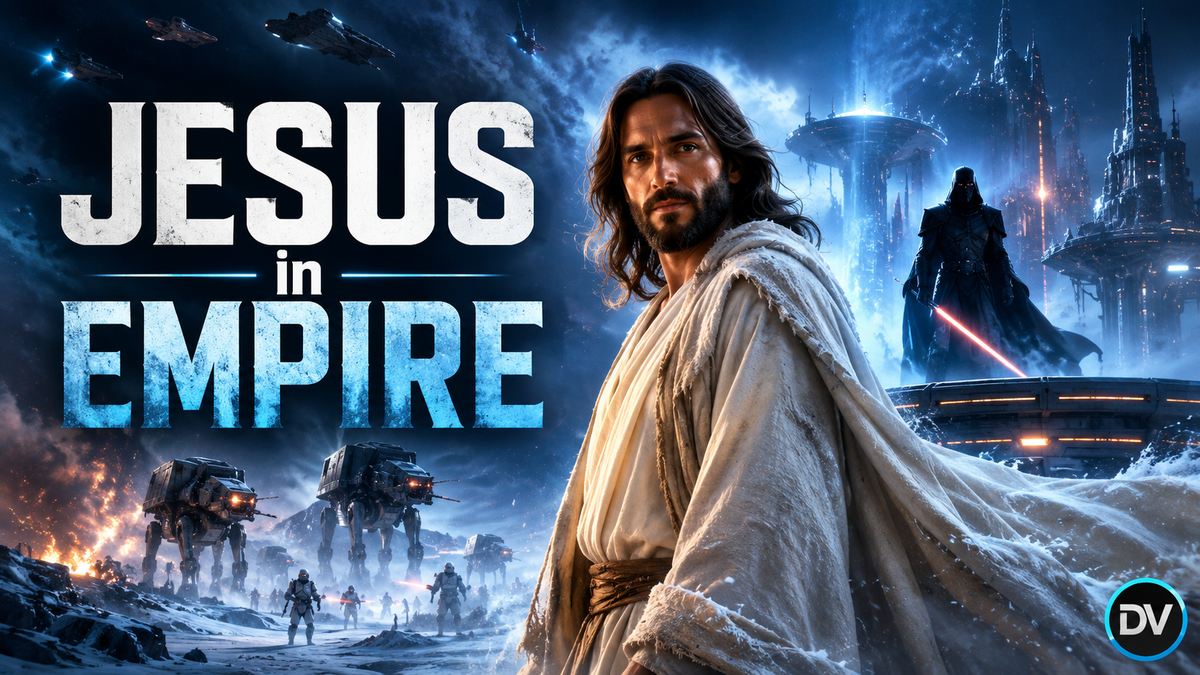
The Quiet Mercy Beneath the Frozen Sky, Jesus in STARWARS The empire Strikes Back

Chapter One
Jesus knelt alone where the white plain broke open into a narrow ridge of black stone. Snow moved across the ground in thin restless sheets, and the wind pressed against His robe as if the frozen moon itself wanted to erase every footprint before morning. Far below Him, under layers of ice, engines beat with a dull buried sound from the refuge city carved inside the mountain. Years later, people would try to name what happened there and speak of Jesus in Star Wars as if the cold itself had become a kind of parable, but on that morning there was no audience and no noise of wonder. There was only Jesus praying in the silence before men began to decide what fear would make them do.
The ridge overlooked a valley where transport lights flickered behind blowing snow. The people hidden beneath the mountain called the place Nareth Hold, though the Dominion records called it a temporary industrial shelter, a phrase clean enough to hide hunger, grief, and the sound of children coughing near heat pipes. Inside the Hold, men and women lived under borrowed names because names could be traded for food, air, passage, or a few extra hours before soldiers came through the lower corridors. Some who heard the story later would connect it with the related article about faith when fear tries to bury the truth, but the people inside the ice did not think in lessons. They thought about rations, searchlights, sealed doors, and whether the person beside them would still be loyal by nightfall.
Jesus remained on His knees while the first alarm rolled faintly through the rock below. It was not loud from where He prayed, yet He heard the human fear beneath it more clearly than the siren itself. He lifted His eyes toward the pale sky, and His face carried no panic. The cold did not hurry Him. The soldiers did not surprise Him. The hidden betrayals already forming in tired minds did not harden Him. He prayed as one who knew the Father was near, and when He rose, the snow had gathered on His shoulders without making Him look small.
Tovan Rell had not slept in thirty-six hours. He sat on the floor beside a cracked heating vent with his back against a supply crate and his left hand wrapped around a metal cup that had gone cold long before he remembered to drink from it. Across from him, his younger sister, Jessa, slept under two gray blankets with one boot still on because she had been too tired to untie it. Her breath sounded thin in the cold room, not dangerous yet, but close enough to make Tovan look at her every few seconds as if watching could hold her in the world.
He had once been known as a courier, though the word sounded better than the work had ever felt. Before the evacuation, before the blockade, before the Dominion began closing the outer routes, he had carried parts, messages, medicine, and sometimes people through checkpoints where one wrong glance could get a man dragged into an interrogation room. He had learned to lie with a calm face. He had learned which officers liked bribes and which ones liked fear more. He had learned the bitter art of making himself useful to whoever held power, because useful men lived longer than honest ones.
Jessa shifted under the blankets and whispered their mother’s name in her sleep. Tovan closed his eyes and waited for the old pain to pass through him. Their mother had died on a transport ramp during the first winter sweep, not from a weapon blast or a dramatic act of violence, but from a simple delay at a Dominion inspection gate while the fever took what strength she had left. Tovan had been seventeen then. Jessa had been nine. Since that day, he had carried one hard belief like a blade under his coat. If he did not control the next door, the next route, the next bargain, someone he loved would pay for his weakness.
The room belonged to Maintenance Level Twelve, though no one maintained much anymore. The wall panels trembled each time the heat pumps strained against the storm outside. Somewhere beyond the door, voices moved through the corridor in tight bursts. People were packing. People were arguing. People were praying in whispers because the Dominion probes had found the north vents before dawn, and everyone knew what came after probes. First came the scan. Then came the demand for surrender. After that came soldiers with white armor, black visors, and rifles held across their chests as if mercy were an old language they had chosen not to learn.
A knock sounded at the door, soft at first and then sharper when Tovan did not answer. He stood with a sudden motion that made the cup fall and roll beneath the crate. Jessa startled awake, and fear crossed her face before she remembered where she was. Tovan put a finger to his lips and reached for the narrow pulse cutter lying on the shelf. It was a tool, not a weapon, but it could burn through a lock or a wrist if a man had no better choice.
“Open,” said a woman’s voice from the other side. “It’s Maelin.”
Tovan exhaled through his nose and lowered the cutter. Maelin Orr stepped in before he had the door fully open, bringing the smell of corridor smoke and cold metal with her. She was not a soldier, though she moved like someone who had learned how to survive among them. Her hair was tucked under a mechanic’s scarf, and grease streaked the side of her jaw. In one hand she carried a folded thermal map. In the other she held a ration pouch that looked too thin to matter.
“They found the north vents,” she said.
“I heard the alarm,” Tovan answered.
“They found more than the vents.” Maelin looked at Jessa and softened for half a breath before turning back to him. “Command is sealing the old service channels. We have maybe five hours before the Dominion cuts through the outer doors. Maybe less if their walkers reach the ridge.”
Tovan hated how calm she sounded. He had always mistrusted calm people because calm could be courage, but it could also be stupidity dressed in clean clothes. He reached for his jacket and pulled it on slowly to give himself time. “Then people need to leave.”
“They are trying,” Maelin said. “That is why I came.”
He glanced at the map in her hand. “No.”
“You did not even hear me.”
“I know what you want.”
“You know the lower routes better than anyone,” she said. “The cargo spine under the east wall still connects to the old lift shaft. If we can get families through it, we can move them before the main doors fall.”
Tovan laughed once, but there was no humor in it. “That shaft froze two winters ago.”
“You got through it last month.”
“I got myself through it.”
“And that is the problem.” Maelin’s voice stayed low because of Jessa, but the words came with heat. “You always know a way out, Tovan. Somehow the way only fits you.”
Jessa sat up fully and pulled the blankets close. “What is happening?”
Tovan looked at Maelin with a warning in his eyes, but Maelin did not flinch. “The Dominion is coming,” she told Jessa gently. “We are moving people to safer levels.”
“There are no safer levels,” Tovan said.
Maelin turned on him. “There are children in the south dorms who will die if we wait for a perfect route. There are old people who cannot climb the ice wells. There are mothers trying to carry infants and oxygen packs at the same time. You can help.”
He felt the old blade inside him twist. He wanted to shout that everyone had someone. Everyone had grief. Everyone had a reason to become noble when another man had to pay the cost. Instead he looked at Jessa’s pale face and thought of the medicine locker two corridors away, empty except for labels and broken latches.
“I can get my sister out,” he said. “That is what I can do.”
Maelin stared at him as if she had expected better and was angry at herself for it. “I did not ask you to abandon her.”
“No, you asked me to risk her for people who would trade my name if Dominion boots came close enough.”
“Some would,” Maelin said. “Most would not.”
“You do not know that.”
“No,” she said, and the honesty in her answer bothered him more than confidence would have. “I only know what happens if every person waits to obey until trust feels safe.”
The room grew quiet except for the heater stuttering beneath the wall. Jessa watched them both, still caught between sleep and fear. Tovan looked away first because Maelin’s face had become too difficult to hate. He had once trusted her, before the war made every friendship feel like a door that could be forced open. There had been a time when they repaired skimmers together in the upper bays and laughed over bad caf, before her father disappeared after refusing to falsify fuel logs for a Dominion officer. Maelin had stayed soft in one place Tovan had deliberately killed in himself, and that made him feel accused even when she said nothing.
A second alarm sounded, closer this time. The overhead light flickered and came back dim. Dust fell from the ceiling in a fine gray line.
Maelin unfolded the thermal map and set it on the crate between them. “The east cargo spine can move twenty people at a time if we clear the ice from Hatch Seventeen. The lift shaft leads to the canyon shelter. From there, small transports can take them under the storm cover.”
“The transports are half charged.”
“Then we charge what we can.”
“The canyon shelter is exposed.”
“Less exposed than this room will be when the doors fall.”
“You keep saying doors fall like that is the worst thing that can happen,” Tovan said, and his voice roughened before he could stop it. “The worst thing is getting halfway out and watching someone you love collapse because you believed a plan that sounded brave in a meeting.”
Jessa looked down. Maelin’s expression changed, and Tovan knew she had heard the part of him he had meant to hide. He hated her for hearing it. He hated himself more.
Before Maelin could answer, the corridor outside filled with hurried footsteps. Someone shouted for a medic. Another voice called for power cells. Nareth Hold was beginning to wake into terror. The quiet hiding place under the ice had become a throat tightening around everyone inside it.
Tovan picked up the pulse cutter and clipped it to his belt. “I will look at Hatch Seventeen,” he said. “I am not promising anything.”
Maelin nodded once, accepting the small opening without trying to widen it by force. “That is enough for now.”
“It is not enough,” he said.
“No,” she answered. “But it is more than nothing.”
They left Jessa in the care of an older woman named Vaila who lived two rooms down and had the calm hands of someone who had seen too much to waste movement. Jessa protested until a coughing fit bent her forward, and the sound nearly broke Tovan’s resolve before he had taken ten steps into the corridor. He wanted to turn back. He wanted to gather her in his arms and force his way through a private route no one else knew. He wanted the universe to shrink until it held only the person he still had left.
The corridor outside Maintenance Level Twelve was crowded with people moving under emergency lights. A boy carried a cage with two small heat-lizards inside, their bodies glowing faintly orange against the wires. A mother tied a blanket around her child’s shoulders while trying not to cry. Two old miners argued over which tunnel had collapsed during the last storm. Tovan moved through them with his shoulders tight, reading every face as a possible danger, every plea as a hook meant to catch him.
Maelin walked beside him without speaking. That bothered him too. She was usually the kind of person who filled silence with purpose, but now she let the silence follow them like a third presence. At the junction, they passed a wall where people had scratched names into the frost-stained metal. Some were names of the dead. Some were names of the missing. Near the bottom, written by a child’s hand, were the words Come back warm. Tovan saw Maelin notice him reading it, so he looked away.
Hatch Seventeen sat at the end of a maintenance passage where the air grew colder with every step. Ice had formed along the seams, thick as bone. Three volunteers were already there with cutters, but one of the tools had failed, and another sparked in a way that made everyone step back. Tovan crouched near the lock panel and ran his fingers over the frost.
“It is sealed from the far side,” one volunteer said. He was young, narrow-faced, and trying to sound older than he was. “We tried a heat pulse.”
“That would fuse the latch if the inner gear is frozen,” Tovan said.
The young man’s face reddened. “No one told us.”
“No one tells anyone anything useful when they are scared.”
Maelin gave him a look. “Can you open it?”
Tovan did not answer. He removed the panel, leaned close, and listened to the machinery behind it. People thought locks were silent until they learned how many small sounds lived inside them. A frozen latch had a different stillness than a broken one. A sealed gear resisted with a tighter strain. This hatch had both problems, and something else beneath them.
He worked for ten minutes without speaking. The volunteers watched him. Maelin held the light steady over his shoulder. When the cutter heated, he smelled old oil and burnt frost. His fingers numbed, but he kept them steady because this kind of work asked nothing from his heart. Metal did not plead with him. Wires did not ask him to become good. A lock only required skill, and skill had always been safer than love.
The hatch groaned. One volunteer stepped forward too soon, and Tovan snapped, “Back.”
The young man froze. Tovan adjusted the cutter angle, burned through a narrow strip of ice-packed metal, and pulled the manual release. The sound that followed was deep and reluctant, like the mountain itself had decided to open one tired eye. Cold air rushed through the widening crack.
For one brief moment, people cheered. It was not loud, but it was real. Maelin smiled with relief, and Tovan felt something dangerous rise in him, a faint warmth that almost made the work feel worth doing. Then the lights above them flashed red.
A voice came over the corridor speaker. “All levels, prepare for breach at north gate. Dominion ground units have entered outer range. Repeat, prepare for breach.”
The cheer died so quickly it seemed embarrassing that it had existed at all.
Tovan stood and looked into the dark passage beyond the hatch. The cargo spine ran east under the mountain, narrow but passable. Frost coated the floor. Cables sagged from the ceiling. It would be a brutal route for children and the elderly, but it could work if people moved now and did not panic. He turned to Maelin, ready to tell her the plan, but the words never came.
At the far end of the maintenance passage stood a man Tovan had never seen before.
He was not dressed like a pilot, soldier, miner, officer, or refugee. His robe should have looked impossible in that place, not thick enough for the cold and far too simple for a station where everyone wore patched thermal layers. Yet He stood without shivering. Snow dust clung lightly to the hem of His garment, though there was no open path from the surface to that corridor. His face was calm, but not distant. He looked at the people near the hatch the way a thirsty man might look at a cup of water offered to someone else first.
The young volunteer whispered, “Who is that?”
No one answered. Maelin lowered the light without meaning to, as if brightness suddenly felt rude. Tovan reached for the pulse cutter at his belt, not because the man looked threatening, but because Tovan had survived by mistrusting anything he could not explain.
The stranger’s eyes met his. Tovan felt the look before he understood it. It did not push into him. It did not search him like a scanner. It simply knew, and being known without being used was so unfamiliar that his first response was anger.
“You cannot be here,” Tovan said.
Jesus walked closer. “Many say that when they are afraid.”
Tovan’s hand tightened around the cutter. “This level is restricted.”
“By whom?”
The question was gentle, but it unsettled the air. Tovan wanted to say command, security, Maelin, the Hold, anyone with a right to decide who belonged. Instead he felt the foolishness of the words before he spoke them. The whole mountain was full of people who had been told they could not be where they were.
Maelin took a careful breath. “Sir, we are evacuating civilians. If you are lost, we can move you with the next group.”
“I am not lost,” Jesus said.
The corridor seemed to grow quieter, though alarms still sounded somewhere above. Tovan studied Him harder, trying to find the trick. The man’s hands were empty. His feet were dusted with snow. His eyes held grief without fear. He looked as if He had crossed the cold not to escape something, but to enter it.
An older miner behind Maelin spoke in a trembling voice. “Are you a priest?”
Jesus turned His face toward him. “I am the good shepherd.”
The words did not sound like a title. They sounded like a fact older than the mountain. The miner’s mouth parted slightly, and he lowered his eyes. Tovan felt irritation flare because reverence could slow people down and get them killed.
“We do not have time for this,” he said.
Jesus looked back at him. “Then do not waste time hiding from what you know.”
Maelin glanced at Tovan, and he hated that too. He heard accusation where there may have been none. His thoughts moved at once to the private route under the coolant ducts, the one he had not told Maelin about, the one wide enough for two people if one of them was small. He had found it during a repair run and kept it secret because secrets were useful. It bypassed the cargo spine entirely and opened near a landing shelf where an old courier pod sat half buried in snow. He could take Jessa through it before anyone else knew.
Jesus did not name the route. He did not have to.
Tovan felt his throat tighten. “You do not know me.”
“I know you have carried your sister through more fear than a young man should have had to carry,” Jesus said. “I know you learned to call control wisdom because loss hurt too much. I know you believe love means keeping one person alive even if your heart grows smaller every day.”
The pulse cutter trembled in Tovan’s hand. Maelin looked away, giving him the only mercy she could offer in that moment. The others stood still near the open hatch, caught between the alarm and the strange holiness that had entered their corridor.
Tovan forced a laugh. “That is a fine speech.”
“No,” Jesus said. “It is a wound.”
The word struck him harder than rebuke. Tovan had built whole walls inside himself to avoid that truth. He had called it caution, intelligence, loyalty, responsibility, even strength. He had never called it a wound because wounds asked to be touched, and touched places could still hurt.
The speaker crackled again. “North gate impact in twelve minutes. All mobile units withdraw to inner levels.”
Maelin stepped closer to Tovan. “We need to move them now.”
Tovan looked at the hatch, then back down the corridor toward Level Twelve where Jessa waited under thin blankets with fever in her breath. He could feel the hidden route in his mind like a door with his name on it. If he gave it up, it would no longer belong to him. If he gave it up, people would crowd it, slow it, risk it, maybe ruin it. Jessa might not survive waiting her turn behind strangers who had done nothing for them.
Jesus watched him, and Tovan hated how the gaze held both truth and compassion. Condemnation would have been easier. A cruel man could be dismissed. A sentimental man could be ignored. This man stood before him with mercy that did not excuse him and truth that did not crush him, and Tovan did not know where to put that.
“There is another way,” Tovan said before he could stop himself.
Maelin’s face changed. “What?”
He swallowed. The moment stretched until he thought he might take the words back. “Coolant ducts behind Twelve. They lead to a shelf outside the east wall. There is an old courier pod there.”
The young volunteer stepped forward. “How many can fit?”
“Not enough,” Tovan said quickly. “It is narrow. Dangerous. It is not for a crowd.”
Jesus said nothing. That silence did more than a command could have done.
Tovan shut his eyes for one second. “Children first,” he said. “Sick, wounded, anyone who cannot make the cargo spine. The rest use the hatch. If the pod powers up, we can shuttle the weakest to the canyon shelter while the transports charge.”
Maelin stared at him as if she was afraid to trust the change too quickly. “Can you guide them?”
Tovan looked toward the corridor again. Every part of him screamed to say no, to take Jessa and vanish into the cold before the larger need swallowed them both. He thought of his mother at the inspection gate, waiting while men with clean gloves decided whether she mattered. He thought of Jessa whispering her name in fevered sleep. Then he looked at Jesus, and the old belief inside him began to crack under the unbearable weight of being seen.
“I can guide the first group,” he said. “After that, Maelin can mark the turns.”
Jesus stepped nearer. “And your sister?”
Tovan’s voice became almost too quiet to hear. “She goes with the first group.”
“Will you carry her?”
The question should have been simple. It was not. If he carried Jessa, his arms would be full, and every other person would become someone else’s burden. If he did not carry her, he would have to trust hands that were not his. The whole shape of his fear stood exposed in the narrow corridor.
Maelin spoke softly. “I can carry her.”
Tovan looked at her. The answer rose in him like a refusal, but it did not leave his mouth. He saw the steadiness in Maelin’s face, not perfect, not untouched by fear, but real. He saw the open hatch. He saw the volunteers waiting to be told what courage required next. He saw Jesus standing in a corridor under a mountain about to be invaded, asking him to let love become larger than control.
“You drop her, I will never forgive you,” Tovan said, but his voice broke on the last word.
Maelin nodded with tears standing in her eyes. “Then I will not drop her.”
The first distant impact shuddered through the Hold. The floor jumped beneath them. Someone cried out. A line of frost broke loose from the ceiling and scattered across Tovan’s shoulders. The Dominion had reached the north gate.
Jesus turned toward the sound, and for a moment His face carried such sorrow that Tovan understood the invasion differently. It was not only a military movement. It was the old sickness of men trying to rule what they could not redeem. It was fear wearing armor. It was power without mercy. It was the thing Tovan had hated and imitated in smaller ways because he believed survival required it.
“Go,” Jesus said.
No one mistook the word for panic. It moved through them like a bell.
Maelin ran toward Level Twelve to get Jessa. The volunteers began calling people from the nearest corridors. Tovan stepped into the open hatch and shone his light down the cargo spine. The path ahead was dark, narrow, and bitterly cold. It did not look like rescue. It looked like a place where fear would have many chances to return.
He looked back once. Jesus stood beside the hatch, helping an old miner fasten his coat with hands that had just held the silence of prayer on the ridge above. The alarms screamed. The mountain trembled. People pushed forward with frightened faces and shaking bags. Yet where Jesus stood, the corridor felt less like a trap and more like a place where truth had finally entered.
Tovan turned into the dark passage and lifted the light. “Stay close,” he called to the first group, though his voice shook more than he wanted it to. “Step where I step. Do not run. If you fall, say something. We are getting out through the east.”
Behind him, a child began to cry, and someone whispered a prayer. Tovan did not know whether he believed the prayer would change anything. He only knew that for the first time in years, he had given away a secret door instead of keeping it for himself. The cost of it frightened him. The rightness of it frightened him too.
As the first evacuees entered the cargo spine, Tovan felt the cold rise around his boots and thought of Jessa in Maelin’s arms. He wanted to turn back with every breath. Instead he moved forward one careful step at a time, carrying the light into the frozen dark while the man who had seen him remained at the opening, steady as mercy under a collapsing sky.
Chapter Two
The cargo spine swallowed sound in a way that made every breath feel private. Tovan moved first with the light held low, not high, because the ceiling was webbed with frost and hanging cable, and the wrong reflection could blind the people following him. The passage had once carried supply carts under the mountain, but now it held only stripped rails, frozen grease, and the faint pulsing hum of emergency power fighting to stay alive. Behind him came the first line of evacuees, not many yet, only the weakest from the nearest levels, but their fear filled the narrow space as fully as a crowd.
He kept listening for Jessa. She was not behind him yet, and that fact made every step feel like betrayal. Maelin had gone to get her, and Tovan had given his consent with words that still felt unnatural in his mouth. Trust did not become easy because he had spoken it once. It fought him now with every sound from the passage behind him. He imagined Maelin stumbling. He imagined Jessa’s fever rising. He imagined the corridor sealing before they reached it, and each thought tried to turn him around.
“Keep to the left rail,” he said without looking back. “The right side drops where the floor buckled.”
A little boy near the front sniffed hard and clutched a cloth bundle against his chest. Tovan had seen him earlier with the glowing heat-lizards, but the cage was gone now, probably left behind when his mother realized she could carry either the animals or her own child through the east route. The boy’s face looked too serious for his age. He stepped where Tovan stepped, but his eyes kept moving toward the dark spaces between the rails.
“What is your name?” Tovan asked.
“Sair,” the boy answered.
“Look at my boots, Sair. Not the walls.”
“I hear something in there.”
“You hear old pipes,” Tovan said.
The boy did not believe him, and Tovan could not blame him. The Hold was full of noises that stopped being mechanical when people were afraid enough. The metal groaned like a living creature. Ice cracked behind the walls. Far above them, the first heavy impacts rolled through the mountain, deeper and slower than the alarms. The Dominion was not rushing anymore. It was arriving with the confidence of people who believed time itself belonged to them.
The passage bent left, then narrowed near a support brace where an old collapse had pinched the walls inward. Tovan crouched and ran his light over the floor. The last time he had come through this route, he had been alone and hungry, carrying a stolen battery under his coat. Alone, he had slid sideways through the gap with only a torn sleeve. The people behind him could not do that. An old woman with a breathing mask would not make it without help. A man with a wrapped leg might fall. Two children were already trembling from cold.
He turned to the volunteer behind him, the narrow-faced young man from the hatch. “What is your name?”
“Bren.”
“Bren, take three people through at a time. Packs off first. Pass them after. No one pushes.”
Bren nodded quickly, grateful for orders because orders gave fear somewhere to stand. Tovan showed him where to place his feet and how to brace his shoulder against the bent frame. The old woman went first. Her mask fogged white with each breath, and for a moment she seemed too fragile for the passage. Tovan reached for her hand before he had time to protect himself from the act. Her fingers were cold and small in his grip.
“I am sorry,” she whispered as he helped her through.
“For what?”
“For being slow.”
The answer struck him in a place he did not want opened. He thought of his mother apologizing to him on the transport ramp because fever had made her legs weak, as if dying had been an inconvenience she had caused. Tovan swallowed and guided the old woman’s hand to Bren on the far side.
“You are not the problem,” he said.
She looked at him through the clouded mask, and her eyes filled. He looked away before gratitude could ask too much from him.
The next tremor came hard enough to throw dust from the ceiling. A child screamed near the back, and the line bent out of shape as people reached for one another. Tovan pressed his palm against the wall to stay upright. The metal under his hand vibrated with the distant violence at the north gate. He pictured armored walkers lowering their legs into the snow, cannons blooming white fire against the outer door, officers watching the mountain crack open like men opening a crate. The image made his jaw tighten until pain ran up the side of his face.
“Steady,” he called. “If you panic, we lose time.”
Sair began to cry quietly, trying so hard not to that the sound came in broken breaths. His mother, a tired woman with a burn mark along one sleeve, lowered herself beside him and pulled him close. Tovan wanted to tell her to keep moving. He wanted to say there was no time to kneel in a passage while soldiers approached. Then he saw the boy’s empty hands and understood that the bundle he had carried was not a toy or clothing. It was the heat-lizards wrapped in cloth, already too cold to glow.
The mother looked up at Tovan. “One minute,” she said. “Please.”
He almost refused. The word formed in him easily. It belonged to the man he had practiced becoming, the man who measured mercy against seconds and found it wasteful. Before he spoke, a light appeared behind the line. It did not come from a lamp. It came from the way people shifted aside without instruction.
Jesus entered the cargo spine with snow still melting from His robe.
No one asked how He had come so quickly from the hatch, though Tovan wanted to. Jesus walked to Sair and knelt on the frozen rail beside him. The boy looked at Him through tears, ashamed of crying for small creatures when people were trying to survive. Jesus did not shame him further. He rested one hand near the cloth bundle, not touching it at first, and waited until the boy let Him.
“They were warm,” Sair said. “I thought if I wrapped them, they might stay warm.”
Jesus looked at the cloth, then at the boy. “You loved what was given into your care.”
Sair nodded and broke into a fuller sob. His mother pressed her face against his hair and whispered that she was sorry. Jesus stayed with them for a few breaths, and something about His stillness held the line together. He did not turn the moment into a display. He did not make the dead creatures breathe or use the child’s grief to prove anything. He simply honored a small love in the middle of a large terror, and that disturbed Tovan more than he expected.
“We have to move,” Tovan said, though the words came softer than he intended.
Jesus rose and looked at him. “Yes.”
There was no rebuke in the answer, but Tovan felt one anyway. He turned back to the gap and pushed the next pack through. The line began moving again. Sair’s mother carried the cloth bundle now, tucked inside her coat, and the boy walked with a steadier face. Tovan did not understand why that mattered. Nothing had changed. The Dominion was still coming. The animals were still dead. The passage was still dangerous. Yet the boy no longer looked as if fear had taken everything from him.
When the last of the first group made it through the bent frame, Tovan checked the support brace. Fresh cracks had opened in the frost around it. They would not be able to pass large groups through for long. He made a mark on the wall with black grease and pointed to Bren.
“When Maelin gets here, show her this. Three at a time. Packs off. If the brace shifts, stop moving people through and use the upper crawl.”
Bren frowned. “What upper crawl?”
Tovan lifted the light to a shadowed seam above the frame. “There is a maintenance slot behind that panel. It is tight, but children can go through.”
“How did you know that?”
“I know things because I did not tell people.” The admission landed between them with a weight Tovan had not expected. He looked down and clipped the light to his belt. “Now I am telling you.”
Bren’s face changed, not with accusation, but with a kind of startled respect. Tovan found it easier to turn away than receive it. Respect felt dangerous when it came too soon.
A voice crackled through Maelin’s handheld comm from somewhere behind them. Tovan heard only pieces at first, broken by static and distance. “Level Twelve clear. Moving sick now. Need room at the spine. Repeat, need room.”
Jessa was moving. Tovan’s chest loosened and tightened at the same time.
He took the comm from Bren. “Maelin, where are you?”
Her answer came through with heavy breathing behind it. “Two corridors from the hatch. I have Jessa. Vaila is bringing two children from Twelve. We have more sick than expected.”
“Of course you do,” Tovan muttered.
“What?”
“Nothing. Move fast.”
“Tovan,” Maelin said, and the static cut her voice into rough pieces. “She is conscious. Scared, but conscious.”
He closed his eyes. “Tell her I am ahead.”
“I did.”
“What did she say?”
A brief pause came through the comm. “She said you always are.”
The words should have comforted him. Instead they exposed him. He had always been ahead, always scouting exits, always opening doors just wide enough for the two of them, always mistaking distance for protection. Jessa had learned to look for him in front of her because he had rarely been beside her. He gave the comm back to Bren before Maelin could hear his breathing change.
The cargo spine opened into a wider service chamber where three routes met. One led down toward the canyon shelter. One led back toward storage and auxiliary power. The third was sealed behind a round coolant door with yellow warning paint worn almost away. Behind that door lay the private route Tovan had hidden, the narrow duct that led under Maintenance Level Twelve and out toward the shelf. He stood before it and felt the old claim rise in him with surprising force. Some part of him still wanted to keep it secret even after he had already spoken of it.
Jesus came to stand beside him.
Tovan did not look at Him. “You keep appearing where people are weakest.”
“I go where I am needed.”
“That is not an answer.”
“It is the answer I have given you.”
Tovan breathed out through his teeth. “There are soldiers cutting through the gate. If You are who that miner thinks You are, why are You in a service tunnel instead of stopping them?”
Jesus looked toward the ceiling as another tremor moved through the rock. “Because you are not the only one who thinks salvation means control.”
Tovan turned sharply. “People are going to die.”
“Yes,” Jesus said, and His voice carried grief so real that Tovan’s anger lost its footing. “Death is an enemy. Do not make peace with it. But do not become its servant because you fear it.”
Tovan wanted to argue. He wanted to demand something larger than words in a tunnel. He wanted fire against the machines outside, blindness over the soldiers, the mountain sealed by power no empire could break. He wanted the sort of rescue that would not require him to change. Jesus did not give him that, and Tovan could feel the offense of it pressing against all the sore places in his soul.
“You could make this easy,” Tovan said.
“I could make you obey without love,” Jesus answered. “That would not heal you.”
The words were quiet, and because they were quiet, he could not protect himself from them. He looked back at the coolant door and pressed his palm against the release plate. The panel was cold enough to sting. For years he had lived as if love were proved by refusing to lose one person, no matter what became of the rest. Now Jesus stood beside him and offered a harder mercy. Love might require him to risk being unable to control the person he most wanted to protect.
Footsteps and strained voices reached the chamber. Maelin appeared first, her face flushed from effort and cold. Jessa was in her arms, wrapped in blankets, one cheek pressed against Maelin’s shoulder. Vaila followed with two small children tied to her by a safety strap around her waist. Several others came behind them, limping, coughing, carrying what little they had saved.
Tovan went to Jessa so quickly he almost knocked into Maelin. “Jessa.”
His sister lifted her head. Her eyes were glassy with fever, but she managed a faint smile. “You opened the way?”
“Part of it.”
“That sounds like you.”
He reached for her, then stopped. Maelin shifted as if ready to pass her over, but the coolant door stood unopened behind him, and the service chamber was filling fast. Tovan could not carry Jessa and open the old duct at the same time. He could not guide the sick through the crawl with both arms wrapped around his sister. The choice returned, cruel and simple.
Jessa saw it before he spoke. She was younger than he was, but fear had made her observant. “I can stay with Maelin.”
“No.”
“Tovan.”
“No,” he said again, too sharply. Several people turned. He lowered his voice and tried to make it steady. “You do not understand the duct. It is tight. The floor drops near the intake bend. I have to get you through.”
Maelin spoke carefully. “You can guide from the front. I can carry her where you tell me.”
“That is not the same.”
“No,” Jessa whispered. “It is not. But I trust her.”
The words hurt more than he expected because they were not rejection. They were release, and release felt like being cut. Tovan looked at his sister’s face and saw how tired she was of being the center of his fear. He had called his control love for so long that he had never asked what it felt like to be loved that way. Maybe it felt like being held too tightly in a burning room.
Jesus stood a few steps away, saying nothing.
Tovan rubbed both hands over his face, then turned to the coolant door. “Fine. Listen to me exactly.”
He opened the outer panel and worked the manual lever. The door resisted at first, then hissed as old pressure bled out around the seal. Cold vapor rolled across the floor. The people nearest it stepped back. Behind the door, the duct sloped downward into blue darkness. It was barely large enough for a person to crouch inside.
“This is not a walking route,” Tovan said. “You crawl for the first stretch. No packs on your back. Push them ahead. Children go wrapped and tied. Anyone who cannot crawl waits for the cargo spine unless we can move them by board.”
A man near the back groaned. “That will take too long.”
Tovan looked at him. “Then help, or be quiet.”
The man lowered his eyes. Tovan stepped into the duct, checked the first bend, and came back with frost on his sleeves. He showed Maelin where to place her knees, where the metal skin had split near the intake, and where to lean so Jessa would not strike her shoulder on the turn. Maelin listened without pride. Jessa watched him with a strange gentleness that made him feel both loved and exposed.
A new message came through the chamber speakers. “North gate breached. Inner blast doors holding. All evacuation teams accelerate movement. Dominion units inside outer shield zone.”
The room stiffened. Someone began praying under his breath. Someone else cursed with a shaking voice. Vaila tightened the safety strap around the two children and looked at Tovan as if he were much older than he was.
“Move,” Tovan said.
Maelin entered first with Jessa tied securely against her chest. Tovan wanted to stand close enough to catch them both, but the duct would not allow it. He had to crawl ahead, turn, and guide with words instead of hands. That small distance felt like a violence against everything he had trained himself to be. He moved through the first bend and looked back with the light.
“Left shoulder down,” he said. “There is a seam above your right.”
Maelin obeyed. Jessa closed her eyes as the duct narrowed around them. Tovan saw fear pinch her mouth and nearly pushed past Maelin to drag her through himself. Jesus’ words held him where he was, not like a chain, but like a hand against his chest. You are not the only one who thinks salvation means control.
“You are doing fine,” Tovan said.
Jessa opened one eye. “That sounded painful for you.”
Maelin gave a breathless laugh despite the fear. Tovan almost smiled, and the almost surprised him.
Behind them, Bren began sending the first child into the duct. Vaila spoke calmly to the others. The chamber had become a place of hurried obedience. It was not neat or heroic. People bumped shoulders, dropped packs, snapped at each other, apologized, and kept moving. Tovan crawled deeper, marking safe spots with his light. He had imagined this route a hundred times as an escape for himself and Jessa. He had never imagined it filled with crying children, coughing elders, Maelin’s steady breathing, and the strange nearness of Jesus moving behind the weakest as if no cramped duct could make Him less holy.
They reached the intake bend ten minutes later. The duct dipped sharply, then rose toward a service grate that opened near the outer shelf. Ice had grown along the lower edge, narrowing the passage more than Tovan remembered. He chipped at it with the pulse cutter while Maelin waited with Jessa in a crouch that had to be burning through her legs.
Jessa coughed hard. The sound echoed in the metal and came back multiplied. Tovan turned so fast his shoulder struck the wall.
“She needs the med canister,” he said.
Maelin adjusted her hold. “Where?”
“Auxiliary power storage. Back near the service chamber.”
“How far?”
“Too far,” he said.
Jessa tried to speak and coughed again. When she could breathe, she looked at him with wet eyes. “No.”
“You do not decide this.”
“I am not the only one coughing.”
Tovan looked past Maelin. In the dim line behind her, the two children tied to Vaila were coughing too. The old woman with the breathing mask had stopped twice already. Others needed medicine, not only Jessa. He knew where a sealed emergency canister might be because he had seen it months ago and left it hidden, thinking he might need it later. Another secret. Another door he had saved for himself.
Maelin read his face. “You know where medicine is.”
“I might.”
“Tovan.”
“I said I might.”
Jessa reached one weak hand toward him. In the narrow duct, the gesture had no strength, but it stopped him. “If you go back,” she said, pausing to breathe, “go back for all of us.”
He stared at her. He wanted to tell her not to sound brave when she could barely sit upright. He wanted to say she did not understand cost. But of course she did. She had paid for his fear too. She had lived inside it, moving from hidden room to hidden route, always protected and always trapped by the protection.
The duct behind them shifted with the movement of more evacuees. Bren called from the rear that the service chamber was filling again. The main cargo spine had taken more people than expected, but the bent support was cracking. Time was thinning.
Jesus’ voice came from behind the line, low and clear. “Tovan.”
He could not see Him from the bend, only hear Him. The sound moved through the metal without becoming distorted.
Tovan shut his eyes. “I know.”
No one asked what he knew. He turned to Maelin and forced himself to speak before courage drained away. “Take her through the bend. When you reach the grate, the release latch is on the lower right. It sticks. Kick it twice, then pull up. The shelf outside is narrow, and the pod is under snow to the left. Do not power it until I get there unless soldiers come through the east ridge.”
Maelin’s face tightened. “You are going back.”
“For the canister.”
“And if you cannot get back through?”
“Then you open the pod and get them to the canyon shelter.”
Jessa began shaking her head. “No.”
Tovan crawled closer and took her hand. For the first time, he did not tell her everything would be fine. He did not know that. The lie sat ready on his tongue because old habits wanted to comfort him as much as her. He let it die there.
“I am afraid,” he said.
Jessa’s eyes filled, not because the words were comforting, but because they were true. He had given her orders for years. He had given her plans, routes, warnings, and sharp promises. He had rarely given her honesty without armor.
“I know,” she whispered.
“I kept doors from people,” he said. “I kept medicine. I kept every way out like the world owed me a private mercy because we lost Mother.”
Her fingers tightened around his. Maelin looked down, giving them what privacy she could in a tunnel full of frightened people.
“I thought if I controlled enough, I could keep it from happening again,” Tovan said. “I thought that was love.”
Jessa swallowed. “You did love me.”
“Yes,” he said. “But I was also afraid.”
She nodded, and that small mercy nearly undid him. She did not excuse everything. She did not accuse him either. She simply let the truth stand between them without turning away.
Tovan leaned forward and kissed her forehead. It burned with fever. “Stay with Maelin.”
“Come back,” Jessa said.
He looked at her and then past her, toward the line of people crawling through the secret he had finally surrendered. “I will try.”
He turned before he could weaken. Moving backward through the duct against the flow was slow and brutal. People pressed themselves to the side where they could. Children stared at him with wide eyes. The old woman with the breathing mask touched his sleeve as he passed, and he could not tell whether she meant to bless him or steady herself. He took the touch either way.
When he reached the service chamber again, the situation had worsened. The cargo spine behind the bent brace was still moving people, but part of the ceiling had come down near the entry. Bren’s face was streaked with dust, and blood ran from a cut above his eyebrow. He was still directing people through the hatch, his voice hoarse from repeating instructions.
“Where is the canister?” Jesus asked.
Tovan turned. Jesus stood near the coolant door with one arm around a man who could barely stand. The man’s face was gray with fear, but his breathing steadied under Jesus’ hand. Tovan did not understand how Jesus had moved from the rear of the duct to the chamber, and he no longer had strength to demand an explanation.
“Auxiliary power storage,” Tovan said. “South side. Behind the dead generator.”
“I will go with you.”
The answer came so simply that Tovan almost refused out of habit. He did not know how to walk beside someone who saw him clearly and did not use what He saw. But there was no time to untangle the fear. He nodded once and led the way.
They moved through a side passage lit by failing emergency strips. The impacts from above had changed pitch. The Dominion was past the outer defense. Somewhere in the Hold, people were fighting to slow them down, and the mountain carried each blast through its walls like a body carrying blows. Tovan ran with the cutter in one hand and the light in the other. Jesus kept pace beside him without hurry, and that steadiness began to feel less like slowness and more like a different kind of strength.
At the storage door, Tovan burned through the latch. The room beyond smelled of old coolant, dust, and electrical fire. Shelves had collapsed along one wall. Power cells lay scattered across the floor like dull metal bones. He went straight to the dead generator and dropped to his knees. Behind it, under a loose floor plate, was the sealed canister he had hidden and marked with a strip of black wire.
His hands froze over it.
The canister was smaller than he remembered. It would not save everyone. It would help some. Maybe Jessa. Maybe the two children. Maybe the old woman. Not all of them. The old terror rose again, quick and convincing. If there was not enough for everyone, then he should choose his sister first. Was that not love? Was that not his duty? Had he come all this way just to pretend people did not choose when survival became narrow?
Jesus crouched beside him. “What do you fear will happen if you give it freely?”
Tovan gripped the canister. “That she will need what I gave away.”
“And what happens to you if you save it only for her?”
“She lives.”
Jesus waited.
Tovan looked at the sealed metal in his hands. He heard Jessa’s voice in the duct. Go back for all of us. He heard his mother apologizing for being slow. He heard the old woman whispering the same apology. He heard Maelin saying that obedience would never feel safe if he waited for trust to become easy.
His voice came out rough. “I stay the same.”
Jesus’ eyes held his. “I did not come into this cold place to leave you the same.”
Tovan looked away because tears had risen too fast. He had no time for them. He stood with the canister under one arm and grabbed two portable power cells with his free hand.
They ran back toward the service chamber. Halfway there, a blast shook the passage so violently that Tovan struck the wall and dropped one cell. The light went out. For a moment there was only darkness, alarms, and the sound of metal tearing somewhere far too close. He felt for the canister in panic and found it still against his chest. Then a hand closed around his arm.
“I am here,” Jesus said.
Those words did not remove the danger. They did not open the mountain or silence the soldiers. Yet something in Tovan steadied under them. He had spent years believing that fear told the truth because fear was loud and specific. Jesus spoke softly in the dark, and the words went deeper than fear had ever reached.
The emergency light flickered back. Tovan picked up the dropped cell. Together they entered the service chamber just as Bren shouted for help near the cargo spine. The bent support had shifted. Several evacuees were trapped on the far side, not crushed, but cut off by fallen metal and ice. Vaila was among them. Through the gap, Tovan could see her holding the two children close while others pressed back in fear.
Bren looked at him with desperate eyes. “We cannot get them through.”
The coolant duct remained open behind them. Maelin and Jessa were already ahead, maybe near the outer shelf by now. The canister in Tovan’s arms needed to reach them. The trapped group needed the gap opened before the next tremor sealed it completely. Two claims pulled at him at once, and neither was imaginary.
Tovan looked at Jesus. “Tell me what to do.”
Jesus did not answer quickly. His face was grave, and His silence made Tovan understand that obedience was not going to become smaller just because he wanted it to. At last Jesus placed His hand on the med canister.
“Give Bren what must go forward,” He said. “Then open what must not remain closed.”
Tovan turned to Bren. The young man looked terrified and too young and bloodied, but still standing. Tovan put the med canister and power cells into his arms.
“Take these through the duct,” Tovan said. “Find Maelin. Tell her the dosage marks are under the seal. Jessa gets the second measure if her breathing worsens, not the first. The first goes to whoever is closest to losing air. Do you understand me?”
Bren’s mouth opened slightly. “Your sister—”
“Do you understand me?”
Bren nodded. “Yes.”
“Say it.”
“The first measure goes to whoever is closest to losing air. Jessa gets the second if her breathing worsens.”
Tovan’s throat tightened, but he held Bren’s gaze until the instruction became real. “Go.”
Bren went into the duct with the canister and cells. Tovan watched only long enough to see him disappear beyond the first bend. Then he turned toward the collapsed gap where Vaila and the others waited behind twisted metal. Jesus stood beside him, not as a commander above him, but as mercy beside him in the work.
For the first time since the alarm began, Tovan did not move because he had found a way to control the outcome. He moved because the next right thing stood in front of him and would not be opened by fear. He lifted the pulse cutter, stepped toward the fallen brace, and began to cut.
Chapter Three
The fallen brace glowed red where Tovan pressed the cutter against it. Metal did not yield like flesh, but it complained in its own language, shrieking softly as the heat found the frozen stress inside it. Beyond the twisted frame, Vaila held the two children close against the far wall while three other evacuees crouched in the narrow pocket left by the collapse. None of them spoke at first. They watched the light of the cutter the way people watched a candle in a room filling with smoke.
Tovan kept his shoulder low and his hands steady. He had cut through locks, plates, couplings, cargo seals, and once through a Dominion boot clamp while its owner slept drunk in a guard post. This was different because the brace was carrying weight from above. If he cut too quickly, the ceiling could sag and bury the trapped group. If he cut too slowly, the next impact could finish what the first collapse had started.
“Not that side,” Jesus said quietly.
Tovan stopped with the cutter still humming in his hand. “What?”
Jesus stood beside him, one palm resting against the wall as if listening through stone. “The strain is higher there.”
Tovan wanted to ask how He knew. He had no time for pride, but pride rose anyway. This was the one thing he understood. Metal, pressure, routes, and risk had always been his ground. He angled the light and saw what Jesus had already seen, a thin bending line near the upper joint, almost hidden under frost. If he had cut one inch deeper on that side, the brace could have folded inward.
He swallowed the bitterness of being corrected and moved the cutter lower. “Here?”
“Yes.”
Tovan burned a cleaner line along the bottom support. The smell filled the service chamber, sharp and dirty. Vaila pressed one hand over a child’s mouth to keep him from breathing too much smoke, and Tovan looked for a way to increase airflow without shifting the debris. He pointed with the cutter handle toward a cracked vent above the collapse.
“There is a fan line behind that panel,” he told the man nearest him. “Tear it open if you can. Slow. Do not pull the cable.”
The man, broad-shouldered and pale with fear, looked up at the panel as if Tovan had asked him to lift the mountain. Then Jesus looked at him, not with command, but with a calm that seemed to remind him he still had hands. The man stood carefully, wedged his fingers under the broken metal, and began pulling it loose.
A blast rolled through the Hold before Tovan finished the second cut. The floor lurched hard enough to drive one knee into the rail. Sparks scattered across his sleeve. On the far side, one of the children cried out, and Vaila pulled both of them tighter, her old face pinched with pain. A chunk of ice fell from above and shattered between Tovan and Jesus.
“North gate?” Tovan asked through clenched teeth.
“Closer now,” Jesus said.
Tovan looked at Him, irritated by the answer and comforted by the steadiness of His voice at the same time. “You say that like distance matters less than fear.”
“Fear makes every enemy closer.”
The words might have sounded like a saying if anyone else had spoken them. From Jesus, they felt like the plainest truth in the room. Tovan set his jaw and cut the third line. The brace gave a low groan. Everyone froze.
“Do not move,” he said.
No one did. Even the child stopped crying for a moment. Tovan slid his hand under the lower edge, felt the tension, and looked at the remaining section. He could not remove the brace entirely. He could only create enough of an opening for the trapped people to crawl through one at a time. The old woman would have trouble. The children would make it if they did not panic.
“I need wedges,” he said. “Anything flat and hard.”
A woman near the coolant door emptied a pack onto the floor and handed him two broken tool plates. Another person gave him a folded rail clamp. Tovan jammed them under the brace, then nodded toward the far side.
“Vaila first with the children.”
“No,” Vaila said. Her voice came calm but hard. “Children first.”
“If they panic halfway, you will have to push them through. You go with them.”
“I said children first.”
Tovan nearly snapped at her. The argument was foolish and costly, but her eyes held the same stubborn mercy he had seen in older people who had survived by refusing to let fear choose the order of love. He realized she was not delaying out of pride. She was making sure the children did not believe their lives depended on whether she could move fast enough.
Jesus stepped nearer to the opening. “Let them hear your voice from behind them,” He said to Vaila. “They already trust it.”
Vaila looked at Him, and something in her face softened without weakening. She nodded once. The first child crawled toward the opening, small shoulders shaking under a brown coat. Tovan reached through as far as he could, but he was still inches short. The boy froze beneath the twisted brace with his eyes squeezed shut.
“What is his name?” Tovan asked.
“Orin,” Vaila said.
Tovan remembered how Sair had watched his boots in the cargo spine. He lowered his voice. “Orin, open your eyes and look at my hand.”
The boy did not move.
“Look at my hand,” Tovan said again. “Not the metal. Not the dark. My hand.”
Orin opened his eyes enough to see him. Tovan pushed his arm farther into the gap until the edge of the brace bit into his sleeve. The boy reached, missed, then reached again. Their fingers touched. Tovan closed his hand around the child’s wrist and pulled slowly while Vaila urged from behind with words so tender that the chamber seemed to hold its breath around them.
Orin came through covered in dust. The woman who had given the tool plates caught him and pulled him clear. The second child followed, crying but moving. Vaila came after them, and that was harder. Her breathing mask caught on a jagged strip of metal, and when she tried to free it, her shoulder wedged against the brace. The support shifted with a sound that made Tovan’s blood go cold.
“Stop,” he said.
Vaila stopped. Her face was half hidden by the mask, but her eyes found his. She knew. The brace might hold, or it might not. There was no careful calculation left, only a choice made under pressure.
Tovan slid onto his side and pushed his shoulder under the lower frame. Pain flashed through him as the weight settled against him. It was not enough to crush him, not yet, but it pinned him in a way that made breathing harder. “Move now,” he said.
Vaila tried. The mask caught again. Jesus knelt beside Tovan and reached through the opening, His hand steady near Vaila’s face.
“Do not pull against the fear,” Jesus told her. “Turn toward My hand.”
She obeyed. It was a small movement, almost nothing, but it changed the angle. The mask slipped free. Tovan shoved up with his shoulder, and two evacuees pulled Vaila through as the brace screamed above him. She collapsed into the chamber, coughing hard.
The remaining three came through faster after that, driven by the sound of the metal beginning to fail. Tovan held the brace until the last man cleared the gap. Then Jesus gripped the back of his jacket and pulled him free just as the support folded inward. The collapse filled the space where Tovan’s chest had been a heartbeat earlier.
He landed hard on the floor and rolled onto his back. For several seconds he could not move. The chamber ceiling swayed in and out of focus. His shoulder throbbed from the weight of the brace, and the side of his face burned where sparks had touched it. He heard people coughing, thanking one another, calling names. He heard Vaila crying quietly, not from panic, but from the release that comes when the body survives what the mind had already begun to surrender.
Jesus crouched beside him. “Can you stand?”
Tovan laughed weakly because the question was so ordinary. “Do I have a choice?”
“You have many choices,” Jesus said. “That is why some of them frighten you.”
Tovan turned his head and looked at Him. The alarms painted the side of Jesus’ face red, then white, then red again. No fear ruled Him. Yet He was not untouched by what was happening. His eyes moved from the rescued children to Vaila to the sealed collapse, and each human life seemed to matter to Him with a weight Tovan could not understand without feeling ashamed of how lightly he had learned to count strangers.
Bren’s voice crackled through the comm clipped to the wall near the coolant door. “Tovan, do you read?”
Tovan pushed himself up too quickly, and pain cut through his shoulder. Jesus placed a hand behind him, not holding him down, only steadying him until the room stopped spinning. Tovan grabbed the comm.
“I read.”
“We reached the outer shelf,” Bren said through static. Wind tore at the transmission. “The pod is here, but the intake is frozen. Maelin is clearing it. Jessa got medicine.”
Tovan closed his eyes for one second. “Did it help?”
“Some. She is breathing easier. The old woman from the first group needed the first measure. Jessa told Maelin to do it.”
Of course she had. Tovan felt something inside him bend in a way that hurt and healed at the same time. He had taught Jessa survival, or thought he had. Somewhere in the shadow of his control, she had learned mercy without his permission.
“Tell her I heard,” he said.
There was a pause full of static. “She already knows you would ask.”
Tovan lowered the comm and stared at the floor. He had spent years thinking Jessa needed him to become harder, quicker, more guarded, more ready to fight the world before it could touch her. Maybe she had needed some of that. But she had also needed a brother who could trust goodness without treating it like a trap. He did not know how to become that kind of man quickly, and the not knowing frightened him almost as much as the soldiers.
Maelin came onto the comm, her voice breathless. “Tovan, listen. We can get the pod started, but it only seats six safely. Maybe eight if two are children. The canyon shelter signal is weak. If we send the worst cases first, the pod has to return twice.”
“Battery?”
“Thin,” she said. “Bren brought cells, but one port is cracked. I can patch it, but not while loading people.”
He looked at the service chamber. More evacuees had entered while he was cutting the brace, and more were waiting beyond the hatch. The cargo spine was blocked now by the collapsed support. The coolant duct had become the main route for the most vulnerable, but it could not move everyone. The wider east passage still led toward the canyon shelter by foot, though its lower stretch crossed an exposed section under the ridge. If Dominion scouts reached the east slope, anyone on that path would be visible against the snow.
“Send the pod with the sickest,” Tovan said. “Do not wait for me.”
Maelin hesitated. “Jessa will ask.”
“Tell her I said to obey.”
“That may not help.”
Despite everything, he almost smiled. “Tell her I am coming by the foot route after I clear the next group.”
The comm crackled. “Tovan.”
“What?”
Maelin’s voice dropped. “There are lights moving above the east ridge. Not many. Maybe scouts.”
The chamber seemed to grow smaller around him. The private route was no longer private. The Dominion had spread faster than command predicted, or command had lied, which was more likely. Tovan looked at Jesus. He did not know why he did that now, only that his eyes went there before he made the next decision.
Jesus’ face was grave. “The frightened must not be driven into the open without someone to gather them.”
Tovan understood. The foot route would need a guide. If the pod carried the sickest and children, the rest would still need to cross the exposed stretch under storm cover before the ridge lights came closer. It was the kind of job Tovan would have refused that morning because it did not center on Jessa. Now it stood before him like a door he had already begun to open.
He keyed the comm. “Maelin, launch when ready. I am bringing the next group through the lower foot route.”
“You mean the shelf path?”
“Yes.”
“That path is exposed.”
“I know.”
“Tovan, if scouts are above it—”
“I know.”
He heard her breathing through the static. “Come back from this.”
The words were simple, but they held too much history to answer easily. He looked at Jesus again, and this time Jesus did not speak for him.
“I will try,” Tovan said. “Take care of her.”
“I will.”
The comm went dead. For a moment, Tovan stood with the silence of that promise in his hand. Then a shout came from the hatch. A group of evacuees stumbled into the chamber, led by a broad woman in a torn command jacket. Her name patch read Sella Vorn. Blood had dried along her temple, and her left sleeve was blackened from smoke.
“Cargo spine is gone,” she said. “North corridors are filling with smoke. We have maybe forty people behind us, and two squads holding the inner door.”
“Forty?” Tovan said.
“At least.”
“Can they crawl?”
“Some can. Some cannot.”
“Then some go duct, some go foot route.”
Sella looked at him as if measuring whether he had authority or merely urgency. “Who are you?”
Tovan almost gave the old answer. A courier. A nobody. A man who knew the Hold’s bones because he had used them for his own survival. Instead he glanced toward the coolant door where people were helping one another into the narrow dark.
“Someone who knows the way out.”
Sella accepted it because there was no time not to. “Then tell me where to put them.”
Tovan gave instructions fast, but not carelessly. He sent the smallest and weakest toward the duct, assigned two able-bodied miners to help at the first bend, and told Sella to gather everyone who could walk under their own power near the east passage. He no longer saved knowledge until someone begged for it. He spoke routes, hazards, hidden panels, grip points, old warning codes, air vents, and heat breaks as if pouring out a life he had stored in secret compartments.
Jesus moved among the people while Tovan worked. He lifted a fallen pack from a child’s path. He steadied a man whose leg kept buckling. He placed His hand on the shoulder of a woman who could not stop shaking long enough to stand, and when He spoke to her, she rose with tears on her cheeks and took the arm of another woman beside her. He did not make the danger vanish. He made people less alone inside it.
That unsettled Tovan because it was smaller than the miracle he wanted and more searching than the rescue he imagined. He had always pictured salvation as removal. Out of the corridor. Out of the checkpoint. Out of the storm. Out of the reach of anyone who could hurt him again. Jesus was walking inside the danger, and people were becoming brave enough to take the next step without pretending the danger was not real.
Sella returned with twenty-three walkers ready for the foot route. Most carried nothing but wrapped food, small bags, or tools they could not bear to abandon. One old man had a stringed instrument strapped across his back, the case cracked and tied shut with wire. Tovan almost told him to leave it. Then he saw the old man’s hand resting on the case as if it held more than music.
“Can you move fast with that?” Tovan asked.
The old man nodded. “Fast enough.”
“If it slows you, I carry it or you drop it.”
The man looked wounded, then relieved. “Fair.”
Tovan turned to Sella. “You keep the rear together. No one drifts. No one goes back for property. If soldiers appear on the ridge, get low against the black rock and wait for my signal.”
“What signal?”
“You will know it.”
“That is not reassuring.”
“It was not meant to be.”
A thin cry came from the coolant duct, followed by Maelin’s distant voice over the comm from someone else’s unit. “Pod launching. First group away. Repeat, first group away.”
A murmur moved through the chamber. People did not cheer this time, but their faces changed. The idea of anyone escaping made escape feel less like rumor. Tovan felt relief burn through him so suddenly that his knees weakened. Jessa was on that pod. Unless she had refused. Unless Maelin had made her go. Unless the pod failed outside. Unless scouts saw it.
Fear began building its staircase inside him again, one terrible possibility after another. Jesus turned His head toward him, and Tovan knew He saw every step of it.
“Do not climb what fear builds,” Jesus said.
Tovan breathed hard through his nose. “It builds fast.”
“Yes.”
“How do I stop it?”
“You take the step given to you, not the thousand imagined.”
Tovan wanted to hold onto that and reject it at the same time. It sounded too simple for a life that had torn open in complicated ways. Yet the next step was in front of him. Twenty-three people waited near the east passage while the mountain shook and soldiers advanced. He could not live through all possible futures before moving into one.
He lifted his light. “We go now.”
The east passage sloped downward through an old maintenance throat that had not been used for full transport in years. Heat pipes lined the left wall, mostly dead, though one still pulsed faintly enough to melt narrow streaks through the frost. Tovan led the group through two turns, past a sealed pump room, and down a ladder well where the rungs were slick with ice. He made each person descend facing the wall. It slowed them, but panic would slow them more.
Jesus stayed near the middle of the line, where people were most likely to lose courage because they could neither see the path ahead nor the chamber behind. Tovan noticed that about Him. He did not always stand where attention gathered. Often He stood where fear hid in silence.
Halfway down the ladder well, the old man with the instrument slipped. His boot slid off a rung, and the case struck the wall with a hollow crack. He clung with both hands, his face white. The people below him froze. The people above him pressed back against each other.
“Do not move,” Tovan called from below.
“I cannot feel my foot,” the old man said.
“What is your name?”
“Aven.”
“Aven, listen to me. Your right knee is against the side bracket. Press into it. Let your weight move there.”
“I will drop the case.”
“Then drop it if you must.”
The old man closed his eyes. “It was my son’s.”
The words moved through the ladder well and changed the space. Tovan felt the impatience in him recoil from shame. A case was never only a case when grief had placed its hand on it. The instrument might have been the last sound of a son who did not make it to Nareth Hold. It might have been foolish to carry it, but not meaningless.
Jesus was three rungs above Aven. “Pass it to Me,” He said.
Aven looked up, startled. “It is broken.”
Jesus reached down. “Then let it be carried broken.”
Aven’s face trembled. He lifted the strap over his shoulder with effort and passed the case up. Jesus took it carefully, as if the cracked thing were worthy of reverence. The old man pressed his knee into the bracket as Tovan had told him and found the rung with his foot. The line began moving again.
At the bottom, Tovan waited until Aven reached him. “Can you continue?”
Aven nodded, embarrassed by his tears. “Yes.”
“Good. Stay near the wall.”
Jesus came down moments later with the instrument case in His hand. He returned it to Aven, who held it against his chest for one breath before slinging it back over his shoulder.
“My son played when the lower levels lost power,” Aven said, though no one had asked. “Children were less afraid when he played.”
Jesus looked at him with deep kindness. “Then the music served love.”
“He is gone.”
“I know.”
The old man lowered his eyes. Tovan looked away because there was too much tenderness in the exchange, and tenderness made the air feel thin. He had no defense against a man who could acknowledge death without letting death have the last word.
The passage narrowed near the exterior service lock. Cold wind hissed through the seams ahead. Tovan signaled for everyone to crouch and killed his main light, leaving only the dim floor markers glowing blue. Beyond the lock was the exposed shelf path. It ran along the mountain’s east face for about two hundred paces before turning down toward the canyon shelter. Under storm cover, they might make it unseen. Under a clear sky, they would be targets.
He eased the lock panel open just enough to see outside. The storm had weakened. That was bad. Snow still moved across the shelf, but in broken veils now, not the full white cover they needed. Far above, on the black ridge, small lights moved in pairs. Dominion scouts. Not a full squad yet, but enough to spot motion below if the wind turned.
Sella crouched beside him. “How many?”
“Three pairs. Maybe four.”
“Can we wait?”
Tovan listened. Behind them, deep in the mountain, another explosion shook dust from the passage roof. Waiting would trade one danger for another. “No.”
Sella looked past him through the crack. “We will be seen.”
“Not if we move when the wind lifts.”
“That is a thin hope.”
“It is the one we have.”
Tovan turned to the group. In the blue dimness, faces looked hollow, not because people lacked courage, but because fear had made each person feel alone with the cost of being alive. He saw Aven touching the case strap. He saw the mother with the burn mark holding Sair close. He saw a young couple sharing one pair of gloves between them. He saw strangers who were no longer only obstacles between him and Jessa. That realization did not make him noble. It made the next decision harder because now each life had weight.
“We cross in two waves,” Tovan said. “First wave goes to the black outcrop halfway down the shelf. Stay low and do not stand until I tell you. Second wave waits here with Sella. If shots come from above, do not scatter into the open. Drop against the rock.”
A man near the back whispered, “What about the scouts?”
Tovan looked through the crack again. “I will draw their eyes if I have to.”
Sella frowned. “That is not a plan.”
“No,” Tovan said. “It is the part of the plan I hope not to use.”
Jesus stood a few steps behind the front wave. He still held the calm of the hidden places, but His face had become sorrowful. Tovan could feel a question forming before Jesus asked it.
“What are you trying to prove?” Jesus said.
Tovan stiffened. “People need to cross.”
“That is true.”
“Then what is the problem?”
Jesus stepped closer, His voice low enough that only Tovan and Sella could hear. “There is a difference between laying down your life in love and throwing it away because you believe your life is worth less than the pain you caused.”
The words entered Tovan like cold water. He looked away quickly, but not before Sella’s eyes shifted toward him. Shame rose hot under his skin. Jesus had found another hidden door, one buried deeper than the duct, deeper than the medicine. Beneath his control, beneath his fear for Jessa, there was another belief he had not named. If he could not save everyone he had once ignored, maybe he could pay for it by not surviving.
“I am trying to get them across,” he said.
Jesus did not move. “Do that. But do not call despair obedience.”
Tovan’s anger flared because the truth was too close. “You do not know what I have done.”
“I know all of it.”
“Then You know I kept routes from people.”
“Yes.”
“I kept medicine.”
“Yes.”
“I watched a man get taken at a checkpoint because I did not speak. I had papers that could have cleared him, but if I showed them, the officer might have searched us too. Jessa was twelve. She was sick that day. I let him be dragged away.”
The confession came out before he could stop it. Sella’s face changed, not with disgust exactly, but with the sober recognition that people are rarely only brave or cowardly. The passage hummed around them. Outside, the wind dragged snow across the shelf.
Jesus’ eyes did not leave Tovan’s face. “What was his name?”
Tovan swallowed. He had tried to forget the name, but memory kept it stored with cruel precision. “Renik.”
“Have you carried him as punishment or as grief?”
Tovan could not answer.
Jesus waited only a moment before speaking again. “Punishment keeps the wound centered on you. Grief can teach you to love differently.”
Tovan gripped the door frame until his injured shoulder burned. He had expected Jesus to say he was forgiven, and perhaps some part of him wanted that too quickly. Instead Jesus named the difference between sorrow that turns a man outward and sorrow that becomes another form of self-importance. Tovan hated it. He needed it.
The wind outside rose suddenly, sweeping a thick veil of snow across the shelf. Tovan turned because the next step had come, and if he stayed inside the confession too long, fear would dress itself as reflection.
“First wave,” he said. “Move.”
He opened the service lock and led them into the cold.
The shelf path was narrower than he remembered. Snow had drifted against the wall on one side, while the other dropped into a white hollow where the canyon fell away beneath storm cloud. The wind struck them sideways. Tovan kept one hand against the black rock and motioned the others forward in a crouched line. The first wave moved slowly, too slowly, but no one broke. Jesus walked near the mother and Sair, shielding them with His own body when the wind surged hard enough to stagger the boy.
Halfway across, the snow thinned.
A light swept down from the ridge.
Tovan dropped flat and motioned violently for everyone to do the same. The light passed over the shelf, pale and searching. Aven pressed himself against the rock with the instrument case under his chest. Sair’s mother covered the boy’s mouth gently with her hand. Tovan held his breath as the light paused near the outcrop ahead, then moved on.
The first wave reached the outcrop and crouched behind it. Tovan looked back toward the lock. Sella had the second wave ready. The scouts above shifted along the ridge. One pair was descending.
Tovan’s mind moved quickly, calculating distance, wind, slope, visibility. If the second wave came now, they might make it before the scouts reached the lower ridge. If they waited, they would be trapped inside the service lock when soldiers arrived behind them from the Hold. There was no clean answer. Clean answers belonged to people far from the cold.
He signaled Sella.
The second wave entered the shelf path. They were more exposed because the wind had weakened again. Tovan moved out from behind the outcrop and started back toward them, staying low. Jesus remained with the first wave for a moment, helping Aven settle a shaking hand over the case strap. Then He looked up toward the ridge.
A Dominion scout stepped into view above them.
He was young. That was the first thing Tovan saw, and it angered him. The mask covered most of the soldier’s face, but his movements had none of the bored cruelty of veterans. He lifted his rifle with both hands and looked down at the second wave crossing below. For one breath, no one moved. Then the scout shouted into his comm.
Tovan rose before he knew what he was doing. He threw his dead light unit hard against the rock below the ridge. It shattered with a bright flare and a burst of sparks. The scout turned toward the flash. Sella shoved the second wave forward.
“Move,” she shouted.
The scout fired. The blast struck the shelf behind Tovan and threw ice into his back. He stumbled but stayed upright. Another shot hit near the outcrop. People screamed. Tovan waved both arms and ran toward the lower bend, drawing the scout’s aim away from the crossing group. It was not noble in the clean way stories make sacrifice look. It was frantic, painful, and full of fear. He did not want to die. He did not want to be captured. He did not want Jesus to be right about the despair hiding under his courage.
A second scout appeared above. Tovan slid behind a narrow column of black rock as fire struck the edge. The heat cut through the cold. He pressed his back against stone and looked toward the crossing group. Sella had almost brought them to the outcrop. Jesus stood in the open between the two waves, not running, not hiding, His robe moving in the wind.
The first scout aimed at Him.
Tovan shouted, but the wind tore the sound apart. The soldier hesitated. From where Tovan crouched, he could not see the man’s eyes through the visor, but he saw the rifle lower by a fraction. Jesus looked up at him, and the whole ridge seemed to fall into a silence no storm could explain.
“Do not harden your heart,” Jesus said.
The words carried. Tovan did not know how, but they reached the ridge. The young scout stood rigid, rifle trembling. The second scout shoved him from behind and raised his own weapon.
Sella fired from the outcrop, not to kill, but to break the aim. The shot struck the ridge near the soldiers, sending rock shards into the air. Both scouts dropped back. The moment broke. The second wave reached the outcrop in a rush of bodies, tears, and ragged breathing.
“Down the canyon,” Tovan shouted. “Go.”
Sella took the rear and began moving people toward the shelter path. Jesus turned and walked toward Tovan, still exposed, still calm. Tovan stared at Him, furious with relief.
“Why did You stand there?”
Jesus reached him behind the rock column. “Because he is also seen by God.”
“He was aiming at You.”
“Yes.”
Tovan shook his head. He could not process that kind of mercy. It felt reckless, almost offensive, as if Jesus had widened compassion beyond the boundaries that made it understandable. Tovan could barely bear mercy for evacuees who had done nothing to him. Jesus had looked at a soldier holding a rifle and seen a heart not yet fully surrendered to darkness.
Another blast struck the shelf above them. Rock splintered. The scouts had recovered. Tovan and Jesus moved down the path toward the canyon bend, keeping low against the wall. Behind them, the exposed stretch began to disappear under fresh smoke from the ridge. Ahead, Sella and the evacuees were almost at the lower shelter doors.
Then the comm at Tovan’s belt crackled.
Maelin’s voice came through broken and sharp. “Tovan, the pod made the shelter. Jessa is inside. We have sick here, but the shelter doors are jammed on the outer seal. We can hold them open for small groups, not everyone.”
Tovan grabbed the comm. “How jammed?”
“Old ice in the lower gear. We need the manual crank from outside. It is on the south housing.”
“That housing faces the ridge.”
“I know.”
A shot screamed overhead and struck somewhere behind them. Tovan looked at Jesus, then toward the lower shelter where people were gathering under the shallow overhang. The doors were partly open, enough for children and the sick to squeeze through, but not enough for the whole group before soldiers reached the canyon.
The next right thing stood in front of him again.
Tovan keyed the comm. “I am coming to the housing.”
Maelin answered at once. “No. Scouts have angle on it.”
“If the doors stay jammed, everyone outside becomes a target.”
“Tovan, Jessa is calling for you.”
The words hit him harder than the shots. He could see Jessa in his mind, fever-bright and frightened inside a half-open shelter, asking where he was because she still believed his nearness meant safety. Every old instinct rose up, begging him to run straight to her and let someone else take the exposed crank. He stood in the storm with Jesus beside him and felt the full cruelty of love when it was asked to become trust.
“Tell her,” Tovan said, and his voice nearly failed. “Tell her I am opening the door.”
The comm hissed. Maelin’s reply came softer. “I will tell her.”
Tovan clipped the comm back to his belt and looked at the shelter housing. It was only fifty paces away. It might as well have been another world. Dominion scouts were descending. The wind was failing. The shelter doors groaned as people tried to hold them from inside.
Jesus placed His hand on Tovan’s uninjured shoulder. “You are not earning mercy.”
Tovan looked at Him, breathing hard.
“You are walking in it,” Jesus said.
For a moment, the words held him together. Then Tovan ran.
He crossed the open snow with his body low and his shoulder burning. Shots struck behind him, then ahead, throwing white bursts across his path. Sella shouted from somewhere near the door. Maelin’s voice called from inside the shelter. Tovan kept his eyes on the south housing, where a rusted crank protruded from a frozen gear assembly. He reached it, dropped to his knees, and wrapped both hands around the handle.
It would not move.
He pulled harder. Pain tore through his injured shoulder. The gear held. Ice packed the teeth so tightly that the crank might as well have been welded in place. He reached for the pulse cutter and found the holster empty. He had dropped it near the service chamber after cutting the brace.
A Dominion scout fired from above. The blast hit the housing beside his head, and the shock knocked him sideways. For a few seconds, sound vanished. He saw the shelter doors twenty paces away, people squeezing through one at a time, too slow. He saw Jesus walking across the snow toward him, not running, while fire flashed along the ridge. He saw the young scout again, the one whose rifle had trembled.
Tovan forced himself back to the crank. With no cutter, he used the broken edge of the light bracket from his belt, chipping at the ice between the gear teeth. His fingers went numb. His shoulder screamed. He struck the ice again and again until pieces broke loose.
Jesus reached the housing and knelt beside him. “Again,” He said.
Tovan struck the gear. The crank shifted.
“Again.”
He struck it once more. The crank moved half an inch. Tovan grabbed the handle with both hands and pulled with everything left in him. The gear screamed. The shelter doors began to open.
From inside, people shouted. Sella pushed the outer door while Maelin worked the inner lever. The gap widened enough for adults to pass. Evacuees surged forward, but Sella held them in order with a voice like iron. The old man with the instrument case went through. Sair and his mother followed. Vaila helped the breathing-mask woman inside. One by one, the people crossed from open snow into shelter.
Tovan kept turning the crank.
A shot struck his side with a glancing burn that spun him against the housing. Heat tore through his coat and into the skin beneath his ribs. He fell to one knee. Jesus caught him before he hit the ground fully, and the strength in His hands shocked him. Tovan tried to stand, but his legs shook.
“The door,” Tovan gasped.
“It is open,” Jesus said.
“Keep it open.”
Jesus looked toward the shelter. “They are coming through.”
Tovan’s vision blurred. He hated that his body would not obey. He had spent years demanding that weakness never speak, but weakness had its own voice and had finally become louder than will. He pressed one hand against his side and felt warmth under his fingers.
Maelin appeared at the shelter entrance. “Tovan!”
Jessa was behind her, pale and wrapped in blankets, trying to push past the people holding her back. Tovan saw her face and nearly broke. She was alive. Not safe in the perfect way he had wanted, but alive under another person’s care. Alive because medicine had gone first to someone closer to losing air. Alive because Maelin had not dropped her. Alive because love had become larger than his control, and the world had not ended.
Jesus helped him stand. “Can you walk?”
Tovan looked at the shelter doors, the last evacuees entering, the scouts still descending, and the young soldier on the ridge staring down through the snow. He did not know how many steps he had left. He only knew the next one.
“Yes,” he said, though it was barely true.
They moved toward the shelter together. Maelin ran out despite Sella shouting for her to stay inside. She reached Tovan and took his weight from one side while Jesus held him from the other. Jessa cried his name, and this time he did not tell her not to cry. He let the sound reach him. He let it matter.
At the threshold, Tovan looked back once toward the ridge. The young Dominion scout stood apart from the others. His rifle was lowered again. For one strange second, Tovan saw not an enemy machine, but a frightened young man inside armor that had taught him not to feel. Then Sella pulled the shelter door wider, and Tovan stumbled inside with Jesus and Maelin beside him.
The doors groaned shut behind the last of them. The shelter shook under distant fire, but for the moment, they were behind stone and steel. People sank to the floor. Some wept. Some stared as if they had not yet understood they were alive. Aven opened the cracked case with trembling hands and looked at the damaged instrument inside. He did not play. He only touched the strings lightly, and even that small sound made the room listen.
Jessa reached Tovan where Maelin had lowered him against the wall. She knelt beside him, crying openly now, her feverish face full of anger and relief.
“You said you would try,” she whispered.
“I did.”
“You came back bleeding.”
“That was not the plan.”
She laughed through tears, then covered her mouth because it turned into a cough. Tovan reached for her, and this time there was no route to control, no door to guard, no secret to hide behind. He took her hand and let Maelin check the wound in his side. He looked for Jesus, and found Him near the shelter entrance with one hand resting against the closed door, His head slightly bowed as if listening not only to the soldiers outside, but to every frightened heart within.
Tovan leaned his head back against the wall. The pain was sharp, but beneath it something else had opened. He had not become free of fear. He could feel it still, circling, looking for a place to rebuild. Yet fear no longer felt like the only honest voice inside him. Mercy had spoken too. It had spoken in a corridor, in a duct, on a shelf under fire, and now in the shelter where strangers breathed because a secret door had been given away.
Chapter Four
The canyon shelter had been built for miners, not fugitives. Its main chamber was long and low, with black stone walls, a corrugated ceiling, and a floor that sloped toward a drain clogged with old ice and dust. Emergency lamps burned along the seams in tired amber strips, giving everyone’s face the same hollow color. The air smelled of wet clothing, scorched fabric, machine oil, and the sour fear of too many bodies pressed into too little safety.
Tovan sat with his back against the wall while Maelin cut away the burned edge of his coat. The shot had torn a line across his left side, not deep enough to kill him quickly, but deep enough to make every breath feel borrowed. Jessa knelt beside him with both hands wrapped around his right hand, as if holding him there could keep the wound from becoming worse. He wanted to tell her not to look at the blood, but that was the old voice in him again, the one that believed protection meant controlling what another person was allowed to see.
“It looks worse than it is,” Maelin said.
Tovan glanced down. “That is not true.”
“No,” she said, pressing a clean cloth against the burn. “But it is what people say when they are trying to keep someone from fainting.”
“I am not going to faint.”
“I meant your sister.”
Jessa gave Maelin a look that would have been sharper if her face had not still carried fever. “I am right here.”
“Yes,” Maelin said. “And that is why I am being careful.”
Tovan almost smiled, but the movement pulled at his side and turned into a grimace. Maelin noticed. She always noticed more than he wanted her to. She reached for the med canister, checked the remaining measures, and frowned so briefly that anyone else might have missed it. Tovan did not. He had spent too long reading scarcity.
“How much is left?” he asked.
“Enough to keep the worst from slipping,” she said.
“That is not an amount.”
“It is the only answer I have.”
Jessa looked between them. “Do not start hiding things again.”
The words were quiet, but they entered the space like a clean blade. Tovan looked at her, and for a moment the shelter faded around them. He heard again the sound of the inspection gate where their mother had weakened. He saw Jessa at twelve, following him through service alleys because he had told her fear was intelligence. He saw every closed door he had chosen for them and against everyone else.
“I will not,” he said.
Maelin’s hands paused against the bandage. Jessa did not smile. She was too tired for that. But her fingers tightened around his, and this time the pressure did not feel like need alone. It felt like a witness.
Across the chamber, Sella Vorn moved among the evacuees with a limp she was pretending not to have. She had set two miners at the inner door, another at the intake vent, and an older mechanic near the portable heater that had begun clicking in a dangerous rhythm. She wore command like a coat that no longer fit but could not be taken off because people were cold. Every few breaths she looked toward the sealed outer doors, where the sound of the Dominion scouts had not yet reached them but lived in everyone’s imagination.
Jesus stood near the far wall with the boy Sair and his mother. The dead heat-lizards were still wrapped in cloth inside the mother’s coat, and Sair had not asked to see them again. He stood close to Jesus without touching Him, a child’s careful nearness when trust has not yet learned what it is allowed to do. Jesus spoke softly to him, not long enough to draw attention, and the boy listened with his eyes on the floor. Whatever Jesus said did not erase the child’s grief, but Sair’s shoulders lowered as if he had been given permission not to be ashamed of loving something small.
Tovan watched them and felt the strange discomfort that came when mercy widened beyond his categories. In his mind, mercy belonged to urgent things. A sealed door. A medicine dose. A body pulled from under metal. Jesus gave mercy also to a child grieving small creatures in a shelter under threat. It made Tovan wonder how much of life he had missed while scanning only for danger.
A tremor passed through the shelter. Not a blast this time. More like distant machinery moving over the canyon ridge. The lamps flickered. Several people looked up. Sella turned toward the door, then toward Tovan.
“How long before they find this shelter?” she asked.
He had expected the question. He still did not like answering it. “If the scouts marked the shelf path, not long.”
“How long?”
“An hour if they are cautious. Less if they call armor down the ridge.”
A woman near the heater began to cry into her sleeve. No one rebuked her. The shelter had room for fear now because fear no longer needed to pretend it was not there.
Sella crossed the chamber and crouched near him. “Can the canyon shelter hold?”
“Against weather, yes. Against a Dominion breach team, no.”
“So this is not safety.”
Tovan looked around at the people breathing inside the dim chamber. “It is a pause.”
“A pause is not useless.”
“No,” he said. “But only if we use it.”
Maelin finished tying the bandage and looked at him carefully. “You know another route.”
It was not a question. Tovan closed his eyes for one breath. The old instinct rose again, though weaker now, a reflex of secrecy. He saw in his mind the maintenance records no one else knew how to read, the old survey marks from before the Hold had been converted, the dry culvert that ran below the shelter floor and eventually opened near the western ice fields. It was not a clean escape. It was narrow, half-flooded in some sections, and dangerous in the dark. But it existed.
“Tovan,” Jessa said.
He opened his eyes. “There may be a culvert under the lower drain.”
Sella stared at him. “Under us?”
“It was part of the old meltwater system before the shelter was sealed for mining use. It runs west beneath the canyon floor.”
“Where does it open?”
“Near the broken vapor towers.”
“That is far.”
“It is farther from the ridge scouts.”
Sella looked toward the drain, then back at him. “Why did you not mention it before?”
The question deserved more than strategy. Tovan looked at Jesus across the chamber. Jesus was no longer speaking to Sair, but His eyes were on Tovan now. There was no surprise in them. There was also no permission to hide.
“Because I did not know whether I would need it for myself,” Tovan said.
The chamber grew still in a new way. Some people looked at him with anger. Some with exhaustion. Some with the blank look of people too overwhelmed to afford another disappointment. Maelin’s face tightened, but she did not interrupt. Jessa lowered her eyes, and that hurt more than if she had shouted.
Tovan forced himself to continue. “I kept routes. I kept supplies. I kept what I knew because I thought if I gave everything away, there would be nothing left when my sister needed me. I was wrong. Not because danger is not real. It is real. But fear made me smaller than love. I am telling you now because the route may save us, and because I am tired of surviving in a way that leaves other people outside the door.”
The words cost him more than the burn. They did not make him feel clean. Confession in front of frightened people had no beauty while it was happening. It felt like standing under cold light with all his excuses removed. He waited for someone to curse him. Part of him wanted it. Punishment still felt easier than the slow work of becoming different.
The woman near the heater spoke first. “My husband died in the north corridor this morning.”
Tovan looked at her. He did not know her name.
“He went back for three children who were not ours,” she said. Her voice shook, but it did not break. “I am angry that he died. I am angry that I am glad those children are alive. I do not know what to do with either feeling.”
No one moved.
Jesus walked toward her. He did not hurry. When He reached her, He lowered Himself to one knee so His face was near hers. “What was his name?”
“Darin.”
Jesus received the name with a grief so complete that the woman’s own grief seemed to find a place to rest. “Darin is not forgotten by God.”
The woman covered her mouth, and her shoulders shook. Jesus did not ask her to be less angry. He did not turn her husband into a lesson. He let the truth stand whole, death as an enemy and love as something death had not fully conquered.
Aven, the old man with the cracked instrument case, cleared his throat from the other side of the chamber. “I also kept something.”
People turned toward him. He looked smaller now without the shelf wind around him, but his hands were steady when he opened the case. Inside lay an old stringed instrument with a split body and two broken tuning pegs. Under the lining, tucked where padding had been cut away, was a folded packet wrapped in oilcloth.
“My son worked communications before the lower towers fell,” Aven said. “He gave me this before he died. Access codes. Old frequencies. Signal maps. I kept them because they were his last thing to me, and because if I gave them to command, I thought they would use his work and forget his name.”
Sella stood slowly. “Those maps might let us reach the western relay.”
Aven nodded, shame and grief crossing his face together. “I know.”
Tovan looked at him, and something like recognition passed between them. Different secrets. Different wounds. The same fear that giving something away would mean losing the last fragile control over pain. The chamber was not full of heroes and cowards. It was full of human beings carrying grief badly until mercy gave them a chance to carry it differently.
Jesus turned from the grieving woman to Aven. “Love is not lost when it becomes bread for others.”
Aven’s lips trembled. He handed the packet to Sella. “His name was Corren. If this helps, remember his name.”
Sella took it with both hands. “I will.”
The shelter changed after that. Not dramatically. No one became fearless. No one forgot the soldiers outside. But something loosened. People began offering what they had held back. A mechanic admitted she had one full battery hidden in her tool roll. A young mother had a strip of fever tabs sewn into her sleeve. Sella revealed that her command jacket held a short-range beacon she had not activated because it could draw Dominion attention as easily as rescue. Each confession was practical and painful in its own way. Each one made the group less dependent on one person’s secrets.
Tovan watched it happen from the wall and felt both relief and loss. Some old part of him mourned the collapse of private control. It had kept him company for years. It had given him something to be good at when trust felt foolish. Now the shelter filled with dangerous generosity, and he realized fear had never actually made him safe. It had only made him lonely with information.
Maelin knelt near the drain and pried at the clogged grate with a short iron bar. Two miners helped her. Tovan tried to stand, but the wound pulled him down before he made it halfway. Jessa pressed a hand against his chest.
“No.”
“I need to show them the release teeth.”
“You can talk.”
“They may not understand.”
“Then explain better.”
He stared at her, almost offended by the simplicity of the answer. Jessa held his gaze. Her face was pale, her hair damp at her temples, her breathing still not right, but there was strength in her that did not come from pretending weakness was gone.
“Fine,” he said.
He explained from the wall. Maelin listened, repeated the steps back, and corrected her grip on the bar. Tovan had to stop himself from snapping when she moved too slowly. He had to let other hands learn what his hands already knew. That was harder than being shot at in some ways because bullets gave him no illusion of patience. Trust required him to stay present while someone else struggled through a task he wanted to seize.
The grate finally broke loose with a harsh crack. Cold, stale air breathed up from the darkness below. Several people recoiled. The smell was mineral-heavy, wet, and old. Maelin lowered a lamp through the opening. The beam caught a narrow shaft with rusted rungs set into one side. At the bottom, dark water reflected the light.
Sella unrolled Aven’s maps on a supply crate. Tovan studied them from where he sat, forcing himself to ask for help when he could not read the smallest markings. Maelin moved the crate closer without comment. Aven stood beside Sella and pointed to a set of old signal notations.
“The western relay is weak but not dead,” Aven said. “If the beacon can handshake with it, we might call transports to the vapor fields.”
“Dominion will hear it,” Sella said.
“They might,” Maelin answered. “But if we stay here, they do not need to hear anything. They only need to open the door.”
Tovan looked at the map. The culvert would take them under the canyon, then through two service splits before rising near the vapor towers. From there, the relay sat on a ridge of frozen rock. If they could reach it and broadcast under the storm interference, they might guide transports to a place the Dominion had not yet sealed. Might. The word carried both hope and cruelty.
Sella saw his face. “What are you not saying?”
“The culvert narrows after the second split,” he said. “Anyone who panics could block the line. The water may be high. The old rungs may not hold. If the Dominion enters the shelter while people are still descending, we cannot defend the opening for long.”
Sella looked toward the outer doors. “Then we need time.”
A silence fell. Everyone understood what that meant. Someone would have to slow the breach from inside the shelter or outside the first chamber. Someone would have to hold the door long enough for the slowest to descend. It was exactly the kind of costly task Tovan would have once framed as his own because dying could look like redemption if a man was tired enough. Jesus’ warning returned to him. Do not call despair obedience.
“I can rig the door delay from here,” Tovan said. “Not hold it by hand. Rig it.”
Sella narrowed her eyes. “Can you do that without standing in front of soldiers?”
“Yes.”
Maelin’s expression told him she heard what he was not doing. Jessa heard it too. He was not offering himself as payment. He was offering skill.
“What do you need?” Maelin asked.
“Two coil packs, a cracked power cell, wire, the broken heater regulator, and someone with smaller hands to reach the lock core.”
Sair lifted his head from beside his mother. “I have small hands.”
His mother pulled him closer at once. “No.”
Tovan would have refused too quickly before. This time he looked at the boy, then at the lock panel on the inner shelter door. The work was dangerous but not suicidal. Sair would not be near the outer breach, and his small fingers could pull the bypass wire without forcing the panel apart.
Jesus looked at Sair, then at his mother. “Do not ask a child to carry fear that belongs to adults. But do not refuse the courage God is growing in him.”
The mother’s eyes filled with conflict. “He is all I have.”
Jesus’ face softened. “Then let love guide him, not terror.”
Sair looked up at her. “I can do the wire, Mama. I will stay right here.”
Tovan spoke carefully. “He will not go near the outside door. He can sit by the lock panel. I will tell him what to pull. You can be beside him.”
The mother hesitated, then gave a small nod that seemed to cost her. Sair came forward with his lips pressed tight. He was trying to look brave, which meant he was terrified. Tovan understood that. He explained the lock core slowly, using plain words and pointing from where he sat. Sair listened with the intense focus of a child who had been trusted with something real.
While others gathered parts, Tovan became aware of Jesus standing beside him. He looked up.
“You did not take the most dangerous part for yourself,” Jesus said.
Tovan breathed through a wave of pain. “You told me not to call despair obedience.”
“I did.”
“I wanted to.”
“I know.”
Tovan looked toward the outer door, where Sella had posted two watchers. “Part of me still does.”
Jesus sat on a low crate near him, close enough that His voice did not need to carry. “Because if you die for them, you do not have to live changed among them.”
The words went straight into him. Tovan turned his face away. The shelter noise helped cover the breath that caught in his chest. He had not known that thought until Jesus gave it shape. Dying bravely could be done in a moment. Living differently would require morning after morning, apology after apology, trust after trust. It would require letting Jessa grow beyond his fear. It would require looking at Maelin without hiding behind sarcasm. It would require remembering Renik not as proof that he was beyond mercy, but as a reason to choose courage when another frightened person stood before him.
“I do not know how to live that way,” Tovan said.
“No one is healed by pretending he already knows.”
Tovan looked back at Him. “Then what do I do?”
Jesus’ answer was quiet. “Begin with the truth given to you now.”
The truth given to him now was messy and immediate. The shelter needed a delay rig. The people needed the culvert. Jessa needed to be carried by others again. Aven’s son needed to be remembered. Sair needed courage without being crushed by it. Tovan needed to stop making himself either savior or failure.
The parts arrived. Maelin set them out on the floor within his reach. The broken heater regulator smelled burnt, but its timing coil was intact. Tovan stripped wire with his teeth until Maelin took it from him with a look and handed him a tool instead. He told Sair where to sit near the lock core. The boy slid his arm into the open panel, guided by Tovan’s voice and his mother’s steady hand on his back.
“Not the red wire,” Tovan said. “The black one under it. You will feel a notch.”
“I feel two,” Sair said.
“The lower notch.”
“This one?”
“Do not pull yet. Hold it.”
Sair held it. Tovan connected the coil pack to the cracked cell, then used the regulator to create a timed surge. It would not stop a breach team, but it could lock the inner door in staggered pulses, forcing the Dominion to cut through three times instead of once. If he set it wrong, the door could seal before the last evacuees descended. If he set it right, it might give them twelve minutes. Fifteen if the old motor fought in their favor.
A heavy knock sounded from the outer door.
No one moved.
Another knock followed, slow and deliberate, not the impact of machinery but the butt of a rifle against metal. The Dominion had reached the shelter. The third knock echoed through the chamber with almost polite patience.
A voice came from the other side, amplified and flat. “Open the shelter. Civilians will be processed and relocated. Resistance will be punished.”
The words were clean enough to sound official. That made them worse. Tovan had heard words like that at checkpoints. Processed. Relocated. Secured. Terms designed to drain blood from cruelty.
Sella motioned for silence. The evacuees stared at the door. One child began to whimper, and another person gently covered the sound with a hand over the child’s ear, not mouth. A small mercy. People were learning.
The amplified voice returned. “We have thermal confirmation. This shelter is occupied. Open now.”
Sair’s fingers shook inside the panel. Tovan saw it. “Sair,” he said softly. “Look at me.”
The boy looked over his shoulder.
“You are holding the right wire. You do not need to pull until I say. Fear can shake your hand and still not choose for you.”
Sair nodded. Tears hung at the edge of his eyes but did not fall.
Jesus stood and turned toward the door. His presence changed the room again. The people did not become less afraid, but the fear no longer seemed to own the center. The center belonged to Him.
The voice outside hardened. “Final warning.”
Sella raised her rifle toward the door, though everyone knew how little it would matter once the cutting charge began. Maelin moved to the drain opening and began sending people down. Vaila went first with the breathing-mask woman because she knew how to speak calm into tight spaces. Aven followed to help at the bottom, carrying his cracked instrument case strapped tightly across his back. The grieving widow, whose husband Darin had died in the north corridor, began guiding children toward the opening with a steadiness that made Tovan remember her name after she finally gave it to a little girl. Nessa. Her name was Nessa.
Tovan kept working the delay rig. “Sair, pull now.”
The boy pulled the wire. Sparks snapped inside the panel. The inner lock motor coughed, then caught. Tovan twisted the regulator knob with his good hand and felt the pulse begin moving through the circuit.
“How long?” Sella asked.
“Twelve minutes if the motor holds.”
“And if it does not?”
“Then less.”
A cutting charge ignited outside. White heat glowed around the outer door seam. The shelter filled with a rising whine. People descended faster, but not wildly. Maelin kept order at the drain. Jessa waited near the opening with two blankets around her shoulders, watching Tovan with the knowledge that he would soon tell her to go before him.
He dreaded that moment more than the breach.
The outer door buckled at the top seam. Sella fired twice through a narrow side slit, then ducked back as return fire burned across the wall. The chamber erupted in screams and falling bodies, though no one was hit. Smoke began sliding under the door in gray ribbons.
Jesus walked to the center of the chamber.
Tovan looked up sharply. “Do not stand there.”
Jesus turned His face toward him. “Finish the work.”
The command was gentle, but it was command. Tovan turned back to the rig with shaking hands. He adjusted the regulator, tied off the last wire, and slammed the panel closed. Sair pulled his arm free just as the lock motor pulsed hard enough to shake the frame.
“You did it,” Tovan said.
Sair stared at the panel as if he could not believe his hands had mattered. His mother grabbed him and held him tightly, tears running down her face.
Maelin called from the drain. “Tovan, Jessa goes now.”
Jessa stiffened. “No.”
Tovan closed his eyes. The moment had arrived exactly as he knew it would. He turned to her and saw their whole life trembling in the space between them. The old Tovan would have argued until fear sounded like authority. He would have dragged her if he had to and called it love. He did not have that right anymore.
“You have to go down,” he said.
“So do you.”
“I will.”
“You keep saying that.”
“I know.”
Her eyes flashed. “Then stop making it sound like a promise you are allowed to break.”
The outer door screamed under the cutting charge. The top edge bent inward. Sella shouted for the last group to move. Maelin waited at the drain, torn between urgency and mercy.
Tovan reached for Jessa’s hand. “I am not staying to die.”
“Then why does it feel like you are?”
“Because I have trained you to expect that love means panic,” he said, and the honesty hurt them both. “I am sorry.”
Jessa’s face broke, not into weakness, but into the pain of finally hearing what she had needed him to say. He kept going before fear closed his throat.
“I am not sending you away because I want distance. I am sending you down because the next right thing is for you to get below with Maelin. The next right thing for me is to make sure the last people make it. Then I come.”
She searched his face. “You are not lying?”
“No.”
Jesus’ voice came from the center of the room. “Let your yes be yes.”
Tovan looked toward Him, then back at Jessa. “Yes,” he said.
Jessa nodded through tears. Maelin came forward and helped her to the drain. This time Tovan did not move to take over. He watched his sister lower herself into the shaft with Maelin supporting her, and every second felt like a test of whether trust could hold under real pressure. Jessa disappeared below the floor, and Tovan felt fear surge so violently that his body almost followed without thought.
He stayed.
The outer door blew inward.
The blast did not fully open the shelter because the inner door caught in the first timed lock pulse, but the shock threw Sella backward and filled the chamber with smoke. Dominion soldiers appeared through the torn outer gap, white armor marked by frost and black dust. Their rifles swept the room. Sella fired from the floor, and one soldier dropped behind the broken door frame. Return fire scorched the wall above her head.
“Down,” Tovan shouted to the remaining evacuees.
Nessa pushed two children toward the drain. The young mother with Sair had already descended, but Sair himself suddenly slipped from her grasp and ran back toward Tovan. His face was wild.
“My mother’s pack,” he cried. “The cloth bundle.”
Tovan saw it near the wall, the small wrapped bundle with the dead heat-lizards inside. The mother must have dropped it while entering the shaft. Sair lunged toward it just as the inner lock pulsed open for three seconds before the next delay.
A soldier raised his rifle.
Tovan moved. He did not think about redemption or punishment. He did not think about whether his life was worth less or more than another’s. He ran because a child had crossed into fire for love of something small and grief-stricken, and because mercy had taught him that small loves mattered too. He caught Sair around the waist and pulled him down as the shot burned over them and struck the wall.
Jesus stepped between the soldiers and the drain.
The room seemed to stop around Him. Smoke moved past His robe. Firelight flickered on His face. The soldiers hesitated, not because they recognized Him, but because holiness had entered their violence and their violence did not know what to do with Him.
The young scout from the ridge stood behind the first line, helmet removed now, his face pale and wind-burned. He saw Jesus and froze. Tovan saw him too, and recognition passed through the smoke like another kind of signal.
The commander behind him barked, “Secure them.”
The young scout did not move.
Jesus looked at him. “You heard Me on the ridge.”
The commander turned. “Leth, advance.”
The young scout’s name was Leth. He lifted his rifle halfway, not toward Jesus, not toward the evacuees, but into the confused space between command and conscience. His hands shook so visibly that even the commander noticed.
Jesus spoke again, His voice calm under the alarms. “A man cannot serve fear and truth with the same heart.”
Leth’s face twisted. “I was ordered.”
“Yes.”
“I have family in Dominion custody.”
Jesus’ eyes held sorrow. “I know.”
The commander shoved past him. “Enough.”
The inner lock pulsed shut with a violent clang, cutting the soldiers from the chamber for a few more seconds. Tovan dragged Sair and the cloth bundle toward the drain. Sair sobbed apologies into his sleeve. Tovan handed him to Nessa, who had climbed back halfway to pull the last children down.
“Take him,” Tovan said.
Nessa grabbed Sair under the arms. “You next.”
Tovan looked at Sella, who was trying to stand with blood running down her cheek again. He moved to her and hooked one arm under her shoulder.
“I can walk,” she snapped.
“Good. Walk down.”
The inner lock pulsed open. The soldiers forced through the gap. Jesus remained in the center of the room. Tovan could not understand why no one had fired directly at Him. Perhaps they could not. Perhaps something in them still knew. The commander raised his weapon with clear intent this time.
Leth stepped into him.
The shot went wild and struck the ceiling. The commander cursed and turned on the young scout. Leth did not fight back. He looked terrified, but he stood between the commander and Jesus for one breath. One costly breath. It was enough.
Sella dropped into the shaft. Tovan moved toward the opening behind her. Jesus turned to him.
“Go.”
“What about You?”
Jesus’ face carried the same quiet authority Tovan had seen at the hatch, on the shelf, beside the crank, and in the shelter. “Go.”
Tovan wanted to argue, but obedience sometimes looked like leaving the place where he wanted to control the ending. He lowered himself into the drain shaft. Before his head dipped below the floor, he saw Jesus turn back toward the soldiers. He saw Leth standing shaken and unarmed because the commander had knocked his rifle away. He saw smoke filling the chamber like a dark veil.
Then Maelin’s hands caught his boots from below, and the shelter disappeared above him.
The shaft was colder than the chamber and slick with old mineral runoff. Tovan climbed down slowly, pain cutting through his side each time his left arm took weight. Maelin guided him from beneath while Jessa called his name from the culvert below. When he reached the bottom, he nearly fell, but Maelin braced him hard against her shoulder.
“You came,” Jessa said.
Tovan leaned against the wet wall and looked at her. “Yes.”
This time the word held. Not perfectly. Not without fear. But it held.
Above them, the delay rig pulsed one last time. A heavy metallic crash followed. The Dominion had broken into the shelter. The evacuees stood in ankle-deep water inside the culvert, packed shoulder to shoulder, waiting for Tovan to lead them through the dark.
He looked up the shaft. Jesus was not descending. For one terrible moment, Tovan thought he had abandoned Him by obeying. Then he heard footsteps in the shelter above, soldiers shouting, the commander demanding pursuit, and another voice, young and shaking, saying, “No. There are children below.”
Leth.
A shot sounded. The culvert flinched with the echo. Tovan could not know what had happened. He only knew the story had widened enough to include even a frightened enemy who had heard Jesus once and could not unhear Him.
Maelin gripped Tovan’s arm. “We have to move.”
Tovan nodded. He took the front lamp from Aven, turned toward the black culvert, and lifted the light over the water.
“Stay close,” he said. “The first split comes fast. We go west.”
Jessa stood beside Maelin instead of behind Tovan. Sair held the cloth bundle against his chest. Aven carried his son’s maps under his coat. Nessa helped Vaila keep the breathing-mask woman upright. Sella limped near the rear, refusing to surrender command even in pain. The people were not safe. The path ahead was narrow and cold. Jesus was somewhere above them with soldiers and smoke and a young scout caught between fear and truth.
Tovan stepped into the culvert. The water closed around his boots. He did not know how the next hour would end, but he knew he was no longer moving as a man with a private escape. He was moving as part of a wounded people learning, one costly step at a time, that mercy could lead them through the dark without becoming another form of fear.
Chapter Five
The culvert carried them west under the mountain like a wound the old settlement had tried to forget. Its ceiling curved low enough that the tallest evacuees had to bow their heads, and the water moved around their boots with a slow, black insistence. It was not deep yet, only above the ankles in most places, but every step sent cold through Tovan’s legs until the burn in his side seemed to pulse with the same rhythm as the current. The lamp in his hand threw a narrow cone of light across wet stone, rusted braces, and mineral stains that looked almost like old smoke.
No one spoke much at first. Sound behaved badly in the culvert. A cough traveled too far. A whispered comfort came back distorted. The smallest scrape of a boot could sound like pursuit. Behind Tovan, the line moved with the broken patience of frightened people who knew panic would spend the little strength they had left. Maelin supported Jessa near the front, though Jessa insisted on walking whenever the water fell shallow enough. Aven followed with the maps sealed under his coat, one hand pressed against the cracked instrument case on his back. Nessa guided two children by the shoulders, and Sella limped near the rear with a borrowed rifle and the stubborn posture of a woman refusing to let pain take command.
Tovan kept counting turns. First bend left. Thirty-six paces. Low pipe overhead. Second bend right. Split before the rust wall. He had traveled part of this route once years ago, not all the way to the vapor fields, but far enough to know its language. That memory had been filed away in the secret place inside him where he stored anything that might one day keep him and Jessa alive. Now the secret had become a public road, and with each person who passed through it, something in him felt stripped bare.
Jessa coughed behind him. The sound came sharp and wet. Tovan stopped before he could stop himself, and the whole line tightened behind him.
“I am fine,” she said.
“You are not.”
“I can still walk.”
“That is not the same.”
Maelin’s voice came from beside her. “She needs slower steps, not an argument.”
Tovan turned with the lamp. Jessa stood with one hand against the wall and the other pressed to her chest. Her fever had eased some after the medicine, but the cold was taking back ground. Her face had a grayness he did not like. The sight called up every old instinct. He wanted to put her on his back and move ahead of everyone. He wanted to tell the others to wait because his sister had already lost too much. He wanted to make the line of people shrink again until love meant only one face.
Then Sair slipped in the water behind Maelin, and Nessa caught him before he fell fully. The cloth bundle he still carried stayed pressed against his coat. The boy’s mother reached for him with a fear so familiar that Tovan felt it like a mirror held too close. Other people were afraid for their own beloved ones too. That truth had always been there, but he had treated it as competition. Now it stood in the water with him, shivering and human.
“We pause at the first split,” Tovan said. “Not here.”
Jessa looked at him for a moment, and he knew she heard the effort under his words. She nodded, and the line began moving again.
The first split came sooner than he expected. The culvert opened into a round junction chamber where three tunnels met beneath a dome of sweating stone. A corroded marker hung crookedly above the left arch, its lettering eaten away until only fragments remained. The center tunnel carried a stronger current, and the right tunnel sloped upward into darkness with old cables running along its ceiling. Tovan lifted the lamp and searched the walls for survey cuts.
Aven stepped beside him carefully, trying to keep his maps dry. “West is center,” he said.
“On the map.”
“Is the map wrong?”
“The map was drawn before the lower ice shifts.” Tovan lowered the lamp toward the center current. “Water is moving too fast. If the floor drops, the children will be swept.”
Sella came forward, breathing hard from the rear. “Then we take the right.”
“Maybe.”
“Maybe is not a route.”
“It is all we have until I check.”
He moved toward the right tunnel, but the wound in his side pulled him short. For a second the lamp dipped, and the shadows swung violently around the chamber. Maelin saw it. So did Jessa. Tovan steadied himself against the wall and hated that his body had become part of the problem.
“I can check it,” Maelin said.
“No.”
“Tovan.”
“No,” he said again, then heard the old control in his voice and forced himself to breathe before he continued. “I mean, wait. The floor could be broken.”
“Then tell me what to watch for.”
He looked at her boots, then at the tunnel. “Step along the right edge first. If the wall sweats warm, turn back. That means a heat line is active under the stone, and the floor may be hollow.”
Maelin nodded and took the lamp from his hand before he could decide whether to release it. The simple transfer felt like surrender. It was only a lamp, and yet for a man who had lived by holding the light himself, it asked more than he wanted to admit. She moved into the right tunnel slowly, one hand against the wall, one foot testing each patch of floor. The light moved with her, leaving Tovan in the dim glow from Sella’s rear lamp.
Jessa stood beside him. “You let her go.”
“I did not like it.”
“I know.”
“That does not make it wrong.”
“No,” she said softly. “It makes it new.”
The chamber quieted around them while Maelin checked the passage. Tovan could hear water from the center tunnel and distant movement overhead, or what he hoped was only the memory of the shelter settling after the breach. He looked up at the dome. Somewhere above, Jesus had stood in smoke while soldiers entered. Tovan had obeyed and gone down into the shaft, but obedience did not keep questions from clawing at him. Was Jesus still in the shelter? Had the Dominion taken Him? Had Leth paid for stepping between the commander and the unarmed? Tovan wanted to know because knowledge still felt like a form of control, even when there was nothing he could do with it.
A sound came from the shaft behind them.
Everyone went still.
It was faint at first, a scrape, then a splash far back in the culvert. Sella raised her rifle and motioned for the rear to crouch. Nessa pulled the children close. Tovan reached for the pulse cutter that was no longer there and found only empty habit at his belt. The shame of that small motion burned through him. He had no tool. No weapon. No secret passage held back. Only the people around him and the choices still before him.
Another splash came, closer.
Sella whispered, “Dominion?”
Tovan listened. The rhythm was wrong for a squad. Too uneven. One person, maybe two, moving fast but wounded or exhausted. He stepped toward the rear, but Jessa grabbed his sleeve.
“You are bleeding again.”
He looked down. The bandage at his side had darkened under his coat. “Stay with Maelin when she returns.”
“You keep saying stay with someone else.”
“Because I keep needing you safe.”
“And I keep needing you alive.”
The words held him in place longer than he expected. Sella moved past him toward the rear. “I will check it.”
Tovan almost refused, but Jesus’ voice seemed to return in memory. You take the step given to you, not the thousand imagined. This step was not his. Sella could handle a rifle better than he could in his current state. He nodded once.
Sella moved into the dark with two miners behind her. The rest waited in the junction with breath held tight. Maelin’s lamp glowed in the right tunnel ahead, then paused. Tovan stood between two uncertainties, unable to reach either one by force. It felt like punishment at first. Then, slowly, it began to feel like training.
A voice came from the rear darkness. “Do not shoot.”
It was young, strained, and familiar.
Sella’s answer came hard. “Hands where I can see them.”
A figure stumbled into the junction light with both hands raised. Leth’s face was streaked with soot, and blood ran from his hairline down one side of his cheek. His white armor was gone except for the chest plate, which hung cracked and loose over a dark undersuit. Behind him, supported by one of the miners, came a woman Tovan did not recognize. She wore Dominion gray, not full armor, and her left arm was bound against her body with a strip of torn fabric.
Murmurs of fear moved through the evacuees. Sella trained the rifle on Leth’s chest. Nessa pulled Sair behind her. Aven’s hand went to the instrument case strap, as if grief itself needed something to hold.
Tovan stared at Leth. “Where is Jesus?”
Leth’s eyes found him, and something like shame crossed his face. “He let us pass.”
“That is not an answer.”
“It is the only one I understand.”
Sella stepped closer. “Why are you here?”
Leth swallowed. He looked younger without the helmet, hardly more than twenty. “The commander ordered the shaft cleared. I told him the lower tunnel had flooded.”
“Did he believe you?” Sella asked.
“No.”
The wounded Dominion woman beside him let out a bitter breath. “He believed me when I collapsed the upper grate.”
Several evacuees shifted backward. Tovan looked at her more closely. Her gray uniform had the insignia of a logistics officer, not a scout. She was older than Leth, maybe early thirties, with dark hair cut at her jaw and eyes bright with pain.
“My name is Ilyra Kade,” she said. “I know you have no reason to trust me.”
“You are right,” Sella said.
Ilyra accepted the answer with a small nod. “The commander will send a cutting team into the shaft as soon as he clears the shelter. You may have minutes, not hours.”
Tovan looked at Leth again. “Why help us?”
Leth’s face tightened. “Because He looked at me like I was not only what I had obeyed.”
No one spoke. The answer was not enough for trust, but it was too honest to dismiss easily. Tovan understood it more than he wanted to. Jesus had looked at him that way too, not ignoring his wrong, not reducing him to it. That kind of mercy could break a man open if he let it.
Sella kept the rifle raised. “And her?”
Leth glanced at Ilyra. “She heard Him speak to the commander.”
“I heard Him say my fear had taught me to call cruelty order,” Ilyra said. Her jaw tightened as pain moved through her. “I did not want to hear it. Then the commander ordered fire into the shaft after the last child went down. Leth stood in front of him. I sealed the grate. We ran.”
Nessa spoke from behind the children. “How many have you led here?”
“No one,” Leth said quickly. “Just us.”
Tovan heard the fear beneath the question. Two Dominion defectors were one danger. A line of soldiers behind them would be another. He moved toward the rear tunnel and listened past them. Far away, something metallic struck stone. Pursuit was real.
Maelin returned from the right tunnel with the lamp. “The right route rises, then drops into a dry service cut. It may bypass the fast water.”
She stopped when she saw Leth and Ilyra. Her face hardened. “Why are they here?”
Leth lowered his eyes. Ilyra tried to stand straighter and failed.
Sella looked at Tovan. “We need to decide now.”
There it was again. The terrible pressure of deciding when no choice came clean. If they took Leth and Ilyra, they brought danger into the group. If they left them, they abandoned two people who had risked themselves after hearing Jesus. Tovan looked at Jessa. She was watching him, not pleading, not directing, but seeing what kind of man he was becoming before he knew himself.
A month ago, he would have refused them. That morning, he would have refused them. He would have said mercy for enemies was a luxury for people with safe doors and full medicine. Now the memory of Jesus on the shelf returned to him. He is also seen by God. Tovan had hated those words because they widened the circle past the point where his fear felt comfortable.
He turned to Leth. “If you lie to us, people die.”
“I know.”
“If you slow us to lead soldiers here, I will not be able to stop Sella from shooting you.”
Leth nodded. “I know.”
Tovan looked at Ilyra. “Can you walk?”
“With help.”
“That is not what I asked.”
Her face paled, but she answered plainly. “Not far.”
“Then you go near the middle. If you fall, you say so before you block the line. Leth walks behind Sella until she says otherwise.”
Sella’s eyes flashed. “I did not say otherwise yet.”
“You will not have to.” Tovan met her gaze. “But if we leave them, we become the kind of people who only accept mercy when it comes for us.”
Sella did not lower the rifle. For a moment he thought she would refuse. Then Jesus’ absence seemed to fill the junction with a harder kind of test. It was one thing to obey when He stood visibly in the room. It was another to carry His mercy into a place where fear had better arguments.
Sella stepped toward Leth and removed the sidearm from his belt. Then she took a small blade from his boot and tossed both to one of the miners. “You stay where I can see you.”
“Yes,” Leth said.
Ilyra looked at Tovan with an expression he could not read. “Why?”
He almost said because Jesus had looked at him. That was true, but not all of it. “Because I have needed mercy from people who had reason not to give it.”
The answer left him quiet inside. Not safe. Not sure. Quiet.
They entered the right tunnel with Maelin leading now because she had checked the path. Tovan walked second, which irritated him until he realized irritation did not have to become action. He could feel the old urge to reclaim the front, but his wound slowed him, and Maelin’s lamp held steady. Sometimes trust looked like letting the light move ahead in another hand.
The tunnel rose steeply over ridged stone. Water thinned, then disappeared into cracks underfoot. The air warmed by a few degrees, enough for breath to stop clouding so heavily. Old cables ran along the ceiling, tied with brackets that had rusted into the rock. Twice, Maelin stopped to test the floor. Once, she asked Tovan what a certain vibration meant, and he told her without reaching past her to decide for her. He felt Jessa watching that too.
At the back, Sella kept Leth in front of her and the wounded Ilyra near Nessa, who had surprised everyone by offering her shoulder. Ilyra resisted at first until Nessa said, “I am not doing this because you earned it. I am doing it because I watched my husband go back for children who were not his.” After that, Ilyra accepted the help with tears she did not let fall.
The service cut beyond the rise was dry, narrow, and marked by old maintenance symbols Tovan barely recognized. Aven opened the map packet under Maelin’s lamp and found a matching mark near the western relay lines. His hands trembled as he unfolded the paper, and Tovan could tell he was thinking of Corren, the son who had drawn or preserved those routes before death turned the maps into relics.
Aven touched one symbol. “This cut meets the relay access tunnel before the vapor fields.”
Tovan leaned closer. “That cannot be right. The relay tunnel was sealed after the second collapse.”
“It was rerouted.”
“How do you know?”
“My son wrote a note here.” Aven swallowed. “He said the old seal was unsafe, but the reroute held under pressure.”
Tovan looked at the small handwriting near the edge of the map. He did not know Corren, but the careful note carried the presence of a person who had once loved details because details could save lives. Aven had kept the maps from command because grief had made him afraid his son’s name would be swallowed by usefulness. Now Corren’s work was guiding people through a dark place he had never lived to enter.
“Then we follow Corren’s route,” Tovan said.
Aven blinked at him.
“What?”
“You said his name.”
Tovan glanced away. “You asked us to remember it.”
Aven pressed his lips together and looked down at the map. The old man did not thank him. He did not need to. Some forms of gratitude were too tender to speak in a tunnel with pursuit behind them.
They moved into the service cut. The walls closed tight around them, and the ceiling dipped lower than before. People had to go single file, which made every delay ripple through the line. Tovan’s side bled through the bandage again, but he said nothing until Maelin looked back and saw his hand pressed under his coat.
“You need to stop.”
“No.”
“Tovan.”
“We cannot stop here.”
Jessa spoke from behind him. “Then switch places with me.”
He turned, startled. “What?”
“You are blocking the line when you slow down. Maelin can lead. I can walk behind her. You move to the middle and let Nessa or Sella watch your bleeding.”
The suggestion was practical. That made it worse. Tovan opened his mouth to refuse because the front still felt like the only place where he could protect anyone. Then he saw how tired Jessa was, how much effort it had taken for her to speak without coughing, and how calm her eyes were. She was not trying to punish him. She was asking him to trust the group enough to stop making his failing strength the hinge of everyone’s survival.
“I know the route,” he said, but his voice lacked force.
“You know the route,” Jessa said. “You can teach it from the middle.”
Maelin looked at him over her shoulder. “She is right.”
That should have settled it. Instead he looked toward the rear, where Leth walked under Sella’s aim and Ilyra leaned heavily against Nessa. Enemies. Strangers. People he would not have counted that morning. Then he looked forward at the dry cut and understood that the wound Jesus had exposed was not only about secrets. It was about believing he had to stand in the one place where losing control would feel impossible. But the body tells the truth eventually, and his body was telling him he could not lead this way much longer.
“All right,” he said.
Jessa’s face softened. Maelin did not make the mistake of praising him. She simply took the lead again and asked him what came next. He described the route from memory and map together, then moved aside at a wider notch in the wall. People passed him one by one. Sair looked at him solemnly as he went by, still holding the cloth bundle. Aven nodded with the map under his coat. Nessa helped Ilyra past, and Ilyra paused just long enough to say, “Thank you,” so quietly that it might have been meant for God more than Tovan.
Leth passed last before Sella. He stopped beside Tovan, keeping his hands visible. “The commander will not stop.”
“I know.”
“He believes fear is the only stable order.”
Tovan looked at him. “And what do you believe?”
Leth’s throat moved. “I do not know yet.”
It was the first answer from him that did not sound like a defense. Tovan found, unexpectedly, that he respected it. “Then do not pretend you do.”
Sella nudged Leth forward with the rifle. “Keep moving.”
Tovan fell into the middle of the line with Jessa in front of him and Maelin farther ahead. Nessa moved near him after settling Ilyra against a miner’s shoulder. Without asking permission, she peeled back the edge of his coat and checked the bandage by lamp glow.
“You are still bleeding,” she said.
“Yes.”
“You say that like it is a minor disagreement.”
“It is not as bad as it could be.”
“That is also what people say when they are trying not to faint.”
Despite himself, he laughed softly. It hurt his side, but the sound felt human in a way he had almost forgotten. Nessa pressed a fresh strip of cloth over the wound and tied it tighter than Maelin had dared to. Her face held grief, but not only grief. Darin’s death had not made her gentle in a fragile way. It had made her mercy feel chosen under pressure.
“My husband would have liked you,” she said.
Tovan looked at her, startled. “No, he would not.”
“He liked difficult men who did the right thing late.”
The words did not let him escape into shame. He looked ahead at the moving line. “I am sorry about him.”
“So am I.”
“I mean I am sorry he had to be the kind of man who went back.”
Nessa tightened the knot. “He did not have to be. He chose to be.”
Tovan absorbed that in silence. Choice. There it was again, not clean, not painless, but real. Fear had taught him to think most choices were traps. Jesus had begun showing him that a choice could also be a door.
They had gone another hundred paces when the service cut opened into a maintenance gallery lined with dead control boxes. Here the ceiling rose high enough for people to stand upright, and relief moved through the group in small sighs. At the far end of the gallery, a vertical shaft climbed toward a sealed hatch. Frost hung around the hatch rim like white teeth. Aven’s map showed the relay access beyond it.
Maelin climbed the first few rungs and tested the hatch. It did not move. She tried the manual wheel. Nothing. Tovan moved forward despite Nessa’s protest and looked up.
“Frozen seal?” Maelin asked.
“Maybe. Or pressure lock.”
Sella reached them with Leth behind her. “Can we cut it?”
“With what?”
No one answered. The pulse cutter was gone. The power cells were in the pod or spent. The tools they had left were small and meant for panels, not a sealed overhead hatch. The group crowded into the gallery, and the air changed again. Hope had brought them to this point, and obstruction made hope feel foolish. Tovan saw it on their faces. People had followed him into another narrow place, and now a door stood shut above them.
From the rear tunnel came a distant metallic echo.
Pursuit.
Sella looked back. “They are in the service cut.”
Leth’s face went pale. “If they brought a tracker, they will follow the heat trail.”
Tovan looked at the sealed hatch, then at the dead control boxes lining the gallery. The old system might still hold a charge if the relay line above had power. Or it might be entirely dead. He scanned the panels, looking for marks he knew. Most were water-damaged. One, half hidden behind a hanging sheet of corroded metal, bore the same symbol Aven had shown him from Corren’s note.
“There,” Tovan said.
Maelin followed his gaze and crossed to the panel. It was locked with an old maintenance latch. She wedged a tool under it and pried. The latch snapped, and the panel opened to reveal tangled wire, mineral crust, and a small manual transfer lever.
Tovan leaned over her shoulder, but did not take the work from her. “The relay line may feed the hatch motor. We need to bridge the transfer without overloading it.”
“Tell me.”
He explained the circuit. Maelin repeated it back. Aven held the map near the lamp, searching Corren’s notes for any reference to the transfer. Leth stood a few paces behind Sella, staring at the panel with an expression that shifted from fear to recognition.
“I know that system,” he said.
Sella turned the rifle slightly toward him. “Convenient.”
“I maintained Dominion field locks before scout training. That transfer lever is not enough. The motor will burn out unless you release the pressure catch first.”
Tovan looked at the hatch wheel above. “Where is the catch?”
“Inside the panel. Upper right. It will be sealed behind a gray cap.”
Maelin moved the lamp. There it was. Tovan had missed it because it was not part of the older civilian design. Dominion retrofit. If Leth was lying, he could damage their only way forward. If they refused his knowledge, they might trap themselves until pursuit reached the gallery.
Sella shook her head. “No.”
Tovan looked at her. “He is right about the retrofit.”
“You know that?”
“I know enough to know he saw what I did not.”
Sella’s face tightened. “Trusting him could get everyone killed.”
“So could refusing what he knows because we hate needing it.”
Leth looked down at the floor. Ilyra, leaning against Nessa, spoke through clenched teeth. “Let me do it. I know the cap release too.”
“You can barely stand,” Nessa said.
“I can still use one hand.”
The pursuit echo came again, louder. Time made the argument smaller. Tovan looked at Sella. “Keep the rifle on Leth. Ilyra talks Maelin through the cap. Maelin does the work. No one touches the panel alone.”
Sella held his gaze, then nodded once.
Ilyra talked slowly, fighting pain between words. Maelin found the cap, released the hidden clip, and uncovered a small pressure catch. Leth corrected one instruction when Ilyra mixed left and right in pain, and Sella’s rifle rose half an inch before Ilyra confirmed he was right. The work became a strange communion of mistrust and necessity. Former enemies, grieving civilians, hidden maps, and Tovan’s surrendered knowledge all bent toward one closed hatch.
When Maelin pulled the catch and bridged the transfer, the panel sparked blue. The hatch motor above groaned. For a terrible second, nothing happened. Then the manual wheel shifted.
The gallery exhaled.
“Again,” Tovan said.
Maelin held the bridge. The motor groaned louder. Sella climbed the rungs and turned the wheel with both hands. Frost cracked around the seal. A thin line of colder air fell from above.
The first Dominion light appeared in the service cut behind them.
A child screamed. Sella shouted for silence and kept turning the wheel. Tovan looked back and saw white armor moving through the tunnel. Not many yet. Three shapes. Maybe more behind them.
Leth stepped backward without thinking, fear taking him toward the group. Sella snapped, “Stay.”
He stopped, shaking. The soldiers raised rifles.
Then a voice came from behind them in the service cut, not from the Dominion soldiers, not from the evacuees, but from the dark between.
“Leth.”
The young man froze.
Jesus walked into the soldiers’ light.
He came from the tunnel behind the pursuers as if the darkness itself had opened to Him. His robe was stained with smoke from the shelter, and there was a cut along one cheek, but His face carried the same unbroken peace Tovan had seen on the ridge before the alarms. The soldiers turned, startled. Their rifles swung toward Him. Jesus did not raise His hands in fear. He looked at them with sorrow and authority together.
“You have followed frightened people through the dark,” He said. “No farther.”
The soldiers hesitated. One cursed and lifted his rifle higher. Leth made a broken sound, something between warning and grief. The hatch above opened with a harsh cry of metal, flooding the gallery with wind and pale light from the relay access tunnel.
“Up,” Tovan shouted. “Now.”
People moved. Sella pulled the first children onto the ladder and shoved them toward the hatch. Maelin climbed beside them to guide from above. Aven handed his instrument case up before climbing. Nessa helped Ilyra to the rungs, and Ilyra nearly collapsed, but Leth moved under her before asking permission and braced her weight with his shoulder. Sella almost objected, then saw that he was helping and turned her rifle back toward the service cut.
Tovan stood at the bottom, watching Jesus between the soldiers and the evacuees. He wanted to go to Him. He wanted to ask how He had come. He wanted to do anything except climb away again while Jesus faced danger behind them. Jesus looked past the soldiers and met his eyes.
“Lead them into the light given.”
The words reached Tovan over the shouts, over the hatch motor, over the rising fear. He understood enough to obey. Not because he controlled what would happen behind him. Because obedience had become the shape of trust.
Jessa waited halfway up the ladder, refusing to climb farther until he moved. “Tovan!”
He grabbed the rung. Pain tore through his side, and his vision flashed white. Nessa, already above him, reached down. Leth, still supporting Ilyra, shifted enough to give him a foothold on his bent knee. Tovan looked at him once, and Leth looked back with fear and something like repentance beginning to breathe.
Tovan climbed.
Below, Jesus stood firm in the mouth of the service cut. The soldiers did not fire. Tovan could not see why. Perhaps they saw only a man and yet could not make their hands complete the violence. Perhaps something in His authority exposed every order they had hidden behind. Perhaps mercy itself had drawn a boundary in that dark place and said no farther.
Tovan reached the hatch and rolled into the relay access tunnel with Jessa and Maelin pulling him through. Sella came last, climbing backward for three rungs with her rifle aimed below before Maelin grabbed her collar and hauled her up. The hatch began to close under its own failing motor.
Through the narrowing gap, Tovan saw Jesus look up at him once.
There was no panic in His face. No abandonment in His eyes. Only the steady command to continue in the mercy already given. Then the hatch sealed, and the sound of the service cut dropped away.
For several seconds, no one moved. The relay access tunnel stretched ahead, pale with frost and faint daylight leaking through vents near the far end. The air was thin but open. People lay on the floor, breathing hard. Some wept. Some stared at Leth and Ilyra with confusion still unresolved. Tovan sat against the wall with his hand pressed to his side and tried to understand the strange terror of being saved again without being in control of how.
Jessa crawled to him and placed her forehead against his shoulder, carefully away from the wound. “You climbed.”
“I had help.”
“I saw.”
The words were small, but they carried a tenderness he had not earned by heroics. He had climbed because others held him, because an enemy bent his knee into a foothold, because Maelin pulled from above, because Jesus remained below. Tovan had spent years believing strength meant needing no one. Now the proof of his survival was the opposite.
At the far end of the tunnel, the western relay began to hum.
Aven lifted his head. “Corren’s route held.”
Maelin looked toward the sound. “Then we still have a chance to call transports.”
Sella stood slowly, bruised and limping but alert. “We move before the hatch opens again.”
Tovan looked down the pale tunnel. The story was not over. Soldiers still hunted them. The relay could fail. The storm could shift. Jesus was behind them again, unseen but not absent. The people around him were tired, wounded, frightened, and changed in ways too fragile to name yet.
He pushed himself up with Jessa’s help. This time, when Maelin stepped forward with the lamp, he did not reach for it.
“Lead,” he said.
Maelin nodded and moved ahead. The group followed her through the relay access tunnel, carrying maps, wounds, children, grief, and mercy that had crossed enemy lines. Tovan walked in the middle beside Jessa, one hand on the wall, no longer at the front and no longer pretending that the front was the only faithful place to stand. The light ahead was not bright yet, but it was real, and for now, real was enough.
Chapter Six
The relay access tunnel did not feel like rescue once they began walking through it. At first, the pale light leaking through the vents made people breathe easier. It softened the darkness behind them and gave the wounded a reason to lift their heads. Then the tunnel stretched on longer than hope wanted it to, and the light became thin, gray, and unreliable. Frost had grown over the upper seams. Old cable lines hung loose where brackets had failed. Every few minutes, the floor vibrated with distant force from somewhere below, and no one could tell whether the sound came from collapsing stone, Dominion pursuit, or the tired machinery of a moon that had been forced to hold too many secrets.
Maelin led with the lamp in one hand and Corren’s map in the other. She moved slower than Tovan would have liked, but faster than he could have moved himself. That truth kept bothering him because it kept saving them. He walked in the middle beside Jessa, one hand against the wall and the other pressed tight against his side. Nessa had tied the bandage well, but the wound still burned under the cloth, and he could feel fresh warmth each time he stumbled. He did not mention it. He was learning honesty, not foolishness, but he had not yet learned where the line was.
Jessa noticed anyway. She always did when it was him. “You are breathing wrong.”
“That is a strange accusation.”
“You make jokes when you are trying not to worry me.”
“I thought you liked my jokes.”
“I like them better when they are not hiding blood.”
He looked down at her. Her face was pale in the tunnel light, and her eyes still carried fever, but there was more life in her than there had been under the mountain. The medicine had helped. The movement had helped too, perhaps because lying still in fear can make sickness feel like the whole world. She walked with Maelin’s spare arm wrapped around her shoulders when the floor sloped, but she no longer looked like a fragile thing being carried through other people’s decisions. She looked like someone who had started to see herself outside his fear.
“I am still walking,” he said.
“So am I.”
He nodded. “You are.”
That simple admission changed something in her face. For years he had praised her mostly for surviving. He had told her she was strong when what he meant was that she had endured the route he chose. Now she was choosing too. She had trusted Maelin. She had sent medicine to the old woman first. She had told him to move from the front of the line. She was not only the person he protected. She was becoming a person he had to honor.
Ahead of them, Maelin stopped at a broken panel set into the right wall. The relay hum had grown louder, a low vibration that seemed to live beneath the floor. Aven came forward with the map packet held close to his chest. Sella moved behind them, keeping Leth in sight while also watching the sealed hatch they had left behind. Ilyra leaned against Nessa near the wall, her injured arm bound tightly, her face drawn with pain and exhaustion.
“This should be the relay service door,” Maelin said.
Tovan looked past Jessa toward the panel. “There is no handle.”
“That seems to be the problem.”
“Look for a pressure plate under the frost.”
Maelin brushed the wall with her sleeve until a square outline appeared. She pressed it. Nothing happened.
Leth spoke from a few paces behind Sella. “It needs a keyed pulse.”
Sella did not turn away from him. “You know that because?”
“Because Dominion field teams use old civilian relay rooms as trap points. They retrofit the outer doors so people running from one route into another get stopped in a controlled place.”
The tunnel went quiet. Several evacuees looked toward the sealed hatch behind them, as if the door they had just escaped might open at the sound of that explanation. Tovan looked at Leth and felt anger rise, not clean anger, but fear looking for somewhere to land.
“You turned shelters into traps,” he said.
Leth’s face tightened. “I did not retrofit this one.”
“But you know how it works.”
“Yes.”
“That means you worked on others.”
Leth did not answer quickly. His silence did more than denial would have. Sella’s rifle shifted higher. Ilyra closed her eyes as if the truth had become too heavy to hold upright.
Tovan stepped closer, and the movement pulled pain through his side. “How many?”
Leth looked at the floor. “Three.”
“How many people were caught?”
“I do not know.”
“That is convenient.”
“I was told they were smuggler routes.”
“And you believed that because it kept your hands clean.”
Leth flinched. The accusation had come fast, and part of Tovan enjoyed that it landed. That part of him frightened him. He knew what it was to build survival out of not asking questions. He knew what it was to let someone else become the price of keeping one loved person alive. The difference between his secret doors and Leth’s trap doors was not as wide as he wanted it to be.
Jesus was not visible in the tunnel, but His words returned with the force of presence. Have you carried him as punishment or as grief? Tovan looked at Leth again and saw not innocence, but a young man standing at the edge of his own guilt without knowing whether to fall into it or turn from it. He could still become crueler. He could still become honest. The line between those futures looked painfully thin.
Tovan forced his voice lower. “Can you open it?”
Leth swallowed. “Maybe. I need a pulse pack.”
“We do not have one.”
Ilyra spoke without lifting her head. “My wrist unit has enough charge.”
Everyone looked at her. She pulled back the torn edge of her gray sleeve with her good hand. A slim command unit was strapped to her wrist, cracked but active. Sella moved toward her at once.
“You still had that?”
Ilyra did not resist when Sella took her arm and examined it. “It cannot transmit through this much rock without a relay connection.”
“That is not the same as harmless.”
“No,” Ilyra said. “It is not.”
Sella looked as if she might rip it off her wrist, but Tovan raised a hand. “Wait. If it opens the service door, we need it.”
“If it calls Dominion command, we die,” Sella said.
Ilyra lifted her eyes. “If I wanted to call them, I had chances before now.”
“That does not make you trustworthy.”
“No,” Ilyra said again. “It makes me useful.”
The honesty was bitter, but not false. Tovan understood the edge in it. Some people offered trust. Others offered usefulness because they no longer believed they deserved the first. He had lived in that narrow shelter too.
Maelin turned from the pressure plate. “Can you control the unit without sending a signal?”
Ilyra nodded. “If I keep it in local pulse mode.”
Leth looked at the unit. “The door will read Dominion encryption first. If the old civilian motor still works, it should open after the second pulse.”
“Should?” Sella said.
Leth looked at her. “Everything we are doing is should.”
Tovan almost laughed, but no one else would have found it funny. Ilyra stepped toward the panel, but the movement made her sway. Nessa caught her by the waist and held her upright. Ilyra’s pride flashed, then faded into reluctant need.
“I can do it from here,” she said.
Nessa helped her close enough to the panel. Sella stood beside them with the rifle angled down but ready. Leth stayed back, hands open. Tovan watched all of it with the strange awareness that the group had become something no one would have designed. A hidden courier, a sick girl, a mechanic, a wounded command runner, a grieving widow, a frightened scout, an old musician, children, miners, and refugees were now gathered before a frozen door, needing one another in ways no one had permission to prefer.
Ilyra touched the wrist unit to the pressure plate and entered a sequence with shaking fingers. The panel gave a dull red blink. Nothing opened.
“Again,” Leth said. “Slower on the third digit.”
Sella snapped, “Do not coach her unless she asks.”
“He is right,” Ilyra said.
She entered the sequence again. This time the panel flashed red, then amber. Somewhere behind the wall, a motor tried to wake and failed. The relay hum deepened under their feet. Frost cracked around the hidden seam of the service door, but the door did not open.
Tovan moved closer and listened. The motor had power. The latch was resisting. He looked at the bottom edge of the door and saw frost packed into the threshold.
“The lower seal is frozen,” he said. “We need leverage.”
Maelin shoved the lamp into his hand and wedged her iron bar under the seam. Two miners joined her. Sella kept one eye on the rear. Jessa stood beside Tovan, holding the lamp steady with him when his injured arm began to shake. Ilyra pulsed the panel a third time. The motor groaned. Maelin pushed down on the bar, and the miners added their weight. With a loud crack, the door broke free and slid open halfway before jamming in the wall.
Cold light spilled out of the relay room.
The space beyond was larger than Tovan expected. It had been cut into the mountain’s western side with three narrow view slits facing the vapor fields outside. A central console rose from the floor, surrounded by old communication chairs, dead screens, and banks of equipment patched with Dominion components. On the far wall, a circular signal dish housing trembled behind a transparent shield, slowly turning with a sound like metal breathing in its sleep. Frost coated the corners. A thin veil of snow blew in through a crack near the ceiling.
People entered carefully, as if the room might reject them. The relay hum was louder inside, not painful, but felt through bone. Aven walked to the central console and placed one hand on it. His expression changed so sharply that Tovan knew he was seeing more than machinery.
“Corren worked here,” Aven said.
Maelin looked up from the map. “How do you know?”
Aven traced a carved mark along the console edge. It was small, easy to miss, a childlike symbol of a rising bird cut into the old paint. “He carved that on everything when he was young. His mother used to scold him for it.”
The old man’s voice thinned, and he pressed his palm flat over the mark. No one hurried him. Even Sella let the pause remain, though every second mattered. Tovan found himself grateful for that. The relay was a machine, but for Aven it had become a place where his son’s hands were suddenly near again.
Then the sealed hatch behind them echoed from the tunnel.
A metallic strike. Pursuit had reached the other side.
Sella turned. “We need that signal now.”
Aven opened the map packet and spread the relay notes across the console. Maelin began reading the labels. Tovan understood routes and locks better than signal systems, but he knew enough to see the problem. The relay had power, but the targeting array was misaligned. The old channels were scrambled by storm interference. The beacon Sella carried could handshake with the relay, but only if someone entered a clear channel and cycled the dish manually.
“How long?” Sella asked.
Maelin looked at the notes. “Maybe ten minutes.”
The hatch struck again.
“We may not have ten,” Sella said.
Ilyra came to the console, leaning heavily against Nessa. She stared at the Dominion components, and her face grew rigid.
“What?” Tovan asked.
“This is not just a relay retrofit.”
Leth looked over her shoulder and went still.
Sella’s voice hardened. “Explain.”
Ilyra swallowed. “They installed a capture mirror.”
Maelin frowned. “Meaning?”
“If we broadcast on an open channel, Dominion command can trace the receiving transport and the sending point. They may not stop the first ship, but they will know where it goes. They will mark the vapor fields and every route beyond them.”
Tovan looked at the central console. Hope narrowed again. “Can we bypass it?”
Ilyra did not answer.
Leth did. “With officer encryption.”
Everyone turned to Ilyra.
Her face had already closed.
Sella stepped nearer. “You have it.”
Ilyra stared at the console. “No.”
“You just used Dominion encryption to open the door.”
“That was local access. This is different.”
“How different?”
Ilyra’s jaw tightened. “Officer encryption binds to command identity. If I use it on a rebel relay, Dominion central will log my betrayal. My family will be flagged.”
The room fell silent except for the relay hum and the distant striking at the hatch. Tovan looked at her and felt his anger falter before it could stand fully upright. Family. Of course. Fear almost always had a face behind it. He had his sister. Leth had family in Dominion custody. Ilyra had people who would pay for her choice if her name entered the wrong system. The machinery of cruelty did not only threaten bodies. It trained people to weigh strangers against the ones they loved until every mercy felt like betrayal.
Sella did not soften. “If you do not use it, these families may be captured now.”
“If I do use it, mine may be taken later.”
“They might already be.”
Ilyra turned on her. “You do not know that.”
“No,” Sella said. “I do not.”
Tovan heard the hard edge in Sella’s voice and understood it. Command had taught her to turn urgency into pressure. It had probably saved lives. It could also become a blade. He looked at Ilyra’s face and saw the same trapped look Jessa had worn when he used love as a command. He remembered Jesus standing beside the service chamber and asking him whether he would carry his sister or trust another. No one had forced the truth from him. Jesus had exposed the wound and left obedience in his hands.
Tovan stepped between Sella and Ilyra. It cost him pain, but he stood straight enough. “Do not force her.”
Sella looked at him sharply. “You cannot be serious.”
“I am.”
“That encryption may be the only way out.”
“Then it has to be given, not taken.”
Sella’s nostrils flared. “People are about to die.”
“I know.”
“Do you?”
The question hit harder because part of him believed she had a right to ask it. He had kept doors. He had kept medicine. Now he was defending a Dominion officer’s right not to give what could save them. It sounded absurd. It sounded merciful. It sounded like something Jesus would make unbearably costly.
Tovan looked at Ilyra. “If we make you sacrifice your family by force, we have learned nothing from the people hunting us.”
Ilyra’s eyes flashed with something like confusion. She had expected hatred. She had prepared for accusation. She did not seem prepared for restraint.
The hatch struck again, louder. The service door frame shook.
Maelin spoke from the console, careful but urgent. “There may be another way. Corren’s notes mention a manual dish alignment through the outer maintenance cage. If we can point the dish physically toward the western vapor lane, we may send a narrow burst with Sella’s beacon and avoid the capture mirror.”
Sella turned. “Outer maintenance cage means outside?”
Maelin nodded toward one of the view slits. Beyond it, snow moved across a narrow exterior platform clinging to the mountain wall. The vapor fields lay far below, pale columns rising from cracks in the frozen plain. The dish housing protruded above the platform inside a half-collapsed cage of metal struts.
Tovan saw the danger at once. The platform was exposed to the storm and to any Dominion unit sweeping the western face. The maintenance cage looked unstable. The manual alignment wheel would be frozen. It might not move at all.
“I can do it,” he said.
“No,” Jessa said at once.
He looked at her, and this time her refusal did not sound like fear alone. It sounded like someone guarding the truth they had just fought to reach.
Maelin looked at the blood on his side. “You cannot climb out there.”
“I know the alignment marks.”
“You can read them from here.”
“The wheel may need force.”
“You have one working side.”
“I can still—”
“No,” Jessa said again, stronger now. “You are doing it again.”
Tovan stopped.
The room seemed to tighten around those words. He could hear the relay hum, the hatch strikes, Ilyra’s uneven breathing, Sair whispering to his mother near the far wall, and the storm dragging snow across the outside shield. Jessa stepped closer to him, no longer the little sister behind his coat, no longer a fevered child waiting for him to decide what love required.
“You said you were not staying to die,” she said.
“I am not trying to die.”
“You are trying to be the one who has to do the dangerous part.”
“That is not the same.”
“It can be.”
The words found the place Jesus had already opened. Tovan felt his defense rise, then break before it reached his mouth. The outer maintenance cage needed someone lighter, less wounded, and better with relay mechanics. Maelin could do it. Sella could cover her. Leth knew Dominion scans and could warn if a sweep came. Tovan could read the marks from Corren’s notes and guide the alignment from inside. There was no reason he had to be the one outside except the old belief that if he was not carrying the risk, he was not loving well.
He looked at Maelin.
She was already watching him. Not pleading. Not proving herself. Waiting.
“You can climb the cage?” he asked.
“Yes.”
“If the wheel is frozen?”
“I use the bar.”
“If the dish slips?”
“You tell me before it tears loose.”
He breathed through pain and fear together. “The alignment marks are probably worn.”
“Then read carefully.”
That almost made him smile. Almost.
Leth stepped forward, still keeping his hands visible. “Dominion sweep lights pass every ninety seconds if they have ridge teams on the west face. I can watch the pattern.”
Sella’s eyes narrowed. “How do we know you will not signal them?”
Leth looked at the view slit, then at the sealed hatch behind them. “You do not.”
Sella stared at him. “That is not enough.”
“No,” he said. “It is only true.”
Tovan heard it and felt the strange weight of an honest unfinished man. Leth was not asking to be trusted as if his past had vanished. He was asking for the chance to act differently while still being watched. Perhaps that was all any of them could ask for at first.
Ilyra touched the console with her good hand. “I can route the beacon burst around the mirror if Maelin aligns the dish. But the window will be short.”
Sella looked between them all, jaw tight. Then she pulled the short-range beacon from inside her jacket and set it on the console. “Everyone gets one chance to be useful. Betray us and I will not hesitate.”
Ilyra nodded. Leth lowered his eyes. Maelin took the iron bar and crossed toward the exterior service hatch.
Tovan reached for Corren’s notes. Aven brought them to him without a word. The paper was damp at the edges, but the markings were still clear. Tovan studied the alignment diagram while Maelin opened the exterior hatch. A blade of cold wind cut into the relay room. Several people stepped back. Snow swept across the floor in a thin white rush.
Jessa stood beside Tovan. “Tell her what to do.”
He nodded.
Maelin stepped outside.
The platform beyond the hatch clung to the mountain above a long drop into blowing snow. The maintenance cage rose ten feet above it, bolted around the dish housing, its upper struts bent by years of ice and neglect. Maelin clipped a safety tether to her belt and handed the other end to Sella, who wrapped it around a support column inside the room. Then Maelin climbed.
Tovan moved to the view slit where he could see the dish marks. Pain ran through his side with each breath, but he stayed upright. “There are three rings,” he called over the wind. “Outer ring is elevation. Middle ring is sweep. Inner ring is lock. Do not touch inner yet.”
Maelin raised one hand to show she heard. She reached the manual wheel and struck the ice with the iron bar. Frost broke loose and fell past the platform into the storm.
Leth stood at the second view slit, watching the western ridge. “Sweep light in twenty seconds.”
Sella tightened her grip on the tether. “Maelin, hold position.”
“I am attached to a frozen cage on the side of a mountain,” Maelin called back. “Holding position is the main activity.”
Jessa gave a short laugh before fear swallowed it. Tovan held onto that sound.
Ilyra worked at the console with Nessa beside her. Her injured arm trembled, but her good hand moved with practiced precision. She entered commands, rejected two warning prompts, and opened a narrow transmission channel that flickered blue across one cracked screen. Aven stood near the console, watching his son’s notes become living guidance. Sair and his mother crouched near the back with the youngest children, while Vaila murmured comfort to the breathing-mask woman whose air flow had begun to weaken again.
The sweep light passed across the upper ridge outside, pale and slow. Leth counted under his breath. “Clear.”
“Maelin,” Tovan called. “Outer ring two marks down.”
She braced her boots against the cage and pulled the wheel. Nothing moved. She struck the gear again, harder. The cage shuddered.
“Careful,” Tovan said.
“I assumed reckless was preferred.”
“Not today.”
“Growth for both of us, then.”
The exchange was too human for the danger around them, and for a moment Tovan felt the life they might have had if war had not trained them into sharper versions of themselves. Repair bays. Bad caf. Quiet work. Maybe trust that grew without alarms. The thought hurt, but not in the old useless way. It made him want a future where apology could become ordinary faithfulness, not just crisis words spoken under fire.
Maelin pulled again. The outer ring moved with a grinding cry.
“Stop,” Tovan called. “Half mark back.”
She adjusted. “There.”
“Good. Middle ring left four marks.”
The hatch behind the relay room shook violently. Dominion cutting tools had reached the sealed door. Sella glanced back, then forced her attention to the tether. “We are almost out of time.”
Ilyra’s screen flashed red. “Channel will collapse if we do not burst soon.”
“Middle ring,” Tovan called again.
Maelin put both hands on the wheel and pulled. The cage shifted. One upper strut cracked with a sound sharp enough to cut through the wind. Sella planted her feet and tightened the tether.
“Maelin,” Jessa whispered.
Tovan wanted to shout for her to come back. The words rose in him with every old terror attached. He saw the cage failing. He saw Maelin falling. He saw Jessa watching another person die because he had allowed trust to become risk. He pressed his hand flat against the wall until stone scraped his palm.
“Middle ring left four marks,” he repeated, and his voice stayed steady because love required it.
Maelin pulled again. The dish housing turned. One mark. Two. The wind shoved her sideways, and the safety tether snapped tight. She slammed into the cage, lost her grip on the bar, and caught the wheel with one hand. Sella and two miners hauled on the tether from inside, keeping her from swinging out over the platform edge.
“Maelin!” Jessa cried.
“I have it,” Maelin shouted, though her voice strained.
Leth called from the slit. “Sweep light in fifteen.”
Tovan looked at the alignment marks. The dish was close but not enough. “Two more marks.”
Sella turned on him. “She almost fell.”
“And if it is not aligned, no one hears us.”
Jessa stared at him, but this time she did not accuse him of control. She saw the difference. He was not sending Maelin because he wanted distance from risk. He was telling the truth because false comfort would waste her courage.
Maelin heard him too. She pulled the wheel with a cry that disappeared into the wind. The dish shifted to the fourth mark.
“Stop,” Tovan called. “Inner lock now. Quarter turn.”
Leth’s voice sharpened. “Sweep in five.”
“Maelin, down,” Sella shouted.
“Quarter turn,” Tovan said, though every part of him hated saying it.
Maelin reached for the inner lock. The sweep light broke across the ridge and slid toward the platform. Leth stepped back from the slit, face pale. Ilyra looked up from the console. Everyone seemed to understand the same thing at once. If Maelin moved now, the light might catch her. If she waited, the transmission window would close.
Maelin turned the inner lock.
The dish housing clicked into place.
“Now,” Tovan shouted.
Ilyra slammed her hand onto the beacon control. The relay room filled with a rising tone. The cracked screen flashed blue, then white. A narrow burst shot through the dish, invisible except for the sudden vibration that passed through the floor and up into the mountain wall. Aven gripped the console with both hands. His son’s carved bird sat beneath his fingers while the old relay called into the storm.
The sweep light reached the platform.
Maelin dropped flat against the cage. The light passed over the dish housing, over the bent struts, over the platform edge. For one terrible moment, it paused. Tovan stopped breathing. Sella’s rifle rose toward the slit. Leth whispered something that might have been prayer or regret.
Then the light moved on.
The relay tone faded. Ilyra stared at the screen. “Burst sent.”
“Was it received?” Sella asked.
“I do not know.”
The answer landed hard. The hatch behind them screamed as cutting tools bit deeper into the lock. Maelin climbed down from the cage with movements that were slower than before. When she stepped back inside, Jessa threw her arms around her. Maelin looked startled, then held her with one arm while Sella unclipped the tether with shaking hands she tried to hide.
Tovan stayed near the view slit because if he moved too quickly, he might fall. Maelin looked over Jessa’s shoulder at him. Their eyes met across the relay room, and he saw something there that had no easy name. Trust, maybe. Not the soft kind. The costly kind that had crossed a platform in the wind.
“You read the marks well,” she said.
“You climbed them well.”
Jessa stepped back and looked between them. For the first time in hours, she smiled without sadness taking it immediately.
The screen on the console crackled.
Everyone turned.
Static filled the room. Ilyra adjusted the gain. A broken signal came through, faint and layered with storm interference.
“Unidentified relay burst received. Vapor lane uncertain. Repeat coordinates.”
A sound moved through the room that was not quite a cheer because no one had enough strength for it. It was a collective breath of hope.
Aven bent over the map. “Coordinates are here.”
Ilyra entered them, then stopped. Her hand hovered above the confirmation key.
Sella saw it. “What now?”
Ilyra’s face had gone pale again. “Second burst increases trace risk.”
“Can we answer without it?”
“No.”
The room held its breath. Ilyra looked at the screen, then toward the children gathered near the back, then at Leth, whose own face reflected her fear. Finally she looked at Tovan, and he understood that she expected him to pressure her now. The first burst had been narrow and hidden. The second might expose her name. It might expose her family. It might save everyone in the room.
He could not make that choice clean for her.
“Ilyra,” he said, “what are their names?”
She froze.
“Your family.”
Her mouth tightened. For a moment he thought she would refuse even that. Then she whispered, “My mother is Sovan. My brother is Keir. My daughter is Alna.”
Daughter. The word moved through the room with a new weight. Nessa closed her eyes. Sella lowered the rifle slightly. Leth looked at Ilyra as if this was the first time he had known that part of her.
Tovan nodded slowly. “Then do not give the code as if their lives mean less than ours. Give it only if you can place them in God’s hands and still do what is before you.”
Ilyra’s eyes filled, but her voice turned sharp because pain often guards the door when tears get too close. “And if I cannot?”
“Then tell the truth.”
The hatch lock sparked behind them. The Dominion would be through soon.
Ilyra looked at the screen. Her injured arm hung useless at her side. Her good hand trembled above the key. When she spoke, it was not to Sella or Tovan or Leth. It was barely above a whisper.
“I thought if I kept obeying, they would leave Alna alone. I signed transfer orders. I sealed routes. I told myself every cruel thing was a wall between her and punishment. But the wall kept moving. It always wanted more from me.”
Tovan felt the words enter him because he knew that moving wall. Fear never stopped collecting payment. It only changed the amount.
Ilyra pressed her fingers to her mouth for one second. Then she entered the officer encryption.
The console flashed white.
“Coordinates confirmed,” the distant voice answered through static. “Transports inbound to western vapor fields. Hold position if able.”
The room broke. Some cried. Some laughed. Aven bowed his head over Corren’s carved mark. Nessa whispered Darin’s name. Sair’s mother pulled him close enough that he complained softly, which made her cry harder. Jessa looked at Tovan, and there was hope in her eyes now, fragile but real.
Then the console flashed red.
Ilyra stiffened. “Trace warning.”
The sealed hatch blew inward.
Smoke and white light filled the relay access tunnel. Dominion soldiers pushed through the broken door, rifles raised, their armor marked by the dark grime of the passages below. Sella fired first, not wildly, but with controlled shots that forced the front line back. The relay room erupted into motion. Maelin shoved Jessa behind the console. Nessa pulled the children toward the exterior hatch. Leth stood frozen for half a second, then moved toward Ilyra as she collapsed beside the console.
Tovan reached for Jessa, not to drag her away from everyone else, but to get her low behind cover. She came willingly, and that difference mattered even now. He looked toward the service door and saw the Dominion commander from the shelter enter through the smoke. His face was partly burned, his uniform torn, and his eyes held the cold focus of a man whose authority had been publicly resisted and who meant to restore it with fear.
The commander saw Ilyra on the floor. “Officer Kade.”
Ilyra lifted her head, exhausted and terrified.
“You have named yourself,” he said.
Leth stepped between them before anyone told him to. His hands shook, but he stood.
The commander looked at him with contempt. “Still pretending conscience will protect you?”
Leth’s voice came thin but clear. “No.”
“Then move.”
Leth swallowed. “No.”
The word was small. It was not heroic in the polished way people tell stories later. It was frightened, unfinished, and real. The commander raised his weapon.
Before he could fire, the room seemed to change temperature.
Jesus stood in the broken service doorway behind the soldiers.
No one had seen Him enter. He was simply there, smoke moving around Him, His robe torn at the hem, His face marked by sorrow and authority. The soldiers nearest Him stepped back without being ordered. The commander turned slowly, and for the first time, Tovan saw fear in his face.
“You keep standing in doors,” the commander said.
Jesus looked at him. “So do you.”
The commander’s jaw tightened. “You are harboring fugitives.”
“I am gathering the lost.”
“They belong to the Dominion.”
Jesus walked one step into the room. “No man belongs to fear.”
The words moved through the relay chamber with more force than the blast that had opened the hatch. Tovan felt them in his own wound, in the place where fear had claimed ownership for years. He saw Ilyra weeping silently on the floor. He saw Leth trembling but not moving. He saw Sella lower her rifle by an inch, not surrendering, but recognizing a greater authority than violence.
The commander aimed at Jesus.
Tovan’s body moved to rise, but Jessa grabbed his arm. “No.”
This time he listened. Not because he did not care. Because Jesus had not asked him to stand between Him and the weapon. The old impulse to control holy things too passed through Tovan and broke against trust.
Jesus looked at the commander with grief. “You have made obedience your hiding place.”
The commander’s hand shook once. “Silence.”
“You are afraid that without cruelty, you are nothing.”
The commander fired.
The shot struck the wall beside Jesus and burst into white heat. Whether he missed or could not hold his aim, no one knew. Jesus did not move. The commander stared at Him, breathing hard, as if the failure had exposed something he hated more than any enemy.
Outside the view slit, a low engine sound entered the storm.
Transports.
The room heard it at once. Hope and danger collided in every face.
Sella shouted, “Move to the platform.”
The evacuees surged toward the exterior hatch. The transports could not dock at the relay chamber, but if they reached the lower vapor field path, they might make the landing zone before Dominion reinforcements. Maelin pulled Jessa up. Nessa lifted Sair. Aven gathered the maps and his cracked case. Leth bent to help Ilyra, and after one awful second, Sella covered them instead of stopping them.
Tovan turned toward Jesus. The commander still had His weapon raised, but his men were divided now, some looking toward the transport sound, some toward Jesus, some toward the civilians escaping through the exterior hatch. Mercy had fractured their certainty.
Jesus looked at Tovan. “Go with them.”
The command came again. Tovan hated it less this time, but it still hurt. “Will You come?”
Jesus’ eyes softened. “I am with you.”
It was not the answer Tovan wanted. It was the answer he had been receiving since the ridge.
Jessa called his name from the exterior hatch. Maelin waited with her, refusing to leave until he moved. Tovan took one step toward them, then another. His side burned. His fear shouted. His heart did not obey the fear the way it once had.
He went.
Behind him, Jesus stood between the commander and the broken people fleeing into the storm. Ahead, the vapor fields opened under gray light, and the sound of approaching transports trembled through the cold air. Tovan stepped out onto the exterior platform with Jessa and Maelin beside him, no longer carrying the lamp, no longer holding the only plan, no longer believing love had to control every door in order to be real.
Chapter Seven
The exterior platform emptied them into weather that felt less like air and more like a hand against the chest. The vapor fields spread below the western face of the mountain in wide broken terraces, where pale steam rose from cracks in the frozen ground and drifted across the slope in slow torn curtains. The transports were somewhere beyond those curtains. Tovan could hear their engines, low and uneven under the wind, but sound bent strangely in the fields. It came from ahead, then from the left, then from everywhere at once.
Maelin moved first, keeping Jessa close to the rock wall until the path widened. Sella came behind them with the rifle raised, walking backward every few steps to watch the relay platform. Nessa kept Sair and two smaller children low beneath a shelf of black stone while Aven helped Vaila guide the breathing-mask woman down the ice-slick incline. Leth carried Ilyra with one arm around her waist, though his own steps were unsteady. He had the look of a man who had not yet decided whether he deserved to survive and was frightened by the possibility that mercy might not ask his permission.
Tovan stepped off the platform last. His side burned so deeply now that each breath seemed to scrape the wound from inside. He kept one hand against the outer wall and followed the others down toward the first vapor terrace. His body wanted to fold. His mind wanted to count every danger at once. The commander still stood behind them in the relay room. Dominion units could come through the exterior hatch at any moment. Sweep lights still moved along the ridge. The transports had answered the signal, but no one knew how many could land, how long they could stay, or whether they had been traced.
Jessa looked back at him from Maelin’s side. “You are falling behind.”
“I am admiring the weather.”
“You are bleeding.”
“That too.”
She tried to leave Maelin and come to him, but Maelin held her gently. Tovan saw the conflict cross Jessa’s face. She wanted to help him. She also knew that if she turned back, he might use her concern as an excuse to shrink the world around them again. He could see her learning the same hard lesson from the other side. Love was not control when it came from him, and it was not control when it came from her either.
“Stay with Maelin,” he called.
Jessa’s mouth tightened. “Walk faster.”
“That I can try.”
Maelin gave him a look over Jessa’s head, half worry and half warning. It carried more trust than comfort. Tovan accepted it because comfort would have insulted the moment. The vapor path angled down between dark stone outcrops glazed with ice. Warm steam rolled across the ground in bursts, thinning the snow in some places and hiding holes in others. Corren’s map had marked the old vapor fields as unstable, but the years had changed them further. New cracks opened where no route should have been. Old markers leaned into the wind with their warning paint worn almost clean away.
Aven called from ahead, “The landing shelf should be beyond the third vent line.”
Tovan looked through the steam. “Do not trust the old markers.”
Aven nodded and relayed the warning forward. The group moved in a bent line, crouching whenever ridge lights swept overhead. The transports were louder now. Through a break in the vapor, Tovan saw the first one descend toward a flat stretch of ice-ringed stone. It was not a military craft, only a patched civilian hauler with its underlights flickering and one side panel darker than the rest from old burn damage. It came down hard, tilted against the wind, and corrected just before landing.
The sight of it nearly broke the group. People who had endured tunnels, sealed doors, soldiers, smoke, cold water, and the climb through the relay access suddenly stumbled toward hope as if hope itself might leave without them. Sella shouted them back into order. Maelin caught Jessa when she tried to move too quickly. Nessa pulled Sair close while he clutched the cloth bundle against his chest. The hauler’s ramp lowered with a shriek of hydraulics, and two figures in heavy flight coats ran down into the steam, waving people forward.
“Children and critical wounded first,” Sella shouted.
The phrase struck Tovan in the chest because it had become the law of the day, and each time it returned, it asked him whether he believed it beyond his own sister. He looked at Jessa. Her eyes found his. Neither of them had to say it. She belonged in that first group, but she would not be the only one.
The first pilot reached them, a broad woman with silver hair tucked under a cracked helmet. “We can take thirty on this lift,” she said. “Second hauler is two minutes out if it does not get clipped by the ridge fire.”
Sella pointed toward the children. “Those first. Then breathing support. Then burned and bleeding.”
The pilot’s eyes moved to Tovan’s side. “That includes him.”
“No,” Tovan said.
Jessa spun toward him. “Do not.”
He raised a hand, not sharply. “I am not refusing help. I can still walk. Put the ones who cannot.”
The pilot glanced at Sella. “We do not have time for noble arguments.”
“It is not noble,” Tovan said. “It is triage.”
Maelin came close enough that only he, Jessa, and the pilot could hear. “You need treatment soon.”
“I know.”
“Do you?”
He looked at her. The old version of him would have used his wound as proof that he had earned the right to decide. The despairing version would have stayed behind because dying seemed cleaner than living changed. Neither truth could guide him now. He had to name the actual thing in front of him.
“If there is room after the children, the breathing-mask woman, Ilyra, and the worst wounded, I go,” he said. “If there is not, I take the second hauler.”
Jessa’s eyes filled with angry tears. “And if there is no second hauler?”
“Then I still do not take a place from someone who cannot stand.”
“That sounds like you are making yourself the judge again.”
“No,” he said, though the challenge shook him. “I am letting the need decide, not my fear.”
Jessa stared at him, searching for the hidden lie. He let her search. He did not fill the silence with defense. At last she looked toward the breathing-mask woman, who was leaning heavily against Vaila while each breath whistled through failing equipment. Then she looked at Ilyra, whose face had gone colorless and whose daughter’s name still seemed to hang in the air even though no one had spoken it again.
Jessa wiped her face with the back of her hand. “Then I am not going first because I am your sister. I am going because I am sick.”
“Yes,” Tovan said. “That is the truth.”
The truth hurt both of them less than the old arguments and more than easy comfort. Maelin guided Jessa toward the hauler ramp. This time Jessa went, but she kept her eyes on Tovan until the vapor swallowed her halfway up the ramp. Tovan wanted to follow with every part of himself that still thought love meant proximity. Instead he helped Vaila bring the breathing-mask woman forward.
Ilyra resisted when Leth tried to take her toward the hauler. “No. I have to stay near the relay channel.”
“You cannot even stand,” Leth said.
“The second burst exposed my officer identity. If Dominion central responds through the trace, I may be able to scramble the confirmation before it locks.”
Sella heard her and turned sharply. “You said the trace warning already triggered.”
“It did. That does not mean the lock completed.”
The pilot cursed under her breath. “If they lock this field, every transport that lands here is marked.”
Tovan looked through the vapor toward the ridge. Sweep lights moved faster now. The commander would not need to catch them all on foot if he could mark the landing zone for heavier units. The rescue itself could become the next trap.
“What do you need?” Tovan asked.
Ilyra pointed toward a smaller service mast near the edge of the landing shelf. It rose from a cracked foundation twenty paces away, half hidden in vapor, with a small maintenance console set into its base. “That mast can access the burst residue if the relay is still feeding it. I can scramble the officer tag from there.”
Sella shook her head. “That mast is exposed.”
“I know.”
“You are barely conscious.”
“I know that too.”
Leth stepped closer. “I can carry her to it.”
The pilot looked toward the hauler, where children were being loaded by Nessa and Maelin. “You have maybe ninety seconds before I lift.”
Tovan saw the pattern beginning, and this time he recognized it before it owned him. Someone had to go to the exposed mast. His body tried to offer itself automatically, but the wound and the truth stopped him. He could not do Ilyra’s work. He could not scramble the tag. He could only help make the path possible and then not turn that help into a claim of control.
“Sella,” he said, “cover them from the outcrop.”
Sella was already moving. “Leth, if you run, I shoot.”
Leth nodded. “If I run, you should.”
Ilyra looked at him sharply. “Do not say that.”
He met her eyes. “I do not want to run.”
The words were quiet and unfinished. They were not a promise of lifelong courage. They were enough for the next step. He lifted Ilyra carefully, and she gripped the wrist unit against her chest with her good hand. They moved toward the service mast through the steam while Sella took position behind a black stone shelf and aimed upslope.
Tovan stayed near the landing ramp and helped load the last children. Sair came with his mother, still carrying the wrapped bundle. At the base of the ramp, he stopped and looked back toward the vapor fields.
“Can I bury them?” he asked.
His mother’s face twisted. “Sair, we have to go.”
The boy looked down at the cloth in his hands. He had carried the small dead creatures through ducts, shafts, gunfire, and water. Now the transport ramp stood open, and grief asked for a piece of ground. Tovan felt the old urgency rise. There was no time. There were soldiers. There were traces. There were transports burning fuel under enemy lights. Every practical argument was true.
Jesus had honored the boy’s grief in the cargo spine.
Tovan looked at the ground beside the ramp. The vapor had softened a patch of dark soil under the snow near a warm vent. It was not deep, not proper, not safe for lingering. It was something.
“Here,” Tovan said.
The pilot snapped, “We lift in one minute.”
“Then give him thirty seconds.”
“That thirty seconds may cost lives.”
Tovan looked at her. “So can teaching a child that love must be abandoned every time fear shouts.”
The pilot stared at him like she wanted to argue and did not have time to win. She turned and shouted toward the ramp, “Thirty seconds.”
Sair knelt. His mother knelt with him, one arm around his shoulders. Tovan used a broken strip of metal to scrape a shallow hollow in the warm soil. The boy placed the cloth bundle inside. He did not make a speech. He only touched the cloth once, then pushed soil over it with trembling hands. His mother helped. When they stood, Sair’s face was wet, but calmer.
“Thank you,” his mother whispered.
Tovan nodded. There was nothing else to say. Some acts of mercy did not change the battle. They changed what the battle was allowed to steal.
A blast struck the far edge of the landing shelf.
Steam and ice exploded upward. The hauler rocked on its landing struts. People screamed from inside. Ridge fire had found the field. Sella returned fire from the outcrop while Leth and Ilyra reached the service mast. Ilyra collapsed against the console and began entering commands with shaking fingers. Leth stood over her, shielding the wrist unit from snow and debris with his body.
The pilot shouted from the ramp. “Now. Everyone aboard who is going.”
Maelin appeared at the ramp entrance, supporting Jessa. “Tovan!”
The word cut through the wind. He turned. Jessa was inside the hauler now, but she had forced her way back to the open ramp. Her face was streaked with tears and anger. Behind her, Nessa held two children in the aisle while Aven secured the breathing-mask woman near a heat vent.
“There is room,” Maelin called. “Come on.”
Tovan looked toward the exposed mast. Ilyra was still working. Leth looked back once, and Tovan saw fear tearing through him. The commander’s forces were moving along the ridge. The second hauler had not landed yet. If the first hauler stayed, the loaded children could be destroyed with everyone else. If it lifted, Tovan might remain outside with Sella, Leth, Ilyra, and whoever had not yet reached the shelf.
The pilot understood before he spoke. “I cannot keep these children on the ground.”
“Then go,” Tovan said.
Jessa’s face went white. “No.”
Maelin looked at him with a grief that did not accuse. She knew. The hauler was full of the weakest. It needed to lift. Tovan was still standing, barely, but standing. The second hauler’s engines were somewhere in the storm. Maybe close. Maybe not close enough.
“I said there is room,” Jessa cried.
Tovan stepped to the base of the ramp. Every part of him wanted to climb. Not only to be with her, but to stop seeing that look in her eyes. He had spent so long fearing her death that he had never fully understood how much she feared his. Now the cost of love stood on both sides of the ramp.
“I am not staying because I want to die,” he said.
“Then come.”
“I cannot take a place while Ilyra is still stopping the trace and Sella is covering her.”
“That is not your job.”
“No. It is our people.”
Jessa shook her head. “You keep making the circle bigger.”
He looked at her, and tears came to his eyes before he could stop them. “Jesus did.”
The words landed between them. Jessa’s face changed. Not acceptance, not exactly. Something more painful and more faithful. She looked past him toward the mast, then toward the children inside the hauler, then back at him.
“Promise me the truth,” she said.
“I will board the second hauler if I can reach it.”
“If you cannot?”
He swallowed. The old lie waited again, polished and ready. He let it die. “Then I will keep doing the next right thing until I cannot.”
Jessa covered her mouth. Maelin held her from behind. The pilot grabbed the ramp lever.
“I love you,” Tovan said.
Jessa tried to answer, but the ramp began to rise. Her voice disappeared under the engine surge. Tovan stood in the vapor field and watched the first hauler lift with his sister inside it. The craft rose slowly at first, heavy with the weak and wounded, then banked west under the cover of steam. Ridge fire followed it, but the vapor swallowed its outline. For three long breaths, Tovan saw only moving white and the faint glow of engines.
Then the hauler broke through the upper veil, alive, and vanished toward the storm lanes.
Tovan bent forward with both hands on his knees, not because of the wound alone. Something had torn loose in him. He had let Jessa go without his hands on the door, without knowing the route, without being able to keep the sky from firing at her. He had not felt peace. He had felt terror. But beneath the terror there was a small hard truth he could not deny. Love had not ended when control ended.
A hand touched his shoulder.
He turned, expecting Maelin even though he knew she had gone with Jessa. Jesus stood beside him in the vapor.
The sight took Tovan’s breath more than the wound did. Jesus was unarmed. Smoke marked His robe. His cheek still bore the cut from below, but His eyes were steady and sorrowful and full of life. Behind Him, the relay platform was half hidden by steam and ridge fire. Tovan did not know how He had passed through soldiers, doors, and danger. By now, he had stopped thinking the question was the most important thing.
“She is gone,” Tovan said, his voice breaking.
Jesus looked toward the storm lane where the hauler had disappeared. “She is entrusted.”
“That feels worse than holding her.”
“Often it does.”
Tovan let out a sound that was not quite a laugh. “You do not make obedience easy.”
“No,” Jesus said. “I make it true.”
A blast struck near the service mast. Sella shouted from the outcrop. Leth fell over Ilyra, shielding her from flying ice. The console at the mast sparked blue, then red. Ilyra cried out, not from injury this time, but urgency.
“Trace is locking,” she shouted.
Jesus turned toward the mast, and Tovan followed. The second hauler’s engines were louder now, but still out of sight. The landing shelf shook under ridge fire. Sella fired twice, then ducked as a shot tore across the rock above her. The Dominion commander’s voice sounded faintly from a ridge amplifier, distorted by wind.
“Officer Kade, stand down. Your family is in Dominion record.”
Ilyra froze at the console.
The voice continued, cold and clear. “Sovan Kade. Keir Vann. Alna Kade. Stand down, and their review may remain administrative. Continue, and their treason file opens with yours.”
Tovan felt the words like a hook in his own ribs. Not because those names belonged to him, but because fear knew how to speak every language of love. Ilyra’s hand hovered over the wrist unit. Leth looked at her, helpless. Sella shouted for her to keep working, then cursed herself because command was not what Ilyra needed in that moment.
Jesus walked toward the mast.
Ridge fire struck near Him and threw steam across His path. He did not hurry. Ilyra saw Him coming and began to weep with a despair so naked that Tovan looked away for a second, then forced himself to look back. Mercy did not let him hide from another person’s cost just because it was too painful to watch.
Jesus reached the mast and stood beside her. “Ilyra.”
She shook her head. “My daughter.”
“I know her name.”
The words seemed to break something in her. She pressed her wrist unit against her chest. “She is eight.”
“Yes.”
“They will take her.”
Jesus’ face carried a sorrow deeper than the field, deeper than the mountain, deeper than the empire hunting them. “They may.”
Tovan flinched. He had expected comfort. So had everyone within hearing. Jesus did not offer a lie in the shape of comfort. Ilyra stared at Him as if He had struck her.
“Then how can You ask me?” she whispered.
Jesus knelt beside her in the snow and vapor. “I do not ask as One who does not know what love costs.”
The field seemed to grow quiet around that sentence. Even the engines, ridge fire, and wind felt far away for one breath. Tovan thought of a cross without yet seeing it, of love not as control, not as panic, not as bargain, but as surrender placed in the Father’s hands when evil still had teeth.
Ilyra sobbed once, hard. “I cannot save them by obeying forever.”
“No,” Jesus said.
“And I cannot protect her by becoming what they want.”
“No.”
Her hand shook over the console. “What if I lose her?”
Jesus’ eyes held hers. “Then you will not lose her unseen by God.”
It was not the answer fear wanted. It was the only answer strong enough not to be false.
Ilyra turned back to the console and entered the final command.
The service mast flashed white. The relay residue scrambled. A wave of static burst from the console so sharply that everyone’s comm units screamed at once. The commander’s amplified voice cut off mid-threat. The sweep lights on the ridge stuttered and spun away from the vapor field as their tracking feeds collapsed.
Leth grabbed Ilyra before she fell fully. “It worked.”
She looked at him, stunned by the terror of what she had done. “I named them in my heart,” she whispered. “I gave the command, but I named them.”
Jesus rose beside her. “They were heard.”
The second hauler dropped through the vapor so suddenly that its landing blast knocked several people down. It was smaller than the first, a battered rescue skiff with one engine coughing black smoke and its ramp already lowering before the struts settled. A young pilot leaned from the side hatch and shouted, “Move. We have one minute before they reacquire.”
Sella waved everyone forward. “Go.”
This group was smaller now but more broken. Sella helped Ilyra up the ramp. Leth carried a child who had twisted her ankle near the outcrop. Nessa was already gone on the first hauler, but Vaila had stayed behind to help the rear and now climbed slowly with Aven supporting her. Tovan moved toward the ramp and nearly fell when his wounded side cramped. Jesus caught him under the arm.
“You need to go,” Jesus said.
Tovan looked at Him, and the old fear took one final desperate shape. “Come with us.”
Jesus’ eyes softened. “I am.”
“I mean on the hauler.”
Jesus looked toward the ridge, where soldiers were regrouping beyond the scrambled sweep lights. “There are others still in the mountain.”
Tovan felt the refusal rise in him, but it was weaker now because he knew better than to mistake love for possession, even with Jesus. He wanted to keep Him near. He wanted to know where He would be, how He would leave, whether He would suffer at the hands of the commander who feared truth more than death. Jesus did not belong to his need for certainty.
Tovan bowed his head. “I do not know how to keep going without seeing You.”
Jesus placed His hand against Tovan’s chest, not over the wound, but above his heart. “You have already begun.”
Tovan closed his eyes. The touch was warm in the bitter field. Not sentimental. Not dramatic. Real. It did not remove pain. It gave the pain somewhere to kneel.
Sella shouted from the ramp. “Tovan!”
Jesus released him. Tovan climbed the ramp with Leth’s help from above and Sella pulling hard on his coat. He collapsed onto the metal floor just inside the skiff. Ilyra lay strapped against one wall, still crying silently. Aven held the map packet and his cracked instrument case. Vaila had her head bowed, lips moving in prayer. Leth sat near the open ramp, staring out at Jesus with the face of a man who had seen the door of his life open and did not yet know how to walk through it.
The ramp began to rise.
Tovan pushed himself up on one elbow. Through the narrowing gap, he saw Jesus standing in the vapor field beneath the frozen sky. Ridge fire flashed behind Him. Steam moved around Him like a veil. He was not running from the soldiers. He was not abandoned by the departing. He was exactly where mercy had chosen to stand.
Then the ramp sealed.
The skiff lifted hard, throwing Tovan back against the floor. Engines roared. The vapor field fell away beneath them. Dominion fire streaked past the side panels, but the pilot banked low through the steam, following the western storm lane the first hauler had taken. Inside the shaking craft, no one celebrated. They were too wounded for that. They were alive, and being alive had become holy enough.
Tovan lay on the floor with one hand pressed to his side and the other closed around nothing. For once, nothing in his hand did not mean failure. Jessa was beyond his reach. Jesus was beyond his sight. The mountain was behind them, full of danger and people still unseen. The future remained uncertain. Yet the truth had become clear enough to wound and heal him at the same time.
He had believed love meant keeping control so loss could not enter.
Now, as the skiff climbed into the gray storm with rescued strangers, former enemies, borrowed maps, and names spoken before God, Tovan understood the turning point had already come. Love was not smaller because he could not hold everyone. Love became truer when he placed them in hands greater than his own and still chose the next faithful step.
Chapter Eight
The skiff climbed through the vapor fields with one engine coughing and the other fighting the storm like an animal caught in a snare. Tovan lay on the metal floor near the rear wall, braced between a crate of emergency blankets and the folded landing strut housing. Each time the craft banked, pain flashed through his side and ran up into his ribs until the ceiling lights blurred. He kept his jaw tight because the people around him were listening for every sign of failure, and he did not want his own body to become another alarm.
The pilot flew low under the storm lane. She kept the skiff inside the vapor where the heat from the field confused scans and the rising white columns hid them from ridge fire. The cost was visibility. More than once, the craft dropped suddenly, and everyone inside lifted from the floor for half a breath before gravity threw them down again. Aven held the cracked instrument case with one arm and Corren’s map packet with the other. Vaila had tied herself to a wall strap so she could keep pressure on the breathing-mask woman’s auxiliary line. Sella sat near the ramp with the rifle across her knees, her eyes moving from Leth to Ilyra to the sealed door and back again.
Leth had not moved much since the ramp closed. He sat with his back against the wall and his hands open on his knees, staring at the deck as if his own fingers were evidence against him. Ilyra lay strapped across from him, pale and shivering under a thermal sheet. She had stopped crying, but the silence that replaced it was not peace. It had the stunned weight of a person who had done the right thing and now had to live with the cost of it.
Tovan knew that silence. He had felt it after the first hauler lifted with Jessa inside. The world had not ended when he let her go, but that did not make the letting go painless. Trust was not a warm feeling that arrived once fear had been defeated. It was more like walking through a narrow tunnel with water around your ankles while fear kept pace beside you and failed, step by step, to become your master.
The skiff lurched hard to the left. A warning tone screamed from the cockpit. Sella grabbed a strap with one hand and caught Vaila’s shoulder with the other before the old woman struck the wall. Aven’s instrument case slid across the floor, and Tovan reached for it without thinking. The movement tore at his wound. He hissed through his teeth but caught the case before it slammed into the ramp mechanism.
Aven crawled toward him as the skiff steadied. “You should not have done that.”
Tovan pushed the case toward him. “You would have done it.”
“For this old thing?”
“For your son.”
Aven’s face changed, and he took the case with a care that made the battered object seem almost alive. “Corren hated when I called it old. He said music only gets old when people stop listening.”
Tovan leaned back against the crate. “Sounds like he knew how to argue.”
“He learned from his mother.” Aven looked toward the cockpit, where the pilot was speaking rapidly into a short-range channel. “He wanted to leave Nareth Hold long before the sweeps began. Said the place was getting used to hiding. I told him hiding was wisdom. I told him survival was not cowardice.”
“It is not always cowardice.”
“No,” Aven said. “That was what made it easy to say when it was.”
The words settled between them. Tovan looked at the old man and found no accusation there, only grief that had lost interest in pretending. It seemed many of them had survived by telling almost-true things until the almost became a prison. Tovan had loved Jessa. That was true. He had protected her. That was true too. The lie had entered when he called every closed fist love and every secret door wisdom.
The pilot shouted back from the cockpit. “We have a problem.”
Sella was on her feet before the sentence finished. “How bad?”
“Bad enough to stop calling it interesting.” The pilot fought the controls as another gust shoved the skiff down. “First hauler made the storm lane, but I just lost its beacon. Could be interference. Could be damage. Could be they cut signal to stay hidden.”
Tovan felt the words strike before he could prepare himself. Jessa. Maelin. The children. The breathing support units. His mind began building every possible disaster, each one sharper than the last. The first hauler could have been hit. It could have gone down in the white fields beyond the lane. It could have landed under Dominion sight. Jessa could be calling for him inside a craft he could not reach.
He tried to sit up and nearly blacked out.
Sella caught the movement. “Do not even think about standing.”
“That hauler has my sister.”
“And this skiff has people who will die if you tear yourself open trying to command a cockpit.”
The words were harsh, but not cruel. Tovan looked toward the pilot anyway. “Can you search for them?”
The pilot gave a humorless laugh. “With what? One sick engine, ridge fire behind us, and storm scatter thick enough to make a mountain look like a transport? I am flying by old vapor marks and prayer.”
“Then follow the lane.”
“That is what I am doing.”
Tovan pressed his head back against the wall. His whole body wanted motion, decision, task, leverage. Anything was better than lying helpless while someone he loved disappeared into uncertainty. He heard Jesus again in the vapor field. She is entrusted. At the time, the words had held him like a hand under his ribs. Now they tested him without tenderness. Entrusted did not mean visible. Entrusted did not mean safe in the way fear demanded. Entrusted meant she was in the Father’s sight when she was outside his.
Leth spoke suddenly from across the skiff. “Dominion pilots sometimes cut beacon after trace disruption. If the first hauler knew it might be tracked, they would go dark before the storm break.”
Sella turned on him. “You are guessing.”
“Yes,” Leth said. “But it is a reasonable guess.”
Tovan looked at him. The young man did not sound defensive. He sounded like someone offering the little he knew without trying to buy forgiveness with it. That mattered. Not enough to erase what he had done. Enough to make his words worth hearing.
Ilyra opened her eyes. “He is right. If the pilot had any training, she would silence the beacon after crossing the vapor rise.”
“Could Dominion still find them?” Tovan asked.
Ilyra hesitated, which was answer enough. “Maybe. But losing the beacon does not mean they were hit.”
Maybe. Tovan wanted more than maybe. He wanted Jesus on the skiff, saying Jessa’s name with certainty. He wanted a clean promise. He received instead the next small mercy: the possibility that fear did not know everything.
The skiff bucked again, and the warning tone changed pitch. The pilot cursed. “Second problem is now first problem. We are losing thrust.”
Aven gripped a wall strap. “Can we land?”
“That depends how generous you feel about the word land.”
Sella moved to the cockpit door and braced herself in the frame. “Where are we?”
“West of the vapor fields. Short of the old ice road. There is a signal outpost ahead, but the storm is pushing us south.”
Tovan opened his eyes. “What signal outpost?”
The pilot glanced back. “Old survey station. Nothing there but a pad, a half-buried tower, and maybe shelter if the door still opens.”
Aven fumbled with Corren’s map packet. “There was a station marked near the vapor lane.”
“Station Vale,” Tovan said.
Everyone looked at him.
He breathed through the pain before explaining. “It was used before Nareth Hold expanded under the mountain. Small crew shelter. Emergency transmitter. Not enough supplies for long, but it may still have a medical kit and a channel mast.”
Sella’s expression sharpened. “Could we contact the first hauler from there?”
“If the mast works.”
“And if it does not?”
“Then we are in another cold room with another broken machine.”
The pilot shouted from the cockpit. “That is the spirit.”
Tovan almost smiled, then grabbed the crate as the skiff dropped hard. This time the floor rose against his body. Vaila cried out. Ilyra’s strap snapped loose on one side, and Leth lunged across the deck to keep her from sliding into the opposite wall. Sella braced herself and yelled for everyone to lock down.
The skiff fell through a curtain of vapor and broke into open gray. For a moment, the western waste spread beneath them in a vast white plain cut by black ridges and old utility lines half buried in snow. In the distance, barely visible through the storm, stood a leaning signal mast beside a low angular structure almost swallowed by drifts. Station Vale. The landing pad beside it was cracked, iced, and too small for the skiff’s failing angle.
The pilot fought the controls. “Hold onto something.”
The skiff hit the edge of the pad with its rear strut, bounced, scraped sideways, and struck a snowbank hard enough to throw Tovan into darkness for a few seconds. When sound returned, it came as a confusion of alarms, coughing, groaning metal, and Sella shouting names one by one. The craft had stopped tilted against the drift, nose down, engine still whining in a way no engine should.
Tovan opened his eyes to the taste of blood. He was on his side. Aven’s case lay near his hand again, intact but scuffed. Someone was crying. Someone else was saying they could not feel their fingers. The cockpit door hung half open, and the pilot was slumped forward against her harness.
Sella reached her first. “Alive. Unconscious.”
Vaila called from the wall, “The breathing line is cracked.”
Aven crawled toward her. “I can hold it.”
Leth was already freeing Ilyra from the broken strap. She had struck her head and was blinking as if the skiff had become a dream she could not enter. Nessa was not there to help. Maelin was not there. Jessa was not there. The absence of the first hauler pressed against Tovan again, but the immediate chamber of need gave fear less room to grow.
He pushed himself up. Pain nearly drove him down again, but he stayed on one elbow. “Shut off the engine before the fuel line heats.”
Sella turned. “Where?”
“Cockpit left panel. Red lever under the cracked cover.”
Sella went without argument. A moment later, the engine whine lowered and died in a coughing shudder. The sudden quiet made the storm outside sound larger. Wind scraped snow across the hull. Metal ticked as it cooled.
The pilot groaned. Sella cut her harness and eased her back. “She needs treatment.”
“So does he,” Aven said, looking at Tovan.
“So does half this skiff,” Sella answered. “We need inside the station.”
The rear ramp would not open because the crash had bent its lower hinge into the snowbank. The side hatch was partly blocked by ice, but not sealed. Leth forced it open with a pry bar from the emergency kit. Wind poured into the skiff, sharp enough to steal breath. Snow blew across the deck. Outside, Station Vale sat perhaps forty paces away, but the storm made it feel much farther.
Sella looked through the hatch. “No movement.”
“Dominion?” Leth asked.
“Nothing visible.”
Tovan listened. No engine sound beyond the wind. No shots. No ridge lights. For the first time since Nareth Hold, danger was not immediately visible. That did not make the place safe. The crash beacon, if the skiff had one, might draw anyone searching the western lane. The Dominion trace had been scrambled, but scrambled was not erased. They needed the station’s transmitter before they could know whether Jessa’s hauler had made it.
“We move everyone inside,” Sella said.
Tovan tried to stand. The deck shifted under him, or his body did. Leth stepped toward him, then stopped, unsure whether help from his hands would be accepted.
Tovan saw the hesitation. He also saw the need. “Help me up.”
Leth’s eyes lifted.
“I said help me.”
The young man crossed quickly and braced Tovan under the arm, careful not to touch the wound. It was awkward because Leth was still half armored and trembling from cold. Tovan had to lean on him more than he wanted. The humiliation came first, then the recognition. He was alive because he could be helped by someone he would have left behind hours ago.
“You are heavier than you look,” Leth said.
“That is not a wise thing to say to an injured man.”
“I am not known for wisdom.”
“No,” Tovan said. “Not yet.”
Leth looked at him, startled by the last two words. Tovan had not planned them. They had come because he was beginning to understand that the word yet could be an act of mercy.
They moved through the hatch into the storm. Cold struck Tovan so hard he nearly lost his footing. Leth held him up, and Sella came on his other side without comment. Together they crossed the snow toward Station Vale. Behind them, Aven and Vaila helped the breathing-mask woman. Ilyra staggered with one hand against the pilot’s shoulder while two miners carried the pilot between them. The group was smaller now, but the pattern remained the same. No one crossed alone if another hand could reach.
The station door was buried halfway under drifted snow. Sella kicked at the lower edge while Leth scraped frost from the panel. The access screen was dead. Tovan leaned close, studying the old manual lock through blowing snow.
“Upper hinge release,” he said. “There should be a recessed pull under the ice.”
Leth found it and yanked. Nothing moved.
“Harder.”
He pulled again. The release snapped free, and the door shifted inward with a deep frozen groan. A breath of stale air came out, warmer than the storm but heavy with dust and closed years. Sella went in first with the rifle raised. After a moment, her voice came back.
“Clear.”
They entered Station Vale one by one. The main room was small, square, and dim, with two bunks fixed to one wall, a dead heater unit, a cracked table, and a communications console under a layer of frost. Emergency shutters covered the view slit, though one had broken loose enough to let in a thin blade of gray light. The place felt abandoned, but not empty. Human beings had once waited out storms here. Someone had scratched tally marks into the wall near the bunks. Someone had left a tin cup on the table. Someone had taped a faded child’s drawing beside the console, so brittle now that the paper curled away from the wall.
Sella lowered the rifle. “We hold here until we know the next move.”
Tovan looked at the console. “The next move is getting that transmitter alive.”
“The next move for you is sitting down before you fall down.”
He wanted to object, but his legs made the argument for her by buckling. Leth caught him again and helped him onto the lower bunk. The thin mattress cracked with age under his weight. Vaila brought the emergency kit from the skiff and opened it on the table. The supplies were poor, but not nothing. Bandage foam. Two antiseptic strips. One stimulant injector. A half-powered thermal wrap. A small packet of pain tablets hardened by cold.
“Use the foam on the pilot first,” Tovan said.
Vaila did not look up. “I know who is bleeding worst.”
“That may be me.”
“No,” she said. “You are only loudest about being useful.”
Aven laughed once from near the console, and the sound startled them all. Even Sella’s mouth almost moved. The faint human warmth of it held for a breath before the storm took back the walls.
Ilyra sat on the floor with her back against the table. Her face had gone inward. She stared at nothing, lips moving silently. Tovan thought at first she was calculating codes, then realized she was saying names. Sovan. Keir. Alna. She repeated them in a rhythm too soft for most to hear. Not as panic now. As prayer, perhaps, though she may not have known what to call it.
Leth sat near the door, still watching the storm through the gap. His hands were red from cold and shaking openly now. Sella had taken his weapons, his rank had become a mark against him, and whatever future awaited him would not be simple. He looked less like a defector in that moment than a boy who had stepped out of one life before another had appeared.
Tovan leaned his head back against the wall and closed his eyes. In the dark behind his eyelids, he saw Jesus standing in the vapor field. Then he saw Jessa on the hauler ramp as it closed. He opened his eyes again because either image could pull him too far away from the room he was in.
Maelin would know what to do with the first hauler if it had landed. She would keep Jessa warm. She would fight the pilot if the pilot tried to ignore the sick. She would not drop her. Tovan repeated that last truth without realizing it until Jessa’s earlier voice came back to him. You drop her, I will never forgive you. Then Maelin’s answer. Then I will not drop her.
He had trusted Maelin once under protest. Now he had to trust her without being able to see the proof.
Aven worked at the communications console with Corren’s notes spread across the cracked table. The old system had not powered on, but the relay battery beneath it still held a weak charge. He called Leth over despite Sella’s frown because the console included Dominion retrofit components and Leth recognized the bypass architecture. Together they opened the lower panel, removed a frozen fuse bridge, and warmed it between Aven’s hands.
“You know these circuits?” Aven asked.
“Some.”
“Did you build traps here too?”
Leth flinched. The question was blunt, but the old man’s voice was not cruel.
“No,” Leth said. “Not here.”
“But elsewhere.”
“Yes.”
Aven studied him while holding the fuse bridge. “My son believed systems reveal what people worship. If a system is built to guide, it worships arrival. If it is built to trap, it worships control.”
Leth looked down. “Then I helped build altars to fear.”
Aven’s face softened with grief, not only for Corren now. “Perhaps. But you are holding a piece that may help call the lost. Hold it steady.”
Leth nodded, and for a moment his hands stopped shaking.
Tovan watched from the bunk and felt the quiet force of what was happening. No one had declared Leth forgiven. No one had pretended his choices no longer mattered. Yet Aven had given him a task shaped toward rescue. Maybe repentance began not with being trusted fully, but with being given a truthful place to stand and choosing not to leave it.
The console flickered.
Aven inhaled sharply. “We have power.”
Sella came close. “Can you reach the first hauler?”
“Not yet. The mast outside is iced over. The console can send, but the signal will scatter unless the mast turns.”
Of course. Another frozen mechanism. Another outside task. Tovan started to swing his legs off the bunk, and every person in the room turned toward him with such immediate disapproval that he froze.
“I was shifting position,” he said.
Sella stared at him. “Try a better lie.”
He leaned back, chastened by the fact that he had been caught before he had fully committed. “Someone has to clear the mast.”
“I will go,” Leth said.
Sella’s expression hardened. “That is a convenient way to get outside.”
“It is also work I understand.”
“I can go with him,” Aven said.
“You can barely see in the storm,” Sella answered.
Ilyra lifted her head. “I will go.”
“No,” several voices said at once, including Tovan’s.
She looked at him, and for one strange second something almost like a weary smile touched her mouth. “You see how unpleasant it is.”
He had no answer. The old desire to be necessary had begun to look foolish in the light of everyone else carrying it too.
Sella made the decision. “Leth goes with me. We tie him to the door line. If he runs, he drags a station wall with him.”
“I accept,” Leth said.
“You do not get to sound noble about it.”
“I did not mean to.”
Sella gathered the tether, and Leth wrapped his hands in torn cloth to keep from freezing against the mast. Before they opened the door, he looked toward Ilyra.
“If the channel opens,” he said, “send whatever message you need about your family.”
Her face tightened. “That may give Dominion more to hold.”
“They already hold them.”
“I know.”
He hesitated. “I am sorry.”
Ilyra looked away. “Do not spend sorry quickly. You may need it for a long time.”
Leth accepted that without defense. Then he and Sella went out into the storm.
The station door slammed behind them. Through the narrow broken shutter, Tovan could see only shapes moving in gray-white force. The mast stood just beyond the station wall, coated in ice and leaning under the wind. Sella held the tether near the base while Leth climbed the lower rungs and hammered at the frozen rotation joint with the pry bar. Snow swallowed him to the outline of a man and returned him with each gust.
Aven worked the console from inside, calling instructions through a short comm line. “Left housing. No, not that one. The lower ring. Corren marked it as manual sweep.”
Leth’s voice came back thin with wind. “I see it.”
The mast did not move. He struck harder. Ice fell in sheets. Sella looked over her shoulder toward the eastern ridge, then raised the rifle. Tovan could not see what she saw.
“What is it?” he called.
No one answered. The station walls blocked most of the comm line, and the wind ate the rest. Tovan tried to stand again, not to go out, only to see. Vaila pressed a hand to his shoulder and pushed him down with surprising strength.
“You will tear that wound open for a view?”
He looked at her hand, then at her face. “You are stronger than you look.”
“I have had to be.”
The words carried a life he did not know. He wondered how many people around him had entire histories of courage he had never asked about because he was too busy reading them as burdens or threats. He wondered how many times God had placed strength near him in forms he dismissed.
A shot cracked outside.
Everyone inside the station went still.
Another shot followed, then Sella’s rifle answered. Aven leaned over the console, trying to see through the shutter. Ilyra dragged herself up by the table despite Vaila’s protest. Tovan’s heart hammered with the helplessness of being inside while others faced fire. Then the comm line sparked.
Leth’s voice burst through. “Mast is free. Turning now.”
Aven grabbed the console controls. “Hold at west-northwest. Wait. Two degrees back. There. Lock it.”
Sella shouted something outside. The words dissolved in static. The station door shook as a blast struck near it. Dominion had found them, or a patrol had followed the crash trail. The pause was over.
Aven pressed the transmit key. “First hauler, this is Station Vale. Respond if receiving. First hauler, respond.”
Static.
He tried again. Nothing.
Tovan’s hands curled against the bunk frame. Every silence from the speaker became another doorway for fear. He pictured Jessa hearing a call she could not answer. He pictured Maelin injured. He pictured the hauler buried somewhere in the fields, beacon dark because no one remained to turn it on.
Aven adjusted the frequency. “First hauler, this is Station Vale using Corren relay map sequence. Respond if receiving.”
Static hissed, then cracked. A voice came through broken by storm.
“Station Vale, we receive. First hauler down at west shelf refuge. Heavy damage but landed. Children alive. Critical cases stabilized.”
Tovan could not breathe.
Aven turned toward him. “They landed.”
The voice returned through the speaker, clearer now. “Repeat, children alive. We have one fever patient asking for someone named Tovan and threatening to walk into a storm if not answered.”
Tovan made a sound somewhere between laughter and pain. The room changed around him. Vaila closed her eyes. Ilyra covered her mouth. Even the pilot, half conscious under a thermal wrap, muttered, “Stubborn girl.”
Aven pressed the transmit key and looked at Tovan. “Speak.”
Tovan tried to lean forward. His voice failed the first time. He swallowed and tried again. “Jessa.”
Static answered, then a scramble of movement. Maelin’s voice came through first. “She is here. Do not make her shout. She has been saving up anger.”
Then Jessa’s voice, thin but alive. “Tovan?”
He closed his eyes. “I am here.”
“Are you lying?”
“No.”
“Are you bleeding?”
A laugh moved through the station before fear could stop it. Tovan pressed a hand over his face. “Some.”
“That means yes.”
“Yes.”
“Are you coming?”
He opened his eyes and looked around the station. Sella and Leth were outside under fire. Ilyra still needed to send something, perhaps to save or warn her family. The pilot needed treatment. The mast was exposed. The second hauler was down, not safe. The next faithful step had not ended. He wanted to say he was coming now, wanted it so badly the words almost outran truth.
“I am coming when we can move,” he said. “We crashed at Station Vale. We made contact because Aven and Corren’s map got the transmitter working.”
There was a pause. “Corren?”
Aven bowed his head slightly.
“Aven’s son,” Tovan said. “Remember his name.”
Jessa’s voice softened. “I will.”
Maelin came back on. “We can send a sled if the storm drops.”
“Do not risk it yet,” Tovan said. “We have Dominion contact outside.”
Maelin’s silence said more than a curse. “How bad?”
“Sella and Leth are at the mast.”
“Leth?”
“It is a long story.”
“It always is with you.”
He almost smiled. “Take care of her.”
“I am,” Maelin said. Then, quieter, “And she is not the only one praying you let others take care of you.”
The channel crackled before he could answer. Aven stabilized it, but the signal had weakened. Sella’s voice broke through from the outside comm line.
“Mast is drawing fire. We need to cut transmission or move now.”
Ilyra pulled herself to the console. “Wait.”
Sella shouted from outside, “No waiting.”
Ilyra grabbed the transmit key. Her voice shook, but she spoke clearly. “Open Dominion family welfare archive, officer emergency channel Kade-seven.”
A harsh tone sounded from the console. Aven looked at her in alarm. “That may expose us.”
“They already know enough,” she said.
The console blinked red. A cold automated voice answered through static. “Identity key required.”
Ilyra pressed her wrist unit to the console. “Ilyra Kade. Logistics officer. Temporary field revocation pending.”
The pause that followed felt endless.
The automated voice returned. “Identity recognized. State emergency request.”
Ilyra closed her eyes. “File protective civilian transfer for Sovan Kade, Keir Vann, and Alna Kade. Reason code medical displacement.”
A second tone sounded. “Request denied. Officer status flagged for review.”
Her face twisted, but she did not stop. “Attach dependent vulnerability note. Minor child Alna Kade, age eight. Regional custody risk. Request neutral review under civilian clause nine.”
“Civilian clause nine unavailable under military override.”
Ilyra’s hand shook on the console. “Then record this message.”
Aven looked at Tovan. Sella shouted through the outside line again, but Tovan did not stop Ilyra. This was not strategy anymore, not fully. It was a mother placing truth somewhere fear had told her only silence could protect.
The automated voice answered. “Recording.”
Ilyra leaned close to the console. “Alna, if this reaches any archive they let you hear, I did not leave you because I loved strangers more. I did what I should have done before you were ever threatened. I told the truth. I tried to stop helping fear take other people’s children. If they use my name against you, remember that your name was spoken before God in the snow, and you were not forgotten by me.”
Her voice broke. She pressed her fist against her mouth, then forced the final words out. “Mother, Keir, forgive me if my courage came late. I love you.”
The console gave a dull chime. “Message stored under restricted review.”
Ilyra bowed over the table and wept without sound. No one moved to correct the risk she had taken. Outside, another shot struck the station wall. The room shook, and the moment broke into urgency again.
Sella’s voice came through the comm line. “Leth is hit.”
The words hit the station like a physical thing.
Ilyra lifted her head. “What?”
Sella answered through static. “Leg wound. Not fatal if we get him in. Cover the door.”
Tovan swung his feet to the floor. This time Vaila did not push him back because the work had changed. He could not run outside, but he could help prepare the room. “Clear the table. We bring him there. Aven, cut transmission after saving the channel. Ilyra, get down. Vaila, foam ready if there is arterial bleeding.”
Everyone moved. The pilot groaned but tried to sit up and help. Tovan stopped her with a look. For once, he understood the mercy of telling someone wounded to stay still.
The door burst open. Sella dragged Leth inside by the back of his armor, then slammed the door as a shot tore across the outer frame. Leth collapsed onto the floor, face white, teeth clenched. Blood spread from a wound high in his thigh. Sella’s coat sleeve was burned, but she ignored it.
“He turned the mast after he was hit,” she said, breathing hard. “Stupid boy.”
Leth gasped. “You said west-northwest.”
“I also said stay low.”
“I was doing both poorly.”
Sella pressed both hands above the wound. “Vaila.”
They worked quickly. Leth shook under their hands, fighting not to cry out. Ilyra crawled to him and took one of his hands. He looked ashamed of needing it, then gripped her fingers with desperate strength. Tovan watched from the bunk, hating that he could not cross the room without falling and learning again that help did not stop being real because it came from someone else’s hands.
The Dominion fire outside slowed. Perhaps the station walls and storm made the patrol cautious. Perhaps they thought the mast work had ended. Perhaps Jesus stood somewhere in the white distance holding back what they could not see. Tovan did not know. He was beginning to live with not knowing.
When the bleeding was controlled, Leth lay on the floor under the thermal wrap, pale and shivering. Sella sat back on her heels and wiped blood from her hands onto her already ruined pants.
“You will live,” she said.
Leth closed his eyes. “I did not ask.”
“No,” she said. “That is why I am telling you.”
His mouth tightened. “I do not know what to do with living.”
The room became very quiet. Tovan knew that sentence too. It was the sound of a man who had expected death to simplify what repentance would complicate. Sella looked at him for a long moment, and something in her hard expression changed by a fraction.
“You start by not running when it gets difficult,” she said.
“I did run.”
“Then start again.”
Leth opened his eyes. The mercy was not soft. It was better than soft. It gave him ground.
The station speaker crackled once more. Maelin’s voice returned, faint but steady. “Station Vale, we have a shelter lock at west shelf refuge. Storm is heavy, but if you can hold position until the lane clears, we can guide you in.”
Aven answered. “We hear you.”
Tovan leaned forward despite the pain. “Maelin.”
“I am here.”
“Tell Jessa I heard her.”
“She is right beside me.”
Jessa’s voice came, tired and fierce. “You always say things through people when you are scared.”
He closed his eyes and let the rebuke land without defending himself. “I am scared.”
The channel went quiet on the other end, not dead, only still.
Jessa answered softly. “Me too.”
Tovan held the speaker with both hands. It was the first time he could remember fear passing between them without becoming an order. No command. No false promise. No private route. Just truth carried over a weak signal in the storm.
“I will come when the lane opens,” he said.
“I know,” she answered. “And if you cannot yet, I will still stay alive where I am.”
The words nearly undid him. She was not asking him to carry the whole weight anymore. She was not letting him abandon responsibility either. She was living in the space mercy had opened for both of them.
The channel faded into static. Aven saved the frequency and powered the console down to a low draw. The room settled into a fragile quiet. The Dominion patrol remained outside somewhere in the storm, but not at the door. The first hauler was alive. Station Vale still stood. The wounded breathed. The mast worked. None of it was victory in the clean sense. It was a held place in the middle of danger.
Tovan leaned back against the wall and looked around the small room. Aven sat beneath his son’s map notes. Ilyra stayed beside Leth, still whispering her daughter’s name from time to time. Sella watched the door, not with panic, but with disciplined patience. Vaila adjusted the breathing line. The pilot slept under the thermal wrap. Each person carried a cost that had not vanished.
Jesus was not visible in the room.
For the first time, Tovan did not take His hiddenness as absence.
He looked at the faded child’s drawing taped beside the console. It showed a crude mountain under a large yellow circle, maybe a sun the child had never seen clearly through the moon’s weather. Under the drawing, in careful letters, someone had written, Come home through the storm.
Tovan read the words once, then again. He thought of Jessa at west shelf refuge. He thought of Maelin’s steady hands. He thought of Jesus praying alone before the alarms began. He thought of the mountain still behind them, full of people who might yet need mercy in rooms he would never see. The final landing place was not control restored. It was trust made honest enough to walk, wait, act, and release without calling fear love.
Outside, the storm pressed against Station Vale. Inside, Tovan closed his eyes and did not build a thousand imagined disasters. He took the one breath given to him. Then another. Then another after that.
Chapter Nine
Station Vale taught them that waiting could be its own kind of battle. The storm wrapped the walls in hard white sound, and every silence inside the little room seemed to hold its breath for the next shot, the next engine, the next voice from the transmitter. Tovan sat on the lower bunk with his back against the wall and his coat opened where Vaila had packed the burn along his side with bandage foam. The medicine dulled the sharpest edge of the pain, but it left the deeper throb behind, and that throb kept time with the low battery pulse from the console.
No one had the strength to pretend they were safe. The Dominion patrol remained somewhere beyond the walls, close enough that Sella kept the rifle across her knees and the door line rigged to a warning bell made from a cup, two wire scraps, and a cracked panel hook. Leth lay on the floor near the table with his injured leg wrapped tight, his face pale under the thermal sheet. Ilyra sat beside him, one hand still resting on the wrist unit she had used to send the message to her daughter. Aven kept Corren’s notes spread across his lap, studying them as if the dead could still advise the living if the living would slow down enough to listen.
The first hauler’s signal had gone quiet again, not dead, but intentionally dark. Maelin had warned them she would power down to avoid drawing another trace, and Tovan had agreed because it was the right choice. Agreeing had not made it easy. Every few minutes his mind reached for the transmitter, wanting to call Jessa again, wanting to hear one more irritated answer, one more cough, one more living breath. Each time, he had to let the wanting pass through him without turning it into command.
Vaila watched him from the table while she cleaned a bloodied strip of cloth in melted snow. “You are looking at that console like it owes you a child.”
Tovan did not look away from it. “It has a voice that can reach her.”
“It has a signal that can reach enemies too.”
“I know.”
“Knowing and accepting are cousins, not twins.”
He turned his head toward her. The old woman’s face was lined, tired, and calm in a way that had nothing to do with comfort. She had carried people through the Hold, gone down the culvert before others, steadied the breathing-mask woman through every passage, and now sat in a half-frozen station speaking as if she had been waiting for him to become honest enough to hear simple things.
“Were you always this direct?” he asked.
“No. I got old enough to stop decorating the truth for frightened men.”
Aven gave a dry little cough that might have been a laugh. Tovan almost answered, but a knock sounded against the outer wall and the room changed at once. Sella rose with the rifle. Leth tried to sit up and failed. Ilyra grabbed his shoulder to keep him down. The knock came again, not at the door, but against the metal shutter beside the view slit. Slow. Deliberate. Too human to be storm debris.
Sella motioned everyone away from the wall. She moved beside the slit and lifted the rifle toward the sound. Tovan forced himself upright, though Vaila gave him a look sharp enough to sit him back down by itself. Outside, the wind dragged snow across the station face. For a moment, nothing moved. Then a voice came through the wall, muffled but clear enough.
“Station occupants, you are surrounded.”
Sella’s jaw tightened. She did not answer.
The voice continued. “We have no need to damage the structure. Send out the Dominion officer and scout. Civilians will be evaluated separately.”
Ilyra closed her eyes. Leth stared at the floor. Tovan felt the room turn toward them without anyone moving. The offer was a lie, or partly a lie, which could be more dangerous. It separated the group into categories fear could manage. Civilians. Traitors. Useful. Disposable. That was how control worked. It named people smaller than God had made them, then asked the frightened to agree.
Sella leaned close to the wall but kept herself out of the slit’s line. “Who is speaking?”
A pause answered. Then the commander’s voice came back, closer to the shutter. “Commander Vaust.”
Leth’s body went rigid under the blanket. Ilyra’s fingers tightened around the wrist unit.
Sella looked at Tovan. He heard the question without words. Commander Vaust was still alive, and he had followed them from the relay through the storm. He was wounded, embarrassed, and cornering them with procedure because procedure made cruelty sound patient.
“We do not negotiate under false terms,” Sella called.
Vaust answered at once. “You are not in a position to negotiate.”
“No,” Sella said. “We are in a position to refuse.”
A shot struck the wall near the shutter. Dust fell from the ceiling. The breathing-mask woman whimpered, and Vaila moved to her side with one hand lifted in comfort. Sella did not flinch, but Tovan saw her left hand tighten on the rifle.
Vaust’s voice returned, colder now. “You have wounded fugitives, limited heat, and a disabled craft. Your transmitter mast is visible. Your door is compromised. You are delaying the inevitable.”
Tovan looked at the station door, then at the cracked floor near the back wall. A memory moved through him, half map, half rumor. Station Vale had not been built only as a shelter. Old survey crews used these outposts in pairs, and some had small maintenance garages for surface crawlers used when storms grounded flight. If the garage still existed, it would be buried behind the rear storage wall. Corren’s map might show it. Or it might have collapsed twenty years ago. He reached toward Aven.
“Let me see the western sheet.”
Aven handed it over. “What are you looking for?”
“An old crawler bay.”
Sella turned slightly, still watching the shutter. “A what?”
“Survey stations sometimes had ground crawlers. Slow, ugly, hard to kill.”
The pilot, still strapped under the thermal wrap, opened one eye from the upper bunk. “I would take ugly and hard to kill at this point.”
Aven leaned over the map with him. “Here,” he said, touching a faded rectangle behind the station mark. “Corren circled this.”
Tovan studied the note written near it. “Secondary bay access. Manual release from interior storage if main door iced.” He looked toward the back wall, where a row of rusted cabinets stood beneath a sagging shelf. “There.”
Vaust called again from outside. “You have one minute.”
Sella answered, “Use it to think about leaving.”
“That was not wise,” the pilot muttered.
Sella did not look back. “It was satisfying.”
Tovan swung his legs down, and this time Vaila did not stop him because the work had become immediate. She did, however, put a hand under his arm before he stood. He wanted to tell her he could manage. Instead he accepted the help. It seemed his pride had less energy than before, or mercy had taught it to breathe differently.
Aven and two miners cleared the cabinets from the back wall. Behind them, under years of frost and dust, was a maintenance panel with a manual release wheel set into its center. The wheel was red with rust. Maelin would have known how to coax it without breaking the spindle. Tovan missed her in a way that surprised him. Not only because she had Jessa, but because trust, once formed under pressure, made absence feel like a line still connected across distance.
“Oil,” Tovan said.
Aven looked around. “Where?”
“Skiff emergency kit. There should be seal lubricant.”
The pilot lifted one weak hand. “Small silver tube. Side pouch.”
Vaila found it and tossed it to Aven. The old man worked the lubricant around the wheel while Tovan studied the release housing. Leth pushed himself up on one elbow, his face tight with pain.
“The Dominion will hear the bay open,” he said.
“They already know we are here,” Sella answered from the door.
“They may not know there is another exit.”
Vaust’s voice came again, amplified now through a field speaker. “Final warning. Send out Kade and Leth. Refusal will be treated as armed resistance.”
Ilyra whispered, “He will not let them go.”
No one answered because no one believed otherwise.
Tovan looked at Leth. “If we open the bay and there is a crawler, can you disable a Dominion tracker from inside it?”
Leth blinked. “Maybe.”
“That word is popular today.”
“The tracker depends on the model. If it is old civilian, yes. If Dominion retrofitted it, I need a toolset.”
The pilot pointed weakly toward the cockpit hatch visible through the station door. “Skiff panel kit. Under my seat. If someone wants to freeze for it.”
Sella glanced at the shutter, then at the room. “No one goes back to the skiff under fire unless we know the crawler exists.”
Tovan nodded. “Open the panel first.”
Aven and the miners gripped the release wheel. It did not move. They tried again. The metal groaned but held. Tovan stepped forward, but Vaila caught his sleeve.
“You can explain or you can bleed on it. Choose wisely.”
He exhaled. “Push inward first. The wheel is pressure seated.”
Aven followed the instruction. The wheel shifted inward with a dull clunk. The miners turned it. This time it moved an inch, then stuck. They worked it back and forth until rust cracked loose and fell in red flakes to the floor. The wall trembled as old latches released one by one.
Outside, Vaust stopped speaking.
Sella noticed. “He heard.”
The station shook under a sudden burst of rifle fire. The shutter warped inward. The breathing-mask woman cried out, and the pilot slid from her bunk, cursing as she hit the floor. Sella fired through the slit twice, not to win a fight, only to force the patrol back from the wall. The room filled with the sour smell of weapon discharge.
“Faster,” she said.
The release wheel spun suddenly. The back wall split along a hidden seam and opened inward on a narrow storage passage. Cold air breathed out, carrying the smell of old fuel, dust, and metal long undisturbed. Aven lifted a lamp. Beyond the passage, a bay door rose in the darkness, and beneath a sheet of heavy frost sat a squat surface crawler on six wide treads.
The pilot stared from the floor. “Ugly enough to be useful.”
A fragile wave of relief moved through the room, but Tovan did not trust it yet. A crawler that old could be dead, dry, frozen, or rigged. He moved into the storage passage with Aven and Leth behind him. Leth should not have been walking, but he refused to remain on the floor, and there were not enough uninjured people left to waste a man who understood trackers.
The crawler’s side hatch was iced shut. Aven struck the seam with a pry bar while Tovan cleared frost from the access plate. The machine was older than he expected, a pre-Dominion survey model with a reinforced cab and rear bench for crew. It had no weapons, which was almost comforting. Its front plow was bent, and one tread sagged, but the frame looked intact. On the side, under layers of dust, someone had painted Station Vale Survey Three in faded yellow.
Leth leaned against the wall, breathing hard. “This one may not have a Dominion tracker.”
“Good.”
“But if survey control installed a beacon later, it might ping when powered.”
“Less good.”
Aven got the hatch open with a crack of ice. Tovan climbed partly inside and found the cab in better condition than the station. The seats were stiff but whole. The control yoke resisted, then loosened. The power gauge was dead. No surprise there. He opened the lower panel and found the battery housing empty.
“No battery,” he called.
The pilot’s voice came faintly from the main room. “Skiff has one surviving auxiliary cell.”
Sella answered before anyone else could. “Outside under fire.”
“There is another option,” Aven said.
Tovan turned.
The old man stood in the passage with Corren’s notes in one hand and his other hand resting against the wall as if the answer pained him. “The transmitter battery.”
The suggestion landed with a weight everyone understood. The transmitter battery was their connection to Jessa’s hauler, to Maelin, to any rescue route, to the proof that they had not vanished into the storm. If they took it, the crawler might run. If they left it, they could keep speaking but not move. Tovan felt the choice rise like a fist around his heart.
“No,” he said too quickly.
Aven looked at him with sadness, not accusation. “Then we need the skiff cell.”
“That door is under fire.”
“The transmitter will not carry us through snow.”
Tovan looked back toward the main room, where the console still held the frequency that had carried Jessa’s voice. He could almost hear her asking if he was lying, asking if he was bleeding, telling him she would stay alive where she was. If they pulled the battery, he could not call again. He could not hear whether the first hauler moved. He could not use her voice to steady the terror. The cost felt unreasonable even though the logic was clear.
Sella entered the passage. “Vaust is moving people around the east side. We cannot stay.”
Tovan rubbed a hand over his face. The old control returned with another disguise. This time it did not say keep the route secret or take the medicine first or climb the mast yourself. It said keep the line to Jessa open because a loving brother needs to hear her. It sounded tender. It sounded reasonable. It would kill people if he obeyed it.
Jesus had said she was entrusted.
Tovan hated how often trust felt like losing the last thing his hands could reach.
“Take the transmitter battery,” he said, and the words scraped coming out.
Aven did not move immediately. “Are you certain?”
“No. But it is right.”
That answer seemed to satisfy the old man more than certainty would have. They returned to the main room. Tovan avoided looking at the console until he had to. Ilyra sat beside it, listening to the static. She understood before anyone explained. Her eyes moved to his face.
“You will lose the channel.”
“I know.”
“Your sister is on the other end.”
“Yes.”
She touched the wrist unit on her arm. “I understand.”
He believed her. That was what made it harder. Aven powered down the console and removed the battery housing with careful hands. As the light on the transmitter faded, Tovan felt something inside him reach after it, wanting one more word, one more call, one more proof. He closed his eyes and let the light die without stopping Aven.
The station became dimmer at once. The wind outside sounded larger. The room held a shared silence that did not ask him to explain. Even Sella softened enough not to order anyone for three full breaths.
Then Vaust’s voice cut through the wall again. “You are making a mistake.”
Sella muttered, “He has no idea how many.”
They carried the transmitter battery into the crawler bay. Aven and Leth worked together to seat it in the housing, guided by Tovan’s instructions from the hatch. Leth’s leg trembled so badly that he had to sit on the bay floor halfway through, but his hands remained steady when he connected the leads. The crawler’s gauges flickered weakly, then died.
“No,” Aven whispered.
“Again,” Tovan said.
Leth checked the contact. “Corrosion on the lower lead.”
Aven scraped it with a blade. Leth tightened the clamp. The gauge flickered again, held amber, then rose into a thin green line. Somewhere deep in the crawler, an old motor coughed awake with the rough dignity of something offended to be needed after years of neglect.
The pilot crawled into the passage, ignoring Vaila’s protests. “Let me hear it.”
The motor coughed again.
“Fuel line is thick,” she said. “Warm cycle it twice before drive, or it stalls in the snow.”
Sella looked at her. “Can you drive?”
The pilot looked at her own shaking hands. “Not without putting us into a rock.”
“I can,” Tovan said.
Every head turned toward him with immediate refusal.
He lifted a hand. “I am not claiming the dangerous place. I know old survey controls. That is all.”
The pilot studied him. “Driving that thing half conscious through storm terrain is a good way to kill everyone.”
“I am not half conscious.”
“You are pale enough to haunt a room.”
Leth spoke from the floor. “I can drive.”
Sella barked, “You have one working leg.”
“Crawler controls are hand-yoke and throttle grip. Foot pedals are auxiliary. I trained on field rigs.”
“You also worked for the people outside.”
Leth looked at her steadily. “Yes.”
The answer held no defense. Tovan looked at the crawler cab. Leth could drive it. He knew pursuit patterns. He understood Dominion trackers. He was wounded, but the controls favored hands over feet. Tovan could sit beside him and navigate. Sella could cover from the rear hatch if necessary. The old instinct said no because trusting Leth put too much weight in the hands of a man who had once helped build fear. The truth said there was no better driver in the room.
Tovan turned to Leth. “You drive. I navigate.”
Sella looked at him as if he had lost more blood than Vaila thought. “You trust him with all of us?”
Tovan glanced toward Leth, then toward Ilyra, who watched with a complicated hope she was trying not to show. “Not fully.”
“That is reassuring.”
“I trust the task to fit him better than it fits me,” Tovan said. “That may be enough for the next mile.”
Leth lowered his eyes. “I will not run.”
“No,” Tovan said. “You will drive.”
The difference mattered. It moved Leth from a man proving he would not betray them into a man given something constructive to do. He nodded and climbed into the cab with difficulty. Tovan took the passenger seat, gripping the frame until the pain settled enough for him to breathe. The pilot leaned in to show Leth the warm cycle sequence, then allowed Vaila to pull her back into the rear bench with a string of muttered insults.
They loaded the crawler quickly. It was too small for comfort, but comfort had long since stopped being part of the plan. The breathing-mask woman lay across the rear bench with Vaila beside her. Ilyra sat on the floor against the left wall. Aven kept the maps open on his knees while Sella positioned herself near the rear hatch with the rifle and a narrow firing slit. The two miners wedged themselves near the supply compartment. The pilot strapped herself against a tool cabinet and gave Leth advice in a tone that made every instruction sound like a personal disappointment.
The bay door remained shut. Opening it would reveal the crawler to Vaust’s patrol. They had one chance to push through the snowbank behind the station and angle southwest toward the old ice road that led, if Corren’s map could be trusted, toward the west shelf refuge. Tovan traced the route with one finger.
“Do not go straight down the grade,” he told Leth. “The snow bridges over thermal cracks. Follow the black ridgeline until the third marker, then cut left.”
Leth nodded. “If they have a ridge gun?”
“Then do not drive where they aim.”
The pilot snorted weakly from the rear. “Expert navigation.”
Sella called from the back. “They are moving closer.”
Tovan looked through the small side slit. Shapes moved in the storm beyond the station wall, pale armor against pale snow. Vaust had split the patrol. If they waited, the bay would be surrounded. If they opened now, the old crawler would have to wake fully under fire.
Jesus was nowhere visible.
Tovan noticed, and the noticing did not become accusation. That alone was new. He no longer believed Jesus had to stand in front of every door for mercy to be real. Perhaps He was with Jessa at the refuge. Perhaps He was with frightened people still under Nareth Hold. Perhaps He was in the storm beyond the wall, unseen by any of them. Tovan had enough light for the step before him, and for once he did not demand the whole sky.
“Open the bay,” he said.
Aven pulled the manual release inside the crawler. The bay door groaned upward three feet, then stuck against the snow outside. Wind blasted into the bay. Leth engaged the drive. The crawler lurched but did not move.
“Again,” Tovan said.
Leth pushed the throttle. The treads caught, slipped, then bit into the ice-packed floor. The crawler rammed the snowbank with a force that threw everyone forward. The bay door bent outward. Sella fired through the rear slit as Dominion soldiers shouted outside. Leth reversed one foot, then drove forward again.
The crawler broke through.
Snow swallowed the front window. The machine climbed, dropped, and slammed into open storm. Shots struck the side armor with hard metallic cracks. Leth kept both hands on the yoke, jaw tight, eyes fixed on the narrow visibility ahead. Tovan grabbed the map rail and forced himself to stay upright.
“Left,” he said. “Not hard. Follow the wall.”
“I see nothing.”
“Then feel the grade.”
The crawler angled left. A blast hit behind them, rocking the rear compartment. Sella returned fire once, then ducked as sparks burst from the hatch frame. Aven clutched the map packet. Ilyra braced herself against the floor and whispered Alna’s name. The pilot shouted that the warm cycle had not completed fully and if Leth pushed the engine too hard she would come back from near death to haunt him personally.
Leth obeyed the machine better than he obeyed fear. He eased the throttle, let the treads find the packed layer beneath loose snow, and guided the crawler along the black ridgeline. Vaust’s patrol faded behind them, then reappeared as sweep lights swung through the storm. The crawler had no speed worth bragging about, but it had weight and stubbornness, and the old survey frame held under fire better than anyone had a right to expect.
The first thermal crack opened under the left tread without warning. The crawler dropped hard. Vaila cried out. The breathing-mask line slipped, and Aven caught it before it tore free. Leth fought the yoke, but the machine tilted toward the crack.
“Do not reverse,” Tovan said.
“We are sliding.”
“Right tread forward. Left tread idle.”
“That will pivot us.”
“Yes.”
“Into the ridge.”
“Better than into the crack.”
Leth followed the instruction. The crawler groaned, pivoted, and struck the black ridge with its front plow. The impact threw Tovan against the side panel. His wound flared so sharply that his vision narrowed to a white ring. He heard voices but could not separate them. Someone said his name. Someone cursed. Someone prayed.
When his sight cleared, Leth was looking at him while still holding the yoke. “Stay with me.”
Tovan tasted blood again. “Drive.”
“I need the next marker.”
“Three hundred paces. Bent tower. Half buried. After that, cut left.”
Leth nodded and drove.
The storm thickened, which helped hide them from the patrol and made the path more dangerous. The crawler’s headlights caught only snow, rock, and the occasional flash of old marker poles appearing too late and vanishing too fast. Tovan fought to keep his mind clear. He had to read the slope, remember Corren’s map, and not drift into the easy darkness gathering at the edges of pain. Once, he thought he saw Jesus walking beside the crawler through the storm. He blinked and saw only vapor and blowing snow. He did not know whether it had been real. It steadied him anyway.
Sella crawled forward from the rear hatch. “Pursuit falling back.”
“Did we lose them?” Leth asked.
“No. Storm slowed them. Vaust will call machines if he has signal.”
“Trace scramble may still be disrupting their relay,” Ilyra said from the floor. Her voice was weak but alert. “For a while.”
“How long is a while?” Sella asked.
Ilyra closed her eyes. “Longer if mercy is kind.”
No one mocked her for saying mercy. That might have been the clearest sign of how far they had come.
The bent tower appeared suddenly through the snow, a dark crooked shape leaning over the ridge like an old witness. Tovan pointed. “There. Cut left after the base.”
Leth turned the yoke, and the crawler descended from the ridge into a lower run where the snow was smoother. The engine settled into a deeper rhythm. For the first time since leaving Station Vale, the shots behind them faded completely. The only sounds were motor strain, wind, injured breathing, and the small shifting noises of people still alive in a machine that should have been forgotten.
Aven unfolded another sheet of the map. “If we stay on this run, it meets the west shelf refuge route.”
“How far?” Sella asked.
“Far enough to worry. Close enough to hope.”
The pilot grunted from the rear. “I hate poetic navigation.”
Tovan closed his eyes for one second. Hope. The word did not feel bright. It felt worn and breathing, like the people around him. It felt like a transmitter battery surrendered, a frozen crawler waking, a former scout steering through storm, a grieving father reading his son’s notes, a sister alive beyond reach, and Jesus unseen but not absent.
Leth spoke quietly enough that only Tovan heard. “Why did you let me drive?”
Tovan kept his eyes on the window. “Because you could.”
“That is not all.”
“No.”
Leth waited. The crawler moved through the storm, slow and stubborn.
Tovan took a breath. “Because if I never let you carry anything good, I keep you chained to the worst thing you have carried.”
Leth’s hands tightened on the yoke. His voice came rough. “You do not know the worst thing.”
“No,” Tovan said. “But Jesus does.”
Leth looked ahead, and for a moment his face folded under the weight of that. Not destroyed. Not excused. Seen. Tovan knew the difference now. Being seen by Jesus had not erased his guilt. It had made repentance possible without letting despair become his god.
The crawler crested a low rise.
Below them, through the storm, a faint line of warm light shone from a shelf cut into the western rock. West shelf refuge. The first hauler was there. Jessa was there. Maelin was there. Children, fever patients, wounded strangers, and whatever fragile shelter had been found were there. Tovan gripped the side rail, and this time the pain in him did not drown out gratitude.
“There,” Aven whispered.
The crawler began its slow descent toward the refuge. No one cheered. They had learned too much to spend hope carelessly before arrival. Yet the room changed all the same. Vaila adjusted the breathing line with gentler hands. Ilyra leaned her head back and whispered her daughter’s name once more, not as panic, but as offering. Sella lowered the rifle from the slit. Leth drove with his eyes fixed on the light.
Tovan looked through the front window at the refuge glow. He had let the transmitter go. He had not heard Jessa again. He had trusted the voice already given, the word already spoken, the mercy already shown. Now the light waited ahead, not because he had controlled every path, but because God had carried people through hands Tovan could not command.
For the first time, he did not reach for a secret door in his mind.
He sat beside the young man who had once served fear, guided by a dead son’s map, carried by an old machine powered by a surrendered signal, and he let the light ahead be enough for the next mile.
Chapter Ten
The crawler reached west shelf refuge in a silence that felt too delicate to trust. Its treads rolled down the final slope with the slow grinding patience of a thing that had outlived its own usefulness and then been called back into mercy. The refuge lights glowed through the storm from a low cut in the western rock, not bright enough to seem safe from a distance, but steady enough to make wounded people lean toward them without meaning to. Warm vapor drifted from vents near the entrance, and the first hauler sat half buried beside the shelter wall with one side scorched and its ramp sealed against the cold.
Tovan saw the hauler before he saw any people. His body tightened so sharply that the wound in his side answered with a fresh stab of pain. The craft was upright. That mattered. Its running lights were low but alive. Its hull bore a long black mark across the rear quarter where ridge fire or landing impact had torn along the metal, but the main cabin looked intact. He searched the small view slit for movement near the ramp, for Maelin’s scarf, for Jessa’s pale face, for any sign that the voice on the transmitter had not been the last mercy before another loss.
Leth slowed the crawler near the refuge wall. “No visible patrol.”
Sella shifted beside the rear hatch, rifle ready. “Visible is not the same as absent.”
“No,” Leth said. “It is not.”
The old suspicion between them had not vanished, but it had changed shape. Sella no longer spoke to him as if every word might become a trap. Leth no longer answered as if a clean explanation could rescue him from what he had been. They had crossed enough snow together for hatred to lose some of its simplicity, though not enough for trust to become easy. Tovan understood that place. Much of his own soul still lived there, somewhere between the old prison and a freedom he did not yet know how to inhabit.
The crawler lurched to a stop beneath a stone overhang. The motor coughed, shuddered, then settled into a rough idle. For a moment no one moved. They had become used to motion under threat, and arrival asked a different kind of courage. Arrival meant counting who had made it. Arrival meant seeing who had not. Arrival meant learning whether the hope ahead could bear the weight they had placed on it.
The refuge door opened.
Maelin stepped out first with a lamp in her hand and wind pulling at her scarf. She looked thinner than she had in the cargo spine, as if the hours had carved something from her face, but she was standing. Behind her came the silver-haired pilot from the first hauler, and then Nessa, carrying a bundle of supplies against her chest. Tovan searched past them before he could stop himself.
Jessa appeared in the doorway wrapped in two thermal blankets, one hand braced against the frame.
For one breath, Tovan could not move.
She was alive. Pale, fever-worn, furious, and alive. Her hair had come loose around her face. Her mouth trembled in the cold. She looked too weak to be standing there and too stubborn to be anywhere else. The sight entered him with such force that he had to close one hand around the crawler rail to stay upright.
Leth cut the engine. Sella opened the hatch. Cold poured in, and people began unloading with the heavy awkwardness of exhaustion. Aven stepped down first to help Vaila. The pilot from the crashed skiff was passed carefully from hand to hand. Ilyra came next, leaning on Leth despite his wounded leg because neither of them had enough strength to pretend they did not need help. Sella kept watch over the slope until everyone else began moving toward the refuge.
Tovan tried to climb down by himself and failed halfway. His boot missed the lower step, and his weight pulled hard against his wounded side. Leth caught him from below, while Sella gripped his collar from above with a muttered complaint about men who thought gravity respected intentions. Tovan wanted to laugh and could not. His eyes were still on Jessa.
She came toward him across the snow.
Maelin reached to stop her, then withdrew her hand. It was a small act, but Tovan saw it. Maelin had carried Jessa, protected her, argued with her, kept her warm, and now trusted her to take the steps she chose. The contrast humbled him. He had loved Jessa longer, but Maelin had shown him another way to honor her in a single day of terror.
Jessa stopped a few feet away from him. For a moment, brother and sister only stared at each other in the blowing snow. Then she slapped his arm with the weak force of a sick person who had saved up anger carefully.
“You said you were coming when you could move,” she said.
“I moved.”
“You arrived in a half-dead crawler with more blood on your coat.”
“I did not choose the crawler for style.”
“You gave up the transmitter.”
He looked at her carefully. “You know?”
“Maelin told me what that meant when the signal died.”
Tovan glanced toward Maelin. She stood near the refuge door, watching them with a face that carried both tenderness and restraint. He looked back at Jessa. “We needed the battery.”
“I know.”
“I wanted to call you again.”
“I know that too.”
The words were not accusation now. They were recognition. Jessa stepped forward and leaned into him carefully, avoiding the wound. Tovan lifted one arm around her shoulders, and for a moment the storm, the Dominion, the refuge, the dead and rescued, the unfinished path ahead all seemed to fall back. She felt thinner than she should have. Too warm still. Alive.
He bowed his head over her hair and let himself weep silently, not because fear had won, but because it had not. He had let her go into another hauler. He had surrendered the transmitter that carried her voice. He had trusted hands other than his own. Now she stood in his arms, and the old belief inside him lost another piece of its throne.
Jessa spoke into his coat. “I was scared you would turn brave in the worst way.”
“I almost did. More than once.”
“I know.”
He drew back enough to look at her. “I am sorry.”
“You already said that.”
“I need to say it when no door is falling and no one is shooting.”
Her expression changed. The refuge light caught the tears in her eyes. He had apologized in crisis, yes, but apology under crisis can be mistaken for fear. Now, in the small space after arrival, the words had fewer places to hide.
“I am sorry I made my fear feel like your home,” he said. “I am sorry I called control love until you had to fight me just to breathe. I was trying to keep you alive, and I was also trying to keep from feeling helpless again. You paid for both.”
Jessa looked down, and a tear fell from her face into the snow. When she looked back up, there was no neat forgiveness in her eyes. There was love, pain, fatigue, and the first honest room between them.
“I did feel trapped sometimes,” she said.
He nodded because the words deserved space.
“I knew you loved me,” she continued. “That made it harder to say. If someone hurts you by hating you, at least the name is clear. When someone hurts you by loving you in fear, you feel guilty for needing air.”
Tovan closed his eyes briefly. It was worse and better than being accused. Worse because it was true. Better because truth had finally become spoken rather than stored in her body as quiet resentment.
“I do not want you to feel guilty for needing air,” he said.
“I do not want you to feel guilty for being afraid.”
He looked at her.
“You think I do not know what happened to you when Mother died,” she said. “I was younger, not blind. You became the door because the door did not open for her. I know that. But I cannot live my whole life being carried by the boy who stood at that gate.”
Snow moved between them in thin white lines. Tovan felt that sentence open the deepest chamber of the wound. The boy at the gate. The boy who could not make the officer hurry. The boy who heard his mother apologize for dying slowly. The boy who decided helplessness was a sin he would never commit again.
He had mistaken that boy’s vow for wisdom for so long.
“I do not know how to stop being him all at once,” he said.
Jessa’s face softened. “Then do not pretend you can. Just stop making him captain of every room.”
A faint laugh broke through his tears. “That is very specific.”
“I had time to think while you were being dramatic in the snow.”
He looked past her toward Maelin, who pretended not to listen while very clearly listening. “She has been spending time with you.”
“She kept me alive. She also told me when I was being difficult.”
“She does that.”
“She said it is because we both are.”
Maelin raised her eyebrows from the doorway. “I said many wise things under pressure. That was among them.”
The small warmth of the moment moved through Tovan like medicine. Not enough to heal the wound. Enough to remind him that life after terror could still contain ordinary human sound. A teasing remark. A sister’s complaint. A woman waiting by a door with a lamp. None of it erased the danger. It made the danger less able to define everything.
Sella interrupted from the crawler. “Inside. Now. Reunion can continue under stone.”
The command was practical, and no one argued. Tovan let Jessa and Leth help him toward the refuge door, which bothered him less than he expected and more than he wanted to admit. The interior of west shelf refuge was larger than Station Vale but rougher, a natural hollow reinforced with old braces and sealed panels where survey crews had once stored emergency fuel. The first hauler’s passengers had turned it into a temporary shelter with blankets strung along the walls, heat lamps powered by salvaged cells, and supply crates opened across the floor. Children slept in clusters near the warmest vent. The breathing-mask woman from the first group lay propped against a crate with better airflow now. Nessa had organized water, medicine, and food with the calm efficiency of grief given work.
Sair sat near the children, empty-handed now. Tovan noticed the absence of the cloth bundle before he noticed the boy’s face. Sair saw him looking and touched the front of his coat as if the memory still rested there.
“I buried them,” he said.
“I know.”
“In the warm ground.”
“Yes.”
The boy studied him. “Will God remember heat-lizards?”
Several adults went still, not knowing whether to answer such a question in the middle of war. Tovan would have once dismissed it gently or harshly because survival had no room for small theology. Now he crouched slowly, with Jessa’s hand still on his arm for balance.
“I do not know everything God remembers,” he said. “But I saw Jesus care that you loved them. That tells me your love was not foolish.”
Sair considered that. “I did not want them to be cold.”
“I know.”
The boy nodded as if this answer, incomplete but honest, could hold him for now. He went back to the sleeping children, and Tovan stood with help. Jessa watched him quietly.
“What?” he asked.
“You answered him without sounding annoyed.”
“I am full of surprises.”
“You are full of blood loss.”
“That too.”
Nessa came over with a med kit. “Sit down before both become everyone else’s problem.”
Tovan obeyed. He sat on a crate near the central support wall while Nessa cut back the bandage and inspected the burn. Her face did not comfort him.
“That bad?”
“That depends on whether you enjoy infection.”
“I do not have a strong preference.”
“You will develop one.”
Jessa sat beside him, close enough that their shoulders touched. Maelin knelt across from him to hold the lamp while Nessa cleaned the wound. The pain that followed nearly drove him forward off the crate, but Maelin put one hand against his chest, not with force, simply reminding him to stay. He breathed hard and focused on the refuge around him.
Aven had opened his instrument case near the far wall. The instrument inside looked worse in warm light. The body was split, the strings uneven, one tuning peg missing entirely. Still, he held it with the reverence of something living. Leth sat against another crate while Vaila worked on the wound in his leg. Ilyra remained near him but not clinging to him. Her eyes moved often toward the refuge entrance, perhaps imagining Dominion soldiers, perhaps seeing her daughter’s face in every child who slept under borrowed blankets.
Sella stood with the two pilots over a map spread on a supply crate. The first hauler pilot had the sharp, exhausted look of someone who had made a terrible landing and then immediately begun planning the next escape. The skiff pilot, still pale from the crash, contributed from a blanket on the floor with one hand wrapped around a hot canister. They spoke in low tones about fuel, storm lanes, safe windows, and the impossibility of moving everyone before daylight shifted across the western plain.
Jesus was not in the refuge.
Tovan noticed because his eyes kept searching doorways and shadowed places. He did not panic this time, but he did feel the lack like cold against bare skin. After everything that had happened, part of him still wanted Jesus visible before the next decision. He wanted the calm face, the clear word, the holy presence that made fear step back even when danger remained. Yet the refuge itself carried traces of Him. In the way people shared blankets. In the way Nessa gave the breathing-mask woman the better airflow. In the way Sella allowed Leth to sit unwatched for short stretches because she could not watch the door and every wounded person at once. In the way Jessa sat beside him without asking him to become fearless before she loved him.
Maelin finished holding the lamp and sat back on her heels. “You are looking for Him.”
Tovan did not pretend not to understand. “Yes.”
“So am I.”
“Do you think He is still in the field?”
“I think He is wherever mercy has not finished walking.”
He looked at her. “That sounds like something you would have made fun of me for saying years ago.”
“I would have made fun of how you said it.”
“Fair.”
Her face grew serious. “He got us here.”
“Yes.”
“And He did not let us use Him as an excuse to stop choosing.”
Tovan looked toward the entrance again. Snow moved beyond the windbreak. “That is the part I keep wanting.”
“What part?”
“For Him to choose so completely that I do not have to.”
Maelin held that for a moment. “Maybe He chose to make us responsible without leaving us alone.”
The sentence settled deeper than she likely intended. Tovan thought of every place Jesus had stood: the ridge in prayer, the hatch, the cargo spine, the shelf, the shelter, the service cut, the relay room, the vapor field. He had not removed the cost. He had not let fear write the story alone either. He had entered the place where human choice had become twisted and called people back into truth.
Nessa tied the fresh bandage tight enough to make Tovan grip the crate edge. “There. If you tear this open again, I will personally ask God why He made men so determined to leak.”
“Is that a prayer or a threat?”
“With me, sometimes both.”
Jessa laughed softly, then coughed. Maelin turned at once, but Jessa lifted a hand. “I am all right.”
Tovan felt the old urge to ask three questions, check her forehead, demand she lie down, and argue until she obeyed. He let the urge pass. “Do you need water?”
Jessa looked at him, noting the difference. “Yes.”
He turned to Maelin, then stopped himself. He could not get it easily. He could ask without turning the room into his command. “Could someone pass water?”
A girl near the supply crate heard him and brought a canister over. She could not have been more than twelve. “Here.”
“Thank you,” Tovan said.
She looked at him with solemn curiosity. “Are you the one who opened the secret way?”
The refuge quieted in small ripples. Tovan felt Jessa beside him, felt Maelin watching, felt his old shame rise to speak for him. He could have answered simply. Yes. He could have let the child keep the useful version of the story. Instead he looked at the girl.
“I opened it late,” he said. “It should not have been secret as long as it was.”
The girl frowned, not fully understanding. “But people got out.”
“Some did because I finally told the truth. Some may have suffered because I waited.”
Her face grew more serious. Children often understand moral weight before adults decorate it. “Did Jesus tell you?”
“Yes,” Tovan said. “He saw what I was hiding.”
“Was He angry?”
The question moved through the adults too. Tovan felt it. Everyone wanted to know what holiness did when it found secrets under fear. He thought of Jesus in the corridor, calling his control a wound. He thought of Jesus saying death was an enemy but warning him not to become its servant. He thought of that gaze that had known all of him and still called him into the next right thing.
“He told the truth,” Tovan said. “It hurt. But He did not hate me.”
The girl absorbed that and then handed Jessa the water. “I am glad He found you.”
Tovan looked down. “So am I.”
The child went back to the supply crate, and the refuge returned slowly to its work. But the moment had shifted something. Confession had been public before, in the shelter when he named the routes he had kept. Now it had become quieter, less dramatic, more woven into ordinary speech. Maybe that was part of healing too. Not one grand admission that cleansed everything at once, but a willingness to tell the truth when a child asked who you had been.
Sella came over from the map crate. “We have another problem.”
The refuge groaned softly, not as a structure, but as a people tired of problems. The skiff pilot lifted her canister in a grim little salute. “Naturally.”
Sella ignored her. “We cannot move everyone out by air tonight. First hauler can fly again after patching the coolant line, but only one short lift. The skiff is dead unless we strip the crawler, and the crawler cannot make the long crossing without fuel. The storm gives cover for maybe two more hours. After that, the western lane clears enough for Dominion aerial search.”
Maelin stood. “Where can the hauler go?”
“Southwest ridge settlement if the coordinates from Aven’s map are still valid.”
Aven nodded. “Corren marked it as independent.”
“Independent does not mean safe,” the first pilot said.
“No,” Sella answered. “It means not yet locked down.”
Tovan looked at the map. “How many can the hauler carry if stripped?”
“Thirty-five dangerously,” the pilot said. “Twenty-eight responsibly.”
“How many here?”
“Fifty-one alive enough to count,” Nessa said from the supplies. “More if you count the stubborn ones twice.”
The math entered the room like a familiar enemy. Not enough seats. Not enough fuel. Not enough night. The old world returned in numbers, asking who mattered first. Tovan felt the fear of it move through everyone. This was where people became categories again if mercy did not hold. Sick. Mobile. Young. Useful. Risk. Burden. Enemy. Stranger. Sister.
He looked at Jessa. She knew what he was thinking before he spoke. Her face tightened, but she did not look away.
“The sickest and children go first,” Tovan said.
The pilot nodded. “That fills most of the hauler.”
“The rest?”
Sella pointed toward the crawler. “Crawler takes a ground group toward the old ice road. If we strip dead equipment and conserve heat, maybe it reaches the lower ridge by morning.”
“Maybe,” the skiff pilot said. “There is our favorite word again.”
Maelin studied the map over Sella’s shoulder. “The ground group will be slower and easier to track once the storm clears.”
“Yes,” Sella said.
“And the Dominion will expect us to move the strongest by ground and the weakest by air.”
“Likely.”
Ilyra spoke from near Leth. “Vaust will also expect Kade and Leth to avoid the hauler manifest if he is monitoring settlement arrivals.”
Sella looked at her. “Meaning?”
“If I go by air and the hauler is scanned at southwest ridge, my officer tag may flag every person onboard. Leth too if his scout ID is still active.”
Nessa crossed her arms. “So you are saying you should go ground.”
“I am saying anyone near me may be in more danger.”
Leth looked down. “Same for me.”
The room shifted. Fear found a new category quickly. Former Dominion. Trace risk. Dangerous to shelter. Dangerous to carry. Tovan saw it move through faces, not always with cruelty. Sometimes survival and suspicion wear the same expression. Ilyra saw it too, and her face closed in that old useful way.
“I will go separately,” she said.
Leth looked up. “No.”
“It is practical.”
“It is death.”
“It may spare them.”
Sella’s mouth tightened. “No one is going separately into the storm.”
Ilyra gave a short, bitter laugh. “You say that now because you have not counted the risk.”
“I have counted more risk today than I ever wanted to.”
“Then count this honestly.”
The refuge quieted. Tovan looked at Ilyra and recognized the shape of what she was doing. Not exactly despair, but close. She had given the command that exposed her name. She had spoken her daughter’s name before God. Now fear was trying to convince her that the right next step was to remove herself as danger to everyone else. It was the same lie Tovan had faced in another form. If your life complicates the rescue, step out of the story.
He stood slowly, ignoring the protest in his side.
Jessa reached for him. “Tovan.”
“I am only standing.”
“That has not been a reliable category today.”
He steadied himself on the crate and looked at Ilyra. “You do not get to call abandonment practical just because fear can do arithmetic.”
Her eyes flashed. “You do not know what my presence costs.”
“No. But I know what it sounds like when someone wants to disappear so no one has to decide whether to love them under risk.”
Ilyra looked away. Leth stared at the floor. The words had reached him too.
Tovan continued, voice low but clear. “We will count the danger honestly. We will not pretend your officer tag is harmless. We will not pretend Leth’s ID means nothing. But we are not making a new secret door called go die alone.”
No one spoke. Sella watched him with a look he could not read. Maelin’s eyes had softened. Jessa’s hand remained near his arm but did not pull him back.
Ilyra’s mouth trembled. “If my daughter is punished because I live, I do not know how to carry that.”
Jesus’ absence seemed to draw near around the sentence, as if every person in the refuge was being asked to remember what He had already shown them. Tovan did not offer easy comfort. He could not. Her fear was not imaginary.
“You may not be able to carry it alone,” he said.
“That does not solve it.”
“No,” he said. “But it tells the truth.”
Aven stepped forward with Corren’s map packet held against his chest. “My son died before I could understand what he had given. I carried his work as if keeping it hidden kept him mine. It did not. It only kept his love from helping people. I cannot promise your daughter will be safe. I can promise that hiding in fear does not keep love whole.”
Ilyra looked at him, and the old man’s grief met the mother’s fear without trying to outrank it. Leth reached for her hand, then stopped, unsure. Ilyra saw the movement and took his hand herself. It was not romance. It was not absolution. It was two frightened people refusing, for one moment, to stand alone inside what they had done.
Sella turned back to the map. “Then we make the risk part of the plan. Ilyra and Leth go ground in the crawler, not separately. Their tags stay away from the hauler full of children. Tovan goes ground too because he knows the ice road and because he is too stubborn to fit neatly into a medical category.”
Jessa’s head snapped toward her. “No.”
Tovan also looked at Sella. “I should go on the hauler if my wound worsens.”
“You should. You will not, because the hauler cannot carry everyone who should. The ground group needs a navigator. But you do not lead alone, and you do not make yourself expendable. Maelin goes ground too if she agrees, because she can keep you from turning sacrifice into a hobby.”
Maelin’s eyes moved from Sella to Tovan. “I agree.”
Jessa stood too quickly and swayed. Tovan reached for her, and she let him steady her. “I can go ground.”
“No,” Tovan said, then stopped. The refusal had come from fear and truth together. He needed to separate them before speaking again. “You belong on the hauler because you are still sick. Not because I am deciding your life belongs to me. Because your body needs heat and treatment.”
“I do not want to leave you again.”
“I do not want you to.”
“Then why does this keep happening?”
The question was not childish. It was the cry beneath the whole story. Why did love keep being asked to release? Why did mercy not simply gather everyone into one room and shut the door against every weapon? Tovan looked at her and had no answer that could make the pain painless.
“Because this is the faithful path in front of us,” he said. “I hate it. But I think it is true.”
Jessa’s face crumpled, and she turned into him carefully, not striking his wound. He held her with one arm while the refuge moved around them into the hard work of division. Names were called. Children were counted. The sickest were prepared for the hauler. The ground group was formed from those able to endure the crawler route or necessary to guide it. No one liked the plan. That did not make it wrong.
While they prepared, the refuge door opened again.
Everyone turned.
Jesus stepped in from the storm.
No one had seen Him approach. Snow clung to His robe. His face was calm and tired in a way that did not diminish His authority. He carried no weapon, no map, no visible proof of what He had passed through after the vapor field. Yet the moment He entered, the room changed. Not into safety. Into recognition. Children lifted their heads. Aven stood. Leth began to weep before he seemed to know he was doing it. Ilyra covered her mouth. Sella lowered her rifle as if some deeper command had reached her bones.
Tovan held Jessa and looked at Him. There were too many questions, and for once he did not ask any of them first.
Jesus walked to the center of the refuge. His eyes moved over the wounded, the pilots, the children, the former soldiers, the grieving, the hidden, the newly honest. He saw them all with the same terrible tenderness that had found Tovan in the corridor.
“Do not let fear divide what mercy has gathered,” Jesus said.
The words did not cancel the plan. Tovan understood that at once. Some would still go by air. Some by ground. Some would separate because the path required it. But fear would not be allowed to name the separation abandonment. Fear would not decide whose life counted as a risk too costly to love.
Jessa whispered, “You came.”
Jesus looked at her. “I was with you.”
She began to cry, not loudly, not dramatically, but like a child and a young woman and a soul all at once. Tovan felt her tears against his coat and closed his eyes. He had wanted Jesus on the hauler, in the crawler, at the station, in every place where he could see Him. Jesus had been with them in ways sight did not govern.
Ilyra stood unsteadily. “My daughter.”
Jesus turned toward her.
“I named her,” she said. “I gave the command anyway. I do not know what happens now.”
Jesus walked to her and stopped close enough that she did not have to raise her voice. “You placed her where fear said only fear could hold her.”
Ilyra’s lips trembled. “Will You hold her?”
Jesus’ eyes filled with grief and promise too deep for explanation. “The Father sees her.”
Ilyra broke then, not because every outcome had been promised, but because she had been told the truth by One who did not speak carelessly. Leth lowered his head beside her. Jesus looked at him next.
“You heard My voice and turned,” Jesus said.
Leth shook as if the words were heavier than accusation. “I turned late.”
“Yes.”
“I helped build traps.”
“Yes.”
“I do not know how to live after that.”
Jesus stepped closer. “Walk in the truth, and do not hide when truth costs you.”
Leth nodded, crying openly. There was no ceremony. No instant cleansing of consequence. Only a command that felt like a road.
Then Jesus looked at Tovan.
The whole refuge seemed to quiet around that look, though perhaps it only felt that way inside him. Tovan still held Jessa. His wound burned. His fear had not vanished. His hands were no longer empty, because his sister was in them, yet he knew he would have to release her again soon.
“You opened the door,” Jesus said.
Tovan swallowed. “Late.”
Jesus’ face remained steady. “But open.”
“I kept so much.”
“Yes.”
“I still want to keep her where I can see her.”
Jesus looked at Jessa, then back at him. “Love her in truth.”
Tovan’s voice broke. “I am trying.”
“I know.”
There was such mercy in those two words that Tovan almost sank under it. Jesus did not say trying was enough to excuse every harm. He did not say the past no longer mattered. He did not ask Tovan to become instantly whole. He saw the beginning and named it honestly.
Outside, the first hauler powered up again. Its engines rumbled through the refuge floor. The time had come.
Jesus turned toward the door. “Go in the path given. Do not call fear wisdom. Do not call despair obedience. Do not call control love. Trust the Father with what your hands cannot hold.”
No one moved for one breath. Then the refuge began to act.
The children were led toward the hauler. The sickest followed. Vaila went with the breathing-mask woman because she would not leave her after carrying her this far. Nessa went on the hauler to care for the children and because Darin’s name, spoken and remembered, now seemed to move in every child she helped. Aven chose the ground group because Corren’s map still had work to do, and because he said his old bones preferred an ugly crawler to a brave pilot. The first pilot returned to her damaged hauler. The skiff pilot remained with the ground group because she claimed she could improve the crawler’s fuel efficiency by insulting it properly.
Jessa stood before Tovan near the refuge door.
This goodbye was worse because it was no longer forced by chaos. It happened in light, with a plan, with Jesus standing nearby and the engines ready. There was no illusion that either of them misunderstood the cost.
“I will go on the hauler,” she said.
Tovan nodded. “Because your body needs it.”
“Because my body needs it,” she repeated. “Not because I belong behind your fear.”
“No.”
“And you will go ground because the group needs your knowledge. Not because you think bleeding in snow makes you clean.”
He gave a weak laugh through tears. “You have become very direct.”
“I learned from Vaila.”
Vaila, already near the hauler line, called back, “Good.”
Jessa took his hand. “When we meet again, you are not allowed to make every decision for both of us.”
“I know.”
“And I am not allowed to pretend I am fine when I am not just to keep you calm.”
He looked at her with surprise. She smiled sadly.
“We both learned fear from that gate,” she said. “Yours became control. Mine became silence.”
The truth of it landed softly and deeply. He had not seen that. Or perhaps he had not wanted to see it because her silence made his control easier. He squeezed her hand.
“Then we both stop making fear our captain,” he said.
“Not all at once.”
“No. Not all at once.”
She stepped closer and hugged him carefully. “Come home through the storm.”
The phrase from Station Vale moved through him, now in her voice. He held her and looked at Jesus over her shoulder. Jesus’ eyes were on them, full of mercy that did not hurry the moment. Then Maelin came and touched Jessa’s shoulder.
“It is time.”
Jessa released him. She went to the hauler without looking back at first. Then, at the ramp, she turned. Tovan lifted one hand. She lifted hers. The ramp closed between them, not like a final wall, but like a trust neither of them could make painless.
The hauler lifted into the storm.
Tovan watched until the vapor took it. This time he did not collapse. He did not feel peaceful. He felt pain, fear, love, and trust all at once, which perhaps was closer to faith than the clean certainty he had imagined.
Behind him, the ground group loaded into the crawler. Leth took the driver’s seat again. Aven spread Corren’s map across the console. Maelin sat beside Tovan near the front, close enough to catch him if the wound stole his balance. Ilyra sat near the middle, hands folded, whispering Alna’s name once before going quiet. Sella took the rear watch. The skiff pilot muttered that if the crawler died, she wanted it known she had predicted its personality.
Jesus stood outside the refuge as they prepared to leave.
Tovan looked through the front slit. Snow moved around Him. The frozen world stretched behind Him in every direction, and yet He seemed to stand at the center of all of it. Not trapped by the story. Not merely passing through it. Lord over the storm, yet gentle enough to enter shelters, ducts, and broken machines.
“Will He come with us?” Maelin asked.
Tovan watched Jesus turn toward the distant mountain, where Nareth Hold still lay under Dominion shadow.
“Yes,” he said quietly. “But maybe not where we can see Him.”
Maelin looked at him and nodded.
Leth started the crawler. The old motor groaned alive. The refuge lights fell behind them as they rolled onto the ice road, not as fugitives scattered by fear, but as a wounded people carrying mercy into the next mile. Tovan sat with his hand pressed to his bandage and his eyes on the dim path ahead. He did not have a secret door left. He did not have Jessa’s voice in a transmitter. He did not have Jesus in the seat beside him. What he had was the truth already given, the people still with him, and enough light to keep moving.
For the first time, enough did not feel like failure.
Chapter Eleven
The ice road did not look like a road at first. It was only a long pale shelf running between black ridges and low banks of wind-packed snow, marked every few hundred paces by bent survey poles that leaned away from the storm as if they had spent years trying to leave. The crawler moved over it with a slow grinding rhythm, its old treads biting into ice, slipping, catching again, and carrying the ground group farther from west shelf refuge with less confidence than sound. Inside, no one spoke for the first several minutes. They had watched the hauler lift with the sick, the children, Jessa, Nessa, Vaila, and the others. They had watched it vanish into the same white that had swallowed so much else. Now the refuge lights were gone behind them, and the only world left was the narrow front window, the weak dash glow, and the people breathing in the machine.
Tovan sat beside Maelin near the front, strapped into a side bench because everyone had agreed he could navigate without pretending he could stand. A fresh bandage held his side tight enough that every breath reminded him not to be heroic in the old way. He hated that reminder and needed it. Maelin held Corren’s map under a small lamp while Aven sat behind Leth and called out the old survey markers before they reached them. Leth drove with both hands on the yoke, his injured leg braced awkwardly beneath the console. Ilyra sat near the middle with her wrist unit powered down, hands folded in her lap, her eyes open but fixed inward. Sella stayed near the rear slit, watching the storm behind them. The skiff pilot sat across from Tovan with a tool pouch open on her knees, listening to the crawler engine as if she could shame it into righteousness.
The road curved left around a ridge of exposed stone. Leth slowed before the turn.
“Do not slow that much,” Tovan said.
“There may be a drop.”
“There is. Stay closer to the inner wall and let the right tread ride the slope.”
Leth adjusted without arguing. That alone told Tovan how tired the young man was. Earlier, even his obedience had carried the tension of someone waiting to be accused. Now he seemed to have stepped into the task itself. The crawler’s nose dipped as the ice road narrowed. Wind struck the side armor and made the whole machine groan, but Leth kept the angle steady. The right tread rode the slope as Tovan said, and the crawler passed the drop without sliding.
The skiff pilot grunted. “Not terrible.”
Leth glanced back. “Was that praise?”
“No. It was a temporary lack of insult.”
“I will accept it.”
“Do not get sentimental.”
Tovan looked out the front slit and let the small exchange pass through him. A few hours ago, Leth would have been only enemy in his mind. Now he was enemy, defector, frightened son, wounded driver, and a man capable of dry humor under pressure. Mercy did not make the past vanish. It made the truth larger than one word.
Maelin lifted the map closer to the lamp. “Corren marked a service hollow two miles ahead. If the hauler makes the southwest ridge settlement, they may route a rescue sled back along this road.”
“If Dominion has not reached the settlement,” Sella said from the rear.
No one answered. It was the kind of truth that did not need help becoming heavier.
Ilyra stirred for the first time in several minutes. “If Vaust still has a working command band, he will not go first to the settlement. He will try to close the road.”
Sella turned. “Why?”
“Because he knows the hauler carried the weakest. He can pursue them, but if he stops the ground group, he captures the ones who know the routes, the maps, the signal work, and the betrayal chain. He will want names. He will want to prove order still holds.”
Aven folded one edge of the map with slow care. “Then he may already be ahead of us.”
The crawler seemed smaller after that. Tovan looked through the front slit at the storm. The ice road bent between ridges, and every bend could hide a patrol. He felt the old need to know every danger before arriving at it. That need reached into him like a familiar hand, offering the illusion that fear could become protection if it counted enough possibilities. He pressed his palm against the edge of the bench and forced himself to name what was actually known. They had a road. They had a crawler. They had maps. They had wounded people. They had a hauler ahead and the Dominion somewhere behind or beside them. They did not have all knowledge. They had the next bend.
“Lights,” Leth said.
Sella moved fast to the front slit. A pale flicker appeared beyond the next ridge, low and intermittent, not like lightning or reflection. A signal marker, maybe. Or a lure. Leth slowed without being told.
Aven checked the map. “There should be a guide beacon at this bend.”
“Should be,” the skiff pilot muttered.
Tovan leaned toward the window. The flicker repeated in a sequence. Three short flashes, one long, then darkness. Again. Three short, one long.
“That is not a survey beacon,” he said.
Ilyra’s face tightened. “Dominion halt code.”
Leth stopped the crawler before anyone told him to. The machine rumbled in place. Through the blowing snow ahead, a dark shape emerged across the road. Then another. Two armored sleds sat sideways between the ridges, half hidden behind drifts. Soldiers crouched near them with rifles raised. At the center of the blockade stood Commander Vaust.
He had beaten them to the road.
No one spoke. The crawler motor kept grinding. The wind dragged snow across the front armor. Vaust lifted one hand, and a field speaker cracked to life.
“Power down the vehicle.”
Sella took position at the firing slit. “We cannot fight through that.”
The skiff pilot leaned forward, eyes narrowed. “Maybe ram?”
“With this engine?” Leth said.
“With enough offense in your heart.”
“No,” Tovan said. “The sleds are angled to catch the plow. We hit them, we break the front tread and stop in the open.”
Sella cursed softly. “Reverse?”
Aven looked at the map. “There is no turn wide enough for half a mile.”
Ilyra closed her eyes. “He chose the bend because the ridge walls trap us.”
Vaust’s speaker crackled again. “Power down. Kade and Leth exit first. The courier follows. The rest remain inside until instructed.”
Tovan felt every eye turn toward him.
“The courier,” Maelin said quietly.
“He means me.”
“How does he know?”
Ilyra looked sick. “The command trace may have caught more than my officer tag. Vaust has been listening. Or one of the scans from Nareth Hold marked your route activity.”
Sella tightened her grip on the rifle. “If he wants you, he thinks you know enough to matter.”
“Or he wants to make an example,” the skiff pilot said.
Vaust lifted his weapon toward the crawler. “You have ten seconds.”
Leth’s hands remained on the yoke. They shook, but he did not move. “I can drive into the left ridge and try to roll us behind the bank.”
“You will kill half of us,” the pilot said.
“I know.”
“Then do not pitch it like a plan.”
Ilyra reached toward the wrist unit, then stopped. It had no power left strong enough to help. Aven clutched Corren’s map packet. Maelin looked at Tovan with the terrible steadiness of someone refusing to let him disappear into sacrifice. He knew that look now.
“Do not,” she said.
“I have not said anything.”
“You are thinking loudly.”
Tovan almost smiled, but the moment would not hold it. He looked through the front slit at Vaust. The commander stood in the storm with the confidence of a man who believed every road could be owned by enough force. He did not look rushed. That was the worst part. He had time, position, rifles, and the belief that fear would make everyone inside the crawler smaller than truth.
Tovan felt the old doors opening inside him. Give yourself up. Maybe they let the others pass. Step out. Pay for the secrets. Let it end in a way that looks like courage. Then another voice, quieter but deeper, answered from what Jesus had already spoken. Do not call despair obedience.
He turned to the people in the crawler. “If I go out alone, he still has the road blocked. He still takes Leth and Ilyra. He still searches the vehicle. He still follows the hauler once he has what he wants.”
Sella’s eyes stayed on the blockade. “So no heroic wandering into rifles.”
“No.”
Maelin released a breath she had been holding.
Tovan looked at Ilyra. “What does Vaust fear?”
The question startled her. “Fear?”
“Jesus said he made obedience his hiding place. He is not only angry. What does he fear losing?”
Ilyra stared toward the front slit. Outside, Vaust counted down through the speaker, his voice flat and controlled.
“Authority,” she said at last. “Not rank. Authority over fear. He believes if one person disobeys and survives, fear loses structure. That is why he followed. Not only to recapture us. To make the road afraid again.”
Leth swallowed. “He used to say mercy spreads disorder.”
Tovan looked at him. “Does he need you alive?”
“I know access chains and scout routes. I think he wants me alive.”
“Ilyra?”
“He wants her alive too,” Leth said. “Officer betrayal requires review.”
Ilyra’s face twisted. “Unless he decides the battlefield is cleaner.”
Sella turned from the slit. “Where are you going with this?”
Tovan looked at the blockade, then at Corren’s map. The ice road bent tightly here, but the ridge above the left wall showed dark vents along its base. Heat vents. Small ones. Not enough for a passage, but enough to soften the snow shelf above. He remembered the slope from old survey knowledge and from the map. If the crawler could edge toward the inner wall, the warm shelf might collapse under the nearest sled, not by ramming, but by shifting the road beneath it. Dangerous. Uncertain. Not a new route, only a way to use the ground already under them.
“We cannot overpower him,” Tovan said. “But the left sled is sitting on a heated shelf.”
The skiff pilot leaned toward the slit. “I wondered about that sag.”
“If we move forward slowly and angle the plow toward the wall, the tread vibration may break the crust under that sled.”
Leth looked at the snowbank. “It could also break under us.”
“Yes.”
“That is an important footnote.”
“We keep the right tread on the hard road. Left tread near the soft edge. We do not hit the sled. We make the road fail under it.”
Sella studied the blockade. “And while we do that, they shoot us.”
“Not if they think we are surrendering.”
The room quieted again.
Maelin’s voice came low. “Who goes out?”
Tovan looked at Leth, then Ilyra, then Sella. This was the place where old instincts would make the answer simple and wrong. He would have stepped out alone, not because it was best, but because it let him control the risk and dress guilt as courage. That path was closed now.
“Leth and Ilyra step out first because Vaust demanded them and expects it,” he said. “Not far. Just enough to hold his attention. I go to the hatch after them, visible, but not down. Sella covers from the rear slit. Maelin stays with the map and watches the ridge. Aven holds the route. Pilot, you tell Leth exactly how much throttle this dying machine can take without stalling.”
The skiff pilot blinked. “That is almost a plan.”
“It is what we have.”
Ilyra looked at him with a fear that was fully honest. “If I step out, I may not get back in.”
“Yes.”
Leth looked at her, then at Tovan. “He will order me to kneel.”
“Will you?”
Leth’s mouth trembled. “I do not know.”
Tovan held his gaze. “Then decide before the door opens.”
Leth closed his eyes. The crawler motor hummed under them. Vaust’s voice came through the speaker again.
“Final count.”
Leth opened his eyes. “I will not kneel to him.”
Ilyra whispered, “Neither will I.”
Sella’s jaw tightened, not with distrust now, but with the strain of caring whether they survived. “Then step where I can cover you.”
The pilot leaned into the cab and gave Leth fast instructions. “Low throttle. Do not punch it. This engine has the dignity of a wet match. Give it too much and it dies. Let the vibration build. Keep the plow close enough to kiss the bank, not marry it.”
Leth nodded, pale but focused.
Maelin gripped Tovan’s arm before he moved toward the hatch. “You said you are not going alone.”
“I know.”
“You said you are not trying to die.”
“I remember.”
“You said love in truth.”
He looked at her. Her face was close enough for him to see the exhaustion under her steadiness. This was not the time for all that remained unsaid between them, not the years of friendship broken by fear, not the way trust had returned in pieces through duct, shelf, relay, and storm. But something true passed between them anyway.
“I will not make my death the plan,” he said.
“Good,” she answered. “Because I am tired of revising your bad plans while being shot at.”
That did make him smile, faintly and with pain. He moved toward the side hatch.
The crawler door opened into wind and rifles.
Leth stepped down first, hands raised but shoulders straight. His injured leg almost buckled in the snow, but he caught himself against the crawler side. Ilyra followed with one hand pressed to her wrapped arm. She looked small against the storm, but not weak. Tovan moved into the hatch opening behind them, visible from the chest up, one hand on the frame.
Vaust stood twenty paces ahead, flanked by soldiers near the sleds. His face was marked by smoke and cold, but his posture remained rigid. He looked first at Leth, then Ilyra, then Tovan.
“On your knees,” he ordered.
Leth trembled. Tovan saw it from behind him. He also saw the young man stay standing.
“No,” Leth said.
The word nearly disappeared in the wind, but everyone heard it because every rifle shifted.
Vaust’s eyes narrowed. “You mistake hesitation for transformation.”
Leth swallowed. “I do not claim transformation.”
“Then what do you claim?”
Leth looked back once toward the crawler, not to run, but to remember. His eyes met Tovan’s for a fraction of a second. Then he faced Vaust again.
“I claim the truth that I was afraid,” Leth said. “I obeyed fear. I helped build places where fear caught people. I will answer for that. But I will not kneel to the fear that taught me to do it.”
Vaust’s face hardened. “You learned that language from the man in the robe.”
Leth said nothing.
Vaust turned to Ilyra. “Officer Kade. You invoked restricted channels, tampered with a military relay, aided fugitives, and named Dominion dependents in a compromised field recording. Kneel.”
Ilyra looked as if his words had struck each name inside her. For one second, Tovan saw the mother before he saw the officer. Sovan. Keir. Alna. The cost had not faded. It stood in the snow beside her.
“I am afraid for my daughter,” Ilyra said.
Vaust’s mouth curved slightly. “Then you are not entirely lost.”
“I am afraid,” she repeated. “But fear is not my lord.”
Tovan felt the sentence enter him like a bell. Not loud. Not polished. True.
Vaust lifted his weapon toward her. “It will be.”
Inside the crawler, Leth eased the throttle with one hand through the open cab reach. The old engine deepened by a fraction. The left tread began to vibrate near the heated shelf. Snow shifted beneath the left sled almost imperceptibly.
Vaust heard the engine change. His eyes snapped toward the crawler. “Power down.”
Tovan met his gaze. “No.”
Vaust stared at him, and Tovan saw the commander’s anger sharpen into something personal. “You are the courier who opened the routes.”
“I am.”
“You led civilians through military territory.”
“I led people through doors that should never have been closed.”
Vaust stepped closer. “You imagine that makes you righteous?”
Tovan felt the trap in the question. Shame waited on one side. Pride waited on the other. Jesus had walked him away from both.
“No,” he said. “It makes me late.”
Ilyra turned her head slightly. Leth did too. Even Vaust paused because the answer did not fit the script of rebellion he wanted.
Tovan continued, voice carrying more steadily than he felt. “I kept doors too. I kept medicine. I kept routes. I thought fear made me wise because loss had made me helpless once, and I hated helplessness so much I began serving fear in smaller ways. Jesus found me there. He told the truth. I am not righteous because I opened the door. I am alive because mercy did not leave me when it found it shut.”
Vaust’s jaw tightened. “Mercy is disorder.”
“No,” Tovan said. “Mercy is the first true order I have seen.”
The crawler vibrated harder. Snow under the left sled sank another inch. One soldier glanced down. Sella fired through the rear slit, not at the soldier, but into the snow beside the sled. The shot cracked the crust. The left sled lurched.
Vaust shouted, “Hold position.”
Leth shoved Ilyra backward toward the crawler just as the heated shelf collapsed. The left sled dropped sideways into the softened snow with a grinding crash, blocking the soldiers behind it and throwing two men off balance. The right sled remained in place, but the road opened just enough along the inner wall.
“Now,” Tovan shouted.
Leth and Ilyra scrambled toward the hatch. Sella fired twice through the slit to keep the soldiers down. The skiff pilot screamed from inside, “Throttle like you mean it, but not like an idiot.”
Leth hauled himself into the driver’s seat, half falling over the console. Ilyra stumbled through the side hatch, and Maelin grabbed her with both arms. Tovan held the frame as the crawler lurched forward. A shot struck the side armor near his head. Sella shouted for him to get down. He ducked inside as Leth pushed the crawler along the narrow opening between the ridge wall and the half-sunk sled.
For three seconds, it worked.
Then Vaust stepped onto the front strut of the right sled and fired at the crawler’s left tread.
The shot hit the tread housing with a violent crack. The crawler lurched and slowed. The engine roared under strain. Leth fought the yoke. The machine scraped the ridge wall, throwing sparks and ice.
“We are stuck,” Leth shouted.
“Not yet,” the pilot snapped. “Reverse half, then forward hard.”
“Forward hard stalls it.”
“Then forward almost hard, boy.”
Leth reversed half a length. Vaust ran toward the side hatch, using the sled as cover. Sella aimed, but soldiers pinned her back with fire. Tovan saw Vaust coming and knew the hatch had not sealed fully. If he reached it, he could throw a charge inside or pull the door open. Tovan grabbed the hatch lever and tried to force it down. His wounded side tore with pain so sharp that his grip failed.
Maelin reached over him. “Move.”
Together they pulled. The latch stuck. Vaust was five paces away. Ilyra pushed herself up from the floor, saw him, and went still.
“Do not freeze,” Maelin shouted.
Ilyra did not freeze. She lunged toward the hatch controls and slammed her wrist unit into the manual override port. The unit sparked. Vaust grabbed the outer handle. Ilyra screamed, not in fear, but effort, and dumped the last emergency pulse in her unit into the lock. The hatch slammed shut on Vaust’s fingers.
He cried out and fell back.
Leth drove forward almost hard.
The crawler broke free.
It scraped past the right sled, tore through a drift, and plunged down the far side of the bend. Shots struck behind them. The blockade vanished into snow. For several wild seconds, the crawler slid more than drove, angled sideways down a slope no survey crew had intended as a road. People slammed into straps, benches, and each other. Aven clutched the maps to his chest. Sella crawled forward and grabbed a support bar. The pilot shouted contradictory instructions that somehow made sense to Leth, who corrected the slide before the crawler rolled.
The machine crashed onto the lower ice road with a force that knocked the breath out of everyone inside.
Then it kept moving.
No one spoke at first. The engine rattled. The damaged tread thumped with each rotation. The snow behind them swallowed the blockade’s lights. Leth drove with his forehead almost touching the control yoke, breathing in rough bursts. Ilyra sat on the floor near the hatch, staring at her dead wrist unit. Sella looked out the rear slit until she could no longer see pursuit.
Tovan felt warm blood under his bandage again. He pressed his hand against the wound and shut his eyes. He had not stepped out alone. He had not made death the plan. Leth and Ilyra had stood in truth. Sella had covered. Maelin had caught. The pilot had guided the engine. Aven’s map had shown the road. The crawler had carried them. Mercy had not come through one hero. It had moved through a wounded body.
Maelin knelt beside him. “You are bleeding.”
“Yes.”
“Do you have any new jokes?”
“No.”
“Good. That means you are worse than usual.”
He opened his eyes. Her face was too close to hide concern. “We made it through.”
“We made it through that.”
He nodded. That. There was always another mile until there was not. But this one mattered.
Leth’s voice came from the front, quiet and shaken. “I did not kneel.”
“No,” Tovan said. “You did not.”
“I wanted to.”
“I know.”
Leth looked back, eyes wet. “I wanted him to tell me what I was so I did not have to decide.”
Tovan felt the words deeply. “That is what fear does. It gives you a name small enough to obey.”
Ilyra, still staring at the dead wrist unit, whispered, “Fear gave me mother as a chain. Jesus gave it back as love.”
No one replied because the sentence did not need help.
The crawler moved into a lower valley where the storm thinned and the ice road widened. Ahead, far away but visible through a tear in the clouds, several lights blinked along a ridge. Not Dominion sweep lights. Warmer. Lower. The southwest ridge settlement, if the map and mercy held.
Aven saw them and bowed his head. “Corren marked it right.”
The skiff pilot leaned back with a tired groan. “Then let us all agree never to insult dead mapmakers.”
“I did not insult him,” Sella said.
“You insulted hope near his map. It counts.”
Sella almost smiled. Almost.
Tovan watched the distant lights and felt the chapter of the road closing around them. The decisive thing had happened at the blockade, though danger still remained. Leth had refused to kneel. Ilyra had refused to let fear own her motherhood. Tovan had refused the old script of solitary sacrifice. Vaust was behind them now, not defeated forever perhaps, but broken in the one place that mattered most. His fear no longer ruled the road inside the crawler.
That did not mean everything was healed. Tovan’s wound still bled. Ilyra’s family remained in danger. Leth’s guilt did not vanish. Jessa was still separated from him. The settlement ahead might bring rescue, or another hard decision. But the central thing had turned. Fear had demanded worship on the ice road, and one by one, trembling and imperfect, they had refused to bow.
Maelin sat beside Tovan and rested the map edge across her knees. “When we reach the settlement, you are going to a medic before you argue with anyone.”
“I may argue on the way.”
“You may be unconscious on the way.”
“That would weaken my position.”
“It would improve the room.”
He let out a small laugh, and though it hurt, he did not regret it. The crawler rolled on toward the ridge lights. Behind them, snow covered the bend, the blockade, the collapsed shelf, and the place where Vaust had commanded them to kneel. Ahead, the road remained uncertain, but it was open.
Tovan looked out at the dim lights and thought of Jesus standing in the refuge doorway, saying not to call control love. He did not know where Jesus was now. Perhaps walking the ice road behind them. Perhaps already at the settlement. Perhaps back in the mountain with those still hidden under stone. The not knowing no longer felt like abandonment. It felt like being asked to carry what had already been given.
He took the next breath. Then the next.
The crawler kept moving.
Chapter Twelve
The southwest ridge settlement did not rise out of the storm like a city. It appeared slowly, almost reluctantly, as the crawler descended from the lower ice road into a basin of black stone and wind-carved snow. First came the lights, warm and low against the ridge. Then came the shapes of heat tents, landing braces, fuel tanks, and reinforced dwellings built into the rock itself. No banners flew. No towers announced safety. It looked like what it was, a hidden place kept alive by people who had learned not to draw attention to mercy.
Leth slowed the crawler as two figures stepped from behind a blast wall with rifles raised. Sella lifted both hands before they could shout. The skiff pilot leaned forward and opened the cracked side speaker with the weary confidence of someone who had crashed enough times to know how to sound irritated and harmless at once.
“Civilian rescue transport from Nareth route,” she called. “Wounded onboard. Dominion contact behind us. If you shoot this crawler after what it took to get here, I will haunt your fuel lines.”
The two guards looked at each other. One lowered his rifle by a fraction. The other kept his trained on the front slit but spoke into a shoulder comm. A moment later, the settlement gate opened between two slabs of dark metal pulled into the ridge face. Heat rolled out in a thin wave that fogged the crawler’s front window. Leth guided the old machine through the gate and into a sheltered intake bay where mechanics, medics, and armed volunteers converged all at once.
Tovan heard their voices before he understood their words. He was too tired to sort command from concern. The crawler stopped. The engine sputtered and died as if it had carried them exactly as far as obedience required and refused to be asked for another miracle. The sudden quiet inside the cab made everyone listen to one another breathing. Then the side hatch opened, and warm air touched Tovan’s face.
Hands reached in. Not Dominion hands. Not hands pulling people into custody. Human hands. Rough hands. Careful hands. A medic with dark curls and a scar across one eyebrow climbed into the crawler and began naming injuries with a calm that made the room feel less likely to break. Leth’s leg. Ilyra’s head and arm. The pilot’s concussion. Tovan’s side. Vaila’s breathing patient. Aven’s frostbitten fingers. Sella’s burn. Maelin’s cracked knuckles. Every wound received a name, and somehow being named by someone trying to heal it felt different from being counted by someone trying to control it.
Tovan tried to climb down before the medic reached him. He made it one step before his knees folded. Maelin and the medic caught him together.
“I am fine,” he said, though the words came out badly.
The medic stared at him. “That is not even an interesting lie.”
Maelin looked at the medic. “He has been practicing it all day.”
“Poorly,” the medic said.
Tovan wanted to answer, but the intake bay tilted, and for a moment he saw only light smeared across metal. When his sight returned, he was on a stretcher with Maelin walking beside him and Sella arguing with a settlement guard about the settlement’s defensive radius. Leth was being helped to another stretcher. Ilyra refused to lie down until someone told her whether the settlement had a long-range civilian archive channel. Aven followed the medics with Corren’s maps clutched against his chest, explaining their importance to anyone close enough to hear.
“Jessa,” Tovan said.
Maelin leaned closer. “She is here.”
The words struck him with such force that he closed his eyes.
“She came on the first hauler,” Maelin continued. “They brought her into the lower infirmary. She is stable. Still feverish, still angry, still alive.”
He opened his eyes. “I need to see her.”
“You will.”
“Now.”
Maelin’s face softened, but she did not yield. “You will see her after they stop you from bleeding through another bandage.”
“I promised.”
“You promised to come when you could. You came. Let that be true without turning it into another emergency.”
He stared at her, ready to push back, then stopped. She was not keeping Jessa from him. She was keeping him from using Jessa to escape the care his own body needed. That was different. He let his head fall back onto the stretcher.
“I hate how often you are right.”
“I have found it comforting.”
The medic walked beside them and pressed a scanner near Tovan’s side. “You two can continue whatever this is after I decide whether he is going to pass out.”
“This is not whatever,” Tovan muttered.
Maelin looked down at him. “You are wounded enough that I will let that terrible sentence pass.”
They took him into a low infirmary carved into the ridge. The room was crowded, but orderly. Heat lamps hung from metal braces. Blankets lined the walls. The first hauler’s wounded filled one side of the chamber, while settlement medics moved between them with practiced urgency. Children slept under thermal covers. The breathing-mask woman had been placed near a proper oxygen unit. Nessa sat beside a cluster of children with a bowl of warm broth in her hands, making sure each child drank before she did. Vaila was already asleep in a chair, one hand still resting near the breathing line as if even sleep had not fully convinced her to stop helping.
Then Tovan saw Jessa.
She lay on a cot near the far wall with two blankets pulled to her shoulders and a cup of water beside her. Her face was pale, but her eyes were open. When she saw him, she began to sit up too quickly and immediately started coughing. Maelin made a sound of warning. A medic near Jessa gently pushed her back down. Tovan tried to rise from his stretcher, and the medic beside him pushed him down too.
Brother and sister glared at separate medics across the room.
Jessa pointed weakly at him. “Do not tell me you are fine.”
“I was not going to.”
“You were thinking it.”
“I was thinking you look terrible.”
“So do you.”
The medics exchanged glances as if they had just discovered a family illness. Maelin covered her mouth, but not well enough to hide her smile. Tovan felt tears rise beneath the small argument because ordinary irritation had never sounded so beautiful. It meant they were both alive enough to annoy each other.
They moved his stretcher beside her cot after enough bandaging, cleaning, and muttered medical judgment to satisfy the people in charge. Tovan’s wound had not gone deep enough to kill him if infection was stopped and rest was forced on him. The medic said the word forced with unnecessary emphasis while looking directly at him. Jessa approved. Tovan did not argue because even he could tell his body had reached the edge of its ability to continue pretending.
When the medics finally stepped away, the space between the two cots became quiet. Maelin stayed nearby for a moment, then moved to help Nessa with the children, giving them privacy without leaving the room. Tovan looked at Jessa. She looked back at him.
“You made it,” she said.
“We made it.”
“I know. I meant you.”
He let that stand. “I made it.”
She closed her eyes for a moment, and the relief on her face was so open that it hurt him. When she opened them again, she looked older than she had before the alarms began. Not in the cruel way war ages people, though that was there too. She looked as if she had stepped out from behind his fear and found her own strength waiting in the cold.
“I prayed on the hauler,” she said.
Tovan turned his head toward her. “You did?”
“I did not know what to say. I was angry at you. I was scared for you. I was scared for me. I was scared that if I asked God to bring you back, I was doing the same thing you do, trying to make love control the outcome.”
He listened without interrupting.
“So I said, ‘Father, he is Yours before he is mine.’ I hated saying it.”
Tovan’s throat tightened. “I would have hated hearing it.”
“I know.”
He looked at the ceiling, where heat shimmered around the lamp. “Jesus told me you were entrusted.”
“When?”
“In the vapor field. After your hauler lifted.”
Jessa’s eyes filled. “That sounds gentle.”
“It did not feel gentle at the time.”
“Maybe true things do not always feel gentle when they are breaking fear.”
He turned back to her. There was his sister, feverish and weak on a cot, speaking truth he could not dismiss. He had tried to make himself the strong one for so long that he had almost missed how God was strengthening her in ways he could not supervise.
“I am proud of you,” he said.
Her face changed as if those words reached somewhere deep. “For what?”
“For telling the truth. For trusting Maelin. For giving the medicine to the woman who needed it first. For going on the hauler when staying with me felt easier to your fear. For being more than the person I tried to protect.”
A tear slipped down her temple into her hair. “I wanted you to say that for a long time.”
“I should have.”
“Yes.”
The answer was not cruel. It was clean. He nodded.
Maelin returned with two cups of warm broth and handed one to each of them. “Drink before both of you turn reconciliation into dehydration.”
Jessa accepted hers. “He said he is proud of me.”
Maelin looked at Tovan. “Good.”
“I said more than that.”
“I assumed there was a speech.”
“It was not a speech.”
Jessa sipped her broth and winced at the heat. “It was almost a speech.”
Tovan looked between them and felt something loosen in him. He did not need to command this room. He did not need to prove his change by dramatic declarations. He needed to live it in small ways that would continue after the danger became memory. Let Jessa answer for herself. Let Maelin help without making her fight for the right. Tell the truth when shame wanted secrecy. Rest when his body needed rest. Trust God with what he could not hold.
Across the infirmary, Ilyra sat upright on a cot while a settlement communications worker adjusted a portable archive unit beside her. Leth sat nearby with his leg elevated and his face drawn with pain. Sella stood behind them, arms crossed, not exactly guarding and not exactly comforting. Aven had given Corren’s maps to the settlement coordinator, but he stayed close enough to watch every fold and note as if the papers were family being introduced to strangers.
The communications worker spoke carefully. “Your message entered a restricted Dominion archive, but it mirrored through a civilian relief node before the lock sealed. That does not guarantee your family is safe.”
Ilyra closed her eyes. “I understand.”
“It does mean the names are now visible to non-Dominion monitors. Sovan Kade, Keir Vann, and Alna Kade are in the displacement watch network. If they are moved, someone may see the movement.”
Ilyra covered her face with both hands. It was not the relief of rescue. It was the relief of not being completely alone against a machine built to erase people quietly. Leth bowed his head. Sella looked away, but not before Tovan saw the emotion cross her face.
Jesus had not promised Ilyra an easy answer. The Father sees her. That was what He had said. Now the settlement had become one small way of seeing, not enough to close the wound completely, but enough to keep fear from sealing it in darkness.
Aven stood at the map table, listening as the coordinator traced the routes Corren had marked. “Your son’s notes may help open three more passages out of Nareth Hold,” the coordinator said. “Maybe more if the lower seals still exist.”
Aven touched the cracked instrument case at his side. “Then use them.”
“We will credit him.”
The old man swallowed. “Remember him. Credit is for records. Remembering is for people.”
“We will remember him,” the coordinator said.
Aven nodded, and the grief in his face did not leave. It changed posture. It stood a little straighter.
Near the children, Sair sat with a bowl of broth in both hands. His mother had fallen asleep against the wall, her hand still resting on his shoulder. The boy looked toward the infirmary entrance every few minutes, perhaps thinking of the warm patch of ground in the vapor fields where he had buried what he loved. Tovan hoped the boy would remember not only the loss, but the fact that someone had made time for it. In a world that tried to make children hard too early, thirty seconds of holy tenderness mattered.
The settlement shook once as distant thunder rolled through the ridge. Everyone went still. A guard came in and spoke quietly to Sella. Dominion patrols had not reached the settlement perimeter. Vaust’s blockade had been left behind on the upper road after a shelf collapse widened. Search lights had moved east again, likely toward Nareth Hold. The danger was not gone, but it had shifted away from the room. People breathed.
Tovan listened for Jesus.
He did not know why he expected to hear Him before seeing Him, but he did. Perhaps because Jesus had become, in that long day, the voice that found the truth beneath every noise. He looked toward the infirmary entrance. No one stood there. He looked toward the children. Not there. The map table. Not there. The corner where wounded pilots argued over fuel. Not there.
Jessa saw him searching. “He came to the hauler after it landed.”
Tovan turned. “He did?”
She nodded. “Before we reached the settlement. We were at the west shelf refuge. The children were crying because the engines were damaged and no one knew if you were alive. Then He came in from the storm. I do not know how. He put His hand on the wall near the heat vent and told us fear was not allowed to name the ending before the Father did.”
Tovan closed his eyes. He had been in Station Vale then, or on the ice road, afraid and unable to see her. Jesus had been with her too. Not in the way Tovan would have designed. In the way mercy chose.
“What did you say to Him?” he asked.
Jessa’s voice softened. “I asked Him if you would come back.”
Tovan opened his eyes.
“He said, ‘Your brother is being taught how to return without chains in his hands.’”
The words entered him slowly. Return without chains. Not return without love. Not return without fear. Return without chains in his hands. He looked down at his own hands resting on the blanket. They were scratched, bruised, and empty. Empty no longer felt like failure. Empty might be the first shape of freedom.
Maelin sat on the end of his stretcher without asking. He should have objected. He did not. She looked tired enough to sleep sitting upright.
“You carried Jessa,” he said.
“I did.”
“You did not drop her.”
“No.”
“I know I said something cruel when I trusted you with her.”
“You were afraid.”
“That explains it. It does not clean it.”
Maelin looked at him for a moment. “No. It does not.”
“I am sorry.”
She accepted it with a small nod. “I forgive you. I am also still angry about several other things from the last few years, but we can schedule those for when no one is bleeding.”
Jessa coughed a laugh into her cup. Tovan nodded with a seriousness that made Maelin’s expression soften.
“That is fair,” he said.
“There is something else,” Maelin said. “When this is over, whatever over means, Jessa needs more than your protection. She needs community. Work. Choice. People who know her apart from being your sister.”
Jessa looked at her, surprised and moved. Tovan felt the old reflex resist, but it had less strength now. He looked at Jessa.
“Do you want that?”
Jessa answered carefully. “Yes.”
The word was simple. It carried years.
“Then we will find it,” he said.
“Not you alone.”
He nodded. “Not me alone.”
Maelin gave a satisfied little nod, then leaned back against the foot rail. “That may be the best sentence you have said today.”
“I thought I had several strong contenders.”
“You had dramatic contenders.”
Jessa sipped her broth. “There is a difference.”
The infirmary continued around them. People who had been strangers that morning now shared blankets, names, and pieces of food. The settlement coordinator arranged ground teams to search for remaining routes out of Nareth Hold using Corren’s maps. Sella agreed to brief the guards on Vaust’s tactics after she let a medic dress her burn. Leth gave every Dominion access route he remembered, not to purchase mercy, but because truth had to start somewhere. Ilyra recorded a second message for the civilian watch network, this one calmer, naming what she knew and asking that her family be watched, not used. Aven finally opened his instrument case and let a settlement repair worker examine the damage.
The repair worker plucked one surviving string. It sounded thin and out of tune, but it sounded. Children nearby lifted their heads. Aven stood very still. The repair worker adjusted the cracked bridge, tightened another string, and handed it back. “It will never sound the same.”
Aven held the instrument. “Neither will I.”
He sat near the children and played two notes, then three. The sound trembled, fragile and imperfect. It filled the room not as entertainment, but as witness. Corren’s music had not returned whole. Neither had the people. But the sound existed after the storm, and every person who heard it seemed to understand that survival without tenderness would not be enough.
Tovan leaned back and let the music reach him. He thought of the cargo spine, the child grieving heat-lizards, Vaila caught under the brace, the duct, the medicine, the shelter, the relay, the vapor field, Station Vale, the blockade. He thought of all the places fear had asked to be obeyed and all the ways mercy had interrupted. The central wound in him had not vanished. He could still feel the boy at the gate inside him. But the boy was no longer alone with his vow. Jesus had found him. Jessa had spoken truth to him. Maelin had helped carry what he could not. Strangers had become neighbors. Even enemies had become people under the gaze of God.
Late in the settlement’s false evening, when the storm dimmed outside and the infirmary lamps lowered, Jesus entered quietly.
No alarm rose. No one announced Him. He came through the open side passage from the outer hall, snowmelt darkening the hem of His robe, His face carrying the peace of One who had walked through more sorrow than anyone in the room could measure. Children noticed first. Then Aven stopped playing. Then Sella, who had been speaking with the guards, fell silent. Leth tried to stand and could not, so he bowed his head where he sat. Ilyra whispered her daughter’s name once and looked at Jesus as if the name had been placed into safer hands.
Jesus moved through the infirmary slowly. He touched the shoulder of the breathing-mask woman, and her breathing eased into sleep. He laid His hand on Sair’s head, and the boy leaned against his mother without shame. He stopped beside Aven, looked at the cracked instrument, and said nothing, but Aven wept as if silence itself had remembered Corren. Jesus stood near Ilyra, and she did not ask again whether her daughter would be safe. She only whispered, “The Father sees her,” and Jesus nodded.
Then He came to Tovan and Jessa.
Tovan tried to sit up straighter. Jesus placed a hand gently on his shoulder, and the effort ceased to matter. Jessa looked at Him with tears in her eyes.
“You were with us in both places,” she said.
Jesus looked at her with deep tenderness. “Yes.”
Tovan’s voice came rough. “I kept asking You to come where I could see You.”
“I know.”
“You came anyway, just not as I demanded.”
Jesus’ eyes held his. “Mercy is not ruled by fear’s map.”
Tovan breathed out slowly. “I do not want to go back to the way I was.”
“Then walk in truth when fear asks you to return.”
“I will fail.”
“You will need grace.”
The answer was so simple and so complete that Tovan had no defense against it. He lowered his eyes. “What do I do with the boy at the gate?”
Jesus sat on the edge of the empty cot beside him. He did not hurry the answer. The room around them remained quiet, listening without intruding.
“You stop making him guard every door,” Jesus said. “You bring him to the Father.”
Tovan’s throat tightened. “I could not save her.”
Jesus’ face filled with sorrow. “No.”
“My mother kept saying she was sorry.”
“I heard her.”
Tovan looked up, shaken.
Jesus continued, “Her life did not end unseen. Her son did not become unloved because he could not open a gate.”
The old wound in Tovan, the one under every route and secret and hard decision, finally broke open without needing violence to open it. He covered his face with one hand and wept. Jessa reached for his other hand. Maelin stood nearby with tears on her cheeks. No one told him to stop. No one turned it into weakness. It was grief finding its rightful name after years of wearing armor.
When the tears eased, Jesus remained beside him.
Tovan lowered his hand. “I thought if I never felt helpless again, I could keep love safe.”
Jesus said, “Love is not kept safe by fear. Love is made whole in the Father.”
Tovan nodded, though understanding would take longer than the nod. He looked at Jessa. She was crying too, not from terror now, but from something softer and deeper. He squeezed her hand gently.
“I will not make you live under that vow anymore,” he said.
Jessa nodded. “And I will not hide my voice to keep your fear calm.”
Maelin wiped her face and looked away as if giving them privacy, though she was close enough to hear. Jesus rose then, and the room seemed to rise inwardly with Him. He moved toward the settlement door that led back out into the night.
Sella stepped forward. “There are still people in Nareth Hold.”
Jesus turned to her. “Yes.”
“We are sending teams when the storm turns.”
“Yes.”
“Will we find them?”
Jesus looked at her with the same truth He had given all day, never cruel and never false. “You will find enough to continue obeying.”
Sella absorbed that. It was not a promise that every grief would be reversed. It was a command not to let grief end mercy. She nodded once, like a soldier receiving orders from the only King who had not used fear to give them.
Jesus looked across the infirmary one last time. “Let mercy remain open.”
Then He went out into the cold.
Tovan watched Him through the doorway until snow and shadow took Him from sight. No one followed. Not because they did not want to, but because something in the room understood that Jesus was not leaving them empty. He had left them with truth, with one another, with work still to do, and with the Father’s nearness in places where visibility failed.
Much later, when the settlement had quieted and even the wounded had fallen into uneasy sleep, Tovan woke before dawn. The infirmary lamps were low. Jessa slept on the cot beside him, one hand resting open on the blanket between them. Maelin slept in a chair at the foot of the cots, arms folded, chin lowered to her chest. Aven’s cracked instrument rested beside him. Leth slept with his wounded leg raised, and Ilyra sat awake nearby, looking toward the east with the face of a mother still waiting but no longer alone. Sella stood watch by the hall, though her eyes were heavy.
Through the narrow window cut into the ridge wall, Tovan saw movement outside.
Jesus stood beyond the settlement lights on a small rise of black stone where snow moved softly around His feet. The storm had eased. The frozen plain stretched beyond Him, pale under the first thin light. In the distance, Nareth Hold lay hidden under the mountain, still wounded, still watched, still held in the mercy of God.
Jesus knelt.
No crowd gathered around Him. No one spoke. The settlement slept behind Him with its rescued, wounded, grieving, frightened, and changed. Jesus bowed His head in quiet prayer, and the morning came slowly over the ice.
Tovan watched from the infirmary window, his hand resting open beside Jessa’s. For the first time since the gate where his mother died, he did not feel responsible to hold the whole world shut against loss. He felt responsible to love truthfully inside the world God still held. That was smaller than control. It was stronger too.
Outside, Jesus prayed.
Inside, the people breathed.
And beneath the frozen sky, mercy remained open.
Your friend,
Douglas Vandergraph
Watch Douglas Vandergraph inspiring faith-based videos on YouTube:
https://www.youtube.com/@douglasvandergraph
Support the continued growth of the Douglas Vandergraph Christian encouragement library:
https://www.buymeacoffee.com/douglasvandergraph