The Difference Between Asking Jesus and Assigning Him an Answer

Chapter 1: The Ending We Quietly Write for God
The school auditorium doors swing open, and a father watches his daughter emerge from an audition. She has been practicing her song for weeks. He knows how badly she wants a part in the musical, and he has been praying about it with her every evening. As she walks toward him, he almost says, “I know God is going to give you this.” He means to encourage her. But a quieter question stops him: Does trusting Jesus mean knowing what He will decide?
That is the question behind the YouTube conversation about Mary's faith before the miracle at Cana. It grows from the account of Jesus bringing joy to a wedding that had run out of wine, but there is a detail in John 2:1–11 that can change how we understand our own prayers. Mary does not tell the servants that Jesus has promised to fix the problem. She tells them, “Whatever he says to you, do it.” Those are not quite the same thing.
Mary first approaches Jesus with a simple observation: “They have no wine.” Jesus responds that His hour has not yet come. John doesn't describe Mary arguing, presenting a better case, or demanding a particular outcome. Instead, she turns the attention of the servants toward Jesus. The next instruction must come from Him. In that small shift, I see a distinction we can easily miss: faith can be settled about whom we trust while remaining open about what He will do.
We sometimes confuse those two kinds of certainty. We ask for an opportunity, then tell ourselves that believing hard enough means expecting exactly that opportunity. We pray for a person we love, then become frightened that acknowledging any other outcome would show weak faith. Without realizing it, we begin writing God's answer before He has given it. When circumstances move differently, we aren't only disappointed. We feel as though our relationship with Him has failed.
But Mary does not offer the servants a prediction to cling to. She gives them Someone to listen to. That is a stronger foundation for faith, because an answer can surprise us while the character of Jesus remains worthy of our trust.
The father outside the auditorium can still pray boldly for his daughter. He can tell her that God cares about her, that her preparation mattered, and that he is proud of her courage. What he cannot honestly promise is the name on the cast list. His faith can support her whether she gets the role or not, because Christ's love is not measured by the result of an audition.
There is room in a trusting prayer for a real request and an unwritten ending. Mary brought Jesus the need. She did not have to become the author of His response.
Chapter 2: When Doing More Becomes Another Way of Being Afraid
The kitchen clock reads 11:47 p.m., and a small-business owner is still sitting at the table with his laptop open. He has spent the evening answering customers, reviewing expenses, and trying to figure out how to keep his business alive. He prayed that morning for God's help, but now he feels guilty whenever he considers going to bed. What if the answer to his prayer depends on something he hasn't done yet? What if stopping means he isn't showing enough faith?
I think this is where we sometimes misunderstand the relationship between prayer and action. We hear that faith requires us to do our part, and we turn that into an exhausting obligation to do everything imaginable. We convince ourselves that if we work harder, pray longer, and worry through every possible outcome, we might somehow increase the likelihood that God will answer us. Without realizing it, our efforts become another attempt to control what belongs to Him.
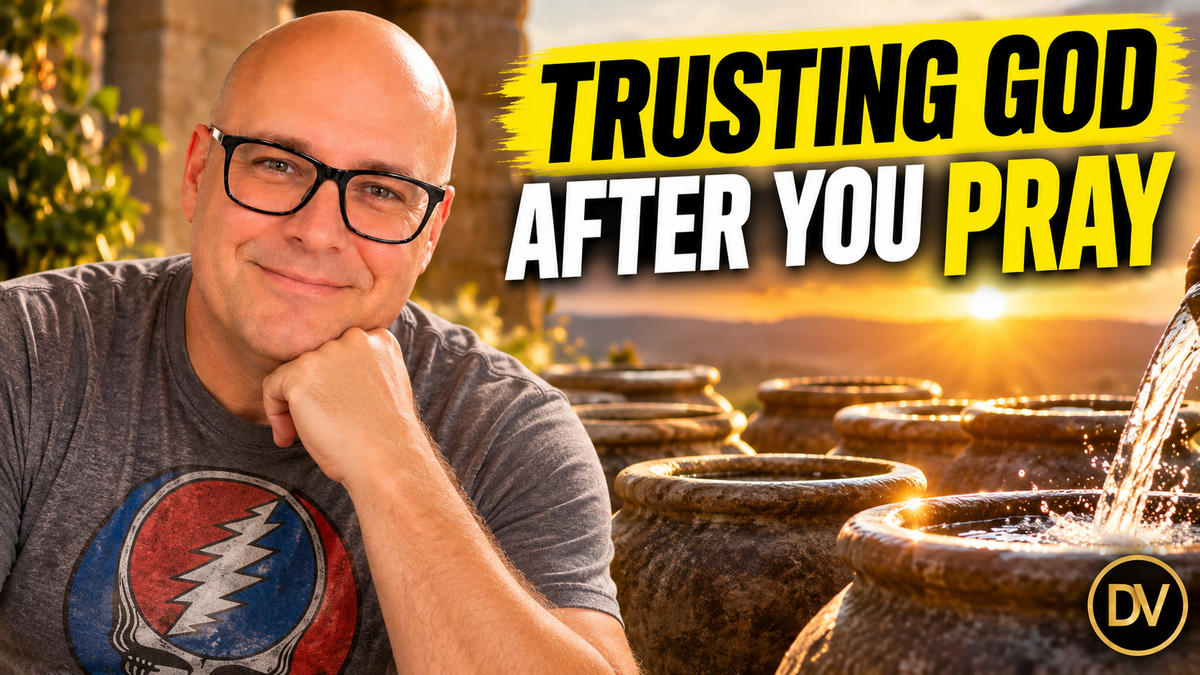
But look again at what happened during the wedding at Cana. Jesus told the servants to fill six stone jars with water. They filled them to the brim. Then He instructed them to draw some out and take it to the master of the feast. There is something remarkably straightforward about their obedience. They didn't need to invent additional tasks or prove their dedication through unnecessary suffering. They followed the instructions Jesus actually gave them.
This changes how I understand Mary's words. She didn't tell the servants to do everything possible to save the celebration. She told them to do whatever Jesus said. Those instructions leave room for something we frequently overlook: faithful action requires discernment, not endless activity.
For the man sitting at his kitchen table, the next responsible step might be making an appointment with his accountant, contacting a customer, or reconsidering an expense. Those are useful things he can do. But spending another sleepless night imagining every way his business could fail will not make him more faithful. There comes a point when doing more stops being productive and becomes a way of avoiding the uncertainty we are afraid to face.
Jesus Himself understood the importance of stepping away from demands and spending time with His Father. His example reminds us that rest is not necessarily a failure of responsibility. Sometimes it is an acknowledgment that we are human beings with limits.
Perhaps you've been measuring your faith by how much effort you can produce after praying. I want you to consider whether Jesus might be inviting you to something different. You can take your responsibilities seriously without believing that every outcome rests on your shoulders.
The business owner can close his laptop, turn off the kitchen light, and get some sleep. Tomorrow will still require decisions, but he doesn't have to solve every one of them tonight.
Chapter 3: The Unexpected Gift of Not Being in Control
The test results are open on a phone in the clinic parking lot, and a woman sits beside her husband reading the same sentence for the third time. The treatment has helped, but not as much as they had hoped. They had prayed together before every appointment. On the drive home, he reaches for her hand and asks a question neither of them can answer: “What do we do with our faith now?”
I think that question belongs beside the wedding at Cana, because we can misunderstand the story if we make the wine its entire meaning. Jesus did provide what the celebration lacked. But John tells us something deeper about why he recorded the event: Jesus revealed His glory, and His disciples believed in Him. The sign was meant to direct their attention toward the One performing it, not merely toward the wonderful thing He provided.
There's a detail I love here. The master of the feast tastes the wine and praises its quality, but he doesn't know where it came from. The servants do. They had carried the water without knowing what Jesus would make of it. Their obedience didn't give them control over the miracle. It gave them a close view of what Jesus did.
Our lives don't always give us an ending like that wedding. A treatment may fall short. A loved one may remain distant. A door we believed would open may stay closed. I don't want to turn Cana into a promise that every disappointment is secretly preparing a better reward. That would leave hurting people wondering what they did wrong when their circumstances didn't change.
What the story offers is a different kind of hope. We are invited to know Jesus, not to manage Him. We can bring Him a request, act responsibly, listen carefully, and still leave the result in His hands. Faith doesn't require us to deny a difficult reality. It allows us to face that reality without deciding that Christ has stopped caring.
For the couple driving home, the next step may be asking the doctor about other options, taking a quiet evening together, or telling a friend they need support. They may pray again tomorrow. Their prayers aren't invalid because they have questions, and their love for Jesus isn't measured by a medical report.
Mary's words still reach us across that wedding room: “Whatever he says to you, do it.” Maybe the greatest change they invite isn't certainty about what comes next. It's freedom from believing we must know the ending before we can trust the One walking with us.
Your friend,
Douglas Vandergraph
Explore the complete Douglas Vandergraph Master Index: https://douglasvandergraph.com/douglas-vandergraph-master-index/
Watch Douglas Vandergraph’s faith-based videos on YouTube: https://www.youtube.com/@douglasvandergraph