Jesus, The Burden Is Not the Proof

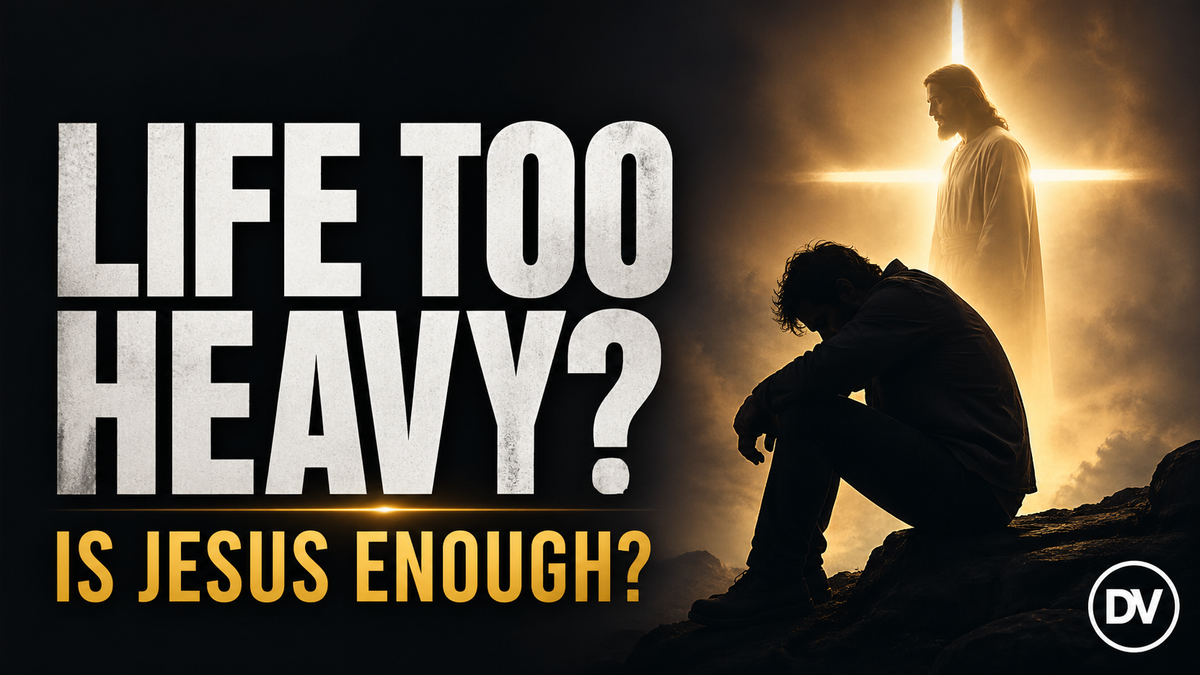
Some of the heaviest moments in life do not look heavy from the outside. Nothing has exploded. No single tragedy has stepped into the room and announced itself. The day still moves. The phone still lights up. Responsibilities still arrive on time. A person still answers people, still shows up, still makes decisions, still gets through what needs to get done. Yet inside, something has changed shape. The soul has stopped feeling spacious. It has begun to feel crowded. Thoughts press harder. Hope breathes shallower. Small things land with more weight than they should. The mind does not always know how to explain it, but the heart knows something is off. Life has become more difficult to carry than it used to be, and the exhaustion is no longer just physical. It has moved inward. It has settled into the hidden parts where a person measures what they can still bear.
That is the place where many people quietly start asking whether Jesus is really enough. Not enough in the polished religious sense. Not enough as a phrase people say because they have heard it their whole lives. Enough for the actual life being lived. Enough for the pressure that keeps returning. Enough for the fear that does not fully leave. Enough for the unanswered prayer that now feels woven into the season itself. Enough for the emotional strain nobody else can fully see. Enough for the slow sadness that does not ruin every day but never fully lifts either. Enough for the private weariness that comes from carrying too much too long without knowing when the load will change.
That question matters because it exposes a false assumption many people live under without realizing it. They think the proof of Jesus in a person’s life should be a lighter life. They think if Christ is near, then the burden should shrink fast enough to reassure the mind. They think peace should feel like the absence of pressure. They think faith should produce quick inner relief. So when life remains hard, or when sorrow stays longer than expected, or when anxiety still comes around, or when disappointment lingers even in the presence of prayer, they begin to wonder what is wrong. Something starts whispering that if Jesus were truly enough, the strain would not still feel this real.
That assumption seems believable when you are hurting. It even feels spiritual at first because it dresses itself up as expectation. Yet it can quietly do damage to the soul. It trains a person to interpret the ongoing burden as evidence against the nearness of Christ. It makes hardship look like contradiction. It makes delay look like abandonment. It makes the emotional reality of struggle feel like disproof. Before long, a person is not only carrying pain. They are also carrying the accusation hidden inside the pain. If Jesus is enough, then why does this still feel heavy. If Jesus is enough, then why am I still tired. If Jesus is enough, then why do I still feel fragile in places. If Jesus is enough, then why has this not become easier by now.
But what if the burden is not the proof against Him. What if the burden is the place where we most misunderstand Him.
That shift sounds small at first, but it changes everything. A great deal of spiritual discouragement is born not from suffering itself, but from the meaning we attach to suffering. Pain alone is painful enough. Yet what often crushes people more deeply is the story they begin telling themselves about what the pain must mean. They decide the heaviness means God has stepped back. They decide the struggle means they are failing. They decide the unanswered prayer means they are alone. They decide the ongoing battle means faith is not working. None of those conclusions are neutral. They are interpretations. They are readings of reality. They are judgments about what the burden proves.
That is why perspective matters so much here. Not artificial positivity. Not pretending life is easier than it is. Not trying to sound brave while the heart is still shaking. What matters is whether the burden gets to define what is true about Jesus. If it does, then every hard season becomes a slow erosion of trust. Every delay becomes suspicion. Every weakness becomes self-accusation. Every disappointment becomes a quiet argument against hope. But if the burden does not get the final interpretive authority, then something deeper becomes possible. A person begins to ask not only what the burden feels like, but what the burden actually proves. Does it prove abandonment. Does it prove the absence of Christ. Does it prove that love has left the room. Does it prove that Jesus is smaller than what is being carried.
No. It does not.
That is the perspective shift many people need, and it is not a shallow one. The burden is real. The tears are real. The stress is real. The exhaustion is real. The loneliness is real. The grief is real. The confusion is real. The private breaking point you keep brushing up against is real. But the burden does not get to interpret Christ for you. It does not get to decide His size. It does not get to measure His faithfulness. It does not get to rewrite His character because life became difficult. The burden reveals your need. It does not reveal His inadequacy.
That is a harder sentence than it looks because most people spend much of life measuring God by outcomes. If the day went well, they feel more assured. If the answer came, they feel more secure. If the relief arrived, they feel more connected. If the strain remains, they feel more uncertain. The heart gets trained into this almost without noticing. It starts using circumstances as a translation key for the nature of God. But circumstances are unstable interpreters. They shift too much. They speak too fast. They tell partial truths. They describe the pressure but not the whole room. They describe the ache but not the presence inside the ache. They describe what is painful but not always what is holy. If you let hardship become your theologian, everything begins to tilt in the wrong direction.
What often deepens suffering is not just the weight of what is happening. It is the way a person begins to read themselves through it. They stop saying, “I am carrying something hard,” and start saying, “Maybe I am failing.” They stop saying, “This season is painful,” and start saying, “Maybe God has stepped away.” They stop saying, “I am weary,” and start saying, “Maybe I should not be.” The human mind is very quick to moralize its own pain. It confuses being wounded with being weak in the wrong way. It confuses being exhausted with being spiritually defective. It confuses the need for mercy with the evidence of failure. That confusion makes a hard life feel even harder because now the person is fighting on two fronts. They are fighting the burden itself, and they are fighting the false conclusions the burden keeps offering them.
Jesus does not look at your burden that way. He never has. He does not see the fact that you are tired and conclude that you are disqualified from closeness. He does not see you struggling and decide you are too complicated to stay near. He does not hear the unsteady prayer and dismiss it because it lacks polish. He does not look at the heart that still hurts after months of trying and say it should have been over this by now. Human beings do that to each other all the time. They impose timelines on pain. They rush healing. They get uncomfortable with the slow work of endurance. They want visible progress because visible progress reassures them. Christ is not like that. He is not hurried by your unfinished places. He is not offended by your need. He is not confused by your weakness.
That is part of what makes Him enough. Not that He removes every pressure instantly, but that He never misreads the person under pressure. He never mistakes a bruised heart for a faithless one. He never confuses heaviness with rebellion. He never sees the strain in your life and start standing at a distance from it. He comes close to the things that make other people retreat. He remains steady in the presence of the very things that make human beings uncomfortable. The soul may still feel overwhelmed, but Jesus is not overwhelmed by the soul.
That is a different kind of enough than many people were taught to expect. Some were taught an “enough” that looked mostly like quick breakthrough. Others were taught an “enough” that sounded more like suppression, as though faith means being less honest about what hurts. Neither one holds up well under real life. The deeper enough of Christ is more durable than that. It does not depend on speed. It does not depend on the emotional atmosphere becoming easy. It does not depend on you sounding strong. It does not depend on circumstances quickly turning into something you would have chosen. It depends on who He is. That sounds obvious, but it is not lived as obviously as it should be. Most people still live as though Christ’s sufficiency rises and falls with how manageable life feels that week.
Yet the scriptures do not present Jesus as enough because His followers would never carry weight. They present Him as enough because He remains Himself in the presence of every kind of weight. He remains the one who does not panic. He remains the one who does not abandon. He remains the one who can hold together what feels like it is splitting apart. He remains the one whose mercy is not fragile. He remains the one whose presence does not evaporate under pressure. If anything, the testimony of scripture is that Jesus is especially recognizable in places where other supports prove thin. He is not diminished by dark places. He is seen more clearly there by people who have run out of easier answers.
That is why some of the deepest people sound less impressed with easy language than they used to. Suffering has taught them something. It has shown them that many religious phrases sound stronger before they are tested than after. Before testing, a person can imagine that the phrase “Jesus is enough” means the path will soon grow lighter. After testing, they begin to understand that it means something far more profound. It means that when the path does not grow lighter quickly, Christ remains. It means that the person who has no strength left to create their own peace can still be held in a peace not made by them. It means that grief can still be grief without becoming the highest authority in the heart. It means that unanswered questions can stay unanswered without taking the throne away from God.
This is where a person begins to notice that what is ruining them is not always the burden itself. Often it is the silent agreement they made with the burden. They agreed that because it was still heavy, Christ must be far. They agreed that because the season was still painful, hope must be unrealistic. They agreed that because they did not feel strong, God must be disappointed. They agreed that because relief had not come quickly, intimacy must be delayed too. Those agreements often happen quietly. They happen beneath the surface. They may not even be spoken out loud. Yet they shape the entire inner life. They turn every difficult day into a theological statement against comfort.
Breaking those agreements is not the same thing as pretending. It is the beginning of freedom. It is the moment a person says, this burden is real, but I refuse to let it define Christ for me. This sorrow is real, but I refuse to let it declare God absent. This exhaustion is real, but I refuse to turn it into a verdict against my worth. This unanswered prayer is real, but I refuse to decide that silence means indifference. That kind of refusal is not denial. It is clarity. It is one of the ways the soul begins to breathe again.
There is also something else that must be said plainly. The life many people are carrying is not just hard because of what is happening around them. It is hard because of what is happening within them in response to it. Life does not only bring events. It creates interpretations, fears, reflexes, emotional habits, protective walls, and internal narratives. One disappointment can make a person braced for more disappointment. One abandonment can make them anticipate distance everywhere. One season of unanswered prayer can make them afraid to hope too directly. One long stretch of stress can teach the body to live as though peace is always temporary. So the burden is not only external. It begins to shape the inner posture of the person carrying it.
That is why Christ’s enoughness cannot be limited to circumstance management. If He were only enough to improve externals, people would still be left with the inward patterns suffering has created in them. They would still be tense in peace. Still suspicious in kindness. Still guarded in love. Still fearful in blessing. Still waiting for the next collapse. But Jesus does something deeper than that. He goes below the surface interpretation of life. He begins to loosen the burden’s right to define reality. He teaches the heart a new reading of existence itself. He teaches it that the future is not lord. Fear is not lord. Memory is not lord. Shame is not lord. Pain is not lord. Delay is not lord. He is.
That does not make a person instantly calm. It does something better. It gives them a true center. Calm can come and go. A true center remains. Many people are looking for calm when what they really need is a center strong enough to keep them when calm disappears. Jesus does not promise emotional weather that never changes. He offers Himself as the rock under changing weather. That is why people can still grieve and yet not be destroyed. Still fear and yet not be owned by fear. Still hurt and yet not become only hurt. Still wait and yet not lose everything to waiting.
The modern mind struggles with this because it likes quick correlation. If Christ is enough, then I should feel better fast. If I do not feel better fast, then something is wrong. But human souls do not heal by formula. They unfold. They relearn. They loosen slowly from false masters. They return again and again to what is true because pain is repetitive and must often be answered repetitively. That is not failure. That is formation. The burden may press on the same wound multiple times, and Christ may answer with the same faithful presence multiple times. People often mistake repetition for stagnation. It is not. Some truths have to be relearned at deeper levels because life keeps reaching deeper levels in us.
Perhaps this is why some of the holiest people are not the loudest. They are the people who have suffered enough to stop expecting easy translations of God. They no longer assume that difficulty equals distance. They no longer assume that delay equals rejection. They no longer assume that heaviness means Christ is somehow insufficient. They have learned to stop letting the storm describe the shepherd. That is wisdom. It makes a person gentler, slower to judge, more grounded, and strangely more alive. Not because they live lighter than others, but because they no longer hand ultimate meaning to the burden.
That shift opens the door to real hope. Not shallow hope that depends on seeing immediate evidence. Real hope that can remain in the room before visible change comes. Hope is often misunderstood as optimism. It is not. Optimism usually depends on probabilities. Hope in Christ depends on His character. Optimism says things will probably improve. Hope says even if the path remains hard longer than I want, I am not handed over to it alone. Optimism leans on trends. Hope leans on a person. That is why hope can survive where optimism cannot. And that is why the burden cannot finally destroy a person who is truly anchored in Christ. It can wound them. It can tire them. It can humble them. It can expose them. But it cannot be the final word if Jesus is not a slogan to them but a living Lord.
This changes how prayer is understood too. Many people pray only for removal. That is understandable. The hurting soul naturally wants relief. But if relief is the only category, then prayer becomes discouraged very quickly in long seasons. The person asks, does not receive what they expected, and quietly starts to withdraw. Yet prayer is not only a request line for changed conditions. It is also the reordering of reality in the presence of Christ. It is the place where the burden is brought into the true room. It is the place where false interpretations are interrupted. It is the place where the soul remembers that what feels biggest is not always what is biggest. It is the place where a person stops being alone with their thoughts about the burden and begins being with Jesus in the presence of the burden.
That matters because solitude with pain can become distortion. Pain left to speak by itself gets louder. It becomes more convincing. It edits the horizon. It shrinks tomorrow. It makes the soul feel as though the current moment has swallowed the whole future. Prayer does not always change circumstances quickly, but it changes the atmosphere in which the circumstances are carried. It introduces the heart again to the One who cannot be defined by the trouble. It teaches the mind to stop bowing before the immediate. It reminds the soul that the One who holds history is not confused by this chapter.
A person eventually begins to see that much of their suffering came from expecting the burden to disappear before they could rest. That is an impossible arrangement. If rest can only begin after full resolution, then many people will spend years without inward rest. Christ offers something better. He offers rest in Himself before the road is resolved. That does not make the road painless. It makes it bearable in a new way. And that new way is not small. It is the difference between carrying life alone and carrying it with a presence that does not weaken under its weight.
At some point this perspective shift becomes more than insight. It becomes practice. A person begins noticing when the burden is trying to define God for them. They interrupt it. They begin noticing when heaviness is trying to tell them they are alone. They interrupt it. They begin noticing when delay is trying to teach them hopelessness. They interrupt it. They begin noticing when exhaustion is trying to become shame. They interrupt it. Not with fake positivity. With truth. With returning. With scripture. With prayer. With the stubborn refusal to let pain be the only voice in the room. That is not mechanical spirituality. It is spiritual maturity. It is how the soul stays open under pressure.
If you want the spoken companion to this same deeper movement, you can step into when life feels too heavy, is Jesus still enough and let it meet you there in a more direct way, and if you are moving through this circle in sequence, there is a natural next layer waiting in the article just before this one, where the theme turns and widens from another direction without losing its center.
The burden is not the proof. That is the shift. The burden is not the evidence that Christ is small. It is not the evidence that you are forgotten. It is not the evidence that prayer has become meaningless. It is not the evidence that your weakness has pushed Him away. It is the place where everything false is trying to rush in and interpret your life for you. That is why the battle is not only to endure the burden. It is to refuse the burden’s theology.
Once that begins to settle in, a person stops asking the burden to tell them the truth about Jesus. That is where the inner ground starts to change. The struggle may still be real. The unanswered prayer may still be unanswered. The fear may still visit. The pressure may still sit on the chest some mornings before the day has even had a chance to speak. Yet something inside is no longer as easy for the burden to control. The heart begins to understand that pain is a real experience but a poor authority. It can describe what hurts. It cannot define who Christ is. It can report the weight of the moment. It cannot rewrite the nature of God. That is not a small distinction. It is one of the lines between a soul that keeps sinking into confusion and a soul that begins learning how to stand in the middle of things it would never have chosen.
That standing does not always look strong in the way people admire. It often looks quiet. It looks like a person deciding not to turn every hard day into a verdict against heaven. It looks like a person refusing to conclude that because their heart feels shaken, Christ must be absent. It looks like someone bringing the same burden to God again, not because they enjoy repetition, but because they know the burden is not the right interpreter. It looks like a person telling the truth more carefully. Not just the truth about what hurts, but the truth about who remains when it hurts. That is one of the hidden forms of faith. It is not flashy. It will not always impress anybody. But it is the kind of faith that survives real life.
Many people are more shaped by what they assume than by what they consciously believe. They say Jesus is enough, but in practice they live as though His enoughness must be verified by quick improvement. They say God is near, but in practice they measure nearness by emotional relief. They say He is faithful, but in practice they feel most convinced of that when the path becomes understandable. Then the hard season stretches. The soul becomes weary. And what was merely assumed is suddenly exposed. A person realizes that without meaning to, they had been treating Christ as though His job were to reassure them by reducing pressure fast enough. When that does not happen, they are not only disappointed in the season. They are disoriented in the relationship.
That disorientation is painful, but it is also revealing. It reveals how much of the inner life had been built around visible change rather than around the person of Christ Himself. It shows how easily the heart begins to want the gifts of God more than God. Relief. Closure. Explanation. Rescue. Softened circumstances. Emotional clarity. Those are not wrong things to desire. They are deeply human things to desire. Yet when they become the condition under which trust is allowed to breathe, the soul becomes fragile in a particular way. It can only rest if the road cooperates. It can only hope if the timing makes sense. It can only feel secure if the burden lightens. That arrangement leaves a person at the mercy of fluctuation.
Christ does not call people into that arrangement. He calls them into something more stable and far deeper. He calls them into relationship with Himself. That sounds obvious until life stops feeling manageable. Then it becomes very costly and very real. Relationship with Christ means that the center of the inner life is no longer located in circumstances behaving well enough to calm you down. The center is Him. His character. His presence. His mercy. His lordship. His nearness. His refusal to stop being who He is because your season became difficult. That is why the burden is not the proof. The burden may still be there. The proof is who Christ remains while it is there.
This is where people often begin to understand why shallow spiritual language fails them so badly in painful seasons. Shallow language usually speaks as though the problem is only outer. It offers a quick sentence to cover a deep ache. It speaks fast where the soul needs slowness. It speaks loudly where the soul needs tenderness. It rushes toward resolution because silence makes it uncomfortable. But the heart knows better. The heart knows when something has not truly gone deep enough. It knows when it has been handed a neat phrase instead of being met in the actual complexity of what it is carrying. Real spiritual depth does not fear that complexity. It does not panic when pain is still in the room. It does not try to push the soul through its own process faster than grace is actually moving.
That is one reason Christ remains so different from the voices people are used to hearing. He is not fragile around need. He is not impatient with the unfinished. He is not embarrassed by weakness. He is not disturbed by the return of grief. He is not exhausted by the person who has to come back again because the burden did not leave after one prayer. Human beings often lose patience with recurring pain. They like breakthroughs they can talk about. They like visible improvement. They like simple stories because simple stories are easy to hold. But Jesus does not require your life to become simple before He will stay near it. He knows how to be present in a life still full of loose ends.
That changes what a person begins to expect from Him. They stop only watching for spectacular rescue. They start noticing sustaining grace. They start noticing that the burden should have driven them into total bitterness, yet something in them remains soft enough to still seek God. They notice they should have fully given up hope by now, yet hope keeps showing up in quieter forms than before. They notice they are still here. Still praying. Still turning toward Christ. Still wanting truth. Still longing for peace that cannot be manufactured. These things may look small when compared to outward breakthrough, but they are not small. They are evidence of a life being held.
A great deal of God’s faithfulness is missed because people only count what is dramatic. They count the door that opened, the prayer that was answered quickly, the illness that lifted, the relationship that healed, the sudden turn that made a testimony easy to tell. They do not always count the faithfulness of being kept from becoming someone else under pressure. They do not always count the mercy of remaining spiritually alive in a season that tried to drain them. They do not always count the grace of being drawn back to prayer after disappointment. They do not always count the miracle of a heart that is bruised but not shut, tired but not gone, confused but not abandoned. Yet these quieter mercies may reveal more about the sufficiency of Christ than the dramatic answers people keep waiting for.
That is because Jesus does not only prove Himself in outcomes. He proves Himself in endurance. He proves Himself in presence. He proves Himself in the way He does not let the soul become fully owned by what it is suffering. That matters more than many people realize. There are people who have everything around them functioning and still feel inwardly lost. There are people with money, options, relationships, activity, and noise, and still the soul is unanchored. That is why Christ’s enoughness cannot be measured by external arrangement alone. If it could, then comfortable people would be the deepest people, and they are often not. Depth is born when a soul learns that what it most needs is not merely improved circumstance but a truer center.
A truer center changes the way pain lands. It does not always reduce the force of the first blow, but it changes what happens after. A person may still feel the grief, but the grief no longer has the same right to define their entire existence. They may still feel fear, but fear is no longer treated as prophecy. They may still feel lonely, but loneliness is no longer allowed to prove they are forsaken. They may still feel tired, but tiredness is no longer translated into spiritual failure. This is what happens when Christ becomes more than a statement. He becomes the stable point around which the inner life is gradually reordered. Not perfectly. Not instantly. But truly.
That reordering takes time because most people have spent years learning the wrong reflexes. They learned to measure love by ease. They learned to measure God’s attention by fast answers. They learned to measure their worth by how well they were coping. They learned to believe that if they were still affected by something, they must not be growing enough. These reflexes do not disappear in a day. They are exposed and loosened over time. Life itself often exposes them. A person enters a season they cannot quickly solve. The old habits begin to fail. Control feels weaker. Explanations feel thinner. Performance feels more exhausting. Then somewhere in that slow undoing, Christ begins to teach a different way to live. A way less built on appearance. Less built on immediate outcomes. Less built on emotional self-management. More built on trust. More built on surrender. More built on the reality that God remains God even when the weather inside you changes.
This is one reason the burden can become a strange mercy without ever becoming good in itself. The burden strips away illusions. It shows a person where they had been living on assumptions too small to survive real pain. It exposes the supports that looked reliable until real pressure arrived. It reveals how much of the inner life had been leaning on things that could not actually carry it. None of that makes the burden pleasant. None of that means you should desire the burden for its own sake. But it does mean Christ can use even painful seasons to lead a person away from false centers and into something real.
When that begins to happen, prayer changes. It becomes less like an effort to convince yourself to feel hopeful and more like a return to the one place where reality is told straight. You stop praying only to escape pain and start praying to avoid being defined by pain. You stop coming to God only for altered circumstances and start coming because you need the burden put back in its place. You need to remember that it is real but not sovereign. Heavy but not ultimate. Loud but not lord. Prayer becomes the place where your soul relearns scale. Your fear is real, but Christ is greater. Your grief is real, but Christ is greater. Your uncertainty is real, but Christ is greater. Your shame is real, but Christ is greater. This is not denial. It is right proportion.
Right proportion is one of the first things suffering distorts. Whatever hurts feels largest. Whatever weighs on the mind feels most final. The burden fills the horizon until a person can barely imagine reality outside it. That is why human beings so often mistake the immediacy of pain for the totality of truth. They cannot yet see beyond what hurts, so they begin treating what hurts as the whole picture. Christ interrupts that. Not always by removing the pain instantly, but by reintroducing the soul to a larger reality. He reminds the tired heart that what it feels most intensely is not necessarily what is most authoritative. He reminds the person under strain that their current weakness is not the deepest truth about them. He reminds them that the room contains more than the burden.
That is where peace begins to look different. At first many people imagine peace as the removal of disturbance. Later they begin to understand that peace in Christ is the presence of a stronger reality inside disturbance. It is the knowledge that what threatens to consume you is not the highest thing in the room. It is the inward steadiness that comes not because every question has been answered, but because the one holding you has not changed. Peace becomes less like an emotional condition you successfully create and more like a person in whose presence your soul becomes less scattered. That is why peace can coexist with tears. It is why it can coexist with waiting. It is why a person can still ache deeply and yet not be spiritually destroyed.
The same is true of hope. Hope is often treated like a bright emotional feeling. But much of real hope is quieter than that. It looks like refusing to surrender your interpretation of life to the burden. It looks like refusing to decide that delay means denial. It looks like refusing to let the heaviness in your chest become a final statement about the future. Hope in Christ is often not loud confidence. It is continued returning. Continued prayer. Continued openness. Continued willingness to believe that your pain is not a map of God’s character. That is why hope can survive in people who look tired. Their hope is not built on visible momentum. It is built on who Jesus is.
That matters especially for people carrying shame along with sorrow. Some burdens are hard because life wounded you. Others are hard because your own failures are mixed into the weight. Regret can make the whole conversation feel even more fragile. A person begins to wonder not only whether Jesus is enough for the pain, but whether He is enough for the mess they helped make. This is where many people pull back inwardly. They fear that mercy may be real in theory, but perhaps not large enough for what they know about themselves. Yet the burden still does not get to interpret Christ there either. Shame is another false theologian. It is persuasive because it speaks with familiarity. It reminds you of what you did, what you broke, what you mishandled, what you became in weaker moments. It tells you those things are now the truest facts in the room. But the cross says otherwise. The cross says sin is serious and mercy is deeper. The cross says your worst truth is not deeper than Christ’s redeeming love.
That does not make repentance unnecessary. It makes it possible. A person can repent because Jesus is enough for the thing they are ashamed of. They can come clean because His mercy is not threatened by what He already fully sees. They can stop hiding because the burden of guilt does not get to decide the reach of grace. That is another perspective shift many people desperately need. They think their failure has become the final translator of their relationship with God. It has not. Jesus remains the translator. Jesus remains the mediator. Jesus remains the one through whom the whole life is read and redeemed.
There is also another quiet trap the burden sets. It teaches a person to build their whole life around protection. They become careful in all the ways wounded people become careful. They say less. Trust less. Hope less directly. Risk less tenderness. They brace before things happen. They hold back internally in case another blow is coming. That can feel wise because it reduces the shock of disappointment. But over time it also narrows the soul. A guarded life can become a joyless one. Christ does not deepen a person by making them harder. He deepens them by making them safer in Him. That safety does not remove all vulnerability, but it changes the foundation beneath it. The person no longer has to make self-protection their highest strategy because they are learning what it means to be held by someone stronger than their own defenses.
This is where the burden loses more of its power. Not because it disappears, but because its ability to dictate the whole shape of the inner life begins to weaken. The person is no longer asking the burden for permission to rest, for permission to hope, for permission to trust. Those permissions are now received from Christ. That is freedom. The burden can still hurt. It cannot rule the same way. It can still visit. It cannot claim the throne. It can still speak. It is not the only voice in the room.
And once that becomes real, the question changes. A person may begin by asking whether Jesus is enough. Over time they begin seeing that the better question is whether anything else ever truly was. Was control enough. Was distraction enough. Was self-reliance enough. Was performance enough. Was image enough. Was comfort enough. Was numbing enough. None of them could carry the soul. They only delayed the collapse or disguised it. Christ alone remains when lesser refuges give out. Christ alone knows how to meet the whole human being without either flattering or crushing them. Christ alone can tell the full truth about your life and still call you toward peace.
That is why the burden is not the proof. It never was. The burden is the place where false interpretations rush in fastest. It is the place where the enemy of your soul would love to teach you the wrong lesson about God, about yourself, about your future, about your hope. It is the place where your own exhausted mind is most tempted to make temporary feelings into permanent conclusions. It is the place where perspective matters most because pain wants to become revelation when often it is only pressure. Christ does not ask you to deny the pressure. He asks you to stop bowing to its interpretation.
If you have been carrying a heavy life, this is where you start. Not by pretending it is lighter. Not by trying to become more impressive in your faith. Not by forcing quick emotional victory. You start by refusing to let the burden define Jesus for you. You start by bringing the full truth of what hurts into His presence again. You start by telling the truth more carefully. This is hard. This is real. This has lasted longer than I wanted. This has affected me deeply. But none of that means Christ is small. None of that means I am abandoned. None of that means His mercy has thinned out. None of that means the burden has the final word.
And from there, slowly, often quietly, life begins to be carried differently. Not necessarily lightly. But differently. More honestly. More steadily. Less ruled by panic. Less interpreted through fear. Less measured by immediate outcome. More anchored. More aware. More awake to sustaining grace. More able to notice the presence that was always there, even when the burden tried to tell another story.
This is what Ghost needs the reader to feel here. Not just comfort, but correction. Not harsh correction. Liberating correction. The burden has been over-speaking. It has been given too much authority. It has been treated like a prophet when it is only a weight. It knows how to press. It does not know how to tell the truth about Christ. That truth must come from Him.
And when it does, the soul starts to breathe again.
Your friend,
Douglas Vandergraph
Watch Douglas Vandergraph inspiring faith-based videos on YouTube: https://www.youtube.com/@douglasvandergraph
Support the ministry by buying Douglas a coffee: https://www.buymeacoffee.com/douglasvandergraph