When the Dark Staircase Learned His Name

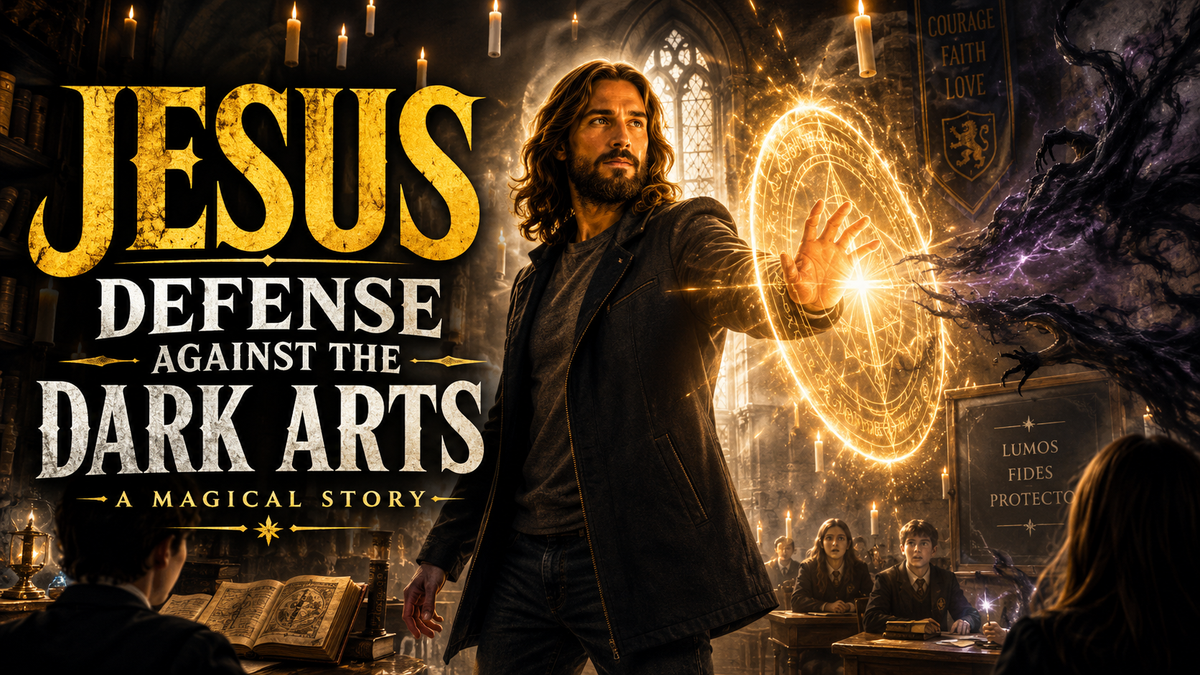
Chapter One: The Lesson No Shield Could Hold
Jesus was already awake before the first owl crossed the pale windows of Hogwarts. He knelt in quiet prayer on the cold stone floor of the Defense Against the Dark Arts classroom, dressed in a plain dark sweater, simple trousers, and worn brown boots that looked more suited for a village road than a castle full of moving staircases and ancient portraits. The torches along the walls burned low, and the glass cases of old defensive instruments stood around Him in uneasy silence. Outside, the Scottish wind pressed against the high windows, carrying the faint sound of rain moving over the black lake. He did not ask the Father to make the day easy. He prayed for the frightened, for the proud, for the hidden, and for the child who would almost choose darkness before supper.
Down below, in the corridor outside the Great Hall, a fifth-year Ravenclaw named Corin Vale stood with both hands wrapped around the strap of his satchel as if holding it tightly enough might keep his life from falling open. The morning post had not arrived yet, but he already knew what one owl would bring. His mother’s letter would be folded with the same exact care as always, written from a narrow flat above a bookshop in Diagon Alley, where she repaired spell-damaged bindings until her fingers cramped. She would ask how his marks were. She would ask whether he was sleeping. She would remind him that the school governors had invited observers this year because of the rumors that the new teacher was unlike any teacher Hogwarts had ever known. Corin had seen the phrase Jesus as the Defense Against the Dark Arts Teacher at Hogwarts copied across student notices, whispered in common rooms, and mocked by boys who thought mockery made them brave.
He had also heard older students mention the quiet mercy that entered the old corridors as though it were some strange story from another school year, something soft enough to comfort younger children but not strong enough to survive the real world. Corin did not believe in quiet mercy. He believed in preparation, leverage, and being first with a wand raised. Mercy was what people talked about when they had never been cornered. Mercy was what adults praised after children had already paid the price for trusting the wrong person. Mercy was not going to protect him from Cassian Rook.
Cassian was standing near the entrance to the Great Hall, laughing with two Slytherin boys beneath the floating candles. His dark hair was combed neatly, his robes were clean, and his prefect badge shone as if it had never been touched by a dirty hand. Most teachers liked him because he knew when to lower his voice. Most students feared him because he knew when no teacher was looking. Corin had feared him since second year, when Cassian found out that Corin’s father had left after the war and had not sent a single owl since. Cassian had not needed to hex him often after that. A few well-placed words in the library, a missing essay before inspection, a whispered joke about abandoned sons, and Corin learned that humiliation could move through a castle faster than any staircase.
That morning, Corin had something in his satchel that could end it. It was not a cursed object from Knockturn Alley. It was not a forbidden potion or a dark charm copied from a rotting book. It was worse in a quieter way because he had made it himself. Tucked between his Charms notes and a cracked copy of Defensive Theory was a strip of enchanted parchment that could force a wand to answer against its owner’s will for three seconds. Three seconds was not long. It was enough time for Cassian’s wand to cast something cruel in front of the new Defense Against the Dark Arts teacher. It was enough time for everyone to see what Corin wanted them to see. It was enough time to ruin him.
A bell rang somewhere above the marble staircase, and the portraits began their usual complaints as students poured through the hallways. Corin stepped into the crowd without eating breakfast. He passed the hourglasses that measured house points and looked away from the blue stones shining for Ravenclaw. A suit of armor near the stairs sneezed as the draft cut through its visor, and a second-year Hufflepuff nearly dropped a stack of toast she had wrapped in a napkin. Hogwarts was awake in all its oddness and age, but Corin felt none of the wonder he had once carried when he first crossed the lake in a small boat. He felt only the weight of the parchment hidden in his bag and the hot, steady thought that justice sometimes needed help.
The staircases shifted when he reached the third floor, turning away from the route he wanted and swinging him toward a corridor lined with tapestries. Several students groaned and hurried down a side passage, but Corin stopped for a moment because the delay felt personal. He hated that feeling. Hogwarts always seemed to have a mind of its own when a person most needed control. He could smell dust, rain-soaked wool, and the faint metallic scent that came from old suits of armor after damp weather. Somewhere behind the wall, pipes clanged as if the castle were clearing its throat before saying something it had been waiting centuries to say.
“Move, Vale,” Cassian said behind him.
Corin turned. Cassian stood three steps above him with his friends close enough to look amused but far enough back to deny involvement. His prefect badge caught the light again. Corin glanced at it and felt the old anger rise from a place he did not like to examine.
“The stairs moved,” Corin said.
“They do that,” Cassian replied. “Most people adapt.”
One of his friends snorted. Corin’s hand tightened around his satchel strap. He imagined the enchanted parchment waking inside the bag like a living thing.
Cassian leaned closer and lowered his voice. “You look tired. Bad dreams again? Or did your mother finally stop pretending your father might write back?”
Corin’s mouth went dry. The corridor seemed to narrow. He heard the shuffle of other students passing, the creak of the staircase settling, and the painted cough of an old witch in a frame. His hand moved toward the buckle of his satchel before he could stop it.
Then someone spoke from the landing below.
“Corin.”
It was not loud. It did not echo like a command. Yet the sound of his name moved through him with a strange force, as if it had reached the place inside him where the lie had already started dressing itself as courage. Corin looked down and saw the new professor standing beside the banister, one hand resting lightly on the old wood. Jesus looked at him with calm eyes that did not accuse him and did not look away from him either.
Cassian straightened. His friends went quiet. The portraits along the corridor seemed to hold their painted breath.
“Professor,” Cassian said, with the careful politeness he used whenever adults appeared.
Jesus looked at Cassian for a moment, then at the boys behind him. “Your class begins in four minutes.”
Cassian nodded. “Yes, sir.”
“Then walk there without wounding anyone on the way.”
The words were gentle, but they landed with a weight that changed the air. Cassian’s face tightened, not enough for most people to notice, but Corin noticed because he had spent years watching for small shifts in Cassian’s expression. The two boys behind him looked at the floor. No one laughed.
Cassian moved past Corin without touching him. His shoulder nearly brushed the satchel, and Corin felt the hidden parchment inside as if it had become hot. Jesus remained at the landing until the corridor thinned. He did not ask Corin what had almost happened. He did not reach for the satchel. He simply waited.
Corin wished He would speak first because silence gave too much room for the truth.
“I’ll be late,” Corin said.
“Yes,” Jesus said.
Corin frowned, unsure whether that was permission or warning. “Defense is upstairs.”
Jesus looked toward the classroom tower. “So is the place where you planned to use what you made.”
Corin stopped breathing for half a second. No spell had passed through the air. No Legilimency pressure pushed against his mind. He knew what that felt like because Professor Flitwick had demonstrated the difference between magical intrusion and mental discipline during a dueling safety lecture. This was not intrusion. It felt worse because nothing had been forced open. It felt as though Jesus had seen the door and knew what stood behind it.
“I don’t know what you mean,” Corin said.
Jesus did not move. “You do.”
A group of third-years turned the corner, saw the two of them, and quickly lowered their voices. One girl looked at Jesus with wide eyes, then hurried on. Corin stared at the stone floor between his shoes.
“He deserves it,” Corin said, and hated how childish the words sounded once they left him.
“Perhaps he has done wrong,” Jesus said.
Corin looked up sharply. “He has.”
Jesus nodded once. “Then do not become like him and call it balance.”
Something in Corin flinched. He wanted a harder answer because a harder answer would have been easier to hate. He wanted Jesus to misunderstand him so he could defend himself. He wanted to be told that revenge was wrong in a way that sounded weak, thin, and blind to the facts. Instead, he was being seen too plainly.
“You don’t know what he’s done,” Corin said.
“I know what it is doing to you.”
Corin’s eyes stung, and anger rushed in to cover the embarrassment. “That’s convenient. Everyone wants the person who got hurt to stay good. It keeps the halls clean for everyone else.”
Jesus’ face remained steady. “No. I do not ask you to pretend you were not hurt. I ask you not to hand your hurt the wand.”
The words did not comfort him. They troubled him. Corin turned away before his face could betray him and started up the stairs. For one fearful second, he thought Jesus might call him back in front of everyone. He did not. Jesus walked beside him instead, quietly, as though they were simply going the same way.
They reached the Defense Against the Dark Arts classroom just as the last students were finding their seats. The room looked different from the years before. The skulls, cracked mirrors, and old warning charts still hung in their places, but the center of the classroom had been cleared. The desks were arranged in a wide half circle, leaving an open stone floor. On the teacher’s desk sat a bowl of clear water, a plain wooden cup, and a folded cloth. No one knew what to make of them.
Hermione Granger, who had returned to Hogwarts that day as a guest from the Ministry’s education office, stood near the back with a small notebook in her hands. She was no longer a student, but she still had the alert look of someone ready to correct a badly stated rule before it could hurt anyone. Beside her, Professor McGonagall sat stiffly with her hands folded over the head of her cane. The headmistress had said very little about the new appointment. Rumor claimed she had objected, then wept alone in her office, then approved it without explanation. Hogwarts rumors were rarely kind, but they were often persistent.
Corin slid into a seat beside a Gryffindor girl named Iona Bell, who smelled faintly of broom polish and peppermint. She glanced at him, then at his satchel.
“You look awful,” she whispered.
“Thank you.”
“I mean worse than normal.”
“That helps.”
She gave him a look, but Jesus had stepped to the front, and the room settled before she could say more.
“Good morning,” Jesus said.
A few students answered. Others remained silent, unsure of the proper tone for a teacher who did not seem like a teacher and yet made the whole room feel like a place where careless words would be heard by heaven itself.
Jesus looked around the half circle. “Today we begin with defense.”
A Slytherin boy near the front lifted his chin. “Against curses, sir?”
“Against darkness,” Jesus said.
The boy smirked, but it faded quickly when Jesus’ eyes rested on him without irritation.
Cassian sat two rows ahead of Corin, posture perfect, wand placed neatly on his desk. Corin could see the back of his neck above his collar. He could also see the exact place where the enchanted parchment would need to be slipped beneath Cassian’s wand hand. During the practical demonstration, students would rotate. There would be movement, noise, and one chance. The parchment did not need to stay in place long. It only needed contact.
Jesus walked to the bowl of water and placed His hand beside it. “Many of you have learned shields. Some of you are proud of how fast you can raise them. Some of you have been told that a strong shield is enough to keep you safe.”
Several students straightened. Defense Against the Dark Arts had always been measured by visible things. Sparks, light, speed, correct wand motion, accurate countercurse. Corin knew these things well because visible things could be practiced until no one could question your worth.
Jesus lifted the wooden cup and dipped it into the water. “A shield can stop a spell. It cannot cleanse what a person agrees to keep.”
No one moved.
Cassian raised his hand.
Jesus nodded to him.
“With respect, sir, that sounds more like moral instruction than defensive magic.”
“It is both,” Jesus said.
A few students shifted. Professor McGonagall’s mouth tightened in a way that might have been approval. Hermione wrote something down.
Cassian smiled politely. “But in an actual duel, hesitation can get a person hurt.”
“Yes,” Jesus said. “So can hatred.”
Corin stared at his desk. He hated how the room seemed to know the conversation was no longer general.
Jesus set the cup down. “Come forward, Mr. Rook.”
Cassian stood with smooth confidence and stepped into the open space. He looked handsome under pressure, Corin thought bitterly. Some people even looked innocent while being invited to prove themselves.
“Raise a shield,” Jesus said.
Cassian drew his wand. “Protego.”
A clear shield shimmered before him, well-formed and strong. Several students murmured. Cassian’s smile returned, small but satisfied.
Jesus looked toward the room. “What do you see?”
“A strong Shield Charm,” said a Ravenclaw near the front.
“Good wand control,” said another.
“Confidence,” Iona said under her breath, not meaning to be heard.
Jesus turned slightly. “Yes.”
Cassian’s smile sharpened.
Jesus stepped closer, still outside the shield’s range. “Mr. Rook, your shield is strong. Now tell the truth.”
Cassian blinked. “Sir?”
“Tell the truth.”
The shield flickered.
Corin’s head lifted.
Cassian tried to laugh. “About what?”
“About the boy on the stairs.”
The room became painfully still. The shield thinned, then steadied as Cassian tightened his grip.
“I don’t know what you mean,” Cassian said.
The shield flickered again.
Jesus did not raise His voice. “A shield held by a lying hand may still shine. That does not make the person behind it safe.”
Cassian’s face flushed. “Are you accusing me of something in front of the class?”
“I am inviting you away from something.”
“That sounds like the same thing.”
“No,” Jesus said. “An accusation leaves you alone with your shame. An invitation gives you a door.”
Corin felt every eye trying not to look at him. His pulse beat hard in his throat. Part of him was satisfied to see Cassian exposed. Another part was terrified because Jesus had not only exposed Cassian. He had exposed the whole room’s hunger to see someone else fall.
Cassian lowered his shield, but not because he had softened. “I said something unkind,” he said. “I shouldn’t have.”
The apology sounded clean and empty, the way prefects spoke when teachers were listening. Corin felt the old fury move again. Cassian would step back into his life after class. He would be more careful for a week. He would find quieter ways.
Jesus looked at him for a long moment. “That is not the truth yet.”
A sound moved through the class, barely more than breath.
Cassian’s wand hand tightened. “I apologized.”
“No,” Jesus said. “You performed regret.”
The words struck harder than any curse. Cassian’s face changed. For the first time since Corin had known him, the polished surface cracked in public. It did not become humility yet. It became fear.
Professor McGonagall shifted in her chair, but she did not interrupt.
Jesus turned toward the class. “You will learn countercurses. You will learn shields. You will learn how to stand when dark things move toward you. But if you use defense as a way to hide cruelty, your magic will become another locked room.”
Corin’s fingers found the buckle of his satchel beneath the desk. He did not open it. He only touched it because the hidden parchment had become too real to ignore.
Jesus looked across the room, and His eyes met Corin’s.
“Mr. Vale,” He said. “Come forward.”
Heat rushed into Corin’s face. “Me?”
“Yes.”
Iona whispered, “What did you do?”
Corin did not answer. He stood slowly. The satchel strap caught on the chair, and he nearly stumbled. A few students watched with curiosity, others with the alert discomfort of people sensing that entertainment had turned into judgment too close to home. Corin walked into the open space and stopped several feet from Cassian.
Jesus stood between them, not like a referee, but like someone standing where a blow had been meant to land.
“Draw your wand,” Jesus said to Corin.
Corin obeyed. His hand shook. He hated that too.
“Raise a shield.”
“Protego.”
His shield rose, bright but uneven along the edges. He had cast better shields before. This one trembled as if it knew his heart was divided.
Jesus watched the shield. “What do you see?” He asked the class.
No one answered at first.
Hermione looked up from her notes, and Corin saw pain move across her face in a way he did not understand. Perhaps she remembered being a student under pressure. Perhaps everyone who had survived Hogwarts carried some old corridor inside them.
“A shield,” Iona said carefully. “But unstable.”
Jesus nodded. “Why?”
A Hufflepuff boy answered, “His grip might be wrong.”
Corin felt shame burn through him.
Jesus did not look away from the shield. “His grip is frightened, but fear is not the deepest trouble here.”
Corin lowered his wand. “Can I sit down?”
“No,” Jesus said, gently.
Corin swallowed. “I don’t want to do this.”
“I know.”
“Then why make me?”
“Because if you leave now, you will still believe the lie waiting in your bag.”
The room went colder.
Cassian turned his head and looked at Corin with sudden interest. “What’s in your bag?”
“Nothing,” Corin said.
Jesus’ voice remained quiet. “Bring it here.”
Corin stood frozen. If he refused, everyone would know. If he obeyed, everyone would know. His mind raced toward excuses, but none reached his mouth. He walked back to his chair, lifted the satchel with numb hands, and returned to the open floor. The room held still around him.
Jesus did not take the bag. “You may open it.”
Corin wanted to say no. He wanted to say this was unfair, that teachers had ignored Cassian for years and now wanted honesty from the boy who finally found a way to answer. He wanted to say that if adults had done their jobs, children would not need to build ugly solutions in the dark. Some of that was true, and because it was true, it made the lie feel cleaner.
He unbuckled the satchel.
The enchanted parchment lay between two books, dull and narrow, covered in tiny marks that shifted like insects when the light touched them. Several students leaned forward. Hermione inhaled sharply. Professor McGonagall rose halfway from her chair.
“Do not touch it,” Jesus said.
No one moved.
Cassian stared at the parchment. “What is that?”
Corin looked at him with more hatred than he had meant to show. “Something you earned.”
Cassian stepped back. His face had gone pale.
Jesus looked at Corin. “Tell him what it does.”
Corin shook his head. “No.”
“Tell him.”
The command was soft, but Corin felt no space inside it for pretending. He looked at Cassian. “It would have made your wand cast for three seconds. Not much. Just enough.”
Cassian whispered, “Enough for what?”
Corin’s throat tightened. He had imagined this moment a hundred times, but in the imagining, Cassian was always arrogant and deserving. He had not imagined fear on his face. He had not imagined the rest of the class seeing not only Cassian’s cruelty but Corin’s plan.
“Enough to make you look like what you are,” Corin said.
Cassian flinched. The words did not satisfy Corin the way he hoped they would.
Jesus looked at the parchment, then at the class. “This is darkness wearing the clothing of justice.”
Corin turned on Him. “You don’t get to say that.”
Several students gasped. Professor McGonagall’s eyes sharpened, but Jesus lifted one hand slightly, and she stayed silent.
Corin could not stop now. “He gets to say whatever he wants for years. He gets believed. He gets badges. He gets teachers smiling at him. I make one thing, one thing that could finally show people, and now I’m the problem?”
Jesus stepped closer. “You are not the problem.”
Corin’s voice broke. “Then why are you stopping me?”
“Because I love you too much to let your wound become your master.”
Corin’s eyes filled, and he looked down quickly. He would rather have been cursed than seen crying in front of Cassian Rook.
Jesus turned to Cassian. “And I love you too much to let your polished cruelty remain hidden.”
Cassian’s jaw trembled. “I didn’t do anything that bad.”
The lie sounded weak even before it finished.
Corin laughed once, bitterly. “There it is.”
Jesus looked at Cassian with sorrow that did not excuse him. “You have learned to make harm small after you have done it. That is how cruelty survives in respectable rooms.”
Cassian stared at the floor. His friends would not look at him. The prefect badge on his chest seemed suddenly heavy.
Jesus then turned to the class. “No one in this room is safe merely because someone else has been exposed. If your heart is glad only because another person has been uncovered, be careful. Darkness can celebrate truth when truth is being used as a weapon.”
The words moved through the classroom like light entering places no one had dusted in years. Corin saw Iona look down. He saw a Gryffindor boy shift uneasily. He saw Cassian’s friends look smaller than before.
Jesus picked up the folded cloth from the desk and laid it over the enchanted parchment without touching it directly. “Professor Granger.”
Hermione came forward at once. “Yes.”
“Can this be safely contained?”
She studied the covered strip. “Yes. If I suspend it first.” She drew her wand with careful precision. “It’s advanced. Dangerous, but not dark by origin. The intent twisted it.”
Corin hated the accuracy of that. He almost preferred being called evil. Evil sounded distant. Twisted intent sounded like something he could not deny.
Hermione murmured a containment charm, and the cloth stiffened around the parchment like a sealed envelope. Professor McGonagall approached, her face stern but not cold.
“Mr. Vale,” she said, “this matter will not be ignored.”
Corin nodded. He expected that.
“And Mr. Rook,” she continued, turning her gaze toward Cassian, “neither will the conduct that brought us here.”
Cassian swallowed. “Headmistress, I—”
“No,” she said. “You will not tidy this with a sentence.”
Cassian fell silent.
For a moment, the classroom felt less like a classroom and more like a courtroom where everyone had been found guilty of something. Corin looked at Jesus, expecting Him to soften the moment now, to make it easier, to say something kind enough to rescue them all from the discomfort.
Instead, Jesus walked to the bowl of water.
He placed the wooden cup beside it and looked at the students. “There are times when defense begins with a spell. There are times when defense begins with confession.”
No one spoke.
Jesus dipped His fingers lightly into the water. “Not public shame for spectacle. Not forced words to satisfy watchers. Truth before God. Truth before the person you harmed when it is right and safe. Truth within yourself when you are still trying to rename sin as survival.”
Corin heard the word sin and expected it to sound like a weapon. It did not. It sounded like a surgeon naming the place that had to be healed.
Cassian’s face had gone tight again, but something underneath it had changed. He looked younger. Corin had never thought of him as young. Cassian had always seemed like a polished blade, too sure of himself to be a boy. Now he looked like someone who had been carrying his own fear under expensive robes.
Jesus looked at him. “Mr. Rook, why did you speak of Corin’s father?”
Cassian’s eyes lifted sharply. “I don’t know.”
Jesus waited.
Cassian’s throat moved. “Because I knew it would hurt.”
“Why did you want it to hurt?”
Cassian said nothing.
The silence stretched. A portrait near the back wall, an old wizard with a silver beard, lowered his painted eyes.
Cassian whispered, “Because he looks at me like he knows.”
Corin frowned. “Knows what?”
Cassian’s face hardened at once. “Nothing.”
Jesus did not press loudly. He simply asked, “What are you afraid he sees?”
Cassian’s wand hand trembled. “That I’m not what everyone thinks.”
No one laughed. No one moved. The confession was too small to explain years of cruelty, but it was real enough to crack the door. Corin did not forgive him. He did not even want to. But the room shifted because Cassian had finally said something that did not sound polished.
Jesus turned to Corin. “And you, Corin. Why did you make the parchment?”
Corin almost said, “Because of him.” The answer sat ready on his tongue. It had been his answer for months. Yet with Jesus looking at him, it suddenly seemed incomplete.
“I wanted him scared,” Corin said.
Cassian looked away.
“I wanted everyone to look at him the way they looked at me,” Corin continued. His voice shook, but he kept going because stopping would feel worse. “I wanted him to feel trapped. I wanted him to not know how to fix it. I wanted one morning where he couldn’t smile his way out.”
Jesus nodded, not approving, not condemning, only receiving the truth without letting it become smaller.
Corin’s breath caught. “And I wanted my father to know somehow.”
That was the part he had not expected to say. It came out before he could stop it, and once it did, the classroom blurred. He stared at the floor because he could not bear the faces around him.
Jesus stepped nearer. “What did you want him to know?”
Corin wiped at his eyes with the heel of his hand, furious at himself. “That I’m not weak.”
Jesus was quiet for a moment. “Your father’s leaving did not name you.”
Corin’s shoulders began to shake, and he hated every second of it.
Jesus continued, “Cassian’s cruelty did not name you. This parchment does not have to name you.”
Corin looked up. “Then what does?”
Jesus’ eyes held him with a tenderness that felt stronger than comfort. “The Father who sees you before you defend yourself.”
The room disappeared for Corin in a way he could never explain later. The torches still burned, students still breathed, rain still touched the windows, but something deeper became more real than all of it. He had spent years trying to become undeniable. He had believed that if he could become brilliant enough, sharp enough, dangerous enough, no one could leave him unnamed again. Yet Jesus spoke as if Corin had already been seen before any mark, any shield, any score, any revenge.
A sound came from near the door.
Everyone turned.
Argus Filch stood there with Mrs. Norris at his feet, his face pinched with irritation and something close to alarm. He held a stack of old detention slips in one hand. The cat’s yellow eyes fixed on the sealed cloth containing the parchment.
“Begging pardon,” Filch said, though his tone suggested he disliked begging anything. “Headmistress, there’s trouble on the second-floor west passage. Portraits are shouting. One of them’s gone blank.”
McGonagall’s expression sharpened. “Blank?”
“Empty frame,” Filch said. “Not sleeping. Not visiting. Gone. And the others say they heard whispering in the wall.”
A ripple passed through the students. Hogwarts portraits moved between frames all the time, but they did not vanish from the castle entirely. Even the most dramatic portraits left a painted chair, a background, some trace of themselves. An empty frame meant damage.
Jesus looked toward the corridor before anyone else moved.
Hermione’s face grew serious. “Which portrait?”
Filch shifted. “Eldred the Unready.”
A few students exchanged nervous looks. Eldred the Unready was not famous for wisdom, but he had guarded a narrow passage near the west stairs for over two hundred years and complained through most of them. He had once refused to allow a young Albus Dumbledore through because his socks were “too cheerful for serious scholarship.” Hogwarts had endured him like it endured drafty windows and unpredictable plumbing.
McGonagall reached for her wand. “Students will remain here.”
But from somewhere beyond the door, a long, thin cry rose through the corridor. It was not loud enough to be called a scream. It was worse because it sounded painted, stretched, and old.
The classroom froze.
Mrs. Norris hissed.
Jesus moved first.
He did not hurry, yet everyone stepped aside as He walked to the door. Corin watched Him pass and felt the strange certainty that the lesson had not been interrupted. It had only changed rooms.
“Professor,” McGonagall said, following Him. “This may be unsafe.”
Jesus paused at the threshold. “Yes.”
That was all He said.
The answer unsettled Corin more than reassurance would have. Jesus was not careless. He knew danger was present. He walked toward it anyway.
Hermione turned to the class. “No one leaves this room unless instructed.”
Filch muttered, “That’ll stop them.”
It might have, if the castle had not chosen that moment to groan.
The sound moved through the stones beneath their feet. The desks shivered. The bowl of water on the teacher’s desk rippled, though no one had touched it. From the corridor came a strange scraping noise, like a frame being dragged across a wall by hands no one could see.
Then a whisper entered the room.
It did not come through the doorway. It came from the old defensive instruments in the glass cases, from the cracks between stones, from the iron hinges of the cupboards. It was low and dry, and though no one could make out words, every student seemed to understand that it wanted to be heard.
Corin’s satchel slid from his chair and fell open.
The sealed cloth containing the parchment twitched on Hermione’s palm.
Jesus turned and looked directly at it.
The whisper sharpened.
Corin felt something cold pass over his thoughts, not entering exactly, but brushing against the place where revenge had been. The feeling was familiar enough to terrify him. It was as though the castle itself had found the shape of his anger and was trying it on.
Cassian backed away from the center of the room. “What is that?”
Jesus looked at the class. “Stay behind Me.”
No one questioned Him.
He stepped back into the room and stood between the students and the covered parchment. The whisper pressed harder. The torches dimmed. The glass around the old instruments fogged from the inside, and words began to appear in the mist, written by no visible hand.
Use what they deserve.
Corin stared at the words until they blurred.
Another line formed beneath it.
Mercy is weakness.
Iona whispered, “That’s not just a haunting.”
Hermione raised her wand. “No. It’s feeding on something.”
The parchment inside the cloth jerked again, harder this time, as if it had a heartbeat. Corin stepped backward and bumped into a desk. He knew, with a sick certainty, that whatever had entered the walls had noticed what he made because it wanted the same thing. Not the parchment itself. The agreement behind it.
Jesus did not draw a wand. He had no wand.
He placed His hand over the sealed cloth.
The room went silent so suddenly that the absence of whispering felt like a door slammed shut.
The torches steadied. The words on the glass faded, but not before everyone saw one last sentence appear and vanish.
He will not let you be strong.
Corin’s breath shook. He knew the sentence was meant for him. He also knew, with sudden shame, that part of him had believed it before the whisper ever came.
Jesus lifted the cloth-wrapped parchment and held it without fear. “This cannot remain here.”
Hermione looked astonished. “Professor, I contained it, but if that presence has touched the enchantment, it may have altered the structure.”
“Yes,” Jesus said.
“Then it should go to the headmistress’s office or the Department of Mysteries.”
“No,” Jesus said. “It must go where it was born.”
Corin’s blood chilled. “What does that mean?”
Jesus looked at him. “You made it in the room where you were most alone.”
Corin did not answer.
McGonagall turned to him. “Mr. Vale?”
Corin wished the floor would open. “The old astronomy storage room,” he said. “North tower landing. Behind the broken orrery.”
Filch scowled. “That room’s been locked for years.”
“I know,” Corin said.
Hermione gave him a look that was almost impressed despite herself. “You bypassed a faculty lock?”
Corin said nothing.
Another cry moved through the corridor, closer now. It sounded like more than one portrait. McGonagall turned toward the door, her face pale with controlled anger.
“Miss Granger, with me,” she said. “Mr. Filch, clear the west passage. No students near that corridor.”
Filch looked ready to argue, but Mrs. Norris had already bolted, and he followed with a curse under his breath.
Jesus looked at Corin. “Come.”
Corin’s stomach dropped. “Me?”
“Yes.”
McGonagall turned sharply. “Professor, he is a student under disciplinary concern and possible magical influence.”
Jesus’ answer was quiet. “He is also the one who must choose what he does with what he made.”
Corin wanted McGonagall to forbid it. He wanted rules to save him from walking beside Jesus into the part of the castle where his secret had taken form. But the headmistress looked at him, and perhaps she saw that punishment alone would not reach the root. Her mouth tightened.
“Miss Bell,” she said, “you will accompany Mr. Vale and Professor Jesus as far as the north tower stairs, then return if instructed.”
Iona blinked. “Me?”
“You are a steady witness,” McGonagall said. “And Mr. Vale may need one.”
Iona stood, startled but serious.
Cassian remained near the desks, face pale. For one strange moment, Corin thought Jesus would leave him behind. Instead, Jesus turned to him.
“You also will come.”
Cassian’s eyes widened. “Why?”
“Because you helped plant what grew.”
Cassian looked to McGonagall, but she did not rescue him. “Go,” she said.
The four of them left the classroom while Hermione and McGonagall moved quickly toward the second-floor west passage. The corridor outside was colder than before. Portraits leaned from their frames, whispering frantically over one another. A painted knight demanded evacuation. A shepherdess cried into her apron. A monk near the stairwell kept repeating a prayer in Latin, though his painted hands shook too hard to fold properly.
As they climbed toward the north tower, Hogwarts felt less like a school and more like an old conscience waking up disturbed. Stairs shifted away from them, then slowly returned when Jesus stepped forward. Doors trembled in their frames. Somewhere below, students shouted, and a teacher’s voice ordered them back. Rain struck the windows in sudden hard bursts, blurring the view of the lake and the dark trees beyond it.
Iona walked close to Corin. “Did you really make that thing alone?”
“Yes.”
“How?”
Corin glanced at Jesus, who carried the sealed parchment in one hand. “Months of not sleeping.”
“That is not an answer.”
“It’s the only one I have.”
Cassian walked behind them, silent for once. Corin could feel his presence like a bruise he refused to look at.
When they reached the seventh-floor landing, the air changed. It smelled of dust, old brass, and something burnt beneath the stone. Corin had come this way many nights under a Disillusionment Charm that was never as strong as he hoped. He knew which boards groaned, which portrait pretended to sleep, which suit of armor had a loose elbow that clanged if the draft caught it. He had believed secrecy made the room his. Now every familiar detail accused him.
The door to the astronomy storage room stood slightly open.
Corin stopped. “I locked it.”
Jesus looked at the gap. “Yes.”
Iona drew her wand. Cassian did the same after a moment, though his grip was unsteady.
Jesus pushed the door open.
The room beyond was narrow and high, built into the curve of the tower. Broken star charts leaned against shelves. Cracked brass instruments gathered dust beneath a small arched window. The old orrery stood in the center, its planets frozen mid-turn, some missing, some bent, all casting long strange shadows in the gray light. Corin had worked behind it because the space was hidden from the door. He had sat on the floor with stolen ink, borrowed theory, and bitterness so focused it felt like intelligence.
Now the walls were covered with words.
They had been scratched into stone, not with ink but with thin dark lines that looked burned into the surface.
Make him pay.
No one is coming.
Mercy leaves boys unprotected.
The final line was written larger than the rest, directly above the place where Corin had sat.
Be the thing they fear.
Corin backed into the doorframe. He could not breathe properly.
“I didn’t write those,” he said.
Jesus stepped into the room. “No.”
“I didn’t.”
“I know.”
Cassian stared at the walls. “Then what did?”
The broken orrery creaked. One of its bent planets began to move. Slowly, then faster. The others followed, turning against their rusted joints until the whole old mechanism spun with a grinding sound. Dust rose in the dim air. The sealed parchment in Jesus’ hand pulsed once beneath the cloth.
Iona whispered a Shield Charm, and a pale barrier rose before her.
Jesus looked at the words on the wall. “A lie found language here.”
The orrery stopped.
A voice came from behind it.
“He listened.”
Corin’s skin went cold.
The voice was not loud, but it sounded like stone rubbing against bone. A shadow gathered behind the broken instrument. It did not form a body. It formed suggestions of one, a shoulder, a bowed head, a hand too long to be human. It had no face, but Corin felt it looking at him.
Iona’s shield brightened. Cassian stepped back so quickly his heel struck a shelf.
Jesus stood still.
The shadow spoke again. “He listened when no one else did.”
Corin’s mouth opened, but no words came.
Jesus said, “You used his pain.”
“I named it,” the shadow replied.
“You fed it.”
“I strengthened it.”
Corin shook his head. “No.”
The shadow shifted toward him. “Did you not feel stronger, Corin Vale? Did your hands not stop shaking when you wrote the marks? Did you not sleep better when you imagined his face?”
Corin covered his ears, but the voice did not need sound.
Jesus stepped between them. “Enough.”
The shadow recoiled as if the word had struck it.
Iona’s eyes were wide. “Professor, what is it?”
“A darkness that entered through agreement,” Jesus said.
Cassian swallowed. “Can it possess someone?”
Jesus did not look away from the shadow. “Only where it is welcomed. Only where lies are loved.”
The words frightened Corin because they did not let him remain merely a victim. He had been hurt. That was true. He had also welcomed something while telling himself it was only strategy.
The shadow stretched along the wall, crossing the burned words like smoke. “He will hate you for this,” it whispered to Corin. “They all will. The prefect will pity you. The girl will fear you. The teachers will watch you. Your father will still be gone.”
Corin’s eyes filled again. The cruelty of the voice was not that it lied about everything. It used true things without mercy.
Jesus held out the sealed parchment. “Corin.”
Corin looked at Him.
“This was made by your hand,” Jesus said. “It cannot be surrendered by another.”
The shadow hissed.
Corin stared at the cloth. “What do I do?”
“Take it.”
Iona looked alarmed. “Is that safe?”
“No,” Jesus said.
Corin almost laughed, but he was too afraid.
Jesus stepped closer. “You will not hold it alone.”
Corin reached out. His fingers touched the cloth, and the room changed.
He was no longer standing only in the storage room. He was back in second year, small and thin, while Cassian’s voice sliced through the library and everyone pretended not to hear. He was in the owlery with no letter from his father. He was in the common room watching other boys laugh easily, as if belonging had never been a problem they needed to solve. He was on the cold floor behind the broken orrery, drawing marks by wandlight, telling himself that this was what strength felt like.
Then Jesus’ hand covered his.
The memories did not vanish. They lost their command.
Corin gasped.
The shadow screamed without a mouth. The burned words on the walls flared black. Cassian shouted and raised his wand, but no spell came out. Iona held her shield with both hands, her face tight with fear and resolve.
Jesus looked at Corin. “Say the truth.”
Corin trembled. “I was hurt.”
“Yes.”
“I wanted revenge.”
“Yes.”
“I called it justice.”
“Yes.”
The cloth grew hot under his fingers.
Corin sobbed once, angry and ashamed and relieved in a way that terrified him. “I don’t want it to own me.”
The shadow lunged.
Jesus turned His head, and the shadow stopped as if held by an unseen hand.
Corin’s voice broke. “I don’t want to become what hurt me.”
The parchment split beneath the cloth.
A sharp crack sounded through the room. The burned words on the wall began to fade, not all at once, but as if rain were washing soot from stone. The orrery shuddered. One brass planet fell from its bent arm and rolled across the floor until it stopped at Cassian’s feet.
The shadow thinned, but it did not disappear. It drew itself upward, narrow and furious.
“Mercy will leave him defenseless,” it whispered.
Jesus answered, “No. Mercy will teach him what darkness cannot.”
The shadow recoiled again. Its edges tore like smoke in wind, but before it vanished into the cracks between stones, it turned toward Cassian.
“And you,” it said. “You still enjoy the sound of small humiliations.”
Cassian went white.
The shadow slipped into the wall.
For several seconds, no one spoke. Rain tapped the small arched window. The old orrery gave one final creak and became still. Corin still held the torn cloth, but the parchment inside had become ash. It left no mark on his fingers.
Iona lowered her shield slowly. “Is it gone?”
Jesus looked at the wall where the last burned words were fading. “For now, from this room.”
Corin heard what He did not say. Not from everywhere. Not from every heart. Not from every corridor where someone was nursing a private agreement with darkness.
Cassian bent down and picked up the fallen brass planet. It sat in his palm, dull and dented. He looked at Corin, then away.
“I did know,” Cassian said.
Corin frowned. “What?”
Cassian’s voice was rough. “What you said earlier. About wanting your father to know you weren’t weak.” He swallowed. “I knew that was where to cut.”
Corin looked at him for a long moment. The apology was not enough. Nothing could be enough in one conversation. But it was no longer polished. That made it harder to dismiss.
Cassian continued, “My father writes every week.” His mouth twisted. “He corrects my marks, my posture, my friends, my future. He says our family survived disgrace once and won’t survive it again. I learned early that if people were looking at someone else, they weren’t looking at me.”
Iona’s face softened a little, but Jesus’ did not change into easy approval. He allowed the truth to stand without turning it into an excuse.
Corin said, “So you made me useful.”
Cassian closed his eyes. “Yes.”
The word hung in the storage room.
Corin wanted to strike him. He wanted to forgive him. He wanted both with such force that he did neither.
Jesus spoke quietly. “Truth has begun. Do not pretend it has finished.”
Cassian nodded once, still holding the brass planet.
Footsteps sounded in the corridor outside. Hermione appeared at the doorway with her wand raised and Professor McGonagall close behind her. Both looked from the faded wall marks to the torn cloth in Corin’s hand.
Hermione lowered her wand slowly. “What happened?”
Corin looked at Jesus. For one moment he hoped Jesus would answer for him, frame it properly, protect him from the humiliation of saying it in front of more people. Jesus only waited with him.
Corin took a breath. “I brought something dark here before it was dark,” he said. “Then something darker found it.”
Hermione studied him with a grave kindness. “That may be the most accurate first report I’ve ever heard from a student.”
McGonagall stepped into the room, her eyes moving over the walls. “The west passage has settled. Eldred’s frame is still empty, but the other portraits have stopped crying out.” She looked at Jesus. “Is this connected?”
“Yes,” Jesus said.
“How?”
Jesus looked toward the little arched window where rain blurred the gray sky beyond the tower. “Something in the castle has been waiting for wounded hearts to call its voice their own.”
Hermione’s expression tightened. “That sounds older than a student enchantment.”
“It is.”
McGonagall’s hand closed around the top of her cane. She looked older for one breath, not weak, only burdened by the memory of how many dark things had found their way into the school across the years. “Then we have more to uncover.”
“Yes,” Jesus said.
Corin felt exhausted suddenly, as if the strength that had carried him for months had drained out and left him with a body too young for the war inside him. Iona must have seen it because she moved near him without making a show of it.
McGonagall turned to Corin and Cassian. “Both of you will come to my office after you have been examined by Madam Pomfrey. There will be consequences. There will also be protection from gossip where protection is possible. I will not have this school feed on either of you.”
Cassian nodded. Corin could not speak, so he nodded too.
Jesus handed the torn cloth to Hermione. The ash inside shifted softly. “This should be kept until we know why the portraits were touched.”
Hermione accepted it with both hands. “I’ll place it under layered containment.”
McGonagall looked at Jesus with a question she did not ask in front of the students. He answered with a slight nod, and some silent understanding passed between them.
They left the storage room together, but Corin stopped at the doorway and looked back. The wall above the place where he had sat was almost clean. Almost. One faint line remained, so pale it could have been a scratch from years before.
No one is coming.
Corin stared at it.
Jesus stood beside him. “You see it?”
Corin nodded.
Jesus touched the stone, and the last line faded.
“I came,” He said.
Corin could not answer. He only stood there while the rain moved against the tower window and the castle breathed around him like something ancient learning, for one fragile morning, that not every hidden room had to stay hidden forever.
Chapter Two: The Empty Frame Above the West Stair
Madam Pomfrey did not like quiet students. She trusted groans, complaints, fidgeting, and the kind of dramatic misery that usually meant a child would be well enough to argue about returning to class within the hour. Corin said almost nothing while she waved her wand over his temples, his chest, and both hands. That made her mouth press into a thin line. Cassian sat two beds away with his prefect badge removed and placed on the bedside table, which somehow made him look more unsettled than any bruise could have done.
The hospital wing smelled of clean linen, bitter potions, rain-damp robes, and the faint lavender Madam Pomfrey used when too many students came in shaking. The windows showed a gray afternoon settling over the grounds. Far below, the lake moved under the weather like dark glass being stirred from underneath. Corin watched the rain slide down the panes and tried not to think about the old astronomy storage room, the burned words, or the way Jesus had said, “I came.”
Iona sat in a chair between the beds because Professor McGonagall had told her to remain until dismissed. She had a scrape across her knuckle from gripping her wand too hard when the shadow lunged, though Madam Pomfrey had already healed it twice and declared there was nothing left to fix. Iona kept rubbing the spot anyway. Now and then she looked toward Corin as if wanting to say something, but each time she looked at Cassian and decided silence was safer.
Madam Pomfrey finished with Corin and lowered her wand. “No lasting magical injury that I can detect. Exhaustion, stress, poor sleep, and a very foolish pattern of skipping breakfast.”
Corin looked down. “Yes, ma’am.”
“I am not finished.” She folded her arms. “I also detect trace contact with a hostile influence, though Professor Granger’s containment seems to have kept the worst of it from binding to you. You will take dreamless sleep potion tonight, not because I enjoy sedating fifth-years, but because your mind has been dragged through enough for one day.”
Corin nodded.
Madam Pomfrey turned to Cassian. “You, Mr. Rook, have no physical injury either, though I would not call you well.”
Cassian’s face stiffened. “I feel fine.”
“No one who says that in that tone is fine.” She picked up a small vial from a tray and held it out to him. “Drink.”
Cassian hesitated. “What is it?”
“Humility, if I had my way. Calming draught, in reality.”
Iona made a small sound that might have been a laugh trying to hide. Cassian took the vial and drank it without comment. He coughed once, then handed it back.
The doors opened before Madam Pomfrey could say more. Professor McGonagall entered first, followed by Hermione and Jesus. The headmistress looked composed, but Corin noticed that the hand around her cane was tight. Hermione carried a sealed metal case marked with three containment runes, and she kept it away from her body as if whatever remained inside still deserved respect. Jesus walked beside them with the same quiet steadiness He had carried through the classroom, the corridors, and the storage room, but Corin thought He looked grieved in a way that made the room feel more honest.
Madam Pomfrey drew herself up. “If this is an interrogation, it can wait.”
“It is not,” McGonagall said.
“Good. Because I have two boys who look like the castle chewed them and decided they were too much trouble to swallow.”
Hermione glanced at the beds. “That may be closer to the truth than we’d like.”
Madam Pomfrey did not enjoy that answer. “Explain.”
McGonagall looked at Corin and Cassian before turning back to the matron. “Not here in full.”
Corin’s stomach tightened. It was strange how quickly a person could grow tired of secrets and still fear the moment they were spoken out loud. He expected McGonagall to dismiss Iona, but she did not. The headmistress looked at the Gryffindor girl with the same measuring gaze she used in class when a student had done more than they understood.
“Miss Bell has already seen more than most,” McGonagall said. “She may remain, unless Professor Jesus objects.”
Jesus looked at Iona. “Do you wish to remain?”
Iona’s eyes flicked toward Corin, then Cassian. “I don’t know.”
“That is an honest answer.”
She swallowed. “I think I should.”
“Then remain.”
Something about the way He said it made the choice feel heavier, not because He pressured her, but because He treated it as real. Iona sat a little straighter. Corin envied her for having courage that did not seem to need anger to stand up.
Hermione placed the metal case on a table near the window. “The parchment is ash now, but the ash retained a pattern. Not enough to function as the original enchantment, but enough to show that something external touched it after Corin created it.”
Corin heard his name and wished he could sink into the pillow.
McGonagall looked at him. “You will answer for what you made, Mr. Vale. You will also be protected from becoming the simple explanation for a much larger danger.”
Corin looked up. “What does that mean?”
“It means adults will not soothe themselves by blaming a child for everything frightening in the castle.”
Cassian shifted on the bed, and McGonagall’s gaze moved to him. “Nor will they excuse a pattern of cruelty because it wore clean robes and spoke politely.”
Cassian looked at the empty space on his bedside table where the badge had been. “Am I expelled?”
“No.”
He closed his eyes for one brief second, and relief moved across his face before he could hide it.
McGonagall continued, “You are suspended from prefect duties pending review. You will meet with me, Professor Jesus, and your head of house. You will also provide a truthful written account of your conduct toward Mr. Vale and any other student you have targeted.”
Cassian stared at her. “Any other student?”
“Yes.”
His throat moved. “I don’t remember every little thing.”
Jesus looked at him. “Begin with the things you do remember.”
Cassian’s face reddened, but he did not argue.
McGonagall then turned to Corin. “As for you, unauthorized enchantment, bypassing a faculty lock, concealment of a coercive magical device, and intent to use it against another student are grave matters.”
Corin nodded because there was nothing else to do.
“You will lose house points,” she said. “You will serve detention. You will surrender all notes, drafts, and related materials. Your wand will be monitored during practical lessons for a period I will determine. You will also meet with Professor Jesus until I am satisfied that you understand what happened.”
Corin expected humiliation to rise, but what he felt first was exhaustion. Consequences were almost a relief because at least they were named. Hidden things had become heavier than punishment.
“Yes, Headmistress,” he said.
McGonagall’s expression softened by the smallest degree. “I am angry with you, Mr. Vale. I am not finished with you.”
The sentence landed in a place Corin did not know how to defend. He lowered his eyes quickly.
Hermione opened her notebook. “There’s more. The west passage disturbance was not limited to Eldred the Unready. Four portraits reported hearing phrases that matched the language found in the astronomy storage room. Two suits of armor moved without command. A defensive mirror outside the old Charms corridor showed students their worst retaliatory fantasies instead of reflected images.”
Iona whispered, “That’s horrible.”
“It is,” Hermione said. “And precise.”
Cassian frowned. “Precise how?”
Hermione looked at him. “It did not tempt students randomly. It showed them versions of harm that felt justified.”
The hospital wing became quiet. Corin thought of the words on the glass in the Defense classroom. Use what they deserve. Mercy is weakness. He wondered how many students in Hogwarts carried little rooms inside them where those sentences would feel like truth.
Madam Pomfrey sat down slowly in the chair near her desk. “I have seen fear move through this school before. I have seen curses, possession, panic, grief, and children trying to be older than they are. This sounds like something that knows how to speak with a person’s own voice.”
Jesus stood near the foot of Corin’s bed. “Yes.”
Hermione looked at Him. “Do you know what it is?”
“I know what it does.”
“That is not the same thing.”
“No.”
Hermione seemed both frustrated and careful, as if she knew impatience would not force Him to speak faster than truth required. “Then what does it do?”
Jesus looked toward the rain-dark windows. “It waits near wounds that have begun to make vows.”
Corin felt that sentence move through him with painful accuracy. He had made vows in secret without naming them as vows. I will not be weak. I will not be humiliated again. I will make him feel it. He had thought vows needed ceremony. Now he saw that some were made on the floor in the dark with a wand, a page, and a heart too tired to ask for help.
Cassian’s voice was low. “What kind of vows?”
Jesus turned to him. “The ones that sound like protection but lead a person away from God.”
Cassian looked away first.
McGonagall drew a slow breath. “Hogwarts is full of wounded children.”
“No,” Madam Pomfrey said sharply. “Hogwarts is full of children. The wounds are what careless adults keep treating as side effects.”
The room held that truth with no easy place to put it.
McGonagall did not defend herself. She looked older again, and Corin saw that leadership could be its own kind of punishment when the past would not stay buried. “Then we will be careful,” she said.
A sharp tapping struck the window.
Everyone turned.
An owl perched outside on the narrow ledge, feathers plastered by rain, one leg lifted with a letter tied to it. The owl looked furious about the weather and even more furious about the delay. Madam Pomfrey crossed the room and opened the window. Cold air swept in, carrying the smell of wet stone and lake water. The owl hopped inside, shook itself violently, and sent droplets across the nearest bed.
“That had better not be for a student under medical rest,” Madam Pomfrey said.
The owl lifted its leg toward Corin.
Corin’s heart dropped.
Madam Pomfrey untied the letter and handed it to him with a look that said she would gladly intercept the entire postal system if children would stop receiving upsetting news during treatment. Corin recognized his mother’s handwriting immediately. The careful fold. The tiny ink blot near his last name where her quill always caught because she pressed too hard.
He did not open it.
Iona noticed. “You don’t have to read it now.”
“Yes,” Corin said. “I do.”
He broke the seal with his thumb. The room seemed to recede as he unfolded the page.
My dearest Corin,
I hope this reaches you before lunch. I know the post has been unreliable with the weather. Mr. Forley downstairs says storms over Hogwarts make owls behave like offended judges, which made me laugh more than it should have. I am writing because I heard from Mrs. Peakes that several Ministry observers will be at school this week. I do not want you to feel pressure to impress anyone. You are already enough before a single mark is counted.
Corin stopped reading.
The words blurred.
He wanted to be angry at the timing. He wanted to be angry that she had written exactly what he had needed yesterday, last month, three years ago. He wanted to fold the letter away before anyone saw his face, but his hands would not obey.
Jesus said nothing.
Corin forced himself to keep reading.
I know I ask about your marks too often. I tell myself I am encouraging you, but sometimes I think I am only afraid for you. I am sorry if my fear has felt like another weight. Your father leaving did not make you responsible for proving anything to me. It did not make you responsible for becoming impressive enough to heal what he broke. You are my son. That is already a gift.
Corin’s breath came unevenly. The letter shook in his hands.
Madam Pomfrey turned away and pretended to arrange bottles on a shelf. Iona stared at the floor. Even Cassian did not watch him like a spectator. He sat very still, his face lowered.
Corin read the last lines silently.
If the new professor is truly who people say He is, stay near Him. I do not know how to write that without sounding strange. I only know my heart has been restless, and this morning while I was repairing a torn gospel commentary for an old wizard who never pays on time, I felt as if I should tell you this. You do not have to become hard to become safe.
All my love,
Mum
Corin folded the letter with more care than he had ever folded anything. He held it against his knee and looked at no one. Something in him wanted to break open, but he was too tired to let it.
Jesus asked, “May I sit?”
Corin nodded.
Jesus sat in the chair beside the bed. He did not ask to read the letter. He did not need to.
“She wrote it before class,” Corin said.
“Yes.”
“How?”
Jesus looked at him gently. “Love is sometimes warned before danger is understood.”
Corin pressed his lips together. “She should hate him.”
No one needed to ask whom he meant.
Jesus did not soften the truth. “She may grieve what he did. She may be angry. She may need boundaries. Hatred will not restore what he took.”
Corin’s voice lowered. “Nothing will restore it.”
Jesus was quiet long enough that Corin knew He would not insult him with easy comfort. “Some losses are not returned in the form we ask for.”
“That means no.”
“It means the Father wastes nothing that is brought into His hands.”
Corin looked at Him with tired frustration. “That sounds like something adults say when they can’t fix it.”
Jesus’ eyes held sorrow without offense. “Yes. Many have used true words to avoid sitting with pain. I am not avoiding yours.”
Corin’s anger lost its place to stand. He looked down at the folded letter again.
Across the room, Cassian spoke without lifting his head. “My mother doesn’t write.”
No one answered at first.
Cassian swallowed. “My father says she is unwell when I ask. Then he says we don’t discuss private weakness in public.”
McGonagall watched him carefully. “Do you know where she is?”
“Yes.” His voice tightened. “At home. In the east wing. That’s what he says.”
Hermione’s face changed. It was slight, but Corin saw it. Adults had a way of hearing danger behind ordinary family words once they allowed themselves to listen.
Jesus looked at Cassian. “And do you believe him?”
Cassian rubbed his thumb across the place where his badge had rested. “I don’t know what I believe.”
The answer was quiet enough to be missed, but no one missed it. Corin felt something complicated stir inside him. He did not want to care about Cassian’s mother. He did not want Cassian to have sorrow that made sense. He had wanted him to be simple, all sharp edges and no wound beneath them. It would have been easier.
Madam Pomfrey crossed back from the shelves and spoke with less bite than usual. “Family matters can be addressed after both of you have slept.”
McGonagall nodded, though her eyes remained on Cassian. “They will be addressed.”
A commotion rose beyond the hospital wing doors before anyone could answer. Students’ voices swelled in the corridor, not panicked this time, but excited and uneasy. Filch shouted for them to move along. A portrait somewhere nearby cried, “I saw it! I saw it pass through the wall like smoke!”
The doors burst open, and a second-year boy stumbled in with his robes muddy at the hem. He stopped when he saw the headmistress and looked as if he had just run willingly into doom.
“Mr. Peabody,” McGonagall said. “There had better be an injury.”
He pointed behind him. “The empty portrait, Headmistress. Eldred’s back.”
McGonagall straightened. “Where?”
“Not in his frame.” The boy gulped. “He’s in the Fat Friar’s frame near the lower landing, and he won’t stop saying the new professor has to come. He says he saw the staircase under the staircase.”
Hermione frowned. “The what?”
“That’s what he said.” The boy looked miserable. “He said there’s a staircase under the staircase, and something down there has been counting names.”
Madam Pomfrey muttered something about cursed architecture.
Jesus stood.
McGonagall lifted a hand. “You are not going alone.”
“No,” Jesus said. “I am not.”
Her eyes narrowed. “You intend to bring the boys.”
“Yes.”
Madam Pomfrey objected at once. “Absolutely not. They are under observation.”
Jesus looked at Corin and Cassian. “They have already been observed by what is below.”
Corin felt cold move through him again.
Hermione crossed her arms. “That may be exactly why they should stay here.”
Jesus looked at her. “If darkness calls a child by name, hiding the child without healing the name does not free him.”
Hermione’s expression shifted between resistance and recognition. Corin had the strange impression that she was remembering too much at once, perhaps a diary, perhaps a war, perhaps the danger of adults deciding children should be kept safe after the danger had already found them.
McGonagall spoke carefully. “They are not to be placed in needless danger.”
“No one should be,” Jesus said.
“That is not a full answer.”
“It is the true one.”
The headmistress studied Him for a long moment. Then she looked at Corin and Cassian. “You will follow every instruction immediately. You will not cast unless told. You will not investigate. You will not speak to any apparition, portrait, shadow, whisper, or architectural feature without permission.”
Iona raised her hand slightly from the chair. “What about me?”
McGonagall turned. “You will return to Gryffindor Tower.”
Iona’s face fell before she could hide it. “But I was there.”
“And you were brave,” McGonagall said. “Bravery does not require you to stand in every fire.”
Iona looked ready to argue, but Jesus spoke before she could.
“There will be a time to stand again,” He said. “This is a time to rest.”
The disappointment in her face changed into something calmer. She nodded once, though she clearly disliked it.
Corin slid off the hospital bed. His legs felt unsteady, and Madam Pomfrey noticed at once.
“You will take this first.” She thrust a small piece of chocolate into his hand, then gave one to Cassian with equal force. “Eat. If either of you faints in a haunted corridor, I will be very cross, and death itself knows better than to test me when I am cross.”
Cassian looked at the chocolate as if kindness made him suspicious. Corin ate his because he had learned not to argue with Madam Pomfrey when she held medicine, food, or both.
They left the hospital wing with Jesus, McGonagall, Hermione, and the second-year boy trailing until Filch intercepted him and sent him away. The corridors had changed since morning. News had clearly moved faster than any teacher could control. Students stood in clusters and pretended not to stare. Some looked at Corin with fear. Some looked at Cassian with sharp satisfaction. A few looked at Jesus as though expecting Him to glow, shout, or do something dramatic enough to confirm whatever rumor they had already chosen to believe.
Jesus did none of those things.
He walked through the castle with quiet attention, and people moved aside without understanding why. A group of seventh-years near the trophy room stopped whispering when He passed. One boy who had been laughing at something on a scrap of parchment suddenly folded it and tucked it into his sleeve, his face flushed. Jesus did not call him out. He only looked at him once, and the boy’s expression changed as if he had been invited to reconsider his own soul in the middle of a hallway.
They reached the lower landing near the west stairs, where a crowd had gathered despite Filch’s attempts to scatter it. The Fat Friar’s portrait hung crooked on the wall, and inside it stood not only the cheerful Hufflepuff ghostly figure painted in warm browns and golds, but also a thin painted man in a ruff collar who seemed deeply offended by being alive in someone else’s frame.
“Eldred,” McGonagall said.
The painted man clutched the sides of the frame. “At last. I have been displaced, flattened, stretched through a passage that smelled of mildew and bad intentions, and forced to share quarters with a monk who hums.”
The Fat Friar, looking wounded, said, “I was trying to comfort you.”
“You offered me soup. We are paint.”
Hermione stepped closer. “Eldred, what happened?”
Eldred’s painted eyes darted toward Jesus, then to the stairs. “It opened beneath the west staircase. Not one of the usual passages. I know the usual passages. I have complained beside most of them since before your great-grandparents learned to mispronounce Latin. This one was behind the wall and under the turning joint. It should not be there.”
Hogwarts groaned softly, as if the castle disliked being discussed.
“What did you see?” McGonagall asked.
Eldred’s face tightened. “Names. Hundreds of them. Scratched into stone. Some old. Some fresh. Some belonging to children still walking the halls.”
The crowd murmured.
McGonagall turned sharply. “Everyone back to your common rooms.”
No one moved fast enough for Filch, who began waving his arms and threatening ancient punishments he was no longer allowed to use. Hermione helped clear the landing with a firm voice that carried more authority than her Ministry badge. Within minutes, only the necessary adults remained, along with Corin and Cassian.
Jesus looked at Eldred. “Did it speak to you?”
The painted man’s mouth trembled. “It offered me my old frame back.”
The Fat Friar whispered, “Oh, dear.”
“What did it ask?” Jesus said.
Eldred looked ashamed, which was strange to see in a portrait that had spent two centuries cultivating irritation as an art form. “It asked me to say one name aloud.”
“Whose?”
Eldred’s painted eyes moved to Corin.
Corin’s stomach clenched.
Cassian whispered, “Why him?”
Eldred’s gaze moved again, this time to Cassian. “It had yours already.”
Cassian took one step back.
McGonagall’s face hardened. “Where is this passage?”
Eldred pointed with one shaking painted hand toward the west staircase. “When the stair turns toward the seventh landing, the underside opens for a breath. Only when someone near it has agreed to be unseen.”
Hermione looked at the staircase. “That is not a standard Hogwarts mechanism.”
“Very little about this school is standard,” McGonagall said. “But I take your point.”
Jesus stepped toward the stairs. As He did, the portraits lining the landing went silent. Even Eldred stopped complaining. Corin watched the staircase begin to move, slow and grand, swinging away from the corridor with the patient arrogance of something that had carried centuries of secrets and felt entitled to keep them.
Halfway through the turn, a dark seam appeared beneath the stone joint.
It lasted only a second.
Jesus said, “Corin.”
Corin’s heart lurched. “Yes?”
“Do you want to be unseen?”
The question seemed too simple until Corin felt the old reflex rise. Of course he did. He wanted to vanish from gossip, punishment, Cassian’s eyes, teacher concern, and the kind of pity that made a person feel smaller. He wanted to be unseen every time being seen meant being known in the wrong way.
He looked at the seam as the staircase turned back.
“Yes,” he said, because lying in front of Jesus had become impossible. “But I don’t want that to lead me.”
The seam widened.
Cold air breathed out from beneath the stairs.
Hermione lifted her wand. McGonagall did the same. Cassian stood rigid beside Corin, chocolate still uneaten in his hand. The stone under the staircase folded inward, revealing narrow steps descending into darkness where no steps should have fit. The air smelled of old dust, wet stone, and ink burned too many times.
Madam Pomfrey would have dragged them all back by their collars if she had been there.
McGonagall looked at Jesus. “This is where I remind you they are children.”
Jesus’ eyes remained on the hidden stairs. “I know.”
“And?”
“And children should not have had to carry what is written below.”
That ended the argument without making the danger smaller.
They descended in a tight line. Jesus went first, then McGonagall, then Corin and Cassian, with Hermione behind them. The staircase was so narrow that Corin’s shoulder brushed cold stone on one side. No torches burned, but light seemed to gather around Jesus just enough for each step to appear before they reached it. The silence was not empty. It listened.
After twenty steps, the sounds of the castle faded. No student voices. No portraits. No rain. Only breathing, shoes against stone, and the faint scratch of something moving far below.
Cassian whispered, “I don’t like this.”
Corin almost said something cruel. It came naturally, ready and sharp. He stopped because he recognized the taste of it before it left his mouth.
Jesus glanced back. “That restraint matters.”
Corin felt his face warm. He had not known restraint could be seen too.
At the bottom of the stairs, the passage opened into a low chamber beneath the moving staircase. It was not large, but it felt deep, as if the walls had been pressed inward by years of secrets. Names covered the stone from floor to ceiling. Some were carved with knives. Some were scratched by fingernails. Some looked burned. Others were written in faded ink, chalk, blood-red rust, or something that shimmered when the light touched it.
Corin saw his name almost immediately.
Corin Vale.
It was fresh and dark, cut into the stone at eye level.
Near it, lower and older-looking though it could not have been, was another.
Cassian Rook.
Cassian made a sound like he had been struck. He stepped closer, then stopped himself.
Hermione’s voice was tight. “These cannot all be current students.”
“No,” McGonagall said softly.
Corin looked across the walls. He recognized some names from plaques, old house records, trophy cases, and classroom legends. Students who had become famous. Students who had vanished into ordinary life. Students who had died in wars before he was born. Names from every house. Names no one in the castle remembered anymore.
In the center of the chamber stood an old wooden school desk. Its surface was covered in knife marks, ink stains, and carved initials. On it lay a quill with no feather, only a blackened stem. Beside the quill sat a small inkwell, though the liquid inside was not ink. It moved too slowly and reflected no light.
McGonagall raised her wand toward it. “Do not touch anything.”
A whisper moved along the names.
It did not come all at once. It traveled from wall to wall, as if each carved name lent it breath.
Corin.
Cassian.
Corin felt the pull of his name like a hand under his ribs.
Jesus stepped between the boys and the desk.
The whisper changed.
Teacher.
The word was not respectful. It sounded hungry.
Jesus stood still. “You may not have them.”
The inkwell trembled.
Hermione murmured a diagnostic charm, and pale symbols moved from her wand across the chamber. The symbols warped near the desk, twisted into sharp shapes, then shattered.
She drew a breath. “This chamber has been collecting emotional residue for a very long time. Anger, shame, fear, envy, humiliation. The magic here is layered through the structure itself.”
McGonagall looked stricken. “In my school.”
Jesus looked at her with deep compassion. “In a school where many children learned to survive by hiding.”
The headmistress closed her eyes briefly. When she opened them, they shone, but her voice stayed firm. “Then we will not hide it now.”
The quill rolled across the desk by itself.
Cassian’s name darkened on the wall.
He stared at it, unable to move.
A voice spoke from the chamber, not loud, not bodied, not exactly the same as the shadow in the storage room. This voice was many voices pressed into one, wounded and bitter and patient.
He belongs here.
Cassian whispered, “No.”
The voice answered with soft cruelty.
He made others small so he would not feel small. He taught his tongue to cut before he could be cut. He smiled when boys lowered their eyes. He belongs here.
Cassian’s face crumpled with fear and shame. Corin watched him, and for a dangerous second, satisfaction rose again. The chamber seemed to notice. Corin’s own name darkened.
And he belongs here too.
Corin froze.
The voice moved closer without moving.
He made a weapon and called it justice. He wanted a fall more than healing. He loved the thought of another boy’s ruin. He belongs here.
Corin could not deny it. That was the worst part. The chamber did not need to invent sins. It only needed to display them without mercy.
Jesus turned toward the walls. “Accusation is not the same as truth.”
The chamber hissed.
Hermione’s wand light flickered. “Professor?”
Jesus did not look away from the names. “Truth names what is real so it can be brought into the light. Accusation names what is real so it can bury a person under it.”
The desk shook. The quill lifted by itself and hovered above the inkwell.
A new line began carving itself beneath Corin’s name.
Revenge-maker.
Corin stumbled backward.
Jesus reached out and took his hand.
The carving stopped.
The quill jerked toward Cassian’s name and began again.
Cruel son.
Cassian stared at the words as if they had entered his body. His wand slipped from his fingers and clattered against the stone.
Jesus took Cassian’s hand too.
The second carving stopped.
There, beneath the hidden staircase in a chamber built from old secrecy, Jesus stood holding the hands of two boys who had spent years becoming enemies. Corin wanted to pull away because Cassian’s hand was cold and trembling and too human. Cassian did not look at him. Neither of them spoke.
The chamber whispered with sudden fury.
They are what they did.
Jesus answered, “No.”
The word did not echo. It filled.
The names on the wall trembled. Dust fell from the ceiling. Hermione stepped closer to McGonagall, wand raised, but neither interrupted.
Jesus looked first at Corin. “You made a weapon. You are not a weapon.”
Corin’s throat tightened.
Jesus looked at Cassian. “You practiced cruelty. You are not beyond mercy.”
Cassian began to cry then, silently, without covering his face. Corin had never seen him cry. He had imagined it before and enjoyed the thought. Seeing it now gave him no victory. It only made the chamber feel colder for having wanted both of them trapped in their worst hour forever.
The inkwell cracked.
A thin black line ran down its side.
Hermione whispered, “Whatever You’re doing is destabilizing it.”
Jesus released neither boy. “It was never stable.”
McGonagall raised her wand. “Can it be destroyed?”
Jesus looked at the walls. “Not by pretending the names were never written.”
Corin understood before anyone explained. He looked at his own name again and at the unfinished word beneath it. He did not want to speak. He was tired of truth. Tired of being seen. Tired of the day cutting him open every time he thought there could be nothing left.
But the chamber had fed on hidden vows. Perhaps hidden things had to lose their hiding place.
“I made it,” Corin said.
The walls quieted.
He forced the words out. “I made the parchment. I planned to use it on Cassian. I wanted him exposed, but I wanted more than truth. I wanted him ruined.”
The chamber shivered, but his name did not darken further.
Jesus still held his hand.
Corin looked at Cassian. “I am not sorry for wanting people to know what you did. I’m not there yet.”
Cassian nodded once, crying harder now.
“But I’m sorry I tried to become the judge of your whole life,” Corin said. “I’m sorry I made something that could have hurt you worse than I understood.”
For a moment, nothing happened.
Then the unfinished word beneath Corin’s name faded. Revenge-maker disappeared from the stone as if it had never belonged there.
Corin felt no grand rush of peace. He felt shaky and emptied. Yet the name above it, Corin Vale, looked less like a sentence and more like a fact.
Jesus turned slightly toward Cassian.
Cassian shook his head at once. “I can’t.”
Jesus waited.
“I can’t say it.”
The chamber whispered.
Coward.
Cassian flinched.
Jesus’ voice was steady. “Do not answer the chamber. Answer the truth.”
Cassian breathed through his mouth, fighting for control. When he finally looked at Corin, his face had lost every polished defense. “I chose you because I could tell it worked,” he said. “The first time I said something about your father, you went quiet, and I liked that I could make you quiet. I told myself it was nothing because I never sent you to the hospital wing. I told myself everyone says things. But I watched you change around me, and I kept doing it.”
Corin’s jaw tightened. Hearing the truth did not make it easier. It made the years sharper.
Cassian looked down at his own empty hands. “I’m sorry,” he said. “Not because I got caught. I mean, I am sorry I got caught, and I hate that part of me. But I’m sorry because you were a person, and I treated you like a place to put my fear.”
The chamber seemed to draw in on itself.
The words beneath Cassian’s name trembled.
Cruel son remained.
Cassian looked at Jesus in panic. “Why didn’t it go away?”
Jesus’ eyes were gentle. “Because that is not the name you most believe.”
Cassian went very still.
The chamber whispered with pleasure now, soft as a blade sliding free.
Unwanted heir.
The words appeared under Cassian’s name in dark, wet strokes.
Cassian made a small sound and tried to pull his hand free, but Jesus held him without force. Corin saw something in Cassian’s face that no hallway insult had ever shown him. The boy was not only afraid of being exposed. He was afraid the exposure would prove what he already believed.
Jesus spoke quietly. “Who told you that?”
Cassian shook his head.
“Who gave you that name?”
Cassian’s lips trembled. “My father.”
The inkwell pulsed.
Hermione’s eyes filled with anger, not at Cassian. McGonagall’s face became very still.
Jesus asked, “When?”
Cassian swallowed. “After my mother stopped coming to meals. I asked too many questions. He said heirs preserve the family. They do not whine for women too weak to stay useful.” His voice broke. “Then he said if I could not carry the name properly, he would find someone who could.”
Corin felt the room tilt. He did not forgive Cassian in that moment. Forgiveness still felt too large and too far away. But hatred lost some of its clean shape.
The chamber whispered.
Make him small before he makes you nothing.
Cassian covered his face with his free hand. “That’s what it says all the time.”
“No,” Jesus said. “That is what darkness says using your father’s cruelty as its mouth.”
The words under Cassian’s name shook.
Jesus stepped closer to him. “Look at Me.”
Cassian tried and failed.
“Cassian.”
The boy lifted his eyes.
Jesus spoke with such quiet authority that even the stones seemed to listen. “Your father did not create your soul. His fear does not have the right to name you.”
Cassian’s breath caught.
“You have done wrong,” Jesus said. “You have caused pain. You must tell the truth and make amends where you can. But shame will not heal what sin has broken.”
Cassian could barely speak. “Then what will?”
“Mercy received deeply enough to make you honest.”
The inkwell cracked again, wider this time.
Cassian looked at the words unwanted heir as if they were a chain around his throat. “I don’t know how to receive that.”
Jesus said, “Then begin by not defending the lie.”
Cassian’s hand tightened in His. “I don’t want that name.”
The words faded.
Not all at once. They resisted, darkening twice before thinning into scratches and then dust. Cassian stared at the clean space beneath his name as if the wall had become impossible.
The chamber gave a sound like wind trapped under a door.
Then the other names began to stir.
Hermione stepped back. “Oh no.”
Names all around the chamber darkened. New words appeared under them, hundreds of private sentences written in the language of shame. Fool. Betrayer. Coward. Useless daughter. Failed son. Dirty blood. Spare child. Liar. Weakling. Names from generations of students rose with the old cruelty attached to them. The chamber had not only marked Corin and Cassian. It had collected what countless children had secretly believed after being harmed, mocked, overlooked, tempted, or afraid.
McGonagall’s face broke for one unguarded moment. “All these years.”
The inkwell split open.
Black liquid spilled across the desk, but instead of dripping to the floor, it rose into the air in thin twisting strands. The strands reached toward the walls, touching the names, strengthening the accusations beneath them. The hidden chamber filled with whispers until it sounded like a feast of pain.
Jesus released Corin and Cassian.
“Stand behind Me,” He said.
This time, neither boy hesitated.
Jesus stepped toward the desk. Hermione raised a shielding charm around the boys and McGonagall, but the shield trembled under the pressure of so many voices. The black strands bent toward Jesus, then recoiled before touching Him.
The chamber spoke in many voices at once.
They gave us their hurt.
Jesus answered, “You stole what should have been healed.”
They believed us.
“You spoke to wounds as if wounds were thrones.”
They chose.
Jesus stood before the cracked inkwell. “And now I choose to stand between them and the darkness that fed on their choosing.”
The chamber convulsed.
For the first time that day, Corin saw fear move through the thing beneath the castle. It had enjoyed anger. It had used shame. It had repeated true failures without grace. But it did not know what to do with someone who did not deny sin, did not fear sorrow, and did not surrender a single child to either.
Jesus placed His hand on the old desk.
The wood split down the middle.
Light did not burst out like a spell. It entered quietly, as if a door somewhere higher than the castle had opened. The black strands curled away. The whispers thinned. Names remained on the walls, but the accusations beneath them began to fade, row by row, not erased from history but stripped of ownership.
Hermione lowered her wand slowly.
McGonagall’s lips moved, though Corin could not hear the words. Perhaps she was praying. Perhaps she was naming students she had lost. Perhaps both.
The inkwell shattered.
The sound was small for such an old evil.
When it broke, the chamber did not collapse. It exhaled. Dust fell. The air warmed. Somewhere above them, faint through layers of stone, portraits began talking all at once.
Eldred’s voice carried down, indignant and relieved. “My frame! I demand immediate restoration to my frame!”
Cassian let out a shaky breath that was almost a laugh and almost a sob.
Corin leaned against the wall and closed his eyes. He felt tired enough to sleep for a week, but beneath the exhaustion was a strange steadiness. His pain had not vanished. His father was still gone. Cassian had still hurt him. Consequences still waited. Yet the hidden chamber had lost the right to call his revenge his strength.
Jesus turned back toward them.
The chamber light, dim and natural again, rested on His face. He looked at Corin, then Cassian, then McGonagall and Hermione.
“There is more to mend,” He said.
McGonagall nodded. “Yes.”
Hermione looked at the broken desk. “We’ll need to document everything. Carefully. There may be other chambers like this. Other places where the castle kept emotional residue.”
McGonagall glanced at her. “You believe there are more?”
Hermione looked toward the stairs. “I believe Hogwarts rarely has only one of anything.”
Corin did not like that, but it sounded true.
Cassian bent and picked up his wand from where he had dropped it. He held it carefully, as if it no longer felt like an extension of power but an object he needed to learn how to carry rightly. Then he looked at Corin.
“I don’t expect you to forgive me,” he said.
Corin almost answered too quickly. He stopped, breathed, and let the first sharp words pass without using them.
“Good,” Corin said. “Because I don’t.”
Cassian nodded, pain crossing his face.
Corin looked at the wall where both their names remained, now without the dark sentences beneath them. “But I don’t want the chamber to have us either.”
Cassian’s eyes lifted.
That was all Corin could give. It was small, but it was true. In that strange room under the moving staircase, small truth felt stronger than any large lie.
Jesus stepped between them, not to force peace, but to guard what had begun. “Then we will walk from here without pretending the walk is finished.”
They climbed back up slowly. The hidden stairs seemed less narrow on the way out, though Corin knew the stones had not moved. When they reached the landing, the west staircase settled into place above the sealed opening. The seam disappeared. Eldred was back in his own portrait, patting the painted edges of his frame as if checking himself for missing pieces.
“Never,” Eldred declared, “have I been so insulted by architecture.”
The Fat Friar smiled from his nearby frame. “But you were very brave.”
“I was displaced,” Eldred snapped. “There is a difference.”
Jesus looked at the portrait. “You refused to speak the name it asked of you.”
Eldred’s painted chin lifted. “Yes, well. One must maintain standards.”
The Fat Friar beamed at him.
McGonagall dismissed the few lingering ghosts and portraits from their dramatic commentary, then sent a message through Hermione to secure the area. The school day would not return to normal, though Hogwarts would make a stubborn attempt. Students still needed dinner. Teachers still needed order. Rumors still needed correction before they grew teeth.
Corin expected to be sent straight back to the hospital wing. Instead, Jesus paused near a narrow window overlooking the rain-dark grounds. The clouds had begun to break over the far hills, and a thin line of pale light touched the edge of the Forbidden Forest.
“Corin,” He said.
Corin stepped closer.
“Write to your mother tonight.”
The thought frightened him more than the chamber in a quieter way. “What do I say?”
“The truth you are able to tell.”
“She’ll be scared.”
“Yes.”
“I don’t want to hurt her.”
Jesus looked out toward the grounds. “Then do not hide so deeply that fear must invent what love was not allowed to know.”
Corin nodded slowly. He did not know how to write that letter. He only knew he would.
Jesus turned to Cassian. “You also will write.”
Cassian looked startled. “To my father?”
“No.”
Relief and confusion crossed his face together. “Then to whom?”
“To your mother.”
Cassian went pale. “I don’t know if she’ll receive it.”
“You can still tell the truth.”
“What if my father reads it?”
“Then we will act with wisdom,” Jesus said. “Not fear pretending to be wisdom.”
McGonagall heard that and stepped closer. “Mr. Rook, no letter will leave this castle concerning your home without protection until I understand the matter more fully.”
Cassian stared at her. “You would do that?”
McGonagall’s eyes sharpened. “You are a student of this school.”
The answer seemed to strike him almost as deeply as anything Jesus had said. Perhaps Cassian had understood rules all his life but not protection. He nodded once and looked away.
At the end of the corridor, students began moving toward the Great Hall for supper under the careful watch of teachers. The castle sounded different now, though Corin could not explain how. It was not safe exactly. Too much had been uncovered for that. But the whispers that had clung to the walls all morning were gone, and ordinary noise had returned with surprising mercy. Shoes on stone. A first-year asking whether supper would still include treacle tart. Filch complaining about muddy footprints. A portrait demanding to know if anyone had considered the emotional strain on painted persons.
Iona appeared at the far end of the landing, despite having been sent away. She stopped when she saw McGonagall and looked guilty at once.
“I was going to Gryffindor Tower,” she said. “Very slowly.”
McGonagall gave her a look that could have disciplined a thunderstorm. “Miss Bell.”
Iona lifted her chin. “I wanted to know if they were alive.”
Corin felt unexpected warmth at that.
Cassian looked at the floor.
Jesus said, “They are.”
Iona’s shoulders lowered. “Good.”
McGonagall seemed prepared to scold her properly, but something in the girl’s face stopped her. “To dinner,” she said instead. “All of you. Under supervision.”
They walked toward the Great Hall together, not as friends, not as enemies in the old way either, but as people who had seen a hidden room and could no longer pretend the castle was made only of stone. Corin kept his mother’s letter folded inside his robe. Cassian carried his prefect badge in his pocket instead of wearing it. Iona walked between them for part of the way, then seemed to realize what she had done and stayed there.
At the entrance to the Great Hall, Corin paused.
The long tables were filling. Floating candles shone overhead. The enchanted ceiling still showed the clearing storm beyond the real roof. Students looked up as Corin and Cassian entered, and the first wave of whispers began.
Corin’s hand moved toward his robe where the letter rested.
Jesus stood behind him. “You do not have to answer every whisper by becoming smaller.”
Corin took one breath.
Then he walked in.
Chapter Three: The Table Where Rumors Sat Down
The Great Hall did not know how to be quiet for long. Even after a day of moving staircases, vanished portraits, sealed corridors, and whispers in the walls, students still reached for bread, poured pumpkin juice, argued over seats, and glanced toward the doors whenever someone important entered. Hogwarts had survived too much to surrender its appetite easily. Yet the noise that evening did not rise in its usual warm disorder. It moved in sharp pockets, low and quick, as if every table had become a small courtroom where no one had enough truth and everyone wanted a verdict.
Corin felt the room look at him before he reached the Ravenclaw table. He could not prove it. Most students turned away in time, and some were very skilled at pretending to study their plates. Still, attention had a texture. It pressed against the back of his neck, tugged at his shoulders, and made the folded letter inside his robe feel like the only honest thing he carried. He sat near the end of the table, not in his usual place, because his usual place was too far inside the crowd and too close to the people who would want answers.
Iona did not go to the Gryffindor table right away. She stood behind an empty space across from Corin and looked toward Professor McGonagall, who had gone to the high table with Hermione and Jesus. The headmistress gave the smallest nod, though her expression remained severe. Iona sat down across from Corin as if she had been assigned there by the weight of the day itself. A few Ravenclaws stared, then looked away when she stared back.
Cassian entered a moment later.
The Slytherin table changed around him before he even reached it. Some students made room too quickly. Others bent their heads together. One boy who usually sat beside him kept his bag on the bench, then removed it only after Cassian stopped and looked at it. Cassian did not wear his prefect badge. That absence spoke louder than any announcement could have. He sat down stiffly, placed both hands under the table, and stared at a plate he had not filled.
Corin watched him for a second too long.
Iona noticed. “Don’t.”
“I didn’t say anything.”
“You were thinking something.”
“That’s not against school rules yet.”
“Give Hogwarts time,” she said.
The corner of Corin’s mouth moved despite himself. It was not quite a smile, but it was closer than he expected to get that evening. Then a Ravenclaw sixth-year named Merrit leaned over from two seats away, eyes bright with curiosity.
“Is it true you made something that possessed his wand?” Merrit whispered.
Corin looked at his empty plate. “No.”
“But something happened.”
“Yes.”
“What?”
Iona answered before Corin could. “Something that is none of your business.”
Merrit frowned. “Everyone’s talking about it.”
“That does not make it yours.”
Merrit’s face flushed, and he turned back to his friends. The whispering there became quieter but more intense. Corin felt heat rise in his chest. Part of him wanted to correct every rumor. Part of him wanted to let the worst ones spread because at least then people might understand that Cassian had not been innocent. Another part of him wanted to vanish under the table and stay there until he could become someone no one recognized.
Food appeared on the tables with the usual sudden abundance. Roast chicken, potatoes, peas, warm rolls, thick stew, and platters of treacle tart settled among the students as if the house-elves had decided that fear needed gravy. Corin stared at it all and felt no hunger. Across the hall, Cassian remained still while a younger Slytherin beside him quietly pushed a bowl of potatoes closer. Cassian did not touch them.
At the high table, Professor McGonagall stood.
The hall quieted in waves. A few students were slow to stop talking, but one look from the headmistress ended what manners had failed to accomplish. Even the floating candles seemed to hold steadier.
“There was a disturbance in the castle today,” McGonagall said. Her voice carried without strain. “Several corridors were affected. One portrait was displaced and has since been restored to his frame, though not, I am told, to his preferred level of dignity.”
A nervous ripple of laughter moved through the hall. Eldred the Unready, hanging near the west doors for reasons no one understood, sniffed loudly from his frame.
McGonagall waited for silence. “The affected areas have been secured. No student is to enter the west staircase passage, the north tower astronomy storage room, or any restricted corridor without explicit permission. Rumors have already begun moving through this school. Some of those rumors concern your fellow students. I will say this once. Curiosity is not a virtue when it feeds on another person’s trouble.”
Corin looked down.
At the Slytherin table, Cassian did the same.
McGonagall’s gaze moved across all four house tables. “If I discover that any student has used today’s events to mock, threaten, shame, corner, imitate, or provoke another student, consequences will be immediate. You may ask your teachers for truth where truth is yours to know. You may not invent what secrecy refuses to give you.”
The words landed firmly, but Corin knew Hogwarts. A warning could slow gossip, but it could not kill it. In some students, it might even make the hidden parts more interesting.
Jesus sat at the high table beside an empty chair that no professor seemed willing to claim. He had not touched the meal before Him. His eyes moved over the students, not sweeping like a guard’s, but resting here and there with attention so complete that people looked changed when He looked away. Corin saw Him pause at a cluster of third-years passing a folded scrap under the Hufflepuff table. The girl holding it suddenly opened her hand as if the paper had grown hot.
A folded scrap appeared beside Corin’s plate before McGonagall sat down.
He did not know who passed it. One second the wood beside his cup was empty, and the next there it was, creased into a small square. Iona saw it too. Her face hardened.
“Don’t open it,” she said.
That meant he had to.
Corin unfolded it beneath the edge of the table. The writing was cramped and eager.
Vale made a curse because Rook said his father ran off. Rook lost his badge because he cried in front of Jesus. The new teacher found a secret room full of cursed names. If your name is written there, you go mad before morning.
Corin’s fingers tightened around the paper. The rumor was wrong in almost every detail, but enough truth lived inside it to make it dangerous. It had taken the most private moments of the day and turned them into entertainment. His father had become a punchline again. Cassian’s shame had become a spectacle. The secret room had become a game.
Iona reached across the table. “Give it to me.”
Corin handed it over. She read it, and her face went red with anger.
“Who wrote this?”
“It doesn’t matter.”
“It does.”
“No,” Corin said. “It will just be someone else in ten minutes.”
Iona looked ready to stand and interrogate half the hall by force. Instead, she crushed the paper in her fist. “People are foul.”
Corin glanced across the hall at Cassian. “Yes.”
Iona heard the double meaning and did not answer.
At the Slytherin table, Cassian had received one too. He stared at the scrap in front of him without touching it. A boy beside him whispered something, then laughed nervously as if waiting for Cassian to laugh back. Cassian did not. He lifted the paper, read it once, and his face emptied.
Corin saw the moment Cassian’s old self tried to return. It appeared in the lift of his chin, the narrowing of his eyes, the careful arrangement of his mouth into something cold enough to survive public humiliation. He could almost predict what would happen next. Cassian would choose someone weaker. He would make one cruel comment to restore the room’s balance. He would prove he could still cut.
Instead, Cassian stood.
The hall noticed at once.
McGonagall had barely taken her seat. Her eyes sharpened, and several teachers looked ready to intervene. Cassian held the folded scrap in one hand. His face was pale, but he did not sit back down.
“I wrote worse things than this about other people,” he said.
The Slytherin table went silent.
His voice was not loud enough for the whole hall at first, but silence helped it travel. “Not today. Before. For years. Some of you laughed because I made it easy to laugh. Some of you looked away because it was easier. Some of you were glad when it wasn’t you.”
A chair scraped somewhere. No one told him to stop.
Cassian looked toward Corin, then away again because he could not hold the look. “The rumor about me losing my badge is true. The part about me crying is true too. The rest is twisted.”
Someone at the far end of the Slytherin table muttered, “Sit down.”
Cassian’s face tightened. For a second, Corin thought the old blade would come out. Instead, Cassian gripped the edge of the table.
“No,” he said. “I’ve told people to sit down with my face, my voice, and worse. I’m not doing that now.”
Jesus watched from the high table without moving.
Cassian lifted the paper. “Whoever wrote this wanted everyone to feel powerful for knowing someone else’s shame. I understand that. I was good at that. It feels like control for about five seconds. Then you need another person to cut because the first one did not make you whole.”
The hall had become so quiet that Corin could hear the rain tapping the high windows.
Cassian swallowed. “I hurt Corin Vale. I will not say how, because that part belongs to him. I hurt others too. I am going to write what I remember, and I am going to answer for it. If you received one of these scraps, do not pass it.”
The silence after that was heavier than the speech itself.
Cassian sat down.
No one clapped. That would have made it cheaper. No one laughed either. A few students looked uncomfortable in a way that seemed almost useful. The boy who had muttered at Cassian stared at his plate. At the Ravenclaw table, Merrit looked down quickly, and Corin wondered whether he had passed the scrap. He did not ask.
Iona breathed out. “Well.”
Corin said nothing.
She studied him. “Are you angry?”
“Yes.”
“At him?”
“Yes.”
“At the paper?”
“Yes.”
“At everyone?”
Corin looked at her. “You’re asking too many accurate questions.”
She leaned back. “That’s my best subject.”
The strange almost-smile returned, then faded. Corin looked across the hall again. Cassian was eating now, not much, but enough to obey the basic demand of being alive after a humiliating moment. A younger Slytherin girl beside him quietly took the rumor scrap and set it in the flame of a nearby candle. It curled black and vanished.
That small act moved something through the room.
One by one, a few other students burned scraps. Some tore them. Some tucked them away, unwilling to surrender the power of knowing. The hall did not transform into goodness. It simply shifted enough for Corin to notice that not every person was hungry for ruin.
Professor McGonagall stood again, but this time she did not speak to the students first. She turned toward Cassian.
“Mr. Rook,” she said. “You will report to my office after supper.”
Cassian nodded.
Then she looked across the hall. “Mr. Vale, you as well.”
Corin’s stomach sank, though he had expected it.
“And Miss Bell,” McGonagall added.
Iona blinked. “Me again?”
“Yes.”
Iona opened her mouth, closed it, then nodded. Corin wondered whether she regretted sitting at the Ravenclaw table. Her face suggested she did not.
Supper ended without the usual rush. Students left in watched groups, and teachers stood at the doors like sentries. The castle felt tired. Portraits whispered more carefully now, as if even painted witnesses had learned the danger of repeating what they did not understand. Corin walked beside Iona toward the high table, while Cassian approached from the other side of the hall. They arrived before McGonagall at the same moment and stood in awkward silence.
Cassian looked at Corin. “I didn’t say all that to make you forgive me.”
“I know.”
“I wanted to say it before I became too afraid.”
Corin looked toward the doors where the last students were leaving. “That makes sense.”
Cassian nodded, and the silence returned.
Iona crossed her arms. “You both are exhausting.”
Cassian glanced at her, startled.
She looked at him plainly. “You were awful. He made a revenge parchment. The castle has an evil shame cupboard under the stairs. Everyone is passing notes like second-years with dragon fever. I’m tired.”
Despite everything, Cassian gave a short breath that almost became a laugh. Corin did too. It did not make things light. It made them human.
McGonagall joined them with Jesus at her side. Hermione had gone ahead to examine the corridor again, and several teachers were already escorting students back to their houses. The enchanted ceiling above the hall had cleared enough to show a few pale stars between clouds.
“To my office,” McGonagall said.
They walked in a small group through corridors that were quieter than they should have been after supper. The castle’s stone seemed to hold the day’s events the way skin holds a bruise. At the foot of the spiral staircase leading to the headmistress’s office, the gargoyle looked at them with carved suspicion.
“Sugar quills,” McGonagall said.
The gargoyle stepped aside.
Iona leaned toward Corin. “That password feels too cheerful.”
“I think that’s the point.”
The spiral staircase carried them upward. Corin had never liked the sensation of moving while standing still. It made him feel as if the castle were deciding something about him. When they reached the office, the door opened into a round room filled with instruments, shelves, portraits of former headmasters and headmistresses, and the quiet authority of too many dead educators pretending not to listen.
Most of the portraits were awake.
Phineas Nigellus Black looked particularly interested, which Corin did not consider encouraging. Dumbledore’s portrait watched over half-moon spectacles with a sadness that felt gentle but not intrusive. Several others whispered until McGonagall turned.
“Not one word unless invited,” she said.
The portraits became insulted into silence.
Jesus stood near the center of the room. The old Sorting Hat rested on a shelf behind McGonagall’s desk, limp and patched, looking like a tired creature that had seen too many children placed into categories before anyone knew what they would become.
McGonagall gestured to three chairs. “Sit.”
They obeyed.
She did not sit immediately. She walked to her desk, lifted Cassian’s prefect badge from where it had been placed earlier, and held it in her palm. The badge caught the lamplight. Cassian looked at it, then down at his hands.
“This was entrusted to you,” she said.
“Yes, Headmistress.”
“You used the trust around it to avoid being questioned.”
His voice was low. “Yes.”
“You used your reputation as cover.”
“Yes.”
“You understand that confession at supper does not erase discipline.”
“Yes.”
McGonagall set the badge on the desk. “Good. Then we may begin somewhere honest.”
She turned to Corin. “Your enchantment notes have been collected from the astronomy storage room. Professor Granger found three drafts hidden beneath a loose stone.”
Corin winced. He had forgotten one of them.
McGonagall’s eyebrow lifted. “Only three there?”
Corin hesitated. Jesus looked at him, not sternly, but enough.
“There’s another in my trunk,” Corin said. “Inside the false bottom. And one in the library, behind Defensive Theory, fourth shelf from the left, section twelve.”
McGonagall closed her eyes briefly. “Of course there is one in the library.”
Iona stared at him. “You hid illegal magic in the library?”
Corin looked at the floor. “It felt safest.”
“It is a library.”
“That was my reasoning.”
Professor McGonagall did not appreciate the exchange, though one of the portraits made a sound suspiciously close to amusement before pretending to cough. She wrote something on a small slip of parchment and sent it folding itself into a paper bird. It flew out through a narrow opening near the door.
“Thank you for telling the truth,” she said to Corin. “Late truth is still better than continued concealment.”
Corin nodded.
McGonagall sat behind her desk at last. “Now we must discuss what happens next. Not merely punishment. Protection. Repair. Investigation. The hidden chamber beneath the west staircase will be sealed under faculty guard until Professor Granger and I understand its structure. The astronomy storage room will remain closed. The school will be informed only as needed.”
Iona raised her hand slightly. “What about the scraps?”
McGonagall’s mouth tightened. “Those concern me.”
“They sounded like the chamber,” Iona said.
Corin looked at her. He had felt it too but had not wanted to say it.
McGonagall leaned forward. “Explain.”
Iona chose her words with care. “Not cursed exactly. Not like the wall. But the same appetite. Whoever wrote them wanted the hall to do what the chamber did. Give people names they couldn’t escape.”
Jesus looked at her with approval so quiet that it did not embarrass her. “That is true.”
Cassian’s face tightened. “So it isn’t gone.”
“No,” Jesus said.
The room seemed colder.
Corin asked, “Is it another object?”
Jesus looked at him. “Sometimes darkness binds itself to objects. Sometimes to rooms. Sometimes to habits people keep feeding.”
McGonagall’s gaze moved toward the windows, beyond which the night had settled against the castle. “Gossip as a passageway.”
Hermione might have said it more academically, but it would not have been truer.
Jesus turned to Cassian. “When you spoke at supper, you closed one door.”
Cassian looked surprised. “It didn’t feel like closing anything.”
“Obedience rarely feels grand while it is happening.”
Corin frowned a little. The word obedience sounded heavy to him, but not in the way he expected. It did not sound like blind rule-following when Jesus said it. It sounded like choosing not to serve whatever had been ruling you.
McGonagall looked at Iona. “And you, Miss Bell, chose not to pass what you received.”
Iona shrugged. “It was nasty.”
“It was also tempting.”
Iona did not answer quickly. Her honesty slowed her down. “A little,” she admitted. “I wanted to know who wrote it. I wanted to catch them and make them feel stupid.”
Corin glanced at her. “You were defending me.”
“I know.” She looked annoyed by her own point. “That is why it felt clean.”
Jesus said, “Many unclean things first ask to borrow a clean reason.”
The portraits remained very quiet.
McGonagall rested her hands on the desk. “Then this is not finished with discipline alone. We have to address the culture that allowed it.”
Phineas Nigellus muttered, “The culture of students being students?”
McGonagall turned her head. “You were not invited.”
The portrait sniffed and leaned back.
Dumbledore’s portrait spoke gently. “Minerva, the school has often mistaken cleverness for maturity. It has also mistaken endurance for healing.”
McGonagall’s face tightened with grief, but she did not reject it. “Yes,” she said. “And we will not do so now.”
She turned back to the students. “Mr. Rook, you will begin your written account tonight under supervision. You will not be asked to perform public shame. You will be asked to tell the truth to those who have the responsibility to act on it.”
Cassian nodded.
“Mr. Vale, you will write two documents. One will be a complete account of the enchantment process so it can be dismantled and prevented. The second will be a private letter to your mother, unless Professor Jesus believes that should wait.”
Corin’s hand moved to the folded letter in his robe. “I’ll write it.”
McGonagall studied him. “Not to confess every detail before you are ready. To tell enough truth that you are no longer alone in what matters.”
Corin nodded again, though the thought still frightened him.
“Miss Bell,” McGonagall said, “you will write what you witnessed.”
Iona looked pained. “I thought I was just steady.”
“Steady witnesses write statements.”
“That seems unfair.”
“Most useful things are inconvenient.”
Iona accepted this with a sigh.
Jesus walked toward the shelf where the Sorting Hat rested. He did not touch it. He only looked at it for a moment, and Corin wondered what He saw in a hat that had spent centuries telling children where they belonged. The hat twitched once, as if uncomfortable under holy attention.
Then Jesus turned to the three students. “You were sorted into houses. You have been named by families. You have been named by rumors. You have been named by fear. Some names help. Some harm. Some are given by people who never asked God who you were.”
The Sorting Hat’s brim tightened, though it wisely said nothing.
Jesus continued, “Tonight, you will begin learning which names to answer.”
Corin felt those words settle over him slowly. Corin Vale was his name. Abandoned son had felt like his name. Revenge-maker had tried to become his name. He did not know yet what it meant to answer the Father who saw him before he defended himself. He only knew that the old names no longer felt as permanent as they had that morning.
Cassian looked at the prefect badge on the desk. “What if the wrong names are the only ones that make sense?”
Jesus looked at him. “Then you bring that confusion into the light and let truth be patient with you.”
Cassian breathed in carefully. “And if I still feel like them?”
“Feeling a chain does not mean it has the right to lead you.”
The office was quiet after that.
McGonagall handed each student parchment, ink, and a quill. Not the blackened quill from below, not anything dramatic, only ordinary school supplies. Somehow that made the task heavier. Evil had offered them labels carved into stone. Truth handed them blank parchment and required them to write carefully.
Corin sat at a side table near the window. Iona sat across the room with her witness statement. Cassian sat near McGonagall’s desk, far enough from Corin to give space and close enough that the same lamplight touched both pages.
For a while, only quills moved.
Corin began with the technical account because it was easier. He wrote about the coercive wand-response theory, the binding marks, the parchment preparation, and the three-second command window. He wrote where he had borrowed ideas from legal defensive redirection charms and where he had crossed into something no professor would have allowed. His hand shook when he explained the intended placement beneath Cassian’s wand hand. He did not soften that part.
When he finished the first page, Jesus stood beside him.
Corin looked up. “Do I have to write why?”
“Yes,” Jesus said.
Corin swallowed. “In the technical account?”
“In the truthful one.”
Corin looked down at the neat lines of spell theory. The page described danger but not sin. It explained method but not hunger. He turned to a fresh sheet.
Mum, he wrote.
Then he stopped.
The word opened too much.
He could still smell the bookshop in Diagon Alley if he let himself remember it. Old paper, glue, dust, tea, and the strange burnt scent of spell-damaged leather. His mother stood in that smell every day, repairing books other people had ruined. He had not noticed until that moment how much of her life had been spent mending what careless hands tore.
He wrote slowly.
Mum, something happened at school today, and I am safe now. I need you to know that first. I made something I should not have made because I was angry and ashamed. I was hurt by someone, but I also tried to answer that hurt in a way that could have made me darker. I do not know how to tell you all of it yet. Professor Jesus stopped me before I used it, and He also saw the part of me I was trying to hide.
His eyes blurred, and he stopped. Across the room, Cassian’s quill had stopped too. Corin looked over without meaning to.
Cassian sat frozen over his parchment.
McGonagall noticed. “Mr. Rook?”
Cassian’s voice was barely audible. “I don’t know how to start.”
Jesus walked to him. “Write her name.”
Cassian stared at the blank page. “I haven’t said it out loud in months.”
“Say it now.”
Cassian closed his eyes. “Mother.”
“No,” Jesus said gently. “Her name.”
Cassian’s lips parted, and for a moment no sound came. Then he whispered, “Evelina.”
The name changed his face. Not dramatically. Not magically. It simply made him look like a son instead of a family product polished for display.
“Write to Evelina,” Jesus said.
Cassian bent over the page.
Corin returned to his own letter. He did not write everything. He wrote enough. He wrote that he missed her. He wrote that his marks had become a place to hide fear. He wrote that he was sorry for letting silence make him harder. He did not write Cassian’s secrets. He did not write about the hidden chamber in detail. That truth belonged partly to the school and partly to a danger still being understood.
When he finished, he folded the letter but did not seal it. Jesus had told him to write the truth he was able to tell. That was what he had done. The rest could come later, if later was given.
Iona finished her statement with a final angry dot of ink. “There.”
McGonagall took it. Her eyes moved over the page. “This is concise.”
“I was told not to write a novel.”
“By whom?”
“My own good sense.”
One portrait coughed again.
McGonagall looked over the statement a second time, and her expression softened. “It is also clear. Thank you.”
Iona seemed more pleased by that than she wanted anyone to know.
Cassian finished last. His parchment held only half a page. He sat with his hand over it as if the words might escape.
McGonagall did not reach for it. “Is that for the school record?”
Cassian shook his head. “For my mother.”
“Then it remains yours unless safety requires otherwise.”
Cassian looked at Jesus. “Will she get it?”
Jesus answered, “We will make the way with care.”
That was not a promise of ease. It was better than that. It did not lie.
A knock came at the office door.
McGonagall’s wand was in her hand at once. “Enter.”
Hermione stepped in, rain in her hair and worry on her face. She carried a bundle of folded scraps in one hand and a sealed jar in the other. Inside the jar, several ashes turned slowly though there was no wind.
“I found the source of the notes,” she said.
McGonagall stood. “A student?”
“No.” Hermione placed the jar on the desk. “A copying charm attached to the underside of the Ravenclaw table. It was fed by the first scrap, then spread the message by contact. Someone wrote the first one, but the copies multiplied on their own.”
Corin’s stomach turned. Ravenclaw table. Near him. Maybe before he sat down. Maybe after.
Hermione set the folded scraps beside the jar. “There’s more. The spell structure used to copy them was not advanced. Any fourth-year with decent Charms marks could manage it. But the wording shifted slightly between copies.”
Iona frowned. “Shifted how?”
Hermione opened one and read without dramatizing it. “One says Corin planned to curse Cassian. Another says Cassian begged Professor Jesus not to tell his father. Another says the hidden room writes your true name if you are wicked. Another says the new professor can read every secret you have.”
McGonagall’s eyes moved to Jesus. “That last one will become a problem.”
Jesus did not seem troubled for Himself. “Fear often calls love surveillance when it does not want to be seen.”
Hermione nodded reluctantly, then turned to the students. “The copying charm did not invent the cruelty. It amplified it. That means someone began this, and the castle’s remaining influence may have shaped the rest.”
Cassian’s face hardened with dread. “So someone wanted this.”
“Yes,” Hermione said. “And something used it.”
Corin looked at the jar of ashes. They turned slowly, like tiny dark leaves caught in water. The hidden chamber had been broken, but the habit it fed had walked upstairs and sat down at dinner with everyone else.
McGonagall’s voice was quiet and dangerous. “Then tomorrow we address the whole school.”
Iona looked uneasy. “That may make it worse.”
“It may,” McGonagall said. “But silence already has.”
Jesus looked at the ashes in the jar, then toward the dark window. “Not with accusation first.”
McGonagall turned to Him. “Then with what?”
“With truth strong enough to make hiding unnecessary.”
No one answered because no one knew how to build such a thing in a school where children had been hiding for centuries.
The office fire popped softly. Outside, the storm had nearly passed. Corin could see the reflection of the room in the window: McGonagall standing behind her desk, Hermione with ashes sealed in glass, Iona upright and tired, Cassian holding a letter to a mother he was not sure he could reach, and Jesus standing among them as if no hidden staircase, cruel rumor, or old shame could make Him hurry.
A small tapping came from the shelf.
Everyone turned.
The Sorting Hat had shifted again. Its stitched brim opened with a dry, reluctant sound.
“I did not write the names below,” it said.
McGonagall stared. “No one accused you.”
“Good,” the hat replied. “But I have heard them.”
The room changed.
Jesus looked at the hat. “How long?”
The old hat sagged slightly on its shelf. “Longer than any of you have been alive. Children try me on for a few minutes, and most think I see only where to place them. I see more than they know. Fear. Pride. Want. Loneliness. Hunger to belong. Hunger to be admired. Old family voices telling them what they must become. I sort them, and then they walk away. The school cheers. The feast begins.”
Dumbledore’s portrait looked down with sorrow.
The hat continued, “But some names do not leave when I am lifted from their heads. Some cling. Some deepen. Some are fed by houses, families, friendships, rivalries, teachers, jokes, and silence. I did not carve the chamber under the stairs. But I have felt its pull.”
McGonagall’s face had gone pale. “Why did you never say?”
The hat’s brim folded in on itself. “Because no one asked what happened to the names after the sorting.”
That sentence entered the office and stayed there.
Corin looked at Cassian. Cassian looked back. For once, neither had anything sharp to offer. They were both boys who had been sorted young and then had spent years answering other names the hat had never spoken aloud.
Jesus stepped closer to the shelf. “Tomorrow, you will help.”
The Sorting Hat seemed to stiffen. “I am not accustomed to helping outside the feast.”
“Tomorrow will not be a feast.”
The hat gave a long, weary sigh. “No. I suppose not.”
McGonagall turned toward Jesus, and Corin saw in her face both dread and resolve. “What are you going to do?”
Jesus looked at the three students first, then at the portraits, the letters, the ashes, the badge on the desk, and the old hat that had carried too many first impressions for too many years.
“I am going to teach Defense Against the Dark Arts,” He said.
Corin understood then that tomorrow’s lesson would not fit inside any classroom. It would not be about shield speed, wand angle, or exam technique. The whole castle had become the classroom, and the darkness they were facing did not only live under staircases. It lived wherever wounded people learned to wound others before anyone could wound them again.
McGonagall dismissed them not long after, though dismissed did not mean free. A teacher escorted Cassian toward the Slytherin dormitories. Iona was sent to Gryffindor Tower with a warning that bravery did not excuse wandering after hours. Corin was walked to Ravenclaw Tower by Professor Flitwick, who said very little until they reached the bronze eagle knocker.
The eagle asked, “What can be broken by truth and healed by mercy?”
Professor Flitwick looked startled. “That is not the scheduled riddle.”
Corin stood before the door, too tired for cleverness. He thought of the parchment, the chamber, the rumor scraps, Cassian’s speech, his mother’s letter, and Jesus’ hand over his in the room where he had made his weapon.
“Shame,” he said.
The door opened.
Professor Flitwick looked at him with quiet concern. “Sleep if you can, Mr. Vale.”
“I’ll try.”
Corin entered the common room. Conversations stopped for a moment, then restarted badly. He ignored them and climbed the stairs to his dormitory. His trunk sat at the foot of his bed, looking ordinary despite what it still hid. He knelt, opened the false bottom, and removed the last draft of the enchantment.
For a moment, he held it.
Then he folded it, placed it on his bedside table, and set his mother’s letter on top of it like a gentler weight.
He did not sleep quickly. He lay awake listening to the tower creak in the clearing weather. Somewhere in the room, another boy breathed through a stuffy nose. Somewhere far below, a portrait complained. Somewhere beyond what he could hear, Jesus remained in the castle.
Corin turned toward the window where a few stars had appeared over the dark line of the mountains. For the first time in months, he did not rehearse revenge before sleep. He did not feel healed. He did not feel safe in the simple way he wanted. But he felt seen, and though being seen still frightened him, it no longer felt like the same thing as being exposed.
Chapter Four: The Morning the Hat Refused to Sort
Morning came to Hogwarts with a thin blue light and the kind of quiet that follows a storm when the world has not yet decided whether it is safe to speak normally again. The rain had stopped before dawn, leaving the lawns silvered with water and the stone paths dark along the edges. From the Ravenclaw Tower window, Corin could see mist resting low over the black lake and gathering in pale folds near the trees. He had slept for a few broken hours, heavy and strange, with his mother’s letter under his pillow and the last draft of the enchantment surrendered on Professor Flitwick’s desk before breakfast.
The common room had not known what to do with him when he came down. Some students looked quickly away. Others looked too long. Merrit sat in a blue armchair with a book open upside down in his lap, which told Corin more than any confession would have. He considered walking past without a word, but the question from the eagle knocker still sat in his mind. What can be broken by truth and healed by mercy? He did not feel full of mercy, but he was tired of pretending silence was the same thing as strength.
Merrit stood before Corin reached the stairs. “Vale.”
Corin stopped.
“I didn’t write the first note,” Merrit said. His face was pale under the morning light. “I passed one. I thought it was already everywhere, so it didn’t matter.”
Corin looked at him for a long second. “It mattered.”
Merrit’s mouth tightened. “I know.”
“No, you know now.”
Merrit lowered his eyes. “Yes.”
Corin wanted to say more. He wanted to make Merrit feel the full ugliness of what it was like to see your private humiliation folded into entertainment beside your plate. But the words that rose in him were too close to the old ones. They would have felt good for a moment, and then they would have needed another victim by lunch.
“Tell McGonagall,” Corin said.
Merrit looked up quickly. “What?”
“Tell her you passed it. Not because I’m threatening you. Because if everyone hides their part, this thing keeps moving.”
Merrit swallowed, then nodded. “I will.”
Corin did not know whether he believed him. He walked down the spiral stairs anyway, carrying hunger, nerves, and something that was not peace but was no longer revenge. At the bottom, Iona waited with her arms crossed and a look that suggested she had already argued with someone before breakfast and might be willing to do it again.
“You’re late,” she said.
“For what?”
“For walking into a room where everyone stares.”
Corin glanced toward the corridor. “I thought Gryffindors enjoyed public discomfort.”
“Only when we choose it ourselves.”
He almost smiled. “That sounds right.”
They walked toward the Great Hall together. Students flowed through the corridors in looser groups than usual, but the teachers had arranged themselves in visible places. Professor Flitwick stood near the Charms corridor speaking quietly with two Hufflepuffs. Professor Sprout, who had come up from the greenhouses with soil still under one fingernail, watched a cluster of fourth-years until they stopped whispering. Filch hovered near the west stairs with Mrs. Norris at his feet, both of them looking personally offended by every student who existed.
At the doors of the Great Hall, Corin saw Cassian standing alone.
His robes were neat, but there was no badge on his chest. The absence still looked strange. Two Slytherins passed him without speaking, and one looked as if he wanted to say something but lacked the courage to decide whether it should be kind or cruel. Cassian noticed Corin and Iona. For a moment, all three stood in the awkward space between yesterday and whatever came next.
“Did you sleep?” Iona asked him.
Cassian blinked, as if he had not expected to be spoken to like a person. “Not much.”
“That makes three of us.”
Corin looked at the hall doors. “Do you know what this is?”
Cassian shook his head. “Only that we’re all required to attend.”
“Comforting.”
“Not really.”
They entered together, which caused more whispers than Corin wanted. He almost moved away from Cassian on instinct, not because he wanted to perform hatred but because standing near him invited questions neither of them could answer. Then he saw Jesus at the high table, not watching with pressure, simply present. Corin stayed where he was until they reached the rows of tables.
The Great Hall had been changed.
The four house tables were gone.
In their place stood dozens of plain wooden benches arranged in wide curved rows facing the staff table. The floor looked larger without the long divisions. Students hesitated at the doorway because Hogwarts without house tables felt wrong, like a map with the roads erased. A few complained under their breath. Others seemed relieved for reasons they probably could not explain.
At the front of the hall, the Sorting Hat rested on a simple stool.
The stool sat alone in the open space. It looked smaller than it did during the feast, less ceremonial, more exposed. The hat’s patched brim drooped toward the floor as though it had already regretted whatever promise it made in McGonagall’s office. Behind it, the enchanted ceiling showed a pale morning sky with clouds breaking apart over the castle. No candles floated above the students yet. The light came through the high windows and made the hall feel less magical in a showy way, more like an old room where hard things were about to be said.
Professor McGonagall stood near the stool with her cane in one hand. Hermione stood beside her with a covered tray of folded scraps, the sealed jar of ashes, and several ordinary quills. Jesus stood a little apart from them. He did not look like a professor waiting to begin a lecture. He looked like someone who had already prayed before entering and was now listening for the moment when truth could do its work without crushing those who needed it.
Students filled the curved benches uneasily. Without house tables, people did not know where to put old loyalties. Some clung to their housemates anyway. Others ended up beside students they usually avoided. Corin sat between Iona and an anxious Hufflepuff second-year who kept twisting a napkin in both hands. Cassian sat one row ahead, near the aisle, with a space left beside him until a small Slytherin girl sat there quietly and folded her hands in her lap.
When the last bench settled, McGonagall lifted her chin.
“You will notice,” she said, “that the hall is arranged differently this morning.”
A Ravenclaw near the back whispered, “Hard not to,” and immediately regretted it when McGonagall’s eyes found him.
She continued. “Yesterday, a hidden chamber was discovered beneath the west staircase. It had collected names and accusations over many years. That chamber has been broken, but not everything that fed it was contained under stone.”
No one moved.
“Some of what fed it sat at our tables,” McGonagall said. “Some of it passed through our corridors. Some of it wore the face of jokes, rivalry, clever remarks, family pride, fear of weakness, and the desire to make another student smaller before one could be made small.”
The hall held its breath. Corin stared at the floor. Cassian did too. But as McGonagall spoke, Corin realized her gaze was not fixed on either of them. It moved across the whole school.
“I will not allow Hogwarts to become a place where shame is treated as sport,” she said. “I will not allow this school to pretend that cruelty is harmless because it is clever. I will not allow pain to be answered by darker pain and called justice. Discipline has begun where discipline is required. Investigation will continue where investigation is necessary. But today’s lesson belongs to all of us.”
She stepped back.
Jesus moved forward.
The room changed before He spoke. Not because He made a display, but because attention gathered around Him in a way that felt unlike fear. Even students determined not to be impressed looked at Him. Corin saw a seventh-year Slytherin lean back with his arms folded, wearing the expression of someone ready to reject whatever came next, but even he did not look away.
Jesus stood beside the Sorting Hat. “Yesterday, many of you heard rumors.”
A few students shifted.
“Some of you passed them. Some of you believed them. Some of you enjoyed them. Some of you hated them and still wanted to know more.”
Corin felt Iona go still beside him.
Jesus’ eyes moved gently over the benches. “Darkness does not always begin by asking you to do something monstrous. Sometimes it asks you to enjoy a smaller harm without calling it harm.”
A girl in front of Corin looked down at her hands. Across the hall, a boy who had laughed at the scrap last night sat rigid, his face flushed.
Jesus turned to the covered tray. Hermione lifted the cloth. Under it lay a pile of rumor scraps collected from the Great Hall. They looked harmless now, small and dirty and creased, but Corin remembered how one had felt beside his plate. Like a hook.
“These scraps carried pieces of truth twisted into accusation,” Jesus said. “They took real people and flattened them into names they did not choose.”
He lifted one scrap but did not read it aloud. “Today, no student’s shame will be repeated for instruction.”
Something in Corin loosened. He had not realized he feared the scraps would be read. He glanced at Cassian and saw the same relief move across his shoulders.
Jesus placed the scrap back on the tray. “Truth does not need spectacle to be strong.”
Then He turned to the Sorting Hat.
The hat opened its stitched brim with a long sigh. “I wish it known that I prefer ceremonial use.”
McGonagall’s look could have frozen water.
The hat went on quickly. “However, certain unusual circumstances have persuaded me to assist.”
A few students smiled nervously. The sound disappeared almost at once when the hat’s voice changed. It became older than its humor.
“I have rested on the heads of children for centuries,” the hat said. “I have heard fear before children learned to hide it well. I have heard pride before it became performance. I have heard grief disguised as ambition and loneliness disguised as superiority. I have sent students to houses, and I have watched them cheer because belonging is a deep hunger in the young.”
The hall was silent.
“But I have also heard names I never spoke,” the hat continued. “Names brought from homes. Names formed in corridors. Names given by bloodlines, rivals, teachers, failures, victories, secrets, and wounds. Some children believed those names more deeply than they believed anything I said.”
A first-year near the front began to cry silently. A professor moved behind her but did not interrupt.
The hat’s brim sagged. “Yesterday, a hidden place beneath this castle revealed what happens when false names are fed too long. I did not carve that chamber. But I have been near its echo.”
Jesus looked at the students. “This morning, the hat will not sort you.”
A faint stir moved through the benches.
“It will speak only when a student chooses to come forward,” Jesus said. “No one will be forced. No one will be exposed. No one will confess another person’s secret. This is not public shame. It is practice in defense.”
The seventh-year Slytherin with folded arms muttered, “Against what?”
Jesus turned toward him. “Against the false name you are tempted to obey.”
The boy’s face hardened, but he did not answer.
Hermione stepped forward with a stack of blank parchment. “Each of you will receive one sheet. You will not write your name on it. You will write a word or phrase that has tried to name you wrongly. It may be something someone said to you. It may be something you say to yourself. It may be something you are afraid is true. No one will collect these unless you choose to bring yours forward.”
Quills floated from the staff table and distributed themselves through the rows. Parchment followed, landing in laps and on knees. Corin stared at his sheet when it arrived. It looked too white, too empty, too capable of holding what he did not want anyone else to see.
Iona leaned over her own page, chewing the inside of her cheek.
Cassian did not move at first.
The hall filled with the scratch of hesitant quills. Some students wrote quickly and folded their pages at once. Others stared for a long time. A few pretended not to care, but Corin saw their hands tighten around their quills.
He knew what he could write.
Abandoned son.
Weak.
Revenge-maker.
Too much trouble.
Not worth staying for.
Each one had a claim. Each one had lived in him at different times. He looked toward Jesus, who was not watching him in a way that demanded performance. That made honesty harder and safer at the same time.
Corin wrote two words.
Unchosen boy.
The moment the ink dried, he wanted to blot it out. The phrase looked smaller than the pain beneath it. It did not explain his father, his mother’s overcareful letters, Cassian’s cruelty, his own hunger to become dangerous, or the long nights behind the broken orrery. It only sat there, plain and ugly, like a door left open.
Beside him, Iona folded her parchment so tightly the edges bent.
“What did you write?” Corin whispered.
She gave him a look. “That is exactly what we are not doing.”
“Right.”
A few rows ahead, Cassian finally bent over his page. His hand moved once, then stopped. He folded the parchment without looking at it again.
Jesus waited until the hall grew still.
“You may keep the page,” He said. “You may tear it. You may bring it forward. You may do nothing yet. But know this. A hidden lie does not become harmless because it is private.”
For several seconds, no one moved.
Then the small Slytherin girl beside Cassian stood. She looked no older than twelve. Her face went pink when everyone turned toward her, but she walked to the front with her parchment held in both hands. Professor McGonagall’s expression softened, though she stayed still.
The girl stopped before Jesus and the Sorting Hat.
“Do you wish the hat to read it?” Jesus asked.
She shook her head.
“Do you wish to read it?”
Another shake.
“Then what do you wish to do?”
The girl looked at the folded parchment. “I want to put it down where it can’t follow me back to the table.”
Jesus nodded. “Then place it here.”
He gestured to an empty clay bowl beside the stool. The girl placed the parchment inside. It did not burn. It did not vanish. It simply lay there, surrendered.
Jesus looked at her. “You may return.”
She hurried back, but she walked lighter than before. When she reached her row, Cassian moved his knees aside so she could sit, and she gave him a small grateful look.
Then a Hufflepuff boy stood. Then two Ravenclaws. Then a Gryffindor whose face stayed stubbornly dry even though his eyes were red. Some brought their pages and left them folded. One boy asked the hat to read his aloud, then changed his mind before it could. Jesus told him that changing his mind was not cowardice. The boy placed the page in the bowl and returned to his seat.
The hall did not become dramatic. It became careful.
That was what made it powerful.
After several students came forward, the seventh-year Slytherin with folded arms stood abruptly. His friends looked shocked. He strode to the front with the hard walk of someone angry at himself for moving. When he reached the stool, he held out the page.
“Read it,” he said.
Jesus looked at him. “Are you sure?”
The boy swallowed. “Yes.”
The Sorting Hat’s brim opened. “Disposable.”
The word entered the hall and changed the boy’s face. He looked younger at once, furious and embarrassed and relieved all at the same time. A few students reacted with soft surprise, but no one laughed. Something about the room warned them not to.
Jesus asked, “Who gave you that name?”
The boy’s jaw worked. “No one. Everyone. My parents have five sons. I’m the fourth. The first is the heir. The second is brilliant. The third is charming. The fifth was born sick, so everyone worries over him. I learned that if I caused enough trouble, people remembered I existed.”
His friends stared at him as though he had opened a hidden room of his own.
Jesus said, “Trouble can make people look at you. It cannot make them know you.”
The boy flinched, then nodded once. He placed the page in the bowl and returned to his seat without his old swagger.
Corin watched the hall shift. The houses were still there in robes and habits and old rivalries, but the curved benches had made something visible. Pain had not respected house lines. False names had moved through all of them. No one table owned the darkness, and no one table escaped it.
Iona stood next.
Corin looked up sharply. She did not glance at him. She walked to the front, shoulders squared, folded parchment in hand. When Jesus asked what she wished, she looked at the hat.
“Read it,” she said.
The hat opened its brim. “Too loud to be loved.”
Corin stared at her.
Iona’s face flushed deep red, but she stood her ground. Jesus waited.
“My aunt says I enter rooms like a thrown chair,” Iona said, and a tiny laugh moved through the hall before dying under McGonagall’s look. “My brothers say I argue because I like the sound of myself. Maybe sometimes I do. But when I was little, I learned that if I spoke fast enough and strong enough, no one could decide I was easy to leave out.”
Her voice shook on the last words, and she seemed angry that it did.
Jesus looked at her with deep tenderness. “Your strength does not make you hard to love.”
Iona blinked quickly.
“And your gentleness does not need to disappear for your strength to remain.”
She folded her lips together, nodded once, and placed the parchment in the bowl. When she returned, Corin did not know what to say. That seemed right. Some things were not helped by quick words.
Cassian stood before Corin had recovered.
The hall grew even quieter. This was not the sharp silence from supper, when everyone waited to see what he would confess. This silence had more fear in it, perhaps because Cassian no longer looked like someone performing control. He walked to the front with his folded page held at his side.
Jesus asked, “What do you wish?”
Cassian looked at the hat, then at the students, then at Corin. “I’ll read it.”
He unfolded the page. His hands shook enough that the parchment trembled.
“Unwanted heir,” he said.
The words were barely above a whisper, but the hall heard them.
Cassian did not explain his father in detail. He did not use his pain to ask for pardon from those he had hurt. He simply stood there, breathing hard, while the words lost some of their secrecy in the light.
Jesus asked, “Is that your name?”
Cassian closed his eyes. “No.”
“Who are you?”
Cassian opened his mouth and found nothing. The hall waited. Corin expected Jesus to give him the answer, but He did not. He let Cassian stand in the difficulty of not knowing.
At last Cassian said, “I don’t know yet.”
Jesus nodded. “That is more honest than a borrowed lie.”
Cassian placed his page in the bowl. He turned to walk back, but stopped after one step and faced the hall again. His eyes moved across the benches until they rested on a small Hufflepuff boy near the middle.
“Willem,” Cassian said.
The boy froze.
Cassian’s voice shook. “I told people last year that you cried over a broken wand because you were babyish. I knew your grandfather had given it to you before he died. I said it anyway. I’m sorry.”
The boy looked stunned. He did not answer.
Cassian looked at a Ravenclaw girl near the aisle. “Priya. I changed your answer sheet in third year and let everyone think you made the mistake. I was angry because you beat my mark the week before. I’m sorry.”
Priya’s eyes widened. “That was you?”
“Yes.”
Her face went hard, and she looked away.
Cassian accepted it. He did not defend himself. “I’ll write the rest for the headmistress. I won’t turn this into a speech.”
He returned to his seat.
Corin sat with his own parchment in his lap, heart beating too fast. He did not want to go forward after Cassian. If he went now, people would compare them. If he stayed seated, the page would return to the tower with him. He hated the pressure of being seen, but he hated the thought of the words unchosen boy going back under his pillow even more.
He stood.
Iona looked at him, but said nothing.
The walk to the front felt longer than it should have. Students watched, but this time their attention did not feel like the Great Hall feeding on him. It felt like people waiting near something fragile, unsure whether to protect it or break it. Corin stopped before Jesus and held the folded page tight.
Jesus asked, “What do you wish?”
Corin’s throat felt dry. “I’ll read it.”
He unfolded the page.
The words looked worse in the open air.
“Unchosen boy,” he said.
A sound moved through the hall, soft and pained. Corin did not look toward Ravenclaw. He did not look toward Cassian. He looked at Jesus because if he looked anywhere else, he might not finish standing.
Jesus asked, “Who gave you that name?”
“My father leaving started it,” Corin said. He forced himself to keep his voice steady. “Other people helped. I helped too.”
The truth surprised him as he said it. He had guarded the wound so fiercely that it had become part of his work. He had repeated the name to himself every time no owl came, every time his mother asked too carefully about school, every time Cassian cut where he knew the skin was thin.
Jesus said, “Is that your name?”
Corin looked down at the page. His fingers tightened.
“No.”
“Who are you?”
Corin wanted a beautiful answer. None came. He thought of his mother repairing torn books. He thought of the false names fading under the staircase. He thought of Jesus touching the final words in the storage room and saying, “I came.”
“I’m Corin Vale,” he said. “And I was seen before I could prove I was worth seeing.”
The words came out unevenly. They were not grand. They were enough.
Jesus’ eyes warmed. “Yes.”
Corin placed the page in the bowl. When he turned back, he saw Cassian watching him with tears in his eyes, but not the kind that asked Corin to comfort him. Corin returned to his seat beside Iona. She did not say anything. She only pushed her shoulder lightly against his for half a second, then faced forward.
More students came after that. Some read their words. Some surrendered them folded. Some stayed seated with their pages hidden in their robes, and Jesus did not shame them for not being ready. Even that became part of the lesson. Not every healing could be scheduled between breakfast and first period.
Then, near the back of the hall, a student laughed.
It was not loud, but it cut the room. Several heads turned. The laugh had come from a sixth-year boy at the edge of a row, a broad-shouldered Gryffindor named Tavin Marsh, known mostly for Quidditch, detentions, and treating any serious moment like a dare against his pride. He leaned back with his page still blank in his hand.
“This is ridiculous,” he said. “We’re all supposed to cry into a bowl because a few people had a bad day?”
McGonagall’s face hardened, but Jesus lifted a hand slightly. The headmistress did not speak.
Tavin looked around, encouraged by the attention and afraid of it at the same time. “Come on. Everyone’s thinking it. Hogwarts used to teach defense. Now we’re sitting here listening to a hat talk about feelings.”
The Sorting Hat muttered, “I spoke with restraint.”
Tavin ignored it. “Dark wizards won’t care what name hurt your feelings. Curses won’t stop because you had a hard childhood. This is weak.”
The word weak struck Corin in the old place, but it did not enter as deeply.
Jesus looked at Tavin. “Come forward.”
The hall tightened.
Tavin smirked. “Why?”
“Because you have named the lesson weak. You should stand close to what you judge.”
A few students inhaled. Tavin’s smirk faltered. Refusing would make him look afraid. Coming forward might make him known. Pride chose for him. He stood and walked down the aisle with loose shoulders and a set jaw.
When he reached the front, Jesus gestured toward the blank parchment. “You have written nothing.”
“I don’t need to.”
“What do you need?”
Tavin laughed once. “A real Defense lesson.”
Jesus nodded. “Raise your wand.”
Tavin’s eyes sharpened with relief. This was ground he understood. He drew his wand quickly. Around the hall, students leaned forward. McGonagall looked wary, but did not interrupt.
Jesus stepped back into the open space. “Cast a shield.”
Tavin’s grin returned. “Protego.”
A strong shield rose before him, bright and clean.
Jesus looked at it. “Good.”
Tavin’s face showed satisfaction.
“Now hold it,” Jesus said.
Tavin held the shield easily.
Jesus turned to Hermione. “Professor Granger, the jar.”
Hermione understood at once, though concern crossed her face. She lifted the sealed jar of ashes from the table and carried it forward. Inside, the ashes from the rumor scraps turned slowly. Jesus did not take the jar. He only looked at Tavin.
“These ashes are contained,” He said. “They cannot harm you. But they can reveal what your shield does not answer.”
Tavin’s confidence flickered. “Fine.”
Hermione placed the jar on the floor several feet from him. The ashes stirred, then rose inside the glass in a thin dark spiral. Tavin’s shield brightened. The spiral bent toward him though the jar remained sealed.
A whisper came from the ashes.
Fraud.
Tavin’s shield trembled.
His face changed so quickly that some students might have missed it. Corin did not. He knew what it looked like when a word found a door.
The ashes whispered again.
Fraud.
Tavin tightened his grip. “Shut up.”
The shield wavered.
Jesus said, “Hold the shield.”
“I am.”
The whisper pressed harder.
They only cheer because you can fly. They would forget you by winter if you fell.
Tavin’s face went white. The shield cracked along one edge.
He snarled and raised his wand higher. “Protego!”
The shield strengthened outwardly but fractured near the center, a bright line splitting through the charm. The hall watched in stunned silence. Tavin’s arm shook.
Jesus spoke calmly. “Your shield can stop a spell. It cannot heal the place where a lie has been welcomed.”
Tavin’s eyes filled with panic and rage. “I didn’t welcome anything.”
The ashes whispered.
Your brother was better.
The shield shattered.
The sound rang through the hall like breaking glass. Tavin stumbled backward, and his wand fell. He looked suddenly terrified, stripped of all swagger. Hermione sealed the jar more tightly with a flick of her wand, and the whisper stopped.
For a moment, Tavin stood in the open space with every eye on him. Corin expected him to bolt or lash out. Instead, he bent as if he might be sick, one hand against his knee.
Jesus stepped near, but not too close. “You are not weak because a false name found pain.”
Tavin shook his head hard. “Don’t.”
Jesus stopped.
That mattered. He did not force comfort where the boy had not yet allowed it.
Tavin looked at the blank parchment still clenched in his other hand. His face twisted. “My brother was captain before me,” he said, voice rough. “Everyone says I’m better. They say it like it’s praise. But when he got hurt and had to leave school, my father stopped talking about him and started talking through me. Every win feels stolen.”
No one spoke.
Tavin swallowed hard. “I didn’t write anything because I knew what it would be.”
Jesus said, “You may write it now.”
Tavin stared at the page. His wand lay at his feet, forgotten. After a long moment, he took the quill Jesus handed him and wrote one word. He did not show it to the hall. He folded the page and placed it in the bowl.
Then he picked up his wand and returned to his seat without looking at anyone.
No one laughed now.
Jesus faced the hall. “That was Defense Against the Dark Arts.”
The words settled over the students with more force than any demonstration of sparks could have carried.
“Darkness does not only attack from outside you,” Jesus said. “It studies what you have not brought into the light. It offers power where you feel powerless, cruelty where you feel unseen, pride where you feel small, secrecy where you feel ashamed. If you do not learn the truth about what is ruling you, you may raise a shield with one hand while opening a door with the other.”
The hall was utterly still.
He did not continue long. He did not turn the moment into a sermon. He let the demonstration remain visible in Tavin’s shaken face, in Cassian’s lowered eyes, in Corin’s empty hands, in Iona’s quiet breathing beside him, and in the clay bowl now holding dozens of folded false names.
McGonagall stepped forward. Her voice was softer than before, though no less firm. “Classes are suspended until after lunch. Heads of house will meet with students in small groups this morning. Any student who passed or created rumor scraps will report to their head of house before supper. You may come willingly, or you may be found. I strongly recommend the former.”
That sounded more like the McGonagall everyone knew, and a few students seemed grateful for the familiar sharpness.
As the hall began to move, Jesus lifted the clay bowl. “These will not be read without permission. They will be kept until tonight, and then they will be destroyed in prayer.”
Several students looked startled at the word prayer. Others looked relieved. Corin understood both.
Students left slowly, quieter than they had entered. Some walked alone. Some found friends without speaking. A few approached teachers. Merrit walked straight to Professor Flitwick, face pale, and Corin watched him hand over a folded scrap from his pocket. Flitwick listened gravely, then placed one small hand on the boy’s arm.
Iona stood beside Corin. “I hate that this helped.”
Corin looked at her. “Why?”
“Because it was awful.”
“Maybe both can be true.”
She considered that. “That is annoying.”
Cassian approached them carefully. “Vale.”
Corin braced himself.
Cassian looked toward the aisle where Tavin had disappeared. “When I said those names at supper, I thought I was being brave.”
“You were.”
“I think I also liked that people saw me being honest.” Shame crossed his face. “That part is still ugly.”
Corin did not know what to do with that kind of confession. It was too honest to strike and too uncomfortable to praise.
Jesus, passing near them with the bowl in His hands, answered before Corin had to. “Seeing ugliness clearly is not the same as surrendering to it.”
Cassian nodded slowly.
Corin looked at the bowl. “What happens if some of those names come back?”
Jesus looked at him. “Then they are brought back into the light again.”
“That sounds like it could take a long time.”
“Yes.”
Corin expected to feel discouraged by that. Instead, the answer felt sturdy. A quick cure might have sounded nicer, but it would not have matched the truth of him.
McGonagall called Cassian to meet with the Slytherin head of house. Iona was summoned by Professor Longbottom, who had arrived late from the greenhouses and looked like he had walked through a hedge on purpose. Corin was left standing near the front of the hall as students thinned around him.
Jesus stood beside the Sorting Hat, which looked exhausted.
“Professor,” Corin said.
Jesus turned.
“Does God ever choose people who already did something terrible?”
The question came out before Corin had dressed it in safer words. He thought of the parchment. He thought of Cassian’s cruelty. He thought of the chamber full of names. He thought of Tavin calling the lesson weak until his own shield broke.
Jesus looked at him with no surprise. “Yes.”
Corin’s throat tightened. “Why?”
“Because if God only chose the unbroken, no one would be called.”
Corin looked down at his hands. They looked ordinary again. No ash. No weapon. Still his hands.
Jesus continued, “But being chosen does not mean being excused. It means being loved truthfully enough to be changed.”
Corin nodded. He could understand that better than easy pardon. He did not want his wrong excused. He wanted it no longer ruling him.
The Sorting Hat shifted on the stool. “For what it is worth, Mr. Vale, I did not choose wrongly when I placed you in Ravenclaw.”
Corin glanced at it. “I made a dangerous enchantment and hid drafts in the library.”
“Yes,” the hat said. “A distressing misuse of intelligence. But intelligence misused is still intelligence. The question is whether wisdom will be allowed to govern it.”
Corin had no idea how to answer a hat giving moral correction, so he said nothing.
Jesus almost smiled.
That was when the Great Hall doors slammed shut by themselves.
Every remaining person turned.
The sound rolled through the hall and up into the enchanted ceiling, where the pale morning clouds darkened at once. The benches scraped slightly across the floor though no one touched them. The clay bowl in Jesus’ hands trembled. One folded parchment inside it unfolded by itself, then another, then another, until dozens of false names began lifting into the air like white birds with broken wings.
Hermione ran forward from near the side door, wand drawn. “That should not be possible.”
The scraps spun above the bowl.
Then they arranged themselves into a single sentence in the air.
One name was kept below.
Corin felt the blood leave his face.
McGonagall entered from the staff door at a sharp pace. “What is happening?”
The scraps shifted again.
Ask the boy whose father left.
Every eye turned toward Corin.
For a moment, the old fear returned so hard he could barely breathe. The chamber was broken, but something had remembered him. Something had kept a thread.
Jesus stepped between Corin and the floating words.
“No,” He said.
The scraps shook.
Jesus lifted one hand, and every parchment fell back into the bowl at once. The Great Hall doors opened. The enchanted ceiling cleared. But the sentence had been seen, and the silence it left behind was not finished.
Hermione looked at Corin, then at Jesus. “There’s still an anchor.”
Jesus’ face was grave. “Yes.”
McGonagall’s voice lowered. “Where?”
Jesus looked toward the far end of the hall, beyond the doors, beyond the west stairs, beyond the hidden chamber that had already been opened.
“Not where it wrote the names,” He said. “Where it learned the first one.”
Chapter Five: The Book That Wrote Before the Feast
The words did not remain in the air, but Corin could still see them after they fell. Ask the boy whose father left. They had hung in the Great Hall long enough to find every watching eye, and even though Jesus had brought the scraps down before the sentence could twist into another rumor, the damage had already brushed against him. It was not the same as yesterday’s humiliation. This felt colder because whatever remained in the castle had chosen him in front of teachers, portraits, and students who had not yet been dismissed from the lesson.
Professor McGonagall moved first. She sent the remaining students out under the care of Professor Longbottom and Professor Sprout, and this time no one argued. The Great Hall emptied in a hush that did not feel like obedience so much as fear wearing school robes. Iona tried to remain, but McGonagall gave her a look that ended the attempt before it became a sentence. Cassian had already gone with his head of house, though Corin wondered if the words had reached him too. Ask the boy whose father left. Even absent, Cassian would know those words were meant to reopen an old wound and make the whole school lean closer.
Jesus stood beside Corin while the last footsteps faded beyond the doors. He did not touch his shoulder. Corin was grateful for that. Comfort in front of too many people could become another kind of exposure, even when it was kind. The clay bowl of surrendered false names rested on the staff table now, covered by Hermione’s strongest containment charm. The folded papers inside no longer moved, but Corin did not trust them. They had looked harmless too many times already.
Hermione paced once near the front of the hall, thinking hard enough to sharpen the room. “An anchor explains the persistence, but the phrasing bothers me. It did not say the anchor was where it began. It said where it learned the first name.”
McGonagall’s mouth tightened. “The first false name?”
“Possibly. Or the first student name it ever touched.” Hermione looked toward the high windows, then back at Jesus. “Hogwarts has several old name systems. House records, class ledgers, disciplinary rolls, old enchanted attendance scrolls, the memorial lists, the trophy room inscriptions, the Sorting records.”
Corin looked up. “Sorting records?”
McGonagall answered before Hermione could. “Names are recorded when a child enters the school. Some records are administrative. Some are older than most of our current practices.”
Hermione’s eyes shifted to the headmistress. “There is also the Book of Admittance.”
Corin had heard of it only in rumors. Ravenclaws loved rumors that sounded like scholarship. The Book of Admittance and the Quill of Acceptance were said to record the names of magical children before the children knew what they were. A child made a thing happen somewhere in the world, and if the magic was true enough, the quill tried to write. The book either opened or refused. It sounded beautiful when first-years whispered about it. Now it sounded frightening.
McGonagall was silent for a moment. “The Book is protected.”
“So was the castle,” Hermione said.
The headmistress did not correct her.
Corin felt a slow unease move through him. “Why would it point to me if this is about that book?”
Jesus turned to him. “Because the wound it used in you may show us the door.”
“That sounds awful.”
“Yes.”
Corin appreciated that He did not dress the answer in softness. He had spent enough of the last day hearing terrible things explained plainly that he no longer trusted comfort that came too quickly. Still, the thought of his father’s leaving becoming a map to some hidden danger made him feel sick. It was bad enough to have pain. It was worse to learn that pain had been useful to darkness.
McGonagall stepped closer to him. “Mr. Vale, you are not responsible for whatever remains.”
Corin gave a small bitter breath. “People keep saying I’m not responsible for everything right before asking me to help with the worst part.”
Hermione’s face softened. “That is fair.”
McGonagall looked as if she wanted to object and could not. “It is also true that we need what you can tell us. But you will not be dragged through this.”
Jesus looked at Corin. “You may say no.”
The room became very quiet.
Corin wished He had not said that. Orders could be resented and obeyed. Choice required him to meet himself. He looked at the staff table, at the covered bowl, at the empty benches where students had written down names they were afraid were true. He thought of Cassian standing before everyone and saying unwanted heir. He thought of Iona saying too loud to be loved. He thought of his own page in the bowl, and the way the room had not swallowed him after he read it.
“What would saying no do?” Corin asked.
Jesus answered, “It would mean we find another way.”
“Would that way be worse?”
“Perhaps slower.”
That was not pressure, but it carried weight. Corin looked toward the Great Hall doors. He could almost hear the sentence again, carried by whispers through corridors. Ask the boy whose father left. If he stepped away, the sentence might still follow him. If he stepped forward, at least he would not be chased without turning.
“I’ll come,” he said.
McGonagall nodded once. “Then we go now, before the school has time to invent a dozen explanations.”
Hermione collected the sealed jar of ashes, though she left the clay bowl under protection on the staff table. McGonagall sent a silver cat Patronus leaping from her wand with instructions for the deputy heads and house staff. It moved through the doors in a streak of light, and Corin watched it vanish down the corridor. He had seen Patronuses before, but after a morning of false names and dark scraps, the clean silver light looked almost impossible.
They left the Great Hall through a side passage rather than the main doors. Jesus walked beside Corin, with McGonagall ahead and Hermione behind. The passage curved behind the staff rooms and opened near a narrow stair that Corin had never used. The walls there were plainer than most of Hogwarts, with fewer portraits and more old stone. No suits of armor lined the corners. No tapestries covered the drafts. It felt like the part of the castle that kept records rather than stories.
As they climbed, Corin became aware of a sound above them. It was faint at first, a scratching like a quill moving across parchment. Then it paused. Then scratched again. The sound made his skin prickle. He had spent months listening to his own quill making forbidden marks while the rest of the tower slept. This was different. Older. Patient. Certain.
Hermione heard it too. “Is it usually active when no students are being admitted?”
McGonagall’s answer came slowly. “Not audibly.”
“That is concerning.”
“Yes, Miss Granger. I had gathered.”
They reached a landing with a single door set into the stone. It had no handle. Above it, carved into the arch, were words in Latin that Corin could not fully translate. He recognized enough to know they concerned names, truth, and entrance. The center of the door bore no crest, no house symbol, no decorative warning. Only a small silver line ran vertically down the wood, thin as a quill stroke.
McGonagall raised her wand. “Minerva McGonagall, Headmistress.”
The silver line brightened.
The door did not open.
Hermione frowned. “That should have been enough.”
McGonagall’s expression became severe. “It has always been enough.”
Jesus stepped closer, not to the door, but to Corin. “What do you hear?”
Corin almost said the quill, because that was the obvious answer. Then he stopped. Beneath the scratching was something else. A low murmur, nearly hidden by the wood. He leaned toward the door despite himself.
“I hear a man,” Corin said.
McGonagall turned sharply.
Hermione lowered her voice. “What is he saying?”
Corin listened. At first, the words came blurred. Then one sentence rose through the door, thin and familiar in a way that made the back of his neck go cold.
Not mine.
Corin stepped back.
Jesus’ eyes remained on him. “Do you know that voice?”
Corin shook his head too quickly. “No.”
The murmur came again, clearer.
Not mine. Not mine. Not mine.
Corin gripped the strap of his satchel, though there was nothing dangerous left inside it. “That isn’t my father.”
McGonagall said, “You are certain?”
“I don’t remember his voice well enough to be certain.”
The admission hurt more than he expected. He had remembered his father in pieces for years. A sleeve. A laugh in another room. A hand closing a trunk. The smell of winter air when the door opened and did not open again for him. The voice had faded first, which felt like betrayal from his own mind.
Jesus looked at the door. “It is not his voice. It is the name the wound learned from his leaving.”
The door’s silver line trembled.
Hermione whispered, “So the anchor is not a person. It is a phrase attached to the admission record.”
The scratching behind the door grew faster.
McGonagall lifted her wand again. “The Book should not contain emotional judgments. It records magical eligibility, not family wounds.”
Jesus looked at the closed door. “A record can be pure. The fear around it may not be.”
Corin swallowed. “What does that mean?”
McGonagall answered with visible reluctance. “When children are recorded for Hogwarts, some families rejoice. Some fear exposure. Some deny what has happened. Some are proud for the wrong reasons. Some are ashamed of magical children. Some are ashamed of non-magical ones. Some treat the letter as honor. Some treat it as threat.”
Hermione added softly, “And some children never receive the joy without the family’s wound attached to it.”
Corin thought of his mother holding his Hogwarts letter years ago. She had cried, but at the time he thought it was happiness. Later he wondered if some of the tears belonged to fear. His father had already gone by then. Maybe the letter had proved Corin was magical enough to be admitted but not enough to make a father stay. That thought had lived in him without words for years. Maybe the darkness had found the words before he did.
The door opened inward.
No hinge creaked. No lock clicked. One moment it was shut, and the next a narrow gap breathed warm air into the landing. The scratching stopped.
McGonagall entered first. Hermione followed with her wand raised. Jesus gestured for Corin to come beside Him, and they stepped into the Room of Admission.
It was smaller than Corin expected.
He had imagined a grand chamber with towering shelves and golden light. Instead, the room was almost plain. A tall window overlooked the wet grounds far below. A narrow table stood in the center. On it rested a large ancient book bound in dark leather, its edges worn soft by centuries of opening and closing. Beside it stood a silver inkwell and a long quill whose feather looked white at first, then silver, then almost transparent when the light shifted. The room smelled of parchment, dust, old magic, and something like rain on leaves.
On the walls were shelves of ledgers, each labeled by year. The early ones were thick and cracked, the newer ones neater. There were no portraits. No suits of armor. No decoration except the window and the table. It felt like a place built to do one thing and not be praised for doing it.
The Book of Admittance was open.
The Quill of Acceptance hovered above it, shaking.
Corin stared. The page before them held names written in careful lines. Some were old enough to belong to no current student. Some seemed newer. The ink did not sit flat. It shimmered faintly, as though each name contained the first spark of magic that had caused it to be written.
Then he saw his own.
Corin Elias Vale.
It was not on the current page where it should have been from years ago. It was written again at the bottom, fresh and dark. Beneath it, a second line had tried to form. The letters were scratched rather than written, as if another hand had forced itself through the quill’s movement.
Not mine.
Corin could not move.
Hermione approached slowly. “That line should not exist.”
McGonagall’s voice was quiet with anger. “No, it should not.”
The Quill dipped toward the page again. Jesus lifted His hand, and it stopped, trembling above the paper.
Corin heard the murmur now, not from the door, but from the open book.
Not mine.
The voice had no body. It had borrowed the shape of rejection because that shape already lived in him. He wanted to close the book. He wanted to tear out the page. He wanted to run down the stairs and be done helping anyone.
Jesus spoke gently. “Corin.”
He shook his head. “I don’t want to look at it.”
“I know.”
“It’s not even real. It’s just writing.”
“No,” Jesus said. “It is a lie trying to attach itself to a true record.”
Corin forced himself to look again. His name was there. His full name. Carefully written. Accepted. Recorded before he had ever stepped into a boat on the lake. The lie beneath it had not erased the name. It had only tried to interpret it.
Hermione leaned closer without touching the page. “It appears the false line was added recently, but the imprint underneath is older. The dark influence may have used your renewed wound to access something that had been dormant here.”
McGonagall turned a page carefully with a gloved hand. The Book resisted, then allowed it. Names moved past them. Some familiar, some not. On several pages, faint scratches appeared under certain names. Most were nearly invisible until the light caught them.
Unwanted.
Burden.
Mistake.
Spare.
Danger.
Mudblood.
Corin looked at Hermione when that last word appeared. Her face went pale, then very calm in a way that frightened him more than anger would have.
McGonagall’s voice sharpened. “That word should never have touched this room.”
Hermione said, “It touched plenty of children before it touched a room.”
No one answered.
Jesus looked at the page with grief. “The Book wrote names. The darkness wrote accusations beneath them.”
The Quill trembled again, as if ashamed though it had done no wrong.
Corin asked, “How?”
Hermione moved around the table, studying the shelves and the floor. “Possibly through repeated magical residue from letters, family responses, student fear, old prejudices, and the castle’s own memory. The Book identifies magical children. That moment carries enormous emotional force. Joy, dread, pride, rejection. If something old in the castle learned to linger near names at their first official recognition, it could attach false interpretation beneath true identity.”
McGonagall looked ill. “For centuries?”
“Perhaps not actively all that time,” Hermione said. “But long enough.”
Jesus turned toward the shelves. “The chamber below did not create the names. It stored what was agreed with.”
Corin understood in a slow, terrible way. The Book had recorded the first true naming: a child was accepted. The dark thing had learned to whisper another name underneath: a child was rejected, dangerous, unwanted, lesser. Then years of school life decided which name the child would hear more loudly.
He looked at his own name again. “Why did it use me to open this?”
“Because you were close to surrendering to the false name,” Jesus said. “And then you did not. Darkness often reaches harder when it begins to lose what it has fed on.”
That should have encouraged him. It did not. It made him feel hunted.
The page shifted.
A new name appeared beneath his.
Cassian Lucien Rook.
Corin stepped back. “Why is his here?”
The Quill dipped, fighting some unseen pressure. Beneath Cassian’s name, the scratching began.
Unwanted heir.
Jesus placed His hand above the page without touching it. The scratching stopped.
McGonagall’s face hardened. “It is reaching for both boys.”
Hermione looked toward the door. “Then Cassian may not be safe.”
Before anyone could answer, the room’s shelves began to rattle. Ledgers trembled in place. One old volume slid halfway out and fell open on the floor. Its pages flipped rapidly until they stopped on a list of names written more than fifty years before. A dark scratch under one name pulsed.
Alone.
Another ledger fell open.
Wrong blood.
Then another.
Never enough.
The room filled with the sound of pages turning by themselves. The Quill shook violently above the Book, and the silver inkwell darkened from the bottom upward. Corin felt the same cold pressure from the hidden chamber, but this time it did not speak from below. It spoke from under names, under histories, under the first official moment a child was seen by the school.
The voice rose around them.
Every name needs a shadow.
Hermione raised a containment charm around the table. McGonagall cast another over the shelves. The charms held for a moment, then began to strain.
Jesus stepped to the table.
“No,” He said.
The word steadied the Quill, but the ledgers kept shaking.
The voice answered.
They believe us more easily than You.
Corin flinched at the ugliness of the truth. False names had been easy to believe. Sometimes they had felt more reliable than love because they explained pain so neatly. If he was unchosen, then his father’s leaving made sense. If Cassian was unwanted, then his cruelty had a source. If Iona was too loud to be loved, then every correction became proof. Lies were brutal, but they organized sorrow.
Jesus looked at the Book. “They believe what has been repeated without mercy.”
The room darkened at the edges.
The voice whispered.
Then repeat Yourself.
For the first time, Corin felt the invitation underneath the danger. The remaining darkness wanted a contest of labels. It wanted Jesus to answer every false name with a better phrase, as if identity could be won by a louder inscription. But Jesus did not lean over the Book to write something new. He did not seize the Quill. He did not let the room make Him play by its rules.
Instead, He looked at Corin.
“What does the Book say?” Jesus asked.
Corin blinked. “What?”
“What is already written?”
Corin stared at the open page. His name remained there, fresh and clear, though the false line beneath it had faded to a thin scratch. “My name.”
“Read it.”
Corin swallowed. “Corin Elias Vale.”
“What else?”
He looked closer. The Book had not written any judgment beside the name. No explanation. No ranking. No note about his father. No measure of worth. The name itself stood accepted into the record, not because of family approval, not because of performance, but because something true had been recognized.
“It doesn’t say anything else,” Corin said.
Jesus nodded. “The lie added what the truth did not say.”
The words landed with quiet force.
Corin looked at the name again. For years he had treated every silence around his father as a sentence against him. He had filled the blank spaces with the cruelest explanation available and then called it reality. But the Book had not said not mine. His father’s leaving had not written that in the record. Cassian’s mockery had not made it true. Even Corin’s own revenge had not erased his name from where it had first been written.
The Quill lowered slightly, calmer now.
Jesus spoke again. “Read Cassian’s name.”
Corin hesitated. “Why me?”
“Because darkness used your pain to see him only as enemy. Truth will ask more of your sight.”
That was harder than facing his own page. Corin looked at the second name. Cassian Lucien Rook. No unwanted heir. No cruel son. No polished blade. Just a name. A boy accepted into the school before he had learned to use fear as a weapon.
Corin read it aloud. “Cassian Lucien Rook.”
The false scratch beneath Cassian’s name faded.
The room shook.
The voice hissed.
He harmed you.
Corin’s jaw tightened. “Yes.”
He will again.
“I don’t know.”
He is easier to hate.
Corin closed his eyes. That was true. Hatred was easier than grief, easier than boundaries, easier than the long work of healing. It made the world simple. It made him feel armed.
Jesus’ voice was near him. “Do not answer alone.”
Corin opened his eyes. Jesus stood beside him, not in front of him now. The difference mattered. Corin had been shielded many times in the last day. This time, he was being asked to stand.
Corin looked at Cassian’s name. “He harmed me,” he said, voice shaking. “What he did was wrong. It has to be answered. But he is not only what he did to me.”
The ledgers stopped shaking.
One by one, the open pages stilled.
Hermione lowered her wand slightly, eyes fixed on the Book. McGonagall looked at Corin as if she had just watched a spell stronger than any charm move through the room.
The darkness did not vanish. It withdrew to the edges, thinner and colder, searching.
Then the Book flipped.
Pages turned so quickly that the names blurred. Decades passed under the Quill’s shadow. Then the pages stopped on an old record written in fading ink.
Elias Rowan Vale.
Corin’s breath left him.
He stepped back so quickly he nearly struck the shelf behind him. “No.”
McGonagall looked at the name. “Your father?”
Corin could not speak at first. He had not known his father’s middle name. That detail felt like a theft, as if the Book possessed something more complete than his own memory. Elias Rowan Vale sat on the page in careful writing, accepted long before Corin existed. Beneath it, a dark scratch pulsed.
Never staying.
Corin stared at the words.
Jesus did not speak immediately. The room seemed to wait with Him.
Corin’s voice came thin. “That’s his name.”
“Yes,” Jesus said.
“I didn’t know he came here.”
McGonagall frowned gently. “Many records are not discussed by families. But yes, if this is your father, he was admitted.”
Corin wanted to ask what house he had been in. He hated that he wanted to know. He hated that some child-version of his father had once stood in the Great Hall under floating candles, perhaps nervous, perhaps hopeful, before he became the man who walked away.
Hermione crouched slightly near the page, careful not to touch it. “The false line under his name is old. Much older than yours. It may have been reinforced over time.”
Corin heard himself ask, “What does that mean?”
Jesus looked at him with sorrow. “Your father may have carried a false name before he gave you a wound.”
The sentence hit Corin in a place anger had protected for years. He did not want his father to have been hurt. He wanted him guilty in a clean way. He wanted no history beneath the leaving because history made room for complexity, and complexity felt too close to mercy. Mercy toward his father seemed like betrayal of his mother, and maybe betrayal of himself.
“No,” Corin said.
Jesus did not press.
Corin’s voice rose. “No. He doesn’t get a sad word under his name. He left.”
“Yes.”
“He never wrote.”
“Yes.”
“He let my mother carry everything.”
“Yes.”
“He doesn’t get to become some wounded boy in a book.”
Jesus looked at him steadily. “His wound does not excuse the wound he gave.”
Corin’s eyes burned. “Then why show me?”
The Book answered before Jesus did.
The dark scratch beneath Elias Rowan Vale deepened, and a second line appeared under it, fresh and sharp.
And neither will you.
Corin understood with a shock that made him cold. Never staying. And neither will you. The darkness had not shown his father’s record to create pity first. It had shown it to pass inheritance like a curse. It wanted him to believe leaving was in the blood, abandonment a family language, harm a thing sons repeated because fathers had failed before them.
Corin shook his head. “No.”
The voice whispered from the page.
He left because leaving was written first.
“No.”
His father left. You made a weapon. The line continues.
“No.”
Jesus stood close now. “Corin.”
The page seemed to grow larger, the words darker. Corin saw himself older, bitter, brilliant, feared. He saw letters unanswered because answering them cost too much. He saw himself using pain as proof that closeness was foolish. He saw the hidden room inside him rebuilt under a different staircase.
“No,” he said again, but this time the word was not panic. It was choice.
The Book stilled.
Corin stepped toward the table. Hermione looked alarmed, but Jesus did not stop him. Corin placed both hands on the edge of the table, not touching the page, and looked at his father’s name.
“I don’t know why he left,” Corin said. His voice shook hard, but he kept it clear. “I may never know the whole truth. But his leaving does not get to write my future.”
The dark line under his father’s name flickered.
Corin felt tears move down his face, and he did not wipe them away. “I can be angry. I can grieve. I can ask hard questions. I can tell the truth. But I do not have to become proof that he was right to leave, and I do not have to become him because he did.”
The second false line vanished.
And neither will you disappeared first.
Never staying remained under Elias Rowan Vale, faint but stubborn.
Corin looked at Jesus. “Why is that one still there?”
Jesus’ eyes held him with tenderness. “Because that one is not yours to surrender.”
The answer hurt, but it also freed something. Corin could not repent for his father. He could not heal him by hating him hard enough. He could not rewrite the man’s record or force him to return to the story with a reason that made everything bearable. He could only refuse the false inheritance that tried to step from his father’s wound into his own.
McGonagall’s voice was quiet. “We may need to find him.”
Corin looked at her sharply. “Why?”
“If his name remains an anchor, he may know something. Or something may still be bound to him.”
Corin felt the story trying to open in a direction he did not want. His father had always been absence. Absence was painful, but it stayed where it was placed. A living father, findable and named, was more frightening than an empty space.
Jesus looked at McGonagall. “With care.”
“Yes,” she said. “I will not move without care.”
Hermione straightened. “The anchor may not be only him. Look.”
The Book’s pages turned again, slower this time. They stopped on another name.
Evelina Mara Rook.
Cassian’s mother.
Beneath her name, a false line pulsed weakly.
Too fragile to keep.
McGonagall’s face sharpened. “This is no longer limited to students currently enrolled.”
Hermione’s voice was grim. “It may be following family lines where false names were believed and passed on. Corin’s father. Cassian’s mother. Possibly others.”
Corin stared at Evelina’s name. Cassian had said she was in the east wing at home. His father said she was unwell. The words beneath her name made that answer feel suddenly dangerous. Too fragile to keep. What had been done to her under the cover of that idea? What had Cassian been taught to believe about weakness because someone had first named his mother fragile and then treated her disappearance from life as natural?
Jesus looked at the page, and grief deepened in His face.
Hermione spoke carefully. “If the dark influence learned names here and stored agreement below, it may have been using Hogwarts as a seedbed. Not controlling every life, but whispering along the fault lines people already carried.”
McGonagall placed one hand on the table, her knuckles white. “Then this school has sent children into the world carrying more than education.”
The sentence nearly broke her. She did not let it, but Corin saw the cost.
Jesus turned to her. “It has also sent courage, friendship, sacrifice, wisdom, laughter, and love.”
McGonagall closed her eyes briefly.
He continued, “Truth must not be used by accusation against the healer either.”
She opened her eyes, and Corin understood that Jesus was defending her from the same darkness they were fighting. Not from responsibility. From despair pretending to be responsibility.
The Quill lowered until its tip hovered above the Book.
A clean line of silver ink appeared beneath Corin’s name, not written by the Quill exactly, but revealed where it had been hidden inside the record all along.
Accepted.
The word was simple.
Corin stared at it until his vision blurred again. It did not erase his father. It did not cancel yesterday. It did not make his consequences vanish. It did not force him to feel whole. But it stood there beneath his name where the lie had tried to root, and its quietness was stronger than the accusation had ever been.
Then the same word appeared beneath Cassian’s name.
Accepted.
Not excused. Not approved in every action. Not untouched by discipline. Accepted into the truth before false names had taught him how to survive by harming others.
The dark inkwell beside the Book cleared from bottom to top. Its silver returned slowly. The room brightened.
But under Elias Rowan Vale and Evelina Mara Rook, the false lines remained faintly visible.
Corin looked at Jesus. “What happens now?”
Jesus looked at the older names. “Now the story reaches the wounded roots.”
Corin did not like the sound of that. It felt like the next corridor after the hidden staircase, another descent when he had barely climbed out of the last one. Yet he also knew they could not stop at the children if the lies had learned from parents, houses, bloodlines, silences, and old pain passed down without being named.
The door opened behind them before anyone touched it.
Professor Flitwick stood on the landing, breathless from the climb. His face was serious in a way Corin had rarely seen.
“Headmistress,” he said. “Forgive the interruption. Mr. Rook is asking for Professor Jesus.”
McGonagall turned. “What happened?”
Flitwick glanced at Corin, then at the open Book. “A protected owl arrived. Not from his father.”
Jesus stepped away from the table. “From his mother.”
Flitwick nodded, startled. “Yes.”
Corin felt the thread pull tight between the names in the Book and the living people beyond the room.
“Is she safe?” Hermione asked.
Flitwick’s eyes were troubled. “I do not know. The letter is only one line.”
“What does it say?” McGonagall asked.
Flitwick looked at Jesus before answering.
“It says, ‘Please tell my son I did not leave him willingly.’”
The Room of Admission went still.
Corin looked back at Evelina Mara Rook’s name and the false line beneath it. Too fragile to keep. Suddenly it no longer looked like a private sorrow. It looked like a prison door with kind words painted over it.
Jesus closed the Book with one gentle motion.
The sound was soft, but it carried through the room like a decision.
“We go to Cassian,” He said.
Chapter Six: The Letter From the Locked Wing
Cassian was not in the Slytherin common room when they found him. He was in a small side chamber off Professor Slughorn’s office, seated at a narrow table with his hands folded around a letter so tightly that the parchment had begun to bend. The room smelled faintly of crystallized pineapple, old potion fumes, and polished wood. Shelves of glass jars lined one wall, each labeled in careful script, but the strange ingredients inside them had become background to the one thing that mattered. Cassian did not look up when the door opened.
Professor Slughorn stood near the mantel, looking unusually pale and far less comfortable than his rich waistcoat suggested. He liked praise, order, useful connections, and promising students who made the future feel manageable. This was not a manageable moment. His eyes moved from Jesus to McGonagall, then to Corin, and for once he did not fill the room with words. He only stepped aside.
Corin had not expected to be brought in. He had thought Jesus would go to Cassian alone, or with McGonagall and Hermione. Yet Jesus had looked at him in the Room of Admission and said, “The wound that showed the door must not be sent away before it understands what it opened.” Corin did not fully understand that, but he came because leaving now felt too much like hiding at the edge of someone else’s pain while his own had already been placed in the open.
Cassian finally lifted his eyes. They were red, but not in the way they had been under the hidden staircase. This was not public shame breaking through polish. This was something deeper and more private, the face of a boy who had just learned that one of the fixed facts of his life might have been a lie. He looked at Jesus first, then at McGonagall, and only afterward at Corin.
“She wrote to me,” Cassian said.
Jesus nodded. “Yes.”
Cassian looked down at the letter. “I asked if she would receive anything. I didn’t ask her to answer before I even sent it.”
Hermione stepped closer, her voice careful. “May I see the envelope?”
Cassian did not move at first. Then he reached toward the table and pushed the envelope across without letting go of the letter itself. Hermione picked it up with the attention of someone handling evidence and grief at the same time. The parchment was thick, cream-colored, and marked by a seal that had been broken from the inside rather than the outside. Corin knew enough about magical post to know that was strange. A protected letter usually broke open for the right recipient. This one looked as if it had fought to escape.
“There are containment marks,” Hermione said. “Old ones. Family-based. Someone tried to prevent unsupervised correspondence.”
Slughorn cleared his throat softly. “Rook family protections are notoriously layered. Old pure-blood families do love making ordinary things difficult.”
McGonagall’s eyes cut toward him.
He shrank a little. “That was not meant to diminish the seriousness, Minerva.”
“See that it does not,” she said.
Cassian’s hand tightened around the letter. “Read it.”
No one moved.
He looked at Jesus. “Please.”
Jesus stepped nearer. “Do you want me to read it aloud?”
Cassian swallowed. “I don’t know if I can.”
Jesus held out His hand, not taking, only offering. Cassian looked at the letter for another long second, then placed it in His hand. His fingers released it slowly, as if letting go might make the words vanish.
Jesus unfolded the parchment.
The room seemed to become smaller.
“My son,” Jesus read, and His voice held the words with such care that Corin felt their weight before he understood them. “If this reaches you, then either the wards have weakened or mercy has found a road through what your father locked. I have written many letters. I do not know how many were burned before they reached an owl. I do not know what you have been told. I have been unwell, but not in the way he says. I have been kept quiet because grief was called instability and questions were called danger.”
Cassian lowered his head.
Jesus continued, “You were seven when I first tried to leave the east wing after your father dismissed the healer I trusted. You were eight when I heard you crying outside the green room and was told I had imagined it. You were nine when my letters began returning blank. After that, I wrote anyway. A mother does not stop being your mother because a door is locked between you.”
Corin looked at Cassian and felt his own anger become confused. Cassian had harmed him. That remained true. But here was a boy who had lived in a house where a mother’s love had been turned into a rumor of weakness. It did not pardon him. It made the shape of him harder to hate simply.
Jesus read on. “I do not know what kind of young man you have become. I fear what your father has praised in you. I fear what silence has taught you. But I have prayed that somewhere, someone would tell you that strength without mercy is only fear wearing armor. If the new professor is who the house-elves whispered He was, then perhaps my prayers have reached farther than these walls.”
Hermione’s eyes filled, and she looked away for a moment.
Cassian’s shoulders shook once.
The final line came softly. “Please tell my son I did not leave him willingly.”
Jesus folded the letter with reverence and placed it on the table before Cassian. No one spoke. The room allowed the sentence to stand in its own full truth, because adding anything too quickly would have made it smaller.
Cassian stared at the parchment. “He told me she couldn’t bear seeing me.”
Slughorn shut his eyes briefly.
Cassian’s voice went flatter. “He said my magic frightened her after the incident with the dining room glass. I was six. I shattered every goblet when they were arguing. He said she never trusted me after that.”
McGonagall’s expression tightened with controlled fury. “That was a cruel lie.”
Cassian gave a small laugh with no humor in it. “Which part? That she was frightened, or that I was frightening?”
Jesus answered before anyone else could. “The part that made you believe love withdrew because you were too much to bear.”
Cassian’s face crumpled. He pressed both palms against his eyes, but the tears came anyway. Corin stood still, uncomfortable and unable to look away. Yesterday, he would have wanted Cassian brought low. Now he was watching him break under a different truth, and it felt nothing like justice as he had imagined it. It felt like standing near a house after a wall had been torn open and seeing that the person who threw stones from the window had been locked inside too.
McGonagall drew a slow breath. “Mr. Rook, I will be contacting the Department of Magical Law Enforcement and the child protection office within the Ministry’s family welfare division. You will not be returned to your father’s custody while this matter is examined.”
Cassian looked up sharply. “He’ll come here.”
“Then he will find the gates closed to him.”
“You don’t understand him.”
McGonagall’s eyes flashed. “I understand enough men who mistake control for honor.”
Cassian shook his head. “He knows people. Governors. Ministry officials. Old families. He won’t shout. He’ll make this look like I’m unstable, like she is unstable, like Hogwarts is being influenced by some unregistered religious appointment.” His eyes flicked toward Jesus with panic and apology tangled together. “He’ll make everything sound improper.”
Hermione’s jaw tightened. “Let him try.”
Slughorn looked deeply unhappy. “Lucien Rook is not a man to challenge lightly. I say that not in admiration but as practical warning. He has spent years making himself useful to people who enjoy not being questioned.”
McGonagall turned to him. “And you did not think to mention this sooner?”
Slughorn’s face colored. “I knew him as many know him. Difficult. Proud. Old-fashioned in the ugliest sense. I did not know he had imprisoned his wife.”
“Did you not know,” Jesus asked quietly, “or did you know enough to avoid knowing more?”
The question landed in Slughorn like a hand on a locked cabinet.
He looked at Jesus, hurt and ashamed. For once, no charming phrase came to rescue him. “I liked the comfort of not knowing more,” he said at last.
McGonagall’s mouth tightened, but Jesus nodded as if the truth, however late, mattered.
Corin shifted near the door. He did not belong in this room, yet he also could not pretend he was untouched by it. Cassian’s letter had placed another name beside the ones in the Book. Too fragile to keep. It was a false name, but it had been used like a key to lock a woman away. Corin thought of his own mother repairing books over a shop in Diagon Alley, asking him not to prove anything for her, loving him enough to write before she knew danger had come. The contrast hurt.
Cassian looked at him suddenly. “Why are you here?”
The question was not cruel. It was exhausted and confused.
Corin answered honestly. “I don’t know.”
Cassian looked down. “I don’t want you to see this.”
“I didn’t want you to see me yesterday.”
“I deserved that.”
“Yes.”
The bluntness made Slughorn wince, but Cassian only nodded.
Corin surprised himself by continuing. “But maybe that’s not the whole answer anymore.”
Cassian looked at him carefully, as if hope might be another trap.
Jesus stood between the boys and the adults, though He did not block anyone from anyone else. “Pain hidden alone becomes language for darkness. Pain brought into the light may still hurt, but it no longer has the same master.”
Cassian touched the edge of his mother’s letter. “Can I see her?”
McGonagall looked at Hermione. Hermione looked at the envelope again, then at the seal. “Not without preparation. If the family wards are still active and she is under household restriction, direct travel could trigger alarms or retaliation. We need to know where she is being held, what protections surround the room, whether she can leave under her own power, and who in the Ministry can be trusted.”
Slughorn took a troubled step forward. “I may know someone who can answer the last part.”
McGonagall looked at him.
He lifted both hands slightly. “Someone trustworthy, Minerva. Truly. Amelia Bones is gone, but not every honest spine left the Ministry with her. There is a woman in Magical Family Welfare, Selene Marchbanks. Severe, incorruptible, dislikes dinner parties. All excellent signs.”
Hermione nodded slowly. “I know of her. She led the inquiry into illegal inheritance bindings after the war.”
McGonagall made a decision. “Contact her through secure channels. No mention of Mr. Rook’s name until she confirms privacy.”
Slughorn nodded, grateful to be useful in a way that did not require pretending. He moved toward the fireplace and began preparing a sealed Floo communication.
Cassian stood abruptly. “No. We can’t just talk to offices while she’s there.”
McGonagall’s voice softened, but stayed firm. “We cannot help your mother by rushing into a trap your father built over many years.”
“He could know the letter got out.”
“Yes,” Hermione said. “That is why we move quickly and carefully.”
Cassian turned to Jesus. “You can go, can’t You?”
The room went still. The question carried a child’s desperate logic. If Jesus was who He seemed to be, why not walk through wards, open doors, take his mother by the hand, and end it? Corin felt the same question rise in him for his own life in a different shape. Why not bring back a father? Why not undo yesterday? Why not break every dark room at once?
Jesus looked at Cassian with sorrow and strength. “I can go where the Father sends Me.”
Cassian’s face tightened. “That isn’t an answer.”
“It is.”
“It sounds like waiting.”
Jesus stepped closer. “Waiting with God is not the same as doing nothing.”
Cassian’s anger rose through his tears. “She has waited for years.”
“Yes.”
“Then why would God wait?”
No one breathed easily after that. It was the kind of question adults often tried to soften because they feared the answer or feared there was none. Jesus did not look offended. He looked grieved enough for Cassian to dare stay angry in front of Him.
Jesus said, “God’s patience is not approval of evil. His timing is not indifference. Yet I will not offer you a sentence that makes your mother’s suffering sound small.”
Cassian’s hands trembled. “I don’t want a sentence.”
“I know.”
“I want my mother.”
Jesus’ eyes shone with tenderness. “Then we will walk toward her with truth, not panic.”
Cassian seemed to fold inward around the words. He sat down slowly, breathing hard, one hand over the letter.
Corin looked away because the privacy of grief mattered even when the door was open.
Slughorn spoke from the fireplace, low and urgent. Green flames reflected over his face. “Madam Marchbanks is reachable. She will receive McGonagall directly through sealed Floo in three minutes. She asked whether this concerns a minor at immediate risk.”
McGonagall moved toward the fire. “Tell her yes.”
The next several minutes changed the room from grief to action. McGonagall spoke with Selene Marchbanks through the fire, and though Corin could not see the woman clearly from where he stood, he heard enough to understand she was not easily rattled. Her voice was brisk, low, and clipped, with no patience for pure-blood delicacy. When McGonagall mentioned household correspondence suppression and possible confinement of a spouse, the woman asked six precise questions and wasted no emotion on shock.
Hermione stood near the mantel taking notes. Slughorn supplied family details when asked, including Rook Manor’s location in Wiltshire, the old ward structure, and Lucien Rook’s known affiliations. Cassian sat very still while adults discussed the house he had grown up in as if it were not a home but a structure of legal and magical dangers. Corin watched him and wondered what it did to a person when the place they came from had to be mapped like a threat.
At last, the flames lowered. McGonagall turned back.
“Madam Marchbanks is assembling a small legal party,” she said. “She believes there is enough cause to request immediate welfare entry, especially with the letter. However, she warned that if Lucien Rook has framed this as private medical guardianship, the first visit may be contested.”
Cassian gripped the table. “So he can keep her.”
“Not if she is being held unlawfully,” Hermione said.
“If he makes her sound mad?”
Hermione’s face hardened. “Then we make sure someone listens to her, not only to him.”
Jesus looked toward the window. The day outside had brightened, though clouds still dragged over the grounds. “There is another matter.”
McGonagall knew before He said it. “Corin’s father.”
Corin’s whole body went tense.
Cassian looked at him, startled out of his own fear. The two stories, which had seemed separate for a moment, were being drawn together again by the Book’s pages. Elias Rowan Vale. Never staying. Corin hated the name more now that it had a middle.
Jesus turned to Corin. “No one will force that door today.”
Corin breathed a little easier.
“But it is part of this,” Jesus said.
The relief thinned.
Hermione spoke carefully. “If your father carried an older false name that remains active in the Book, finding him may help us understand how this influence moved beyond school records into families. But that does not have to happen in the same hour as everything else.”
Corin looked at her. “Do you know where he is?”
No one answered quickly enough.
McGonagall’s face shifted. That was answer enough.
Corin felt cold. “You know?”
“I know where records last placed him,” she said.
For a moment, Corin could only hear his own breathing. “How long have you known?”
McGonagall stepped toward him. “I did not connect Elias Rowan Vale to you until today.”
“That’s not what I asked.”
Her face tightened. “The school keeps records. Some are more current than others. I knew of him as a former student who requested that no school correspondence be forwarded after his departure from Britain.”
Corin’s voice went thin. “He left Britain?”
“Yes.”
“When?”
McGonagall hesitated.
Jesus looked at her, and something in that look asked for truth without delay.
McGonagall said, “When you were seven.”
The room seemed to tilt. Corin had known his father left. He had not known the leaving had become geographical, official, recorded. Britain itself had been too close for him. His father had not only left their flat, their table, their life. He had crossed water, cut correspondence, and made distance into policy.
Corin laughed once, sharp and pained. “No school correspondence. That’s tidy.”
Hermione looked stricken. “Corin—”
“No. It’s fine.” He knew it was not fine. Everyone knew. Saying it anyway felt like the last ragged piece of armor he had left.
Jesus moved nearer but did not crowd him. “You do not have to make this smaller.”
Corin looked at Him, angry suddenly. “What if I want to?”
“Then the smallness will not hold.”
The answer was too true to argue with.
Cassian spoke quietly from the table. “You can be angry.”
Corin turned on him. “I know that.”
Cassian flinched but did not retreat into coldness. “I mean you can be angry without letting it make the next choice.”
Corin stared at him. A bitter answer rose, but the strangeness of Cassian offering back a truth he had barely learned himself stopped it. This was what yesterday had done. It had made enemies inconveniently human.
Corin looked away. “I don’t want to look for him today.”
Jesus said, “Then today you will not.”
McGonagall nodded. “We will secure the records and proceed carefully. Your mother should be informed before any contact is made.”
The mention of his mother steadied him. It also hurt. She had deserved to know years ago where the man went. Maybe she had known. Maybe she had hidden it to protect him. Maybe adults had made a private ruin and left a child to fill the silence with poison.
The fireplace flared again.
Slughorn stepped back as a silver-edged message came through the flame and formed in the air. It unfolded itself into a short official notice. McGonagall read it, and her jaw tightened.
“Madam Marchbanks has obtained permission for immediate welfare inquiry,” she said. “She will go to Rook Manor within the hour.”
Cassian stood. “I’m going.”
“No,” McGonagall said.
“I have to.”
“No.”
His face flushed. “She’s my mother.”
“And you are a fifteen-year-old boy who may be used as leverage the moment you enter that house.”
Cassian looked desperate enough to run.
Jesus spoke his name softly. “Cassian.”
He turned.
“Your love for her is real. Your fear is real. Neither one should drive you into your father’s hands.”
Cassian swallowed hard. “Then what am I supposed to do?”
“Prepare to receive truth.”
Cassian looked almost offended by the answer. “That’s all?”
“No,” Jesus said. “It may be harder than running.”
Corin understood that more than he wanted to. Running toward danger could look like courage when waiting required helpless trust. Cassian had been trained to act powerful, not to sit under uncertainty. Corin had been trained by pain to prepare revenge, not to remain open when he could not control the outcome. Both of them were being asked for something that did not feel like their kind of strength.
McGonagall turned to Slughorn. “Mr. Rook will remain under faculty supervision. No unmonitored owls, Floo access, visitors, or family correspondence.”
Slughorn nodded solemnly. “Of course.”
Hermione looked at Cassian. “Your mother’s letter will be copied for legal evidence, but the original remains yours if you want it.”
Cassian looked relieved and ashamed of needing that relief. “I want it.”
“Then it is yours.”
Jesus picked up the letter and handed it back to him. Cassian held it with both hands, and for a moment his face changed again. Not healed. Not safe. But less empty.
A knock sounded on the chamber door.
Everyone turned too quickly.
Professor Flitwick opened it a crack. “Forgive me. There is a visitor at the main entrance demanding to see the headmistress.”
McGonagall’s eyes narrowed. “Who?”
Flitwick looked at Cassian, then at Jesus. “Lucien Rook.”
Cassian went still.
The name entered the room like cold air.
Slughorn whispered, “Already?”
Hermione’s hand went to her wand. “He must have been alerted.”
McGonagall straightened fully. The headmistress who had grieved in the Room of Admission was gone from the surface now. In her place stood the woman who had defended this school through war, loss, and every foolish person who mistook age for weakness.
“No student leaves this room,” she said.
Cassian’s face had drained of color. “He’ll ask for me.”
“He may ask,” McGonagall said. “He will not receive.”
Jesus moved toward the door.
McGonagall turned. “Professor?”
“I will go with you.”
Her eyes searched His face. “This man will try to twist anything holy into impropriety.”
Jesus’ voice was quiet. “Men tried before him.”
The answer carried history Corin could not measure. McGonagall looked at Him for one breath, then nodded.
Corin stepped forward without meaning to. “I’m coming.”
“No,” McGonagall said at once.
Corin expected Jesus to agree. Instead, He looked at him.
“Why?” Jesus asked.
Corin did not know at first. He was afraid of Lucien Rook, though he had never seen him. He was afraid of seeing Cassian afraid. He was afraid of another father-shaped man entering the story with calm cruelty and polished words. But beneath that fear was something else.
“Because I need to see what not leaving looks like,” Corin said.
The room went silent.
Cassian stared at him.
McGonagall’s expression softened and sharpened at the same time. “You will remain behind me. You will not speak unless addressed by me or Professor Jesus. You will not engage Mr. Rook. You will not allow his words to become your burden.”
Corin nodded.
Cassian looked panicked. “You don’t have to.”
“I know.”
“You shouldn’t.”
“Maybe.”
Cassian clutched the letter. “He’ll use whatever he can.”
Corin looked at him. “Then he’ll probably find a lot.”
That almost sounded like humor, but neither boy smiled.
Jesus looked at Cassian. “You will remain here. Your father does not get to make you perform fear for him.”
Cassian’s eyes filled again, but he nodded.
They left him with Hermione, Slughorn, and Professor Flitwick. McGonagall led the way down the corridor, her cane striking the stone with clear steady taps. Jesus walked beside her. Corin followed behind them, close enough to feel included and far enough to remember the rule. As they descended toward the main entrance, the castle seemed to know what was coming. Portraits withdrew into their frames. Students were moved from corridors by teachers who appeared as if summoned by instinct. Even Peeves was nowhere to be seen, which told Corin the moment was grave.
They reached the entrance hall.
A man stood near the great oak doors with his gloves still on and rain darkening the shoulders of his traveling cloak. He was tall, silver at the temples, and dressed with a precision that made every line of him seem deliberate. His face resembled Cassian’s in structure but not in softness. Cassian’s polish had been learned. Lucien Rook’s looked carved.
Two house-elves stood near the wall trembling, though one tried bravely not to. Hagrid was visible beyond the open doorway, filling the outside steps with his enormous presence and looking as if he would happily throw the visitor into the lake if given proper permission.
Lucien Rook did not look at Hagrid. He looked at McGonagall.
“Headmistress,” he said. “I have come for my son.”
McGonagall stopped several feet away. “You will not have him.”
No greeting. No soft approach. Corin felt a strange gratitude for that.
Lucien’s eyes moved past her to Jesus, then to Corin. The glance at Corin was brief, but it felt like being measured and dismissed in the same breath.
“I see,” Lucien said. “The rumors are true. Standards have become flexible.”
McGonagall’s voice was cold. “Take care, Mr. Rook.”
“I am taking care. That is why I am here. My son has been exposed to irregular instruction, public emotional coercion, and possibly unauthorized spiritual influence. I will remove him until the governors review this matter.”
Jesus said nothing.
Lucien seemed irritated by the silence. His eyes rested on Him with polished contempt. “And You must be the new appointment.”
Jesus looked at him. “I am.”
“Do You have a surname?”
“No.”
A faint smile touched Lucien’s mouth. “Convenient.”
Corin felt anger rise, not only for Jesus but for Cassian, whose fear suddenly made perfect sense. Lucien’s words did not shout. They arranged themselves like legal furniture, making cruelty look like procedure.
McGonagall stepped slightly forward. “Your wife’s letter has been received.”
For the first time, something moved in Lucien’s face. It was gone quickly, but Corin saw it. Not grief. Calculation.
“My wife is unwell,” Lucien said.
“That will be determined by appropriate authorities.”
His smile cooled. “My wife’s condition has been managed privately for years.”
“Yes,” McGonagall said. “That is precisely the concern.”
Lucien’s eyes hardened. “You are interfering in family matters you do not understand.”
Jesus spoke then. “A locked door does not become love because it is inside a family house.”
The words entered the hall with quiet force.
Lucien turned fully toward Him. “You speak boldly for a man with no documented lineage.”
Jesus’ face did not change. “Lineage did not teach you mercy.”
Corin’s breath caught. Lucien’s control held, but barely. His hand flexed once inside his glove.
“You know nothing of my family,” Lucien said.
“I know your son is afraid of you.”
The sentence struck harder because it was plain.
Lucien’s face became still. “My son has been disciplined. Modern weakness often mistakes discipline for fear.”
McGonagall’s cane tapped once against the stone. “Your son will remain under Hogwarts protection pending inquiry.”
“I will involve the governors.”
“They may join the queue.”
Hagrid made a sound outside that could have been a laugh or a growl.
Lucien’s gaze moved to Corin again. “And who is this? Another protected casualty of the new moral theater?”
Corin remembered the rule. Do not engage. He held his tongue, though the effort burned.
Jesus stepped slightly, not hiding Corin but standing near enough that Lucien’s attention had to pass through Him. “He is not yours to name.”
Lucien’s eyes narrowed. “Everyone is named by something.”
“Yes,” Jesus said. “That is why your house is being judged by truth rather than your voice.”
The entrance hall seemed to deepen around them. Corin saw, for the first time, a crack in Lucien’s confidence. It was small, but real. This man had expected resistance from McGonagall. He had expected legal challenge from the Ministry. He had expected fear from children. He had not expected to be seen without being studied.
A silver flash moved through the open doors.
A Patronus, shaped like a stern falcon, swept past Hagrid and landed in front of McGonagall. Selene Marchbanks’s voice spoke through it, clipped and urgent.
“Headmistress, welfare entry completed. Evelina Rook has been found alive. She is weak but coherent. She states she was confined against her will and prevented from contacting her son. Lucien Rook is to be detained for questioning immediately.”
The Patronus vanished.
For one second, no one moved.
Then Lucien drew his wand.
He was fast. Corin barely saw the motion. McGonagall was faster than most people alive, and her shield flashed up at once, but Lucien’s spell did not fly toward her. It shot toward the corridor behind her, toward the direction of Slughorn’s office, toward Cassian.
Jesus lifted His hand.
The spell stopped in the air.
It did not explode. It did not rebound. It hung there, a thin silver-black curse twisting like a trapped snake between Lucien’s wand and the corridor. McGonagall’s eyes widened, but only for a fraction of a second. Then she disarmed Lucien with a spell so sharp it cracked across the hall like lightning. His wand flew from his hand and struck the stone near Hagrid’s boot.
Hagrid stepped on it.
The wand snapped.
Lucien made a sound of pure rage.
Jesus closed His hand, and the suspended curse collapsed into ash before it touched the floor.
Corin stood frozen. The spell had been aimed at Cassian. Not at the teachers. Not at the adults. At his own son, the moment control was threatened.
McGonagall’s voice shook with fury. “Bind him.”
Ropes burst from her wand and wrapped around Lucien before he could move. Hagrid entered and took hold of him by the back of his cloak with one massive hand.
Lucien’s polish had cracked. His face twisted toward Jesus. “You think this ends anything?”
Jesus stepped close enough that Lucien had to look at Him.
“No,” Jesus said. “I know what darkness does when it is exposed.”
Lucien’s breathing was hard. “My son is mine.”
Jesus’ voice remained quiet, and that quiet made the whole hall listen. “No child is yours to possess.”
For the first time, Lucien looked afraid.
Hagrid dragged him toward a side chamber to await Ministry officials, muttering under his breath about people who needed more than ropes. McGonagall stood in the center of the hall, wand still raised, face pale with anger. Corin realized his own hands were shaking.
Jesus turned to him. “Breathe.”
Corin inhaled, and the air felt too cold.
“He tried to curse Cassian,” Corin said.
“Yes.”
“His own son.”
Jesus’ eyes were full of sorrow. “Yes.”
Corin looked down the corridor where the spell had tried to go. Something inside him shifted painfully. His father had left. Cassian’s father had stayed and tried to own. Absence and control were different wounds, but both could teach a child a false name. Corin did not know why that mattered yet. He only knew it did.
McGonagall lowered her wand. “We must tell the boy carefully.”
Jesus looked toward the corridor. “He already knows something has happened.”
From far above, a voice cried out. Not a portrait this time. A boy.
Cassian.
They ran.
Chapter Seven: The Son Who Was Not Owned
Cassian’s cry tore through the corridor before they reached Slughorn’s office. It was not loud in the way of pain from a cut or burn. It sounded as if something invisible had found the old hook inside him and pulled hard. Corin ran behind McGonagall and Jesus, his shoes slipping once on the polished stone as the castle blurred around him. The spell Lucien Rook had cast was gone, crushed into ash before it could reach its target, but Corin could feel that something had still moved through the air ahead of it.
They reached the side chamber with wands already raised around the door. Hermione stood inside with one arm extended in a shield charm, her face pale but steady. Slughorn was pressed near the mantel, breathing hard, while Professor Flitwick stood on the table with his wand out and his small body rigid with fury. Cassian was on the floor beside the chair, clutching his left wrist with both hands. His mother’s letter lay open beside him, and across its bottom edge a dark line had appeared where no ink had been before.
Jesus knelt beside him at once. “Cassian.”
Cassian tried to answer, but his breath broke. A black mark circled his wrist like a thin band of smoke under the skin. It tightened and loosened in pulses, as if some distant hand were testing whether it could still close. Corin stopped in the doorway, sickened by the sight. He had seen magical bindings in books, but books had never made them look this personal.
Hermione kept her wand trained on the mark. “It activated the moment the curse was stopped. I think the spell was tied to family authority. When it failed to reach him directly, the blood ward answered.”
McGonagall’s face became white with anger. “He bound his own child.”
Cassian shook his head hard. “No. No, I didn’t know. I didn’t know.”
Jesus placed one hand near Cassian’s wrist without touching the mark. “Look at Me.”
Cassian’s eyes were wild. “It won’t come off.”
“Look at Me.”
The command was gentle, but it gave Cassian something firmer than panic to obey. He lifted his eyes to Jesus, breathing in short, broken pulls. The mark tightened again, and he bent forward with a sound he tried to swallow.
Jesus spoke quietly. “You are not owned.”
The mark shuddered.
Cassian shook his head, tears running down his face. “He says I am. He always said family is not chosen. It is carried.”
“Family is not ownership.”
The black band twisted, and letters began to rise through it, forming and dissolving too quickly for Corin to read. Hermione moved closer, eyes narrowed.
“It is reacting to speech,” she said.
Jesus did not take His eyes from Cassian. “Then truth will trouble it.”
The mark tightened again. Cassian cried out, and Corin flinched. He hated Lucien Rook then with a force that frightened him because it felt so much like yesterday’s old hunger. The difference was that this hatred had no plan yet. He wanted only for Cassian to be free, and that desire made him uneasy because it did not fit any simple version of who they had been.
McGonagall moved toward the fireplace. “Madam Pomfrey must come at once.”
Flitwick had already sent sparks from his wand, silver-blue and urgent. “She is on her way.”
Slughorn looked shaken beyond charm. “I knew old families used inheritance oaths, but not on children. Not like this.”
Hermione’s voice was sharp. “What did you think those oaths were for?”
Slughorn opened his mouth, then closed it. His face sagged with a guilt that had run out of places to hide. “For keeping estates intact,” he said weakly. “For preventing reckless transfers. For ensuring old lines did not splinter.”
“And the children?” Hermione asked.
Slughorn looked at Cassian and could not answer.
Jesus extended His hand, palm upward, near Cassian. “Give Me your wrist.”
Cassian stared at Him. “Will it hurt?”
“Yes.”
The honest answer passed through the room. Cassian trembled so hard the chair behind him rattled, but after a moment he placed his wrist into Jesus’ hand. The instant they touched, the mark flared black. Words formed clearly now, circling the skin.
Mine by blood.
Cassian gasped.
Jesus covered the words with His hand. “No.”
The room seemed to bend around that one word. The jars on Slughorn’s shelves rattled. The fire pulled low in the grate. Somewhere below, Lucien shouted, though the sound was muffled by stone and distance. The mark fought like a living thing, but Jesus held Cassian’s wrist with a tenderness that did not loosen.
“You are not your father’s possession,” Jesus said. “You are not the family’s instrument. You are not the heir of his fear. You are a son made by God before any man claimed the right to rule you.”
Cassian sobbed once, and the sound broke something in Corin too. He had wanted a father who stayed. Cassian had needed a father whose staying did not become a cage. Neither wound was clean. Neither boy had known what to do with the shape of absence or control, so both had tried to survive by becoming harder than they were.
The mark split.
A thin line of black smoke rose from Cassian’s wrist and curled toward the fireplace, as if seeking Lucien through the old family magic. Hermione struck it with a severing charm. McGonagall added another, older and sharper. Flitwick’s wand traced quick silver loops over the smoke until it frayed into harmless ash.
Cassian collapsed forward, but Jesus caught him before he struck the floor. The band on his wrist had faded to a faint gray bruise. His breathing came ragged, but the worst pressure had passed. Corin realized his own fists were clenched and slowly opened them.
Madam Pomfrey swept into the room with two floating medical bags and the expression of a woman prepared to battle death, bureaucracy, and foolishness in that order. “Move. All of you. If anyone has made this worse with heroic incompetence, I will know.”
No one argued.
She knelt beside Cassian and began examining the wrist. Her face shifted from irritation to something harder as her wand passed over the faded mark. “Blood-binding residue. Familial coercion. Old legal varnish over ugly magic. I have seen smaller versions in inheritance disputes, though never this active in a student.”
Cassian whispered, “Is it gone?”
Madam Pomfrey looked at Jesus before answering. “The active hold is broken. The wound from it is not gone, and you will not pretend otherwise. You will come to the hospital wing.”
Cassian tried to sit up. “My mother.”
“Will not be helped by you collapsing in a corridor.”
He looked at McGonagall. “Please.”
The headmistress stepped closer and crouched with more effort than she would have allowed anyone to mention. “Madam Marchbanks has found her. That is the first victory. We will not lose sense now because fear wants us hurried.”
Cassian closed his eyes. “He cast at me.”
“Yes.”
The simple confirmation seemed to hurt him almost as much as the mark had. Corin understood that too. Sometimes the worst part was not learning that someone could harm you. It was losing the last hidden argument that maybe they would not.
Madam Pomfrey helped Cassian into a chair long enough to pour a restorative potion down him. He swallowed without protest, too worn out to resist her authority. Hermione lifted the letter from the floor and examined the dark line that had appeared at the bottom. It had burned through part of the parchment but had not touched the words from Evelina.
“It tried to void the letter,” Hermione said. “The binding may have been set to destroy unauthorized maternal contact.”
McGonagall’s face sharpened. “Preserve that.”
“I will.”
Slughorn stood near the mantel, looking older than he had an hour before. “I can testify to the family’s known reliance on old ward structures. I should have paid closer attention years ago.”
McGonagall looked at him with no softness. “Then begin now.”
He nodded, chastened. “I will.”
A knock sounded at the chamber door, and every wand rose before anyone thought. Professor Sprout stood there, breathing heavily from the stairs, her hat slightly crooked and her face grave. “Minerva. Ministry party has arrived at the gates. They have Mrs. Rook with them. She asked for her son before they even crossed the grounds.”
Cassian tried to stand so quickly the chair scraped back. Madam Pomfrey shoved him down by one shoulder.
“Absolutely not.”
Cassian looked ready to fight her, which meant he was not well enough to win. “I have to see her.”
“You will see her when I decide your legs can carry you without drama.”
Jesus looked at Madam Pomfrey. “Could he be brought to the hospital wing and see her there?”
“That is what I was already arranging before everyone wasted time having feelings at me,” she snapped.
No one smiled because they were too tense, but the familiar force of her practical care steadied the room. Stretchers appeared with a flick of her wand. Cassian objected until he tried to stand again and nearly fell. After that, he accepted the floating support with a humiliation so plain Corin looked away.
As they moved through the corridor, Hogwarts seemed to gather around them without crowding. Teachers kept students back, but faces appeared at intersections, stair landings, and classroom doors. Word had already spread that Lucien Rook had come to the castle. It would not take long for the rest to twist. McGonagall walked with a face that warned every witness not to turn this into sport. Jesus walked near Cassian’s stretcher, one hand resting lightly on the rail.
Corin walked farther behind, uncertain whether he was still meant to come. No one told him to stop. That was its own kind of invitation.
At the hospital wing doors, Madam Pomfrey paused and turned on the trailing adults. “The boy sees his mother. He does not attend a hearing. He does not answer questions. He does not comfort everyone else through his own shock. If anyone forgets this, I will remove you.”
McGonagall said, “Understood.”
Madam Pomfrey looked at Corin. “You as well.”
Corin blinked. “Me?”
“You have the face of someone planning to stand in the corner and absorb too much.”
“I don’t have a plan.”
“Good. Keep it that way.”
She pushed the doors open.
Evelina Rook lay in the bed nearest the windows.
She was thinner than Corin expected and younger than the word mother had made her seem in his mind. Her dark hair had been braided loosely by someone in a hurry, and her face was pale with exhaustion, but her eyes were open and fixed on the door. A woman with iron-gray hair and severe robes stood beside her bed, holding a folder of legal documents. Corin knew at once that she must be Selene Marchbanks. She had the expression of someone who had never once been impressed by a family crest.
Evelina tried to rise when she saw Cassian.
Madam Pomfrey pointed at her. “Do not.”
Evelina froze, but her eyes never left her son.
Cassian’s stretcher lowered beside the bed. For a moment, mother and son only stared at each other across the narrow space. Years of lies, locked doors, returned letters, and stolen explanations stood between them. No one in the room moved. Even Madam Pomfrey did not interrupt.
Cassian spoke first, his voice breaking. “Mother?”
Evelina reached out with a trembling hand. “My Cassian.”
The name undid him.
He reached for her, and she reached for him, and their hands met between the beds with a desperation that was almost painful to witness. Cassian bowed over her hand as if he might never release it. Evelina touched his hair, his cheek, his wrist, all the places mothers check when years have been stolen and the child before them is both known and unknown.
“I did not leave you,” she said.
Cassian could not answer.
“I heard you sometimes,” she whispered. “In the corridor. In the garden once. I tried to come. I tried.”
Cassian shook his head against her hand. “He said you couldn’t bear me.”
Her face crumpled. “No. Never. Never, my darling.”
The repetition did not feel like faux-poetic emphasis. It felt like a mother trying to place truth over years of poison, one breath at a time. Corin looked toward the window because watching them felt too private. Outside, the clouds had lifted over the lake, and sunlight lay in broken strips across the wet grass. The grounds looked newly washed, though nothing about the room was simple enough to call clean.
Selene Marchbanks spoke quietly to McGonagall near the foot of the bed. “Lucien Rook has been secured by Ministry officers. His attempt to curse the boy will be added to the inquiry. The household wards have been suspended pending review.”
McGonagall’s voice was low. “And Mrs. Rook?”
“Coherent. Weak from long-term isolation and potion misuse, though Madam Pomfrey will have the better medical judgment. She has already given a preliminary statement. It will be enough to prevent Lucien from reclaiming custody or guardianship today.”
“Only today?”
Selene’s eyes hardened. “I choose my legal words carefully. Today is secured. Tomorrow we make permanent arrangements.”
Corin liked her immediately.
Jesus stood near the bed, but He did not intrude on the reunion. Evelina saw Him after a few minutes, when Cassian finally lifted his head enough to breathe. Her eyes widened not with confusion but recognition, as if she had been praying toward a face she had not yet seen clearly.
“You came to him,” she said.
Jesus stepped closer. “Yes.”
Her lips trembled. “I asked God so many times.”
“I know.”
Evelina began to cry then, softly and without shame. Cassian held her hand tighter. Corin stood in the corner and felt his own chest constrict. He thought of his mother, alive and free but carrying her own long loneliness above the Diagon Alley shop. He thought of the letter under his pillow. He had not written back yet. The guilt of that now felt heavier than before.
Jesus looked at him across the room.
Corin lowered his eyes. He did not need Legilimency to know what that look meant. Write to her. Do not wait until love has to break through wards.
Madam Pomfrey began examining Evelina with efficient tenderness. She checked her pulse, eyes, hands, and the residue of potions in her system. Cassian refused to let go of her hand, and Madam Pomfrey worked around him with only three muttered complaints, which meant she understood. Selene Marchbanks took notes in precise script. Hermione stood nearby, quiet and watchful, anger banked into usefulness.
After a while, Evelina turned her head toward Corin.
“You are Mr. Vale,” she said.
Corin stiffened. “Yes, ma’am.”
“Cassian told me your name in the letter he had not yet sent.” Her voice was weak, but clear. “He wrote that he had harmed you.”
Cassian closed his eyes in shame.
Corin did not know what to say. He did not want to discuss that beside a hospital bed where a mother and son had just found each other again. He also did not want to lie.
“He did,” Corin said.
Evelina nodded with sorrow. “Then I am sorry for what my house allowed to grow in him.”
Cassian’s face twisted. “Mother, don’t.”
She turned to him. “I will not excuse you, Cassian. I love you too much for that.”
He went still.
Evelina looked back at Corin. “And I will not ask your forgiveness for him. That belongs to you and to God.”
The room seemed to settle around those words. Corin had been afraid she might weep and ask him to release Cassian for her sake. She did not. Her love for her son did not try to erase the person he had hurt. That made it easier to stand there. It made the air feel more truthful.
Corin nodded. “Thank you.”
Cassian looked at him through tears. “I wrote more names for McGonagall.”
“I know.”
“I will write yours first in the formal account.”
Corin almost said something sharp about how generous that was. He stopped because the sharpness had no work to do. “Write the truth,” he said.
Cassian nodded.
Selene Marchbanks moved toward Jesus after finishing a note. “Professor, the boy’s broken binding may have legal significance. If You are willing, I will need an account of what occurred when Lucien cast at him.”
Jesus looked at her. “I will speak truth.”
She studied Him with the steady suspicion of a woman trained to trust no one too quickly. Then something in her face shifted, not into softness, but into respect. “That will be useful.”
McGonagall turned to Corin. “Mr. Vale, you may return to your common room under escort.”
Corin should have welcomed that. Instead, he hesitated. “What about the Book?”
Hermione looked at him. “The Room of Admission is sealed. The Book is stable for now. The older names remain unresolved.”
“For now,” Corin repeated.
“Yes.”
He thought of Elias Rowan Vale. Never staying. He did not want to ask anything in front of the others, but the name pressed against him. It had changed shape now. Less like absence only. More like a locked room with a living person somewhere beyond it, a person he might hate, pity, need, or never understand.
Jesus walked toward him. “You are not required to face your father today.”
Corin nodded.
“But you must not let fear decide that truth should never be faced.”
Corin looked up. “What if finding him makes everything worse?”
“Then we will tell the truth there too.”
“That is Your answer to everything.”
Jesus’ eyes held a trace of warmth. “It is not a small answer.”
Corin could not argue with that. He looked toward Cassian and Evelina. The reunion had not fixed everything. It had not erased Lucien or the years lost. It had not changed Cassian’s actions or Corin’s pain. Yet the truth had opened a door that lies had kept sealed for years. Maybe truth did not make everything easier. Maybe it made things possible.
Professor Flitwick offered to escort Corin back, but before they reached the hospital wing door, an owl struck the outside window so hard that Madam Pomfrey shouted. It was a large brown owl, soaked and wild-eyed, with mud on its talons and a torn ribbon tied around one leg. It struck again, frantic.
Madam Pomfrey snapped, “If that bird breaks my glass, I will personally teach it regret.”
Hermione hurried to the window and opened it. The owl tumbled inside, landed badly on the sill, and held out its leg. The ribbon was not a letter. It was a strip of cloth, dark blue, with silver thread along one edge. Corin recognized it before anyone else did, though he did not know why at first.
His mother had a shawl with that border.
The room narrowed.
Hermione removed the cloth and handed it to him. “Corin?”
He took it with numb fingers. The cloth smelled faintly of old books, rain, and smoke. There were three words written across it in hurried ink.
He came here.
Corin stared at the message.
McGonagall moved to his side. “Who?”
Corin could not speak. He did not need to. The room knew.
Jesus took one step closer. “Your father.”
The owl shook water from its feathers and gave a low distressed sound. Around its other leg was a second scrap, smaller, almost missed beneath the mud. Hermione untied it carefully. This one was not in his mother’s hand. The writing was slanted, rushed, and unfamiliar, but the first line carried his name.
Corin,
I should have come before the darkness learned how to use my leaving. I am at your mother’s shop. I will not run if you come. If you do not, I will understand. Tell the Teacher the name under mine is not the first one.
Elias
Corin read it once. Then again. The words did not change. His father was at the bookshop in Diagon Alley. His father had written to him. His father had used the phrase the Teacher as though he knew something about Jesus. His father had not asked for forgiveness, not directly. He had said he would not run, which meant he knew that running was the name of his sin.
Corin’s hand shook so hard the scrap nearly fell.
Cassian, pale on his stretcher, watched him with a face full of recognition. Evelina’s hand rested on her son’s hair. Hermione’s eyes moved from the note to Jesus. McGonagall looked as if the day had decided to open every sealed door in the castle before lunch.
Corin felt anger, fear, hope, and a fierce desire not to hope at all. “I don’t want to go.”
Jesus said, “I know.”
“I want to go.”
“I know that too.”
“What if he leaves before I get there?”
Jesus looked at the note in Corin’s hand. “Then that will be truth. But do not let the fear of his leaving make you leave first.”
The words struck so deep he almost hated them. His first instinct was to refuse before he could be refused. To stay away before his father could vanish again. To make absence his choice this time and call it strength. But that was the old inheritance trying on a new robe.
McGonagall spoke firmly. “You will not go without adults. Diagon Alley will be secured. Your mother will be checked. Mr. Vale, look at me.”
Corin looked at her.
“You are not being sent into this. You are being accompanied.”
That mattered. It did not make the fear leave. It gave it a boundary.
Jesus looked toward the hospital wing windows, where the sunlight had brightened but the wet owl still shivered on the sill. “The roots are rising.”
Selene Marchbanks closed her folder. “It appears I chose quite a day to visit Hogwarts.”
Madam Pomfrey gave her a withering look. “No one visits Hogwarts. They are pulled into it and then pretend they had a schedule.”
For a moment, the smallest breath of humor moved through the room. It did not weaken the seriousness. It kept the seriousness from swallowing them whole.
Corin folded both scraps carefully. He thought of his mother’s hands repairing torn pages. He thought of his father sitting in that shop, if he truly was still there, surrounded by books that had survived fire, curses, careless owners, and time. He thought of the Book of Admittance with Elias Rowan Vale written in old ink and the false name beneath it still waiting.
He looked at Jesus. “Will You come?”
Jesus’ answer was immediate. “Yes.”
Corin breathed out, and only then realized he had been holding the question like a lifeline.
Cassian reached toward him with his unmarked hand. Not far. Not demanding. Just a small movement from one bed toward the place Corin stood. Corin looked at it, then at him.
“I hope he stays,” Cassian said.
Corin nodded once. It was all he could manage.
Then he turned toward the door with Jesus, McGonagall, and Hermione, carrying the torn strip of his mother’s shawl and the first words his father had sent him in years. Behind him, Cassian held his mother’s hand. Ahead of him, Diagon Alley waited with a man who had left and a name that had not yet been brought into the light.
Chapter Eight: The Man Who Waited Among Torn Books
Diagon Alley looked different when approached through fear. Corin had known its crooked storefronts, bright windows, and noisy signs since childhood, and there were days when the place felt like the nearest thing to a world that made sense. Even with the rainwater still shining in uneven stones, even with shoppers stepping around puddles and owls complaining from high cages, the alley usually carried a kind of restless wonder. That afternoon, wonder sat behind something heavier. Every doorway looked like it could hide a departure, and every passing stranger seemed capable of knowing too much.
Professor McGonagall brought them through the Leaky Cauldron by secured Floo, with Hermione arriving first to check the room and Jesus stepping through last with no soot on His clothes. Tom the landlord went quiet when he saw them, then quieter when he saw Corin’s face. He did not ask questions. He only nodded once toward the back door and made sure no one followed them too closely. By the time they reached the brick wall behind the pub, two Ministry officers sent by Selene Marchbanks had taken position near the entrance, not dramatic enough to start panic but visible enough to warn anyone watching that this was not an ordinary family visit.
Corin held the torn strip of his mother’s shawl in one hand and his father’s note in the other. He had folded and unfolded the note so many times on the way that the crease had begun to weaken. I will not run if you come. Those words had become a dare and a wound and a fragile bridge all at once. Corin hated them for making him hope. He hated himself more for checking every corner as if his father might already be gone.
His mother’s shop stood near the quieter end of the alley, past a narrow apothecary and across from a secondhand telescope dealer whose window had always been cracked in the upper left corner. The sign above the door read Vale & Wren Restoration, though Mr. Wren had died before Corin was old enough to remember him. The painted letters were faded, and the brass bell over the door had a charm that made it ring differently depending on whether a customer brought water damage, fire damage, curse damage, or ordinary neglect. As they approached, the bell gave one soft note by itself, thin and uncertain, as if the shop recognized trouble before they touched the handle.
McGonagall stopped outside. “Mr. Vale, we will enter with you, but you may decide whether you wish to speak first.”
Corin looked through the window. Rows of wounded books stood on shelves and tables, their covers clamped, pages splinted, spines bound in linen strips. A green-shaded lamp glowed on the main worktable. Behind it, he saw his mother standing with one hand pressed to the edge of the table and the other near her mouth. Across from her sat a man in a dark traveling cloak, shoulders bent, head lowered, hands resting open on his knees as if he was trying very hard not to reach for anything that no longer belonged to him.
Corin knew him and did not know him.
His father’s hair had more gray than he expected. His face was thinner. The line of his jaw was familiar enough to feel like an insult. Corin had seen that jaw in his own mirror when he clenched his teeth before crying. The man looked up toward the window, and for one terrible second Corin felt seven years old again, waiting for a door to open with the foolish certainty that love would return before bedtime.
Jesus stood beside him. “Breathe before you enter.”
Corin did, though the breath shook.
His mother saw him through the glass. Her face changed so quickly that he nearly stepped back. Relief, fear, love, and pain all moved through her at once. She came around the table and opened the door before he could decide whether he was ready. The brass bell rang with a strange mixed tone, the sound it made for books that had suffered both water and fire.
“Corin,” she said.
He went to her because he could not do anything else. She wrapped him in her arms with a force that made the scraps in his hand crumple between them. He held her back, and for a moment the whole alley, the castle, the hidden chamber, Cassian’s father, and the Book of Admittance fell away. She smelled like tea, old paper, rain, and the lavender soap she bought cheaply because the shop never made enough for expensive things.
“I’m safe,” he said into her shoulder because he knew she needed those words first.
She held him tighter. “I know you are standing here, and I am grateful for that. I will decide about safe after I understand why an owl brought me my own torn shawl and your father arrived looking like judgment had finally learned his address.”
Corin almost laughed, but it broke before it reached his mouth. She pulled back and touched his face with both hands, searching him like mothers do when they know the body may be whole while something inside has been frightened. Her eyes moved to Jesus, and the worry in her face changed into recognition so sudden that she did not speak for a moment.
“You are the Teacher,” she said softly.
Jesus inclined His head. “I am.”
She looked as if she might kneel, then stopped herself because her hand was still on her son’s cheek and letting go felt impossible. Jesus did not require anything from her. He simply looked at her with such kindness that her eyes filled.
McGonagall entered behind them, followed by Hermione, who closed the door and placed a privacy charm across the windows. The shop dimmed slightly as the outside view blurred for anyone passing by. The man at the table stood when McGonagall entered, then froze when Corin looked at him.
Elias Rowan Vale did not say his son’s name.
That was the first mercy he managed.
He looked as though he wanted to, but he held it back, perhaps understanding that a name unused for years could not simply be picked up again like a dropped glove. Corin stood beside his mother, his body torn between the instinct to move toward the man and the instinct to put the worktable between them. The worktable was already between them. It was scarred with knife marks, ink stains, and the faint silver burns left by spell-damaged books. Corin had done homework there as a child while his mother repaired other people’s carelessness.
McGonagall spoke with the controlled voice of a headmistress who had decided emotion would not be allowed to ruin procedure. “Mr. Vale.”
Elias lowered his head. “Professor McGonagall.”
“You requested no school correspondence be forwarded after leaving Britain.”
“Yes.”
Corin’s mother closed her eyes for half a second. That told Corin she had known. Maybe not every detail, but enough. Another small bitterness rose, then tangled with pity before it could harden.
Elias looked at Corin at last. “I did that because I was a coward.”
The bluntness shocked the room. Corin had expected excuses first. He had prepared for them without knowing it. Work, danger, confusion, a mission, a misunderstanding, some adult web of reasons that would ask him to make room for complexity before naming the wound plainly. Instead, his father placed the ugliest word on the table and did not move away from it.
Corin’s voice came out flat. “That’s not enough.”
“No,” Elias said. “It is not.”
His mother’s hand tightened around his shoulder. Hermione stood near the door, watching both the man and the corners of the shop. McGonagall kept her wand visible but lowered. Jesus moved to the side of the table, not between father and son, but near enough that the room did not feel abandoned to itself.
Elias looked at Jesus. “You found the Book.”
“Yes,” Jesus said.
“And the line under my name?”
“Yes.”
Elias flinched, though he had clearly expected it. He reached into his cloak slowly and withdrew a small bundle wrapped in oilcloth. McGonagall lifted her wand a fraction. Elias stopped at once and placed the bundle on the table without opening it.
“It is not a weapon,” he said. “Though I have used what is in it as one against myself for years.”
Hermione stepped forward. “May I?”
He nodded. She cast two detection charms, then unwrapped the oilcloth. Inside lay a cracked school photograph, a torn page from what looked like an old student journal, and a small tarnished nameplate from a Hogwarts trunk. The nameplate read Elias R. Vale. The photograph showed three boys in Hogwarts robes near the black lake, laughing in the wind. One was Elias, much younger, with dark hair falling into his eyes. He looked nothing like the man at the table except for the jaw. Another boy stood beside him with one arm slung over his shoulder. The third stood slightly apart, smiling as if he was trying to earn the right to remain.
Corin stared at the photograph despite himself. “Which one are you?”
“The foolish one who thought leaving first meant never being left,” Elias said.
Hermione looked at the torn journal page. “What is this?”
Elias swallowed. “The first name under mine was not never staying. That came later. The first was second son.”
McGonagall frowned. “Second son?”
“My brother was the one my father wanted.” Elias spoke without drama, which somehow made the words heavier. “He was older, brilliant, proper, and dead by sixteen.”
The shop grew still. Corin had never been told he had an uncle. He looked at his mother. Her eyes were wet, but not surprised. Another secret, then. Another adult room he had not been allowed to enter.
Elias saw the look between them and lowered his eyes. “Your mother wanted to tell you more than once. I asked her not to before I left, then forfeited any right to ask anything. She carried silence that belonged to me.”
His mother’s voice shook. “I carried it because I thought the truth might make you chase pain that was not yours, Corin. I was wrong to keep all of it hidden. I was trying to protect you from a ghost while you were bleeding from a living absence.”
Corin could not answer her. The sentence was too honest, and honest things had become harder to fight.
Elias touched the torn journal page with two fingers. “My brother, Rowan, died in a duel that was called an accident because the other family had influence and my father preferred dignity to truth. After that, everything I did was measured against a dead boy. I was sorted into Ravenclaw, as he had been. I sat where he sat. Professors sometimes called me by his name and apologized as if apology fixed being mistaken for a memory. At home, my father stopped saying Elias unless he was disappointed.”
Corin looked at the nameplate. Elias R. Vale. Rowan had been a dead brother. Elias had given his son Rowan’s name as his own middle name in the school record, or perhaps the Book had held it differently. The family wound had been older than Corin had ever imagined, and he hated that it made sense.
“The Book wrote my true name,” Elias said. “The darkness under it wrote second son. I believed it because it explained the house. Then I grew older, married your mother, and tried to become someone new. For a while, I thought I had.”
His eyes moved to Corin, then away again because he seemed to understand he had not earned the right to hold the gaze for long.
“When you were born, I loved you,” Elias said. “That is not a defense. I need you to know it before I speak the worse truth.”
Corin’s throat tightened.
Elias continued, “You looked at me as if I was already enough. Babies do that before fathers teach them disappointment. I did not know what to do with it. Then your magic showed early. Stronger than mine had been. Cleaner. Your mother rejoiced, and I did too at first. Then the old fear began speaking again. It said you would become another son measured against someone gone. It said I would fail you before you were old enough to know. It said if I stayed, I would ruin you slowly. So I did the thing that ruined you quickly and called it mercy.”
Corin’s mother made a small wounded sound, but she did not interrupt.
Corin stared at his father. “You left because you were afraid you would hurt me?”
“Yes.”
“And you thought leaving would not?”
Elias closed his eyes. “No. I knew it would. I told myself a smaller wound now was better than a larger one later. That was the lie I preferred because it let me run while pretending I was protecting you.”
The words were clean enough to hurt. Corin had imagined this conversation many ways. In most of them, he was the one with the sharp truth. He had not expected his father to bring his own blade and turn it inward without asking to be admired for doing so.
Jesus spoke for the first time in several minutes. “Why did you come today?”
Elias looked at Him with fear and relief tangled together. “Because the name changed.”
Hermione leaned forward. “In what way?”
“For years, I carried never staying. It was deserved by then. It fit so well I stopped fighting it. But last night it changed while I was in a rented room above a wandmaker’s shop in Prague.” He looked at Corin. “It became and neither will he.”
Corin felt the words in his stomach.
Elias’ voice broke for the first time. “I knew it meant you. I knew something had found the road from my leaving to your future. I have no right to ask you for anything. But I could not let my sin become your inheritance without at least standing where I should have stood years ago.”
The worktable seemed too small for all the years placed on it.
Corin looked at Jesus. “Is he telling the truth?”
McGonagall’s face shifted with concern. “Mr. Vale—”
Jesus answered plainly. “Yes.”
Elias bowed his head as if the confirmation hurt him because it also confirmed everything he had done.
Corin wanted the truth to make the next step obvious. It did not. His father had loved him and left him. His father had been wounded and had wounded. His father had come back and could leave again. Truth had not arranged itself into a clean verdict.
Corin’s mother turned toward Elias. “Why did you never write to me?”
Elias looked at her, and the shame in his face deepened. “Because your first letter found me.”
Her lips parted. “You received it?”
“Yes.”
“I sent twenty-seven.”
“I received the first.” He swallowed. “I burned it after reading it too many times.”
Corin felt his mother’s hand go still on his shoulder.
Elias continued, each word costing him. “You wrote that Corin had asked whether I would come for Christmas. You wrote that he had stopped leaving a chair open but still looked at the door when someone climbed the stairs. I could have come home then. I almost did. Instead, I read it until I hated myself enough to make shame feel like punishment. Then I burned it and made sure no others could follow.”
His mother stepped back as if the words had touched her physically. Corin caught her arm without thinking. She held him there, not leaning heavily but letting him know she needed the support. For the first time that day, Corin’s anger for himself made room for anger for her in a deeper way. She had written into silence. She had repaired books while her own life tore quietly at the spine.
“You let me think you had become unreachable by accident,” she said.
“I know.”
“You let me wonder if my letters were lost.”
“I know.”
“You let your son think no answer meant no love.”
Elias looked at Corin. “Yes.”
His mother’s voice changed. It did not become loud. It became steady in a way Corin had rarely heard. “Then you will not come back into our lives through one honest afternoon and expect grief to move over for you.”
Elias nodded, tears standing in his eyes. “I do not expect it.”
“You will not use your pain to make my son feel responsible for your healing.”
“No.”
“You will not disappear again without answering for what it does.”
Elias’ face twisted. “No.”
Jesus looked at her with deep approval, but He did not need to say it. Corin felt it in the room. His mother was not being hard. She was placing truth where years of silence had been.
Hermione lifted the journal page carefully. “This may connect to the Book’s older imprint. May we take it to Hogwarts?”
Elias nodded. “Take all of it.”
Corin looked at the photograph again. The dead brother, the younger Elias, the third boy smiling from the edge. “Who is the other one?”
Elias’ face changed. “Lucien Rook.”
The name struck the shop like a thrown stone.
McGonagall stepped closer to the photograph. “Mr. Rook was at school with you?”
“Yes. Same year. Different house, but he was close to my brother. Or wanted to be close to him. It was hard to tell with Lucien. He admired what gave him status and hated what made him feel outside it.”
Hermione’s eyes sharpened. “Was he connected to Rowan Vale’s death?”
Elias looked down. “Not directly. But he was there.”
Corin felt the story tightening around two families that had seemed joined only through school cruelty. “Cassian’s father knew your brother?”
Elias nodded. “He knew the old name too.”
Jesus’ gaze became grave. “What name?”
Elias looked at the journal page. “Not second son. The one under Rowan’s.”
McGonagall’s voice was low. “What was it?”
Elias did not answer quickly. When he did, his voice was nearly a whisper. “Chosen blade.”
The shop lights flickered.
On the worktable, the tarnished nameplate moved by itself. Hermione raised her wand, but Jesus lifted one hand and she held back. The photograph trembled. In the image, young Lucien’s smile thinned, though moving photographs were not supposed to change beyond their captured moments. The air filled with the faint scent of cold stone from the Room of Admission.
Corin’s mother whispered, “What is happening?”
Jesus looked at the photograph. “The root is hearing its name.”
Elias closed his eyes. “Rowan was brilliant. Everyone said it. Teachers, students, my father, Lucien, everyone. He could cast before others finished reading. He defended younger students. He also enjoyed winning more than he admitted. The false name under him did not tell him he was unwanted. It told him he was chosen for greatness through force.”
Hermione’s voice was tense. “Chosen blade.”
“Yes,” Elias said. “Lucien loved that name. He thought it meant destiny. Rowan thought it was nonsense at first. Then the dueling club started meeting after hours. Nothing formal. Nothing approved. Students testing one another where teachers could pretend not to know. Rowan became sharper there. So did Lucien. They talked about strength, bloodlines, old magic, the duty of powerful families to lead weak ones. Rowan would come home at holidays and sound less like himself every time.”
McGonagall looked stricken. “This was never in the record.”
“No. The accident report said a misfired curse struck loose stone near the lake path. Rowan was killed by falling debris.” Elias’ hands shook. “That was the clean version. The truth is that Rowan tried an old family spell meant to bind another person’s wand in a duel. Lucien urged him to use it. The spell broke open something under the school. Not the chamber itself, perhaps, but the same darkness. It answered the name chosen blade, and Rowan died when he tried to command what had been feeding him.”
Corin felt suddenly cold. “My parchment forced a wand.”
Elias looked at him with sorrow. “Yes.”
The connection made Corin’s skin crawl. He had not invented only from cleverness and anger. He had walked near an old family pattern without knowing the path had been cut before him. His father’s brother had tried to bind a wand. Corin had made a parchment to command one. The false inheritance had been more precise than he understood.
Jesus looked at Corin. “You see why the lie wanted you hidden.”
Corin nodded slowly. “Because if I thought it was only mine, I would carry it alone.”
“Yes.”
Hermione’s face was focused and pale. “Lucien may have used knowledge of that old spell in the binding on Cassian. If he saw Rowan die attempting coercive wand magic and later built family bindings around control, he may have spent years refining the same root idea.”
McGonagall’s voice hardened. “And the school buried the death as accident.”
Elias looked at her. “Your predecessor did. My father insisted. Lucien’s family supported it. Everyone wanted the story contained.”
Jesus’ voice was quiet. “A buried sin does not stay buried because important people prefer silence.”
The sentence moved through the shop and seemed to touch every broken book on every shelf.
Corin looked at his father. “You knew this and still left me without warning?”
Elias flinched. “I convinced myself the danger followed me, not you.”
“That is convenient.”
“Yes.”
The answer gave Corin nowhere easy to strike. Elias was not fighting back. He was not defending the weak points in his old choices. Corin hated that too because it left him alone with the size of his own pain.
His mother moved beside him. “Corin, you do not have to forgive him today.”
“I know.”
She looked at Elias. “And you do not get to measure his goodness by how quickly he offers it.”
Elias nodded. “I won’t.”
Jesus looked at the photograph. Young Rowan laughed silently while young Lucien’s altered smile remained too still. “We must take this to the place where Rowan fell.”
McGonagall’s eyes sharpened. “At Hogwarts?”
“Yes.”
Hermione looked at the oilcloth bundle. “The old lake path.”
Elias drew a shaky breath. “There was a stone overlook near the black lake. It collapsed after Rowan died. They rebuilt part of it, but the old foundation remains under the western bank.”
Corin knew the place. Students did not go there often because the ground stayed damp and the stones were uneven. He had walked past it in first year without caring. Now it felt as though a piece of his family had been waiting under moss and school rules.
McGonagall looked at Elias. “You will come.”
Elias looked at Corin before answering. “Only if he permits it.”
Corin looked at his father. That answer was the first one that did not feel like a performance of remorse. Permission. The man who had left was asking not to force his way into the next room of the story. Corin did not know whether mercy made that possible or whether anger made it necessary to refuse. He only knew the root had to be faced, and Elias carried part of the map.
“You can come,” Corin said. His voice sounded older than he felt. “But don’t stand near me unless I say.”
Elias bowed his head. “I understand.”
His mother touched Corin’s arm. “I am coming too.”
Corin turned quickly. “Mum.”
“No.” Her voice was gentle but firm. “I have lived with the silence this man left behind. I have watched it shape you. I will not send you back to Hogwarts carrying another family truth without me.”
McGonagall looked as if she might object, then seemed to think better of it. “You will remain under protection.”
“I have repaired cursed books for twenty years, Professor. I know how to stand behind protection and still be useful.”
Hermione almost smiled. “I believe her.”
Jesus looked at Corin’s mother. “Mara Vale, you have mended many torn things.”
She looked startled to hear her full name from Him. “Not all.”
“No,” He said. “But more than you know.”
Her eyes filled again, and Corin felt her hand tremble lightly against his sleeve.
A sound came from the back of the shop.
Everyone turned. The shelf of unrepaired books nearest the workroom had begun to shake. One volume slid out and struck the floor open. Then another fell. Then a third. The pages flipped without wind, stopping on damaged title pages where owners’ names had been written inside covers. Each name darkened, and beneath them faint false phrases appeared.
Too late.
Too torn.
Not worth mending.
Corin’s mother inhaled sharply. “Those books came in this morning.”
Hermione lifted her wand. “The influence followed the name bundle.”
Jesus stepped toward the fallen books. “No. It followed agreement.”
The pages fluttered harder. A whisper moved through the shop, quieter than the hidden chamber but made of the same hunger.
Some bindings cannot be restored.
Mara Vale stepped forward before anyone stopped her. Corin reached for her, but she lifted one hand slightly, not looking back.
She knelt beside the nearest book. Its cover was scorched, and the spine had split almost completely from the pages. The false line under the owner’s name pulsed darkly. Not worth mending. Mara placed her hand gently on the torn binding.
“I have heard that from customers who did not want to pay,” she said, voice shaking but clear. “I have heard it from grief. I have heard it from my own tired mind at two in the morning. It is still a lie.”
The whisper recoiled.
She looked at Jesus. “May I?”
He nodded.
She drew her wand and whispered a restoration charm so old and familiar it sounded almost like breathing. The spell did not make the book new. It drew the torn spine back into alignment, sealed the worst split, and left the scars visible in the leather. The false line faded from the title page.
Mara touched the scarred cover. “Mended does not mean untouched.”
The room steadied.
Corin stared at his mother. He had seen her repair hundreds of books. He had never understood how much defiance lived inside that work. Day after day, she took torn things seriously when others might have thrown them away.
The other fallen books quieted. Hermione gathered them carefully. McGonagall looked at Mara Vale with new respect.
Jesus turned toward Corin. “You come from a house of mending too.”
Corin looked at his father, then at his mother, then at the repaired book on the floor. “I don’t know what that makes me.”
Jesus answered, “Not finished.”
For once, Corin did not argue.
Outside, the blurred windows brightened as the privacy charm shifted with movement in the alley. A Ministry officer tapped once on the glass, then held up a folded message. Hermione opened the door just enough to receive it and sealed the charm again. She read quickly, then looked at McGonagall.
“Lucien Rook has refused formal questioning. He is demanding legal counsel and claiming Hogwarts fabricated the wife’s statement under outside influence.”
McGonagall’s mouth hardened. “Of course he is.”
“There is more,” Hermione said. “When officers searched his personal effects, they found a ring with the same coercive structure as Cassian’s wrist binding. It bears an old inscription.”
Jesus looked toward her. “Chosen blade.”
Hermione’s face tightened. “Yes.”
Elias gripped the edge of the table. “He kept it.”
McGonagall took the message and read it herself. “The ring is being transported to Hogwarts under guard.”
Jesus turned toward the door. “Then we must return before it reaches the school.”
Corin’s mother wrapped the repaired book in cloth and set it on the worktable with deliberate care. “Then we go.”
Elias looked at the floor. “Mara, I am sorry.”
She turned toward him. For a moment, the shop seemed to hold its breath. “I believe you are,” she said. “That is not the same as restoration.”
“I know.”
“No,” she said. “You are beginning to know. There is a difference.”
Elias accepted the correction without lowering himself into self-pity. That mattered too.
They left the shop through the rear Floo under Ministry guard. Before stepping into the green flame, Corin looked back at the worktable where he had done homework as a little boy. The repaired book sat there, scarred but held together. His father’s photograph and nameplate were wrapped in Hermione’s custody cloth. His mother stood beside him, alive and trembling and unhidden. His father waited several steps away, not running, not approaching.
Corin did not feel ready for the lake path. He did not feel ready for Lucien’s ring, Rowan’s death, the false name chosen blade, or the possibility that his own weapon had been part of a pattern older than his anger. But readiness had not been the condition for truth so far. Presence had.
Jesus stepped into the flame first and turned back, His face steady in the green light.
“Hogwarts,” He said.
Corin entered after Him with his mother close behind, carrying the smell of torn books, rain, smoke, and the first hard shape of a truth his family could no longer bury.
Chapter Nine: The Ring Beneath the Lake Stones
The Floo threw Corin out into Professor McGonagall’s office with a burst of green flame and the bitter taste of ash in his mouth. He stumbled once, caught himself on the edge of a chair, and stepped aside before his mother came through behind him. Mara Vale arrived with more grace than he did, though she still coughed into one hand and blinked soot from her lashes. Jesus stepped from the hearth as if fire had only been another doorway, and a moment later Elias followed, pale and silent, keeping his distance exactly as Corin had asked.
The office had changed while they were gone. The portraits were awake and restless, whispering until McGonagall emerged from the flame and silenced them with one look. Hermione went at once to the desk, where a silver Ministry message waited beside a small sealed case. The case was black, not large enough for anything more than a ring, but the runes on its hinges glowed with warning. Corin felt cold before anyone opened it.
McGonagall looked at the case and then at Hermione. “It arrived already?”
Hermione nodded. “Under guard. Selene Marchbanks sent it straight here after containment. She says Lucien became violently agitated when they removed it from his hand. The ring had not been on the finger he uses for family seals. It was worn under a concealment charm on a chain beneath his shirt.”
Elias drew in a sharp breath. “He kept it close to his heart.”
No one asked what that meant. The meaning sat in the room heavily enough. Lucien had not kept the ring as a legal token or old family ornament. He had carried it like a hidden vow.
Mara moved nearer to Corin, though she did not touch him. She had touched him almost constantly in Diagon Alley, but now she seemed to understand that he needed space to stand inside his own fear. That small restraint made him want to lean toward her more, which confused him. So much of the last two days had taught him that love did not always announce itself by holding tightly. Sometimes love gave enough room for truth to breathe.
Professor McGonagall lifted her wand and opened the case.
Inside lay a ring of dark metal, almost black, but not from tarnish. It looked as if silver had been burned until it remembered fire more than light. The band was narrow and plain except for an inscription cut around the outer edge in tiny letters. Even from several feet away, Corin could see that the words did not sit still. They shifted slightly, as if trying to hide from being read.
Hermione leaned closer, lips pressed tight. “Chosen blade.”
The ring pulsed once.
The office fire lowered in the hearth. A few instruments on McGonagall’s shelves clicked, spun, and stopped. The Sorting Hat, which still rested on a side table after the morning’s lesson, gave a muffled groan from under its brim.
“I dislike that object,” the hat said.
McGonagall did not look at it. “Your opinion is noted.”
Jesus stood before the ring, and the air around it seemed to harden. Corin had seen dark objects react to spells in books and demonstrations, but this was different. The ring did not thrash or hiss or smoke. It waited. That made it worse. It felt intelligent in the way a trap is intelligent when the person who built it knows exactly which step fear will choose.
Elias stared at it as if he were looking at a grave. “Rowan had it the night he died.”
Corin’s mother closed her eyes.
McGonagall’s voice was low. “How did Lucien get it?”
“I don’t know,” Elias said. “After Rowan died, my father claimed all his things. He said the school had returned them. The ring was not among them, or at least not where I could see. I assumed it had been destroyed or hidden.”
Hermione looked at him sharply. “Was it your family’s ring?”
“No. It belonged to no family that would admit it. Rowan said he found it.”
“Where?”
Elias swallowed. “Near the old lake overlook, after one of the unofficial duels.”
The room quieted.
Jesus looked toward the window. Outside, the afternoon light had begun to soften over the grounds. The black lake lay beyond the glass, dark under the clearing sky, with small white ripples moving across its surface. From that height, the old western bank was only a rough line of stone, moss, and shadow.
Hermione closed the case without touching the ring. “Then taking it back to the overlook may awaken whatever bound itself through it.”
“Yes,” Jesus said.
McGonagall’s mouth tightened. “And not taking it back?”
Jesus turned toward the sealed case. “Leaves the root hidden inside a smaller circle.”
Corin understood that. The chamber had held names. The Book had held the true records beneath false interpretations. The ring held something more focused. It did not whisper that a child was unwanted or unchosen. It whispered that being chosen meant becoming a weapon. That was a more dangerous lie because it did not make itself look like shame. It made itself look like purpose.
A knock sounded at the office door.
McGonagall raised her wand. “Enter.”
Madam Pomfrey came in first, which meant everyone made room quickly. Cassian followed behind her, walking slowly but on his own feet. Evelina Rook came beside him, one hand on his arm and the other holding the bed rail that Madam Pomfrey had charmed to float beside her for support. She looked exhausted, but her eyes were clearer than they had been in the hospital wing. The faint gray mark on Cassian’s wrist remained visible, though no longer moving.
Madam Pomfrey pointed at the chairs without preamble. “They are not well enough for heroics, arguments, emotional collapse, or standing dramatically near cursed jewelry.”
Cassian looked at the case on the desk. “That’s his ring.”
Evelina’s face changed. “Lucien wore one under his shirt. I saw it once after he thought I was sleeping.”
Hermione moved closer to her. “Do you know when he began wearing it?”
“After Cassian was born,” Evelina said. “Perhaps before. He became more careful with it when Cassian’s magic first appeared.”
Cassian glanced at his wrist.
Jesus looked at him. “You felt it before you saw it.”
Cassian nodded slowly. “When my father was angry, I could tell before he entered the room. I thought that was normal.”
Evelina’s eyes filled with grief. “So did I, for too long.”
Elias stared at the ring case, then at Evelina. “Lucien was there when my brother died. If he took the ring then and kept it all these years, the lie did not end with Rowan.”
“No,” Jesus said. “It passed from ambition into control.”
The Sorting Hat shifted again. “That is often how such things travel. At eleven, children dream of being great. At forty, some decide greatness means owning rooms no one may question.”
McGonagall looked at the hat. “You were not invited.”
“I was being useful.”
“That remains debatable.”
Despite everything, Mara let out a small breath that was almost a laugh. Corin looked at her and felt a brief, painful gratitude for ordinary human sound inside such a heavy day.
Hermione lifted the sealed case. “We need a controlled party. Headmistress, Professor Jesus, myself, perhaps one Ministry guard. Elias, because he witnessed the original event. No students.”
Cassian immediately objected. “I’m coming.”
“No,” Hermione said.
Cassian’s face tightened. “It was used on me.”
“And that is why you are vulnerable to it.”
Corin expected Cassian to argue harder, but his mother placed a hand on his arm. He looked at her, and whatever he saw there stopped him. She had just been returned from years of confinement. He could not ask her to watch him walk toward the same darkness because pride could not bear waiting.
Corin said nothing, though his own desire to go had already risen. The ring was tied to his family, to Rowan, to his father, to the weapon he made. It felt wrong to remain behind while adults carried the object to the old lake path. It also felt safer, and that bothered him in a different way.
Jesus looked at him. “You wish to come.”
Corin hated that he was so readable now. “Yes.”
Mara turned to him. “Corin.”
“I know.”
“No,” she said gently. “Let me say it. I am afraid for you.”
The sentence landed cleanly because she did not disguise it as logic. She did not say he was too young or it was improper or that adults could handle it better. She simply told the truth of her fear. He could receive that better than command.
“I’m afraid too,” he said.
Elias looked at him from near the hearth. “You should not have to see the place where Rowan died.”
Corin turned toward him. “You don’t get to decide that for me.”
Elias lowered his eyes at once. “You are right.”
Again, the lack of defense left Corin holding his own words. They had been true, but they had also been sharp. He did not apologize. He did not think he needed to. Yet he noticed that truth could be spoken cleanly or thrown like a stone, and the difference mattered even when the sentence was deserved.
Jesus stepped near the desk. “The children connected to the false names do not need to be used by the darkness again. But neither will they be treated as objects while adults speak over them.”
McGonagall’s eyes narrowed slightly. “You believe they should come.”
“I believe each one should choose with truth and protection, not compulsion.”
Madam Pomfrey looked offended by the entire idea. “Truth and protection do not prevent concussions.”
“No,” Jesus said. “That is why you will come too.”
She blinked. “I beg your pardon?”
“The wounded should not be brought near darkness without a healer.”
For once, Madam Pomfrey seemed unable to decide whether to argue or accept the compliment hidden inside the command. She settled for scowling. “If I come, everyone follows my medical instructions immediately.”
“Yes,” Jesus said.
“That includes you.”
Jesus looked at her with warmth. “I will not make your care harder.”
She huffed. “Everyone says that before becoming impossible.”
McGonagall drew a breath, then made the decision. “The party will include Professor Jesus, Professor Granger, Madam Pomfrey, myself, Mr. and Mrs. Vale, Mrs. Rook, Mr. Rook, Mr. Vale, and one Ministry guard at the perimeter. No other students. The ring remains sealed until Professor Jesus directs otherwise.”
Cassian looked at Corin with surprise. They were both being allowed into the same danger for different reasons. Neither looked pleased, exactly. But neither looked like a thing being moved around the board without a voice.
They left the office through the lower corridor rather than the main stairs. Hogwarts held the strange quiet of a school pretending not to notice something enormous moving through it. Classes were still suspended, and students had been kept in house groups after lunch. Even so, faces appeared in high windows and behind half-open classroom doors. Word had become impossible to contain fully. Something was happening near the lake. Something involving the new Defense teacher, two families, and the cursed ring taken from Lucien Rook.
The air outside was cold but clean after the storm. The grounds smelled of wet grass, mud, lake water, and pine from the forest edge. Hagrid waited near the front steps with a crossbow over one shoulder and a face like thunder. When McGonagall told him to hold the upper path and keep students away, he looked disappointed but obeyed. Fang sat beside him and whined softly as the group passed.
The old lake path curved westward, away from the usual routes students took to the boathouse or greenhouses. Corin had walked near it many times without noticing much beyond slippery stones and moss. Now every step seemed to uncover the past. Elias walked several paces behind him, keeping the distance Corin had required. Mara walked on Corin’s other side, close but not clinging. Cassian and Evelina followed with Madam Pomfrey hovering like a storm cloud with medical authority.
The black lake stretched beside them, darker than the sky. Small waves struck the stones with a steady, hollow sound. Across the water, the castle rose behind them in towers and windows, ancient and wounded and still beautiful. Corin wondered how many things could be true about a place at once. Hogwarts had held friendship, wonder, courage, and shelter. It had also held hidden chambers, false names, buried death, and adults who failed to ask what children were carrying.
Jesus walked ahead, holding the sealed ring case.
At the western bank, the path narrowed. Moss covered broken stones near the waterline, and several old foundation blocks jutted from the earth like teeth. A low wall had once stood there, perhaps part of the overlook Elias had described. Now it was only a half-circle of damp stone, partly swallowed by grass and time. The lake lapped close below it. The place did not look dramatic enough for death. That made it worse.
Elias stopped before the broken stones.
His face had gone gray.
“This is it,” he said.
Corin looked at him despite himself. “Where?”
Elias pointed to the half-circle. “There was a platform then. Students came at night because sound carried strangely over the water, and the torches from the castle did not reach this side. Rowan stood there.” He pointed to a flat stone near the edge. “Lucien stood there. I was behind them, near that tree.”
A twisted ash tree leaned near the bank, its roots exposed by years of rain. Corin looked at it and imagined his father as a boy, standing in the dark, watching an older brother become a story no one told properly.
Hermione cast a wide detection charm over the ground. Silver lines spread across the stones, then sank into the moss. For a moment nothing happened. Then one line flared black near the half-circle wall.
“The residue is still present,” she said. “Deep. Not active on the surface until the ring came near.”
The sealed case shook in Jesus’ hand.
Cassian drew closer to Evelina. Madam Pomfrey noticed and did not scold him. Corin felt his own fingers curl inward. The old place had recognized the ring the way the hidden chamber recognized names.
McGonagall lifted a protective barrier around the group. Hermione added a second layer. The Ministry guard, a square-jawed man named Dawlish who seemed uneasy around Jesus, moved to the upper path and signaled that the perimeter was secure.
Jesus placed the ring case on the flattest stone in the old overlook.
The lake went still.
Not calm. Still. The waves stopped touching the bank as if the water itself had drawn back to listen.
Elias whispered, “That happened before.”
Mara looked at him sharply.
He swallowed. “The water stopped before Rowan cast.”
Jesus opened the case.
The ring lay inside, dark and waiting. The inscription shifted faster now, trying to blur itself. Chosen blade. Chosen blade. Chosen blade. The words circled the band like a command that had been repeated until it sounded holy to the people who feared being ordinary.
The air tightened.
A voice rose from the stones.
Chosen.
It was not the same as the chamber’s many whispers or the Book’s old murmur. This voice sounded young and proud and terrified beneath the pride. Corin felt the hair rise on his arms.
Elias covered his mouth with one hand. “Rowan.”
The ring lifted from the case by itself.
Hermione’s wand flashed, but the ring passed through the containment field as if it had been called by something older than the seal. It hovered above the broken stone, turning slowly. The inscription glowed black, and the air behind it began to shimmer.
A figure appeared at the edge of the old platform.
Not a ghost. Not exactly. It had no full body, only the memory of one made from lake mist, shadow, and the silver-gray light after rain. A teenage boy stood there, tall and bright-eyed, with hair blown across his forehead. He looked like the boy in the photograph, but thinner with pride and fear. Rowan Vale’s face turned toward them.
Elias made a sound that seemed torn from childhood. “Rowan.”
The figure did not look at him at first. It looked at the ring.
“I was chosen,” it said.
Jesus stepped forward. “You were loved.”
The figure’s head snapped toward Him. “No. Chosen.”
The word struck the shield with enough force to make it flare.
Cassian flinched. Corin felt the word in his own chest, not because he believed it the same way, but because he understood the hunger beneath it. To be chosen was supposed to mean safe from being second, unwanted, forgotten, replaceable, left behind. But here the word had been sharpened into a blade. It had promised worth through force.
Elias moved forward before McGonagall could stop him. “Rowan, I’m sorry.”
The figure turned slowly.
For one brief second, it looked like a boy seeing his younger brother. Then the ring pulsed, and the expression hardened.
“You hid,” Rowan said.
Elias stopped as if struck. “Yes.”
“You watched.”
“Yes.”
“You let them name it accident.”
Elias’ face collapsed. “Yes.”
The figure stepped closer, though its feet did not disturb the wet grass. “Second son.”
Corin saw the words hit his father. Elias closed his eyes but did not retreat.
“Yes,” Elias said. “That is what I believed. I hated you for being loved more. Then I hated myself because you were dead and I was still angry.”
The figure flickered.
Mara stood very still beside Corin. He could feel her grief, not only for the boy who died, but for all the silence that had entered her marriage before she had even known its full name.
Jesus looked at Elias. “Tell him what the lie did.”
Elias opened his eyes. “It made me think love was a contest I had already lost. After you died, I used your death to excuse my fear. I left my wife and my son because I believed leaving was the only power I had left. I let the name under me become a path, and Corin paid for it.”
The figure looked toward Corin then.
Corin’s body went tense. Rowan’s eyes were not cruel at first. They were curious, wounded, and strangely hungry. Then the ring turned, and darkness moved through them.
“He made a weapon,” Rowan said.
Corin swallowed. “Yes.”
“Good.”
The word landed like rot in clean water.
Jesus said, “No.”
Rowan’s face twisted. “He understood. A wand is loyalty in the hand. Command the wand, and you command the person. Command the person, and they cannot leave.”
Cassian made a small sound. Evelina gripped his arm.
Hermione whispered, “That is the same structure.”
The ring spun faster.
Rowan lifted one mist-shaped hand, and a memory formed over the stones. Three boys stood on the old overlook in school robes, younger and alive. Rowan wore the ring. Lucien stood across from him, smiling with feverish admiration. Elias stood near the ash tree, uncertain, too far away to stop anything and too near to claim ignorance.
The memory moved in silence at first. Rowan raised his wand. Lucien raised his. The ring flashed. Lucien’s wand jerked in his hand, answering not to him but to Rowan. Triumph crossed Rowan’s face.
Then the lake went still.
A dark line opened beneath the stone platform, like an eye under the earth.
The memory-Lucien smiled wider.
The real Elias whispered, “I never saw that.”
Hermione’s voice was sharp. “Saw what?”
Elias pointed. “Lucien. He was glad before the spell broke.”
The memory continued. Rowan looked startled as Lucien’s wand, still under partial command, twisted the spell back toward the ring. The old platform cracked. Stone rose and split. Rowan shouted without sound. Elias ran from the tree. Lucien stepped backward just in time.
Then the memory changed.
Sound entered it.
Rowan’s voice cried, “It chose me!”
A crash followed, heavy and final. Stone fell. Water surged. The memory dissolved before the body could be seen. Mara turned her face away. Corin could not. He watched his father’s younger self fall to his knees in the mud, screaming his brother’s name while Lucien stood behind him with one hand over his mouth and the other curled around something small.
The ring.
Lucien had taken it before anyone else arrived.
The memory vanished.
The real ring hovered above the stone, pulsing.
McGonagall’s face was filled with fury and sorrow. “He stole evidence from a death scene.”
Hermione’s jaw was tight. “And spent decades learning from it.”
Cassian looked sick. “My father knew it turned on Rowan.”
Evelina’s voice shook. “He kept it anyway.”
Jesus looked at the mist-figure of Rowan. “The ring did not choose you.”
Rowan’s face sharpened. “It obeyed me.”
“No,” Jesus said. “It fed you.”
The figure trembled. “I was not second. I was not spare. I was not ordinary.”
Elias whispered, “No one said you were ordinary.”
“I heard it anyway.”
The sentence struck Corin hard. False names did not need to be spoken by everyone to be believed. Sometimes praise itself created a prison. Rowan had been called brilliant, chosen, powerful, and destined until anything less than command felt like loss. The darkness did not always enter through rejection. Sometimes it entered through being praised for the wrong thing.
Jesus stepped closer to the ring. “Rowan Vale, son of a wounded house, you were not made to be a blade.”
The figure recoiled. “Do not take my name.”
“I am not taking it. I am calling you from the lie beneath it.”
The ring flared, and the word chosen burned black across the air. The shield around the group shook. Madam Pomfrey moved in front of Cassian and Corin with the fierce absurdity of a healer protecting students from an ancient curse by sheer will. Hermione strengthened the charm. McGonagall raised her wand toward the ring, but Jesus held up one hand.
“Not yet.”
Corin felt something pull at him. Not physically. Deeper. The ring knew his parchment. It knew the marks he had drawn. It knew the pleasure he had taken in imagining Cassian’s wand betraying him. The old spell and his new one were not identical, but they were related like a family resemblance you hate seeing in a mirror.
The ring turned toward him.
Corin Vale.
Mara stepped forward. “No.”
Jesus looked at Corin. “Do not answer the ring.”
The voice continued, smooth and intimate.
You could finish what he began.
Corin’s mouth went dry.
Cassian hurt you. Lucien hurt him. Elias left you. Rowan was betrayed. Every wound waits for a hand strong enough to command the answer.
The ring lowered slightly, hovering between him and the stone. The dark metal shone like a pupil.
Corin heard his mother breathe his name.
He saw himself in the old astronomy storage room again, wandlight over parchment, building a solution that felt like strength because it required no trust. He saw Rowan on the platform, young and brilliant, believing chosen meant control. He saw Lucien taking the ring from a death and turning another boy, another family, another generation into something bound. He saw the hidden chamber full of names. He saw the Book of Admittance with true names and false lines.
“No,” Corin said.
The ring pulsed.
Jesus stood near him, but did not speak for him.
Corin stepped forward, not beyond the shield, but close enough that he could see the inscription clearly. “I made something like you.”
The ring stilled.
Corin’s voice shook. “I wanted a wand to answer me because I could not make pain answer. I thought control would make me safe. It wouldn’t have. It would have made me easier for you to use.”
The mist-figure of Rowan watched him.
Corin looked at him, not the ring. “You were not chosen to be a blade. I’m not chosen to finish your spell. Cassian is not chosen to carry his father’s chain. My father is not chosen to stay gone because he once ran. That is not what chosen means.”
The word chosen flickered in the air.
Jesus’ eyes rested on Corin with quiet strength.
The ring whispered.
Then what does it mean?
Corin did not know. He almost panicked because the question had the force of a challenge, and he had no polished answer. Then he thought of Jesus kneeling in quiet prayer before dawn. He thought of his mother mending torn books without making them pretend they were never damaged. He thought of Cassian standing at supper and refusing the protection of his old cruelty. He thought of Evelina telling her son she had not left him. He thought of truth that did not excuse and mercy that did not flatter.
“It means being called toward what heals,” Corin said. “Not what controls.”
The ring cracked.
A thin line appeared across its band. Rowan cried out and staggered, though no body touched him. Elias moved toward him, then stopped, remembering perhaps that he could not rush this grief either.
Jesus stepped onto the old stone platform.
The ring dropped into His open hand.
Everyone went still.
The dark metal smoked against His palm, but He did not release it. The inscription writhed, trying to form chosen blade again. Jesus closed His hand around it with no anger in His face, only sorrow deep enough to make anger unnecessary.
“Chosen,” He said, “does not mean blade.”
The ring split in two.
The sound was small, like the crack of a thin cup. Yet the lake answered. Water surged against the bank, then pulled back. The old stones under the platform trembled, and from beneath them rose black smoke threaded with silver fragments. Hermione lifted her wand, but the smoke did not attack. It rose around Rowan’s mist-shaped figure, pulling from him like old ink drawn from cloth.
Rowan screamed.
Elias broke. “Rowan!”
Jesus opened His hand. The broken ring lay in His palm, split cleanly through the inscription. The black smoke bent toward it, then collapsed into the broken metal. The two halves dulled until they looked like ordinary dead iron.
Rowan’s figure changed.
The pride went first. Then the hunger. Then the sharpness that had made him look older than his years. What remained was a boy on a lakeside, frightened, grieving, and dead too young. He looked at Elias, and for the first time, no false name stood between them.
“Eli,” Rowan said.
Elias covered his face with both hands.
Corin realized he was watching his father become a younger brother. It did not erase what Elias had done. It did not return the years. But it explained some part of the man Corin had never been allowed to see.
Elias stepped forward slowly. “I’m sorry.”
Rowan looked confused, then sad. “You were a child.”
“So were you.”
The two truths met and did not cancel each other.
Rowan looked toward Corin. “You are his son.”
“Yes,” Corin said.
“Do not carry our house like a curse.”
Corin’s throat tightened. “I’m trying not to.”
Rowan nodded faintly. “Good.”
The mist around him thinned. Elias reached one hand out, but not all the way. Perhaps he knew by then that not every goodbye could be held. Rowan looked at him once more.
“Tell Father I was afraid,” Rowan said.
Elias sobbed. “He’s dead.”
“Then tell the truth anyway.”
The figure faded with the lake mist. No burst of light carried him away. No choir sounded. One moment Rowan Vale was visible against the gray water, and the next he was only absence, but not the same kind of absence as before. This absence had been named truthfully. It no longer felt buried.
The group stood in silence.
The lake began moving again. Small waves touched the stones. Wind passed through the wet grass. Somewhere across the grounds, a bell rang faintly from the castle, marking an hour that felt unrelated to the day they had lived.
Jesus placed the broken ring pieces back into the case. “This must be kept until every binding tied to it is undone.”
Hermione nodded, wiping at her eyes quickly before pretending she had not. “The Ministry will need it, but not before we examine the severed structure. Cassian’s mark may not be the only one.”
Cassian looked at his wrist. Evelina touched his shoulder.
McGonagall looked at Elias. “You will provide a formal statement about Rowan’s death.”
“Yes.”
“You will also give the school every record you have concerning the old dueling group.”
“Yes.”
Elias looked at Corin afterward, not asking for approval, not asking to be comforted. That helped. Corin did not have comfort ready for him. He barely had words.
Mara stepped beside Elias, not close enough to imply reunion, but near enough to speak without cruelty. “You should have told me.”
“Yes,” Elias said.
“You should have come home before this.”
“Yes.”
“You should have let grief make you honest instead of absent.”
Elias’ eyes filled. “Yes.”
She looked at him for a long moment. “That is where we begin, if beginning is even possible. Not with you back in our lives as though the chair was only empty for a day. We begin with truth, distance where needed, and no more locked rooms.”
Elias nodded. “I will accept whatever boundaries you set.”
Corin listened, feeling the strange shape of a family not restored but no longer lying. It did not feel like joy. It felt like standing after a fever, weak and aware that recovery would require many ordinary days after the dramatic one.
Cassian stepped near Corin, careful not to come too close. “When the ring spoke to you, I wanted to tell it to stop.”
Corin glanced at him. “That would have been odd.”
“Yes.”
“Also maybe unwise.”
“Probably.” Cassian looked toward the old platform. “I hated you yesterday morning.”
“I know.”
“I think I hated you because you could still be angry at someone who was gone. I had to be obedient to someone who stayed.”
Corin thought about that. “Both are terrible.”
Cassian nodded. “Yes.”
There was nothing neat to do with that. The two boys stood near the lake, not friends in any easy way, not enemies as they had been, both facing the broken stones where an older version of their pain had once been praised, hidden, and stolen.
Jesus came down from the platform and stood with them.
“The ring is broken,” Corin said. “Is it over?”
Jesus looked toward the castle. “A root has been cut. The ground still needs tending.”
Corin looked back at Hogwarts. From the western bank, the school looked almost peaceful, its windows catching late afternoon light. Yet he knew what waited inside. Students with folded pages in a clay bowl. The Book of Admittance with older names still marked. Teachers who had to decide how to repair more than stone. A whole castle learning that defense meant more than spells.
McGonagall seemed to be thinking the same thing. “We will need to address the students again.”
“Yes,” Jesus said.
Her gaze moved to the broken platform. “And the records.”
“Yes.”
“And the families.”
“Yes.”
Madam Pomfrey sighed. “And the hospital wing will become a confessional with beds.”
Jesus looked at her kindly. “Perhaps also a place of healing.”
“It already was,” she said, offended. “People simply keep arriving with harder things than bones.”
That time, even McGonagall allowed herself the smallest smile.
The walk back toward the castle was slower. No one spoke much. The Ministry guard took the sealed ring case from Hermione under layered charm and walked ahead with the cautious stiffness of a man carrying something he wished had never existed. Elias remained behind Corin at the same respectful distance. Mara stayed beside her son. Once, her hand brushed his sleeve, and he let his arm rest near hers instead of pulling away.
Near the front steps, Hagrid waited with red eyes and a fierce scowl. “All right?” he asked, though the question seemed to include everyone and the whole school.
McGonagall answered, “Not yet.”
Hagrid nodded. “Thought so.”
Inside, the entrance hall smelled of stone, candle wax, and supper being prepared somewhere far below. Ordinary life had continued because kitchens, staircases, and children never fully stop for sorrow. A few students were visible at the top of the main stairs under Professor Sprout’s watch. They looked down, trying to read the faces of those returning from the lake.
Corin knew rumors would come again. They always did. But something in him had changed in how he feared them. A rumor could still hurt. A false name could still find a tender place. Yet the ring had cracked. The chamber had broken. The Book had revealed accepted beneath his name. He did not have to answer every whisper as though it held authority over him.
Then a sound rose from the Great Hall.
Not a scream. Not panic. Singing.
The group stopped.
It was unsteady at first, a few voices only. Then more joined. The song was not one Corin knew from feasts or house celebrations. It had no school pride in it, no rivalry, no clever lyrics. It sounded old and simple, carried by students who were not quite sure they were allowed to sing it but kept going because silence had become too heavy.
McGonagall looked startled. “What is that?”
Professor Longbottom appeared at the hall doors, eyes bright. “The first-years started it. One of the surrendered pages belonged to a Muggle-born student whose grandmother used to sing hymns over him when he was scared. He asked if he could sing instead of speak. Then others joined.”
Jesus closed His eyes for a moment.
Corin looked into the Great Hall.
Students sat on the curved benches from the morning, not divided by house tables. Some held their folded pages. Some had already placed them in the clay bowl. The Sorting Hat sat on its stool, silent for once. Floating candles had returned, casting warm light over tired faces. No one looked magically fixed. Some were crying. Some looked uncomfortable. Some looked like they wanted to leave but had not.
The song moved through the hall like a hand laid gently over a wound.
Corin did not know the words well enough to join. Cassian did not either. They stood in the doorway with their families behind them and Jesus beside them, listening while Hogwarts sounded, for one rare moment, less like a castle proving its greatness and more like children asking to be held by something truer than fear.
At the front of the hall, the clay bowl trembled.
Hermione stiffened.
But this time the pages did not rise in accusation. One folded paper at the top opened by itself, and the false name written inside faded while the singing continued. Then another opened. Then another. No spectacle. No force. Just ink losing its power in the presence of truth, mercy, and voices too tired to pretend they did not need God.
Corin felt his mother’s hand take his.
This time, he held on.Chapter Ten: The Records That Learned to Tell the Truth
The singing did not make Hogwarts innocent. Corin knew that even while he stood in the doorway with his mother’s hand in his and listened to the voices filling the Great Hall. A song could not rewrite every cruel thing said in a corridor. It could not heal Cassian’s wrist, restore Evelina’s stolen years, return Rowan Vale to his brother, or make Elias into the father he should have been. Yet the song did something all the same. It entered the room where shame had tried to multiply and gave the students another sound to follow.
No teacher interrupted it. Professor McGonagall stood near the doorway with her cane held still in both hands. Hermione kept her wand ready, though the tension in her arm slowly lowered as folded pages in the clay bowl opened and the false names faded one by one. Madam Pomfrey watched the students with the guarded concern of a healer who did not trust emotional moments unless someone was checking breathing, pulse, and hydration. Jesus remained beside the entrance, eyes closed for several breaths, not as though He had stepped away from the room, but as though He was holding the whole sorrow of it before the Father.
Corin saw Iona near the middle row. She was not singing loudly, but she was singing. Her face was wet, and she looked annoyed by that fact, which made him feel a small pulse of affection he would never have been able to explain the day before. Tavin Marsh sat a few benches behind her, shoulders bowed, turning his blank parchment over and over in his hands as if he was still deciding whether to surrender the word that had broken his shield. Merrit sat near Professor Flitwick, holding his own folded statement. Across the room, a Hufflepuff boy Corin remembered from the morning pressed both hands together so tightly his knuckles had gone white.
Cassian stood just inside the doorway, looking at the room as if he did not know where a boy like him belonged after everything that had happened. Evelina’s hand rested lightly on his back. She did not push him forward. She did not hold him in place. Her palm simply stayed there, a quiet reminder that one true touch could answer years of locked doors without pretending the years were gone.
The song ended gradually. Some students stopped first, then others, until only one first-year voice remained for two uncertain lines before falling silent. No one laughed. That alone felt like a miracle small enough to be believed. The floating candles burned warmly above the curved benches, and the clay bowl at the front held dozens of blank pages that had once carried private accusations.
Jesus walked forward.
No one told the students to quiet down. They already were.
He stopped before the clay bowl and looked into it. “You have brought many false names into the light today.”
A few students lowered their eyes. Others looked at Him directly, as if they were afraid to miss the next word.
He lifted one blank page from the bowl. “Some of these words were spoken by others. Some were formed by fear. Some were made stronger by sin. Some were repeated so long that they began to sound like identity.”
Corin felt his mother’s hand tighten around his. The word identity had become less abstract to him now. It was not a concept for books. It was the hidden answer a person lived from when no one was watching.
Jesus placed the blank page back in the bowl. “A lie losing ink is not the same as a heart fully healed. You may leave this room and hear the old word again inside you. You may be tempted to pick it up. You may feel safer with the false name because it explains your pain in a way that asks nothing new from you.”
The hall remained still.
“If that happens,” He said, “do not hide it again. Bring it back into truth. Bring it to God. Bring it to someone wise enough not to use your weakness against you. Defense is not pretending darkness never speaks. Defense is learning not to obey its voice.”
McGonagall’s face changed as He spoke. Corin thought she looked both strengthened and burdened, as if she could already see the work ahead. One morning of truth would not change the school unless the adults changed what they allowed. The hidden chamber had been dramatic. The ordinary habits would be harder.
Jesus turned toward the staff. “Headmistress.”
McGonagall stepped forward.
For once, she did not look like she had a speech prepared. She looked like a woman who had seen too much to hide behind ceremony, yet still knew that children needed structure and not merely emotion.
“Hogwarts will not treat today as an unusual event to be filed away and forgotten,” she said. “The hidden chamber beneath the west staircase will remain closed until its purpose and history are fully documented. The Room of Admission will be reviewed with protections in place. Old disciplinary records, dueling records, and student welfare policies will be examined. Any faculty member or portrait who knew of unofficial dueling, coercive magic, or repeated student cruelty and failed to report it will answer for that failure.”
Several portraits along the walls shifted uncomfortably. Phineas Nigellus was not in the Great Hall, which Corin considered fortunate for everyone.
McGonagall continued, “House pride will not be used as cover for house blindness. Cleverness will not excuse cruelty. Strength will not excuse domination. Suffering will not excuse revenge. If you are harmed, you will be heard. If you harm another, you will be held responsible. If you have carried something alone, you may bring it forward without fear that this school will turn your pain into entertainment.”
Her eyes moved across the students, stern and bright. “I cannot promise that every person here will suddenly become kind. I can promise that the adults in this school will no longer call silence peace because it is easier to manage.”
Corin heard a faint breath pass through the hall. Students knew when adults were making promises they had no intention of keeping. This did not feel like that. It felt costly enough to be real.
Hermione stepped beside McGonagall with the sealed case that held the broken ring. She did not open it. The case rested in both hands, marked now by layers of Ministry and Hogwarts containment.
“This object,” Hermione said, “was used to strengthen coercive magic across more than one generation. It will remain sealed until every known binding connected to it is identified and dismantled. Any student who has experienced family pressure involving magical oaths, inheritance vows, wand restriction, correspondence control, or household confinement may speak privately to your head of house, Madam Pomfrey, Professor Jesus, Professor McGonagall, or me.”
A ripple moved through the hall. Not panic, but recognition. Corin realized with a chill that Cassian might not be the only student whose family treated old magic like a private leash.
Hermione’s voice softened, though it stayed clear. “You will not be asked to prove your pain in front of your peers. You will not be dismissed because your family is respected. Respectability is not evidence of righteousness.”
Evelina closed her eyes, and Cassian looked at the floor.
Selene Marchbanks stood near the side wall, having entered quietly after the group returned from the lake. She gave one sharp nod, as if Hermione had said something legally useful and morally overdue.
Then Jesus looked toward the Sorting Hat.
The hat shifted on its stool. “I am beginning to dislike eye contact.”
“You will speak truthfully,” Jesus said.
“That was the plan, yes.”
McGonagall gave the hat a warning look.
The hat opened its brim and addressed the hall. “I have sorted students for centuries. I have placed many of you where you were most likely to grow, though I admit some of you have made that growth more difficult than necessary.”
A few students looked startled, but no one laughed.
“I will continue to sort,” the hat said. “That is my appointed task. But I will no longer pretend that the work of naming ends when the feast begins. Beginning next term, each new student will be told what sorting is and what it is not. A house is a place of formation. It is not a prison, a weapon, a measure of worth, or permission to despise another house. You are more than the table where you sit.”
The hat sagged as if the effort of sincerity exhausted it.
After a moment, it added, “And if any of you quote me sentimentally, I will deny it.”
This time a small laugh moved through the hall, gentle and brief. It helped. The moment did not lose its weight. It became breathable.
Jesus turned toward the bowl. “These pages will be destroyed now.”
The students watched as He lifted the clay bowl. He did not raise it like a trophy. He held it like something sacred because it contained the surrendered pain of children. He carried it to the front of the hall, where a small iron brazier had been placed. Professor McGonagall must have arranged it earlier, though Corin had not noticed. The brazier was plain, without decoration, standing on three black legs.
Jesus set the bowl beside it, then looked out over the students.
“No false name written here will be spoken again from this bowl,” He said. “Not by Me. Not by a teacher. Not by another student. If you brought it forward, God has seen it. That is enough.”
He placed the pages into the brazier. Hermione lit the fire with a small clean charm. The pages caught slowly, curling at the edges. No dark smoke rose. No whisper came out. They burned like ordinary paper, and somehow that ordinariness mattered. Darkness had wanted to make each false name feel eternal. Fire made them ash in minutes.
Corin watched until the last page blackened.
His own page was in there. Unchosen boy had been written, read, surrendered, and now burned. He did not feel suddenly chosen in a bright effortless way. But he no longer felt owned by the opposite. That was enough for the moment.
When the fire died, Jesus knelt beside the brazier and prayed quietly.
The room bowed without being told. Not every student folded hands. Not every student closed eyes. Some looked uncomfortable. Some looked hungry. Some only sat still. Jesus did not pray like a performer filling a hall. His words were low enough that people had to lean inward to hear them, and yet every sentence seemed to reach the farthest stone.
“Father, You know every child in this room. You know the names spoken over them and the names they have spoken over themselves. You know where they have been harmed. You know where they have done harm. Bring truth without crushing them. Bring mercy without hiding sin. Teach this school to protect the wounded, correct the proud, restore the honest, and fear You more than reputation. Let no child here believe darkness has the final word over who they are.”
He paused.
“Let what has been hidden come into light. Let what has been broken be brought into Your hands. Let what has been named falsely be called back to truth.”
No one moved when He finished. Prayer had not ended the work. It had placed the work where it belonged.
Afterward, McGonagall dismissed the students by year rather than house. That small change seemed deliberate. First-years left first, guided by Professor Sprout and Professor Longbottom. Then second-years, third-years, and so on. Some students looked back at the brazier. Some glanced at Cassian, then looked away quickly, not with mockery this time but uncertainty. Corin knew uncertainty would be part of life now. People would not know how to speak to him. They would not know how to speak to Cassian. That might be better than the old certainty that made cruelty easy.
Iona came to him before the fifth-years were dismissed.
“You went to the lake,” she said.
“Yes.”
“You missed the first part of the singing.”
“I heard the end.”
She looked at his face more carefully. “Something else happened.”
“Yes.”
“Are you going to tell me?”
Corin looked at his mother, his father standing at a distance, Cassian with Evelina, and Jesus speaking quietly with McGonagall. “Not yet.”
Iona nodded. “That is annoying, but fair.”
“Thank you for your patience.”
“I did not say I had patience. I said it was fair.”
He did smile then, small but real.
She looked pleased for half a second, then hid it. “If anyone says anything foul about your father or Rook’s mother or whatever happened, tell me.”
“So you can do what?”
“Stand nearby with moral intensity.”
“That sounds dangerous.”
“It is one of my gifts.”
Corin shook his head, but the warmth remained. “I’ll tell you if I need standing nearby.”
“Good.”
She left with the fifth-years after giving Cassian one brief nod from across the hall. He looked surprised by it, then nodded back. It was not friendship. It was the beginning of a world where people did not have to remain exactly what yesterday made them.
When most students were gone, the Great Hall felt enormous again. Only a small group remained: Jesus, McGonagall, Hermione, Madam Pomfrey, Selene Marchbanks, Corin and his parents, Cassian and Evelina, and a few teachers near the doors. The floating candles burned lower. The brazier held soft gray ash. Outside the high windows, evening had begun pressing blue against the sky.
Selene Marchbanks approached with her folder tucked under one arm. “Mrs. Rook, Mr. Rook, arrangements have been made for protected lodging inside Hogwarts tonight. Tomorrow we will discuss longer-term guardianship and legal separation from Lucien Rook’s authority. No decision will be forced tonight.”
Evelina’s shoulders lowered slightly. “Thank you.”
Cassian asked, “Can he still reach us?”
“Not easily,” Selene said. “And not legally. Those are different matters, so we are guarding against both.”
Cassian seemed to appreciate the honesty.
Selene turned to Elias. “Mr. Vale, your testimony regarding Rowan Vale and Lucien Rook will be needed. Because the incident is decades old, prosecution will be complex. The ring, however, connects past concealment to present coercive binding. That makes your statement more than historical.”
Elias nodded. “I will give it.”
She studied him. “You understand that your own concealment may be examined.”
“Yes.”
“And your abandonment of family responsibilities may become part of the broader record if relevant.”
Corin felt his mother tense beside him. Elias did not look toward her for rescue.
“Yes,” Elias said. “I understand.”
Selene’s eyes narrowed, perhaps expecting evasion and finding none. “Good.”
When she moved away, Mara looked at Elias. “You do not have to punish yourself dramatically to prove remorse.”
Elias looked up, startled.
She continued, “That can become another way of making your pain the center. Tell the truth. Accept consequence. Do not perform collapse and call it repentance.”
Corin stared at her.
Elias bowed his head. “You are right.”
Mara sighed, and for the first time she looked not only wounded but tired of being the only adult in an old sorrow. “I wish being right felt better.”
Jesus came near them. “Truth often feels heavy before it feels clean.”
Mara looked at Him. “Will it become clean?”
“In the places surrendered to God, yes.”
She nodded slowly. Corin knew his mother believed, but he also knew belief had lived in her like a lamp carefully kept lit in a drafty room. Today the room had been opened, and the wind had been strong.
Elias turned to Corin. “May I speak with you for one minute? Here. With your mother present. With distance.”
Corin did not answer at once. His first instinct was no. His second was yes. His third was to ask Jesus what to do, but he stopped himself. He had been protected, guided, and seen. He still had to choose.
“One minute,” he said.
Elias stood several feet away, hands visible, as if approaching a frightened animal. That bothered Corin until he admitted that part of him was frightened.
“I will not ask you to call me Father,” Elias said.
The opening hit harder than Corin expected.
Elias continued, “I forfeited the right to hear that easily. If it comes one day, it must come truthfully. If it does not, I will not demand it from you.”
Corin’s throat tightened, but he kept his face steady.
“I will remain reachable,” Elias said. “Not because that repairs what I did. Because leaving again would repeat it. Professor McGonagall will have my location. Your mother will have it. You may have it only if you want it. I will write no letter to you unless you permit it. If you permit one, it will not ask you to carry my grief.”
Corin looked at him. “You sound like you planned that.”
“I did,” Elias said. “I needed words that did not reach for more than I have earned.”
That was the first time Corin felt something other than anger, grief, or guarded curiosity toward him. It was not trust. It was the faint recognition of effort shaped by truth. He did not know what to do with it, so he did nothing.
Mara spoke quietly. “You may write to me first. Not often. Not emotionally flooded. Facts, location, legal matters, and what you are doing to make repair without demanding closeness.”
Elias accepted that like a man receiving both mercy and sentence. “Thank you.”
Corin looked at his mother. “Are you sure?”
“No,” she said. “But sure is not always available. Wise will have to do.”
He nodded because that sounded like the kind of sentence she had earned the right to say.
Across the hall, Cassian and Evelina were having their own quiet conversation. Cassian stood with his head bent, listening as his mother spoke. He looked young, younger than he had ever allowed himself to look in public. The gray mark on his wrist was visible below his sleeve. Evelina touched it once, and he did not pull away.
Corin wondered what Cassian’s next weeks would be like. Every old system in his life had cracked at once. Father, house, reputation, power, fear. He would have to decide who he was without the armor that had made him cruel. That sounded hard enough that Corin almost pitied him. Maybe he did pity him. Not in a way that erased anything. In a way that made revenge seem increasingly useless.
Hermione called them all toward the front after finishing a quiet discussion with McGonagall and Selene.
“There is one more record matter tonight,” she said. “The Book of Admittance is stable, but the revealed word accepted appeared only beneath two current names. We cannot force that revelation under every name at once without risking magical damage to the Book. However, Professor Jesus believes the Book may respond if the false roots are renounced at their living points.”
Cassian frowned. “What does that mean?”
Jesus answered, “The Book does not need performance. It needs agreement with truth where lies were once agreed with.”
Corin looked at Him. “You mean us.”
“And your parents,” Jesus said. “And Mrs. Rook, where she is able.”
Evelina straightened. “I am able.”
Madam Pomfrey muttered, “That remains medically debatable.”
Evelina looked at her with surprising firmness. “I have had many decisions made for me in the name of fragility. Not this one.”
Madam Pomfrey held her gaze, then nodded once. “Sit while you make it.”
That seemed fair to everyone.
They did not go back to the Room of Admission. Hermione explained that the Book could be opened through a protected projection in the Great Hall, using the Sorting Hat as a witness and McGonagall’s authority as headmistress. The hat objected on grounds of being tired, then fell silent when Jesus looked at it. McGonagall cast the first spell. Hermione added the second. The Sorting Hat opened its brim and spoke several old words in a language Corin did not know.
The air above the brazier shimmered.
A page appeared there, suspended in light. Not the whole Book, but a faithful image of one open page. Corin saw his own name and Cassian’s, both with accepted beneath them in clear silver script. Then the page turned.
Elias Rowan Vale appeared.
Under it remained the faint false line.
Never staying.
Elias closed his eyes.
Jesus stood beside him. “Do you renounce this name as master?”
Elias opened his eyes and looked at the suspended page. “Yes.”
“Speak truth.”
Elias’ voice shook, but he did not look away. “I left. That is what I did, not who God made me to be. I used my brother’s death, my father’s coldness, and my own fear to justify abandoning my wife and son. I will not call leaving my nature so I can avoid repentance. I renounce never staying.”
The false line trembled.
Jesus looked at him. “What truth will you agree with?”
Elias swallowed. “I am called to remain in truth, even when I cannot repair quickly what I broke.”
The line faded. Beneath Elias Rowan Vale, a new word did not appear immediately. For a moment the space stayed blank, and Corin felt disappointment rise. Then silver script formed slowly.
Summoned.
Elias bowed his head and wept silently.
Corin did not know what summoned meant for him. Maybe it meant his father had been called back but not restored by return alone. Maybe it meant a man could be commanded out of flight without pretending he had never fled. Whatever it meant, it was not never staying. That was enough.
The page turned again.
Evelina Mara Rook.
Too fragile to keep still pulsed faintly below her name.
Cassian’s hand closed around the back of her chair.
Jesus looked at Evelina. “Do you renounce this name as master?”
Her face was pale, but her voice was steady. “Yes.”
“Speak truth.”
Evelina lifted her head. “I was weakened by confinement, potions, fear, and years of being told my sorrow made me unreliable. But I was not too fragile to love my son. I was not too fragile to know when wrong was wrong. I was not too fragile because I could be wounded. I renounce the name that made my suffering into permission for others to control me.”
The false line faded faster than Corin expected. Silver script appeared beneath her name.
Kept by God.
Cassian covered his mouth with one hand, and Evelina reached back for him. He took her hand and held it tightly. The words did not say kept by family, kept by strength, or kept by the world’s fairness. They told a deeper truth, and it settled over her face like rest beginning at last.
The page flickered.
For a second, Rowan Vale’s name appeared again. No false line remained beneath it. No new word appeared either. The space under his name stayed clean. Elias looked at it with pain, but not the old trapped kind. Corin thought of Rowan’s last request by the lake. Tell the truth anyway. Perhaps a clean space was the only record the dead needed now.
Then the projection shifted unexpectedly.
Lucien Abraxas Rook appeared.
Cassian stiffened.
Beneath Lucien’s name, the false line chosen blade burned fiercely, though the ring had been broken.
Hermione raised her wand. “It should not still be that strong.”
Jesus looked at the name with sorrow. “He still agrees with it.”
The air around the projection darkened at the edges. Lucien was not present, but his will seemed to press through the record. The silver light flickered, and for one moment the words chosen blade stretched toward Cassian like a hook.
Jesus stepped in front of the projection.
“No farther,” He said.
The hook stopped.
Cassian was shaking. Evelina gripped his hand. McGonagall lifted her wand, but again Jesus did not move as if afraid. He looked at Lucien’s name as though He saw not only the man bound in a side chamber under guard, but the boy he had been, the choices he had made, the lies he had loved, and the damage he had called order.
“Can that one be changed?” Corin asked.
Jesus did not answer quickly. When He did, His voice was grave. “Not by another person’s repentance.”
The false line remained.
Cassian whispered, “So it stays?”
“For now,” Jesus said.
Fear crossed Cassian’s face.
Jesus turned to him. “A false name another person clings to does not have to rule you.”
Cassian looked at the burning words under his father’s name. “What if he never lets it go?”
“Then he remains responsible for what he serves. You still may be free.”
The hook dissolved. The page turned back to Cassian’s name, where accepted remained steady. Then the projection faded, and the Great Hall returned to ordinary candlelight.
No one spoke for a while.
Corin felt the shape of that final truth. Some names could be surrendered by those who carried them. Some could not be removed from another person by love, grief, argument, or the desperate need for them to change. Lucien might cling to chosen blade until it destroyed him. Corin’s father had not. Cassian did not have to. Corin did not have to either.
Madam Pomfrey finally broke the silence. “Now that everyone has handled ancient wounds, projected admissions records, and cursed family legacies, my medical recommendation is supper and bed.”
McGonagall looked at her. “A rare moment in which your recommendation is also school policy.”
“I will try not to be overwhelmed by institutional wisdom.”
Mara laughed softly, and even Evelina smiled through exhaustion. The sound felt fragile but real.
Supper was not served in the Great Hall that night. Too much had happened there. Food was sent to common rooms, staff rooms, the hospital wing, and several private chambers where conversations would continue more quietly. Corin ate with his mother in a small guest room near McGonagall’s office. Elias ate separately with Professor Flitwick, who had been assigned to him with the politeness of a guard and the kindness of a small man who understood more than he said.
Mara made Corin eat stew before asking questions. That felt so normal it nearly undid him.
After several spoonfuls, she looked at him across the little table. “Tell me what you are able to tell me about the parchment.”
He did.
Not all at once. Not with every technical detail. He told her enough. He told her about Cassian’s cruelty, the storage room, the weapon he made, Jesus stopping him, the hidden chamber, the false name, and the Book. His mother listened without interrupting except once, when her eyes filled and she asked whether he had been alone in the storage room every night. He said yes. She had to look away then.
When he finished, she reached across the table. He let her take his hand.
“I am sorry,” she said.
“You didn’t do it.”
“No. But I did not know how alone you had become.”
Corin looked down. “I hid it well.”
“Yes,” she said. “And I was afraid in ways that made me ask about marks when I should have asked where your heart was hurting.”
He wanted to tell her not to blame herself. Part of that would be true. Part of it would be another way to rush past pain so no one had to sit with it. He squeezed her hand instead.
“We can ask better now,” he said.
She nodded, tears slipping down her face. “Yes. We can ask better now.”
Later, after she had been taken to a protected guest room and Corin had returned under escort to Ravenclaw Tower, the common room was quieter than he expected. Students looked at him, but not with the same hunger. Merrit stood when he entered.
“I told Flitwick,” Merrit said.
Corin nodded. “Good.”
“I’m sorry.”
“I know.”
Merrit waited, perhaps hoping for more. Corin could not give more, not yet. He went to the dormitory and found Iona standing outside the door with a folded note.
“Gryffindors are not supposed to be here,” Corin said.
“I am not staying.”
“How did you get past the knocker?”
“I answered the riddle.”
“What was it?”
“What is loudest when no one wants to hear it?”
“And you said?”
“The truth.”
Corin looked at the bronze eagle. “That worked?”
“It hesitated, which I found rude.”
She handed him the note. “This is from Tavin. He was too embarrassed to deliver it himself, which shows growth and cowardice in equal measure.”
Corin unfolded it after she left. It was not long.
Vale,
I called the lesson weak because I did not want mine exposed. That was cowardly. I also laughed at things yesterday that I should not have laughed at. I am sorry.
Tavin Marsh
Corin read it twice, then folded it and placed it beside his mother’s letter. The pile of truthful things near his bed was growing.
He lay down later with the curtains partly open. The tower was dark except for moonlight and a faint glow from someone’s charm under a blanket across the room. He did not sleep right away. He thought of the lake stones, the broken ring, Rowan fading into mist, the false line under Lucien’s name still burning because the man would not release it. He thought of accepted beneath his own name. He thought of summoned beneath his father’s.
For the first time, his future did not feel like a corridor already written by someone else’s leaving.
Near midnight, Hogwarts settled around him with its usual creaks and sighs. The castle still had hidden repairs ahead. So did every person touched by the last two days. Corin did not mistake the quiet for completion.
But when the old thought came, soft as a habit, asking whether he was still the boy no one chose, it found less room than before.
He turned his face toward the window, where the stars hung over the dark lake beyond the tower.
“No,” he whispered, not dramatically, not for anyone else to hear.
Then he slept.Chapter Eleven: The Hearing Behind the Sealed Door
Morning came softer than Corin expected. No alarm shook the tower. No whisper crawled through the walls. No folded paper appeared beside his bed with a name he feared. He woke to pale light, the sound of someone quietly pulling on robes across the dormitory, and the distant movement of Hogwarts trying to become a school again after two days of being forced to become honest.
For several seconds, he lay still and listened. The silence was not empty. It held too much now. It held Rowan by the lake, his father’s bowed head, his mother’s hand across the table, Cassian’s broken binding, Evelina’s voice saying she had not left willingly, and the silver word accepted beneath his name. Corin had thought healing would feel more like relief. So far, it felt more like being awake where sleep had once protected him.
At breakfast, the house tables were back.
That alone made the Great Hall feel strange. The long familiar rows had returned overnight, polished and set with plates, cups, toast, porridge, eggs, fruit, and steaming pitchers. Yet nobody sat quite the way they had before. A few students crossed house lines briefly before sitting down, as if the curved benches from the day before had left a memory in their bodies. Others clung harder to old places, perhaps because the return of structure gave them something safe to recognize.
Corin sat at Ravenclaw table with Iona standing behind him long enough to steal a piece of toast from his plate before going to Gryffindor. She claimed it was payment for emotional labor. He told her he had never hired her. She said some services were forced upon the needy for their own good and walked away before he could answer. The exchange lasted less than half a minute, but it left Corin steadier than any grand encouragement would have.
Across the hall, Cassian sat at the Slytherin table beside the small girl who had first placed her false name in the bowl. He did not wear his prefect badge. He did not sit like a ruler returning to a throne. He sat like someone learning how to occupy a seat without turning it into armor. Some Slytherins avoided him. A few spoke quietly to him. One older boy looked ready to sneer until Professor Slughorn appeared behind him and cleared his throat with unusual force.
Jesus sat at the high table, but He did not eat much. He watched the room with the same quiet attention that had unsettled and steadied the school from the beginning. Professor McGonagall had a stack of messages beside her plate and read each one with a tightening mouth. Hermione sat near her, writing notes with the speed of someone trying to rebuild policy before the next crisis found a gap.
Halfway through breakfast, a paper bird flew into the hall and landed beside Corin’s cup. It unfolded itself without ceremony.
Mr. Vale,
Report to the small council chamber beside the headmistress’s office after breakfast. Your mother will be present. Professor Jesus, Professor McGonagall, Professor Granger, and Madam Marchbanks will attend. You are not required to speak unless asked or unless you choose to do so.
M. McGonagall
Corin read it twice, then folded it slowly.
Merrit, sitting across from him, looked at the note and then at Corin. For once, he did not ask. That was another small sign that something in the tower had changed. Curiosity had not vanished from Ravenclaw. Nothing that impossible had happened. But Merrit seemed to understand that not every fact was owed to the nearest clever person.
After breakfast, Corin walked to the headmistress’s tower alone until he reached the seventh-floor corridor, where his mother waited near a window. Mara Vale wore the same travel cloak from the day before, brushed clean of soot but still creased at the hem. She had tied her hair back, and the tiredness under her eyes looked deeper in morning light. When she saw him, she did not rush at him. She smiled gently and let him come the rest of the way.
“Did you sleep?” she asked.
“Yes.”
“A real yes or a teenage yes?”
“A few hours.”
“That is a teenage yes.”
He almost smiled. “Did you?”
“A mother’s version.”
“That sounds worse.”
“It is.”
They stood side by side near the window, looking down at the grounds. The old lake path was visible in the distance, and Corin wished it were not. The broken place by the water looked ordinary from here, which felt unfair. Places should look changed after they give up the truth.
His mother touched his sleeve. “Your father is already inside.”
Corin’s stomach tightened. “Is this about him?”
“Partly. And Lucien Rook. And the records. And what comes next.”
Corin looked at her. “What comes next for us?”
Mara was quiet for a moment. “I do not know fully. Your father will not live with us. He will not step back into our family as if absence were only a delayed train. But he will remain reachable, and he will give testimony, and he will begin repair without being allowed to control the pace of it.”
Corin nodded slowly. “Do you want him back?”
The question seemed to hurt her, but she did not dodge it. “I want the years back. That is not the same thing.”
He looked down.
She continued, “I do not know what I will want after truth has had time to settle. I know I will not build anything on secrecy again.”
That answer felt honest enough to trust because it did not pretend to know too much. Corin slipped his hand into hers. She held it without tightening.
The council chamber was smaller than McGonagall’s office and much plainer. A long table stood in the middle with chairs on either side. There were no portraits, which Corin appreciated immediately. A fire burned low in the hearth, and the windows had been covered by privacy charms that turned the glass soft gray. Jesus stood near the far wall, hands folded in front of Him, already quiet in a way that made the room feel less like a legal proceeding and more like a place where souls might be called to account.
Elias Vale sat on one side of the table with Professor Flitwick beside him. He looked up when Corin entered but did not speak. His face held a night without sleep. Across from him sat Evelina Rook in a high-backed chair with a blanket over her knees, Cassian standing behind her, and Madam Pomfrey hovering near them both with open suspicion toward everyone’s stamina. Selene Marchbanks sat at the head of the table with a thick folder, a quill, and the expression of a woman who believed mercy and evidence should not be enemies.
Professor McGonagall began without ceremony. “This meeting is not a trial. It is a protected inquiry to gather truth before formal proceedings continue. Mr. Lucien Rook remains under Ministry detainment. He has refused direct questioning, but he has agreed to submit a written statement through counsel.”
Hermione, standing beside a smaller table covered with sealed objects, lifted one sheet. “His statement denies unlawful confinement, denies coercive binding, denies knowledge of the hidden chamber, denies responsibility for Rowan Vale’s death, and claims his curse in the entrance hall was a defensive misfire caused by interference.”
Cassian made a sound under his breath.
Evelina reached back and touched his hand.
Selene Marchbanks adjusted her glasses. “Fortunately, the truth does not depend on his preferred version of it.”
Corin liked her even more.
McGonagall nodded to Hermione. “The evidence.”
Hermione uncovered the objects one at a time. The broken ring lay in one sealed case. The cracked photograph from Elias’s bundle sat under glass in another. Rowan Vale’s torn journal page had been flattened and protected beside the tarnished nameplate. Cassian’s mother’s letter rested in a transparent envelope, its burned lower edge preserved. Corin felt the room tighten around each item. They were small things, but each had carried enough hidden force to shape lives.
Hermione pointed to the ring. “The ring’s coercive structure matches the family binding residue found on Cassian’s wrist. It also shares spell architecture with the forbidden parchment enchantment created by Corin Vale, though Corin’s version was independently constructed from modern defensive theory and altered by the castle’s remaining influence.”
Corin stared at the table. Hearing his wrong described in technical language did not make it smaller. It made it real in a different way.
Hermione continued, “The older structure appears to have originated in the unofficial dueling group tied to Rowan Vale’s death. Lucien Rook witnessed that death, removed the ring from the scene, concealed evidence, and later used the ring’s principles to create or strengthen household control magic.”
Elias bowed his head.
Selene looked at him. “Mr. Vale, you were present the night your brother died.”
“Yes.”
“You failed to report the full truth.”
“Yes.”
“You were a minor at the time.”
“Yes.”
“That matters legally,” she said. “It does not erase the consequences of silence.”
Elias looked up. “I know.”
“What changed now?”
He glanced toward Corin and Mara, then back to Selene. “The false name under my record changed. It reached for my son. I realized my silence was no longer only cowardice about the past. It had become danger to the living.”
Selene wrote that down. “Fear finally became less persuasive than responsibility.”
Elias swallowed. “Yes.”
Corin watched him carefully. He expected the old anger to surge. It did, but less sharply. His father was not being rescued from consequence. That mattered. The adults in the room were not turning his return into a beautiful ending. They were making him answer.
Selene turned to Evelina. “Mrs. Rook, you have given preliminary testimony regarding confinement. Are you able to confirm the truth of the letter in this room?”
Madam Pomfrey objected at once. “She is able for a limited time.”
Selene nodded. “Then we will be brief.”
Evelina sat straighter. Her voice was quiet, but no one strained to hear it. “I wrote letters to my son for years. Most were intercepted. Some were returned blank. I was told my grief made me unstable and that seeing Cassian would disturb both of us. Potions were given to me under the name of treatment, but they kept me weak and confused. When I objected, Lucien used family wards to restrict which rooms I could enter.”
Cassian’s face had gone pale.
Evelina continued, “I believed for a time that perhaps I was too fragile. That was the lie he used because it had already been spoken over me in other ways before I married him. I renounce it still.”
The air near the sealed ring case flickered.
Jesus looked toward it.
The ring pieces did not move, but the case darkened at the corners. Hermione lifted her wand. McGonagall did the same. Selene watched with controlled alarm.
Cassian stepped closer to his mother’s chair. “Is it him?”
Jesus answered, “It is the agreement he still serves pressing against truth.”
The room grew colder.
A dark line appeared on the outside of the ring case, forming letters against the glass.
Order requires possession.
Evelina did not look away. “No.”
The letters trembled.
Cassian’s voice shook. “No.”
The line thinned but did not vanish.
Selene Marchbanks stood. “Can it hear us?”
Jesus looked at the case. “It can hear what still seeks a place to land.”
The letters shifted.
Children obey blood.
Cassian flinched. For one terrible second, Corin saw the gray mark on his wrist darken faintly. Evelina tried to stand, but Madam Pomfrey held her chair. Hermione strengthened the containment charm.
Jesus looked at Cassian. “Speak truth.”
Cassian stared at the case. “I am my mother’s son.”
The letters pulsed.
He swallowed. “I am not my father’s possession.”
The mark on his wrist faded back to gray.
Jesus said, “Again, not as argument. As truth.”
Cassian’s voice steadied. “I am not my father’s possession.”
The sentence did not sound grand. It sounded like a boy placing both feet on a floor that had shifted too many times. The letters on the case cracked apart and vanished. Evelina reached back for his hand, and he took it.
Mara leaned close to Corin and whispered, “Remember that.”
He knew she did not mean the exact sentence only. She meant the shape of it. Not everything inherited was identity. Not every voice with authority had the right to define. Not every family wound deserved obedience.
Selene sat slowly, looking between Jesus and the ring case. “I have handled cursed objects before. This is more personal than most.”
Hermione lowered her wand. “Because it was fed through personal agreement, not only spellwork.”
McGonagall’s face was grave. “Then legal containment alone will not finish it.”
“No,” Jesus said.
Selene looked irritated by the limits of law but not surprised by them. “Law can restrain the man. It cannot repent for him.”
“That is true,” Jesus said.
The fire popped softly in the hearth.
Corin looked at the ring case and thought of Lucien somewhere under guard, still agreeing with the name chosen blade. He wondered what it felt like to prefer a lie even after it had cost your wife, your son, and your freedom. Then he wondered what lies he might have preferred if Jesus had not stopped him in the corridor before Defense class. The thought sobered him.
McGonagall moved the inquiry toward practical matters. Lucien Rook would remain detained. Evelina would stay under protection while legal separation and custody matters began. Cassian would remain at Hogwarts through the term but under special care, with no unsupervised family contact. Elias would give a sworn statement and remain reachable through Ministry channels. Mara would return to Diagon Alley only after the shop had been checked for residual influence, and until then she would stay in a guest room near the castle.
Corin listened as the adults built boundaries around the broken places. None of it sounded like an ending. It sounded like scaffolding. He found that reassuring. Scaffolding did not pretend the wall was fixed. It admitted repair was underway.
Then Selene turned to Corin.
“Mr. Vale, your own conduct with the coercive parchment remains a school disciplinary matter, not a Ministry charge at this time, unless the headmistress determines otherwise. The object was not used, and you surrendered information needed to dismantle it. That does not make it minor.”
“I know,” Corin said.
She studied him. “Do you?”
He looked at the sealed ring. “More than I did.”
That seemed to satisfy her more than a longer answer would have.
McGonagall spoke next. “Your detention will begin tomorrow. It will not consist of lines, trophy polishing, or meaningless discomfort. You will work with Professor Granger to write a full safety analysis of the enchantment you created. You will also assist, under supervision, in developing a student reporting system for coercive magic, harassment, and hidden retaliation. Your mind was used wrongly. Now it will be required to serve protection.”
Corin felt something stir in him that was almost relief. Punishment that only made him miserable would have been easier to resent. This would make him look at what he had done and turn the shape of it toward guarding someone else.
“Yes, Headmistress,” he said.
Cassian’s discipline followed. He would write formal accounts of harm done. He would meet privately with those students only if they agreed. He would be removed from prefect consideration for the rest of the year. He would serve under Professor Sprout in the greenhouses three evenings a week, which confused Corin until McGonagall explained that tending living things without controlling their speed might be useful.
Professor Sprout, who had quietly entered during the middle of the inquiry, nodded with fierce satisfaction. “Plants tell the truth about how you handle them.”
Cassian looked uncertain. “Yes, Professor.”
“And some bite if you get arrogant.”
“I understand.”
“You do not yet, but you will.”
Evelina’s mouth trembled with the smallest smile. Cassian looked both embarrassed and grateful.
The meeting should have ended there. The records had been reviewed, the evidence named, the boundaries set. But Jesus had not moved from His place by the wall, and Corin had learned that His stillness often meant the deepest matter had not yet been touched.
Jesus looked toward the sealed ring case. “Lucien must be offered truth.”
McGonagall’s eyes sharpened. “He has refused questioning.”
“Truth is not the same as questioning.”
Selene Marchbanks leaned back. “You want to speak with him.”
“Yes.”
“I cannot allow an unsecured private meeting.”
“I do not ask for one.”
Cassian’s hand tightened around his mother’s. “I don’t want to see him.”
Jesus looked at him. “You do not have to.”
The answer came quickly enough that Cassian breathed again.
Evelina asked, “Should I?”
Jesus’ eyes were gentle. “Not today.”
Relief and grief crossed her face together.
Corin looked at Jesus, then at the adults. He knew what was coming before anyone said it. Lucien’s false name remained in the projected record. The ring had responded inside the room. The root was cut, but the man still held agreement. If that was left untouched, the story would not close. It might be contained, but not fully answered.
“Are You going now?” Corin asked.
Jesus nodded. “Yes.”
Mara’s hand found his under the table. “Corin.”
“I know,” he said.
But he did not know. Not fully. Part of him wanted to see Lucien confronted because Lucien had tried to curse his own son and had helped bury Rowan’s death. Part of him feared what seeing a man refuse truth might do to all of them. He had watched false names fade when surrendered. He had not yet watched one cling to a person who loved it.
McGonagall seemed to understand the danger. “No students.”
Jesus looked at Corin and Cassian. “No students are needed.”
Cassian lowered his eyes in relief. Corin felt his own release and disappointment mix. He did not need to stand in every fire. Iona had been told that, and now the sentence returned to him.
Selene rose. “I will attend. So will a guard. Headmistress, Professor Granger, you may attend as school and evidentiary witnesses. Professor Jesus may speak, but if Mr. Rook attempts magic or manipulation, the meeting ends.”
McGonagall nodded. “Agreed.”
Before they left, Jesus came to the side of the table where Corin and Cassian sat near their mothers. He looked at both boys, and the room seemed to draw close around them.
“You may hear things afterward,” He said. “About what he says. About what he refuses. About what he blames. Do not build your freedom on his response.”
Cassian’s face tightened.
Jesus continued, “If he repents, that will be mercy. If he refuses, that will not return you to bondage.”
Cassian nodded slowly.
Corin asked, “What if someone never tells the truth?”
Jesus looked at him with sorrow that did not weaken the answer. “Then truth still remains true.”
The adults left through the sealed door. Madam Pomfrey stayed behind with the students and parents, which meant no one was allowed to pace too much, speak too dramatically, or refuse water. Professor Sprout remained as well, perhaps for Cassian, perhaps because she had decided plants were not the only living things needing stern care that day. The closed door held the weight of what was happening beyond it.
Corin sat beside his mother and tried not to imagine Lucien’s face.
Cassian sat across from him, pale and still. Evelina held his hand. Elias sat near the far end of the table, quiet, visibly resisting the urge to disappear into shame. Mara watched him once, then looked back at Corin. It seemed everyone in the room had something they were refusing to obey.
Minutes passed slowly.
Then the fire in the hearth bent sideways.
Madam Pomfrey stood at once. “Oh, I dislike that.”
A voice came through the flame, not loud, but cold and clear. Lucien Rook’s voice.
“My son will return to his proper name.”
Cassian went rigid.
Evelina gripped his hand. “No.”
The fire darkened.
Madam Pomfrey drew her wand, but before she could cast, Corin stood. He did not know why. He only knew the voice had come looking for a place to land, and silence felt wrong.
“Cassian’s name is Cassian Lucien Rook,” Corin said, his voice shaking. “It is not yours to use as a chain.”
The fire snapped.
Lucien’s voice shifted, now turned toward him. “And you are the abandoned boy playing witness.”
The words struck the old wound, but they did not enter as deeply. Corin felt his mother stand beside him. He felt Elias lift his head across the room. He felt Cassian watching him, frightened and present.
Corin answered, “I am Corin Elias Vale. My father left. He came back to tell the truth. That wound is not yours to use.”
The flame flashed green, then gold.
Madam Pomfrey cast a severing charm with unexpected violence. The fire returned to ordinary orange. The room smelled of smoke and singed air.
For a moment, no one spoke.
Cassian stared at Corin. “You didn’t have to answer him.”
Corin sat back down slowly. His legs felt unsteady. “I think I did.”
Elias whispered from the end of the table, “Thank you.”
Corin did not look at him, but he nodded once.
The sealed door opened several minutes later. McGonagall entered first, face grim. Hermione followed, shaken but composed. Selene Marchbanks came after them, closing her folder with finality. Jesus entered last.
Cassian stood. “What happened?”
Jesus looked at him with deep sadness. “He refused.”
The sentence was simple and devastating.
Evelina closed her eyes. Cassian sat down as if his body had lost strength.
McGonagall’s voice was controlled. “He attempted to reassert paternal binding through the hearth line. Madam Pomfrey appears to have severed it from this side.”
“I did,” Madam Pomfrey said. “With pleasure.”
Selene looked at Cassian. “His attempt will be added to the record. It strengthens the case against him considerably.”
Cassian gave a small nod, but the legal victory did not reach his face yet.
Jesus stepped closer to him. “Your father’s refusal is not your verdict.”
Cassian’s eyes filled. “I know.”
“No,” Jesus said gently. “You have heard it. Knowing will take time.”
Cassian bowed his head, and Evelina placed her hand over his hair the way she had in the hospital wing. He did not pull away. That, too, was a form of beginning.
Selene turned to the group. “Lucien Rook will be transferred to Ministry holding under anti-binding protocols. The ring remains evidence. The family wards at Rook Manor are suspended. Mrs. Rook and Mr. Rook are under protection. The legal process will be long, but it has begun.”
Long. There was that word again. Corin thought of what Jesus had said when he asked whether false names could return. Bring them back into the light again. The work ahead was long for all of them. Maybe most true things were.
The meeting ended soon after. Not because everything was solved, but because human beings could only carry so much in one morning. Evelina was taken back to the hospital wing with Cassian beside her. Elias was escorted to give his formal statement. Mara remained with Corin in the corridor outside the chamber.
Jesus came out last.
Corin looked at Him. “He really refused everything?”
Jesus nodded.
“Even after the ring broke?”
“Yes.”
“Even after what happened to Cassian?”
“Yes.”
Corin felt anger rise, but it was different now. Less wild. More sorrowful. “How can someone see that much truth and still choose the lie?”
Jesus looked down the corridor where the others had gone. “Because the lie has promised him a throne.”
Corin thought of Lucien’s voice in the fire. My son will return to his proper name. Proper name meant control. Proper name meant ownership. Proper name meant chosen blade dressed as family order.
“What happens to him?” Corin asked.
“He will face law,” Jesus said. “And he will face God.”
That answer was enough and more than enough.
Mara touched Corin’s shoulder. “You answered him well.”
Corin looked down. “I was scared.”
“I know.”
“I’m still scared.”
“I know that too.”
Jesus looked at him with quiet warmth. “Courage without fear is often only ignorance. You were afraid, and you told the truth.”
Corin carried those words with him through the rest of the day.
By evening, the castle had settled into a careful rhythm. Classes would resume the next morning in shortened form. House meetings continued. The hidden chamber stayed sealed. The Room of Admission remained under guard. The old lake path was closed. Students whispered, but less carelessly. Teachers listened more closely than they had before.
Corin returned to Ravenclaw Tower after supper and found another note beside his bed. This one was from Cassian.
Vale,
My father refused. I thought I would feel trapped again. I do, a little. But not the same way. When he spoke through the fire, you answered him before I could. I do not know what to do with that except say thank you.
Cassian
Corin folded the note and placed it with the others. His mother’s letter. Tavin’s apology. His father’s first note. Cassian’s thanks. Truth had become a pile of paper beside his bed, each piece imperfect, none of it magic enough to fix him by itself, all of it harder to ignore than silence.
Before sleeping, Corin looked out the tower window toward the dark lake. He could not see the old stones from there, but he knew where they were. He knew Rowan’s name no longer carried the false line. He knew Lucien’s did, at least for now. He knew his own name held accepted in silver beneath it, whether he felt it every hour or not.
He whispered the word once.
“Accepted.”
It did not feel like pride. It felt like a place to stand.
This time, when he slept, no false name followed him into the dark.
Chapter Twelve: The Day Defense Became Practice
The next morning, Hogwarts tried to return to lessons, though no one believed the return was simple. The castle had a way of making routine feel powerful after fear, and Corin noticed it in small things before breakfast was even finished. Ink bottles appeared beside lesson planners. Owls complained over toast. First-years argued about staircases as if staircases were once again the greatest danger in the building. Yet under the ordinary noise, something quieter moved. Students looked at one another more carefully now, as if every face might be carrying a word no one could see.
Corin’s first class was Defense Against the Dark Arts.
He stood outside the classroom door with his satchel strap twisted in one hand and his wand tucked safely inside his sleeve. The last time he had entered that room, the enchanted parchment had still been in his bag, Cassian had still been a clean-edged enemy, and Jesus had called both of them forward before the whole class. It felt impossible that only a few days had passed. Some kinds of truth made time stretch until yesterday seemed like a former life.
Iona leaned against the wall beside him. “You’re doing the thing.”
“What thing?”
“The face like you’re preparing to walk into your own execution.”
“I am entering a class where the professor can see through lies.”
“That does raise the stakes.”
Corin looked down the corridor. “I don’t know how everyone is supposed to sit in there like nothing happened.”
“They’re not,” Iona said. “That’s probably the point.”
Cassian arrived before Corin could answer. He walked alone, without the two boys who used to hover near him and laugh on command. His robes were neat, but the sleeve on his left arm sat lower than usual, covering the faded mark around his wrist. He stopped several feet away, uncertain whether to stand near them or keep moving. Iona looked at Corin and left the choice where it belonged.
Corin shifted half a step, not a full invitation, but enough space.
Cassian understood. He came closer, though not too close. “Morning.”
“Morning,” Corin said.
Iona glanced between them. “That was painfully normal.”
Cassian looked at her with tired confusion. “Was that criticism?”
“Mostly observation.”
The door opened before the awkwardness could grow. Jesus stood inside the classroom, dressed plainly as before, with no wand, no robe of office, and no attempt to make His authority look like the school’s usual authority. The room had changed again. The half-circle of desks remained, but the center space held three objects on a plain table: an empty glass, a cracked shield charm disc from an old training set, and a wand lying across a folded cloth. The wand was not Corin’s. It was old, dark, and splintered near the handle.
Students entered quietly. Some looked at Corin. Some looked at Cassian. Most tried not to be caught looking at either of them. Professor McGonagall sat in the back with Hermione beside her, both present as observers, though no one believed they were only observing. Madam Pomfrey had somehow managed to appear near the door as well, claiming she was checking whether students were fainting from stress, though she looked more like she was prepared to challenge any spell that became irresponsible.
Corin sat beside Iona. Cassian sat one row ahead but not far. That small arrangement felt like the whole castle’s condition. Not healed. Not separated in the old way. Near enough to make truth inconvenient.
Jesus walked to the table. “Today you will use your wands.”
A visible unease moved through the class. After everything that had happened with coerced wand magic, the word itself seemed to carry extra weight. Several students touched their wands as if making sure they still belonged to them.
Jesus noticed. “A wand is not evil because someone has misused one. Power is not evil because darkness has offered a corrupt way to hold it. What matters is whether power remains under truth.”
He lifted the old splintered wand from the cloth and held it gently. “This wand belonged to a student long ago. It was used in fear. It was used in pride. It was used in a duel that should never have happened. It did not create the sin. It carried what the heart commanded.”
Corin knew without being told that it had belonged to Rowan Vale. His father must have surrendered it after the lake testimony. The sight of it stirred something in him, not exactly grief because he had not known Rowan, but a sorrow shaped like family. The wand looked too small to have been part of so much damage. That troubled him because most dangerous things had looked small at first.
Jesus set the wand down. “Raise your own wands.”
The students obeyed slowly.
“Do not cast,” Jesus said. “Only hold them.”
Corin held his wand in his right hand. He had always liked its balance. It made him feel focused and capable. For months, that feeling had mixed with something darker, the thought that skill could become leverage if the world refused to be fair. Now the wand felt honest and dangerous at the same time.
Jesus looked across the room. “A wand answers many things. Training. Intention. Discipline. Fear. Anger. Love. Sometimes it reveals what the mouth hides.”
A Gryffindor boy shifted uncomfortably.
“You will cast a shield today,” Jesus continued. “But you will not be graded for brightness. You will be asked what the shield is protecting.”
That unsettled the class more than any difficult spell would have. Corin heard a student behind him whisper, “What does that mean?” No one answered.
Jesus turned to a Hufflepuff girl in the first row. “Miss Alder, come forward.”
She looked terrified but stood. Her wand shook slightly as she entered the center space.
“Cast when ready,” Jesus said.
“Protego.”
Her shield appeared, pale gold and trembling near the edges. She looked embarrassed at once.
Jesus asked, “What is it protecting?”
She blinked. “Me.”
“Yes. What part?”
She looked confused and then frightened, as if the question had reached farther than expected. “I don’t know.”
“That is all right. Lower it.”
She lowered the shield.
Jesus said, “Again. This time, before you cast, tell the truth about what you fear in this room.”
The girl’s eyes widened. “In front of everyone?”
“No detail that belongs private. Only what is needed for the spell to stand in truth.”
She swallowed. “I’m afraid everyone will think I’m weak if my shield is bad.”
Jesus nodded. “Now cast.”
“Protego.”
This time the shield rose smaller but steadier. It did not flare bright. It held.
Jesus looked at the class. “Truth did not make her weaker.”
The girl stared at her shield as if it had surprised her. When she sat down, a Hufflepuff beside her whispered something kind, and she gave a shaky nod.
Jesus called others forward. Tavin came, face set, and admitted he was protecting the part of himself still afraid of being forgotten if he was not impressive. His shield came out too strong at first, cracking at the edges under its own force. Jesus had him lower it, breathe, and cast again without trying to prove anything to the room. The second shield held less dramatically and more truly.
Iona went next. She walked to the center like someone determined to make fear regret choosing her. When Jesus asked what her shield protected, she crossed her arms and stared at the floor.
“My mouth,” she said.
A few students almost laughed, then decided against it.
Jesus waited.
Iona sighed. “Not because I shouldn’t speak. Because sometimes I speak first so no one can find the softer thing underneath.”
“Cast.”
Her “Protego” came out sharp, but the shield was warm and firm. She stared through it at Jesus. “That felt irritatingly healthy.”
Jesus’ eyes warmed. “Good.”
Corin expected Cassian to be called next. Instead, Jesus looked at him.
“Mr. Vale.”
Corin stood. His legs did not feel as weak as they had the first day, but every step into the center carried memory. He passed Cassian’s desk, aware of the other boy’s stillness. He stopped before the plain table where Rowan’s old wand lay on the cloth.
Jesus said, “Raise your wand.”
Corin did.
“What is your shield protecting?”
The question seemed simple until he felt all the possible answers gather. His mother. His pride. His privacy. The part of him that still wanted his father’s return to hurt less than it did. The part that still resented Cassian. The part that feared becoming like Elias or Rowan without seeing it happen.
“I think it’s protecting the place where I still want control,” Corin said.
The class stayed silent.
Jesus nodded. “Tell the truth beneath that.”
Corin looked at his wand. “I’m afraid if I don’t control what happens next, someone else’s choice will ruin me again.”
Elias leaving. Cassian cutting. Lucien reaching through fire. Rowan’s old spell pulling at his own anger. So many choices had tried to write him. He felt the class around him, but he did not look at them.
“Cast,” Jesus said.
Corin raised his wand. “Protego.”
The shield rose blue-white, clear and quick. For one second, it looked perfect. Then it bent inward, not breaking but curving toward him like a wall trying to become a cage. Corin’s breath caught. He had never seen a shield do that.
Murmurs moved through the classroom.
Jesus spoke calmly. “Hold it.”
Corin tried. The shield curved tighter.
“It’s closing,” he said.
“Yes.”
“I didn’t tell it to do that.”
“No,” Jesus said. “But fear did.”
Corin’s hand shook. The shield pressed nearer, and for a moment he understood exactly what Jesus meant. A shield built from control might begin as protection and end as a prison. He lowered his wand quickly, and the shield vanished.
His face burned.
Jesus did not let shame settle. “Again.”
Corin looked up. “What do I do differently?”
“Release the part that is trying to make safety absolute.”
“That sounds impossible.”
“Yes,” Jesus said. “So begin with surrender, not mastery.”
Corin closed his eyes for one second. He did not want surrender. The word still sounded too much like losing. Then he thought of his mother saying wise would have to do when sure was not available. He thought of Jesus breaking the ring but not forcing Lucien to repent. He thought of his father remaining at a distance because repair could not be controlled into place.
He raised his wand again.
“I cannot make everyone stay,” he said, and his voice shook in front of the class. “I cannot make everyone tell the truth. I cannot make the future safe by gripping it harder.”
Jesus said, “Now cast.”
“Protego.”
The shield rose again. This one was not as bright. It did not curve inward. It stood before him, clear and steady, with space enough for him to breathe behind it. Corin looked through it at Jesus, then at the classroom. No one laughed. No one whispered. Even the students who did not understand everything seemed to understand enough not to cheapen the moment.
Jesus nodded. “That is defense.”
Corin lowered the shield and returned to his seat. Iona did not speak, but her shoulder touched his as he sat. He accepted the contact.
Then Jesus called Cassian.
The room tightened again. Cassian stood slowly, his left sleeve still pulled low. He entered the center space and stopped near Rowan’s wand. For a moment, Corin saw how hard this was for him. Cassian’s old strength had been polished, sharp, and ready to wound. This new kind required him to stand without the old tools.
Jesus said, “Raise your wand.”
Cassian did.
“What is your shield protecting?”
Cassian’s jaw tightened. “My mother.”
Evelina was not in the room, but her presence seemed to come with the answer.
Jesus waited.
Cassian swallowed. “And myself.”
“From what?”
“My father.”
The shield charm formed before he cast. Not fully, but as a flicker of instinct, a pale barrier trying to rise from fear alone. Cassian looked startled and lowered his wand.
Jesus said, “Fear may warn. It cannot lead.”
Cassian nodded, breathing hard.
“What else?” Jesus asked.
Cassian stared at the floor. “I’m afraid if I am not hard, I will be taken over.”
Corin felt the sentence move through him because it had once belonged to him too.
Jesus said, “Cast.”
Cassian raised his wand. “Protego.”
The shield exploded outward so violently that Hermione lifted her wand, but Jesus did not move. The shield flared bright, then splintered into sharp fragments of light that dissolved before they could reach anyone. Cassian stumbled back, horrified.
“I’m sorry.”
Jesus’ voice remained steady. “Again.”
Cassian shook his head. “I’ll hurt someone.”
“Not if truth governs power.”
Cassian looked at Him, panic rising. “I don’t know how to do that.”
“Then tell the truth you do know.”
Cassian’s hand shook around his wand. “I don’t want to become him.”
“Good.”
“That is not enough.”
“No,” Jesus said. “But it is a beginning.”
Cassian looked toward Corin for one brief moment. The glance carried no demand. It only admitted that Corin was there. Corin held his gaze and did not look away.
Cassian turned back. “I hurt people because I thought fear was the only thing that kept me from being nothing. I don’t want fear to hold my wand anymore.”
Jesus nodded. “Cast.”
“Protego.”
This shield rose slowly. It was smaller than Cassian’s first attempt and less polished than the shields he had likely practiced for years. But it held. The edges trembled, then steadied. Cassian stared at it like a person watching a door remain open instead of locked.
Jesus stepped closer. “What is it protecting now?”
Cassian’s voice was rough. “The choice not to obey him.”
“Then remember this feeling,” Jesus said. “Not the magic. The truth beneath it.”
Cassian lowered his wand.
The class exhaled together.
Jesus did not call anyone else. He returned Rowan’s wand to the folded cloth and looked over the room. “You will practice Shield Charms this week. Some of you will improve quickly. Some will struggle. But from this day forward, no shield in this classroom will be treated as strong only because it shines. A strong defense protects what is good without becoming what is evil.”
He paused long enough for the words to settle.
“Class dismissed.”
No one rushed out. Students packed slowly, as if ordinary motion needed to be relearned. Hermione spoke quietly with Jesus near the front. McGonagall watched Corin and Cassian with an expression that did not soften the consequences still waiting for them but did seem to trust that consequences could become part of repair.
Corin waited until the room thinned. Cassian did too. They ended up near the doorway with Iona beside them, because Iona had decided that subtlety was less useful than presence.
Cassian looked at Corin. “Your shield was better the second time.”
“So was yours.”
“I hated that everyone saw the first one.”
“Same.”
Iona looked between them. “This is either progress or the strangest duel commentary I have ever heard.”
Cassian almost smiled. “Maybe both.”
They left the classroom together, though they separated at the next corridor. Cassian had to report to Professor Sprout in the greenhouses, while Corin had his first supervised work session with Hermione. Iona announced she had actual classes to attend because some people were still expected to learn Transfiguration while the rest of the castle processed generational darkness. Then she stole another piece of toast from Corin’s satchel and left before he could protest.
Hermione met Corin in an unused Charms classroom that had been turned into a temporary research room. His confiscated notes lay in a sealed folder on the desk. Seeing them again made his stomach twist. There were diagrams, corrections, failed marks, and long lines of theory written in his own hand. He remembered the nights behind the broken orrery, the way each page had made him feel less helpless. Now the same pages looked like evidence that pain could become intelligent without becoming wise.
Hermione did not open the folder right away. “Before we begin, I want to say something clearly.”
Corin braced himself.
“What you made was dangerous,” she said. “It was wrong. It could have caused serious harm. We will not soften that.”
“I know.”
“I also want you to understand that the mind that made it can be taught to protect people. That is why I agreed to supervise this instead of simply locking your notes away.”
Corin looked at the sealed folder. “You think anything in there can help?”
“I think the structure shows how coercive magic can hide inside legitimate theory. If we understand that, we can teach students and teachers how to recognize the warning signs sooner. Not the spell itself. The drift toward it.”
“The drift?”
Hermione sat across from him. “When a defensive idea begins requiring someone else’s will to be overridden. When justice starts sounding like control. When a student becomes secretive not because the work is personal, but because they know it would not survive wise questions. That drift.”
Corin listened carefully. He had expected Hermione to be brilliant. He had not expected her to be kind in such a precise way. She did not rescue him from guilt. She gave the guilt a job.
They worked for two hours. Corin identified each step of the enchantment process and marked where he had crossed lines. Hermione asked questions that made him think harder than any exam. Why had he chosen parchment instead of a triggered charm? Why three seconds? Why wand obedience rather than forced spell failure? Why concealment marks adapted from harmless library preservation charms? Each answer revealed another part of his thinking, and not all of it was comfortable.
By the end, they had drafted the beginning of a safety framework. It was not a list for students to misuse. It was a guide for teachers to notice when cleverness bent toward coercion. Corin felt drained when Hermione finally closed the folder.
“You did well,” she said.
He looked down. “That feels wrong to hear.”
“It should feel complicated. Not wrong.”
He nodded slowly.
She leaned back in her chair. “I was clever at school too. Cleverness can become a hiding place if no one teaches you to bring your whole self into the light.”
Corin looked up, surprised by the personal note.
Hermione did not elaborate. She only tapped the folder. “We continue tomorrow.”
After leaving the classroom, Corin walked without a clear destination and somehow ended up near the greenhouses. The late afternoon sun had broken through clouds, turning the wet glass panes bright. Inside Greenhouse Three, he could see Cassian standing beside Professor Sprout, holding a pair of dragon-hide gloves while a row of young plants snapped at the air with tiny thorned mouths.
Corin almost turned away.
Then Cassian looked up and saw him.
For a moment, both boys froze on opposite sides of the glass. Corin felt foolish. Cassian looked embarrassed. Professor Sprout noticed and waved Corin in with a trowel as if summoning students with garden tools was standard procedure.
Corin entered carefully. Warm damp air wrapped around him, thick with the smell of soil, leaves, compost, and plant life that did not care about human drama unless it became fertilizer. Professor Sprout pointed to a bench.
“If you are here, you can hold that pot steady.”
“I’m not assigned here.”
“You are standing in my greenhouse. That is assignment enough.”
Corin took the pot.
Cassian wore gloves too large for his hands and had dirt on one sleeve. The sight was so different from the polished prefect by the Great Hall doors that Corin had to look away before it became a stare.
Professor Sprout demonstrated how to repot the snapping plants without gripping the stems too hard. “Firm is not the same as harsh,” she said. “Too loose and they bite. Too tight and they die. Most students get one of those wrong before learning.”
Cassian glanced at Corin as if hearing the lesson beneath the lesson.
Corin held the pot while Cassian moved the plant. The little thing snapped at his glove, missed, and settled into the new soil with an offended wiggle. Professor Sprout grunted approval.
“Again,” she said.
They worked through six plants. The silence between the boys was not easy, but it was no longer hostile. Soil spilled. One plant caught Cassian’s glove and refused to release it until Professor Sprout scolded it by name. Corin found himself steadying a pot while Cassian loosened roots with careful fingers, and the ordinariness of the task did something the grand moments had not. It let them exist near each other without every second being about pain.
When Professor Sprout stepped away to check a watering charm, Cassian spoke quietly.
“I wrote Priya a formal apology.”
Corin kept his eyes on the pot. “Did she accept it?”
“No. She said she needed time and might never want to speak to me.”
“That sounds fair.”
“Yes.” Cassian breathed out. “It hurt more because it was fair.”
Corin understood that too.
Cassian loosened another root ball. “I wrote yours, but I did not send it.”
Corin looked at him.
“I don’t know if a letter helps or only makes you carry more,” Cassian said. “Professor Jesus told me repentance does not get to demand an audience.”
“He says difficult things plainly.”
“Yes.”
Corin considered the plant between them. Its tiny jaws opened and closed around nothing. “Keep it for now.”
Cassian nodded. “All right.”
“That doesn’t mean never.”
“I understand.”
Professor Sprout returned with a watering can that hissed steam from its spout. “Less talking, more tending. Emotional growth is welcome, but the plants still need room.”
They obeyed.
By the time Corin left the greenhouse, his sleeves were damp and his hands smelled like soil even after washing them twice. The castle stood in golden evening light, its windows bright and its shadows long. For the first time since the whole darkness had surfaced, Hogwarts looked less like a place hiding secrets and more like a place under repair.
At supper, Corin sat at Ravenclaw table. He wrote a short note to his mother before eating.
Mum,
Defense was hard today, but I went. Hermione and I started the safety work. I held a pot in the greenhouse because Professor Sprout apparently drafts people by proximity. I am tired, but not in the same way.
Corin
He folded it carefully and planned to send it with the morning post, though she was still in the castle and would probably see him before the owl did. That almost made him smile. He was learning that writing was not only for distance. Sometimes it was a way to tell the truth without letting fear interrupt.
Before bed, he placed the note beside the others on his table. His pile of truth had grown again. It no longer looked like evidence against him. It looked like the beginning of a record that told more than false names ever had.
As he lay down, he thought of the shield that had curved inward when control ruled it. Then he thought of the second shield, smaller but steadier, with room enough to breathe. That was the image he carried into sleep, not a wall without weakness, but a clear space where fear no longer had the right to decide the shape of protection.
Chapter Thirteen: The Door That Stayed Open
The next several days did not feel like an ending. They felt like the first hard week after a storm when broken branches still lay on the ground and everyone had to decide whether they were truly going to clean them up. Classes resumed, but not in the way they had existed before. Teachers still assigned essays, corrected wand motions, and took house points when students behaved foolishly, but something deeper had entered the ordinary work. Hogwarts had always taught magic. Now, at least for a while, it was also learning how to notice what magic could hide.
Corin spent his mornings in class and his afternoons under supervision. Some days he worked with Hermione in the temporary research room, sorting through his own notes until every dangerous turn in his thinking had been named. Other days he met with Professor McGonagall, who asked fewer questions than Hermione but made each one feel like it had been carved into stone. She did not ask him to feel better than he did. She asked him to become more truthful than he had been. That difference mattered because feelings shifted from hour to hour, but truth kept waiting in the same place.
The safety guide they were building grew slowly. Hermione refused to let it become a manual that clever students could reverse into harm. Instead, she shaped it around warning signs, teacher awareness, and the emotional drift that often came before dangerous magic. Corin hated some of the phrases because they described him too well. Secret work fueled by humiliation. Defensive theory bent toward control. The desire to expose another person turning into the desire to command him. Each line felt like a mirror, and he learned that part of repair was not flinching away from what the mirror showed.
One afternoon, while rain returned softly against the classroom windows, Hermione set down her quill and looked at him across the desk. “This section is good.”
Corin glanced at the page. “It made me feel terrible.”
“That may be part of why it is good.”
“I don’t think that is how writing is usually judged.”
“It is when the writing is meant to prevent harm.” She folded her hands over the edge of the desk. “You named the moment when you stopped wanting Cassian safe from consequences and started wanting him unable to defend himself. That distinction may help a teacher recognize the danger in another student before it becomes an object hidden in a satchel.”
Corin looked toward the sealed folder containing the original notes. “It is strange that something wrong can still teach.”
“Most things that teach us were not good in themselves,” Hermione said. “The good comes from bringing them into truth and refusing to protect the lie inside them.”
He nodded slowly. The answer felt like much of the week. Nothing was being called harmless. Nothing was being wasted either.
Cassian’s repair looked different. He spent three evenings a week in the greenhouses, and by the end of the first week, he had been bitten twice, scratched once, and corrected by Professor Sprout more times than Corin could count. The work did not flatter him. Plants did not care about family name, good posture, controlled speech, or whether a boy knew how to make adults believe him. They responded to how they were handled. Too much force made them twist away. Too little care made them wither. Corin suspected Professor Sprout had chosen the assignment with more wisdom than she admitted.
On the fourth evening, Corin found Cassian outside Greenhouse Three washing dirt from his hands under a cold spigot. The sky beyond the glass panes was turning purple over the grounds, and the air smelled of damp soil and crushed leaves. Corin had not planned to stop. He had come to return a borrowed pair of gloves, and stopping near Cassian still took effort, especially when there was no task between them.
Cassian looked up. “Professor Sprout said you might come by.”
“She says many things like they are orders from weather.”
“She told me roots rot when they are kept too wet.” Cassian shut off the spigot and dried his hands on a rough cloth. “Then she stared at me for so long I understood she was not only talking about plants.”
Corin almost smiled. “That sounds like her.”
Cassian looked toward the greenhouse, where rows of young plants sat under warm light. “I sent two more apology letters today. One came back unopened.”
Corin did not answer quickly. “What did you do with it?”
“Kept it.” Cassian folded the cloth carefully. “Not so I can send it again and press the matter. Professor Jesus said an unopened apology may still be part of repentance if I do not turn it into resentment.”
“That sounds like Him.”
Cassian nodded. “I wanted to be angry. I kept thinking she could at least read it after I wrote it.”
Corin looked at him.
Cassian’s face reddened. “I know. That was ugly.”
“It was honest.”
“I am learning those can arrive together.”
Corin leaned against the stone wall beside the greenhouse door. “Do you still have mine?”
“Yes.”
“Have you changed it?”
“Four times.”
“Why?”
Cassian looked down at the cloth in his hands. “The first one tried to explain too much. The second sounded like I wanted you to admire my honesty. The third made my father too central. The fourth is shorter.”
Corin stood with that for a moment. The old version of him would have enjoyed making Cassian uncomfortable. The newer version still noticed the discomfort, but it no longer tasted like victory. “You can give me the fourth one tomorrow.”
Cassian looked up quickly. “Are you sure?”
“No.”
Cassian accepted that. “Tomorrow, then.”
They stood in the quiet after that. The lake reflected the last light beyond the slope, and the castle windows began to glow one by one. Corin did not feel friendship settle between them like a clean answer. He felt only the door staying open, and that was difficult enough.
His father remained in the castle too, though not near him unless invited. Elias spent long hours giving statements to Selene Marchbanks, McGonagall, and Hermione. He also wrote pages about the old dueling group, Rowan’s changes, Lucien’s influence, and the silence that followed the death near the lake. Corin did not read those pages. His mother told him he did not have to. Jesus told him the same thing, which helped because part of Corin kept wondering whether refusal to read them meant he was avoiding truth. Jesus said truth did not require a child to swallow every adult detail before his soul was ready.
Mara stayed in a guest room near the staff corridor, and the shop in Diagon Alley remained closed while Ministry charms cleared the last traces of the influence that had followed the name bundle. She wrote letters to customers explaining delays without explaining the spiritual condition of their damaged books. Corin helped her draft one because she said his sentence control was better than hers when she was angry. That made him laugh for the first time without feeling guilty afterward.
One evening, she took him to the small courtyard near the transfiguration wing where late ivy grew over the stone and the air carried the smell of rain drying on old walls. They sat on a bench while the last students hurried in from the grounds before curfew. Mara had a wrapped bundle in her lap, tied with blue thread from the same shawl that had been torn for the message.
“I repaired something,” she said.
Corin looked at the bundle. “A book?”
“Not exactly.”
She untied the thread and folded back the cloth. Inside was the torn strip of shawl that had come by owl, now stitched carefully into a small square of dark blue fabric. The silver border had been mended with tiny, patient stitches. The tear was still visible if he looked closely, but it no longer looked like damage only. It looked held.
“I could have hidden the tear,” she said. “I decided not to.”
Corin touched the edge of the fabric. “Why?”
“Because it told the truth.” She placed the square in his hand. “Your father coming back does not erase what happened. You speaking to him does not erase it either. But the tear does not have to keep widening.”
Corin turned the mended cloth over. “Are you going to forgive him?”
Mara looked toward the ivy. “I am going to obey God one step at a time. Some days forgiveness feels like a door in the distance. Some days it feels like refusing to poison myself while he answers for what he did. I do not yet know what it will mean for daily life.”
“Do you hate him?”
She was quiet long enough that he knew she was not choosing a convenient answer. “No. I am angry, and I am hurt, and I do not trust him. But hate would keep him in the center of me, and he has already had enough space there.”
Corin nodded. That sounded like something he would understand later more than now.
Mara touched his hand. “You do not have to copy my pace. You do not have to copy his sorrow either. Your heart belongs to God before it belongs to this family’s wounds.”
He held the mended cloth and looked across the courtyard. A pair of second-years crossed the stones, arguing softly about homework. An owl passed overhead, wings dark against the fading sky. Ordinary life kept moving around them, and he was beginning to see that repair happened inside ordinary life more often than in dramatic rooms.
Later that night, Jesus asked Corin to walk with Him.
They did not go to the Defense classroom, the Great Hall, the lake, or the hidden chamber. They walked through a side corridor Corin barely knew, down a narrow stair, and out to a covered walkway facing the inner grounds. Rain fell beyond the arches, soft and steady, turning the courtyard stones black. Jesus stood beneath the shelter with His hands folded, looking into the rain as if He had been there before time had names for weather.
Corin waited, then finally asked, “Are You going to leave Hogwarts?”
Jesus looked at him. “Yes.”
The answer struck harder than he expected. He had known somehow that Jesus would not remain as a normal professor forever. Still, hearing it made something tighten in him.
“When?”
“Soon.”
Corin looked away into the rain. “Of course.”
Jesus turned toward him. “Say the truth.”
“I do not like that word anymore.”
“Soon?”
“Leave.”
Jesus was quiet.
Corin swallowed. He felt embarrassed by the suddenness of his own reaction, but pretending would only give the old name room again. “Everyone leaves. Or gets taken. Or changes. Or goes where I cannot follow. You came, and everything started breaking open, and now You are saying You will leave too.”
“I will leave this role,” Jesus said. “I will not leave you.”
Corin looked at Him sharply. “That sounds like something people say before absence becomes spiritual language.”
Jesus did not look offended. “Many have used words like that to cover absence. I am not covering it.”
“Then what does it mean?”
“It means you will not always see Me standing in your classroom, but you may still walk with Me. It means prayer will not be pretend conversation with an empty room. It means truth will still call your name when lies return. It means My presence is not limited to the halls where you first recognized Me.”
Corin looked back at the rain. “I wish it were.”
“I know.”
The honesty helped and hurt at the same time. He did not want a faith that required unseen trust yet. He wanted Jesus in the corridor, visible and near, stopping him before every wrong turn. But he also knew that if Jesus remained only as a professor between him and every danger, Corin might never learn to stand in truth when the hallway was empty.
“What happens after You go?” Corin asked.
“You continue what has begun.”
“That sounds too large.”
“It is too large for you alone.”
Corin breathed out. “You keep saying things that are both comforting and difficult.”
Jesus’ eyes warmed. “Truth often holds both.”
They stood listening to the rain. Corin thought of the first morning, when Jesus had called his name on the staircase before he opened his satchel. He thought of the storage room, the hidden chamber, the Book, the ring, the shield that curved inward, the greenhouse pots, the mended cloth. So much had changed because Jesus had come close enough to see what everyone else missed.
“Was I the child You prayed for that first morning?” Corin asked.
Jesus looked at him. “One of them.”
“One of them,” Corin repeated softly.
“Yes.”
That answer might have bothered him before. He might have wanted to be the only one seen, the one chosen in a way that made every other hurt stop. Now it felt different. One of them did not mean less loved. It meant Jesus had come for more pain than Corin knew how to measure. Cassian. Evelina. Mara. Elias. Rowan. Iona. Tavin. Merrit. Perhaps even Lucien, though Lucien had refused.
“Did You pray for him too?” Corin asked.
Jesus knew who he meant. “Yes.”
“Lucien.”
“Yes.”
Corin looked at Him, troubled. “Even after everything?”
“Yes.”
“Does that mean You want him forgiven?”
“I desire his repentance and life,” Jesus said. “Forgiveness does not mean he avoids justice. Mercy does not make his victims carry his consequence for him.”
Corin let that settle. It mattered because part of him feared that loving enemies meant pretending they had not been enemies. Jesus did not seem interested in pretending. He had named sin more clearly than anyone.
“Will he repent?” Corin asked.
Jesus looked into the rain. “He has not chosen that.”
Not chosen. Corin heard the sorrow in it. It was strange to think of refusal as a kind of chosen thing. Lucien still clung to the false name that made control feel like destiny. Jesus would not force it from him. That was frightening too, because it meant people could remain in darkness even after light stood before them.
The next day brought the hearing before the school governors.
It was not held in the Great Hall, though every student seemed to know it was happening. The governors arrived in dark robes with severe faces, some embarrassed, some defensive, some clearly more concerned about scandal than truth. Selene Marchbanks attended with Ministry authority. McGonagall attended with evidence. Hermione attended with documentation so thorough that one governor visibly wilted before she finished the first section. Jesus attended without papers.
Corin, Cassian, Iona, Tavin, and several other students did not attend the hearing, but they waited in a classroom nearby with Professor Sprout and Madam Pomfrey. Corin thought waiting might be easier by now. It was not. Cassian sat by the window, pale and silent. Iona paced until Madam Pomfrey threatened to charm her shoes to the floor. Tavin leaned against a desk, arms crossed, less arrogant now but still carrying embarrassment like a heavy cloak.
After nearly two hours, the door opened.
Professor McGonagall entered first. Her face revealed little, but her shoulders looked less burdened than when she had gone in. Hermione followed with a stack of papers clutched to her chest. Selene Marchbanks came next, looking satisfied in the restrained way of a woman who did not celebrate until every form was filed correctly. Jesus entered last.
Cassian stood. “What happened?”
McGonagall looked at him, then at all of them. “Lucien Rook’s influence over the board has been formally suspended pending Ministry proceedings. The governors have approved an independent review of Hogwarts student welfare systems, past dueling records, and all family-based magical pressure reported through the school. They have also approved Professor Jesus’ remaining Defense curriculum for the duration of His appointment.”
Iona frowned. “Remaining?”
Corin looked at Jesus.
McGonagall’s expression softened just a little. “Professor Jesus will complete the week with us.”
A silence followed. It was not surprise exactly. It was the silence of children learning that a good thing had an end date.
Tavin looked away. Cassian sat down slowly. Iona’s face became very still. Corin felt the mended cloth in his pocket and pressed his fingers against it.
Hermione spoke gently. “He was never appointed in the usual way.”
“That is becoming obvious,” Iona said, but without bite.
Jesus looked at them. “You have learned that defense is not only spellwork. This week, you will practice what remains.”
Tavin asked, “What remains?”
Jesus answered, “Truth when rumor returns. Mercy when shame feels easier. Boundaries when harmful people demand access. Courage when fear speaks loudly. Prayer when I am no longer standing where your eyes can see Me.”
No one answered. It sounded like too much, and yet it sounded exactly like what they had been learning.
The week moved toward its end with that knowledge over it. Defense classes became smaller and more practical, not in the exam sense but in the living sense. Students practiced Shield Charms while naming what they were protecting. They practiced disarming spells while learning the difference between stopping harm and seeking humiliation. They practiced counter-curses while discussing when to ask for help before magic became the last resort. Jesus never let the lessons become soft, but He also never let strength become cruel.
On Thursday evening, Cassian gave Corin the fourth apology letter.
They stood outside the library, where late sun fell through tall windows onto the stone floor. Cassian held the letter in both hands before offering it. Corin took it but did not open it.
“You don’t have to read it now,” Cassian said.
“I know.”
“It does not explain everything.”
“Good.”
Cassian nodded once. “It says what I did. It says I am sorry. It says I will answer questions if you ever want to ask them, but I will not ask you to help me feel better.”
Corin looked at the folded parchment. “That is probably the right shape.”
“I had help.”
“I assumed.”
The corner of Cassian’s mouth moved faintly. Then he looked serious again. “I am afraid that once Professor Jesus leaves, I will become worse again.”
Corin had not expected him to say it aloud. He thought about answering with comfort, but comfort too quickly would have been dishonest. “You might be tempted to.”
Cassian looked down. “Yes.”
“You are in the greenhouses three nights a week. Your mother is here. McGonagall is watching you like a hawk. Sprout’s plants would report you if they could talk.”
“One of them can almost talk.”
“There you go.”
Cassian breathed out, nearly a laugh. Corin’s voice grew quieter. “And you know more now. That does not make it easy. But it means you cannot pretend you do not know.”
Cassian nodded slowly. “Neither can you.”
“No.”
That was their agreement, perhaps. Not friendship in the simple sense. Not forgiveness completed. A shared refusal to pretend ignorance after truth had found them.
On Friday morning, Jesus began class in silence.
No objects sat on the table. No cracked shield disc. No old wand. No bowl. Only the cleared stone floor and the half-circle of students. The windows were open slightly, letting in cool air from the grounds. Somewhere far away, a bird called from the edge of the forest.
Jesus stood before them. “This is My final class with you in this room.”
No one spoke.
Corin had thought he was ready because Jesus had already told him. He was not. Around the room, students shifted, lowered their eyes, or stared too hard at their desks. Iona looked furious, which Corin knew by now meant she was trying not to look hurt. Cassian sat very still, his left hand resting over the faded mark on his wrist.
Jesus looked at them all. “You have learned spells. You will learn more. You have learned that darkness can hide in fear, pride, injury, secrecy, and the false names people obey. You have learned that truth may hurt before it frees. You have learned that mercy is not weakness and correction is not hatred.”
He walked slowly through the open space. “Today, you will not cast.”
That surprised them.
“Today, you will speak one true sentence you will carry after I go.”
The room held the instruction carefully.
He turned first to the Hufflepuff girl who had cast the trembling shield earlier in the week. She whispered, “Truth does not make me weaker.”
Jesus nodded.
Tavin spoke next, after a long pause. “I am more than applause.”
Iona stared at her desk before saying, “Strength and softness can live in the same person.”
Several students spoke after that. Some sentences were awkward. Some were so simple they might have sounded childish in another room. None were mocked. A Ravenclaw boy said he did not have to be useful to be loved. A Slytherin girl said her family’s anger was not God’s voice. A Gryffindor said courage did not mean making pain into a joke before anyone else could touch it.
Then Cassian spoke.
“I am not my father’s possession,” he said. His voice was quiet but steady. “And I do not have to make others afraid to prove I am not afraid.”
Jesus looked at him with deep tenderness. “Carry that in truth.”
Cassian nodded.
Corin knew his turn was coming, and still his heart beat hard when Jesus looked at him. He had considered several sentences through the night. Accepted was the obvious one. I am not unchosen. My father’s leaving does not write my future. They were all true, but none felt like the sentence he needed to carry.
He looked at Jesus, then at the classroom where everything had begun.
“I do not have to control the story to be held by God,” Corin said.
The sentence shook as it left him, but it stood.
Jesus’ eyes warmed. “Yes.”
Class ended without spectacle. No one wanted to leave. Students packed slowly, then slower still, until Jesus finally said, “Go in peace,” and the words released them with a sorrowful kindness. Corin lingered near the doorway with Iona and Cassian. None of them spoke at first.
Iona wiped at her face angrily. “I hate goodbyes.”
Cassian looked at the floor. “I do too.”
Corin looked back into the classroom. Jesus stood near the window, speaking quietly with McGonagall. The plain sunlight rested on His face. He looked fully there and already impossible to keep.
That afternoon, the whole school gathered one last time in the Great Hall. The house tables remained, but a clear path had been left down the center. The clay bowl was gone. The brazier was gone. The Sorting Hat sat in its usual place near the high table, looking solemn and perhaps a little proud of itself.
McGonagall spoke briefly. She thanked Professor Jesus for His service, though the word service seemed too small for what had happened. Her voice nearly broke once, but she mastered it. Hermione stood beside her with tears openly in her eyes. Madam Pomfrey looked stern enough to hold herself together by force.
Jesus stepped forward.
He did not make a grand farewell. He did not retell the week. He did not praise Hogwarts as though danger had made it noble. He looked at the students, the staff, the ghosts, the portraits, the tables, and the old enchanted ceiling above them.
“Let truth remain after emotion fades,” He said. “Let mercy remain after shame loses its first sting. Let justice remain after fear seeks comfort. Let prayer remain after My footsteps are no longer heard in these halls.”
The hall was silent.
“Do not be afraid to bring hidden things into the light. The Father sees you before you defend yourself, before you prove yourself, before you are praised, and before you are accused. Live from the name He gives.”
He turned then and walked down the center aisle.
No one stopped Him. No one could have. Corin stood with the other Ravenclaws, his hands at his sides, feeling the mended cloth in his pocket and the apology letter folded beside it. As Jesus passed near him, He paused.
Corin looked at Him.
“You are not alone in the unseen,” Jesus said.
Corin could not answer. He nodded because words had left him.
Jesus continued down the aisle. He paused beside Cassian too, and though Corin could not hear what He said, he saw Cassian close his eyes and bow his head. Iona, standing at the Gryffindor table, cried openly and looked furious at anyone who dared notice.
At the doors, Jesus turned once.
For a moment, the Great Hall seemed to hold every candle flame, every breath, every old stone, every child, every repaired and unrepaired place. Then He stepped through the doors.
He was gone from sight.
No one moved for a long time.
Then somewhere near the back, a first-year began singing the same hymn from the day the false names burned. This time, no page opened. No dark line faded. No hidden chamber shook. The song rose because children remembered it. Others joined, softly at first, then with more courage. Corin did not know every word, but he sang the ones he knew.
Beside the Slytherin table, Cassian sang too. Across from him, Iona’s voice rose strong and unashamed. At the high table, McGonagall bowed her head. Mara Vale stood near the staff entrance with one hand over her heart. Elias stood several feet behind her, not near enough to claim closeness, not far enough to run. Evelina Rook held her son’s empty chair with one hand as though steadying herself and thanking God at the same time.
Corin sang until his throat tightened too much to continue.
The week was not the whole story. The work would remain. Lucien still had hearings. Elias still had repair. Cassian still had apologies. Corin still had days when the old names might return and ask to be believed. Hogwarts still had records to review and rooms to heal.
But the door had stayed open.
Truth had entered, and not everything hidden had survived it. Mercy had entered, and not everything broken had been thrown away. Jesus had left the classroom, but the name He had spoken over Corin had not left with His footsteps.
Accepted.
Corin stood in the Great Hall, surrounded by song, and let the word remain.
Chapter Fourteen: The Prayer Beyond the Castle Windows
The first week after Jesus left felt quieter than the week before it, but the quiet did not mean nothing was happening. Hogwarts had always been loudest in its obvious places, in the Great Hall, on the staircases, in classrooms where spells cracked against shields and students tried to hide mistakes with confidence. Now some of the deepest changes moved in smaller rooms. A student stayed after Charms to speak with Professor Flitwick about a family oath that had never felt right. A third-year left an unsigned note with Madam Pomfrey, asking whether being afraid of going home counted as a medical problem. Two seventh-years who had once laughed through every serious moment were seen carrying chairs into an unused classroom where younger students could speak privately with their heads of house.
Corin noticed these things because he had become someone who noticed. He did not always like it. Seeing more meant feeling more, and feeling more made it harder to pretend the world was simple. Still, there was strength in noticing that did not turn into control. He was learning that. Some days he learned it badly. Some days he had to begin again before breakfast.
The hidden chamber beneath the west staircase remained sealed, but it was no longer secret. Not fully. McGonagall did not allow students to visit it or turn it into a legend to whisper about, but she spoke of it plainly enough that the school could not pretend it had never existed. Hermione and a small team of trusted staff documented the names, not to expose students from the past but to understand what the castle had held. The false accusations beneath the names had faded, though some marks remained like scars in stone. Professor Sprout said scars were not always signs of failure. Sometimes they were proof that a living thing had closed around a wound instead of dying from it.
The Room of Admission was guarded for another month. The Book remained stable. Corin was not allowed to see it again, which annoyed him at first, until he admitted that part of him wanted to look at accepted every time he felt uncertain. Jesus had not spoken that word over him so he could become dependent on seeing it in silver ink. It had to move deeper than the page. That was slower. Most true things were.
His work with Hermione continued. The safety guide became a formal faculty document, then a student-facing lesson after Hermione stripped away everything that could be misused. Corin was not named in it, but he recognized the bones of his own wrong choices beneath the careful language. Secret pain can make dangerous magic feel reasonable. Defensive study must never become a path to controlling another person’s will. If a spell requires another person to lose agency so that you can feel safe, stop and bring the work to a trusted teacher. Reading those sentences in clean script made him feel exposed and relieved at the same time.
His detention did not end quickly. McGonagall made sure of that. He wrote, revised, repaired, assisted, reported, and met with her once a week. Sometimes she asked about the work. Sometimes she asked about his father. Sometimes she asked what name had been loudest in him that week. He disliked that question most because it was usually useful.
Cassian’s repair moved slowly too. He remained in the greenhouses and became unexpectedly good at handling difficult plants. Professor Sprout claimed this was because difficult plants did not respond to charm, status, or fear. They responded to patience, attention, and the humble admission that leaves had their own timing. Cassian did not find this funny, which made Professor Sprout enjoy saying it more.
Some students accepted his apologies. Some did not. Priya took nearly three weeks before she read his letter, and when she did, she told him she was glad he had told the truth but did not want friendship. Cassian wrote that down in his repair journal because Professor Jesus had told him to remember that repentance did not purchase access. Corin read his own apology letter one rainy evening near the Ravenclaw window. It was short, careful, and painful. Cassian named what he had done without decorating it. He did not ask for forgiveness. He did not explain his father until the final paragraph, and even then he wrote only that what had been done to him did not excuse what he had done to Corin.
Corin kept the letter.
He did not answer it for four days. On the fifth, he wrote one sentence.
I read it, and I believe you are telling the truth.
That was all he could give. Cassian received it like more than it was, but did not push for more. That helped Corin believe the change might be real.
Evelina Rook remained under protection at Hogwarts until the Ministry secured a safe residence for her and Cassian during holidays. She grew stronger by ordinary means that looked unimpressive beside the dramatic rescue. Good meals. Clean sleep. Reduced potions. Long conversations with healers. Legal counsel that did not treat her like a fragile object. Time with her son that was sometimes tearful, sometimes awkward, and sometimes as simple as sitting near him while he finished homework. One afternoon, Corin saw them walking near the lake, not on the western path but closer to the boathouse. Cassian was speaking with his hands, and Evelina was laughing softly. The sound carried over the water, small and real.
Lucien Rook did not repent.
The news came through official channels and through rumor, which meant it arrived in two very different shapes. Officially, he faced charges for unlawful confinement, coercive family binding, evidence concealment, and attempted magical harm against a minor. Unofficially, he blamed Hogwarts, the Ministry, his wife, his son, and the unnamed influence of the new Defense professor. He never blamed the lie he had served. He never renounced chosen blade. The projected record in the Room of Admission still showed the false line beneath his name, though Hermione reported that it no longer reached outward with the same strength after the ring was broken.
Cassian took the news quietly.
Corin found him in the greenhouse that evening, sitting on an overturned crate while a row of young plants leaned toward the lamplight. Cassian did not look surprised. He looked like a boy grieving the last version of hope he had been afraid to admit he still held.
“He still thinks he is right,” Cassian said.
Corin stood beside the workbench and did not pretend otherwise. “Yes.”
“I thought I would feel more free if the Ministry held him.”
“Do you?”
“Some.” Cassian rubbed the faded mark on his wrist. “But part of me still hears his voice before I make choices.”
Corin looked at the plants. “Jesus said knowing would take time.”
“I remember.”
“That was annoying.”
“It still is.”
They sat in the damp warmth without speaking for a while. Corin had learned that silence was not always hiding. Sometimes it was the space where truth stopped being chased and started being carried.
Elias did not leave Britain.
He stayed first in a Ministry-supervised lodging house, then in a small rented room above a closed bakery near the edge of Diagon Alley. Mara did not let him return to the flat above the shop. She wrote to him once a week about legal matters, practical repairs, and Corin’s boundaries. He answered with facts, not floods of regret. Corin read some of the letters later, when his mother offered them without pressure. Elias wrote where he was. What testimony he had given. What work he had found repairing damaged catalog records for a wizarding archive. What steps he was taking to repay old debts. He did not ask Corin to visit.
That restraint became the first small plank in a bridge neither of them trusted yet.
The first meeting after the hearing happened in the courtyard with Mara present. Elias brought nothing but himself. No gifts. No dramatic heirloom. No apology repeated until Corin had to comfort him. He sat across from his son on a stone bench and answered questions. Some were simple. What house were you in? Ravenclaw. What did you study best? Ancient Runes, though not as well as I pretended. Did you ever come back to Diagon Alley after leaving? Once, from across the street, and I was too ashamed to knock. That answer made Corin stand and walk away for several minutes before returning.
Some questions were harder.
“Did you love me when you left?”
Elias’ face folded with pain, but he did not make the pain the answer. “Yes. And I left anyway. That is what makes it terrible.”
Corin looked at him for a long time. “I hate that both can be true.”
“So do I.”
That was all they said that day.
Mara watched with tears in her eyes, but she did not interrupt. Later, she told Corin she had been proud of him. He asked what part. She said the part where he walked away before cruelty became easier than honesty, and the part where he came back because the conversation was not finished. Corin kept that too.
By the end of the term, Hogwarts had changed in ways large and small. House tables remained, but mixed study hours became common. The Defense curriculum now included lessons on coercive magic, not only how to block it but how to recognize when fear was making control feel righteous. Anonymous reporting charms were installed under strict safeguards. Portraits were instructed to report patterns of student cruelty instead of merely commenting on them. Eldred the Unready complained that he had never agreed to become a moral witness, then proceeded to report three incidents in one week with great satisfaction.
The Sorting Hat gave a revised speech to a group of visiting governors and became nearly impossible to live with afterward. It claimed institutional reform suited it. McGonagall told it not to become vain. The hat replied that it had been central to British magical education for centuries and had shown admirable restraint. Nobody agreed out loud.
Iona remained Iona. She still spoke too quickly sometimes and argued when she thought people were being foolish, which was often. But she also apologized faster than before, and once, when a first-year Gryffindor cried after being mocked for a failed spell, Iona sat beside him instead of hunting down the culprit immediately. She found the culprit later, of course, but she let comfort come before confrontation. Corin told her that showed growth. She told him never to say that again.
Tavin became quieter, though not less intense. He wrote to his injured brother, then spent three days looking haunted until a reply arrived. No one knew what the letter said, but he stopped flinching when people mentioned Quidditch. That seemed like a beginning.
Merrit learned to ask fewer questions with his mouth and better ones with his conscience. This did not make him less curious. It made him less careless. Ravenclaw needed that. Corin needed it too.
Near the last week of term, Professor McGonagall asked Corin to walk with her to the old west staircase. The entrance to the hidden chamber had been sealed with a new stone plate set into the wall, carved with no names, only a simple line in Latin and English beneath it. Corin read the English silently.
What is hidden in shame must be brought into truth.
McGonagall stood beside him, leaning on her cane. “Too plain?”
“No,” Corin said. “Plain is probably best.”
“I thought so.”
They stood there while students moved past at a respectful distance. The staircase shifted above them, creaking in its old familiar way. It no longer felt like the same place, though of course it was. Places could be repaired without becoming new. Corin had learned that from his mother.
McGonagall looked at the sealed stone. “I have been headmistress long enough to know that schools fail children even when they are loved.”
Corin did not answer. He knew she was not asking him to absolve her.
She continued, “I cannot repair every past failure. I can refuse to make peace with preventable ones.”
“That sounds like something Professor Jesus would say.”
Her mouth twitched. “I will take that as a compliment.”
“It was.”
She looked at him then, stern and kind at once. “Mr. Vale, you will carry a clever mind for the rest of your life. Do not let pain use it before wisdom does.”
Corin nodded. “I’ll try.”
“Try with structure.”
That was very McGonagall, and it comforted him more than a softer sentence might have.
On the final night before the train, Corin walked alone to the covered walkway where Jesus had told him He would leave. The rain had stopped, but the stones still held the cool of evening. Beyond the arches, the courtyard lay quiet. He carried the mended square of his mother’s shawl in his pocket, Cassian’s letter folded inside a notebook, and a short note from his father that he had not yet answered.
He did not expect to see Jesus.
That expectation mattered because he had come anyway.
Corin stood under the arch and looked into the darkening courtyard. “I do not have to control the story to be held by God,” he said quietly.
The sentence did not make the night glow. It did not bring footsteps. It did not turn prayer into a visible answer. Yet as he stood there, he did not feel foolish. He felt heard. Not in the dramatic way he might once have demanded, but in the steadier way that had been growing since Jesus first called his name on the staircase.
He prayed awkwardly because he was still new to praying when no one visible knelt beside him.
He prayed for his mother, that her mending would not become another way of ignoring herself. He prayed for his father, not with warmth yet, but with honesty. He prayed for Cassian and Evelina. He prayed for Lucien, though that prayer was hard and came out mostly as, “God, do what truth requires.” He prayed for Iona, Tavin, Merrit, McGonagall, Hermione, Madam Pomfrey, Professor Sprout, and the students whose false names had burned without ever being spoken aloud.
Then he stopped, because he had run out of words.
The quiet remained.
It did not feel empty.
The next morning, the Hogwarts Express waited under a bright sky washed clean by days of rain. Steam rolled along the platform, and trunks thudded against one another as students said goodbye too loudly, too casually, or with too much emotion hidden in jokes. Parents and guardians moved through the crowd. Mara Vale stood near the edge of the platform with her shawl repaired around her shoulders. Elias stood several paces away, exactly where Corin had asked him to wait. He had come to the station only after Corin said he could.
Cassian stood with Evelina near the Slytherin trunks. He looked nervous about leaving the castle and relieved not to be going to Rook Manor. When he saw Corin, he lifted one hand. Corin lifted his in return. It was not a promise of friendship. It was a promise that neither would pretend the other was only what he had been.
Iona appeared beside Corin with two pumpkin pasties she claimed to have acquired legally. He did not ask follow-up questions.
“Ready?” she said.
“No.”
“Good. I distrust people who are too ready.”
Merrit called from the train door that they would lose the good compartment if they kept standing around having meaningful faces. Iona shouted back that meaningful faces were sometimes necessary and that he should guard the compartment with his life. Corin’s mother laughed, and the sound loosened something in him.
Before boarding, Corin turned to Elias.
The platform noise seemed to lower, though it probably did not. Elias stood still, hands at his sides, waiting without reaching. Corin walked over until only a few feet stood between them.
“I read your note,” Corin said.
Elias nodded. “Thank you.”
“I’m not ready to visit.”
“I understand.”
“I might write.”
Elias’ eyes filled, but he did not step forward. “I would be grateful.”
Corin looked at the man who had left, the man who had returned, the man who was not yet father in the daily sense and not merely absence anymore. “If you leave without telling us, that is the end.”
Elias accepted the sentence. “I know.”
“No, I need you to hear it.”
“I hear it,” Elias said. “I will not disappear. And if fear tells me to, I will bring that fear into the light before I obey it.”
Corin nodded. That was enough for now.
Mara hugged him before he boarded. “Write even when you think the letter is too small.”
“I will.”
“And eat properly.”
“That feels less spiritual.”
“It is not.”
He smiled against her shoulder, then stepped back.
As the train pulled away, Corin stood in the corridor and watched the platform slide past. His mother raised one hand. Elias stood behind her, not claiming what had not been restored, but present. That word mattered. Present. Not perfect. Not forgiven into ease. Present.
The countryside opened beyond the station. Hogwarts rose in the distance behind them, towers bright in the morning sun. The castle looked magnificent from far away, as it always had. But Corin no longer needed it to look innocent. It was more meaningful now because it had been seen truthfully and had not been abandoned.
Far above the lake, unseen by the students leaving in the train, Jesus knelt in quiet prayer on a grassy rise beyond the western bank. The old stones where Rowan had died lay below Him, damp and ordinary in the morning light. The castle stood beyond the water, full of children, records, scars, courage, foolishness, hidden fears, and new beginnings that would need tending long after one extraordinary week became school history.
He prayed for Corin, who was learning that being accepted did not depend on being impossible to leave. He prayed for Cassian, who was learning that freedom did not require making others afraid. He prayed for Mara and Elias, for Evelina and even for Lucien, who still sat behind walls with a false name burning where repentance had not yet entered. He prayed for McGonagall and every teacher who would have to choose truth after the emotion faded. He prayed for the students who had placed folded papers in a bowl and for those who had kept their pages because they were not ready.
The wind moved softly over the lake. The water touched the stones with a small steady sound. The castle did not speak, but it seemed less burdened than before, as if some old grief under its staircases had finally been named in the presence of God.
Jesus remained there in prayer until the train disappeared from sight.
And Hogwarts, with all its towers, wounds, songs, records, children, and repaired places, stood under the morning sky as something seen, not by rumor, not by fear, not by the false names hidden under old ink, but by the Father who had known every child before any house, family, failure, or wound tried to tell them who they were.
Your friend,
Douglas Vandergraph
Watch Douglas Vandergraph inspiring faith-based videos on YouTube
https://www.youtube.com/@douglasvandergraph
Support the Christian encouragement library through GoFundMe:
https://www.gofundme.com/f/help-douglas-vandergraph-build-a-christian-encouragement-lib
Support the ministry by buying Douglas a coffee