When Doubt Feels Louder Than God: Building Unshakeable Faith in Seasons of Inner Conflict
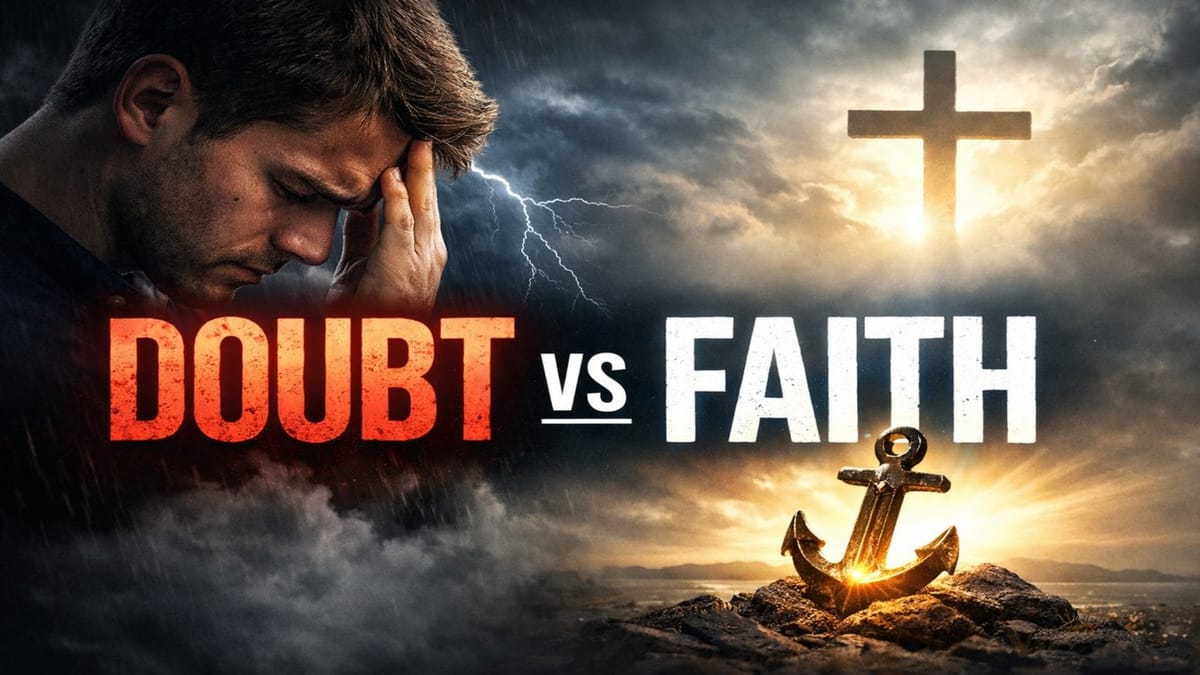
There are moments in every believer’s life when the question rises quietly, almost reluctantly, from somewhere deep within the soul: What if my doubt is bigger than my faith? It is not a question asked by rebels or cynics. It is asked by sincere hearts who desperately want to believe, who long for certainty, who hunger for peace, yet find themselves wrestling with uncertainty that feels larger than their confidence in God. This tension between doubt and faith is not a sign of spiritual failure. It is evidence that something profound is happening beneath the surface. It is the sound of growth pressing against the boundaries of comfort. It is the friction that produces depth.
In Christian growth, doubt is often misunderstood. Many assume that faith means the absence of questions, the elimination of uncertainty, and the steady maintenance of emotional confidence. Yet when we examine Scripture honestly, we discover that faith has rarely looked like emotional stability. It has looked like perseverance in the middle of instability. It has looked like trust chosen in the presence of confusion. It has looked like obedience when clarity was incomplete. The heroes of faith were not men and women who never wrestled with doubt. They were individuals who brought their doubt into the presence of God rather than allowing it to drive them away.
The modern believer faces unique pressures that intensify this struggle. We live in an information-saturated world where skepticism is celebrated and certainty is challenged daily. Social media amplifies opposing viewpoints. News cycles stir fear. Cultural narratives question long-held biblical convictions. In such an environment, doubt can feel overwhelming. It can feel intellectual. It can feel emotional. It can feel spiritual. Sometimes it feels like all three at once. The internal dialogue becomes relentless. Questions multiply. Assurance seems distant. Faith feels small.
Yet the central truth that must anchor every Christian heart is this: the size of your doubt does not determine the strength of God. Faith has never been about the volume of your confidence. It has always been about the object of your trust. When doubt feels loud, it does not mean God has grown weaker. It means you are in a season where deeper roots are being formed.
Spiritual maturity is not developed in environments of constant emotional certainty. It is developed in seasons where belief must be chosen repeatedly despite internal resistance. Consider how a muscle grows. It does not strengthen by remaining unchallenged. It strengthens by being stretched, strained, and placed under tension. In the same way, faith develops resilience when it is forced to push against doubt. Without resistance, there is no growth. Without tension, there is no depth. Doubt, while uncomfortable, often becomes the catalyst for a more enduring and authentic relationship with God.
One of the most liberating realizations for any believer is understanding that doubt is not the opposite of faith. Indifference is. Apathy is. Turning away completely is. Doubt still engages with God. Doubt still wrestles. Doubt still seeks understanding. A person who asks, What if my doubt is bigger than my faith, is not walking away from God. That person is reaching for Him. The very act of asking the question reveals a heart that cares deeply about spiritual truth.
When doubt feels bigger than faith, it often exposes unrealistic expectations we have placed on ourselves. Many Christians believe they must maintain a constant level of spiritual confidence to be considered mature. They imagine that strong believers wake up every morning filled with unwavering certainty. They assume that pastors, teachers, and spiritual leaders never question, never struggle, and never wrestle internally. This illusion creates unnecessary shame. When doubt surfaces, the believer feels defective. The mind whispers that something must be wrong.
Yet Scripture consistently reveals that even the most faithful servants of God experienced moments of uncertainty. They questioned timing. They questioned outcomes. They questioned their own adequacy. What distinguished them was not the absence of doubt but the direction of their response. They did not allow uncertainty to sever their connection with God. Instead, they carried their confusion into His presence.
There is a profound difference between suppressing doubt and surrendering it. Suppression leads to hidden anxiety and internal fragmentation. Surrender leads to transformation. When doubt is ignored, it festers. When it is acknowledged before God, it becomes an opportunity for revelation. Honest prayer is rarely polished. It is raw. It is vulnerable. It sometimes sounds more like a plea than a proclamation. But God does not require eloquence. He responds to authenticity.
In seasons where faith feels small, the temptation is to measure spiritual health by emotional intensity. If the worship song does not move you the way it once did, you assume your faith is fading. If prayer feels dry, you assume you are drifting. If Scripture feels difficult to grasp, you assume you are failing. Yet emotional fluctuations are not reliable indicators of spiritual depth. Faith is not a mood. It is a commitment. It is a decision to trust God’s character even when feelings shift.
Emotions are powerful, but they are not ultimate. They rise and fall. They respond to circumstances. They are influenced by stress, fatigue, and environment. Faith, however, rests on something more stable. It rests on who God is. When doubt becomes louder than belief, it often signals that your emotions are demanding clarity that your circumstances cannot yet provide. In those moments, the believer must lean not on fluctuating feelings but on established truth.
Truth does not change when your confidence does. God’s promises do not expire because your certainty weakens. His character is not diminished by your questions. The cross does not lose power because your mind is unsettled. The resurrection is not undone because your heart feels uncertain. Faith does not require perfect emotional alignment. It requires direction. It requires a willingness to say, Even if I do not fully understand, I will remain.
Remaining is powerful. Staying rooted when doubt storms through your thoughts is an act of spiritual courage. Walking into church when you feel spiritually dry is faith. Opening your Bible when clarity feels distant is faith. Praying when words feel heavy is faith. Faith is not always dramatic. It is often quiet endurance.
There is also a deeper layer to consider. Doubt sometimes emerges not because God has become less real but because your understanding of Him is expanding. As you grow spiritually, simplistic assumptions about God are replaced with richer, more complex understanding. Childlike faith is beautiful, but it eventually matures into tested faith. Questions that once seemed unnecessary begin to surface. You begin to wrestle with suffering, injustice, unanswered prayers, and delayed promises. These questions do not signal regression. They often signal progression.
A faith that has never confronted suffering is fragile. A faith that has wrestled with pain and remained is resilient. When doubt challenges your belief, you are being invited into deeper theological reflection and spiritual formation. You are moving from borrowed convictions to personal conviction. What once was accepted because others believed it must now be embraced because you have wrestled and chosen it.
This process can feel destabilizing. It can feel lonely. It can feel frightening. Yet it is often in these very seasons that faith becomes anchored in a way that cannot be easily shaken. The believer who has walked through doubt and emerged with renewed trust carries a different kind of confidence. It is not loud or boastful. It is steady. It has depth. It has endured.
Another crucial truth is that doubt magnifies when isolated. When internal questions remain unspoken, they grow in perceived power. The mind replays them. The heart amplifies them. Silence becomes fertile ground for anxiety. This is why spiritual community is essential. Healthy Christian fellowship creates space for honest conversations. It allows believers to share struggles without fear of condemnation. It reminds the doubting heart that it is not alone.
Isolation distorts perception. It convinces you that your struggle is unique and unprecedented. Community restores perspective. It reveals that many faithful believers have walked similar paths and found God present in the midst of their uncertainty. There is profound strength in realizing that doubt does not disqualify you from belonging. It connects you to the shared human experience of seeking God amid complexity.
When doubt feels overwhelming, it is also important to examine the narratives you are feeding your mind. The human brain is wired to focus on perceived threats. If you constantly consume content that undermines faith without balancing it with truth, doubt will naturally expand. Guarding your spiritual intake is not avoidance. It is wisdom. Just as you would nourish your body intentionally, you must nourish your spirit deliberately.
This does not mean avoiding hard questions. It means engaging them with balance and discernment. It means seeking thoughtful theological resources, mature mentors, and Scripture-centered guidance rather than allowing random voices to shape your worldview. Intellectual doubt deserves thoughtful exploration. Emotional doubt deserves compassionate care. Spiritual doubt deserves patient surrender.
There is also a subtle pride that can infiltrate seasons of doubt. Sometimes we assume that unless we understand everything, we cannot trust anything. We demand complete comprehension before offering commitment. Yet no human relationship operates this way. Trust always involves elements of mystery. You do not understand every detail of a loved one’s mind before choosing to love them. You trust based on character and consistency over time.
The same principle applies to faith. You may not have answers to every theological question. You may not understand every circumstance. But you can examine God’s character throughout Scripture and throughout your own life. You can reflect on moments where provision appeared unexpectedly. You can remember prayers that were answered in ways you did not anticipate. You can recall strength that carried you through seasons you once thought would break you. These reflections become anchors when doubt attempts to pull you away.
If doubt feels larger than faith, it may be because you are measuring faith incorrectly. Faith is not measured by how rarely you question. It is measured by how consistently you return. It is measured by whether, after wrestling, you still choose God. It is measured by whether, after tears, you still pray. It is measured by whether, after confusion, you still seek.
There is an important distinction between doubt that seeks understanding and doubt that seeks escape. The first leads to growth. The second leads to disengagement. When you approach doubt with humility and openness, it becomes a doorway. When you approach it with cynicism and finality, it becomes a wall. The posture of your heart determines the outcome.
In seasons where doubt dominates your thoughts, shift your focus from trying to eliminate uncertainty to strengthening trust. Trust grows through relationship. Relationship grows through time spent. Continue reading Scripture even when it feels challenging. Continue praying even when it feels quiet. Continue worshiping even when emotions are subdued. Spiritual habits are not performances. They are pathways. Over time, they create space for renewed clarity.
It is also helpful to remember that faith has always coexisted with mystery. Christianity does not promise exhaustive explanations for every suffering or delay. It promises the presence of God within them. If your doubt stems from unanswered prayers or prolonged hardship, you are standing in sacred territory. Many faithful believers have asked why deliverance seemed delayed. Many have wondered why certain outcomes unfolded differently than expected. Yet within those unanswered questions, they discovered deeper intimacy with God.
Sometimes doubt grows when life does not match expectation. We imagine how God should act, and when reality diverges from that expectation, we struggle. Yet spiritual maturity often involves releasing control over outcomes while retaining trust in God’s goodness. This is not passive resignation. It is active surrender.
Surrender does not mean abandoning hope. It means placing hope in God’s wisdom rather than your own timeline. It means acknowledging that finite understanding cannot fully grasp infinite perspective. It means recognizing that faith is not about predicting God’s moves but trusting His heart.
As this internal journey continues, you may discover something remarkable. The doubt you feared would destroy your faith may actually refine it. The questions you thought would dismantle your belief may deepen it. The season you worried would distance you from God may ultimately draw you closer.
Faith that has confronted doubt is different from faith that has never been challenged. It carries humility. It carries empathy. It carries compassion for others who struggle. It no longer judges quickly because it understands complexity. It no longer assumes that certainty equals superiority. It becomes gentle, steady, and anchored.
If doubt feels larger than faith right now, do not panic. Do not condemn yourself. Do not assume you are failing. You may be standing at the threshold of spiritual transformation. You may be in the middle of a refinement process that will produce greater depth than you have ever known. You may be building a foundation that cannot be easily shaken in future storms.
The key is not to silence your doubt but to bring it into the light. Speak it honestly before God. Examine it thoughtfully. Surrender it consistently. Allow Him to meet you within it. As you do, you will begin to realize that faith is not the absence of internal conflict. It is the decision to remain aligned with God even while conflict exists.
And when you look back on this season months or years from now, you may recognize that the moment you feared most was actually the moment your faith began to mature in ways you never expected, because what felt like weakening was actually strengthening, what felt like unraveling was actually rebuilding, and what felt like doubt overwhelming belief was in truth the quiet construction of a faith that would endure far beyond the noise of uncertainty, and as we continue exploring this journey of wrestling, rebuilding, and rediscovering trust, it becomes essential to understand how endurance in these seasons reshapes not only what you believe but who you become.
Endurance reshapes identity in ways comfort never can. When everything feels certain, faith often remains conceptual. It sits comfortably in the realm of agreement. It affirms doctrines. It nods at Scripture. It participates in routine. But when doubt enters the room, belief is forced to move from theory into decision. It must become chosen rather than inherited. It must become personal rather than assumed. And that shift, though uncomfortable, is where spiritual depth is formed.
There is a difference between borrowed faith and owned faith. Borrowed faith is what you absorb from family, church culture, or admired leaders. It is not false, but it is secondhand. Owned faith is what remains after questions have been faced, after disappointments have been processed, after expectations have been refined. Owned faith has wrestled and stayed. It has examined and still chosen trust. It carries weight because it has endured testing.
When doubt feels larger than faith, you are often in the middle of that transition. The scaffolding of borrowed certainty begins to loosen. Assumptions are challenged. Familiar language feels thinner. You begin asking questions you once ignored. This can feel destabilizing because it removes the illusion of control. Yet what is actually happening is that God is inviting you into deeper ownership. He is not intimidated by your examination. He welcomes it because authentic faith withstands scrutiny.
One of the most overlooked aspects of spiritual doubt is how closely it is tied to expectation. Many believers subconsciously build contracts with God. If I obey, life will unfold a certain way. If I pray, outcomes will align with my hopes. If I trust, suffering will be minimal or brief. When reality contradicts those internal contracts, doubt begins to grow. It whispers that perhaps God is distant, inattentive, or inconsistent.
Yet Scripture never promised a life free of tension. It promised presence within it. It never guaranteed predictable outcomes. It guaranteed purpose. It never eliminated mystery. It anchored hope in resurrection. When doubt arises from unmet expectations, it is often not God’s character that needs reevaluation but our assumptions about how He operates.
Suffering, delay, and uncertainty are not signs of abandonment. They are environments where trust matures. A seed buried in soil may interpret darkness as isolation, but darkness is the very condition that allows growth to begin. Roots expand in unseen places long before branches are visible. In the same way, faith often strengthens beneath the surface during seasons where clarity is absent.
Consider how resilience is formed in any area of life. Athletes grow through resistance training. Leaders grow through difficult decisions. Relationships grow through conflict resolved with humility. Faith is no different. It deepens when it must push through resistance. The resistance of doubt is not evidence of God’s absence. It is the pressure under which conviction is solidified.
There is also a psychological dimension to doubt that deserves attention. The human mind is designed to seek certainty. Ambiguity triggers discomfort. When answers feel incomplete, anxiety can intensify. In a culture that demands instant clarity and immediate results, spiritual patience feels counterintuitive. We want resolution quickly. We want proof immediately. Yet faith has always required endurance beyond immediate evidence.
This does not mean blind belief. It means sustained trust rooted in character rather than circumstances. If faith were based solely on emotional reassurance, it would collapse the moment emotions shift. But faith grounded in God’s consistent nature can withstand fluctuating feelings. The cross remains true whether you feel inspired or numb. The resurrection remains powerful whether your prayers feel urgent or quiet.
When doubt grows loud, shift your focus from measuring your faith to remembering God’s faithfulness. Reflection is a powerful antidote to anxiety. Revisit moments in your life where provision arrived unexpectedly. Recall seasons where strength carried you through situations you once feared would destroy you. Remember prayers that were answered in ways you did not anticipate at the time. Memory strengthens perspective. It reminds the heart that the God who sustained you before has not changed.
Another transformative practice in seasons of doubt is disciplined gratitude. Gratitude does not deny hardship. It reframes focus. When the mind fixates solely on uncertainty, doubt expands. When gratitude intentionally acknowledges daily evidence of grace, perspective widens. Gratitude shifts attention from what feels missing to what is present. It builds spiritual resilience quietly and consistently.
Community also becomes essential in these seasons. Isolation magnifies uncertainty. Shared experience reduces its intensity. Honest conversations with mature believers create space for perspective. Doubt that feels overwhelming alone often feels manageable when voiced in trusted circles. Vulnerability dismantles shame. It reminds you that spiritual struggle is not a unique defect but a shared journey.
In these conversations, you may discover that many who appear spiritually confident have walked through similar valleys. Their steadiness was not inherited effortlessly. It was developed through seasons of internal wrestling. Hearing their stories expands your understanding of what mature faith actually looks like. It looks less like constant certainty and more like consistent return.
Returning is a powerful act. Every time you choose to pray despite uncertainty, you return. Every time you open Scripture even when clarity feels thin, you return. Every time you worship even when emotions are quiet, you return. Faith is strengthened not by eliminating doubt but by repeatedly choosing to move toward God rather than away from Him.
It is important to acknowledge that some doubt stems from intellectual questions that deserve thoughtful engagement. Christianity is not threatened by examination. Historical evidence, theological reasoning, and philosophical reflection have long supported the credibility of the Christian worldview. Seeking understanding through study can strengthen belief rather than weaken it. Questions explored with humility often lead to deeper conviction.
However, not all doubt is intellectual. Some of it is emotional. It arises from pain, disappointment, grief, or exhaustion. When prayers seem unanswered and suffering lingers, the heart grows weary. In these moments, faith feels fragile not because theology has collapsed but because the soul is tired. Emotional doubt requires compassion rather than argument. It requires rest. It requires gentle reminders of God’s nearness rather than complex explanations.
There is a difference between questioning God’s ways and questioning God’s goodness. The first is part of growth. The second is often born from hurt. When you find yourself doubting His goodness, pause and consider the foundation of your belief. The cross stands as the ultimate declaration of divine love. It is not a distant symbol. It is the central revelation of God’s character. If God was willing to enter suffering for redemption, His goodness cannot be measured solely by temporary circumstances.
Doubt often exaggerates the present moment and minimizes eternal perspective. It narrows focus to immediate discomfort. Faith widens the lens. It acknowledges that life is part of a larger story. Temporary confusion does not erase eternal promise. Delayed answers do not negate ultimate restoration. This perspective does not eliminate pain, but it anchors hope beyond it.
As seasons of doubt continue, you may begin to notice subtle shifts within yourself. You become less reactive. You become more reflective. You become slower to judge others who struggle. You develop empathy for those who wrestle with belief. Your faith, once perhaps rigid, becomes resilient. It bends without breaking. It holds without needing constant reassurance.
Resilient faith is powerful. It does not depend on perfect conditions. It is steady amid imperfection. It has faced questions and remained. It has endured silence and continued seeking. It has experienced disappointment and still chosen hope. This kind of faith influences others not through volume but through stability. It speaks quietly yet convincingly because it has been tested.
If your doubt feels larger than your faith right now, consider that perhaps your faith is not shrinking. Perhaps it is being refined. Refinement involves heat. It involves exposure. It involves discomfort. But refinement produces purity. It removes superficial layers and strengthens what remains. The faith that emerges from refinement is less dependent on emotional intensity and more grounded in conviction.
There will be days when clarity returns and doubt softens. There will also be days when questions resurface. Growth is rarely linear. It moves in cycles. What matters is not the absence of internal struggle but the direction of your movement. Continue moving toward God. Continue engaging with truth. Continue practicing spiritual disciplines even when they feel ordinary. Ordinary faithfulness compounds into extraordinary resilience.
Over time, you may look back and realize that the season you feared most became the foundation of your strongest convictions. The doubt that once felt overwhelming became the doorway to deeper understanding. The questions that unsettled you led to clarity that could not be easily shaken. You will recognize that faith was never about eliminating uncertainty but about trusting through it.
In the end, the question What if my doubt is bigger than my faith transforms into a new realization. Doubt may feel loud, but it is not ultimate. Faith may feel small, but it is anchored in something eternal. Your confidence does not need to be constant for God to remain faithful. Your emotions do not need to be steady for His promises to stand. Your understanding does not need to be complete for His love to remain intact.
You are not failing because you question. You are growing because you wrestle and stay. You are maturing because you refuse to walk away. The presence of doubt does not disqualify you from spiritual depth. It may be the very path that leads you there.
As you continue forward, hold this truth firmly. Faith is not measured by the silence of doubt. It is measured by persistence in the midst of it. It is measured by whether you continue seeking when answers are incomplete. It is measured by whether you remain anchored when emotions fluctuate. It is measured by whether you trust God’s character when circumstances are unclear.
And if you remain, if you keep returning, if you continue choosing trust even when your voice trembles, you will discover that your faith was never as small as you feared. It was simply being strengthened beneath the surface. What felt like weakness was preparation. What felt like uncertainty was construction. What felt like doubt overwhelming belief was the slow, steady formation of a faith that will endure far beyond this season.
Stay the course. Stay honest. Stay rooted. The God you seek is not intimidated by your questions. He is shaping you through them.
Your friend,
Douglas Vandergraph
Watch Douglas Vandergraph’s inspiring faith-based videos on YouTube: https://www.youtube.com/@douglasvandergraph
Support the ministry by buying Douglas a coffee: https://www.buymeacoffee.com/douglasvandergraph