When All I Could Say Was Still Here
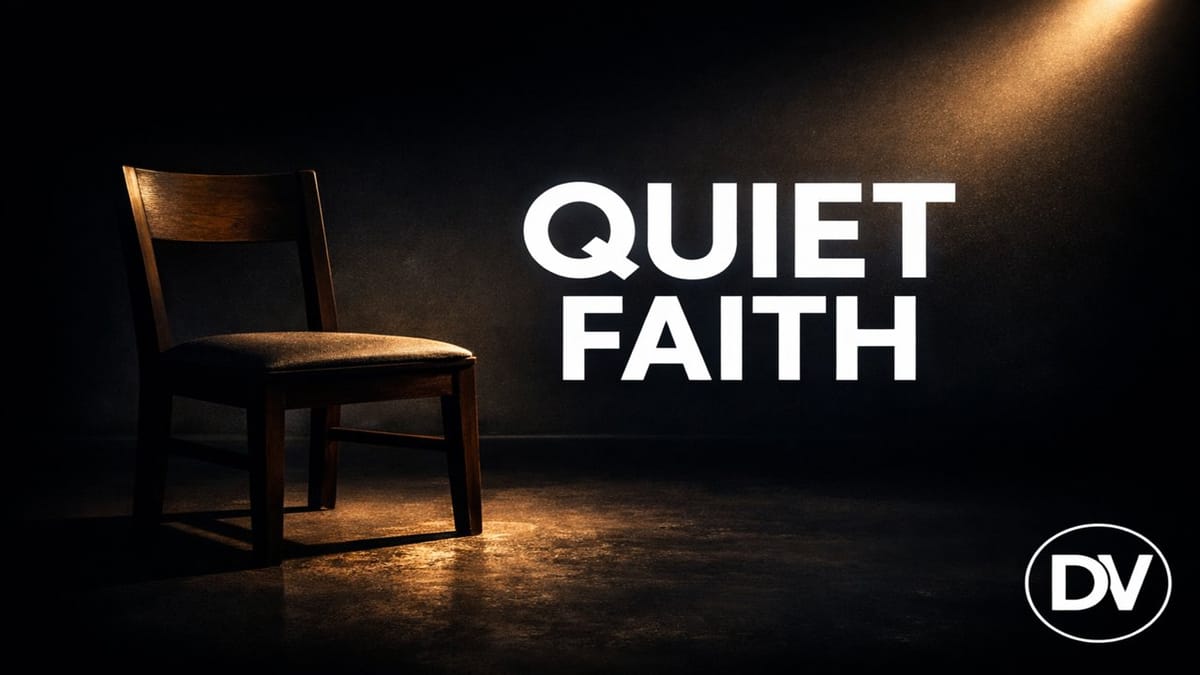
There are seasons in life when faith feels like something you carry in your hands, visible and confident, something you can point to and say, “This is it. This is what I believe.” And then there are seasons when faith feels more like something you keep in your pocket, unseen and quiet, pulled out only when you need to remind yourself that it’s still there. I used to believe faith was meant to be loud, decisive, and constantly affirmed by clarity. I thought that if God was truly working in my life, I would feel it in unmistakable ways—direction that didn’t waver, confidence that didn’t crack, and answers that arrived before doubt had time to settle in. I assumed that silence meant something was wrong.
But life has a way of teaching lessons slowly, especially the ones you never sign up to learn.
There was a stretch of time in my life that didn’t come with a dramatic breaking point. No catastrophic event. No single moment where everything fell apart. It was quieter than that, and in some ways, more unsettling. The days began to blur together. Wake up, move through responsibilities, return home, repeat. Nothing outwardly disastrous was happening, which almost made it harder to explain the heaviness I felt. From the outside, everything looked functional. Inside, it felt hollow.
I was still doing the things people associate with faith. I still believed in God. I still acknowledged Him. I still considered myself a person of faith. But something had shifted. The excitement I once associated with belief was gone, replaced by a low, steady fatigue. Not anger. Not rebellion. Just weariness. The kind that doesn’t shout but lingers.
Silence can be deceptive. At first, it feels peaceful. Then it starts to feel like absence. I began to wonder whether I had missed something, whether I had failed to notice a sign or ignored a direction I was supposed to follow. I searched for meaning in every small detail, convinced that if I paid enough attention, clarity would return. But it didn’t.
There was one night, ordinary in every way, that stays with me. It wasn’t late enough to be dramatic, but late enough that the world had slowed down. The house was still. No background noise. No distractions. Just quiet in its purest form. I sat there longer than I meant to, staring into a space that didn’t demand anything from me, and I realized something that unsettled me deeply: I didn’t know what to pray.
That realization didn’t come from disbelief. It came from exhaustion. I was tired of rehearsing the same questions, tired of trying to phrase them in a way that sounded faithful, tired of pretending that the lack of answers didn’t affect me. I had prayed sincerely for a long time, and the silence had become heavier than the questions themselves.
So I didn’t pray the way I thought I was supposed to.
There were no carefully chosen words. No structured thoughts. No attempt to sound strong or composed. I didn’t quote Scripture. I didn’t try to elevate the moment. I just spoke honestly, quietly, and without ceremony.
“I’m still here.”
That was the entire prayer.
At the time, it felt inadequate. Almost embarrassing. I remember thinking that if faith were measured, this would barely register. I had grown up with the idea that belief should be bold, confident, declarative. What I offered felt small. Fragile. Unimpressive. It didn’t feel like something worthy of being called faith.
For a while afterward, I carried a quiet sense of guilt about that moment. I told myself that real believers should have more to say, more confidence to express, more certainty to lean on. I wondered if my faith had diminished, if it had somehow eroded over time without me noticing.
But time has a way of revealing the truth of moments that feel insignificant while you’re living them.
Looking back now, I understand something I couldn’t see then. That prayer wasn’t the absence of faith. It was the stripping away of performance. It was belief without ornament, without polish, without the need to impress. It was the most honest expression of where I actually was.
Faith is often portrayed as something that shines brightest on mountaintops. Public victories. Loud testimonies. Confident declarations. But most of life doesn’t happen on mountaintops. It happens in ordinary rooms, on quiet nights, when no one is watching and nothing feels resolved. In those moments, faith doesn’t announce itself. It whispers.
Sometimes faith isn’t standing tall and saying, “I believe without question.” Sometimes it’s sitting still and saying, “I haven’t walked away.”
There is a subtle but important difference between certainty and faithfulness. Certainty demands answers. Faithfulness remains without them. I had spent so long measuring my faith by how strong I felt that I didn’t realize strength was never the point. Presence was.
That night didn’t change my circumstances. The days that followed looked much like the ones before it. There was no immediate relief, no sudden sense of direction. But something had shifted internally, quietly and slowly. I stopped demanding that my faith feel a certain way. I stopped treating silence as failure.
Instead, I began to understand that faith is not proven by how loudly it speaks, but by how faithfully it stays.
There are people who believe that doubt is the opposite of faith. I don’t think that’s true. Indifference is the opposite of faith. Walking away without caring is what breaks belief. Doubt, on the other hand, often shows how deeply someone wants to understand, how much they care about what they believe. Silence doesn’t destroy faith unless we decide it does.
I began to notice how many people around me were quietly carrying the same weight. People who still believed but didn’t feel triumphant about it. People who hadn’t abandoned faith but weren’t celebrating it either. People who assumed something was wrong with them because belief no longer felt easy.
We don’t talk enough about that version of faith. The kind that shows up tired. The kind that doesn’t have the energy for dramatic declarations. The kind that simply keeps going.
There is a strange courage in staying. Not in the spotlight. Not in moments of affirmation. But in the long middle, where nothing feels resolved and nothing is certain. Endurance is rarely praised, but it is one of the deepest expressions of belief there is.
I didn’t lose my faith in that season. It matured. It shed the need to be impressive. It learned how to exist without constant reassurance. It learned how to trust without seeing.
And perhaps most importantly, it taught me compassion. Because once you understand how quiet faith can be, you stop judging people for not sounding confident enough. You stop assuming that silence means absence. You begin to recognize belief in places you once overlooked.
This is why I speak the way I do now. It’s why I write the way I do. It’s why I refuse to rush past the uncomfortable spaces in Scripture or life. Because faith doesn’t grow by avoiding silence. It grows by learning how to remain in it.
There are people who read words like these and think they are failing because their belief doesn’t feel strong right now. They think something is wrong with them because they don’t have the language, the energy, or the certainty they once had. They think faith is slipping through their fingers.
But what if it isn’t?
What if it’s simply being carried differently now?
What if the fact that you’re still here—still questioning, still hoping, still listening—is not weakness, but evidence?
This story is not about a dramatic transformation. It’s about recognition. It’s about realizing that faith doesn’t always look the way we expect it to, and that sometimes the quietest forms are the most resilient.
And that understanding changes everything.
What I didn’t realize at the time was that seasons like that do something important to your faith. They remove the illusion that belief is something you control through effort or language. They force you to confront what remains when enthusiasm fades and answers delay themselves. And what remains, if you allow it, is something quieter but sturdier than what you had before.
We live in a culture that rewards certainty. People want quick conclusions, strong opinions, and confident declarations. That pressure creeps into faith as well. We begin to think belief must always be articulate, expressive, and emotionally convincing. We confuse passion with depth and volume with conviction. When that energy disappears, we assume something has gone wrong.
But faith was never meant to be measured by how loud it sounds.
There is a difference between faith that performs and faith that endures. Performance requires energy. Endurance requires commitment. One depends on how you feel. The other depends on who you trust, even when feelings are unreliable. I didn’t understand that distinction until I was forced to live in it.
That quiet season stripped away my assumptions. It revealed how much of my belief had been built around expectation. I expected clarity. I expected reassurance. I expected God to respond on my timeline, in my language, and in ways that matched my emotional state. When none of that happened, I assumed the problem was my faith.
But the problem wasn’t faith. It was expectation.
Faith is not a transaction. It is not an exchange where belief guarantees immediacy. It is a relationship, and relationships include silence. Anyone who has lived long enough knows that silence does not always mean absence. Sometimes it means trust is being deepened rather than affirmed.
What changed after that night was not my circumstances, but my posture. I stopped demanding that God prove His presence to me constantly. I stopped interpreting silence as rejection. I learned to remain without needing to understand. And that shift, subtle as it was, altered the way I moved through life.
I became more patient with myself. More patient with others. I stopped assuming that people who struggled to articulate their faith lacked it. I stopped expecting belief to look the same in every season. I recognized that some of the strongest believers I knew were also the quietest.
There is a version of faith that does not announce itself. It doesn’t post updates. It doesn’t demand recognition. It simply shows up. Day after day. Moment after moment. Even when nothing seems to be happening.
That kind of faith is rarely celebrated, but it is the kind that lasts.
I began to see endurance everywhere once I knew how to look for it. In people who kept praying even when prayer felt mechanical. In people who still believed even when belief felt thin. In people who hadn’t walked away, not because everything made sense, but because something deeper held them in place.
Those people are not failing. They are faithful.
And that distinction matters.
There is a quiet cruelty in telling someone that their faith must always feel victorious. That it must always sound confident. That it must always be certain. Those expectations don’t strengthen belief; they burden it. They turn faith into something people feel they must maintain rather than something that carries them.
The truth is that faith will not always feel strong. It will not always feel clear. It will not always feel reassuring. Sometimes it will feel like weight rather than lift. Sometimes it will feel like obligation rather than inspiration. Sometimes it will feel like nothing more than presence.
And presence is enough.
That realization reshaped the way I approach Scripture as well. I stopped reading it only for answers and started reading it for companionship. I noticed how often faith in Scripture looks unresolved. How many people in the Bible waited without explanation. How often obedience preceded understanding rather than followed it.
Faith, in its truest form, is not certainty about outcomes. It is trust in character. It is staying when leaving would be easier. It is continuing when quitting would feel justified.
When I say now that faith is sometimes just saying, “I’m still here,” I don’t mean that lightly. I mean it with the weight of lived experience. I mean it as a reminder to those who feel inadequate because they don’t have the words, the energy, or the clarity they once did.
You are not behind.
You are not broken.
You are not failing.
You are carrying something that has simply changed shape.
This is why I write and speak the way I do. Not to impress. Not to perform. But to create space for people who feel unseen in their belief. People who assume their quiet endurance doesn’t count. People who think faith must always feel victorious to be valid.
It doesn’t.
Some of the deepest faith is practiced in silence. Some of the strongest belief exists without explanation. Some of the most meaningful prayers are unfinished sentences spoken into the dark.
And if all you can say today is that you’re still here, that is not the absence of faith.
That is its persistence.
That is its resilience.
That is its quiet strength.
Truth.
God bless you.
small wave Bye bye.
Your friend,
Douglas Vandergraph
Watch Douglas Vandergraph’s inspiring faith-based videos on YouTube
Support the ministry by buying Douglas a coffee