The Towel, the Cage, and the Soul of Public Power

Chapter 1: When the Headline Feels Smaller Than the Hunger in the Room
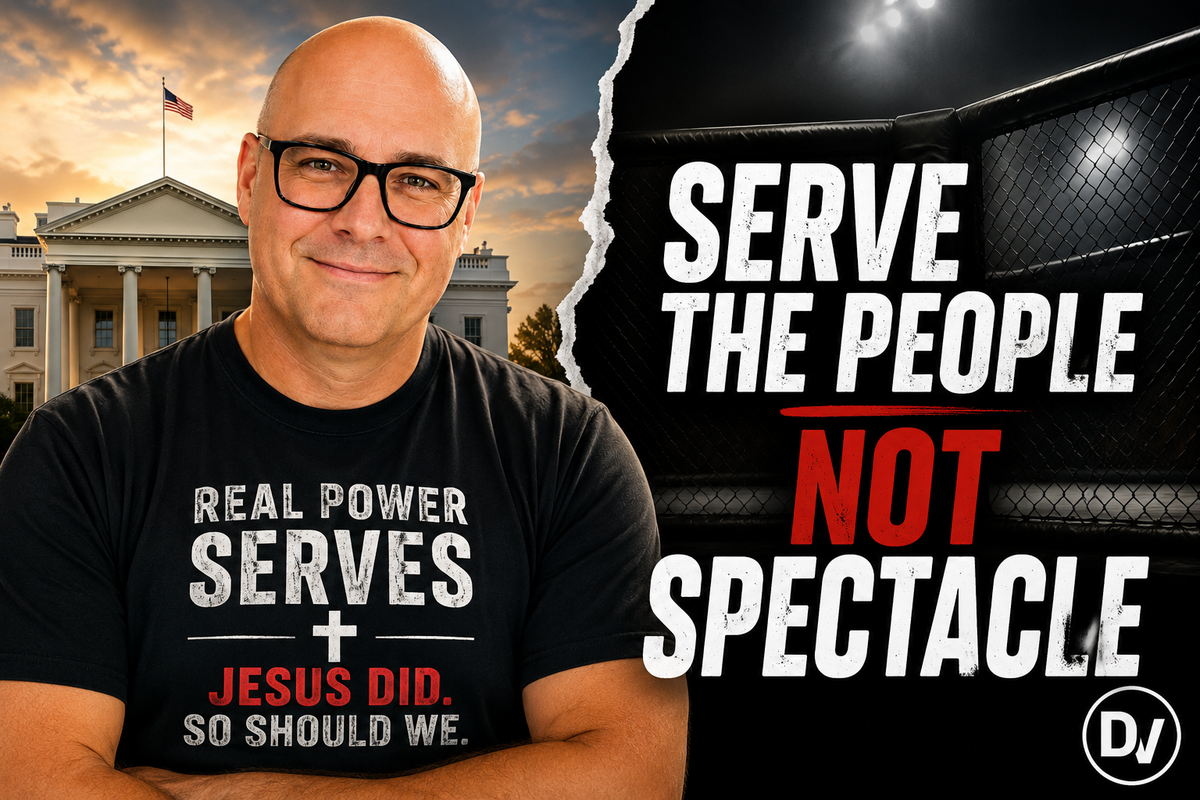
A person can read the news while standing in the kitchen with the refrigerator door open, and somehow the headline can feel colder than the air coming from the shelves. There may be milk in the door, a few eggs left in the carton, leftovers in a plastic container, and a quiet question sitting in the room that no one wants to say out loud: how are we going to make this stretch until payday? Then the phone lights up with talk about a cage fight connected to the White House, and it does not land like ordinary entertainment. It lands like a symbol. It lands like one more reminder that the people with power may be living in a completely different country than the people trying to keep their families steady. That is why the Jesus-centered talk on why government should serve people instead of sponsor spectacle matters as more than a reaction to one event. It opens a deeper question about what kind of spirit we want shaping public life.
For the tired parent reading that headline after work, this is not just about a sport. It is not just about fighters, fans, promoters, politicians, ratings, or noise. It is about the strange feeling that public life keeps becoming less serious at the exact moment ordinary life feels more serious than ever. Rent is not a performance. Medical debt is not a performance. Groceries are not a performance. A child asking whether everything is going to be okay is not a performance. That is where the related article about following Jesus when public power loses humility belongs in the same spiritual pathway, because the issue underneath this moment is not whether Christians are allowed to dislike something in the culture. The issue is whether followers of Jesus still know how to recognize the difference between service and spectacle.
A father may stand there with his phone in one hand and a bill in the other, not angry in a flashy way, just worn down in a real way. He may not hate anybody connected to the event. He may not even want to argue with people who enjoy combat sports. He may simply feel that something is off when the house that is supposed to represent the people becomes linked with the image of two men beating each other up in a cage for entertainment. He may wonder why government would ever want to sponsor, celebrate, bless, or even symbolically attach itself to that kind of spectacle when so many people need mercy, wisdom, repair, and help. That wondering is not weakness. It is conscience waking up before the culture tells it to go back to sleep.
This article is not written from hatred. It cannot be, because hatred does not come from the heart of Jesus. Hatred makes us blind even when we are trying to be right. Hatred turns people into targets and makes righteousness sound like revenge. A Christian response has to begin somewhere else. It has to begin with the truth that every fighter in a cage is a human being made in the image of God. Every fan in the crowd is a human being made in the image of God. Every political leader, every executive, every camera operator, every security guard, every person selling merchandise, and every person cheering from home is still someone God sees with more depth than public argument usually allows.
That matters because Christian conviction should never require us to dehumanize the people involved. We can question a public symbol without pretending the human beings inside it are worthless. We can reject the message being sent without mocking the people who are caught inside the message. We can say something is wrong without making cruelty our language. That is one of the hardest things about following Jesus in a loud age. The world keeps trying to hand us two bad choices. Either celebrate everything or hate everyone. Either clap along or become vicious. Either be silent or become bitter. Jesus gives us another way. He gives us truth with tears still in it. He gives us courage without contempt. He gives us moral clarity without the poison of personal hatred.
So the question is not whether a private company can run a fight. The question is not whether adults can choose to participate in a legal sport. The question is not whether athletes train hard, sacrifice, endure pain, and develop impressive discipline. The question is whether the government should place its symbolic weight behind the image of human beings damaging one another for entertainment. That is a different question. That is a public question. That is a moral question. That is a spiritual question for anyone who believes authority is supposed to be used in service to the people.
There is a reason this feels different from a private event happening in a private arena. When something becomes tied to the White House, it carries meaning beyond the event itself. The White House is not just a building. It is one of the most visible symbols of public responsibility in the nation. It is supposed to remind leaders that power is not ownership. It is supposed to remind citizens that government, at its best, should protect the weak, pursue justice, uphold order, and serve the common good. It is supposed to represent more than whoever happens to occupy it at a particular moment. It belongs to the people, including the people who will never be invited inside, never sit near power, never know a billionaire, and never be treated like their pain is camera-worthy.
That is why a cage fight connected to that symbol should trouble us. Not because Christians must pretend violence has never existed in the world. Not because we are shocked that human beings enjoy competition. Not because every person watching is evil. The concern is deeper than that. The concern is what a culture slowly learns to admire. A nation can train its imagination. It can train people to see compassion as weakness and domination as strength. It can train young men to believe that being powerful means being feared. It can train citizens to mistake noise for leadership and performance for courage. It can even train Christians to clap for the very spirit Jesus came to deliver us from.
Jesus never taught us to measure greatness by the ability to dominate another person. He never told His followers that the strongest person in the room is the one who can hurt the most people, gather the loudest crowd, or turn pain into profit. Jesus did not step into the world as a celebrity ruler demanding constant applause. He entered poor, humble, vulnerable, and close to ordinary people. He walked dusty roads. He ate with people religious society avoided. He touched the sick. He welcomed children. He noticed widows. He heard the cries of the blind. He spoke to women with dignity in a world that often did not. He challenged religious pride. He confronted hypocrisy. He carried authority without turning it into self-glory.
And near the end of His earthly ministry, when the disciples still did not fully understand what kind of kingdom He was bringing, Jesus wrapped a towel around His waist and washed feet. That moment should haunt every Christian understanding of power. The Son of God knelt before men who still wanted position. He lowered Himself before men who argued about greatness. He washed the feet of men who would scatter, deny, doubt, and fail. He did not use the room to promote Himself. He used it to reveal what holy authority looks like when it is not corrupted by pride.
That is the image Christians should bring into this conversation. Not a clenched fist first. Not a political slogan first. Not outrage first. A towel and a basin. The question becomes simple, even if the application is uncomfortable. Does this look like the way of Jesus? Does public power wrapping itself around violence, celebrity, money, and spectacle look like the One who knelt? Does government attaching itself to the image of men striking each other for entertainment reflect the heart of the Savior who healed wounded bodies and told His followers to love their enemies?
Someone might say that this is too serious, that it is just entertainment, that nobody is being forced to watch, that fighters are choosing to participate. But Christians are allowed to ask what entertainment does to the soul. We are allowed to ask what repeated images train us to love. We are allowed to ask whether something becomes different when the symbols of public authority are placed beside it. A private adult choice is one thing. A national symbol embracing that image is another. When government steps close to a spectacle, it gives the spectacle dignity it may not deserve. It tells the people, without saying it directly, that this is worth national attention.
Meanwhile, an elderly woman may be cutting pills in half because the refill costs too much. A young couple may be wondering whether they can afford another month in their apartment. A single mother may be eating less so her children can eat more. A veteran may be sitting alone in a small room, feeling forgotten by the country he served. A teenager may be learning from every screen around him that violence, money, and fame are the quickest ways to matter. These are not side issues. These are the people public leadership is supposed to remember.
The government exists to serve people, not entertain power. That sentence is not complicated, but it is easy to forget when a culture becomes addicted to spectacle. Spectacle has a way of making serious things feel boring. It makes humility look small. It makes service look weak. It makes quiet faithfulness look invisible. It makes the work of caring for the poor, repairing broken systems, listening to families, protecting children, and honoring the vulnerable feel less exciting than a camera shot, a chant, a fight card, or a famous face.
But Jesus did not call His followers to be impressed by the same things that impress the world. He taught us to see what others miss. He taught us that a widow’s small offering could matter more than the loud giving of the rich. He taught us that a Samaritan stranger could show more neighborly love than respected religious figures who walked past a wounded man. He taught us that children, servants, beggars, and outcasts were not interruptions to the kingdom. They were often the very places where the kingdom became visible.
That is why the Christian response to public spectacle has to be more than political irritation. It has to become spiritual reorientation. The deeper problem is not one event. The deeper problem is the temptation to admire power when it refuses to kneel. We can become so used to public arrogance that humility feels unrealistic. We can become so used to branding that service feels old-fashioned. We can become so used to aggression that gentleness feels weak. We can become so used to leaders performing for attention that we forget leaders are supposed to carry responsibility with fear and trembling.
There is also something important to say about young men. Many of them are already carrying anger they do not know how to name. They are being told from every direction that their worth depends on dominance, money, appearance, sexual conquest, physical toughness, and public status. Some of them have never been shown a man who is strong without being cruel. Some of them have never been shown authority that serves instead of takes. Some of them are looking for a model of masculinity, and the world keeps handing them louder and harder versions of the same empty promise: win, crush, rise, be feared, be untouchable.
Jesus offers a better vision of manhood. He was not weak. No honest reading of the Gospels can turn Jesus into weakness. He faced temptation. He confronted evil. He endured betrayal. He spoke truth to power. He walked toward suffering when He could have escaped it. He carried a cross after being beaten and mocked. But His strength was not the strength of ego. It was not the strength of a man trying to prove he mattered by humiliating someone else. His strength was holy love under pressure. His strength was obedience to the Father. His strength was mercy that did not collapse when surrounded by hatred.
That is the kind of strength our sons need to see. They need to know that a man can be courageous without being violent, firm without being cruel, disciplined without being arrogant, protective without being hateful, and strong without worshiping domination. They need to know that the highest model of manhood is not found in a cage, on a stage, in a luxury box, or behind a microphone. It is found in Jesus Christ, who could command angels but chose the cross, who could expose everyone but chose mercy, who could demand service but chose to wash feet.
This is where the perspective has to shift. The question is not merely, “Should Christians be against a UFC event connected to the White House?” The better question is, “What kind of people are we becoming when this no longer bothers us?” When the house of public service starts borrowing the energy of combat entertainment, it reveals something about what a culture thinks power is for. If power is for spectacle, then the vulnerable will always be pushed to the edge of the frame. If power is for branding, then the poor become background. If power is for applause, then truth becomes negotiable. If power is for service, then the hurting move to the center of concern.
That is why the image of Jesus washing feet is not a soft religious decoration. It is a direct challenge to the spirit of the age. It confronts celebrity politics. It confronts money worship. It confronts violence as entertainment. It confronts leadership without humility. It confronts every public figure, every private citizen, and every Christian who has started to confuse the kingdom of God with the kingdoms of this world. The towel and basin do not flatter our pride. They expose it. They ask whether we are willing to be lowered into love when everything around us wants to be lifted into attention.
A woman sitting in her car outside work may understand this better than any commentator. She may have spent the day being talked down to by people above her, doing more than she is paid for, answering messages during lunch, wondering how she will care for an aging parent and still be present for her children. She does not need leaders performing toughness for cameras. She needs leaders who know that responsibility is sacred. She needs leaders who remember that real people are carrying real weight in real rooms with no audience at all.
That is the public spirit Christians should want. Not a joyless nation where nobody celebrates anything, but a wiser nation where celebration does not swallow conscience. Not a culture that hates athletes, but a culture that refuses to confuse violence with virtue. Not a government stripped of ceremony, but a government humble enough to remember that its highest purpose is not to entertain the comfortable but to serve the people, especially those who are barely holding on.
The way of Jesus asks more from us than outrage. It asks us to examine our loves. It asks whether we have become too easily impressed. It asks whether our politics have trained us to defend what our faith should teach us to question. It asks whether we can still feel concern for the soul of a nation without needing to hate the people caught up in its confusion. It asks whether we can look at a cage, look at a symbol of public power, look at the cross, and tell the truth about what does not belong together.
Chapter 2: What a Nation Teaches Without a Lesson Plan
A teenage boy can learn a lesson without anyone sitting him down at a desk. He can learn it while leaning over a kitchen table with one earbud in, watching short clips on his phone while his backpack sits half-open on the floor. His mother may be washing a pan at the sink. His father may be in the next room trying to answer an email after a long shift. Nobody in that house may think a public spectacle has anything to do with them. But images teach. Headlines teach. What powerful people celebrate teaches. What government treats as worthy of national attention teaches. A boy may not know how to explain it, but he can absorb the message that toughness means being harder than someone else, that manhood means winning through force, that public honor belongs to the loud, the rich, the famous, and the physically dominant.
That is one reason this issue matters beyond politics. A culture does not only form people through laws. It forms people through admiration. Whatever we place on the stage, we quietly tell the next generation to notice. Whatever we connect to national symbols, we quietly tell people to respect. When the visible symbols of public service are joined with the image of two men striking each other in a cage, the problem is not that every viewer will become violent or that every athlete is immoral. That would be too simple and unfair. The deeper problem is that a government symbol begins lending honor to a picture of human beings hurting each other for applause.
Christians should not be naïve about what repeated images do to the heart. The eye may seem small, but it is a doorway. The mind may seem private, but it is shaped by what it takes in. The heart may seem strong, but it can grow used to almost anything if it sees it enough times with cheering around it. A society can become trained to treat aggression as entertainment and then act surprised when tenderness begins to look strange. It can grow used to the sound of mockery, the thrill of humiliation, the pleasure of watching someone fall, and the habit of calling it strength.
Jesus did not form His disciples that way. He formed them slowly, personally, and often against their own instincts. When they wanted status, He taught them humility. When they wanted fire called down from heaven, He rebuked them. When they tried to keep children away, He welcomed the children. When they reached for the sword, He told them to put it away. Jesus understood that His followers could not merely have correct beliefs while carrying the same spirit as the world. They had to be retrained in what greatness looked like.
That retraining is still needed. It is needed in the living room when a father realizes his son is learning more from a screen than from his words. It is needed at the workplace when people mistake intimidation for leadership. It is needed in politics when officials learn that outrage gets more attention than quiet service. It is needed in the church when Christians become more loyal to public personalities than to the teachings of Christ. It is needed in the private place where each of us has to ask whether our own hearts have started to enjoy what Jesus would have healed.
A man can come home from work tired and not want to think about any of this. He may take off his boots near the door, set his keys in the same dish, and sit down for a few minutes before dinner. He may feel he has enough to carry without worrying about what a national spectacle means. But then his child asks a question from across the room, something simple like, “Why would they do that there?” and suddenly the issue becomes more personal. He cannot hide behind indifference anymore. He has to decide what kind of answer he wants to give.
That answer does not need to be complicated. It can be honest and calm. He can say that people are valuable even when we disagree with what they do. He can say athletes are human beings and should not be mocked. He can say adults make choices, and those choices can involve risk. But he can also say that government should be careful about what it honors. He can say that a nation should not use its highest symbols to make violence look glamorous. He can say that Jesus shows us a different kind of strength.
This is where Christian conviction becomes practical. It is not enough to say, “Jesus is humble,” while we keep admiring public arrogance. It is not enough to say, “Jesus is merciful,” while we keep rewarding cruelty with attention. It is not enough to say, “Jesus loves the vulnerable,” while we allow the vulnerable to disappear from our public imagination. Faith has to become a way of seeing. It has to change what impresses us. It has to change what bothers us. It has to change what we defend, what we question, and what we refuse to normalize.
The public connection between government and combat spectacle matters because public power has a teaching role. Not a classroom role, but a symbolic one. It tells us what matters. It tells us what kind of image the nation wants to project. If the image is service, humility, repair, protection, and responsibility, then the people learn something healthy. If the image is domination, celebrity, money, violence, and showmanship, then the people learn something else. No speech has to be given. No curriculum has to be written. The lesson arrives through the picture itself.
This does not mean Christians must become offended by every rough thing in the world. Life is not clean. Scripture itself does not hide violence, injustice, empire, betrayal, suffering, or blood. The Bible is honest about the world as it is. But the Bible also shows us the difference between naming violence and glorifying it. It shows us that human beings are capable of cruelty, and it shows us God entering that cruelty not to bless it but to redeem us from it. The cross is not God celebrating violence. The cross is God exposing violence, absorbing it, and defeating it through self-giving love.
That distinction matters deeply. When Jesus was beaten, mocked, crowned with thorns, and nailed to the cross, the world displayed its usual idea of power. Soldiers used force. Leaders used fear. Crowds used mockery. Religious pride and political calculation stood near each other and called it necessary. But Jesus did not answer with the same spirit. He did not turn suffering into entertainment. He did not teach His followers to enjoy the destruction of the body. He prayed forgiveness from the place of pain. He entrusted Himself to the Father. He showed that holy strength is not the ability to crush another person but the power to remain faithful when the world has become cruel.
That is why Christians should feel uneasy when public authority drifts toward the celebration of violence as spectacle. We are not following a Savior who built His kingdom through domination. We are following the One who was pierced by domination and rose above it. We are following the One who confronted evil without becoming evil. We are following the One who could have used unlimited power and chose sacrificial love instead.
A nurse on a late shift understands something about bodies that a cheering crowd can forget. She may see bruises, swollen faces, concussions, broken hands, and frightened families in the waiting room. She may understand that the human body is not a prop. It is not an object. It is not a brand. It is fearfully and wonderfully made. It carries breath given by God. It carries a mother’s prayers, childhood memories, unseen wounds, and future years that can be changed in a moment. Even when adults consent to risk, Christians can still refuse to make damage look holy by placing government honor around it.
There is a real difference between courage and spectacle. Courage runs into danger to rescue a child. Courage tells the truth when lying would be easier. Courage stays faithful to a spouse during a hard season. Courage gets sober. Courage apologizes. Courage forgives. Courage keeps working when no one claps. Courage cares for an aging parent, sits beside a hospital bed, stands up for someone being mistreated, and chooses integrity when cheating would bring profit. Spectacle often imitates courage because it has lights, noise, and risk. But risk alone does not make something righteous. Pain alone does not make something noble. Applause alone does not make something worthy of public honor.
Jesus was courageous, but His courage was never empty performance. He did not need to prove Himself through violence. When people mocked Him and dared Him to come down from the cross, He stayed. Not because He lacked power, but because love held Him there. That is the kind of courage Christians must keep naming in a world that keeps mistaking force for greatness. The strongest Man who ever lived did not build a cage around another man. He opened a way for sinners to come home.
This should change the way we speak, too. The point is not to sneer at fans or shame people who have enjoyed fights. Many people have grown up with combat sports as part of their family culture. Some respect the discipline, the training, the sacrifice, and the competitive spirit. A Christian article should not pretend those people are stupid or evil. But love for people does not require agreement with every cultural pattern. Sometimes love says, “We are being shaped by something, and we need to pay attention.” Sometimes love says, “There is a better picture of strength than the one being sold to us.” Sometimes love says, “The government should not put its hand on this and call it worthy.”
A small church youth leader may feel that burden on a Wednesday night when the boys in his group start talking about who is tough, who could beat whom, who is weak, who deserves respect. He may not shut the conversation down with scolding. He may sit with them, listen, and then talk about Jesus standing silent before His accusers. He may talk about the courage it takes not to retaliate. He may talk about Joseph forgiving his brothers, David refusing to kill Saul when he had the chance, and Jesus telling Peter to put away the sword. He may tell them that self-control is not weakness. Mercy is not weakness. Restraint is not weakness. Service is not weakness. In the kingdom of God, a man does not become great by making another person small.
That is the lesson a nation needs, too. The more public life becomes a contest of who can look strongest, richest, loudest, and most untouchable, the more the way of Jesus becomes necessary. Not as decoration. Not as a quote placed over the same old hunger for power. Not as a religious label pasted onto worldly values. The way of Jesus must become a real challenge to what we admire.
A government that serves people should not need to borrow glory from a cage. It should not need the energy of combat to look strong. It should not need celebrity spectacle to prove relevance. Real public strength is measured by whether families can live with dignity, whether the poor are remembered, whether justice is pursued, whether veterans are honored with action instead of slogans, whether children are protected, whether truth matters, and whether leaders understand that authority is stewardship.
When Christians say this, we are not asking for a nation without joy. We are asking for a nation with a conscience. We are asking for public power to remember its limits. We are asking for government to stop confusing visibility with virtue. We are asking for leaders to honor the people by serving them, not by staging symbols that make power feel entertaining while real needs wait outside the camera frame.
The teenage boy at the kitchen table may not understand all of that yet. He may still be scrolling. He may still be laughing at clips. He may still be trying to figure out what kind of man he wants to become. But somewhere in that house, an adult has the chance to interrupt the lesson the world is teaching. Not with panic. Not with shame. Not with a lecture that crushes the conversation. Just with a better picture.
Look at Jesus.
Look at the towel.
Look at the cross.
Look at the empty tomb.
That is strength.
Chapter 3: The People Outside the Camera Frame
A woman can stand in a grocery store aisle longer than she planned because the decision in front of her is not really about cereal. It is about whether she can buy the kind her children like or the cheaper box on the lower shelf. It is about whether the meat in the cart needs to go back so there is room for laundry detergent. It is about whether she can smile when she gets home so the kids do not feel the pressure she has been carrying all day. Around her, the store lights are bright, the cart wheel keeps pulling to one side, and her phone buzzes with one more headline about power, spectacle, and entertainment being treated like national importance. She may not have words for the frustration that rises in her, but she knows this much: the people in charge should be thinking about people like her.
That is the part public spectacle tries to hide. It pulls the camera toward the famous, the wealthy, the violent, the loud, and the staged, while millions of ordinary people keep living in rooms nobody broadcasts. A government symbol connected to a cage fight does not happen in a vacuum. It happens in a country where many families are tired, frightened, overworked, underpaid, and quietly ashamed of how hard life has become. It happens while people are skipping appointments because the copay is too much. It happens while grandparents are raising grandchildren on fixed incomes. It happens while young adults wonder if they will ever be able to afford a home. It happens while the lonely sit in apartments where no one calls, no one knocks, and no leader seems to remember they exist.
Jesus always noticed the people outside the camera frame. That is one reason His way is so different from the way of spectacle. The world often looks toward the center of power and asks who is winning. Jesus looks toward the edge of the crowd and sees who is being crushed. The world asks who has the platform. Jesus asks who has been ignored. The world asks who can draw attention. Jesus asks who needs mercy. That difference is not small. It changes everything about how a Christian should think about public life.
When Jesus entered a room, the most important person was not always the person everyone else considered important. A woman with a long illness touched the edge of His garment in a crowd, and He stopped. A blind beggar cried out while others tried to silence him, and Jesus listened. A tax collector climbed a tree because he was too short to see, and Jesus noticed him. Children were pushed aside by adults who thought serious ministry belonged to serious people, and Jesus welcomed them. Again and again, Jesus turned His attention toward those the world treated as interruptions.
That is why the White House, or any public institution meant to represent service, should never become a symbol that tells struggling people they are background scenery. When public power wraps itself in entertainment, it risks sending a cruel message without meaning to. It says the stage matters more than the kitchen table. It says the powerful deserve the spotlight while the poor can keep waiting. It says national attention belongs to whatever is loud enough, rich enough, and marketable enough to dominate the screen.
A Christian conscience should resist that. Not because Christians think government can save the soul. It cannot. Only Jesus saves. Government is not the kingdom of God, and no political building is holy in the way Christ is holy. But government still has moral responsibility. Public authority is still accountable for how it uses its influence. Leaders may not be pastors, but they are still stewards. They may not preach sermons, but they preach through symbols. They tell the public what matters by what they elevate.
That is why the issue is not only the cage. It is the connection between the cage and public honor. In a private arena, a fight is already a serious moral question for Christians to consider. But when government stands near it, sponsors it, celebrates it, or uses its most visible symbols to give it weight, the question deepens. Then it is no longer simply adults consenting to risk. It becomes public power placing dignity around an image of bodily harm for entertainment. It becomes a nation hinting that this kind of spectacle belongs near the center of civic identity.
A man waiting in a hospital hallway might understand the problem in a way no debate panel can capture. He may be sitting under fluorescent lights while his brother is being examined after a workplace injury. He may see the bandage, the swelling, the fear that comes when the body is no longer dependable. In that moment, pain does not feel like entertainment. A damaged body does not feel like branding. Blood does not feel like a symbol of greatness. The body feels sacred because it is fragile. It feels sacred because every breath is a gift. It feels sacred because people are not objects for the powerful to use, market, or decorate.
Scripture teaches that human beings are made in the image of God. That truth should not disappear when someone becomes an athlete, a celebrity, an opponent, or a product. The body is not meaningless. The face is not meaningless. The mind is not meaningless. The possibility of lasting injury is not meaningless. Even when fighters are skilled, disciplined, willing, and compensated, Christians can still ask whether public celebration of their harm forms us in the wrong direction. Consent may answer one legal question, but it does not answer every spiritual question.
Jesus treated bodies with tenderness. He touched lepers. He restored sight. He gave strength to weakened limbs. He healed bleeding, fever, paralysis, and brokenness that had made people feel isolated from community. His miracles were not performances designed to make suffering entertaining. They were signs of the kingdom, glimpses of God’s heart toward human pain. Jesus did not look at the wounded body and ask how to sell tickets. He looked with compassion.
That compassion should shape how Christians think about public honor. We should ask whether the things we celebrate teach us to become more compassionate or less. We should ask whether we are being trained to see another person’s pain as a thrill. We should ask whether young people are learning that bodies are sacred or that bodies are tools for applause. We should ask whether government, when it steps into the picture, is helping the public become wiser, gentler, more just, and more responsible.
There is a difference between courage and cruelty, between discipline and spectacle, between strength and domination. A firefighter entering a burning house shows courage. A mother staying up all night with a sick child shows courage. A recovering addict telling the truth and beginning again shows courage. A husband humbling himself and asking forgiveness shows courage. A worker refusing to cheat even when money is tight shows courage. These forms of courage rarely get flashing lights, celebrity seats, or national ceremonies, but they are closer to the way of Jesus than the celebration of one person damaging another for public excitement.
This is not about pretending life can be made soft by avoiding hard truths. The Christian faith is not fragile. It does not deny suffering, sacrifice, blood, violence, or the cost of love. At the center of our faith stands the cross, where Jesus suffered in His body. But the cross must never be used to baptize the love of violence. The cross does not glorify cruelty. It exposes it. The cross shows what sin does when power loses humility, when leaders protect themselves, when crowds become entertained by shame, when the innocent body is handed over to public violence.
That is why the cross is such a powerful lens for this moment. On the day Jesus was crucified, public authority and public spectacle were not strangers to each other. Soldiers mocked Him. Crowds watched. Leaders sneered. A sign was placed above His head. His suffering became public. But heaven was not entertained. The Father was not impressed by the machinery of humiliation. The darkness that fell over the land was not applause. It was judgment on the world’s way of treating the innocent, the vulnerable, and the holy.
Christians who kneel at the cross should be careful about what they cheer. We should be careful about what we call strength. We should be careful about what we let public power dress up as national pride. We should be careful because our hearts can be discipled by the wrong kingdom if we never question what captures our attention.
A teacher grading papers late at night might feel this concern in another form. She may read essays from students who are anxious, angry, lonely, and confused about what kind of future awaits them. She may see boys who think tenderness will get them mocked and girls who think their worth depends on being noticed. She may know that young people are absorbing the moral weather of the nation even when adults pretend they are not. When public life glorifies spectacle, children learn spectacle. When public life rewards aggression, children learn aggression. When public life honors service, children have a chance to imagine something better.
This is why followers of Jesus must speak with care, but also with firmness. We cannot let our concern become hatred, but we also cannot let our kindness become silence. Silence can become agreement when the moment calls for witness. A Christian witness is not the same as political shouting. It is a steady refusal to let the world rename darkness as light. It is the courage to say that government should not sponsor or symbolically celebrate two men beating each other up in a cage. It is the humility to say this while praying for everyone involved. It is the maturity to reject the spectacle without despising the souls inside it.
The person in the grocery aisle, the man in the hospital hallway, the teacher grading papers, the father answering his child’s question, the nurse seeing wounded bodies, the youth leader talking to restless boys, and the elderly woman cutting pills in half all belong inside this conversation. They are not distractions from it. They are the reason it matters. Public leadership should be measured by whether it remembers them. Public symbols should be judged by whether they honor the dignity of the people, especially the ones without power.
Jesus did not build His ministry around the admiration of the powerful. He did not organize His life around the comfort of the wealthy. He did not measure success by how much attention He could gather from those who wanted signs but not repentance. He kept moving toward the hurting. He kept seeing the unseen. He kept telling His followers that whatever they did for the least of these, they did for Him.
That means Christians cannot talk about public power without talking about the least of these. They are not a sentimental add-on to the faith. They are central to whether our faith is real. The hungry, the sick, the imprisoned, the stranger, the poor, the grieving, the exploited, the lonely, and the overlooked are not background figures in the kingdom of Jesus. They are where Jesus tells us to look.
So when public office begins to look like a stage for power to entertain itself, Christians should feel a holy discomfort. We should feel it not because we hate the people on the stage, but because we love the people outside the frame. We should feel it because Jesus loved them first. We should feel it because the towel and basin are still telling the truth. We should feel it because the cross still exposes the lie that violence plus public approval equals greatness.
There is a better way to be strong. There is a better way to lead. There is a better way for a nation to use its symbols. There is a better way for Christians to speak into a moment like this. We can be calm and still be clear. We can be loving and still be firm. We can refuse to publicize names and still confront the spirit behind the spectacle. We can say, without cruelty, that public power should not kneel before money, celebrity, or combat entertainment. Public power should kneel before service.
And if Christians are going to follow Jesus in this generation, we have to keep our eyes trained on the people Jesus never stopped seeing.
Chapter 4: When Strength Stops Needing an Audience
A man can sit in his truck before sunrise with both hands resting on the steering wheel, not because he is afraid to go into work, but because he is tired of having to be hard all the time. The parking lot is still dark. The thermos in the cup holder has cheap coffee in it. His phone is facedown on the passenger seat because he already knows what it will show if he turns it over: arguments, highlights, outrage, people laughing at pain, people praising power, people telling him what strength is supposed to look like. He may have been raised to believe that a man should not let anything bother him, that he should absorb pressure silently, that he should answer insult with a sharper insult and threat with a stronger threat. Then he hears the way Jesus speaks about greatness, and something inside him starts to loosen. Maybe real strength is not what the world has been selling him.
That may be one of the hardest shifts for a person to make. The world often teaches strength as display. It wants strength to be visible, intimidating, marketable, and loud enough to control the room. It wants strength to have an audience. It wants a camera angle, a crowd reaction, a winner’s pose, a defeated opponent, and a story that can be sold. But Jesus keeps moving strength into places where applause cannot follow. He moves it into forgiveness. He moves it into restraint. He moves it into service. He moves it into truth spoken without hatred. He moves it into obedience when obedience costs something. He moves it into the quiet moment when a person could retaliate but chooses to remain faithful.
That is why a public symbol connected to cage fighting troubles the Christian conscience. It is not merely that bodies are being struck. It is that a certain vision of strength is being lifted up near the place where public responsibility should be modeled. It is the image of power standing beside violence and calling it worthy of attention. It is the suggestion that national strength needs the energy of combat spectacle to feel alive. The way of Jesus challenges that suggestion at its root. Christ does not need human beings to damage each other in order to reveal power. He reveals power by loving sinners, healing wounds, bearing shame, forgiving enemies, and rising from the grave.
The man in the truck may not use those words. He may simply know that he is tired of being told that tenderness makes him weak. He may think about the night before, when his teenage son snapped at him across the dinner table. For a second, he wanted to crush the boy with a sentence. He had the authority. He had the sharper tongue. He could have reminded his son who paid the bills and who made the rules. Instead, he paused. He took a breath. He asked what was really going on. The boy looked away, then admitted he was scared about something at school. In that kitchen, no one cheered. No one clipped the moment for a video. No one called it strength. But heaven may have recognized it better than the world ever could.
That kind of strength is not soft. It may be harder than the strength of spectacle because it requires self-control. It is easier to explode than to listen. It is easier to humiliate than to understand. It is easier to dominate than to serve. It is easier to hide behind anger than to admit fear. A cage can show trained aggression under rules, but a home reveals whether a person has learned the deeper discipline of love. A stage can make force look impressive, but a kitchen table can reveal whether a man has become safe for the people God entrusted to him.
Jesus was safe for wounded people, but He was not harmless toward evil. That distinction matters. Some people hear Christian talk about gentleness and assume it means weakness, passivity, or pretending wrong is not wrong. That is not the Jesus of the Gospels. Jesus confronted religious hypocrisy with courage. He overturned tables when worship was being exploited. He called leaders to account when they burdened people and did not lift a finger to help. He spoke with authority that astonished those who heard Him. But He did not confuse authority with self-display. His courage was never vanity. His firmness was never cruelty. His strength never needed to prove itself by turning another human being into a prop.
This is where Christians have to recover a better imagination. We do not have to accept the world’s thin definition of strength. We do not have to choose between weakness and domination. Jesus gives us a third way that is stronger than both. He shows us strength under the Father’s command. Strength with clean hands. Strength that can protect without becoming predatory. Strength that can confront without becoming hateful. Strength that can suffer without becoming bitter. Strength that can lead without needing constant applause.
A young employee may learn this in a break room after being blamed for something he did not do. The old version of him might have raised his voice and made the room choose sides. He might have turned the mistake into a public battle because embarrassment felt unbearable. But faith has been working in him slowly. He has been praying in the mornings, not with impressive words, just with enough honesty to say, “Lord, help me not become someone I do not respect.” So when the accusation comes, he answers clearly, provides the facts, refuses to insult, and walks out with his character intact. It does not feel like victory at first. It feels like swallowing fire. Later, when he sits in his car, he realizes he did not lose strength by refusing to become cruel. He found a different kind.
That kind of lived faith matters because public life and private life feed each other. A nation that constantly celebrates domination will eventually carry that spirit into homes, workplaces, schools, churches, and friendships. People will begin to believe that the only way to be heard is to overpower. The only way to be respected is to intimidate. The only way to win is to make someone else look small. Then we wonder why conversations are harder, families are angrier, and leaders sound less like servants and more like performers protecting their own image.
Jesus breaks that pattern. He does not merely tell us to be nice. He gives us a new center. When a person is secure in the Father’s love, they do not need to turn every disagreement into a cage. When a person knows God sees them, they do not need every room to clap. When a person has surrendered their pride to Christ, they can apologize without feeling destroyed. They can serve without feeling invisible. They can tell the truth without needing to crush. They can let God be their defender instead of living in constant performance.
This is one of the reasons public spectacle is spiritually dangerous. Spectacle does not usually invite reflection. It invites reaction. It pulls people into the thrill of the moment and makes deeper questions feel like interruptions. But the Christian life requires the courage to interrupt the thrill. It requires a person to ask what is happening to the soul while the crowd is cheering. It asks what kind of desires are being fed. It asks what kind of future is being imagined. It asks whether the event is teaching us to love what Jesus loves or admire what Jesus resisted.
That does not mean Christians must live suspicious of every sport, every competition, or every public event. The point is not to drain life of joy or discipline. The point is to ask why government, which carries responsibility for the common good, would attach itself to the spectacle of human beings beating one another in a cage. The public connection changes the moral weight. It makes the event feel less like private entertainment and more like a statement about power, national identity, and what public leadership considers worthy of honor.
A grandmother watching her grandson play in the yard might see the issue with painful clarity. The boy is small enough that his shoes still light up when he runs. He swings a plastic bat at the air, falls down, laughs, gets up, and asks her to watch again. She wants him to grow strong. She wants him to be brave. She wants him to know how to stand up for what is right. But she does not want him to believe strength means enjoying another person’s harm. She does not want him to believe that men become valuable by becoming harder, colder, and more celebrated for force. She wants him to learn the strength of Jesus before the world teaches him another gospel.
That grandmother may not call it theology, but it is. It is a belief about what human beings are for. Are we made to bear the image of God, or are we made to become products in someone else’s show? Are our bodies temples of the Holy Spirit, or are they disposable instruments for profit and applause? Is power meant to protect life, or is it meant to decorate violence with importance? These questions do not disappear because an event is popular. Popular things may need deeper examination precisely because they form so many people at once.
The gospel gives us the courage to examine them without fear. Christians do not need to panic, because Jesus is Lord. We do not need to rage, because rage cannot build the righteousness of God. We do not need to dehumanize anyone, because Christ died for sinners, including us. But we also do not need to be silent. Silence in the face of distorted power can become its own kind of surrender. There are moments when love for neighbor requires a clear word. There are moments when love for young people requires a better model. There are moments when love for the country requires saying that public leadership should not be discipled by spectacle.
The stronger path is not hatred. It is witness. A witness points beyond the present moment to a truer kingdom. A witness does not merely complain that something feels wrong. A witness holds up the image of Christ and says, “Here is the standard.” The towel and basin. The cross. The empty tomb. The mercy shown to enemies. The truth spoken to power. The welcome given to children. The healing offered to wounded bodies. The command that the greatest must become servants.
That standard exposes how small our public imagination has become. We have been told to admire people who can gather attention, move money, dominate opponents, and turn public life into performance. Jesus asks us to admire the one who serves when no one is watching. He asks us to honor the one who protects the weak, tells the truth, keeps promises, feeds the hungry, visits the lonely, and refuses to let pride rule the heart. He asks us to see greatness where the world sees nothing to market.
The man in the truck eventually has to go inside. The shift will begin. The noise of the day will return. The phone will keep buzzing. Public life will keep offering him images of strength that are easier to sell than the way of Jesus. But he can choose what he lets shape him. He can decide that his home will not become a smaller version of the world’s cage. He can decide that his words will not become fists. He can decide that the people around him will not have to be defeated for him to feel strong. He can ask Christ to make him the kind of man who can carry authority without making others afraid.
That is where the renewal of public life begins, not only in offices and institutions, but in human hearts that stop worshiping the wrong kind of power. A nation becomes healthier when its people recover a better vision of strength. A church becomes brighter when its men and women stop confusing cruelty with courage. A family becomes safer when authority learns to kneel. A leader becomes trustworthy when service matters more than display.
The world may keep building stages for spectacle, but Christians do not have to bow to them. We can honor Jesus by refusing to call violence holy because powerful people stood near it. We can honor Jesus by refusing to let government symbols make domination look sacred. We can honor Jesus by teaching our children that the strongest Person who ever lived did not need an audience to prove Himself. He carried a cross, forgave His enemies, washed feet, and rose with scars still visible.
That is strength without vanity. That is power without corruption. That is leadership without spectacle. That is the way of Jesus, and it is still the only way strong enough to heal what pride keeps breaking.
Chapter 5: The Witness That Refuses to Become What It Opposes
A man can leave a church service and still carry the argument into the parking lot. The sermon may have been about grace, the last song may still be in his head, and the sun may be bright on the windshield, but his phone is already filling with comments, clips, and people daring him to pick a side. Someone has shared the headline again. Someone else has mocked anyone who questions it. Another person has turned the whole thing into a loyalty test. He sits in the driver’s seat while his family buckles in, and he feels that familiar pull to answer anger with anger, sarcasm with sarcasm, accusation with accusation. Then he remembers that following Jesus is not only about having the right concern. It is also about carrying the right spirit.
That is where Christian witness becomes difficult. It is not hard to be upset when something feels wrong. It is not hard to recognize that public power should not attach itself to the spectacle of two men beating each other up in a cage. It is not hard to say government should serve people instead of entertain power. The harder work is refusing to let our opposition become infected with the same spirit we are opposing. If we condemn spectacle while craving attention for our outrage, we have not fully escaped it. If we criticize arrogance with arrogant language, we have only changed the target. If we speak against violence while using our words like weapons, we have missed the deeper invitation of Christ.
Jesus never asked His followers to become quiet cowards. He never asked them to watch injustice, corruption, hypocrisy, or spiritual confusion and pretend everything was fine. But He also never gave His disciples permission to surrender their hearts to the spirit of the age in the name of fighting it. He taught them to be wise as serpents and innocent as doves. That means discernment without corruption. Courage without cruelty. Clarity without contempt. A Christian can say, “This is not right,” while still guarding the heart from the pleasure of despising another person.
This matters because the world is always trying to turn moral concern into tribal performance. It wants us to speak in a way that wins applause from people who already agree. It wants us to make enemies simple so we do not have to love them. It wants us to forget that every person involved in a public controversy has a soul. It wants us to believe that the only way to be strong is to be severe. But Jesus does not let us off that easily. He commands love for enemies, prayer for those who mistreat us, and truthfulness that does not need hatred to sound serious.
A woman may feel this tension at a family table where the subject comes up without warning. Someone laughs and says Christians are too sensitive. Someone else says the whole thing is great because it makes the country look tough. The room tightens. She feels her face getting warm. She could respond in a way that turns dinner into a battle. She could shame everyone. She could fire back so sharply that no one hears the truth underneath her words. Or she could take a breath and say something simple: “I just think public power should point us toward service, not violence as entertainment. I think Jesus gives us a better picture of strength.” That kind of answer may not win the room, but it may keep the door open.
Keeping the door open is not compromise. Sometimes Christians mistake gentleness for surrender because we have forgotten how forceful gentleness can be. A gentle answer can be stronger than a public insult because it refuses to be controlled by the other person’s tone. A calm sentence can carry more authority than a loud speech when it comes from a clean conscience. Jesus often spoke with a kind of authority that did not need to beg for attention. He did not flatter crowds, but He also did not let crowds decide His spirit. He was free in a way angry people are not free.
That freedom is important here. If Christians are going to challenge the public celebration of cage-fight spectacle, we must not become performers ourselves. We must not turn concern for the poor into a way to sound superior. We must not use the suffering of families as a prop for our own frustration. We must not speak as though we alone see clearly and everyone else is beneath us. The people who disagree with us may be wrong about this moment, but they are not beyond the mercy of God. Some of them may love their families, work hard, pray sincerely, and still not have thought deeply about what public symbols teach. Our task is not to crush them. Our task is to witness.
A witness does not need to win every exchange. A witness tells the truth and leaves room for God to work. That is a difficult discipline in a culture that measures everything by instant reaction. We want the clever reply. We want the satisfying comeback. We want the comment that gets shared. We want proof that we landed the point. But the way of Jesus often works more slowly. A sentence spoken with humility may return to someone’s mind later when they are alone. A calm refusal to join the crowd may trouble a conscience more deeply than a public scolding. A Christian who does not mock may become harder to dismiss.
This is part of why the towel and basin matter so much. Jesus did not simply teach servant leadership as an idea. He embodied it in front of people who were still confused. He gave them a picture they could not easily forget. Christian witness should do the same. It should make people feel the contrast between the spirit of Jesus and the spirit of spectacle. It should not merely announce that the world is wrong. It should show another way of being human.
A business owner may have to decide what that looks like in a workplace. He may hear employees debating the event near the coffee machine. One person says it is embarrassing. Another says it is exactly the kind of strength the nation needs. The owner could use his position to shut everyone down or force his view into the room. Instead, he listens, then says that he believes leadership should be measured by service and that government should be careful about what it celebrates. He does not lecture. He does not mock. Later that same day, he approves time off for an employee caring for a sick parent and checks on another worker who has been struggling. His words about service gain weight because his life is trying to match them.
That is where public conviction becomes credible. Christians cannot call leaders to humility while refusing humility in our own relationships. We cannot condemn the misuse of power while misusing power at home, at work, at church, or online. We cannot say government should remember the hurting while ignoring the hurting person sitting beside us. The article, the post, the conversation, the criticism, and the public concern all have to lead somewhere real. They have to lead toward the neighbor. They have to lead toward the child watching us. They have to lead toward the person who needs help.
If a Christian says the White House should not be connected to a cage fight, that statement becomes stronger when the Christian is also feeding someone, encouraging someone, forgiving someone, serving someone, and refusing to worship human power. Otherwise, our words can become another form of noise. The world has enough noise. It needs embodied faith. It needs people whose resistance to spectacle is matched by a quiet devotion to mercy.
That does not mean every Christian must respond in the same way. One person may write. Another may speak to their children. Another may pray. Another may challenge a friend in a careful conversation. Another may simply refuse to share the clips, refuse to celebrate the symbol, and choose to give attention to something more faithful. Every act of attention is a small act of worship. That may sound strong, but it is true in a practical sense. What we keep looking at shapes what we keep loving. What we keep sharing shapes what others notice. What we keep rewarding with our attention becomes larger in the public imagination.
A college student may learn this while sitting alone in a dorm room at midnight, scrolling through arguments until her chest feels tight. She may realize she has spent an hour absorbing anger from strangers and has not prayed for five minutes. She may feel convicted, not condemned, just awakened. She closes the app, opens her Bible, and reads about Jesus withdrawing to lonely places to pray. That small decision does not change the national headline, but it changes the atmosphere of her soul. She stops letting spectacle disciple her for the night. She lets Jesus restore her attention.
Attention is one of the most contested parts of modern faithfulness. The world does not merely want our agreement. It wants our eyes, our outrage, our time, our nervous system, our imagination, and our ability to be pulled from one emotional spike to the next. A public cage-fight spectacle tied to political symbolism is designed to capture attention. The Christian response cannot only be to stare at it angrily. At some point, we have to redirect attention toward Christ and toward the people Christ calls us to love.
That redirection is not denial. It is spiritual resistance. When we pray for the poor instead of merely using them as an argument, we resist. When we serve a struggling family instead of only complaining that leaders forgot them, we resist. When we teach our sons that gentleness is strength, we resist. When we refuse to make idols of public figures, we resist. When we refuse to publicize names that do not need more attention, we resist. When we say that government should serve people and then go serve someone ourselves, we resist with integrity.
This is the kind of witness that can survive beyond one news cycle. Outrage burns hot and then looks for another object. Faithfulness burns steadier. It keeps showing up after the crowd moves on. It cares about the elderly woman next week, not only when her struggle helps make a point today. It cares about the young man being formed by violent images long after the headline fades. It cares about the public soul of a nation because it cares about the private soul of a child. It keeps measuring power by Jesus when everyone else is measuring it by attention.
The church has an opportunity in moments like this, but only if it refuses the easy traps. We must not become partisan performers. We must not let moral concern become personal hatred. We must not talk about violence in a way that makes our own words violent. We must not use Jesus as a decoration for our preferred outrage. We must return to Him for real. We must let Him correct our tone, our motives, our loves, and our courage.
There is a clean way to say this. Public power should not sponsor the spectacle of human beings hurting each other for entertainment. Government should serve the people, not use its symbols to bless violence, celebrity, money, and showmanship. Christians should care because Jesus teaches us to honor the body, protect the vulnerable, serve the struggling, resist the worship of power, and measure greatness by humility. We can say all of that without naming people who do not need more attention. We can say it without hating fans. We can say it without pretending we are better than anyone. We can say it as sinners who have been corrected by grace and are still learning what it means to follow the Servant King.
The man in the church parking lot finally starts the car. His family is hungry. The afternoon is waiting. He may not post the perfect response. He may not change the national conversation. But he can choose the spirit he carries home. He can talk to his children about Jesus instead of merely talking about what is wrong with the world. He can pray for leaders without worshiping them. He can reject spectacle without becoming hard. He can serve someone quietly before the day is over.
That may seem small compared with the size of public power, but the kingdom of God often begins in places the powerful overlook. A seed. A cup of cold water. A widow’s coin. A Samaritan stopping on the road. A Savior kneeling with a towel. A believer choosing truth without hatred in a noisy parking lot after church.
Chapter 6: The House That Must Learn to Kneel
A volunteer can arrive early at a church basement while the folding tables are still stacked against the wall and the coffee has not finished brewing. The room may smell faintly like floor cleaner and old hymnals. Boxes of canned food sit near the door, and a clipboard waits for the names of families who will come later with quiet faces and careful smiles. Nobody in that basement is trying to create a spectacle. Nobody is looking for a camera. Nobody is trying to prove they are powerful. They are simply preparing to hand groceries to people who need help getting through the week. In a world obsessed with stages, that little room may be closer to the heart of Jesus than many places with bright lights and important names.
That is the perspective shift this whole moment should give us. The question is not only whether a government symbol should be connected to a cage fight. The question is whether we still know how to recognize greatness when it does not entertain us. If greatness has to be loud before we notice it, we have already drifted from the way of Jesus. If leadership has to look rich, famous, violent, and untouchable before we call it strong, then our imaginations have been discipled by the wrong kingdom. The kingdom of God keeps showing up in quieter places. A meal handed across a table. A child comforted after a hard day. A bill paid for someone who could not pay it. A lonely person remembered. A leader who chooses service when spectacle would have brought more applause.
This is why the image of the White House matters. It is not sacred like Christ is sacred, and Christians must never confuse any nation with the kingdom of God. But public symbols still teach. They still shape imagination. They still tell people what a nation honors. When the house of public service begins to kneel before celebrity, money, violence, and entertainment, something has become disordered. The house that should remind leaders to serve the people begins to look like a stage where power entertains itself. That is not a small thing, because symbols can either call a nation upward or train it downward.
A government that remembers its purpose should feel the weight of the hungry before it feels the pull of the cameras. It should think about the exhausted nurse driving home after a double shift, the father filling out job applications at midnight, the grandmother raising children on a fixed income, the veteran waiting for help, the young mother sitting beside a crib while wondering how much longer she can keep going. These are the lives public responsibility is supposed to keep in view. These are the people who should haunt the conscience of leadership in the best possible way. Not as political props, but as neighbors.
Jesus gives us no permission to forget them. He does not let us build a faith that floats above the wounded world. He keeps bringing us back to the hungry, the sick, the stranger, the prisoner, the child, the widow, the sinner, the overlooked person on the side of the road. He keeps making love practical. He keeps asking whether our spiritual words have become flesh in the way we treat real people. If our nation wants to talk about strength, then let it show strength by protecting those who cannot buy influence. If leaders want to be honored, let them become honorable through service. If public institutions want respect, let them remember the people they were created to serve.
There is a kind of strength that repairs instead of performs. It may not trend. It may not draw crowds. It may not look impressive to people who have become addicted to spectacle. But it is the strength that holds families, churches, neighborhoods, and nations together. It is the strength of the person who keeps showing up at the food pantry. It is the strength of the teacher who buys supplies for students with her own money. It is the strength of the mechanic who quietly fixes a widow’s car for less than he could charge. It is the strength of the friend who answers the phone at midnight. It is the strength of the believer who refuses to return evil for evil because Christ is still Lord over the hidden places of the heart.
That strength looks weak only to people who have forgotten what love costs. Serving is not easy. Humility is not easy. Forgiveness is not easy. Telling the truth without hatred is not easy. Refusing to join the crowd when the crowd is cheering for the wrong thing is not easy. Jesus never made the narrow road sound glamorous. He simply told us to follow Him. And if we follow Him long enough, we begin to see that the loudest rooms are not always the most important rooms, and the most powerful people are not always the ones closest to the heart of God.
A pastor visiting a nursing home may understand this in a way public spectacle never could. He may sit beside a woman whose hands are thin now, whose voice is soft, whose family lives far away. She may not know the latest headline. She may not care about the argument online. She may simply want someone to pray with her and remind her that Jesus has not forgotten her. In that room, greatness is not measured by attention. It is measured by presence. It is measured by whether someone slows down enough to see the person the world has moved past. That is the kind of sight Christians need in public life. We need eyes trained by Jesus, not by spectacle.
When public power connects itself to the image of combat entertainment, it does more than make a poor choice of scenery. It reveals a hunger for attention that is unworthy of true service. A government does not become stronger by standing near violence. A leader does not become more serious by borrowing the energy of a cage. A nation does not become more courageous by treating human harm as a symbol of pride. The strength a nation needs is moral strength, the strength to tell the truth, protect the vulnerable, restrain greed, resist corruption, honor work, repair what has been broken, and serve without needing to be worshiped.
The cross must remain our measure. At the cross, Jesus exposed what happens when power loses humility. The innocent was mocked. The body was wounded. The crowd watched. Leaders protected themselves. Violence was made public. Yet Jesus answered with a love that the world could not understand. He did not call cruelty strength. He did not turn suffering into a show. He absorbed the worst human power could do and revealed that the love of God is stronger than the violence of men. The resurrection did not vindicate spectacle. It vindicated holy obedience, sacrificial love, and the kingdom that cannot be conquered by force.
That means Christians must be careful about where we place our admiration. We can respect discipline without worshiping damage. We can care about athletes without celebrating the public glorification of bodily harm. We can pray for leaders without turning them into idols. We can love our country without pretending every public symbol is wise. We can speak against a government-sponsored spectacle without becoming cruel toward the people involved. The way of Jesus is narrow because it refuses both cowardice and hatred. It calls us to truth with mercy, courage with humility, and conviction with clean hands.
There may be someone reading this who feels torn because they enjoy combat sports and also love Jesus. This article is not written to shame you as a person. It is written to invite deeper reflection. All of us have places where the Lord teaches us to see differently. All of us have been entertained by things we later had to reconsider. All of us have defended cultural habits before asking whether they were forming us in the likeness of Christ. The question is not whether you are better or worse than someone else. The question is whether Jesus is allowed to examine what we love, what we excuse, what we share, and what we celebrate.
That examination should begin in prayer, not pride. Pride says, “I see what everyone else misses.” Prayer says, “Lord, purify my sight too.” Pride says, “Those people are the problem.” Prayer says, “Search my heart and teach me Your way.” Pride uses truth to stand above others. Prayer lets truth bring us lower before God, where we can speak more honestly because we are not pretending to be untouched by the same world we are critiquing. If Christians want to challenge the spirit of spectacle, we have to let Jesus challenge the spectacle inside us, the desire to be seen, applauded, proven right, and publicly affirmed.
A mother cleaning up the kitchen after everyone has gone to bed may live that challenge quietly. The sink is full. The house is finally still. She is tired enough to cry but too tired to explain why. She thinks about the world her children are inheriting, a world where power often looks like performance and violence is dressed up as entertainment. She dries a plate, whispers a prayer, and asks Jesus to make her home different. She cannot control every headline. She cannot reform every institution. But she can teach her children that people are not disposable, that strength can be gentle, that service matters, that bodies are sacred, and that Jesus is the clearest picture of power they will ever see.
That kind of home matters. That kind of church matters. That kind of citizen matters. A nation is not healed only by what happens in high offices. It is also healed when ordinary people refuse to let their souls be trained by corruption, cruelty, arrogance, and spectacle. It is healed when families honor service. It is healed when churches remember the poor. It is healed when young men learn that self-control is stronger than rage. It is healed when believers stop giving their worship to personalities and return their attention to Christ.
This does not mean Christians should withdraw from public concern. It means we should enter public concern with a different spirit. We should speak because people matter, not because outrage feels good. We should criticize symbols because truth matters, not because we need enemies. We should refuse to name and publicize personalities when the deeper issue is the spirit behind the spectacle. We should keep pointing to Jesus, because only Jesus can keep moral clarity from becoming another form of pride.
The White House, and every place of public authority, should learn to kneel. Not before money. Not before celebrity. Not before ratings. Not before combat entertainment. Not before the hunger for attention. It should kneel before the responsibility to serve. It should kneel before the needs of the people. It should kneel before justice, mercy, humility, and the truth that authority is entrusted, not owned. And every Christian who speaks about public power should kneel too, because none of us can call leaders to humility while refusing it ourselves.
Jesus washed feet. That image remains stronger than the spectacle because it reveals a kind of power the world cannot manufacture. The towel and basin still preach without shouting. They tell us that greatness does not have to injure someone to prove itself. They tell us that leadership is not a performance for the powerful but a burden carried for the good of others. They tell us that the body of another person is not a prop. They tell us that the forgotten are not forgotten by God. They tell us that the Servant King is still correcting the imagination of everyone willing to follow Him.
So let the nation have a better vision. Let young men see a better strength. Let leaders remember the people outside the camera frame. Let Christians speak with courage and tenderness. Let government serve the hungry before it entertains the comfortable. Let public symbols point toward responsibility instead of spectacle. Let the church refuse to become hateful while it refuses to be silent. Let every argument be brought back under the lordship of Christ.
The final word for followers of Jesus is not outrage. It is allegiance. Our highest loyalty is not to a party, a politician, a celebrity, a brand, a sport, a nation’s image, or a public spectacle. Our highest loyalty is to Jesus Christ, who used His power to save, His authority to serve, His body to redeem, and His scars to show that love is stronger than violence. If we belong to Him, then we cannot call every spectacle harmless. We cannot call every display of power admirable. We cannot call every public celebration wise. We have to ask what looks like Jesus, and then we have to follow Him even when the crowd is looking somewhere else.
The church basement will eventually fill with people. Someone will pour coffee. Someone will carry a box to a car. Someone will thank the volunteers with embarrassed eyes. Someone will go home with enough food for a few more days. No camera may come. No famous person may notice. No headline may call it strong. But in that room, the kingdom will be easier to recognize than in many places that call themselves powerful.
That is where Christians should learn to look again. Not toward the cage. Not toward the stage. Not toward the spectacle. Toward the towel, the basin, the cross, the empty tomb, and the people Jesus never stopped seeing.
Your friend,
Douglas Vandergraph
Watch Douglas Vandergraph inspiring faith-based videos on YouTube:
https://www.youtube.com/@douglasvandergraph
Support the Christian encouragement library through GoFundMe:
https://www.gofundme.com/f/help-douglas-vandergraph-build-a-christian-encouragement-lib
Support the daily work by buying Douglas a coffee: