The Quiet Weight Jesus Found in Huntsville

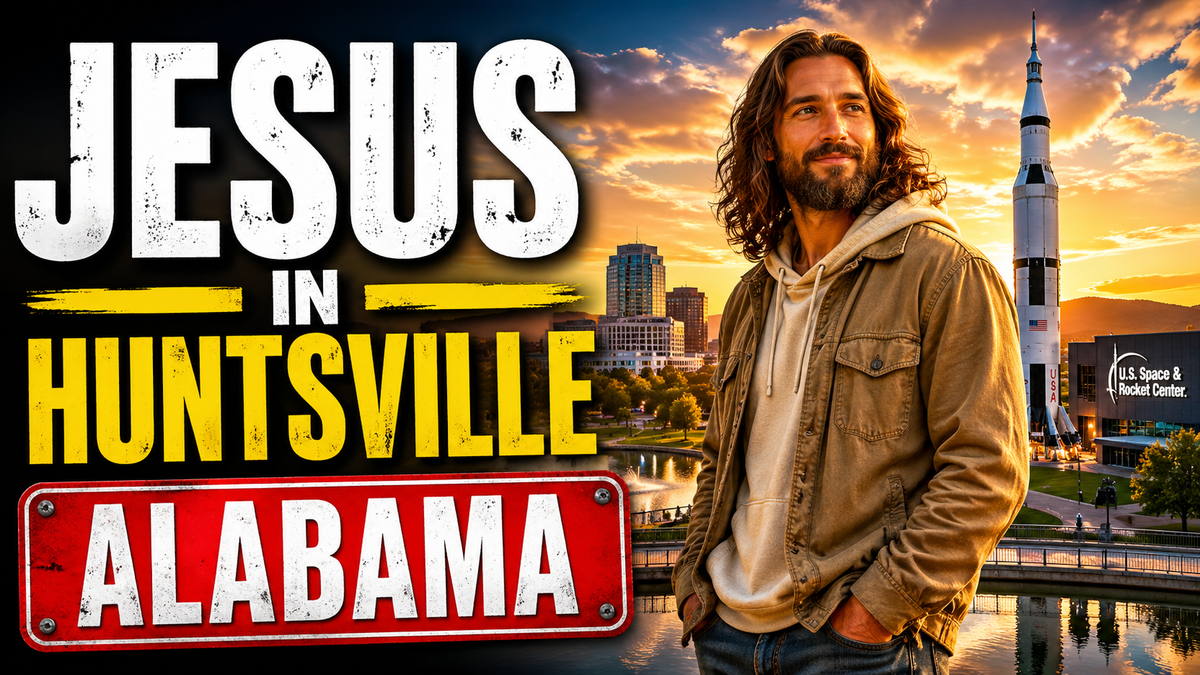
Jesus began the morning in quiet prayer before the city had fully opened its eyes, while Huntsville still held that half-lit stillness that comes before traffic, before phone calls, before the first hard thing of the day finds a person and climbs onto their shoulders. He was not far from Big Spring International Park, where the water moved with a calm that seemed older than the city around it. The sky had not yet turned bright. It was only beginning to loosen the dark. A few early runners passed in the distance. A truck rolled slowly along the street nearby. Somewhere, a man was already late for work before his shift had even begun. Somewhere, a woman was sitting on the edge of her bed wondering how to get through another day without letting anyone know how close she was to breaking. Jesus knelt where no one was watching and spoke to His Father with the kind of silence that carries more than words.
The city around Him was known for reaching upward. Rockets. Research. Engineering. Defense work. Big dreams measured in thrust and distance. Huntsville had learned how to look at the sky and imagine what could be done. But Jesus had not come that day to admire what people could build when they were strong. He had come to see what they carried when they were tired. He had come for the man who could solve systems at work but could not find words for his marriage. He had come for the girl who smiled through a shift she hated because rent was due. He had come for the father sitting in his car too long because going home felt like walking into another failure. He had come for the people who lived in a city of movement and still felt stuck inside themselves.
When He rose from prayer, the first light was touching the water. The park was quiet except for the birds and the sound of shoes against the path. Jesus walked slowly, not as a visitor trying to see everything, but as someone who already knew the ache under the surface. He passed the water and saw a maintenance worker standing near a trash can with a gloved hand on the lid. The man’s name was Calvin. He was in his late fifties, with a face that looked like it had learned not to expect much from the day. His uniform was clean, but worn in the way work clothes get worn when a man owns very little that is not attached to responsibility. He had one hand on the can and the other pressed against his lower back.
Calvin saw Jesus looking at him and gave a small nod, the kind a person gives when they are polite but not available for conversation. Jesus returned the nod and kept walking toward the water. He did not rush into the man’s life. He did not force a moment. He stood nearby and looked across the park as the day began gathering itself.
After a while Calvin said, “You lost?”
Jesus turned toward him gently. “No.”
Calvin studied Him for a second. “Most people down here this early are either running from something or trying to get ahead of something.”
Jesus looked at the water again. “And which are you doing?”
Calvin let out a dry little laugh. “Man, I’m just trying to get paid.”
Jesus did not smile like He was amused by the answer. He received it like it mattered. Calvin shifted his weight and looked away. The silence got too honest for him, so he added, “Been doing this kind of work a long time. People leave stuff behind. Cups, wrappers, old food, broken umbrellas. You learn a lot about folks by what they drop and keep moving.”
Jesus said, “Some people do that with sorrow too.”
Calvin stopped moving. His hand stayed on the trash can, but his eyes changed. He looked at Jesus more sharply now, not angry, but guarded. “You always talk like that to strangers?”
“Only when it is true.”
Calvin stared at Him, then looked back toward the path. A jogger passed between them. For a moment the ordinary world stepped in and gave Calvin a place to hide. He took it. He pulled the bag from the can and tied it with a practiced twist. But his hands moved slower now.
“My wife died last year,” he said, still not looking at Jesus. “Cancer. Everybody kept saying I was strong. I got tired of hearing that. Strong just means people stop asking if you’re okay.”
Jesus stood with him in the morning light. “You were not made to carry grief as proof.”
Calvin’s face tightened. He pressed his lips together and looked across the park like the water had offended him. “I don’t know what I was made for anymore.”
Jesus stepped closer, not too close. “You were made to be loved before you were useful.”
The words landed in Calvin like something old being touched. Not loud. Not dramatic. But deep enough that he had to stop pretending the conversation was casual. His eyes filled before he wanted them to. He looked down quickly and took a breath that shook at the edge.
“I got work,” he said.
Jesus nodded. “I know.”
Calvin picked up the trash bag and began to walk away, but after a few steps he stopped. He did not turn fully around. “I used to pray with her in the mornings,” he said. “Now when I try, it feels like I’m talking into an empty room.”
Jesus answered softly, “The room is not empty.”
Calvin stood there for another moment, then kept walking. He did not look healed. He did not look fixed. He looked like a man who had been seen without being cornered. Sometimes that is the first mercy. Not the full answer. Not the sudden change. Just the holy interruption of being known in a place where you thought you were invisible.
Jesus left the park as the city brightened. Cars moved more quickly now. The sidewalks began to fill. Huntsville was waking into its responsibilities. People carried coffee, backpacks, lunch bags, laptops, silence. He walked toward the parts of the city where old buildings held new lives, where spaces that once carried labor had been turned into gathering places. At Lowe Mill ARTS & Entertainment, the halls were not fully alive yet, but there were already signs of human effort. A door opening. A delivery being unloaded. A painter arriving with keys in one hand and a tired hope in the other.
Inside, a woman named Mara stood in a studio space that smelled faintly of wood, paint, dust, and cold coffee. She was thirty-three, though the last two years had made her feel older. Her work hung on the walls in careful rows. Abstract pieces. Bright colors. Shapes that looked confident from across the room, but up close carried small scratches, covered-over mistakes, places where she had painted something and then changed her mind. She was trying to prepare for a small showing, but she had spent most of the morning staring at one unfinished canvas and feeling foolish for believing she could build a life from something as fragile as art.
Her phone sat on a stool beside her. The screen lit up every few minutes. A message from her mother asking if she had applied for the administrative job they had talked about. A message from a creditor. A notification from someone else’s success. Mara picked up a brush, dipped it in paint, then set it down again without making a mark.
Jesus stood at the open doorway.
Mara noticed Him in the reflection of a framed piece before she turned around. “Can I help you?”
He looked at the canvases. “You have been trying to make the pain beautiful.”
She frowned a little. “That’s not exactly a sales pitch, but sure.”
“I did not come to buy anything.”
“Then I’m not sure what you’re doing here.”
Jesus stepped only far enough inside to show respect for the room. “You were about to give up.”
Mara’s face changed. Not all at once. First irritation. Then alarm. Then the tired face that hides beneath both. “Do you know me?”
“Yes.”
She swallowed and looked toward the hallway, as if checking whether someone else had heard Him. “I don’t think we’ve met.”
Jesus looked at the unfinished canvas. “You have been calling yourself practical because you are afraid to call yourself disappointed.”
Mara crossed her arms. “That’s a pretty bold thing to say to someone standing in her own studio.”
“Is it untrue?”
Her mouth opened, but nothing came out. She turned away and looked at the canvas again. It was mostly blue, with a shape like a doorway in the center. She had painted over that doorway three times. Somehow it kept coming back.
“My dad used to come to everything,” she said suddenly. The words came out with frustration because tenderness would have been too exposed. “Every little show. Every bad painting. Every weird idea. He’d stand in the corner like I had just put something in a museum. He died before I got this place. I keep thinking if I do something big enough, maybe it will feel like he saw it.”
Jesus said, “You are not creating for a dead man’s approval. You are grieving the absence of someone who loved you loudly.”
Mara pressed her fingers against her eyes. “Please don’t.”
Jesus did not move closer. “I will not take your grief from you by force.”
That stopped her. Most people tried to pull sorrow out of her hands like it was something ugly. They told her to move forward. They told her her father would want her to be happy. They told her to keep creating. They told her to get stable. They told her to be realistic. Jesus did not tell her any of that. He let the grief remain real without letting it rule the room.
“What am I supposed to do with it?” she asked.
“Bring it into the light without making it your master.”
She looked at Him with wet eyes. “I don’t know how.”
Jesus looked at the canvas again. “Start with the doorway.”
Mara turned toward the painting. The blue around the covered shape suddenly looked less like failure and more like weather. She picked up the brush again, but this time her hand did not shake as much. Jesus watched for a moment as she made one clean line where she had been afraid to commit. It was not a miracle anyone would write down. It was not blind eyes opening or water becoming wine. It was a woman making one true mark after months of trying to bury what hurt. But heaven knows the weight of small obediences. Heaven sees the moment a person stops punishing themselves for still being wounded.
Before Jesus left, Mara said, “I don’t even know your name.”
He turned back. “You know more than you think.”
She stood with the brush in her hand while He walked into the hallway. After He was gone, she looked at the doorway on the canvas and whispered, “I miss you, Dad.” For the first time in months, the words did not feel like defeat. They felt like truth standing up.
By late morning, heat had begun to gather over the streets. Huntsville carried that particular Southern brightness that can make everything feel exposed. Jesus walked through areas where old brick and new plans sat side by side. Near Campus No. 805, the old school bones of the place held the noise of modern life. People came and went. Some laughed too loudly because silence would have made them think. Some checked their phones with the helpless motion of people looking for proof that they still mattered. The city had its own rhythm there, part memory and part reinvention.
A young man named Darius sat alone outside, elbows on his knees, wearing a work shirt with his name stitched above the pocket. He was twenty-six, though exhaustion had already started talking through his posture. His lunch sat unopened beside him. He worked in maintenance for a contractor that handled several properties around town. His mother called him dependable. His younger brother called him boring. His supervisor called him when someone else failed to show up. Darius had become the kind of person people trusted because he rarely said no. That sounds noble until a person realizes they are disappearing inside everyone else’s need.
Jesus sat a few feet away, leaving enough space between them for Darius to decide whether to speak.
Darius glanced at Him. “You waiting on somebody?”
“Yes.”
Darius looked around. “Who?”
“You.”
Darius laughed once, but it had no joy in it. “That’s a new one.”
Jesus looked at the unopened lunch. “You are hungry, but you do not eat.”
“I’ll eat later.”
“You said that yesterday.”
Darius turned his head slowly. “You don’t know what I said yesterday.”
Jesus looked at him with calm eyes. “You say it often.”
Darius looked away. His jaw tightened. “Everybody needs something. That’s all. My mom needs help with bills. My brother needs rides. My job needs overtime. My friend needs a couch. My girl says I’m not emotionally available, whatever that means. I don’t have time to sit around thinking about myself.”
Jesus said, “Neglect is not the same as sacrifice.”
Darius leaned back and rubbed both hands over his face. “Man, I don’t need a quote. I need a break.”
“Yes,” Jesus said. “You do.”
Something about the way He agreed made Darius angrier than if He had argued. “Then where is it? Because I’ve been asking God for one. I’ve been asking for months. You know what happens? Another bill. Another problem. Another person calling me because they know I’ll pick up.”
Jesus listened without flinching.
Darius looked at Him with eyes that were more hurt than hard. “I’m tired of being the good one.”
Jesus said, “Then stop trying to be good in a way that keeps you from being honest.”
Darius stared at Him. People passed by behind them, laughing about something ordinary. The world went on as if a young man’s soul was not sitting there on the edge of collapse.
“I can’t let people down,” Darius said.
“You already are.”
The words hit him sharply. “Excuse me?”
Jesus did not soften the truth, but His face held mercy. “You are letting them depend on a version of you that cannot survive. That is not love. That is fear dressed up as responsibility.”
Darius looked down. His breathing changed. He wanted to reject it. He wanted to call it selfish. He wanted to say Jesus did not understand his family or his bills or the way life works when you are the one everyone calls. But beneath all that, something in him knew. He had been living like rest was betrayal. He had been calling exhaustion loyalty. He had been giving from places God never asked him to destroy.
“My mom’s gonna think I don’t care,” he said.
Jesus answered, “Then speak with love and tell the truth.”
“She won’t hear it that way.”
“Perhaps not at first.”
Darius shook his head. “That’s easy for you to say.”
Jesus looked at him with a sorrow that seemed to have seen every burden ever carried by every son trying to hold a family together. “No. It is not easy. But truth is still kinder than a slow collapse.”
Darius looked at his lunch. After a long moment, he opened it. A sandwich. Chips. A bottle of water. Nothing grand. Nothing dramatic. But his hands slowed as he ate, like he was doing something sacred and did not know how to name it. Jesus stayed beside him without filling the air.
After a few bites, Darius said, “I don’t know how to pray right now.”
Jesus said, “Then begin with the truth you have.”
Darius wiped his mouth with the back of his hand. “What if all I have is, ‘I’m tired’?”
Jesus looked at him. “That is a prayer when you bring it to the Father.”
Darius nodded once. He did not close his eyes. He did not fold his hands. He only sat there in Huntsville with half a sandwich and a burden that had finally been named. Under his breath, barely audible, he said, “I’m tired.”
Jesus bowed His head slightly, as if honoring the prayer.
The day kept moving. The city did not stop because one man told the truth. The cars still passed. Doors still opened and closed. Schedules still pressed. But something had shifted. Darius had not solved his life, but he had stopped lying to himself for one whole minute. Sometimes grace begins there. Not with the grand change. Not with the perfect plan. Just with one honest sentence spoken before God without decoration.
As Jesus walked away from Campus No. 805, the sound of laughter faded behind Him. He moved through Huntsville with a calm that did not separate Him from the ache of the place. He was not untouched by human pain. He was not floating above it. He entered it without being swallowed by it. That is what made people uneasy around Him. Not because He was distant, but because He was present in a way that made hiding feel unnecessary and frightening at the same time.
Near the Twickenham Historic District, the streets carried a different kind of quiet. Older homes stood with a dignity that reminded people how much a place can hold. Beauty lived there, but so did memory. Jesus walked beneath trees that had watched generations pass with their secrets, losses, weddings, arguments, prayers, and regrets. A woman named Helen stood near the sidewalk outside a house that had belonged to her family for decades. She was seventy-one and dressed carefully, though she had nowhere important to go. Her hair was pinned back. Her purse hung from her arm. She was looking at the house like it had asked her a question she could not answer.
A real estate sign stood in the yard.
Helen had come to meet the agent, but she had arrived too early on purpose. She wanted a few minutes alone with the place before she signed anything final. Her knees hurt. Her daughter wanted her closer to Birmingham. Her son said the house was too much for her. Everyone was probably right. That was the part that made her angry. There are few things more painful than being told the truth before your heart is ready to accept it.
Jesus stopped near the gate.
Helen noticed Him and straightened slightly. “Can I help you?”
Jesus looked at the house. “You are saying goodbye.”
Her face stiffened. “I’m selling a property.”
“Yes,” He said. “And saying goodbye.”
She looked away. “People get sentimental about houses. I’m trying not to.”
Jesus said, “You think sentiment will weaken you.”
Helen gave Him a sharp look. “You’re very forward.”
“I am gentle with what is true.”
That answer unsettled her. She looked back at the house. “My husband planted those camellias. First year we lived here. He did everything wrong, according to the neighbor. Wrong depth. Wrong spacing. Wrong season. They bloomed anyway. He never let that neighbor forget it.”
Her mouth trembled, but she pressed it into a smile that tried to behave itself. “He’s been gone nine years.”
Jesus said, “You still listen for him in certain rooms.”
Helen’s eyes flashed. “I don’t know who you are, but that is enough.”
Jesus lowered His gaze, not in shame, but in respect. “I will not push.”
She gripped her purse. A car passed slowly. The driver glanced at the sign and kept going. Helen took a breath, then another. “I hear his chair sometimes,” she said, almost angry at herself for saying it. “Not really. I know that. But in my mind. The little scrape it made when he got up. I hated that sound when he was alive. Isn’t that something? I used to tell him to lift the chair instead of dragging it. Now I would give almost anything to hear it once more.”
Jesus stood with her in front of the house, and the morning seemed to grow still around that confession.
Helen swallowed. “My children think I’m clinging to the past.”
“Are you?”
She turned toward Him, ready to defend herself. Then she stopped. The question had not been accusing. It had been honest. She looked at the windows, the porch, the flowers, the sign. “Some of it,” she said. “Not all of it. Some of it is just love with nowhere to sit.”
Jesus said, “Love does not die because the room changes.”
Helen’s eyes filled. “Then why does leaving feel like betrayal?”
“Because you have mistaken the house for the keeper of what mattered.”
She closed her eyes. That one hurt, but not cruelly. It hurt the way a bandage hurts when it is taken off a wound that needs air. She had been afraid that selling the house meant selling the years, the meals, the arguments, the Christmas mornings, the long illness, the ordinary afternoons when her husband fell asleep with a book on his chest. She had feared that once the house belonged to someone else, her life would become less real.
Jesus looked at the camellias. “What was loved here is not trapped here.”
Helen covered her mouth with one hand. She had spent months trying to be sensible. She had spoken to agents, sorted closets, signed forms, donated boxes, argued with her daughter, and told everyone she was fine. But no one had said that. No one had told her that leaving did not erase what God had allowed her to live.
The agent’s car turned onto the street in the distance.
Helen wiped her eyes quickly. “I’m not ready.”
Jesus said, “You can be honest and still move.”
She looked at Him. “Will it always hurt?”
“Not in the same way.”
The answer was not easy, which helped her trust it. Jesus did not offer her a lie wrapped in comfort. He gave her truth with enough mercy to carry it. The agent parked and stepped out with a folder in hand. Helen looked once more at the house. Then she touched the gate lightly, not like someone worshiping the past, but like someone blessing what had held her for a season.
Before she walked toward the agent, she turned back. “Do I know you?”
Jesus looked at her with such tenderness that her question seemed to answer itself somewhere deeper than thought.
“You have called for Me in the rooms,” He said.
Helen stood still. The agent called her name. When she turned back again, Jesus was already walking down the sidewalk beneath the old trees. She watched Him go with one hand pressed to her chest, not because she understood everything, but because something in her had stopped fighting the mercy of release.
By afternoon, clouds gathered in soft layers over the city. The light changed. Huntsville, for all its technology and motion, still belonged to the same earth as every other place. Weather came. People aged. Children worried. Marriages strained. Paychecks ran thin. Dreams shifted shape. The sky reminded the city it was not in control of as much as it thought.
Jesus walked toward a bus stop not far from a busy road where the noise made it hard to think. A mother sat there with a little boy beside her. Her name was Keisha. The boy’s name was Malachi. He was seven and swinging his feet beneath the bench, tapping his shoes against the metal in an uneven rhythm. Keisha held a folder full of papers from a school meeting. Her face had the blankness of someone trying not to cry in public. Malachi leaned against her arm and asked if they could get fries when they got home.
“We’ll see,” she said.
He knew what that meant. He looked down at his shoes and stopped tapping.
Jesus sat at the other end of the bench.
Keisha glanced at Him and then looked away. She was used to guarding herself. Life had trained her to read strangers quickly. She saw no threat in Him, but she did not invite conversation. Her mind was still in the meeting. Words circled inside her. Behavioral concerns. Delays. Evaluation. Support plan. Possible diagnosis. She had nodded through all of it like a responsible parent. Inside, she had felt like the floor had opened.
Malachi looked at Jesus. Children often noticed Him first without knowing why.
“Are you waiting for the bus too?” Malachi asked.
Jesus smiled gently. “I am waiting with you.”
Keisha looked over then. “Malachi, don’t bother people.”
“He is not bothering Me,” Jesus said.
Malachi studied Him. “My teacher says I don’t listen.”
Keisha closed her eyes for half a second. “Baby, we don’t need to tell everybody our business.”
Jesus looked at Malachi. “Do you hear many things at once?”
The boy nodded hard. “Sometimes the lights make noise.”
Keisha’s face tightened with embarrassment and grief. “He says things like that.”
Jesus turned to her. “He is telling you the truth as best he can.”
The sentence struck her deeper than she expected. She looked down at the folder in her lap. “I don’t know what I’m doing,” she said quietly.
Malachi leaned against her again, sensing the change in her voice.
Keisha tried to steady herself. “I work nights. My mama helps when she can. The school calls all the time. People tell me to be patient. Then they look at me like I’m the reason he’s struggling. I love my son. I love him so much it scares me. But I am tired in places I didn’t know could get tired.”
Jesus said, “Love can be real and still need help.”
Keisha let out a breath that almost became a sob. She pressed the folder flat with both hands. “I feel guilty even saying that.”
“Guilt is not always the voice of truth,” Jesus said.
She looked at Him with suspicion and longing mixed together. “Then what is it?”
“Sometimes it is fear trying to sound holy.”
Keisha stared at Him. The bus stop noise seemed to fade around her. She had been carrying guilt like a second purse. Guilt when she got frustrated. Guilt when she wanted quiet. Guilt when she snapped. Guilt when she prayed and still felt angry. Guilt when she looked at other families and wondered why everything seemed easier for them. She loved her child with her whole heart, but love had not made her life simple. No one had told her that both could be true.
Malachi reached for the edge of the folder. “Are those papers about me?”
Keisha looked down at him, and her face softened. “Yes, baby.”
“Am I in trouble?”
The question broke something in her. She pulled him close. “No. No, you are not in trouble.”
Jesus watched them with deep tenderness.
Malachi looked at Him over his mother’s arm. “My mom cries in the bathroom sometimes.”
Keisha shut her eyes. “Malachi.”
Jesus said, “Many strong people cry where no one can see.”
Keisha held her son tighter. “I don’t want him to think he’s a problem.”
Jesus leaned forward slightly. “Then do not speak of him as a problem, even inside yourself. Speak of him as a child you are learning to understand.”
Keisha nodded slowly. It sounded simple, but it changed the shape of the day. Her son was not a disruption to the life she was supposed to have. He was a child. A whole child. A loved child. A child who needed help. A child she could learn. A child God did not find confusing.
The bus approached, brakes sighing as it pulled near the curb. Keisha gathered the folder and stood. Malachi took her hand, then turned back to Jesus.
“Are you coming?” the boy asked.
Jesus looked at him. “Not on this bus.”
Malachi seemed disappointed. “Okay.”
Keisha hesitated before stepping up. “Thank you,” she said. Her voice carried more than manners.
Jesus nodded. “The Father sees you both.”
Keisha froze for a moment on the first step of the bus. Then she looked at Malachi, at the folder, at Jesus, and something in her face steadied. She did not become less tired. She did not suddenly have money, childcare, answers, or a clean path. But she had a new sentence to carry. A child she was learning to understand. Sometimes one true sentence can push back against years of shame.
The bus pulled away, and Jesus watched until it turned out of sight.
Later, as the afternoon stretched on, He walked near the U.S. Space & Rocket Center. The rockets rose in the distance with the strange stillness of things built for motion but fixed to earth. Families moved through the area with children pointing upward. A boy in a bright shirt stared with open wonder. A grandfather explained something he only partly understood. A teenager pretended not to be impressed. The place held ambition, history, science, memory, and the human desire to go beyond what seems reachable.
A man named Owen stood apart from the families, looking up at the massive shape above him. He wore a badge clipped to his belt from an aerospace contractor. He had come there on his lunch break though he told himself he was only walking to clear his head. He had spent years building a career that impressed people at church, at reunions, at family gatherings. He knew how to speak in calm technical language. He knew how to sit in meetings where millions of dollars turned on controlled sentences. He knew how to look competent while fear ate through him quietly.
His daughter had not spoken to him in three months.
That was the fact beneath everything. Not the project delay. Not the pressure at work. Not the blood pressure medication. His daughter. She was twenty-two and living in Nashville now. Their last phone call had ended with her saying, “You don’t know how to love people without managing them.” He had called her dramatic. She had hung up. He had not called back because pride can feel like dignity when a person is afraid to repent.
Jesus stood beside him and looked upward too.
Owen said without turning, “Hard not to feel small standing here.”
Jesus answered, “Small is not the same as worthless.”
Owen glanced at Him. “Didn’t say it was.”
“No,” Jesus said. “But you felt it.”
Owen looked back at the rocket. “You a counselor or something?”
Jesus said, “I am a shepherd.”
Owen gave a faint, humorless smile. “That’s not usually the answer around here.”
Jesus looked at him. “You are more comfortable with systems than sorrow.”
Owen’s smile disappeared. “I don’t know you.”
“You have used that sentence to avoid being known.”
Owen stepped back half a pace. “That’s a little much.”
Jesus turned toward him fully. “Your daughter told you the truth, and you called it disrespect.”
Owen’s face went pale in a way anger could not cover fast enough. “Who are you?”
Jesus did not answer the question directly. “You taught her to achieve, but she needed you to listen. You provided, but she needed tenderness. You corrected, but she needed delight.”
Owen’s eyes hardened because his heart was under attack by mercy and did not know what to do with it. “I gave that girl everything.”
Jesus said, “Except the safety to be unfinished.”
The words landed with terrible precision. Owen looked away. A family walked past them, the father holding a child’s hand. The child asked a question about astronauts. The father laughed and said he did not know. Owen watched them with a strange ache. He had always known. Or tried to. He had made knowing part of his identity. He had corrected homework until tears came. He had turned casual talks into lessons. He had asked about grades before asking about her heart. He had called it love because he was terrified she would suffer if she was not prepared. But fear had discipled his parenting more than tenderness had.
“She won’t answer,” he said finally.
Jesus said, “Then leave a message without defending yourself.”
Owen shook his head. “You don’t understand. If I give an inch, she’ll unload everything.”
Jesus looked at him with sadness and strength together. “Let her tell the truth about the weight she carried in your house.”
Owen swallowed. “And what? I just take it?”
“You listen. You grieve. You repent where repentance is needed. You love her without needing to win.”
Owen’s eyes filled, but he blinked hard. He was not a man used to crying in public. He had built too much of his life around appearing steady. But his steadiness had become a locked door. He stared at the rocket again, this monument to power and reach and human brilliance, and for the first time that day he felt the poverty of being impressive and unreconciled.
“I don’t know what to say,” he whispered.
Jesus said, “Begin with, ‘I am sorry I made it hard for you to be honest with me.’”
Owen closed his eyes. The sentence felt impossible. It also felt like the first true thing he had been given in months.
Jesus waited.
Owen took out his phone. His thumb hovered over his daughter’s name. He did not press it yet. Pride fought for one more minute. Fear argued. Shame warned him he would sound weak. But love, bruised and neglected, was still alive somewhere under all of it.
He pressed call.
It went to voicemail.
Owen’s face fell with relief and pain together. The beep sounded.
He looked at Jesus once, then turned slightly away and spoke into the phone. “Hey, sweetheart. It’s Dad. I’m not calling to argue. I’m calling because I need to say something, and you don’t have to respond before you’re ready. I am sorry I made it hard for you to be honest with me.”
His voice broke on the last words. He stopped. Jesus stayed beside him.
Owen continued, quieter now. “I thought I was helping. I can see now that I hurt you too. I want to listen. I love you. That’s all.”
He ended the call and stood there holding the phone like it weighed more than the rocket above him.
Jesus said, “That was not weakness.”
Owen wiped his face quickly. “Feels like it.”
“It is the beginning of strength.”
Owen looked at Him. Something in his expression had changed. He did not look like a man who had fixed his family. He looked like a man who had finally stopped protecting the part of himself that needed to be humbled. That is a different kind of miracle. It is quiet, but it can change generations.
The afternoon moved toward evening, but the day was not finished. Jesus still had farther to walk. Huntsville still held other rooms, other streets, other people carrying private heaviness beneath public motion. As He left the shadow of the rockets behind, the city seemed to stretch between earth and sky, between what people could build and what they could not heal on their own. Somewhere in that space was the reason the full Jesus in Huntsville, Alabama message mattered beyond one telling, because a city is never just its landmarks, its history, or its reputation. A city is the grief in a worker’s hands, the unfinished painting in a quiet studio, the tired prayer of a young man learning to stop disappearing, the widow releasing a house, the mother riding a bus with a folder in her lap, and the father leaving a voicemail that might become the first open door.
And for those who had already followed the previous reflection on Jesus walking through Huntsville, this part of the journey would feel different. Not louder. Not bigger. Different in the way grace is different when it reaches another hidden room of the human heart. Jesus was not repeating Himself through the city. He was revealing that no two burdens are exactly the same, and no act of mercy arrives with a copied shape. He met each person where the wound had taken root. He did not rush them toward a performance of healing. He did not demand that they become inspirational before they had become honest. He brought truth close enough to touch, and tenderness strong enough to bear it.
By the time He reached the road leading toward higher ground, the light had softened. The air had cooled just enough for people to notice. Jesus looked toward Monte Sano, where the mountain rose over Huntsville with quiet patience. He began walking that way, not hurried, not weary in the way people become weary from resentment, but carrying the holy weight of love that sees every hidden thing and still keeps moving toward the next soul.
The road toward Monte Sano carried Him away from the busier parts of Huntsville, but not away from the people who needed Him. The city thinned into neighborhoods, slopes, trees, and quiet turns. Houses sat beneath branches that had seen storms and summers. Driveways held cars with unpaid notes, booster seats, work tools, and bumper stickers that told small stories about the people inside. Jesus walked past all of it with a presence that made even the ordinary seem seen. He did not look at homes like structures. He saw kitchens where hard words had been spoken. He saw bedrooms where people stared at ceilings after midnight. He saw porches where mothers prayed under their breath. He saw garages where men stood pretending to organize tools because they did not know how to go inside and say they were sorry.
At the edge of Monte Sano State Park, the trees gathered close like they were guarding something. The air changed. It carried the smell of leaves, soil, and distance. A few cars were parked nearby. Someone laughed on a trail. A dog barked once and then went quiet. Jesus moved along a path where roots pressed up through the ground and stones held the heat of the day. He walked as one who loved the city from above and from within. Huntsville spread below in pieces, not as a collection of achievements, but as a living burden of souls.
A man sat on a bench near one of the overlooks with a folded envelope in his hands. His name was Andre. He was forty-four, a former soldier who now worked security nights and slept in broken sections during the day. His shoulders were broad, but his face carried the flatness of a man who had learned how to shut down before pain could embarrass him. The envelope in his hands held a letter from his son, written from a residential treatment program outside the city. Andre had read it three times. He had not understood how paper could weigh so much.
Jesus stood near the overlook, not beside him at first. Andre noticed Him but said nothing. Men like Andre often measured silence before they trusted it. He looked down at the letter again, then folded it harder than he needed to.
After a while Jesus said, “You came up here so no one would see your face.”
Andre gave a small bitter laugh. “People come up here for the view.”
Jesus looked across Huntsville. “Some do.”
Andre’s jaw flexed. “You always talk like you know what people are doing?”
Jesus turned toward him. “No. I speak when the Father gives Me words.”
Andre stared at Him. The answer should have sounded strange, but the steadiness in it kept him from dismissing it. He looked back down at the letter. “My son says he’s afraid of me,” he said. The words came out rough. “Not because I hit him. I never hit him. But he says I make the house feel like he’s always failing inspection.”
Jesus listened.
Andre kept going because stopping would have made the shame louder. “I thought I was raising him right. I kept him sharp. Kept him accountable. Didn’t let him get soft. Now he’s sixteen and he don’t want to come home.”
The wind moved through the trees, but Jesus remained still.
Andre looked at Him. “What do you say to that?”
Jesus said, “You trained him to survive pressure, but he needed to know your arms were safe.”
Andre blinked slowly. His eyes turned wet before his pride could stop them. “I didn’t know how to do that.”
“I know.”
“My father didn’t do that.”
“I know.”
Andre looked away fast. “I hated him for it.”
Jesus said, “And then you feared becoming him so much that fear shaped you anyway.”
Andre’s hand tightened around the letter. For a second it looked like he might tear it. Then his grip loosened. He stared at the ground between his boots. “I don’t know how to be soft.”
Jesus sat beside him. “Tenderness is not weakness. It is strength that has learned not to harm.”
Andre breathed out through his nose. He seemed to be fighting something inside that had been trained to stand at attention. The whole world had taught him how to brace. War had taught him. His father had taught him. Work had taught him. Bills had taught him. He had believed that if he stayed hard enough, nothing would break through. But the hardness had not protected his son. It had only taught the boy to hide.
“What if he doesn’t believe me?” Andre asked.
“Then become the truth long enough for him to see it.”
Andre looked at the letter again. “That sounds hard.”
“It will be.”
“Worth it?”
Jesus looked over the city. “Your son is worth it.”
Andre closed his eyes. The words found the place no lecture could reach. He had called his son difficult, rebellious, moody, distracted, disrespectful, and weak. He had not called him worth it in a long time. He had loved him, but love had been buried beneath correction. It had become something the boy had to dig for. Andre opened the letter again and read the last line one more time. I want to come home, but I need home to feel different.
He folded it slowly this time and placed it in his shirt pocket like something sacred.
Jesus stood. Andre did not ask Him to stay. He knew somehow that the moment had done what it came to do. Before Jesus walked away, Andre said, “What should I say when I write back?”
Jesus looked at him with mercy. “Tell him you are learning how to love him without making him afraid.”
Andre nodded. His face did not relax, but it softened. That was enough for now. He sat on the bench above Huntsville with a new sentence in his pocket and a hard road ahead. Grace had not made the road easy. It had only made the first step possible.
Farther along the mountain, the day opened into the kind of late afternoon that makes people quieter without asking permission. Jesus walked beneath trees until the path gave way to the grounds near Burritt on the Mountain. The old mansion stood with its wide view and its strange mix of history, beauty, and distance from the city below. Visitors moved through the area in small groups. A woman took pictures. A child complained about being thirsty. A couple stood at the overlook and tried to smile for a photo after arguing in the parking lot. Human beings carried their lives everywhere, even into beautiful places.
Near a fence, an older man adjusted a small camera bag on his shoulder. His name was Warren. He had come to take photos because his therapist had told him to return to things that once gave him peace. He found that suggestion insulting. Peace sounded like a word people used when they did not know what to do with someone else’s damage. Still, he had come. He had not taken one picture yet.
His wife had left eight months earlier. She had not left for another man. That would have given him a cleaner story to tell. She had left because, in her words, she could no longer live beside someone who was physically present and emotionally gone. Warren had heard those words as an accusation. Now they were starting to sound like a diagnosis.
Jesus stopped beside him and looked at the view.
Warren said, “Everybody comes up here and takes the same picture.”
Jesus answered, “Many people look at the same thing and see different wounds.”
Warren lowered the camera slightly. “That supposed to mean something?”
“Yes.”
Warren looked at Him. “You don’t waste much, do you?”
“No.”
For some reason, Warren almost smiled. Then the heaviness returned. “I used to bring my wife here,” he said. “Back when we were dating. I took a picture of her right over there. Wind was messing up her hair. She hated the picture. I loved it.”
Jesus looked toward the place he meant. “Because she was unguarded.”
Warren’s face tightened. “Yeah.”
“You miss the person she was before she had to protect herself from you.”
That sentence cut so cleanly that Warren could not answer. He looked down at the camera in his hands. The anger rose first because anger often protects grief from being touched. He wanted to say Jesus had no right. He wanted to defend the long hours he worked, the bills he paid, the house he maintained, the vacations he funded, the retirement he had tried to build. But defense had kept him lonely. It had kept him right and alone.
“She said I disappeared,” Warren whispered. “I was sitting right there in the room.”
Jesus said, “A body can stay while the heart leaves.”
Warren shut his eyes. “I didn’t know how to talk about what was happening to me.”
“What was happening?”
The question was gentle. Warren could have ignored it. He did not.
“I was scared,” he said. “I got older. Work changed. Younger guys came in. Everything moved faster. My dad died. My body started hurting. I didn’t know what to do with any of it. So I got quiet. Then she got quiet. Then the house got quiet. Then one day she said she couldn’t breathe there anymore.”
Jesus looked at him. “You thought silence would keep you safe.”
“It kept me from saying the wrong thing.”
“It also kept her from hearing your heart.”
Warren wiped his eyes with his thumb and looked away. “I don’t know if she’ll come back.”
Jesus did not give him false comfort. “She may not.”
Warren nodded, and that answer seemed to hurt less than a lie would have. “Then what am I supposed to do?”
“Become truthful, whether she returns or not.”
He looked at Jesus then. “That feels like losing.”
“No,” Jesus said. “That is how a man stops hiding from his own soul.”
Warren’s grip changed on the camera. He lifted it and looked through the viewfinder toward the city. For a few seconds he only stood there. Then he took one photograph. Not of himself. Not of the mansion. Not of the place where his wife once stood. He took a picture of the light on the city below. It was not much, but it was honest. It was the first thing he had done in months without trying to prove something.
Jesus turned to leave.
Warren lowered the camera. “Do you think God hears people who waited too long?”
Jesus looked back. “The Father hears the first honest cry, even when it comes late.”
Warren’s mouth trembled. He nodded because speaking would have broken him open in front of strangers. Jesus left him there with the view, the camera, and a grief that had begun turning into confession.
Evening gathered slowly over Huntsville. Lights began to appear below, one by one, until the city looked less like a machine and more like a field of small human rooms. Jesus descended from the mountain as shadows lengthened. The day had carried Him through public places and private wounds. He had not changed the skyline. He had not moved a rocket, stopped traffic, or gathered a crowd. He had done something quieter and more dangerous to darkness. He had entered the hidden places where people had mistaken survival for life.
Near Huntsville Hospital, the air carried the seriousness that always seems to surround places where people wait for news. Cars moved in and out. People stood outside with cups of coffee they did not want. A nurse in blue scrubs sat alone on a low wall, looking at her hands. Her name was Lila. She had worked twelve hours and stayed two more because a coworker had called out. Her feet hurt. Her head hurt. But the worst part was not physical. The worst part was the face of the man whose wife had died before his daughter could arrive. Lila had stood in the room with him because no one should be alone in that moment. She had done her job well. Then she had gone to the staff bathroom and felt nothing. That scared her more than crying would have.
Jesus approached and stood a short distance away.
Lila looked up. “Visiting hours are inside.”
“I am not here for a room.”
“Then I’m not the person you need.”
Jesus looked at her hands. “You believe that because you could not feel what you thought you should feel, something in you has gone cold.”
Lila’s face went still. “I don’t want to talk.”
Jesus nodded. “You have carried too many endings without being allowed to be human inside them.”
Her eyes filled so fast she seemed angry at them. “Please don’t do this.”
“I will not take more from you.”
That undid her. She covered her face with both hands and bent forward, trying to keep the sound inside. Jesus waited. He did not touch her without invitation. He did not ask her to explain what He already saw. A siren sounded somewhere nearby and faded. The hospital doors opened and closed. People kept walking through their emergencies.
After a while Lila lowered her hands. “I used to pray before every shift,” she said. “Now I just ask God to get me through without falling apart.”
Jesus sat beside her. “That is still prayer.”
“It doesn’t feel holy.”
“Need is not unholy.”
She looked at Him. Her face was pale with exhaustion. “I’m tired of being needed.”
Jesus said, “Then let the Father minister to the part of you no one sees.”
Lila shook her head. “I don’t even know what that means.”
“It means you are not only hands for the hurting. You are also a daughter who needs comfort.”
She looked down. “I don’t remember how to receive it.”
Jesus said, “Then begin here.”
She waited.
He spoke softly. “You are not failing because grief has made you numb. You are not empty because you are tired. You are not less faithful because you need rest. The Father has seen every room you entered and every tear you swallowed after leaving it.”
Lila closed her eyes. Tears moved down her face without force now. Not dramatic. Not loud. They simply came, and she let them. For a few minutes she was not a nurse, not the steady one, not the person who knew where everything was, not the one who could handle it. She was a weary daughter sitting outside a hospital in Huntsville while Jesus gave her permission to be cared for.
When she opened her eyes, she whispered, “I have to go back in.”
“I know,” Jesus said.
“I don’t feel ready.”
“Take one breath with the Father before you stand.”
Lila inhaled slowly. Then again. Something in her shoulders eased. It was not enough to fix the whole life she was living, but it was enough for the next doorway. Sometimes that is how mercy comes. Enough for the next doorway. Enough for the next hour. Enough for the next honest breath.
She stood and looked at Him. “Thank you.”
Jesus looked at her with a love that made the words feel too small and still accepted. “You are seen.”
Lila went back through the hospital doors. She did not walk like a person who had been rescued from exhaustion. She walked like a person who had been reminded she was not alone inside it. That difference matters more than people know.
Night settled fully as Jesus moved back toward the heart of the city. Big Spring International Park was different after dark. The water caught the lights. The paths held fewer people. The noise softened. A few couples walked slowly. A man talked on his phone near a bench. A teenager sat with earbuds in, staring at nothing. The city looked peaceful from a distance, but Jesus knew peace is not proven by quiet streets. A person can sit beside still water and carry a storm no one sees.
Calvin had finished his shift hours earlier, but he had come back to the park. He stood near the place where he had spoken with Jesus that morning. He had not planned to return. He told himself he was just passing through. But grief has a way of bringing people back to places where truth first touched them.
Jesus saw him before Calvin saw Jesus.
Calvin turned and froze. “You again.”
Jesus smiled gently. “Yes.”
Calvin looked embarrassed, almost caught. “I don’t know why I came back here.”
“You wanted to know if the room was still not empty.”
Calvin’s eyes lowered. The morning conversation returned to him with fresh force. He had carried the words all day while emptying cans, answering a supervisor, buying gas, ignoring a call from his sister, and sitting in his apartment with the television on for noise. The room is not empty. It had bothered him because he wanted it to be true.
“I tried,” Calvin said. “When I got home. I sat there and tried to pray. Couldn’t get much out.”
Jesus stepped beside him. “What did you say?”
Calvin looked at the water. “I said, ‘Lord, I miss her.’ That was it.”
Jesus said, “That was not little.”
Calvin swallowed. “Felt little.”
“Love often begins again in small words.”
Calvin nodded slowly. “I heard myself say it, and for a second it felt like she wasn’t the only one hearing it. Does that make sense?”
Jesus looked at him with deep kindness. “Yes.”
Calvin breathed through the ache in his chest. “I don’t want to be alone the rest of my life.”
Jesus said, “Then do not let grief teach you to refuse every hand the Father sends.”
Calvin gave a sad laugh. “You saying I’m stubborn?”
“I am saying you are afraid that if life holds any new kindness, it will mean you loved her less.”
Calvin’s face crumpled. He turned slightly away, but not fast enough to hide it. “That’s exactly it.”
Jesus placed a hand on his shoulder. This time Calvin did not pull away. The touch was firm and gentle. It felt like comfort without pity. Calvin cried quietly beside the water where he had worked that morning. No crowd gathered. No one noticed. But the Father saw. The Son stood with him. The Spirit moved in the silence between breaths.
After a while Calvin wiped his face. “I don’t know what tomorrow looks like.”
Jesus said, “Tomorrow is not asking you to carry it tonight.”
Calvin nodded. He looked older and younger at the same time. Older because grief had marked him. Younger because hope had found a place in him that had not been touched in a long while.
Jesus left him by the water and continued through the park. The day had come nearly full circle now. Huntsville rested under the night sky, and the same city that looked ambitious by day looked tender in the dark. The rockets, the studios, the old homes, the hospital, the mountain, the buses, the benches, the small rooms with tired people inside them all belonged to one great human need. People wanted to know they had not been forgotten. They wanted to know their hidden life mattered. They wanted to know that God did not only stand at the height of achievement but also at the bottom of exhaustion.
Jesus knew every person He had met that day would wake tomorrow with choices still waiting. Calvin would still miss his wife. Mara would still have bills and an unfinished show. Darius would still need to tell the truth to his family. Helen would still sign papers and pack boxes. Keisha would still need support for her son. Owen would still wait for a daughter who might not call back right away. Andre would still need to write to his son with humility. Warren would still face the quiet of his house. Lila would still walk into rooms where pain had a name and a chart.
But none of them would be exactly as they had been before Jesus passed through their day. That is how His mercy often works. It does not always remove the weight in one motion. It changes the person carrying it. It tells the truth without cruelty. It brings conviction without contempt. It gives rest without denying responsibility. It makes a person honest enough to repent, brave enough to grieve, soft enough to love, and strong enough to take the next step.
The city did not know what had happened. Most cities never do. No headline appeared. No announcement moved across a screen. No crowd gathered to say that Jesus had walked through Huntsville and touched the unseen places. Yet heaven knew. Heaven knew the worker who prayed again. Heaven knew the painter who stopped covering the doorway. Heaven knew the young man who ate his lunch instead of disappearing. Heaven knew the widow who released the house without surrendering the love. Heaven knew the mother who stopped calling her child a problem in her own mind. Heaven knew the father who left the voicemail. Heaven knew the soldier who tucked a letter near his heart. Heaven knew the nurse who took one breath with the Father before going back inside.
That is the part people miss when they think God is only moving when life becomes dramatic. Much of the kingdom comes quietly. It comes in a sentence that frees someone from shame. It comes in a pause before an old reaction. It comes in one apology that costs a man his pride. It comes when a woman lets herself cry after staying strong too long. It comes when a tired mother learns that needing help does not make her love less real. It comes when a grieving husband admits that the room is not empty. The world often measures movement by noise. Jesus measures it by truth received in the heart.
Near the water again, Jesus stopped. The park had grown still around Him. The day had begun in quiet prayer, and now it returned there. He stepped away from the path to a place where the light fell softly across the ground. He knelt beneath the night over Huntsville, with the city breathing around Him and the Father listening as He had listened before dawn.
He prayed for Calvin and the apartment that felt too quiet. He prayed for Mara and the line she had finally painted. He prayed for Darius and the courage it would take to stop confusing fear with responsibility. He prayed for Helen and the rooms she was learning to release. He prayed for Keisha and Malachi as they rode home with a folder that no longer had the final word. He prayed for Owen and the voicemail that might begin a long road back. He prayed for Andre and the letter he would write. He prayed for Warren and the photograph taken without pretending. He prayed for Lila and the next hospital room she would enter. He prayed for the whole city, from the mountain to the medical halls, from the old homes to the studio spaces, from the bus stops to the places where people looked up at rockets and still wondered why their own hearts felt so far from home.
And in that quiet prayer, Huntsville was not a city of landmarks, work, history, science, art, or southern streets. It was a city held before the Father. It was a city full of people God had not overlooked. Jesus stayed there in prayer as the night deepened. The water moved. The lights trembled on its surface. The world kept turning. But in the hidden place where heaven touched earth, mercy had already begun moving through Huntsville one honest heart at a time.
Your friend,
Douglas Vandergraph
Watch Douglas Vandergraph inspiring faith-based videos on YouTube:
https://www.youtube.com/@douglasvandergraph
Support the ministry by buying Douglas a coffee:
https://www.buymeacoffee.com/douglasvandergraph