The Ones Who Sit Just Outside the Frame
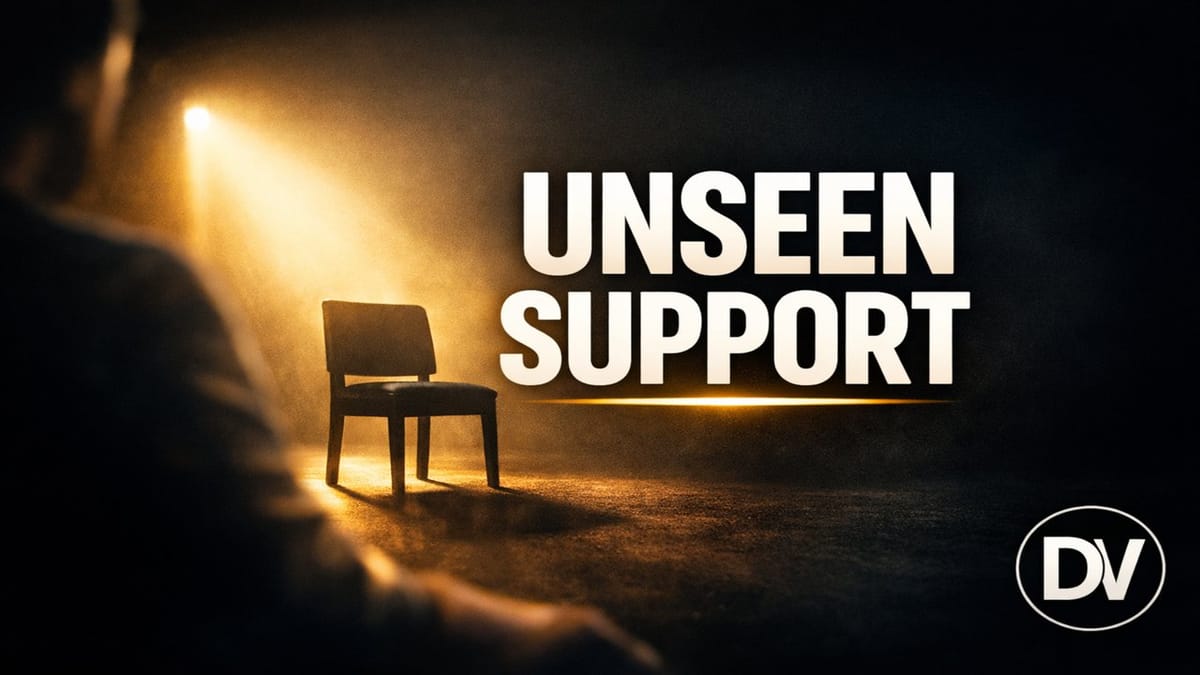
There are parts of a story that the camera never captures. When people see a finished moment, they assume it began at the moment of visibility. They imagine the beginning is where the light turns on, where the voice starts speaking, where the scene finally exists. But the truth is that most meaningful work begins long before it is ever seen, and it continues long after the screen goes dark. What we witness is only the surface of something much deeper. We see the speaker, but we do not see the silence that came before the words. We hear the message, but we do not hear the doubts that were wrestled down to make room for it. We notice the movement, but we rarely notice the stillness that made it possible.
For me, that stillness has had a face. It has had a presence. It has had a quiet loyalty that never demanded attention. Every single time I have turned on a camera, every time I have prepared myself to speak, every time I have wondered whether what I was about to say would matter to anyone at all, there has been someone sitting just outside the frame. My wife has been there, not as an accessory to the work but as the unseen foundation beneath it. Almost two thousand times now, she has taken her place beside me, unseen by the audience, unrecorded by the lens, yet completely present in the act of creation itself.
It is easy to romanticize success when you imagine it as a destination. It is much harder to understand it as a posture of endurance. Endurance does not look like celebration. It looks like showing up on days when there is nothing new to celebrate. It looks like believing when the evidence is thin. It looks like choosing to stay when the outcome is uncertain. This is the part of the journey most people never talk about, because it does not photograph well. It does not produce soundbites. It does not sparkle. It simply exists, steady and faithful, and because of that, it often goes unnoticed.
The Bible does not glorify the unseen as much as it simply assumes it. Scripture is filled with people whose greatest obedience never happened on a stage. It happened in kitchens, in fields, in waiting rooms, in long seasons of preparation where no one was watching. When God called Abraham, the promise came long before the fulfillment. When Moses was chosen, the desert came before the deliverance. When David was anointed, the pasture came before the palace. God has always been comfortable building greatness out of quietness, and He has never rushed the process.
What I have come to understand is that support is not passive. It is active in the most subtle way possible. It is a form of participation that does not require visibility to be real. My wife’s presence has never been loud, but it has always been intentional. Her support has not taken the form of speeches or strategies. It has taken the form of staying. Staying when the work was repetitive. Staying when the results were invisible. Staying when the calling felt larger than the capacity to carry it alone.
There is something profoundly holy about staying.
The world celebrates beginnings and endings, but God seems to linger in the middle. He does not rush past the long obedience. He inhabits it. He shapes people there. He teaches them how to trust in the absence of applause. He teaches them how to work without needing constant reassurance. He teaches them how to lean on one another instead of leaning only on outcomes.
Marriage, in that sense, is not merely companionship. It is a shared calling to endure what cannot yet be proven. It is the decision to walk beside someone while God does something slowly. The Bible says that two are better than one, not because they will always succeed faster, but because when one falls, the other can lift him up. That verse is not about productivity. It is about persistence. It is about what happens when someone is too tired to believe on their own and borrows belief from the one who stands beside them.
There have been days when I questioned whether any of this mattered. Days when the effort felt heavier than the reward. Days when the silence after publishing something felt louder than the message itself. In those moments, I did not need a solution. I needed a witness. I needed someone who knew what it cost me to show up and chose to show up with me anyway. That kind of support does not solve problems. It dissolves isolation. It reminds you that calling is not carried alone.
Faith, when we speak of it, often sounds like something internal. We picture it as something that lives inside a person, like a flame that must be protected from the wind. But faith is also relational. It moves between people. It passes from one heart to another in moments of weakness. It is not always a fire. Sometimes it is a hand on a shoulder. Sometimes it is the quiet presence of someone who says nothing at all but stays long enough to prove that the effort is not foolish.
I have learned that the greatest ministries are rarely sustained by charisma alone. They are sustained by covenant. By relationships that hold when excitement fades. By people who do not need the spotlight to feel essential. By partners who understand that influence begins long before an audience exists.
When Jesus sent His disciples out, He sent them two by two. Not because He needed pairs for efficiency, but because He understood something about human weakness. He understood that belief can falter when it stands alone. He understood that discouragement grows faster in isolation. He understood that obedience is more bearable when it is shared. The model was never one voice against the world. It was always companionship on the road.
There are people who will never preach a sermon and yet will be responsible for thousands of them. There are people who will never publish a word and yet will be the reason words were written at all. They are the ones who remind the weary that they are not ridiculous for trying. They are the ones who hold space for a dream while it is still fragile. They are the ones who believe when belief is inconvenient.
My wife has believed when there was no external reward for doing so. She has believed when the work looked the same day after day. She has believed when the world had no reason yet to affirm what was being built. That belief has not been loud, but it has been constant. And constancy is a form of courage.
We live in a culture that measures worth by visibility. If it cannot be seen, it is assumed not to exist. If it is not praised, it is assumed not to matter. But God has never worked that way. He measures faithfulness in secret. He weighs obedience in silence. He watches what happens when no one is clapping. The Father who sees in secret does not do so because He prefers secrecy. He does so because He understands where character is formed.
There is a sacredness in unseen work. It strips away the temptation to perform. It removes the need to impress. It leaves only intention. You do not stay when something is difficult unless you believe it is worth staying for. You do not sit beside someone every day unless you trust the direction of the journey more than the comfort of certainty.
Support is often misunderstood as encouragement, but true support is endurance with another person’s purpose. It is aligning your patience with someone else’s calling. It is investing time into something that may not benefit you directly but will bless others eventually. It is choosing to be a steward of something God planted in someone else.
That is what I have witnessed beside me. A stewardship of belief. A guardianship of consistency. A quiet ministry that does not preach but still participates in the work of God.
Some of the most important characters in Scripture never speak a line of dialogue. They are present in the background, holding the story steady. They are the wives who trust God with their husband’s obedience. They are the friends who lower someone through a roof so Jesus can heal him. They are the women who fund the ministry of Jesus without standing in front of the crowd. They are the ones whose names are not remembered as often, but whose faith is recorded just as deeply.
It is tempting to think that impact always looks like motion. But often it looks like stability. It looks like being the person who does not change direction every time the wind does. It looks like being the one who does not leave when the work becomes monotonous. It looks like faith practiced in repetition rather than spectacle.
There is something profoundly spiritual about repetition. It is where trust is proven. It is where love becomes durable. It is where calling moves from idea to habit. Anyone can believe for a moment. Only someone who loves you can believe for years.
If this work ever grows into something larger than it is now, it will not be because I spoke well. It will be because someone stayed. Someone did not ask for immediate proof. Someone did not demand visible success as the price of support. Someone chose partnership over certainty.
We often imagine that when something becomes meaningful, it will look dramatic. We imagine that God will announce it with thunder. But most of the time, God whispers. He builds slowly. He layers obedience over time until the structure can bear weight. And the ones who make that possible are the ones who do not grow tired of quiet progress.
I have learned that calling is rarely solitary, even when it looks that way from the outside. There is always someone praying, someone waiting, someone holding the emotional space for the work to continue. The idea of a lone creator is mostly an illusion. Behind every sustained effort is at least one person who did not leave when it would have been understandable to do so.
What makes this kind of support holy is not that it is dramatic, but that it is deliberate. It is a daily decision. It is a posture of loyalty. It is a way of saying, “I trust what God is doing through you, even if I cannot see it yet.” That is faith in its most relational form.
The kingdom of God is built on this kind of faith. It is not built only by prophets and teachers. It is built by people who cook meals, who listen patiently, who sit quietly while someone else obeys. It is built by the ones who believe without needing a platform. It is built by the ones who never demand recognition but quietly enable it.
In that sense, this work has never been mine alone. It has always been shared. It has been carried by more than one set of hands. It has been protected by more than one heart. It has been sustained by more than one faith.
And that realization changes how I understand success. Success is not merely that something exists. Success is that someone loved me enough to help it exist. Success is not that a voice was heard. Success is that someone stood close enough to make speaking possible.
There is a tenderness in knowing that someone has chosen to walk with you through uncertainty. It is one of the deepest forms of love there is. It says, “I do not need to see the ending to commit to the middle.” It says, “I trust what God is doing in you enough to tie my patience to your obedience.” It says, “Even if this never becomes what you imagine, it is still worth doing because it is who you are.”
That is not just emotional support. That is spiritual partnership.
And I believe God honors that kind of faith. Not because it is perfect, but because it is persistent. Not because it is loud, but because it is loyal. Not because it seeks reward, but because it seeks obedience.
There is a phrase in Scripture that says we are surrounded by a great cloud of witnesses. We often imagine that cloud as something heavenly and distant. But sometimes the witnesses are right beside us. They are the ones who see the work up close. They are the ones who know how heavy it feels. They are the ones who watch without applause and pray without announcement.
Those are the ones who sit just outside the frame.
And their presence is not accidental. It is appointed.
There is a strange and sacred tension in the work God gives people to do. On the surface, it often looks like an individual effort. One person speaking. One person writing. One person standing in the visible place. But beneath that surface is a web of quiet faithfulness that never shows up in the final picture. The kingdom of God does not advance by solitary heroes as much as it advances by shared obedience. It is built on the willingness of some to go forward and the willingness of others to stay close enough to make going forward possible.
What I have learned through this journey is that unseen support is not secondary. It is not optional. It is not decoration around a calling. It is structural. It holds the weight of discouragement when enthusiasm fades. It absorbs the shock when outcomes are delayed. It stabilizes the heart when the mind begins to question whether the effort is worth it. The presence of someone who chooses to remain is not just comforting; it is formative. It reshapes how a person understands God’s work in their life.
We tend to tell stories about purpose as if it is something discovered alone. We imagine calling as a private revelation between God and one soul. But Scripture rarely presents it that way. Over and over again, God reveals purpose in community. He speaks to one, but He anchors that one in relationship. He calls a person, but He surrounds that calling with people who will test it, temper it, and sustain it. Even the prophets did not live in isolation. Even the apostles were not sent out one by one. The pattern of God has always been partnership.
There is something about being believed in by another person that gives faith a body. It takes what could remain abstract and makes it practical. It transforms hope from an idea into a habit. When someone sits beside you while you do what God has placed in your heart, they are not just witnessing your obedience. They are participating in it. Their patience becomes part of the offering. Their consistency becomes part of the sacrifice. Their presence becomes part of the prayer.
It is easy to think that faith is proven in moments of bold action. It is harder to see that faith is also proven in moments of quiet agreement. Agreement to stay. Agreement to wait. Agreement to support something that may not produce visible results for a long time. Agreement to value obedience over outcome. These agreements do not announce themselves. They simply continue.
There are seasons in every calling where the work feels heavier than the reward. These are the seasons that reveal what kind of support is truly present. Shallow encouragement evaporates when progress slows. Performative belief disappears when applause is absent. But faithful support remains because it is not dependent on external validation. It is rooted in love and trust. It does not ask for proof. It offers patience.
When I think about what has made it possible for me to keep showing up, I realize it has less to do with motivation and more to do with companionship. Motivation comes and goes. Feelings rise and fall. Energy fluctuates. But companionship steadies the path. It anchors the work to relationship rather than emotion. It keeps obedience from becoming lonely. It reminds the person walking that they are not misunderstood by everyone, even when they are unseen by many.
In this way, support becomes a form of intercession. It stands between the work and the temptation to quit. It shields the heart from the lie that effort without recognition is meaningless. It resists the narrative that success is the only measure of faithfulness. It insists that showing up is itself an act of worship.
There is a quiet theology embedded in this kind of support. It says that God’s timing is trustworthy even when it is slow. It says that obedience does not need to hurry to justify itself. It says that worth is not dependent on reach. It says that God’s work in a person’s life is not invalidated by a lack of immediate response from the world. These beliefs are rarely spoken out loud, but they are lived out in the daily choice to remain present.
When someone sits beside you while you labor, they are making a statement about what they believe God values. They are saying that the effort itself matters. They are saying that faithfulness has dignity. They are saying that a calling does not need to be impressive to be important. They are saying that love is willing to inhabit uncertainty.
That is what makes this kind of support sacred. It mirrors the patience of God Himself. God does not abandon His work in people when it is incomplete. He does not withdraw His presence when growth is slow. He does not measure worth by speed. He measures it by surrender. He stays with His people while they become who He is shaping them to be. In that sense, faithful human support becomes a reflection of divine faithfulness.
The danger of living in a culture obsessed with results is that it teaches people to value only what can be measured. Views. Numbers. Growth. Visibility. But God has never limited His work to what can be quantified. He works in the long arc of transformation. He builds character before He builds platforms. He teaches endurance before He allows influence. And He often uses relationships as the classroom for that lesson.
If I have learned anything from this journey, it is that purpose matures in proximity. It grows stronger when someone witnesses it over time. It becomes more resilient when it is not isolated. The presence of another person who does not need the spotlight but is willing to share the weight changes the texture of the work. It turns a private struggle into a shared pilgrimage.
There is a story in Scripture of the friends who lowered a man through the roof so he could be healed by Jesus. The man was paralyzed. He could not bring himself to Jesus. His healing was made possible by the faith of those who carried him. This is not just a story about miracles. It is a story about what makes miracles reachable. It is a story about support. The man’s healing was visible, but the friends’ effort was the true engine of the moment. Without them, the encounter never would have happened.
In the same way, there are many moments of obedience that would never occur if someone were not willing to help carry the weight. There are sermons that would never be preached if someone were not willing to sit quietly and listen to them first. There are words that would never be written if someone were not willing to believe they were worth writing. There are callings that would collapse under discouragement if someone were not willing to hold them up with patience.
We rarely tell these stories because they do not center the person in the visible role. They center the person in the supportive one. And yet Scripture is full of these characters. They appear in the margins. They operate in the background. They influence the outcome without controlling the narrative. They are the ones God entrusts with endurance.
There is a spiritual humility in supporting another person’s calling. It requires releasing the need to be recognized. It requires trusting that God sees what others do not. It requires believing that obedience is not a competition. It requires loving the process as much as the promise. It is not a passive role. It is an active submission to God’s design for partnership.
In this sense, support becomes a vocation of its own. It is not merely emotional. It is theological. It reflects a belief about how God chooses to work in the world. It affirms that He does not rely only on individuals, but on relationships. It honors the truth that faith is not meant to be solitary.
This changes how I understand gratitude. Gratitude is not simply appreciation for kindness. It is recognition of shared obedience. It is acknowledgment that what exists now is not the product of one person’s resolve but of another person’s willingness to walk alongside that resolve. It is confession that the work was never carried alone.
There is a temptation to view support as secondary to vision. Vision seems more impressive. Vision feels more dramatic. Vision gets more attention. But vision without support collapses under its own weight. Vision without patience burns out. Vision without companionship turns into isolation. It is support that gives vision longevity. It is support that gives calling breath.
When God places a desire in a person’s heart, He often places a partner near them who will guard that desire until it matures. That partner may not share the same role, but they share the same responsibility. They are responsible for the space around the calling. They tend the soil while the seed grows. They keep the environment safe while the work takes shape.
This is why the Bible speaks so often about unity. Not because agreement is easy, but because it is powerful. Unity does not mean sameness. It means shared direction. It means aligning different strengths toward one purpose. It means choosing together what God has called one person to do. It means trusting the work enough to invest presence into it.
Over time, this kind of unity reshapes both people. The one who is supported learns humility. They learn dependence. They learn to receive. The one who supports learns patience. They learn discernment. They learn to trust God with outcomes they do not control. Both are changed by the process. Both are formed by the waiting. Both become part of something larger than themselves.
There is also a quiet courage in this kind of support. It takes courage to invest in something that may not succeed publicly. It takes courage to attach your patience to another person’s obedience. It takes courage to stay when the world offers easier paths. It takes courage to believe in what God is doing rather than in what others can see.
This courage is rarely celebrated, but it is deeply spiritual. It mirrors the courage of Mary when she believed the angel’s word without knowing how it would unfold. It mirrors the courage of Joseph when he protected a story that could have cost him his reputation. It mirrors the courage of the disciples when they left everything without knowing where the road would lead. It is courage expressed through staying rather than through spectacle.
There is something profoundly countercultural about honoring unseen faithfulness. It pushes back against the idea that only visible success matters. It insists that the hidden labor of love is as holy as the public act of obedience. It reminds us that God’s economy does not operate on the same scale as human applause.
If there is a message I want to offer through this reflection, it is this: the ones who sit just outside the frame are not peripheral to God’s work. They are central to it. They are not optional participants. They are appointed companions. Their faithfulness is woven into the outcome whether it is ever acknowledged or not.
And this is not only about my story. It is about every person who has chosen to support someone else’s calling. It is about the spouse who prays instead of preaches. It is about the friend who listens instead of leads. It is about the family member who stays when the future is unclear. It is about the ones who hold the space while God does the shaping.
God sees that faith. God honors that patience. God works through that presence.
We often think of miracles as sudden events, but many miracles are slow. They unfold over years of obedience. They are built out of repeated acts of faithfulness. They are sustained by people who do not need to be seen to be sincere. The miracle is not only what happens at the end. The miracle is what keeps happening in the middle.
That is where most of God’s work occurs. Not at the finish line, but in the long obedience that leads toward it. Not in the applause, but in the quiet decision to continue. Not in the spotlight, but in the shadows where trust is formed.
The work I do may have my voice attached to it, but it has never had only my faith behind it. It has been carried by companionship. It has been protected by loyalty. It has been sustained by someone who did not leave when there was no guarantee of reward.
That is not incidental. It is intentional. It is part of how God has chosen to shape both of us.
In the end, this is what I have come to believe: the most powerful ministries are not built by those who seek recognition, but by those who practice faithfulness together. They are not formed by isolated brilliance, but by shared perseverance. They do not grow out of ambition, but out of agreement with what God is doing in one another.
And so, if this work ever reaches more people, if it ever grows into something larger than it is now, it will not simply be the fruit of one person’s effort. It will be the harvest of a relationship that chose to endure.
That is the quiet story behind the visible one.
That is the truth about the ones who sit just outside the frame.
And that is how God builds things that last.
Watch Douglas Vandergraph’s inspiring faith-based videos on YouTube:
Watch Douglas Vandergraph’s inspiring faith-based videos on YouTube
Support the ministry by buying Douglas a coffee:
Support the ministry by buying Douglas a coffee
Your friend,
Douglas Vandergraph
#faith #marriage #calling #obedience #encouragement #ChristianWriting #perseverance #purpose #devotion #ministry