The DNA of Christ Was Never the Point: Why the World Doesn’t Need a Cloned Savior, But a Living Reflection
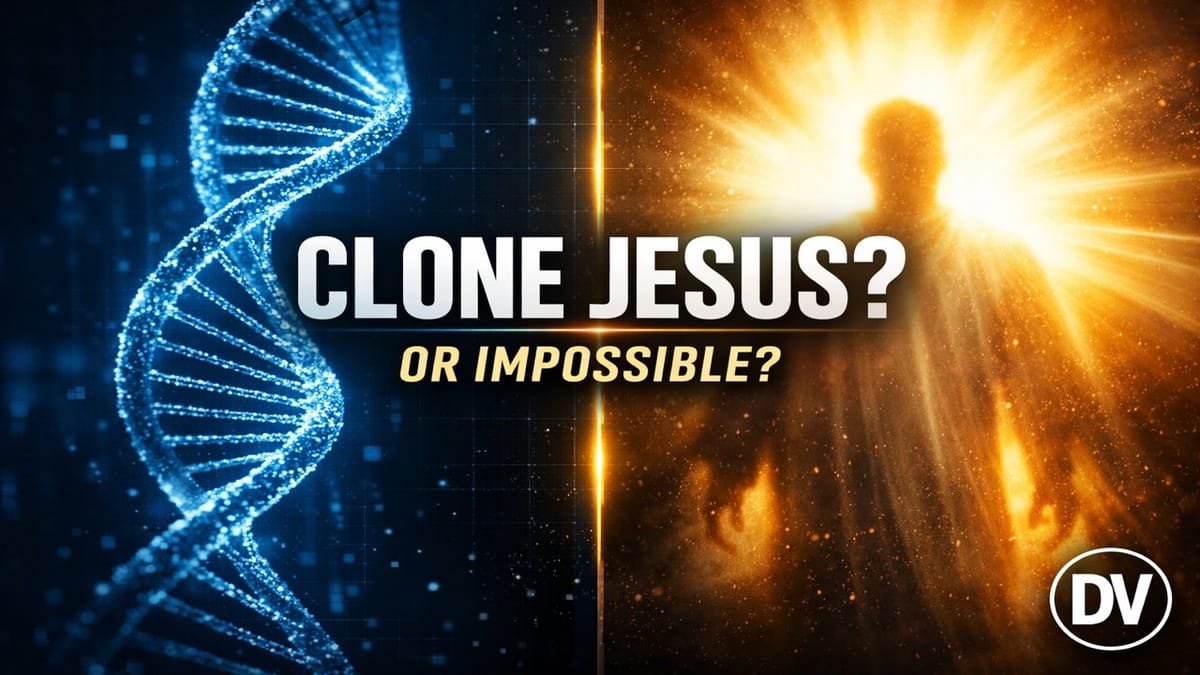
There are questions that sound like they belong in a laboratory, but if you sit with them long enough, they start echoing in your soul. They begin in curiosity, but they end in revelation. And one of those questions is this quiet, almost unsettling thought that lingers just long enough to make you pause and wonder what it would really mean if it were possible. What if someone took DNA from what is believed to be the burial cloth of Jesus, and what if science advanced far enough to clone Him? At first glance, it feels like a question about technology, about capability, about whether humanity has crossed some invisible threshold where nothing is off-limits anymore. But if you look closer, you begin to realize that the question is not really about science at all. It is about identity, about divinity, about the difference between what can be replicated and what can only be revealed by God Himself.
Because beneath that question is something deeper that most people don’t immediately recognize. It is the assumption that if you could recreate the body, you could recreate the person. It is the belief that what made Jesus who He is can somehow be reduced to something measurable, something extractable, something that can be copied and reproduced. And that is where everything begins to shift, because the moment you start to understand who Jesus truly is, you realize that no laboratory on earth could ever recreate Him. Not because of limitations in science, but because of the nature of what He is. Jesus was never just a biological being moving through time like the rest of us. He was God stepping into human history, not as an experiment, but as a rescue. Not as a possibility, but as a promise fulfilled.
And that changes everything, because it means that even if someone could extract DNA, even if they could replicate every strand perfectly, even if they could grow a human being that was genetically identical to the man who walked the roads of Galilee, they still would not have recreated Jesus. They would have created a human being with similar biology, but without the divine mission, without the eternal identity, without the purpose that defined every step He took and every word He spoke. And that realization is not disappointing. It is actually freeing, because it reminds us that what makes Jesus who He is was never something that could be contained in cells or sequences. It was something that came from beyond this world and entered into it with intention.
There is something deeply human about wanting to hold onto what changes us. When something impacts your life in a way that reshapes your heart, you want to preserve it. You want to keep it close. You want to make sure it never disappears. And for many people, the idea of cloning Jesus feels like an extension of that desire. If we could bring Him back in physical form, if we could see Him again, hear Him again, walk with Him again, then maybe we would feel closer to Him, maybe we would understand Him more, maybe the world would finally believe. But that line of thinking quietly overlooks something profound that Jesus Himself made clear. His physical presence was never meant to be the foundation of our faith. His presence was always meant to become something deeper, something internal, something that lives within us rather than something we chase outside of ourselves.
Because if the power of Jesus was only in His physical form, then His departure would have left the world empty. But it didn’t. In fact, something even greater began to unfold after He left, something that could not have happened if He had remained physically present in one place at one time. His life began to multiply, not through replication of His body, but through transformation of hearts. His message spread, not because people could touch Him, but because they were changed by Him. His presence expanded, not because He stayed, but because He was carried forward by those who believed in Him and chose to live differently because of it.
This is where the question begins to turn into something much more powerful than it first appeared. Because instead of asking whether Jesus could be cloned, you begin to ask whether He was ever meant to be. And the answer that rises up is both simple and profound. He was not meant to be duplicated in flesh. He was meant to be reflected in lives. His purpose was not to create copies of His body, but to awaken something within humanity that would carry His love, His truth, and His spirit into every corner of the world.
Think about the way He lived, the way He moved through crowds, the way He saw people that everyone else overlooked. He did not just perform miracles to prove a point. He healed to restore dignity. He spoke to bring clarity. He loved in a way that made people feel seen, known, and valued in a world that often does the opposite. And none of that came from His DNA. It came from who He is. It came from the nature of God expressed through a human life. It came from a purpose that could not be manufactured or replicated, because it was not created by human hands.
And this is where something begins to stir in a different way, because if Jesus cannot be cloned, then the question becomes what are we supposed to do with the life He lived and the example He gave. And that is where the real weight of it all begins to settle in, because the answer is not passive. It is not distant. It is not something we can observe from a safe distance and admire without involvement. The answer is deeply personal. The answer is that His life was meant to change ours, not just inspire us, not just impress us, but transform us from the inside out.
Because what if the world is not waiting for science to recreate Jesus, but for people to actually live like Him. What if the missing piece is not a physical return in a laboratory, but a spiritual awakening in the hearts of those who already know His name. What if the reason things feel so broken sometimes is not because Jesus is absent, but because His reflection is not being fully lived out in the way it was intended to be.
There is something powerful that happens when you begin to realize that the call of Jesus was never about observation. It was about participation. He did not invite people to simply watch Him live. He invited them to follow. And that word carries weight, because following means movement. It means change. It means leaving behind what is familiar and stepping into something that requires trust. It means allowing His way of thinking, His way of loving, His way of responding to become your way of living.
And that is where the true multiplication of Christ begins, not in a laboratory, not in a controlled environment where everything is measured and calculated, but in the unpredictable, often messy, deeply human experience of everyday life. It begins in the moments where you choose patience instead of frustration, where you choose forgiveness instead of holding onto resentment, where you choose compassion when it would be easier to turn away. It begins in the quiet decisions that no one else sees, the internal battles that no one else understands, the moments where you could respond like the world expects, but instead you choose something different because you are being shaped by something greater.
And maybe that is the part that challenges us the most, because it shifts the focus away from what could be done in a lab and places it directly on how we are living right now. It removes the distance. It removes the excuse. It brings everything into the present moment and asks a simple but powerful question. If Jesus cannot be cloned, then how closely is your life reflecting Him?
Because that is where the real impact is found. Not in recreating His physical presence, but in allowing His presence to reshape your heart in a way that becomes visible to others. Not in trying to bring Him back into the world through science, but in realizing that He never left in the way we sometimes imagine. He is still here, moving through people, working through lives, reaching through acts of love, kindness, and truth that echo His original message in ways that are just as powerful today as they were then.
And when you begin to see it that way, something shifts. The question no longer feels like something distant or hypothetical. It becomes something immediate and personal. Because instead of asking what science could do, you begin to ask what you are doing. Instead of wondering what it would mean if Jesus walked the earth again, you begin to consider what it means that you are walking the earth now, carrying the opportunity to reflect Him in a world that desperately needs to see what real love looks like.
And that is where the conversation changes completely, because it is no longer about possibility. It is about responsibility. It is about recognizing that the life of Jesus was not given to us as something to admire from a distance, but as something to embody in the way we live, the way we treat people, the way we respond when things are difficult, and the way we show up in moments that test who we really are.
And maybe, just maybe, the reason this question lingers the way it does is because deep down, it is pointing us back to something we already know but sometimes forget. That the world does not need another version of Jesus created in a lab. It needs people who are willing to live in a way that makes His presence undeniable.
It needs people who are willing to love when it is inconvenient, to stand firm when it is uncomfortable, to speak truth when it would be easier to stay silent, and to carry hope into places that feel like they have run out of it.
Because that is where the real miracle is found.
And that is where everything begins.
And when you really allow that truth to settle into your spirit, it begins to reshape the way you see yourself, the way you see your purpose, and the way you move through the world. Because suddenly, your life is no longer something small or isolated or insignificant. It becomes part of something much bigger, something eternal, something that stretches far beyond your current circumstances and into a story that God has been writing since the beginning of time. You begin to understand that you were never meant to just exist, to just get through the day, to just survive whatever is in front of you. You were created to carry something. You were created to reflect something. You were created to reveal something that the world cannot produce on its own.
And this is where it gets real, because it is easy to talk about reflecting Christ in moments where everything feels calm and manageable, but the true test comes when life presses in on you, when situations don’t go the way you hoped, when people disappoint you, when the weight of everything feels heavier than you expected it to be. That is where the reflection either becomes visible or fades into the background. That is where your response begins to tell a story, not just about what you believe, but about what has truly taken root inside of you. Because anyone can speak about love when it is easy, but it takes something deeper to live it when it is difficult.
And that is exactly where the life of Jesus becomes more than a concept and starts becoming a pattern. Because if you look at the way He lived, He did not avoid difficulty. He stepped directly into it. He did not turn away from brokenness. He moved toward it. He did not protect Himself from pain at all costs. He allowed Himself to feel it, to carry it, and ultimately to transform it into something that brought healing to others. And that is the part that cannot be cloned, because it is not about structure, it is about surrender. It is not about form, it is about faith. It is not about what you are made of physically, but what you are willing to become spiritually.
There is something incredibly powerful about realizing that the same love that moved through Jesus is not locked in history. It is not trapped in a moment that cannot be reached. It is still active. It is still available. It is still calling people into something greater than themselves. And that means that every single day, you are standing at a crossroads, whether you realize it or not. You are standing in moments where you can either respond out of habit, out of frustration, out of fear, or you can choose to respond in a way that reflects something higher, something stronger, something that points beyond yourself and back to the source of that love.
And the truth is, most people underestimate the impact of those moments. They think the big things are what matter most, the visible things, the things that get recognized and acknowledged. But the reality is that transformation often happens in the quiet places, in the unseen decisions, in the moments where no one is watching and yet everything is being shaped. It happens in the way you speak to someone who is struggling, in the patience you show when you are stretched thin, in the grace you extend when someone has not earned it, in the restraint you practice when you could easily react. Those are the moments where reflection becomes real.
Because what you carry internally will always find its way to the surface externally. And if what you are carrying is aligned with Christ, then your life begins to take on a different weight, a different presence, a different kind of impact that goes beyond what you could accomplish on your own. People begin to notice something different, not because you are trying to prove anything, but because there is a consistency, a depth, a steadiness that does not come from circumstances. It comes from something rooted deeper than what is happening around you.
And that is where the conversation about cloning completely loses its importance, because you start to see that the real question was never about whether Jesus could be recreated physically. The real question is whether His life is being reflected spiritually. And that is something that cannot be outsourced. It cannot be delegated. It cannot be manufactured. It has to be chosen. It has to be lived. It has to be walked out day by day, decision by decision, moment by moment.
And here is where it becomes even more meaningful, because you begin to understand that you are not expected to do this perfectly. You are not expected to become some flawless representation overnight. The process itself is part of the transformation. The growth, the struggle, the moments where you fall short and have to come back and realign, those are not failures, they are part of the journey. They are the places where humility is formed, where dependence on God is deepened, where your understanding of grace becomes more than just a concept and starts becoming something you actually live from.
Because the life of Jesus was never about perfection in the way the world defines it. It was about alignment with the will of God. It was about obedience, about trust, about walking in a way that remained anchored even when everything around Him shifted. And that is the invitation that still stands today. Not to replicate Him externally, but to follow Him internally. Not to become a copy, but to become a reflection.
And when you begin to live that way, something incredible happens. Your life starts to carry a sense of purpose that is not dependent on outcomes. You begin to move with intention, not because everything is clear, but because you know who you are following. You begin to respond differently, not because life has become easier, but because you have become stronger in the way that actually matters. You begin to influence people, not by force or by effort, but by presence, by consistency, by the quiet strength that comes from living in alignment with something eternal.
And that is where the true impact of Christ continues to unfold, not through a single moment in history, but through countless lives that choose to carry that same spirit forward. It unfolds in conversations that bring hope, in actions that restore dignity, in choices that reflect integrity, in moments where love shows up in ways that cannot be explained by logic alone. It unfolds in the way people are seen, the way they are treated, the way they are valued, and the way they are reminded that they are not alone.
And when you step back and look at it from that perspective, you begin to see that the world is not lacking the presence of Christ. It is surrounded by opportunities for that presence to be revealed. The question is whether those opportunities are being embraced or overlooked. The question is whether people are willing to carry what they have been given or whether they are waiting for something external to happen before they step into it.
Because the truth is, the moment you decide to live differently, the moment you choose to reflect Christ in your actions, in your words, in your thoughts, something shifts not just in your life, but in the lives of the people around you. And that shift may not always be loud. It may not always be recognized immediately. But it is real. It is lasting. And it is exactly how transformation spreads.
So when the question comes up again, when the idea of cloning Jesus surfaces in conversation or curiosity, you can meet it with a deeper understanding. Not with dismissal, not with confusion, but with clarity. Because you know something that goes beyond the surface of the question. You know that Jesus was never meant to be recreated in a laboratory. He was meant to be revealed through lives that are willing to follow Him.
And that brings everything back to where it truly matters, because it places the focus not on what could happen out there somewhere in the future, but on what is happening right here, right now, within you. It reminds you that your life is not separate from this conversation. It is central to it. It is part of the answer. It is part of the continuation of something that began long before you and will continue long after you.
And maybe that is the most powerful realization of all. That you are not waiting for Christ to appear again in a way that can be seen with physical eyes. You are part of the way He is seen. You are part of the way His love is experienced. You are part of the way His presence is made known in a world that is still searching, still questioning, still trying to understand what is real and what is worth holding onto.
And that means your choices matter more than you think. Your actions carry more weight than you realize. Your willingness to live differently has a ripple effect that extends far beyond what you can see in the moment. Because every act of love, every moment of grace, every decision to reflect something higher is another reflection of Christ moving through the world again.
Not cloned.
Not manufactured.
But alive.
Alive in the way people love, in the way they forgive, in the way they stand firm in truth while still extending compassion, in the way they carry hope into places that feel like hope has run out.
And that is the continuation of His life.
That is the legacy that cannot be duplicated, but can be lived.
That is the calling that remains, not as a distant idea, but as a present reality.
And at the center of it all is a simple, powerful truth that reshapes everything once you fully see it.
The world does not need a cloned Jesus.
It needs people who are willing to live like Him.
Your friend,
Douglas Vandergraph
Watch Douglas Vandergraph’s inspiring faith-based videos on YouTube https://www.youtube.com/@douglasvandergraph
Support the ministry by buying Douglas a coffee https://www.buymeacoffee.com/douglasvandergraph
Financial support to help keep this Ministry active daily can be mailed to:
Vandergraph
Po Box 271154
Fort Collins, Colorado 80527