The Cup Was Not the Crown

Chapter One: A Gate Called Control
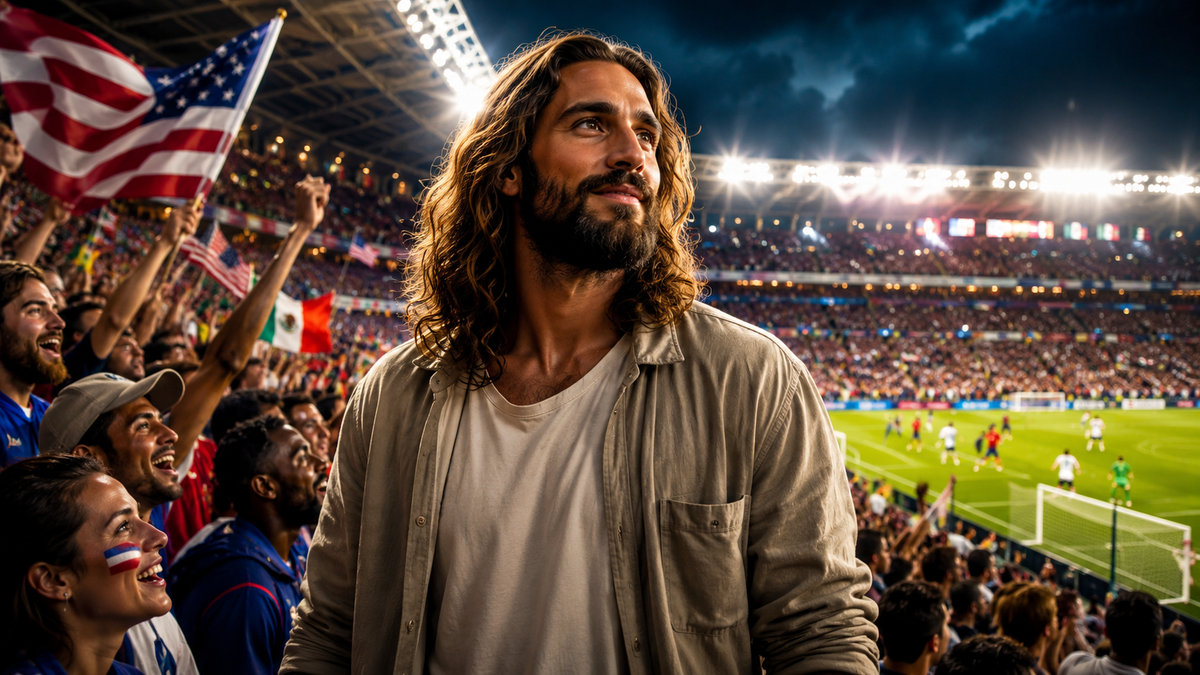
Jesus knelt before sunrise in the narrow strip of grass beyond the service road, where the stadium lights still burned against the blue-black morning and the first cleaning trucks moved like tired animals around the concrete ramps. He faced no camera and stood beneath no banner. His hands rested open upon His knees, and His voice was low enough to be covered by the hum of generators. Beyond the fence, the great bowl of the stadium waited for nations to fill it with flags, drums, chants, painted faces, and the thunder of wanting one side to rise while another side fell. Jesus prayed there in the quiet, before the roar arrived, with His heart turned toward the Father and His mercy already turned toward the people who would soon pour through the gates.
Liana Reyes saw Him from the operations cart as it turned past the media entrance, but she did not stop. She had a radio at her shoulder, a tablet on her lap, and a message from her mother still glowing on her phone because she had been too restless to swipe it away. Her mother had sent two midnight links, one to Jesus at World Cup Soccer in the United States and another to when faith learns to stand inside the crowd, followed by a sentence that had found the one weak place in Liana’s armor: Mija, not every person in a crowd is a problem God is asking you to solve. Some are people He is asking you to see.
Liana turned the phone facedown. She had no room for her mother’s softness today. The United States had hosted major sports before, but this felt different in the body, different in the city, different in the way every street nearby had been remade for foreign flags, broadcast trucks, temporary fences, sponsor tents, police lines, and fans who had flown oceans because ninety minutes on grass could make them feel as if the whole world had taken a breath with them. Liana’s job was movement. People in, people out, people separated from danger, people held behind barriers when impatience rose. She had spent eight months telling anyone who would listen that a crowd was not a celebration until it was safely managed.
By six in the morning, the north plaza smelled of wet pavement, coffee, diesel, and the faint sweetness of food trucks beginning their first prep. Workers hung final directional signs in several languages. Volunteers in bright vests repeated instructions they had been given in training sessions until the words sounded memorized instead of understood. Police officers adjusted barricades and watched the early fans who had already arrived wrapped in flags and singing through hoarse voices, as though being early could prove devotion. Liana moved through them with a practiced calm that made younger staff trust her, though it cost her something to keep it on her face.
Her radio crackled before she reached Gate C. “Operations, we have a vendor conflict by the east pedestrian corridor. Unauthorized table. Family group, maybe church group, maybe just people giving away water. Security wants direction.”
Liana closed her eyes for half a second. “If they are inside the perimeter without credentials, they move. No debate.”
“They’re outside the hard perimeter,” the voice said, “but close enough to draw a line.”
“Then draw the line,” Liana answered. “Clear them before broadcast setup crosses that corner.”
The answer sounded clean. That was why she trusted clean answers. They left no room for memory.
Her younger brother had vanished in a crowd when he was nine and she was sixteen, not at a World Cup match or any place important enough for news, but at a regional final held at a field complex with poor lighting and too many parents pushing through one narrow exit after a storm warning. Their father had told Liana to hold Nico’s hand. She had been angry that day because she wanted to find her friends, angry because Nico kept asking for a blue shaved ice, angry because everyone expected her to become a second mother whenever adults were tired. She let go for three seconds to answer a text, and three seconds became twenty minutes of shouting his name through rain. They found him behind a maintenance shed, shaking so hard he could not speak, with a cut above his eyebrow and one shoe missing. He lived. Everyone told her that was what mattered. But something in Liana had decided survival was not forgiveness.
Since then, she had believed in closed gaps, double barriers, count sheets, radio discipline, and saying no before anyone could make a mess of yes. Faith, to her, had become a kind of private superstition she respected from a distance. She believed God existed. She even prayed sometimes. But she trusted procedures more than mercy because procedures had edges she could see, and mercy seemed always to arrive asking her to loosen her grip at the exact place where everything could fall apart.
At Gate C, a cluster of volunteers stood around a stack of handheld scanners that were not syncing with the entry system. One of them, a college student named Priya, looked close to tears. A supervisor from the tournament authority had arrived with a pressed shirt and the expression of a man who had never carried a barricade in his life.
“Liana,” he said, stepping toward her before she had even parked the cart, “we need this gate open for soft entry in twenty minutes. Media walk-through passes here, premium hospitality crosses here, and our international delegation uses the same lane. I was told this was ready.”
“It was ready last night,” Liana said. She took a scanner from Priya and turned it over in her hand. “The update dropped at 4:10. Half the devices are waiting for authentication.”
“That is not a good sentence,” the man said.
“It is the true sentence.”
He breathed out through his nose and glanced toward the line of early fans pressing against the outer fencing. “Truth is fine after doors open. Right now I need flow.”
Liana looked at him long enough for Priya to stare at the ground. “Flow without truth is how people get hurt.”
The man’s face tightened. “Then fix the truth quickly.”
He left with two assistants following him, and the little cloud of pressure he carried remained after him. Liana handed the scanner back to Priya, softened her voice, and asked for the device batch numbers. Priya gave them with trembling precision. Liana listened, called tech, rerouted two premium lanes, and ordered temporary manual verification until the sync returned. She made decisions rapidly, and the gate began to breathe again. People around her relaxed. She did not.
Across the plaza, she noticed the Man from the service road again. Jesus now stood near a concrete planter, not interfering, not wandering, not carrying a sign or wearing a credential. He wore simple clothing, clean but ordinary, and the stillness around Him seemed almost impossible in the morning’s machinery. He watched a father kneel to tie his daughter’s shoe while a tide of singing supporters passed on both sides of them. Liana saw the father’s hand shake as he looped the laces. She saw the little girl clutch a folded flag too large for her arms. Then the crowd covered them from view.
“Who is that?” Liana asked Priya.
Priya followed her eyes. “I don’t know. He helped Mr. Han carry the extra water coolers earlier. I thought He was with volunteer services.”
“Is He credentialed?”
“I didn’t check. He was just kind.”
Liana almost said kindness was not a credential, but the sentence tasted ugly before it reached her mouth. “Find out,” she said instead, and hated that she sounded like the tournament supervisor.
Her radio broke in again. “East corridor is escalating. The group says they are waiting for someone. Security says they are blocking sightline. One older woman is refusing to move.”
Liana turned the cart sharply enough that Priya stepped back. The east corridor sat between the fan festival approach and the broadcast compound, a place designed on maps by people who thought arrows behaved better than humans. By the time Liana arrived, the first real wave of supporters had begun pressing through the avenue, drums echoing beneath the temporary pedestrian bridge. A table stood near a low wall with paper cups, bottled water, and a hand-lettered sign that said FREE FOR ANYONE WHO NEEDS IT. Beside it stood an older woman with silver hair braided down her back, a thin teenage boy holding a cardboard box, and a man in a faded goalkeeper jersey who kept glancing toward the stadium as if it were both a dream and a threat.
Security had formed a half-circle around them. Fans flowed around the obstruction, annoyed but not endangered. A camera crew farther down the corridor had turned its lens toward the scene, hungry for color or conflict; Liana could not tell which. She stepped out of the cart and felt the morning tighten.
“Who is responsible here?” she asked.
The older woman lifted her chin. “I am responsible for the water.”
“That is not what I mean.”
“I know what you mean,” the woman said. “I am answering anyway.”
A security lead named Parsons moved close to Liana. “They were told to leave. They keep saying they have tickets and they’re waiting for their pastor. The table needs to go.”
Liana looked at the sign, the cups, the faces of thirsty fans taking water as they passed. “Do you have a permit for distribution?”
The woman gave a small smile without humor. “For mercy?”
“For operating inside a managed event zone.”
“We are not selling. We are not shouting. We are not blocking the gate.”
The man in the goalkeeper jersey put a hand on her shoulder, pleading without words for her to stop. Liana recognized that kind of pleading. It was the face of someone who knew authority had already decided and feared love would only make the punishment worse.
“What is your name?” Liana asked the woman.
“Belén Ortega.”
“Ms. Ortega, the table has to move outside the marked corridor. You can keep the water, but you cannot remain here.”
Belén looked past her, toward the stadium. “My grandson is meeting us here. He was told Gate E because that is what the ticket office printed. He is not comfortable in crowds. If we move, he will not find us.”
Liana’s skin went cold before her mind could stop it. A boy not comfortable in crowds. A meeting place changed by someone else’s mistake. A family believing love could hold a position against a tide. She forced her face to stay neutral because her face was the only barrier she had complete authority over.
“How old?” she asked.
“Eleven.”
“Phone?”
“He has one. It is dead. His father is looking for him from the train station side.”
Parsons muttered, “That is exactly why they can’t sit here and create another problem.”
Belén heard him and looked at Liana. “We are not a problem.”
The words should have been easy to dismiss. Liana had heard some version of them from drunk men, angry parents, lost tourists, uncredentialed influencers, and vendors pretending innocence while slipping through cracks in the plan. But Belén did not sound defensive. She sounded wounded by the smallness of being reduced to an obstacle when she was trying to be faithful to a frightened child.
Liana looked toward Gate E. The first soft-entry horn sounded in the distance. Her radio filled with overlapping voices: scanners coming online, broadcast convoy approaching, crowd density rising near the fan zone, a bus delayed, a medical team requesting clearer access. Every system she was responsible for had awakened at once.
Then Jesus stepped beside the low wall, close enough that Parsons noticed Him and straightened.
“Sir, move along,” Parsons said.
Jesus looked at him, not sharply, and yet Parsons did not repeat himself. The older woman’s face changed first. Belén’s mouth opened as if she had forgotten the next word she meant to say. The teenage boy holding the cardboard box lowered it slowly to the ground.
Liana felt irritation rise because she needed motion and everyone had gone still. “Do You belong with this group?” she asked.
Jesus turned His eyes to her. They were calm, but not distant. She had the unsettling sense that He saw the radio, the badge, the tablet, the schedule, the old rain behind a maintenance shed, and the sixteen-year-old girl who had never forgiven herself for letting go.
“I belong to My Father,” He said.
The answer moved through Liana like a hand placed against a locked door. It did not open the door. It simply revealed that the door was there.
Parsons shifted. “Ma’am, we need a call.”
Liana looked away from Jesus and found the camera crew angling closer. The table would become a clip before the match even began. If she allowed the group to stay, every unofficial helper would press closer. If she forced them out and the boy arrived afraid to an empty meeting point, she would know exactly what she had done. The clean answer no longer felt clean. It felt like hiding.
Her radio cracked again, louder than before. “Operations, we have a report of a minor separated from family near the transit approach. Male, maybe eleven or twelve, red jacket, no working phone. Last seen moving toward Gate E.”
Belén made a sound that was almost a prayer and almost a wound.
Liana’s tablet buzzed with three new alerts. Parsons waited. The camera watched. The crowd sang louder as another wave of fans rounded the corridor, bright flags rising against the morning like a thousand claims of belonging. Liana stood between the table and the tide, between the rule and the child, between the thing she could control and the person she might have to see.
Jesus said nothing more. He only looked toward Gate E, where the movement of the crowd had begun to thicken, and Liana understood with sudden, frightening clarity that the day was not asking whether she could manage people. It was asking whether she could love them without needing them to become manageable first.
Chapter Two: The Child in the Moving River
Liana heard Belén’s breath catch behind her, but she kept her own voice flat because a frightened command could break a crowd faster than a bad gate. She lifted the radio and stepped away from the table just far enough to keep Parsons from answering for her.
“Give me the last confirmed location,” she said.
“Transit approach, north side of the pedestrian bridge,” the dispatcher answered. “Reported by a volunteer. Red jacket, dark hair, carrying a small black backpack. He did not respond when asked if he needed help. He moved with the match crowd toward the east entry.”
“Name?”
“Unconfirmed.”
Belén came toward her. Parsons put out an arm, not touching her, but blocking without compassion. Liana saw the older woman’s eyes go hard, not with anger first, but with the humiliation of being held back from her own blood by a stranger in a uniform. Liana almost told Parsons to lower his arm. Instead, she looked at Belén and asked the question she already knew the answer to.
“Your grandson’s name?”
“Mateo,” Belén said. “Mateo Ortega. Red jacket. Black backpack. He will keep walking if he thinks he is in trouble. He does that when he is afraid.”
Liana swallowed. The crowd beyond the bridge had grown denser, shoulders turning sideways to pass through the corridor as songs in different languages collided above them. It was not dangerous yet. That was the cruel thing. Danger did not always announce itself as danger. Sometimes it arrived dressed as ordinary movement, a thousand harmless choices braided into one force too large for one small boy.
“Parsons,” she said, “move the water table against the wall and leave one guard here. They are not to be removed until I give that order.”
Parsons stared at her. “That conflicts with the corridor directive.”
“I know what it conflicts with.”
“The broadcast lane—”
“Can still pass if the table is flat to the wall. Keep the center clear.”
He lowered his voice. “If every unofficial group sees this, they’ll take space.”
“Then they will see one table against one wall under supervision, not a free-for-all. Do it.”
For a moment, she thought he would refuse. Then he turned and barked instructions at the nearest guard. The teenage boy with the cardboard box dragged the table backward, spilling cups into the gutter. Belén bent to gather them, but her hands shook too badly. Jesus knelt beside her and picked up the cups without haste, as if the whole weight of the stadium could wait for one scattered paper cup to be lifted from dirty water.
Liana looked away first.
She called the control room and requested camera review along the transit approach. The answer came with the strained patience of people already drowning in requests. Cameras were prioritized for entry flow, emergency lanes, and restricted zones. A boy who might be lost, might be on his way to the right place, and might simply be one of thousands moving toward a soccer match did not rise to the top of the queue. Liana knew the logic because she had helped write it. That made her anger feel dishonest, so she turned it into action.
“I’m walking east,” she said into the radio. “I need eyes at Gate E, the bridge, and the family assistance tent. If anyone sees a minor matching that description, do not grab him unless he is in immediate danger. Get beside him. Speak calmly. Say his grandmother Belén is waiting at the water table near the east corridor.”
Parsons heard her and stepped closer. “You are leaving the hot corridor?”
“I am moving within it.”
“You are operations lead for this sector.”
“And the operation currently includes a separated child.”
Before he could answer, the tournament supervisor from Gate C strode toward them with two assistants and a face that said he had been inconvenienced by humanity again. “Why is this table still here?”
Liana felt the old version of herself rise with relief, ready to meet pressure with sharper pressure. Jesus stood and turned slightly, not toward the supervisor but toward her, and she felt the question before He spoke a word. Was she about to protect the child, or was she about to protect the part of herself that needed to win?
“Because it is a meeting point for a separated minor,” Liana said.
The supervisor’s eyes moved to the sign, the water, the older woman, the fans taking cups as they flowed past. “Then move the meeting point to family assistance.”
“The child does not know that location.”
“Then send someone to intercept him.”
“That is what I am doing.”
“You personally?”
“Yes.”
His voice lowered, but his anger did not. “Do you understand the visibility of this event? Do you understand what happens if our east corridor turns into an unmanaged charity station on international broadcast?”
Liana looked past him at the camera crew, which had drifted closer again. She understood visibility. It was the reason the event could turn ordinary workers into background scenery until something went wrong, and then the world would want names. She also understood that a frightened boy did not become less frightened because a corridor looked clean on television.
“I understand that if Mateo comes to the place his grandmother promised and she is gone, we will have created the very risk we claim to be preventing.”
The supervisor’s mouth tightened. “You are making an emotional decision.”
Liana almost laughed because the accusation was meant to shame her. She had spent years being praised for being unemotional, as though the absence of visible feeling made a person wise. Yet standing there beside a free water table while a grandmother tried not to unravel, she saw the hidden lie in that praise. Unfeeling decisions were not always rational. Sometimes they were only fear wearing a pressed shirt.
“I am making a field decision,” she said. “You can escalate it after the child is found.”
She did not wait for permission. She walked into the moving river of fans.
The sound changed inside the crowd. From the outside, it had seemed like one enormous voice, but within it there were layers: men arguing about line direction, children laughing, someone singing off-key into a phone, vendors calling prices, a woman praying under her breath as she clutched tickets in a plastic sleeve. Flags brushed Liana’s face. A drumbeat traveled through her ribs. She kept to the side where the temporary fencing bent toward the bridge, scanning for red, black backpack, small shoulders moving with the wrong rhythm.
At first she saw red everywhere. Red jerseys. Red scarves. Red painted cheeks. Red stripes across flags. The color mocked her, multiplying itself until the boy became harder to imagine as a person and easier to lose as a category. She slowed, forced herself to breathe, and pictured Mateo not as an alert but as Belén’s grandson. An eleven-year-old with a dead phone. A child who kept walking when afraid. A child who might think every adult voice meant trouble.
Her radio called updates she barely processed. Gate C scanners were stable. Premium entry was backing up but not failing. Medical requested a clear lane near the south fan zone. The broadcast convoy had cleared the east bend. Parsons reported the table was flat against the wall and under guard. The supervisor had requested a formal review. Liana almost smiled at that. The review could stand in line behind every ghost already waiting for her.
Near the base of the bridge, she found a volunteer in a yellow vest pointing too aggressively toward Gate E while a knot of fans ignored him in three languages. She asked about the boy. The volunteer shook his head, then paused.
“There was a kid,” he said. “Red jacket. He asked where the big flag wall was.”
“What big flag wall?”
“I don’t know. Maybe the fan festival mural? I pointed toward Gate E because I thought he meant the entry banners.”
“Was he alone?”
The volunteer’s face changed when the meaning caught up with him. “I thought his family was ahead.”
Everyone always thought the family was ahead. Liana had told herself the same thing for three seconds when Nico slipped from her hand. He was just ahead. He was with Dad. He had run to the shaved ice stand. He was not gone. A mind could build a bridge across terror out of the thinnest boards and then fall through anyway.
She moved faster.
The bridge funneled into a wide plaza where sponsor screens flashed highlights from old matches, men leaping into the air with mouths open in frozen joy. Temporary turf had been laid over pavement near a display of oversized soccer balls, and fans posed in front of them while police watched from the edge. Liana saw a flash of red near the far side and pushed through, apologizing in fragments, her credential raised.
It was not Mateo. It was a girl wearing her brother’s jacket, laughing as she spun in circles with a flag over her shoulders.
Liana stood still long enough for panic to find her. It came not as noise but as a narrowing, the plaza shrinking around her until she could hear rain from a different year. She saw Nico’s little hand slick with storm water. She saw her own phone lighting in her palm. She heard her father’s voice after they found him, not yelling, which had been worse. He had only said her name once. Liana. As though the name itself had been a broken thing he did not know how to hold.
“Operations,” the radio said. “Possible match near the east merchandise tent. Red jacket, black backpack. He is standing near the fencing. Volunteer reports he looks upset.”
Liana turned so quickly she bumped into a man carrying two coffees. One spilled across his shirt, and he cursed after her, but she was already moving.
The merchandise tent sat between Gate E and the fan festival, exactly where too many visual signals fought for attention. Shirts hung from racks. Scarves waved from poles. The line bent into the walkway because people trusted lines more than signs. Liana saw the red jacket at the edge of the fencing. The boy stood with his back to the crowd, one hand gripping the chain link, his small backpack pulled high on both shoulders. He was not crying. That frightened her more. He was holding himself rigid in the way children do when they have decided tears will only make adults louder.
A volunteer stood five feet away, trying to coax him with a bright voice. “Hey, buddy, can you tell me your name?”
The boy pressed closer to the fence.
Liana lifted one hand to stop the volunteer. She approached slowly and crouched several feet away, not blocking his path. “Mateo?”
The boy’s shoulders rose.
“My name is Liana. Your grandmother Belén is at the water table. She asked me to find you.”
He did not turn. “I was supposed to meet her at Gate E.”
“I know.”
“This is Gate E.”
“It is.”
“She is not here.”
“No,” Liana said. “She is close. The signs made it confusing.”
“My dad said if I get lost, stay where I am.”
“That was good advice.”
“But people keep telling me to move.”
Liana felt the sentence pierce deeper than it should have. She looked at the fencing, the crowd, the sponsor signs, the enormous stadium built to gather the world and still capable of making one child feel disobedient for standing still.
“You are not in trouble,” she said.
He turned then, just enough for her to see his face. His eyes were wet, but his jaw was clenched hard. “Then why does everyone sound mad?”
Liana had no prepared answer for that. The honest one was too large for a child and too convicting for her. Because adults mistake urgency for authority. Because we are afraid of being blamed. Because crowds make us treat softness as a hazard. Because some of us have been punishing ourselves for old failures so long that we punish everyone who reminds us of them.
Before she could speak, a shout rose behind her. Two supporters had begun arguing over a place in the merchandise line, one accusing the other of cutting ahead. A rack toppled. People surged sideways to avoid it, and the volunteer stumbled toward Mateo. The boy flinched from the sudden movement and slipped along the fence toward a narrow service gap between the tent and a temporary barrier.
“Mateo, stop,” Liana said, too sharply.
He ran.
The gap was not meant for public access, but the latch had been left half-fastened by a vendor crew. Mateo squeezed through it. Liana followed, catching the barrier with one hand as it swung back toward the crowd. The passage behind the tent was lined with cables, supply crates, and portable fencing that hid the stadium wall from view. The noise dropped only slightly, becoming muffled and more frightening because it lost its shape.
“Mateo,” she called, forcing gentleness back into her voice. “I am not chasing you to punish you. I just need you away from the service carts.”
He stopped near a stack of folded barricades, breathing hard, eyes darting for another exit. Liana stayed where she was. She could close the distance in three strides. She did not. Her whole body wanted control. Her training wanted containment. Her memory wanted to seize the child by the shoulders and prove she could stop the worst thing from happening this time.
Then Jesus entered the passage behind her.
No guard announced Him. No credential opened the way. He simply stepped into the narrow space as if no barrier had the final word over mercy. Liana turned, startled, and for one strange second she was angry at Him for arriving where she had not permitted Him to be. The anger faded almost immediately because Mateo was looking at Him now, and the fear in the boy’s face had changed.
Jesus did not move toward Mateo. He looked at the fallen latch, then at Liana, then at the child.
“Your grandmother is waiting,” He said.
Mateo’s chin trembled. “I did what I was told.”
“Yes,” Jesus said. “You stayed faithful as well as you knew how.”
The boy’s face crumpled, not loudly, but completely. He covered his eyes with both hands. Liana felt something inside her pull backward from the sight because she had not cried like that when they found Nico. She had wanted to. She had swallowed it because guilt had told her she did not deserve the relief.
She knelt on the pavement. “Mateo, I spoke too sharply. I am sorry. You did the right thing. The adults made it confusing, and then we made it louder. That was not your fault.”
The boy peeked between his fingers. “Can I go to Abuela?”
“Yes,” Liana said. “I will take you to her.”
Her radio erupted before she could stand. “Operations, we need you back at east corridor immediately. Supervisor is requesting your location. Security reports media filming the unauthorized table. We need removal approval now.”
Liana looked toward the open gap and saw the crowd passing beyond it, impatient and bright and unaware of the small confession that had just taken place behind a merchandise tent. Mateo waited for her answer. Jesus watched her with the same quiet authority she had felt at the water table, and she knew the choice was not between event safety and mercy. That was the lie that had trapped her. The choice was whether safety would remain a servant of love or become an idol that demanded people be sacrificed to the appearance of order.
She lifted the radio.
“Negative on removal,” she said. “I have Mateo. We are returning to the water table now. Keep the corridor clear and keep the grandmother in place.”
The supervisor’s voice cut in, no longer bothering to hide his anger. “Liana, you are exceeding your authority.”
She looked at Mateo, then at Jesus, then at the open gate back into the river of nations.
“No,” she said, steady now in a way that did not feel like armor. “I am remembering what authority is for.”
Chapter Three: The Rule Beneath the Rule
Liana brought Mateo back through the service gap with one hand hovering near his shoulder but not touching him. She wanted to hold on. The wanting surprised her with its force, as though every instinct in her body had mistaken this child for a chance to reach backward through time and take Nico’s hand again. She kept her palm open at her side instead. Mateo had already been crowded, redirected, questioned, and startled by adults who meant well but did not know him. He did not need one more person turning fear into possession and calling it care.
Jesus walked on Mateo’s other side. He did not place Himself in front, as though leading a rescue parade, nor behind, as though supervising Liana. He moved beside them at the pace the child could manage. When the crowd noise rose at the opening of the passage, Mateo slowed. Liana slowed with him. A service cart beeped in reverse somewhere behind the merchandise tent, and the boy’s shoulders tightened again.
“We can wait a moment,” Liana said.
“My abuela will think I left,” Mateo whispered.
“She knows you were found.”
“Did you tell her?”
“I told my team.”
He looked up at her with wounded suspicion. “That is not the same.”
The sentence landed with more weight than Mateo could have known. Liana had built whole years on messages passed through systems instead of faces, through schedules instead of presence, through reports instead of repair. She had told herself that if information moved correctly, people would be all right. Yet Mateo was right. A dispatch update was not the same as a grandmother seeing the child with her own eyes. A cleared corridor was not the same as a soul at peace.
“You’re right,” she said. “It is not the same. Let’s take you to her.”
When they stepped back into the plaza, the World Cup morning seemed to swallow them whole. The singing had grown louder. A wave of supporters in white and blue moved toward Gate E, drums strapped to their chests and flags tied around their necks like capes. Farther away, another group answered with a chant in a different rhythm, and for a moment the two sounds did not clash as much as rise together, separate hopes sharing the same air. Liana saw what she had not allowed herself to see earlier. The crowd was not one animal. It was thousands of small histories moving in the same direction. Fathers who had saved for years. Daughters wearing jerseys too big for them. Old men trying not to cry at songs from home. Workers on their first day. Volunteers afraid to disappoint. Security guards hiding back pain. Children trusting signs that adults had made imperfectly.
The realization did not make the crowd less dangerous. It made her responsibility feel heavier, but also truer. Managing people as a mass was necessary. Seeing them as persons was necessary too. The first without the second became cold. The second without the first became careless. Liana had spent so many years fearing carelessness that she had mistaken coldness for wisdom.
By the time they neared the east corridor, the water table had become the center of a quiet storm. The camera crew stood across the way now, lens raised. Parsons had one hand up to keep people flowing around the wall. Belén stood beside the table, both hands pressed flat against its surface as though the wood itself were holding her upright. The tournament supervisor faced her with a jaw set hard enough to make every word look pre-decided.
Belén saw Mateo before anyone spoke. She did not run because the corridor between them was full, but her whole body moved toward him. Mateo slipped past Liana and broke into a run only when the last few feet cleared. Belén dropped to her knees and pulled him into her arms with a sound that made several strangers turn their heads. She spoke Spanish into his hair too quickly for Liana to catch every word, but she understood enough. My child. My heart. I stayed. I stayed.
The boy sobbed then, no longer rigid, no longer trying to prove he had not failed. The man in the goalkeeper jersey, who had to be Mateo’s father, arrived from the opposite side of the corridor just as Belén was still kneeling. He stopped when he saw them, and the relief on his face folded into shame so swiftly that Liana recognized it before he tried to hide it.
“Papá,” Mateo said, reaching for him.
His father knelt too and put one arm around both of them. The three of them became a small shelter at the edge of the largest event Liana had ever worked. Fans kept moving around them. Cameras kept rolling. Radios kept speaking. But for a few seconds, the reunion held a kind of authority none of the barricades possessed.
The supervisor stepped toward Liana. His voice was low, controlled, and more dangerous for being quiet. “You made your point. Now clear the table.”
Liana looked at him. “The child has been reunited. Give them a few minutes.”
“We do not run this event on a few minutes.”
“No,” she said. “We run it for people who live inside minutes like this.”
His eyes sharpened. “Do not turn this into poetry. You violated chain of command, left your post, and permitted an unauthorized setup in a sensitive corridor while media recorded the whole thing. If that footage airs with sponsor signage and unapproved messaging in frame, there will be questions above both of us.”
“There was no unapproved messaging. It said free water.”
“You know exactly what I mean.”
“I do,” Liana said, and she did. He meant that mercy looked disorderly when it had not been branded, scheduled, fenced, and assigned a credential. He meant that if compassion happened outside a permitted zone, it embarrassed the systems that had failed to provide it. He meant that a grandmother waiting for a lost child looked like a liability until the child was found, and then she looked like a public relations opportunity.
The thought unsettled her because it was too easy to see his sin and not her own. Had she been different an hour ago? Had she not seen Belén as an obstruction, Mateo as an alert, Jesus as an uncredentialed unknown, and the table as an event-zone problem? The supervisor’s mistake was only her mistake with more expensive shoes.
Jesus stood near the edge of the family’s embrace, not intruding upon it. He looked at the supervisor with sadness, but not contempt. That was harder for Liana to bear. Contempt would have let her choose a side cleanly. Sadness suggested there was a wound beneath the man’s control too.
The supervisor followed her gaze and frowned. “And who is He? Does He have access clearance?”
Liana was about to answer with some practical evasion, but Belén spoke first from where she still held Mateo. “He helped us.”
“That is not an answer,” the supervisor said.
Jesus turned toward him. “It may be the answer you need.”
The supervisor stared as if insulted by the calmness. “Sir, this is a restricted managed zone. Everyone here answers to someone.”
“Yes,” Jesus said.
The single word did not sound like agreement. It sounded like a door opening beneath the sentence. The supervisor looked suddenly unsure of where to place his anger.
Liana’s radio interrupted. “Operations, update from Gate C. Entry holding but crowd density is rising near the east approach. We have families being split between lanes because signage conflicts with ticket colors. We need a decision on whether to pause the hospitality crossover or keep pushing.”
She closed her eyes briefly. Another gap. Another place where paper and people were disagreeing. Before today, she would have chosen the faster answer, then defended it with efficiency. Keep pushing. Preserve flow. Do not pause unless numbers demand it. But Mateo’s question still stood inside her: Why does everyone sound mad? She imagined dozens of children hearing that same tone. She imagined parents pulled one direction by signs and another by staff. She imagined all the little human confusions hidden beneath the clean word flow.
The supervisor pointed toward the gate. “There. That is your job.”
Liana lifted the radio. “Pause hospitality crossover for seven minutes. Convert two outer lanes to family rejoin and ticket correction. Put bilingual volunteers at the lane mouths, not halfway down. No shouting. If someone is separated, keep one adult with the child and one staff member with the searching adult. I want water moved to the family assistance tent and a small supply at Gate E under staff control.”
The supervisor’s face flushed. “You do not have approval to alter hospitality movement.”
“I have authority over sector safety.”
“That is not sector safety. That is comfort.”
Liana looked toward the family still on their knees. Mateo had one hand twisted in his grandmother’s sleeve, as if he could keep her from vanishing by touch alone. “Comfort becomes safety before anyone notices the difference.”
The supervisor stepped close enough that Parsons looked between them, uncertain where loyalty should stand. “This will be reported.”
“Then report it accurately.”
He held her gaze, then turned away to make a call. Liana knew the call would travel upward through people who had not seen Mateo behind the tent or Belén’s hands shaking over paper cups. They would see a delay, a corridor violation, a risk to partner optics, and an operations lead who had become unpredictable. The old fear rose in her again. It was not fear of losing the job, though that was real. It was fear of being named careless. Fear of someone saying she had let go again.
Jesus moved beside her. For several moments, they watched the adjusted lanes begin to form. Priya had arrived from Gate C and was already repositioning volunteers with a gentleness Liana had not taught but should have valued more. Families confused by ticket colors were being gathered instead of scolded. A father with two sons looked ready to argue until a volunteer showed him the corrected lane with a smile and walked with him the first few steps. The movement slowed, then steadied. It did not collapse. The world did not end because mercy had taken seven minutes.
“You carry a boy from another day,” Jesus said quietly.
Liana did not look at Him. Her throat tightened so suddenly that the plaza blurred. “He lived.”
“Yes.”
“Then I don’t know why it still feels like I ruined something that can never be repaired.”
Jesus waited while a group of fans passed singing, their joy almost indecent beside the old wound opening in her. When the sound moved on, He said, “Because you have treated guilt as if it were faithfulness.”
Liana turned to Him then. The words felt too precise to resist. “I was responsible for him.”
“You were sixteen.”
“I let go.”
“You were sixteen,” He said again, not softer, not harder, but truer. “And after he was found, you took the fear of one terrible moment and made it your master.”
Her first instinct was to defend the master. It had kept her sharp. It had built a career. It had made her useful in places where hesitation could injure people. She wanted to tell Him that guilt had saved others because it made her vigilant. But the words would not form cleanly because she could see Mateo’s face now, pressed against the fence, hearing every adult as anger. She could see Belén being treated like an obstruction. She could see herself gripping the world so tightly that people became things to be moved.
“If I stop holding everything together,” she said, “people get hurt.”
Jesus looked toward the gate, where the family correction lanes were beginning to work. “You are not holding everything together.”
The sentence should have humiliated her. Instead, it emptied her. She had spent years exhausted by a responsibility she secretly knew was impossible, and He did not say it to mock her. He said it the way a physician might name the fever that had been burning unnoticed.
“Then what am I supposed to do?” she asked.
“Be faithful with what is in your hands,” He said, “and stop calling fear by the name of love.”
Liana looked down at her hands. One held a radio. The other held nothing. She thought of Nico’s small fingers slipping away in the rain. She thought of her mother’s messages, her father’s quiet disappointment, every plan she had tightened until no one could accuse her of being the girl who let go. She thought of the supervisor, angry because control was the only language he trusted. She thought of Belén, who had stayed where she promised she would stay, even when everyone told her to move.
The midpoint of the day arrived without a whistle or scoreboard. It came as a clear and costly understanding. Liana did not need to become careless to be merciful. She did not need to surrender safety to see people. But she did need to repent of the false throne she had given control in her heart. She could not keep serving fear and pretend it was wisdom.
Parsons approached with his radio lowered. His face was different now, less hard, perhaps because he had watched the reunion longer than he meant to. “Gate E says the family lanes are reducing arguments. We still have a slow pocket near the hospitality crossover, but it is cleaner.”
“Thank you,” Liana said.
He nodded toward the supervisor, who was still on the phone. “He’s not done.”
“I know.”
“What do you want done with the water table?”
Liana watched Belén hand a bottle to Priya, who carried it to a mother holding a sleeping toddler. The table no longer looked unauthorized. It looked like a small correction to a large blind spot.
“Move it to family assistance under volunteer services,” Liana said. “Ask Ms. Ortega if she is willing to help there until match start. If she wants to go inside with her family, she goes inside. No pressure.”
Parsons nodded, then hesitated. “And Him?”
He meant Jesus. Liana turned, but Jesus was no longer beside her. He had moved several yards away, where a sanitation worker struggled to lift an overfilled bag from a bin before it split. Jesus held the bin steady while the man tied the plastic, His hands doing the unnoticed work of the morning.
Liana watched Him and understood something that made the stadium feel suddenly smaller and the mercy of God immeasurably larger. Jesus had not entered the World Cup to compete with the roar. He had entered the place beneath it, where the unseen people carried the visible celebration, where a frightened child needed a calm voice, where a guilty woman needed truth without condemnation, where authority had to be pulled down from pride and returned to service.
Her radio crackled again. “Operations, we have a new issue. A supporter group is refusing to leave the closed stairwell near Section 118. Security says they are chanting and blocking emergency access.”
The old Liana would have felt almost relieved by a problem with clear enforcement written into it. Closed stairwell. Blocked emergency access. Remove them. Now she still knew the rule, but she also knew there was a rule beneath the rule. Emergency access mattered because bodies mattered. Movement mattered because people mattered. Even removal, if needed, had to remember the human beings being removed.
She lifted the radio and began walking toward the stadium doors.
“I’m responding,” she said. “No escalation until I arrive unless there is immediate danger. Keep the exit path visible. Tell them why the stairwell has to clear before you tell them they have to move.”
The supervisor ended his call and saw her leaving. “Liana!”
She stopped but did not turn all the way back.
“You are not finished here,” he said.
For the first time that morning, she did not feel the need to make him understand before she obeyed what was clear. She looked toward Jesus, who had finished helping with the trash bag and was now washing His hands from a bottle poured by the sanitation worker. Then she looked at the stadium, where the match had not yet begun but the test already had.
“I’m not finished anywhere,” she said.
Then she stepped through the gate.
Chapter Four: The Stairwell and the Scoreboard
Inside the stadium, the air changed from open morning to contained thunder. The concourses were not yet full, but they carried the promise of being full, the early pressure of feet on concrete, voices bouncing beneath exposed beams, vendors calling over the hiss of grills, and volunteers trying to sound confident while pointing people toward sections they had only memorized from maps. The match was still more than an hour away, yet the place already felt as if it had a pulse large enough to pull every person into its rhythm.
Liana moved toward Section 118 with Parsons and two security officers behind her. She did not ask Jesus to come, and He did not ask permission. He walked several paces away, unnoticed by most, noticed by those who were carrying more than their faces could hide. A cleaner pushing a mop bucket looked at Him and seemed to stand a little straighter. A young volunteer lost in a stream of supporters saw Him and stopped apologizing long enough to breathe. Liana saw these things only at the edge of her attention, but each one made it harder to believe that authority was measured by who could make the most people step aside.
The stairwell near Section 118 had been closed because the upper landing connected too closely to an emergency medical route. The closure should have been simple. A sign stood at eye level. A rope barrier crossed the entrance. Two guards stood before it. Yet a group of supporters had gathered inside the first bend of the stairwell, maybe twenty of them, singing with arms over shoulders and filming themselves under a banner they had tied to the railing. They were not violent. That almost made it harder. Their joy was real, their singing was beautiful, and their location was unacceptable.
A guard saw Liana and lifted both hands in frustration. “They won’t move. We told them closed means closed.”
From within the stairwell, a man shouted, “We paid for tickets! We are not hurting anyone!”
Another added, “The song takes one minute!”
Liana looked at the rope, the banner, the narrow turn of the stairs, the emergency access sign partly hidden by someone’s flag. Before the morning, she would have given one warning and then ordered removal. It would have been defensible. It might even have been necessary. But now she asked herself a question she had not been asking often enough. What did they not understand yet?
She stepped past the guard but did not cross the rope. “Who tied the banner?”
Several supporters looked at one another until a broad-shouldered man in a green scarf lifted his chin. “I did.”
“What is your name?”
“Tomás.”
“Tomás, do you see that sign behind your flag?”
He glanced back. “It says closed.”
“It says emergency medical access. The medical team uses the upper landing to move people out if someone collapses in the seats. If your banner hides that sign and your group blocks this turn, a stretcher team loses time.”
The singing weakened. One woman lowered her phone. Tomás looked at the upper bend as if the stairwell had changed shape in front of him.
“We didn’t know that,” he said.
“I believe you.”
The guard beside Liana shifted, perhaps surprised that she had said it. Tomás untied one corner of the banner, then stopped. “We just wanted a picture before the match. My father came from very far. He cannot climb back down easily.”
Liana saw an older man seated on the third step, smiling with embarrassment, one hand wrapped around the railing. His face shone with sweat, and he was trying to pretend he was not the reason the group had lingered. Liana felt the old machine of efficiency search for the fastest answer. Remove the group. Clear the stairs. Let family comfort happen elsewhere. But the rule beneath the rule remained steady now. The emergency route mattered because life mattered. The older man mattered too.
“We will help your father down slowly,” she said. “Then I will give you a better place for the picture where you are not blocking emergency access. But the banner comes down now.”
Tomás nodded. “Now.”
The group untied the banner. Parsons helped the older man stand without being asked. One of the younger supporters looked at Liana with suspicion, waiting for the insult he expected authority to add after winning. She did not give him one. She directed the officers to hold the concourse flow for thirty seconds while the group stepped out, then asked a volunteer to guide them toward a wide wall near their section entrance where they could take their picture without blocking the route. The whole thing took less than four minutes.
As the last supporter left the stairwell, Liana heard a sound behind her that did not belong to the concourse. It was a small, strained gasp. She turned and saw Priya standing near the wall with her tablet clutched against her chest. The girl’s face was pale.
“What happened?” Liana asked.
“Nothing. I mean, not nothing.” Priya swallowed. “The supervisor is asking control to replace you as sector lead.”
Parsons swore under his breath. Liana did not. The words struck with force, but not surprise. She had known the morning was creating a record against her, and the systems she had trusted for years were very good at building records. Each decision could be flattened into a line: unauthorized table permitted; hospitality crossover paused; sector lead left post; closed stairwell handled without immediate enforcement. None of those lines would show Mateo’s hands over his face or Belén on her knees or the older father catching his breath on the third step.
“Did they confirm?” she asked.
“Not yet. They want you in the operations room.”
Parsons looked toward the stairwell, now clear. “I can tell them this was handled clean.”
“It was handled humanly,” Liana said. “Clean may depend on who writes the report.”
Jesus stood near the emergency access sign, now fully visible. He touched the edge of the sign lightly, not as if blessing the paper, but as if honoring the purpose behind it. Liana wanted to ask Him what to do, but part of her already knew and did not want the cost of knowing. She could defend herself by translating mercy back into the language of liability. She could say the table prevented a missing-child escalation, the family lanes improved throughput, and the stairwell removal reduced conflict. All of that was true. It might save her role. But if she said only that, she would leave the deeper truth untouched. She would protect the decisions while hiding the repentance.
Her phone buzzed in her pocket. For once, it was not an event alert. It was her brother.
Nico’s name on the screen looked almost impossible in that place. He did not call often during work days. Liana stared at it until the buzzing stopped, then began again immediately. She stepped away from the others and answered.
“Nico?”
“Hey,” he said. His voice was older than the boy she carried inside her, and that always startled her. “Mom said you were working the match today. I saw a clip online. Are you okay?”
Liana looked across the concourse. The camera crew’s footage had already escaped. Of course it had. The world could move mercy faster than a report when it wanted to.
“What clip?”
“Some grandmother and a kid. You were there, right? Mom said that was you.”
Liana closed her eyes. “Yes.”
“She’s crying over here.”
“Mom?”
“Yeah. Happy crying. Proud crying. You know her.”
Liana pressed her free hand against the concrete wall. “Nico, I can’t talk long.”
“I know. I just wanted to say something before you disappear into work mode.” He paused, and in that pause she heard years of things neither of them had known how to say. “I remember that day, Lia.”
Her throat closed.
“I don’t remember all of it,” he continued. “I remember rain. I remember being scared. I remember you finding me after Dad did, and you looked worse than I felt.”
“I let go of your hand.”
“You were a kid too.”
“I was supposed to watch you.”
“You did watch me. Not perfectly. But you didn’t stop looking. I think maybe you never stopped.”
Liana turned her face toward the wall because people were passing and she could not keep her composure together. The old guilt rose up to argue, but it sounded weaker now, like a voice from far down a hallway. She thought of Jesus saying she had treated guilt as faithfulness. She thought of Mateo saying everyone sounded mad. She thought of Nico, alive and grown, telling her that her failure had not been the whole story.
“I’m sorry,” she whispered.
“I know,” Nico said. “I forgave you a long time ago. I didn’t know you were still asking.”
A group of fans burst into cheers behind her as a scoreboard test lit the stadium bowl. The roar spilled through the concourse and covered whatever sound broke out of her. Liana lowered her head and let the noise hide her tears. For the first time in years, she did not punish herself for having them.
When she returned to Parsons and Priya, both pretended not to have noticed her face. Jesus did not pretend. He looked at her with a mercy that did not expose her to others but did not allow her to hide from herself.
“The operations room?” Priya asked gently.
“Yes,” Liana said. “I’ll go.”
Parsons straightened. “Want us with you?”
“No. Keep Section 118 clear and support Gate E. If I’m replaced, follow the next lead unless it endangers people.”
Priya looked frightened. “Do you think they will fire you?”
Liana almost gave the old answer, the professional one, the one that made uncertainty sound managed. Instead, she told the truth without handing fear the throne.
“I don’t know.”
The operations room was tucked behind a restricted corridor where the stadium’s public roar became a muted vibration through walls and screens. Inside, maps glowed across monitors. Radio channels overlapped through headsets. Staff watched dots, lines, camera angles, and status dashboards that turned human movement into colored zones. Liana had always loved rooms like that because they made chaos visible. Now she entered and felt the danger of mistaking visibility for understanding.
The tournament supervisor stood at the central table with a senior director Liana knew only from planning calls. The director was a compact woman with silver glasses and the unreadable calm of someone who had ended many careers without raising her voice.
“Ms. Reyes,” the director said. “We need to review your sector decisions.”
Liana stood across from them. Through the glass panel behind the monitors, she could see a slice of the seating bowl. The field lay brilliant under the lights, green and perfect, waiting for men to run and millions to care. Somewhere below, Belén was either finding her seat with Mateo or helping at family assistance. Somewhere in the concourse, Tomás was taking a picture with his father near a wall that did not block a medical route. Somewhere outside, the water table had become a story people would argue over without knowing the whole of it.
The supervisor began before the director could. “She disregarded corridor directives, paused a hospitality crossover without approval, permitted an unauthorized distribution point, abandoned her post during active entry, and personally engaged a closed-stairwell incident instead of using standard removal.”
The words fell exactly as Liana expected. They were not false, but they were not true enough.
The director looked at Liana. “Your response?”
Liana felt fear rise, asking to borrow wisdom’s clothing one more time. She could still make the case strategically. She could begin with throughput improvements and incident prevention. She could bury mercy under metrics until everyone felt safe. But the morning had led her to a gate she could not manage her way around.
“My response,” she said slowly, “is that every decision I made was for the safety of the people in my sector. But I need to say more than that. I had started to treat people as flow before I treated them as people. Today exposed that in me. The table was not only an obstruction. It was a grandmother keeping a promise to a lost child. The family lanes were not only a delay. They were a correction to confusion our system created. The stairwell was not only a violation. It was a joyful group that did not understand they were blocking emergency care. In each case, the rule still mattered. But the purpose of the rule mattered more.”
The supervisor’s eyes flashed. “That sounds noble after the fact.”
Liana looked at him without anger. “It is costly before the fact.”
The director leaned back slightly. “Are you saying you would make the same decisions again?”
Liana glanced toward the doorway. Jesus stood there, not inside the room, not claiming a place at the table, but present as though no restricted corridor could keep Him from witnessing truth. He did not nod. He did not rescue her from answering. His silence held her upright.
“Yes,” Liana said. “But I would make them earlier, with clearer communication, and with less pride.”
The room went quiet except for the radios and the muffled roar building as kickoff drew closer. On one monitor, Gate E showed smoother lines than it had all morning. On another, the family assistance area showed a small cluster of volunteers moving water into coolers. The director studied the screens, then studied Liana.
Before she could speak, an alert sounded from the south side of the stadium. A medical icon flashed near an upper section, followed by a crowd-density warning on the nearest concourse. Voices sharpened across the radio channels.
“Medical response needed, upper south concourse. Possible collapse. Access route partially blocked by merchandise overflow and incoming late crowd.”
The director turned toward the screen. The supervisor reached for a headset. Liana’s whole body recognized the shape of the moment. This was not a punishment hearing anymore. It was the test beneath the testimony.
The director looked back at her. “Ms. Reyes, can you clear that route?”
Liana looked once more toward Jesus, then toward the map where a human life had become a flashing icon.
“Yes,” she said. “But we clear it like people are waiting for mercy, not like obstacles are in the way.”
Chapter Five: The Route Mercy Cleared
The operations room changed shape around the alert. A moment earlier, Liana had stood inside a judgment. Now every screen seemed to lean toward the south concourse, where a flashing icon marked the place a person had fallen beneath the weight of a morning that had become too much. The director stepped back from the central table, not dismissing the review but surrendering it to the emergency. The supervisor put on a headset and began asking for camera angles. Priya’s voice came through the radio from Gate E, steady but quick, reporting that family lanes were holding. Parsons confirmed Section 118 remained clear.
Liana took the nearest console, touched the map, and enlarged the south side. The access route that should have carried medical straight from the service lift to the upper seating bowl had been narrowed by late-arriving crowds, temporary merchandise racks, and a backup where a ticket scanner at the section portal had stalled. None of it had looked like a crisis alone. Together, it had become one.
“Medical team is at the lift,” a dispatcher said. “They cannot get through the concourse.”
Liana looked at the camera feed. A stretcher team stood behind a wall of supporters who did not know what was happening beyond them. Some were still laughing. Some were filming the field through the opening to the bowl. Others had stopped in confusion because people ahead of them had stopped. There was no malice in it. That was what the day kept teaching her. A person could become part of harm without intending harm, and authority could become part of healing only if it remembered why it spoke.
She lifted the radio. “South concourse team, I need calm separation, not shouting. Open the west concession gate and pull the crowd toward the wider food court. Use the scoreboard delay message if available. Tell them medical is moving through and ask them to make room. Do not say emergency in a way that starts panic.”
The supervisor covered one ear of his headset. “That route will not clear fast enough with requests.”
“It will not clear faster if fear spreads,” Liana said.
The director watched the feed. “Use public address?”
“Not stadium-wide,” Liana said. “Localized only. We need the people in the path to understand, not everyone in the building to react.”
The director nodded once. “Do it.”
A voice repeated Liana’s instruction through the local concourse speakers, and the words reached the crowd like a hand on the shoulder instead of a shove to the back. Please make room for medical staff moving through your area. Please follow event team directions and continue toward the wider concourse. Thank you for helping us care for a guest. On the feed, heads turned. The first people moved because they understood. The next moved because the first had moved. A narrow seam opened.
“Merchandise overflow still blocking the turn,” the dispatcher said.
Liana saw it. Two racks had been placed beyond their assigned footprint, probably by workers trying to relieve a line and make sales before kickoff. The racks stood exactly where the stretcher would need to swing. She could order them shoved aside. It would work, and it would damage merchandise, start arguments, and slow the team when staff tried to protect inventory.
“Who is closest?” she asked.
“Parsons is moving from 118. Three minutes.”
“Too long.”
A camera angle shifted. Jesus stood at the far edge of the south concourse, near a service door Liana had not even realized connected through. For an instant she simply stared. He was not rushing, yet He was already there. A vendor worker beside the merchandise racks was arguing with a guard, one hand on the clothing rail as if the shirts were more fragile than the person waiting for medical above them. Jesus spoke to him. The room had no audio from that angle, and Liana could not hear the words. She saw only the worker’s face change, saw his grip loosen, saw him call another worker over. Together they began rolling the racks back.
The supervisor saw it too. “Who gave Him access there?”
Liana did not answer. She was past the point of defending mercy’s credentials.
“Route widening,” the dispatcher said. “Medical moving.”
The stretcher team entered the seam. A few supporters clapped, not from celebration but from nervous gratitude. Others pressed themselves against walls. One man kept filming until a woman beside him pushed his phone gently down and shook her head. The team reached the turn, swung cleanly past the moved racks, and disappeared into the upper opening.
Liana’s hands trembled over the console. She curled them once, not to hide the tremor but to steady what was still hers to do. “Keep the return path open,” she said. “We need the patient out the same way. Priya, can you spare two volunteers from Gate E to support the family assistance overflow near south?”
Priya answered without hesitation. “Yes. Sending them now.”
The director glanced at her. “You built that lane this morning.”
“It built itself once we stopped treating confusion as defiance.”
The words came out quietly. The supervisor heard them and looked away.
Several minutes passed with the strange slowness that belongs to emergencies. Liana kept the radio pattern clean. The director stood beside her, no longer evaluating from across the table but watching the work from within it. On the monitor, the crowd held the corridor better than Liana had dared hope. They were still impatient. They still wanted food, seats, photos, and kickoff. But once they understood a person needed room, most of them made room. The hidden assumption under so many hard systems was that people would not care unless forced. Sometimes that was true. Often it was not. Sometimes they had simply never been trusted with the reason.
The medical team reappeared with the stretcher. Liana could not see the patient clearly, only a shape under a light blanket and one arm moving weakly. A woman walked beside the team, crying into one hand, while a volunteer held her elbow and guided her through the cleared path. The crowd remained parted. No one sang now. No one chanted. The stadium itself seemed to hold its breath.
“Patient is through the turn,” the dispatcher said. “Route remains clear.”
Liana closed her eyes for one second. Not in triumph. In thanks.
Then the scoreboard above the seating bowl exploded into its pre-match sequence, sending music and national colors across the stadium. The crowd roared, not knowing how close one person had come to being trapped by their joy. The sound rolled through the operations room walls and seemed to shake the table beneath Liana’s hand. The match was almost here. The world would soon focus on the field, on skill, pride, victory, and disappointment. But Liana knew the truest contest of her day had happened off-camera, in corridors and stairwells, at a water table, behind a merchandise tent, inside the narrow place where a person decides what power is for.
“Medical confirms transport,” the dispatcher said. “Patient conscious.”
The room released a breath. Someone whispered, “Thank God,” and no one corrected it into procedure.
The director removed her glasses and rubbed the bridge of her nose. “Ms. Reyes.”
Liana turned from the monitor.
“You kept that route open because of decisions you made earlier,” the director said. “The corrected family lanes reduced pressure at Gate E. Section 118 was clear because you handled the stairwell without escalation. The water station moved into family assistance and gave us volunteer capacity we did not have on the south side. I am not ignoring the chain-of-command concerns, but I am also not blind.”
The supervisor’s mouth tightened, but the morning had taken some of the certainty from him. He looked at the screen where Jesus and the vendor workers had finished moving the racks and were now handing bottled water to people pressed against the wall. “This still cannot become the standard,” he said, though his voice no longer carried the same edge.
Liana looked at him with a tired compassion she had not expected to feel. “Maybe the standard needs to remember its purpose.”
He bristled, then stopped himself. For the first time, she wondered who had taught him that control was the only safe language. She wondered what old failure stood behind his polished anger, what moment he was still trying to correct by never allowing uncertainty to enter the room. The thought did not excuse him. It kept her from needing to hate him.
The director placed her glasses back on. “You will remain sector lead through match start. After that, we will debrief.”
The old Liana would have heard only threat. The new one heard both threat and trust, and she accepted the weight of both. “Understood.”
“Ms. Reyes,” the director added, “document the changes you made. Not as defense. As learning.”
Liana nodded. “I will.”
She left the operations room before kickoff, not because the work was done but because she needed to stand once more where the people were. The restricted corridor opened into the concourse, and the stadium’s roar wrapped around her. Fans moved toward their seats with drinks, flags, scarves, children on shoulders, tired grandparents, nervous volunteers, guards trying to keep pathways visible, workers sweeping spills before they became falls. None of it looked holy at first glance. It looked loud, commercial, impatient, human. Then Liana saw Jesus near the family assistance sign, speaking with Belén.
Mateo stood beside his grandmother, calmer now, wearing a lanyard someone had given him from volunteer services. His father held three tickets and kept checking them as if paper could become trustworthy if read enough times. Belén saw Liana and touched Mateo’s shoulder. The boy came toward her slowly, no longer afraid, but still serious in the way children become serious after they have been frightened.
“Thank you,” he said.
“You were brave,” Liana answered.
“I was scared.”
“That does not mean you were not brave.”
He considered this, then nodded as though accepting a difficult rule.
Belén took Liana’s hands before Liana could retreat into professionalism. “God sent you today.”
Liana looked toward Jesus. He stood close enough to hear, but He did not claim credit with a word or gesture. His humility felt like another correction. Heaven had moved all morning, but not to make a spectacle of itself. It had moved to return people to one another.
“I almost moved you,” Liana said to Belén. “Before I understood.”
“But you listened.”
“Late.”
Belén squeezed her hands. “Late is not never.”
The words nearly undid her again. Liana nodded because speaking would have been too much.
A surge of cheering rose as the teams appeared in the tunnel. People around them began rushing toward the seating bowl, afraid of missing the first glimpse of players whose names would be shouted across continents. Belén gathered Mateo and his father. Parsons appeared to escort them through a calmer lane, and he gave Liana a small nod that carried more respect than any formal praise could have given. Priya waved from the family assistance tent, where two volunteers were refilling coolers beneath a sign that had been hastily printed but clearly understood.
Liana turned to Jesus. “I thought You came for the crowd.”
“I did,” He said.
She looked out at the thousands moving around them. “And for the child.”
“Yes.”
“And for me.”
Jesus met her eyes. “Yes.”
The answer was so simple that it left no room to hide. The roar of the stadium swelled until it seemed to lift the roof, but Liana felt a quiet place open within her that the noise could not enter. She had not been absolved of responsibility. If anything, she felt responsibility more honestly now. But the crown had fallen from control, and she no longer had to worship it. She could serve with vigilance without kneeling to fear. She could make hard calls without becoming hard. She could hold what was in her hands without pretending the whole world would collapse if she ever opened them.
Her radio called her name. Another gate needed direction. Another lane needed adjustment. Another human problem waited inside the machinery of a global celebration. Liana answered, but before she moved, she looked at Jesus one more time.
“What happens when I forget?” she asked.
His face held mercy deep enough for every future failure she feared. “Return to what is true.”
Then He turned toward the entrance to the seating bowl, where the sound of the nations rose like weather, and Liana stepped back into the work with open hands.
Chapter Six: Open Hands at Full Time
The match began with a roar so large it seemed to pass through concrete and bone. From the concourse opening, Liana watched the first touch of the ball travel across the grass, and the stadium rose as if every nation inside it had become one body for a single breath. Flags lifted. Phones rose. Children stood on seats beside parents who held them steady. The field was bright enough to look unreal, but everything around it was painfully real: spilled drinks, late arrivals, nervous guards, elderly fans searching for railings, volunteers repeating section numbers until their voices thinned.
Liana did not watch long. The work remained, but it no longer felt like a wall she had to hold up alone. She moved through the concourse with her radio low and her eyes lifted. When a father snapped at a volunteer because his seats had been changed, Liana stepped in before the volunteer could shrink under the anger. She did not shame the man. She asked him what he had been told, found the mistake, and walked the family to the correct tunnel herself. When a line formed across an exit, she cleared it firmly, explaining that the space had to stay open for anyone who might need help fast. When two young men tried to push through a restricted lane, she stopped them without contempt. Authority still had edges. It simply no longer needed cruelty to prove it existed.
Near halftime, the director found her by the family assistance tent. Belén was inside now, helping Priya hand out water and direct confused guests. Mateo sat on a folding chair with his backpack against his feet, listening to the match through the stadium noise and smiling whenever the crowd rose. His father had gone to buy food and had left three tickets with Belén, trusting paper less now than people.
The director watched the tent for a moment before speaking. “The south medical patient is stable. Heat, dehydration, and too much standing in a tight space. They are transporting as a precaution.”
Liana let out a breath she had not realized she was holding. “Thank you for telling me.”
“You were right about the crowd,” the director said. “Not every situation gets better when people are given more information, but that one did.”
“People helped once they knew what they were helping.”
The director nodded. “Document that. We design too much around worst-case behavior and then act surprised when people behave like they were never trusted.”
Liana heard the perspective shift in the words and knew the day had not only changed her. It had moved through the room behind the screens too. Not perfectly. Not permanently unless people chose to remember. But something had been exposed, and once truth has entered a place, it is difficult for every old shadow to return exactly as it was.
The supervisor approached from the opposite side of the tent. His tie had loosened. His face looked older than it had in the morning, or perhaps only less defended. For a second, Liana expected another complaint, another record of violations, another careful sentence meant to reassert the hierarchy that had been shaken. Instead, he looked toward Mateo and then at the water coolers.
“I spoke to vendor operations,” he said. “We can authorize hydration support near family assistance for the remainder of the match and exit period. It will need staff oversight.”
Liana did not smile quickly, because she could tell the words had cost him something. “That is a good call.”
He looked uncomfortable with praise. “It should have been in the plan.”
“Yes,” she said, not to wound him, but because mercy did not require pretending.
His eyes flicked to hers, and for once he did not argue. “I kept seeing the table as a breach.”
“I did too.”
The admission surprised him. It seemed to disarm him more than correction had. He looked back at the tent, where Belén handed a bottle to a mother whose child had fallen asleep against her shoulder. “My first event was a disaster,” he said quietly. “Years ago. Not soccer. Concert. A crowd pushed through a bad entrance plan, and a woman fell. She lived, but barely. After that, I decided no one would ever tell me I was too soft to prevent harm.”
Liana felt the old temptation to rank wounds, to decide whose pain excused what, to measure his confession against the way he had treated Belén. But Jesus had not done that with her. He had told the truth without letting guilt become a crown. So she received the confession as a human thing and let it remain human.
“I understand more than I wish I did,” she said.
He swallowed and nodded once. “I am still filing concerns.”
“I know.”
“But I will also file outcomes.”
“That would be fair.”
Fair did not sound like forgiveness, but it sounded like a doorway. For today, that was enough.
When the match moved into its final minutes, Liana stood near the top of a tunnel where she could see both the field and the people moving behind it. The score mattered fiercely to the crowd, and the final whistle would send joy through some and grief through others. She could feel the coming surge before it happened. Yet instead of tightening into panic, she prepared with clarity. Exit lanes were widened early. Family rejoin points were staffed. Water was placed where people would wait. Volunteers were told not only where to stand, but why their standing mattered.
The whistle came. Half the stadium erupted. The other half folded inward. Some people shouted in delight, some cursed, some cried, some stood silently with flags hanging from their shoulders like tired wings. Liana watched a boy in a losing jersey wipe his eyes angrily while his father put an arm around him. A few feet away, a woman from the winning side saw them and lowered her own celebration just enough to give their sorrow room. It was a small mercy, easily missed in the roar. Liana did not miss it.
The exit held. Not perfectly. Nothing human did. A gate stalled for six minutes. A man argued over a rideshare zone. Two teenagers tried to climb a barrier for a better photo and were brought down safely before they fell. But the movement remained alive instead of frantic. The systems served the people, and when the systems strained, people served one another.
After the last heavy wave passed, the stadium entered the strange quiet that follows public thunder. Trash lay beneath seats. Flags were folded. Workers began the long labor of restoring order after joy. Liana walked down into the lower bowl where the field lights still burned over emptying rows. Her radio was clipped to her belt now, quieter. Her phone buzzed with another message from Nico.
Proud of you, Lia. Call me when you are done.
She typed back with slow fingers. I will. And I am done pretending I forgave myself just because you did.
The reply came after a moment. Good. Let’s start there.
Liana held the phone against her chest and looked toward the field. She knew one day did not heal everything. Tomorrow she would still wake with habits built by years of fear. She would still be tempted to hear every problem as accusation and every gap as proof that she had failed before she had begun. But something true had been planted where fear had ruled. She had seen that control could not be her savior. She had seen that mercy did not weaken responsibility; it purified it. She had seen that the people inside a crowd were not problems moving through lanes, but souls passing through moments only God fully understood.
She found Jesus outside the stadium at dusk, near the same service road where she had first seen Him before sunrise. The last color of the day rested behind the upper rim of the stadium, and the concrete ramps that had roared with nations now held only the sounds of carts, distant voices, and workers calling to one another as they closed gates. He stood beside the narrow strip of grass, looking toward the place where crowds had come and gone.
Liana approached slowly. “You were there before all of it started.”
Jesus turned to her. “Yes.”
“And You are still here after it ended.”
“Yes.”
She looked back at the stadium. “I thought the cup was the crown today. The game, the nations, the spectacle, the thing everyone came to see.”
His eyes rested on the emptying gates. “And what did you see?”
Liana thought of Belén’s hands on the table, Mateo behind the fence, Tomás untying the banner, the medical route opening, the supervisor lowering his armor, Priya learning she could be gentle without being weak, Nico’s voice telling her he had forgiven her a long time ago. “I saw that the crown was never the crowd’s attention. It was the chance to serve what God sees inside it.”
Jesus looked at her with quiet joy. “Then remember.”
“I will forget,” she said honestly.
“Then return.”
The answer did not give her a technique. It gave her a path. Liana nodded, and for the first time all day, she turned off her radio. Not forever. Not as escape. Only as an act of trust that the world had not been resting on her shoulders after all.
She left Him there and walked toward the family assistance tent to help with the last cleanup. Behind her, Jesus knelt again on the grass beside the service road. No cameras turned toward Him. No crowd sang His name. The stadium lights shone above Him, and the evening settled over the city, the workers, the families, the disappointed, the joyful, the careful, the careless, the guilty, and the forgiven. Jesus bowed His head in quiet prayer to the Father, and the mercy that had moved unseen through the day remained present after the roar was gone.
Your friend,
Douglas Vandergraph
Watch Douglas Vandergraph inspiring faith-based videos on YouTube
https://www.youtube.com/@douglasvandergraph
Support the Christian encouragement library through GoFundMe:
https://www.gofundme.com/f/help-douglas-vandergraph-build-a-christian-encouragement-lib
Support the ministry by buying Douglas a coffee
https://www.buymeacoffee.com/douglasvandergraph