The City of AustinCould Not Quiet Jesus
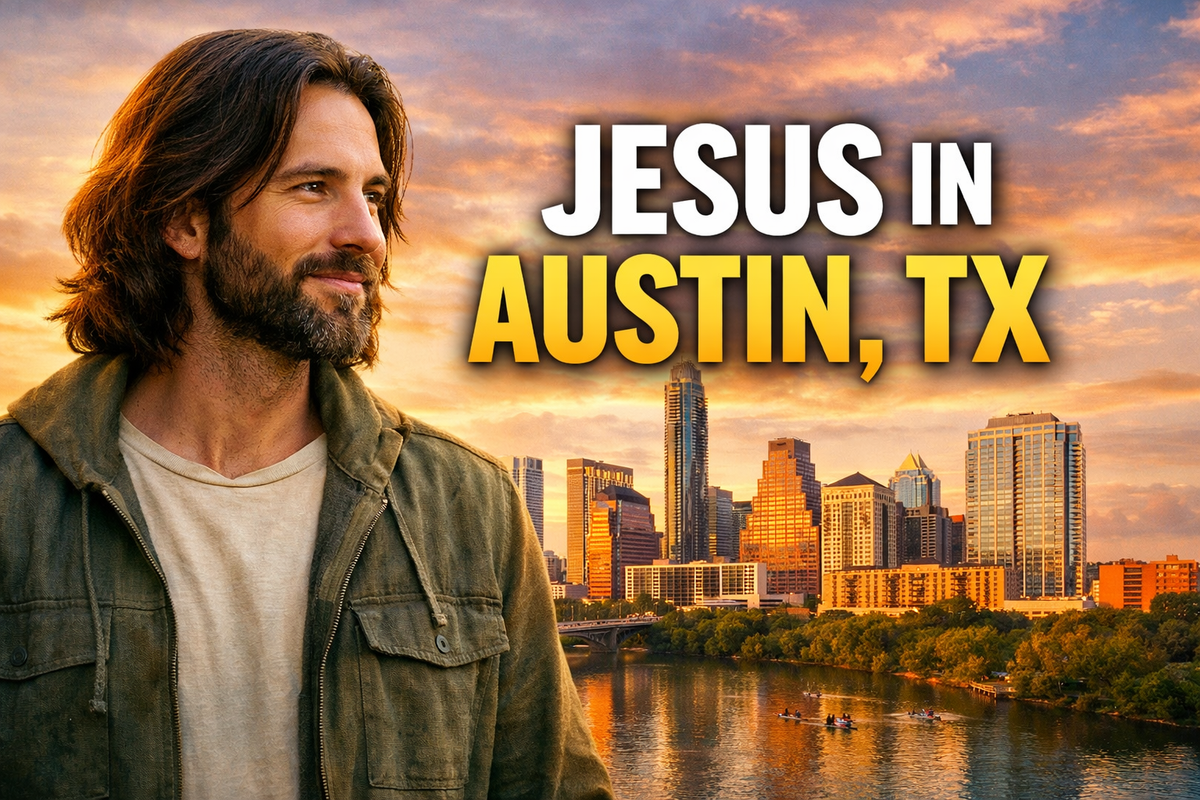
Before the sun came up over Austin, while the skyline still looked half-asleep and the water by Auditorium Shores held the last of the night in it, Jesus knelt in the dim blue quiet and prayed. The grass was still damp. A breeze moved across Lady Bird Lake and pressed lightly against His clothes. The city was not fully awake yet, but it was close. Trucks were already groaning in the distance. A train horn rolled somewhere beyond the buildings. A runner crossed part of the trail with the hard, fixed expression of a man who had turned discipline into a substitute for peace. Jesus stayed where He was and prayed in that stillness as if the Father were nearer than breath and as if the coming noise of the day had no claim on Him at all.
About forty yards away, inside a silver Honda with rideshare stickers on the windshield, a man in his late thirties woke with a violent start and hit his head against the side window. He had fallen asleep crooked in the driver’s seat sometime after four, still in yesterday’s jeans, one work boot unlaced, his phone dead on his lap until the charger finally caught enough current to bring it back to life. The first thing he saw was a text from his ex-wife. The second thing he saw was the time. The third thing was a missed call from his daughter made forty-three minutes earlier. He stared at the screen long enough for his face to change from blank to tight. Then he listened to the voicemail.
“Gabe, I need you to answer me. I’m already on my way into a shift I can’t afford to lose. Ana gets out early today and the program at the library changed their hours. She cannot sit there by herself all afternoon. I am serious. Do not do this again.”
He closed his eyes for one hard second. Then he hit play again, as if a second hearing might make the words kinder. It did not. His jaw clenched. He dragged his hand down his face. There was a stale bag in the passenger seat with fast-food wrappers, a hoodie, a half-full bottle of water that tasted like plastic, and a crumpled receipt that told him more clearly than any sermon ever could that he had worked fourteen hours and still did not have enough. Not enough for child support caught up. Not enough for the electric bill. Not enough to look his daughter in the eye and believe his own mouth when he told her he was trying.
He opened the door and stepped out too fast. The morning air hit him, cool and clean and wrong for the kind of day already waiting on him. He kicked the front tire once, then again harder, then stood there breathing like somebody trying not to explode in public. When he looked up, he saw Jesus walking back from the water.
At first Gabe thought He was just another early Austin man in plain clothes, calm in a way that made everybody else feel loud. Then the man came closer, and what unsettled Gabe was not anything dramatic in His face. It was the opposite. He looked at him the way nobody in months had looked at him. Not with suspicion. Not with hurry. Not with that quick mental sorting people do when they decide how much of you is worth dealing with. He just saw him.
“You have not slept much,” Jesus said.
Gabe gave a short laugh with no humor in it. “That your opening line?”
“It is the truth.”
“Great. You do counseling too?”
Jesus stopped near the hood of the car. “Sometimes I ask questions. Sometimes I listen.”
Gabe shook his head. “I don’t have time for either.”
“You are standing in a parking lot at dawn after sleeping in your car.”
That irritated him because it was accurate and because the words were gentle enough to slip past the first layer of his defenses. Gabe reached into the car, grabbed the bottle of water, took a swallow, and hated the taste of it. “You ever been broke?” he asked. “You ever had everybody in your life act like if you’d just manage yourself better, somehow money would start falling out of the sky? Because I’m not in the mood for churchy stuff.”
Jesus did not move. “I know what men carry when they think they must hold up the whole world with empty hands.”
Gabe let out another laugh, quieter this time. “That sounded expensive.”
Jesus almost smiled. “And yet you understood it.”
The light was beginning to shift. On the trail behind them, more people were coming through now, heads down, earbuds in, moving as if motion itself could redeem them. Gabe glanced at his phone again. No new messages. No miracle. Just the same facts, waiting. He shoved the phone in his pocket.
“What do you want?” he asked.
“To walk.”
“With you?”
“Yes.”
Gabe stared at Him. “I don’t know you.”
“You do not know many people who speak to you like they are not buying something from you or extracting something from you.”
That hit close enough to make him angry. “You don’t know anything about me.”
Jesus looked toward the trail, then back at him. “You drive strangers all night. You apologize for things that are not your fault because a good rating matters more to you right now than dignity. You tell yourself you are doing what you must to survive, and sometimes that is true. But there is another truth under it. You keep moving because motion feels better than facing the places where love has already been disappointed by you.”
Gabe felt his face harden. “You can go ahead and leave.”
Jesus turned and started walking toward the trail as if rejection had not offended Him in the least. After a few steps He said, “Your daughter would still know your footsteps if you arrived today.”
Gabe stood still long enough to hate that sentence. Then he locked the car and followed.
They walked east along the Ann and Roy Butler trail while the city rose around them in layers. The water took on color. Paddleboards waited near the bank like unanswered plans. Dogs tugged their owners forward. Cyclists came through fast and close and impatient. Gabe kept a little distance between himself and Jesus, as if proximity might imply consent. But after five minutes he was still there. After ten, he found himself talking.
“I used to do finish work on houses,” he said. “Cabinets, trim, stuff like that. Paid decent when it was steady. Then steady stopped being steady. Then my back went bad for a while. Then Elena got tired of hearing one more version of why things were gonna turn around. Then I started driving nights because at least the app doesn’t ask how you’re doing as long as you keep accepting rides.”
Jesus listened.
“She says I disappear,” Gabe went on. “That’s her favorite word now. You disappear. Like I’m some kind of magic trick. Like I wanted this.” He looked out at the water and spoke more quietly. “I miss things because I’m trying not to miss things. That’s the stupid part. I work the hours that might keep me from falling behind and that’s exactly what makes me fall behind somewhere else.”
Jesus nodded once. “Many people destroy what they love while trying to prove they love it.”
Gabe kicked at a pebble on the path. “That sounds about right.”
A little farther on, Jesus slowed near a bench where an older woman sat tying her shoes with trembling fingers. He bent without asking for attention, took the lace she had dropped, and held it steady while she finished the knot. She thanked Him without really looking up, embarrassed by how much help something small had required. He spoke to her for less than half a minute. Gabe could not hear everything, but he caught enough to understand that Jesus was not making a performance out of kindness. He was simply there, wholly there, even for this. The woman’s shoulders eased before they moved on.
“That’s what I don’t get,” Gabe said after a while. “Why do people like you do that? Half the time people don’t even say thank you.”
“Is gratitude the measure of what is worth doing?”
“No. I guess not.”
“You know that already,” Jesus said. “You have been disappointed many times and still you love your daughter.”
Gabe did not answer.
By the time they reached the streets feeding into South Congress, Austin had become itself. Delivery vans backed into alleys. Sidewalks took on their steady current. Music leaked from somewhere it did not yet belong. The city had that strange morning tension it carries so well, where everything feels casual until you look closely and realize nearly everybody is already under pressure.
Jo’s was busy enough that nobody paid much attention when Jesus and Gabe stepped up to the side of the counter. A woman with dark hair pinned up too fast and a green apron half twisted around her waist was working the register with the fixed brightness of somebody holding herself together by keeping other people moving. Her name tag said Talia. She could not have been more than twenty-eight, but tiredness had put older shadows under her eyes. She smiled at each customer with practiced speed, then lost the smile the instant she turned away. Gabe knew the type because the city was full of them. People who looked functional from a distance and frayed up close.
Talia took one look at the line, one look at the espresso machine, and then at her buzzing phone on the counter where a message had arrived that she did not open. Her hand shook as she reached for a cup. The lid slipped. Coffee ran hot over the counter and onto the floor. Somebody at the back of the line sighed loud enough to make sure she heard it.
“I’m so sorry,” she said at once, already crouching for towels. “I’m so sorry. I’ve got it.”
Jesus stepped around the spill before another customer could track it through. He picked up the fallen sleeves and set them aside. Gabe, almost against his own will, grabbed the napkin dispenser before it tipped.
“It’s fine,” Talia said too quickly. “Really. You don’t have to—”
Jesus handed her the towel. “You are trying to apologize your way through a day that has not finished hurting you yet.”
She froze.
It was not the kind of sentence most people would have accepted from a stranger, but something in His voice took the sting out of it. Talia looked at Him as if He had somehow opened a locked door without touching it.
“I’m okay,” she said, and the words sounded exhausted before they were even fully out.
“No,” Jesus said gently. “You are functioning.”
The line behind them shifted. A man checked his watch. Somebody ordered a cold brew. The machine hissed again. Austin continued being Austin. But for one second Talia’s face changed and the strain came all the way to the surface.
“My mom called three times before six,” she said, speaking lower now, as if the truth embarrassed her. “My brother missed another class. He’s on probation at school. I’m covering rent until he gets his job back. I picked up this shift because Maren’s kid is sick, and I know none of that matters to anyone standing here who just wants coffee, but if one more person looks at me like I’m stupid for spilling one thing, I think I might walk out and never come back.”
Jesus did not rush to answer her. He let the admission land. “Then do not lie to yourself,” He said. “What you need is not more pretending. You need rest, and truth, and one honest sentence instead of ten rehearsed smiles.”
She laughed once through the threat of tears. “You say that like people can afford it.”
“Some cannot afford collapse,” Jesus said. “But many are collapsing because they never tell the truth before they fall.”
Gabe watched Talia stand a little straighter, not because her problems had vanished, but because someone had named them without making her feel small. One of her coworkers finally stepped over from the machine and took over the register for a minute. Talia wiped her hands on her apron and nodded toward the side window as if she needed air.
“Can I get you anything?” she asked, still trying to do her job.
“Water,” Jesus said.
She blinked. “Just water?”
“Yes.”
Gabe almost smiled despite himself. Talia filled two cups and slid them across. When Gabe reached for his wallet, she shook her head. “You already helped clean up my disaster.”
“It wasn’t a disaster,” Jesus said.
Her mouth tightened as if she wanted to believe Him. “Feels like one most days.”
“Most days feel larger than they are when you carry them alone.”
For the first time all morning, Gabe saw a little of the hardness leave somebody else’s face before it had left his own. Talia took a breath, pocketed her phone without checking it, and went back to work with less panic in her shoulders. Nothing outwardly dramatic had happened. The line moved again. Orders were called. But something real had changed, and Gabe could not deny he had seen it.
As they walked back onto South Congress, he said, “Do you do that everywhere?”
“Do what?”
“Say one thing and make it feel like somebody’s been holding their breath for years.”
Jesus looked at him. “Truth can feel like air when a person has lived in a sealed room.”
Gabe stared ahead. “That’s not annoying at all.”
“You keep staying,” Jesus said.
Gabe shoved a hand into his pocket. “I keep not knowing why.”
They crossed toward downtown as the heat rose faster than it should have. The city got louder block by block. A man in a suit barked into a headset about numbers. A young couple argued quietly over a stroller and whether they could still make brunch with the reservation already missed. A delivery rider shot through a yellow light with one hand on the bars and the other holding a phone that was probably deciding the rest of his day for him. Gabe had lived in Austin long enough to stop noticing most of it. Jesus seemed to notice all of it. Not in a distracted way. In a merciful way. As if nobody passed Him without being fully seen.
Near Central Presbyterian Church they found a man in work clothes kneeling on the steps with a box torn open beside him, oranges rolling farther than he could catch them. He looked to be in his early sixties, lean and tired, his gray hair flattened by a cap he had taken off and jammed into his back pocket. He muttered something sharp in Spanish under his breath when another orange bounced toward the curb. Jesus bent and caught it before it rolled into the street. Gabe got the next two.
“Appreciate it,” the man said, breathing hard as he set the box upright again. “I had this balanced. Thought I had it balanced.”
The sentence was ordinary, but the look on his face was not. It was the face of a man who knew he was not talking only about fruit.
“You work here?” Gabe asked.
“Maintenance,” the man said. “A little of whatever needs doing. Deliveries too. Pantry stuff. Chairs. Doors. Everything old breaks if you wait long enough.” He wiped his forehead with the heel of his hand and glanced toward the church entrance. “You come to pray?”
Jesus answered, “Sometimes prayer finds people on steps before it finds them inside.”
The man let out a tired breath that might once have been laughter. “That sounds true.” He shifted the box against his hip, then added, “Luis.”
“Jesus,” He said.
Luis looked at Him more carefully then, the way people do when a name lands strangely and yet somehow fits. He did not comment on it. He only nodded once, slowly.
His phone buzzed. He glanced at the screen and the life went out of his face in a different way than before. He silenced it without answering.
“My son,” he said after a pause. “Or not my son, depending on the week.”
Gabe leaned against the rail. “That bad?”
Luis kept his eyes on the phone in his hand. “Worse because it is not new. He’s downtown for now. In and out of shelters. In and out of staying clean. In and out of answering me. I spent years drinking more than I should and teaching him more by example than by speech. Then I got sober late enough to call myself a better man, and he had already become one of the men I used to be.” He looked embarrassed as soon as he had said so much. “Sorry. You don’t need all that.”
Jesus answered, “You have been trying to repair with urgency what was broken over time.”
Luis swallowed. “I keep thinking if I say the right thing he’ll hear it this time. I keep thinking there has to be one sentence that opens the door.”
“And when it does not?”
Luis looked down at the box. “Then I feel like maybe the Lord is punishing me by making me watch him wear my old face.”
The words sat there between them. A bus sighed to a stop nearby. Somewhere across the street, a jackhammer started up. Austin did not pause for grief. It simply built around it.
Jesus rested a hand on the top edge of the box and said, “Punishment is not the same as consequence, and shame is not the same as repentance.”
Luis’s eyes lifted.
“You cannot save your son by speaking perfectly,” Jesus went on. “You cannot hurry trust just because your regret is sincere. But you can stop making your sorrow the center of every meeting. When he sees you, let him meet a man who is present, not a man still collapsing under the weight of himself.”
Luis stared at Him as if he had been struck and steadied at once. “I don’t know how to do that.”
“Begin by letting today be about him, not about proving you have changed.”
For a second Luis could not speak. He nodded instead, then rubbed his thumb hard against the phone case like a man trying not to cry in front of strangers. Gabe looked away to give him the mercy of privacy, but in doing so he felt something turn sharply in his own chest. He had spent so much of the last year narrating his failures that he had almost convinced himself the narration was responsibility. Maybe it was only another way of staying turned inward.
Luis cleared his throat. “There’s a place downtown he goes sometimes,” he said. “The ARCH. If I find him later, maybe I’ll try again. Different this time.” He shifted the box under one arm. “Thank you. Both of you.”
Jesus picked up the last orange from the step and set it carefully in the top of the box. “Do not speak to him as a man begging to be forgiven before the conversation begins. Speak to him as a father willing to remain.”
Luis nodded again. Then he went inside the church, moving slower than before but less bent.
Gabe waited until the door closed behind him. “You know, for somebody who doesn’t do churchy stuff, you keep saying things that sound like they could end up on walls.”
Jesus looked down the street toward Congress. “Walls do not need truth as much as people do.”
“That was one.”
They walked again, and for a while Gabe did not speak. The city around them had become fully midday now, hot and bright and a little unforgiving. Sweat gathered under his shirt. Traffic noise bounced off glass and concrete. A food truck vented grease-heavy air from an alley. Somewhere nearby a saxophone was being played badly enough to hurt.
“What if you already disappointed them too many times?” Gabe said at last.
Jesus did not make him define who them was.
“What if they’re tired,” Gabe went on. “What if they’re done hearing you explain? What if every time you show up, all they can see is the last five times you didn’t?”
Jesus slowed near the shade line thrown by a building and turned toward him. “Then stop arriving with speeches in your mouth.”
Gabe frowned. “What does that mean?”
“It means many people use words to manage the pain they have caused. They come prepared to explain themselves, soften themselves, defend the shape of their failures, and seek quick relief from the consequences of being known. Love does not always need explanation first. Sometimes it needs someone to sit down, tell the truth plainly, and remain there long enough to be seen without performance.”
Gabe stared at Him. “You make everything sound simple.”
“No,” Jesus said. “I make it plain. Plain is not always easy.”
His phone buzzed again. Gabe took it out and felt his stomach drop before he even opened the message. It was from Elena.
Ana’s at the Central Library. Third floor near the children’s area because she said she wanted to draw. I cannot leave work. Please. Do not make her sit there wondering if you’re coming.
He read it once. Then again. Then a third time while the noise of the street seemed to move farther away from him.
“She still asked you,” Jesus said.
Gabe shoved the phone back into his pocket because the truth in that sentence was almost unbearable. “Because she didn’t have another option.”
“And yet she asked you.”
Gabe looked toward the direction of the library though he could not see it from where they stood. “I don’t have anything,” he said. “I’m supposed to go get my kid and what then? I can’t take her anywhere decent. I can’t even promise I’ll be available tomorrow. I’m tired of showing up half-broke and pretending it counts as enough.”
Jesus’s voice stayed quiet. “Do you think your daughter has been measuring you only in money?”
“No,” Gabe said too fast. Then more honestly, “I don’t know. Maybe. The world does.”
“The world teaches children many cruel ways to count. Love teaches better ones.”
Gabe pressed both hands against the back of his neck and shut his eyes. He could see Ana in fragments without trying. The way she tucked one foot under herself when she sat on a chair. The way she said “it’s okay” too quickly when something wasn’t okay at all. The way she had stopped asking if he was coming and started asking if he knew where she left things, as if practical questions hurt less than hopeful ones. He had watched disappointment mature in his child, and he had let himself believe exhaustion excused more than it did.
“What if I walk in there and she looks at me the way her mom looks at me now?” he asked.
Jesus answered without hesitation. “Then receive the look honestly and stay.”
They turned west again, then north, and by the time the Austin Central Library came into view across the street, Gabe’s heartbeat had started doing strange things. The building stood clean and bright against the afternoon, full of glass and light and people whose lives, from the outside, looked better organized than his. Families moved in and out. A teenager hurried down the steps with headphones on and a stack of books against his chest. A woman adjusted a toddler on one hip while balancing a library bag on the other arm. Normal life. That was almost harder to face than disaster.
Gabe stopped at the edge of the crosswalk.
Jesus kept walking, then paused when He realized Gabe had not followed. Traffic passed in quick bursts between them and the entrance. The signal changed. Gabe did not move.
“She’s up there right now,” he said, more to himself than to Jesus. “Probably looking at the elevator every thirty seconds. Probably telling herself I’m late because of traffic, because that’s nicer than the truth.”
“You know the truth?”
Gabe laughed bitterly. “Yeah. I’m late because I’m a man who keeps becoming the thing he said he wouldn’t become.”
Jesus came back toward him until they were standing side by side at the curb. “No,” He said. “You are a man at the edge of one more choice.”
Gabe looked at Him, exhausted and angry and scared in a way that felt younger than his years. “You really think one choice changes anything?”
“One choice rarely changes everything at once,” Jesus said. “But it often reveals whether a man still intends to belong to what is good.”
The light shifted again. People began crossing around them. Gabe still could not make himself step forward. Through the wide glass of the library’s upper floors, he could see only flashes of movement and sun and shelves. Somewhere in there was his daughter. Somewhere in there was the child he had not yet completely lost, though he had given her reasons to protect herself from him.
Jesus looked up toward the building and then back at Gabe. His voice was very steady when He spoke.
“She has been waiting longer than this afternoon.”
Gabe felt those words go all the way through him.
He swallowed once, hard, and turned toward the crosswalk as the crowd moved.
He moved with them before he could change his mind. The traffic hissed past on either side, and Gabe kept expecting the old reflex to take over, the one that could build excuses on command and make delay sound reasonable. But the crosswalk was short, the library was close, and there was no room in that small stretch of concrete for the lies he usually used to soften himself. By the time he hit the far curb, his heart was pounding hard enough to make his hands feel numb. Jesus walked beside him without hurry, as if panic had no authority over timing. That alone steadied him more than he wanted to admit.
Inside, the air was cool and bright. The lobby held the clean hush of a place built for order, but beneath it there was still the sound of a living city moving through it. Kids talked too loud and were corrected softly. Elevators opened and closed. Someone laughed from somewhere above them and then caught themselves. Gabe stood in the open space with his eyes lifted toward the upper floors and felt like a man who had entered a room where he had once belonged and was no longer sure he did. Jesus did not push him. He only looked toward the elevators and then toward the stairs, as if both options were still open to a man who had spent too long believing everything was already decided. Gabe chose the stairs because he could not bear being trapped in a mirrored box with his own face.
By the time they reached the third floor, his shirt was sticking to his back. He stepped into the children’s area and saw her almost at once. Ana was sitting at a table near the windows with a pack of colored pencils spread out in a careful row. She had one elbow on the table and her cheek resting against her hand while she drew. Her backpack was hooked around one ankle the way kids do when they have learned early not to trust the world to leave their things alone. She had grown in ways that startled him every time he noticed them. She was still small enough to look young when she was quiet, but something in her eyes had already started to look older than it should. He stood there a few seconds too long, and when she finally looked up, he saw the exact moment recognition and caution met in her face.
She did not light up. That hurt more than if she had been angry.
He walked toward her slowly. Jesus stayed back by the shelves, near enough to be there and far enough not to intrude. Gabe stopped beside the table and stared at the drawing because he needed one second to gather himself. It was the Austin skyline in rough pencil, the buildings simple and a little crooked, the water below them blue and green in strips, and a long walking path at the front with two tiny figures sketched on it and then half erased.
“Hey,” he said.
Ana looked down at the paper again. “Hey.”
“I’m sorry I’m late.”
She shrugged, but it was the kind of shrug children learn when they are trying to make disappointment smaller so it does not swallow the room. “Mom said you might be.”
He closed his eyes for half a second because he had earned that and worse. Then he sat down across from her. “You should not have had to wonder if I was coming.”
That got her attention. She looked at him directly then, not because the sentence fixed anything, but because it was not one of his usual tangled explanations.
“I fell asleep in the car,” he said. “That is what happened. I’m not proud of it. I’m here now, and I’m staying.”
Ana studied him with that careful seriousness kids have when they are deciding whether an adult means what he says. “Okay,” she said at last, but the word was thin and protective. It was not trust. It was only room.
Gabe nodded because room was more than he deserved and still enough to begin. “What are you drawing?”
“The lake,” she said. “Kind of. And downtown.” She touched the half-erased figures with the side of the pencil. “I messed this part up.”
He looked at the faint lines. One figure was taller. One was shorter. Even erased, they were obvious. He swallowed. “Maybe not messed up.”
Ana glanced toward the shelves behind him. “Who’s that?”
Gabe turned. Jesus was standing a few feet away with a book in His hand He had not really been reading. A little boy nearby had drifted close to Him because children always know when someone is safe before adults do. The boy was talking about dinosaurs with great seriousness, and Jesus was listening as if the subject mattered. When He saw Ana looking, He set the book back in place and walked over.
“This is Jesus,” Gabe said, then heard how impossible it sounded and almost laughed. But Ana did not. She only looked at Him with direct child honesty.
“That’s a church name,” she said.
“It is My name,” Jesus answered.
Ana accepted that more easily than Gabe had accepted almost anything all day. “Oh.” She turned the paper around toward Him. “Do you think it looks like Austin?”
Jesus bent slightly to see it. “It looks like you noticed the water first.”
“That’s the best part,” she said. “Everything else is just buildings and people honking.”
A small smile touched His face. “You may be right.”
She studied Him another second. “Are you Dad’s friend?”
“I am with him today.”
Ana nodded slowly, as if that answer was somehow enough. Then she pushed the colored pencils into a neater row and asked, “Were you there when he got late?”
The honesty of children can cut cleaner than anything adults say. Gabe almost rushed in to answer, but Jesus looked at him, not at Ana, giving him the moment back.
“Yes,” Gabe said. “I was with him.”
“Did he forget?”
He felt the old reflex rise again, the one that wanted to say it was complicated and he was tired and adult life was hard and she would understand one day. He did not let it. “No,” he said. “I did not forget you. I failed you today. That’s different. But it still hurt you, and I know that.”
Ana’s fingers moved over the edge of the paper. “I don’t like waiting where everybody else gets picked up.”
“I know.”
“You always say you know.”
He let that hit. “Then I’ll say something better. I hear you.”
For the first time since he sat down, some part of her face softened. It was small, but it was real. She looked at Jesus then, almost as if checking whether that answer had been a good one. Jesus did not congratulate Gabe. He only remained very still, leaving the truth to stand on its own feet.
A librarian came by a minute later, a woman in her forties with silver-framed glasses and a badge clipped near her shoulder that said Maribel. She had the patient expression of somebody who had spent years protecting quiet without becoming cold. She reminded Ana that the craft carts would be put away in twenty minutes and then noticed Gabe. There was a brief flicker in her eyes that told him she knew exactly which parent he was. The late one. The uncertain one. The one the staff quietly prepared children for. He braced for it. Instead she only said, “She’s been reading and drawing. She did fine.”
The sentence was kind, but there was weight behind it, and he heard what she had not said. She had needed to do fine. Gabe nodded. “Thank you for staying with her.”
Maribel looked at him a little longer, perhaps measuring whether gratitude was real or just another attempt at smoothing over a bad pattern. Then she said, “Children notice who returns.” It was not cruel. It was simply true. She moved on.
Ana reached for a purple pencil. “She’s nice,” she said. “She gave me extra paper because I messed up twice.”
Jesus looked around the room at the shelves, the chairs, the bins of worn books touched by hundreds of small hands. “Mercy often looks ordinary before people learn how much they need it.”
Ana seemed to consider that. Then she asked, “Are you one of those people that says weird things all the time?”
Gabe laughed before he could stop himself, and even Jesus smiled fully then. “Sometimes,” He said.
Ana turned back to her drawing, and the air around the table changed a little. It was still fragile. Nothing had been repaired by magic. But the moment no longer felt like a courtroom. It felt like something living and breakable and worth protecting.
Gabe’s phone buzzed in his pocket. He looked at the screen and saw the rideshare app throwing him a surge alert downtown. High demand. Earnings up. The number on the screen was exactly the kind of number that could buy groceries, cover gas, maybe quiet one bill for one more week. His body reacted before his mind did. He could feel the pull of it in his chest, the logic already building itself. Ana was occupied. He could take one ride, maybe two. He could circle back. He could make the delay useful. He hated how fast his mind still worked in the direction of disappearing.
Jesus had not seen the screen, but He looked at Gabe anyway. “There is always a voice telling a tired man that one more compromise is practical.”
Gabe stared at the phone. “You don’t understand. This is real money.”
“Yes.”
“I’m behind on everything.”
“Yes.”
He swallowed hard. “So what am I supposed to do, just act like money doesn’t matter?”
Jesus answered calmly. “No. But you must decide what gets taught here today. Whether your daughter learns again that she stands on the losing end of every urgent thing, or whether she learns that love can remain even while need still shouts.”
Gabe looked down at Ana. She was shading the water darker now, concentrated, unaware of the battle happening three feet from her. Or maybe not unaware. Children notice more than adults think. He knew that too. He had watched her adapt to uncertainty with a quiet that never should have been necessary.
With one movement that felt both small and violent, he turned the app off.
Nothing outside changed. The bills did not disappear. The surge did not weep over his courage. But something inside him stopped bending for a second, and he knew it. Jesus said nothing. He did not need to.
Ana looked up. “Are we staying?”
“Yes,” Gabe said.
“For how long?”
“For as long as I told you I would.”
She studied his face again. Then she turned the paper toward him. “Do you think this looks better with the blue darker?”
He leaned in and took the question as seriously as if the answer mattered at the level of nations. “Yeah,” he said. “It does.”
They stayed another hour. Ana drew, then wandered the shelves and came back with a stack of books taller than it needed to be. Jesus sat with her on the floor by the low picture-book section while she read titles out loud and rejected most of them for reasons that made sense only to a child and were therefore somehow purer than adult logic. A little girl nearby cried because her older brother had taken the last beanbag chair by the window, and Jesus gave up His chair without being asked. A mother mouthed thank you from across the room while holding a toddler and a diaper bag that looked heavier than sleep. Nothing in the room was dramatic. No thunder split the ceiling. No angels announced anything. Still, Gabe had the strangest feeling that heaven had come very near to a public library in the middle of Austin simply because Jesus was there and was wholly present in it.
When they finally walked out into the afternoon brightness, Ana put one hand in Gabe’s without asking first. The contact was light, almost cautious, but it hit him with more force than anything else had all day. He wanted to grip back too hard, wanted to prove something through pressure alone, but he resisted. He let the hand stay small and real inside his. Jesus walked on Ana’s other side as they headed back toward Congress.
“Are we going home?” Ana asked.
“We can,” Gabe said. “Or we can walk a little first.”
She looked up at the buildings and the movement of people and the bright weight of afternoon over everything. “Can we walk?”
“Yes.”
So they did. They crossed toward Congress Avenue, where the city felt hotter and busier than the library had allowed them to remember. Ana talked about a class project involving city maps and birds, then switched suddenly to a story about a girl at school who had started pretending not to know her because another group of girls had decided Ana’s shoes were weird. She told it without much emotion, the way kids sometimes tell hard things after they have already packed them away. Gabe listened and felt anger rise in him toward people he would never meet, toward the world for teaching cruelty so early, toward himself for not being near enough lately to know when his daughter had started carrying this.
“What did you do?” Jesus asked her.
Ana shrugged. “Nothing. I just stopped trying to sit by her.”
That answer sat heavily with all three of them.
After a moment Jesus said, “Many people learn to leave first so it hurts less when someone else leaves.”
Ana kicked lightly at a crack in the sidewalk. “That sounds true.”
Gabe looked at her. “Is that what you do?”
She did not answer right away. “Sometimes.”
He let the silence stay open for a few steps. “I think I taught you that without meaning to,” he said at last.
Ana glanced up at him but did not deny it. She only squeezed his hand once and let go, not in rejection, but because they had reached a busier patch of sidewalk and she needed both hands free to move around people. Even that small release made him feel the cost of his old pattern all over again. He was beginning to understand that failure was not just the things he had missed. It was what others had learned to do in order to survive his missing.
They slowed near Mexic-Arte Museum when Ana stopped to look at a bright poster in the window. She did not ask to go in. She only stood there a moment, drawn to the color after so much glass and concrete. Jesus watched her face more than the art.
“She sees beauty quickly,” He said.
Gabe nodded. “Her mom says she gets that from me, but I think she got it from Elena.”
“Perhaps beauty survives through both of you,” Jesus said.
Gabe looked at the reflection in the window and saw himself standing between his daughter and a city that had made him smaller than he meant to become. “I don’t know how to be enough for her.”
Jesus answered, “Then stop aiming for enough as if love were a quota. Be honest. Be near. Be the kind of man whose staying can be trusted more than his promises.”
Ana was still staring at the poster. “Can we get tacos later?” she asked without turning.
Gabe laughed softly. “That came out of nowhere.”
“It didn’t. I’m hungry.”
He reached into his pocket and felt the folded bills there. Not much. Enough for some tacos if he was careful. Enough to matter. “Yeah,” he said. “We can get tacos.”
She looked pleased in the unguarded way only children can still be pleased when they have not yet learned to hide joy out of caution. They kept walking.
When they reached Central Presbyterian again, the doors were open and volunteers were carrying boxes inside. Luis was on the steps with the same cap in his back pocket and sweat darkening the front of his shirt. He saw them and lifted a hand. Something in his face had changed since morning. He still looked tired, but not hollow.
“You made it back,” he said.
Jesus nodded. “And you?”
Luis exhaled through his nose and glanced toward the doorway. “He came by. My son. About twenty minutes ago.” He said it carefully, like a man describing a wounded animal that had stepped close enough to touch and might still bolt. “He was hungry. Angry too. But hungry first, thank God. He’s inside.” Then he noticed Ana and softened. “Hey there.”
Ana gave him a small nod and moved half behind Gabe’s leg out of habit.
Luis leaned closer to Gabe and lowered his voice. “I did what He said. I didn’t start with speeches. I didn’t make it about me. I just said, ‘There’s food. Sit down if you want. I’m glad to see you.’” His eyes were wet, but he was smiling a little through it. “He stayed.”
Gabe felt that sentence go through him the same way Jesus’s words had all day. He looked at the church entrance. “Can we help?”
Luis looked surprised, then grateful. “Always.”
Inside, the room smelled faintly of coffee, old wood, and hot food. Volunteers were setting up trays and folding chairs in quick practiced movements. The people arriving did not come in as a single group. They came in the way need always comes, scattered and individual, carrying different kinds of strain in the same body language. Ana stayed close at first, taking it in with wide eyes. Gabe knelt down beside her.
“We don’t have to stay if this feels like too much,” he said.
She looked around the room again. “Are these people okay?”
Jesus answered from beside them, “Some are hungry. Some are tired. Some have been talked around all day and not really seen. But being near pain does not make a place bad.”
Ana nodded slowly. “Can I help with something small?”
Luis found her a stack of napkins to place at the ends of the tables. She took the job seriously. Gabe helped carry trays. Jesus moved among the room in that same unforced way He had all day, greeting people without spectacle, speaking to each person as if they were not part of a category but wholly themselves. A woman with blistered feet sat down and cried quietly over a bowl of soup before she took a bite. A young man whose hands would not stop trembling kept pretending he only needed water. Jesus sat beside him until the pretending wore out. An older veteran with a rigid jaw and a service cap folded in his hands tried to refuse a second helping until Jesus asked him, very simply, whether pride had ever once fed him. The man looked annoyed, then laughed, then took the food.
Gabe saw Mateo before he knew it was him. The resemblance to Luis was obvious in the eyes. He was younger than Gabe expected, maybe mid-twenties, beard overgrown, clothes worn past dignity, but the anger in him was still fresh enough to make him look more defended than broken. He sat at the far end of a table with his body turned halfway toward the exit, eating fast, as if he did not trust the meal to remain available. Luis did not crowd him. He stayed on the other side of the room, helping where he was needed, glancing over only enough to make sure his son was still there. Gabe recognized the discipline in that restraint and understood how much it must have cost.
At one point Mateo looked up and caught his father looking. Gabe expected him to get up and leave. Instead he held the look for a second, then went back to eating. It was not reconciliation. It was only non-departure. But in a room like that, on a day like that, it felt holy.
Ana finished the napkins and came back to Gabe. “That guy by the door looks like he might leave,” she whispered, meaning Mateo.
“Maybe,” Gabe said.
She looked at Jesus, who was speaking softly to the young man with trembling hands. “He makes people stay.”
Gabe followed her gaze. “Not exactly.”
“What then?”
He thought about it before answering. “Maybe He makes it feel possible.”
Ana seemed satisfied with that.
The hours moved. Afternoon leaned toward evening. Outside, the city was still loud, still expensive, still proud of itself in all the ways cities are proud. Inside the church, something quieter was happening. Not a rescue from reality, but a different way of standing in it. Gabe realized he had gone half a day without performing competence for strangers, without apologizing his way through every square inch of a room, without trying to outrun the ache in his chest by keeping the wheels moving. He was tired, yes. The bills still waited. Elena still had good reasons not to trust him. None of that had vanished. But he no longer felt split into ten pieces and sent in ten directions by every demand at once. For the first time in months, he felt gathered.
When the meal was nearly over, Luis crossed the room and sat down across from Mateo with a cup of coffee he did not really need. He did exactly what he had said he would do. He did not begin with remorse. He did not lead with his own guilt. He asked whether Mateo’s ankle was healing from an old injury. He asked whether he had found a place to sleep the last two nights. He listened when Mateo answered sharply. He stayed when the sharpness did not soften. And after a while, with no visible signal to mark the change, Mateo’s shoulders loosened enough for a little weariness to show through the anger. Gabe watched it happen and understood something he had missed for years. Presence was not weakness. It was endurance without self-protection.
His phone buzzed again. This time it was Elena.
He stared at the name a moment before answering. “Hey.”
“Where are you?” Her voice was clipped from a long day and too much strain. He could hear noise in the background. Maybe dishes. Maybe a television in another room she was not watching.
“At Central Presbyterian downtown,” he said. “Ana and I stayed near the library and then came here to help serve a meal.”
There was silence on the line, and he realized she had expected either defensiveness or a polished version of events. She had not expected plain truth. “You’re where?”
“At the church by the library. We’re okay.”
Another pause. “Did you pick her up on time after all?”
He could have lied there. The temptation flashed through him, quick and ugly and familiar. He let it pass. “No. I was late. I told her the truth about it. I’m sorry, Elena.”
Her breathing changed slightly. Not softened, exactly. More like recalibrated. “Is she with you now?”
He looked across the room. Ana was handing the last of the extra napkins to a volunteer as if the role mattered immensely. “Yes.”
“And you’re staying with her?”
“Yes.”
Silence again, but a different silence. Tired, cautious, not yet closed. “Okay,” she said at last. “Bring her by around eight. She has school tomorrow.”
“I will.”
He almost ended the call, but then something in him refused to leave things at the surface. “I know sorry has been cheap from me,” he said quietly. “I know that. I’m not trying to buy relief with it tonight. I just wanted you to hear one honest thing. I picked her up late, but I didn’t leave after that. I stayed.”
She did not answer right away. When she did, her voice was lower. “She notices more than you think.”
“I’m starting to understand that.”
Another small pause passed between them. Then she said, “Just get her home safe.”
“I will.”
After the call ended, Jesus looked at him, and Gabe knew there would be no praise, no easy medal pinned to his chest for a day of finally doing part of what he should have done all along. Yet there was no condemnation in Jesus either. Only that same clear presence.
“You told the truth without reaching for reward,” Jesus said.
Gabe let out a long breath. “It felt weird.”
“It will for a while.”
“Is that supposed to encourage me?”
“It is supposed to prepare you.”
Ana came over then and held up a folded paper place card someone had left blank. She had drawn on it instead. It was three figures this time, not two. One tall, one medium, one small, all standing by the water. None of them erased.
“Can we keep this?” she asked.
“Yeah,” Gabe said, and his voice nearly broke on the single syllable.
By the time they left the church, evening had dropped its softer light over the city. The heat was loosening. The streets still carried noise, but it had changed pitch. Dinner traffic was thick. Patios were full. Somewhere music had started up again, cleaner now, less desperate than the bad saxophone from earlier. Austin looked almost beautiful in the hour when the day stops demanding explanation and simply glows for a little while.
They got tacos from a truck parked off a side street because Ana had remembered and because promises that small matter too. They ate sitting on a low wall, napkins in their laps, sauce dripping in ways impossible to contain. Ana talked with more ease than she had at the library. She told a story about a teacher who mispronounced a student’s name for three months and never seemed embarrassed enough about it. She asked Jesus whether He liked Austin.
“I like the people in it,” He said.
“That’s not the same thing.”
“No,” He said, “but it is often better.”
She laughed at that. Gabe watched her and felt both joy and grief at once. Joy because she was still this reachable. Grief because he had nearly convinced himself he had more time than love is ever actually given. He looked at Jesus across the small table and said, “What happens tomorrow when all this feels farther away?”
Jesus wiped His hands with a napkin and answered, “Tomorrow you will still have the same temptation to become motion instead of presence. You will still be pressured by money, by shame, by fatigue, by the old story that says disappearing is practical and returning later with a reason is good enough. You must refuse that story one day at a time.”
“That sounds slow.”
“It is.”
Gabe looked down at the grease marks on the paper tray. “I was hoping for something more supernatural.”
Jesus’s gaze was steady. “Remaining is supernatural for many people.”
They drove Ana home just before eight. Gabe’s car still smelled faintly stale from the night before, and he hated that suddenly with a fresh kind of clarity. Not because it embarrassed him, though it did. Because he could feel how much of his daughter’s life he had expected her to step into on his terms, however cramped and half-kept those terms were. On the short drive she leaned against the window and looked out at the city lights sliding by. Once she glanced in the rearview mirror at Jesus in the back seat and seemed about to ask something, then changed her mind. Some mysteries children hold without trying to solve.
Elena was waiting outside the apartment when they pulled up. The porch light threw a pale circle over the cracked walkway. She stood with her arms folded, tired in the way only long responsibility can make a person tired. When Ana got out, Elena checked her face first, not Gabe’s. Mothers do that. Ana moved toward her, then stopped and turned back.
“Dad stayed,” she said simply.
Elena looked from Ana to Gabe. The old history between them did not vanish. The mistrust did not suddenly melt into tenderness. But something in her expression loosened just enough to make room for one unguarded second. “Good,” she said.
Gabe crouched and handed Ana the folded drawing. “Keep that somewhere safe.”
She took it and nodded. Then, after a small hesitation, she leaned in and hugged him. It was not long. It was not dramatic. It was also more mercy than he had expected to be given that day. When she pulled back, he did not ruin it by asking for another one or making the moment carry more than it did. He just said, “I’ll see you soon.”
“You better,” she said, but there was a flicker of a smile with it.
He stood then, looked at Elena, and chose not to decorate the moment with speeches. “Good night,” he said.
“Good night,” she answered.
That was all. But as he walked back to the car, he understood that some of the holiest changes in a life do not sound large when they happen. They sound plain. They sound almost unfinished. They sound like a man finally refusing to hide inside his own explanations.
When he reached the passenger side, Jesus was no longer there.
Gabe turned slowly, scanning the lot, the sidewalk, the street beyond it where headlights moved through the dark like brief intentions. For a moment he felt a pulse of panic, not because he thought Jesus had abandoned him, but because the thought of moving back into ordinary life without seeing Him in the next seat felt suddenly unbearable. Then he looked beyond the apartment buildings toward the distant line of the city and knew, without needing to be told, where to go.
He drove back toward the water.
The night had settled fully over Austin by the time he parked near Auditorium Shores again. The skyline shone against the dark like something people had built to reassure themselves they were not small. Music drifted faintly from far off. The trail still held walkers and runners and couples in conversation and solitary men pretending exercise was the only reason they had stayed out. Gabe moved toward the same stretch of shoreline where morning had begun and found Jesus there, kneeling again in quiet prayer with the city behind Him and the dark water before Him.
He stopped a few yards away and did not interrupt.
Everything in him was tired now. His body ached. His money problems remained. Tomorrow still waited with all its unfinished bills and obligations and complicated relationships. Yet as he stood there watching Jesus pray, he realized the day had not given him a new life in the cheap sense. It had given him a truer way to live the life he already had. Jesus had not shown him how to escape pressure. He had shown him how not to let pressure become his master. He had not erased the consequences of his failures. He had shown him how to stop worshiping shame as if shame were the deepest truth about him. He had not handed him a polished speech for his daughter or his ex-wife or the rest of the world. He had shown him that love becomes visible when a man tells the truth and stays.
After a long while, Jesus rose.
Gabe took a breath. “Do I just keep doing this now?”
Jesus turned toward him. The wind moved lightly off the lake, and the city kept speaking its thousand restless words behind them. “You pray,” He said. “You tell the truth. You remain. And when you fail again, because you are still a man and not yet whole, you do not run deeper into hiding. You return quickly.”
Gabe looked out over the black water, then back toward the skyline, then down at his own hands. They were still empty in most of the ways the world counts emptiness. But they no longer felt useless. “I don’t know if I can hold my life together.”
Jesus answered, “You were never asked to be the one who holds all things together.”
For the first time all day, Gabe let the tears come without fighting them. Not loud. Not dramatic. Just the quiet breaking of a man who had spent too long trying to survive without surrender. He bowed his head there by the water while the city moved and flashed and hurried around him, and Jesus stepped closer and placed a hand on his shoulder.
Then, under the Austin night, with the trail behind them and the lake before them, Jesus prayed.
He prayed with the same stillness He had carried at dawn. He prayed as if the Father was not far and had never been far. He prayed for a tired man who had mistaken movement for faithfulness. He prayed for a daughter learning how to trust without hardening too soon. He prayed for a woman carrying more than she should have had to carry. He prayed for a barista trying not to collapse under family strain, for an old father learning to meet his son without turning regret into the center of the room, for the hungry and trembling and proud and weary people moving through Austin under all its lights. He prayed for the hidden ache under polished lives. He prayed for the city itself, not as a machine of traffic and money and image, but as a place full of souls loved more deeply than they knew.
And when He finished, the night seemed quieter, though the city had not made less noise at all.
Gabe stood there beside Him and understood, maybe for the first time in years, that peace was not the absence of pressure. It was the presence of Someone greater than it. He looked once more at the skyline, then at Jesus, and the fear in him was not gone, but it was no longer alone.
Austin kept moving. Cars crossed the roads. Glass towers held their lights. Somewhere a band played to people trying to feel less empty for a few hours. Somewhere a child slept. Somewhere a father tried again. And near the water, under a sky that had watched men strive and fail and strive again for generations, Jesus remained what He had been all day and what He had always been: calm, near, observant, compassionate, carrying quiet authority no city could drown out and no darkness could finally resist.
The city could not quiet Him. It could only reveal how much every restless heart inside it needed Him.
Your friend,
Douglas Vandergraph
Watch Douglas Vandergraph inspiring faith-based videos on YouTube:
https://www.youtube.com/@douglasvandergraph
Support the ministry by buying Douglas a coffee:
https://www.buymeacoffee.com/douglasvandergraph
Financial support to help keep this Ministry active daily can be mailed to:
Vandergraph
Po Box 271154
Fort Collins, Colorado 80527