The Booth Where Four Roads Learned One Name
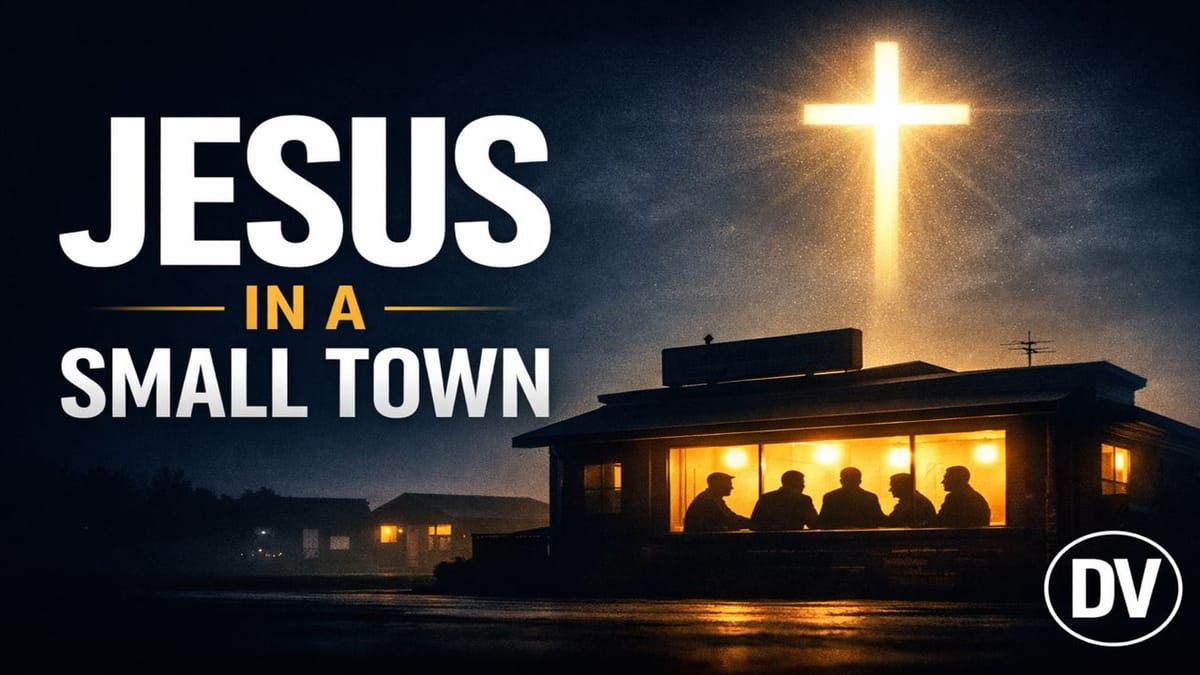
See a video of the full poem here: https://youtu.be/8VP7bp8l0ps
In a culture that rushes past ordinary places in search of extraordinary meaning, it is easy to miss how often God hides His lessons inside what looks small. We imagine revelation arriving with thunder, with angels, with unmistakable drama, and yet Scripture shows us again and again that the most important truths of heaven frequently appear in the most unremarkable corners of earth. A manger instead of a palace. A cross instead of a throne. A handful of fishermen instead of trained scholars. Even now, if we are paying attention, the story of Jesus continues to unfold not in headlines but in quiet towns, simple rooms, and unnoticed gatherings where lives intersect. This is why the image of four men sitting at the same diner booth in a forgotten town matters more than it first appears. It is not just a story about them. It is a parable about how Christ still gathers people from different roads and teaches them to speak one truth with their lives.
Small towns have a way of slowing the world down just enough for patterns to become visible. When there is only one diner, only one street with traffic lights, only one place where the morning coffee is poured before sunrise, the habits of people turn into rituals. Over time, ritual becomes witness. You begin to notice who always sits by the window. You notice who always arrives alone and who never does. You notice who talks too much and who never says enough. And in noticing, you begin to wonder why. That wondering is where meaning begins to form. It is no accident that Jesus often taught by drawing attention to everyday scenes. A man sowing seed. A woman sweeping her house. A shepherd counting sheep. The kingdom of God, He said, looks like these things. In the same way, the story of four men meeting every morning at a booth by the window becomes a kind of modern parable. It is not dramatic at first glance. It is not designed to impress. It simply is. And yet, like so many of Christ’s teachings, its power is revealed only when the layers are allowed to unfold.
Each of the four men carries a past that shaped him long before he ever shared a table with the others. One came from work with his hands, shaped by physical labor and hard lessons learned outdoors. One came from the world of words and reflection, trained to observe and record. One came from money and transactions, from the daily counting of worth in numbers. One came from skepticism and loss, trained by pain to believe only what could be proven. If we are honest, these four men represent most of the ways people still approach life today. There are those who trust strength and experience. There are those who trust insight and feeling. There are those who trust systems and security. There are those who trust evidence and logic. None of these are wrong in themselves. Each of them becomes dangerous only when they try to replace God instead of serving Him. Jesus never erased the personalities of the men He called. He redirected them. He took fishermen and made them fishers of men. He took a tax collector and made him a witness of grace. He took a doubter and turned his need for proof into a testimony of resurrection. What looks like difference in temperament becomes harmony in purpose when Christ stands at the center.
The genius of this kind of story is that it does not announce itself as religious. It does not open with sermons or scripture quotations. It opens with coffee and routine. That is precisely how Christ often works. He steps into the ordinary before He reveals the eternal. He speaks of bread before He speaks of Himself as the Bread of Life. He speaks of water before He offers living water. He speaks of light before He declares Himself the Light of the world. The diner booth becomes a modern altar not because anyone names it so, but because lives changed by Jesus gather there. Faith is not first seen in words. It is seen in patterns. It is seen in the fact that these men keep showing up. It is seen in the way they sit together despite having little in common on the surface. It is seen in the way their pasts no longer define their present behavior. This is the first lesson hidden in the scene: before the gospel is spoken, it is lived.
The man with the rough hands and the history of running from his failures mirrors something deeply biblical. There is always at least one disciple whose story is shaped by impulse and regret. He is the one who promised loyalty and then fled when fear came. He is the one who spoke boldly and then wept bitterly. Yet he is also the one who rose early to meet Jesus again. The detail that he watches the sunrise matters. Dawn in Scripture is often tied to renewal. Lamentations says that God’s mercies are new every morning. Resurrection happened at dawn. Light breaks into darkness at the same time each day without asking permission. The man who once ran now waits. The man who once denied now reflects. This is not self-improvement. It is transformation. His presence at the booth is itself a testimony that failure does not disqualify someone from walking with Christ. It prepares them to understand grace.
The quiet writer who returned home after seeing more of the world reflects another kind of disciple. He is the one who leaned close enough to hear the heartbeat of Jesus. He is the one who spoke of love not as theory but as lived truth. His decision to stay in a small town instead of chasing larger stages reflects a profound spiritual shift. The world teaches that meaning is found by leaving small places. Jesus teaches that meaning is found by remaining faithful wherever you are planted. The man who has seen love does not need novelty. He needs faithfulness. His writing is not about fame but about memory. He is preserving something that changed him. In this way, he becomes a picture of testimony. Testimony is not about impressing others. It is about refusing to forget what God has done.
The man who once counted money and now quietly pays for others is perhaps the clearest echo of gospel transformation. Nothing exposes the heart like how someone handles wealth. Jesus said that where your treasure is, there your heart will be also. A man who once used money to elevate himself now uses it to lift others. That is not social reform. That is repentance made visible. When grace reaches a person who was defined by greed, the proof appears in generosity. His story reminds us that Christ does not merely forgive sins. He reassigns purpose. What once served the self now serves the kingdom. The same skills remain, but their direction changes. This is what makes Christianity fundamentally different from moralism. Moralism says, “Try harder.” Jesus says, “Follow Me.” And following Him always leads away from the self and toward others.
The man who trusted only what he could measure reflects the disciple who needed to see wounds before he would believe resurrection. Doubt is not foreign to faith. It is often faith’s doorway. The difference lies in where doubt goes. When doubt is turned inward, it becomes cynicism. When doubt is brought to Christ, it becomes encounter. The man who lost something precious and then stopped believing in anything learned, eventually, that scars can be proof of love rather than its absence. Christ did not erase His wounds to convince Thomas. He showed them. This matters deeply for anyone who believes that faith requires pretending pain did not happen. Christianity does not deny wounds. It declares that wounds can become witnesses. The man who now brings blankets and tools instead of arguments is living out the truth that belief is not merely intellectual. It is practical. It moves hands and feet.
When the storm comes in the story, it serves the same function that crisis serves throughout Scripture. Crisis reveals what routine conceals. Until the blizzard, the men’s shared table is simply a habit. During the blizzard, it becomes preparation. All four contribute differently. One brings strength. One brings resources. One brings communication. One brings tools. No one alone is sufficient. Together, they become effective. This is the church in miniature. Not a building, not a program, but people whose different gifts converge in a moment of need. The woman and child in the ditch represent the world Christ came to save: vulnerable, stuck, unable to rescue itself. The men do not debate doctrine in the snow. They act. And afterward, when they are called heroes, they refuse the title. This is another mark of genuine discipleship. It does not crave recognition. It points elsewhere.
When they finally say the name of Jesus, it is not in the language of slogans. It is in the language of relationship. They speak His name the way someone speaks the name of a person who changed them. This is crucial. There is a difference between using Jesus as a concept and knowing Him as a presence. One can talk about Christ in abstract terms and never resemble Him. The apostles did not preach an idea. They bore witness to a person. That is why the town begins to understand something without a sermon. It sees coherence between what these men were and what they have become. Their unity is not ideological. It is relational. They are bound by having met the same Savior.
This is where the deeper moral of the story emerges. The world often tries to create unity by minimizing difference. Jesus creates unity by redeeming difference. The men do not become the same type of person. They become the same kind of follower. Their stories still do not rhyme, but they harmonize. This is the church as God intended it. Many members, one body. Many gifts, one Spirit. Many pasts, one redemption. When people see this kind of unity, they do not ask first about doctrine. They ask about source. Something must be holding this together. Something must be at the center.
The diner booth becomes a symbol of the cross. Four directions meet there. Four roads lead to it. And at the center is an invisible presence that shaped them all. The cross also stands at the intersection of divine love and human brokenness. It draws people from every direction and gives them a shared identity that does not erase their history but reinterprets it. The men’s pasts are not hidden. They are redeemed. Their failures are not erased. They are reframed. This is why their story teaches more powerfully than argument ever could. It shows what Jesus does rather than merely saying who He is.
If we listen carefully, we hear in this story the echo of the fourfold gospel. One voice emphasizing action and repentance. One voice emphasizing love and witness. One voice emphasizing grace and calling. One voice emphasizing belief born from encounter. Together they form a single narrative: Christ met us where we were and changed the direction of our lives. The diner is not Jerusalem. The storm is not Calvary. But the pattern is the same. God enters ordinary space and reveals eternal truth through transformed people.
There is also something deeply instructive about the timing of their meetings. Morning matters. Morning is when intentions are set. Morning is when habits are formed. Morning is when light returns. By gathering at dawn, these men are participating in a rhythm older than the town itself. Scripture repeatedly ties faithfulness to daily return. Give us this day our daily bread. His mercies are new every morning. Seek Him early. The booth is not sacred because of its furniture. It is sacred because of faithfulness. Day after day, they show up. That is where discipleship is formed. Not in dramatic moments alone, but in repeated obedience.
The moral of the story is not that small towns produce better Christians. It is that God uses small faithfulness to reveal large truth. Anyone who has ever thought their life was too ordinary to matter is confronted by this scene. Jesus did not choose His disciples because they were extraordinary. He chose them because they were willing. He did not place them in palaces. He placed them on roads. He did not give them thrones. He gave them a cross. And through that, He changed the world.
The modern temptation is to believe that faith must be broadcast to be real. Yet the story shows faith embodied before it is announced. The men’s actions during the storm preach louder than any words they could have spoken. This is precisely what Jesus meant when He said that others would know His followers by their love. Love is not abstract. It looks like chains on tires. It looks like blankets in cold weather. It looks like staying until help arrives. These acts do not save souls by themselves, but they open hearts to the one who does.
What makes this story endure is that it does not resolve in triumphalism. The town does not suddenly convert. The men do not become celebrities. They return to their booth. The pattern continues. This is how the kingdom grows. Quietly. Persistently. Faithfully. Seed by seed. The lesson is not that one dramatic rescue proves God. The lesson is that transformed lives consistently reveal Him.
There is also a warning embedded here. If four different lives can converge around Christ and become one testimony, then a community that claims His name but lives divided tells a contradictory story. Unity is not optional. It is evidence. When believers cannot sit at the same table because of pride, politics, or prejudice, the diner booth is empty of its witness. The gospel is not primarily proven by argument. It is proven by reconciliation.
The story also confronts the reader personally. Every person approaches the booth from a different road. Some come with hands calloused by work. Some come with notebooks full of questions. Some come with pockets once full of ill-gotten gain. Some come with hearts guarded by pain. Jesus calls all of them. Not to erase their road, but to redirect it. The question is not which man you resemble. The question is whether you have met the same Christ they did.
This is why the moral finally settles on who Jesus was rather than who they are. He is the one who called fishermen, tax collectors, skeptics, and lovers of truth into a single story. He is the one who took failure and made it foundation. He is the one who took doubt and made it declaration. He is the one who took greed and made it generosity. He is the one who took fear and made it faith. The booth is only meaningful because of Him. The storm is only meaningful because of Him. The unity is only possible because of Him.
In the end, the story teaches what the apostles themselves taught with their lives: that Jesus does not create clones. He creates witnesses. He does not flatten personality. He redeems it. He does not call people to escape the world. He sends them back into it changed. And when different lives point to the same Savior, the world begins to believe there must be something real at the center.
What looks like a poem about four men in a diner becomes a sermon about the incarnation. God still walks into ordinary places. God still meets people on their roads. God still turns tables into testimonies. The booth by the window becomes a reminder that Christ does not need stages. He needs surrendered lives. And surrendered lives, when gathered together, become a song no storm can silence.
The small-town diner becomes more than a setting. It becomes a mirror. It asks uncomfortable questions of modern faith communities. It asks whether we still believe that Jesus changes people or whether we have reduced Him to a symbol we decorate ourselves with while remaining largely the same. It asks whether unity is something we talk about or something we practice. It asks whether the gospel is still visible in our ordinary habits or only in our religious language.
In many ways, contemporary Christianity has drifted toward performance. Faith is often measured by how loudly it is expressed rather than how deeply it is lived. Yet the story of the four men insists on a different measurement. Their faith is seen in what they do when no one is watching and in how they respond when something goes wrong. The storm does not create their character. It reveals it. Long before the blizzard, they had already learned how to sit together, how to listen, how to carry one another’s burdens in small ways. Crisis simply magnifies what was already there. This is a sobering thought. If faith only appears when conditions are easy, it is not faith at all. It is convenience. Jesus never prepared His disciples for comfort. He prepared them for faithfulness.
The modern church often tries to attract people by promising improvement: better relationships, better habits, better lives. While those things may come, they are not the core of the gospel. The gospel is not about becoming better versions of ourselves. It is about becoming new creations in Christ. The men at the booth are not simply improved versions of who they were. They are redirected versions. Their old instincts have been retrained. Their old priorities have been reordered. This is what repentance looks like in motion. It is not a one-time apology. It is a long obedience in a new direction.
What is striking about the story is that no one ever sees the moment of their conversion. The narrative does not show them meeting Jesus. It shows the aftermath. This mirrors how the world usually encounters faith. Rarely does it see the private moment of surrender. It sees the public pattern of change. It sees people who once would not help now helping. It sees people who once isolated now gathering. It sees people who once hoarded now giving. This is why the church’s witness is inseparable from its behavior. Doctrine without transformation becomes noise. Transformation without Christ becomes confusion. But when doctrine and transformation align, they become testimony.
The story also challenges the assumption that faith must always be explained before it is trusted. In the diner, the men do not begin by telling their town about Jesus. They begin by becoming like Him. Only after their lives converge in love does the question arise: why are you like this? Only then does the name surface. This is profoundly biblical. Peter wrote that believers should always be ready to give an answer for the hope that is in them, but he did not say to force the answer before the question exists. Hope must be visible before it can be explained. The men’s unity and compassion provoke curiosity. Their words simply satisfy it.
There is a hidden critique here of religious tribalism. Each man represents a different type of person who might otherwise avoid the others. In many communities, they would form separate groups. The worker would not sit with the thinker. The businessman would not sit with the doubter. The skeptic would not sit with the believer. Yet Christ brings them into the same booth. This is not accidental. The gospel does not sort people by similarity. It gathers them by surrender. The church becomes strongest not when everyone thinks alike but when everyone submits to the same Lord. Diversity of personality is not a weakness. It is evidence that something greater than personality is holding the group together.
The diner booth thus becomes a living illustration of the body of Christ. Each man contributes differently, yet all are necessary. When the storm comes, no one role is sufficient. Strength without resources cannot rescue. Resources without communication cannot coordinate. Communication without tools cannot act. Tools without compassion cannot care. Only when all are present does rescue occur. This is the tragedy of isolated faith. Christianity was never meant to be practiced alone. From the beginning, Jesus gathered disciples, not admirers. He formed a community, not a fan base. The booth is a reminder that discipleship is relational by design.
The storm itself functions like the cross in miniature. It is the moment when love must cost something. Until then, faith is inexpensive. It costs time, perhaps, but not sacrifice. When the blizzard hits, faith requires risk. It requires inconvenience. It requires action. This is where many modern versions of belief falter. They remain safe and theoretical. The cross, however, is neither. It is the place where love absorbs suffering for the sake of others. The four men do not die for the woman and child, but they risk comfort and security. They enter cold and danger to pull someone else from a ditch. That is the shape of Christ’s love translated into ordinary life.
It is important that the rescued woman and child remain mostly anonymous in the story. They are not named because they represent anyone. They could be anyone. This reflects the indiscriminate nature of Christ’s compassion. He healed people without first asking for their résumés. He fed crowds without screening their theology. He touched lepers without calculating reputation. The men at the booth act in the same spirit. They do not rescue because the woman believes what they believe. They rescue because someone is in need. This is one of the clearest moral implications of the story: faith that only loves its own group has misunderstood Jesus.
Another layer of the story is its quiet resistance to spectacle. In an age that craves dramatic proof, the narrative insists on slow evidence. The men do not become famous. The diner does not become a pilgrimage site. The town does not explode with revival meetings. Life continues. And yet, something has changed. A question has entered the community. A name has been spoken differently. That is often how the kingdom advances. Not through fireworks, but through ferment. Not through shock, but through saturation. Jesus compared the kingdom to yeast in dough, not lightning in the sky. The booth becomes yeast. It works invisibly until its influence is felt.
The story also invites reflection on memory. Each man carries a memory of meeting Christ. Those memories are not described in detail, but they govern his present behavior. This is deeply biblical. Israel was constantly commanded to remember what God had done. Forgetting led to disobedience. Remembering led to faithfulness. The men remember not in words but in actions. They remember in generosity. They remember in patience. They remember in courage. Their lives become memorials. This challenges modern believers to ask what we are remembering and how. If our memory of Christ does not shape our conduct, it has become nostalgia rather than faith.
There is a profound theological truth embedded in the way the men refuse the title of heroes. Christianity does not deny the goodness of their action, but it denies ownership of it. They attribute what they did to what they learned from someone else. This reflects the apostolic pattern. When Peter healed the lame man, he said, “Why do you look at us as though by our own power we have made him walk?” He redirected glory. The diner men do the same. They do not deny their involvement. They deny their centrality. This is humility in practice. It is not self-hatred. It is accurate placement of credit.
The moral that emerges is not merely ethical. It is christological. It does not simply teach people to be kind. It teaches them that kindness flows from knowing Christ. Without Him, their unity would collapse into convenience. Their sacrifice would collapse into self-righteousness. Their compassion would collapse into burnout. Christ is the interpretive key. He is the reason their lives can point in the same direction. This keeps the story from becoming a generic moral tale. It remains specifically Christian because its source is specific.
The diner booth also becomes a quiet challenge to how people think about calling. None of the men abandon their jobs. The fisherman remains a mechanic. The writer remains a writer. The accountant remains an accountant. The skeptic remains a shop owner. Their calling is not to escape their roles but to inhabit them differently. This reflects the New Testament teaching that people are called where they are. The gospel does not require relocation. It requires reorientation. Jesus does not pull people out of the world. He sends them back into it changed. This dismantles the idea that only overtly religious work matters. Every vocation becomes sacred when lived in obedience.
The modern church often struggles to connect belief with behavior. It can articulate doctrine but hesitate at discipleship. The story bridges that gap by showing how belief becomes habit. The men’s daily meeting is not ritualistic in a hollow sense. It is formative. Over time, their shared table trains them to listen, to wait, to be present. These are spiritual disciplines disguised as routine. They resemble the early church, which devoted itself to fellowship and breaking of bread. A diner booth becomes an echo of an upper room. Ordinary space becomes holy ground when Christ shapes the people within it.
There is also a warning implicit in the story about isolation. Had any of the men stayed alone, the rescue would not have happened. Strength alone might have failed. Resources alone would have been useless. Tools alone would have been insufficient. Communication alone would have been powerless. It is only their togetherness that becomes effective. This confronts the modern myth of self-sufficiency. Christianity is not a solo project. The idea of a lone Christian hero is foreign to the New Testament. Even Paul traveled with companions. Even Jesus sent disciples out two by two. The booth testifies that salvation creates community.
Another layer emerges when we consider the timing of their rescue. It happens at night, in a storm, when help is unlikely. This reflects the gospel pattern that God’s work often appears when human systems fail. Roads are closed. Phones do not work. Darkness covers the scene. Yet help still arrives. This mirrors the incarnation itself. Christ came when the world was morally dark and politically oppressive. Light entered where it was least expected. The diner men become small reflections of that pattern. They are not the light. They carry it.
The moral, then, is not merely that Jesus inspires kindness. It is that Jesus creates a new way of being human. He teaches people to move toward danger rather than away from it when love requires. He teaches people to share rather than hoard. He teaches people to trust scars rather than hide from them. The story’s final lesson is that faith is not proven by what people claim but by what they carry. These men carry each other. They carry strangers. They carry the memory of Christ. In doing so, they carry the gospel into their town without a pulpit.
This is why the story resonates as a parable of who Jesus was. He was the one who sat at tables with unlikely companions. He was the one who crossed boundaries between fisherman and tax collector, between believer and doubter. He was the one who entered storms to reach those stuck in them. He was the one who refused glory for Himself and pointed always to the Father. He was the one who turned fear into faith and isolation into community. The four men do not replace Him. They reflect Him.
In the end, the booth by the window stands as a symbol of convergence. Roads meet there. Lives meet there. Stories meet there. And at the center, unseen but essential, is the presence of Christ who taught them how to live this way. The moral is not written on a sign because it is written on people. That is how Jesus intended His message to spread. Not first through books or buildings, but through bodies. Through lives that have been reoriented by love.
The final question for the reader is unavoidable. Where is your booth? Where do your roads converge with others? Who sits at your table? If Christ were shaping your habits as clearly as He shaped theirs, would anyone notice? The story is not meant to be admired. It is meant to be inhabited. It invites each person to imagine what would happen if different lives agreed on one truth and lived it together.
In a world fractured by fear and difference, the quiet witness of four men in a small-town diner teaches a lesson as old as the gospels and as fresh as tomorrow morning. Jesus still gathers people from different directions. He still makes them one without making them the same. He still turns ordinary places into signs of extraordinary grace. And He still teaches the world who He is by what His followers become.
Your friend,
Douglas Vandergraph
Watch Douglas Vandergraph’s inspiring faith-based videos on YouTube
Support the ministry by buying Douglas a coffee