Jesus in the Backrooms, Where the Light Hummed Like a Warning

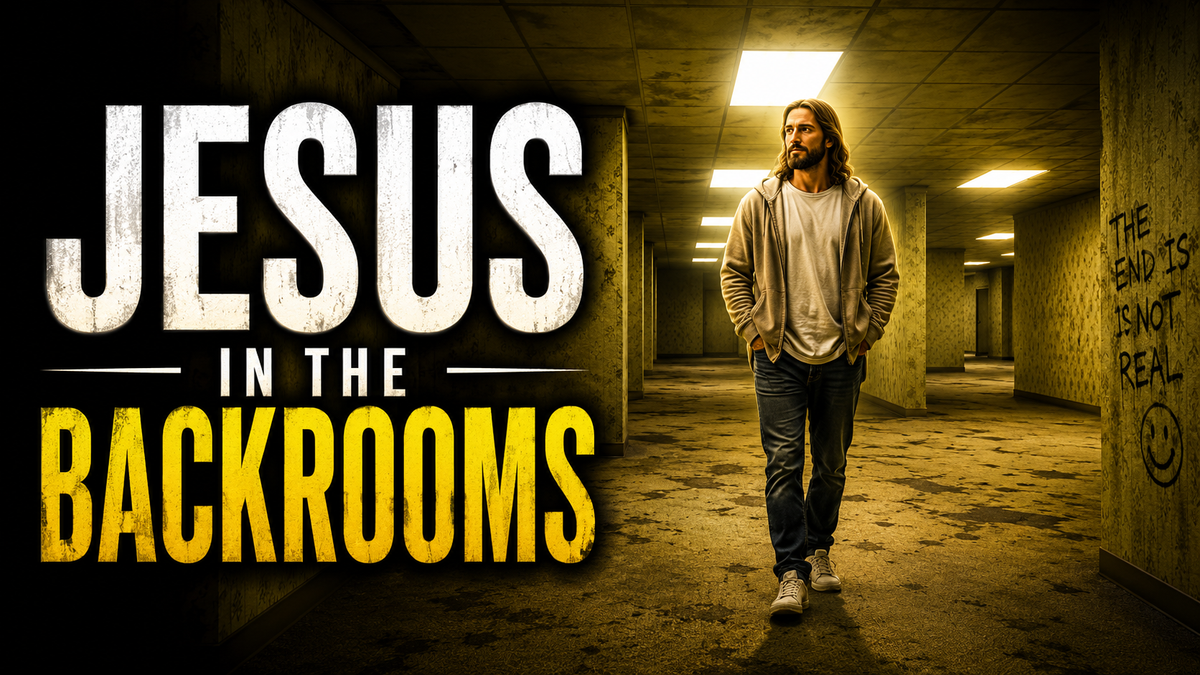
Chapter One: The Door That Should Not Have Been There
Jesus knelt on the damp carpet beneath the buzzing yellow lights, His hands resting open before the Father. The room around Him looked like an office that had been remembered wrong. Pale wallpaper stretched in every direction with no windows, no doors that made sense, and no sound except the steady hum overhead. His head was bowed, and His stillness did not belong to the place, because nothing in The Backrooms was still in a peaceful way. The place held its breath like a trap, but He prayed as though even here the Father heard every word.
A few walls away, behind a corner that seemed to have moved since she last looked, Mara Ellison pressed her back against the damp wallpaper and tried not to make a sound. Her phone had no signal, but the screen still glowed with the note she had written before everything changed. She had typed the words Jesus in The Backrooms as a joke beneath a strange video link a coworker had sent her, because she thought people online would turn anything into a story. Now she was standing inside the joke, barefoot in an endless yellow maze, with one shoe missing and the name of Jesus suddenly feeling less like content and more like a cry she was afraid to speak.
Mara had been working late inside a warehouse in Fort Worth, cleaning out a storage room nobody wanted to touch. The building had once been used for call-center overflow, and the old cubicles were stacked in pieces near the loading dock. She had taken the overtime because her younger brother Caleb had wrecked her car again, and she did not have the strength to fight with him one more night. While dragging a broken office chair toward the dumpster, she found a file folder wedged beneath a panel in the wall. Inside it was a printed article titled a quiet story about faith when familiar places turn strange, and she remembered laughing at the dramatic phrasing before the floor dipped under her feet like wet cardboard.
The fall had not felt like falling. It felt like being misplaced. One moment she stood under warehouse lights that flickered from age, and the next she was on her knees in wet carpet beneath different lights that buzzed with a cruel patience. She had called for help until her throat burned, but every echo sounded like someone else calling back in her voice. After the first hour, or what felt like one, she stopped shouting. The Backrooms did not answer people the way normal places did.
Her brother was the reason she had gone back to the warehouse after midnight, but that was only the simple version. Caleb had stolen from her purse twice, lied about it three times, and still called her when he needed a ride, money, food, or someone to clean up what he broke. Their mother had died two years earlier after making Mara promise not to give up on him. That promise had become a room inside Mara she could not leave. She hated him for needing her so much, then hated herself for hating him at all.
The room she now stood in looked like every office she had ever dreaded. It smelled like old carpet, warm dust, wet cardboard, and coffee that had been spilled years ago but never dried. The walls were the color of cheap butter, and every hallway turned too soon or too late. Some rooms had low ceilings that forced her to duck, while others stretched upward into shadow even though the fluorescent panels stayed at the same impossible height. She had tried marking the walls with a broken pen, but when she circled back, the marks had become thin dark lines that looked like someone had scratched them from the other side.
Mara held the file folder against her chest because it was the only thing from the real world that had fallen with her. The pages were damp now, and the ink had begun to smear. She did not know why she kept carrying it, except that letting it go felt like admitting she had no past left. The title on the first page had blurred, but a few words remained clear near the bottom. They said, “No place is empty if God sees it.”
She had read those words six times before she became angry enough to crumple the page. God had seen the hospital room where her mother died, and He had not stopped it. God had seen Caleb shaking on the bathroom floor, begging her not to call anyone, and He had not healed him. God had seen Mara sitting in the parking lot outside the warehouse at midnight, too tired to cry and too responsible to quit. If God saw everything, then being seen had not felt like rescue.
A sound came from the hallway to her left. It was soft, like a shoe shifting on wet carpet. Mara held her breath and gripped the broken pen in her fist, though she knew it would not help much. Earlier, she had heard something running beyond the walls, not near enough to see but close enough to know the place had other movement inside it. The sound had been too fast for a person and too uneven for an animal. Since then, every quiet step made her skin tighten.
“Who’s there?” she whispered.
No answer came. The lights hummed harder, or maybe she noticed them more because fear had sharpened everything. She turned to the right, then stopped, because the hallway there had not been there before. A long corridor stretched ahead with low yellow walls and an exit sign hanging at the far end. The sign was not lit. It swung gently though there was no wind.
Mara stared at it until her eyes watered. She knew enough from the videos Caleb watched to know that exit signs in The Backrooms were lies. He had gone through a phase of staying up all night with horror channels playing on his cracked laptop, filling the apartment with stories about noclipping through reality, levels that changed, and doors that fed on desperation. Mara had told him those videos were rotting his brain. He had told her she had no imagination left.
Now she wished she had listened closer.
A low scrape came from behind her. Mara turned and saw a shadow slide across the corner wall. It bent wrong, stretched too tall, then disappeared. Her body moved before her thoughts did. She ran toward the dark exit sign, one hand flat against the wall to keep from slipping on the damp carpet. The corridor seemed to lengthen as she ran, and the hum of the lights deepened until it felt like pressure in her teeth.
The file folder slipped from under her arm. Papers scattered across the floor behind her. For a moment she almost stopped, because the folder had become her proof that she had not imagined the world before this. Then something breathed from the hallway she had left. The breath was wet and eager. She kept running.
The exit sign was close now. Beneath it stood a door with peeling gray paint and a metal push bar. Mara shoved it hard. It opened without resistance, and cold air rolled across her face. She stumbled through and found herself in a break room.
The room was small, square, and lit by one flickering bulb. A vending machine stood against the wall, filled with snacks whose labels were turned backward. A microwave blinked 12:00 in green numbers. Three plastic chairs sat around a round table, and on the table lay a single brown paper lunch bag with her name written across it in her mother’s handwriting.
Mara froze.
Her chest tightened in a way fear alone could not explain. She had not seen that handwriting in two years. The M leaned too far left, and the last a in Mara curled upward the way it always had on birthday cards, grocery lists, rent envelopes, and little notes left on the refrigerator when her mother worked double shifts. Mara stepped closer, then stopped herself. The Backrooms knew things. That was worse than hunger, worse than darkness, worse than being hunted. It knew what a person missed.
She reached toward the bag, then pulled her hand back. Her mother used to pack lunches in brown bags when they could not afford anything else. Peanut butter, crackers, an apple if there was one, sometimes a folded napkin with a sentence written on it. You are stronger than today feels. Don’t forget to eat. I love you more than the hard parts. Back then, Mara had rolled her eyes at those notes. After the funeral, she would have given anything to find one more.
The bulb buzzed and dimmed. On the far wall, a dark stain spread across the wallpaper, though there had been no stain a moment ago. It grew slowly at first, then formed letters in a dripping black line.
You left him.
Mara’s face went cold. She looked at the lunch bag again. Her hand shook. “No,” she said, though the word barely came out. “I didn’t.”
The letters stretched wider.
You wanted to.
Her breath caught because that was true in the ugliest way. Not all the time, and not in the way the words accused her, but some nights she had dreamed of getting in the car and driving until her phone died. Some mornings she had stared at Caleb sleeping on the couch and wondered what her life would have been if he had not become her responsibility. She had never said it out loud. She had never written it down. Yet the wall had found it inside her.
The door behind her clicked shut.
Mara turned and ran to it. The push bar was gone. In its place was a smooth yellow surface, flat as skin. She slapped it with both hands. “Open,” she said. “Open!”
The microwave beeped.
She turned. The green numbers had changed from 12:00 to 2:17 a.m. That was the time her mother died. Mara remembered because the nurse had said it gently, as though numbers could be softened by tone. Two seventeen in the morning. A Tuesday. Rain tapping against the hospital window. Caleb nowhere to be found because he had been high in a friend’s garage and did not answer his phone until dawn.
The paper lunch bag crinkled.
Mara stepped back until her shoulders hit the wall. The top of the bag folded open by itself. Inside was not food. Inside was Caleb’s driver’s license, cracked across the middle. Beside it was the little silver cross their mother had worn around her neck. Mara had given it to Caleb after the funeral because he had cried so hard she thought it might help him hold on to something. Three weeks later, he pawned it.
She had never forgiven him.
The dark letters on the wall began to run downward. They spread like ink in water. You left him, they said again, but now the words were everywhere, across the wallpaper, across the table, across the vending machine glass. Mara covered her ears, but the words were not sound. They were memory pressing itself against her from inside the room.
Then another voice spoke behind her.
“Mara.”
She turned so fast she nearly fell.
Jesus stood near the corner where the vending machine had been. The machine was gone. He wore simple dark jeans, worn shoes, and a plain coat the color of sand after rain. Nothing about His clothing demanded attention, yet the whole room seemed to know He was there. His face was calm, but not distant. His eyes held grief without confusion, and Mara felt, with sudden terror, that He saw more than the walls had seen and somehow did not use it against her.
She backed away. “You’re not real.”
He did not move toward her. “I am.”
“That’s what this place does,” she said. “It copies things. It pulls from your head.”
Jesus looked at the spreading words on the wall. The black lines recoiled slightly, as though they did not like being seen by Him. “This place knows wounds,” He said. “It does not know truth.”
Mara let out a short, bitter laugh that sounded too close to crying. “There’s a difference?”
“Yes,” He said.
The single word settled into the room with more force than a shout. The bulb stopped flickering. The microwave went dark. The letters on the wall stopped moving, though they did not disappear. Mara watched Him, waiting for the trick to reveal itself. Every fake comfort she had known in life had rushed toward her, promised something, demanded something, or needed her to believe it quickly. He did none of that. He stood with patience that made room for her fear.
“You’re supposed to say it wasn’t my fault,” Mara said.
Jesus looked at her with a tenderness that did not flatter her. “Do you want Me to say what you are supposed to hear, or what is true?”
Her eyes stung. “I want out.”
“I know.”
“Then open the door.”
He looked toward the wall where the door had vanished. “The way out is not through lies.”
Mara swallowed hard. Her anger rose because anger was easier than being afraid. “I didn’t ask for a lesson. I asked for help.”
“And I have come to you,” He said.
The sentence struck her harder than she expected. She wanted to argue, but the room felt different now. Not safe exactly, because the place itself still seemed hostile, but less able to swallow her whole. Jesus turned His hand slightly, palm open, and the black words on the nearest wall pulled back as if wind had passed over them. Beneath them, the wallpaper was stained but clean enough to show its old pattern again.
Mara stared at His hand. “Can you destroy it?”
“Yes.”
“Then why don’t You?”
His gaze returned to her. “Because you are not only trapped in this room.”
She hated Him for that, just for a second. She hated that He had walked straight past the monster version of the problem and touched the hidden one. She was trapped in The Backrooms, and that should have been enough. Nobody should have expected her to deal with guilt, bitterness, grief, and her brother while the walls were breathing around her. Yet something in His voice made the truth difficult to dodge. The place had only given shape to a prison she had carried in normal rooms for years.
A sound came from beyond the wall. It was a long dragging scrape. The lights dimmed as though the whole building had inhaled. Mara looked at Jesus, then at the wall, then back at Him. “Something is out there.”
“Yes.”
“What is it?”
His face did not change. “Something that feeds on fear and wears familiar voices.”
Mara’s throat tightened. “There are things like that?”
“There are many things that speak without loving you,” He said.
The dragging sound came again, closer this time. The smooth yellow wall where the door had vanished began to ripple. A shape pushed against it from the other side. Long fingers pressed through the wallpaper without tearing it, stretching the surface like rubber. Mara stumbled backward into the table, and the paper bag fell to the floor. Caleb’s cracked license slid out and stopped at Jesus’ feet.
He looked down at it.
Mara felt exposed. “Don’t,” she said.
Jesus bent and picked up the license. The motion was ordinary, careful, almost gentle. He looked at the picture of Caleb, taken years earlier when his eyes were clearer and his smile still had some boyish pride in it. Mara remembered that day. He had passed his driving test on the second try, and their mother bought grocery-store cupcakes to celebrate. Caleb had eaten three before dinner and promised Mara he would give her rides anywhere she wanted once he saved for a car.
“He was not always as he is now,” Jesus said.
Mara’s mouth trembled. “You think I forgot that?”
“No.”
“You think I don’t remember him before all of this?”
“I know you remember,” He said. “That is part of why it hurts.”
The wall bulged again. A seam appeared where no door had been, thin and dark from ceiling to floor. Mara could hear breathing through it now, wet and impatient. Then came a voice from the other side.
“Mara?” it called.
Her blood went cold. It sounded like Caleb.
“Mara, open up,” the voice said. “Please. I messed up. I need you.”
She closed her eyes. “No.”
The voice grew softer. “I’m sorry. I’m really sorry this time.”
Jesus watched her, not the wall. “Listen carefully.”
“I know it’s not him,” she whispered.
“Do you?”
The question was not cruel. That made it worse. Mara opened her eyes. The seam in the wall widened. Darkness showed through, but it was not empty darkness. Something moved inside it, holding itself just beyond the gap. The voice came again, shaking now, full of the exact panic Caleb used when consequences finally caught up with him.
“Mara, please. Don’t leave me here.”
Mara covered her mouth. The old promise rose inside her like a chain. Don’t give up on him. Her mother’s voice. Caleb’s face. Hospital rain. Pawned silver. Stolen money. Broken apologies. Every version of love and exhaustion braided so tightly she could not tell one from the other anymore.
Jesus held Caleb’s license out to her. “Your brother is not this voice.”
She looked at the license but did not take it. “Then why does it sound like him?”
“Because your guilt opens doors your wisdom would keep shut.”
The words landed with painful clarity. Mara stared at Him, breathing hard. Outside the room, the thing with Caleb’s voice began to cry. It sounded young now, almost like the boy he had been before addiction had taken his face hostage. She had heard him cry that way once after their father left. He had been nine years old, sitting under the kitchen table with his knees to his chest, asking if Dad had left because he was bad.
“Mara,” the voice sobbed, “I’m scared.”
Mara reached toward the seam.
Jesus did not grab her. He did not shout. He only said her name once, and the sound of it held her still.
She looked at Him. “What am I supposed to do?”
“Tell the truth.”
“To a wall?”
“To the lie behind it.”
Mara shook her head. “I can’t.”
“You can,” He said.
The seam widened another inch. A hand came through, thin and gray, with fingers too long to belong to Caleb or anyone human. It trembled in the air, reaching for her. The voice kept crying. Mara felt the pull of it in her chest. Not love exactly. Not mercy. Something twisted that wore both as clothing.
Jesus stepped beside her but not in front of her. “Truth is not abandonment,” He said. “Mercy is not slavery.”
Mara’s tears spilled before she could stop them. She faced the gap in the wall. Her voice shook. “You’re not Caleb.”
The crying stopped.
The hand froze.
Mara’s knees nearly gave out, but Jesus was close enough that His presence steadied her without touching her. She forced herself to breathe. “You’re not my brother,” she said again. “And needing me is not the same as loving me.”
The gray hand snapped back through the seam. The voice changed. It dropped low and rough, then rose into a hundred small whispers that spoke over one another. The words were hard to catch, but she heard enough. Cruel sister. Bad daughter. Promise breaker. Alone. Alone. Alone.
Jesus lifted His eyes toward the seam. “Be silent.”
The room shook.
The whispers cut off at once.
The seam in the wall sealed itself from the floor up, not quickly, but with the reluctant movement of something forced to let go. When the last dark line disappeared, the yellow wall remained stained but whole. Mara stood frozen, tears on her cheeks, her hands curled at her sides. She expected relief to come rushing in, but what came instead was exhaustion. The kind that follows a fight you did not know you had been fighting for years.
Jesus gave Caleb’s license back to her. She took it this time.
“I don’t know how to save him,” she said.
“You were never his savior.”
The words were simple. They should have comforted her. Instead, they opened something raw because she had lived so long as if failing to save Caleb meant failing to love him. She looked at the cracked plastic in her hand. “My mom asked me not to give up on him.”
“She did not ask you to become God.”
Mara looked away. The lunch bag lay collapsed on the floor. The silver cross beside it was not real, not the true one Caleb had pawned, yet the sight of it still hurt. She crouched and picked it up. The metal felt cold. For a moment, she thought of Caleb alone somewhere in the real world, maybe drunk, maybe angry, maybe asleep, maybe searching for her now that she had vanished from the warehouse. The thought pierced her, but it did not command her the way it had before.
“How do I love him without being destroyed?” she asked.
Jesus crouched across from her so that she did not have to look up at Him from the floor. “With truth. With prayer. With boundaries that do not hate him. With mercy that does not lie for him. With a heart that stays open to the Father before it opens every door.”
Mara wiped her face with the sleeve of her hoodie. “That sounds impossible.”
“It is impossible without Me.”
She looked at Him then. His face held no impatience. He had not minimized Caleb’s suffering, and He had not minimized hers. Somehow, that made her trust Him more than comfort would have. The Backrooms had taken her worst fear and pretended it was the whole truth. Jesus had looked at the same fear and separated it from the lies around it.
The break room began to change. The vending machine reappeared, but the snacks inside were gone. The table faded. The lunch bag dissolved into dust. The microwave clock flashed once, showing 2:18 now, one minute past the hour that had held her grief in place for two years. Then it went dark.
A door appeared in the far wall.
This one was not gray or marked by an exit sign. It was an ordinary wooden door, the kind found in older houses, with a brass knob worn smooth by use. Warm light showed beneath it. Mara rose slowly. Her body felt heavy, and the carpet pulled at her bare foot with every step.
“Is that the way out?” she asked.
Jesus stood beside her. “It is the way forward.”
“That’s not the same thing.”
“No,” He said. “But it is the way I am giving you now.”
She almost smiled because the answer was frustrating in a way that felt real. She looked back at the sealed wall. No voice came from behind it. The silence there was not peaceful, but it no longer owned the room.
Mara reached for the brass knob, then stopped. “Will Caleb be okay?”
Jesus did not answer quickly. That silence told her He would not give her a false promise just to calm her. She appreciated it and hated it at the same time.
“He is seen,” Jesus said. “He is called. He is not beyond My reach.”
“But he can still refuse You.”
“Yes.”
Mara closed her eyes. More tears came, quieter now. “I hate that.”
“I know.”
“I want You to make him choose right.”
Jesus’ voice softened. “So do I.”
She opened her eyes and found no cold doctrine in His face, no distant explanation of freedom or suffering. There was sorrow there, deep and holy, and it made her understand that God’s patience was not indifference. The room seemed smaller now, not because the walls had moved inward, but because the lies had lost some of their size.
Mara turned the knob.
The door opened into a hallway that should not have fit behind the wall. It was narrower than the others, with yellow wallpaper fading into a sickly cream. The hum of the lights was softer there, though still present. At the far end, another corner waited. Nothing about it promised safety.
Jesus stepped through first.
Mara followed, clutching the cracked license and the false silver cross. Behind her, the break room door closed with a soft click. When she looked back, there was only wallpaper. No door. No table. No lunch bag. No written accusation. She stood in the new hallway with Jesus ahead of her and realized the place had not released her. It had only lost one claim.
They walked without speaking for a while. The carpet changed underfoot, becoming drier and rougher, almost like old office carpet tiles. The walls were still yellow, but the pattern shifted from room to room. Sometimes the wallpaper had tiny flowers. Sometimes it had thin vertical lines. Once, for several steps, it carried the faint outline of children’s handprints, small and dark, as though an entire preschool class had pressed paint-covered palms against the wall and then vanished.
Mara tried not to look too closely. “How big is this place?”
Jesus looked ahead. “Bigger than fear needs it to be.”
“That’s not a number.”
“No.”
She gave a tired breath. “You do that a lot?”
“What?”
“Answer in ways that make me think instead of giving me what I asked for.”
He glanced at her, and there was something almost like warmth in His eyes. “You asked for the size of a prison. I answered with the nature of it.”
Mara wanted to be annoyed, but the words stayed with her. The Backrooms did feel bigger when she panicked. Every hallway multiplied under fear. Every corner became a threat because her mind filled it before she reached it. She wondered how many rooms in her ordinary life had done the same thing. The apartment after Caleb slammed a door. The hospital waiting room. The warehouse storage closet. Spaces became endless when dread was in charge.
They turned the corner and came upon a row of office doors. Each door had a frosted window with a name printed in black letters. Mara slowed when she recognized the first name. Howard Ellison. Her father. The second door read Denise Ellison. Her mother. The third read Caleb Ellison. The fourth read Mara Ellison.
She stopped walking.
Jesus stopped too.
The hallway stretched ahead with more doors than her family had names. Some letters were blurred. Some windows were cracked. Behind one door, a phone rang and rang without being answered. Behind another, a man laughed in a way that made Mara feel eight years old again.
“I don’t want this hallway,” she said.
“I know.”
“Can we take another one?”
Jesus looked at the doors. “This is where the way forward has opened.”
Mara stared at her own name. The black letters looked freshly printed. Her reflection showed faintly in the frosted glass, distorted by the texture. She looked older in it, then younger, then almost like her mother. She stepped back.
“I already faced something,” she said. “Isn’t that enough for one day?”
His face remained gentle. “It was not nothing.”
“That isn’t what I asked.”
“No,” He said. “It is not enough to face a lie if you still belong to the wound that made it powerful.”
Mara turned away from the door. “I don’t belong to it.”
Jesus waited.
The phone behind one of the doors kept ringing. Mara knew that sound. Their old apartment landline had rung like that when she was a teenager, before everyone had cell phones and before silence became easier than answering. Her father would call after he left, usually when he was drunk or lonely, and her mother would stand in the kitchen staring at the phone. Sometimes she answered. Sometimes she let it ring until Caleb cried.
“I was a kid,” Mara said.
“Yes.”
“I couldn’t fix that either.”
“No.”
Her jaw tightened. “Then why does every broken thing feel like it became mine?”
Jesus looked at her for a long moment. “Because children often make vows in rooms where adults fail them.”
The phone stopped ringing.
Mara felt the hallway tilt, though nothing moved. She remembered standing outside Caleb’s bedroom door while he cried under the blankets after their father left for good. She remembered placing her hand on the door and whispering, “I won’t leave you.” She had meant it as love. She had not known a child could turn a promise into a chain strong enough to follow her into adulthood.
The door with her name clicked open.
Mara did not move.
Inside was darkness, but not the hunting kind. This darkness was quiet, personal. It smelled faintly like old laundry, cheap shampoo, and the lavender candle her mother used to light when the apartment smelled like fried food and stress. Mara could hear a girl breathing inside. Not crying. Trying not to cry.
Jesus stepped toward the door, then stopped and looked back at her. “I will not force you.”
Mara laughed under her breath, but there was no humor in it. “This place will.”
“This place opens wounds to consume you,” He said. “I open truth to free you.”
She stood in the hallway for several breaths. The door waited. Jesus waited. The hum overhead continued, steady and cold. Somewhere far away, something screamed, but the sound faded quickly, swallowed by the walls.
Mara looked down at Caleb’s license in her hand. The crack ran through his photograph, splitting one eye from the other. She thought about how many times she had mistaken panic for responsibility. She thought about how many rooms she had entered because guilt pushed her through the door. Then she looked at Jesus, who had come into the worst room without being trapped by it.
“What happens if I don’t go in?” she asked.
“Then the hallway remains longer than it needs to be.”
That answer frightened her because it sounded like her life. She had spent years avoiding certain memories, only to find them waiting in every argument, every emergency call, every quiet night when Caleb did not come home. The rooms did not vanish because she refused to enter them. They simply moved.
Mara stepped toward the open door.
Inside, the darkness shifted, and a small bedroom appeared. It was not exact, but close enough to hurt. Two twin mattresses on metal frames. A dresser with one missing drawer. A poster Caleb had loved as a kid hanging crooked on the wall. Rain tapping a window that could not exist in The Backrooms.
On the floor sat a younger version of Mara, maybe fourteen, knees drawn to her chest, listening to Caleb cry behind the closet door. Young Mara’s hair was unbrushed, and her face had the hard, watchful look of a child who had learned to read adult moods too early. She held a kitchen knife in both hands, not because she meant to hurt anyone, but because their father had shouted that night before leaving and she did not know if he would come back.
Adult Mara stood in the doorway, unable to breathe.
Jesus stood beside her, His presence filling the threshold with quiet mercy. He did not speak. He did not need to. The room itself spoke. Not in words, but in the old pressure of a child deciding she would become strong enough to keep everyone safe.
Young Mara looked up.
For a terrible moment, adult Mara thought the girl would accuse her. Instead, the girl looked relieved. “Did we do it?” she asked.
Adult Mara’s mouth opened, but no answer came.
“Did we keep him safe?” the girl asked. Her voice was small, and that smallness undid Mara more than any accusation could have.
Mara sank to her knees in the doorway. “I tried.”
Young Mara stared at her. “That means no.”
Mara pressed a hand over her mouth. The room blurred through tears. She had no defense for the girl. No speech about addiction. No explanation about adulthood. No way to tell a frightened child that love could be real and still not powerful enough to control another human soul.
Jesus entered the room slowly and knelt near young Mara, leaving space between them. The girl looked at Him with suspicion, but not fear.
“Who are You?” she asked.
“I am Jesus.”
Young Mara frowned. “Mom prays to You.”
“Yes.”
“She still cries.”
“I know.”
“Then You didn’t make it stop.”
“No,” He said softly. “Not yet.”
Adult Mara flinched, expecting the answer to crush the girl. But young Mara only looked at Him harder, as if honest sorrow was safer than a bright lie.
“Why?” the girl asked.
Jesus’ face held the weight of the question. “There are wounds in this world that come from sin, from broken choices, from evil, and from hearts that turn away from love. I do not call those wounds good. I do not pretend they do not hurt. I came into the world to carry what you could never carry and to bring My Father’s kingdom where pain has tried to rule.”
Young Mara looked down at the knife in her hands. “That doesn’t fix tonight.”
“No,” He said. “But I am here tonight.”
The girl’s chin trembled.
Adult Mara wept silently because she had never known how badly she needed that sentence. Not an explanation big enough to solve every grief. Not a promise that no one would suffer. Just the presence of One who had not been absent from the room she thought she survived alone.
Jesus held out His hand, palm up. “You do not need to hold that anymore.”
Young Mara looked at the knife. Her grip tightened. “If I don’t, who will keep us safe?”
“I will be with you.”
“Will Dad come back?”
Jesus did not answer with what the girl wanted. “Not tonight.”
“Will Caleb stop crying?”
“He will sleep soon.”
“Will Mom be okay?”
“She will be held.”
Young Mara looked angry then. “That’s not enough.”
Jesus’ eyes filled with compassion. “It is not all that will be given. But it is enough for this moment.”
The girl looked at adult Mara. “Do you believe Him?”
Mara could barely speak. “I want to.”
“That’s not yes.”
“No,” Mara said, wiping her face. “It’s not.”
Jesus looked at her then. “Faith often begins where the honest answer is small.”
Young Mara watched Him, still holding the knife. The rain at the impossible window softened. In the closet, Caleb’s crying faded into sleep. The room seemed to breathe with less strain.
Adult Mara crawled forward and sat across from the girl she used to be. “You’re not bad because you couldn’t fix this,” she said.
Young Mara’s eyes filled. “Then why does it feel like I failed?”
“Because nobody told us it wasn’t our job.”
The girl looked at Jesus. “Was it?”
“No,” He said.
The knife slipped slightly in her hands. “Then what was my job?”
“To be a child,” He said. “To be loved. To call for help. To learn that love does not require you to become the keeper of every broken person around you.”
Young Mara’s face tightened as she fought tears. “I don’t know how.”
Jesus moved His hand a little closer but still did not take the knife. “Then let Me begin with what is in your hands.”
For a long moment, the girl did not move. Adult Mara held her breath. The whole room seemed to wait, and beyond the bedroom walls, The Backrooms hummed with discontent, as though this small act mattered more than it wanted to admit. At last, young Mara placed the knife in Jesus’ open hand.
The blade rusted instantly, then turned to dust.
The bedroom light warmed. Not brightly. Just enough to change the shadows. Young Mara stared at her empty hands with wonder and fear. Adult Mara felt something inside her loosen, not completely, but enough to notice. A vow made in fear had lost its first layer.
The room began to fade.
Young Mara looked suddenly afraid. “Don’t leave me.”
Adult Mara reached for her. “I’m here.”
Jesus looked at both of them. “I have always been here.”
The younger girl dissolved into light, not dramatic or blinding, but quiet like dawn under a closed door. The bedroom faded with her. The rain stopped. The twin beds, the dresser, the crooked poster, and the impossible window thinned into yellow walls and damp carpet.
Mara found herself back in the hallway of doors, kneeling on the floor. The door with her name stood closed now. The black letters on the frosted glass had changed. They no longer said Mara Ellison. They said Daughter.
She stared at the word until her breathing slowed.
Jesus stood near her. “Can you walk?”
Mara nodded, though she was not sure. He offered His hand. She took it, and He helped her stand. His hand was warm and steady. Not gripping, not pulling. Just enough.
The hallway ahead was shorter now. The doors with her father’s, mother’s, and brother’s names remained, but they looked different. Less like traps. More like rooms that could be faced when the time came. Mara did not feel ready for them, but readiness had stopped seeming like the requirement. Maybe willingness was the first step. Maybe walking with Him was the second.
At the end of the hall, the lights flickered twice.
Something moved beyond the last door. Not the gray hand. Not Caleb’s voice. This was heavier. The entire hallway seemed to lean away from it. A low sound rolled through the walls, almost like a train passing underground, though there were no tracks here and no earth above them.
Mara looked at Jesus. “That’s not another memory, is it?”
“No.”
“What is it?”
His gaze remained fixed on the far door. “A keeper of this place.”
The words made the air colder. Mara’s grip tightened around Caleb’s license and the false cross. “Does it know we’re here?”
Jesus turned toward her, and His calm did not deny the danger. “Yes.”
The far door opened by itself.
Beyond it was not another yellow room. Beyond it was a vast office floor stretching into darkness, filled with thousands of empty desks arranged in perfect rows. Every desk held a ringing telephone. Every phone rang with the same old sound from Mara’s childhood, sharp and endless. Above the desks, hanging from the ceiling by wires that disappeared into shadow, were hundreds of exit signs. None of them pointed the same direction.
Mara took one step back.
Jesus took one step forward.
The phones stopped ringing all at once. The silence that followed was so complete that Mara heard her own heartbeat. Then, from somewhere deep among the desks, Caleb’s real voice spoke through one telephone and said her name.
Chapter Two: The Phones That Learned Her Name
Mara stood at the edge of the vast office floor and listened as Caleb’s voice came from one telephone among thousands. It did not echo through the room like the false voice behind the wall had done. It came thin and broken through a single receiver lying crooked on a desk near the middle aisle, and that made it worse because it sounded limited, human, and afraid. The voice said her name once more, then cut into static as every exit sign above the desks swung gently in a wind she could not feel.
Jesus did not reach for the phone. He stood beside Mara with His eyes fixed on the rows ahead, His face calm in a way that did not make the danger smaller. The empty office stretched so far into shadow that the back wall could not be seen. Desks sat in perfect lines, each one holding a gray telephone, a dried coffee ring, and a stack of blank intake forms. The forms were headed with one sentence printed in small black letters: Reason for calling.
Mara looked at the nearest form and felt her stomach tighten. The paper was blank beneath the heading, but as she watched, words began to appear in dark ink. Need money. Need a ride. Need you to lie. Need you to answer. Need you to open the door. She blinked, and the words vanished, leaving the page clean again.
“Don’t read them,” Jesus said.
Mara looked at Him. “They’re writing by themselves.”
“They are writing from places you have already been.”
The phone in the middle aisle crackled again. Caleb’s voice came through, quieter now. “Mara, I don’t know where I am.”
Her hand moved before she meant it to. Jesus did not stop her, but His voice came low and steady. “Walk with Me first.”
“That’s him,” she said.
“Yes.”
She turned toward Him, startled. “You said yes.”
“I did.”
“Then why are we standing here?”
“Because the truth can still be used by a liar.”
Mara looked back at the phone. The office floor seemed to stretch farther every time Caleb spoke. A person could spend a lifetime walking toward the one call that sounded most urgent and never notice what the room was doing with the path. She knew that feeling too well. Caleb’s emergencies had a way of changing the size of her world. They made everything else disappear until only his need remained.
Another phone rang to her left.
Mara flinched. Then another rang on the right, then three more deeper in the room. Soon a dozen phones rang at once, not all with the same tone. Some sounded like old landlines. Some sounded like the cell phone she used now. One sounded like the hospital phone from the nurses’ station. Another had the bright electronic chirp of the cheap prepaid phone Caleb used whenever he lost the last one.
She pressed her hands over her ears. “Make it stop.”
Jesus stepped forward into the first aisle. “Stay near Me.”
Mara followed Him because the doorway behind her had already become wall. The carpet changed beneath her feet as soon as she crossed into the office floor. It was no longer damp yellow carpet. It was gray and rough, with the same small square pattern she remembered from insurance offices, job centers, bank lobbies, and the kind of places where people sat with documents in their hands while waiting to be told whether they qualified for help. The air smelled like toner, dust, old coffee, and overheated wires.
The phones kept ringing.
Jesus walked slowly, not because He was uncertain, but because He refused to be hurried by the room. Mara stayed close enough to feel the steadiness of Him in the air around her. She wanted to run straight to Caleb’s voice, but every row looked the same, and the exit signs above them contradicted one another. Some pointed left. Some pointed right. Some pointed downward at the floor. One pointed straight back at her own chest.
A phone rang on the desk beside her. Mara glanced at it and saw her apartment number written on a sticky note beneath the receiver. The number was wrong by one digit, but her mind corrected it before she could stop herself. The screen on the phone lit up with the word HOME, though it was too old to have caller ID.
“Mara?” Caleb’s voice came from that phone too.
She froze.
The voice from the middle aisle spoke again at the same time, weaker and farther away. “Mara, please.”
Then a third phone rang behind her. Caleb again. Then another. Soon his voice came from all over the room, each version slightly different. One was angry. One was crying. One was drunk. One was calm in a way that made her think he was trying to sound sober. One was young, no more than ten years old, asking if she could sleep on the floor beside him because the apartment felt scary after their father left.
Mara turned in a slow circle, overwhelmed by the sound. “How am I supposed to know which one is real?”
Jesus stopped near a desk with a cracked glass top. “By learning what love sounds like when it is not ruled by fear.”
She almost snapped at Him, because she wanted something simpler than that. She wanted Him to point to the right phone. She wanted Him to lift His hand and silence the rest. Yet she also knew the question had followed her long before this room. She had answered a thousand false calls because they sounded close enough to love. She had mistaken guilt for kindness, panic for duty, and surrender to pressure for faithfulness.
A telephone two desks away stopped ringing and began to play an old voicemail. It was Caleb’s voice from months earlier, slurred and defensive. “I didn’t take it, Mara. I swear. I don’t know why you always think the worst of me.” The next phone picked up where the first ended. “You’re just like Dad, you know that? You leave when people need you.” The next phone spoke in her mother’s voice. “Promise me you’ll look after your brother.” The next used Mara’s own voice, tired and shaking. “I can’t do this anymore.”
Mara bent over and covered her ears harder. The voices still reached her. They seemed to come through the carpet, through the desks, through her teeth. Jesus turned and faced the room, and when He spoke, His voice was not loud, but every telephone grew quiet enough to hear Him.
“No voice that uses love to enslave you speaks for My Father.”
The words did not erase the pain. They made a line through it. Mara straightened slowly. Several phones still rang, but the sound had lost some of its power. She looked at Jesus, then at the nearest desk. Its intake form now had her name typed across the top. Under Reason for calling, words appeared one by one: Because if I do not answer, something terrible will happen.
Mara stared at the sentence. “That’s always what it feels like.”
“I know.”
“And sometimes something terrible does happen.”
Jesus did not soften the truth into something easier. “Yes.”
Her throat tightened. “Then what?”
“Then you grieve what happened without calling yourself God.”
Mara looked away. She wanted to reject the sentence because it made her feel small, but the smallness was different from shame. It was a boundary, not an insult. She had lived as if love required her to be present for every crisis, capable of stopping every collapse, and responsible for whatever happened when she failed. The office around her had been built from that belief. Each desk was another demand. Each phone was another emergency pretending to be a commandment.
They moved deeper into the rows.
The phones began ringing less often, but the room changed with every step. The desks nearest the entrance had been blank and gray. Now they carried objects from Mara’s life. A cracked phone charger. A hospital bracelet with her mother’s name on it. A pawn shop receipt. A grocery card. A photograph of Caleb at seventeen, standing beside a used car with one hand on the hood and a grin too big for the moment. Mara slowed when she saw the photograph. She remembered taking it. She remembered Caleb saying, “First thing I’m doing is getting you out of the house for a day.” He had meant it then. That was the part that hurt. He had meant many things before he broke them.
A phone beside the photograph rang.
Mara looked at Jesus. He did not tell her no. He only watched her with a patience that made her choice feel real. She reached for the receiver and lifted it slowly.
At first there was only static. Then breathing.
“Caleb?” she said.
The breathing hitched. “Mara?”
Her eyes closed. It was him. Not a perfect certainty, not proof she could explain, but something in his voice carried a present fear the room had not been able to fake. It was not shaped to pull her. It was lost.
“I’m here,” she said.
“I’m in the warehouse,” he said. “I came looking for you. Your boss called because your car was still outside and you weren’t answering. I thought you were mad at me.”
Mara gripped the receiver so hard her fingers hurt. “Listen to me. Don’t go into the storage room.”
“I already did.”
The office lights flickered. Jesus’ gaze shifted toward the dark end of the room.
Mara’s voice sharpened. “Caleb, get out of there.”
“I can’t.” His breathing quickened. “There’s no door now. I turned around and the door was gone. It looks like an office, but it’s not the warehouse. Everything’s yellow. It smells wrong.”
Mara pressed her eyes shut. The room seemed to tilt around her. “No. No, no, no.”
“Mara, what is this?”
She looked at Jesus, panic rising fast. “He’s here.”
Jesus nodded once. “Not in this room. Not yet.”
“What does that mean?”
The line crackled, and Caleb spoke over the static. “Who are you talking to?”
Mara swallowed. “Jesus is with me.”
There was a pause. “That’s not funny.”
“I’m not joking.”
“Mara, I’m scared.” He sounded younger then, and the sound pulled hard at every old vow in her. “I don’t know what I did. I was just trying to find you.”
She looked at Jesus, silently pleading for what to say. His face was grave and merciful.
“Tell him to be still,” Jesus said.
Mara spoke into the receiver. “Caleb, listen to me. Don’t run. Don’t follow voices. Don’t open anything that looks like a way out just because you want it to be. Stay where you are if it’s quiet.”
“It’s not quiet.”
“What do you hear?”
He breathed hard into the phone. “Mom.”
Mara’s knees weakened. Jesus moved closer, not touching her, but near enough that she could stand. The phones around them began to ring again, softly at first, like the room was listening.
Caleb’s voice broke. “I hear Mom calling from down the hall.”
Mara looked at the photograph on the desk. Caleb at seventeen. Caleb before the worst. Caleb still making promises. She wanted to scream at him, to beg him, to command him as if volume could become protection. Instead she forced herself to speak slowly.
“That is not Mom.”
“You don’t know that.”
“I do.”
“How?”
“Because she is not trapped here,” Mara said, and the words surprised her as they came out. She had not known she believed them until she said them. “She is with God. Whatever is calling you is using what hurts.”
Silence came through the line. Then Caleb whispered, “She sounds sad.”
Mara closed her eyes. She could see him in her mind, standing in some yellow hallway, shaking, alone, wanting so badly to hear their mother one more time that the lie barely had to work. “I know.”
“She’s saying she forgives me.”
Mara’s voice trembled. “Caleb, I need you to hear me. Mom loved you. I believe she wanted mercy for you. But that voice is not her.”
“She says she wants her cross back.”
Mara looked at the false silver cross in her hand. It had grown colder. The metal seemed to pulse faintly, as though it could hear the conversation. Jesus looked at it too, and Mara saw something in His face that made her want to drop it.
“Set the cross down,” He said.
Mara looked at Him. “This one?”
“Yes.”
She crouched and laid the false cross on the desk beside the photograph. The moment it left her hand, several phones screamed with feedback. Mara stumbled back, and the cross twisted on the desk like a living insect pinned under invisible glass. Jesus reached toward it, and the metal blackened before His fingers touched it. It broke into ash, leaving a small burn mark on the photograph of Caleb. His face remained untouched.
The line cleared.
“Mara?” Caleb said. “The voice stopped.”
Mara exhaled shakily. “Good. Stay still.”
“I see a light.”
“No. Don’t move yet.”
“It’s at the end of the hall.”
Jesus lifted His head. The office went silent again, every phone watching without eyes. Far beyond the desks, where the darkness swallowed the rows, something huge shifted. Mara could not see it clearly. She saw only the suggestion of a shape, tall enough to brush the ceiling, thin enough to move between aisles without touching the desks. Above it, the exit signs swung harder.
“Caleb,” she said. “Do not go toward the light.”
He gave a small, bitter laugh that sounded like old Caleb for half a second. “That’s the opposite of every movie.”
“Please.”
The line crackled. “I’m tired of dark hallways.”
“I know.”
“You don’t know,” he said, and the old anger slipped into his fear. “You always think you know, but you don’t. You stand there with your clean little rules like I wanted any of this.”
Mara closed her eyes. The words hit familiar places. The room seemed to lean closer, waiting to see whether she would fall back into the old pattern. Defend. Apologize. Fix. Promise. Pay. Rescue. Carry. Jesus said nothing. He simply remained beside her.
“I don’t know what it’s like inside you,” Mara said. “You’re right.”
Caleb went quiet.
“I know what it’s been like beside you,” she continued. “I know I love you. I know I’ve been angry. I know I can’t save you by letting you pull me into every dark place you enter.”
His breathing shook through the receiver. “So you’re leaving me.”
“No,” she said, and this time the word had strength without panic. “I’m telling you the truth from where I am. Stay still. Don’t follow Mom’s voice. Don’t follow the light. Don’t answer any phone unless it rings twice and stops once before ringing again.”
She did not know why she said that last part until she looked at Jesus. He had lifted two fingers slightly, then lowered one. She had followed without understanding. Caleb breathed hard, but he did not argue.
“What if something comes?” he asked.
“Then say the name of Jesus.”
The line hissed.
Caleb did not answer.
“Caleb?”
“I don’t know if I believe in Him.”
Mara looked at Jesus. His face did not change. He did not seem offended by Caleb’s fear or disbelief. He seemed near to it.
“Say His name anyway,” Mara said. “He believes in finding you.”
The line went silent.
For one terrible second, Mara thought he was gone. Then Caleb whispered, “Okay.”
The phone clicked dead.
Mara kept holding the receiver to her ear long after the line ended. She could hear only emptiness now. Not static. Not breathing. Just the hollow quiet of a call that had been cut. Slowly, she placed the receiver back on the cradle. Her hand would not stop shaking.
The dark shape at the far end of the office moved.
Every exit sign turned at once, all of them pointing toward it.
Mara stepped back from the desk. “Is that the keeper?”
“Yes.”
“What does it keep?”
Jesus’ eyes stayed on the far darkness. “Doors that fear opens.”
The phrase settled over the room. Mara looked at the thousands of desks and understood with sudden dread that this was not only a place where people got lost. It was a place that learned how people entered. A guilty person opened one kind of door. A lonely person opened another. A desperate person opened many. She wondered how many people had answered the wrong phone and spent the rest of their lives walking toward voices that sounded like what they loved.
The keeper came closer.
It did not run. It moved with slow confidence, as though the room belonged to it. As it entered the weaker light, Mara saw that it was not one creature in a simple way. Its body was made of office things bent into something alive. Long limbs like cords and chair legs. A narrow torso layered with file folders, name badges, old keys, and pieces of yellow wallpaper. Where its face should have been, there was a dark square like an unplugged monitor. Across that darkness, pale words appeared and vanished.
Reason for calling.
Mara’s breath caught. “That’s horrible.”
Jesus looked at the keeper with sorrow rather than surprise. “It is a hunger wearing order.”
The keeper stopped three aisles away. All the phones near it lifted from their cradles without hands. Receivers dangled by curled cords, swinging gently. Voices poured from them in a low chorus.
Mara. Answer. Mara. Responsible party. Mara. Emergency contact. Mara. Next of kin. Mara. Account holder. Mara. Authorized signer. Mara. Only one available. Mara. Reason for calling.
She stepped back until her shoulder brushed Jesus’ arm. The labels struck her with cruel precision. Responsible party. Emergency contact. Next of kin. Words that sounded official enough to hide the weight placed beneath them. She had signed forms, answered calls, picked up prescriptions, paid fees, explained situations, made excuses, and sat across from tired people behind desks who looked at her as though Caleb’s collapse was a case number she should manage better.
The keeper lifted one long arm. A file folder opened in its hand, though Mara had not seen it pick one up. Pages fluttered inside. Her name was printed on every one.
The voice that came from the keeper was not Caleb’s, not her mother’s, not her own. It was the sound of a thousand bored offices speaking at once. “You are listed.”
Mara’s mouth went dry.
Jesus stepped slightly forward. “She is known.”
The keeper’s dark screen-face flickered.
“She is listed,” it repeated.
“She is known by My Father,” Jesus said.
The lights above the aisle brightened, and for a moment the keeper’s shape looked less solid. Mara saw gaps inside it, empty spaces where fear had been threaded through forms, wires, signs, and old demands. It had no heart. It only had records.
The keeper turned its face toward Jesus. Words flashed across the dark square. Unauthorized.
Jesus did not move. “All authority in heaven and on earth has been given to Me.”
The room shuddered. Several exit signs fell from the ceiling and crashed onto desks, scattering sparks. The keeper recoiled, but only for a moment. Then every phone in the office rang at once.
The sound hit Mara like a physical force. She dropped to one knee and pressed her hands over her ears. The ringing became voices, then accusations, then memories. Caleb crying. Her mother coughing. Her father leaving. Hospital machines. Warehouse forklifts. Her own voice saying she couldn’t do this anymore. Beneath it all, the keeper spoke with office-calm cruelty.
Failure to respond may result in loss.
Mara bent forward, gasping.
Jesus knelt beside her, placing Himself between her and the keeper. He did not touch her ears. He touched the floor with one hand. The gray carpet beneath His palm brightened like something warm was rising through it. The light spread outward, not fast, but steady. Every desk it touched stopped shaking. Every phone it reached fell silent.
“Mara,” He said.
She looked at Him, tears on her face.
“Stand in the truth you have been given.”
“I can’t fight that thing.”
“I did not ask you to fight it as it fights.”
The light kept spreading from His hand. The keeper dragged itself backward one aisle, but the darkness behind it thickened, feeding it room. Mara realized it wanted her to answer. It wanted her to pick up a receiver, sign a form, accept the name it gave her, and enter its system again. It could not own what she did not agree to carry.
Jesus stood. “What is your name?” He asked her.
“Mara.”
The keeper’s screen flickered. Listed party: Mara Ellison.
Jesus looked at her. “What has My Father called you?”
She remembered the door in the hallway. She remembered the word replacing her name. Daughter. It had seemed almost too simple then. Now it felt like a rope thrown across a dark river.
“Daughter,” she said.
The keeper twitched. Several papers flew from its body and turned to dust before touching the floor.
Jesus asked, “Whose burden is your brother’s soul?”
Mara swallowed. The office held still. “God’s.”
The keeper’s cords snapped tight. A dozen phones began ringing again, but the sound wavered.
Jesus asked, “What is love?”
Mara’s first instinct was to answer with everything she had done. Rides. Money. Forgiveness. Excuses. Nights without sleep. But those were pieces, some true and some twisted. She looked at the rows of phones and thought of Caleb alone in another level of this place, told not to follow the voice that sounded like their mother. She thought of herself as a girl holding a knife. She thought of Jesus kneeling with that frightened child and not shaming her for wanting safety.
“Love tells the truth and stays close to God,” she said.
The keeper’s face went black. The words disappeared from it completely.
Jesus looked at the creature. “You have no claim where truth has been received.”
The keeper opened its mouth, though it had not had one before. The sound that came out was not a voice. It was ringing, screaming, paper tearing, fluorescent buzzing, and something like wind trapped in a sealed room. The desks around it lifted from the floor and slammed down again. Exit signs spun overhead. Papers filled the air. Mara staggered, but she did not fall.
The keeper lunged.
Jesus raised His hand.
The creature stopped as though it had struck an invisible wall. Its limbs strained forward. Its file-folder body flapped and snapped, spilling forms onto the carpet. Each form burst into ash when it touched the light spreading from Jesus’ feet. The keeper trembled with a rage that had no face to show it.
“Behind you,” Jesus said to Mara.
She turned.
At the far side of the office, where there had been only rows of desks moments ago, a narrow passage had opened between two filing cabinets. The passage was not bright, but it was real. Its walls were made of cinder block painted white, and the floor sloped downward like a service corridor behind an old building.
“Go,” Jesus said.
Mara stared at Him. “What about You?”
His eyes remained on the keeper. “I am not trapped here.”
The creature strained harder, and the air filled with the smell of burning dust. Mara wanted to stay near Jesus, but she understood that obedience now meant moving. She ran between the desks toward the passage. Phones rang as she passed, each one trying to hook her with another voice.
“Mara, please.”
“Don’t leave.”
“You promised.”
“Emergency contact.”
“Final notice.”
“Last chance.”
She kept running. Her bare foot struck something sharp, and pain shot up her leg, but she did not stop. She reached the filing cabinets and looked back.
Jesus stood in the aisle, one hand raised, His coat still, His face full of authority and sorrow. The keeper loomed before Him, unable to cross the unseen line. For a moment the whole office seemed to bend around them, the false order of it exposed by the true order in Him. Mara saw then that His gentleness was not weakness. It was power under perfect command.
“Come,” He said without turning, and somehow she knew He was speaking to her.
She entered the passage.
The air changed at once. The ringing stopped. The hum of fluorescent lights faded behind her, replaced by a low mechanical throb like ventilation fans turning somewhere deep below. The cinder-block walls were cold and sweating. Pipes ran along the ceiling. The passage sloped down for several yards before turning sharply left. Mara leaned against the wall and waited, breathing hard.
A moment later, Jesus came around the corner.
Behind Him, the passage sealed itself with a heavy metal door that had not been there before. Something struck the other side. The door bowed outward once, then settled back into place. A small sign on it read RECORDS DEPARTMENT. The letters peeled away one by one and fell like dead insects.
Mara slid down the wall until she sat on the floor. Her foot was bleeding from a small cut near the heel. She tried to laugh and cry at the same time, but neither sound came out right. Jesus crouched before her and looked at the wound.
“It’s not bad,” she said.
He tore a strip from the edge of His own sleeve. The cloth came away cleanly, though the sleeve did not look damaged after He tore it. He wrapped her foot with gentle care. Mara watched Him, ashamed by how much the small kindness affected her. In a place that used every need against her, He tended to a cut without turning it into a claim.
“Thank you,” she said.
He tied the cloth securely. “You are weary.”
“That’s a polite word for it.”
A faint warmth entered His eyes. “It is still true.”
Mara leaned her head back against the cold wall. “I talked to him differently.”
“Yes.”
“I didn’t fix anything.”
“No.”
“But I didn’t lie.”
Jesus sat on His heels, looking at her with quiet approval that did not feel like applause. “That matters.”
She looked down at her wrapped foot. The cloth was plain, but the pain had already eased. “Is Caleb really in here?”
“Yes.”
“Can we find him?”
“We can.”
The words should have relieved her. Instead, they opened a new fear. Finding Caleb meant facing whatever this place was doing to him. It meant seeing whether he would listen. It meant realizing that even with Jesus beside her, her brother could still choose wrong. Mara wished faith removed the possibility of grief. It did not. It only changed who stood with her inside it.
The corridor lights flickered on one by one ahead of them. They were not yellow like the other rooms. They were white, dim, and spaced too far apart. Beneath the mechanical throb, Mara heard water dripping. Somewhere beyond the turn, metal clanged softly, then rolled to a stop.
“What is this level?” she asked.
Jesus helped her stand. “A place beneath the offices.”
“That tells me almost nothing.”
“It is where things are stored after people stop answering.”
Mara looked down the corridor. “That sounds worse.”
“It is quieter,” He said. “Not safer.”
They began walking again. Mara limped at first, but the pain faded with each step. The corridor narrowed, then widened into a service hall lined with locked cages. Each cage held objects stacked on metal shelves. Lost keys. Wallets. Children’s backpacks. Work badges. Wedding rings. Pill bottles. Bibles with broken spines. Phones with cracked screens. Some objects were ordinary. Others seemed too personal to be abandoned in such a place.
Mara slowed near a shelf filled with framed photographs. None of the faces were clear. They blurred when she tried to focus, as though memory itself had been rubbed thin. “What are these?”
“Things people dropped while trying to survive what they feared.”
Mara thought of the file folder she had dropped when running from the first hallway. “Can they get them back?”
“Some can,” Jesus said. “Some no longer want what fear made them lose.”
They passed another cage. Inside it sat dozens of clocks, all stopped at different times. Mara noticed one stopped at 2:17 and looked away. She did not need that room again. Not yet. Maybe not ever in the same way.
At the end of the service hall, a red light blinked above a metal door. Unlike the other doors, this one had a small square window reinforced with wire. Through it, Mara could see a room filled with lockers. Some stood open. Some had chains wrapped around them. A few shook from the inside, gently, like something behind them was breathing.
Jesus stopped before the door.
Mara looked at Him. “Is this where Caleb is?”
“No.”
“Then why are we stopping?”
“Because what waits here will be used against him if it remains hidden from you.”
She let out a tired breath. “I’m starting to miss when I thought this was just a maze.”
Jesus looked at her with kindness. “A maze can be solved by finding the right path. This place must be overcome by truth.”
Mara looked through the wire-glass window again. One locker near the back had a familiar sticker on it. A faded blue star from a skate shop Caleb had loved in high school. She moved closer to the window. The locker door trembled once.
“What is in there?” she asked.
Jesus did not answer right away. The silence told her enough to make her stomach tighten.
The red light above the door turned green.
The lock clicked.
Mara’s hand hovered near the handle. She did not want to open it. She did not want to leave it closed either. That was becoming the pattern of this place. Every door offered two kinds of fear, and walking with Jesus did not mean fear vanished. It meant she no longer had to let fear choose first.
She pulled the door open.
The locker room smelled like wet metal, mildew, and old gym clothes. The floor was concrete, cracked in places, with water running through the cracks in thin dark lines. Rows of lockers stretched ahead beneath buzzing white lights. Some had names scratched into them. Some had Bible verses carved badly into the paint. Some had dents shaped like fists.
Mara stepped inside. Jesus followed.
At the back of the room, the locker with Caleb’s sticker began to shake harder.
“Caleb?” Mara called.
No answer came.
She moved toward it slowly. The other lockers stayed still as she passed, though she felt watched by whatever grief had been stored inside them. The blue star sticker was scratched nearly white. Beneath it, someone had carved two words into the metal.
Good son.
Mara stopped.
The locker shook once more, then went still.
Jesus stood beside her. “Open it.”
Mara’s hand closed around the latch. It was cold enough to hurt. She lifted it, and the door swung open with a long metallic groan.
Inside was not Caleb.
Inside was a pair of muddy shoes, a folded hoodie, a small plastic bag of pills, and a birthday card still sealed in its envelope. The card was addressed to Mara in Caleb’s handwriting. Her chest tightened. She had never seen it before.
She picked up the envelope. The paper was soft from moisture but still sealed. “Is this real?”
“It is true,” Jesus said.
“That’s not the same thing.”
“No.”
Mara slid her finger beneath the flap. Inside was a card with a cartoon dog on the front holding balloons in its mouth. Caleb would have chosen it because it was cheap and stupid, and he used to say serious cards made him feel like he was being emotionally mugged. Mara opened it.
The printed message was short. Hope your birthday is awesome.
Beneath it, Caleb had written in blue ink.
Mara, I know I ruin everything. I was going to give this to you but then I got messed up and felt stupid. I don’t know how to be normal anymore. I know you think I don’t care. I do. I care and then I panic and then I do the wrong thing anyway. I’m sorry about Mom’s cross. I’m sorry about the car. I’m sorry I make your life smaller. You were the best thing I had after Mom, and I hate that I turned you into someone who has to be scared when I call. I don’t know how to stop being me. Happy birthday. I love you. Caleb.
Mara read it once, then again, her vision blurring so badly the words swam. “He never gave this to me.”
“No.”
“When did he write it?”
“Before he lost the courage to let you see it.”
She held the card against her chest. Something inside her shifted painfully. Not because the card fixed anything. It did not repay money, undo lies, restore trust, or make Caleb safe. Yet it revealed a part of him she had nearly stopped believing existed. The Backrooms had used Caleb’s need as a weapon. This card showed his shame, his love, and his helplessness without demanding Mara become his savior.
A locker behind her slammed open.
Mara spun around.
Inside stood Caleb as a boy, maybe thirteen, wearing a hoodie too big for him. His eyes were red. His hands were dirty. He stared at Mara with a look full of hurt and accusation.
“You read my stuff?” he said.
Mara backed up. “You’re not him.”
The boy smiled, and the expression stretched too far. “You sure?”
Jesus stepped between them.
The boy’s face flickered. For half a second, it was Caleb at thirteen. Then it became Caleb at twenty-five. Then their father. Then Mara herself. The thing inside the locker tilted its head, annoyed.
“You keep saying what I’m not,” it said. “But you still don’t know what I am.”
Jesus answered, “A thief.”
The thing’s smile vanished.
Mara’s grip tightened around the birthday card. The locker room lights dimmed, and every locker began to rattle. The creature in the open locker reached one hand toward the card.
“That belongs to the fear,” it said.
Jesus’ voice was quiet. “It belongs to what was hidden, and now it has been brought into the light.”
The creature hissed. Its borrowed face blurred until it had no features left. “She will use it to hope. Hope opens more doors than guilt.”
Mara looked at Jesus. “Is that true?”
“Hope without truth can be used,” He said. “Hope with Me is not a trap.”
The creature lunged for the card.
Mara stepped back, but she did not drop it. Jesus moved with a swiftness she had not seen before, placing His hand against the locker door. The metal slammed shut on the creature, cutting off its cry. A deep dent formed from the inside, then another, then silence. The carved words Good son faded from the door and were replaced by something else.
Beloved and lost, but not abandoned.
Mara stared at the words. “That’s him?”
“That is true of him.”
She touched the locker door lightly. The metal was warm now. For the first time since entering The Backrooms, she prayed without planning to. She did not fold her hands or find the right words. She simply looked at the locker and whispered, “Lord, find him.”
Jesus stood beside her. “I am already seeking him.”
The room grew quiet. Not safe, but clear. The lockers stopped shaking. The water in the cracks slowed to a steady drip. Mara folded the birthday card and placed it carefully in the pocket of her hoodie, next to Caleb’s cracked license. She no longer had the false cross. She did not miss it.
A phone rang.
Mara turned sharply.
There had been no phone in the locker room before, but one now sat on the wooden bench between two rows. It was black, older than the phones in the office, with a heavy receiver and a cord wrapped tight around itself. It rang twice, stopped once, then rang again.
Mara looked at Jesus.
He nodded.
She crossed the room and lifted the receiver.
Caleb was whispering. “Mara?”
“I’m here.”
“I didn’t follow the light.”
Relief hit her so hard she had to sit on the bench. “Good.”
“But something knows where I am.”
Jesus stepped closer, listening.
Caleb’s voice shook. “There are lockers here now.”
Mara looked around the room. The lights buzzed overhead. The same lockers stood around her, but she knew from the cold tightening in her stomach that Caleb was not in the same room. The Backrooms had given them matching rooms in different places, like two wounds shaped alike but separated by walls neither could see.
“Do you see one with a blue star sticker?” she asked.
Silence.
Then Caleb said, “Yes.”
Mara closed her eyes. “Open it.”
“I don’t want to.”
“I know.”
“There’s something breathing behind it.”
Mara looked at Jesus. He shook His head once, slowly.
“Not that one,” she said quickly. “Don’t open the shaking one. Is there another one with the same sticker?”
Caleb breathed hard. “There’s two.”
“Open the quiet one.”
A long silence followed. Mara held the receiver with both hands and listened to faint sounds on the line. A latch lifting. Metal creaking. Caleb’s breath catching.
“What’s inside?” she asked.
He did not answer.
“Caleb?”
His voice broke. “My birthday card to you.”
Mara pressed her hand over her mouth.
“I never gave it to you,” he said.
“I know.”
“You know?”
“I found it too.”
The line filled with static, but his voice pushed through. “I was ashamed.”
Mara looked at Jesus, who watched her with that same calm mercy that refused to turn truth into a weapon. She took a slow breath.
“I’m not going to pretend the card fixes everything,” she said.
Caleb gave a broken laugh. “Yeah. I figured.”
“But I’m glad you wrote it.”
He was quiet for a long time. When he spoke again, his voice sounded smaller. “I meant it.”
“I believe you.”
Something slammed in the background on Caleb’s end. He gasped. The locker room around Mara flickered violently. Jesus turned toward the door they had entered through. The red light above it had gone black.
Caleb whispered, “The other locker opened.”
Mara stood. “Move away from it.”
“It looks like me.”
“Move away.”
“It’s saying it can take me home.”
Jesus reached for the receiver, and Mara gave it to Him without hesitation.
“Caleb,” Jesus said.
The line went silent in a way that felt like every wall had leaned close to hear. Mara watched Him. His voice had not become louder, but the room changed around it. The lights steadied. The rattling lockers stopped. Even the water beneath the floor seemed to pause.
Caleb answered in a trembling whisper. “Who is this?”
“I am Jesus.”
A sound came through the phone that might have been a sob or a breath breaking. “I don’t deserve help.”
“No,” Jesus said.
Mara looked at Him, startled by the answer. It was not harsh, but it was true, and the truth landed with a strange mercy.
Jesus continued, “You do not deserve grace. Grace is given because My Father is merciful.”
Caleb cried then. Not loudly. Not dramatically. Just a broken sound through an old receiver in a room that should not exist. Mara felt tears rise again, but this time they did not come from panic. They came from hearing her brother spoken to without excuse and without contempt.
“The thing says I belong here,” Caleb whispered.
“You have belonged to many lies,” Jesus said. “You do not belong to them.”
“I sold Mom’s cross.”
“I know.”
“I stole from Mara.”
“I know.”
“I keep saying I’ll change, and then I don’t.”
“I know.”
Caleb’s breathing turned ragged. “Then why are You talking to me?”
“Because I came to seek and save the lost.”
The words filled the room with a depth Mara could not measure. They were not sermon words here. They were rescue spoken through a telephone line stretched across an impossible maze. She could almost see Caleb somewhere beyond the walls, holding a receiver, crying in front of a locker that had opened his shame and called it home.
Jesus listened for a moment, then spoke again. “Step away from the voice that looks like you.”
“I can’t.”
“You can take one step.”
A pause.
“Take it,” Jesus said.
The line crackled. Caleb breathed hard. Then came the faint sound of a shoe dragging on concrete.
“I did,” Caleb whispered.
“Again.”
Another scrape.
The locker room around Mara trembled, but not with rage this time. It felt like strain, as though two different powers pressed against the same hidden door. The phone cord twisted in Jesus’ hand. He held it lightly, yet it stopped moving.
“Do you see a door?” He asked.
“No.”
“Look behind you.”
Caleb’s breath caught. “There’s a hall.”
“Enter it.”
“What about Mara?”
Jesus looked at her. “She is walking also.”
Mara nodded quickly, though Caleb could not see her. “I’m here. I’m moving. Just go.”
Caleb whispered, “I’m sorry.”
Mara closed her eyes. There were so many ways to answer that, and most of them were too large for the moment. Jesus held the receiver between them, giving her room but not pressure.
“I know,” she said. “Keep walking.”
The line clicked.
This time, the silence felt different. Not safe. Not finished. But moving.
Jesus placed the receiver back on the phone. The black telephone cracked down the middle and folded inward until it became a small square of dark plastic on the bench. Then even that faded.
Mara stood in the locker room, shaking from everything that had happened. “He took a step.”
“Yes.”
“That’s not enough to get him out.”
“No.”
“But it’s something.”
Jesus looked toward the far side of the locker room. A new door had appeared there, painted white, with a small brass plaque at eye level. Mara walked closer and read it.
STAIR B
She let out a breath. “Finally, a normal door.”
Jesus looked at the plaque. “Do not trust a door because it looks normal.”
Mara almost smiled. “I was afraid you’d say that.”
He opened the door.
Behind it was a stairwell descending into darkness. The walls were concrete, and the air smelled like rain, dust, and something faintly electrical. Far below, a light flickered on and off at steady intervals. The stairs went down farther than any building should allow.
Mara looked back at the locker room. The open locker with the blue star stood quiet now. The words on it remained. Beloved and lost, but not abandoned. She touched the birthday card through her hoodie pocket, then stepped into the stairwell behind Jesus.
The door closed above them.
For several minutes they descended without speaking. The stairwell magnified every sound. Mara’s breathing. Jesus’ footsteps. Water dripping down the center column. Somewhere far below, metal scraped against concrete in a slow rhythm, then stopped whenever they stopped. The light beneath them flickered again, and with each flash Mara saw more stairs spiraling down.
“Where does this go?” she asked.
“To a lower place.”
“That’s becoming obvious.”
Jesus glanced back at her, and the warmth in His eyes was brief but real. “It goes where Caleb’s path has turned.”
Mara gripped the railing. It was cold and sticky with rust. “He’s below us?”
“In one way.”
“In one way?”
“This place is not built like the world you know.”
“I noticed.”
They continued downward. The stairs changed after a while. The concrete became older, rougher, with patches of yellow wallpaper pasted over cracks as if someone had tried to make the stairwell match the rooms above. The wallpaper peeled in long strips. Behind it, Mara glimpsed words scratched into the concrete. Some were names. Some were prayers. Some were warnings. Don’t answer the humming. Count the corners. If the carpet is dry, run. If the lights go out, kneel.
That last warning made her pause.
Jesus stopped two steps below. “What did you see?”
She pointed to the words. “If the lights go out, kneel.”
He looked at the scratched sentence. “Some who were lost learned enough to cry out.”
“Did they get out?”
“Some did.”
“And the others?”
His silence was honest.
Mara continued down, carrying that silence with her. The Backrooms had felt unreal when she first arrived, but now it felt filled with people. Not present, maybe not living, but marked by fear and memory. Every scratched warning meant someone had been here long enough to learn something the hard way. Every abandoned object belonged to a story that had not ended neatly. She wondered how many had heard a voice they loved and followed it too far.
The light below flickered off.
The stairwell went black.
Mara froze.
Jesus’ voice came through the darkness. “Kneel.”
She did not argue. She dropped to her knees on the concrete step, gripping the railing with one hand. The darkness pressed close, thick and immediate. It did not feel like absence of light. It felt like something arriving.
Above them, footsteps began.
Slow. Heavy. Descending.
Mara’s mouth went dry. Jesus was kneeling too, one step below her. She could barely see the outline of Him, but she felt His nearness. The footsteps came closer, one flight above, then half a flight. Whatever descended was large, but its steps were careful, almost respectful of the dark.
A voice spoke from above them.
This time it was not Caleb. It was Mara’s mother.
“Baby,” the voice said softly, “why are you on the floor?”
Mara’s whole body tightened. Jesus remained still.
The voice descended another step. “Come here. Let me see you.”
Tears sprang to Mara’s eyes before she could fight them. In the dark, the voice sounded perfect. Not like the earlier imitation. This one had the breath, the warmth, the tired softness her mother carried after long shifts. Mara could smell lavender and hospital soap. She pressed her forehead against the railing and did not move.
“Don’t listen,” she whispered, though she was not sure whether she was speaking to herself or Caleb somewhere below.
The voice came closer. “Mara, I’m not angry. I just want to hold you.”
Jesus spoke into the darkness. “Her mother is not yours to wear.”
The stairwell shook. The voice stopped.
For a moment there was only breathing above them. Then the thing laughed in a voice that had never belonged to any person. “So many rooms,” it said. “So many griefs. You walk through them slowly. I only need one to open.”
Jesus lifted His head. “You have no authority over what is surrendered to My Father.”
The darkness seemed to thicken. Mara felt it reaching for thoughts, not her skin. It brushed against hospital memories, birthday cards, unanswered calls, Caleb’s shame, her own exhaustion. It searched for a handle.
Jesus said, “Pray, Mara.”
She could barely breathe. “I don’t know what to say.”
“Say what is true.”
The footsteps resumed, closer now. Mara closed her eyes though the dark made no difference. “Father,” she whispered, and the word felt strange in her mouth. She had said God many times. Lord sometimes. Jesus more often since this place. But Father felt exposed because father had been a broken word in her life. She forced herself to continue. “Father, I am scared. I miss my mother. I want my brother safe. I cannot tell every voice from every lie without You. Keep me near Jesus. Keep Caleb from following what wants to destroy him. Help me let go of what was never mine to carry.”
The darkness shifted.
The thing above them hissed, and its footsteps stopped.
Jesus said, “Amen.”
The light below flickered back on.
Mara looked up. The stairwell above was empty. No footsteps. No mother. No creature. Only damp concrete and peeling wallpaper. She let out a shaking breath and stayed on her knees a moment longer.
Jesus rose first. “Come.”
Mara stood carefully. Her legs trembled, but the fear had changed again. It had not disappeared. It had met something larger than itself. She followed Jesus down the last flight toward the flickering light.
At the bottom, the stairwell opened into a parking garage.
Mara stopped at the threshold.
It looked like the lower level of the warehouse parking structure where she had sometimes parked during rain, except wrong in a hundred small ways. The concrete pillars were painted yellow halfway up. The ceiling was too low. The parking spaces had no numbers, only names written in black paint. Water dripped through cracks overhead, forming shallow puddles that reflected fluorescent lights and impossible exit signs. Far across the garage, parked beneath a dead light, was her car.
Its front bumper was crushed from Caleb’s last wreck.
Mara stared at it, anger and grief rising together. The car should not have been here. It was in the real warehouse lot, or maybe towed by now, or maybe still sitting under Texas night with her purse locked inside. Yet there it was, damaged and familiar, holding the shape of another fight she had not had the energy to finish.
A figure stood beside it.
Caleb.
Not a child. Not a copy she could easily dismiss. He stood under the dead light in his dirty jacket, one hand on the car roof, his face pale and wet with tears. He looked across the garage at Mara and Jesus. His mouth opened, but no sound came.
Mara took one step forward.
Jesus placed a hand lightly before her, not touching her chest, only stopping the rush.
“Wait,” He said.
Caleb lifted his hand. “Mara!”
His voice echoed across the garage, raw and real.
Mara’s whole body leaned toward him. “He’s right there.”
Jesus watched the garage, not Caleb only. “Look at the spaces.”
Mara forced herself to look down.
The parking space beneath her feet had her name painted on it. MARA ELLISON. The next space said CALEB ELLISON. Beyond that, DENISE ELLISON. Then HOWARD ELLISON. Across the garage, hundreds of other names covered the concrete. Some were crossed out. Some were written over and over until the paint became a dark block. Some spaces were empty. Others held cars, wheelchairs, hospital beds, office chairs, cribs, and objects Mara did not want to understand.
Between her and Caleb, the floor was lined with names.
Jesus’ voice was quiet. “Do not run across what you have not been shown.”
Caleb took a step away from the car. “Mara, please. It’s me.”
She believed him. That was the terrible part. She believed it was really him standing there, and still Jesus told her to wait. The Backrooms had taught her that truth could be placed inside a trap. Now the room stretched the lesson across a parking garage with her brother at the far end.
The dead light above Caleb flickered once.
Behind him, in the shadow beyond her car, something unfolded itself from the concrete pillar. It was tall and thin, with a dark square for a face and cords hanging from its shoulders like torn phone lines.
The keeper had found another way down.
Caleb did not see it.
Mara shouted, “Behind you!”
Caleb turned.
The keeper’s long arm reached toward him, and every car alarm in the garage went off at once.
Chapter Three: The Garage That Kept the Guilty
The car alarms screamed across the garage, bouncing off the concrete ceiling until the sound seemed to break apart and come back sharper. Caleb turned just as the keeper’s arm stretched toward him, its cords dragging across the wet floor like live wires. He stumbled backward against Mara’s damaged car, and the keeper’s dark screen-face flashed with pale words that changed too quickly to read. The dead light above Caleb flickered, showing his fear in quick bursts, and then the whole garage dropped into a dim yellow gloom.
Mara started forward without thinking. Jesus caught her wrist, not hard, but with enough firmness to stop her from stepping into the painted name beneath her feet. She looked down and saw her own name begin to darken, the black letters spreading outward like oil in water. Something in the floor wanted her weight. The space marked MARA ELLISON pulsed once, as though it had been waiting for her to forget.
“Let go,” she said, though she knew He was not the one holding her captive.
Jesus kept His eyes on Caleb and the keeper. “Do not give the place your panic.”
“My brother is going to die.”
“Then stand where truth can hold.”
The words felt impossible because standing still looked too much like abandonment. Caleb was across the garage with the keeper closing in, and every old part of Mara screamed that love meant running, grabbing, pulling, fixing, and paying whatever price came after. She tried to twist free, and Jesus released her at once. That almost stopped her more than His grip had, because He would not force even her obedience.
Caleb ducked as the keeper’s arm struck the car roof. The metal caved inward with a dull crunch, and the windshield spiderwebbed from corner to corner. He fell to the wet concrete beside the front tire, scrambling backward on his hands, his face white under the flickering light. “Mara!” he shouted, and the fear in his voice ripped through the garage.
Mara stepped toward him, but the painted letters beneath her feet rose off the floor like black smoke. The smoke wrapped around her ankle and pulled. She gasped and grabbed at the air, trying to keep her balance. Jesus moved beside her, and the smoke recoiled from His feet, but it did not fully let her go because she had already stepped into agreement with it.
“Say what you are doing,” Jesus said.
Mara looked at Him, terrified and angry. “I’m trying to save him.”
The smoke tightened.
Jesus’ face remained steady. “Say what is true.”
She looked across the garage. Caleb crawled away from the keeper, but every direction was blocked by rows of named spaces and cars that seemed to have no drivers. The alarms kept blaring in waves. Mara’s throat closed around the answer because she knew it would cost her something.
“I’m trying to control what I’m afraid to surrender,” she said.
The smoke loosened slightly.
Jesus nodded once. “Again.”
“I’m trying to be his savior because I don’t trust what will happen if I’m not.”
The smoke snapped away from her ankle and flattened back into the painted letters. Mara nearly fell forward, but Jesus steadied her with one hand at her elbow. Across the garage, the keeper turned its dark face toward them. The words on its screen stopped flickering and formed a single phrase.
Responsible party.
Mara felt the phrase try to enter her again. It pressed against every form she had signed, every phone call she had answered, every night she had believed someone else’s collapse became proof of her failure. She gripped the birthday card in her hoodie pocket until the paper bent beneath her fingers. Caleb was still on the floor, but now he had stopped crawling and was staring at the keeper as if the words on its face had reached him too.
The keeper turned from Mara back to Caleb. Its long arm lowered until one gray hand hovered over his head. A cord slipped from its wrist and dropped near his shoulder, twitching like a living thing. Caleb tried to move, but his body seemed locked in place.
Jesus called across the garage. “Caleb.”
Caleb’s eyes snapped toward Him.
“Stand,” Jesus said.
Caleb shook his head. “I can’t.”
“You can stand.”
The keeper’s screen flashed again. Failed son. Failed brother. Failed man. The words lit the concrete around Caleb, and the car alarms dropped lower until they became something like chanting. Caleb covered his ears and curled inward. Mara took a breath so sharp it hurt, but she did not run.
Jesus said, “Caleb, look at Me.”
Caleb lifted his head by inches. His face twisted with effort, shame, and terror. The keeper leaned closer, and its cords slid around his shoulders, not gripping yet, only suggesting where they could tighten. Caleb’s mouth opened, but no words came.
“You have followed many voices,” Jesus said. “Follow Mine now.”
“I don’t know how.”
“Put one foot beneath you.”
Caleb stared at Him. For a moment, nothing moved except the swinging exit signs and the water dripping from the cracked ceiling. Then Caleb dragged one knee under himself. The keeper recoiled slightly, as if that small motion had burned it. The words on its screen blurred and reformed.
Noncompliant.
Caleb looked at the word and gave a broken laugh. It sounded half mad with fear. “That’s probably accurate.”
Jesus did not smile, but something in His face softened. “Then begin with one act of obedience.”
Caleb planted one hand on the crushed hood of Mara’s car and pushed himself halfway up. His legs shook. The keeper snapped one cord around his wrist, and Caleb cried out as the cord tightened. Mara stepped forward again, but this time she stopped at the edge of her own painted space and looked at Jesus.
“What do I do?” she asked.
“Speak truth without taking his place.”
Mara turned toward Caleb. Her voice trembled, but she made it carry. “Caleb, I love you. I cannot stand up for you. You have to stand.”
His eyes found hers across the rows. Pain crossed his face, and for a second she thought he would hate her for saying it. Then he nodded once, barely. He gripped the cord around his wrist with his free hand and pulled against it. The keeper bent toward him, its body creaking with papers, wires, and old keys.
“I can’t break it,” Caleb said.
“No,” Jesus answered. “You cannot free yourself by strength. Call on Me.”
Caleb’s jaw worked. Shame fought him harder than the cord did. Mara saw it clearly, maybe for the first time. His enemy was not only fear. It was the belief that needing mercy proved he was too filthy to receive it. He had worn that belief under every apology and every lie, and the keeper had wrapped it into a leash.
“Jesus,” Caleb said, barely above a whisper.
The cord smoked.
The keeper jerked backward.
Caleb stared at his wrist. The cord had not broken, but it had loosened. His eyes widened with something that looked dangerously close to hope. He said the name again, stronger this time. “Jesus.”
The cord snapped.
The car alarms stopped at once.
Silence fell so hard that Mara heard water dripping from the ceiling and Caleb’s breath coming in ragged pulls. The keeper staggered backward, its limbs jerking out of rhythm. Dozens of keys fell from its body and struck the concrete, each one dissolving into rust before it stopped bouncing. The dark square of its face went blank, then filled with a single red line.
Denied.
Jesus stepped forward.
The keeper retreated two long strides, but the garage moved with it. The rows of cars shifted, rearranging themselves between Jesus and Caleb. Vehicles rolled without drivers into new positions, tires squealing against wet concrete. Mara’s damaged car lurched sideways and blocked Caleb from view for one terrible moment.
“Caleb!” Mara shouted.
“I’m here,” he called back, though his voice was muffled behind the car.
The floor beneath Mara changed. Her painted parking space stretched into a long black strip, and the letters of her name began to repeat down the lane ahead. Mara Ellison. Mara Ellison. Mara Ellison. The names formed a path straight toward Caleb, and every old instinct told her to follow it. The path looked clearer than the rest of the garage. That made it more dangerous.
Jesus looked at the path, then at her. “This is the way you have always gone.”
Mara stared at the repeating name. “It leads to him.”
“It leads to the part of him that fear can use to capture you both.”
The keeper’s voice came through the speakers mounted on the garage pillars. “Emergency contact must report. Emergency contact must report. Failure to respond may result in loss.”
Caleb shouted from behind the car. “Don’t listen to it!”
His voice stopped Mara more than Jesus’ warning had. Caleb had never told her not to come fix something. Not in all the years she could remember. Even when he said he did not need her, his life usually pulled her back in some other way. Now his voice carried fear, but also a fragile kind of concern. He did not want the room to take her.
The black path cracked down the center.
Mara stepped back from it.
The keeper shrieked through the speakers, and the garage lights flashed white. For an instant, Mara saw the whole level as if from above. The parking spaces formed a map of obligations, each name connected by thin black lines. Some lines ran between family members. Some between strangers. Some between victims and those who had harmed them. The garage was not built to hold cars. It was built to hold claims.
When the lights dimmed again, Jesus was moving.
He walked between the shifting vehicles without hurry. Cars rolled toward Him, then stopped before touching Him. The keeper backed away, using the garage itself to keep distance. Caleb climbed onto the hood of Mara’s damaged car and looked over the roof, his face streaked with tears and grime.
“Mara, there’s a door behind me,” he called. “It says Exit.”
“Don’t open it,” she answered at once.
“I know,” he said, and the steadiness in his voice broke something open in her chest.
Jesus looked back at her. “Come another way.”
Mara looked around. There was no clear path except the black strip with her name. The rest of the garage was a confusion of cars, pillars, puddles, and painted spaces. Then she noticed the spaces that were not marked with names. They were narrow and plain, tucked between the rows, barely wide enough for a person to walk through. They did not point straight to Caleb. They wound toward Jesus.
She stepped onto one of them.
Nothing grabbed her.
The keeper’s screen flashed: Unassigned.
Mara almost laughed from relief, but the sound caught in her throat. She moved along the narrow unmarked path, keeping her eyes on Jesus instead of the fastest route to Caleb. The path bent between a hospital bed and an old pickup truck. It passed a wheelchair with no one in it, then a child’s car seat sitting alone in a puddle. Each object seemed to pull at her with a story she did not know, but she kept walking because not every sorrow was hers to carry.
Caleb climbed down from the hood and met Jesus near the front of the damaged car. The keeper stood several spaces beyond them, half-hidden between two concrete pillars. It seemed thinner now, but not defeated. Its body had lost many of the files and cords, leaving gaps where darkness showed through. Still, the garage belonged to it in some way, and every exit sign overhead pointed toward doors that looked easier than the way Jesus was leading.
When Mara reached them, Caleb looked at her like he expected her to hit him, hug him, or disappear. She did none of those things. She stopped a few feet away, breathing hard, the birthday card still in her pocket. For the first time in years, they stood near each other without an emergency deciding what happened next.
“You’re bleeding,” Caleb said, looking at her wrapped foot.
“It’s not bad.”
“I did that too somehow, didn’t I?”
Mara looked at him carefully. “No. The floor did.”
He swallowed. “Feels like everything is my fault in here.”
Jesus stood between them and the keeper, but His attention was on Caleb’s face. “Guilt can tell you what you have done. Shame tells you that darkness is your name.”
Caleb looked down at his hands. “I don’t know the difference most days.”
“I know,” Jesus said.
The keeper made a low clicking sound. A car engine started somewhere behind them, though no one sat inside it. Then another engine turned over. Exhaust began to fill the garage, pale and bitter. Mara covered her mouth with her sleeve. Caleb coughed, and the keeper’s screen flashed again.
Evacuate through nearest exit.
A door opened behind Caleb with a clean electronic chime. Bright daylight spilled from it onto the wet concrete. Mara could see a normal parking lot beyond, with blue sky, cars passing, and the corner of the warehouse visible across the street. It looked like home. It even smelled like hot asphalt and real air.
Caleb turned toward it.
Mara reached for him, then stopped herself. “Caleb.”
He froze. His shoulders rose and fell with a hard breath.
The door beyond him widened. Outside, a version of the warehouse lot waited in perfect detail. Mara’s real car was parked there without damage. Her purse sat on the passenger seat. The sky held the pale gray light before morning. Caleb took one step toward it.
Jesus said, “Look at the shadows.”
Caleb stared at the doorway. “It’s outside.”
“Look at the shadows,” Jesus repeated.
Mara looked too. At first the light seemed real. Then she saw that the cars outside cast shadows in different directions. The warehouse sign trembled as if reflected in water. A bird crossed the sky and froze midair before jerking backward. The door showed the world, but the world beyond it had been assembled by something that knew shapes better than life.
Caleb backed away. The daylight flickered. For one second, the parking lot became a long mouth full of fluorescent tubes. Then the door slammed shut.
The keeper screamed.
The engines revved, and the exhaust thickened. Mara’s eyes watered. Caleb bent over coughing. Jesus lifted His hand, and the exhaust parted around them, leaving a narrow column of breathable air.
“We have to leave this level,” Mara said.
“Yes,” Jesus answered.
“Which door?”
Jesus looked toward the far wall. There was no door there, only a payment kiosk beside a rusted elevator. The kiosk screen glowed green. On it were the words PAY TO EXIT. Beneath the screen was a card slot, a cash slot, and a small tray filled with tokens. Each token had a face stamped into it.
Mara moved closer, then stopped when she recognized one of the faces. It was hers. Another token showed Caleb. Another showed their mother. Another showed their father. There were hundreds in the tray, all carrying faces of people tied to someone else’s grief. The machine hummed with quiet hunger.
Caleb stood beside Mara, still coughing. “What does it want?”
The kiosk screen changed.
Amount due: one life held in debt.
Mara felt cold anger rise in her. “No.”
The machine printed a receipt. The paper slid out slowly, covered in dates, amounts, and descriptions. Gas money. Bail fee. Missed work. Broken phone. Towed car. Stolen cash. Hospital co-pay. Replaced lock. Lost sleep. Lost trust. Lost years. The list kept printing, curling onto the wet floor at her feet.
Caleb stared at it. His face collapsed. “Mara.”
She did not look away from the receipt. It was not all lies. That was the cruelty of it. The machine did not invent the cost. It counted the cost without mercy and called the total ownership.
Caleb reached for the paper with shaking hands. “I’ll pay it.”
Jesus stopped him with a look. “You cannot pay with despair.”
Caleb pulled his hand back. “Then what am I supposed to do? Pretend I didn’t do any of that?”
“No,” Jesus said. “You confess without handing your soul to the debt.”
Caleb’s breathing shook. “I don’t know how to be sorry without drowning in it.”
Mara turned toward him. The exhaust stung her eyes, but the tears were not only from that. “I don’t know how to forgive without pretending either.”
Jesus looked at both of them. “Then neither of you will pretend.”
The keeper came closer through the smoke. Its body scraped against a pillar, leaving black marks on the concrete. The kiosk screen flickered faster. PAY TO EXIT. PAY TO EXIT. PAY TO EXIT. The elevator beside it opened with a soft ding, revealing yellow wallpaper inside instead of metal walls.
Jesus walked to the payment kiosk.
The machine trembled as He approached. The receipt continued printing, the paper spilling around His feet. He looked at the list without denial. Mara watched His eyes move over the words, and she understood that He did not dismiss what had been lost. He saw every cost more clearly than the machine did.
The screen changed again.
Unauthorized payer.
Jesus placed His hand on the kiosk.
The green light turned white.
“I have paid what no sinner could pay,” He said.
The machine cracked from top to bottom. The card slot spit out ash. The cash slot folded inward. The tray of tokens rattled violently, and every stamped face faded until the metal became blank. The long receipt curled upward in flame, burning without smoke until nothing remained.
The keeper shrieked and lunged.
Caleb moved before Mara did. He grabbed her arm and pulled her back from the keeper’s reach. The motion was clumsy and desperate, but it saved her from the sweep of a long cord that cracked against the concrete where she had stood. Mara stumbled into him, and for one strange second he was the one holding her steady.
He looked shocked by it too.
“Sorry,” he said.
“Don’t apologize for that.”
The keeper swung again. Jesus stepped between them, and the cord struck the air before Him and snapped apart. The creature recoiled, shedding more pieces of itself. Name badges fell. File tabs fell. Old phone cords curled on the floor like dead snakes. The garage lights brightened enough to show the far wall clearly.
Behind the cracked kiosk, where the elevator had been, there was now a narrow ramp leading upward.
Not an exit. Not daylight. Just a ramp.
Mara looked at it and nearly cried from exhaustion. “Of course.”
Caleb wiped his face with his sleeve. “I’m starting to hate ramps.”
“You’ve been here an hour,” Mara said.
“Feels longer.”
“It does that.”
A strange quiet passed between them. Not healing. Not yet. Something smaller and maybe more honest. They were both afraid, both tired, and both standing beside Jesus in a garage that had tried to turn their history into a bill.
The keeper gathered itself for another movement. It seemed weaker but more frantic now. Its screen-face flashed through names, charges, labels, and warnings until the words blurred into light. The garage shook. Engines roared again. Exit signs spun. The ramp ahead flickered as if the level itself was trying to hide it.
Jesus turned to them. “Go up.”
Mara looked at Him. “Together?”
“Yes.”
Caleb hesitated. “What if I slow her down?”
Jesus answered him plainly. “Then walk honestly and do not pretend strength you do not have.”
Caleb looked at Mara with shame still in his eyes. “What if I fall?”
Mara started to give the old answer. I’ll carry you. The words rose automatically, shaped by years of fear. She stopped them before they left her mouth. Caleb saw it happen, and his face tightened, but he did not look away.
“Then I’ll tell you to get up,” she said. “And I’ll keep walking where Jesus leads.”
Caleb swallowed hard. For a moment, the old hurt flashed across his face. Then something steadier replaced it. “Okay.”
They moved toward the ramp.
The keeper screamed behind them, and the garage floor cracked open across several named spaces. Black smoke rose from the cracks, forming hands that reached for their ankles. Caleb stumbled, and Mara caught his sleeve without stopping. She did not pull him forward with all her strength. She steadied him long enough for him to place his own foot.
“Keep going,” she said.
“I am.”
“Then keep going.”
Jesus walked behind them now, between them and the keeper. Mara wanted Him in front where she could see Him, but she understood why He had placed Himself there. The thing could not take them from behind without facing Him. The ramp sloped upward through concrete walls lit by small square lights. Each light buzzed as they passed, and each buzz seemed to form words.
Too late.
Too broken.
Too many times.
Caleb breathed harder. “I hear it.”
“I do too,” Mara said.
“How do we make it stop?”
“We keep walking.”
The words sounded too simple, but they were all she had. She looked back once and saw Jesus at the bottom of the ramp, His hand raised against the keeper, which had reached the entrance but could not cross. The creature beat its long arms against the invisible boundary. Pieces of its body flew loose with every strike.
Then the keeper stopped.
Its screen went black.
When words appeared again, they were not aimed at Mara. They were aimed at Caleb.
She will never forgive you.
Caleb froze.
Mara saw the sentence hit him harder than the cords had. His shoulders folded inward. His face went slack with a kind of surrender that frightened her more than panic. The ramp lights dimmed.
The keeper pressed closer to the boundary. She will never forgive you. She will only manage you. She will remember every cost. She will see the damage before she sees you.
Caleb stepped backward.
Mara grabbed his sleeve. “Caleb.”
He shook his head. “It’s not wrong.”
“That doesn’t mean it’s telling the truth.”
He looked at her, eyes wet. “Can you forgive me?”
The question stood between them on the ramp, raw and unfinished. Mara wanted to say yes because the moment demanded it. She wanted to give him the clean answer that would break the keeper’s hold and move the story forward. Yet Jesus had taught her too much already for another false mercy.
She looked at her brother. “I can’t forgive everything in one sentence just because we’re scared.”
Caleb flinched.
The keeper’s screen flared.
Mara tightened her grip on his sleeve. “But I can begin with the truth. I don’t want you destroyed. I don’t want you owned by what you did. I don’t want to live as your judge or your savior.”
Caleb’s mouth trembled. “That’s not forgiveness.”
“It may be the first honest step toward it.”
Jesus stood at the bottom of the ramp, watching them with deep approval and deeper sorrow. “Truthful mercy is stronger than rushed words.”
The keeper shrank back, enraged by what it could not easily twist. Caleb stared at Mara. His shame did not vanish. It did not need to vanish for him to keep walking. He turned away from the keeper and took another step up the ramp.
Mara walked beside him.
The ramp ended at a landing with a single door made of frosted glass. Behind the glass, warm light moved like sunlight through curtains. On the door was a brass handle, and above it hung no exit sign. Instead, someone had taped a handwritten note to the glass.
Knock before entering.
Caleb looked at Mara. “That seems polite for this place.”
“That makes me suspicious.”
Jesus came up the ramp behind them. The keeper did not follow, but its presence still pressed from below like heat from a fire. The glass door waited. Mara could see shadows moving beyond it, not monstrous, but human. Several people seemed to be inside. Their voices were muffled by the glass, low and ordinary, the sound of a room where people were talking quietly over coffee.
Mara felt a longing so sudden that it embarrassed her. Normal voices. Warm light. A door that asked instead of demanded. After yellow rooms, phones, lockers, and a garage of debts, even a false kitchen would have tempted her.
“What is this?” she asked.
Jesus looked through the glass. “A room where hidden things speak more softly.”
Caleb stepped back. “That doesn’t sound better.”
“It may not feel better,” Jesus said. “It is different.”
Mara read the note again. Knock before entering. The command felt strange in a world where doors appeared, vanished, trapped, and swallowed. This door asked for a response. Not payment. Not panic. Not proof. A knock.
Caleb rubbed his wrist where the cord had been. A red mark remained. “Do we have to go in?”
Jesus looked at him. “The way forward is through the room where you stop hiding from one another.”
Mara’s stomach tightened. She had faced rooms made from memory, guilt, fear, and debt. Somehow this sounded harder. Monsters could be named. Doors could be tested. A real conversation with her brother, without crisis as an excuse, felt like walking into a room with no armor.
Caleb looked at her. “I don’t know if I can do that.”
Mara looked back at the ramp behind them. The garage below was dim now, but she could still hear the keeper moving at the boundary, waiting for any door fear might open. Then she looked at Jesus. He had not led them here to humiliate them. He had not forced truth as a weapon. He had brought hidden things into light without letting them become chains.
“I don’t know if I can either,” she said.
Jesus stepped closer to the door. “Then enter with Me.”
Mara lifted her hand and knocked.
The sound was small against the frosted glass. For a moment, nothing happened. Then the warm light behind the door brightened, and the human voices inside fell silent. The brass handle turned by itself.
The door opened inward.
A room waited beyond it, shaped like the kitchen of their old apartment, but wider, cleaner, and filled with chairs around a long wooden table. At the far end of the table sat their mother’s empty chair. A lavender candle burned beside it, though the flame did not flicker. On the table were two cups of coffee, a folded towel, a deck of worn playing cards, and a small silver cross that looked real enough to make both Mara and Caleb stop breathing.
Caleb whispered, “No.”
Mara stood frozen in the doorway.
Jesus entered first and stood beside the empty chair, not touching the cross, not explaining it, not rushing them. His face was full of grief and mercy. Behind Mara and Caleb, the glass door closed, and the sound of the keeper faded until only the soft hum of the lights remained.
Chapter Four: The Chair Nobody Could Fill
Mara stood just inside the kitchen and stared at the silver cross beside her mother’s empty chair. The room looked more real than anything The Backrooms had shown her so far, and that made it harder to trust. The old apartment kitchen had never been beautiful, but it had held their lives in ways she had almost forgotten. There was the loose cabinet door near the sink, the chipped blue mug their mother refused to throw away, the narrow window above the table that used to look out toward a brick wall and a strip of sky.
Caleb did not move beside her. His eyes were locked on the cross, and his face had the hollow look of a man standing in front of the thing he had spent years trying not to remember. He touched his own chest as if checking for something missing there. Mara knew that motion. He had worn the cross under his shirt for three weeks after the funeral, pulling it out sometimes with a tenderness that surprised her. Then the chain vanished, and the lie he told about losing it in a gas station bathroom lasted only until Mara found the pawn ticket in his jacket.
Jesus remained near the empty chair, quiet enough that the room had to reveal itself without being crowded by His words. The lavender candle burned with a steady flame. Its scent mixed with old coffee, dish soap, and warm dust from the vent above the stove. For a moment, Mara could almost hear their mother humming while washing dishes after a long shift, not happily exactly, but with that worn-down steadiness that made the apartment feel less fragile.
Caleb swallowed hard. “That can’t be hers.”
Mara looked at him. “You don’t know that.”
“I sold it.”
“I know.”
His eyes cut toward her, then dropped again. “You always say that like it explains everything.”
“It explained a lot.”
He flinched, and Mara regretted how fast the words came out. The kitchen did not raise its voice. It did something worse. It let every sentence hang in the air long enough to become what it truly was. There were no ringing phones, no screaming car alarms, no keeper throwing labels across a screen. There was only a table, an empty chair, and two people who had used crisis for years to avoid sitting still with the truth.
Jesus pulled one chair back from the table. The scrape of wood against linoleum sounded exactly like home. “Sit,” He said.
Mara did not want to sit. Sitting felt like agreeing to stay. Caleb looked just as uneasy, but after a few seconds he lowered himself into the chair nearest the wall, the one he used to take as a teenager because it kept his back from feeling exposed. Mara noticed that without meaning to. Even after everything, she still knew his habits. She sat across from him, leaving their mother’s chair empty at the head of the table.
The moment Mara sat, the kitchen deepened around them. The walls seemed to stretch into memory without changing shape. The refrigerator began to hum. A clock above the stove ticked, though its hands did not move. On the table, the two cups of coffee gave off faint steam, but neither had been poured by anyone. Caleb stared at his cup like it might accuse him if he touched it.
Mara slid her hands under the table to hide their trembling. “What is this place supposed to do?”
Jesus sat beside the empty chair, not in it. “It gives room for what has been avoided.”
Caleb gave a tired, bitter breath. “I liked the monster better.”
Mara almost smiled, then stopped because the room made even small reactions feel honest. Caleb saw the almost-smile and looked away. That too hurt in a strange way. There had been a time when they could make each other laugh in the middle of anything, even hunger, even fear, even their father’s footsteps in the hallway. Somewhere along the way, laughter had become risky because it might make the damage seem smaller than it was.
The silver cross caught the candlelight. Caleb looked at it again and shook his head. “I can’t sit here with that thing on the table.”
Jesus looked at him. “Why?”
“Because I know what I did.”
“Say it.”
Caleb’s mouth tightened. “I sold Mom’s cross.”
“Say what you did without hiding inside the shortest version.”
Caleb looked at Jesus, then at Mara. Anger flashed in his eyes, but it did not hold. He rubbed the red mark on his wrist where the cord had been, and his voice came out rough. “I took it from my drawer after I told Mara it was safe. I told myself I was only going to pawn it for a few days. I said I’d get it back before anybody noticed. Then I used the money, and when I got enough cash later, I was too ashamed to walk back into the shop and ask for it. After a while, I let it become another thing I ruined.”
Mara stared at him. She had imagined versions of that story for years, but hearing it in his own words did something different. It did not make the wound clean. It made it specific. The theft was no longer a dark cloud hovering over every argument. It had edges now, and the edges cut but also let her see the size of it.
Caleb looked at the cross. “I thought if I never talked about it, maybe it would just stay gone.”
Jesus asked, “Did it?”
Caleb’s face folded. “No.”
The kitchen light dimmed slightly, and one cabinet near the sink opened by itself. Inside were stacks of paper plates, cheap plastic cups, and behind them, a small pile of things Mara recognized. A missing birthday gift card. Their mother’s old recipe notebook. A photograph from Mara’s high school graduation with Caleb torn out of one side. The room was not shouting. It was opening drawers.
Mara stood sharply. “Don’t.”
Jesus looked at her. “This room will not show what cannot be healed by truth.”
“That sounds like something people say right before it hurts.”
“It may hurt,” He said. “But it will not devour you.”
She stayed standing for another moment, breathing hard. Caleb watched her with shame and fear together, as if every object in the cabinet might become another witness. Mara wanted to shut the cabinet, but she knew the room would only open another. She sat back down slowly.
Jesus turned to her. “What have you hidden?”
Mara’s first answer rose fast. Nothing. She had been the one answering calls, cleaning messes, telling the truth to landlords, bosses, tow yards, and hospital clerks. Caleb had hidden things. Their father had hidden things. Their mother had hidden how sick she was until the bills piled up and the cough worsened. Mara had been the one forced to know too much.
Then the room waited.
She looked at Caleb. He looked older than he had in the garage. Not because his face had changed, but because the performance had drained out of him. He was not defending himself in this room. That left her with fewer places to aim her anger.
“I kept records,” she said.
Caleb blinked. “What records?”
Mara reached for her phone, though she did not remember putting it in her pocket after falling into The Backrooms. The screen turned on without a passcode. There was still no signal, but one note was open. She knew the title before she looked. Things Caleb Cost Me. Her face went hot.
Caleb stared at the screen from across the table. “You made a list?”
Mara held the phone tighter. “I didn’t mean to keep it forever.”
“But you did.”
“Yes.”
The kitchen clock ticked louder.
She looked down at the note. Dates. Amounts. Missed work. Replaced phone. Cash stolen from a drawer. Nights spent searching. Conversations ruined. People she stopped inviting over. Jobs she did not apply for because she feared a crisis would come. Some entries were practical. Others were cruel in their precision. The last one had been written only three days ago: the person I might have been without him.
Caleb looked as if she had hit him.
Mara closed her eyes. “I wrote that when I was angry.”
“But you wrote it.”
“Yes.”
Jesus did not soften the moment. He let the truth sit between them with the coffee, the candle, and the cross. Mara wanted Him to say anger was understandable. She wanted Him to tell Caleb he had no right to be hurt by words he had helped create. He did neither. His silence made room for both truths at once. Caleb had caused real damage, and Mara had fed her anger with a private record she could reopen whenever she needed proof that mercy was unreasonable.
Caleb leaned back in his chair. “So that’s what I am to you.”
Mara shook her head. “No.”
“You wrote it.”
“I did. That doesn’t mean it’s the whole truth.”
His voice cracked. “It sounds like the part you believe most.”
Mara looked at him, and the old defense rose again. She could explain the list. She could justify every entry. She could show him the receipts of what his choices had done. But the kitchen had no appetite for courtroom speeches. It wanted what was beneath them.
“I was afraid if I stopped counting, nobody would know what it cost me,” she said.
Caleb looked down.
“I thought forgiveness meant the cost disappeared,” Mara continued. “So I kept the list like evidence. I thought maybe one day God would look at it and understand why I got hard.”
Jesus looked at her then, and His eyes carried such sorrow that she could not keep looking straight at Him. “My Father saw every cost before you wrote one word.”
Her throat tightened. “Then why did I feel so alone with it?”
Jesus answered gently. “Because pain counted without prayer becomes a lonely book.”
Mara looked back at her phone. The note was still there. Every word. Every date. Every sentence that had kept her angry company. She wanted to delete it in one dramatic motion and feel pure afterward, but she knew that would be another kind of pretending. The damages had happened. Her life had been made smaller in real ways. Love could not require her to lie about that.
“What do I do with it?” she asked.
Jesus looked at the phone in her hands. “Bring it into the light without making it your lord.”
Mara set the phone on the table. The screen glowed beside the cross. Caleb looked at it, then at her. His face was wet now, though he had made no sound.
“I don’t know how to make any of that right,” he said.
“You can’t make all of it right,” Mara said.
He nodded as if he had expected that. “I know.”
“But you can stop adding to it.”
Caleb closed his eyes. The sentence landed hard, but he did not run from it. He opened his eyes again and looked toward Jesus. “Can I?”
Jesus’ answer was simple. “With Me, yes.”
Caleb looked at the table. “And when I fail?”
“Then you tell the truth faster.”
Mara let that sentence settle. It was not the kind of answer that made recovery sound clean or easy. It did not erase the hard road ahead, if they ever got out of this place. It did not promise Caleb would never fall, nor did it ask Mara to ignore the danger of trusting too soon. It gave them a smaller doorway than both despair and fantasy offered. Tell the truth faster.
The refrigerator door opened.
Both Mara and Caleb turned.
Inside, instead of food, there were shelves filled with small glass jars. Each jar held a scene suspended in pale light. Mara rose slowly and stepped closer. One jar showed Caleb at sixteen sitting beside their mother on the couch, letting her cut his hair with kitchen scissors while he complained and smiled at the same time. Another showed Mara at twelve doing homework at the table while Caleb built a tower out of sugar packets. Another held their mother alone at the sink, weeping quietly with one hand pressed to her mouth so her children would not hear.
Caleb came to stand beside Mara. His face changed when he saw that last jar. “I didn’t know she cried like that.”
“I did,” Mara said.
He looked at her. “How?”
“I used to wake up.”
He turned back to the jar, and his shame deepened into something less self-centered. For once, Mara could see him realizing their mother’s pain was not only a backdrop to his own. It had belonged to her. It had weight outside his guilt. That mattered.
Jesus stood behind them. “Grief is not healed by making one person carry all of it.”
The jars trembled slightly.
Another jar near the bottom shelf rolled forward. Mara caught it before it fell. Inside was a scene she did not recognize at first. Their mother sat in the front seat of an old car outside a pawn shop. She held a small paper envelope in her lap and looked through the windshield for a long time. Then she opened the envelope and took out the silver cross.
Mara’s breath stopped.
Caleb leaned closer. “What is that?”
The scene continued inside the jar. Their mother held the cross to her chest, crying quietly. She looked thinner than Mara remembered from that season, wearing the same blue work shirt she wore near the end, the one with a bleach spot on the sleeve. After a moment, she slipped the cross into the glove compartment, closed it, and whispered something neither of them could hear.
Caleb’s face went pale. “That was before the funeral.”
Mara shook her head. “No. She wore it at the hospital.”
Jesus looked at the jar. “She had more than one.”
The words moved through Mara slowly. Their mother had owned two crosses. The one Caleb pawned had been real, but it had not been the only one. Mara stared at the jar, trying to understand why this felt both relieving and painful. The loss was still real. Caleb had still betrayed trust. Yet the object she had turned into the full measure of his ruin had carried a truth she did not know.
Caleb whispered, “Where did this one go?”
The jar’s scene shifted. Their mother opened the glove compartment again, took out the cross, and placed it in a small envelope. She wrote Mara’s name on the front. Then she tucked it into the back of the recipe notebook in the kitchen cabinet. The scene faded.
Mara turned toward the open cabinet. The recipe notebook sat there behind the paper plates, exactly as it had in the room’s earlier revealing. Her hands shook as she pulled it down. The cover was soft and cracked, stained near the edges. She opened to the back. A small envelope slid out and landed on the floor.
Her name was written across it in her mother’s handwriting.
Mara crouched and picked it up. Caleb stepped back as if he had no right to stand near it. Jesus remained still, letting her choose whether to open it. She did, carefully, because the paper felt as thin as breath.
Inside was the silver cross.
Mara looked at the table. The cross beside the candle was gone. The one in her hand was warm.
A folded note rested in the envelope too. Mara opened it and read aloud because somehow keeping it private felt wrong in a room that had asked so much truth of them.
Mara, if you find this, I want you to know I saw how much you carried. I should have told you more often that you were my daughter, not my second pair of hands. I know you love your brother. I know he needs help. But baby, do not let need swallow your life. Pray for him. Tell him the truth. Love him without letting his brokenness become your home. I am asking Jesus to teach you what I did not know how to teach well enough. I love you. Mom.
Mara could not read the last line clearly because her eyes filled too fast. Caleb turned away, one hand over his mouth. The kitchen did not hum now. It held the silence gently, as if even The Backrooms had been forced to make space for a mother’s blessing that fear had buried but not destroyed.
Mara sat down hard in the nearest chair. The cross lay in her palm, small and warm. For two years, she had believed her mother’s last unspoken message had been a burden. Don’t give up on him. Now another message sat in the same handwriting, not canceling love for Caleb, but freeing Mara from the shape fear had given it.
Caleb spoke without looking at her. “I’m sorry.”
Mara closed her hand around the cross. “I know.”
“No, I need to say it without using it to make you make me feel better.”
She looked at him then.
He turned back, and his face was wrecked open in a way that seemed new. “I stole from you. I lied to you. I made you scared of your own phone. I made Mom’s memory harder for you. I don’t know how much of me is sorry because I hurt you and how much is sorry because I hate seeing what I am. But I want Jesus to make the selfish part smaller. I want to stop using my shame as another way to stay the same.”
Mara listened. The words were not perfect. That helped her believe them more. Caleb had often apologized in polished panic, saying whatever would soften the room. This sounded unfinished, clumsy, and costly.
Jesus looked at Caleb. “Then do not ask your sister to carry the next step for you.”
Caleb nodded. “What is the next step?”
“Tell her what you were doing at the warehouse.”
Mara’s eyes moved to Caleb.
Caleb went still.
The kitchen changed temperature. The warm light remained, but a cold draft slipped under the cabinets. Somewhere behind the walls, a faint version of the keeper’s clicking returned, as if it had been waiting for this hidden thing.
Mara set the note down slowly. “What were you doing there?”
Caleb rubbed both hands over his face. “I told you I came looking for you.”
“You said your boss called me.”
“No. Your boss didn’t call me.”
Mara stared at him. “Then why were you there?”
He looked at Jesus, almost pleading. Jesus did not rescue him from the question. Caleb lowered his hands.
“I knew you were working late,” he said. “I went there because I thought you kept the spare apartment key in your car. I was going to take it and get in while you were still at work.”
Mara felt the room pull away from her. “Why?”
“There was stuff in the apartment I thought I could sell.”
Her chest tightened around the words. The cross in her hand no longer felt comforting. It felt like a witness. “You came to rob me?”
Caleb flinched. “Yes.”
The honesty was so brutal that Mara had no place to put it. Part of her wanted the lie back because the lie at least let her think his presence in The Backrooms began with concern. She stood, then sat, then stood again. The chair scraped loudly against the floor.
Caleb held up his hands, palms open. “I didn’t do it.”
“Because you fell into this place before you got the chance.”
“Yes.”
Mara laughed once, but the sound was sharp and full of pain. “So this whole time, I was feeling grateful that you came looking for me.”
“I did look for you after,” he said quickly. “When I got there and your car was empty, I panicked. I forgot about the key. I swear I did. I went inside calling your name.”
“But you came to steal.”
“Yes.”
Mara turned away from him. The kitchen window above the sink had gone dark. In the glass, she saw her reflection and behind it the faint rows of yellow walls. The Backrooms had not vanished. It had simply gone quiet enough for a deeper trap to open. The room of soft truth had saved her from one lie and handed her another truth that hurt more.
Jesus stood, but He did not come between them. “Mara.”
She did not turn. “I don’t want to hear that I have to forgive this right now.”
“I will not tell you to pretend.”
“Good.”
“I will tell you not to let this truth become a new chain.”
She closed her eyes. Anger rose with such force that she wanted to throw the cross, the note, the phone, the birthday card, all of it. She had been walking through terror with the man who had entered her workplace to steal from her. She had risked herself for him. She had spoken hope to him through the phone. She had told him she was glad he wrote the card. The humiliation of caring for someone who had planned to harm her felt almost unbearable.
Caleb’s voice came from behind her. “I’ll leave.”
Mara turned. “Where?”
He gestured helplessly toward the door. “Anywhere. Away from you.”
The kitchen lights flickered, and the door they had entered through appeared again, but its frosted glass was now dark. Behind it, something moved down the hall. The keeper had heard him. Shame was opening a door.
Jesus looked at Caleb. “Running from truth is not repentance.”
Caleb froze.
Mara breathed hard through her nose. She wanted him to stay and wanted him gone. She wanted him safe and wanted him to feel the weight of what he had done. None of those feelings fit neatly together, but the room did not demand neatness. It only demanded that none of them lie.
“You don’t get to leave so I have to chase you,” she said.
Caleb’s face tightened. “I wasn’t trying to do that.”
“You do it without trying.”
He looked down, and this time he did not defend himself.
Mara stepped back to the table. She picked up her phone and looked at the note full of costs. Then she looked at the birthday card from Caleb and her mother’s note beside it. The table held too many truths at once, and none erased the others. Caleb had loved her. Caleb had planned to steal from her. Her mother had trusted Jesus with what she could not control. Mara had counted every cost because she was scared no one else saw it.
She placed the phone face down on the table.
“I am not deleting that list tonight,” she said.
Caleb nodded slowly. “Okay.”
“But I am not going to keep reading it like scripture.”
Jesus’ gaze rested on her with quiet tenderness.
Mara picked up her mother’s cross and placed it around her own neck. The chain settled against her skin, warm at first, then ordinary. That felt right. Holy things did not need to keep glowing to be real.
The kitchen clock finally moved. One minute passed.
A sound came from the hallway beyond the frosted door. Not the keeper’s heavy scrape this time. Something smaller. A child crying. Caleb’s face changed at once.
Mara heard it too. A boy’s voice, young and afraid, coming from somewhere outside the kitchen. “Mara?”
Caleb shut his eyes. “That’s me.”
Jesus looked toward the door. “Yes.”
Mara turned to Him. “Another memory?”
“A wound he entered before he wounded you.”
Caleb looked terrified. “I don’t want her to see that.”
Jesus answered him with gentleness. “You are not healed by controlling who knows where you hurt.”
Caleb’s eyes filled. “She’ll hate him too.”
Mara understood that him meant the boy, not the man. Her anger shifted, not leaving, but making room for a different sorrow beside it. She looked at the door. Behind the frosted glass, the shadow of a small boy moved past, then vanished. The cry came again, farther away now.
Mara looked back at Caleb. “I can be angry at you and still not hate the child you were.”
Caleb covered his face.
The kitchen began to fade around the edges. The table remained, along with the empty chair, the candle, the phone, the notes, and the coffee cups. Everything else thinned into yellow wallpaper and cinder-block shadow. The room had given what it came to give. It had not solved them. It had removed enough hiding that the next door could not use the same darkness in the same way.
Jesus lifted Mara’s phone from the table and handed it to her. The note was still there, but its title had changed. It no longer said Things Caleb Cost Me. It said Things God Saw. Mara stared at it, then slipped the phone into her pocket.
Caleb picked up the birthday card and held it out to her. “Do you want this?”
Mara took it. “Yes.”
He nodded. “Good.”
Their mother’s note remained on the table. Mara folded it carefully and placed it with the birthday card. When she looked at the empty chair, she did not see a demand there anymore. She saw absence, love, and a place no child was meant to fill.
Jesus walked to the frosted door and opened it.
The hallway beyond was not the ramp, the garage, or the service corridor. It was a narrow passage lined with apartment doors, each painted the faded beige of cheap rentals. The air smelled like old carpet, boiled noodles, cigarette smoke from somewhere distant, and rain-soaked concrete. A child’s cry echoed from the far end. The yellow wallpaper showed through in patches where paint had peeled away.
Caleb stood beside Mara at the threshold. “That’s where it started for me.”
Mara looked at him. “Then don’t run from it.”
He swallowed hard. “Walk with me?”
She did not answer quickly. The old yes would have meant she was taking charge. The old no would have meant she was punishing him. She looked at Jesus, then at the hallway, then at her brother.
“I’ll walk with Jesus,” she said. “You can walk with Him too.”
Caleb absorbed that. It hurt him, but it also steadied him. “Okay.”
Jesus stepped into the hallway first. Mara followed. Caleb came last, leaving their mother’s chair behind. As the kitchen door closed, the lavender candle went out, not from wind but because its work in that room was done. The hallway ahead stretched long and dim, and at the far end, behind one apartment door, a small boy kept crying for someone to come home.
Chapter Five: The Door With the Small Chain Lock
The apartment hallway stretched farther than any real building could hold. Doors lined both sides, each with a brass number plate, a peephole, and a small chain lock hanging loose like a question nobody wanted to answer. The carpet was brown in some places and yellow in others, as if The Backrooms had tried to remember an old apartment complex and could not resist bleeding through the seams. Somewhere at the far end, a child cried again, and Caleb stopped walking as though the sound had reached through his ribs.
Mara looked at him, but she did not touch his arm. That restraint still felt strange. For years, comfort had meant immediate contact, immediate help, immediate words meant to keep Caleb from falling apart. Now she stood beside him in the dim hallway and let him feel what had come to meet him. Jesus stood a few steps ahead, His body turned slightly toward the sound, His face grave and patient.
Caleb swallowed. “I know that cry.”
Jesus said, “Yes.”
Mara watched her brother’s hands curl and uncurl at his sides. He looked young in the sick hallway light, not because his face changed, but because dread had stripped away the practiced angles of adulthood. The man who had lied, stolen, and planned to steal again now stood listening to a boy he had once been. The hallway did not let either truth cancel the other.
The crying came again, muffled behind one of the doors near the end. Caleb flinched. “I used to do that in the closet.”
Mara looked down the hall. “I remember you hiding.”
“No,” he said, his voice low. “Not that night.”
She turned back to him. “What night?”
He stared at the carpet. “The one nobody talked about.”
The air changed when he said it. Several chain locks along the hallway lifted by themselves and dropped back against the doors with small metallic clicks. The sound traveled away from them, one door after another, like the hallway was passing the words along. Mara felt the cross against her chest and the folded notes in her pocket. The kitchen had taken away some lies, but it had not made truth painless.
Jesus walked on, and they followed. Each apartment door they passed carried signs of a life interrupted. A grocery list taped crooked beside one. A child’s drawing of a blue house beneath another. A cracked plastic wreath. A notice of late rent. A faded sticker from a school fundraiser. Ordinary things made the hallway feel worse because The Backrooms had learned how terror hides inside places people are supposed to feel safe.
They stopped before apartment 214.
Mara knew the number. It had been their apartment for seven years, though the real door had been painted white with scuffs near the bottom from Caleb kicking it open with his heel while carrying groceries. This door was beige and damp at the edges. The peephole was too dark. A small chain lock hung on the outside instead of the inside, which made Mara’s stomach tighten. Locks were supposed to keep danger out, not keep children in.
The boy cried behind the door.
Caleb whispered, “I don’t want to go in there.”
Jesus looked at him. “You have spent many years trying not to.”
Caleb gave a short breath that sounded almost like anger. “You keep saying true things like that makes them easier.”
“It does not make them easier,” Jesus said. “It makes them possible.”
Mara listened to that and felt the sentence settle into her as much as into Caleb. Truth had not made anything easy in this place. It had made motion possible where fear had kept every room repeating itself. The door waited. The crying behind it went quiet, and the silence that followed seemed worse.
Caleb reached for the handle, then pulled his hand back. “I was ten.”
Mara frowned. “When?”
He did not look at her. “When it happened.”
She wanted to ask again, but Jesus lifted His eyes to the door, and the chain lock slid loose on its own. The small metal links fell against the wood, and the sound was final enough to end the question for now. The handle turned. The door opened inward a few inches, releasing the stale smell of the old apartment. Overcooked noodles. Wet socks near the heater. Cigarette smoke from the neighbor’s unit. The sharp, sour trace of fear in a room after shouting.
Jesus entered first.
Mara followed with Caleb close behind, though he looked like he might turn back at any second. The apartment was smaller than she remembered, but that made sense. Childhood had made every room feel larger, every adult voice louder, every closed door heavier. The living room lamp glowed orange beside the couch. Rain tapped against the window. A television played silently in the corner, showing static that moved in slow waves.
The crying came from the hallway near the bedrooms.
Caleb stopped in the living room and stared at the carpet near the coffee table. “There was glass everywhere,” he said.
Mara looked down. At first she saw only old carpet. Then tiny pieces of glass appeared, scattered in a wide arc from the coffee table to the kitchen doorway. They caught the lamp light in sharp little flashes. Beside the couch lay a broken picture frame, and inside the frame was a photograph of their father standing behind their mother with one hand on her shoulder, smiling in a way Mara barely recognized.
“I don’t remember this,” Mara said.
“You were at Aunt Lidia’s,” Caleb replied. “Mom sent you there because you had that fever. It was just me and them.”
Mara looked toward Jesus. His face held the kind of sorrow that made the room feel seen without being explained. Caleb stepped around the glass, but the pieces moved with him, appearing wherever he might place his foot. He froze, trapped by glittering fragments.
Jesus said, “Do not walk as if the brokenness is your name.”
Caleb looked down at the glass. “I broke it.”
“Say what happened.”
Caleb’s throat worked. “Dad came home angry. He and Mom were fighting in the kitchen. I was trying to make them stop. I picked up the picture frame because I thought if he saw us all together, maybe he’d remember he loved us.” His voice thinned as the memory tightened around it. “He grabbed for it. I pulled back. It hit the table and broke.”
The television static snapped into an image. A younger Caleb stood in the living room wearing a red shirt, holding the picture frame in both hands. Their father stood near the kitchen doorway, broad-shouldered, unsteady, his face flushed with anger and something emptier than anger. Their mother stood behind him, one hand pressed to her mouth. Young Caleb lifted the picture like an offering.
“Please don’t go,” the boy said through the silent television, and then sound flooded the room.
Their father’s voice came hard. “Put that down.”
Young Caleb shook his head. “We’re still a family.”
Mara watched from beside the couch, unable to breathe. Her father lunged. The boy pulled back. The frame struck the coffee table and shattered. The sound filled the apartment with terrible clarity. Their father stared at the broken glass, then at Caleb, and something cruel settled over his face because he had found a place to put his guilt.
“Look what you did,” he said.
Young Caleb began to cry. “I didn’t mean to.”
Their father pointed toward the hallway. “Go to your room.”
Their mother stepped forward. “Howard, stop.”
“No,” he snapped. “He needs to learn that grabbing and begging does not fix what is already broken.”
The words struck adult Caleb so visibly that Mara turned from the memory to her brother. He was staring at the scene with his mouth slightly open, as if a sentence had been living in him for years and he had only now heard where it came from. The glass around his feet began to darken. Each piece reflected his face, older and younger, guilty and afraid.
Young Caleb ran down the hallway. A bedroom door slammed. Their mother and father kept arguing, but the sound blurred. Adult Caleb put a hand against the wall to steady himself.
“That was the night he left,” he said.
Mara spoke carefully. “You thought the broken frame made him leave.”
Caleb laughed once without humor. “No. I knew it didn’t. I wasn’t stupid.”
Jesus looked at him.
Caleb closed his eyes. The hallway seemed to lean toward his answer. “I knew it didn’t in my head. But the rest of me believed it.”
The room dimmed. The adult voices from the memory faded until only young Caleb’s crying remained behind the bedroom door. Mara remembered the years after their father left, the way Caleb broke things by accident and panicked too hard, the way he lied about small damage before anyone even blamed him. She remembered him knocking over a lamp and saying it was not him while the broken shade still rolled at his feet. At the time, she thought he was just dishonest. Maybe he had been. But dishonesty had roots, and one of them was here.
Jesus stepped toward the broken frame. “A child could not hold together what an adult chose to break.”
The room trembled.
From the kitchen doorway, the memory of their father turned his head. His eyes, which had been fixed on the past, now looked directly at Jesus. The image should not have seen them. Mara felt the air go cold.
Caleb backed up. “That’s not part of it.”
The father in the doorway smiled, but it was not their father’s smile. His face remained the same, yet something else looked through it. “Every room needs someone to blame,” he said.
Mara moved closer to Caleb. “That’s the place talking.”
Jesus did not take His eyes off the figure. “It is wearing what wounded him.”
The figure stepped over the broken glass. It did not cut him. “He broke what was left. He cried, begged, grabbed, and made everything worse. Then he learned. If something breaks, lie quickly. If someone leaves, make them feel guilty first. If you are already bad, be bad enough to need rescuing.”
Caleb covered his ears, but the words seemed to enter through the walls. The broken glass rose from the carpet, piece by piece, circling him in a slow ring. Each shard caught a different scene. Caleb lying. Caleb stealing. Caleb passed out on the bathroom floor. Caleb shouting at Mara. Caleb standing outside her warehouse car with the plan to rob her. The place was connecting the wound to the wreckage, not to heal it, but to make it seem inevitable.
Jesus said, “You will not call bondage destiny.”
The figure stopped.
Mara felt the authority in His voice move through the apartment like clean air. The shards circling Caleb trembled. Some fell. Others kept turning, reflecting Caleb’s face as his shame deepened.
Caleb looked at Jesus. “But it did become me.”
Jesus stepped closer to him. “Sin may become a pattern. It does not become your name unless you surrender to it.”
Caleb’s eyes were wet. “I did surrender.”
“Then repent.”
The word did not sound churchy in His mouth. It sounded like a door opening away from a burning room. Caleb stared at Him, breathing hard. Mara expected him to argue, soften it, drown in it, or turn it back on himself. He did none of those things. He looked at the moving shards, then at the false version of their father, and his face changed with a tired kind of clarity.
“I broke things after that,” Caleb said.
The shards slowed.
“I lied because I was scared. Then I lied because it worked. Then I lied because I didn’t know how to come back without admitting how far I’d gone.” His voice shook, but he kept speaking. “What he said to me hurt me. But I used that hurt to hurt other people. I used it on Mara. I used it on Mom. I used it on anyone who stayed close enough to pay for it.”
Mara felt the words in her chest. They did not repair what he had done, but they gave truth a place to stand. Caleb was not excusing himself with pain. He was tracing the line without letting it become a chain. Jesus watched him with quiet mercy.
The false father’s face hardened. “Too late.”
Caleb looked at him. “Maybe for pretending.”
The figure moved fast then. It crossed the living room in a blur and reached for Caleb’s throat. Jesus was there before it touched him. He placed Himself between Caleb and the thing wearing their father’s face. The figure struck His chest and recoiled as though it had touched flame. For one second, the shape tore open, revealing not a man but a knot of shadows, glass, and old shouted words.
Jesus said, “Leave this memory.”
The shadow shrieked, and the apartment walls buckled. Kitchen cabinets slammed. The television cracked. Rain hit the window harder, though the glass showed only darkness beyond it. The shadow tried to gather the broken frame pieces into itself, but the shards fell flat to the floor, dull and powerless.
Young Caleb cried out from behind the bedroom door.
The shadow lunged toward the hallway instead.
Caleb moved before Mara could. He ran across the broken glass toward the bedroom. The pieces cut at his shoes but did not rise. The shadow reached the door first, its long fingers sinking into the wood. The small boy inside cried harder.
Adult Caleb grabbed the shadow from behind.
It twisted toward him, and for a moment its face became his own. Older Caleb. Dirty jacket. Red eyes. Shame and hunger and anger all layered together. “You can’t save him,” it hissed.
Caleb looked terrified, but he did not let go. “I’m not saving him.”
The shadow’s face flickered.
Caleb looked toward Jesus. “Jesus is.”
Jesus stepped forward and placed His hand on the bedroom door. The shadow broke apart with a sound like glass crushed underfoot. Darkness scattered across the hallway and tried to seep into the walls, but light moved from Jesus’ hand over the doorframe, quiet and warm. The apartment stilled.
Caleb sank to the floor.
Mara went to him, then stopped herself from kneeling in the old way. He was not injured in the way she thought. He was shaking, but he was present. He looked up at her, and for once he seemed grateful she had not rushed to make him feel less responsible.
Jesus opened the bedroom door.
Inside, young Caleb sat in the closet with his knees drawn up, sobbing into the sleeve of his red shirt. The room was dark except for light from the hallway. A twin bed stood against one wall, and on the floor beside it were toy cars, a school backpack, and a notebook with a half-finished drawing of the family. In the drawing, all four of them held hands beneath a square sun.
Adult Caleb stayed on the hallway floor. “I can’t go in.”
Jesus looked at him. “You can enter with truth.”
Caleb shook his head. “He thinks he ruined everything.”
“Then tell him what you know.”
Caleb looked at Mara. “You knew all this time?”
She shook her head. “Not this.”
He wiped his face with his hands. “Mom never told you?”
“No.”
“She tried to talk to me about it once,” he said. “I told her I forgot.”
Mara looked into the room at the boy in the closet. “You didn’t.”
“No.”
Jesus waited by the door. He had already driven out what wore the father’s wound. What remained was not a monster. It was a child, a memory, and a man who had to stop hiding from both.
Caleb stood slowly. He took one step into the bedroom, then another. The closet seemed farther away than it should have been, but he kept going. Mara stood in the doorway beside Jesus, watching him cross the room. She wanted to help, but this was not hers to do. That boundary hurt in a cleaner way now.
Young Caleb looked up when adult Caleb crouched before the closet.
The boy’s eyes widened. “Are you me?”
Adult Caleb nodded, though the movement was unsteady. “Yeah.”
The boy wiped his face angrily. “Did Dad come back?”
Caleb closed his eyes for a second. “No.”
The boy’s face fell.
Adult Caleb swallowed hard. “And it wasn’t because of the picture.”
Young Caleb looked toward the living room. “He said I broke it.”
“You broke a frame,” Caleb said. “He broke his promise.”
The boy stared at him.
“He was already leaving,” adult Caleb continued. “You tried to stop it with a picture because you were ten and you loved everybody more than you knew how to carry.”
The boy’s mouth trembled. “Mom cried.”
“I know.”
“I made it worse.”
“No,” Caleb said. “You were scared in a scary room.”
Mara felt tears rise, but she stayed quiet. The words Caleb gave the boy were words he had never let anyone give him. They were simple, but they broke something open. Young Caleb looked at Jesus in the doorway.
“Is that true?” the boy asked.
Jesus entered the room and knelt near the closet. “Yes.”
Young Caleb studied Him through tears. “Then why didn’t You stop him from leaving?”
The question carried no polish, no adult theology, no desire to debate. It was a child asking from the floor of a closet. Jesus received it with full seriousness.
“Your father made choices that grieved My Father,” He said. “I did not call his leaving good. I did not place that burden on you. I was near to you in this room, though you did not know how to see Me.”
The boy looked doubtful. “Where?”
Jesus touched the notebook on the floor. The drawing of the family changed slightly. The four figures remained beneath the square sun, but beside the small boy, a fifth figure appeared, not replacing anyone, not fixing the father’s absence, simply standing near the child with one hand lowered toward him. Young Caleb stared at the drawing, and adult Caleb covered his mouth.
“I was there,” Jesus said.
The boy’s face tightened. “Then why did I feel by myself?”
Jesus’ eyes held deep sorrow. “Because the world had taught you to measure presence by who stayed perfectly. I stayed, but your pain was loud.”
Adult Caleb bent his head. Mara watched him take in the words not as an excuse, but as mercy. The pain had been loud. It had drowned many things. It had never drowned Jesus.
The boy looked at adult Caleb. “Do we get better?”
The room seemed to wait for another false promise. Mara knew the old Caleb would have said yes quickly, with a grin if he could manage it. Adult Caleb did not. He breathed in, rubbed his wrist, and answered slowly.
“We get worse for a while,” he said. “We hurt Mara. We hurt Mom. We hurt ourselves. We become the kind of man we swore we’d never be.”
The boy began to cry again.
Adult Caleb reached toward him, then stopped and looked to Jesus. Jesus nodded. Caleb held out his hand.
“But Jesus comes into the room,” Caleb said. “And if we stop lying, He can still lead us out.”
Young Caleb looked at his hand. “Even after all that?”
Jesus answered, “Yes.”
The boy crawled forward and took adult Caleb’s hand. The bedroom light warmed, and the closet behind him became ordinary shadow instead of a hiding place with teeth. Adult Caleb pulled the boy gently out of the closet, then sat beside him on the carpet. They leaned against the bed together, one grown, one small, both crying without trying to hide it.
Mara turned away because the sight felt too private, but Jesus looked at her and shook His head gently. Not as correction, but as invitation. She stayed. Some truths needed a witness who would not use them later as a weapon.
The apartment changed again.
The broken glass in the living room rose from the carpet, but this time it did not circle anyone. The pieces returned to the frame one by one. The photograph inside did not restore their father’s smile into something meaningful. It changed instead. Their mother sat at the kitchen table with Mara and Caleb beside her. Their father was not in the picture. The absence remained, but it no longer tore the image in half.
Young Caleb looked at the new photograph. “Where is Dad?”
Adult Caleb wiped his face. “Gone.”
The boy leaned against him. “Is that my fault?”
“No.”
The word came from adult Caleb, Mara, and Jesus at the same time. The room held it. The boy closed his eyes.
For the first time since entering the apartment, Mara felt the air ease. The memory had not been rewritten into a happy one. Their father still left. Their mother still cried. Caleb still carried damage from that night and later turned much of it into harm. But the room had separated the child’s wound from the man’s choices, and that separation felt like the beginning of something neither excuse nor accusation could have given.
Young Caleb began to fade, not vanishing in fear, but resting into light the way young Mara had done. Before he disappeared, he looked at adult Caleb with sudden seriousness. “Don’t make her be Mom.”
Adult Caleb’s face crumpled.
The boy faded completely.
Mara stared at the place where he had been. The sentence remained in the room after him. Don’t make her be Mom. It was a child’s way of saying what no one had been able to say clearly enough. Mara was Caleb’s sister. Not his mother. Not his keeper. Not his proof that he had not been abandoned.
Caleb looked at Mara from the bedroom floor. “I did.”
She nodded because kindness could not require dishonesty. “Yes.”
“I don’t know how to stop looking at you that way.”
Jesus stood. “By looking to Me first.”
Caleb leaned back against the bed and seemed almost too tired to move. “What if I forget when we get out?”
“Then remember sooner,” Jesus said.
Mara looked at Him. “What if I forget too?”
His gaze turned to her with the same mercy. “Then return sooner.”
The apartment began to fade at the edges. The rain at the window slowed. The television went dark. The family photograph in the restored frame dissolved into a small square of light, then disappeared. When the room cleared, they were no longer in apartment 214. They stood back in the long hallway, but the door behind them had changed. The chain lock was gone. The number plate no longer read 214. It read Mercy did not erase truth.
Caleb looked at the words. “That’s a long apartment number.”
Mara let out a tired laugh before she could stop it. The sound surprised both of them. It was small, and it did not solve anything, but for a second it felt like something alive had entered the hallway.
Caleb smiled faintly, then looked ashamed for smiling. Mara shook her head. “It’s okay.”
He nodded. “Okay.”
Jesus walked ahead, and they followed. The hallway was shorter now, though it still stretched farther than it should. Some doors had gone dark. Others remained lit around their frames. As they passed one door, Mara heard her father’s voice behind it, angry and low. She tensed, but Jesus did not stop. The door did not open.
“Do we have to face him?” she asked.
“Not every wound must be entered in the same hour,” Jesus said.
Caleb looked relieved and disappointed at once. Mara understood that feeling. Some rooms would need truth later, maybe outside this place, maybe through years of choices, prayer, boundaries, and grief that did not become a weapon. The Backrooms wanted every unresolved thing to feel urgent. Jesus seemed to know which doors belonged to this path and which were only trying to pull them away.
At the end of the hallway stood an elevator.
Mara stopped. “No.”
Caleb looked at her. “You hate elevators?”
“In here? I hate anything with doors.”
The elevator was old, with brass doors scratched by thousands of small marks. Above it, instead of floor numbers, the indicator showed words. Office. Records. Garage. Kitchen. Apartment. Beneath those was a word that made Mara’s skin tighten.
Intake.
The doors opened with a soft chime.
Inside was a small elevator car with yellow wallpaper, a stained carpet floor, and a single fluorescent panel overhead. On the back wall hung a mirror. Not a normal mirror. Its surface was dark, like glass over deep water. The panel beside the door had no buttons, only a small speaker grille and a red emergency phone.
Caleb took a step back. “I’m not getting in that.”
Mara looked at Jesus. “Is this the way?”
Jesus nodded. “Yes.”
“That is not comforting.”
“I know,” He said.
The elevator waited. Nothing lunged from it. No voice called. No exit sign blinked. Its stillness was almost worse than movement. Mara looked down the hallway behind them. Apartment doors stretched back into dimness, and beyond them she could hear faint sounds from earlier rooms. A phone ringing once. A car alarm cut short. A locker door closing. The place did not want them to stop, but it also did not want them to enter the elevator. That contradiction told her Jesus was right.
She stepped inside first.
Caleb looked at her, surprised. “You sure?”
“No.”
“Then why are you going first?”
Mara looked at the dark mirror. “Because I’m not doing it to rescue you.”
Caleb absorbed that, then stepped in beside her. Jesus entered last. The doors closed, and the elevator did not move. The fluorescent panel buzzed overhead. The dark mirror reflected them, but not exactly. Mara’s reflection stood with the cross at her neck and the phone in her hand. Caleb’s reflection stood with the red mark on his wrist and the birthday card tucked against his chest, though the card was actually in Mara’s pocket.
The speaker crackled.
A calm voice spoke, neither male nor female. “Reason for arrival?”
Mara looked at Jesus. He did not answer for them.
Caleb swallowed. “We fell.”
The speaker crackled again. “Incorrect.”
Mara frowned. The elevator walls seemed to lean closer.
Caleb tried again. “We got lost.”
“Insufficient.”
The dark mirror rippled. Behind their reflections, Mara saw the warehouse storage room, the place where both of them had crossed from ordinary life into The Backrooms. She saw herself dragging the broken chair, the file folder falling open, the floor dipping beneath her. Then she saw Caleb arriving later, moving through the lot with his hood up, looking into her car window, trying the door handle, and checking under the wheel well for the spare key she no longer kept there.
He looked away from the mirror.
Jesus said nothing.
Mara felt anger rise again, but it was less wild now. She could see the whole of it without being swallowed by the newest wound. Caleb had come to steal. Caleb had also panicked when she was missing. Both were true. The elevator seemed to demand not the easiest answer, but the truest one.
Mara spoke. “I entered through exhaustion and resentment.”
The speaker clicked. “Accepted.”
The elevator shuddered but did not move.
Caleb looked at the speaker as if it might bite him. Then he looked at Jesus. “I entered through theft and shame.”
The speaker was silent for several seconds.
“Accepted.”
The elevator began to descend.
Mara grabbed the rail along the wall. Caleb reached for the rail too, but his hand brushed hers and he pulled back quickly. The elevator moved too smoothly at first, then with a sudden drop that made Mara’s stomach rise. The indicator above the doors changed from Apartment to Intake. The word blinked slowly in dull red light.
“Why are we going down again?” Caleb asked.
Jesus looked at the doors. “Because this place must bring every traveler to the question it asks beneath all others.”
Mara tightened her grip. “Which is?”
The elevator stopped.
The speaker answered before Jesus did. “Who will you trust when every door is afraid of Him?”
The doors opened.
Beyond them was a room so large Mara could not see its ceiling. It looked like a waiting room, a warehouse, a church basement, an airport terminal, and an abandoned office all folded into one another. Rows of chairs stretched in uneven lines. Some were plastic. Some were wooden. Some were hospital recliners. Some were pews cut into pieces. At the far end stood a reception desk made of doors laid flat and stacked like boards.
Behind the desk sat no person.
Above it hung a sign.
INTAKE.
Every chair was filled with a shadow shaped like someone waiting. Some had bowed heads. Some rocked gently. Some held forms. Some whispered into phones with no cords. None looked directly at Jesus, but every shadow leaned away from Him as He stepped out of the elevator.
Mara and Caleb followed.
The air here was cooler, and the hum was deeper, almost like the building itself had a heart buried too far underground. The shadows in the chairs murmured as they passed. Mara caught pieces of their speech. I only need one more chance. I can still fix it. Nobody came. It was my fault. It was not my fault. Open the door. Close the door. Answer the phone. Don’t answer. The voices overlapped without becoming loud, and that made them feel endless.
Caleb moved closer to Mara without touching her. “Are those people?”
Jesus looked across the waiting room. “Some are memories of those who waited too long in fear. Some are lies that learned to sit like people.”
Mara looked at the reception desk. A bell sat on top of it. Beside the bell was a clipboard with two forms. One had her name. One had Caleb’s. Both forms were mostly blank except for one question in the center of the page.
Do you accept permanent residence?
Mara recoiled. “No.”
The shadows in the chairs whispered louder.
Caleb stared at his form. His face went gray. “Mine already has a check mark.”
Mara looked. He was right. The box beside Yes had been marked in thick black ink. Beneath it was his signature, or something like it, repeated in dozens of versions. Childish handwriting. Teenage scrawl. Slurred adult loops. Angry block letters. Every time Caleb had believed he belonged to what broke him, the place had treated it like consent.
Jesus reached toward the clipboard. The paper trembled under His hand.
A voice spoke from behind the reception desk. “Filed.”
The keeper rose from behind the stacked doors.
It looked smaller than before but denser, less like office debris and more like the idea beneath it. Its limbs were now made of dark hallways, its torso of locked doors, its face still a blank square. The labels and receipts were gone. What remained was hunger.
Mara stepped back. Caleb did too.
Jesus did not.
The keeper placed one long hand on Caleb’s form. The black check mark deepened. “Filed,” it repeated.
Jesus looked at Caleb. “Do you accept permanent residence?”
Caleb stared at the form. “No.”
The keeper’s face flashed with a red line. Prior authorization: shame.
Caleb shook his head. “No.”
The shadows in the waiting room rose from their chairs all at once.
Mara’s heart slammed against her ribs. The figures turned toward them, faceless and patient, holding forms in their dark hands. They did not rush. They waited, which somehow felt worse. This was not the garage’s panic or the office’s ringing. This was despair with paperwork. This was the place beneath the place, where people stopped looking for a way out because every door had disappointed them too many times.
Jesus turned to Mara. “And you?”
She looked at her form. The box was not checked, but ink hovered above Yes, trembling as if ready to fall. Her name at the top looked tired. She thought of all the rooms she had lived in before The Backrooms. The apartment of responsibility. The hospital of unanswered prayer. The warehouse of exhaustion. The private list of costs. Permanent residence did not always look like surrender to horror. Sometimes it looked like deciding this was simply who she was now.
“No,” she said.
The ink above Yes vanished.
The keeper struck the desk with both hands, and every chair in the waiting room scraped backward. The shadows opened their mouths, and from each came a different voice Mara and Caleb knew. Their mother. Their father. Their own voices. The warehouse manager. Nurses. Clerks. Old friends. Strangers online. Every voice spoke the same sentence in different tones.
There is no way out.
Mara felt the sentence hit the places that were still tired enough to believe it. Caleb bent forward like he had been punched. Jesus stepped between them and the desk, and the fluorescent lights overhead flared.
“I am the way,” He said.
The waiting room shook.
The sign above the desk cracked down the middle. Intake became Incomplete. The shadows recoiled, but the keeper leaned over the desk toward Jesus. Its screen-face filled with darkness so deep it seemed to pull light from the room.
The red emergency phone inside the elevator began to ring behind them.
Mara turned. The elevator doors were still open, and the phone on its wall flashed with each ring. Two rings. A pause. One ring. Caleb looked at her.
“That’s the pattern,” he said.
Jesus did not take His eyes off the keeper. “Answer.”
Mara ran back to the elevator and lifted the phone.
For a second she heard only static. Then a voice came through, faint and far away, but not Caleb’s this time. It was a woman’s voice she did not know.
“Is someone there?” the woman whispered.
Mara looked out at the waiting room, at the shadows, at Jesus facing the keeper, at Caleb standing with his unchecked form in his shaking hands. “Yes,” she said. “I’m here.”
The woman on the line sobbed once. “I found a door with light under it, but I’m scared it’s lying.”
Mara closed her eyes. Somewhere else in The Backrooms, another person was standing before another door. The place was larger than their family, larger than their pain, larger than any one story. But Jesus was here, and if He was here, then the kingdom of God had entered even this impossible maze.
Mara looked at Jesus.
He gave one small nod.
She spoke into the phone. “Don’t open it because you’re scared. Ask Jesus to show you the truth.”
The line crackled. “Who?”
“Jesus,” Mara said, and this time His name did not feel like a last resort. It felt like the only solid thing in the room. “Say His name. Ask Him to come to you.”
The keeper screamed behind her, and the waiting room lights went out.
Chapter Six: The Waiting Room Beneath Every Wrong Door
The lights went out so completely that the waiting room seemed to fall through itself. Mara held the red emergency phone against her ear and could no longer see the elevator wall, the reception desk, Caleb, Jesus, or the shadows that had risen from the chairs. The only thing left was the woman’s breathing on the line, thin with terror, and the sound of the keeper screaming somewhere in the dark. The scream did not move through the air like normal sound. It pressed into Mara’s bones with the old lie that there was no way out.
The woman whispered, “It heard you.”
Mara gripped the phone tighter. “Don’t hang up.”
“I didn’t mean to come here,” the woman said. “I was in a motel hallway in Reno. I walked past an ice machine, and the wall just opened. I thought it was a maintenance closet at first, but then the carpet kept going.”
Mara closed her eyes. The mention of a real place hit her strangely. Fort Worth, Reno, warehouses, motels, apartments, parking garages, office floors. The Backrooms were not a city in the way normal places were, but they touched cities where people were tired, ashamed, afraid, and alone. They did not need a map because they found the rooms inside people first.
“Listen to me,” Mara said. “Do you see the door?”
“Yes.”
“What does it look like?”
“It’s white. There’s light underneath it. It smells like rain outside.”
Mara felt a cold familiarity pass through her. “Look at the shadows under the door. Do they move the right way?”
The woman was quiet for several seconds. In the darkness around Mara, the keeper’s scream lowered into a grinding sound. The shadows in the waiting room began to whisper again. She could not see them, but she could feel them standing closer.
The woman breathed hard. “No. They’re moving sideways.”
“Then don’t open it.”
A sob broke through the line. “I thought I found it.”
“I know.”
“I’ve been here so long.”
Mara swallowed. She wanted to ask how long, but something in her warned her not to measure time inside this place. Time could become another trap. If the woman had been here days, that was terrifying. If she had been here years, it might crush them both. Mara looked into the black room and tried to find Jesus by sight, but the darkness gave her nothing.
The woman whispered, “What do I do?”
Mara wanted Jesus to answer through her. She wanted the perfect words. She wanted a holy sentence that could cross the line and lead a stranger out of a false door. Instead she remembered what Jesus had told her in the office. Love sounded different when it was not ruled by fear.
“Say His name,” Mara said. “Not like a magic word. Say it because you want Him more than you want the first door that looks easy.”
The line crackled. “Jesus.”
The darkness around Mara shifted.
The woman said it again, softer. “Jesus, help me.”
A low sound came through the phone, not from the woman, but from somewhere near her. It was the groan of hinges. Mara held her breath. For one horrible second, she thought the false door had opened. Then the woman gasped.
“There’s another door,” she whispered. “It’s behind me.”
Mara felt tears rise in the dark. “Does it have light?”
“No. It’s just a plain door.”
“Is it calling you?”
“No.”
“Then wait.”
“Why?”
Mara turned her face toward where she thought Jesus stood, though she still could not see Him. “Because Jesus does not need to lure you.”
A quiet came through the line. Not empty. Waiting. Then the woman spoke in a voice that sounded younger than before. “I’m going to open the plain one.”
“Ask Him to go first.”
The woman whispered the words. “Jesus, go first.”
The phone filled with a sound like wind moving through a room that had been sealed for a long time. The woman cried out, but it was not the same cry as before. It held shock, relief, and fear all tangled together. Mara heard the false door slam somewhere far away. Then the line cleared.
The woman’s voice returned, trembling. “There’s a hallway. It’s not yellow.”
“Good,” Mara said, though she did not know if good was big enough. “Keep calling on Him.”
“Who are you?”
Mara looked into the dark. She had no simple answer. She was not a rescuer. She was not a guide. She was a woman still trapped in the same impossible place, holding a phone because Jesus told her to answer. “Someone He helped first,” she said.
The line clicked, and the phone went dead.
The waiting room lights came back on one by one, but dimmer than before. Mara stood in the open elevator, the red receiver still in her hand. Across the room, Jesus stood before the reception desk with the keeper looming over Him. Caleb stood to one side, clutching his form in both hands. The shadows that had risen from the chairs were no longer all facing Mara and Caleb. Some had turned toward the far walls, as if they had heard the woman pray and remembered a sound they had forgotten.
The keeper’s face flickered with a broken red line. Unauthorized assistance.
Jesus looked at Mara, and the quiet approval in His eyes nearly undid her. Not because she had done much. She had repeated truth she had been given. Yet in The Backrooms, even repeating truth was an act of defiance.
Mara set the phone back in its cradle and stepped out of the elevator. “She found another door.”
Jesus said, “She was found.”
The keeper struck the desk. The stack of doors that formed it buckled but did not break. Caleb flinched, but he did not step away from his form. Mara walked toward him, keeping her eyes on the floor. The waiting room tiles were no longer plain gray. Thin lines ran beneath them like routes on a hidden map, spreading from the reception desk to the chairs, from the chairs to the elevator, from the elevator to doors that had not yet appeared. Some lines glowed faintly where the woman’s call had ended.
Caleb looked at Mara. “You helped somebody.”
“I answered a phone.”
“That’s not nothing.”
She looked at him for a second, surprised by the steadiness in his voice. “No. I guess it isn’t.”
The keeper leaned across the desk again, its dark face turned toward Caleb’s form. The check mark in the Yes box was gone now, replaced by a smear of black ink that moved like something alive. Caleb stared at it, his jaw tight. The paper trembled in his hands.
Jesus turned toward him. “Read the question.”
Caleb looked down. His voice was rough. “Do you accept permanent residence?”
“Answer with truth.”
“No,” Caleb said.
The ink on the form hissed. It slid toward the Yes box again, but Caleb pressed his thumb over it. He winced as the ink burned his skin. Mara moved instinctively, then stopped herself. Jesus watched Caleb, not with distance, but with trust that Caleb needed to stand in.
Caleb’s voice shook. “No.”
The ink retreated from his thumb. The paper began to tear itself from the edges inward. The keeper reached one long hand over the desk, but Jesus spoke before it touched the form.
“He has answered.”
The keeper froze.
Caleb took a breath and held the form out to Jesus. “What do I do with it?”
Jesus did not take it. “You brought agreement to the lie. You must renounce it.”
Caleb looked terrified by the word, but he did not mock it or run from it. He looked at the form, then at the waiting shadows. “I don’t belong here.”
The room stirred. Several shadows whispered louder.
“I don’t belong to my shame,” Caleb said. “I don’t belong to what I stole, what I lied about, or what I used to escape being sorry. I don’t belong to the night Dad left. I don’t belong to the voice that says broken means finished.”
The paper shook harder. The ink crawled across it, trying to form new words, but Caleb gripped it with both hands.
He looked at Mara. “And I don’t belong to my sister’s mercy like it’s something I can demand.”
Mara’s throat tightened.
Caleb looked back at Jesus. “I belong to You if You will have me.”
Jesus stepped closer to him, and the whole waiting room seemed to draw back. “I came for you before you knew how to come.”
Caleb closed his eyes. The form burst into white flame, but it did not burn his hands. It became ash that rose instead of fell, lifting toward the unseen ceiling until it vanished in the dim light. The keeper let out a sound like a thousand locks turning at once.
Mara looked at her own form on the clipboard. It still waited. The Yes box was empty. The No box was empty. Her name looked smaller than before, less official, less final. She picked up the pen beside it and held it above the page, but the pen bent in her hand, becoming soft as a worm. She dropped it with disgust.
Jesus looked at her. “This answer is not written with their ink.”
Mara understood before she knew how to say it. The place wanted documents, signatures, labels, and agreements. Jesus wanted truth. She looked at the form and spoke aloud.
“I do not accept permanent residence.”
The form did not burn.
For a second, fear flashed through her. She looked at Jesus, but His face remained steady. The waiting room whispered around her. The shadows leaned closer. The keeper’s face flickered with one word: Incomplete.
Mara looked at the form again. The question had changed.
Do you accept permanent responsibility for what only God can carry?
Her mouth went dry. This was the deeper question. Not whether she wanted to stay in The Backrooms. Of course she did not. But a person could reject a prison while still carrying its key. She had rejected the walls, the ringing phones, the garage debts, and the false doors. Yet part of her still wanted to keep the old power to blame herself if Caleb fell.
She looked at Jesus. “I’m afraid if I let go, something bad will happen.”
Jesus answered, “Something bad may happen.”
The honesty stung. Caleb looked at Him too, but Jesus kept His eyes on Mara.
“And if it does,” He continued, “My Father will still be God.”
Mara stood still with the form in her hands. That was the truth she had been circling since the break room. She wanted surrender to become a guarantee. She wanted God’s authority to mean no more grief could enter. Jesus did not offer that. He offered Himself, the Father’s nearness, and a way to love without becoming a false god in someone else’s life.
Mara looked at Caleb. “I don’t know how to live this when we get back.”
Caleb did not make a promise. That was new. He did not say he would never need help again, never lie again, never fall again, never scare her again. He looked at her with wet eyes and said, “I don’t either.”
The answer was sad, but it was clean.
Mara turned back to the form. “I do not accept responsibility for what belongs to God.”
The paper warmed in her hands.
“I am allowed to love my brother without carrying his soul.”
The waiting room went quiet.
“I am allowed to tell the truth. I am allowed to say no. I am allowed to grieve without counting pain like a god. I am allowed to pray and still not control the outcome.”
The form split down the center. Light came through the tear, thin and bright, not like the false daylight from the garage. This light did not lure. It revealed. The paper dissolved from her fingers, leaving no ash behind.
The keeper staggered backward from the desk.
For the first time, Mara saw fear in the creature’s movement. Not human fear. Not the fear of being hurt. It was the terror of a thing losing agreement. Its whole existence seemed to depend on people accepting its paperwork, its labels, its doors, its names. When those agreements broke, it had no real ground.
The shadows in the chairs began to change.
Some remained dark and faceless. Others lifted their heads, and faint features appeared. A woman in a motel hoodie. An old man in work boots. A teenage boy holding a backpack. A nurse with her badge turned backward. They were not fully present, but they were no longer only shadows. The waiting room murmured in confusion, as if many sleepers were hearing their names from a great distance.
The keeper slammed both hands onto the desk. The sign above it flickered violently. Intake. Incomplete. Intake. Incomplete. Then the letters twisted into a new word.
Containment.
Every door in the vast room appeared at once.
They covered the walls from floor to ceiling. Office doors. Apartment doors. Metal service doors. Church basement doors. Motel doors. Warehouse doors. Hospital room doors. School doors. Doors painted bright colors. Doors with exit signs. Doors with windows. Doors with locks. Doors with no handles. Every one of them began to open a crack.
Mara stepped closer to Caleb. “That seems bad.”
Caleb looked around, pale. “Yeah.”
Jesus lifted His eyes to the walls. “It is desperate.”
From behind the doors came voices. Not one or two now, but too many to count. Some begged. Some threatened. Some cried. Some promised safety. Some sounded like loved ones. Some sounded like children. One sounded like Mara’s mother. One sounded like Caleb as a boy. One sounded like the unknown woman from the phone, asking Mara to come help her. The voices overlapped into a storm of need.
Mara pressed her hands over her ears. Caleb did the same. The shadows in the chairs rocked, some moaning, some reaching toward the doors. The keeper stood behind the desk with its arms spread wide, as if conducting the noise.
The reception bell rang by itself.
Jesus stepped onto the base of the stacked-door desk. The sound did not stop, but His presence changed the room’s center. Mara lowered her hands enough to hear Him.
“My sheep hear My voice,” He said.
The words moved through the waiting room with quiet authority. They did not compete with the voices. They cut beneath them. A few of the half-formed people in the chairs grew still. One by one, faces turned toward Jesus.
The keeper’s screen flashed: Noise level increase.
The doors opened wider. The voices grew louder.
Jesus looked at Mara and Caleb. “Do not answer every cry. Listen for Mine.”
Mara took Caleb’s hand without thinking, then almost let go. He noticed and did not grip tighter. He let her choose. She kept holding it, not as a rescuer, not as a chain, but as a sister standing through a storm. Caleb’s hand trembled in hers.
“How do we hear Him through this?” Caleb shouted.
Mara looked at Jesus standing before the keeper. “We already know what His voice doesn’t do.”
Caleb turned toward her.
“It doesn’t flatter us. It doesn’t use guilt to move us. It doesn’t hurry us into a trap. It doesn’t tell us lies just because we’re scared.”
Caleb nodded slowly, breathing hard. “It tells the truth.”
“And stays,” Mara said.
His grip tightened once, gently.
The voice that sounded like their mother rose above the others. “Mara, Caleb, come here. I found the way out.”
Caleb shut his eyes. Mara looked at the door where the voice came from. It was their old apartment door, white this time, scuffed at the bottom. Warm light glowed through the peephole. It looked so close to real that grief surged through Mara before she could stop it.
Caleb whispered, “That’s not her.”
“No,” Mara said, though tears came anyway.
The mother-voice softened. “Baby, I’m not angry. Come home.”
Caleb’s hand shook in Mara’s. For a moment, she thought he might move toward it. Instead he whispered, “Jesus, help me hear You.”
The apartment door slammed shut.
Mara felt the hand of God in that small victory more than in some grand miracle. Caleb had asked for help before moving toward the voice. That was new ground. The keeper’s body flickered.
Another door opened near the ceiling. A voice that sounded like the unknown woman cried, “Mara, you told me to call Him, and now I’m trapped. Help me.”
Mara stepped forward.
Jesus looked at her.
She stopped. Her heart pounded. The voice cried again, and it was very convincing. It even used the same breathless rhythm the woman had used on the phone. Mara wanted to help. That desire was not wrong. The Backrooms twisted it by making help into obedience to fear.
Mara closed her eyes. “Jesus, is that mine?”
The door above them slammed shut.
She exhaled hard, almost shaking from relief. “Okay.”
Caleb looked at her. “That was good.”
“I hated it.”
“I know.”
The keeper reached down and pressed the reception bell again. This time the sound became a pulse that shook the floor. Chairs toppled. Several shadows rose and ran toward doors. Some vanished through them. Others cried out and fell back as the doors turned into walls. The waiting room was coming apart, but not cleanly. The keeper would rather scatter everyone deeper than lose them to the truth.
Jesus stepped down from the desk.
He walked around it slowly, toward the keeper. The creature backed away. Its screen-face flashed commands so quickly Mara could barely read them. Lockdown. Misdirection. Emotional override. Emergency contact. Containment failure. The words looked less like power now and more like panic.
Jesus said, “You have hidden behind rooms built from fear.”
The keeper retreated.
“You have worn grief, guilt, duty, shame, and false light.”
The creature struck at Him with one long arm. Jesus caught it by the wrist. The sound that followed was not impact, but exposure. The keeper’s arm split open, and from inside it spilled keys, phone cords, broken chain locks, signed forms, and tiny exit signs. They fell at Jesus’ feet and became dust.
Mara watched, unable to look away. She had seen His gentleness in the break room, His patience in the kitchen, His truth in the apartment. Now she saw His authority with no softness removed from it. He was not cruel. He was not loud. He simply stood as the rightful Lord in a place that had pretended no lord could enter.
The keeper’s face went blank.
Then, from its screen, Mara’s own voice spoke. “If You were good, You would have stopped this place from existing.”
The words hit her because they were close to something she had not dared say. Caleb looked at her, not accusing, only recognizing the pain. The waiting room quieted around the question.
Jesus did not release the keeper’s wrist. He looked at the dark screen as if looking through it to every room where that question had been born.
“There is evil I have not yet destroyed,” He said. “There is suffering My Father grieves more deeply than you know. But I have entered the rooms of the lost, and I will judge every darkness. I do not abandon those who call on Me.”
The screen flickered. This time Caleb’s voice came from it. “Then why did I become this?”
Jesus turned His gaze toward Caleb. “Because wounds opened doors, and sin walked through them. But sin is not stronger than My mercy.”
Caleb bowed his head, crying silently.
The keeper’s voice changed again, becoming a chorus of the waiting room. “There is no way out.”
Jesus released the creature’s wrist and stepped closer. “I am the way.”
Light spread from beneath His feet.
It moved across the waiting room floor in narrow lines, following the hidden routes Mara had seen beneath the tiles. Where it touched chairs, some shadows vanished, while others became more human, blinking as if waking from a long sleep. Where it touched doors, the false ones sealed, and the true ones became plain, unmarked, quiet. The room did not become bright all at once. It became honest one line at a time.
The keeper staggered backward into the reception desk. The stacked doors that formed it began to separate. One slid free and fell flat. Another split in half. Another opened on its own and revealed only darkness behind it, then collapsed into dust. The sign above the desk flickered one final time and went blank.
Mara felt something tug at her pocket.
She reached inside and pulled out the file folder she had dropped in the first hallway. It should not have been there. Its pages were still damp, the ink blurred, but the sentence from the bottom of the first page had become clear again. No place is empty if God sees it. Beneath it, new words were appearing, written not in ink but in light.
Then let the seen call to the unseen.
Mara looked up at Jesus.
He nodded.
She did not fully understand, but she turned toward the waiting room and lifted her voice. It felt foolish for half a second, speaking to shadows and strangers and lies shaped like people. Then she remembered the woman on the phone. Someone had needed a voice that did not belong to the place.
“If you can hear me,” Mara called, “don’t trust the loudest door. Don’t trust the one that uses the voice you miss most. Call on Jesus. He came into this place. He can find you where you are.”
The room trembled.
Caleb looked at her, then stepped beside her. His voice was rough but clear. “Don’t believe shame when it tells you to sign yourself over. I did that. I thought I belonged to what I’d done. I don’t. You don’t either. Call on Him.”
More faces lifted.
A teenage boy near the back row whispered, “Jesus.”
An old man by a hospital recliner began to sob. A woman clutching a motel key stood slowly, her features becoming clearer with each breath. Somewhere behind a plain door, a child knocked from the other side. The waiting room filled with small prayers, unpolished and afraid, but real.
The keeper shrank.
It tried to raise its arms, but they were shorter now, stripped of cords and files. It backed into the ruins of the desk, its screen filled with broken static. Mara saw then that it had never been powerful in the way Jesus was powerful. It had been persistent. It had learned where people were tired. It had collected agreements from pain. Without those, it was only a starving thing in a room built from lies.
Jesus stood before it.
“Your claim here is ended,” He said.
The keeper’s screen went black. For a moment, Mara thought it would dissolve like the others. Instead, a narrow seam opened behind it, and the creature slipped backward through it, folding into darkness with one final scrape. The seam sealed before Jesus reached it.
Caleb stepped forward. “It got away.”
Jesus looked at the place where the seam had been. “It has lost this room.”
“That’s not the same as gone.”
“No,” Jesus said.
Mara understood the answer with a heaviness that did not crush her. The story was not over. The Backrooms were not fully destroyed. Caleb was not instantly healed. She was not instantly free from every old instinct. Yet a room that had held many in waiting had been broken open, and that mattered.
The walls began to change.
The hundreds of doors faded until only seven remained. Then five. Then three. Each remaining door was plain and unmarked. The chairs dissolved row by row, leaving people standing in small clusters, some solid, some faint as breath on glass. The ones who were solid looked confused, frightened, and newly awake. The faint ones seemed to be memories of those who had already been led another way. Mara could not explain how she knew that, but the room no longer required her to explain everything to respect it.
The woman from the phone appeared near one of the plain doors.
Mara recognized her by the motel hoodie before she recognized her face. She was in her forties, with tired eyes and hair pulled into a loose knot. She held a plastic ice bucket in one hand. When she saw Mara, she began to cry.
“You were on the phone,” the woman said.
Mara nodded. “You made it.”
The woman shook her head. “He came through the plain door.”
Mara looked at Jesus, but He was already speaking gently to a young man near the reception desk, one hand resting on the man’s shoulder. The sight settled something in her. He had been with her, with Caleb, with the woman, with those who called from rooms Mara would never enter. His nearness was not divided by giving it to others.
The woman looked toward one of the doors. “Do I go through?”
Jesus turned from the young man and answered her. “Yes. Do not run. Walk.”
She nodded. Before she left, she looked at Mara. “Thank you.”
Mara wanted to say she had done almost nothing, but that felt like false humility. She had answered. Sometimes that was the obedience given. “Keep calling on Him,” she said.
The woman walked through the plain door, and it closed softly behind her.
More people followed through other doors, not in a rush, but one by one as Jesus guided them. Some were too afraid to move at first. He did not force them. He spoke their names when they were ready to hear. Mara watched a boy no older than fifteen step through a door while clutching his backpack. She watched the old man in work boots go through with tears running down his face. Each departure made the room feel less like a prison and more like a station where captives had been told the trains would never come.
Caleb stood beside Mara, silent.
She glanced at him. “What?”
He shook his head. “I keep waiting for it to turn bad again.”
“It might.”
“That’s not comforting.”
“No,” she said. “But it’s honest.”
He looked at her, and for a second they both almost smiled again. Not because the room was safe. Not because the pain was gone. Because truth had become something they could share without using it to cut each other.
Jesus returned to them after the last of the newly solid people had gone through the plain doors. The faint ones had vanished like mist in morning light. The waiting room was smaller now. The ceiling could be seen, low and stained. The enormous space had become an ordinary room with cracked tile, three doors, and the broken remains of the reception desk.
Mara looked around. “What happens to the people who left?”
“They are being led according to what they need,” Jesus said.
“By You?”
“Yes.”
Caleb rubbed the mark on his wrist. It had faded from red to pale pink. “Are we leaving too?”
Jesus looked toward the center door. “Not yet.”
Mara followed His gaze. The door was plain, but something about it felt different from the others. Not false. Not hungry. Heavy. The air around it moved like heat above pavement.
“What’s behind that one?” she asked.
“The room where the way out begins to cost what fear cannot pay.”
Caleb gave a weary breath. “I really wish one door would just say kitchen again.”
Mara looked at him. “The kitchen was terrible.”
“Yeah, but there was coffee.”
Despite everything, she laughed softly. The sound did not echo wrong. It simply existed in the room. Caleb looked relieved to hear it, then careful not to ask too much from it.
Jesus opened the center door.
Beyond it was darkness, but not the thick predatory dark from the stairwell. This darkness was open, cool, and filled with a faint sound of moving water. A narrow path led forward, made of carpet squares, concrete slabs, wooden boards, and metal grates all placed together like pieces from different rooms. On either side of the path, the floor fell away into black space. Far ahead, a pale light glowed through what looked like fog.
Mara stepped to the threshold and felt wind touch her face for the first time since entering The Backrooms. It smelled faintly of rain, dust, and something living beneath the rot.
“Is that outside?” Caleb asked.
Jesus looked down the path. “It is not yet home.”
Mara touched the cross at her neck. Her mother’s note and Caleb’s card rested in her pocket with the file folder. She felt the weight of each one, not like chains now, but like witnesses. The story was not finished. The keeper had retreated, not disappeared. There were still doors ahead, and somewhere beyond them the real world waited with consequences that would not be solved by escaping a maze.
But Jesus stood at the threshold.
That changed the path.
Mara looked at Caleb. He looked afraid, tired, and more honest than she had seen him in years. She did not know what their life would look like if they got back. She did not know whether trust could be rebuilt, whether Caleb would choose help, whether she would hold her boundaries when his need returned with a human face and a familiar phone number. She only knew the next step did not belong to fear.
Jesus stepped onto the narrow path.
Mara followed.
Caleb came after her, leaving the intake room behind. The door closed softly, and for the first time since she had fallen through the warehouse floor, Mara heard no hum overhead. Only water in the dark, wind ahead, and the steady sound of Jesus walking before them.Chapter Six: The Waiting Room Beneath Every Wrong Door
The lights went out so completely that the waiting room seemed to fall through itself. Mara held the red emergency phone against her ear and could no longer see the elevator wall, the reception desk, Caleb, Jesus, or the shadows that had risen from the chairs. The only thing left was the woman’s breathing on the line, thin with terror, and the sound of the keeper screaming somewhere in the dark. The scream did not move through the air like normal sound. It pressed into Mara’s bones with the old lie that there was no way out.
The woman whispered, “It heard you.”
Mara gripped the phone tighter. “Don’t hang up.”
“I didn’t mean to come here,” the woman said. “I was in a motel hallway in Reno. I walked past an ice machine, and the wall just opened. I thought it was a maintenance closet at first, but then the carpet kept going.”
Mara closed her eyes. The mention of a real place hit her strangely. Fort Worth, Reno, warehouses, motels, apartments, parking garages, office floors. The Backrooms were not a city in the way normal places were, but they touched cities where people were tired, ashamed, afraid, and alone. They did not need a map because they found the rooms inside people first.
“Listen to me,” Mara said. “Do you see the door?”
“Yes.”
“What does it look like?”
“It’s white. There’s light underneath it. It smells like rain outside.”
Mara felt a cold familiarity pass through her. “Look at the shadows under the door. Do they move the right way?”
The woman was quiet for several seconds. In the darkness around Mara, the keeper’s scream lowered into a grinding sound. The shadows in the waiting room began to whisper again. She could not see them, but she could feel them standing closer.
The woman breathed hard. “No. They’re moving sideways.”
“Then don’t open it.”
A sob broke through the line. “I thought I found it.”
“I know.”
“I’ve been here so long.”
Mara swallowed. She wanted to ask how long, but something in her warned her not to measure time inside this place. Time could become another trap. If the woman had been here days, that was terrifying. If she had been here years, it might crush them both. Mara looked into the black room and tried to find Jesus by sight, but the darkness gave her nothing.
The woman whispered, “What do I do?”
Mara wanted Jesus to answer through her. She wanted the perfect words. She wanted a holy sentence that could cross the line and lead a stranger out of a false door. Instead she remembered what Jesus had told her in the office. Love sounded different when it was not ruled by fear.
“Say His name,” Mara said. “Not like a magic word. Say it because you want Him more than you want the first door that looks easy.”
The line crackled. “Jesus.”
The darkness around Mara shifted.
The woman said it again, softer. “Jesus, help me.”
A low sound came through the phone, not from the woman, but from somewhere near her. It was the groan of hinges. Mara held her breath. For one horrible second, she thought the false door had opened. Then the woman gasped.
“There’s another door,” she whispered. “It’s behind me.”
Mara felt tears rise in the dark. “Does it have light?”
“No. It’s just a plain door.”
“Is it calling you?”
“No.”
“Then wait.”
“Why?”
Mara turned her face toward where she thought Jesus stood, though she still could not see Him. “Because Jesus does not need to lure you.”
A quiet came through the line. Not empty. Waiting. Then the woman spoke in a voice that sounded younger than before. “I’m going to open the plain one.”
“Ask Him to go first.”
The woman whispered the words. “Jesus, go first.”
The phone filled with a sound like wind moving through a room that had been sealed for a long time. The woman cried out, but it was not the same cry as before. It held shock, relief, and fear all tangled together. Mara heard the false door slam somewhere far away. Then the line cleared.
The woman’s voice returned, trembling. “There’s a hallway. It’s not yellow.”
“Good,” Mara said, though she did not know if good was big enough. “Keep calling on Him.”
“Who are you?”
Mara looked into the dark. She had no simple answer. She was not a rescuer. She was not a guide. She was a woman still trapped in the same impossible place, holding a phone because Jesus told her to answer. “Someone He helped first,” she said.
The line clicked, and the phone went dead.
The waiting room lights came back on one by one, but dimmer than before. Mara stood in the open elevator, the red receiver still in her hand. Across the room, Jesus stood before the reception desk with the keeper looming over Him. Caleb stood to one side, clutching his form in both hands. The shadows that had risen from the chairs were no longer all facing Mara and Caleb. Some had turned toward the far walls, as if they had heard the woman pray and remembered a sound they had forgotten.
The keeper’s face flickered with a broken red line. Unauthorized assistance.
Jesus looked at Mara, and the quiet approval in His eyes nearly undid her. Not because she had done much. She had repeated truth she had been given. Yet in The Backrooms, even repeating truth was an act of defiance.
Mara set the phone back in its cradle and stepped out of the elevator. “She found another door.”
Jesus said, “She was found.”
The keeper struck the desk. The stack of doors that formed it buckled but did not break. Caleb flinched, but he did not step away from his form. Mara walked toward him, keeping her eyes on the floor. The waiting room tiles were no longer plain gray. Thin lines ran beneath them like routes on a hidden map, spreading from the reception desk to the chairs, from the chairs to the elevator, from the elevator to doors that had not yet appeared. Some lines glowed faintly where the woman’s call had ended.
Caleb looked at Mara. “You helped somebody.”
“I answered a phone.”
“That’s not nothing.”
She looked at him for a second, surprised by the steadiness in his voice. “No. I guess it isn’t.”
The keeper leaned across the desk again, its dark face turned toward Caleb’s form. The check mark in the Yes box was gone now, replaced by a smear of black ink that moved like something alive. Caleb stared at it, his jaw tight. The paper trembled in his hands.
Jesus turned toward him. “Read the question.”
Caleb looked down. His voice was rough. “Do you accept permanent residence?”
“Answer with truth.”
“No,” Caleb said.
The ink on the form hissed. It slid toward the Yes box again, but Caleb pressed his thumb over it. He winced as the ink burned his skin. Mara moved instinctively, then stopped herself. Jesus watched Caleb, not with distance, but with trust that Caleb needed to stand in.
Caleb’s voice shook. “No.”
The ink retreated from his thumb. The paper began to tear itself from the edges inward. The keeper reached one long hand over the desk, but Jesus spoke before it touched the form.
“He has answered.”
The keeper froze.
Caleb took a breath and held the form out to Jesus. “What do I do with it?”
Jesus did not take it. “You brought agreement to the lie. You must renounce it.”
Caleb looked terrified by the word, but he did not mock it or run from it. He looked at the form, then at the waiting shadows. “I don’t belong here.”
The room stirred. Several shadows whispered louder.
“I don’t belong to my shame,” Caleb said. “I don’t belong to what I stole, what I lied about, or what I used to escape being sorry. I don’t belong to the night Dad left. I don’t belong to the voice that says broken means finished.”
The paper shook harder. The ink crawled across it, trying to form new words, but Caleb gripped it with both hands.
He looked at Mara. “And I don’t belong to my sister’s mercy like it’s something I can demand.”
Mara’s throat tightened.
Caleb looked back at Jesus. “I belong to You if You will have me.”
Jesus stepped closer to him, and the whole waiting room seemed to draw back. “I came for you before you knew how to come.”
Caleb closed his eyes. The form burst into white flame, but it did not burn his hands. It became ash that rose instead of fell, lifting toward the unseen ceiling until it vanished in the dim light. The keeper let out a sound like a thousand locks turning at once.
Mara looked at her own form on the clipboard. It still waited. The Yes box was empty. The No box was empty. Her name looked smaller than before, less official, less final. She picked up the pen beside it and held it above the page, but the pen bent in her hand, becoming soft as a worm. She dropped it with disgust.
Jesus looked at her. “This answer is not written with their ink.”
Mara understood before she knew how to say it. The place wanted documents, signatures, labels, and agreements. Jesus wanted truth. She looked at the form and spoke aloud.
“I do not accept permanent residence.”
The form did not burn.
For a second, fear flashed through her. She looked at Jesus, but His face remained steady. The waiting room whispered around her. The shadows leaned closer. The keeper’s face flickered with one word: Incomplete.
Mara looked at the form again. The question had changed.
Do you accept permanent responsibility for what only God can carry?
Her mouth went dry. This was the deeper question. Not whether she wanted to stay in The Backrooms. Of course she did not. But a person could reject a prison while still carrying its key. She had rejected the walls, the ringing phones, the garage debts, and the false doors. Yet part of her still wanted to keep the old power to blame herself if Caleb fell.
She looked at Jesus. “I’m afraid if I let go, something bad will happen.”
Jesus answered, “Something bad may happen.”
The honesty stung. Caleb looked at Him too, but Jesus kept His eyes on Mara.
“And if it does,” He continued, “My Father will still be God.”
Mara stood still with the form in her hands. That was the truth she had been circling since the break room. She wanted surrender to become a guarantee. She wanted God’s authority to mean no more grief could enter. Jesus did not offer that. He offered Himself, the Father’s nearness, and a way to love without becoming a false god in someone else’s life.
Mara looked at Caleb. “I don’t know how to live this when we get back.”
Caleb did not make a promise. That was new. He did not say he would never need help again, never lie again, never fall again, never scare her again. He looked at her with wet eyes and said, “I don’t either.”
The answer was sad, but it was clean.
Mara turned back to the form. “I do not accept responsibility for what belongs to God.”
The paper warmed in her hands.
“I am allowed to love my brother without carrying his soul.”
The waiting room went quiet.
“I am allowed to tell the truth. I am allowed to say no. I am allowed to grieve without counting pain like a god. I am allowed to pray and still not control the outcome.”
The form split down the center. Light came through the tear, thin and bright, not like the false daylight from the garage. This light did not lure. It revealed. The paper dissolved from her fingers, leaving no ash behind.
The keeper staggered backward from the desk.
For the first time, Mara saw fear in the creature’s movement. Not human fear. Not the fear of being hurt. It was the terror of a thing losing agreement. Its whole existence seemed to depend on people accepting its paperwork, its labels, its doors, its names. When those agreements broke, it had no real ground.
The shadows in the chairs began to change.
Some remained dark and faceless. Others lifted their heads, and faint features appeared. A woman in a motel hoodie. An old man in work boots. A teenage boy holding a backpack. A nurse with her badge turned backward. They were not fully present, but they were no longer only shadows. The waiting room murmured in confusion, as if many sleepers were hearing their names from a great distance.
The keeper slammed both hands onto the desk. The sign above it flickered violently. Intake. Incomplete. Intake. Incomplete. Then the letters twisted into a new word.
Containment.
Every door in the vast room appeared at once.
They covered the walls from floor to ceiling. Office doors. Apartment doors. Metal service doors. Church basement doors. Motel doors. Warehouse doors. Hospital room doors. School doors. Doors painted bright colors. Doors with exit signs. Doors with windows. Doors with locks. Doors with no handles. Every one of them began to open a crack.
Mara stepped closer to Caleb. “That seems bad.”
Caleb looked around, pale. “Yeah.”
Jesus lifted His eyes to the walls. “It is desperate.”
From behind the doors came voices. Not one or two now, but too many to count. Some begged. Some threatened. Some cried. Some promised safety. Some sounded like loved ones. Some sounded like children. One sounded like Mara’s mother. One sounded like Caleb as a boy. One sounded like the unknown woman from the phone, asking Mara to come help her. The voices overlapped into a storm of need.
Mara pressed her hands over her ears. Caleb did the same. The shadows in the chairs rocked, some moaning, some reaching toward the doors. The keeper stood behind the desk with its arms spread wide, as if conducting the noise.
The reception bell rang by itself.
Jesus stepped onto the base of the stacked-door desk. The sound did not stop, but His presence changed the room’s center. Mara lowered her hands enough to hear Him.
“My sheep hear My voice,” He said.
The words moved through the waiting room with quiet authority. They did not compete with the voices. They cut beneath them. A few of the half-formed people in the chairs grew still. One by one, faces turned toward Jesus.
The keeper’s screen flashed: Noise level increase.
The doors opened wider. The voices grew louder.
Jesus looked at Mara and Caleb. “Do not answer every cry. Listen for Mine.”
Mara took Caleb’s hand without thinking, then almost let go. He noticed and did not grip tighter. He let her choose. She kept holding it, not as a rescuer, not as a chain, but as a sister standing through a storm. Caleb’s hand trembled in hers.
“How do we hear Him through this?” Caleb shouted.
Mara looked at Jesus standing before the keeper. “We already know what His voice doesn’t do.”
Caleb turned toward her.
“It doesn’t flatter us. It doesn’t use guilt to move us. It doesn’t hurry us into a trap. It doesn’t tell us lies just because we’re scared.”
Caleb nodded slowly, breathing hard. “It tells the truth.”
“And stays,” Mara said.
His grip tightened once, gently.
The voice that sounded like their mother rose above the others. “Mara, Caleb, come here. I found the way out.”
Caleb shut his eyes. Mara looked at the door where the voice came from. It was their old apartment door, white this time, scuffed at the bottom. Warm light glowed through the peephole. It looked so close to real that grief surged through Mara before she could stop it.
Caleb whispered, “That’s not her.”
“No,” Mara said, though tears came anyway.
The mother-voice softened. “Baby, I’m not angry. Come home.”
Caleb’s hand shook in Mara’s. For a moment, she thought he might move toward it. Instead he whispered, “Jesus, help me hear You.”
The apartment door slammed shut.
Mara felt the hand of God in that small victory more than in some grand miracle. Caleb had asked for help before moving toward the voice. That was new ground. The keeper’s body flickered.
Another door opened near the ceiling. A voice that sounded like the unknown woman cried, “Mara, you told me to call Him, and now I’m trapped. Help me.”
Mara stepped forward.
Jesus looked at her.
She stopped. Her heart pounded. The voice cried again, and it was very convincing. It even used the same breathless rhythm the woman had used on the phone. Mara wanted to help. That desire was not wrong. The Backrooms twisted it by making help into obedience to fear.
Mara closed her eyes. “Jesus, is that mine?”
The door above them slammed shut.
She exhaled hard, almost shaking from relief. “Okay.”
Caleb looked at her. “That was good.”
“I hated it.”
“I know.”
The keeper reached down and pressed the reception bell again. This time the sound became a pulse that shook the floor. Chairs toppled. Several shadows rose and ran toward doors. Some vanished through them. Others cried out and fell back as the doors turned into walls. The waiting room was coming apart, but not cleanly. The keeper would rather scatter everyone deeper than lose them to the truth.
Jesus stepped down from the desk.
He walked around it slowly, toward the keeper. The creature backed away. Its screen-face flashed commands so quickly Mara could barely read them. Lockdown. Misdirection. Emotional override. Emergency contact. Containment failure. The words looked less like power now and more like panic.
Jesus said, “You have hidden behind rooms built from fear.”
The keeper retreated.
“You have worn grief, guilt, duty, shame, and false light.”
The creature struck at Him with one long arm. Jesus caught it by the wrist. The sound that followed was not impact, but exposure. The keeper’s arm split open, and from inside it spilled keys, phone cords, broken chain locks, signed forms, and tiny exit signs. They fell at Jesus’ feet and became dust.
Mara watched, unable to look away. She had seen His gentleness in the break room, His patience in the kitchen, His truth in the apartment. Now she saw His authority with no softness removed from it. He was not cruel. He was not loud. He simply stood as the rightful Lord in a place that had pretended no lord could enter.
The keeper’s face went blank.
Then, from its screen, Mara’s own voice spoke. “If You were good, You would have stopped this place from existing.”
The words hit her because they were close to something she had not dared say. Caleb looked at her, not accusing, only recognizing the pain. The waiting room quieted around the question.
Jesus did not release the keeper’s wrist. He looked at the dark screen as if looking through it to every room where that question had been born.
“There is evil I have not yet destroyed,” He said. “There is suffering My Father grieves more deeply than you know. But I have entered the rooms of the lost, and I will judge every darkness. I do not abandon those who call on Me.”
The screen flickered. This time Caleb’s voice came from it. “Then why did I become this?”
Jesus turned His gaze toward Caleb. “Because wounds opened doors, and sin walked through them. But sin is not stronger than My mercy.”
Caleb bowed his head, crying silently.
The keeper’s voice changed again, becoming a chorus of the waiting room. “There is no way out.”
Jesus released the creature’s wrist and stepped closer. “I am the way.”
Light spread from beneath His feet.
It moved across the waiting room floor in narrow lines, following the hidden routes Mara had seen beneath the tiles. Where it touched chairs, some shadows vanished, while others became more human, blinking as if waking from a long sleep. Where it touched doors, the false ones sealed, and the true ones became plain, unmarked, quiet. The room did not become bright all at once. It became honest one line at a time.
The keeper staggered backward into the reception desk. The stacked doors that formed it began to separate. One slid free and fell flat. Another split in half. Another opened on its own and revealed only darkness behind it, then collapsed into dust. The sign above the desk flickered one final time and went blank.
Mara felt something tug at her pocket.
She reached inside and pulled out the file folder she had dropped in the first hallway. It should not have been there. Its pages were still damp, the ink blurred, but the sentence from the bottom of the first page had become clear again. No place is empty if God sees it. Beneath it, new words were appearing, written not in ink but in light.
Then let the seen call to the unseen.
Mara looked up at Jesus.
He nodded.
She did not fully understand, but she turned toward the waiting room and lifted her voice. It felt foolish for half a second, speaking to shadows and strangers and lies shaped like people. Then she remembered the woman on the phone. Someone had needed a voice that did not belong to the place.
“If you can hear me,” Mara called, “don’t trust the loudest door. Don’t trust the one that uses the voice you miss most. Call on Jesus. He came into this place. He can find you where you are.”
The room trembled.
Caleb looked at her, then stepped beside her. His voice was rough but clear. “Don’t believe shame when it tells you to sign yourself over. I did that. I thought I belonged to what I’d done. I don’t. You don’t either. Call on Him.”
More faces lifted.
A teenage boy near the back row whispered, “Jesus.”
An old man by a hospital recliner began to sob. A woman clutching a motel key stood slowly, her features becoming clearer with each breath. Somewhere behind a plain door, a child knocked from the other side. The waiting room filled with small prayers, unpolished and afraid, but real.
The keeper shrank.
It tried to raise its arms, but they were shorter now, stripped of cords and files. It backed into the ruins of the desk, its screen filled with broken static. Mara saw then that it had never been powerful in the way Jesus was powerful. It had been persistent. It had learned where people were tired. It had collected agreements from pain. Without those, it was only a starving thing in a room built from lies.
Jesus stood before it.
“Your claim here is ended,” He said.
The keeper’s screen went black. For a moment, Mara thought it would dissolve like the others. Instead, a narrow seam opened behind it, and the creature slipped backward through it, folding into darkness with one final scrape. The seam sealed before Jesus reached it.
Caleb stepped forward. “It got away.”
Jesus looked at the place where the seam had been. “It has lost this room.”
“That’s not the same as gone.”
“No,” Jesus said.
Mara understood the answer with a heaviness that did not crush her. The story was not over. The Backrooms were not fully destroyed. Caleb was not instantly healed. She was not instantly free from every old instinct. Yet a room that had held many in waiting had been broken open, and that mattered.
The walls began to change.
The hundreds of doors faded until only seven remained. Then five. Then three. Each remaining door was plain and unmarked. The chairs dissolved row by row, leaving people standing in small clusters, some solid, some faint as breath on glass. The ones who were solid looked confused, frightened, and newly awake. The faint ones seemed to be memories of those who had already been led another way. Mara could not explain how she knew that, but the room no longer required her to explain everything to respect it.
The woman from the phone appeared near one of the plain doors.
Mara recognized her by the motel hoodie before she recognized her face. She was in her forties, with tired eyes and hair pulled into a loose knot. She held a plastic ice bucket in one hand. When she saw Mara, she began to cry.
“You were on the phone,” the woman said.
Mara nodded. “You made it.”
The woman shook her head. “He came through the plain door.”
Mara looked at Jesus, but He was already speaking gently to a young man near the reception desk, one hand resting on the man’s shoulder. The sight settled something in her. He had been with her, with Caleb, with the woman, with those who called from rooms Mara would never enter. His nearness was not divided by giving it to others.
The woman looked toward one of the doors. “Do I go through?”
Jesus turned from the young man and answered her. “Yes. Do not run. Walk.”
She nodded. Before she left, she looked at Mara. “Thank you.”
Mara wanted to say she had done almost nothing, but that felt like false humility. She had answered. Sometimes that was the obedience given. “Keep calling on Him,” she said.
The woman walked through the plain door, and it closed softly behind her.
More people followed through other doors, not in a rush, but one by one as Jesus guided them. Some were too afraid to move at first. He did not force them. He spoke their names when they were ready to hear. Mara watched a boy no older than fifteen step through a door while clutching his backpack. She watched the old man in work boots go through with tears running down his face. Each departure made the room feel less like a prison and more like a station where captives had been told the trains would never come.
Caleb stood beside Mara, silent.
She glanced at him. “What?”
He shook his head. “I keep waiting for it to turn bad again.”
“It might.”
“That’s not comforting.”
“No,” she said. “But it’s honest.”
He looked at her, and for a second they both almost smiled again. Not because the room was safe. Not because the pain was gone. Because truth had become something they could share without using it to cut each other.
Jesus returned to them after the last of the newly solid people had gone through the plain doors. The faint ones had vanished like mist in morning light. The waiting room was smaller now. The ceiling could be seen, low and stained. The enormous space had become an ordinary room with cracked tile, three doors, and the broken remains of the reception desk.
Mara looked around. “What happens to the people who left?”
“They are being led according to what they need,” Jesus said.
“By You?”
“Yes.”
Caleb rubbed the mark on his wrist. It had faded from red to pale pink. “Are we leaving too?”
Jesus looked toward the center door. “Not yet.”
Mara followed His gaze. The door was plain, but something about it felt different from the others. Not false. Not hungry. Heavy. The air around it moved like heat above pavement.
“What’s behind that one?” she asked.
“The room where the way out begins to cost what fear cannot pay.”
Caleb gave a weary breath. “I really wish one door would just say kitchen again.”
Mara looked at him. “The kitchen was terrible.”
“Yeah, but there was coffee.”
Despite everything, she laughed softly. The sound did not echo wrong. It simply existed in the room. Caleb looked relieved to hear it, then careful not to ask too much from it.
Jesus opened the center door.
Beyond it was darkness, but not the thick predatory dark from the stairwell. This darkness was open, cool, and filled with a faint sound of moving water. A narrow path led forward, made of carpet squares, concrete slabs, wooden boards, and metal grates all placed together like pieces from different rooms. On either side of the path, the floor fell away into black space. Far ahead, a pale light glowed through what looked like fog.
Mara stepped to the threshold and felt wind touch her face for the first time since entering The Backrooms. It smelled faintly of rain, dust, and something living beneath the rot.
“Is that outside?” Caleb asked.
Jesus looked down the path. “It is not yet home.”
Mara touched the cross at her neck. Her mother’s note and Caleb’s card rested in her pocket with the file folder. She felt the weight of each one, not like chains now, but like witnesses. The story was not finished. The keeper had retreated, not disappeared. There were still doors ahead, and somewhere beyond them the real world waited with consequences that would not be solved by escaping a maze.
But Jesus stood at the threshold.
That changed the path.
Mara looked at Caleb. He looked afraid, tired, and more honest than she had seen him in years. She did not know what their life would look like if they got back. She did not know whether trust could be rebuilt, whether Caleb would choose help, whether she would hold her boundaries when his need returned with a human face and a familiar phone number. She only knew the next step did not belong to fear.
Jesus stepped onto the narrow path.
Mara followed.
Caleb came after her, leaving the intake room behind. The door closed softly, and for the first time since she had fallen through the warehouse floor, Mara heard no hum overhead. Only water in the dark, wind ahead, and the steady sound of Jesus walking before them.Chapter Six: The Waiting Room Beneath Every Wrong Door
The lights went out so completely that the waiting room seemed to fall through itself. Mara held the red emergency phone against her ear and could no longer see the elevator wall, the reception desk, Caleb, Jesus, or the shadows that had risen from the chairs. The only thing left was the woman’s breathing on the line, thin with terror, and the sound of the keeper screaming somewhere in the dark. The scream did not move through the air like normal sound. It pressed into Mara’s bones with the old lie that there was no way out.
The woman whispered, “It heard you.”
Mara gripped the phone tighter. “Don’t hang up.”
“I didn’t mean to come here,” the woman said. “I was in a motel hallway in Reno. I walked past an ice machine, and the wall just opened. I thought it was a maintenance closet at first, but then the carpet kept going.”
Mara closed her eyes. The mention of a real place hit her strangely. Fort Worth, Reno, warehouses, motels, apartments, parking garages, office floors. The Backrooms were not a city in the way normal places were, but they touched cities where people were tired, ashamed, afraid, and alone. They did not need a map because they found the rooms inside people first.
“Listen to me,” Mara said. “Do you see the door?”
“Yes.”
“What does it look like?”
“It’s white. There’s light underneath it. It smells like rain outside.”
Mara felt a cold familiarity pass through her. “Look at the shadows under the door. Do they move the right way?”
The woman was quiet for several seconds. In the darkness around Mara, the keeper’s scream lowered into a grinding sound. The shadows in the waiting room began to whisper again. She could not see them, but she could feel them standing closer.
The woman breathed hard. “No. They’re moving sideways.”
“Then don’t open it.”
A sob broke through the line. “I thought I found it.”
“I know.”
“I’ve been here so long.”
Mara swallowed. She wanted to ask how long, but something in her warned her not to measure time inside this place. Time could become another trap. If the woman had been here days, that was terrifying. If she had been here years, it might crush them both. Mara looked into the black room and tried to find Jesus by sight, but the darkness gave her nothing.
The woman whispered, “What do I do?”
Mara wanted Jesus to answer through her. She wanted the perfect words. She wanted a holy sentence that could cross the line and lead a stranger out of a false door. Instead she remembered what Jesus had told her in the office. Love sounded different when it was not ruled by fear.
“Say His name,” Mara said. “Not like a magic word. Say it because you want Him more than you want the first door that looks easy.”
The line crackled. “Jesus.”
The darkness around Mara shifted.
The woman said it again, softer. “Jesus, help me.”
A low sound came through the phone, not from the woman, but from somewhere near her. It was the groan of hinges. Mara held her breath. For one horrible second, she thought the false door had opened. Then the woman gasped.
“There’s another door,” she whispered. “It’s behind me.”
Mara felt tears rise in the dark. “Does it have light?”
“No. It’s just a plain door.”
“Is it calling you?”
“No.”
“Then wait.”
“Why?”
Mara turned her face toward where she thought Jesus stood, though she still could not see Him. “Because Jesus does not need to lure you.”
A quiet came through the line. Not empty. Waiting. Then the woman spoke in a voice that sounded younger than before. “I’m going to open the plain one.”
“Ask Him to go first.”
The woman whispered the words. “Jesus, go first.”
The phone filled with a sound like wind moving through a room that had been sealed for a long time. The woman cried out, but it was not the same cry as before. It held shock, relief, and fear all tangled together. Mara heard the false door slam somewhere far away. Then the line cleared.
The woman’s voice returned, trembling. “There’s a hallway. It’s not yellow.”
“Good,” Mara said, though she did not know if good was big enough. “Keep calling on Him.”
“Who are you?”
Mara looked into the dark. She had no simple answer. She was not a rescuer. She was not a guide. She was a woman still trapped in the same impossible place, holding a phone because Jesus told her to answer. “Someone He helped first,” she said.
The line clicked, and the phone went dead.
The waiting room lights came back on one by one, but dimmer than before. Mara stood in the open elevator, the red receiver still in her hand. Across the room, Jesus stood before the reception desk with the keeper looming over Him. Caleb stood to one side, clutching his form in both hands. The shadows that had risen from the chairs were no longer all facing Mara and Caleb. Some had turned toward the far walls, as if they had heard the woman pray and remembered a sound they had forgotten.
The keeper’s face flickered with a broken red line. Unauthorized assistance.
Jesus looked at Mara, and the quiet approval in His eyes nearly undid her. Not because she had done much. She had repeated truth she had been given. Yet in The Backrooms, even repeating truth was an act of defiance.
Mara set the phone back in its cradle and stepped out of the elevator. “She found another door.”
Jesus said, “She was found.”
The keeper struck the desk. The stack of doors that formed it buckled but did not break. Caleb flinched, but he did not step away from his form. Mara walked toward him, keeping her eyes on the floor. The waiting room tiles were no longer plain gray. Thin lines ran beneath them like routes on a hidden map, spreading from the reception desk to the chairs, from the chairs to the elevator, from the elevator to doors that had not yet appeared. Some lines glowed faintly where the woman’s call had ended.
Caleb looked at Mara. “You helped somebody.”
“I answered a phone.”
“That’s not nothing.”
She looked at him for a second, surprised by the steadiness in his voice. “No. I guess it isn’t.”
The keeper leaned across the desk again, its dark face turned toward Caleb’s form. The check mark in the Yes box was gone now, replaced by a smear of black ink that moved like something alive. Caleb stared at it, his jaw tight. The paper trembled in his hands.
Jesus turned toward him. “Read the question.”
Caleb looked down. His voice was rough. “Do you accept permanent residence?”
“Answer with truth.”
“No,” Caleb said.
The ink on the form hissed. It slid toward the Yes box again, but Caleb pressed his thumb over it. He winced as the ink burned his skin. Mara moved instinctively, then stopped herself. Jesus watched Caleb, not with distance, but with trust that Caleb needed to stand in.
Caleb’s voice shook. “No.”
The ink retreated from his thumb. The paper began to tear itself from the edges inward. The keeper reached one long hand over the desk, but Jesus spoke before it touched the form.
“He has answered.”
The keeper froze.
Caleb took a breath and held the form out to Jesus. “What do I do with it?”
Jesus did not take it. “You brought agreement to the lie. You must renounce it.”
Caleb looked terrified by the word, but he did not mock it or run from it. He looked at the form, then at the waiting shadows. “I don’t belong here.”
The room stirred. Several shadows whispered louder.
“I don’t belong to my shame,” Caleb said. “I don’t belong to what I stole, what I lied about, or what I used to escape being sorry. I don’t belong to the night Dad left. I don’t belong to the voice that says broken means finished.”
The paper shook harder. The ink crawled across it, trying to form new words, but Caleb gripped it with both hands.
He looked at Mara. “And I don’t belong to my sister’s mercy like it’s something I can demand.”
Mara’s throat tightened.
Caleb looked back at Jesus. “I belong to You if You will have me.”
Jesus stepped closer to him, and the whole waiting room seemed to draw back. “I came for you before you knew how to come.”
Caleb closed his eyes. The form burst into white flame, but it did not burn his hands. It became ash that rose instead of fell, lifting toward the unseen ceiling until it vanished in the dim light. The keeper let out a sound like a thousand locks turning at once.
Mara looked at her own form on the clipboard. It still waited. The Yes box was empty. The No box was empty. Her name looked smaller than before, less official, less final. She picked up the pen beside it and held it above the page, but the pen bent in her hand, becoming soft as a worm. She dropped it with disgust.
Jesus looked at her. “This answer is not written with their ink.”
Mara understood before she knew how to say it. The place wanted documents, signatures, labels, and agreements. Jesus wanted truth. She looked at the form and spoke aloud.
“I do not accept permanent residence.”
The form did not burn.
For a second, fear flashed through her. She looked at Jesus, but His face remained steady. The waiting room whispered around her. The shadows leaned closer. The keeper’s face flickered with one word: Incomplete.
Mara looked at the form again. The question had changed.
Do you accept permanent responsibility for what only God can carry?
Her mouth went dry. This was the deeper question. Not whether she wanted to stay in The Backrooms. Of course she did not. But a person could reject a prison while still carrying its key. She had rejected the walls, the ringing phones, the garage debts, and the false doors. Yet part of her still wanted to keep the old power to blame herself if Caleb fell.
She looked at Jesus. “I’m afraid if I let go, something bad will happen.”
Jesus answered, “Something bad may happen.”
The honesty stung. Caleb looked at Him too, but Jesus kept His eyes on Mara.
“And if it does,” He continued, “My Father will still be God.”
Mara stood still with the form in her hands. That was the truth she had been circling since the break room. She wanted surrender to become a guarantee. She wanted God’s authority to mean no more grief could enter. Jesus did not offer that. He offered Himself, the Father’s nearness, and a way to love without becoming a false god in someone else’s life.
Mara looked at Caleb. “I don’t know how to live this when we get back.”
Caleb did not make a promise. That was new. He did not say he would never need help again, never lie again, never fall again, never scare her again. He looked at her with wet eyes and said, “I don’t either.”
The answer was sad, but it was clean.
Mara turned back to the form. “I do not accept responsibility for what belongs to God.”
The paper warmed in her hands.
“I am allowed to love my brother without carrying his soul.”
The waiting room went quiet.
“I am allowed to tell the truth. I am allowed to say no. I am allowed to grieve without counting pain like a god. I am allowed to pray and still not control the outcome.”
The form split down the center. Light came through the tear, thin and bright, not like the false daylight from the garage. This light did not lure. It revealed. The paper dissolved from her fingers, leaving no ash behind.
The keeper staggered backward from the desk.
For the first time, Mara saw fear in the creature’s movement. Not human fear. Not the fear of being hurt. It was the terror of a thing losing agreement. Its whole existence seemed to depend on people accepting its paperwork, its labels, its doors, its names. When those agreements broke, it had no real ground.
The shadows in the chairs began to change.
Some remained dark and faceless. Others lifted their heads, and faint features appeared. A woman in a motel hoodie. An old man in work boots. A teenage boy holding a backpack. A nurse with her badge turned backward. They were not fully present, but they were no longer only shadows. The waiting room murmured in confusion, as if many sleepers were hearing their names from a great distance.
The keeper slammed both hands onto the desk. The sign above it flickered violently. Intake. Incomplete. Intake. Incomplete. Then the letters twisted into a new word.
Containment.
Every door in the vast room appeared at once.
They covered the walls from floor to ceiling. Office doors. Apartment doors. Metal service doors. Church basement doors. Motel doors. Warehouse doors. Hospital room doors. School doors. Doors painted bright colors. Doors with exit signs. Doors with windows. Doors with locks. Doors with no handles. Every one of them began to open a crack.
Mara stepped closer to Caleb. “That seems bad.”
Caleb looked around, pale. “Yeah.”
Jesus lifted His eyes to the walls. “It is desperate.”
From behind the doors came voices. Not one or two now, but too many to count. Some begged. Some threatened. Some cried. Some promised safety. Some sounded like loved ones. Some sounded like children. One sounded like Mara’s mother. One sounded like Caleb as a boy. One sounded like the unknown woman from the phone, asking Mara to come help her. The voices overlapped into a storm of need.
Mara pressed her hands over her ears. Caleb did the same. The shadows in the chairs rocked, some moaning, some reaching toward the doors. The keeper stood behind the desk with its arms spread wide, as if conducting the noise.
The reception bell rang by itself.
Jesus stepped onto the base of the stacked-door desk. The sound did not stop, but His presence changed the room’s center. Mara lowered her hands enough to hear Him.
“My sheep hear My voice,” He said.
The words moved through the waiting room with quiet authority. They did not compete with the voices. They cut beneath them. A few of the half-formed people in the chairs grew still. One by one, faces turned toward Jesus.
The keeper’s screen flashed: Noise level increase.
The doors opened wider. The voices grew louder.
Jesus looked at Mara and Caleb. “Do not answer every cry. Listen for Mine.”
Mara took Caleb’s hand without thinking, then almost let go. He noticed and did not grip tighter. He let her choose. She kept holding it, not as a rescuer, not as a chain, but as a sister standing through a storm. Caleb’s hand trembled in hers.
“How do we hear Him through this?” Caleb shouted.
Mara looked at Jesus standing before the keeper. “We already know what His voice doesn’t do.”
Caleb turned toward her.
“It doesn’t flatter us. It doesn’t use guilt to move us. It doesn’t hurry us into a trap. It doesn’t tell us lies just because we’re scared.”
Caleb nodded slowly, breathing hard. “It tells the truth.”
“And stays,” Mara said.
His grip tightened once, gently.
The voice that sounded like their mother rose above the others. “Mara, Caleb, come here. I found the way out.”
Caleb shut his eyes. Mara looked at the door where the voice came from. It was their old apartment door, white this time, scuffed at the bottom. Warm light glowed through the peephole. It looked so close to real that grief surged through Mara before she could stop it.
Caleb whispered, “That’s not her.”
“No,” Mara said, though tears came anyway.
The mother-voice softened. “Baby, I’m not angry. Come home.”
Caleb’s hand shook in Mara’s. For a moment, she thought he might move toward it. Instead he whispered, “Jesus, help me hear You.”
The apartment door slammed shut.
Mara felt the hand of God in that small victory more than in some grand miracle. Caleb had asked for help before moving toward the voice. That was new ground. The keeper’s body flickered.
Another door opened near the ceiling. A voice that sounded like the unknown woman cried, “Mara, you told me to call Him, and now I’m trapped. Help me.”
Mara stepped forward.
Jesus looked at her.
She stopped. Her heart pounded. The voice cried again, and it was very convincing. It even used the same breathless rhythm the woman had used on the phone. Mara wanted to help. That desire was not wrong. The Backrooms twisted it by making help into obedience to fear.
Mara closed her eyes. “Jesus, is that mine?”
The door above them slammed shut.
She exhaled hard, almost shaking from relief. “Okay.”
Caleb looked at her. “That was good.”
“I hated it.”
“I know.”
The keeper reached down and pressed the reception bell again. This time the sound became a pulse that shook the floor. Chairs toppled. Several shadows rose and ran toward doors. Some vanished through them. Others cried out and fell back as the doors turned into walls. The waiting room was coming apart, but not cleanly. The keeper would rather scatter everyone deeper than lose them to the truth.
Jesus stepped down from the desk.
He walked around it slowly, toward the keeper. The creature backed away. Its screen-face flashed commands so quickly Mara could barely read them. Lockdown. Misdirection. Emotional override. Emergency contact. Containment failure. The words looked less like power now and more like panic.
Jesus said, “You have hidden behind rooms built from fear.”
The keeper retreated.
“You have worn grief, guilt, duty, shame, and false light.”
The creature struck at Him with one long arm. Jesus caught it by the wrist. The sound that followed was not impact, but exposure. The keeper’s arm split open, and from inside it spilled keys, phone cords, broken chain locks, signed forms, and tiny exit signs. They fell at Jesus’ feet and became dust.
Mara watched, unable to look away. She had seen His gentleness in the break room, His patience in the kitchen, His truth in the apartment. Now she saw His authority with no softness removed from it. He was not cruel. He was not loud. He simply stood as the rightful Lord in a place that had pretended no lord could enter.
The keeper’s face went blank.
Then, from its screen, Mara’s own voice spoke. “If You were good, You would have stopped this place from existing.”
The words hit her because they were close to something she had not dared say. Caleb looked at her, not accusing, only recognizing the pain. The waiting room quieted around the question.
Jesus did not release the keeper’s wrist. He looked at the dark screen as if looking through it to every room where that question had been born.
“There is evil I have not yet destroyed,” He said. “There is suffering My Father grieves more deeply than you know. But I have entered the rooms of the lost, and I will judge every darkness. I do not abandon those who call on Me.”
The screen flickered. This time Caleb’s voice came from it. “Then why did I become this?”
Jesus turned His gaze toward Caleb. “Because wounds opened doors, and sin walked through them. But sin is not stronger than My mercy.”
Caleb bowed his head, crying silently.
The keeper’s voice changed again, becoming a chorus of the waiting room. “There is no way out.”
Jesus released the creature’s wrist and stepped closer. “I am the way.”
Light spread from beneath His feet.
It moved across the waiting room floor in narrow lines, following the hidden routes Mara had seen beneath the tiles. Where it touched chairs, some shadows vanished, while others became more human, blinking as if waking from a long sleep. Where it touched doors, the false ones sealed, and the true ones became plain, unmarked, quiet. The room did not become bright all at once. It became honest one line at a time.
The keeper staggered backward into the reception desk. The stacked doors that formed it began to separate. One slid free and fell flat. Another split in half. Another opened on its own and revealed only darkness behind it, then collapsed into dust. The sign above the desk flickered one final time and went blank.
Mara felt something tug at her pocket.
She reached inside and pulled out the file folder she had dropped in the first hallway. It should not have been there. Its pages were still damp, the ink blurred, but the sentence from the bottom of the first page had become clear again. No place is empty if God sees it. Beneath it, new words were appearing, written not in ink but in light.
Then let the seen call to the unseen.
Mara looked up at Jesus.
He nodded.
She did not fully understand, but she turned toward the waiting room and lifted her voice. It felt foolish for half a second, speaking to shadows and strangers and lies shaped like people. Then she remembered the woman on the phone. Someone had needed a voice that did not belong to the place.
“If you can hear me,” Mara called, “don’t trust the loudest door. Don’t trust the one that uses the voice you miss most. Call on Jesus. He came into this place. He can find you where you are.”
The room trembled.
Caleb looked at her, then stepped beside her. His voice was rough but clear. “Don’t believe shame when it tells you to sign yourself over. I did that. I thought I belonged to what I’d done. I don’t. You don’t either. Call on Him.”
More faces lifted.
A teenage boy near the back row whispered, “Jesus.”
An old man by a hospital recliner began to sob. A woman clutching a motel key stood slowly, her features becoming clearer with each breath. Somewhere behind a plain door, a child knocked from the other side. The waiting room filled with small prayers, unpolished and afraid, but real.
The keeper shrank.
It tried to raise its arms, but they were shorter now, stripped of cords and files. It backed into the ruins of the desk, its screen filled with broken static. Mara saw then that it had never been powerful in the way Jesus was powerful. It had been persistent. It had learned where people were tired. It had collected agreements from pain. Without those, it was only a starving thing in a room built from lies.
Jesus stood before it.
“Your claim here is ended,” He said.
The keeper’s screen went black. For a moment, Mara thought it would dissolve like the others. Instead, a narrow seam opened behind it, and the creature slipped backward through it, folding into darkness with one final scrape. The seam sealed before Jesus reached it.
Caleb stepped forward. “It got away.”
Jesus looked at the place where the seam had been. “It has lost this room.”
“That’s not the same as gone.”
“No,” Jesus said.
Mara understood the answer with a heaviness that did not crush her. The story was not over. The Backrooms were not fully destroyed. Caleb was not instantly healed. She was not instantly free from every old instinct. Yet a room that had held many in waiting had been broken open, and that mattered.
The walls began to change.
The hundreds of doors faded until only seven remained. Then five. Then three. Each remaining door was plain and unmarked. The chairs dissolved row by row, leaving people standing in small clusters, some solid, some faint as breath on glass. The ones who were solid looked confused, frightened, and newly awake. The faint ones seemed to be memories of those who had already been led another way. Mara could not explain how she knew that, but the room no longer required her to explain everything to respect it.
The woman from the phone appeared near one of the plain doors.
Mara recognized her by the motel hoodie before she recognized her face. She was in her forties, with tired eyes and hair pulled into a loose knot. She held a plastic ice bucket in one hand. When she saw Mara, she began to cry.
“You were on the phone,” the woman said.
Mara nodded. “You made it.”
The woman shook her head. “He came through the plain door.”
Mara looked at Jesus, but He was already speaking gently to a young man near the reception desk, one hand resting on the man’s shoulder. The sight settled something in her. He had been with her, with Caleb, with the woman, with those who called from rooms Mara would never enter. His nearness was not divided by giving it to others.
The woman looked toward one of the doors. “Do I go through?”
Jesus turned from the young man and answered her. “Yes. Do not run. Walk.”
She nodded. Before she left, she looked at Mara. “Thank you.”
Mara wanted to say she had done almost nothing, but that felt like false humility. She had answered. Sometimes that was the obedience given. “Keep calling on Him,” she said.
The woman walked through the plain door, and it closed softly behind her.
More people followed through other doors, not in a rush, but one by one as Jesus guided them. Some were too afraid to move at first. He did not force them. He spoke their names when they were ready to hear. Mara watched a boy no older than fifteen step through a door while clutching his backpack. She watched the old man in work boots go through with tears running down his face. Each departure made the room feel less like a prison and more like a station where captives had been told the trains would never come.
Caleb stood beside Mara, silent.
She glanced at him. “What?”
He shook his head. “I keep waiting for it to turn bad again.”
“It might.”
“That’s not comforting.”
“No,” she said. “But it’s honest.”
He looked at her, and for a second they both almost smiled again. Not because the room was safe. Not because the pain was gone. Because truth had become something they could share without using it to cut each other.
Jesus returned to them after the last of the newly solid people had gone through the plain doors. The faint ones had vanished like mist in morning light. The waiting room was smaller now. The ceiling could be seen, low and stained. The enormous space had become an ordinary room with cracked tile, three doors, and the broken remains of the reception desk.
Mara looked around. “What happens to the people who left?”
“They are being led according to what they need,” Jesus said.
“By You?”
“Yes.”
Caleb rubbed the mark on his wrist. It had faded from red to pale pink. “Are we leaving too?”
Jesus looked toward the center door. “Not yet.”
Mara followed His gaze. The door was plain, but something about it felt different from the others. Not false. Not hungry. Heavy. The air around it moved like heat above pavement.
“What’s behind that one?” she asked.
“The room where the way out begins to cost what fear cannot pay.”
Caleb gave a weary breath. “I really wish one door would just say kitchen again.”
Mara looked at him. “The kitchen was terrible.”
“Yeah, but there was coffee.”
Despite everything, she laughed softly. The sound did not echo wrong. It simply existed in the room. Caleb looked relieved to hear it, then careful not to ask too much from it.
Jesus opened the center door.
Beyond it was darkness, but not the thick predatory dark from the stairwell. This darkness was open, cool, and filled with a faint sound of moving water. A narrow path led forward, made of carpet squares, concrete slabs, wooden boards, and metal grates all placed together like pieces from different rooms. On either side of the path, the floor fell away into black space. Far ahead, a pale light glowed through what looked like fog.
Mara stepped to the threshold and felt wind touch her face for the first time since entering The Backrooms. It smelled faintly of rain, dust, and something living beneath the rot.
“Is that outside?” Caleb asked.
Jesus looked down the path. “It is not yet home.”
Mara touched the cross at her neck. Her mother’s note and Caleb’s card rested in her pocket with the file folder. She felt the weight of each one, not like chains now, but like witnesses. The story was not finished. The keeper had retreated, not disappeared. There were still doors ahead, and somewhere beyond them the real world waited with consequences that would not be solved by escaping a maze.
But Jesus stood at the threshold.
That changed the path.
Mara looked at Caleb. He looked afraid, tired, and more honest than she had seen him in years. She did not know what their life would look like if they got back. She did not know whether trust could be rebuilt, whether Caleb would choose help, whether she would hold her boundaries when his need returned with a human face and a familiar phone number. She only knew the next step did not belong to fear.
Jesus stepped onto the narrow path.
Mara followed.
Caleb came after her, leaving the intake room behind. The door closed softly, and for the first time since she had fallen through the warehouse floor, Mara heard no hum overhead. Only water in the dark, wind ahead, and the steady sound of Jesus walking before them.
Chapter Seven: The Path That Would Not Carry Lies
The narrow path held beneath their feet, though nothing about it looked strong enough to trust. Carpet squares gave way to concrete slabs, then to wooden boards dark with moisture, then to metal grates that rang softly under each step. On both sides, the floor dropped into black space where rooms drifted far below like memories sinking through water. Mara saw flashes of yellow wallpaper, office lights, locker doors, and apartment windows floating in the darkness beneath them, each one passing slowly as if the path crossed above every place they had already faced.
There was no ceiling here. That disturbed her more than the low ceilings had. The Backrooms had always pressed down from above with buzzing lights and stained panels, but this open dark made the place feel endless in another way. A wind moved through it, carrying distant sounds that came and went before she could understand them. Water ran somewhere below, though she could not see it, and each drop echoed like it had fallen into a well deep enough to reach another world.
Jesus walked ahead, steady on every mismatched piece of the path. He did not test the boards before stepping. He did not hurry across the metal grates. His presence made the path feel less like a bridge and more like a road that existed because He had chosen it. Mara kept her eyes on His back whenever the darkness beside her tried to pull her attention downward.
Caleb followed a few steps behind her. His breathing was uneven, but he kept moving. The mark on his wrist had faded, though he rubbed it now and then as if remembering the cord helped him remember not to belong to it. He had not asked Mara to slow down for him, and she had not turned every few seconds to check whether he was still there. That small restraint felt like walking with a different body.
After several minutes, Caleb spoke quietly. “I thought the way out would feel better.”
Mara looked ahead at the pale fog in the distance. “I thought the same thing.”
“It feels like we’re walking over everything instead of away from it.”
Jesus answered without turning. “Some places must be passed over after they are faced. Otherwise you keep living beneath them.”
Mara let the sentence sit with her. Beneath the path, a room drifted into view, lit by one flickering bulb. For a second she saw the break room with the paper lunch bag and her name in her mother’s handwriting. The table was empty now. No accusation spread across the wall. The door had no push bar, but it also no longer looked sealed. Then the room sank into darkness, and the path moved on.
Caleb stopped when a lower room passed beneath him. Mara turned and saw the old apartment bedroom, the closet door open, the red shirt folded neatly on the bed. The younger Caleb was gone. The drawing of the family still lay on the floor, but the fifth figure Jesus had revealed beside the child remained. Adult Caleb stared down at it until the room slipped away.
He wiped his face with the back of his hand. “I don’t want to forget that.”
Jesus stopped and turned toward him. “Then do not use it as an excuse. Receive it as mercy.”
Caleb nodded slowly. “I think that’s going to be hard.”
“It will be.”
Mara looked at Jesus. His answers had stopped surprising her in one way and kept surprising her in another. He never made the road look easier than it was. He also never spoke as though difficulty had the final word. He told the truth with no cruelty in it, and that made His mercy feel stronger than comfort alone.
They kept walking. The path narrowed until Mara had to place one foot carefully before the other. Wind rose from below and pressed against her side. Caleb muttered something under his breath, and she heard just enough to know it was the name of Jesus. The sound steadied her more than she expected. Her brother, who had once used God mainly as a word when angry or desperate, now spoke His name as a place to stand.
The fog ahead thickened. It was not white exactly. It carried a yellow tint, like old light scattered through dusty glass. Shapes moved inside it. At first Mara thought they were people, but as they drew closer she saw they were doors standing upright along the path, not attached to walls. Each one faced the bridge at a different angle. Some were open. Some closed. Some had warm light behind them. Some showed gray hallways, small bedrooms, hospital rooms, and streets under rain.
Mara slowed. “Are these false?”
Jesus looked at the doors. “Some are false. Some are unfinished. Some are memories trying to become commands.”
“That sounds like a yes in three different ways.”
Caleb gave a faint breath behind her, almost a laugh. It faded quickly when the first door turned toward him on its own. It was painted dark green, with peeling trim and a brass knob shaped like a flower. Through the open crack came the smell of cold night air and gasoline. Caleb stiffened.
Mara recognized the smell too. “That’s the gas station.”
He did not answer.
The door opened wider. Inside was a parking lot at night, wet from rain, with fluorescent lights reflecting in puddles. Their mother’s old car sat near the pump, the driver’s door open. Caleb stood beside it, maybe nineteen, thin and shaking, searching through the glove compartment while their mother stood inside the store paying for gas. Mara had not been there that night, but she remembered what came after. Their mother’s debit card vanished. Caleb swore he had not touched it. Two days later, money was gone.
Caleb stared into the doorway. “I told myself I’d put it back.”
Mara felt tiredness move through her. Not shock this time. The story fit the pattern too well to surprise her. Yet seeing the young version of him shaking in the rain still made the memory more complicated than a line on her list. He had been wrong. He had also been terrified, sick, and already caught in something that was eating him.
The young Caleb in the doorway looked over his shoulder, then took the card. The scene froze with his hand half inside his jacket.
Caleb whispered, “I hate him.”
Jesus stepped beside him. “Hatred of your old sin is not the same as hatred of the soul I came to save.”
Caleb swallowed hard. “Sometimes I don’t know how to separate them.”
“Then learn with Me.”
The door began to pull at him. Not with force like the cords in the garage, but with recognition. It wanted him to step inside and become again the man who could only replay what he had done. Caleb took one small step toward it, then stopped. His shoulders trembled.
“I stole from Mom too,” he said.
Mara closed her eyes briefly. Some truth still found new places to hurt. Their mother had died carrying more knowledge than Mara had understood. The note in Mara’s pocket felt heavier now, but not accusing. It was as if her mother’s words had been written with all of this already seen.
Caleb faced the door. “I stole from her. I lied about it. I let her wonder if she had lost it. I watched her check her purse three times. I let her think she was getting forgetful because she was sick.”
The door shuddered. The young Caleb inside turned his head slowly, as if hearing the confession from across time. Mara expected his face to twist into something monstrous, but it did not. He only looked scared.
Jesus asked, “What do you say to what you did?”
Caleb’s voice shook. “It was evil.”
The word landed hard on the narrow path. Mara looked at him, startled by the plainness of it. Caleb did not soften it with explanations. He did not call it a mistake, a bad time, a sickness, or a thing he could not control. All those things might touch the edges, but the center had a name, and he had spoken it.
The green door cracked from top to bottom.
The scene inside did not vanish. Instead, their mother appeared from the store, carrying a plastic bag with a loaf of bread and cough drops inside. She looked at young Caleb through the rain. For a moment, Mara wondered if the memory would change, if their mother would accuse him from the past. But Denise Ellison only looked tired and sad, as if some part of her already knew.
The door closed gently.
Caleb stood breathing hard, his face pale. “I don’t know if I can keep doing this.”
Jesus looked at him. “You cannot carry all confession at once. But you must stop hiding from the next true thing when it is placed before you.”
Mara heard the mercy inside that. Jesus was not asking Caleb to vomit up every sin in a flood until he drowned in it. He was asking him to stop making darkness his shelter. That felt like a road, not a performance.
The next door swung toward Mara.
It was not dramatic. It was a plain gray office door with a narrow window. Behind it, she saw the warehouse break room in the real world, not the false one from The Backrooms. A clock above the sink read 11:43 p.m. A younger version of Mara stood by the vending machine with her supervisor, Grant, a tired man in his fifties who always smelled like chewing gum and machine oil. He was asking whether she could stay another two hours because someone had called out.
Mara remembered the night. She had said yes before he finished asking. Not because she wanted the money only, though she needed it. She had said yes because saying no made her feel like a bad person, and bad people were the ones who left.
The door opened wider.
Grant’s voice came through. “You’re a lifesaver, Mara.”
Her younger self smiled, exhausted and proud of being needed. The phrase hooked something in her. Lifesaver. Responsible. The dependable one. The one who always came through. She saw the shape now. Caleb was not the only one whose wound had become a pattern. Mara had taken the child’s vow to hold everyone together and dressed it in usefulness until people praised the very chain that was cutting into her.
She looked away from the door.
Jesus said, “Look with Me.”
Mara forced herself to turn back. In the scene, younger Mara walked into the storage room alone. The same room where she would later fall through the wrong part of reality. Boxes leaned against the wall. Broken chairs stood in a stack. Old office panels were piled like barricades. Her younger self rubbed her face, then pulled out her phone and looked at six missed calls from Caleb.
She did not call back. Instead, she opened the note titled Things Caleb Cost Me and added one more line.
The door grew darker.
Mara whispered, “I thought I was only angry.”
Jesus stood close enough that she felt His nearness. “You were also making your pain into a witness that could not forgive.”
She looked at Him. “Was I wrong to keep proof?”
“Proof is not evil,” He said. “But when proof becomes the place you go to receive your identity, it becomes another room.”
The words struck with quiet force. Mara thought of how often she had opened that note not to remember what happened, but to remember who she was allowed to be. Hurt. Justified. Too tired to soften. The responsible one who had earned the right to stay guarded. She had not only counted pain so God would see it. She had counted it so she could keep seeing herself through it.
The gray door pulled at her.
Inside, younger Mara looked toward the wall panel where the floor would later dip. The room seemed to wait for the moment to repeat. Mara understood suddenly that The Backrooms had not caught her only because the building was strange. It had found agreement in a soul already living in rooms of resentment, exhaustion, and fear. That did not make her guilty for being trapped, but it did make the entry point clearer.
She looked at the door and spoke. “I was tired. I was hurt. I was not wrong to tell the truth about what happened. But I let the record teach me who I was.”
The doorframe trembled.
“I am not the list.”
The scene inside dimmed.
“I am not the overtime I could not refuse. I am not the person who has to say yes to matter. I am not safer because I stay angry.”
The door swung inward, and the storage room beyond it emptied of color. Younger Mara faded from the scene, not erased, but released from that moment’s command. The gray door folded in on itself until it became a strip of paper, then a line, then nothing.
Mara exhaled. She did not feel victorious. She felt exposed and lighter in a way that made her nervous.
Caleb spoke softly behind her. “I didn’t know you felt that way about work too.”
She looked back at him. “I didn’t either.”
They stood for a few breaths on the narrow path while the fog shifted around them. Doors continued to stand along the way, but many no longer opened. Some turned away as Jesus approached, as if they knew He would not let them perform. The path widened again, and the drop on either side became less black. Far below, Mara could see water now, dark and slow, flowing beneath the floating rooms. It carried scraps of wallpaper, paper forms, broken locks, and small lights that looked like candles.
“Is that water real?” she asked.
Jesus looked down. “Real enough to carry what is surrendered. Not enough to save.”
Caleb leaned carefully over the edge, then stepped back. “Everything down here has a catch.”
“Everything here imitates something it did not create,” Jesus said.
They walked until the path reached a place where the boards ended and a wide circular platform began. The platform was made from the floor of many rooms fitted together in uneven pieces. Yellow carpet. Linoleum. Concrete. Office tile. Wet motel carpet. Church-basement vinyl. A low stone wall circled the edge, and beyond it the dark water flowed far below. In the center stood a scale.
It was old and iron, taller than Mara’s shoulder, with two hanging trays suspended from chains. One tray held a door handle. The other held nothing. Above the scale, words had been carved into the air itself, glowing faintly.
What will open must first be weighed.
Caleb stared at the scale. “I hate this place’s sentences.”
Mara almost answered, but the platform shifted beneath them. From the fog ahead came the sound of the keeper’s scraping movement. Not close yet, but no longer far. It had lost the intake room, but it had not stopped following. Mara looked toward Jesus.
Jesus stood before the scale. “This is not the keeper’s device.”
“Then whose is it?” Mara asked.
“A mercy for those who would otherwise carry the wrong key.”
The empty tray lowered slightly, waiting.
Mara looked at the door handle on the other tray. It was brass, worn smooth, like the knob from the wooden door after the break room. A way forward. Maybe even the beginning of a way out. But the scale did not move toward balance. Something had to be placed in the empty tray.
Caleb stepped forward, reaching into his jacket pocket. His face changed when his hand closed around something. Slowly, he pulled out a small metal key. Mara recognized it before he spoke. It was the spare apartment key he had come to steal from her car.
Her breath caught.
“You had it?”
Caleb shook his head, confused and ashamed. “I never got it. I swear. I looked for it, but it wasn’t there.”
Jesus looked at the key. “This place gives shape to intent as well as action.”
Caleb stared at the key in his palm. It was small, ordinary, and devastating. He had not stolen the real key, but he had carried the choice in himself. The Backrooms had found it and made it metal.
Mara felt anger rise again, but this time it did not become fire. It became grief with edges. “You were going to use that to get into my apartment.”
“Yes.”
“What were you going to take?”
Caleb closed his fist around the key. “Your laptop, if it was there. The old camera. Maybe the jar of cash in the closet.”
Mara looked at him sharply. “You knew about that?”
His face crumpled. “I saw it once when you were getting towels.”
She stepped away from him, sickened by the specificity. The jar had held cash for car repairs, groceries, and emergency bills. It was not much, but it represented small pockets of safety she had scraped together in a life that rarely felt safe. He had seen it and remembered it not as her safety, but as something he might use.
Caleb looked at the key in his hand as if it burned. “I can put it on the scale.”
Jesus did not answer.
Mara watched Caleb’s face and understood the deeper problem. Putting the key on the scale might be right, but if he did it only to make the door open, then even surrender became another transaction. The room was quiet enough to reveal motives. Caleb seemed to realize it too, because his hand lowered.
“I want to give it up because I want out,” he said.
Jesus looked at him with compassion. “Begin by telling the truth.”
Caleb nodded, breathing hard. “I also want to give it up because I don’t want to be the man who keeps a key to her life.”
Mara’s eyes burned. Caleb placed the key in the empty tray.
The scale moved, but not enough.
The door handle tray lifted slightly, then stopped. The air-carved words glowed brighter. What will open must first be weighed.
Caleb looked at Jesus. “What else?”
Jesus turned to Mara.
She stiffened. “I didn’t bring a key.”
“No,” He said.
The fog around the platform shifted. Something appeared in Mara’s hoodie pocket, pressing against the fabric. She reached in and pulled out her phone. The note was open again. Its title still read Things God Saw. But beneath the title, all the entries remained. Dates, costs, losses, sentences that had once kept her anger company. The phone felt heavier than it should have.
Caleb looked at it and went still.
Mara held the phone tightly. “I already said I wouldn’t keep reading it like scripture.”
Jesus’ voice was gentle. “Will you keep it as a key?”
She looked at Him. “A key to what?”
“To a locked room where he is always only what he cost you.”
Mara looked down at the screen. The entries were true. Some were necessary. If they returned to the real world, she might need records for practical reasons. Boundaries needed memory. Wisdom did not require amnesia. But Jesus was not asking whether she could remember. He was asking whether she would keep using the list to enter the same room whenever trust felt dangerous.
“I’m afraid if I let it go, I’ll become stupid again,” she said.
Jesus answered, “Wisdom does not need bitterness to stay awake.”
Mara shut her eyes. The phone warmed in her hand. She thought of all the times she had opened the note after Caleb hurt her, not to make a plan or set a boundary, but to re-enter the pain until anger made her feel less helpless. It had been a key. A key to a room where she could sit above him as judge because sitting there felt safer than grieving as a sister.
Caleb spoke quietly. “You don’t have to delete it because I’m standing here.”
“I know,” she said.
“I mean it. I don’t deserve that from you.”
Mara looked at him. The old Caleb would have pushed for the gesture, turning her release into proof he was forgiven. This Caleb looked afraid of it. That did not erase what he had done, but it changed the room they were standing in.
She looked at Jesus. “What does letting go mean here?”
“It means you will not use pain to keep a throne.”
The words went deeper than she wanted. The phone in her hand showed the list. Things God Saw. That title mattered. God had seen them. She did not have to keep the list as a courtroom because the Judge of all the earth had never missed a single line. She did not have to forget in order to release the throne. She had to stop worshiping the record.
Mara opened the note. She selected all the text beneath the title. Her thumb hovered over delete, and for one moment every part of her rebelled. Then she thought of Jesus kneeling in the yellow room, praying beneath lights that hated peace. She thought of Him standing before the keeper. She thought of her mother’s note. She thought of Caleb as a child in the closet and Caleb as a man confessing what he had planned to do.
She deleted the entries.
The title remained: Things God Saw.
The page beneath it was blank.
Mara placed the phone in the empty tray beside Caleb’s key.
The scale moved.
The door handle tray rose, but still not all the way. The platform groaned. The fog ahead thickened, and the scraping sound of the keeper came closer. Caleb looked around, panic creeping back into his eyes.
“What else?” he asked.
The empty tray had lowered again, though it held the key and phone. There was room for more. Mara reached for the birthday card and her mother’s note, but Jesus shook His head.
“Not what was given as truth,” He said.
Caleb touched his chest, searching his pockets. “I don’t have anything else.”
The platform trembled. From the fog behind them, the keeper’s shape emerged at the far end of the path. It was smaller than before, but it moved with a focused rage that made it more frightening. Its screen-face was cracked, and through the crack leaked darkness like smoke. It dragged one long arm behind it, shedding broken cords and bits of yellow wallpaper.
Caleb stepped back. “It’s coming.”
Jesus looked at the scale, then at them. “There is one thing fear still holds between you.”
Mara and Caleb looked at each other.
Neither spoke.
The keeper came closer, placing one limb after another on the mismatched path. Each step made the boards behind it rot and fall into the water below. The path was disappearing in its wake. They could not go back even if they wanted to.
Caleb’s face tightened. “I think I know.”
Mara knew too, and she hated knowing.
There was a sentence between them, old and poisonous, carried in different forms by both of them. Caleb had used it to bind her. Mara had used it to condemn him. Their mother’s death had deepened it. Their father’s leaving had planted it. The Backrooms had repeated it in voices, rooms, forms, and doors.
If you loved me, you would save me.
Caleb said it first, barely above a whisper. The platform shook as if the sentence had been a hidden beam holding part of it up.
Mara closed her eyes. “And if I loved you, I would not need saving.”
The scale chains rattled.
Jesus looked at them with sorrow and mercy. “Bring the false covenant into the light.”
Caleb moved toward the tray, but there was no object in his hands. The sentence itself began to appear between them, written in dark letters across a strip of yellow wallpaper that unrolled on the floor. If you loved me, you would save me. The letters pulsed with Caleb’s voice, their mother’s voice, their father’s absence, and every emergency that had turned love into panic.
A second strip unrolled from Mara’s side. If I loved you, I would not need saving. The letters seemed quieter, but just as heavy. Mara stared at them and realized how much pride had hidden inside her responsibility. She had hated being needed so much, yet she had also feared being the one who needed mercy. She had built herself around being the stable one. Jesus had saved her in every room, and part of her still wanted to seem less needy than Caleb.
The keeper reached the edge of the platform.
Its cracked screen flashed: Keep agreement.
Jesus stepped between the keeper and the scale. “No.”
Caleb bent and picked up the first strip of wallpaper. It writhed in his hands like a living thing. “I used this on you,” he said to Mara. “Not always with those words, but I did. I made you prove love by rescuing me. I made you feel cruel for telling me the truth. I made my fear more important than your life.”
The strip darkened, then began to smoke.
Mara picked up the second strip. It was cold and stiff. “I used this against you and against God,” she said. “I thought needing less made me better. I thought being the strong one meant I had less to repent of. I thought if I could keep myself useful, nobody would see how scared and angry I was.”
The strip softened in her hands.
Caleb looked at her. “You were the strong one.”
“No,” she said, with tears rising. “I was the controlled one. Sometimes that looked like strength.”
Jesus looked at both of them. “Strength begins when truth no longer has to hide.”
Together, they placed the two strips into the empty tray.
The scale dropped hard on their side. The door handle tray lifted high, and the brass handle began to glow with a warm light. The key, phone, and strips of wallpaper burned without smoke. Mara’s phone did not vanish entirely. When the fire faded, the phone remained, but the blank note was gone. In its place, the screen showed only one line: Seen by God, led by Jesus.
Caleb’s key melted into a small round bead of metal, then cooled. Jesus picked it up from the tray and gave it to Caleb.
Caleb looked confused. “Why give it back?”
“It is no longer a key,” Jesus said.
Caleb held it in his palm. The bead was smooth and harmless. He closed his fingers around it and wept quietly, not from panic this time. The thing that had represented his intent to violate Mara’s safety had become a reminder that even confessed sin, once surrendered, did not have to remain a weapon.
The brass door handle floated down from its tray and hovered before the fog ahead. A door formed around it, not suddenly, but piece by piece. First wood, then frame, then hinges, then a threshold. It was plain and solid, with no sign above it. The fog drew back from it as if making room for something older than the maze.
The keeper screamed and lunged.
Jesus turned.
The creature struck Him with its remaining arm, but the blow did not move Him. Light flared where it touched His shoulder. The keeper reeled backward, and its cracked screen filled with one word repeated over and over.
Fear. Fear. Fear. Fear.
Jesus stepped toward it. “You have spoken enough.”
The keeper backed away, but the path behind it had rotted into gaps. It looked down at the missing boards, then back at Jesus. For the first time, it had no room to retreat.
Mara stood near the new door with Caleb beside her. She expected Jesus to destroy the keeper then. Some part of her wanted Him to. But instead, He faced the creature with a grief deeper than anger. The dark water below moved louder.
“Every lie will be judged,” Jesus said. “Every captive who calls will be heard. Every hidden room is seen by My Father.”
The keeper’s screen flickered violently, then went black. It folded inward, not dissolving, but collapsing into a shape small enough to fall between the broken boards. It dropped into the dark water below without a splash. For several seconds, nothing happened. Then far beneath the platform, a faint red glow drifted away with the current and vanished under the floating rooms.
Caleb stepped closer to Jesus. “Is it dead?”
Jesus looked into the water. “Its claim over this path is finished.”
Mara heard the precision and understood not to turn it into more than He said. This place still held dangers. The keeper, or something like it, might have other rooms. But the path they stood on had been cleared, and the door before them waited.
She looked at the phone in her hand. The line on the screen faded, leaving an ordinary lock screen with no signal. The blankness no longer frightened her. She slid it into her pocket beside the notes.
Caleb held the metal bead. “What am I supposed to do with this if we get out?”
“Remember,” Jesus said. “Not to punish yourself. To walk differently.”
Caleb nodded. “I don’t know if I can.”
“You cannot without Me.”
“I believe that now.”
Mara looked at him. He said it without drama. He did not sound fixed. He sounded honest. That was more than she had known how to hope for when the first phone rang.
Jesus opened the plain door.
On the other side was not daylight, not the warehouse, not home. It was a room filled with water up to the ankles, lit by a pale gray light that seemed to come from nowhere. The walls were yellow, but faded almost white. Dozens of doors stood along the edges, all closed. In the center of the room, rising from the shallow water, was a wooden table. On it sat a basin, a towel, and a single unlit lamp.
Mara stepped to the threshold and felt the air change. It smelled clean, almost like rain after dust. The sound of the dark water below faded behind them, replaced by the gentle ripple of shallow water moving across tile.
“What is that room?” she asked.
Jesus looked at the basin and towel. “A place of washing before return.”
Caleb swallowed. “Return to the real world?”
Jesus looked at him, then at Mara. “Toward it.”
Mara felt both relief and fear. Return meant more than escape. It meant the warehouse, the police maybe, the car, the apartment, the jar of cash, the truth about why Caleb came there, and the long road of choices after one impossible night with Jesus. It meant that The Backrooms might end, but obedience would not.
She looked at Caleb. He looked as afraid of the real world as he had been of any monster.
Jesus stepped through first, His feet entering the shallow water without sound. Mara followed, and the water moved around her ankles, cool and gentle. Caleb came after her, still holding the bead in one hand. Behind them, the door closed, and the scale platform disappeared.
The washing room held still.
Jesus walked to the table and placed His hand near the unlit lamp. The lamp caught fire with a small steady flame. Its light spread across the water, revealing what lay beneath the surface. Not creatures. Not traps. Footprints. Thousands of them. Some small, some large, some bare, some made by shoes. They crossed the room in different directions, all leading toward doors.
Mara looked down at her own feet. New footprints appeared where she stood.
Caleb’s appeared beside hers.
Jesus looked at the closed doors around the room. “Many have passed through waters they did not understand.”
Mara looked at Him. “Did they all get home?”
“Home is not one door for every person,” He said. “But none who trust Me are unseen.”
She nodded slowly, though the answer opened more mystery than it closed. The shallow water moved around her ankles like it was breathing. The lamp flame reflected in every ripple.
Caleb looked at the basin. “What gets washed here?”
Jesus turned toward him. “Not memory. Not consequence. Not truth.”
Caleb’s face tightened. “Then what?”
“The agreement that filth is your name.”
Caleb looked down.
Mara felt the words enter her too. She had not called herself filthy the way Caleb had, but she had worn other names. Exhausted. Angry. Responsible. Unseen. Strong because no one else was. Those names had stuck to her in places water alone could not reach.
Jesus lifted the basin from the table and stepped toward Caleb first. Caleb stiffened, then lowered his head. He looked like a man who expected tenderness to hurt because he did not know how to receive it. Jesus dipped His hand into the basin and touched water to Caleb’s forehead.
“You are not clean because you have hidden nothing,” Jesus said. “You are clean because mercy is stronger than what you confessed.”
Caleb closed his eyes, and a sound came out of him that was almost too quiet to hear. The red mark on his wrist vanished completely. The bead in his hand warmed, and he opened his fingers. It remained only a bead, dull and harmless, but now a small cross had been etched into its surface.
Jesus turned to Mara.
She did not step back, though part of her wanted to. She had been helped, corrected, protected, and seen through every room. Yet being washed felt different. It required her to stop explaining why she had become hard in certain places and simply receive what she could not give herself.
Jesus touched water to her forehead.
“You are not loved because you carried well,” He said. “You are loved because you are My Father’s daughter.”
Mara shut her eyes. The word from the door returned. Daughter. Not worker. Not emergency contact. Not second mother. Not record keeper. Daughter. The water on her forehead felt cool, and the cross at her neck rested warm against her skin.
When she opened her eyes, the room had changed.
One door across from them now stood open. Beyond it was a dim hallway with walls that were not yellow. They were warehouse gray, dented and plain. A red exit sign glowed at the far end, but this one did not swing. It did not hum. It simply marked a door.
Caleb saw it too. “Is that it?”
Jesus looked toward the door. “It is the way to the last room before return.”
Mara’s stomach tightened. “Last room?”
Jesus picked up the towel from the table and dried His hands. “The place where you choose whether truth will come with you.”
Caleb’s face went pale.
Mara understood why. Truth in The Backrooms was one thing. Truth in the real world had addresses, consequences, phone calls, reports, locks changed, help sought, money protected, apologies repeated without reward, and boundaries kept after the emotional force of this place faded. Truth had to survive fluorescent warehouse lights, not just holy fire in impossible rooms.
Jesus walked toward the open door.
Mara followed with water dripping from her jeans. Caleb came beside her, not behind this time. At the threshold, Mara looked back once. The washing room remained quiet, the lamp burning on the table, the footprints beneath the water crossing in every direction. She wondered how many people had stood there before returning to lives that were still hard. The thought no longer felt cruel. It felt like proof that mercy did not end at the doorway.
They entered the gray hallway.
The door closed behind them, and the sound of shallow water disappeared. Ahead, beneath the steady red exit sign, another door waited. This one had a small window reinforced with wire, just like the storage room door at the warehouse. Through the glass, Mara saw cardboard boxes, old office panels, and a broken chair lying on its side.
Her breath caught.
The real storage room.
Caleb saw it too and stopped walking.
Jesus stood between them and the final door, His face calm and full of the weight of what came next. “Before you leave,” He said, “you must decide what you will not leave behind.”
Mara looked at Caleb. Caleb looked at the door. Beyond it waited not only the warehouse, but the lives they had to return to as changed people who could no longer honestly pretend they did not know the truth.
The red exit sign buzzed once, softly, then went still.
Chapter Eight: The Truth That Had to Leave With Them
Mara stood beneath the red exit sign and stared through the wired glass at the storage room. The sight should have relieved her. Cardboard boxes, broken chair legs, old cubicle panels, a mop bucket, and gray warehouse walls looked almost holy after yellow wallpaper and rooms that breathed guilt. Yet the room beyond the door frightened her in a different way because it was ordinary enough to hold consequences.
Caleb stood beside her, silent in the gray hallway. The small metal bead rested in his palm, and his fingers kept closing over it as if he had to make sure it remained changed. He looked at the storage room through the glass, but Mara knew he was not only seeing boxes. He was seeing himself outside her car, looking for a key, already preparing a story in case someone caught him. He had entered The Backrooms through theft and shame, and the way back seemed to be asking whether he would step into the real world as the same man who had fallen out of it.
Jesus stood between them and the door. The red light touched His face, but did not change it. He looked neither hurried nor severe. The whole hallway seemed to wait around Him, as if even the walls understood that no exit mattered if the old lies walked out with them untouched.
Mara swallowed. “What does that mean?”
Jesus looked at her. “What you will not leave behind.”
She looked again through the glass. “I thought we were supposed to leave things behind.”
“You have surrendered what fear used to hold you,” He said. “But some truth must be carried back, or freedom becomes only a memory of this place.”
Caleb’s shoulders tightened. “You mean I have to tell people what I did.”
Jesus turned His eyes to him. “You must tell the truth where truth is owed.”
Caleb looked down. The bead in his hand clicked softly against his ring finger. “Mara knows.”
“Mara is not the only one you harmed.”
The words entered the hallway plainly. Caleb did not argue. That was different enough to make Mara notice. Before this night, he would have reached for reasons, timing, fear, sickness, pressure, the unfairness of everyone expecting him to change too fast. Now he stood with the truth pressing against him, and though it hurt, he did not try to make Mara hold the pain for him.
Mara looked at Jesus. “And me?”
“You must decide whether the truth you carry will become wisdom or another wall.”
She closed her eyes for a moment. That was the harder edge of it. She could leave The Backrooms with her mother’s cross, the birthday card, the note, and the knowledge that God had seen every cost. She could also turn all of it into a shrine to survival and use it to remain untouchable. A person could escape a maze and still rebuild it in normal rooms.
The exit sign buzzed once. The storage room beyond the glass flickered, and for half a second Mara saw the first yellow hallway behind the boxes. It vanished quickly, but not before she understood. The Backrooms did not have to keep them physically if they agreed to carry its patterns home.
Jesus reached for the door but did not open it. “Before this door, speak what must not be left unsaid.”
Caleb took in a slow breath. “To who?”
“To the one standing here first,” Jesus said.
Caleb turned toward Mara. The hallway seemed to narrow around them, not trapping them, but bringing the moment close enough that neither could hide in distance. Mara braced herself, not knowing whether she was preparing for an apology, another confession, or something worse. Caleb looked at her for a long time before speaking.
“I want to say I’ll never hurt you again,” he said. “But I know how many times I used big promises to make the room feel better.”
Mara nodded once. “You did.”
His face tightened, but he kept going. “So I’m not saying that. I’m saying I will tell the truth about why I came to the warehouse. I will not ask you to lie for me. I will not ask you to let me back into your apartment because I feel bad. I will not use Mom’s memory to get around your boundaries. And if I need help, I’m going to ask without turning it into an emergency you have to solve.”
Mara heard the shape of the words. They were not poetry. They were not magic. They were not enough to repair years. But they were clear, and clarity felt like clean air.
Caleb looked down at the bead in his hand. “I need help that is bigger than you.”
“Yes,” she said.
He looked back up. “I should have said that years ago.”
“Yes.”
He winced, but the small answer did not push him away. It seemed to help him stand under the truth without decorating it. Mara realized she had often softened honesty because she feared Caleb would collapse under it. But Jesus had not softened truth, and Caleb had not died from hearing it. He had begun to live.
Caleb wiped his face with his sleeve. “I’m sorry I tried to make you my way out.”
Mara’s eyes stung. She looked at him and saw the child from the closet, the man from the garage, the thief outside her car, the brother who wrote a birthday card and never found the courage to give it. All of them were true in some way, but none of them alone was the whole man. That was part of the pain and part of the mercy.
“I’m sorry I made you smaller in my heart so I could survive being angry,” she said.
Caleb stared at her, surprised.
Mara kept speaking before fear could make her retreat. “That does not excuse what you did. It does not mean I trust you with things you have not earned. It does not mean everything is fixed. But I started seeing you only through damage, and I let that become a place where I could feel safe from love.”
Caleb’s mouth trembled. “I don’t blame you.”
“That is not the point.”
He nodded slowly. “Right.”
The hallway light warmed. Not much. Just enough for the gray walls to lose their sick color. The red exit sign remained steady. Mara felt the cross at her chest and understood that forgiveness, if it came fully, would not be a single emotional wave. It would be a path guarded by truth. It would have boundaries. It would have grief. It would have choices. It would need Jesus every day because Mara did not know how to do it from her own strength.
Jesus looked at her. “What will you carry back?”
Mara breathed in. “I will carry back that I am a daughter before I am useful.”
The words made the hallway still.
“I will carry back that God saw what happened, even when nobody else did. I will carry back that I can love Caleb without becoming his savior. I will carry back that boundaries can be mercy when they tell the truth. I will carry back that I need You too.”
Jesus’ face held quiet tenderness. “Good.”
Caleb looked at her. “I don’t know how to be your brother without needing you wrong.”
Mara answered carefully. “Then start by being honest before you are desperate.”
He nodded. “And you?”
She knew what he was asking. Not as a challenge. As a brother trying to understand the road. “I’ll start by not turning every fear into a locked door before you even knock.”
That answer cost her. She felt it leave her like a key pulled from a deep pocket. Caleb saw the cost and did not try to spend it too quickly.
Jesus turned back to the storage room door. “There is more.”
Mara almost groaned. “Of course there is.”
Caleb gave a tired laugh, then stopped when the wired glass darkened.
The storage room beyond the door faded from view. In its place appeared the warehouse parking lot at night, seen from above. Mara’s car sat under a light pole near the side entrance. Rain had begun in the real world, not hard, but steady enough to shine on the pavement. The driver’s side door stood open. Two police cars were parked nearby, their lights flashing silently blue and red across the wet asphalt.
Mara’s stomach dropped.
A woman in a warehouse vest stood near the entrance with her arms folded tightly against the rain. Grant stood beside her, talking to an officer. Another officer held a flashlight toward the storage room door. The scene looked real. Not like the false garage daylight. The shadows moved right. The rain fell with honest weight. The people looked confused, not staged.
“They called the police,” Mara said.
Caleb leaned closer to the glass. “Because of us?”
“Because my car is there and I vanished.”
His face went pale. “And because they’ll find me too.”
Mara looked at him. “You came there to steal.”
“I know.”
“No. I need you to hear it outside the room where you already confessed it.” She kept her voice level, though her hands shook. “If they ask why you were there, you cannot make me part of another lie.”
Caleb closed his eyes. “I won’t.”
The glass shifted again. The parking lot disappeared, replaced by Mara’s apartment. The door was locked. Inside, the living room sat dark except for a small lamp near the couch. The jar of cash was still hidden in the closet. Her laptop sat on the table. Everything looked fragile, not because it had been touched, but because she now knew how close it had come.
Caleb looked away.
Jesus asked him, “What do you see?”
Caleb’s jaw worked. “A room I was willing to violate.”
“More.”
Caleb forced himself to look through the glass again. “Her safety. Her small bit of order. The place where she tries to breathe when everything else is too much.”
Mara looked at him, startled by the accuracy. He had seen it. Maybe not before. Maybe only now because truth had made him look properly. Her apartment was not impressive. It was ordinary, cramped, and full of secondhand furniture, but it was the one space where she could set the phone down and choose not to answer for a few minutes. Caleb had planned to take from that.
The glass returned to gray storage room walls.
Caleb turned toward her. “You should change the locks.”
“I will.”
“You should not give me a key.”
“I won’t.”
His face tightened with pain, but he nodded. “Good.”
Good. The word landed softly. It did not make him happy. It made him honest. Mara felt something loosen because he had not asked her to comfort him for losing access he had already abused.
The hallway floor trembled.
From far behind them came a faint hum.
Mara turned. The hallway stretched back into darkness where no hallway had been moments earlier. The hum was the old fluorescent sound, but distant, like a swarm of insects trapped under a sealed ceiling. Then came a scrape. Slow. Dragging. Familiar.
Caleb’s eyes widened. “I thought it lost this path.”
Jesus looked into the dark. “The claim over the path was broken. The place still resists return.”
The scrape came again.
Mara could not see the keeper, but she felt the shape of its attention. It had followed them through rooms of guilt, shame, debt, intake, and surrender. Maybe it could not stop the door from opening, but it could still whisper at the threshold. The worst traps often came near escape, when a person wanted relief badly enough to accept a shortcut.
Jesus placed His hand on the storage room door. “Do not turn back when truth becomes costly.”
The door opened.
The storage room waited beyond it, quiet and gray. The air smelled of cardboard, dust, old metal, and rain seeping through cracks near the loading dock. It was so ordinary that Mara nearly sobbed. The fluorescent light overhead buzzed, but not with the hateful pressure of The Backrooms. It sounded like an old warehouse light that needed replacing.
Jesus stepped through.
Mara followed.
Her bare foot touched cold concrete. She looked down and realized she was still missing one shoe. The cloth Jesus had wrapped around her heel remained in place, clean despite everything. Caleb stepped in after her. The door stayed open behind him, revealing the gray hallway with the red exit sign. Beyond the hallway, in the dark distance, something moved.
Mara turned toward the warehouse room. The broken chair lay where she remembered dropping it. The old cubicle panels leaned against the wall. The file folder she had carried was not on the floor, because it was in her hand now. The storage room door to the hallway of the real warehouse stood ahead, closed but not vanished.
Caleb breathed out shakily. “Are we back?”
Jesus looked around. “Not fully.”
Mara understood when she looked toward the far wall. A patch of yellow wallpaper clung to the concrete where there had never been wallpaper. It pulsed faintly, as if The Backrooms had left a bruise on the real room. The patch was small, no bigger than a door mat, but the hum came from it. The scrape behind them grew louder.
Caleb stepped away from the patch. “What is that?”
Jesus looked at Mara. “The place where agreement opened.”
She knew before He explained. The wall panel. The floor dipping. The tired, resentful, fearful moment when she had fallen. Caleb looked from the patch to Mara, then back to Jesus.
“How do we close it?” he asked.
Jesus looked at both of them. “By refusing to let what opened here remain hidden.”
Mara’s throat tightened. “We tell the truth.”
“Yes.”
“To who?”
“To those who must know. To God first, then to those affected by what happened.”
Caleb rubbed both hands over his face. “That means police.”
“Maybe,” Mara said.
He looked at her. “I’ll tell them.”
Mara studied him. “You need to tell them before they ask me to explain you.”
He nodded. “I know.”
The yellow patch spread an inch along the wall, reacting to his fear. The scrape from the hallway behind them grew closer. Mara heard something like a phone ringing very far away. Caleb flinched, and the patch widened again.
Jesus stepped nearer to him. “Fear of consequence is not the same as repentance.”
Caleb shut his eyes. “I know.”
“Say what you will do.”
Caleb opened his eyes and faced the storage room door that led to the warehouse hall. “When we get through, if officers are there, I will tell them I came to Mara’s workplace intending to get into her car and find a spare key so I could steal from her apartment. I will tell them I did not get the key. I will not say I came only because I was worried. I will not make Mara defend me.”
The yellow patch stopped spreading.
Jesus looked at Mara. “And you?”
Mara felt the old pressure to manage the story. If Caleb told the police, his life could get worse. If he did not, hers would. If she softened the truth, maybe she could keep the peace for one more night. But peace built on hiding had become a room with no exit.
“I will tell them what I know,” she said. “I will not add cruelty, and I will not remove truth.”
The patch shrank slightly.
The scrape behind them became a long drag across the gray hallway. Mara turned. The keeper’s cracked face appeared in the doorway they had come through. It was barely the height of a man now, thin and broken, dragging itself forward with one arm. Its screen flickered weakly, but the words still found their way through.
Family protects family.
Caleb stiffened.
Mara felt the sentence hook old places. She had heard versions of it her whole life. Family does not call police. Family handles things at home. Family keeps shame inside the walls. Family forgives before outsiders find out. The words sounded noble until she saw how often they had protected darkness more than people.
Jesus looked at the keeper. “Family does not require lies.”
The keeper’s screen flashed. Sister betrays brother.
Mara stepped toward it, though fear ran cold through her. “No.”
The screen flickered.
She kept speaking. “I am not betraying him by telling the truth. He betrayed trust by planning harm. I betrayed myself when I thought covering it was love. We are done calling secrecy mercy.”
The keeper recoiled.
Caleb stepped beside her. His voice shook, but he spoke. “She is not betraying me. I did wrong.”
The keeper’s body cracked along one side. Yellow dust leaked from it like old insulation.
Caleb continued, “I want her to lie because I’m scared. But wanting that does not make it love.”
The keeper bent low, almost folding in on itself. The patch of yellow wallpaper on the wall shrank to the size of Mara’s palm. The real storage room grew clearer. The gray concrete sharpened. The smell of rain through the dock door became stronger. Somewhere beyond the warehouse hallway, a muffled voice called Mara’s name.
Mara turned sharply.
The real world was close.
Jesus looked at the patch. “One more truth.”
Mara’s heart sank because she knew the voice behind this one too. Not Caleb’s. Not the keeper’s. Hers.
The patch of yellow wallpaper rippled and became a small window. Inside it, Mara saw herself years from now if she carried this night wrong. She was older, living in a cleaner apartment, maybe with Caleb far away or maybe gone. She had firm boundaries, but no softness left. Her phone was always silent because she let no one need her. Her life was safe in the way a locked storage unit is safe. Nothing got in, but nothing living grew there either.
Mara looked away.
Jesus said gently, “See it.”
“I don’t want that.”
“Then do not confuse hardness with healing.”
She forced herself to look again. The older Mara in the yellow window sat alone at a kitchen table with a Bible unopened beside her and a list of people she no longer answered. Her face was calm, but not free. That frightened Mara more than the keeper’s accusations. The Backrooms could follow a person through survival if survival became worship.
“I’m afraid softness will make me stupid,” she whispered.
Jesus stood beside her. “The tenderness I give is not blindness.”
The older Mara in the window looked up, as if hearing Him. Her face cracked with grief, then dissolved into yellow dust. The patch shrank again.
Mara pressed a hand to the cross at her neck. “I will not use boundaries as an excuse to stop loving. I will not use love as an excuse to stop telling the truth. I need You to teach me the difference every day.”
The yellow patch tightened into a small knot of wallpaper and fell from the wall.
It landed on the concrete with a wet slap.
Caleb stared at it. “Is that it?”
The knot twitched.
The keeper lunged from the gray hallway with a final burst of strength. It grabbed the fallen patch and shoved it against its cracked screen. The wallpaper stuck there, pulsing like a second skin. The creature straightened, not fully restored, but sharpened by desperation. Its dark face filled with a thousand tiny doors opening and closing.
Mara stepped back.
Jesus moved forward.
The real warehouse light flickered. For a moment, the storage room became half real and half Backrooms. Concrete walls split into yellow paper. Boxes stretched into hallways. The broken chair became a desk with a ringing phone. The far door became twenty doors at once. The keeper stood in the middle, shaking with borrowed voices.
“Return requires denial,” it said in their mother’s voice. “Return requires silence,” it said in Mara’s. “Return requires escape,” it said in Caleb’s. “Return requires agreement,” it said in its own empty tone.
Jesus stood before it. “Return requires truth.”
The keeper opened every tiny door on its face. From them came the waiting room voices, the office phones, the crying child, the mother imitation, the father’s accusation, the elevator speaker, the payment kiosk, and the garage alarms. They poured into the storage room in one final storm.
Mara covered her ears, then stopped. Jesus had told them not to answer every cry. He had also taught them to hear what His voice did not do. The storm demanded panic. That was how she knew not to obey it.
Caleb stood beside her, shaking hard. “Jesus,” he whispered.
The storm wavered.
Mara said His name too. Not because she could not think of anything else, but because He was the One standing between them and the lie that return meant surrendering what He had given. “Jesus.”
The keeper staggered.
Jesus lifted both hands. They were open, not clenched. The room filled with a light that did not flare like lightning. It arrived like dawn deciding the night had ended. The voices thinned. The false doors on the keeper’s face slammed shut one by one. Its body cracked from head to foot.
“You may not keep what My Father has called out,” Jesus said.
The keeper reached for the storage room floor, trying to cling to the seam where the worlds had met. Its fingers dug into concrete and yellow carpet at the same time. The patch of wallpaper on its face burned white. The creature shook, then collapsed inward into a small black square no bigger than a file card.
The square fell to the floor.
For a moment, nobody moved.
Then Caleb stepped forward and picked up the broken chair leg from the floor. Mara almost told him not to touch the square, but he did not look reckless. He looked afraid and determined. He used the chair leg to push the square toward Jesus’ feet.
“I don’t want it,” Caleb said.
Jesus looked at Mara.
She stepped forward too. The file folder was still in her hand. She opened it and took out the first page, the one with the line No place is empty if God sees it. She placed the page over the black square. The paper did not burn. It brightened.
The square folded in on itself and vanished.
The storage room snapped back into full reality.
The gray walls held. The boxes were boxes. The broken chair was only a broken chair. The fluorescent light buzzed overhead with ordinary weariness. Through the door to the warehouse hall came muffled voices, footsteps, and the crackle of police radios.
Mara began to shake.
Caleb looked at the place where the black square had been. “Is it over?”
Jesus looked toward the warehouse door. “This passage is closed.”
That was not the same as everything being over. Mara knew enough now not to pretend. But the wall no longer pulsed. The yellow bruise was gone. The way behind them had vanished. The Backrooms had lost its hold on this room.
Someone knocked hard on the storage room door from the warehouse side.
“Mara Ellison?” a man called. “Fort Worth Police. If you’re in there, call out.”
Mara’s breath caught. The real world had arrived with a badge, a voice, and a door that could be opened from the outside.
Caleb looked at her. Fear washed over his face. For one second, she saw the old instinct rise in him. He might say nothing. He might let Mara speak first. He might hope confusion would hide the truth. Then he closed his hand around the bead and looked at Jesus.
Jesus said nothing.
Caleb turned toward the door. His voice shook, but it carried. “We’re in here.”
The officer outside shouted to someone else. The handle rattled. “Step back from the door.”
Mara and Caleb moved back. Jesus remained near them, calm and present. The door opened, and harsh white light from the warehouse hallway spilled into the storage room. A uniformed officer stood there with a flashlight raised. Behind him stood Grant, soaked from rain, his face stunned.
“Mara?” Grant said.
She tried to answer, but her throat closed. She nodded instead.
The officer looked from her to Caleb, then to the storage room behind them. “Are you injured?”
Mara shook her head, then remembered her wrapped foot. “A little. Not badly.”
The officer’s eyes moved to Caleb. “Who are you?”
Caleb looked at Mara once. Not asking permission. Not asking rescue. Just seeing her before truth changed whatever came next.
“My name is Caleb Ellison,” he said. “I’m her brother.”
The officer lowered the flashlight slightly. “What are you doing here?”
Caleb’s face went pale. He gripped the bead so tightly his knuckles whitened. Mara felt her whole body tighten, not to stop him, but to stand through the cost of what they had chosen.
Caleb breathed in.
“I came here planning to steal from her,” he said.
Grant stared. The officer’s expression changed.
Mara closed her eyes for half a second. Truth had crossed the threshold.
When she opened them, Jesus was still there, standing in the storage room where nobody else seemed to notice Him. His face held sorrow, mercy, and the steady strength of One who did not leave when consequences entered.
Chapter Nine: The Statement Written in the Open
The officer’s flashlight stayed on Caleb’s face longer than it needed to, not because the man was cruel, but because truth had entered the room too suddenly for anyone to know where to place it. Grant stood behind him with rain dripping from the brim of his warehouse cap, his mouth slightly open, his eyes moving from Mara’s bare foot to Caleb’s white knuckles and then to the broken chair leg on the floor. The storage room looked too ordinary to explain what had happened, and that ordinary look made the silence feel almost dishonest. Boxes sat where boxes belonged, old panels leaned against concrete, and the fluorescent light buzzed above them like nothing holy or terrible had just passed through.
Caleb did not take back what he said. Mara watched that first. She had seen him confess before, but his confessions often moved like frightened animals, darting toward pity, excuse, and escape. This time he stood still under the officer’s attention, pale and shaking, but not reaching for the nearest lie. Jesus stood a few feet away near the wall where the yellow patch had vanished, His quiet presence filling the space that panic wanted to occupy.
The officer lowered the flashlight enough to stop blinding Caleb. “You came here planning to steal from your sister?”
Caleb swallowed. “Yes.”
“What were you planning to steal from this building?”
“Nothing from the building,” Caleb said. His voice sounded rough, but clear enough. “I came here because I thought she kept a spare apartment key in her car. I was going to take the key and go to her apartment while she was working.”
Grant’s face changed then. The warehouse had been strange enough already with an employee missing, a door stuck from the inside, and two people found in a room that had been checked once before. Now the strangeness had a crime sitting inside it. The officer glanced at Mara, and she felt the old instinct rise in her chest before he even asked the question. Soften it. Explain him. Make the room less sharp. Keep Caleb from becoming the whole worst version of himself in someone else’s eyes.
Jesus looked at her.
Mara breathed through the pressure. “That’s true,” she said.
Caleb closed his eyes briefly, not in betrayal, but in pain. The officer turned toward her. “You knew this?”
“I know it now,” Mara said. “I didn’t know when he came here. I learned it after.”
The officer’s brow tightened. “After what?”
Mara looked at the storage room wall. The gray concrete held no sign of yellow paper, but she could still feel where the opening had been. How could she explain The Backrooms without sounding injured, drugged, unstable, or worse? How could she speak the truth when the real world had no forms for rooms that ate fear and phones that carried souls across impossible hallways?
Jesus did not tell her to describe what others could not yet receive. His eyes held the same steady mercy as before, and Mara understood the difference between hiding truth and speaking it in the measure the moment could hold. She could tell the truth that was owed without forcing a police report to carry a world it could not name.
“I was trapped in here,” she said. “The door wouldn’t open from our side. Caleb ended up trapped with me. I don’t know how to explain all of it yet.”
Grant shook his head slowly. “We checked this room after we found your car. You weren’t in here.”
Mara looked at him. “I know.”
“You couldn’t have been in here.”
“I know.”
The officer studied her face, then looked past her at the room. “Did someone else lock you in?”
Mara’s first answer was no, but the word caught. Something had locked her in. Not someone the officer could arrest, not in a way that fit the question. She chose the cleanest answer she could give without lying. “No person locked us in.”
Caleb looked at her, and gratitude flickered in his face because she had not made the impossible sound smaller than it was. The officer’s expression remained careful. He had likely heard strange answers from frightened people before, and Mara wondered what he saw in them now. Two exhausted adults, one with a bleeding foot, both soaked in fear, one admitting attempted theft before being asked. The real world had its own way of turning mystery into categories.
Another officer appeared in the hallway behind Grant, a woman with dark hair pulled tight beneath her cap. She spoke softly into her radio, then looked into the storage room. “EMS is coming around to the loading dock.”
“I don’t need an ambulance,” Mara said automatically.
The female officer looked at her foot. “You’re missing a shoe, you’ve got a wrapped injury, and you’ve been missing for several hours. Let them check you.”
Several hours. Mara held on to that. Inside The Backrooms, time had stretched like a hallway that wanted her to count every corner. Here, in the warehouse, only hours had passed. It was still night, still raining, still close enough to the moment of falling that the real world had not moved on without her.
Caleb looked at the officer. “I’ll go with you if you need to talk to me.”
The male officer nodded. “We do need to talk to you.”
Mara heard the fear beneath Caleb’s breath. She did not reach for him. That almost hurt more than reaching would have. She wanted to promise him it would be okay, but Jesus had not given her permission to make promises that belonged to God.
Grant stepped aside as the officer guided them into the warehouse hall. The corridor was bright, cold, and smelled of wet concrete, pallets, and industrial cleaner. Mara had walked it dozens of times before, always tired, always thinking of tasks, schedules, bills, or Caleb’s latest crisis. Now every ordinary detail felt newly visible. A safety poster peeling near the time clock. Mud tracked in from the loading dock. A stack of flattened boxes tied with plastic straps. The world had not become less ordinary because Jesus had stood in an impossible maze. It had become more deeply seen.
Jesus walked with them, unnoticed by Grant and the officers. Mara kept glancing toward Him as they moved down the hall, afraid that return meant He would become less present. Each time she looked, He was there. Not glowing, not demanding attention, simply walking near them with the same calm authority He had carried beneath the yellow lights.
At the loading dock, rain blew in through the open bay door. Red and blue lights flashed across the wet floor. Paramedics waited near the ambulance, and one of them opened a medical bag as soon as Mara sat on the edge of a folded moving blanket. She answered their questions as plainly as she could. Her name. Her age. No, she did not think she had hit her head. Yes, she had been under severe stress. No, she had not taken anything. Yes, her foot hurt, but less than it should.
One paramedic unwrapped the cloth Jesus had tied around her heel. Mara held her breath, afraid the cloth would vanish under someone else’s hands or reveal itself as something impossible. It remained plain, clean fabric, though she could not explain where it came from. The cut beneath it was shallow, already closing more than it should have been. The paramedic frowned a little, cleaned it anyway, and wrapped it with gauze from her kit.
“This looks pretty good,” the woman said. “You were lucky.”
Mara looked past her to Jesus, who stood beneath the edge of the loading dock roof, rain falling behind Him like a curtain. “I was helped,” she said.
The paramedic smiled politely, hearing only what she knew how to hear. “Good. Keep weight off it tonight if you can.”
Across the dock, Caleb stood with the male officer near a patrol car. His shoulders were hunched against the rain, but he was talking. Mara could not hear every word. She caught pieces when the wind shifted. Spare key. Apartment. Cash jar. I didn’t get in. I was going to. I lied before. I’m not lying now. Each phrase seemed to cost him, and each one closed some hidden door the place had tried to leave open.
Grant came to stand near Mara, keeping a respectful distance. He looked shaken in a way he seemed embarrassed by. “I don’t understand what happened in there.”
Mara looked down at her bandaged foot. “Neither do I. Not in a way I can explain.”
He rubbed the back of his neck. “When I checked the room, I swear it was empty. Door was jammed, but I got it open enough to shine my light inside. Empty. Then we heard you call out later from behind the same door.”
“I believe you.”
Grant looked relieved and more unsettled at the same time. “You do?”
“Yes.”
He let out a slow breath. “I should’ve never asked you to stay late. You’d already worked enough.”
Mara looked at him carefully. That would have been an easy opening for resentment before. She could have taken his guilt and added it to the list, another entry under what people cost her when they needed one more thing. But the list was gone, and God had seen it before it disappeared.
“I said yes,” Mara replied. “You asked, and I said yes when I needed to say no.”
Grant’s face tightened. “Still.”
“Still,” she agreed, because truth did not have to protect him from his part either. “But I need to stop acting like I have no choice when someone asks for more than I can give.”
He nodded slowly. “Fair enough.”
The words were simple, but Mara felt the weight of them. Fair enough. A normal phrase in a wet warehouse at night. Yet it held a boundary without drama, and that made it feel almost sacred. She did not have to accuse Grant to stop overgiving. She did not have to erase his responsibility to admit her own.
The female officer approached with a small notebook. “Mara, when you’re ready, I need to get a statement from you about your brother.”
Mara looked toward Caleb. He stood by the patrol car now, head bowed as the male officer wrote. His face was drawn, and his hair stuck to his forehead from the rain. He looked like someone who had stepped out of a nightmare and into judgment, but not without Jesus. Mara could see the Lord standing near him now, just beyond the reach of the police lights.
“I’m ready,” Mara said.
The officer asked her to describe what she knew. Mara kept her answers honest and limited to what belonged in that statement. Caleb had admitted he came to take a spare apartment key from her car. He had intended to enter her apartment and steal items, including her laptop, camera, and cash. He did not get the key because it was not there. He had not entered the apartment. She did not know whether he had damaged the car. She did not want to add anything she had not seen.
The officer wrote carefully. “Do you want to press charges?”
The question arrived like a door.
Mara looked at Caleb across the dock. He was not looking at her. That mattered. He was not performing remorse for her benefit in this exact moment. He was speaking to the officer, still holding the small bead in his hand. The rain fell harder behind him, turning the flashing lights into long streaks across the pavement.
Mara turned toward Jesus.
His face did not answer the question for her. He had been clear about truth, but truth could move through legal consequence in more than one way. Pressing charges might be right. Refusing might be right. Mercy was not the same as avoidance. Boundaries were not the same as punishment. She felt the full weight of needing wisdom instead of reaction.
“I don’t know yet,” she said.
The officer looked up from the notebook. “That’s okay. You don’t have to decide this second. We’ll document what he said.”
Mara nodded. Something in her loosened because she had not rushed to mercy to calm Caleb, and she had not rushed to punishment to calm herself. She could wait in truth. That was a new room.
The officer asked more questions, then stepped away. Mara stayed seated on the blanket, watching rain gather in little streams along the dock’s edge. The warehouse smelled like wet asphalt and dust. Someone brought her a bottle of water. She drank slowly, only then realizing how dry her throat was.
Caleb was finally led closer, not handcuffed, but watched. The officer allowed him to stand several feet from Mara while they waited for more instructions. He looked at her with a fear that did not ask to be comforted. That too was new.
“I told him,” Caleb said.
“I heard some of it.”
“I told him all of it. The parts that fit here, anyway.”
Mara understood. The Backrooms did not fit on a police form. But the truth that needed to leave with them had crossed the threshold. “Good.”
Caleb looked down at his wet shoes. “They might take me in.”
“Yes.”
“I’m scared.”
“I know.”
He looked up, and for a moment she saw the old question. Will you save me from this? It flickered, then faded before becoming words. Caleb turned his head slightly toward Jesus, though Mara did not know whether he saw Him clearly or felt Him. “I have to go through what comes next,” he said.
Mara’s eyes filled. “Yes.”
Caleb nodded. His face looked younger and older at the same time. “If they let me leave tonight, I’m not going to your apartment.”
“No.”
“I should not stay with you.”
“No.”
He swallowed. “I don’t have anywhere good to go.”
The sentence hung there with all its old power. Mara felt it reach for her, gentle at first, then tightening. I don’t have anywhere good to go. How many times had that truth pulled her back into the same cycle? It was real, and because it was real, it could do damage if fear took hold of it. She looked at Jesus again.
He looked at Caleb. “Ask for help without making your sister the answer.”
Caleb’s eyes closed briefly. When he opened them, he spoke carefully. “Can you help me figure out who to call without letting me stay with you?”
Mara felt pain and relief meet in the same breath. That was different. He had not demanded. He had not collapsed. He had asked within a boundary he named himself. “Yes,” she said. “I can help with that.”
One of the officers returned before they could say more. “Caleb, we’re going to have you come down with us to make a full statement. We’ll sort out the next steps there.”
Caleb’s face tightened. “Am I under arrest?”
The officer paused. “At this point, you’re being detained while we look into the admitted attempted burglary. You’ve been cooperative, and that matters, but we need to proceed properly.”
Caleb nodded as if every word struck him separately. “Okay.”
The officer glanced at Mara. “We’ll contact you for follow-up. Do you have somewhere safe to stay tonight?”
Mara almost said yes because she had an apartment. Then she remembered Caleb had known about the cash jar, had planned to enter, and might not be the only person who knew too much about her routines. Safe was not the same as familiar. “I’ll call someone,” she said.
Grant spoke from nearby. “I can wait until someone picks you up. Or arrange a rideshare through the company. Whatever you need.”
Mara looked at him, then nodded. “Thank you.”
She did not say she was fine. She was not fine, and pretending had opened too many doors already.
Caleb stepped toward the patrol car, then stopped. The officer allowed the pause. Caleb turned back to Mara, rain running down the side of his face.
“I don’t want to use Mom as a promise,” he said. “So I’m not going to swear on her or anything like that.”
Mara’s throat tightened.
“But I am going to ask Jesus to help me tell the truth again when I want to lie.” He looked embarrassed by saying it in front of officers, paramedics, and warehouse employees, but he said it anyway. “And if I call you, I’ll try to say what I’m asking for instead of making you guess the emergency.”
Mara nodded. “That would help.”
“I’m sorry,” he said.
This time, she heard no hook inside the apology. No demand that she answer with absolution. No pressure to make his pain smaller. She received it without letting it become a door she had to walk through too quickly.
“I hear you,” she said.
Caleb nodded once. It hurt him, but he accepted it. Then he followed the officer to the patrol car and got into the back seat. When the door closed, Mara felt an old panic rise because a car door closing on Caleb had always meant something terrible. Trouble. Jail. Hospital. Disappearance. Their mother crying. Mara searching. But Jesus stood near the patrol car, and the panic did not get to finish its sentence.
The police car pulled away from the dock and turned into the rain. Caleb looked back once through the rear window. Mara lifted one hand. He lifted his. Then the car moved around the corner of the warehouse and disappeared into the wet night.
Mara sat very still.
The world did not end.
That was not a small thing. She had told the truth, Caleb had faced consequence, and the world did not split open beneath her. She was still afraid. He was still fragile. The future still held decisions she did not know how to make. But the immediate catastrophe that fear had always promised did not swallow her whole.
Grant brought her a dry warehouse jacket and placed it gently beside her instead of trying to wrap it around her shoulders. “You want this?”
“Yes. Thank you.”
She put it on herself. That small space to choose mattered. The jacket smelled like cardboard and rain, but it was warm. Grant looked toward the parking lot. “Do you want me to call someone for you?”
Mara took out her phone. It had signal now. The screen showed missed calls, text messages, and a low battery warning. For a moment, the sight of all those notifications made her stomach tighten, but none of them rang with the power of the office phones. They were only messages. She could answer with wisdom instead of fear.
“I’ll call my friend Tessa,” she said.
The name felt strange because Tessa had drifted away over the last year, not because she stopped caring, but because Mara had stopped answering invitations. Coffee. Dinner. A walk. Church one Sunday. Mara had been too tired or too guarded, and after a while Tessa stopped pressing. Mara had told herself that was proof people left when you were no longer useful. Now she wondered if some friendships simply needed a plain door reopened.
She found Tessa’s name and hesitated.
Jesus stood near the edge of the dock now, looking out into the rain. Mara could see Him clearly, though everyone else moved around Him as if He occupied a kind of nearness they did not know how to notice. He turned His head slightly, and she knew He was with her in this too. Not only in monsters and impossible rooms, but in the ordinary humility of asking a friend for help.
Mara called.
Tessa answered on the fourth ring, her voice thick with sleep and concern. “Mara?”
Mara closed her eyes. “I’m sorry to call so late.”
“What happened? Are you okay?”
The old answer rose. I’m fine. She let it pass. “I’m not fine. I’m safe right now, but I need a ride from work. Something happened, and I can explain some of it when you get here.”
Tessa was fully awake in an instant. “I’m coming. Send me the address.”
Mara’s eyes filled. “Thank you.”
“Don’t thank me like it’s weird,” Tessa said, and Mara almost laughed through tears. “Send the address. I’m getting dressed.”
The call ended. Mara texted the location, then held the phone in both hands. It did not feel like a key to an old room. It felt like a tool again. She slipped it into her pocket carefully, beside the birthday card and her mother’s note.
Grant looked at her. “Someone coming?”
“Yes.”
“Good.”
The paramedics finished their paperwork and advised her to get checked if dizziness, confusion, or worsening pain showed up. The officers asked a few more questions, then stepped into the rain to speak by their cars. The warehouse slowly shifted from emergency to aftermath. People moved quieter now. The loading dock lights shone on wet concrete. The broken storage room door stood open, and nothing yellow waited behind it.
Mara looked for Jesus.
For one terrible second, she did not see Him. Panic rose fast, sharper than she expected. Then she found Him inside the storage room doorway, kneeling on the concrete near the wall where the passage had closed. His hands were open before the Father, and His head was bowed. The sight struck her so deeply that she could not move.
The story had begun with Him in quiet prayer beneath the buzzing yellow lights. Now He knelt in the ordinary storage room, praying where fear had opened and truth had closed. The warehouse continued around Him, unaware. Radios crackled. Rain fell. Grant talked softly to an officer. A paramedic shut the back of the ambulance. Jesus prayed in the middle of it all, not because the Father had been absent, but because communion had never been broken, not even in The Backrooms.
Mara stood carefully and limped toward the doorway.
No one stopped her. The storage room was empty except for Him. She stood just inside, near the broken chair, and did not speak. Jesus lifted His head after a moment and looked at her. There was no exhaustion in His face, but there was sorrow, love, and something like joy that had passed through grief without being defeated by it.
“Will I still know You like this tomorrow?” Mara asked.
“You will know Me truly,” He said. “Not always with your eyes.”
Her throat tightened. “I’m afraid I’ll turn all of this into a memory and then go back to being the same.”
“Then return to Me sooner.”
She nodded through tears. He had said that before, but now it belonged to the warehouse, the phone call to Tessa, the police statement, the coming morning, and every ordinary doorway she would have to walk through after this. Return sooner. Not never fail. Not never fear. Not never get tired. Return sooner.
“What about Caleb?”
Jesus looked toward the rainy lot where the police car had gone. “I am seeking him still.”
“He can still refuse You.”
“Yes.”
Mara hated that answer less this time. Not because it hurt less, but because she had seen Jesus seek Caleb in places Mara could never have entered by her own strength. The Lord did not need her panic to reach her brother. That truth did not remove grief, but it removed the throne she was never meant to sit on.
She touched the cross at her neck. “My mother knew more than I thought.”
“She loved with what light she had,” Jesus said.
“And where she didn’t?”
“My mercy was there too.”
Mara let that settle. Her mother had loved deeply and imperfectly. Caleb had hurt people from wounds and choices braided together. Mara had carried too much and judged too much. None of them had been unseen. No place was empty if God saw it, and God had seen more than Mara could bear to know all at once.
A car horn sounded outside, brief and careful. Mara turned. Through the loading dock opening, she saw headlights near the gate and a woman stepping out under a raincoat. Tessa had arrived faster than Mara expected.
When Mara looked back, Jesus was standing.
“Go,” He said.
She wanted to ask if He was coming, but the question changed before it left her mouth. Of course He was. Not always in the way her eyes wanted. Not always with answers that made fear impossible. But He had entered the rooms of the lost. He had walked through lies, forms, debts, locks, phones, and doors. He had not left when consequences began.
Mara stepped out of the storage room.
Tessa ran across the wet pavement and up onto the dock. She stopped short when she saw Mara’s face, then opened her arms without forcing the embrace. Mara stepped into it. For a moment, she let herself be held by someone who was not asking her to fix anything.
“What happened?” Tessa whispered.
Mara closed her eyes. “A lot.”
“Are you hurt?”
“A little.”
“Do you need the hospital?”
“Maybe tomorrow if it gets worse. Right now I need to sit somewhere that is not here.”
Tessa held her tighter for a second, then let go. “Then let’s go.”
Mara turned once more toward the storage room. Jesus stood in the doorway, visible to her, steady as breath. Rain blew across the dock, and the warehouse lights hummed overhead, but the hum no longer sounded like a trap. It sounded like an old light in need of repair.
She walked with Tessa toward the car.
At the edge of the dock, Mara looked down at the wet pavement and saw water running in thin streams toward the drain. For one second, in one narrow reflection, she saw yellow wallpaper far below, drifting away under dark water. Then a raindrop broke the image, and only pavement remained.
Tessa helped her into the passenger seat. Mara sat back, shivering inside the borrowed jacket. As they pulled away from the warehouse, she watched the building grow smaller in the side mirror. The storage room door was no longer visible, but she knew where it was. She also knew she did not have to live there.
Tessa drove slowly through the rain. She did not press for the whole story at once, and Mara was grateful. The city lights smeared across the windshield. Her phone buzzed once in her pocket, and for the first time in years, she did not reach for it immediately.
She looked out at the wet road ahead.
The real world had not become easy. Caleb was in a police car. Her apartment needed new locks. Her heart needed a kind of healing she could not rush. But somewhere behind all of that, deeper than fear and closer than breath, Jesus had prayed in the room where the door had closed. That prayer followed her into the rain, and Mara let the silence hold.
Chapter Ten: The Morning That Did Not Fix Anything
Tessa drove Mara through the rain without filling the car with questions. That silence felt like mercy, not distance. The windshield wipers moved in a steady rhythm, clearing the glass just long enough for the road to appear before the next sheet of water blurred it again. Mara sat with the warehouse jacket wrapped around her shoulders and her bandaged foot resting awkwardly against the floor mat, feeling the weight of her mother’s cross against her chest every time the car turned.
Fort Worth looked normal through the wet glass. Gas stations glowed under white canopies. A delivery truck rolled through an intersection with its hazard lights blinking. A man in a hoodie hurried across a parking lot with a plastic bag held over his head. Nothing about the city knew that a door had opened under Mara’s life and shown her the rooms she had been carrying inside herself.
Tessa glanced at her once, then back at the road. “I’m not going to make you explain everything right now.”
Mara nodded. “Thank you.”
“But I need to know one thing.”
Mara turned her head slightly. “What?”
“Are you safe from Caleb tonight?”
The question was clean. It did not insult him. It did not dramatize him. It did not ask Mara to defend him before she had even taken a full breath. It simply named the first practical truth that mattered after the warehouse, and Mara felt gratitude rise so fast it nearly became tears again.
“Yes,” she said. “He’s with the police.”
Tessa’s hands tightened on the steering wheel. “Because of what happened to you?”
“Because of what he admitted.”
Tessa waited.
Mara looked out at the rain-smeared lights. “He came to my work planning to find my spare apartment key and steal from me.”
Tessa said nothing for a few seconds, but her face changed. Pain, anger, and concern moved across it in a controlled way that told Mara she was trying hard not to make the car another room Mara had to manage. “Did he get in?”
“No.”
“Did he hurt you?”
“Not physically.”
Tessa breathed out slowly. “Okay.”
That one word held more than agreement. It held the beginning of rearranging the night around truth. Mara had spent years fearing that if someone else heard the full shape of Caleb’s behavior, they would either condemn him completely or turn the matter back on her for still caring. Tessa did neither. She kept driving through the rain, letting the truth sit in the car without grabbing it too roughly.
Mara looked at her phone. The battery was down to six percent. There were missed calls from Grant, two unknown numbers, and one text from Caleb sent before he entered the warehouse. It read: You working late? She stared at it until the words blurred. A simple question had held a hidden plan. That was what made trust hard. The door to harm had not announced itself as harm.
Tessa’s apartment was on the second floor of a brick building with dim stairwell lights and wet leaves stuck to the steps. She helped Mara up slowly, but did not hover. Inside, the apartment smelled like laundry detergent, peppermint tea, and the faint vanilla candle Tessa always burned near the kitchen. A small lamp lit the living room. There were books stacked beside the couch, a blanket folded over the armchair, and a pair of running shoes near the door.
Mara stood just inside and felt herself begin to shake again. It was not fear of the apartment. It was the sudden relief of being somewhere that was not demanding anything from her. The walls were ordinary. The carpet was dry. No phone rang. No hidden speaker asked why she had arrived.
Tessa closed the door and locked it. “You can take the couch or my bed.”
“The couch is fine.”
“You can have the bed.”
“Tessa.”
Her friend looked at her, then softened. “Okay. Couch. But I’m getting you blankets.”
Mara almost said she did not need them, then stopped. She did need them. Not because she was incapable, but because kindness did not become a chain just because it was offered. She sat down carefully while Tessa moved through the apartment, gathering a pillow, a blanket, a phone charger, and a towel for Mara’s wet hair. Each item appeared without fuss, and the quiet usefulness of it nearly broke something open in Mara.
When Tessa handed her the charger, Mara plugged in her phone and set it on the coffee table. The screen lit up with the same missed messages. She flipped it face down.
Tessa noticed but did not comment. She went into the kitchen and put water on for tea. The kettle clicked on. The small sound was so normal that Mara had to close her eyes. In The Backrooms, every ordinary object had eventually revealed a hidden accusation or door. Here, the kettle only warmed water.
Jesus stood near the window.
Mara did not see Him at first. She felt Him before she turned her head. He stood quietly in the dim living room, rain streaking the glass behind Him, His face turned toward the sleeping city outside. He wore the same plain coat, the same worn shoes, and His presence did not make the apartment less ordinary. It made the ordinary feel held.
Tessa returned with two mugs and set one near Mara. “Peppermint. No pressure to drink it.”
Mara wrapped her hands around the mug because the warmth helped. “Thank you.”
Tessa sat in the armchair across from her, not too close, not too far. “Do you want me to stay awake with you?”
Mara looked at Jesus by the window. He did not answer for her. That felt consistent with the whole night. His nearness did not erase her choices. It made them possible.
“I don’t know if I can sleep,” Mara said.
“Then I’ll stay awake for a while.”
Mara took a sip of tea. It burned her tongue a little, and the pain was strangely comforting because it belonged to a real cup in a real apartment. “I saw Jesus tonight.”
Tessa did not laugh. She did not make a face. She only studied Mara with concern and care. “You mean that as more than a feeling.”
“Yes.”
“Okay.”
Mara looked at her. “You believe me?”
“I believe something happened to you that I don’t understand,” Tessa said. “And I believe you’re not lying to me.”
The answer was humble enough to trust. Mara nodded and looked down into the tea. “I don’t know how to explain it without sounding crazy.”
“You don’t have to explain all of it tonight.”
“I was in a place that knew things. Not like a haunted house. More like a place built out of fear, guilt, shame, and old rooms people never really leave.” Mara paused, trying to choose words that did not turn the holy parts into drama. “Jesus was there before I knew how to ask Him to be. He helped me face things I had been carrying. He helped Caleb too.”
Tessa’s eyes filled, but she kept her voice steady. “And now?”
Mara looked toward the window again. Jesus was still there, watching the rain. “Now we have to live what we saw.”
The sentence settled between them. Tessa leaned back slowly, absorbing it. “That might be harder.”
“I think it is.”
They sat in silence for a while. Mara’s phone buzzed once against the coffee table, then again. She looked at it but did not pick it up. Tessa did not reach for it either. That mattered. The phone was no longer a master. It was just a device with a low battery and too many messages.
After a few minutes, Mara turned it over. The new message was from an unknown number, likely the police station. It said Caleb Ellison requested that you be informed he is being held for further processing. An officer will contact you later for follow-up. No action required from you at this time.
No action required from you at this time.
Mara read the sentence three times. It felt almost unbelievable. For years, Caleb’s trouble had carried an invisible command beneath it. Act now. Fix now. Answer now. Leave now. Pay now. Explain now. This message said the opposite. No action required from you at this time.
Tessa watched her face. “What is it?”
Mara handed her the phone.
Tessa read the message and looked back at Mara. “That’s good.”
“It feels wrong.”
“I know.”
“No, I mean it feels like I’m forgetting something.”
Tessa set the phone back on the table. “Maybe you’re used to being made responsible before you can even think.”
Mara looked at Jesus. He had turned from the window and was watching her with the same quiet tenderness as before. She remembered the form in the intake room. Do you accept permanent responsibility for what only God can carry? She had answered no there. Now the ordinary world was asking whether she meant it.
“I don’t have to do anything tonight,” Mara said, mostly to herself.
Tessa shook her head. “Not about Caleb.”
The phrase about Caleb helped. There were things Mara did need to do. Rest. Drink tea. Keep her foot clean. Call her landlord in the morning. Maybe decide about charges. Maybe arrange a ride to retrieve her car. Truth did not mean doing nothing. It meant refusing to do what fear assigned.
Mara leaned back against the couch and let the blanket cover her lap. Her body was exhausted in a way sleep alone would not fix. Tessa drank her tea quietly. Rain tapped against the window. Jesus sat in the simple wooden chair near the corner, His hands resting open on His knees. The sight of Him there, in Tessa’s living room beside a bookshelf and a basket of folded laundry, touched Mara more deeply than the impossible rooms had in some ways. He was not only Lord over the maze. He was Lord in the apartment after.
Near dawn, Mara fell asleep without meaning to.
She dreamed of yellow hallways, but they did not trap her. In the dream, she walked through them carrying a lamp, and each hallway ended sooner than expected. Behind some doors, phones rang, but she did not answer unless Jesus stood beside the door and told her it was hers. Behind others, voices begged for rescue, but when she asked Jesus whether to enter, the false ones faded. The dream was not peaceful, exactly. It was training.
When she woke, gray morning light filled the apartment. Tessa was asleep in the armchair, wrapped in a throw blanket with her head tilted awkwardly to one side. Mara’s phone was charged to forty-seven percent. The tea mug sat empty on the coffee table. For one frightened moment, she looked for Jesus and did not see Him.
Then she heard a sound from the kitchen.
She turned. Jesus stood near the small kitchen table, His head bowed in quiet prayer. Morning light touched the side of His face. He had prayed in the yellow rooms, in the warehouse storage room, and now in this apartment where Mara had asked for help instead of pretending she needed none. The continuity of it steadied her. She had slept, but He had not left.
Tessa stirred awake and rubbed her eyes. “You okay?”
Mara looked from Jesus to her friend. “I think so.”
Tessa sat up, wincing at her own stiff neck. “That couch is terrible. I should’ve made you take the bed.”
“I slept.”
“That’s something.”
Mara reached for her phone. There were more messages now. One from Grant asking her to let him know when she was safe. One from her landlord about a maintenance notice unrelated to everything. One from the officer asking if she could come in later that day to clarify her statement. No message from Caleb.
That last absence hurt and relieved her. She did not know what she wanted from him. Maybe nothing yet. Maybe proof that he had not vanished into shame. Maybe space. The old Mara would have tried to decide immediately what every silence meant. This morning, she let the silence remain undecided.
Tessa made toast because that was what she had. Mara ate half a slice because her body needed something even though her stomach was tight. They sat at the small table while the rain softened outside. Jesus stood nearby, unseen by Tessa, though Mara wondered if some part of her friend felt the holiness in the room because she spoke more gently than usual.
“What do you need today?” Tessa asked.
Mara looked at the table. “I need to call my landlord and ask about changing the locks.”
“Good.”
“I need to go to the police station.”
“I’ll take you.”
“You don’t have to.”
“I know. I’m offering.”
Mara let herself receive that without shrinking. “Thank you.”
“What else?”
Mara touched the cross at her neck. “I need to call a counselor.”
Tessa’s face softened. “For you?”
“Yes. For me.”
The answer landed with surprising force. Not for Caleb. Not to ask how to manage Caleb. Not to find a professional way to be better at carrying everything. For her. For the rooms inside her that still needed truth, grief, wisdom, and healing in the ordinary world. Jesus had led her through the night, but He had not told her to despise human help. Mercy could arrive through prayer, friendship, practical steps, counseling, police reports, changed locks, and a cup of peppermint tea.
Tessa nodded. “I can help you find someone if you want.”
“I might want that.”
“Okay.”
Mara’s phone rang.
Her whole body went rigid before she saw the screen. Unknown number. She looked at Tessa, then at Jesus. He did not move toward the phone. He did not warn her away. She let it ring twice, then picked it up.
“This is Mara.”
A woman’s voice answered. “Ms. Ellison, this is Officer Ramirez. I spoke with you last night at the warehouse.”
“Yes.”
“I wanted to update you. Your brother gave a full statement. Because there was no forced entry into your vehicle or apartment and no property was taken, the situation is being reviewed as an attempted offense connected to his admitted intent. We still need your formal statement. There may be options depending on how you want to proceed, but I don’t want to discuss all of that over the phone.”
Mara listened carefully. The legal words were less important than the steadiness beneath them. There would be process. There would be choices. Nothing had to be solved in one frightened sentence.
“Okay,” Mara said. “I can come in today.”
“Good. Also, your brother asked whether we could pass along a message.”
Mara’s chest tightened. “What message?”
Officer Ramirez paused, as if reading from something. “He said, ‘Tell her I am not asking her to come get me. Tell her I asked for information about treatment and a public defender. Tell her I told the truth again this morning.’”
Mara closed her eyes.
The officer continued, her voice softening a little. “That’s the message.”
Mara pressed her hand over her mouth. Tessa leaned forward, concern in her eyes. Jesus stood by the table, quiet and near.
“Thank you,” Mara managed.
“We’ll see you later today.”
The call ended.
Mara set the phone down carefully. Tears ran down her face before she could stop them. Tessa reached across the table and took her hand, not tightly, just enough. Mara let her.
“He told the truth again,” Mara said.
Tessa breathed out. “That matters.”
“Yes.”
It did matter. It did not guarantee tomorrow. It did not erase yesterday. It did not rebuild trust by itself. But it was another step on the right side of the door. Mara had learned in The Backrooms that one step toward Jesus could break a cord. Maybe in the real world, one truthful morning could become the beginning of a different path.
A few hours later, Tessa drove Mara to the police station. The rain had stopped, leaving the streets shining under a pale sky. Mara wore borrowed sneakers that did not fit well, Tessa’s old gray sweatshirt, and her mother’s cross beneath it. She felt unprepared for the day, but not alone inside it.
The police station smelled like paper, coffee, floor cleaner, and damp jackets. Mara sat in a small interview room with Officer Ramirez, who spoke plainly and gave her time to answer. Mara told the truth again. Caleb had admitted his intent. She had not known before he told her. She wanted the incident documented. She was not ready to decide every next step that hour. She wanted information about protective options, restorative options if appropriate, and what boundaries could be formally noted.
Officer Ramirez did not pressure her toward one kind of response. “It’s reasonable to take time,” she said. “You’re allowed to care about him and still protect yourself.”
Mara almost laughed softly because the sentence sounded like something that had followed her out of The Backrooms in a uniform. “I’m learning that.”
When the statement was finished, Officer Ramirez walked her to the lobby. Caleb was there.
Mara stopped.
He sat on a plastic chair near the far wall, wearing the same wet clothes from the night before, now mostly dry and wrinkled. His hair was messy, his face tired, and his eyes red from little or no sleep. An officer stood nearby, not hovering, but present. Caleb looked up when he saw Mara, and everything in his face tightened with fear and hope.
Mara did not go to him right away. She looked at Jesus, who stood near the lobby windows where morning light came through dull glass. He gave no command. He simply remained.
Caleb stood slowly. “They said I can leave while things are reviewed. I have to come back when they tell me. I gave them my number, and I gave them the address of that shelter intake place they told me about.”
Mara absorbed that. “You’re going there?”
“I called them from here. They said I can come in this afternoon and talk to someone. It’s not a bed guarantee, but it’s a start.” He swallowed. “They also gave me information about treatment.”
The word treatment hung in the lobby. Mara had wanted to force that word into his life for years. Hearing him say it without being chased into it felt fragile, like a match lit in wind.
“That’s good,” she said.
Caleb nodded. “I know it’s not enough.”
“No. But it’s good.”
He looked down at his hands. The small bead sat in his palm. Mara could see the tiny cross etched into it. He rubbed it with his thumb. “Can I ask you something?”
Mara’s body tightened. Caleb noticed and quickly added, “Not money. Not a ride to your apartment. Not a place to stay.”
“What?”
“Can you write Tessa’s number down for me so I don’t call her? I mean, so I don’t call you through her or try to get around you. I want to know who not to pull into this without asking.”
Mara stared at him, surprised by the shape of the request. It was clumsy, but there was thought inside it. “You don’t need her number for that. You just need not to call her.”
He gave a tired nod. “Right. That makes sense.”
A small, sad smile touched Mara’s mouth. “You can make a list of people not to use without needing access to them.”
Caleb looked embarrassed, then nodded again. “I’m not good at this yet.”
“No,” she said. “You’re not.”
He accepted that. “Okay.”
Mara stepped a little closer, leaving space between them. “Here is what I can do today. I can give you the name of one treatment place I heard about from someone at work. I can text it to you. I can also text you the number for a crisis line if you feel like you’re going to use or hurt yourself. I am not picking you up. I am not bringing you to my apartment. I am not giving you cash.”
Caleb listened like the words mattered. “Okay.”
“If you lie to me, I will end the conversation.”
“Okay.”
“If you use Mom, Jesus, or shame to pressure me, I will end the conversation.”
His face tightened, but he nodded. “Okay.”
Mara felt the cost of every sentence. Boundaries sounded simple until spoken to someone whose pain still mattered to you. But the lobby did not open beneath her. Caleb did not dissolve. Jesus did not look disappointed in her for refusing to become what only He could be.
Caleb spoke carefully. “Can I text you once after I go to the intake place? Just to say I went.”
Mara thought about it. She did not answer from guilt. She did not answer from punishment. She asked herself whether the request was clear, limited, and truthful. “Yes. Once.”
He nodded. “Once.”
“And I may not answer right away.”
“I know.”
The officer nearby glanced at Caleb. “We need to finish one more paper before you go.”
Caleb looked at Mara. “Okay.”
He stepped away, then stopped. “Mara?”
She looked at him.
“I’m scared of being alone today.”
The old hook reached for her. It was a true sentence. He was scared. He might be alone. He might make a wrong choice. He might fall. The truth of his fear did not make her responsible for becoming the answer. She looked at Jesus, then back at Caleb.
“I believe you,” she said. “Tell Jesus that before you tell me.”
Caleb’s eyes filled. He nodded once, then followed the officer.
Mara stood in the lobby, shaking slightly. Tessa came up beside her from the waiting area. “That was strong.”
“It didn’t feel strong.”
“It was.”
Mara looked toward the lobby windows. Jesus was still there, but something in the air had changed. His presence was no less real, but it no longer felt like the night when every hallway required visible rescue. It felt like He was teaching her to walk while trusting He remained even when she could not see every step lit at once.
Tessa drove her back to the apartment building. Mara called her landlord from the car and explained that a family member had attempted to obtain a key and that she needed the locks changed as soon as possible. She did not over-explain. She did not apologize for needing safety. The landlord sounded irritated at first, then became more serious when she mentioned the police report. He agreed to send maintenance that afternoon.
At her apartment, Tessa walked in first at Mara’s request. Nothing was disturbed. The jar of cash was still in the closet. The laptop still sat on the table. The rooms looked smaller than the fear that had surrounded them. Mara stood in the living room, looking at the couch where Caleb had slept too many nights, the kitchen where she had counted money, and the door where she would soon have a new lock.
Jesus stood near the window, where morning had become afternoon.
Mara removed the jar of cash from the closet and set it on the table. For a moment, she simply looked at it. It was practical money. Emergency money. Car money. Grocery money. It had also become a symbol of the little safety she had left. She decided to open a separate bank account for it. Not because cash was evil, but because wisdom could close doors before desperation found them.
Tessa helped her make the call.
Later, after the maintenance man changed the lock, Mara held the new key in her hand. It was ordinary silver with sharp new teeth. She looked at it and thought of Caleb’s melted key becoming a bead. A key could protect, violate, open, close, serve love, or serve fear. The object was not the whole question. The heart carrying it mattered too.
Tessa hugged her before leaving. “Call me tonight.”
“I will.”
“I mean it.”
“I know.”
Mara watched her friend leave, then locked the door with the new key. The click sounded different. Not like fear. Like care.
For the first time since the warehouse, she was alone in her apartment.
She stood still, waiting for panic to rise. It came, but not as strongly as she expected. The silence was deep, and the rooms were familiar, but not empty. She looked toward the window.
Jesus was there.
Mara began to cry then, not violently, not from terror, but from the slow breaking of a loneliness she had mistaken for adulthood. She sat on the couch and let the tears come without explaining them to anyone. Jesus sat in the chair across from her, near enough to be known, quiet enough to let the grief tell the truth.
Her phone buzzed near sunset.
A text from Caleb.
I went to the intake place. I told them I need treatment. I am going to a meeting tonight if I do not run. I am trying to tell the truth again. You do not have to answer.
Mara read it twice.
She did not answer right away.
Instead, she set the phone down and prayed. Not long. Not beautifully. Not like someone who had figured out how to trust without fear.
“Jesus, keep him. Keep me. Teach us to return sooner.”
The apartment remained quiet. The new lock held. Outside, cars passed on the wet street. Inside, Jesus bowed His head, and Mara understood that prayer had followed her from the yellow maze into the small living room where the next real step waited.
Chapter Eleven: The Door That Opened in Daylight
Mara did not answer Caleb’s text for almost an hour. She kept the phone on the coffee table where she could see it, but not close enough to obey it. The old pressure came in waves, not as strong as before, but familiar enough to have a voice. Answer now. Encourage him now. Keep him from running. Make sure he knows you are proud. Make sure he does not feel abandoned. Each thought sounded caring until she noticed how quickly it tried to make her responsible for the next breath he took.
Jesus remained in the chair across from her, quiet and near. He did not tell her whether to answer right away. That almost frustrated her because she wanted the relief of being commanded. If He told her exactly what to do, then she could obey without facing the deeper work of learning wisdom. Instead, His presence made room for her to notice the difference between love and panic.
Mara picked up the phone at last and read Caleb’s text again.
I went to the intake place. I told them I need treatment. I am going to a meeting tonight if I do not run. I am trying to tell the truth again. You do not have to answer.
The last sentence mattered. You do not have to answer. He had written it, and he had not sent three more messages after it. He had left the door closed from his side. That was new enough that Mara did not want to ignore it. She also did not want to turn one good step into a flood of reassurance that would teach them both the old pattern in softer clothing.
She typed slowly.
I am glad you went. Keep telling the truth. I am praying for you. I am not available for more conversation tonight.
She read it twice. It felt too firm. Then it felt too cold. Then it felt like something honest enough to hold. She sent it before fear could edit it into an apology.
Caleb did not answer.
Mara set the phone down and waited for the panic to come. It did come, but weaker this time, like a phone ringing in another room. She did not walk toward it. She sat on the couch with her hands folded around her mother’s cross and let the silence be silence.
Outside, evening settled over the wet street. Tires hissed on pavement. Somewhere in the building, a door opened and closed. A dog barked once, then stopped. The apartment felt different with the new lock. Not magically safe. Not healed. Just a little more truthful. The door now matched the boundary she had spoken, and that practical agreement with truth steadied her.
Mara looked at Jesus. “I keep expecting the wall to turn yellow.”
“It may try in other ways.”
That answer made her tired and grateful at the same time. “So this never just ends?”
He looked at her with deep patience. “Some deliverance closes a door. Some teaches you how not to open it again.”
She nodded slowly. That was not the ending she would have chosen. She wanted one clean rescue with no aftercare, no maintenance, no daily practice of truth. But her life had not been damaged in one night, and it would not be rebuilt by pretending one night could mature every wounded place. Jesus had truly delivered her. Now He was teaching her how to live delivered.
She slept badly that night. Dreams came in pieces. A phone ringing twice, stopping once, then ringing again. A hallway that turned into her apartment building. Caleb standing outside a door, not knocking. Her mother’s chair empty but not accusing. The keeper’s cracked face sinking beneath dark water. Each time she startled awake, the apartment remained ordinary. The new lock held. Jesus was there, sometimes by the window, sometimes near the kitchen, sometimes seated in the chair as if keeping watch without making sleep impossible.
In the morning, Mara woke to sunlight instead of rain.
The room looked plain in the weak gold light. Dust showed on the bookshelf. The blanket was twisted around her legs. Her phone had slid between couch cushions during the night. For a few seconds, she lay still and listened. No hum. No false voices. Only a garbage truck groaning somewhere outside and a neighbor’s shower turning on through the wall.
Her phone buzzed once.
She found it under the blanket and looked at the screen. Caleb had texted at 6:12 a.m.
I went to the meeting. I did not stay the whole time, but I went. I am going back to the intake place this morning. I will not keep texting updates unless you say it is okay. I just wanted to tell the truth that I left early instead of making it sound better.
Mara sat up slowly. That message hurt less than it would have if he had claimed victory. I did not stay the whole time. The old Caleb would have hidden that. The new Caleb, or at least Caleb taking a new step, had included the part that embarrassed him. Mara felt a small pulse of hope, then held it carefully. Hope with truth was not a trap. She remembered that.
She did not answer yet. She made coffee first.
The act felt almost rebellious. Not in a dramatic way, but in the quiet sense that her morning did not have to rearrange itself around Caleb’s message. She washed her face, changed the bandage on her foot, and opened the blinds. The city outside looked washed clean from the rain, though nothing deep had been solved by weather. Cars moved through puddles. A woman carried a child toward a parked sedan. A man in work pants smoked near the curb. The world was already moving.
Jesus stood near the small kitchen counter while Mara poured coffee. She looked at Him over the rim of the mug. “Is it wrong that part of me feels hopeful?”
“No.”
“Is it wrong that part of me still doesn’t trust him?”
“No.”
“Those two things feel like they shouldn’t be allowed in the same room.”
“They must learn to stand together under truth,” He said.
Mara took that with her to the table. Hope and caution. Prayer and boundaries. Love and truth. None of them got to rule alone. Maybe that was what maturity would feel like, not one emotion winning, but every part brought under the Father’s care.
She answered Caleb after breakfast.
Thank you for telling the truth about leaving early. You can send one update after intake today. I may not answer right away.
This time he replied only once.
Okay. Thank you.
Mara set the phone down. A small smile came and went. Not happiness exactly. Something quieter. A sign that the phone could carry a message without becoming a leash.
By midmorning, her landlord’s maintenance man returned to check that the new lock worked smoothly. Mara stood in the doorway while he tested it. She kept the chain on until she saw who it was, and she did not apologize for that. He seemed annoyed by nothing, finished quickly, and handed her two new keys in a tiny envelope.
“Only two copies,” he said. “Don’t lose them.”
“I won’t.”
After he left, Mara placed one key on her own keyring and put the other in a small drawer beneath a stack of towels. Then she paused and took it back out. Hiding a spare in the apartment made sense, but the drawer felt too easy, too tied to the old pattern of hoping no one who meant harm would notice obvious things. She called Tessa and asked if she would hold the second key.
Tessa answered on the second ring. “Of course.”
“I don’t want this to become weird.”
“It’s not weird.”
“I mean, I don’t want to make you responsible for me.”
“You’re asking me to hold a spare key, not become the mayor of your life.”
Mara laughed before she could stop it. “Fair.”
Tessa’s voice softened. “I’m proud of you for asking plainly.”
Mara looked toward Jesus. He stood near the hallway, and the faint warmth in His eyes told her this mattered too. Small practical truth. A key given to a safe friend. A boundary built without bitterness.
Later, Mara drove back to the warehouse with Tessa to retrieve her car. The front bumper was still damaged from Caleb’s earlier wreck, but nothing new had happened to it. The driver’s side door was locked. No spare key had been found because there had been no spare key there to find. The parking lot looked smaller in daylight. The loading dock no longer seemed like the edge of a supernatural wound. It was wet concrete, orange cones, pallets, and forklifts moving behind open bay doors.
Grant came out when he saw her. He looked as if he had slept as little as she had.
“You sure you want to be here today?” he asked.
“I’m only getting my car.”
“Right.” He rubbed his hands together, uncomfortable. “Corporate wants an incident report. I don’t know what to put in it.”
Mara looked toward the side entrance. The storage room was beyond it, invisible from the lot. “Put what you saw. My car was here. You couldn’t find me. Police were called. I was later found in the storage room. I was injured slightly. My brother admitted he came here intending to get access to my apartment key. Don’t invent what you don’t know.”
Grant nodded slowly. “That’s probably best.”
“It is.”
He looked at her carefully. “You coming back to work?”
The question landed harder than she expected. The warehouse represented money she needed, but also the old pattern of saying yes until her body and soul gave way. She did not have the luxury of quitting without a plan. She also could not go back as though nothing had changed.
“I need a few days,” she said.
Grant nodded quickly. “Take them.”
“Paid?”
He hesitated.
Mara felt the old fear rise. Don’t be difficult. Don’t ask for too much. Be grateful they still want you. Then she remembered the gray office door and the younger version of herself saying yes because being needed made her feel real.
“This happened while I was working late after you asked me to stay,” she said. “I need the days paid.”
Grant looked down, then back at her. “I’ll make the case. I can’t promise what they’ll approve.”
“Make the case clearly.”
“I will.”
It was not a perfect answer, but it was an honest one. Mara accepted it without shrinking. Tessa stood beside her, silent but solid. Jesus stood near the warehouse door, visible only to Mara, and she felt the steadying truth that she did not have to become harsh to stop disappearing.
Before leaving, Mara asked to see the storage room.
Grant frowned. “Are you sure?”
“Yes.”
He led her and Tessa through the hall. The storage room door had been repaired enough to close, though the frame still showed marks from being forced open. Grant unlocked it and stepped aside.
Mara entered alone.
The room smelled exactly as it had the night before, but the fear did not rise in the same way. Boxes. Panels. Broken chair. Mop bucket. Concrete walls. No yellow wallpaper. No hidden hum. She walked to the wall where the patch had been and placed her palm against the cold surface.
Jesus stood beside her.
She closed her eyes. “Thank You.”
No dramatic light came. No voice shook the room. Jesus’ nearness was enough. She understood then that not every holy moment arrives like rescue. Some arrive as the strength to stand in a room that used to own you and know it no longer does.
When she opened her eyes, she saw a small scrap of paper under one of the office panels. She crouched and pulled it free. It was from the file folder, a torn corner she must have lost before the passage closed. Only a few words remained readable.
God sees it.
Mara held the scrap in her hand for a long moment. Then she folded it and placed it in her pocket with her mother’s note and Caleb’s birthday card. Not as a charm. Not as proof for anyone else. As a witness.
She drove home with Tessa following behind her. The car pulled slightly to one side because of the bumper damage, so she kept to slower roads. Every intersection seemed sharper than usual. Every stoplight offered a small pause. She noticed people waiting at bus stops, a woman laughing into her phone, a man carrying flowers wrapped in grocery-store plastic. The world was full of lives she could not see into. Full of rooms. Full of doors. Full of people who might be carrying places no one else could name.
At home, she parked carefully and sat in the car after turning off the engine. Tessa pulled in beside her but waited. Mara appreciated that. She looked at her phone. No new message from Caleb yet. She felt concern, but not command.
Inside the apartment, she made a list. Not the old kind. This one she wrote on paper, not in her phone.
Call counselor.
Give spare key to Tessa.
Ask Grant about paid days.
Move cash to bank.
Pray before answering Caleb.
Eat something real.
Sleep in the bed tonight.
She looked at the list and smiled faintly. It was plain and practical. It did not pretend spiritual healing meant floating above ordinary steps. It also did not make ordinary steps into salvation. It was just a way to walk.
By late afternoon, Caleb texted.
I went back. They did an assessment. There is a treatment bed that may open tomorrow, but tonight they found me a place through a men’s shelter partner. I am going there. I told them about using. I told them about the police. I am scared and embarrassed. I want to run. I have not run yet.
Mara sat at the kitchen table and read it slowly. The words felt like a narrow bridge. She could see where he might fall. She could also see that he was walking.
She prayed before answering.
I am glad you told them the truth. Go to the shelter. Take the next right step. I am praying for you. I am not available for more conversation tonight.
She sent it and set the phone down.
A few minutes later, it buzzed.
I understand. I am going.
Mara did not answer.
That evening, Tessa came by to pick up the spare key. She brought soup in a plastic container and a loaf of bread from a bakery near her apartment. Mara almost said she had food, then remembered not to refuse care just to prove she could stand alone.
They ate at the small kitchen table. Tessa asked careful questions, and Mara answered some of them. She did not tell every detail of The Backrooms, not because she was hiding, but because some things needed time to become speakable. She told Tessa about the rooms of guilt and fear. About Jesus standing in them. About Caleb telling the truth. About her mother’s note. Tessa listened with tears in her eyes and did not interrupt with explanations.
When Mara showed her the note, Tessa read it quietly and handed it back with both hands, as if returning something sacred.
“She loved you well,” Tessa said.
“She loved me imperfectly.”
Tessa nodded. “That too.”
Mara folded the note carefully. “I think both are true.”
“They usually are.”
After Tessa left, Mara locked the door and stood in the quiet apartment. The day had not fixed anything. Caleb was still at the edge of choices that could change or collapse. Legal questions remained. Work remained uncertain. Her car needed repair. Her heart still carried pain that would not vanish just because she understood it better.
But the apartment felt less like a sealed room.
Mara walked to her bedroom instead of sleeping on the couch. That choice felt small, but it was not. The couch had been where she waited for Caleb’s calls, where she fell asleep half-dressed in case she needed to leave, where she lived like an emergency contact even in her own home. The bed was where a daughter could rest.
She changed clothes, placed her mother’s cross on the nightstand, and set her phone across the room. She did not keep it under her pillow. She did not leave it face up beside her ear. She set it where she would hear a true emergency, but not where every vibration could touch her nervous system before prayer did.
Jesus stood in the doorway.
Mara sat on the edge of the bed. “Will You wake me if I need to answer?”
He looked at her with a tenderness that reached deeper than sleep. “Rest.”
That one word carried more permission than a long speech. Mara lay down under the blanket. Her body resisted at first, unsure what to do without watchfulness. She listened to the apartment. Pipes settling. A car passing outside. The faint sound of someone’s television through the wall. No hum. No voices behind doors. No forms asking for permanent residence.
Before sleep took her, Mara whispered, “Father, I give You the night.”
For a moment, she thought of Caleb at the shelter, maybe sitting on a narrow bed, maybe fighting the urge to leave, maybe holding the small metal bead and trying to remember that shame was not his name. She prayed for him, but she did not rise. She did not grab the phone. She did not become the answer.
She slept in her own bed.
In the deep part of the night, she dreamed again, but this time she stood outside a plain door in a long yellow hallway. The door had no handle on her side. From behind it, she heard people moving, crying, whispering, and praying. Mara wanted to force it open, but Jesus stood beside her and placed a lamp in her hand.
“Not every door is yours to enter,” He said.
“What do I do, then?”
“Hold the light where you are.”
So she did.
The hallway did not vanish. The voices did not all stop. But under the lamp’s glow, a small sign appeared on the door.
He sees them too.
Mara woke before dawn with tears on her face and peace beneath the tears. She did not understand all that the dream meant, but she knew enough. Her calling was not to enter every room. It was to stay close to Jesus, tell the truth, keep the light she had been given, and refuse the old lie that love required her to become a savior.
Morning came slowly.
For the first time in years, Mara did not reach for her phone before she prayed.
Chapter Twelve: The Call She Did Not Carry Alone
Mara woke before the alarm and stayed still in the gray light, listening to the apartment as if it were speaking a language she had only begun to understand. The room did not feel perfectly safe, but it felt real, and real was enough for that moment. The phone sat across the room on the dresser where she had left it, quiet and facedown. For several minutes she did not move toward it, and that small delay felt like a prayer her body was learning before her words caught up.
Jesus stood near the window, looking out over the waking street. Dawn made the glass pale around Him, and His stillness carried the same peace Mara had first seen beneath the false yellow lights. She had thought rescue would mean leaving terror behind. Now she understood that rescue also meant learning how to wake up without letting fear choose the first action of the day. She whispered good morning before she realized she had spoken aloud, and the warmth in His eyes told her He had heard.
Her phone buzzed while she was brushing her teeth. The sound still struck her nerves, but it did not command her feet the way it once had. She finished rinsing, dried her face, and walked to the dresser slowly. The message was from Caleb, sent at 5:48 a.m. He had slept at the shelter partner location, though not well. A treatment bed had opened, and staff could transport him by noon if he stayed on site and completed the next paperwork.
Mara read the message twice, then set the phone down. Her first feeling was relief, followed immediately by dread, because good news carried risk when hope had been punished so often. She wanted to ask whether he had eaten, whether he had told them about the police matter, whether he had enough clothes, whether he needed anything before noon. Each question might be reasonable on its own, but together they began arranging themselves into the old job.
She looked at Jesus. “I don’t know what to say.”
He did not answer quickly. That had become familiar. His silence never felt empty, but it did not let her hide behind urgency either.
“Speak what is true and yours to speak,” He said.
Mara sat on the edge of the bed and typed with care. I am glad you stayed. Complete the paperwork. Go with the staff when they transport you. I am praying for you. I am not able to manage details today. She read it, almost added that she loved him, then paused. The love was true, but she wanted to make sure she was not adding it as a cushion because the boundary felt hard. After a moment, she added, I love you, and I am keeping the boundary. Both are true. Then she sent it.
Caleb did not answer right away. Mara put the phone back on the dresser and made herself breakfast. Toast, eggs, coffee. Nothing special. Still, the act felt like rebuilding a small altar to ordinary life. She ate at the kitchen table instead of standing over the sink, and when worry rose, she prayed one sentence at a time until the coffee cooled.
At nine, Officer Ramirez called and asked if Mara could come in to discuss the report and possible next steps. Mara agreed, then called Tessa to ask for a ride. Tessa offered without hesitation, but Mara noticed the old shame that came with needing help. It whispered that she was becoming a burden now, that she had spent years complaining about being needed and then turned around to need others herself. The whisper sounded nothing like the keeper’s cracked voice, yet it carried the same old poison in cleaner clothes.
Mara placed her hand over the cross at her neck. “Needing help is not the same as taking someone hostage,” she said aloud.
Jesus stood by the kitchen doorway. “Yes.”
The word settled her. Tessa was free to offer. Mara was free to receive. That was different from demanding rescue and different from refusing love in order to stay proud. The truth had more room than the old extremes.
At the police station, Officer Ramirez led Mara into a small office instead of an interview room. A folder sat on the desk, and beside it was a paper cup of coffee no one seemed to be drinking. The officer looked tired but kind, and she had the manner of someone who had seen enough family pain to know that clean categories rarely held the whole story. She explained that Caleb’s admitted intent mattered, but the absence of entry or stolen property shaped what could happen next. There would still be documentation. There could still be legal consequences. There were also diversion and treatment-related pathways that might become relevant depending on the prosecutor’s review and Caleb’s cooperation.
Mara listened carefully, asking questions when she needed clarity. The old version of her would have tried to decide based on what would hurt Caleb least in the moment. Another version, the one sharpened by years of anger, might have wanted the harshest path just to prove the cost had mattered. This morning she wanted neither panic nor revenge to hold the pen. She wanted truth, safety, and a door Caleb could walk through without forcing her to become the hinge.
Officer Ramirez folded her hands on the desk. “You have time. Your statement is documented. His statement is documented. Your safety plan matters first.”
Mara nodded. “I changed my locks.”
“Good.”
“I moved the cash.”
“Good.”
“He is supposed to go to treatment today.”
The officer’s expression softened a little. “That is good if he follows through.”
“If he doesn’t, I can’t chase him.”
Officer Ramirez looked at her steadily. “That is true.”
Mara felt tears rise and blinked them back. It helped to hear the truth from someone sitting behind a desk in the real world. The Backrooms had been impossible, but the lessons needed ordinary witnesses. Truth had to survive rooms with fluorescent lights, paper folders, and practical questions.
When Mara left the office, Caleb was in the lobby again.
She stopped at the doorway. He sat in the same plastic chair as before, but now he had a small plastic bag at his feet with donated clothes inside. A shelter worker stood nearby speaking with another officer. Caleb looked exhausted, but there was a strange alertness in him, like a man trying not to drift out of his own life. When he saw Mara, he stood, then looked immediately at the floor as if reminding himself not to rush her.
“I didn’t know you’d be here,” he said.
“I didn’t know you would either.”
“The shelter staff brought me here to sign something before intake transport. They said it would help keep the legal side connected to treatment.”
Mara nodded. “That sounds good.”
He rubbed the small metal bead between his fingers. “I almost left this morning.”
Her stomach tightened, but she did not interrupt.
“I walked out the side door after breakfast,” he said. “There was a gas station across the street. I was thinking I could get through one day on my own and then figure it out tomorrow. That’s how it always starts.” He swallowed hard. “Then I heard a phone ringing inside the station. It wasn’t even my phone. Just the clerk’s phone. But for a second, I was back there.”
Mara glanced toward Jesus, who stood beside the lobby windows. He watched Caleb with compassion, not surprise.
“What did you do?” Mara asked.
Caleb looked up. “I said His name. Then I went back inside and told the staff I wanted to run.”
Mara’s eyes filled. She felt hope rise, but she held it carefully. This was not the whole road. It was one honest step. One returned moment. One hallway not entered.
“I’m glad you told them,” she said.
Caleb nodded. “Me too.”
The shelter worker called his name, then held up a clipboard. Caleb looked at Mara. “I have to go in a few minutes.”
“Okay.”
“I want to ask something, but I’m trying to check whether it’s fair.”
Mara breathed in. “Ask plainly.”
He nodded, taking the instruction seriously. “Would you be willing to keep the birthday card? Not as proof that I’m good. Not as pressure. Just because I don’t want that hidden anymore.”
Mara touched her pocket, though the card was in her purse now, folded with their mother’s note and the torn scrap from the storage room. “I’m keeping it.”
His face shifted with relief he did not try to turn into a bigger moment. “Thank you.”
“I’m also keeping Mom’s note.”
“You should.”
The answer came without hunger. He did not ask to see it again. He did not ask to share ownership of what had been given to Mara. That restraint mattered more than he knew.
The shelter worker called again, gently this time. Caleb picked up the plastic bag. He looked at Mara with fear, gratitude, shame, and something fragile that might become resolve if it lived long enough.
“I’m going to treatment,” he said.
“I know.”
“I don’t know what happens after.”
“Neither do I.”
He nodded. “Can I text you when I arrive?”
Mara thought for a moment. The request was clear. The boundary could hold it. “Yes. One text when you arrive.”
“One text,” he repeated.
Then he turned toward the shelter worker. Mara watched him walk across the lobby. His shoulders were not straight in some triumphant way. He looked like a man who wanted to run and had not run yet. That was enough for the step he was on.
At the door, Caleb stopped and looked back. “Mara?”
She looked at him.
He took a breath. “When I was in the room with the scale, I thought giving up the key meant I’d feel clean. But I mostly feel scared.”
Jesus looked at him from the window.
Mara answered softly. “Maybe clean people still have to learn how to walk.”
Caleb held her gaze for a second, then nodded. “Yeah.”
He left with the shelter worker.
Mara stood in the lobby after the door closed. Tessa waited near the chairs, pretending not to watch too closely and failing kindly. Officer Ramirez passed through the hall with a folder in her hand. The station smelled of coffee, paper, and wet shoes. The world remained practical, imperfect, and unfinished.
Jesus came to stand beside Mara. “You did not carry what was his.”
“No,” she said.
“And you did not close your heart to him.”
She breathed out slowly. “No.”
The two truths stood together without fighting. Mara felt them both. It was not the simple relief she had once wanted, but it was stronger than relief. It was a narrow path that held.
Tessa drove her to the bank next. Mara deposited the cash from the jar into a new account and set up a small emergency fund that Caleb could not access because nobody could access it without her permission. The bank teller did not know the spiritual importance of the transaction. She smiled, printed receipts, and explained account features in a cheerful voice. Mara nodded, signed where needed, and left with less cash in her purse and more peace in her body.
After that, they stopped at a grocery store. The bright aisles felt overwhelming at first. Carts squeaked, a child begged for cereal, someone spoke too loudly into a phone near the produce, and the fluorescent lights hummed overhead. Mara froze under the sound. It was not the Backrooms hum, but her body did not know that right away.
Tessa noticed. “Do you need to leave?”
Mara looked up at the lights. Jesus stood at the end of the aisle near a display of oranges, His presence calm beneath the ordinary glare. She took a slow breath. “No. I need to know this is just a store.”
“Okay,” Tessa said. “Then we’ll stand here until it is.”
So they stood beside the apples while shoppers moved around them. The hum stayed a hum. No wall breathed. No phone rang from behind the shelves. No exit sign swung. Mara breathed until the room became itself again. Then she bought bread, soup, coffee, eggs, bandages, and a small pack of batteries for the flashlight she kept in a kitchen drawer.
At home, she put groceries away slowly. Tessa made sure she was steady, then left after extracting a promise that Mara would call if the evening became too much. The apartment felt quiet after the door closed. Mara locked it, checked the chain, and then stopped herself from checking again.
She sat at the kitchen table with the police paperwork, the bank receipt, and a list of counselors she had found online. Calling felt harder than it should have. It was one thing to survive a supernatural maze with Jesus beside her. It was another to call a stranger and say she needed help healing from family trauma, boundaries, fear, and whatever language could hold the rest. The old pride returned in a subtle way. Maybe she could pray enough. Maybe she could journal enough. Maybe she could turn this into a private transformation and not have to be seen in process.
Jesus stood across the table. “Do you want to be healed only where no one can witness your need?”
Mara looked down at the counselor list. “Apparently.”
His eyes were kind. “Then begin there too.”
She called the first number. No answer. She left a voicemail with her name, her number, and a brief statement that she was seeking counseling after a family crisis. Her voice shook, but she did not hang up. Then she called a second office and scheduled an intake for the next week. When she ended the call, she laughed softly and cried at the same time.
“That felt harder than the bank.”
Jesus’ face warmed. “It touched a deeper room.”
Mara leaned back in the chair. The apartment did not change. No yellow wallpaper appeared. No scale rose from the floor. Still, something had opened and closed in the right way. A door to help, not a door to captivity.
Near sunset, Caleb texted.
I arrived. They took my phone except for limited times. I told them I wanted to leave before I got there. I stayed anyway. One text. I will stop now.
Mara read the message and placed the phone on the table. She prayed before answering, then typed: I am glad you arrived and told the truth. Stay. I am praying for you. No more tonight.
His reply came three minutes later.
No more tonight. Thank you.
Mara set the phone across the room.
The evening came quietly. She warmed soup, ate at the table, and read her mother’s note again, not to reopen grief, but to receive the blessing with more steadiness. Then she read Caleb’s birthday card. It still hurt. It still mattered. She placed both in a small wooden box on her dresser along with the torn scrap that said God sees it. She did not put them away as buried things. She put them where truth could rest.
Before bed, she opened her Bible for the first time in months without feeling like it was another obligation. She did not search for a perfect passage about fear, family, or forgiveness. The pages fell open in Luke, and her eyes landed on the story of Jesus calling Zacchaeus down from the tree. A man who had taken from others. A crowd that knew it. Jesus entering his house anyway. Restitution following mercy instead of replacing it.
Mara read slowly. The story did not map perfectly onto Caleb, and she did not force it to. But it gave her a picture of Jesus entering the life of someone others had reasons to despise, not to excuse him, but to save him so thoroughly that his relationship to what he had taken had to change. Mercy did not pretend theft was small. Mercy made truth possible.
She closed the Bible and sat with that for a while.
The apartment lights flickered once.
Mara froze.
The lamp beside the couch dimmed, then brightened. The kitchen light buzzed faintly. For a moment, the wall near the hallway took on a yellow cast. Her body went cold before her mind caught up. She stood slowly, eyes fixed on the wall.
Jesus was already there.
He stood between her and the hallway, His face calm. The yellow cast deepened, and for one breath the hallway looked longer than it was. A smell of damp carpet slipped into the room. From somewhere beyond the apartment wall came a phone ringing twice, pausing once, then ringing again.
Mara’s heart slammed.
The phone was not hers. Her phone lay dark on the dresser. The sound came from no device in the apartment. It came from the thin place fear still knew how to touch.
Jesus looked at her. “Do not answer what I have not given you.”
The ringing continued.
Mara took one step toward Him, not the hallway. “Is someone there?”
Jesus’ gaze remained on the yellowing wall. “Someone is always there. But not every call is yours.”
The sentence from her dream returned. He sees them too. Mara gripped the back of the chair and breathed. The ring came again, pleading now, shaped almost like the woman from the motel, then like Caleb, then like a child. The wall rippled. A seam appeared where no door belonged.
Mara wanted to help. She also wanted to prove she would not be fooled. Both desires stirred inside her, and neither could be trusted alone. She looked at Jesus.
“Is this mine?” she asked.
He answered, “No.”
The word steadied the floor.
Mara closed her eyes. “Father, see whoever is there. Send Your Son into every room that is truly crying for mercy. Keep me from entering what fear is opening.”
The ringing faltered.
The seam in the wall narrowed.
Jesus lifted His hand, and the yellow cast drained out of the hallway. The apartment returned to its soft evening light. The smell of damp carpet vanished. The ring cut off mid-sound, leaving only the refrigerator hum and a car passing outside.
Mara sank into the chair.
She was shaking, but she had not answered. She had prayed. She had asked. She had let Jesus decide what was hers.
He turned toward her. “This is how doors lose power.”
“One at a time?” she asked.
“Often.”
She let out a tired breath. “I was hoping for something more efficient.”
His eyes warmed. “You are learning to walk.”
The phrase returned from what she had told Caleb. Clean people still had to learn how to walk. Maybe delivered people did too. Maybe everyone who had been rescued from a false room had to learn the slow work of living outside it without becoming either careless or afraid of every wall.
That night, Mara slept in her bed again. The phone stayed across the room. The Bible sat on the nightstand. Her mother’s cross rested against her chest because she had decided to wear it through the night, not as protection against every fear, but as a reminder that she was loved before she was useful.
She dreamed of The Backrooms, but not as before. She stood in the washing room with shallow water around her ankles. The lamp on the table burned steadily. Doors lined the walls, and behind some of them people cried out. Jesus stood beside the basin, listening to each voice with perfect attention. Mara wanted to ask Him how He could hear so many and not become torn apart by their need.
He looked at her and said, “Because I am the Shepherd, not another sheep.”
When she woke, the words remained.
Morning light entered the room. Her phone was quiet. The apartment was ordinary. Mara lay still, letting the truth settle deeper than the old vow. She was not the Shepherd. She was loved by Him, led by Him, corrected by Him, and held by Him. That did not make her careless toward the lost. It made her free to love from the place of a sheep who knew the Shepherd’s voice.
In the kitchen, Jesus was already in quiet prayer. He knelt beside the small table with His hands open before the Father. The sight no longer startled Mara, but it still filled her with reverence. He prayed in yellow rooms, in storage rooms, in apartments, in treatment centers, in police stations, in places she would never see, and in hearts that had not yet learned how to call His name clearly.
Mara stood in the doorway and watched Him pray.
For the first time, she did not feel the need to know every room He was entering. She only needed to follow Him in the one where He had placed her.
Chapter Thirteen: The Room With Windows on Both Sides
Three days passed before Mara saw Caleb again. The days did not move cleanly. They came in uneven pieces, with quiet stretches that felt almost normal and sudden moments when a hallway light, a ringing phone, or the smell of wet carpet made her body remember The Backrooms before her mind could catch up. She kept doing the small things Jesus had placed in front of her, and those small things became the shape of obedience when she had no strength for anything grand.
Caleb sent only the updates he had asked permission to send. The first day, he wrote that he had stayed. The second day, he wrote that he had told a counselor the truth about why he entered the warehouse. The third morning, he wrote that the treatment center wanted to schedule a family session, but he understood if she was not ready. Mara read that message at the kitchen table with her coffee cooling beside her, and the old world inside her shifted as if a door had opened somewhere below the floor.
Jesus stood near the counter, not speaking yet. Mara had learned that His silence often meant she needed to notice what was happening in her before she moved. The word family did something complicated to her. It sounded like love, but also like obligation. It sounded like their mother’s tired hands, Caleb’s emergencies, their father’s absence, the kitchen chair nobody could fill, and every old belief that told Mara showing up meant taking over.
She set the phone down and placed both hands around the coffee mug. “I don’t know if I should go.”
Jesus looked at her with the same patience that had followed her out of the impossible rooms. “What do you fear will happen if you go?”
“That I’ll become responsible again.”
“And if you do not go?”
“That I’ll be closing my heart because I’m scared.”
He did not answer for her. That was becoming both His mercy and His training. Mara looked at the phone again. Caleb had not begged. He had not written that he needed her. He had not used their mother, his shame, or Jesus as a lever. He had simply said the session was offered, and he understood if she was not ready.
Mara breathed slowly. “I want to go if I can go as his sister, not his rescue plan.”
Jesus nodded once. “Then go with that truth.”
She texted Caleb back. I will come to one family session. I am coming as your sister, not as your manager. I need the counselor to understand that before we begin. He replied twenty minutes later. I told them that. Thank you for considering it. I am scared, but I am staying. Mara read the answer and did not respond again, because the boundary had already been honored enough for the moment.
The treatment center sat on the edge of a busy road between a tire shop and a medical office with tinted windows. The building was plain brick with a small courtyard out front and a sign that looked more practical than hopeful. Tessa drove Mara there and offered to wait in the parking lot. Mara almost told her it was unnecessary, then remembered that receiving support did not make her helpless. She thanked her, stepped out of the car, and stood for a moment beneath a pale afternoon sky that smelled faintly of exhaust, cut grass, and rain left over from the week.
Jesus stood beside the entrance.
He did not look like someone arriving. He looked like someone who had already been inside, who already knew every hallway, every group room, every trembling confession, every person trying not to run. The sight steadied Mara more than the building did. She had thought treatment would feel like a clean opposite of The Backrooms, but the entrance had its own pressure. People came here because some doors inside them had become dangerous, and healing did not begin by pretending otherwise.
Inside, the lobby was small and bright. A woman behind a glass window asked Mara to sign in, and a counselor named Anita came out a few minutes later. Anita was in her fifties, with kind eyes and a voice that did not rush. She explained that Caleb had given permission for the meeting and that Mara was free to stop at any point. She said the purpose was not to pressure reconciliation, but to bring truth into a guided room so everyone could understand the next safe step.
Mara listened carefully. “I need to be clear before we start. I am not taking responsibility for whether he completes treatment.”
Anita nodded. “Good.”
“I’m not agreeing to house him when he leaves.”
“That is also good to name.”
“I care about him, but I can’t be his emergency plan.”
Anita’s expression remained steady. “Then we will not treat you as one.”
Mara felt something in her chest loosen. It helped to hear someone in the real world say that without shock, disappointment, or spiritual confusion. Jesus had taught her truth in rooms that should not exist, but this ordinary office was showing her that truth could have chairs, consent forms, and professional boundaries too.
Anita led her down a hallway with blue carpet and framed prints of mountains on the walls. Mara noticed every door they passed. Some were open, showing group rooms with circles of chairs. Some were closed, with small windows covered by privacy blinds. At the end of the hall, one door stood slightly ajar, and from beneath it came a faint yellow line.
Mara stopped.
Anita turned. “Are you all right?”
The yellow line was gone when Mara blinked. Only ordinary light from the room remained. Yet her body had already remembered the hum, the wallpaper, the keeper, and the false doors. She looked toward Jesus. He stood near the door, one hand resting against the frame, His eyes on her.
“I need a second,” Mara said.
“Take one,” Anita replied.
Mara breathed slowly. This was not The Backrooms. This was a treatment center hallway. The carpet was blue. The lights were normal. The door had a handle on the correct side. She had entered by choice and could leave by choice. Jesus was here, not because the room was a trap, but because every honest room still needed Him.
“I’m okay,” Mara said.
Anita opened the door fully.
Caleb sat inside at a round table with a paper cup of water in front of him. He looked thinner after only three days, though maybe that was what happened when a person stopped wearing performance as armor. His hair was clean, his face unshaven, his hands restless in his lap. When Mara entered, he stood too quickly, then sat back down as if remembering not to rush the room.
“Hi,” he said.
“Hi.”
That was all they managed at first. Anita invited Mara to sit across from Caleb, not beside him, and took the chair between them at an angle. Jesus stood near the window. The room had two windows, one facing the parking lot and one facing an interior courtyard where two men smoked near a bench. Light came from both sides, and that made the room feel unusually honest. There were fewer shadows for old things to hide in.
Anita began by setting rules. She said the meeting was not for blame dumping, not for instant forgiveness, and not for Caleb to prove he was fixed. It was for honest naming and practical next steps. Caleb listened with his eyes down. Mara listened with her hands folded around the strap of her purse, noticing how badly her fingers wanted something to grip.
Anita turned to Caleb. “You asked for this session. Can you tell Mara why?”
Caleb swallowed. “Because I don’t want to wait until I’m desperate to talk honestly.”
Mara felt that sentence land. It sounded like something he had brought from The Backrooms without naming it. Tell the truth faster. Ask before panic becomes a weapon. Do not wait until fear opens another door.
Caleb continued, slower now. “I also wanted there to be someone else in the room so I don’t turn this into what I used to turn things into. I know I can make a conversation feel like a crisis. I know I can say I’m sorry in a way that makes the other person feel like they have to take care of me. I don’t want to do that here.”
Anita nodded. “That is a strong thing to notice.”
Caleb looked uncomfortable with the praise. “I don’t know if noticing it means anything yet.”
“It means you are seeing it,” Anita said. “What you do next is where the work continues.”
Mara looked at Caleb and felt the old mixture of grief and hope. He was saying things she had longed to hear for years, but he was saying them after damage, not before it. That mattered. Her heart wanted to lean forward, and wisdom told it to stay seated. Both responses had truth in them.
Anita turned to Mara. “What do you need Caleb to understand before this conversation goes further?”
Mara looked at her hands. She had prepared sentences in the car, but they scattered now. Caleb looked up, then down again. Jesus remained by the window, not giving her words, but giving her courage to use her own.
“I need him to understand that I am tired in places one apology cannot reach,” she said.
Caleb closed his eyes, but he did not interrupt.
Mara continued. “I believe he is trying right now. I am grateful he is here. But I do not trust him yet, and I am not going to pretend I do just because he is scared, sorry, or in treatment.”
Caleb nodded, eyes still closed.
“I also need him to understand that if he leaves treatment, lies to me, asks for money, asks for housing, or tries to use another person to get around my boundary, I will not keep discussing it. I will step back.”
Anita wrote something down. Caleb opened his eyes. “I understand.”
Mara looked at him carefully. “Do you?”
“I think so,” he said. “I probably don’t understand all of it. But I hear what you’re saying, and I’m not going to argue with it.”
The room stayed ordinary after he said that. No wall shifted. No false door opened. Mara realized she had been bracing for old resistance, and when it did not come, her body did not know what to do with the space. Jesus turned slightly toward her, and she felt the lesson in the silence. Sometimes peace feels strange because the body has practiced war too long.
Anita asked Caleb what responsibility looked like beyond words. He looked at the table for a long moment. Then he said he had written down the things he remembered taking or damaging, but he knew his list was incomplete. He said he wanted the treatment staff to help him create a restitution plan that did not depend on Mara managing it. He said he would give the plan to his counselor first, not to Mara as a way to get comfort. His voice shook when he said he wanted to tell the truth about their mother’s debit card too, even though their mother was gone and could not be repaid in the way he wished.
Mara looked sharply at him. “You told them that?”
“I told my counselor this morning,” he said. “I didn’t want to. I almost left that part out.”
Anita confirmed gently. “He did disclose it in individual counseling.”
Mara sat back. The truth hurt, but the fact that it had not been dragged from him by her changed the pain. He was not using confession only to manage her reaction. He was letting truth exist in rooms where Mara was not present. That mattered more than another apology.
Caleb looked at her. “I’m not asking you to do anything with that right now.”
“Good.”
A faint smile moved across his face and vanished. “I keep hearing your voice say that.”
“My voice?”
“From the warehouse. From the other place.” He glanced at Anita, then looked down. “I know how that sounds.”
Anita did not look alarmed. “You can call it the other place if that helps you speak honestly.”
Caleb nodded, grateful and embarrassed. “You told me to tell Jesus before I told you. I’ve been trying. It feels awkward and fake sometimes.”
Mara looked toward Jesus. He was watching Caleb with a tenderness that made the small room feel wider than it was.
Caleb rubbed the small bead between his fingers. “But when I say His name before I say yours, I don’t feel the same pull to make you fix it.”
Mara’s eyes filled.
Anita looked between them. “That sounds like an important practice.”
“It is,” Mara said softly.
The window facing the courtyard darkened.
Mara noticed it first. The men on the bench outside disappeared, though their cigarettes still glowed in the glass reflection. The courtyard stretched longer than the building allowed. The brick wall beyond it became yellow wallpaper for one breath, then blue brick, then yellow again. A fluorescent hum slipped beneath Anita’s voice.
Mara stiffened.
Caleb saw her face and turned. His own face went pale. “Do you see that?”
Anita looked toward the window. “See what?”
The yellow color deepened. In the glass, not in the room itself, a hallway appeared. At the end of it stood a door with a small sign.
FAMILY SESSION.
The letters crawled, rearranging themselves.
FAMILY CONFESSION.
Then again.
FAMILY CLAIM.
Caleb stood so suddenly his chair scraped backward. Anita rose too, startled by his reaction. “Caleb, what’s happening?”
Mara looked at Jesus. He had moved between the table and the window. His face was calm, but His eyes held authority. The room around them remained mostly real, yet the reflection in the glass was wrong. The Backrooms had found a surface, not a door. It was not inside the room, but it was trying to use the room.
Jesus said, “Stay in truth.”
Caleb gripped the table edge. “It followed us here.”
Anita looked from Caleb to Mara, her expression careful. “Are both of you experiencing something right now?”
Mara appreciated the way she asked. Not accusing. Not dismissing. Grounded and present. “The room feels wrong,” Mara said.
Anita nodded slowly. “Then let’s ground it. You are in a treatment center. My name is Anita. The carpet is blue. There are two windows. The door is openable. You both can leave if needed.”
The practical words helped, but they did not erase the reflection. Mara looked into the glass and saw the old kitchen table appear beyond the false hallway. Their mother’s empty chair sat at the end. A voice like Denise Ellison’s spoke from the reflection, soft and tired.
“Don’t let him face this without family.”
Caleb made a wounded sound.
Mara’s hand moved toward him, then stopped halfway across the table. The mother-voice continued, gentler now, more dangerous because it did not sound cruel.
“You know how scared he gets. Just help him this one time.”
Anita’s eyes moved to Mara’s hand. “What are you feeling pulled to do?”
Mara answered without looking away from the reflection. “Become the answer again.”
The window trembled.
Anita stayed calm. “Then name what is true.”
Mara looked at Caleb. His face was wet with tears, but he did not reach for her. He looked at the window, then at Jesus, though Mara did not know how clearly he saw Him in that moment.
Caleb spoke first. “Mom is not asking that.”
The reflection flickered.
“She loved me,” he said. “She loved Mara. She would want me helped, but she would not want me to use her voice to make Mara carry me.”
The false kitchen chair scraped in the reflection.
Mara stood slowly. “Family can stand near truth. Family does not have to become a hiding place from it.”
The yellow hallway in the glass narrowed.
Anita did not speak, but her presence as a witness strengthened the room. Mara realized that The Backrooms hated not only truth, but truth spoken where another living person could hear and help hold the line. Secrecy had been one of its favorite carpets. This room had windows, a counselor, boundaries, and Jesus standing between the lie and the people it wanted.
The mother-voice changed. It became Caleb’s voice, weaker and younger. “Mara, I’m scared.”
Caleb turned away from the window and faced Mara. “I am scared,” he said. “But I am not asking you to save me from being scared.”
The reflection cracked.
A dark line ran through the false hallway. Behind it, Mara saw for one second the keeper’s screen-face, smaller now, watching through the glass like something locked outside in daylight. Its screen flashed one word.
Unfinished.
Jesus stepped to the window and placed His hand against the glass.
The reflection went white.
The hum stopped.
The courtyard returned, ordinary and bright. The two men were still on the bench, one laughing at something on his phone. The cigarettes burned normally. The brick wall was brick. The treatment room held its shape. Anita took a slow breath and sat down only after Caleb sat first.
No one spoke for a while.
Anita finally said, “I don’t pretend to know everything that just happened for you both. But I heard both of you name a pattern and refuse it. That matters.”
Caleb nodded, shaking. Mara sat too, exhausted but clear.
“I thought coming here meant this place could not touch us,” Caleb said.
Mara looked at the window. “Maybe it touches the places where we still agree with it.”
Jesus remained by the window, and the daylight around Him looked stronger than before. Mara understood that The Backrooms did not need endless yellow hallways to return. It could appear in a family sentence, a guilty glance, a rushed apology, a pressure disguised as love. But if it could appear in ordinary rooms, so could Jesus. That was the greater truth.
The session continued, quieter after that. Caleb agreed to sign releases allowing treatment staff to coordinate general safety updates without turning Mara into the main contact for every crisis. Mara agreed to receive limited updates through a counselor if Caleb wanted to communicate practical progress, but not urgent emotional demands. Anita helped them put language around it so the boundary sounded less like rejection and more like structure.
Before the meeting ended, Anita asked if either of them wanted to say one final thing. Caleb looked at Mara.
“I don’t want you to wait for me,” he said.
She frowned slightly. “What do you mean?”
“I want you to live. I know that sounds obvious, but I think I trained you not to. I don’t get to ask you to pause your life while I figure out whether I’m going to tell the truth tomorrow.”
Mara looked down because the words reached a place she had not planned to expose in this room. She had not thought of herself as waiting, but she had been. Waiting for the next call. Waiting for Caleb to get better. Waiting for crisis to stop before she made plans. Waiting for enough safety to become a person beyond survival.
She looked back at him. “I don’t know how to do that yet.”
Caleb nodded. “I know.”
“I’ll learn.”
His eyes filled again. “Good.”
Anita ended the session with practical next steps. Caleb would remain in treatment. Mara would not be listed as the first emergency emotional contact, though she could be contacted for specific safety matters if she consented. Caleb would work with staff on legal follow-up and restitution planning. The words were plain, ordinary, and imperfect, but they held the shape of a door that did not lure or trap. A door that opened only with truth.
When Caleb stood to leave, he did not hug Mara. He looked like he wanted to, but he did not ask with his body before asking with words. “Would a hug be okay?”
Mara felt the question move through her. A hug would not mean the same thing it used to mean. It would not mean everything was solved. It would not mean her boundaries vanished. It would not mean she was carrying him out of treatment on her back. It would simply mean that he was her brother and she was choosing one honest moment of human tenderness.
“Yes,” she said.
He hugged her carefully, almost trembling with the effort not to cling. She hugged him back for a few seconds, then stepped away. Caleb let her go immediately. That was the part that made her cry.
“I’ll stay,” he said.
“Tell Jesus that when you want to leave.”
“I will.”
A staff member came to walk him back to the residential wing. Caleb looked once toward the window where the reflection had tried to open, then toward Jesus. His face steadied. Then he followed the staff member down the blue-carpet hallway without looking back again.
Mara stayed in the treatment room with Anita for a few minutes afterward. The counselor asked how she was feeling. Mara did not know how to answer with one feeling, so she told the truth in a plain way. She felt tired, sad, relieved, afraid, and strangely lighter. Anita said that made sense. Mara believed her.
When Mara walked back to the lobby, Tessa stood from her chair. “How did it go?”
Mara looked toward the hallway where Caleb had gone, then toward the front door where daylight waited. “It was honest.”
Tessa nodded as if that was enough. “Good.”
Outside, the afternoon sun had broken through the clouds. The parking lot still held puddles from the rain, but the sky above them was clear enough to show pale blue between drifting gray. Mara stood beside Tessa’s car and looked back at the treatment center. In the reflection of one lobby window, she thought she saw yellow for half a second. Then Jesus stepped into the reflection, and the yellow disappeared.
She turned.
He stood beside her in the parking lot, the wind moving lightly at the edge of His coat. He looked toward the road, where cars passed without knowing anything about scales, washing rooms, false doors, or the quiet war inside family language. Mara followed His gaze and saw the city continuing, full of ordinary rooms where people were either hiding, healing, waiting, or being found.
“What now?” she asked.
Jesus looked at her. “Now you live the truth you carried out.”
She breathed in. “That sounds like a long road.”
“It is.”
“Will You stay on it?”
His eyes met hers. “I am the road.”
Mara stood with that under the open sky. Then she got into Tessa’s car, not because everything was fixed, but because the next right step was no longer hidden behind a false door.
Chapter Fourteen: The Life That Did Not Need the Maze
Mara spent the next week learning that freedom could feel strangely ordinary. It did not arrive as one clean emotional sunrise where every fear lost its voice and every room became easy to enter. It came through small choices that looked unimpressive from the outside. She answered some messages and let others wait. She ate meals at the kitchen table instead of standing over the sink. She kept her phone across the room at night. She checked the lock once, not five times, and when her body wanted to check again, she placed one hand over the cross at her neck and prayed until the need to obey fear passed.
Jesus stayed near her, though not always in the same visible way. Sometimes she saw Him clearly by the window, in the kitchen, or standing quietly near the door before she left the apartment. Other times she did not see Him at all, but His words remained with a weight that made the next step possible. Return sooner. Do not answer what I have not given you. You are loved because you are My Father’s daughter. Those sentences became like lamps placed along the edges of her day, and when a hallway inside her started turning yellow again, she knew where to look.
Caleb remained in treatment. His messages were limited, and for the first time in years, the limits were not only Mara’s idea. He sent updates through the counselor when needed. He told her when he stayed, when he struggled, and once, when he had almost lied in group because he wanted the others to think his last relapse had been shorter than it was. That message came through Anita, not directly from him, and it ended with the words, “He wanted you to know he corrected himself before the session ended.”
Mara read that message at her kitchen table and cried quietly. Not because it fixed everything, but because it showed truth beginning to move without her pushing it from behind. Caleb had lied, then told the truth faster. The road ahead remained long, but this was the road. Not a miracle that removed every consequence. Not a performance of instant transformation. A man learning to turn around sooner.
Her first counseling appointment came on a Thursday afternoon. Tessa offered to drive her, but Mara decided to go alone. She did not do it to prove she needed no one. She did it because this particular step felt like one she needed to take with her own feet. She told Tessa where she was going, promised to call afterward, and drove through bright afternoon traffic with the radio off.
The counselor’s office sat on the third floor of a building shared by dentists, insurance agents, and a small tax firm. The elevator smelled like carpet cleaner and somebody’s cologne. Mara watched the floor numbers light one by one and felt an old unease rise as the doors closed around her. For a second, the metal walls seemed too narrow. The light above her head buzzed. Her chest tightened.
Jesus stood beside her in the reflection of the elevator doors.
Mara breathed out. The elevator was only an elevator. It went to the third floor, opened with a normal chime, and released her into a hallway with framed prints of lakes and trees. She stepped out slowly, not ashamed of needing a second. Some rooms had to be reclaimed by walking through them without pretending they had never been frightening.
The counselor was named Dr. Elaine Porter. She was calm, middle-aged, and careful with her questions. Her office had two chairs, a low table, a soft lamp, and a window overlooking the parking lot. There were no dramatic decorations, no religious posters, no heavy language printed on the walls. Mara liked that. After the past week, she had learned to be wary of rooms that tried too hard to tell her what they were.
Dr. Porter asked what brought her in. Mara looked at her hands for a long moment before answering. She did not begin with The Backrooms. She began with Caleb. Addiction. Theft. Their mother’s death. Her father leaving. Years of emergency calls. The night at the warehouse. The police report. Treatment. Boundaries. The strange mix of hope and fear that now lived in every text message.
Dr. Porter listened without rushing to organize Mara’s pain into something tidy. She asked about sleep, food, panic, support, and safety. She asked whether Mara felt responsible for Caleb’s choices. Mara almost gave the answer she knew was correct, then stopped. Counseling would be useless if she performed healing the way she had once performed strength.
“I know I’m not responsible,” Mara said. “But some part of me still reacts like I am.”
Dr. Porter nodded. “That part may need time to learn what the rest of you now knows.”
Mara looked toward the window. Jesus stood outside in the parking lot beside a small tree, visible through the glass as if distance meant nothing to Him. His presence did not interrupt the session. It deepened it.
“I think I thought knowing the truth would make my body stop being afraid,” Mara said.
“Usually the body needs repeated safety,” Dr. Porter replied. “Truth gives you direction. Practice helps your nervous system learn the new road.”
The phrase new road touched something in Mara. She thought of Jesus telling her He was the road. She thought of the narrow path made of broken pieces from different rooms. She thought of walking over what she used to live beneath. Maybe this was what that looked like in daylight. Not mystical every second. Not dramatic. Repeated safety. Repeated truth. Repeated return.
Near the end of the session, Dr. Porter asked if Mara had any spiritual support. Mara looked down and smiled faintly, because the answer was both simple and impossible.
“Yes,” she said. “Jesus.”
Dr. Porter did not press. “Would you like your faith to be part of our work together?”
“Yes,” Mara said. “But not in a way that skips the work.”
“That is a good distinction.”
Mara left the office tired, but not emptied. In the elevator down, the light buzzed again. This time she noticed it, breathed, and let it remain a light. Not every hum was a warning. Not every closed space was a trap. Not every fear needed to become a map.
When she reached the parking lot, Jesus stood near her car.
“She helped,” Mara said.
“Yes.”
“I was afraid needing counseling meant I didn’t trust You enough.”
His eyes were gentle. “Receiving help I send is not unbelief.”
Mara nodded, and something old in her softened. She had often treated faith like it should make her less human. Jesus kept meeting her in ways that made her properly human again. Hungry, tired, helped, limited, loved.
That evening, Mara returned to the warehouse for a meeting with Grant and the regional manager. She had asked Tessa to be available by phone afterward, but she went alone. The meeting took place in a small conference room with a whiteboard, a coffee machine, and a table scratched by years of boxes being opened with keys. Grant looked nervous. The regional manager, a woman named Paula, looked professional in a way that might become kind if the room allowed it.
Mara had written down what she needed because she did not trust herself to remember under pressure. Paid time for the missed days. No more late-night solo work in the storage wing. Clear policy on who could access the building after hours. A written incident record that did not imply she had abandoned her shift. A schedule adjustment for the next two weeks while she handled police follow-up and counseling.
She expected resistance. She got some. Paula explained policy. Grant looked guilty. Mara listened without shrinking. When Paula said the company could not guarantee every requested accommodation, Mara felt the old urge to apologize for needing anything at all. Then she looked at Jesus, who stood near the conference room door, calm beneath the fluorescent lights.
Mara placed her written list on the table. “I am not asking for special treatment because I am fragile. I am asking for reasonable steps after a workplace incident that happened while I was working late in a room where I should not have been alone.”
Paula looked at the list again.
Grant cleared his throat. “She’s right.”
Mara turned toward him, surprised.
He kept his eyes on Paula. “I asked her to stay. The storage room door had been sticking for weeks. We knew it. Nobody fixed it. We’ve had people working alone back there because we were short-staffed. That’s on us.”
The room went quiet.
Mara felt something shift. Not dramatic. Not holy fire. Just a man telling the truth in an office where it would have been easier to let policy carry the blame in a vague way. Paula sighed, then began making notes. She approved three paid days, a temporary schedule change, and an immediate maintenance review. The late-night solo work policy would need higher approval, but she agreed to suspend it for the storage wing until safety checks were completed.
It was not everything. It was enough for the next step.
After the meeting, Grant walked with Mara to the exit. He seemed embarrassed, but not in a way that asked her to comfort him. “I should have said something about that door sooner.”
“Yes,” Mara said.
He nodded. “I will next time.”
“Good.”
He looked at her and smiled faintly. “You say that like a period.”
“It is one.”
Grant accepted that. “Fair.”
Mara walked out to the parking lot under a purple evening sky. The warehouse lights came on behind her, one by one. For a second, she looked toward the storage room wall through the side window and felt the memory of yellow wallpaper press at the edges of her mind. Then she looked at the real sky. It had clouds, power lines, and a bird flying toward the roof of a nearby building. The world was not empty. God saw it too.
Two weeks later, Caleb called during his approved phone time.
Mara had agreed to one short call a week if the request came through Anita first and if Caleb remained in treatment. The phone rang while Mara was folding laundry. Her body still reacted, but less violently now. She let it ring once, breathed, and answered on the second.
“Hi,” Caleb said.
“Hi.”
His voice sounded clearer, though tired. “Is this still a good time?”
“Yes. Fifteen minutes.”
“Okay.”
That one word held effort. Caleb had always treated time limits as suggestions when fear took over. Now he named the limit, and Mara could hear him holding himself to it.
He told her treatment was hard. He hated group some days. He had confessed more than he wanted to. He had started writing a restitution list with his counselor and realized he owed truth to more people than he had admitted. He had dreamed of The Backrooms twice, once waking up sweating because he heard the office phones again. The second time, he said, he found himself in the locker room with the blue star sticker, but instead of opening the shaking locker, he sat on the floor and prayed until the room faded.
Mara sat down slowly on the edge of the couch. “You prayed in the dream?”
“Yeah.”
“What happened?”
“I woke up before it changed much. But I didn’t run in the dream. That felt different.”
“It is different.”
He was quiet for a few seconds. “Do you still see Him?”
Mara looked toward the kitchen. Jesus stood near the sink, where afternoon light touched the counter. “Yes.”
Caleb breathed out. “I don’t see Him like that most of the time.”
“What do you mean?”
“I felt Him the first night here. Then less. Sometimes I wonder if I imagined all of it because I was scared.”
Mara understood that fear. The real world had a way of sanding down holy terror until a person wondered whether anything beyond stress had happened. She thought of the torn scrap in the wooden box. God sees it. She thought of the metal bead in Caleb’s hand, which he had said staff let him keep. She thought of the yellow reflection in the treatment center window and Jesus’ hand against the glass.
“I think fear can invent things,” Mara said carefully. “But fear did not teach us the truth we came out with.”
Caleb was silent.
She continued. “Fear did not teach you to confess. It did not teach me boundaries without hatred. It did not teach either of us to call on Jesus before opening a door.”
He breathed unevenly. “That helps.”
“I’m not saying we understand everything.”
“I know.”
“I’m saying the fruit matters.”
He gave a small laugh, shaky but real. “You sound like Mom.”
Mara’s chest tightened, but not painfully. “Maybe in a good way this time.”
“Yeah,” Caleb said. “In a good way.”
The call ended at fifteen minutes. Caleb ended it himself.
Mara held the phone after the line went dead, not because she needed more, but because she was noticing the difference. A call had come. Truth had been spoken. The boundary had held. No hallway opened. No wall turned yellow. Jesus stood in the kitchen, and the room remained itself.
That Sunday, Mara went to church with Tessa.
She had avoided church for months before the warehouse, partly from exhaustion and partly because she did not want to sit in a room where people spoke easily about surrender while she felt crushed by what she had been carrying. Tessa did not make a big deal of her coming. She simply saved her a seat near the back.
The sanctuary was plain, with wooden pews, blue carpet, and stained-glass windows that looked brighter from the inside than they had from the parking lot. People greeted one another, balanced coffee cups, found bulletins, and moved around with the gentle disorder of a familiar gathering. Mara sat beside Tessa and felt both comfort and tension. A church was a room too. Rooms could heal, but they could also hide. She did not want to become suspicious of every holy space. She also did not want to pretend every holy space was safe just because it used the right words.
Jesus stood near the front, not on the stage, not behind the pulpit, but beside a woman in the second row who was wiping her eyes before the service began. He looked at her with such tenderness that Mara looked away, feeling as though she had seen something private. Then she understood. He was not only here for her. He had always been moving through rooms filled with people carrying unseen hallways.
During the first song, Mara could barely sing. The words caught in her throat. Not because she did not mean them, but because meaning them felt larger than her voice. Tessa sang softly beside her. Jesus stood among the people, and the sanctuary seemed, for a moment, to have windows on both sides like the treatment room. One side opened toward human sorrow. The other opened toward the mercy of God. The room was honest because both were present.
The sermon that morning was from John 10. The pastor spoke about Jesus as the Good Shepherd, about His sheep hearing His voice, about thieves and strangers, about the Shepherd who lays down His life for the sheep. Mara sat very still. She did not hear it like a metaphor anymore. She had heard voices in false rooms. She had seen doors use love as bait. She had learned that the Shepherd’s voice did not flatter, enslave, hurry, or lie. It told the truth and stayed.
When the pastor read, “I am the door,” Mara began to cry.
Tessa placed a hand over hers.
Mara let her.
After the service, an older woman from the church approached and said she was glad to see Mara again. Mara barely remembered her name, but she remembered her kindness. The woman did not ask where she had been. She did not demand a story. She simply said, “You were missed,” and touched Mara’s shoulder lightly before moving on.
You were missed.
The words did not feel like accusation. They felt like a window opening.
On the drive home, Tessa asked if Mara wanted lunch. Mara almost said no because she felt emotionally full and physically tired. Then she realized she was actually hungry. They stopped at a small diner with cracked vinyl booths and a waitress who called everyone honey without making it sound fake. Mara ordered soup and half a sandwich. Tessa ordered pancakes because she said Sundays had flexible rules.
They talked about ordinary things for half the meal. Tessa’s work. The diner’s terrible coffee. A neighbor who kept leaving laundry in the building machines. Mara found herself laughing more than once, and each laugh surprised her. It did not mean the pain had vanished. It meant pain no longer owned every room.
Near the end of the meal, Tessa looked at her gently. “What do you want your life to look like now?”
Mara stared at the spoon in her bowl. The question felt enormous. For years, her life had been shaped by what might happen next. Caleb might call. Her mother might need care. Work might demand overtime. Money might run short. A crisis might swallow the evening. Wanting had felt irresponsible when survival was always negotiating with disaster.
“I don’t know,” she said.
“That’s okay.”
Mara looked out the diner window. Cars moved through the Sunday afternoon. A family crossed the parking lot, the father carrying a toddler on his hip while the mother held the hand of an older child. A delivery truck rumbled past. The world was full of futures people entered without guarantees.
“I want to sleep without waiting for the phone,” Mara said. “I want to work without disappearing into being useful. I want friends in my life again. I want to pray before I panic. I want to know who I am when nobody needs me for five minutes.”
Tessa smiled softly. “That sounds like a beginning.”
Mara looked across the diner and saw Jesus near the door, waiting as people came and went. He was not impatient. He never seemed impatient with beginnings.
“Yes,” she said. “I think it is.”
That evening, Mara returned to her apartment and opened the wooden box on her dresser. She took out her mother’s note, Caleb’s birthday card, and the torn scrap from the file folder. She added one more thing: the paper list she had made after leaving The Backrooms. Call counselor. Give spare key to Tessa. Ask Grant about paid days. Move cash to bank. Pray before answering Caleb. Eat something real. Sleep in the bed tonight.
Every item had been done.
Mara did not throw the list away. She folded it and placed it with the others. It was a witness too. Not dramatic, not impossible, not glowing with otherworldly light. Just proof that truth could become a life through ordinary obedience.
Her phone buzzed once.
A message from Anita.
Caleb completed his first full week. He asked that I tell you he stayed through Sunday evening group. No response needed.
Mara read it and smiled through tears.
No response needed.
She set the phone down and did not respond. Instead, she went to the kitchen, poured a glass of water, and stood by the window. The night outside was clear. Apartment lights glowed across the street. Somewhere, someone laughed loudly on the sidewalk. A car alarm chirped once, then stopped.
Jesus stood beside her.
“For so long,” Mara said, “I thought peace would mean nothing bad could reach me.”
He looked out into the night. “Peace is not the absence of every storm.”
“I know that now.”
“It is My presence with you, and your trust in My Father when the storm is not yours to command.”
Mara let the words settle. The old desire to command storms had made sense. She had been a child in rooms where adults failed. She had been a sister beside addiction. She had been a daughter watching her mother die. Control had seemed like love when helplessness felt unbearable. But Jesus had shown her another way. Not passive. Not cold. Not careless. Trusting, truthful, boundaried, tender, and awake.
Before bed, Mara prayed in the living room. She prayed for Caleb by name, then stopped before turning the prayer into management. She prayed for Tessa, for Grant, for the woman from the motel if she was real in the way Mara understood real, for the people still trapped in rooms no one could see. She prayed for herself without apologizing for doing so.
“Father,” she whispered, “teach me to hold the light where You place me.”
The apartment remained quiet. Jesus bowed His head.
That night, Mara dreamed of The Backrooms again, but the dream had changed. She stood in a long yellow hallway with doors on both sides. The lights hummed, but softly now. She held a lamp in one hand and did not walk alone. Jesus was beside her. Behind some doors, voices cried. Behind others, silence waited. She looked at Him before each one, and sometimes He nodded. Sometimes He shook His head. Sometimes He opened the door Himself and told her to remain in the hall.
At the end of the hallway, a window appeared where no window had ever been before.
Through it, Mara saw daylight.
Not an exit sign. Not a lure. Daylight. Real and plain, touching a world that still needed healing but did not belong to the dark.
She woke with tears on her face and peace in her chest. The morning had not come yet, but she knew it would.
Chapter Fifteen: A Window Where the Wall Had Been
A month after the warehouse, Mara stood in the storage room with the door propped open behind her. She had not planned to come back that morning, but Grant had called to say the last of the old cubicle panels were being hauled out and asked if she wanted to check whether anything of hers had been left behind. She almost said no. Then she thought of the torn scrap in the wooden box, the one that said God sees it, and she realized she did not need to avoid the room in order to prove it no longer owned her.
The storage room looked emptier now. The broken chairs were gone, the panels had been stacked on a cart, and the wall where the yellow patch had once pulsed had been painted over in flat gray. Someone had fixed the bad light, so the hum above her was softer. It was still a warehouse storage room, still dusty, still ordinary, but ordinary had become precious to Mara in a way she had not expected. A room that stayed what it was felt like mercy.
Jesus stood near the far wall, His hand resting lightly against the fresh paint. He looked at the place where the passage had closed, not as though He feared it, but as though He knew every cry that had ever passed through unseen places. Mara stood beside Him for a while without speaking. In the first days after leaving The Backrooms, she had wanted every spiritual thing explained. Now she had learned that some holy truths were not made smaller by remaining too large for her language.
Grant appeared in the doorway, holding a clipboard. “You okay in here?”
Mara turned. “Yes.”
He looked at the room, then at her. “Still gives me a weird feeling.”
“It should.”
He nodded, accepting that more easily than she expected. “We found one more folder behind the panels. I don’t think it’s yours, but you can look.”
He handed her a thin manila folder with bent corners. It was empty except for a blank sheet of paper. Mara stared at it longer than the paper deserved. For a second, she expected words to appear. No place is empty if God sees it. Reason for calling. Do you accept permanent residence? Some question from the old rooms, dressed in new quiet.
Nothing appeared.
The page stayed blank.
Mara smiled faintly and handed it back. “Not mine.”
Grant tucked it under his arm. “Fair enough.”
That phrase had become a strange little bridge between them. He used it more now, sometimes with discomfort and sometimes with humor. Work had not become perfect. The company still moved slowly. Grant still forgot that urgency was not the same as leadership. Mara still had days when saying no felt like stepping off a cliff. But the storage wing was no longer staffed by one person at night, the damaged door had been replaced, and Mara’s schedule had changed enough that she could attend counseling without begging for permission.
When Grant left, Mara looked at Jesus again. “I thought coming back would feel bigger.”
His eyes were gentle. “Some victories become quiet once they are received.”
She let that settle. The old Mara might have wanted a dramatic feeling to prove she had healed. The new Mara, still learning, could stand in a former doorway and not need the room to shake. She walked to the wall, placed her palm against the gray paint, and whispered, “You do not get to name me anymore.”
Nothing answered.
That silence was a gift.
Outside, the morning was bright and dry. Mara drove from the warehouse to the counseling office with the windows cracked, letting warm air move through the car. Her bumper had been repaired the week before. The cost had hurt, but it had not become another entry in a list of resentment. It was a bill, not an identity. She had paid what she could, arranged the rest, and let the repair be practical instead of symbolic.
In counseling, Dr. Porter asked about Caleb. Mara told her he had completed his first stage of treatment and had moved into a sober living house with staff oversight. He was attending meetings, working with a counselor, and slowly building a restitution plan that began with written apologies he was not allowed to send until his counselor believed they were honest and not emotionally demanding. He had not become easy to trust. He had become easier to believe in small pieces.
Dr. Porter asked how Mara felt about that. Mara took her time. She had learned that the first answer was often the one trained by old fear.
“I feel hopeful,” she said. “And cautious. And sad that the hopeful parts still scare me.”
Dr. Porter nodded. “Hope can feel unsafe when disappointment has been repeated.”
Mara looked out the window at the parking lot. Jesus stood near a tree where leaves moved in the wind. “I am learning not to make hope responsible for guaranteeing the future.”
“That is important.”
“I can hope because God is good,” Mara said slowly. “Not because Caleb is suddenly safe to trust with everything.”
Dr. Porter smiled softly. “That distinction will help you.”
Mara believed her. The distinction had already helped. Caleb had called twice since entering sober living, both times within the agreed window. The first call had been awkward and brief. The second had been harder because he admitted he had lied to a housemate about why he was there, then corrected it later. Mara had listened, thanked him for telling the truth, and ended the call when the time came. He did not punish her for ending it. That small ending had done more to build trust than a long emotional apology would have.
After counseling, Mara drove to a park near the Trinity River and sat on a bench with a sandwich she had packed that morning. The river moved slow under the afternoon light. A cyclist passed. Two children threw pebbles near the bank while their grandmother warned them not to get too close. Mara watched the water and thought of the dark current beneath the path in The Backrooms. That water had carried what was surrendered. This water carried leaves, mud, reflected sky, and ordinary time.
Her phone buzzed once.
It was Caleb.
I got permission to send this update. I start part-time work training next week through the program. I am scared I will mess it up. I told my counselor that before texting you. No response needed unless you want to.
Mara read the message and breathed. No response needed. Those words still felt like a small miracle. She did want to answer, but she waited until she finished eating. She let the river move, the children laugh, the wind pass through the trees. Then she typed, I am glad you told your counselor first. Take the next honest step. I am praying for you.
He answered twenty minutes later. I will. Thank you.
No extra pull. No hidden hook. No demand. Mara placed the phone in her bag and looked back at the river. It did not mean Caleb would never fall. It did mean he had not fallen in that moment, and moments mattered.
That evening, Mara went to church for a midweek prayer gathering. She had never liked those gatherings much before. They felt too quiet, too exposed, too full of people who seemed to know what to say to God. But Tessa had invited her, and Mara had learned to notice invitations that opened without pressure. She went because she wanted to pray somewhere she did not have to carry the room.
Only twelve people showed up. They sat in a loose circle near the front of the sanctuary while the rest of the room stayed dim. The pastor read a short passage about casting burdens on the Lord because He cares. No one made speeches. People prayed in simple sentences. A man prayed for his adult son. A woman prayed for sleep. Tessa prayed for people learning how to trust God with what they could not control.
Mara kept her eyes open while they prayed. Jesus stood near the back of the sanctuary at first, then moved quietly among the chairs. He paused beside each person as if no prayer was small to Him. When He reached Mara, He did not speak, but she felt the same truth that had carried her out of the intake room. She was not the Shepherd. She was one of His sheep, and that was not an insult. It was rest.
When it was her turn, Mara almost passed. Then she looked at the circle and realized she did not need to tell the whole story to tell the truth.
“Father,” she prayed, her voice quiet but steady, “help me love without trying to control. Help me tell the truth without becoming hard. Help my brother stay where healing can happen, and help me stay where You have placed me.”
No one rushed to fix her prayer. No one asked for details. The circle simply held the silence afterward, and Mara felt gratitude for a room where need could be spoken without becoming a performance.
After the gathering, an older man approached her near the aisle. She had seen him before but did not know him well. He said his name was Paul and that his daughter had been in recovery for six years. He did not offer advice. He did not promise Caleb would be fine. He only said, “There is help for families too. You don’t have to learn every boundary alone.”
Mara took the card he offered. It listed a support group that met on Tuesday nights. She thanked him and placed it in her purse. Another door, plain and unforced, had opened. This one did not smell like fear. It smelled like folding chairs, coffee, and people telling the truth because secrets had become too heavy.
That night, Mara came home to a quiet apartment. She locked the door once and set her keys in the bowl by the entrance. The spare was still with Tessa. The wooden box sat on her dresser with the note, the card, the scrap, and the completed list. She opened it and added Paul’s support group card beside them. Not because she had already decided to go, but because she wanted the option to sit among people who knew the strange road of loving someone without becoming their savior.
Before bed, she took off her mother’s cross and held it in her palm. The chain had warmed from her skin. She thought of Denise Ellison’s empty chair, the note hidden in the recipe book, the blessing that had waited longer than grief. Her mother had not loved perfectly. No one had. But love had left a witness, and Jesus had found it.
Mara placed the cross on the nightstand and lay down.
Sleep came slowly. She dreamed again of yellow halls, but this dream did not begin with fear. She stood in the washing room, ankle-deep in clear water, the lamp burning on the table. Doors lined the walls as before. Behind some came crying, behind others silence, and behind one came the sound of a phone ringing twice, pausing once, then ringing again.
Mara looked at Jesus, who stood beside the basin. “Is it mine?”
He listened.
Then He nodded.
The door opened, and beyond it stood not a monster, not Caleb, not her mother, but the woman from the motel. She was holding the plastic ice bucket, now empty and dry, and she looked less frightened than before. Behind her was a hallway with plain walls and a window at the far end.
“I found people,” the woman said.
Mara did not know whether this was memory, dream, or something God allowed for reasons beyond her understanding. “Good.”
“They helped me call my sister,” the woman said. “I had not called her in nine years.”
Mara felt tears rise. “I’m glad.”
The woman looked past Mara to Jesus and lowered her head. “He came through the plain door.”
Jesus’ face was full of tenderness. “I was already seeking you.”
The woman faded then, not into darkness, but into morning light. The door closed softly. Mara turned to Jesus, but He had already moved toward another door, one that was not hers to enter. Behind it, someone was whispering His name for the first time. He opened it and stepped through, leaving Mara in the washing room with the lamp.
She woke before dawn.
The apartment was quiet. Her phone had not rung. The dream stayed with her, but it did not demand explanation. It gave her something better than explanation. It gave her a sense that the mercy she had received was moving beyond her sight, into rooms she could never map.
She got out of bed and walked to the kitchen for water. The sky outside was still dark, but a thin line of light had begun behind the buildings across the street. As she drank, she noticed the hallway wall near the bathroom. For a moment, it seemed almost yellow.
Mara did not panic.
She set the glass down, walked to the wall, and placed her hand against it. It was cool drywall. Paint. Nothing more. Still, she prayed.
“Father, if there is any room in me still agreeing with fear, bring it into Your light. If there is any person crying in a place I cannot enter, send Jesus. Keep me faithful in what is mine.”
The wall remained a wall.
Behind her, Jesus was kneeling beside the kitchen table.
Mara turned and saw Him in quiet prayer, His hands open before the Father. He prayed with the same stillness He had carried beneath the buzzing yellow lights at the beginning, the same communion that no maze, no keeper, no shame, no debt, and no false door had ever broken. The small kitchen seemed to widen around Him, not into a trap, but into holiness. Mara stood in the doorway and watched, knowing that before she ever called His name in terror, He had been praying, seeking, and present.
Then the room changed.
Not the apartment around her. Something beyond it. For one breath, Mara saw The Backrooms as if from above and within at once. Endless yellow halls, office floors, stairwells, locker rooms, waiting rooms, false exits, damp carpets, and doors that had learned the voices of the wounded. Yet now small lights burned in scattered places. A lamp in a washing room. A plain door opening for someone who had stopped running. A child kneeling beside a bed. A man in work boots calling on Jesus in a hallway with no windows. A woman in a motel hoodie stepping into daylight.
The Backrooms were not empty.
They had never been empty.
God saw them.
Jesus walked there still.
The vision faded, and Mara was back in her kitchen before dawn. Jesus remained kneeling in prayer, and the apartment held the quiet weight of a world seen by God. Mara did not feel called to chase every hallway. She did not feel abandoned because some doors remained closed. She stood where she had been placed, no longer the savior, no longer the keeper of every ringing phone, but a daughter learning to live in the light she had been given.
The first sun touched the window.
Mara made coffee, opened her Bible, and let her phone stay silent across the room. When the day began, she would have work, counseling, calls to return, bills to pay, and boundaries to keep. Caleb would have his own choices. Tessa would hold the spare key. The support group card would wait in the wooden box until Tuesday. The world would remain unfinished, and Jesus would remain Lord.
She sat at the table while He prayed.
For a while, she said nothing. She did not need to fill the room. She only needed to be there, awake, loved, and no longer living as if love required her to become God.
Outside, the city began to move. Inside, the light grew. Somewhere beyond sight, in the rooms where fear still whispered through old walls, the Shepherd was already walking.
Your friend,
Douglas Vandergraph
Watch Douglas Vandergraph inspiring faith-based videos on YouTube
https://www.youtube.com/@douglasvandergraph
Support the Christian encouragement library through GoFundMe:
https://www.gofundme.com/f/help-douglas-vandergraph-build-a-christian-encouragement-lib
Support the ministry by buying Douglas a coffee