Jesus in Seattle, Washington: The Quiet Breaking Point No One Could See

Before the sun came up, before the traffic thickened and the city started performing competence again, Jesus knelt in the damp silence near Volunteer Park Conservatory and prayed in the gray-blue dark. The grass held the cold of the night. The glass of the conservatory caught what little light there was and gave it back softly, as if even the morning did not want to arrive too loudly. His head was bowed, His hands still, His voice too low for anyone to hear unless they were near enough to care. A woman in blue scrubs sat in a car not far from Him with the engine off and both hands clamped around the steering wheel so tightly that her fingers had gone pale. She had just worked all night at Harborview Medical Center, and she had not driven home because if she went home now there would be no wall left standing inside her. Her son had been suspended the day before. Her landlord had taped a notice to her door last week. Her ex-husband had not sent the support money he promised. She had spent twelve hours keeping other people from losing blood, breath, and hope, and now she could not gather enough strength to turn her own key. She looked through the windshield and saw the man kneeling in prayer, and something about the stillness of Him bothered her more than if He had shouted.
Her name was Elena Ruiz, and exhaustion had been living in her body so long it no longer felt like a visitor. It felt like furniture. She was forty-two, good at her job, short with fools, kind when she had something left to give, and lately she almost never did. There had been a time when people described her as warm. There had been a time when she laughed in a way that filled a room. There had been a time when she believed that if she worked hard enough, stayed decent enough, and kept putting one foot in front of the other, life would eventually respect the effort. Seattle had taught her otherwise. Bills rose faster than mercy. People said they cared until care cost them something. Her son Mateo had reached sixteen and become all edges, silence, slammed doors, skipped classes, and long stretches where he looked at her like she was not his mother but the face of every disappointment he had inherited. She put her forehead against the steering wheel and whispered that she could not do another day like this. When she lifted her head, the man in the park was standing now. He did not hurry. He did not look lost. He simply started walking downhill toward the waking city as if He already knew where the ache was thickest.
By the time Elena finally drove out of the park and toward First Hill, the sky had lightened enough to show the shine of wet pavement and the tired faces of people pretending the morning was manageable. Harborview was changing shifts. Ambulances moved in and out. Staff came through the doors with clipped steps and paper cups and eyes that had seen too much to be fully present yet. Elena parked again because she had forgotten her badge inside. Her mind was fraying in small places now. She walked back toward the entrance with one hand rubbing her temple, and that was when she saw Him again. He was standing off to the side near the main flow of people, not in anybody’s way, just watching with the kind of attention that made the air around Him feel slowed down. She found herself annoyed by it. Everybody else was rushing because they had to. He looked like a man with enough space left in Him to notice things. She reached the door, patted her scrub pocket, checked her bag, and realized her phone was gone. Panic flashed quick and hot through her chest. She turned back and saw Him holding it.
“You dropped this,” He said.
Elena took the phone and muttered thanks without really looking at Him, but He did not move away. He watched her face with a steadiness that did not feel invasive. It felt worse than that. It felt accurate. She started to step past Him, and He said, “You are trying to drive home on anger because if you drive home on grief you may not get there.”
She stopped. It made her mad at once. She had no patience left for strangers who guessed at people’s pain and called it insight. “You don’t know me,” she said. Her voice came out sharper than she intended, but not by much.
“No,” He said. “But I know what it looks like when a person has been carrying too much for too long and mistakes numbness for strength.”
She stared at Him, partly offended and partly too tired to defend herself with any skill. Around them the doors opened and closed. A gurney rolled past. Someone laughed too loudly at something that was not funny enough to earn it. Elena wanted to walk away, yet her feet held. “I have to go home,” she said, as if that settled everything.
“You have to sit down first,” He said gently. “Just for a minute. Your body is still standing, but the rest of you is falling.”
She should not have listened. She knew that. Yet five minutes later she was sitting with Him at a small table near the hospital coffee stand, one paper cup untouched in front of her, her badge finally found, her shoulders slumped in a way she would never have allowed on shift. Jesus sat across from her with no trace of impatience, and that quiet made room for the truth faster than advice ever could. She told Him more than she meant to. Not in a flood, not all at once, but in the flat fragments of a person too worn out to decorate her pain. She told Him Mateo had been suspended for shoving another boy and then walking off campus. She told Him she had missed a conference with the school because a trauma case came in. She told Him she had promised herself years ago that her son would not grow up around chaos the way she had, and now chaos lived in the apartment like a relative who paid no rent and never left. She said she was tired of being the only adult in every room that mattered. She said she was afraid her son had already decided who he was, and she was more afraid that she had helped him become it.
Jesus listened with His hands around the warm cup and His eyes on her face as if every word deserved to arrive somewhere safe. When she stopped, He did not rush to fill the silence. He let it settle first. Then He said, “You speak about your son as if he is a fire you are failing to control.”
Elena laughed once, humorless and thin. “Some days that sounds right.”
“He is not a fire,” Jesus said. “He is a boy who has learned to hide hurt inside heat because heat feels stronger.”
She looked away. The words landed too close. Through the window she could see the city beginning to move with full intention now. Buses hissed at the curb. People in expensive coats walked quickly with faces already closed for business. “You say that like you know him too.”
“I know boys who are tired of being disappointed before they are old enough to name the feeling,” He said. “And I know mothers who keep confusing responsibility with power. You can carry a great deal and still not be able to save someone by force.”
Something in her chest tightened, not because the words were cruel, but because they were kind enough to reach the place she had barricaded. “Then what am I supposed to do?” she asked. “Just watch him ruin his life?”
“No,” Jesus said. “But you must stop speaking to him only from your fear. Fear can manage behavior for a moment. It cannot raise a heart.”
Elena pressed her lips together and looked down at the table. She wanted a practical answer. She wanted a sequence, a method, something she could execute between shifts and bills and arguments. Instead this man kept handing her truth that felt alive enough to ask something from her. “You talk like people have time for the right way,” she said quietly. “Some of us are just trying to keep the floor from disappearing.”
Jesus nodded. “I know. That is why people start living on the edge of themselves and call it survival.”
When Elena finally stood, she did not feel fixed. She felt seen, which was more dangerous. She told herself the conversation had been strange because she was sleep-deprived. She told herself the man was intuitive, nothing more. She told herself she would go home, shower, sleep for three hours, wake Mateo if he was there, and handle the rest the way she handled everything else. Yet when she reached the parking garage, she sat in the driver’s seat with the key in her hand and heard His voice again: You are more tired than angry. She hated how true it was. She hated even more that somewhere under the hate was relief. Meanwhile Jesus moved out from the hospital hill and into the streets below, walking without rush toward downtown while the city dressed itself in motion.
He passed people who had mastered the art of looking occupied enough not to be questioned. A man in a suit adjusted his cuffs while fighting with his wife through an earpiece. A woman in athletic clothes pushed a stroller and stared straight ahead with the distant look of someone who had not slept properly in months. A delivery driver sat for a moment behind the wheel with his forehead against the back of his wrist before forcing himself up for another run. Jesus noticed them all, but He did not stop at everyone. There is a difference between seeing pain and being sent into it. Near a corner where the morning foot traffic thickened, an older woman in a city maintenance vest was crouched beside an overturned supply tote, trying to gather paper towels, cleaner bottles, and a split pack of gloves before anyone stepped on them. Most people curved around her. One or two glanced down with the abstract guilt of people relieved the mess was not theirs. Jesus stepped into the flow, crouched beside her, and began picking things up.
“You don’t have to do that,” the woman said, though her relief showed immediately. She was in her late fifties with tired eyes, a back that hurt when she straightened too fast, and the practiced voice of someone used to being thanked without being helped.
“I know,” Jesus said.
That answer made her look at Him. “Most people don’t.”
He handed her the bottles and folded the torn cardboard back into shape as best He could. Her name patch read Marisol. She told Him under her breath that the wheel on the tote had jammed again and facilities would not replace it until it failed hard enough to inconvenience someone important. Jesus smiled faintly, not because it was funny, but because truth sometimes arrived with such plain force that all one could do was honor it. Marisol shook her head and said she should not be complaining to a stranger, but once the first honest sentence is spoken, others often follow. She told Him her husband had begun forgetting things in patches. Not everything. Just enough to make a normal day feel unstable. Some mornings he remembered the coffee brand but not the year their daughter moved away. Last week he had looked at her across the kitchen table with a frightened politeness that belonged between strangers. “I’m still there,” she said, pressing the lid back onto a bottle with too much force. “I’m right there in front of him, and some days it feels like I’m disappearing while I’m standing in the room.”
Jesus set the last box inside the tote and rose with her. “You are not disappearing,” He said. “You are carrying a sorrow that does not make noise, so people keep underestimating how heavy it is.”
Marisol stared at Him and swallowed. The city moved around them. Someone brushed by with an apology they did not wait to see received. Marisol nodded once and looked down because tears at the start of a workday are inconvenient things. “That’s exactly right,” she whispered.
Jesus touched the handle of the broken tote. “Then let the truth of the weight change the way you speak about yourself. This is not weakness. This is grief with a schedule.”
She exhaled as if something in her had finally been named in the right language. Then she laughed softly through the wetness in her eyes. “You talk like a person who’s not afraid of quiet,” she said.
“I am not,” He said, and then He kept walking.
By the time He reached Pike Place Market, the city had become fully itself. Vendors were setting up. Deliveries rattled through back lanes. Tourists were not yet at full force, which meant the market still belonged for a little while to the people who actually made it breathe. The smell of fish, bread, coffee, flowers, rain-damp wood, and salt air mixed into the kind of scent that does not ask permission before becoming memory. A woman in a dark green jacket was hauling crates of flowers toward a stall with the clipped speed of someone working inside a budget that had no mercy. She was younger than Elena, maybe thirty-four, but her face had the worn concentration of a person who had been solving urgent problems for too many years in a row. One crate slipped against the wet ground and split. Wrapped stems spilled outward across the pavement. She shut her eyes for one second the way people do when they know anger will not help but arrives anyway. By the time she bent down, Jesus was already there, gathering roses, eucalyptus, and lilies in careful handfuls so the blooms would not bruise.
“Please tell me you work here,” she said without looking up.
“I do not.”
“Then Seattle still has one decent person left before nine in the morning.” She straightened, pushed wet hair back from her face, and took the stems from Him. “Sorry. That came out harsher than I meant.”
“You are speaking from pressure,” Jesus said. “Pressure is rarely polite.”
That made her pause. “You’re not from around here,” she said.
Jesus smiled a little. “Why do you say that?”
“Because locals don’t usually answer like that.” She knelt again and began sorting the flowers by salvage. “And because nobody with sense looks this calm while standing in the middle of opening rush.”
Her name was Nia. The stall belonged to her aunt once, then to her mother, and now mostly to debt. Her mother had died eleven months earlier, not suddenly enough to feel like an accident and not slowly enough to prepare anything that mattered. Since then Nia had been doing the books badly, sleeping little, speaking to vendors in a voice that kept getting flatter, and finding herself irritated by beauty because she had to sell it in bundles while feeling none of it herself. She did not tell Jesus all of that in one speech. It came through sideways while they cleaned up the spill and reset the display. She mentioned the cooler that needed repair. She mentioned wholesale prices. She mentioned that people liked to smell flowers and call them healing while still haggling over three dollars. Then, almost as an afterthought, she said she had not been inside her own apartment before midnight more than twice in the last month. “I work here, then I go home and stare at the wall, and then I come back,” she said. “I don’t know if that counts as living, but it does cover expenses for one more day.”
Jesus looked over the buckets of arranged color. “You stand in the middle of beauty every day,” He said, “and still feel starved.”
Nia laughed without humor. “That is disturbingly accurate.”
“Beauty can be near a person without entering them,” He said. “Especially when they have started treating themselves like a machine that must justify its own existence.”
The words did not sound lofty coming from Him. They sounded plain, almost practical, which made them harder to shake off. Nia put both hands on the edge of the stall and stared at Him. People moved past. A vendor across the way shouted to someone about change. A gull cut across the market air with the confidence of a thief. “I don’t have the luxury of some big inner healing journey,” she said. “I have invoices.”
“I am not speaking about luxury,” Jesus said. “I am speaking about what happens when a person’s soul goes without kindness for too long. Eventually even survival begins to rot from the inside.”
Nia looked away quickly. That sentence touched the private place she had built her whole schedule to avoid. Before she could answer, a teenage boy drifted near the stall, backpack hanging from one shoulder, hood up despite the mild morning. He had the posture of someone pretending not to care whether he was noticed, which is one of the clearest signs that he desperately was. He looked at the flowers, then at the small handwritten price tags, then past all of it toward the open space and movement beyond the market. Nia saw him first. “Hey,” she said instinctively, not accusing, just alert. The boy lifted one hand as if to say he was not taking anything and kept walking. Jesus watched him go.
Mateo Ruiz had left the apartment an hour earlier without waking his mother because waking her would have required seeing her face. He had come home before sunrise, found her asleep on top of the blanket with her scrub shirt still on, and stood in the hallway looking at her with that complicated anger children feel when they still love the person they blame. There had been dishes in the sink, a school notice on the table, and a final warning from the landlord tucked beneath a grocery flyer. He had taken the cash from the kitchen jar, less than twenty dollars, then put five back because even in his anger he knew exactly how close the apartment lived to empty. He told himself he was just getting out for the day. He told himself he might take a ferry somewhere, maybe Bainbridge, maybe nowhere in particular, just somewhere that did not smell like stress and bleach and overdue everything. He did not have a real plan because sixteen-year-old boys often confuse movement with escape. What he did have was a hard face, a sore heart, and the stubborn conviction that leaving first hurts less than being failed again.
Jesus stepped away from the flower stall and followed at a pace that did not threaten. Mateo kept moving through the market with the alert sideways attention of a boy who had learned to read adults before they opened their mouths. He paused near a railing where the water showed in strips of silver through the breaks in the buildings. He looked out, then back over his shoulder. When he saw Jesus nearby, he frowned. “You following me?”
“I am walking,” Jesus said.
Mateo gave Him a look that said he was not in the mood for odd answers. “You one of those street church guys or something?”
“No.”
“You talk like one.”
“How do they talk?”
“Like they already decided what’s wrong with you before they ask your name.”
Jesus considered that. “Then I do not talk like them.”
Mateo shifted his backpack higher. Beneath the attitude there was fatigue around his eyes that made him look younger than he wanted to seem. “Good,” he said. “I’m not doing a speech today.”
“I am not giving one.”
For a second Mateo looked unsure what to do with a grown man who did not rush to control the space. Most adults led with rules, suspicion, or advice. Jesus did none of the three. That unsettled him more than confrontation would have. “Then what do you want?”
“To know where you are going,” Jesus said.
Mateo shrugged. “Away.”
“That is not a place.”
“It is for now.”
Jesus nodded. “And when away is finished, what then?”
Mateo looked back toward the water and tightened his jaw. “Why do grown people always act like kids have some long explanation ready? Maybe I just don’t want to be where I came from right now.”
“That is honest,” Jesus said.
Mateo glanced at Him again, caught off guard by not being challenged. He started walking toward the waterfront, and Jesus walked with him. They moved downhill toward Colman Dock while the city opened wider around them. Office workers threaded past tourists, cyclists wove through slick streets, and the air near the water carried that cold maritime edge that wakes the skin before it wakes the soul. Mateo kicked at nothing as he walked. After half a block he said, “My mom thinks everything is an emergency. School, rent, dishes, my attitude, whatever. She acts like if she can just keep yelling at life hard enough, it’ll line up.”
“And what do you think?” Jesus asked.
Mateo shoved his hands into his hoodie pocket. “I think she’s tired all the time. I think she says my name like it already comes with bad news. I think every time something goes wrong in that apartment the room looks at me first.”
Jesus let the words sit for a moment. “And does that make you angry?”
Mateo let out a short breath. “It makes me done.”
At Colman Dock the terminal pulsed with its own rhythm of arrivals, departures, waiting lines, rolling bags, announcements, and the peculiar loneliness of people in public transit who do not want to be read too closely. Ferries moved in the water like working things, not decorative ones. Mateo stood near the edge of the terminal approach and watched a crowd begin to funnel toward boarding. For the first time that morning, he looked less defiant than uncertain. Running away always feels cleaner before the actual leaving point appears in front of you. On a bench nearby sat an older man in a dark rain jacket with both hands resting on a cane he did not always need but brought anyway. He had the quiet face of someone who came here often enough to belong and rarely enough to be noticed. His name was Arthur Bell, though almost nobody had called him Arthur in years. Most people called him Art, and lately most days nobody called him anything at all. He had worked on the ferries for nearly three decades as a mechanic, knew the smell of the engine rooms better than he knew the layout of his own kitchen, and had started coming back to the dock every Friday after his wife died because it was where she used to meet him when he got off shift. Habits can outlive the people who gave them meaning. He sat now watching the vessels slide in and out as if somewhere in the repeated motion there might still be a doorway back.
Jesus looked at the bench, then at Mateo, then sat beside the older man. Art turned His way and gave the brief nod of strangers not seeking conversation. That changed when Jesus asked, “Who are you waiting for?”
Art almost smiled. “These days? Nobody.”
“That is not the same as having no one in mind.”
The older man’s gaze went back to the water. “Used to be my wife.” He spoke without drama because grief, after a certain age, often quits performing itself for others. “She’d take the passenger boat over sometimes if I had the late shift. We’d grab coffee. Walk a little. Head home.” He shrugged one shoulder. “I still come down here now and then. Guess some part of me still expects the shape of her.”
Mateo stood a few feet away pretending not to listen, which meant he heard every word.
Art went on more quietly. “Funny thing is, after a while people stop asking how you’re doing. Not because they don’t care. Mostly because they assume if you’re still standing, you must’ve adjusted.” He tapped the cane once against the concrete. “A lot of standing gets mistaken for healing.”
Jesus turned toward him. “Yes,” He said. “It does.”
Art gave Him a longer look then, the kind a man gives when he senses he has accidentally said something true in the presence of someone who understands the cost of it. The boarding call sounded over the terminal. Mateo looked toward the line, then back toward the water, then down at the ticketing area as if each direction had betrayed him in a different way. Jesus rose and stepped beside him. “You can leave,” He said.
Mateo frowned. “You say that like I need permission.”
“You do not need permission. But you should know what you are actually doing.”
“I’m getting out for a while.”
“No,” Jesus said. “You are testing whether being gone will hurt less than being known.”
The words hit hard enough that Mateo’s whole expression changed. He turned fully toward Jesus now, anger flashing up because anger is often what shame grabs when it needs armor quickly. “Why do you keep talking like that?” he said. “Why do you keep acting like you know what’s in my head?”
Jesus did not step back. He did not harden. He simply held the boy’s gaze with a calm strong enough to make running feel suddenly harder than staying.
Because some people only start telling the truth when they are standing at the edge of leaving.
Mateo looked away first. Boys his age often hated tears less than they hated being seen near them. “You don’t know anything about me,” he said, but the sentence had lost force. It sounded tired now, not strong.
Jesus leaned one arm on the railing and looked out over Elliott Bay. “Then tell me what I do not know.”
For a while Mateo said nothing. The ferry engines pulsed below them. A gull landed, judged the whole scene, and moved on. Art stayed on the bench a short distance away, not pretending anymore that he was not listening. The city had that late-morning brightness that shows every hard edge more clearly. Mateo’s face kept changing between defiance and something younger underneath it. Finally he said, “My dad always said he’d show up and then didn’t. My mom always said she’d calm down and then didn’t. Everybody keeps saying things are gonna get better. I’m tired of living in people’s almost.”
Jesus let that settle. It was not a child’s complaint. It was the exhausted summary of years. “So you decided it would hurt less to stop needing anyone.”
Mateo gave a dry, quick laugh and wiped his nose with the heel of his hand as if it were the rain, not feeling. “That sounds stupid when you say it out loud.”
“It sounds lonely,” Jesus said.
That was when the first real crack showed. Not a dramatic break. Just a small failure in the face he had been using all day. He stared down toward the terminal again. “I’m not lonely,” he said, and then after a few seconds, more quietly, “Not in the way people mean it.”
Jesus turned toward him. “There are many ways to be lonely. Some people are lonely because no one comes near them. Some are lonely because everyone comes near the version of them they perform.”
Mateo said nothing, but Art looked down at the cane between his hands as if that sentence had walked over and sat beside him too.
“You are angry,” Jesus said to Mateo. “But anger is not the deepest thing in you. It is only the part that learned how to stand in front of the hurt.”
Mateo swallowed. “If I go back, nothing changes.”
Jesus nodded. “Not all change begins with everyone else. Sometimes it begins when one person stops feeding the lie that has kept the pain in place.”
“What lie?”
“That you are already what has been done to you.”
The words sat there between them like something with weight. Mateo did not know how to answer because boys his age are rarely given language for the fear underneath their bad decisions. They are given consequences. They are given labels. They are given warnings. What they are almost never given is a sentence strong enough to separate them from the damage they have started to wear like a name.
Art cleared his throat softly from the bench. “Kid,” he said, still looking toward the water, “running gives you scenery. That’s about all it gives.”
Mateo glanced over at him. Art did not turn. “You ever run?” Mateo asked.
Art gave a slight shrug. “Enough to know I kept arriving with myself.”
It was not advice dressed up to sound wise. It was an old man saying the only honest thing he had left about it. Mateo looked back toward the boarding crowd, then at his backpack, then at Jesus. “So what,” he said. “I just go home and everything’s suddenly healthy?”
“No,” Jesus said. “You go home and tell one truth without using anger to carry it.”
Mateo frowned. “That never works.”
“It rarely works quickly,” Jesus said. “But truth spoken without the armor of contempt can reach places yelling never will.”
Mateo leaned against the rail and rubbed both hands over his face. He looked sixteen then, not hard, not dangerous, just tired and overwhelmed and too proud to admit how badly he wanted someone stronger to make the world simple again. “I don’t even know what I’d say,” he muttered.
“Then do not begin with the whole thing,” Jesus said. “Begin with the truest thing.”
Before Mateo could answer, his phone buzzed in his pocket. He ignored it once. Then it buzzed again. He took it out. Three missed calls from his mother. One text that simply read: Where are you. Another right after it: Please answer me. The absence of anger in those words unsettled him more than a threat would have. He stared at the screen. Jesus watched his face but did not push. After a moment Mateo typed only three words: I’m at Colman Dock.
Elena saw the message while sitting upright on her bed with one shoe still on and sleep nowhere near her. She had tried to lie down after getting home, but her mind kept jerking awake as if danger had remained in the room. When she found Mateo gone, the kitchen cash disturbed, and the messages from school still there like accusations, panic moved through her with such force that she nearly dropped the phone. She had already imagined the call from police, the hospital desk, the worst version of every unfinished fear. When his message came through, relief hit first, but it was thin relief because Colman Dock still meant he might be halfway to disappearing. She grabbed her keys and left without changing clothes.
At the waterfront, Jesus had not moved. Neither had Mateo. Some choices take longer than they should because the real decision is not logistical. It is emotional surrender. When Mateo finally put the phone back in his pocket, he said, “She’s going to show up mad.”
“She is scared,” Jesus said.
“She always turns scared into mad.”
“That is true,” Jesus said. “But you do not have to answer fear with more fear.”
Mateo shook his head. “That sounds nice. It’s not real.”
“It is real,” Jesus said. “It is just hard.”
Art rose slowly from the bench then, using the cane more for rhythm than necessity, and came over. “You waiting on your mother?” he asked Mateo.
“Guess so.”
Art nodded. “Then stand still when she gets here. Don’t make her chase you with her heart already in her throat.”
Mateo almost rolled his eyes, but not quite. “Why’s everybody talking like this today?”
Art looked toward Jesus once and then back at the boy. “Maybe because you needed a better day than the one you were making.”
That might have earned a bitter reply on any other morning, but not now. Mateo looked out at the water again. The longer he stood there, the less certain escape seemed. Not because home had become easy in his imagination, but because leaving had started to look less like freedom and more like surrender to the wrong voice.
Elena arrived too fast, parked too badly, and came toward the terminal with the wild, scanning eyes of a mother who has already lived through three tragedies in her head before reaching the scene. She saw Mateo first. Relief bent her almost double for one step. Then she saw Jesus near him and Art beside them and could not make quick sense of what she was entering. “Mateo,” she said, and his name came out broken, not angry. “What are you doing?”
Mateo stiffened at once. All his practiced defenses returned to the surface because old patterns do not die just because truth brushed against them once. “I was leaving,” he said. “Obviously.”
Elena stopped a few feet away. “I can see that.”
Art took one step back. Jesus did not.
“You took money,” Elena said. “You disappeared. I wake up and you’re gone. Do you have any idea what that did to me?”
“There it is,” Mateo said at once, voice sharpening. “What it did to you.”
Elena flinched. The sentence landed exactly where he meant it to. “I’m your mother,” she said. “Of course it did something to me.”
“And I’m your son,” he shot back. “Which apparently means I’m the problem every time something falls apart.”
The words came fast now, the way they always did when pain found its old channel. Elena’s shoulders tightened. Mateo’s jaw locked. Their voices were not yet loud enough to draw a crowd, but the whole shape of the moment had tipped toward the familiar cliff. Jesus watched them both. Elena opened her mouth again, probably to say something true but badly timed, and He spoke before either could keep building the wall.
“Do not let fear choose your next sentence,” He said.
They both stopped. Not because they enjoyed being interrupted, but because the calm authority in Him entered the space like a hand laid flat on a shaking table.
Elena looked at Him first, then at Mateo, then back at Him. She was breathing too high in her chest. “He left,” she said. “He just left.”
“Yes,” Jesus said. “And he did not leave because he hates you.”
Mateo stared at Him. Elena did too.
“He left,” Jesus went on, “because he has been carrying the story that he is already lost, and boys who believe that often start acting in ways that match the sentence.”
Mateo dropped his eyes.
Then Jesus turned to Elena. “And you have been speaking to him from exhaustion and fear for so long that love has had trouble reaching the room without armor on.”
Elena looked like someone had opened a door she had been leaning against for years. Her mouth tightened. “I’m trying,” she said, and there was no anger in it now, only weariness close to tears.
“I know,” Jesus said. “But trying is not the same as seeing.”
The wind off the water lifted a strand of hair against her cheek. She was still in yesterday’s exhaustion. Still half in her scrubs. Still a woman who had spent years believing that if she relaxed for one second the whole structure would collapse. Mateo looked at her and saw for the first time that her face was not only harsh. It was scared. Elena looked at him and saw for the first time that his hard expression was not simply rebellion. It was hurt wearing a costume.
Jesus looked at Mateo. “Say the truest thing.”
The boy swallowed. Every instinct in him wanted sarcasm, deflection, a shrug, anything but exposure. Yet something about the morning had stripped his usual defenses of their certainty. He looked at his mother and said, voice low and rough, “I’m tired of feeling like bad news before I even open my mouth.”
Elena shut her eyes. Her whole face changed. Not because the sentence accused her unfairly, but because it did not. It told the truth too plainly. “Mateo,” she whispered.
Jesus looked at her then. “Now you.”
She pressed both hands over her mouth for a moment, pulled them down, and said the sentence she had not let herself say because adults who are barely holding things together often believe honesty will disqualify them from leadership. “I am scared all the time,” she said. “And I hate how much of that you have to live around.”
Mateo looked stunned, not because he had not sensed her fear, but because fear confessed is different from fear projected. Art looked away with the private courtesy of the old.
No miracle wind moved in. No music changed. The terminal did not suddenly become sacred space in a way other people could detect. Yet something real happened there, and it was this: two people who had been speaking through armor touched the truth without it. That does not solve a life in one minute. It does, however, interrupt the lie that nothing else is possible.
Jesus told them not to force the rest. “You do not repair years in one conversation,” He said. “But you can stop letting contempt do the talking.”
Elena nodded slowly. Mateo wiped his face again, annoyed by himself. “So now what?” he asked.
“Now,” Jesus said, “you do not go back to the apartment and pretend this settled everything. You go somewhere quieter first. You sit long enough for the fear to come down. Then you speak again.”
Elena almost laughed because the sentence sounded impossible and necessary at the same time. “Where?”
Jesus turned and looked uphill toward the city. “Go to the Seattle Public Library. Sit where words have room. Some places help a person stop performing.”
It was such an unusual answer that neither of them argued. Art gave a small approving grunt. “Better than the apartment for a first round,” he said.
Before they left, Mateo looked at Jesus with the awkward directness of a boy who knows something important happened but does not know how to speak to it. “You coming?”
Jesus smiled. “For a little while.”
So they walked uphill together through the city, past intersections full of movement and half-heard lives. The climb itself did something to them. Fear burns hot and fast at the waterfront; by the time people reach higher ground, breath has forced the body into a different pace. They moved through Pioneer Square and farther on, where old brick and glass and traffic carried the layered memory of a city that had rebuilt itself enough times to start calling reinvention normal. Mateo kept shoving his hands in and out of his hoodie pockets. Elena kept glancing at him as if checking whether he was still there. Jesus walked between them at times and slightly ahead at others, never managing them, only holding the emotional center of the day by refusing to let it be hijacked by old reflex.
At the library, the cool interior and vast open geometry had the strange calming effect that some public spaces still carry when they have not fully surrendered to noise. They found seats high enough to look down across levels and movement without being inside it. For a while none of them spoke. Mateo watched people drift past with books, laptops, headphones, tired shoulders, soft steps. Elena leaned back and felt how much her body hurt. The city outside kept doing what cities do. Inside, time loosened just enough for the truth to breathe.
Finally Mateo said, “I pushed that kid because he kept talking about my dad.” He spoke without looking up. “Not even because he knows him. Just because people hear stuff and use whatever they can.” He rubbed his thumb across the seam of his backpack strap. “And I skipped because if I stayed I was going to do worse.”
Elena let out a slow breath. The old impulse to answer as a parent first, to correct, to lecture, to reclaim authority through response, came to her and then passed. “You should not have shoved him,” she said, and her tone was steady. “But I’m glad you didn’t stay and make it worse.”
Mateo looked at her, surprised by the shape of the answer.
She went on. “I wish you had called me.”
He gave the smallest shrug. “I figured you’d just come in hot.”
The sentence hurt, but it did not feel unfair. Elena nodded. “Probably.” She stared at her own hands for a second. “I don’t want that to be the only version of me you know.”
Mateo looked down again. “Sometimes you act like everything about me is one more bill.”
Her face tightened. That one cut deeper because she knew what moments had taught him to say it. “You are not a burden,” she said quickly.
He did not answer quickly back, and that delay mattered. It meant he was checking the sentence against memory, not just receiving it because it sounded nice.
Jesus sat with them and let the exchange unfold at its own speed. Then He said, “Pain that is not named often changes its clothes and begins running the household.”
Elena looked over. Mateo did too.
“In some homes,” Jesus said, “it dresses as anger. In others it becomes distance. In others it becomes constant correction. But underneath, there is usually grief, fear, shame, or exhaustion asking for help in the wrong language.”
Elena’s eyes filled again, though she stayed composed. “What do we do with that?”
“You stop honoring the disguise more than the wound,” Jesus said.
Those words stayed with them for a long moment. A child laughed somewhere on another level. Pages turned. A chair scraped softly. Life went on around them without spectacle. Mateo leaned forward and rested his forearms on his knees. “I don’t know how to not be mad all the time,” he said, not to win anything, just because it was true.
Jesus answered him with the seriousness of someone speaking to a life still becoming. “You do not begin by pretending you are not angry. You begin by asking what the anger has been protecting. Then you bring that hurt into the light before it hardens into identity.”
Mateo looked at Him with the wary openness of someone who wants to trust a sentence but has been disappointed by many. “And then what?”
“Then you stop feeding the part of you that wants pain to become a reason to do damage.”
The boy sat with that. Elena sat with it too, because adults need the same instruction more often than they admit.
After a time, they went downstairs and out onto the street again. Hunger had finally entered the day. They found a small place near the edge of downtown where the food was simple and nobody cared if people sat quietly for a while. They ate in the awkward honesty of people who had started telling the truth and did not yet know how to do anything casual with one another. Mateo picked at his food at first, then actually got hungry. Elena drank water like someone remembering she had a body. Jesus stayed with them through the meal, drawing neither attention nor curiosity from others beyond the occasional glance. People often sense depth before they understand it.
At one point Mateo asked Him, “Do you ever get tired of people?”
Jesus smiled faintly. “People get tired in predictable ways. They also hope in them.”
“That sounds like a yes and no.”
“It is.”
For the first time all day, Mateo almost smiled back.
When they left the restaurant, Elena checked her phone and saw missed calls from the school and a message from her landlord. Real life had waited patiently at the door for this whole fragile hour. She looked at the screen and felt the old panic rise. Jesus saw it happen. “Not everything must be answered at the same emotional temperature it arrived with,” He said.
She laughed once through her nose because that was exactly the kind of sentence she needed and hated needing. “I don’t know how to live like that.”
“You can learn,” He said.
The afternoon carried them north without hurry. At Westlake the city was louder again, the blend of buskers, shoppers, office workers, unhoused men talking to themselves, teenagers moving in flocks, and the peculiar emptiness of people surrounded by stimulation but still far from peace. Nia was there unexpectedly, away from the market for the first time in hours, carrying a flat of unsold stems back toward a delivery van. She recognized Jesus at once and stopped short. “You again,” she said, half amused, half unsettled.
Jesus greeted her as if a second meeting in the same city on the same day were the most natural thing in the world.
Nia looked at Elena and Mateo, then back at Him. “You collecting broken people now?”
“No,” Jesus said. “I am walking with them.”
Something in Nia’s face softened. She shifted the weight of the flowers and admitted she had closed the stall early because she suddenly realized she could not remember the last day she had chosen breath over productivity. Elena gave her a look of immediate recognition that women carrying too much often exchange without needing explanation. They spoke for a few minutes about work, rent, impossible margins, and the humiliating way exhaustion can make simple tasks feel like moral failures. Mateo listened with the half-bored, half-absorbing face teenagers wear when adults forget he is still hearing everything. Nia finally said, “I think I forgot I was a person and not just the thing keeping the business alive.”
Jesus answered, “Then let today be the day you refuse to disappear inside usefulness.”
Mateo glanced at Nia, then at his mother. He was storing these lines somewhere, even if he would never admit it out loud.
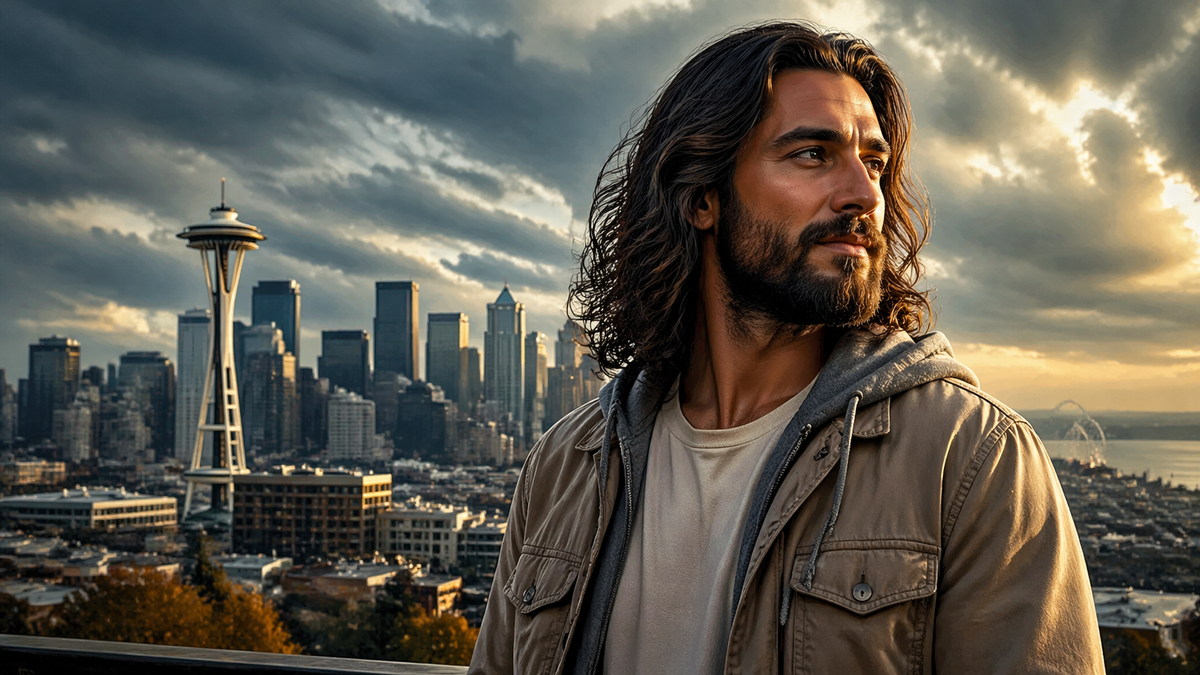
Later, as the day lowered toward evening, Elena said she needed to stop by the apartment before her shift the next morning, and Mateo surprised both her and himself by saying he would come. Not because everything was resolved. Not because home had become peaceful in a few hours. Simply because leaving no longer felt like the truest move available. They rode north for a while first, just to keep moving without fleeing, and ended up near Kerry Park where the city opened itself in that wide familiar view people photograph too quickly and feel too little because they are busy capturing it. Today the skyline did not feel like a postcard. It felt like the visible shape of thousands of private battles stacked together. Clouds moved slowly over the line of buildings. The Space Needle stood with its strange grace. Far beyond, the mountain showed itself faintly, almost withheld.
Marisol was there too, unexpectedly, on her way home from work. Her husband had once liked the view, and on difficult days she sometimes stopped there before facing the quiet of the house. She saw Jesus by the wall with Elena and Mateo and froze with that startled look people get when the day begins arranging itself in ways they did not know how to ask for. She came over slowly. Jesus introduced no one with fanfare. He simply made room. Soon five hurting people who would probably never have met under normal conditions were standing together above the city, linked only by the fact that each of them had nearly vanished inside something heavy.
Art did not join them there, but his sentence from the dock remained like an old nail in good wood. A lot of standing gets mistaken for healing.
They did not hold hands. They did not form a circle. Nobody turned the moment into performance. They just stood there and let the evening do some of the work that noise had failed to do. Elena looked at Mateo without the immediate impulse to correct him. Mateo looked at the skyline and then, after a while, at his mother. Nia set the flowers she was still carrying against the wall and said she might take tomorrow morning off and accept whatever small disaster followed. Marisol admitted she had not told anyone how frightened she was of losing her husband in pieces instead of all at once. Elena listened and did not interrupt with her own emergency. That alone was a kind of healing.
Jesus spoke little then. The day had already said much. Presence was doing the rest.
As the light shifted softer, Mateo asked the question he had been circling since the waterfront. “Why did you stop for me?”
Jesus looked at him with a gentleness that did not weaken the answer. “Because you are not throwaway material.”
The sentence passed through the whole small group. Elena covered her mouth again. Nia blinked hard and looked away toward the skyline. Marisol let out a breath she had apparently been holding for years. Mateo stood still in it, trying to act as though he had not been hit clean through the chest. He failed at that, which was good.
Jesus went on. “Neither are any of you. But pain keeps trying to convince people that what is bruised is what they are. It is a lie. A common one. A destructive one. A lie all the same.”
No one argued. Everyone there had believed some version of it.
When the evening cooled further, Elena said they needed to go. Real life still waited. Rent still waited. School still waited. Marisol still had to go home to a husband whose memory was thinning at the edges. Nia still had invoices. Mateo still had consequences. Yet all of it looked different now, not lighter exactly, but less final. There is a difference between carrying pain alone and carrying it after truth has interrupted the false story around it.
At the edge of the overlook, Elena turned to Jesus. “Will I see you again?”
He smiled, and in the smile was both nearness and mystery. “You will know how to recognize what I have said.”
She nodded as if that answer made more sense than it should have.
Mateo hesitated, then asked, “What if I mess it all up again?”
Jesus answered him the way only truth answers the young when it does not want to flatter them or crush them. “Then tell the truth sooner next time.”
Mateo looked down and gave the smallest nod.
Nia gathered her flowers. Marisol adjusted her bag on her shoulder. One by one they stepped back into their own lives, not cured of difficulty, not floating above consequence, but less trapped inside the names pain had been trying to assign them. Elena and Mateo walked to the car together. Their silence was different now. Not fixed. Not easy. Just honest enough to keep going. Halfway there, Mateo said, “I shouldn’t have taken the money.” Elena said, “No, you shouldn’t have.” Then after a moment she added, “I shouldn’t have made home feel like a place where you were always one mistake away from being too much.” Neither sentence solved them. Both mattered.
Jesus watched them go until they were folded back into the life waiting for them. Then He turned and walked away from the overlook as the city moved into evening. He went west and then south again, through streets gradually yielding their daytime faces to night. Office lights blinked on. Restaurant windows glowed. Cars drew white and red lines through the wet-darkening roads. Somewhere music rose through an apartment window. Somewhere an argument started. Somewhere a woman sat alone at a kitchen table not knowing that hope had just turned quietly toward her street. Seattle was still Seattle. Beautiful in places. Harsh in places. Tired, striving, lonely, expensive, restless, alive. Jesus moved through it without hurry, as if none of its surfaces could confuse Him about what lay beneath.
When the city had dimmed enough and the crowds had thinned into pockets, He made His way north again to Green Lake, where the water held the last of the fading light and the path carried runners, dog walkers, couples, and solitary people each moving inside their own thoughts. He stepped away from the path at last to a quieter place beneath the trees where the noise of the city softened but did not disappear. He knelt there in the evening damp the way He had knelt before dawn. The day had begun in prayer, and it ended the same way. His head bowed. His hands still. His voice low, carrying the names and wounds of the people He had walked among. There was no performance in it. No distance. Only the deep quiet of love that sees fully and does not turn away.
Behind Him, Seattle kept breathing. Ahead of Him, the dark settled over the water. And in apartments, hospital rooms, break rooms, buses, kitchens, and ferry benches, lives that had nearly mistaken damage for identity held one more chance to tell the truth before the lie returned in its old clothes. Jesus remained there in prayer until the night had fully come.
Your friend,
Douglas Vandergraph
Watch Douglas Vandergraph inspiring faith-based videos on YouTube:
https://www.youtube.com/@douglasvandergraph
Support the ministry by buying Douglas a coffee:
https://www.buymeacoffee.com/douglasvandergraph