Jesus in Fort Worth and the Hunger People Hide
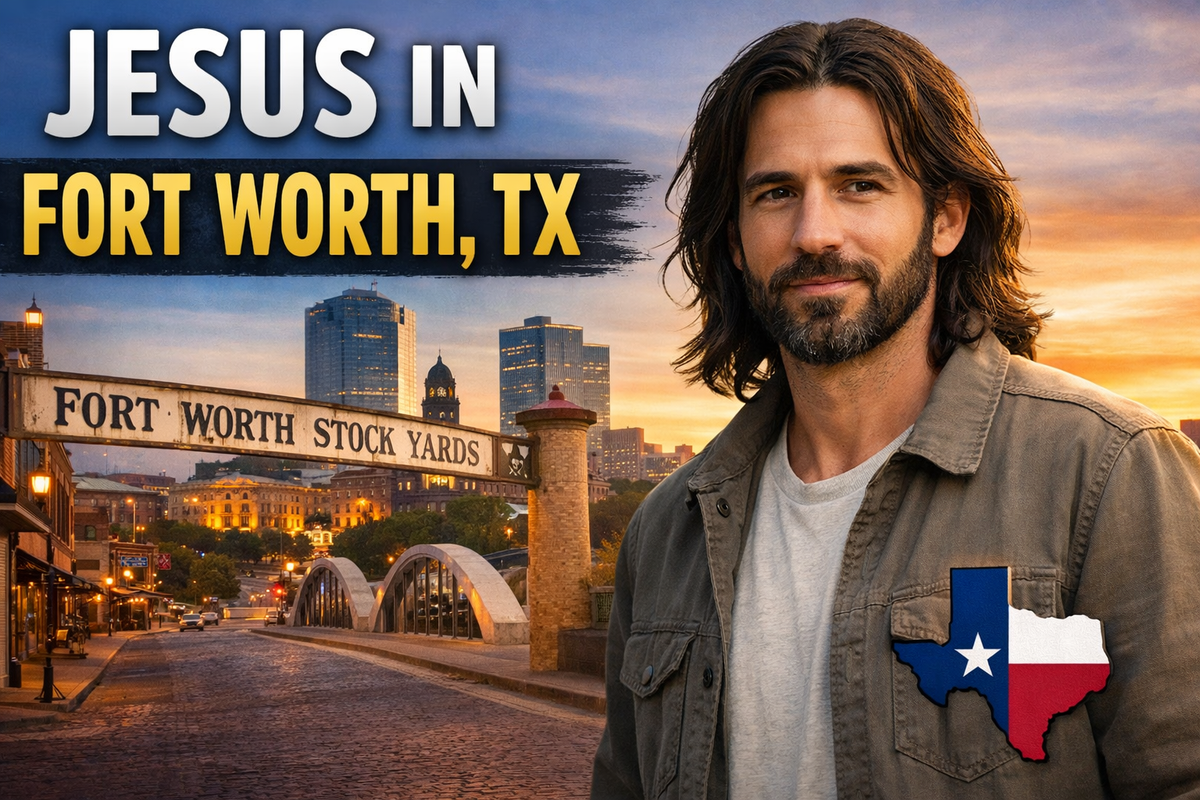
Before daylight had fully opened over Fort Worth, Jesus was already awake. He stood near the Quiet Pool at the Fort Worth Water Gardens while the city still held that thin hour when even traffic sounded tired. The rush of water moved against the concrete with a steady sound that covered everything sharp enough to cut through a man’s thoughts. He bowed His head and prayed in the cool gray light while office towers stood over Him in silence. He did not pray like someone trying to escape the world. He prayed like someone entering it on purpose. He brought the city before the Father without hurry. He brought the people who had not yet spoken that morning, the ones who were already losing before the sun came up, the ones who had learned how to smile while fear kept eating through them. When He lifted His face, He stayed still for another moment, as if listening longer than most people ever do. Then He opened His eyes and walked toward the day.
Not far away, at Fort Worth Central Station, a woman named Ava Mercer was trying very hard not to cry where strangers could see her. She was forty-one years old, wearing navy scrubs under a light jacket, and holding her phone so tightly it left a dent in the side of her hand. Her shift at JPS had started in less than an hour. She had already been awake most of the night because her seventeen-year-old son, Jonah, had come home angry, slammed the front door so hard the frame shook, and said three sentences that had stayed in her mind ever since. The first was that he hated school. The second was that she never listened. The third was that he was tired of living like this. Then he had locked himself in his room, and she had sat on the couch with the lamp off because she knew if she knocked, she would only make it worse.
Now the bank had sent her a notice that her account was overdrawn. The used car she had been barely keeping alive had died two days earlier in the JPS parking garage. The shop wanted more money than she had. Her father had not returned her calls since yesterday afternoon. He was supposed to be staying with a friend on the south side, but Ava no longer trusted the phrase supposed to. It had covered too many lies lately. Her lunch container held saltines and peanut butter because payday was still four days away. She had not told Jonah that the power bill was late. She had not told her father that she could not keep sending him money. She had not told anyone that the hardest part was no longer the lack itself. The hardest part was the way she had started acting normal inside it.
The station was filling with people who looked like they had long ago given up expecting gentleness from morning. Shoes struck concrete. A bus sighed. Someone dragged a rolling bag across the platform. A young man in a suit was talking too loudly into a headset about projections and deliverables while an older woman leaned against a column with both eyes closed and her purse tucked under her arm like she had learned survival through repetition. Ava stared at the cracked corner of her phone screen and saw Jonah’s name at the top of an unread message. She did not open it right away. She already knew what fear felt like before it formed words.
When she finally tapped the screen, the message was short.
Not going.
That was all.
No school. No explanation. No punctuation. Just two words from a boy who had once cried when he got in trouble for talking in second grade and now moved through the world like every room had already made up its mind about him.
Ava pressed her lips together and looked up, because if she kept looking down, she was going to break open in public. That was when she noticed Jesus sitting two seats away on the same metal bench. She had not seen Him come over. He was dressed simply, nothing on Him calling attention to itself, but there was something settled in the way He sat that made the chaos around Him feel louder by contrast. He looked at the station the way a person looks at weather that matters, noticing not just what was there but what was coming through it.
Ava looked away first. She had no energy for a kind stranger. Kind strangers were dangerous when you were holding yourself together with thread.
“You have been awake a long time,” He said.
It was not a question, and something about that irritated her.
“Most people here have,” she answered.
He nodded. “That is true.”
She let out a breath through her nose. She had meant the response to end the conversation. Instead it made room for another one. The bus bay announcement crackled overhead, naming routes with mechanical calm. Ava checked the time again and realized she was going to have to choose between calling Jonah, calling her father, or calling work to say she would be late. She had enough energy for one of those calls and not the fallout from all three.
Jesus looked at her phone without intruding. “Who are you most afraid of losing today?”
That should have felt too personal, but it did not. It felt exact, and exactness has a way of going past the defenses people build for vague concern. Ava laughed once, though there was no humor in it.
“Today?” she said. “Just today?”
He waited.
She swallowed and stared toward the buses. “My son,” she said. “My temper. My job. My father maybe. Depends on how the day wants to go.”
“The day is not your father,” Jesus said gently. “It does not get to decide what you are worth.”
Ava looked at Him then. There was no performance in His face. No polished sympathy. No religious eagerness. Just presence. That almost made her angrier, because real presence asks something from a person. It makes hiding feel more childish than safe.
“You do not understand,” she said quietly. “Everything depends on me not dropping anything.”
He turned enough to face her fully. “And how is that going?”
She wanted to give Him a hard answer. Something clipped. Something that would close the space He kept opening. Instead her eyes burned.
“I do not know how to do one more bad month,” she said. “I do not know how to talk to a son who thinks I have failed him. I do not know how to help a father who has spent his whole life acting like needing help is a sin. I am tired of pretending I can absorb every problem in my family and still stay soft.”
Jesus let the words sit between them. He did not rush to improve them. He did not lay a lesson over them like a blanket. He respected the truth enough to leave it uncovered for a moment.
“You have made a home out of bracing,” He said. “That can keep a roof up for a while. It cannot keep a soul alive.”
Ava looked down again. No one had ever said it like that. People told her she was strong. People praised her for handling things. People said she always found a way. No one had ever named the fact that surviving had changed the shape of her inside.
“My father used to say,” she murmured, “that if people saw you hurting, they would either use it or pity you. And he hated both.”
“Did it make him less hungry,” Jesus asked, “to hide the hunger?”
The bus for the hospital route was pulling in. Ava stood on instinct and slung her bag over her shoulder. She should have boarded. She knew she should have boarded. But she looked at Him instead.
“What kind of question is that?”
“The kind that stays with you because it is already living in your life.”
She ought to have left Him there. She ought to have done what mornings demanded and pushed the rest aside. But when the doors folded open and people began climbing on, she stayed where she was.
“I have to get to work,” she said.
“I know.”
“My son is skipping school.”
“I know.”
“My father disappears when he is ashamed.”
“I know.”
The driver called for boarding one last time. Ava looked from the bus to Jesus and back again, and for reasons she could not have explained, the choice in front of her no longer felt like bus or no bus. It felt like the life she had been dragging versus the truth she had been avoiding.
She stepped back from the curb. The bus pulled away without her.
For a second she panicked. Then she got angry at herself for panicking. “That was irresponsible.”
Jesus stood. “Maybe. Or maybe you keep calling every surrender irresponsible because you only trust control.”
“I do not trust control,” Ava snapped. “I trust consequences.”
He started walking toward Jones Street and she followed before deciding to. “Those are not the same thing,” He said.
Downtown was waking up in layers. Delivery trucks rolled through alleys. Windows caught more light. Men in pressed shirts moved quickly with coffee in hand while others in worn jackets moved more slowly, as if speed belonged to a different kind of day. Ava walked beside Jesus and hated that part of her already knew she was safer near Him than she had felt in weeks. Safety had become unfamiliar enough to feel suspicious.
They passed through the edge of Sundance Square, where the city tried hard to look bright before everyone inside it had remembered who they were again. Chairs sat stacked outside a storefront. A woman in heels wiped down an outdoor table with one hand and texted with the other. Near one of the planters, an older man sat on a bench with his elbows on his knees and a paper cup at his feet. He wore clean jeans, polished boots, and a button-down shirt tucked in too carefully for a man who had nowhere to be. Ava recognized him before he looked up.
“Dad.”
The word came out flat, not because she felt nothing, but because feeling too much had made tenderness expensive.
Luther Mercer lifted his head slowly. Seventy years old. Wide hands. Gray beard trimmed with the kind of attention that belonged to older men who would let life fall apart before they let themselves look sloppy. He took one look at Ava and then at Jesus, and something closed in his face.
“I was going to call,” he said.
“No, you were not.”
“Ava.”
“Do not Ava me.” Her voice stayed low, but the strain in it sharpened every word. “I called you six times.”
“My phone died.”
“Your phone always dies when you do not want to answer.”
Luther sat back and looked past her, out toward the plaza. That had always been his move. If he looked directly at pain, he might have to answer it honestly. Better to study the weather. Better to inspect traffic. Better to say he was fine until the lie could stand on its own legs.
Jesus stepped closer but did not interrupt. Luther looked at Him with open dislike.
“And who is this?”
“A man who sees you,” Jesus said.
Luther almost smiled at that, but it was not amusement. It was the reflex men use when they think they are about to be handled.
“I am not asking for anything,” he said.
“I did not say you were.”
“Then whatever she told you, I do not need a talk.”
Ava crossed her arms. “Good. Because I do not have time for one either. Where did you stay last night?”
Luther rubbed his forehead. “A motel.”
“Which one?”
“It does not matter.”
“It does matter.”
“It matters to you because you think details equal safety.”
Ava stared at him. “No. It matters because you are seventy years old and you keep acting like vanishing is a personality trait instead of a problem.”
He flinched, but only with his eyes. Luther had spent most of his life working with his body. Construction first. Then maintenance. Then smaller jobs as his back worsened and pride got louder. He had been the kind of father who kept the grass cut, kept the truck washed, kept his opinions guarded, and kept love hidden inside provision. After Ava’s mother died, he had become harder in all the wrong places. He still believed that needing people reduced a man. He still believed private suffering was cleaner than public need. He still believed daughters could be leaned on without being crushed by the weight.
“I sold the ring,” he said.
Ava stopped breathing for a second. “What ring?”
He did not answer, which was answer enough.
“Mom’s ring?” she whispered.
“I was going to get it back.”
“You sold Mom’s ring.”
“I needed a room.”
“You could have called me.”
“And what would that make me?”
Ava let out a sound that was close to breaking. “It would make you my father.”
Luther looked at Jesus again, as if somehow this stranger had caused all of it by being there to hear it. “This is why I stay to myself,” he said. “People turn need into a courtroom.”
Jesus said, “No. Shame did that long before she arrived.”
Luther’s face tightened. “You do not know me.”
Jesus held his gaze. “You have spent years refusing bread because you cannot bear the thought of someone seeing your empty hands.”
For the first time, Luther had no answer ready. Ava turned away and pressed the heel of her hand into one eye. All around them, the city continued as if none of this mattered. A delivery driver laughed into his phone. Someone unlocked a storefront gate. A pair of women crossed the plaza carrying coffee and talking about a meeting. That was one of the cruelest things about public pain. The world kept going at full speed while your own life suddenly stood in the street.
Luther got to his feet more slowly than he used to. “I am not taking charity.”
Jesus said, “Is that what you call love when it arrives lower than your pride?”
“I call it debt.”
“No,” Jesus said, still calm. “You call it debt because that is the only way you know how to receive anything. You think every gift puts you beneath someone. You do not know how to be loved without calculating what it costs your identity.”
Ava looked back at them. Luther’s jaw moved, but no words came out.
Jesus continued, and His tone did not harden, which somehow made it land harder. “You would rather let your daughter drown than admit you cannot swim this part alone. That is not dignity. That is fear wearing your voice.”
Luther stared at Him with sudden anger, but there was grief under it. The kind men carry when they realize the lie that protected them is now the same lie destroying the people near them.
“I worked my whole life,” he said.
“I know.”
“I gave my family everything I had.”
“I know.”
“I am not some man on the street waiting for a handout.”
Jesus did not move. “Then stop living like one inside your spirit.”
The words seemed to strip something away. Ava saw her father’s shoulders change. Not collapse. Just lose the little extra height pride always tries to borrow. He sat back down without meaning to. For a moment he looked less like a stubborn old man and more like a tired one.
Ava sat beside him, leaving a little space because they were not yet in a place where closeness came easily. “Why did you not tell me about the ring?”
He stared at his boots. “Because your mother loved that ring.”
“I loved it too.”
“I know.”
“Then why?”
Luther swallowed. “Because I was hungry.”
It was such a plain answer that Ava almost missed what it cost him to say it.
Hungry. Not in theory. Not in a sermon. Not in a dramatic street-corner way people can safely pity from a distance. Hungry in the humiliating, quiet, ordinary way that makes adults act strange and mean and evasive because admitting need feels worse than suffering it. Ava pictured him in a motel room with bad carpet and cold air, pretending sleep could replace dinner. She pictured the ring leaving his hand. She pictured the life her mother had worn reduced to enough money for a room and some days bought forward.
Jesus stood before them with the same steady attention. “There is more than one kind of hunger in this city,” He said. “Some stomachs are empty. Some homes are empty. Some people have food and no tenderness. Some have people around them and no rest. Some have learned how to feed others while starving in secret. The deepest hunger is often the one people respect the most because it looks like strength.”
Ava heard her own life in that and did not like it. She was a woman people called dependable. She registered patients. Solved problems. Stayed late when staffing broke down. Loaned money she did not have. Smoothed conflict. Remembered birthdays. Answered calls. Pushed through. And beneath all of it was a private emptiness she had stopped naming because naming it would require admitting she was not just tired. She was thinning out from the inside.
Her phone rang. She looked down and saw JPS on the screen. Work. Reality. Consequences returning right on schedule.
She stood and answered. The charge nurse was clipped but not cruel. Someone had called out. The unit was short. Ava was asked, in the language of workplaces that pretend need is neutral, whether she could still make it in.
Ava looked from her father to Jesus to the waking city. “I can come,” she said, and even as she said it, she knew it was not the full truth. She could come physically. The rest of her was another matter.
When the call ended, she said, “I have to go now.”
Jesus nodded. “Go.”
She glanced at Luther. “Are you coming with me?”
He shook his head.
“Dad.”
“I need a minute.”
“You have needed a minute for fifteen years.”
His expression almost cracked. “Then let me have one more.”
Ava closed her eyes. In another mood she would have fought him. In another month she might have threatened or pleaded. But something about standing there with Jesus had made the old dance feel visible enough to refuse.
“Fine,” she said. “One minute. Then you call me.”
Luther nodded without conviction.
Jesus looked at him. “She is not asking you to become a child. She is asking you to stop disappearing.”
Luther stared at the ground. Ava turned to go, then stopped and looked back at Jesus. “Are You coming?”
He gave the smallest hint of a smile. “Yes.”
They walked south toward the hospital district. By the time they reached JPS, the city had shed its early hush and become fully itself. Ambulances moved in and out with the kind of urgency that made every person nearby look at the ground or look away. Families came through the doors carrying blankets, paperwork, fear, and plastic bags with things no one plans to bring to a hospital until life forces it. Ava’s work badge felt heavier as she clipped it on. Going inside meant returning to a world where pain had numbers, rooms, monitors, codes, and not enough staff.
At the employee entrance she stopped. “You cannot come in everywhere.”
“I know.”
“This place is complicated.”
“I know.”
“You keep saying that.”
“Because I do.”
She almost laughed, which surprised her. “I do not even know Your name.”
He met her eyes. “You know enough to keep walking.”
That answer should have been frustrating. Instead it steadied her in a way names often do not. She went inside and was swallowed by fluorescent light, pager sounds, call buttons, thin patience, and institutional speed. For the next several hours she did what she always did. She moved people from confusion to paperwork. She answered questions from those who were afraid and irritation from those who were not. She explained delays she did not cause. She took heat for systems she did not design. She smiled when she meant only to endure. Twice she checked her phone. Jonah had not responded. Her father had not called.
Near noon she stepped into a hallway alcove with her peanut butter crackers and could not make herself eat them. A woman she worked with, Nadine, came up beside her carrying a vending machine soda and a face already worn down by the shift.
“You look bad,” Nadine said, not unkindly.
“Thank you.”
“I mean worse than usual.”
“That helps.”
Nadine leaned against the wall. “You ever get tired of being the one everybody assumes can handle it?”
Ava looked at her. “Every day.”
Nadine nodded toward the crackers in Ava’s hand. “You eating that because you want it or because that is what’s left?”
Ava looked away. Even harmless questions felt dangerous when they walked that close to truth.
“Because I am not hungry,” she lied.
Nadine did not call it out. “There’s a mobile pantry near my church this week,” she said. “And Tarrant Area’s got help all over town. Just saying.”
Ava stiffened immediately. “I am not there.”
Nadine took a slow sip of soda. “I did not say you were.”
Ava heard the edge in her own voice too late. Shame makes even generous words sound like accusations. “Sorry.”
“Do not be sorry with me. Be honest with yourself.” Nadine pushed off the wall. “Pride is expensive, girl. More expensive than groceries.”
After she left, Ava stood alone with the crackers and felt exposed in a new way. She thought of her father on the bench. She thought of Jesus saying some people feed others while starving in secret. She thought of how quickly she had rejected the idea of help, as if the mere suggestion had insulted her character. That bothered her because it sounded too much like Luther.
When her break ended, she moved through the afternoon in a blur. Around three, Jonah finally texted.
At Magnolia.
That was all.
No apology. No explanation. Just a location, which somehow frightened her more than silence because it sounded like a flare sent from a distance too stubborn to call itself need. Ava stared at the message long enough for the screen to dim. Magnolia Avenue. Near Southside. He had probably taken a bus, or ridden with someone older, or skipped through the day with that heavy anger boys use when they do not know what else to do with embarrassment.
She asked to leave early and was denied. She asked again with less patience and was told everyone was short. By four-thirty her father still had not called. By five, Ava felt something inside her hardening into the same old resolve that had carried her for years and nearly ruined her. Fine. She would handle it. She would get off work, find Jonah, find Luther, stretch the groceries, delay another bill, apologize to everyone, and start over tomorrow pretending today had not rearranged anything.
Yet beneath that familiar resolve, another thought had begun to press against her. What if the thing that kept her functioning was also the thing keeping her trapped.
When her shift finally ended, the sky had turned the color of worn steel. She stepped outside and saw Jesus across the street as if He had not moved far from her life at all, only waited for her to catch up to what had already been happening. Beside Him stood Jonah.
Her son looked taller in public now, which startled her every time. He had his hood up despite the warmth. His face still held the soft traces of the child he had been, but anger had sharpened it over the last year. He looked at Ava and then away. That was the new pattern. Not rejection exactly. More like refusal to be read.
Ava crossed to them with too much relief and too much anger mixed together. “What are you doing here?”
Jonah shrugged. “Standing.”
“Do not start.”
“I am not starting anything.”
“You skipped school.”
“I know.”
“You disappear all day and then I find you standing with—” She stopped, because she still did not know what to call Jesus. Stranger did not fit. Friend was too quick. Prophet would have sounded ridiculous in her own mouth.
Jonah looked at Jesus once, then at his mother. “He found me first.”
Ava folded her arms. “Where?”
“Magnolia.”
“What were you doing there?”
Jonah scraped the toe of his shoe against the curb. “Walking.”
“That is not an answer.”
“It’s the one I got.”
Ava was about to push harder when Jesus said, “He was trying to outrun the shame of being seen where he hurts.”
The sentence landed so cleanly that both of them went quiet.
Jonah stared at the street. “You do not have to say everything.”
Jesus said, “No. But some things should no longer stay hidden.”
Ava looked from one to the other. “What happened at school?”
Jonah’s jaw tightened. “A guy said Grandpa was a bum.”
Ava closed her eyes.
Jonah kept going before she could speak. “He said everybody knows. He said you work at the hospital and still cannot keep your family together. He said people like us always end up needing handouts. So I hit him.”
There it was. Not just anger. Exposure. Public humiliation has a way of turning boys violent because it lets them feel powerful for one second instead of small for a whole day.
Ava opened her eyes and found her son already watching for disappointment. That hurt more than the school call ever could have. He expected correction before comfort. He expected management before understanding. Maybe she had trained him for that without meaning to.
“I am not glad you hit him,” she said carefully. “But I am sorry he said that.”
Jonah looked confused by the order of those sentences.
“He was not wrong,” he muttered.
“Yes, he was.”
“You do not even know where Grandpa is.”
Ava’s mouth went dry. “I saw him this morning.”
“And?”
“And he was still your grandfather.”
Jonah laughed without joy. “That does not pay for anything.”
Jesus looked at him. “You think money is the deepest measure because fear has been loud in your house.”
Jonah’s eyes flashed. “You do not know my house.”
“I know enough,” Jesus said, “to see that you are embarrassed by hunger you did not create.”
Jonah did not deny it. The traffic moved beside them. Somewhere nearby a siren started and faded. Fort Worth kept breathing around them, large enough to hide almost any pain if pain was willing to stay ordinary.
Ava said, quieter now, “We need groceries.”
Jonah looked at her sharply. Not because he did not know, but because hearing her say it broke something open.
Jesus said, “Then let us stop acting like the truth is what dishonors you.”
Ava stood very still. She thought of Nadine in the hallway. She thought of Luther saying he was hungry. She thought of the way her own whole body had recoiled from the suggestion of a food bank. She thought of Jonah carrying family shame into a school hallway and throwing a punch because he had nowhere else to put it.
“No,” she said at last, but the word came out weak.
Jesus did not argue. “Why not?”
“Because I cannot,” she said. “Because once people see you like that, they never unsee it.”
Jonah looked away again, and Ava knew immediately that he had heard the confession under the defense. Not I cannot go. I cannot be seen.
Jesus let the silence open wide enough for her own words to echo back. “Then you and your father are not nearly as different as you think.”
Ava wanted to reject that. She wanted to explain all the ways she had kept the family alive while Luther let things drift. She wanted to list sacrifices, overtime shifts, skipped meals, careful budgeting, sleepless nights, and everything else that proved she was not the same. But none of that answered the one point that mattered. When help came close enough to touch her life, she did what he did. She turned dignity into distance.
Jonah shoved his hands into his pockets. “So what now?”
Jesus looked at both of them. “Now you tell the truth all the way. Then you let love come lower than your pride.”
Ava’s throat tightened. “What if I do not know how?”
He answered her as if the question deserved gentleness. “Then today can be the first day you stop calling that failure.”
He started walking, and after a moment, they followed.
The three of them moved through the evening toward a place Ava had spent all day refusing even in thought. She knew where Tarrant Area Food Bank was. Everybody in healthcare knew the map of need whether they admitted it or not. The building did not accuse anyone. The accusation lived in the stories people attached to needing it. Jonah stayed beside her but not too close. He was at that age where love often looked like shared direction more than touch. Ava kept expecting to see Luther’s name flash across her phone. It never did.
By the time they reached the lot, the sun had lowered enough to throw long shadows across the pavement. Cars were lined up. People stood in small clusters. Some talked. Some did not. A young mother bounced a toddler on her hip while staring at the ground. An older couple leaned against a truck without speaking. Two volunteers carried boxes with the ordinary seriousness of people who knew food could mean more than calories on a hard week. Nothing about the place looked dramatic. That was what unsettled Ava most. She had imagined visible ruin, some line that separated people who needed help from people like her. Instead it looked like her city. Her people. Men and women who could have been in scrubs or uniforms or office clothes an hour earlier. Hunger had no costume.
Ava stopped walking.
Jonah noticed first. “Mom.”
She could not move.
Jesus stood a few feet ahead and turned back toward them. He did not pressure. He simply waited with the kind of patience that makes truth harder to escape.
Ava looked at the people in line and felt every old lesson rise up at once. Good families handle their business. Decent people do not get this close to the edge. If you need help, take it quietly. If you take it publicly, expect to be reduced by it. Stand up. Keep going. Do not let anyone know.
Then the side door opened, and one of the men stepping out into the evening light was Luther Mercer.
He was carrying a box with both hands.
Ava’s breath caught.
He saw her at the same moment. The box nearly slipped.
Jonah whispered, “Grandpa?”
Luther stood frozen in the doorway, shame and relief and exhaustion all crossing his face so quickly none of them had time to hide. For one terrible second it looked like he might turn around and disappear again.
Jesus did not move toward him. He did not need to. The moment itself had already done the work.
Ava stared at her father holding food he had once sworn he would never take, and everything she thought she knew about humiliation, dignity, family, and hunger shifted under her feet.
That was where the day stopped feeling survivable in the old way, and where something harder and better began.
Luther set the box down on the folding table just inside the door as if the weight in his hands had suddenly become too personal to carry in front of them. One of the volunteers beside him asked if he was all right, and he nodded too quickly, which was his old way of telling a lie politely. Ava looked at him and saw something she had not let herself see for years. He was not simply stubborn. He was frightened in the exact place where men like him are taught never to be frightened. He was frightened of being reduced. Frightened of being seen as a man who had fallen. Frightened that once his daughter and grandson looked directly at his need, they would never again be able to remember him as strong. What he had never understood was that the hiding had already done far more damage than the hunger.
Jonah moved before Ava did. There was hesitation in it, but there was also a kind of courage boys find when life stops asking them to perform and starts asking them to become honest. He walked toward his grandfather and stopped a few feet away. Luther looked at him, and the shame in his face deepened because children always make our masks feel more foolish than adults do. You can lie to peers and call it dignity. You can lie to yourself and call it independence. It is harder to lie to a grandson who still remembers what your voice sounded like when you were simpler.
“Grandpa,” Jonah said quietly.
Luther opened his mouth and closed it again.
Jonah glanced at the box, then back at him. “You work here?”
Luther rubbed his palms against his jeans. “No. Not exactly.”
A volunteer, a woman in her sixties with tired eyes and a patient face, stepped around the table and spoke with the gentle boldness of someone who had watched shame ruin too many good people. “He’s been helping load cars for the last hour,” she said. “He didn’t want to sit in line empty-handed.”
Luther shot her a look that was part irritation and part gratitude, which is often how exposed people look when kindness tells the truth before they were ready.
“I can speak for myself,” he muttered.
She gave a little shrug. “Then do that.”
Ava had spent so much of her life bracing for men to harden when cornered that it startled her to see her father standing there with no real defenses left. He looked smaller than he had that morning in Sundance Square, but not because he had been humiliated. He looked smaller because he had stopped borrowing size from pride. There is a difference, and once you see it, you cannot mistake it again.
Jesus came to stand beside Ava and Jonah, not in front of them, not above the moment, but with them inside it. That was one of the things that kept undoing people around Him. He never acted as though pain were something beneath Him or merely instructive. He entered it without becoming controlled by it.
Luther looked at Him with an old man’s raw suspicion. “Did You bring them here to make a point?”
Jesus answered without sharpness. “No. I brought them here because truth should not keep meeting your family one person at a time.”
The volunteer woman looked from face to face and wisely stepped away, leaving space for what families often delay until they no longer can.
Ava’s voice came out rougher than she intended. “How long have you been coming here?”
Luther stared at the floor. “A few times.”
“How many is a few?”
He did not answer.
“Dad.”
“Enough.”
“Enough for what?”
“Enough to know the parking lot. Enough to know which door opens first. Enough to know where to stand if you do not want to look like you are waiting.” He exhaled and shook his head once. “Enough to know I kept telling myself I would only do it once.”
Ava felt anger rise, but it was not the same anger as before. Before, it had been built from abandonment. Now it was mixed with grief because she could see the whole thing more clearly. This was not just him avoiding her. This was him disappearing inside a private war he thought manhood required him to fight alone.
“Why didn’t You tell me?” she asked, and the question came softer than the earlier version had.
Luther looked up at last. “Because you already carry too much.”
Ava almost laughed, and the sound nearly turned into tears. “So you let me carry ignorance instead.”
He flinched again.
Jonah shoved his hands deeper into his pockets. “I thought you were just gone.”
Luther looked at him, and for the first time all day there was no angle left in him. “I know.”
“You sold Grandma’s ring.”
The words landed like a struck board in a quiet room. Ava looked at Jonah sharply. She had not told him. Luther’s eyes narrowed in confusion.
“How do you know that?”
Jonah shrugged without lifting his head. “Mom keeps her voice down when she’s hurting. But she still paces.”
That simple answer cut through all the adult complexity. Children do not need full explanations to know a house is carrying pain. They learn to read floors, doors, footsteps, tone, silence, and the shape of breathing through walls. Ava suddenly saw how much Jonah had been absorbing while she congratulated herself for protecting him with partial truths.
Luther’s shoulders dropped further. “I was going to get it back.”
Jonah nodded once, but it was not agreement. It was the sad nod of someone hearing a sentence that has already become too familiar in the family language. Going to. Meant to. Soon. After this. When things settle down. People can live inside those phrases for decades while the real damage keeps happening in the meantime.
Ava stepped closer to her father. “I need you to hear me.”
He braced out of habit.
“No,” she said. “Do not brace. Just hear me. I am not angry because you were hungry. I am angry because you made hunger into a secret so large it swallowed everybody around you. You keep acting like letting people help you is the worst thing that could happen, but it is not. The worst thing is what it does to us when you vanish.”
Luther’s jaw moved. “I did not want him seeing me like this.”
Jonah looked at him then, straight on. “I already see you like this.”
That sentence could have become cruel. In another household, on another day, it might have. Instead it came out with a different kind of force. It was not condemnation. It was plain truth. And plain truth often gives people their first honest place to stand.
Luther blinked hard and looked away.
Jesus said, “A family cannot heal around truths everyone agrees to keep unnamed.”
Nobody spoke for a moment. Through the open doorway came the sound of boxes sliding across tables, volunteers calling out numbers, car engines idling, a child fussing in a back seat, and the ordinary noise of need being met without fanfare. Ava listened to it all and realized how much of her own suffering had been worsened by the story she told about visibility. She had not only feared lack. She had feared being seen in lack. That fear had shaped her tone with Jonah, her silence with friends, her resentment toward her father, and even the way she looked at herself in the mirror before work.
The volunteer woman returned with a clipboard and paused when she saw they were still standing in their unfinished moment. “You all okay?”
Jesus looked at Ava.
That was all. He did not instruct. He did not urge. He let the choice arrive in her hands where it belonged.
Ava looked at the clipboard, then at the cars, then at Jonah, then at her father. Her face felt hot. Her chest tightened. Everything in her body wanted to step back into the old position where she could still pretend she was above this line. But the line itself had disappeared. It was not a line between good people and broken people. It was only the place where truth asked whether she wanted pride more than peace.
“No,” she said at last, and the volunteer’s face softened with concern until Ava continued. “No, we’re not okay. But I think maybe we’re done lying about it.”
The woman nodded once as if that were answer enough. “Then let’s take care of what needs taking care of.”
Ava took the clipboard.
The pen felt heavier than it should have. There are signatures that transfer money, signatures that bind contracts, signatures that settle property, and signatures that admit a person has reached the end of pretending. This one did not feel humiliating. It felt clean. That unsettled her more than humiliation would have, because it meant the cruelty had never been in the help itself. It had lived in the pride that taught her to fear it.
Jonah stood close enough to read over her shoulder. “Do we put all three of us?”
Ava glanced at him. “Yes.”
His face stayed guarded, but something in it shifted. For the first time all day he looked less like a boy trying to defend his family from public exposure and more like a son standing inside the truth with them.
Luther took a step back. “I don’t want my name on there.”
Ava looked up from the paper. “Dad.”
He shook his head. “I came here for food. I did not come here to be counted.”
Jesus answered him with a calm that stripped excuses of all their borrowed nobility. “You do not mind being hungry. You mind being known.”
Luther’s eyes sharpened. “And maybe a man gets to keep something.”
Jesus stepped toward him, not aggressively, but with the kind of nearness that leaves no room for half-truths to stretch out and look impressive. “You are trying to keep an image that has already cost you your peace, your daughter’s trust, your grandson’s steadiness, and your wife’s ring. What else would you like it to take before you call it what it is?”
Luther’s face folded inward. Not dramatically. Just enough. Like an old structure finally admitting where the load has been landing all along.
Jonah spoke before anyone else could. “Put your name on it, Grandpa.”
Luther looked at him.
Jonah swallowed. “Because I don’t want to spend my whole life thinking help is shame.”
The sentence seemed to move through all of them at once. Ava felt it like a door opening onto years ahead. This was bigger than groceries. Bigger than one hard month. Bigger than the immediate problem of bills and food and a sold ring. This was a pattern being offered to the next generation, and Jonah had named it before any adult had. Sometimes the clearest voices in a family are the ones people have dismissed as too young to understand.
Luther held out his hand.
Ava gave him the pen.
He signed slowly, as if each letter had to pass through a lifetime’s worth of resistance before it could reach the page. When he finished, he stared at his own name for a long second. Then he handed the clipboard back like a man surrendering a weapon he had carried too long.
The volunteer woman smiled without making it sentimental. “Good,” she said. “Now let’s get you fed.”
What happened next was quieter than Ava would once have imagined. No thunder. No public revelation. No dramatic speech that made the whole room stop and stare. Just motion. Box after box. Produce, canned goods, bread, staples, simple things that become mercy when there has not been enough of them. Jonah helped carry. Luther loaded with the seriousness of a man trying to repent through usefulness. Ava answered questions and signed what needed signing. She kept waiting for humiliation to arrive and it never did. No one treated them like lesser people. No one studied them with superior pity. Everyone there looked busy serving reality rather than judging it.
At one point Jonah lifted a bag heavier than he should have and grimaced. Luther instinctively moved to take it from him, then stopped halfway as if unsure whether he still had the right. Jonah handed it over without a word. It was a tiny exchange, almost nothing if you looked quickly, but Ava saw the whole ache of their family in it. The places where love had not vanished, only grown awkward through silence.
When the car was loaded, Ava stood with her hands on the edge of the trunk and stared at the food. It was enough to change the shape of the week. Enough to let dinner happen without arithmetic. Enough to take the panic out of the next few mornings. Enough to prove that what had frightened her most was not need but the story she had been telling about what need meant.
Jesus stood a little apart, watching them with that same calm attention that never felt detached. He had not solved their lives in one sweep. Jonah still had to face school. Ava still had bills. Luther still had to answer for the ring and the lies and the disappearing. But the day had turned at its deepest hinge. The false dignity had cracked. The hidden hunger had been named. And once named, it could no longer rule quite the same way.
Ava closed the trunk and turned toward Him. “What now?”
He looked toward the darkening sky over the city. “Now you go home and stop performing strength for each other.”
Luther frowned faintly. “That sounds simple.”
“It is simple,” Jesus said. “Simple is not the same as easy.”
They drove first to the apartment complex on the south side where Ava and Jonah lived. Luther rode in the back with the groceries and did not complain. Jonah sat in front, staring out the window as Magnolia Avenue gave way to blocks that carried more wear and less polish. Fort Worth in the evening looked like many cities at once depending on which street you chose. Restaurant patios and hospital corridors. Public art and payday loan signs. Stately churches and exhausted apartments. Green park space and lots where weeds had begun negotiating with concrete. The city was large enough to make people feel invisible and small enough to keep crossing their lives back into one another.
When they carried the groceries inside, the apartment seemed to change around them. Not because the rooms were different, but because scarcity has a way of making every object in a house feel tense. A pantry with almost nothing in it affects the sound of conversation. So does a refrigerator with too much empty air. Ava opened cabinets and made room while Luther stood awkwardly by the table. Jonah put away cereal, canned soup, rice, pasta, bread, and produce with the overcareful movements of someone who did not want his relief noticed.
Ava pulled out the peanut butter crackers from her bag and set them on the counter. Jonah looked at them and then at her. “That was lunch?”
She gave the smallest nod.
He turned away and ran a hand over the back of his neck. “I’m sorry.”
Ava felt that land in the old wound where she had spent years wanting appreciation, obedience, understanding, and somehow never asking plainly for any of them because that would require admitting she was not inexhaustible.
“I’m sorry too,” she said.
Jonah looked back. “For what?”
“For making this house feel like you had to be tough before you were allowed to be honest.”
He stared at her, and Ava could see the boy in him and the almost-man both listening. “You didn’t do all that.”
“I did some of it.”
He swallowed. “I hit that kid.”
“I know.”
“And part of me wanted to do it before he even opened his mouth.”
Ava leaned against the counter. “That part of you needs to be told the truth before it starts telling you who you are.”
Jonah’s eyes shifted toward Jesus, who stood near the doorway as if homes were holy enough to enter gently. “He said anger is often grief trying not to look weak.”
Ava let out a breath. “That sounds right.”
Jonah’s voice dropped. “I’m tired of being embarrassed all the time.”
The honesty in it hit her harder than any teenage outburst had. Not because she did not know it already, but because naming is different from sensing. Once a son says I am embarrassed all the time, a mother can no longer pretend the tension in the house is just mood, just age, just stress, just school, just attitude. It becomes sorrow with a name.
Ava moved closer but not too fast. “You should not have had to carry all of that alone.”
Jonah looked at the floor. “Neither should you.”
For a second neither of them knew what to do with that. Then Ava reached for him and he let her. He did not collapse into her like a little boy would have, but he leaned just enough to tell the truth without words. She put one hand on the back of his head and held him there while her own eyes filled. Some tenderness returns quietly, almost embarrassed by how long it stayed away.
At the kitchen table, Luther sat down heavily as if the apartment itself had brought him to the end of his own evasion. He watched them and looked like a man standing outside a warmth he had helped damage and did not know how to reenter.
Ava noticed. “Dad, sit there if you need to. But don’t go quiet again.”
Luther nodded once. “I’m thinking.”
“That can be dangerous with you.”
He almost smiled. “Probably.”
Jesus pulled out the chair opposite him and sat. The room was small enough that no word could really leave without touching everyone. That was good. Families often need the mercy of close quarters when their honesty has gone thin.
Luther folded his hands. “I thought if I could keep some part of myself untouched, I’d still be me.”
Jesus answered, “And what part did you choose?”
Luther stared at the table. “The part that doesn’t ask.”
“And what did it cost?”
Luther looked at Ava first, then Jonah. “Too much.”
He said it plainly this time. No metaphor. No detour. Just too much. Ava realized that for all his years of labor and stoicism, her father’s deepest poverty had never only been financial. He had been poor in receiving. Poor in confession. Poor in letting people love him where he was weakest. It had starved every relationship around him.
“I sold the ring at a pawn shop off Lancaster,” he said. “I hated myself before I got back to the sidewalk.” He drew a breath that caught in the middle. “Your mother wore it every day. Even when her hands were swollen. Even when it was too loose after treatment. She used to twist it when she was thinking.” He rubbed his thumb against his palm as if he could still see it there. “I told myself I was only selling metal. That was a lie too.”
Ava sat across from him and let the pain come clean instead of sharp. “Why didn’t you bring the ring to me first?”
“Because if I brought it to you, I’d have to say why.”
“And?”
“And then I’d have to let you see I couldn’t hold my own life together.”
Ava was quiet for a moment. Then she said, “Dad, I have been watching that for a long time. What I have not been seeing is you.”
The words settled over the room with a strange mercy. They did not excuse him. They simply named the real wound. People can watch someone unravel for years without ever feeling they are actually being allowed near the true person underneath it.
Luther looked up, stunned in that small old-man way people get when a truth goes gentler than they deserved. “I didn’t know how.”
“I know.”
No defense followed. No lecture. Just I know. It sounded almost like forgiveness, though Ava was not ready to call it that yet. Forgiveness that arrives too early can become another way of avoiding truth. This was not avoidance. This was the beginning of a better kind of sight.
Jonah sat down too, elbows on knees, no longer pretending he was half out of the conversation. “Can we get the ring back?”
Luther let out a long breath. “Maybe.”
Ava looked at him. “Do you know where it is?”
He nodded. “I know the shop.”
Jesus said, “Then tomorrow can carry tomorrow’s obedience. Tonight is for telling the truth fully.”
Luther closed his eyes for a second. “The truth fully,” he repeated, as if the phrase itself were hard work. “All right.” He looked at Jonah first. “I thought if I stayed away when things were bad, I was protecting you from seeing me small. But what you saw instead was someone who left.” He turned to Ava. “And you saw someone who could take from you without ever really standing beside you.” His face tightened. “I did not know pride could make a man selfish while he still thought he was preserving dignity.”
Jesus answered, “Pride often survives by renaming its harm.”
Nobody argued.
The light in the kitchen had gone from evening gold to the duller glow of apartment bulbs. Outside, a siren passed somewhere blocks away. A neighbor laughed too loudly in the parking lot and then went quiet. Ava became aware of how ordinary the night sounded, and that steadied her. The most important things in people’s lives often happen while the world around them remains completely unastonished.
She stood and started making dinner out of the new groceries because bodies need ordinary mercies when souls have been worked over. Rice on the stove. Beans warming. A little onion and garlic. Some of the produce cut and set aside. Jonah got plates without being asked. Luther reached for silverware and then hesitated until Ava nodded. That nod mattered more than either of them said.
Jesus remained at the table, not idle, not intrusive, simply present in the center of the room in a way that made everything feel more exposed and more bearable at the same time.
As they worked, Ava said, “Nadine told me today pride is more expensive than groceries.”
Luther gave a dry laugh. “Sounds like a woman who’s had to survive men.”
“Probably.”
Jonah set forks down. “Can we not become people who talk around things anymore?”
All three adults looked at him.
He pressed on. “I know I’m just the kid in the room, but I’m tired of everyone acting like silence is the mature option. It’s not. It just makes everything weird and angry.”
Ava almost smiled through the ache of it. “You’re right.”
Luther rubbed one hand over his mouth. “You shouldn’t have to teach us that.”
Jonah shrugged, but there was less hardness in it now. “Then learn fast.”
Dinner came together in the plain way good things sometimes do when there has been too much strain for ceremony. They sat at the table and ate while steam rose from bowls and the first real quiet of the day settled over them. Not the dangerous quiet of avoidance. The better quiet that comes after truth when nobody feels like pretending for a few minutes. Luther chewed slowly, and Ava noticed his hands trembling just slightly as he lifted his spoon. She said nothing about it. Mercy does not always need to narrate what it sees.
Halfway through the meal, Jonah looked at Jesus with the frankness teenagers sometimes have once they decide a person is real. “How do You know what to say?”
Jesus met his eyes. “I listen longer than most people are willing to.”
Jonah considered that. “To people?”
“Yes.”
“And to God?”
“Yes.”
Jonah looked down into his bowl. “I don’t know how to do that.”
Jesus said, “You do not start by speaking better. You start by becoming still enough to stop lying.”
The answer landed in the room and kept working on all of them. Ava thought of the Water Gardens before daylight. Luther thought of the bench in Sundance Square. Jonah thought of the school hallway and Magnolia and the punch and all the anger covering embarrassment. The truth was not abstract among them anymore. It had addresses now. Times of day. Specific losses. A pawn shop. An empty pantry. A skipped school day. A mother’s untouched lunch. A grandfather’s false vanishing. A son’s hidden shame.
After dinner, Ava washed dishes while Jonah dried them and stacked them away. Luther took out the trash without being asked and came back in without leaving. That too mattered. Small obediences often look ridiculous to people waiting for dramatic transformation, but families are rebuilt through a thousand humble returns. He stayed in the apartment. He did not disappear into the night with an excuse. He remained visible.
Later, when the kitchen was clean, Ava found the old tin box where she kept bills, receipts, and everything she did not want to look at until she had to. She set it on the table and opened it in front of Jonah and Luther. Normally she would have done this alone after everyone was asleep, her shoulders tight and jaw set, performing private strength the way she always had. Tonight she spread the papers out in the light.
“This is what we’re facing,” she said.
The numbers were not catastrophic, which almost made them worse. Disaster can gather sympathy. Slow financial strain often just breeds shame because it looks survivable from the outside. A power bill behind. Car repairs impossible at the moment. Rent due soon. Credit card balance high enough to keep breathing at night but not enough to let a person rest. Groceries now covered for the week. That mattered. More than it should. More than she had admitted.
Jonah sat quietly, not with a child’s panic, but with the solemnity of someone realizing adulthood had already been reaching into his life longer than he knew.
Luther looked at the papers and then at Ava. “I can help if I pick up some work.”
Ava almost answered the old way, with no, I’ll handle it, because that response had become muscle memory. Instead she paused and heard Jesus’s voice in her mind. Stop performing strength for each other.
“All right,” she said. “But help means truth. Not promises. Not disappearing. Not maybe. Truth.”
Luther nodded. “Truth.”
Jonah said, “And I can get a job this summer.”
Ava started to object on reflex, then saw that refusal can also be a form of pride if it comes from needing to remain the only one who saves the family. “Maybe,” she said. “But not because you’re carrying what should be mine. Because we’re a family.”
He looked relieved by that distinction. “Okay.”
Jesus watched them, and though He had not spoken for a minute, His presence kept the moment from becoming merely practical. This was not only budget management. It was the reordering of love. The false center had been exposed. Pride, secrecy, performance, shame. Those had run the house more than any of them wanted to admit. Now something better was being asked to take the middle.
The conversation lasted longer than Ava expected. They talked about school. About the kid Jonah hit and what would need to happen next. About the car. About Luther staying in the spare room for now, which was really a corner Jonah had once used for storage and video games before growing old enough to leave things everywhere. About the pawn shop and the ring. About asking Nadine which pantry schedules were real and where else help could come from if needed. About not making every sentence sound like a crisis even when the problems were real. About answering calls. About not weaponizing silence.
At one point Jonah looked at his mother and asked, “Were you scared today?”
Ava smiled sadly. “All day.”
“Even when I was little?”
She thought about that. “Especially then. I just hid it better.”
He leaned back in his chair and let the answer settle. “That explains some stuff.”
Luther said, “Fear explains more families than anybody admits.”
Jesus answered, “Fear can explain them. It does not have to govern them.”
By the time the hour had grown late, the apartment had taken on that particular exhaustion that follows deep honesty. Not the numb kind. The clean tiredness of people who have carried something heavy into the open at last. Ava made up a place for Luther to sleep. Jonah disappeared into the bathroom and came out softer than before, his hair damp, the day’s anger finally thinning. He hovered near the living room like he wanted to say something and was not sure how.
Jesus stood near the door then, and all three of them looked at Him at once. Ava felt the sudden ache that comes when you realize someone has altered the shape of your life in a single day and you still do not know what to do with the gratitude.
“You’re leaving,” she said.
“For tonight.”
The wording caught her. Not forever. Not in the final language people use when they mean the moment is over. For tonight.
Jonah asked, “Will we see You again?”
Jesus looked at him with warmth that did not flatter. “You will have chances to listen.”
That answer might once have frustrated Ava, but now she understood something in it. His nearness had never depended on spectacle. It had been in the exactness, the truth, the patient unmasking, the refusal to shame them for what He exposed. He had moved through Fort Worth that day like water finding cracks no one else noticed, entering the hidden places people defend with pride until they can no longer breathe inside them.
Luther stood awkwardly by the hallway. “I don’t know what to say.”
Jesus answered, “Then do not decorate the truth. Start there.”
Luther nodded.
Ava walked Him to the door. In the parking lot below, a car stereo pulsed softly. Someone coughed on a balcony. Night had settled full across the city. She looked at Him and said the thing she had not been able to name before.
“I thought hunger was the problem.”
He waited.
“But it wasn’t only that,” she said. “It was what we believed hunger meant.”
“Yes.”
Ava swallowed. “And what did it mean?”
Jesus looked back into the apartment where Jonah and Luther were visible in the small warm light. “It meant you needed one another more honestly than your pride allowed.”
The answer moved through her like something both painful and healing. She had thought survival required becoming harder, quieter, more capable, less needy, more controlled. Instead the day had shown her that her family’s deepest rescue would begin in the place they finally stopped calling truth a threat.
She almost asked Him not to go. Instead she said, “Thank You.”
He answered with that same calm that had carried the whole day. “Feed what is true in this house. Do not go back to admiring the mask that starved you.”
Then He stepped out into the night.
Ava stood at the doorway for a while after He left, watching His figure move through the lot and into the dark beyond the building. Nothing about it was theatrical. No strange light. No crowd. No music rising somewhere impossible. Just Jesus walking through an ordinary Fort Worth night as if holiness had every right to pass through apartment complexes, hospital districts, downtown plazas, side streets, food bank parking lots, and weary family rooms without announcing itself. That made it more real, not less. He did not belong only to sanctuaries or polished moments. He belonged wherever hidden hunger had made people afraid to be known.
When Ava finally closed the door and turned back, Jonah was sitting on the couch and Luther was still standing where he had been, like a man not yet used to staying. Ava looked at them both and felt no miracle that erased consequence, but something steadier. Hope, maybe, though not the flimsy version people talk about when they want to skip the work of repair. This was hope with sleeves rolled up. Hope that answered texts. Hope that signed forms. Hope that admitted fear. Hope that stayed in the room. Hope that told the truth before shame could rename it. Hope that might, by the grace of God, make a different kind of family out of the same people.
Jonah yawned and tried to hide it. Ava smiled. “Go to bed.”
He stood and hesitated near Luther. Then, almost embarrassed by his own tenderness, he said, “Don’t leave in the morning.”
Luther’s face changed in a way Ava had not seen since before her mother died. It was not a full smile. Just a wounded man’s sudden encounter with mercy he had not earned. “I won’t,” he said.
Jonah nodded once and disappeared down the hall.
Ava looked at her father. “Mean that.”
“I do.”
She studied him, then gave the smallest nod and turned off the kitchen light. The apartment dimmed into softer shapes. Luther went to the room she had made for him and closed the door without shutting himself off from the house. Ava stood alone for one more moment near the counter where the groceries now sat in cabinets instead of in fear. The room smelled faintly of cooked rice and dish soap. On the table lay the opened tin box, the bills still there, the problems still real. Yet they no longer held the same throne.
Far across the city, beyond the hospital lights and downtown edges and dark streets running toward Trinity Park, Jesus had gone again into quiet prayer. He stood where the night opened around Him and the city’s noise reached Him softened by distance. He prayed for the mother who had mistaken secrecy for strength, for the son who had confused anger with protection, for the grandfather who had almost let pride become the last language of his life. He prayed for homes all across Fort Worth where people were still smiling over empty cupboards, still joking over breaking hearts, still vanishing in plain sight because they thought being known would cost too much. He prayed for the men who could not bear dependence, for the women who had become so dependable they no longer knew how to receive, for the children learning silence as inheritance, for every table where shame had eaten more than hunger ever could.
The city lay before Him in all its contradictions, its polished corners and tired blocks, its hospitals and bars, its churches and parking lots, its hidden grief and ordinary courage. He prayed without hurry because the Father’s attention was never thin. Then He grew quiet and listened, as if even now He were receiving the names of those who had not yet broken open enough to ask for help. The night held still around Him. The work of the day had not ended in spectacle, but in truth, and truth is where real healing begins. So He remained there a while longer in the dark, steady and near, carrying Fort Worth before the Father until prayer and mercy seemed to rest over the city like unseen hands.
Your friend,
Douglas Vandergraph
Watch Douglas Vandergraph inspiring faith-based videos on YouTube:
https://www.youtube.com/@douglasvandergraph
Support the ministry by buying Douglas a coffee:
https://www.buymeacoffee.com/douglasvandergraph
Financial support to help keep this Ministry active daily can be mailed to:
Vandergraph
Po Box 271154
Fort Collins, Colorado 80527