Jesus in Detroit, MI: When Survival Had Become a Place to Hide
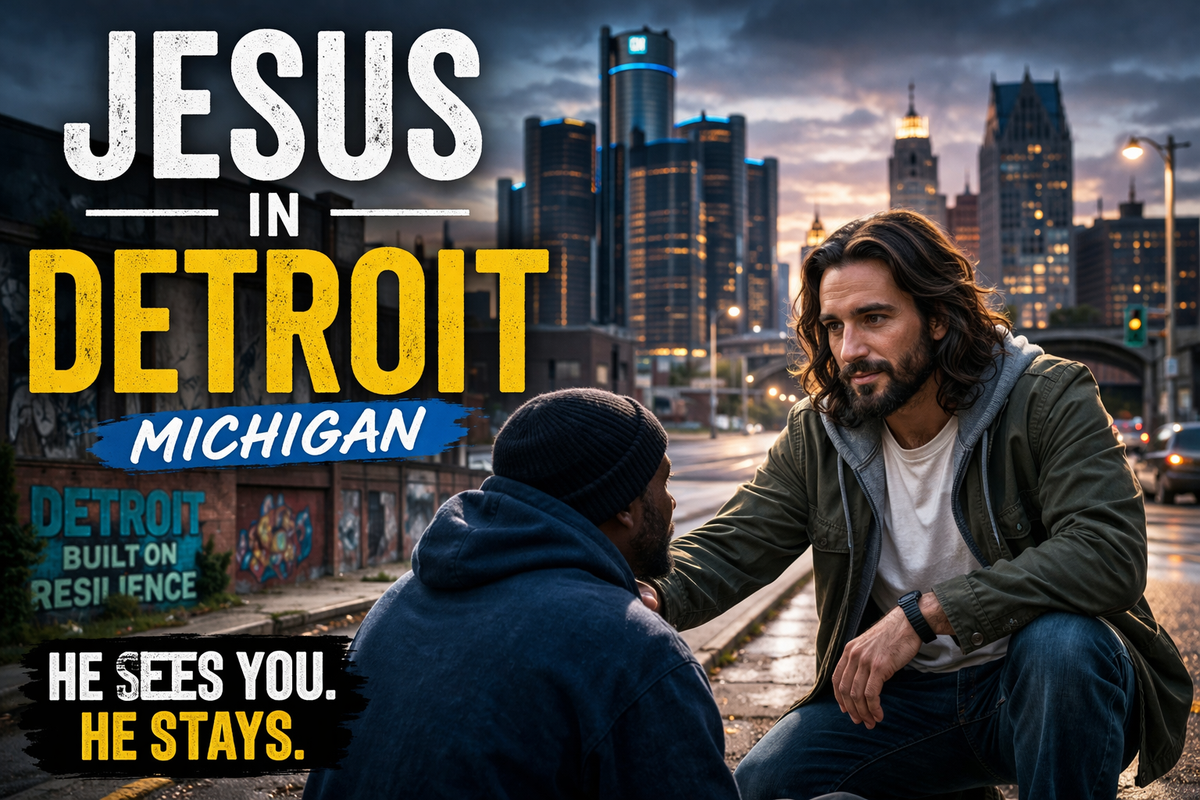
Before the light had fully come up over Detroit, Jesus was already awake and alone in quiet prayer near the river, with the cold edge of morning moving across the water and the city still holding that strange silence it gets before the weight of the day drops back onto it. The skyline stood dark and patient in the distance. A few cars moved along Jefferson. Somewhere behind Him a truck backed up and beeped in the half-dark. A gull cut low over the river and disappeared. He knelt with His head bowed and His hands still, and He prayed with the kind of calm that did not fight the city or try to rise above it, but seemed to hold all of it at once, the people sleeping too little, the people waking up tired, the people already losing heart before breakfast, the people who had become so used to carrying pressure that they no longer called it pain. Not far from where He prayed, a silver sedan sat crooked near the curb with the engine idling rough and a man folded over the steering wheel inside it, one hand still wrapped around his phone like he had meant to answer somebody and failed even at that.
The man’s name was Calvin. He was forty-one years old and looked older in the tired way that comes when a person has been running too long from too many parts of his own life. His jaw was shadowed. His hoodie smelled like fast food grease and stale coffee. There were receipts on the passenger seat, a charger cord twisted around the gearshift, an orange light on the dash he had been ignoring for weeks, and three text messages glowing on his phone that he had read but had not answered. The first was from Monique, his ex-wife. It said, You said you would call her last night. The second was from his daughter Nia. It said, Are you still coming today or should I stop asking. The third was from a number he knew too well because it never brought anything good. FINAL NOTICE BEFORE REPOSSESSION. He had seen all three. He had done what he always did. He told himself he would deal with them after one more delivery, one more hour, one more little push toward getting the money right, because in his mind the whole of life had become a hallway he would walk through later, once things calmed down. The trouble was that things had not calmed down in years.
Jesus finished praying and stood. He looked toward the car the way a man might look toward a house with smoke rising from inside it. Not startled. Not rushed. Simply aware. He walked over and stood near the driver’s side window while Calvin jerked awake with that violent little confusion that comes after sleeping in a bad position and forgetting for a second where you are. Calvin blinked hard, straightened up, and stared at Him through the glass. For a moment he did not roll the window down. He just looked at Him with the dull suspicion of a man who had been asked for too much by too many people and had started expecting every new face to want something from him.
When he finally cracked the window, he said, “You need something?”
Jesus looked at him with an expression Calvin could not place because there was no edge in it and no performance either. “You have been awake for too many days inside too little sleep,” He said. “And you are tired in places sleep does not reach.”
Calvin let out a dry laugh. “That supposed to help me?”
“No,” Jesus said. “But it is true.”
Calvin rubbed his face and looked away toward the river as if the morning itself had irritated him. “You trying to preach at me before sunrise, you picked the wrong car.”
“I am asking for a ride.”
Calvin looked back at Him. “You got money?”
“No.”
That made Calvin laugh again, but this time it came out thinner. “Then you are definitely in the wrong car.”
Jesus did not move. “Take me into the city.”
Calvin should have told Him no. He knew that even while he sat there. He had deliveries to chase and a battery light on and hardly enough gas to keep doing what he was doing. He had no margin for random people standing by the river before dawn asking for favors. But there was something about the way Jesus stood there that did not feel like intrusion. It felt like truth had walked up to his window and refused to hurry. Calvin reached over and shoved a stack of crumpled paper bags off the passenger seat.
“Get in,” he muttered. “If this turns into something weird, I’m putting you out at the next light.”
Jesus got in without hurry, closed the door, and sat with His hands resting loosely in His lap. Calvin pulled away from the curb and headed west, the river falling behind them as the city slowly opened its eyes around them. Delivery vans started appearing. Bus stops began to fill. The tall buildings downtown held the first pale light on their windows. Calvin drove with one wrist hooked over the steering wheel, his other hand on his phone when he thought he could get away with it, tapping between delivery apps, checking for orders, checking his balance, ignoring his messages again. Jesus watched the city. He watched the people waiting on corners and the workers stepping out into cold air and the man dragging a mop bucket through a side door of a tower before most people were even fully awake.
After a while Calvin said, “So where exactly am I taking you?”
“Keep driving,” Jesus said.
“That is not a place.”
“It is for now.”
Calvin shook his head. “You one of those guys that talks in riddles because you like hearing yourself?”
“No,” Jesus said. “You hear yourself enough for both of us.”
Calvin gave Him a sideways look. It should have made him angry, but what it really did was bother him because it landed too close. He turned off onto Woodward and rolled toward Midtown. He could feel the shape of the morning building around him. He had to be near Eastern Market later if he wanted the better delivery runs. He had promised himself he would clear enough by afternoon to keep the repo company off him for another week. He had also promised Nia he would be there that evening. It was some school art thing. She had told him about it twice on the phone and once by text. He had half listened each time because he was always half somewhere else. He remembered only that it mattered to her, which should have been enough, but even that had begun to feel like one more item in a life full of items.
“You have a daughter,” Jesus said.
Calvin’s grip tightened on the wheel. “That wasn’t a question.”
“No.”
“How you know that?”
Jesus looked ahead. “You keep looking at your phone as if love is something you can answer later.”
Calvin swallowed and stared at the road. “You do not know anything about my life.”
“You have told yourself that once you are steady, then you will show up the way you should. Once the money is better. Once the car is safe. Once you are less ashamed. Once you are not so tired. But delay has been wearing your face for so long that the people who love you can no longer tell the difference between your struggle and your absence.”
Calvin’s mouth went dry. He hated how cleanly the words cut through him. He wanted to snap back. He wanted to say Monique had no idea what it was like trying to hold life together with bills coming in from every direction and work that barely worked and a body that had never felt right since the accident at the plant. He wanted to say Nia was too young to understand what it took to keep things from completely falling apart. He wanted to say that if people would just stop needing something from him for one week, maybe he could breathe. But none of those things were the deepest truth. The deepest truth was uglier. He had gotten used to letting people down one manageable piece at a time because the whole truth about himself felt too heavy to face all at once.
They rode in silence for a few blocks until Jesus said, “Stop here.”
Calvin looked up and realized they were near the Detroit Public Library, not far from where the wide stone steps faced the morning and the city had begun to move in earnest. A few students were crossing with backpacks slung over one shoulder. A bus hissed at the curb. Someone rolled a cart full of books through a side entrance. On the lower end of the steps, a girl sat with her elbows on her knees and her forehead pressed into both hands while a younger boy stood beside her with his coat unzipped and one shoelace dragging the ground. Calvin had not noticed them until Jesus opened the door.
“You serious right now?” Calvin said. “I have places to be.”
Jesus stepped out and looked back in. “Then come with Me.”
“I am not doing this.”
But he parked anyway. Maybe it was because Jesus had already left the door open and standing there with the engine running felt even stranger than getting out. Maybe it was because the girl on the steps looked like she was trying not to break in front of the child beside her. Maybe it was because Calvin had been moving so long that standing still for one unwanted minute felt like a kind of threat, and some part of him knew that was exactly why he needed it. He got out, slammed the door harder than necessary, and walked a few steps behind Jesus with the stubborn face of a man making it clear he was only there physically.
The girl looked up when Jesus stopped in front of her. She could not have been more than seventeen. Her eyes were swollen from crying but she still held herself in that stiff way people do when they are trying not to give strangers the satisfaction of seeing too much. The boy beside her looked from her to Jesus to Calvin and then down at the steps, uncertain whether he was in trouble simply for existing there.
“What happened this morning?” Jesus asked her.
She wiped under one eye and gave a short, embarrassed laugh. “You mean besides all of it?”
“Yes.”
She looked at Him as if she had not expected a real answer to be possible. “My brother has to be at school in twenty minutes,” she said. “I am supposed to be in school too. My grandma thinks I’m taking him. I got this email before we left the house that said the scholarship I thought I had is not enough and there are other costs and I knew there would be, I’m not stupid, I just thought maybe for once I would not be standing at the front of a cliff with everybody telling me to jump and also somehow build the bridge on the way down.” She stopped and shook her head. “I’m sorry. You don’t know me. I don’t know why I’m saying all this.”
“Because it is hard to carry a future that keeps asking for money from people who do not have enough for the present,” Jesus said.
The girl’s face changed. It did not soften exactly. It just lost the small defensive mask she had thrown up out of habit. “Yeah,” she said quietly. “That.”
The little boy looked up at her. “Are we late?”
She touched the back of his head. “We are always late.”
“What is your name?” Jesus asked.
“Imani.”
“And his?”
“Desmond.”
Jesus nodded and then looked at Desmond’s shoe. He crouched and tied the loose lace with easy care, the kind that made the act feel holy instead of small. Desmond watched Him closely and did not pull away. Calvin stood off to one side with his hands in his pockets and his chest tightening for reasons he did not want to examine.
“You do not have to solve ten years of fear before noon,” Jesus said to Imani. “You only have to tell the truth about today.”
She laughed once under her breath, but it broke halfway through. “The truth is today doesn’t look good.”
“The truth is also that you are not a failure because the road ahead is expensive,” Jesus said. “And you are not weak because the pressure is making your hands shake. Some burdens feel like they are asking you to become stone. Do not obey them.”
She stared at Him. “If I go home and tell my grandma, she is going to feel like all her work was for nothing.”
“No,” Jesus said. “She is going to feel afraid. That is different. Do not make fear into a final verdict.”
Imani looked down at her hands. “You ever been the person everybody thinks is going to make it out, and the whole time you’re just trying not to fall apart where they can see you?”
“Yes,” Calvin said before he meant to speak.
All three of them looked at him. Calvin wished immediately that he had stayed silent, but the words were already in the air. Imani studied him with a kind of startled recognition that had nothing to do with him personally and everything to do with hearing another human being say the thing out loud. Calvin shifted his weight and looked away toward the street.
Jesus stood and said, “Walk your brother to school. Then go home and tell your grandmother what the email said. Say it before fear has time to rehearse its speech.”
Imani let out a long breath. “That sounds terrible.”
“It may be,” Jesus said. “But terrible truths are still kinder than lonely lies.”
She nodded slowly. Then, to Calvin’s surprise, she stood and straightened her coat like someone preparing for weather instead of defeat. Desmond slipped his hand into hers. Before she left, she looked once more at Jesus and said, “Who are you?”
He answered her with a small, tired-kind smile that somehow held both gentleness and weight. “Someone who is not afraid of what feels impossible.”
Calvin watched them go down the steps and disappear into the movement of the street. He did not realize until then that he had stopped thinking about his apps. His phone buzzed in his pocket and he ignored it without even checking. He looked at Jesus and said, “You do that a lot?”
“See people?” Jesus asked.
Calvin frowned. “I meant walking into things that are none of your business.”
Jesus turned and started back toward the car. “There is less that is none of My business than people think.”
They drove again. This time Calvin did not fill the silence right away. They headed toward Eastern Market because he finally had to stop resisting his own day, and because part of him wanted movement again after whatever had just happened on those library steps. The city was fully awake now. Trucks rolled in. Men in work gloves unloaded crates. Murals flashed past on long brick walls. The smell of produce and coffee and cold pavement came through the vents when Calvin cracked the window. As they got closer, he felt another kind of tension rise in him. He knew this stretch. He knew who worked here. He knew who he owed a call and had not made. Jesus looked out the window as if He knew that too.
“I need to make a drop,” Calvin said. “You can wait in the car.”
Jesus said nothing.
“That means yes,” Calvin muttered, though he already knew it did not.
He parked near a row of market sheds and got out with a box under one arm. Jesus came with him. Calvin did not argue this time because he was too busy hoping not to run into the wrong person. The hope lasted less than thirty seconds.
“Calvin.”
The voice came sharp from behind a folding table stacked with jars, bundled greens, and loaves of bread wrapped in paper. Renee stood there in a knit cap and heavy coat, one hand on her hip, the other holding a clipboard. She was Calvin’s cousin on his mother’s side. They had grown up two blocks apart. She had once been the easiest person in the family to laugh with. Now she looked at him the way people look at someone who has turned into a pattern they are tired of pretending not to notice.
“So you do remember this side of town exists,” she said.
Calvin stopped. “I’m working.”
“I can see that,” Renee said. “Funny how work only leads you back to family when you happen to be standing where they can catch you.”
Calvin set the box down near a vendor stall and kept his face flat. “Not today, Renee.”
“No, today is perfect,” she said. “Because you missed Uncle Vernon’s appointment on Tuesday and then you missed his call yesterday and then you missed mine last night. He sat in that chair by the window till almost midnight because he thought maybe you’d still come.”
Calvin felt heat climb the back of his neck. “I got caught up.”
Renee let out a hard laugh. “You live caught up. That is not a reason. That is just your address.”
Jesus stood beside Calvin without speaking. Renee noticed Him then and seemed for the first time to pull back from her own momentum. “Who is this?”
“A ride I picked up,” Calvin said.
Jesus looked at her. “You have been carrying too much for too long.”
Renee’s expression changed the way strong people’s expressions change when somebody names the hidden cost and not just the visible task. She looked tired all of a sudden. Not dramatic. Just worn in the bones. “That is everybody around here,” she said.
“Yes,” Jesus said. “But not everybody has mistaken being dependable for being unbreakable.”
Renee’s eyes dropped. “I do not have time to break.”
“No,” Jesus said. “That is usually when it begins.”
For a second nobody moved. The market noise went on all around them, carts rattling, vendors calling, engines humming, footsteps crossing wet concrete. Calvin stared at a stack of onions on a nearby table because looking at either of them felt harder than it should have. Renee cleared her throat and pressed the heel of her hand into one eye.
“Daddy asked for you,” she said to Calvin, quieter now. “Not because he needed anything fixed. He just wanted to sit with you. He was having one of his better afternoons and he remembered that story about you and him sneaking into Tiger Stadium when you were fourteen. He wanted to tell it again before he forgot it.” She looked at him with more hurt than anger now. “Do you know what it feels like to watch a person disappear by inches and still be the one calling everybody else to come say hello while there is still enough of him left to know their names?”
Calvin’s mouth opened, then closed. He had no defense that did not sound rotten out loud. The truth was simple. He had been avoiding Uncle Vernon because each visit made time feel real. The old man’s mind came and went. Some days he remembered everything. Some days he remembered almost nothing. Calvin could not stand walking into a room and seeing what became of people even when they had once been loud and strong and impossible to imagine diminished. It made him feel the thinness of everything. It made his own life feel exposed.
“I kept meaning to come by,” he said, and hated himself for how weak it sounded.
Renee gave him a long look. “That sentence has done more damage in this family than almost anything.”
Jesus turned toward Calvin then. He did not shame him. He did not raise His voice. He simply said, “You keep speaking of your intentions as if they should receive credit for work your presence never did.”
That landed harder than Renee’s anger had. Calvin felt something inside him recoil because he knew it was true. He had been living inside intention for years. Good intentions. Future intentions. Delayed intentions. He had built a whole identity out of the version of himself he still planned to become while people around him lived with the version that kept not arriving.
Renee looked between them. “Well,” she said after a moment, “I have customers and no backup and a delivery late and bills on my table at home I have not opened because I already know how they are going to make me feel, so if this is the part where everybody gets healed by lunch, I do not have time.” But her voice had softened despite herself. She glanced at Jesus again. “Still. What you said. About dependable and unbreakable. That one got in.”
Jesus nodded. “Go home tonight before you become a machine in your own mind.”
Renee snorted. “That late already, huh?”
“Yes,” Jesus said.
She stood there for another second as if she wanted to say something more and did not trust herself to. Then she turned back to her table, picked up her clipboard, and called out to a customer with practiced cheer that did not quite hide the trembling in it. Calvin remained where he was.
“You could have stayed in the car,” he said to Jesus.
“You could have come on Tuesday,” Jesus said.
Calvin looked away. The market suddenly felt too loud. He picked up the empty box again though he had nowhere to take it. He started walking without direction and Jesus walked with him between the sheds, past stacked produce and handwritten signs and the everyday labor of people building a living in plain sight. They came out near the street where the noise thinned just enough for Calvin to hear his own breathing.
“She thinks I do not care,” he said.
“Do you?” Jesus asked.
Calvin stopped. “That is not fair.”
“It is honest.”
Calvin turned on Him then, not shouting but close. “You want honesty? Fine. I am tired. I am tired of everybody needing a piece of me when I barely have enough left to keep the lights on in my own place. I am tired of feeling like every room I walk into comes with another way I have already failed somebody. I am tired of hearing what I should have done when I am the one waking up in this car because I cannot risk missing a run that might keep my whole life from sliding another inch downhill. You stand there and say all this clear stuff like it is easy. It is not easy.”
“No,” Jesus said. “It is not easy.”
Calvin waited for more, but Jesus only looked at him with that same steady attention that felt unbearable because it left no room to hide in noise. Traffic moved past them. A man pushed a dolly across the lot. Somewhere nearby a radio played softly from inside a stall. Jesus said at last, “You are telling the truth about your exhaustion, but not yet about your hiding.”
Calvin stared at Him. “Hiding?”
“Yes. There was a time when you worked because people depended on you. Now you also work because motion keeps you from having to feel what still hurts. You tell yourself you are surviving, and some of that is true. But survival has become more than your condition. It has become your shelter. You stay in it because if you ever stood still long enough, grief would catch you. Regret would catch you. The faces of the people you keep disappointing would catch you. So you call your running responsibility and hope nobody notices it is also fear.”
Calvin felt like the whole city had gone quiet around him. He looked off toward the street, toward the market, toward anything that was not this man beside him saying the exact thing he had spent years arranging his life not to hear. He remembered the accident. He remembered the pain pills after. He remembered the weeks at home and the silence and the feeling that something strong in him had cracked open and never fully reset. He remembered Monique asking him simple questions in a careful voice because she did not know which version of him was coming through the door. He remembered Nia at eight years old waiting in a folding chair after dance class with her little coat buttoned wrong because he had been late again then too. He remembered each moment as if they had all been waiting just behind a locked door and somebody had finally turned the key.
His phone buzzed again. This time he pulled it out. The message was from Monique.
If you are coming tonight, do not tell her unless you mean it.
Calvin stared at the screen until the words blurred.
Jesus said nothing. He let the silence do its work.
Calvin slid the phone back into his pocket and looked toward the west where the day had already moved farther than he wanted to admit. “I have to make money before tonight,” he said, though he no longer knew whether he was explaining or pleading.
Jesus began walking again, and Calvin followed because by now he understood that whatever this day was, it was not going to let him stay untouched. They moved away from the market and eventually out toward Corktown, where the city carried its old bones and its newer ambitions side by side. When Michigan Central came into view, tall and restored and standing like a statement about return, Calvin slowed without meaning to. He had worked a short contract job not far from there once. He remembered thinking at the time that maybe the city getting another chance meant something for him too. Maybe if enough around him got rebuilt, it would pull him up with it. But buildings were easier than people. Buildings did not wake in the night with shame in their chest. Buildings did not keep making promises they were too afraid to test.
Jesus looked toward the station and then at Calvin. “A city can repair what was broken in public and still carry private ruin in its people.”
Calvin swallowed.
“There is nothing wrong with rebuilding,” Jesus said. “But many live as if repair on the outside is the same as life on the inside. It is not. Some walls can look stronger than ever while the rooms behind them stay empty.”
Calvin wanted to answer. He wanted to say something bitter or smart or at least solid enough to protect himself. But he had begun to feel that all his usual defenses were made of paper. The day had already seen through too much. He stood there with the restored stone and steel behind him and the ache of his own life opening wider than he liked, and he felt the old temptation rising again, the one that always came when truth got close. Get back in the car. Take the next order. Make the next run. Push this feeling off until tomorrow. Tomorrow had been ruling him for so long that it almost felt like a god.
Then his phone rang.
This time it was not Monique. It was the lender.
Calvin answered because not answering no longer stopped anything. He listened for thirty seconds and said almost nothing. Just yes. Then okay. Then a strained, “I heard you.” When the call ended, he kept the phone to his ear for a moment anyway, as if pretending the conversation were still happening might give him a few more seconds before he had to admit what had just been said.
“What happened?” Jesus asked.
Calvin lowered the phone slowly. “Five o’clock,” he said. “If I do not make a payment by five, they start the pickup process tonight.” He looked down the street, then back toward where the car sat, then at nothing at all. “If I lose the car, I lose the work. If I lose the work, everything else goes with it.”
Jesus held his gaze.
Calvin’s voice dropped. “Nia’s event starts at five-thirty.”
The afternoon wind moved down the street and carried the smell of wet pavement and old brick. Traffic passed. Somewhere a siren rose and fell. Calvin stood there between two clocks that both felt merciless, one tied to money and one tied to the face of a little girl who had been learning for years not to trust his promises too much. He did not know yet which fear would own him by evening. He only knew that for the first time in a long time, the choice had become too clear to blur with excuses, and the truth of that clarity frightened him more than the lender ever could.
Calvin looked at Jesus as if maybe, for once, someone else would tell him what to do and save him from having to be the one who chose. That was part of the problem too. He had been waiting on rescue from decision for a long time. He wanted some clean arrangement where he could keep the car, keep the money coming, keep his daughter from one more disappointment, keep his family from saying what they had every right to say, and keep his own shame from opening any wider than it already had. He wanted mercy without exposure. He wanted relief without surrender. He wanted a way forward that did not first require honesty.
Jesus did not rush in to fill the silence. He let Calvin stand there with the full pressure of the hour pressing against him. It was that stillness, more than anything, that began to break something open. Most people either rushed to solve him or rushed to judge him. Jesus did neither. He stayed present. He stayed clear. He stood there in the cold Detroit air while traffic moved and the city kept going, and He made Calvin feel the thing he had spent years outdriving. Choice was not really hiding from him anymore. It was standing in plain sight.
“What would you have me do?” Calvin asked at last, and he hated how small his voice sounded.
Jesus answered Him gently, but not softly enough to let him escape. “Tell the truth with your life before the day ends.”
“That is not an answer.”
“It is the only one that reaches beneath the surface.”
Calvin ran a hand over his mouth and looked back toward the car. “Truth is not going to stop them from taking that vehicle.”
“No,” Jesus said. “But lies have been taking more from you than the lender ever will.”
The words landed with a heavy, brutal mercy. Calvin almost laughed from how unfair they felt, except that he knew they were not unfair. They were exact. Every delay. Every excuse. Every half-promise. Every call he meant to return. Every family member he avoided because their eyes held too much memory. Every time he told himself he was buying time when really he was spending trust. The car was a problem. Money was a problem. The lender was a problem. But none of those were the deepest thing happening in him. The deepest thing was that he had built a life where urgency always got the best of him and love got whatever was left over.
He leaned against the side of the car and shut his eyes. For a moment he saw Nia at six, sitting cross-legged on the floor in the old apartment, drawing on a scrap pad with that fierce concentration children have when they still believe what they are making matters. He had come in late and she had run to him holding up a picture of all three of them under a sun too large for the page. He had barely looked at it because he was on the phone. Later he found it in the trash, folded in half. He did not know whether she had thrown it away or Monique had cleaned up. He only knew that he had never forgotten the image, even while he kept acting like forgetting was the one thing he did well.
Jesus stepped away from the car and started walking.
Calvin opened his eyes. “Where are you going?”
“To the next truth.”
Calvin stared at Him, then pushed himself upright and followed. At this point there was something almost absurd about it, a whole day turning because a stranger would not stop walking toward the exact places Calvin least wanted to go. Yet it no longer felt random. It felt surgical. They got back in the car, and Jesus told him to head west. Calvin drove with the kind of tense attention men get when they know they are moving toward a reckoning and are still half hoping for a diversion. They passed blocks where the city wore its wounds openly and others where fresh paint and new construction tried to tell a better story. Detroit had become used to speaking in that double voice, promise and scar, comeback and ache. Calvin knew the feeling.
They came at last to a quiet stretch of neighborhood streets on the west side where Uncle Vernon lived in a small brick house that had once held cookouts and arguments and card games and borrowed lawn chairs and cousins running through the yard until dark. Calvin had not been there in three weeks. That was long enough for guilt to ripen into something sour and thick. He parked at the curb and sat there with both hands on the wheel.
“I do not know what version of him is in there today,” he said.
Jesus looked at the house. “And if he does not remember you?”
Calvin swallowed. “That would almost be easier.”
Jesus turned toward him. “No. It would only hurt you in a cleaner place.”
Calvin stared through the windshield. Curtains moved faintly in the front window. He thought of Renee and her hard tired face at Eastern Market. He thought of Uncle Vernon sitting by the window waiting. He thought of how many times people had expected so little from him lately that even the smallest act of showing up had started to seem heroic in his own mind. It was not heroic. It was basic. That realization stung.
He got out. Each step to the porch felt heavier than it should have. He could hear a television low inside the house. He almost turned back when the front door opened before he knocked. Renee stood there holding a dish towel. She looked from Calvin to Jesus and then back again, her expression guarded but not closed.
“You picked a time,” she said.
Calvin gave a small nod. “I know.”
Renee watched him another second, then stepped back. “Come in.”
The house smelled like onions, laundry soap, and old wood warmed by years of heat. Some homes carry the memory of everyone who has ever cried there. This was one of them. The furniture was mostly the same. The framed photographs on the wall were mostly the same too, though Calvin noticed with a strange ache how many faces had already gone from living people into images that watched from frames. There was Uncle Vernon in his younger days in a Tigers cap. There was Calvin’s mother laughing with one hand over her mouth. There were cousins at graduations, weddings, baby dedications, funerals. Whole chapters of family life looked back at him while he stood in the hallway feeling like a late arrival to his own responsibilities.
Uncle Vernon sat in the living room near the window in the same recliner where Renee had said he waited. A blanket lay over his knees. The television was on but muted now. He looked thinner than Calvin remembered, and smaller too, which did something mean and immediate to his chest. Some losses announce themselves loudly. Others sit in a chair in daylight and change the whole room by how quietly they happen.
Renee went in first. “Daddy,” she said, “you got company.”
Uncle Vernon looked up slowly. His eyes moved to Calvin, narrowed as if searching through a drawer of names, and then widened with the old spark that used to appear right before he laughed at his own joke. “Boy,” he said, “you still owe me for those hot dogs.”
Calvin let out a breath that almost became a sob but caught itself halfway. “Yeah,” he said. “I probably do.”
Uncle Vernon pointed a crooked finger at him. “Tiger Stadium. You said you were hungry and then ate like you had never seen food before.”
Renee looked down, smiling despite the tiredness on her face. Calvin sat on the edge of the couch across from his uncle and felt the room tilt around the simple grace of being remembered at all.
“I should’ve been by sooner,” he said.
Uncle Vernon waved a hand. “You here now.”
That should not have hurt, but it did. Maybe because it carried no accusation. Maybe because older mercy often wounds more deeply than anger. Calvin leaned forward and rested his forearms on his knees. He had come ready for confusion or distance or another excuse to retreat. Instead he found the man still there enough to receive him, and suddenly all the missed days felt heavier.
Jesus stood quietly near the doorway. He did not interrupt. He watched the room like someone honoring holy ground.
Uncle Vernon squinted toward Him. “Who that?”
“A friend,” Calvin said, though he was not sure the word was big enough.
Uncle Vernon nodded as if that answered more than it should have. “Good. Too many people trying to live without one.”
Renee disappeared into the kitchen and came back with coffee, setting a mug down near Calvin without asking how he took it because family history had already answered that years ago. He looked up at her. “I’m sorry,” he said, and meant more than the immediate moment.
She exhaled through her nose and leaned against the doorway. “I know you are. I just need you to stop making me hear it only in sentences.”
Calvin nodded. He could not argue. Even apology had become theoretical in him sometimes, another good intention suspended in air. He took the mug in both hands and let the heat sit against his fingers. Uncle Vernon started telling the old stadium story in broken but vivid pieces, about the chain-link gap and the security guard looking the other way and Calvin nearly dropping a paper tray of hot dogs because he was too busy trying to stare at everything at once. Calvin laughed, really laughed, and felt something in him loosen. Not fixed. Not erased. Just loosened. For a few minutes the room was not built around his failures. It was built around memory. That mattered.
Then the conversation drifted. Uncle Vernon looked at him with a puzzled tenderness and said, “Your little girl still drawing?”
Calvin blinked. “Yeah. Yeah, she is.”
“She got that from her mama?”
Calvin smiled faintly. “Maybe. She got the stubborn part from both sides.”
Uncle Vernon chuckled. Then his face changed, not into confusion exactly, but into that vulnerable searching look people get when their own mind has begun to feel like uncertain ground. “You seeing her enough?”
The question went through him clean. Calvin lowered his gaze to the coffee. “No,” he said.
Uncle Vernon shifted in the chair. “Then go.”
Calvin looked up.
“Whatever you keeping for later,” the old man said, with surprising steadiness now, “later is a liar.” He lifted one shoulder as if the thought had come from somewhere he did not need to explain. “You think you got more of it than you do.”
Renee looked toward Jesus then, and Calvin did too. Jesus had not spoken, but somehow the whole room felt shaped by His presence. Calvin felt suddenly as if the city, the day, his family, the lender, his daughter, all of it had been converging toward one simple thing. Show up now. Not when it is neat. Not when the math works. Not when shame has finally stopped talking. Now.
He checked the time and felt his stomach drop. The afternoon had run harder than he thought. He still did not have the money. He still did not know what would happen to the car. But something had shifted while he sat in that room. The question no longer felt like which disaster he could avoid. It felt like what kind of man he was going to keep becoming if he chose fear again.
He stood. Uncle Vernon caught his wrist with unexpected strength.
“Hey,” the old man said.
Calvin leaned closer.
“Do not punish people with your absence because you are ashamed of your life.”
Calvin stared at him. For a second he wondered if his uncle even fully understood what he had said. Then it stopped mattering. Truth does not become weaker because it came through a failing body. Sometimes it becomes stronger. Calvin closed his hand over the old man’s and bowed his head. “I hear you.”
When they left the house, the light had begun its slow turn toward evening. The city looked different in that hour, softer around the edges but heavier in the chest. Calvin stood on the porch for a moment without moving. He looked at Jesus and said, “Everybody today keeps saying the same thing in different words.”
“Truth often echoes before it is finally obeyed,” Jesus said.
Calvin laughed once under his breath. “I really do not know what to do about five o’clock.”
Jesus stepped off the porch. “Then stop asking the hour to forgive what only surrender can heal.”
Calvin frowned. “You keep talking like this is bigger than money.”
“It is,” Jesus said. “Money is the fire nearest your feet. But there has been another fire burning longer. You have been living with a divided heart. One part says it loves people. The other part keeps arranging life around self-protection. Until that division is faced, every crisis will only look financial because that is the easiest pain to name.”
Calvin wanted to reject it, but the day had already earned too much of the truth. He followed Jesus back to the car and drove south again. They moved through the city toward Midtown as traffic thickened and office buildings began emptying themselves into the streets. A train of thought kept pulling through Calvin’s mind. He had lived for months, maybe years, assuming the biggest danger was collapse. Lose the car. Lose the work. Lose the apartment. Lose the little bit of standing he still had. But the day was forcing him to see a more frightening possibility. A person can technically keep everything necessary to function and still lose what made life human. He had been doing that very thing. He had been keeping motion and losing tenderness. Keeping survival and losing presence. Keeping excuses and losing trust.
Near the Detroit Institute of Arts, traffic slowed. Students crossed in clusters. People moved along the sidewalks with that end-of-day hurry that is not exactly speed so much as accumulated tiredness. Calvin checked the time again. He could still make it to Nia’s event, but only if he stopped trying to solve the entire rest of his life first. That was the real trap. He had told himself for so long that he needed to fix the whole structure before offering anyone his presence. Jesus had been tearing that lie down all day, one encounter at a time.
“Her event is at the school on Putnam,” Calvin said quietly. “Art night. She told me twice on the phone and once by text.” He looked ashamed even saying it. “I almost missed it in my head before I ever missed it with my body.”
Jesus nodded. “Then do not miss it twice.”
Calvin pulled over and parked along the curb. He took out his phone. His thumb hovered over Monique’s name longer than it should have. His heart was beating harder from this one call than it had from the lender’s. Money was ruthless, but relational truth made him feel exposed in a deeper way. He tapped the name before he could talk himself out of it.
Monique answered on the fourth ring. “What.”
No hello. No softness. Just a tired wall with his history already built into it.
“It’s me,” Calvin said, and immediately hated how stupid that sounded.
“I know who it is.”
He swallowed. “I’m coming.”
Silence.
“For real,” he said. “I know how that sounds. I know what you’re thinking. I’m still coming.”
“Calvin.”
Her voice held no anger now. That was worse. Anger at least still leans forward. This was older than anger. This was fatigue.
“I’m not asking you to believe me because I said it,” he went on. “I’m asking you to watch what I do next. I’m on my way.”
Another silence. Then, “She stopped asking me fifteen minutes ago.”
The sentence cut him open. He shut his eyes. Jesus stood beside the car, saying nothing.
“I’m sorry,” Calvin said, and this time he did not dress it up or rush past it. “I have been making both of you carry my uncertainty for too long.”
Monique did not answer right away. When she spoke, the weariness in her voice had shifted just enough to let something human through. “You always say the right thing when you finally get scared enough.”
He nodded though she could not see him. “I know.”
“Then do not make tonight about your guilt. She doesn’t need another speech. She needs her father to walk through the door before she gives up looking.”
“I hear you.”
He ended the call and stood still for a second with the phone in his hand. Jesus looked at him and said, “That cost you more than the payment would have.”
Calvin let out a breath that trembled. “Yeah.”
“Because pride hates being seen before it is repaired.”
They got back in the car and headed toward the school. Calvin did not drive like a man in a movie racing toward redemption. There was no triumphant music in him. There was only a sober urgency, and underneath it a strange quiet growing stronger than panic. The more honest he became, the less dramatic the day felt. It was almost plain. Just one truth after another. One choice after another. One human being after another. That was what made it holy. Not spectacle. Presence.
They reached the school with a few minutes to spare. Families were already going in under the early evening lights. Children in dress clothes and sneakers moved through the entrance carrying projects and canvases and trifold boards. A teacher held the door. Voices echoed in the hall. Calvin parked crooked and killed the engine. Then he sat there.
Jesus waited.
“What if she sees me and doesn’t care anymore?” Calvin asked.
“That is not the same as not being wounded,” Jesus said.
“What if I already taught her not to trust me?”
Jesus looked toward the entrance where parents kept walking in. “Then tonight is not the end of the lesson. It is the beginning of a better one.”
Calvin nodded, opened the door, and got out. Jesus came with him as far as the sidewalk. Inside the building the smell of waxed floors, paper, tempera paint, and cafeteria coffee hit Calvin with a flood of memories from his own school days. There is something about school hallways in the evening that exposes people. Parents stand a little straighter. Children glance more often toward the doors. Teachers look both proud and exhausted. Everything is ordinary and tender at the same time.
They followed the signs to the art rooms. Calvin’s heart thudded harder the closer they got. He saw Monique first near a display board at the far end of the hall. She stood with her arms folded tight, not angry-looking now, just braced. Beside her was Nia, eleven years old, in a denim jacket with her hair pulled back and a paper badge clipped to her shirt. She was staring at a painting mounted on black backing, but the kind of stillness in her body told him she was not really seeing it. She was waiting without wanting to admit she was waiting.
Monique saw him first. Her face did not open. It just changed, the way a door changes when the lock finally turns but the person inside is not sure whether to trust the sound. Nia turned then. For one awful second Calvin saw all the old disappointment rush to the surface in her before she could stop it. Then she saw that he was actually there. Not on the phone. Not apologizing from a distance. There.
“Dad?”
He walked toward her slowly, as if sudden movement might break the fragile reality of the moment. “Hey, baby.”
She studied him the way children do when they are checking whether hope is safe. “You came.”
“I did.”
That was not enough, and he knew it. So he added, “I should have made it simpler for you to believe.”
Nia looked down at her shoes. “Mom said not to get excited until you walked in.”
Monique let out the smallest breath at that, half rueful, half aching.
Calvin nodded. “Your mom was right.”
He wanted to hug Nia right then, but he did not force the moment to happen on his terms. He stood there and let her choose. After a few seconds that felt longer than most of his recent life, she stepped forward and wrapped her arms around his middle. He held her with both arms and closed his eyes. There are moments when a person realizes how much of his own soul has been starving without knowing its own name. This was one of them. Her small body against him was not dramatic or mystical. It was simply true. He had been absent from tenderness so long that the return of it felt like pain first and relief second.
When she pulled back, she took his hand and led him toward her display with the possessive urgency of a child who has finally decided not to hide her excitement anymore. “I made this,” she said.
It was a painting of the Detroit river at sunset, done in thick imperfect strokes, with the Ambassador Bridge in the distance and a figure standing near the water. The person was turned away, almost just a shape. But something in the posture caught him. The figure looked like someone waiting for an answer that had not yet come.
“It’s beautiful,” he said.
She searched his face, checking whether he meant it.
He did. “No,” he said, more firmly now. “It really is. Tell me about it.”
That mattered. He could tell from how quickly her whole face changed. Children know when adults are throwing praise over them like a blanket to cover guilt. Asking to hear the heart behind what they made is different. Nia pointed to the water. “It’s supposed to be somebody standing there after a bad day. Not because everything is fixed. Just because the river is still there and it makes them feel like maybe they can breathe long enough to try again.”
Calvin swallowed hard. “That’s what you painted?”
She shrugged in a shy little way. “Kind of.”
Monique looked at him then, and for the first time that day he saw something in her eyes other than expectation braced against disappointment. It was not trust restored. That would be too cheap. It was something smaller and maybe stronger. Recognition. He was finally in the room.
Parents kept flowing through the hall. Teachers praised projects. Children tugged at sleeves. Somewhere a choir rehearsal was warming up in another wing of the building. Calvin felt his phone buzz again in his pocket. He knew without checking what it probably was. He ignored it. Not as a performance. Not as some grand statement. Simply because one thing had become clear. He had spent too much of life letting whatever shouted loudest define what mattered most.
Nia kept talking. She showed him two sketches and a collage and a charcoal drawing that smudged the edge of his thumb when he touched it. He apologized and she laughed. Monique watched quietly. At one point she stepped closer and said, low enough for only him to hear, “Do you understand this does not erase everything?”
“Yes,” he said.
She studied him, perhaps expecting defense or self-pity. He gave neither.
“I’m glad you’re here,” she said finally, and the sentence carried far more weight than someone outside the history would have understood.
He nodded. “I’m glad I stopped acting like later was good enough.”
She looked over his shoulder toward the hall entrance. “Who came with you?”
Calvin turned. Jesus stood near the doors at the far end of the corridor, not apart from the evening but somehow holding it all in one quiet gaze. Children moved past Him. Parents passed without noticing anything unusual. A teacher laughed into a phone near Him. Yet He seemed more present than anyone else in the building.
“A friend,” Calvin said again.
Monique followed his line of sight, but by the time she looked, Jesus had already begun walking back toward the exit.
Panic flickered in Calvin. He squeezed Nia’s shoulder gently. “I’ll be right back.”
He moved down the hallway, past taped-up drawings and bulletin boards and the bright clutter of school life. By the time he reached the sidewalk outside, Jesus was standing beneath the darkening sky with the city lights beginning to rise around Him. Traffic moved along the street. The evening had settled into that hour when people head home carrying whatever the day has left in them.
Calvin stopped in front of Him. “So that’s it?”
Jesus looked at him with warmth and gravity together. “For today.”
Calvin searched His face. “I still do not have the money.”
“No.”
“They may still take the car.”
“Yes.”
“My life is still a mess.”
Jesus did not argue with that either. “Some things will remain difficult,” He said. “But difficulty is not the same as abandonment. You have spent years thinking your crisis was that life became hard. Your deeper crisis was that hardness trained you to withdraw from love while calling it necessity.”
Calvin lowered his eyes.
Jesus stepped closer. “Listen carefully. Survival is a season, not a home. If you live in it long enough, it will teach you to treat tenderness like a luxury and presence like a risk. It will convince you that the loudest emergency is always the truest one. It will make you postpone the people you love in the name of someday protecting them better. But love cannot live on your someday. It has to be given in the day you actually have.”
Calvin felt the words settle into him, not as accusation now but as structure. They arranged the day. They arranged the months before it. They arranged the whole weary logic he had built his life on and showed him exactly where it had bent wrong.
“What do I do tomorrow?” he asked.
“Tell the truth again,” Jesus said. “And then again. Pay what you can. Work honestly. Return the calls you dread. Visit the people you keep postponing. Let your daughter see consistency in pieces if that is all you have at first, but let her actually see it. Stop offering intention where presence is required. Stop calling avoidance wisdom. Stop confusing shame with humility. One keeps you hidden. The other brings you back.”
Calvin nodded slowly, tears standing in his eyes now without drama, without trying to hide. “I don’t know if I can rebuild all of it.”
“You cannot rebuild all of it tonight,” Jesus said. “But you can stop abandoning it.”
The words opened something deeper than comfort. They gave him a way to step into his life without first becoming a fantasy of himself. That had been part of the trap too. He was always waiting to arrive as a finished man, a stable man, a redeemed man whose debts were smaller and whose habits were clean and whose confidence no longer shook. Meanwhile the actual work of repair had been waiting on smaller, humbler ground. A call returned. A chair sat in. A promise kept. A hard truth spoken before fear edited it. That kind of living did not flatter the ego. It did something better. It made love believable.
The phone buzzed again. Calvin took it out and looked. Another lender message. He stared at it, then at Jesus.
“What if I lose it anyway?”
Jesus answered with the kind of calm only truth carries. “Then lose less than you used to.”
Calvin frowned slightly.
“If the car goes,” Jesus said, “do not let your soul go with it. Do not turn one loss into permission for greater ones. People often suffer one blow and then surrender five more things out of despair. Do not do that. Hardship is real. But hopelessness still lies.”
Calvin took a long breath and let it out slowly. Somewhere behind them in the school building children laughed. A car door slammed across the street. The city kept moving, but the movement no longer felt like something dragging him. For the first time in longer than he could remember, he felt a strange plain courage rising in him. Not certainty. Not euphoria. Just willingness.
He looked back toward the entrance where Nia and Monique still were. “I should go back in.”
“Yes,” Jesus said.
Calvin hesitated. “Will I see you again?”
Jesus smiled, and there was something in it both near and immeasurably deep. “You will have many chances to notice whether I am near.”
Calvin wanted to ask more, but the words would not come. He stood there in the cooling Detroit evening with his chest full and raw and strangely lighter. He turned back toward the school, then stopped and looked over his shoulder one last time. Jesus was already walking away down the sidewalk, moving without hurry into the city that held so many tired hearts, so many defended lives, so many people calling their hiding by stronger names.
Calvin went back inside. He stayed for the rest of the event. He listened. He asked questions. He did not check his phone every minute. When Nia introduced him to her teacher, he did not shrink with guilt or overcompensate with charm. He just stood there and was her father. When the evening ended, he helped carry her projects to the car Monique had driven. They stood in the parking lot under the lights with the cold creeping in around them. Nia hugged him again before getting in.
“Can you come Saturday?” she asked.
He did not answer the old way. He did not say probably. He did not say I’ll try. He did not say we’ll see. He said, “Yes. And if something changes, I will tell you before you have to wonder.”
Nia nodded, and because she was still a child, hope came back to her more quickly than it would have to an adult. But it was not blind hope now. It had a new shape. Smaller. Careful. Real.
Monique lingered a moment after Nia got in the car. “You seem different,” she said.
Calvin looked at the school, then at the street, then back at her. “I got tired of hearing myself say later.”
She held his gaze, and in hers was all the history that would not disappear by one evening’s sincerity. But there was also the honest recognition that something had happened in him which did not feel like a speech. “Good,” she said. “Stay tired of it.”
When they drove away, he stood in the lot alone for a moment, hands in his pockets, the city lights reflecting dimly on wet pavement. Then he took out his phone and made another call. Renee answered on the second ring.
“What.”
It almost made him smile.
“I’m calling before later,” he said.
There was a pause.
“I’m going to come by Sunday after church and take a shift with Uncle Vernon,” he said. “You go home. Sleep. Yell at the walls. I don’t care. I’ll sit with him.”
Renee was quiet long enough that he thought maybe the line had dropped.
“You serious?” she asked.
“Yes.”
Another pause. Then her voice changed, not softened exactly, but relieved enough to show the weight she had been carrying alone. “Okay.”
“I’m also sorry,” he said. “Not in the floaty way. In the actual way. I have been making my struggle everyone else’s assignment.”
Renee exhaled. “Well. That’s about the first useful thing you said all year.”
He laughed, and she did too, and even that small shared sound felt like a board laid across a broken place.
After the call, he sat in his own car and finally listened to the lender voicemail in full. The terms were bad. The deadline was real. He checked his account and saw exactly how little room he had. The old panic tried to return with all its familiar force, telling him that this was the true center of the night, this was what should govern everything, this was what made all softer things foolish. He let the panic move through him without bowing to it. Then he did what he could do. He made the partial payment that was possible. It was not enough to fix everything, but it was not nothing either. He sent the money. He sent an email asking for one-day forbearance and called to leave a direct message instead of hiding in silence. Then he sat back and realized how strange it felt to face a problem without first disappearing from the people he loved.
The sky had gone nearly dark by then. He did not start the engine right away. He thought about the day from the river forward. Imani on the library steps trying not to collapse under the cost of a future. Renee at Eastern Market mistaking endurance for invincibility. Uncle Vernon in the recliner telling him later was a liar. Nia with her painting of a figure by the water just trying to breathe long enough to try again. Every part of the day had been saying the same thing in a hundred human forms. Stop living as if tomorrow is where love belongs. Show up while the day is still called today.
He drove at last, not home yet, but back toward the river. He did not know why at first. Then he knew. Some days rearrange a life without making much noise about it. They do not solve everything. They simply reveal where the real war has been. By the time he parked near the Detroit Riverwalk again, the wind had sharpened and the lights across the water had come alive in streaks and reflections. The city looked both bruised and beautiful, which felt right.
He got out and walked down toward the water where the path opened into a quiet stretch. At first he thought he was alone. Then he saw Jesus farther ahead, near where the river held the last scraps of evening light. He was kneeling again in quiet prayer, just as the day had begun. There was no crowd around Him. No spectacle. No glow the city could not explain. Only stillness. Only presence. Only the Son of God holding a worn and restless city before the Father with the same calm attention He had given to one exhausted man in a crooked sedan before sunrise.
Calvin stopped a few paces back and did not interrupt. He stood there in silence with his hands hanging at his sides and his mind finally no longer racing hard enough to drown out his own soul. He watched Jesus pray and felt something that had been missing from him for years begin, quietly, to return. Not ease. Not certainty. Something better. Alignment. The kind that comes when truth and love stop feeling like opposite demands and start becoming the same road.
The wind moved over the water. A distant horn sounded. The city lights shimmered and broke and gathered themselves again. Calvin did not speak. He did not need to. He had spent enough of his life talking around the things that mattered. Tonight he simply stood in the presence of the One who had walked him back into his own life. For the first time in a very long time, the future did not feel like a courtroom waiting to sentence him or a mountain waiting to crush him. It felt like a place where he would have to tell the truth again tomorrow, and maybe the day after that, and then the day after that too. Hard, humble, ordinary truth. The kind that keeps love from starving.
Jesus remained in quiet prayer, and the night deepened around Him. Detroit kept breathing. Somewhere families were still arguing. Somewhere bills still sat unopened on kitchen tables. Somewhere old grief still woke in the bones of people who had learned to function around it. Somewhere a young woman was telling her grandmother the truth about money with shaking hands. Somewhere a market vendor was finally sitting down after carrying too much all day. Somewhere a little girl was setting a painting against her bedroom wall and letting herself believe, carefully, that maybe her father had really come back through the door.
And by the river, under the darkening Michigan sky, Jesus prayed on.
Your friend,
Douglas Vandergraph
Watch Douglas Vandergraph inspiring faith-based videos on YouTube:
https://www.youtube.com/@douglasvandergraph
Support the ministry by buying Douglas a coffee:
https://www.buymeacoffee.com/douglasvandergraph
Financial support to help keep this Ministry active daily can be mailed to:
Vandergraph
Po Box 271154
Fort Collins, Colorado 80527