Jesus in Columbus, OH and the People Who Were Breaking Quietly
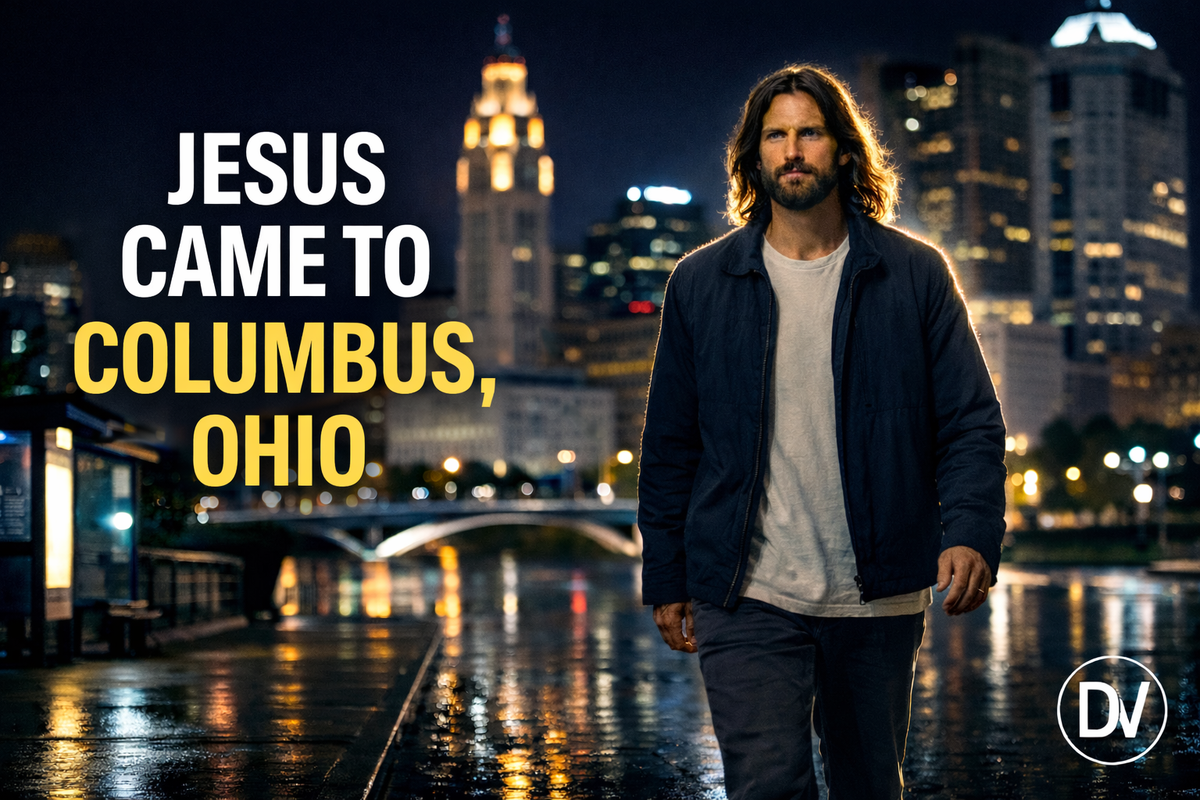
Before the first real light had settled over the water, Jesus stood near the Scioto Mile where the city was still half asleep and the river carried the soft gray of a sky that had not decided what kind of day it would become. The towers downtown were only beginning to hold shape. A few windows were lit. A runner moved in the distance with the steady rhythm of somebody who needed motion more than scenery. Traffic had not yet become noise. It was only a murmur gathering itself. Jesus bowed His head and prayed in the chill of the morning while the wind moved lightly along the river and lifted the edge of His coat. He did not pray like a man trying to escape the world. He prayed like someone standing in full awareness of it. He carried before the Father every unseen ache already rising with the city. He held the quiet dread of people waking to bills, bad news, strained marriages, chronic pain, and jobs they could not afford to lose. He held the shame people pushed down before looking in the mirror. He held the weariness of those who had stopped asking for help because they had asked too many times and nothing seemed to change. When He lifted His face, the skyline was clearer now. Columbus was waking up. Men and women were about to step into another day pretending they were fine, and He began to walk toward them.
He left the river and moved north and east through streets that were slowly filling with motion. A delivery truck backed into an alley. A woman in scrubs hurried across a crosswalk with a paper cup in one hand and her keys in the other. A man in a suit stood outside a parking garage staring at his phone with the hard expression of someone already angry and it was not yet seven. Jesus walked without hurry. He noticed the things other people passed by. He noticed the janitor dragging a heavy trash bag out from a doorway near Broad Street and how the man paused for a second to stretch his back before putting on the same blank face he would wear the rest of the shift. He noticed the young woman in a rideshare glancing at herself in the mirror and practicing calm because she had to walk into work looking like nothing in her life was slipping. He noticed a father buckling his daughter out of the back seat near a daycare drop-off, kissing the top of her head with tenderness, then sitting in the car after she went inside with both hands gripping the wheel and his eyes closed. The city was full of people trying to remain upright through force. That was the thing He kept seeing. Not loud rebellion. Not dramatic collapse. Quiet breaking. Private surrender. Lives fraying from the inside while the outside still looked acceptable enough to keep moving.
At Broad and High, a COTA bus pulled up with a hiss of brakes and a tired sway that made it look older than it was. The driver sat with both hands on the wheel for one extra second before opening the doors. His name tag read Marcus. He looked like a man who had learned how to function while carrying too much. His jaw stayed tight even when he was not speaking. His eyes had the dullness that comes from poor sleep and too many thoughts that return the moment the room gets quiet. Jesus stepped onto the bus with the others and tapped His fare card. Marcus gave Him the quickest glance and then looked away. It was the kind of glance people use when they have no energy for anything unexpected. A woman in a dark green coat boarded behind Jesus and nearly dropped her tote when her phone slid from her hand. She caught it against her chest and let out a shaky breath like she had been close to crying long before that little scare. Jesus moved down the aisle but did not sit far back. He stayed near the front where morning light came weakly through the windshield and where the driver could be spoken to without the whole bus feeling involved.
Marcus pulled away from the curb and guided the bus through downtown with the practiced movements of somebody who could do the route half asleep. Jesus watched him for a few blocks before speaking. He did not speak loudly. He said Marcus’s name with the ease of someone who had always known it. The driver looked into the overhead mirror first, then slightly to his right. There was a flash of suspicion in his face. People in cities learn to protect themselves from strange moments. “Yeah?” he said. Jesus asked him how long it had been since he had slept through a night without waking up angry. The question landed so directly that Marcus almost missed the light turning. He caught himself, pressed the accelerator, and shook his head with a dry kind of irritation. “Man, I don’t know you,” he said. “That’s true,” Jesus replied, “but I know what it is to watch a day start before your heart is ready for it.” The woman in the green coat looked up from her phone. A college student near the middle of the bus pulled one earbud out. Nobody said anything. The bus moved north through downtown, and the quiet inside it changed. It was not uncomfortable yet. It was attentive.
Marcus gave a humorless laugh. “Everybody’s got something,” he said. “That’s not news.” Jesus looked out through the windshield as they passed storefront glass catching the first honest light of morning. “Everybody does,” He said, “but not everybody admits what it is doing to them.” Marcus gripped the wheel harder. “I’m working,” he said. “That’s what it’s doing. That’s life.” Jesus let the answer sit. Then He said, “Work is not the same as peace, and motion is not the same as strength.” That hit harder than Marcus wanted it to. He said nothing for a full block. The woman in the green coat turned her face toward the window, but her expression shifted in the reflection. She was listening now in the way people listen when something said to somebody else has somehow found the exact door into them. Marcus finally spoke again, quieter this time. “You ever have somebody get tired of you being wrong?” he asked. He did not look back. “You ever wear out your own daughter because every time you talk it turns into the same thing?” Jesus said, “Yes. I have watched many fathers lose tenderness because shame kept speaking before they did.” Marcus swallowed. The bus stopped. Two people got off. A man with a coffee boarded. Nobody broke the strange sacred ordinary feeling that had settled into the front half of the bus.
The woman in the green coat sat down across from Jesus when the bus emptied a little. She looked to be in her late thirties. Her hair was pinned up in a way that had been done fast in a mirror. She held her phone so tightly that her fingers had gone pale. Marcus pulled away from another stop and kept his eyes forward. “She doesn’t answer me now,” he said. “My daughter. Seventeen. Won’t answer a call unless she has to.” The woman stared at the floor. Jesus said, “Do you want her to hear your defense, or do you want her to feel your love?” Marcus frowned. “I’m her father.” Jesus nodded. “That is not the question.” The bus rolled past the edge of the downtown government buildings where the day was gathering speed. Marcus said nothing, and the silence became a place where the truth could arrive without being forced. After a while he said, “I always start with what I meant. I always start with why I did it. I always start with why I’m not the worst guy she could have had.” Jesus looked at him gently. “Then she never gets her father first,” He said. “She gets your argument first.” Marcus blinked hard. He kept driving, but something in him had been pierced cleanly enough that he stopped hiding behind irritation. Jesus leaned back slightly and said, “You do not have to wait until you can explain everything well. Tell the truth before you protect yourself. Let your daughter hear grief in your voice, not your case.”
The woman across from Him let out a sound so small it almost disappeared under the bus engine. Jesus turned toward her. Her name was Alana, though He did not ask for it before saying it. She looked startled in the way tired people do when the world suddenly feels personal. “You are carrying three different fears and calling it one problem,” Jesus said. Her lips parted. For a second she looked like she might deny it. Then the denial died before reaching her mouth. “I’m late,” she said, which was not an answer and they all knew it. Jesus waited. Alana looked down at the lock screen of her phone where several unread notifications glowed with quiet menace. “My mother wandered out again last night,” she said. “My brother said I’m overreacting about assisted living, then stopped answering me. And if I miss one more morning meeting, my supervisor is going to move me off the project I’ve been trying to keep.” She gave a brittle laugh. “So yes. I guess that’s three.” Jesus said, “And beneath those three is the fear that if you stop holding everything, it will all fall and everybody will know you were never enough to carry it.” Her face changed. It was the face of someone hearing her private sentence spoken aloud. She nodded once, then pressed her mouth shut because tears were too near.
When the bus reached the stop near the Statehouse, Alana stood. She hesitated as though she wanted to say something wise or proper, but people breaking under pressure rarely have polished words. She only said, “I don’t know why that felt like truth.” Jesus stood with her and stepped off the bus. Morning air moved through the buildings. Behind them Marcus called out from the driver’s seat before the doors closed. “How do I start?” he asked. Jesus turned back toward the bus. “With no defense,” He said. “Not tonight. Now. On your break, send her one sentence that asks for nothing in return.” Marcus stared at Him. Then he nodded once, and the doors folded shut. The bus pulled away into traffic, and for the first time that morning Marcus’s face did not look armored. Alana stood on the sidewalk with the tote slipping down her shoulder and her eyes still wet. Across the street the Ohio Statehouse sat with its broad stone steadiness while suited workers moved in and out around it like the day was already in full command. Jesus began walking with her east along Broad Street. She did not ask how He knew her name. People do not always ask that question when they are finally in the presence of someone who sees them completely. Sometimes the deeper need is not explanation. It is relief.
She worked in the Rhodes Tower in a division most people would never think about unless some public service failed. She told Jesus that on most days she handled problems that came to her as numbers, forms, deadlines, and escalating emails. Her whole job was a kind of controlled urgency. If she did it well, nobody noticed. If something slipped, somebody somewhere was angry. She had become good at sounding calm while feeling cornered. “I used to think I was strong,” she said as they waited for the light to change. “Now I think I’m just the person in my family who doesn’t get permission to fall apart.” Jesus looked at her with such steady attention that she had to look away first. “Many people call that strength,” He said. “But some of what the world praises is only unwept grief wearing sensible shoes.” Alana let out a laugh through the beginnings of tears. It startled her that laughter could appear there. “That’s rude,” she said softly. Jesus smiled. “It is also true.” They crossed the street and walked past people carrying laptops, coffee, and the practiced expressions of urban usefulness. Columbus was fully awake now. Sirens sounded in the distance. A construction crew worked behind barriers farther down the block. A woman passed them while giving instructions into a headset so quickly that her own breathing seemed secondary. Jesus moved through it all as though none of the rush had authority over Him.
By midmorning they had reached Topiary Park, where the trimmed green figures stood in their quiet strange stillness and the trees were beginning to fill with spring life. Office workers drifted through the edges of the park on breaks. A few people sat on benches eating late breakfasts out of paper bags. Alana’s phone buzzed again and again. She did not look at it this time. She sat down hard on a bench like someone whose knees had finally admitted the truth her mind had been ignoring. Jesus sat beside her. The city noise softened there without disappearing. It made the place feel honest. Not removed from life. Just mercifully open inside it. Alana rubbed her palms together and said, “I don’t know who I am when I’m not fixing something.” Jesus said, “That is because you have been loved for usefulness more often than for being.” She shut her eyes. The sentence did not wound her because it was cruel. It wounded her because it was accurate. She told Him about being the dependable one since she was twelve. She told Him about a father who left early and a mother who praised achievement but had no language for comfort. She told Him that even now, when her mother forgot things and wandered and confused names and dates, Alana still felt thirteen when the phone rang. She still felt summoned instead of loved.
Jesus listened without interruption. That alone began to heal something she had not known could still be reached. People had heard facts from her for years. Few had listened for the deeper current beneath them. “You have made an altar out of preventing disaster,” He said after she finished. “You kneel there every day. You offer your body, your peace, your sleep, and your joy. Then you wonder why you feel empty.” Alana stared at the ground. A breeze moved across the park and lifted a strand of hair loose from her pin. “So what am I supposed to do,” she asked, “let everything burn?” Jesus turned slightly toward her. “No,” He said. “But stop worshiping your fear as though it is wisdom. Love people. Serve faithfully. Answer what is yours to answer. But do not live as though the whole world is hanging from your spine.” The tears came then, not dramatically, not loudly, but with the deep unguarded shaking of someone whose inner life had been clenched for too long. She covered her face. Jesus did not rush her. He let her cry in the daylight where office workers might pass, where the city might see, where shame could learn it was not entitled to control every moment of human pain.
When she could breathe again, He asked her to open her phone. She looked at Him with the cautious look of someone afraid obedience will cost too much. “Call the care coordinator your brother suggested,” He said. “Not because you have failed. Because love is not the same as solitary control.” She hesitated, then made the call. Her voice trembled at first. Then it steadied. She asked practical questions. She listened. She wrote down names and times and options. When the call ended, she looked both exhausted and oddly lighter, as if some hidden muscle had released. “I still have to go back,” she said. “Yes,” Jesus replied. “You do. But you will not go back as a woman trying to be steel. You will go back as a daughter of God who is allowed to be human.” The words sat between them with more kindness than she was used to receiving. She wiped her face and laughed once at herself. “I’m going to look like a mess.” Jesus looked around the park at the carved green figures, the restless branches, the ordinary people moving through lunch and deadlines and appointments. “Many of the people you fear looking weak in front of are carrying their own collapse under cleaner clothing,” He said. “Do not let a city full of pretending teach you how to disappear.”
By noon Jesus had left the park and was walking eastward again. The clouds had thickened. Columbus held that heavy daylight that makes afternoon feel tired before it has earned the right. He moved through blocks where old brick, state buildings, parking lots, churches, clinics, and apartment buildings sat close enough together that whole worlds could be separated by a single corner. He passed people on lunch breaks carrying styrofoam containers and looking at their phones instead of the day. He passed a young man asleep in a wheelchair under an awning with a hospital wristband still on his arm. He passed two construction workers arguing in low hard voices over a mistake neither of them could afford to own. He passed a mother pulling a little boy by the hand while the boy cried from the deep place children cry when they are tired, hungry, and still expected to keep up. Jesus did not treat any of it as background. Every human life He passed was alive to Him. Nothing blurred. Nothing became crowd. That was one of the differences between Him and everyone else. He did not need people to become dramatic before He cared. He saw pressure while it was still quiet.
He turned south for a while and later came back toward the area around Grant Medical Center where the air carried that strange mix of traffic, coffee, rain on concrete, and human worry that tends to gather near hospitals. There are places in every city where fear concentrates. Hospitals are among them. People walk toward those doors holding test results, private prayers, unresolved guilt, and memories they would rather not revisit. Jesus stood near the edge of the entrance drive while a light rain finally began. Not enough to send people running. Enough to make everyone lift their shoulders and hurry. A man sat alone on a low retaining wall near the side entrance, elbows on his knees, phone dead in his hand, helmet resting beside him. He wore a dark work shirt with the name of a plumbing company stitched over the pocket. He was probably in his early thirties, though fatigue made him look older. He kept staring at the pavement as if the answer to his life might appear in the pattern of wet concrete if he looked long enough. Jesus walked over and sat beside him without asking whether the space was taken.
The man glanced over with reflexive annoyance. Then he saw Jesus’s face and did not know what to do with the anger he had already prepared. His name was Darien. His mother had been brought in after a fall that morning, though the fall was only the latest thing in a longer unraveling. Darien had spent months pretending her decline was a bad stretch. He had been telling himself he still had time. He had been telling himself that next month he would arrange better care, next month he would fix the leak in her kitchen, next month he would stop missing her calls because work was busy, next month he would show up without resentment. Then one morning arrives and the deferred love of many next months feels like a brick on the chest. “I should’ve gone over there Sunday,” he said before Jesus asked anything. “She called. I saw it. I was tired and I thought I’d go Monday after work.” Rain darkened the front of his shirt. He did not move. “Now I’m out here doing the math on what kind of son that makes me.” Jesus let the sentence breathe. Then He said, “Regret always wants to sound final. It tells you that what you failed to do yesterday is the whole truth of who you are today.” Darien rubbed his face with both hands and laughed bitterly. “That sounds nice,” he said, “but it don’t change what I did.” Jesus said, “No. But it changes what you do next.”
Darien looked at Him more closely then. The rain had made the world softer at the edges. Ambulances moved in and out. Hospital staff passed with that efficient speed learned under pressure. Jesus remained steady inside all of it. “You talk like you already know me,” Darien said. Jesus answered, “I know you have been carrying exhaustion like proof that you care. I know you have been calling survival devotion. I know you loved your mother, and I know you also resented how much she needed when your own life already felt like too much.” Darien stared at Him, all pretense gone now. “Yeah,” he said, and the word came out hollow. “Yeah.” Jesus did not shame him for it. That was part of the shock of being with Him. He brought truth close without wielding it like a weapon. “Love that has grown tired is still love,” He said. “But tired love must be brought back into the light or it starts hardening into guilt.” Darien’s mouth shook once before he pressed it flat. “What if she doesn’t wake up enough to hear any of it?” he asked. Jesus looked toward the hospital entrance where strangers were carrying entire worlds behind their eyes. “Then say it anyway,” He said. “Truth spoken in love is never wasted, even when the moment is not what you wanted.”
Darien bent forward and put his face in his hands. When he looked up again, he was not fixed. He was simply honest. Sometimes that is the holier beginning. Jesus asked him about his work, about his mother’s apartment, about the brother in Cincinnati who had opinions but no presence, about the old church his mother still streamed every Sunday even when she forgot what day it was. Darien answered with the guarded surprise of somebody unused to being asked real questions without feeling judged. The rain eased. A weak stripe of light moved through the clouds. Jesus told him to go inside, sit by his mother’s bed, and stop trying to perform the right version of love. “Just be her son,” He said. “Not her manager. Not her delayed apology. Not her future promise. Be present now.” Darien swallowed hard, picked up his helmet, then hesitated. “Who are you?” he asked quietly. Jesus looked at him with the kind of gaze that does not force itself and yet seems to enter every room in a person. “I am the one still calling you while you think you are too late,” He said.
Darien went inside with wet shoulders and red eyes. Jesus remained where He was for another moment, listening to the city. Columbus kept moving. It always does. Cars flowed along Livingston. Hospital doors opened and shut. Somewhere farther off, a siren rose and faded. Above it all was the quieter sound people rarely notice in a city because they have trained themselves not to hear it. It was the sound of thousands of hearts trying to bear life without collapsing in public. Jesus stood and began walking again, because the day was not finished and there were still more people carrying burdens they had started to confuse with identity. He moved away from the hospital and back into the streets with the same calm authority He had carried from the river at dawn. The afternoon was waiting, and somewhere ahead of Him another life was about to reach the point where pretending could no longer hold.
He crossed back toward the downtown core while the rain thinned into a mist that made the glass and stone of the city look softer than they had that morning. The pressure of the day had changed shape now. Morning strain always has a forward lean to it. It is people bracing, performing, reaching, trying to outrun what they fear will happen if they slow down. Afternoon strain is different. It is heavier. It has already absorbed a few disappointments. It knows what the meeting felt like, what the text said, what the doctor did not promise, what the supervisor hinted, what the bank balance actually is, what the child did not say back. Jesus walked along High Street with that deep calm that made hurried people seem even more hurried around Him. He passed an attorney speaking sharply into a phone and then, the moment he hung up, standing still at a corner as if the conversation had cost him more than he wanted to admit. He passed a food delivery cyclist with wet cuffs and an expression emptied of expectation. He passed a woman stepping out of a building with mascara just slightly blurred beneath one eye and nobody around her noticing because everyone had become so skilled at letting quiet pain remain private. The city did not need one dramatic crisis to be aching. It was already aching everywhere.
Near the Columbus Metropolitan Library downtown branch, a young mother sat on the broad low edge of the building with a stroller turned toward her knees and a paper folder bent at the corners from being opened too many times. The toddler inside the stroller was asleep in that sweaty, flushed, loose-limbed way small children sleep when they have cried hard before finally giving in. The woman had the look of someone who had done all she could do before noon and had discovered noon was not merciful. Her name was Tiana. She kept trying to straighten the papers in the folder even though the papers were not the problem. Two denial letters sat on top. A third document had coffee spilled across the bottom edge. She was not crying. She looked beyond tears for the moment. She looked stunned in the way people look when reality keeps arriving with the exact same answer no matter how respectfully they ask for help. Jesus sat down near her, leaving enough space to honor the instinctive self-protection people carry in public.
For a while He said nothing. The library doors opened and closed behind them. A teenager came out laughing too loudly with two friends. An older man went in carrying newspapers under his arm. Traffic sighed through the wet streets. Tiana kept her eyes on the stroller and said, without looking at Him, “If you’re here to tell me everything happens for a reason, I don’t have the patience.” Jesus answered, “I am not here to make your pain smaller so it can fit inside somebody else’s sentence.” That turned her face toward Him. It was not a dramatic turn. It was the cautious look of somebody surprised not to be managed. She studied Him for a second. Then her shoulders dropped by a fraction. “Good,” she said, and the word came out tired. “Because I’m one more form away from losing my mind.” Jesus looked down at the folder. “You have been trying to secure an apartment for six weeks,” He said. “You have called places that did not call back. You have sat in offices where people spoke kindly while telling you no. You are not afraid of being poor. You are afraid of failing your son in front of his own life.” Her hand went still on the papers.
Tiana stared at Him, then out toward the street, then back at the stroller, as if the sentence had made the day feel too personal. “You know how people talk,” she said. “They talk like if you just work hard enough and stay focused and keep your attitude right, things line up. I’ve been doing all that. I have been doing everything they say to do.” Her voice thinned at the edges but did not break. “I’m working evenings at a place in the Brewery District. My cousin let me stay for a while, but she’s got her own kids and she made it clear this can’t stretch forever. Daycare is unstable. My son got an ear infection. I missed a shift. Then I got behind on the one thing I thought I still had control over.” She tapped the folder. “So now I’m sitting outside a library because it has free Wi-Fi and heat and a bathroom and I can keep pretending this is part of a normal day.” Jesus listened as though nothing else in the city required His attention more. That, too, was part of what made people speak truth around Him. He did not half-listen. He did not divide Himself.
“You have been living as though dignity depends on how well you hide need,” He said. Tiana gave a short, humorless laugh. “You ever needed help from people?” she asked. “Everybody says ask. Nobody says how humiliating it feels when asking becomes your whole life.” Jesus nodded. “Yes,” He said. “And many people who tell others to ask for help only feel generous when the help can stay tidy and brief.” Tiana looked at Him sharply, then let out a breath that was almost a sob. “Exactly,” she whispered. “Exactly.” She pressed the heel of her hand against one eye and took a second to steady herself. “I’m tired of people acting like I’m a project with paperwork,” she said. “I’m tired of acting grateful while somebody explains why my situation doesn’t fit what they can do. I’m tired of trying to sound organized so nobody thinks I’m irresponsible.” Jesus looked at the sleeping child, then back at her. “You do not need to become less human to deserve mercy,” He said. “And you are not failing your son because you have reached the end of what you can carry alone.”
She let the words in slowly, not like comfort she could immediately trust but like water arriving in ground that had gone hard. Jesus asked her the boy’s name. “Micah,” she said, softening for the first time. Jesus smiled slightly at that and asked if she had eaten. She shrugged with the reflexive dismissal of someone who has stopped counting her own hunger as urgent. He asked for the folder. She hesitated, then handed it to Him. He looked through the papers without hurry, not because He needed time to understand them, but because sometimes being seen includes having someone touch the mess without flinching. He told her to stand up. “Where are we going?” she asked. “To the next right thing,” He said. That answer would have annoyed her from almost anyone else, but something in His voice made it feel solid rather than vague. They walked with the stroller west and slightly south, crossing into streets where the afternoon had thickened and office workers were beginning to think about the end of the day even though there were still hours left in it.
He led her first to a small church office tucked between other downtown buildings where a woman named Denise handled more need than any one person should have been asked to hold, but still had not let bureaucracy kill her tenderness. Denise knew Jesus when He entered, though she did not know how she knew. She simply looked at Him, then at Tiana, then motioned them inside without making Tiana explain herself from the beginning. That alone made Tiana’s face change. So much of the cruelty of hardship is repetition. Every doorway asks for the wound in summary form. Every stranger wants the version that fits on a line. Denise made tea, found a clean set of forms that actually matched Tiana’s situation, called someone at a transitional housing contact she trusted, and spoke with the kind of plain urgency that meant she still believed mercy should move faster than red tape. Jesus did not dominate the room while any of it happened. He stayed present. He steadied the child when Micah woke crying and reached for his mother at the same moment she was trying to remember dates and sign lines. He placed a hand lightly on the stroller handle when Tiana’s breathing started climbing. “Stay here,” He said quietly. “You are not being erased because help is entering the room.” She looked at Him and nodded, though her eyes had filled.
By the time they left, nothing had become easy, but one wall had opened. There was a temporary placement possible if paperwork cleared by morning. There was a person to meet instead of a faceless process to fear. There was at least one concrete path where, two hours earlier, there had only been the blank dead-end feeling of another rejection. Tiana stepped back onto the sidewalk carrying the same folder, yet not carrying it the same way. “Why does this feel bigger than housing?” she asked. Jesus began walking again, and she kept pace with the stroller. “Because shelter is not only about rooms,” He said. “It is also about whether your soul believes it must earn the right to rest.” They moved southward through a city that was beginning to lean toward evening. The streets were fuller again. People were leaving office towers, entering shops, meeting friends, trying to create some softness after a day that had been all edges. Tiana looked straight ahead and said, “I don’t know how to rest. Even when nothing is happening, my mind is still braced for what could go wrong next.” Jesus said, “Yes. Fear has taught you to confuse hypervigilance with love.” She was quiet for several steps after that. Then she said, “My mother used to sleep like that. One ear open. One eye open. Like peace was for other people.” Jesus looked at her gently. “And now you have inherited a posture your heart was never meant to live inside forever.”
Near the Commons they stopped because Micah wanted down from the stroller and because children sometimes tug adults back into the body when the mind is spiraling too far ahead. He ran in the uneven happy bursts of a child whose world can still be rescued by open space. Tiana watched him with the grief and wonder known only to parents who love deeply while fearing they are not enough. Jesus crouched down when Micah came near and asked him about the small toy bus in his hand. Micah showed it to Him with solemn importance. Tiana smiled despite herself. For one brief minute she looked less like a woman being hunted by circumstances and more like a mother simply seeing her son. “There,” Jesus said softly, without even looking up at her. “Do not miss the life that is still happening because fear keeps shouting about the life you cannot control.” Tiana’s smile disappeared into tears almost immediately, not because the moment was ruined, but because it was too tender to hold casually. She turned away so Micah would not see the full weight in her face. Jesus stood and let her gather herself. Then He walked with them until the contact Denise had called agreed to meet her later that evening in Franklinton. When they reached the bus line that could take her closer, Tiana stopped.
She looked at Jesus as if there were ten things she wanted to say and none of them were enough. “You make me feel like God is not looking at me through a form,” she said. Jesus answered, “He never was.” She nodded, then laughed once through tears. “I know I’m supposed to say thank you,” she said, “but it feels smaller than this.” Jesus touched the stroller handle and then stepped back. “Then do not rush to reduce it into neat words,” He said. “Receive the mercy first.” Tiana bent down and kissed Micah’s hair. The bus came. She boarded with a folder, a sleeping bag rolled under the stroller, a child, and the first real breath she had taken all day. Jesus watched until it pulled away, then turned westward again. The afternoon had moved into that strange hour when a city’s exhaustion starts blending with its evening hopes. Lights began appearing in restaurant windows. Traffic thickened near ramps. The sky over Columbus opened slightly at the horizon and sent a weak gold under the clouds. Jesus kept walking.
He crossed into Franklinton as the day lowered itself toward evening. The neighborhood carried old wear, stubborn life, murals bright against brick, storefronts at different stages of struggle and renewal, and the kind of history that leaves both pride and fatigue in the bones of a place. Near COSI the river reflected a broken stripe of late light. People moved in clusters now. A couple argued quietly while walking too fast. A man waited outside a corner store with flowers in his hand and the posture of somebody rehearsing an apology. Two teenage boys skated past laughing with the beautiful recklessness of people who still think the body will always obey. Jesus turned down a side street toward a small coffee shop that filled in the early evenings with remote workers lingering too long, artists pretending not to be discouraged, people meeting before heading home to lives they were not sure how to carry. Inside, the room was warm and noisy with cups, low music, laptop clicks, tired conversation, and the smell of coffee strong enough to mask hunger for a little while.
At a table near the back sat a woman named Naomi with a laptop open, a stack of invoices beside it, and the fixed expression of somebody trying to make numbers become mercy. She ran a small freelance design business that looked flexible from the outside and felt like drowning from within. Two clients had delayed payment. One had disappeared entirely after revisions. Her rent had risen. Her father in Grove City had called earlier wanting help with something small in the tone fathers use when they do not know how to ask for companionship directly. Naomi had promised to come by next week, and when she hung up she had hated herself for hearing his loneliness and still not moving toward it. She had been divorced for three years and still used work to keep silence from becoming unbearable. Jesus ordered nothing. He simply sat across from her after asking whether the seat was taken. She looked up with polite annoyance, ready to protect her small island of overstretched concentration. Then something in His face made her pause. “Do I know you?” she asked. “More than you think,” He said.
Naomi almost smiled at the strangeness of the answer, then did not. There are days when charm feels insulting. “I’m not really in a conversational mood,” she said. Jesus looked at the invoices and then at the untouched pastry beside her elbow. “No,” He said. “You are in a collapse-managed-by-focus mood.” She stared at Him. “That is not a normal sentence.” Jesus leaned back slightly. “Neither is the life you are pretending is sustainable.” Her eyes narrowed, but not in offense. It was the narrowing of somebody deciding whether this moment was absurd or holy and not yet knowing which. Around them, the shop carried on. Milk steamed. A chair dragged across the floor. Somebody laughed near the front. Naomi closed the laptop halfway. “What do you want?” she asked. Jesus answered, “For you to stop making endurance your god.” She inhaled sharply and then laughed in disbelief. “Well,” she said, “that’s direct.” Jesus said, “You asked.”
She looked down at the pastry, then out the window where evening traffic moved under wet light. “I do what I have to do,” she said. “That is what grown people do.” Jesus nodded. “Yes. But you have gone beyond faithfulness. You have built your entire identity around being self-contained. Now every need feels like humiliation and every delay feels like annihilation.” Naomi crossed her arms. “You make me sound dramatic.” “No,” Jesus said gently. “I am describing how lonely control becomes when it is mistaken for safety.” That reached something under her defenses. She looked tired in a way makeup cannot hide and ambition cannot solve. “You ever have too many little things go wrong at once,” she asked, “and it starts feeling like the world itself is closing?” Jesus said, “Many times. That is why I am telling you not to let scarcity teach you lies about your worth.” Naomi’s eyes filled before she could stop them. She looked embarrassed by that and immediately reached for the old sharpness. “It’s not worth,” she said. “It’s math.” Jesus shook His head. “The numbers are real,” He said. “But the despair speaking through them is not math. It is fear taking every unpaid invoice and turning it into a prophecy about your future.”
She sat very still. Then words started coming out of her the way they sometimes do when someone has been strong for too long and finally meets a presence that does not require performance. She told Him about the divorce that had not only broken a marriage but had damaged her trust in her own judgment. She told Him about how freelancing had begun as freedom and slowly become an altar where every month she offered sleep, weekends, and peace just to prove she could survive without needing anyone. She told Him that sometimes, late at night, she kept working long after good sense had ended because work made the apartment feel less empty. Jesus listened. He did not rush toward solution because people are not machines that need quick adjustment. They need truth brought close enough to warm what has gone cold. “You are trying to outrun abandonment by becoming indispensable to yourself,” He said when she finished. Naomi looked away at that because it was too exact. “And how’s that working?” Jesus asked, not cruelly, but clearly. She gave a wet laugh and wiped at her face. “Badly,” she said. “Badly, apparently.”
Jesus asked whether she had called her father back after promising next week. She shook her head. “I keep thinking when things calm down.” He said, “Things have not calmed down in your inner life for years.” Naomi let that settle. Outside, the sky had deepened. The first real evening lights had taken hold. “You think I’m selfish,” she said. Jesus answered, “I think you are afraid that if you open any more room for love, the whole structure you built to keep functioning will crack.” She did not deny it. He asked for her phone. She handed it to Him before she had time to argue with herself. “Call him now,” Jesus said. “You are not promising more labor. You are moving toward love.” Naomi looked almost offended by how simple He made it sound, but she called. Her father answered on the third ring with a cautious cheerfulness that revealed how often he had learned not to expect too much. Naomi’s face changed the instant she heard his voice. The edge went out of it. Not completely, but enough to show the daughter still inside the woman. “Hey, Dad,” she said, and for once she did not speak like a project manager handling a task. She spoke softly. They talked for five minutes. Nothing dramatic happened. No revelation. No speech. They simply made plans for her to come by the next evening and bring takeout. When she hung up, tears fell without her trying to hide them. “I keep postponing tenderness,” she whispered. Jesus said, “Yes. That is one of fear’s favorite thefts.”
The door opened then and a young man stepped in, glanced around, saw Naomi, and stiffened. She stiffened too. His name was Eli. He had once been her closest friend and almost more than that, but timing, fear, bruised pride, and one terrible conversation had left them estranged. He had come only to pick up a mobile order. Seeing her there felt like walking into unfinished history. He started to turn back out, but Jesus looked at him and said his name before Naomi could pretend she had not seen him. Eli froze. Naomi stared from one to the other with disbelief written plainly across her face. “What is happening,” she said under her breath. Jesus stood and told Eli to come sit for a moment. The request was so calm that it became difficult to refuse without feeling silly. Eli approached cautiously, holding a paper bag he had not expected to carry into emotional danger. He sat on the other side of the table like a man stepping onto thin ice. Nobody spoke for several seconds. Naomi looked ready to flee. Jesus let the tension remain. Some truths need the full weight of silence before words can carry them honestly.
Finally He said, “You both grieved the same loss and blamed each other for how lonely it felt.” Naomi’s eyes widened. Eli stared at the table. Jesus continued, “You wanted honesty, but when honesty came close, both of you protected yourselves with sharpness. Then time did what time often does when pride is left untreated. It turned pain into distance and distance into a story.” Eli swallowed. Naomi folded her arms, but not in defiance now. More in self-protection. “You don’t know the whole thing,” she said. Jesus looked at her gently. “I know enough to say that neither of you has healed by rehearsing your side privately.” Eli laughed once under his breath and shook his head. “That feels unfair,” he said. “It is,” Jesus replied. “Healing often begins in the place where fairness is no longer the point.” Naomi closed her eyes. She hated how true that sounded. She also hated that she still cared enough for it to matter.
What followed was not dramatic reconciliation. It was better than that. It was honest enough to begin. Eli admitted he had disappeared because her pain had awakened his own fear of never being enough for anyone. Naomi admitted she had spoken to him like disappointment had a face and his happened to be there. Jesus did not excuse either of them. He simply kept drawing truth out from underneath the cleaner lies they had been telling themselves. By the time Eli left with his now-cold order, there were no promises and no romantic reset, but there was something more solid than a pretty ending. There was repentance without spectacle. There was clarity without cruelty. There was room again for each of them to become more honest people. Naomi sat back and looked at Jesus with exhausted wonder. “Who talks like this and somehow makes me feel more alive instead of more ashamed?” she asked. Jesus smiled slightly. “Truth spoken in love does not crush what God is trying to restore,” He said.
When He left the coffee shop, evening had settled fully across Columbus. The wet streets caught the lights from storefronts and traffic signals and turned them into long trembling colors. The city did not get quieter at night. It only changed its confessions. Daytime hides behind productivity. Evening often reveals what productivity was trying to suppress. He walked again toward the river, then northward, carrying with Him the prayers of people who did not even know they had been praying. Near the bus depot area He saw Marcus again, off his shift now, standing beside his car under a streetlight and staring at his phone like it might explode in his hand. When he saw Jesus approaching, he straightened the way men do when they feel suddenly seen in the middle of something tender. “I sent it,” Marcus said. “What you said. No defense. No asking for anything.” Jesus nodded. “And?” Marcus held up the phone. A message from his daughter filled the screen. It was short. It did not solve years. It only said, I read it. Thank you for saying that. I need time. Marcus looked at Jesus with wet eyes he was too tired to disguise. “It ain’t much,” he said. Jesus answered, “It is more than pride would have given you.” Marcus laughed and cried at once, then pressed his hand over his mouth as if embarrassed by the sound that came out. Jesus stepped closer. “Do not rush what honesty has just opened,” He said. “Stay low. Stay true. Let love grow roots where control used to live.” Marcus nodded over and over like a man being instructed in a language he had wanted for years but never heard spoken plainly.
Farther on, near the river, Alana was walking fast with her coat unbuttoned and her tote pulled tight under one arm. She had clearly left work late. Her face looked altered, not because the day had become easy, but because she was no longer carrying it alone in the same way. When she saw Jesus, she stopped as if she had half-hoped and half-feared she would. “I called the coordinator,” she said, then laughed at herself. “No. You know I did that. I mean I talked to my brother afterward. I didn’t manage him. I didn’t argue the whole history. I just told him I was scared and tired and needed him to show up like a son, not an advisor.” She shook her head in wonder. “He’s coming Saturday.” Jesus smiled. “Good.” Alana’s eyes filled in the dark and city light. “I also told my supervisor I needed one hour tomorrow morning blocked off to handle family care and that if the project suffers from one honest boundary, then the project was already consuming too much of my life.” She looked almost shocked at herself for saying it. “I thought I was going to get punished. Instead she said she understood.” Jesus said, “Many prisons are maintained long after the door is unlocked because fear has trained people not to test it.” Alana breathed out slowly and looked toward the water. “I still feel tired,” she admitted. “Yes,” He said. “But now your tiredness is not being asked to impersonate control.”
Later still, as the night deepened, He passed near the shelter contact where Tiana had gone. Through a window He saw her sitting in a chair with Micah asleep against her chest while a caseworker spoke gently across a desk. Tiana looked worn down to the bone, but the terror had lifted from her face just enough to let dignity return. She caught sight of Jesus through the glass and did not move for fear of waking her son. She only pressed one hand to her chest and bowed her head with the fragile gratitude of someone who had been kept from the edge that day. Jesus lifted His hand in a small gesture of peace and continued on. In another part of the city, Naomi was driving to her father’s house after all, pastry boxed on the passenger seat, invoices still unpaid, yet something in her no longer willing to postpone love until life became easier. In a hospital room, Darien sat by his mother’s bed and spoke out loud even while she slept, saying the true things too many sons keep waiting to say until death makes courage feel urgent. Columbus remained itself. Not every wound closed in one day. Not every relationship resolved. Not every bill vanished. But mercy had entered rooms where despair had been acting like owner.
Jesus returned at last toward the river where the day had begun. The Scioto moved dark beneath the city lights, carrying reflections that broke and reformed with the current. The wind was colder now. The skyline stood clear against the night, each lit window holding some ordinary hidden life. Somewhere a siren moved through the distance. Somewhere laughter rose from a patio. Somewhere a man sat alone in an apartment deciding whether tomorrow was worth facing. Somewhere a child slept while a mother stared at the ceiling doing mental arithmetic against fear. Somewhere a father reread a text from his daughter and understood that humility had accomplished what force never could. Jesus stood again in quiet at the water’s edge, and as He had done in the morning, He bowed His head and prayed.
He thanked the Father for every heart that had opened, even slightly. He lifted Marcus and his daughter, asking for patience deeper than apology and love steadier than old habits. He lifted Alana, asking that her soul learn the holy difference between responsibility and self-erasure. He lifted Darien and his mother, asking that regret be turned into presence before it hardened into self-condemnation. He lifted Tiana and little Micah, asking for shelter that would not be temporary only in paperwork but would become the beginning of steadier ground beneath their feet. He lifted Naomi, asking that tenderness stop being postponed in her life and that her worth never again be measured by her exhaustion. He prayed for the ones He had not spoken to directly, the thousands whose pain had brushed past Him in doorways, buses, offices, waiting rooms, sidewalks, shops, and intersections. He prayed for the city itself. For the polished and the ignored. For the powerful and the ashamed. For those numbing themselves and those begging silently for one more reason not to quit. He prayed with the calm authority of one who sees every hidden wound and does not turn away.
When He lifted His face, the river kept moving in the dark as it had before dawn. Columbus had not been conquered by spectacle. It had been visited by presence. That was often how the kingdom came near. Not only in grand reversals, though those mattered, but in truth entering the exact places where people had started believing they must carry life alone. The city behind Him still held sorrow. It still held injustice, pressure, loneliness, vanity, fear, greed, tenderness, beauty, fatigue, ambition, and mercy all braided together in the ordinary complexity of human life. Jesus did not despise any of it from a distance. He had walked inside it. He had touched the places where people break quietly. He had spoken where shame had been doing all the talking. He had reminded the weary that being human is not failure and that love can still enter the rooms fear has ruled for years. Then, with the night settled over the water and the prayer still living in the air, He turned and walked on.
Your friend,
Douglas Vandergraph
Watch Douglas Vandergraph inspiring faith-based videos on YouTube:
https://www.youtube.com/@douglasvandergraph
Support the ministry by buying Douglas a coffee:
https://www.buymeacoffee.com/douglasvandergraph
Financial support to help keep this Ministry active daily can be mailed to:
Vandergraph
Po Box 271154
Fort Collins, Colorado 80527